
Columbus City Zoning Code
CHAPTER 4
GENERAL DEVELOPMENT STANDARDS
Section 4.1.1.- Applicability.
The provisions of the Chapter, unless provided otherwise in this UDO, shall apply to all development within the City.
Section 4.2.1.- Screening Required For Trash Areas.
This Section shall apply to all trash areas, dumpsters, compacters, dumpsters and outdoor storage areas visible from any public street or from residential uses or zoning districts.
A.
Applicability. The requirements of this Section shall apply dumpsters for sanitation or recycling services that are visible from any public street or any residential use or zoning districts. For the purposes of this Section, the term dumpsters shall include dumpsters, compactors, recycling bins, trash areas and similar equipment.
B.
Minimum Requirements.
1.
Location.
(A)
Accessibility. All dumpsters shall be located so as to be reasonably accessible for trash collection by sanitation vehicles.
(B)
Distance from Residential Zoning Districts. Dumpsters shall be located a minimum of 25 feet from a residential zoning district, unless waived by the Director.
(C)
Public Rights-of-way. Dumpsters shall not be located within the right-of-way of a public street or alley.
2.
Screening. All dumpsters shall be screened from public view, from public rights-of-way and from abutting properties.
(A)
Minimum Screening. Dumpsters shall be screened on all four sides, as indicated in Figure 4.2.1.
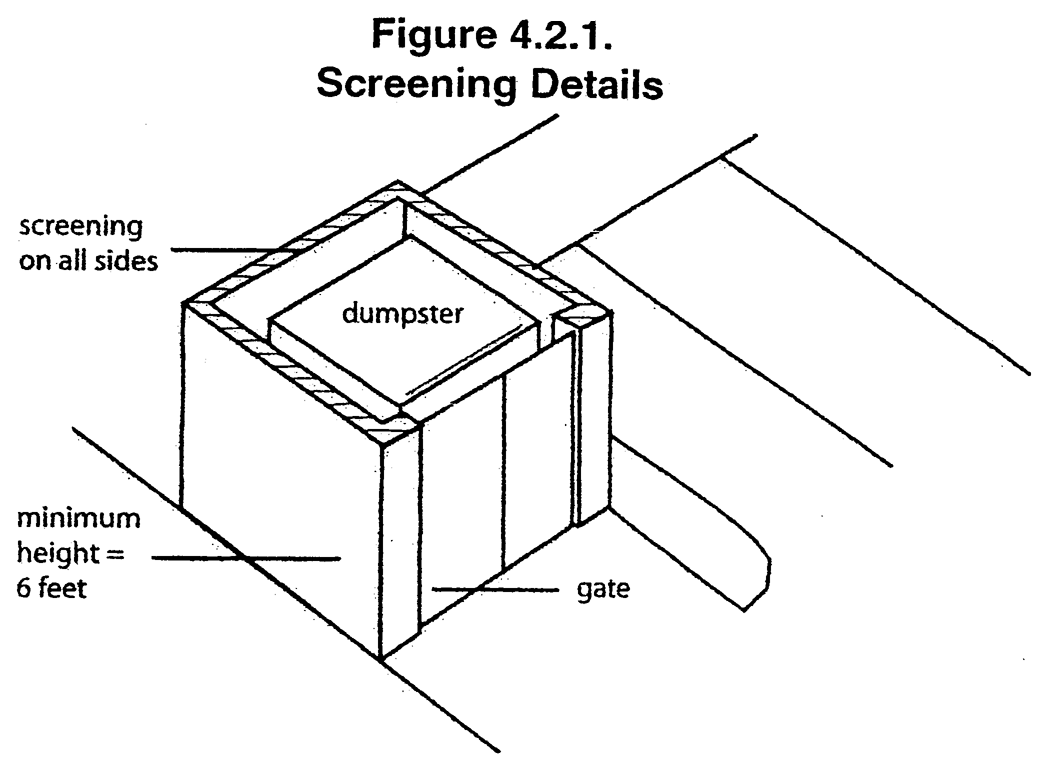
Figure 4.2.1.
(B)
Gates. Gates which must be closed when the dumpster in not is use. Gates shall be maintained in good repair.
(C)
Materials. Dumpsters screening shall be compatible with shall be screened with materials of the same architectural style, color, and materials as the principal use.
(D)
Repair. Dumpster screening enclosures shall be maintained in good repair.
(E)
Minimum Height. All screening must be a minimum of six feet high.
(F)
Surface. All dumpsters must be placed on a hard surface, of adequate size to accommodate the dumpster and garbage trucks.
(G)
Application of Standards. These standards shall apply to all existing and future development within the City. For new development, the location of these dumpsters shall be shown on an approved site plan.
(H)
Additional Standards. The City may adopt additional standards for pads or other surfaces on which dumpsters equipment are to be located.
C.
Nonconforming Dumpsters. All existing nonconforming dumpsters in the Columbus Consolidated Government jurisdiction, shall be in compliance with these regulations, with the exception of the requirement for materials as described under paragraph B.2.(C) of this Section, no later than 18 months from the effective date of this UDO. Materials used for the screening of these dumpsters shall consist of either concrete, fieldstone, brick, stucco or wood picket fence to provide for an opaque design to screen the dumpster from the public's view.
1.
Locations with Nonconforming Dumpsters. A use with a dumpster that does not conform to the requirements of this Section shall not cause the use, structure or property to be considered nonconforming.
2.
Effect of Expansion or Improvements. Any use or structure that undergoes renovation, expansion or similar improvement in an amount equal to or in excess of 50 percent of the value of improvements shall comply with the requirements of this Section.
D.
Additional Screening. The City may require installation of landscaping to provide additional screening for dumpsters visible from a public right-of-way or residential zoning district.
E.
Appeals. Appeals from decision of the Director regarding dumpsters are subject to the jurisdiction of the BZA, and appeals shall be filed as provided in Article 11 of Chapter 10.
F.
Exemptions. This Section shall not apply to the following:
1.
Single-family and duplex residential dwellings; or
2.
Temporary dumpsters, such as those placed on job sites during construction are exempt from this Section.
(Ord. No. 05-32, § 1, 4-5-05)
Section 4.2.2. - Lighting and Illumination.
A.
Intent. The intent of this Section is to limit the spillover of commercial or nonresidential lighting at or beyond a property line into property possessing a residential zoning district designation.
B.
Applicability. Unless otherwise provided in these land development regulations, the requirements of this Section shall apply in all zoning districts. The requirements of this Section shall not apply to streetlights located within public rights-of-way.
C.
Illumination Standards. Lighting standards are established in Table 4.2.1.
D.
Compliance with Illumination Standards. Any use or structure that undergoes renovation, expansion or similar improvement in an amount equal to or in excess of 50 percent of the value of improvements shall comply with the requirements of this Section.
E.
Additional Standards. Illumination installed shall comply with the standards listed below.
1.
Automatic Reduction. At 11:00 p.m. each night, all illumination, excluding security lighting, shall be automatically extinguished. This standard shall not apply to the following:
(A)
Lighting associated with an activity that is open to the public on a 24-hour per day basis;
(B)
Lighting associated with an activity that operates under extended hours of business, provided that such activity does not abut a residential zoning district;
(C)
Lighting that is required by the building code for security purposes; and
(D)
Lighting that is required for public safety purposes such as airports and jails.
2.
Lighting Plan Required. Plans for illumination of buildings, outdoor display areas, parking areas and similar uses shall be provided at the time a building permit is submitted for the following:
(A)
All new uses and structures within a commercial, industrial or other nonresidential zoning district, excluding new uses located within an existing structure;
(B)
Any use or structure within a commercial, industrial or other nonresidential zoning district subject to renovation, expansion or similar improvement in an amount equal to or in excess of 50 percent of the value of existing improvements;
(C)
All new nonresidential uses and structures, such as a place of worship, private school, public building and similar use located within a residential zoning district; and
(D)
Any nonresidential use or structure located within a residential zoning district subject to renovation, expansion or similar improvement in an amount equal to or in excess of 50 percent of the value of existing improvements.
3.
Format of Lighting Plans. Plans for illumination of buildings, outdoor display areas, parking areas and similar uses shall be provided at the time a building permit is submitted. Illumination plans shall comply with the standards listed below.
(A)
Design. Plans shall be prepared and sealed by an engineer registered in the State of Georgia, or as otherwise permitted by the Director.
(B)
Plans. Lighting plan or plans, including photometric plans, including the following information:
(1)
Overall site plan;
(2)
Vehicular and pedestrian access and circulation;
(3)
Location of parking stalls;
(4)
Adjacent property lines, including existing uses and zoning district designations;
(5)
Plan view of all fixtures, including pole and wall mounted;
(6)
Height of all fixtures;
(7)
Photometric data and statistical analysis, including foot candle values, the average maintained foot candles, the minimum foot candles, the maximum foot candles, points of calculation for foot candles, and similar information required by the Director; and
(8)
Light fixture data, including height, manufacturer, wattage, lighting type, etc.
Table 4.2.1.
Lighting and Illumination Standards
4.
Glare. Lighting produced by illumination shall not be a public safety hazard for vehicle drivers.
5.
Source not Visible. Any bulbs that are the source of lighting or illumination shall not be visible from any adjacent property line.
(Ord. No. 14-2, § 8, 1-14-14)
Section 4.2.3. - Outdoor Cafes in CRD Zoning District.
Outdoor cafes in the CRD zoning district shall comply with the standards of this Section.
A.
Definitions. Definitions relating to outdoor cafes are located in Chapter 13.
B.
Purpose and Intent. The outdoor cafe regulations as established in this Section are designed to encourage outdoor cafes on publicly-owned spaces within the CRD zoning district; to promote and protect public health, safety, and general welfare; and to provide for a more urban pedestrian environment. In addition, these regulations are designed to achieve the specific purposes listed below.
1.
Promotion of Outdoor Cafes. To encourage and promote outdoor cafes as visual amenities which in turn encourages pedestrian activities and makes the urban environment more attractive.
2.
Character. To preserve and enhance the character of the "CRD" and other commercial zoning districts.
3.
Pedestrians. To ensure adequate space for pedestrians adjacent to outdoor cafes.
C.
Operations.
1.
CRD Zoning District. A cafe shall be operated by the proprietor of the adjacent establishment, located within the pedestrian area of the public right-of-way.
(A)
Prohibited Areas. Cafes shall not be located within a state-owned right-of-way.
(B)
Clear Passage to be Provided. A minimum seven-foot wide unobstructed clear passage for pedestrians shall be maintained. The minimum distance shall be measured from the portion of the outdoor cafe frontage that is nearest to either the curb line or to the nearest obstruction.
(1)
An outdoor cafe shall not obstruct the exits and entrances of adjacent properties and shall not extend beyond the property lines of the establishment operating the outdoor cafe.
(2)
Recesses in the outdoor cafe frontage shall not be used to satisfy the unobstructed width requirement.
2.
Operation of Outdoor Cafes. A cafe shall be operated by the proprietor of the adjacent establishment, cafe operations shall not be located within the pedestrian area of any adjacent public right-of-way.
(A)
Obstruction. An outdoor cafe shall not obstruct the exits and entrances of adjacent properties and shall not extend beyond the property lines of the establishment operating the outdoor cafe.
(B)
Recesses. Recesses in the outdoor cafe frontage shall not be used to satisfy the unobstructed width requirement.
D.
Definition of Outdoor Area. A cafe shall be defined by readily removable railings or fencing or a combination of railings or fencing and landscaping in planter boxes which separates the encroachment area from the remainder of the public right-of-way.
E.
Use of Enclosed Area. The enclosure shall be used exclusively for dining, drinking and circulation therein.
F.
Enclosure. The outdoor cafe shall be open to the sky, however fixed or retractable awning or table umbrellas may be provided.
G.
Types of Service. An outdoor cafe may provide either wait service or sell take-out items to be consumed in the outdoor dining area.
H.
Location. Outdoor cafes must be located immediately adjacent to and abutting the indoor establishment which operates the cafe.
I.
Umbrellas.
1.
Anchoring. Umbrellas shall be secured and anchored with a minimum base of not less than 60 pounds.
2.
Signage. Table umbrellas shall not contain any type of sign or signage except on the fringe or valance.
3.
Traffic or Pedestrian Safety. A table umbrella shall not obstruct the clear vision of any traffic sign or traffic control signals or devices or interfere with pedestrian safety.
4.
Encroachment. An umbrella lower than six feet six inches from the walkway surface shall not encroach past the defined boundary of the outdoor cafe.
J.
Awnings.
1.
Installation. Awnings shall comply with all building and fire code requirements.
2.
Prohibited Material. The use of glass in awnings is prohibited.
3.
Minimum Height and Supports. The minimum height of the awning shall be at least eight feet from the walkway surface. Awnings shall have no support posts located within the public right-of-way.
K.
Planters, Railings and Fencing.
1.
Support. All planters, railing, and fencing placed within an outdoor cafe shall be self-supporting.
2.
Maximum Height. The maximum height of planters, railing and fencing is 36 inches. Vegetation with a planter is included in determining the maximum height.
(A)
Drainage. Water drainage from any planters onto the walkway or sidewalk is prohibited. Planters shall have saucers or other suitable systems to retain seepage.
(B)
Elevation. The outdoor cafe shall be at the same elevation as the adjoining walkway or sidewalk.
L.
Ground Coverings Prohibited. Paint, grass, artificial turf, carpet, platforms or any other surface cover or treatment of any kind shall not be placed upon the area designated for an outdoor cafe.
M.
Other Restrictions.
1.
Tables and Food. Tables may not be preset with utensils, glasses, napkins or condiments. Outdoor food preparation and the storage of food or beverages are prohibited.
2.
Music. Musical instruments or sound reproduction devices shall not be operated or used within an outdoor cafe.
3.
Maintenance. The operator shall maintain an outdoor cafe in a clean and sanitary manner at all times. Trash receptacles shall not be located in the outdoor cafe or on the adjoining walkway. All liquid, food, debris, broken glass, and other trash is be cleaned from the walkway immediately.
N.
Hours of Operation. Outdoor cafes may be open during the regular business hours of the establishment operating the outdoor cafe. If the outdoor cafe is not used for more than one week, all tables, chairs, railings, fencing, planter boxes and other furniture shall be removed from the walkway by the operator of the outdoor cafe.
O.
Sale of Alcoholic Beverages.
1.
Sale. Beer and wine are the only alcoholic beverages that may be served in the outdoor cafe area.
2.
Removal. Alcoholic beverages shall not be removed from the designated outdoor cafe. Operators are responsible for ensuring their patrons do not remove alcoholic beverages from the premises.
3.
Compliance with State Law. Sale of alcoholic beverages shall comply with all applicable state laws.
P.
Compliance. The operator shall comply with all other federal, state or local laws, ordinances and regulations, including but not limited to all applicable Health Department standards.
Q.
Closure by City Permitted.
1.
Closure. In the CRD zoning district, the City shall have the right and power, acting through the City Manager, to prohibit the operation of an outdoor cafe at any time because of anticipated or actual problems or conflicts in the use of the walkway area. Such problems and conflicts may arise from, but are not limited to the following:
(A)
Scheduled festivals and similar events;
(B)
Parades or marches;
(C)
Street or sidewalk repairs;
(D)
Demonstrations; or
(E)
Declared or undeclared emergencies.
2.
Notice. To the extent possible, an operator shall be given prior written notice of any time period during which the City will prohibit the operation of the outdoor cafe. Failure to provide prior written notice shall not affect the right and power of the City to prohibit the cafe's operation at any particular time.
R.
Encroachment Permit Required.
1.
Operation. In the CRD zoning district, an outdoor cafe shall not be operated without an encroachment permit issued by the Director of Engineering.
2.
Application for Encroachment Permit.
(A)
Proposed Encroachments. The applicant shall provide a scaled drawing of proposed encroachment locations.
(B)
Scaled Drawing. The scaled drawing shall conform to the standards and conditions set forth herein and shall provide the following information:
(1)
The proposed layout, materials, and design;
(2)
The relationship of the proposed encroachment to the curb, obstacles, existing buildings, and buildings on either side; and
(3)
Existing or projected pedestrian traffic movements.
(C)
Approval Required. Approval of the scaled drawing is required prior to operation of an outdoor cafe.
S.
Enforcement. The operator shall adhere to the scaled drawing and all requirements of this subsection. The operator shall not change, increase, or decrease the approved materials or scaled drawing layout without written authorization from the Director of Engineering.
T.
Revocation. An encroachment permit can be revoked at any time by the City by giving the operator 30 days written notice of the revocation. More than two violations of the provisions of this Article shall constitute cause to revoke the encroachment permit. There shall be no refund issued for any permit that is revoked.
U.
Certificates of Appropriateness. If the walkway area proposed for an outdoor cafe falls within the jurisdiction of the Uptown Facade Board or the Board of Historic and Architectural Review, the applicant must obtain a certificate of appropriateness from the appropriate board prior to issuance of an encroachment permit. A copy of an approved certificate of appropriateness shall be submitted with an encroachment permit application.
Section 4.2.4. - Outdoor Cafes and Seating in other Zoning Districts.
Excluding the CRD zoning district, outdoor cafes and seating shall be permitted when located on private property. Use of public right-of-way for outdoor cafes or seating is prohibited.
Section 4.2.5. - Bay or Garage Doors.
A.
Intent. The intent of this Section is to provide for the screening of day and garage doors from public rights-of-way and residential zoning districts. This requirement shall apply in all commercial, industrial, and nonresidential zoning districts.
B.
Screening of Bay and Garage Doors Required. Unless otherwise allowed by this Section, bay or garage doors shall not be oriented toward public rights-of-way or residential zoning districts.
C.
Options for Screening of Bay or Garage Doors. Screening of day or garage doors may be accomplished by one or more of the following techniques, including any combination thereof.
1.
Orientation. The bay or garage door shall be oriented at a 90-degree angle away from a public right-of-way or residential zoning district, as indicated in Figure 4.2.2. The residential orientation requirement shall not apply if the bay or garage door is located at least 200 feet from any residential zoning district.
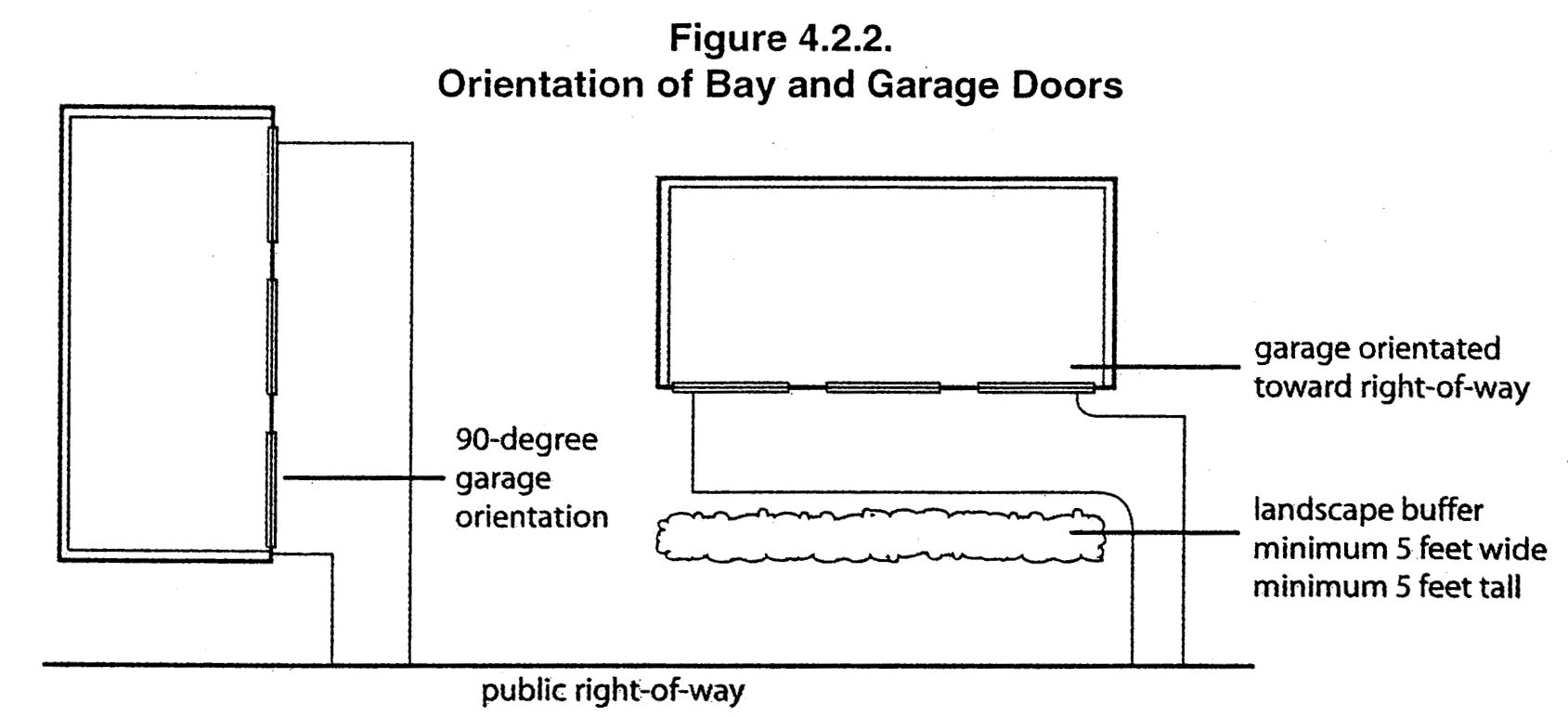
Figure 4.2.2.
2.
Increased Setback, Screening and Access Control. The building may subject to an increased building setback in order to provide each of the following site design elements:
(A)
A clearly defined vehicle entrance;
(B)
A clearly defined vehicle exit; and
(C)
A screening and landscape buffer that is not less than 10 feet in width with trees, shrubs, berms, screening walls, or any combination thereof that is located along the entire area between the entrance and exit, extends for not less than 50 percent of the width of the property, and provides screening at a height of not less than five feet;
3.
Screening Wall and Landscaping. A screening and landscape buffer that is not less than five feet in width, with trees, shrubs, berms, screening walls or any combination thereof that extends along the entire length a structure that contains bay or garage doors oriented toward a right-of-way or residential zoning district, and provides screening at a height of not less than five feet.
4.
Screening by Permanent Buildings. Screening is provided by one or more permanent buildings located between a public right-of-way or residential zoning district.
5.
Screening Wall and Buffer Requirements. For the purposes of this Section, screening and buffering shall comply with the standards listed below.
(A)
The minimum height of not less than five feet shall be achieved within 12 months of installation of the buffering and screening when vegetation is utilized for all or a portion of the installation. Height requirements shall be measured from the grade or floor elevation of the development.
(B)
All vegetation, including large maturing trees, small maturing trees, shrubs and ornamental grasses shall comply with the minimum installation size requirements of Section 4.5.10.
(C)
A screening wall shall be permanent and constructed of masonry, brick, or similar opaque materials, and shall be consistent with the color and style of the principal structure. Height requirements shall be measured from the grade or floor elevation of the development.
(D)
A berm shall average not less than one foot in height as measured across its entire length.
(E)
Large maturing trees shall be planted at a ratio of at least one tree per 50 linear feet of buffer, or portion thereof. Small maturing trees shall be planted at a ratio of at least one tree per 40 linear feet of buffer or portion thereof. One small maturing tree may be utilized for each two large maturing trees that are installed. Tree species that are installed shall comply with the recommended and prohibited tree planting list of Table 4.6.5.
(F)
When utilized in the buffer, shrubs and ornamental grasses shall be planted at a ratio of at least one shrub per two and one-half feet linear feet or portion thereof.
(G)
Vegetative material shall be maintained in compliance with Section 4.5.12.
(H)
Replacement of vegetation shall comply with Section 4.5.10.D.
(I)
Trees shall be allowed to grow to their natural height and form. Topping of any tree necessary to comply with this Section is prohibited.
(J)
Placement, installation and irrigation of all plant materials shall comply with Section 4.5.11.
D.
Exception for Residential Zoning Districts. The requirements of this Section shall not apply to residential structures in residential zoning districts.
(Ord. No. 09-40, § 1, 7-14-09)
Section 4.2.6. - Double Counting of Yards or Open Space.
Unless otherwise provided herein for such permitted activities as shared or off-site parking, any portion of a lot, yard or other open space, or off-street parking or loading space required in connection with any building or use for the purpose of complying with these regulations shall not be included as part of a lot, yard, open space, or off-street parking or loading space for any other building or use.
Section 4.2.7. - Painting or Marking of Public or Private Streets.
A.
Prohibited. Painting or marking of public or private streets of the City is prohibited, including but not limited to the following:
1.
Painting or marking any curb on any street in the City with yellow or other colored paint or material;
2.
Erecting or painting signs or lines in any street in the City indicating parking or ranking lines or places for vehicles; or
3.
Erecting or painting signs or lines of any kind indicating hours of times for parking or ranking vehicles.
B.
Exception. Painting or marking shall be permitted when authorized by the City, including the painting of addresses on a public curb face as may be permitted by the City Engineer.
Section 4.2.8. - Administrative Offices for Residential Projects.
A.
Office Permitted. An administrative office may be included within any multifamily residential project consisting of ten or more dwelling units. Offices may be located within the following zoning or overlay zoning districts:
1.
HIST;
2.
RMD;
3.
RMF1;
4.
RMF2;
5.
PUD;
6.
UPT;
7.
CRD;
8.
SAC;
9.
PCD; and
10.
PID.
B.
Residence. The administrative office may include a residential dwelling for onsite management or security.
C.
Restrictions. The office shall be used only for the operation and management of the project. Activities of any sort not related to the project are prohibited.
Section 4.2.9. - Secondary Uses for Retail Sales and Personal Services.
In multifamily, institutional, office or hotel buildings, secondary uses for retail sales and personal services shall be allowed as an accessory use, subject to the standards listed below.
A.
Minimum Size. A secondary use shall be permitted only within a permitted principal structure or use that exceeds more than 50,000 square feet.
B.
Maximum Size.
1.
Multifamily Building. Not more than 25 square feet per dwelling unit in a multifamily building.
2.
Motel or Hotel. Not more than 25 square feet per hotel or motel room.
3.
Office or Institutional Building. Not more than ten percent of gross floor area of an office or institutional building.
C.
Access and Advertising Limitations.
1.
Entrances and Access. Access to secondary uses shall be located within interior lobbies, hallways or similar areas. Exterior access is prohibited and may not be waived by the Council.
2.
Advertising. Secondary uses shall not utilize show or display window or advertising or displays that are visible from the exterior of the building or a public sidewalk or right-of-way.
3.
Storage or Display. Display or storage of goods or materials associated with a secondary use shall be located only within the interior premises of such use.
D.
Exceptions. Restaurants or cafeterias associated with a hotel or motel use may be located in a separate structure. In the HIST zoning district, a restaurant or cafeteria shall comply with the requirements of Section 3.2.41.
E.
Parking Lots or Garages. Public or private commercial parking facilities may include gasoline pumps that are completely enclosed within the principal structure.
Section 4.2.10. - Conduct of Commercial and Industrial Activities.
A.
Enclosure. Unless otherwise provided in this Section or within these land development regulations, all commercial, business, industrial and nonresidential activities shall be conducted within a fully enclosed structure.
B.
Exemptions. The requirements of this Section not apply to the following activities:
1.
All principal uses identified as wholly or partially operating outdoors;
2.
Junk, salvage or auto wrecking yard;
3.
Monument sales;
4.
Nursery and garden supply, retail;
5.
Nursery and garden supply, wholesale;
6.
Pottery, outdoor furniture and similar retail sales;
7.
Produce sales;
8.
Sale of vehicles, mobile homes, sheds and similar structures;
9.
Sign fabrication;
10.
Storage of vehicles;
11.
Temporary sales or events as provided in Section 3.2.65;
12.
Towing service; and
13.
Similar activities as determined by the Director.
Section 4.2.11. - Drive-in Windows.
Drive-in windows, including queuing areas and ordering areas shall be located, landscaped, screened, buffered, and oriented in such fashion as to minimize the impacts of noise, auto exhaust emissions, loud speakers, headlights, and similar potential nuisance items on adjacent residential zoning districts. In addition, each drive-in window shall comply with the standards listed below.
A.
Design. Drive-through facilities shall be designed to minimize conflicts between pedestrian and vehicular circulation.
B.
Separation. Each drive-through lane shall be separated from the circulation routes necessary for ingress or egress from the property or access to any parking space.
C.
Marking. Each drive-through lane shall be striped, marked, or otherwise distinctly delineated in a manner acceptable to the City Engineer.
D.
Queuing and Stacking. The queuing or vehicle stacking capacity of a drive-through facility shall be at least 100 feet. The minimum distance shall be measured from the centerline of the window closest to the edge of right-of-way from which access is provided. The stacking capacity may be increased based upon individual circumstances as determined by the City Engineer.
E.
Ordering and Pickup Facilities. The design and location of ordering and pickup facilities will be determined for a proposed use based on traffic engineering and planning data. Any request for a drive-through facility shall include the information listed below.
1.
Nature of the product or service being offered;
2.
Method by which the order is processed;
3.
Peak demand hour;
4.
Percentage of sales or business conducted via drive-through facilities; and
5.
Anticipated vehicular stacking required.
F.
Pass-by Lane. Each drive-through facility shall provide a pass-by lane separate from the drive-through lanes. The pass-by lane shall provide a minimum width of ten feet. Each drive-through facility shall provide a pass-by lane separate from the drive-through lane, when the lane is also used for parking access. The design shall be approved by the Director of Engineering.
G.
Roofing. Roofs constructed as part of a drive-through facility shall be consistent with the architectural style, materials, and colors of the principal structure.
(Ord. No. 09-40, § 1, 7-14-09)
Section 4.2.12. - Minimum Public Street Frontage Required.
Unless otherwise provided herein, a principal building shall not be constructed on a lot that possesses public street frontage of less than 25 feet.
Section 4.2.13. - Lots and Lot Coverage.
Lot coverage calculations shall not include carports, screen enclosures, swimming pools, and similar unenclosed structures.
Section 4.2.14. - Fencing, Walls and Hedges.
A.
Fencing Permitted. Fences, walls and hedges are permitted subject to the standards listed below.
1.
Maximum Height. Fences, walls and hedges not exceeding eight feet in height may be permitted in any required yard along the edge of a yard, or within a yard in any zoning district.
2.
Exceptions. Fences, walls and hedges shall not impair or block the vision of vehicle drivers so as to constitute a safety hazard.
3.
Reserved.
4.
Easements and Encroachments. Fences, walls and hedges shall not obstruct public easements nor encroach or overhang dedicated rights-of-way.
5.
Corner Rights-of-way. Fences, walls and hedges shall be at least 20 feet from any corner right-of-way line. As indicated in Figure 4.2.3, exceptions to this requirement may be granted for hedges or ground cover with a height of 30 inches or less and trees with a clear trunk of not less than eight feet. The clear trunk shall be measured from grade to the bottom of the lowest portion of the lowest branch.
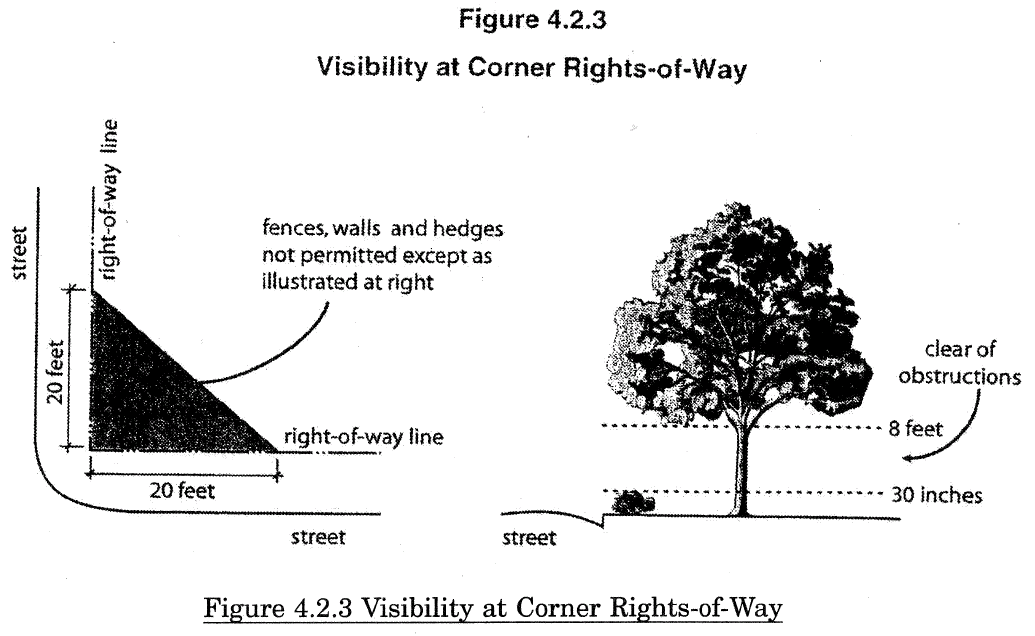
6.
Opaque Walls and Fences. When an opaque wall is required by this UDO, the wall shall not be constructed of any combination of chain link fences, screening applied to such fences, plastic or wooden slats inserted in such fence, or any similar installation.
B.
Maintenance. Fences, walls and hedges shall be maintained in good order by the owner of the property and, as applicable, shall include but is not limited to such routine items as trimming, replacement of missing vegetation, painting, and replacement of rotten or deteriorated wood or other materials.
C.
Exception. Major and minor auto repair services and salvage, disassembly or storage yard shall provide fencing as required in Section 3.2.4.
(Ord. No. 07-82, § 1, 12-11-07)
Section 4.2.15. - Calculation of Number of Stories.
A.
Attic Space. Attic space is construed as one-half story if used in whole or part for dwelling or habitable purposes.
B.
Basement as a Story. A basement shall be counted as a story for the purpose of height measurement if subdivided and used for dwelling or business purposes.
Section 4.2.16. - Conversion of Residential Accessory Structures.
Residential accessory structures may be converted to a principal residential use, subject to the requirements of this Section.
A.
Exempt Residential Zoning Districts. This Section shall not apply in the RE10, RE5, RE1 and RT zoning districts.
B.
Minimum Standards for Residential Conversions.
1.
Density. The dwelling unit shall not exceed the maximum density allowed by the Comprehensive Plan or this UDO.
2.
Minimum Lot Size. The dwelling unit shall be located on a lot that conforms to the requirements of the zoning district.
3.
Parking. The dwelling unit shall provide the required number of parking spaces.
4.
Property Development Regulations. The dwelling unit shall comply with all property development regulations of the zoning district.
5.
Creation of Lot by Subdivision. The principal structure created from an accessory dwelling shall be located on a separate lot that complies with the requirements of this UDO. The lot shall be subdivided consistent with the requirements of this UDO.
6.
Nature of New Principal Structure. The new principal structure created in accordance with this Section shall be a dwelling unit that complies with the definition of Chapter 13.
Section 4.2.17. - Exceptions to Height Limits.
In all zoning districts, the following exceptions to height limits shall apply.
A.
Exceptions. Bulkheads, chimneys, cooling towers, fire towers, gas tanks, public monuments, silos, spires, steeples, television and radio towers and wireless communications structures and towers are exempt from height limitations. Also exempt are mechanical appurtenances that are located above the roof level.
B.
Human Occupancy Prohibited. Any structure exempt from height limitations shall not be used for human occupancy.
C.
Federal Aviation Administration. All structures shall comply with height limitations established by the Federal Aviation Administration.
Section 4.2.18. - Required Yards.
In all zoning districts, the standards listed below shall apply to required yards.
A.
Obstructions or Encroachments Prohibited. Unless otherwise provided in this Section, all yards shall be unobstructed from the ground to the sky.
B.
Double Counting Prohibited. A required yard for one use or structure shall not be counted as part of the required yard for another use or structure.
C.
Encroachments. An encroachment of not more than four feet into a required yard may be allowed for one or more of the following structural features: awnings, balconies, belt courses, cornices, eaves, gutters, lintels, open porches, outside staircases, sills, and similar architectural or structural features.
D.
Double Frontage Lots. The main entrance to the building shall determine the front yard for lots with two or more street frontages.
E.
Alleys. One-half of the width of an alley abutting a side or rear yard may be included as part of the required yard.
F.
Front Yard Standards.
1.
Average Front Yard.
a.
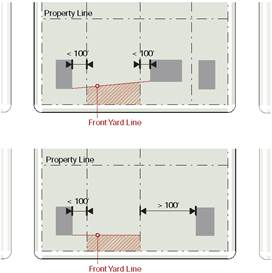
Where 40% or more of the frontage on the same side of a street between two intersecting streets is developed with buildings that have (with a variation of 5 feet or less) a front yard greater or lesser in depth than required, new buildings shall not be erected closer to the street than the average front yard established by the existing buildings.
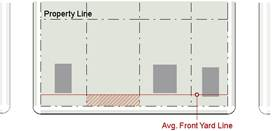
b.
Where 40% or more of the frontage on one side of a street between two intersecting streets is developed that do not have a front yard as described above, then:
i.
Where a building is to be erected on a parcel of land that is within 100 feet of existing buildings on both sides, the minimum front yard shall be a line drawn between the two closest front corners of the adjacent buildings; or
ii.
Where a building is to be erected on a parcel of land that is within 100 feet of an existing building on one side only, the building may be erected as close to the street as the existing adjacent building.
(Ord. No. 26-016, § 3, 5-26-26)
Section 4.2.19. - Number of Structures on a Lot.
Unless otherwise provided herein, this Section shall determine the number of structures on a lot.
A.
Maximum Number of Residential Structures.
1.
Single-family Dwellings. Not more than one principal dwelling shall be allowed on any lot.
2.
Multiple Family Dwellings. The number of multiple family dwellings on a lot, including two-family and three-family structures, shall be determined by the property development regulations of the underlying zoning district as established in Chapter 2, including minimum lot size, minimum setbacks and minimum building area.
B.
Minimum Distances between Multifamily Dwellings. Minimum separation distances are provided in Table 4.2.5.
Table 4.2.5.
Minimum Separation Distances for Multifamily Dwellings.
Section 4.2.20. - Minor Utility Structures Permitted in All Zoning Districts.
In all zoning districts, minor utility improvements or structures providing for public safety, public utilities, and similar elements to promote the public welfare are permitted, including such improvements as drainage facilities; fire hydrants; ground-mounted utilities support structures and poles for cable television, electricity, natural gas, telephone, and related services; lift or pump stations; postal collection boxes; public or private streets; water and sewer lines; and similar public improvements.
Section 4.2.21. - Manufacturing Standards.
A.
Manufacturing, Heavy.
1.
Hazardous Materials. May include the storage and use of flammable, toxic, or explosive materials.
2.
Outdoor Storage. These activities also may include the outdoor storage of raw or finished materials prior to processing or distribution.
B.
Manufacturing, Light.
1.
Permitted Activities. May include the manufacture, assembly, storage, distribution, and incidental sale of goods from processing, fabrication, assembly, treatment, and packaging of from materials previously prepared, processed, or partially assembled.
2.
Prohibited Activities. Light manufacturing does not include heavy industrial processing of materials, pressing, smelting, plating of metal, food processing, and similar processes.
Section 4.2.22. - Encroachments into Public Rights-of-Way.
Certain structures may be permitted to encroach into sidewalks as provided in this Section.
A.
Maximum Encroachment. Maximum encroachment shall not exceed five feet.
B.
Structures Permitted. Structures that may be permitted to encroach into public rights-of-way include the following:
1.
Awnings and canopies;
2.
Balconies;
3.
Clocks;
4.
Hanging signs;
5.
Marquees; and
6.
Projecting signs.
C.
Minimum Height. A minimum distance of at least eight feet between the top of grade and bottom of structure shall be provided.
D.
Existing Structures. As of effective date of this UDO, existing structures in a GC or CRD zoning district that encroach over or upon a public right-of-way shall be allowed to remain. Replacements for such structures, or new buildings which propose to continue such encroachments, may be permitted subject to approval of the Council, subject to an advisory recommendation provided by the City Engineer.
E.
Approval of New Structures. Structures constructed after the effective date of this UDO shall not encroach into public rights-of-way other than as provided in this Section.
Section 4.2.23. - Screening of Mechanical Equipment.
All ground-, wall-, or roof-mounted mechanical equipment associated with nonresidential buildings and structures, unless otherwise provided herein, shall be screened from public view.
A.
Screening Required. The highest portion of mechanical equipment, including but not limited to equipment, meters and valves for public utility services; satellite antennas; heating, ventilating, and air conditioning; or other utility hardware on roofs, ground, or buildings shall be installed at or below the highest level of screening materials.
B.
Screening Materials.
1.
Compatibility. Materials used for screening purposes shall be compatible with the architectural style, color, and materials of the principal building and its overall landscaping.
2.
Use of Landscaping. Screening achieved by use of landscaping must include a dense use of planting materials, or structures such as earth berms, opaque walls or fences, or combination thereof.
C.
Application of Screening Requirements.
1.
New Buildings and Structures. All buildings and structures constructed after the effective date of this UDO shall comply with the requirements of this Section.
2.
Exemption for Existing Buildings. Existing buildings or structures are exempt from the requirements of this Section.
3.
Improvements to Existing Buildings. Any building or structured that is expanded, renovated, rehabilitated or otherwise improved shall comply with this Section if the work is valued at 50 percent or more of the value of existing improvements.
Section 4.2.24. - Storage of Recreational Vehicles, Boats, and Trailers.
Storage of recreational vehicles, boats and trailers in all residential zoning districts shall comply with the requirements of this Section.
A.
Maximum Size. Vehicle size shall not exceed 32 feet in length.
B.
Salvage Prohibited. Salvage, junkyard operation, or disassembly of vehicles to obtain parts is prohibited.
C.
Outdoor Storage of Disassembled Vehicles. Outdoor storage of disassembled vehicles or parts is prohibited.
D.
Compliance with Other Requirements. In addition the requirements of this Section, storage of recreational vehicles, boats and trailers shall comply with all other requirements of this UDO and the City Code.
E.
Storage Location. Storage of Recreational Vehicles, Boats, and Trailers on the right-of-way is prohibited.
(Ord. No. 23-007, § 7, 1-31-23)
Section 4.2.25. - Key Lock Boxes.
A.
Required; exemptions. Residential structures which are not gated and do not require fire alarm or sprinkler systems.
1.
The following structures shall be equipped with a key lock box within ten feet of the main entrance, or other such location required by the Fire Chief. The lock box shall be affixed in a location of not less than four feet and not more than six feet above final grade:
(a)
Any new commercial structure
(b)
Any existing or new educational facility
(c)
Any building or facility containing a quantity of hazardous materials which would require compliance with Title III of SARA (Superfund Amendment Reauthorization Act).
(d)
Any structure requiring a new or change of occupancy.
(e)
Any existing or new gated apartment complex (can be located at designated access point but must be a minimum of 25' from two-way traffic)
2.
This section shall not apply to one- and two-family dwellings unless requested by the owner, in which case, the provisions of this section shall apply.
B.
Time for installation. All newly constructed structures subject to this section shall have the key lock box installed and operational prior to occupancy. All existing structures described in section (A) on the effective date hereof shall have 12 months to have a key lock box installed and operational.
C.
Fire Department approved padlock and gated locations. Any structure meeting the requirements of divisions (A) and (B) surrounded by a locked fence in an area barring access to the structure shall be required to utilize a padlock in conjunction with the lock which is utilized by the property/business owner, which is keyed to match the approved key lock box as defined by this section. If there are multiple locked entrances through the fence, only one shall be required to utilize the Fire Department approved lock. Any new gated apartment complex location or one which changes ownership shall install an approved lock box device allowing emergency access.
D.
Type of lock box. The Fire Chief shall designate the type of key lock box system to be implemented within the jurisdiction and shall have the authority to require all structures to use the designated system.
E.
Keys required in box.
1.
The owner or operator of a structure required to have a key lock box shall keep a key in the lock box for the following:
(a)
The main entrance door;
(b)
Alarm room (if one exists);
(c)
Mechanical and/or sprinkler control rooms;
(d)
Fire alarm control panel;
(e)
Electrical room;
(f)
Special keys to reset pull station;
(g)
Elevator keys (if an elevator exists); and
(h)
Any other room as specified by the Fire Chief.
2.
These keys shall be labeled for easy identification in the field.
F.
Rules and Regulations. The Fire Chief shall be authorized to implement rules and regulations for the use of the lock box system.
G.
Penalty. Any person, firm, corporation, or agent, in violation of any requirements set forth in this article or otherwise comply with the requirements of this article shall be guilty of an offense, punishable as set forth in Section 1-8 of the Columbus Code. Each such person shall be considered guilty of a separate offense for each and every day, or portion thereof, during which any violation of any violation of any of the provisions of this code is committed or continued, and upon conviction of any such violation, such person shall be punished as set forth in Section 1-8 of the Columbus Code. Any person violating any provision of this article shall be fined a minimum of $500.00 for the first offense and shall be fined a minimum of $1,000.00 for a second and each subsequent offense at the same property location.
(Ord. No. 24-006, § 1, 2-13-24)
Section 4.2.26. - Retail Developments of Community Significance.
A.
Statement of Purpose. Any large-scale development has the potential to affect significantly the natural environment and the value and use of adjacent properties, public water and sewer services, roadway capacity and traffic patterns, local and regional economies, and the public health, safety, and general welfare of Columbus Consolidated Government residents. Review of proposed large-scale developments is designed to insure that future land uses are suitable to the demands and needs of our citizens, while also insuring that large-scale building development is compatible with its surrounding area and contributes to the overall community character of Columbus.
The purpose of this ordinance is to achieve and maintain an overall integrity to the development through landscaping, architectural design and signage; to promote pedestrian access within the development; and to insure the long-term health of the natural environment.
B.
Applicability. The provisions of this section shall be applicable only in retail developments totaling 200,000 square feet or more of gross leasable area; or uses that result in a building of 100,000 square feet or more of gross leasable area whether by new construction or by expansion of existing uses. These sections shall also apply to all contiguous out parcels associated with the overall development.
C.
Compatibility with City Plans.
1.
The applicant shall provide, through a written compatibility report, due at the time of applying for permits or rezoning, adequate evidence that the proposed building and overall development project shall be compatible with the city's comprehensive plan and any detailed neighborhood plan for the area. The compatibility report shall specifically address the following items:
(A)
A detailed description of the proposed project and its design features;
(B)
A description of how the proposed development is compatible with adopted city plans, including the comprehensive plan, detailed neighborhood plans, and other plans officially adopted by the city;
(C)
Impact on utilities and public services, including water, sewage, storm drains, solid waste disposal, police and fire protection, emergency services, schools, and other public services;
(D)
Impact on the physical and ecological characteristics of the site and surrounding land, including wetlands, floodplain, vegetation, wildlife habitat, and other environmental conditions;
(E)
Impact on the community, including but not limited to scenic, historic, or archaeological conditions, with regard to scale, placement, lighting, landscaping, signage, parking, use of open space and design of buildings and structures; and,
(F)
A completed transportation and traffic impact analysis in a format acceptable to the Columbus Consolidated Government.
D.
Design Requirements. The following design standards must be met for each project subject to the provisions of this ordinance.
1.
Transportation/Infrastructure.
(A)
Provide interparcel vehicle access points within the development between all contiguous tracts.
(B)
All new utility lines shall be located underground.
(C)
Sidewalks, streetlights and lighting for parking areas shall be required as specified in the Unified Development Ordinance.
(D)
Raised pedestrian walkways shall be installed through parking areas.
(E)
Parking lots shall be divided into separate areas and divided by landscaped areas or walkways at least ten feet in width, or by a building or group of buildings.
(F)
Interconnected walkways shall be constructed within the parking areas of the development with trees or other landscaping features to define a pedestrian-friendly corridor system. Principal pedestrian crossings of vehicular areas shall utilize change in materials or colors and shall implement traffic calming as maybe deemed necessary to encourage low vehicle speeds.
2.
Landscaping Requirements.
(A)
At a minimum, 20 tree density units per acre shall be required. Type and size of plantings shall be in compliance with the Unified Development Ordinance's requirements for buffers and trees.
(B)
Landscaped islands throughout all surface-parking areas, as required by the buffer and tree sections of the Unified Development Ordinance, shall be provided.
(C)
A minimum ten-foot wide landscaped strip shall be provided between primary developments and adjacent out parcels.
(D)
At a minimum, landscaped strips shall be planted in accordance with the Unified Development Ordinance's requirements for buffers and trees.
(E)
The provisions of this section shall be subject to section 4.6.18 of this ordinance.
3.
Parking/Yard, Height and Setback.
(A)
Up to 25% of the required parking spaces for any development may be reduced in total area, width or depth for designated small vehicle parking. Each small vehicle parking space shall not be less than eight feet in width and 17 feet in depth.
(B)
Decorative, commercial-quality, bicycle racks, cart return areas, benches and trash receptacles shall be required and shall be approved by the director of planning.
4.
Signage.
(A)
The plan for exterior signage shall provide for modest, coordinated, and complimentary exterior sign locations, configurations, and color throughout the development, including outlots. Such signage shall complement on-building signage and shall provide a pole cover full width to the sign face with architectural design features, including color and materials common to those used in the design of the building(s) to which the sign is necessary. A minimum 100 square foot planting area shall be provided around the base of any monument sign.
(B)
Consolidated signs for multiple users may be required instead of multiple individual signs. The city may require the use of muted corporate colors on signage if proposed colors are not compatible with the city's design objectives for the area. The use of logos, slogans, symbols, patterns, striping and other markings, and colors associated with a franchise or chain is permitted, and shall be considered as contributing to the number and area of permitted signs.
(C)
The following types of signs are prohibited in these developments: portable signs; street banners; inflatable signs/flying signs; billboards; painted wall signs; bench signs; and roof signs. Signage may be internally illuminated with an opaque field to control glare.
5.
Architectural Design.
(A)
Architectural design shall comply with the following performance guidelines:
(1)
Building facades visible from roadways or public parking areas shall be of architectural treatments of glass and/or brick, stone or stucco. Tilt-up or pre-cast concrete or alternate material may be used subject to review and approval of the director of planning.
(2)
Metal sided or portable buildings shall be prohibited.
(3)
Roofing materials for pitched or mansard roofs shall be of colors compatible with the building and subject to approval and limited to the following materials:
(i)
Metal standing seam.
(ii)
Tile, slate or stone.
(iii)
Wood shake.
(iv)
Shingles with a slate, tile or metal appearance.
(v)
Other materials subject to approval.
(4)
All rooftop mechanical equipment shall be screened by parapets, upper stories, or other areas of exterior walls or roofs so as to not be visible from public streets adjacent or within 1,000 feet of the subject property, or at least equal to the height of the equipment to be screened, which ever is less. Fences or similar rooftop screening devices may not be used to meet this requirement.
(5)
Any accessories provided such as railings, benches, trash receptacles and/or bicycle racks shall complement the building design and style.
(B)
Architectural design of all buildings shall comply with the following additional performance guidelines:
(1)
To lend the appearance of multi-tenant occupancy, facades of multi-tenant buildings shall be varied in depth or parapet height.
(2)
Distinct architectural entry identity for individual tenants' entrances shall be provided for suites exceeding 10,000 square feet of leasable area.
(C)
All out parcel buildings within a proposed development shall be of an architectural character comparable to the primary structure as determined by the planning department.
(D)
Walls visible from roadways or public parking areas shall incorporate changes in building material/color or varying edifice detail such as trellises, false windows or recessed panels reminiscent of window, door or colonnade openings, landscaping or storefront every 150 linear feet.
(E)
Roof parapets shall be articulated to provide visual diversity. Parapets shall include articulations or architectural features at least every 100 linear feet. The minimum height of articulations or features shall be three feet, and may be provided in height offset or facade projections such as porticoes or towers.
(F)
Articulation of building design shall continue on all facades visible to the general public.
6.
Outdoor Storage Uses And Areas.
(A)
Exterior storage structures or uses, including the parking or storage of service vehicles, trailers, equipment, containers, crates, pallets, merchandise, materials, fork lifts, trash, recyclables, and all other items shall be permitted only where clearly depicted and labeled on the approved site plan, such outdoor storage uses and areas shall be appropriately screened as required by this ordinance. The following standards are intended to reduce the impacts of outdoor storage, loading and operations areas on adjacent land uses and to protect the outdoor area of the subject property.
(1)
Areas for truck parking and loading shall be screened by a combination of structures and evergreen landscaping to minimize visibility from adjacent streets and residential district lines.
(2)
Outdoor storage, loading and operations shall be attractively screened from adjacent parcels and streets.
(3)
Outdoor storage, trash collection and/or compaction, loading or other such uses shall be located in the rear of the lot. If because of lot configuration the director of inspections and Code determines that such placement is not feasible, then the side yard may be used, but in no case shall such area(s) be located within 15 feet of any public street, public sidewalk or on-site pedestrian way.
(4)
Seasonal merchandise such as Christmas trees, Halloween pumpkins, bedding plants, etc. may be displayed in any outdoor area up to four times per calendar year for a cumulative total not to exceed eight weeks per year.
(5)
Areas for the storage and sale of all other merchandise shall be permanently defined and screened with walls or fences. Materials, colors and design of screening walls or fences shall conform to those used as in the principal structure. If such areas are to be covered, then the covering shall conform to the colors on the building.
(6)
No product such as fertilizers, insecticides, herbicides, cement, etc., containing toxic chemicals shall be stored in any uncovered outside location where they might enter the stormwater drainage system in the event of any spillage, breakage or tearing of container.
E.
Maintenance of Vacant Buildings.
1.
The following conditions shall also apply to property owners of any vacant premise in excess of 100,000 square feet:
(A)
The property owner will maintain the exterior of the building so as to keep the appearance similar to that when the building was fully occupied. In the event the store is damaged or destroyed as a result of inclement weather, act of God, fire, or other catastrophe, the property owner will promptly notify city officials and initiate appropriate action to return the property to a safe and clean condition as soon as practical.
(B)
The property owner will maintain the landscaped areas in accordance with landscape plans approved by the city and in the same condition as such areas were maintained when the store was open.
(C)
The property owner will maintain the parking area in the same condition as such area was maintained when the store was open.
(D)
The property owner will maintain the cleanliness of the entire site by removing any trash, rubbish, or other debris deposited on the site.
(E)
The property owner will provide security patrols on the site to deter vandalism or other illegal activities on the property.
(F)
The property owner shall use good faith efforts to market and re-tenant the premise.
(G)
Should any single occupant premise in excess of 100,000 square feet become vacant for more than 60 days, and the property owner fail to maintain the property in accordance with the conditions listed above, the city may notify the property owner in writing of any such failures and in the event such failures are not cured within 30 days, the property owner shall be subject to citation by the inspections and codes division to recorder's court and shall be subject to the maximum fine permitted for ordinance violations for each violation of any provision of this ordinance or the Columbus UDO. As used in this Code section, "vacant" shall mean unoccupied for a period of 60 days or longer. Each day of any violation of any section of this section 4.2.26 shall constitute a separate offense.
(Ord. No. 06-33, § 1, 5-23-06)
Section 4.3.1.- Purpose and Intent.
This Article is intended to ensure that adequate off-street parking and loading is provided within the City. All parking and loading areas shall be designed and located for the following purposes:
A.
To serve the use for which constructed;
B.
To protect the public safety; and,
C.
To mitigate potential adverse impacts on adjacent uses.
Section 4.3.2. - Provision of Adequate Parking.
The owner, developer, or operator of a specific use site shall provide and maintain adequate off-street parking and loading to meet specific characteristics of a use or combination of uses.
Section 4.3.3. - Applicability of Article.
A.
Applicability.
1.
The requirements of this Article shall apply to all development, including new structures, alterations or improvements to existing structures, establishment of new uses, or change of use.
2.
Off-street parking shall be available for use prior to the issuance of any certificate of occupancy or occupational license.
B.
Expansion. If an existing building, structure, or use that conforms to the off-street and parking and loading requirements is expanded, the area of expansion shall comply with requirements of this Article.
C.
Change in Use. If a change of use or occupancy occurs and does not involve expansion of an existing building, the new use shall comply with the off-street parking and loading requirements of this Article.
D.
Nonconformities as to Parking. If expansion occurs to a building that does not comply with off-street parking and loading requirements, the area of expansion shall comply.
E.
Calculations. Calculations shall be rounded up to the nearest whole number.
F.
Assigned Parking. Parking spaces may be assigned to a specific use, provided the number of spaces assigned to a particular use does not exceed the number of spaces required for such use. Assigned spaces shall be indicated on the approved site plan associated with the affected use.
Section 4.3.4. - Location of Required Parking.
A.
Location. Parking facilities, unless otherwise provided herein, shall be located on the same lot as the principal use and shall provide convenient and safe access to the uses served by such facilities.
B.
Joint Access for Parking Facilities. The City may require joint access between adjacent parking facilities constructed for nonresidential or multifamily residential purposes. Joint access may be required to achieve one or more of the following:
1.
Reduce the number of entrances and exits along public roads and streets;
2.
Expand existing joint access;
3.
Increase pedestrian safety;
4.
Reduce the number of vehicles entering or exiting public roads and streets; and
5.
Increase utilization of public improvements such as frontage roads and limited access roads.
C.
Residential Parking.
1.
General. Parking spaces for all residential uses shall be located on the same lot as the principal use and shall be located as close as possible to the entrance of such principal use. Parking for second floor, loft, and similar types of parking in mixed uses shall be exempt from this requirement.
2.
Driveways. Driveways may be considered off-street parking spaces for single-, two-, and three-family and four-family dwellings. The length of the driveway must provide sufficient space to comply with the requirements of this Article.
3.
Parking within Required Yards or Setbacks.
(A)
Prohibited Parking. Parking of vehicles in any front, side, or rear setback, except on driveways or other approved surfaces, is prohibited.
(B)
Temporary Parking. Temporary parking of vehicles in a yard is permitted for social or other events held at a residence, provided such parking shall not exceed eight hours in a 24-hour period. Temporary parking in a yard due to renovation or repair of a driveway or residence is permitted for the duration of the improvements.
(C)
Parking of Commercial Vehicles and Construction Equipment. Parking of commercial vehicles and construction equipment in residential zoning districts shall comply with the requirements of Section 20-13.10 of the Code of Columbus.
Section 4.3.5. - Construction and Maintenance.
A.
General Requirements.
1.
Construction, Maintenance and Operation. Off-street parking facilities and loading shall be constructed, maintained, and operated in accordance with the requirements listed below.
(A)
Paving and Drainage. Drainage for off-street parking and loading facilities shall comply with the requirements of this UDO. Unless otherwise provided by this Article, off-street parking facilities shall be paved with concrete, asphaltic concrete, asphalt, or other materials acceptable to the City Engineer.
(B)
Maintenance. Residential and nonresidential off-street parking and loading facilities shall be maintained in proper condition, free of weeds, dust, trash, and debris. Drainage systems for off-street parking and loading facilities shall be maintained in a manner acceptable to the City Engineer.
2.
Striping. Striping of parking stalls and other traffic control features shall comply with requirements established by the City Engineer.
3.
Lighting. Lighting of off-street parking and loading facilities shall be provided in compliance with Section 4.2.2.
4.
Entrances and Exits. The City Engineer shall determine the number of entrances and exits to parking and loading facilities. Standards to assist in the location of entrances and exits include the following:
(A)
The number shall be as few as possible; and
(B)
The location shall be provided and located so as to minimize traffic congestion
5.
Other Standards.
(A)
Backing Out. Vehicles shall not be permitted to back out from parking or loading spaces into a public street or right-of-way. This requirement shall not apply to any residential dwelling located within a residential zoning district, unless precluded by public safety considerations such as daily traffic flow or the category of the street.
(B)
Off-street Stacking.
(1)
Off-street stacking distance shall be provided between the edge of right-of-way and the nearest intersecting drive aisle of a parking lot or location of a conflicting traffic movement. The minimum length of the stacking area shall depend on the number of parking spaces in the associated parking lot in accordance with Table 4.3.1.
Table 4.3.1.
Minimum Stacking Requirements
(2)
For any request to reduce stacking distance, the City Engineer shall consider lot depth, lot width, location of existing structures, existing circulation patterns, and similar factors.
6.
Screening and Landscaping.
(A)
Screening. All parking facilities and loading facilities shall be screened from adjoining uses as required in Section 4.6.11.
(B)
Minimum Clearance. Tree limbs, signs, vegetation, or other obstructions shall not impede visibility between the heights of two feet and ten feet above pavement elevation at the entrances and exits.
(Ord. No. 09-40, § 1, 7-14-09)
Section 4.3.6. - Prohibition of Other Uses.
Required off-street parking areas shall not be used for the following: the sale, repair, dismantling, or servicing of any vehicle; or the sale, repair, storage, or servicing of other equipment, materials, or supplies.
Section 4.3.7. - Structured Parking Facilities.
Parking facilities on more than one level shall be designed in accordance with the general standards established in this Section.
A.
Accessory Use. Structured parking shall be considered an accessory use to a principal commercial or industrial use. Structured parking also may be constructed as a principal use.
B.
Phasing. Construction of structured parking facilities may be phased when included as part of an approved site plan.
C.
Standards. The Director shall consider the following standards when considering an application for development approval which includes a structured parking facility:
1.
Layout;
2.
Circulation;
3.
Pedestrian orientation and circulation;
4.
Ingress and egress affecting safety and convenience;
5.
Landscaping proposed for the top and sides of the structure;
6.
Landscaping, and screening and buffering from adjacent uses;
7.
Proximity to residential zoning districts;
8.
Lighting;
9.
Appearance;
10.
Architectural treatments to minimize visual impacts, including the use of opaque screening to conceal parked vehicles from public view;
11.
Compatibility with adjacent structures; and
12.
Mass and bulk of structure.
Section 4.3.8. - Parking Stall and Bay Dimensions.
A.
Minimum Dimensions. Minimum dimensions for parking stalls are indicated in Table 4.3.1 and Figure 4.3.1.
B.
Paving. All minimum dimensions of parking spaces, travel aisles, and other vehicular circulation areas shall be paved. The City Engineer may approve use of specialty paver brick or surfaces.
Figure 4.3.1
Minimum Parking Bay Dimensions
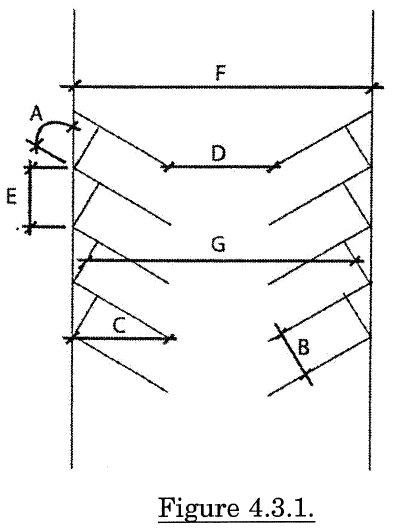
LEGEND
A=Stall Angle
B=Stall Width
C=Vehicle Projection
D=Aisle Width, One Way
E=Curb Length per Car
F=Wall to Wall Width for Double Aisle
G=Overlap Center Width for Double Aisle
C.
Parking Bays. Parking bays, which are the total of stall depth plus aisle width shall provide for adequate maneuvering and parking space. Parking bays shall be subject to the minimum standards as described in Table 4.3.1 and Figure 4.3.2.
D.
Location Near Sidewalks. Sidewalks located in front of parking spaces shall have a minimum width of six (6) feet or provide bumper stops or curbing to prevent the front of the vehicle from overhanging the sidewalks.
E.
Parking Near Property Lines. All parking must be offset three (3) feet from any property line, unless an adjacent parking/access agreement exists between adjoining property owners.
Table 4.3.2.
Minimum Parking Bay Dimensions for Residential and Nonresidential Uses
(Ord. No. 09-40, § 1, 7-14-09; Ord. No. 14-2, § 7, 1-14-14)
Section 4.3.9. - Number of Parking Spaces Required.
A.
Required Spaces. The number of off-street parking spaces required for individual uses is established in Table 4.3.2.
B.
Maximum and Minimum Number of Parking Spaces. Unless otherwise provided in this Article, the number of required parking spaces established in this Section represents both the minimum and maximum number of parking spaces to be provided for an individual use. An increase or reduction in the number of required parking spaces may be requested as provided herein.
C.
Parking Studies.
1.
Parking Study Discretionary. As indicated in Table 4.3.3, the Director may request a parking study to demonstrate compliance with overall parking demand.
2.
Mandatory Parking Study. For certain uses, a parking study is required, as indicated in Table 4.3.3.
3.
Parking Study Standards. A parking study shall comply with the standards listed below.
(A)
Preparation. The study shall be prepared by one or more of the following:
(1)
A professional engineer licensed by the State of Georgia;
(2)
A landscape architect licensed by the State of Georgia;
(3)
A planner who is a member of the American Institute of Certified Planners (AICP) or possessing the qualifications to be a member of AICP; or
(4)
An architect licensed by the State of Georgia.
(B)
Professional Standards. The study will be conducted according to commonly accepted professional practices.
D.
Unlisted Uses. For any use not listed in Table 4.3.3, the Director shall determine off-street parking requirements.
E.
Exemptions.
1.
Single-family and Two Family Dwellings. Unless otherwise provided herein, single-family and two-family dwelling units are exempt from the provisions of this Section.
2.
CRD and UPT Zoning Districts. Unless otherwise provided herein, all uses within the CRD and UPT zoning districts are exempt from the requirements of this Article.
Section 4.3.10. - Parking for Mixed Uses.
Mixed use parking shall comply with the standards listed below.
A.
Mixed Use Projects. For mixed use projects, such as a planned development, approved by the City Council with a specific percentage of individual uses, total off-street parking requirements shall be calculated based upon the requirements applicable to each individual use.
B.
Shopping Centers. For commercial shopping centers or other centers that may provide a variety of mixed uses, the parking requirements for a general retail use shall apply.
Section 4.3.11. - Change in Required Number of Spaces.
A.
Reduction in Spaces. Unless otherwise provided herein, a reduction in the required number of parking spaces may be granted as a variance by the Board of Zoning Appeals or as a waiver to a planned development approval granted by the Council.
B.
Increase or Decrease in Number of Required Parking Spaces. As applicable to the type of development order, the Director may authorize an increase or decrease in the number of parking spaces in an amount not to exceed ten percent of the required number of spaces.
C.
Additional Parking.
1.
Variance. Excluding planned developments, any application which requests an increase of parking equal to or greater than ten percent of required parking shall be considered by the Board of Zoning Appeals as a variance.
2.
Planned Developments. Any request for an increase of parking equal to or greater than twenty-five percent of required parking which affects a planned development shall be considered as request for approval of a waiver by the Council.
3.
Standards for Additional Parking Spaces. An application to provide parking in excess of the minimum requirements shall comply, as applicable, with the standards for a variance or the standards for a planned development waiver. In addition, the requests shall consider the additional standards listed below.
(A)
Additional Open Pervious Space. Additional open space, at a ratio of 1.0 square feet for each additional square foot of paved parking and vehicular circulation area, shall be provided. The additional pervious open space shall be provided as additional landscaping, pedestrian amenities, or pervious open space and shall be calculated and identified on the project site plan. This additional open space shall not be counted as complying with any open space, landscaping or other similar requirements of this UDO.
(B)
Enhanced Site Appearance. The additional open space and landscaping shall be utilized to enhance the visual appearance of the site, the vehicular entries, and the parking areas. The method for visual enhancements shall be indicated in the application for development approval.
Table 4.3.3.
Off-Parking Street Parking Standards
D.
Bicycle Parking in Lieu of Minimum Parking.
1.
Applicability. Commercial buildings and multi-family residential buildings may elect to reduce their minimum parking requirements by providing bicycle parking at a rate of exchange of one standard parking space for every eight units of bicycle parking provided. Maximum allowable exchange will be determined by the Planning Director on a case by case basis.
Rate of exchange
2.
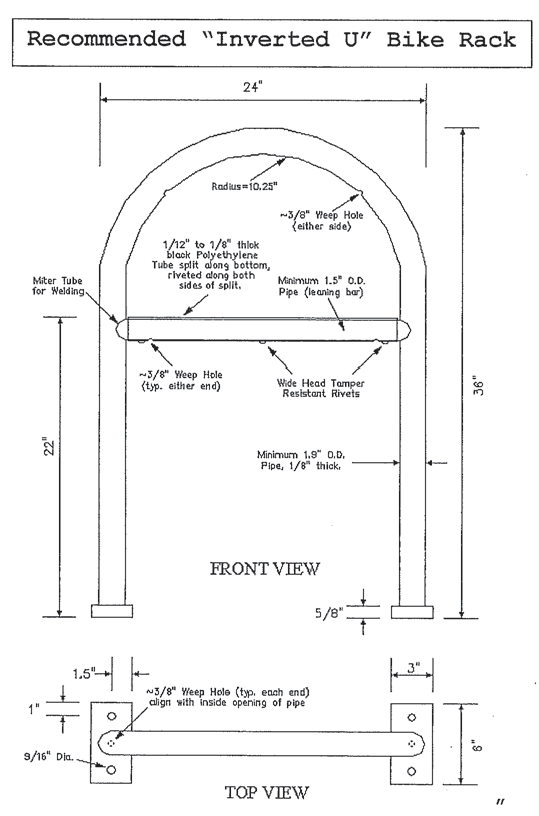
Function and Design. The recommended bike rack by the Association of Bicycle and Pedestrian Professionals is the inverted "U" design. This design is economical, secure, and well designed to meet the needs of many types of bicyclists and bicycles. Other designs may be used provided that they meet the functional criteria described below.
Functional Criteria:
(A)
Shall support the bicycle frame in at least two places.
(B)
Must be designed in such a way as to allow the use of both cable and "U" locks.
(C)
Must be designed in such a way as to allow bicycles with different types of frames to lock to the rack.
(D)
Must be made of a material that is weather resistant and is difficult to cut with hand tools or saws.
(E)
The racks shall be cemented or bolted into concrete to prevent theft or vandalism.
3.
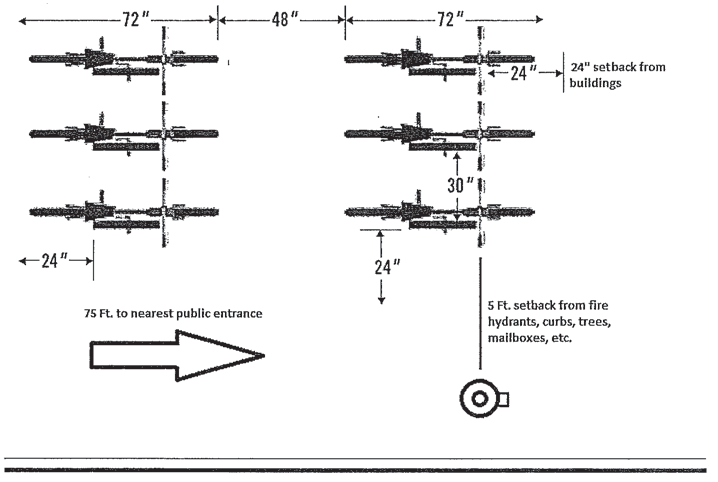
Placement and Setbacks. The bicycle racks must be placed within 75 feet of an entrance and in a visible, well-lit area. The bicycle racks may be placed in separate locations on the property but may not be reduced to fewer than two racks per location. Bicycle racks must be at least 24 inches away from buildings and five feet away from fire hydrants and infrastructure. The minimum distance between two bike racks placed side by side should be no less than 30 inches. If the bike racks are to be located within a parking lot or area with traffic, it is recommended that physical buffers or signage be created to protect bicyclists and notify vehicles to exercise caution.
(Ord. No. 05-32, § 1, 4-5-05; Ord. No. 09-40, § 1, 7-14-09; Ord. No. 15-43, § 1, 9-8-15; Ord. No. 15-55, § 3, 11-17-15; Ord. No. 23-007, § 5, 1-31-23; Ord. No. 24-061, §§ 3, 5, 10-22-24)
Section 4.3.12. - Shared Parking.
A.
Permitted. The Council, may, as part of an approval of a new or expanded use, new construction, substantial renovation, or alteration or expansion of an existing site, approve the use of shared parking to reduce overall parking requirements. The basis for approval of an application to establish shared parking includes the factors listed below.
1.
Complementary Uses. Use of a building or structure for two or more uses which possess complementary, rather than competing, peak hours of usage.
2.
Shared Parking Study. Preparation, in a professionally accepted manner, of a shared parking study by a qualified professional as indicated in Section 4.3.12.
3.
Development Order. Any development order approved by the Council which includes the use of shared parking shall include a separate agreement for shared parking. The agreement, at a minimum, shall include the provisions listed below.
(A)
Provide one or more specific methods to re-assess the agreement if future parking problems or changes in use occurs.
(B)
Provide a legal description of the land and structures included within the agreement.
(C)
Provide for a term of the agreement of at least five years.
(D)
Provide a site plan to indicate specific uses, hours of operation, location of parking facilities, and similar information required to illustrate the operation of the shared parking.
(E)
Assure the availability of all parking spaces affected by the agreement for a period not less than the term of the agreement.
(F)
Provide for the termination of the agreement if there is a change in the uses supporting shared parking agreement, and require each individual user to comply with all applicable parking requirements.
B.
Amount of Parking. The amount of parking provided pursuant to a shared parking agreement shall be determined as follows:
1.
Multiply the individual uses by the minimum required parking percentages per time period as contained in the five vertical columns of Table 4.3.4;
2.
Add the sum of the calculations; and
3.
The required parking is the largest number of spaces resulting from the calculations.
Table 4.3.4.
Shared Parking Calculations
Section 4.3.13. - Off-Site Parking.
A.
Permitted. Off-site parking is permitted, subject to the standards of this Section.
B.
Zoning District. Off-site parking shall be permitted only within a nonresidential zoning district.
C.
Maximum Distance. Not more than 500 feet shall separate the nearest public door of a use and the nearest property line of the lot utilized for off-site parking.
D.
Measurement of Distance. Distance shall be measured based upon public pedestrian circulation patterns.
E.
Agreement for Off-site Parking. An agreement for off-site parking shall be approved, subject to the requirements of Section 4.3.13.
Section 4.3.14. - Off-Street Loading Requirements.
A.
Required. Off-street loading facilities shall be provided as required in this Section.
B.
Legal Nonconformities. This Section does not require installation of off-street loading facilities for uses that exist upon the effective date of this Code.
C.
Change of Use. The City may require installation of required loading spaces when a change in use of any existing structure occurs. The installation may be required based upon such factors as the square feet occupied by the new use, operational characteristics of the new use, existing traffic circulation patterns, traffic safety or similar circumstances.
D.
Expansion or Alteration. Any uses or structures which are enlarged, expanded, or changed, shall provide the required off-street loading facilities for the additional increment of the enlarged, expanded or changed use or structure.
E.
Size of Loading Spaces. Off-street loading spaces shall comply with the minimum dimensions indicated in Table 4.3.5.
Table 4.3.5.
Minimum Dimensions for Loading Spaces
Section 4.3.15. - Required Number of Loading Spaces.
A.
Number of Spaces. The required number of loading spaces is indicated in Table 4.3.6.
B.
Applicability. Off-street loading spaces shall comply with the requirements of Table 4.3.6 and shall be applicable to all structures containing commercial, business, industrial, manufacturing, storage, warehousing, processing, offices, hotels, hospitals, airports, railroad terminals, and similar uses as may be required by the Traffic Engineer.
Table 4.3.6.
Minimum Number of Loading Spaces
C.
Exception. Hotels and motels shall provide loading spaces based upon the number of rooms. An application for development order approval for a hotel, or which includes a hotel, shall provide a study documenting the number of loading spaces to be provided.
D.
Cooperative Establishment and Use Of Facilities. Two or more neighboring uses may establish common off-street loading facilities, subject to approval by the City Engineer. The total number of common off-street loading spaces shall not be less than the number required for individual users, unless otherwise approved by the City Engineer. Criteria for reduction in the total number of off-street loading spaces include the following:
1.
Times of usage of the truck loading facilities by the individual users;
2.
The location of the proposed common facilities; and
3.
The character of the merchandise involved.
E.
Other Requirements. In order to establish common off-street loading facilities, the standards listed below are applicable.
1.
Consent. Written consent is obtained from all affected property owners.
2.
Written Agreement. All conditions relating to the use, location, construction, and maintenance of the common facilities will be provided in a written agreement.
F.
Location. Except as otherwise provided, off-street loading facilities shall be located on the same property that they serve.
G.
Residential Zoning Districts. An off-street loading facility may be located within 50 feet of a residential zoning district if hours of operation begin at or after 7:00 a.m. and end not later than 11:00 p.m. For the purposes of this Section, hours of operation shall not include routine maintenance, cleaning or similar activities within a building.
H.
Enclosure. The City may require off-street loading facilities to be enclosed to minimize visual impacts, noise, and related effects on adjacent property owners.
I.
Refrigerated Trucks. Refrigerated trucks and other trucks which require compressors, engines, refrigeration equipment, and similar equipment to be continuously or periodically operational shall not park within 250 feet of any residential zoning district during the hours of 7:00 p.m. to 7:00 a.m. on weekdays, and 7:00 p.m. to 9:00 a.m. on Saturday and Sunday.
J.
Circulation. Access and maneuvering areas, ramps, and other vehicular circulation areas associated with such facilities shall not be located on a public or private street right-of-way. All vehicular circulation shall be so arranged that the vehicles are not required to back from the street into the facility nor required to back from the facility into a street or other public-right-of-way.
K.
Construction and Maintenance. Off-street loading facilities shall be constructed, maintained, and operated in accordance with the standards listed below.
1.
Drainage and Paving. Off-street loading facilities shall be properly graded for drainage and paved with concrete or asphaltic concrete consistent with City standards.
2.
Maintenance. Off-street loading facilities shall be maintained in good condition, free of weeds, dust, trash, and debris.
3.
Lighting. Lighting facilities shall be so arranged that the source of light does not shine directly into adjacent residential properties or into traffic on adjoining streets.
4.
Entrances and Exits. Entrances and exits to the facility shall be located so as to minimize traffic congestion or prevent vehicles from backing from the street into the facility. Streets, alleys, or other public rights-of-way shall not be considered part of an off-street loading facility.
5.
Striping. All off-street loading spaces shall be striped and clearly marked in a manner consistent with City standards.
(Ord. No. 09-40, § 1, 7-14-09)
Section 4.4.1.- Purpose and Intent.
The purpose and intent of this Article is to establish a set of standards for the design, installation maintenance and removal of signs within the City. The City of Columbus, Georgia wishes to regulate signs within its jurisdictional boundaries under its police powers to accomplish the goals listed below.
A.
Public Health. To promote and protect the general public health, safety, and welfare of the community.
B.
Community Appearance. To promote and protect the community's appearance by regulating the design, location, type, illumination, and maintenance of signs.
C.
Regulate Use. To regulate the use of signs which provide direction and aid orientation for businesses and activities.
D.
Hazards. To prevent possible traffic and safety hazards through good signage.
E.
Revitalization. To revitalize areas of the City by reducing sign clutter and thus improving appearance.
F.
Environmental Setting and Appearance. To provide a pleasing overall environmental setting and community appearance this is deemed vital to tourism and to the continued economic attractiveness of the city.
G.
Variances. To accomplish each of the foregoing goals in a manner consistent with promoting the robust marketing atmosphere of the City and allowing the property owners, retailers, and merchants to continue to adequately advertise their services and products so that any requested variances will be carefully considered taking into consideration the marketing and advertising needs of the citizens of the City as well as the needs of the City in enforcing this Article.
Section 4.4.2. - Definitions.
Definitions for this Article are provided in Chapter 13.
Section 4.4.3. - Review of Sign Applications.
All sign applications must be reviewed and approved or denied by the Director of Inspection and Codes, within fifteen working days of the date of the application.
(Ord. No. 05-32, § 1, 4-5-05; Ord. No. 09-40, § 1, 7-14-09)
Section 4.4.4. - Exempt Signs.
Except as otherwise provided, the following on-site signs may be erected without securing a permit, subject, however, to the terms and conditions contained herein and meeting all other applicable codes and regulations.
A.
Address Signs. Address or identification sign for residences, estates, farms, and ranches. Such signs must not exceed one square foot in area.
B.
Individual Residential Lots. Signs for individual residential lots
1.
Number. Signs must not exceed one in number.
2.
Maximum Dimensions. Signs shall have a maximum size of six square feet, six feet in height, and with a ten foot minimum setback.
C.
Sale, Lease or Rental Signs. Signs advertising the sale, lease, or rental of property.
1.
Number of Signs. Such signs shall be limited to one per street frontage per property.
2.
Maximum Dimensions. Signs shall not exceed six square feet in area in residential districts or 32 square feet in other districts.
3.
Location and Removal. Signs must be displayed on the property advertised for sale, lease, or rent. The signs must be removed no later than seven days after the sale, lease, or rental of the property.
D.
Builder's Name. Signs indicating the builder's name.
1.
Number of Signs. Such signs shall be limited to one per street frontage per property.
2.
Maximum Dimensions. Signs shall not exceed six square feet in residential district or 32 square feet in other districts.
3.
Location and Removal. Signs must be displayed on the property advertised for sale. The sign must be removed no later than seven days after the sale of the property.
E.
Associated Professionals Signs. Signs indicating the architect, engineer, project name, source of financing, and contractors when displayed during the construction period on a construction site.
1.
Maximum Dimensions. Such signs shall not exceed four square feet in area in residential districts or 16 square feet in other districts.
2.
Location and Removal. Signs must be displayed on the construction site. All signs must be removed seven days after the issuance of the certificate of occupancy.
F.
Ground or Monument Signs.
1.
Sign Permitted. A permanent ground or monument sign with a sign surface area of 15 square feet or less in a commercial, industrial, or RO zoning district.
2.
Exemption. This is not an extra sign, but is ground or monument sign authorized by Section 4.4.10.
G.
Specific Exemptions. Any sign inside a building and any sign attached or painted on a building below roofline in a nonresidential zone. This includes signs on windows, awnings, canopies, and walls and includes projecting signs and marquis signs.
H.
Governmental Signs and Legal Notices. Governmental and legal notices, including signs required by federal and state regulations.
I.
Flags. Flags attached to freestanding poles mounted on the ground, or mounted on a building.
1.
Number. Not more than three in number.
2.
Commercial Use Prohibited. Flags shall not be used in such a way as to attract the attention of the public for commercial purposes.
J.
Directional Signs. Directional signs, with copy not to exceed three square feet in area.
K.
Symbols. Symbols or insignia including religious symbols, commemorative plaques of recognized historical agencies.
L.
Holiday Decorations. Holiday decorations, lights or displays with no commercial messages erected in connection with the observance of holidays.
M.
Incidental Signs. Incidental signs limited to information or direction related to the permitted use on the lot or building or a directory sign within an office park, industrial park, hospital campus, school campus, or within the confines of any other similar development.
N.
Vehicle Signs. Signs attached to or painted on a licensed vehicle for the purpose of advertising a business or service or advertising the sale of a vehicle by a licensed car dealer.
O.
Banners.
1.
Permitted Zoning Districts. Banners used in commercial, industrial, or RO zoning districts.
2.
Location and Attachment. Banners must be attached at all corners to a permanent principal structure or canopy.
P.
Multifamily Building Signs. Multifamily building identification signs, addresses and parking lot identification signs for an individual building.
Q.
Menu Board Signs.
1.
Permitted. Menu boards shall be permitted in UPT and CRD zoning districts.
2.
Maximum Number. One menu board shall be allowed per business.
3.
Maximum Size. Boards shall not exceed nine square feet in size.
4.
Permitted Location. Boards shall be positioned so as to be adjacent to that business whose menu is listed on the board and be placed in a manner clearly visible to pedestrian traffic.
5.
Rights-of-way. Menu boards shall not be placed in a City right-of-way without permission from the City's Traffic Engineer.
6.
Removal. All menu boards shall be removed at the end of each business day.
R.
Drive-Thru Menu Boards. Drive-thru menu boards set back beyond building line.
(Ord. No. 09-40, § 1, 7-14-09)
Section 4.4.5. - Prohibited Signs.
All signs not expressly permitted under this Article or exempt from regulation in accordance with this Article are prohibited within the Columbus Consolidated Government. Such signs include, but are not limited to the signs listed below.
A.
Conflicts with Traffic Control Signals. Lights or signs that by color, location, or design resemble or conflict with traffic control signs or signals.
B.
Unshielded Illumination. Unshielded illuminated devices that produce glare or are a hazard or a nuisance to motorists or occupants of adjacent properties such as sealed beam, flood or spotlights.
C.
Noise and Sounds. Signs that produce noise or sound capable of being heard even though the sound produced are not understandable sounds.
D.
Emitting Signs. Signs that emit visible smoke, vapor, particles, or odor.
E.
Natural Features. Signs attached to trees or painted or drawn upon rocks or other natural features except posted on property or "no trespassing" signs less than three square feet.
F.
Unlicensed Vehicle Signs. Signs attached to or painted onto an unlicensed vehicle parked on and visible from a street, except on a licensed auto dealership property.
G.
Bench Signs. Bench signs in public right-of-way or within 30 feet of street or public right-of-way.
H.
Revolving Signs. Revolving signs.
I.
Roof Signs. Roof signs.
J.
Decorative Signs. Decorative items/deluxes/ornamentation.
K.
Moving Signs. Flappers/moving signs.
L.
Signs not Otherwise Identified. Any other sign not authorized as exempt from permitting or otherwise specifically authorized by this Article.
Section 4.4.6. - Temporary Signs.
Temporary signs shall be permitted subject to the requirements of this Section.
A.
Temporary Sign Permit Required. A temporary sign may be erected only after obtaining a temporary sign permit from the inspections and code enforcement division.
B.
Prohibited Locations. A temporary sign shall not be erected in a residential zoned district.
C.
Time Limitations. A temporary permit cannot be obtained for the same property within a period of 30 days after the expiration date of a previous temporary permit.
D.
Removal. If any temporary sign is not removed by the expiration date of the permit, the Building Official may remove it and charge the costs of removal to the individual or enterprise responsible.
E.
Permitted Temporary Signs. Permitted temporary signs are listed below.
1.
Civic Event Signs. Special event signs, banners, and directional signs directing the attention of the public to special events sponsored, in whole or in part, by the City or by religious, charitable, nonprofit or public service groups may be erected on public property with the approval of the City Manager.
(A)
Such signs shall be nonilluminated.
(B)
Such signs shall be allowed 30 days prior to the event and must be removed within five days following the event.
(C)
Notwithstanding any other provision of this Code section, the City Manager may approve banners for placement on public rights-of-way recognizing an enterprise zone or redevelopment area on file with the Planning Division for a period not to exceed 12 months.
2.
Temporary Signs For New Businesses. A new business or a business in a new location with no permanent signs may obtain a temporary permit for a sign for 90 days.
(A)
The maximum size of said sign shall be 32 square feet.
(B)
The sign must be removed at the end of 90 days or when permanent sign is erected or a permanent permit is issued for the sign.
3.
Inflatable Signs and Advertising Balloons. A temporary permit for 15 days per property may be granted for the use of on-site inflatable signs/advertising balloons.
(A)
A temporary permit shall be obtained for not more than one time in a six-month period.
(B)
The required setback is 20 feet from the right-of-way.
(Ord. No. 05-79, § 1, 10-25-05)
Section 4.4.7. - Portable Signs.
A.
Annual Permit Required. A portable sign may be used only after obtaining an annual permit from the Department of Inspections And Codes, and only under the conditions listed below.
B.
General Standards. The standards listed below are applicable to portable signs.
1.
Maximum Size. Maximum size of 72 square feet.
2.
Illumination. No flashing illumination.
3.
Minimum Setback. Set back a minimum of three feet from the right-of-way.
4.
Permitted Zoning. Such signs may be allowed on residentially zoned property when associated with special events sponsored in whole by religious, charitable, nonprofit or public service groups, and shall only be allowed with the approval of the Inspections and Code Department 30 days prior to the event and must be removed within five [days] following the event.
5.
Maximum Number. Only one portable sign allowed per street frontage.
6.
Electrical Code Compliance. Every sign capable of illumination must comply with the National Electrical Code.
(Ord. No. 07-82, § 1, 12-11-07; Ord. No. 09-40, § 1, 7-14-09)
Section 4.4.8. - Signs in the Public Right-of-way.
A.
Generally. It shall be unlawful to erect, maintain or place any permanent sign upon the right-of-way of any public streets and thoroughfares unless authorized by the City for the following purposes.
1.
Public Notice and Information. Permanent signs erected by or on behalf of a governmental body to post legal notices, identify public property, and to convey public information.
2.
Bus Stops. Bus stop signs.
3.
Traffic Signs. Regulatory signs giving notice of traffic laws or regulations.
4.
Warning Signs. Warning signs calling attention to conditions on, or adjacent to, a highway or street that are potentially hazardous to traffic operation.
5.
Guide and Information Signs. Guide signs showing route designations, destinations, directions, distances, services, points of interest, and other geographical, recreational or cultural information.
6.
Service Signs. Service signs providing travelers with business identification and directional information for essential motorist services.
7.
Recreation and Cultural Signs. Recreational and cultural area signs used to direct persons to facilities, structures, and places, and to identify various services available to the general public.
8.
Emergency Warning Signs. Emergency warning signs erected by a governmental agency, a public utility company, or a contractor doing authorized or permitted work within the public right-of-way.
9.
Flags. Flags erected by local, state, or federal officials or their designees.
10.
Entrance and Exit Signs. Authorized entrance and exit signs with no advertising less than 2.5 square feet.
11.
Identification Signs. Subdivision, apartment, office park signs, and industrial park signs authorized by City or approved on plat of subdivision, apartment, office park, or industrial park, provided such signs contain no additional form of advertising.
12.
Pole Banners. Pole banners erected by local, state, or federal officials or their designee.
B.
Design Standards for Signs in a Public or Private Right-of-way. Design standards for signs erected in a public or private right-of-way shall be according to the Federal Manual on Uniform Traffic Control Devices.
C.
Violations. Any signs installed or placed on public property, except in conformance with the requirements of this Article, shall be forfeited to the public and subject to confiscation.
1.
Event Signs. Event organizers, promoters, or their representatives of specific events advertising on public property, shall be deemed responsible.
2.
Removal Costs. In addition to other remedies cited in this Article, the City shall have the right to recover from the owner or person placing such a sign the full costs of removal and disposal of such sign.
(Ord. No. 08-66, § 1, 11-25-08)
Section 4.4.9. - Sign Number and Area Computation.
The following sign standards specify the number, types, sizes, heights, and locations of ground and monument signs which are permitted in Columbus, Georgia and which require a permit.
A.
Determining the Number of Signs. In determining the number of signs, a sign shall be considered a single sign if the following applies:
1.
Unit Created. A single display surface containing elements organized to form a unit.
2.
V-Type or Multiple Sided Signs. A V-type or multiple-sided sign shall be regarded as one sign as long as the sides are not separated by a distance exceeding 20 feet.
3.
Double Face Signs. With respect to a double faced (back to back) signs, the distance between the backs of each of the sign does not exceed three feet.
B.
Determining Total Sign Surface Area. In measuring the area of signs permitted under these regulations, the entire face of the sign (one side only) and any wall work incidental to its decoration shall be included.
1.
Double-faced or V-Shaped Signs. A double-faced or V-shaped sign constituting a single sign as identified in this Section, where both sides contain lettering or other allowable display, one side only shall be used to compute the allowable size of the sign.
2.
Multiple Faced Signs. With respect to multiple-sided signs, the sign surface area shall be computed by measuring the sum of the area of any two adjacent sides.
3.
Exception to Area Calculations. If a double faced, V-shaped or multiple-sided sign is separated by a distance greater than that allowed to be considered a single sign, then the signage area is measured as the sum of the area of all sides.
4.
Individual Letters or Irregular Signs. Where the sign consists of individual raised letters or a sign face of irregular shape, the sign area shall include the area of the smallest rectangle that can encompass the letters or sign face, exclusive of its supports.
C.
Determining the Height of Signs.
1.
Measurement of Height. The height of a sign erected shall be the distance above the grade level at the foot of the sign structure to the top of the sign or sign structure.
2.
Elevated Grade Levels. In instances where the level of the road or highway is elevated, the maximum height of the sign and its structure shall be the distance above the grade level of the road or highway at the point nearest the sign and its structure.
D.
Minimum Setbacks. All signs and sign structures must be located at least three feet from any property line and outside of all intersection sight distance lines.
Section 4.4.10. - Ground and Monument Sign Size and Height.
A.
Generally.
1.
UPT and CRD Zoning District Ground/Monument Sign. 1 sign. 150 square feet; 20 feet high.
2.
NC, RO, CO, GC, LMI, and HMI Zoning District Ground/Monument Sign.
(A)
Lots Less Than 300 Feet Road Frontage. One sign with maximum height of 35 feet with a maximum of 250 square feet. Lots with road frontage more than 300 feet on one street are allowed one additional sign. Combined square footage for all signs shall not exceed 300 square feet.
(B)
Lots More Than 300 Feet of Road Frontage on Two Streets. Two signs with maximum height of 35 feet and maximum square footage of 300 square feet for both signs combined.
3.
RE10, RE5, RE1, SFR1, SFR2, SRF3, RMD, RMF1 and RMF2 Zoning District Ground/Monument Signs. See Section 4.4.4 regarding exempt signs.
(Ord. No. 05-32, § 1, 4-5-05; Ord. No. 09-40, § 1, 7-14-09)
Section 4.4.11. - HIST Zoning District Signage.
(A)
General Provisions. The appearance, size, position, method of attachment, texture of materials, color, and design of such signs is in keeping with the collective characteristics of the structure located within the appropriate historic district or landmark properties.
(B)
Permitted Signs. Signs may be allowed within a historic zoning district shall be further limited as follows.
(1)
Off-site signs shall not be permitted.
(2)
Business signs shall be limited to one sign only for each street frontage per premises and shall not be over five feet in height.
(3)
Maximum area of any sign associated with a historic residential use shall be two square feet; maximum area of any sign associated with a historic commercial use shall be 12 square feet.
(4)
No sign may extend above the top of the nearest facade, eaves, or firewall of a building or structure.
(5)
No sign that flashes, blinks, revolves, or is put in motion by the atmosphere shall be permitted. Backlit signs are not allowed. No visible bulbs, neon tubing, luminous paints, or plastics will be permitted as a part of any sign.
(C)
Illumination. Buildings and signs within the historic zone may be illuminated by remote light sources, provided that these light sources are shielded to protect adjacent properties.
(D)
Real Estate Sign Removal. Real estate signs shall be removed not more than ten days after the closing of a sale of a house or lot.
(E)
Portable Signs and Banners. Portable signs and banners are prohibited; except for special events where they may be displayed for no more than ten days for the event.
(F)
Paper Signs. Paper signs attached to windows (announcing sales, etc.) are discouraged and under no circumstances are to be allowed beyond 15 days.
(G)
Sign Location.
(1)
Should be integrated architecturally with the building, or on an awning in accordance with the zoning code limitations.
(2)
Signs will not be attached directly to building so that they obscure, cover or disfigure architectural features and details.
(H)
New Signs.
(1)
New signs should be compatible with principal/accessory structures on a site and with surrounding buildings and sites in size, shape, design, materials, overall appearance, method of attachment, erection and location.
(2)
Shall not obscure the view to or from a historic site or building.
Section 4.4.12. - Multiple Franchise Business Signs.
Businesses having two or more franchises to conduct business on the same parcel of land or business development, shall be exempt from the requirements for ground and monument signs, provided they can meet the following provisions.
A.
Required Signs. Signs required by a franchise must be supported with documentation as to the requirement for such signage by the franchiser or licensor.
B.
Logos. Signs may contain the corporate or franchise logo.
C.
Compliance. Signs must meet the requirements of the zoning classification in which they are located.
Section 4.4.13. - Billboards.
A.
Permitted Locations. Billboards are permitted in GC, LMI, and HMI zoning districts and are subject to compliance with all other provisions of this Article.
B.
Prohibited Locations. Maintaining the aesthetics of the entrances to this community, its gateways, is important. New or larger billboards within 660 feet shall not be allowed along the following gateways:
1.
2nd Avenue;
2.
The J. R. Allen Parkway/U.S. 80/Falline Freeway from the Alabama state line past its intersection with the Columbus Manchester Expressway to its intersection with the west side of Flat Rock Road and I-185 north of its intersection with the J. R. Allen Parkway/U.S. 80, except for signs which may be authorized by the Georgia Department of Transportation within the highway right-of-way; and
3.
River Road, north of the J.R. Allen Parkway.
C.
Setback Requirements. Setback requirements for all billboard signs shall be no less than 15 feet from the right-of-way.
D.
Permitted Sign Dimensions and Area.
1.
Permitted Dimensions and Area. Billboards shall be 12 feet by 25 feet, 25 feet by 25 feet, 10.5 feet by 36 feet, or 14 feet by 48 feet and shall not exceed 672 square feet.
2.
Permitted Extensions. In determining the square footage, the following extensions are allowed and not included in the 672 square feet: a five-foot extension at the top, a two-foot extension on each side, and a one-foot extension on the bottom.
E.
Determining the Number of Signs. In determining the number of signs, the following shall be considered a single sign if the following applies.
1.
Single Display Surface. A single display surface containing elements organized to form a unit.
2.
V-Type and Tri-face Signs. A V-type and tri-face sign shall be regarded as one sign as long as the sides are not separated by a distance exceeding 20 feet.
3.
Double Faced Signs. With respect to a double faced (back to back) sign, the distance between the backs of each of the sides does not exceed five feet.
F.
Determining Total Sign Surface Area.
1.
Double Faced or V-Shaped Signs. To measure the allowable sign area of billboard signs permitted under these regulations, a double-faced or V-shaped sign constitutes a single sign as identified in Section 4.4.9, and is measured by computing the area of one side only.
2.
Tri-face Signs. With respect to tri-face signs, the total sign surface is measured as the sum of the areas of any two adjacent sides.
3.
Double Faced and V-Shaped Signs. The allowable sign area of signs with equal size and shape for both double-faced (back-to-back) and V-shaped signs is measured by computing the area of only one side of the sign.
(A)
Equal Size Required. Both sides of the double-faced and V-shaped sign shall be of equal size.
(B)
Multiple Faced Signs. The sign area of sign with three or more side, multiple sided signs, is measured as the sum of the area of any two adjacent sides.
G.
Spacing of Signs.
1.
Minimum Separation Required. No part of any permitted billboard sign may be erected within 1,250 feet on the same side of the street with any other billboard sign. No other billboard sign shall be erected within 1,250 feet as measured by an arc from a permitted billboard sign on the same side of the street. Said minimum separation for billboard signs are indicated in Figure 4.4.1.
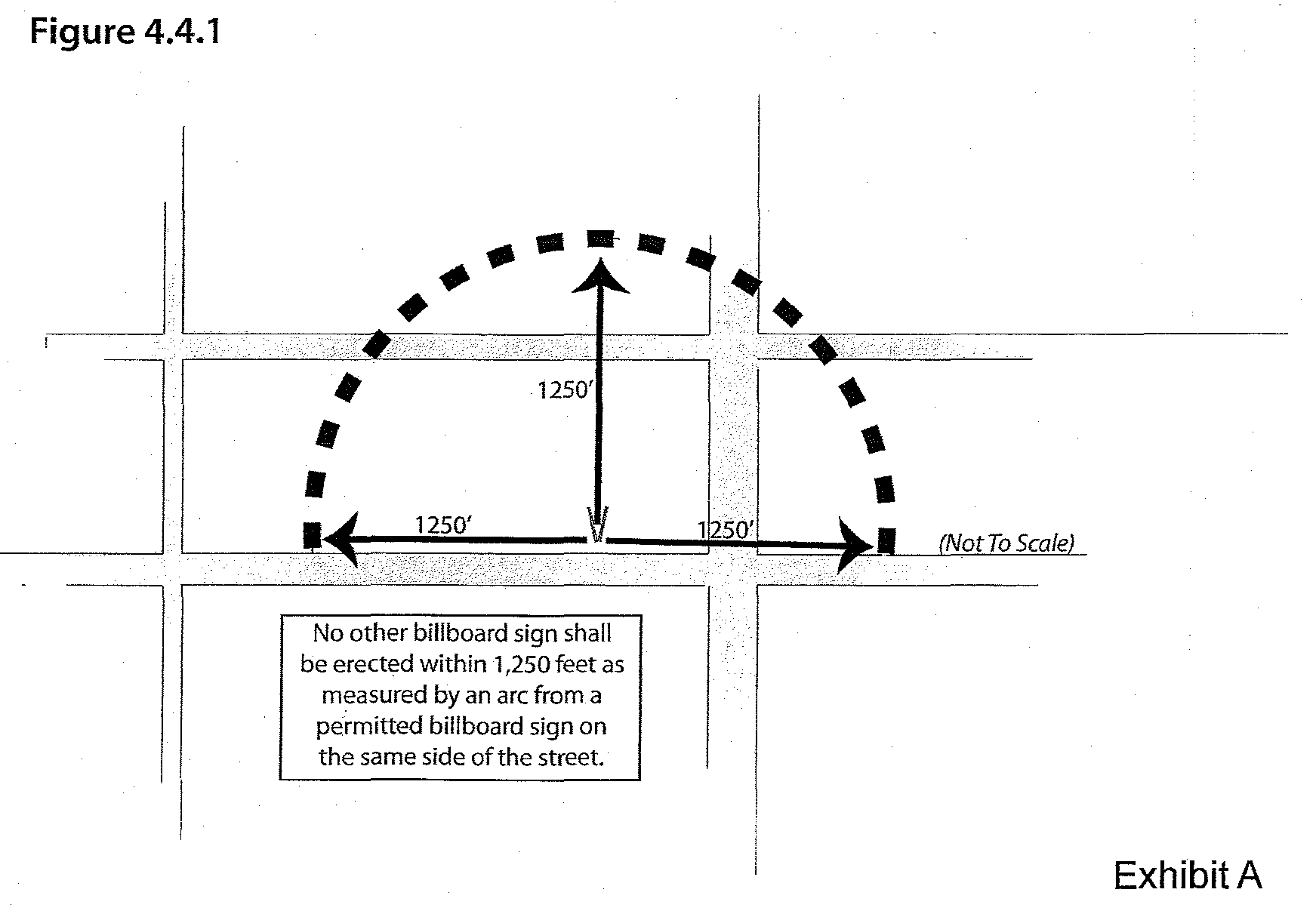
2.
Limited Access Road Locations.
(A)
Minimum Distance Required. Billboards located along limited access roads shall not be located within 500 feet of an interchange, intersection at grade, or safety rest area.
(B)
Measurement of Distance. The foregoing 500-foot zone shall be measured along the highway from the point at which the pavement commences or ceases to widen at exits from or entrances to the main traveled way.
3.
Intersections. Measuring from the center point of an intersection, no outdoor advertising structure shall be located within a 650 feet radius of said center point. Said minimum separation for billboard signs at intersections are indicated in Figure 4.4.2.
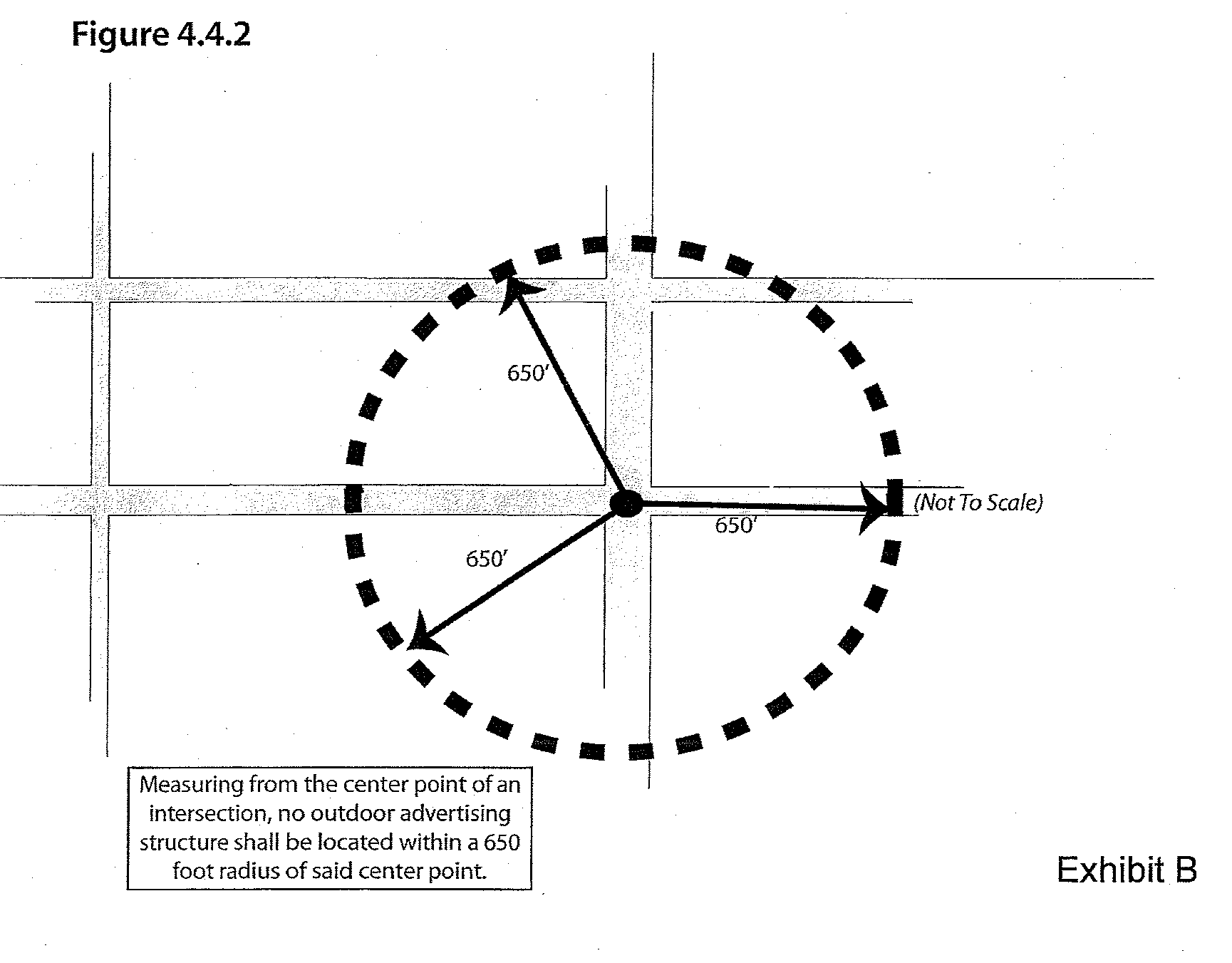
H.
Sign Facing Orientation. Any permitted, outdoor advertising structure facing shall face perpendicular to the street to which it has been permitted. Said sign facing orientation for billboard signs is indicated in Figure 4.4.3.
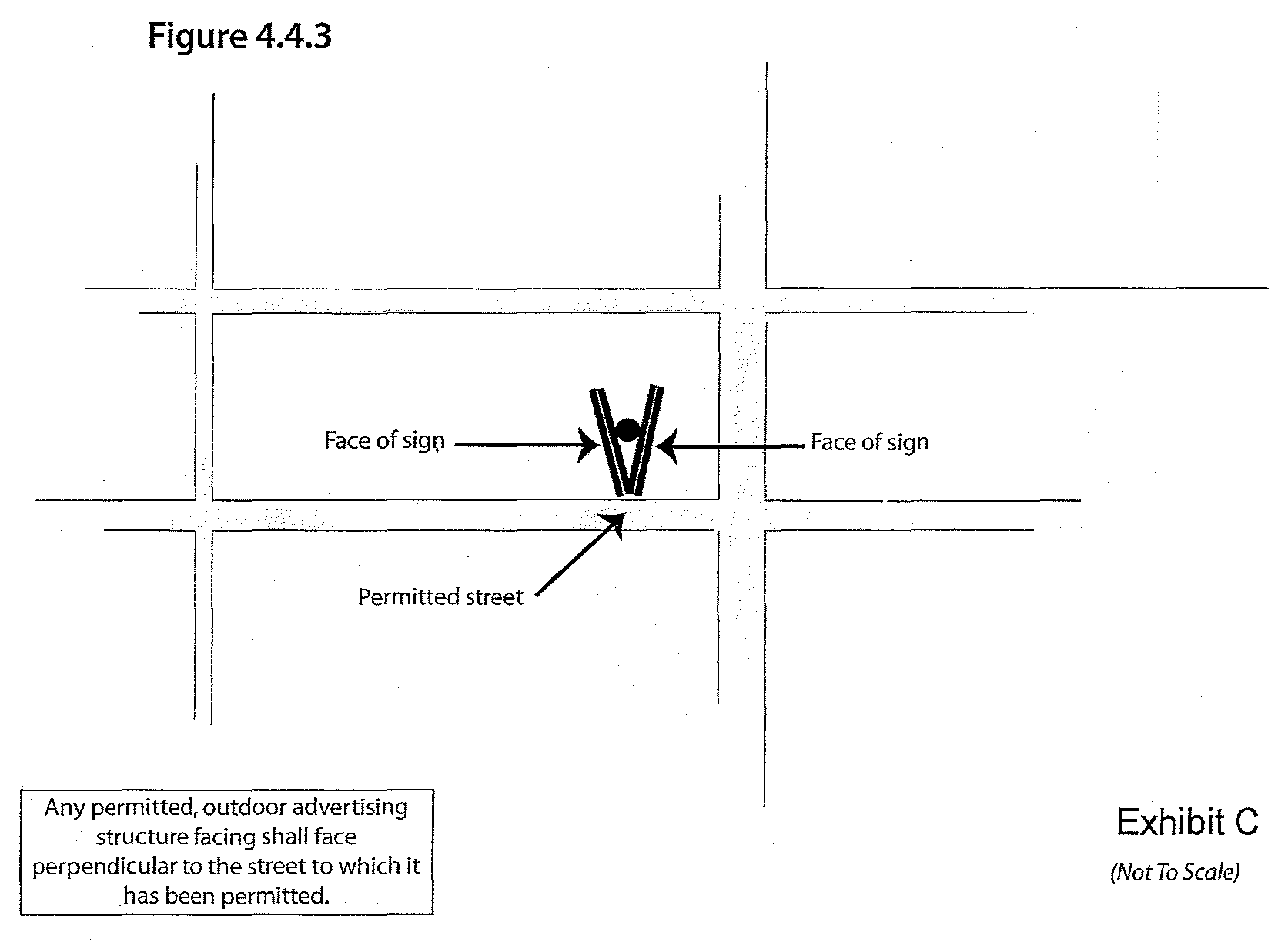
I.
Structure Specifications. All poles and structural members shall be of metal and shall be mounted on a single pole.
J.
Height Requirements.
1.
Maximum Height. The maximum height of the sign and its structures shall be 60 feet above the grade level at the foot of the sign structure to the top of the sign or sign structure.
2.
Exception. In instances where the level of the highway is elevated, the maximum height of the sign and its structure shall be 60 feet above the grade level of the highway at the point nearest the sign and its structure.
K.
Cap and Replace. No billboard or multiple message board shall be erected until such time as the following criteria is met:
1.
If a static billboard is erected, two square feet of existing space shall be removed for each square foot of new space to be erected.
2.
If a multiple message board is erected, five square feet of existing space shall be removed for each square foot of new space to be erected.
3.
A 50 percent space bonus shall be applied to square footage of existing, legal nonconforming structures removed.
4.
A structure removal permit shall be submitted when a new structure permit is requested.
5.
Relocation of existing structures shall not be subject to this section if removal or relocation is due to road projects or safety upgrades.
(Ord. No. 05-32, § 1, 4-5-05; Ord. No. 10-66, § 1, 12-14-10)
Section 4.4.14. - Permitted Locations.
Multiple message signs shall be permitted in GC, LMI and HMI zoning districts under the following conditions.
A.
Minimum Fixed Period. Each sign shall remain fixed for at least ten seconds.
B.
Change of Message. When a message is changed, it shall be accomplished in three seconds or less.
C.
Minimum Separation. Also see Section 4.4.13.C.2 and Section 4.4.13.C.3 regarding spacing of signs.
1.
No part of any permitted multiple message sign shall be erected within 5,000 feet as measured by an arc from another multiple message sign on the same side of the street. Said minimum separation for multiple message signs are indicated in Figure 4.4.4.
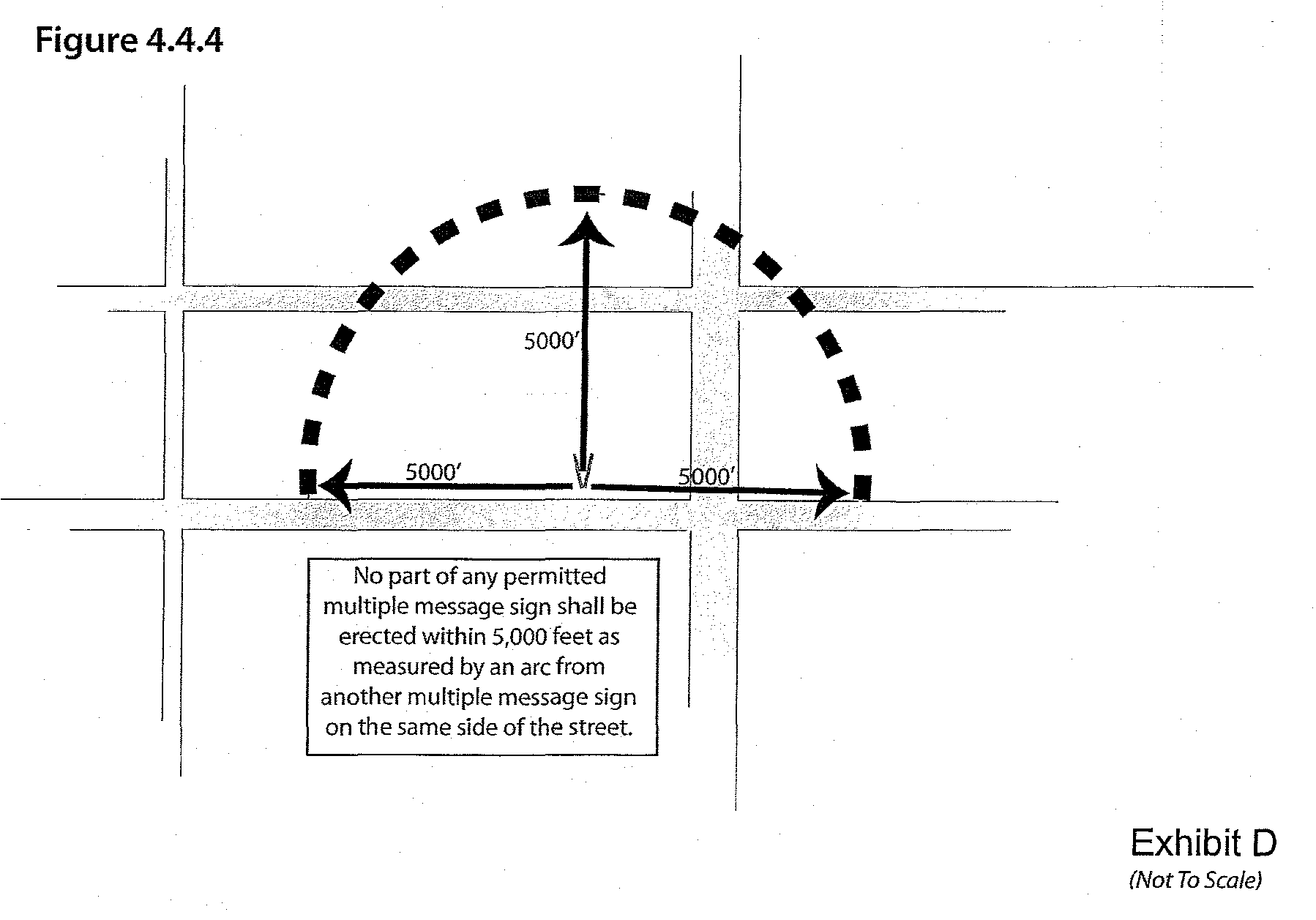
2.
No digital multiple message sign face shall be placed within 1,000 feet of a residential structure as measured by an arc from the sign's digital face. Said minimum separation for digital multiple message sign faces from residential structures is indicated in Figure 4.4.5.
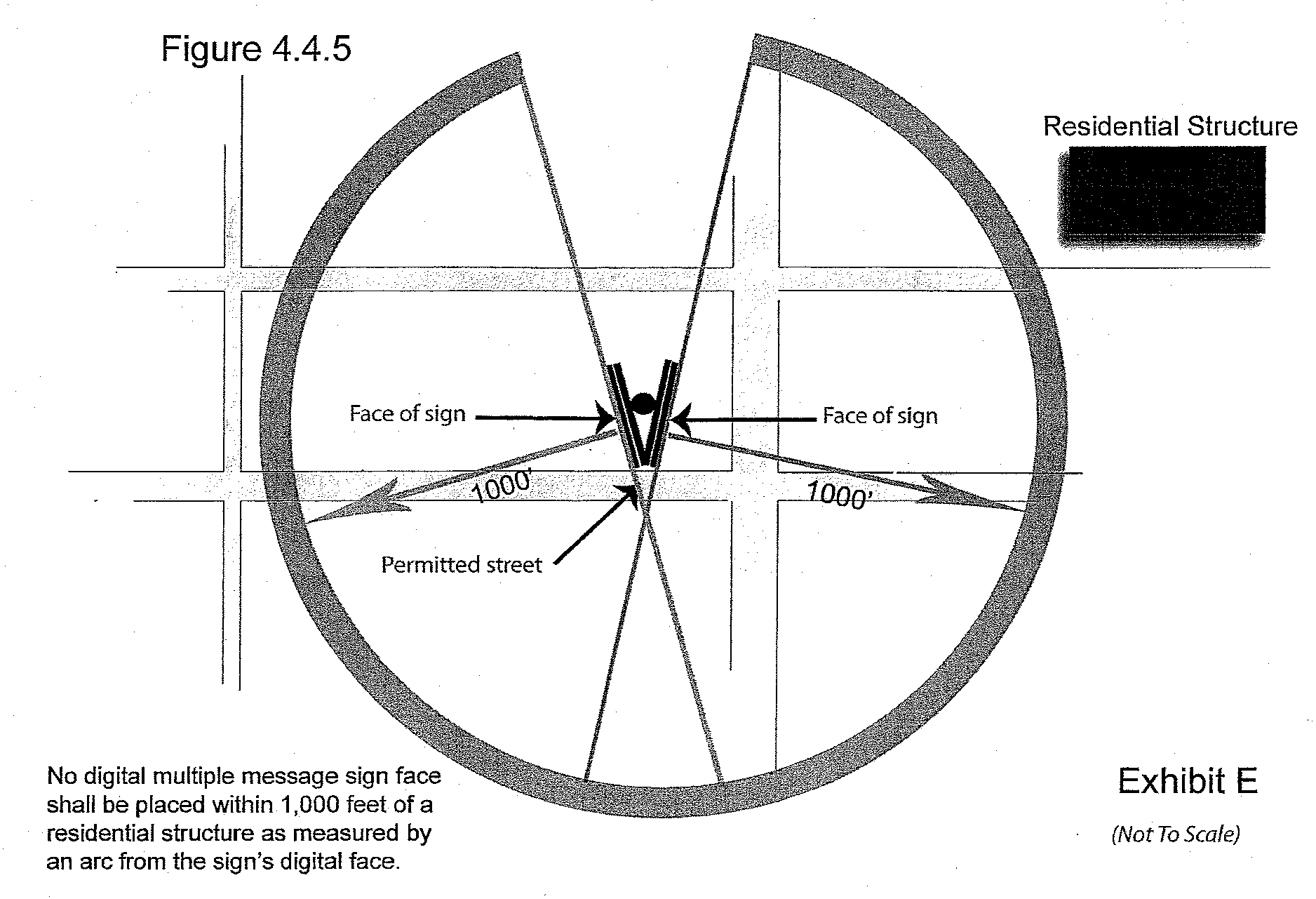
D.
Default Design. Any such sign shall contain a default design that will freeze the sign in one position if a malfunction occurs.
E.
Maximum Size Limitations. Any maximum size limitations shall apply independently to each side of a multiple message sign.
F.
Compliance. Such signs are subject to compliance with all other applicable provisions of this Article.
G.
Setback Requirements. See Section 4.4.13.C regarding setback requirements.
H.
Permitted Sign Dimensions and Area. See Section 4.4.13.D regarding permitted sign dimensions and area.
I.
Determining the Number of Signs. See Section 4.4.13.E regarding the determination of number of signs.
J.
Determining Total Sign Surface Area. See Section 4.4.13.F regarding the determination of total sign surface area.
K.
Structure Specifications. See Section 4.4.13.I regarding structure specifications.
L.
Height Requirements. See Section 4.4.13.J regarding height requirements.
M.
Cap and Replace. See Section 4.4.13.K regarding cap and replace.
N.
Existing non-digital multiple message boards shall be permitted to convert to digital multiple message boards within twelve months of the effective date of this ordinance, December 14, 2010. Said conversions shall be completed within the aforementioned twelve months. No digital multiple message sign face shall be placed within 500 feet of a residential structure as measured by an arc from the sign's digital face. Said minimum separation for digital multiple message sign faces from residential structures is indicated in Figure 4.4.6.
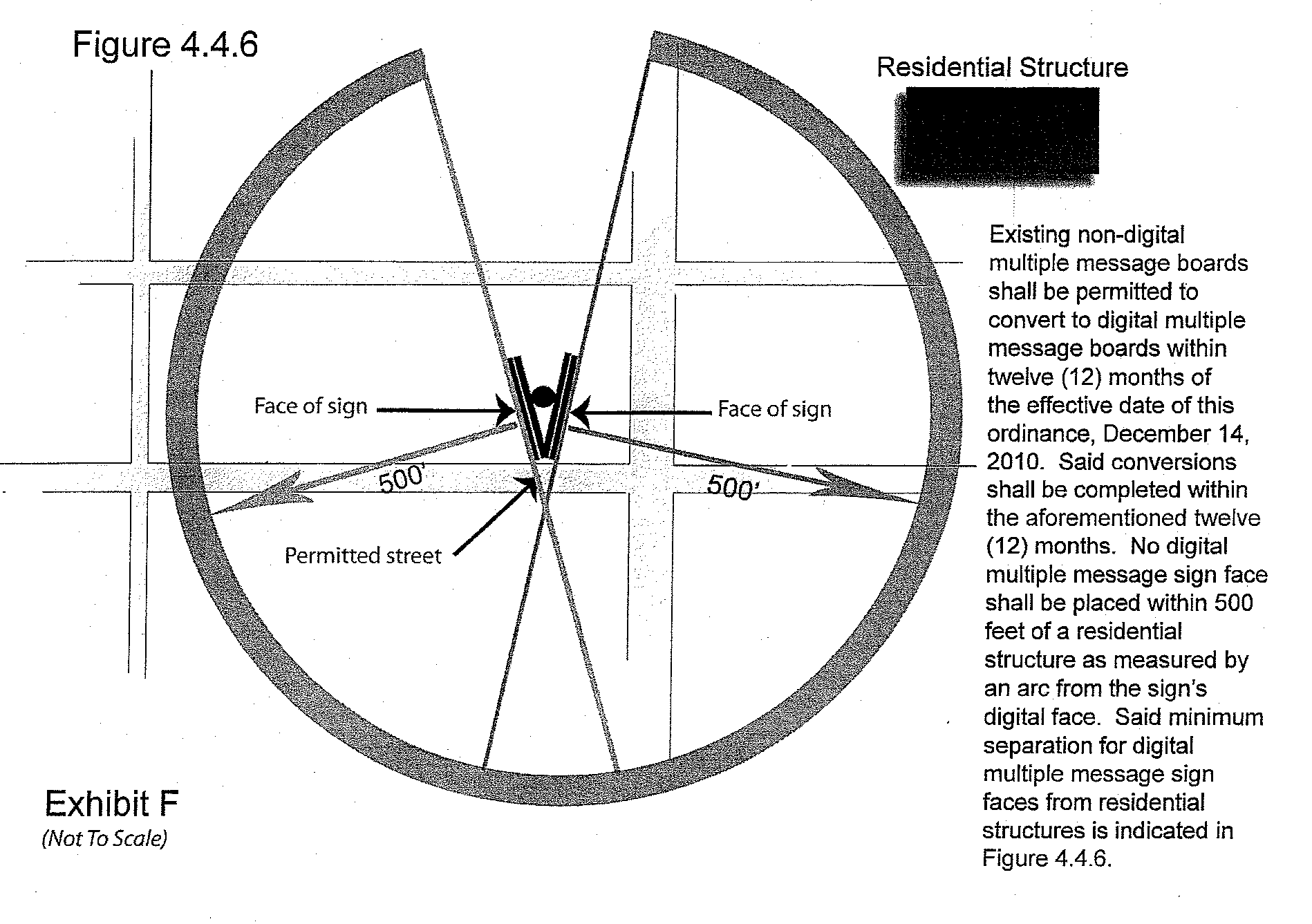
(Ord. No. 05-32, § 1, 4-5-05; Ord. No. 09-40, § 1, 7-14-09; Ord. No. 10-66, § 1, 12-14-10)
Editor's note— Ord. No. 05-32, adopted Apr. 5, 2005, changed the title of § 4.4.14 from multiple message signs to permitted locations.
Section 4.4.15. - Design, Construction, and Maintenance of Signs.
A.
Design and Construction. The design and construction of all signs shall be in accordance with the structural and construction requirements set forth in the building and electrical codes adopted by the State of Georgia and Columbus Consolidated Government.
B.
Maintenance.
1.
Maintenance and Painting. All signs, including those specifically exempt from this code in respect to permits and permit fees, together with all their supports, braces, guys and anchors shall be kept in repair and unless of galvanized or non-corroding metal shall be thoroughly painted at least every two years.
2.
Removal. The Building Official may order the removal of any sign that is not maintained in accordance with the provisions of this Article. Such removal shall be at the expense of the owner or lessee.
3.
Unsafe Signs.
(A)
Securing or Removal. Should any sign become insecure or in danger of falling or otherwise unsafe in the opinion of the Building Official, the owner thereof, or the person or firm maintaining the sign, shall upon written notice from the Building Official, forthwith in the case of immediate danger and in any case within ten days, remove such signs or secure the same in the manner to be approved by the Building Official, in conformity with the provisions of this Code.
(B)
Failure to Comply. If such order is not complied within ten days, the Building Official may remove such signs in accordance with the provisions of this Article.
C.
Weeds, Grass, Litter and Debris. Weeds and grass shall be kept cut in front of, behind, and underneath and around the base of ground signs, no rubbish or debris that would constitute a fire or health hazard shall be permitted under or near such signs.
Section 4.4.16. - Abandoned Signs.
Except as otherwise provided in this Article, any signs that are located on property which becomes vacant and is unoccupied for a period of three months or more, or any sign which pertains to a time, event, purpose or service which no longer applies, shall be deemed to have been abandoned. An abandoned sign is prohibited and shall be removed by the owner of the sign or owner of the premises.
Section 4.4.17. - Removal of Signs.
A.
Removal of Dangerous Signs. The Building Official may cause to be removed any sign that endangers the public safety, such as an abandoned, dangerous, or materially, electrically, or structurally defective sign, or a sign installed, erected or constructed in violation of this Article.
B.
Notice. The Building Official shall notify, by registered mail or written notice served personally, the applicant listed on the permit application thereof to alter such signs so as to comply with this Article or the building code and to secure the necessary permit therefore, or to remove the sign.
C.
Failure to Comply. If such order is not in compliance within ten days, the Building Official may remove such signs in accordance with the provisions of this Article.
D.
Commencement of Time. Any time periods provided in this Article shall be deemed to commence on the date of the receipt of the registered mail or written notice.
E.
Failure to Notify Owner.
1.
Owner Cannot Be Contacted. For all other signs in which the owner is unknown and the whereabouts cannot be ascertained, the Building Official shall make an affidavit to that effect, then the serving of complaint and notice upon such party may be made by publishing the notice once a week for two successive weeks in the newspaper of general circulation published in Columbus, Georgia.
2.
Posting. A copy of such notice served by publication shall be posted in a conspicuous place on the premises affected by the notice. If the owner of the sign is known, the notice shall be mailed to or delivered to the owner or the occupant of the property.
3.
Emergency. In emergency cases where it reasonably appears there is imminent danger to the life or safety of any person, the Building Official may cause the immediate removal of a dangerous or defective sign without notice.
F.
Status of Removed Signs. Any sign caused to be removed by the Building Official shall become the property of the City and may be disposed of in any manner deemed appropriate by the City.
G.
Cost of Removal. The cost of removal of the sign by the City shall be considered a debt to the City by the owner of the sign and the owner of the property, and may be recovered in any appropriate court action by the City or by assessment against the property. The cost of removal shall include any and all incidental expense incurred by the City in connection with the sign removal.
Section 4.4.18. - Nonconforming Signs; Generally.
A.
Legal Signs. Any sign legally in existence prior to adoption of this Article that does not satisfy the requirements of this Article are declared nonconforming and subject to the following requirements.
1.
Legal Nonconforming Signs. Any sign legally in existence prior to February 10, 1998, which does not conform to the requirements set forth in this Article may be continued as a nonconforming sign and any request for changes in size or height of such a sign shall be submitted to the Board of Zoning Appeals as a request for variance.
2.
Temporary, Portable and Banner Signs. All temporary and portable signs, and banners must be removed and comply with the provisions for temporary and portable signs, and banners by April 13, 1998.
B.
Replacement. A nonconforming sign shall not be replaced by another nonconforming sign except that the substitution or interchange of poster panel, painted boards or demountable material on a nonconforming sign shall be permitted.
C.
Permitted Maintenance and Repair. Maintenance and repair of nonconforming signs, including changing of copy, electrical repairs or lettering repairs and necessary nonstructural repairs that do not further extend or intensify the nonconforming features of the sign shall be permitted.
D.
Damage or Destruction of Nonconforming Signs.
1.
Structural Repair. Structural repairs shall not be permitted except to make the sign comply with the requirements of this Article.
2.
Compliance Required. If a legal nonconforming sign is damaged or destroyed by any means to the extent that 50 percent or more of its current replacement value, exclusive of the cost of the support structure, the sign may not be rebuilt or used thereafter unless it conforms to all of the provisions of this Article.
3.
Replacement Authorized. If the damage or destruction of the nonconforming sign is less than 50 percent of the replacement value, the sign may be rebuilt to its original condition in terms of size and height and may continue to be displayed.
E.
Change in Business or Change in Sign. A nonconforming sign shall be removed or altered to conform to the requirements of this Article when the nature of the business conducted on the premises changes or the sign is changed or modified either in shape, size, or legend.
Section 4.4.19. - Permit Procedures.
A.
Permit Required. Except as otherwise provided herein, it shall be unlawful for any person to erect, alter, construct, enlarge, relocate or convert any sign in the City of Columbus without first obtaining a sign permit from the Inspection and Code Division of the City of Columbus.
B.
Application. In order to obtain a permit to erect, alter, or relocate any sign under the provisions of this Article, an applicant shall file with the Building Official a sign permit application that sets forth in writing a complete description of the proposed sign including the following information.
1.
Owner Information. The name, address, and telephone number of the owner or persons entitled to possession of the sign and of the sign contractor erector.
2.
Lot Owner. The name, address, and telephone number of the owner of the lot on which the sign is located if different from those designated above.
3.
Location. The location by street address of the proposed sign.
4.
Drawings and Elevations. A scaled drawing and an elevation drawing of the proposed sign including the number of sides of the sign.
5.
Plans for Scope and Structure. Plans indicating the scope and structural detail of the work to be done, including details of all connections, guy lines, supports and footings, and materials to be used as provided by the erector or builder of the sign.
6.
Electrical Permit Application. Application and required information for such application, for an electric permit for all electric signs if the person erecting the sign is to make the electrical connection.
7.
Consent. A written consent from the owner of the property on which sign shall be erected.
8.
State Approval. Any sign that requires a state permit from the Department of Transportation must provide a copy of such permit prior to the issuance of the local permit.
9.
Site Plan. A site plan showing the following information.
(A)
Name of applicant or owner, including address and telephone number if such exist.
(B)
Boundaries and dimensions of the lot. All dimensions shown on site plans related to the location and size of the lot to be built upon shall be based on an actual survey.
(C)
North arrow.
(D)
Location and dimensions of existing and proposed structures.
(E)
Dimensions of all yard and setback requirements.
(F)
All driveways, including the width of each.
(G)
Location and dimensions of individual off-street parking and loading facilities.
(H)
All existing and proposed rights-of-way.
(I)
All easements.
(J)
Protective measures as indicated on the plot plan in cases involving rezoning.
(K)
Other details as may be necessary to ensure conformance with the applicable ordinances and regulations of Columbus, Georgia, or as may be required by the Building Official.
C.
Indemnification and Hold Harmless Agreement.
1.
Agreement. Each application shall contain an agreement to indemnify and hold the City harmless for all damages, demands, or expenses of every character which may in any manner be caused by the sign or sign structure (standard form).
2.
Business Liability Insurance. Each applicant shall present to the Building Official upon request a certificate of business liability insurance prior to the issuance of a sign permit.
Section 4.4.20. - Issuance of Permit.
A.
Review of Application. It shall be the duty of the Building Official, upon receipt of an application for a sign permit, to examine plans, specifications and other data and if the proposed structure is in compliance with the requirements of this Article and all other applicable provisions of this Article, the Building Official will have a maximum time of 15 working days to respond to the application.
B.
Effect of Newly Acquired Information. Issuance of the permit shall in no way prevent the Building Official from later declaring said sign to be nonconforming if upon further review of newly acquired information, the sign is found not to comply with the requirements of this Article.
C.
Decal.
1.
Issuance. All applicants shall be issued a decal identifying the applicable permit by a reference number.
2.
Attachment. The issued decal is required to be affixed to the sign.
3.
Transfer Prohibited. The decals are not transferable from one sign to another and must be placed at all times on the sign described and permitted in the corresponding permit application.
4.
Failure to Comply. Failure to have a decal on a sign shall be prima facie evidence that the sign is not lawfully permitted.
Section 4.4.21. - Review by the Board of Historic and Architectural Review.
A.
Review Required. All signs requiring a permit that are located in an historic district, have achieved landmark status, or listed on the National Historic Register shall be reviewed by the board of Historic and Architectural Review (BHAR).
B.
Standards for Review. The BHAR shall consider the appearance, size, location, structure materials, color, and appropriateness of the sign in relation to the structure on the premises and contiguous area.
C.
Permit Issuance. No permit shall be issued by the Building Official until a certificate of appropriateness has been issued for the sign by the BHAR.
Section 4.4.22. - Signs in the UPT and CRD Zoning Districts.
A.
Compliance with Uptown Facade Board Guidelines. All signs located in the Uptown Columbus, Uptown Zoning District (UPT), or the Central Riverfront District (CRD) must meet all the design requirements set forth by the Uptown Facade Board Guidelines.
B.
Compliance. All such signs are subject to all other provisions of this Article.
C.
Permit Issuance. No permit shall be issued by the Building Official until approval has been obtained from the uptown facade board by the owner of the sign.
Section 4.4.23. - Inspection, Revocation and Penalty.
A.
Inspection. All signs for which a permit is required by this Article are subject to inspection by the Building Official.
B.
Revocation.
1.
Misrepresentation. A permit shall not constitute a contract and a vested right shall not be acquired by any person, firm, or corporation holding such permits where same was issued upon any misrepresentation, intentional or nonintentional.
2.
Effect of Misrepresentation. In such events, such permits may be revoked upon notice in writing given by the chief of the inspections and code enforcement division to the person, firm, or corporation holding such permits and such revocation shall be effective immediately upon receipt of such notice.
3.
Permit Fees. Before any permit is issued under the provisions of this Article, the applicant shall pay fees as established by the Council.
C.
Penalty. If any person actually begins any work for which a permit is required by this Article, without having first obtained a permit therefore shall pay, in addition to the fees set forth in Table 4.4.1, an additional amount equal to 100 percent of such fees and shall be subject to any penalties described herein. The payment of a double fee for failing to obtain the appropriate permit shall not relieve any person from complying with other provisions of this Article.
D.
Time Limitation. A sign permit shall become null and void if the construction of the sign for which the permit was issued is not begun within a period of six months after issuance.
(Ord. No. 06-51, § 1, 6-20-06; Ord. No. 09-40, § 1, 7-14-09)
Section 4.4.24. - Variances.
A.
Variance May Be Granted.
1.
Authority for Variance. Where the Board of Zoning Appeals finds that extraordinary hardships or practical difficulties may result from strict compliance with these regulations or the purposes of these regulations may be served to a greater extent by an alternative proposal, the Board shall be authorized to grant a variance from the terms of this Article where such modification will not be contrary to the public interest where, due to special conditions surrounding such signage, a literal enforcement of the provisions of this Article will, in an individual case, result in unnecessary hardship provided that such variances shall not have the effect of nullifying the intent and purpose of this Article.
2.
Standards. Such variances may be granted in such individual case of unnecessary hardship upon the finding of the board of zoning appeals that:
(A)
The granting of the variance will not cause substantial detriment to the public health, safety, or welfare or injurious to other property or impair the purpose and intent of this Article;
(B)
The conditions upon which the request for a variance is based are unique to the property for which the variance is sought and are not applicable generally to other property;
(C)
There are extraordinary and exceptional conditions pertaining to the particular sign in question because of topographical conditions of the specific property involved, site distance, site distance times due to speed of vehicular traffic, physical surroundings, or shape, that would result in a particular hardship to the owner, as distinguished from a mere inconvenience, if the strict letter of these regulations were carried out;
(D)
The strict application of this Article to the particular sign would deprive an applicant of reasonable use of the land or would create an unnecessary hardship as distinguished from a mere inconvenience; and
(E)
Such special circumstances are not the result of actions of the applicant taken subsequently to the adoption or amendment of this Article.
B.
Procedure. Variances under this Article shall be granted under the same procedures and conditions as set forth in Article 11 of Chapter 10, with the exception that any appeal of the decision of the board of zoning appeals pertaining to the sign request shall be made directly to the Council.
(Ord. No. 08-72, § 1, 12-16-08)
Section 4.4.25. - Noncommercial Speech Protection.
Any sign allowed herein may contain, in lieu of any other message or copy, any lawful noncommercial message that does not direct attention to a business operated for profit, or to a product, commodity, or service for sale or lease, or to any other commercial interest or activity, so long as said sign complies with the size, height, area, and other requirements of this Article.
(Ord. No. 08-72, § 1, 12-16-08)
Section 4.4.26. - Enforcement and Administration.
A.
Administration. The Building Official shall have primary responsibility for the administration and enforcement of this Article and is hereby given full authority to enforce any and all provisions of this Article.
B.
Appeals. When the owner feels aggrieved by a determination of the Building Official, the owner shall have the right to appeal to the Board of Zoning Appeals.
1.
Filing of an Appeal. Any such appeal must be filed with the Board of Zoning Appeals within 15 days after the issuance of the determination pursuant of this Article.
2.
Action by the Board. The Board of Zoning Appeals may approve, modify, or reject the determination made by the Building Official, but only if a majority of the members of the board of zoning appeals finds that the Building Official abused its discretion in reaching the decision.
3.
Appeals. Appeals from decision of the board of zoning appeals shall be made directly to the Council, but no such appeal shall be allowed until and unless the aggrieved party has exhausted the remedies previously set forth in this Article.
(Ord. No. 08-72, § 1, 12-16-08)
Section 4.4.27. - Violation.
Violations of this Chapter shall be enforced as provided in Chapter 12 of this UDO.
(Ord. No. 08-72, § 1, 12-16-08)
Section 4.5.1.- Purpose.
The purpose of this Article is to establish minimum landscaping, screening and buffering standards for development, redevelopment or expansion of property that will provide one or more of the following benefits:
A.
Amelioration of adverse impacts between different uses and zoning districts;
B.
Buffer more intensive land uses from less intensive land uses; and
C.
Protection of the public health, safety and general welfare by minimizing noise, air, dust and visual pollution; reducing the heat and glare absorbed and radiated by development; preserving property values and the character of neighborhoods; helping to control soil erosion and stormwater runoff; and improving the aesthetic appeal of the City.
Section 4.5.2. - Definitions.
Definitions relating to landscaping, screening and buffering are located in Chapter 13.
Section 4.5.3. - Effective Date.
The effective date of this Article is the date of the adoption of this UDO.
Section 4.5.4. - General Standards.
The standards listed in this Section shall apply to all landscaping, screening, buffering, tree preservation, and tree planting.
A.
Fences and Fencing. Fences shall be installed consistent with building code requirements and Section 4.2.14. Fencing that is required or installed shall be located at the property line. The finished surface of a fence shall face abutting properties.
B.
Berms. Berms shall have a maximum slope of 3:1 and a minimum crown width of two feet. Berms shall be planted with vegetative ground cover.
C.
Planned Developments. For planned developments, including the operations of clearing or grading, the owner shall comply with the standards of this Article and with the requirements of this UDO regarding erosion and sedimentation control, and all other applicable portions of this UDO.
D.
Installation. The installation of buffers shall not be required until:
1.
A certificate of occupancy is requested for a developed parcel; and
2.
At that time only the buffer for a developed parcel should be required.
E.
Public Properties. All other development including all Columbus Consolidated Government- and government-owned property or school district property, shall comply with the requirements of this Article.
F.
Redevelopment.
1.
Redevelopment of a site shall require the application of Articles 5 and 6 of this Chapter.
2.
Redevelopment is defined as one or more of the following:
(A)
Demolition of an existing building and rebuilding on the site;
(B)
Expansion of the gross square feet of buildings or a site's physical development, by 50 percent or greater; or
(C)
An expansion of the gross square feet of buildings or site's physical development that cumulatively totals more than 50 percent since the effective date of the original Buffer Ordinance (April 29, 1999).
G.
Minimum Standards. The standards provided in this Article are the minimum requirements and may be exceeded, except for minimum fence heights. Any deviation from minimum or maximum fence height requirements shall occur only as a variance granted by the Board of Zoning Appeals.
(Amend. of 4-5-05; Ord. No. 05-32, § 1, 4-5-05; Ord. No. 09-40, § 1, 7-14-09)
Section 4.5.5. - Applicability.
A.
Application. This Article shall apply to all development as indicated below.
1.
Property Proposed for Development. All appropriately zoned lots requiring a building permit and proposed for development shall conform to this Article.
2.
Change in Zoning. A change in zoning shall require compliance with the standards of this Article.
3.
Special Exception Uses. An approval of a special exception uses shall require compliance with the standards of this Article.
4.
Sites Two Acres or Less. On sites two acres or smaller, additions or expansions greater than 5,000 square feet shall comply with the standards of this Article.
5.
Site More than Two Acres. On sites greater than two acres, additions or expansions greater than 10,000 square feet shall comply with the standards of this Article.
(A)
Additions. This includes additions cumulatively totaling more than 10,000 square feet since the effective date of the Article.
(B)
Exemptions. Additions or expansions located at least 100 feet from any property line shall be exempt, except on property lines that but parcels with one or more of the following zoning designations: RE10, RE5, RE1, RT, SFR1, SFR2, SFR3, RMD, RMF1, RMF2, MHP or HIST.
(C)
Additions less than 100 Feet from a Property Line. Additions or expansions located less than 100 feet from any property line shall:
(1)
Provide the required buffer along all portions of the addition or expansion less than 100 feet from the affected property lines; and
(2)
Buffers shall extend between building lines and shall include the entire length of property lines.
Section 4.5.6. - Minimum Buffer Requirements.
A.
Installation of Buffers.
1.
Buffers to be Installed. Table 4.5.1 indicates the type of side and rear buffers to be installed based upon the zoning of both the property to be developed, redeveloped or expanded and of the abutting property.
2.
Additional Buffers. Additional buffers may be required by this UDO, including the following:
(A)
Article 5 of Chapter 2, regarding master planned developments;
(B)
Chapter 6, regarding buffers for conservation subdivisions; and
(C)
Chapter 5, regarding buffers for streams and water bodies.
Table 4.5.1
Minimum Side and Rear Buffer Requirements
(Ord. No. 05-32, § 1, 4-5-05; Ord. No. 09-40, § 1, 7-14-09)
Section 4.5.7. - Buffer Categories and Options for Side or Rear Yard Buffers.
An applicant may choose the option to be used for rear and side yards based upon the category of buffer as established in Table 4.5.2. A list of tree species to be used in the buffers is provided in Table 4.6.5.
Table 4.5.2.
Options for Buffers in Side or Rear Yards
(Ord. No. 09-40, § 1, 7-14-09)
Section 4.5.8. - Required Street Buffers.
A.
All portions of a parcel proposed for development, redevelopment or expansion that abuts a public street or highway right-of-way shall be buffered as provided in Table 4.5.3.
B.
Conflicts with Overhead Lines.
1.
When the street buffer is within 20 feet of overhead utilities, small maturing trees must be substituted for the required large maturing tree.
2.
Substitutions must be two for one and be planted at either 25 or 50 feet separation.
3.
Substitutions must meet large maturing tree size specifications.
Table 4.5.3.
Minimum Street Buffer Standards
(Ord. No. 09-40, § 1, 7-14-09)
Section 4.5.9. - Standards for Buffers.
A.
Location. Buffer shall be located subject to the standards listed below.
1.
Perimeter of Parcels. Buffers shall be located along the perimeter of a lot or parcel, and may be located within a public right-of-way.
2.
Yards or Setbacks. Buffers may be located within required front, side, side corner or rear yards or setbacks.
3.
Public Rights-of-way. If the buffer is to be located within a public right-of-way, the City Engineer must determine that the plantings will not adversely impact utilities, roadway expansions or traffic flow.
B.
Credit for Required Landscaping. Planting in a right-of-way may account for not more than 25% of total landscape requirements.
C.
Trees, Shrubs and Ornamental Grasses. Trees, shrubs or ornamental grasses planted to form hedges shall comply with the following standards:
1.
The plant material shall be an evergreen species and a minimum of 18 inches in height when measured immediately after planting;
2.
The plant material shall be planted no further apart than 30 inches on center.
D.
Exemption. Parcels zoned RE10, RE5, RE1, RT, SFR1, SFR2, SFR3, SFR4, RMF1 and RMF2 are exempt from the requirements of this Section.
(Ord. No. 09-40, § 1, 7-14-09)
Section 4.5.10. - Planting Specifications.
A.
Ground Cover. Vegetated ground cover shall be provided throughout the buffer area except in undisturbed natural vegetation areas. If grass is used, it shall be of a species normally grown as permanent laws in the vicinity of the City. Grass areas may be sodded, plugged, sprigged or seeded.
B.
Standards. All plant material shall meet American Association of Nurserymen standards.
C.
Standards for Large Maturing and Small Maturing Trees and Shrubs and Ornamental Grasses. All planted material shall comply with the standards listed in Table 4.5.4.
Table 4.5.4.
Standards for Large Maturing and Small Maturing Trees and Shrubs and Ornamental Grasses
D.
Replacement. All plantings, including trees, shrubs and ground cover, required by this Article or an approved development approval that die or are destroyed must be replaced.
E.
Standards for Planting. See Section 4.6.15.
(Ord. No. 08-10, § 1, 3-25-08; Ord. No. 09-40, § 1, 7-14-09; Ord. No. 12-53, § 6, 12-4-12)
Section 4.5.11. - Placement, Installation and Irrigation.
A.
Placement. To achieve a more natural appearance, plantings should not be evenly spaced or planted in a straight line, but should be staggered or grouped together. Plantings shall be distributed throughout the length of the buffer.
B.
Installation. Plantings shall be installed consistent with current nursery industry standards. See Section 4.6.15.
C.
Support. Plant materials shall be properly supported with wires, guy wires, stakes, and similar devices to ensure survival. Support devices shall not interfere with vehicular or pedestrian movement and shall be removed 12 months after installation.
D.
Topsoil. Topsoil, or appropriate substitute, shall be provided to a depth sufficient to ensure plant survival, in accordance with current nursery standards.
E.
Watering or Irrigation. All buffer areas shall be provided with means of providing water with one of the following two options:
1.
A permanent built-in irrigation system; or
2.
A temporary watering system (hoses, water tank truck, etc.), which provides sufficient water, to ensure that installed plants can survive adequately on their own once established.
F.
Existing Vegetation. Preservation of existing stands of natural vegetation and mature trees is a highly desirable aspect of site development and encouraged whenever and wherever existing vegetation will assist in meeting the requirements of this Article.
1.
Use as a Buffer. As noted in the Table 4.5.2, undisturbed natural vegetation can serve as an adequate buffer and can eliminate the need for any supplemental vegetation within the buffer areas.
2.
Mature Trees. Mature trees are valuable community assets and should be saved whenever possible. Where existing hardwood or pine trees, measuring at least four inches in diameter as measured 4½ feet above the ground are used in the buffer or landscaped area, each tree will count double toward meeting buffer tree requirements.
3.
Protection during Construction. Protection of all existing vegetation utilized to comply with the requirements of this Article shall be provided as required in Section 4.6.13.
(Ord. No. 08-10, § 1, 3-25-08)
Section 4.5.12. - Responsibility for Installation and Maintenance.
The property owner is responsible for installation and maintenance of all buffer, landscape and screening areas.
Section 4.5.13. - Timing of Buffer Installation.
Required buffers shall be installed in accordance with the requirements of this Section.
A.
New Development, Redevelopment and Expansion.
1.
Installation and Planting Plan Required. Unless otherwise provided herein, all buffers and plant materials shall be installed prior to issuance of a certificate of occupancy. Installation shall include submission to the Director of Inspections and Code Enforcement and the City Arborist of a planting or landscape plan indicating the dimensions, category and option of buffer installation. Installation shall be verified by the City Arborist prior to issuance of a certificate of occupancy or a final building inspection being performed.
2.
Change in Zoning. Buffer plans shall be submitted with any application for rezoning, as provided in Section 4.5.5.
3.
Delay in Planting. Property owners or developers may submit a "Request for Delay Affidavit" to allow for planting installation to occur at a time which better coincides with normal planting season of November 1 st to March 30 th . Unless the City Arborist approves the request, plantings shall be installed as required by this Article, a development approval or as otherwise provided by these land development regulations.
B.
Exemption. Any property zoned UPT or CRD is exempt from the front, side and rear buffering requirements of this Article. This exemption shall not apply to the following:
1.
Standards for screening and landscaping in parking lots as provided in Section 4.6.11; and
2.
Screening required for trash areas, dumpsters and outdoor storage areas as provide in Section 4.2.1.
(Ord. No. 05-32, § 1, 4-5-05)
Section 4.5.14. - Administrative Modifications.
A.
Modifications. Modifications to the standard of this Article may be granted by the City Arborist if the one or more of the following circumstances exist on the proposed building site:
1.
Natural land characteristics such topography or existing vegetation on the proposed building site would achieve the same intent of this Article; or
2.
Innovation buffering or architectural design is employed on the building site to achieve an equivalent screening or buffering effect.
B.
Application. The developer shall submit sufficient documentation to the City Arborist a minimum of 60 days in advance of requesting issuance of a site development permit.
C.
Response. The City Arborist shall make a written response to the application within 15 working days, or as otherwise approved by the Director.
Section 4.5.15. - Variances.
A variance from the requirements and standards of this Article may be granted consistent with Article 11 of Chapter 10.
Section 4.5.16. - Enforcement and Administration.
A.
Administration. The administration and enforcement of this Article shall be consistent with the requirements of Chapter 12 and all other applicable requirements of this UDO.
B.
Site Plans. All site plans submitted with rezoning applications shall depict the location and dimensions of all required buffers.
C.
Appeals. Any appeal from a decision or interpretation regarding this Article shall be consistent with the requirements of Article 11 of Chapter 10.
Section 4.6.1.- Findings and Statement Of Purpose.
A.
Findings.
1.
Columbus, Georgia is situated in an area covered with a wide variety of deciduous and evergreen trees and shrubs which are a vital part of the heritage passed to us by nature and our forefathers;
2.
Trees are recognized to be a valued asset providing a healthier and more beautiful environment in which to live;
3.
Trees are economically beneficial in attracting new residents and tourists;
4.
Tree preservation enhances the value and marketability of property and, thereby, promotes the stability of residential neighborhoods making them more livable and desirable, and thus helps prevent the emergence of blighted neighborhoods, slum conditions and urban sprawl;
5.
Trees aid in preventing erosion, storm drainage, siltation of streams and reservoirs, and flash flood damage; and
6.
Trees are valuable in providing shade and cooling effects, and in preventing air, noise, and visual pollution.
B.
Purpose. The purpose of this Article is to:
1.
Make the City a more attractive and healthy environment in which to live, and better control stormwater runoff, noise, glare, heat, and soil erosion;
2.
Provide the necessary information to facilitate development project design, plan review, and enforcement processes in order that the standards and requirements of this Article are administered in the most effective, efficient and economical manner;
3.
Establish and maintain the maximum sustainable amount of tree cover on public and private lands in the City;
4.
Maintain City trees in a healthy and nonhazardous condition; and
5.
Establish and maintain appropriate diversity in tree species and age classes to provide a stable and sustainable urban forest.
Section 4.6.2. - Official Tree.
The Muskogee Crape Myrtle shall be the official tree of the City.
Section 4.6.3. - Definitions.
Definitions relating to tree preservation and replacement are provided in Chapter 13.
Section 4.6.4. - City Arborist.
A.
Designation. The Urban Forestry and Beautification Division Manager, or designee, shall serve as the City Arborist.
B.
Duties. The duties of the City Arborist shall include those duties listed below.
1.
Review and Approval. Review and approve or disapprove all plans required by Articles 5, 6 and 7 of this Chapter.
2.
Variances.
(A)
Consider and act upon requests for variances as provided in Section 4.6.18.
(B)
The City Arborist shall take such action within 15 days of receipt of any such plans or requests for variance.
3.
Inspections and Compliance. Conduct such inspections as are necessary to see that compliance with the applicable Articles of this UDO is achieved and maintained.
4.
Trees in Public Areas. Direct, regulate and control the planting, maintenance and removal of all trees growing now or hereafter in any public area of the City.
5.
Violations. Make cases for violations of applicable portions of this UDO, to issue summons directed to the offenders and to appear in the Recorder's Court or such other court as shall have jurisdiction of the matter.
6.
Preparation of Standards and Specifications. Produce tree planting and maintenance standards and specifications to specify planting methods, maintenance and location of trees within public rights-of-way, in parks and in public places within the City.
7.
Street Trees. Prepare a street tree planting plan and program along all major arterial streets, collector streets, and publicly owned spaces, including the preparation of detailed plans and specifications for all areas covered by the tree planting plan.
8.
Cooperation with Other Agencies.
(A)
Cooperation. Cooperate closely with and assist the Public Services Department, the Planning Department, the Department of Inspections and Codes, the Engineering Department, the Parks and Recreation Department, the Development Authority and the Downtown Development Authority, and all other city departments of this government in a program to protect and maintain existing trees and green areas and all city-owned and recreational lands and properties.
(B)
Review and Comment. Review and comment on the proposed landscaping plans of all recreation lands and other public properties within the City.
9.
Proposed Landscape Plans. Review and make recommendations or comments on all proposed landscaping or development plans of any department of the City, or any plans of whatever nature which propose the planting or removal of any public trees.
10.
Monitoring. Monitoring the impact of the requirements of this Article and Article 7 through canopy studies, tree inventories and other methods, and report on the same to the Tree Board and Council.
11.
Recommendations to Mayor and Council.
(A)
Recommendations. Study and make recommendations to the Mayor and Council regarding the planting, maintenance and protection of trees on public property.
(B)
Special Matters or Questions. Consider, investigate, make findings, report and recommend on any special matter or question coming within the scope of its work.
(Ord. No. 05-32, § 1, 4-5-05; Ord. No. 09-40, § 1, 7-14-09)
Section 4.6.5. - Tree Board.
See Chapter 9, Article 2.
Section 4.6.6. - Applicability.
The standards of this Article shall apply to any development, redevelopment, alteration or expansion as indicated below.
A.
Compliance by Development. All sites proposed for development, other than mere renovation of an existing building, shall comply with the requirements of this Article.
B.
Expansions or Additions.
1.
Sites Two Acres or Less.
(A)
Compliance. On sites two acres or smaller, additions or expansions greater than 5,000 square feet shall comply with the standards of this Article.
(B)
Cumulative Effect. The standards shall apply to additions cumulatively totaling more than 5,000 square feet since the effective date of the Tree Protection Ordinance (June 4, 2002).
2.
Sites Greater than Two Acres.
(A)
Additions or Expansion. On sites greater, than two acres, additions or expansions greater than 10,000 square feet shall comply with the standards of this Article.
(B)
Cumulative Effect. The standards shall apply to additions cumulatively totaling more than 10,000 square feet since the effective date of the original Tree Protection ordinance (June 4, 2002)."
C.
Application of Tree Density Unit Requirements.
1.
Any site or development which falls under the provisions of this Article by virtue of additions or expansions as defined in this subsection shall be required to comply with the applicable TDU requested as established hereafter only and without regard to any specific placement of trees contained in Section 4.6.10 regarding parking areas and Section 4.6.11 regarding perimeter plantings.
2.
To determine the required number of TDUs that are required by this Article, two options are available.
(A)
Option 1. Calculate the total surface area of any proposed new impervious surface or improvements and plant new trees sufficient to meet the required TDUs for that area. Existing trees elsewhere on the site shall be excluded in the calculation of TDUs.
(B)
Option 2. Calculate required TDUs for entire site area according to zoning classification. Existing trees on the site may be counted to achieve required TDUs.
D.
Planned Development Districts. All planned developments shall comply with the requirements of this Article.
1.
Compliance. For planned developments, including the operation clearing and grading, the owner shall be required to follow at a minimum the standards set forth herein and the standards for stabilization relating to erosion control as set forth in the Section 8.3.2 of this UDO.
2.
Time of Plantings. Planting of materials shall not be required until a Certificate of Occupancy is requested for the developed parcels and at that time only the plantings for each developed parcel should be required.
3.
Completion of Planting. Plantings shall be completed prior to the issuance of a certificate of occupancy or performance of a final building inspection.
4.
Intent. The intent of this subsection is to ensure that proper plantings are established for each use as well as to provide for the appropriate timing of plant installation, consistent with the requirements of Section 4.6.15.A regarding tree planting standards, Section 4.6.15.B regarding planting standards and specifications, and Section 4.5.13.A.3 regarding delayed plantings.
E.
Redevelopment. Redevelopment of a site shall require compliance with the requirements of Articles 5 and 6 of this Chapter.
1.
Definition. For the purposes of this Article, redevelopment is defined as one or more of the following:
(A)
Demolition of an existing building and rebuilding on the site;
(B)
Expansion of the gross square feet of the buildings or a sites physical development by 50 percent or greater; or
(C)
An expansion of the gross square feet of buildings or a sites physical development totaling more than 50 percent since the effective date of the original Tree Protection Ordinance (June 4, 2002).
2.
Redevelopment. Any site or development subject to this Article due to redevelopment as specified herein shall be required only to comply with the applicable TDU requirements. TDU requirements shall not include any specified placement of trees contained in Section 4.6.10 regarding parking areas and lots or Section 4.6.11 regarding perimeter plantings.
F.
Applicability to Public Land. The provisions of this Article shall apply to all public entities and owners of public property within the City and it shall be unlawful for the owners to fail to comply with all provisions and requirements of this Section.
(Ord. No. 05-32, § 1, 4-5-05)
Section 4.6.7. - Tree Density Unit Requirements.
The calculations for determining TDU requirements are provided in this Section. Compliance with the tree density unit standards is required, whether or not a site supported trees prior to development.
A.
Achieving Tree Density Units. The TDUs required by this Article may be achieved by the following:
1.
Counting existing trees to be preserved;
2.
Planting new trees; or
3.
Combination of preservation and new plantings.
B.
Formula for Calculation of Density. The formula for determining total tree density units is indicated below:
1.
Total Tree Density Units Requirements for a Site. The Total Tree Density Unit (TTDU) requirement for a site is the minimum Tree Density Units (TDU) required to be maintained on a developed site.
(A)
Calculation. This number is calculated by multiplying the number of site acres by the appropriate Tree Density Unit (TDU) number for the applicable zoning classification.
(B)
Site Acreage. This number is determined by starting with the total area of the parcel of land on which the project is located.
(C)
Exclusions. Excluded from the site acreage is the area of any utility easement and pond or lake and dam over one acre in area.
2.
Existing Tree Density Units. Existing Tree Density Units ETDU is the density of existing trees to be preserved on a site.
(A)
Calculation. The ETDU is calculated by converting the diameter of individual existing trees to density factor units as indicated in Tables 4.6.1 and 4.6.2.
(B)
Exclusions. Trees that exist in any utility easements cannot be counted toward compliance with tree density requirements.
Table 4.6.1.
Tree Density Unit Value for Small Maturing Preserved Trees
1
Table 4.6.2.
Tree Density Unit Value for Large Maturing Preserved Trees
3.
Replacement Tree Density Units. Replacement Tree Density Units (RTDU) is the density of new trees to be planted on a site.
(A)
Calculation. The RTDU is calculated by subtracting the ETDU from the TTDU. The density factor credit for each caliper size of replacement or new trees is shown in Table 4.6.3.
(B)
Exclusion. Trees that are replanted within any utility easement or street right-of-way cannot be counted toward meeting tree density requirements.
Table 4.6.3.
Tree Density Unit Standards for Planted Trees—Caliper Size to Unit Value for Trees
Normally Sold by Caliper Size
C.
Minimum Caliper Sizes.
1.
Small Maturing Trees. Minimum caliper size for small maturing tree species is 1.5 inches at a minimum height of five (5) feet tall immediately after planting.
2.
Large Maturing Trees. Minimum caliper size for large maturing tree species is 2 inches at a minimum height of eight (8) feet tall immediately after planting.
(Ord. No. 09-40, § 1, 7-14-09)
Section 4.6.8. - Estate, Low and Medium Density Single-family Residential Lots and Subdivisions.
A.
Tree Protection and Tree Planting Plan Required.
1.
Plan Required. A tree protection and tree planting plan shall be submitted, shall be approved and shall comply with the appropriate tree density standards of density units per acre which corresponds to the zoning classifications as provided in Table 4.6.4.
2.
Approval and Permits. The plan shall be approved prior to either of the following:
(A)
The issuance of a site development permit for any property to be developed as a residential subdivision within a residential estate or single-family residential zoning district; or
(B)
A building permit for any lot that is not located within in a previously approved single-family residential subdivision for which a tree protection or tree planting plan has been approved.
Table 4.6.4.
Tree Density Standards for Estate, Low Density Residential and Medium Density Residential
Zoning Districts
B.
Tree Protection and Planting. Trees must be protected and preserved in compliance with the provisions of Section 4.6.12 and must be planted in compliance with Section 4.6.15.
C.
Required Species. Trees planted as required by this Article shall be a species listed on Table 4.6.5 at the end of this Article.
D.
Trees Included in TDU Calculations. All trees located within any required zoning buffer or on any individual lot as provided hereafter or by any other legal requirement shall be counted in calculating if a property complies with the required TDU standard.
E.
Individual Trees for Residential Lots. Individual trees for residential lots shall be provided as required in this subsection.
1.
Lots of 7,500 or More Square Feet. Every residential lot containing 7,500 or more square feet area shall have a minimum of two trees located, subject to the standards listed below.
(A)
Location. At least one tree must be located between the front set back line and the right-of-way.
(B)
Type. At least one tree shall be a large maturing tree.
2.
Lots of Less than 7,500 Square Feet. Every residential lot containing less than 7,500 square feet of surface area shall have a minimum of one tree, and the tree may be located anywhere on a lot.
3.
Inclusion as Part of Required Tree Density. These individual trees per lot may be counted as part of the required tree density units per acre for the development. However, such trees may be an additional requirement if the appropriate units per acre requirement are located elsewhere on the site.
4.
Application to Developer or Home Builder. The minimum tree per lot requirement shall apply to the developer or homebuilder, whoever is responsible for obtaining the building permit for the individual lot.
5.
Application Only to Home Builder. If the requirement for tree installation is to be applied to the home builder, the developer will be given credit on the whole project for the trees which must be planted on lots to be built upon at a later date.
F.
Planting Delay. In the event final planting of trees required by this Section or other required plantings cannot be accomplished on a single-family residential lot within a previously approved residential subdivision due to the planting season, inclement weather, or other extenuating circumstances and the owner desires to occupy the dwelling prior to planting, the owner or developer may submit a request for delay affidavit to the City Arborist.
G.
Residential Lots Greater than Two Acres. If a single-family residential home is constructed on any lot or tract zoned as provided in Section 4.6.8, the tree density units required for the site shall be applicable to two acres irrespective of the greater size of said lot or tract upon which said home is built.
(Ord. No. 09-40, § 1, 7-14-09; Ord. No. 12-53, § 7, 12-4-12)
Section 4.6.9. - All Other Residential Lots, Subdivisions, Commercial and Industrial Developments.
A.
Tree Protection and Tree Planting Plan Required.
1.
Plan Required. Prior to the issuance of a site development permit for any property to be developed within any zoning classification other than the low and medium density single-family residential lots and subdivisions as provided in Section 4.6.9, a tree protection and/or tree planting plan shall be submitted and shall be approved in compliance with the standards of this Article, prior to the issuance of a site development permit.
2.
Minimum Tree Unit Density. The plan shall be based upon a tree unit density requirement of ten density units per acre.
B.
Inclusion of Certain Trees. All trees required by any required zoning buffer or perimeter trees and trees required to be planted in any parking lot as provided in this Article or by any other legal requirement shall be counted in calculating whether a property complies with the required TDU standard.
C.
Tree Protection and Planting. Trees that are included as part of compliance with minimum TDU standards must be protected and preserved in compliance with the provisions of Section 4.6.12 and must be planted in compliance with Section 4.6.15 of this Article.
D.
Required Species. Trees planted as required by this Article shall be a species listed on Table 4.6.5.
(Ord. No. 09-40, § 1, 7-14-09)
Section 4.6.10. - Parking Areas.
A.
Lots One and one-half Acres or Less. Trees within parking areas are not required. However, a minimum of 70 percent of the required TDUs for a lot shall be either retained or planted, as the case may be, in the following:
1.
The front or side yards of said lots; or
2.
Adjacent to the City roadways.
B.
Lots Larger than One and one-half Acres with not more than 20 Parking Spaces. Landscaping and trees in parking areas may be provided in landscaping islands or medians as provided in Section 4.6.10. Landscaping and trees in a parking area are not mandatory so long as every parking space is within 60 feet or less from a perimeter or "street" tree, or other large maturing tree retained or planted on the development or lot.
C.
Lots Larger than One and one-half Acres with more than 20 Parking Spaces. Landscaping shall be provided in landscape islands or interior linear landscape medians.
1.
Location. Landscaping islands shall be placed so that no line of more than 16 adjacent (side by side) parking spaces exists.
2.
Protection. All landscaping islands and medians shall be installed with raised curbs or wheel stops, however the use of at-grade planting areas in parking lots to promote storm water runoff treatment and to supplement irrigation needs is encouraged.
3.
Interior Linear Landscape Medians. Interior linear landscape medians may be provided within parking lots.
(A)
Minimum Width. There shall be at least eight feet width, measured from back of curb to back of curb.
(B)
Minimize Planting Area Size. Each tree planted in an interior landscape island is required to have a minimum of 200 square feet of planting area.
(C)
Installation of Landscape End Islands. When the landscape median extends to the end of a parking bay, a contiguous median end island, perpendicular to the landscape median, is required.
(D)
Combination Swales and Planting Strips. Combination drainage swale/planting strips are permitted, in lieu of curbed and sloped island, provided that adequate drainage is provided for the chose species.
4.
Interior Landscape Islands. Interior landscape islands may be provided within parking lots and other paved areas.
(A)
Minimum Size. Each tree planted in an end island is required to have a minimum of 200 square feet of planting area, with a minimum width of at least 8 feet in one direction, measured from back of curb to back of curb.
(B)
Additional Trees. If a landscape issued contains more than one tree, at least 80 square feet of planting space shall be added for each additional tree.
(C)
Contiguity. The landscape end islands may be contiguous with an interior landscape median or a perimeter planting strip.
5.
Landscape End Islands. Landscape end islands shall be provided at the end of a parking bay.
(A)
Minimum Size. Each tree planted in an end island is required to have a minimum of 200 square feet of planting area, with a minimum length equal to the length of the adjoining parking space, and a minimum width of at least 8 feet in one direction, measured from back of curb to back of curb.
(B)
Additional Trees. If a landscape island contains more than one tree, at least 80 square feet of planting space shall be added for each additional tree.
(C)
Contiguity. The landscape end islands may be contiguous with an interior landscape median or a perimeter planting strip.
6.
Required Plantings.
(A)
Single Row Parking. Interior and terminal landscape islands for a single row of parking spaces shall be planted with a least one large maturing tree.
(B)
Double Row Parking. Interior or terminal islands for a double row of parking spaces shall contain not less than two large maturing trees.
7.
Maximum Separation Distances.
(A)
Maximum Separation for Large Maturing Trees. Large maturing trees must be planted or retained within the landscape medians or islands so that each parking space is 80 feet or less from a tree in an interior planting area, median or island, or 60 feet or less from a perimeter or "street" tree, or other large maturing tree retained or planted on the development.
(B)
Minimum Area. The minimum unpaved landscape area per tree within a landscaping island shall be 200 square feet with a minimum dimension of 8 feet.
(C)
Exemption for Overhead Utility Lines. Small maturing trees may be substituted for large maturing trees in any landscape median or island if a tree will be planted within 20 feet of an overhead utility line.
(D)
Exemption for Tree Save and Natural Areas. If significant tree save areas or natural areas, or planned alternatives, which exceed the requirements of this Article as to numbers of trees, or spacing distances exist within a parking area, the City Arborist may make such exceptions to these requirements, as deemed appropriate at their sole discretion.
8.
Tree Protection Standards.
(A)
Curbs and Wheel Stops. As a protective measure, trees shall be planted at least three feet, from any curb or wheel stop.
(B)
Vehicle Overhangs. As a protective measure, when landscape areas are located adjacent to vehicle overhangs, trees shall be planted in line with the striping between parking spaces.
9.
Landscaping of Islands and Medians.
(A)
Minimum Landscape Requirements. All landscape islands and medians within parking lots shall be 100 percent landscaped with the following:
(1)
Large maturing trees as required in this Article;
(2)
Evergreen shrubs, not to exceed 30" in height at maturity;
(3)
Ground cover, excluding material that requires mowing;
(4)
Small maturing trees as provided in this Article;
(5)
Mulch; or
(6)
Flowers in mulched beds in the area within three feet of the base of a tree.
(B)
Grass. Grass may be used in landscape medians and islands so long as it stops at least three feet from the base of a tree.
(C)
Pedestrians. Pedestrian traffic through landscape medians and islands should be directed away from the critical root zones of trees and toward appropriate pathways through appropriate landscaping.
(D)
Medians. The same planting requirements as provided herein shall apply to medians in parking lots.
10.
Pre-planting Preparation of Compacted Soil. All landscape islands and medians where trees, shrubbery and other vegetation will be planted shall be prepared as listed below.
(A)
Uncompacted Soil. All areas shall be prepared to a uniform depth of two and one-half feet of uncompacted soil.
(B)
Final Soil. The final soil in the landscape islands and medians shall be obtained on site or imported from a suitable source.
(C)
Dumping and Other Wastes. Dumping of construction debris, trash, concrete residue, paint residue or other items toxic to trees and plants shall not be allowed in landscape islands and medians.
(D)
Gravel and Stone. Gravel, stone, or other impervious material greater than one inch in diameter shall not be allowed in the landscape islands or in a landscape median within an eight feet radius of a tree planted in an interior linear landscape median. Gravel, stone or other impervious material not greater than one inch in diameter may be used as mulch.
(E)
Site Lighting. Site lighting standards should be coordinated for new planting locations or avoided in planting islands for required trees.
D.
Exceptions.
1.
Multilevel or Covered Parking. Multilevel or covered parking areas are exempt from the requirements of subparagraphs A through C of this Section.
2.
Shipping and Loading Areas.
(A)
Exemption for Areas of Truck Traffic. The provisions of this Section relating to landscape medians, landscape islands and maximum distance between parking spaces and trees shall not apply to areas used principally for motor vehicle, boat or mobile home sales, storage or display lots, and loading and shipping docks and areas of heavy truck traffic. These areas shall be clearly delineated to provide separation employee and customer parking areas.
(B)
Compliance with Other Standards. All other requirements of this Article, including but not limited to perimeter planting and tree density requirements for the whole development, shall apply to such exempted areas.
Section 4.6.11. - Perimeter Plantings.
In all developments and substantial improvements on parcels excepted by Article 5 of this Chapter, other than areas zoned UPT and CRD, the standards listed below shall apply.
A.
Continuous Perimeter Planting Strip. A continuous perimeter planting strip is required along the perimeter of a property and is subject to the standards listed below.
1.
Minimum Width. The perimeter planting strip shall be a minimum width of 10 feet.
2.
Location. Perimeter planting strips may occur within required buffers or yards.
3.
Minimum Number of Trees. The minimum number of trees required in a perimeter planting strip shall be one large maturing tree for every 50 linear feet of perimeter or portion thereof or one small maturing tree for every 30 linear feet of perimeter or portion thereof.
(A)
Combination of Trees. If a small maturing tree is planted next to a large maturing tree. The maximum distance between the two trees shall be 30 feet, subject to the grouping provision of this Section.
(B)
Existing Trees. Existing trees to be preserved in the landscape strip may count toward perimeter planting.
(C)
Minimum Percentage of Trees. At least 50 percent of trees in the perimeter planting strip must consist of large maturing trees.
(D)
Overhead Utility Lines. A large maturing tree shall not be planted within 20 feet of an overhead utility line.
4.
Grouping of Trees. Trees may be grouped or spaced to allow sight corridors. In the event of trees are grouped or spaced, a portion of the grouped trees may be planted inward of the perimeter planting strip if necessary to maintain a minimum distance between trees of 20 feet.
5.
Trees within a Right-of-way. Where evenly spaced street trees exist within a public right-of-way, planted trees should be staggered to prevent conflict with existing trees and accommodate the full potential growth of the trees.
6.
Minimum Planting Area. Each tree planted in a perimeter planting strip shall have a minimum of 200 square feet of planting area that may not be encroached upon by parking spaces or driveway surfaces.
7.
Additional Areas of Application. The requirements of this Section shall apply to the portions of those low and medium density single-family residential lots and subdivisions specified in Section 4.6.8 when a subdivision or lot abuts the right-of-way of a public freeway, arterial or collector street.
B.
Stormwater Detention and Retention Facilities. In addition to the requirements this Section, a visual screen shall separate and screen all stormwater detention or retention facilities adjacent to a public street or right-of-way and any adjoining or contiguous property. The visual screen shall comply with the standards listed below.
1.
Minimum Height. The visual screen shall be a minimum of 36 inches in height within 24 months after planting.
2.
Materials. The visual screen may be formed through creation of a planted hedge, wall, earth berm or combination thereof.
3.
Berms. When using an earth berm, the slope shall not exceed three to one with a maximum crown width of two feet. The berm shall be planted with turf or other landscaping materials.
4.
Location within Required Perimeter Planting Strip. The visual screen may be included in a required perimeter planting strip.
C.
Nonresidential Uses in Residential Zoned Areas. All provisions of this Article apply to all nonresidential uses on parcels zoned for residential purposes, including but not limited to the following:
1.
Clubhouses;
2.
Convents and monasteries;
3.
Places of worship;
4.
Public uses including buildings, structures and uses of land by a unit of government such as schools, libraries, parks, playgrounds, recreation centers and fire stations;
5.
Public, private and parochial schools;
6.
Recreational and meeting facilities constructed in connection with a residential development or owned and operated by a neighborhood association; and
7.
Utility substations and wireless communication facilities.
Section 4.6.12. - Tree Protection and Planting Plan Requirements.
A.
Tree Protection and Planting Plan Required. All applications for site development permits shall be accompanied by a tree protection and planting plan drawn to a standard scale and size that includes the information listed below.
1.
Tree and Root Zone Protection. A tree and root protection zone plan for:
(A)
All existing trees on the public right-of-way;
(B)
All trees to be retained for credit under any of the provisions of this Article; and
(C)
TDU and any applicable parking lot or perimeter planting requirements and attainment.
2.
Planting Plan. A planting plan for all trees required to be planted under any of the requirements of this Article on public and private property. Plans that are only for required street planting may be in written form. This plan shall be approved prior to construction where street trees may be affected.
3.
Inclusion on Other Plans. A required tree protection and planting plan may be included on other required plans.
B.
Tree Protection and Planting Plan for Subdivisions. A plan may be in narrative form with sketch sufficient information to identify tree save areas and how the project will meet the requirements of this Article.
1.
Residential Subdivisions. For residential subdivisions, a copy of this plan shall be forwarded to the Building Inspections and Code Division.
2.
Identification of TDUs. All proposed site plans for any development for which a plan has been approved shall make reference to the specified number of TDUs or trees for that lot. The site plan also shall make reference to the builder's acknowledgement to comply with these previously imposed requirements.
C.
Tree Replacement and Protection. When trees retained or planted as required by this Article die or are removed for any reason except in single-family residential lots, the trees must be replaced during the next suitable planting season.
1.
Replacement. Dead or removed trees shall be replaced in a manner, quantity and size agreed upon by the owner and the City Arborist.
2.
Failure to Agree. If the developer and Arborist cannot agree on replacement, then the Tree Board shall make the determination.
3.
Appeal. The right of appeal by any aggrieved party shall occur as provided in Section 4.6.18.
D.
Tree Growth. Trees shall be allowed to grow to their natural height and form. Topping of any tree necessary to attain compliance with any provision of this Article is prohibited.
E.
Final Certification of Compliance. At the time a tree protection and planting plan is submitted, the applicant must identify a party who shall track and submit periodic reports and a final certification of compliance. The party shall be either:
1.
The City Arborist; or
2.
A registered landscape architect, registered civil engineer, International Society of Arboriculture-approved arborist or registered forester, on a list approved by the City Arborist.
F.
Removal of protected trees.
1.
It shall be a violation of this Article for any person, organization, society, association or corporation, or any agent or representative thereof, directly or indirectly, to cut down, remove, damage or destroy, or shall authorize the cutting down, removal, damage, or destruction of any protected tree, as defined in Section 13.1.1 hereof, or shall commit any act or authorize the commission of any act which physically removes a protected tree or causes a tree to die, such as damage inflicted upon the root system by heavy machinery, chemicals or paving, changing the natural grade above the root system and tree damage permitting infection or pest infestation, unless such removal is specifically permitted in accordance with paragraph (2) below.
2.
Any Beautification Plan Tree or Public Protected Tree or Exceptional Specimen Tree may only be cut with permission of the City Arborist or in the event of his denial, the Tree Board. Any Beautification Plan Tree or Public Tree which poses imminent danger to the public health, welfare or safety or any tree that needs to be removed on an emergency basis to restore public utility service may be removed with specific permission, authorization and approval from either the City Arborist, the Public Works Director, City Manager, Deputy City Manager, Mayor, Chief of Police or Chief of Fire and EMS.
(Ord. No. 19-013, § 1, 3-26-19)
Section 4.6.13. - Tree Protection During Construction.
The following standards shall apply to trees proposed to be preserved for credit toward meeting the minimum required Tree Density Units on a property.
A.
Tree and Root Protection Zone. The root system within the dripline is the critical root zone. To protect these critical root zones, a tree protection area shall be established around each tree or group of trees to be retained.
1.
Tree Protection Area. The tree protection area shall include the not less than the total area beneath the tree canopy as defined by the dripline of the tree or group of trees. The tree protection area may be changed with prior approval from the City Arborist.
2.
Utility and Grading Plans.
(A)
Tree Protection Area. Layout of the project site utility and grading plans shall avoid disturbance in the tree protection area.
(B)
Trenching. Trenching shall not be allowed within tree protection areas, unless prior approval is received from the City Arborist.
3.
Prohibited Activities.
(A)
Construction Site Activities. Construction site activities, including but not limited to parking, materials storage, concrete washout, and burn-hole placement are prohibited within a tree protection area.
(B)
Soil Compaction. Soil compaction is prohibited within a tree protection area.
4.
Root Disturbance. Root disturbance due to cuts or fill shall not be allowed within a tree protection area. All exposed roots one inch and greater in diameter at the edge of the tree protection area shall be pruned with a clean cut flush to the soil edge.
5.
Erosion and Sediment Control. Erosion and sedimentation control measures shall be installed in a manner designed to prevent the accumulation of sediment within a tree protection area.
B.
Protective Barriers. Tree protection devices shall be installed as shown on a tree protection plan or otherwise completely surround a tree protection area.
1.
Installation of Fencing. All tree protection fencing shall be installed prior to and maintained throughout the land disturbing and construction process. The fencing shall not be removed until final landscaping is installed.
2.
Fencing Materials. Tree protection fencing shall consist of chain link, orange laminated plastic, wooden post, two rail fencing or other equivalent restraining material.
Section 4.6.14. - Additional Standards or Recommended Practices.
A.
Extra TDU Credits. Any tree with a single-stem trunk diameter of 21.1 inches or greater at DBH that is shown on a tree protection plan will receive double the normal or standard tree density unit credit if appropriate tree protection standards are employed for a ground area equivalent to 1.5 feet in radius for each 1 inch in diameter at DBH. These trees must be represented on the plan by a circle the size of the protected root zone.
B.
Signage. Posting "Tree Save Area" signs is recommended in addition to the required tree protection fencing. Signs requesting subcontractor cooperation and compliance with the tree protection standards are recommended for site entrances.
C.
Pruning. Pruning of tree limbs to provide clearance for equipment and materials or for any other reason shall be conducted in accordance with standard arboricultural practices.
D.
Encroachment. If encroachment into a tree protection area occurs which causes irreparable damage to one or more trees, based on the assessment of the City Arborist, the damaged trees shall no longer count toward the required TDUs for the property and must be replaced.
Section 4.6.15. - Tree Planting Standards.
The following standards shall apply to all trees and shrubs proposed to be planted for credit toward meeting the minimum required TDUs on a property.
A.
Plant Material Specifications.
1.
Standard for Plant Materials. All plant material shall meet American Standard of Nursery Stock standards.
2.
Survivability. Trees selected for planting must be free from injury, pests, disease, nutritional disorders or root defects, and must be of good vigor in order to assure a reasonable expectation of survivability.
3.
Large Maturing Trees. Large maturing trees shall be a minimum of eight feet in height and have a caliper of at least two inches immediately after planting.
4.
Small Maturing Trees. Small maturing trees shall be a minimum of five feet in height and have a caliper of at least one and one-half inches immediately after planting.
5.
Suitable Species. Table 4.6.5 contains a "Required Large Maturing and Small Maturing Tree Planting Lists" for suitable species choices.
6.
Installation Adjacent to Utility Lines Prohibited. Large maturing tree species shall not be planted within 20 feet of overhead utility lines.
7.
Replacement. All plantings that die or are destroyed must be replaced, except in single-family residential lots, during the next suitable planting season. Trees which are planted on single-family residential lots to meet the requirements of this Article must be alive and in good vigor at the time of the sale of the property, or the developer or builder who planted the tree shall replace the same during the next suitable planting season.
B.
Planting Specifications and Standards.
1.
Installation. Plantings shall be installed to current nursery industry standards.
2.
Planting Hole. The diameter of the planting hole shall be a minimum of three times the diameter of the root ball.
3.
Planting Hole Sidewalks. The planting hole sidewalls shall be scored or roughened to eliminate the smooth, slick surface caused by the shovel or auger.
4.
Containerized Materials. If containerized material is to be planted, any circling roots shall be cut by slicing the root ball vertically from top to bottom in two to three well spaced lines around the root ball with a sharp knife.
5.
Location of Root Ball. The root ball shall rest on undisturbed soil in the planting hole with the top of the root ball on level with the natural ground level or slightly raised. If slightly raised, the elevation will not exceed a height of two inches above the natural ground level.
6.
Credit Not Applicable. Any tree planted with the top of the root ball below natural ground level shall not be counted towards the required TDUs for the property.
7.
Soil. The soil used to backfill around the root ball shall not be compacted, and shall be native soil free of rocks, trash or any construction debris.
8.
Stakes and Guy Wires. Stakes and guy wires should only be installed when absolutely necessary. Supporting devices shall not interfere with vehicular or pedestrian movement and shall be removed after 12 months.
9.
Mulching of Trees. Mulch in the form of pine straw, pine bark or wood chips shall be evenly distributed over the planting hole to a settled depth of two inches.
10.
Irrigation. A permanent or temporary irrigation system shall be installed to ensure that plants will survive the critical establishment period.
11.
Out-of-season Planting. Out-of-season planting is discouraged. Property owners or developers may submit a "Request for Delay Affidavit" to allow for plant installation to occur at a time which better coincides with the normal planting season, normally considered to be November 1 st to March 31 st .
Figure 4.6.1
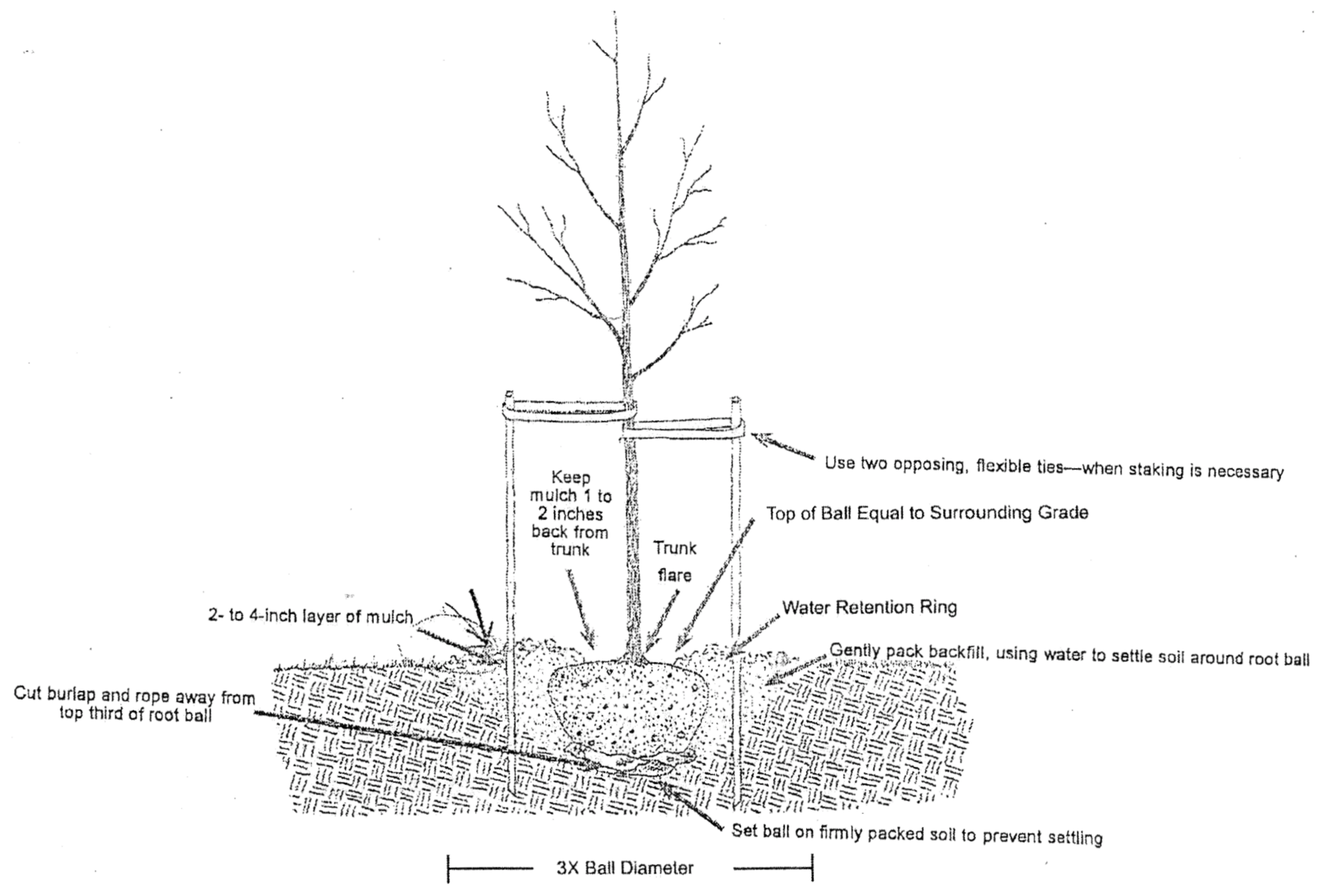
(Ord. No. 09-40, § 1, 7-14-09)
Section 4.6.16. - Alternative Compliance.
A.
Intent. The intent of this Article is to ensure that a minimum density of trees is maintained on all developed sites. Occasionally, compliance with this intent cannot be attained because a project site will not support the required density of trees. When the City Arborist makes a writing finding that the project site will not bear the required density of trees, two methods of compliance are acceptable:
1.
Off-site planting at a location on public property or an appropriate conservation easement remote from the project site; or
2.
Contributing to the Columbus, Georgia Tree Replacement Fund.
B.
Standards for Alternative Compliance. The following standards have been established for administering these alternative compliance methods.
1.
Review and Approval. The City Arborist must review and approve all requests for alternative compliance within 15 day of receipt of such requests.
2.
Standards for Compliance. In no instance shall 100 percent of the required TDU be attained through alternative compliance. As many trees as can reasonably be expected to survive must be planted on the site in question.
3.
Permit Issuance. The land disturbance permit will only be issued after the City Arborist has approved the request and received the necessary documentation or funds.
C.
Off-site Planting. If trees are to be planted at another location, the compliance with the standards listed below is required.
1.
Location. The off-site location should be in the same area of the City as the project site and will be selected by joint consultation between the developer and the City Arborist. If they are unable to agree upon a mutually acceptable site, then the Tree Board will select the site.
2.
Tree Planting Plan. A tree planting plan consistent with all applicable standards of this Article must be reviewed and approved by the City Arborist.
3.
Required Plan Note. The following note must be shown on the approved plan:
"A Tree Planting Plan addendum for this project shall be submitted to the City Arborist within 30 days from the date of this land disturbance permit. This plan shall include the species, size and location of trees to be planted off-site to meet the tree density deficit shown. Release of this project is subject to approval of this plan as well as verification of the installation of the trees."
D.
Tree Replacement Fund. As another method of alternative compliance, the City will accept donations to the City's Tree Replacement Fund. The donations shall be used for the sole purpose of planting trees on public property in the same area of the City as the project site.
1.
Calculating Contribution Amounts. Contribution calculations are based on two-inch caliper replacement trees with a value of $220.00, representing the average size and cost of materials, labor and guarantee for trees planted in the City.
2.
Minimum Contribution Formula. The formula for determining the total contribution is indicated below:
Required Contribution = Density Factor Deficit (DFD)/.5 (Unit Value) × $220.00 (Replacement Value).
Density Factor Deficit. The unit value that cannot be planted on the site.
Unit Value. The unit value of a two inch caliper replacement tree.
Replacement Value. $220.00 for trees planted in the City.
Example Calculation.
An example calculation to determine a required contribution is presented below.
A 2.2 acre site has a required total tree density units (TTDU) standard of 22.0, an existing tree density Units (ETDU) OF 11.4, and can only accommodate replacement tree density units (RTDU) of 9.0.
Determine the density unit deficit (DUD) using the formula: DUD=TTDU-ETDU-RTDU
In this example, DFD = 22.0 - 11.4 - 9.0 = 1.6
Determine the acceptable contribution amount as follows: 1.6 divided by .5 multiplied by $220.00 = $704.00
E.
Fund Administration. The Urban Forestry and Beautification Division will administer the Columbus Tree Replacement Fund. A quarterly report shall be submitted to the City Manager showing amounts collected, amount spent, and the types and locations of trees planted. The report will be made available to the Mayor and Council upon their request.
Section 4.6.17. - Inspections.
A.
Certification and Inspections.
1.
Inspections. Inspections shall be performed at any time during the development process, and from time to time, as determined by the City Arborist. The inspections shall be performed by the Arborist or designee, which may include officials of the Building Inspections and Code Division for single-family residential lots.
2.
Final Approvals. Prior to the release of the certificate of occupancy, final plat approval or final building inspection, an inspection will be performed to assure compliance with the tree protection and planting plan. The inspection and report shall be made by either the City Arborist or designee or by an individual with the qualifications as provided in Section 4.6.4.
(A)
Irrigation. Any required irrigation must be operational at this time. Hose bibs and other watering devices specified on the plans will be verified.
(B)
Plantings. All plantings and trees retained for TDU credit will be inspected.
(C)
Exception. Any certificate of occupancy or final building inspection may be granted prior to any required plantings having been fully installed if a "Request for Delay Affidavit" has been filed and approved by the Arborist.
B.
Maintenance Inspection. Any planted materials that are dead or missing at the time of a maintenance inspection must be replaced by the responsible party.
1.
City Arborist. The City Arborist shall provide the responsible party with a written evaluation of what trees need to be replaced and the time frame within which replacement is to occur.
2.
Additional Monitoring. Any trees in a state of decline will be noted and subject to monitoring at later dates. If such trees die, they will become the responsibility of the current owner to replace.
Section 4.6.18. - Variances and Appeals.
A request for variance shall be filed subject to the requirements of this Section and of Article 11 of Chapter 10.
A.
Administrative Variances.
1.
Authority of City Arborist. The City Arborist shall have the authority to grant variances not to exceed 20 percent of the minimum or maximum standards of this Article.
2.
Appeals from City Arborist Decision. Appeals of a decision made by the City Arborist shall be submitted to the Tree Board.
B.
Other Variances. Variances in excess of the amount that can be granted by the City Arborist shall be submitted to the Tree Board. Variances to this Article shall be granted under the same procedures as provided in Article 11 of Chapter 10, excluding the notification of property owners, except that the Tree Board will be acting as the appellate body on all matters under this Article rather than the Board of Zoning Appeals. The Tree Board is granted the same powers for hearing appeals and granting variances involving this Article as the Board of Zoning Appeals is granted in Chapter 10.
C.
Standards for Review. In addition to the standards for review contained in Article 11 of Chapter 10, the following standards shall be utilized for a variance from the requirements of this Article.
1.
Public Health, Safety and Welfare. The granting of the variance will not cause substantial detriment to the public health, safety or welfare; be injurious to other property; or impair the purpose and intent of this Article.
2.
Extraordinary Conditions. There are extraordinary and exceptional conditions pertaining to the property in question that would result in a particular hardship to the owner, as distinguished from a mere inconvenience, if the strict letter of these regulations were carried out.
3.
Reasonable Use of Land. The strict application of this Article would deprive an applicant of reasonable use of the land, or would create an unnecessary hardship as distinguished from a mere inconvenience.
4.
Special Circumstances. Any special circumstances are not the result of actions of the applicant taken subsequently to the adoption or amendment of this Article.
5.
Action or Variance Request. As applicable, the City Arborist or Tree Board may approve, modify or deny the requested adjustment or variance. The approval or modification shall be granted only if the Arborist or Board determines that approval of any adjustments would not be contrary to the intent of this Article and that literal enforcement of the above standards would be impractical and would result in unreasonable and unnecessary hardships.
6.
Timely Decisions. The City Arborist or Tree Board shall act as expeditiously as possible on all requests for variance and appeals.
(A)
City Arborist. The City Arborist shall act on all requests for variance with 15 days of receipt of the request.
(B)
Tree Board.
(1)
The Tree Board shall approve or reject any request for a variance or appeal from the decision of the City Arborist within 40 days after an application is filed.
(2)
If a meeting of the Tree Board has not been scheduled within the next 30 days of the filing of a request for variance or appeal, the Chair shall call a meeting.
(3)
The decision of the Board shall be issued within ten days following consideration of the request or appeal.
(4)
Notification of all actions on requests for variance or appeal, whether by the Arborist or Tree Board, shall be forwarded to the applicant by certified or registered mail, return receipt requested, and posted in a conspicuous place, or in the office of the City Arborist. The notification shall be in the form of a short, concise statement of the action taken.
(5)
Within 14 days after posting of a decision, but not thereafter, any decision of the City Arborist or Tree Board may be appealed by the applicant. The appeal of any decision by the City Arborist shall be submitted to the Tree Board and the appeal of any decision of the Tree Board shall be filed with the Clerk of Council for action by the Council of Columbus.
(6)
The appeal to the Council of Columbus is a de novo appeal and the Council may affirm, modify or reverse the ruling of the Tree Board.
Table 4.6.5
Required and Prohibited Tree Planting List
(Ord. No. 12-53, § 8, 12-4-12)
Section 4.6.19. - Enforcement and Administration.
A.
Review of Tree Protection and Tree Planting Plans.
1.
Review. The City Arborist shall review and approve or disapprove all tree protection plans and tree planting plans submitted as required by this Article.
2.
Period for Review. The City Arborist shall review and approve or disapprove a plan within 15 working days after it is filed.
3.
Issuance of Certificates and Permits.
B.
Fast Track Projects. A site development permit, residential development permit, certificate of occupancy or building permit shall not be issued without the approval of the City Arborist signifying compliance with the provisions of this Article.
1.
Cooperative Review. On any project, which the Planning Director determines to be a fast track, large economic development project, the Arborist shall work with the Community Project Team, the Development Authority, the developer and the company representatives to comply with the 15-day permit turn around time.
2.
Status of Projects. These are special projects determined by the Columbus Consolidated Government, and it is intended for this action to be processed concurrent with all other permitting actions relating to a project in support of its fast track designation.
C.
Revocation, Suspension or Voiding of Permits and Certificates. The City Arborist shall have the authority to revoke, suspend or void any site development permit, final inspection or building permit or to withhold any certificate of occupancy or approval of a final plat, and shall have the authority to suspend all work on a site or any portion thereof, where tree removal or damage occurs in violation of this Article or the provisions of the approved tree protection and planting plan for the site. The City Arborist's authority to suspend work on a site shall have the concurrence of the Director of the Department of Public Services.
D.
Falsification of Information. It shall be unlawful to falsify any information contained in any application, plan or report required by this Article or this Chapter to tree preservation, protection, installation or similar action. If the City Arborist makes a written determination that a person has falsified any required application, plan or report, such person:
1.
Shall not be permitted to certify compliance with this Chapter for a period of five years;
2.
Shall submit and implement a revised tree protection and planting plan approved by the City Arborist; and
3.
Shall be subject to a minimum fine of $500.00 for violation of this Section.
E.
Penalty. The penalty for any violation of this Article shall be in accordance with the applicable portions of the City Code. Each day of any violation of any provision of this Article shall constitute a separate offense. Any action which results in the death or destruction of a public tree located on Columbus Consolidated Government property shall be subject to a fine in an amount equal to $100.00 for each inch of diameter at breast height or stump diameter if the tree is no longer present, up to a maximum fine of $1,000.00. All money collected from fines shall be deposited in the Tree Replacement Fund.
(Ord. No. 05-32, § 1, 4-5-05)
Section 4.7.1.- Nuisances.
A.
Public Nuisances.
1.
Authority of City Arborist. The City Arborist has the authority to declare as a nuisance any tree or shrub or parts thereof growing on public or private property, and interfering or endangering the use of the public streets or sidewalks or obscuring sight distances and creating a traffic hazard on intersections or endangering the life, health, safety or property of the public.
2.
Notification of Nuisance. The City Arborist shall notify in writing the owner or interested parties of such tree or shrub of the existence of the nuisance and give a 15-day period of time for contracting for correction or removal of the nuisance or for requesting a hearing.
B.
Failure to Remove.
1.
Hearing. If the owner or interested parties have not corrected or removed the nuisance or contracted for correction or removal of the nuisance within the 15 day period, the City Manager or designee shall hold a hearing not less than 15 days nor more than 30 days following the notice of the City Arborist. The hearing shall be schedule at a date and time certain, within the City.
2.
Rights of Owner or Parties in Interest. The owner or parties in interest shall be given the right to file an answer to the notice, to appear in person, or be represented by an attorney and give testimony at the public hearing, as to why compliance with the notice from the City Arborist has not been achieved.
3.
Rules of Evidence. Rules of evidence prevailing in courts of law or equity shall not control in hearings before the City Manager or designee.
C.
Determination of Nuisance. The City Manager or designee shall determine at the hearing, on the basis of the evidence presented, whether or not the tree or shrub is a nuisance to the public and the owner's responsibility therefore.
1.
Issuance of Order. If the City Manager or designee determines that the tree or shrub is a nuisance, an order shall be issued, which shall be served upon the owner or parties in interest, requiring them to remove or correct the nuisance within 15 days.
2.
Failure to Correct or Remove. If not corrected or removed within such period, the City Arborist shall cause the nuisance to be corrected or removed and the cost shall be assessed to the owner or interested parties.
D.
Liens.
1.
Lien Against Real Property. The cost of the correction or removal shall be a lien against the real property upon which the tree or shrub is or was situated. The lien shall be prepared and entered by the Finance Department and recorded in the office of the Clerk of the Muscogee County Superior Court in the same manner which liens for costs for removal of weeds and other vegetation are filed.
2.
Payment of Lien. The owner or parties in interest shall pay the full amount due on a lien to the Director of Finance of the City within 30 days of perfection of the lien. If the lien is not paid in full within 30 days of the perfection of such lien, the owner or parties in interest shall pay:
(A)
Twenty-five percent of the total lien amount plus seven percent interest within 60 days of the perfection of the lien; and
(B)
The remaining balance due on such lien to be paid in three equal annual installments with interest at the rate of seven percent per annum, each of which shall become due and payable on the anniversary date of the initial payment made as prescribed herein.
3.
Sale or Conveyance of Real Property subject to a Lien. Should the property upon which a lien is perfected be sold, transferred or conveyed by the owner or parties in interest at any time, then the entire balance due on the lien shall be due and payable to the Director of Finance of the City.
4.
Failure to Pay. Should the amount due on a lien, or any portion thereof, be unpaid after the time for payment of the final annual installment provided in this Section, the amount shall continue as a lien together with interest at the rate of seven percent per annum until paid in full.
E.
Disease and Insect Infestation.
1.
Authority of City Council. Council shall have the authority to insist that all property owners treat or allow the City to treat trees or shrubs suffering from transmittable diseases or insect infestations which are on private property but are affecting the health of public trees on public property.
2.
Determination by City Arborist. If the City Arborist determines that disease or insect infestation warrants drastic action to curb its spread to healthy public trees, then the disease or infestation shall constitute a nuisance and the procedural requirements of Section 4.6.5 regarding a nuisance shall apply.
F.
Emergencies. In case of emergencies, such as windstorms, or other disasters, or other imminent danger to the health, safety or property of the public, including but not limited to automotive and pedestrian traffic due to obstruction of public sidewalks, streets or sight distances, the requirements of Sections 4.7.4 and 4.7.5 shall be waived so that the requirements of this Article would not hamper private or public work to restore order to the City. This work to be done in accordance with emergency standards as outlined by the City Arborist.
Section 4.7.2. - Enforcement and Administration.
A.
Review of Tree Protection and Tree Planting Plans.
1.
Review. The City Arborist shall review and approve or disapprove all tree protection plans and tree planting plans submitted as required by this Article.
2.
Period for Review. The City Arborist shall review and approve or disapprove a plan within 15 working days after it is filed.
3.
Issuance of Certificates and Permits. A site development permit, certificate of occupancy, or building permit shall not be issued without the approval of the City Arborist signifying compliance with the provisions of this Article.
B.
Fast Track Projects.
1.
Cooperative Review. On any project, which the City Manager determines to be a fast track, large economic development project, the Arborist will work with the Community Project Team, the Development Authority, the developer, and the company representatives to comply with the 15-day permit turn around time.
2.
Status of Projects. These are special projects determined by the City, and it is intended for this action to be processed concurrent with all other permitting actions relating to a project in support of its fast track designation.
C.
Revocation, Suspension or Voiding of Permits and Certificates. The City Arborist shall have the authority to revoke, suspend or void any site development permit, final inspection, or building permit or to withhold any certificate of occupancy or approval of a final plat, and shall have the authority to suspend all work on a site or any portion thereof, where tree removal or damage occurs in violation of this Article or the provisions of the approved Tree Protection and Planting Plan for the site. The City Arborist's authority to suspend work on a site must have the concurrence of the Director of the Department of Public Services.
D.
Falsification of Information. It shall be unlawful to falsify any information contained in any application, plan or report required by this Article or this Chapter to tree preservation, protection, installation or similar action. If the City Arborist makes a written determination at a person has falsified any application, plan or report required herein, such person:
1.
Shall not be permitted to certify compliance with this Chapter for a period of five years;
2.
Shall submit and implement a revised tree protection and planting plan approved by the City Arborist; and
3.
Shall be subject to a minimum fine of $500.00 for violation of this Section.
E.
Penalty. The penalty for any violation Article shall be in accordance with the applicable portions of the City Code. Each day of any violation of any provision of this Article shall constitute a separate offense. Any action which results in the death or destruction of a public tree located on City property shall be subject to fine in an amount equal to $100.00 for each inch of diameter at breast height or stump diameter if tree is no longer present, up to a maximum fine of $1,000.00. All money collected from fines shall be deposited in the Tree Replacement Fund.
(Ord. No. 09-40, § 1, 7-14-09)
Section 4.7.3. - Injunctive Relief.
A.
Civil Action. Whenever the City has reasonable cause to believe that any person, firm, corporation or other entity is violating this Chapter, or any term, condition or provision of an approved permit, it may, either before or after the institution of any other action or proceeding authorized by this Ordinance, institute a civil action in the name of the City for an injunction and order of abatement commanding the defendant to correct the unlawful condition or cease the unlawful use of the property.
B.
Civil or Criminal Penalties. The institution of an action for injunctive relief under this Section shall not relieve any party to such proceedings from any civil or criminal penalty prescribed for violation of this Chapter.
Section 4.7.4. - Miscellaneous.
A.
Trenching and Boring within the Critical Root Zone on City Property. Trenching within the critical root zone of any tree on City property shall be prohibited. The critical root zone is considered to be the root system within the dripline. Boring, auguring, or other alternative method may be employed that allows for the installation of underground utilities within the critical root zone but stays three feet or more below the surface of the ground.
B.
Damage by City Trees. When, in the opinion of the City Arborist, roots of a tree on public property damage City curbs, gutters and sidewalks including the portions of driveways on public right-of-way, the City shall be responsible for appropriate corrective measures which are least damaging to the tree. In the event the portion of the driveway on public right-of-way must be repaired or replaced, the City Arborist shall make a report to the City Manager, Director of Public Works and the Risk Manager detailing the nature of such damage, and in such cases, the City Manager is authorized to approve repairs or replacement of such driveway portion on public right-of-way in an amount not to exceed $2,500.00.
C.
Required Permits.
1.
Actions Affecting Public Trees. Any person or organization shall not take any of the following action to or upon any public trees as determined by the City Arborist unless previously approved in a site development permit or without first obtaining the proper permit from the City Arborist:
(A)
Cut, prune, climb with spikes, break, damage, remove, kill, or cause to be killed;
(B)
Cut, disturb or interfere in any way with any root within the drip line;
(C)
Place or spray with, any toxic chemical as listed in the maintenance standards;
(D)
Fasten any rope, wire, sign, or other device;
(E)
Remove or damage any guard devices placed to protect any tree;
(F)
Conduct razing, removal or renovation of any structures if deemed by the City Arborist to be damaging to neighboring trees;
(G)
Maintain a stationary fire or device which vaporizes noxious fumes deleterious to tree health; or
(H)
Pave with concrete, asphalt or other impervious material within four feet of a tree.
2.
Topping of Public Trees. The topping of any City tree for any purpose, including sight clearance for billboards, is prohibited and a permit shall not be issued for such action.
3.
Permit Fees. A permit fee of $35.00 shall be assessed for each permit and shall be applicable to the particular job as specified by the permit.
4.
Permit for Removal of Trees on City Property. A request for a permit to remove trees on City property may be submitted to the City Arborist, if accompanied by a proposed landscape plan. The landscape plan must show the number, size, and species of plants and must replace all removed trees at a 1:1 ratio.
5.
Tree Planting Standards. All trees proposed shall adhere to Section 4.6.15 relating to standards for tree planting.
6.
Exemptions. The City and public utility companies shall be exempted from acquiring individual job permits to perform necessary tree maintenance on public rights-of-way or public lands.
D.
Public Utility Standards for Maintenance of Trees. All work performed by public utilities involving maintenance of trees on public rights-of-way shall adhere to the standards listed below.
1.
Nature of Work. The work shall be limited to the actual necessities required to maintain safe and reliable systems.
2.
Necessary Maintenance. Necessary maintenance shall be deemed the maintenance necessary to prevent regrowth into the wire zone during the established cycle length.
3.
Maintenance Standards. All maintenance shall adhere to American National Standards Institute Standard 300, as amended.
4.
Waiver. During the event of a natural disaster, such as an ice storm, tornado or hurricane, the public utility standards for maintenance of trees shall be waived.
5.
Coordination. The public utilities shall communicate and coordinate with the City Arborist when clearing or pruning within the rights-of-way.
E.
Licensure of Tree Experts.
1.
Application. To protect the public, the City shall require anyone who removes or maintains trees as a business on public or private lands to be licensed.
2.
Examinations by City Arborist. In order to be licensed, individuals shall be examined by the City Arborist to determine the ability to conduct such work before granting a license to practice as a tree expert.
3.
Other Examinations. Passage of the examination administered by the International Society for Arboriculture (ISA) for Certified Arborist or Certified Tree Worker may be accepted in lieu of an examination by the City Arborist.
4.
City Workers. Employees of the City responsible for maintaining public trees shall be examined in the field for their ability to properly prune, maintain, or remove trees but shall not be required to pay the application fee.
5.
Application. A $25.00 fee shall be made payable to Columbus, Georgia to accompany the application for examination for each applicant.
F.
House Moving Permits. To avoid damage to public trees, any building or other large objects which is to be moved along any street must obtain the following:
1.
Written permission from the City Arborist; and
2.
A permit from the Inspections and Code Enforcement Division.
(Ord. No. 14-2, § 2, 1-14-14)
Section 4.7.5. - Land Clearing, Timber Harvesting, and Speculative Grading.
A.
Exemption.
1.
Bona Fide Agricultural Purposes. Land clearing for bona fide agricultural purposes within an RE10 or RE5 zoning district, including legitimate timber harvesting, plant or tree nurseries and orchards, is exempt from the provisions of this Article and Article 6 of this Chapter.
2.
Excluded Tree Harvesting. The exemption provided in this Section shall not be interpreted to include tree harvesting incidental to the development of land, or tree harvesting on land that is anticipated to be developed for nonhorticultural uses.
B.
Natural Area Required.
1.
Timber Harvesting. All legitimate timber harvesting on tracts of five or more acres shall be required to provide and maintain a 50 foot wide undisturbed natural area adjacent to all paved public road frontages during harvesting and site preparation activities.
(A)
Crossings Permitted. A maximum of two access crossings will be allowed.
(B)
Maintenance. The natural area is to be maintained for five (5) years.
2.
Other Land Disturbing Activities. For all other land disturbing activities in anticipation of development other than those specified in this Section, a natural areas with an average width of at least 30 feet shall be maintained adjacent to all paved public road frontages.
(A)
Calculation of Average Width. The average shall be calculated on the plans submitted and include for credit in said calculation only the first 60 feet of the site closest to the right-of-way.
(B)
Retention of Natural Area. The natural area shall be maintained until a tree protection or planting plan is approved for the site adjacent to all paved public road frontages. The plan may be in narrative form, and shall provide for planting as required by either the perimeter planting requirements of Article 6 of this Chapter or the requirements of Article 5 of this Chapter relating to buffering screening and landscaping, whichever is applicable, or seek a variance from such requirements.
Section 4.7.6. - Cooperation with Other Departments.
There shall be close cooperation between the City Arborist, the Public Services Department, the Planning Department, the Department of Inspections and Codes, the Engineering Department, the Parks and Recreation Department and all other city departments when their work affects public trees. The City Arborist shall review and comment on the proposed landscaping plans of all recreational lands and other public properties within the City and any plan or project of any department of this city which requires the removal of any tree.
(Ord. No. 09-40, § 1, 7-14-09)
Section 4.7.7. - Nonliability of City.
Nothing in this Article or Article 6 of this Chapter shall be deemed to impose any liability upon the City or upon any of its officers or employees, or to relieve the owner and occupant of any private property from the duty to keep trees and shrubs upon his private property or under his control in a safe condition.
Section 4.8.1.- Airports.
A.
Purpose. The purpose of these regulations is to regulate and restrict growth, development and building height in the area adjacent to the Columbus Metropolitan Airport, including the following:
1.
Regulate and restrict the height of structures and objects of natural growth and otherwise regulate the use of property in the vicinity of the Columbus Metropolitan Airport;
2.
Regulate and restrict the use of property in the vicinity of the Columbus Metropolitan Airport to prevent development of high density residential dwellings or the concentration of large numbers of persons in those areas subject to low flying aircraft in the process of normal operations; and
3.
Protect flying aircraft by limiting the height of structures and trees.
Section 4.8.2. - Definitions.
Definitions relating to the Columbus Metropolitan Airport are provided in Chapter 13.
Section 4.8.3. - Runway Protection Zone/Airspace Drawing.
The Runway Protection Zone/Airspace Drawing, Columbus Metropolitan Airport, prepared by the LPA Group Incorporated, Aviation Consultants, dated March 1994, is adopted by reference as part of these land development regulations.
Section 4.8.4. - Airport Zones.
A.
Established. In order to carry out the provisions of this Chapter, airport zones are established which include all the land within the approach zones, transitional zones, horizontal zones, and conical zones as they apply to the City of Columbus. Individual airport zones are indicated below.
1.
Approach Zones. The inner edge of these zones coincides with the width of the primary surfaces, and the horizontal dimensions are the same as those shown on the airspace zoning map for the respective approach surfaces.
2.
Transitional Zones. These zones are hereby established as the area beneath the transitional surfaces.
(A)
Relation to Horizontal and Conical Surfaces. These surfaces extend outward and upward at 90-degree angles to the runway centerline and extend at a slope of seven feet horizontally for each foot vertically from the sides of the primary and approach surfaces to where they intersect the horizontal and conical surfaces.
(B)
Relation to Conical Surfaces and Centerline. Transitional zones for those portions of the precision approach zones which project through and beyond the limits of the conical surface extend a distance of 5,000 feet measured horizontally from the edge of the approach zones and at 90-degree angles to the extended runway centerline.
3.
Horizontal Zones. The horizontal zones are hereby established by swinging arcs of 10,000 feet radius from the center of each end of the primary surface of Runway 5-23 and connecting the adjacent arcs by drawing lines tangent to those arcs. The horizontal zone does not include approach and transitional zones. This zone is the imaginary surface 150 feet above the highest point of the airport elevation.
4.
Conical Zones. The conical zones are hereby established as the area that commences at the periphery of the horizontal zone and extends outward a horizontal distance of 4,000 feet. The conical zones do not include the precision instrument approach zones or the transitional zones.
B.
Location of Zones. The airport zones are shown on the Runway Protection Zone/Airspace Drawing, Columbus Metropolitan Airport, consisting of one sheet, prepared by the LPA Group Incorporated, Aviation Consultants, dated March 1994.
C.
Effect of Airport Zones.
1.
Additional Zoning Requirements. These airport zones shall be superimposed over existing zone districts and the special requirements of these airport zoning regulations shall apply in addition to the requirements of the use district within which a specific property is located.
2.
Multiple Zones. An area located in more than one of the following airport zones is considered to be only in the zone with the more restrictive height limitation.
Section 4.8.5. - Airport Zone Height Limitation.
A.
Height Limits. Except as otherwise provided in these regulations, no structure or tree shall be erected, altered, allowed to grow, or be maintained in any zone created by these regulations to a height in excess of the applicable height limit herein established for each zone.
B.
Elevation. Such height limitations are hereby established for each zone in question as the elevation of the respective imaginary surfaces shown on the airspace zoning map.
C.
Most Restrictive. Where an area is covered by more than one height limitation, the more restrictive limitation shall prevail.
Section 4.8.6. - Use Restrictions.
A.
Interference Prohibited. Notwithstanding any other provisions of these land development regulations, one or more uses shall not be made of land or water within any zone established by these regulations in such a manner as to:
1.
Create electrical interference with navigational signals or radio communication between the airport and aircraft;
2.
Make it difficult for pilots to distinguish between airport lights and others;
3.
Result in glare in the eyes of pilots using the airport;
4.
Impair visibility in the vicinity of the airport; or
5.
Otherwise in any way create a hazard or endanger the landing, takeoff or maneuvering of aircraft intending to use the airport.
B.
Prohibited Uses. The following uses are prohibited in the first 2,500—foot segment of the approach zone beginning at the end of the primary surface for Runway 6-24 and the first 1,700-foot segment of the approach zone beginning at the end of the primary surface for Runway 13-31:
1.
Houses of worship, schools, lodges, clubs, theatres, and other places of public assembly;
2.
Multifamily dwellings in excess of four units per structure or in a group development;
3.
Hospitals and institutions; and
4.
Any other similar use where a concentration of people is customary.
C.
Airports. The following uses are permitted subject to conformity with the Federal Aviation Administration (FAA) safety standards applicable to the particular airport property:
1.
Grassed or paved runways, taxiways, landing strips and aprons;
2.
Aircraft fueling facilities;
3.
Aircraft storage, service and repair hangars;
4.
Passenger and freight terminal facilities, including any accessory use as contracted and approved by the Airport Commission;
5.
Lighting, radio and radar facilities;
6.
Accessory structures and facilities including aircraft, aviation and accessory sales.
Section 4.8.7. - Height Standards.
All buildings shall comply with Federal Aviation Agency height standards. Heights in excess of 30 feet may be permitted only upon securing a use permit from the Airport Commission.
Section 4.8.8. - Nonconforming Uses.
A.
Regulations not Retroactive. These airport regulations shall not be construed to require the removal, lowering, or other changes or alterations of any structure or tree not conforming to these regulations as of the effective date of this chapter or otherwise interfere with the continuance of a nonconforming use.
B.
Marking and Lighting.
1.
Installation Required. Notwithstanding the provisions of this Section, the owner of any existing nonconforming structure or tree is hereby required to permit the installation, operation, and maintenance thereon of such markers and lights as shall be deemed necessary by the Columbus Metropolitan Airport Commission to indicate to the operators of aircraft in the vicinity of the airport the presence of such hazards.
2.
Expense of Marking and Lighting. Such markers and lights shall be installed, operated, and maintained at the expense of the Columbus Metropolitan Airport.
C.
Termination of Nonconforming Uses.
1.
Discontinuance. The discontinuance of a nonconforming use for a period of one year shall result in loss of the nonconforming use status. In addition, the change of use to a more restrictive or to a conforming use for any period of time shall be considered evidence of intent of abandonment, and such nonconforming use shall not thereafter be revived.
2.
Partial Destruction. Any nonconforming use, building or structure that, as a result of fire, explosion, or other casualty, has 50 percent or more of its replacement value destroyed, shall thereafter be terminated, and any new construction shall be in accordance with these regulations.
3.
Expansion. Any existing nonconforming use as described in these regulations shall not be expanded by altering, replanting or otherwise enlarging it so as to increase in any way its hazard within the airspace required for flight of aircraft in landing or takeoff or to increase the potential hazard to persons assembled within a structure so located and used.
Section 4.8.9. - Variances.
Any person desiring to erect or increase the height of any structure or permit the growth of any tree or use property not in accordance with the regulations of this Article may apply to the Board of Zoning Appeals for a variance from such regulations.
Section 4.8.10. - Permits.
A.
Material Changes. A material change shall not be made in the use of land, and no structure or tree shall be erected, altered, planted, or otherwise established in any zone hereby created unless a permit therefore shall have been applied for and granted.
B.
Application. Each application for a permit shall indicate the purpose for which the permit is desired with sufficient information to determine whether the resulting use or structure or tree would conform to the regulations herein prescribed. If such determination is in the affirmative, the permit shall be granted.
C.
Existing Use. A permit shall not be granted that would allow the establishment or creation of an airport hazard or permit a nonconforming use, structure, or tree to become a greater hazard to air navigation than it was on the effective date of these regulations or any amendments thereto or than it is when the application for a permit is made.
D.
Hazard Marking and Lighting.
1.
Any permit granted may, if such action is deemed advisable to effectuate the purpose of these regulations and be reasonable in the circumstances, be so conditioned as to require the owner of the structure or tree in question to permit the Columbus Metropolitan Airport Commission, at its own expense, to install, operate and maintain thereon such markers and lights as may be necessary to indicate to pilots the presence of an airport hazard.
2.
Such markers and lights shall be installed, operated and maintained at the expense of the Columbus Metropolitan Airport.
E.
Approval Agencies. Applicants for a building permit or for variances to these regulations shall submit written approval from the City Engineer and the FAA, and other approval as required by the Chief of the Inspections and Code Enforcement Division regarding height and safety before issuance of a permit.
Section 4.9.1.- Intent; purpose.
It is the purpose of this chapter to protect the public health, safety and general welfare of individuals and the community at large; to monitor and provide reasonable means for citizens to mitigate impacts created by occupancy of short-term units; and to implement rationally based, reasonably tailored regulations to protect the integrity of the city's neighborhoods.
(Ord. No. 18-45, § 1, 10-9-18)
Section 4.9.2. - Definitions; general provisions.
Code compliance verification form is a document executed by a short-term unit owner certifying that the short-term unit complies with applicable zoning, building, health and life safety code provisions. No person shall allow occupancy or possession of any short-term rental unit if the premises is in violation of any applicable zoning, building, health or life safety code provisions.
Owner-occupied property refers to real property which contains one or more dwelling unit(s) where the principal dwelling unit must be occupied by the property owner and constitute his/her primary and usual place of residence. Proof of owner-occupancy requires proof of a valid homestead exemption submitted with the application for a short-term vacation rental certificate. In lieu of homestead exemption, a sworn affidavit and supporting documentation establishing proof of residency must be submitted by the applicant stating that the primary dwelling unit is the legal residence and domicile of the resident. Proof of residency is required in the form of two of the following: 1) a valid Georgia Driver's License or Georgia Identification Card; 2) registration for vehicles owned by and registered in the name of the applicant; 3) Muscogee County Voter's Registration Card or 4) other documentation of permanent residence satisfactory to the Director.
Short-term rental agent means a natural person designated by the owner of a short-term rental on the short-term rental permit application. Such person shall be available for and responsive to contact at all times and someone who is customarily present at a location within the city for purposes of transacting business. An owner who is a natural person may also be the short-term rental agent.
Short-term rental occupants means guests, tourists, lessees, vacationers or any other person who, in exchange for compensation, occupy a dwelling unit for lodging for a period of time not to exceed 30 consecutive days.
Short-term rental owner means the owner of record of the property. If the owner is not a natural person, the duties of the owner shall be carried out by the officer of the corporation or entity whose responsibility is to control the use of the premises.
Short-term rental permit is the permit issued by the Director of the Department of Inspections and Code to owners of short-term rental units who have submitted the required documentation and met the requirements set for in this Article for the operation of a short-term rental unit.
Short-term rental unit means an accommodation for transient guests where, in exchange for compensation, a residential dwelling unit, either the primary structure or any approved accessory dwelling is provided for lodging for a period of time not to exceed 30 consecutive days. Such use may or may not include an on-site manager. For the purposes of this definition, a residential dwelling shall include all single family and multi-family housing types and shall exclude group living or other lodging uses, as described in Chapter 3 and defined in Chapter 13, respectively, of the Unified Development Ordinance of the Columbus Consolidated Government. A short-term rental unit may not include a motor vehicle as defined in Title 40 of the Official Code of Georgia Annotated.
(Ord. No. 18-45, § 1, 10-9-18; Ord. No. 23-008, § 1, 1-31-23)
Section 4.9.3. - Short-term rental permit.
No person shall rent, lease or otherwise exchange for compensation all or any portion of a dwelling unit as short-term rental, as defined in Section 4.9.2, without first obtaining a short-term rental permit pursuant to the regulations contained in this Article and then obtaining a business license from the Revenue Division of the Department of Finance. No permit issued under this chapter may be transferred or assigned or used by any person other than the one to whom it is issued, or at any location other than the one for which it is issued.
(Ord. No. 18-45, § 1, 10-9-18)
Section 4.9.4. - Application for short-term rental permit.
A.
Owners desiring to obtain a short-term rental permit shall submit, on an annual basis, an application for a short-term rental permit to the Director of Inspections and Code Enforcement. The application shall be furnished under oath on a form specified by the city manager, accompanied by a non-refundable application fee in the amount of $40.00 or as may be revised in the city's annual budget ordinance or such other ordinance as may later be passed by Council. Both the short-term rental unit owner and short-term rental agent will consent to a criminal background check which will be reviewed by the department before the application is accepted for processing. If any required background check reveals felonies within the last ten years or a misdemeanor involving moral turpitude within the last five years, the application will not be accepted for processing. Such application should include:
1.
The name, address, telephone and email address of the owner(s} of record of the dwelling unit for which a permit is sought. If such owner is not a natural person, the application shall identify all partners, officers and/or directors of any such entity, including personal contact information;
2.
The address of the unit to be used as a short-term rental;
3.
The name, address, telephone number and email address of the short-term rental agent, which shall constitute his or her 24-hour contact information;
4.
The owner's sworn acknowledgement that he or she has received a copy of this section, has reviewed it and understands its requirements;
5.
The number and location of parking spaces allotted to the premises;
6.
The owner's agreement to use his or her best efforts to assure that use of the premises by short- term rental occupants will not disrupt the neighborhood, and will not interfere with the rights of neighboring property owners to the quiet enjoyment of their properties; and
7.
Any other information that this chapter requires the owner to provide to the city as part of an application for a short-term rental permit. The city manager or his or her designee shall have the authority to obtain additional information from the owner as necessary to achieve the objectives of this chapter.
B.
Attached to and concurrent with submission of the application described in this section, the owner shall provide:
1.
The owner's sworn code compliance verification form;
2.
A written exemplar agreement, which shall consist of the form of document to be executed between the owner and occupant(s} and which shall contain the following provisions:
(A)
The occupant(s)' agreement to abide by all of the requirements of this chapter, any other Columbus Consolidated Government ordinances, state and federal law and acknowledgement that his or her rights under the agreement may not be transferred or assigned to anyone else;
(B)
The occupant(s)' acknowledgement that it shall be unlawful to allow or make any noise or sound that exceeds the limits set forth in the City's noise ordinance;
(C)
The owner and occupant(s)'acknowledgement that the unit is not being leased for and will not be advertised, promoted, or have any amenities provided for the purposes of providing any adult entertainment as defined in Article VI of Chapter 14 of the Columbus Code or providing Escort Services as defined in Article VII of Chapter 14 [of] the Columbus Code; and
(D)
The occupant(s)' acknowledgement and agreement that violation of the agreement or this chapter may result in immediate termination of the agreement and eviction from the short-term rental unit by the owner or agent, as well as the potential liability for payments of fines levied by the city.
3.
Proof of the owner's current ownership of the short-term rental unit;
4.
Proof of insurance satisfactory in accordance with administrative guidelines published by the Columbus Consolidated Government; and
5.
A written certification from the short-term agent that he or she agrees to perform the duties specified in Subsection 4.9.5.8.
C.
Permit holder shall publish a short-term rental permit number in every print, digital, or internet advertisement and any property listing in which the short-term rental is advertised.
(Ord. No. 18-45, § 1, 10-9-18)
Section 4.9.5. - Short-term rental agent.
A.
The owner of a short-term rental shall designate a short-term rental agent on its application for a short-term rental permit. A property owner may serve as the short-term rental agent. Alternatively, the owner may designate a natural person as his or her agent who is over age 18 and is customarily present at a location within the city for purposes of transacting business.
B.
The duties of the short-term rental agent are to:
1.
Be reasonably available to handle any problems arising from use of the short-term rental unit;
2.
Keep his or her name and emergency contact phone number posted in a readily visible place in the short-term rental unit;
3.
Receive and accept service of any notice of violation related to the use or occupancy of the premises; and;
4.
Monitor the short-term rental unit for compliance with this chapter.
C.
In the event the short-term rental agent is replaced by another agent, the owner will apply for a new short-term rental permit with the correct short-term rental agent designated within 30 days of such change.
(Ord. No. 18-45, § 1, 10-9-18)
Section 4.9.6. - Grant or denial of application.
All of-record property owners adjacent to a proposed short-term vacation rental shall be notified of the use prior to the issuance of an initial short-term vacation rental certificate. Notification shall be issued by the short-term vacation rental applicant and proof of notification provided to the city. The notification to the property owners shall include:
1.
Street address of the proposed short-term vacation rental;
2.
Location of any on-site parking for short-term vacation rental occupants;
3.
Maximum occupancy requirements;
4.
Copy of the short-term vacation exemplar rental agreement;
5.
Name of the property owner(s); and
6.
Name of rental agent and contact information.
Review of an application shall be conducted in accordance with due process principles and shall be granted unless the applicant fails to meet the conditions and requirements of this chapter, or otherwise fails to demonstrate the ability to comply with local, state, or federal law. Any false statements or information provided in the application are grounds for revocation, suspension and/or imposition of penalties, including denial of future applications.
(Ord. No. 18-45, § 1, 10-9-18; Ord. No. 23-008, § 2, 1-31-23)
Section 4.9.7. - Short-term rental units.
A.
A legible copy of the short-term rental unit permit shall be posted within the unit and include all of the following information:
1.
The name, address, telephone number and email address of the short-term rental agent:
2.
The short-term rental unit permit number;
3.
The maximum occupancy of the unit;
4.
The maximum number of vehicles that may be parked at the unit; and
B.
Short-term rental units must be properly maintained and regularly inspected by the owner to ensure continued compliance with applicable zoning, building, health and life safety code provisions.
C.
The short-term rental unit current business license shall be posted within the unit.
D.
A window/door sticker, provided by the Inspections and Code Department, shall be placed on the front door of the short- term rental unit for public safety purposes.
E.
Each rental unit is limited to no more than two (2) occupants per bedroom plus one additional occupant per unit.
F.
There shall be no change in the exterior appearance of the dwelling and premises, or other visible evidence of the conduct of a short-term rental unit.
G.
A minimum stay is considered twenty-four (24) hours. Short-term rental units shall not be rented for less than 24 hours.
(Ord. No. 18-45, § 1, 10-9-18; Ord. No. 23-008, § 3, 1-31-23)
Section 4.9.8. - Short-term regulation procedure.
A.
To ensure the continued application of the intent and purpose of this chapter, the Columbus Georgia Convention and Visitor's Bureau ("the CCVB") shall maintain and make available to appropriate Consolidated Government officials a list of all short-term rental units as defined by this Article, and the CCVB will also notify the owner of any short-term rental unit it identifies of the requirements of this Article and the permit application process.
B.
The Department of Inspections and Code shall maintain for each short-term rental location file a record of all code violation charges, founded accusations and convictions occurring at or relating to a short-term rental unit. When a property owner has accumulated three code violations for a particular property within a period of 12 consecutive months, the Department of Inspections and Code shall revoke any pending permits and reject all applications for the subject premises for a period of 12 consecutive months.
C.
If a short-term rental unit owner has been cited and found to be in violation of any zoning, building, health or life safety code or other violations, the owner must demonstrate compliance with the applicable code prior to being eligible to receive a short-term rental permit.
D.
Citations for code violations and any other violation of the city code shall be heard by the recorder's court of Muscogee County. Violations of this chapter, including but not limited to operating a short-term rental unit without obtaining a short term rental permit and a business license are subject to the following fines, which may not be waived or reduced and which may be combined with any other legal remedy available to the City:
(1)
First violation: $500.00.
(2)
Second violation within the preceding 12 months: $750.00.
(3)
Third violation within the preceding 12 months: $1,000.00.
E.
A person aggrieved by the city's decision to revoke, suspend or deny a short-term rental permit may appeal the decision to the city manager or his appointed designee. The appeal must be filed with the city manager's office in writing, within 30 calendar days after the adverse action and it shall contain a concise statement of the reasons for the appeal. Timely filing of an appeal shall stay the revocation, suspension or denial pending a decision by the city manager.
F.
The city manager or appointed designee shall consider the appeal within 30 days after receipt by the city manager of a request unless otherwise agreed in writing by the city and aggrieved party. All interested parties shall have the right to be represented by counsel, to present testimony and evidence, and to cross-examine witnesses. The city manager shall render a determination, which will constitute a final ruling on the application.
G.
Nothing in this section shall limit the city from enforcement of its code, state or federal law by any other legal remedy available to the city. Nothing in this section shall be construed to limit or supplant the power of any city inspector, police officer, or other duly empowered officer under the city's ordinances, rules and regulations and the authority granted under state law, as amended, to take necessary action, consistent with the law, to protect the public from property which constitutes a public nuisance or to abate a nuisance by any other lawful means of proceedings.
(Ord. No. 18-45, § 1, 10-9-18)
Section 4.9.9. - Taxes.
Short-term rental unit owners are subject to state sales tax, city taxes, including but not limited to the hotel/motel tax, and are liable for payment thereof as established by state law and the city code. The city may seek to enforce payment of all applicable taxes to the extent provided by law, including injunctive relief.
(Ord. No. 18-45, § 1, 10-9-18)
Section 4.9.10. - Historic District Limitations.
A.
In areas designated as Historic Districts as defined in Section 9.3.7, for parcels of land that are not owner-occupied, as defined in Section 4.9.2, short-term vacation rentals are limited within each Historic District as provided below:
Downtown Historic District—35
Weracoba/St. Elmo Historic District—20
High Uptown Historic District—15
Liberty Heritage Historic District—7
Waverly Terrace Historic District—16
Wildwood Circle Historic District—11
Wynnton Village Historic District—27
Peacock Woods/Dimon Circle—12
Dinglewood Historic District—2
Wynn's Hill Overlook Historic District—26
B.
Permits for non-owner-occupied short term vacation rentals subject to the above stated limits shall be issued on a first come first served basis with a preference being given to any owner who has a current permit from the previous year that has remained in good standing. In the event the property owner fails to timely make application for a new annual permit, then this preference is lost, and that owner must wait for the next available space.
(Ord. No. 23-008, § 3, 1-31-23)
Section 4.10.1.- Intent; purpose.
An ordinance of Columbus Consolidated Government, providing definitions relating to electric vehicle infrastructure and standards to guide the development of electric vehicle infrastructure in order to protect the public health, safety, and welfare and avoid significant impacts on resources and adjacent uses.
By enacting this Article, it is the intent of Columbus Consolidated Government to:
1.
Respond to and/or prepare for the increased need for electric vehicle infrastructure resulting from increased ownership and usage of electric vehicles;
2.
Encourage the establishment of convenient, cost-effective electric vehicle infrastructure that such use necessitates.
3.
Encourage the location of electric vehicle infrastructure, to the extent possible, in areas where any potential adverse impacts on the community will be minimized.
(Ord. No. 24-015, § 1, 3-6-24)
Section 4.10.2. - Definitions; general provisions.
Accessible electric vehicle charging station: An electric vehicle charging station where the battery charging station is located within accessible reach of a barrier-free access aisle and the electric vehicle to enable access by disabled persons.
Battery charging station: An electrical component assembly or cluster of component assemblies designed specifically to charge batteries within electric vehicles.
Battery electric vehicle: Any vehicle that is licensed and registered for operation on public and private highways, roads, and streets; either partially or exclusively, on electrical energy from the grid, or an off-board source, that is stored on-board via a battery for motive purpose. Any vehicle that operates exclusively on electrical energy from an offboard source that is stored in the vehicle's batteries and produces zero tailpipe emissions or pollution when stationary or operating.
Charging levels: The standardized indicators of electrical force, or voltage, at which an electric vehicle's battery is recharged. The terms 1, 2, and 3 are the most common charging levels, and include the following specifications:
1.
Level-1 is considered slow charging. Voltage including the range from 0 through 120.
2.
Level-2 is considered medium charging. Voltage is greater than 120 and includes 240.
3.
Level-3 is considered fast or rapid charging. Voltage is greater than 240.
Electric vehicle: Any vehicle that is licensed and registered for operation on public and private highways, roads, and streets; either partially or exclusively, on electrical energy from the grid, or an off-board source, that is stored on-board via a battery for motive purpose. "Electric vehicle" includes: (1) a battery electric vehicle; and (2) a plug-in hybrid electric vehicle.
Electric vehicle charging station: A public or private parking space that is served by battery charging station equipment that has as its primary purpose the transfer of electric energy (by conductive or inductive means) to a battery or other energy storage device in an electric vehicle. An electric vehicle charging station equipped with Level-1 or Level-2 charging equipment is permitted outright as an accessory use to any principal use.
Electric vehicle charging station—Private restricted use: An electric vehicle charging station that is (1) privately owned and restricted access (i.e., single-family home, executive parking, designated employee parking) or (2) publicly owned and restricted (i.e., fleet parking with no access to the general public).
Electric vehicle charging station—Public use: An electric vehicle charging station that is (1) publicly owned and publicly available (i.e., commuter parking, public library parking lot, on-street parking) or (2) privately owned and available to visitors of the use (i.e., shopping center parking).
Electric vehicle infrastructure: Conduit/wiring, structures, machinery, and equipment necessary and integral to support an electric vehicle, including battery charging stations and rapid charging stations.
Electric vehicle parking space: Any marked parking space that identifies the use to be exclusively for the parking of an electric vehicle.
Non-electric vehicle: Any motor vehicle that is licensed and registered for operation on public and private highways, roads, and streets that does not meet the definition of electric vehicle.
Plug-in hybrid electric vehicle: Any vehicle that is licensed and registered for operation on public and private highways, roads, and streets; either partially or exclusively, on electrical energy from the grid, or an off-board source, that is stored on-board via a battery for motive purpose. An electric vehicle that (1) contains an internal combustion engine and also allows power to be delivered to drive wheels by an electric motor; (2) charges its battery primarily by connecting to the grid or other off-board electrical source; (3) may additionally be able to sustain battery charge using an on-board internal-combustion-driven generator; and (4) has the ability to travel powered by electricity.
(Ord. No. 24-015, § 1, 3-6-24)
Section 4.10.3. - Applicability.
A.
This Article shall apply to all electric vehicle infrastructure installed, constructed, or modified after the effective date of this Article.
B.
Electric vehicle infrastructure in place prior to the effective date of this Article shall not be required to meet the requirements of this Article unless substantial modification to the infrastructure is proposed.
C.
All electric vehicle infrastructure shall be designed, built, and installed in accordance with applicable local, state, and federal codes, regulations, and standards.
(Ord. No. 24-015, § 1, 3-6-24)
Section 4.10.4. - Requirements for Electric Vehicle Infrastructure.
A.
Permitted Location.
1.
Level-1 and Level-2 electric vehicle charging stations are permitted in every zoning district when accessory to the primary permitted use. Such stations located at one-family, multiple-family, and mobile home park dwellings shall be designated as private restricted use only. Installation shall be subject to permit approval administered by the Inspections and Codes Division.
2.
Level-3 electric vehicle charging stations are permitted in all districts when accessory to the primary permitted use. Installation shall be subject to permit approval administered by the Inspections and Codes Division.
3.
If the primary use of the parcel is the retail electric charging of vehicles, then the use shall be considered a gasoline service station for zoning purposes. Installation shall be subject to Inspections and Codes Division approval and located in zoning districts which permit gasoline service stations.
B.
Application and Approval.
1.
Charging stations located at one-family, multiple-family, and mobile home park dwellings as accessory uses shall comply with the requirements of this Article and any applicable permitting requirements.
2.
Charging stations located at commercial sites and as accessory uses shall comply with site review and permitting requirements. Charging stations shall not be located in subterranean spaces such as underground or below grade parking structures.
3.
Charging stations located at commercial sites and as primary uses shall be subject to approval by the Inspections and Codes Division, and located in zoning districts which permit gasoline service stations. Site review and permitting requirements shall also apply.
C.
General Requirements for Residential and Non-Residential Development.
1.
Electric vehicle charging stations within single family residences are exempt from the below general requirements. This does not exempt electrical or other permit obligations.
2.
Parking:
a.
An electric vehicle charging station space may be included in the calculation for minimum required parking spaces required.
b.
Public electric vehicle charging stations are reserved for parking and charging electric vehicles only. Electric vehicles may be parked in any space designated for public parking, subject to the restrictions that would apply to any other vehicle that would park in that space.
3.
Accessible Spaces: It is strongly encouraged, but not required, that a minimum of one (1) accessible electric vehicle charging station be provided. Accessible electric vehicle charging stations shall not be located in close proximity to the building or facility entrance and connected to a barrier-free accessible route of travel. It is not necessary to designate the accessible electric vehicle charging station exclusively for the use of disabled persons.
4.
Lighting: Site lighting shall be provided where an electric vehicle charging station is installed unless charging is for daytime purposes only.
5.
Equipment Standards and Protection:
a.
Battery charging station outlets and connector devices shall be no less than 36 inches and no higher than 48 inches from the surface where mounted. Equipment mounted on pedestals, lighting posts, bollards, or other devices shall be designed and located as to not impede pedestrian travel or create trip hazards on sidewalks.
b.
Adequate battery charging station protection, such as concrete-filled steel bollards, shall be used. Curbing may be used in lieu of bollards, if the battery charging station is setback a minimum of 24 inches from the face of the curb.
6.
Usage Fees: The property owner or operator is not restricted from collecting a service fee for the use of an electric vehicle charging station made available to visitors of the property.
7.
Signage:
a.
Information shall be posted identifying voltage and amperage levels and any time of use, fees, or safety information related to the electric vehicle charging station.
b.
Each electric vehicle charging station space shall be posted with signage indicating the space is only for electric vehicle charging purposes. For purposes of this subsection, "charging" means that an electric vehicle is parked at an electric vehicle charging station and is connected to the battery charging station equipment.
8.
Maintenance: Electric vehicle charging stations shall be maintained in all respects, including the functioning of the equipment. A phone number or other contact information shall be provided on the equipment for reporting when it is not functioning, or other problems are encountered.
9.
Emergency Disconnect: For Electric Vehicle Charging Stations rated at more than 60 amps or more than 150 volts to ground, an approved remote means of disconnect must be installed in a readily accessible location and within sight of the electric charging connector. For Electric Vehicle Charging Stations designated for public use, a remote means of disconnect, approved by the fire code official, must be installed.
10.
Decommissioning: Unless otherwise directed by the Columbus Consolidated Government, within 90 days of cessation of use of the electric vehicle charging station, the property owner or operator shall restore the site to its original condition. Should the property owner or operator fail to complete said removal within 90 days, the Columbus Consolidated Government shall conduct the removal and disposal of improvements at the property owner or operator's sole cost and expense.
(Ord. No. 24-015, § 1, 3-6-24)
Section 4.10.5. - Appeals.
If the owner of an electric vehicle charging station is found to be in violation of the provisions of this Article, appeals should be made in accordance with the established procedures of the Columbus Consolidated Government Code.
(Ord. No. 24-015, § 1, 3-6-24)
Section 4.10.6. - Effectiveness, Interpretation, Separability.
A.
This Article shall become effective immediately upon its adoption.
B.
All other portions, parts and provisions of the Unified Zoning Ordinance of Columbus Consolidated Government, as heretofore enacted and amended, shall remain in force and effect.
C.
All Ordinances, or parts of Ordinances, in conflict herewith are repealed.
D.
If any part of this Article conflicts with any other applicable federal, state, or local regulation, the more restrictive regulation shall control.
E.
If any section, clause, portion or provision of this Article is found unconstitutional, such invalidity shall not affect any other portion of this Article.
(Ord. No. 24-015, § 1, 3-6-24)

