
Copperas Cove City Zoning Code
ARTICLE I
- GENERAL PROVISIONS
Sec. 20-1-1. - Title.
(a)
Title. This document is known, and may be cited as, the City of Copperas Cove, Texas, Zoning Ordinance.
(b)
Short title. References to "this Code" or "this ordinance" are interpreted as references to this zoning ordinance.
(Ord. No. 2023-36, § 2(Exh. A), 10-17-23)
Sec. 20-1-2. - Purposes.
The provisions of this zoning ordinance are specifically intended to:
(a)
Public health and safety. Promote the health, safety, comfort, and general welfare of the public in the City of Copperas Cove by:
(1)
Lessening congestion in the streets;
(2)
Providing a higher degree of safety from fire, panic, flooding, and traffic hazards;
(3)
Providing adequate light and air, preventing overcrowding, and undue concentration of population; and
(4)
Facilitating the adequate provision of transportation, schools, parks, and public utilities.
(b)
Comprehensive plan. Promote the stability of existing land uses that conform with the City of Copperas Cove's Comprehensive Plan and protect the existing land uses from inharmonious influences and harmful intrusions.
(c)
Fiscal and functional health. Protect the fiscal and functional health of the city by:
(1)
Promulgating fair and uniform rules for promoting the public health and safety;
(2)
Providing clear and effective instructions for applying and administering these rules; and
(3)
Ensuring efficient application in conjunction with other codes, ordinances, and regulations, including the City of Copperas Cove Infrastructure Design and Construction Manual, the City's Subdivision Ordinance, and Comprehensive Plan.
(Ord. No. 2023-36, § 2(Exh. A), 10-17-23)
Sec. 20-1-3. - Authority.
The city council adopts this zoning ordinance pursuant to:
(a)
Texas Local Government Code, Chapters 211, 213, 216, and 242 through 246;
(b)
The City's Charter and Code of Ordinances;
(c)
Article XI, Section 5 of the Constitution of the State of Texas; and
(d)
Such additional authority as may be conferred by the Texas Statutes.
(Ord. No. 2023-36, § 2(Exh. A), 10-17-23)
Sec. 20-1-4. - Applicability.
(a)
Generally. No land, building, or structure shall be developed, redeveloped, or substantially improved except in accordance with this zoning ordinance. The following actions are considered "development" subject to the zoning ordinance:
(1)
Uses of land. The use of any building, structure, or land, including new uses or an expansion or material change to the operational characteristics of existing uses; and
(2)
Wireless telecommunications. The erection or modification of any telecommunication structures and antenna support structures that are located within the city.
(b)
Applicability to publicly owned property. This ordinance is applicable to all public agencies and organizations to the full extent allowed under the laws of the United States and Texas and their Constitutions.
(Ord. No. 2023-36, § 2(Exh. A), 10-17-23)
Sec. 20-1-5. - Jurisdiction.
This ordinance applies to all development within the corporate limits of the city, as may be expanded, contracted, or modified from time to time.
(Ord. No. 2023-36, § 2(Exh. A), 10-17-23)
Sec. 20-1-6. - Abrogation, conflicting provisions, and other regulations.
(a)
Abrogation. Except for those provisions of the City's Code of Ordinances explicitly repealed upon the adoption of this ordinance, this ordinance is not intended to repeal, abrogate, or impair any existing public or private laws, easements, covenants, or deed restrictions.
(b)
Conflict.
(1)
Public restrictions.
a.
Where this ordinance conflicts with another local, state, or federal law, whichever the zoning administrator finds imposes the more stringent restrictions controls. Where the zoning administrator finds conflicting provisions to be equally stringent, then the provision more recently adopted controls.
b.
Where the text of this ordinance conflicts with its tables or illustrative material, the text controls. Where a table of this ordinance conflicts with an illustration, the table controls.
(2)
Private restrictions. The city does not interpret or enforce private restrictions, including, but not limited to, deed restrictions, covenants, or easements, unless it is a party to them.
(c)
Stricter standard controls. Where, in any specific case, different sections of this Code specify different requirements, the requirements that the zoning administrator finds to be the more restrictive shall govern. Where there is conflict between a general requirement and a specific requirement, the specific requirement shall be applicable.
(Ord. No. 2023-36, § 2(Exh. A), 10-17-23)
Sec. 20-1-7. - Severability.
(a)
Generally. If a court of competent jurisdiction holds any provision of this ordinance to be illegal or invalid, the remainder of this ordinance shall not be affected.
(b)
As-applied. If a court of competent jurisdiction holds any application of a provision of this ordinance to a particular structure, land, or water to be illegal or invalid "as-applied", such judgment shall not be applicable to any other structure, land, or water not specifically included in the judgment.
(Ord. No. 2023-36, § 2(Exh. A), 10-17-23)
Sec. 20-1-8. - Enactment, effective date, and repeal.
(a)
Enactment. The enactment of this ordinance is pursuant to Ordinance No. 2023-36.
(b)
Repeal. The enactment of this ordinance shall repeal and replace the City of Copperas Cove Zoning Ordinance, as adopted on January 23, 2007, by Ordinance 2007-01, replaced by Ordinance No. 2023-36, hereafter titled the City of Copperas Cove Zoning Ordinance.
(c)
Effective date. The effective date of this ordinance is October 17, 2023, which shall be the date when this ordinance enters into the full force of law.
(Ord. No. 2023-36, § 2(Exh. A), 10-17-23)
Sec. 20-1-9. - Transitional provisions and vesting.
(a)
Generally. It is the intent of the city council to respect the property rights of applicants with existing or pending development approvals.
(b)
Effect on existing ordinances. The city's ordinances in effect prior to the effective date of this ordinance, unless expressly repealed or amended by this ordinance, or by some other city council action, remain in effect; provided, however, that where this ordinance is more restrictive or where it includes additional provisions (including those that are inconsistent or in conflict with existing ordinances), the city shall enforce this ordinance as set out in section 20-1-6, Abrogation, Conflicting Provisions, and Other Regulations.
(c)
Pending applications.
(1)
Generally. Each development review application shall be evaluated in accordance with the adopted ordinances and technical regulations in effect at the time that each complete application is submitted.
(2)
Stale applications. Pending development review applications that the applicant does not pursue with diligence may expire pursuant to section 20-6-1(j), Inactive and Expired Applications.
(d)
Development approvals that predate this ordinance.
(1)
Generally. Development applications approved prior to the effective date of this ordinance may be carried out within the scope of the development approval, including applicable standards in effect at the time of approval, provided that the approval is valid and has not expired.
(2)
Duration of approvals. Development approvals that are valid on the effective date of this ordinance are valid until their expiration date; or, if no expiration date is specified in the approval documents or prior regulations, pursuant to Table 20-6-1(k)-1, Summary of Procedures.
(Ord. No. 2023-36, § 2(Exh. A), 10-17-23)
Sec. 20-1-10. - Measurements and allowances.
(a)
Measurements. Table 20-1-10-1, Measurements, below, provides the method of measurement for the developmental standards in this ordinance. Standards related to each type of measurement in this section are established in the tables in Article II, Zoning Districts and Dimensional Standards.
| Table 20-1-10-1, Measurements | ||
|---|---|---|
| Measurement | Methodology | Illustration |
|
Lot
Coverage | The area of a parcel occupied by permanently anchored primary and/or accessory buildings. | 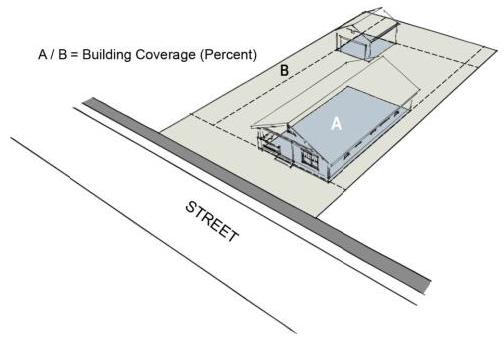 |
|
Gross Floor
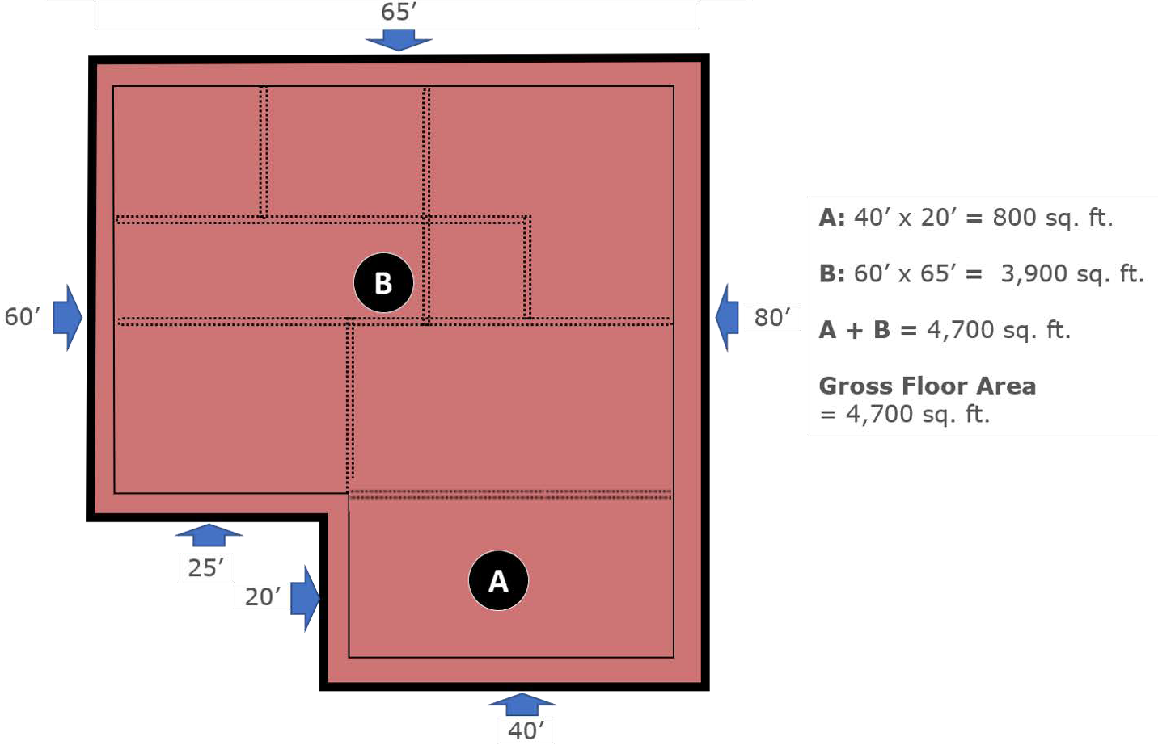
Area (GFA) | The total area of all the floors of a building, including intermediately floored tiers, mezzanines, etc., as measured from the exterior surfaces of the outside walls of the building. Cellars, basements, penthouses, attics, covered or uncovered porches, balconies and decks, enclosed storage or mechanical areas, mezzanines, and similar structures shall be included as GFA wherever at least seven feet are provided between the finished floor and the ceiling. No deduction shall apply for horizontal areas void of actual floor space (for example, elevator shafts and stairwells). The protected upper floors of open atriums and foyers shall not be included. | |
 | ||
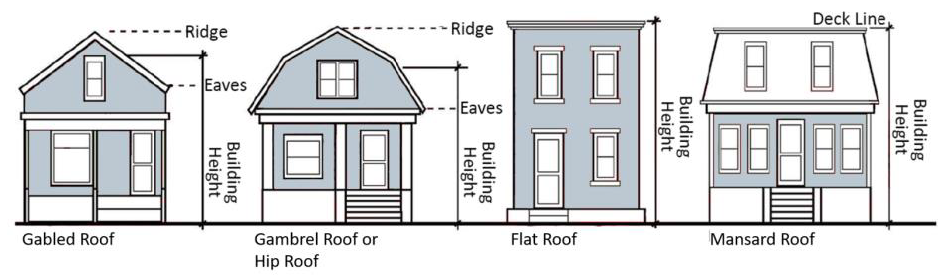
| Height | Buildings: In accordance with the adopted building code, the vertical distance from the grade level of that portion of a parcel covered by the building to the highest point of the coping of a flat roof, or the deck line of a mansard roof, or to the average height between eaves and the ridge of a gable, hip or gambrel roof. Where a parapet is used to screen rooftop mechanical equipment, the overall height including the parapet may exceed the stated maximum height by no more than five feet. | |
 | ||
| Lot Area | The total horizontal area included within property lines. Lot width multiplied by lot depth. | 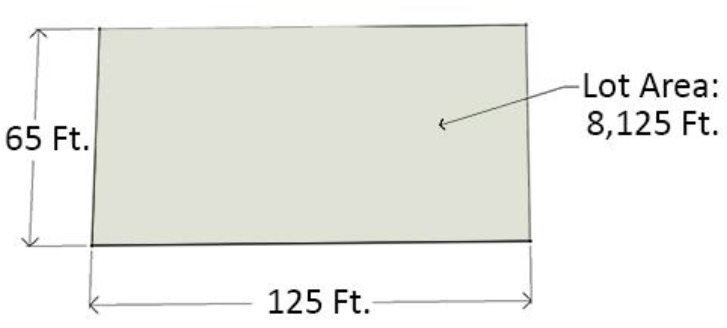 |
| Lot Width |
For an interior parcel, the horizontal distance between the side property lines, measured
at the required front setback line.
For a cul-de-sac parcel, the horizontal distance between the side property lines measured at the required front setback line. | 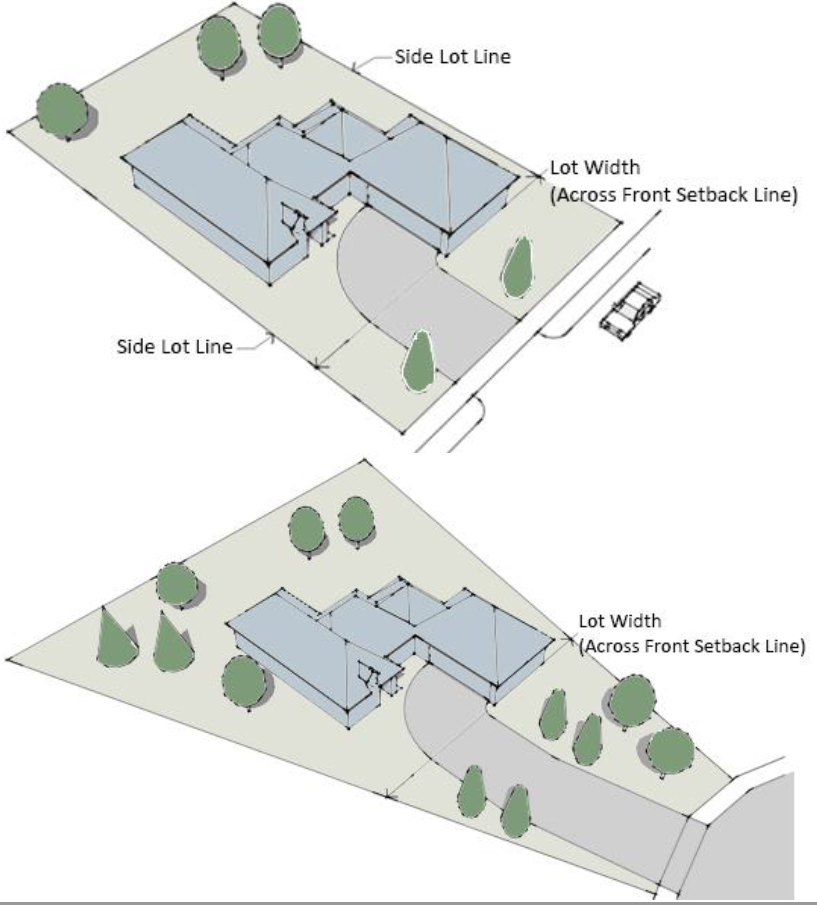 |
| Setback | The horizontal distance of a required open space at grade between the outer wall of a building or structure and the adjoining property lines, or, in the case of an abutting private street, the back-of-curb, unoccupied and unobstructed by any portion of a structure from the ground upward. The street setback and rear setback lines span the entire width of the property. The interior side and exterior side setback lines extend from the required front setback line to the required rear setback line. | 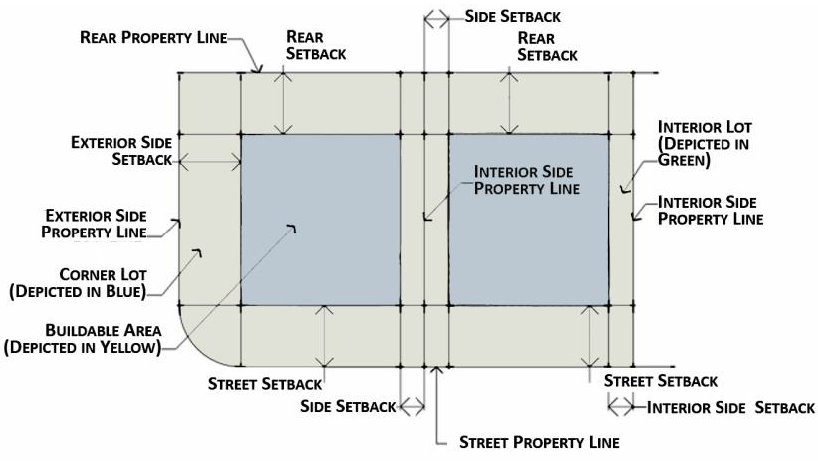 |
|
Visibility
Triangle |
A triangular area that includes that portion of public right-of-way and any private
property within a triangle formed by a diagonal line extending through points on the
edge of the driving surface 25 feet from the street corner intersection of the property
lines.
The vertical dimensions of this triangle are two feet to seven feet above finished grade. | 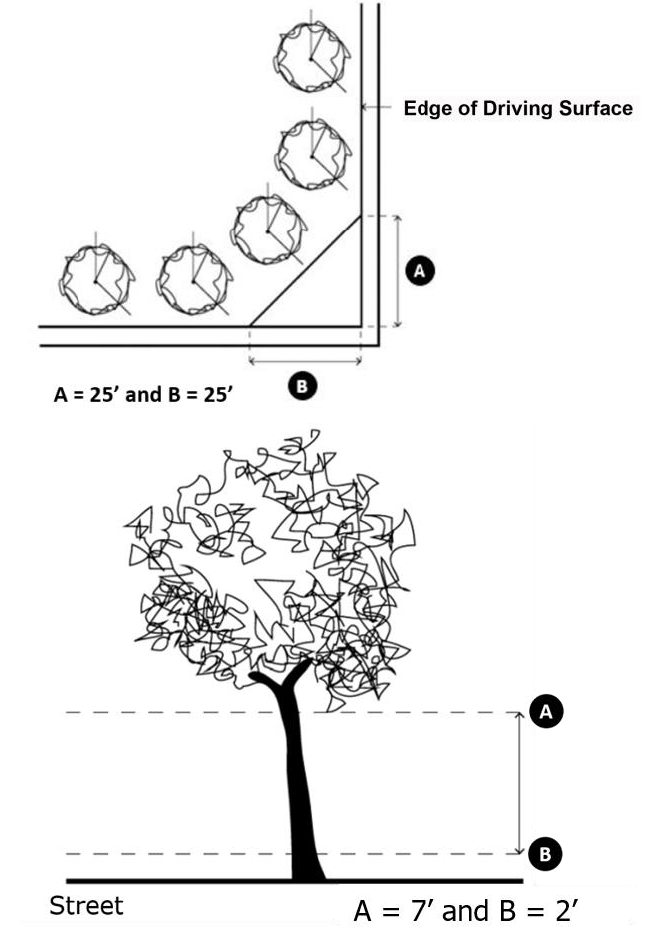 |
(b)
Allowances. The provisions of this subsection set forth special cases that warrant flexibility in the developmental standards in this zoning ordinance.
(1)
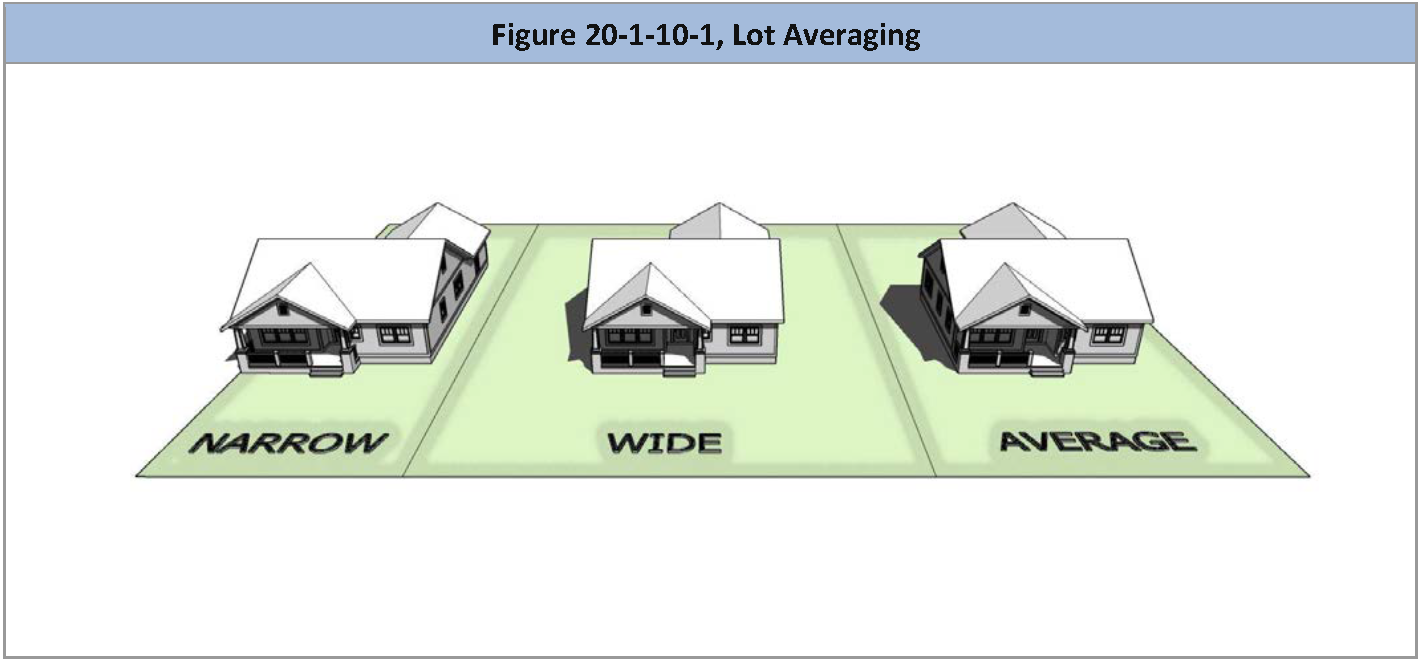
Lot averaging. Lot averaging is a design technique that replaces minimum lot dimensions with an average lot width and size per phase for a subdivision. The lot area and width dimensions in Article II, Zoning Districts and Dimensional Standards, may be averaged for each zoning district. In order to utilize lot averaging, all lots in the proposed subdivision shall meet the following criteria:
a.
Equal to or greater. The average lot area and average lot width of the proposed subdivision shall be equal to or greater than the individual lot area and lot width of the subdivision's proposed underlying zoning district as specified in Article II.
b.
Greater than ninety (90) percent. No lot shall have a lot area or lot width that is less than ninety (90) percent of the lot area or lot width specified in Article II (see Figure 20-1-10-1, Lot Averaging).
(2)
Alternative setback compliance. The provisions of this subsection provide for flexibility from specifically referenced portions of this ordinance that might, in limited circumstances, provide for requirements that are too rigid. The front setback required for all districts in Article II may be reduced subject to the following standards.
a.
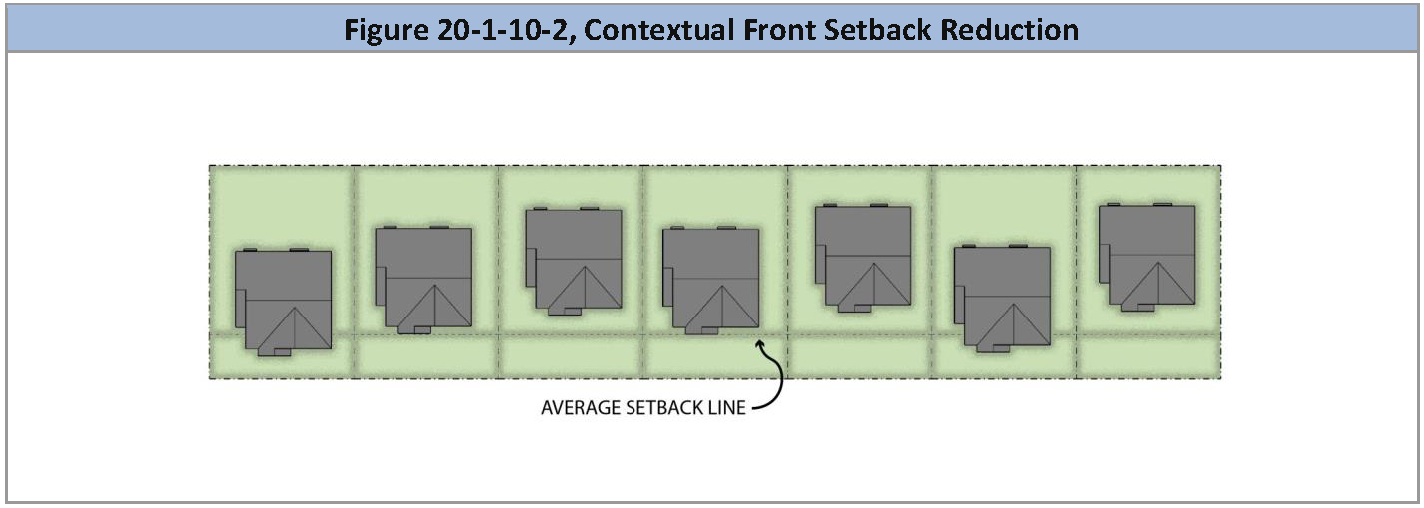
Existing neighborhoods. In existing developed areas, if fifty (50) percent or more of the lots on the same side of the block (not counting the applicant's lot) are developed with buildings that are set back at distances that are less than the required front yard setback, the front setback of the applicant's lot may be reduced to the average front setback of all of the developed lots on the same side of the block (See Figure 20-1-10-2, Contextual Front Setback Reduction).
b.
New neighborhoods. In subdivisions platted after the effective date of this ordinance, the front setback in Article II may be averaged for all lots on a block. In order to utilize front setback averaging in this instance, all lots on the block shall meet the following criteria:
i.
Must be eighty (80) percent or more. No lot shall have a front setback that is less than eighty (80) percent of the front setback specified in Article II.
ii.
Equal to or greater. The average front setback of the block shall be equal to or greater than the front setback of the subdivision's proposed underlying zoning district as specified in Article II, Zoning Districts and Dimensional Standards. For example, on a block with six (6) lots, in the low density residential (LR) district, where the minimum front setback is twenty-five (25) feet, the following front setbacks would be permissible: twenty (20) feet, twenty-six (26) feet, twenty-two (22) feet, twenty-eight (28) feet, twenty-six (26) feet, and twenty-eight (28) feet.
c.
Driveway length. If the applicant's lot takes vehicular access from the front, the driveway shall be a minimum of twenty (20) feet long, measured from the property line to a building wall or garage door.
(3)
Setback plane.
a.
Exemptions. Unless otherwise expressly stated, the height regulations in this ordinance do not apply to structures for the housing of elevators, stairways, tanks, ventilating fans, or similar equipment required to operate and maintain the building, fire or parapet walls, skylights, towers attached to a building, steeples, flagpoles attached to a building, chimneys, smokestacks, water tanks, silos, grain elevators, or similar structures.
b.
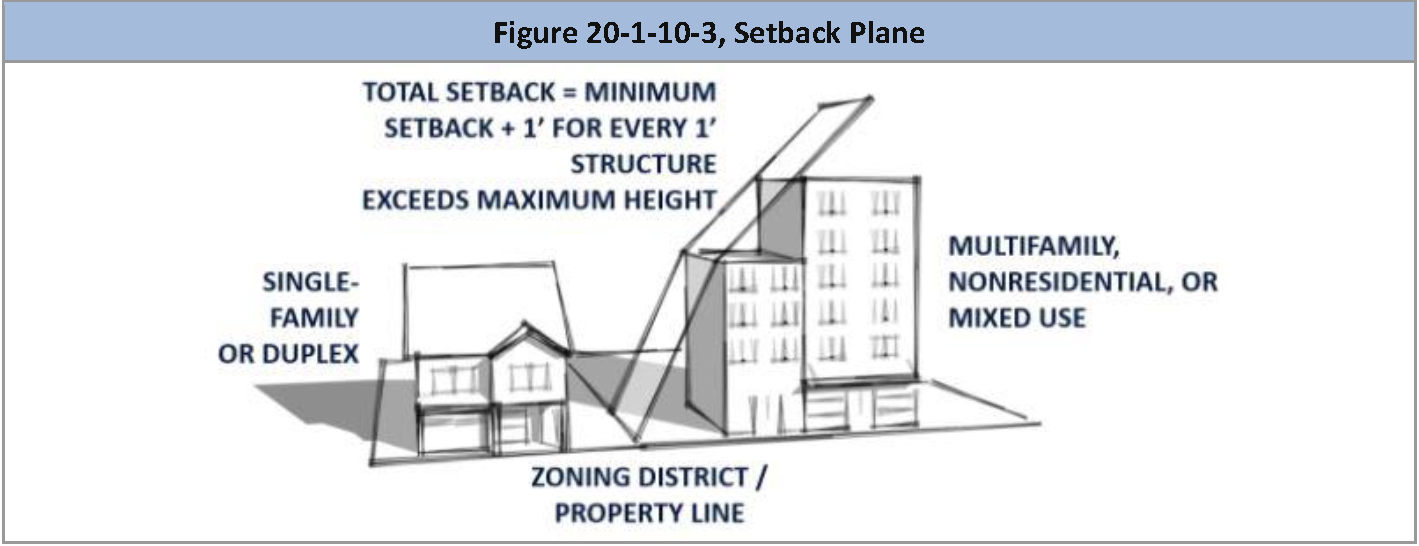
Setback plane. As depicted in Figure 20-1-10-3, Setback Plane, where a building adjoins a property with a single-family dwelling, the building height may be increased beyond the maximum permitted if the setback nearest the adjoining single-family dwelling is increased one (1) foot for each one (1) foot of height above the maximum permitted height.
(4)
Setback encroachments.
a.
Architectural features. Except where a minimum side setback is less than five (5) feet, cornices, canopies, gutters, eaves or other architectural features may project into required setbacks a maximum of two and one-half (2½) feet for a maximum of fifty (50) percent of the linear feet of the side of the building.
b.
Balconies, decks, and porches. Unenclosed balconies, decks, and porches may project into a front or rear setback a maximum of ten (10) feet, but shall not be closer than ten (10) feet from the front property line.
c.
Bay windows and chimneys. Bay windows and chimneys may project into required setbacks a maximum of two (2) feet, provided that such features do not occupy, in the aggregate, more than one-third (⅓) of the length of the building wall on which they are located and provided they are set back a minimum of three (3) feet from all property lines.
d.
Outdoor seating. Outdoor seating associated with a restaurant use category may project a maximum of ten (10) feet into a required front setback, provided the space is at grade and is separated from the right-of-way by landscaping or a vertical barrier.
e.
Building setback lines and easements. Where building lines established by restrictive covenant in a recorded subdivision or where public easements are in excess of the setback requirements of the zoning district, the easement or the platted building line controls.
(c)
Height. The following building elements and appurtenances may exceed the allowable height of the applicable district by no more than twenty (20) feet:
(1)
Antennas in compliance with section 20-3-7, Wireless Telecommunications Facilities;
(2)
Belfries;
(3)
Chimneys;
(4)
Cooling towers;
(5)
Fire towers;
(6)
Flag poles;
(7)
Public monuments;
(8)
Ornamental towers and spires;
(9)
Roof gables;
(10)
Spires;
(11)
Stage towers or scenery lofts;
(12)
Tanks;
(13)
Water towers; and
(14)
Vent stacks.
(Ord. No. 2023-36, § 2(Exh. A), 10-17-23)

