
Copperas Cove City Zoning Code
ARTICLE III
- USE STANDARDS
Sec. 20-3-1. - Use table. AG, AR, BP, DT, HC, HI, HR, LI, LR, MR, NC, PF, RC, RE
(a)
Permitted uses. Permitted uses and structures are set forth in Table 20-3-1-1, Use Table, which presents the permitted uses within each zoning district classification.
(1)
Symbols. Table 20-3-1-1 uses the following symbols:
a.
"P" means that the land use is permitted by right, subject to the standards that apply to all permitted uses. The use is approved by the zoning administrator.
b.
"L" means a limited use, which the zoning administrator shall use the criteria set forth in section 20-3-3, Limited Use Standards, to determine whether to authorize a land use requested by the applicant or whether to recommend it for a decision of the planning and zoning commission subject to the procedures set forth in subsection 20-6-2(e), Limited Use Permit.
c.
"C" means a conditional use, which may be approved following a public hearing by the city council for a conditional use permit, subject to:
i.
The standards in section 20-3-4, Conditional Use Standards; and
ii.
The procedures set forth in subsection 20-6-3(f), Conditional Use Permit.
d.
"—" means that the use is prohibited in the specified zoning district.
(2)
Standards. The "standards" column provides a reference to associated standards for limited and conditional uses. Where the "N/A" is in the column, the use has no associated standards.
(3)
Unlisted use categories and uses. A use category of a specific use is prohibited if it is not listed in Table 20-3-1-1 and if the zoning administrator cannot interpret an unlisted specific use as functionally similar to a use that is allowed, based on the criteria in section 20-3-8, New and Unlisted Uses.
(Ord. No. 2023-36, § 2(Exh. A), 10-17-23; Ord. No. 2024-20, § 1(Exh. A), 7-16-24; Ord. No. 2024-40, § 2(Exh. A), 12-3-24)
Sec. 20-3-2. - Use categories.
(a)
General.
(1)
Approach to categorizing uses. The use categories found in the use table above are described in this section. Specific uses may be further defined in Article IX, Word Usage. Any proposed use not specifically set forth in this section is prohibited, unless the zoning administrator determines, based on the criteria in section 20-3-8, New and Unlisted Uses, that the proposed use is similar to a permitted, limited, or conditional use.
(2)
Basis for classifications. Use categories classify land uses based on common functional or physical characteristics. Characteristics include the type and amount of activity, how goods or services are sold or delivered, and likely impact on surrounding properties and site conditions. The use categories provide a systemic basis for assigning land uses to appropriate zoning districts and for consistently regulating similar uses in regard to parking and other requirements in this ordinance.
(3)
Developments with multiple primary uses. Developments with multiple primary uses shall conform to the following provisions:
a.
When all primary uses of a development fall within the same use category, the entire development is assigned to that use category.
b.
When the primary uses of a development fall within different use categories, each primary use is classified in the applicable use category and each use is subject to all applicable regulations for that use category. For example, where a use has a specific use standard applied (such as a minimum site acreage) in section 20-3-3, Limited Use Standards, or in a dimensional standards table, the standard applies even when that use is part of a development with multiple primary uses.
(4)
Characteristics. The "characteristics" portion of each use category table below describes the common characteristics of each primary use.
(5)
Primary uses. The "primary uses" portion of each use category table lists primary uses common to that use category. The names of these sample uses are generic and are based on common meanings, not on what a specific use may call itself. For example, a use that calls itself "wholesale warehouse," but sells mostly to retail consumers, is included in the retail repair, sales, and service category rather than the wholesale trade category.
(6)
Accessory uses. Accessory uses are generally allowed by right in conjunction with a primary use. However, specific accessory uses with parenthetical cross-references in the use category tables are permitted subject to additional standards in section 20-3-5, Accessory Uses and Structures.
(b)
Residential use categories. The following tables set forth the primary uses and accessory uses included in each residential use category:
(1)
Household living.
(2)
Group living.
(c)
Public and civic use categories. The following tables set forth the primary uses and accessory uses included in each public and civic use category:
(1)
Community service.
(2)
Day care.
(3)
Educational facilities.
(4)
Government facilities.
(5)
Medical facilities.
(6)
Parks and open areas.
(7)
Passenger terminals.
(8)
Places of worship.
(9)
Social service establishments.
(10)
Utilities (major and minor).
(d)
Commercial use categories. The following tables set forth the primary uses and accessory uses included in each commercial use category:
(1)
Office.
(2)
Short-term accommodations.
(3)
Parking, commercial.
(4)
Recreation, indoor.
(5)
Recreation, outdoor.
(6)
Restaurants.
(7)
Retail repair, sales, and service.
(8)
Vehicle sales and service.
(e)
Industrial use categories. The following tables set forth the primary uses and accessory uses included in each industrial use category:
(1)
Heavy industrial.
(2)
Light industrial.
(3)
Warehousing.
(4)
Waste-related.
(5)
Wholesale trade.
(f)
Open uses. The following tables set forth the primary uses and accessory uses included in each open use category:
(1)
Agriculture.
(2)
Resource extraction.
(Ord. No. 2023-36, § 2(Exh. A), 10-17-23; Ord. No. 2025-5, § 2(Exh. A), 2-18-25)
Sec. 20-3-3. - Limited use standards.
(a)
Purpose. The purpose of this section is to establish standards for limited uses denoted with an "L" in Table 20-3-1-1, Use Table. Limited use standards ensure that a use that is generally deemed incompatible with permitted uses in a given zoning district can be considered for approval subject to certain specific standards established in this section.
(b)
Standards. In determining whether to approve, approve with conditions, or deny a use requiring a limited use permit, the zoning administrator shall consider the following general criteria for each use below in addition to limited use standards listed per use:
(1)
Surrounding properties. The proposed limited use will operate or be designed in a manner that does not diminish the use, enjoyment, or functionality of surrounding properties;
(2)
Hours of operation and site improvements. Provisions for hours of operation, parking and loading areas, driveways, lighting, signs, landscaping, buffering, and/or other site improvements have been provided;
(3)
Public services. Adequate public services (such as streets, off-street parking, pedestrian facilities, water, sewer, gas, electricity, police, and fire protection) shall be available without the reduction of services to any existing, adjacent uses;
(4)
Design features. The proposed limited use will incorporate design features to sufficiently protect adjacent existing uses or future land uses contemplated in the comprehensive plan, including but not limited to: Service areas, pedestrian and vehicular circulation, safety provisions, access ways to and from the site, buffering, fencing, and building placement; and
(5)
Compatibility. The proposed limited use will be compatible with adjacent existing uses or future land uses contemplated in the comprehensive plan. Compatibility shall be expressed in terms of appearance, architectural scale, features, site design and scope, landscaping, as well as the control of adverse environmental impacts, including noise, lighting, and other undesirable conditions.
(c)
Residential uses.
(1)
Community home for persons with disabilities. Community homes for persons with disabilities shall be permitted in all residential and mixed-use districts subject to the proposed home complying with all regulations of Texas Human Resources Code, Chapter 123, Community Homes for Persons with Disabilities.
(2)
Modular home.
a.
Any modular home shall have a value equal to or greater than the median taxable value for each single-family dwelling located within five hundred (500) feet of the lot on which the modular home will be located, as determined by the most recent certified tax appraisal of the county (Coryell, Bell or Lampasas).
b.
For purposes of this subsection, "value" means the taxable value of the modular home and lot before the installation of the modular home on the lot.
(d)
Public and civic uses.
(1)
Place of public assembly. The gross floor area shall not exceed fifteen thousand (15,000) square feet within the High Density Residential (HR) zoning district.
(2)
Places of worship. The gross floor area shall not exceed fifteen thousand (15,000) square feet within the High Density Residential (HR) zoning district.
(3)
Privately operated community building or recreation field.
a.
Site access. Access to any service or parking areas for over fifty (50) vehicles serving the use shall be made from a collector or higher classification roadway.
b.
Use compatibility. The principal building or recreation field(s) shall be:
i.
Located at least one hundred (100) feet from any residential building;
ii.
Constructed of sound-resistant materials if activity is located within a structure; and
iii.
Limited in operation such that it is closed between 10:00 p.m. and
10:00 a.m.
c.
Bufferyards. The use is separated from all residential property by a Type B bufferyard.
d.
Parking. Parking areas shall be a minimum of fifty (50) feet from a residential use.
e.
Noise. Events or activities are limited such that noise levels attributable to the use at the closest residential property does not exceed:
i.
Sixty (60) dBA between the hours of 9:00 p.m. and 10:00 a.m.; and
ii.
Seventy (70) dBA between the hours of 10:00 a.m. and 9:00 p.m.
(4)
Hospital. The property shall be a maximum of five (5) acres in area.
(e)
Commercial uses.
(1)
Amusement facility and arcade. The land use shall comply with the provisions of Chapter 12, Article V, Amusements; Entertainments, of the City's Code of Ordinances.
(2)
Adult-oriented business. In addition to complying with the general standards outlined in subsection (b), above, all land uses that qualify as an adult-oriented business must fully comply with Chapter 2.5, Adult-Oriented Businesses, of the City's Code of Ordinances.
(3)
Banking or credit union.
a.
Total floor area. The gross floor area shall not exceed three thousand five hundred (3,500) square feet.
b.
Drive-through facility. A drive-through component is permitted if the applicant demonstrates that:
i.
Noise buffer. Where the use abuts a residential zoning district, the speaker station is buffered with a wall and landscaping to reduce noise transmission.
ii.
Access. Where an alley abuts the property, it is utilized for circulation through the drive-through.
(4)
On-premise alcohol consumption (such as bar, tavern, lounge, nightclub or microbrewery). The land use shall comply with the provisions of Chapter 12.5, Alcoholic Beverages, of the City's Code of Ordinances.
(5)
Circus or carnival grounds.
a.
Location. The use shall be located a minimum of three hundred (300) feet from any residential district or use.
b.
Compliance. Any use, whether permanent or temporary, shall be subject to the requirements of Chapter 12, Article V, Amusements; Entertainments, in the City's Code of Ordinances.
(6)
Fuel sales.
a.
Service station pumps and pump islands.
i.
Service station pumps and pump islands may be located within a required yard, but in no case shall be less than fifteen (15) feet from any street right-of-way line.
ii.
Service station pumps and pump islands shall not be closer than one hundred (100) feet from any residential district.
b.
Bufferyard. A Type B bufferyard as established in section 20-4-3, Landscaping, Buffering, and Screening, shall be required adjacent to any abutting residential district or use.
c.
Ingress and egress. Refueling or delivery trucks shall not take ingress and egress from a local street.
d.
Car wash. If the use includes a car wash as an accessory use, then the standards of section 20-3-5, Accessory Uses and Structures shall apply.
(Ord. No. 2023-36, § 2(Exh. A), 10-17-23; Ord. No. 2024-40, § 2, 12-3-24)
Sec. 20-3-4. - Conditional use standards.
(a)
Purpose. The purpose of this section is to establish standards for conditional uses denoted with a "C" in Table 20-3-1-1, Use Table.
(b)
Standards. In determining whether to approve, approve with conditions, or deny a use requiring a conditional use permit, the planning and zoning commission and city council shall consider the following general criteria for each use below in addition to conditional use standards listed per use:
(1)
Complies with all applicable district and design standards;
(2)
Complies with the specific limitations and restrictions set out in this section in addition to the other applicable standards of this zoning ordinance, specifically including:
a.
Article IV, Development Standards;
b.
Chapter 17.5, Subdivisions; and
c.
Article VI, Development Review Procedures;
(3)
Is deemed to be compatible with, and not a material impact to, the uses permitted in the districts of surrounding lands;
(4)
Is effectively oriented, configured, or designed to provide adequate screening and buffering to mitigate or minimize any adverse visual impacts on adjacent lands;
(5)
Avoids significant deterioration of water and air resources, scenic resources and views, and other natural resources;
(6)
Maintains safe and convenient ingress, egress, and traffic flow onto and through the site by vehicles, bicycles, pedestrians, and alternative modes;
(7)
Allows for the protection of property values and the ability of neighboring lands to develop the uses permitted in the applicable district(s); and
(8)
Complies with all other relevant city, state and federal laws and regulations.
(c)
Manufactured home park or subdivision.
(1)
Location. The boundary of any manufactured home park shall be at least two hundred (200) feet from any existing permanent residential building or platted residential subdivision located outside the park, unless separated therefrom by a Type B bufferyard (see Table 20-4-3-3 in section 20-4-3, Landscaping, Buffering, and Screening).
(2)
Lot size requirements. See Table 20-2-3-5, MR Dimensional Standards in section 20-2-3, Residential District Dimensional Standards.
(3)
Driveways. All manufactured home lots or spaces shall abut upon a driveway, which meets the requirements of section 20-4-2, Parking, Loading, and Stacking.
(4)
Walkways. Walkways not less than three (3) feet wide shall be provided from the manufactured home lots or spaces to the service buildings.
(5)
Lighting. All driveways, parking areas and walkways within the park shall be lighted at night with electric lamps sufficient to provide all illumination levels of not less than two-tenths footcandles on all driveways, parking areas and walkways.
(6)
Skirting. Manufactured homes shall be skirted in a manner that complies with the regulations stated in the city's building code.
(7)
Existing manufactured home parks. The provisions of this subsection shall not apply to manufactured home parks already in existence and in operation before December 6, 1983. Such existing and operating parks shall be treated as a nonconforming use insofar as the requirements of this section are concerned.
(d)
Tiny house community.
(1)
Building standards. A tiny house that is part of a tiny house community shall be built to the city's residential building code.
(2)
Maximum floor area. A tiny house shall consist of a total maximum floor area of six hundred (600) square feet, excluding any loft space.
(3)
Permanent foundations. Tiny houses that are part of a tiny house community shall be constructed on a permanent foundation. Tiny houses on wheels or other non-permanent foundations are prohibited from being part of a tiny house community but may be placed on a lot with a single-family residence as an accessory dwelling unit.
(4)
Prefabricated tiny houses. A prefabricated tiny house is required to be skirted.
(e)
Public and civic uses.
(1)
Vocational and trade school.
a.
Vocational and trade schools shall be located in the zoning district applicable to the type of activity involved.
b.
The facility/activity shall meet applicable state law requirements.
(2)
Medical or dental office or clinic.
a.
Accessory laboratory activity. Laboratory activity shall occur only as an accessory use to a principal clinic or medical office use.
b.
Scale of use. The floor area of the use shall not exceed three thousand (3,000) square feet.
c.
Hours of operation. The use shall not operate between the hours of 8:00 p.m. and 8:00 a.m., and shall not provide for overnight stays by those receiving care.
(3)
Place of worship.
a.
Located within residential district. When located within a residential district, the facility shall:
i.
Take access from a connector or commercial corridor;
ii.
Install a Type B bufferyard when adjoining a residential use;
iii.
Locate buildings and parking areas at least fifty (50) feet from a residential use; and
iv.
Not provide for off-street parking on noncontiguous lots without a conditional use permit.
b.
Location. The use shall be located in a permanent structure.
c.
Parking and traffic congestion. The use shall not create parking or traffic congestion or otherwise unreasonably interfere with the peace and enjoyment of surrounding residences.
d.
Minimum lot size. The use shall have a minimum site area that is the greater of two (2) acres or four (4) times the minimum lot area of the respective zoning district.
(4)
Airport, landing field or landing strip for aircraft. An airport, landing field or landing strip for aircraft is permitted with a conditional use permit if the applicant demonstrates that:
a.
Fifty-Five Day Night Level (DNL) Limited Development Area. All airport development applications shall be submitted with a noise impact assessment. The assessment shall identify the initial and 20-year projected DNL noise contour lines beginning with 50 DNL and proceeding to 75 DNL.
i.
No new residential development shall be permitted within the 55 DNL line. If for some reason a new residential use must be permitted, the building shall have insulation and windows that limit aircraft noise within the building to 50 DNL.
ii.
If the 55 DNL area expands, a zoning and land use plan for all land within the 55 DNL noise contour shall be submitted. This plan shall indicate the feasibility of restricting such land to nonresidential uses. Airport approval shall be based on the ability to minimize noise intrusion into existing residential areas and to prohibit new residential development that would hinder future airport expansion.
iii.
Once established, the city shall require all rezonings that would permit a residential use within the 55 DNL noise contour to record the noise contours on the property. In addition, all developments and all individual lot surveys shall show the noise contours with an accompanying warning indicating the city will not restrain future airport growth because of residential development inside the 55 DNL noise contour.
b.
Airport boundary. The 20-year, 65 DNL line shall lie completely within airport property or Light Industrial (LI) or Heavy Industrial (HI) zoned or used land that has granted a noise easement to the airport use.
c.
Site. The minimum site area for airport, landing field or landing strip for aircraft use is three hundred (300) acres.
d.
Conditional use permit. Airport uses must also meet the standards of section 20-6-2(f), Conditional Use Permit.
(f)
Major utilities.
(1)
All major utilities. The use is set back a minimum of twenty-five (25) feet from the right-of-way of all streets bounding the property on which the use is located.
(2)
Electric generation plant. Electric generation plants shall be screened with a six (6) foot opaque fence or wall constructed of material similar in type and construction. Shrubs may be allowed provided the desired screening effect is accomplished.
(3)
Gas/petroleum line regulating or compression station. Gas/petroleum line regulating or compression stations shall be screened with a six (6) foot opaque fence or wall constructed of material similar in type and construction. Shrubs may be allowed provided the desired screening effect is accomplished.
(4)
Wireless telecommunications facility. Standalone telecommunication facilities shall comply with the standards in section 20-3-7, Wireless Telecommunications Facilities.
(g)
Commercial uses.
(1)
Bakery (retail). All on-premise sales of bakery products as a principal use in the HR zoning district shall:
a.
Not exceed three thousand (3,000) square feet of net floor area for the total of all establishments in one (1) development;
b.
Prohibit a drive-through facility; and
c.
Take access from an arterial or collector street.
(2)
Office. The gross floor area shall not exceed three thousand five hundred (3,500) square feet in the HR zoning district.
(3)
Restaurant, drive-in and fast food. The speakers associated with the drive-through are a minimum of two hundred (200) feet from a residential district, measured along a straight line between the closest district boundary lines.
(4)
Restaurant, fast food with drive-through. Fast food restaurants with service exclusively as drive-thru shall be subject to the following standards:
a.
Site design. The site design shall accommodate adequate turning radius and vertical clearance for passenger and delivery vehicle types. Designated loading areas shall be exclusive of off-street parking stalls and drive aisles and shall not cause conflicts with customer vehicles and pedestrian movements. Part of public rights-of-way may be used for stacking of vehicles.
b.
Stacking lanes. The stacking lane and its access shall be designed to manage traffic in a manner to protect pedestrians, buildings, and all landscaped areas on the site.
c.
Traffic mitigation. As set out in section 20-4-2, Parking, Loading, and Stacking, adequate vehicle stacking shall be provided for the service window to minimize conflict with traffic flow and required parking.
d.
Protect residential uses. The stacking lane, order board intercom, and service window shall be designed and located to minimize vehicle and communication noises, emissions, and headlight glare upon adjoining properties that share a common lot line with a residential district or use, and to maximize maneuverability of vehicles on the site.
(5)
Restaurant, standard. All standard restaurants as a principal use in the HR zoning district shall be subject to the following standards:
a.
Scale. Restaurants shall not exceed ten thousand (10,000) square feet per lot.
b.
Residential character. If operated within a pre-existing dwelling, the use shall maintain the residential character and appearance of the structure.
c.
Residential screening. When the site is located adjacent to a residential use or residential zoning district boundary, visual screening shall be provided along all common side and rear property lines. The screening shall consist of a solid landscaping strip at least four (4) feet in width that provides a year-round visual barrier, and positioned directly adjacent to the adjoining property. A solid masonry or concrete wall or a wood fence having a minimum height of five (5) feet shall be installed immediately behind the landscaping strip.
d.
No nuisance created. The use shall not create or cause any perceptible noise, odor, smoke, electrical interference, or vibrations that constitute a public or private nuisance to neighboring properties.
(6)
Retail-sales oriented. The gross floor area shall not exceed three thousand (3,000) square feet.
(7)
Drug store/pharmacy. When including a drive-through facility, the facility shall:
a.
Not be located within the front setback; and
b.
Provide for a Type B bufferyard, in accordance with section 20-4-3, Landscaping, Buffering, and Screening, between a drive-in or drive-through facility and adjacent or abutting properties that include a residential use.
i.
Drive-in or drive-through facilities may be located only in interior side or rear yards.
ii.
Loudspeakers and similar instruments shall not be located within fifty (50) feet of any property that includes a residential use.
(8)
Car wash.
a.
Wash bay location. To the extent practicable, wash bays shall be sited parallel to the adjacent street in such a way as to use the frontage efficiently and be oriented away from any abutting residentially zoned or residentially used property to prevent headlights from shining onto any street or abutting residential district;
b.
Wash bay limitations. There are no more than three (3) car washing bays;
c.
Mechanical equipment. All mechanical equipment, excluding vacuum units, is enclosed within a building;
d.
Outdoor spraying. All facilities are designed and configured such that any outdoor spraying preparation or drying activities are directed away from any abutting residential district;
e.
Vacuums. If self-service vacuums are provided, a minimum of one (1) parking space per vacuum is required, which will not interfere with site circulation, driveways, or fire lanes; and
f.
Site access. Access is taken from a collector or higher classification roadway.
(9)
Recreational vehicle (RV) park.
a.
Location. RV parks shall be located at least three hundred (300) feet from any residential zoning district.
b.
Tract size. RV parks shall be located on tracts with a minimum area of five (5) acres.
c.
Other regulations. RV parks shall comply with all applicable health, fire, building, and related City Codes and Ordinances to ensure safe operation of the park.
d.
Access. All RV parks shall be directly linked by an entrance way with a public street. The entrance shall be at least forty (40) feet in pavement width with a 20-foot curb radius. The connection of the entrance way with the public street shall be constructed according to municipal construction standards. The entrance roadway from the public street to the main office plus the parking for the office and all uses accessible by the general public shall be paved. All other surfaces intended for regular vehicular use shall have a durable surface, such as compacted base material. Entrance ways and interior streets shall be considered private streets.
e.
Campsite size. Individual campsite size shall be a minimum of one thousand six hundred (1,600) square feet and shall have a minimum depth of fifty (50) feet to provide adequate space for a recreational vehicle, a car, and a picnic table/grill.
f.
Separation. RVs and accessory structures, including carports and storage buildings, shall be separated from other structures on adjacent campsites by a minimum of ten (10) feet.
g.
Setbacks. Setback requirements for RV trailers shall be as follows:
i.
Twenty (20) feet from the edge of cul-de-sac streets;
ii.
Ten (10) feet from the edge of other interior streets;
iii.
Twenty-five (25) feet from front park property line; and
iv.
Fifteen (15) feet from rear and side (exterior and interior) park property lines.
h.
Accessory uses. Accessory uses such as an office, recreation facilities, toilets, dumping stations, laundries, swimming pools, etc., shall be permitted, subject to the following restrictions:
i.
Such establishments and the parking area primarily related to their operations shall not occupy more than twenty-five (25) percent of the gross area of the park.
ii.
The structures housing such facilities shall not be located closer than fifty (50) feet to any public street.
i.
Permanent dwellings. No permanent place of dwelling or business shall be located in an RV park or any trailer located in an RV park except for permanent, full-time employees of the RV park.
j.
Sanitation. The following sanitation requirements shall apply to all RV parks:
i.
Female:
(A)
One (1) flush toilet per twenty-five (25) campsites; and
(B)
One (1) shower/dressing room per twenty-five (25) campsites.
ii.
Male:
(A)
One (1) flush toilet per twenty-five (25) campsites; and
(B)
One (1) shower/dressing room per twenty-five (25) campsites.
k.
Refuse containers. Refuse containers or collection sites shall be conveniently located for park residents. One (1) or more central refuse collection sites for the park as a whole shall be provided. Such containers shall be watertight and rodent-proof. If refuse is to be collected by the city, central refuse collection areas shall be located in conformance with city standards.
l.
Water and sewer. RV parks shall have the option of connecting to municipal water and sewage systems or of seeking appropriate waivers and installing private systems. Private sanitation facilities shall meet all state, county, and city health standards and regulations.
m.
Campsite pads. Each campsite shall have a concrete parking pad with a minimum width of twelve (12) feet and a minimum length of thirty (30) feet.
n.
Screening. RV parks shall be screened along all property lines by a minimum six-foot screening device which may be a solid, opaque wall or fence, or shrubs creating a similar density.
o.
Time limitation. After initial location on a campsite, an RV must be removed after a period of one hundred twenty (120) days except as allowed in paragraph i., permanent dwellings, above.
(h)
Industrial uses.
(1)
Auto/truck/salvage/storage and/or wrecking.
a.
All material shall be stored within a fully enclosed building, or otherwise screened one hundred (100) percent from view, consistent with the screening requirements in section 20-4-3, Landscaping, Buffering, and Screening.
b.
No outdoor storage operation shall be located in front of a principal building.
c.
Materials shall not be stored in areas intended for vehicular or pedestrian circulation.
(Ord. No. 2023-36, § 2(Exh. A), 10-17-23)
Sec. 20-3-5. - Accessory uses and structures.
(a)
Generally. An accessory use or structure may be established provided that it is associated with a primary use in the use categories in section 20-3-2, Use Categories, and that it complies with the standards of this section.
(b)
Purpose. The purpose of this section is to establish minimum standards for accessory uses and structures that:
(1)
Advance the general welfare of the community;
(2)
Protect the general health and safety of the community;
(3)
Enhance and protect the aesthetic interests of the community;
(4)
Protect property values and lessen the impact that some accessory structures may have on residential properties; and
(5)
Promote economic development by making the community a more desirable place to live, conduct business, and recreate.
(c)
Standards that apply to all accessory uses and structures. The following standards shall apply to accessory uses and structures except as this section or zoning ordinance indicates otherwise.
(1)
Subordination. The accessory use or structure shall be subordinate to and serve a primary use or primary structure. Except as provided in this section, a non-agricultural accessory structure must be subordinate in height to the primary structure.
(2)
Commercial use. Accessory structures located on residentially zoned or used property shall not be used for commercial purposes other than home occupations that comply with this section.
(3)
Timing of construction. No detached accessory structure shall be erected before construction of the primary structure has begun. Once construction of the primary structure has begun, construction of the detached accessory structure may occur concurrently.
(4)
Same property. An accessory use or structure shall be located on the same parcel or lot as the primary use or structure.
(5)
Separation. No accessory structure shall be located closer than six (6) feet to any other structure.
(6)
Setbacks.
a.
Generally. Accessory structures shall comply with the front, interior side, and exterior side setback standards for the primary structure established in Article II, Zoning Districts and Dimensional Standards.
b.
Front yard. No accessory building or structure may be erected within any front yard requirement.
c.
Rear and side yard. Detached accessory structures have a minimum rear and side setback of three (3) feet.
(7)
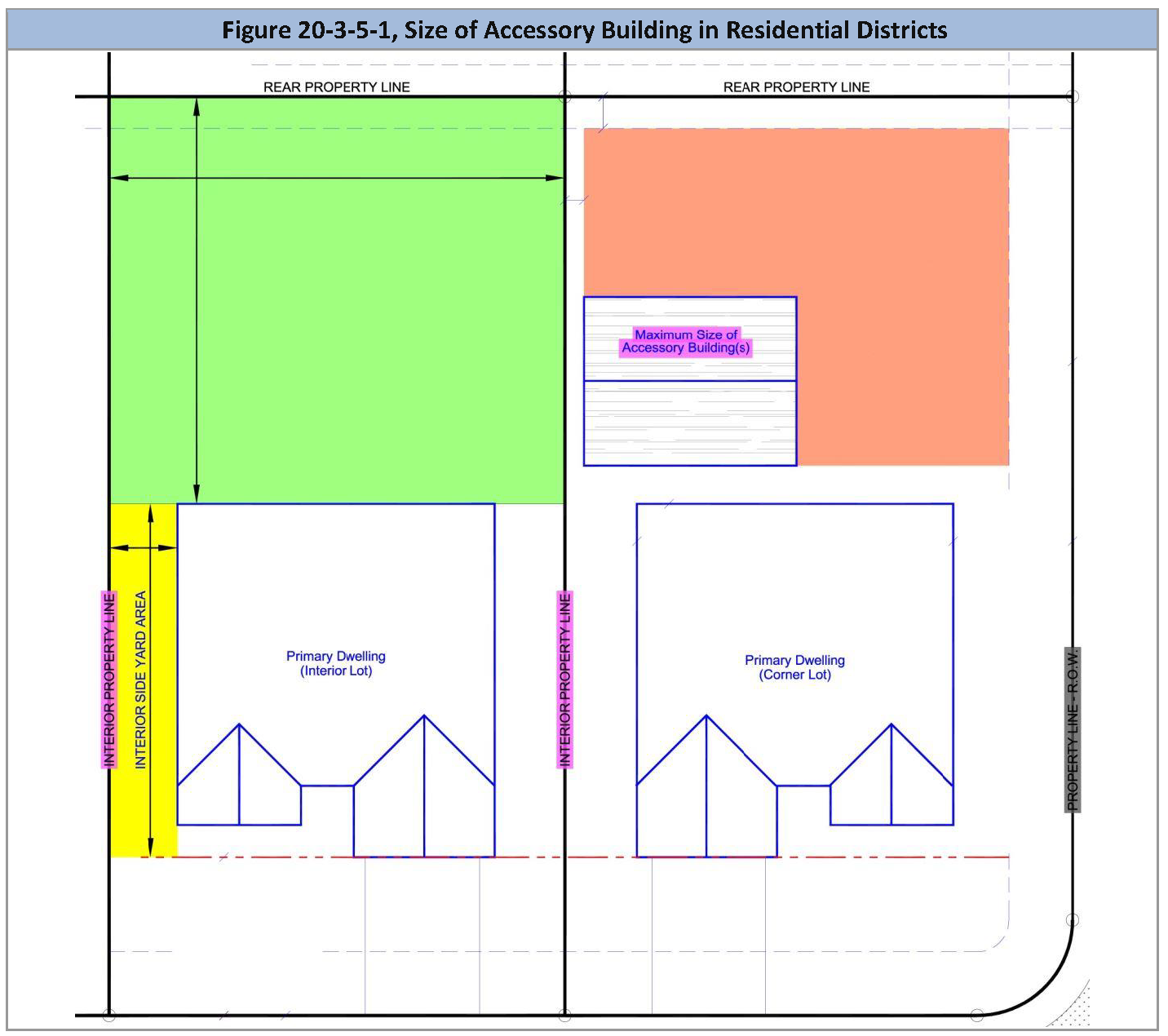
Size. An accessory building shall not occupy more than twenty-five (25) percent of the area of a rear yard. As shown in Figure 20-3-5-1, Size of Accessory Building in Residential Districts, the maximum yard area shall be calculated by measuring the distance from the primary dwelling to the interior side or rear yard lot line multiplied by the width of the interior side or rear lot line, whichever is greater. The maximum square footage for all accessory buildings shall be the yard area multiplied by twenty-five (25) percent.
(8)
Easements. Accessory structures permanently affixed to the ground shall not encroach into an easement.
(9)
Fence orientation. The finished side of all fences shall face outward toward adjacent rights-of-way. Posts and supports shall face inward toward the subject property.
(d)
General accessory structures or uses.
(1)
Refuse containers.
a.
The facilities shall be located no more than five hundred (500) feet (walking distance) from the individual uses that they are intended to serve;
b.
Access to the facilities shall be configured to meet the requirements of the refuse hauler and approved by the city. Access shall be provided from an alley if an alley is present and used for service to other properties;
c.
The areas where dumpsters are stored shall be fully enclosed by a wall with a minimum height of six (6) feet constructed to match the principal building;
d.
The enclosures shall:
i.
Have metal service gates that remain closed at all times except when the dumpster is being serviced;
ii.
Include separate metal pedestrian access gates or a pedestrian access opening that screens the dumpster from view;
iii.
Be large enough to accommodate:
(A)
One (1) or more dumpsters that are of sufficient size to serve the development, based on the frequency of solid waste collection; and
(B)
One (1) or more recycling bins (whether provided at the time of development or not), based on the anticipated generation of recyclable materials and the frequency of collection.
iv.
Meet city engineering, infrastructure, and construction design standards, including those that pertain to maneuvering space;
v.
The facilities shall be located in a side or rear yard of the parcel proposed for development, unless it is not possible to provide service access in such locations; and
vi.
If an enclosure must be located in a front yard to meet the requirements of the refuse service provider, it shall be designated and constructed with the same cladding materials used for the principal building walls.
(2)
Fences.
a.
Setbacks. Fences and walls are permitted in any required setbacks.
b.
Safety. Fences constructed of barbed wire and walls topped with broken glass or surfaced with any like material shall be prohibited except as provided in this subsection.
c.
Height. Walls and fences constructed on property used for or restricted to residential uses shall be no greater than six (6) feet in height, subject to the following limitations, except as provided for in this section:
i.
The height of a wall or fence shall be the vertical distance between the ground and the top of the fence. In terrain where the ground slopes at a grade of ten (10) percent or more, the fence or wall may be built in ten-foot horizontal stair-step sections. The average height of each section shall comply with the height regulations in this section.
ii.
Notwithstanding any contrary provisions in this Code, the zoning administrator may approve an overall fence height not to exceed eight (8) feet in height as measured according to subsection c.1 of this section. Such authorization shall be based on specific proposals that demonstrate superior craftsmanship, aesthetic harmony with and enhancement of the streetscape and the neighborhood, structural integrity, durability, safety, and overall design standards.
iii.
No wall or fence located on a lot with two (2) street frontages (corner lot) shall have a height in conflict with the regulations governing visibility at intersections as prescribed in Chapter 18, Section 18-14, Visual Obstructions to Traffic, in the City's Code of Ordinances.
d.
Location.
i.
The maximum height of a fence within a required front or exterior side yard shall be thirty-six (36) inches. Such fences shall have a minimum transparency of fifty (50) percent. Such fencing shall have clear sight visibility and not cause an obstruction from a driveway or to a street.
ii.
No fences shall be located within a clear visibility triangle as set forth in Table 20-1-10-1, Measurements.
iii.
No wall or fence shall be located in a dedicated drainage easement in which an existing or improved drainage channel is located.
iv.
Fences constructed with chicken wire or similar material for the enclosure of farm animals shall not be allowed except on property zoned as Agricultural (AG).
e.
Fencing exceptions.
i.
Barbed wire shall not be used on fencing except under the following circumstances:
(A)
Fencing for property used for agriculture or grazing purposes;
(B)
Security fencing for nonresidential uses in the nonresidential zoning districts where the barbed wire is six (6) feet or more above the ground level; and
(C)
Security fencing for a site operated by a local, state or federal government agency or a franchised utility company where the barbed wire is six (6) feet or more above the ground level.
ii.
Wired electrical fences shall be installed in accordance with the National Electrical Code as adopted by the city and may be used only for the purposes they are designed for and shall be Underwriters' Laboratory-approved. Wired electrical fencing may be used on a property used for agriculture or grazing purposes only and shall not be used for fencing adjacent to or in any residential district. Notice of such fence shall be posted at least once along each adjoining public right-of-way and at intervals not less than five hundred (500) feet.
(e)
Residential accessory structure or use.
(1)
Accessory buildings.
a.
Location.
i.
An accessory building shall be located in the interior side or rear yard;
ii.
No accessory building shall be closer than three (3) feet to any rear or side lot line; and
iii.
An accessory building shall be no closer than six (6) feet from any building.
b.
Height. An accessory building shall not exceed twenty (20) feet in height.
c.
Screening. An accessory building located in an interior side yard shall be screened by a six (6) foot fence or wall.
d.
Garages. Garages, attached or detached, shall not be considered an accessory building when constructed concurrently with the primary structure.
e.
Commercial boarding home. A commercial boarding home shall comply with state standards for day care centers and foster homes.
(2)
Accessory dwelling units (ADUs). In addition to complying with the standards for accessory buildings in section 20-3-5.e.1, above, the following standards apply for accessory dwelling units.
a.
Zoning districts. ADUs are allowed in accordance with section 20-3-1, Use Table.
b.
Housing standards. ADUs shall comply with all applicable local, state, and federal housing codes.
c.
Number. Only one (1) ADU shall be permitted per lot.
d.
Size of unit. The ADU shall meet the size requirements as described in section 20-3-5.c.7, Size.
e.
Location of ADU on the lot. A detached ADU shall be sited to the rear of the principal building, and shall meet the requirements in section 20-3-5-e.1.a, Location.
f.
Parking. Adequate off-street parking shall be provided for any vehicles owned by occupants of the ADU.
(3)
Bed and breakfast home.
a.
The lot is conforming relative to the standards of this zoning ordinance;
b.
Meals are for overnight occupants and guests only (use of the home for an external catering service is prohibited);
c.
Private events are allowed only by issuance of a conditional use permit;
d.
The home is inspected and has a written record indicating that it meets all applicable building and fire codes prior to occupancy;
e.
The principal use of the bed and breakfast home is a single-family dwelling; and
f.
The business is conducted so that it does not create parking or traffic congestion or otherwise unreasonably interfere with the peace and enjoyment of surrounding homes as places of residence.
(4)
Child or group day care home.
a.
The operator must reside on the premises;
b.
The use shall be clearly accessory to the residential use;
c.
The use shall meet state registration and licensing requirements;
d.
The resident operator, if not the owner of the property, shall provide a letter of authorization from the property owner;
e.
Outdoor play areas are enclosed by a fence that is at least six (6) feet in height; and
f.
The use shall be accessed by a public street.
(5)
Community gardens.
a.
Location. The entirety of the community garden shall be located within the rear yard and shall not be located within any required setback.
b.
Screening. The entirety of the community garden shall be screened by a fence where the community garden abuts residential properties.
c.
Composting. Composting may be performed on-site, within a composting container, subject to the following:
i.
Composted materials shall be generated on-site or contributed by members of the community garden; and
ii.
All composting containers shall be located a minimum of twenty (20) feet from side and rear property lines and a minimum of forty (40) feet from the front property line.
(6)
Home occupations. In connection with the residential occupancy of a dwelling, any use permitted as a home occupation may be operated subject to compliance with the following conditions:
a.
Is operated entirely within the dwelling unit and only by a person or persons maintaining a dwelling therein;
b.
Does not display or create outside the building any external evidence of the operation of the occupation;
c.
Does not utilize more than twenty-five (25) percent of the gross floor area in a dwelling unit;
d.
Does not have any employee or regular assistant not residing in the dwelling unit in which the home occupation is operated or maintained; and
e.
With the exception of day care homes, does not involve customers coming to the dwelling unit for retail or personal service purposes. Child care shall be considered a permissible home occupation. Home child care facilities shall not involve more than six (6) children, including those residing at the residence. Said child care facilities shall be licensed by the State of Texas.
f.
Customary home occupations shall not include auto repair, barber shops, beauty shops, carpenters', electricians', or plumbers' shops, radio shops, tin-painting, furniture repairing, sign painting, or any form of retail sales.
(7)
Outdoor swimming pool, spa, and hot tub. A private swimming pool along with incidental installations, such as pumps and filters, is permitted in any residential zoning district subject to the following standards:
a.
Permit. No swimming pool shall be constructed or placed until a swimming pool building permit has been issued. No building permit shall be issued unless the proposed pool complies with applicable local and state regulations.
b.
Location. A swimming pool, spa, or hot tub may be constructed and operated in a rear or side yard setback when the pool is not located in any easement or closer than ten (10) feet to any back property line and seven and one-half (7½) feet to the side property line.
c.
Enclosure. Pool enclosure requirements for pools located in residential districts must meet current adopted Building Codes for single-family residential pools, spas, and hot tubs.
d.
Lighting. All lighting of the pool is shielded or directed to face away from adjoining residences.
(8)
Chicken-keeping. Complies with all provisions of Chapter 3, Section 3-66, Hens, of the City's Code of Ordinances.
(i)
Agricultural accessory structure or use.
(1)
Generally. All accessory structures or uses that support an agricultural activity shall follow the following criteria:
a.
Floor area. An accessory structure that supports an agricultural activity may exceed the floor area of the principal building.
b.
Residential separation. All agricultural structures (excluding fences) used to house livestock shall be located so that they are no closer than one hundred fifty (150) feet from a dwelling unit on another property. This requirement shall not apply if a dwelling unit is constructed to encroach upon such separation, except that such an agricultural structure may no longer expand towards a newly established residential use.
(j)
Nonresidential accessory structure or use.
(1)
Automated teller machine (ATM) or vending kiosk. ATMs or vending kiosks are permitted subject to the following:
a.
Accessory use. They shall be customarily associated with a permitted principal use, located on the same lot or parcel and shall not serve as a principal use;
b.
Setback. They shall be set back from property lines one (1) foot for each foot in height of the kiosk or ATM;
c.
Height. They shall not exceed a maximum height of ten (10) feet;
d.
Pedestrian access. Walk-up vending kiosks and ATMs shall be connected to the internal and external pedestrian circulation systems and do not interfere with vehicular circulation; and
e.
Vehicular access. Drive-through vending kiosks and ATMs shall have circulation that is independent from parking areas and shall provide a minimum of three (3) stacking spaces, including the position at the kiosk or ATM.
(2)
Community garden. All community gardens accessory to a principal nonresidential use shall conform with the following criteria:
a.
Accessory use. A community garden may be permitted as an accessory use to:
i.
Household living;
ii.
Group living;
iii.
Community service;
iv.
Day care;
v.
Government facilities;
vi.
Medical facilities;
vii.
Parks and open areas;
viii.
Social service establishments;
ix.
Utilities;
x.
Church or place of worship; and
xi.
Educational facilities.
b.
Location. The entirety of the community garden shall not be located within any required setback.
c.
Composting. Composting may be performed on-site, within a composting container, subject to the following:
i.
Composted materials shall be generated on-site or contributed by members of the community garden; and
ii.
All composting containers shall be located a minimum of forty (40) feet from side and rear property lines and a minimum of eighty (80) feet from the front property line.
(3)
Donation bin.
a.
Generally. Donation bins and similar storage containers can be permitted to community service, not-for-profit organizations, on developed nonresidential properties for placing secondhand materials including, but not limited to, used clothing, toys, small electronics, sporting goods, and similar household items or materials.
b.
Permit required. Donation bins shall be an accessory land use activity to an existing primary land use established on property and shall receive a permit from the building department prior to installation. Donation bins shall be subject to the requirements of this section. Permits issued to an organization shall not be transferable and shall expire on the 31st day of December in the year of issuance. According to the city's fee schedule, a minimum permit fee shall be paid before an annual permit is issued.
c.
Number, location, and requirements. Community service, not-for-profit organizations, are to place donation bins in accordance with the following standards:
i.
There shall be no more than one (1) donation bin placed on private property or within eight hundred (800) feet of another permitted donation bin.
ii.
The bin shall not exceed a capacity of five hundred twelve (512) cubic feet (8′ × 8′ × 8′ maximum dimensions).
iii.
The bin shall be designed and installed in a manner that prevents the bin from tipping over.
iv.
The community service, not-for-profit organization, placing the bin shall:
(A)
Submit to the city a written permission letter from the property owner consenting to the placement and maintenance of the donation bin;
(B)
Keep the bin in good repair, maintain the area around the bin free of litter, and remove any graffiti from the bin within forty-eight (48) hours of discovery or notice;
(C)
Clear the bin of its contents no less than every two (2) weeks, or as needed, more often to prevent the placement of items outside of or around the bin; and
(D)
Clearly mark in an area no greater than one (1) square foot in size the name and telephone number of the community service, not-for-profit organization on the bin.
v.
Bins shall be located:
(A)
Only on private property in an interior side or rear yard area and shall be screened from a public street right-of-way; and
(B)
On an impervious surface that is not also a parking space and that does not, in any way, reduce the minimum required parking spaces for the established nonresidential uses found on the property site on which it is located; and
(C)
In a location that shall not interfere with any of the requirements found in the Code of Ordinances, Chapter 4, Buildings, Construction, Related Activities, and in this Chapter.
d.
Security. The bin(s) shall be enclosed by use of a receiving door and locked so that the contents of the bin may not be accessed by anyone other than those responsible for retrieval of the contents.
(4)
Drive-in or drive-through facility.
a.
Generally. Drive-in or drive-through facilities are permitted only as an accessory use to a principal use.
b.
Access. The facility shall take access from an arterial or collector street.
c.
Location. The drive-in or drive-through facility shall not be located within the front yard setback.
d.
Speakers. Drive-through speakers shall be either:
i.
Oriented to face away from a single- or two-family dwelling or a residential zoning district; or
ii.
Be setback a minimum of twenty-five (25) feet from a single- or two-family dwelling or a residential zoning district.
e.
Buffering. Ordering stations facing abutting residentially zoned or used property shall be buffered with five- to six-foot-high fencing and landscaping.
(5)
Agricultural outdoor display of merchandise. Permanent or seasonal outdoor display of merchandise is permitted in rural (AG) and nonresidential zoning districts, subject to the requirements of section 20-4-4, Outdoor Storage and Display.
(6)
Outdoor storage. Outdoor storage shall take place only in conjunction with a principal use as permitted in nonresidential and mixed-use districts, and is subject to the requirements of section 20-4-4, Outdoor Storage and Display.
(Ord. No. 2023-36, § 2(Exh. A), 10-17-23)
Sec. 20-3-6. - Temporary uses and structures.
(a)
Generally. Permitted temporary uses and structures are set forth in Table 20-3-6-1, Temporary Uses and Structures. Standards for temporary uses and structures are set forth below.
(b)
Purpose. The purpose of this Section is to establish specific conditions for certain uses and structures permitted for a limited duration. The following standards ensure that such temporary uses or structures do not negatively impact surrounding properties and are discontinued upon the expiration of a set time period.
(c)
Applicability.
(1)
Maximum duration. Other than retail promotional activities, the temporary uses set out in this subsection are limited for a specified period of time as outlined in Table 20-3-6-1, Temporary Uses and Structures.
(2)
Required principal use. The establishment of a temporary use requires a permanent principal use, except for a batch plant.
(3)
Authorized applicants. The owner or another person having a contractual interest in the subject property shall sign the temporary use permit application.
(4)
Unlisted temporary uses. Refer to section 20-3-8, New and Unlisted Uses, if temporary use is not listed in Table 20-3-6-1.
(d)
General criteria. All temporary uses listed in this subsection require a temporary use permit. The zoning administrator shall not approve or modify and approve an application for a temporary use permit unless the following general criteria, specific regulations, and time limitations are met in addition to standards for any particular temporary use as specified below.
(1)
Accessibility. The temporary use does not create any violations of the Americans with Disabilities Act, the Texas Accessibility Standards, or the accessibility standards adopted by the city.
(2)
Location (permission required). The use shall not be on publicly or privately owned property unless the applicant first obtains written approval from the owner.
(3)
Traffic. The location of the temporary use or structure shall be such that adverse effects on surrounding properties will be minimal. Regarding traffic, this is specific to the amount of traffic generated or traffic circulation impacted by the temporary use or structure.
(4)
Parking and access. Adequate off-street parking shall be provided to serve the use. The use shall not displace the required off-street parking spaces or loading areas of the principal permitted uses on the site. The entrance and exit drives shall be designed to prevent traffic hazards and nuisances.
(5)
Property line setbacks. Structures and/or display of merchandise shall comply with the yard and property line setback requirements of the base zoning district within which it is located. The items shall be displayed so as not to interfere with the sight triangle of the intersection of the curb line of any two (2) streets or a driveway and a street. In no case shall items be displayed, or business conducted, within the public right-of-way with the exception of the DT or NC zoning districts.
(6)
Number per parcel. Only one (1) temporary use permit shall be permitted for a single parcel of land at any given time.
(7)
Utilities. Temporary uses must provide sufficient potable water and adequate sewage disposal.
(8)
Outdoor lighting. All light sources must be directed inward to the site and downward and away from adjacent properties. Refer to section 20-4-5, Outdoor Lighting.
(9)
Public convenience and litter control.
a.
Adequate public restroom facilities and waste containers shall be required on-site.
b.
After the temporary use is finished, the site shall be returned to its condition prior to the temporary use being established, including, but not limited to, removal of all litter and any other facilities related to the use, at no expense to the city.
(e)
Construction, storage, and refuse collection uses. The standards of this Section apply to temporary construction, storage, and refuse collection uses that are listed as a permitted temporary use in Table 20-3-6-1.
(1)
Location and operations. The location, hours of use, operational limitations, and duration of use are set out in Table 20-3-6-2, Temporary Construction, Storage, and Refuse Collection Uses.
(2)
Sanitary facilities. Restroom facilities shall be provided for operators of concrete and asphalt batching operations and for users of temporary construction buildings (except when used exclusively for storage), model homes, and on-site real estate offices.
(3)
Additional standards applicable to concrete and asphalt batching operations. The public works director shall review all applications for concrete and asphalt batching operations to make a recommendation to the zoning administrator regarding compliance with the standards of this subsection. The standards include:
a.
The applicant shall provide a written agreement and advanced surety in the amount of one hundred twenty-five (125) percent of the estimated site restoration cost to ensure complete site restoration upon the facility's dismantling or revocation of the permit, plus the estimated road restoration/replacement costs along anticipated principal truck routes. This amount shall be approved by the public works director.
b.
If deemed necessary by the public works director, the property access shall be controlled by special traffic markings and/or signalization at the applicant's expense. Instances warranting such traffic improvements may include locations at busy intersections or other areas where interference with primary traffic from trucks would be extensive.
c.
All electric and lighting facilities shall be submitted to the public works director prior to installation. These facilities shall be installed in accordance with approved plans.
d.
Noise shall be controlled so that it complies with section 8-7, Noise, of the Code of Ordinances.
(4)
Extension of approvals. Approvals may be extended upon demonstration of good cause, appropriate maintenance, extension of any surety, and diligent pursuit of the purposes for which the temporary construction or storage uses were established. All applications for renewal of a temporary use permit issued pursuant to this section shall be submitted to the zoning administrator at least ten (10) working days before the expiration of the permit.
(Ord. No. 2023-36, § 2(Exh. A), 10-17-23)
Sec. 20-3-7. - Wireless telecommunications facilities.
(a)
Purpose. The purpose of this section is to establish regulations for the siting of towers and antennas on public and private property. The goals of this section are to:
(1)
Encourage the location of towers in nonresidential areas and minimize the total number of towers throughout the community;
(2)
Encourage the joint use of new and existing tower sites;
(3)
Require users of towers and antennas to locate them, to the extent possible, in areas where the adverse impact on the community is minimal;
(4)
Require users of towers and antennas to configure them in a way that minimizes the adverse visual impact of the towers and antennas; and
(5)
Enhance the ability of the providers of telecommunication services to provide such services to the community quickly, effectively, and efficiently.
(b)
Application requirements. The proponent of a new tower site other than a radio, television or microwave broadcasting or transmission facility shall provide the following documentation for review by the planning department:
(1)
Residential setback. Towers must be set back a distance equal to the height of the tower from any off-site residential structure.
(2)
Yard setback. Towers and accessory facilities must satisfy the minimum yard setback requirements for the zoning district in which they are located.
(3)
Security fencing. Towers shall be enclosed by security fencing not less than six (6) feet in height and shall be equipped with an appropriate anti-climbing device.
(4)
Aesthetics. Towers shall either maintain a galvanized steel finish or, subject to any applicable standards of the FAA, be painted sky blue or gray, so as to reduce visual obtrusiveness. At a tower site, the design of the buildings and related structures shall, to the extent possible, use materials, colors, textures, screening, and landscaping that will blend the tower facilities to the natural setting and building environment. If an antenna is installed on a structure other than a tower, the antenna and supporting electrical and mechanical equipment must be of a neutral color that is identical to, or closely compatible with, the color of the supporting structure so as to make the antenna and related equipment as visually unobtrusive as possible.
(5)
Federal requirements. All towers must meet or exceed current standards and regulations of the FAA, FCC, and any other agency of the federal government with the authority to regulate towers and antennas. If such standards and regulations are changed, then the owners of the towers and antennas governed by this section shall bring such towers and antennas into compliance with such revised standards and regulations within six (6) months of the effective date of such standards and regulations.
(6)
Building codes and safety standards. To ensure the structural integrity of towers, the owner of a tower shall ensure that it is maintained in compliance with standards contained in applicable local building codes and the applicable standards for towers that are published by the Electronic Industries Association, as amended from time to time. If, upon inspection, the tower fails to comply with such codes and standards and constitutes a danger to persons and property, then, upon notice being provided to the owner of the tower, the owner shall have thirty (30) days to bring such tower into compliance with such codes and standards. If the owner fails to bring such tower into compliance within the thirty (30) days, the city may remove such tower or cause such tower to be removed at the owner's expense.
(c)
Removal of abandoned antennas and towers. Any antenna or tower that is not operated for a continuous period of twelve (12) months shall be considered abandoned, and the owner of such antenna or tower shall remove same within ninety (90) days of receipt of notice from the planning department notifying the owner of such abandonment. If such antenna or tower is not removed within the ninety (90) days, the planning department may cause such antenna or tower to be removed at the owner's expense. If there are two (2) or more uses of a single tower, then this provision shall not become effective until all users cease using the tower.
(d)
Satellite dish antennas. Satellite dish antennas may be allowed in any district when the following conditions are met:
(1)
Limits. Only two (2) antennas shall be allowed per dwelling unit or structure housing a permitted nonresidential use, and may be either ground- or roof-mounted. An antenna shall be considered ground-mounted whenever it is not entirely supported by the roof.
(2)
Roof-mounted antennas. Roof-mounted antennas shall not extend beyond the maximum height of structures permitted in the district in which they are located, except that when mounted to a two-story structure, no portion of the dish or appurtenances shall extend more than ten (10) feet beyond the roofline.
(3)
Encroachments. A satellite antenna array shall not extend into the front yard. See subsection b.2 above for more detail.
(4)
Accessories to principal use. Antennas shall be accessories to the primary use of the lot or tract upon which it is located.
(Ord. No. 2023-36, § 2(Exh. A), 10-17-23)
Sec. 20-3-8. - New and unlisted uses.
(a)
Purpose. It is recognized that new types of land use will develop and forms of land use not anticipated may seek to locate in the city. In order to provide for such changes and contingencies, a determination as to the appropriate classification of any new or unlisted form of land use shall be made as follows:
(b)
Authorization of proposed use.
(1)
Zoning administrator discretion. Use categories and specific uses are listed in the tables in section 20-3-2, Use Categories. The zoning administrator may interpret a use that is not listed to be within a defined use category or zoning district.
(2)
Referral to planning and zoning commission. The zoning administrator may refer the question concerning any new or unlisted use to the planning and zoning commission requesting an interpretation as to the use category or zoning district into which such use should be placed. The referral of the use interpretation question shall be accompanied by a statement of facts listing the nature of the use and whether it involves dwelling activity, sales, processing, type of product, storage and amount and nature thereof, enclosed or open storage, anticipated employment, transportation requirements, the amount of noise, odor, fumes, dust, toxic material and vibration likely to be generated and the general requirements for public utilities such as water and sanitary sewer.
(3)
Zoning district determination. The planning and zoning commission shall consider the nature and described performance of the proposed use and its similarity with the uses within a given use category or the purpose of a given zoning district and determine the use category or zoning district within which such use should be permitted.
(4)
Transmission to city council. The planning and zoning commission shall transmit its findings and recommendations to the city council as to the classification proposed for any new or unlisted use. The city council may, by ordinance, approve the recommendation of the commission or make such determination concerning the classification of such use as is determined appropriate.
(c)
If not authorized then prohibited. If the zoning administrator or planning and zoning commission determines that a proposed use does not fit within a given use category or zoning district and is not functionally the same as a permitted, limited, or conditional use, then the use is a prohibited use.
(d)
Decision criteria. The zoning administrator or planning and zoning commission, as appropriate, shall evaluate the proposed use based on the descriptions of the use categories as provided in section 20-3-2, Use Categories, and the following criteria:
(1)
Parking demand;
(2)
Average daily and peak hour trip generation (cars and trucks);
(3)
Impervious surface;
(4)
How the use is advertised;
(5)
Regulated air or water emissions;
(6)
Noise;
(7)
Lighting;
(8)
Dust;
(9)
Odors;
(10)
Glare;
(11)
Solid waste generation;
(12)
Potentially hazardous conditions, such as projectiles leaving the site;
(13)
Use and storage of hazardous materials;
(14)
Character of buildings and structures;
(15)
Nature and impacts of operation; and
(16)
Hours of operation.
(Ord. No. 2023-36, § 2(Exh. A), 10-17-23)

