
Copperas Cove City Zoning Code
ARTICLE IV
- DEVELOPMENT STANDARDS
Sec. 20-4-1. - Purpose and applicability.
(a)
Purpose. This article addresses the quality design of buildings and sites to preserve and enhance the visual character of the City of Copperas Cove. The standards provide for buildings constructed of quality, durable materials; development sites that are functional, safe, and attractive; the protection of environmental resources; and preservation of civic places and common spaces for parks, recreation, and outdoor enjoyment.
(1)
Parking, loading, and stacking. The purpose of section 20-4-2, Parking, Loading, and Stacking, is to provide minimum requirements:
a.
Adequate space. Ensure that adequate vehicle use areas are provided for new land uses and major alterations to existing uses;
b.
Environmental impacts. Minimize the negative environmental and urban design impacts that can result from excessive parking, driveways, and drive aisles within parking lots;
c.
Bicycle parking. Ensure that adequate off-street bicycle parking facilities are provided and promote parking that offers safe and attractive pedestrian routes;
d.
Design. Establish standards and regulations for safe and well-designed vehicle use areas that minimize conflicts between pedestrians and vehicles within parking lots and surrounding land uses; and
e.
Reductions and credits. Offer flexible means of minimizing the amount of area devoted to vehicle parking by allowing reductions in the number of required spaces in context-sensitive locations.
(2)
Landscaping, buffering, and screening. The purpose of section 20-4-3, Landscaping, Buffering, and Screening, is to provide standards that will protect the health, safety, and general welfare of the public, enhance property values, improve the appearance of the community, and preserve natural resources, trees, and native plants. Planting yard regulations are established to minimize potential conflicts between abutting developments, enhance the appearance of buildings and parking lots, and create a unified and attractive streetscape. These requirements will be applied to all new development, redevelopment or building expansion projects including streetscaping of rights-of-ways. These minimum requirements will:
a.
Erosion and infiltration. Reduce soil erosion and increase infiltration in permeable land areas essential to storm water management and aquifer recharge;
b.
Nuisances. Mitigate air, dust, noise, heat and chemical pollution;
c.
Heat island. Reduce the "heat island" effect of impervious surfaces, such as parking lots, by cooling and shading the surface area and breaking up large expanses of pavement;
d.
Streetscape. Establish a landscape theme including street trees and streetscape designs to be used throughout the city to promote the overall character and identity of the community;
e.
Entryways. Address the design of entryways into the city to express the community's values;
f.
Native plants. Reserve existing native vegetation as an integral part of the wildlife habitats, and incorporate native plants and ecosystems into landscape design;
g.
Conservation. Promote innovative and cost-conscious approaches to the design, installation, and maintenance of landscaping while encouraging water and energy conservation;
h.
Healthy plants. Promote planting techniques that ensures long term health of plant materials;
i.
Screening. Screen unsightly equipment or materials from the view of persons on public streets or adjoining properties and buffering from uncomplimentary land uses; and
j.
Professional design and installation. Maintain and increase property values by requiring site appropriate landscaping to be incorporated into development that is designed and installed by a qualified landscape professional.
(3)
Outdoor storage and display. The purpose of section 20-4-4, Outdoor Storage and Display, is to provide standards on the appropriate location of where merchandise and storage materials may be located in relation to a business in order to ensure their safety and the health and safety of employees and customers.
(4)
Outdoor Lighting. The purpose of section 20-4-5, Outdoor Lighting, is to provide direction in controlling light spillage and glare so as not to adversely affect motorists, pedestrians, and land uses of adjacent properties. Lighting intensities should be controlled and ensured that excessive light spillage and glare are not directed at adjacent properties, neighboring areas, and motorists.
(b)
Applicability. The standards in this article apply to new development, redevelopment, substantial improvement, and expansions of use, site, and buildings, as shown in Table 20-4-1-1, Development Standards Applicability.
(Ord. No. 2023-36, § 2(Exh. A), 10-17-23)
Sec. 20-4-2. - Parking, loading, and stacking. AG, AR, BP, DT, HC, HI, HR, LI, LR, MR, NC, PF,RC, RE
(a)
Off-street parking ratios and design.
(1)
Generally.
a.
Minimum requirements. The minimum off-street parking requirements shall be provided for the land uses specified in Table 20-4-2-1, Minimum Required Off-Street Parking.
b.
Parking in DT district exemption. In recognition of the reliance upon centralized parking in the DT zoning district and the impracticality of providing parking in the oldest section of the city, minimum off-street parking requirements shall not apply to the area bounded by Avenue D, Avenue F, Third Street, and Second Street.
c.
Surfacing, maintenance, and temporary use.
i.
All required off-street parking, loading, and stacking areas, drive aisles, and internal roadways for all uses shall be paved with an all-weather surface and kept in a dust-free condition at all times. All additional off-street parking, loading, and stacking areas to the front and side of the building not required by this section shall at a minimum meet the dimensional requirements of this section, but may be constructed of concrete, asphalt, black-top, stone, macadam, limestone, iron ore, gravel, or shell over a compacted base that enables the safe and effective movement of stored vehicles, both under their own power and under tow, at all times, regardless of prevailing weather conditions.
ii.
The parking, loading, and stacking area surface shall remain free of vegetation.
iii.
The composition of all surfaces to the rear of the building are at the discretion of the owner. The use of all other types of unpaved surfaces for off-street parking, loading, or stacking may only be permitted in accordance with a temporary use permit in accordance with section 20-6-2, Administrative Review Procedures, subject to the placement of limitations on the hours and duration of the use, the nature and intensity of the event, the area affected, traffic control, and interim maintenance or erosion control requirements.
(2)
Use of parking spaces. Required off-street parking shall:
a.
Be maintained for the duration of the use or existence of the building requiring the parking; and
b.
Be used for the temporary parking of passenger automobiles, motor vehicles, or light trucks or for any other activity permitted by this ordinance or the Code of Ordinances.
(3)
Calculation of spaces. The following rules apply when computing off-street parking and loading requirements:
a.
Sum of specific uses. In computing the parking requirements for any development, the total parking requirements shall be the sum of the specific parking space requirements, per Table 20-4-2-1, Minimum Required Off-Street Parking, for each use included in the development except as provided in subsection (g), Alternative Parking Plan and Shared Parking, below.
b.
Rounding. If the final calculation of the number of required parking spaces includes a fractional space, the number of required parking spaces is rounded up to the nearest whole number, regardless of the fraction.
c.
Per square foot (sf.) of gross floor area (GFA). The phrase "per SF GFA" means that the number of parking spaces is calculated based on the number of square feet of gross floor area of the subject building.
d.
Per dwelling unit. The phrase "per dwelling unit" means that the number of parking spaces is calculated based on the number of dwelling units.
e.
Per bedroom. The phrase "per bedroom" means the number of parking spaces is calculated based on the number of bedrooms.
f.
Per bed. The phrase "per bed" means that the number of parking spaces is based on the total number of beds in any given facility. Per bed calculations are normally applied to uses that offer residential care or short-term accommodations with shared rooms.
g.
Per employee. The phrase "per employee" means that the number of parking spaces is based on the number of employees during the shift in which the maximum number of employees is present.
h.
Uses involving fleets or vehicle inventory. Uses that involve fleets of vehicles (e.g., police stations, fire stations, etc.) and uses that involve vehicle inventories (e.g., passenger vehicle sales or rental) shall provide parking for the fleet or inventory. Such parking shall not count toward the requirements of Table 20-4-2-1, Minimum Required Off-Street Parking.
i.
New and unspecified uses. Where a determination of the minimum parking and/or loading requirements cannot be readily ascertained for new or unspecified uses or where uncertainty exists, the minimum off-street parking and/or loading requirements shall be established by the same process as provided for classifying new and unspecified uses. See section 20-3-8, New and Unlisted Uses.
(4)
Residential parking.
a.
Parking spaces for household living use categories or specified building types that are located in private garages, carports, or individual driveways do not have to be marked. An area on a private residential lot is considered a parking space if:
i.
Dimensions. The area is at least eight (8) feet wide and twenty (20) feet deep in length;
ii.
Encroachment. The area does not encroach upon a public sidewalk;
iii.
Surface. The area has an improved hard surface or other surface approved by the building official; and
iv.
Access. The area is accessible from the street or alley.
b.
Recreational and similar vehicles.
i.
All motor vehicles and motor driven equipment, including, but not limited to, recreational vehicles, trailers of all kinds, boats, and special interest vehicles, parked or stored in the front setback or exterior side setback of single-family or two-family dwellings, shall be parked or stored on an all-weather surface which shall be connected to an all-weather surfaced driveway to a street.
ii.
All motor vehicles and other motor-driven equipment listed in paragraph b.i. above, parked or stored in the rear, interior, and exterior side setback of single-family or two-family dwellings, shall be parked or stored on surfaces authorized by paragraph (a)(1)c of this section, but shall not be required to be connected to an all-weather surfaced driveway to a street or alley.
(5)
Design and construction requirements.
a.
Tandem parking. Each parking space shall be accessible from a street or alley through aisles and/or driveways, except that tandem parking arrangements are permitted for single-family, two-family, and manufactured home uses or as allowed based on an approved parking study as described in subsection (g), Alternative Parking Plan and Shared Parking, below.
b.
Dead-end aisles. Dead-end aisles are not permitted unless adequate turnarounds are provided.
c.
Marking. All parking spaces for nonresidential and mixed uses shall be clearly marked on the pavement with yellow or white traffic paint or raised pavement markers approved by the public works director.
d.
Site access. All driveways and other site access shall meet the applicable driveway requirements of subsection (f), Driveways, below.
e.
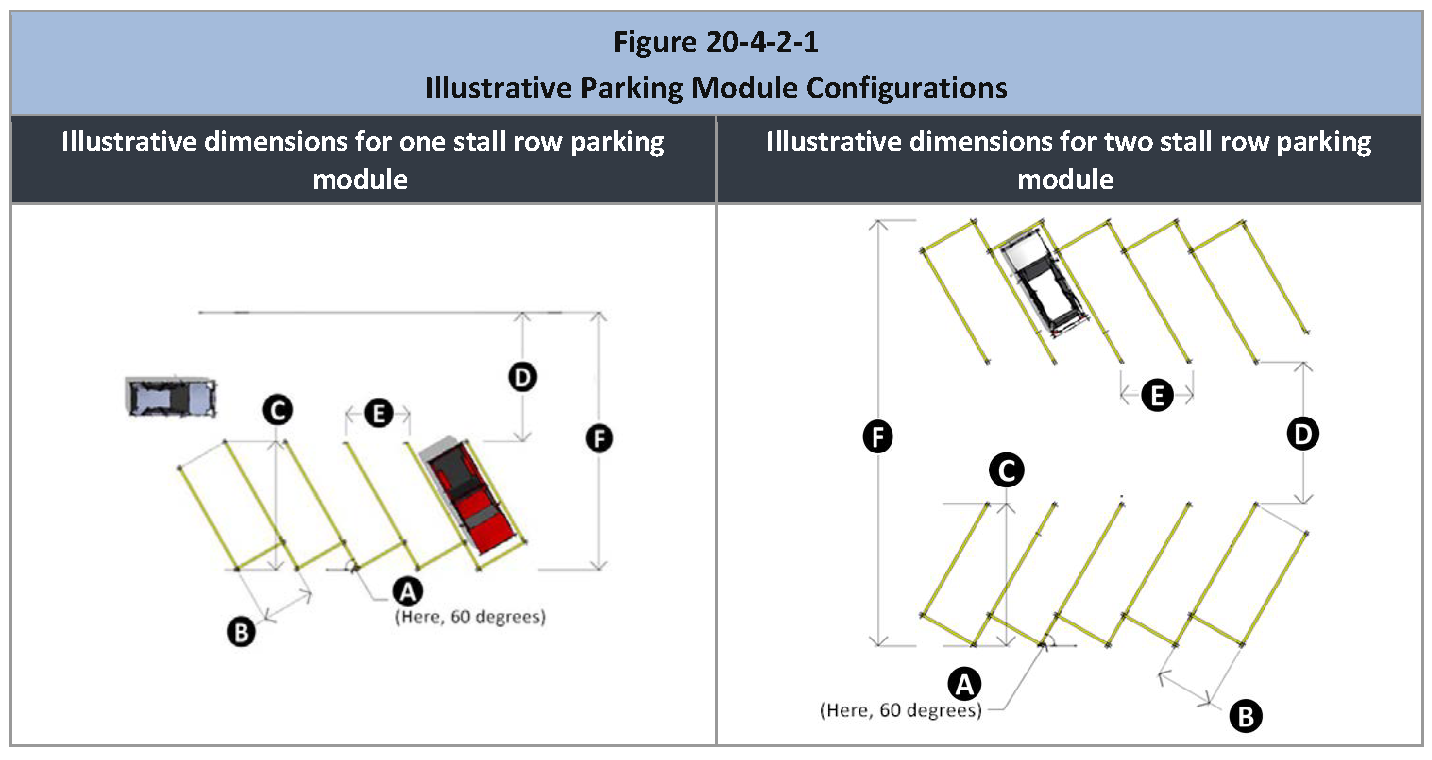
Parking module dimensions. Parking modules shall be dimensioned as shown in Table 20-4-2-2, Parking Module Dimensions. The dimensions that are set out in the table are illustrated in Figure 20-4-2-1, Illustrative Parking Module Configurations.
(b)
Accessible parking.
(1)
Number of required spaces. Parking for disabled persons shall be provided as set out in Table 20-4-2-3, Accessible Parking Requirements, or as required by the Americans with Disabilities Act (ADA) Standards for Accessible Design and ADA Accessibility Guidelines for Buildings and Facilities published by the United States Access Board. If any of the standards within this Section and the United States Access Board are in conflict then whichever requires more spaces shall be used. Required accessible parking spaces are included in the total number of required parking spaces per Table 20-4-2-1, Minimum Required Off-Street Parking.
(2)
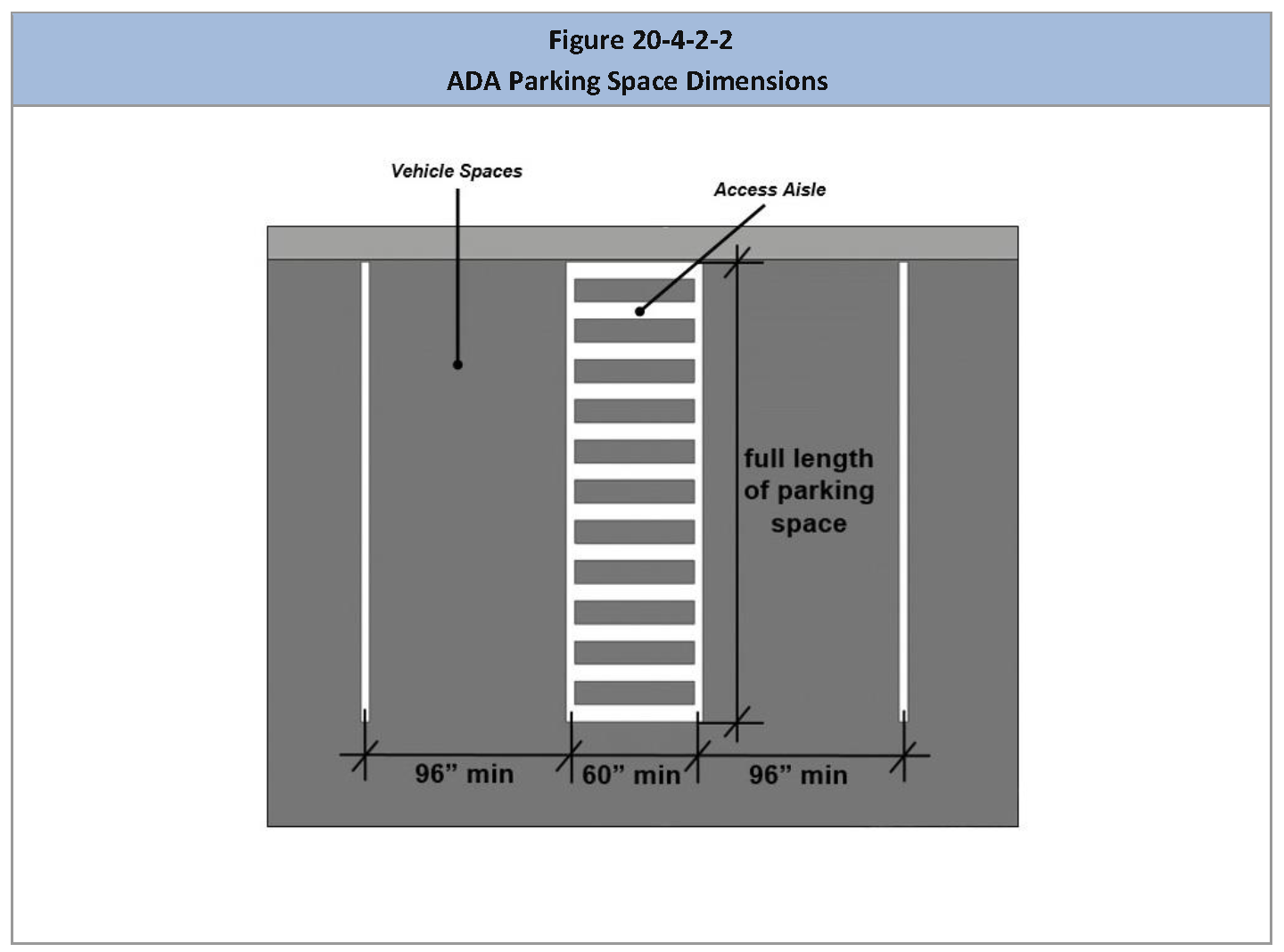
Parking space size specifications. Figure 20-4-2-2, ADA Parking Space Dimensions, details the specific size requirements for both standard automobile and van-accessible ADA-accessible parking spaces.
(c)
Off-Street Loading.
(1)
Generally. This subsection establishes the requirements with off-street loading spaces in connection with any nonresidential or mixed-use building, structure, or use which is to be erected or substantially altered to provide adequate space for off-street loading, unloading, and the maneuvering of shipping and delivery vehicles in the DT, NC, RC, HC, BP, LI, HI, and PC overlay districts.
(2)
Minimum number of off-street loading spaces required. Off-street loading facilities shall be provided in accordance with the requirements in Table 20-4-2-4, Minimum Off-Street Loading Spaces Required.
(3)
Design. To minimize impacts, off-street loading areas shall comply with the following standards:
a.
Lighting. Any lighting used to illuminate off-street loading or unloading areas may not glare on any right-of-way or adjacent property.
b.
Location. Off-street loading areas shall not be located within forty (40) feet of the nearest point of intersection of any two (2) streets.
c.
Buffering. Truck access and loading areas that are located between a principal building and a residential property shall comply with either one (1) of the following additional standards:
i.
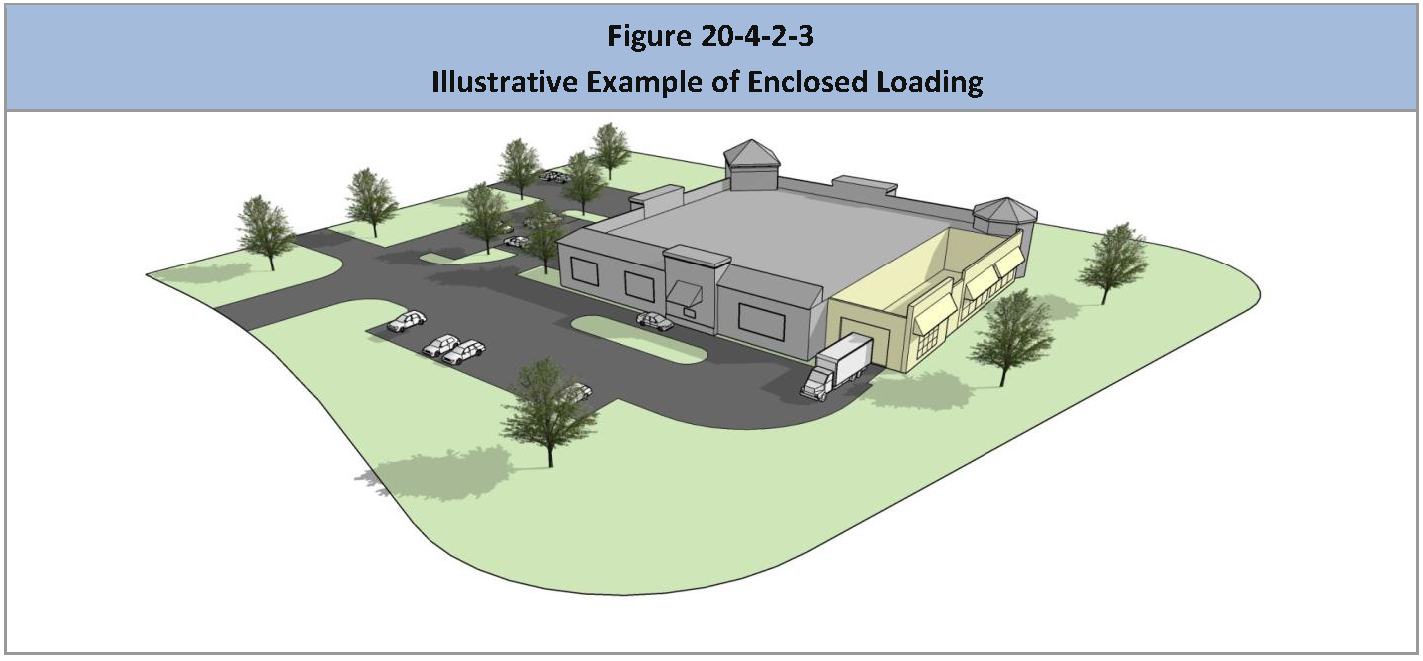
Use of enclosed loading. The loading area shall be enclosed by a roof and a wall between the principal building and the property boundary line (as depicted in Figure 20-4-2-3, Illustrative Example of Enclosed Loading, below). The walls of the enclosure shall be tall enough to completely screen the delivery vehicle and shall be designed and constructed with architectural elements such as windows, awnings, or other features that complement the exterior of the principal building; or
ii.
Absence of enclosed loading. The loading area shall be screened along its length by a district bufferyard that has one additional level of opacity (for example, from a Type A bufferyard to a Type B bufferyard) than required by Table 20-4-3-3, Foundation Landscaping Requirements, and, additionally, the loading area shall contain an eight-foot-tall wall as an additional screening device.
d.
Loading space width.
i.
Loading for industrial uses. Each required loading space in the LI and HI zoning districts shall be a minimum of twelve (12) feet in width and forty-five (45) feet in depth.
ii.
Other uses. All other required loading spaces shall be a minimum of twelve (12) feet in width and eighteen (18) feet in depth. All required loading spaces shall have a minimum vertical clearance of fifteen (15) feet and shall be designated by signs as loading spaces.
(d)
Stacking.
(1)
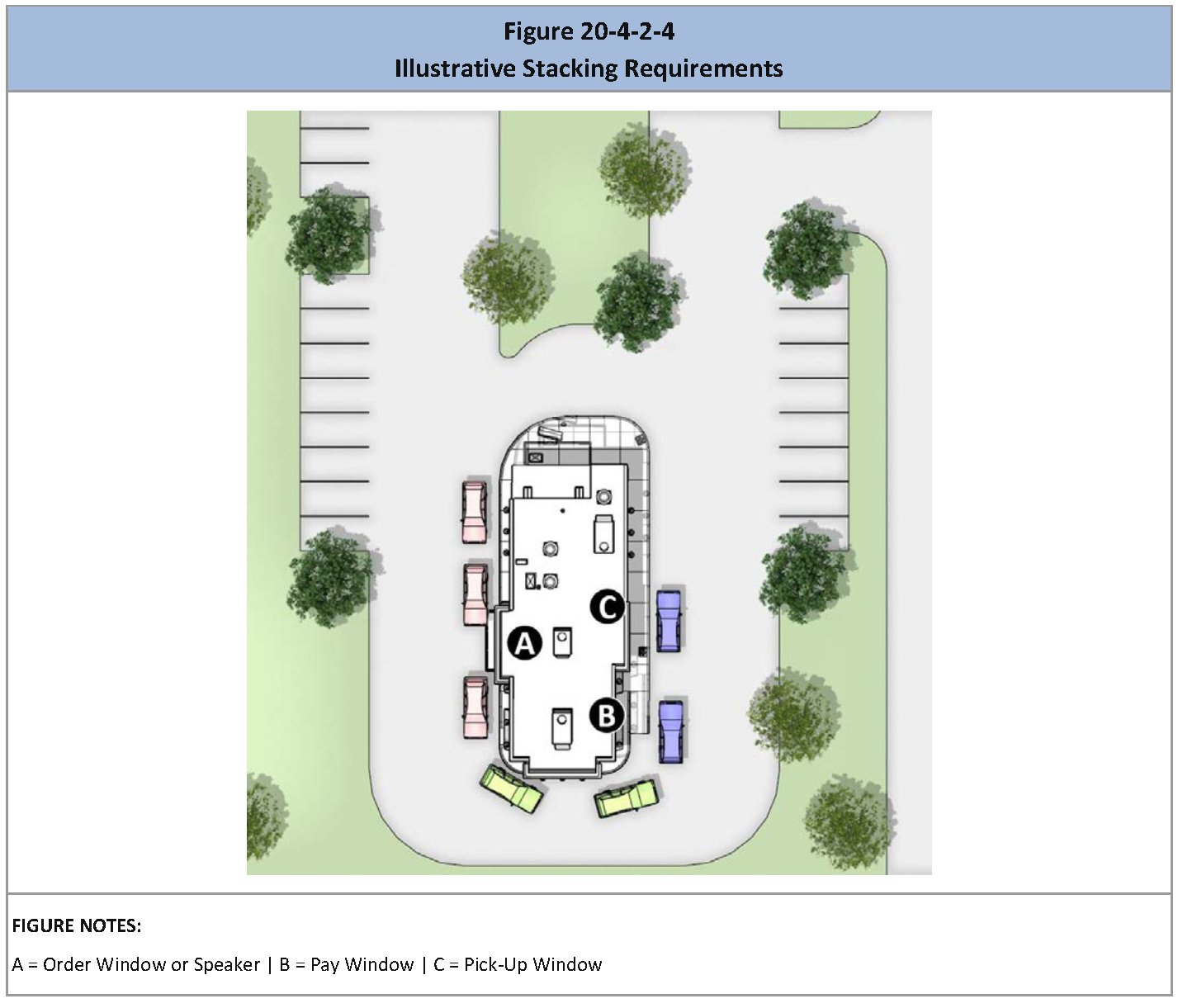
Generally. Stacking spaces create capacity of a drive-through lane to hold vehicles while transactions are taking place at drive-through facilities. Stacking shall not block access to driveways or parking areas. An illustrative diagram of stacking spaces and the requirements outlined below is shown in Figure 20-4-2-5, Illustrative Stacking Requirements.
(2)
Requirements.
a.
Dimensions. Stacking spaces are nine (9) feet in width by twenty-five (25) feet in length and provide direct access to a service window or other improvement.
b.
Minimum number. Uses that include drive-through service shall not have fewer than the number of stacking spaces established in Table 20-4-2-4, Stacking Requirements. The position in front of a drive-through station (e.g., a service window, ATM, or station at a drive-through bank) is counted as a stacking space.
c.
Bypass lane. A 10-foot-wide bypass lane is required adjacent to stacking lanes to allow vehicles to travel around the drive-through activity and exit the site or park.
d.
Turn-around area. Controlled entrances for facilities such as apartment complexes or self-service storage shall be designed so that vehicles may turn around without entering the gated area or backing out into the public right-of-way.
(e)
Access.
(1)
Direct access. All off-street parking must have direct access to a public street through an alley, driveway, or permanent access easement.
(2)
Street classification. Entries for parking shall be placed along a collector street, where practicable.
(3)
Large retail uses. Site plans for retail developments greater than a cumulative fifty thousand (50,000) gross square feet shall designate a primary vehicle circulation route entering and exiting the development.
(4)
Moving other vehicles. Except for where valet or tandem parking is utilized, all required parking shall be designed so that vehicles enter or leave a parking space without having to move any other vehicle.
(5)
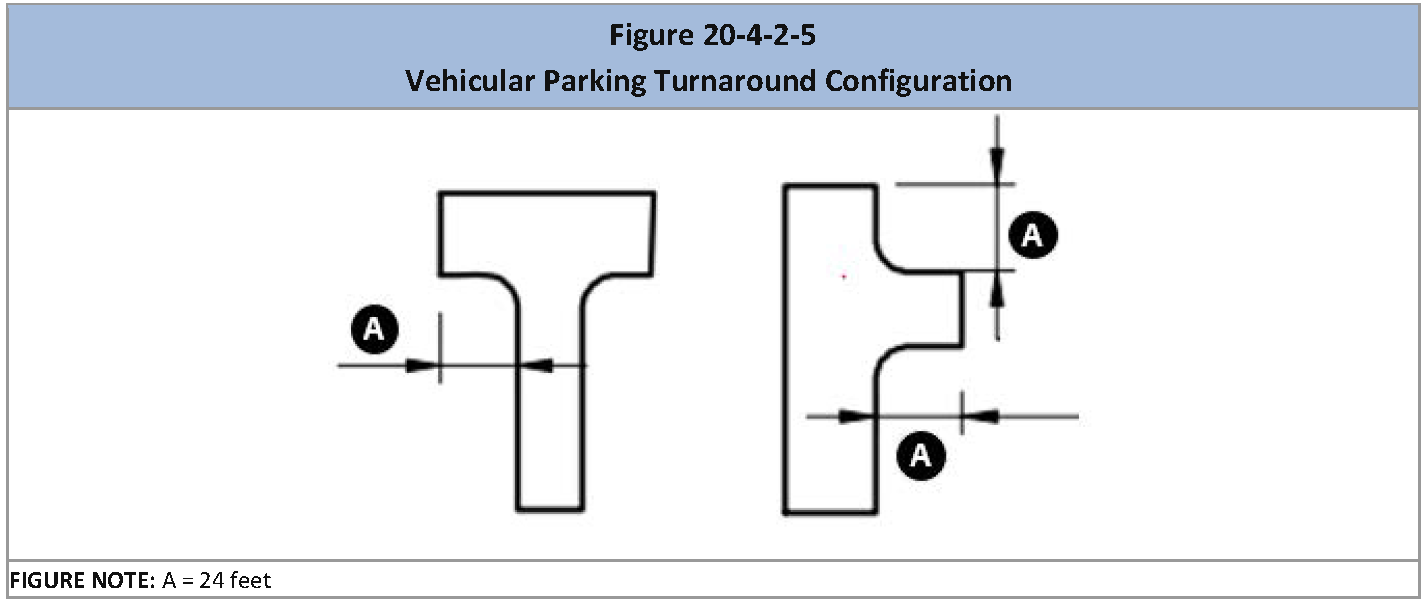
Turn-arounds. Any parking row that does not provide two (2) means of vehicular egress must provide, at the closed end, a space designated as a vehicular turn-around area as depicted in Figure 20-4-2-5, Vehicular Parking Turnaround Configuration. This space must be located at the end of a parking row, be designed with the minimum dimensions depicted in Figure 20-4-2-5, or other dimensions and configuration acceptable to the public works director, and include a "No Parking" sign.
(6)
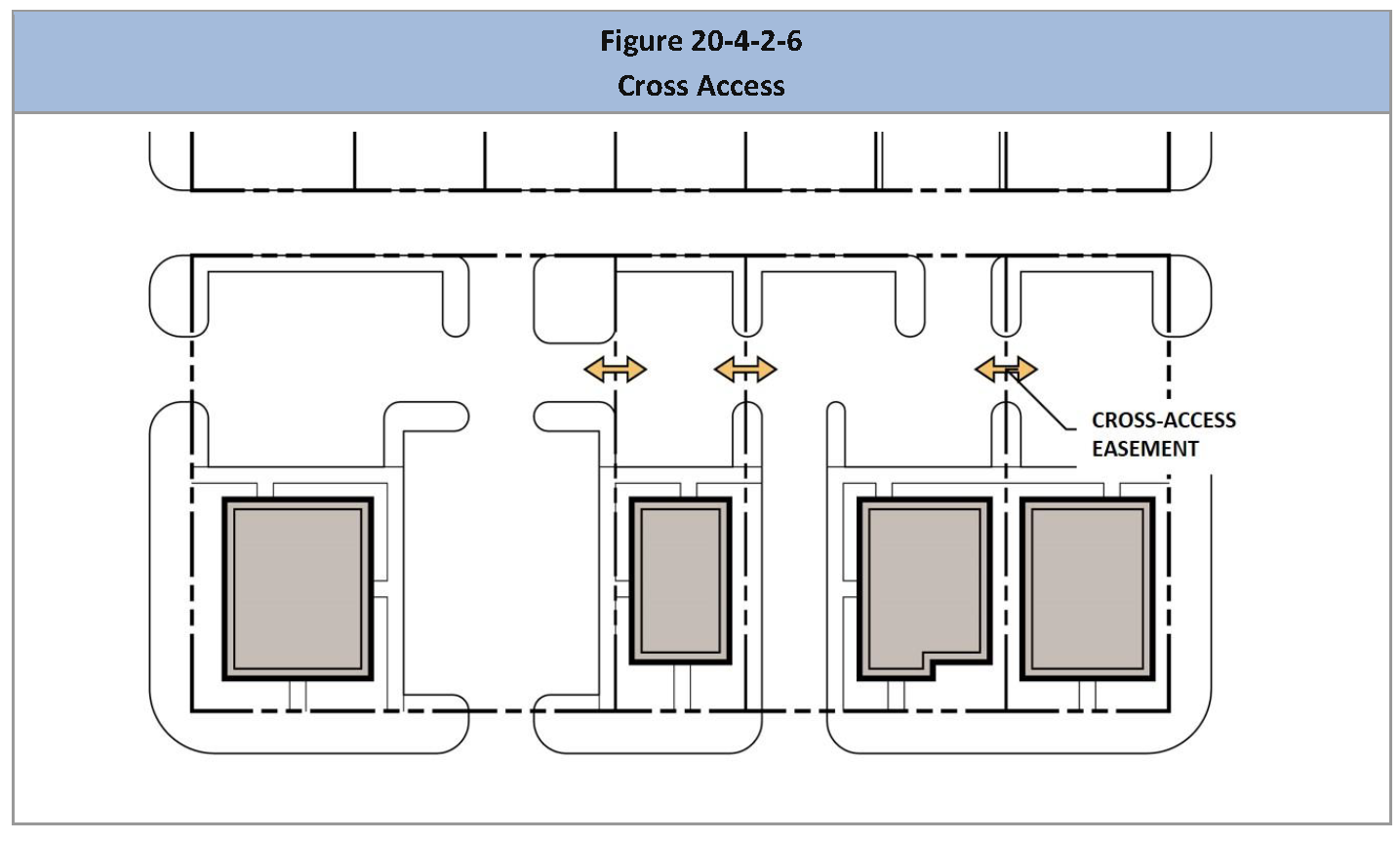
Cross-access. Cross-access for vehicle circulation shall be provided between abutting nonresidential development, as shown in Figure 20-4-2-6, Cross Access.
(7)
Emergency access. The applicant shall provide emergency access lanes where necessary to provide adequate protection for a structure.
a.
Dimensions. Dimensions for emergency access lanes and turnarounds, including width and clearance, shall comply with the requirements of the fire code. Any emergency access lane shall either connect at each end to a dedicated public street or be provided with a turnaround established in the fire code, with an additional distance of ten (10) feet on all sides clear of permanent structures. The driving surface within emergency access lanes shall be designed and constructed according to standards established for local public streets.
b.
Location. All structures shall be located within one hundred fifty (150) feet of an emergency access easement lane or public street.
(f)
Driveways. Driveways shall be constructed in accordance with Table 20-4-2-6, Width of Driveway Access, but shall not conflict with any requirements of the Texas Department of Transportation.
(g)
Alternative parking plan and shared parking.
(1)
Alternative parking plan. An alternative parking plan may be approved by the Zoning Administrator for specific developments that are deemed to require a different amount of parking than the standards shown in Table 20-4-2-1, Minimum Required Off-Street Parking. The zoning administrator shall establish conditions necessary to ensure the adequacy of future on-site parking when approving an alternative parking plan. Any alternative standard shall meet the criteria below:
a.
The use of the building is specific and occupied by a single user.
b.
The applicant provides a detailed breakdown of his or her parking requirements indicating employee counts, shift distribution and visitor or customer needs.
c.
The applicant provides a site plan showing how additional parking to meet standard requirements would be provided if the use changed or parking needs increase.
(2)
Shared parking.
a.
Shared parking reduction. Shared parking allows a reduction of up to twenty-five (25) percent in the total number of required parking spaces when a property is occupied by two (2) or more uses that typically do not experience peak use of parking areas at the same time. When any land or building is used for two (2) or more uses that are listed in Table 20-4-2-7, Shared Parking Demand, below, the minimum total number of required parking spaces may be determined by the following procedures, which are followed by Table 20-4-2-8, Shared Parking Reduction Calculation Example, showing an example of how to calculate shared parking reductions.
i.
Determine the minimum parking requirements for each use category in Column (A) as if it were a separate use;
ii.
Multiply the sum of required parking spaces for each use by the corresponding percentages for each of the five (5) time periods set forth in Columns (B) through (F) of Table 20-4-2-7, Shared Parking Demand;
iii.
Calculate the total for each time period; and
iv.
Select the column with the highest total to find the required number of shared spaces.
b.
Requirements for multiple ownership. The following documentation shall be submitted to the zoning administrator as part of the review process if requesting shared parking:
i.
The names and addresses of the uses and the owners or tenants that are sharing the parking;
ii.
The location and number of parking spaces that are being shared;
iii.
An analysis showing that the peak parking demands for the different uses occur at different times and that the parking area will supply at least the minimum number of required spaces for each use during its respective peak parking time;
iv.
A legal instrument such as an easement that guarantees access to the joint parking for all uses;
v.
A shared parking agreement executed by all the users and the owner of the property proposed to be used for parking;
vi.
The agreement shall be notarized and recorded, with a provision that the consent of the city must be obtained for termination of the agreement; or
vii.
In the event of the termination of an existing shared parking agreement, a new shared parking agreement shall be executed within sixty (60) days prior to termination. If a new shared parking agreement is not executed, then documentation shall be submitted to the zoning administrator supporting that the uses on all affected properties meet their respective parking requirements. This process of amending a shared parking agreement applies to all existing parking agreements impacted by sale, change of use, or expansions on any affected property.
(h)
Optional bicycle parking in NC district.
(1)
Credit. For a nonresidential use in the NC district, the applicant may provide two (2) bicycle parking spaces in lieu of one (1) required vehicle parking space, for a reduction of up to ten (10) percent of the required vehicular parking spaces. For example, if a minimum of twenty (20) vehicular parking spaces are required on a site, the applicant may provide four (4) bicycle parking spaces, which will result in a reduction of two (2) required vehicular spaces, for a total of eighteen (18) required spaces.
(2)
Standards. In order to receive the vehicular parking credit described in subsection (1), Credit, above, bicycle parking shall comply with the following:
a.
Close proximity to building. Bicycle parking shall be located inside of or within fifty (50) feet of the principal building entrance.
b.
Dimensions. Bicycle racks shall be a minimum of fifteen (15) inches in width and a minimum of seventy-two (72) inches in length.
c.
Bicycle parking rack design.
i.
Bicycle parking racks shall support the frame of the bicycle and at least one (1) wheel. Racks shall allow the frame and one (1) wheel to be locked to the rack.
ii.
Racks shall be securely anchored.
iii.
Bicycle parking racks shall support the bikes in a stable, upright position, without damage to wheels, frame, or other components.
d.
Installation. Bicycle parking racks shall be permanently mounted/installed within private property or in approved locations in the public right-of-way on solid surfaces. Racks placed adjacent to sidewalks shall not encroach upon required pedestrian accessways, accessible routes, or accessible passing space areas.
(Ord. No. 2023-36, § 2(Exh. A), 10-17-23)
Sec. 20-4-3. - Landscaping, buffering, and screening. AG, AR, BP, DT, HC, HI, HR, LI, LR, MR, NC, PF, RC, RE
(a)
Generally.
(1)
Types of landscaping.
a.
Development landscaping. There are three types of development landscaping:
i.
Foundation landscaping;
ii.
Site landscaping; and
iii.
Parking lot landscaping.
b.
Bufferyard landscaping. Bufferyards are required based on zoning, development type, or right-of-way type that is adjacent to a parcel proposed for development. Bufferyards may be required along and between certain differing zoning district boundaries in accordance with Table 20-4-3-4, District Bufferyard Standards.
(2)
Application of standards. The standards of this section shall apply subject to Table 20-4-1-1, Development Standards Applicability, upon application for a building permit.
(3)
Exceptions. The following are exempted from the requirements of this Section:
a.
Reconstruction or replacement of a lawfully existing use or structure following a casualty loss;
b.
Remodeling, rehabilitation, or improvements to existing uses or structures that do not substantially change the location of structures, parking, or other site improvements; and
c.
Sites that are proposed for redevelopment or substantial improvement, where due to the geometry of the site or existing improvements, installation of landscaping would be impractical or unreasonable; in which case, the zoning administrator may approve a lesser landscaping requirement, provided that the reduction of landscaping standards is only to the extent necessary to make the installation practicable. In no case shall this exception be interpreted to lessen these requirements for reasons other than those provided within this section.
(b)
Plant materials and locations.
(1)
Recommended plants. Appendix A, Plant List, contains the plant species that count toward fulfilling the recommendations of this section.
(2)
Prohibited plants. Plants that are on the Texas State Noxious Weed List, as provided by the USDA, are prohibited.
(3)
Minimum size of plants at installation. Plant material that is installed to comply with the requirements of this section shall be of the sizes set out in Table 20-4-3-1, Minimum Size of Plants at Installation.
(4)
Distance from utilities.
a.
No canopy trees shall be planted within fifteen (15) lateral feet of any overhead utility lines or paved street surface.
b.
No trees shall be planted over or within five (5) lateral feet of any underground utility line, or as required by the owner of the utility.
(5)
Visibility triangles. Plant materials shall not be installed where they may compromise the visibility triangle established in Table 20-1-10-1, Measurements.
(6)
Substitution. Small trees may be substituted for canopy trees where there is sufficient room for the healthy growth and stability of the tree at a rate of three (3) small trees per one (1) canopy tree.
(c)
Development landscaping.
(1)
Generally.
a.
Applicability. Development landscaping may be provided around nonresidential and mixed-use buildings.
b.
Incentives.
i.
Provision of development landscaping according to the requirements of this subsection shall result in the development incentives shown in Table 20-4-3-2, Development Incentives.
ii.
To qualify for the incentives in Table 20-4-3-2, the landscaping provisions applied to the site shall be fully complied with and not subject to a variance or other forms of relief in this ordinance.
iii.
The incentives in Table 20-4-3-2 shall not apply in the DT district or the PC overlay district.
(2)
Foundation landscaping.
a.
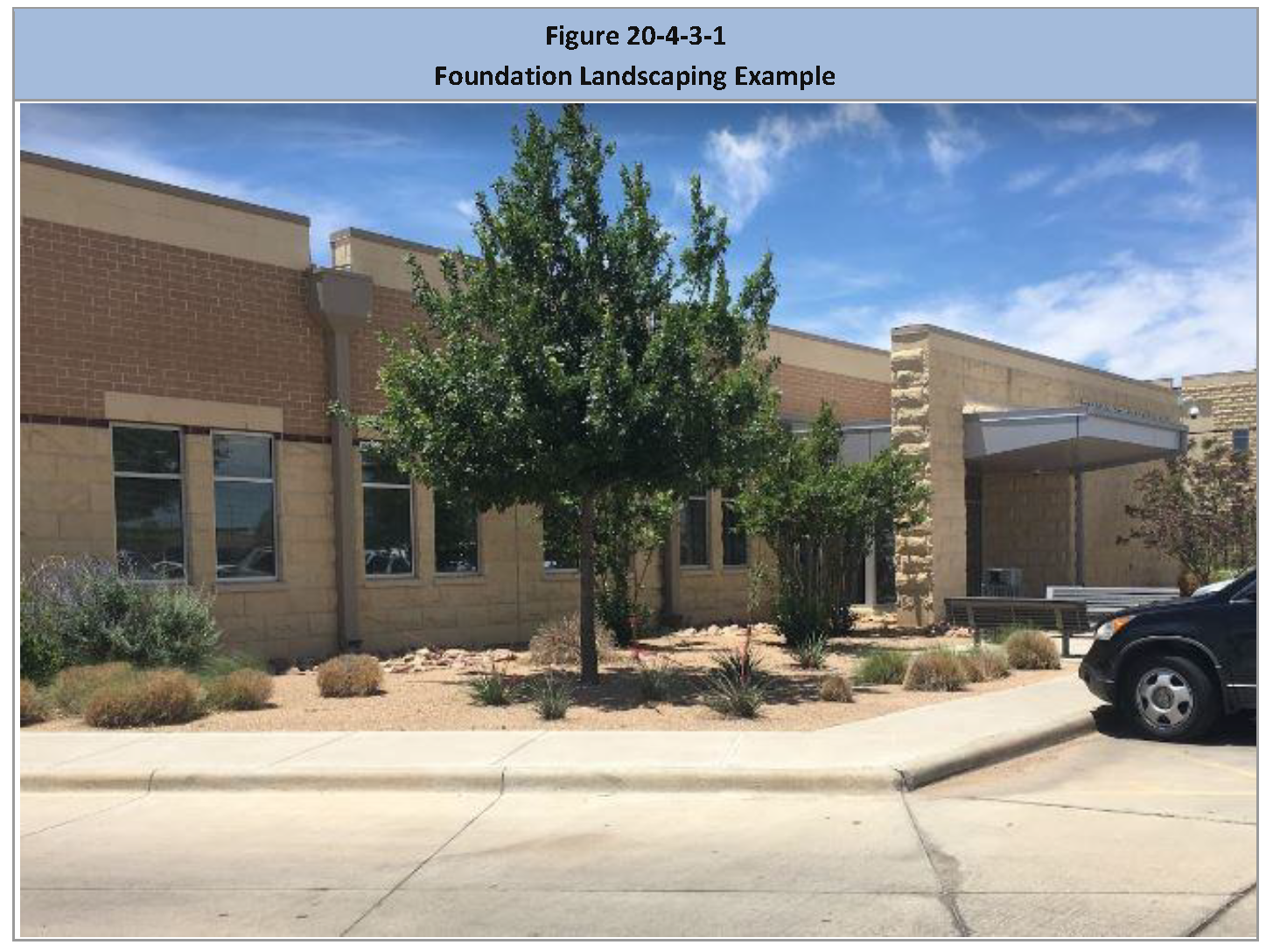
Generally. Building foundation landscaping shall be provided as set out in Table 20-4-3-3, Foundation Landscaping Requirements. Foundation plant materials shall not count towards the fulfillment of any other landscaping requirement. See Figure 20-4-3-1, Foundation Landscaping Example, for a visualization of the required standards.
b.
Plantings. Building foundation landscaping shall include a combination of low height plant materials (shrubs, ornamental grasses, perennials) and shall be installed and maintained next to and along all building foundation lines where not impeded by building entrances, loading areas, and sidewalks. Foundation plantings may be installed at grade, in raised planters, or decorative plant containers.
c.
Minimum linear feet and radius. Applicable buildings shall have foundation planting areas adjacent to the base of the building with a minimum percentage of linear feet along the front, side, and rear facade (if applicable) and the average width as set out in Table 20-4-3-3, Foundation Landscaping Requirements. Where planting areas are required, they may be crossed with walkways to provide access to the building and may be interrupted in the rear by required service and loading areas.
d.
Planting and decorative materials.
i.
Front, sides, and rear. A minimum of two (2) small trees shall be planted within the foundation planting areas that face the front and street side setbacks for each fifty (50) linear feet, measured parallel to the building. A minimum of one (1) small tree shall be planted within the foundation planting areas that face the rear setbacks for each fifty (50) linear feet. Remaining portions of the planting area shall be planted with groundcover or consist of xeriscape groundcover, rocks, decorative pavers or stamped, dyed concrete.
ii.
Exception. If the rear exterior wall of the building is not visible to a residential use, public right-of-way, or public park, then the foundation planting area is not required.
(3)
Parking lot landscaping.
a.
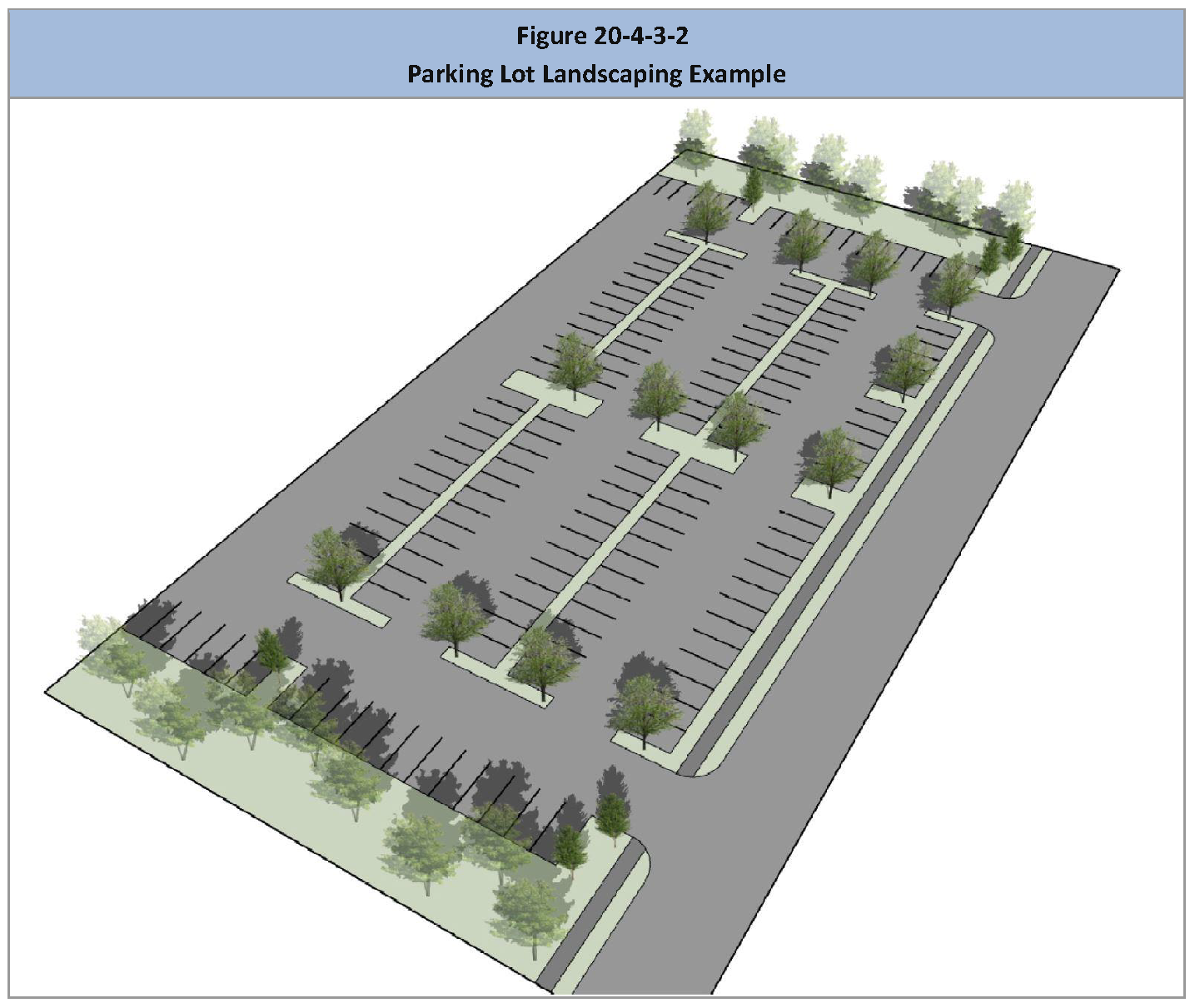
All rows of parking shall be terminated with a curbed landscaped island that is a minimum of nine (9) feet wide and no less than sixteen (16) feet in length (thirty-two (32) feet in length for head-to-head parking stalls).
b.
No off-street parking space shall be more than seventy-five (75) feet from a canopy tree located within a landscaped area.
c.
All parking lot islands shall be landscaped with a combination of turf grass, ornamental grass plantings, plant beds, shrubs, and trees. Rock, chip brick, pavers, pavement and similar hard surfacing shall not be permitted within a parking lot island. Impervious cover is not considered landscape. Sidewalks may be constructed within a parking lot island as necessary to accommodate pedestrian circulation. No less than one (1) canopy tree shall be planted within each required landscaped island. See Figure 20-4-3-2, Parking Lot Landscaping Example.
(4)
Site landscaping.
a.
Planting location. All areas not designated as foundation landscaping, bufferyards, parking lot landscaping, or utilized for pedestrian and vehicular access to the building (for example, sidewalks, parking spaces, loading spaces, service areas, and drive-in or drive-through facilities) shall be landscaped with groundcover or consist of xeriscape groundcover, rocks, decorative pavers or stamped, dyed concrete, and designated as site landscaping area.
b.
Trees. One (1) canopy or two (2) ornamental trees shall be planted per one thousand (1,000) square feet of the site landscaping area.
c.
Shrubs. Six (6) shrubs shall be planted per one thousand (1,000) square feet of the site landscape area.
d.
Groundcover. All remaining ground surface not covered in b. and c., above, shall be groundcover.
(d)
Bufferyards.
(1)
Purpose. The requirements and standards set out in this Section are intended to:
a.
Increase the compatibility of adjacent uses; and
b.
Mitigate the effects of noise, dust, debris, artificial light intrusions, and other externalities created by the use of land.
(2)
Applicability. Bufferyards shall be provided, where required, in accordance with the standards of this section.
(3)
Bufferyard landscaping.
a.
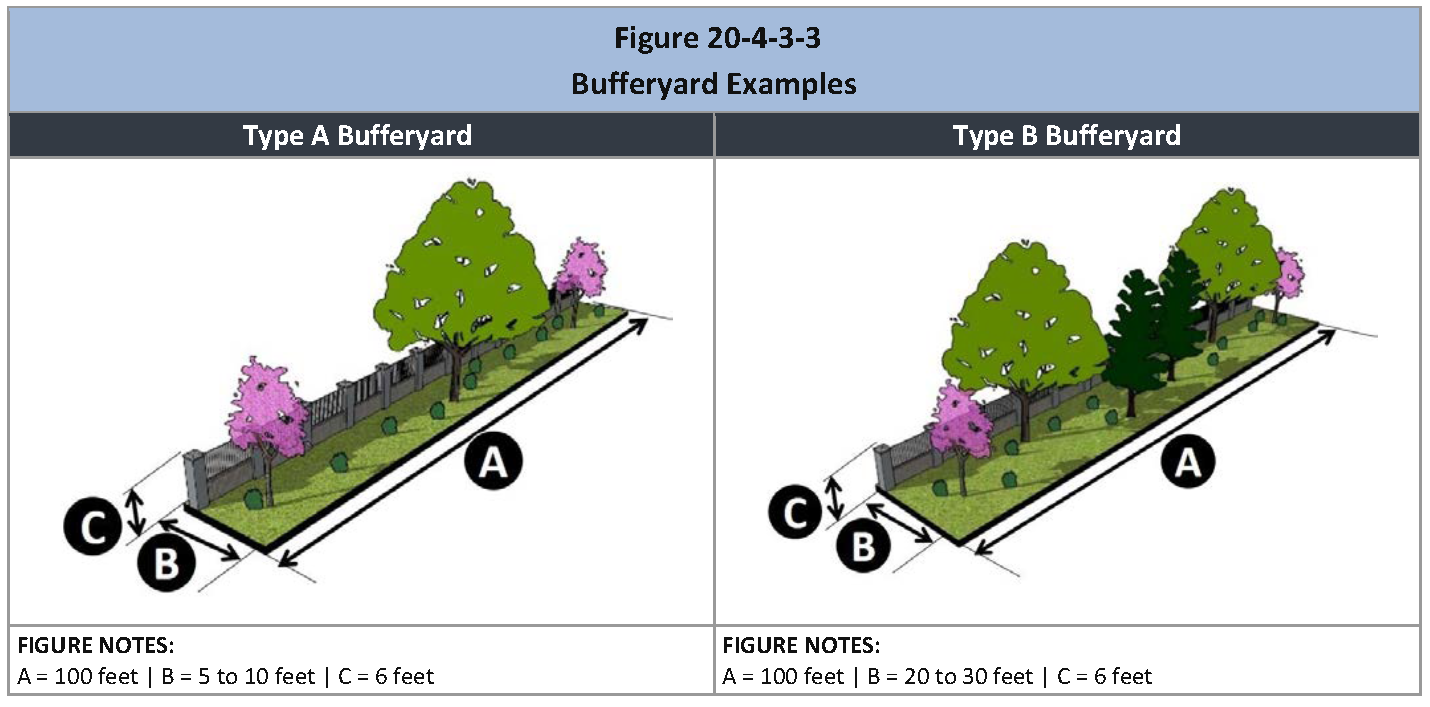
Generally. Required bufferyards are based on the amount of buffering and screening they provide. Bufferyards are classified in terms of intensity from less ("Type A") to moderate ("Type B").
b.
Differing zoning districts. Bufferyards shall be required between differing zoning districts in the form of a district bufferyard as detailed in the Table 20-4-3-4, District Bufferyard Standards, Table 20-4-3-5, Bufferyard Classifications, and Figure 20-4-3-3, Bufferyard Examples, below.
c.
Spacing of plants. Trees or shrubs in a bufferyard may be evenly spaced or clustered in order to present a naturalistic character.
d.
Fences and walls. Fences and walls that are part of the required district bufferyard shall:
i.
Be maintained by the business or property owners' association, as applicable; and
ii.
Not encroach into the public right-of-way.
(Ord. No. 2023-36, § 2(Exh. A), 10-17-23)
Sec. 20-4-4. - Outdoor storage and display. AG, BP, DT, HC, HI, LI, NC, PF, RC
(a)
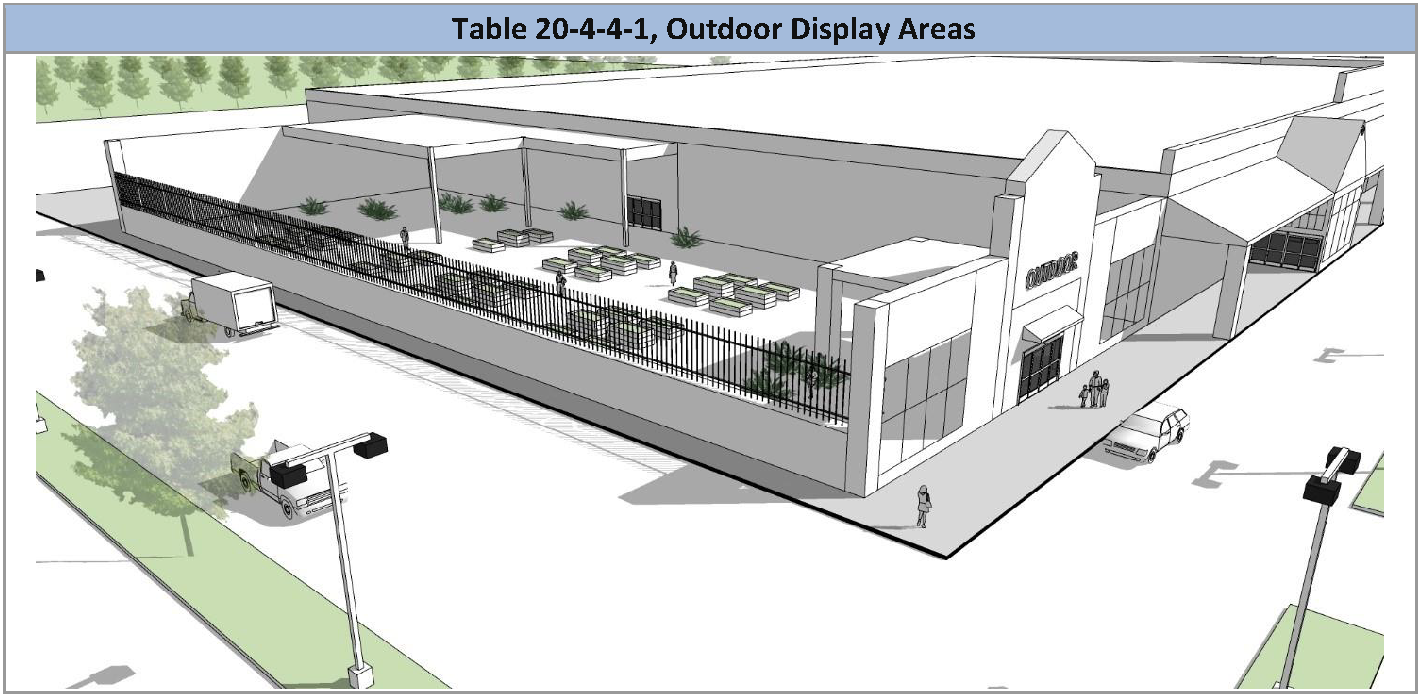
Outdoor display. Permanent or seasonal outdoor display of merchandise is permitted if the display area contains items for sale by the business, whether the display area is detached from, or attached to, a principal building.
(1)
Accessory use. The permanent or seasonal outdoor display of merchandise that is for sale by the business shall take place only in conjunction with a principal use as permitted in nonresidential and mixed-use districts.
(2)
Location. The outdoor display area shall only contain items for sale by a business that is located within a permanent structure or a designated area on the same site, whether the display area is detached from, or attached to, a principal building.
(3)
Attached to principal building. An outdoor display area that is attached to a principal building is permitted if the outdoor display area is:
a.
Adjacent to a wall of a principal structure;
b.
The lesser of:
i.
If located in areas devoted to parking, loading, or vehicular circulation, twenty (20) percent of the total of such vehicle use areas; or
ii.
Fifteen (15) percent of the gross floor area of the principal building;
c.
Within the buildable area of the site formed by the required setbacks; and
d.
If permanently covered, the display area shall be covered with a roof structure that is architecturally integrated into the primary building, except that nursery areas may be covered by greenhouse roofing, screening, or another cover material that is appropriate for protecting plant stock.
(b)
Outdoor storage. Outdoor storage is permitted subject to the following:
(1)
Accessory use. Outdoor storage shall take place only in conjunction with a principal use as permitted in agricultural, nonresidential, and mixed-use districts.
(2)
Surfacing and drainage.
a.
LI and HI districts. In the LI and HI zoning districts, access aisles and maneuvering areas of enclosed outdoor storage areas may be composed of gravel.
b.
All other nonresidential and mixed-use districts. All outdoor storage facilities including access aisles, driveways, and maneuvering areas shall be composed of an all-weather surface.
(3)
Location. An outdoor storage facility shall be located to the rear or side of the primary structure and away from the public right-of-way and adjacent residentially zoned or used property.
a.
AG district. In the AG district, outdoor storage areas for agricultural equipment or materials shall be set back one hundred (100) feet from public rights-of-way and properties that have different zoning; or surrounded by an opaque fence that completely screens stored equipment or materials from ground-level views.
(4)
Maneuvering of inventory. The site shall be of adequate size, shape, and design to ensure:
a.
Inventory will be maneuvered without conflicting with vehicular use areas; and
b.
All on-site maneuvering shall occur without encroaching onto adjacent properties or rights-of-way.
(5)
Buffering and screening. Outdoor storage areas shall be screened from the public right-of-way and from adjacent properties with a Type B bufferyard as established in section 20-4-3, Landscaping, Buffering, and Screening, together with a fence or wall that is a minimum of six (6) feet and a maximum of eight (8) feet in height.
(6)
Exemptions. The following activities shall be exempt from these outdoor storage standards:
a.
Retail planting stock and landscape stone or similar landscape materials, associated with a nursery or greenhouse;
b.
Commercial vehicles related to a permitted business on-site; and
c.
Finished recreational vehicles, automobiles, portable buildings, boats, trailers, manufactured homes, and other similar vehicles or equipment sold by a permitted use on-site.
(Ord. No. 2023-36, § 2(Exh. A), 10-17-23)
Sec. 20-4-5. - Outdoor lighting. AG, AR, BP, DT, HC, HI, HR, LI, LR, MR, NC, PF, RC, RE
(a)
Applicability. All outdoor lighting within the city limits must comply with the requirements of this section unless required by state, federal, or local law. The following types of outdoor lighting are exempt from the requirements of this section:
(1)
Emergencies. Lighting used only under emergency conditions;
(2)
Street lights. Lighting used for the principal purpose of illuminating streets and sidewalks;
(3)
Residential. Lighting for single-family dwellings, multiplexes, townhouses, and manufactured homes;
(4)
Signs. Lighting solely used for signs;
(5)
Temporary uses. Lighting associated with an approved temporary use;
(6)
Temporary lighting. Temporary lighting associated with a development site;
(7)
Monuments and statutes. Lighting for public monuments and statues;
(8)
Water features. Underwater lighting in fountains, swimming pools, and other water features;
(9)
State and federal mandates. Lighting required pursuant to state and federal laws (e.g., FAA);
(10)
Building code. Lighting required by the city's building code;
(11)
Ornamental lighting. Ornamental lighting with a rated initial luminaire lumen output of five hundred twenty-five (525) lumens or less; and
(12)
Seasonal lighting. Seasonal lighting that is temporary.
(b)
Standards.
(1)
Height.
a.
Wall-mounted. All wall-mounted fixtures shall comply with maximum building height requirements specified in Article II, Zoning Districts and Dimensional Standards, for the district where the fixture is located.
b.
Freestanding. Freestanding fixtures without fully shielded luminaires shall be fifteen (15) feet in height or less.
(2)
Location. All fixtures shall be located outside of utility easements.
(3)
Shielding.
a.
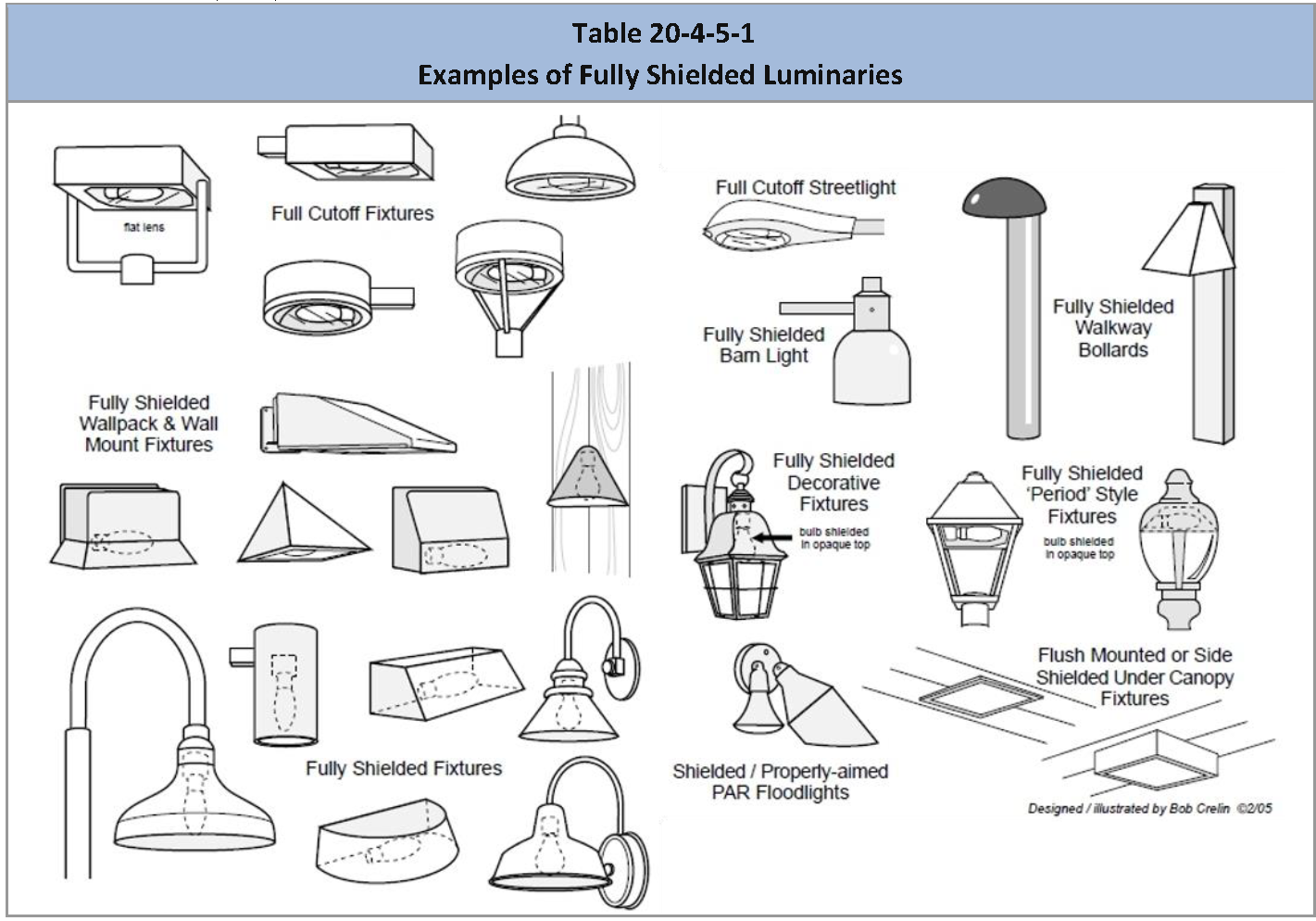
All luminaires with initial lamp output of over one thousand five hundred (1,500) lumens shall be fully shielded.
b.
All lighting shall be directed away or shielded from adjacent or nearby property zoned for residential use. Examples of fully shielded luminaires are illustrated in Figure 20-4-5-1, Examples of Fully Shielded Luminaires.
(4)
Timers, dimmers, and sensors. Timers, dimmers, or vacancy or motion sensors are required when continuous lighting is not needed for security, safety, or operational purposes.
(5)
Vertical illuminance at lot lines.
a.
Vertical illuminance. The maximum allowable vertical illuminance at a lot line is based on the zoning of the adjacent lot, as specified in Table 20-4-5-2, Maximum Vertical Illuminance at Lot Lines.
b.
Measurement. Maximum vertical illuminance levels are measured in foot-candles:
i.
At the lot line;
ii.
Five feet above the ground; and
iii.
With the light meter facing towards the adjacent lot, street, or alley.
(6)
Correlated color temperature (CCT).
a.
Blue light emissions. Blue light emissions can be harmful to flora and fauna and can result in decreased nighttime visibility and increased skyglow. In order to minimize blue light emissions, warm spectrum, amber lighting shall be utilized rather than cool spectrum, blue, or white lighting, as specified in subsection b, Maximum Kelvins, below.
b.
Maximum Kelvins. The CCT of luminaires installed pursuant to the provisions of this subsection shall be 5,000 Kelvins (5000K) or less.
(7)
Prohibited outdoor lighting. The lighting prohibitions for signs in Chapter 16.5, Stay Basic Sign Regulations, of the City Code of Ordinances shall apply to outdoor lighting.
(Ord. No. 2023-36, § 2(Exh. A), 10-17-23)
Sec. 20-4-6. - Flood damage and signs reference.
(a)
Purpose. This section provides references to key standards in the City's Code of Ordinances that shall be applied in addition to the standards outlined in this zoning ordinance.
(b)
Standards.
(1)
Flood damage prevention. Chapter 4, Article III, Flood Damage Prevention Ordinance, of the City's Code of Ordinances provides standards to minimize losses due to flood conditions.
(2)
Signs. Chapter 16.5, Stay Basic Design Regulations, of the City's Code of Ordinances provides standards for signs.
(Ord. No. 2023-36, § 2(Exh. A), 10-17-23)

