
Coquille City Zoning Code
Division I
Introduction
17.01.010 - How to use the development code.
Welcome to the city of Coquille Development Code. This is a comprehensive land use and development code that governs all of the land within the incorporated limits of city of Coquille. The five divisions of the code are used together to review land use applications. They are organized as follows:
A.
Division I. In addition to this brief introduction, Division I provides definitions for selected terms, land use classifications and categories, and information on the legal construct of the code. It also explains the city authority to enforce the development code.
B.
Division II. Every parcel, lot, and tract of land within the city's incorporated boundaries is also within a "land use district." Land use districts are shown on the city's official zoning map. Division II identifies the land uses that are allowed within each district, and the standards that apply to each type of land use (e.g., lot standards, setbacks, and use-specific design standards). As required by state law, the zones or "land use districts" are intended to implement the city of Coquille comprehensive plan. The districts reserve land for planned land uses, provide for compatibility between different uses, and implement planned housing densities.
C.
Division III. The design standards contained in Division III apply throughout the city. They are used in preparing development plans and reviewing applications, to ensure compliance with city standards for transportation access and circulation, landscaping, parking, public facilities, surface water management, housing densities, and areas subject to natural hazards.
D.
Division IV. Application requirements and procedures for obtaining permits required by this code are contained in Division IV. Four types of permit procedures are provided: Type I (nondiscretionary, "ministerial" decision); Type II (discretionary, "administrative" decision); Type III ("quasi-judicial" decision requiring a public hearing); and Type IV ("legislative" decisions).
E.
Division V. Standards and application procedures for processing variances and addressing nonconforming situations (i.e., existing uses or development that do not comply with the code) are contained in Division V. this code cannot provide standards to fit every potential development situation. The city's varied geography, and complexities of land development, require flexibility. Division V provides that flexibility, consistent with the purposes and intent of the code.
(Ord. 1471 § 2 (part), 2008)
17.04.010 - Severability.
The provisions of this development code are severable. If any section, sentence, clause or phrase of the development code is adjudged to be invalid by a court of competent jurisdiction, that decision shall not affect the validity of the remaining portion of the development code.
(Ord. 1471 § 2 (part), 2008)
17.04.020 - Compliance and scope.
A.
Compliance with the Provisions in the Development Code. Land and structures may be used or developed only as this development code ("code"), including all amendments thereto, permit. No plat shall be recorded and no building permit shall be issued without compliance with the provisions of this code.
B.
Obligation by Successor. The requirements of this code apply to the owner(s) of record, persons undertaking the development or the use of land, and to those persons' successors in interest.
C.
Most Restrictive Regulations Apply. Where a conflict arises between this code and any other rule or regulation of the city of Coquille, the most restrictive regulation, or that imposing the higher standard, shall govern. The city of Coquille planning official ("planning official") shall determine applicability of such regulations; however, where the planning official is unable to determine a regulation's applicability, the Coquille city council shall decide.
D.
Variances. Variances shall be governed by the provisions of Chapter 17.116.
E.
Transfer of Development Standards Prohibited. No lot area, yard, landscaping, or open space that is required by this code for one use shall be a required lot area, yard, landscaping, or open space for another use, except as otherwise specifically allowed by this code.
(Ord. 1471 § 2 (part), 2008)
17.04.030 - Consistency with plan and laws.
This development code is designed to implement the city of Coquille comprehensive plan. All provisions of this code shall be construed in conformity with the comprehensive plan, including all adopted comprehensive plan elements, except as otherwise required by applicable state or federal law.
(Ord. 1471 § 2 (part), 2008)
17.04.040 - Land use and use of a development.
All land uses and all uses of a development shall conform to this code. A lawful use is one that is permitted by this code (including nonconforming uses, subject to Chapter 17.128), and is not prohibited by law. Where a proposed use is not specifically identified by this code, the planning official shall determine the code's applicability based on similar uses either permitted, allowed conditionally, or prohibited by this code.
(Ord. 1471 § 2 (part), 2008)
17.04.050 - Pre-existing approvals.
A.
Legality of Pre-Existing Approvals. Developments and uses for which approvals were granted prior to the effective date of the ordinance codified in this title may occur pursuant to such approvals; except that modifications to those approvals shall comply with Chapter 17.100, Modifications to Approved Plans and Conditions of Approval, as applicable.
B.
Subsequent Development Applications. All developments and uses begun on or after the effective date of the ordinance codified in this title shall conform to the provisions of this code.
(Ord. 1471 § 2 (part), 2008)
17.04.060 - Building permit and certificate of occupancy.
A.
Building Permit. A building permit shall not be issued until the planning official has issued a land use review or site design review approval in accordance with the provisions of Chapter 17.84, or has otherwise found that such review is not required. Processing of building permits is subject to city of Coquille Municipal Code.
B.
Certificate of Occupancy Required. To ensure completion of a development or use in the manner approved, a building shall not be occupied and a use shall not begin until the city of Coquille has issued or received a certificate of occupancy, as applicable, from the building official following completion of the work in substantial conformance to the applicable approvals and permits. Occupancy shall be subject to final clearance by the city planning official for compliance with applicable zoning and development code requirements, including applicable conditions of approval. Where a development or use is found to be in violation of this code or any applicable condition of approval, the city may withhold final clearance and occupancy until the violation is remedied.
(Ord. 1471 § 2 (part), 2008)
17.04.070 - Official action.
A.
Official Actions. The planning official or his or her designee, as applicable, is vested with authority to issue permits or grant approvals in conformance with this code, and shall issue no permit and grant no approval for any development or use that violates or fails to comply with conditions or standards imposed to carry out this code.
B.
Void Actions. Any permit or approval issued or granted in conflict with the provisions of this code shall be void, unless it is modified to conform to the code. The planning official shall determine when an approval is void and he or she may modify the approval, or refer it back to the original decision making body for modification, to make it conform to the code.
C.
Notices and Validity of Actions. The failure of any person to receive mailed notice or failure to post a notice shall not invalidate any actions pursuant to this code, provided a good faith effort was made to notify all parties entitled to notice.
(Ord. 1471 § 2 (part), 2008)
17.05.010 - Planning commission—Created—Members.
There is created a planning commission that shall be known as the city of Coquille Planning Commission. The city of Coquille Planning Commission shall consist of seven voting members in number appointed by the common council, and their qualifications shall be as required by ORS Chapter 227 and as otherwise provided by law.
(Ord. 1438 (part), 2003)
17.05.020 - Vacancy.
Any vacancy shall be filled by the common council for the unexpired portion of the term; provided, however, appointments made while Ordinance 893 was in effect shall continue as to the member and the respective term. Their successors shall hold office for four years. Commission members may be removed only by the common council subsequent to a hearing for misconduct or nonperformance of duty.
(Ord. 1438 (part), 2003)
17.05.030 - President and vice-president—Election.
The city planning commission shall, at its first meeting in January of each year, elect a president and vice-president, who shall hold office at the pleasure of the commission.
(Ord. 1438 (part), 2003)
17.05.040 - Reimbursement of expenses.
Members of the city planning commission shall receive no compensation but shall be reimbursed for duly authorized expenses. The city planning commission shall elect or appoint a secretary who need not be a member of the commission. Such secretary shall keep an accurate record of all proceedings of said commission.
(Ord. 1438 (part), 2003)
17.05.050 - Power and authority to employ.
The city planning commission shall have power and authority to employ consulting advice on municipal problems, a secretary, and such clerks as may be necessary, and to pay for their services and for such other expenses as such commission may lawfully incur, including the necessary disbursements incurred by its members in the performance of their duties as members of said commission out of such funds as are therefore placed at the disposal of the commission by the city council.
(Ord. 1438 (part), 2003)
17.05.060 - Power and duties.
It shall be the duty of the city planning commission and they shall have power, except as otherwise provided by law, to recommend and make suggestions to the city council and to all other public authorities concerning the laying out, widening, extending, parking, and locating of streets, sidewalks, and boulevards, the establishment of setback lines, the relief of traffic congestion, the betterment of housing and sanitation conditions, and the establishment of zones and districts limiting the use, height, area, and bulk of buildings and structures; to recommend to the city council and all other public authorities plans for the regulation of the future growth, development, and beautification of the municipality in respect to its public and private buildings and works, streets, parks, grounds, and vacant lots, and plans consistent with the future growth and development of the city in order to secure to the city and its inhabitants sanitation, proper service of all public utilities (harbors, shipping) and transportation facilities; to do and perform any and all other acts and things necessary or proper to carry out the provisions of this division; and in general to study and to propose such measures as may be advisable for the promotion of the public interest, health, morals, safety, comfort, convenience, and welfare of said city.
(Ord. 1438 (part), 2003)
17.05.070 - Maps, plats, and replats dedicated to public use—Submittal requirements—Approval.
All maps, plats, and replats of land laid out in building lots and the streets, alleys, or other portions of the same intended to be dedicated for public use or for the use of purchasers or owners of lots fronting thereon or adjacent thereto and located within the city limits and all plans or plats for vacating or laying out, widening, extending, parking, and locating streets or plans for public buildings shall first be submitted to the city planning commission by the city engineer or other proper municipal officer; and a report thereon from the commission secured in writing before approval shall be given by the said proper municipal official.
(Ord. 1438 (part), 2003)
17.05.080 - Plans, plats, or replats dedicated to public or private use—Approval before being recorded.
All plans, plats, or replats of lands laid out in lots or plats within the city, including the streets, alleys, and other portions of the same intended to be dedicated to public or private use, shall first be submitted to the said planning commission and approved by it before they shall be recorded.
(Ord. 1438 (part), 2003)
17.05.090 - Proposed zone or district boundaries and regulations—Recommendation.
Copies of all proposed ordinances for establishment of the boundaries of any zone or district provided by Section 17.05.060, and of all proposed ordinances regulating or limiting the use, height, area, bulk, and construction of buildings to be submitted to the council shall, before the same are presented to the council, be first submitted by the city recorder to the city planning commission for recommendation and said recorder shall immediately so notify the council of such submission to said commission, and said commission shall make its recommendation thereon in writing to the council.
(Ord. 1438 (part), 2003)
17.05.100 - Gifts—Bequests.
The city planning commission may not receive gifts, bequests, or devise property to carry out any of the purposes of this act and shall have control and disposition over same unless this title should be repealed, in which case such control shall be vested in the council.
(Ord. 1438 (part), 2003)
17.05.110 - Authority.
The city planning commission shall also have all the powers which are now, or may hereafter be, given to it under the general laws of the State of Oregon, "including the power to grant or deny applications for zone changes and permits for variance of requirements of the city zoning ordinance."
(Ord. 1438 (part), 2003)
17.05.120 - Recommendations to the council.
All recommendations made to the council by the commission shall be in writing.
(Ord. 1438 (part), 2003)
17.05.130 - Appointment of hearing officer.
The city manager shall appoint a planning commission hearings officer who shall be a nonvoting additional member of the planning commission and who shall be the presiding officer at all hearings as specified in Section 17.05.210, Rule 1, of this chapter. The hearings officer shall rule on all matters pertaining to admissibility of evidence and the general conduct of hearings. Such rulings shall be in conformance with the rules pertaining to admissibility of evidence and procedure as set forth herein. In the event the city manager does not appoint a "hearings officer," the chairman of the planning commission shall act in this capacity and shall be a voting member thereof.
(Ord. 1438 (part), 2003)
17.05.140 - Meetings.
The chairman of the planning commission or a majority of the members of the planning commission may call a special meeting thereof with not less than three days notice. Regular meetings shall be held once a month at the times and places fixed by the planning commission.
(Ord. 1438 (part), 2003)
17.05.150 - Quorum.
Four members of the planning commission shall constitute a quorum.
(Ord. 1438 (part), 2003)
17.08.010 - Purpose.
The purpose of this chapter is to define terms that are used frequently in the city of Coquille Development Code to assist decision makers in interpreting and applying the code. Some of the terms that are defined here may have different meanings in other communities.
(Ord. 1471 § 2 (part), 2008)
17.08.020 - Applicability.
A.
Definitions. The definitions in this chapter apply to all actions and interpretations under the city of Coquille Development Code. The meanings of some terms in this chapter may, in certain contexts in which they are used, be clearly inapplicable. In such cases, the context in which a term is used will indicate its intended meaning, and that intent shall control. Where a term used in this code is already defined in another part of the city of Coquille Municipal Code or codes incorporated therein by reference (e.g., building code), the term is not redefined herein for purposes of that other code. Terms not defined in this code shall have their ordinary accepted meanings within the context in which they are used. Webster's Third New International Dictionary of the English Language, unabridged, shall be considered a standard reference.
B.
Land Use Categories. Chapter 17.12 contains descriptions of the land use categories and examples of uses allowed in each district in Division II.
(Ord. 1471 § 2 (part), 2008)
17.08.030 - Definitions.
The following definitions are organized alphabetically and some related terms are also grouped together and cross-referenced under group headings (e.g., transportation-related, environment-related, etc.).
"Abutting" means contiguous or adjoining.
Access. See transportation-related terms.
"Accessory" means secondary or incidental to a primary use or structure.
Accessory Dwelling. See "Residential structure types."
"Accessory parking facility" means a parking facility that provides parking for one or more primary use and may be located on or off the site of the use or uses to which it is accessory.
"Accessory structure" means a structure of secondary importance or function on a site. In general, the primary use of the site is not carried on in an accessory structure. Accessory structures are detached from the primary structure. Examples of accessory structures include, but are not limited to: garages, decks, fences, arbors, gazebos, heat pumps, workshops and other structures. See also "Primary structure."
"Accessory use" means a use or activity that is a subordinate part of a primary use and that is clearly incidental to a primary use on a site. See also "Primary structure."
"Adjacent" means abutting or located directly across a street right-of-way or easement.
"Administrative" means a discretionary action or permit decision made without a public hearing, but requiring public notification and an opportunity for appeal.
"Adult foster care" means a family home or facility in which residential care is provided for five or fewer adults who are not related to the provider by blood or marriage. "Provider" means any person operating an adult foster care home. See also "Residential structure types: Group living structure."
"Adverse impact or effect" means negative effect that can be measured (e.g., noise, air pollution, vibration, dust, property values, etc.).
"Affordable" means housing affordable to a certain percentage of the population earning a specified level of income and spending no more than thirty (30) percent of their income on housing expenses. For more information, contact the Federal Department of Housing and Urban Development and the Oregon Department of Housing and Community Services.
Agriculture. See use category under Chapter 17.12 and ORS 215.203(2)(a).
Airport-Related Definitions. The airport-related definitions of the Oregon Department of Aviation's Land Use Compatibility Handbook are incorporated by reference.
Alley. See "Transportation-related definitions."
Alteration. See "Development-related definitions."
"Ambient" means normal or background environmental conditions, as in the level of light, dust or noise.
"Applicant" means a person who applies for a land use review. An applicant can be the owner of the property, a contract purchaser, or someone who is legally authorized to represent the owner, such as a builder, developer, contract purchaser, consultant, architect, or similar individual.
"Arborist" means a professional listed as a certified arborist or a registered consulting arborist.
Arterial. See "Transportation-related definitions."
"Articulate/articulation" means the jointing and interrelating of building spaces through offsets, projections, overhangs, extensions or similar breaks in the exterior building elevation.
Attached House (Townhouse or Rowhouse). See "Residential structure types."
Attached Structure. See "Development-related definitions."
Automobile-Dependent/Oriented Development. See "Development-related definitions."
Automobile-Oriented Use. Automobiles and/or other motor vehicles are an integral part of the use, such as drive-in/drive-through restaurants and banks. See also "Automobile-oriented development."
"Bed and breakfast inn" means any establishment located in a structure designed for a single-family residence and structures appurtenant thereto, regardless of whether the owner or operator of the establishment resides in any of the structures, that:
1.
Has more than two rooms for rent on a daily basis to the public; and
2.
Offers a breakfast meal as part of the cost of the room.
"Berm" means a small man-made rise or hill in a landscape which is intended to buffer or visually screen certain developments, such as parking areas.
Bikeway. See "Transportation-related definitions."
"Block" means all of the property bounded by streets, rights-of-way (pedestrian or vehicle ways), water features, or any combination thereof, but is not divided or separated in any way by streets or water features.
"Block frontage" means all of the property fronting on one side of a street that is between intersecting or intercepting streets, or that is between a street and a water feature, or end of a dead-end street. An intercepting street determines the boundary of the block frontage only on the side of the street that it intercepts. See figure.
Block Frontage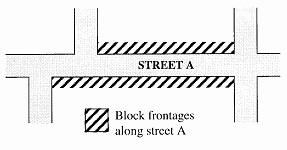
"Bollard" means a post of metal, wood or masonry that is used to separate or direct traffic (vehicles, pedestrians and/or bicycles). Bollards may contain sidewalk or pathway lighting.
Boulevard. See "Transportation-related definitions."
Building. See "Development-related definitions."
"Building official" means the person who enforces the building ordinances and regulations for the city, and other ordinances and regulations as assigned.
"Build-to line" means a maximum front or street yard setback which is typically required along commercial street frontages to promote a storefront character and pedestrian-oriented design.
"Canopy" means a permanent roofed unenclosed structure that may be freestanding or be partially attached to a building, for the purpose of providing shelter; typically used for sheltering patrons on foot and/or in motor vehicles; does not include a completely enclosed structure. See also "Carport" (below) and "Tree canopy," under "Environment-related definitions."
"Capacity" means maximum holding or service ability, as used for transportation, utilities, parks and other public facilities. See also definition of "Occupancy" in applicable building codes.
"Carport" means a stationary structure consisting of a roof, its supports, not more than one wall or storage cabinets substituting for a wall, used to shelter motor vehicles, recreational vehicles, or boats; does not include temporary shelters or canopies not affixed to a permanent foundation per applicable building codes.
"Centerline radius" means the radius of a centerline of a street right-of-way.
"Certificate of occupancy" means a certificate of occupancy or a certificate of inspection issued by the building official at the completion of a building permit or change of occupancy.
"Change of use" means change in the primary type of use on a site.
"Child care center, family child care" means facilities that provide care and supervision of minor children for periods of less than twenty-four (24) hours. "Family child care providers" provide care for not more than sixteen (16) children in a home. See ORS 657A.440(4) for applicable requirements.
"City" means the city of Coquille, Oregon.
"Clear and objective" means decision criteria and standards that do not involve substantial discretion or individual judgment in their application.
Clearing (as in clearing and grading). See "Development-related definitions."
"Club" means any organization, group, or association supported by the members thereof, the purpose of which is to render a service customarily rendered for members and their guests but shall not include any organization, group, or association, the chief activity of which is to render a service customarily carried on as a business.
Collector. See "Transportation-related definitions."
"Commercial" means land use involving buying/selling of goods or services as the primary activity.
"Commission" means the Coquille planning commission.
"Common area" means land commonly owned to include open space, landscaping or recreation facilities (e.g., may be managed by a homeowners' association).
"Comprehensive plan" means the current adopted comprehensive plan of the city of Coquille.
"Conditional use" means a use that requires a conditional use permit. See Chapter 17.92.
"Condominium" means ownership of a single unit in a multi-unit structure that includes common areas and facilities; includes both residential and commercial condominiums. See ORS 100 for applicable requirements.
Conservation Easement. See "Environment-related definitions."
Corner Lot. See "Lot, Corner lot."
"Corner radius" means the radius of a street corner, as measured around the curb or edge of pavement.
Cottage. See "Residential structure types."
"Council" means the city council of Coquille, Oregon.
Courtyard. See "Development-related definitions."
"Crown cover" means the area directly beneath the crown and within the drip line of a tree or shrub. The crown consists of the aboveground branches, stems, and leaves.
"Days" means calendar days, unless specifically stated as working days. Working days include Monday through Friday, excluding federal holidays.
Dead-End Street. See "Transportation-related definitions."
"Dedication" means the designation of land by its owner for any public use as shown on a subdivision plat or deed. The term may also be used for dedications to a private homeowners' association.
"Density(ies)" means a measurement of the number of dwelling units in relationship to a specified amount of land. As used in this code, density is determined based on the gross parcel or lot area, which includes land that will be dedicated as right-of-way and land that will be reserved as open space through the development process. It does not include land previously dedicated as right-of-way. Density is a measurement used generally for residential uses.
Development-related definitions:
1.
"Alter/alteration" means a change in use or occupancy or physical change to a structure or site. Alteration does not include normal maintenance and repair. (See also "Interior/exterior alteration.") Alterations may or may not require land use approval, but property owners should check with the city planning official before commencing any alteration. Alterations include the following:
a.
Changes in use or occupancy;
b.
Changes to the exterior of a building;
c.
Changes to the interior of a building;
d.
Increases or decreases in floor area of a building;
e.
Changes to other structures on the site, or the development of new structures;
f.
Changes to exterior improvements;
g.
Changes to landscaping; and
h.
Changes in the topography of the site.
2.
"Arcade" means an arched or covered passageway; often along building fronts, or adjacent to courtyards.
3.
"Attached structure" means any structure that is attached to another structure by a common wall, by a roof or canopy, or by other structural connections. A garage or workshop may be attached to another structure by sharing a wall or by a breezeway, subject to applicable building codes. Structures connected by an "I" beam or similar connections are not considered attached.
4.
"Automobile-dependent development" means primary or accessory structure or facility servicing motor vehicles, or patrons in motor vehicles, such as motor vehicle repair or service (e.g., oil change), gas station, car wash, auto or truck sales or rental, drive-up windows, kiosks, and similar uses.
5.
"Automobile-oriented development" means development in which the site layout and design gives preference to automobiles as the primary mode of transportation; generally discouraged in all residential areas and in the downtown.
6.
"Building" means a structure that has a roof and is enclosed on at least fifty (50) percent of the area of its sides.
7.
"Building coverage" means the area that is covered by buildings, and decks, stairways and entry bridges that are more than thirty (30) inches above grade. Eaves are not included in building coverage.
8.
"Building footprint" means the outline of a building, as measured around its foundation, or building coverage, whichever is greater.
9.
Building/Structure Height. "Building height," for the purposes of this code, is measured as the vertical distance above a reference datum (grade plane) to the highest point (peak) of a roof. The height of a stepped or terraced building is the maximum height of any segment of the building.
10.
"Building line" means a line running parallel to a lot line that is the same distance from the lot line as the closest portion of a building on the site, typically used in reference to required setback yards. See figure.
Building Lines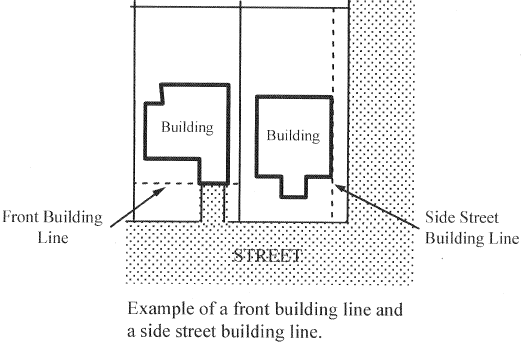
11.
"Building mass" means the aggregate size of a building, or the total height, width, and depth of all its parts.
12.
"Building pad" means a vacant building site on a lot with other building sites, as identified by an approved site plan.
13.
"Building scale" means the dimensional relationship of a building and its component parts to other buildings.
14.
"Clearing (as in clearing and grading)" means any activity that removes existing vegetation or strips surface material from any portion of the site and exceeding typical yard maintenance for a single-family dwelling.
15.
"Cornice" means the projecting horizontal element that tops a wall or flat roof.
16.
"Courtyard" means a court or enclosure adjacent to a building, which usually provides amenities such as gardens, planters, seating, or art.
17.
"Develop" means to construct or alter a structure or to make a physical change to the land, including excavations and fills. See also "Alter/alteration."
18.
"Development" means all improvements on a site, including alterations to land and new or remodeled structures, parking and loading areas, landscaping, paved or graveled areas, and areas devoted to exterior display, storage, or activities. Development includes improved open areas such as plazas and walkways, but does not include naturally occurring (e.g., geologic) forms landscaping land. See also "Exterior improvements."
19.
Driveway. There are two types of driveways:
a.
The area that provides vehicular access to a site from a street. Maximum driveway width for this type is the same width as the curb cut, excluding any aprons or extensions of the curb cut. This type of driveway begins at the street and extends into the site. A driveway does not include parking, maneuvering, or circulation areas in parking areas, such as aisles; and
b.
The area that provides vehicular circulation between two or more noncontiguous parking areas. This type of driveway does not include maneuvering or circulation areas within the interior of a parking area. Where required by code for fire safety, a driveway must be kept clear of all obstructions.
20.
"Driveway apron/approach" means the edge of a driveway where it abuts a public way; usually constructed of concrete.
21 "Eave" means projecting overhang at the lower border of a roof and extending from a primary wall or support. See figure.
Eave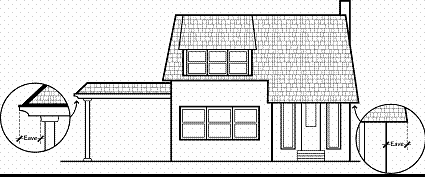
22.
"Exterior improvements" means all improvements except buildings or other roofed structures. Exterior improvements include surface parking and loading areas, paved and graveled areas, and areas devoted to exterior display, storage, or activities. It includes improved open areas such as plazas and walkways, but does not include vegetative landscaping, natural geologic forms, or unimproved land. See also "Development."
23.
"Facade" means the front or street-facing elevation of a structure, except as otherwise specified by this code.
24.
"Fire apparatus lane" or "fire lane" means unobstructed area or driveway meeting Uniform Fire Code requirements; typically may not be used for parking or loading area.
25.
"Floor area" means, except as otherwise prescribed by applicable building codes, the total floor area of a building, both above and below ground with a clear ceiling height of at least seven feet. Floor area is measured from the interior walls of a building or structure and does not include the following:
a.
Roof area;
b.
Roof top mechanical equipment; and
c.
Roofed porches, exterior balconies, or other similar areas, unless they are enclosed by walls that are more than forty-two (42) inches in height, for fifty (50) percent or more of their perimeter.
26.
Floor, Main. "Main floor" means building floor closest to street level and within four feet of finished grade.
27.
"Grading" means all cuts, fills, embankments, stockpile areas, and equipment maneuvering areas associated with development.
28.
"Impervious surface" means surface area that does not allow for water infiltration, or has a runoff coefficient of 0.90 or more (e.g., nonpermeable pavement, solid rock, roofs, foundations, underground tanks and vaults, and similar areas).
29.
"New development" means development of a site that was previously unimproved or that has had more than fifty (50) percent of any previously existing buildings demolished; e.g., not a remodel of an existing building.
30.
Parking. See "Parking."
31.
"Paved area" means an uncovered, hard-surfaced area or an area covered with a perforated hard surface (such as porous concrete or pavers) that is able to withstand vehicular traffic or other heavy-impact uses. Graveled areas are not paved areas but are typically impervious.
32.
"Pedestrian amenity(ies)" means areas and objects that are intended to serve as places for public socializing and enjoyment and are usually closed to motorized vehicles. Examples include plazas, building frontage areas (extra-wide sidewalks), street furnishings (e.g., benches, drinking fountains, bus waiting shelters), pocket parks adjacent to a street or public way, and similar areas and objects. Sidewalk surfaces designed to meet the minimum sidewalk width standards under Section 17.72.010 are not "amenities" for the purpose of this code.
33.
"Pedestrian-oriented development" means development that is designed with an emphasis primarily on the street sidewalk and on pedestrian access to the site and building, rather than on auto access and parking areas. The building is generally placed close to the street and the main entrance is oriented to the street sidewalk. There are generally windows or display cases along building elevations which face the street and other public ways. Typically, buildings cover a large portion of the site. Although parking areas may be provided, they are generally oriented behind or to the sides of buildings.
34.
"Roof pitch" means the slope of a roof, usually described as ratio (e.g., one foot of rise per two feet of horizontal distance).
35.
"Shopping street" means a driveway in a commercial development that is designed to mimic a public street with sidewalks, tree wells, pedestrian lighting, and street furnishings. A shopping street may also have on-street parking.
36.
"Storm water facility" means a facility designed to manage the quantity of storm water runoff and may contain features that are designed to improve the quality of runoff. Storm water quality facilities may include vegetated swales and sand filters, wet or dry ponds, marshes, infiltration facilities, and structural storm sewer devices such as oil-water separators. Storm water quality facilities do not include conveyance systems that are meant only for conveying the storm water from one place to another and do not affect the quality of the storm water.
37.
"Storefront character" means the character expressed by buildings placed close to the street with ground floor display windows, weather protection (e.g., awnings or canopies), corner building entrances or recessed entries, and similar features.
38.
"Street furniture/furnishings" means benches, lighting, bicycle racks, drinking fountains, mail boxes, kiosks, and similar pedestrian amenities; may be located within a street furnishings zone or building front zone of a sidewalk or in a plaza. See also "Pedestrian amenities."
39.
"Structure" means, except as provided by applicable building codes, any object constructed in or on the ground. Structure includes buildings, decks, fences, towers, flag poles, signs, utility vaults, and other similar objects. Structure does not include paved areas or vegetative landscaping materials.
40.
"Structure height" means the height of a structure, and the cumulative height of a building with any appurtenant structures.
41.
"Swale" means a type of storm water facility. Usually a broad, shallow depression with plants that filter and process contaminants.
42.
"Vehicle areas" means all of the areas on a site where vehicles may circulate or park, including parking areas, driveways, drive-through lanes, and loading areas. See also "Driveway and parking area."
Disabled Person. For the purposes of this code, a "disabled person" is a person who has a condition of physical or mental disability which substantially limits one or more major life activities as stated in Section 504 of the Federal Rehabilitation Act of 1973 and state law.
"Discontinued use" means a use that physically left the land it was on, a permitted use that ceased, or a use terminated at the end of a lease or contract. See Chapter 17.120, Nonconforming Uses and Developments. A use is considered temporarily discontinued during the first two years after it ceases, after which it is considered permanently discontinued.
"Discretionary" means a permit action or decision that involves substantial judgment or discretion.
Disturbance Area. See "Environment-related definitions."
Drainage Way. See "Environment-related definitions."
Drip-Line. See "Environment-related definitions."
"Drive-through/drive-up facility" means a facility or structure that is designed to allow drivers to remain in their vehicles before and during an activity on the site. Drive-through facilities are a type of site development that is usually found in conjunction with a quick vehicle servicing use or a retail sales and service use, as defined by Chapter 17.12. Drive-through/drive-up facilities also include facilities designed for the rapid servicing of vehicles, where the drivers may or may not remain in their vehicles, but where the drivers usually either perform the service for themselves, or wait on the site for the service to be rendered. Drive-through facilities may serve the primary use of the site or may serve accessory uses. Examples are drive-up windows; automatic teller machines; coffee kiosks and similar vendors; menu boards; order boards or boxes; gas pump islands; car wash facilities; auto service facilities, such as air compressor, water, and windshield washing stations; quick-lube or quick-oil change facilities; and drive-in theaters. All driveways queuing and waiting areas associated with a drive-through/drive-up facility are similarly regulated as part of such facility.
Driveway. See "Development-related definitions."
Driveway Apron/Approach. See "Development-related definitions."
Duplex. See "Residential structure types."
Dwelling Unit. See "Residential structure types."
"Easement" means a grant of rights by a property owner that allows others to use the owner's land for a specific purpose, such as access, or to locate utilities. Recorded and on record at Coos County.
Eave. See "Development-related definitions."
"Elevation" means height in feet and inches above a specified datum.
Elevation, Building. "Building elevation" means scaled drawing of the outside wall of a building or structure, from grade to roof ridgeline, typically specifying materials, color, and dimensions.
Environment-related definitions:
1.
"Designated sensitive lands" means natural resources areas and landforms regulated under applicable overlay zones in Division II.
2.
"Conservation easement" means an easement that restricts development and protects identified conservation values of the land, such as wetlands, woodlands, significant trees or groves, floodplains, habitat, or similar resources.
3.
"Crown cover" means the area directly beneath the crown and within the drip line of a tree or shrub. The crown consists of the aboveground branches, stems, and leaves.
4.
"Disturbance area" means an area that contains all temporary and permanent development, exterior improvements, and staging and storage areas on the site, both existing and proposed. Vegetation planted for resource enhancement and agricultural and pasture land is not included.
5.
"Drainage way" means an open linear depression, whether constructed or natural, that functions for the collection and drainage of surface water. It may be permanently or temporarily inundated.
6.
"Drip-line" means imaginary line around a tree or shrub at a distance from the trunk equivalent to the canopy (leaf and branch) spread.
7.
"Fish and wildlife habitat areas" means lands that contain significant food, water, or cover for native terrestrial and aquatic species of animals. Examples include forests, fields, riparian areas, wetlands, and perennial or intermittent water bodies, as regulated by applicable state or federal natural resource regulatory agencies.
8.
"Flood hazard area" means land that is in the one hundred (100) year floodplain as currently defined by the Federal Emergency Management Agency (FEMA) Flood Insurance Rate Map (FIRM) program. See city of Coquille floodplain ordinance (Ordinance No. 1226 (March 16, 1987; amended by Ordinance No. 1351A, November 1, 1993).
9.
"Floodway" means the active flowing channel during a flood, as designated on flood maps for the city; the channel of a river or other watercourse and the adjacent land areas that must be reserved in order to discharge the base flood without cumulatively increasing the water surface elevation more than a designated height. See applicable overlay zones in Division II.
10.
"Identified natural features (e.g., wetlands or streams)" means natural features that are identified in the national wetlands inventory, and/or other references used by applicable natural resource regulatory agency, as being significant and requiring protection under Federal Clean Water Act.
11.
"Natural hazard" means natural areas that can cause dangerous or difficult development situations. For example, natural hazard areas include steep slopes, unstable soils, and areas prone to landslides, floodways and floodplains. See applicable overlay zones in Division II.
12.
"Riparian areas" means lands adjacent to rivers, streams, lakes, ponds, and other water bodies. They are transitional between aquatic and upland zones, and as such, contain elements of both aquatic and terrestrial ecosystems. They have high water tables because of their close proximity to aquatic systems, soils which are usually made up largely of water-carried sediments, and some vegetation that requires free (unbound) water or conditions that are more moist than normal.
13.
"Sensitive lands" means wetlands, significant trees, steep slopes, floodplains and other natural resource areas designated for protection or conservation by the comprehensive plan.
14.
"Stream" means an area where enough natural surface water flows to produce a stream channel, such as a river or creek that carries flowing surface water either intermittently or during most of the year. This includes:
a.
The water itself, including any vegetation, aquatic life, or habitat;
b.
Beds and banks below the high water level which may contain water, whether or not water is actually present;
c.
The floodplain between the high water levels of connected side channels;
d.
Beaver ponds, oxbows, and side channels if they are connected by surface flow to the stream during a portion of the year; and
e.
Stream-associated wetlands.
15.
"Stream channel" means an area with evidence of perennial or seasonal water passage. The depression between the banks worn by the regular and usual flow of the water. The channel need not contain water year-round. This definition does not include irrigation ditches, canals, storm or surface water runoff devices, or other entirely artificial watercourses.
16.
"Top of bank" means the first major change in the slope of the incline from the ordinary high water level of a water body. A major change is a change of ten (10) degrees or more. If there is no major change within a distance of fifty (50) feet from the ordinary high water level, then the top of bank will be the elevation two feet above the ordinary high water level.
17.
"Tree canopy" means the ground area that, when viewed from above the crown of one or more trees, is mostly covered by the tree(s). For deciduous trees, canopy area is based on the time of year when foliage is present.
18.
"Water bodies" means permanently or temporarily flooded lands which may lie below the deepwater boundary of wetlands. Water bodies include rivers, streams, creeks, sloughs, drainage ways, lakes, and ponds.
19.
"Wetland" means, except as otherwise determined by applicable state or federal natural resource regulatory agencies with wetland jurisdiction, an area that is inundated or saturated by surface or ground water at a frequency and duration sufficient to support, and that under normal circumstances does support, a prevalence of vegetation typically adapted for life in saturated soil conditions. Wetlands include swamps, marshes, bogs, and similar areas.
"Evidence" means application materials, plans, data, testimony and other factual information used to demonstrate compliance or noncompliance with a code standard or criterion.
"Excavating or filling" means the removal, placement, or replacement of earth, concrete, asphalt, and similar nondecomposable materials whether permanent or temporary in nature. Excavating or filling does not include the movement of earth or placement of gravel, asphalt, or other paving materials that is done in conjunction with road improvements. It does not include the excavation of mineral or aggregate resources. Excavating or filling includes the terms grading, preloading, surcharging, and stockpiling.
"Exterior display" means the outdoor display of products, vehicles, equipment, and machinery for sale or lease. Exterior display functions as an outdoor showroom for customers to examine and compare products. The display area does not have to be visible to the street. Exterior display does not include storage of goods placed or parked outside, if the goods are not examined and compared by customers in such location. It does not include damaged or inoperable vehicles, vehicles or equipment being serviced, bulk goods and materials, and other similar products. Exterior display does not include car and boat sales and/or leasing when such vehicles are not accessible to customers to inspect and compare; this situation is considered exterior storage. Examples of uses that often have exterior display are car and boat sales and leasing, and plant nurseries. See also "Exterior Work Activities" and "Exterior Storage."
Exterior Improvements. See "Development-related definitions."
Exterior Storage. "Exterior storage" includes the outdoor storage of goods exclusive of outdoor displays for sale or rent. The goods may be for sale or lease, but if so, the storage area is generally not for the purpose of inspection or comparison of goods by customers. Exterior storage includes the storage of raw or finished goods (packaged or bulk), including gases, oil, chemicals, gravel; building materials, packing materials; salvage goods; machinery, tools, and equipment; vehicles that are for sale, lease or rent, which are not accessible to the customer to inspect or compare; vehicles that have been unloaded and are waiting transport to off-site locations; vehicles that have been towed and are being kept in an impound lot; and other similar items. The storage of recreational vehicles outdoors is also considered exterior storage. Damaged or inoperable vehicles, or vehicles that have missing parts, which are kept outside are also included as exterior storage. Examples of uses that often have exterior storage are lumber yards, wrecking yards, tool and equipment rental, bark chip and gravel sales, car dealerships or car rental establishments, and port facilities. See also "Exterior display" and "Exterior Work Activities."
Exterior Work Activities. "Exterior work activities" include the outdoor processing, assembly, or fabrication of goods; the maintenance, repair, and salvage of vehicles and equipment; and other similar activities that generally have an industrial orientation. Exterior work activities do not include normal pickup and deliveries to a site, parking, excavation and fills, exterior eating areas, outdoor recreation, or outdoor markets. See "Exterior display" and "Exterior Storage."
Facade. See "Development-related definitions."
Family Day Care. See "Child care center, family child care."
Farming or Farm Use. As used in this code, "agriculture" is the same as "farm use." (See ORS 215.203(2)(a).) Includes utilization of land to raise, harvest, or sell crops; feed, breed, manage, and sell livestock, poultry, fur-bearing animals, honeybees, or their produce; dairy and sell dairy products; or any other agricultural or horticultural use, animal husbandry, timber agricultural use, or combination thereof. Farm uses include preparation or processing and storage of products raised on such land, but do not include construction or use of dwellings and other buildings customarily provided in conjunction with farm uses.
"Final plat" means the diagrams, drawings, and other writing containing all the descriptions, locations, dedications, provisions and information concerning a land division.
Fire Apparatus Lane or Fire Lane. See "Development-related definitions" and applicable fire code.
Flag Lot. See "Lot."
Flood Hazard Area. See "Environment-related definitions."
Floor, Main. See "Development-related definitions."
"Food truck" or "mobile food unit" means any vehicle that is self-propelled, or can be pulled or pushed down a sidewalk or street. Food may be prepared or processed on this vehicle, and the vehicle is used to sell and dispense food to the ultimate consumer.
"Footcandle" means a unit of illumination (light standards), equal to one lumen per square foot, or the amount of light from a source of one candela directly thrown on a square foot of surface at a distance of one foot.
"Frontage" means the dimension of a property line abutting a public or private street.
"Frontage street or road" means a minor street that parallels an arterial street or highway in order to provide access to abutting properties and minimize direct access onto the arterial or highway.
"Functional classification" means the classification given to streets by the road authority (e.g., "local/collector/arterial"). See "Transportation-related definitions," and Section 17.72.020 for street standards.
"Future division plan" or "future development plan" means a document that shows lot, tract and right-of-way boundaries for all potential future phases of a land division. The plan is not binding on the city or the applicant. The purpose of the plan is to document that the design of the first phase of the plan does not preclude future phases or future development of adjacent properties from meeting city standards.
"Garage" means a covered permanent structure designed to provide shelter for vehicles, and which is accessory to a use in these structure types: houses, attached houses, duplexes, mobile homes, or houseboats. Carports are considered garages. Floor area adjacent to the space designed to provide shelter for vehicles, if not entirely separated from the garage area by floor-to-ceiling walls, is considered part of the garage. A garage may be attached to or detached from another structure. See also "Structured parking."
"Grade" means the lowest point of elevation of the finished surface of the ground, paving, or sidewalk within the area between the building and the property line or, when the property line is more than five feet from the building, between the building and a line five feet from the building. This is the definition used in the Oregon Structural Specialty Code (the International Building Code as amended by the state of Oregon).
Grading. See "Development-related definitions."
"Ground cover" means living or processed plant material (e g., mulch, bark chips) that is used to cover bare ground. See Chapter 17.64, Landscaping, Street Trees, Fences and Walls.
Group Living Structure. See "Residential structure types."
"Hardscape" means nonvegetative landscape materials or installations, including pathways, decorative pavers, benches, drinking fountains, arbors, pergolas, playgrounds, plazas, and similar amenities.
"Hazardous substances" means any substance, material, or waste listed below:
1.
Nuclear or radioactive materials or waste;
2.
Chemicals subject to reporting under Title III of the Superfund Amendments and Reauthorization Act (SARA) of 1986, published July, 1987, U. S. Environmental Protection Agency;
3.
Hazardous Materials Table, in the Code of Federal Regulations (CFR), Title 49, Part 172.101; and
4.
Other substances as determined by applicable state or federal agency.
Historic Resource-Related Definitions. See "Historic-cultural resources provisions."
"Home occupation, home occupation site" means a business activity that is carried out on the same site as a dwelling unit, and which is accessory to the household living use on the site, subject to the provisions of Chapter 17.24 (Residential Land Use Districts) and Section 17.112.020 (Home occupation permits).
"Hotel/motel" means a building or portion thereof designed and used for occupancy of transient individuals lodged with or without meals for a continuous period not to exceed twenty-nine (29) days. (See ORS 446.310.)
House. See "Residential structure types."
"Household" means one or more persons related by blood, marriage, civil union, legal adoption or guardianship, plus not more than five additional persons, who live together in one dwelling unit; or one or more handicapped persons as defined in the Fair Housing Amendments Act of 1988, plus not more than five additional persons, who live together in one dwelling unit.
"Impervious surface" means surface area that does not allow for water infiltration, or has a runoff coefficient of 0.90 or more (e.g., nonpermeable pavement, solid rock roofs, foundations, underground tanks and vaults, and similar areas).
"Incidental and subordinate to" means secondary to, and less apparent, than the primary use or other portion of the development.
"Infill" means the development of vacant, bypassed lands located in an area that is predominately developed at densities/land use intensities allowed by zoning.
"Junk yard" means:
1.
Any property or establishment on which one or more persons are engaged in breaking up, dismantling, sorting, storing, distributing, buying, or selling scrap or waste materials;
2.
Any establishment or place of business on which two or more inoperable motor vehicles or an equivalent volume of waste or refuse are maintained, stored, bought, or sold. Includes wrecking yards, automobile grave yards, garbage dumps, and scrap metal processing facilities. See also "Recycling facility."
"Kennel" means any lot or premises where three or more dogs or cats aged six months or older are boarded or bred for compensation. Establishments where animals are offered for sale as the primary use, such as pet stores, are not classified as kennels.
"Land division" means the process of dividing land to create parcels or lots. See Chapter 17.88.
"Land use" means the activity or activities that occur on a piece of land. Activities may be individually identified as primary or accessory uses. See also Chapter 17.12, Use Categories.
"Land use approval" means a land use decision for approval or approval with conditions under Division IV; includes any time limits or other restrictions that may apply to the land use decision.
Land Use District. As used in this code, a "land use district" is the same as a zoning district.
"Land use review" means an application for land use approval under Section 17.84.020(A), or the review of such application; typically limited to determining conformance with standards of the applicable land use district and does not include site design review, conditional use permit, or land division approval.
"Landing (stairs)" means a level part of a staircase, usually at the end of a flight of stairs.
"Landscaping" means any combination of living plants such as trees, shrubs, plants, vegetative ground cover or turf grasses, and may include structural features such as walkways, fences, benches, plazas, works of art, reflective pools, fountains or the like. Also includes irrigation systems, mulches, topsoil, and revegetation or the preservation, protection and replacement of trees.
Lane, Mid-Block. See "Transportation-related definitions."
Legislative. A "legislative action" or "decision" is the making of law, as opposed to the application of existing law to a particular use (e.g., adoption of, or amendment to, a comprehensive plan or development regulation). See also Section 17.80.050 (Type IV procedure).
Light Manufacture. See Chapter 17.12, Use Categories.
"Livestock" means domestic animal types customarily raised or kept on farms. See "Agriculture."
"Living area" means the habitable floor area of a residential structure conforming to applicable building codes; typically does not include garage area, and attic and basement areas with substandard ceiling height or substandard egress.
"Loading area" means the area available for the maneuvering and standing of vehicles engaged in delivering and loading goods, freight, or other articles. See also Chapter 17.68, Parking and Loading.
"Local improvement district (LID)" means a small public district formed for the purpose of financing local improvements (paving of streets, construction of sidewalks, street lighting, water mains, storm sewers, parks, etc.) within a zone of benefit, usually assessed against abutting properties. Property owners within the LID are assessed for the cost of the improvements in accordance with ORS 223.387 through 223.485.
"Longest street-facing wall" means the longest wall that faces a street. If two or more street-facing walls are of equal length, then the applicant chooses which is to be the longest street-facing wall for purposes of applying regulations of the development code. See also "Facade," and Section 17.28.060, Building orientation and commercial block layout.
Lot. A "lot" is a legally defined piece of land other than a tract that is the result of a land division. The following definitions for "lot" apply to the state definition of both lot (result of subdividing), and parcel (result of partitioning). See also "Ownership and site."
1.
"Corner lot" means a lot that has frontage on more than one intersecting street. A street that curves with angles that are one hundred twenty (120) degrees or less, measured from the centerline of the street, is considered two intersecting streets for the purpose of evaluating whether a lot is a corner lot. See figures below.
2.
"Flag lot" means a lot with two distinct parts (see figure below):
a.
The flag, which is the only building site; and is located behind another lot; and
b.
The pole, which connects the flag to the street; provides the only street frontage for the lot; and at any point is less than the minimum lot width for the zone.
3.
"Through lot" means a lot that has frontage on two parallel or approximately parallel streets.
Corner Lots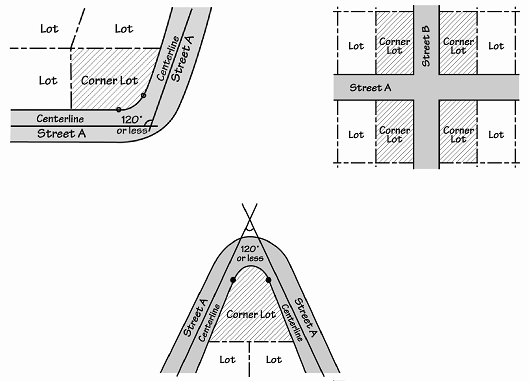
Flag Lot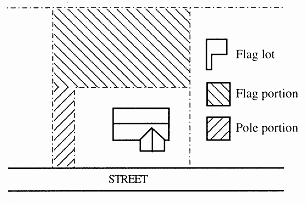
"Lot area" means the total surface area (measured horizontally) within the boundary lines of a lot.
"Lot consolidation" means the reduction in the number of lots; i.e., the creation of one lot from two or more existing lots.
"Lot coverage" means the total area of a lot covered by building(s) or impervious surfaces, as provided by the applicable land use district development standards.
Lot, Double-Frontage. See "Lot, Through lot."
Lot Line Adjustment. See "Property line adjustment."
"Lot lines/property lines" means the property lines along the edge of a lot or site.
1.
"Front lot line" means a lot line, or segment of a lot line, that abuts a street. On a corner lot, the front lot line is the shortest of the lot lines that abut a street. If two or more street lot lines are of equal length, then the applicant or property owner can choose which lot line is to be the front lot line for the purpose of determining required setbacks. However, a through lot has two front lot lines regardless of whether the street lot lines are of equal or unequal length. See figures below.
2.
"Rear lot line" means a lot line that is opposite a front lot line. A triangular lot has two side lot lines but no rear lot line. For other irregularly shaped lots, the rear lot line is all lot lines that are most nearly opposite the front lot line. See figures below.
3.
"Side lot line" means a lot line that connects front and rear lot lines. On a corner lot, the longer lot line that abuts a street is a side lot line. See figures below.
4.
"Side street lot line" means a lot line that is both a side lot line and a street lot line. See figures below.
5.
"Street lot line" means a lot line, or segment of a lot line, that abuts a street. Street lot line does not include lot lines that abut a dedicated alley. On a corner lot, there are two (or more) street lot lines. Street lot line can include front lot lines and side lot lines, however, both are considered front yards for the purpose of measuring required setbacks. See figures below.
6.
"Lot of record" means a legally created lot or parcel meeting all applicable regulations in effect at the time of creation, and held in separate ownership, or any other lot deemed a legal lot under Chapter 17.124.
Front and Side Lot Lines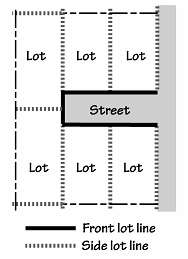
Street Lot Lines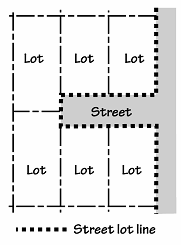
Lot Lines on Irregular Lots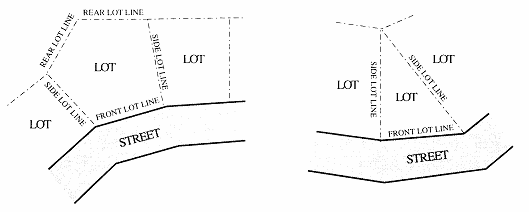
Main/Primary Building Entrance. A "main entrance" is the entrance to a building that most pedestrians are expected to use. Generally, each building has one main entrance, however, some buildings may have more than one primary entrance where pedestrian access is provided from a street sidewalk as well as a parking area internal to the site. In multi-tenant buildings, main entrances may open directly into the building's lobby or principal interior ground level circulation space. When a multi-tenant building does not have a lobby or common interior circulation space, each tenant's outside entrance is a main entrance. In single-tenant buildings, main entrances typically open directly into lobby, reception, or sales areas.
"Main floor" means building floor closest to street level and within four feet of finished grade.
"Major remodeling" means projects where the floor area is being increased by fifty (50) percent or more, or where the cost of the remodeling is greater than the assessed value of the existing improvements on the site. Assessed value is the market value shown on the applicable county assessment and taxation records for the current year.
"Maneuvering area/aisle" means the driving area in a parking lot where motor vehicles are able to turn around and access parking or loading spaces.
"Manufactured dwelling park" means any place where four or more manufactured dwellings are located within five hundred (500) feet of one another on a lot, tract or parcel of land under the same ownership; the primary purpose of which is to rent or lease space or keep space for rent or lease to any person for a charge or fee paid or to be paid for the rental or lease or use of facilities or to offer space free in connection with securing the trade or patronage of such person. "Manufactured dwelling park" does not include a lot or lots located within an approved subdivision being rented or leased for occupancy by no more than one manufactured dwelling per lot. See also ORS Chapter 446. Manufactured Home/Dwelling. See "Residential structure types."
"Ministerial decision" means a routine administrative action or decision that involves little or no discretion. See Section 17.80.020 (Type I procedure).
"Mitigation" means to avoid, rectify, repair, or compensate for negative impacts or effects that result from other actions (e.g., improvements to a street may be required to mitigate for transportation impacts resulting from development.)
"Mixed-use" means the combination on a site of residential uses with commercial (e.g., office, retail, or services), civic, or light industrial uses.
"Mobile home park" means two or more mobile homes that are located on a single site for thirty (30) days or more, connected to an electric utility and city sewer and water systems, and intended for permanent residential use; does not include recreational vehicle parks or temporary medical hardship homes approved by the city, nor does it include sites where unoccupied mobile homes are offered for sale or lease. See also "Recreational vehicle park."
"Mobile home space" means the area occupied by a mobile home and its accessory uses and structures in a mobile home park.
Motor Home. See "Recreational vehicle," under "Vehicle types."
Motor Vehicle. See "Vehicle types."
Multi-Dwelling Development or Multifamily Housing. See "Residential structure types."
Multi-Dwelling Structure. See "Residential structure types."
Multi-Use Pathway. See "Walkway and bikeway."
Natural Resource Areas/Natural Resources. See "Environment-related definitions."
"Neighborhood" means a residential area usually having distinguishing character or geography.
Neighborhood Commercial. See Chapter 17.12, Use Categories, Commercial.
"Nonconforming development" means an element of a development, such as lot area, setback, height, lot coverage, landscaping, sidewalk, or parking area, or lack thereof, that was created in conformance with development regulations but which subsequently, due to a change in the zone or applicable code standards, is no longer in conformance with the current applicable development regulations. See Chapter 17.120.
"Nonconforming situation" means a nonconforming development or nonconforming use. A situation may be nonconforming in more than one aspect. For example, a site may contain a nonconforming use and also have some nonconforming development. See also "Nonconforming development" and "Nonconforming use." See Chapter 17.120.
"Nonconforming use" means a use that was allowed by right when established or a use that obtained a required land use approval when established, but that subsequently, due to a change in the zone or zoning regulations, the use or the amount of floor area of the use is now prohibited in the zone. See Chapter 17.120.
"Nonnative invasive plants" means plants listed by Oregon State University Extension Service, Coos County, or other government agency as nonnative invasive plants in Oregon.
"Off-street parking" means all off-street areas designed, constructed, used, or required or intended to be used for the parking of motor vehicles. See Chapter 17.68 for parking standards.
"On-street parking" means parking in the street right-of-way, typically in parking lanes or bays. Parking may be "parallel" or "angled" in relation to the edge of the right-of-way or curb, as provided by applicable standards of the roadway authority. See Chapter 17.68 for parking standards.
"Open space (public/common/private/active/passive)" means land within a development that has been dedicated in common to the ownership within the development or to the public specifically for the purpose of providing places for recreation, conservation or other open space uses. See also "Common area."
"Orientation" means to cause to face toward a particular point of reference (e.g., "A building oriented to the street"). See also "Pedestrian-oriented development."
"Outdoor commercial use" means a use supporting a commercial activity that provides goods or services, either wholesale, retail or entertainment, where the amount of site area in outdoor use (e.g., storage of materials, display of merchandise, or entertainment) exceeds the total floor area of all buildings on the site. Examples of outdoor commercial uses include automobile sales or services, nurseries, lumber yards and equipment rental businesses, and outdoor amusement.
Overlay Zone/District. "Overlay zones" impose and/or relax requirements of an underlying land use district, or base zone, where characteristics of the land or neighborhood, or the types of development planned for an area, require special regulations. See Chapter 17.40.
"Owner" means the owner of the title to real property or the contract purchaser of real property of record, as shown on the latest assessment records in the office of the county assessor. Owner also includes a deed holder or contract purchaser whose name does not appear in the latest assessment records, but who presents to the city a copy of a deed or contract of sale signed by the owner of record.
Ownership. An "ownership" is one or more contiguous lots that are owned by the same person, partnership, association, or corporation. Ownership also includes lots that are in common ownership but are separated by a right-of-way. See also "Lot" and "Site."
"Parcel" means a legally defined area of land created through a partition.
Parking Area. A "parking area" is all the area devoted to the standing, maneuvering, and circulation of motor vehicles. Parking areas do not include driveways or areas devoted exclusively to nonpassenger loading or fire apparatus lanes. See also "Driveway," "Garage," "Structured parking," and "Vehicle areas."
"Parking lot perimeter" means the boundary of a parking lot area that usually contains a landscaped buffer area.
"Parking space" means an improved space designed to provide standing area for a motor vehicle. See Chapter 17.68 for parking space standards.
Parking Versus Storage. "Parking" is to leave a motor vehicle for a temporary time, no longer than twenty-four (24) hours. Storage is to place or leave in a location for storage, maintenance, repair, future sale or rental, or future use more than twenty-four (24) hours. See also "Exterior display."
Partial Street/Half Street. See "Transportation-related definitions."
"Partition" means to divide an area or tract of land into two or three parcels within a calendar year when such area or tract of land exists as a unit or contiguous units of land under single ownership at the beginning of such year. See ORS 92.010(8).
Paved Area. See "Development-related definitions."
Pedestrian Amenity(ies). See "Development-related definitions."
"Planter strip" means a landscape area for street trees and other plantings within the public right-of-way, usually a continuous planter area between the street and a sidewalk. See also "Tree well."
"Plat" means diagrams, drawings and other writing containing all the descriptions, locations, dedications, provisions, and information concerning a land division. This term includes the state law definitions of "partition plat" and "subdivision plat." See also Chapter 17.88, Land Divisions and Property Line Adjustments.
"Plaza" means an area generally open to the public on a controlled basis and used for passive recreational activities, informal public gathering, and relaxation. Plazas are paved areas typically provided with amenities, such as seating, drinking and ornamental fountains, art, trees, and landscaping for use by pedestrians. See also "Pedestrian Amenities (Development-related definitions)."
"Pocket park" means a small park, usually less than one-half acre typically accessed by foot or wheelchair, or bicycle. See also "Pedestrian Amenities (Development-related definitions)."
"Practicable" means capable of being done after taking into consideration reasonable cost, existing technology, and logistics in light of overall project purposes.
"Primary structure" means a structure or combination of structures of chief importance or function on a site. In general, the primary use of the site is carried out in a primary structure. The difference between a primary and accessory structure is determined by comparing the size, placement, similarity of design, use of common building materials, and the orientation of the structures on a site.
"Primary use" means an activity or combination of activities of chief importance on the site. One of the main purposes for which the land or structures are intended, designed, or ordinarily used. A site may have more than one primary use. See also Chapter 17.12, Land Use Categories.
"Project" means an existing or proposed use or development subject to one or more land use approvals.
Project, Major. "Major project" means a project that requires site design review (Sections 17.84.040 through 17.84.060), subdivision or partition review (Chapter 17.88), conditional use permit review (Chapter 17.92), or master planned development review (Chapter 17.96).
Project, Minor. "Minor project" means a project that requires land use review (Section 17.84.030), but does not require site design review (Sections 17.84.040 through 17.84.060), subdivision or partition review (Chapter 17.88), conditional use permit review, or master planned development review (Chapter 17.96).
Property Line: Front, Rear, Interior Side, Street Side. See "Lot line."
"Property line adjustment" means the relocation of a single common property line between two abutting properties, in conformance with Chapter 17.88 and ORS 92.010(11). See figure.
Property Line Adjustment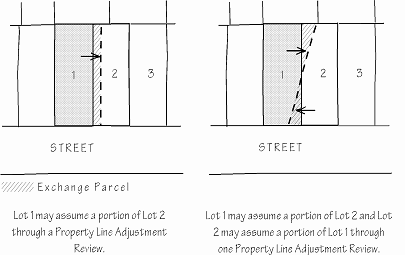
Public Access Easement. See "Transportation-related definitions."
"Public improvements" means development of public infrastructure, as required by the city, county, special district, or road authority, as applicable. See Chapter 17.72.
"Public safety facility" means a facility necessary to respond to an immediate hazard to the public health and safety, and that is owned, leased, or operated by a public agency. Public safety facilities include fire and police stations, flood control facilities, water towers and pump stations needed for emergency service, and emergency communication broadcast facilities.
"Quasi-judicial" means an action or decision that requires substantial discretion or judgment in applying the standards or criteria of this code to the facts of a development or land use proposal, and requires a public hearing. See Section 17.80.040 (Type III procedure).
Rail Right-of-Way. See "Transportation-related definitions."
"Recreation camp" means:
1.
An area devoted to facilities and equipment for recreation purposes, including swimming pools, tennis courts, playgrounds, and similar uses, either open to the public upon payment of a fee, or limited to private membership;
2.
An area designated by the landowner for picnicking or overnight camping and offered to the general public, with or without a fee or charge. (See ORS Chapter 446.)
Recreational Vehicle. See "Vehicle types."
"Recreational vehicle park" means a commercial use providing space and facilities for motor homes or other recreational vehicles for recreational use or transient lodging. There is no minimum required stay in a recreational vehicle park, however, the maximum length of stay may be established by the city. Uses where unoccupied recreational vehicles are offered for sale or lease, or are stored, are not included as recreational vehicle parks. See also "Outdoor storage and display," and "Mobile home park."
"Recycling facility" means any property or establishment on which one or more persons are engaged in collecting, sorting, storing and distributing post-consumer goods or materials for reuse in the marketplace. Post-consumer goods do not include scrap or waste materials from manufacturing, industrial processing, or waste treatment facilities.
Residence. Same as "Dwelling." See "Residential structure types."
Residential structure types:
1.
"Accessory dwelling unit" means a second dwelling unit created on lot with a single-family house, attached house, or manufactured home. The second unit is created auxiliary to, and is always smaller than the house, attached house, or manufactured home.
2.
"Attached duplex" means a duplex located on its own lot that shares one or more common or abutting walls with one other duplex (for a total of four dwelling units on two lots). The common or abutting wall must be shared for at least fifty (50) percent of the length of the side of the dwelling.
3.
"Attached house (townhome or rowhouse)" means a dwelling unit located on its own lot which shares one or more common or abutting walls with one or more dwelling units. The common or abutting wall must be shared for at least fifty (50) percent of the length of the side of the dwelling. An attached house does not share common floor/ceilings with other dwelling units. An attached house is also called a rowhouse or a common-wall house.
4.
"Cottage" means a small house, generally containing not more than one thousand two hundred (1,200) square feet of floor area that may be used as a primary dwelling or an accessory dwelling, as applicable.
5.
"Cottage cluster" means a group of two or more cottages on one lot.
6.
"Duplex" means a building that contains two primary dwelling units on one lot. The units must share a common wall or common floor/ceiling.
7.
"Dwelling unit" means a building, or a portion of a building, that has independent living facilities, including provisions for sleeping, cooking, and sanitation, and that is designed for residential occupancy by a group of people. Buildings with more than one set of cooking facilities are considered to contain multiple dwelling units or accessory dwelling units, as applicable, unless the additional cooking facilities are clearly accessory to the primary use, such as an outdoor grill or wet bar.
8.
"Group living structure" means a structure that contains sleeping areas and at least one set of cooking and sanitary facilities that is used as a residence for group living uses:
a.
"Residential care facility" means a residence for six to fifteen (15) physically or mentally disabled persons, and for staff persons. The facility may provide residential care alone, or in conjunction with training or treatment. This definition includes the state definition of residential facility; or
b.
"Residential care home" means a residence for five or fewer physically or mentally disabled persons, and for staff persons. The residence may provide residential care alone, or in conjunction with training or treatment. This definition includes the state definition of residential home.
c.
Manufactured Home. A "manufactured home" is a dwelling constructed off-site in accordance with federal manufactured housing construction and safety standards (HUD code) in effect after June 15, 1976, then assembled or placed on-site in accordance with the requirements of this code.
10.
"Mobile home" means a dwelling unit constructed off of the site and which is not constructed to building code standards and does not conform to current standards for manufactured homes.
11.
"Multi-dwelling development" means a grouping of individual structures where each structure contains one or more dwelling units. The land underneath the structures is not divided into separate lots. A multi-dwelling development project may include an existing single-dwelling detached building with one or more new detached structures located to the rear or the side of the existing house. It might also include a duplex in front with either one or more single-dwelling houses behind or one or more duplex units or multi-dwelling structures behind. There is no requirement for the structures on the sites to be attached.
12.
"Multi-dwelling structure" means a structure that contains three or more dwelling units that share common walls or floor/ceilings with one or more units. The land underneath the structure is not divided into separate lots. Multi-dwelling includes structures commonly called garden apartments, apartments, and condominiums.
13.
"Residential trailer" means a mobile home that was not constructed in accordance with federal manufactured housing construction and safety standards (HUD code) in effect after June 15, 1976. This definition includes the state definitions of residential trailers and mobile houses, as stated in Oregon Revised Statutes (ORS) Chapter 446. 14. "Senior housing" means housing designated and/or managed for persons over a specified age. Specific age restrictions vary. May include assisted living facilities, retirement homes, convalescent or nursing homes, and similar uses not otherwise classified as group care.
15.
"Single-family house" means a detached dwelling unit located on its own lot.
16.
"Single room occupancy housing (SRO)" means a structure that provides living units that have separate sleeping areas and some combination of shared bath or toilet facilities. The structure may or may not have separate or shared cooking facilities for the residents. SRO includes structures commonly called residential hotels and rooming houses.
17.
"Temporary medical hardship dwelling" means a dwelling for the care of an aged or infirm person or persons. Financial hardship, child care, upkeep of home or property, or other convenience arrangements are not considered medical hardships. The temporary dwelling may be a manufactured home or an existing building on the property converted for temporary residential use.
"Review body" means the person or group who is assigned to make decisions on land use reviews, whether initially or on appeal. Review body includes the planning official, planning commission, and the city council.
Right-of-Way. See "Transportation-related definitions."
Riparian Areas. See "Environment-related definitions."
Roadway/Roadway Authority. See "Transportation-related definitions."
Senior Housing. See "Residential structure types."
Sensitive Lands. See "Environment-related definitions."
"Setback/setback yard" means the minimum distance required between a specified object, such as a building, and another point, measured from lot lines to a specified object. Typically, a setback refers to the minimum distance (yard dimension) from a building to a specified property line.
Shared Driveway. See "Transportation-related definitions."
"Shared parking" means required parking facilities for two or more uses, structures, or lots or parcels, which are satisfied jointly with the same facilities. See Chapter 17.68.
Shopping Street. See "Development-related definitions."
"Sign" means any outdoor device, or device visible from outdoors, providing identification, advertising or directional information for a specific business, group of businesses, service, product, brand, person, organization, place or building. Including in this definition of signs are: graphic devices such as logos, trademarks, and attention-attracting objects such as wind-driven spinners and portable sign devices, logo sculpture and banners, balloons, streamers, strobe lights, flags, inflatable structures, projected picture signs, holographic projection signs, laser-projected designs/images/copy and other attention-attracting media and devices.
Single Room Occupancy Housing (SRO). See "Residential structure types."
Site. For land divisions, property line adjustments, and lot consolidations, the "site" is the lots, lots of record, parcels, or tracts proposed to be divided or reconfigured. For all other purposes, the site is an ownership except as follows:
1.
If a proposed development includes multiple ownerships, then the site is the combined area of all contiguous ownerships.
2.
If a proposed development includes only a portion of an ownership, and the balance of the ownership is vacant, then the applicant may choose to define the site as the portion of the ownership that is proposed for development.
3.
If a proposed development includes only a portion of an ownership, and there is other development on the ownership, then the applicant may choose to define the site as the portion of the ownership that is currently developed plus the portion proposed for development.
"Site design review" means a discretionary review that applies to all major developments except those specifically designated for land use review. A development proposal is reviewed in light of the Division II, land use district development standards and the design standards and public improvement requirements in Division III. See Chapter 17.84 for review procedures.
"Site frontage" means the part of a site that abuts a street. See also "Block frontage."
"Specific area plan" means an adopted plan for a sub-area of the city and/or urban growth area providing a framework and standards for future land uses, densities, blocks, typical lot patterns, public improvements and streets, and site design; may also include architectural design guidelines or standards.
Standards and Criteria. Both are code requirements for how to develop uses and structures on land. A standard is a quantitative requirement, or a qualitative requirement that is interpreted through one or more standards. (Example: Criterion: All developments subject to site design review shall comply with the Chapter 17.68, Parking and Loading. Standard: Medical and dental office uses must provide one vehicle parking space for each x square feet of gross floor area.)
"Steep slopes" means slopes of eighteen (18) percent or greater, subject to the hazards overlay zone provisions in Chapter 17.40.
Storefront Character. See "Development-related definitions."
Storm Water Facility. See "Development-related definitions."
"Storm water management system" means all components of storm water facility (e.g., conveyance, detention/retention, treatment system or outfall).
"Story" means that portion of a building included between the upper surface of any floor and the lower surface of the next floor above, or as otherwise provided by applicable building codes.
Stream. See "Environment-related definitions."
Street. See "Transportation-related definitions."
Street Connectivity. See "Transportation-related definitions."
"Street-facing facade/wall" means all the wall planes of a structure as seen from one side or view that are at an angle of forty-five (45) degrees or less from a street lot line. See figure below.
Street-Facing Facade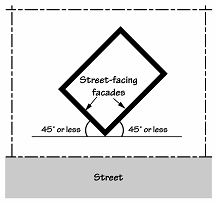
Street Furniture/Furnishings. See "Development-related definitions."
Structure. See "Development-related definitions."
"Subdivision" means to divide land into four or more lots within a single calendar year. See also Chapter 17.88, Land Divisions and Property Line Adjustments, and ORS 92.010(13).
"Surface water management" means storm drainage facilities or practices conforming to an adopted surface or storm water management plan, or environmental/engineering best practices.
Swale. See "Development-related definitions."
"Tangent" means meeting a curve or surface in a single point.
"Terrace" means a porch or promenade supported by columns, or a flat roof or other platform on a building.
Through Lot. See "Lot."
Through Street. See "Transportation-related definitions."
Top of Bank. See "Environment-related definitions."
"Topographical constraint" means where existing slopes, landforms (e.g., streams, canals, rock outcropping, etc.) or existing man-made feature (e.g., embankment or berm) make conformance with a code standard impracticable.
"Tract" means a piece of land within a platted subdivision reserved for open space, utility corridor, recreation facilities, sensitive lands, or other purpose; may be dedicated to a homeowner's association or other entity for maintenance.
Transportation-related definitions (see also Section 17.72.020 for related standards):
1.
"Access" means a way or means of approach to provide pedestrian, bicycle, and/or motor vehicular entrances or exits to a property. See transportation-related terms.
2.
"Access easement" means an easement recorded for the purpose of providing vehicle, bicycle, and/or pedestrian access from a public street to a parcel across intervening property under separate ownership from the parcel being provided access. "Cross access" is a service drive providing vehicular access between two or more separate sites, so that the driver need not enter the public street system between sites.
3.
"Accessway" means a walkway providing a through connection for pedestrians between two streets, between two lots, or between a development and adjoining public right-of-way. It may be an accessway for pedestrians and bicyclists (with no vehicle access), or a walkway on public or private property (i.e., with a public access easement); may also be designed to accommodate emergency vehicles. See also "Walkway."
4.
Accessible. Two meanings are possible depending on the specific code provision: in general, "accessible" means approachable by pedestrians, vehicles or other transportation mode, as applicable. Accessible may also mean approachable and useable by people with disabilities, in conformance with the Federal Americans with Disabilities Act. Either or both definitions may apply in a particular situation. See "Accessible route."
5.
"Accessible route" means a route that can be used by a disabled person using a wheelchair and that is also usable by people with other disabilities.
6.
"Access management" means the systematic control of the location, spacing, design, and operation of driveways, median openings interchanges, and street connections to a roadway to minimize conflicts between turning and through vehicles, bicyclists and pedestrians. The purpose of access management is to provide vehicular access to land development in a manner that preserves the safety and efficiency of the transportation system. Public facility measures to support access management include roadway design applications, such as median treatments and auxiliary lanes, and the appropriate spacing of traffic signals. Measures that may be included as conditions of approval for development decisions include, but are not limited to: (a) standards such as minimum spacing of driveways and on-site vehicle storage requirements; (b) mitigations related to site conditions such as right-in-right-out only approaches, medians, dedicated turn lanes, and shared driveways; and (c) provision for future opportunities for mitigation by land dedication or easement.
7.
"Access spacing/intersection spacing" means the minimum required distance from an intersection of a public or private street to the nearest driveway or other access connection, measured from the closest edge of the pavement of the intersecting street to the closest edge of the pavement of the connection along the traveled way.
8.
"Alley" means a right-of-way that provides vehicle access to a lot or common parking area. Generally, alleys provide secondary vehicle access; however, where vehicle access from the street is not allowed, not possible, or not desirable, the alley may provide primary vehicle access.
9.
"Arterial" means the highest order classification of streets; includes highways and other major streets with limited or no direct access from adjoining properties.
10.
Bicycle Facility. There are different types of bicycle facilities: in general, a "bicycle facility" is a public or private way designed for and dedicated to bicycle use. It may consist of a road, a lane within or on the shoulder of a road, a path, or other way that is specifically designated for bicycle travel or shared bicycle/pedestrian travel.
11.
"Bus stop" means a location where bus service stops to load and unload passengers. For purposes of measuring, the bus stop is the location of a sign denoting the bus stop.
12.
Collector, Minor/Major. "Minor/major collector" means type of street that serves traffic within commercial, industrial, and residential neighborhood areas. Connects local neighborhood or district streets to the arterial network. Part of the street grid system. See standards under Chapter 17.72.
13.
"Common green" means a courtyard that provides for pedestrian access, but not vehicle access, to abutting property and generally provides a common area for use by residents. A common green may function as a community yard (e.g., as in a multiple-family or cottage cluster development). Hard and soft landscape features may be included in a common green, such as ground cover, trees, shrubs, surfaced paths, patios, benches, or gazebos.
14.
"Curb cut" means a driveway opening delineated by a concrete apron along a street.
15.
Driveway, Shared. "Shared driveway" means when land uses on two or more lots or parcels share one driveway. An easement or tract (owned in common) must be created and recorded for this purpose.
16.
"Dead-end street" means a street that connects to another street at only one end, does not have a city-approved turnaround on its other end, and may or may not be extended to serve future development. A pedestrian connection may extend from the end of a dead-end street to connect with another street of any type, or with another pedestrian connection.
17.
"Level of service (LOS)" means a quantitative standard for transportation facilities describing operational conditions. Level of service may be described for intersections (signalized or unsignalized) or street segments (between signalized intersections).
18.
"Pathway" means a walkway, bikeway or accessway conforming to city standards and separated from the street right-of-way, that may or may not be within a public right-of-way.
19.
Public Access Easement. A "public access easement" is an easement granted to the public for all the purposes for which a public sidewalk may be used, including, but not limited to, pedestrian and bicycle travel.
20.
"Rail right-of-way" means a public or private right-of-way, for the purpose of allowing rail travel.
21.
"Right-of-way" means an area that allows for the passage of people or vehicles. Right-of-way includes all public streets, highways, alleys and public accessways (e.g., pedestrian connections). A right-of-way may be dedicated or deeded to the public for public use and under the control of a public agency, or it may be privately owned, provided the public is granted access. A right-of-way that is not dedicated or deeded to the public will be in a public access easement and may be separately contained in a tract.
22.
"Roadway" means the portion of a right-of-way that is improved for motor vehicle and bicycle travel, subject to applicable state motor vehicle licensing requirements. Roadway includes vehicle travel lanes and on-street parking areas. Roadway does not include area devoted to curbs, parking strips, or sidewalks.
23.
"Road/roadway authority" means the city or other agency (e.g., Oregon Department of Transportation, Coos County, a special purpose district, or other agency) with jurisdiction over a road or street.
24.
"Sidewalk" means a paved walkway within a public street right-of-way that is generally located adjacent to and separated from the roadway by a curb or curb and planter strip.
25.
"Sight distance" means the unobstructed viewing distance measured from one object or location to another object or location, usually required the purpose of traffic safety.
26.
"Street" means a right-of-way that is intended for motor vehicle, pedestrian or bicycle travel or for motor vehicle, bicycle or pedestrian access to abutting property. For the purposes of this code, street does not include alleys, rail rights-of-way that do not also allow for motor vehicle access, or freeways and their on-ramps.
27.
"Street connectivity" means expressed as the number of street and/or accessway connections within a specific geographic area. Higher levels of connectivity provide for more direct transportation routes and better dispersion of traffic, resulting in less traffic on individual streets and potentially slower speeds through neighborhoods.
28.
"Street stub" means a temporary street ending where the street will be extended through adjacent property in the future, as those properties develop. Not a permanent street-end or dead-end street. See also "Dead-end street."
29.
"Street tree" means a tree planted in a planter strip or tree well between the street and sidewalk.
30.
"Through street" means a street that connects to other streets at both ends.
31.
"Transportation mode" means the method of transportation (e.g., automobile, bus, walking, bicycling, train, etc.)
32.
"Turnaround" means a vehicle maneuvering area at the end of a dead-end street (e.g., hammerhead, cul-de-sac, or other configuration) that allows for vehicles to turn around.
33.
"Walkway" means a sidewalk or path, including any accessway, improved to city standards, or to other roadway authority standards, as applicable. See also "Accessway," "Pathway," "Sidewalk."
"Travel trailer" means a vacation structure or self-propelled vehicle equipped with wheels for street or highway use; intended for human occupancy; equipped with plumbing, sink or toilets; used for vacation and recreational purposes; and not used as a residence. See ORS 446.003(5), (24); and see "Recreational vehicle."
"Travel trailer/recreational vehicle park/campground" means a lot or parcel on which two or more travel trailers, recreational vehicles, motor homes, tent trailers, tent sites, campers, and/or similar vehicles or devices, with or without a charge or fee.
"Tree well" means a planter area cut out of a sidewalk within the street furnishing zone, planted with a street tree and including ground cover or a grate cover; typically used in commercial districts where on-street parking or pedestrian traffic makes the use of a planter strip impracticable.
"Use (land use)" means the purpose for which land or a structure is designed, arranged, intended, occupied, or maintained. See also Chapter 17.12, Use Categories.
Utilities. For the purposes of this code, there are two types of utilities: (1) private: telephone, cable, natural gas, electric, telecommunication, and similar franchise facilities, any portion of which utilizes a public right-of-way; and (2) public: water and wastewater conveyance and treatment facilities. See also Section 17.12.180, Basic utilities, private and public.
"Vacate plat/street" means to abandon a subdivision or street right-of-way. For example, vacation of a public right-of-way that is not needed or cannot be used for a street or other public purpose. Vacation of a plat typically returns the property to the adjoining owners and restores it to an undivided condition and ownership.
"Vacation home rental" means a commercial use of a single-family or duplex dwelling unit where the unit is rented for periods of time of twenty-eight (28) or fewer consecutive days.
"Variance" means an administrative or quasi-judicial decision to lessen or otherwise modify the requirements of this code. See Chapter 17.116.
Vehicle Areas. See "Development-related definitions."
Vehicle types:
1.
"Motor vehicle" means vehicles that have their own motor power and that are used for the transportation of people or goods on streets. Motor vehicle includes motorcycles, passenger vehicles, trucks, and recreational vehicles, except all-terrain vehicles, off-road vehicles, snow mobiles, and similar vehicles may be prohibited from using streets.
2.
"Passenger vehicle" means a motor vehicle designed to carry ten (10) persons or less, including the driver. Passenger vehicles are passenger cars and multi-purpose passenger vehicles as defined by the National Highway Traffic Safety Administration in Title 49 of the Code of Federal Regulations, Chapter V, Section 575-1.3. See also "Recreational vehicle" and "Truck."
3.
"Recreational vehicle" means a vehicle with or without motive power that is designed for sport or recreational use, or that is designed for temporary human occupancy on an intermittent basis. A recreational vehicle may be permitted in a city-approved mobile home park or manufactured home park where the vehicle is connected to an electrical utility and city sewer and water systems, in accordance with ORS 197.493. Recreational vehicle is divided into two categories as follows:
a.
Motor Home. "Motor home" includes motorized vehicles designed for human occupancy on an intermittent basis. A camper is considered a motor home when it is on the back of a pick-up or truck. Motor homes are regulated as trucks unless the regulations specifically indicate otherwise. See also "Truck."
b.
Accessory Recreational Vehicle. "Accessory recreational vehicle" includes nonmotorized vehicles designed for human occupancy on an intermittent basis such as vacation trailers and fifth-wheel trailers. A camper is considered an accessory recreational vehicle when it is standing alone. Accessory recreational vehicle also includes vehicles designed for off-road use, such as all-terrain vehicles, dune buggies, and recreational boats. Recreational vehicles are not dwellings, and occupancy of a recreational vehicle is not considered a primary or accessory residential use.
4.
"Truck" means a motor vehicle that is designed primarily for the movement of property or special purpose equipment, or a motor vehicle that is designed to carry more than ten (10) persons. Truck includes vehicles commonly called trucks, pick-ups, delivery vans, buses, motor homes and other similar vehicles. See also National Highway Traffic Safety Administration in Title 49 of the Code of Federal Regulations, Chapter V, Section 575-1.3.
a.
"Light truck" means trucks and similar vehicles with single rear axles and single rear wheels.
b.
"Medium truck" means trucks and similar vehicles, other than truck tractors, with single rear axles and dual rear wheels. Truck tractors are in the heavy truck category.
c.
"Heavy truck" means trucks, including truck tractors, and similar vehicles with two or more rear axles.
5.
"Utility trailer" means a vehicle designed to be pulled by a motor vehicle which is used to carry property, trash, or special equipment and that is sixteen (16) feet or less in length. Boat trailers are included as utility trailers. Utility trailers that are longer than sixteen (16) feet are considered industrial vehicles and are regulated as heavy trucks.
"Vision clearance area" means those areas near intersections of roadways and motor vehicle access points where a clear field of vision is necessary for traffic safety and to maintain adequate sight distance. See standards in Section 17.60.020.
Waste Collection Areas. "Waste collection areas" include areas set aside or designed to be used for garbage collection and collection of materials for recycling. Waste collection areas include areas occupied by dumpsters and other solid waste receptacles.
"Window" means, for the purposes of this code, a transparent or semi-transparent (not more than fifty (50) percent opaque) glazing on a building facade; a window may be a display window (e.g., for merchandise, art, etc.) that is integral to a building design, but a display box mounted onto the exterior of a building is not a window for purposes of this code.
"Wireless communication equipment" means cellular towers, antennae, monopoles, and related facilities used for radio signal transmission and receiving.
"Yard" means the area defined by setbacks (i.e., between the setback line and nearest property line).
"Zero-lot line house" means a single-family detached dwelling with one "0" side yard setback. See also "Attached dwelling types."
(Ord. 1471 § 2 (part), 2008)
(Ord. No. 1526, 11-6-2023)
17.16.010 - Provisions of this code declared to be minimum requirements.
A.
Minimum Requirements Intended. In their interpretation and application, the provisions of this code shall be held to be minimum requirements, adopted for the protection of the public health, safety, and general welfare.
B.
Most Restrictive Requirements Apply. When the requirements of this code vary from other provisions of this code or with other applicable standards, the most restrictive or that imposing the highest standard shall govern.
(Ord. 1471 § 2 (part), 2008)
17.16.020 - Violation of code prohibited.
No person shall erect, construct, alter, maintain or use any building or structure or shall use, divide or transfer any land in violation of this code or any amendment thereto.
(Ord. 1471 § 2 (part), 2008)
17.16.030 - Penalty.
A.
Class 1 Penalty. A violation of this code shall constitute a Class 1 misdemeanor/civil infraction, which shall be processed accordingly.
B.
Each Violation a Separate Infraction. Each violation of a separate provision of this code shall constitute a separate infraction, and each day that a violation of this code is committed or permitted to continue shall constitute a separate infraction.
C.
Abatement of Violation Required. A finding of a violation of this code shall not relieve the responsible party of the duty to abate the violation. The penalties imposed by this section are in addition to and not in lieu of any other remedies available to the city.
D.
Responsible Party. If a provision of this code is violated by a firm or corporation, the officer or officers, or person or persons responsible for the violation shall be subject to the penalties imposed by this section.
(Ord. 1471 § 2 (part), 2008)
17.16.040 - Complaints regarding violations.
A.
Filing Written Complaint. Whenever a violation of this code occurs, or is alleged to have occurred, any person may file a signed, written complaint.
B.
File Complaint with Planning Official. Such complaints, stating fully the causes and basis thereof, shall be filed with the planning official. The planning official shall properly record such complaints, investigate and take action thereon as provided by this code.
(Ord. 1471 § 2 (part), 2008)
17.16.050 - Inspection and right of entry.
The police chief or his or her designee, with due cause, shall have the right to enter and inspect private property for the purpose of abating any suspected violation of the development code.
(Ord. 1471 § 2 (part), 2008)
17.16.060 - Abatement of violations.
Any development or use that occurs contrary to the provisions of this code or contrary to any permit or approval issued or granted under this code is unlawful, and may be abated by appropriate proceedings.
(Ord. 1471 § 2 (part), 2008)
17.16.070 - Stop order hearing.
A.
Stop Order Issued. Whenever any work is being done in violation of the provisions of the code or a condition of any permit or other approval granted pursuant hereto, the planning official may order the work stopped by notice in writing served on persons engaged in doing such work or causing such work to be done. All work under the permit or approval shall cease until it is authorized in writing by the city to continue.
B.
Appeal Opportunity. A person or organization that has been served the stop work order may appeal the decision by submitting a letter to the city recorder requesting a hearing with the city council. The city council shall hold this hearing and make written findings as to the violation within thirty (30) days.
C.
Stop Order Hearing. The planning official may schedule a city council hearing on the stop order. At the discretion of the planning official, such hearing may be:
1.
Part of a hearing on revocation of the underlying development approval; or
2.
Solely to determine whether a violation has occurred.
The city council shall hold this hearing and shall make written findings as to the violation within thirty (30) days. Upon finding a violation, the stop order shall continue to be effective until the violating party furnishes sufficient proof to the planning official that the violation has been abated.
(Ord. 1471 § 2 (part), 2008)
17.12.010 - Purpose.
This chapter classifies land uses and activities into use categories on the basis of common functional, product, or physical characteristics, as follows:
A.
Categorization. Uses are assigned to the category whose description most closely describes the nature of the primary use. The "Characteristics" subsection of each use category describes the characteristics of each use category. Developments may have more than one primary use. Developments may also have one or more accessory uses.
B.
Interpretation. When a use's category is not clearly identifiable, the planning official, through a Type II procedure, may determine the applicable use category or refer the question to the planning commission for a determination following the Type II procedure under Chapter 17.108, Code Interpretations. The following is considered to determine what use category the use is in, and whether the activities constitute primary uses or accessory uses:
1.
The description of the activity(ies) in relationship to the characteristics of each use category;
2.
The relative amount of site or floor space and equipment devoted to the activity;
3.
Relative amounts of sales from each activity;
4.
The customer type for each activity;
5.
The relative number of employees in each activity;
6.
Hours of operation;
7.
Building and site arrangement;
8.
Vehicles used with the activity;
9.
The relative number of vehicle trips generated by the activity;
10.
Signs;
11.
How the use advertises itself; and
12.
Whether the activity would function independently of the other activities on the site.
C.
Developments with Multiple Primary Uses. When all the primary uses of a development fall within one use category, then the development is assigned to that use category. For example, a development that contains a retail bakery and a cafe would be classified in the retail sales and service category because all the primary uses are in that category. When the primary uses of a development fall within different use categories, each primary use is classified in the applicable category and is subject to the regulations for that category.
D.
Accessory Uses. Accessory uses are allowed by right in conjunction with the use unless stated otherwise in the regulations. Also, unless otherwise stated, they are subject to the same regulations as the primary use. Typical accessory uses are listed as examples with the categories.
E.
Use of Examples. The "Examples" subsection of each use category provides a list of examples of uses that are included in the use category. The names of uses on the lists are generic. They are based on the common meaning of the terms and not on what a specific use may call itself. For example, a use whose business name is "Wholesale Liquidation" but that sells mostly to consumers, would be included in the retail sales and service category rather than the wholesale sales category. This is because the actual activity on the site matches the description of the retail sales and service category.
(Ord. 1471 § 2 (part), 2008)
17.12.020 - Group living.
A.
Characteristics. Group living is characterized by the residential occupancy of a structure by a group of people who do not meet the definition of household living. The size or composition of the group is different than that of a household. Tenancy is arranged on a month-to-month basis, or for a longer period. Uses where tenancy may be arranged for a shorter period are not considered residential. They are considered to be a form of transient lodging (see the retail sales and service and community service categories). Generally, group living structures typically have a common eating area for residents, though individual units may have a kitchen. The residents may or may not receive any combination of care, training, or treatment, as long as they also reside at the site. Group living may include the state definition of residential facility (see Section 17.08.030, Definitions).
B.
Accessory Uses. Accessory uses commonly found are recreational facilities, parking of autos for the occupants and staff, and parking of vehicles for the facility.
C.
Examples. Examples include dormitories; fraternities and sororities; monasteries and convents; nursing and convalescent homes; assisted living and similar retirement facilities where some level of daily care is provided by on-site staff; some group homes for the physically disabled, mentally retarded, or emotionally disturbed; some residential programs for drug and alcohol treatment; and alternative or post-incarceration facilities.
D.
Exceptions.
1.
Lodging where tenancy may be arranged for periods less than one month is considered a hotel or motel use (or hospital) and is classified in the retail sales and service or other category. However, in certain situations, lodging where tenancy may be arranged for periods less than one month may be classified as a community service use such as publicly assisted, short-term housing.
2.
Lodging where the residents meet the definition of household, and where tenancy is arranged on a month-to-month basis, or for a longer period is classified as household living.
3.
Facilities for people who are under judicial detainment and are under the supervision of sworn officers are included in the detention facilities category.
(Ord. 1471 § 2 (part), 2008)
17.12.030 - Household living.
A.
Characteristics. Household living is characterized by the residential occupancy of a dwelling unit by a household. Where units are rented, tenancy is arranged on a month-to-month basis, or for a longer period. Uses where tenancy may be arranged for a shorter period are not considered residential. They are considered to be a form of transient lodging (see the retail sales and service and community service categories). Apartment complexes that have accessory services such as food service, dining rooms, and housekeeping are included as household living. Single room occupancy (SRO) housing that do not have totally self-contained dwelling units (i.e., with kitchen and wash room facilities) are also included if at least two-thirds of the units are rented on a monthly basis. SROs may have a common food preparation area, but meals are prepared individually by the residents. In addition, temporary medical hardship dwellings, and residential homes as defined by the state of Oregon, are included in the household living category.
B.
Accessory Uses. Accessory uses commonly found are private yards and gardens, private recreational activities, raising of pets, hobbies, home occupations (subject to code requirements), and parking of the occupants' vehicles, but not including residential occupancy of any vehicle. Home occupations, accessory dwelling units, and bed and breakfast facilities are accessory uses that are subject to additional regulations.
C.
Examples. Uses include living in houses, duplexes, apartments, condominiums, retirement center apartments (not otherwise categorized as group living), manufactured housing, and other structures with self-contained and permitted dwelling units. Examples also include living in single room occupancy hotels if the provisions are met regarding length of stay and separate meal preparation.
D.
Exceptions.
1.
For purposes of this code, a recreational vehicle is not considered a dwelling, except when it is permitted within a city-approved mobile home park or manufactured home park where the vehicle is connected to an electrical utility and city sewer and water systems in accordance with ORS 197.493.
2.
Lodging in a dwelling unit or single room occupancy hotel (SRO) where less than two-thirds of the units are rented on a monthly basis or longer is considered a hotel or motel use and is classified in the retail sales and service category. SROs which include common dining are classified as group living.
4.
Guest houses that contain kitchen facilities are not accessory to household living uses; such houses may be allowed as accessory dwellings or as part of a multifamily development, subject to applicable code requirements.
5.
In certain situations, lodging where tenancy may be arranged for periods less than one month may be classified as a community service use, such as publicly assisted, short-term housing or mass shelter in the event of an emergency declared by a government agency.
(Ord. 1471 § 2 (part), 2008)
17.12.040 - Commercial outdoor recreation.
A.
Characteristics. Commercial outdoor recreation uses are large, generally commercial uses that provide continuous or temporary recreation or entertainment-oriented activities. They generally take place outdoors. They may take place in a number of structures which are arranged together in an outdoor setting. (Temporary uses are subject to Chapter 17.112.)
B.
Accessory Uses. Accessory uses may include concessions, restaurants, parking, caretaker's quarters, and maintenance facilities.
C.
Examples. Examples include amusement parks, theme parks, golf driving ranges, farmer's market, flea market, arts and crafts fair, miniature golf facilities, and similar commercial venues.
D.
Exceptions.
1.
Golf courses, including up to two thousand (2,000) square feet of accessory commercial floor area (e.g., clubhouse, restaurant, equipment sales and rental) are classified as parks and open space. Golf courses with a commercial component exceeding two thousand (2,000) square feet commercial floor area are considered retail sales and service.
2.
Uses that draw large numbers of people to periodic events, rather than on a continuous basis, are classified as major event entertainment.
(Ord. 1471 § 2 (part), 2008)
17.12.050 - Commercial parking.
A.
Characteristics. Commercial parking facilities provide parking that is not accessory to a specific use. A fee may or may not be charged. A facility that provides both accessory parking for a specific use and regular fee parking for people not connected to the use is also classified as a commercial parking facility.
B.
Accessory Uses. In a parking structure only, accessory uses may include car washing, and vehicle repair activities.
C.
Examples. Examples include short- and long-term fee parking facilities, commercial district shared parking lots, commercial shuttle parking, and mixed parking lots (partially for a specific use, partly for rent to others).
D.
Exceptions.
1.
Parking facilities that are accessory to a use, but which charge the public to park for occasional events nearby, are not considered commercial parking facilities.
2.
Parking facilities that are accessory to a primary use are not considered commercial parking uses, even if the operator leases the facility to the primary use or charges a fee to the individuals who park in the facility. See "Accessory parking facilities" in Section 17.08.030, Definitions.
(Ord. 1471 § 2 (part), 2008)
17.12.060 - Quick vehicle servicing.
A.
Characteristics. Quick vehicle servicing uses provide direct services for motor vehicles where the driver generally waits in the car before and while the service is performed. The development will include a drive-through facility, the area where the service is performed. (See Section 17.08.030, Definitions.) Vehicle fueling stations are always classified as a primary use (quick vehicle servicing), rather than an accessory use, even when the fueling component comprises less land than other uses of the site.
B.
Accessory Uses. Accessory uses may include auto repair and tire sales, minimart or similar convenience retail uses.
C.
Examples. Examples include full-serve and mini-serve gas stations, unattended card key stations, car washes, and quick lubrication services where service is typically provided in less than one hour.
D.
Exceptions.
1.
Truck stops are classified as industrial service.
2.
Refueling facilities for the vehicles that belong to a specific use (fleet vehicles), which are on the site where the vehicles are kept, are accessory to the use.
(Ord. 1471 § 2 (part), 2008)
17.12.070 - Major event entertainment.
A.
Characteristics. Major event entertainment uses are characterized by activities and structures that draw large numbers of people to specific events or shows. Activities are generally of a spectator nature.
B.
Accessory Uses. Accessory uses may include restaurants, bars, concessions, parking, and maintenance facilities.
C.
Examples. Examples include sports arenas, race tracks (auto, horse, dog, etc.), auditoriums, exhibition and meeting areas, concert halls, outdoor amphitheaters, and fairgrounds.
D.
Exceptions.
1.
Exhibition and meeting areas with less than ten thousand (10,000) square feet of total event area are classified as retail sales and service.
2.
Banquet halls that are part of hotels or restaurants are accessory to those uses, which are included in the retail sales and service category.
3.
Theaters, including drive-in theaters, are classified as retail sales and service.
(Ord. 1471 § 2 (part), 2008)
17.12.080 - Educational services, commercial.
A.
Characteristics. Commercial educational service uses are characterized by activities conducted in an office setting and generally focusing on serving students with vocational education, or supplemental academic education, enrichment, and/or tutoring.
B.
Accessory Uses. Accessory uses may include incidental retail (e.g., sale of instructional materials), parking, or other amenities primarily for the use of customers and employees.
C.
Examples. Examples include vocational schools, tutoring centers, computer classes, after school learning centers for grades K-12, and arts and crafts classes.
(Ord. 1471 § 2 (part), 2008)
17.12.090 - Office.
A.
Characteristics. Office uses are characterized by activities conducted in an office setting and generally focusing on business, government, professional, medical, or financial services.
B.
Accessory Uses. Accessory uses may include cafeterias, health facilities, parking, or other amenities primarily for the use of employees in the firm or building.
C.
Examples. Examples include professional services such as lawyers, accountants, engineers, or architects; financial businesses such as lenders, brokerage houses, bank headquarters, or real estate agents; data processing; sales offices; government offices and public utility offices; TV and radio studios; medical and dental clinics, and medical and dental labs.
D.
Exceptions.
1.
Offices that are part of and are located with a firm in another category may be considered accessory to the firm's primary activity. Headquarters offices, when in conjunction with or adjacent to a primary use in another category, are considered part of the other category.
2.
Contractors and others who perform construction or similar services off-site are included in the office category if equipment and materials are not stored on the site and fabrication, services, or similar work is not carried on at the site.
3.
Governmental offices may be classified as office, community service, or other use based on the use's predominate function.
(Ord. 1471 § 2 (part), 2008)
17.12.100 - Retail sales and service.
A.
Characteristics. Retail sales and service firms are involved in the sale, lease or rent of new or used products to the general public. They may also provide personal services or entertainment, or provide product repair or services for consumer and business goods.
B.
Accessory Uses. Accessory uses may include offices, storage of goods, manufacture or repackaging of goods for on-site sale, and parking, subject to applicable code requirements.
C.
Examples. Examples include uses from the four subgroups listed below:
1.
Sales-oriented: stores selling, leasing, or renting consumer, home, and business goods, including art, art supplies, bicycles, clothing, dry goods, electronic equipment, fabric, furniture, garden supplies, gifts, groceries, hardware, home improvements, household products, jewelry, pets, pet food, pharmaceuticals, plants, printed material, stationery, and videos; food sales, and sales or leasing of consumer vehicles, including passenger vehicles, motorcycles, light and medium trucks, and other recreational vehicles;
2.
Personal service-oriented: branch banks; urgency medical care; laundromats; photographic studios; photocopy and blueprint services; hair, tanning, and personal care services; tax preparers, accountants, real estate, legal, financial services; business, martial arts, and other trade schools; dance or music classes; taxidermists; mortuaries; veterinarians; kennels limited to boarding, with no breeding; and animal grooming;
3.
Entertainment-oriented: restaurants, cafes, delicatessens, taverns, and bars; indoor or outdoor continuous entertainment activities such as bowling alleys, ice rinks, and game arcades; pool halls; indoor firing ranges; theaters, health clubs, gyms, membership clubs, and lodges; hotels, motels, recreational vehicle parks, and other temporary lodging with an average length of stay of less than thirty (30) days;
4.
Repair-oriented: repair of TVs, bicycles, clocks, watches, shoes, guns, appliances and office equipment; photo or laundry drop-off; quick printing; recycling drop-off; tailor; locksmith; and upholsterer.
D.
Exceptions.
1.
Lumber yards and other building material sales that sell to contractors and not retail customers are classified as wholesale sales.
2.
The sale of landscape materials, including bark chips and compost not in conjunction with a primary retail use, is classified as industrial service.
3.
Repair and service of consumer motor vehicles, motorcycles, light and medium trucks and small personal transportation devices (e.g., electric carts) and garden tractors, is classified as vehicle repair. Repair and service of industrial vehicles and equipment, including farm, construction and other heavy equipment, and heavy trucks is classified as industrial service.
4.
Sales, rental, or leasing of heavy trucks and equipment is classified as wholesale sales.
5.
Hotels, restaurants, and other services that are part of a truck stop are considered accessory to the truck stop which is classified as industrial service.
6.
In certain situations, hotels and motels may be classified as a community service use, such as publicly assisted, short-term housing or mass shelter in the event of an emergency declared by a government agency. See "Community services."
7.
When kennels are limited to boarding, the applicant may choose to classify the use as retail sales and service or agriculture.
(Ord. 1471 § 2 (part), 2008)
17.12.110 - Self-service storage.
A.
Characteristics. Self-service storage uses provide separate storage areas for individual or business uses. The storage areas are designed to allow private access by the tenant for storing personal property.
B.
Accessory Uses. Accessory uses may include security and leasing offices. Living quarters for one resident manager per site are allowed. Other living quarters are subject to the regulations for residential uses. Use of the storage areas for sales, service and repair operations, or manufacturing is not considered accessory to the self-service storage use. The rental of trucks or equipment is also not considered accessory to a self-service storage use.
C.
Examples. Examples include single-story and multi-story facilities that provide individual storage areas for rent. These uses are also called mini-warehouses.
D.
Exceptions. A transfer and storage business where any individual storage areas are incidental to transfer and storage operations, or where employees are the primary movers of the goods to be stored or transferred, is in the warehouse and freight movement category.
(Ord. 1471 § 2 (part), 2008)
17.12.120 - Vehicle repair.
A.
Characteristics. Firms servicing passenger vehicles, light and medium trucks and other consumer motor vehicles such as motorcycles, boats and recreational vehicles. Generally, the customer does not wait at the site while the service or repair is being performed (different than quick vehicle services category).
B.
Accessory Uses. Accessory uses may include offices, sales of parts, and vehicle storage.
C.
Examples. Examples include vehicle repair, transmission or muffler shop, auto body shop, alignment shop, auto upholstery shop, auto detailing, and tire sales and mounting.
D.
Exceptions. Repair and service of industrial vehicles and equipment, and of heavy trucks; towing and vehicle storage; and vehicle wrecking and salvage are classified as industrial service.
(Ord. 1471 § 2 (part), 2008)
17.12.130 - Industrial service.
A.
Characteristics. Industrial service firms are engaged in the repair or servicing of industrial, business or consumer machinery, equipment, products or byproducts. Firms that service consumer goods do so by mainly providing centralized services for separate retail outlets. Contractors and building maintenance services and similar uses perform services off-site. Few customers, especially the general public, come to the site.
B.
Accessory Uses. Accessory uses may include offices, parking, storage, rail spur or lead lines, and docks.
C.
Examples. Examples include welding shops; machine shops; tool repair; electric motor repair; repair of scientific or professional instruments; sales, repair, storage, salvage or wrecking of heavy machinery, metal, and building materials; towing and vehicle storage; auto and truck salvage and wrecking; heavy truck servicing and repair; tire retreading or recapping; truck stops; building, heating, plumbing or electrical contractors; printing, publishing and lithography; exterminators; recycling operations; janitorial and building maintenance services; fuel oil distributors; solid fuel yards; research and development laboratories; dry-docks and the repair or dismantling of ships and barges; laundry, dry-cleaning, and carpet cleaning plants; and photofinishing laboratories.
D.
Exceptions.
1.
Contractors and others who perform industrial services off-site are included in the office category, if equipment and materials are not stored at the site, and fabrication, or similar work is not carried on at the site.
2.
Hotels, restaurants, and other services that are part of a truck stop are considered accessory to the truck stop.
(Ord. 1471 § 2 (part), 2008)
17.12.140 - Manufacturing and production.
A.
Characteristics. Manufacturing and production firms are involved in the manufacturing, processing, fabrication, packaging, or assembly of goods. Natural, man-made, raw, secondary, or partially completed materials may be used. Products may be finished or semi-finished and are generally made for the wholesale market, for transfer to other plants, or to order for firms or consumers. Goods are generally not displayed or sold on-site, but if so, they are a subordinate part of sales. Relatively few customers come to the manufacturing site, as distinguished from retail sales and services where customers routinely come to the business.
B.
Accessory Uses. Accessory uses may include offices, cafeterias, parking, employee recreational facilities, warehouses, storage yards, rail spur or lead lines, docks, repair facilities, or truck fleets. Living quarters for one caretaker per site are allowed. Other living quarters are subject to the regulations for residential uses.
C.
Examples. Examples include processing of food and related products; catering establishments; breweries, distilleries, and wineries; slaughter houses, and meat packing; feed lots and animal dipping; weaving or production of textiles or apparel; lumber mills, pulp and paper mills, and other wood products manufacturing; woodworking, including cabinet makers; production of chemical, rubber, leather, clay, bone, plastic, stone, or glass materials or products; movie production facilities; ship and barge building; concrete batching and asphalt mixing; production or fabrication of metals or metal products, including enameling and galvanizing; manufacture or assembly of machinery, equipment, instruments, including musical instruments, vehicles, appliances, precision items, and other electrical items; production of artwork and toys; sign making; production of prefabricated structures, including mobile homes; and the production of energy.
D.
Exceptions.
1.
Manufacturing of goods to be sold primarily on-site and to the general public is classified as retail sales and service; where the majority of traffic to the business is for retail sales and the manufacturing use is entirely indoors, the use will be categorized as retail sales and service.
2.
Manufacture and production of goods from composting organic material is classified as waste-related uses.
(Ord. 1471 § 2 (part), 2008)
17.12.150 - Warehouse, freight movement and distribution.
A.
Characteristics. Warehouse, freight movement and distribution involves the storage, or movement of goods for the subject firm or other firms, including goods that are generally delivered to the final consumer. There is little on-site sales activity with the customer present, except for some will-call pickups.
B.
Accessory Uses. Accessory uses may include offices, truck fleet parking and maintenance areas, rail spur or lead lines, docks, repackaging of goods, and will-call pickups.
C.
Examples. Examples include separate or off-site warehouses used by retail stores such as furniture and appliance stores; household moving and general freight storage; cold storage plants, including frozen food lockers; storage of weapons and ammunition; major wholesale distribution centers; truck, marine, or air freight terminals; bus barns; parcel services; major post offices; grain terminals; and the stockpiling of sand, gravel, or other aggregate materials.
D.
Exceptions.
1.
Uses that involve the transfer or storage of solid or liquid wastes are classified as waste-related uses.
2.
Mini-warehouses are classified as self-service storage uses.
(Ord. 1471 § 2 (part), 2008)
17.12.160 - Waste-related—Recycling facilities.
A.
Characteristics. Waste-related uses are characterized by uses that receive solid or liquid wastes from others for disposal on the site or for transfer to another location, uses that collect sanitary wastes, or uses that manufacture or produce goods or energy from the biological decomposition of organic material. Waste-related uses also include uses that receive, store, sort, and distribute post-consumer recyclable materials; and those that receive hazardous wastes from others and are subject to the regulations of OAR 340-100-110, Hazardous Waste Management.
B.
Accessory Uses. Accessory uses may include offices, repackaging and transshipment of byproducts, and recycling of materials.
C.
Examples. Examples include sanitary landfills, limited use landfills, waste composting, energy recovery plants, sewer treatment plants, portable sanitary collection equipment storage and pumping, recycling centers, and hazardous waste collection sites.
D.
Exceptions.
1.
Disposal of clean fill, as defined in OAR 340-093-0030, is considered a fill, not a waste-related use.
2.
Sewer pipes that serve a development are considered a basic utility.
3.
Excavation is considered development or mining, as applicable.
(Ord. 1471 § 2 (part), 2008)
17.12.170 - Wholesale sales.
A.
Characteristics. Wholesale sales firms are involved in the sale, lease, or rent of products primarily intended for industrial, institutional, or commercial businesses. The uses emphasize on-site sales or order taking and often include display areas. Businesses may or may not be open to the general public, but sales to the general public are limited as a result of the way in which the firm operates. Products may be picked up on-site or delivered to the customer.
B.
Accessory Uses. Accessory uses may include offices, product repair, warehouses, parking, minor fabrication services, and repackaging of goods.
C.
Examples. Examples include sale or rental of machinery, equipment, heavy trucks, building materials, special trade tools, welding supplies, machine parts, electrical supplies, janitorial supplies, restaurant equipment, and store fixtures; mail order houses; and wholesalers of food, clothing, auto parts, building hardware, and office supplies.
D.
Exceptions.
1.
Firms that engage primarily in sales to the general public are classified as retail sales and service.
2.
Firms that engage in sales on a membership basis are classified as either retail sales and service or wholesale sales, based on a consideration of characteristics of the use and the customer traffic generated.
3.
Firms that are primarily storing goods with little on-site business activity are classified as warehouse, freight movement, and distribution.
(Ord. 1471 § 2 (part), 2008)
17.12.180 - Basic utilities, private and public.
A.
Characteristics. Basic utilities are infrastructure services which need to be located in or near the area where the service is provided. Basic utility uses generally do not have regular employees at the site. Services may be public or privately provided. All public safety facilities are basic utilities.
B.
Accessory Uses. Accessory uses may include parking; control, monitoring, data or transmission equipment.
C.
Examples. Examples include water and sewer pump stations; sewage disposal and conveyance systems; electrical substations; water towers and reservoirs; water quality and flow control facilities; water conveyance systems; storm water facilities and conveyance systems; telephone exchanges; bus stops or turnarounds, suspended cable transportation systems, and public safety facilities, and emergency communication broadcast facilities when not accessory to a different primary use; except fire and police stations and holding cells within a police standard are community services or offices.
D.
Exceptions.
1.
Services where people are generally present, other than bus stops or turnarounds, and public safety facilities, are classified as community services or offices.
2.
Utility offices where employees or customers are generally present are classified as offices.
3.
Bus barns and similar facilities are classified as warehouse and freight movement.
4.
Public or private passageways, including easements, for the express purpose of transmitting or transporting electricity, gas, oil, water, sewage, communication signals, or other similar services on a regional level are classified as rail lines and utility corridors.
(Ord. 1471 § 2 (part), 2008)
17.12.190 - Community services—Government offices.
A.
Characteristics. Community services are uses of a public, nonprofit, or charitable nature generally providing a local service to people of the community, except for schools which are categorized separately. Generally, they provide the service on the site or have employees at the site on a regular basis. The service is ongoing, not just for special events. Private lodges, clubs, and nonprofit athletic or health clubs that have membership provisions are open to the general public to join at any time may be considered a community service. Uses providing mass shelter or short-term housing where tenancy may be arranged for periods of less than one month when operated by a public or nonprofit agency may also be considered a community service. The use may also provide special counseling, education, or training of a public, nonprofit or charitable nature.
B.
Accessory Uses. Accessory uses may include offices; meeting areas; food preparation areas; parking, health and therapy areas; day care uses; and athletic facilities.
C.
Examples. Examples include City Hall, county government and administrative offices, libraries, museums, senior centers, community centers, publicly owned swimming pools, youth club facilities, hospices, ambulance stations, drug and alcohol centers, social service facilities, mass shelters or short-term housing when operated by a public or nonprofit agency, vocational training for the physically or mentally disabled, soup kitchens, and surplus food distribution centers.
D.
Exceptions.
1.
Private commercial athletic clubs, golf clubs (e.g., clubhouse or restaurant exceeding two thousand (2,000) square feet of floor area), and private museums and similar commercial uses are classified as retail sales and services.
2.
Parks are in parks and open areas.
3.
Uses where tenancy is arranged on a month-to-month basis, or for a longer period are residential, and are classified as household or group living.
4.
Public safety facilities are classified as basic utilities.
(Ord. 1471 § 2 (part), 2008)
17.12.200 - Day care.
A.
Characteristics. Day care use includes day or evening care of two or more children outside of the children's homes, for a fee. Day care uses also include the daytime care of teenagers or adults who need assistance or supervision. See also "Family day care," which is a different use category.
B.
Accessory Uses. Accessory uses include offices, play areas, and parking.
C.
Examples. Examples include preschools, nursery schools, latch key programs, and adult day care programs.
D.
Exceptions. Day care use does not include care given by the parents, guardians, or relatives of the children, or by babysitters. Day care use also does not include care given by a "family day care" provider as defined by ORS 657A if the care is given to sixteen (16) or fewer children at any one time, including the children of the provider. Family day care is care regularly given in the family living quarters of the provider's home, and is regulated as a home occupation.
(Ord. 1471 § 2 (part), 2008)
17.12.210 - Medical centers.
A.
Characteristics. Medical centers include uses providing medical or surgical care to patients and offering overnight care.
B.
Accessory Uses. Accessory uses include out-patient clinics, offices, laboratories, teaching facilities, meeting areas, cafeterias, parking, maintenance facilities, and housing facilities for staff or trainees.
C.
Examples. Examples include hospitals and medical complexes that include hospitals.
D.
Exceptions.
1.
Uses that provide exclusive care and planned treatment or training for psychiatric, alcohol, or drug problems, where patients are residents of the program, are classified in the group living category.
2.
Medical clinics (medical, dental, vision, and similar clinics) that provide care where patients are generally not kept overnight are classified as office.
3.
Urgency medical care clinics not otherwise part of a medical center use are classified as retail sales and service.
(Ord. 1471 § 2 (part), 2008)
17.12.220 - Parks and open space areas.
A.
Characteristics. Parks and open space areas are uses of land focusing on natural areas, public parks, private open areas consisting mostly of vegetative landscaping or outdoor recreation, community gardens, or public squares. Lands tend to have few structures and structures are accessory to the primary park or outdoor recreation use.
B.
Accessory Uses. Accessory uses may include club houses, maintenance facilities, concessions (as with athletic fields), caretaker's quarters, and parking.
C.
Examples. Examples include parks, golf courses, cemeteries, public squares, plazas, recreational trails, botanical gardens, boat launching areas, nature preserves, and open space that is not part of an agricultural use.
(Ord. 1471 § 2 (part), 2008)
17.12.230 - Religious institutions and places of worship.
A.
Characteristics. Religious institutions are intended to primarily provide meeting areas for religious activities.
B.
Accessory Uses. Accessory uses include Sunday school facilities, parking, caretaker's housing, one transitional housing unit, and group living facilities such as convents. A transitional housing unit is a housing unit for one household where the average length of stay is less than sixty (60) days. Religious schools, when accessory to a religious institution, are different than a school as a primary use. Additional housing may be permitted as a primary use on the same site as a religious institution or place of worship subject to applicable code requirements.
C.
Examples. Examples include churches, temples, synagogues, and mosques. See also religious schools included in Section 17.12.240, Schools.
(Ord. 1471 § 2 (part), 2008)
17.12.240 - Schools.
A.
Characteristics. This category includes public and private schools, secular or parochial, at the primary, elementary, middle, junior high, or high school level that provide state-mandated basic education.
B.
Accessory Uses. Accessory uses include play areas, cafeterias, recreational and sport facilities, auditoriums, and before- or after-school day care.
C.
Examples. Examples include public and private daytime schools, boarding schools and military and similar academies.
D.
Exceptions.
1.
Preschools are classified as day care uses.
2.
Business and trade schools are classified as retail sales and service.
(Ord. 1471 § 2 (part), 2008)
17.12.250 - Incarceration facilities.
A.
Characteristics. This category includes law enforcement incarceration facilities that are not accessory to a police station or law enforcement office.
B.
Accessory Uses. Accessory uses include visitor areas, cafeterias, recreational and sport facilities, and educational facilities.
C.
Examples. Examples include short- and long-term city, county, state, or federal law enforcement facilities, at any designated level of security.
D.
Exceptions. (Reserved)
(Ord. 1471 § 2 (part), 2008)
17.12.260 - Agriculture.
A.
Characteristics. Agriculture includes activities that raise, produce or keep plants or animals.
B.
Accessory Uses. Accessory uses include dwellings for proprietors and employees of the use, and animal training and veterinary services.
C.
Examples. Examples include breeding or raising of fowl or other animals; dairy farms; stables; riding academies; kennels or other animal boarding places; veterinary services; farming, truck gardening, forestry, tree farming; and wholesale plant nurseries.
D.
Exceptions.
1.
Processing of animal or plant products, including milk, and feed lots, are classified as manufacturing and production.
2.
Livestock auctions are classified as wholesale sales.
3.
Plant nurseries that are oriented to retail sales are classified as retail sales and service.
4.
When kennels are limited to boarding, with no breeding, the city may determine the use category is agriculture or retail sales and service.
(Ord. 1471 § 2 (part), 2008)
17.12.270 - Mining.
A.
Characteristics. Mining includes mining or extraction of mineral or aggregate resources from the ground for off-site use.
B.
Accessory Uses. Accessory uses include storage, sorting, stockpiling, or transfer off-site of the mined material.
C.
Examples. Examples include quarrying or dredging for sand, gravel or other aggregate materials; mining; and oil, gas, or geothermal drilling. Note: land use approval is required prior to any grading or clearing of vegetation from a site, even if the intended use is not mining. In such case, the land use designation is the same as that for which the clearing or grading is proposed.
(Ord. 1471 § 2 (part), 2008)
17.12.280 - Radio frequency transmission facilities.
A.
Characteristics. Radio frequency transmission facilities include all devices, equipment, machinery, structures or supporting elements necessary to produce nonionizing electromagnetic radiation within the range of frequencies from one hundred (100) KHz to three hundred (300) GHz and operating as a discrete unit to produce a signal or message. Towers may be self-supporting, guyed, or mounted on poles or buildings.
B.
Accessory Uses. Accessory use may include transmitter facility buildings.
C.
Examples. Examples include broadcast towers, communication/cell towers, and point to point microwave towers.
D.
Exceptions.
1.
Receive-only antennae are not included in this category.
2.
Radio and television studios are classified in the office category.
3.
Radio frequency transmission facilities that are public safety facilities are classified as basic utilities.
(Ord. 1471 § 2 (part), 2008)
17.12.290 - Utility corridors.
A.
Characteristics. The category includes public or private passageways, including easements, for the express purpose of transmitting or transporting electricity, gas, oil, water, sewage, communication signals, natural gas, or other similar services on a regional level.
B.
Examples. Examples include regional electrical transmission lines; and regional gas and oil pipelines.
C.
Exceptions. (Reserved)
(Ord. 1471 § 2 (part), 2008)

