
Coquille City Zoning Code
Division IV
Administration of Land Use and Development
17.80.010 - Purpose and applicability of review procedures.
A.
Purpose. The purpose of this chapter is to establish standard decision making procedures that will enable the city, the applicant, and the public to reasonably review applications and participate in the local decision making process in a timely and effective way. Table 17.80.010 provides a key for determining the review procedure and the decision making body for particular approvals.
B.
Applicability of Review Procedures. All land use and development permit applications and approvals, except building permits, shall be decided by using the procedures contained in this chapter. The procedure "type" assigned to each application governs the decision making process for that permit or approval. There are four types of permit/approval procedures as described in subsections (B)(1) through (B)(4) of this section. Table 17.80.010 lists the city's land use and development approvals and their required review procedure(s).
1.
Type I Procedure (Administrative). Type I decisions are made by the city planning official, or someone he or she officially designates, without public notice and without a public hearing. The Type I procedure is used when there are clear and objective approval criteria, and applying city standards and criteria requires no use of discretion.
2.
Type II Procedure (Administrative). Type II decisions are made by the city planning official with public notice and an opportunity for appeal. The appeal of a Type II decision is heard by the planning commission.
3.
Type III Procedure (Quasi-Judicial). Type III decisions are made by the planning commission after a public hearing, with appeals reviewed by the city council.
4.
Type IV Procedure (Legislative). Type IV procedures apply to legislative matters. Legislative matters involve the creation, revision, or large-scale implementation of public policy (e.g., adoption of land use regulations, zone changes, and comprehensive plan amendments). Type IV matters are considered initially by the planning commission with final decisions made by the city council.
Table 17.80.010 Summary of Approvals by Type of Review Procedure
1 The applicant may be required to obtain approvals from other agencies, such as a road authority or natural resource regulatory agency, for some types of approvals. The city's failure to notify the applicant of any requirement or procedure of another agency shall not invalidate a permit or action taken by the city under this code.
(Ord. 1471 § 2 (part), 2008)
17.80.020 - Type I procedure (administrative).
A.
Application Requirements.
1.
Application Forms. Type I applications shall be made on forms provided by the city planning official.
2.
Application Requirements. Type I applications shall:
a.
Include the information requested on the application form;
b.
Address the criteria in sufficient detail for review and action; and
c.
Be filed with the required fee.
B.
Administrative Decision Requirements. The city planning official's decision shall be based on the applicable approval criteria, including applicable requirements of any road authority. Based on the criteria and the facts contained in the application, the city planning official shall approve or deny the requested permit or action. A written record of the decision (e.g., letter or permit stamped as approved) shall be provided to the applicant and kept on file at City Hall.
C.
Final Decision. A Type I decision is the final decision of the city. It cannot be appealed to city officials. If the decision is contested by the applicant or other aggrieved party, it is not appealable as a land use decision but may be referred to the city council as a separate code interpretation request, as provided under Chapter 17.108; in which case all required forms and fees shall be filed in accordance with Chapter 17.108.
D.
Effective Date. A Type I decision is final on the date it is made.
(Ord. 1471 § 2 (part), 2008)
17.80.030 - Type II procedure (administrative).
A.
Pre-application Conference. A pre-application conference is required for Type II reviews. Pre-application conference requirements and procedures are in Section 17.80.060.
B.
Application Requirements.
1.
Application Forms. Type II applications shall be made on forms provided by the city planning official.
2.
Submittal Information. The application shall:
a.
Include the information requested on the application form;
b.
Be filed with one copy of a narrative statement that explains how the application satisfies each and all of the relevant criteria and standards in sufficient detail for review and decision making. Note: additional information may be required under the specific application requirements for each approval, e.g., Chapters 17.84 (Land Use Review and Site Design Review), 17.88 (Land Divisions and Property Line Adjustments), 17.100 (Modifications to Approved Plans and Conditions of Approval), 17.108 (Code Interpretations), and 17.112 (Miscellaneous Permits); and
c.
Be accompanied by the required fee.
C.
Notice of Application for Type II Administrative Decision.
1.
Before making a Type II administrative decision, the city planning official shall mail notice to:
a.
All owners of record of real property within a minimum of one hundred (100) feet of the subject site;
b.
Any person who submits a written request to receive a notice; and
c.
Any governmental agency that is entitled to notice under an intergovernmental agreement entered into with the city. The city may notify other affected agencies. The city shall notify the road authority, and rail authority and owner, when there is a proposed development abutting or affecting their transportation facility and allow the agency to review, comment on, and suggest conditions of approval for the application. The failure of another agency to respond with written comments on a pending application shall not invalidate an action or permit approval made by the city under this code.
2.
The purpose of the notice is to give nearby property owners and other interested people the opportunity to submit written comments about the application before the Type II decision is made. The goal of this notice is to invite people to participate early in the decision making process.
3.
Notice of a pending Type II administrative decision shall:
a.
Provide a fourteen (14) day period for submitting written comments before a decision is made on the permit;
b.
List the relevant approval criteria by name and number of code sections. This information may be summarized by code chapter, provided the notice has sufficient detail to help the public identify and locate applicable code criteria;
c.
State the place, date and time the comments are due, and the person to whom the comments should be addressed;
d.
Include the name and telephone number of a contact person regarding the administrative decision;
e.
Describe proposal and identify the specific permits or approvals requested;
f.
Describe the street address or other easily understandable reference to the location of the site;
g.
State that if any person fails to address the relevant approval criteria with enough detail, they may not be able to appeal to the land use board of appeals or circuit court on that issue. Only comments on the relevant approval criteria are considered relevant evidence;
h.
State that all evidence relied upon by the city planning official to make this decision is in the public record, available for public review. Copies of this evidence can be obtained at a reasonable cost from the city;
i.
State that after the comment period closes, the city planning official shall issue a Type II administrative decision, and that the decision shall be mailed to the applicant and to anyone else who submitted written comments or who is otherwise legally entitled to notice;
j.
Contain the following notice: "Notice to mortgagee, lien holder, vendor, or seller: The city of Coquille Development Code requires that if you receive this notice it shall be promptly forwarded to the purchaser."
D.
Administrative Decision Requirements. The city planning official shall make a Type II written decision addressing all of the relevant approval criteria and standards. Based upon the criteria and standards, and the facts contained within the record, the city planning official shall approve, approve with conditions, or deny the requested permit or action. Alternatively, the city planning official, and/or the applicant, may refer the application to the planning commission for review in a public hearing, in which case the public shall be notified of the hearing and the review shall proceed following the Type III procedures in Section 17.80.040.
E.
Notice of Decision.
1.
Within five days after the city planning official signs the Type II decision, a notice of decision shall be sent by mail to:
a.
The applicant and all owners or contract purchasers of record of the site that is the subject of the application;
b.
Any person who submits a written request to receive notice, or provides comments during the application review period;
c.
Any city-recognized neighborhood group or association whose boundaries include the site; and
d.
Any governmental agency that is entitled to notice under an intergovernmental agreement entered into with the city, and other agencies that were notified or provided comments during the application review period.
2.
The city planning official shall cause an affidavit of mailing the notice to be prepared and made a part of the file. The affidavit shall show the date the notice was mailed and shall demonstrate that the notice was mailed to the parties above and was mailed within the time required by law.
3.
The Type II notice of decision shall contain:
a.
A description of the applicant's proposal and the city's decision on the proposal (i.e., may be a summary);
b.
The address or other geographic description of the property proposed for development, including a map of the property in relation to the surrounding area, where applicable;
c.
A statement of where the city's decision can be obtained;
d.
The date the decision shall become final, unless appealed;
e.
A statement that all persons entitled to notice may appeal the decision; and
f.
A statement briefly explaining how to file an appeal, the deadline for filing an appeal, and where to obtain further information concerning the appeal process.
F.
Final Decision and Effective Date. A Type II administrative decision is final for purposes of appeal, when it is mailed by the city. A Type II administrative decision is effective on the day after the appeal period expires. The appeal period runs fourteen (14) days from the date the decision is mailed. Upon appeal, the decision becomes effective when the city takes final action on the appeal.
G.
Appeal. A Type II administrative decision may be appealed to the planning commission as follows:
1.
Who may Appeal. The following people have legal standing to appeal a Type II administrative decision:
a.
The applicant or owner of the subject property;
b.
Any person who was entitled to written notice of the Type II decision;
c.
Any other person who participated in the proceeding by submitting written comments on the application to the city by the specified deadline.
2.
Appeal Filing Procedure.
a.
Notice of Appeal. Any person with standing to appeal, as provided in subsection (G)(1) of this section, may appeal a Type II administrative decision by filing a notice of appeal according to the following procedures.
b.
Time for Filing. A notice of appeal shall be filed with the city planning official within fourteen (14) days of the date the notice of decision was mailed.
c.
Content of Notice of Appeal. The notice of appeal shall contain:
i.
An identification of the decision being appealed, including the date of the decision;
ii.
A statement demonstrating the person filing the notice of appeal has standing to appeal;
iii.
A statement explaining the specific issues being raised on appeal;
iv.
If the appellant is not the applicant, a statement demonstrating that the appeal issues were raised during the comment period;
v.
Filing fee.
3.
Scope of Appeal. The appeal of a Type II administrative decision by a person with standing shall be a hearing de novo before the planning commission. The appeal shall not be limited to the application materials, evidence and other documentation, and specific issues raised in the Type II administrative review, but may include other relevant evidence and arguments. The planning commission may allow additional evidence, testimony or argument concerning any relevant standard, criterion, condition, or issue.
4.
Appeal Procedures. Type III notice, hearing procedures and decision process shall also be used for all Type II administrative appeals, as provided in Section 17.80.040(C) through (E).
5.
Further Appeal to City Council. The decision of the planning commission regarding an appeal of a Type II administrative decision is the final decision of the city unless appealed to city council. An appeal to city council shall follow the same notification and hearing procedures as for the planning commission hearing. The decision of the city council on an appeal is final and effective on the date it is mailed by the city. The city council's decision may be appealed to the state land use board of appeals pursuant to ORS 197.805—197.860.
(Ord. 1471 § 2 (part), 2008)
17.80.040 - Type III procedure (quasi-judicial).
A.
Pre-application Conference. A pre-application conference is required for all Type III applications. The requirements and procedures for a pre-application conference are described in Section 17.80.060(C).
B.
Application Requirements.
1.
Application Forms. Type III applications shall be made on forms provided by the city planning official; if a Type II application is referred to a Type III hearing, either voluntarily by the applicant or staff, or upon appeal, no new application is required.
2.
Submittal Information. When a Type III application is required, it shall:
a.
Include the information requested on the application form;
b.
Be filed with one copy of a narrative statement that explains how the application satisfies each and all of the relevant criteria and standards in sufficient detail for review and decision making. Note: additional information may be required under the specific application requirements for each approval, e.g., Chapters 17.84 (Land Use Review and Site Design Review), 17.88 (Land Divisions and Property Line Adjustments), 17.100 (Modifications to Approved Plans and Conditions of Approval), 17.108 (Code Interpretations), and 17.112 (Miscellaneous Permits);
c.
Be accompanied by the required fee; and
d.
Be accompanied by a list of property owners of record within the required notification area (by tax map and lot number) and mailing labels for the same.
C.
Notice of Hearing.
1.
Mailed Notice. The city shall mail the notice of the Type III action. The records of the Coos County assessor's office are the official records for determining ownership. Notice of a Type III application hearing or Type II appeal hearing shall be given by the city planning official in the following manner:
a.
At least twenty (20) days before the hearing date, notice shall be mailed to:
i.
The applicant and all owners or contract purchasers of record of the property that is the subject of the application;
ii.
All property owners of record within one hundred (100) feet of the site;
iii.
Any governmental agency that is entitled to notice under an intergovernmental agreement entered into with the city. The city may notify other affected agencies. The city shall notify the road authority, and rail authority and owner, when there is a proposed development abutting or affecting their transportation facility and allow the agency to review, comment on, and suggest conditions of approval for the application;
iv.
Owners of airports in the vicinity shall be notified of a proposed zone change in accordance with ORS 227.175;
v.
Any neighborhood or community organization recognized by the city council and whose boundaries include the subject property;
vi.
Any person who submits a written request to receive notice;
vii.
For appeals, the appellant and all persons who provided testimony in the original decision; and
viii.
For a land use district change affecting a manufactured home or mobile home park, all mailing addresses within the park, in accordance with ORS 227.175.
b.
The city planning official shall have an affidavit of notice be prepared and made a part of the file. The affidavit shall state the date that the notice was mailed to the persons who must receive notice.
c.
At least fourteen (14) business days before the hearing, notice of the hearing shall be printed in a newspaper of general circulation in the city. The newspaper's affidavit of publication of the notice shall be made part of the administrative record.
2.
Content of Notice. Notice of appeal of a Type II administrative decision or notice of a Type III hearing to be mailed and published per subsection (C)(1) of this section shall contain the following information:
a.
The nature of the application and the proposed land use or uses that could be authorized for the property;
b.
The applicable criteria and standards from the development code(s) that apply to the application;
c.
The street address or other easily understood geographical reference to the subject property;
d.
The date, time, and location of the public hearing;
e.
A statement that the failure to raise an issue in person, or by letter at the hearing, or failure to provide statements or evidence sufficient to afford the decision maker an opportunity to respond to the issue, means that an appeal based on that issue cannot be filed with the state land use board of appeals;
f.
The name of a city representative to contact and the telephone number where additional information on the application may be obtained;
g.
A statement that a copy of the application, all documents and evidence submitted by or for the applicant, and the applicable criteria and standards can be reviewed at Coquille City Hall at no cost and that copies shall be provided at a reasonable cost;
h.
A statement that a copy of the city's staff report and recommendation to the hearings body shall be available for review at no cost at least seven days before the hearing, and that a copy shall be provided on request at a reasonable cost;
i.
A general explanation of the requirements to submit testimony, and the procedure for conducting public hearings; and
j.
The following notice: "Notice to mortgagee, lien holder, vendor, or seller: The city of Coquille Development Code requires that if you receive this notice it shall be promptly forwarded to the purchaser."
D.
Conduct of the Public Hearing.
1.
At the commencement of the hearing, the hearings body shall state to those in attendance:
a.
The applicable approval criteria and standards that apply to the application or appeal;
b.
A statement that testimony and evidence shall concern the approval criteria described in the staff report, or other criteria in the comprehensive plan or land use regulations that the person testifying believes to apply to the decision;
c.
A statement that failure to raise an issue with sufficient detail to give the hearings body and the parties an opportunity to respond to the issue, means that no appeal may be made to the state land use board of appeals on that issue;
d.
Before the conclusion of the initial evidentiary hearing, any participant may ask the planning commission for an opportunity to present additional relevant evidence or testimony that is within the scope of the hearing. The hearings body shall grant the request by scheduling a date to finish the hearing (a "continuance") per subsection (D)(2) of this section, or by leaving the record open for additional written evidence or testimony per subsection (D)(3) of this section.
2.
If the planning commission grants a continuance, the completion of the hearing shall be continued to a date, time, and place at least seven days after the date of the first evidentiary hearing. An opportunity shall be provided at the second hearing for persons to present and respond to new written evidence and oral testimony. If new written evidence is submitted at the second hearing, any person may request, before the conclusion of the second hearing, that the record be left open for at least seven days, so that they can submit additional written evidence or testimony in response to the new written evidence.
3.
If the planning commission leaves the record open for additional written evidence or testimony, the record shall be left open for at least seven days after the hearing. Any participant may ask the city in writing for an opportunity to respond to new evidence submitted during the period that the record was left open. If such a request is filed, the planning commission shall reopen the record.
a.
When the planning commission reopens the record to admit new evidence or testimony, any person may raise new issues that relate to that new evidence or testimony;
b.
An extension of the hearing or record granted pursuant to subsection D of this section is subject to the limitations of ORS 227.178 ("one hundred twenty (120) day rule"), unless the continuance or extension is requested or agreed to by the applicant;
c.
If requested by the applicant, the city shall allow the applicant at least seven days after the record is closed to all other persons to submit final written arguments in support of the application, unless the applicant expressly waives this right. The applicant's final submittal shall be part of the record but shall not include any new evidence;
d.
The record shall contain all testimony and evidence that is submitted to the city and that the hearings body has not rejected;
e.
In making its decision, the hearings body may take notice of facts not in the hearing record (e.g., local, state, or federal regulations; previous city decisions; case law; staff reports). The review authority must announce its intention to take notice of such facts in its deliberations, and allow persons who previously participated in the hearing to request the hearing record be reopened, if necessary, to present evidence concerning the noticed facts;
f.
The review authority shall retain custody of the record until the city issues a final decision.
4.
Participants in the appeal of a Type II administrative decision or participants in a Type III hearing are entitled to an impartial review authority as free from potential conflicts of interest and pre-hearing ex parte contacts as reasonably possible. (See subsection (D)(5) of this section.) However, the public has a countervailing right of free access to public officials. Therefore:
a.
At the beginning of the public hearing, hearings body members shall disclose the substance of any pre-hearing ex parte contacts (as defined in subsection (D)(5) of this section) concerning the application or appeal. He or she shall state whether the contact has impaired their impartiality or their ability to vote on the matter and shall participate or abstain accordingly;
b.
A member of the hearings body shall not participate in any proceeding in which they, or any of the following, has a direct or substantial financial interest: their spouse, brother, sister, child, parent, father-in-law, mother-in-law, partner, any business in which they are then serving or have served within the previous two years, or any business with which they are negotiating for or have an arrangement or understanding concerning prospective partnership or employment. Any actual or potential interest shall be disclosed at the hearing where the action is being taken;
c.
Disqualification of a member of the hearings body due to contacts or conflict may be ordered by a majority of the members present and voting. The person who is the subject of the motion may not vote on the motion to disqualify;
d.
If a member of the hearings body abstains or is disqualified, the city shall provide a substitute in a timely manner subject to the impartiality rules in subsections (D)(4) through (D)(5). In this case, a member of the city council appointed by a majority vote of the city council may substitute for a member of the planning commission;
e.
If all members of the planning commission abstain or are disqualified, the city council shall be the hearing body. If all members of the city council abstain or are disqualified, a quorum of those members present who declare their reasons for abstention or disqualification shall be requalified to make a decision;
f.
Any member of the public may raise conflict of interest issues prior to or during the hearing, to which the member of the hearings body shall reply in accordance with this section.
5.
Ex Parte Communications.
a.
Members of the hearings body shall not:
i.
Communicate directly or indirectly with any applicant, appellant, other party to the proceedings, or representative of a party about any issue involved in a hearing without giving notice per subsection C of this section;
ii.
Take official notice of any communication, report, or other materials outside the record prepared by the proponents or opponents in connection with the particular case, unless all participants are given the opportunity to respond to the noticed materials.
b.
No decision or action of the hearings body shall be invalid due to ex parte contacts or bias resulting from ex parte contacts, if the person receiving contact:
i.
Places in the record the substance of any written or oral ex parte communications concerning the decision or action; and
ii.
Makes a public announcement of the content of the communication and of all participants' right to dispute the substance of the communication made. This announcement shall be made at the first hearing following the communication during which action shall be considered or taken on the subject of the communication.
c.
A communication between city staff and the hearings body is not considered an ex parte contact.
6.
Presenting and Receiving Evidence.
a.
The hearings body may set reasonable time limits for oral presentations and may limit or exclude cumulative, repetitious, irrelevant or personally derogatory testimony or evidence.
b.
No oral testimony shall be accepted after the close of the public hearing. Written testimony may be received after the close of the public hearing, only as provided in subsection D of this section.
c.
Members of the hearings body may visit the property and the surrounding area, and may use information obtained during the site visit to support their decision, if the information relied upon is disclosed at the beginning of the hearing and an opportunity is provided to dispute the evidence.
E.
The Decision Process.
1.
Basis for Decision. Decisions on Type III applications, and any action taken on an appeal of a Type II administrative decision, shall be based on standards and criteria in this code. The decision on such application or appeal shall relate to the applicable code standards and criteria.
2.
Findings and Conclusions. Approval or denial shall be based upon the criteria and standards considered relevant to the decision. The written decision shall explain the relevant criteria and standards, state the facts relied upon in rendering the decision, and justify the decision according to the criteria, standards, and facts.
3.
Form of Decision. The decision making body shall issue a final written order containing the findings and conclusions stated in subsection (E)(2) of this section, which either approves, denies, or approves with specific conditions. The decision making body may also issue appropriate intermediate rulings when more than one permit or decision is required.
4.
Decision Making Time Limits. A final order for any Type III decision or action on a Type II administrative appeal shall be signed by the chairperson of the decision making body and filed by the city planning official within ten (10) business days after the decision or action is made.
5.
Notice of Decision. Written notice of a Type III decision, or action on an appeal of Type II administrative appeal, shall be mailed to the applicant and to all participants of record within ten (10) business days after the decision is made. Failure of any person to receive mailed notice shall not invalidate the decision or action, provided that a good faith attempt was made to mail the notice.
6.
Final Decision and Effective Date. The Type III decision, or action on a Type II administrative appeal, is final for purposes of appeal on the date it is mailed by the city. The decision is effective on the day after the appeal period for the same expires. If an appeal is filed, the decision becomes effective on the day after the appeal is decided by the city council.
G.
Appeal. Appeals of Type III decisions are heard by city council as follows:
1.
Who may Appeal. The following people have legal standing to appeal a Type III administrative decision:
a.
The applicant or owner of the subject property;
b.
Any other person who participated in the proceeding by submitting oral or written comments.
2.
Appeal Filing Procedure.
a.
Notice of Appeal. Any person with standing to appeal, as provided in subsection (G)(1) of this section may appeal a Type III decision by filing a notice of appeal according to the following procedures.
b.
Time for Filing. A notice of appeal of a Type III decision, or action made on a Type II administrative appeal, shall be filed with the city planning official within ten (10) business days after the notice of decision is mailed.
c.
Content of Notice of Appeal. The notice of appeal shall contain:
i.
An identification of the decision being appealed, including the date of the decision;
ii.
A statement demonstrating the person filing the notice of appeal has standing to appeal;
iii.
A statement explaining the specific issues being raised on appeal;
iv.
If the appellant is not the applicant, a statement demonstrating that the appeal issues were raised during the comment period;
v.
Filing fee.
3.
Scope of Appeal. The appeal of a Type III decision, or further appeal of a Type II administrative appeal decision, made by the planning commission shall be a hearing de novo before the city council. The appeal shall not be limited to the application materials, evidence and other documentation, and specific issues raised in the planning commission proceedings. The city council may allow additional evidence, testimony or argument concerning any relevant standard, criterion, condition, or issue raised in the notice of appeal.
4.
Appeal Procedures. Type III notice, hearing procedures and decision process shall also be used for Type III appeals, as provided in subsections C through E of this section.
5.
Further Appeal to LUBA. The decision of the city council regarding an appeal of a Type III decision is the final decision of the city. The decision of the city council on an appeal is final and effective on the date it is mailed by the city. The city council's decision may be appealed to the state land use board of appeals pursuant to ORS 197.805—197.860.
(Ord. 1471 § 2 (part), 2008)
17.80.050 - Type IV procedure (legislative).
A.
Pre-Application Conference. A pre-application conference is required for all Type IV applications initiated by a party other than the city of Coquille. The requirements and procedures for a pre-application conference are described in Section 17.80.060(C).
B.
Timing of Requests. The city may establish a schedule for when it will accept legislative code amendment or plan amendment requests. The city council may initiate its own legislative proposals at any time. Legislative requests are not subject to the one hundred twenty (120) day review period under ORS 227.178.
C.
Application Requirements.
1.
Application Forms. Type IV applications shall be made on forms provided by the city planning official.
2.
Submittal Information. The application shall contain:
a.
The information requested on the application form;
b.
A map and/or plan addressing the appropriate criteria and standards in sufficient detail for review and decision (as applicable);
c.
The required fee; and
d.
One copy of a letter or narrative statement that explains how the application satisfies each and all of the relevant approval criteria and standards.
D.
Notice of Hearing.
1.
Required Hearings. A minimum of two hearings, one before the planning commission and one before the city council, are required for all Type IV applications.
2.
Notification Requirements. Notice of public hearings for the request shall be given by the city planning official in the following manner:
a.
At least twenty (20) days, but not more than forty (40) days, before the date of the first hearing on an ordinance that proposes to amend the comprehensive plan or any element thereof, or to adopt an ordinance for any land use district change, a notice shall be prepared in conformance with ORS 227.175 and mailed to:
i.
Each owner whose property would be rezoned in order to implement the ordinance (including owners of property subject to a comprehensive plan amendment shall be notified if a zone change would be required to implement the proposed comprehensive plan amendment);
ii.
Any affected governmental agency;
iii.
Any person who requests notice in writing;
iv.
For a zone change affecting a manufactured home or mobile home park, all mailing addresses within the park, in accordance with ORS 227.175;
v.
Owners of airports shall be notified of a proposed zone change in accordance with ORS 227.175.
b.
At least ten (10) days before the scheduled planning commission public hearing date, and fourteen (14) days before the city council hearing date, public notice shall be published in a newspaper of general circulation in the city.
c.
The city planning official shall:
i.
For each mailing of notice, file an affidavit of mailing in the record as provided by subsection (D)(2)(a) of this section; and
ii.
For each published notice, file in the record the affidavit of publication in a newspaper that is required in subsection (D)(2)(b) of this section.
d.
The Oregon Department of Land Conservation and Development (DLCD) shall be notified in writing of proposed comprehensive plan and development code amendments at least forty-five (45) days before the first public hearing at which public testimony or new evidence will be received. The notice to DLCD shall include a DLCD certificate of mailing.
e.
Notifications for annexation shall follow the provisions of this chapter.
3.
Content of Notices. The mailed and published notices shall include the following information:
a.
The number and title of the file containing the application, and the address and telephone number of the city planning official's office where additional information about the application can be obtained;
b.
The proposed site location;
c.
A description of the proposed site and the proposal in enough detail for people to determine what change is proposed, and the place where all relevant materials and information may be obtained or reviewed;
d.
The time(s), place(s), and date(s) of the public hearing(s); a statement that public oral or written testimony is invited; and a statement that the hearing will be held under this title and rules of procedure adopted by the council and available at City Hall (See subsection E of this section); and
e.
Each mailed notice required by this subsection shall contain the following statement: "Notice to mortgagee, lien holder, vendor, or seller: The city of Coquille Development Code requires that if you receive this notice it shall be promptly forwarded to the purchaser."
4.
Failure to Receive Notice. The failure of any person to receive notice shall not invalidate the action, providing:
a.
Personal notice is deemed given where the notice is deposited with the United States Postal Service;
b.
Published notice is deemed given on the date it is published.
E.
Hearing Process and Procedure.
1.
Unless otherwise provided in the rules of procedure adopted by the city council:
a.
The presiding officer of the planning commission and of the city council shall have the authority to:
i.
Regulate the course, sequence, and decorum of the hearing;
ii.
Direct procedural requirements or similar matters; and
iii.
Impose reasonable time limits for oral presentations.
b.
No person shall address the commission or the council without:
i.
Receiving recognition from the presiding officer; and
ii.
Stating their full name and address.
c.
Disruptive conduct such as applause, cheering, or display of signs shall be cause for expulsion of a person or persons from the hearing, termination or continuation of the hearing, or other appropriate action determined by the presiding officer.
2.
Unless otherwise provided in the rules of procedures adopted by the council, the presiding officer of the commission and of the council shall conduct the hearing as follows:
a.
The presiding officer shall begin the hearing with a statement of the nature of the matter before the body, a general summary of the procedures, a summary of the standards for decision making, and whether the decision which will be made is a recommendation to the city council or the final decision of the council;
b.
The city planning official's report and other applicable staff reports shall be presented;
c.
The public shall be invited to testify;
d.
The public hearing may be continued to allow additional testimony or it may be closed; and
e.
The body's deliberation may include questions to the staff, comments from the staff, and inquiries directed to any person present.
F.
Continuation of the Public Hearing. The planning commission or the city council may continue any hearing, and no additional notice of hearing shall be required if the matter is continued to a specified place, date, and time.
G.
Decision Making Criteria. The recommendation by the planning commission and the decision by the city council shall be based on the following factors:
1.
Approval of the request is consistent with the statewide planning goals;
2.
Approval of the request is consistent with the comprehensive plan; and
3.
The property and affected area is presently provided with adequate public facilities and services, including transportation, sewer and water systems, to support the use, or such facilities and services are provided for in adopted city plans and can be provided concurrently with the development of the property.
H.
Approval Process and Authority.
1.
The planning commission shall:
a.
After notice and a public hearing, vote on and prepare a recommendation to the city council to approve, approve with modifications, approve with conditions, deny the proposed change, or adopt an alternative; and
b.
Within fourteen (14) business days of determining a recommendation, the presiding officer shall sign the written recommendation, and it shall be filed with the city planning official.
2.
Any member of the planning commission who votes in opposition to the planning commission's majority recommendation may file a written statement of opposition with the city planning official before the council public hearing on the proposal. The city planning official shall send a copy to each council member and place a copy in the record.
3.
If the planning commission fails to adopt a recommendation to approve, approve with modifications, approve with conditions, deny the proposed change, or adopt an alternative proposal within sixty (60) days of its first public hearing on the proposed change, the city planning official shall:
a.
Report the failure together with the proposed change to the city council; and
b.
Provide notice and put the matter on the city council's agenda for the city council to hold a public hearing make a decision. No further action shall be taken by the commission.
4.
The city council shall:
a.
Approve, approve with modifications, approve with conditions, deny, or adopt an alternative to an application for legislative change, or remand the application to the planning commission for rehearing and reconsideration on all or part of the application;
b.
Consider the recommendation of the planning commission; however, the city council is not bound by the commission's recommendation; and
c.
Act by ordinance, which shall be signed by the mayor after the council's adoption of the ordinance.
I.
Vote Required for a Legislative Change.
1.
A vote by a majority of the qualified voting members of the planning commission present is required for a recommendation for approval, approval with modifications, approval with conditions, denial or adoption of an alternative.
2.
A vote by a majority of the qualified members of the city council present is required to decide any motion made on the proposal.
J.
Notice of Decision. Notice of a Type IV decision shall be mailed to the applicant, all participants of record, and the Department of Land Conservation and Development, within five business days after the city council decision is filed with the city planning official. The city shall also provide notice to all persons as required by other applicable laws.
K.
Final Decision and Effective Date. A Type IV decision, if approved, shall take effect and shall become final as specified in the enacting ordinance, or if not approved, upon mailing of the notice of decision to the applicant.
L.
Record of the Public Hearing.
1.
A verbatim record of the proceeding shall be made by stenographic, mechanical, or electronic means. It is not necessary to transcribe an electronic record verbatim, but the meeting minutes shall be filed in hardcopy form with the city recorder. The minutes and other evidence presented as a part of the hearing shall be part of the record.
2.
All exhibits received and displayed shall be marked to provide identification and shall be part of the record.
3.
The official record shall include:
a.
All materials considered by the hearings body;
b.
All materials submitted by the city planning official to the hearings body regarding the application;
c.
The verbatim record made by the stenographic, mechanical, or electronic means; the minutes of the hearing; and other documents considered;
d.
The final ordinance;
e.
All correspondence; and
f.
A copy of the notices that were given as required by this chapter.
(Ord. 1471 § 2 (part), 2008)
(Ord. No. 1526, 9-5-2023)
17.80.060 - General provisions—One hundred twenty day rule, time computation, pre-application conferences, acceptance and review, planning official's duties, amended applications, resubmittal, appeals.
A.
One Hundred Twenty Day (120) Rule. The city shall take final action on Types I, II, and III permit applications that are subject to this chapter, including resolution of all appeals, within one hundred twenty (120) days from the date the application is deemed as complete, unless the applicant requests an extension in writing. Any exceptions to this rule shall conform to the provisions of ORS 227.178. (The one hundred twenty (120) day rule does not apply to Type IV legislative decisions—plan and code amendments—under ORS 227.178.)
B.
Time Computation. In computing any period of time prescribed or allowed by this chapter, the day of the act or event from which the designated period of time begins to run shall not be included. The last day of the period so computed shall be included, unless it is a Saturday or legal holiday, including Sunday, in which event, the period runs until the end of the next day which is not a Saturday or legal holiday.
C.
Pre-Application Conferences.
1.
Participants. When a pre-application conference is required, the applicant shall meet with the city planning official and other city or agency representatives as appropriate.
2.
Information Provided. At such conference, the city planning official shall:
a.
Cite the comprehensive plan policies and map designations applicable to the proposal;
b.
Cite the ordinance provisions, including substantive and procedural requirements applicable to the proposal;
c.
Provide available technical data and assistance that will aid the applicant;
d.
Identify other governmental policies and regulations that relate to the application; and
e.
Reasonably identify other opportunities or constraints concerning the application.
3.
Disclaimer. Failure of the city planning official or his or her designee to provide any of the information required by this subsection shall not constitute a waiver of any of the standards, criteria or requirements for the application.
4.
Changes in the Law. Due to possible changes in federal, state, regional, and local law, the applicant is responsible for ensuring that the application complies with all applicable laws on the day the application is deemed complete.
D.
Acceptance and Review of Applications.
1.
Initiation of Applications.
a.
Applications for approval under this chapter may be initiated by:
i.
Order of city council;
ii.
Resolution of the planning commission;
iii.
The city planning official;
iv.
A record owner of property (person(s) whose name is on the most recently recorded deed), or contract purchaser with written permission from the record owner.
b.
Any person authorized to submit an application for approval may be represented by an agent authorized in writing to make the application on their behalf.
2.
Consolidation of Proceedings. When an applicant applies for more than one type of land use or development permit (e.g., Types II and III) for the same one or more parcels of land, the proceedings shall be consolidated for review and decision.
a.
If more than one approval authority would be required to decide on the applications if submitted separately, then the decision shall be made by the approval authority having original jurisdiction over one of the applications in the following order of preference: the council, the commission, or the city planning official.
b.
When proceedings are consolidated:
i.
The notice shall identify each application to be decided;
ii.
The decision on a plan map amendment shall precede the decision on a proposed land use district change and other decisions on a proposed development. Similarly, the decision on a zone map amendment shall precede the decision on a proposed development and other actions; and
iii.
Separate findings and decisions shall be made on each application.
3.
Check for Acceptance and Completeness. In reviewing an application for completeness, the following procedure shall be used:
a.
Acceptance. When an application is received by the city, the city planning official shall immediately determine whether the following essential items are present. If the following items are not present, the application shall not be accepted and shall be immediately returned to the applicant:
i.
The required form;
ii.
The required fee;
iii.
The signature of the applicant on the required form and signed written authorization of the property owner of record if the applicant is not the owner.
b.
Completeness.
i.
Review and Notification. After the application is accepted, the city planning official shall review the application for completeness. If the application is incomplete, the city planning official shall notify the applicant in writing of exactly what information is missing within thirty (30) days of receipt of the application and allow the applicant one hundred eighty (180) days to submit the missing information, or fourteen (14) days to submit a refusal statement.
ii.
Application Deemed Complete for Review. In accordance with the application submittal requirements of this chapter, the application shall be deemed complete upon the receipt by the city planning official of all required information. The applicant shall have the option of withdrawing the application, or refusing to submit information requested by the city planning official in subsection (D)(3)(b)(i) of this section. For the refusal to be valid, the refusal shall be made in writing and received by the city planning official no later than fourteen (14) days after the date on the city planning official's letter of incompleteness. If the applicant refuses in writing to submit the missing information, the application shall be deemed complete on 31st day after the city planning official first accepted the application.
iii.
Standards and Criteria that Apply to the Application. Approval or denial of the application shall be based upon the standards and criteria that were applicable at the time it was first accepted.
iv.
Coordinated Review. The city shall also submit the application for review and comment to the city engineer, road authority, and other applicable county, state, and federal review agencies.
4.
Changes or Additions to the Application During the Review Period. Once an application is deemed complete:
a.
All documents and other evidence relied upon by the applicant shall be submitted to the city planning official at least seven days before the notice of action or hearing is mailed, if possible. Documents or other evidence submitted after that date shall be received by city planning official, and transmitted to the hearings body, but may be too late to include with the staff report and evaluation.
b.
When documents or other evidence are submitted by the applicant during the review period but after the application is deemed complete, the assigned review person or body shall determine whether or not the new documents or other evidence submitted by the applicant significantly change the application.
c.
If the assigned reviewer determines that the new documents or other evidence significantly change the application, the reviewer shall include a written determination that a significant change in the application has occurred as part of the decision. In the alternate, the reviewer may inform the applicant either in writing, or orally at a public hearing, that such changes may constitute a significant change (see subsection (D)(4)(d) of this section), and allow the applicant to withdraw the new materials submitted, in order to avoid a determination of significant change.
d.
If the applicant's new materials are determined to constitute a significant change in an application that was previously deemed complete, the city shall take one of the following actions, at the choice of the applicant:
i.
Continue to process the existing application and allow the applicant to submit a new second application with the proposed significant changes. Both the old and the new applications will proceed, but each will be deemed complete on different dates and may therefore be subject to different criteria and standards and different decision dates;
ii.
Suspend the existing application and allow the applicant to submit a new application with the proposed significant changes. Before the existing application can be suspended, the applicant must consent in writing to waive the one hundred twenty (120) day rule (subsection A of this section) on the existing application. If the applicant does not consent, the city shall not select this option;
iii.
Reject the new documents or other evidence that has been determined to constitute a significant change, and continue to process the existing application without considering the materials that would constitute a significant change. The city will complete its decision making process without considering the new evidence.
e.
If a new application is submitted by the applicant, that application shall be subject to a separate check for acceptance and completeness and will be subject to the standards and criteria in effect at the time the new application is accepted.
E.
City Planning Official's Duties. The city planning official shall:
1.
Prepare application forms based on the criteria and standards in applicable state law, the city's comprehensive plan, and implementing ordinance provisions;
2.
Accept all development applications that comply with this section;
3.
Prepare a staff report that summarizes the application(s) and applicable decision criteria, and provides findings of conformance and/or nonconformance with the criteria. The staff report may also provide a recommended decision of: approval; denial; or approval with specific conditions that ensure conformance with the approval criteria;
4.
Prepare a notice of the proposal decision:
a.
In the case of an application subject to a Type I or II review process, the city planning official shall make the staff report and all case-file materials available at the time that the notice of the decision is issued,
b.
In the case of an application subject to a hearing (Type III or IV), the city planning official shall make the staff report available to the public at least seven days prior to the scheduled hearing date, and make the case-file materials available when notice of the hearing is mailed, as provided by Sections 17.80.030(C) (Type II), 17.80.040(C) (Type III), or 17.80.050(D) (Type IV);
5.
Administer the hearings process;
6.
File notice of the final decision in the city's records and mail a copy of the notice of the final decision to the applicant; all persons who provided comments or testimony; persons who requested copies of the notice; and any other persons entitled to notice by law;
7.
Maintain and preserve the file for each application for the time period required by law. The file shall include, as applicable, a list of persons required to be given notice and a copy of the notice given; the affidavits of notice; the application and all supporting information; the staff report; the final decision, including the findings, conclusions and conditions, if any; all correspondence; minutes of any meeting at which the application was considered; and any other exhibit, information or documentation which was considered by the decision maker(s) on the application; and
8.
Administer the appeals and review process.
F.
Amended Decision Process.
1.
The purpose of an amended decision process is to allow the city planning official to correct typographical errors, rectify inadvertent omissions and/or make other minor changes that do not materially alter the decision.
2.
The city planning official may issue an amended decision after the notice of final decision has been issued but before the appeal period has expired. If such a decision is amended, the decision shall be issued within fourteen (14) business days after the original decision would have become final, but in no event beyond the one hundred twenty (120) day period required by state law. A new appeal period, as specified for Type II or Type III actions, as applicable, shall begin on the day the amended decision is issued.
3.
Notice of an amended decision shall be given using the same mailing and distribution list as for the original decision notice.
4.
Modifications to approved plans or conditions of approval requested by the applicant shall follow the procedures in Chapter 17.100. All other changes to decisions that are not modifications under Chapter 17.100 follow the appeal process.
G.
Resubmittal of Application Following Denial. An application that has been denied, or an application that was denied and on appeal or review has not been reversed by a higher authority, including the land use board of appeals, the land conservation and development commission or the courts, may not be resubmitted as the same or a substantially similar proposal for the same land for a period of at least twelve (12) months from the date the final city action is made denying the application, unless there is substantial change in the facts or a change in city policy that would change the outcome, as determined by the city planning official.
H.
Appeal Process. An appeal by a person with standing shall be a hearing de novo and following the Type III procedure under Section 17.80.040. The appeal shall not be limited to the application materials, evidence and other documentation, and specific issues raised in the proceeding below. The planning commission or city council may allow additional evidence, testimony, or argument concerning any standard, criterion, condition, or issue relevant to the original application.
(Ord. 1471 § 2 (part), 2008)
17.80.070 - Special procedures.
A.
Expedited Land Divisions. An expedited land division ("ELD") shall be defined and may be used as provided under ORS 197.360 through 197.380.
1.
Selection. An applicant who wishes to use an ELD procedure for a partition, subdivision or planned development instead of the regular procedure type assigned to it, must request the use of the ELD in writing at the time the application is filed, or forfeit his or her right to use it.
2.
Review Procedure. All applications for expedited land divisions shall comply with ORS 197.360 through 197.380 and the city of Coquille comprehensive plan; ORS 197.360 through ORS 197.380 details the criteria, application and notice requirements, and action and appeal procedures for expedited land divisions.
3.
Appeal Procedure. An appeal of an ELD shall follow the procedures in ORS 197.375. Where the city has not otherwise appointed a hearings officer (referee) for such appeals, and the city attorney is a contractor (not a city employee), the city attorney shall serve as the referee for ELD appeals.
B.
(Reserved)
(Ord. 1471 § 2 (part), 2008)
17.80.080 - Neighborhood meetings.
Applicants are encouraged to meet with adjacent property owners and neighborhood representatives prior to submitting their application to the city in order to solicit input and exchange information about the proposed development. The planning official, at his or her discretion may require an applicant for a Type III or Type IV application to offer to meet with adjacent property owners prior to submitting an application, or prior the city's acceptance of an application as complete, in order to solicit public input that may be pertinent to the application. Adjacent property owners include those within a minimum one hundred (100) feet from subject property.
(Ord. 1471 § 2 (part), 2008)
17.80.090 - Traffic impact analysis.
The purpose of this section of the code is to assist in determining which road authorities participate in land use decisions, and to implement Section 660-012-0045(2)(e) of the State Transportation Planning Rule that requires the city to adopt a process to apply conditions to development proposals in order to minimize impacts and protect transportation facilities. This chapter establishes the standards for when a proposal must be reviewed for potential traffic impacts; when a traffic impact analysis must be submitted with a development application in order to determine whether conditions are needed to minimize impacts to and protect transportation facilities; what must be in a traffic impact analysis; and who is qualified to prepare the analysis.
A.
When a Traffic Impact Analysis is Required. The city or other road authority with jurisdiction may require a traffic impact analysis (TIA) as part of an application for development, a change in use, or a change in access. The current version of the Institute of Transportation Engineers Trip Generation Manual shall be used as a source for estimating development-generated traffic. A TIA shall be required when a land use application involves one or more of the following actions:
1.
A change in zoning or a plan amendment designation;
2.
Any proposed development or land use action that a road authority states may have operational or safety concerns along its facility(ies);
3.
An increase in site traffic volume generation by three hundred (300) average daily trips (ADT) or more;
4.
An increase in peak hour traffic volume of a particular turning movement to and from an arterial street, including state highways, by twenty (20) percent or more;
5.
An increase in use of adjacent streets by vehicles exceeding the twenty thousand (20,000) pound gross vehicle weights by ten (10) vehicles or more per day;
6.
The location of the access driveway does not meet minimum sight distance requirements, or is located where vehicles entering or leaving the property are restricted, or such vehicles queue or hesitate on the state highway, creating a safety hazard; or
7.
A change in internal traffic patterns that may cause safety problems, such as back up onto a street or greater potential for traffic accidents.
B.
Traffic Impact Analysis Preparation. A traffic impact analysis shall be prepared by a professional engineer in accordance with the requirements of the road authority. If the road authority is the Oregon Department of Transportation (ODOT), the applicant shall consult ODOT's regional development review planner and OAR 734-051-180.
(Ord. 1471 § 2 (part), 2008)
17.84.010 - Purpose.
The purpose of this chapter is to:
A.
Provide rules, regulations and standards for efficient and effective administration of land use and site development review;
B.
Carry out the development pattern and plan of the city and its comprehensive plan policies;
C.
Promote the public health, safety and general welfare;
D.
Provide adequate light and air, prevent overcrowding of land, and provide for adequate transportation, water supply, sewage, fire protection, pollution control, surface water management, and protection against natural hazards;
E.
Encourage the conservation of energy resources; and
F.
Encourage efficient use of land resources, full utilization of urban services, mixed uses, transportation options, and detailed, human-scaled design.
(Ord. 1471 § 2 (part), 2008)
17.84.020 - Applicability.
Land use review or site design review shall be required for all new developments and modifications of existing developments described below. Regular maintenance, repair and replacement of materials (e.g., roof, siding, awnings, etc.), parking resurfacing and similar maintenance and repair shall be exempt from review.
A.
Land Use Review. Land use review is a review conducted by the city planning official without a public hearing (Type I or II). (See Chapter 17.80 for review procedure.) It is for changes in land use and developments that do not require a conditional use permit or site design review approval. Land use review ensures compliance with the basic land use and development standards of the land use district, such as lot area, building setbacks and orientation, lot coverage, maximum building height, and other provisions of Division II. Land use review is required for all of the types of land uses and development listed below. Land uses and developments exceeding the thresholds below require site design review.
1.
Change in occupancy from one type of land use to a different land use;
2.
Single-family detached dwelling (including manufactured home on its own lot);
3.
A single duplex, or up to two single-family attached (town home) units not requiring a land division, and accessory parking on the same lot;
4.
Nonresidential building additions up to five hundred (500) square feet, or twenty (20) percent of an existing structure, whichever is greater;
5.
Minor modifications to development approvals as defined by Chapter 17.100;
6.
Any proposed development that has a valid conditional use permit. Major modifications to a development with a conditional use permit shall require review and approval in accordance with Chapter 17.92, Conditional Use Permits;
7.
Home occupations requiring a permit under Chapter 17.112;
8.
Temporary uses requiring a permit under Chapter 17.112;
9.
Accessory structures and accessory parking;
10.
Development and land uses that are part of a previously approved site design review or conditional use permit application, provided modifications to such plans may be subject to Chapter 17.100;
11.
Public improvements required by a condition of approval (e.g., transportation facilities and improvements, parks, trails, and similar improvements, as determined by the city planning official).
B.
Site Design Review. Site design review is a discretionary review conducted by the planning commission with a public hearing (Type II review). (See Chapter 17.80 for review procedure.) It applies to all development in the city, except those specifically listed under subsection A of this section (applications subject to development review). Site design review ensures compliance with the land use and development standards in Division II (e.g., lot area, building setbacks and orientation, lot coverage, maximum building height), and the design standards and public improvement requirements in Division III.
(Ord. 1471 § 2 (part), 2008)
17.84.030 - Land use review procedure and approval criteria.
When land use review is required, it shall be conducted prior to issuance of building permits, occupancy permit, business license, or public improvement permits, as determined by the city planning official. The city shall conduct land use reviews using either a Type I or Type II procedure, as described in Sections 17.80.020 and 17.80.030. A Type I procedure shall be used when the planning official finds that the applicable standards are clear and objective and do not require the exercise of discretion. A Type II procedure shall be used when the decision is discretionary in nature. The city planning official shall be responsible for determining the required review procedure. An application for land use review shall be approved only upon meeting all of the following criteria:
A.
The proposed land use or development is permitted by the underlying land use district (Division II);
B.
The land use, building/yard setback, lot area, lot dimension, density, lot coverage, building height and other applicable standards of the underlying land use district and any applicable overlay district(s) are met (Division II); and
C.
When development is proposed, the applicable sections of Division III, Community Design Standards, apply.
Note: land use reviews do not address a project's compliance with applicable building, fire and life safety regulations. Subsequent review by city officials may be required to determine compliance with applicable regulations.
(Ord. 1471 § 2 (part), 2008)
17.84.040 - Site design review—Application review procedure.
Where site design review is required, it shall be conducted using a Type III procedure, consistent with Section 17.80.040, and using the application requirements and approval criteria contained in Sections 17.84.050 through 17.84.060 below.
(Ord. 1471 § 2 (part), 2008)
17.84.050 - Site design review—Application submission requirements.
All of the following information is required for site design review application submittal:
A.
General Submission Requirements. An application for site design review shall contain all of the information required for a Type III review under Section 17.80.040, and provide:
1.
Public Facilities and Services Impact Study. The impact study shall quantify and assess the effect of the development on public facilities and services. The city shall advise as to the scope of the study during the required pre-application conference (Section 17.80.060(C)). The study shall address, at a minimum, the transportation system, including required improvements for vehicles and pedestrians, the drainage system, the parks system, the water system, and the sewer system. For each public facility system and type of impact, the study shall propose improvements necessary to meet city standards.
2.
Traffic impact analysis, if required by the city or other road authority. Traffic impact analysis shall conform to the standards and procedures in Section 17.80.090.
3.
In situations where this code requires the dedication of real property to the city, the city shall either: (a) include in the written decision evidence that shows that the required property dedication is directly related to and roughly proportional to the projected impacts of the development on public facilities and services, or (b) not require the dedication as a condition of approval.
B.
Site Design Review Information. In addition to the general submission requirements for a Type III review (Section 17.80.040) an applicant for site design review shall provide the following additional information, as deemed applicable by the city planning official. The planning official may deem applicable any information that he or she needs to review the request and prepare a complete staff report and recommendation to the approval body:
1.
Site Analysis Map. At a minimum, the site analysis map shall contain the following:
a.
The applicant's entire property and the surrounding property to a distance sufficient to determine the location of the development in the city, and the relationship between the proposed development site and adjacent property and development. The property boundaries, dimensions and gross area shall be identified;
b.
Topographic contour lines at two-foot intervals for slopes, except where the city engineer determines that larger intervals will be adequate for steeper slopes;
c.
Identification of slopes greater than twenty-five (25) percent;
d.
The location and width of all public and private streets, drives, sidewalks, pathways, rights-of-way, and easements on the site and adjoining the site;
e.
Potential natural hazard areas, including any areas identified as subject to a flood hazard as identified on FEMA Flood Insurance Rate Maps or as otherwise determined through site specific survey, areas subject to high water table, and areas designated by the city, county, or state as having a potential for geologic hazards, including areas subject to Chapter 17.40, Geologic Hazard Overlay;
f.
Resource areas, including marsh and wetland areas, streams, and wildlife habitat identified by the city or any natural resource regulatory agencies as requiring protection;
g.
Site features, including existing structures, pavement, large rock outcroppings, areas having unique views, and drainage ways, canals and ditches;
h.
Locally or federally designated historic and cultural resources on the site and adjacent parcels or lots;
i.
The location, size and species of trees and other vegetation having a caliper (diameter) of six inches or greater at four feet above grade;
j.
North arrow, scale, names and addresses of all persons listed as owners of the subject property on the most recently recorded deed;
k.
Name and address of project designer, engineer, surveyor, and/or planner, if applicable.
2.
Proposed Site Plan. The site plan shall contain the following information:
a.
The proposed development site, including boundaries, dimensions, and gross area;
b.
Features identified on the existing site analysis maps that are proposed to remain on the site;
c.
Features identified on the existing site map, if any, which are proposed to be removed or modified by the development;
d.
The location and dimensions of all proposed public and private streets, drives, rights-of-way, and easements;
e.
The location and dimensions of all existing and proposed structures, utilities, pavement and other improvements on the site. Setback dimensions for all existing and proposed buildings shall be provided on the site plan;
f.
The location and dimensions of entrances and exits to the site for vehicular, pedestrian, and bicycle access;
g.
The location and dimensions of all parking and vehicle circulation areas (show striping for parking stalls and wheel stops);
h.
Pedestrian and bicycle circulation areas, including sidewalks, internal pathways, pathway connections to adjacent properties, and any bicycle lanes or trails;
i.
Loading and service areas for waste disposal, loading and delivery;
j.
Outdoor recreation spaces, common areas, plazas, outdoor seating, street furniture, and similar improvements;
k.
Location, type, and height of outdoor lighting;
l.
Location of mail boxes, if known;
m.
Name and address of project designer, if applicable;
n.
Locations of bus stops and other public or private transportation facilities;
o.
Locations, sizes, and types of signs.
3.
Architectural Drawings. Architectural drawings showing one or all of the following shall be required for new commercial, commercial/residential, industrial and multifamily buildings, and major remodels of the same:
a.
Building elevations (as determined by the city planning official) with building height and width dimensions;
b.
Building materials, colors and type;
c.
The name of the architect or designer.
4.
Preliminary Grading Plan. A preliminary grading plan prepared by a registered engineer shall be required for development sites one-half acre or larger. The preliminary grading plan shall show the location and extent to which grading will take place, indicating general changes to contour lines, slope ratios, slope stabilization proposals, and location and height of retaining walls, if proposed. Surface water detention and treatment plans may also be required, in accordance with Section 17.72.050.
5.
Landscape Plan. Where a landscape plan is required, it shall show the following:
a.
The location and height of existing and proposed fences, buffering or screening materials;
b.
The location of existing and proposed terraces, retaining walls, decks, patios, shelters, and play areas;
c.
The location, size, and species of the existing and proposed plant materials (at time of planting);
d.
Existing and proposed building and pavement outlines;
e.
Specifications for soil at time of planting, irrigation if plantings are not drought-tolerant (may be automatic or other approved method of irrigation) and anticipated planting schedule;
f.
Other information as deemed appropriate by the city planning official. An arborist's report may be required for sites with mature trees that are protected under Chapter 17.64, Landscaping, Street Trees, Fences and Walls, of this code.
6.
Deed Restrictions. Copies of all existing and proposed restrictions or covenants, including those for access control.
7.
Narrative. Letter or narrative report documenting compliance with the applicable approval criteria contained in Section 17.84.060, Site design review approval criteria.
8.
Traffic impact analysis, when required, shall be prepared in accordance with the road authority's requirements. See Section 17.80.090, and Section 17.72.020 for relevant standards.
9.
Other information determined by the city planning official. The city may require studies or exhibits prepared by qualified professionals to address specific site features or project impacts (e.g., traffic, noise, environmental features, natural hazards, etc.), in conformance with this code.
(Ord. 1471 § 2 (part), 2008)
17.84.060 - Site design review approval criteria.
The review authority shall make written findings with respect to all of the following criteria when approving, approving with conditions, or denying an application:
A.
The application is complete, as determined in accordance with Chapter 17.80, Types of Review Procedures and Section 17.84.050 above.
B.
The application complies with all of the applicable provisions of the underlying land use district (Division II), including: building and yard setbacks, lot area and dimensions, density and floor area, lot coverage, building height, building orientation, architecture, and other special standards as may be required for certain land uses.
C.
The applicant shall be required to upgrade any existing development that does not comply with the applicable land use district standards, in conformance with Chapter 17.120, Nonconforming Uses and Developments.
D.
The application complies with all of the design standards in Division III:
1.
Chapter 17.60, Access and Circulation;
2.
Chapter 17.64, Landscaping, Street Trees, Fences and Walls;
3.
Chapter 17.68, Parking and Loading, for automobiles and bicycles;
4.
Chapter 17.72, Public Facilities;
5.
Chapter 17.76, Surface Water Management.
E.
Existing conditions of approval required as part of a prior land use decision, including Land Divisions and Property Line Adjustments (Chapter 17.88), Conditional Use Permits (Chapter 17.92), Master Planned Developments (Chapter 17.96) or other approval, shall be met.
Note: compliance with sign permit requirements and other city codes and requirements, though not applicable land use criteria, may be required prior to issuance of building permits.
(Ord. 1471 § 2 (part), 2008)
17.84.070 - Bonding and assurances.
A.
Performance Bonds for Public Improvements. On all projects where public improvements are required, the city shall require a bond in an amount equal to one hundred ten (110) percent of estimated improvement costs, or other adequate assurances, as a condition of site development approval in order to guarantee the public improvements.
B.
Release of Performance Bonds. The bond or assurance shall be released when the city planning official finds the completed project conforms to the site development approval, including all conditions of approval.
C.
Completion of Landscape Installation. Landscaping shall be installed prior to issuance of occupancy permits, unless security equal to the cost of the landscaping as determined by the city planning official or a qualified landscape architect is filed with the city planning official assuring such installation within six months after occupancy. If the installation of the landscaping is not completed within the six-month period, the security may be used by the city to complete the installation.
(Ord. 1471 § 2 (part), 2008)
17.84.080 - Development in accordance with permit approval—Modifications—Permit expiration.
Development shall not commence until the applicant has received all of the appropriate land use and development approvals (i.e., site design review approval) and building permits. Construction of public improvements shall not commence until the city has approved all required public improvement plans (e.g., utilities, streets, public land dedication, etc.). The city may require the applicant to enter into a development agreement (e.g., for phased developments and developments with required off-site public improvements), and may require bonding or other assurances for improvements, in accordance with this section. Development review and site design review approvals shall be subject to all of the following standards and limitations:
A.
Modifications to Approved Plans and Developments. Minor modifications of an approved plan or existing development, as defined in Chapter 17.100, shall be processed as a Type I procedure and require only land use review. Major modifications, as defined in Chapter 17.100, shall be processed as a Type II or Type III procedure and shall require site design review. For information on Types I, II and III procedures, please refer to Chapter 17.80. For modifications approval criteria, please refer to Chapter 17.100.
B.
Approval Period. Development review and site design review approvals shall be effective for a period of one year from the date of approval. The approval shall lapse if:
1.
A public improvement plan or building permit application for the project has not been submitted within one year of approval; or
2.
Construction on the site is in violation of the approved plan.
C.
Extension. The planning commission shall, upon written request by the applicant, grant a written extension of the approval period not to exceed one year; provided that:
1.
No changes are made on the original approved site design review plan;
2.
The applicant can show intent of initiating construction on the site within the one-year extension period;
3.
There have been no changes to the applicable code provisions on which the approval was based. If there have been changes to the applicable code provisions and the expired plan does not comply with those changes, then the extension shall not be granted; in this case, a new site design review shall be required; and
4.
The applicant demonstrates that failure to obtain building permits and substantially begin construction within one year of site design approval was beyond the applicant's control.
D.
Phased Development. Phasing of development may be approved with the site design review application, subject to the following standards and procedures:
1.
A phasing plan shall be submitted with the site design review application.
2.
The planning commission shall approve a time schedule for developing a site in phases, but in no case shall the total time period for all phases be greater than two years without reapplying for site design review.
3.
Approval of a phased site design review proposal requires satisfaction of all of the following criteria:
a.
The public facilities required to serve each phase are constructed in conjunction with or prior to each phase;
b.
The development and occupancy of any phase dependent on the use of temporary public facilities shall require city council approval. Temporary facilities shall be approved only upon city receipt of bonding or other assurances to cover the cost of required public improvements, in accordance with Section 17.88.100. A temporary public facility is any facility not constructed to the applicable city or district standard, subject to review by the city engineer;
c.
The phased development shall not result in requiring the city or other property owners to construct public facilities that were required as part of the approved development proposal; and
d.
An application for phasing may be approved after site design review approval as a modification to the approved plan, in accordance with the procedures for minor modifications (Chapter 17.100).
(Ord. 1471 § 2 (part), 2008)
17.88.010 - Purpose.
The purpose of this chapter is to:
A.
Provide rules, regulations and standards governing the approval of subdivisions, partitions and lot line adjustments, as defined below and in Chapter 17.08:
1.
"Subdivisions" are the creation of four or more lots from one parent lot, parcel or tract, within one calendar year,
2.
"Partitions" are the creation of three or fewer lots within one calendar year,
3.
"Lot line adjustments" are modifications to lot lines or parcel boundaries that do not result in the creation of new lots (includes consolidation of lots);
B.
Carry out the city's development pattern, as envisioned by the comprehensive plan;
C.
Encourage efficient use of land resources, full utilization of urban services, and transportation options;
D.
Promote the public health, safety and general welfare through orderly and efficient urbanization;
E.
Provide adequate light and air, prevent overcrowding of land, and provide for adequate transportation, water supply, sewage, fire protection, pollution control, surface water management, and protection against natural hazards; and
G.
Encourage the conservation of energy resources.
(Ord. 1471 § 2 (part), 2008)
17.88.020 - General requirements.
A.
Subdivision and Partition Approval Through Two-Step Process. Applications for subdivision or partition approval shall be processed by means of a preliminary plat evaluation and a final plat evaluation, according to the following two steps:
1.
The preliminary plat must be approved before the final plat can be submitted for approval consideration; and
2.
The final plat must include all conditions of approval of the preliminary plat.
B.
Compliance with ORS Chapter 92. All subdivision and partition proposals shall conform to state regulations in Oregon Revised Statute (ORS) Chapter 92, Subdivisions and Partitions.
C.
Future Redivision Plan. When subdividing or partitioning tracts into large lots (i.e., greater than two times or two hundred (200) percent the minimum lot size allowed by the underlying land use district), the city shall require that the lots be of such size, shape, and orientation as to facilitate future redivision in accordance with the requirements of the land use district and this code. A redivision plan shall be submitted for large lots identifying:
1.
Potential future lot division(s), consistent with the density and lot size standards of Division II;
2.
Potential street right-of-way alignments to serve future development of the property and connect to adjacent properties, including existing or planned rights-of-way;
3.
A disclaimer that the plan is a conceptual plan intended to show potential future development. It shall not be binding on the city or property owners, except as may be required through conditions of land division approval. For example, dedication and improvement of rights-of-way within the future plan area may be required to provide needed secondary access and circulation.
D.
Lot Size Averaging. Single-family residential lot size may be averaged to allow lots less than the minimum lot size in residential districts, as provided by Section 17.24.060, flexible lot size option, or through approval of a master planned development under Chapter 17.96.
E.
Temporary Sales Office. A temporary sales office in conjunction with a subdivision may be approved as set forth in Section 17.112.010, Temporary use permits, and subject to the requirements for mobile homes and recreational vehicles in Chapter 17.36, as applicable.
F.
Minimize Flood Damage. All subdivisions and partitions shall be designed based on the need to minimize the risk of flood damage. No new building lots shall be created entirely within a floodway. All new lots shall be buildable without requiring development within the floodway and, where possible, allow building outside of the flood fringe. Development in a one hundred (100) year floodplain shall comply with the National Flood Insurance Program, state building code requirements, including elevating structures above the base flood elevation, and the city of Coquille floodplain ordinance. The applicant shall be responsible for obtaining floodplain development permit from the NFIP and local jurisdiction.
G.
Determination of Base Flood Elevation. Where a development site consists of five or more acres or fifty (50) or more lots, and is located in or near areas prone to inundation for which the base flood elevation has not been mapped, the applicant shall have the base flood elevation it shall be prepared by a qualified professional as part of the land division application.
H.
Need for Adequate Utilities. All lots created through land division shall have adequate public utilities and facilities such as sewer, gas, electrical, and water systems. These systems shall be located and constructed to prevent or minimize flood damage, and to avoid impairment of the system and contamination from them during flooding.
I.
Need for Adequate Drainage. All subdivision and partition proposals shall have adequate surface water drainage facilities that reduce exposure to flood damage and improve water quality. Water quality or quantity control improvements may be required.
J.
Floodplain, Park and Open Space Dedications. Where land filling and/or development is allowed within or adjacent to regulatory floodplain and the comprehensive plan designates the subject floodplain for park, open space, or trail use, the city may require the dedication of sufficient open land area for a greenway and/or trail adjoining or within the floodplain for transportation, storm drainage/water quality, or park purposes in the public interest. When practicable, this area shall include portions at a suitable elevation for the construction of a multi-use pathway in accordance with the city's adopted trails plan or pedestrian and bikeway plans, as applicable. The city shall evaluate individual development proposals and determine whether the dedication of land is justified based on the development's impact to the park and/or trail system, or storm water management requirements, consistent with Sections 17.72.030 and 17.72.050, and assist in obtaining any floodplain permit that may be required.
(Ord. 1471 § 2 (part), 2008)
17.88.030 - Pre-planning for large sites.
A.
Purpose. The purpose of this section is to require pre-planning of large sites (i.e., in conjunction with annexation or master planned development approval, or prior to subdivision approval) and ensure the development of fully integrated, mixed-use pedestrian-oriented neighborhoods. The intent is to minimize traffic congestion, suburban sprawl, infrastructure costs, and environmental degradation, particularly as new development takes place on large parcels of land.
B.
Applicability. This section applies to parcels, and development sites with more than one parcel in residential district(s), comprising forty (40) acres or more site area.
C.
Area Plan Required. Prior to annexation and land division approval, a specific area plan shall be prepared for all sites meeting the criteria in subsection D of this section.
D.
Land Use and Design Standards. The specific area plan required under subsection C of this section shall be consistent with the following design criteria:
1.
All neighborhoods have identifiable centers and outer boundaries;
2.
Edge lots are readily accessible to neighborhood commercial uses, if any, and recreational uses by walking and bicycling (a distance not greater than one-quarter mile);
3.
Uses and housing types are mixed and in close proximity to one another;
4.
Streets are connected and blocks are walkable in scale (e.g., two hundred (200) through six hundred (600) feet in length, with an average perimeter no greater than one thousand four hundred (1,400) feet), except where topography, existing development, or other physical features require longer blocks;
5.
Civic buildings, monuments and/or open spaces (e.g., parks, squares, greenbelts, natural areas, etc.), and scenic viewing points are given prominent sites throughout the neighborhood;
6.
Overall, the master plan achieves a housing density that is consistent with the comprehensive plan and development code; and
7.
Land needed for public use (e.g., schools, parks, fire stations, and other facilities) shall be designated on the master plan, in accordance with the comprehensive plan.
E.
Implementation. Upon approval of a plan under the provisions of Section 17.88.030, the processing of development proposals shall follow the land division procedures in this chapter, and the land use review and/or site design review procedures in Chapter 17.84, as applicable. Any modifications to the approved master plan shall be subject to the standards and procedures in Chapter 17.100, Modifications to Approved Plans and Conditions of Approval.
(Ord. 1471 § 2 (part), 2008)
17.88.040 - Flexible lot size—Flag lots—Lots accessed by mid-block lanes.
A.
Flexible Lot Size. To allow creativity and flexibility in subdivision design and to address physical constraints, such as topography, existing development, significant trees and other natural and built features, the approval body may grant a ten (10) percent modification to the lot area and/or lot dimension (width/depth) standards in Section 17.24.040, provided that the overall density of the subdivision does not exceed the allowable density of the district and the approval body finds that granting the modification allows for a greater variety of housing types or it improves development compatibility with natural features or adjacent land uses. The approval body may require that standard size lots be placed at the perimeter of the development where the abutting lots are standard size or larger; except that this provision shall not apply where the abutting lots are larger than twenty thousand (20,000) square feet.
B.
Mid-Block Lanes. Lots may be developed without frontage onto a public street when lot access is provided by mid-block lanes, as shown below. Mid-block lanes or shared driveways, as illustrated in Figure 17.88.040(B), may be required when practicable to provide connectivity between infill developments. Mid-block lanes with access easements for adjoining properties may be allowed as an alternative to requiring through streets where block lengths do not necessitate a through street. The lanes shall meet the standards for alleys, per Section 17.72.020, and the standards under subsections C through F of this section.
Figure 17.88.040(B) Mid-Block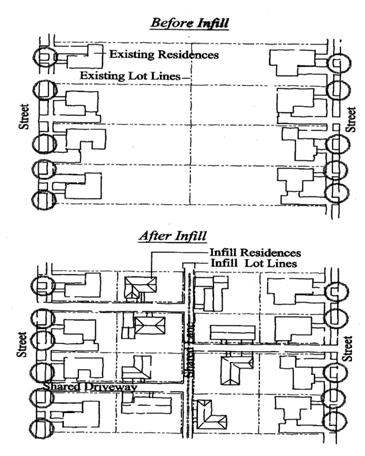
C.
Flag Lots. Flag lots may be created only when a through street or mid-block lanes cannot be extended to serve abutting uses or future development. A flag lot driveway ("flag pole") may serve no more than two dwelling units, including accessory dwellings and dwellings on individual lots, unless Uniform Fire Code (UFC) standards are met for more units. When UFC standards are met, the maximum number of dwellings shall be four. A drive serving more than one lot shall have a reciprocal access and maintenance easement recorded for all lots. No fence, structure or other obstacle shall be placed within the drive area. The fire marshal may require an emergency turnaround. Fire sprinklers may also be required for buildings that cannot be fully served by fire hydrants (i.e., due to distance from hydrant or insufficient fire flow).
D.
Driveway and Lane Width. The minimum width of all shared drives and lanes shall be twelve (12) feet; the maximum width is twenty (20) feet, except as required by the Uniform Fire Code.
E.
Easement and Improvement of Drive Lane. The property owner shall record a twenty (20) foot easement benefiting all properties that are to receive vehicle access. The drive lane shall be improved with an all weather surface approved by the city. Dedication or recording, as applicable, shall be so indicated on the face of the subdivision or partition plat.
F.
Maximum Drive Lane Length. The maximum drive lane length is subject to requirements of the Uniform Fire Code, but shall not exceed one hundred fifty (150) feet for a shared side drive, and four hundred (400) feet for a shared rear lane.
G.
Future Street Plans. Building placement and alignment of shared drives shall be designed so that future street connections can be made as surrounding properties develop (i.e., as shown in the Figure 17.88.040(B)).
(Ord. 1471 § 2 (part), 2008)
17.88.050 - Preliminary plat approval process.
A.
Review of Preliminary Plat. Review of a preliminary plat with two or three lots (partition), or a replat involving two or three lots, shall be processed using a Type II procedure, under Section 17.80.030. Preliminary plats involving four or more lots (subdivision), or a replat involving four or more lots, shall be processed using a Type III procedure under Section 17.80.040. All preliminary plats shall be reviewed using approval criteria in Section 17.88.070. An application for subdivision may be reviewed concurrently with an application for a master planned development under Chapter 17.96.
B.
Review of Final Plat. Review of a final plat for a subdivision or partition shall be processed using a Type I procedure under Section 17.80.020, using the approval criteria in Section 17.88.090, except where the planning official requires that a Type II or Type III procedure is required due to changes the applicant proposes to the preliminary plat.
C.
Preliminary Plat Approval Period. Preliminary plat approval shall be effective for a period of two years from the date of approval. The preliminary plat shall lapse if a final plat has not been submitted within the two-year period. The planning commission may approve phased projects, including master planned developments, with overall time tables of more than two years between preliminary and final plat approvals.
D.
Modifications and Extensions. The applicant may request changes to the approved preliminary plat or conditions of approval following the procedures and criteria provided in Chapter 17.100, Modifications to Approved Plans and Conditions of Approval. The city planning official shall, upon written request by the applicant and payment of the required fee, grant one written extension of the approval period not to exceed one year; provided that:
1.
Any changes to the preliminary plat follow the procedures in Chapter 17.100;
2.
The applicant has submitted written intent to file a final plat within the one-year extension period;
3.
An extension of time will not prevent the lawful development of abutting properties;
4.
There have been no changes to the applicable code provisions on which the approval was based. If such changes have occurred, a new preliminary plat application shall be required; and
5.
The extension request is made before expiration of the original approved plan.
E.
Phased Development.
1.
The city may approve a time schedule for developing a subdivision in phases, but in no case shall the actual construction time period (i.e., for required public improvements, utilities, streets) for any partition or subdivision phase be more than two years without reapplying for a preliminary plat;
2.
The criteria for approving a phased land division proposal are:
a.
Public facilities shall be constructed in conjunction with or prior to each phase,
b.
The development and occupancy of any phase dependent on the use of temporary public facilities shall require city council approval. Temporary facilities shall be approved only upon city receipt of bonding or other assurances to cover the cost of required permanent public improvements, in accordance with Section 17.88.110. A temporary public facility is any facility not constructed to the applicable city or district standard;
c.
The phased development shall not result in requiring the city or a third party (e.g., owners of lots) to construct public facilities that were required as part of the approved development proposal; and
d.
The proposed time schedule for phased development approval shall be reviewed concurrently with the preliminary plat application, and the decision may be appealed in the same manner as the preliminary plat.
(Ord. 1471 § 2 (part), 2008)
17.88.060 - Preliminary plat submission requirements.
A.
General Submission Requirements. For all partitions (three or fewer parcels), the application shall contain all of the information required for a Type II procedure under Section 17.80.030, except as may be waived by the planning official. For all subdivisions (four or more lots), the application shall contain all of the information required for a Type III procedure under Section 17.80.040, and the information in subsections (A)(1) through (A)(3) of this section:
1.
Public Facilities and Services Impact Study. The impact study shall quantify and assess the effect of the development on public facilities and services. The city shall advise as to the scope of the study during the required pre-application conference (Section 17.80.060(C)). The study shall address, at a minimum, the transportation system, including pedestrian ways and bikeways, the drainage system, the parks system, the water system, and the sewer system. For each public facility system and type of impact, the study shall propose improvements necessary to meet city standards and to minimize the impact of the development on the public at large, public facilities systems, and affected private property users;
2.
Traffic impact analysis, if required by the road authority. Traffic impact studies shall conform to the standards and procedures in Section 17.80.090; and
3.
In situations where this code requires the dedication of real property to the city, the city shall either: (a) include in the written decision evidence that shows that the required property dedication is directly related to and roughly proportional to the projected impacts of the development on public facilities and services; or (b) delete the dedication as a condition of approval.
B.
Preliminary Plat Information. In addition to the general information described in subsection A of this section, the preliminary plat application shall consist of drawings and supplementary written material (i.e., on forms and/or in a written narrative) adequate to provide the following information:
1.
General Information.
a.
Name of subdivision (not required for partitions). This name must not duplicate the name of another subdivision in Coos County (please check with county surveyor);
b.
Date, north arrow, and scale of drawing;
c.
Location of the development sufficient to define its location in the city, boundaries, and a legal description of the site;
d.
A title block, including the names, addresses and telephone numbers of the owners of the subject property and, as applicable, the designer, and engineer and surveyor if any, and the date of the survey if submitted; and
e.
Identification of the drawing as a "preliminary plat."
2.
Site Analysis.
a.
Streets: location, name, present width of all streets, alleys and rights-of-way on and abutting the site;
b.
Easements: width, location and purpose of all existing easements of record on and abutting the site;
c.
Utilities: location and identity of all utilities on and abutting the site. If water mains and sewers are not on or abutting the site, indicate the direction and distance to the nearest one and show how utilities will be brought to standards;
d.
Ground elevations shown by contour lines at two-foot vertical interval, except where the city engineer determines that larger intervals are adequate; i.e., for steep slopes. Such ground elevations shall be related to some established benchmark or other datum approved by the county surveyor; this requirement may be waived for partitions when grades, on average, are less than six percent;
e.
The location and elevation of the closest benchmark(s) within or adjacent to the site (i.e., for surveying purposes);
f.
Potential natural hazard areas, including any areas identified as subject to a flood hazard as identified on FEMA Flood Insurance Rate Maps or as otherwise determined through site specific survey, areas subject to high water table, and areas designated by the city, county, or state as having a potential for geologic hazards, including areas subject to Chapter 17.40, Geologic Hazard Overlay;
g.
Sensitive lands, including wetland areas, streams, wildlife habitat, and other areas identified by the city or natural resource regulatory agencies as requiring protection;
h.
Site features, including existing structures, pavement, large rock outcroppings, areas having unique views, and drainage ways, canals and ditches;
i.
Designated historic and cultural resources on the site and adjacent parcels or lots;
j.
The location, size and species of trees having a caliper (diameter) of six inches or greater at four feet above grade in conformance with Chapter 17.64;
k.
North arrow and scale;
l.
Name and address of project designer, if applicable; and
m.
Other information, as deemed appropriate by the city planning official. The city may require studies or exhibits prepared by qualified professionals to address specific site features and code requirements.
3.
Proposed Improvements.
a.
Public and private streets, tracts, driveways, open space and park land; location, names, right-of-way dimensions, approximate radius of street curves; and approximate finished street centerline grades. All streets and tracts that are being held for private use and all reservations and restrictions relating to such private tracts shall be identified;
b.
Easements: location, width and purpose of all proposed easements;
c.
Lots and private tracts (e.g., private open space, common area, or street): approximate dimensions, area calculation (e.g., in square feet), and identification numbers for all proposed lots and tracts;
d.
Proposed uses of the property, including all areas proposed to be dedicated to the public or reserved as open space for the purpose of surface water management, recreation, or other use; potential location of future buildings;
e.
Proposed improvements, as required by Division III (Community Design Standards), and timing of improvements (e.g., in the case of streets, sidewalks, street trees, utilities, etc.);
f.
Preliminary location of development showing those future buildings can meet siting and dimensional standards of the district;
g.
The proposed source of domestic water;
h.
The proposed method of sewage disposal;
i.
Proposed method of surface water drainage and treatment if required;
j.
The approximate location and identity of other utilities, including the locations of street lighting fixtures;
k.
Proposed railroad crossing or modifications to an existing crossing, if any, and evidence of contact with the affected railroad and the Oregon Department of Transportation Rail Division regarding proposed railroad crossing(s);
l.
Changes to navigable streams, or other watercourses. Status of public access to these areas shall be shown on the preliminary plat, as applicable;
m.
Identification of the base flood elevation for development of more than two lots or one-half acre, whichever is less. Written evidence of initiation of a Federal Emergency Management Agency (FEMA) floodplain map amendment shall be required when development is proposed to modify a designated one hundred (100) year floodplain. FEMA approval of the amendment shall be a condition of city land use approval. See also city of Coquille floodplain ordinance (Ordinance No. 1226, March 16, 1987; as amended by Ordinance No. 1351A, November 1, 1993);
n.
Evidence of contact with from the road authority for any development requiring access to its facility(ies); and
o.
Evidence of written notice to the applicable natural resource regulatory agency(ies) for any development within or adjacent to jurisdictional wetlands, rivers, streams or other regulated water bodies.
(Ord. 1471 § 2 (part), 2008)
17.88.070 - Approval criteria—Preliminary plat.
A.
General Approval Criteria. The city may approve, approve with conditions or deny a preliminary plat based on the following approval criteria:
1.
The proposed preliminary plat complies with the applicable development code sections and all other applicable ordinances and regulations. At a minimum, the provisions of this division, and the applicable chapters and sections of Division II (Land Use Districts) and Division III (Community Design Standards) shall apply. Where a variance is necessary to receive preliminary plat approval, the application shall also comply with the relevant sections of Division V;
2.
The proposed plat name is not already recorded for another subdivision, and satisfies the provisions of ORS Chapter 92;
3.
The proposed streets, roads, sidewalks, bicycle lanes, pathways, utilities, and surface water management facilities are laid out so as to conform or transition to the plats of subdivisions and maps of major partitions already approved for adjoining property as to width, general direction and in all other respects. All proposed public improvements and dedications are identified on the preliminary plat;
4.
All proposed private common areas and improvements (e.g., homeowner's association property) are identified on the preliminary plat;
5.
Evidence that any required state and federal permits have been obtained, or shall be obtained before approval of the final plat;
6.
Evidence that improvements or conditions required by the city, road authority, Coos County, special districts, utilities, and/or other service providers, as applicable to the project, have been or can be met; and
7.
If any part of the site is located within an overlay zone, or previously approved master planned development, it shall conform to the applicable regulations and/or conditions.
C.
Layout and Design of Streets, Blocks and Lots. All proposed blocks (i.e., one or more lots bound by public streets), lots and parcels conform to the specific requirements below:
1.
All lots shall comply with the lot area, setback, and dimensional requirements of the applicable land use district (Division II), and the standards of Section 17.72.020(G), Street Connectivity and Formation of Blocks.
2.
Setbacks shall be as required by the applicable land use district (Division II).
3.
Each lot shall conform to the standards of Chapter 17.60, Access and Circulation.
4.
Landscape or other screening may be required to maintain privacy for abutting uses. See Division II, Land Use Districts, and Chapter 17.64, Landscaping, Street Trees, Fences and Walls.
5.
In conformance with the Uniform Fire Code, a twenty (20) foot width fire apparatus access drive shall be provided to serve all portions of a building that are located more than one hundred fifty (150) feet from a public right-of-way or approved access drive. See Chapter 17.60, Access and Circulation.
6.
Where a common drive is to be provided to serve more than one lot, a reciprocal easement which will ensure access and maintenance rights shall be recorded with the approved subdivision or partition plat.
7.
All applicable engineering design standards for streets, utilities, surface water management, and easements shall be met.
D.
Conditions of Approval. The city may attach such conditions as are necessary to carry out provisions of this code, and other applicable ordinances and regulations, and may require reserve strips be granted to the city for the purpose of controlling access to adjoining undeveloped properties. See Chapter 17.72 (Public Facilities).
(Ord. 1471 § 2 (part), 2008)
17.88.080 - Variances authorized.
Variances to the standards of this chapter shall be processed in accordance with Chapter 17.116, Variances. Applications for variances shall be submitted at the same time an application for land division or lot line adjustment is submitted, and the applications shall be reviewed together.
(Ord. 1471 § 2 (part), 2008)
17.88.090 - Final plat submission requirements and approval criteria.
A.
Submission Requirements. Final plats require review and approved by the city prior to recording with Coos County. The applicant shall submit the final plat within two years of the approval of the preliminary plat as provided by Section 17.88.050. Specific information about the format and size of the plat, number of copies and other detailed information can be obtained from the city planning official.
B.
Approval Process and Criteria. By means of a Type II procedure, the city planning official and city engineer, or the planning commission, shall review the final plat and shall approve or deny it based on findings regarding compliance with the following criteria:
1.
The final plat is consistent in design (e.g., number, area, dimensions of lots, easements, tracts, right-of-way) with the approved preliminary plat, and all conditions of approval have been satisfied;
2.
All public improvements required by the preliminary plat have been installed and approved by the city engineer or appropriate service provider (e.g., road authority). Alternatively, the developer has provided a performance guarantee in accordance with Section 17.88.110;
3.
The streets and roads for public use are dedicated without reservation or restriction other than reversionary rights upon vacation of any such street or road and easements for public utilities;
4.
The streets and roads held for private uses have been approved by the city as conforming to the preliminary plat;
5.
The plat and deed contain a dedication to the public of all public improvements, including, but not limited to, streets, public pathways and trails, access reserve strips, parks, sewage disposal storm drainage and water supply systems;
6.
The applicant has provided copies of all recorded homeowner's association covenants, conditions and restrictions (CC&Rs); deed restrictions; private easements and agreements (e.g., for access, common areas, parking, etc.); and other recorded documents pertaining to common improvements recorded and referenced on the plat;
7.
The plat complies with the applicable sections of this code (i.e., there have been no changes in land use or development resulting in a code violation since preliminary plat approval);
8.
Certification by the city or service district, as applicable, that water and sanitary sewer service is available to every lot depicted on the plat; or bond, contract or other assurance has been provided by the subdivider/partitioner to the city that such services will be installed in accordance with Chapter 17.72, Public Facilities, and the bond requirements of Section 17.88.110. The amount of the bond, contract or other assurance by the subdivider/partitioner shall be determined by a registered professional engineer, subject to review and approval by the city;
9.
The plat contains an affidavit by the surveyor who surveyed the land, represented on the plat to the effect the land was correctly surveyed and marked with proper monuments as provided by ORS Chapter 92, indicating the initial point of the survey, and giving the dimensions and kind of such monument and its reference to some corner approved by the Coos County surveyor for purposes of identifying its location.
(Ord. 1471 § 2 (part), 2008)
17.88.100 - Public improvements required.
Before city approval is certified on the final plat, all required public improvements shall be installed, inspected, and approved. Alternatively, the subdivider/partitioner shall provide a performance guarantee, in accordance with Section 17.88.110.
(Ord. 1471 § 2 (part), 2008)
17.88.110 - Performance guarantee.
A.
Performance Guarantee Required. When a performance guarantee is required under Section 17.88.100, the subdivider/partitioner shall file an assurance of performance with the city supported by one of the following:
1.
An irrevocable letter of credit executed by a financial institution authorized to transact business in the state of Oregon;
2.
A surety bond executed by a surety company authorized to transact business in the state of Oregon which remains in force until the surety company is notified by the city in writing that it may be terminated; or
3.
Cash.
B.
Determination of Sum. The assurance of performance shall be for a sum determined by the city as required to cover the cost of the improvements and repairs, including related engineering and incidental expenses, plus reasonable inflationary costs.
C.
Itemized Improvement Estimate. The developer shall furnish to the city an itemized improvement estimate, certified by a registered civil engineer, to assist the city in calculating the amount of the performance assurance.
D.
Agreement. A written agreement between the city and developer shall be recorded with the final plat. The agreement shall not be valid until it is signed and dated by both the applicant and city planning official. The agreement shall contain, at a minimum, all of the following:
1.
The period within which all required improvements and repairs shall be completed;
2.
A provision that if work is not completed within the period specified, the city may complete the work and recover the full cost and expenses from the applicant;
3.
The improvement fees and deposits that are required;
4.
(Optional) A provision for the construction of the improvements in stages and for the extension of time under specific conditions therein stated in the contract.
E.
When Subdivider Fails to Perform. In the event the developer fails to carry out all provisions of the agreement and the city has unreimbursed costs or expenses resulting from such failure, the city shall call on the bond, cash deposit or letter of credit for reimbursement.
F.
Termination of Performance Guarantee. The developer shall not cause termination of nor allow expiration of the guarantee without having first secured written authorization from the city.
(Ord. 1471 § 2 (part), 2008)
17.88.120 - Filing and recording.
A.
Filing Plat with County. Within sixty (60) days of the city approval of the final plat, the applicant shall submit the final plat to Coos County for signatures of county officials as required by ORS Chapter 92.
B.
Proof of Recording. Upon final recording with the county, the applicant shall submit to the city a mylar copy and five paper copies of all sheets of the recorded final plat. This shall occur prior to the issuance of building permits for the newly created lots.
C.
Prerequisites to Recording the Plat.
1.
No plat shall be recorded unless all ad valorem taxes and all special assessments, fees, or other charges required by law to be placed on the tax roll have been paid in the manner provided by ORS Chapter 92;
2.
No plat shall be recorded until it is approved by the county surveyor in the manner provided by ORS Chapter 92.
(Ord. 1471 § 2 (part), 2008)
17.88.130 - Replatting and vacation of plats.
A.
Replatting and Vacations. Any plat or portion thereof may be replatted or vacated upon receiving an application signed by all of the owners as appearing on the deed.
B.
Procedure. All applications for a replat or vacation shall be processed in accordance with the procedures and standards for a subdivision or partition (i.e., the same process used to create the plat shall be used to replat or vacate the plat). The same appeal rights provided through the subdivision and partition process shall be afforded to the plat vacation process. (See Chapter 17.80, Types of Review Procedures.) The road authority(ies) shall be notified of all applications for replats and street vacations. All street vacations shall also conform to the ORS Chapter 271.
C.
Basis for Denial. A replat or vacation application may be denied if it abridges or destroys any public right in any of its public uses, improvements, streets or alleys; or if it fails to meet any applicable criteria.
D.
Recording of Vacations. All approved plat vacations shall be recorded in accordance with Section 17.88.120 and the following procedures:
1.
Once recorded, a replat or vacation shall operate to eliminate the force and effect of the plat prior to vacation; and
2.
Vacations shall also divest all public rights in the streets, alleys and public grounds, and all dedications described on the plat.
E.
After Sale of Lots. When lots have been sold, the plat may be vacated only in the manner herein, and provided that all of the owners of lots within the platted area consent in writing to the plat vacation.
F.
Street Requirement. Except as prohibited by law (e.g., ORS 92.837, Manufactured Home Park), in approving a right-of-way vacation or replat, the city may require dedication of accessways, paths or trails as a condition of the vacation of any public easement or right-of-way, in order to establish or maintain a safe, convenient and direct pedestrian and bicycle circulation system. Such requirements shall be coordinated with the applicable road authority.
(Ord. 1471 § 2 (part), 2008)
17.88.140 - Property line adjustments.
A property line adjustment is the modification of lot boundaries, when no lot is created or removed. The application submission and approval process is as follows:
A.
Submission Requirements. All applications for property line adjustment shall be made on forms provided by the city and shall include information required for a Type I application, as governed by Section 17.80.020. The application shall include a preliminary lot line map drawn to scale identifying all existing and proposed lot lines and dimensions; footprints and dimensions of existing structures (including accessory structures); location and dimensions of driveways and public and private streets within or abutting the subject lots; location of sensitive lands (e.g., flood hazard, geological hazard, airport approach areas) existing fences and walls; and any other information deemed necessary by the city planning official for ensuring compliance with city codes.
B.
Approval Process.
1.
Decision Making Process. Property line adjustments shall be reviewed by means of a Type I procedure, as governed by Section 17.80.020, using approval criteria contained in subsection C of this section. The road authority(ies) shall be notified of lot line adjustments that may affect property access or traffic volumes or operations on their facilities.
2.
Time Limit on Approval. The property line adjustment approval shall be effective for a period of one year from the date of approval, during which time it must be recorded.
3.
Lapsing of Approval. The property line adjustment approval shall lapse if:
a.
The property line adjustment is not recorded within the time limit in subsection (B)(2) of this section;
b.
The property line adjustment has been improperly recorded with Coos County without the satisfactory completion of all conditions attached to the approval; or
c.
The final recording is a departure from the approved plan.
C.
Approval Criteria. The city planning official shall approve or deny a request for a property line adjustment in writing based on all of the following criteria:
1.
Parcel Creation. No additional parcel or lot is created or removed by the lot line adjustment.
2.
Lot Standards. All lots and parcels conform to the applicable lot standards of the land use district (Division II), including lot area, dimensions, setbacks, and coverage, and no resulting lot is wholly comprised of a flood hazard area or jurisdictional wetland.
3.
Access and Road Authority Standards. All lots and parcels conform to the standards or requirements of Chapter 17.60, Access and Circulation, and all applicable road authority requirements are met. If a lot is nonconforming to any city or road authority standard, it shall not be made even less conforming by the property line adjustment.
D.
Recording Property Line Adjustments.
1.
Recording. Upon the city's approval of the proposed property line adjustment, the applicant shall record the property line adjustment with Coos County within sixty (60) days of approval (or the decision expires), and submit a copy of the recorded survey map to the city, to be filed with the approved application.
2.
Time Limit. The applicant shall submit a copy of the recorded property line adjustment survey map to the city within fifteen (15) days of recording and prior to the issuance of any building permits on the reconfigured lots.
E.
Extension. The city shall, upon written request by the applicant and payment of the required fee, grant a written extension of the approval period not to exceed one year provided that:
1.
No changes are made to the original property line adjustment as approved by the city;
2.
The applicant can show intent of recording the approved plan within the one-year extension period;
3.
There have been no changes in the applicable code or plan provisions on which the approval was based. In the case where the property line adjustment conflicts with a code change, the extension shall be denied; and
4.
The extension request is made before expiration of the original approved plan.
(Ord. 1471 § 2 (part), 2008)
17.92.010 - Conditional use permits—Purpose.
There are certain uses, which, due to the nature of their impacts on surrounding land uses and public facilities, require a case-by-case review and analysis. These are identified as "Conditional Uses" in Division II, Land Use Districts. The purpose of this chapter is to provide standards and procedures under which a conditional use may be permitted, enlarged or altered if the site is appropriate and if other appropriate conditions of approval can be met.
(Ord. 1471 § 2 (part), 2008)
17.92.020 - Conditional use permits—Approvals process.
A.
Initial Application. An application for a new conditional use shall be processed as a Type III procedure (Section 17.80.040). The application shall meet submission requirements in Section 17.92.030, and the approval criteria contained in Section 17.92.040.
B.
Modification of Approved or Existing Conditional Use. Modifications to approved or existing conditional uses shall be processed in accordance with Chapter 17.100, Modifications to Approved Plans and Conditions of Approval.
(Ord. 1471 § 2 (part), 2008)
17.92.030 - Conditional use permits—Application submission requirements.
In addition to the submission requirements required in Chapter 17.80, an application for conditional use approval must include the following information (subsections A through H of this section), as applicable. For a description of each item, please refer to Section 17.84.050, Site design review—Application submission requirements:
A.
Existing site conditions;
B.
Site plan;
C.
Preliminary grading plan;
D.
A landscape plan;
E.
Architectural drawings of all structures;
F.
Drawings of all proposed signs;
G.
A copy of all existing and proposed restrictions or covenants;
H.
Narrative report or letter documenting compliance with all applicable approval criteria in Section 17.92.040.
(Ord. 1471 § 2 (part), 2008)
17.92.040 - Conditional use permits—Criteria, standards and conditions of approval.
The city shall approve, approve with conditions, or deny an application for a conditional use or to enlarge or alter a conditional use based on findings of fact with respect to each of the standards and criteria in the following.
A.
Use Criteria.
1.
The site size, dimensions, location, topography and access are adequate for the needs of the proposed use, considering the proposed building mass, parking, traffic, noise, vibration, exhaust/emissions, light, glare, erosion, odor, dust, visibility, safety, and aesthetic considerations;
2.
The negative impacts of the proposed use on adjacent properties and on the public can be mitigated through application of other code standards, or other reasonable conditions of approval; and
3.
All required public facilities have adequate capacity to serve the proposal.
B.
Site Design Standards. The site design review approval criteria (Section 17.84.060) shall be met. The planning official may waive the application requirements for site design review upon determining that the conditional use permit application provides sufficient information to evaluate the proposal.
C.
Conditions of Approval. The city may impose conditions that are found necessary to ensure that the use is compatible with other uses in the vicinity, and that the negative impact of the proposed use on the surrounding uses and public facilities is minimized. These conditions include, but are not limited to, the following:
1.
Limiting the hours, days, place and/or manner of operation;
2.
Requiring site or architectural design features which minimize environmental impacts such as noise, vibration, exhaust/emissions, light, glare, erosion, odor and/or dust;
3.
Requiring larger setback areas, lot area, and/or lot depth or width;
4.
Limiting the building or structure height, size or lot coverage, and/or location on the site;
5.
Designating the size, number, location and/or design of vehicle access points or parking areas;
6.
Requiring street right-of-way to be dedicated and street(s), sidewalks, curbs, planting strips, pathways, or trails to be improved;
7.
Requiring landscaping, screening, drainage, water quality facilities, and/or improvement of parking and loading areas;
8.
Limiting the number, size, location, height and/or lighting of signs;
9.
Limiting or setting standards for the location, design, and/or intensity of outdoor lighting;
10.
Requiring berms, screening or landscaping and the establishment of standards for their installation and maintenance;
11.
Requiring and designating the size, height, location and/or materials for fences;
12.
Requiring the protection and preservation of existing trees, soils, vegetation, watercourses, habitat areas, drainage areas, historic resources, cultural resources, and/or sensitive lands;
13.
Requiring the dedication of sufficient land to the public, and/or construction of pedestrian/bicycle pathways in accordance with the adopted plans, or requiring the recording of a local improvement district nonremonstrance agreement for the same. Dedication of land and construction shall conform to the provisions of Chapter 17.60, and Section 17.60.030 in particular;
14.
Establish a time table for periodic review and renewal, or expiration, of the conditional use to ensure compliance with conditions of approval; such review may be subject to approval by the planning official or planning commission through a Type II administrative review or Type III quasi-judicial process at the discretion of the decision making body.
(Ord. 1471 § 2 (part), 2008)
17.92.050 - Conditional use permits—Additional development standards.
A.
Concurrent Variance Application(s). A conditional use permit shall not grant variances to regulations otherwise prescribed by the development code. Variance application(s) may be filed in conjunction with the conditional use application, and both applications may be reviewed concurrently and heard at the same public hearing.
B.
Additional Development Standards. Development standards for specific uses are contained in Division II, Land Use Districts.
(Ord. 1471 § 2 (part), 2008)
17.96.010 - Master planned development—Purpose.
The purposes of this section are to:
A.
Implement the comprehensive plan and applicable land use district(s) by providing a means for master planning large development sites;
B.
Encourage innovative planning that results in projects that benefit the community (i.e., through compatible mixed use development, improved protection of open spaces, transportation options and consistent application of standards in phased developments);
C.
Encourage developments that recognize the relationship between buildings, their use, open space, and transportation options, providing varied opportunities for innovative and diversified employment environments;
D.
Facilitate the efficient use of land;
E.
Promote an economic arrangement of land use, buildings, circulation systems, open space, and utilities;
F.
Preserve to the greatest extent possible the existing landscape features and amenities that may not otherwise be protected through conventional development;
G.
Encourage energy conservation and improved air and water quality; and
H.
Assist the city in planning infrastructure improvements.
(Ord. 1471 § 2 (part), 2008)
17.96.020 - Master planned development—Applicability.
The master planned development designation is an overlay zone that may be applied over any of the city's land use districts. An applicant may elect to develop a project as a master planned development in compliance with the requirements of this chapter, or the city may require a development be processed as such when a project cannot otherwise meet the applicable development code requirements due to existing topography or natural features.
(Ord. 1471 § 2 (part), 2008)
17.96.030 - Master planned development—Review and approvals process.
A.
Review Steps. There are three required steps to planned development approval, which may be reviewed individually or combined into one package for concurrent review:
1.
The approval of a planned development overlay zone and concept plan;
2.
The approval of a detailed development plan; and
3.
The approval of a preliminary subdivision plat(s) and/or site design review application(s).
B.
Approval Process.
1.
The master planned development (PD) overlay zone and concept plan shall be reviewed together using the Type III procedure in Section 17.80.040, the submission requirements in Section 17.96.080, and the approval criteria in Section 17.96.060.
2.
The detailed development plan shall be reviewed using the Type III procedure in Section 17.80.040, to ensure substantial compliance with the approved concept plan.
3.
Preliminary subdivision plats and site design review applications for approved planned developments shall be reviewed using a Type II procedure, as governed by Section 17.84.040.
4.
Subsections (B)(1) through (B)(3) of this section may be combined in any manner, so long as the decision making sequence follows that in subsection A of this section. Notification and hearings may be combined.
(Ord. 1471 § 2 (part), 2008)
17.96.040 - Master planned development—Modification of district standards (Division II) and design standards (Division III).
The planning commission may approve modifications or adjustments to the standards in Division II and/or Division III through the master plan approval without the need for variances upon finding that all of the following criteria are met:
A.
Comprehensive Plan. The modification or adjustment is consistent with the policies of the comprehensive plan, and equally or better meets the intent of the development code section(s) to be modified, as compared to a project that strictly conforms to code standards.
B.
Public Benefit. The modification or adjustment results in an overall net benefit to the public, such as a greater variety of housing, greater affordability in housing, more open space or more usable open space, greater protection of natural features, greater protection of scenic views or vistas, greater potential for use of renewal energy such as solar or wind, avoidance of natural hazards (e.g., geological hazards, streams, or other drainage ways), superior architecture, and/or improved transportation planning in new development.
C.
Public improvement standards and engineering design criteria shall not be modified without variance to such standards approved by the city engineer. The city may grant such variances concurrently with the master planned development.
D.
Residential densities shall not exceed the density allowed under the applicable land use district in Division II. Where the land use district prescribes a minimum lot size as the basis of allowable density, the total number of dwelling units shall not exceed the net site area (site area minus required street rights-of-way) divided by the minimum lot size standard of the district.
E.
Industrial and commercial uses, if not otherwise allowed in a residential district, shall not be allowed in a residential district master plan.
(Ord. 1471 § 2 (part), 2008)
17.96.050 - Master planned development—Overlay zone and concept plan submission.
A.
General Submission Requirements. The applicant shall submit an application containing all of the general information required for a Type III procedure, as governed by Section 17.80.040. In addition, the applicant shall submit the following:
1.
A statement of planning objectives to be achieved by the planned development through the particular approach proposed by the applicant. This statement should include a description of the character of the proposed development and the rationale behind the assumptions and choices made by the applicant;
2.
A development schedule indicating the approximate dates when construction of the planned development and its various phases are expected to be initiated and completed;
3.
A statement of the applicant's intentions with regard to the future selling or leasing of all or portions of the planned development;
4.
Narrative report or letter documenting compliance with the applicable approval criteria contained in Section 17.96.060;
5.
Special studies prepared by qualified professionals may be required by the city planning official, planning commission or city council to determine potential traffic, geologic, noise, environmental, natural resource and other impacts, and required mitigation.
B.
Additional Information. In addition to the general information described in subsection A of this section, the concept plan, data, and narrative shall include the following exhibits and information:
1.
Existing conditions map, as defined in Section 17.84.050, Site design review—Application submission requirements;
2.
Conceptual site plan (e.g., general land use, building envelopes, circulation, open space, utility connections, and other information necessary to convey the concept plan);
3.
Grading concept (for hillside or sloping properties, or where extensive grading is anticipated);
4.
Landscape concept (e.g., shows retention of existing vegetation and general planting areas);
5.
Architectural concept (e.g., information sufficient to describe architectural styles, building heights, and general materials);
6.
Sign concept plan (e.g., locations, general size, style and materials of signs);
7.
Copy of all existing covenants and restrictions, and general description of proposed restrictions or covenants (e.g., for common areas, access, parking, etc.).
(Ord. 1471 § 2 (part), 2008)
17.96.060 - Master planned development—Overlay zone and concept plan approval criteria.
The city shall make findings that all of the following criteria are satisfied when approving or approving with conditions, the overlay zone and concept plan. The city shall make findings that not all of the criteria are satisfied when denying an application:
A.
Comprehensive Plan. The master plan conforms to the comprehensive plan.
B.
Land Division Chapter. All of the requirements for land divisions, including requirements for pre-planning large sites under Section 17.88.030, are met, except as may be modified under Section 17.96.040 (Chapter 17.88).
C.
Divisions II and III Standards. All of the land use, development, and design standards contained in Divisions II and III are met, except as may be modified under Section 17.96.040.
D.
Open Space. Master plans shall contain a minimum of twenty-five (25) percent open space. Public open space shall be integral to the master plan. Plans shall emphasize public gathering places such as plazas, neighborhood parks, trails, and other publicly accessible spaces that integrate land use and transportation and contribute toward a sense of place. Where public or common private open space is designated, the following standards apply:
1.
The open space area shall be shown on the final plan and recorded with the final plat or separate instrument, per Section 17.72.030(A); and
2.
The open space shall be conveyed in accordance with one of the following methods:
a.
By dedication to the city as publicly owned and maintained open space. Open space proposed for dedication to the city must be acceptable to the city planning official with regard to the size, shape, location, improvement, environmental condition (i.e., the applicant may be required to provide a level one environmental assessment), and budgetary and maintenance abilities,
b.
By leasing or conveying title (including beneficial ownership) to a corporation, home association or other legal entity, with the city retaining the development rights to the property. The terms of such lease or other instrument of conveyance must include provisions (e.g., maintenance, property tax payment, etc.) suitable to the city.
E.
Adjustments and Modifications to Standards. Where adjustment(s) or modification(s) to standards are requested, such adjustment(s) or modification(s) must be found to conform to the criteria in Section 17.96.040.
(Ord. 1471 § 2 (part), 2008)
17.96.070 - Master planned development—Administrative procedures.
A.
Land Use District Map Designation. After a planned development overlay zone has been approved, the land use district map shall be amended in accordance with Chapter 17.104, to indicate the approved planned development designation for the subject development site. The approval of the planned development overlay zone shall not expire.
B.
Time Limit on Filing of Detailed Development Plan. Within three years after the date of approval of the concept plan, the applicant or his or her successor shall prepare and file with the city a detailed development plan or final plat, in conformance with Sections 17.96.080 through 17.96.090. Where a detailed development plan or final plat is not filed within three years, the concept plan shall become void.
C.
Extension. The city shall, upon written request by the applicant and payment of the required fee, grant a written extension of the approval period not to exceed one year provided that:
1.
No changes have been made on the original conceptual development plan as approved;
2.
The applicant can show intent of applying for detailed development plan review within the one-year extension period;
3.
There have been no changes to the applicable comprehensive plan policies and ordinance provisions on which the approval was based; and
4.
The extension request is made before expiration of the original approval period.
(Ord. 1471 § 2 (part), 2008)
17.96.080 - Master planned development—Detailed development plan submission requirements.
The contents of the detailed development plan shall be determined based on the conditions of approval for the concept plan. At a minimum, the detailed development plan shall identify the final proposed location of all lots, tracts, parcels, open space, rights-of-way, building envelopes and other features, prior to approval of a development permit. The detailed development plan may combine land division, development review, site design review, and/or other applications for concurrent review and approval. The detailed development plan shall be reviewed using a Type III procedure.
(Ord. 1471 § 2 (part), 2008)
17.96.090 - Master planned development—Detailed development plan approval criteria.
The city shall approve the detailed development plan upon finding that the final plan conforms to the concept plan and required conditions of approval. If the detailed plan request combines other land use and development applications, as provided in this section, those applications shall additionally be subject to the applicable approval criteria in Division IV. Minor changes to the approved concept plan may be approved with the detailed plan, when the approval body finds that the modification(s) is/are consistent with the criteria in subsections A through H of this section. Changes exceeding those below must be reviewed as major modifications under Chapter 17.100.
A.
Increased residential densities (overall or reallocated between development phases) by no more than ten (10) percent over that which is approved, provided such increase conforms to the comprehensive plan and underlying land use district;
B.
Increase in lot coverage or impervious surface (overall or reallocated between development phases) by no more than ten (10) percent over that which is approved;
C.
Reduction in open space or landscaping by no more than ten (10) percent over that which is approved;
D.
Increase in overall automobile parking spaces by ten (10) percent over that which is approved;
E.
Land Use. No change in land use shall be permitted without a major modification to the master planned development (concept plan) approval;
F.
Proposals to add or increase lot coverage within environmentally sensitive areas (sensitive lands) or areas subject to a potential hazard shall require a major modification to the concept plan;
G.
Major changes in the location or configuration of proposed lots, blocks, buildings, streets, parking lots, utility easements, landscaping or other site improvements shall require a major modification pursuant to Chapter 17.100. "Major" in this subsection means by more than twenty (20) percent for setbacks, or more than twenty (20) feet in the alignment or placement of the features listed herein; and
H.
Other substantial modifications not allowed as minor modifications in subsections A through G of this section shall require approval of a major modification, in conformance with Chapter 17.100.
(Ord. 1471 § 2 (part), 2008)
17.96.100 - Master planned development—Land use review, site design review, final plat and building permit approvals.
A.
Land Use and Site Design Reviews. For projects requiring land use or site design review, all such approvals must be final and appeal periods expired before the city issues building permits. Chapter 17.84 applies to site design review.
B.
Land Divisions. For projects requiring a land division, the preliminary land division plats must be final and appeal periods expired before a final plat is approved and building permits issued. Chapter 17.88 applies to land divisions.
C.
Streamlined Review Option. Applications for preliminary land division plats, land use reviews, and site design review applications that are part of a previously approved master planned development may be reviewed using a Type II procedure, rather than the conventional Type III procedure. This shall be the applicant's option, provided the planning official may refer any Type II application to the planning commission for its review as he or she deems it in the public interest. The variation from the standard procedures of Chapter 17.84, Land Use Review and Site Design Review, and Chapter 17.88, Land Divisions and Property Line Adjustments, is intended to streamline review of projects that have received master planned development approvals, since those projects have previously been subject to public review and hearings.
(Ord. 1471 § 2 (part), 2008)
17.100.010 - Modifications—Purpose.
The purpose of this chapter is to provide an efficient process for modifying land use decisions and approved development plans, in recognition of the cost and complexity of land development and the need to conserve city resources.
(Ord. 1471 § 2 (part), 2008)
17.100.020 - Modifications—Applicability.
A.
This chapter applies to all development applications approved through the provisions of Division IV, including:
1.
Land use review approvals;
2.
Site design review approvals;
3.
Subdivisions, partitions, and property line adjustments;
4.
Conditional use permits;
5.
Master planned developments; and
6.
Conditions of approval on any of the above permit types.
B.
This chapter does not apply to comprehensive plan amendments, land use district changes, text amendments, annexations, temporary use permits, or other permits not listed in subsection A of this section.
(Ord. 1471 § 2 (part), 2008)
17.100.030 - Major modifications.
A.
Major Modification Defined. The city planning official shall determine that a major modification(s) is required if one or more of the changes listed below are proposed:
1.
A change in land use;
2.
An increase in density by more than ten (10) percent, provided the resulting density does not exceed that allowed by the land use district;
3.
A change in setbacks or lot coverage by more than ten (10) percent, provided the resulting setback or lot coverage does not exceed that allowed by the land use district;
4.
A change in the type and/or location of accessways, drives or parking areas affecting off-site traffic;
5.
An increase in the floor area proposed for nonresidential use by more than fifteen (15) percent where previously specified;
6.
A reduction of more than ten (10) percent of the area reserved for common open space; or
7.
Change to a condition of approval, or a change similar to subsections (A)(1) through (A)(6) of this section, that could have a detrimental impact on adjoining properties. The city planning official shall have discretion in determining detrimental impacts warranting a major modification.
B.
Major Modification Applications—Approval Criteria. An applicant may request a major modification using a Type II or Type III review procedure, as follows:
1.
Upon the city planning official determining that the proposed modification is a major modification, the applicant shall submit an application form, filing fee and narrative, and a site plan using the same plan format as in the original approval. The planning official may require other relevant information, as necessary, to evaluate the request.
2.
The application shall be subject to the same review procedure (Type II or III), decision making body, and approval criteria used for the initial project approval, except that adding a conditional use to an approved project shall be reviewed using a Type III procedure.
3.
The scope of review shall be limited to the modification request. For example, a request to modify a parking lot shall require site design review only for the proposed parking lot and any changes to associated access, circulation, pathways, lighting, trees, and landscaping. Notice shall be provided in accordance with Chapter 17.80.
4.
The decision making body shall approve, deny, or approve with conditions an application for major modification based on written findings on the criteria.
(Ord. 1471 § 2 (part), 2008)
17.100.040 - Minor modifications.
A.
Minor Modification. Any modification to a land use decision or approved development plan that is not within the description of a major modification as provided in Section 17.100.030(A) above.
B.
Minor Modification Review Procedure. An application for approval of a minor modification shall be reviewed by the planning official using a Type I or a Type II review procedure under Section 17.80.020 or 17.80.030. The planning official is responsible for determining the appropriate review procedure based on the following criteria:
1.
Minor modifications that involve only clear and objective code standards may be reviewed using a Type I procedure;
2.
Minor modifications that involve one or more discretionary standards shall be reviewed through Type II procedure; and
3.
When the code is unclear on whether the application should be a Type I or Type II review, a Type II procedure shall be used.
C.
Minor Modification Applications. An application for minor modification shall include an application form, filing fee and narrative, and a site plan using the same plan format as in the original approval. The planning official may require other relevant information, as necessary, to evaluate the request.
D.
Minor Modification Approval Criteria. The planning official shall approve, deny, or approve with conditions an application for minor modification based on written findings that the modification is in compliance with all applicable requirements of the development code and conditions of approval on the original decision, and the modification is not a major modification as described in Section 17.100.030(A) above.
(Ord. 1471 § 2 (part), 2008)
17.104.010 - Amendments—Purpose.
The purpose of this chapter is to provide standards and procedures for legislative and quasi-judicial amendments to this code and the land use district map. These will be referred to as "map and text amendments." Amendments may be necessary from time to time to reflect changing community conditions, needs and desires, to correct mistakes, or to address changes in the law.
(Ord. 1471 § 2 (part), 2008)
17.104.020 - Legislative amendments.
Legislative amendments are policy decisions made by city council. They are reviewed using the Type IV procedure in Section 17.80.050 and shall conform to the transportation planning rule provisions in Section 17.104.060, as applicable.
(Ord. 1471 § 2 (part), 2008)
17.104.030 - Quasi-judicial amendments.
A.
Applicability of Quasi-Judicial Amendments. Quasi-judicial amendments are those that involve the application of adopted policy to a specific development application or code revision, and not the adoption of new policy (i.e., through legislative decisions). Quasi-judicial district map amendments and application of master planned development overlay zones to individual properties shall follow the Type III procedure, as governed by Section 17.80.040, using standards of approval in subsection B of this section. The approval authority shall be as follows:
1.
The planning commission shall review and recommend land use district map changes that do not involve comprehensive plan map amendments;
2.
The planning commission shall make a recommendation to the city council on an application for a comprehensive plan map amendment. The city council shall decide such applications; and
3.
The planning commission shall make a recommendation to the city council on a land use district change application that also involves a comprehensive plan map amendment application. The city council shall decide both applications.
B.
Criteria for Quasi-Judicial Amendments. A recommendation or a decision to approve, approve with conditions or to deny an application for a quasi-judicial amendment shall be based on all of the following criteria:
1.
Approval of the request is consistent with the statewide planning goals;
2.
Approval of the request is consistent with the comprehensive plan;
3.
The property and affected area is presently provided with adequate public facilities, services and transportation networks to support the use, or such facilities, services and transportation networks are planned to be provided in the planning period;
4.
The change is in the public interest with regard to neighborhood or community conditions, or corrects a mistake or inconsistency in the comprehensive plan or land use district map regarding the property which is the subject of the application; and
5.
The amendment conforms to the transportation planning rule provisions under Section 17.104.060.
(Ord. 1471 § 2 (part), 2008)
17.104.040 - Conditions of approval for quasi-judicial amendments.
A quasi-judicial decision may be for denial, approval, or approval with conditions; conditions shall be based on applicable regulations and factual evidence in the record. A legislative amendments may only be approved or denied.
(Ord. 1471 § 2 (part), 2008)
17.104.050 - Record of amendments.
The city recorder shall maintain a record of amendments to the text of this code and the land use districts map in a format convenient for public use. This shall be located in Division VI.
(Ord. 1471 § 2 (part), 2008)
17.104.060 - Transportation planning rule compliance.
A.
Review of Applications for Effect on Transportation Facilities. When a development application includes a proposed comprehensive plan amendment or land use district change, the proposal shall be reviewed to determine whether it significantly affects a transportation facility, in accordance with Oregon Administrative Rule (OAR) 660-012-0060 (the Transportation Planning Rule—TPR) and the Traffic Impact Analysis provisions of Section 17.80.090. "Significant" means the proposal would:
1.
Change the functional classification of an existing or planned transportation facility (exclusive of correction of map errors). This would occur, for example, when a proposal causes future traffic to exceed the levels associated with a "collector" street classification, requiring a change in the classification to an "arterial" street, as identified by the Coquille comprehensive plan;
2.
Change the standards implementing a functional classification system;
3.
As measured at the end of the planning period identified in the Coquille comprehensive plan or the adopted plan of any other applicable roadway authority, allow types or levels of land use that would result in levels of travel or access that are inconsistent with the functional classification of an existing or planned transportation facility;
4.
Reduce the performance of an existing or planned transportation facility below the minimum acceptable performance standard identified in road authority's adopted plan;
5.
Worsen the performance of an existing or planned transportation facility that is otherwise projected to perform below the minimum acceptable performance standard identified in the road authority's adopted plan; or
6.
Where the city lacks specific transportation policies or standards, the city council shall be consulted, as provided under Section 17.80.050 (Type IV procedure (legislative).
B.
Amendments that Affect Transportation Facilities. Except as provided in subsection C of this section, amendments to the comprehensive plan and land use regulations which significantly affect a transportation facility shall assure that allowed land uses are consistent with the function, capacity, and level of service of the facility identified in the comprehensive plan. This shall be accomplished by one of the following:
1.
Adopting measures that demonstrate that allowed land uses are consistent with the planned function of the transportation facility;
2.
Amending the comprehensive plan to provide transportation facilities, improvements, or services adequate to support the proposed land uses; such amendments shall include a funding plan to ensure the facility, improvement, or service will be provided by the end of the planning period;
3.
Altering land use designations, densities, or design requirements to reduce demand for automobile travel and meet travel needs through other modes of transportation;
4.
Amending the planned function, capacity or performance standards of the transportation facility; or
5.
Providing other measures as a condition of development or through a development agreement or similar funding method, specifying when such measures will be provided.
C.
Exceptions. Amendments to the comprehensive plan or land use regulations with a significant effect on a transportation facility, where the facility is already performing below the minimum acceptable performance standard identified in the comprehensive plan, may be approved when all of the following criteria are met:
1.
The amendment does not include property located in an interchange area, as defined under applicable law;
2.
The currently planned facilities, improvements or services are not adequate to achieve the standard;
3.
Development resulting from the amendment will, at a minimum, mitigate the impacts of the amendment in a manner that avoids further degradation to the performance of the facility by the time of the development; and
4.
The road authority provides a written statement that the proposed funding and timing for the proposed development mitigation are sufficient to avoid further degradation to the facility.
(Ord. 1471 § 2 (part), 2008)
17.108.010 - Interpretations—Purpose.
Some terms or phrases within the code may have two or more reasonable meanings. This section provides a process for resolving differences in the interpretation of the code text.
(Ord. 1471 § 2 (part), 2008)
17.108.020 - Code interpretation procedure.
A.
Requests. A request for a code interpretation shall be made in writing to the planning official.
B.
Decision to Issue Interpretation. The planning official shall have the authority to interpret the code, or refer the request to the planning commission for its interpretation. The planning official shall advise the person making the inquiry in writing within fourteen (14) days after the request is made, on whether or not the city will make an interpretation.
C.
Written Interpretation. If the city decides to issue an interpretation, it shall be issued in writing and shall be mailed or delivered to the person requesting the interpretation and any other person who specifically requested a copy. The written interpretation shall be issued within fourteen (14) days of the request. The decision shall become effective fourteen (14) days later, unless an appeal is filed in accordance with subsections E through F of this section.
D.
Type II Procedure. Code interpretations shall be made using a Type II procedure under Section 17.80.030. Alternatively, the city planning official may initiate a code interpretation (i.e., without an application being filed by a property owner) and ask the planning commission to ratify the decision, in which case the city shall provide notice of the decision to affected property owner(s) with an opportunity to appeal the decision to city council. Such appeals must be filed in accordance with Section 17.80.060.
E.
Appeals. The applicant and any party who received notice or who participated in the proceedings through the submission of written or verbal evidence may appeal the decision to the planning commission for a Type III decision. The appeal must be filed within fourteen (14) days after the interpretation was mailed or delivered to the applicant. Initiating an appeal requires filing a notice of appeal with the city planning official pursuant to Section 17.80.040.
F.
Interpretations on File. The city shall keep on file a record of all code interpretations.
(Ord. 1471 § 2 (part), 2008)
17.112.010 - Temporary use permits.
Temporary uses are characterized by their short-term or seasonal nature and by the fact that permanent improvements are not made to the site. Temporary uses include, but are not limited to: construction trailers, leasing offices, temporary carnivals and fairs, parking lot sales, retail warehouse sales, and seasonal sales such as Christmas tree sales and vegetable stands. (Note: for temporary medical hardship dwellings, please refer to Section 17.24.110.) Three types of temporary uses require permit approval. See the following:
A.
Seasonal and Special Events. These types of uses occur only once in a calendar year and for no longer a period than thirty (30) days. Using the Type II procedure under Section 17.80.040, the city shall approve, approve with conditions or deny a temporary use permit based on findings that all of the following criteria are satisfied:
1.
The use is permitted in the underlying land use district and does not violate any conditions of approval for the property (e.g., prior development permit approval);
2.
The applicant has proof of the property-owner's permission to place the use on his or her property;
3.
No parking will be utilized by customers and employees of the temporary use which is needed by the property owner to meet their minimum parking requirement under Chapter 17.68 (vehicle and bicycle parking);
4.
The use provides adequate vision clearance, as required by Section 17.60.020, and shall not obstruct pedestrian access on public streets;
5.
Ingress and egress are safe and adequate when combined with the other uses of the property; as required by Section 17.60.020, Vehicular access and circulation;
6.
The use does not create adverse off-site impacts, including vehicle traffic, noise, odors, vibrations, glare or lights that affect an adjoining use in a manner in which other uses allowed outright in the district do not affect the adjoining use; and
7.
The use is adequately served by sewer or septic system and water, if applicable. (The applicant shall be responsible for obtaining any related permits.)
B.
Temporary Sales Office or Model Home. Using a Type I procedure under Section 17.80.020, the city may approve, approve with conditions or deny an application for the use of any real property within the city as a temporary sales office, offices for the purpose of facilitating the sale of real property, or model home in any subdivision or tract of land within the city, but for no other purpose, based on the following criteria:
1.
Temporary Sales Office.
a.
The temporary sales office shall be located within the boundaries of the subdivision or tract of land in which the real property is to be sold;
b.
The property to be used for a temporary sales office shall not be permanently improved for that purpose;
c.
Conditions may be imposed regarding temporary utility connections, and as necessary to protect public health, safety, or welfare.
2.
Model House.
a.
The model house shall be located within the boundaries of the subdivision or tract of land where the real property to be sold is situated; and
b.
The model house shall be designed as a permanent structure that meets all relevant requirements of this code and other applicable codes and permit requirements.
C.
Temporary Building, Trailer, Kiosk or Structure. Temporary or permanent placement of a building, trailer or recreational vehicle per Chapter 17.36, kiosk, or structure, including, but not limited to, prefabricated building(s), for use on any real commercial or industrial property within the city shall require land use approval. Using a Type II procedure, as governed by Section 17.80.040, the city may approve, approve with conditions or deny an application for a placement of a building, trailer, kiosk, or structure for temporary use, or temporary placement, such as a temporary commercial or industrial use or space associated with the primary use on the property, based on following criteria:
1.
The temporary trailer or building shall be located within the specified property line setbacks of the parcel of land on which it is located;
2.
The primary use on the property to be used for a temporary trailer is already developed;
3.
Ingress and egress are safe and adequate as demonstrated by an approach permit approved by the road authority, as applicable. See also Section 17.60.020, Vehicular access and circulation;
4.
There is adequate parking for the customers or users of the temporary use as required by Chapter 17.68 (bicycle and vehicle parking);
5.
The use will not result in vehicular congestion on streets;
6.
The use will pose no impediment or hazard to pedestrians in the area of the use;
7.
The use does not create adverse off-site impacts, including vehicle traffic, noise, odors, vibrations, glare or lights that affect an adjoining use in a manner which other uses allowed outright in the district do not affect the adjoining use;
8.
The building complies with applicable building codes;
9.
The use can be adequately served by sewer or septic system and water, if applicable. (The applicant shall be responsible for obtaining any related permits); and
10.
The length of time that the temporary building will be used does not exceed six months. When a temporary building exceeds this time frame, the applicant shall be required to remove the building, or renew the temporary use permit; and
11.
Conditions may be imposed regarding temporary utility connections, and as necessary to protect public health, safety, or welfare.
(Ord. 1471 § 2 (part), 2008)
17.112.020 - Home occupation permits.
A.
Purpose. The purpose of this section is to encourage those who are engaged in small commercial ventures that do not conform to the special standards for certain uses in Section 17.24.110(E), Home Occupation. The standards referenced above allow home occupations as outright permitted uses that do not require development review or site design review.
This section provides a process for more intense home occupations to be allowed with site design review by the planning commission and notice to surrounding property owners. These home occupations may be permitted, with conditions of approval when appropriate, in order to increase the benefits of people working and living in the same place, while protecting neighboring residents from adverse impacts of home occupation activities. These benefits to the business owner and to the general public include: reduced number of commute-to-work trips, daytime "eyes on the street" at the residence, and a neighborhood-scale version of mixed residential and commercial uses.
B.
Approval Process and Criteria.
1.
Home Occupation Permit. Applications for proposals that cannot meet all of the standards in Section 17.24.110(E) shall be processed using a Type III procedure, as governed by Section 17.80.040, using the approval criteria in subsection (B)(2) of this section. In addition to the application requirements contained in Section 17.80.040(B), the applicant shall provide:
a.
A written narrative or letter:
i.
Describing the proposed home occupation,
ii.
Demonstrating compliance with those standards in Section 17.24.110(E) that can be met, and explaining why the other standards in Section 17.24.110(E) cannot be met, and
iii.
Demonstrating compliance with the criteria in subsection (B)(2) of this section;
b.
A site plan, not necessarily to scale, of the lot proposed for the home occupation, including:
i.
The property lines and their dimensions,
ii.
Outlines of the foundations of all buildings proposed for home occupation use with dimensions for each wall, and the distances from each wall to the nearest property line,
iii.
Boundaries and dimensions of driveways and parking areas, indicating areas for use by home occupation employees and customers,
iv.
Outlines of the foundations of abutting residences, and the distances from the shared property line to the nearest wall of each neighboring residence, and
v.
Identifying the buildings and areas of those buildings in which home occupation activities will take place, and identifying which activities will take place in which buildings and areas;
2.
The city shall approve, approve with conditions, or deny an application for a Type III home occupation based on all of the following criteria:
a.
The proposed use will not be materially detrimental to the stated purposes of applicable code requirements and to other properties within a radius of one hundred (100) feet of the subject property,
b.
Impacts to surrounding properties may exist but can be mitigated,
c.
Existing physical and natural systems, such as, but not limited to drainage, natural resources, and parks, will not be adversely affected any more than would occur if the development occurred in compliance with Section 17.24.110(E).
(Ord. 1471 § 2 (part), 2008)

