
Coupeville City Zoning Code
CHAPTER 16
10 - SUPPLEMENTAL USE STANDARDS
16.10.010 - Purpose.
It is the purpose of this chapter to provide supplemental use standards for some of the allowed uses identified in Chapter 16.08 of the Coupeville Town Code. They further refine and implement comprehensive plan goals and policies relating to providing housing alternatives, and allowing some nonresidential uses within residential zones.
(Ord. 566 § 2 Exh. A (part), 1998)
16.10.020 - Nonconforming uses, buildings, and structures.
This section governs those buildings and land uses which were legally constructed or commenced, but which do not conform to the current regulations of the district in which the building or use is located.
A.
Nonconforming Land Uses Permitted—Restrictions. Except as otherwise provided in this chapter, the lawful use of land existing at the time of the adoption of the ordinance codified in this title may be continued, although such use does not conform to the regulations specified by this chapter for the district in which the land is located; provided however, that no such nonconforming use shall be enlarged or increased, nor shall any such nonconforming use be extended to occupy a greater area of land than occupied by the use at the time of the adoption of the ordinance codified in this title; provided further, that if any such nonconforming use of land ceases for any reason for any continuous period of not less than one year, any subsequent use of any such land shall be in conformity to the regulations specified by this chapter for the district in which such land is located.
B.
Nonconforming Building Uses Permitted—Restrictions. Except as otherwise provided in this chapter, the lawful use of any building existing at the time of the adoption of the ordinance codified in this title, although such use does not conform to the regulations specified by this chapter for the district in which such building is located, may be continued. Any such use may be extended throughout any parts of a building which were manifestly arranged or designed for such use at the time of the adoption of the ordinance codified in this title; but no such use shall be extended to occupy any land outside such building.
C.
Cessation of Nonconforming Building Use. If any nonconforming use of a building ceases for any reason for a continuous period of not less than one year, or if the building in or on which such use is conducted or maintained is moved for any distance, then any future use of such building shall be in conformity to the regulations specified by this chapter for the district in which such building is located.
D.
Repair to or Reconstruction of Nonconforming Buildings and Structures.
1.
A nonconforming building or structure may be repaired and maintained, so long as any such repair or maintenance does not in any way increase its nonconformity and it remains otherwise lawful.
2.
An nonconforming historic building or structure that is destroyed may be restored and/or reconstructed at its former location despite noncompliance with the bulk regulations, including setbacks.
E.
Effect.
1.
Any use for which a special permit is required or for which a special permit may be granted as provided in this chapter, which use was existing at the time of the adoption of the ordinance codified in this title in any district in which the use is specifically permitted subject to the securing of a special permit, shall without further action be deemed to be a conforming use in the district.
2.
All the foregoing provisions shall apply to all uses which do not conform to the provisions of the ordinance codified in this title at the time of its adoption and also to all uses that become nonconforming by reason of any subsequent amendment of this chapter.
3.
Except as otherwise provided in this chapter, nothing in this chapter shall be deemed to require any change in the plans, construction, or designated use of any building on which a building permit was issued or authorized by action of the town council, prior to the adoption of the ordinance codified in this title; provided, that the construction of the building was completed within one year of the date of issue of a building permit, or two years from the date authorized by the town council.
(Ord. 566 § 2 Exh. A (part), 1998)
(Ord. No. 692, § 9, 10-3-2011)
Editor's note— Ord. No. 692, § 9, adopted Oct. 3, 2011, changed the title of § 16.10.020 from "Nonconforming uses" to "Nonconforming uses, buildings, and structures."
16.10.030 - Existing substandard lots.
A.
Conveyance Restricted. If two or more lots or combinations of lots and portions of lots with continuous frontage in single ownership are of record at the time of passage or amendment of the town zoning ordinance, and if all or part of the lots do not meet the requirements for lot width and area as established by the zoning ordinance, the lands involved shall be considered to be an undivided parcel for the purposes of this title, and no portion of said parcel shall be used or sold which does not meet lot width and area requirements established by this title, nor shall any division of the parcel be made which leaves remaining any lot with width or area below the requirements stated in this title except that, any lot of record as of March 27, 1995, which meets all lot width and area requirements established by Town ordinances as of that date, shall continue to be considered a legal building lot and may be used or sold accordingly. Variances pertaining to area, width and yard requirements so specified in the zoning ordinance shall be obtained as specified in Section 16.14.020 of this title.
B.
Determination of Ownership. For the purpose of this section, lots and property shall be considered in the same ownership when owned by the same person, persons or corporation, or by husband and wife, as tenants by the entirety.
(Ord. 566 § 2 Exhs. A (part), B (part), 1998)
16.10.040 - Accessory dwelling units.
This section establishes supplemental standards for acquiring a certificate for installing an accessory dwelling unit in those districts where this use is permitted as an accessory use. The addition of an accessory dwelling unit on lots containing a single-household dwelling, or a duplex, as a principal use (hereinafter "the principal unit") shall be permitted in all zoning districts, subject to the specific development, design and occupancy standards listed in this section.
A.
Intent and Purpose. The intent of this section is to implement appropriate development standards for accessory dwelling units as advocated by the Coupeville comprehensive plan. The purposes behind allowing accessory dwelling units are as follows:
1.
Provide homeowners with a means of obtaining, through tenants in either the accessory dwelling unit or the principal unit, rental income, companionship, security and services.
2.
Increase the potential for affordable dwelling units to be constructed in Coupeville, thus making these units available to low- to moderate-income people who might otherwise have difficulty finding affordable housing.
3.
Provide for the development of dwelling units in traditionally "single-family" residential neighborhoods that are appropriate for people at a variety of stages of life.
4.
Protect neighborhood stability, property values and the traditionally "single-family" residential character of the neighborhood by ensuring that each permitted accessory dwelling unit is installed in accordance with these supplemental standards.
B.
Standards.
1.
Types of accessory dwelling units:
a.
Attached ADUs: These units are added as an addition to the principal residential building.
b.
Detached ADUs: These units are separate structures, such as a guest house, on the same property as the principal building.
c.
Internal ADUs: These units are conversions of existing space within the principal residential building into a separate living space that is a fully functional. These units must meet all building codes and shall be considered separate and independent residential units from the primary structure.
2.
ADUs can be established either in an existing residence, as part of new construction, or through the conversion of an existing nonresidential structure.
3.
Number. A maximum of two accessory dwelling units are permitted per residential lot.
a.
The first accessory dwelling unit can be an attached, detached, or internal accessory dwelling unit.
b.
The second accessory dwelling unit must be an internal or detached accessory dwelling unit.
c.
If both accessory dwelling units are detached from the principal building, they may be attached to each other.
4.
Code Compliance. The accessory dwelling unit(s) shall conform to all applicable standards in the building, plumbing, electrical, mechanical, fire, health and other applicable codes, including the Coupeville development regulations. Prefabricated accessory dwelling units which conform to these standards shall be allowed.
5.
Sewer Service. Connection to the town sanitary sewer main shall be an independent connection as established in Chapter 13.08. If an accessory dwelling unit is leased or sold at eighty (80) percent or less of Coupeville's AMI though the implementation of a covenant, new sewer connection charges may be waived.
6.
Septic Service. On properties with septic systems, connection of an accessory dwelling unit to an existing or new on-site drain field must be reviewed and approved by the Island County health department. Fees and restrictions shall be as established in Chapter 13.12.
7.
Water Service. The independent water service for a principal unit and accessory dwelling unit shall be as established in Chapter 13.08. If an accessory dwelling unit is leased or sold at eighty (80) percent or less of Coupeville's AMI though the implementation of a covenant, new water connection charges may be waived.
8.
Size. The square footage of the floor area of an ADU, excluding garage area, shall not exceed one thousand (1,000) square feet.
9.
Appearance. The accessory dwelling units shall be designed such that, to the highest degree feasible, the appearances of the building and site remain those of a single-household residence. Applications for accessory dwelling units are subject to design review under CTC Chapter 16.13 and the adopted Ebey's Landing National Historical Reserve Design Guidelines.
10.
Parking. One additional off-street parking space is required for each accessory dwelling unit.
11.
Address. The street address of the first accessory dwelling unit shall be the same as the principal unit, followed by the letter "A" (e.g., 605A NE Gould Street). The street address of the second accessory dwelling unit shall be the same as the principal unit, followed by the letter "B" (e.g., 605B NE Gould Street).
12.
Setbacks.
a.
A setback reduction to one-half of the standard established in CTC Chapter 16.12.030 shall be granted for the first accessory dwelling unit established on a property. This setback reduction is applicable to the rear setback, but not to the street setback. This setback reduction is applicable only to the first accessory dwelling unit on a lot with a single-household detached dwelling unit as the primary use.
b.
An accessory dwelling unit may be sited on the rear property line if the property line abuts a public alley.
13.
Lot Coverage. A lot coverage bonus of five percent in excess of the standards established in CTC Chapter 16.12.040 shall be granted for the first accessory dwelling unit established on a property. This lot coverage bonus is applicable only to the first accessory dwelling unit on a lot with a single-household detached dwelling unit as the primary use.
C.
Legacy Rights.
1.
Owners of accessory dwelling units created illegally prior to adoption of this section who want to continue this use, must apply within one year of the effective date for review and possible approval as a legal accessory dwelling use. The property owner shall apply for approval providing such information as necessary for the Town to determine whether the unit meets the supplemental standards contained herein. The town planner is authorized to require modifications to these units in order to comply with these standards. Failure to apply for retroactive approval of an existing accessory dwelling unit within the allowed one-year grace period shall be unlawful, and subject to enforcement under Section 16.06.080.
D.
Application Procedure. Application for a building permit for an accessory dwelling unit shall be made in accordance with established procedures, subject to an accessory dwelling unit application fee as set by the town council.
E.
Vacating the Use. A property owner with an approved accessory dwelling unit may apply to vacate this use by filing a request with the Town.
1.
The request to vacate the use will be reviewed and a course of action prescribed that will eliminate the accessory dwelling unit. Possible actions could include removal of the kitchen and/or bathroom facilities or disconnection of the water and sewer connections.
2.
No refund will be given for any fees paid in association with creating the accessory dwelling unit.
3.
Upon completion of these actions, the Town will authorize the filing and recording of a certificate vacating the accessory dwelling unit use.
(Ord. 614 § 4 Exh. D (part), 2001; Ord. 566 § 2 Exh. A (part), 1998)
(Ord. No. 692, § 11, 10-3-2011; Ord. No. 801, § 1(Exh. A), 5-27-2025)
Editor's note— Ord. No 801, § 1(Exh. A), adopted May 27, 2025, repealed § 16.10.040 and renumbered the former § 16.10.050 as § 16.10.040 as set out herein. Former § 16.10.040 pertained to duplex dwellings, and derived from Ord. No. 566, § 2, Exh. A (part), adopted in 1998; and Ord. No. 692, § 10, adopted Oct. 3, 2011.
16.10.050 - Reserved.
Note— See editor's note at § 16.10.040.
16.10.060 - Reserved.
Editor's note— Ord. No 801, § 1(Exh. A), adopted May 27, 2025, renumbered the former § 16.10.060, which pertains to accessory uses, as § 16.10.090. The historical notation has been retained with the amended provisions for reference purposes.
16.10.070 - Reserved.
Editor's note— Ord. No 801, § 1(Exh. A), adopted May 27, 2025, renumbered the former § 16.10.070, which pertains to home occupations, as § 16.10.100. The historical notation has been retained with the amended provisions for reference purposes.
16.10.080 - Cottage housing.
A.
Intent and Purpose. The purpose of cottage housing is to provide higher density residential uses while maintaining a predominantly "single-family" character. Smaller lots and smaller houses characterize this residential style, with a maximum square footage per dwelling unit. Cottage housing is intended to:
1.
Provide a housing type that responds to changing household sizes, ages, and needs (e.g., retirees, small families, single person households);
2.
Provide opportunities for ownership of small, detached dwelling units within a single-household neighborhood;
3.
Provide opportunities for creative, diverse, and high quality infill development;
4.
Provide development compatible with existing neighborhoods with less overall bulk and scale than standard sized single-household detached dwellings;
5.
Encourage creation of more usable open space for residents of the development through flexibility in density and lot standards;
6.
Support the growth management goal of more efficient use of urban residential land;
7.
Provide guidelines to ensure compatibility with surrounding land uses; and
8.
Promote opportunities for the development of traditional cottage housing styles.
B.
Cottage Housing Development Size. There is no limit to the number of cottage houses that may be built in a development. However, no more than ten (10) cottage homes may cluster around a common open space to encourage the creation of smaller nodes of community within the larger residential development.
C.
Special Site Requirements for Cottage Housing Developments.
1.
Density, Lot Coverage, Height, Setback and Parking Requirements.
a.
Intent. The site requirements chart establishes the basic dimensional requirements for cottages. Development standards are intended to define design parameters of cottages to achieve compatibility with adjacent single-household residential uses.
_____
b.
Requirements—Cottage Housing Developments Site Requirements Chart.
1 When vehicular access to a cottage housing development is from an alley or access corridor, a four-foot minimum setback is allowed for the vehicular access.
2 Except standard architectural projections up to a maximum of eighteen (18) inches in depth and six feet in width, and eaves up to 1.5 feet.
3 The Design Review Board may reduce parking requirements based on the applicant's demonstration of site-specific factors that justify a lower standard, such as opportunities for transit service or anticipated number of residents.
_____
2.
Cottage Design Intent and Floor Area.
a.
Intent.
i.
Scale of Development. To ensure that the overall size, including bulk and mass of cottage structures and cottage housing developments, remain smaller and incur less visual impact than standard sized single-household dwellings, particularly given the allowed density of cottage dwellings.
ii.
Variety. To provide variety in cottage housing developments through a mixture of building sizes; footprints, designs, and materials.
b.
Requirements.
i.
Cottage areas that do not count toward the total floor area calculation are:
(A)
Unheated storage space located under the main floor of the cottage;
(B)
Architectural projections, such as bay windows, dormers, fireplaces or utility closets not greater than thirty-six (36) inches in depth or eight feet in width;
(C)
Attached roofed porches less than eighty (80) square feet in size with a minimum dimension of eight feet on any side or covered walks connected to an adjacent carport;
(D)
Detached carports;
(E)
Spaces with a ceiling height of six feet or less measured to the exterior walls, such as in a second floor area under the slope of the roof;
(F)
The town planner may approve other exemptions similar in nature provided the intent of this section is met.
ii.
The maximum first floor or main floor area for an individual cottage shall be as follows:
(A)
For at least fifty (50) percent of the units, the first floor area shall not exceed eight hundred (800) square feet;
(B)
For no more than fifty (50) percent of the units, the total floor area may be up to one thousand (1,000) square feet;
(C)
The total square foot area of a cottage dwelling unit may not be increased. A note shall be placed on the title to the property for the purpose of notifying future property owners that any increase in the total square footage of a cottage is prohibited for the life of the cottage or duration of Town cottage regulations.
3.
Required Minimum Open Space.
a.
Intent. The minimum open space requirements are intended to provide a sense of openness and visual relief in cottage housing developments. Common open space shall provide a centrally located, focal area for the cottage housing development. The common area shall be developed and maintained so it is usable for active or passive recreation activities. Private open space around the individual cottages will promote diversity in landscape design.
b.
Requirements.
i.
Common open space shall:
(A)
Be a minimum of twenty (20) percent of the lot area;
(B)
Have cottages abutting on at least two sides;
(C)
Not be parking areas and vehicular areas;
(D)
Not be critical areas and their buffers, including steep slopes.
ii.
Cottages shall be oriented around and have the main entry from the common open space.
iii.
When proposed, private open space shall:
(A)
Be a minimum of two hundred (200) square feet of private, contiguous, usable open space adjacent to each dwelling unit, for the exclusive use of the cottage resident. It shall be oriented toward the common open space as much as possible, with no dimension less than ten (10) feet.
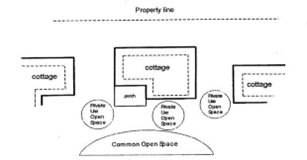
Private use open space should be contiguous to each cottage, for the exclusive use of the cottage resident, and oriented towards the common open space.
iv.
Pedestrian Connections. Connections with adjoining areas through attractive footpath connections is required.
4.
Parking Location, Refuse Containers, and Screening.
a.
Intent. To ensure minimal visual impact from vehicular use and storage areas for residents of the cottage housing development as well as adjacent properties, and to maintain the traditionally "single-family" character along public streets.
b.
Requirements. Parking shall be:
i.
Located on the cottage housing development property;
ii.
Screened from public streets and adjacent residential uses by landscaping and/or architectural screening;
iii.
Located in clusters of not more than five adjoining spaces;
iv.
Prohibited in the front yard setback area;
v.
Units may have a detached carport between or adjacent to structures but only when it is located toward the rear of the principal structure and is served by an alley or private driveway. Carport design must be coordinated with the design of the cottage unit;
vi.
A pitched roof design is required for all parking structures;
vii.
No outside storage is allowed within the carport structure. Enclosed storage is only allowed provided that it is constructed as part of the structure;
viii.
The town planner may approve other methods provided the intent of this section is met.
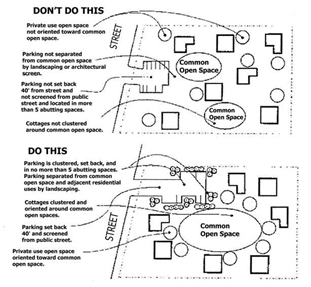
Avoid large clusters of parking, set parking back from the street, create functional common and private use open space, provide for screening of parking from cottages and common open space. The site should be designed with a coherent concept in mind.
c.
Requirements. Except for placement during collection, garbage cans and/or refuse bins of any sort shall be completely concealed from view.
5.
Community Buildings. A cottage housing development may contain a community building that is clearly incidental in use and related in size and architecture to the dwelling units. Such a community building shall be located on the same site as the cottage housing development and shall be commonly owned by the residents. A cottage housing development greater than six units shall contain a community building. Covered parking structures for multiple vehicles shall also be owned by the community. The community building may share a wall with a single cottage.
a.
A community building shall have no more than two thousand four hundred (2,400) square feet of net floor area, excluding attached garages.
b.
A community building shall have no minimum off-street parking requirement.
(Ord. No. 801, § 1(Exh. A), 5-27-2025)
Editor's note— Ord. No 801, § 1(Exh. A), adopted May 27, 2025, enacted a new § 16.10.080 as set out herein and renumbered the former § 16.10.080, which pertains to transient accommodation, as § 16.10.110. The historical notation has been retained with the amended provisions for reference purposes.
16.10.090 - Accessory uses.
The section establishes supplemental standards for regulating the placement and use of accessory buildings and structures in the Town of Coupeville. These uses shall be allowed only if a principal or conditional use is located on the lot.
A.
Accessory Buildings. Accessory buildings include attached or detached accessory dwelling units, garages, carports, greenhouses, storage units and other small buildings which are customarily incidental and subordinate to a principal residential, commercial or public/quasi-public use. The following supplemental standards shall apply.
1.
No accessory building shall be located within a street setback. This prohibition shall not apply to or prevent the restoration, reconstruction or rehabilitation of any accessory building designated as a contributing structure within the Ebey's Landing national historical reserve.
2.
An accessory building whose customary purpose is to house motor vehicles (such as a garage or carport) or to be used for the same purpose as the principal use (such as bonus rooms or additional retail space) shall be subject to the same required rear and side setbacks as the principal use.
3.
Accessory buildings other than those identified in subsection (2) of this section may be located within a rear or side setback, but no closer than five feet to a rear or side property line.
4.
In calculating permitted square footage for accessory buildings, the total of floor area shall be used, as defined in Section 16.04.060 of this chapter.
5.
For those zoning districts where animal keeping is a permitted use, accessory buildings for the housing of livestock, poultry or other animals for personal, noncommercial and commercial use shall maintain a minimum fifty-foot setback from all property lines. At the time of construction, these accessory buildings shall be at least one hundred (100) feet away from any principal use on neighboring lots.
6.
Any detached accessory building connected to the Town of Coupeville water and/or sewer service will be subject to application requirements and related fees as stated in Section 13.08.070—Application for water service and Section 13.12.050—Application for sewer service.
B.
Accessory Structures. Accessory structures include decks less than thirty (30) inches in height, satellite dishes and antennae serving the principal use, patios, swimming pools, household composting facilities, propane tanks, recreational equipment and other structures customarily incidental and subordinate to a principal residential, commercial or public/quasi-public use. The following supplemental standards shall apply:
1.
No accessory structure intended for permanent or semi-permanent attachment to the ground shall be located closer than five feet to a rear or side property line.
2.
No accessory structure greater than eighteen (18) inches in height shall be allowed within a street setback, and in no case shall an accessory structure be located closer than five feet to a street lot line.
(Ord. 614 § 4 Exh. D (part), 2001; Ord. 566 § 2 Exh. A (part), 1998)
(Ord. No. 772, § 1, 5-10-2022; Ord. No. 801, § 1(Exh. A), 5-27-2025)
Note— See editor's notes at § 16.10.060 and § 16.10.120.
16.10.100 - Home occupations.
This section establishes supplemental use standards to permit the limited use of residential property as a business, as advocated by the comprehensive plan. In accordance with the comprehensive plan, Class I and Class II home occupations shall be limited to those which are incidental to the primary residential use and do not change the residential character of the structure.
A.
Exemptions. The supplemental use standards in this section shall not apply to short- and long-term lodging facilities, including bed and breakfast inns, guest houses, group care facilities and residential rental properties. The requirements in Sections 16.10.080 and 16.10.100 may apply to these uses.
B.
Prohibited Home Occupations. The following activities are not allowed as home occupations:
1.
Medical, dental and veterinary offices;
2.
Vehicle and heavy equipment repair, painting, rent, storage and sale;
3.
Rental of space for indoor or outdoor storage;
4.
Outdoor activities, display or storage related to the home occupation except for plant nurseries.
C.
General Requirements. All home occupations, whether Class I or Class II, shall meet the following general requirements:
1.
Home occupations are required to have a valid certificate of occupancy issued by the Town of Coupeville.
2.
Home occupations shall be conducted entirely within the principal or accessory building.
3.
Home occupations shall be customarily incidental or secondary to the use of the property as a dwelling, and shall occupy not more than fifty (50) percent of the gross floor area of the dwelling unit.
4.
The operation of a home occupation shall not require structural alterations or appurtenances which are not seen typically in Coupeville residential architecture.
5.
Home occupations shall not generate noise, vibration, smoke, dust, odor, heat, glare, light or electrical interference that exceed levels customarily associated with residential use.
6.
Use of hazardous materials or equipment shall comply with requirements in the Uniform Building Code and Uniform Fire Code.
7.
Customer/client contact shall be limited to the hours between eight a.m. and eight p.m.
8.
No special lighting, banners, flags, balloons, streamers or other devices may be used to draw attention to the home occupation.
9.
Permits to operate home occupations shall not be transferable to other persons or locations.
D.
Class I Home Occupations. Class I home occupations are accessory uses to a residential principal use and are characterized as having a negligible impact on residential neighborhoods. In addition to meeting the general standards listed under subsection C of this section, Class I home occupations shall not exceed the following thresholds:
1.
Apart from very occasional exceptions, no customers or clients shall visit the home occupation.
2.
Deliveries and collections to and from the home occupation shall be limited to two per day.
3.
No individual not resident at the address of the home occupation shall be employed by the home occupation.
4.
No sign is permitted.
E.
Class II Home Occupations. Class II home occupations are accessory uses to a residential principal use, and are characterized as having a minor impact on residential neighborhoods. All proposed home occupations exceeding any of the Class I home occupation thresholds under subsection D of this section shall, in addition to meeting general standards under subsection C of this section, be subject to following standards:
1.
Class II home occupations require administrative approval in accordance with Section 16.06.050(C).
2.
One nonilluminated sign up to two square feet may be displayed. This sign must be attached flush to the principal or accessory structure in which the home occupation is located.
3.
A limited amount of schedule or drop-in visits by customers or clients may be permitted, so long as this activity does not detract from neighborhood residential character.
4.
Up to two employees not resident at the home occupation address may be employed, but in no case shall their hours of employment extend outside the twelve-hour period between eight a.m. and eight p.m.
5.
Off-street parking for nonresident employees shall include one space for each full-time equivalent employee. Nonresident employees shall not park in the public right-of-way.
(Ord. 566 § 2 Exh. A (part), 1998)
(Ord. No. 801, § 1(Exh. A), 5-27-2025)
Note— See editor's note at § 16.10.070.
16.10.110 - Transient accommodation.
This section provides supplemental standards for hotels, motels, bed and breakfast inns, and short-term rentals in zoning districts where these uses are permitted as principal or conditional uses.
A.
Hotels and Motels. Hotels are conditional uses within all commercial zoning districts (HCC, TC and GC). Motels are conditional uses within the general commercial (GC) zoning district only. Where allowed, the following supplemental standards shall apply:
1.
The number of allowed guest rooms is limited to one for every one thousand five hundred (1,500) square feet of useable area or ten (10) guest rooms, whichever is the smaller number.
2.
Cooking facilities are permitted in up to twenty-five (25) percent of the allowed number of guest rooms or suites. Except microwave ovens and coffee makers, cooking facilities of any type are prohibited in all other guest rooms.
B.
Bed and Breakfast Inns. Bed and breakfast inns are principal uses in all residential districts (RR, LDR, RM 9,600 and HDR) and in all commercial zoning districts (HCC, TC and GC). Where allowed, the following supplemental standards shall apply:
1.
No bed and breakfast inn shall operate or be advertised without having obtained a bed and breakfast inn license in accordance with Chapter 5.36. Evidence of operation includes, but is not limited to, advertising, online calendars showing availability, guest testimony, online reviews, rental agreements or receipts.
2.
All guest rooms shall be within quarters approved for habitation by the building official or designee.
3.
The owner/manager of the bed and breakfast inn shall reside on-site when guests are present.
4.
The number of guest rooms shall be limited to no more than two in the RR, LDR, MDR and HDR zoning districts, and to no more than eight in the HCC, TC and GC zoning districts.
5.
Guest rooms and accessory buildings within which guest rooms are located shall be devoid of cooking facilities of any type except microwave ovens and coffee makers.
6.
Where Chapter 16.12 requires off-street parking for the associated residence, one additional off-street parking space shall be provided for each guest room and full-time equivalent employee not resident at the inn.
7.
In residential zones, onsite meals and beverages may be served to room guests only. Food service, if provided, shall comply with Island County Health Department rules and permitting.
8.
One non-exempt sign per bed and breakfast inn is permitted, subject to Chapter 16.28.
9.
Accessory uses, buildings and structures associated with bed and breakfast inns located in the HR, MDR, LDR and RR zoning districts shall be limited to those customarily associated with single-household residences and subject to the regulations of the zoning district.
10.
The operation of a bed and breakfast inn within or adjacent to residential districts shall not infringe upon the right of neighboring residents to reasonable peaceful occupancy of their homes.
11.
Bed and breakfast inns shall comply with requirements of adopted building codes for smoke and carbon monoxide detectors and egress windows in all guest rooms. The operator shall maintain a functioning fire extinguisher with a minimum 2A-10BC rating located on a means of egress route, as approved by the building official or designee. The means of egress route shall be posted in each guest room in a readily visible location.
C.
Short-term Rentals. Short-term rentals are principal uses within all commercial zoning districts (HCC, TC and GC). Where allowed, the following supplemental standards shall apply:
1.
No short-term rental shall operate or be advertised without having obtained a short-term rental license in accordance with Chapter 5.38. Evidence of operation includes, but is not limited to, advertising, online calendars showing availability, guest testimony, online reviews, rental agreements or receipts.
2.
Short-term rentals that were legally established prior to December 1, 2019, in any residential zone may continue as nonconforming uses, subject to all other applicable requirements, until the short-term rental use is determined discontinued for a period of one year or abandoned. Failure to submit a complete application for a short-term rental license for two consecutive calendar years shall constitute prima facie evidence of intent to abandon. In all cases, it shall be the property owner's responsibility to provide evidence of legal establishment and continued use.
3.
Where consistent with all applicable regulations and permitting and licensing requirements, a short-term rental may occupy any dwelling unit approved for habitation by the building official or designee.
4.
Signage shall be subject to the provisions of Chapter 16.28.
5.
Outdoor amplified sound is prohibited.
6.
Adjacent to any residentially zoned property, use of a short-term rental for meetings, hosted parties, weddings, commercial functions, or similar events is prohibited.
7.
Recycling and refuse containers shall be provided and screened from the public right-of-way. Refuse collection through the Town's contract waste hauler is required.
8.
A local contact shall be designated who is able to respond twenty-four (24) hours a day, seven days a week, to any complaints or issues at the property licensed as a short-term rental. The local contact shall reside on Whidbey Island within twenty (20) road miles of the town limits while guests are in residence at the short-term rental. The name and contact information for the local contact shall be posted in a conspicuous location within the short-term rental. The local contact shall contact the town planner by email within twenty-four (24) hours following any public complaint with a description of the complaint, contact information for the complainant, and the resolution.
9.
Short-term rentals shall comply with requirements of adopted building codes for smoke and carbon monoxide detectors and egress windows in all sleeping rooms. The operator shall maintain a functioning fire extinguisher with a minimum 2A-10BC rating located on a means of egress route, as approved by the building official or designee. The means of egress route shall be posted in each guest room in a readily visible location.
10.
A copy of the rental agreement listing all applicable standards shall be posted in prominent place within the short-term rental. Rental agreements shall include, at a minimum:
a.
Contact information for the local contact.
b.
A copy of the short-term rental license and all applicable standards and conditions.
c.
The number of guests and vehicles. Neither shall exceed the maximum number in the short-term rental license.
d.
Notice that quiet hours are from ten p.m. to seven a.m.
(Ord. 604 § 2, 2000; Ord. 566 § 2 Exhs. A (part), B (part), 1998)
(Ord. No. 751, § 6, 8-27-2019; Ord. No. 801, § 1(Exh. A), 5-27-2025)
Note— See editor's note at § 16.10.080.
16.10.120 - Manufactured housing units and manufactured housing parks.
A.
Intent and Purpose. The purpose of this section is to:
1.
Allow for the establishment of manufactured homes when, and only when, contained within a manufactured housing park, manufactured housing subdivision, or in designated residential districts;
2.
Provided that such developments are designed with the protection of the natural environment in mind; and
3.
Provided that the historic and rural character of the town is preserved.
B.
General Requirements.
1.
No manufactured home shall stand in the open on any property for more than ten (10) days, nor shall a manufactured home be used as a place of habitation or business for any period of time, except in a manufactured housing park, a manufactured housing sales lot, a single manufactured home on a residential lot, a temporary shelter on a construction site, or as a watchman's quarters on commercial sites, industrial sites, or on school sites.
2.
It is unlawful for any person to construct, maintain or operate either a manufactured housing park or a manufactured housing sales lot, or to maintain a single manufactured home as a temporary shelter on a construction site, or as a watchman's quarters on commercial sites, industrial sites, or on school sites, or to make a major change or alteration in a manufactured housing park or a manufactured housing sales lot for which town council approval has already been obtained, without first obtaining a conditional use permit from the Town as specified in this chapter.
C.
Manufactured Housing Parks.
1.
Permitted Locations. Unless otherwise provided herein, upon compliance with applicable regulations and processes, manufactured housing parks shall be permitted in the high density residential district by a conditional use permit.
2.
Design Standards. The following standards and requirements shall govern the design of a manufactured housing park:
a.
A manufactured housing park shall be not less than two and one-half acres.
b.
Spaces within a manufactured housing park shall contain a minimum of three thousand (3,000) square feet, for a single-width twelve-foot unit with a minimum width of forty (40) feet, or four thousand eight hundred (4,800) square feet for a double-width unit with a minimum width of sixty (60) feet, with a maximum occupied area of forty (40) percent of such space. Total density shall be determined by the use zone that the park is located in.
c.
Only one manufactured home shall be permitted on any space.
d.
No building, structure, or land within the boundaries of a manufactured home park shall be used for any purpose, except as follows:
i.
Manufactured homes shall be used as residences only, together with the normal accessory uses such as patio, carport, garage, storage and washroom buildings;
ii.
Community recreation facilities, including swimming pool, for the residents of the park and guests;
iii.
One residence for the use of a manager or caretaker responsible for maintaining or operating the property.
e.
All structures in a manufactured housing park shall be located a minimum of twenty (20) feet from any property line abutting upon a public street or highway and at least ten (10) feet from any other boundary line defining the outside limits of the park.
f.
A manufactured home or accessory building shall not be located closer than ten (10) feet from any other manufactured home or accessory building or closer than ten (10) feet from any roadway lot line. Manufactured home accessory buildings when not attached to the manufactured home, shall not be closer than ten (10) feet from such home.
g.
Attached structures shall be considered part of the manufactured home for setback purposes.
h.
All spaces shall be provided with a foundation base which shall be improved to provide adequate support for the placement of a manufactured home, in accordance with Town standards.
i.
Two off-street parking spaces shall be provided at each manufactured home space, with a minimum access of ten (10) feet to a park street. Also, additional parking spaces shall be provided in parking areas distributed around the park, which shall be not less than one parking space per five homes. All off-street parking spaces are to be all-weather surfaced and be a minimum of nine feet by nineteen (19) feet per parking space.
j.
Adequate street lighting shall be provided within the park.
k.
All utilities shall be installed underground.
l.
Buffering or screening shall be sight-obscuring fence, wall, evergreen shrubs or other suitable planting, at least six feet high and it shall be maintained.
m.
Swimming pools shall be set back at least fifty (50) feet from any park boundary line and shall be surrounded by a fence which shall be at least seven feet high and shall not obscure vision.
n.
There may be landscaping within open areas of the manufactured home park not otherwise used for park purposes. Such open areas and landscaping shall be continually and properly maintained.
o.
Storage areas for recreational vehicles, boats or trailers shall be provided. A six-foot-high sight-obscuring fence with a lockable gate shall be erected around the perimeter of such storage areas. Parking of recreational vehicles shall not be allowed other than in approved storage areas.
p.
All vehicular ways shall be based, graded, and paved with asphalt or concrete. The speed limit shall be set at ten (10) miles per hour, and notice of said speed limit shall be given by placement of appropriate signs. Surfaced widths of streets shall be a minimum of twelve (12) feet per traffic lane with a minimum of two lanes. When parking along the street is allowed, six additional feet on each lane, where parking is allowed, shall be surfaced.
3.
Development Plan.
a.
Application for Development Permit.
i.
No land shall be developed for use as a manufactured home park and no plan for such park shall be filed or recorded, until the plan has been submitted and approved by the town council.
ii.
The requirements and standards set forth in this chapter are the minimum standards to which a manufactured home park must conform for approval.
iii.
All applications submitted for approval of a manufactured home park shall consist of twelve (12) copies of the development plan. Such plan shall be submitted twenty-one (21) days before the meeting at which the plan will be reviewed, and shall contain, as a minimum, the following information:
(A)
Name of the person who prepared the plan;
(B)
Names of all persons owning and managing the land proposed for the park development;
(C)
Name and address of the proposed manufactured home park;
(D)
Scale and north point of the plan;
(E)
Boundaries and dimensions of the manufactured home park, and number of acres included;
(F)
Vicinity map showing relationship of the development to adjacent properties;
(G)
Location and dimensions of each space, with each space designed by number or other designation;
(H)
Location and dimensions of each existing or proposed building;
(I)
Location and width of streets and pedestrian ways;
(J)
Location of each lighting fixture for exterior lighting;
(K)
Location of recreational and other common areas;
(L)
Location and type of landscaping, fences, walls and other screening structures;
(M)
Location, arrangement and design of all parking facilities;
(N)
Location of fire hydrants;
(O)
Enlarged plot plan of a typical space, showing location of foundation base, storage space, parking, utility connections and other improvements;
(P)
Topography of the park site with contour intervals of not more than two feet, and a drainage plan;
(Q)
A survey plat of the property, plans of structures to be constructed, public water system and sewage approved by appropriate governmental agencies, and garbage disposal provisions.
b.
Plan Approval. Upon application for the development of a manufactured housing park, and conformance to the requirements of submission of the plan for such development, and upon such review and public hearing as may be otherwise required by law, the town council shall reach a decision relative to the plan, as follows:
i.
Reject the plan, and provide the developer with a list of specified reasons for such action;
ii.
Withhold approval of the plan subject to specified conditions which shall be met prior to approval;
iii.
Accept and approve the development of the manufactured housing park.
Approval of such plan shall expire one year from the date of approval, unless the plan is substantially implemented. Any interested person may appeal a decision of the town council.
4.
Park Administration.
a.
It shall be the responsibility of the park owner and manager to assure that the provisions of this chapter are observed and maintained within the manufactured housing park. Violations of this chapter shall subject both the owner and the manager of the facility to any penalties provided for such violation. The owner, or a designated agent, shall be available and responsible for the direct management of the manufactured housing park.
b.
No travel trailer or recreational vehicle shall be used except as temporary living quarters, which use shall not exceed a maximum of thirty (30) days per year.
c.
Manufactured homes and accessory structures installed in the manufactured home park shall be required to conform to the following installation requirements:
i.
Construction of accessory structures shall be subject to requirements of the building official, and necessary permits and inspections shall be obtained, if required, for such construction.
ii.
All manufactured homes shall be installed with blocking supports conforming to standards of the NFPA.
iii.
All manufactured homes shall have compatible foundation facia of fire and weather resistant material, which must be properly maintained.
iv.
Accessory structures shall be in compliance with town building codes.
v.
Prior to the location, relocation, establishment or occupancy of any manufactured home, the owner, or the authorized representative of the owner, shall secure a permit for such action from the building official as follows:
(A)
Application for such a permit shall be made on forms prescribed by the building official.
(B)
The fee for such a permit shall be established by the town council. This fee shall be in addition to fees required for other necessary permits.
(C)
Applicants shall be required to:
(1)
Provide plot plan;
(2)
Submit to an on-site inspection consisting, as applicable, of setbacks (property corner stakes shall be in place), anchoring system, foundation, utility connections, and accessory structures;
(3)
Provide the building official with a copy of the manufacturer's HUD-approved installation instructions, if applicable.
d.
All electrical connections to each manufactured home shall comply with the town electrical code and shall be inspected. All sewage connections to manufactured homes shall be provided in a manner conforming to the town plumbing codes.
e.
Portable fire extinguishers, rated for classes A, B and C shall be kept in service buildings and other locations, as required by town codes.
f.
The park shall be maintained free of any brush, leaves and weeds in which might communicate fires between manufactured homes and other improvements. No combustible materials shall be stored in, around or under any manufactured home.
g.
The building official shall inspect each park annually, prior to licensing, and submit to the park owner and manager a written report stating whether or not the park is in compliance and listing any repairs which may be required prior to issuance of any annual license renewal. An extension of time to complete repairs may be granted if no risk to public health or safety is created by such extension.
h.
Centrally located individual mail boxes shall be provided for each space in the park.
i.
Refuse shall be collected and disposed of on a regular and sanitary basis.
5.
All manufactured homes shall be anchored as required by the standards of the Department of Housing and Urban Development or NFPA Pamphlet No. 501A, 1977 Edition, whichever is the more restrictive.
(Ord. 566 § 2 Exhs. A (part), B (part), 1998)
(Ord. No. 692, § 12, 10-3-2011; Ord. No. 801, § 1(Exh. A), 5-27-2025)
Editor's note— Ord. No 801, § 1(Exh. A), adopted May 27, 2025, renumbered the former § 16.10.090 as § 16.10.120. The historical notation has been retained with the amended provisions for reference purposes.
16.10.130 - Special needs lodging and care facilities.
This section provides supplemental standards for special needs lodging and/or care and to reflect the intent of the Coupeville comprehensive plan. The plan encourages a variety of housing densities and types, promotes nondiscriminatory regulations for group homes and supports private sector efforts to provide housing for elderly and disabled citizens. In addition to meeting the specific requirements of the applicable zoning district, these uses shall meet the following supplemental standards:
A.
All Special Needs Lodging and Care Facilities. The following standard shall apply to all special needs lodging and care facilities discussed in this section:
1.
All special needs facilities shall be in conformance with applicable federal, state and local licensing requirements, including the locally adopted edition of the International Building Code and Fire Code.
2.
Each facility shall have an approved Town of Coupeville certificate of occupancy.
3.
The design of each facility is subject to the standards and procedures specified in Chapter 16.13 CTC and the adopted Ebey's Landing National Historical Reserve Design Guidelines.
B.
Adult Family Homes. This section provides supplemental standards for locating adult family homes in residential zoning districts.
1.
No more than six adults who are not related by blood or marriage to the person or persons providing care may be resident at any time.
C.
Group Care Facilities. This section provides supplemental standards for foster family homes, group homes and halfway houses licensed by the State Department of Social and Health Services and operated on a twenty-four-hour basis.
1.
Classes of Group Care Facilities. This section establishes two classes of group care facilities.
a.
Class I. Class I group care facilities are accessory uses within all residential zoning districts and are limited to two residents for each group care facility.
b.
Class II. Class II group care facilities are conditional accessory uses in the RR, LDR and MDR zoning districts, and are accessory uses in the HDR zoning district. No Class II group care facility may be located within one thousand (1,000) feet of another Class II group care facility located in a residential zoning district and shall not house more than five residents in care.
D.
Continuing Care Retirement Facilities. This section provides supplemental standards regulating the development of residential living areas for senior citizens. These facilities provide a range of continuing care services, including independent living (single-household and multifamily), congregate care, assisted care and extended care.
1.
Permitted Principal Facilities. Continuing care retirement facilities may include any of the following, or a combination thereof:
a.
Independent single-household dwellings;
b.
Independent duplex dwellings;
c.
Independent multifamily dwellings;
d.
Congregate care facilities;
e.
Assisted care facilities;
f.
Extended care facilities.
2.
Permitted Accessory Facilities. The following uses are permitted accessory uses to the principal uses listed under subsection (D)(1) of this section:
a.
Maintenance buildings and structures;
b.
Garages, carports and off-street parking areas;
c.
Private noncommercial greenhouses;
d.
Common meeting and activity buildings;
e.
Small-scale support businesses contained within the grounds (such as personal care, gift shop, florist, etc.);
f.
Other uses customarily accessory to such facilities.
3.
Maximum Densities. The following maximum densities are established for each type of principal use:
a.
Independent single-household dwellings—One dwelling unit per nine thousand six hundred (9,600) square feet of useable area.
b.
Independent duplex dwellings—One dwelling per five thousand (5,000) square feet of usable space.
c.
Independent multifamily dwellings—One dwelling unit for each four thousand (4,000) square feet of gross lot area.
d.
Congregate care facilities—One dwelling unit for each two thousand five hundred (2,500) feet of gross lot area.
e.
Assisted care and extended care facilities—One room for each two thousand (2,000) square feet of gross lot area.
(Ord. 566 § 2 Exhs. A (part), B (part), 1998)
(Ord. No. 692, § 12, 10-3-2011; Ord. No. 801, § 1(Exh. A), 5-27-2025)
Editor's note— Ord. No 801, § 1(Exh. A), adopted May 27, 2025, renumbered the former § 16.10.100, as § 16.10.130. The historical notation has been retained with the amended provisions for reference purposes.

