12 - DEVELOPMENT STANDARDS1
Editor's note— Ord. No. 692, § 13, adopted Oct. 3, 2011, changed the title of Ch. 16.12 from "Development and design standards" to "Development standards."
The purpose of this chapter is to establish general dimensional, design and use standards for development within the Town of Coupeville, thereby reflecting the intent of the Coupeville comprehensive plan. The comprehensive plan supports new development which is compatible with existing neighborhoods, promotes enhancement of unique neighborhood characteristics, and encourages community design standards that are in keeping with a small town atmosphere.
(Ord. 566 § 2 Exh. A (part), 1998)
A.
No building, structure or land shall hereafter be used or occupied, and no building or structure or part thereof shall hereafter be erected, constructed, reconstructed, moved or structurally altered unless in conformity with all of the regulations herein specified for the zoning district in which it is located.
B.
No building or other structure shall hereafter be erected or altered:
1.
To exceed the height;
2.
To accommodate or house a greater number of families;
3.
To occupy a greater percentage of lot area;
4.
To have narrower or smaller setbacks; than herein required; or in any other manner contrary to the provisions of this title.
C.
No part of a setback, or other open space, or off-street parking or loading space required about or in connection with any building for the purpose of complying with this chapter shall be included as part of a setback, open space or off-street parking or loading space similarly required for any other building.
D.
No setback or lot existing at the time of passage of the ordinance codified in this title shall be reduced in size or area below the minimum requirements set forth herein. Setbacks or lots created after the effective date of said ordinance shall meet minimum requirements established by this chapter.
E.
Wherever there is a conflict between this chapter and other chapters pertaining to the regulation of property within the Town, the most restrictive regulations shall apply.
(Ord. 566 § 2 Exh. A (part), 1998)
This section establishes minimum setbacks from lot lines and streets.
A.
Minimum Setbacks. Unless reduced for any of the reasons noted in subsections C and D of this section, minimum setbacks shall be maintained as provided by district in the following table:
B.
Calculating Required Setbacks.
1.
In the case of double frontage lots, street setbacks shall be provided on all frontages.
2.
In the case of corner lots, a second street setback of half the depth required generally for street setbacks in the district shall be provided on the other frontage.
3.
In the case of corner lots with more than two frontages, the town planner shall determine the street setback requirements, subject to the following limitations:
a.
At least one street setback shall be provided having the full depth required generally in the district.
b.
No other street setback on such lot shall have less than half the full depth required generally.
4.
Depth of required street setbacks shall be measured at right angles to a straight line joining the foremost points of the side lot lines. The foremost point of the side lot line, in the case of rounded property corners at street intersections, shall be assumed to be the point at which the side and front lot lines would have met without such rounding.
5.
Width of a required side setback shall be measured in such a manner that the setback established is a strip of the minimum width required by district regulations, with its inner edge parallel to the side lot lines.
6.
No building shall encroach within five feet of a dedicated access or utility easement.
C.
Rear and Side Setback Reduction in Certain Circumstances. Upon written approval of the town planner, the rear or side minimum setbacks, as noted in Section 16.12.030A., may be reduced up to fifty (50) percent. The presence of one or more of the following circumstances may justify the granting of a setback reduction:
1.
Unusual topography, where strict adherence to the minimum required setback may require extensive grading and filling or threaten unstable slopes;
2.
Irregular lot shape;
3.
Retention of natural vegetation, where granting relief from the minimum required setback would preserve desirable landscape features;
4.
View consideration, for any property owner other than the one for whom the setback reduction is requested.
5.
When the reduction is necessary to comply with the Ebey's Landing National Historical Reserve Design Guidelines and for alterations, rehabilitations, and reconstruction of historic buildings or structures or to facilitate and promote implementation of the guidelines for new construction.
D.
Street Setback Reduction. Upon written approval of the town planner, the minimum street setback may be reduced if, by granting the reduction, the street setback will be consistent with the historical street setbacks of adjacent development or when the reduction is necessary to comply with the Ebey's Landing National Historical Reserve Design Guidelines for alterations, rehabilitations, and reconstruction of historic buildings or structures. In no case shall the street setback be reduced to allow encroachment into the sight distance triangle.
E.
Projections into Required Setbacks. The following structures may project into required front, side or rear yards:
1.
Paved terraces may project into required front, side or rear setbacks provided that no structures placed there shall violate other requirements of this title.
2.
Unroofed landings, decks and stairs may project into required front and rear setbacks only, provided that no portion other than a light handrail shall extend higher than forty-two (42) inches above the finished grade level.
3.
Window sills, belt courses, cornices, eaves and similar incidental architectural features may project not more than two feet into any required setback.
4.
Open fire escapes may project not more than four feet six inches into any required setback.
F.
Fences. Fences may be constructed at the lot line; provided, however, that front yard fences over three and one-half feet high in any residential zoning district shall meet the front yard setback required in the district in which the lot is located.
(Ord. 566 § 2 Exh. A (part), 1998)
(Ord. No. 692, § 13, 10-3-2011)
This section provides development standards for lot area, lot width and lot coverage.
A.
Standards. Minimum lot area, minimum lot width and maximum lot coverage are described in the table below for all zoning districts in the Town of Coupeville.
B.
Measuring Lot Coverage. For all zoning districts, lot coverage shall include the combined area of the principal building along with all accessory buildings and structures greater than forty-two (42) inches in height. For the residential reserve (RR) and low density residential (LDR) zoning districts only, lot coverage shall be the combined total of all impervious surfaces.
C.
Useable Area. That portion of a lot or parcel physically suited for supported buildings. Lands not considered useable area includes, but is not limited to, tidelands, shorelines, bluffs, unstable slopes, wetlands, areas of poor drainage, dedicated accessways providing vehicle access to back lots, and areas devoted solely to utility purposes such as stormwater detention ponds.
(Ord. 566 § 2 Exh. A (part), 1998)
This section establishes maximum allowable heights by zoning district, and provides for exemptions for customary appurtenances.
A.
Maximum Height by Zoning District. The table below establishes a maximum allowable height for all zoning districts in the Town of Coupeville.
B.
Exemptions. The height limitations contained in this title do not apply to spires, belfries, cupolas, chimneys, antennas, water tanks, ventilators, elevator housing, other structures placed above the roof level, or when a height in excess of twenty-eight (28) feet is necessary to comply with the Ebey's Landing National Historical Reserve Design Guidelines for alterations of historic buildings and structures, provided, however, that no structure or portion of any structure hereafter erected shall interfere with Federal Aviation Administration Regulations on airport approaches.
C.
Measuring Height. Height shall be measured from the vertical datum as defined in the "Definitions" section of this title.
(Ord. 615 § 1, 2001; Ord. 566 § 2 Exh. A (part), 1998)
(Ord. N0. 677, § 7, 10-13-2009; Ord. No. 692, § 14, 10-3-2011)
These standards are established in part to implement the comprehensive plan direction to ensure that commercial and high density residential development is compatible with Coupeville's small town character.
A.
Landscaping. Minimum standards for the provision of landscaping in commercial, public and high density residential districts are provided in the table below:
1.
Nonconforming Parcels. Parcels of land developed prior to the adoption of the landscaping standards in subsection A of this section shall be considered to be legally nonconforming with respect to the requirements of this section, subject to the following:
a.
A change in use shall not trigger the landscaping requirements in this section.
b.
Development applications for a greater than fifty (50) percent increase in building footprint on these nonconforming parcels shall be accompanied by a landscaping plan covering a minimum of five percent of the useable area of the parcel or parcels.
2.
Landscaping Plans. All landscaping plans submitted in fulfillment of the requirements of this section shall be approved by the town planner and installed prior to obtaining a certificate of occupancy. A bond or other surety may be approved to delay planting to a more favorable planting season.
B.
Recreation Space. This section is intended to provide recreation areas for high density residential uses, to separate such areas from automobile-oriented space, and enhance the residential environmental quality of multiple family residential uses.
1.
A minimum of three hundred (300) square feet of recreation area shall be provided per each dwelling unit, including those used by the owner or building management personnel. No part of the area may be used for driveway, parking or other automobile use.
2.
One outdoor main activity, such as a swimming pool or tennis court, may not cover more than twenty-five (25) percent of the total recreation space.
C.
Exterior Appearance. For all commercial, public/quasi-public and high density residential zoning districts, the following exterior appearance requirements are established:
1.
Garbage cans and/or refuse bins of any sort shall be completely concealed from view from public streets and rights-of-way;
2.
Fences should be constructed of wood finished with natural color, stone or masonry.
(Ord. 566 § 2 Exh. A (part), 1998)
This section implements the comprehensive plan goals and policies which call for the provision and maintenance of adequate parking for commercial, public/quasi-public and residential land uses. This section also implements the Ebey's Landing National Historical Reserve Design Guidelines.
A.
Intent and Purpose. It is the intent of these regulations to provide for off-street parking for employees, customers, and residents in the Town of Coupeville. This will relieve on-street congestion and provide safe and convenient access to private properties.
B.
Applicability. In all zoning districts, there shall be provided at the time of the construction of any main building or at the time of the alteration, enlargement or any change in use of any main building, permanently maintained off-street parking facilities for the use of occupants, employees or patrons of such building and it shall be the joint and several responsibility of the owner and/or occupant of any main building or structure to provide, and thereafter maintain, the minimum number of free off-street parking facilities, as described in subsection C of this section.
C.
Parking Requirement by Land Use. The prescribed minimum numbers of parking spaces to be provided by type of land use are shown in the table below:
1.
Single-family dwellings, two-family dwellings, guest homes: two spaces per dwelling unit.
2.
Multifamily dwellings: one and one-half spaces per dwelling unit.
3.
Adult family homes, group homes: two spaces per dwelling unit plus one space for every three residents in care.
4.
Hotels, rooming houses, other structures containing sleeping rooms: two spaces per every three sleeping rooms.
5.
Motels: one space per sleeping room, plus one space per employee.
6.
Mortuaries, funeral homes: ten spaces, or one space for each one hundred fifty (150) feet of gross floor area up to maximum of seventy (70) spaces, whichever is greater.
7.
Churches, theaters, auditoriums: one space for every five seats in the principal place of assembly.
8.
Public buildings, community centers, public libraries, art galleries, museums, post offices, telephone offices: one space for each employee, plus one space for each official vehicle, plus one visitor parking space for each one thousand (1,000) square feet of office or display space.
9.
Assembly, fraternal, exhibition halls: one space for each employee plus one space for each fifty (50) square feet of floor area used for assembly, exhibition or dining.
10.
Vocational and music schools, dances studios and other private schools and colleges for nonacademic instruction: one space for each instructor and for each student, based upon the average number of students attending class at one time.
11.
Hospitals, sanitariums, nursing and rest homes: one space for each resident and staff doctor, plus one space for each employee per shift, intern and nurse, plus one space for each five beds, plus one space for each institutional vehicle.
12.
Continuing care retirement facilities: one space for each employee per shift, plus one space for each residential unit, plus one space for each institutional vehicle.
13.
Day care facilities, home and private kindergartens: one space for each staff member and employee plus one space for each one thousand (1,000) square feet of gross floor area.
14.
Elementary schools, junior high schools: one space for each employee plus one space for every twenty-five (25) employees.
15.
Senior high schools: one space for every seven pupils plus one space per employee.
16.
Office buildings, banks, savings and loan companies, similar institutions: one space for each two hundred (200) feet of gross floor area.
17.
Medical office buildings, veterinary offices: one space for each one hundred fifty (150) square feet of gross floor area.
18.
Bowling alleys: six spaces for each alley.
19.
Restaurants, cafes, eating and drinking establishments: one space for each one hundred (100) square feet of gross floor area.
20.
Beauty and barber shops: one space for each one hundred twenty-five (125) square feet of gross floor area.
21.
Laundry and dry cleaning establishments: one space for each employee plus one space for each five hundred (500) square feet of gross floor area.
22.
Self-service laundry and dry cleaning establishments: one space per each four washing machines and/or dry cleaning machines.
23.
Household services and trades such as carpentry, electrical servicing, plumbing and heating shops, paper hanging, painting, furniture upholstering, decorating shops, and other similar establishments: one space for each employee plus one space for each company vehicle, plus one space for each five hundred (500) square feet of floor space.
24.
Filling stations: three spaces for each working bay.
25.
Grocery stores, delicatessens, drugstores, pharmacies: one space per two hundred fifty (250) square feet of gross floor area.
26.
Nurseries and greenhouses: one space for each employee plus four spaces for customer parking.
27.
Shopping centers: one space for each two hundred (200) square feet of gross floor area.
28.
Retail and wholesale stores of nonbulky items: one space for each three hundred (300) square feet of gross floor area.
29.
Retail and wholesale stores of bulky items (e.g., furniture, major appliances, automobiles): one space for each six hundred (600) square feet of gross floor area.
30.
Warehouse, wholesale, retail and commercial storage: one space for each employee, plus one space for each company vehicle, plus two spaces, but a total of no less than four spaces.
D.
Interpretation. When a parking requirement is stated in terms of employees, it means the maximum number of employees who will be at the site at one time either on a single shift or an overlap of shifts. In figuring the total parking requirement for a use, any fraction of one-half or more shall require one more space. When a building, existing at the effective date of the ordinance codified in this title, is enlarged so as to require additional parking spaces to conform to these parking requirements, such additional spaces shall be provided; however, the number of such additional spaces shall be computed with regard only to the extent of the enlargement, regardless of whether or not the number of previously existing spaces satisfies the requirements of this section.
E.
Exemptions.
1.
In that area of Coupeville enclosed by Alexander Street, Coveland Street, Ninth Street NE and Haller Street, the following exemptions apply in accommodating parking:
a.
In the historic Front Street area bounded by Coveland on the South, Alexander Street on the West, Main Street on the East, and extending into Penn Cove to include the Coupeville Wharf, the minimum required parking standards contained in this section shall not apply.
b.
In the portion of the historic/limited commercial district east of Main Street, off-street parking and loading requirements shall be set on a case-by-case basis by the planning commission at a public meeting, using the requirements in this section as a guide. The planning commission may establish maximum as well as minimum parking requirements. In reviewing specific project proposals, the planning commission shall consider minimizing the impacts of parking location and design on the pedestrian environment and on adjacent properties, and shall seek to maintain the historic residential character of this area through the retention or re-establishment of residential-scale landscaping within and around proposed parking areas.
2.
All commercial use of a designated historic residential building or structure within the town commercial or general commercial zoning districts shall be exempt from off-street parking requirements. If parking facilities are provided on the site of a historic building or structure, the parking facilities must meet the design requirements established in the adopted Ebey's Landing National Historical Reserve Design Guidelines.
F.
General Provisions.
1.
It shall be a continuing obligation of the owner of property, for which parking spaces are required by this chapter, to provide the required off- street parking and loading facilities. Building permits or other permits will be issued only after receipt by the building official of site plan drawn to scale showing the location of permanent parking and loading facilities.
2.
Required parking spaces shall be available for parking of vehicles of residents, customers, patrons and employees only, as the case may be, and shall not be used for storage of vehicles or materials or for the parking of vehicles used in conducting the business or use to which the property is put, and shall not be used for the sale, repair or servicing of any vehicle.
3.
Off-street parking and loading facilities shall be provided prior to occupancy of any structure hereafter built or enlarged, or prior to a change in the category of use of any land. No certificate of occupancy will be issued until the requirements of this chapter are satisfied.
4.
Any use of property which, on the effective date of the ordinance codified in this title or any amendments hereto, is nonconforming as to the regulations relating to off-street parking facilities may continue to be used in the same manner as if the facilities were conforming. Such existing parking facilities shall not be further reduced.
5.
Off-street parking spaces existing on the effective date of the ordinance codified in this title and actually being used for the parking of automobiles or other motor vehicles in connection with the use of an existing building shall not be reduced in number or size during the entire life of such building or land use below that which would be required for a new building or land use of a similar type constructed or commenced after the effective date of said ordinance.
6.
Any spaces required by the Uniform Building Code for handicapped person shall be in addition to the number of spaces required by this section.
G.
Design Standards.
1.
Each parking space shall contain not less than one hundred seventy-one (171) square feet in area exclusive of access and circulation aisles, except for compact car spaces as noted below.
2.
All parking lots shall be provided with a paved surface. The town planner may approve in writing a nonpaved surface for some parking areas when the primary use will be for employees only. To qualify for this exception, use of individual parking spaces shall typically be limited to one vehicle per day per space, and shall not otherwise effect public health, safety and welfare.
3.
Required parking areas shall not be used for sales display, dead storage, repair work or any purpose other than parking.
4.
Lighting of parking lots shall be arranged to reflect away from public rights-of-way and from any adjoining residential area.
5.
Curb cuts shall be located so as to avoid traffic hazards and shall be approved by the public works inspector.
6.
Twenty-five (25) percent of parking space requirement may be designed for "compact car." Such space may not be less than eight feet five inches wide or fourteen (14) feet five inches in length and shall be labeled "compact car."
7.
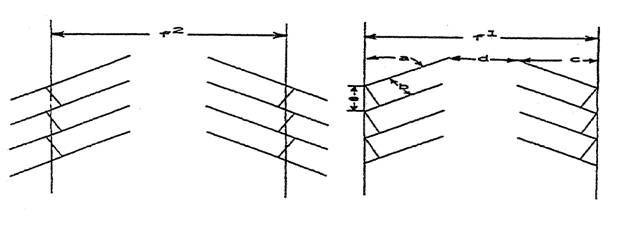
Parking lot design shall conform to the dimensions of the parking diagram contained in Plates A and B.
Parking Diagram (A)
For two-way circulation, the minimum aisle width shall be twenty-two (22) feet, adequate ingress, egress and turnaround space shall be provided. No portion of a parking space or aisle shall be located in a required landscaped yard.
Parking Diagram (B)
H.
Off-Street Loading. Every building or structure used for business, trade or industry and normally requiring truck loading or unloading with respect to the use shall provide space as herein indicated for the loading and unloading of vehicles off the street or public alley. Off-street loading and unloading space shall not be used or designed, intended or construed to be used in a manner to obstruct or interfere with the free use of any street or adjoining property. The minimum off-street loading and unloading space required for specific uses shall be as follows:
1.
Retail business and service establishments shall provide one off-street loading and unloading space at least ten (10) feet wide and thirty-eight (38) feet long with a fourteen (14) foot height clearance per building.
2.
Trucking terminals and ship terminals shall provide one off-street loading and unloading space for every five thousand (5,000) square feet of total floor area used for storage, warehousing and shipping. Each loading space shall be a minimum of fourteen (14) feet wide and sixty-five (65) feet long with a fourteen (14) foot height clearance.
(Ord. 566 § 2 Exh. A (part), 1998)
(Ord. No. 702, § 1, 4-24-2012)
A.
To Ensure the Effective Installation of Electrical Vehicle Charging Stations. Where any other provisions of the Coupeville Municipal Code directly conflict with this chapter, this chapter shall control. Where no conflict exists, all other Town Code provisions shall be in force as to electric vehicle charging stations as applicable.
B.
Level 1 and 2 electrical vehicle charging stations are allowed outright in all residential zones. Level 1 and 2 electrical vehicle charging stations are allowed in all commercial or public/quasi-public zones. Level 3 rapid charging stations are allowed outright in public rights-of-way. Level 3 rapid charging stations are allowed within a commercial or public/quasi-public zones with the approval of an administratively issued conditional use permit.
C.
An electronic vehicle charging station is a public or private parking space(s) that are served by battery charging equipment with the purpose of transferring electric energy to a battery or other energy storage device in an electrical vehicle and is classified based on the following levels:
1.
Level 1 is considered slow charging and operates on a 15 to 20 amp breaker on a 120 volt AC circuit.
2.
Level 2 is considered medium charging and operates on a 40 to 100 amp breaker on a 208 or 240 volt AC circuit.
3.
Level 3 is considered fast or rapid charging and operates on a 60 amp or higher breaker on a 480 volt or higher three phase circuit with special grounding equipment. Level 3 stations can also be referred to as rapid charging stations that are typically characterized by industrial grade electrical outlets that allows for faster recharging of electrical vehicles.
D.
Electric vehicle charging stations utilizing parking stalls located in parking lots or parking garages or on-street parking spaces shall comply with the following standards:
1.
Signage. Each charging station space shall be posted with signage indicating the space is only for electric vehicle charging purposes. Directional signage may be provided to guide motorist to charging stations space(s) provided that directional signs shall be consistent with MUTCD D9-11b and D9-11bP.
2.
Accessibility. The design and location of the charging stations shall comply with the following barrier free accessibility requirements:
a.
Accessible charging stations shall be provided for based on the following table:
b.
Accessible charging stations shall be located in close proximity to the buildings or facility entrance and shall be connected to a barrier-free accessible route of travel.
c.
Accessible charging stations shall comply with the requirements of WAC 51-50-005.
d.
Electric vehicle charging stations are reserved for parking and charging electric vehicles only.
e.
Electric vehicles may be parked in any space designated for public parking, subject to the restrictions that would apply to any other vehicle that would park in that space.
3.
Lighting. Adequate site lighting shall be provided as required by Town Code.
4.
Charging Station Equipment: Charging station equipment shall comply with the following standards:
a.
Equipment mounted on pedestals, lighting post, bollards, or other devices for on-street charging stations shall be designed and located as to not impede pedestrian travel or create trip hazards within the right-of-way.
b.
Charging station outlets and connector shall be no less than thirty-six (36) inches or no higher than forty-eight (48) inches from the top of the surface where mounted and shall contain a retraction device or a place to hang cords and connectors above the ground surface.
c.
Equipment shall be protected by wheel stops or concrete-filled bollards.
5.
Notification. At all charging stations the following information shall be posted:
a.
Voltage and amperage levels.
b.
Hours of operations if time limits or tow-away provisions are to be enforced by the property owner.
c.
Usage fees.
d.
Safety information.
e.
Contact information for reporting when the equipment is not operating or other problems.
6.
Required Facilities.
a.
Development of new multifamily housing projects or new or expanded parking facilities, public or private, exceeding twenty (20) parking spaces shall be required to provide electric vehicle infrastructure for ten (10) percent of the parking spaces unless waived by the council upon a request by the applicant.
7.
Review Process.
a.
New residential construction which proposes to include an electric vehicle charging station shall be reviewed with the underlying permits and is exempt from the requirement of this section.
b.
Retrofitting of existing single family residential structures shall only be subject to applicable electrical and/or building permits, and is exempt from this section.
c.
Review of electrical vehicle charging station(s) associated with new commercial, multifamily, or mixed use development shall be through the underlying land use review process identified in the Coupeville Town Code. In the case where the underlying development does not meet the threshold for site plan approval, as determined by Coupeville Town Code, the development of the electrical vehicle charging station, shall be reviewed with the underlying permit(s).
d.
When retrofitting on street public parking or a municipal parking lot, a commercial, multifamily, mixed use development or institutional use, the proponent shall provide to the Town documentation on the new impacts associated with the electrical vehicle charging station. If the planning official determines that the new electrical vehicle charging station has an adverse impact on the public health, safety and welfare, then the retrofit shall require a site plan approval. If there is no substantial impact to the public health safety and welfare, the electric vehicle infrastructure shall be reviewed with the underlying electrical and/or building permit.
e.
Minimum Parking Requirements. Electric vehicle charging stations located within parking lots may be included in the calculation of the minimum required parking spaces required pursuant to Chapter 16.12.07 CTC.
(Ord. No. 701, § 2, 3-27-2012)
Editor's note— Ord. No. 692, § 15, adopted Oct. 3, 2011, repealed § 16.12.080 in its entirety, which pertained to community design standards, and derived from Ord. 648 § 3 Exh. B (part), 2005; Ord. 566 § 2 (Exh. A (part), 1998.
A.
Applicability.
1.
Cottage housing developments are allowed in those areas of the Town designated for such pursuant to CTC 16.08.085B.
B.
Cottage Housing Development Size.
1.
Cottage housing developments shall contain a minimum of six and a maximum of twelve (12) cottages located in a cluster to encourage a sense of community among the residents.
2.
In the medium density residential zone, cottage housing developments shall not be located on contiguous parcels and a development site may not contain more than one cottage housing development.
C.
Special Site Requirements for Cottage Housing Developments.
1.
Density, Lot Coverage, Height, Setback and Parking Requirements.
a.
Intent. The site requirements chart establishes the basic dimensional requirements for cottages. Development standards are intended to define design parameters of cottages to achieve compatibility with adjacent single-family residential uses.
b.
Requirements—Cottage Housing Developments Site Requirements Chart.
1 When vehicular access to a cottage housing development is from an alley or access corridor, a four-foot minimum rear setback is allowed.
2 Except standard architectural projections up to a maximum of eighteen (18) inches in depth and six feet in width, and eaves up to 1.5 feet.
3 All parts of the roof above eighteen (18) feet shall be pitched. The maximum height of any portion of the roof, except chimneys or cupolas, shall not exceed twenty-five (25) feet anywhere on the site.
4 A ten (10) percent variance to the minimum lot size may be granted by the approving authority upon recommendation by the design review board.
5 The design review board may reduce parking requirements based on the applicant's demonstration of site specific factors that justify a lower standard, such as opportunities for transit service or anticipated number of residents.
2.
Cottage Design Intent and Floor Area.
a.
Intent.
i.
Scale of Development. To ensure that the overall size, including bulk and mass of cottage structures and cottage housing developments, remain smaller and incur less visual impact than standard sized single-family dwellings, particularly given the allowed density of cottage dwellings.
ii.
Neighborhood Characteristics. The design of individual cottage housing units is to be tailored to ensure compatibility with surrounding neighborhoods as identified in the adopted comprehensive plan. Development within the historic restoration overlay zone shall reflect the historic residential architecture of Coupeville homes as follows:
(a)
Small homes with gable or hipped roof and overhanging eaves;
(b)
Double-hung windows; picture windows in later versions;
(c)
Simple entries and little or no ornamentation;
(d)
Usually, narrow horizontal wood siding or machine-cut wood shingles.
iii.
Variety. To provide variety in cottage housing developments through a mixture of building sizes; footprints, designs, and materials.
b.
Requirements.
i.
Cottage areas that do not count toward the total floor area calculation are:
(A)
Unheated storage space located under the main floor of the cottage;
(B)
Architectural projections, such as bay windows, dormers, fireplaces or utility closets not greater than thirty-six (36) inches in depth or eight feet in width;
(C)
Attached roofed porches less than eighty (80) square feet in size with a minimum dimension of eight feet on any side or covered walks connected to an adjacent carport;
(D)
Where allowed, detached carports;
(E)
Spaces with a ceiling height of six feet or less measured to the exterior walls, such as in a second floor area under the slope of the roof;
(F)
The town planner may approve other exemptions similar in nature provided the intent of this section is met.
ii.
The maximum first floor or main floor area for an individual cottage shall be as follows:
(A)
For at least fifty (50) percent of the units, the first floor area shall not exceed six hundred fifty (650) square feet;
(B)
For no more than fifty (50) percent of the units, the floor area may be up to eight hundred (800) square feet;
(C)
The total floor area of each cottage shall not exceed either 1.25 times the area of the main level or one thousand (1,000) square feet, whichever is less;
(D)
The total square foot area of a cottage dwelling unit may not be increased. A note shall be placed on the title to the property for the purpose of notifying future property owners that any increase in the total square footage of a cottage is prohibited for the life of the cottage or duration of Town cottage regulations.
3.
Required Minimum Open Space.
a.
Intent. The minimum open space requirements are intended to provide a sense of openness and visual relief in cottage housing developments. Common open space shall provide a centrally located, focal area for the cottage housing development. The common area shall be developed and maintained so it is usable for active or passive recreation activities. Private open space around the individual cottages will promote diversity in landscape design.
b.
Requirements.
i.
Common open space shall:
(A)
Be a minimum of four hundred (400) square feet per cottage;
(B)
Have cottages abutting on at least two sides.
ii.
Cottages shall be oriented around and have the main entry from the common open space.
iii.
When proposed private open space shall:
(A)
Be a minimum of two hundred fifty (250) square feet of private, contiguous, usable open space adjacent to each dwelling unit, for the exclusive use of the cottage resident. It shall be oriented toward the common open space as much as possible, with no dimension less than ten (10) feet.
Private use open space should be contiguous to each cottage, for the exclusive use of the cottage resident, and oriented towards the common open space.
iv.
Pedestrian Connections. Connections with adjoining areas through attractive footpath connections is required.
4.
Parking Location, Refuse Containers, and Screening.
a.
Intent. To ensure minimal visual impact from vehicular use and storage areas for residents of the cottage housing development as well as adjacent properties, and to maintain a single-family character along public streets.
b.
Requirements. Parking shall be:
i.
Located on the cottage housing development property;
ii.
Screened from public streets and adjacent residential uses by landscaping and/or architectural screening;
iii.
Located in clusters of not more than five adjoining spaces;
iv.
Prohibited in the front yard setback area;
v.
Prohibited within forty (40) feet of a public street, except: single-loaded parking is allowed in a maximum fifty (50) foot wide area when set back a minimum of fifteen (15) feet from a public street;
vi.
Twenty-five (25) percent of the units may have a detached carport between or adjacent to structures but only when it is located toward the rear of the principal structure and is served by an alley or private driveway. Carport design must be coordinated with the design of the cottage unit;
vii.
A pitched roof design is required for all parking structures;
viii.
No outside storage is allowed within the carport structure. Enclosed storage is only allowed provided that it is constructed as part of the structure;
ix.
The town planner may approve other methods provided the intent of this section is met.
Avoid large clusters of parking, set back parking from the street, create functional common and private use open space, provide for screening of parking from cottages and common open space. The site should be designed with a coherent concept in mind.
c.
Requirements. Except for placement during collection, garbage cans and/or refuse bins of any sort shall be completely concealed from view.
5.
Community Buildings. A cottage housing development of six units may contain a community building that is clearly incidental in use and related in size and architecture to the dwelling units. Such a community building shall be located on the same site as the cottage housing development and shall be commonly owned by the residents. A cottage housing development greater than six units shall contain a community building. Covered parking structures for multiple vehicles shall also be owned by the community. The community building may contain one accessory living quarters.
(Ord. 648 § 3 Exh. B (part), 2005)
The following standards are established in order to maintain good visibility at controlled and uncontrolled intersections.
Visibility at Intersections. On corner lots in residential and industrial districts, no fence, wall, hedge or other planting or structure that will impede visibility between a height of two feet six inches and eight feet above the centerline grades of the intersecting streets shall be erected, painted, placed or maintained, and no vehicle so impeding visibility shall be parked within the triangular area formed by the right-of-way lines at such corner lots and a straight line joining said right-of-way lines at points which are twenty (20) feet distant from the intersection of the right-of-way lines and measured along such lines. If the relation of the surface of the lot to the streets is such that visibility is already obscured, nothing shall be done to increase the impediment to visibility within the vertical and horizontal limits set forth above.
(Ord. 566 § 2 Exh. A (part), 1998)

12 - DEVELOPMENT STANDARDS1
Editor's note— Ord. No. 692, § 13, adopted Oct. 3, 2011, changed the title of Ch. 16.12 from "Development and design standards" to "Development standards."
The purpose of this chapter is to establish general dimensional, design and use standards for development within the Town of Coupeville, thereby reflecting the intent of the Coupeville comprehensive plan. The comprehensive plan supports new development which is compatible with existing neighborhoods, promotes enhancement of unique neighborhood characteristics, and encourages community design standards that are in keeping with a small town atmosphere.
(Ord. 566 § 2 Exh. A (part), 1998)
A.
No building, structure or land shall hereafter be used or occupied, and no building or structure or part thereof shall hereafter be erected, constructed, reconstructed, moved or structurally altered unless in conformity with all of the regulations herein specified for the zoning district in which it is located.
B.
No building or other structure shall hereafter be erected or altered:
1.
To exceed the height;
2.
To accommodate or house a greater number of families;
3.
To occupy a greater percentage of lot area;
4.
To have narrower or smaller setbacks; than herein required; or in any other manner contrary to the provisions of this title.
C.
No part of a setback, or other open space, or off-street parking or loading space required about or in connection with any building for the purpose of complying with this chapter shall be included as part of a setback, open space or off-street parking or loading space similarly required for any other building.
D.
No setback or lot existing at the time of passage of the ordinance codified in this title shall be reduced in size or area below the minimum requirements set forth herein. Setbacks or lots created after the effective date of said ordinance shall meet minimum requirements established by this chapter.
E.
Wherever there is a conflict between this chapter and other chapters pertaining to the regulation of property within the Town, the most restrictive regulations shall apply.
(Ord. 566 § 2 Exh. A (part), 1998)
This section establishes minimum setbacks from lot lines and streets.
A.
Minimum Setbacks. Unless reduced for any of the reasons noted in subsections C and D of this section, minimum setbacks shall be maintained as provided by district in the following table:
B.
Calculating Required Setbacks.
1.
In the case of double frontage lots, street setbacks shall be provided on all frontages.
2.
In the case of corner lots, a second street setback of half the depth required generally for street setbacks in the district shall be provided on the other frontage.
3.
In the case of corner lots with more than two frontages, the town planner shall determine the street setback requirements, subject to the following limitations:
a.
At least one street setback shall be provided having the full depth required generally in the district.
b.
No other street setback on such lot shall have less than half the full depth required generally.
4.
Depth of required street setbacks shall be measured at right angles to a straight line joining the foremost points of the side lot lines. The foremost point of the side lot line, in the case of rounded property corners at street intersections, shall be assumed to be the point at which the side and front lot lines would have met without such rounding.
5.
Width of a required side setback shall be measured in such a manner that the setback established is a strip of the minimum width required by district regulations, with its inner edge parallel to the side lot lines.
6.
No building shall encroach within five feet of a dedicated access or utility easement.
C.
Rear and Side Setback Reduction in Certain Circumstances. Upon written approval of the town planner, the rear or side minimum setbacks, as noted in Section 16.12.030A., may be reduced up to fifty (50) percent. The presence of one or more of the following circumstances may justify the granting of a setback reduction:
1.
Unusual topography, where strict adherence to the minimum required setback may require extensive grading and filling or threaten unstable slopes;
2.
Irregular lot shape;
3.
Retention of natural vegetation, where granting relief from the minimum required setback would preserve desirable landscape features;
4.
View consideration, for any property owner other than the one for whom the setback reduction is requested.
5.
When the reduction is necessary to comply with the Ebey's Landing National Historical Reserve Design Guidelines and for alterations, rehabilitations, and reconstruction of historic buildings or structures or to facilitate and promote implementation of the guidelines for new construction.
D.
Street Setback Reduction. Upon written approval of the town planner, the minimum street setback may be reduced if, by granting the reduction, the street setback will be consistent with the historical street setbacks of adjacent development or when the reduction is necessary to comply with the Ebey's Landing National Historical Reserve Design Guidelines for alterations, rehabilitations, and reconstruction of historic buildings or structures. In no case shall the street setback be reduced to allow encroachment into the sight distance triangle.
E.
Projections into Required Setbacks. The following structures may project into required front, side or rear yards:
1.
Paved terraces may project into required front, side or rear setbacks provided that no structures placed there shall violate other requirements of this title.
2.
Unroofed landings, decks and stairs may project into required front and rear setbacks only, provided that no portion other than a light handrail shall extend higher than forty-two (42) inches above the finished grade level.
3.
Window sills, belt courses, cornices, eaves and similar incidental architectural features may project not more than two feet into any required setback.
4.
Open fire escapes may project not more than four feet six inches into any required setback.
F.
Fences. Fences may be constructed at the lot line; provided, however, that front yard fences over three and one-half feet high in any residential zoning district shall meet the front yard setback required in the district in which the lot is located.
(Ord. 566 § 2 Exh. A (part), 1998)
(Ord. No. 692, § 13, 10-3-2011)
This section provides development standards for lot area, lot width and lot coverage.
A.
Standards. Minimum lot area, minimum lot width and maximum lot coverage are described in the table below for all zoning districts in the Town of Coupeville.
B.
Measuring Lot Coverage. For all zoning districts, lot coverage shall include the combined area of the principal building along with all accessory buildings and structures greater than forty-two (42) inches in height. For the residential reserve (RR) and low density residential (LDR) zoning districts only, lot coverage shall be the combined total of all impervious surfaces.
C.
Useable Area. That portion of a lot or parcel physically suited for supported buildings. Lands not considered useable area includes, but is not limited to, tidelands, shorelines, bluffs, unstable slopes, wetlands, areas of poor drainage, dedicated accessways providing vehicle access to back lots, and areas devoted solely to utility purposes such as stormwater detention ponds.
(Ord. 566 § 2 Exh. A (part), 1998)
This section establishes maximum allowable heights by zoning district, and provides for exemptions for customary appurtenances.
A.
Maximum Height by Zoning District. The table below establishes a maximum allowable height for all zoning districts in the Town of Coupeville.
B.
Exemptions. The height limitations contained in this title do not apply to spires, belfries, cupolas, chimneys, antennas, water tanks, ventilators, elevator housing, other structures placed above the roof level, or when a height in excess of twenty-eight (28) feet is necessary to comply with the Ebey's Landing National Historical Reserve Design Guidelines for alterations of historic buildings and structures, provided, however, that no structure or portion of any structure hereafter erected shall interfere with Federal Aviation Administration Regulations on airport approaches.
C.
Measuring Height. Height shall be measured from the vertical datum as defined in the "Definitions" section of this title.
(Ord. 615 § 1, 2001; Ord. 566 § 2 Exh. A (part), 1998)
(Ord. N0. 677, § 7, 10-13-2009; Ord. No. 692, § 14, 10-3-2011)
These standards are established in part to implement the comprehensive plan direction to ensure that commercial and high density residential development is compatible with Coupeville's small town character.
A.
Landscaping. Minimum standards for the provision of landscaping in commercial, public and high density residential districts are provided in the table below:
1.
Nonconforming Parcels. Parcels of land developed prior to the adoption of the landscaping standards in subsection A of this section shall be considered to be legally nonconforming with respect to the requirements of this section, subject to the following:
a.
A change in use shall not trigger the landscaping requirements in this section.
b.
Development applications for a greater than fifty (50) percent increase in building footprint on these nonconforming parcels shall be accompanied by a landscaping plan covering a minimum of five percent of the useable area of the parcel or parcels.
2.
Landscaping Plans. All landscaping plans submitted in fulfillment of the requirements of this section shall be approved by the town planner and installed prior to obtaining a certificate of occupancy. A bond or other surety may be approved to delay planting to a more favorable planting season.
B.
Recreation Space. This section is intended to provide recreation areas for high density residential uses, to separate such areas from automobile-oriented space, and enhance the residential environmental quality of multiple family residential uses.
1.
A minimum of three hundred (300) square feet of recreation area shall be provided per each dwelling unit, including those used by the owner or building management personnel. No part of the area may be used for driveway, parking or other automobile use.
2.
One outdoor main activity, such as a swimming pool or tennis court, may not cover more than twenty-five (25) percent of the total recreation space.
C.
Exterior Appearance. For all commercial, public/quasi-public and high density residential zoning districts, the following exterior appearance requirements are established:
1.
Garbage cans and/or refuse bins of any sort shall be completely concealed from view from public streets and rights-of-way;
2.
Fences should be constructed of wood finished with natural color, stone or masonry.
(Ord. 566 § 2 Exh. A (part), 1998)
This section implements the comprehensive plan goals and policies which call for the provision and maintenance of adequate parking for commercial, public/quasi-public and residential land uses. This section also implements the Ebey's Landing National Historical Reserve Design Guidelines.
A.
Intent and Purpose. It is the intent of these regulations to provide for off-street parking for employees, customers, and residents in the Town of Coupeville. This will relieve on-street congestion and provide safe and convenient access to private properties.
B.
Applicability. In all zoning districts, there shall be provided at the time of the construction of any main building or at the time of the alteration, enlargement or any change in use of any main building, permanently maintained off-street parking facilities for the use of occupants, employees or patrons of such building and it shall be the joint and several responsibility of the owner and/or occupant of any main building or structure to provide, and thereafter maintain, the minimum number of free off-street parking facilities, as described in subsection C of this section.
C.
Parking Requirement by Land Use. The prescribed minimum numbers of parking spaces to be provided by type of land use are shown in the table below:
1.
Single-family dwellings, two-family dwellings, guest homes: two spaces per dwelling unit.
2.
Multifamily dwellings: one and one-half spaces per dwelling unit.
3.
Adult family homes, group homes: two spaces per dwelling unit plus one space for every three residents in care.
4.
Hotels, rooming houses, other structures containing sleeping rooms: two spaces per every three sleeping rooms.
5.
Motels: one space per sleeping room, plus one space per employee.
6.
Mortuaries, funeral homes: ten spaces, or one space for each one hundred fifty (150) feet of gross floor area up to maximum of seventy (70) spaces, whichever is greater.
7.
Churches, theaters, auditoriums: one space for every five seats in the principal place of assembly.
8.
Public buildings, community centers, public libraries, art galleries, museums, post offices, telephone offices: one space for each employee, plus one space for each official vehicle, plus one visitor parking space for each one thousand (1,000) square feet of office or display space.
9.
Assembly, fraternal, exhibition halls: one space for each employee plus one space for each fifty (50) square feet of floor area used for assembly, exhibition or dining.
10.
Vocational and music schools, dances studios and other private schools and colleges for nonacademic instruction: one space for each instructor and for each student, based upon the average number of students attending class at one time.
11.
Hospitals, sanitariums, nursing and rest homes: one space for each resident and staff doctor, plus one space for each employee per shift, intern and nurse, plus one space for each five beds, plus one space for each institutional vehicle.
12.
Continuing care retirement facilities: one space for each employee per shift, plus one space for each residential unit, plus one space for each institutional vehicle.
13.
Day care facilities, home and private kindergartens: one space for each staff member and employee plus one space for each one thousand (1,000) square feet of gross floor area.
14.
Elementary schools, junior high schools: one space for each employee plus one space for every twenty-five (25) employees.
15.
Senior high schools: one space for every seven pupils plus one space per employee.
16.
Office buildings, banks, savings and loan companies, similar institutions: one space for each two hundred (200) feet of gross floor area.
17.
Medical office buildings, veterinary offices: one space for each one hundred fifty (150) square feet of gross floor area.
18.
Bowling alleys: six spaces for each alley.
19.
Restaurants, cafes, eating and drinking establishments: one space for each one hundred (100) square feet of gross floor area.
20.
Beauty and barber shops: one space for each one hundred twenty-five (125) square feet of gross floor area.
21.
Laundry and dry cleaning establishments: one space for each employee plus one space for each five hundred (500) square feet of gross floor area.
22.
Self-service laundry and dry cleaning establishments: one space per each four washing machines and/or dry cleaning machines.
23.
Household services and trades such as carpentry, electrical servicing, plumbing and heating shops, paper hanging, painting, furniture upholstering, decorating shops, and other similar establishments: one space for each employee plus one space for each company vehicle, plus one space for each five hundred (500) square feet of floor space.
24.
Filling stations: three spaces for each working bay.
25.
Grocery stores, delicatessens, drugstores, pharmacies: one space per two hundred fifty (250) square feet of gross floor area.
26.
Nurseries and greenhouses: one space for each employee plus four spaces for customer parking.
27.
Shopping centers: one space for each two hundred (200) square feet of gross floor area.
28.
Retail and wholesale stores of nonbulky items: one space for each three hundred (300) square feet of gross floor area.
29.
Retail and wholesale stores of bulky items (e.g., furniture, major appliances, automobiles): one space for each six hundred (600) square feet of gross floor area.
30.
Warehouse, wholesale, retail and commercial storage: one space for each employee, plus one space for each company vehicle, plus two spaces, but a total of no less than four spaces.
D.
Interpretation. When a parking requirement is stated in terms of employees, it means the maximum number of employees who will be at the site at one time either on a single shift or an overlap of shifts. In figuring the total parking requirement for a use, any fraction of one-half or more shall require one more space. When a building, existing at the effective date of the ordinance codified in this title, is enlarged so as to require additional parking spaces to conform to these parking requirements, such additional spaces shall be provided; however, the number of such additional spaces shall be computed with regard only to the extent of the enlargement, regardless of whether or not the number of previously existing spaces satisfies the requirements of this section.
E.
Exemptions.
1.
In that area of Coupeville enclosed by Alexander Street, Coveland Street, Ninth Street NE and Haller Street, the following exemptions apply in accommodating parking:
a.
In the historic Front Street area bounded by Coveland on the South, Alexander Street on the West, Main Street on the East, and extending into Penn Cove to include the Coupeville Wharf, the minimum required parking standards contained in this section shall not apply.
b.
In the portion of the historic/limited commercial district east of Main Street, off-street parking and loading requirements shall be set on a case-by-case basis by the planning commission at a public meeting, using the requirements in this section as a guide. The planning commission may establish maximum as well as minimum parking requirements. In reviewing specific project proposals, the planning commission shall consider minimizing the impacts of parking location and design on the pedestrian environment and on adjacent properties, and shall seek to maintain the historic residential character of this area through the retention or re-establishment of residential-scale landscaping within and around proposed parking areas.
2.
All commercial use of a designated historic residential building or structure within the town commercial or general commercial zoning districts shall be exempt from off-street parking requirements. If parking facilities are provided on the site of a historic building or structure, the parking facilities must meet the design requirements established in the adopted Ebey's Landing National Historical Reserve Design Guidelines.
F.
General Provisions.
1.
It shall be a continuing obligation of the owner of property, for which parking spaces are required by this chapter, to provide the required off- street parking and loading facilities. Building permits or other permits will be issued only after receipt by the building official of site plan drawn to scale showing the location of permanent parking and loading facilities.
2.
Required parking spaces shall be available for parking of vehicles of residents, customers, patrons and employees only, as the case may be, and shall not be used for storage of vehicles or materials or for the parking of vehicles used in conducting the business or use to which the property is put, and shall not be used for the sale, repair or servicing of any vehicle.
3.
Off-street parking and loading facilities shall be provided prior to occupancy of any structure hereafter built or enlarged, or prior to a change in the category of use of any land. No certificate of occupancy will be issued until the requirements of this chapter are satisfied.
4.
Any use of property which, on the effective date of the ordinance codified in this title or any amendments hereto, is nonconforming as to the regulations relating to off-street parking facilities may continue to be used in the same manner as if the facilities were conforming. Such existing parking facilities shall not be further reduced.
5.
Off-street parking spaces existing on the effective date of the ordinance codified in this title and actually being used for the parking of automobiles or other motor vehicles in connection with the use of an existing building shall not be reduced in number or size during the entire life of such building or land use below that which would be required for a new building or land use of a similar type constructed or commenced after the effective date of said ordinance.
6.
Any spaces required by the Uniform Building Code for handicapped person shall be in addition to the number of spaces required by this section.
G.
Design Standards.
1.
Each parking space shall contain not less than one hundred seventy-one (171) square feet in area exclusive of access and circulation aisles, except for compact car spaces as noted below.
2.
All parking lots shall be provided with a paved surface. The town planner may approve in writing a nonpaved surface for some parking areas when the primary use will be for employees only. To qualify for this exception, use of individual parking spaces shall typically be limited to one vehicle per day per space, and shall not otherwise effect public health, safety and welfare.
3.
Required parking areas shall not be used for sales display, dead storage, repair work or any purpose other than parking.
4.
Lighting of parking lots shall be arranged to reflect away from public rights-of-way and from any adjoining residential area.
5.
Curb cuts shall be located so as to avoid traffic hazards and shall be approved by the public works inspector.
6.
Twenty-five (25) percent of parking space requirement may be designed for "compact car." Such space may not be less than eight feet five inches wide or fourteen (14) feet five inches in length and shall be labeled "compact car."
7.
Parking lot design shall conform to the dimensions of the parking diagram contained in Plates A and B.
Parking Diagram (A)
For two-way circulation, the minimum aisle width shall be twenty-two (22) feet, adequate ingress, egress and turnaround space shall be provided. No portion of a parking space or aisle shall be located in a required landscaped yard.
Parking Diagram (B)
H.
Off-Street Loading. Every building or structure used for business, trade or industry and normally requiring truck loading or unloading with respect to the use shall provide space as herein indicated for the loading and unloading of vehicles off the street or public alley. Off-street loading and unloading space shall not be used or designed, intended or construed to be used in a manner to obstruct or interfere with the free use of any street or adjoining property. The minimum off-street loading and unloading space required for specific uses shall be as follows:
1.
Retail business and service establishments shall provide one off-street loading and unloading space at least ten (10) feet wide and thirty-eight (38) feet long with a fourteen (14) foot height clearance per building.
2.
Trucking terminals and ship terminals shall provide one off-street loading and unloading space for every five thousand (5,000) square feet of total floor area used for storage, warehousing and shipping. Each loading space shall be a minimum of fourteen (14) feet wide and sixty-five (65) feet long with a fourteen (14) foot height clearance.
(Ord. 566 § 2 Exh. A (part), 1998)
(Ord. No. 702, § 1, 4-24-2012)
A.
To Ensure the Effective Installation of Electrical Vehicle Charging Stations. Where any other provisions of the Coupeville Municipal Code directly conflict with this chapter, this chapter shall control. Where no conflict exists, all other Town Code provisions shall be in force as to electric vehicle charging stations as applicable.
B.
Level 1 and 2 electrical vehicle charging stations are allowed outright in all residential zones. Level 1 and 2 electrical vehicle charging stations are allowed in all commercial or public/quasi-public zones. Level 3 rapid charging stations are allowed outright in public rights-of-way. Level 3 rapid charging stations are allowed within a commercial or public/quasi-public zones with the approval of an administratively issued conditional use permit.
C.
An electronic vehicle charging station is a public or private parking space(s) that are served by battery charging equipment with the purpose of transferring electric energy to a battery or other energy storage device in an electrical vehicle and is classified based on the following levels:
1.
Level 1 is considered slow charging and operates on a 15 to 20 amp breaker on a 120 volt AC circuit.
2.
Level 2 is considered medium charging and operates on a 40 to 100 amp breaker on a 208 or 240 volt AC circuit.
3.
Level 3 is considered fast or rapid charging and operates on a 60 amp or higher breaker on a 480 volt or higher three phase circuit with special grounding equipment. Level 3 stations can also be referred to as rapid charging stations that are typically characterized by industrial grade electrical outlets that allows for faster recharging of electrical vehicles.
D.
Electric vehicle charging stations utilizing parking stalls located in parking lots or parking garages or on-street parking spaces shall comply with the following standards:
1.
Signage. Each charging station space shall be posted with signage indicating the space is only for electric vehicle charging purposes. Directional signage may be provided to guide motorist to charging stations space(s) provided that directional signs shall be consistent with MUTCD D9-11b and D9-11bP.
2.
Accessibility. The design and location of the charging stations shall comply with the following barrier free accessibility requirements:
a.
Accessible charging stations shall be provided for based on the following table:
b.
Accessible charging stations shall be located in close proximity to the buildings or facility entrance and shall be connected to a barrier-free accessible route of travel.
c.
Accessible charging stations shall comply with the requirements of WAC 51-50-005.
d.
Electric vehicle charging stations are reserved for parking and charging electric vehicles only.
e.
Electric vehicles may be parked in any space designated for public parking, subject to the restrictions that would apply to any other vehicle that would park in that space.
3.
Lighting. Adequate site lighting shall be provided as required by Town Code.
4.
Charging Station Equipment: Charging station equipment shall comply with the following standards:
a.
Equipment mounted on pedestals, lighting post, bollards, or other devices for on-street charging stations shall be designed and located as to not impede pedestrian travel or create trip hazards within the right-of-way.
b.
Charging station outlets and connector shall be no less than thirty-six (36) inches or no higher than forty-eight (48) inches from the top of the surface where mounted and shall contain a retraction device or a place to hang cords and connectors above the ground surface.
c.
Equipment shall be protected by wheel stops or concrete-filled bollards.
5.
Notification. At all charging stations the following information shall be posted:
a.
Voltage and amperage levels.
b.
Hours of operations if time limits or tow-away provisions are to be enforced by the property owner.
c.
Usage fees.
d.
Safety information.
e.
Contact information for reporting when the equipment is not operating or other problems.
6.
Required Facilities.
a.
Development of new multifamily housing projects or new or expanded parking facilities, public or private, exceeding twenty (20) parking spaces shall be required to provide electric vehicle infrastructure for ten (10) percent of the parking spaces unless waived by the council upon a request by the applicant.
7.
Review Process.
a.
New residential construction which proposes to include an electric vehicle charging station shall be reviewed with the underlying permits and is exempt from the requirement of this section.
b.
Retrofitting of existing single family residential structures shall only be subject to applicable electrical and/or building permits, and is exempt from this section.
c.
Review of electrical vehicle charging station(s) associated with new commercial, multifamily, or mixed use development shall be through the underlying land use review process identified in the Coupeville Town Code. In the case where the underlying development does not meet the threshold for site plan approval, as determined by Coupeville Town Code, the development of the electrical vehicle charging station, shall be reviewed with the underlying permit(s).
d.
When retrofitting on street public parking or a municipal parking lot, a commercial, multifamily, mixed use development or institutional use, the proponent shall provide to the Town documentation on the new impacts associated with the electrical vehicle charging station. If the planning official determines that the new electrical vehicle charging station has an adverse impact on the public health, safety and welfare, then the retrofit shall require a site plan approval. If there is no substantial impact to the public health safety and welfare, the electric vehicle infrastructure shall be reviewed with the underlying electrical and/or building permit.
e.
Minimum Parking Requirements. Electric vehicle charging stations located within parking lots may be included in the calculation of the minimum required parking spaces required pursuant to Chapter 16.12.07 CTC.
(Ord. No. 701, § 2, 3-27-2012)
Editor's note— Ord. No. 692, § 15, adopted Oct. 3, 2011, repealed § 16.12.080 in its entirety, which pertained to community design standards, and derived from Ord. 648 § 3 Exh. B (part), 2005; Ord. 566 § 2 (Exh. A (part), 1998.
A.
Applicability.
1.
Cottage housing developments are allowed in those areas of the Town designated for such pursuant to CTC 16.08.085B.
B.
Cottage Housing Development Size.
1.
Cottage housing developments shall contain a minimum of six and a maximum of twelve (12) cottages located in a cluster to encourage a sense of community among the residents.
2.
In the medium density residential zone, cottage housing developments shall not be located on contiguous parcels and a development site may not contain more than one cottage housing development.
C.
Special Site Requirements for Cottage Housing Developments.
1.
Density, Lot Coverage, Height, Setback and Parking Requirements.
a.
Intent. The site requirements chart establishes the basic dimensional requirements for cottages. Development standards are intended to define design parameters of cottages to achieve compatibility with adjacent single-family residential uses.
b.
Requirements—Cottage Housing Developments Site Requirements Chart.
1 When vehicular access to a cottage housing development is from an alley or access corridor, a four-foot minimum rear setback is allowed.
2 Except standard architectural projections up to a maximum of eighteen (18) inches in depth and six feet in width, and eaves up to 1.5 feet.
3 All parts of the roof above eighteen (18) feet shall be pitched. The maximum height of any portion of the roof, except chimneys or cupolas, shall not exceed twenty-five (25) feet anywhere on the site.
4 A ten (10) percent variance to the minimum lot size may be granted by the approving authority upon recommendation by the design review board.
5 The design review board may reduce parking requirements based on the applicant's demonstration of site specific factors that justify a lower standard, such as opportunities for transit service or anticipated number of residents.
2.
Cottage Design Intent and Floor Area.
a.
Intent.
i.
Scale of Development. To ensure that the overall size, including bulk and mass of cottage structures and cottage housing developments, remain smaller and incur less visual impact than standard sized single-family dwellings, particularly given the allowed density of cottage dwellings.
ii.
Neighborhood Characteristics. The design of individual cottage housing units is to be tailored to ensure compatibility with surrounding neighborhoods as identified in the adopted comprehensive plan. Development within the historic restoration overlay zone shall reflect the historic residential architecture of Coupeville homes as follows:
(a)
Small homes with gable or hipped roof and overhanging eaves;
(b)
Double-hung windows; picture windows in later versions;
(c)
Simple entries and little or no ornamentation;
(d)
Usually, narrow horizontal wood siding or machine-cut wood shingles.
iii.
Variety. To provide variety in cottage housing developments through a mixture of building sizes; footprints, designs, and materials.
b.
Requirements.
i.
Cottage areas that do not count toward the total floor area calculation are:
(A)
Unheated storage space located under the main floor of the cottage;
(B)
Architectural projections, such as bay windows, dormers, fireplaces or utility closets not greater than thirty-six (36) inches in depth or eight feet in width;
(C)
Attached roofed porches less than eighty (80) square feet in size with a minimum dimension of eight feet on any side or covered walks connected to an adjacent carport;
(D)
Where allowed, detached carports;
(E)
Spaces with a ceiling height of six feet or less measured to the exterior walls, such as in a second floor area under the slope of the roof;
(F)
The town planner may approve other exemptions similar in nature provided the intent of this section is met.
ii.
The maximum first floor or main floor area for an individual cottage shall be as follows:
(A)
For at least fifty (50) percent of the units, the first floor area shall not exceed six hundred fifty (650) square feet;
(B)
For no more than fifty (50) percent of the units, the floor area may be up to eight hundred (800) square feet;
(C)
The total floor area of each cottage shall not exceed either 1.25 times the area of the main level or one thousand (1,000) square feet, whichever is less;
(D)
The total square foot area of a cottage dwelling unit may not be increased. A note shall be placed on the title to the property for the purpose of notifying future property owners that any increase in the total square footage of a cottage is prohibited for the life of the cottage or duration of Town cottage regulations.
3.
Required Minimum Open Space.
a.
Intent. The minimum open space requirements are intended to provide a sense of openness and visual relief in cottage housing developments. Common open space shall provide a centrally located, focal area for the cottage housing development. The common area shall be developed and maintained so it is usable for active or passive recreation activities. Private open space around the individual cottages will promote diversity in landscape design.
b.
Requirements.
i.
Common open space shall:
(A)
Be a minimum of four hundred (400) square feet per cottage;
(B)
Have cottages abutting on at least two sides.
ii.
Cottages shall be oriented around and have the main entry from the common open space.
iii.
When proposed private open space shall:
(A)
Be a minimum of two hundred fifty (250) square feet of private, contiguous, usable open space adjacent to each dwelling unit, for the exclusive use of the cottage resident. It shall be oriented toward the common open space as much as possible, with no dimension less than ten (10) feet.
Private use open space should be contiguous to each cottage, for the exclusive use of the cottage resident, and oriented towards the common open space.
iv.
Pedestrian Connections. Connections with adjoining areas through attractive footpath connections is required.
4.
Parking Location, Refuse Containers, and Screening.
a.
Intent. To ensure minimal visual impact from vehicular use and storage areas for residents of the cottage housing development as well as adjacent properties, and to maintain a single-family character along public streets.
b.
Requirements. Parking shall be:
i.
Located on the cottage housing development property;
ii.
Screened from public streets and adjacent residential uses by landscaping and/or architectural screening;
iii.
Located in clusters of not more than five adjoining spaces;
iv.
Prohibited in the front yard setback area;
v.
Prohibited within forty (40) feet of a public street, except: single-loaded parking is allowed in a maximum fifty (50) foot wide area when set back a minimum of fifteen (15) feet from a public street;
vi.
Twenty-five (25) percent of the units may have a detached carport between or adjacent to structures but only when it is located toward the rear of the principal structure and is served by an alley or private driveway. Carport design must be coordinated with the design of the cottage unit;
vii.
A pitched roof design is required for all parking structures;
viii.
No outside storage is allowed within the carport structure. Enclosed storage is only allowed provided that it is constructed as part of the structure;
ix.
The town planner may approve other methods provided the intent of this section is met.
Avoid large clusters of parking, set back parking from the street, create functional common and private use open space, provide for screening of parking from cottages and common open space. The site should be designed with a coherent concept in mind.
c.
Requirements. Except for placement during collection, garbage cans and/or refuse bins of any sort shall be completely concealed from view.
5.
Community Buildings. A cottage housing development of six units may contain a community building that is clearly incidental in use and related in size and architecture to the dwelling units. Such a community building shall be located on the same site as the cottage housing development and shall be commonly owned by the residents. A cottage housing development greater than six units shall contain a community building. Covered parking structures for multiple vehicles shall also be owned by the community. The community building may contain one accessory living quarters.
(Ord. 648 § 3 Exh. B (part), 2005)
The following standards are established in order to maintain good visibility at controlled and uncontrolled intersections.
Visibility at Intersections. On corner lots in residential and industrial districts, no fence, wall, hedge or other planting or structure that will impede visibility between a height of two feet six inches and eight feet above the centerline grades of the intersecting streets shall be erected, painted, placed or maintained, and no vehicle so impeding visibility shall be parked within the triangular area formed by the right-of-way lines at such corner lots and a straight line joining said right-of-way lines at points which are twenty (20) feet distant from the intersection of the right-of-way lines and measured along such lines. If the relation of the surface of the lot to the streets is such that visibility is already obscured, nothing shall be done to increase the impediment to visibility within the vertical and horizontal limits set forth above.
(Ord. 566 § 2 Exh. A (part), 1998)
