
Coupeville City Zoning Code
CHAPTER 16
13 - EBEY'S LANDING NATIONAL HISTORICAL RESERVE DESIGN REVIEW AND COMMUNITY DESIGN STANDARDS
16.13.010 - Purpose.
The board of county commissioners as authorized by RCW Chapter 36.70, after having been petitioned and holding public hearings, created a "historic preservation district" for Island County to protect the Ebey's Landing National Historical Reserve (NHR) on October 16, 1972, and to enhance the collaborative efforts of the Town of Coupeville, the County, and the trust board.
"Ebey's Landing National Historical Reserve was established in 1978 in order to preserve and protect a rural community which provides an unbroken historical record from nineteenth century exploration and settlement in Puget Sound to the present time" (Public Law 95-625 and 16 USC Sec. 461). Ebey's Landing NHR is a unit of the National Park System, managed by a trust board representing the four governmental partners; Island County, Town of Coupeville, Washington State Parks and Recreation, and the National Park Service.
The overall intent and purpose of the Ebey's Reserve design review and community design standards is to recognize that land use and specific design regulations aimed at the orderliness of community growth, the protections and enhancement of property values, and other environmental and aesthetic objectives provide for the health, safety, and general welfare of the citizens, and as such, are the proper and necessary concerns of local government.
The specific purpose of this chapter is to provide for the protection of historic and prehistoric resources within the incorporated and unincorporated area of the Ebey's Landing National Historical Reserve (Reserve) and to encourage the protection, preservation, restoration, and rehabilitation of historic and cultural resources within the Reserve for future generations. It is also the intent that new or remodeled structures within the Reserve be designed and constructed to harmonize and be compatible with historic structures and historic settings in order to preserve property values, enhance tourism as an economic base, and to promote the awareness of the Reserve's heritage among residents and visitors alike. In keeping with this purpose, the guiding functions of this chapter are:
A.
To protect, enhance, and preserve historic resources, contributing structures, buildings, and landscape features which represent elements of the Reserve's cultural, agricultural, historic, social, economic, scenic, natural, and architectural history.
B.
To maintain the Reserve's viability and property values through managed preservation of historic and scenic landscapes and associated historic structures.
C.
To strengthen the area's economy by protecting and enhancing the Reserve's attraction to visitors and supporting agriculture use within the Reserve.
D.
To maintain the economic viability of farms within the Reserve by working with the agricultural community to preserve significant cultural resources and contributing structures, while allowing new economically viable and compatible construction.
E.
To assist the public in making development decisions which are compatible with the Reserve's character and long term preservation.
F.
To promote and facilitate the early identification and resolution of conflicts between preservation of historic or cultural resources and alternative land uses.
G.
To educate and provide outreach and awareness to the property owners of the Reserve.
H.
To work with the trust board to aid in preserving and maintaining scenic easements as established under the National Park Service (NPS).
I.
To assist, encourage, and provide incentives to property owners for preservation, restoration, and use of significant buildings, objects, sites, and structures.
J.
To make determinations concerning the eligibility of individual properties for special tax valuation.
K.
To work in collaborative effort with the Ebey's Historical Reserve and the Town of Coupeville to have a unified long range vision, consistent design requirements, and a unified code within the County and Town.
L.
To review properties and structures for possible listing or designation for inclusion as "contributing" in the building and landscape inventory for the Reserve; properties that are proposed to be added to the National Register of Historic Places; or designation as protected cultural resources.
M.
With regard to agriculture, the purpose and intent is to preserve the rural and scenic nature and character of the landscape without adversely affecting the use of the land for farming practices consistent with farm practices, customs, and characteristics local to the area and the Pacific Northwest.
(Ord. No. 692, § 16(Att. 1), 10-3-2011)
16.13.020 - Applicability.
This chapter applies to the geographic area of the Reserve within the Town of Coupeville and to all buildings, sites, structures, landscapes, and objects which add to the historic architectural qualities, historic associations, or archeological values of the Reserve which were designated as contributing in the building and landscape inventory, prepared for the Ebey's Landing National Historical Reserve; those that are subsequently listed on the National Register of Historic Places; and those properties containing protected cultural resources.
This chapter is designed as a companion to Island County Code Chapter 17.04.A, which applies to the geographic area of the Reserve within the unincorporated area of the Reserve. This chapter contains references to requirements within the unincorporated Island County that are unique to the County and differ from the requirements within the Town of Coupeville. These references are included for information purposes and intended to preserve the structure of a unified code for actions within Ebey's Landing NHR.
Nothing in this chapter shall be construed to prevent the ordinary maintenance or repair of any exterior feature of any property covered by this chapter, so long as such maintenance or repair does not involve a change in exterior design, material, or appearance, or a technique that is contrary to the Secretary of the Interior's Standards for Rehabilitation.
The list of contributing structures in the building and landscape inventory, copies of other Town codes referenced in this chapter, and the design standards and guidelines for Ebey's Reserve are available to the public at the Island County Permit Center, the offices of the Town of Coupeville and the trust board, and can be accessed on the Town, trust board, or County websites.
Nothing in this chapter changes any of the requirements or land use entitlements set forth in the Town development regulations contained in CTC Title 16. Nothing in this chapter changes any of the requirements set forth in the Town building and construction codes adopted under CTC Title 15.
(Ord. No. 692, § 16(Att. 1), 10-3-2011)
16.13.030 - Design guidelines adopted.
The Town adopts by reference the Secretary of the Interior's Standards for Rehabilitation and the Ebey's Landing National Historical Reserve Design Guidelines dated August 5, 2011, attached hereto as Appendix 3, and any subsequent approved amendments thereto. The Secretary of the Interior's Standards and Guidelines are available to the public at the Island County Planning and Community Development Department, the Town of Coupeville, and the Ebey's Landing Trust Board office. The guidelines are also available on the websites of the Town, County, and trust board. The guidelines contain standards and technical guidance for complying with this chapter.
(Ord. No. 692, § 16(Att. 1), 10-3-2011)
16.13.040 - Permit coordination.
Development activities within the geographic boundaries of Ebey's Landing National Historical Reserve require review and issuance of a certificates of appropriateness, as set forth in this chapter. Development activities within the Town are also required to comply with all other applicable permitting requirements established in Coupeville Town Code and state law. Permit requirements in Ebey's Reserve include, but are not limited to, land use permits, building permits, clearing and grading permits, work within public rights-of-way, on-site sewage disposal systems, well permits, road access permits, etc.
Any conditions or approval attached to a certificate of appropriateness will become conditions of approval for the underlying or companion land use or building permits, as established in Section 16.13.080.B.3.
In order to ensure coordination of these permitting requirements, the requirements to obtain a certificate of appropriateness must be completed prior to issuance of any underlying or companion land use, health, public works, or building permits.
Site investigative work necessary for land use application submittals, such as surveys, soil borings and test pits, soil logs, and other related activities may be completed prior to issuance of a COA, provided the land disturbing activity is no greater than is necessary to accomplish the work.
(Ord. No. 692, § 16(Att. 1), 10-3-2011)
16.13.050 - Definitions.
All definitions set forth in CTC Titles 12, 13, 15, and 16 are incorporated by this reference into this chapter, unless modified below. Where terms are not defined in this chapter, such terms shall have their ordinary accepted meanings within the context with which they are used.
"Accessory use or building" means a use, structure or building customarily considered to be incidental to or secondary to a permitted use or an approved conditional use on the property, or on adjacent property(ies) under the same ownership. Examples of accessory buildings or structures include, but are not limited to, sheds, shops, garages, greenhouses, accessory dwelling units, etc.
"Actual cost of rehabilitation" means the costs incurred within twenty-four (24) months prior to the date of application and directly resulting from one or more of the following:
• Improvements to an existing building located on or within the perimeters of the original structure;
• Improvements outside of, but directly attached to, the original structure, which are necessary to make the building fully useable, but shall not include rentable or habitable floor space attributable to new construction;
• Architectural and engineering services attributable to the design of the improvements; or
• All costs defined as qualified rehabilitation expenditures for purposes of the Federal Historic Preservation Investment Tax credit.
"Agricultural activities" means agricultural uses and practices currently existing or legally allowed including, but not limited to: producing, breeding, or increasing or expanding agricultural products; rotating and changing agricultural crops; allowing land used for agricultural activities to lie fallow in which it is plowed and tilled but left unseeded; allowing land used for agricultural activities to lie dormant as a result of adverse agricultural market conditions; allowing land used for agricultural activities to lie dormant because the land is enrolled in a local, state, or federal conservation program, and/or the land is subject to a conservation easement; conducting agricultural operations; maintaining, repairing, and replacing agricultural equipment and facilities; maintaining agricultural lands under production or cultivation; preparation, processing, and storage of the products raised on such land for human use and animal use and disposal by marketing or otherwise; post and wire fencing; temporary seasonal structures; weed control activities; establishment of windbreaks; alteration or removal of hedgerows and old orchard trees; and tree removal associated with agriculture when such tree removal does not require a forest practices permit.
"Agricultural structure" means a structure designed and constructed to house farm implements, hay, grain, poultry, livestock, or other horticultural products. This structure may not be a place of human habitation or a place of employment where agricultural products are processed, treated, or packaged, except as allowed under the definition of agricultural activities. An agricultural structure may not be a place used by the public.
"Agricultural processing plant" means a structure or facility where agricultural products are prepared or processed for commercial disposal by marketing or otherwise and the agricultural products involved are not grown on the site or the extent of processing involved can be otherwise classified as an agricultural activity.
"Alteration" means minor modification of structures, buildings, or landscaping without significantly changing the original configuration.
"Archaeologist, qualified" means a person on the list of qualified archaeologists maintained by the Washington State Department of Archaeology and Historic Preservation, who have been determined to meet the professional standards for cultural resource management of the National Park Service as in published in 36 CFR Part 61. Board: Shall refer to the Island County Board of Commissioners except where reference is made to the "Local Review Board" for purposes of the special valuation tax incentive program.
"Building permit" means an official document issued by the Town that authorizes performance of construction related activities in accordance with CTC Title 15.
"Certificate of appropriateness (COA)" means a document issued by the town planner or the HPC certifying that all new construction or proposed changes to a historic resource, contributing structure, or other property within the geographic boundaries of the Reserve have been reviewed, complies with the standards established by the guidelines, and that the proposed changes do not adversely affect the historic characteristics of the Reserve or properties that contribute to the Reserve's designation as a National Historic Reserve. Development activities that are not required to obtain a COA are defined as exempt activities.
"Clustering" means a grouping of buildings on a site to perpetuate open space and scenic vistas.
"Contributing" or "contributing building or structure" means historic buildings and structures and other features, determined to be significant in the Building and Landscape Inventory (1995) prepared for the Reserve or the most recent or updated list that is available from the Town, County, or trust board. The building and landscape inventory may be updated by the Town and County on an annual basis, following review by the trust board. Also referred to as historic resource.
"Cost" means the actual cost of rehabilitation, which cost shall be at least twenty-five (25) percent of the assessed valuation of the historic property, exclusive of the assessed value attributable to the land, prior to rehabilitation.
"Council" means the Council of the Town of Coupeville.
"Cultural resource" means historic or prehistoric archaeological sites and standing structures, cemeteries, burial grounds, funerary objects, and distributions of cultural remains and artifacts.
"Demolition" means the destruction or removal of a historic resource, in whole or in part. Demolition pertains to the demolition or partial demolition of significant features of a resource that are important to defining its historic character. Demolition does not include the removal of past additions for the purpose of restoration of a structure to its historic appearance, form, or function provided demolition is reviewed and approved through the COA process.
"Design review" means the process of applying the adopted design guidelines to proposed projects that may potentially affect cultural or historic resources within the Reserve.
"Deteriorated" means the substantial loss of the original condition of a building or building elements over time, due to natural elements, human activity, and/or inactivity.
"Development" means any proposal which will result in construction, reconstruction, conversion, structural alteration, relocation and/or enlargement of any structure, division of land, earth movement, clearing, and/or other site disturbance.
"Director" means the Island County Planning and Community Development Director for Island County.
"District" means a geographically definable urban or rural area, small or large, possessing a significant concentration, linkage, or continuity of sites, buildings, structures, or objects united by past events or aesthetically by plan or physical development.
"Ebey's Landing National Historical Reserve (Reserve or NHR)" means historic property consisting of multiple buildings, sites, structures, or objects located in proximity to one another and related in historic period or theme, as most recently listed in the Washington Heritage Register and the National Register of Historic Places. The Ebey's Landing NHR is also known as the Central Whidbey Historic District. The Ebey's Landing NHR has been listed in the National Register of Historic Places since December 12, 1973. The Reserve is a geographic area delineating America's first historical reserve and a unit of the National Park Service. The Reserve was established in 1978 by Congress to preserve and protect a rural community which provides an unbroken and vivid historical record of Pacific Northwest history from 19th century exploration and settlement to the present time. The Reserve contains seventeen thousand five hundred seventy-two (17,572) acres, farms, more than four hundred (400) historical structures, native prairies, two state parks, miles of shoreline, a network of trails, and the second oldest town in Washington. The review area map(s) of the geographic boundaries regulated under this chapter are attached hereto as Appendix 1.
"Emergency repair" means emergency construction necessary to prevent destruction or dilapidation to real property or structural appurtenances thereto immediately threatened or damaged by fire, flood, earthquake, windstorms, or other disaster. An "emergency" is an unanticipated and imminent threat to public health, safety, or the environment. Following cessation of an emergency, all emergency repairs are required to comply with all relevant guidelines and obtain a COA, if applicable.
"Exempt activities" means certain development activities are exempt from the requirements to obtain a certificate of appropriateness. These exempt activities are further defined as categorical exemptions or contingent exemptions as set forth below:
"Categorical exemptions:" Exempt activities which are: i) not required to comply with the design guidelines; and ii) not required to obtain a certificate of appropriateness.
"Contingent exemptions:" Exempt activities which are: i) required to comply with the design guidelines; and ii) not required to obtain a certificate of appropriateness.
"Farm cluster" means the grouping of buildings or structures historically used to support farming activities, such as barns, outbuildings, silos, water towers, and farmhand housing. Farm clusters typically have a house, a main barn, and several outbuildings.
"Guidelines" or "design guidelines" means the Ebey's Landing National Historical Reserve Design Guidelines, approved by the board, and any subsequent approved amendments thereto. Incorporated into the guidelines are the Secretary of the Interior's Standards for Rehabilitation.
"Historic building." See definition for contributing or contributing building or structure.
"Historic preservation commission (HPC)" means the Ebey's Reserve Historic Preservation Commission (HPC). Members are appointed by the board and town council. Its purpose is to promote historic preservation, conduct design review, and issue decisions or recommendations on certificates of appropriateness within the Reserve, including new construction affecting historic buildings, structures or sites, alterations to historic properties, demolition or relocation of historic resources, other projects consistent with this chapter.
"Historic resource" means those properties, buildings, structures, landscape features, sites, archaeological sites, and/or objects designated as contributing in the Building and Landscape Inventory (1995) prepared for the Reserve; listed on the most recent or updated list of historic resources that is available from the Town, County, or trust board; properties that are subsequently added to the National Register of Historic Places; and protected cultural resources. The list of identified historic resources within the Town of Coupeville is attached hereto as Appendix 2.
"Historic structure." See definition for contributing or contributing building or structure.
"Historical significance" or "historically significant" means a building, building element, or other resource that adds to our understanding of history or prehistory, usually by helping to explain the importance of the persons or events associated with the property, or by its building type, construction details, or architectural style. The National Register of Historic Places criteria for evaluation are typically used to evaluate significance.
"Land development application" means applications for land development and building permits within the Town as specified in Coupeville Town Code.
"Memorandum of agreement district (MOA)." This zoning district is intended to provide for future land uses within two broad categories - mixed density residential and mixed use residential. The zoning district's designation is based upon a contract rezone, i.e., memorandum of agreement (MOA), which was executed by the Town in January of 2004. The MOA consists of nine special planning areas, five of which have been designated for future development consistent with the MOA.
"National Register of Historic Places" means the National Register of Historic Places is the official list of the nation's historic places worthy of preservation. Authorized by the National Historic Preservation Act of 1966, the National Park Service's National Register of Historic Places is part of a national program to coordinate and support public and private efforts to identify, evaluate, and protect America's historic and archaeological resources.
"Noncontributing building or structure" means any building or structure that does not meet the definition of a contributing structure (which includes historic buildings and historic structures).
"NPS easements" means easements within the Reserve purchased and administered by the National Park Service.
"Ordinary repair and maintenance" means work for which a permit issued by Island County or the Town is not required by law, and where the purpose and effect of such work is to correct any deterioration or decay of or damage to the real property or building, structure, and/or structural appurtenance thereon and to restore the same, as nearly as may be practicable, to the condition prior to the occurrence of such deterioration, decay, or damage. Ordinary repair and maintenance does not include those activities defined as replacement in kind.
"Operating farms" means those farms enrolled in the current use farm and agricultural tax program (RCW Chapter 84.34).
"Park" means a tract of land designated and used by the public for active or passive recreation.
"Partners" means the Board of Island County Commissioners, the Council of the Town of Coupeville, and the Trust Board of Ebey's Landing National Historical Reserve.
"Planning official" means the Island County Planning and Community Development Department Director or the town planner within the Town of Coupeville.
"Replacement in kind" means new or replacement features (e.g., siding, roofing, windows, or trim) which have the same material, appearance, and color as the original feature and meet the design guidelines. For siding and windows, the new material must reasonably match the design, profile, material, and general appearance of the original and meet the design guidelines.
"Reserve committee" means a committee composed of the county planning director, the town planner, and the Reserve manager or their respective designees.
"Reserve manager." This position reports to the trust board and has the overall responsibility of operations and implementation of the trust board directives for the Reserve, including board and partner development, education, interpretation and outreach activities, and cultural resource and preservation programs.
"Review area" means the geographic area or areas within which any proposed development may directly or indirectly cause changes in the character or use of historic properties. The review area is divided into two areas; The geographic boundaries areas of review areas 1 and 2 are delineated on the map of the Reserve and the Town, attached hereto as Appendix 1. Whenever there is a conflict between the descriptions of review areas 1 or 2 and the boundaries of the review areas as shown on Appendix 1, the boundaries shown on Appendix 1 shall control.
"Review area 1" means those portions of the Reserve with a concentration of buildings and associated landscape features that retain a high degree of historic character. This area includes buildings in the Reserve visible across a prairie or water body or from certain public roads, as well as the intrinsic links between historic buildings and other significant historic features; these links shall be visually protected to maintain the sense of the historic setting. Review area 1 also includes historic resources within the Town as indicated in Appendix 2, and the associated area measured within one hundred (100) feet from the historic building or structure. These resources have the highest design review standards in order to preserve their character and integrity;
"Review Area 2" means areas within the Reserve requiring limited review for regulated actions. Area 2 includes all property that is not located in review area 1.
"Secretary of the Interior's Standards for Rehabilitation" means standards established by the National Park Service to aid review boards and property owners in their decision-making process regarding the retention of character defining features of contributing buildings, compatible additions, and limited maintenance advice. They establish a standard for the treatment of historic properties.
"Sensitive areas" means areas where scenic, natural, cultural, or historic features are prominent.
"Significance (historical)" or "historically significant" means a building, structure, building element or other resource that adds to our understanding of history or prehistory, usually by helping to explain the importance of the persons or events associated with the property, or by its building type, construction details or architectural style. The National Register of Historic Places Criteria for Evaluation is typically used to evaluate significance.
"Special purpose district" means every municipal and quasi-municipal corporation other than counties, cities, and towns. Such special purpose districts shall include, but are not limited to, water-sewer districts, fire protection districts, port districts, public utility districts, county park and recreation service areas, flood control zone districts, diking districts, drainage improvement districts, and solid waste collection districts, but shall not include industrial development districts created by port districts, and shall not include local improvement districts, utility local improvement districts, and road improvement districts.
"Temporary seasonal structures" means a structure associated with agricultural activities that does not have a foundation or footings and is erected for no more than six months.
"Town" means Town of Coupeville.
"Trust board" means the appointed nine member body representing a partnership of local, state, and federal governments working collaboratively to ensure the historic and natural resources of the Reserve are protected for future generations.
(Ord. No. 692, § 16(Att. 1), 10-3-2011)
16.13.060 - Ebey's Landing Historic Preservation Commission.
A.
Creation and Size. The Town and County establish an Ebey's Reserve Historic Preservation Commission (HPC), consisting of seven members. Members of the HPC shall be appointed by the Town of Coupeville and Island County as described below and shall be residents of or owners of property within the Reserve, except as provided for herein.
When vacancies occur, applications will be invited through notices to local media. All applications must include a letter of interest and a resume or curriculum vitae.
B.
HPC Appointments.
1.
Three members are appointed by the Board of Island County Commissioners;
2.
Three members are appointed by the Council of the Town of Coupeville; and
3.
One member is appointed jointly by the Board of Island County Commissioners and the Council of the Town of Coupeville, upon recommendation of the Trust Board.
4.
All members shall be selected without respect to political affiliations.
C.
Composition of HPC.
1.
All members of the HPC should have a demonstrated interest, experience, or knowledge in history, historic preservation, architecture, design, landscape architecture, cultural landscapes, and/or related disciplines. All members must have a commitment to continuing education and training and possess qualities of impartiality and sound judgment.
2.
Preference shall be given for two members to be agricultural representatives (farmer, retired farmer or farm owner, or a person with an interest, education, or background in agriculture) in the Reserve.
3.
Preference shall be given for two members who own a contributing building or structure within the Reserve.
4.
Preference shall be given for one member who owns and operates a commercial business within the Reserve.
5.
Preference shall be given for at least two members who have professional experience in identifying, evaluating, and protecting historic and cultural resources. Appropriate disciplines for these members include history, public history, architecture, architectural history, historic preservation, planning, cultural landscapes, archaeology, cultural geography, American studies, or the practice of historic rehabilitation or restoration. One of these professional representatives may live outside of Island County.
6.
Exceptions to qualifications and residency requirements for HPC members may be granted by the appointing authority in order to obtain representatives who reside in the Reserve and/or have the desired professional experience.
D.
Terms, Removal and Vacancies.
1.
Appointments to the HPC shall be for three years. The Town and County shall each appoint or reappoint a representative member each year.
2.
Vacancies occurring otherwise than through the expiration of terms shall be filled for the unexpired term. Members may be removed by their respective governmental appointer for inefficiency, neglect of duty, or malfeasance in office.
E.
Powers and Duties. The major responsibilities of the HPC are to identify and actively encourage the conservation of the Reserve's historic and cultural resources by maintaining a register of historic places and to issue or make recommendations on the issuance of COA decisions, as described below. In carrying out these responsibilities, the HPC shall engage in the following:
1.
Conduct design review and issue decisions or make recommendations on COA applications proposing alterations, new construction, demolition, or relocation of contributing structures, new development, and construction activities on or near historic resources, and other actions as required herein;
2.
Work with the trust board and the National Park Service as partners, to maintain and periodically update a comprehensive inventory of historic resources within the boundaries of the Reserve;
3.
Nominate additional properties based on established criteria;
4.
Act as the local review board for special tax valuation (within the geographic extent of Ebey's Landing only), pursuant to RCW Chapter 84.26 and WAC Chapter 254.20, for purposes of eligibility for loans, grants, and other incentives administered by the Town or County;
5.
When requested by the Town or County, provide comments on applications for approvals, permits, environmental assessments or impact statements, and other similar documents pertaining to historic resources (including buildings, structures, sites, and landscapes) and/or adjacent property;
6.
Provide comments to Town or County staff should a compliance issue be observed regarding the Reserve's historical regulations to enable appropriate monitoring and enforcement;
7.
Recommend amendments to the guidelines to the Planning Directors of the Town and County; and
8.
Participate in training opportunities provided to the HPC.
F.
Compensation. All members shall serve without compensation.
G.
Rules and Officers.
1.
The HPC shall establish and adopt its rules and procedures consistent with this section and other applicable local, state and/or federal law.
2.
The HPC shall select from among its membership a chairperson and vice-chair to conduct the HPC meetings.
3.
A quorum of the HPC must be present to conduct business. A quorum shall consist of a majority of the entire membership of the HPC.
H.
HPC Staff. Staff assistance shall be provided by the partners with additional assistance and information to be provided by other county or town departments as may be necessary to aid the HPC in carrying out its duties and responsibilities.
(Ord. No. 692, § 16(Att. 1), 10-3-2011; Ord. No. 752, § 1, 6-25-2019)
16.13.070 - Interlocal agreement required.
Prior to review by the HPC of nominations or certificates of appropriateness for properties within the Reserve, an interlocal agreement between the partners shall be established. The purpose of the agreement is to facilitate open communication between all parties, as well as facilitate coordinated permit review pursuant to this chapter.
(Ord. No. 692, § 16(Att. 1), 10-3-2011)
16.13.080 - Procedural, substantive, and appeal requirements within Ebey's Landing National Historical Reserve.
A.
Review Required.
1.
Pre-applications. All potential applicants are strongly encouraged to schedule a pre-application conference with staff. In those cases involving a request for demolition of a contributing structure, a pre-application conference is required rather than encouraged (See CTC 16.13.150(B)). Applicants for a level C certificate of appropriateness (which are reviewed or approved by the HPC) may also request a non-binding pre-application conference with the HPC.
2.
No person shall make exterior alterations to a historic resource; demolish, partially demolish, or relocate a historic resource or contributing structure; construct any new building or structure; reconstruct, alter, restore, remodel, repair, and/or make any regulated changes to the landscape (such as clearing and grading and construction of driveways) which affect a historic resource within the boundaries of the Reserve without obtaining a certificate of appropriateness (COA) as required under this chapter. The COA review shall apply to all features of the property, building and/or structure that contribute to its designation. This requirement shall apply whether or not the proposed action also requires a building or other land use permit. Information required to review the proposed change(s) is established herein.
3.
All decisions involving applications for COA shall be in writing and shall state the findings of fact and reasons relied upon in reaching the decision. Any conditions or approval for the COA shall become conditions of approval of subsequent building, health, public works, and/or land use permit(s) for the respective property, building and/or structure.
B.
Review and Issuance of Certificates of Appropriateness.
1.
The county and town planning officials shall report any application for a land use development or building permit within the Reserve to the HPC. If the activity is not exempt from review, the town planner shall notify the applicant of the review and application requirements.
2.
Three decision-making levels (LEVELS A, B, and C) are established for reviewing applications and issuance, conditional issuance, or denial of a COA, as set forth below. The processing time periods for all permits, including COAs, shall not be greater than those established by applicable state law, as specified in RCW Chapter 36.70B, for administrative decisions.
3.
All conditions of approval associated with a certificate of appropriateness shall be attached as conditions of approval to the underlying or companion land use or building permit.
C.
Unclassified Applications. In the event an application is unclassified, the town planner is authorized to assign the decision-making level (levels A, B, and C) for processing the application.
D.
Appeal Process.
1.
Any appeal of the town planner or HPC decision regarding a certificate of appropriateness shall be appealed in conformance with the administrative appeal procedures set forth in CTC 16.06.060.
2.
All appeals of the town planner or HPC decision regarding a certificate of appropriateness shall be consolidated with any appeal of the underlying or companion land use or building permit application. Such appeals shall be heard at a single simultaneous open record public hearing before the town council to consider the town planner or HPC decision or recommendation on the proposal, except when an open record hearing has already been held by the HPC as part of their decision-making process. In such case the appeal of the HPC decision to the town council shall be based upon the record.
E.
Criteria for Designation, Process for Designation, and Removal of Properties from the National Register of Historic Places.
1.
Criteria for Determining Designation in the Register. Any building, structure, site, object, or district may be designated for inclusion in the National Register of Historic Places if it is significantly associated with the history, architecture, archaeology, engineering, and/or cultural heritage of the community; if it has integrity; is at least fifty (50) years old, or is of lesser age and has exceptional importance; and if it falls in at least one of the following categories:
a.
Is associated with events that have made a significant contribution to the broad patterns of national, state and/or local history;
b.
Embodies the distinctive architectural characteristics of a type, period, style, or method of design or construction, or represents a significant and distinguishable entity whose components may lack individual distinction;
c.
Is an outstanding work of a designer, builder, or architect who has made a substantial contribution to the art;
d.
Exemplifies or reflects special elements of Whidbey Island's cultural, special, economic, political, aesthetic, engineering, or architectural history;
e.
Is associated with the lives of persons significant in national, state, or local history;
f.
Has yielded or may be likely to yield important archaeological information related to history or prehistory;
g.
Is a building or structure removed from its original location but which is significant primarily for architectural value, or which is the only surviving structure significantly associated with an historic person or event;
h.
Is a birthplace or grave of an historical figure of outstanding importance and is the only surviving structure or site associated with that person;.
i.
Is a cemetery which derives its primary significance from age, from distinctive design features, or from association with historic events, or cultural patterns;
j.
Is a reconstructed building that has been executed in a historically accurate manner on the original site; or
k.
Is a creative and unique example of folk architecture and design created by persons not formally trained in the architectural or design professions, and which does not fit into formal architectural or historical categories.
The above list of criteria is a broader list than the criteria for listing on the National Register of Historic Places. The National Register criteria can be found in the design guidelines and are available on the Internet from a variety of sources.
2.
Process for Designating Properties.
a.
With the consent of the owner, any person, including, but not limited to, members of the HPC or the HPC as a whole, may nominate a building, structure, site, object, or other historic resource for inclusion in the National Register of Historic Places. In proposing nominations, the HPC shall consider the desires of the property owner, the National Register of Historic Places, and the Town of Coupeville and Island County Comprehensive Plans.
b.
In the case of individual properties, the designation shall include the Universal Transverse Mercator reference and all features that contribute to its designation.
c.
The HPC shall consider the merits of the nomination, according to the criteria herein and according to the nomination review standards established in rules, at a public meeting. Adequate notice will be given to the public, the owner(s), and the authors of the nomination, if different, and lessees, if any, of the subject property prior to the public meeting in accordance with the Open Public Meetings Act, RCW Chapter 42.30. Such notice shall include publication in a newspaper of general circulation in Island County and posting of the property. If the HPC finds that the nominated property is eligible for the National Register of Historic Places, the HPC shall, with the owner's consent, forward the nomination to the SHPO and the National Park Service.
3.
Removal of Properties from the Register.
a.
In the event that any property is no longer deemed appropriate for designation to the National Register of Historic Places, the HPC or an owner may initiate removal from such designation by the same procedure as provided for in establishing the designation. A property may not be removed from the National Register of Historic Places without notice to the owner.
(Ord. No. 692, § 16(Att. 1), 10-3-2011)
16.13.090 - Exempt activities.
Exempt activities are divided into two categories: categorical exemptions and contingent exemptions. Exempt activities do not require a certificate of appropriateness (COA). Only those exempt activities listed as contingent exemptions are required to meet the guidelines established in the Ebey's Landing National Historical Reserve Design Manual.
A.
Categorical Exemptions. The following activities are categorical exemptions. These activities are not required to comply with the guidelines and these activities are not required to obtain a certificate of appropriateness:
1.
Agricultural activities.
2.
Alteration of interior features.
3.
Emergency repairs - provided that following cessation of an emergency, all emergency repairs are required to meet all relevant guidelines and obtain a COA, if applicable.
4.
Residential energy conservation or renewable energy measures that do not affect the site or the exterior of a building or structure.
5.
Replacement of driveways or sidewalks that are associated with non-historic buildings and structures.
6.
Replacement in kind that is associated with non-historic buildings and structures.
7.
Replacement or addition of utility systems that do not alter the exterior of non-historic buildings and structures.
8.
Replacement or repair of foundations of non-historic buildings and structures.
9.
Seismic or structural upgrades that do not alter the exterior of non-historic buildings and structures.
10.
Temporary accessibility improvements, such as ramps, for disabled access that are not permanent structures or do not require a building permit.
B.
Contingent Exemptions. The following activities are contingent exemptions. When these activities require a building permit, they are required to comply with the guidelines but do not require a certificate of appropriateness. When these activities do not require a building permit, town staff will assist owners in understanding and applying the design guidelines.
1.
Exterior painting.
2.
Construction or demolition consistent with a heritage farm plan.
3.
Ordinary repair and maintenance.
4.
Replacement or the addition of utility systems that do not alter the exterior of historic buildings or structures.
5.
Replacement of driveways or sidewalks associated with historic buildings or structures.
6.
Replacement in kind or repair of foundations - historic structures.
7.
Reroofing and/or residing with the same or substantially similar materials when no building permit is required.
8.
Installation of residential satellite dishes that are less than or equal to thirty-six (36) inches in diameter or largest dimension.
9.
Seismic or structural upgrades that do not alter the exterior of the historic buildings or structures.
10.
Construction, installation and/or placement on operating farms of agricultural buildings or structures that do not exceed ten thousand (10,000) square feet in area, and which are of similar size, scale, and within two hundred (200) feet of to existing agricultural buildings or structures.
11.
Public park improvements such as playground equipment, trails, etc., that do not require a building permit and that are not buildings.
12.
Development activities or construction/installation/placement of agricultural structures within building envelopes, construction zones, etc., which are consistent with and described in scenic easement agreements with the National Park Service.
13.
Construction, installation and/or placement of greenhouses, hoop houses, high tunnel, hot houses, or other fabric-type structures associated with agricultural uses or activities when these structures do not exceed ten thousand (10,000) square feet in area and are of similar size, scale, and within two hundred (200) feet of existing agricultural buildings or structures.
(Ord. No. 692, § 16(Att. 1), 10-3-2011)
16.13.100 - Level A certificate of appropriateness decisions—Ministerial—Planning staff decision process.
Level A Certificate of Appropriateness. A level A certificate of appropriateness is a ministerial decision issued by the town planner for the development activities listed below:
1.
Accessibility alterations that alter the exterior of non-historic buildings or structures.
2.
Administrative site plan approvals with no construction activities.
3.
Installation of commercial, institutional, public, and residential signs.
4.
Construction and installation of decks or porches on non-historic buildings or structures.
5.
Reroofing non-historic buildings or structures with new or different materials (whether or not a building permit is required).
6.
Construction and/or installation of retaining walls and fences that are less than six feet in height.
7.
Construction, installation and/or placement of greenhouses, hoop houses, high tunnel, hot houses, or other fabric type structures on residential property when no building permit is required.
8.
Construction and/or installation of energy conservation or renewable energy measures that affect the site or the exterior of a historic residential building or structure in review area 2 or a non-historic residential building or structure in review area 1.
(Ord. No. 692, § 16(Att. 1), 10-3-2011)
16.13.110 - Level B certificate of appropriateness decisions—Administrative decision process.
A.
Level B Certificate of Appropriateness. A level B certificate of appropriateness is an administrative decision issued by the town planner, following consultation with the Reserve committee, for the development activities listed below:
1.
Construction, installation and/or placement of accessory structures.
2.
Construction of aircraft hangars in airport (AP) zone.
3.
Clearing and grading activities.
4.
Construction and installation of decks or porches on historic buildings or structures.
5.
Accessibility alterations that do not permanently alter the exterior of a historic building or structure.
6.
Demolition or relocation of non-historic buildings or structures.
7.
Approval of heritage farm plans.
8.
New residential construction in review area 2 provided this construction is not within one hundred (100) feet of a historic structure.
9.
Tree removal when not associated with an underlying or companion building, health, public works, and/or land use permit.
10.
Replacement in kind that is associated with historic buildings and structures, consistent with the design guidelines.
11.
Reroofing historic buildings or structures with new or different materials.
12.
Construction and/or installation energy conservation or renewable energy measures that affect the site (i.e., within one hundred (100) feet) or the exterior of a residential historic building or structure in review area 1.
13.
Short plat and short subdivision design.
14.
Construction and/or installation of antenna support structures associated with residential uses that (as built or when retracted) do not exceed the allowable height of structures in the underlying zoning district.
15.
Construction, installation and/or placement of greenhouses, hoop houses, high tunnel, hot houses, or other fabric type structures for commercial use when a building permit is required.
16.
Construction, installation and/or placement of structures associated with an agricultural activity and that do not exceed ten thousand (10,000) square feet in area, and which are of similar size, scale, and within two hundred (200) feet of existing agricultural structures but not on a site with an operating farm.
17.
Construction and/or installation of communication towers or radio tower support structures that are not associated with a residential use and that effectively use camouflage or architectural concealment techniques; or consist of "swap out" utility poles placed in line with existing utility poles.
B.
Recommendations by the Reserve Committee. Recommendations on a COA and associated conditions should, ideally, be unanimous. The town planner may refer an application to the Reserve HPC for further review, comment and recommendation when:
1.
At least one other member of the Reserve committee agrees that the application for the COA or the conditions of approval for the certificate of appropriateness should be reviewed by the HPC; or
2.
Upon the request of the applicant.
(Ord. No. 692, § 16(Att. 1), 10-3-2011)
16.13.120 - Level C certificate of appropriateness decisions—HPC recommendations and decisions.
A.
Level C Certificates of Appropriateness—HPC Recommendations to the Town Planner. This is an administrative decision by the town planner on the COA following review of the project by the HPC in a public meeting, for the development activities listed in subsection C below when those activities are proposed on a site that does not contain a historic building or structure, or historic resource; or is within one hundred (100) feet of a historic building or structure. In these instances, the HPC recommendations on the COA are forwarded to the town planner for action in conjunction with the underlying or companion land use or building permit.
B.
Level C Certificates of Appropriateness—HPC Decision. This is an administrative decision by the HPC on the COA, following a public meeting, for the development activities listed in subsection C below when those activities are proposed on a site containing a contributing structure or historic resource, or on a site that is within one hundred (100) feet of a historic building or structure. Any conditions of approval attached to the COA by the HPC are forwarded to the town planner and become conditions of approval for the underlying or companion land use or building permit.
C.
Land Uses and Development Activities Requiring a Level C Certificate of Appropriateness. The following development activities require a level C certificate of appropriateness:
1.
Installation of above-ground power transmission lines.
2.
Accessibility alterations that permanently alter the exterior of a historic building or structure.
3.
Additions or alterations to a historic building or structure; new construction on a site containing a historic building, structure or resource; new construction within one hundred (100) feet of a historic building or structure.
4.
New construction within review area 1, unless such construction is a contingent exemption pursuant to a heritage farm plan (CTC 16.13.090.B.2) or a NPS easement (CTC 16.13.090.B.12).
5.
Construction, installation and/or placement of agricultural structures that are greater than ten thousand (10,000) square feet in area (also refer to subsection 9 below).
6.
Construction and/or installation of communication towers or radio tower support structures that are not associated with a residential use and which do not effectively use camouflage or architectural concealment techniques.
7.
Demolition (partial or complete) or relocation of a historic building or structure (the standards for demolition are specified in CTC 16.13.150).
8.
Construction and/or installation of energy conservation or renewable energy (major or minor utilities) measures that affect the site or the exterior of a non-residential building or structure in review area 1 or 2.
9.
Construction, installation and/or placement of greenhouses, hoop houses, high tunnel, hot houses, or other fabric type structures associated with agricultural uses or activities when any one or a series of these structures exceed ten thousand (10,000) square feet in area (also refer to subsection C.5 above).
10.
Construction, installation and/or placement of new multi-family structures or modular or mobile home parks.
11.
New construction or alteration of nonresidential (commercial, public, or institutional) buildings, structures, or facilities within review areas 1 or 2.
12.
Construction and/or installation of retaining walls and fences that are greater than six feet in height.
13.
Over-water shoreline development physically connected to uplands.
D.
Level C certificates of appropriateness—HPC recommendations to Town Planner and Decision-Making Body. The recommendations of the HPC on the certificate of appropriateness for certain level C land use decisions (listed below) are restricted to design considerations only. These recommendations to the decision-making body are strictly advisory in nature. In the case of planned unit developments, subdivisions, and conditional use permits, HPC recommendations on the COA will be incorporated into the staff report and recommendation to the town planning commission and town council.
1.
Highway, road, and street improvements involving the addition of lanes or right-of-way.
2.
Over-water shoreline development not physically connected to uplands.
3.
Projects requiring energy facility site evaluation council (EFSEC) or Federal Energy Regulatory Commission (FERC) approval.
4.
Site plan review or conditional use permits.
5.
Subdivision plats or planned unit development (PUD).
6.
Water reclamation and phytoremediation projects not on property under federal ownership.
(Ord. No. 692, § 16(Att. 1), 10-3-2011)
16.13.130 - Level A and B certificates of appropriateness—Application requirements and planning department decisions.
A.
Applications for the level A or B certificates of appropriateness shall be submitted to the Town on forms provided by the Town and in accordance with the following submission requirements. The Town may waive standard application requirements if not necessary to the decision making process due to the simplicity of the application.
B.
The owner or the owner's agent (architect, contractor, lessee, etc.) shall apply to the Town for review of a regulated action and request a certificate of appropriateness or, in the case of demolition, a waiver. All such applicants are strongly encouraged to avail themselves of the pre-application process. An applicant must include any information as required by this chapter or Coupeville Town Code. This includes information responding to the Secretary of the Interior's Standards for Rehabilitation and Guidelines for Rehabilitating Historic Buildings referenced in WAC 254-20-100 and used by the Washington State Advisory Council on Historic Preservation and by the HPC. A copy of the standards is available at the county and town planning offices.
C.
Application Requirements. Applications shall contain the following information:
1.
Clear color photographs of the building, object, site, structure, and adjacent properties.
2.
A complete description of the proposed work.
3.
A scaled site plan depicting existing and proposed buildings, structures and improvements, including significant trees, tree planting, buffering, and landscaping.
4.
Scaled design elevations of new buildings, structures and/or improvements, alterations, and additions.
5.
Existing or proposed covenants and easements regarding the subject property.
6.
Samples of construction materials. For contributing structures, samples for comparison with the existing or the original building or structure.
7.
Any supplemental information deemed necessary for review of the application by the Town.
8.
Any other information required by the Coupeville Town Code or other applicable state or federal law.
D.
HPC Review. A town planner decision to refer a level B application to the Reserve HPC, pursuant to Section 16.13.110.B. CTC shall be made within fourteen (14) calendar days from the date on which a fully complete application is received and after consultation with the Reserve Committee.
E.
Level B Certificates of Appropriateness—Planning Department Administrative. A level B COA is an administrative decision issued by the town planner, following review of the application, including any review by the HPC when an application is referred to the HPC. Any conditions associated with the COA will be included the underlying or companion land use or building permit.
(Ord. No. 692, § 16(Att. 1), 10-3-2011)
16.13.140 - Level C certificates of appropriateness—Application requirements, public meetings, and HPC decisions.
A.
Applications for level C certificates of appropriateness shall be submitted to the Town on forms provided by the Town and in accordance with the following submission requirements:
1.
The owner or the owner's agent (architect, contractor, lessee, etc.) shall apply to the Town for review of a regulated action and request a certificate of appropriateness or, in the case of demolition, a waiver. All such applicants are strongly encouraged to avail themselves of the pre-application process. An applicant must include any information as required by this chapter or Coupeville Town Code. This includes information responding to the Secretary of the Interior's Standards for Rehabilitation and Guidelines for Rehabilitating Historic Buildings, referenced in WAC 254-20-100 and used by the Washington State Advisory Council on Historic Preservation and by the HPC. A copy of the standards is available at the county and town planning offices.
2.
Application Requirements. Applications shall contain the following information:
a.
Clear color photographs of the building, object, site, structure, and adjacent properties.
b.
A complete description of the proposed work.
c.
A scaled site plan depicting existing and proposed buildings, structures and improvements, including significant trees, tree planting, buffering, and landscaping.
d.
Scaled design elevations of new buildings, structures and/or improvements, alterations, and additions.
e.
Existing or proposed covenants and easements regarding the subject property.
f.
Samples of construction materials. For contributing structures, samples for comparison with the existing or the original building or structure.
g.
Any supplemental information deemed necessary for review of the application by the Town.
h.
Any other information required by the Coupeville Town Code or other applicable state or federal law.
3.
The HPC shall meet with the applicant and review the proposed work according to their established rules during a public meeting. Notice of the HPC meeting shall be published in a newspaper of general circulation and the agenda for a public meeting shall be properly posted.
4.
The HPC shall complete its review and make its decisions or recommendations within the timelines established in state statutes, unless an extension of time is necessary and agreed to by the applicant.
5
The HPC reviews applications for certificates of appropriateness in accordance with the following procedures:
B.
Public Meeting.
1.
The town planner reviews each application for completeness and certifies it if it is complete. If not complete, the town planner shall so notify the applicant. Following certification of completeness, the town planner shall provide timely notice of application to the public in accordance with the Coupeville Town Code.
2.
The HPC shall hold the public meeting regarding the application within a reasonable period of time following the receipt of a completed application by the Town.
3.
The town planner shall submit a staff report to the HPC, containing a description and analysis of the request, findings of fact, and a staff recommendation.
4.
The HPC, after reviewing the application, the staff report, and considering the information and comments received at the public meeting, shall forward their written decision or recommendation to the town planner to grant, grant with conditions, or deny the application based upon the consistency of the proposed action with the requirements of this chapter.
5.
The HPC's decision or recommendation on the COA shall be in writing and shall state the reasons relied upon in reaching its decision or recommendation. A decision or recommendation to deny a certificate of appropriateness shall state the specific reasons for the granting or denial and explain why the proposal is consistent or inconsistent with the requirements of this chapter and adopted guidelines for the Reserve.
6.
Upon receipt of the HPC recommendation or decision, the town planner shall transmit the COA decision or recommendation to the applicant and owner.
(Ord. No. 692, § 16(Att. 1), 10-3-2011)
16.13.150 - Demolition or relocation of contributing buildings or structures or historic resources.
Ebey's Landing National Historical Reserve has been determined to be historically significant to the nation. In consideration of this, it is the intention of the Town and partners to preserve contributing buildings and structures in their current location. Relocation of contributing structures or historic buildings within the Reserve is preferred over demolition. A property owner wanting to demolish (in whole or part) or to relocate a historic building or structure must receive a certificate of appropriateness before the action will be approved by the Town. Demolition of a historic building or structure is also subject to further review under the State Environmental Policy Act (SEPA) pursuant to WAC 197-11-800(2)(f).
A.
The procedures and criteria established in this section do not apply to any demolition under an adopted heritage farm plan consistent with the design guidelines, however, such demolition is subject to further review under SEPA. The provisions herein shall govern the demolition of agricultural structures unless a heritage farm plan is approved.
B.
Application Requirements and Procedures. A pre-application conference shall be required with the Reserve committee to provide for initial review of proposal with the applicant or applicant's agent. Performing the requisite surveys, studies, and providing substantiating information to file a complete application may entail a significant commitment of time and financial resources prior to filing an application for relocation or demolition of a historic structure or building. Demolition of a historic building or structure or historic resource is also subject to further review under the State Environmental Policy Act (SEPA). The application shall not be presented to the HPC until such time as the requirements of the SEPA threshold determination are completed.
1.
Where demolition of the building, structure or resource is sought due to unsafe conditions, the applicant shall submit a detailed report from a State of Washington licensed structural engineer that substantiates and demonstrates that the condition of the building, structure or resource poses an imminent danger to public health and/or safety and cannot be repaired, renovated and/or rehabilitated without imposing an undue burden upon the applicant. The engineer shall have demonstrated experience in historic preservation as approved by the town planner.
2.
Where demolition of the historic building, structure or resource is sought for reasons other than unsafe conditions, the applicant shall submit detailed reports and information from qualified professionals with demonstrated experience in historic preservation as approved by the Town Planner in support of the reasons for the request.
3.
Demolition of a historic building, structure or resource is also subject to further review under the State Environmental Policy Act (SEPA). The application shall not be presented to the HPC until such time as said SEPA review is complete and a threshold determination is issued
C.
Decision Criteria.
1.
If demolition of the historic building, structure or resource would be detrimental to the historic character of the Reserve, then the COA application shall be denied unless the applicant can establish one or more of the following:
a.
The denial or partial denial will deprive the owner of reasonable economic use of the property; or
b.
The building, structure, or portion to be removed cannot be adapted for any other use, whether by the owner or by a purchaser, which would result in a reasonable economic return; or
c.
There is no viable or reasonable alternative which would have less impact; or
d.
The structure is so deteriorated, and there is so little historic fabric, that it would be an inordinate burden to retain the historic, cultural, and architectural significance of the structure though rehabilitation or renovation; or
e.
The location of the building, structure or resource is unsafe and that the unsafe condition cannot be made safe or cannot be made safe without imposing an undue burden on the applicant and that removal is necessary to address the unsafe condition. This assertion shall be substantiated and demonstrated by a written report(s) submitted by applicant and prepared by an engineer duly licensed by the State of Washington in the engineering area appropriate for the situation (i.e., structural engineer, geotechnical engineer). Additional engineering reports (including review by a qualified engineer selected by the Town) may be required at the expense of the applicant.
2.
The demolition of a historic building, structure or resource will be determined to be detrimental to the historic character of the Reserve if the structure meets three or more of the following criteria:
a.
Is associated with events that have made a significant contribution to the broad patterns of national, state or local history;
b.
Embodies distinctive architectural characteristics of a type, period, style, or method of design or construction, or represents a significant and distinguishable entity whose components may lack individual distinction;
c.
Is an outstanding work of a designer, builder, or architect who has made a substantial contribution to the art at the national, regional, state, or local level;
d.
Exemplifies or reflects special elements of the Reserve's cultural, special, economic, political, aesthetic, engineering, or architectural history;
e.
Is associated with lives of persons significant in national, state, or local history;
f.
It is the only remaining, or one of the few remaining structures of a particular style, building type, design, material, or method of construction;
g.
It is a conspicuous visual landmark in the Reserve;
h.
It is an important or critical element in establishing or contributing to the continuity or character of the setting.
If demolition of the historic building, structure or resource would be detrimental as set forth above, then the demolition COA application shall be denied unless the applicant can establish one or more of the following:
i.
The denial or partial denial will deprive the owner of reasonable economic use of the property; or
j.
The building, structure, or resource cannot be adapted for any other use, whether by the owner or by a purchaser, which would result in a reasonable economic return; or
k.
There is no viable or reasonable alternative which would have less impact; or
l.
The building, structure or resource is so deteriorated, and there is so little historic fabric, that it would be an inordinate burden to retain the historic, cultural, and architectural significance of the building, structure or resource though rehabilitation or renovation; or
m.
The building, structure or resource is unsafe and that the unsafe condition cannot be made safe or cannot be made safe without imposing an undue burden on the owner and that demolition is necessary to address the unsafe condition. This shall be substantiated and demonstrated by a written report(s) submitted by applicant and prepared by an engineer duly licensed by the State of Washington in the engineering area appropriate for the situation (i.e., structural engineer, geotechnical engineer). Additional engineering reports (including review by a qualified engineer selected by the Town) may be required at the expense of the applicant.
3.
The certificate of appropriateness for demolition may be issued with conditions such as:
a.
Approval of a replacement building, structure or resource before demolition;
b.
Providing adequate evidence of financial ability to complete the replacement project;
c.
A requirement that the historic building, structure or resource and site be thoroughly documented through photographs or other methods for permanent retention in local, regional, or national archives before any action is taken to demolish or relocate the historic building, structure or resource; and
d.
Allowing salvage of building materials for use in other locations.
4.
The provisions of this chapter shall in no case be used to impose upon any property owner any peculiar or undue financial hardship, nor be so used to prevent the removal or demolition of any building or structure which cannot be economically maintained or rehabilitated, giving due consideration of all potential uses to which the structure may reasonably be put following rehabilitation by a private property owner.
5.
If the HPC determines that demolition will be detrimental to the historic or architectural character of the Reserve, the HPC shall issue the COA directing that demolition be postponed for a period fixed by the HPC, but not exceeding one year from the date of the HPC meeting where the application was first scheduled to be heard by the HPC, unless further delay is agreed upon by all parties or the applicant requests a delay in review of the application for demolition. The imposition of the delay period authorized in this section is appealable to the town council.
6.
During the period of postponement, the partners and HPC may consult with interested persons, agencies, or organizations to ascertain what may be done to preserve the building. If no means are found to preserve it, staff shall, at the conclusion of the postponement period, approve the demolition permit. During the period of postponement, the applicant shall allow staff to photo-document the property.
D.
Expiration. The certificate of appropriateness will expire if the work authorized does not begin within two years of issuance. The time period may be extended upon written application.
E.
Waivers. The HPC may issue a certificate of appropriateness with a waiver from some or all of the above requirements in cases where it has been demonstrated by the applicant that:
1.
Relocation can occur while retaining the same historical context and without damaging the historic building, structure or resource; or
2.
Demolition of a portion of the historic building, structure or resource would not reduce the its historic significance and integrity; or
3.
Reports from qualified structural engineers and historic preservation experts indicate that the building is so deteriorated and there is so little historic fabric left that its integrity is compromised and significance has been lost.
F.
Penalties. If someone demolishes (in whole or in part) or relocates a historic building, structure or resource without first receiving the required certificate of appropriateness, the owner shall be subject a civil penalty of up to two hundred fifty dollars ($250.00) per day. Any new construction on the site will be reviewed based upon the adopted design guidelines for "infill construction." The property owner may also be subject to special valuation disqualification as stated in WAC 458-15-070.
(Ord. No. 692, § 16(Att. 1), 10-3-2011)
16.13.160 - Procedures for changes to the guidelines.
A.
The planning officials of the Town of Coupeville and Island County retain their authority to interpret their respective land development regulations and the guidelines as established by ordinance. With respect to interpretations of this chapter and the guidelines, such interpretations by the county planning director shall require consultation with the town planner and the reserve manager. A record of issued interpretations shall be maintained and presented annually to the legislative bodies of the County and Town, pursuant to the interlocal agreement entered into by the partners.
B.
Changes to the guidelines shall require approval by the town council after first consulting with the Council and Mayor of the Town of Coupeville and the trust board. Such changes are only effective upon Town of Coupeville, consistent with the terms and conditions of the interlocal agreement entered into by the partners.
(Ord. No. 692, § 16(Att. 1), 10-3-2011)
16.13.170 - Political subdivisions, special purpose districts, and public and private utility projects.
A.
In order to achieve consistency with the Ebey's design guidelines and in order to promote efficient and effective planning for the capital needs of those political subdivisions, special purpose districts, and public and private utility owners, hereinafter referred to as service providers; the service provider should initiate the design development process for new and replacement facilities with the reserve committee prior to commencement of formal design development activities and permitting processes.
B.
A pre-application meeting with the reserve committee shall be held at least ninety (90) calendar days before the application is submitted and accepted by the Town or County or service provider. This ninety-day period may be waived in the case of emergencies and when the reserve committee finds the proposal consistent with the purpose and intent of the design guidelines.
16.13.180 - Designated buildings and sites—National Register of Historic Places.
Appendix 2 (attached) is a list of properties within the Town that are locally designated as historic resources. This list includes properties designated as "contributing" in the Building and Landscape Inventory (1995) prepared for the Reserve and "contributing" to the Central Whidbey Historic District. Additional contributing structures that meet the National Register criteria may be designated in the future. The town and county planners are directed to record this attachment as a matter of public record in the Office of the Island County Auditor.
(Ord. No. 692, § 16(Att. 1), 10-3-2011)
16.13.190 - Review and monitoring of property for special property tax valuation.
A.
This section implements the local option special valuation tax incentive program as established in RCW Chapter 84.26. "Special valuation tax incentive program" or "special valuation" means the local option program which makes available to property owners a special tax valuation for rehabilitation of historic property under which the assessed value of an eligible historic property is determined at a rate that excludes, for up to ten (10) years, the actual cost of the rehabilitation.
B.
Timelines.
1.
Applications must be filed with the county assessor's office and shall be forwarded to the HPC by the assessor within ten (10) calendar days of filing.
2.
For applications filed at least thirty (30) calendar days prior to the next regularly scheduled meeting of the HPC, the case may be put on the agenda for that meeting. If there are not thirty (30) calendar days, the case will be scheduled for the next regularly scheduled meeting of the HPC.
3.
Applications shall be reviewed by the HPC before December 31 of the calendar year in which the application is made.
4.
HPC decisions regarding the applications shall be certified in writing and filed with the assessor within ten (10) calendar days of the decision.
C.
Procedure.
1.
The applicant shall file an application for special valuation with the county assessor's office no later than October 1 of the calendar year preceding the tax assessment year in which they wish to apply. A fee may be required as established in the county and town fee schedule.
2.
The assessor shall forward the application to the HPC within ten (10) calendar days of receipt of the completed application.
3.
The HPC reviews the application, consistent with its rules and procedures, and determines if the application is complete and if the property meets the criteria set forth in WAC 254-20-070(1).
4.
If the HPC finds the property meets all the criteria, then in accordance with RCW 84.26.050 (2) and WAC 254-20-070(2), it shall on behalf of the Town enter into a historic preservation special valuation agreement with the owner which at a minimum includes the provisions set forth in WAC 254-20-120 and as it may be amended hereafter. Upon execution of the agreement, HPC shall approve the application.
5.
If the HPC determines the property does not meet all the criteria set forth in WAC 254-20-070(1), then it shall deny the application.
6.
The HPC shall certify its decision in writing and states the facts upon which the approval or denial is based and files copies of the certification with the assessor within ten (10) calendar days of issuing its decision.
7.
For approved applications:
a.
In accordance with WAC 254-20-070(5), the HPC shall forward copies of the agreement, application, and supporting documentation to the county assessor for recording;
b.
In accordance with WAC 254-020-070(5), the HPC shall notify the state review board that the property has been approved for special valuation;
c.
The assessor shall record the certificate with the county auditor as required by RCW 84.26.060(3) and the applicant shall be assessed fees for recording as prescribed by the county auditor and other applicable Coupeville Town Code sections; and
d.
Pursuant to WAC 254-20-070(6) the HPC monitors the property for continued compliance with the agreement throughout the ten-year special valuation period.
8.
Once an application has been approved and in accordance with WAC 254-020-070(6), the HPC shall determine in a manner consistent with its rules of procedure, whether or not property is disqualified from special valuation either because of:
a.
The owner's failure to comply with the terms of the agreement; or
b.
Because of a loss of historic value resulting from physical changes to the building or site.
9.
For disqualified property, pursuant to RCW 84.26.080 and in accordance with WAC 254-020-070(6), the HPC shall notify the owner, county assessor and the state review board in writing and state the facts supporting its findings.
D.
Criteria.
1.
Historic Property Criteria. The class of property eligible to apply for special valuation in Island County shall mean all property listed on the National Register of Historic Places or all property containing contributing structures in Ebey's Landing National Historical Reserve, which have been substantially rehabilitated at a cost and within a time period which meets the requirements set forth in RCW Chapter 84.26.
2.
Application Criteria. Complete applications shall consist of the following documentation:
a.
A legal description of the historic property;
b.
A copy of the nomination inventory form for the subject property;
c.
Comprehensive exterior and interior photographs of the historic property before and after rehabilitation. Photographs should be four inches by six inches or five inches by seven inches minimum format either black and white or color, and must be clearly labeled to identify case, location, subjects and the direction the photograph was taken. Photographs shall include:
i.
Photos taken prior to construction;
ii.
Historic photos or other source materials of replicated features; and
iii.
A current streetscape.
d.
Architectural plans or other legible drawings depicting the completed rehabilitation work and signed by the architect or draftsperson;
e.
Notarized affidavit(s):
i.
Attesting to the actual itemized cost of the rehabilitation work completed prior to the date of application, and
ii.
Indicating rehabilitation work was completed within the twenty-four-month period of time prior to application for special valuation. Documentation of both must be made available to the HPC;
f.
Samples of utilized materials may be required by the HPC; and
g.
Other information as required by staff or the HPC at a pre-application meeting.
3.
Property Review Criteria. Consistent with RCW 84.26.030 and WAC 254-20-070(1), in its review the HPC shall determine if the property meets all of the following criteria:
a.
The property is a historic property which is listed on the National Register of Historic Places within the Reserve;
b.
The property has been rehabilitated at a cost which meets the definition of cost set forth in RCW 84.26.020(2) within twenty-four (24) months prior to the date of application; and
c.
The property has not been altered in any way which adversely affects those elements which qualify it as historically significant as determined by applying the Washington State Advisory Council's Standards for the Rehabilitation and Maintenance of Historic Properties, WAC 254-20-100(1).
4.
Rehabilitation and Maintenance Criteria. The Washington State Advisory Council's Standards for the Rehabilitation and Maintenance of Historic Properties in WAC 254-20-100 shall be used by the HPC as minimum requirements for determining whether or not a historic property is eligible for special valuation and whether or not the property continues to be eligible for special valuation once it has been so classified.
E.
Agreement. The historic preservation special valuation agreement in WAC 254-20-120 shall be used by the HPC as the minimum agreement necessary to comply with the requirements of RCW 84.26.050(2).
F.
Appeals.
1.
Consistent with RCW 84.26.130, any decision of the HPC acting on any application for classification as historic property eligible for special valuation may be appealed to superior court under RCW 34.05.510 through RCW 34.05.598 in addition to any other remedy of law.
2.
Any decision on the disqualification of historic property eligible for special valuation, or any other dispute, may be appealed to the county board of equalization.
(Ord. No. 692, § 16(Att. 1), 10-3-2011)
16.13.200 - Disclosure statement.
Pursuant to the requirements of this chapter, no person shall sell, lease, or offer for sale or lease any property within the Ebey's Landing National Historical Reserve and subject to the design standards and protections required by this chapter, unless the prospective buyer or lessee has been given notice in a form substantially as follows:
Statement
The Seller/Selling Agent discloses the following information and Seller hereby authorizes any agent(s) representing any principal(s) in this transaction to provide a copy of this statement to any person or entity in connection with any actual or anticipated sale of the property.
To: ___________
The property at ___________ (Assessor's Parcel #___________) is located within the Ebey's Landing National Historical Reserve.
Before purchasing or leasing the above property, you should consult with the Island County Planning Department or the Town of Coupeville Planning Department and research and review The Ebey's Landing National Historical Reserve Design Guidelines and associated procedures and regulations, as well as any previously issued permits, to determine restrictions, if any, which have been placed on the subject property.
The owners of property within the Ebey's Landing National Historical Reserve have a unique responsibility and challenge in protecting the Reserve's cultural landscape. The Reserve is a complex combination of buildings, structures and landscape features (both natural and manmade). Its character ranges from a town with thriving commercial and residential neighborhoods and a valuable shoreline with dramatic vistas to prairies with operating farms and suburban subdivisions. In recognition of its importance, the Reserve is a Congressionally authorized unit of the National Park Service.
Such a fragile resource can be easily lost through incremental changes and as a result Island County and the Town of Coupeville have adopted standards to protect contributing structures, the landscape, views, and vistas.
I/WE acknowledge receipt of this disclosure:
Buyer/Lessee ___________
Date:________
Buyer ___________
Date:________
I acknowledge receipt of a copy of this Signed Statement.
Agent (Broker) representing Seller___________
Date:________
I acknowledge witnessing the Signing of this Statement.
Agent (Broker) representing Buyer
___________Date:________
(Ord. No. 692, § 16(Att. 1), 10-3-2011)
16.13.210 - Penalties and enforcement.
A.
The Town has established enforcement procedures in CTC 16.06.080. Additional enforcement provisions are also adopted herein for the unlawful demolition of a historic building, structure or resource. Enforcement actions as related to enforcement of the provisions of this chapter shall be prioritized based upon the impact to the historic resources involved.
B.
Penalties for Violations. For any and every violation of the provisions of this chapter the owner, agent or contractor of a building, structure, resource or premises where such violations have been committed or shall exist, or any other person who maintains any building or premises in which any violation shall exist, shall be guilty of a misdemeanor and upon conviction thereof shall be fined not more than five hundred dollars ($500.00) or imprisoned in jail not to exceed thirty (30) days, or both such fine and imprisonment.
C.
Restoration or Modification. When work has been done upon a resource without a permit, and the HPC finds that the work does not qualify for a certificate of appropriateness, the Town may require an owner to restore the resource to the condition the resource was in before the inappropriate work was done or to modify the work so that it qualifies for a certificate of appropriateness.
D.
In addition to the other remedies set forth in this section, the Town may also:
1.
Revoke, place further conditions on, or suspend processing of COAs and/or other permits pertaining to the building, structure and premises on which the violation occurred;
2.
File for injunctive or other civil relief in superior court; or
3.
Pursue any other recourse available under law.
(Ord. No. 692, § 16(Att. 1), 10-3-2011)
16.13.220 - Severability.
If any provision of this chapter or its application to any person or circumstance is held invalid, the remainder of the chapter or the application of the provisions to other persons or circumstances is not affected.
(Ord. No. 692, § 16(Att. 1), 10-3-2011)
CTC 16.13—Apendix 1
REVIEW AREA MAP
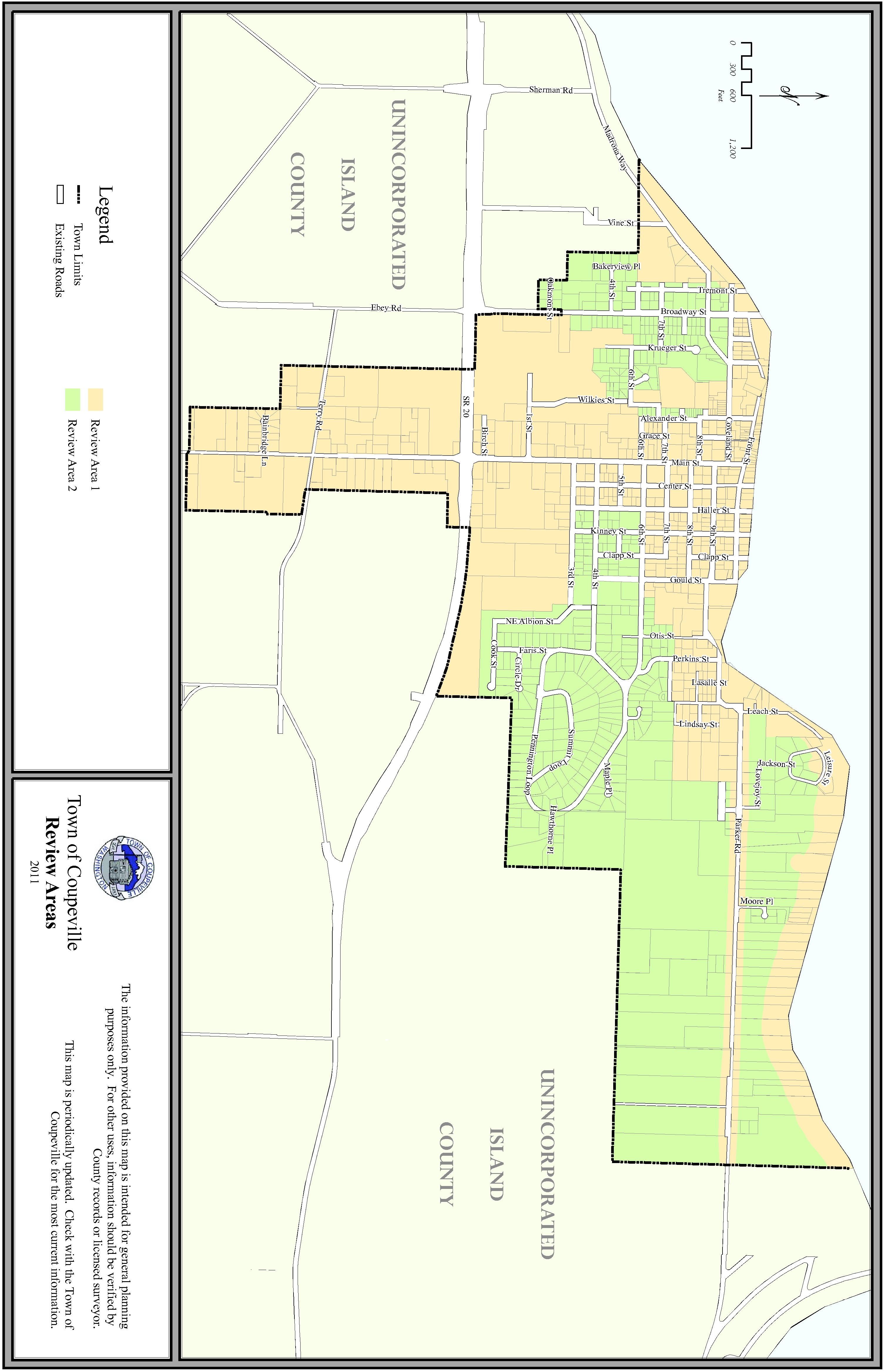
(Ord. No. 692, § 17, 10-3-2011)
CTC 16.13 - Appendix 2
(Three lists sorted alphabetically by historic name of building, sorted by street name without quadrant reference, and sorted by street number)
HISTORIC RESOURCES WITHIN THE TOWN OF COUPEVILLE
Historic Sites - Alphabetical List by Historic Name
TOWN OF COUPEVILLE - Appendix 2 continued
Historic Sites - Listed by Street Name Without Quadrant Reference
TOWN OF COUPEVILLE - Appendix 2 continued
Historic Sites - Listed by Address Number
(Ord. No. 692, § 18, 10-3-2011)
TOWN OF COUPEVILLE ZONING MAP
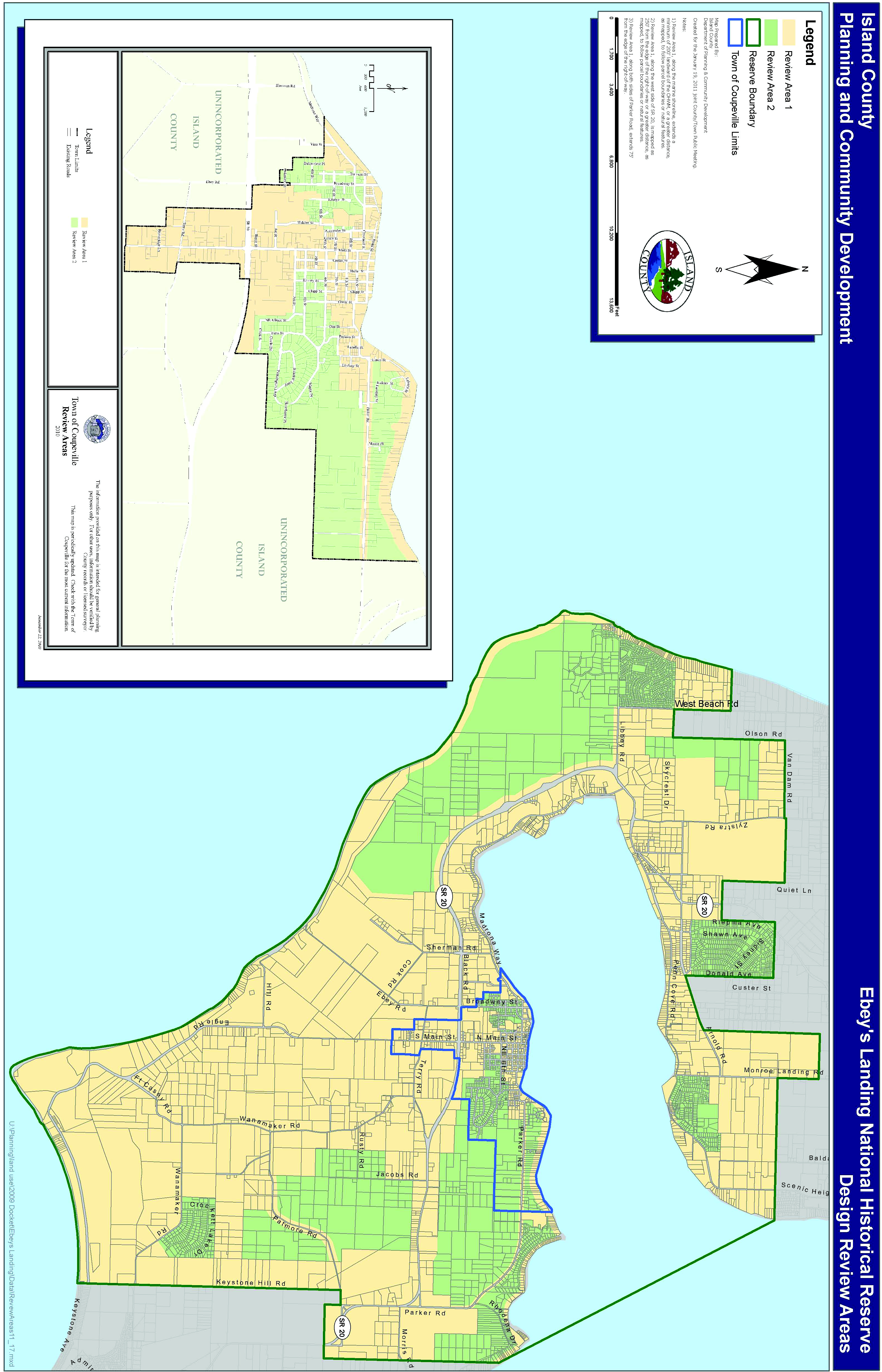
(Ord. No. 692, 10-3-2011)

