- DEFINITIONS AND RULES OF INTERPRETATION
2.101. This ordinance shall be constructed to achieve the purposes for which it is adopted.
2.102. The event of a conflict between the provisions of this ordinance and any other ordinance of The City of Covington, LA, the provisions of this ordinance shall control.
2.103. In the event of a conflict between the text of this ordinance and any caption, figure, illustration, table or map, the text of this ordinance shall control.
(Ord. No. 2010-30, Exh. 1, 1-4-2011)
2.201. For the purpose of these regulations, certain terms and words are hereby defined. Words used in the present tense include the present; the singular number shall include the plural and the plural the singular; the word "building" shall include the word "structure"; the word "shall' is mandatory and not directory, and the words and terms not defined herein shall be interpreted in accord with their normal dictionary meaning and customary usage;
Abandonment. (Also see discontinuance) The cessation of the use of a property or of a particular use for at least six months.
Accessory building. A structure on the same parcel of property as the principal structure that is used for purposes incidental to those of the principal structure; e.g., garage, barn, storage shed, boat house, pool house, or greenhouse.
Accessory dwelling unit. A self-contained residential unit built on the same lot as an existing single-family home. An accessory dwelling unit is not considered subordinate to the principal use and is not permitted in the City of Covington.
Accessory use. A subordinate use which is incidental to and customary or necessary in connection with the principal structure or use and which is located on the same lot with such principal structure or use.
Accessways. A paved area intended to provide ingress or egress of vehicular traffic from a public right-of-way to an off-street parking area or loading area. Parking area aisles are not to be constructed as accessways. The maximum width of an accessway through the periphery to an off-street parking or other vehicular use area shall be 35 feet for two-way vehicular movement and 15 feet for one-way accessway. For street frontage up to 100 linear feet, no more than two, one-way accessways and one, two-way access shall be permitted. For more than 100 feet of frontage, one additional two-way or two additional one-way accessways may be permitted for each additional 100 feet of frontage or major fraction thereof (51 feet or greater).
Adult business. An adult bookstore, adult motion picture theater, adult mini-motion picture theater, adult nightclub, or an adult massage business. Adult business also means any premises that sells or disseminates explicit adult sexual material. For purposes of this definition, the following terms shall have the following meanings:
Adult bookstore. A bookstore having as a preponderance of its publications, books, magazines, and other periodicals that are distinguished or characterized by their emphasis on matter depicting, describing, or relating to specified sexual activities or specified anatomical areas.
Adult motion picture theater. An enclosed building with a capacity of 50 or more persons used for presenting motion pictures, a preponderance of which are distinguished or characterized by an emphasis on matter depicting, describing, or relating to specified sexual activities or specified anatomical areas, as defined in this section, for observation by patrons therein.
Adult mini-motion picture theater. An enclosed building with a capacity of less than 50 persons used for presenting motion pictures, a preponderance of which are distinguished or characterized by an emphasis on matter depicting, describing, or relating to specified sexual activities or specified anatomical areas, as defined in this section, for observation by patrons therein.
Adult nightclub. An establishment engaged in the sale of alcoholic beverages at retail for consumption on premises, where minors are excluded by law, where the incidental service of food may occur, and which features live entertainment where persons, male or female, perform, dance or otherwise appear partially or totally nude or where partially or totally nude dancing is performed.
Adult uses/materials. An establishment having a substantial or significant portion of its stock in trade in which, for any form of consideration, adult material is presented to or is available for exclusive viewing, rental or purchase by adults. As used in this ordinance, adult material shall consist of movies, films, motion pictures, video tapes, video discs, slides, photographs, or other media of visual representation; or live performances, exhibitions or presentations; or books, papers, pamphlets, magazines, periodicals or publications which are characterized by an emphasis upon the depiction or description of any of the conduct or activities set forth and described in the provisions of R.S. tit. 14, ch. 1, pt. VI, Subpt. C, and in that portion thereof designated as sub-paragraphs (2)(b) and (3) of paragraph A of section 106 [R.S. 14:106A(2)(b), (3)], or as such provisions may hereafter be amended, re-enacted or redesignated from time to time, or shall consist of any instruments, devices or paraphernalia that are designed or marketed for use in connection with any such conduct or activities. As used in these regulations, the term "adult material" shall be applied to any material that meets the definition set forth in this section whether or not, as a matter of law; such material is or could be classified as pornographic or obscene.
Agricultural use. A farm of ten acres or more for the production of crops and livestock including green house and nurseries for the raising of plants and sale of farm products raised on the premises but shall not be construed to mean the commercial processing of farm products such as slaughter houses, canning plants, feed mills, etc.
Alteration, structural. Any change in the supporting members of a building or structure, such as bearing walls, columns, beams, or girders, or any substantial change to the roof or exterior walls; provided, however, that the application of any exterior siding to an existing building for the purpose of beautifying and modernizing shall not be considered a structural alteration.
Antenna. Any structure or device for the purpose of collecting or transmitting electromagnetic waves including, but not limited to, directional antennas, such as panels, microwave dishes, and satellite dishes, and omni-directional antennas, such as whip antennas.
Area (gross). See Floor area - gross floor.
Area (net). Area actually occupied not including accessory unoccupied areas.
Athletic fields. A site providing recreational areas for activities such as soccer, baseball, softball and football.
Automobile wash. A building or portion thereof, containing facilities for washing motor vehicles, using automatic production-line methods with a chain conveyor blower, steam cleaning device, or other mechanical devices; or providing space, water, and equipment for the hand-washing of autos, whether by the customer or the operator.
Automotive fuel station. A property where flammable or combustible liquids or gases used as fuel are stored and dispensed from fixed equipment into the fuel tanks of motor vehicles. Such an establishment shall be permitted to offer for sale at retail other convenience items as a clearly secondary activity and shall be permitted also to include a freestanding automatic car wash. No video draw-poker devices may be operated in such an establishment. Major repair such as motor replacement, body and fender repair or spray painting is prohibited.
Automotive repair, major. An establishment primarily engaging in the repair or maintenance of motor vehicles, trailers and similar large mechanical equipment, including paint, body and fender, and major engine and engine part overhaul, which is conducted within a completely enclosed building.
Automotive repair, minor. An establishment primarily engaging in the repair or maintenance of motor vehicles, trailers and similar large mechanical equipment, including brake, muffler, upholstery work, detailing, tire repair and change, lubrication, tune ups, and transmission work, which is conducted within a completely enclosed building.
Bar. An establishment for the primary purpose of which is the service of and on-premises consumption of alcoholic beverages, including taverns, cocktail lounges and similar uses other than a restaurant as that term is defined herein.
Base flood elevation. The elevation shown on FEMA flood insurance rate maps (FIRMs) for that indicates the water-surface elevation resulting from a flood that has a one-percent chance of equaling or exceeding that level in any given year.
Bed and breakfast. An owner-occupied residential structure, constructed or converted to a single-family residential structure, which provides up to five sleeping rooms for overnight paid occupancy of up to 14 nights.
Block. A parcel of land within a subdivision or development that is bounded only by streets, or bounded by streets and the exterior boundary of the subdivision. For this definition, an alley is not considered a street but part of the block.
Block face. - The front of a block along one side of the street.
Boarding house. A dwelling containing a single dwelling unit and not more than ten sleeping units, where lodging is provided with or without meals, for compensation for more than one week.
Buffer. A landscaped area providing a visual screen. Nonliving material may be used instead of landscaping, if minimum height of six feet is provided. If living material is used, it shall be a minimum of four feet in height immediately after planting.
Building. Any structure, either temporary or permanent, having a roof and designed, intended or used for the sheltering or protection of persons, animals, chattels, or property of any kind.
Building code. The Uniform Building Code as adopted by the State of Louisiana and the City of Covington.
Building line. The perimeter of that portion of a building or structure nearest a property line, but excluding open steps, ramps, terraces, cornices and other ornamental features projecting from the walls of the building or structure.
Building, main or principal. A building in which is conducted the principal use of the lot on which it is situated. A dwelling shall be deemed to be the main building on the lot in all residential districts.
Building, temporary. A building used temporarily for the storage of construction materials and equipment incidental and necessary to on-site permitted construction of utilities, or other community facilities, or used temporarily in conjunction with the sale of property within a subdivision under construction.
Business or financial services. An establishment intended for the conduct, service or administration by a commercial enterprise, or offices for the conduct of professional or business service.
Canopy. A roofed structure constructed of fabric or other material supported by the building or by support extending to the ground directly under the canopy placed so as to extend outward from the building providing a protective shield for doors, windows and other openings.
Carport. A shelter for an automobile consisting of a roof extended from the side of a building, similar to a garage but that has a part of the wall area open to the outside.
Cemetery. Land used or intended to be used for the burial of the dead and dedicated for cemetery purposes.
Club or lodge. A use providing meeting, recreational, or social facilities for an association, primarily for use by members and guests. Typical uses include social clubs and fraternal organizations but exclude any residential uses or sale of goods or services for profit.
Club or lodge (private). The buildings and facilities owned and operated by a group of people organized for a common purpose to pursue common goals, interest or activities, usually characterized by certain membership qualifications, payment of fees and dues, regular meetings and a constitution and by-laws.
Commencement of construction. The physical improvement of land in accordance with a permit issued by the City of Covington, provided that the improvements are of a form and character which are not reasonably useable for development other than that authorized by the issued permit.
Commercial purposes. Connected with or engaged in or sponsored by or used in commerce or commercial enterprises.
Commercial retail sales and service. Establishments that engage in the sale of general retail goods and accessory services. Businesses within this definition include those that conduct sales and storage entirely in an enclosed structure (with the exception of occasional outdoor "sidewalk" promotions) businesses specializing in the sale of either general merchandise or convenience goods.
Common structure. A structure, such as a garage, tool shed, or recreational facility used by more than one resident in a planned development or manufactured housing development.
Communication tower. As used in this ordinance shall mean a tower, pole, or similar structure, which supports a telecommunications antenna generally operated for commercial purposes above ground in a fixed location, freestanding, guyed, or on a building.
Conditional use. A use that would become harmonious or compatible with neighboring uses through the application and maintenance of qualifying conditions.
Condominium. A single-dwelling or commercial unit in a multi-unit dwelling or structure, that is separately owned and may be combined with an undivided interest in the common areas and facilities of the property.
Convenience store. Any retail establishment offering for sale a relatively limited selection of prepackaged food products, household items, and other related goods, not including gasoline or fuel sales, characterized by a rapid turnover of customers and high traffic generation. Includes "general store," as defined herein.
Day care center, adult (small). Any place owned or operated for profit or not for profit, by a person, society, agency, corporation, institution, or any other group wherein are received, for a portion of a 24-hour day, fewer than ten functionally-impaired adults are not related to the owner or operator of the facility for the purposes of supervision or participation in a training program. This excludes alcohol and drug abuse clientele, former inmates of prisons or correctional institutions or former patients of mental institutions who have been found not guilty by reason of insanity. The day care services should take place on a regular basis for at least 12.5 hours in a continuous seven-day week and no overnight stays are permitted.
Facilities caring for fewer than ten adults are not required to be licensed by the State of Louisiana, however if the facility receives state or federal funding, directly or indirectly, it must be licensed regardless of the number of adults in its care.
Day care center, adult (large). Any place owned or operated for profit or not for profit, by a person, society, agency, corporation, institution, or any other group wherein are received, for a portion of a 24-hour day, ten or more functionally-impaired adults are not related to the owner or operator of the facility for the purposes of supervision or participation in a training program. This excludes alcohol and drug abuse clientele, former inmates of prisons or correctional institutions or former patients of mental institutions who have been found not guilty by reason of insanity. The day care services should take place on a regular basis for at least 12.5 hours in a continuous seven-day week and no overnight stays are permitted. All facilities caring for more than ten adults must be licensed by the State of Louisiana, and if the facility receives state or federal funding, directly or indirectly, it must be licensed regardless of the number of adults in its care.
Day care center, child (small). Any place or facility operated by any institution, society, agency, corporation, person or persons, or any other group for the primary purpose of providing care, supervision and guidance to a maximum of 15 children, who are not within the immediate family of the care giver and are unaccompanied by parent or guardian, on a regular basis for at least 12.5 hours in a continuous seven-day week.
Day care center, child (large). Any place or facility operated by an institution society, agency, corporation, person or persons, or any other group for the primary purpose of providing care supervision and guidance to a maximum of 50 children who are not within the immediate family of the care giver and are unaccompanied by parent or guardian, on a regular basis for at least 12.5 hours in a continuous seven-day week.
Day care center, child (commercial). A facility other than a family child care home, small child care center, or large child care center, which is operated by an institution, society, agency, corporation, person or persons, or any other group for the primary purpose of providing care, supervision and guidance to more than 50 children who are not within the immediate family of the care giver and are unaccompanied by parent or guardian, on a regular basis for at least 12.5 hours in a continuous seven-day week.
Density. The number of dwelling units that are allowed on an area of land, which area of land shall be permitted to include dedicated streets contained within the development.
Development. The carrying out of any building activity or the making of any change to any structure or material change to the natural surface of the land including activities that change or disturb the natural surface of the land such as clearing, grading, excavating and filling.
Development plan (also called a site plan). An accurate, scaled drawing showing the location of buildings, the landscaping, parking, circulation and such other features as floor plans and elevations to help describe the existing and proposed development of a specified area.
Discontinuance (also see abandonment). The abandonment of a property or of a particular use for a period of at least six months. The determination of discontinuance for nonconforming uses or structures shall be supported by evidence, satisfactory to the building official (e.g., The actual removal of equipment, furniture, machinery, structures, or other components of the nonconforming use and not replaced, the turning off of the previously connected utilities, or where there are no business receipts/records or any necessary licenses available to provide evidence that the use is in continual operation).
District. A part of the city wherein regulations of this ordinance are uniform.
Drainage plan. A plan showing proposed site drainage features for controlling stormwater runoff and conveying it to public outfalls. A drainage plan shall also include runoff calculations for engineering review, evidence that the drainage plan has been submitted to and reviewed by the stormwater drainage authority with jurisdiction over the site, and that the drainage plan has been approved by said authority.
Drive-through establishment. Any establishment which by design, physical facilities, service, or by packing procedures encourages or permits customers to receive services, obtain goods, or be entertained while remaining in their motor vehicles.
Driveway. A private access road, the use of which is limited to persons residing, employed, or otherwise using or visiting the parcel in which it is located.
Duly authorized representative. Person or persons designated by the mayor and/or city council to check, review and comment on all submissions regarding their nonconformance to these regulations. These bodies may designate the Covington City Planner or any other qualified persons or agency as the duly authorized representative.
Duplex. A two-unit family dwelling constructed on a single lot of record.
Dwelling. Any structure or portion thereof, which is designed or used for residential purposes.
Dwelling unit. Any room or group of rooms located within a structure forming a single habitable unit with facilities which are used or intended to be used for living, sleeping, cooking, eating and sanitation by one family.
Easement. The right, granted by the property owner, to use a parcel of land for specified purposes, such as public utilities, drainage and other public purposes, the title of which shall remain with the property owner, subject to the right of use designated in the reservation of the easement (see Servitude).
Educational facilities (also see schools). Any land used for educational facilities, including universities, colleges, elementary and secondary, and vocational schools.
Electrical signs. Any sign containing electrical wiring and which is attached or intended to attach to an electrical energy source.
Entertainment uses. Establishments, which provide opportunities or environments for social relaxation or pleasure, including the sale of food and alcoholic beverages.
Exercise and workout room. Health studio/physical culture salon: A facility operated to promote physical fitness or weight control.
Façade. The exterior wall of a building exposed to public view or that wall viewed by persons not within the building.
Family. One or more persons related by blood, marriage, adoption or guardianship, the occupants of a community or group home for mentally or physically challenged individuals or not more than four persons not so related occupying a dwelling unit and living as a single housekeeping unit shall be considered a family. Notwithstanding any other provisions of this section, this definition does not include individuals required to be assembled under one living unit for the purpose of drug or substance abuse rehabilitation or persons assigned to same as the result of criminal activity.
Financial institution. A bank, savings and loan, credit union, mortgage office, or automated teller machine (ATM).
Finished grade. The completed surfaces of lawns, walks and roads brought to grade as shown on development plans relating thereto.
Flood insurance rate map (FIRM). An official map of the community, on which the administrator of the National Flood Insurance Program (NFIP) has delineated both the special hazard areas and the risk premium zones applicable to the community.
Floodplain. Floodplain or flood-prone area means any land area susceptible to being inundated by floodwater as determined by FEMA.
Floodway. The channel of a river or other watercourse and the adjacent land areas that must be reserved in order to discharge the 100-year flood without cumulatively increasing the water surface elevation more than one foot at any point.
Floor area. The sum of the gross horizontal areas of the several floors of the main building but not including the area of roofed porches, exterior steps, exterior ramps, terraces, or breezeways. All dimensions shall be measured between exterior faces of the walls.
Floor area - gross floor (for determining off-street parking and loading requirements). Gross floor area is the sum of the gross horizontal areas of the several floors of a building or structure measured from the interior faces of the interior walls or from the interior line of walls separating two buildings or structures, including the following. The "floor area" of a building shall include:
(1)
Floor area of the basement if it is not used for other than storage except as required for [subsection] (7) below;
(2)
Penthouses;
(3)
Attics having headroom of seven feet or more;
(4)
Interior balconies and mezzanines;
(5)
Enclosed porches;
(6)
Space devoted to accessory uses;
(7)
Accessory storage areas located within selling or working spaces such as counters, racks or closets, or storage use in the conduct of business or use and calculated in the gross leasable area for multi-tenant buildings; and
(8)
Space devoted to retailing activities, to the production or processing of goods, or to business or professional offices.
It shall not include:
(1)
Elevator shafts and stairwells on each floor;
(2)
Floor space used for mechanical, telephone and electrical equipment; and
(3)
Attics having headroom of less than seven feet.
Floor area ratio (FAR). The ratio of floor area of a building to the area of a lot. Dividing the gross floor area of all buildings on a lot by the gross area of that lot makes the calculation.
Funeral home. A dwelling or other structure used and occupied by a professional licensed mortician for burial preparation and funeral services. Establishments engaged in undertaking services such as preparing the human dead for burial and arranging and managing funerals. Typical uses include funeral homes or mortuaries.
Frontage. That portion of a lot abutting a street right-of-way measured along the property line of the public right-of-way and the private property.
Garage. A permanently roofed structure with three enclosed sides and a garage door that is used for automobile shelter and storage.
General terms. The word "person" includes a firm, association, organization, partnership, trust, company, or corporation as well as individual. The present tense includes the future. The singular includes the plural and the plural, the singular. The word "shall" is mandatory; the word "may" is permissive. The words "used" or "occupied" include the words "intend," "designed," or "arranged" to be used or occupied.
Group or community home (small). A small, residential facility located within a community, designed to serve children or adults with chronic disabilities. Small group homes may have six or fewer occupants who are mentally, physically or developmentally disabled, and one or more resident counselors/trained caregivers on staff 24 hours a day. A small group home must be licensed by an agency of the State of Louisiana, the political subdivision, and/or a state-licensed child placement agency, as a group home, receiving home, or similar care facility. Alcohol and drug abuse clientele, former inmates of prisons or correctional institutions, or former patients of mental illness institutions who have been found not guilty of a criminal charge by reasons of insanity shall be excluded as occupants.
Group or community home (large). A residential facility located within a community, designed to serve children or adults with chronic disabilities. Large group homes may have 12 or fewer occupants who are mentally, physically or developmentally disabled, and two or more resident counselors/trained caregivers on staff 24 hours a day. A group home must be licensed by an agency of the State of Louisiana and/or a state-licensed child placement agency, as a group home, receiving home, or similar care facility. Alcohol and drug abuse clientele, former inmates of prisons or correctional institutions, or former patients of mental illness institutions who have been found not guilty of a criminal charge by reasons of insanity shall be excluded as occupants.
Group development. Two or more uses occupying the same parcel, or where two or more uses function as a single complex by virtue of having common access, parking, traffic or design orientation.
Group commercial development. A group commercial development is defined as two or more separate tenants occupying the same parcel, or where two or more businesses function as a single center by virtue of having common access, parking, traffic or design orientation. A shopping center is a group commercial development. All businesses located in such a group commercial development, even if they occupy separate buildings or are developed on outlot parcels, will be considered part of the group development and must abide by the provisions of this chapter.
Group office development. Two or more offices occupying the same parcel or where two or more offices function as a single complex by virtue of having common access, parking, traffic and design orientation. All offices located in such an office development, even if they occupy separate buildings or are developed on outlot parcels, will be considered part of the office development and must abide by the provisions of this chapter.
Gymnasium. A building or room designed and equipped for indoors sports, exercise, or physical education.
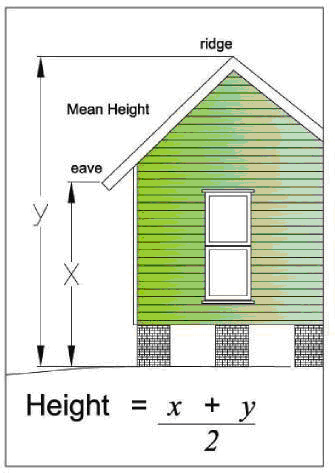
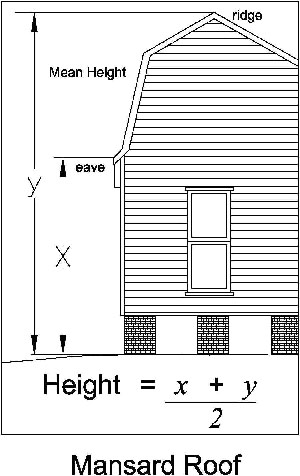
Height. The vertical distance of a structure measured from the average elevation of the proposed finished grade to the highest point of the roof for flat roofs, to the deck line of the mansard roof, and to the mean height between eaves and ridges for gable, hip and gambrel roofs. No height limitation in this ordinance shall apply to any of the following structures: silos, barns and other agricultural structures; church spires; cupolas; domes; monuments; water towers; smoke stacks; derricks; flag poles; masts; solar energy facilities; air conditioning equipment; elevator penthouses and similar structures required to be placed above the roof level and not intended for human occupancy.
Hotel or motel. A building in which lodging or temporary living accommodations are provided or offered to the general public.
Household. A residence with a separate mailing address, phone number and/or utility bill. Multifamily properties of more than six units may be considered one household; in such cases, the owner or manager shall be considered the head of household.
Impervious coverage. The square footage or other area measurement by which all buildings and impervious surfaces cover a lot as measured in a horizontal plane to the limits of the impervious area(s), such as surface areas, walkways, patios and plazas. All parking spaces and lot s, buildings, roads, driveways, walkways, tennis courts, patios, decks and any other structure or on-site material or ground condition that does not permit the natural absorption of water shall be included in the computation of impervious coverage.
Impervious materials. Materials that prevent precipitation from contacting the existing soil and do not allow water to penetrate the soil.
Incidental home occupation An incidental use of a portion of the main building for business purposes. Such a use will be allowed only if it is subordinate to the residential use of the property. At no time shall home occupations be interpreted to include any business which produces noxious fumes, smoke, dust or noise or interference in local radio or television reception, day care centers and/or babysitting services with six or more children, nursing or convalescent homes, restaurants, tearooms, auto repair and bed and breakfasts, irrespective of whether any of the foregoing should fit within the general parameters of the definition of home occupation.
Industrial use. The manufacture, assembly or fabrication of goods and materials.
Institutional use. Any land use for hospitals, including such educational, clinical, research and convalescent facilities as are integral to the operation of the hospital; medical and health service facilities and clinics, including nursing homes, supervised residential institutions, rehabilitation therapy centers and public health facilities; cultural, educational, philanthropic or charitable facilities and other similar uses.
Kennel. A facility for the care or boarding of animals which is operated for economic gain or the keeping of more than three dogs more than six months of age outside the principal building.
Land. The earth, water and air, above, below or on the surface including any improvements or structures customarily regarded as land.
Land area, gross. The total area of ground, soil or earth including structures on, above or below the surface. This is to include all street rights-of-way, utility rights-of-way and other land either dedicated or proposed for dedication to the municipality.
Land area, net. The total area of ground, soil or earth including structures on, above or below the surface. This is not to include street rights-of-way, utility rights-of-way or other such areas either dedicated or proposed for dedication to the municipality.
Landscape area. A nonbuilt-upon area of land in which landscape materials are placed, planted or maintained.
Landscape plan. Shall mean the preparation of graphic and written criteria, specifications, and detailed plans to arrange and modify the effects of natural features such as planting ground and water forms, circulation, walks and other features to comply with the provisions of this ordinance.
Landscaping. The installation of plant material or seed as a part of development.
Letter of understanding. A letter from the city planner setting out the substance of a pre-application conference.
Livestock includes, but is not limited to, horses, bovine animals, sheep, goats, swine, reindeer, donkeys, mules and any other hoofed animals.
Lodge or fraternal order. A "lodge" is a hall or meeting place of a local branch or the members composing such a branch of a fraternal order, or society, such as the Masons, Knights of Columbus, Moose, American Legion and other similar organizations. It may be permissible to serve food and meals on such premises, providing adequate dining room space and kitchen facilities are available. The sale of alcoholic beverages to members and their guests may be allowed provided it is secondary and incidental to the promotion of some other common objective by the organization and further provided that such sale of alcoholic beverages is in compliance with the applicable federal, state and parish laws.
Lot. A parcel of land having specific boundaries and having its principal frontage upon an officially approved street.
Lot lines. The lines forming the outer boundary of a lot.
Lot of record. A recorded, platted lot or a parcel of land lot, the map of which has been recorded in the Office of the Clerk of Court of St. Tammany Parish, or a lot described by metes and bounds, the description of which has been recorded in the Office of the Clerk of Court of St. Tammany Parish.
Major state or interstate highway. Those highways, which have an average daily total of at least 25,000 vehicles at the intersection or section nearest to the use in question.
Mansard. A roof with two slopes on all four sides, the lower slope being nearly vertical and the upper nearly horizontal.
Manufacturing uses. The assembly or fabrication of goods and materials, which does not involve toxic, hazardous or highly flammable materials.
Mortuary, funeral home. An establishment in which the dead are prepared for burial or cremation. The facility shall be permitted to include a chapel for the conduct of funeral services and spaces for funeral services and informal gatherings, and/or display of funeral equipment.
Multiple lot development. A common development, which includes more than one lot, shall be treated as one lot for the purpose of satisfying this ordinance. Split ownership, phased development or construction, or multiple building permits for a project shall not prevent it from being a common development as referred to above. Each phase of a phased project shall comply with the requirements described herein.
Nightclub. An establishment having a minimum entertainment floor area of 2,000 square feet, including discotheques, providing live entertainment, but not live adult entertainment, and/or a permanent area for dancing and which may serve food and/or alcoholic beverages. The entertainment floor area shall be composed of the wet-bar, dance floor and/or live entertainment stage area, and table area.
Nonconforming lot of record. A platted lot which does not comply with the lot size requirements of the zoning district in which it is located.
Nonconforming structure. Any structure, which was lawful on the effective date of this ordinance, but does not comply with all the standards and regulations of this ordinance or any amendment thereto.
Nonconforming use. Any use of any land, building, or structure, which was lawful on the effective date of this ordinance, but does not comply with all the standards and regulations of this ordinance or any amendment thereto.
Nursery school/preschool. Schools designed to provide daytime care or instruction for two or more children up to five years of age and operated on a regular basis.
Nursing home. A facility designed and intended to provide nursing service on a continuing basis to persons, the majority of whom require such service under trained professional nurses or physicians, and for whom medical records are maintained. The term "nursing home" shall include post-operative centers but shall not include any facility used for providing service to any inmate of any prison or other correctional institution.
Open space. That part of a lot, including all yards, which is open and unobstructed from grade level upward and is not occupied by off-street parking, streets, drives, or other surfaces for vehicles.
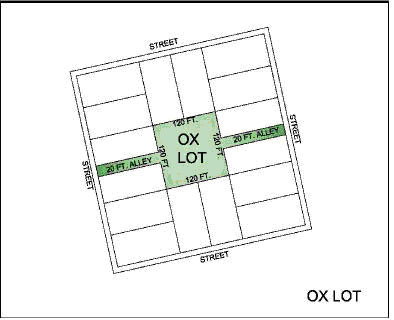
Oxlot. A parcel of dedicated public land within the original 20 symmetrical blocks laid out on a grid system oriented toward the Bogue Falaya River, today known as the Division of St. John. Each block, measuring 360 square feet, contains a small central square measuring 120 square feet and is connected to the adjacent streets with 20-foot alleyways.
Parapet. A low protective railing or wall along the edge of a roof or balcony.
Parcel. Any quantity of land capable of being described with such definitiveness that its location and boundaries may be established and which is designed by its owner as land to be used as a unit.
Park. A noncommercial, not-for-profit facility designed to serve the recreation needs of the residents of the community. Parks include, but are not limited to, ball fields (i.e. baseball, football, soccer), basketball courts, playgrounds.
Parking garage. A public or private structure composed of one or more levels or floors used for the parking of motor vehicles. A parking garage may be a stand-alone facility or may be located in a building also used for other purposes. It includes facilities that offer spaces for free, for rent or other fee to the general public, and facilities that offer automobile parking spaces solely to building tenants, or any combination thereof.
Parking lot. An open area, other than a street, used for the parking of vehicles.
Parking space, automobile. A space within a building, private or public parking lot, exclusive of driveways, ramps, columns, office and work areas, for the parking of an automobile.
Periphery. An area of land between the property line and any vehicular use areas or building that is intended for the placement or preservation of landscape materials.
Permeable paving. A range of materials and techniques for paving roads, parking lots and walkways that allow precipitation to percolate through the paving material. Types of permeable paving surface include: porous concrete, porous asphalt, single-sized aggregate, porous turf, open joint blocks and resin-bound paving.
Person. An individual, corporation, public agency, business, trust, partnership, association, two or more persons having a joint or common interest, or any other legal entity.
Personal improvement services. Establishments primarily engaged in the provision of informational, instructional, personal improvements and similar services of a nonprofessional nature. Typical uses include secretarial schools, driving schools, health or physical fitness studios, reducing salons, dance studios, personal computer training, handicraft and hobby instruction.
Pervious materials. Materials that permit water to enter the ground by virtue of their porous nature or by large spaces in the material.
Planned unit development (PUD). A residential or commercial development guided by a total design plan in which one or more of the zoning or subdivision regulations, other than use regulations, shall be permitted to be waived or varied to allow flexibility and creativity in site and building design and location, in accordance with general guidelines.
Planning commission. The term "planning commission" shall mean the Covington Planning Commission created under R.S. 33:101 et seq., which shall have the powers provided for by Louisiana law and as may be provided for in this Appendix B, Comprehensive Zoning Ordinance of 2010, for the City of Covington.
Planting area. Any area designed for landscape material installation having a minimum area of 25 square feet.
Portable signs. Any sign which is not permanently and securely connected to the ground or building so it can be easily moved from one location to another and is not a lawful highway or motor vehicle regulatory sign.
Prefabricated housing. Any housing with structural or mechanical components manufactured and assembled away from the construction site. For purposes of this definition, the following terms shall have the following meanings:
Manufactured housing. Dwelling units constructed primarily at a plant or facility on a production line basis and delivered to the site as an assembled unit or in modular form. Manufactured housing specifically refers to housing built under the manufactured home construction and safety standards set by the U.S. Department of Housing and Urban Development (HUD).
Mobile home. Prefabricated trailer-type housing units that are semi-permanently attached to land, either the owner's fee land or leasehold, such as in a mobile-home park. A mobile home is a moveable or portable structure designed and constructed on its own chassis and intended for connection to utilities for year-round occupancy as a dwelling. Any dwelling unit that qualifies as a modular home according to the definition herein is not considered a mobile home. Furthermore, a travel trailer is not considered a mobile home.
Mobile home park. A unified development of two or more mobile home sites, plots or stands, arranged on a large tract usually under single ownership, meeting the area and yard requirements of this article, and designed to accommodate mobile homes for a more or less permanent duration. Such term may include travel trailer accommodations, provided that no more than 25 percent of the park is used for such purpose.
Modular home. Modular homes are houses divided into multiple modules or sections, which are manufactured in a remote facility and delivered to their intended site of use. The modules are then assembled on a permanent foundation without a permanent chassis, into a single residential building. Unlike other prefabricated construction, modular homes conform to all state, local and regional codes where the structure is to be located.
Principal building. A building or structure in which the primary use of the lot on which the building is located is conducted.
Principal use. The primary use and chief purpose of a lot or structure.
Projection. Cornices, cells, eaves, belt courses, chimneys or other similar architectural features that may extend or project into a required yard areas.
Public assembly. Places where public or private groups assemble for civic, educational, political, religious, or social purposes including, but not limited to, arenas, religious institutions, lecture halls, theaters, schools, auditoriums, and stadiums.
Public improvement. Any drainage ditch, storm sewer or drainage facility, sanitary sewer, water main, roadway, parkway, sidewalk, pedestrian way, tree lawn, off-street parking area, lot improvement or other facility for which the local government may ultimately assume the responsibility for maintenance and operation, or for which the local government responsibility is established.
Public services. Uses operated by a unit of government to serve public needs, such as a police (with or without a jail), fire service ambulance, judicial court or government offices, but not including public utility stations or maintenance facilities.
Public way. Any street, alley or similar parcel of land essentially unobstructed from the ground to the sky, which is deeded, dedicated or otherwise permanently appropriated to the public for public use.
Public use. Any use operated by an agency of government which provides a direct service to the public including police, fire, library, educational facilities and recreational services.
Public utility station. A structure or facility used by a public or quasi-public agency to store, distribute, and/or generate electricity, gas telecommunications and related equipment, or to pump or chemically treat water. This does not include storage or treatment of sewerage, solid waste or hazardous waste.
Quasi-public. Essentially a public use, although under private ownership or control.
Quorum. A majority of authorized members of a board or commission.
Recreational facilities. Any facility that provides recreational opportunities such as tennis clubs, health clubs or golf clubs.
Recreational facilities, indoor. An establishment providing completely enclosed recreation activities. Accessory uses shall be permitted to include the preparation and serving of food and/or sale of equipment related to the enclosed uses. Included in this definition shall be YMCAs, health clubs, athletic clubs, bowling, roller-skating or ice-skating, billiards, pool, motion picture theaters, and related amusements.
Recreational facilities, outdoor. An area free of buildings except for restrooms, dressing rooms, equipment storage, maintenance buildings, open-air pavilions concession stands and similar structures used primarily for recreational activities.
Rehabilitative care center. A building other than an apartment hotel, hotel, small or large group home, rooming house, tourist home, motel or motor lodge, providing temporary lodging and board and a special program of specialized care and counseling on a full-time basis. Such a center includes but is not limited to centers that provide for alcohol and drug abuse clientele, former inmates of prisons or correctional institutions, or former patients of mental illness institutions. A rehabilitative care center must be licensed by an agency of the State of Louisiana as a rehabilitative or similar care facility, and shall be operated by an entity that is similarly licensed by the State of Louisiana.
Religious facility. A building, together with its accessory buildings and uses, where persons regularly assemble for religious purposes and related social events and which building, together with its accessory buildings and uses, is maintained and controlled by a religious body organized to sustain religious ceremonies and purposes. A place of worship may include group housing for persons under religious vows or orders, day care facilities and/or weekly religious instruction.
Residential care center. A building, other than an apartment, hotel, small or large group home, or rooming house, providing temporary lodging and board and a special program of specialized care and counseling on a full-time basis for 12 or more individuals who are displaced from their normal living environment. A residential care center must be licensed by an agency of the State of Louisiana as a residential or similar care facility, and shall be operated by an entity that is similarly licensed by the State of Louisiana. Alcohol and drug abuse clientele, former inmates of prisons or correctional institutions, or former patients of mental institutions who have been found not guilty of a criminal charge by reasons of insanity shall be excluded as occupants.
Residential use. A building or portion thereof containing units intended for human inhabitation.
Restaurant. A structure, or any part thereof, in which food or beverages are prepared and dispensed for consumption at the time of sale. May include one or more of the following:
Restaurant, drive-in. A restaurant where the customers are either served in their vehicles or at a drive through or walk up window or service unit.
Restaurant, fast food. An establishment which offers quick food service, accomplished through a limited menu of items already prepared and held for service, or prepared, fried or griddled quickly, or heated in a device such as a microwave oven. Orders are not taken at a customers' table and food is generally served in disposable wrapping or containers. Fast food establishments may or may not deliver food or beverages to customers in motor vehicles at drive-up windows.
Restaurant, full-service. A restaurant with table service (order placement and delivery on-site) provided to patrons, also including cafeterias; carryout service, if any, shall be a limited portion of the facility and activity.
Restaurant, limited-service. A restaurant without table service provided to patrons; walk-up counter and carryout trade is a primary portion of the facility; includes food delivery, carryout, public snack bars and delicatessens, but not specialty food or fast-food stores.
Restaurants sit-down. A business establishment whose principal business is the selling of unpackaged food to the customer in a ready-to-consume state, in individual servings, or in non-disposable containers, where the customer consumes these foods while seated at tables or counters where alcoholic beverages may be served to dining patrons from a service bar (not accessible to patrons) and where there typically is not a rapid turnover of clientele. Special events center services considered to be allowed accessory uses to sit-down restaurants.
Roof line. The highest continuous horizontal line of a roof. On a sloping roof, the roofline is the principal ridgeline, or the highest line common to one or more principal slopes of roof. On a flat roof, the roofline is the highest continuous line of the roof or parapet, whichever is higher.
Setback, building. The required minimum horizontal distance between the building and the related front, side, and rear property line. For the purpose of this section, the setback will be measured to the furthest horizontal projection of the structure (including overhang) as per section 4.5 of this ordinance.
Schools.(Also see "educational facilities"). Any land used for educational facilities, including universities, colleges, elementary and secondary, and vocational schools.
Schools - college/university. A post-secondary institution for higher learning that grants associate or bachelor degrees. The institution may also have research facilities and/or professional schools that grant master and doctoral degrees. This also includes post-secondary theological schools for training ministers, priests or rabbis.
Schools - Kindergarten through 12th Grade. A public, private or parochial school offering instruction at the elementary, middle/junior high or senior high school levels.
Schools - vocational or trade. A school established to provide for the teaching of industrial, clerical, managerial or artistic skills. This definition applies to schools that are owned and operated privately for-profit and that do not offer a complete educational curriculum.
Servitude. Same as easement.
Shopping center. A group of commercial establishments planned, developed, managed as a unit; related in location, size, and type of shops to the trade area that the unit serves; and providing on-site parking in definite relationship to the types and sizes of stores.
Shrub. A woody perennial plant differing from the perennial herb by its persistent and woody stems, and from a tree by its low stature (generally obtaining a height less than eight feet and its habit of branching from the base.
Sidewalk. A paved pedestrian footpath between the curb lines or the lateral lines of a roadway and the adjacent property lines.
Sight triangle. The triangle at either side of an accessway or public right-of-way at its junction with a public street with sides of not less than ten feet in length each along the public right-of-way and/or accessway within which clear visibility of approaching vehicular or pedestrian traffic must be maintained in all directions.
Sign. A sign is defined as a medium of communication, including its structure and component parts, which is used or intended to be used to attract attention to its subject matter or location usually for advertising purposes, including paint on the surface of a building. Each distinctive message painted or placed sign. See section 6.103 "definitions", on a building or other structure shall be considered an individual of part 6 Sign Regulations, of this appendix B for additional information.
Site plan (Also called a development plan). An accurate, scaled drawing showing the location of buildings, the landscaping, parking, circulation and such other features as floor plans and elevations to help describe the existing and proposed development of a specified area.
Streets. A public right-of-way or private thoroughfare, which provides vehicular and pedestrian access to adjacent properties. All streets will be within dedicated rights-of-way that have been properly processed, approved and recorded. The following shall be used to classify all streets:
Freeways. A divided multi-lane highway for through traffic with all crossroads separated in grade and with full control access.
Expressways. A divided arterial highway for through traffic with full or partial control of access and generally with grade separation at major intersections.
Arterial streets. Public thoroughfares that serve the major movements of traffic within and through the city and the parish.
Collector streets. Public thoroughfares that serve to collect and distribute traffic primarily from local residential streets to arterial streets.
Local streets. Facilities that are used primarily for direct access to abutting properties and leading into the collector street system.
Frontage road or service road. A street adjacent to a freeway, expressway or an arterial street separated there from by a dividing strip and providing ingress and egress from abutting property.
Cul-de-sac. A street having an outlet at one end only and having the other end permanently closed with facilities permitting vehicles to turn around.
Dead-end street. A street having an outlet at one end only and terminated at the other end by undeveloped property. It may or may not have facilities permitting vehicles to turn around.
Alley. A way that affords only a secondary means of access to property abutting thereon.
Public streets. A public street is a road, thoroughfare, alley, highway, or bridge under the jurisdiction of a public agency.
Private streets. Private streets are owned by residents, and have a publicly recognized indenture, or covenant, that outlines governance and acts as a deed restriction.
Structure. A combination of materials constructed or erected with a fixed location on the ground, or attached to something having a fixed location on the ground, including, but not limited to, retaining walls in excess of four feet.
Subdivision. The division of a parcel of land into two or more lots, tracts, or parcels for the purpose, whether immediate or future, of sale, lease or building development, or if a new street is involved, any division of a parcel of land. The term includes re-subdivision and when appropriate to the context, shall relate to the process of subdivision or to the land subdivided.
Surveyor. A qualified registered land surveyor in good standing with the Louisiana Board of Registration.
Telecommunications. As defined in the Federal Telecommunications Act of 1996, means the transmission between or among points specified by the user, or information of the user's choosing, without change in the form or content of the information as sent and received.
Temporary use. A use that is authorized by this Code to be conducted for a fixed period of time. Temporary uses are characterized by such activities as the sale of agricultural products, contractors' offices and equipment sheds, fireworks, carnivals, flea markets, and garage sales.
Tower. Any ground or roof mounted pole, spire, structure, or combination thereof taller than 15 feet, including lines, cables, wires, braces, and masts, intended primarily for the purposes of mounting an antenna, meteorological device, or similar apparatus above grade. Notwithstanding any other provision of this Code "Height" of a communication tower is the distance from the base of the tower to the top of the structure.
Townhouse. A single-family dwelling unit constructed on separate lots of record in a row or group of two or more units having a separate entrance, front yard and rear yard; where no unit is located over another unit, and each unit is separated from any other unit by one or more common and fire-resistant walls.
Trash and garbage storage area. That area of a development used for the storage and containment of refuse and refuse containers (i.e. dumpsters).
Tract. A parcel of land identified by letter or number the boundaries of which are shown on the recorded subdivision or development plat. A tract need not be suitable for development.
Traffic generation rates. The average daily trips generated per unit of land, as set forth by the Institute of Traffic Engineering or authenticated local figures for approval by the city planner.
Travel trailer. A vehicular, portable structure built on a chassis, designed to be used as a temporary dwelling and may be hauled along a highway.
Truck-stop facility. Those facilities as contemplated in R.S. 33:4862.1 et seq., which are designed primarily for serving 18-wheel tractor-trailer motor vehicles and where no video draw-poker devices may be operated.
Use. The activity occurring on a lot or parcel, for which land or a building is arranged, designed or intended, or for which land or a building is or may be occupied, including all accessory uses.
Use, change of. The change within the classified use of a structure or parcel.
Utility trailer. A small nonmotorized vehicle which is generally pulled by a motorized vehicle and features an open-top rear cargo area (bed) and is used for the hauling of light loads.
Variance. A deviation from the height, bulk, setback, parking or other requirements established by this Code.
Vehicle. Any means of transport on land, especially on wheels (e.g., a car, bus, bicycle etc.)
Vehicle, commercial. A commercial vehicle is any vehicle that meets one or both of the following physical dimensions: Greater than 21 feet in length [This includes any load on the vehicle or tagalong equipment/trailer hitched to the vehicle greater than 21 feet in length and/or greater than eight and one-half feet wide], or weighted at over 10,000 lbs. gross vehicle weight and not licensed as a recreational vehicle. Note: A sign alone on a vehicle does not make the vehicle commercial.
Vehicle, recreational. A vehicle designated for temporary living quarters for camping, traveling, or recreational use. It may have its own motive power, or be mounted on or pulled by another vehicle.
Video draw poker devices. a unit, mechanism, or device that, upon insertion of cash, in available to play or simulate the play of the game of draw poker or other card games utilizing a cathode ray tube or video display screen microprocessors in which the player may win games or credits that can be redeemed for cash only. The term does not include a device that directly dispenses coins, cash, tokens, or anything else of value, except the ticket voucher. The term does not include any device authorized for use in the conducting of charitable gaming.
Wall. An upright structure of wood, stone, etc., serving to enclose, divide, define or protect.
Wall, freestanding. A wall independent of a principal structure.
Warehouse, wholesale or storage. A building or premises in which goods, merchandise or equipment are stored for eventual distribution.
Yard. An open space that lies between the principal building or buildings and the nearest lot line. The minimum required yard as set forth in this Zoning Ordinance is unobstructed by any portion of structure upward except as otherwise provided herein. In measuring a yard to determine the width of a yard, the minimum horizontal distance between the lot line and the maximum permissible main building shall be yard dimension.
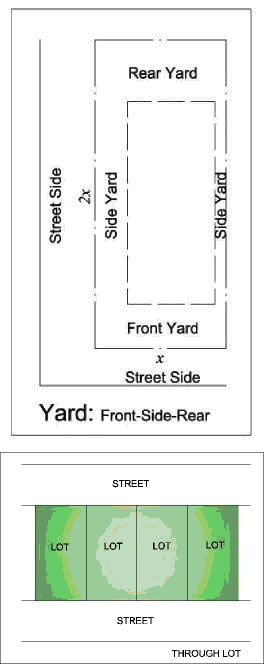
Yard, front. A yard extending across the full width of a lot between the side lot lines and between the front property line and the front line of the building projected to the side lines of the building site. The depth of the front yard shall be measured between the front line of the building and the street line. On corner lots, the front yard shall be considered as parallel to the street upon which the lot has the least dimension. This space is considered open space.
Yard, rear. A yard extending across the rear of the lot between the side lot lines and being the minimum horizontal distance between a rear lot line and the rear of the maximum main building. The rear yard shall be at the opposite end of the lot from the front yard.
Yard, side. A yard between the main building and the side lot line and extending from the front lot line to the rear lot line.
Yard, through. A through yard is any single zoning lot, including a corner lot, that connects two generally parallel streets. On through yards fronting two streets, two front yards shall be provided.
Zoning commission. The term "zoning commission" shall mean the Covington Zoning Commission created under R.S. 33:4721 et seq., which shall have the powers provided for by Louisiana law and as may be provided for in this Appendix B, Comprehensive Zoning Ordinance of 2010, for the City of Covington.
(Ord. No. 2010-30, Exh. 1, 1-4-2011; Ord. No. 2014-23, 10-24-2014; Ord. No. 2016-06, 1-22-2016; Ord. No. 2019-01, 1-16-2019)
- DEFINITIONS AND RULES OF INTERPRETATION
2.101. This ordinance shall be constructed to achieve the purposes for which it is adopted.
2.102. The event of a conflict between the provisions of this ordinance and any other ordinance of The City of Covington, LA, the provisions of this ordinance shall control.
2.103. In the event of a conflict between the text of this ordinance and any caption, figure, illustration, table or map, the text of this ordinance shall control.
(Ord. No. 2010-30, Exh. 1, 1-4-2011)
2.201. For the purpose of these regulations, certain terms and words are hereby defined. Words used in the present tense include the present; the singular number shall include the plural and the plural the singular; the word "building" shall include the word "structure"; the word "shall' is mandatory and not directory, and the words and terms not defined herein shall be interpreted in accord with their normal dictionary meaning and customary usage;
Abandonment. (Also see discontinuance) The cessation of the use of a property or of a particular use for at least six months.
Accessory building. A structure on the same parcel of property as the principal structure that is used for purposes incidental to those of the principal structure; e.g., garage, barn, storage shed, boat house, pool house, or greenhouse.
Accessory dwelling unit. A self-contained residential unit built on the same lot as an existing single-family home. An accessory dwelling unit is not considered subordinate to the principal use and is not permitted in the City of Covington.
Accessory use. A subordinate use which is incidental to and customary or necessary in connection with the principal structure or use and which is located on the same lot with such principal structure or use.
Accessways. A paved area intended to provide ingress or egress of vehicular traffic from a public right-of-way to an off-street parking area or loading area. Parking area aisles are not to be constructed as accessways. The maximum width of an accessway through the periphery to an off-street parking or other vehicular use area shall be 35 feet for two-way vehicular movement and 15 feet for one-way accessway. For street frontage up to 100 linear feet, no more than two, one-way accessways and one, two-way access shall be permitted. For more than 100 feet of frontage, one additional two-way or two additional one-way accessways may be permitted for each additional 100 feet of frontage or major fraction thereof (51 feet or greater).
Adult business. An adult bookstore, adult motion picture theater, adult mini-motion picture theater, adult nightclub, or an adult massage business. Adult business also means any premises that sells or disseminates explicit adult sexual material. For purposes of this definition, the following terms shall have the following meanings:
Adult bookstore. A bookstore having as a preponderance of its publications, books, magazines, and other periodicals that are distinguished or characterized by their emphasis on matter depicting, describing, or relating to specified sexual activities or specified anatomical areas.
Adult motion picture theater. An enclosed building with a capacity of 50 or more persons used for presenting motion pictures, a preponderance of which are distinguished or characterized by an emphasis on matter depicting, describing, or relating to specified sexual activities or specified anatomical areas, as defined in this section, for observation by patrons therein.
Adult mini-motion picture theater. An enclosed building with a capacity of less than 50 persons used for presenting motion pictures, a preponderance of which are distinguished or characterized by an emphasis on matter depicting, describing, or relating to specified sexual activities or specified anatomical areas, as defined in this section, for observation by patrons therein.
Adult nightclub. An establishment engaged in the sale of alcoholic beverages at retail for consumption on premises, where minors are excluded by law, where the incidental service of food may occur, and which features live entertainment where persons, male or female, perform, dance or otherwise appear partially or totally nude or where partially or totally nude dancing is performed.
Adult uses/materials. An establishment having a substantial or significant portion of its stock in trade in which, for any form of consideration, adult material is presented to or is available for exclusive viewing, rental or purchase by adults. As used in this ordinance, adult material shall consist of movies, films, motion pictures, video tapes, video discs, slides, photographs, or other media of visual representation; or live performances, exhibitions or presentations; or books, papers, pamphlets, magazines, periodicals or publications which are characterized by an emphasis upon the depiction or description of any of the conduct or activities set forth and described in the provisions of R.S. tit. 14, ch. 1, pt. VI, Subpt. C, and in that portion thereof designated as sub-paragraphs (2)(b) and (3) of paragraph A of section 106 [R.S. 14:106A(2)(b), (3)], or as such provisions may hereafter be amended, re-enacted or redesignated from time to time, or shall consist of any instruments, devices or paraphernalia that are designed or marketed for use in connection with any such conduct or activities. As used in these regulations, the term "adult material" shall be applied to any material that meets the definition set forth in this section whether or not, as a matter of law; such material is or could be classified as pornographic or obscene.
Agricultural use. A farm of ten acres or more for the production of crops and livestock including green house and nurseries for the raising of plants and sale of farm products raised on the premises but shall not be construed to mean the commercial processing of farm products such as slaughter houses, canning plants, feed mills, etc.
Alteration, structural. Any change in the supporting members of a building or structure, such as bearing walls, columns, beams, or girders, or any substantial change to the roof or exterior walls; provided, however, that the application of any exterior siding to an existing building for the purpose of beautifying and modernizing shall not be considered a structural alteration.
Antenna. Any structure or device for the purpose of collecting or transmitting electromagnetic waves including, but not limited to, directional antennas, such as panels, microwave dishes, and satellite dishes, and omni-directional antennas, such as whip antennas.
Area (gross). See Floor area - gross floor.
Area (net). Area actually occupied not including accessory unoccupied areas.
Athletic fields. A site providing recreational areas for activities such as soccer, baseball, softball and football.
Automobile wash. A building or portion thereof, containing facilities for washing motor vehicles, using automatic production-line methods with a chain conveyor blower, steam cleaning device, or other mechanical devices; or providing space, water, and equipment for the hand-washing of autos, whether by the customer or the operator.
Automotive fuel station. A property where flammable or combustible liquids or gases used as fuel are stored and dispensed from fixed equipment into the fuel tanks of motor vehicles. Such an establishment shall be permitted to offer for sale at retail other convenience items as a clearly secondary activity and shall be permitted also to include a freestanding automatic car wash. No video draw-poker devices may be operated in such an establishment. Major repair such as motor replacement, body and fender repair or spray painting is prohibited.
Automotive repair, major. An establishment primarily engaging in the repair or maintenance of motor vehicles, trailers and similar large mechanical equipment, including paint, body and fender, and major engine and engine part overhaul, which is conducted within a completely enclosed building.
Automotive repair, minor. An establishment primarily engaging in the repair or maintenance of motor vehicles, trailers and similar large mechanical equipment, including brake, muffler, upholstery work, detailing, tire repair and change, lubrication, tune ups, and transmission work, which is conducted within a completely enclosed building.
Bar. An establishment for the primary purpose of which is the service of and on-premises consumption of alcoholic beverages, including taverns, cocktail lounges and similar uses other than a restaurant as that term is defined herein.
Base flood elevation. The elevation shown on FEMA flood insurance rate maps (FIRMs) for that indicates the water-surface elevation resulting from a flood that has a one-percent chance of equaling or exceeding that level in any given year.
Bed and breakfast. An owner-occupied residential structure, constructed or converted to a single-family residential structure, which provides up to five sleeping rooms for overnight paid occupancy of up to 14 nights.
Block. A parcel of land within a subdivision or development that is bounded only by streets, or bounded by streets and the exterior boundary of the subdivision. For this definition, an alley is not considered a street but part of the block.
Block face. - The front of a block along one side of the street.
Boarding house. A dwelling containing a single dwelling unit and not more than ten sleeping units, where lodging is provided with or without meals, for compensation for more than one week.
Buffer. A landscaped area providing a visual screen. Nonliving material may be used instead of landscaping, if minimum height of six feet is provided. If living material is used, it shall be a minimum of four feet in height immediately after planting.
Building. Any structure, either temporary or permanent, having a roof and designed, intended or used for the sheltering or protection of persons, animals, chattels, or property of any kind.
Building code. The Uniform Building Code as adopted by the State of Louisiana and the City of Covington.
Building line. The perimeter of that portion of a building or structure nearest a property line, but excluding open steps, ramps, terraces, cornices and other ornamental features projecting from the walls of the building or structure.
Building, main or principal. A building in which is conducted the principal use of the lot on which it is situated. A dwelling shall be deemed to be the main building on the lot in all residential districts.
Building, temporary. A building used temporarily for the storage of construction materials and equipment incidental and necessary to on-site permitted construction of utilities, or other community facilities, or used temporarily in conjunction with the sale of property within a subdivision under construction.
Business or financial services. An establishment intended for the conduct, service or administration by a commercial enterprise, or offices for the conduct of professional or business service.
Canopy. A roofed structure constructed of fabric or other material supported by the building or by support extending to the ground directly under the canopy placed so as to extend outward from the building providing a protective shield for doors, windows and other openings.
Carport. A shelter for an automobile consisting of a roof extended from the side of a building, similar to a garage but that has a part of the wall area open to the outside.
Cemetery. Land used or intended to be used for the burial of the dead and dedicated for cemetery purposes.
Club or lodge. A use providing meeting, recreational, or social facilities for an association, primarily for use by members and guests. Typical uses include social clubs and fraternal organizations but exclude any residential uses or sale of goods or services for profit.
Club or lodge (private). The buildings and facilities owned and operated by a group of people organized for a common purpose to pursue common goals, interest or activities, usually characterized by certain membership qualifications, payment of fees and dues, regular meetings and a constitution and by-laws.
Commencement of construction. The physical improvement of land in accordance with a permit issued by the City of Covington, provided that the improvements are of a form and character which are not reasonably useable for development other than that authorized by the issued permit.
Commercial purposes. Connected with or engaged in or sponsored by or used in commerce or commercial enterprises.
Commercial retail sales and service. Establishments that engage in the sale of general retail goods and accessory services. Businesses within this definition include those that conduct sales and storage entirely in an enclosed structure (with the exception of occasional outdoor "sidewalk" promotions) businesses specializing in the sale of either general merchandise or convenience goods.
Common structure. A structure, such as a garage, tool shed, or recreational facility used by more than one resident in a planned development or manufactured housing development.
Communication tower. As used in this ordinance shall mean a tower, pole, or similar structure, which supports a telecommunications antenna generally operated for commercial purposes above ground in a fixed location, freestanding, guyed, or on a building.
Conditional use. A use that would become harmonious or compatible with neighboring uses through the application and maintenance of qualifying conditions.
Condominium. A single-dwelling or commercial unit in a multi-unit dwelling or structure, that is separately owned and may be combined with an undivided interest in the common areas and facilities of the property.
Convenience store. Any retail establishment offering for sale a relatively limited selection of prepackaged food products, household items, and other related goods, not including gasoline or fuel sales, characterized by a rapid turnover of customers and high traffic generation. Includes "general store," as defined herein.
Day care center, adult (small). Any place owned or operated for profit or not for profit, by a person, society, agency, corporation, institution, or any other group wherein are received, for a portion of a 24-hour day, fewer than ten functionally-impaired adults are not related to the owner or operator of the facility for the purposes of supervision or participation in a training program. This excludes alcohol and drug abuse clientele, former inmates of prisons or correctional institutions or former patients of mental institutions who have been found not guilty by reason of insanity. The day care services should take place on a regular basis for at least 12.5 hours in a continuous seven-day week and no overnight stays are permitted.
Facilities caring for fewer than ten adults are not required to be licensed by the State of Louisiana, however if the facility receives state or federal funding, directly or indirectly, it must be licensed regardless of the number of adults in its care.
Day care center, adult (large). Any place owned or operated for profit or not for profit, by a person, society, agency, corporation, institution, or any other group wherein are received, for a portion of a 24-hour day, ten or more functionally-impaired adults are not related to the owner or operator of the facility for the purposes of supervision or participation in a training program. This excludes alcohol and drug abuse clientele, former inmates of prisons or correctional institutions or former patients of mental institutions who have been found not guilty by reason of insanity. The day care services should take place on a regular basis for at least 12.5 hours in a continuous seven-day week and no overnight stays are permitted. All facilities caring for more than ten adults must be licensed by the State of Louisiana, and if the facility receives state or federal funding, directly or indirectly, it must be licensed regardless of the number of adults in its care.
Day care center, child (small). Any place or facility operated by any institution, society, agency, corporation, person or persons, or any other group for the primary purpose of providing care, supervision and guidance to a maximum of 15 children, who are not within the immediate family of the care giver and are unaccompanied by parent or guardian, on a regular basis for at least 12.5 hours in a continuous seven-day week.
Day care center, child (large). Any place or facility operated by an institution society, agency, corporation, person or persons, or any other group for the primary purpose of providing care supervision and guidance to a maximum of 50 children who are not within the immediate family of the care giver and are unaccompanied by parent or guardian, on a regular basis for at least 12.5 hours in a continuous seven-day week.
Day care center, child (commercial). A facility other than a family child care home, small child care center, or large child care center, which is operated by an institution, society, agency, corporation, person or persons, or any other group for the primary purpose of providing care, supervision and guidance to more than 50 children who are not within the immediate family of the care giver and are unaccompanied by parent or guardian, on a regular basis for at least 12.5 hours in a continuous seven-day week.
Density. The number of dwelling units that are allowed on an area of land, which area of land shall be permitted to include dedicated streets contained within the development.
Development. The carrying out of any building activity or the making of any change to any structure or material change to the natural surface of the land including activities that change or disturb the natural surface of the land such as clearing, grading, excavating and filling.
Development plan (also called a site plan). An accurate, scaled drawing showing the location of buildings, the landscaping, parking, circulation and such other features as floor plans and elevations to help describe the existing and proposed development of a specified area.
Discontinuance (also see abandonment). The abandonment of a property or of a particular use for a period of at least six months. The determination of discontinuance for nonconforming uses or structures shall be supported by evidence, satisfactory to the building official (e.g., The actual removal of equipment, furniture, machinery, structures, or other components of the nonconforming use and not replaced, the turning off of the previously connected utilities, or where there are no business receipts/records or any necessary licenses available to provide evidence that the use is in continual operation).
District. A part of the city wherein regulations of this ordinance are uniform.
Drainage plan. A plan showing proposed site drainage features for controlling stormwater runoff and conveying it to public outfalls. A drainage plan shall also include runoff calculations for engineering review, evidence that the drainage plan has been submitted to and reviewed by the stormwater drainage authority with jurisdiction over the site, and that the drainage plan has been approved by said authority.
Drive-through establishment. Any establishment which by design, physical facilities, service, or by packing procedures encourages or permits customers to receive services, obtain goods, or be entertained while remaining in their motor vehicles.
Driveway. A private access road, the use of which is limited to persons residing, employed, or otherwise using or visiting the parcel in which it is located.
Duly authorized representative. Person or persons designated by the mayor and/or city council to check, review and comment on all submissions regarding their nonconformance to these regulations. These bodies may designate the Covington City Planner or any other qualified persons or agency as the duly authorized representative.
Duplex. A two-unit family dwelling constructed on a single lot of record.
Dwelling. Any structure or portion thereof, which is designed or used for residential purposes.
Dwelling unit. Any room or group of rooms located within a structure forming a single habitable unit with facilities which are used or intended to be used for living, sleeping, cooking, eating and sanitation by one family.
Easement. The right, granted by the property owner, to use a parcel of land for specified purposes, such as public utilities, drainage and other public purposes, the title of which shall remain with the property owner, subject to the right of use designated in the reservation of the easement (see Servitude).
Educational facilities (also see schools). Any land used for educational facilities, including universities, colleges, elementary and secondary, and vocational schools.
Electrical signs. Any sign containing electrical wiring and which is attached or intended to attach to an electrical energy source.
Entertainment uses. Establishments, which provide opportunities or environments for social relaxation or pleasure, including the sale of food and alcoholic beverages.
Exercise and workout room. Health studio/physical culture salon: A facility operated to promote physical fitness or weight control.
Façade. The exterior wall of a building exposed to public view or that wall viewed by persons not within the building.
Family. One or more persons related by blood, marriage, adoption or guardianship, the occupants of a community or group home for mentally or physically challenged individuals or not more than four persons not so related occupying a dwelling unit and living as a single housekeeping unit shall be considered a family. Notwithstanding any other provisions of this section, this definition does not include individuals required to be assembled under one living unit for the purpose of drug or substance abuse rehabilitation or persons assigned to same as the result of criminal activity.
Financial institution. A bank, savings and loan, credit union, mortgage office, or automated teller machine (ATM).
Finished grade. The completed surfaces of lawns, walks and roads brought to grade as shown on development plans relating thereto.
Flood insurance rate map (FIRM). An official map of the community, on which the administrator of the National Flood Insurance Program (NFIP) has delineated both the special hazard areas and the risk premium zones applicable to the community.
Floodplain. Floodplain or flood-prone area means any land area susceptible to being inundated by floodwater as determined by FEMA.
Floodway. The channel of a river or other watercourse and the adjacent land areas that must be reserved in order to discharge the 100-year flood without cumulatively increasing the water surface elevation more than one foot at any point.
Floor area. The sum of the gross horizontal areas of the several floors of the main building but not including the area of roofed porches, exterior steps, exterior ramps, terraces, or breezeways. All dimensions shall be measured between exterior faces of the walls.
Floor area - gross floor (for determining off-street parking and loading requirements). Gross floor area is the sum of the gross horizontal areas of the several floors of a building or structure measured from the interior faces of the interior walls or from the interior line of walls separating two buildings or structures, including the following. The "floor area" of a building shall include:
(1)
Floor area of the basement if it is not used for other than storage except as required for [subsection] (7) below;
(2)
Penthouses;
(3)
Attics having headroom of seven feet or more;
(4)
Interior balconies and mezzanines;
(5)
Enclosed porches;
(6)
Space devoted to accessory uses;
(7)
Accessory storage areas located within selling or working spaces such as counters, racks or closets, or storage use in the conduct of business or use and calculated in the gross leasable area for multi-tenant buildings; and
(8)
Space devoted to retailing activities, to the production or processing of goods, or to business or professional offices.
It shall not include:
(1)
Elevator shafts and stairwells on each floor;
(2)
Floor space used for mechanical, telephone and electrical equipment; and
(3)
Attics having headroom of less than seven feet.
Floor area ratio (FAR). The ratio of floor area of a building to the area of a lot. Dividing the gross floor area of all buildings on a lot by the gross area of that lot makes the calculation.
Funeral home. A dwelling or other structure used and occupied by a professional licensed mortician for burial preparation and funeral services. Establishments engaged in undertaking services such as preparing the human dead for burial and arranging and managing funerals. Typical uses include funeral homes or mortuaries.
Frontage. That portion of a lot abutting a street right-of-way measured along the property line of the public right-of-way and the private property.
Garage. A permanently roofed structure with three enclosed sides and a garage door that is used for automobile shelter and storage.
General terms. The word "person" includes a firm, association, organization, partnership, trust, company, or corporation as well as individual. The present tense includes the future. The singular includes the plural and the plural, the singular. The word "shall" is mandatory; the word "may" is permissive. The words "used" or "occupied" include the words "intend," "designed," or "arranged" to be used or occupied.
Group or community home (small). A small, residential facility located within a community, designed to serve children or adults with chronic disabilities. Small group homes may have six or fewer occupants who are mentally, physically or developmentally disabled, and one or more resident counselors/trained caregivers on staff 24 hours a day. A small group home must be licensed by an agency of the State of Louisiana, the political subdivision, and/or a state-licensed child placement agency, as a group home, receiving home, or similar care facility. Alcohol and drug abuse clientele, former inmates of prisons or correctional institutions, or former patients of mental illness institutions who have been found not guilty of a criminal charge by reasons of insanity shall be excluded as occupants.
Group or community home (large). A residential facility located within a community, designed to serve children or adults with chronic disabilities. Large group homes may have 12 or fewer occupants who are mentally, physically or developmentally disabled, and two or more resident counselors/trained caregivers on staff 24 hours a day. A group home must be licensed by an agency of the State of Louisiana and/or a state-licensed child placement agency, as a group home, receiving home, or similar care facility. Alcohol and drug abuse clientele, former inmates of prisons or correctional institutions, or former patients of mental illness institutions who have been found not guilty of a criminal charge by reasons of insanity shall be excluded as occupants.
Group development. Two or more uses occupying the same parcel, or where two or more uses function as a single complex by virtue of having common access, parking, traffic or design orientation.
Group commercial development. A group commercial development is defined as two or more separate tenants occupying the same parcel, or where two or more businesses function as a single center by virtue of having common access, parking, traffic or design orientation. A shopping center is a group commercial development. All businesses located in such a group commercial development, even if they occupy separate buildings or are developed on outlot parcels, will be considered part of the group development and must abide by the provisions of this chapter.
Group office development. Two or more offices occupying the same parcel or where two or more offices function as a single complex by virtue of having common access, parking, traffic and design orientation. All offices located in such an office development, even if they occupy separate buildings or are developed on outlot parcels, will be considered part of the office development and must abide by the provisions of this chapter.
Gymnasium. A building or room designed and equipped for indoors sports, exercise, or physical education.
Height. The vertical distance of a structure measured from the average elevation of the proposed finished grade to the highest point of the roof for flat roofs, to the deck line of the mansard roof, and to the mean height between eaves and ridges for gable, hip and gambrel roofs. No height limitation in this ordinance shall apply to any of the following structures: silos, barns and other agricultural structures; church spires; cupolas; domes; monuments; water towers; smoke stacks; derricks; flag poles; masts; solar energy facilities; air conditioning equipment; elevator penthouses and similar structures required to be placed above the roof level and not intended for human occupancy.
Hotel or motel. A building in which lodging or temporary living accommodations are provided or offered to the general public.
Household. A residence with a separate mailing address, phone number and/or utility bill. Multifamily properties of more than six units may be considered one household; in such cases, the owner or manager shall be considered the head of household.
Impervious coverage. The square footage or other area measurement by which all buildings and impervious surfaces cover a lot as measured in a horizontal plane to the limits of the impervious area(s), such as surface areas, walkways, patios and plazas. All parking spaces and lot s, buildings, roads, driveways, walkways, tennis courts, patios, decks and any other structure or on-site material or ground condition that does not permit the natural absorption of water shall be included in the computation of impervious coverage.
Impervious materials. Materials that prevent precipitation from contacting the existing soil and do not allow water to penetrate the soil.
Incidental home occupation An incidental use of a portion of the main building for business purposes. Such a use will be allowed only if it is subordinate to the residential use of the property. At no time shall home occupations be interpreted to include any business which produces noxious fumes, smoke, dust or noise or interference in local radio or television reception, day care centers and/or babysitting services with six or more children, nursing or convalescent homes, restaurants, tearooms, auto repair and bed and breakfasts, irrespective of whether any of the foregoing should fit within the general parameters of the definition of home occupation.
Industrial use. The manufacture, assembly or fabrication of goods and materials.
Institutional use. Any land use for hospitals, including such educational, clinical, research and convalescent facilities as are integral to the operation of the hospital; medical and health service facilities and clinics, including nursing homes, supervised residential institutions, rehabilitation therapy centers and public health facilities; cultural, educational, philanthropic or charitable facilities and other similar uses.
Kennel. A facility for the care or boarding of animals which is operated for economic gain or the keeping of more than three dogs more than six months of age outside the principal building.
Land. The earth, water and air, above, below or on the surface including any improvements or structures customarily regarded as land.
Land area, gross. The total area of ground, soil or earth including structures on, above or below the surface. This is to include all street rights-of-way, utility rights-of-way and other land either dedicated or proposed for dedication to the municipality.
Land area, net. The total area of ground, soil or earth including structures on, above or below the surface. This is not to include street rights-of-way, utility rights-of-way or other such areas either dedicated or proposed for dedication to the municipality.
Landscape area. A nonbuilt-upon area of land in which landscape materials are placed, planted or maintained.
Landscape plan. Shall mean the preparation of graphic and written criteria, specifications, and detailed plans to arrange and modify the effects of natural features such as planting ground and water forms, circulation, walks and other features to comply with the provisions of this ordinance.
Landscaping. The installation of plant material or seed as a part of development.
Letter of understanding. A letter from the city planner setting out the substance of a pre-application conference.
Livestock includes, but is not limited to, horses, bovine animals, sheep, goats, swine, reindeer, donkeys, mules and any other hoofed animals.
Lodge or fraternal order. A "lodge" is a hall or meeting place of a local branch or the members composing such a branch of a fraternal order, or society, such as the Masons, Knights of Columbus, Moose, American Legion and other similar organizations. It may be permissible to serve food and meals on such premises, providing adequate dining room space and kitchen facilities are available. The sale of alcoholic beverages to members and their guests may be allowed provided it is secondary and incidental to the promotion of some other common objective by the organization and further provided that such sale of alcoholic beverages is in compliance with the applicable federal, state and parish laws.
Lot. A parcel of land having specific boundaries and having its principal frontage upon an officially approved street.
Lot lines. The lines forming the outer boundary of a lot.
Lot of record. A recorded, platted lot or a parcel of land lot, the map of which has been recorded in the Office of the Clerk of Court of St. Tammany Parish, or a lot described by metes and bounds, the description of which has been recorded in the Office of the Clerk of Court of St. Tammany Parish.
Major state or interstate highway. Those highways, which have an average daily total of at least 25,000 vehicles at the intersection or section nearest to the use in question.
Mansard. A roof with two slopes on all four sides, the lower slope being nearly vertical and the upper nearly horizontal.
Manufacturing uses. The assembly or fabrication of goods and materials, which does not involve toxic, hazardous or highly flammable materials.
Mortuary, funeral home. An establishment in which the dead are prepared for burial or cremation. The facility shall be permitted to include a chapel for the conduct of funeral services and spaces for funeral services and informal gatherings, and/or display of funeral equipment.
Multiple lot development. A common development, which includes more than one lot, shall be treated as one lot for the purpose of satisfying this ordinance. Split ownership, phased development or construction, or multiple building permits for a project shall not prevent it from being a common development as referred to above. Each phase of a phased project shall comply with the requirements described herein.
Nightclub. An establishment having a minimum entertainment floor area of 2,000 square feet, including discotheques, providing live entertainment, but not live adult entertainment, and/or a permanent area for dancing and which may serve food and/or alcoholic beverages. The entertainment floor area shall be composed of the wet-bar, dance floor and/or live entertainment stage area, and table area.
Nonconforming lot of record. A platted lot which does not comply with the lot size requirements of the zoning district in which it is located.
Nonconforming structure. Any structure, which was lawful on the effective date of this ordinance, but does not comply with all the standards and regulations of this ordinance or any amendment thereto.
Nonconforming use. Any use of any land, building, or structure, which was lawful on the effective date of this ordinance, but does not comply with all the standards and regulations of this ordinance or any amendment thereto.
Nursery school/preschool. Schools designed to provide daytime care or instruction for two or more children up to five years of age and operated on a regular basis.
Nursing home. A facility designed and intended to provide nursing service on a continuing basis to persons, the majority of whom require such service under trained professional nurses or physicians, and for whom medical records are maintained. The term "nursing home" shall include post-operative centers but shall not include any facility used for providing service to any inmate of any prison or other correctional institution.
Open space. That part of a lot, including all yards, which is open and unobstructed from grade level upward and is not occupied by off-street parking, streets, drives, or other surfaces for vehicles.
Oxlot. A parcel of dedicated public land within the original 20 symmetrical blocks laid out on a grid system oriented toward the Bogue Falaya River, today known as the Division of St. John. Each block, measuring 360 square feet, contains a small central square measuring 120 square feet and is connected to the adjacent streets with 20-foot alleyways.
Parapet. A low protective railing or wall along the edge of a roof or balcony.
Parcel. Any quantity of land capable of being described with such definitiveness that its location and boundaries may be established and which is designed by its owner as land to be used as a unit.
Park. A noncommercial, not-for-profit facility designed to serve the recreation needs of the residents of the community. Parks include, but are not limited to, ball fields (i.e. baseball, football, soccer), basketball courts, playgrounds.
Parking garage. A public or private structure composed of one or more levels or floors used for the parking of motor vehicles. A parking garage may be a stand-alone facility or may be located in a building also used for other purposes. It includes facilities that offer spaces for free, for rent or other fee to the general public, and facilities that offer automobile parking spaces solely to building tenants, or any combination thereof.
Parking lot. An open area, other than a street, used for the parking of vehicles.
Parking space, automobile. A space within a building, private or public parking lot, exclusive of driveways, ramps, columns, office and work areas, for the parking of an automobile.
Periphery. An area of land between the property line and any vehicular use areas or building that is intended for the placement or preservation of landscape materials.
Permeable paving. A range of materials and techniques for paving roads, parking lots and walkways that allow precipitation to percolate through the paving material. Types of permeable paving surface include: porous concrete, porous asphalt, single-sized aggregate, porous turf, open joint blocks and resin-bound paving.
Person. An individual, corporation, public agency, business, trust, partnership, association, two or more persons having a joint or common interest, or any other legal entity.
Personal improvement services. Establishments primarily engaged in the provision of informational, instructional, personal improvements and similar services of a nonprofessional nature. Typical uses include secretarial schools, driving schools, health or physical fitness studios, reducing salons, dance studios, personal computer training, handicraft and hobby instruction.
Pervious materials. Materials that permit water to enter the ground by virtue of their porous nature or by large spaces in the material.
Planned unit development (PUD). A residential or commercial development guided by a total design plan in which one or more of the zoning or subdivision regulations, other than use regulations, shall be permitted to be waived or varied to allow flexibility and creativity in site and building design and location, in accordance with general guidelines.
Planning commission. The term "planning commission" shall mean the Covington Planning Commission created under R.S. 33:101 et seq., which shall have the powers provided for by Louisiana law and as may be provided for in this Appendix B, Comprehensive Zoning Ordinance of 2010, for the City of Covington.
Planting area. Any area designed for landscape material installation having a minimum area of 25 square feet.
Portable signs. Any sign which is not permanently and securely connected to the ground or building so it can be easily moved from one location to another and is not a lawful highway or motor vehicle regulatory sign.
Prefabricated housing. Any housing with structural or mechanical components manufactured and assembled away from the construction site. For purposes of this definition, the following terms shall have the following meanings:
Manufactured housing. Dwelling units constructed primarily at a plant or facility on a production line basis and delivered to the site as an assembled unit or in modular form. Manufactured housing specifically refers to housing built under the manufactured home construction and safety standards set by the U.S. Department of Housing and Urban Development (HUD).
Mobile home. Prefabricated trailer-type housing units that are semi-permanently attached to land, either the owner's fee land or leasehold, such as in a mobile-home park. A mobile home is a moveable or portable structure designed and constructed on its own chassis and intended for connection to utilities for year-round occupancy as a dwelling. Any dwelling unit that qualifies as a modular home according to the definition herein is not considered a mobile home. Furthermore, a travel trailer is not considered a mobile home.
Mobile home park. A unified development of two or more mobile home sites, plots or stands, arranged on a large tract usually under single ownership, meeting the area and yard requirements of this article, and designed to accommodate mobile homes for a more or less permanent duration. Such term may include travel trailer accommodations, provided that no more than 25 percent of the park is used for such purpose.
Modular home. Modular homes are houses divided into multiple modules or sections, which are manufactured in a remote facility and delivered to their intended site of use. The modules are then assembled on a permanent foundation without a permanent chassis, into a single residential building. Unlike other prefabricated construction, modular homes conform to all state, local and regional codes where the structure is to be located.
Principal building. A building or structure in which the primary use of the lot on which the building is located is conducted.
Principal use. The primary use and chief purpose of a lot or structure.
Projection. Cornices, cells, eaves, belt courses, chimneys or other similar architectural features that may extend or project into a required yard areas.
Public assembly. Places where public or private groups assemble for civic, educational, political, religious, or social purposes including, but not limited to, arenas, religious institutions, lecture halls, theaters, schools, auditoriums, and stadiums.
Public improvement. Any drainage ditch, storm sewer or drainage facility, sanitary sewer, water main, roadway, parkway, sidewalk, pedestrian way, tree lawn, off-street parking area, lot improvement or other facility for which the local government may ultimately assume the responsibility for maintenance and operation, or for which the local government responsibility is established.
Public services. Uses operated by a unit of government to serve public needs, such as a police (with or without a jail), fire service ambulance, judicial court or government offices, but not including public utility stations or maintenance facilities.
Public way. Any street, alley or similar parcel of land essentially unobstructed from the ground to the sky, which is deeded, dedicated or otherwise permanently appropriated to the public for public use.
Public use. Any use operated by an agency of government which provides a direct service to the public including police, fire, library, educational facilities and recreational services.
Public utility station. A structure or facility used by a public or quasi-public agency to store, distribute, and/or generate electricity, gas telecommunications and related equipment, or to pump or chemically treat water. This does not include storage or treatment of sewerage, solid waste or hazardous waste.
Quasi-public. Essentially a public use, although under private ownership or control.
Quorum. A majority of authorized members of a board or commission.
Recreational facilities. Any facility that provides recreational opportunities such as tennis clubs, health clubs or golf clubs.
Recreational facilities, indoor. An establishment providing completely enclosed recreation activities. Accessory uses shall be permitted to include the preparation and serving of food and/or sale of equipment related to the enclosed uses. Included in this definition shall be YMCAs, health clubs, athletic clubs, bowling, roller-skating or ice-skating, billiards, pool, motion picture theaters, and related amusements.
Recreational facilities, outdoor. An area free of buildings except for restrooms, dressing rooms, equipment storage, maintenance buildings, open-air pavilions concession stands and similar structures used primarily for recreational activities.
Rehabilitative care center. A building other than an apartment hotel, hotel, small or large group home, rooming house, tourist home, motel or motor lodge, providing temporary lodging and board and a special program of specialized care and counseling on a full-time basis. Such a center includes but is not limited to centers that provide for alcohol and drug abuse clientele, former inmates of prisons or correctional institutions, or former patients of mental illness institutions. A rehabilitative care center must be licensed by an agency of the State of Louisiana as a rehabilitative or similar care facility, and shall be operated by an entity that is similarly licensed by the State of Louisiana.
Religious facility. A building, together with its accessory buildings and uses, where persons regularly assemble for religious purposes and related social events and which building, together with its accessory buildings and uses, is maintained and controlled by a religious body organized to sustain religious ceremonies and purposes. A place of worship may include group housing for persons under religious vows or orders, day care facilities and/or weekly religious instruction.
Residential care center. A building, other than an apartment, hotel, small or large group home, or rooming house, providing temporary lodging and board and a special program of specialized care and counseling on a full-time basis for 12 or more individuals who are displaced from their normal living environment. A residential care center must be licensed by an agency of the State of Louisiana as a residential or similar care facility, and shall be operated by an entity that is similarly licensed by the State of Louisiana. Alcohol and drug abuse clientele, former inmates of prisons or correctional institutions, or former patients of mental institutions who have been found not guilty of a criminal charge by reasons of insanity shall be excluded as occupants.
Residential use. A building or portion thereof containing units intended for human inhabitation.
Restaurant. A structure, or any part thereof, in which food or beverages are prepared and dispensed for consumption at the time of sale. May include one or more of the following:
Restaurant, drive-in. A restaurant where the customers are either served in their vehicles or at a drive through or walk up window or service unit.
Restaurant, fast food. An establishment which offers quick food service, accomplished through a limited menu of items already prepared and held for service, or prepared, fried or griddled quickly, or heated in a device such as a microwave oven. Orders are not taken at a customers' table and food is generally served in disposable wrapping or containers. Fast food establishments may or may not deliver food or beverages to customers in motor vehicles at drive-up windows.
Restaurant, full-service. A restaurant with table service (order placement and delivery on-site) provided to patrons, also including cafeterias; carryout service, if any, shall be a limited portion of the facility and activity.
Restaurant, limited-service. A restaurant without table service provided to patrons; walk-up counter and carryout trade is a primary portion of the facility; includes food delivery, carryout, public snack bars and delicatessens, but not specialty food or fast-food stores.
Restaurants sit-down. A business establishment whose principal business is the selling of unpackaged food to the customer in a ready-to-consume state, in individual servings, or in non-disposable containers, where the customer consumes these foods while seated at tables or counters where alcoholic beverages may be served to dining patrons from a service bar (not accessible to patrons) and where there typically is not a rapid turnover of clientele. Special events center services considered to be allowed accessory uses to sit-down restaurants.
Roof line. The highest continuous horizontal line of a roof. On a sloping roof, the roofline is the principal ridgeline, or the highest line common to one or more principal slopes of roof. On a flat roof, the roofline is the highest continuous line of the roof or parapet, whichever is higher.
Setback, building. The required minimum horizontal distance between the building and the related front, side, and rear property line. For the purpose of this section, the setback will be measured to the furthest horizontal projection of the structure (including overhang) as per section 4.5 of this ordinance.
Schools.(Also see "educational facilities"). Any land used for educational facilities, including universities, colleges, elementary and secondary, and vocational schools.
Schools - college/university. A post-secondary institution for higher learning that grants associate or bachelor degrees. The institution may also have research facilities and/or professional schools that grant master and doctoral degrees. This also includes post-secondary theological schools for training ministers, priests or rabbis.
Schools - Kindergarten through 12th Grade. A public, private or parochial school offering instruction at the elementary, middle/junior high or senior high school levels.
Schools - vocational or trade. A school established to provide for the teaching of industrial, clerical, managerial or artistic skills. This definition applies to schools that are owned and operated privately for-profit and that do not offer a complete educational curriculum.
Servitude. Same as easement.
Shopping center. A group of commercial establishments planned, developed, managed as a unit; related in location, size, and type of shops to the trade area that the unit serves; and providing on-site parking in definite relationship to the types and sizes of stores.
Shrub. A woody perennial plant differing from the perennial herb by its persistent and woody stems, and from a tree by its low stature (generally obtaining a height less than eight feet and its habit of branching from the base.
Sidewalk. A paved pedestrian footpath between the curb lines or the lateral lines of a roadway and the adjacent property lines.
Sight triangle. The triangle at either side of an accessway or public right-of-way at its junction with a public street with sides of not less than ten feet in length each along the public right-of-way and/or accessway within which clear visibility of approaching vehicular or pedestrian traffic must be maintained in all directions.
Sign. A sign is defined as a medium of communication, including its structure and component parts, which is used or intended to be used to attract attention to its subject matter or location usually for advertising purposes, including paint on the surface of a building. Each distinctive message painted or placed sign. See section 6.103 "definitions", on a building or other structure shall be considered an individual of part 6 Sign Regulations, of this appendix B for additional information.
Site plan (Also called a development plan). An accurate, scaled drawing showing the location of buildings, the landscaping, parking, circulation and such other features as floor plans and elevations to help describe the existing and proposed development of a specified area.
Streets. A public right-of-way or private thoroughfare, which provides vehicular and pedestrian access to adjacent properties. All streets will be within dedicated rights-of-way that have been properly processed, approved and recorded. The following shall be used to classify all streets:
Freeways. A divided multi-lane highway for through traffic with all crossroads separated in grade and with full control access.
Expressways. A divided arterial highway for through traffic with full or partial control of access and generally with grade separation at major intersections.
Arterial streets. Public thoroughfares that serve the major movements of traffic within and through the city and the parish.
Collector streets. Public thoroughfares that serve to collect and distribute traffic primarily from local residential streets to arterial streets.
Local streets. Facilities that are used primarily for direct access to abutting properties and leading into the collector street system.
Frontage road or service road. A street adjacent to a freeway, expressway or an arterial street separated there from by a dividing strip and providing ingress and egress from abutting property.
Cul-de-sac. A street having an outlet at one end only and having the other end permanently closed with facilities permitting vehicles to turn around.
Dead-end street. A street having an outlet at one end only and terminated at the other end by undeveloped property. It may or may not have facilities permitting vehicles to turn around.
Alley. A way that affords only a secondary means of access to property abutting thereon.
Public streets. A public street is a road, thoroughfare, alley, highway, or bridge under the jurisdiction of a public agency.
Private streets. Private streets are owned by residents, and have a publicly recognized indenture, or covenant, that outlines governance and acts as a deed restriction.
Structure. A combination of materials constructed or erected with a fixed location on the ground, or attached to something having a fixed location on the ground, including, but not limited to, retaining walls in excess of four feet.
Subdivision. The division of a parcel of land into two or more lots, tracts, or parcels for the purpose, whether immediate or future, of sale, lease or building development, or if a new street is involved, any division of a parcel of land. The term includes re-subdivision and when appropriate to the context, shall relate to the process of subdivision or to the land subdivided.
Surveyor. A qualified registered land surveyor in good standing with the Louisiana Board of Registration.
Telecommunications. As defined in the Federal Telecommunications Act of 1996, means the transmission between or among points specified by the user, or information of the user's choosing, without change in the form or content of the information as sent and received.
Temporary use. A use that is authorized by this Code to be conducted for a fixed period of time. Temporary uses are characterized by such activities as the sale of agricultural products, contractors' offices and equipment sheds, fireworks, carnivals, flea markets, and garage sales.
Tower. Any ground or roof mounted pole, spire, structure, or combination thereof taller than 15 feet, including lines, cables, wires, braces, and masts, intended primarily for the purposes of mounting an antenna, meteorological device, or similar apparatus above grade. Notwithstanding any other provision of this Code "Height" of a communication tower is the distance from the base of the tower to the top of the structure.
Townhouse. A single-family dwelling unit constructed on separate lots of record in a row or group of two or more units having a separate entrance, front yard and rear yard; where no unit is located over another unit, and each unit is separated from any other unit by one or more common and fire-resistant walls.
Trash and garbage storage area. That area of a development used for the storage and containment of refuse and refuse containers (i.e. dumpsters).
Tract. A parcel of land identified by letter or number the boundaries of which are shown on the recorded subdivision or development plat. A tract need not be suitable for development.
Traffic generation rates. The average daily trips generated per unit of land, as set forth by the Institute of Traffic Engineering or authenticated local figures for approval by the city planner.
Travel trailer. A vehicular, portable structure built on a chassis, designed to be used as a temporary dwelling and may be hauled along a highway.
Truck-stop facility. Those facilities as contemplated in R.S. 33:4862.1 et seq., which are designed primarily for serving 18-wheel tractor-trailer motor vehicles and where no video draw-poker devices may be operated.
Use. The activity occurring on a lot or parcel, for which land or a building is arranged, designed or intended, or for which land or a building is or may be occupied, including all accessory uses.
Use, change of. The change within the classified use of a structure or parcel.
Utility trailer. A small nonmotorized vehicle which is generally pulled by a motorized vehicle and features an open-top rear cargo area (bed) and is used for the hauling of light loads.
Variance. A deviation from the height, bulk, setback, parking or other requirements established by this Code.
Vehicle. Any means of transport on land, especially on wheels (e.g., a car, bus, bicycle etc.)
Vehicle, commercial. A commercial vehicle is any vehicle that meets one or both of the following physical dimensions: Greater than 21 feet in length [This includes any load on the vehicle or tagalong equipment/trailer hitched to the vehicle greater than 21 feet in length and/or greater than eight and one-half feet wide], or weighted at over 10,000 lbs. gross vehicle weight and not licensed as a recreational vehicle. Note: A sign alone on a vehicle does not make the vehicle commercial.
Vehicle, recreational. A vehicle designated for temporary living quarters for camping, traveling, or recreational use. It may have its own motive power, or be mounted on or pulled by another vehicle.
Video draw poker devices. a unit, mechanism, or device that, upon insertion of cash, in available to play or simulate the play of the game of draw poker or other card games utilizing a cathode ray tube or video display screen microprocessors in which the player may win games or credits that can be redeemed for cash only. The term does not include a device that directly dispenses coins, cash, tokens, or anything else of value, except the ticket voucher. The term does not include any device authorized for use in the conducting of charitable gaming.
Wall. An upright structure of wood, stone, etc., serving to enclose, divide, define or protect.
Wall, freestanding. A wall independent of a principal structure.
Warehouse, wholesale or storage. A building or premises in which goods, merchandise or equipment are stored for eventual distribution.
Yard. An open space that lies between the principal building or buildings and the nearest lot line. The minimum required yard as set forth in this Zoning Ordinance is unobstructed by any portion of structure upward except as otherwise provided herein. In measuring a yard to determine the width of a yard, the minimum horizontal distance between the lot line and the maximum permissible main building shall be yard dimension.
Yard, front. A yard extending across the full width of a lot between the side lot lines and between the front property line and the front line of the building projected to the side lines of the building site. The depth of the front yard shall be measured between the front line of the building and the street line. On corner lots, the front yard shall be considered as parallel to the street upon which the lot has the least dimension. This space is considered open space.
Yard, rear. A yard extending across the rear of the lot between the side lot lines and being the minimum horizontal distance between a rear lot line and the rear of the maximum main building. The rear yard shall be at the opposite end of the lot from the front yard.
Yard, side. A yard between the main building and the side lot line and extending from the front lot line to the rear lot line.
Yard, through. A through yard is any single zoning lot, including a corner lot, that connects two generally parallel streets. On through yards fronting two streets, two front yards shall be provided.
Zoning commission. The term "zoning commission" shall mean the Covington Zoning Commission created under R.S. 33:4721 et seq., which shall have the powers provided for by Louisiana law and as may be provided for in this Appendix B, Comprehensive Zoning Ordinance of 2010, for the City of Covington.
(Ord. No. 2010-30, Exh. 1, 1-4-2011; Ord. No. 2014-23, 10-24-2014; Ord. No. 2016-06, 1-22-2016; Ord. No. 2019-01, 1-16-2019)

