
Covington City Zoning Code
PART 6
- COVINGTON SIGN REGULATIONS
Sec. 6.1. - Sign regulations.
6.101. Purpose and intent. The objective of this chapter is to establish requirements for the placement, installation and maintenance of signs in order to preserve and protect the health, safety, welfare and general well being of the community's citizens. It is the intent of this chapter to regulate the size and location of signs such that their purpose can be served without unduly interfering with motorists and causing unsafe conditions. However, it is not the intent of this chapter that all signs are built to the maximum size. City of Covington encourages use of the minimum signage necessary to meet the purposes needed.
Recognizing that the aesthetic, cultural and historic qualities of City of Covington are unique and, therefore, vital to the community's interest it is the objective of this chapter to ensure compatibility to the community and to ensure that these qualities are not compromised.
In consideration of City of Covington Historic Downtown Entertainment District's continuing efforts to be recognized as an entertainment destination and public gathering locale, it serves as a center of attraction for special events such as festivals, concerts, art walks and a variety of other celebrations, and provides a distinctive environment for special events to take place. In response to the city's mission and goal to maintain and enhance the district's vibrancy and tourism attractiveness, and with the understanding that these special events act as an economic catalyst for the city, the conditions for special treatment of promotional signage is appropriate and essential to attain the city's mission.
Signs are intended as visual contact and can therefore play a proportionately greater role than other structures in determining the overall aesthetic quality of the community. Automatic changeable copy signs have an even greater visual impact upon the community than other less visually intrusive signs and can cause an even greater impairment of the aesthetic quality of the community than other types of lighted signs. This regulation of signs is intended to conserve the value of property and encourage the most appropriate use of land throughout the community. See section 6.114(3) for exceptions.
In addition, it is declared that the regulation of signs within City of Covington is necessary and in the public interest:
1.
To protect property values within City of Covington.
2.
To protect the motoring public from damage or injury caused or partially attributable to distractions or obstructions from improperly designed or situated signs.
3.
To promote the economic well-being of City of Covington by creating a favorable physical image.
4.
To improve the legibility and effectiveness of commercial and governmental signs.
5.
To afford the business community and citizens opportunity to advertise and promote products and services or messages without discrimination.
6.
To create and maintain high quality commercial districts.
7.
To eliminate the clutter of excess signage.
8.
To protect the right of citizens to enjoy City of Covington's natural scenic beauty.
9.
To protect and enhance the unique aesthetic, cultural and historic attractions to tourists and thereby promote and stimulate business.
10.
To regulate the construction, erection, maintenance and size of outdoor signs that may constitute a direct danger to pedestrians and property, especially during periods of high winds.
11.
To protect the aircraft approaches to the local airport(s).
12.
To balance the right of persons to convey their messages through signs and the right of the public to be protected against the unrestricted proliferation of signs.
13.
To classify and categorize sign types by their function.
14.
To expressly allow the substitution of noncommercial copy for commercial copy.
15.
To preserve and promote the public health, safety and welfare in City of Covington.
16.
To enhance, support and promote City of Covington's Historic Downtown Entertainment District's vision and ongoing efforts in the art of placemaking, capitalizing on Covington's assets, inspiration and potential, ultimately creating good public spaces that promote people's health, happiness and well being.
6.102. General prohibition. No person shall develop, install, locate or construct any sign in any district in the city except as expressly authorized in this section and in conformance with all other ordinances of the city. The requirements of this section shall not be varied or modified by any development approval granted under the provisions of this ordinance.
6.103. Definitions. The following words and terms shall, for the purposes of this section and as used elsewhere in this Code, have the meanings shown herein.
A-Frame sign. (See "Sandwich board sign.")
Abandoned sign. A sign or sign structure shall be considered abandoned or discontinued when its owner fails to operate or maintain a sign for a period of six months or longer. The following conditions shall be considered as the failure to operate or maintain a sign:
1.
A sign displaying advertising for a product or service which is no longer available or displaying advertising for a business which is no longer licensed; or
2.
A sign that is blank.
Accessory sign. A sign relating only to the main use of the premises on which the sign is located, or indicating the name and address of a building or the occupants or management of a building on the premises where the sign is located.
Address sign. A sign that conveys the numeric address of the premises in which it is located. Address signs may not include neon, flashing lights, animation, or audible components.
Animated sign. A sign employing actual motion or the illusion of motion. Animated signs, which are differentiated from changeable signs as defined and regulated by this Code, include the following types:
Electrically activated. Animated signs producing the illusion of movement by means of electronic, electrical or electro-mechanical input and/or illumination capable of simulating movement through employment of the characteristics of one or both of the classifications noted below:
Flashing sign. An illuminated sign on which the artificial or reflected light is not maintained stationary or constant in intensity or color at all times when in use and in actuality (or giving the impression of being) flashing or blinking. Rotating signs are not interpreted as being flashing signs.
Patterned illusionary movement. Animated signs or animated portions of signs whose illumination is characterized by simulated movement through alternate or sequential activation of various illuminated elements for the purpose of producing repetitive light patterns designed to appear in some form of constant motion.
Environmentally activated. Animated signs or devices that are motivated by wind, thermal changes, or other natural environmental input. This includes spinners, pinwheels, pennant strings, and/or other devices or displays that respond to naturally occurring external motivation.
Mechanically activated. Animated signs that are characterized by repetitive motion and/or rotation activated by a mechanical system powered by electric motors or other mechanically induced means.
Architectural feature. Any major window, door, column, cornice, etc., that constitutes a part of the building proper.
Artwork. A two- or three-dimensional representation of a creative idea that is expressed in a form and manner as to provide aesthetic enjoyment for the viewer rather than to specifically convey the name of the business or a commercial message about the products or services offered on the property upon which the artwork is displayed.
Audible sign. An audible sign is any sign that is designed to or that does produce sound discernable to a person of normal hearing situated off the premises on which the sign is located.
Awning. An architectural projection or shelter projecting from and supported by the exterior wall of a building and composed of a covering or rigid or nonrigid materials and/or fabric on supporting framework that may be either permanent or retractable, including such structures that are internally illuminated by fluorescent or other light structures.
Awning sign. A sign displayed on or attached flat against the surface or surfaces of an awning.
Backlit awning. An awning with a translucent covering material and a source of illumination contained within its framework.
Bandit sign. (See "Snipe sign.")
Banner. A temporary sign or string of one or more signs, usually made of cloth or other lightweight material, which is used to attract attention, whether or not imprinted with words or characters, including but not limited to balloons, pennants and teardrops. Flags shall not be considered banners.
Beacon. Any stationary or moving light source or light with one or more beams that rotate or move located outside or inside a building, or within three feet of a window and flashing with one or more beams directed into the atmosphere or directed at one or more points not on the same lot as the light source.
Beneficial use. Person or persons deriving the proceeds or other advantages from the erection or operation of a sign.
Billboard. An off-site, permanent, freestanding or wall sign that exceeds 16 square feet in size. See "General advertising sign, outdoor."
Canopy (attached). A multi-sided structure or architectural projection supported by attachments to a building on one or more sides and either cantilevered from such building or also supported by columns at additional points. The surface(s) and/or soffit of an attached canopy may be illuminated by means of internal or external sources of light. See also "Marquee."
Canopy (freestanding). A multi-sided overhead structure supported by columns, but not enclosed by walls. The surface(s) and/or soffit of a freestanding canopy may be illuminated by means of internal or external sources of light.
Canopy sign. Any sign attached to or hung from the underside of a canopy or marquee.
Changeable sign. A sign with the capability of content change by means of manual or remote input, including signs that are:
Electrically activated. Changeable sign whose message copy or content can be changed by means of remote electrically energized on-off switching combinations of alphabetic or pictographic components arranged on a display surface. Illumination may be integral to the components, such as characterized by lamps or other light-emitting devices; or it may be from an external source designed to reflect off the changeable component display.
Manually activated. Changeable sign whose message copy or content can be changed manually.
Commercial event sign. Any sign, banner or flag with the intent and purpose to provide notice of, promote or advertise commercial business events or activities held for specific escalated promotion of the business enterprise, expected to occur and be completed within a reasonable short or definite period after the erection of the sign.
Construction sign. A temporary, nonilluminated on-premises sign that functions solely to identify ongoing construction activity during the time that a building permit is active and prior to completion of the work for which the permit was issued, containing sign copy that is limited to the ongoing construction activity and identifying the contractor and/or any subcontractor engaged to perform construction activity on the site.
Detached sign. Any sign not attached to or painted on a building, but which is affixed to the ground. A sign attached to a flat surface such as a fence or wall of an accessory building, shall be considered a detached sign.
Digital billboard. Digital billboards are electronic image displays that present multiple static advertisements on a rotating basis.
Directional sign. A sign designed to provide direction to pedestrian and vehicular traffic, including the following:
Expressive sign. Any sign which states an opinion or preference, makes a social or religious statement, urges the election or defeat of any candidate seeking any political office, urges the passage or defeat of any ballot measure or is otherwise protected by the First Amendment of the United States Constitution. This does not include any billboard owned or maintained by a commercial firm or advertising company when leased and used as an expressive sign. An expressive sign shall not be obscene, contain any profanity, or lead to social unrest or disturbance of the peace.
Private directional sign. Private directional signs are on-premises signs directing vehicular or pedestrian traffic movement into a premises or within premises.
Public directional sign. Public directional signs are:
1.
Signs permanently or temporarily erected in the public right-of-way or on public or private property by the City of Covington, Parish of St. Tammany, State of Louisiana or other governmental entity or agency thereof to denote the name of any thoroughfare, the name or boundaries of or route to any municipality, educational institution, public building or facility, historic place, shrine or hospital, to direct and regulate traffic and parking, to denote any railroad crossing, bridge, ferry, culvert, pipeline or other appurtenance to transportation or transmission for the direction or safety of the public; or
2.
A sign temporarily or permanently erected or permitted in a public right-of-way or on public or private property advising the public of detours or of hazards or safety conditions arising in connection with public works projects or erected upon the discovery of any condition which is deemed by any public official acting within the scope and jurisdiction of his public duties to be of sufficient gravity to the safety and welfare of the public to require the warning or identification of such condition by such signage; or
3.
Temporary public directional signs erected upon existing permanent public directional sign poles, with the exception of stop signs and utility poles, at the discretion of the government entity or agency approving or erecting the signage.
Eaves. The lowest horizontal line of a sloping roof.
Erect. To build, paint, construct, attach, hang, suspend, place or affix.
Extended advertising space. The area extending beyond the standard face of the billboard.
Façade. The entire building front including the parapet.
Façade sign. A sign, which is integrated into or mounted on the façade or face of a building, and extends no more than 12 inches beyond said façade.
Flag. Any fabric, or bunting containing distinct colors, patterns or symbols, used as an ornamental flag or as a symbol of government, political subdivision, corporation or business or other entity.
Flat sign. Any sign attached to, and erected parallel to the face of, or erected or painted on the outside wall of a building and supported throughout its length by such wall or building, and not extending more than 18 inches from the building wall. Flat signs shall include marquee signs for the calculation of sign area but shall not include canopy signs.
Flyer. An advertisement, usually printed on a page or in a leaflet, intended for wide distribution.
General advertising sign, outdoor (hereinafter otherwise occasionally referred to as billboard). Any type of sign that is freestanding and is either affixed to the ground or to another structure, or that is placed or painted on a vertical surface, and is used for the lease of commercial advertising display space which directs the attention of the general public to a commercial activity conducted, a service rendered, or a commodity or product sold or produced which is not the primary activity, service, commodity or product provided on the premises on which the sign is located.
Ground sign. A sign which is permanently affixed to the ground and which is not dependent on a building for support.
Group commercial sign. A ground sign for a group commercial development, including a multiple use identification sign.
Historic sign. An outdoor general advertising sign that is considered to have merit either by age, location, unique design, construction technique, or association with a notable craftsman or company and has been nominated for, or is eligible for local or national landmark designation.
Holiday and seasonal decorations. Decorations that pertain to a legal or other recognized holiday or to a season of the year, that are displayed for 60 days or less during a calendar year.
Home occupation sign. A home occupation sign is any on-premises sign advertising a home occupation.
Illegal sign. An illegal sign is a sign that was not lawfully placed and maintained under the provisions governing such sign at the time of placement.
Illuminated sign. A sign that has characters, letters, figures, designs, logos, pictures or outlines illuminated by a source of energy directly or indirectly in order to make the message visible. The definition shall include internally and externally lighted signs and reflectorized, glowing and radiating signs.
Incombustible material. Any material that will not ignite at or below a temperature of 1,200 degrees fahrenheit and will not continue to burn or glow at that temperature.
Indirectly illuminated sign. A sign that does not produce artificial light from within itself but which is opaque and backlit or illuminated by spotlights or floodlights not a part of or attached to the sign itself.
Inflatable sign. A sign made of flexible material or fabric that is made to take on a three-dimensional shape (to blow up like a balloon) when filled with a sufficient volume of air or gas. Commonly used as a temporary sign for special events or promotions.
Landmark sign. An outdoor general advertising sign that has been designated as a local or national landmark.
Lot frontage. The distance for which any property line and right-of-way line are coincident.
Machinery and equipment signs. Signs incorporated into machinery or equipment by a manufacturer or distributor, that function only to identify or advertise the product or service dispensed by the machine or equipment, such as signs customarily affixed to vending machines, newspaper racks, telephone booths, and gasoline pumps.
Marquee. Any permanent roof-like structure projecting beyond a building or extending along and projecting beyond the wall of the building, generally designed and constructed to provide protection from the weather.
Marquee sign. Any sign attached to or hung from a marquee. For the purpose of this article, a marquee is a covered structure projecting from and supported by the building with independent roof and drainage provisions and which is erected over a doorway or doorways as protection against the weather.
Memorial sign or tablet. A sign set into a masonry wall or a bronze or similar tablet not exceeding eight square feet that functions solely to identify the name of the building or the date of its erection.
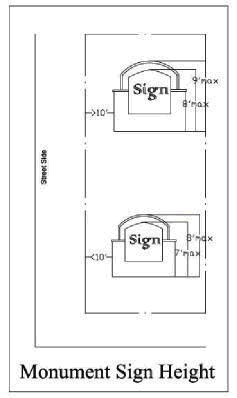
Monument sign. A freestanding sign mounted directly on a planter or pedestal base without air space beneath as distinguished from the support of a pole or poles and that is designed to incorporate features and building materials that complement the architectural theme of the buildings on premises.
Multiple use. A development containing two or more businesses occupying one or more buildings on a single parcel of land.
Multiple use identification sign. A sign that functions to identify the name of the group development and that may also function to identify the tenants.
Mural. A work of art painted or otherwise applied to an exterior wall surface. Such work shall not serve to advertise or promote a business, service, product, cause, or event. If such work does serve to advertise or promote a business, service, product, activity, cause, or event, it will be considered a "sign" and as such, will be subject to the sign ordinance.
Nonconforming sign. Any sign which was erected legally prior to the adoption of this chapter, but which does not conform to any one or more of the requirements of this chapter.
Nameplate. That portion of the sign's face that identifies the individual or company who currently owns it.
Neon. A glass tube filled with gas that emits light when energized.
Off-site directional sign. A permanent off-site sign not exceeding 16 square feet in size facing a major collector or arterial street that functions solely to provide directions to a licensed business located:
1.
On a local or minor collector street; and
2.
Within one-half mile of the major collector or arterial street.
Off-site sign. A permanent advertising device that exceeds 16 square feet in size and that functions to display commercial advertising for goods, products, services, or facilities or displays information not related to the site on which it is located.
On-site directional sign. A noncommercial on-site sign that functions solely to provide direction or information to pedestrian or vehicular traffic that is related or reasonably necessary to the movement of pedestrian or vehicular traffic on the premises, and not displaying a commercial message, e.g., "entrance," "exit," "caution," "no parking," "one way only," "no trespassing," "handicapped parking," and the like.
On-site sign. An advertising device relating in its subject matter to the property on which it is located or to products, accommodations, services, activities on the property, or noncommercial messages.
Ornamental flag. Any fabric or similar material containing patterns, drawings or symbols used for decorative purposes and designed to be flown as a flag.
Parapet sign. A parapet sign is a sign extending above a roofline or which serves as a parapet.
Pennant. Pieces of cloth or plastic joined together uniform or varying in size, color and/or design suspended from a structure to the ground or additional structure.
Permanent sign. Any sign which, when installed, is intended for permanent use. For the purposes of this chapter any sign with an intended use in excess of 12 months from the date of installation shall be deemed a permanent sign.
Person. Any individual, firm, partnership, association, corporation, company, organization or entity of any kind.
Portable sign. Any sign that is manifestly designed to be transported, including by trailer or on its own wheels, even though the wheels of such sign may be removed and the remaining chassis or support constructed without wheels is converted to an "A" or "T" frame sign or attached temporarily or permanently to the ground.
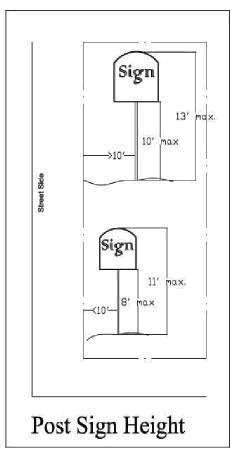
Post sign. A freestanding sign supported by a structural member(s) with air space between the grade level and the bottom of the sign face.
Principal use. The use, which constitutes the primary activity, function or purpose to which a parcel of land or building is put.
Projecting sign. A sign that is attached to and projects more than 18 inches from the face of a wall or building, but which does not project above the parapet or eave line of the building.
Public information sign. Public information signs are either:
1.
Signs permanently or temporarily erected in the public rights-of-way or on public property with the approval of the director of public works or code enforcement official or their designee which denote the name or route to any educational institution, public building or facility, historic place, shrine, church, synagogue, hospital, library or similar facility or institution; or
2.
Signs permanently or temporarily erected in the public rights-of-way identifying a person or entity that has undertaken to plant or maintain landscaping of that portion of the right-of-way.
Public service sign. A public service sign is a sign the primary purpose of which is to provide information as a service to the general public such as time, temperature or the promotion or announcement of public events, or other events of a civic, philanthropic, charitable or religious purpose of general interest to the public.
Real estate sign (including real estate open house sign). A temporary, nonilluminated sign that functions solely to advertise the sale, rental or lease of the premises or part of the premises on which the sign is displayed temporarily.
Right-of-way, future. Proposed or potential rights-of-way that need protection from future development so as to allow the widening of a road without destroying the principal building or use of the property. Either the transportation plan or an approved right-of-way plan shall determine the widths of such future rights-of-way.
Rotating sign. Any sign, illuminated or nonilluminated, supported from a pedestal, pylon or other vertical support and where the face or faces thereof slowly revolve (no more than 20 revolutions per minute) and where the light source, if any, remains constant.
Roof sign. A sign above the roof of a building that is fastened to and supported by the roof of a building, or a projecting sign that extends above the roofline or parapet wall of a building.
Sandwich board signs. Sandwich board signs are self-supporting, A-shaped, freestanding temporary signs with only two visible sides that are situated adjacent to a business. The sign is displayed outside a business during business hours. The maximum area of a sandwich board sign in the Division of St. John shall be no more than six square feet in area per sign face with the maximum height being 42 inches. The maximum area of a sandwich board sign in all other commercial areas of the city shall be no more than 12 square feet in area per sign face with the maximum height being 48 inches.
Sight triangle. The triangle at either side of an accessway or public right-of-way at its junction with a public street with sides of not less than 15 feet in length each along the public right-of-way and/or accessway within which clear visibility of approaching vehicular or pedestrian traffic must be maintained.
Sign. A sign is defined as a medium of communication, including its structure and component parts, which is used or intended to be used to attract attention to its subject matter or location usually for advertising purposes, including paint on the surface of a building. Each distinctive message painted or placed on a building or other structure shall be considered an individual sign. The following shall not be considered signs subject to the regulations of this chapter: artwork, holiday or seasonal decorations, cemetery markers, machinery or equipment signs, or memorial signs or tablets.
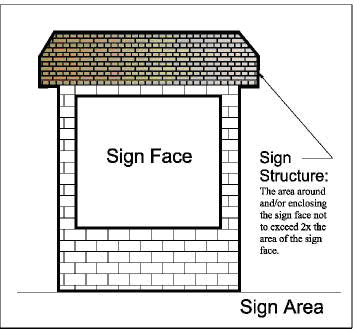
Sign area. That area within a line including the outer extremities of all letters, figures, characters, and delineations, or within a line including the outer extremities of the framework or background of the sign, whichever line includes the larger area. The support for the sign background, whether it is columns, a pylon, or a building or part thereof, shall not be included in the sign area. Only one side of a double-faced sign shall be included in a computation of sign area; for other signs with more than two faces, each side shall be included in a computation of sign area. The area of a cylindrical sign shall be computed by multiplying one-half of the circumference by the height of the sign. The area of a sign made of individually cut out letters is the sum of the area of rectangles or triangles necessary to enclose each letter.
Sign copy. All words, letters, numbers, figures, characters, artwork, symbols, or insignia that are used on a display surface area.
Sign face. That particular area of the sign structure upon which a message, copy, or advertisement is displayed for viewing.
Sign height. The distance from ground level to the highest point on the sign structure.
Sign owner. The owner of the sign.
Sign structure. Any portion of a freestanding base, supports, uprights, or braces the primary purpose of which is to support a sign(s) and excluding those portions of any such structure the primary purpose of which is to serve an architectural function (i.e., building wall, freestanding wall, entrance wall, fence, gate, etc.).
Signable area, wall signs. The area of the façade of the building facing the right-of-way up to the roofline for one-story buildings and up to the first story for multi-story buildings. Where the ground level of a multi-story building is at an elevation that is below the crown of the adjoining roadway from which a sign is designed to be viewed, the signable area for the wall sign may be up to an additional height above the first story of the multi-story building measured by the differential of the ground level of the building and the crown of the adjoining roadway that is perpendicular to the location of the center point of the location of the sign face; however, in no event shall the signable area be above the roofline.
Sign permit identification plate. That portion of the sign's face that identifies the permit number(s) assigned to it by the city, and where applicable, the state.
Snipe sign (bandit sign). Any sign, including flyers, tacked, nailed, posted, pasted, glued, taped or otherwise attached to trees, poles, stakes, fences or other like objects, with the message appearing thereon not applicable to the present use of the premises upon which the sign is located.
Special event sign. Any sign providing notice of, or direction to, an event, activity, gathering, assembly or meeting that is open to the public at large, designed, intended or expected to occur and be completed within a reasonable short or definite period after the erection of the promotional (announcement) sign.
Statutory sign. A sign required by any statute or regulation of the State of Louisiana or the United States.
Streamer. Any long, narrow flag, banner, tinsel or roping that is hung or strung from any structure to another structure or to the ground.
Street banner. Any banner sign which is stretched across or on a public right-of-way.
Subdivision sign. A subdivision sign is a sign located within the boundaries of a subdivision identifying the subdivision and denoting the entrance or exit to the subdivision.
Temporary sign. A sign intended for a use not permanent in nature. For the purposes of this chapter, a sign with an intended use of one year or less shall be deemed a temporary sign.
Time, temperature and date sign. A sign which functions only to display the current time, temperature and date at intervals no more frequently than once per minute and which contains no other messages. Time, temperature and date signs are regulated and permitted within the zoning districts in which they are allowed and shall not be considered as animated flashing signs.
Traffic control device sign. Any sign located within the right-of-way that functions as a traffic control device and that is described and identified in the Manual on Uniform Traffic Control Devices (MUTCD) and approved by the Federal Highway Administrator as the National Standard.
Trailer sign. A trailer sign is any sign or sign structure attached to or composed in whole or in part of a trailer frame or chassis or skid or skid frame or body or of any materials which have ever previously constituted in whole or in part such a trailer, skid, frame, chassis or body.
Vehicle sign. Any sign or signs displayed on or from any mode of transportation including, but not limited to, cars, buses, trucks/trailers, trains, boats, or airplanes, where the total sign area covers more than ten square feet of the vehicle.
Wall sign. Any sign painted on or attached flat and parallel to the exterior surface of a freestanding wall or building and that projects not more than 12 inches from that wall or surface.
Warning sign or safety sign. A sign that functions solely to provide warning of a dangerous condition or situation that might not be readily apparent or that poses a threat of serious injury (e.g., gas line, high voltage, condemned building, etc.) or that provides warning of a violation of law (e.g., no trespassing, no hunting allowed, etc.).
Window sign, permanent. Signs permanently attached to the window glass of a structure and oriented towards the outside.
Window sign, temporary. Signs temporarily attached to the window glass of a structure and oriented towards the outside.
Zoning district. Any geographic area defined by the official City of Covington Zoning Map for the purpose of regulating use. The official zoning map as adopted by the city council shall be the final authority as to the current zoning status of any property.
6.104. Prohibited signs. The following devices and locations shall be specifically prohibited:
1.
Abandoned signs;
2.
Animated signs;
3.
Audible signs;
4.
Billboards or outdoor general advertising signs (including billboard signs on vehicles);
5.
Signs attached or affixed to bus shelters or bus benches, with the exception of adopt-a-stop signs that are two square feet or less in size that function solely to identify the sponsor of a bus stop or shelter;
6.
Signs imitating traffic control devices or emergency signals;
7.
Flashing signs including those which utilize intense flashing strobe-type lights, spot lights, floodlights, flashing or blinking lights, beacons, lasers, or any type of pulsating or moving light;
8.
Signs preventing free ingress or egress to or from any door, window, or fire escape;
9.
Off-site signs;
10.
Parapet signs;
11.
Pennants, banners and streamers, except when they are used for a temporary occasion and permitted as set forth herein;
12.
Signs other than public directional signs, public service signs, public informational signs or official notices which encroach into or over the public right-of-way;
13.
Roof signs;
14.
Snipe signs (bandit signs) on public property;
15.
Signs attached to trees, shrubs or any vegetative matter on public property;
16.
Signs requiring removal of trees from the public right-of-way;
17.
Vehicle or trailer signs, excluding commercial business logo;
18.
Signs without permission of property owner: Any sign placed or erected on property without permission of the owner of the property.
6.105. Exempt signs. The following signs shall be exempt from the provisions of this section. No sign shall be exempt from section 6.102 of this ordinance.
1.
Residential address signs and combination nameplate and address signs that contain no advertising copy and which do not exceed six square feet;
2.
Flags on flagpoles: All flags shall be displayed on purpose-built, professionally fabricated flagpoles, which may be vertical or mast-arm flagpoles. In nonresidential districts flagpoles shall not exceed the allowed height provided for a structure or building in the applicable zoning district, or 50 feet, whichever is greater. Flagpoles in residential districts shall not exceed 25 feet in height, or the height of the primary structure on the lot, whichever is less. In addition the following regulations shall apply:
a.
The maximum dimensions of any flag shall be proportional to the flagpole height. The hoist side of the flag shall not exceed 20 percent of the vertical height of the flagpole, subject to the limitations of Table 61.1;
b.
Each lot or parcel shall have a maximum of two flagpoles;
c.
A maximum of two flags shall be allowed per pole;
d.
A vertical flagpole must be setback from all property boundaries a distance at least equal to the height of the flagpole;
e.
Flags and flagpoles shall be maintained in good repair, and to the extent applicable shall be in compliance with the building code. Flagpoles with broken halyards shall not be used and flags that are torn shall not be displayed.
Table 61.1
3.
Fuel service station pump signs, oil rack signs, and pricing signs in accordance with the provisions of section 6.107;
4.
Helium/cold-air-filled devices: Helium/cold-air-filled devices that do not exceed 36 inches at any measurement;
5.
Home occupation signs not exceeding two square feet in sign area which are nonilluminated and mounted flat against and parallel to the plane of the wall of the building to which the sign is attached;
6.
Memorial plaques, building identification signs and building cornerstones when cut or carved into a masonry surface or when made of noncombustible material and made an integral part of the building or structure;
7.
Official notices authorized by a court, public body, or public safety official;
8.
Public directional signs, public service signs, public informational signs or official notices which encroach into or over the public right-of-way;
9.
Portable signs not exceeding ten square feet in total sign area;
10.
Private directional signs not exceeding four square feet in sign area per sign;
11.
Professional nameplates not exceeding two square feet in sign area;
12.
Religious symbols and seasonal decorations within the appropriate public holiday season;
13.
Temporary signs, including window signs, real estate signs, construction signs, and free expression signs in accordance with the provisions of section 6.106;
14.
Warning and safety signs.
15.
Menu boards. Menu boards for drive-thru [drive-through] facilities providing food for off-property consumption which signs shall not exceed 48 square feet in sign area and which are located so as not to be visible from the street right-of-way from which primary access to the property is obtained. Menu boards and similar data for drive-in parking spaces for drive-in restaurants shall not exceed nine square feet each.
16.
Sandwich board (A-frame) signs. Sandwich board signs are permitted for nonresidential uses within the historic downtown district and designated commercial corridors. Only one sandwich board sign per business shall be permitted and shall only be displayed during the regular business operating hours or special event and must be stored indoors at all other times. The sign shall not be located within or encroach upon a street or street right-of-way, except that where sidewalks exist. When there is a sidewalk, the sign may be placed on a sidewalk directly in front of the associated establishment. The sandwich board sign must be placed so as not to interfere with or obstruct pedestrian or vehicular traffic or create site distance conflicts or other traffic hazards. The sign shall not be erected or maintained in a manner that prevents free ingress or egress from any door, window or fire escape. Attaching sandwich board signs to structures, poles, sidewalks, objects, signs, etc. by means of chains, cords, rope, wire, cable, etc. is prohibited. Sandwich board signs must not be used outdoors when high winds or heavy rain conditions exist. The sign shall be professionally made and constructed of durable weather-resistant materials such as aluminum, plastic or wood-finished surfaces and shall be maintained in good condition.
17.
Signs placed by the city departments of public works, planning, code enforcement or any other city department, by order of the city mayor to direct, warn, caution or inform the traveling public for the convenience and safety thereof, including public parking.
6.106. Temporary signs; additional requirements for erection or display without necessity of permit.
1.
Temporary construction signs. Temporary construction signs not exceeding 32 square feet in sign area, or eight feet in height; however, temporary construction signs shall not exceed six square feet in sign area, or four feet in height in residential zones unless the parcel exceeds three acres in size and is not located in a final recorded subdivision. Temporary construction signs shall be removed within ten days after the construction is completed.
2.
Temporary free expression signs: Temporary free expression signs, not located within the public right-of-way and placed no closer than ten feet to the back of the curb of a public roadway.
3.
Temporary real estate signs.
a.
In all residential zoning districts, temporary real estate signs or real estate open house signs shall not exceed 32 square feet, or eight feet in height; however, temporary signs shall not exceed six square feet in area or four feet in height in residential zones unless the parcel exceeds three acres in size and is not located in a final recorded subdivision. Temporary real estate signs shall be removed within ten days after the subject lot or building is sold or leased.
b.
In all other zoning districts, any such signs shall be limited to one real estate sign per listing broker on any premises offered for sale, rent or lease. Such sign shall be nonilluminated and shall not exceed 32 square feet in sign area. A double-faced real estate sign is permitted, provided that such sign shall not exceed 16 square feet in area per sign face and an aggregate sign face area of 32 square feet. If freestanding, any such sign, whether single or double-faced, shall not exceed seven feet in height. Property with two or more premises street frontages shall be allowed to display one additional sign conforming to all of the requirements of this subsection on a second frontage.
c.
Real estate open house signs shall be allowed no more than three days before the event and must be removed within 24 hours after the event.
4.
Temporary window signs. Signs located on the inside of windows intended for the purpose of viewing from outside the premises, provided that such signs do not exceed 25 percent of the window space, are not permanently attached, and are constructed of such materials that clearly indicates that they are temporary.
5.
Temporary yard or garage sale signs, additional requirements for erection or display without necessity of a permit. Any garage sale sign erected or displayed without necessity of a permit pursuant to the provisions of this sign code shall be limited to one nonilluminated sign displayed on the residential premises at which the sale is conducted, provided that such erection and display shall be limited to three days in conjunction with the yard or garage sale. (See section 22-6, garage sales.) Such sign shall not exceed six square feet in sign area. Two additional garage sale signs, a maximum of six square feet each may be placed off-premises on private property with permission of the property owner.
6.
Personal convenience signs. In order to ensure fairness to property owners and to allow reasonable exposure to the public, the following signs are allowed without permit. In all instances these signs are restricted to placement on private property, with permission from the property owner or lessee of the property, and are not allowed on public streets, rights-of-way, sidewalks and other public areas. Also, in all cases these signs are limited to a maximum of four square feet in area and a maximum height of four feet. They shall not be erected in a dangerous manner, in a manner to interfere with pedestrian or vehicular traffic or in a manner which impedes the effectiveness of vehicular traffic signs or electric signs. One sign is allowed per street frontage and can be placed free-standing, placed on poles, fences or similar standards. Signs may also be placed on provided public or private bulletin boards with consent of the owner.
a.
Warning or caution signs such as "No Trespassing," "Condemned Building," etc.
b.
Signs that announce or advertise temporary public, civic, charitable, educational, home instruction, nonprofit, philanthropic or religious events or functions in pursuit of their purpose. Placement of such event signs should be for a maximum 14-day period and allowed twice per year.
c.
Flag signs of noncommercial or nonadvertising display to include, but not limited to, flags, emblems or insignias of any nation, state or political subdivision, religious, charitable, political, social or fraternal organization or similar.
d.
Lost/found pet signs. Placement of such signs should be for a maximum period of 30 days.
e.
Special event signs. Placement of such signs should be for a maximum period of 14 days prior to the event and removed immediately after the event.
f.
Directional signs with the purpose of directing guests, members of organizations or other persons to a spot or location where a permitted special event will be held. Such signs shall be removed within three days after the event for which the signs pertain.
g.
Expressive signs in connection with an organized campaign in support of or opposition to any candidacy, political slate or ticket, or ballot proposal. Expressive signs measuring 32 square feet are allowed in CR (regional commercial) and ML (light industrial/manufacturing) zoning districts only. For complete definition, see section 6.103.
6.107. Fuel station signs. Fuel service station pump signs, oil rack signs, tire rack signs or pricing signs are permitted, provided they meet the following requirements:
1.
Fuel station pump signs. Fuel service station pump signs may be displayed on fuel pumps to provide required information to the public regarding the available fuel such as "gallons," "price," "octane rating" and "type of fuel." If a trade name of the business or supplier is incorporated into the name or designation of the different types of fuels available, said trade name and any associated symbols therewith may be displayed on the pumps provided that such signs are flat signs that do not exceed three square feet per sign face and an aggregate area of six square feet of sign face per pump.
2.
Oil rack signs. If a fuel service establishment markets engine oil on the pump island, any identification signs on the merchandise itself visible to the public shall be permitted. Additional signs on the oil rack may be permitted provided that each such sign shall not exceed three square feet per sign face with an aggregate area of six square feet of sign face per rack.
3.
Tire rack signs. If a fuel service station, tire store, auto repair shop or any other business which markets tire displays the tires on racks visible to the public, additional signage on the tire rack identifying the tires displayed on that rack may be permitted, provided that such additional signage shall not exceed three square feet per sign face with an aggregate area of six square feet of sign face per rack.
4.
Pricing signs. A sign advertising the price of motor fuel, other than pump signs, shall be permitted provided that such sign shall not exceed 12 square feet of sign face per sign with an aggregate sign face area of 24 square feet per sign. Such sign shall not exceed five feet in height, if freestanding. One such sign per premises frontage shall be allowed with a maximum of two such signs per premises. However, should such pricing sign be attached to, or be made part of, a permanent freestanding sign which identifies the premises, such sign shall not be allowed without permit and shall conform to the requirements of freestanding signs in the applicable zoning district. Pricing signs, however, when made a part of freestanding identification signs and when no additional freestanding pricing signs are placed on the premises may be allowed in excess of the allowable square footage of identification signage, provided that the maximum square footage for the premises is not exceeded in total signage.
6.108. Temporary special event signs on private property requiring a permit. Subject to all provisions and requirements of this article [part], the following temporary special event signs, under the following conditions, may be erected and displayed upon the issuance by the city planner of a temporary sign permit:
1.
Permitted signs:
a.
Proposed project signs. One nonilluminated temporary sign announcing a proposed development may be erected on the premises proposed for the project provided that such sign does not exceed 32 square feet in area, is set back at least ten feet from any property line and is removed within one year from the date the sign permit for its erection was issued or upon the issuance of the sign permit for a construction sign or the lapse of 60 days from the issuance of a building permit for the project, whichever is first to occur;
b.
Street banner signs, streamers, and pennants in accordance with the provisions of section 6.109;
c.
Temporary signs preceding permanent sign approval. Upon the filing of a complete application for sign approval by the city planner or code enforcement official, one temporary identification sign not to exceed 32 square feet may be permitted by the city planner or code enforcement official for a period of not more than 30 days for an occupant who has no other sign to identify the occupant's business. An additional 60-day extension for a temporary sign may be granted by the city planner or code enforcement official.
2.
Zoning districts: Temporary special event signs shall be permitted to businesses located on an individual lot of record located in commercial zoning districts.
3.
Display of sign permit: The sign permit shall be maintained on the premises for inspection for the duration of the display of the temporary special event sign.
4.
Size: The maximum permitted sign area per face shall not exceed 32 square feet.
6.109. Temporary signs; additional requirements for erection or display on public property with a permit.
1.
Public service signs. Public service signs including street banner signs are permitted only in connection with the promotion or identification of special events of a civic, philanthropic, charitable or religious purpose.
a.
General application. Any person, firm, corporation or organization in charge of any festival, spectacle, play, show, or other event of such a general civic and public nature and who is in charge of placing, erecting, constructing and maintaining any public service banner, flag, emblem, bunting or freestanding public service sign upon or over any public street, or other public place in the city shall first secure a temporary permit subject to the approval of the city planner or code enforcement official or their designee and the conditions provided herein prior to the placement of the sign.
b.
Application for permit. Applications for such a permit shall state the name of the person, firm, corporation or organization sponsoring the event; the location where such device or devices are to be installed and the contemplated dates during which such devices shall remain upon or over any street or other public place in the city. Such application shall have attached to it a chart or drawing showing that the device would not interfere with traffic or the safety of persons using such public places.
2.
Flags, streamers, banners, and pennants.
a.
Flags, streamers, banners or pennants may be displayed, upon the issuance of a temporary permit by the city planner or code enforcement official or their designee, in connection with grand openings or special events no more than once semiannually for any one business entity or applicant. Such signs may be displayed for a period of 14 days prior to an event; but in no case shall the total display time be greater than 30 consecutive calendar days.
b.
Flags, streamers, banners or pennants may be displayed in connection with events governed by, and subject to all provisions and restrictions set forth in subsection 6.109 of this sign code.
c.
Application for permit. Applications for such a temporary permit must state the name of the person, firm, corporation or organization sponsoring the event; the locations where such device(s) are to be installed and the contemplated dates during which such devices shall remain on display.
d.
Banners shall not exceed 32 square feet.
6.110. Permanent signs in residential districts. Permanent wall signs and ground signs in the residential districts that are not otherwise allowed without a permit pursuant to the provisions of section 6.105 are subject to the following limitations and shall require a sign permit:
1.
Ground signs. Ground signs shall be allowed for subdivision entrances subject to the following limitations:
a.
Two signs, either ground signs or wall signs, shall be allowed per subdivision entrance.
b.
The maximum size of a ground sign for a subdivision entrance shall not exceed 32 square feet.
c.
The maximum height of a ground sign for a subdivision entrance shall not exceed eight feet.
d.
A ground sign for a subdivision entrance shall be setback a minimum of five feet from the front and side property lines.
2.
Wall signs. Wall signs shall be allowed for subdivision entrances subject to the following limitations:
a.
Two signs, either wall signs or ground signs, shall be allowed per subdivision entrance.
b.
The maximum size for a wall sign for a subdivision entrance is 32 square feet.
c.
The maximum height shall not exceed the top of the signable area.
3.
Additional signs allowed in RSL, RLL, RS-1 and RS -2 zoning districts.
a.
For premises containing permitted nonresidential structures or uses, other than accessory uses, one nonilluminated flat wall sign, not exceeding 24 feet in area shall be permitted.
b.
Churches, child care centers, or bed and breakfasts shall be permitted to erect on their premises, in addition to the permitted wall sign as allowed in subsection 6.110.3.a, a freestanding sign, either nonilluminated or illuminated, no closer than 15 feet to the right-of-way, not to exceed 24 square feet per sign face, [having] an aggregate sign face area of 48 square feet and not exceeding seven feet in height, provided that such sign is so situated and shielded that its source of illumination is not visible from any abutting residence.
4.
Additional signs allowed in RM-1 and RM-2 zoning districts.
a.
One attached sign identifying the premises sized at a ratio of one square foot per one linear foot of building frontage but under no circumstance shall exceed 48 square feet, shall be permitted. No attached sign shall be required to be less than 24 square feet in sign area.
b.
One freestanding sign identifying the premises may be permitted in lieu of an attached sign, provided it does not exceed 32 square feet per sign face and aggregate area of 64 square feet for a two-sided sign, does not exceed seven feet in height, is not closer than 15 feet to the public right-of-way.
c.
Any sign permitted in the RSL, RLL, RS-1 and RS-2 zoning districts.
d.
Table I requirements. These permanent signs shall conform to the provisions set forth in section 6.111.
6.111. Permanent Signs in nonresidential districts.
1.
General provisions.
a.
Computation of frontage. If a building has frontage on more than one public right-of-way, the sign area(s) for each building wall or property frontage will be computed separately. The sign area(s) thus calculated shall be permitted to then be applied to permitted signs placed on each separate wall or property line frontage.
b.
Sight triangle. No portion of any sign shall be located within any sight triangle required by this ordinance, nor shall any sign otherwise be located or installed in such a manner as to create a traffic hazard.
c.
Sign spacing and setback: Signs shall be spaced and setback as indicated in this section.
d.
Sign height: The height requirement for all freestanding signs shall conform to district requirements in this section. This height shall be measured from the grade at the edge of the adjacent right-of-way or the grade of the sign site if such grade is above the grade at the edge of the street right-of-way to the uppermost part of the sign face, base or structure. If the sign is located below the grade at the edge of the right-of-way, sign height shall be measured from the edge of the right-of-way to the uppermost part of the sign face, base or structure.
e.
Multi-face signs: For purposes of determining the total sign square footage allowed for multi-face signs, the total number of faces shall be divided by two and then added together and applied against the total square footage allowed. For example, only one face of a two-faced and/or double-faced sign shall be applied to the total square footage allowed (2 faces/2 = 1 face; therefore, only one face is applied against the total sign square footage). Odd-number-faced signs will be rounded up; e.g., a three-faced sign shall be handled thus: 3 faces/2 = 1.5 faces, which shall be rounded to two faces.
f.
Sign structures: Sign structures shall be measured as the area around and/or enclosing the sign face, including embellishments such as pole covers or decorative roofing. The area of such structures shall be calculated as the smallest, regular, geometric figure(s) needed to circumscribe the sign structure minus the dimension calculated as the sign face. The area of a sign structure shall not exceed twice the maximum square footage allowed for the sign face.
2.
Ground signs.
a.
Number. One ground sign shall be permitted for each street frontage of each property, and a property with more than one street frontage shall be permitted one ground sign per each street frontage; provided that if the street frontage of a property is more than 300 feet on any of the property's street frontages, then an additional ground sign shall be permitted on street frontages in excess of 300 feet as follows:
Table 61.2
b.
Location. A ground sign or ground signs, if more than one is permitted, may be located at any place or places on a property from the street property line, including the street planting area, back to the building façade, or of there is no building façade behind the sign, then back to the yard (setback) line; provided that ground signs constructed within a sight triangle as defined herein, shall be subject to the following:
i.
Any sign placed within a sight triangle shall be a pole sign, and the vertical distance between grade level and the bottom of the lowest sign face shall be sufficient to allow drivers of vehicles to see through the open space so created.
c.
Sign area—Post signs. The sign area for each permitted post construction sign shall not exceed the following:
Table 61.3
d.
Height of post signs. The height of post signs shall not be greater than the following:
Table 61.4
e.
Sign area of monument signs. A monument sign may be permitted in the most rearward ten feet of the front 15 feet of the premises.
Table 61.5
f.
Height of monument signs. The height of monument signs shall not be greater than the following:
Table 61.6
g.
Height of sign at intersection of two highways. Post signs within a sight clearance area as determined by the Louisiana Department of Transportation and Development (LA DOTD) at the intersection of two state highways where the property fronts 250 feet or more on both highways and contains multiple occupants shall be subject to the following criteria:
i.
The lowest part of the lowest sign face shall be high enough, as determined by the LA DOTD, to allow adequate visibility between grade level and the lowest part of the lowest sign face; and
ii.
The sign structure shall not exceed 15 feet in height.
h.
Characteristics of ground signs. Ground signs may be internally or externally illuminated, but such illumination shall not exceed 3,000 lumens per side per sign or otherwise unreasonably intrude on residences located in a district zoned residential, and such illumination shall not constitute a traffic hazard. Internally illuminated signs shall have a darker background with lighter colored letter copy to reduce glare.
i.
Condominium regimes. Condominium units and common areas within condominium regimes shall be treated as a property in single ownership for purposes of determining applicability of rules relating to ground signs.
j.
Multiple occupancy centers.
i.
Only one ground sign is allowed for multiple occupants. Ground signs may contain names and data on some or all tenants, occupants, or activities and any sign message or messages. Signs for individual businesses will be allowed on the face of the building subject to the provisions of this ordinance.
ii.
In addition, each tenant/owner shall be permitted one attached identification sign for façade.
3.
Wall signs. A building may display one wall, awning, marquee, or canopy sign on each façade of each building that faces a public right-of-way in accordance with the following:
a.
Location. The location for each wall, awning marquee, or canopy sign for each building shall be determined by selecting one such area on each of the façades of the building that face a street or on each of the portions of the [building] that faces a street.
b.
Size. The permitted sign area for determining wall, awning, marquee, or canopy signs for each building shall be one square foot per linear foot of façade frontage on which the sign is to be placed; provided that building façades with less than 32 square feet of façade frontage be allowed up to 32 square feet of sign area; and that the maximum square footage for any sign in this category be 64 square feet. In CR (Regional Commercial) and MI (Light Industrial) zoning districts along Hwy. 190, Business Hwy. 190, Collins Blvd., Ronald Reagan and Hwy. 25, the sign area shall be 1.25 square feet per linear foot of building façade, provided that no building shall be required to have less than 32 square feet of wall signage and no wall sign shall be larger than 120 square feet.
c.
Illumination. Wall, awning, marquee, or canopy signs may be internally or externally illuminated, but such illumination shall not exceed 3,000 lumens per sign or otherwise unreasonably intrude on a residence located in a district zoned residential, and such illumination shall not constitute a traffic hazard. Internally illuminated signs shall have a darker background with lighter colored letter copy to reduce glare.
4.
Identification signs. In addition to the other signs permitted herein, each activity shall be permitted one identification sign consisting of one nonilluminated wall or projecting sign not exceeding four square feet in size. An identification sign must be located on the façade of the building.
5.
Exempt signs. Any sign that does not require a permit under the provisions of section 6.105 of this sign code may be erected or displayed in any institutional, open space/recreation, commercial, or industrial zoning district.
6.
Subdivision signs. Subdivision signs not greater than 48 square feet in sign area or 96 square feet for a two-sided sign may be located at the entrances to approved subdivisions by permit.
7.
Regulation of signs in the Historic Downtown Covington Mixed Use Overlay District (HDC-MUOD). This district officially designated as the historic center of the city, calls for special treatment of signage and promotional identification. As such, signage in this overlay district shall governed by the criteria set forth in section 3.3111 of this zoning ordinance.
6.112. Location and construction standards for signs.
1.
Conformance to codes. All signs must meet the structural requirements as set forth in chapter 18 of the City of Covington Code of Ordinances.
2.
Signs in rights-of-way: No portion of any sign or sign structure shall be located within a distance of five feet from the right-of-way line or within 20 feet of the edge of pavement or roadway surface of any public street or highway.
3.
Signs at intersections. Freestanding signs shall not restrict or impair visibility at the intersection of the right-of-way lines of two streets, or of a street and a railroad.
4.
Sight triangle. No sign or sign structure, excluding any ground sign mounting pole not to exceed 12 inches in diameter, shall be erected, placed or maintained as an obstruction to vision between the height of four feet and 15 feet within the area of the corner triangle.
5.
Wall signs. Wall signs may not extend above the roofline.
6.
Clearance of projecting signs. Signs projecting from a building or extending over public property shall maintain a clear height of nine feet above the sidewalk and all such signs shall be at least 18 inches inside of the curb line as measured toward the building. No sign projecting over a driveway and/or parking area shall have less than 14 feet of clearance.
7.
Sign face area. Sign face area shall constitute the entire face of the sign including the advertising surface and any framing, trim, or molding.
8.
Substitution of noncommercial speech for commercial speech. Notwithstanding anything contained in this chapter or code to the contrary, any permanent sign structure erected pursuant to the provisions of this chapter or code or otherwise lawfully existing with a commercial message may, at the option of the owner, contain a noncommercial message unrelated to the business located on the premises where the sign is erected.
6.113. Procedures; application and fees for sign permits.
1.
Requirement to obtain a sign permit. It shall be unlawful to construct, erect, alter, relocate, or display any sign without first obtaining a sign permit from the building official, city planner or code enforcement official and paying the fee required, unless specifically excluded from the requirement of a permit by section 6.105 provided that no permit shall be required for either the repair of a sign, or a change in addition of tenants, occupants, activities, or messages.
2.
Application requirements. Applications for sign permits shall be made upon application forms provided by the building official, city planner or code enforcement official and shall contain or have attached the following:
a.
A completed sign permit application providing all applicable information reasonably requested by the building official, city planner or code enforcement official;
b.
Written consent of the owner of the property or his agent granting permission for the construction, maintenance, and display of the sign or sign structure;
c.
Name, address, and telephone number of the property owner, the sign owner, the sign contractor and any designated contact person;
d.
Address of building, structure, or lot to which or upon which the sign is to be attached or erected;
e.
Position of the sign in relation to nearby buildings, structures, or property lines;
f.
A description of the size and location of all existing signs owned, leased, or otherwise being used on the same property by the entity making application for a sign permit;
g.
Any electrical permit required and issued for said sign; and
h.
Application for a certificate of appropriateness where applicable.
3.
Required fees for sign permits. The schedule of fees shall be established by the city council pursuant to sections 1.501 and 83-1 of this Code. This schedule of fees shall be available from the City of Covington Planning Department and may be altered or amended only by the city council.
4.
Duration of permit. A sign permit shall remain in effect for six months from issuance of the permit, and if the sign is not completed within such six-month period, the permit shall expire.
5.
Responsibility of the building official, city planner or code enforcement official.
a.
It shall be the duty of the building official, city planner or code enforcement official, upon the filing of an application for a sign permit, to examine such plans and specifications and other data and the premises upon which it is proposed to erect the sign, and if it shall appear that the proposed structure is in compliance with all the requirements of this chapter, upon final inspection of the sign all applications meeting the requirements of this chapter shall be granted. If an application fails to meet the requirements of this chapter, the denial shall be in writing and shall identify the requirements that are not met by the application. Any application rejected for incompleteness shall identify the reasons further action cannot be taken.
b.
All sign permit applications shall be granted, denied or rejected for incompleteness within 45 days of the building official, city planner or code enforcement official's actual receipt of a completed application and the payment of the permit fee. The building official, city planner or code enforcement official shall give notice to the applicant of the decision by hand delivery or by mailing a notice to the address on the permit application on or before the forty-fifth day after receipt of the completed application and payment. If the building official, city planner or code enforcement official fails to act by granting, denying or rejecting the application within the 45-day period, the permit shall be deemed denied.
6.
Responsibility of the city planner.
a.
The city planner shall be responsible for the interpretation of the requirements, standards, definitions, or any other provision of this chapter. Upon written request for an interpretation, the city planner shall respond in writing within ten business days.
b.
Any appeal of the city planner's written interpretation or failure to provide a written interpretation shall be subject to the appeal procedure described herein and in this section.
7.
Appeal: A person whose permit application has been denied may appeal the decision to the Board of Adjustment.
6.114. Enforcement of the provisions of the sign code and penalty for violation.
1.
Sign maintenance. Any signs not meeting the following provisions shall be repaired or removed in accordance with the specifications of this chapter.
a.
Owner responsibility: It shall be the responsibility of the sign owner to maintain and insure conformance to the provisions of this chapter.
b.
All burned-out bulbs or damaged panels must be replaced.
c.
All sign copy shall be maintained securely to the face, and all missing copy must be replaced.
d.
All signs shall be designed, constructed, installed and maintained in compliance with applicable building and electrical codes and in accordance with any applicable state law governing sign placement and sign characteristics.
e.
Every sign permitted by this ordinance shall be kept in good condition and repair. When any sign becomes insecure, in danger of falling or is otherwise deemed unsafe by the building official or code enforcement official, or if any sign shall be unlawfully installed, erected or maintained, the owner thereof or the person or firm using the same shall, upon written notice by the City of Covington, make such sign conform to the provisions of this ordinance within 30 days, or shall remove it. If within 30 days the order is not complied with. The city shall be permitted to remove or cause such as sign to be removed at the expense of the owner and/or user of the sign.
2.
Nonconforming signs. Any sign legally existing at the time of the passage of this ordinance that does not conform in use, height, location or size with the regulations of the zone in which said sign is located shall be considered a legal nonconforming use or structure and shall be permitted to continue in such status until such a time as it is either abandoned or removed by its owner, subject to the following limitations:
a.
Structural alterations, enlargement or re-erection are permissible only where such alterations will not increase the degree of nonconformity of the signs.
b.
Any legal nonconforming sign shall be removed or rebuilt without increasing the existing height or area if it is damaged, or removed if allowed to deteriorate to the extent that the cost of repair or restoration exceeds 50 percent of the replacement cost of the sign as determined by the building official or code enforcement official.
c.
The above prohibitions shall not prevent repairing or restoring to a safe condition any part of a sign or sign structure or normal maintenance operations.
d.
Signs that comply with either item a. or b. above need not be permitted.
3.
Nonconforming billboards upgrading to digital billboards. The billboards listed below that are legally existing at the time of the passage of this ordinance that do not conform in use, height, location or size with the regulations of the zone in which said billboards are located shall be permitted to continue or upgrade their status to a digital billboard until such a time as they are either abandoned or removed by their owner, subject to the following limitations:
a.
No increase in square footage of existing billboards.
b.
The minimum dwell (how long a single message must stay visible before changing) will be eight seconds. Each advertisement will be motionless for a minimum of eight seconds.
c.
Instantaneous transition between messages.
d.
No flashing, animation, scrolling, fading or motion is permitted.
e.
Illumination should not exceed 3,000 lumens.
f.
All digital billboards shall come equipped with a light sensing device that automatically adjusts the brightness in direct correlation with ambient light conditions.
g.
Billboard locations:
(1)
800 block of N. Collins Blvd. - Marco double-faced sign (2 boards);
(2)
800 block of N. Collins Blvd. - Lamar stacked signs, single-faced (2 boards);
(3)
1100 block of Hwy. 190 Business - Marco double-faced sign (2 boards);
(4)
2900 block of N. Hwy. 190 - Marco double-faced sign (2 boards);
(5)
1300 block of N. Collins Blvd. - Lamar stacked signs, double-faced (4 boards).
(6)
Any billboard exceeding 160 square feet in size located in an area involved in a future annexation into the City of Covington.
4.
Abandoned or obsolete signs. Any sign that no longer advertises or identifies use on the property on which said sign is erected must have the sign covered or removed within 30 days after written notice from the building official or code enforcement official; and upon failure to comply with such notice, the building official or code enforcement official is hereby authorized to cause removal of said sign, and any expense thereto shall be paid by the owner of the building, structure or ground on which the sign is located.
5.
Violation.
a.
In case any sign structure or sign is erected or structurally altered or maintained or used in violation of the provisions of this article, any city official may institute any appropriate action or proceedings to prevent such unlawful act or to prevent any illegal act, conduct or use in or about or concerning any such sign, sign structure or premises. Each day any such violation continues shall constitute a separate violation of this article. The city planner, building official or code enforcement official may call upon the police to furnish necessary personnel to carry out his orders.
b.
Any resident of the community who believes that a violation of any of the provisions of this article is occurring may file a written complaint with the building official or code enforcement official. Such complaint shall fully set forth the acts or omissions constituting the alleged violation and the site or sites at which such violation or violations are alleged to be occurring. The building official or code enforcement official shall record properly such complaint, investigate the allegations underlying said complaint, and take action on such complaint and investigation as provided by this article [part].
6.
Penalty. Any person violating any provision of this article [part] shall be guilty of a misdemeanor, and upon conviction shall be punished as provided in section 1-8 of this Code.
(Ord. No. 2010-30, Exh. 1, 1-4-2011; Ord. No. 2013-18, 9-19-2013; Ord. No. 2014-32, 11-20-2014; Ord. No. 2016-05, 1-22-2016)

