
Covington City Zoning Code
PART 4
- GENERAL PROVISIONS
Sec. 4.1. - Off-street parking.
4.101. General. Off-street parking shall be provided in compliance with this section whenever any building is erected, altered, enlarged, converted or increased in size or capacity.
4.101.1. Applicability.
1.
All applicable uses and developments must provide parking (including parking for the disabled) and loading facilities in accordance with this code.
2.
No certificate of occupancy shall be issued until these parking requirements have been met.
3.
These parking regulations do not apply to any structure or use existing at the time of enactment of these regulations. However, existing off-street parking spaces and loading spaces shall not be reduced in number or encroached upon so that the minimum requirements of this article would not be met. A reduction below the existing parking provisions may occur only when a change in use allows a corresponding reduction in the associated parking.
4.
Any time a use classification is changed or when a building or use is enlarged or increased, the parking and loading requirements for this article shall apply to the enlargement or increase. A certificate of occupancy for the new use or area of enlargement shall not be issued until all required parking and loading spaces have been provided.
5.
Commercial establishments in the Division of St. John shall not have any off-street parking requirements.
Table 41.1
Off-Street Parking Schedule
Note: Compilation of total employment. The number of employees shall be compiled on the basis of the number of persons employed on the premises at one time on an average day or average night, whichever is greater. Seasonal variations in employment may be recognized as determining an average day.
Note: For parking requirements, fixed seat for bleachers, pews and bench-type seating defined as 24" for one fixed seat.
4.102. Parking space requirements. The off-street parking spaces required for each use permitted by this Code shall not be less than that found in Table 41.1, provided that any fractional parking space be computed as a whole for uses not mentioned in this section, the city planner or a duly authorized representative shall determine the requirements for off-street parking and loading facilities. The determination shall be based upon the most comparable use listed, AASHTO or ITE standards, and/or the specific needs of the development as determined by the city planner.
4.103. Combination of uses or mixed uses. Off-street parking spaces for separate uses on a single location or development may be provided collectively if the aggregate number of spaces provided is not less than the sum of the spaces required for each use separately. No parking or loading space, or portion thereof, shall serve as the required space for more than one use with the exception of the following shared parking arrangement.
1.
Joint use up to 50 percent of required parking spaces may be permitted for two or more uses, provided that use of such facility by each user does not occur at the same time. No shared use of parking spaces shall be permitted unless:
a.
Approval is obtained by the building official that confirms that the use of such facility by each user does not take place at the same hours during the same days of the week;
b.
The users of the shared parking shall record an agreement to share parking facilities. A copy of the recorded agreement shall be given to the city planner.
c.
All location and design requirements of this ordinance are met.
d.
Any subsequent change in ownership or use shall require proof that the minimum parking requirements, per this ordinance, have been met for each use. The owner of an existing building or use shall have 180 days within which to accommodate all required off-street parking or apply for a variance. If the owner is unable to accommodate the parking or fails to apply for a variance, then the occupancy permit shall be revoked with respect to the use for which the separate parking is required. The occupancy permit shall be reinstated when all applicable provisions of this article are complied with. As an alternative to a variance, a new shared parking agreement may be arranged in accordance with this article.
4.104. Shared and off-site parking. The shared and off-site parking provisions of this section are intended to encourage efficient use of land and resources by allowing users to share off-street and off-site parking facilities in situations where the aggregate number of spaces provided is not less than the sum of the spaces required for each use separately and to locate off-street parking facilities on a different site than the uses served by the parking.
1.
Shared or off-site parking arrangements require review and approval by the zoning commission.
2.
All shared or off-site parking spaces must be located no further than 450 feet measured along the nearest pedestrian walkway from the property line or uses they are intended to serve. This distance limitation:
a.
Shall be measured along the shortest legal, practical walking route; and
b.
May be waived by the zoning commission as part of the site plan review process if adequate assurances are offered that adequate van or shuttle service will be operated between the shared or off-site parking area and the principal use or uses.
3.
Shared and off-site parking areas require the same or a more intensive zoning classification than that required for the most intensive of the uses served by the shared or off-site parking area.
4.
For proposed shared parking areas, the applicant must submit a shared parking analysis that clearly demonstrates the feasibility of shared or off-site parking.
a.
It must address, at a minimum, the size and type of the proposed development, the composition of tenants, the anticipated rate of parking turnover, and the anticipated peak parking and traffic loads for all uses that will be sharing off-street parking spaces.
5.
The shared or off-site location of required parking must be guaranteed by a legally-binding agreement, duly executed and acknowledged, between the owner of the parking area and the owners of all uses that are located on a different lot and served by the parking area.
4.105. Location of required parking spaces. Required parking spaces shall be located as follows:
1.
Single-, two-, three-, and four-family dwelling units: On same lot or on abutting lot under the same ownership.
2.
All other uses: The parking spaces shall be provided on the same lot as the use or where exclusive use of such is provided on another lot not more than 450 feet measured along the nearest pedestrian walkway; provided, however, that the zoning classification for such land is the same or less restrictive than the classification of the lot upon which the main use is located.
4.106. Credit for on-street parking.
1.
The amount of off-street parking required shall be reduced by the following credit provided for on-street parking: one off-street parking space credit for every two on-street spaces up to four credits, thereafter one space credit for each on-street parking space.
2.
On-street parking shall follow the established configuration of existing on-street parking, except that 45-degree angle parking may be allowed with the approval of the city engineer and the director of public works, taking into account traffic flows and street design, with the parking spaces designed in accord with the standards on file with the public works department. The following shall constitute one on-street parking space:
a.
Parallel parking—Each 24 feet of uninterrupted curb;
b.
45-degree angle parking—Each 17 feet of uninterrupted curb;
c.
Curb space—Curb space must be contiguous with the lot that contains the use requiring the parking;
d.
Corners and intersections—Parking spaces may not be counted that are within 25 feet measured along the curb of any corner or intersection of an alley or street; nor within ten feet of an intersection of a street or driveway, as measured from the bottom of the apron wing, nor any other parking configuration that violates any law or standard of the City of Covington or the State of Louisiana;
e.
Arterial or collector streets—Parking spaces located on arterial and/or collector streets may not be used for credited on-street parking, unless part of an adopted corridor plan for that street;
f.
Exclusivity—On-street parking spaces credited for a specific use shall not be used exclusively by that use, but shall be available for general public use at all times. No signage or actions limiting general public use of on-street spaces shall be permitted.
g.
Sidewalks - It shall be unlawful to willfully obstruct the normal use of public sidewalks (section 10-35 Entertainment District and section 86-5(b)(1) Public Places).
4.107. Tandem parking.
1.
Any required off-street parking space, whether by the requirements of this ordinance or any other provision of the Code, shall be individually accessible. Tandem or stacked parking may not be utilized to provide any required parking space; except that tandem parking may be permitted in the following instances:
a.
Where an applicant proposes to provide additional parking spaces for the benefit of visitors and residents in addition to those required by the Code, the staff may approve the use of tandem or stacked parking where such tandem parking will not block or impede access to any required space, or present a safety hazard. In no event shall tandem or stacked parking be permitted where its use would increase the permitted density of development.
b.
On a single-family lot, one tandem space may be provided in order to meet the minimum required parking on the property.
4.108. Deferral of full parking requirement by landscape reserve.
1.
Where the expected need for off-street parking for a particular use is uncertain, due to unknown or unusual operating characteristics of the use and unavailability of comparable data to establish need, or when the required parking exceeds 60,000 square feet, the planning or zoning commission, upon recommendation of the city planner, may authorize that construction and provision of not more than 30 percent of the required off-street parking stalls be deferred.
2.
The planning or zoning commission may set such conditions as necessary to guarantee provision of such deferred spaces whenever it is determined than the need exists.
3.
Land area required for provision of deferred parking shall be maintained in reserve and shall be landscaped pursuant to a plan approved by the city planner demonstrating that ultimate provision of the deferred spaces will meet all requirements of this section.
4.
Upon use of the parking area at near build-out (at least 90 percent occupancy) over a period of at least ten years, the city planner may allow the reserve area to be used for other uses that do not generate parking demand, subject to restrictions and conditions to prevent conversion to a more intense use unless sufficient additional on-site parking is provided.
4.109. Maximum parking ratios.
1.
In an effort to limit the amount of impervious surface associated with development, the maximum number of parking spaces allowed shall be 125 percent of the number of required parking spaces. Structured parking facilities are exempt from this maximum.
2.
The planning director may approve parking spaces in excess of the maximum parking ratio, but only if the applicant has proven that the additional spaces area necessary for the normal operation of the business or organization. If the applicant requests parking in excess of 200 percent if the maximum ratio, then a conditional use permit shall be required.
4.110. Parking stall dimension.
1.
Surface: Parking spaces shall be surfaced with a minimum of four inches of concrete or similar all-weather surface such as three-inch macadam on a suitable base and such entrances shall be similarly surfaced.
2.
Stall width: A minimum width of nine feet shall be provided for each parking stall.
3.
Stall length: A minimum length of 18 feet shall be provided for each parking stall.
4.
Exceptions:
a.
Up to 30 percent of required parking spaces may be designated for use by subcompact automobiles, provided that each space is clearly marked for such use and no space so designated is less than eight feet wide by 16 feet long;
b.
Parallel parking stalls shall be permitted to be eight feet wide and no less than 22 feet long;
c.
The city engineer may approve permeable paving materials in lieu of impervious surfaces; however, regular maintenance of the permeable areas that ensure proper function shall be a condition of approval.
4.111. Accessible spaces.
1.
Accessible parking spaces and passenger loading zones shall be built in accordance with the City of Covington Regulations and Building Codes. See handicap parking design sketch below.
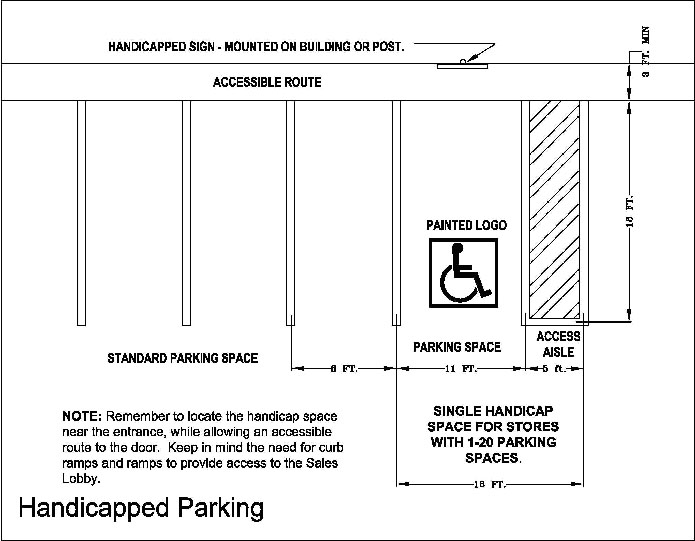
2.
Handicap parking regulations have been taken from the 2010 ADA-Americans with Disabilities Standards for Accessible Design, which includes all subsequent updates/amendments. The required number of accessible spaces, as defined in the Minimum Number of Accessible Parking Spaces (ADA Standards for Accessible Design 4.1.2(5)), is as shown on the table. Latest revisions of the table will always apply.
(Also, refer to chapter 18 Buildings and Building Regulations.)
3.
When combination of uses or mixed uses are involved on a single location or development, and joint use of off-street parking spaces for separate uses is allowed per section 4.103, required accessible parking spaces must be provided for each separate use as determined by the total parking spaces required for each separate use.
4.
Location: Accessible parking spaces serving a particular building shall be located on the shortest accessible route of travel from adjacent parking to an accessible entrance. In parking facilities that do not serve a particular building or buildings with multiple entrances, accessible parking shall be located on the shortest accessible route of travel to an accessible pedestrian entrance of the parking facility.
4.112. Design of parking facilities. Parking structures shall be set back from the property line the same distance as required for the principal structure in the district in which it is located. This does not apply to driveway, parking lots or similar type surface improvements.
1.
Driveway width: Every parking facility shall be provided with one or more access driveways, the width of which shall be at least nine feet for private driveways and 12 feet for one-way and 24 feet for two-way entrances to commercial uses.
2.
Driveway ramps and slopes: The maximum slope of any driveway or ramp shall not exceed 20 percent.
3.
Stall access: Sufficient maneuver and access aisle shall be provided to permit vehicles to enter and leave in a forward motion in accordance with detailed design standards on file with the City of Covington Department of Planning.
4.
Compact-to-standard stall ratio: The maximum ratio of compact stalls to standard stalls in any parking area shall not exceed 1:2.
5.
Screening: A three-foot high buffer at the public way shall be provided for all parking areas of five or more spaces.
6.
A bumper rail or wheel barrier shall be installed so that no part of parked automobiles can extend into the public right-of-way or into the landscaped area. A minimum of three feet shall be provided from the property line to the wheel guard.
7.
If light is provided, it shall be installed so that it does not reflect on adjacent properties or interfere with traffic.
4.113. Off-street loading requirements.
1.
Every hospital institution, hotel, commercial or industrial building or use having a gross floor area in excess of 20,000 square feet and requiring the receipt of distribution by vehicle of material and merchandise shall have at least one permanently maintained off-street loading space and so located as not to hinder the free movement of pedestrians and vehicles over sidewalks, streets, and alleys.
2.
Additional off-street loading requirements shall be as follows:
a.
Less than 200,000 square feet: One.
b.
Over 200,000 square feet: Two.
3.
Retail operations, wholesale operation, and industrial operations with a gross floor area of less than 20,000 square feet shall provide sufficient off-street loading space (not necessarily full berth if shared by an adjacent establishment) so as not to hinder the free movement of pedestrians and vehicles over a sidewalk, street, or alley.
4.
All required off-street loading spaces shall be at least 12 feet in width and at least 35 feet in length, exclusive of aisles and maneuvering space, and shall have a minimum vertical clearance of at least 14 feet.
4.114. Limitations.
1.
No public parking lot or structure may be used for the servicing, repair, or washing of motor vehicles unless legally permitted to do so by the City of Covington.
2.
Parking of unoccupied travel, utility, or boat trailers on residential lot areas is permitted provided they do not constitute a hazard to safe visibility of drivers on adjacent streets. See chapter 86, section 86-3 for general parking regulations.
3.
The following restrictions shall apply to the parking or storage of commercial vehicles on property zoned for residential use:
a.
No commercial vehicle shall be parked on any public right-of-way in a residential district, except as allowed in chapter 86, sections 86-5 and 86-6 or for vehicles in connection with current works being done to the adjacent premises;
b.
No stored or parked commercial vehicle shall be occupied or used for human habitation.
4.
Heavy equipment shall be defined to be any vehicle whose weight is in excess of five tons, including but not limited to equipment commonly used in site clearing, road building or construction. Such vehicles include, but are not limited to, the following:
a.
Cranes.
b.
Pan-scrapers.
c.
Bulldozers.
d.
Steamrollers.
e.
Backhoes.
f.
Graders.
g.
Water-drilling rigs.
h.
Paving machines.
i.
Loaders.
j.
Trenching machines.
k.
Dump trucks.
Parking and storage of heavy equipment is neither incidental to nor customary in a residential area. Parking and storage of heavy equipment is only allowed:
a.
In a zoning district that allows by-right or by-condition for commercial or industrial uses;
b.
Where such parking or storage of heavy equipment is incidental to an existing commercial or industrial use; and
c.
When such equipment is actively being used for the purpose intended.
5.
Recreational vehicles.
a.
No recreational vehicle or trailer licensed to transport recreational vehicles or equipment shall be parked in the public right-of-way unless as permitted in chapter 86, sections 86-3 and 86-6.
b.
Recreational vehicles may be stored in a residential district within a fully enclosed structure or within the rear or side yard. If stored in the rear or side yard, it must be located at least three feet from any lot line.
c.
No recreational vehicle shall be used for living, sleeping, or housekeeping purposes in any zoning district, unless within a regulated recreational vehicle park or as permitted in chapter 86, section 86-6.
d.
All recreational vehicles shall be maintained in mobile condition. No recreational vehicle shall be parked or stored in such a manner as to create a dangerous or unsafe condition on the lot where parked or stored.
e.
This section does not apply to recreational vehicles offered for sale in the approved outdoor sales and display area of a recreational vehicle dealership.
6.
Buses. See chapter 86, section 86-7.
(Ord. No. 2010-30, Exh. 1, 1-4-2011; Ord. No. 2013-09, 4-17-2013; Ord. No. 2015-24, 11-19-2015; Ord. No. 2025-20, 10-15-2025)
Sec. 4.2. - Landscaping and tree preservation.
4.201. Purpose and intent. The purpose of this section is to promote the health, safety and general welfare of the residents of the City of Covington and its environment by establishing minimum standards for the protection, maintenance, and enhancement of natural plant communities, natural features, and landscaped areas within the City of Covington for the following purposes:
1.
Environmental quality. To improve environmental quality through recognition of the beneficial effects of landscaping and protection of the forest canopy;
2.
Aesthetics. To improve the aesthetic appearance of commercial, industrial and residential areas through landscape design that incorporates protection and maintenance of living plant materials and other site developments in ways that harmonize and enhance the natural and built environments, as well as promoting public health and safety;
3.
Land values. To maintain and increase the value of land and community assets by requiring a minimum amount of landscaping to be incorporated into development, thus itself becoming a valuable capital asset;
4.
EPA mandates. To comply with the Environmental Protection Agency and Louisiana Department of Environmental Quality mandates to reduce nonpoint source pollution of streams and waterways;
5.
Stormwater runoff. To reduce the demand for stormwater detention and reduce flooding in the city.
4.202. Applicability. The provisions of this section shall apply to all zoning districts with the exceptions of section 4.208, street planting requirements, section 4.209, interior landscaping and parking lot requirements and section 4.210, buffer planting areas, which shall apply only to non-residential and multi-family zoning districts. The live oak protection requirements apply to all zoning districts. Landscape regulations and tree planting requirements apply to all new building projects, public or private, in the City of Covington, regardless of location unless otherwise noted in this ordinance. These requirements shall apply to existing properties where new construction or renovation of commercial, industrial, multi-family, religious, educational, institutional, public and semi-public land uses:
1.
Increases the footprint of building(s) on the premises on which the landscaping is situated.
2.
There is a change of use that increases the parking requirements.
3.
Where the renovation of a parking lot or vehicular use area creates five (5) or more parking spaces.
For tree removal permits relating to trees on private property with existing improvements, see chapter 102 vegetation, article I, trees on private property.
4.203. Definitions for landscaping regulations. The following definitions relate to the landscaping regulations contained herein:
Accessways. For purposes of landscape regulations, an accessway is an all weather surface for vehicular access to parking and loading spaces traversing a greenbelt area on a development site.
Arborist. A professional certified by the International Society of Arboriculture who possesses the technical competence through experience and related training to provide for or supervise the management of trees and other woody plants in the residential, commercial, and public landscape.
Branch. A secondary shoot or stem arising from one of the main axes (i.e., trunk or leader) of a tree or woody plant.
Buffer planting area. The unpaved area of land located along the side and/or rear property line designated for the preservation and placement of plant materials.
Buffer zone. A landscaped area between any building or vehicular use area and providing a visual screen of vegetation only or vegetation in conjunction with a nonliving screening material for the purpose of providing a buffer between noncompatible land uses.
Caliper. The diameter of a tree trunk measured at six inches above the ground up to and including four inches caliper size, and 12 inches above the ground for larger trees. Used for nursery stock and newly planted trees, and not for established trees.
City of Covington Arborist. A consultant utilized by the city to assist the city official responsible for plans review and site inspections.
City of Covington Urban Forester. The person responsible for coordinating the community tree program, the community forester shall provide technical assistance to the administrators, City of Covington Arborist, and city staff in the administration of this chapter, in addition to other duties and responsibilities as described herein and as may be assigned by the mayor.
Diameter breast height (dbh). The diameter of a tree at breast height, or four and one-half feet above ground level, the accepted point of diameter measurement for most trees.
Drip line. The outer edge of the foliage of a tree extending in all directions parallel to the ground.
Establishment period. The length of time it takes to successfully establish a tree in the landscape, generally considered three years from the time of planting.
Filter area. Gently sloping strips of vegetation (usually grass or groundcover with many leaves) designed to cleanse and infiltrate stormwater runoff.
Ground cover, decorative. Any mulch material (vegetative or mineral) that is used to cover the surface of the ground to prevent erosion or retain moisture.
Ground cover, vegetative. Plant material, including turf, which reaches a maximum height of 12 inches at maturity.
Interior landscape area. Any landscaped area within the interior of a development site and beyond the required periphery landscape area that is planted with trees, shrubs and ground covering material to provide for infiltration of runoff, shade of parking areas or aesthetic enhancement of the site.
Landscaping material. Material such as, but not limited to, living trees, shrubs, vines, turf, ground cover, landscape water features, and nonliving, durable materials commonly used in landscaping including, but not limited to, rocks, pebbles, sands, decorative walls and fences, brick pavers, and earthen mounds, but excluding paving for vehicular use. Any chain link fence and opaque screening fences greater than four feet in height shall not be considered as decorative walls and fences.
Median. The paved or landscaped dividing area between opposing lanes of traffic on highways or within parking lots, also called a median strip or neutral ground.
Mulch. Any material that is used to cover the ground surface to prevent erosion, retain moisture and protect plant material.
Periphery landscape area. An area of land between the property line adjacent to any street right-of-way and any vehicular use areas or building that is intended for the placement or preservation of landscape materials, which may also be referred to as the "street planting area."
Plant material. Any plant including trees, vines, shrubs, ground covers and annuals or vegetation of any size, species or description.
Planting area. An area suitable for the installation and maintenance of plant materials. Although small planting areas may be provided, any required planting areas shall be a minimum of 100 square feet with no side less than five feet.
Sidewalk. A paved pedestrian footpath between the curb lines or the lateral lines of a roadway and the adjacent property lines.
Sight obscuring screen. A 100 percent opaque visual screen with a minimum height of six feet, if nonliving material is used. If living material is used, it shall be at least 70 percent sight obscuring and be a minimum of four feet in height immediately after planting and shall consist of plants that reach a minimum of six feet in height at maturity.
Sight triangle. The triangle at either side of an accessway or public right-of-way with sides of a specific length each along the public right-of-way and/or accessway.
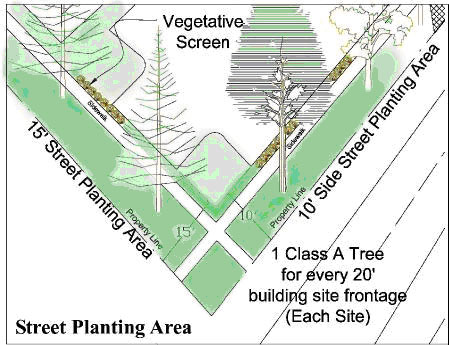
Street planting area. The unpaved area of land located between the property line that abuts a public street right-of-way and any building or vehicular use area designated for the preservation and placement of plant materials, which may also be referred to as the "periphery landscape area".
Swale. A relatively wide, shallow, open channel with a slight gradient, designed to let water flow slowly. This can slow down the flow after storms, let water soak into soil, and let pollutants adhere and/or degrade, and may have drains to prevent overflow.
Tree. A woody perennial plant that has the potential to attain a height of 15 feet or greater and a dbh of three inches or greater.
Tree canopy. The land area covered by a tree crown or crowns, as measured in square feet. For a site or lot it may be expressed as the percent of the land area covered by tree canopy and is calculated by dividing the tree canopy cover in square feet by the total land area of the site or lot.
Tree, Class A. Any self-supporting woody plant of a species which normally grows to an overall height of approximately 50 feet, usually with one main stem or trunk although some species may have multiple trunks, and with many branches. A list of species considered Class A trees may be obtained from the City of Covington Planning Department.
Tree, Class B. Any self-supporting woody plant of a species which normally grows to an overall height of approximately 25 feet, with one or more main stem(s) or trunk(s) and many branches. A list of species considered Class B trees may be obtained from the City of Covington Planning Department.
Tree topping. The severe cutting back of limbs of Class A trees larger than two inches in diameter or one inch of Class B trees within the tree crown thereby removing the normal tree canopy.
Under story plants. All shrubs and trees 25 feet or less in height suitable for growth under the canopy of Class A trees.
Vegetation protection zone. The area within the drip line of a tree required by this ordinance to be preserved.
Visual screen. An opaque barrier of living or nonliving landscape material put in place for the purpose of separating and obscuring from view those areas so screened.
4.204. Standards. The following standards shall apply to the preparation, installation and maintenance of all landscaping, screening and barriers required by this section.
1.
Landscape and tree preservation plan. In accordance with section 4.202 of this ordinance, a landscape and tree preservation plan shall be submitted to the city building department/city planner before any clearing or construction takes place and before any building permit is issued. Such plan will become part of the building permit application file and will be considered part of the building and site approval permit. The landscape and tree preservation plan shall be drawn by a landscape contractor or landscape architect licensed in the State of Louisiana, shall contain the following basic information, and shall be subject to the following:
a.
Interest and ownership. The name, address, phone number and signature of the property owner and proof of ownership.
b.
Zoning classification. The present zoning classification of the property and all property within 500 feet.
c.
Site features. The location, including all dimensions and distances drawn to scale, of all street and buffer planting areas; all existing and proposed parking spaces or other vehicle areas, accessways, and driveways; the location, size and description of all existing and proposed landscape materials, planting methods, fill and irrigation systems.
d.
Utility rights-of-way. The location, including all dimensions and distances drawn to scale, of all utility rights-of-way.
e.
Live oak trees. The location of all live oak trees that are six inches dbh whether located on the property or within the rights-of-way shall be clearly identified.
f.
The location, number, and size of all existing trees six inches dbh or greater located in the required street planting area, required side or rear yard buffers and the street right-of-way shall be clearly identified on the plan. In addition the applicant shall clearly label the trees that he/she seeks permits to remove.
2.
Installation.
a.
All landscaping shall be installed in a sound, workmanlike manner and according to accepted good planting procedures.
b.
All plant materials required for installation shall be certified disease- and insect-free.
c.
Landscape work shall be completed as part of the total construction package and must be in place at final inspection of the building or site by the city building official. Site and landscaping improvements not installed according to the approved landscape plan may prevent city approval of the applicant's occupancy of the building and site and may result in enforcement action.
d.
Existing vegetation that is to be preserved in compliance with the requirements of this section shall be protected during the development process as per section 4.204.5.
e.
See article IV, Fill Regulations, section 18-153, for acceptable soil materials for landscape improvements.
3.
Maintenance.
a.
The owner shall be responsible for the maintenance of required landscaping in good condition so as to present a healthy, neat and orderly appearance; and said landscaped areas shall be kept free from refuse and debris.
b.
Required planting materials that die or become diseased during the 18 months following completion of construction, are to be replaced with the same type and size of plant material originally specified on the landscape plan within six months.
c.
Plant materials shall be pruned as required to maintain good health and character. However, tree topping is not permitted.
d.
Plant beds shall be mulched to prevent weed growth and maintain soil moisture.
e.
In all zoning districts, a tree-cutting permit shall be required prior to the removal of any tree larger than six inches dbh. The permit application shall include a site plan indicating the required yard setback, street and buffer planting areas, and the location, species, and size of any trees over six inches dbh that exist within these areas. The permittee shall remove all debris related to the cutting.
4.
Sight triangle.
a.
All plantings shall conform to Louisiana DOTD standards and be located so as not to cause an obstruction to motorists.
b.
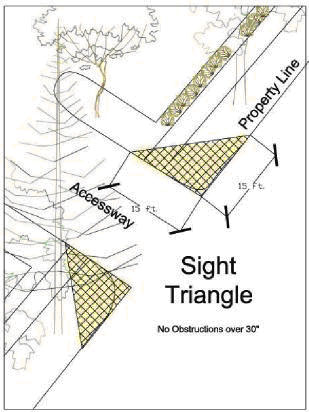
A sight triangle measuring 15 feet along the property line by a depth of 15 feet shall be established at accessways.
c.
No plantings over 30 inches shall be allowed in this sight triangle.
5.
Preservation of existing plant materials (also refer to section 4.206, live oak protection requirements).
a.
Tree preservation requirements in all residential zoning districts. A minimum of 50 percent of all existing Class A trees located within the required setback area of the property that are six inches or more dbh shall be required to be preserved. Trees to be preserved shall be shown on the site plan, with location, species and size in caliper inches at dbh, submitted in conjunction with the building permit application.
Trees to be preserved shall be protected by a barrier fence of acceptable materials to be erected at the outside edge of the drip line. Information about acceptable materials is available from the building permits office. This fencing shall be maintained throughout the entire construction process.
Removal of more than 50 percent of the trees located within the required setback area of the property shall be mitigated onsite or in accordance with section 4.207 of this ordinance and based on general recommendations submitted by the Covington Tree Board. Trees shall be a minimum of two inches dbh and eight feet height at time of planting.
The building official or code enforcement officer shall verify the preservation of all required trees or fulfillment of proper mitigation requirements prior to issuance of a certificate of occupancy.
Appeals concerning these requirements shall be heard by the Covington Board of Adjustment.
b.
Tree preservation requirements in all zoning districts not covered in [section] 4.204.5.a. All healthy trees six inches dbh or greater, located in the street planting area and in the side and rear buffer planting areas shall be preserved regardless of the number of said trees. In no case shall this requirement create a traffic hazard as per section 4.204.4 or obstruct vehicle access points. All trees required to be preserved by this ordinance shall be indicated on the approved landscape plan by location, variety and size in caliper inches measured at dbh.
c.
The owner/developer shall attempt to utilize native trees and shrubs in the design and implementation of the landscape plan.
d.
Exchange rate. For each existing tree preserved, one tree shall be credited towards the satisfaction of the minimum planting requirements. These credits shall only be given if the trees preserved are located in or within 15 feet of the specific area (street/buffer planting areas and parking area). For example: The trees preserved in the street planting area shall be given credit for the street planting requirement only. Credit for trees preserved in the parking area shall apply only to the parking requirements, etc.
e.
It shall be the responsibility of the landowner to use reasonable care in maintaining preserved trees. If a preserved tree dies, during construction or during the 18 months following completion of construction, it is the responsibility of the owner to replace said tree with a tree of the appropriate size and species within six months. The owner or his agent shall be responsible for maintaining all plant materials required by this ordinance in good, living condition. For each tree to be credited, a planting area or open ground space of at least 25 square feet, with a minimum side dimension of five feet, shall be required for trees of up to four inches in diameter. For each additional two inches of tree diameter of the preserved tree, an additional 25 square feet of planting area or open ground space shall be required. For example:
Table 42.1
Tree Dimension
f.
During construction, planting or open ground areas surrounding preserved trees shall be protected sufficiently to prevent earth compaction of the root zone. In addition:
i.
No soil disturbance or compaction, stock piling of soil or other construction materials, vehicular traffic, or storage of heavy equipment are allowed in the tree and root protection area(s), or within the drip line of trees to be retained.
ii.
No ropes, signs, wires, unprotected electrical installation or other device or material, shall be secured or fastened around or through a tree or shrub.
iii.
Toxic chemicals, gas, smoke, salt brine, oil or other injurious substances shall not be stored or allowed to seep, drain or empty within the drip line of trees or shrubs in the tree and root protection area.
iv.
Except for sidewalks and curb and gutter, no paving with concrete, asphalt or other impervious material within the drip line of trees to be retained shall be allowed.
v.
Protective fencing shall remain in place throughout the entire construction process. Failure to maintain the protective fencing shall result in a stop work order.
Table 42.2
Plant Size Requirements at Time of Planting
6.
Building occupancy. Plantings required by this ordinance shall be in place at the time the building is to be occupied. If landscaping cannot be accomplished before the project is occupied, a letter of credit or cash bond must be posted for a period of six months to insure that the landscaping requirements are fulfilled. The amount of the letter of credit or cash bond shall be based upon current estimated costs of Class A and Class B trees.
7.
Minimum requirements. These are minimum requirements for planting. However, a property owner or developer may provide additional landscaping as per their needs or in relation to other city requirements.
4.205. Utility standards for tree preservation.
1.
Provisions for landscaping on public property. It shall be unlawful to prune, destroy, deface or cut down any tree or limbs located in public street rights-of-way or other publicly owned land within the corporate limits of the City of Covington except in accordance with the guidelines for the pruning and removal of public trees and shrubs provided herein and in chapter 102 Vegetation, article II Trees on Public Property in the City of Covington Code of Ordinances.
2.
Required utility annual vegetation management schedule. All utility companies having wires, cable lines, pipe or other facilities within the city rights-of-way shall submit an annual vegetation management schedule by January 1 of each year to perform any vegetative maintenance activities on any public trees or rights-of-way. In the case of any modifications to the annual vegetation management plan, the utility will give 30 days' prior notice to the building official before performing work.
a.
Vegetation maintenance activities shall include the following: mowing, chemical control, and pruning and tree removal;
b.
For nonroutine projects not included on the annual vegetation management schedule, 48-hour prior notification is required;
c.
In no event shall the requirements of this chapter be more restrictive with respect to utility companies affected thereby than equivalent regulations promulgated by the Louisiana Department of Transportation (LA DOTD) with respect to the state highway system;
d.
The annual vegetation management schedule shall be submitted to the city permit office.
3.
Vegetation maintenance standards. All vegetation maintenance activities performed by utility companies and their agents on City of Covington rights-of-way shall conform to the following minimum standards as required by the LA DOTD with respect to utilities on state highways:
a.
Tree removal, tree pruning, and mowing included on the annual schedule may be performed at any time;
b.
Chemical control is not permitted without special permission and shall meet all state and federal regulations and standards;
c.
Aerial applications of chemicals are prohibited;
d.
The utility company shall repair any damage that results from the mishandling or misuse of materials at the utility's expense and to the satisfaction of the City of Covington;
e.
All pruning and removal activities shall be performed under the supervision of an arborist licensed by the State of Louisiana;
f.
All trimming and pruning activities shall be in accordance with the most current ISA tree trimming and pruning guidelines;
g.
Crown reduction of pine trees is limited to lateral limbs;
h.
Cutting the leader of mature wood constitutes topping and is prohibited unless tree is under line and topping is required to maintain clearance;
i.
Pruning that removes more than one-third of the canopy of a tree and/or leaves the tree with unnatural symmetry is prohibited. If this type of pruning is required to meet NESC or OSHA requirements, and it is determined by the building official that the tree should be removed, a tree removal permit is required from the city permit office;
j.
Within right-of-way mowable areas, tree stumps and roots projecting through or appearing on the surface of the ground shall be removed to a depth of six inches below the average contour of the ground surface. Removal shall be accomplished by means of stump grinding equipment designed for the purpose;
k.
Holes or voids created by the removal of stumps shall be filled, graded, and compacted with acceptable fill material. In areas where stumps are adjacent to grass areas, sod shall be used to repair the bare spots created by the stump removal, areas damaged by equipment and/or currently exposed on site;
l.
In nonmowable areas, stumps may remain at a maximum of 18 inches above the ground line;
m.
All work shall be done without damage to native trees and shrubs that are to be preserved in the vegetation management zone. All work shall be done without damage to existing site conditions;
n.
All waste and debris shall be properly disposed of and the site left in an acceptable condition within 48 hours of work completion. When completed, the work site must be clean of all litter and debris created by the utility company and, if mowable area, acceptable for mowing by conventional mowing equipment;
o.
Cut trees, limbs, and shrubs must be removed in their entirety from the site, unless other arrangements have been made;
p.
Woody and leafy debris shall not be discarded onto adjacent property without permission of the landowner;
q.
Maintenance activities that do not conform to these standards shall be deemed unsatisfactory and shall promptly be corrected by the utility company within 15 working days after notification by the building official or a duly authorized representative;
r.
Maintenance activities that result in a safety hazard or cause erosion shall be deemed unsatisfactory and shall be halted and corrected immediately, within eight hours, to the satisfaction of the building official or a duly authorized representative.
4.206. Live oak protection requirements. It shall be unlawful for a person to intentionally cause permanent harm to a protected live oak tree as follows:
1.
Live oak trees to be preserved. All live oak trees in excess of 60 inches dbh shall be preserved. Appeals will be considered by the Covington Board of Adjustment.
2.
All live oak trees measuring six inches dbh or greater within the City of Covington shall be protected during clearing and construction as follows: A barrier fence of acceptable materials shall be erected at the outside edge of the drip line. Information about acceptable materials is available from the building permits office. This fencing shall be maintained throughout the entire construction process.
3.
Live oak tree removal.
a.
A permit shall first be obtained from the designated city official prior to removing live oak trees between six inches dbh and 60 inches dbh.
b.
The applicant for the permit must state in writing that such activity will enhance the health, safety and welfare of the public or otherwise benefit the public interest and the applicant must offer evidence to that effect.
c.
The city building department, in concurrence with an urban forester, licensed arborist or the city's duly authorized representative, is empowered to issue or deny the permit, within 30 days of the date of the application, based upon review of the condition of the tree, location, site conditions and any additional supportive material required to be submitted as part of the application.
d.
The building official, in concurrence with the city planner, may adjust setbacks and parking requirements to facilitate the preservation of a live oak regulated by this section. The live oak tree will only be removed as a last resort when all other efforts to save the tree(s) by re-design of the building placement and site plan have failed.
4.
Live oak tree mitigation requirements.
a.
Live oak trees six inches dbh or greater that have been removed in violation of the provisions of section 4.206 shall be mitigated according to section 4.207, tree mitigation, enforcement and violations.
b.
Live oak trees six inches dbh or greater that the city requires to be removed pursuant to section 4.205.3.i. of this Code or trees that have been declared dead, diseased, infested, fatally declining or hazardous, through no fault of the property owner, by a city-appointed licensed arborist, shall not require any mitigation.
5.
Utility work. Utility work shall be performed in accordance with this section and section 4.205.
4.207. Tree mitigation, enforcement and violations.
1.
Tree mitigation requirements. Tree mitigation requirements shall apply to all land within the corporate limits of the City of Covington. Tree mitigation is required for a violation of sections 4.206, 4.208.5 and 4.210.8 of this ordinance.
2.
Mitigation plan requirements.
a.
Existing conditions plan. A detailed plan indicating the location, species and size of the trees required to be preserved by this ordinance that were on the site prior to clearing;
b.
Tree re-planting plan for on-site mitigation. A detailed tree re-planting mitigation plan showing locations and species of trees to be planted shall be submitted to the building department. Trees shall be planted in the area of the violation and shall be a minimum of two inches caliper dbh and eight feet tall at the time of planting;
3.
Off-site mitigation. If the opinion of the Covington Tree Board or Building Official is that the city would be better served by planting a portion of the required mitigation trees off-site, tree replacements may be planted by the permittee on other approved sites in the City of Covington. At a minimum, on-site plantings shall be equal to the minimum number required by section 4.208 of this ordinance. Any decision made by the building official may be appealed to the Covington Board of Adjustment.
4.
Payment in lieu of planting.
a.
If in the opinion of the city's building official or the tree board the city would be better served, the permittee may place a mitigation payment in an amount equal to the replacement cost of the trees required to remedy this violation.
b.
Payments will be made to a mitigation fund to be used for approved tree planting and landscaping improvements, as well as, preservation and maintenance of existing trees along public streets, in public parks and public spaces within the city.
c.
The amount of the payment will be determined by the cost to replace the total number of caliper inches of trees that were required to be preserved but were cleared from the site. The cost will pay for the purchase of mitigation trees, and transportation and installation costs. Cost estimates must be submitted from three licensed wholesale nurseries and approved by the building official.
d.
At a minimum, on-site plantings shall equal the minimum number of trees required by section 4.208 of this ordinance.
5.
Tree mitigation re-planting must be completed in accordance with the approved mitigation plan prior to the issuance of an occupancy permit.
6.
Violations.
a.
Every caliper inch of tree cut, cleared, removed, caused to become diseased or die, or otherwise acted upon in violation of the provisions of this section, shall constitute a separate offense subject to the penalty provisions of section 4.207.8 of this ordinance and may result in a ticket and/or fine, payable in Covington Mayor's Court in accordance with section 1-8 of this Code. Each separate day upon which a violation occurs or continues shall be considered a separate violation of this section.
b.
Should any tree be cut, cleared, removed, caused to become diseased or die, or otherwise acted upon in violation of the provisions of this section, prior to the issuance of a permit, no such permit shall be issued until the appropriate replanting is completed and all fines resulting from the violation are paid.
c.
Should a tree be cut, cleared, removed, caused to become diseased or die, or otherwise acted upon in violation of the provisions of this section, after the issuance of the permit, the permit shall automatically be suspended until the appropriate planting is completed and all fines resulting from the violation are paid.
d.
Failure to maintain the required buffering protection shall constitute a violation and shall automatically suspend the permit issued and shall be subject to the penalties of section 4.207.8 of this ordinance.
7.
Exceptions. Location and size of all required planting areas as well as the quantity of trees or plants may be adjusted by the building official, with agreement of the city planner, due to the presence of overhead or underground utilities, upon appeal in writing from the owner. This shall not apply to the replacement of cut, dead or diseased trees as outlined in section 4.207.6 of this ordinance.
8.
Enforcement. Failure to comply with any of the provisions of this chapter shall result in a citation in accordance with section 1-8 of this Code, or one of the following actions:
a.
Stop work order. Upon notice from issuing authority or its duly authorized representative, work on any project that is being done contrary to the provisions of this chapter shall be immediately stopped. Such notice shall be in writing and shall be given to the owner of the property, his authorized agent or the person or persons in charge of the activity on the property and shall state the conditions under which work may resume. Where emergency exists neither a written notice to comply nor a written notice to stop work is required.
b.
Withholding of certificate of occupancy. If the person engaged in development activity fails to comply with a written notice to comply within the time specified, he shall be deemed in violation of this chapter and, in addition to other penalties, the administrator may request that the City of Covington Building Official refuse to issue a certificate of occupancy for the building or other improvements constructed or being constructed on the site until the measures necessary to achieve compliance with this chapter have been completed and all violations of this chapter have been brought into compliance.
c.
Permit fine. Failure to submit and receive city approval for a land-clearing permit before any clearing takes place may result in a ticket and fine, payable in Covington Mayor's Court. Each separate day upon which the violation occurs or continues shall be considered a separate violation of this section. In addition, the city will withhold any the building permit and water tap for the site in violation until a mitigation plan is submitted and approved.
4.208. Street planting requirements.
1.
Required street planting area.
a.
In all zoning districts other than RSL, RS-1, RS-2, RLL and RS-3 residential districts, a periphery landscape area, also known as a street planting area, shall be required adjacent to the right-of-way of any public street, road, lane, or other public accessway (excluding any alley) upon which the site fronts. In calculating the required street planting area, the area of any utility servitude, either existing or proposed as part of the development permit, shall not be included as a part of the street planting area.
b.
If a building site has two or more street planting areas, each street planting area is to be considered separately. If a building site is composed of two or more lots, the building site shall be viewed under the minimum landscape ordinance as one lot (building site).
c.
The street planting area shall be calculated as a minimum of 15 feet in depth measured at right angles from the property line edge of the street right-of-way or from the interior edge of any utility servitude which is adjacent to and parallel with the street right-of way less the maximum allowable accessways through the planting area. When a corner property faces onto any two public streets, a ten-foot wide street planting area will be required on the one side street in addition to the front 15-foot street planting requirement.
2.
Flexibility in street planting area.
a.
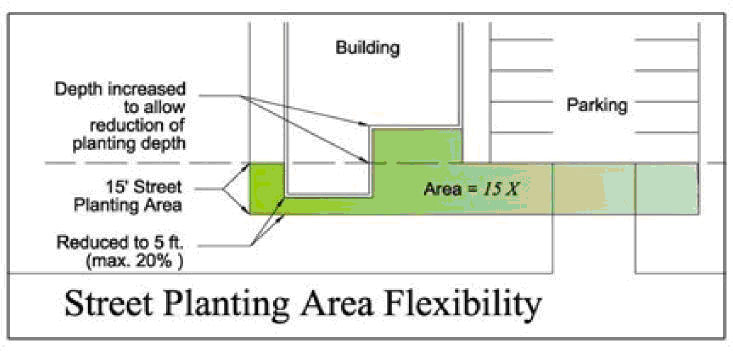
The required depth of the street planting area may be articulated to provide for a depth of greater than or less than the minimum 15-foot depth so long as the required area of street planting area on that street frontage is maintained.
b.
The depth may be reduced for a portion of the length of the street planting area to a minimum of ten feet provided that a depth greater than 15 feet is added to other areas of the street planting area to maintain the overall required street planting area.
c.
In addition, the depth of the street planting area may be reduced to five feet for up to a maximum of 20 percent of the length of the street planting area so long as the overall required area of the street planting area on that street frontage is maintained.
3.
Reduction in street planting area.
a.
When a utility servitude that occurs between the street right-of-way and the required street planting area exceeds ten feet in depth measured from the street right-of-way, the required depth of the adjacent street planting area may be reduced by one foot for every additional five feet of servitude in excess of ten feet.
b.
If any street is widened, the portion of the street planting area lost in the widening need not be replaced with any additional street planting area, and the street planting area will continue to be measured from the old right-of-way line existing before the street widening took place.
4.
Access through street planting area. For street frontage up to 100 linear feet, no more than two, one-way accessways a minimum of 12 feet to a maximum of 15 feet in width or one, two-way accessway a minimum of 24 feet to a maximum of 35 feet in width shall be permitted through the street planting area. For more than 100 linear feet of street frontage, one additional two-way accessway of the maximum width specified may be permitted for each additional 100 linear feet of frontage or major fraction (51 feet or greater) thereof.
5.
Preservation of trees in street planting area.
a.
Except in accessways as described above, all healthy trees six inches dbh or greater located in the street planting area shall be preserved regardless of the said number of trees.
b.
If the number of trees six inches dbh or greater to be preserved does not equal the required number of trees to be planted in the street planting area, additional trees must be planted to meet the minimum requirements.
6.
Planting requirements in street planting area.
a.
The street planting area shall contain a minimum of one Class A tree for every 20 linear feet of building site frontage or fraction thereof. Credit will be given on a one-to-one basis for existing street trees preserved and protected in the street planting area. See table 42.2 for tree size requirements. The required number of trees may be located anywhere within the street planting area.
b.
Except for new or used car lot sales areas, where parking lots are constructed adjacent to roads, a continuous opaque vegetative screen shall be planted to screen the parking from the roadway. This screen shall be planted in a prepared planting area no less than 24 inches wide immediately adjacent to the parking area or may be located within the required street planting area. Refer to table 42.2 for shrub requirements.
c.
A minimum of 75 percent of the required trees shall be selected from the city's recommended tree list indicated in section 4.213 of this ordinance. No more than 50 percent of the total trees planted shall be of the same species.
7.
Sidewalks. Except where sidewalks have been, or are planned to be constructed in the street right-of-way near to, or adjacent to, the street planting area, a sidewalk shall be constructed within the adjacent city right-of-way for all designated zoning districts at the discretion of the city engineer or his designee.
4.209. Interior landscaping and parking lot requirements.
1.
General interior parking landscape requirements.
a.
Landscaping shall be required in parking lots with more than seven parking spaces or that are larger than 3,000 square feet.
b.
Planting areas shall be a minimum of ten percent of the paved parking area.
2.
Specific interior parking landscape requirements.
a.
Landscaping within rows. Landscaping within rows shall be located evenly between every ten to 12 parking spaces. No more than 12 contiguous parking spaces shall be allowed without a minimum of one landscaped island or peninsula containing trees.
b.
Landscaping at end of rows. Every parking row shall terminate in a landscaped island containing trees. A landscape island shall not be required at the end of a parking row where the end of the parking row that abuts a street planting area or buffer planting area.
c.
Size of landscape island. Landscape islands shall be a minimum of nine feet in width and not less than 18 feet in length, or the length of the adjacent parking space, whichever is greater.
d.
Medians. Every fourth row of parking shall be separated by a median strip for landscaping of not less than nine feet in width. Each median shall be planted with a minimum of one Class A tree for every 30 linear feet of median in addition to the planting requirements in [sub]section 4.209.2.e.
e.
Planting requirements. A minimum of one Class B tree shall be planted for every seven parking spaces provided. Required trees shall be a minimum of two inches caliper and eight to ten feet in height at the time of planting. Landscaped islands shall be surfaces with ground cover, grass and/or mulch. Credit will be given on a one-to-one basis for existing trees preserved and protected in the parking areas.
f.
The required trees for a parking lot with fewer than ten spaces may be located around its perimeter. Trees must be located within ten feet of the edge of the parking area pavement to be considered a required tree.
3.
Screening of trash and garbage cans. Storage areas containing three or more refuse, garbage or rubbish containers or one or more dumpsters shall be screened on all sides with a six-foot high, 70 percent sight obscuring screen of living or 100 percent sight obscuring screen of nonliving landscape material.
4.
Filter areas. Best management practices for stormwater.
a.
Parking lots shall be designed to drain through landscape filter areas. A filter area shall be provided where double loaded parking rows occur and a median is not required, and required medians shall also serve as filter areas. The filter area is to be a minimum of three feet in width and the full length of the parking row. Catch basins should be provided as needed to prevent overflow on the parking surface. The city engineer shall review all parking lot applications for adherence to stormwater best management practices.
b.
A portion of the drainage from the parking area may be drained through the street or buffer planting areas into grassed drainage swales. Catch basins should be provided as needed to prevent overflow onto the parking surface or sidewalk.
c.
Landscape filter areas are to be planted with groundcover and/or landscape material that will achieve 100 percent coverage when mature.
4.210. Buffer planting areas. Buffer planting areas shall be required between different uses and/or districts in accordance with paragraph 9 and table 42.3. The table indicates the minimum width of required rear buffer zones between proposed development and existing development. The minimum width listed in the table indicates the minimum buffer required per lot. Provision of the buffer is the sole responsibility of the applicant for the proposed development.
1.
The buffer zone shall contain one Class A or B tree for each ten linear feet of buffer planting area, if the buffer planting area is greater than or equal to ten feet in width.
2.
All buffer planting areas shall contain a minimum six-foot high visual screen of plant material and/or approved fencing material. Plantings shall be of a form, size and type that will provide a 70 percent or more opaque screen within 12 months of planting. Plantings shall be a minimum of four feet in height from the ground immediately after planting. Plantings shall contain a minimum of one shrub for every ten linear feet of buffer planting area.
3.
The remainder of the buffer planting area shall be landscaped with turf and/or vegetative or decorative ground covering materials.
4.
No vehicular parking, utility servitudes containing overhead lines or above-grade equipment, or structures of any kind shall be allowed in the required buffer area.
5.
The buffer zone shall consist of an area not less than the required depth measured at right angles to the property line(s) along the entire length of and contiguous to the property line adjacent to the more restrictive zoning district.
6.
The required width or depth of a buffer zone on a development site which is 150 feet or greater in width or depth, measured at right angles from the property line along which the buffer is required to be located, shall be expanded by an additional one foot for each additional 20 feet of site depth up to a maximum additional side buffer planting area of ten feet, and a maximum rear buffer planting area of 25 feet.
7.
The landscape buffer planting area shall be required to be provided in conjunction with the issuance of a building permit for new construction on a development site or when a change in land use classification from the preceding use of the site renders the development site subject to the provisions of the buffer planting area requirements of this section.
8.
Preservation of trees and vegetation in buffers. Except in accessways, all healthy trees six inches dbh or greater located in the side and rear buffer planting areas shall be preserved regardless of the number of said trees. All trees required to be preserved by this ordinance shall be indicated on the landscape and tree preservation plan.
9.
Side lot buffer zone planting area requirements are as follows:
a.
For all zoning classifications other than industrial and major shopping centers, the width of the side buffer planting area shall be five feet for the first 150 feet of lot depth. The side buffer planting area need not exceed ten feet. Side buffer areas are not required when residential abuts residential or non-residential abuts non-residential.
b.
For industrial and major shopping centers, the width of the side buffer planting area shall be 25 feet for the first 150 feet of lot depth.
c.
See section 4.208 for flexibility in street planting requirements associated with street planting areas.
TABLE 42.3
Buffer Zone Planting Requirements for Rear Lot Buffer Areas.
*For lots that contain townhouses, there shall be a 15 ft. buffer between townhouse lot and any adjoining lot.
4.211. Development clearing permit required for all zoning districts.
1.
General. A development clearing permit shall be required for all parcels where land is to be cleared of trees for a residential subdivision, residence, commercial, multifamily, industrial or institutional use. Unless otherwise provided in this section, no person, corporation, association, public agency, or agent or employee thereof, shall effectively destroy or move vegetation from any property within the City of Covington without first obtaining said permit from the building department.
2.
Objectives of all development clearing permits. The objectives of the requirement for the issuance of a development clearing permit for the monitoring of land clearings are:
a.
To limit the removal of valuable existing vegetation in advance of the planning and approval of land development plans; and
b.
To limit the destruction of natural stormwater retention basins and water recharge zones by promoting the preservation of existing plant communities and natural areas on site.
3.
Development permits for parcels five acres or less.
a.
Prior to any development on a parcel of land, a building permit must be obtained from the building official. The following items must accompany any application for a building permit relative to any development on a parcel of land:
i.
Site plan. A drawing consisting of a description of the site, identifying the location of all trees, types of trees and the diameter of each tree that is six inches in diameter or greater located within the required yard setback area of the property. This plan shall identify the trees to be preserved under the provisions of this article.
ii.
Any other information determined to be necessary by the building inspector, public works director, or city planner in order to document compliance with the requirements of these regulations for the issuance of the requested permits.
4.
Development permits for parcels greater than five acres.
a.
Prior to any development on the parcel of land, a land clearing permit shall be obtained from the building official for all parcels where land is to be cleared of trees for a residential subdivision, residence, commercial, multifamily, industrial or institutional use.
b.
Minimum requirements. The following minimum requirements are mandatory unless the developmental clearing permit is an approved part of a valid building permit or preliminary approval given to construct a subdivision. All buffers required shall be exclusive of all easements, servitudes and/or rights-of-way within the property:
i.
Roadway buffering. A natural buffer of at least 50 feet in width shall be maintained along all property lines. These buffer areas shall retain all existing vegetation.
ii.
Waterway buffering. A minimum uncut buffer of 100 feet in depth along both banks (mean low water line) when applicable of all established natural stream beds, including Mile Branch, Simpson Creek, Rattlesnake Branch, Champagne Creek, riverbanks and improved drainage canals.
c.
In addition, permittee shall follow all requirements set forth in chapter 18, article 3 of the City Code.
5.
Requirement of issuance of development clearing permit. Prior to the cutting, clearing or removal of any tree greater than two inches dbh on any lot(s) or parcel(s) of land on which there are no existing buildings, or which has an existing building and additional undeveloped portions of the lot not required to be preserved as landscape area, a development clearing permit for such activity shall be obtained from the building official. No development clearing permit shall be issued except in conjunction with a duly approved development plan for the site proposed for clearing and the issuance of an authorization to proceed with the construction of public improvements in conjunction with the development of a subdivision. Prior to the issuance of development clearing permit the barriers for the protection of vegetation required to be preserved shall be erected and the building official shall inspect the site to determine compliance with the provisions of this article and section 4.204.5.f of this ordinance. The submittal requirements are:
a.
An application for development clearing permit must be submitted and approved.
b.
Required documents: all documents as required in the permit application (see chapter 18 section 18-123 of the Covington City Code).
4.212. Tree removal permit. A tree removal permit shall be required prior to the removal of any tree larger than six inches dbh. The permit shall be issued by the building permit department and said permit shall be issued pursuant to application being made by the owner or owner's agent on such form as specified by the City of Covington. The fee for a tree removal permit shall be due at the time of issuance of the permit. See chapter 83, fees.
Permits for a tree removal issued in connection with a building permit or site plan shall be valid for the period of the building permit or site plan's validity. Permits for tree removal not issued in connection with a building permit or site plan shall become void 180 days after the issue date on the permit.
4.213. Recommended tree list.
(Ord. No. 2010-30, Exh. 1, 1-4-2011; Ord. No. 2014-25, 10-24-2014; Ord. No. 2017-09, 6-7-2017; Ord. No. 2019-04, 1-16-2019)
Editor's note— Ord. No. 2017-09, adopted June 7, 2017, changed the title of § 4.2 from "Landscaping" to read as herein set out.
Sec. 4.3. - Accessory use regulations.
4.301. Purpose and intent. The provisions of this section shall be known as the accessory use regulations. The purpose of these provisions is to establish the relationship among the principal and accessory uses and the criteria for regulating accessory uses.
4.302. Accessory uses encompassed by principal use. In addition to the principal uses expressly included in the use regulations, each zone subject to such use regulations shall be deemed to include accessory uses that are specifically identified by these accessory use regulations; and other accessory uses that are necessarily and customarily associated with, and are appropriate, incidental and subordinate to such principal uses. When provided by these regulations, it shall be the responsibility of the city planner to determine if a proposed accessory use is necessarily and customarily associated with, and is appropriate, incidental and subordinate to the principal use, based on the city planner's evaluation of the resemblance of the proposed accessory use to those uses specifically identified as accessory to the principal uses and the relationship between the proposed accessory and principal uses.
4.303. Accessory uses subject to controls. Accessory uses and structures are permitted in any zoning district in connection with any principal use or structure lawfully existing within such district provided that all development standards and regulations, including setbacks, are in compliance. Accessory uses shall be controlled in the same manner as the principal uses within each zone, except as otherwise provided by these regulations.
4.304. Residential zones. Subject to the restrictions and limitations specified, the following accessory buildings and uses shall be permitted in zones where residential use types are permitted:
1.
Private garages, attached;
2.
Private garages, detached;
3.
Children's playhouses, patios, porches, gazebos, etc.;
4.
Radio and television receiving antennas and satellite dishes;
5.
Greenhouses;
6.
Detached storage buildings, workshops, hobby shops, recreation rooms and other similar uses;
7.
Dog and cat keeping, not including kennels.
4.305. Development standards.
1.
All detached accessory structures and uses in any residential district used in conjunction with the main structure may be located in the rear or side yard of the residential unit, provided such accessory building is not less than twice the required front yard setback for the zoning district in which the property is a part from the front lot line. In no case may any residential accessory building be closer to the front property line than the front building line of the main structure except that the placement of detached carports shall be governed by section 4.502(6) of this Code. Any residential accessory building that is not part of the main building may be built or placed in a required side yard, providing that such accessory building is not less than three feet from the nearest interior side lot line, three feet from the rear lot line, and provided not more than one accessory building covers any part of the required side yard. On corner lots, accessory buildings are not permitted in required side yards on the side street side. On through lots, accessory buildings shall not be closer to the rear property line than the front yard setback required for the zoning district of the property.
2.
No detached accessory structure or use within a residential district shall occupy more than 40 percent of the total floor area of the principal structure on the lot.
3.
No accessory structure or use shall exceed the height of the principal structure to which it is accessory. An accessory use connected to the principal structure will be considered part of the principal structure. Any accessory use connected by an open unenclosed breezeway will be considered part of the principal structure.
4.
Detached accessory buildings or structures shall not be higher than the peak of the roof of the principal building in residentially zoned districts. However, in any case, an accessory building or structure in a residentially zoned district cannot exceed 20 feet in height.
5.
Commercial trash receptacles shall be considered as accessory structure. Large trash receptacles, dumpsters, and other containers for receiving residential or commercial waste shall be placed at least 15 feet from an adjoining property line, notwithstanding any other provision of this ordinance. Any dumpster or other trash receptacle located closer than 15 feet to any property line or that is visible from any public street, shall be screened with a permanently installed buffer fence made of wood, chain-linked with slats, or masonry.
6.
No residential accessory building may utilize metal or a metal product for siding unless it is screened from view from any public way by a minimum six-foot wood, masonry, stone, rock, or vinyl fence, or by an evergreen vegetative screen that is a minimum of three feet tall at the time of planting and will achieve six feet in height and 70 percent opacity within one year. This shall not be construed to mean that metal roofing is prohibited.
7.
For lots that have frontage on either the Bogue Falaya or Tchefuncte Rivers, residential accessory structures may be located in front of the building line of the main structure provided that they meet all other requirements of this section.
4.306. Flood zones. Accessory structures within flood zones A, A1-30, or AE are further subject to regulations found in sections 3.50 and 3.5008(2)(e).
(Ord. No. 2010-30, Exh. 1, 1-4-2011; Ord. No. 2011-18, 9-9-2011; Ord. No. 2014-20, 8-21-2014; Ord. No. 2020-09, 7-8-2020; Ord. No. 2021-04, 4-14-2021)
Sec. 4.4. - Outdoor lighting regulations.
4.401. Purpose and intent. The purpose of this section is to preserve the nighttime character of the city through the establishment of standards for the use of outdoor lighting. The elimination of glare and light trespass will ensure public safety, as well as, facilitate the harmonious use of adjacent commercial and residential land uses.
4.402. Applicability and permits. All nonresidential outdoor lighting and all outdoor lighting installed for multifamily residential properties of greater than four units in the city shall comply with the provisions of this section as of its effective date.
1.
Permit requirements:
a.
Submission contents. The applicant for any building permit from the city in connection with proposed work involving outdoor lighting shall submit evidence that the proposed outdoor lighting will comply with these regulations.
b.
The applicant shall submit, as part of the permit application, a site plan indicating the location of outdoor lighting, the type of illuminating fixture and device utilized to prevent light spillage onto adjacent streets and properties, as well as, prevent upward light pollution.
4.403. Definitions for outdoor lighting regulations. The following definitions relate to the lighting regulations contained herein.
Direct light. Light emitted directly from the lamp, off of the reflector or reflector diffuser, or through the refractor or diffuser lens, of a lighting fixture.
Fixture. The assembly that houses the lamp or lamps and can include all or some of the following parts: a housing, a mounting bracket or pole socket, a lamp holder, a ballast, a reflector or mirror, and/or a refractor or lens.
Flood or spotlight. Any light fixture or lamp that incorporates a reflector or a refractor to concentrate the light output into a beam directed in a particular manner.
Footcandle. A unit of measure for illuminance. A unit of illuminance on a surface that is everywhere one foot from a uniform point source of light of one candle and equal to one lumen per square foot.
Full cut-off type fixture. A light fixture that, by design of the housing, does not distribute any illumination above a 90-degree horizontal plane.
Fully shielded fixture. A lighting fixture constructed in such a manner that an opaque shield extends, on the top and all sides, below the lowest direct-light-emitting part (LDLEP) of the fixture. The lowest edge of such a shield shall surround the LDLEP and be level with the horizontal plane, regardless of the orientation of the fixture.
Glare. Light emitting from a fixture with intensity great enough to reduce a viewer's ability to see. It is often accompanied by discomfort and, in extreme cases, causing momentary blindness.
Height of lighting fixture. The height of a lighting fixture shall be the vertical distance from the normal finished grade directly below the centerline of the fixture to the lowest direct-light emitting part of the fixture.
Horizontal illuminance. The measurement of brightness from a light source, usually measured in footcandles or lumens, which is taken through a light meter's sensor at a horizontal position.
Indirect light. Direct light that has been reflected or has scattered off of other surfaces.
Lamp. The component of a lighting fixture that produces the actual light; as in the bulb.
Lowest direct-light emitting part (LDLEP). The lowest part of the lamp or lamps, the reflector or mirror and/or the refractor or lens.
Light trespass. The shining of light produced by a lighting fixture beyond the boundaries of the property on which it is located.
Lumen. A unit of luminous flux. One footcandle is one lumen per square foot. For the purposes of this section, the lumen-output values shall be the initial lumen output ratings of a lamp.
Neon lighting. Any white or tubular lighting of which the primary source of light is gaseous.
Outdoor lighting. The nighttime illumination of an outside area or object by any manmade device located outdoors that produces light by any means.
4.404. Lighting fixture design requirements and standards.
1.
Generally. Exterior lights shall not be allowed to shine directly into the eyes of any occupant of any vehicle on any public or private road, onto adjacent property, or where the illumination interferes with the visibility or readability of any traffic signs or devices. Except for the lighting of businesses which remain open 24 hours a day, commercial signs and commercial lighting other than that necessary for security will be turned off at the later of closing time or 11:00 p.m.
2.
Restrictions on illuminance. All lighting fixtures with a lamp or lamps rated at an average of more than 3,000 lumens (2-75 watt bulbs) shall be either:
a.
Full cutoff type fixture with a single plane lens; or
b.
Fully-shielded fixture.
3.
Artificial lighting for parking lots and loading areas. Light source fixtures for parking lots shall conform to the following:
a.
All lighting used to illuminate any off-street parking or loading areas shall be so designed and arranged as to be confined within and directed onto the parking and loading area only. Light spillage not to exceed two footcandles at the property line.
b.
Light fixtures shall not exceed a height of 25 feet measured from the ground/pavement to the bottom/base of the fixture.
c.
Fixtures shall be limited to two per pole.
d.
Fixture lamps shall be quartz halogen, fluorescent, metal halide, mercury vapor, or high-pressure sodium.
4.
Floodlights. Floodlights on all structures shall be shielded so that the light source is not visible from adjacent property.
5.
Yard lighting. Floodlight fixtures for illuminating the canopies or bases of trees shall not be illuminated after 11:00 p.m.
6.
Prohibitions. Electrical illumination of outdoor advertising off-site signs between the hours of 11:00 p.m. and sunrise is prohibited.
7.
Measuring illuminance. Total footcandles measured at three feet above ground level with the measuring instrument held in the horizontal plane shall not exceed two footcandles at the property line, unless it is a public streetlight within the city right-of-way.
4.405. Lamps that emit 3,000 lumens or less. The following list of lamp types and corresponding units of wattage may be considered as a guide to selecting lamps that emit 3,000 lumens or less:
1.
Incandescent lamps: 60 watts or less.
2.
Quartz halogen lamps: 60 watts or less.
3.
Florescent lamp: 35 watts or less.
4.
Mercury vapor lamp: 75 watts or less.
5.
Metal halide lamp: 40 watts or less.
6.
High-pressure sodium lamp: 45 watts or less.
7.
Low-pressure sodium lamp: 25 watts or less.
4.406. Exceptions to outdoor lighting requirements.
1.
Police or fire departments or other emergency services. All emergency or permanent lighting required by the police or fire department or other emergency facilities or personnel.
2.
Hospitals. All emergency or permanent lighting required by a hospital for emergency facilities or personnel.
3.
Federal regulatory agencies. All outdoor lighting levels required under federal law is exempt from the requirements of this section, except where those requirements are less stringent than those contained herein.
4.
Flags. Up-lighting for national, state or foreign nation flags located on poles independent of other structures are exempt from the requirements of this section.
5.
Trees. Lighting of trees is exempt from the requirements of this section except that the maximum amount of lumens for such lighting shall be no greater than 3,000 lumens per fixture.
6.
Street lighting. Public streetlights are exempt from these requirements if they are in existence at the time this section becomes effective.
7.
Holiday lighting. Exterior lights intended as holiday decorations are exempt from the restrictions of this ordinance between Thanksgiving Day and January 6th. Ground mounted floodlights are permitted if they are shielded/hooded and lamp wattage does not exceed 100 watts.
8.
Nonconformities. Lighting systems, fixtures and devices in place and operable immediately preceding the effective date of this ordinance are exempt, but shall not be replaced, enlarged, altered nor improved except in conformity with the provisions and specifications of this ordinance once it is in effect.
4.407. Outdoor lighting for signs.
1.
Externally illuminated outdoor signs. Outdoor signs illuminated by top mounted or bottom mounted fixtures shall comply with the shielding requirement of this section. The maximum amount of lumens for lighting mounted on the sign structure shall be no greater than 3,000 lumens per fixture.
2.
Internally illuminated outdoor signs. Outdoor signs wholly illuminated from within do not require shielding. The maximum amount of lumens for such lighting shall be no greater than 3,000 lumens per fixture.
4.408. Enforcement.
1.
Maintenance of lighting, compliance, penalties. Each lighting fixture that has been erected in accordance with the provisions of this lighting code shall be maintained in substantially the same condition as when constructed. Any person or entity that violates the provisions of this lighting code or any amendments thereto shall be subject to following fines in addition to those fines and penalties as may be provided for in [this] Appendix B, Zoning, of [to] the City of Covington Code of Ordinances.
2.
Fines. Each day in violation of any provision or amendment of this overlay lighting code shall be considered a separate violation. Each violation shall be subject to fine of $100.00.
3.
Officials responsible for administration. The building official, or his duly authorized representative shall administer the provisions of this lighting code. The building official, or his duly authorized representative shall have the power and authority to make inspections of lighting fixtures or property necessary to carry out their duties in the coordination and the enforcement of the provisions of the lighting code.
(Ord. No. 2010-30, Exh. 1, 1-4-2011)
Sec. 4.5. - Supplemental lot, yard and open space regulations.
4.501. More than one main institutional, public or semi-public or commercial or industrial building may be located on a single lot or tract in districts that permit such uses provided that no such building or portion thereof shall be located outside of the buildable area of the lot, and no building shall be closer than ten feet to any other building unless approved by the State Fire Marshall in conformance with all fire codes applicable.
4.502. Building setbacks are measured from the property line to the furthest horizontal projection of the structure (including overhang). However, some items may project into the setbacks as follows:
1.
Roof extensions, including overhangs, porch covers, cornices, canopies and eaves may project into front, rear or side yard setbacks, but in no case may any part of the projection extend closer than three feet to any property line;
2.
Chimneys shall not project more than 24 inches into front, rear or side yard setbacks;
3.
Window sills shall not project more than 24 inches into front, rear or side yard setbacks;
4.
Steps and raised landings, such landings not exceeding four feet by six feet in area, may project to the extent of four feet into front, rear or side yard setbacks if a minimum distance of three feet remains open to the sky between the farthest project of such steps or landing and any interior property line.
5.
Decks 18 inches or taller, and larger than four feet by six feet are considered an extension of the building wall and must meet all setback requirements.
6.
Accessory buildings.
a.
Except on corner lots, any accessory building that is not part of the main building may be built or placed in a required side yard, providing that such accessory building is not less than three feet from the nearest interior side lot line, three feet from the rear lot line, and provided not more than one accessory building covers any part of the required side yard.
b.
On corner lots, accessory buildings are not permitted in required side yards on the side street side.
c.
A carport attached to or detached from the main building may be constructed or placed in a required side yard and may be attached to an enclosed accessory building providing that the accessory building's front setback conforms with the performance standards for the appropriate zoning classification of the main building. Every part of the projection of such carport shall be at least three feet from the side lot line and three feet from the rear lot line.
d.
A swimming pool may be constructed in a required side yard, providing that such inverted accessory building (including decking) is not less than five feet from the side lot line, three feet from the rear lot line, and provided that not more than one accessory building covers any part of the required side yard. Swimming pools shall be constructed pursuant to the 2012 edition of the ICC International Swimming Pool and Spa Code (ISPSC) and any future editions.
e.
A detached garage from the main building may be constructed or placed in a required side yard. The furthest horizontal projection of such garage shall be at least three feet from the side lot line and three feet from the rear lot line.
f.
Exceptions. See HDC-MUOD Historic Downtown Covington mixed-use overlay district (section 3.31) and LA Highway 21 Planned Corridor overlay zoning district (section 3.41) for setback requirements.
7.
No structure shall be constructed or placed within the utility servitude without prior written approval of the affected utilities.
4.503. In all residential and CO districts, if significant and otherwise healthy live oak trees would be damaged or required to be removed by building in the buildable area of the site, the buildable area of the site may be shifted into the front, rear or side yard up to 30 percent so long as the area lost in one required yard is provided in the opposite yard and the total square footage of required yard and open space area of the site remains the same. This determination will be made by the city planner, and shall not be considered a hardship in the future.
(Ord. No. 2010-30, Exh. 1, 1-4-2011; Ord. No. 2013-13, 7-18-2013; Ord. No. 2014-20, 8-21-2014; Ord. No. 2014-23, 10-24-2014)
Sec. 4.6. - Traffic impact studies.
4.601. There are certain uses of land which, by their location, nature or size and density, or by the accessory uses permitted or required in connection therewith, or by certain operational or design and engineering characteristics, tend to cause traffic and related impacts which are contrary to the public health, safety and general welfare in that they lead to, generate or exacerbate: danger and congestion in travel and transportation upon the public streets, parking problems, harmful air pollution, wasteful energy consumption, excess noise, and other adverse impacts upon public and private transportation facilities, environmental quality, historic areas and other qualities of the city which make it a desirable, prosperous and attractive residential and commercial community.
4.602. Definitions for traffic impacts. The following definitions relate to the traffic impact standards contained herein.
Peak hour. The period of a single hour in the morning and the period of a single hour in the afternoon or evening during which the road system servicing the proposed use is most heavily utilized by motor vehicles other than those traveling to or from the proposed use.
Peak period. The period from 6:00 a.m. to 9:00 p.m. in the morning and the period from 3:00 p.m. to 7:00 p.m. in the afternoon and evening during which the road system servicing the proposed use is most heavily utilized by motor vehicles other than those traveling to or from the proposed use.
Projected trips, total number of. The projected number of total person trips generated by the proposed use in a designated time period based upon the size, type and intensity of the use.
Proposed project. A proposed use that consists of more than one building or structure and which may be constructed in phases over time.
Proposed use. A use that is described in an application for a special use permit filed under this section 4.6.
Public transit. Publicly provided and regularly scheduled transportation, usually by bus or rail, or a combination of both.
Ride sharing. The transportation of persons in a motor vehicle where such transportation is incidental to another purpose of the driver. The term shall included ride sharing arrangements known as car pools, vanpools and bus pools.
Transportation management plan. A comprehensive, coordinated and continuously operated plan submitted as part of an application for a special use permit under this section 11-700 which demonstrates the administrative activities, the physical facilities and the operational, financial and other commitments which will be undertaken at or in conjunction with a proposed use in order to reduce the traffic and related impacts of the proposed use.
Usable square feet. Floor area of a proposed use, which shall be the sum of all gross horizontal areas under a roof or roofs of all buildings or structures comprising a proposed use, computed by measuring from the exterior faces of walls and from the eaves of all roofs where they extend party walls, and which shall include all space with a headroom of seven feet six inches or more, whether or not provided with a finished floor or ceiling. Excluded shall be elevator and stair bulkheads. No deduction shall be made for columns and projections necessary to the building structure.
Variable work hours. Work schedules within which employees choose their arrival and departure times within management imposed limits (also known as flex time).
4.603. The following uses, when allowed as a permitted or conditional use by the regulations applicable in the zone in which located, shall require a traffic impact study (TIS):
1.
Any individual building or structure that contains:
a.
40,000 or more usable square feet of commercial and/or professional office space;
b.
40,000 or more usable square feet of institutional space, including but not limited to educational facilities, houses of worship, hospitals, and governmental buildings;
c.
40,000 or more usable square feet of retail sales space;
d.
150,000 or more usable square feet of warehouse or industrial space;
e.
100 or more residential units; or
f.
Any combination of space which includes 40,000 or more usable square feet of commercial and/or professional office space, institutional use, or retail sales space, or 100 or more residential units;
2.
Any project, complex or development which is or becomes the subject of common ownership or control, which is or becomes the subject of a common, concerted, coordinated or phased plan of development irrespective of ownership or control, or which is or becomes the subject of a common, concerted, coordinated or phased plan of lease, sale, marketing or operation irrespective of ownership or control, and which when completed or assembled involves two or more buildings or structures containing in the aggregate any of the dimensions outlined in [sub]section 4.603.1.a through [sub]section 4.603.1.f.
3.
All other uses shall be exempt from the requirements of this section 4.6.
4.604. The applicant shall defray the city's cost for the use of the city engineer or other traffic professional, who will participate in any required meetings and who will provide city agencies with an independent assessment of the study.
4.605. A traffic impact study shall comply with the following requirements:
1.
The traffic impact study shall be conducted by a qualified transportation planner or traffic engineer licensed by LAPELS, who shall meet and confer with the city planner and the building official or designee prior to undertaking the study to define and agree upon the study elements. The extent of the required study will vary depending on the location of the site, the size and nature of the project, and may include some or all of the following elements:
a.
Executive summary;
b.
Table of contents, including:
i.
List of figures;
ii.
List of tables.
c.
Introduction.
i.
Description of the proposed development;
ii.
Location of the project;
iii.
Project sponsor and contact person;
iv.
Site plan including all direct and indirect access to all State highways, arterial roads and collector streets;
v.
Circulation network including all direct and indirect access to State highways, arterial roads and collector streets;
vi.
Land use and zoning;
vii.
Sequence of construction including proposed phases of project completion;
viii.
References to other traffic impact studies;
ix.
Summaries of alternative site configurations that were evaluated;
x.
The adequacy of available traffic and turning movement counts and the need for additional data.
d.
Traffic information.
i.
Clearly stated assumptions;
ii.
Existing a.m. and p.m. peak period traffic volumes of the adjacent street. Some developments have peak traffic time periods that differ from the peak period of the adjacent street. In this case, in addition to the a.m. and p.m. peak period of the adjacent street, existing traffic counts taken during the peak traffic time periods of the proposed development must also be taken. All traffic counts will include turning movements, existing roadway geometry (including storage lengths and traffic controls such as signal phasing and multi-signal progression where appropriate).
iii.
Existing plus generated a.m. and p.m. peak period traffic volumes of the adjacent street and if the development has peak time different than the adjacent street, the peak period of the traffic generator, (including turning movements) without roadway improvements. Also indicate existing roadway geometry including storage lengths and traffic controls such as signal phasing and multisignal progression where appropriate).
iv.
Existing plus generated a.m. and p.m. peak traffic volumes of the adjacent street and the peak period of the generator, with proposed roadway improvements (including turning movements), proposed roadway geometry including storage lengths and traffic controls such as signal phasing and multisignal progression where appropriate).
v.
Project trip generation including references.
vi.
Project generated trip distribution and assignment.
vii.
Level of service (LOS) and warrant analyses existing conditions, cumulative conditions, and full build of general plan conditions for all peak periods.
e.
Conclusions and recommendations.
i.
Level of service (LOS and appropriate Measure of Effectiveness (MOE) data, such as time delay in accordance with the latest LA DOTD Traffic Impact Policy of impacted facilities with and without mitigation measures.
ii.
Mitigation phasing plan including dates of proposed mitigation measures.
iii.
Define responsibilities for implementing mitigation measures.
iv.
Cost estimates for mitigation measures.
f.
Appendices.
i.
Description of traffic data and how data was collected.
ii.
Description of methodologies and assumptions used in analyses.
iii.
Worksheets used in analyses (i.e. signal warrant, LOS, traffic count information, etc.).
2.
Unless otherwise directed by the designated City representative, the traffic impact study shall include the following information:
a.
All mutually agreed upon elements of the study identified in section 4.605.1;
b.
A statement that the applicant has made a good faith effort to discuss the traffic and related impacts of the proposed use with the associations identified pursuant to section 4.605.1, an identification of the associations with which discussions have occurred and a summary of the assessments by affected citizen and neighborhood associations of the traffic and related impacts of the proposed use; and
c.
Such additional information, diagrams and drawings as the city planner, building official or other duly authorized representative of the City of Covington may require in order to consider and evaluate the impacts of the proposed use.
4.606. TIS review process.
1.
Independent review. The City of Covington will review the TIS through the city engineer or other duly authorized representative. More than likely this will be an iterative process with the developer that may require multiple submittals until the developer proposes mitigation acceptable to the city.
(Ord. No. 2010-30, Exh. 1, 1-4-2011)
Sec. 4.7. - Fencing regulations.
4.701. Permit required.
1.
Before commencing construction on any type of fence, whether residential, commercial or industrial, a permit issued under chapter 83 of this Code shall be obtained from the code enforcement officer.
2.
No permit is required for maintenance and repair of a grandfathered, nonconforming fence or wall if the work involved represents less than 50 percent of the fence or wall length. If maintenance and repair involves greater than 50 percent of the grandfathered, nonconforming fence or wall length, a fence or wall permit is required. Maintenance or repair requiring a permit should be completed within a six-month period or grandfather status will be lost and new fence must meet current code requirements. Emergency fence or wall repair involving a safety issue, such as one surrounding a swimming pool, should be completed within three months or at the discretion of the code enforcement officer, if public safety is involved.
3.
Fences or walls constructed with a chain wall require a detailed drawing reflecting utilities, drainage and all specifications associated with the structure and are subject to approval of the city engineer.
4.
For properties lying within the Covington Historic District (for boundaries, see appendix B, part 3. use districts, section 3.3102), a certificate of appropriateness may be required to construct a fence or wall. If a certificate of appropriateness is required, such certificate must be granted by the Covington Historic District Commission (CHDC) before a fence or wall permit may be issued. The staff of the planning department will provide the property owner with an application and CHDC's design guidelines for fences and walls.
4.702. Height restrictions.
1.
Notwithstanding any subdivision or development restrictions, a fence or wall not more than eight feet in height may project into or enclose any required front, side or rear yard provided a height limitation of four feet only is permissible within the front yard setback lot areas. Furthermore, on corner lots, nothing shall be erected, placed or allowed in such a manner as materially to impede vision over a height of four feet above the centerline grades of the intersecting streets in a triangular area bounded by the street right-of-way lines on such corner lots and a side line joining points along right-of-way lines on such corner lots and a side line joining points along right-of-way lines 15 feet from the intersection right-of-way corner. This triangular area shall be referred to as a sight triangle. If a fence or wall to the property line does not impede vision, then the sight triangle is not applicable.
2.
No person shall erect or rebuild any fence or wall which extends beyond the property lines.
3.
The height of the fence or wall shall be measured from the highest grade of the property along the fence, wall or property line. Exceptions are allowed only through obtaining a variance (see section 4.705). Fences or walls should be constructed no higher than a maximum of two inches off the ground.
4.
No fence or wall shall be constructed in such a manner as to prevent the driver of a vehicle from having a clear, unobstructed view of traffic signs and approaching, merging or intersecting traffic.
4.703. Fence or wall construction materials.
1.
Fences or walls must be constructed with wood, chain link, masonry, wrought iron, vinyl, stone or rock, pickets, split rail or other like materials.
2.
No barbed wire, razor wire, electrified, tin, asbestos shingle, black tar paper or hazardous material shall be used in fence or wall construction. Exceptions are commercial or industrial fences or walls or where fences or walls are needed for the protection of property or for reasons of safety. In these cases, security wire may be contained on the top part of the fence or wall. Barbed wire or razor wire used as security wire, when allowed, shall only be used on fences or walls in an area higher than six feet above ground.
4.704. Exceptions.
1.
Fence or wall heights greater than eight feet will be permitted in the following circumstances:
a.
Decorative posts, post lights, columns, column decorations, gates and the like which are integral parts of an eight-foot fence or wall may extend higher than eight feet but shall not exceed a height of ten feet. Spacing between posts or columns should be six feet.
b.
A fence or wall which has a height greater than eight feet that exists upon the effective date of this ordinance is exempt. However, once destroyed or removed, fences or walls must be rebuilt within six months or fence or wall must conform to this article.
c.
Recreational fences and walls, such as tennis courts, baseball fields and other similar recreational uses.
4.705. Variances.
1.
A denial of a permit under this article or an order under this article may be appealed to the board of adjustment. The board of adjustment may grant a variance subject to any conditions which it deems necessary or desirable to make the fence or wall which is permitted by the variance compatible with the purpose of this article.
2.
Developers may apply for a blanket height variance to include an entire subdivision if desired.
3.
Any variance applied for must assure the adjacent property owner will not be adversely affected, no pedestrian access will be hampered and a clear line of sight is maintained.
4.706. Enforcement, violations and penalties.
1.
The code enforcement officer will be responsible for enforcing compliance with this article.
2.
In order to protect the health, safety, welfare and property enjoyment of the citizens and inhabitants of the city, the code enforcement officer may order that fences or free-standing walls which cause traffic hazards or which are dilapidated or dangerous, that the same be removed within a specific time period, depending on the severity of the hazard.
3.
Any person who fails to comply with any directive or order by the code enforcement officer shall be in violation of this article and subject to the penalties as specified in section 1-8 of the Covington Code of Ordinances.
(Ord. No. 2013-13, 7-18-2013)
Sec. 4.8. - Minimum slab elevation.
4.801. All residential and commercial construction shall be designed subject to the following elevation requirements:
1.
Primary structures shall be constructed such that the slab or floor elevation of such construction is at least 12 inches above the centerline crown of the roadway abutting the property upon which the construction is located or at least 18 inches above the roadside ditch bank elevation abutting the property upon which the construction is located, whichever is higher at their highest point fronting the building.
2.
If the property is completely surrounded by streets, such as a building that takes up an entire square, the elevation will be based on the crown of the highest street abutting the property.
3.
If the highest abutting street is a state or federal highway, then the crown of the highest city street in closest proximity may be substituted as the required elevation.
(Ord. No. 2026-05, 2-4-2026)

