
Cullman City Zoning Code
ARTICLE VIII
PARKING AND LOADING STANDARDS
Sec. 62-111.- General standards.
(a)
Plans and specifications. Plans and specifications showing required off-street parking spaces, including the means of access and interior circulation, must be submitted to the commission for review at the time of application for any required site plan approval.
(b)
Site drainage plans, including drainage from parking lots and loading areas, must be designed to prevent stormwater from draining on adjoining properties.
(c)
All off-street parking and loading areas must surfaced with concrete, asphaltic-concrete, asphalt, pervious paving or other hard surface pavement acceptable to the city and maintained in proper condition, free of weeds, dust, trash, and debris.
(d)
Lighting fixtures used to illuminate off-street parking and loading areas must be shielded or arranged to direct light away from any adjoining residential or institutional properties or streets.
(e)
Landscaping must be provided as required in section 62-124, landscaping for vehicular areas.
(f)
No off-street parking or loading areas are allowed that require vehicles to back out into a public street or to back into a loading space from a street. This does not apply to off-street parking for single-family or duplex dwellings and in [the] CBD District.
(g)
Whenever there is an alteration of a structure, an expansion of a use or a change in use, which increases the parking and loading requirements, the use must conform with the off-street parking and loading standards of this chapter to the furthest practicable extent.
(Ord. No. 2020-16, § 8.01, 3-16-2020)
Sec. 62-112. - Off-street parking.
(a)
Off-street parking and loading terms. Terms used in this article have the following meanings:
(1)
Employee. The maximum number of persons employed at the facility regardless of the time period during which this occurs or whether the persons are full-time employees. The major shift may be a particular day of the week or a lunch or dinner period in the case of a restaurant.
(2)
Gross leasable area (GLA). The total floor area of a building designed for both tenant occupancy and exclusive use. GLA includes both owned and leased areas but does not include shared or common areas among tenants. Where the total floor area of a building is occupied or where a building has no shared or common area, GLA is the gross floor area measured by taking the outside dimensions of the building at each floor level intended for occupancy or storage.
(3)
Loading area. That area used to satisfy the requirements of this chapter for truck loading and unloading.
(4)
Loading space. An off-street space or berth used for the unloading or loading of commercial vehicles.
(5)
Occupancy load. The maximum number of persons, which may be accommodated by the use as determined by its design and by the city fire code.
(6)
Parking aisle. That portion of the parking area consisting of lanes providing access to parking spaces.
(7)
Parking area. An improved area on a lot exclusively used or designed for use as a temporary storage area for motor vehicles, containing access driveways, parking aisles and parking spaces.
(8)
Parking space. That portion of the parking area set aside for the parking of one vehicle.
(9)
Stacking space. An off-street space for the temporary stacking of vehicles with an aisle intended to serve a drive-in teller, take-out food window, dry cleaning/laundry pick-up and similar functions.
(b)
Required off-street parking spaces.
(1)
Requirements; exception. When any structure or use is established, enlarged, or increased in capacity, off-street parking spaces in the amount prescribed in Table 8-1. When the requirement is not readily determinable by Table 8-1, the building official will determine parking requirements using the table as a guide. Where deemed necessary to the public interest and upon a favorable recommendation of the building official, the reviewing authority may increase these parking requirements.
Required parking spaces must be maintained and may not be encroached upon by structures or other uses so long as the principal use remains, unless an equivalent number of spaces are provided elsewhere in conformance with this article. An exception may be made in the CBD district by the planning commission in the interest of preserving the character of the district. Required parking spaces may not be used for merchandise or any other use other than parking.
(2)
Location. Required off-street parking spaces must be located on the same lot as the principal building or on a lot within 300 feet thereof, except that this distance may not exceed 150 feet for single-family and two-family dwellings. This distance is measured from the nearest point of the parking facility to the nearest point of the lot occupied by the concerned building or use.
(3)
Parking in residential districts. Parking of motor vehicles in residential districts is limited to passenger vehicles, and not more than one commercial vehicle of the light delivery type, not to exceed one ton, is permitted per dwelling unit. The parking of any other type of commercial vehicle, including those with the use of compressors or motor operations, is prohibited in a residential district.
(4)
Shared and joint parking. A joint parking area may contain required parking spaces for more than one use, provided the combined number of spaces complies with the parking for all uses. If the combined uses will use the same spaces at different times, the spaces may be credited to each separate use. The applicant must present a joint parking agreement; and, if sharing the same spaces, a time schedule for allocation of the spaces.
Table 8-1: Required Off-Street Parking Spaces by Use
Table 8-2: Reserved
Table 8-3: Parking Lot Dimensional Requirements
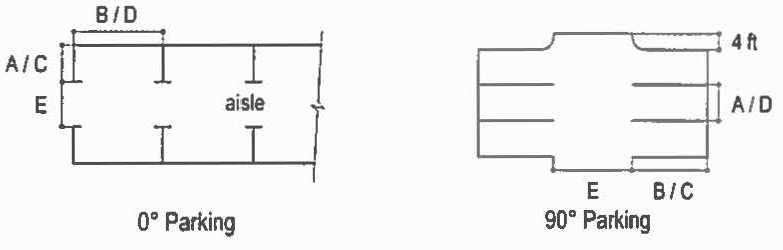
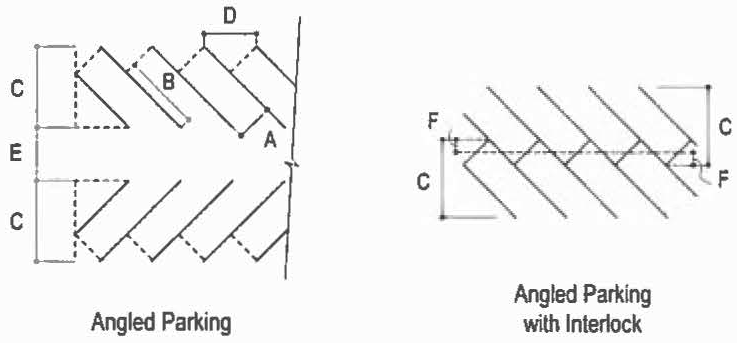
(c)
Parking area design. All off-street parking spaces, enclosed or unenclosed, aisles and access drives for ingress and egress, are subject to the dimensional requirements of Table 8-3 and the following:
(1)
All access to streets or alleys must be located in conformance with city access management standards established in the subdivision regulations. Access drives must connect directly, without obstructions, to a dedicated street or alley.
(2)
In all access drives requiring turning radius or curb cuts, the radius must be sized to allow unobstructed flow of traffic.
(3)
Detached single-family dwellings must have an access drive at least 12 feet wide. Duplexes and multifamily buildings must have an access drive at least 20 feet wide. Nonresidential uses must have an access drive at least 25 feet wide.
(4)
Off-street parking areas must be set back from property lines as required in section 62-124, landscaping for vehicular areas.
(5)
All nonresidential and multifamily off-street parking areas must be striped to indicate parking spaces as shown on the approved site plan.
(6)
Off-street parking areas may not be used for the sale, repair, dismantling, or servicing of any vehicles, equipment, materials or supplies.
(Ord. No. 2020-16, § 8.02, 3-16-2020; Ord. No. 2021-20, §§ XII—XIV, 2-8-2021; Ord. No. 2021-41, § II, 8-9-2021 )
Sec. 62-113. - Off-street loading and unloading areas.
(a)
Nonresidential uses must provide off-street space for the loading and unloading of materials or goods without encroaching upon or interfering with the use of adjoining properties, public streets, alleys and sidewalks. See Table 8-4 for loading requirements.
(b)
Each off-street loading and unloading space must be at least ten feet wide and 55 feet long with not less than 15 feet in vertical clearance, exclusive of maneuvering space.
(c)
Loading space for two or more buildings on the same lot may be shared as long as the amount of space meets the combined requirements of all buildings to be served.
(d)
Loading spaces may not be located in a required front yard or within five feet of any property line.
Table 8-4: Required Loading Spaces
(Ord. No. 2020-16, § 8.03, 3-16-2020)

