
Cullman City Zoning Code
ARTICLE IX
LANDSCAPING
Sec. 62-121.- General provisions.
(a)
Purpose and intent. The purpose and intent of this article is as follows:
(1)
To enhance the aesthetic quality of the city by providing screening, landscape enhancement and protection and renewal of valuable vegetative resources.
(2)
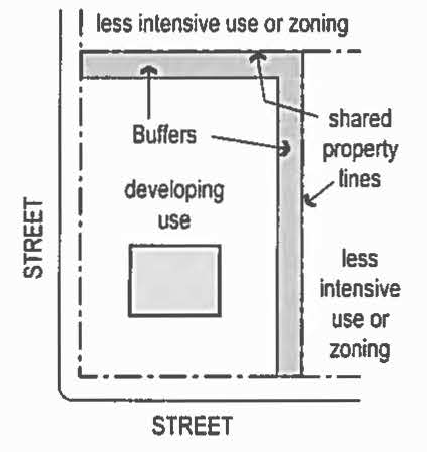
To ensure buffers are provided to mitigate incompatibilities between more and less intensive uses on adjoining properties.
(3)
To promote ecological balance in urban areas through oxygen regeneration, shade, air and water pollutant filtration, groundwater aquifer recharge, and reduction of stormwater runoff.
(4)
To prevent erosion of valuable soil resources and siltation in area waterways.
(5)
To ensure that reasonable measures are taken to design and locate improvements so that heritage trees and other significant vegetation may be protected.
(b)
Exemptions. The requirements of this article apply to all land for which a building permit is sought; except the following:
(1)
Single-family and duplex dwellings.
(2)
Restoration of a building constructed prior to the effective date of the ordinance from which this chapter is derived, which is damaged by fire, explosion, flood or other catastrophe, which damage is less than 50 percent of the assessed value of the structure.
(3)
Interior remodeling.
(4)
Development for which a detailed landscape plan has been approved by the commission prior to the effective date of the ordinance from which this chapter is derived.
(5)
Construction of a structure, other than a building, which does not increase the developed area of a lot more than 50 square feet.
(6)
Developed area of a lot if all proposed new buildings and/or additions to buildings contain less floor area than the floor area of existing buildings which remain on the lot after completion of the new construction.
(Ord. No. 2020-16, § 9.01, 3-16-2020)
Sec. 62-122. - Buffers.
(a)
Applicability. Buffers must be provided as required in Table 9-1 and as described in this section. Buffers are the responsibility of the developing land use. A landscaping plan must be provided in accordance with section 62-126. Buffer requirements are based on the developing land use and the existing, abutting use.
(b)
Required yards, where corresponding with the buffer area, may overlap and may be counted toward buffer width requirements.
(c)
Buffer requirements may be modified by the approving authority as follows:
(1)
When the proposed use will abut an existing, nonconforming use on a property that is designated for another use in the master plan and is zoned accordingly, the buffer may be modified to be consistent with the planned use of the neighboring property.
(2)
If the land use relationship between two abutting lots changes so that a lesser buffer would be required, the previously provided buffer may be reduced.
(3)
Whenever the proposed use abuts vacant land, buffer requirements are based on the zoning of the abutting property or the use projected by the master plan, whichever requires a greater buffer.
(4)
Buffers may not be used for parking, recreational use or any other purpose, except as provided herein. The approving authority may permit a walkway through a buffer and public utilities and storm drainage facilities may be constructed in a buffer, so long as the buffer otherwise complies with this section.
(d)
Design standards.
(1)
Prior to occupancy of the premises, the buffer must provide a visually impervious barrier, from the ground to five feet above grade level throughout the length of the buffer. Within one year after installation, the buffer must be at least six feet above grade throughout the length of the buffer.
(2)
Required plantings must be evergreen and may be supplemented with other plant materials.
(3)
The buffer width may be reduced as provided in Table 9-1 when a fence is provided that is five to seven feet tall and that meets the requirements in section 62-125, design standards for fences.
Table 9-1: Buffer Requirements By Use
Planting Requirements by Buffer Class
(Ord. No. 2020-16, § 9.02, 3-16-2020; Ord. No. 2021-20, § XV, 2-8-2021)
Sec. 62-123. - Screening.
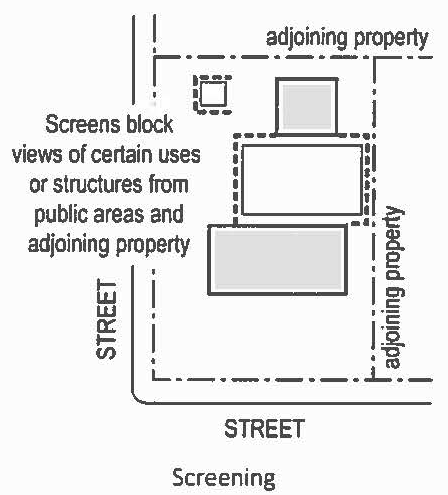
Screening provides visual separation of certain site elements from public areas and adjoining properties.
(1)
Applicability. For all multifamily, nonresidential and mixed use developments, the following require screening:
a.
Garbage collection, recycling and refuse handling areas.
b.
Maintenance areas or utility structures associated with a building or development.
c.
Ganged utility meters and air conditioners/mechanical units.
d.
Outside runs for veterinary clinics, animal shelters, and kennels.
e.
Outdoor storage of materials, stock, equipment, and vehicles (such as those stored for repair), not including retail display.
f.
Any other uses for which screening may be required by the reviewing authority.
(2)
Design requirements. Screening must comply with the following and as approved by the reviewing authority:
a.
Location of the site element should be the first consideration in providing required screening. The reviewing authority may lessen screening requirements when the location of the site element obscures it from public view and from neighboring properties.
b.
Screening may not impede any drainage way or block access to any above-ground, pad-mounted transformer. The utility company may require a minimum clear distance.
c.
The method of screening, including height and materials, must sufficiently screen the site element from view. The minimum height needed is preferred.
d.
Multiple site elements may be screened together.
e.
Site elements that produce objectionable noise or odors must be located to minimize any nuisance to the public and abutting properties.
f.
Shrubs must be evergreen and spaced no more than six feet on center. If used in combination with a fence meeting the requirements of section 62-125, design standards for fences, shrubs may be deciduous and may be spaced no more than eight feet on center.
g.
Trees must be evergreen and, in the absence of a fence, must be supplemented with shrubs to create a continuous, opaque screen.
(3)
Requirements for specific uses.
a.
Refuse and recycling containers may not be located forward of the front building line. These containers must be screened on three sides with an opaque gate for access. The fence must be at least two feet taller than the container.
b.
Outdoor storage must be screened to a height of two feet taller than the material or equipment to be screened.
c.
Service areas, work yards, and similar uses should be located to minimize their visibility to the public and to any abutting properties to which such functions would be objectionable. Where location on site is insufficient to screen the element, required screening must be at least six feet in height.
(Ord. No. 2020-16, § 9.03, 3-16-2020)
Sec. 62-124. - Landscaping for vehicular areas.
Landscaping must be provided in vehicular areas of nonresidential, multifamily and mixed-use developments that are used for off-street parking and loading; vehicular storage, display, maneuvering and washing; and the dispensing of motor fuels. Such landscaping shall be provided in such a manner as to break up the expanse of paving, facilitate the safe circulation of pedestrian and vehicular traffic and provide valuable shade for pedestrians and/or vehicles.
(1)
Requirements.
a.
Required trees must be a species that reaches a mature height of at least 20 feet.
b.
Interior Landscaping. Five percent of the area of any surface parking lot that has over twenty spaces must be interior landscaping, such as islands and peninsulas. Trees must be included within interior landscaped areas and evenly distributed in combination with other landscaping.
c.
Perimeter Landscaping, including street frontage. Vehicular areas must be separated from lot lines by a landscaping strip at least five feet wide planted with shrubs and one tree per 100 feet of lot line.
1.
Where this conflicts with buffer or other landscaping requirements, the greater requirement governs.
2.
Driveway connections between adjacent businesses and other compatible uses are encouraged and are not included in calculation of perimeter tree requirements.
3.
Shrubs used must be detailed on site plan submittal.
(2)
City and state rights-of-way. All landscaping within city or state rights-of-way, other than that performed by the city or state, is the sole responsibility of the adjoining property owner to maintain. The property owner should secure a written agreement with the proper authority prior to landscaping any portion of a right-of-way. The city or state will not be responsible for damages to landscaping materials in rights-of-way, during street or utility repairs or maintenance activities.
(Ord. No. 2020-16, § 9.04, 3-16-2020; Ord. No. 2021-20, § XVI, 2-8-2021)
Sec. 62-125. - Design standards for fences.
Fences must be masonry, durable wood, or a combination thereof. Chain-link can be used to meet landscaping requirements but has to have prior approval from the building official as it should only be used for particular instances. Untreated wood, plastic or wire fencing cannot be used to meet landscaping requirements. No more than 25% of the fence surface may be left open. The finished side of the fence must face abutting property or public views.
(Ord. No. 2020-16, § 9.05, 3-16-2020; Ord. No. 2021-20, § XVII, 2-8-2021)
Sec. 62-126. - Plans; certificate of occupancy.
(a)
All landscaping plans for new construction and for the addition and renovation of buildings exceeding 50 percent of the assessed value of the property must be submitted to the commission along with the original site plan, or to the building official if not subject to commission review. All landscaping plans must be drawn in sufficient detail to determine the size and species of all trees and vegetation to be planted and must include the following:
(1)
Date, scale, north point, project name, owner's name and designer's name.
(2)
Location and dimensions of the property to be developed.
(3)
Existing watercourses and significant drainage features.
(4)
The location and size of existing and proposed streets and alleys, existing and proposed utility easements and overhead utility lines on or adjacent to the lot.
(5)
The location, size and type of trees, shrubs and ground cover to be used in the proposed landscape areas with planting details and/or specifications:
a.
Minimum size of trees: Two and one-half-inch caliper.
b.
Shrubs: Three-gallon containers.
c.
Ground cover: Four-inch cups.
(6)
The method of protecting existing trees from damage during construction.
The plan must be drawn or reviewed and approved by a registered architect, landscape architect, engineer or other person designated in Code of Ala. 1975, § 34-17-27, or licensed to provide such services by the state department of agriculture plant protection division and the city.
(b)
Any landscaping must be constructed according to the approved plan. Any changes in the landscaping plan must be approved by the city arborist before the change is made, who may refer the change to the commission or other authority, when the landscaping plan is part of a development subject to their review and approval. An appeal of the city arborist's determinations may be brought before the ZBA.
(c)
Certificate of occupancy. The building official will not issue a certificate of occupancy until all aspects of a required landscaping plan have been completed and approved by the city arborist. In the event of inclement weather or other unavoidable condition that prevents the implementation of the landscaping plan, the owner may be issued a certificate of completion of structures. A certificate of occupancy may be issued if some aspects of the landscape plan are not completed, provided the following:
(1)
The delay in installation of landscaping will not pose a safety problem to the public.
(2)
A reasonable date for completion is agreed upon by the city arborist and the property owner, in writing.
(3)
A bond payable to the city, in an amount of one and one-half times the cost of the landscaping, is secured and approved by the city clerk.
(Ord. No. 2020-16, § 9.06, 3-16-2020)
Sec. 62-127. - Modifications.
Planting requirements may be modified by the approving authority in any of the following circumstances:
(1)
Existing natural vegetation, which meets, in whole or in part, landscaping requirements, may be counted. However, additional planting may be required to fully achieve the requirement.
(2)
Where impending development of adjacent property would make these standards unreasonable or impractical.
(3)
Where the view from adjoining properties is blocked by a change in grade or other natural or man-made features.
(4)
Where planting will not thrive due to poor soil conditions, intense shade or similar conditions that cannot be reasonably overcome, in which case, the approving authority may require fences or walls to substitute for plantings.
(Ord. No. 2020-16, § 9.07, 3-16-2020)
Sec. 62-128. - Maintenance and irrigation.
(a)
All required fences must be permanently maintained in good condition and replaced or repaired as needed. Plant material required as part of any buffer, screen or landscaping must be tended and maintained in a healthy growing condition, replaced when dead and kept free of weeds, refuse and debris.
(b)
Dead or damaged landscape material must be replaced within three weeks of notice.
(c)
Drought-tolerant, native species are recommended; otherwise, an automatic irrigation system may be required.
(Ord. No. 2020-16, § 9.08, 3-16-2020)

