
Cumberland City Zoning Code
ARTICLE XIV
SIGN CONTROL PROVISIONS2
Editor's note— Ord. No. 3972, § 1(Exh. A), adopted Mar. 5, 2024, repealed the former art. XIV, §§ 25-396—25-407, and enacted a new art. XIV as set out herein. The former art. XIV pertained to similar subject matter, and derived from the original Code.
Sec. 25-401.- Purpose.
Signs perform an important function by identifying residences and businesses to pedestrians and motorists. The purpose of this article is to assist in promoting the public's health, safety, and general welfare, and to promote and preserve aesthetics through the control of signage within the city. This goal shall be achieved by reducing potential signage conflicts between pedestrian and vehicular traffic, preserving property values, preventing unsightly detrimental development that has a blighting influence upon residential, business, and industrial uses, and preventing signs from reaching such an excessive size that they obscure one another to the detriment of all concerned, and securing certain fundamentals of design for the city.
(Ord. No. 3972, § 1(Exh. A), 3-5-24)
Sec. 25-402. - Applicability.
This article shall apply to all signs in the city unless they are exempted hereinafter or elsewhere in the City Code. Signs may be placed, installed, erected, altered, maintained, used, removed, or moved, only in compliance with the provisions of this section and other regulations of the city relating to the placement, erection, alteration, maintenance, use, removal, or moving of signs and similar devices.
(Ord. No. 3972, § 1(Exh. A), 3-5-24)
Sec. 25-403. - Rules of construction.
(a)
Signs which meet the definitions for multiple types of signs shall be subject to the requirements for each type of sign.
(b)
Whenever there are overlapping sign dimension requirements, the requirements for the specific type of sign shall take precedence over the requirements for a general category of signs.
(Ord. No. 3972, § 1(Exh. A), 3-5-24)
Sec. 25-404. - Sign types; requirements.
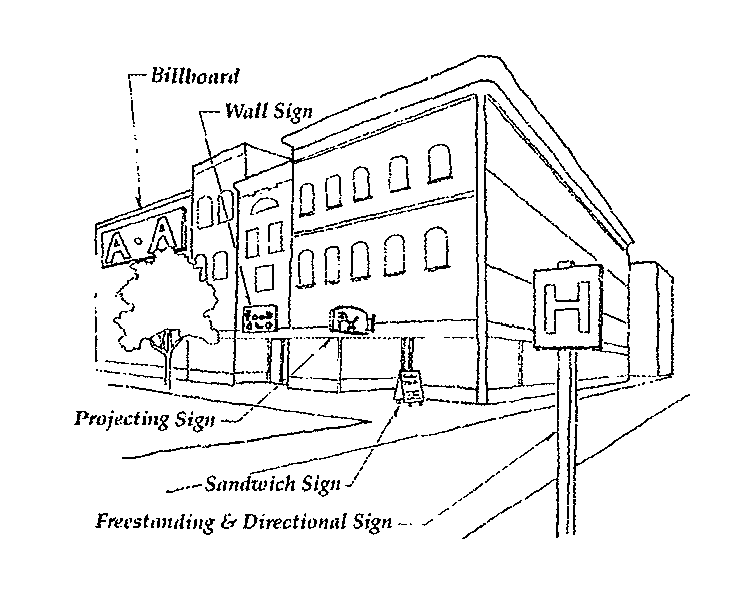
The types of signs and the requirements applicable thereto are set forth below.
(a)
Awning/canopy signs. Any sign painted on or attached to an awning or canopy. Awning/canopy signs shall be treated as wall signs, shall be subject to the requirement applicable to such signs, and shall be included in the overall area calculations for such signs. Signs may be attached flat against awnings or canopies made of rigid materials. They shall not project above the awning or canopy. Awnings and canopies of non-rigid materials (e.g., canvas) shall have signs only appliquéd or painted on them.
(b)
Election polling place signs. Temporary signs at election polling locations may not exceed six (6) square feet in area per sign face. Such signs must be removed within twenty-four (24) hours of Election Day.
(c)
Electronic changeable copy sign. A type of sign or portion thereof that is capable of displaying words, symbols or alphanumeric characters which are defined by a small number of matrix elements using different combinations of light emitting diodes (LEDs), fiber optics, light bulbs or other illumination devices that can be electronically or automatically programmed and may be changed by remote or automatic means. All electronic changeable copy signs shall comply with the following minimum requirements:
(1)
Electronic changeable copy signs shall be permitted only as freestanding signs, low ground (monument) signs, or wall signs in those zoning districts where specifically permitted and only in full compliance with the applicable dimensions and height specified respectively for each type of sign within the applicable zone. However, not more than one (1) electronic changeable copy sign shall be permitted in any chosen form on an individual lot of record.
(2)
All electronic changeable copy signs shall be programmed to ensure that each individual display message shall remain in static (non-moving, non-scrolling, non-streaming video, or non-changing) display for not less than eight (8) consecutive seconds before transitioning to a different display message. Any background image accompanying a message shall remain static with the wording and shall not emulate any form of motion or movement. The transition between individual messages shall occur through a gradual fade out of the preceding message and a gradual fade in to the subsequent message with no image overlap of not less than two (2) consecutive seconds, resulting in a complete individual message cycle of not less than ten (10) consecutive seconds. No flashing or simulated animation of any message or portion thereof (with the limited exception of authorized time and temperature displays) shall be permitted on an electronic changeable copy sign. Any and all background or text color patterns associated with a display message shall remain static and unchanging during each message display cycle.
(3)
Where an electronic changeable copy sign shall include a time and temperature display, said time display shall be in numeric hours and minutes only (not utilizing an animated clock face), and said temperature display shall be in numeric Fahrenheit and/or Celsius readings only. The time and temperature messages shall be allowed to change only as necessary to ensure reading accuracy and may be displayed either as part of each static individual message or as separate messages in the display cycle. The time and temperature shall be displayed in a fixed location on the display area during each programmed display cycle.
(4)
The sign shall be equipped with photosensitive equipment that is programmed to automatically adjust the brightness and contrast of the sign in direct relation to the ambient outdoor illumination. Maximum brightness levels for electronic changeable copy signs shall not exceed five thousand (5,000) nits (a standard unit measure of luminance) when measured from the sign's face at its maximum brightness, during daylight hours, and five hundred (500) nits when measured from the sign's face at its maximum brightness between dusk and dawn, i.e., the time of day between sunrise and sunset.
(5)
All letters, numbers, or other typographical symbols displayed on an electronic changeable copy sign shall be of a size that is fully legible and distinctly discernible from any associated background image or colors by a person with twenty-twenty (20-20) full-color visual acuity at a distance of not less than two hundred (200) feet from the sign.
(6)
Each electronic changeable copy sign shall be programmed or set in a manner such that the display will turn dark and emit no light or shut down in case of a malfunction.
(7)
Prior to approval of a permit to install/erect an electronic changeable copy sign on a property, the property owner and the owner of the proposed sign (if they are not one and the same individual) shall sign an affidavit attesting to and affirming their full and complete understanding of the aforementioned specific requirements and their consent to remain in full compliance with them. An original of said affidavit shall be attached to the issued permit and retained in the city's files.
(d)
Flashing sign. A sign, the illumination of which is not kept constantly in intensity at all times when in use, and which exhibits sudden or marked changes in lighting effects. Illuminated signs which indicate the time, temperature, date, or other similar information shall not be considered flashing signs.
(e)
Freestanding sign (pole or ground signs). A sign which is not affixed to a building that is supported by, or suspended from a freestanding column or other support located in or upon the ground surface.
(f)
Illuminated sign. A sign that has characters, letters, figures, designs, or outlines illuminated by electric lighting or luminous tubes as part of the sign. Illuminated signs are subject to the following requirements:
(1)
They shall be illuminated only with steady, stationary, shielded light sources directed solely onto the sign without causing glare. Light bulbs or lighting tubes used for illuminating a sign shall not be visible from adjacent public rights-of-way or residential properties.
(2)
The intensity of sign lighting shall not exceed that necessary to illuminate and make legible a sign from the adjacent road or closest right-of-way. The illumination of a sign shall not be obtrusive to the surrounding area.
(3)
Sign lighting shall be shielded so no direct light will shine on abutting properties or in the normal line of vision of the public using the streets or sidewalks.
(4)
No flood or spotlights shall be mounted higher than twenty-five (25) feet above ground level.
(g)
Indirectly illuminated sign. A non-flashing sign that is illuminated from an external artificial source. These signs must be arranged so that no direct rays of light are projected from the artificial source into residential properties or public streets.
(h)
Low ground sign. Non-advertising, for identification purposes only. Unless otherwise specified in this article, low ground signs may only be used for identification (but not for advertising) purposes. Low ground signs may not exceed five (5) feet in height. The maximum permitted gross sign area per display face for an electronic changeable copy sign erected as a low ground sign shall not exceed thirty-two (32) square feet. Electronic changeable copy signs shall be prohibited as low ground signs in the Conservation Zone and the R-E (Estate Residential), R-S (Suburban Residential), and R-U (Urban Residential) Zones and on residential principal use properties within the R-O (Office/Residential) Zone.
(i)
Marquee sign. A freestanding sign which utilizes changeable letters or copy. Marquee signs are subject to the following standards:
(1)
There shall be no more than one (1) internally illuminated change-letter marquee sign per property.
(2)
The area of a marquee sign shall not exceed forty-eight (48) square feet in copy area. Such a sign shall be incorporated into the main freestanding sign or may be wall-mounted.
(3)
Letters or symbols shall not exceed twelve (12) inches in height.
(4)
Any portion of a marquee sign incorporated into the main freestanding sign or building sign shall be treated as such and shall be included in the overall calculations for such sign.
(j)
Mobile sign. A sign that is affixed to a vehicle in such a manner that the carrying of such sign or signs is no longer incidental to the vehicle's primary purpose, but becomes a primary purpose in itself, shall be considered a freestanding sign and, as such, shall be subject to the provisions regarding freestanding signs in the district in which such vehicle is located. No person owning, possessing or controlling a vehicle with a mobile sign attached may leave it within a public street, right-of-way, or other property for more than eight (8) hours at a time and may not return the vehicle to a location within one hundred (100) feet of the parking space for one (1) week after its removal. Notwithstanding the foregoing, vehicles with mobile signs attached hereto may not be parked on or in city-owned parking lots or garages. Vehicles with mobile signs affixed thereto which are illegally parked are subject to being towed and impounded as provided for in sections 13-38 and 13-49 of this Code.
(k)
Neighborhood identification sign. A sign intended to promote the identity of a neighborhood or other sub-area within the city that is posted by the city or with the approval of the zoning administrator. They are permitted in all neighborhoods but may not exceed thirty-two (32) square feet in area.
(l)
Occupant sign. A sign bearing only the names and/or addresses of occupants or premises. See subsection 25-407(b)(3).
(m)
Projecting sign. A sign which is attached to the structure wall and which extends perpendicular or at an angle from the plane of such wall. Such signs are subject to the following requirements.
(1)
The two (2) sides of a projecting sign must be parallel and of the same dimensions back-to-back and shall not exceed twelve (12) inches in thickness and ten (10) square feet in area.
(2)
A projecting sign shall be hung at right angles to the building and shall not project more than four (4) feet from the wall or surface to which it is mounted.
(3)
Projecting or suspended signs shall have a minimum clearance of ten (10) feet above grade and shall not project into a vehicular public way.
(4)
Projecting signs shall not interfere with normal pedestrian or vehicular traffic.
(n)
Rooftop signs. No roof signs other than directional devices as may be required by the federal and state aviation authorities shall be placed, inscribed, or supported upon the roof or upon any structure that extends above the eaves of the roof of any building.
(o)
Sandwich/sidewalk sign. An "A-frame" type sign that stands with self-supporting elements and is not permanently affixed to the ground. One (1) on-premise sign is allowed in compliance with the following standards:
(1)
It may not stand higher than four (4) feet off the ground.
(2)
It must have a surface area no greater than eight (8) square feet (per side).
(3)
It must be constructed of durable materials.
(4)
Its copy must be professionally prepared.
(5)
It must be removed from the street when the business is closed.
(6)
It may not obstruct pedestrian traffic by more than twenty (20) percent of the width of any pedestrian right-of-way.
(7)
It may not have wheels.
(p)
Temporary sign. A sign that is intended to remain on the location where it is erected or placed for a period of not more than ninety (90) days. See subsection 25-407(b)(4). Although not mandated, the city requests that all election candidate's signs be removed no later than thirty (30) days after the date of an election.
(q)
Wall sign (parallel sign). A sign attached to the wall of a structure with the face in a plane parallel to such wall, and not extending more than fifteen (15) inches from the face of such wall.
(1)
Wall signs shall not be mounted higher than the eave line or top of the parapet wall of the building and no portions of the sign shall extend beyond the ends of the wall to which it is attached.
(2)
For each business on a separate property, wall-mounted signage for each street frontage is permitted with a maximum area of one (1) square foot of signage per one (1) lineal foot of street frontage of the building.
(3)
Buildings that have multiple businesses accessed by separate entrances each business shall be permitted one (1) building sign for each street frontage with a maximum area of one (1) square foot of signage per one (1) lineal foot of street frontage of the building dedicated to that business.
(r)
Wall-painted signs. A sign painted directly on the wall of a structure. See subsection 25-407(b)(6).
(s)
Window sign. A sign affixed to or visible through a window of a building.
(Ord. No. 3972, § 1(Exh. A), 3-5-24)
Sec. 25-405. - Prohibited signs in all districts.
The following sign types are prohibited within all districts:
(1)
Signs which any way simulate official, functional, directional, or warning signs erected or maintained by the United States Government, the State of Maryland, county, or municipality thereof, or by any railroad, public utility, or similar agency concerned with the protection of public health or safety which are not authorized or constructed by the subject entity.
(2)
Banners, spinners, flags (excluding those described in subsections 25-407(a)(2) and (b)(1), pennants, or any similar moving object more than fifteen (15) square feet in size, whether containing a message or not, except for use during not more than four (4) special occasions in one (1) calendar year by a use located in the Local Business, Highway Business, Central Business, and Business-Commercial Districts for a period of not more than a total of twenty (20) days per calendar year or unless permitted as a temporary sign under subsection 25-404(p).
(3)
Flashing, blinking, twinkling, animated, or moving signs of any type, except for displays of time, temperature, date, and displays of similar information.
(4)
Signs placed, inscribed, or supported upon the roof or upon any structure that extends above the eaves of the roof of any building.
(5)
Signs, other than sandwich board/sidewalk signs, on mobile stands that can be moved from place to place.
(6)
Signs which emit smoke, visible vapors, or particles, sound, or odor.
(Ord. No. 3972, § 1(Exh. A), 3-5-24)
Sec. 25-406. - Permits.
(a)
Generally. With the exception of those signs listed in section 25-407, all signs shall require the issuance of a sign permit by the zoning administrator before erection or replacement. All signs must comply with the regulations contained in this article and elsewhere in the City Code, regardless of whether a permit is required. No permit shall be required for a mere change of copy on a sign, the customary use of which involves frequent and periodic changes of copy.
(b)
Applications. Application for a sign permit shall be made to the zoning administrator on a form provided by the administrator's office and shall be accompanied by a filing fee established by the mayor and city council. The zoning administrator, or his/her authorized designee, shall review and approve, approve with conditions, or deny the permit request within fifteen (15) days of receipt of a complete submission.
(Ord. No. 3972, § 1(Exh. A), 3-5-24)
Sec. 25-407. - Signs not requiring a permit.
Signs which meet the standards set forth in section 25-404.
(a)
Exempt signs. The following types of signs are exempt from obtaining a permit:
(1)
Address/postbox numerals.
(2)
Government signs, flags, and standards erected by the city, county, state, or federal government in furtherance of their governmental responsibility. Such signs, flags, and standards may include, but are not limited to, those used for community identity, to identify facility entrances and grounds, for special community events, and to provide direction to places of interest.
(3)
Legal notices.
(4)
Scoreboards.
(b)
Provisionally exempt signs. The following types of signs may be erected without a sign permit, provided that the standards of this section are met:
(1)
Flags. These shall be allowed subject to the following standards:
a.
Flags of the United States of America, the state, the city, foreign nations having diplomatic relations with the United States, and any other flag adopted or sanctioned by an elected legislative body of competent jurisdiction. Such a flag shall not be flown from a pole more than thirty-five (35) feet in height.
b.
Flags other than those prohibited under section 25-402 shall not be flown from a pole more than twenty-five (25) feet in height, but in no case shall the corporate flag be flown at a height greater than any flag identified in subsection (b)(2)a., located on the same parcel.
(2)
Fuel seller signs. The maximum area for display signs at establishments selling fuel shall be twenty-four (24) square feet per sign face. One (1) such sign shall be allowed per arterial or major collector roadway frontage.
(3)
Occupant signs. One (1) such sign shall be permitted to be constructed on the building face, with the area of said sign not to exceed one (1) square foot in area. In addition to this sign, one (1) freestanding occupant sign or low ground sign not exceeding four (4) square feet in area shall be allowed on each property, subject to provisions regarding such sign types contained in section 25-411 for residential and conservation districts, section 25-412 for the B-CBD, B-H, B-L, G-C, G-I, and B-C Districts, and section 25-413 for the I-G District.
(4)
Temporary signs. Signs set back four (4) feet or less from the edge of a roadway or between the edge of a roadway and a sidewalk are exempt from permitting if they are no more than six (6) square feet in area and are placed at that location no sooner than sixty (60) days before a primary or general election and removed no later than thirty (30) days from the date of the election.
(5)
Service entrance signs. Service entrance signs are allowed provided they are not illuminated and do not exceed four (4) square feet.
(6)
Wall painted signs. These signs are allowed subject to all other applicable regulations but may not exceed fifty (50) percent of the allowable square footage that would otherwise be permitted.
(7)
Window posters. These include signs inside windows of buildings within commercial areas, provided that the sign area does not exceed twenty-five (25) percent of the individual glass area through which it is seen.
(Ord. No. 3972, § 1(Exh. A), 3-5-24)
Sec. 25-408. - Nonconforming signs and sign structures.
Signs existing at the time of passage of this article that do not conform to the requirements of this chapter or elsewhere in the code shall be considered nonconforming signs and, once removed, shall be replaced only with conforming signs. Nonconforming signs are subject to the following provisions:
(1)
Nonconforming signs shall be kept in good repair, including sign maintenance, repainting, and replacement of broken or deteriorated parts of the sign itself.
(2)
Change and modification. A nonconforming sign or sign structure shall be brought into conformity with this chapter if it is altered, reconstructed, replaced, expanded, or relocated. A mere change in copy is not an alteration or replacement for purposes of this subsection.
(3)
A nonconforming sign or sign structure shall be removed within thirty (30) days if the building containing the use to which the sign is accessory is demolished or destroyed to the extent that the sign or the location of the sign is damaged in any respect.
(Ord. No. 3972, § 1(Exh. A), 3-5-24)
Sec. 25-409. - Sign size and area computation.
(a)
The size of any sign shall be computed by multiplying its greatest height by its greatest length, exclusive of supporting structures unless such supporting structure is illuminated or is in the form of a symbol or contains advertising copy. In the case of signs that have no definable edges, such as raised letters attached to a building facade, the sign size shall be that area within a single continuous perimeter enclosing the extreme limits of the actual message or copy area.
(b)
The area of a sign shall be construed to include all lettering, wording, and accompanying designs and symbols, together with the background, whether open or enclosed, on which they are displayed.
(c)
Where the sign consists of individual letters or symbols attached to or painted on a surface, building, wall, or window, the area shall be considered to be that of the smallest rectangle which encompasses all of the letters and symbols.
(d)
In computing square foot area of a double-faced sign, only one (1) side shall be considered, provided both faces are identical. If the interior angle formed by the two (2) faces of the double-faced sign exceeds one hundred twenty (120) degrees, both faces shall be considered in calculating the sign area.
(Ord. No. 3972, § 1(Exh. A), 3-5-24)
Sec. 25-410. - General sign regulations.
(a)
No sign shall be erected containing information on it which states or implies that a property may be used for any purpose not permitted under the provisions of this chapter in the zone in which the property to which the sign relates is located.
(b)
No sign shall be so located or arranged that it interferes with traffic through glare, through blocking of reasonable sight lines for streets, sidewalks, or driveways, through confusion with a traffic control device (by reason of color, location, shape, or other characteristic), or through any other means.
(c)
All signs except temporary signs shall be constructed of durable material and kept in good condition and repair. Temporary signs need only be constructed of such material that is sufficiently durable to last in good condition and repair for the term of their use. Electrical signs shall be subject to the performance criteria of the Underwriters Laboratory, Incorporated or to applicable city codes, whichever is more stringent.
(d)
Only signs of a duly constituted governmental body, shall be allowed within street rights-of-way unless specifically authorized by other ordinances and regulations of the city.
(e)
If an establishment has walls fronting two (2) or more streets, the sign area for each street may be computed separately.
(f)
Any vehicle to which a sign is affixed in such a manner that the carrying of such sign or signs no longer is incidental to the vehicle's primary purpose, but becomes a primary purpose in itself, shall be considered a freestanding sign and, as such, shall be subject to the provisions regarding freestanding signs in the district in which such vehicle is located.
(g)
No sign in other than a residential or conservation district shall be located so as to face any residential or conservation district on the same side of the street on which the property bearing the sign fronts. This provision shall not apply to signs at right angles to the street line of such street.
(h)
The maximum permitted gross sign area per display face for an electronic changeable copy sign erected as a parallel or wall sign shall not exceed thirty-two (32) square feet.
(i)
Only one (1) on-premises sign with a maximum area of one hundred fifty (150) square feet may be erected which faces or is primarily intended to be visible from the National Freeway (Interstate 68). The height of on-premises freestanding signs adjacent to the National Freeway shall not exceed forty (40) feet or shall be no higher than the roadway elevation of the adjacent National Freeway.
(j)
No off-premises sign shall be erected closer than one hundred (100) feet from the edge of the paved roadway of the National Freeway (Interstate 68).
(k)
No sign, except a wall sign or projecting sign as defined herein, shall be permitted to have any portion thereof extending into the public right-of-way in excess of four (4) feet except as hereinafter modified and shall be at least ten (10) feet high above the pavement or ground.
(l)
All sign provisions of this chapter shall apply to smokestacks, water towers, and other similar structures.
(m)
No sign shall be placed on a property without the consent of the owner. Section 25-411. Signs in the residential districts and the conservation district.
(Ord. No. 3972, § 1(Exh. A), 3-5-24)
Sec. 25-411. - [Exceptions to general regulations.]
No signs shall be permitted in the residential zoning districts and the Conservation District except as follows:
(a)
On-premises signs.
(1)
Official traffic signs and other official federal, state, county, and city governmental signs.
(2)
Neighborhood identification signs, pursuant to subsection 25-404(k).
(3)
Occupant signs, pursuant to subsection 25-404(l) and 25-407(b)(3).
(4)
Signs for bulletin or announcement boards for identification of permitted nonresidential buildings provided that the area of any such sign shall not exceed twenty (20) square feet. Not more than one (1) such sign shall be placed on each property.
(5)
Temporary signs, pursuant to subsection 24-404(p) and 24-407(b)(4).
(6)
Signs for identification of a permitted home occupation, provided that the area of any such sign shall not exceed four (4) square feet.
(7)
Low ground signs, pursuant to subsection 25-404(h), except that electronic changeable copy signs shall be prohibited within the Conservation, R-E, R-S, and R-U Residential Zones and on residential principal use properties in the R-O (Office/Residential) Zone.
(8)
Freestanding signs, prohibited, except for low ground signs.
(b)
Off-premises signs.
(1)
Official traffic signs and other official federal, state, county, and city governmental signs.
(2)
Neighborhood identification signs, pursuant to subsection 25-404(k).
(3)
Temporary signs, pursuant to subsections 25-404(p) and 25-407(b)(4).
(Ord. No. 3972, § 1(Exh. A), 3-5-24)
Sec. 25-412. - Signs in the B-CBD, B-H, B-L, G-C, G-I, and B-C Districts.
No signs shall be permitted in the B-CBD, B-H, B-L, G-C, G-I, and B-C Districts except as follows:
(a)
On-premises signs.
(1)
Official traffic signs and other official federal, state, county, and city governmental signs.
(2)
Neighborhood identification signs, pursuant to subsection 25-404(k).
(3)
Occupant signs, pursuant to subsection 25-404(l) and 25-407(b)(3).
(4)
Temporary signs, pursuant to subsection 25-404(p) and 25-407(b)(4).
(5)
Signs for identification of a permitted home occupation, provided that the area of any such sign shall not exceed four (4) square feet.
(6)
Low ground signs, pursuant to subsections 25-404(h), provided:
a.
Low ground signs shall be located not less than four (4) feet from the property line and shall not be sited within a clear sight triangle as required by section 25-135. The city engineer may authorize a low ground sign to be placed within a clear sight triangle where special circumstances exist, such as (but not necessarily limited to) intersections of one-way streets, where traffic sight visibility at the intersection would not be impeded or compromised in any way by the placement of a low ground sign within the required clear sight triangle.
b.
The maximum sign area for a low ground sign shall be thirty-two (32) square feet and not more than five (5) feet in height at any point on the sign face.
c.
Low ground signs may only be illuminated indirectly as specified in subsection 25-404(h). Indirect illumination for a low ground sign shall be accomplished through properly shielded and directed lights located on the ground near the base of the sign.
d.
Special provisions for low ground signs within the G-C and G-I zones.
1.
One (1) low ground sign shall be allowed as a replacement for each freestanding sign permitted under subsection (a)(8). For every low ground sign approved for a property, the number of freestanding signs that may be permitted on the property shall be reduced by one (1). If a low ground sign is desired on a property where the maximum number of freestanding signs already exists, at least one (1) of the existing freestanding signs on the property must be removed before the requested low ground sign may be erected.
2.
The immediate areas surrounding a low ground sign shall be landscaped with natural vegetation that will not obscure the sign when mature and will not exceed thirty (30) inches in height at maturity when located within either a clear sight triangle or four (4) feet of the property line. The highest point of a low ground sign shall be not more than five (5) feet above the natural grade of the site prior to any alteration of the ground level to support natural landscaping under and around the sign.
3.
Up to, but not more than, a continuous area of eight (8) square feet on the face of any low ground sign may be used for copy. Said signs may not be illuminated.
(7)
Wall and projecting signs, provided:
a.
Signs attached to a main wall of a principal building shall not project more than four (4) feet therefrom and no portion shall be less than ten (10) feet and no more than twenty-five (25) feet above basic grade. If not projecting more than five (5) inches from a wall of a building, no portion shall be less than seven and one-half (7.5) feet above the grade.
b.
The total area of all signs shall not exceed twenty-five (25) percent of the area of the building face (including window and door area and cornices) to which they are attached. In no case, however, shall the total area of all signs exceed one hundred (100) square feet.
c.
Permanent window signs shall be considered parallel signs and included in this computation but shall nevertheless not exceed twenty-five (25) percent of the total window area on each street.
d.
In the case of a shopping center, a group of stores, or other business uses on a lot held in single or separate ownership, the provisions of this section relating to the total area of signs permitted on a premise shall apply with respect to each building, separate store, or similar use. Only parallel signs shall be permitted for the individual establishments. However, the total area permitted to be covered by a sign shall not exceed fifteen (15) percent of the area of the building face.
e.
Wall or parallel signs shall be permitted on a side or rear wall only if such wall abuts a street, driveway or parking area and shall not distract from the architectural features of the structure as so approved by the zoning administrator. The maximum size shall be limited to twenty (20) percent of the total sign area permitted and shall not be more than twenty-five (25) feet above the basic grade.
(8)
Freestanding signs.
a.
Shall be limited to one (1) except for an establishment which fronts on two (2) or more streets in which case a sign may be erected in each yard fronting on a street.
b.
No portion of any such sign shall be less than ten (10) or more than forty (40) feet above the ground except such signs described in subsections d. and e. below.
c.
The area of any freestanding sign, except such signs as described in d. and e. below, shall not exceed one (1) square foot for each two (2) feet of lineal lot frontage or fifty (50) square feet, whichever is smaller.
d.
No sign shall be located beyond the rear or side wall of the main building when the rear or side property line on which it is situated abuts a residential or conservation district, except signs that convey information such as parking, entrances, and traffic flow directions. The area of one (1) side of any such sign shall not exceed eight (8) square feet. The name of the business located on the premises may appear on such signs.
e.
No portion of a shopping center freestanding sign shall be less than twenty (20) or more than forty (40) feet above the ground. The area of any one (1) side of such sign shall not exceed one hundred fifty (150) square feet. The location and orientation of such sign shall be shown on the development plan.
f.
In the case of a shopping center, the number of its freestanding signs shall be according to the following schedule: Parking facilities for one hundred (100) to five hundred (500) cars, one (1) freestanding sign shall be allowed. For every additional increment of five hundred (500) parking spaces, one (1) additional freestanding sign is permitted. At no time shall there be more than four (4) freestanding signs per shopping center.
g.
In the case of a group of business uses other than a shopping center, on a lot held in single or separate ownership, a single freestanding sign, including individual signs identifying different establishments, may be erected on a common backing provided that the total area on one (1) side of the sign does not exceed one hundred (100) square feet. The structural backing for all such signs shall be uniform and no sign may extend, in any direction, beyond the outside edge of the backing. No portion of any such backing shall be less than five (5) feet or more than twelve (12) feet above the ground.
(b)
Off-premises signs.
(1)
Official traffic signs and other official federal, state, county, and city governmental signs.
(2)
Neighborhood identification signs, pursuant to subsection 25-404(k).
(3)
Temporary signs, pursuant to subsections 25-404(p) and 25-407(b)(4).
(4)
Off-premises commercial advertising signs shall be permitted only in the B-H (Highway Business) and B-C (Business-Commercial) Districts. Such signs shall comply with the following standards:
a.
All wall and projecting signs shall not exceed two (2) square feet for each foot of length of the front building wall or length of that portion of such wall which is devoted to such establishments or three hundred seventy-five (375) square feet, whichever is smaller. Said signs are permitted on a side or rear wall only if such wall abuts a street, driveway, or parking area. No sign shall be more than twenty-five (25) feet above the basic grade.
b.
Freestanding signs shall not exceed one (1) square foot of sign area for each two (2) feet of lot frontage or three hundred seventy-five (375) square feet, whichever is smaller. Not more than one (1) such sign shall be placed on property in single and separate ownership unless such property fronts on more than one (1) street, in which case one (1) such sign may be erected on each street frontage.
c.
No sign shall be more than twenty-five (25) feet above the basic grade. No sign shall be located beyond the side property line upon which it is situated where it abuts a residential district.
(c)
Special provisions for signs in the G-C and G-I Districts. In addition to the signage provisions set forth in this section, those portions of section 25-141 related to signage in the Gateway (G-C and G-I) Districts also apply.
(Ord. No. 3972, § 1(Exh. A), 3-5-24)
Sec. 25-413. - Signs in the I-G District.
No signs shall be permitted in the I-G District except as follows:
(a)
On-premises signs.
(1)
Official traffic signs and other official federal, state, county, and city governmental signs.
(2)
Neighborhood identification signs, pursuant to subsection 25-404(k).
(3)
Occupant signs, pursuant to subsections 25-404(l) and 25-407(b)(3).
(4)
Temporary signs, pursuant to subsections 25-404(p) and 25-407(b)(3).
(5)
Low ground signs, pursuant to subsection 25-404(i).
(6)
Wall and projecting signs, providing:
a.
Signs shall not exceed two (2) square feet for each foot of length of the front building wall or length of that portion of such wall which is devoted to such establishment or three hundred seventy-five (375) square feet, whichever is smaller.
b.
Signs are permitted on a side or rear wall only if such wall abuts a street, driveway, or parking area.
c.
No sign shall be more than twenty-five (25) feet above the basic grade, nor shall be closer than one hundred (100) feet to residential area.
d.
No sign shall project higher than the roof line.
(7)
Freestanding signs, providing:
a.
Shall not exceed one (1) square foot of sign area for each two (2) feet of lot frontage or three hundred seventy-five (375) square feet, whichever is smaller.
b.
Not more than one (1) free standing sign shall be placed on a property unless it fronts on more than one (1) street, in which case one (1) such sign may be erected on each street frontage. In addition, one (1) freestanding sign, indicating the name of an industrial park and the industries within, may be erected along each highway on which the park fronts. The location and design of such signs shall be subject to review and approval by the planning commission.
c.
No sign shall project higher than the roof line. No sign shall be located beyond the rear or side wall of the main building when the rear or side property line upon which it is situated abuts a residential district.
(b)
Planned industrial park sign requirements.
(1)
One (1) sign, indicating the name of the industrial park and the industries therein, may be erected along each highway on which the development fronts. Such sign may be freestanding or attached to a wall or fence. Plans showing the proposed location and design of such sign shall be subject to approval by the planning commission.
(2)
Identification signs for individual industries shall be permanently attached to the building and shall preferably be part of the architectural design of a building. One (1) sign may be placed on the front, sides, or rear of a building or on all sides, provided the area conforms with the formula established in subsection (a)(7)a.
(3)
One (1) freestanding sign may be used only when an industry comprises a group of buildings. Such sign shall neither extend into any minimum required yard nor rise above the roof line of adjacent buildings. The sign shall not exceed the area derived from the formula established in subsection (a)(7)a.
(4)
A temporary sign not to exceed one hundred fifty (150) square feet may be erected during construction within the rear half of required yards facing upon streets. The purpose of such a sign is to identify the industry that will occupy the lot and the organizations or persons concerned with its construction. A temporary use permit shall be obtained from the office of the zoning administrator. Temporary signs shall be removed within thirty (30) days following completion of construction.
(Ord. No. 3972, § 1(Exh. A), 3-5-24)

