
Daytona Beach City Zoning Code
ARTICLE 11
- DEFINITIONS AND INTERPRETATION
Sec. 11.1. - General Rules for Interpretation.
The following rules shall apply for construing or interpreting the terms and provisions of this Code.
A.
Meanings and Intent. All provisions, terms, phrases, and expressions contained in this Code shall be interpreted in accordance with the general purposes set forth in Section 1.3, General Purpose and Intent, and the specific purpose statements set forth throughout this Code. When a specific section of these regulations gives a different meaning than the general definition provided in this article, the specific section's meaning and application of the term shall control.
B.
Headings, Illustrations, and Text. In the event of a conflict or inconsistency between the text of this Code and any heading, caption, figure, illustration, table, or map, the text shall control. Graphics and other illustrations are provided for informational purposes only and should not be relied on as a complete and accurate description of all applicable regulations or requirements.
C.
Lists and Examples. Unless otherwise specifically indicated, lists of items or examples that use terms like "for example," "including," and "such as," or similar language are intended to provide examples and are not exhaustive lists of all possibilities.
D.
Computation of Time. The time in which an act is to be done shall be computed by excluding the first day and including the last day. If a deadline or required date of action falls on a Saturday, Sunday, or holiday observed by the City, the deadline or required date of action shall be the next day that is not a Saturday, Sunday, or holiday observed by the City. References to days are calendar days unless otherwise stated.
E.
References to Other Regulations/Publications. Whenever reference is made to a resolution, ordinance, code, statute, regulation, or document, it shall be construed as a reference to the most recent edition of such regulation, resolution, ordinance, code, statute, regulation, or document, unless otherwise specifically stated.
F.
Delegation of Authority. Any act authorized by this Code to be carried out by City staff may be carried out by any City officer, employee, or agent designated with the authority to do so.
G.
Technical and Nontechnical Terms. Words and phrases shall be construed according to the common and approved usage of the language, but technical words and phrases that may have acquired a peculiar and appropriate meaning in law shall be construed and understood according to such meaning.
H.
Public Officials and Agencies. All public officials, bodies, and agencies to which references are made are those of the City of Daytona Beach, unless otherwise indicated.
I.
Mandatory and Discretionary Terms. The words "shall," "must," and "will" are mandatory in nature, establishing an obligation or duty to comply with the particular provision. The words "may" and "should" are permissive in nature.
J.
Conjunctions. Unless the context clearly suggests the contrary, conjunctions shall be interpreted as follows:
1.
"And" indicates that all connected items, conditions, provisions or events apply or are required; and
2.
"Or" indicates that one or more of the connected items, conditions, provisions or events apply or are required.
K.
Tenses and Plurals. Words used in the present tense include the future tense. Words used in the singular number include the plural number and the plural number includes the singular number, unless the context of the particular usage clearly indicates otherwise. Words used in the masculine gender include the feminine gender, and vice versa.
L.
Term Not Defined. If a term used in this Code is not defined in this article, City staff shall have the authority to provide a definition based on the definitions used in accepted sources—including, but not limited to, the most recent editions of A Planners Dictionary, A Glossary of Zoning, Development, and Planning Terms, and A Survey of Zoning Definitions (all published by the American Planning Association), and the Merriam-Webster Unabridged Dictionary.
Sec. 11.2. - Interpretation of Zoning District Map Boundaries.
A.
Boundary Interpretation Rules.
1.
Boundaries shown as approximately following a utility line or a street, road, alley, railroad, or other public access way shall be interpreted as following the centerline of the right-of-way or easement for the utility line or access way.
2.
Boundaries shown as approximately following a property line shall be interpreted as following the property line as it existed when the boundary was established. If a subsequent minor adjustment (such as from settlement of a boundary dispute or overlap) results in the property line moving 10 feet or less, the zoning boundary shall be interpreted as moving with the property line.
3.
Boundaries shown as approximately following a river, stream, canal, or other watercourse shall be interpreted as following the centerline of the watercourse as it actually exists, and as moving with that centerline to the extent the watercourse moves as a result of natural processes (flooding, erosion, sedimentation, etc.).
4.
Boundaries shown as approximately following the shoreline of the Atlantic Ocean, the Intracoastal Waterway, or other navigable bodies of water shall be interpreted as following the shoreline at mean high water and as moving with the mean high-water line to the extent the shoreline moves as a result of natural processes (flooding, erosion, sedimentation, etc.).
5.
Boundaries shown as entering a body of water shall be interpreted as continuing in the direction at which they enter the body of water and extending until they intersect another zoning district boundary or similarly extended boundary, or the limits of the City's jurisdiction.
6.
Boundaries shown as approximately following established municipal corporate limits or other political boundaries shall be interpreted as following the corporate limits or boundary.
7.
Boundaries shown parallel to or as extensions of features indicated in this subsection shall be interpreted as such.
8.
If the specific location of a depicted boundary cannot be determined from notations on the Official Zoning District Map or application of the above standards, it shall be determined by using the map's scale to determine the boundary's distance from other features shown on the map.
9.
Where the actual locations of existing physical or natural features vary from that shown on the Official Zoning District Map, or in other circumstances not covered by this subsection, City staff shall have the authority to interpret the district boundaries.
B.
Appeals. Appeals of the decision of City staff in interpreting zoning district boundaries shown on the Official Zoning District Map shall be reviewed and decided by the Planning Board in accordance with Section 3.4.Y, Appeal.
Sec. 11.3. - Use Classifications and Interpretation.
A.
Principal Use Classification System.
1.
Purpose. This section is intended to provide a systematic framework for identifying, describing, categorizing, consolidating, and distinguishing land uses in a way that makes it easier to determine whether a particular use, activity, or combination of activities is allowable as a principal use in a particular zoning district in accordance with the use tables in Article 4: Zoning Districts, and Article 5: Use Standards, or is subject to other use-specific provisions in this Code. This section is also intended to guide interpretations of whether a particular unlisted use should be deemed permitted and to address future additions to the use tables.
2.
Structure Of Principal Use Classification System. The principal use classification system described in this section groups uses at three levels: use classifications, use categories, and use types.
a.
Use Classifications. The use classifications identify broad general classifications of land use and include residential uses, institutional uses, commercial uses, and industrial uses. Use classifications are further broken down into a series of general "use categories."
b.
Use Categories.
i.
The use categories describe the major sub-groups of the respective use classifications, and are based on common functional, product, or physical characteristics, such as the type and amount of activity, the type of customers or residents, how goods or services are sold or delivered, and site conditions. For example, the Residential Use Classification is divided into the Household Living and Group Living use categories.
ii.
Each use category is described in terms of the common characteristics of included uses (including common or typical accessory uses), examples of common use types included in the category, and, for a number of use categories, exceptions—i.e., those uses that might appear to fall within the use category, but are included in another use category.
c.
Use Types. The specific use types included in each use category identify specific principal uses that are considered to possess the characteristics identified for the use category. For example, live/work dwellings, single-family dwellings, and multifamily dwellings are use types in the Household Living use category.
3.
Development With Multiple Principal Use Types. A development may include multiple principal uses, provided each principal use is a principal use type allowed in the applicable zoning district and the development complies with any use-specific standards applicable to each of the included use types. If a use within a development is determined to be an accessory use to a principal use in the development, such accessory use shall be subject to the accessory use standards in Section 5.3, Accessory Uses and Structures.
4.
Agricultural Use Classification. The Agricultural Uses category is characterized by activities related to the production of field crops, fruits, vegetables, ornamental and flowering plants, and the breeding, raising, or keeping of livestock, poultry, swine, or other animals for food or other marketable products. The Agricultural Uses category also includes silvicultural activities related to the planting, management, protection, and harvesting of trees for timber or other forest products, as well as the breeding, raising, keeping, boarding, and training of horses. Accessory uses may include offices, storage areas, barns, stables, irrigation systems, and repair facilities related to the agricultural or silvicultural activities. Example use types include general farming (crop production, orchards, breeding or raising of fowl or other animals, and fish farms), silvicultural activities (the management of timber), and plant nurseries and greenhouse operations. This use category does not include the processing of animal or plant products for wholesale or retail sale purposes, which is considered an industrial manufacturing use type.
5.
Residential Use Classification.
a.
Household Living Uses. The Household Living Uses category includes use types providing for the residential occupancy of a dwelling unit by a single family. Tenancy is generally arranged on a month-to-month or longer basis. Accessory uses common to household living uses include recreational activities, raising of domestic pets, hobbies, swimming pools, and parking of the occupants' vehicles. Home occupations, accessory apartments, and family child care homes are accessory uses that are subject to additional regulations (See Section 5.3, Accessory Uses and Structures.). Example use types include single-family detached dwellings, duplex dwellings, townhouse dwellings, multifamily dwellings, mobile/manufactured home parks, upper-story dwellings above nonresidential uses, and live/work dwellings. This use category does not include residential use types that generally involve some level of managed personal care for a larger number of residents (e.g., community residential homes, assisted living facilities, and continuing care retirement communities), which are categorized as group living uses. It also does not include use types where persons generally occupy habitable units for periods of less than 30 days (e.g., hotels, motels), which are categorized as visitor accommodation uses.
b.
Group Living Uses. The Group Living Uses category includes use types providing for the residential occupancy of a group of habitable units by persons who do not constitute a single family and may receive some level of personal care. Individual habitable units often consist of a single room or group of rooms without cooking and eating facilities, but unlike a hotel or motel, are generally occupied on a monthly or longer basis. Accessory uses common to group living uses include recreational facilities, administrative offices, and food preparation and dining facilities. Example use types include community residential homes, and assisted living facilities. Although continuing care retirement communities include household living uses (e.g., dwellings) and health care uses (e.g., nursing care facilities), they are categorized as a group living use because of their focus on the present or future provision of personal care to senior citizens and their integration of various uses as a single cohesive development. This use category does not include use types where persons generally occupy habitable units for periods of less than 30 days (e.g., hotels, motels), which are categorized as visitor accommodation uses. It also does not include use types where residents or inpatients are routinely provided more than minor health care services (e.g., nursing home facilities, psychiatric treatment facilities), which are categorized as health care uses.
6.
Institutional Use Classification.
a.
Communication Uses. The Communication Uses category includes uses and facilities providing regional or community-wide communications services, such as wireless communications, radio and television broadcasting, and newspaper or magazine publishing. Services may be publicly or privately provided and may include on-site personnel. Accessory uses may include offices, monitoring, storage areas, or data transmission equipment. Example use types include telecommunication towers and antennas, radio and television broadcasting studios, and newspaper or magazine printing facilities.
b.
Community Service Uses. The Community Service Uses category includes use types of a public, nonprofit, or charitable nature providing a local service (e.g., cultural, recreational, counseling, education, training) directly to people of the community. Generally, such uses provide ongoing continued service on-site or have employees at the site on a regular basis. Accessory uses may include offices, meeting areas, food preparation and dining facilities, health and therapy areas, and indoor and outdoor recreational facilities. The category does not include uses with a residential component. Example use types include community centers, libraries, museums, senior centers, and youth centers. This use category does not include clubs or lodges of community-oriented associations (categorized as other institutional uses), private or commercial health clubs or recreational facilities (categorized as recreation/entertainment uses), or counseling in an office setting (categorized as an office use).
c.
Day Care Uses. The Day Care Uses category is characterized by use types providing care, protection, and supervision for children or adults on a regular basis away from their primary residence, and typically for less than 24 hours per day. Care can be provided during daytime or nighttime hours. Accessory uses may include offices, food preparation and dining areas, and recreation areas. Example use types include adult day care centers and child care facilities. This use category does not include family child care homes or drop-in day care provided in connection with an employment or a shopping center, recreational facility, place of worship, hotel, or other principal use, where children are temporarily cared for while parents or guardians are employed part-time or temporarily occupied on the premises or in the immediate vicinity.
d.
Education Uses. The Education Uses category includes use types such as public schools and private schools (including charter schools) at the elementary, middle, or high school level that provide State-mandated basic education or a comparable equivalent. This use category also includes colleges, universities, and other institutions of higher learning such as vocational or trade schools that offer courses of general or specialized study leading to a degree or certification. Accessory uses at schools may include offices, play areas, recreational and sport facilities, cafeterias, auditoriums, and before- or after-school day care. Accessory uses at colleges or universities may include offices, dormitories, food service, laboratories, health care facilities, recreational and sports facilities, theaters, meeting areas, maintenance facilities, and supporting commercial uses (e.g., eating establishments, bookstores).
e.
Government Uses. The Government Uses category includes use types providing for the general operations and functions of local, State, or federal governments. A wide range of accessory uses may be found, depending on the use type. Example use types include courthouse facilities, government administration offices, post offices, fire and EMS stations, fire training facilities, police stations and substations, correctional facilities, and government maintenance, storage, and distribution facilities. This use category does not include passenger terminals for transportation services (categorized as transportation uses), or City, county, or State parks (categorized as open area uses), or water, wastewater, gas, electric, or other infrastructure services (categorized as utility uses).
f.
Health Care Uses. The Health Care Uses category includes use types providing a variety of health care services, including surgical or other intensive care and treatment, various types of medical treatment, nursing care, preventative care, diagnostic and laboratory services, and physical therapy. Care may be provided on an inpatient, overnight, or outpatient basis. Accessory uses may include food preparation and dining facilities, recreation areas, offices, meeting rooms, teaching facilities, hospices, maintenance facilities, staff residences, and limited accommodations for members of patients' families. Example use types include hospitals, medical and dental clinics and labs, medical treatment facilities, nursing home facilities, drug and alcohol treatment facilities, psychiatric treatment facilities, massage therapy establishments, and blood or tissue collection centers. This use category does not include assisted living facilities or community residential homes, which focus on providing personal care rather than medical care to residents, and are categorized as group living uses.
g.
Open Space Uses. The Open Space Uses category includes use types focusing on open space areas largely devoted to natural landscaping and outdoor recreation, and tending to have few structures. Cemeteries and mausoleums are included within this category. Accessory uses may include caretaker's quarters, clubhouses, statuary, fountains, maintenance facilities, concessions, and parking. Example use types include parks (including recreational and natural area parks), greenways, arboretums and botanical gardens, public squares and plazas, community gardens, and cemeteries. This use category does not include golf courses, golf driving ranges, or outdoor swimming pool or tennis court facilities (categorized as commercial or membership recreation/entertainment uses).
h.
Transportation Uses. The Transportation Uses category includes use types providing for the landing and takeoff of airplanes and helicopters, including loading and unloading areas and associated aircraft sales, repair, fuel sales, and flight instruction uses. It also includes passenger terminals for surface or water-based transportation. Accessory uses may include freight handling areas, concessions, offices, maintenance, limited storage, and fueling facilities. Example use types include airports, helicopter landing facilities, and passenger stations/terminals for ground transportation services (e.g., buses, trains). This use category does not include transit-related infrastructure such as bus stops and bus shelters (deemed minor utilities under the utility uses category), and park-and-ride facilities (treated as a parking deck, garage, or lot under the motor vehicle uses category).
i.
Utility Uses. The Utility Uses category includes both major utilities, which are infrastructure services that provide regional or community-wide service, and minor utilities, which are infrastructure services that need to be located in or near where the service is provided. Solar energy collection systems that constitute a principal use of a lot are included as a special type of major utility use. Services may be publicly or privately provided and may include on-site personnel. Accessory uses may include offices, monitoring, or storage areas.
j.
Other Institutional Uses. The Other Institutional Uses category includes use types consisting of a variety of institutional facilities, including clubs or lodges of community-oriented associations, places of worship, civic centers, and housing related to treatment or protection programs. Accessory uses may include school facilities, limited medical treatment facilities, kitchens/cafeterias, recreation areas, offices, meeting rooms, and staff residences.
7.
Commercial Use Classification.
a.
Adult Uses. The Adult Uses category includes use types that sell, distribute, or present material or feature performances or other activities emphasizing the depiction or display of specified sexual activities. Example use types include adult bookstores and adult theaters (distinguished by being largely devoted to selling, renting or presenting media emphasizing sexually explicit content).
b.
Animal Care Uses. The Animal Care Use Category is characterized by use types related to the provision of medical services, general care, and boarding services for domestic animals. Example use types include animal shelters, animal grooming, kennels, and veterinary hospitals and clinics.
c.
Boat and Marine Sales and Service Uses. The Boat and Marine Sales and Service Uses category includes use types involving the direct sales and servicing of boats and other consumer watercraft, whether for recreation, commerce, or personal transport. This use category also includes use types involving the direct sales and servicing of boat trailers, marine engines, and other marine equipment—as well as use types related to the docking and storage of watercraft. Accessory uses may include offices, sales of parts, maintenance facilities, outdoor display, and boat storage. Example use types include boat and marine sales or rental, boat or marine parts sales and installation, boat and marine repair and servicing, boat dry storage, marinas, boat docking facilities, and yacht clubs.
d.
Business Support Service Uses. The Business Support Service Uses category include use types primarily providing routine business support functions for the day-to-day operations of other businesses, as well as to households. Example use types include business service centers, parcel services, telephone call centers, travel agencies, employment agencies, and daily labor services.
e.
Eating and Drinking Establishments. The Eating and Drinking Establishments category includes use types involving the preparation and selling of food and beverages for immediate or direct on- or off-premise consumption. Accessory uses may include decks and patios for outdoor seating, drive-through service, facilities for live entertainment or dancing, and valet parking services. Example use types include bars or lounges, brewpubs, nightclubs, restaurants, and specialty eating or drinking establishments.
f.
Motor Vehicle Sales and Service Uses. The Motor Vehicle Sales and Service Uses category includes use types involving the direct sales and servicing of automobiles (including motorcycles), trucks, recreational vehicles, and other consumer motor vehicles intended to transport persons or goods over land, whether for recreation, commerce, or personal transport. Accessory uses may include offices, sales of parts, maintenance facilities, outdoor display, and vehicle storage. Example use types include automotive parts sales and installation, vehicle repair and maintenance, vehicle/trailer sales or rental, automotive wrecker services, and car wash or auto detailing. Also included are gas stations, taxi service, and commercial parking lots, decks, and garages. This use category does not include similar uses and facilities related to boats (categorized as boat and marine sales and service uses) or airports (categorized as transportation uses), or the storage of inoperable vehicle or vehicle parts (categorized as a waste-related service use).
g.
Office Uses. The Office Uses category includes office buildings housing activities conducted in an office setting, usually with limited contact with the general public, and generally focusing on business, professional, or financial services. Accessory uses may include cafeterias, child care facilities, recreational or fitness facilities, incidental commercial uses, or other amenities primarily for the use of employees in the business or building. Example use types include offices buildings, which may contain offices for business services, professional services (e.g., lawyers, accountants, engineers, architects), financial services (e.g., lenders, brokerage houses, tax preparers), and sales (e.g., real estate agents), or any combination of such offices. Also included are contractor's offices. This use category does not include offices that are a component of or accessory to a principal use in another use category, or government administration offices (categorized as government uses), medical or dental clinics/offices (categorized as health care uses), or banks or financial institutions (categorized as retail sales and service uses). It also does not include contractor's offices that are associated with the outdoor storage of equipment and materials (categorized as industrial services uses).
h.
Recreation/Entertainment Uses. The Recreational/Entertainment Uses category includes private use types providing indoor or outdoor facilities for recreation or entertainment-oriented activities by patrons or members. Accessory uses may include offices, concessions, snack bars, and maintenance facilities. Example use types include arenas, amphitheaters, stadiums, auditoriums, theaters, ocean piers, golf courses and driving ranges, miniature golf courses, marine mammal parks, cinemas, dogtracks, racetracks, outdoor facilities for field sports, swimming, or court games, entertainment and amusement centers, sport shooting and training ranges, and other indoor and outdoor commercial recreational/entertainment uses (including fitness centers, game rooms, pool parlors, dancehalls, archery ranges). Also included are pari-mutuel betting facilities. This use category does not include banquet halls that are part of and accessory to a hotel (categorized as a visitor accommodation use), restaurant (categorized as an eating and drinking establishment), or recreational facilities that are part of and accessory to community service uses or places of worship and clubs or lodges (categorized as other institutional uses), or are reserved for use by a particular residential development's residents and their guests (and thus considered accessory to that household living or group living use).
i.
Retail Sales and Service Uses. The Retail Sales and Service Uses category includes use types involved in the sale, rental, and incidental servicing of goods and commodities that are generally delivered or provided on the premises to a consumer. They may also include uses that provide personal services, or product repair or services for consumer and business goods. Accessory uses may include offices, storage of goods, assembly or repackaging of goods for on-site sale, concessions, ATM machines, and outdoor display of merchandise. Example use types include specific retail sales establishments such as art galleries, antique stores, art galleries, book shops, drug stores, grocery stores, convenience stores, liquor stores, home and building supply stores, farmer markets, flea markets, and other retail sales uses. They also include retail service establishments such as banks or financial institutions, laundromats, dry cleaning and laundry drop-off establishments, lawn and pool services, personal services establishments, personal and household goods repair establishments, funeral homes, and crematories. This use category does not include sales or service establishments related to boats (categorized as boat sales and service uses), aircraft (categorized as transportation uses), or other motor vehicles (categorized as motor vehicle sales and service uses), or entertainment establishments primarily engaged in selling food or beverages for on-site consumption (categorized as eating and drinking establishments), or establishments primarily selling building supplies to contractors or other goods to retailers (categorized as wholesale uses), or the provision of financial, professional, or business services in an office setting (categorized as office uses), or uses providing recreational or entertainment opportunities (categorized as indoor or outdoor recreation/entertainment uses), or uses involving the sales, distribution, or presentation of materials or activities featuring specific sexual activities or nudity (categorized as adult uses).
j.
Self-Service Storage Uses. The Self-Service Storage Uses category includes use types providing individual, self-contained units or areas leased to individuals, organizations, or businesses for self-service storage of household and personal property. The storage units or areas are designed to allow private access by the tenant for storing or removing personal property. Accessory uses include leasing offices, outdoor storage of boats and recreational vehicles, incidental sales or rental of moving supplies and equipment, and living quarters for a resident manager or security guard. Use of the storage areas for sales, service, repair, or manufacturing operations is not considered accessory to self-service storage. The rental of trucks or equipment is also not considered accessory to the use. Example use types include self-service storage establishments, also called "mini-warehouses." This use category does not include a transfer and storage business not involving individual storage areas and where employees are the primary movers of property being stored or transferred (categorized as a warehouse and freight movement use).
k.
Visitor Accommodation Uses. The Visitor Accommodation Uses category includes use types providing lodging units or rooms for short-term stays of less than 30 days for rent, lease, or interval occupancy. Accessory uses may include pools and other recreational facilities, restaurants, bars, limited storage, laundry facilities, gift shops, supporting commercial, meeting facilities, and offices. Example use types include hotels, motels, bed and breakfast inns, and RV parks. This use category does not include rooming or boarding houses, which are generally occupied for tenancies of a month or longer, and thus categorized as group living uses.
8.
Industrial Use Classification.
a.
Industrial Services Uses. The Industrial Services Uses category includes use types involving the repair or servicing of industrial, business, or consumer machinery equipment, products, or by-products. Firms that service consumer goods do so by mainly providing centralized services for separate retail outlets. Contractors and building maintenance services and similar uses perform services off-site. Few customers, especially the general public, come to the site. Accessory activities may include limited retail or wholesale sales, offices, parking, warehousing, and outdoor storage. Example use types include machine shops, tool repair, electric motor repair, repair of scientific or professional instruments, motion picture studios, and heavy equipment sales, rental, repair, and servicing. Also included are fuel oil or bottled gas distribution, research and development facilities, contractor storage yards, metal-working and leather-working uses, printing, general industrial service uses, and laundry, dry-cleaning, carpet cleaning, and dyeing plants.
b.
Manufacturing and Production Uses. The Manufacturing and Production Uses category includes use types involved in the manufacturing, processing, fabrication, packaging, or assembly of goods. Products may be finished or semi-finished and are generally made for the wholesale market, for transfer to other plants, or to order for firms for consumers. This use category also includes custom industries (establishments primarily engaged in the on-site production of goods by use of hand tools and small-scale equipment) and craft manufacturing. Goods are generally not displayed or sold on-site, but if so, such sales are a subordinate part of total sales. Relatively few customers come to the manufacturing site. Accessory uses may include limited retail sales, wholesale sales, offices, cafeterias, employee recreational facilities, warehouses, storage yards, repair facilities, truck fleets, fueling facilities, and security and caretaker's quarters. Example use types include the specific uses of boating manufacturing, the general sectors of heavy manufacturing and light manufacturing, bakeries, cabinet and furniture manufacturing, cement concrete production and batching plants, food processing, fish hatcheries, vegetable and fruit packing, and breweries, wineries, and distilleries. This use category does not include the manufacturing and production of goods from salvage material or composting material (categorized as waste-related uses).
c.
Warehouse and Freight Movement Uses. The Warehouse and Freight Movement Uses category includes use types involving the storage or movement of goods for themselves or other firms or businesses. Goods are generally delivered to other firms or the final consumer, except for some will-call pickups. There is little on-site sales activity with the customer present. Accessory uses include offices, truck fleet parking, outdoor storage, and maintenance areas. Example use types include separate storage warehouses (used for storage by retail stores such as furniture and appliance stores), distribution warehouses (used primarily for temporary storage pending distribution in response to customer orders), cold storage plants (including frozen food lockers), and outdoor storage (as a principal use). This use category does not include contractor's yards (categorized as an industrial services use) or uses involving the transfer or storage of solid or liquid wastes (categorized as a waste-related use).
d.
Waste-Related Uses. The Waste-Related Uses category includes use types receiving solid or liquid wastes from others for on-site disposal, processing, or transfer to another location for processing or disposal, or uses that manufacture or produce goods or energy from the composting of organic material or reuse, recycling, or processing of scrap or waste material. This use category also includes use types that receive hazardous wastes from others. Accessory uses may include offices, outdoor storage, recycling of materials, and repackaging and trans-shipment of by-products. Example use types include materials recovery facilities, recovered materials processing facilities, recycling drop-off centers, construction and demolition debris disposal facilities, tire disposal or recycling facilities, waste composting, waste-to-energy plants, junkyards and salvage yards, and hazardous waste collection sites. This use category does not include wastewater treatment plants and potable water treatment plants (classified as major utilities in the utility and communication use category) or facilities for the drop-off or collection, and temporary holding, of household or business recyclables (classified as minor utilities in the utility and communication use category).
e.
Wholesale Uses. The Wholesale Uses category includes use types involved in the sale, lease, or rent of products primarily intended for industrial, institutional, or commercial businesses. The uses emphasize on-site sales or order-taking and often include display areas. Businesses may or may not be open to the general public, but sales to the general public are limited. Products may be picked up on-site or delivered to the customer. Accessory uses may include offices, product repair, warehouses, minor fabrication services, outdoor storage, greenhouses (for plant nurseries), and repackaging of goods. Example use types include wholesale plant nurseries and showrooms, wholesale sale or rental of machinery, equipment, special trade tools, welding supplies, machine parts, electrical supplies, janitorial supplies, restaurant equipment, and store fixtures; mail-order houses; and wholesalers of food, clothing, plants and landscaping materials, auto parts, and building hardware. This use category does not include uses primarily involving sales to the general public or on a membership basis (categorized as retail sales and service uses), or uses primarily involving storage of goods with little on-site business activity (categorized as warehousing and freight movement uses).
B.
Interpretation of Unlisted Uses.
1.
Procedure for Interpreting Unlisted Uses. City staff may interpret a particular principal use or accessory use or structure not expressly listed in Article 4: Zoning Districts, or Article 5: Use Standards as allowed in a particular zoning district—as a permitted principal use, a Special Use or a Public or Semi-Public Use, or a permitted accessory use or structure—based on the standards in paragraph 2 or 3 below, as appropriate.
2.
Criteria for Allowing Unlisted Principal Uses. City staff shall interpret an unlisted principal use as an allowed permitted use or a Special Use or a Public or Semi-Public Use in a particular zoning district only after determining that the nature, function, and duration of the use and the impact of allowing it in the zoning district are so similar to those of a use type or use category that is allowed in the zoning district that the unlisted use should be deemed allowed in the same manner (i.e., as a permitted use or a Special Use or a Public or Semi-Public Use) as the similar use type or use category and subject to the same use-specific standards. In making such determination, City staff shall consider the relevant characteristics of the unlisted use, the purpose and intent statements in this Code concerning the zoning district (Article 4: Zoning Districts), and the character of use types allowable in the district. The relevant characteristics of the unlisted use that should be considered in making this determination include but are not limited to the following:
a.
Actual or projected characteristics of each activity likely to occur at the unlisted use;
b.
The type, size, orientation, and nature of buildings, and structures devoted to each activity;
c.
The number and density of employees and customers per unit area of site in relation to business hours and employment shifts;
d.
Vehicles used and their parking requirements, including the ratio of the number of spaces required per unit area or activity;
e.
Transportation requirements, including the modal split for people and freight, by volume type, and characteristics of traffic generation to and from the site;
f.
Relative amounts of sales from each activity;
g.
The nature and location of storage and outdoor display of merchandise, whether enclosed, open, inside or outside the principal building, and the predominant types of items stored;
h.
Customer type for each activity;
i.
How each use is advertised, including signage;
j.
The amount and nature of any nuisances generated on the premises, including but not limited to noise, smoke, odor, glare, vibration, radiation, and fumes;
k.
Any special public utility requirements for serving the proposed use type, including but not limited to water supply, wastewater output, pre-treatment of wastes and emissions required or recommended, and any significant power structures and communications towers or facilities; and
l.
The impact on adjacent lands created by the proposed use type, which should not be greater than that of other use types allowed in the zoning district.
3.
Criteria for Allowing Unlisted Accessory Uses and Structures. City staff shall interpret an unlisted use or structure as an allowable accessory use or structure to a principal use allowed in a particular zoning district only after determining that:
a.
The use or structure is accessory to the principal use, in accordance with the definitions of "accessory use" and "accessory structure" in Section 11.5, Terms and Uses Defined;
b.
The nature, function, and potential impacts of the use or structure are so similar to those of uses or structures that are accessory to the principal use, or of accessory uses allowable in the zoning district, that the unlisted use or structure should be deemed allowable in the same manner as the similar accessory uses or structures;
c.
The use or structure is compatible with the character of principal and accessory uses allowable in the district; and
d.
Allowing the use or structure as an accessory use or structure is consistent with the purpose and intent statements in this Code concerning the zoning district (See Article 4: Zoning Districts.).
4.
Effect of Allowing Unlisted Uses as Permitted Use, Special Use, or Public or Semipublic Use.
a.
After interpreting an unlisted principal use as allowed as a permitted use or Special Use or Public or Semi-Public Use, or an unlisted accessory use or structure as a permitted accessory use or structure, in a particular zoning district, City staff shall determine whether the unlisted use or structure is likely to be common or to recur frequently, and whether its omission from Article 5's use standards is likely to lead to public uncertainty and confusion.
b.
On determining that the allowed unlisted use or structure is likely to be common or would lead to confusion if it remains unlisted, City staff shall initiate an application for a text amendment to this Code in accordance with Section 3.4.B, Text Amendment, to list the use or structure in Article 5 as a permitted principal use, a Special Use of Public or Semi-Public Use, or a permitted accessory use or structure, as appropriate. Until final action is taken on the text amendment application, the interpretation of City staff shall be binding.
c.
If City staff determines that the allowed unlisted use or structure is of an unusual or transitory nature, and unlikely to recur frequently, the interpretation shall be binding without further action or amendment of this Code.
(Ord. No. 2020-29, § 8, 1-22-2020)
Sec. 11.4. - Measurement, Exceptions, and Variations of Intensity and Dimensional Standards.
A.
Measurement.
1.
Lot Area. Lot area shall be determined by measuring the total horizontal land area (in square feet) within the lot lines of the lot—excluding any area within existing or proposed public street rights-of-way or private street easements, but including any submerged land.
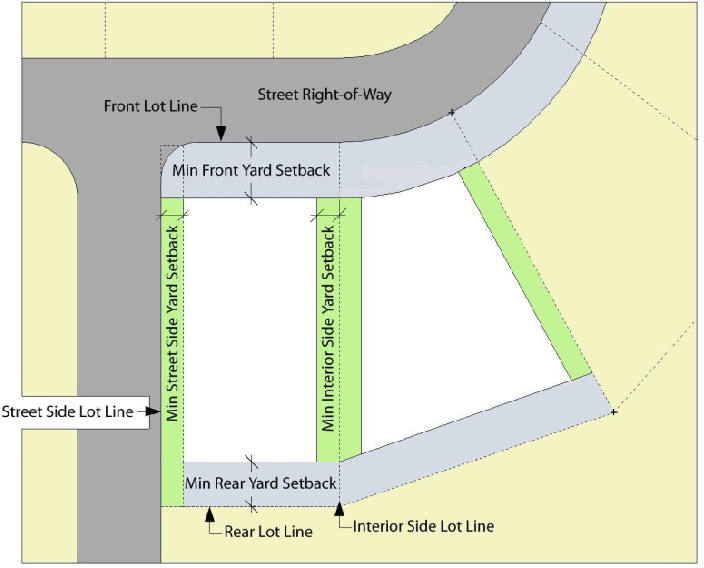
Figure 11.4.A.1: Lot Dimensions
2.
Lot Width. Lot width shall be determined by calculating the mean horizontal distance between the interior side lines of a lot, or for corner lots, between a street side lot line and the opposite interior side lot line, as measured along a line running along the midpoints between the interior side lot lines, or between the street side lot line and the opposite interior side lot line, as appropriate.
3.
Density (Dwelling Units per Acre). Density (expressed as dwelling units per acre) shall be determined by dividing the total number of dwelling units located or proposed on a lot by the area of the lot area (see paragraph A above) and multiplying the result by 43,560.
4.
Floor Area Per Dwelling Unit. Floor area per dwelling unit shall be determined by measuring the sum of the gross horizontal area (in square feet) of each floor of a dwelling unit, measured from the exterior walls or the centerline of party walls—and excluding any area used exclusively for the parking of motor vehicles (e.g., garage).
5.
Floor Area Ratio (FAR). Floor area ratio shall be determined by dividing the gross floor area (in square feet) of all buildings located or proposed on a lot by the total lot area (in square feet).
6.
Lot Coverage. Lot coverage (expressed as a percentage of lot area) shall be determined by measuring the total horizontal land area (in square feet) covered by all principal and accessory buildings on the lot, dividing that coverage area by the total lot area (see paragraph A above), and multiplying the result by 100.
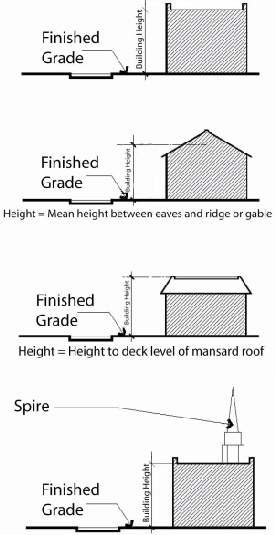
Figure 11.4.A.7: General Height Measurement
7.
Structure Height. The height of a structure shall be determined by measuring the vertical distance from the average elevation of the existing finished grade at the front of the structure to the top of the roof for a flat roof, to the deck line for a mansard roof, or to the mean height between eaves and ridge for a gable, hip, cone, gambrel, or shed roof (See Figure 11.4.A.7: General Height Measurement.).
8.
Yard Setback.
a.
Generally. Front, side, and rear yard setbacks on a lot shall be determined by measuring the horizontal distance along a straight line extending at a right angle from the lot's front, side, or rear lot line (as appropriate) to the foundation of the nearest structure on the lot (See Figure 11.4.A.1: Lot Dimensions.). Allowable encroachments into required yards shall be ignored when measuring yard setbacks See Section 11.4.B.4, Allowable Required Yard Encroachments.).
b.
Front Yard Setback.
i.
Corner Lot.
(a)
On a corner lot, the front yard setback shall be measured from the street-fronting lot line City staff determines to be the front lot line in accordance with the definition of "lot line, front" in Section 11.5, Terms and Uses Defined.
(b)
The street side yard setback shall be measured and applied from the other street-fronting lot line (the street side lot line).
(c)
On a corner lot where the intersecting right-of-way boundaries are defined by a radius, the front yard setback shall be measured, and the minimum front yard setback requirement shall be applied, from the front lot line defined by one right-of-way boundary as extended to form an intersecting angle with an extension of the side lot line defined by the other right-of-way boundary (See Figure 11.4.A.1: Lot Dimensions.).
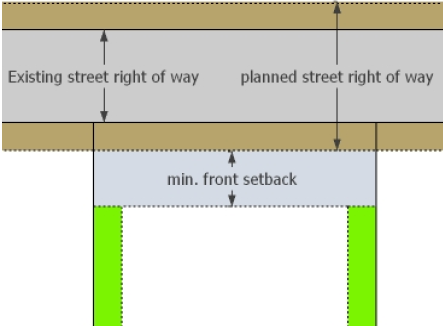
Figure 11.4.A.8.b: Front Yard Abutting Future Right-of-Way
ii.
Through Lot. On a through lot, the front yard setback shall be measured, and the minimum front yard setback requirement shall be applied, from both of the parallel or nearly parallel street-fronting lot lines.
iii.
Measured from Future Street Right-of-Way. Where City-adopted plans call for the future widening of the street right-of-way abutting a lot and identify the future right-of-way boundary (e.g., by delineating the boundary or establishing its distance from the street's centerline), the minimum front yard setback on the lot shall be measured from the future right-of-way boundary (See Figure 11.4.A.8.b: Front Yard Abutting Future Right-of-Way.).
c.
Street Side Yard Setback. On a corner lot where the intersecting right-of-way boundaries are defined by a radius, the street side yard depth shall be measured from the street-fronting lot line City staff determines not to be the front lot line in accordance with Section 11.4.A.8.b.i above.
d.
Rear-Load Setback. Setbacks for residential dwelling units with access through an alley, are to be applied such that the rear setback is the opposite side of the structure as garage and the front/garage setback is to be the side which has the garage access.
B.
Exceptions and Variations.
1.
Reduction of Minimum Lot Area, Depth or Width to Block Face Average. If the average area, depth or width of existing lots located on the same block face and in the same zoning district is less than the minimum lot area or minimum lot depth or width (as appropriate) applied to a lot by the standards in Article 4: Zoning Districts, the minimum lot area or minimum lot depth or width (as appropriate) applicable to the lot shall be reduced to such average. Not applicable for properties east of Atlantic Avenue or west of Halifax Avenue north of International Speedway Blvd. and west of Peninsula Drive south of International Speedway Blvd.
2.
Reduction of Minimum Yard Setbacks to Block Face Average. If the average front yard, street side yard, interior side yard, or rear yard setback on improved lots located on the same block face and in the same zoning district is less than the minimum front yard, street side yard, interior side yard, or rear yard setback (as appropriate) applied to a lot by the standards in Article 4: Zoning Districts, the minimum front yard, street side yard, interior side yard, or rear yard setback (as appropriate) applicable to the lot shall be reduced to such average. Not applicable for properties east of Atlantic Avenue or west of Halifax Avenue north of International Speedway Blvd. and west of Peninsula Drive south of International Speedway Blvd.
3.
Maximum Height Exceptions. The maximum height limits established in Article 4: Zoning Districts, shall not apply to the following structures or structural elements:
a.
Monuments, water towers, utility transmission towers, derricks, cooling towers, fire towers, and other similar structures other than flagpoles not intended for human occupancy;
b.
Spires, belfries, cupolas, domes, chimneys, elevator shaft enclosures, ventilators, skylights, mechanical equipment and appurtenances, and similar rooftop structures or structural elements not intended for human occupancy, provided they:
i.
Cover not more than 25 percent of the roof area of the structure to which they are attached;
ii.
Comply with applicable screening requirements for mechanical equipment and appurtenances;
iii.
Extend above the applicable maximum height limit by no more than 15 percent of the height limit (unless otherwise allowed in this Code);
c.
Ham radio antennas, roof-mounted satellite dishes, and television or radio antennas, provided they comply with height limits established for the specific use; and
d.
Roof-mounted solar energy collection systems, in accordance with the height standards in Section 5.3.C.27, Solar Energy Collection System; and
4.
Allowable Required Yard Encroachments. Every part of every required yard shall remain open and unobstructed from the ground to the sky except as otherwise allowed in Table 11.4.B.4, Allowable Required Yard Encroachments, or allowed or limited by provisions in Article 5: Use Standards, Article 6: Development Standards, or elsewhere in this Code.
(Ord. No. 2021-21, § 1, 1-6-2021; Ord. No. 2025-109, § 2, 3-19-2025; Ord. No. 2025-377, § 3, 9-17-2025)
Sec. 11.5. - Terms and Uses Defined.
The following words, terms, and phrases, when used in this Code, shall have the meaning ascribed to them in this section.
Abnormal Strength Wastes. For the purposes of Section 7.2.P, Public Sanitary Sewer System Pretreatment, wastes containing a CBOD exceeding 300 mg/l, suspended solids exceeding 300 mg/l, a COD exceeding 400 mg/l, total nitrogen exceeding 30 mg/l, or total phosphorous (as P) exceeding ten mg/l.
Abutting or Adjacent. Having a common border with or located immediately across a street or right-of-way from.
Accessory Dwelling Unit (ADU). A habitable unit ancillary or secondary to an existing single-family dwelling use that has a separate kitchen, bathroom, and sleeping area. The term ADU includes a separate detached dwelling unit on the same lot as the principal single-family dwelling; or a separate dwelling unit within, or attached to, the principal single-family dwelling, provided that the unit has a distinctly separate entrance from the main entrance of the principal single-family dwelling.
Accessory Structure. A structure that is subordinate in use and square footage to a principal structure or permitted use. In the case of agricultural uses, accessory uses such as barns may exceed the size of the principal structure. For the purposes of Section 6.15.C, Floodplain Management, the term includes only those accessory structures used solely for parking and storage.
Accessory Use. A use that is customarily incidental, appropriate, and subordinate to the principal use of land or buildings and located on the same lot.
Addition. Any walled and roofed expansion to the perimeter of a building that is connected by a common load-bearing wall other than a firewall. Any walled and roofed addition that is connected by a firewall or is separated by an independent perimeter load-bearing wall shall be considered "new construction."
Administrative Adjustment. An application for a development permit reviewed and decided by City staff in accordance with Section 3.4.W, Administrative Adjustment.
Adult Bookstore. An establishment which has a substantial or significant portion of its stock in trade consisting of adult novelties, books, magazines, other periodicals, videos, discs, or other graphic media, and which excludes minors pursuant to State law.
Adult Day Care Center. An adult day care center is any building(s) or part(s) of a building that provides basic services for part of a day to three or more persons who require such services, are 18 years of age or older, and are unrelated by blood or marriage to the owner or operator. Basic services include providing a protective setting that is as noninstitutional as practicable, therapeutic programs of social and health activities and services, leisure activities, self-care training, rest, nutritional services, and respite care. Accessory uses include recreational facilities, food preparation and eating areas, and offices and storage facilities used by supervisory staff.
Adult Theater. A use which exhibits any motion picture, exhibition, show, live show, representation, or other presentation which, in whole or in part, depicts nudity, sexual conduct, sexual excitement, or sadomasochistic abuse and is harmful to minors, all as defined in F.S. § 847.001, and to which admission of minors is unlawful in accordance with F.S. § 847.013. This includes any exhibition to one or more persons, including facilities commonly known as peep booths or peep shows.
Adverse Impact. A significant negative impact to land, water, associated resources or public facilities resulting from development. The negative impact includes increased risk of flooding; degradation of water quality; increased sedimentation; reduced groundwater recharge; negative impacts on aquatic organisms; negative impacts on wildlife and other resources; inadequate capacity for traffic, potable water, wastewater, police, fire, and EMS services and threatened public health.
Aggrieved or Adversely Affected Party. A property owner or occupant with standing to challenge a land development order as determined pursuant to Florida statutory or case law.
Aircraft Flight Instruction. The use of land or structures for providing instruction in flying aircraft.
Aircraft Fuel Sales. The use of land or structures for the sale of aviation fuel for use in aircraft.
Aircraft or Aviation Equipment Sales or Rental. The use of land or structures for the display and sale or lease of aircraft or aviation equipment.
Aircraft Repair or Servicing. The use of land or structures for the repair and servicing of aircraft or aviation equipment.
Airport. Any area of land or water designed and set aside for the landing and take-off of aircraft, including all necessary facilities for the housing and maintenance of aircraft and the provision of services to aircraft passengers and users.
Airport Noise Report. Final Report-Noise Exposure Maps and Noise Compatibility Program Daytona Beach Regional Airport, published August, 1988 by Peat, Marwick, Main & Company.
Alley. A public or private right-of-way set aside for public travel which is less than 30 feet in width.
Alteration of a Watercourse. A dam, impoundment, channel relocation, change in channel alignment, channelization, or change in cross-sectional area of the channel or the channel capacity, or any other form of modification which may alter, impede, retard, or change the direction and/or velocity of the riverine flow of water during conditions of the base flood.
Amalgam Separator. For purposes of Section 7.2.P, Public Sanitary Sewer System Pretreatment, a device that employs filtration, settlement, centrifugation, or ion exchange to remove amalgam and its metal constituents from a dental office vacuum system before it discharges to the sewer.
Amalgam Waste. For purposes of Section 7.2.P, Public Sanitary Sewer System Pretreatment, non-contact amalgam (amalgam scrap that has not been in contact with the patient); contact amalgam (including, but not limited to, extracted teeth containing amalgam); amalgam sludge captured by chairside traps, vacuum pump filters, screens, and other amalgam trapping devices; used amalgam capsules; and leaking or unusable amalgam capsules.
Amateur Ham Radio Antenna. An amateur ham radio antenna is an antenna, or any combination of a mast or tower plus an attached or mounted antenna, that transmits noncommercial communication signals and is utilized by an amateur radio operator licensed by the Federal Communications Commission.
Animal Care, Training, or Kennel. Any place or establishment, public or private, for the purpose of boarding, training, or selling animals or other similar purpose, for which a fee is charged. Such uses may include outdoor facilities for animal recreation and training, offices, and storage areas for equipment. This does not include Veterinary Clinics that provide medical treatment and services to animals.
Animal Grooming. Any place or establishment, public or private, where animals are bathed, clipped, or combed for the purpose of enhancing their aesthetic value and/or health, and for which a fee is charged.
Animal Shelter. A facility used to house and care for stray, homeless, abandoned, or neglected animals that is owned, operated, or maintained by a public body or an established humane society or other private or nonprofit organization.
Annexation. The adding of land to the boundaries of an incorporated municipality. Such a land addition makes the land in every way a part of the municipality.
Antique Store. An establishment that primarily sells furniture, decorative objects, and similar articles whose value derives from their oldness (usually at least 50 year old) as opposed to their simply not being new.
Appeal. An appeal of an interpretation or a decision made in administering this Code that is applied for, reviewed, and decided in accordance with Section 3.4.Y, Appeal. For the purposes of Section 6.15.C, Floodplain Management, the term means a request for a review of the Floodplain Administrator's interpretation of any provision of Section 6.15.C or a request for a variance.
Applicant. The owner of land, or the authorized representative of the landowner, applying for a development permit.
Application for a Development Permit. The completed form or forms and all accompanying documents, exhibits, and fees required of an applicant by the appropriate City department, board, or commission as part of the review for a development permit, certificate, or approval authorized under this Code.
Arboretum or Botanical Garden. An arboretum or botanical garden is a garden or place where trees, shrubs, or other woody plants are grown, exhibited or labeled for scientific, educational, or passive recreational purposes, not including the harvest of plants or their produce.
Arch. A curved, semicircular opening in a wall.
Architectural Embellishment. A three-dimensional architectural decoration added to a building for aesthetic purposes.
Architectural Lighting. Exterior lighting that is designed to highlight structures, plantings, or significant architectural features in a direct or indirect fashion.
Arena or Stadium. A building or structure designed or intended for use for spectator sports, entertainment events, expositions, and other public gatherings. Such uses may or may not include lighting facilities for illuminating the field or stage area, concessions, parking facilities, and maintenance areas.
Art and Cultural Center. A building used for educational and cultural activities related to the visual or performance arts, open to the public or a designated part of the public, usually owned and operated by a public or nonprofit group or agency.
Art, Crafts, Music, Dance, Photography, or Martial Arts Studio/School. An establishment with space used for the production of—or instruction in—art, music, dance, photography, or the martial arts.
Art Gallery. An art gallery is an establishment engaged in the sale, loan, or display of art books, paintings, sculpture, or other works of art.
ASCE 24. A standard titled Flood Resistant Design and Construction that is referenced by the Florida Building Code. ASCE 24 is developed and published by the American Society of Civil Engineers, Reston, VA.
Asphalt Plant. An industrial facility used for the production of asphalt or concrete, or asphalt or concrete products, used in building or construction, and includes facilities for the administration or management of the business, the stockpiling of bulk materials used in the production process or of finished products manufactured on the premises and the storage and maintenance of required equipment, but does not include the retail sale of finished asphalt or concrete products.
Assessed Value. The monetary value that a parcel of land, portion of land, improvement on land, or other commodity is assigned by the Volusia County Property Appraiser's office for the purposes of taxation.
Assisted Living Facility. Any building(s) or part(s) of a building or residential facility that provides housing, meals, and one or more personal services for a period exceeding 24 hours to one or more adults who are not relatives of the owner or administrator. Personal services includes direct physical assistance with or supervision of the activities of daily living (e.g., eating, bathing, dressing, toileting, transferring, continence) and the self-administration of medication and other similar services—but does not include the provision of medical, nursing, dental, or mental health services. This use does not include community residential homes or dwelling units licensed by the State to provide a family living environment and care for a group of six or fewer persons falling in certain statutory classifications (see definition of "dwelling unit"). Accessory uses may include dining rooms and recreation rooms for facility residents, and offices and storage facilities for supervisory staff.
Auditorium or Theater. A building or structure designed or intended for use for presentation of dramatic, musical, or live entertainment, other entertainment and cultural events, and/or other public gatherings, all occurring inside an enclosed structure. This use does not include cinemas and excludes all uses that fall within the definition of adult theater.
Authorized Representative of the User. For purposes of Section 7.2.P, Public Sanitary Sewer System Pretreatment, "authorized representative of the user" means:
1.
If the user is a corporation:
a.
The president, secretary, treasurer, or a vice-president of the corporation in charge of a principal business function, or any other person who performs similar policy- or decision-making functions for the corporation; or
b.
The manager of one or more manufacturing, production, or operation facilities employing more than 250 persons or having gross annual sales or expenditures exceeding $25,000,000.00 (in second-quarter 1980 dollars), if authority to sign documents has been assigned or delegated to the manager in accordance with corporate procedures.
2.
If the user is a partnership or sole proprietorship: a general partner or proprietor, respectively.
3.
If the user is a federal, State, or local governmental facility: a City Manager or highest official appointed or designated to oversee the operation and performance of the activities of the government facility, or their designee.
4.
The individuals described in paragraphs 1 through 3 above may designate another authorized representative if the authorization is in writing, the authorization specifies the individual or position responsible for the overall responsibility for environmental matters for the company, and the written authorization is submitted to the City.
Automated Teller Machine (ATM). An automated teller machine (ATM) is a mechanized device operated by or on behalf of a bank or financial institution that allows customers to conduct automated banking or financial transactions. Where an ATM is provided at the site of a bank or financial institution for use by customers in motor vehicles, the ATM is considered a drive-through service accessory use. At other locations, an ATM may be considered a separate accessory use to the principal use(s) of the location.
Automotive Parts Sales and Installation. The on-site sale and subsequent installation of various automobile parts and accessories, including but not limited to tires, mufflers, brakes, batteries, audio systems, and lubricants such as engine oil. Such uses do not include the sale of gasoline or other fuels.
Automotive Wrecker Service. An establishment operated for the purpose of temporary storage on-site of wrecked or inoperable motor vehicles. If an establishment regularly stores inoperable vehicles for more than 90 days, stacks vehicles, or portions of the vehicles are dismantled or removed for sale, it shall be considered a salvage and junkyard.
Available Capacity. For purposes of Section 6.16, Concurrency Management, "available capacity" means capacity that can be reserved to future development for a specific facility or service.
Awning. A plastic, canvas, or metal shade supported by a frame and often foldable that is placed over a storefront, doorway, or window.
Awning Sign. A permanent sign that is affixed to or part of an awning supported entirely from the exterior wall of a building and composed of nonrigid materials except for the supporting framework.
Bakery. An establishment primarily engaged in manufacturing fresh and frozen bread and other bakery products (e.g., cookies, crackers).
Bank or Financial Institution. An establishment that provides retail banking services, mortgage lending, or similar financial services to individuals and businesses. This use type does not include check cashing services or bail bond brokers. Accessory uses may include automated teller machines (ATMs) and facilities providing drive-through service (see Drive-Through Service).
Bar or Lounge. An establishment having as its principal or predominant use the serving of beer, wine, or liquor for consumption on the premises, and which sets a minimum age requirement for entrance, consistent with State law. The primary source of revenue for such use is derived from alcohol sales, and the secondary source from the serving of food. This use does not include bottle clubs, as defined in F.S. ch. 561, in which patrons consume alcoholic beverages they bring onto the premises. A bar or lounge does not include boutique bars (which serve only beer and wine within a limited space) or nightclubs (whose principal uses also include on-site entertainment).
Base Flood. A flood having a one percent chance of being equaled or exceeded in any given year. The base flood is commonly referred to as the "100 year flood" or the "one-percent-annual chance flood."
Base Flood Elevation. The elevation of the base flood, including wave height, relative to the North American Vertical Datum (NAVD) or other datum specified on the Flood Insurance Rate Map (FIRM).
Basement. The portion of a building having its floor subgrade (below ground level) on all sides.
Bed and Breakfast Inn. A visitor accommodations use, generally in a single-family dwelling or detached guesthouse(s), primarily engaged in renting one or more sleeping rooms on a daily basis to tourists, vacationers, and business people, and that may provide guests breakfast or other meals.
Best Management Practices (BMPs). For the purposes of Section 7.2.M, Stormwater Management, Section 7.2.N, Illicit Discharge and Connection to the Stormwater Drainage System, and Section 7.2.P, Public Sanitary Sewer System Pretreatment, schedules of activities, prohibitions of practices, maintenance procedures, and other management practices to implement general and specific prohibited discharge standards. The term includes treatment practices, operating procedures, and practices to control plant site runoff, spillage or leaks, sludge or water disposal, or drainage from raw materials storage.
Bike Rack. A bike rack is a stand used for mounting and securing bicycles when not in use.
Bike Week. A major event period historically held in March, consisting primarily of a motorcycle rally and associated commercial activities within Daytona Beach and the surrounding communities.
Biketoberfest. A major event period held in October, consisting primarily of a motorcycle rally and associated commercial activities held within Daytona Beach and the surrounding communities.
Billboard. An outdoor sign that advertises firms, organizations, goods, products, or services not located on the same premises as the sign, and that is sold, rented, owned, or leased for the display of advertising messages
Bingo Hall. A facility that is open to the public and managed by a nonprofit organization for the purpose of conducting bingo games. The bingo hall may serve as other principal uses, such as a worship hall for a place of worship.
Block Face. The lands abutting on one side of a street and lying between the two nearest intersecting or intercepting streets, railroad right-of-way, watercourse, or un-subdivided land.
Blood/Tissue Collection Center. A facility where human blood, organs, skin, or other human tissue are either withdrawn or collected from patients or assembled after being withdrawn or collected elsewhere from patients for subsequent delivery to a clinical laboratory for examination. A collection facility is maintained at a separate physical location not on the grounds or premises of the main licensed laboratory or institution which performs the testing.
Boat Dry Storage Facility. A facility designated for the on-land storage of boats, other watercraft, and marine equipment in open or enclosed roof structures or on trailers, cradles, or boat stands.
Boat Manufacturing. A facility primarily engaged in the manufacturing and production of boats, marine engines, or marine equipment.
Boat or Marina Parts Sales and Installation. The on-site sale and subsequent installation of various boat or marine parts and accessories—including, but not limited to, engine parts, electronics, navigation systems, anchors, propellers, steering systems, sailing gear, audio systems, safety and flotation gear, and water sports and fishing gear.
Boat or Marine Repair and Servicing. A business primarily engaged in the repair or maintenance of boats, marine engines, or marine equipment.
Boat or Marine Sales or Rental. Premises on which new or used boats, marine engines, or marine equipment are displayed for sale, lease, or rental.
Boat Slip. Any space located on, adjacent to, or with direct access to the Halifax River that is designed for the mooring or storage of motorized watercraft or a motor vehicle with attached boat trailer. The term includes wet and dry mooring or storage spaces, but excludes any space designated exclusively for the mooring or storage of sailboats or for transitory use, such as restaurant, bait shop, or fuel dock spaces.
Boat Towing Service. A use providing for the on-water towing of disabled boats, either from a point of breakdown on the water to a docking facility, or from a docking facility to a boat repair and servicing facility. The use may also include the provision of battery jumpstart service or delivery of fuel, engine fluids, and basic engine parts as necessary to avoid a tow, as well as ungrounding assistance.
Body Piercing Establishment. An establishment whose principal business activity is the practice of penetrating the skin of customers to make a generally permanent hole, mark, or scar. This use does not include the practice of using mechanized and presterilized systems to pierce the outer perimeter or lobe of an ear.
Book or Media Shop. A retail store that sells or rents books, magazines, other periodicals, videos, discs, and other printed or graphic media. This use type does not include adult bookstores, which sell sexually-oriented media.
Bottle Club. An establishment in which patrons consume alcoholic beverages they bring onto the premises, as defined in F.S. ch. 561. [In accordance with Article 5: Use Standards, this use is expressly prohibited in the City.]
Bottling Plant. A facility for assembling, mixing, bottling, canning, packing, wrapping, and boxing of commercial products assembled or manufactured off-site.
Boutique Bar. An establishment having as its principal or predominant use the serving of beer or wine (but not liquor) for consumption on the premises, where the customer service area for consumption (including the bar) is limited to 1,000 square feet, and which sets a minimum age requirement for entrance, consistent with State law. The primary source of revenue for such use is derived from alcohol sales, and the secondary source from the serving of food. Live entertainment may be provided as an accessory use. This use does not include bottle clubs, as defined in F.S. ch. 561, in which patrons consume alcoholic beverages they bring onto the premises. Nor does it include bars or lounges (which may serve beer, wine, and liquor and have a service area greater than 1,000 square feet) or nightclubs (whose principal uses also include on-site entertainment).
Brewery, Winery, Distillery. A brewery, winery, or distillery use is an establishment primarily engaged in brewing ale, beer, malt liquors, and nonalcoholic beer (brewery), or in manufacturing or blending wines (winery), or in distilling and blending potable liquors, including mixing them with other ingredients (distillery). Accessory uses may include retail sales of beer produced on-site for take-away or on-premise consumption as allowed by State licensing laws. This use does not include micro-breweries, micro-wineries, or craft distilleries.
Brewpub. An accessory use to a restaurant that is licensed by the Florida Department of Business and Professional Regulation, Division of Alcoholic Beverages and Tobacco to produce malt beverages for onsite consumption. Such establishments are licensed by the State as both manufacturers and vendors of malt beverages.
Building. Any structure having a roof supported by columns or by walls and intended for the shelter, housing, or enclosure of persons, animals, goods, or materials of any kind or nature.
Building Code. The Florida Building Code, as adopted and modified pursuant to Article 9: Construction Codes.
Building Permit. A development permit that is applied for, reviewed, and decided in accordance with procedures and standards in the Building Code.
Building, Heating, Plumbing, or Electrical Contractor's Storage Yard. A building, heating/air conditioning, plumbing, or electrical contractor's yard is a use involving the outdoor storage of materials, supplies, and equipment by building, heating/air conditioning, plumbing, electrical, or other development contractors as the principal use of a lot. Accessory uses may include offices.
Business Service Center. An establishment primarily engaged in providing a range of office support services, such as document copying services, facsimile services, word processing services, on-site personal computer rental, office product sales, and mailing services.
Business Services Office. An office for a commercial activity that does not involve the sale of goods or commodities available in the office or dispensing of personal services, and includes such businesses as real estate brokers, insurance, accountants, corporate training facilities, and similar uses.
Bypass. For purposes of Section 7.2.P, Public Sanitary Sewer System Pretreatment, the intentional diversion of waste streams from any portion of a user's treatment facility.
Cabinet or Furniture Manufacturing. An establishment primarily engaged in manufacturing cabinets or furniture. The cabinets or furniture may be made on a stock or custom basis and may be assembled or unassembled.
Caliper. Trunk diameter measurement of nursery-grown trees, taken six inches above the soil line where the resulting measurement is less than four inches, and 12 inches above the soil line where the resulting measurement is four inches or greater.
Campaign Sign. A sign on behalf of candidates for public office or measures on election ballots.
Canopy. A permanent structure other than an awning made of cloth, metal or other material attached or unattached to a building for the purpose of providing shelter to patrons or automobiles, or as a decorative feature on a building wall. A canopy is not a completely enclosed structure.
Canopy Sign. A sign that is attached to or suspended below a canopy extending from part or all of a building face and constructed of some durable material.
Canopy, Nonresidential. A nonresidential canopy is a permanent, but not completely enclosed structure that may be attached or adjacent to a nonresidential building for the purpose of providing shelter to people or automobiles, or a decorative feature on a building wall. A canopy is not a completely enclosed structure.
Capacity. For purposes of Section 6.16, Concurrency Management, "capacity" means the maximum and quantifiable ability of a public facility or infrastructure system to provide service at an adopted level of service.
Car Wash or Auto Detailing. An establishment providing the exterior washing of vehicles where vehicles are manually driven or pulled by a conveyor through a system of rollers and/or brushes. Interior cleaning and/or drying may be conducted manually by vehicle operator or on-site attendants. Interior cleaning and/or drying may be conducted manually by the vehicle operator or on-site attendants.
Carpet Cleaning or Dyeing Facility. This industry comprises establishments primarily engaged in cleaning and dyeing used rugs, carpets, and upholstery.
Categorical Industrial User. For the purposes of Section 7.2.P, Public Sanitary Sewer System Pretreatment, an industrial user subject to a categorical pretreatment standard or categorical standard.
Categorical Pretreatment Standard or Categorical Standard. For the purposes of Section 7.2.P, Public Sanitary Sewer System Pretreatment, any regulation containing pollutant discharge limits promulgated by EPA in accordance with section 307(b) and (c) of the act (33 USC 1317) which applies to a specific category of users appearing in 40 CFR chapter 1, subchapter N, parts 405—471, and which provides limitations on the introduction of pollutants into the POTW. The term includes the prohibited discharge standards set forth herein, including local limits, as now or hereafter amended or superseded from time to time. The term also includes the provisions of 62-625.410 and 62-625.200(3) FAC, as now or hereafter amended or superseded from time to time.
CBOD. The abbreviation for carbonaceous biochemical oxygen demand or the quantity of oxygen used in the biochemical oxidation of organic matter in a specified time (five days), at a specified temperature (20 degrees Celsius), and under specified conditions (standard laboratory) expressed in mg/l.
Cement Concrete Batching Plant. A cement concrete batch plant is an establishment primarily engaged in manufacturing or mixing cement, concrete, and cement and concrete products delivered to a purchaser in a plastic or unhardened state.
Cement Concrete or Brick Products Manufacturing. An establishment primarily engaged in manufacturing portland, natural, masonry, or other hydraulic cements; or in manufacturing concrete block, pipe, brick, or other concrete products; or in manufacturing brick, clay tiles, ceramic tiles, clay pipes, and other structural clay products.
Cemetery. A cemetery or mausoleum is a use intended for the burial of the dead and dedicated for cemetery purposes. This use type may include a funeral home or mortuary or a mausoleum or columbarium (a structure or vault lined with recesses for cinerary urns), but does not include a crematory.
Centerline. The line midway between the street right-of-way lines; or the surveyed and platted centerline of a street.
Certificate of Appropriateness, Major. A development permit certifying a major development's compliance with Historic Overlay (HO) district regulations that is applied for, reviewed, and decided in accordance with Section 3.4.J.3, Major Certificate of Appropriateness Procedure.
Certificate of Appropriateness, Minor. A development permit certifying a minor development's compliance with Historic Overlay (HO) district regulations that is applied for, reviewed, and decided in accordance with Section 3.4.J.4, Minor Certificate of Appropriateness Procedure.
Certificate of Occupancy. A development permit authorizing an approved development that is applied for, reviewed, and decided by City staff in accordance with procedures and standards in the Building Code and Section 3.4.T, Certificate of Occupancy.
CFR. U.S. Code of Federal regulations.
Change in Use. The change in the use of a structure or land from one use to another use listed in the tables of uses.
Changeable Copy Sign. A sign on which copy is changed manually in the field, such as a reader board with changeable letters or changeable pictorial panels.
Check Cashing Service. A payday loan, paycheck advance, or payday advance service that provides a small, short-term loan intended to cover a borrower's immediate expenses. Check-cashing service does not include a retail sales and service use engaged primarily in the business of selling consumer goods to retail buyers, and which cashes checks or money orders as an incidental service; or a State or federally chartered bank, savings association, credit union, farm credit system, or industrial loan company.
Chemical Oxygen Demand. A measure of the oxygen required to oxidize organic or inorganic compounds in water, usually expressed in mg/l.
Child Care Facility. Pursuant to F.S. § 402.302, a facility where the principal use is the care and supervision of more than five children not related to the owner or operator, which receives a payment, fee, or grant for any of the children receiving care, wherever operated, and whether or not operated for profit. The following uses are not considered to be child care facilities:
(i)
Public schools and nonpublic schools and their integral programs, except as provided in F.S. § 402.3025;
(ii)
Summer camps having children in full-time residence;
(iii)
Summer day camps;
(iv)
Bible schools normally conducted during vacation periods; and
(v)
Operators of transient establishments, as defined in F.S. 509, which provide child care services solely for the guests of their establishment or resort.
Accessory uses include recreational facilities, food preparation and eating areas, and offices and storage facilities used by supervisory staff. This use does not include family child care homes, which are accessory uses to a dwelling.
Cigar Lounge. An establishment that primarily sells, serves, or dispenses cigars to customers from an inventory of at least 5,000 cigars. Accessory uses may include the sale of alcoholic beverages for on-premise consumption and live entertainment.
Cinema. A motion picture theater that is a building or part of a building, and is devoted to showing motion pictures. This can also include an open lot or part of an open lot and auxiliary facilities devoted primarily to the showing of motion pictures on a paid admission basis to patrons seated on outdoor seats.
City. The City of Daytona Beach, Florida. For purposes of Section 7.2.P, Public Sanitary Sewer System Pretreatment, all that land and area included within the boundary of the City of Daytona Beach, Florida, in which the City Commission proposes to acquire, establish, construct, extend, operate, and maintain sanitary sewer facilities, except as follows:
1.
All county, State, and federally owned land and water areas located in the incorporated area of the City, except where the county, State, and federal government consent to the provisions of Section 7.2.P.
2.
All land and water area duly franchised by the City Commission to privately owned sewer utility companies or to municipal corporations, for the provisions of sewer service in the unincorporated area of the City except where the privately owned utility companies consent to the provisions of Section 7.2.P.
City Clerk. The City Clerk of the City of Daytona Beach.
City Code. The City of Daytona Beach, Florida, Code of Ordinances.
City Commission. The elected legislative governing body of the City of Daytona Beach.
City Manager. The City Manager of the City of Daytona Beach, who is primarily responsible for administering and enforcing the provisions of this Code, and who may delegate any decision-making or review authority to any City staff.
City Staff. City officers and employees and agents of the City of Daytona Beach who have responsibilities for administering and enforcing the provisions of this Code delegated to them by the City Manager.
Civic Center. A civic center is a facility designed to accommodate 500 or more persons and used for conventions, conferences, seminars, product displays, recreation activities, and entertainment functions, along with accessory functions including temporary outdoor displays, and food and beverage preparation and service for on-premise consumption. Similar structures with a capacity of less than 500 people constitute conference centers or training centers.
Clean Water Act. The federal Water Pollution Control Act, 33 U.S.C. § 1251 et seq., and any subsequent amendments thereto.
Clear Trunk. Height measurement of the base portion of a tree trunk that is void of any foliage or branching measured from the natural soil line to the base of the lowest branches or fronds.
Clothesline. A clothesline is a cord, rope, or wire stretched between two points above ground level on which clothes are hung to dry or air.
Clothing Store. A retail sales establishment where apparel and accessories are sold, such as department stores, clothing boutiques, shoe stores, and dress, hosiery, and millinery shops.
Club or Lodge. A building or facilities owned and operated by a corporation, association, or group of individuals established for fraternal, social, educational, recreational, or cultural enrichment of its members and primarily not for profit, and whose members meet certain prescribed qualifications for membership.
Clubhouse. A building or room used for social or recreational activities by members of a club (e.g., golf course clubhouse) or occupants of a residential or other development.
Coastal Construction Control Line. The line established by the State of Florida pursuant to F.S. § 161.053, and recorded in the official records of the community, which defines that portion of the beach-dune system subject to severe fluctuations based on a 100-year storm surge, storm waves or other predictable weather conditions.
Coastal High Hazard Area. A special flood hazard area extending from offshore to the inland limit of a primary frontal dune along an open coast and any other area subject to high velocity wave action from storms or seismic sources. Coastal high hazard areas are also referred to as "high hazard areas subject to high velocity wave action" or "V Zones" and are designated on Flood Insurance Rate Maps (FIRM) as Zone V1 V30, VE, or V.
Code of Ordinances. The City of Daytona Beach, Florida, Code of Ordinances.
Collection System. For purposes of Section 7.2.P, Public Sanitary Sewer System Pretreatment, the system of public sewers to be operated by the City or public sewers connected to the City system collecting wastewater from point sources.
College or University. A public or private, non-profit institution for post-secondary education offering courses in general or technical education which operates within buildings or premises on land owned or leased by the institution for administrative and faculty offices, classrooms, laboratories, chapels, auditoriums, lecture halls, libraries, student and faculty centers, athletic facilities, dormitories, fraternities and sororities, and other facilities which further the educational mission of the institution. In no event shall this definition prohibit a college or university from engaging in an activity historically conducted by such institutions. Vocational or trade schools are a different use type.
Commercial Vehicle. Any motor vehicle or trailer that has any of the following attached to it, visible on its exterior, or in an open bed: tools; building materials; merchandise; ladders; pipes; racks; emergency flashing or rotating lights; or altered or removed toolbox.
Community Center. A building used for recreational, social, educational and cultural activities, open to the public or a designated part of the public, usually owned and operated by a public or nonprofit group or agency. This use does not include senior centers or youth centers, which are treated as separate uses.
Community Garden. A private or public facility for cultivation of fruits, flowers, vegetables, or ornamental plants by more than one person, household, or family.
Community Residential Home. A dwelling unit licensed to provide a family living environment and care for seven to 14 residents, as defined in F.S. § 419.001(1)(a).
Comprehensive Plan. The Comprehensive Plan of the City of Daytona Beach, including the elements or portions thereof, as adopted and amended by ordinance of the City Commission pursuant to the Local Government Comprehensive Planning and Land Development Regulation Act.
Concurrency Certificate Determination. A certificate issued by the City that reserves capacity for a particular development project for a period of time; an application for such a certificate reviewed and decided by City staff in accordance with Section 3.4.Z.2, Concurrency Certificate Determination.
Concurrency Determination. A written determination after review of a project notifying an applicant whether capacity is or will be available concurrently to meet the needs of a proposed development project.
Conference or Training Center. A facility designed to accommodate fewer than 500 persons and used for conferences, seminars, product displays, recreation activities, and entertainment functions, along with accessory functions including temporary outdoor displays, and food and beverage preparation and service for on-premise consumption.
Conforming Use. Any lawful use of a building, structure, or parcel of land that complies with all current provisions of this Code.
Congregate Meal Facility. A facility at which nutritious meals are prepared and served to families or individuals. The facility may supplement the meal service with nutrition education, exercise programs, and socializing activities. The use does not include community centers, which provide more comprehensive services and activities, or food banks, which collect and distribute foodstuffs rather than serving meals.
Construction. The erection of any structure or any preparations (including land disturbing activities) for the same.
Construction Activity. For purposes of Section 7.2.N, Illicit Discharge and Connection to the Stormwater Drainage System, activities subject to NPDES Construction Permits as provided in the Code of Federal Regulations.
Construction and Demolition Debris Disposal Facility. A solid waste management facility that is the final resting place for materials discarded from the construction, renovation, or demolition of a structure that are generally considered to be nonhazardous and not water soluble—including, but not limited to, steel, glass, brick, concrete, asphalt materials, pipe, gypsum wallboard, and lumber. A construction and demolition debris disposal facility may also contain land clearing debris such as rocks, soil, trees, and other vegetative matter. These facilities are subject to State permitting requirements and regulations.
Construction Sign. A sign displaying the name of the project and firms or persons involved with its design or construction that is erected at the project construction site.
Continuing Care Retirement Community. An integrated development that offers senior citizens a full continuum of housing options and assistance, ranging from fully independent dwelling units, to assistance with personal care in assisted living facilities, to long-term skilled nursing care in a nursing home facility.
Contractor's Office. A building or portion of a building used by a building, heating, plumbing, electrical, or other development contractor both as an office and for the storage of a limited quantity of materials, supplies, and equipment inside the building. If outdoor storage of materials, supplies, or equipment is associated with the office, the use is considered a contractor's storage yard.
Control Authority. For purposes of Section 7.2.P, Public Sanitary Sewer System Pretreatment, the City, as holder of the FDEP permit for the POTW.
Control Manhole. For purposes of Section 7.2.P, Public Sanitary Sewer System Pretreatment, a structure to facilitate measurement and sampling of all wastewater from an establishment, built in accordance with the standards acceptable to the City and located on the establishment's sewer service line but prior to the City's collection system.
Convenience Store. A retail sales and service store with less than 5,000 square feet of floor area that primarily sells grocery or deli items and miscellaneous day-to-day goods, such as bottled drinks, candy, canned foods, bread, milk, cheese, tobacco products, beer, wine, papers and magazines, and general hardware articles. Fast food may be offered, but only as a secondary activity of the convenience store. As provided in Section 5.2.A.1.d, a development containing a convenience store may also contain another principal use, such as a gas station or a restaurant if such other use is also permitted in the same zoning district.
Correctional Facility. A publicly or privately operated facility for the confinement of persons in lawful detention, especially persons awaiting trial or convicted of a crime. Such uses may include cafeterias, housing for facility staff, outdoor storage and maintenance areas, recreational areas, agricultural facilities, and facilities for the production of goods or materials produced for sale.
Cosmetic Permanent Eye Makeup. The practice of permanent eye makeup, where a tattoo pen is used to inject permanent ink into the skin for purposes of enhancing eyebrows and/or eyelashes.
Country Club. A chartered, nonprofit membership club catering primarily to its membership. Country clubs may provide one or more of the following recreational and social activities: golf, swimming, riding, outdoor recreation, club house, locker room, special event facility, or pro shop.
County. Volusia County, Florida.
Courthouse Facility. Buildings and facilities used primarily for the regular adjudication of civil and criminal legal cases, including courtrooms, meeting rooms, and offices for administrative support functions. Accessory uses may include maintenance, storage, secure transfer facilities, holding cells, concessions, and dining.
Craft Distillery. An establishment that is licensed by the Florida Department of Business and Professional Regulation, Division of Alcoholic Beverages and Tobacco to produce distilled spirits. Accessory uses include retail sale of distilled spirits produced on-site for take-away or on-premise consumption, as allowed by State licensing laws.
Crematory. A facility containing furnaces for the reduction of dead bodies to ashes by fire.
Crosswalk. A right-of-way dedicated to public use which cuts across a block to facilitate pedestrian access to adjacent streets and properties.
Cul-de-sac. A short street having but one end open to traffic and the other end being permanently terminated by a vehicular turnaround.
Daily Maximum. For purposes of Section 7.2.P, Public Sanitary Sewer System Pretreatment, the arithmetic average of all effluent samples for a pollutant collected during a calendar year.
Daily Maximum Limit. For purposes of Section 7.2.P, Public Sanitary Sewer System Pretreatment, he maximum allowable discharge limit of a pollutant during a calendar day. Where daily maximum limits are expressed in units of mass, the daily discharge is the total mass discharged over the course of the day. Where daily maximum limits are expressed in terms of concentration, the daily discharge is the arithmetic average measurement of the pollutant concentration derived from all measurements taken that day.
Damage. For purposes of Section 6.15.A, Tree Preservation, abuse to any plant material through actions or inactions which have caused severe decline, disfigurement, discoloration, defoliation, removal or death of the plant. Abuse includes but is not limited to failure to properly water, fertilize, control pests and fungus, or prune; physically or chemically damaging a plant by cutting the main plant leader stem, removing any mature wood larger than three inches in diameter, topping or heading back, reducing the total circumference or canopy spread by more than one-third, burning, cutting, scarring, painting, or poisoning.
Day Labor Service. A business or an establishment that provides, or markets itself as providing, the temporary employment of persons where persons wait at the establishment on a daily basis for work assignments or transportation to work assignments. This definition specifically excludes those services placing employees primarily through telephone contacts that do not involve the waiting of prospective employees on the premises, whether for employment, transportation, or assignment.
Demolition. The intentional dismantling or tearing down of all or a part of a structure and all operations incidental thereto.
Density. The ratio of the total number of residential dwelling units on a lot to total lot area.
Dental amalgam or amalgam. For purposes of Section 7.2.P, Public Sanitary Sewer System Pretreatment an alloy of elemental mercury and other metal(s) that is used in the practice of dentistry.
Dental Discharger. For purposes of Section 7.2.P, Public Sanitary Sewer System Pretreatment, a facility, other than a mobile unit as described in 40 CFR Section 441.20(d), where the practice of dentistry is performed, including, but not limited to, institutions, permanent or temporary offices, clinics, home offices, and facilities owned and operated by federal, state or local governments, that discharges wastewater into the POTW.
Department Store. A general merchandising store offering a full line of goods that may include clothing, housewares, body products, and specialty items.
Design Flood. The flood associated with the greater of the following two areas:
1.
Area with a floodplain subject to a one percent or greater chance of flooding in any year; or
2.
Area designated as a flood hazard area on the community's flood hazard map, or otherwise legally designated.
Design Flood Elevation. The elevation of the "design flood," including wave height, relative to the datum specified on the City's legally designated flood hazard map. In areas designated as Zone AO, the design flood elevation shall be the elevation of the highest existing grade of the building's perimeter plus the depth number (in feet) specified on the flood hazard map. In areas designated as Zone AO where the depth number is not specified on the map, the depth number shall be taken as being equal to three feet.
Developer. Any person, including a governmental agency, undertaking development.
Development. "Development" has the meaning given it in F.S. 380.04. For the purposes of Section 6.15.C, Floodplain Management, the term means any man-made change to improved or unimproved real estate—including, but not limited to, buildings or other structures, tanks, temporary structures, temporary or permanent storage of equipment or materials, mining, dredging, filling, grading, paving, excavations, drilling operations, or any other land disturbing activities.
Development Order. "Development order" has the meaning given it in F.S. § 163.3164 ("any order granting, denying, or granting with conditions an application for a development permit").
Development Order, Administrative. A development order made after ascertaining the existence of a specified state of facts as being in compliance with an applicable regulation or requirement without exercise of subjective judgment or discretion.
Development Permit. "Development permit" has the meaning given it in F.S. § 163.3164 ("including any building permit, zoning permit, subdivision approval, rezoning, certification, special exception, variance, or other official action of local government having the effect of permitting the development of land").
Diameter at Breast Height (DBH). Trunk diameter of trees growing on a development site, measured four feet above soil level. When a tree forks within four feet of the soil line, each fork shall be considered a separate tree.
Directory Sign. A sign used to indicate occupant names for buildings with multiple units or uses, such as a directory for an office building, place of worship, or multifamily complex.
Docking Facility (Dock). A fixed or floating structure, including moorings, used for the purpose of berthing buoyant vessels.
Dog Track. A facility consisting of a racetrack used for the spectator-oriented sport where greyhound dogs chase a lure on the track to a finish line. The facility may include seating, concession areas, related retail sales, and facilities for the temporary keeping and preparation of racing dogs.
Domestic Wastewater. Wastewater derived principally from household or toilet wastes resulting from human occupancy. Domestic wastewater may be a component of industrial or commercial wastes at the point of discharge to the City system due to the use of restrooms, showers, or kitchen areas within the facility.
Drip Line. A line extending vertically and at right angles between the outermost portion of the tree crown and the ground.
Drive-Through Service. The provision of products or services to customers who remain in their vehicles, whether through a window or door in a building, a machine in a building or detached structure (e.g., ATM), or via a mechanical device (e.g., a pneumatic tube system). In addition to the pick-up window or door, drive-through service facilities also may include remote menu boards and ordering stations. Use types that commonly have drive-through service include banks or financial institutions, restaurants, specialty eating or drinking establishments, and drug stores or pharmacies.
Drop-In Child Care. An occasional child care arrangement within a shopping mall or business establishment, the sole purpose of which is to provide babysitting for no more than a four-hour period while the parent remains on the premises.
Drug or Alcohol Treatment Facility. An inpatient facility that provides care for persons with drug and/or alcohol dependency problems and that may include outpatient follow-up care to the facility's patients.
Drug Store or Pharmacy. A freestanding establishment engaged in the retail sale of prescription drugs, nonprescription medicines, cosmetics, and related supplies. Accessory uses may include automated teller machines (ATMs) and facilities providing drive-through service (see Drive-Through Service).
Dry Cleaning or Laundry Establishment. A facility where retail customers drop off or pick up laundry or dry cleaning and where the cleaning processes may take place on site as long as all cleaning materials and chemicals and waste water is disposed of in compliance with all applicable permits and regulations.
Dry-Cleaning or Laundry Drop-Off Establishment. A commercial establishment maintained for the drop off and pick up of clothes for off-site laundering or dry cleaning, without the operation of any laundry or dry cleaning equipment on the premises.
Duplex. A building containing two single-family dwelling units. Such units may be part of a single structure, or may be attached by one or more common walls.
Duplex Subdivision. A development containing four or more duplex dwelling units.
Dwelling. Any premises used primarily for human habitation, but not including visitor accommodation units.
Dwelling Unit. A combination of connected rooms within a dwelling that constitutes a single and separate habitable unit containing independent cooking, eating, living, sleeping, and sanitation facilities, and that is used or designed for occupancy on a monthly or longer basis by a single household. The term "dwelling unit" does not include dormitories.
Easel Sign. A one-sided sign displayed outside a business by placement on a three- or four-legged easel-type supporting structure.
Easement. A grant by a landowner to another landowner or to the public, for the right to occupy or use designated land for specific purposes, such as access, drainage, conservation, the location of public improvements, or other specified purpose. An easement does not constitute fee simple ownership of the land.
Easement Abandonment. The abandonment of a public access or utility easement; also a development permit that is applied for, reviewed, and decided in accordance with Section 3.4.BB, Easement Abandonment.
Eave. The projecting lower edges of a roof that overhangs the wall of a building.
Educational, Scientific, or Industrial Research and Development. A facility that engages in research, or research and development, of innovative ideas in technology-intensive fields. Examples include research and development of computer software, information systems, communication systems, transportation, geographic information systems, multi-media and video technology. Development and construction of prototypes may be associated with this use.
Egress. An exit from a building or site.
Electric Motor Repair, Machine Shop, or Tool Repair Shop. An establishment that is primarily engaged in repairing and servicing large electric motors or commercial and industrial machine tools and equipment (such as punching, shearing, bending, forming, pressing, forging, and die-casting machines, or where metal is cut and shaped by machine tools.
Electronic Message Center Sign. A sign that is capable of displaying electronic images, including text, where the rate of change is electronically programmed and can be modified by electronic processes.
Electronics Store. A retail sales and service store that primarily sells appliances, home and personal audio and media equipment, televisions, computers and related components, and other electronic goods.
Employment Agency. An establishment that finds jobs for people seeking them and finds people to fill particular jobs offered by employers.
Encroachment. For the purposes of Section 6.15.C, Floodplain Management, the placement of fill, excavation, buildings, permanent structures, or other development into a flood hazard area which may impede or alter the flow capacity of riverine flood hazard areas.
Entertainment or Amusement Center. A use that provides one or more high quality passive or interactive entertainment experiences. Entertainment centers may include water parks, amusement rides, miniature golf, museums, multiscreen theaters, cinema technology, music theaters, indoor and outdoor entertainment areas, and other entertainment and recreational uses. This use is distinguished from other individual recreation/entertainment uses by the magnitude and scope of recreational and entertainment experiences such a center offers and the regional and sub-regional markets it targets.
EPA. The United States Environmental Protection Agency or, where appropriate, the regional water management division director, or other duly authorized official of said agency.
Event Center. A private indoor (entirely within an enclosed structure) use providing for activities that are operated or carried on primarily for financial gain. Example uses include, but are not limited to weddings, receptions, concerts, banquets dancehalls, birthday parties, comedy shows, and other similar uses. The term "Event Center" also includes any contracted, leased, or sublet premises connected to or operated in conjunction with the Event Center's purpose, including food preparation facilities, concessions, bars, and structured parking facilities. The use does not include indoor recreation/entertainment uses, places of worship, theaters, nightclubs, bars, clubs/lodges, or a clubhouse developed as part of a residential development.
Existing Building and Existing Structure. For the purposes of Section 6.15.C, Floodplain Management, any buildings and structures for which the "start of construction" commenced before September 7, 1973.
Existing Dental Discharger. For purposes of Section 7.2.P, Public Sanitary Sewer System Pretreatment, a dental discharger whose first discharge of wastewater into the POTW occurred on or before July 14, 2017.
Existing Source. For the purpose of Section 7.2.P, Public Sanitary Sewer System Pretreatment, any source that does not meet the definition of "new source" will be deemed to be an existing source.
Expansion. An increase in the size of an existing structure or use, including the physical size of the land, building, parking, and other improvements or structures.
F.A.C. or FAC. The Florida Administrative Code.
F.S. The Florida Statutes.
Facade. The entire exterior wall of a building facing a lot line measured from the grade to the eave or highest point of a flat or mansard roof. Facades may be on the front, side, or rear elevation of the building.
Family. See "Household."
Family Day Care Home. Pursuant to F.S. § 402.302, a family day care home is an occupied residence in which child care is regularly provided for compensation (e.g., payment, fee, or grant)—whether or not operated for profit—for children that come from at least two unrelated families and fall within one of the following groups:
(i)
Up to four children, where all are under 12 months old;
(ii)
Up to six children, where no more than three are under 12 months old.
(iii)
Up to six children, where all are preschool age (from 13 months to five years old); or
(iv)
Up to ten children, where no more than two are under 12 months old and no more than five are preschool age.
The numerical limits above apply throughout the year, and the children counted include those children under 13 years old who are related to the caregiver.
A family day care home does not include use of a private residence for an informal cooperative arrangement among neighbors or relatives, or the occasional care of children (with or without compensation).
Farmers' Market. A public market held in a structure or open area where farmers primarily sell produce and other farm products they have grown, gathered, or raised directly to consumers. A farmers' market as a principal use occurs regularly for all or most of the year, whereas a farmers' market as a temporary use occurs occasionally or periodically for only a limited time period during the year.
Farming, General. The growing and cultivation of crops or plants, or the maintaining of horses, livestock, or poultry for the purpose of agricultural production and sale of products grown or raised on the premises of the farm.
FBC, B. The Florida Building Code: Building division as adopted in Article 9: Construction Codes.
FDEP. Florida Department of Environmental Protection.
Federal Emergency Management Agency (FEMA). The federal agency that, in addition to carrying out other functions, administers the National Flood Insurance Program.
Feeding Station. A structure designed to contain and provide food primarily to birds, mammals, and other animals.
Fence or Wall. A fence or wall is an artificially erected freestanding barrier used to enclose (and protect) an area, restrict or prevent access to an area, to conceal or screen an area, and/or for decorative purposes. A fence may be open or solid and generally consists of wood, metal, concrete, or plastic posts connected by boards, rails, panels, wire, or mesh. A wall is generally solid and consists of masonry, stone, brick, tile, concrete, or plaster. Natural growth barriers such as hedges are not considered fences or walls.
Final Plat. The final recorded plat for a subdivision; also a development permit authorizing a final plat that is applied for, reviewed, and decided by the City Commission in accordance with Section 3.4.K.5, Final Plat.
Fire or EMS Station. A facility for the provision of local rapid response emergency services such as firefighting and mobile medical emergency services, including areas for the storage and maintenance of emergency vehicles, and equipment and facilities for the housing and feeding of emergency personnel while on duty.
Fire Training Facility. A facility for intensive training of fire protection personnel in firefighting, rescue, fire investigation, and other skills important to fire protection. Such facilities may include fire training towers and other fire simulating facilities and equipment.
Fish Hatchery. A facility where fish eggs are hatched and the fry raised, especially to stock water bodies.
Flea Market. A market held in an open area or structure where individual sellers offer goods for sale to the public. Such sellers may set up temporary stalls or tables for the sale of their products. Such sales may involve new and/or used items and may include the sale of fruits, vegetables, and other edible items. The use does not include a farmers' market, where food items predominate, or a garage sale or yard sale that is conducted on a residentially developed lot by members of a household, or civic groups selling primarily donated items.
Fleet Service Repair. An establishment providing vehicle repair services exclusively to vehicle fleets owned by private businesses or organizations. Service to the general public or individual customers is prohibited.
Flood Damage-Resistant Materials. Any construction material capable of withstanding direct and prolonged contact with floodwaters without sustaining any damage that requires more than cosmetic repair.
Flood Hazard Area. The greater of the following two areas:
1.
The area within a floodplain subject to a one percent or greater chance of flooding in any year.
2.
The area designated as a flood hazard area on the community's flood hazard map, or otherwise legally designated.
Flood Insurance Rate Map (FIRM). The official map of the community on which the Federal Emergency Management Agency has delineated both special flood hazard areas and the risk premium zones applicable to the community.
Flood Insurance Study. The official report provided by the Federal Emergency Management Agency that contains the Flood Insurance Rate Map, the Flood Boundary and Floodway Map (if applicable), the water surface elevations of the base flood, and supporting technical data.
Flood or Flooding. A general and temporary condition of partial or complete inundation of normally dry land areas from: (1) the overflow of inland or tidal waters; (2) the unusual and rapid accumulation of runoff of surface waters from any source.
Floodplain Administrator. The office or position designated and charged with the administration and enforcement of Section 6.15.C, Floodplain Management (may be referred to as the Floodplain Manager).
Floodplain Development Permit or Approval. An official document or certificate issued by the City, or other evidence of approval or concurrence, which authorizes performance of specific development activities that are located in flood hazard areas and that are determined to be compliant with Section 6.15.C, Floodplain Management.
Floodway. The channel of a river or other riverine watercourse and the adjacent land areas that must be reserved in order to discharge the base flood without cumulatively increasing the water surface elevation more than one foot.
Floodway Encroachment Analysis. An engineering analysis of the impact that a proposed encroachment into a floodway is expected to have on the floodway boundaries and base flood elevations; the evaluation shall be prepared by a qualified Florida licensed engineer using standard engineering methods and models.
Floor. The top surface of an enclosed area in a building (including basement), i.e., top of slab in concrete slab construction or top of wood flooring in wood frame construction.
Floor Area. Generally means the total (horizontal) square footage of all floors measured to the outside surface of the building or portion of the building. This may include hallways, stairways, elevators, storage and mechanical rooms whether internal or external to the structure. Floor area may also be limited to what is considered leasable space.
Floor Area Ratio. The ratio of gross floor area of all buildings on a lot to total lot area.
Florida Building Code (or FBC). The family of codes adopted by the Florida Building Commission, including: Florida Building Code, Building; Florida Building Code, Residential; Florida Building Code, Existing Building; Florida Building Code, Mechanical; Florida Building Code, Plumbing; Florida Building Code, Fuel Gas.
Florist Shop. Retail sales and service business whose principal activity is the selling of flowers, plants, and related gift items within an enclosed building.
Food Bank. A not-for-profit clearinghouse that collects, stores and distributes useable donated surplus food to non-profit organizations, not individuals, who in turn, provide the foods to the people they serve. Facilities can include a warehouse with both dry and cold storage, trucks, and a full-time staff. Accessory uses may include offices, storage, and maintenance facilities.
Food Pantry. Any program that acquires food products through donations, canned food drives, food bank programs or purchases and distributes the food to individuals, and does not provide prepared food to clients for consumption on or off site.
Food Processing (without slaughtering). An establishment primarily engaged in processing livestock or agricultural products into food products for immediate or final consumption. Such products are typically sold to wholesalers or retailers for distribution to consumers. Food processing does not include slaughtering animals.
Fraternity or Sorority House. A building occupied and maintained exclusively for students duly recognized by a college, university, or other recognized institution, and providing domestic and social facilities and services for members. Such use may or may not be located within the campus it is associated with. The fraternity or sorority house may include sleeping areas, cooking facilities, and areas for meeting and socializing.
Frontage. The width in linear feet occupied by each separate business or other use or the width in linear feet of a lot which fronts on a public street. For purposes of determining allowable sign area, each building or lot frontage shall be separately calculated.
Fuel Oil or Bottled Gas Distribution. An establishment that distributes fuel oil or bottled gases such as propane or liquid petroleum for compensation.
Fuel Oil Storage. The bulk storage of fuel oil or kerosene for heating purposes in aboveground containers.
Functionally Dependent Use. For the purposes of Section 6.15.C, Floodplain Management, a use which cannot perform its intended purpose unless it is located or carried out in close proximity to water, including only docking facilities, port facilities that are necessary for the loading and unloading of cargo or passengers, and ship building and ship repair facilities; the term does not include long term storage or related manufacturing facilities.
Funeral Home or Mortuary. An establishment that provides human funeral services, including embalming and memorial services. Crematories are accessory uses to a funeral home.
Furniture or Appliance Store. Retail sales and service business whose principal activity is the displaying and selling of furniture or home appliances to the public.
Gambling. To play a game of chance for money or other stakes, as regulated by Chapter 849 (Gambling) of the Florida Statutes.
Game of Skill. An amusement device that requires some measure of skill to operate, where a score or level of achievement is indicated upon conclusion of operation. Games of skill include, but are not limited to, video games, target games, and pinball machines.
Game Preserve. An area of land where birds, mammals, or other animals are kept in protected conditions in the wild, either for conservation purposes or to be hunted for sport.
Garage. A garage or carport is a structure used or designed to provide shelter for the parking and storage of motor vehicles or boats. A garage is an enclosed building whereas a carport is a roofed structure open on one or more sides. Garages and carports are commonly attached to and considered part of a dwelling or other principal building, but may exist as a detached accessory structure.
Garage or Yard Sale. The temporary and occasional use of the garage or yard of a residential dwelling for the casual sale of miscellaneous items of personal property to the general public.
Garbage. For purposes of Section 7.2.P, Public Sanitary Sewer System Pretreatment, solid waste from domestic and commercial preparation, cooking, and dispensing of food, and from handling, storage, and sale of produce.
Gas Station. Buildings and premises where gasoline, oils and greases, batteries, tires, and automobile accessories may be supplied and dispensed at retail (or in connection with a private operation where the general public is excluded from use of facilities), and where automotive repair and servicing activities typical of an automotive repair and serving use are performed. This use may also involve the sale of drinks, packaged foods, tobacco, and similar convenience goods for filling station customers, as accessory and incidental to principal operation. Other accessory uses include the provision of road maps and other information material to customers and the provision of restroom facilities. The use does not include establishments selling gasoline where the sales of convenience goods constitute a principal use—such uses are classified as convenience stores. As provided in Section 5.2.A.1.d, a development containing a gas station may also contain another principal use such as vehicle repair and servicing, a convenience store, or a restaurant if such other use is permitted in the same zoning district.
General Industrial Services. A general industrial services use is an establishment engaged in the repair or servicing of agriculture, industrial, business, or consumer machinery, equipment, products, or by-products. Firms that provide these services do so by mainly providing centralized services for separate retail outlets. Contractors and building maintenance services and similar uses perform services off-site. Few customers, especially the general public, come to the site. Accessory activities may include retail sales, offices, and storage.
Gift Shop or Stationary Store. Retail sales and service business where items such as art, antiques, jewelry, books, and notions are sold.
Golf Course. A tract of land laid out with at least nine holes for playing the game of golf and improved with tees, greens, fairways, and hazards. Accessory uses of a golf course may include a clubhouse (with or without eating facilities), shelters, a driving range, putting green, maintenance facilities, an irrigation system, and outdoor storage of materials and equipment.
Golf Driving Range. A limited land area on which golf players do not walk, but onto which they drive golf balls from a common driving tee. Accessory uses may include a concessions stand, netting, exterior lighting fixtures, putting greens, as well as maintenance and outdoor storage areas. This use does not include a golf course.
Government Administrative Offices. A building containing offices of a governmental agency that provides administrative and/or direct services to the public, such as, but not limited to, employment services, public assistance, or motor vehicle licensing and registration services.
Government Maintenance, Storage, or Distribution Facility. A facility housing government shops, maintenance and repair centers, equipment, and outdoor storage yards.
gpd. Gallons per day.
Grab Sample. For purposes of Section 7.2.P, Public Sanitary Sewer System Pretreatment, a sample which is taken from a waste stream without regard to the flow in the waste stream and over a period of time not to exceed 15 minutes.
Greenhouse. A structure, primarily of glass, in which temperature and humidity can be controlled for the cultivation or protection of plants.
Grocery Store. An establishment primarily engaged in retail and/or wholesale sale of food and foodstuffs to members of the public. A grocery store may also sell sundries and other common household items.
Ground Sign. A monument sign or pole sign.
Hardscape. Any permanent nonliving site improvements, including but not limited to pavement, curbing, wheel stops, steps, walls, fences, fountains, sculpture, railings, lighting, irrigation fixtures, and other similar fixtures.
Hardware Store. An establishment primarily engaged in the retail sale of various basic hardware goods, such as tools, builders' hardware, plumbing and electrical supplies, paint and glass, housewares and household appliances, garden supplies, and cutlery.
Hat Racking. Hat-racking is the topping or improper cutting of the ends of tree branches in a manner that leaves stubs or portions of lateral branches that do not extend to the tree's drip line. Also known as "topping, "heading," "tipping," "rounding over," or "pollarding". Hat-racking results in a multitude of smaller branches that sprout from the ends of improperly cut branches.
Hazardous Materials. Any material, including any substance, waste, or combination thereof, which because of its quantity, concentration, or physical, chemical, or infectious characteristics may cause, or significantly contribute to, a substantial present or potential hazard to human health, safety, property, or the environment when improperly treated, stored, transported, disposed of, or otherwise managed.
Hazardous Waste Collection Site. A hazardous waste collection site is an establishment for the collection and/or transfer of solid wastes that because of its concentration or physical or chemical characteristics, may pose a substantial hazard to human health or the environment if improperly stored, disposed of, or otherwise managed.
Heavy Equipment Repair and Servicing. A heavy equipment repair and servicing use is an establishment engaged in the repair and servicing of heavy equipment of 12,000 or more pounds gross vehicular weight (GVW).
Heavy Equipment Sales, Rental, or Storage. A heavy equipment sales, rental, or storage use is an establishment engaged in the display, sale, leasing, rental, or storage of heavy equipment of 12,000 or more pounds gross vehicular weight (GVW).
Helicopter Landing Facility. An area, either on ground level or elevated on a structure, licensed or approved for the landing and takeoff of helicopters and which may include auxiliary facilities such as parking, waiting room, fueling, and maintenance equipment.
Highest Adjacent Grade. The highest natural elevation of the ground surface prior to construction next to the proposed walls or foundation of a structure.
Historic Structure or Site. For the purposes of Section 6.15.C, Floodplain Management, any structure that is determined eligible for the exception to the flood hazard area requirements of the Florida Building Code, Existing Building, chapter 12 Historic Buildings.
Historic Tree
(1)
A live oak (Quercus virginica) or bald cypress (Taxodium distichum) that has a DBH (diameter at breast height) of 36 inches or greater; or
(2)
A tree of any species with a DBH of 36 inches or greater that the City Commission determines to be of unique and intrinsic value to the general public because of its size, age, historic association, or ecological value; or
(3)
Any "champion tree" selected and duly designated at the State, national, or world level by the American Forestry Association.
Home and Building Supply Center. An establishment primarily engaged in selling a general line of new home repair and home improvement materials, supplies, and equipment, such as lumber, plumbing goods, electrical goods, tools, housewares, hardware, and lawn and garden supplies. The use may also include rental of tools and equipment, and home improvement installation services.
Home Based Business. A home based business is a business, profession, occupation, or trade that is conducted within a residential dwelling unit for the economic gain or support of a resident of the dwelling, is incidental and secondary to the residential use of the lot and does not adversely and/or perceptively affect the character of the lot or surrounding area. Examples of home based businesses include, but are not limited to, the following: offices of physicians, dentists, lawyers, architects, engineers, contractors, consultants, stock brokers, marketers, bookkeepers, real estate brokers, and insurance agents; electronic and offsite retail; studios of artists, and musicians; sewing, millinery, and dressmaking services; home services such as interior decorating, maintenance, landscaping; and personal services such as physical therapy by licensed individuals, hairdressing, pet grooming, and the like. Home based businesses do not include such businesses as: family child care homes and large family child care homes (which are separate accessory uses of homes), automotive repair and the like; any licensed or unlicensed practitioner who performs invasive procedures (acupuncture, tattooing, body piercing, and the like); restaurants, bars, social clubs and the like; animal kennels or hospitals and the like; or any other business that is clearly inappropriate or out of character for a residential area such that its location constitutes an adverse impact on neighboring residential properties.
Homeless Service Facility. A service facility that provides services such as food distribution, vocational training, or counseling on site and is designed and conducted to assist homeless individuals who lack a regular and adequate nighttime residence or reside in a shelter designed to provide temporary living accommodations.
Hospice Residential Facility. A facility managed directly by a licensed hospice program that can house hospice patients and provides or coordinates inpatient health care (both palliative and supportive) that meets the needs of a terminally ill patient and the patient's family during the final stages of illness and dying and that includes formal bereavement programs as an essential component.
Hospital. An institution licensed by the State providing health services primarily for human inpatient medical or surgical care of the sick or injured, including related facilities such as laboratories, outpatient departments, training facilities, central services facilities, and staff offices which are an integral part of the facility. Hospitals offer facilities and beds for use beyond 24 hours by persons needing medical treatment or service. This use type does not include nursing home facilities, medical treatment facilities, medical clinics, drug or alcohol treatment facilities, or psychiatric treatment facilities.
Hotel or Motel. A hotel or motel is a building or a group of buildings in which one or more sleeping units are offered to the public and intended primarily for use by transient persons or tourists on an overnight or short-term lodging basis. Such uses may include kitchenettes, microwaves, and refrigerators for each guest unit. This use type does not include bed and breakfast inns. Hotels and motels are considered synonymous uses.
Household. Six or fewer adults and minor children in their care who reside together in a single dwelling unit on a monthly or longer basis as a single housekeeping unit. A "single housekeeping unit" shall be determined based on whether the group is (a) sharing the entire dwelling unit, (b) living and cooking together, (c) sharing the work to clean and maintain the premises, and (d) sharing expenses of rent or ownership, utilities, food, and other household expenses.
The definition of "household " does not include any society, club, association, fraternity or sorority house, or other organization or group of individuals whose common living arrangement within the dwelling unit is intended to be temporary or transient; nor does it include residential living arrangements, such as dormitories or rooming houses, where the occupants act as separate roomers. The term "household" also excludes individuals or groups of individuals in transient occupancy, such as a bed and breakfast inn, hotel, motel, or other accommodation.
Hydroponic Garden Facility. An establishment primarily engaged in the commercial cultivation of plants in a root medium other than soil, generally nutrient-rich water with or without the mechanical support of an inert medium such as sand, gravel, peat, rock wool, or vermiculite. Accessory uses include greenhouses, lighting and climate control systems, irrigation equipment, and storage facilities for water and the nutrient medium.
Identification Sign. A sign indicating only the name and character of the primary land use.
Illegal Discharge. For purposes of Section 7.2.N, Illicit Discharge and Connection to the Stormwater Drainage System, any direct or indirect non-stormwater discharge to the MS4, except as exempted in this section.
Illicit Connections. For purposes of Section 7.2.N, Illicit Discharge and Connection to the Stormwater Drainage System, any drain or conveyance, whether on the surface or subsurface, which allows an illegal discharge to enter the MS4 including but not limited to any conveyances which allow any non-stormwater discharge including sewage, process wastewater, and wash water to enter the MS4 and any connections to the MS4 from indoor drains and sinks, regardless of whether said drain or connection had been previously allowed, permitted, or approved by the City; or
Any drain or conveyance connected from a commercial or industrial land use to the MS4 which has not been documented in plans, maps, or equivalent records and approved by the City.
Impact Fee. A capital facilities fee imposed by the City as contained in any impact fee ordinances which are or may be adopted by the City imposing fees to support the construction of capital facilities or infrastructure, including parks and recreation facilities.
Incinerator. An incinerator is a facility that burns refuse at high temperatures to reduce the volume of waste. Incinerators do not include crematoriums.
Indirect Discharge or Discharge. For purposes of Section 7.2.P, Public Sanitary Sewer System Pretreatment, the introduction of pollutants into the POTW from any nondomestic source regulated under section 307(b), (c), or (d) of the Clean Water Act.
Industrial Activity. For the purposes of Section 7.2.N, Illicit Discharge and Connection to the Stormwater Drainage System, "industrial activity" means any activity subject to NPDES Industrial Permits as defined in 40 CFR, Section 122.26(b)(14).
Industrial and Commercial Waste Discharge Agreement. A contractual agreement in fulfillment of federal and State pretreatment program requirements wherein the industrial or commercial user agrees to comply with specific conditions set forth in the agreement and in return the City agrees to provide wastewater treatment service pursuant to this article.
Industrial or Commercial Waste. The liquid wastes from industrial, commercial, or institutional processes as distinct from domestic or sanitary sewage.
Industrial User. For purposes of Section 7.2.P, Public Sanitary Sewer System Pretreatment, a source of indirect discharge.
Infrastructure. The basic facilities and services needed to sustain development and land use activities, such as sewer lines and sewer facilities, streets, sidewalks, bridges, potable water lines and facilities, reuse water lines and facilities, fire hydrants, storm drains and stormwater management facilities, and lines for electric, natural gas, telephone, cable television, and other utility systems.
Ingress. Access or entry to a building or site.
Instantaneous Maximum Allowable Discharge Limit. For purposes of Section 7.2.P, Public Sanitary Sewer System Pretreatment, the maximum concentration of a pollutant allowed to be discharged at any time, determined from the analysis of any discrete or composite sample collected, independent of the industrial flow rate and the duration of the sampling event.
Interference. For the purposes of Section 7.2.P, Public Sanitary Sewer System Pretreatment, a discharge which alone or in conjunction with a discharge or discharges from other sources, inhibits or disrupts the POTW, its treatment processes or operations or its sludge processes, use or disposal and, therefore, is a cause of a violation of the City's NPDES permit or State operating permit, or prevents the use of sewage sludge or disposal in compliance with any of the following statutory/regulatory provisions or agreements issued thereunder, or any more stringent State or local regulations: section 405 of the act; the Solid Waste Disposal Act, including title 11 commonly referred to as the Resource Conservation and Recovery Act (RCRA); any State regulations contained in any State sludge management plan prepared pursuant to subtitle D of the Solid Waste Disposal Act; the Clean Air Act; the Toxic Substances Control Act; and the Marine Protection, Research, and Sanctuaries Act.
Itinerant or Transient Violation. For purposes of code enforcement authorized under F.S. § 162.23, an infraction of this Code that is brief or nonpermanent in nature and is capable of being remedied and repeated on the same day. For example, parking of a vehicle in a prohibited location on private property, or the display of a prohibited banner, would be an itinerant or transient violation.
Jewelry Store. A retail establishment that primarily sells to the public jewelry, watches, gemstones, and other related commodities generally manufactured or reconstituted from precious metals and/or precious or semiprecious stones. Accessory uses may include jewelry and/or watch repair, cleaning services, and appraisals. Although a jewelry store may sell some used jewelry, watches, and related commodities, this use does not include pawnshops where used jewelry, watches, and related commodities are pledged as security for fund advancements, and potentially redeemable by the pledger.
Kennel. A facility where five or more dogs, cats, or other animals over six months of age are maintained, cared for, boarded, or kept for purposes of sale.
Land. "Land" has the meaning given it in F.S. § 163.3164 ("the earth, water, and air, above, below, or on the surface, and includes any improvements or structures customarily regarded as land").
Land Clearing Debris Disposal Facility. A land clearing debris disposal facility is a solid waste management facility other than a construction and demolition debris disposal facility that is the final resting place for materials that normally result from land clearing and or land development operations for a construction project—including rocks, soils, trees, tree remains, and other vegetative matter, but not vegetative matter from lawn and landscape maintenance, right-of-way or easement maintenance, farming operations, nursery operations, or other sources not related to a construction project. This use is subject to State solid waste management regulations.
Land Use. "Land use" has the meaning given it in F.S. § 163.3164 ("the development that has occurred on the land, the development that is proposed by a developer on the land, or the use that is permitted or permissible on the land under an adopted comprehensive plan or element or portion thereof, land development regulations, or a land development code, as the context may indicate").
Land Use Plan. The Land Use Plan for the City of Daytona Beach, adopted as the Future Land Use Plan Element of the Daytona Beach Comprehensive Plan pursuant to the Local Government Comprehensive Planning and Land Development Regulation Act.
Landowner. Any owner of a legal or equitable interest in land, including the heirs, devisees, successors, assigns, and agent or personal representative of the owner.
Landscape Area. At-grade soil planting area.
Large Retail Sales Establishment. A large retail sales establishment is any retail sales establishment constituting a single business engaged in retail sales activities and located in a stand-alone single tenant building with a gross floor area of 60,000 square feet or more.
Laundromat. A facility where patrons wash, dry, or dry clean clothing or other fabrics in machines operated by the patron.
Lawn Care, Pool, or Pest Control Service. An establishment primarily engaged in providing lawn care services (e.g., mowing, aeration, seeding, fertilizer, landscaping), swimming pool services (e.g., cleaning, draining, equipment repair), or pest control services (e.g., inspection, extermination).
LDN (day/night sound level). LDN is measurable noise quantity that was developed for the Environmental Protection Agency (EPA) in 1973-74 and is based on an equivalent sound level (LEQ). LEQ is the equivalent steady noise level which contains the same noise energy at the intermittent noise sources during the same period.
Leather-Working or Upholstery Establishment. An establishment primarily engaged in processing animal hides into leather by tanning or curing and fabricating the leather into products for consumption, or in supplying furniture and furnishing with stiffing, springs, cushions, and covering fabric, or repairing and replacing such upholstery.
Letter of Map Change (LOMC). An official determination issued by FEMA that amends or revises an effective Flood Insurance Rate Map or Flood Insurance Study. Letters of Map Change include:
1.
Letter of Map Amendment (LOMA): An amendment based on technical data showing that a property was incorrectly included in a designated special flood hazard area. A LOMA amends the current effective Flood Insurance Rate Map and establishes that a specific property, portion of a property, or structure is not located in a special flood hazard area.
2.
Letter of Map Revision (LOMR): A revision based on technical data that may show changes to flood zones, flood elevations, special flood hazard area boundaries and floodway delineations, and other planimetric features. LOMRs include the following:
a.
Letter of Map Revision Based on Fill (LOMR-F): A determination that a structure or parcel of land has been elevated by fill above the base flood elevation and is, therefore, no longer located within the special flood hazard area. In order to qualify for this determination, the fill must have been permitted and placed in accordance with the community's floodplain management regulations.
b.
Conditional Letter of Map Revision (CLOMR): A formal review and comment as to whether a proposed flood protection project or other project complies with the minimum NFIP requirements for such projects with respect to delineation of special flood hazard areas. A CLOMR does not revise the effective Flood Insurance Rate Map or Flood Insurance Study; upon submission and approval of certified as-built documentation, a Letter of Map Revision may be issued by FEMA to revise the effective FIRM.
Level of Service. Quantified indicator of service that is or will be provided by an infrastructure system.
Library. A library is a public facility for the use, but not sale, of literary, historical, scientific, musical, artistic, or other reference materials. Accessory uses include offices and storage facilities used by staff and meeting rooms.
Light-Duty Truck. For the purposes of Section 6.15.C, Floodplain Management, as defined in 40 C.F.R. 86.082-2, any motor vehicle rated at 8,500 pounds Gross Vehicular Weight Rating or less which has a vehicular curb weight of 6,000 pounds or less and which has a basic vehicle frontal area of 45 square feet or less, which is:
1.
Designed primarily for purposes of transportation of property or is a derivation of such a vehicle; or
2.
Designed primarily for transportation of persons and has a capacity of more than 12 persons; or
3.
Available with special features enabling off-street or off-highway operation and use.
Liquor or Package Store. An establishment licensed by the State exclusively for the retail sale of liquor or spirits in sealed containers for consumption off the premises where sold.
Live Entertainment. Entertainment provided by one or more live performers, including musical, theatrical, dance, comedy acts directly to a live audience.
Live/Work Unit. A structure or portion of a structure combining a residential living space for one or more persons with an integrated work space principally used by one or more of the residents.
Living Area. The area of a dwelling or other habitable unit which is enclosed, protected from the elements, and heated including interior halls, closets, utility, and storage areas, and excluding garages, carports, screened porches, unenclosed, and unheated areas.
Local Planning Agency. "Local planning agency" has the meaning given it in F.S. § 163.3164 ("the agency designated to prepare the comprehensive plan or plan amendments required by [the Local Government Comprehensive Planning and Land Development Regulation Act]"). For the City of Daytona Beach, the local planning agency is the Planning Board.
Lodging Unit. A sleeping unit offered to the public and intended primarily for use by transient persons or tourists on an overnight or short-term lodging basis. Such units may include kitchenettes, microwaves, and refrigerators. They are commonly found in hotels and motels, apartment hotels, and bed and breakfast inns.
Lot. A parcel of land that is occupied, or capable of being occupied, by a principal use or structure, together with any accessory uses or structures, and such accessways, parking areas, yards, and open spaces required under this Code.
Lot Area. The amount of horizontal land area contained within the lot lines of a lot, excluding existing or proposed public street rights-of-way or private street easements.
Lot Coverage. The percentage of total lot area covered by all principal and accessory buildings.
Lot Line. A line forming the boundary of a lot.
Lot Line, Front. A lot line separating the lot from a public street right-of-way or private street easement towards which the front of the principal building on the lot faces or is otherwise oriented. On a vacant corner lot, the front lot line is generally the shorter of the lot lines abutting a street.
Lot Line, Interior Side. A lot line not abutting a street and connecting the lot's front and rear lot lines.
Lot Line, Rear. A lot line connecting the lot's interior side lot lines, or an interior side lot line and a street side lot line, along the edge of the lot opposite its front lot line.
Lot Line, Street Side. A lot line, other than a front lot line, separating the lot from an abutting public street right-of-way or private street easement. Generally, the street side lot line of a vacant lot is the longer of the lot lines abutting a street.
Lot of Record. A part of a recorded subdivision or a parcel of land that exists as shown or described on a plat or deed in the land records of the Volusia County Clerk of the Circuit Court.
Lot Width. The average horizontal distance between the side lot lines.
Lowest Floor. For purposes of Section 6.15.C, Floodplain Management, the lowest floor of the lowest enclosed area of a building or structure, including basement, but excluding any unfinished or flood-resistant enclosure, other than a basement, usable solely for vehicle parking, building access or limited storage provided that such enclosure is not built so as to render the structure in violation of the non-elevation requirements of the Florida Building Code or ASCE 24.
Low-Speed Vehicle. An electric, fuel cell, or gasoline-powered four-wheeled vehicle, other than a truck, whose speed attainable in one mile is more than 20 miles per hour and not more than 25 miles per hour on a paved level surface.
Maintenance Guarantee. Cash or other surety provided by an applicant to ensure the maintenance of constructed or installed public infrastructure or required private site features pending their acceptance or for a specified time period.
Major event period. A prolonged period of time, recognized by the city and proclaimed by the mayor each year, of heightened activity within the community based upon indicators of a viable market for outdoor event activities where more than 50,000 attendees per day are estimated to attend and much of the city is impacted rather than a specific venue.
Major Subdivision. See Section 3.4.K.2.b, Major Subdivision.
Major Subdivision Preliminary Plat. A preliminary plat of a proposed major subdivision; also, a development permit authorizing a Major Subdivision Preliminary Plat that is applied for, reviewed, and decided in accordance with Section 3.4.K.3, Major Subdivision Preliminary Plat.
Major Thoroughfare. The following streets are major thoroughfares:
•
Atlantic Avenue
•
Beach Street
•
Beville Road
•
Bill France Boulevard
•
Clyde Morris Boulevard
•
International Speedway Boulevard
•
Interstate 4
•
Interstate 95
•
LPGA Boulevard
•
Main Street/Fairview Avenue/George Engram Boulevard/Dunn Avenue
•
Mason Avenue/Seabreeze Boulevard/Oakridge Boulevard
•
Nova Road
•
Orange Avenue/Silver Beach Boulevard.
•
Peninsula Drive
•
Ridgewood Avenue
•
Williamson Boulevard
Mangrove Stand. An assemblage of mangrove trees which is mostly low trees noted for copious development of interlacing adventitious roots above the ground and which contain one or more of the following species: black mangrove (Avicennia nitida); red mangrove (Rhizophora mangle); white mangrove (Laguncularia racemosa); and buttonwood (Conocarpus erecta).
Manufactured Home. For purposes of Section 6.15.C, Floodplain Management, a structure, transportable in one or more sections, which is eight feet or more in width and greater than 400 square feet, and which is built on a permanent, integral chassis and is designed for use with or without a permanent foundation when attached to the required utilities. The term "manufactured home" does not include a "recreational vehicle" or "park trailer." (See "mobile/manufactured home" for use of a similar term for other purposes of the LDC.)
Manufactured Home Park or Subdivision. For purposes of Section 6.15.C, Floodplain Management, a parcel (or contiguous parcels) of land divided into two or more manufactured home lots for rent or sale. (See "mobile/manufactured home park" for use of a similar term for other purposes of the LDC.)
Manufacturing, Assembly, or Fabrication, Heavy. An establishment primarily engaged in manufacturing uses that include, but are not limited to: manufacture or assembly of machinery, equipment, instruments, vehicles, appliances, communications equipment, computer or electronic equipment, precision items and other electrical items; the processing of food and related products; lumber mills, pulp and paper mills, and the manufacture of other wood products; and electric power generation plants. This use type does not include other manufacturing uses specifically listed in the principal use tables, or the manufacture of acids, ammunition, fertilizer, soap, insecticides, or batteries.
Manufacturing, Assembly, or Fabrication, Light. An establishment primarily engaged in manufacturing uses that involve the mechanical transformation of predominantly previously prepared materials into new products, including assembly of component parts and the creation of products for sale to the wholesale or retail markets or directly to consumers. Such uses are wholly confined within an enclosed building, do not include processing of hazardous gases and chemicals, and do not emit noxious noise, smoke, vapors, fumes, dust, glare, odor, or vibration. This use type does not include other manufacturing uses specifically listed in the principal use tables. Examples include, but are not limited to: computer design and development; apparel production; sign making; assembly of pre-fabricated parts, manufacture of electric, electronic, or optical instruments or devices; manufacture and assembly of artificial limbs, dentures, hearing aids, and surgical instruments; manufacture, processing, and packing of cosmetics; and manufacturing of components, jewelry, clothing, trimming decorations, and any similar item.
Marina. A harbor, boat basin, or other commercial facility that provides secured moorings and/or docking facilities, supplies, or other services for watercraft, including facilities for storing watercraft in or out of the water. This use type does not include the mooring or docking of watercraft at a private dock associated with a residential unit or on private property where no fee is charged.
Marine Mammal Park. A commercial theme park or aquarium where marine mammals such as dolphins, orcas, and sea lions are kept within water tanks and displayed to the public in special shows.
Market Value. The price at which a property will change hands between a willing buyer and a willing seller, neither party being under compulsion to buy or sell and both having reasonable knowledge of relevant facts. For the purposes of Section 6.15.C, Floodplain Management, the term refers to the value of buildings and structures, excluding the land and other improvements on the parcel—where market value is the Actual Cash Value (like-kind replacement cost depreciated for age, wear and tear, neglect, and quality of construction) established by a qualified independent appraiser, or tax assessment value adjusted to approximate market value by a factor provided by the Property Appraiser.
Materials Recovery Facility. A solid waste management facility that provides for the extraction from solid waste of recyclable materials and/or materials suitable for use as a fuel or soil amendment.
Maximum Extent Practicable. No feasible or practical alternative exists, as determined by City staff, and all possible efforts to comply with the standards or regulation or minimize potential harmful or adverse impacts have been undertaken by an applicant. Economic considerations may be taken into account but shall not be the overriding factor determining "maximum extent practicable."
Mean High Water. The average height of the high waters over a 19-year period. For shorter periods of observation, "mean high water" means the average height of the high waters after corrections are applied to eliminate known variations and to reduce the result to the equivalent of mean 19-year value.
Mean High Water Line. The intersection of the tidal plane of mean high water with the shore.
Mean Sea Level. The average height of the sea for all stages of the tide.
Meat, Poultry, or Seafood Market. A retail shop selling fresh meat products, poultry products, and/or seafood products (e.g., fish, shellfish).
Medical or Dental Clinic/Office. A small-scale facility or office where patients are admitted for examination and treatment by one or more physicians, dentists, or other health practitioners on a short-term basis. The use includes the offices of physicians, dentists, chiropractors, optometrists, podiatrists, audiologists, speech pathologists, physical therapists, acupuncturists, psychologists, and other health practitioners. It also includes facilities providing short-term outpatient care and treatment (which may or may not be overnight), such as urgent care centers, kidney dialysis centers, ambulatory surgical clinics, outpatient pain therapy clinics, biofeedback centers, sleep disorder clinics, family planning clinics, community health clinics, and health maintenance organization (HMO) medical clinics. Such facilities that provide overnight care and treatment may include sleeping rooms for care workers and members of patients' families. This use does not include hospitals (which are much larger in scale) or blood/tissue collection centers, drug or alcohol treatment facilities, or massage therapy establishments.
Medical or Dental Lab. Facilities and offices for performing services to provide information or materials for use in the diagnosis, prevention, or treatment of a disease or a medical or dental condition. Such services include, but are not limited to, the examination of bodily fluids or tissues and the production or repair of prosthetic dentures, bridges, or other dental appliances.
Medical Treatment Facility. Facilities and offices for providing inpatient and overnight care and support for chronically ill patients. This use does not include hospitals, medical or dental clinics/offices, blood/tissue collection centers, or drug or alcohol treatment facilities.
Medical Waste. For purposes of Section 7.2.P, Public Sanitary Sewer System Pretreatment, "medical waste" means isolation wastes, infectious agents, human blood and blood products, pathological wastes, sharps, body parts, contaminated bedding, surgical wastes, potentially contaminated laboratory wastes, and dialysis wastes, or any other medically related waste products.
Metal Working, Welding, Plumbing, or Gas, Steam, or Water Pipe Fitting. An establishment primarily engaged in processing metals to create individual parts or assemblies, fabricating products by joining metals through welding, or installing or repairing piping or tubing systems that convey liquids, gas, steam, or water.
mg/l. Milligrams per liter.
Micro-Brewery. An establishment that is licensed by the Florida Department of Business and Professional Regulation, Division of Alcoholic Beverages and Tobacco to manufacture malt beverages. The establishment may also include a tasting room and retail space to sell malt beverages on the premises along with retail items and food.
Micro-Irrigation Systems. Irrigation systems that efficiently irrigate plant materials with maximum distribution of water to the plant root zone at a rate consistent with the water requirements of the plants being irrigated and with minimal loss of water by evaporation by using specialized underground emitters or pipes and low trajectory spray heads.
Micro-Winery. An establishment that is licensed by the Florida Department of Business and Professional Regulation, Division of Alcoholic Beverages and Tobacco to produce wine. The establishment may also include a tasting room and retail space to sell wine on the premises along with retail items and food.
Miniature Golf Course. A recreational facility for the playing of a novelty version of golf with a putter, typically with artificial playing surfaces and theme-oriented obstacles such as bridges and tunnels.
Minor Subdivision. See Section 3.4.K.2.c, Minor Subdivision.
Minor Subdivision Plat. A plat of a proposed Minor Subdivision; also, a development permit authorizing a Minor Subdivision Plan that is applied for, reviewed, and decided by the City Commission in accordance with Section 3.4.K.4, Minor Subdivision Plat.
Mobile/Manufactured Home. A structure, transportable in one or more sections, that is built on an integral permanent chassis, includes plumbing, heating, air-conditioning, and electrical systems, and is designed to be used with or without a permanent foundation as a single dwelling unit when connected to required utilities. For the purposes of Section 6.15.C, Floodplain Management, this term has the same meaning as "manufactured home."
Mobile/Manufactured Home Park. A parcel of land under single ownership or management that is operated as a business engaged in providing a place where mobile/manufactured homes used for non-transient living or sleeping purposes—or spaces for installation of mobile/manufactured homes—are offered for rent or lease. Accessory uses to mobile/manufactured home parks include caretaker quarters, laundry facilities, and recreation facilities.
Monument Sign. A sign that is erected directly upon the existing or artificially created grade and supported by a constructed finished base or two or more posts.
Motion Picture Studio. A facility primarily engaged in producing, or producing and distributing, motion pictures, videos, television programs, or television commercials.
Moving and Storage Establishment. A facility primarily engaged in providing local or long-distance trucking of used household, used institutional, or used commercial furniture and equipment. Incidental packing and storage activities are often provided by these establishments.
Multifamily Complex. A development containing more than one single or multifamily dwelling unit on a lot of record. Multifamily complexes may include attached buildings each containing not more than eight separate living units. The dwelling units shall be separately or jointly located on a lot of record and may be individually or collectively owned. Multifamily complexes may include permanent offices for leasing and building management operations. A lot containing a single family dwelling unit as a primary use, one accessory dwelling unit, and no additional dwelling units, is not a multifamily complex.
Multifamily Dwelling. A building containing three or more dwelling units. Units may be located side by side in a horizontal configuration and/or stacked one above the other in a vertical configuration, sharing common vertical walls and/or horizontal floors and ceilings. A multifamily dwelling differs from a townhouse dwelling in that attached side-by-side dwelling units are not required to be located on an individual lot and separated by a party wall.
Municipal Separate Storm Sewer System (MS4). Publicly-owned facilities by which stormwater is collected and/or conveyed, including but not limited to any roads with drainage systems, municipal streets, gutters, curbs, inlets, piped storm drains, pumping facilities, retention and detention basins, natural and human-made or altered drainage channels, reservoirs, and other drainage structures.
Museum. A museum is a facility serving as a repository for a collection of natural, scientific, historical, or literary curiosities or works of art that is arranged, designed, and intended to be viewed and studied by members of the public, with or without an admission charge. Accessory uses include offices and storage facilities used by staff, meeting rooms, and may include the limited retail sale of goods, services, or products such as prepared food to patrons.
National Pollutant Discharge Elimination System (NPDES) Stormwater Discharge Permit. A permit issued by EPA, or by a State under authority delegated pursuant to 33 USC § 1342(b), that authorizes the discharge of pollutants to waters of the United States, whether the permit is applicable on an individual, group, or general area-wide basis.
Native Vegetation. Woody plant materials indigenous to the area.
Natural Outlet. Any outlet into a watercourse, pond, ditch, lake, or other body of surface [water] or groundwater.
New Construction. For the purposes of Section 6.15.C, Floodplain Management, and the flood resistant construction requirements of the Florida Building Code, structures for which the "start of construction" commenced on or after September 7, 1973 and includes any subsequent improvements to such structures.
New Dental Discharger. For purposes of Section 7.2.P, Public Sanitary Sewer System Pretreatment, a dental discharger whose first discharge of wastewater into the POTW occurred after July 14, 2017.
New Source. For purposes of Section 7.2.P, Public Sanitary Sewer System Pretreatment:
1.
Any building, structure, facility, or installation from which there is (or may be) a discharge of pollutants, the construction of which commenced after the publication of proposed pretreatment standards under section 307(c) of the Act which will be applicable to such source if such standards are thereafter promulgated in accordance with that section, provided that:
a.
The building, structure, facility, or installation is constructed at a site at which no other source is located; or
b.
The building, structure, facility, or installation totally replaces the process or production equipment that causes the discharge of pollutants at an existing source; or
c.
The production of wastewater generating processes of the building, structure, facility, or installation are substantially independent of an existing source at the same site. In determining whether these are substantially independent, factors such as the extent to which the new facility is integrated with the existing plant, and the extent to which the new facility is engaged in the same general type of activity as the existing source, should be considered.
2.
Construction on a site, at which an existing source is located results in a modification rather than a new source if the construction does not create a new building, structure, facility, or installation meeting the criteria of section (1)(b) or (c) above but otherwise alters, replaces, or adds to existing process or production equipment.
3.
Construction of a new source as defined under this paragraph commenced if the owner or operator has:
a.
Begun, or caused to begin, as part of a continuous on-site construction program:
(i)
Any placement, assembly, or installation of facilities or equipment; or
(ii)
Significant site preparation work including clearing, excavation, or removal of existing buildings, structures, or facilities which is necessary for the placement, assembly, or installation of new source facilities or equipment; or
b.
Entered into a binding contractual obligation for the purchase of facilities or equipment which are intended to be used in its operation within a reasonable time. Options to purchase or contracts which can be terminated or modified without substantial loss and contracts for feasibility, engineering, and design studies do not constitute a contractual obligation under this paragraph.
Newspaper or Magazine Publishing. Newspaper or magazine publishing is an establishment primarily involved in carrying out operations necessary for producing and distributing newspapers, including gathering news; writing news columns, feature stories, and editorials; selling and preparing advertisements; and publishing of newspapers in print or electronic form. Not included are establishments primarily engaged in printing publications without publishing (categorized as manufacturing and production uses) or education or membership organizations incidentally engaged in publishing magazines or newsletters for distribution to their membership.
Nightclub. A late-night place of entertainment offering alcoholic beverages for consumption on the premises that may also provide on-site entertainment in the form of live performances, dancing, billiards, or other entertainment activities. Performances related to the display of specified sexual activities or nudity are classified as adult theater uses and prohibited within nightclubs.
Nonconforming Lot of Record. Any lot of record that lawfully existed before adoption of this Code, or subsequent amendment thereto, but does not comply with the lot standards applied by this Code, or the subsequent amendment.
Nonconforming Site Feature. Any off-street parking, landscaping, perimeter buffer, or screening that lawfully existed before adoption of this Code, or subsequent amendment thereto, but does not comply with the off-street parking, landscaping, perimeter buffer, or screening standards applied by this Code, or the subsequent amendment.
Nonconforming Structure. Any building or other structure that lawfully existed before adoption of this Code, or subsequent amendment thereto, but does not comply with the standards applied by this Code, or the subsequent amendment, that govern its size, height, coverage, setbacks, and other locational aspects.
Nonconforming Use. Any use of land or a building, sign, or other structure that lawfully existed before adoption of this Code, or subsequent amendment thereto, but does not comply with the use standards applied by this Code, or the subsequent amendment. If the land or structure is vacant or unused before adoption of this Code, or a subsequent amendment, it shall be conclusively presumed that any use of the land or structure is subject to the provisions of this Code, or the subsequent amendment.
Nonconformity. A nonconforming use, structure, lot of record, sign, or site feature.
Noncontact Cooling Water. For purposes of Section 7.2.P, Public Sanitary Sewer System Pretreatment, water used for cooling which does not come into direct contact with any raw material, intermediate product, waste product, or finished product.
Non-Stormwater Discharge. Any discharge to the MS4 that is not composed entirely of stormwater.
North American Vertical Datum (NAVD). Vertical datum for orthometric heights and elevations established in 1988 for vertical control surveying.
Notice of Violation. An initial notice indicating an infraction of this Code.
Nursing Home Facility. A State-licensed facility or any identifiable component of any facility in which the primary function is the provision, on a continuing basis, of nursing services and health-related services for the treatment and inpatient care of two or more nonrelated individuals, including facilities known by varying designations such as rest homes, convalescent homes, skilled care facilities, intermediate care facilities, extended care facilities, and infirmaries. Accessory uses may include dining rooms and recreation and physical therapy facilities for residents, and offices and storage facilities for professional and supervisory staff. This use type does not include the home or residence of any individual who cares for or maintains only persons related to him or her by blood or marriage. It also does not include assisted living facilities.
Oceanfront Lot or Oceanfront Property. One or more lots located on the east side of Atlantic Avenue and adjacent to the Atlantic Ocean beach developed under a single site plan or other development plan.
Ordinance. A legislative enactment of the City.
Ordinary Maintenance and Repairs. Work done on a building or structure to correct any deterioration or decay of, or damage to, the building or structure, or any part thereof, and restore the building or structure as nearly as practical to its condition before the deterioration, decay, or damage.
Other Accommodations. A dwelling unit that is rented or leased to transient persons or tourists for less than six months. This use does not include motels, hotels, or bed and breakfast inns (which are generally rented on an overnight basis). This use continues to recognize and regulate all other "accommodation" uses (including short-term rental lodging) that were recognized and regulated by the previous LDC and thus continue to be grandfathered from the effect of statutory limitations on local regulation of vacation rentals that were enacted subsequent to the City's recognition and regulation of such use.
Other Indoor Recreation/Entertainment Use. Any private indoor (entirely within an enclosed structure) use providing for sport and recreation activities that are operated or carried on primarily for financial gain, and that is not specifically listed in the principal use tables. Examples include, but are not limited to, health and fitness centers, spas, gymnastic facilities.
Other Office Facility. Any private office use that is a principal use and is not specifically listed in the principal use tables.
Other Outdoor Recreation/Entertainment Use. Any private outdoor use providing for sports, recreation, and entertainment activities that are operated or carried on primarily for financial gain, and that is not specifically listed in the principal use tables. Examples include, but are not limited to, go-cart racing, miniature golf, family dirt-track facilities, privately-owned outdoor commercial tourist attractions, water parks, amusement parks, and campgrounds.
Other Retail Sales Establishment. Any establishment primarily engaged in the sale, rental, and incidental servicing of goods or commodities that are generally delivered or provided on the premises to a consumer, and that is not specifically listed in the principal use tables. Examples include, but are not limited to floor covering stores, window treatment stores, camera stores, optical goods stores, shoe stores, luggage stores, jewelry stores, piece goods stores, and pet shops.
Other Wholesale Use. Any establishment primarily engaged in selling goods, generally in large quantities, to other businesses for subsequent resale, and that is not specifically listed in the use tables. Such use generally includes facilities for storage and distribution of goods, and may include display areas.
Outdoor Activities Associated with a Festival or Other Special Event in a Redevelopment Area. Static trade shows, entertainment, food courts, itinerant vending, parking, and similar activities conducted outdoors in associated with a festival or special event (e.g., Bike Week, Biketoberfest) in a Redevelopment Area.
Outdoor Display of Merchandise. Outdoor display of merchandise is the placement of products or materials for sale or rental outside the entrance of a retail or wholesale sales establishment.
Outdoor Facility for Field Sports, Swimming, or Court Games. A large open recreational space used for holding field sports, swimming, or court games or other sporting or special events. Accessory uses may include a concession stand, netting, exterior lighting fixtures, public bathrooms, maintenance and storage areas, and spectator seating or stands.
Outdoor Guest Recreation Sales and Service (as accessory to a hotel/motel). Outdoor guest recreation sales and service as accessory to a hotel/motel is the sale of sun tanning products and other articles related to guest recreation activities, the rental of beach chairs and umbrellas, the outdoor sales, preparation, and service of food and beverages, and similar activities conducted poolside and in other outdoor areas within the site of a hotel/motel.
Outdoor Seating (as accessory to an eating or drinking establishment). Outdoor seating as accessory to an eating and drinking establishment is the provision of on-site outdoor seating areas by an eating and drinking establishment where food or beverages are served for consumption. The accessory use also may include outdoor seating areas on public sidewalks in front of the establishment.
Outdoor Storage (as a Principal Use). Outdoor storage as a principal use is the keeping, in an unroofed area, of any goods, material, merchandise, or vehicles in the same place for more than 24 hours, where such storage is the principal use of a lot. This use does not include a junkyard or salvage yard or the display and storage of vehicles as part of an automobile, recreational vehicle, trailer, or truck sales or rental use.
Outdoor Storage (as an accessory use). Outdoor storage as an accessory use is the keeping, in an unroofed area on the site of a principal use, of any goods, material, merchandise, or vehicles associated with the principal use in the same place for more than 24 hours. This use does not include a junkyard or salvage yard or the display and storage of vehicles as part of an automobile, recreational vehicle, trailer, or truck sales or rental use.
Owner of Record. The owner of a lot of record reflected on the current Volusia County tax roll.
Parcel of Land. Any quantity of land capable of being described with such definiteness that its location and boundaries may be established which is designated by its owner or developer as land to be used or developed as a unit or which has been used or developed as a unit.
Parcel of Record. A contiguous piece of land in possession of, owned by, or recorded as property of the same person in the public records of Volusia County, Florida.
Parcel Services. A business establishment that provides goods and services to facilitate the transmittal and receipt of parcels.
Pari-Mutuel Betting Facility. A racetrack, fronton, or other facility used by a permit holder for the conduct of pari-mutuel wagering. Gaming events for which pari-mutuel betting is permitted per F.S. ch. 849 includes horse racing, harness horse racing, jai alai games, and cardroom poker games. This use does not include dog tracks.
Park or Greenway. A park consists of land used for recreation, exercise, sports, education, rehabilitation, or similar activities, or a land area intended to enhance the enjoyment of natural features or natural beauty, specifically excluding commercially operated amusement parks. A greenway is a linear park that links various parts of the community with bicycle and facilities such as bicycle paths and footpaths.
Park Trailer. For the purposes of Section 6.15.C, Floodplain Management, a transportable unit which has a body width not exceeding 14 feet and which is built on a single chassis and is designed to provide seasonal or temporary living quarters when connected to utilities necessary for operation of installed fixtures and appliances.
Parking Deck or Garage (as a principal use). A structure used primarily for the temporary storage of motor vehicles. The structure may be partially enclosed (parking deck) or fully enclosed or located underground (parking garage). A parking deck or garage may be a principal use of a lot or accessory to the principal use of the lot.
Parking Lot (as a principal use). An off-street, hard-surfaced, ground level area used for the temporary storage of motor vehicles.
Pass Through. For purposes of Section 7.2.P, Public Sanitary Sewer System Pretreatment, a discharge which exits the POTW into waters of the United States in quantities or concentrations which, alone or in conjunction with a discharge or discharges from other sources, is a cause of a violation of any requirement of the City's NPDES permit, including an increase in the magnitude or duration of a violation.
Pawnshop. An establishment that advances funds on the security of pledged goods on condition that the goods are left in the possession of the pawn broker for the duration of the advancement and may be redeemed by the pledger on terms and conditions complying with State law.
Performance Guarantee. Cash or other surety provided by an applicant in lieu of completing the construction or installation of public infrastructure or required private site features before application for Final Plat approval for a subdivision or issuance of a Building Permit or other development approval.
Perimeter Buffer. An area of natural or planted vegetation adjoining or surrounding a use and unoccupied in its entirety by any building, structure, paving or portion of such use, for the purposes of screening and softening the effects of the use, no part of which buffer is used for recreation or parking.
Permanently Licensed Year-Round Business. For purposes of regulating outdoor activities and uses associated with a festival (see Section 5.4.C.4, Outside Activities and Uses Associated with a Festival), a permanently licensed year-round business is (a) a business that has been open and operating for at least six hours a day for at least 250 days during the one-year period immediately preceding application for approval, or (b) a business that opens and operates in a new structure for which a Certificate of Occupancy was first issued during the one-year period immediately preceding application for approval.
Person. For all parts of this Code except Article 10: Enforcement, "person" means any individual, partnership, copartnership, firm, company, corporation, association, joint stock company, trust, estate, government entity (federal, state, and local), two or more persons having a joint interest, or any other legal entity—or their legal representatives, agents, or assigns. For the purposes of enforcing this Code in accordance with Article 10: Enforcement, "person" includes any individual, corporation, government agency, government official, business trust, partnership, two or more persons having a joint interest, or any other legal entity. Persons subject to the remedies and penalties established in Article 10: Enforcement, for violating this Code shall include: an architect, engineer, builder, contractor, developer, agency, or any other person who participates in, assists, directs, creates, causes, or maintains a condition that results in or constitutes a violation of this Code; or an owner, any tenant or occupant, or any other person who has control over, or responsibility for, the use or development of the land on which the violation occurs.
Personal or Household Goods Repair Establishment. An establishment primarily engaged in the provision of repair services for TVs, bicycles, clocks, watches, shoes, guns, canvas products, appliances, and office equipment—including tailor, locksmith, and upholsterer services.
Personal Services Establishment. An establishment primarily engaged in the provision of frequent or recurrent needed services of a personal nature. Examples include hair salons, tanning salons, and nail care stores.
pH. A measure of the acidity or alkalinity of a solution, expressed in standard units.
Place of Worship. A building or structure, together with its accessory buildings and uses, where people regularly assemble to conduct religious worship, ceremonies, rituals, and education. The building or structure and its accessory buildings and uses are maintained and controlled by a religious body. Places of worship include chapels, churches, mosques, shrines, synagogues, tabernacles, temples, and other similar religious places of assembly. Accessory uses may include administrative offices, classrooms, meeting rooms, food pantries, and interior cooking and eating facilities. Homeless shelters, homeless service facilities, and food banks are not accessory uses. A place of worship may include other uses that generally exist as principal uses—e.g., adult day care center, child care facility, school, cemetery, playground, or other recreational facility. Such uses are treated as principal uses and subject to the standards and limitations applicable to such uses.
Planned Development. A type of zoning district map amendment involving the classification of land to a special type of zoning district designed to accommodate generally large-scale development that is planned and developed as an integral unit in accordance with a PD Plan/Agreement and flexible development standards that illustrate and address land uses, circulation, utilities, parking, setbacks, housing densities, land coverage, landscaping and buffers, open space, and similar features of the project; also, a development permit reclassifying land to a Planned Development district that is applied for, reviewed, and decided in accordance with Section 3.4.F, Planned Development.
Planning Board. The Planning Board of the City of Daytona Beach.
Plant Height. Height of a plant measured vertically from the natural soil line to the uppermost point of the plant.
Plant List. City list of trees and vegetation identifying species and specifications approved for planting to comply with City landscape requirements.
Plant Nursery. The growing, storage, and sale of garden plants, shrubs, trees, vines, groundcovers, and other related landscaping materials for resale, typically occurring as wholesale or retail sales directly to landscaping professionals or the general public. Such uses may include greenhouses; outdoor storage of goods, materials, and equipment; irrigation systems; and a caretaker's dwelling.
Plant Nursery, Wholesale. The growing, storage, and sale of garden plants, shrubs, trees, vines, groundcovers, and other related landscaping materials for resale, typically occurring as wholesale or retail sales directly to landscaping professionals. Such uses may include limited incidental retail sales to members of the general public. Such uses may include greenhouses; outdoor storage of goods, materials, and equipment; irrigation systems; and a caretaker's dwelling.
Plat. A map or delineated representation of the subdivision of lands in accordance with the requirements of F.S. ch. 177.
Pole Sign. A detached freestanding sign that is supported by one or more poles, and is over eight feet high.
Police Station. A building or part of a building that is used as a police station or substation and at which duly authorized officers perform law enforcement functions. Accessory uses may include offices, meeting areas, dining areas, storage, and maintenance facilities.
Pollutant. Anything which causes or contributes to pollution, including, but not limited to: paints, varnishes, and solvents; oil and other automotive fluids; non-hazardous liquid and solid wastes and yard wastes; refuse, rubbish, garbage, litter, or other discarded or abandoned objects, and accumulations, that may cause or contribute to pollution; floatables; pesticides, herbicides, and fertilizers; hazardous substances and wastes; sewage, fecal coliform and pathogens; dissolved and particulate metals; animal wastes; wastes and residues that result from constructing a building or structure; and noxious or offensive matter of any kind.
For purposes of Section 7.2.P, Public Sanitary Sewer System Pretreatment, "pollutant" means: dredged spoil; solid waste; incinerator residue; filter backwash; sewage; garbage; sewage sludge; munitions; medical wastes; chemical wastes; biological materials; radioactive materials; heat; wrecked or discarded equipment; rock; sand; cellar dirt; municipal, agricultural and industrial wastes; and certain characteristics of wastewater (e.g., pH, temperature, TSS, turbidity, color, BOD, COD, toxicity, or odor).
Post Office. A facility designated or licensed by the federal government to sell U.S. postage stamps and U.S. postal products and accept mail and packages for delivery.
Premises. Any building, lot, parcel of land, or portion of land whether improved or unimproved including adjacent sidewalks and parking strips.
Pretreatment. For purposes of Section 7.2.P, Public Sanitary Sewer System Pretreatment, the reduction of the amount of pollutants, the elimination of pollutants, or the alteration of the nature of pollutant properties in wastewater prior to, or in lieu of, introducing such pollutants into the POTW. This reduction or alteration can be obtained by physical, chemical, or biological processes; by process changes; or by other means, except by diluting the concentration of the pollutants unless allowed by an applicable pretreatment standard.
Pretreatment Requirements. For purposes of Section 7.2.P, Public Sanitary Sewer System Pretreatment, any substantive or procedural requirement related to pretreatment imposed on a user, other than a pretreatment standard.
Pretreatment Standards. For purposes of Section 7.2.P, Public Sanitary Sewer System Pretreatment, prohibited discharge standards, categorical pretreatment standards, and local limits.
Principal Building. A building which is occupied by, or devoted to, a principal use or an addition to an existing principal building which is larger than the original existing building. In determining whether a building is of primary importance, the use of the entire parcel shall be considered. There may be more than one principal building on a parcel.
Printing or Other Similar Reproduction Facility. A commercial establishment primarily engaged in lithographic (offset), gravure, flexographic, screen, quick, digital, or other method of printing or reproduction on stock materials on a job order basis.
Produce Stand. A building or structure used for the retail sales of fresh fruits, vegetables, flowers, herbs or plants grown on the same parcel of land where the stand is located. Such use may also involve the accessory sales of other unprocessed foodstuffs, home processed food products such as jams, jellies, pickles, sauces or baked goods, and homemade handicrafts. No commercially packaged handicrafts or commercially processed or packaged foodstuffs shall be sold. Such uses also include "pick your own" establishments where customers gather their own produce from the fields for purchase and off-site consumption.
Professional Services Office. An office for a business that does not involve the sale of goods or commodities available in the office or dispensing of personal services and provides primarily legal, architectural, engineering, or some other related service to customers.
Prohibited Discharge Standards or Prohibited Discharges. For purposes of Section 7.2.P, Public Sanitary Sewer System Pretreatment, absolute prohibitions against the discharge of certain substances; these prohibitions appear in this ordinance.
Projecting Sign. A sign that is affixed to any building, wall, or structure and that extends more than 12 inches beyond the building, wall, or structure.
Property Perimeter. The area of a development site beginning on the property boundary line and projecting at a right angle toward the interior of the site. A property perimeter is bounded on the outside by the property line and on the inside by a building or structure, vehicular use area, or open space.
Prune. To cut away, remove, cut off or cut back parts of a tree or plant for the purpose of promoting healthy growth and shape without damaging the plant.
Psychiatric Treatment Facility. An inpatient facility that provides care for persons with psychiatric problems and that may include outpatient follow-up care to the facility's patients.
Public Facilities. Those infrastructure systems for which the City has adopted level of service standards in the City of Daytona Beach Comprehensive Plan.
Public Hearing. A public hearing conducted by a decision-making authority in accordance with Section 3.3.F, Public Hearing Procedures.
Public or Semipublic Use. A use by a government agency, nonprofit entity, utility, broadcaster, or similar entity that serves the needs of the public, but requires special consideration of its location, design, and methods of operation before it can be deemed appropriate in zoning districts other than those in which it is expressly permitted.
Public or Semipublic Use Permit. A development permit authoring a Public or Semipublic Use that is applied for, reviewed, and decided in accordance with Section 3.4.H, Public or Semipublic Use Permit.
Public Square or Plaza. A public square or plaza is community space generally open and readily accessible to the public and used by pedestrians for passive recreation and as an outdoor meeting or gathering place. Such uses may be provided with amenities such as shelters, seating, fountains, art, and landscaping.
Publicly Owned Treatment Works (POTW). For purposes of Section 7.2.P, Public Sanitary Sewer System Pretreatment, a "treatment works," as defined by section 212 of the Clean Water Act (33 USC 1292) which is owned by the City. This definition includes any devices or systems used in the collection, storage, treatment, recycling, and reclamation of sewage or industrial wastes of a liquid nature and any conveyances which convey wastewater to a treatment plant.
R2CTPO. The River to Sea Transportation Planning Organization.
Racetrack. A facility consisting of a paved racetrack used primarily for the spectator-oriented sport of automobile and/or motorcycle racing. The facility may include seating, concession areas, related retail sales, and facilities for the temporary storage and preparation of racing automobiles and motorcycles. This use does not include dog tracks or pari-mutuel betting facilities.
Radio or Television Studio. A radio or television studio is a facility for the staging and recording of audio or television productions.
Rainwater Cistern. A rainwater cistern is a catchment device to capture rain water from a roof or other surface before it reaches the ground, which may be either above or below ground level.
Real Estate Sign. A sign offering a property for sale or lease.
Recovered Materials Processing Facility. A solid waste management facility engaged solely in the storage, processing, resale, or reuse of recovered materials—e.g., metal, paper, glass, plastic, textile, rubber, or other materials—that have known recycling potential, can be feasibly recycled, and have been diverted from the solid waste stream.
Recreation Vehicle, Light. A motorized or self-propelled vehicle designed to provide recreational enjoyment and passenger transportation, such as low-speed vehicles, motorcycles, motor scooters, mopeds, minibikes, and motor-driven cycles.
Recreational Vehicle. Any recreational vehicle as defined in F.S. § 320.01, or any successor provision. For the purposes of Section 6.15.C, Floodplain Management, the term means a vehicle, including a park trailer, which is:
1.
Built on a single chassis;
2.
Four hundred square feet or less when measured at the largest horizontal projection;
3.
Designed to be self-propelled or permanently towable by a light-duty truck; and
4.
Designed primarily not for use as a permanent dwelling, but as temporary living quarters for recreational, camping, travel, or seasonal use.
Recreational Vehicle Park. A lot or group of lots under common ownership, designed and used to accommodate short-term, overnight guests using recreational vehicles, and not for permanent residential use.
Recycling Drop-Off Center. A small collection facility where recyclable materials are purchased or accepted from the public. Typical uses associated with a drop-off center include facilities that accept donations of charitable goods.
Redevelopment. The substantial alteration, expansion, or replacement of existing buildings or improvements on a site.
Redevelopment Area. Any area specifically designated as a Redevelopment Area by the City Commission in accordance with the provisions of F.S. ch. 163, part III.
Redevelopment Board. Any board established for the various Redevelopment Areas in the City of Daytona Beach by Section 2.3, Redevelopment Boards.
Reference Feature. A receding edge of a bluff or eroding frontal dune, or if such a feature is not present, the normal high water line or the seaward line of permanent vegetation if a high water line cannot be identified.
Refuse or Recycling Drop-off Station. A refuse or recycling drop-off station is a container or set of containers used for the collection and temporary storage of refuse and recyclable materials generated on-site.
Relocation. The moving of a structure to a new location on its lot or parcel or the relocation of a structure to a new lot or parcel.
Renovation. The removal and replacement or covering of existing interior or exterior finish, trim, doors, windows, or other materials with new materials that serve the same purpose and do not change the configuration of space. Renovation includes the replacement of equipment or fixtures.
Repair. The restoration to a good or sound condition of materials, systems and/or components of a structure that are worn, deteriorated, or broken using materials or components identical to or closely similar to existing materials or components.
Repair of Scientific or Professional Instruments. An establishment primarily engaged in the provision of repair services for scientific or professional instruments for businesses.
Repeat Violation. "Repeat violation" has the meaning given it in F.S. § 162.04 ("a violation of a provision of [this Code] by a person who has been previously found through a code enforcement board or other quasi-judicial or judicial process, to have violated or who has admitted to violating the same provision within five years prior to the violation, notwithstanding the violations occur at different locations").
Restaurant. An establishment where meals or prepared food, including beverages and confections, are served to customers. Accessory uses may include bars, banquet rooms, catering services, pick-up facilities for take-out orders, windows for walk-up service, and outdoor seating. Restaurants may also include one of the following accessory uses:
(i)
Drive-in facilities - an accessory use to a restaurant whose primary business is serving food to the public for consumption on the premises by order from and service to vehicular passengers outside the structure.
(ii)
Drive-through facilities - an accessory use to a restaurant for the ordering, selling, dispensing, or serving of food, refreshments, or beverages to persons driving by the structure in their motor vehicles.
Right-of-Way. A portion of land acquired by express or implied dedication or condemnation and intended to be occupied by a street, crosswalk, railroad, electric transmission lines, water line and other similar public uses.
Right-of-Way Vacation. The vacating of a public street right-of-way; also a development permit that is applied for, reviewed, and decided in accordance with Section 3.4.AA, Right-of-Way Vacation.
Roof Sign. Any sign erected, constructed, or maintained upon, against, or directly above a roof, or on top of or above the parapet of a building.
Sales or Rental of Heavy Vehicles, Heavy Recreation Vehicles, and Trailers. An establishment engaged in the display, sale, leasing, or rental of heavy equipment of 12,000 or more pounds gross vehicular weight (GVW).
Sales or Rental of Light Vehicles and Light Recreation Vehicles. Premises on which new or used automobiles, trucks, recreational vehicles, and/or trailers less than 12,000 pounds of gross vehicular weight (GVW) and in operating condition are displayed for sale, lease, or rental.
Salvage/Recycling Facility. A salvage/recycling facility is a building, structure, or parcel of land, or portion thereof, used for the collection, storage and sale of paper, rags, scrap metal, bottles, or discarded material. Where such materials are a by-product of a permitted use, such activity shall be considered outdoor storage and must comply fully with all applicable provisions.
Sand Dunes. Naturally occurring accumulations of sand in ridges or mounds landward of the beach.
Sandwich Board Sign. A two-sided "A" frame sign displayed outside a business storefront.
Satellite Building or Satellite Use. A detached building and any accessory structures sharing common ingress, egress, or parking facilities with a shopping center and which is occupied by a single tenant; the use occupying a satellite building.
Satellite Dish. A satellite dish is a round or parabolic antenna and its supporting structure for the purposes of sending and/or receiving radio or electromagnetic signals.
School, Private. A school managed by a private entity that offers primary or secondary educational instruction and that operates in buildings or structures or on premises on land not leased or owned by the educational institution for administrative purposes and meets the State requirements for a school. Such uses include classrooms, laboratories, auditoriums, libraries, cafeterias, after school care, athletic facilities, dormitories, and other facilities that further the educational mission of the institution.
School, Public. A publicly managed school that offers primary or secondary educational instruction and that operates in buildings or structures or on premises on land leased or owned by the educational institution for administrative purposes and meets the State requirements for a school. Such uses include classrooms, laboratories, auditoriums, libraries, cafeterias, after school care, athletic facilities, dormitories, and other facilities that further the educational mission of the institution.
Self-Storage or Mini-Warehouse Facility. A self-storage or mini-warehouse facility is a building or group of buildings divided into separate self-contained units or areas offered for rent for self-service storage of household and personal property. The storage units or areas are designed to allow private access by the tenant for storing and removing personal property. Accessory uses may include leasing offices, outdoor storage of boats and recreational vehicles, incidental sales or rental of moving supplies and equipment, and living quarters for a resident manager or security guard. The rental of trucks or trailers is a separate principal use and not considered accessory to this use.
Senior Center. A senior center is a facility providing a broad spectrum of services suited to the diverse needs and interests of independent older persons (e.g., 62 years or more years old), including nutritional meals, fitness and recreational activities, social activities, health screenings, counseling, wellness programs, respite care, and education services. Accessory uses include recreation facilities, meeting rooms, and offices and storage facilities used by staff.
Septic Tank Waste. Any sewage from holding tanks such as vessels, chemical toilets, campers, trailers, and septic tanks.
Setback. The shortest horizontal distance from a lot line of a lot to the nearest point of a structure on the lot.
Setback, Front Yard. The shortest horizontal distance from the front lot line of a lot to the nearest point of a principal structure on the lot.
Setback, Interior Side. The shortest horizontal distance from the interior side lot line of a lot to the nearest point of a principal structure on the lot.
Setback, Rear. The shortest horizontal distance from the rear lot line of a lot to the nearest point of a principal structure on the lot.
Setback, Street Side. The shortest horizontal distance from the street side lot line of a lot to the nearest point of a principal structure on the lot.
Sewage. Human excrement and gray water (household showers, dishwashing operations, etc.).
Shade Tree. Tree species that customarily grow over 30 feet in height and have a minimum crown spread of 35 feet.
Shelter for the Homeless. A facility with support and supervisory personnel that provides temporary living accommodations for homeless persons.
Shelter for Victims of Domestic Abuse. A facility with support and supervisory personnel that provides temporary living accommodations for abused persons.
Shopping Center. A group of retail sales and service business establishments customarily under single ownership or management and identified as a unified shopping entity, constructed in accordance with a single approved plan.
Shoreline or Shore. The interface of land and water. For purposes of regulations pertaining to boat slips, the term means the shortest horizontal line between points on the side lot lines at the mean high water line of a lot or parcel abutting the Halifax River.
Shoulder. The portion of a roadway contiguous with the traveled way for accommodation of stopped vehicles, emergency use, and lateral support of base and surface courses.
Showroom, Wholesale. An establishment that combines office and showroom uses with warehouse uses for the primary purpose of wholesale trade, display, and distribution of products.
SIC Code Classification. A standard industrial classification as listed in the SIC Code.
Sidewalk. The portion of a right-of-way intended for pedestrian use.
Sign. Any device or display consisting of lights, letters, numbers, symbols, pictures, illustrations, announcements, cutouts, insignia, trademarks, or demonstrations—including all trim and borders—that is designed to advertise, inform, identify, or attract the attention of persons not on the premises on which the device or display is located, and that is visible from a public street.
Sign Permit. A development permit authorizing the erection, placement, or modification of a sign that is applied for, reviewed, and decided in accordance with Section 3.4.Q, Sign Permit.
Significant Industrial User. For purposes of Section 7.2.P, Public Sanitary Sewer System Pretreatment, and except as provided in provisions [3] or [4] below, "significant industrial user" means:
1.
A user subject to categorical pretreatment standards; or
2.
A user that:
a.
Discharges an average of 25,000 gpd or more of process wastewater to the POTW (excluding sanitary, noncontact cooling, and boiler blowdown wastewater);
b.
Contributes a process wastestream which makes up five percent or more of the average dry weather hydraulic or organic capacity of the POTW treatment plant; or
c.
Is designated as such by the City on the basis that it has a reasonable potential for adversely affecting the POTW's operation or for violating any pretreatment standard or requirement, in accordance with 62-625.500(2)(e), FAC.
3.
The City may determine that a user subject to categorical pretreatment standards under 62-625.410 FAC, or 40 CFR Chapter I, subchapter N, parts 405 through 471, is a NSCIU on finding that the industrial user never discharges more than 100 gpd of total categorical wastewater (excluding sanitary, non-contact cooling and boiler blowdown wastewater, unless specifically included in the pretreatment standard), if the following conditions are met:
a.
Prior to the City's finding, the user has consistently complied with all applicable categorical pretreatment standards and requirements;
b.
The user annually submits the certification required by the Pretreatment Code together with any additional information necessary to support the certification statement; and
c.
The user never discharges any untreated concentrated wastewater.
4.
Upon a finding that the user that otherwise meets the criteria in provision [2] of this definition has no reasonable potential for adversely affecting the POTW's operation or for violating any pretreatment standard or requirement, the City may at any time, on its own initiative or in response to a petition received from a user, and in accordance with procedures in 40 CFR 403.8(f)(6) and 62-625.500(2)(e) FAC, determine that such user should not be considered a significant industrial user.
Silviculture. The growing or harvesting of forest tree species used for commercial or related purposes.
Single-Family Detached Dwelling. A single detached dwelling, other than a mobile/manufactured home, containing a single primary dwelling unit designed and intended to be occupied by a single family.
Site. Any lot or lots of record, or contiguous combination thereof, under the same ownership.
Site Plan. A plan depicting the layout and general design of proposed development on a lot.
Site Plan, Major. A site plan for a major development; also, a development permit authorizing major development pursuant to a Major Site Plan that is applied for, reviewed, and decided in accordance with Section 3.4.I.3, Major Site Plan Procedure.
Site Plan, Minor. A site plan for a minor development; also, a development permit authorizing minor development pursuant to a Minor Site Plan that is applied for, reviewed, and decided in accordance with Section 3.4.I.4, Minor Site Plan Procedure.
Slug Load or Slug. Any discharge at a flow rate or concentration which could cause a violation of the prohibited discharge standards in the Pretreatment Code.
Small Tree. Tree species that customarily grow no more than 30 feet in height and have a maximum crown spread of 25 feet.
Solar Energy Collection System. A solar energy collection system consisting of solar panels, modules, and related equipment (e.g., heat exchanger, pipes, inverter, wiring, storage) that collects solar radiation and transfers it as heat to a carrier fluid for use in hot water heating or space heating and cooling, and/or that collects solar energy and converts it into electricity. As an accessory use, a solar energy collection system is designed to primarily meet on-site demands (but may include transfer of excess electricity to an electric utility grid) and components are typically mounted on the roof(s) of principal or accessory structures, but may be mounted on other parts of structures, or on the ground. As a principal use, a solar energy collection system is designed to meet demands for a larger area and is typically mounted on the ground.
Solid Waste Transfer Station. A solid waste transfer station is a facility designed to store or hold solid waste for transport to a processing or disposal facility. Facility operations may include separation of incidental amounts of recyclable materials or unauthorized waste.
Source. For purposes of Section 7.2.P, Public Sanitary Sewer System Pretreatment, any building, structure, facility, or installation.
Special Event. A temporary outdoor event or other temporary outdoor activity involving an organized gathering of an estimated 100 or people for a common cause or specific purpose, such as a fair or carnival. The term "special event" does not include other temporary outside activity use types specifically listed in the Temporary Use/Structure Tables contained in Section 5.4.B of this Code.
Special Event Sign. A sign designed and intended to promote or advertise a "grand opening" or "going out of business" event, or the "Bike Week" or "Speed Week" special event periods as proclaimed by the Mayor.
Special Flood Hazard Area. An area in the floodplain subject to a 1% or greater chance of flooding in any given year. Special flood hazard areas are shown on FIRMs as Zone A, AO, A1—A30, AE, A99, AH, V1—V30, VE or V.
Special Use. A use, designated as a Special Use in the use tables in Section 5.2.A, Principal Use Tables, that may be appropriate in a particular zoning district, but because of its nature, extent, and external effects, requires special standards and special consideration of its location, design, and methods of operation before it is allowed in the district.
Special Use Permit. A development permit authorizing a Special Use that is applied for, reviewed, and decided in accordance with Section 3.4.G, Special Use Permit.
Specialty Eating or Drinking Establishments. An establishment selling specialty food or beverage items that normally do not constitute a full meal—including, but not limited to, ice cream parlors, dessert cafés, snack shops, juice and coffee houses, and retail bakeries. Accessory uses may include pick-up facilities for take-out orders, windows for walk-up service, outdoor seating, and facilities providing for drive-through service. This use does not include internet cafés, which are treated as a separate use.
Specimen Tree. Any existing, healthy tree (except nuisance trees and pine trees) with a DBH of 12 inches or greater.
Spill. The release or escape of a hazardous substance, directly or indirectly, to soils, surface waters, or groundwaters.
Sport Shooting and Training Range (Gun Range). A structure or portion of land used for the discharge of firearms for recreational or training purposes.
Stadium. See "arena."
Standard Industrial Classification (SIC) Code. A classification pursuant to the Standard Industrial Classification Manual issued by the United States Office of Management and Budget.
Start of Construction. For the purposes of Section 6.15.C, Floodplain Management, the date of issuance of permits for new construction and substantial improvements to existing structures, provided the actual start of construction, repair, reconstruction, rehabilitation, addition, placement, or other improvement is within 180 days of the date of the issuance. The actual start of construction means either the first placement of permanent construction of a building (including a manufactured home) on a site, such as the pouring of slab or footings, the installation of piles, the construction of columns. Permanent construction does not include land preparation (such as clearing, grading, or filling), the installation of streets or walkways, excavation for a basement, footings, piers, or foundations, the erection of temporary forms or the installation of accessory buildings such as garages or sheds not occupied as dwelling units or not part of the main buildings. For a substantial improvement, the actual "start of construction" means the first alteration of any wall, ceiling, floor or other structural part of a building, whether or not that alteration affects the external dimensions of the building..
State. The State of Florida.
Stop Work Order. An order issued by City staff that directs the person responsible for a development activity or other act in violation of this Code to immediately cease and desist such activity or act.
Storage Shed. A storage shed is an uninhabitable accessory structure used or designed to be used to provide shelter for or storage of materials, or as a small workshop. Storage sheds may be enclosed or open and may be attached to a principal building or exist as a detached structure.
Storage System. Any one or combination of tanks, sumps, wet floors, waste treatment facilities, pipes, vaults, or other portable or fixed containers used, or designed to be used, for the storage of hazardous substances at a facility.
Storm Sewer. A sewer which carries stormwaters and surface waters as drainage but excludes sewage and polluted industrial waste.
Stormwater. Any surface flow, runoff, and drainage consisting entirely of water from any form of natural precipitation, and resulting from such precipitation.
Stormwater Pollution Prevention Plan (SWPP). A document that describes the Best Management Practices and activities to be implemented by a person or business to identify sources of pollution or contamination at a site and the actions to eliminate or reduce pollutant discharges to stormwater, the MS4, and/or receiving waters to the maximum extent practicable.
Street. Includes any public or private access way such as a street, road, lane, highway, avenue, boulevard, alley, parkway, viaduct, circle, court, terrace, place, or cul-de-sac, and also includes all of the land lying between the right-of-way or easement lines as delineated on a plat showing such streets, whether improved or unimproved, but shall not include those access ways such as easements and rights-of-way intended solely for limited utility purposes, such as for electric power lines, gas lines, telephone lines, water lines, drainage and sanitary sewers, and easements of ingress and egress.
Street, Arterial. A route providing service that is relatively continuous and of relatively high traffic volume, long average trip length, high operating speed, and high mobility importance.
Street, Collector. A route providing service which is of relatively moderate average traffic volume, moderately average trip length, and moderately average operating speed. Such a route also collects and distributes traffic between local streets or arterial streets and serves as a linkage between land access and mobility needs.
Street, Local. A route providing service which is of relatively low average traffic volume, short average trip length or minimal through-traffic movements, and high land access for abutting property.
Street, Marginal Access. A local street which parallels and is adjacent to a collector or arterial street, and which provides access to abutting properties and protection from through traffic.
Street, Minor Arterial. A route which generally interconnects with and augments urban principal arterial routes and provides service to trips of shorter length and a lower level of travel mobility. Such routes include all arterials not classified as "principal" and contain facilities that place more emphasis on land access than the higher system.
Street, Principal Arterial. A route which generally serves the major centers of activity of an urban area, the highest traffic volume corridors, and the longest trip purpose, and carries a high proportion of the total urban area travel on a minimum of mileage. The routes are integrated, both internally and between major rural connections.
Structure. "Structure" has the meaning given it in F.S. § 380.031 ("anything constructed, installed, or portable, the use of which requires a location on a parcel of land. It includes a movable structure while it is located on land which can be used for housing, business, commercial, agricultural, or office purposes either temporarily or permanently. "Structure" also includes fences, billboards, swimming pools, poles, pipelines, transmission lines, tracks, and advertising signs.")
Structure Height. The vertical distance from the average elevation of the existing finished grade of a structure at the front of the structure to the top of the roof for a flat roof, to the deck line for a mansard roof, or to the mean height between eaves and ridge for a gable, hip, cone, gambrel, or shed roof.
Subdivider. Any person who subdivides land deemed to be a subdivision as defined by this Code.
Subdivision. The division of land into two or more lots or parcels, tracts, or any other division of land, and includes establishment of new streets and alleys, additions, and resubdivisions.
Subdivision or Multifamily Complex Sign. A sign designed as permanent signage to identify a subdivision or multifamily complex.
Subdivision, Major. See "major subdivision."
Subdivision, Minor. See "minor subdivision."
Substantial Damage. For the purposes of Section 6.15.C, Floodplain Management, damage of any origin sustained by a building or structure whereby the cost of restoring the building or structure to its before-damaged condition would equal or exceed 50 percent of the market value of the building or structure before the damage occurred. [This term is not related to the thresholds for damage to nonconforming signs and structures that govern the extent which such nonconforming signs or structures may be reconstructed in accordance with Article 8: Nonconformities.]
Substantial Improvement. For the purposes of Section 6.15.C, Floodplain Management, this term has the same meaning as defined in Section 202 of the Florida Building Code, as amended by Section 9.1.C. of this Code.
Surcharge. For purposes of Section 7.2.P, Public Sanitary Sewer System Pretreatment, a charge levied on the users of the treatment works whose wastewater discharge exceeds the parameters established for wastewater strength.
Surface Transportation Passenger Station/Terminal. A facility or location where the principal use is the handling, receiving, transfer, and discharging of passengers of various modes of surface transportation, and at which facilities and equipment for such activities are provided. Examples include terminals for bus, trolley, taxi, railroad, shuttle van, or other similar vehicular services.
Suspended Solids. For purposes of Section 7.2.P, Public Sanitary Sewer System Pretreatment, the total suspended matter that floats on the surface of, or is suspended in, water, wastewater, or other liquid, and which is removable by laboratory filtering.
Swimming Pool, Spa, or Hot Tub. A swimming pool, spa, or hot tub is an above- or below-ground structure that is filled with water and used for swimming, soaking, relaxation, massage, or hydrotherapy.
Tasting Room. A room that is ancillary to the production of beer, wine, or a distillery at a brewery, winery, craft distillery, micro-brewery, micro-winery, and brewpub where the public can purchase and/or consume alcoholic beverages as licensed and regulated by the State of Florida Department of Business and Professional Regulation, Division of Alcoholic Beverages and Tobacco.
Tattoo Establishment. An establishment whose principle business activity, either in terms of operation or as held out to the public, is the practice of placing of designs, letters, figures, symbols, or other marks upon or under the skin of any person, using ink or other substances that result in the permanent coloration or alteration of the skin by means of the use of needles or other instruments designed to contact or puncture the skin.
This use does not include tattooing by a licensed medical professional exclusively for medical or dental purposes; or the application of cosmetic permanent eye makeup as an accessory use of a personal services establishment; or the application of cosmetic permanent eye makeup as an accessory use of a medical or dental clinic/office, except that chiropractors, optometrists, podiatrists, audiologists, speech pathologists, physical therapists, acupuncturists, or psychologists shall not fall under this medical or dental clinic/office exception to the definition of tattoo establishment.
Taxi or Limousine Service Facility. A service that offers transportation in passenger automobiles, vans, shuttles, or pedicabs to persons, including those who are handicapped, in return for remuneration. The business may include facilities for servicing, repairing, and fueling the taxicabs or limousines.
TCEA. Transportation concurrency exception area, as designated in the comprehensive plan.
Telecommunications Facility. A telecommunications facility is the set of equipment and network components—including antennas, transmitters, receivers, base stations, power supplies, cabling, and associated equipment—necessary to provide wireless data and telecommunications services to a discrete geographical area. A telecommunications facility may consist of (a) telecommunications facility equipment and network components that are collocated (attached or mounted) on an existing telecommunications tower, or (b) telecommunications facility equipment and network components that are collated (attached or mounted) on an existing building or structure other than a telecommunications tower (such building or structure is not considered part of the telecommunications facility), or (c) a freestanding lattice, monopole, or other tower or other similar structure whose sole or primary purpose is to support and elevate telecommunications facility equipment and network components above the ground, and including any ground-based accessory structures used to house equipment and any guy wires and guy anchor supports.
Telecommunications Tower, Guyed. A vertical telecommunications tower anchored by guy wires.
Telecommunications Tower, Lattice. A vertical self-supporting telecommunications tower, not guyed, with three or more sides consisting of open-frame supports.
Telecommunications Tower, Monopole. A vertical self-supporting telecommunications tower structure, not guyed, made of spin-cast concrete, concrete, steel, or similar material, presenting a solid appearance.
Telephone Call Center. An establishment primarily engaged in answering telephone calls and relaying messages to clients or in initiating or receiving communications for telemarketing purpose, such as promoting clients' products or services, taking orders for clients, or soliciting contributions or providing information for clients.
Television or Radio Antenna. A television or radio antenna is an omnidirectional antenna tuned to the broadcast frequencies assigned to television or commercial radio. This use does not include an amateur ham radio antenna or satellite dish.
Temporary Construction-Related Structure or Facility. A temporary structure or facility that is associated with new construction—including storage buildings, construction waste and recycling receptacles, temporary sanitation facilities, outdoor storage, and employee parking areas—and located on or adjacent to the construction site.
Temporary Factory-Fabricated Transportation Building. A building constructed in a factory that is designed to arrive at a site ready for occupancy (except for minor unpacking and connection to utilities) and to be readily relocated to another site immediately following its use.
Temporary Mobile/Manufactured Home/Trailer Living Unit. The use of trailers, travel trailers, mobile campers, and mobile/manufactured homes on public property as living quarters in connection with sporting or recreational events where the allowance for use of temporary mobile living quarters by event participants is essential to success of the event, as determined by the City Manager.
Temporary Model Sales Home/Unit. A dwelling, dwelling unit, or other marketable unit of a new development that is used for real estate sales or leasing activities associated with the development pending construction of the development and the initial sales of homes or units in the development.
Temporary Not-for-Profit Carwash. A temporary occasional provision of car washing services to the general public as a fund-raising project by or on behalf of a charity or not-for-profit organization.
Temporary Off-Street Event Parking. A parking area located on a lot in a nonresidential district that is used to meet the parking demands generated by maximum capacity crowds at civic centers designed for multiple uses and varying patronage and racetracks.
Temporary Portable Storage Unit. A transportable unit designed and used primarily for temporary storage of building materials, household goods, personal items, and other materials for use on a limited basis.
Temporary Redevelopment Project Parking Lot. The temporary or interim use of a site for an off-street parking lot pending completion of redevelopment activities on the site.
Temporary Use. A use established for a temporary period of time with the intent to discontinue such use on the expiration of the time period.
Temporary Use of an Accessory Structure as a Principal Dwelling After a Catastrophe. A temporary use of an accessory structure as a principal dwelling after a catastrophe is the temporary use of an existing structure that is accessory to an existing principal dwelling as the principal dwelling pending repair or reconstruction of the principal dwelling, where the principal dwelling has been damaged or destroyed by a fire, hurricane, or other physical catastrophe.
Temporary Use Permit. A development permit authorizing certain temporary uses that is applied for, reviewed, and decided in accordance with Section 3.4.P, Temporary Use Permit.
Text Amendment. An amendment to the language of this Code; also a development permit authorizing revisions to the text of this Code that is initiated, reviewed, and decided in accordance with Section 3.4.B, Text Amendment.
Theater. See "auditorium."
Tire Disposal or Recycling Facility. A tire disposal or recycling facility is a facility that collects, stores, disposes of, or recycles waste tires or waste tire residuals. A tire sales use that accumulates 1,500 or more waste tires on-site at one time is considered a tire disposal and recycling facility.
Tire Sales and Mounting. A use that involves the on-site sale and subsequent mounting of tires on motor vehicles. Such uses do not include the sale of gasoline or other fuels.
Townhouse Dwelling. A residential building with at least three and not more than eight attached single-family dwelling units, where each dwelling unit is required to be located on an individual lot and separated by party walls. It is this required location of individual lots and separation by a party wall that distinguishes a townhouse dwelling from a multifamily dwelling consisting of side-by-side dwelling units.
Townhouse Subdivision. A development containing more than one townhouse building.
Transit Operations Center. The property, facility, and equipment that is owned, used, constructed, maintained, controlled, or operated to provide mass transportation for passengers or to provide for the movement of people, including park-and-ride stations, transfer stations, parking lots, malls, and skyways.
Transportation Concurrency. The system of providing public transportation facilities needed to serve new development that must be in place or under actual construction within three years after the local government approves a building permit or its functional equivalent that results in traffic generation.
Transportation Level of Service. Quantified standard of service established through professionally accepted methodology and adopted by the City, consistent with F.S. § 163.3180, which is or will be maintained by an infrastructure system meeting transportation concurrency.
Travel Agency. An establishment primarily engaged in providing travel arrangement and reservation services to the general public and commercial clients.
Tree. An evergreen or deciduous upright woody perennial plant having a single main stem or trunk, or several main stems or trunks, and usually a distinct crown of foliage and few or no branches on its lower part, and ordinarily growing to a considerable height (i.e., at least 13 feet).
Tree Removal. The actual removal of a tree by digging up or cutting down, or the effective removal through damage or neglect.
Tree Removal Permit. A development permit authoring tree removal that is applied for, reviewed, and decided in accordance with Section 3.4.L, Tree Removal Permit.
Tree, Historic. See "historic tree."
Tree, Nuisance. Any of the following types of trees: Australian pine; Brazilian pepper tree; Chinaberry tree; citrus tree; eucalyptus tree; punk tree; women's tongue.
Tree, Specimen. See "specimen tree."
Truck or Freight Terminal. A facility where buses, trucks, and cargo are stored, where loading and unloading is carried on regularly, and where minor maintenance of these types of vehicles is performed.
TSS. Total suspended solids.
Upper Story Dwelling (above nonresidential use). A dwelling unit located on the second floor or higher of a building with nonresidential uses located on the ground or street level.
Urban Roadway Section. A paved street with a closed drainage system such as curbs and gutters rather than drainage swales.
USC. United States Code.
Utility Use, Major. A structure or facility that is a relatively major component of an infrastructure system providing community-or region-wide utility services. Examples of major utility uses include potable water treatment plants, water towers, wastewater treatment plants, solid waste facilities, gas compressor stations, and electrical substations.
Utility Use, Minor. A structure or facility that by itself is a relatively minor component of an infrastructure system providing community- or region-wide services and that needs to be located in or near the neighborhood or use type where the service is provided. Examples of minor utility uses include water and sewage pipes and pump stations, stormwater pipes and retention/detention facilities, telephone lines and local exchanges, electric lines and transformers, gas transmission pipes and valves, and CATV lines. The use also includes surface transportation stops such as bus stops and park-and-ride facilities.
Variance. A development permit authorizing a variance that is applied for, reviewed, and decided in accordance with Section 3.4.V, Variance. For the purposes of Section 6.15.C, Floodplain Management, the term means a grant of relief from the requirements of Section 6.15.C, or the flood resistant construction requirements of the Florida Building Code, which permits construction in a manner that would not otherwise be permitted by Section 6.15.C or the Florida Building Code.
Variety Store. A retail sales and service business that sells a wide variety of relatively small and inexpensive items.
Vegetable or Fruit Packing. A facility where vegetables or fruit are transported in bulk, then processed (e.g., cleaned, sorted, graded, sized, waxed) and packed into containers for distribution to wholesale and retail markets.
Vehicle Repair and Servicing. An establishment primarily engaged in the general repair, rebuilding, or reconditioning of the engines and other parts of vehicles.
Vehicle, Heavy. Farm tractor, construction equipment, road tractor, mobile home, mass transit carrier, truck over 30 feet in length, or boat over 15 feet in length.
Vehicle, Light. Automobile, pickup truck, van, golf cart, or similar units not exceeding 30 feet in length, or boat not exceeding 15 feet in length.
Vehicular Use Area. Any area of a development site used for circulation, parking, or display of any type of vehicle.
Vending Machine. A coin-operated device, which dispenses a product without an attendant.
Veterinary Hospital or Clinic. A facility for the medical care and treatment of animals, including household pets and larger domesticated animals. Such facilities may provide animal grooming and boarding services, as well as limited retail sales of pet-related merchandise.
Vocational or Trade School. A public or private school offering vocational or trade instruction—such as teaching of trade or industrial skills, clerical or data processing, barbering or hair dressing, computer or electronic technology, or artistic skills—to students and that operates in buildings or structures or on premises on land leased or owned by the educational institution for administrative purposes and meets the State requirements for a vocational training facility. Such uses include classrooms, laboratories, auditoriums, libraries, cafeterias, and other facilities that further the educational mission of the institution.
Volusia County Land Use Element. The future land use plan element for all of Volusia County adopted by the Volusia County Commission in conformance with the requirements the Local Government Comprehensive Planning and Land Development Regulation Act.
Wall Graphic. A wall decoration that depicts a scene, picture, illustration, or design. Any written message, word, insignia, arrow, or logo contained within or superimposed on a wall graphic shall not be deemed to be part of the wall graphic. Such written messages, words, insignias, arrows, or logos shall instead be deemed to be signage and subject to all other signage regulations set forth in this code, including, but not limited to, restrictions on overall sign number, area, and height.
Wall Sign. An outdoor single-faced sign affixed to the wall of any building or seawall that does not project more than 12 inches from the wall.
Warehouse, Storage and Distribution. A warehouse is a facility engaged in the storage, distribution, or storage and distribution of manufactured products, supplies, and equipment, excluding bulk storage of materials that are flammable or explosive or that present hazards or conditions commonly recognized as offensive.
Waste Composting. A waste composting use is a use where solid wastes are composted using composting technology. Accessory uses may include offices and repackaging and shipment of by-products.
Waste-to-Energy Plant. A waste-to-energy plant is a facility that creates energy in the form of electricity or heat from the direct combustion of solid wastes or the production of a combustible commodity (e.g., methane).
Wastewater. For purposes of Section 7.2.P, Public Sanitary Sewer System Pretreatment, liquid and water-carried industrial wastes and sewage from residential dwellings, commercial buildings, industrial and manufacturing facilities, and institutions—whether treated or untreated—that are contributed to the POTW.
Wastewater Treatment Plant or Treatment Plant. For purposes of Section 7.2.P, Public Sanitary Sewer System Pretreatment, that portion of the POTW which is designed to provide treatment of municipal sewage and industrial waste.
Watercourse. A river, creek, stream, channel, or other topographic feature in, on, through, or over which water flows at least periodically.
Well. Any excavation that is drilled, cored, bored, washed, driven, dug, jetted, or otherwise constructed when the intended use of such excavation is for the location, acquisition, development, or artificial recharge of groundwater, but does not include any well for the purpose of obtaining or prospecting for oil, natural gas, minerals, or products of mining or quarrying; for inserting media to dispose of oil brines or to re-pressure oil-bearing or natural gas-bearing formations; or for storing petroleum or natural gas or other products; or for temporary dewatering, or subsurface formations for mining, quarrying, or construction purposes.
Wellfield. An area of land which contains or is designated for future use for one or more potable water supply wells.
Window Sign. A sign inside a business that is attached to or visible from a window.
Woodworking. An establishment primarily engaged in millwork and other manufacturing of wood products, such as windows and doors, moldings, flooring. The use does not include cabinet or furniture manufacturing, which is considered a separate principal use.
Yacht Club. A use consisting of structures and related grounds and docking and/or mooring facilities that are used for social and recreational purposes related to pleasure boating, where use is primarily restricted to members and their guests.
Yard. An area within a lot that lies between a principal structure on the lot and the nearest lot line. Yards are further classified as front yards, street side yards, interior side yards, and rear yards.
Yard, Front. The yard between the principal structure(s) on a lot and the nearest front lot line, and extending the full width of the lot.
Yard, Interior Side. The yard between the principal structure(s) on a lot and the nearest side lot line, and extending between the front yard and rear yard of the lot.
Yard, Rear. The yard between the principal structure(s) on a lot and the nearest rear lot line, and extending the full width of the lot.
Yard, Street Side. The yard between the principal structure(s) on a corner lot and the nearest street side lot line, and extending between the front yard and rear yard of the lot.
Youth Center. A youth center is a facility other than a school that provides youth-oriented activities and recreation for minors—including, but not limited to, facilities operated by Boys' and Girls' Clubs and other similar non-profit organizations.
Zero Lot Line Subdivision. A development of single-family detached dwellings located on individual lots in such a manner that one of the sides of each of the dwellings rests directly on a lot line.
Zoning District. An area delineated on the Official Zoning District Map within which a prescribed set of development standards are applied to various types of development.
Zoning District Map. The Official Zoning District Map of the City of Daytona Beach, on which the boundaries of various zoning districts are drawn and which is an integral part of this Code.
Zoning District Map Amendment, General. A large-scale change in zoning district classifications that usually establish broad policies applicable City-wide or to a large area of the City, where the decision can be functionally viewed more as policy setting than policy application; also a development permit authorizing a general zoning district map amendment that is initiated, reviewed, and decided in accordance with Section 3.4.C, General Zoning District Map Amendment.
Zoning District Map Amendment, Historic Overlay. A type of zoning district map amendment involving the classification of land to a Historic Overlay district; also, a development permit authorizing a Historic Overlay zoning district that is initiated, reviewed, and decided in accordance with Section 3.4.E, Historic Overlay Zoning District Map Amendment.
Zoning District Map Amendment, Site-Specific. A change in the zoning district classification applied to land that has an impact on a single or limited number of properties or applicants, where the decision is contingent on a fact or facts arrived at from distinct alternatives considered at the public hearing on the application, and where the decision can be functionally viewed as policy application rather than policy setting; also a development permit authorizing a site-specific zoning district map amendment that is applied for, reviewed, and decided in accordance with Section 3.4.D, Site-Specific Zoning District Map Amendment.
Zoning District, Base. A zoning district within which a single set of use, intensity, dimensional, and development standards are applied.
Zoning District, Overlay. A zoning district superimposed over one or more underlying base zoning districts that imposes standards and requirements in addition to those required by the underlying base zoning district.
(Ord. No. 16-26, § 1(Exh. A), 1-20-2016; Ord. No. 16-203, § 1(Exh. A), 7-20-2016; Ord. No. 16-354, § 1(Exh. A), 12-21-2016; Ord. No. 18-70, § 3, 2-21-2018; Ord. No. 18-109, § 1, 3-21-2018; Ord. No. 19-149, § 4, 7-3-2019; Ord. No. 2020-29, § 9, 1-22-2020; Ord. No. 2021-21, § 2, 1-6-2021; Ord. No. 2021-304, § 3, 9-22-2021; Ord. No. 2021-384, § 4, 12-1-2021; Ord. No. 2022-188, § 2, 5-18-2022; Ord. No. 2022-238, § 8, 6-15-2022; Ord. No. 2023-33, § 2, 1-18-2023; Ord. No. 2023-46, § 1, 2-1-2023; Ord. No. 2023-451, § 2, 11-15-2023; Ord. No. 2023-285, § 3, 7-19-2023; Ord. No. 2023-33 REISSUED, § 2, 9-19-2025; Ord. No. 2025-443, § 3, 11-5-2025)

