
Daytona Beach Shores
City Zoning Code
City Zoning Code
ARTICLE VIII
SUPPLEMENTARY REGULATIONS
Sec. 14-33.- Access control and sidewalks.
To promote the safety of vehicular traffic and pedestrians and to minimize traffic congestion and conflict by reducing the magnitude and the number of points of conflict, the following regulations shall apply to all streets in the incorporated area of Daytona Beach Shores except to those streets subject to jurisdiction of the Florida Department of Transportation:
1.
A point of access, that is, a driveway or other private opening for vehicles onto a public right-of-way shall be constructed at the right-of-way line to a minimum width of twenty (20) feet but shall not exceed twenty-four (24) feet in width; provided, that for single-family residential uses only, the minimum width shall not be less than twelve (12) feet. Where a point of access is divided by a median to separate vehicular traffic, the access width may be increased proportionally to the width of the median but in no case shall that access width exceed thirty-four (34) feet.
2.
The maximum number of points of access permitted onto any one (1) street shall be as follows:
3.
There shall be a minimum distance of twelve (12) feet between any two (2) openings onto the same street.
4.
No point of access shall be allowed within ten (10) feet of the intersection of the right-of-way lines of any public street.
5.
No curbs shall be cut or altered, and no point of access or opening for vehicles onto a street shall be established without a permit issued by the Building Official.
6.
No permit shall be issued by the Building Official hereafter for the construction of any principal building on any lot adjoining South Atlantic Avenue unless the owner thereof agrees as a condition of said permit, to install sidewalks at his own expense on the public right-of-way provided the Florida Department of Transportation consents to such installation. In that event the installed sidewalks must be completed prior to the issuance of a certificate of occupancy on the principal building.
Sec. 14-34. - Accessory uses and structures.
No accessory uses, structures, which shall include publication storage devices as an accessory use, shall be located in any required yard except as provided for below:
1.
In residential districts accessory uses and structures shall not be located in required front or side yards but may be located in required rear yards not less than five (5) feet from the rear lot line, provided, however, that accessory structures for the housing of persons, such as a garage apartment, shall not be located in any required yard.
2.
In residential districts on double frontage lots or corner lots accessory uses and structures shall not be located in any required yard abutting the public right-of-way but may be located not less than five (5) feet of the lot lines of one (1) but not both required yards that abut upon an adjacent lot.
3.
In all zoning districts fences, walls, and hedges shall be permitted subject to the requirements of section 14-44.
4.
In all zoning districts boat houses and boat docks may be located in any required waterfront yard but shall not encroach within fifteen (15) feet of the side lot.
5.
In all zoning districts rooftop air conditioning and ventilating units shall be so screened as to not be visible from the immediate public right-of-way.
6.
a.
Publication storage devices may be located in any area of any lot except in the area within the following yard areas:
(1)
Side Yard: Twenty (20) feet from the property line.
(2)
Front Yard: Twenty (20) feet from the property line.
(3)
Rear Yard: Ten (10) feet from the property line.
b.
Notwithstanding the foregoing, it is prohibited and unlawful to place, install, use or maintain a publication storage device:
(1)
So as to violate any relevant provision of the Americans with Disabilities Act (ADA), in existence or as amended from time to time;
(2)
Within five (5) feet of any marked crosswalk;
(3)
Within five (5) feet of the curb return of any unmarked crosswalk;
(4)
Within five (5) feet of any fire hydrant, fire call box, police call box, or other emergency facility;
(5)
Within five (5) feet of any driveway;
(6)
In such a location as to cause a material public safety issue;
(7)
Within such distance from a designated bus stop, bus bench or bus shelter so as to impede the entry or exit from a bus;
(8)
On any access ramp for disabled persons;
(9)
Within the limits of any designated loading zone; or
(10)
So as to interfere with access to or egress from a handicapped parking space.
c.
Aside from the above regulations, the city shall not regulate the placement of a publication storage device and shall, in no event, regulate the content of the publication placed in a publication storage devise when such publication does not violate law.
7.
Accessory uses and structures associated with an approved bona fide outdoor dining conditional use permit pursuant to section 14-58 2.1.A. of this Land Development Code may be permitted in required front and side yards, providing any permanent improvement, except for ground treatment and safety features, shall be located no less than three (3) feet from the property line.
8.
Mobile food vehicles may be permitted in required side and rear yards pursuant to section 14-60.3.3 of this Code.
(Ord. No. 2009-13, § 3, 8-11-09; Ord. No. 2020-05, § 1, 4-28-20; Ord. No. 2021-14, § 2, 11-9-21)
Sec. 14-35. - Reserved.
Editor's note— Ord. No. 2002-03, § 4, adopted Feb. 27, 2002, repealed former § 14-35, which pertained to adult bookstores and theaters, and derived unamended from Ord. No. 90-29.
Sec. 14-36. - Airspace height zones.
No structure in Daytona Beach Shores, Florida shall exceed any height limitations prescribed by the Federal Aviation Agency or airport zoning regulations within the flight approach zone of airports.
Sec. 14-37. - Boat docks and boat houses.
The following regulations shall apply in all zoning districts:
1.
No boat house, shelter or other similar enclosed structure extending into any waterway shall have more than a four hundred (400) square foot area. The roof of such structure at its highest point shall not be more than eighteen (18) feet above the water level at mean high tide.
2.
No more than one (1) boat house, shelter or other similar structure shall be permitted for each residence located on waterfront property.
3.
No boat house, shelter or other similar structure shall be used for dwelling purposes nor contain any sleeping or living quarters.
4.
Boat docks, boat houses or other similar structures may be constructed channelward of the bulkhead lines provided they are constructed in accordance with the zoning regulations and other applicable county, state and federal regulations.
(Ord. No. 2017-08, § 1, 8-22-17)
Sec. 14-38. - Special flood hazard regulations.
1.
The regulations of this section are minimum regulations intended for the purpose of maintaining Daytona Beach Shores' eligibility for the National Flood Insurance Program.
2.
No new structure or substantial improvement to any existing structure shall be permitted in any designated floodplain unless constructed to the minimum standards required by the National Flood Insurance Program.
Sec. 14-39. - Construction channelward of bulkhead lines.
In all zoning districts no person shall build any bulkhead, retaining wall, dike or other such structure, or fill any lands where any portion of such structure or fill will extend beyond or be constructed channelward of the coastal construction setback line or established bulkhead line. However, boat docks, boat houses or other similar structures may be constructed channelward of the bulkhead lines provided they are constructed in accordance with the zoning regulations and other applicable county, state and federal regulations.
Sec. 14-39.1. - Construction sites; construction equipment and material storage or placement; limitations; prohibitions.
(a)
Properties which have received site development approval shall be designated as construction sites.
(b)
Construction trailers, temporary buildings, building materials, forms/trusses or other types of fabrications, or heavy equipment such as cranes, bulldozers, cement trucks or backhoes shall be stored or placed only on construction sites and only as provided herein.
(c)
Upon the issuance of a building or foundation permit with respect to a construction site, the storage or placement of construction trailers, temporary buildings, building materials, forms/trusses or other types of fabrications, or heavy equipment such as cranes, bulldozers, cement trucks or backhoes may be stored or placed on the site from thirty (30) days prior to the commencement of actual construction until thirty (30) days following the cessation of construction, but in no event for more than two (2) consecutive years.
(d)
The storage or placement of construction trailers, temporary buildings, building materials, form/trusses or other types of fabrications, or heavy equipment such as cranes, bulldozers, cement trucks or backhoes shall be prohibited on all property within the city limits not designated as a construction site.
(Ord. No. 91-33, § 1, 2-26-92)
Sec. 14-40. - Deed restrictions.
These zoning regulations shall not affect any deed restriction or restrictive covenants recorded with any deed plat or other legal document relating to the use or lot and building requirements, provided such restrictions are more stringent than the requirements of this ordinance. Deed restrictions are not enforceable by the enforcement official.
Sec. 14-40.1. - Drug paraphernalia.
It shall be a violation of this Code to display or offer for sale any item defined as or determined to be drug paraphernalia pursuant to F.S. (2001) §§ 893.145 and 893.146, as amended, in any district as established in Article VII of the Land Development Code of the City of Daytona Beach Shores.
(Ord. No. 2002-02, § 1, 2-27-02)
Sec. 14-40.2. - Prohibition on medical marijuana dispensing facilities.
(a)
Prohibition. Medical marijuana treatment center dispensing facilities are prohibited and shall not be located within the boundaries of the city. The city shall not accept, process or approve any request or application for a development order, development permit, building permit or other approval associated with a proposed medical marijuana treatment center dispensing facility.
(b)
Definition. For the purposes of this section, the term "Medical Marijuana Treatment Center Dispensing Facility" means any facility where medical marijuana or any product derived therefrom is dispensed at retail.
(c)
Interpretation/Intent. This section and the terms used herein shall be interpreted in accordance with F.S. § 381.986 and Chapter 64-4, Florida Administrative Code. The intent of this ordinance is to ban medical marijuana treatment center dispensing facilities from being located within the boundaries of the city as authorized by F.S. § 381.986 (11).
(Ord. No. 2017-13, § 1, 10-24-17)
Editor's note— Ord. No. 2017-13, adopted Oct. 24, 2017, added provisions to the Code, but did not specify manner of inclusion. Therefore, provisions have been designated as § 14-40.2 at the discretion of the editor.
Sec. 14-40.3. - Moratorium contingency.
In the event F.S. § 381.986 is amended or interpreted by a court of competent jurisdiction in a way as to eliminate or prevent the city's ability to ban or prohibit marijuana treatment center dispensing facilities within the city limits (or such statute or this ordinance is interpreted in a manner to prevent the enforcement of this ordinance), upon the effective date of such, an automatic one-year moratorium shall go into place on the acceptance, processing and approval of marijuana treatment center dispensing facilities (including by way of example only and not a limitation, acceptance, proceeding and approval of applications for development orders and permits) within the city Limits in order to give the city time to evaluate changes in the applicable law, the city's ability to regulate such uses and activities and potentially enact local legislation regarding the same. Such one-year moratorium may be terminated early through resolution or ordinance of the City Commission.
(Ord. No. 2017-13, § 1, 10-24-17)
Editor's note— Ord. No. 2017-13, adopted Oct. 24, 2017, added provisions to the Code, but did not specify manner of inclusion. Therefore, provisions have been designated as § 14-40.3 at the discretion of the editor.
Sec. 14-41. - Erection of more than one (1) principal structure on a lot.
In single-family districts more than one (1) structure housing a permitted or permissible principal use may be erected on a single lot provided that yard, area and other requirements of this ordinance shall be met for each structure as though it were on an individual lot.
Sec. 14-42. - Exceptions to height regulations.
The height limitations contained in the schedule of district regulations do not apply to spires, belfries, cupolas, antennas, water tanks, ventilators, chimneys or other appurtenances usually required to be placed above the roof level and not intended for human occupancy; however, the heights of these structures or appurtenances thereto shall not exceed any height limits prescribed by airspace height zones (section 14-36).
Sec. 14-43. - Exceptions to required yard regulations.
In all zoning districts every part of every required yard shall be open and unobstructed at, and above ground level, except as provided for herein or as otherwise permitted in these regulations:
1.
Sills may not project over twelve (12) inches into a required yard.
2.
Movable awnings may not project over two (2) feet into a required yard, provided that where the yard is less than five (5) feet in width the projection shall not exceed one-half (½) the width of the yard.
3.
Chimneys, fireplaces, pilasters, roof overhangs, unenclosed balconies and stairways shall not project over three and one-half (3½) feet and under no circumstances shall the sideyard setback be less than five (5) feet. The board of adjustments shall not grant any variance to this setback requirement.
4.
Fences, walls and hedges are permitted in required yards subject to the provisions of section 14-44.
5.
Permanent improvements associated with an approved bona fide outdoor dining conditional use permit pursuant to section 14-58 2.1.A. of this Land Development Code may be permitted in required front and side yards, providing any permanent improvement, except for ground treatment and safety features, shall be located no less than three (3) feet from the property line.
(Ord. No. 2020-05, § 1, 4-28-20)
Sec. 14-44. - Fences, walls and hedges.
Unless otherwise specified in the ordinance, fences, walls, and hedges may be permitted in any required yard area in accordance with the following requirements:
1.
Fences, walls and hedges are permitted in required side and rear yards not exceeding six (6) feet in height, measured from finished grade.
2.
No solid fence, solid wall or hedge that constitutes any material obstruction to visibility above three (3) feet shall be permitted in any required front or waterfront yard.
3.
Retaining walls are excluded from these height requirements provided they do not extend six (6) feet above finished grade.
4.
Within GC and T districts, no fence, wall, hedge or other obstruction shall be erected between a side lot line and any structure upon the property. This provision is enacted to insure adequate access to public buildings in the affected districts by police, fire and all other emergency personnel.
Sec. 14-45. - Home occupations.
The following regulations shall apply to home occupations:
1.
No person other than members of the family residing on the premises shall be engaged in such occupation.
2.
The use of the dwelling unit for the home occupation shall be clearly incidental and subordinate to its use for residential purposes by its occupant and shall under no circumstances change the residential character thereof.
3.
There shall be no change in the outside appearance of the building or premises or other visible evidence of the conduct of such home occupation other than one (1) sign, not exceeding one (1) square foot in area, nonilluminated, mounted flat against the wall of the principal building.
4.
No home occupation shall be conducted in any accessory building.
5.
The floor area devoted to home occupations shall not exceed twenty (20) percent of the first floor area of the residences, exclusive of the area of any porch or attached garage or similar space not suited or intended for occupancy as living quarters.
6.
No traffic shall be generated by such home occupation in greater volumes than would normally be expected in a residential neighborhood, and any need for parking generated by the conduct of such home occupation shall be met off the street and other than in required front yard.
7.
No equipment or process shall be used in such home occupation which creates noise, vibration, glare, fumes, odors or electrical interference detectable to the normal senses off the lot, if the occupation is conducted in a single-family residence, or outside the dwelling unit if conducted in other than a single-family residence. In the case of electrical interference, no equipment or process shall be used which creates visual or audible interference in any radio or television receivers off the premises, or causes fluctuations in line voltage off the premises.
8.
The following type uses are permitted as home occupations:
a.
Arts and crafts.
b.
Office uses.
c.
The giving of individual instruction to one (1) person at a time, such as an art or piano teacher.
d.
Repair services provided there is no outside or bulk storage of materials.
e.
Retail service but no retail sales.
f.
Fabrication of articles, such as are commonly classified under the terms arts and handicrafts.
9.
A home occupation shall be subject to applicable local business taxes and other business taxes as well as all applicable land development regulations, regulatory and licensing provisions as required by controlling law.
(Ord. No. 2009-10, § 17, 7-28-09)
Sec. 14-46. - Landscaping standards.
14-46.1. Purpose and Intent.
It is the intent of the city to promote the health, safety and welfare of existing and future residents of the city and visitors to the city by establishing minimum standards for the protection of natural plant communities and the installation and continued maintenance of landscaping within the city, in order to:
1.
Improve the aesthetic appearance of commercial, residential, tourist and public areas through the incorporation of open space into development in ways that harmonize and enhance the natural and built environment.
2.
Improve environmental quality by recognizing the numerous beneficial effects of landscaping upon the environment, including:
a.
Improving air quality through such natural processes as photosynthesis and mineral uptake;
b.
Reducing and reversing air, noise, heat and chemical pollution through the biological filtering capacities of trees and other vegetation;
c.
Promoting energy conservation through the creation of shade, reducing heat gain in or on buildings or paved areas; and
d.
Reducing the temperature of the microclimate through the process of evapotranspiration.
3.
Maintain and increase the value of land by requiring a minimum amount of landscaping to be incorporated into development, thus becoming by itself a valuable capital asset.
4.
Provide direct and important physical and psychological benefits to people through the use of landscaping to reduce noise and glare, and to break up the monotony and soften the harsher aspects of urban development.
5.
Preserve existing natural vegetation and incorporate native plants, plant communities and ecosystems into landscape design, whenever possible.
6.
Eradicate or control certain exotic plant species that have become nuisances because of their tendency to damage public and private works, or to disrupt or destroy native ecosystems.
7.
Promote innovative and cost-conscious approaches to the design, installation and maintenance of landscaping, and encourage water and energy conservation.
14-46.2. Definitions.
Definitions for this chapter shall be defined as provided in section 2-3 of this Code.
14-46.3. Land Clearing/Vegetation Protection and Preservation.
1.
General:
a.
The objectives of these regulations in limiting land clearings are:
(1)
To limit the use of irrigation water by promoting the preservation of existing plant communities;
(2)
To limit the removal of valuable existing vegetation in advance of the approval of land development plans; and
(3)
To limit the removal of valuable existing vegetation when no comparable vegetation plan has been prepared for the site.
b.
Existing environmentally suitable native vegetation and plant communities shall be protected and incorporated into the site plan whenever feasible.
c.
Vegetation removal permits:
(1)
Unless otherwise provided within this section, no person, corporation, association, public agency or agent or employee thereof shall effectively destroy or remove vegetation from any property within Daytona Beach Shores without first obtaining a vegetation removal inspection permit from the building department.
(2)
Vegetation removal inspection permits and fees: Permits for the removal, relocation, or replacement of vegetation shall be obtained by submitting an application on a form prescribed by the building department. An inspection of related property by authorized building department personnel shall be required to determine compliance with said landscaping standards within Ch. 14, Zoning Regulations of this Code. The vegetation removal inspection permit fee shall be specified in the current "Daytona Beach Shores Land Development Schedule of Fees," which is available at the office of the City Clerk.
2.
Application Procedure for a Vegetation Removal Inspection Permit Within a Proposed Development for Which a Separate Building Permit is Requested:
a.
Each application for a vegetation removal inspection permit shall be accompanied by a generalized vegetation inventory consisting of the approximate location and extent of vegetation upon the site. This inventory shall be prepared at the same scale as the site development plans.
b.
A decision to grant, deny, or grant with conditions, approval of the application shall be made by the Planning and Zoning Board upon recommendation of the beautification board within thirty (30) working days of submission. Approval shall be granted only if the Planning and Zoning Board finds that all reasonable efforts have been undertaken in the layout and design of the proposed development to preserve existing vegetation and to otherwise enhance the aesthetic appearance of the development by the incorporation of existing vegetation into the design process.
c.
Prior to the issuance of any building permit, the building department shall certify that the final construction plans substantially comply with the information provided for the vegetation removal inspection permit.
d.
A vegetation removal permit shall be subject to the same time limitation rules as are applicable to its accompanying building permit.
e.
No certificate of occupancy shall be issued until all conditions of the vegetation removal inspection permit have been met. Vegetation relocated from one (1) portion of the site to another which does not survive the transportation process shall be replaced with suitable vegetation as specified by the building department in accordance with the purpose and intent of said landscaping standards which provides for species which are salt tolerant and wind resistant and in accordance with the list of salt tolerant species currently in effect as approved by the beautification advisory board.
3.
Application Procedure for Vegetation Removal Inspection Permit for Vegetation Removal Unrelated to Building Permit Applications:
a.
Vegetation removal permits, not sought in conjunction with building permits, shall be obtained by making application to the building department prior to the removal, relocation or replacement of vegetation from or on the following types of property:
(1)
Any vacant or undeveloped site; and
(2)
Any right-of-way.
b.
Each application shall be accompanied by a generalized vegetation inventory consisting of the approximate location and extent of vegetation on the site.
c.
A decision to grant, deny, or grant with conditions, approval of the application shall be made by the building department within ten (10) working days of the submission.
d.
Vegetation and tree removal permits under this section shall be issued in the following circumstances in accordance with section 14-46.8, Permit Requirements for Tree Removal, through section 14-46.18 of Chapter 14 of this Code and in accordance with the purpose and intent of said landscaping standards within the same Zoning Regulations which provides for species which are salt tolerant and wind resistant and in accordance with the list of salt tolerant species currently in effect as approved by the beautification advisory board.
(1)
Where a tree, due to natural circumstances, is no longer viable, is in danger of falling, is too close to existing structures so as to endanger such structures, interferes with utility services, creates unsafe vision clearances or constitutes a health hazard;
(2)
Where the existing vegetation will be relocated, replaced with suitable substitute vegetation or otherwise preserved; or
(3)
Where in consideration of the factors set forth in these regulations, the building department determines that the issuance of the permit is justified in accordance with sections 14-46.8, Permit Requirements for Tree Removal, through section 14-46.18 of Zoning Regulations of this Code and the purpose and intent of said landscaping standards within the Zoning Regulations of this Code.
e.
As a condition to the granting of a vegetation removal inspection permit the applicant shall be required to:
(1)
Relocate vegetation that would otherwise be destroyed to another location on the site; or
(2)
To replace vegetation that will be destroyed with suitable replacements, in accordance with said landscaping standards and aforementioned list of salt tolerant species currently in effect as approved by the beautification advisory board, elsewhere on the site. In determining the appropriate location, the building department shall consider the needs of the intended use of the property, including all land dedicated to public use, together with an evaluation of the following:
(a)
Existing vegetation coverage on the site and in the immediate surrounding area;
(b)
Quantity of vegetation proposed to be removed;
(c)
Type, size and condition of vegetation proposed to be removed;
(d)
The feasibility of relocating the particular vegetation;
(e)
Topography and drainage of the site; and
(f)
The nature of the existing and intended use of the property.
f.
Permits shall expire if work authorized by such permit is not commenced within ninety (90) days from the date of its issuance, or if such work when commenced is suspended or abandoned at any time for a period of ninety (90) days. If work has commenced and the permit expires because of lack of progress or abandonment, a new permit shall be obtained before proceeding with the work.
4.
Vegetation Protection:
a.
During construction, all reasonable steps necessary to prevent the destruction or damaging of vegetation and trees shall be taken. Vegetation or trees destroyed or receiving major damage must be replaced by vegetation or trees of equal environmental value as specified by the building department in accordance with sections 14-46.8 through 14-46.18, Tree Removal Permit, Protection, Relocation, Survival, Coverage, within Chapter 14, Zoning Regulations of the Land Development Code and the purpose and intent of said landscaping standards within said appendix which provides for species which are salt tolerant and wind resistant and in accordance with the list of salt tolerant species currently in effect as approved by the beautification advisory board.
b.
During construction, unless otherwise authorized by the vegetation removal inspection permit, no excess soil, additional fill, equipment, liquids or construction debris shall be placed within the drip line of any vegetation that is required to be preserved in its present location.
c.
Unless otherwise authorized by the vegetation removal inspection permit, no soil shall be removed from within the drip line of any tree that is to remain at its original location.
5.
Exceptions:
1.
In the event that any vegetation shall endanger health, safety or property, and require immediate removal without delay, verbal authorization shall be confirmed in writing as soon as practicable by the Building Official.
2.
The following types of trees shall be exempt from the provisions of this section in accordance with section 14-46.10, exemptions, of the Zoning Regulations of this Code and no fees shall be charged for the removal of this vegetation. The Building Official shall provide guidance to any individual in doubt as to the identity and exempt status of any particular vegetation, however, in no way shall exemptions concerning removal of said vegetation conflict with sections 14-46.11, Tree Protection Requirements, Minimum Tree Coverage Requirements, 14-46.12, Specimen Tree Protection Requirements, section 14-46.13, Area Tree Protection Requirements, and section 14-46.16, Tree Survival, of the Zoning Regulations of this Code or related municipal codes as they are applicable.
(1)
Trees that are no longer viable, or
(2)
Trees that are required to be removed by law.
14-46.4. Site Design Standards.
1.
Preservation of existing plant communities:
a.
All existing plant communities on site proposed for development shall be preserved in as much as they can be incorporated into the required open space.
b.
When existing natural plant communities occur on a parcel of land to be developed, at least twenty-five (25) percent of the required open space shall be in the form of natural plant communities.
2.
Lawn grass areas: Because a major portion of water demand used for landscape purposes is required for the irrigation of lawn areas, no more than seventy (70) percent of the required open space area shall be planted in lawn grass.
14-46.5. Landscape Design Standards.
1.
Minimum tree and shrub planting or preservation requirements:
a.
Trees shall not be placed where they interfere with site drainage or where they shall require frequent pruning to avoid interference with overhead power lines.
(1)
Single-Family Residential Lots. One (1) tree shall be planted or preserved for every two thousand five hundred (2,500) square feet of area of a single family residential unit site or fraction thereof in accordance with section 14-46.11, Tree Protection Requirements, Minimum Tree Coverage Requirements of the zoning regulations, chapter 14 of this Code. A minimum of fifty (50) percent of all required trees shall be shade trees if it can be determined that such species are available and which are salt tolerant and wind resistant.
(2)
Multi-Family Residential Lots. One (1) tree shall be planted or preserved for every two thousand five hundred (2,500) square feet of multifamily residential unit site or fraction thereof in accordance with section 14-46.11, Tree Protection Requirements, Minimum Tree Coverage Requirements of the zoning regulations, chapter 14 of this Code. A minimum of twenty-five (25) percent of all required trees shall be shade trees if it can be determined that such species are available and which are salt tolerant and wind resistant.
(3)
Non-Residential Lots. One (1) tree shall be planted or preserved for every two thousand five hundred (2,500) square feet of non-residential site or fraction thereof in accordance with section 14-46.11, Tree Protection Requirements, Minimum Tree Coverage Requirements of the zoning regulations, chapter 14 of this Code. A minimum of fifty (50) percent of all required trees shall be shade trees if it can be determined that such species are available and which are salt tolerant and wind resistant. Notwithstanding the requirements of this section to the contrary, the provisions hereof may be waived upon application of the property owner provided that: (i) the waiver is in conjunction with an approved bona fide outdoor dining conditional use permit, and (ii) the subject property is, and continuously has been, nonconforming to the landscape standards adopted prior to ordinance 2020-05.
b.
In enacting this minimum tree planting requirement, it is the intent of the city that a canopy of trees be throughout a site development. The city recognizes that salt tolerant canopy and shade trees are not always available and generally have low survival rates within city Limits. Therefore, the city hereby establishes a palm to tree replacement ratio whereby three (3) palms may be substituted in lieu of a single required shaded and/or canopy tree. This section establishes a formula for allocating a certain number of trees to each sub-area in a site development. Preservation areas are excluded from the total area in calculating the tree planting requirements as an incentive to preserve significant vegetation. Site development plans shall indicate the minimum number of trees that shall be planted in each sub-area, and identify their common name and botanical name.
c.
The minimum number of trees required to be planted or preserved within a site development shall be determined by applying the formula established within said section 14-46.5.1(a) and in accordance with section 14-46.8 through 14-46.18, Tree Protection, Coverage, Relocation, Survival, Removal, of the Zoning Regulations, chapter 14 of this Code. The minimum number of trees required to be planted or preserved in a sub-area of a site development shall be proportion of the total number of trees required for the overall site. This proportion shall be determined by comparing the area of the sub-area to the area of the total site.
d.
Standards for landscape materials:
(1)
All plant materials shall be a minimum of Florida Number One as defined in "Grades and Standards Revised, Part II," as published by the Florida Department of Agriculture and Consumer Services. Exceptions and substitutions from this regulation may be reviewed and approved by the Building Official to promote the use of slow growing or native plant materials.
(2)
Immediately upon planting, trees shall be a minimum of eight (8) feet in height and shall have a minimum caliper of one and one-half (1½) inches.
(3)
When more than ten (10) trees are required to be planted to meet the requirements of these regulations, a mix of species shall be provided. The number of species to be planted are indicated in Figure One. Species shall be planted in proportion to the required mix. This species mix shall not apply to areas of vegetation required to be preserved by law.
FIGURE ONE. REQUIRED
SPECIES MIX
(4)
When required by these regulations, shrubs shall be a minimum of twenty-four (24) inches in height immediately upon planting, and spaced eighteen (18) to thirty-six (36) inches on center. Spacing of individual plants shall depend on the type of shrubs used. Hedges, where required, shall form a solid continuous visual screen at least three (3) feet in height within two (2) years after the time of planting but in no way shall conflict with section 14-44, Fences, Walls and Hedges, within the zoning regulations, chapter 14 of this Code. Exceptions and substitutions from this requirement may be approved by the Building Official to promote the use of slow growing or native plant materials.
2.
Landscaping the interior of vehicular use areas: It is the intent of the city that vehicular use areas be both functional and aesthetically pleasing. It is the intent of these regulations to achieve this goal by providing for greater design flexibility while increasing minimum standards for required landscaping. A distinction is made among landscape regulations applicable to two (2) types of vehicular use areas. These are:
Off-street parking; and
Other vehicular use areas (such as "stacking" areas in automotive service stations, fast food outlets, or banks) that are used by the public, but not for parking.
Within off-street parking areas, developers are permitted to choose between two (2) design alternatives. The first, the traditional approach, required land to be set aside in the form of interior islands and perimeter landscape strips. The second eliminates interior islands, but increases tree canopy through increased planting. This design option is only available, however, if parking stalls are laid out so that four (4) stalls intersect.
Regarding vehicular use areas not used for off-street parking but that are open to the public, it is required that an area equal to a percentage of the total paved area be set aside for interior landscaping. This approach gives greater design flexibility and is relatively easily administered.
a.
Landscaping the interior of off-street parking areas.
(1)
Design Alternative One.
(a)
A minimum of fifteen (15) square feet of landscaping for each parking space shall be provided within the interior of an off-street parking area. Notwithstanding the requirements of this section to the contrary, the provisions hereof may be waived upon application of the property owner provided that: (i) the waiver is in conjunction with an approved bona fide outdoor dining conditional use permit, and (ii) the subject property is, and continuously has been, nonconforming to the landscape standards adopted prior to ordinance 2020-05.
(b)
Each row of parking spaces shall be terminated by landscaped islands that measure not less than five (5) feet in width and not less than eighteen (18) feet in length. At least one (1) tree shall be planted in each terminal landscaped island. Notwithstanding the requirements of this section to the contrary, the provisions hereof may be waived upon application of the property owner provided that: (i) the waiver is in conjunction with an approved bona fide outdoor dining conditional use permit, and (ii) the subject property is, and continuously has been, nonconforming to the landscape standards adopted prior to ordinance 2020-05.
(c)
Interior landscaped islands shall also be provided within each row of parking spaces. One (1) interior island shall be provided for each twelve (12) parking spaces or fraction thereof. Landscaped interior islands shall measure not less than five (5) feet in width and not less than eighteen (18) feet in length. At least one (1) tree shall be planted in each interior island.
(d)
Landscaped divider medians may be used to meet interior landscape requirements. If divider medians are used, they should form a continuous landscaped strip between abutting rows of parking spaces. The minimum width of a divider median shall be five (5) feet. One (1) tree shall be planted for each forty (40) linear feet of median or fraction thereof. Trees in a median may be planted singly or in clusters.
(e)
All interior landscaped areas not dedicated to trees or to the preservation of existing vegetation shall be landscaped with grass, ground cover or shrubs. Sand or other pavement shall not be considered appropriate landscape treatment.
(2)
Design Alternative Two.
(a)
This alternative shall be available only in off-street parking areas in which four (4) parking spaces intersect. They need not intersect at right angles. If the parking area is designed to have staggered spaces, the developer shall use Design Alternative One.
(b)
One (1) tree shall be planted or preserved for each nine (9) parking spaces.
(c)
Each row of parking spaces shall be terminated by landscaped islands that measure not less than five (5) feet in width and eighteen (18) feet in length. At least one (1) tree shall be planted in each terminal island.
(d)
Trees required to be planted by these regulations may be distributed throughout the interior of a parking area in any way that encourages adequate shading of parked cars and visual access. Grade level tree planting areas shall be located in the common intersection of four (4) parking spaces. The minimum area of a tree planting area shall be twenty (20) square feet. The minimum dimensions shall be four (4) feet by five (5) feet. Trees shall be planted on center at the point of intersection of the four (4) parking spaces. The ground surface within the tree planting area shall receive appropriate landscape treatment, including mulch or ground cover.
3.
Landscaping the Interior of Other Types of Vehicular Use Areas that are Open to the Public. A minimum of ten (10) percent of the gross paved area of vehicular use areas that are open to the public but are not used for off-street parking shall be devoted to interior landscaping. Such vehicular use areas include access roads in automotive service stations and "stacking" areas in fast food restaurant and drive-in banks.
If the landscaped area developed to meet this requirement is moved to the perimeter of the lot, it shall be designed as an integral part of perimeter landscaping. This landscaped area may also be designed to accommodate one (1) tree for each forty (40) lineal feet of divider median or fraction thereof.
4.
Landscaping the Perimeter of Lots.
a.
Perimeter Landscape Strips Separating Vehicular Use Areas from Abutting Rights-of-Way.
(1)
Wherever a vehicular use area abuts a dedicated right-of-way, a perimeter landscape strip shall be created that meets the minimum standards established herein. The perimeter landscape strip shall extend along the length of the boundary between the right-of-way and the vehicular use area. A perimeter landscape strip may be pierced by access ways to the extent necessary to comply with these regulations, or other applicable ordinances.
(2)
The minimum width of a perimeter landscape strip shall be ten (10) feet.
(3)
One (1) tree shall be planted for each thirty-five (35) feet or fraction thereof of a perimeter landscape strip separating a vehicular use area from an abutting right-of-way.
(4)
Trees in a perimeter landscape strip may be planted singly or in clusters. The maximum spacing of planted trees shall be sixty (60) feet.
(5)
A hedge, berm or other landscape barrier shall be located within the perimeter landscape strip. This barrier shall be no less than three (3) feet and no more than eight (8) feet in height within two (2) years after installation but in no way shall conflict with section 14-44, Fences, Walls and Hedges or section 14-47, Obstruction to Vision at Road Intersections within the zoning regulations, chapter 14 of this Code.
b.
Perimeter Landscape Strips Separating a Vehicular Use Area from the Interior Lot Line of an Abutting Property.
(1)
Every vehicular use area shall be screened from view at ground level from abutting properties. This requirement shall not prohibit the interconnecting of adjoining off-street parking lots to more efficiently and safely handle the access and egress of traffic on to South Atlantic Avenue.
(2)
The minimum width of the perimeter landscape strip between a vehicular use area and an abutting property shall be five (5) feet.
(3)
The perimeter landscape strip shall extend along the length of the interior lot line. The landscape strip may be pierced by accessways as necessary to comply with the requirements of these regulations or other applicable ordinances.
(4)
One (1) tree shall be planted for each thirty-five (35) linear feet or fraction thereof of the perimeter landscape strip. These trees may be planted singly or in clusters. The maximum spacing of planted trees shall be sixty (60) feet.
(5)
A hedge, berm or other landscape barrier shall be located within this perimeter landscape strip. If a condominium high-rise is proposed to be built next to an existing hotel or motel, or vice-versa, this barrier shall be no less than six (6) feet and no more than twelve (12) feet in height within two (2) years after installation. If a special exception is granted under the provisions of section 14-58 of the zoning regulations, chapter 14 of this Code, the barrier shall be eight (8) feet in height within two (2) years after installation. If a service station is built under the provisions of section 14-45.3 [14-55.3] of the zoning regulations, chapter 14 of this Code, where the lot abuts a residentially zoned property, an eight (8) foot barrier shall be provided.
For all other abutting use combinations, this barrier shall be no less than three (3) feet and no more than eight (8) feet in height within two (2) years after installation but in no way shall conflict with section 14-44, fences, walls and hedges or section 14-47, Obstruction to Vision at Road Intersections within the zoning regulations, chapter 14 of this Code.
5.
Curbing and encroachment of vehicles into landscape areas.
a.
Except as provided in paragraph 5.b within section 14-46.5, all landscape areas shall be separated from vehicular use areas by non-mountable, reinforced concrete curbing of the type characterized as "Type D" in the "Roadway and Traffic Design Standards Manual," prepared by the Florida Department of Transportation, or curbing of comparable durability. Unreinforced extruded curbing shall be prohibited.
b.
All landscaped areas adjacent to off-street parking areas shall be protected from encroachment or intrusion of vehicles through the use of wheel stops. Wheel stops shall have a minimum height of six (6) inches above finished grade of the parking area, and shall be properly anchored and maintained in good condition.
c.
The width of curbing shall not be included in the calculation of the minimum dimensions of all required landscape areas.
6.
Vehicular Use Areas Above Garage Decks. Where vehicular use areas including, but not limited to, parking stalls and driveways are proposed or located on or above garage decks the interior landscaping standards pursuant to section 14-46.5.2 and section 14-46.5.3 shall not apply if one (1) of the following alternative landscaping options from the Alternative Landscape Option Table is provided:
Alternative Landscape Option Table
a.
General Landscaping Criteria.
1.
The total onsite tree requirement is at least ten (10) percent more than required.
2.
The total onsite tree mixture requirement is at least fifty (50) percent more than required.
3.
The total onsite green area requirement is at least five (5) percent more than required.
4.
The required interior and terminal landscape island trees are placed in anchored containers, structures or areas within the vicinity of the vehicular use area as approved by the Building Official. The Building Official may require bollards, curbing or other systems to ensure safety of all users.
b.
Perimeter Landscaping Criteria.
1.
The minimum required perimeter landscape strip width adjacent to the vehicular use area (section 14-46.5.4) is at least fifty (50) percent more than required.
2.
The total perimeter landscape strip tree requirement adjacent to the vehicular use area (section 14-46.5.4) is at least twenty-five (25) percent more than required. Trees in this portion of the perimeter landscape strip may be planted singly or in clusters. The maximum spacing of planted trees shall be sixty (60) feet.
3.
Notwithstanding, and in addition to the minimum tree and landscape barrier requirements of section 14-46.5.4 and section 14-46.5.6 of this Code, each perimeter landscape strip adjacent to the vehicular use area shall contain at least one (1) accent landscaped area, at least one-hundred (100) square feet in size, for every sixty (60) linear feet or fraction thereof of the perimeter landscape strip area adjacent to the vehicular use area. This accent area shall include a mixed variety of plantings and incorporate a harmonious design with the overall landscaped perimeter strip.
4.
Notwithstanding, and in addition to the minimum tree and landscape barrier requirements of section 14-46.5.4 and section 14-46.5.6 of this Code, each perimeter landscape strip adjacent to the vehicular use area shall contain a mixed landscape border. This landscaped border shall include a mixed variety of plantings and incorporate a harmonious design with the overall landscaped perimeter strip.
14-46.6. Landscape Plan Required.
Prior to the issuance of any building permit, a landscape plan shall be submitted to, reviewed by and approved by the Building Official in all cases where a regular site plan is not required When regular site plan review is required, the City Commission shall review and approve the landscape plan subsequent to the receipt of action relative the consideration of a recommendation by the Beautification Advisory Board.
1.
Single-Family Detached Residences. The landscape plan submitted for the development of a single-family detached residence on its own lot may be in the form of a plot plan or a drawing prepared by the owner or his agent.
2.
All Other Development. The landscape plan for all other development shall be prepared by and bear the seal of a landscape architect or otherwise be prepared by persons authorized to prepare landscape plans or drawings by Chapter 481, Part II (Landscape Architecture) of the Florida Statutes. Plans may be prepared by other legally qualified person such as:
a.
Architects, where applicable;
b.
Engineers, where applicable;
c.
Nurserymen;
d.
Nursery stock dealers; and
e.
Nursery agents, etc.
3.
Contents of Landscape Plans. The landscape plan shall:
a.
Be drawn to scale, including dimensions and distances;
b.
Delineate the existing and proposed parking spaces or other vehicular areas, access aisles, driveways and similar features;
c.
Indicate the location of sprinklers or water outlets;
d.
Designate by name and location the plant material to be installed or preserved in accordance with these regulations;
e.
Identify and describe the location and characteristics of all other landscape materials to be used;
f.
Show all landscape features, including areas of vegetation required to be preserved by law, in context with the location and outline of existing and proposed buildings and other improvements on the site, if any;
g.
Include a tabulation clearly displaying the relevant statistical information necessary for the Building Official, beautification board and Planning and Zoning Board to evaluate compliance with the provisions of these regulations. This includes:
(1)
Gross acreage;
(2)
Calculated amount of preservation area;
(3)
Number of trees to be planted or preserved;
(4)
Square footage of paved areas;
(5)
Any other information the Building Official may require.
h.
Identify which alternative landscape plan option is selected pursuant to section 14-46.5.6 of this Code and demonstrate compliance with the standards relating to the selected option.
i.
Contain such other information that may be required by the Building Official that is reasonable and necessary for determination that the landscape plan meets the requirements of these regulations.
14-46.7. Maintenance.
The owner, tenant and their agent, if any, shall be jointly and severally responsible for the maintenance of all landscaping which shall be maintained in good condition so as to present a healthy, neat and orderly appearance and shall be kept free from refuse and debris. Any dead or severely damaged plant materials shall be replaced by the owner, tenant or their agent within one (1) year of final installation of all plant materials.
14-46.8. Permit Requirements for Tree Removal.
It is hereby unlawful for any person to cut down, move, remove or destroy through damaging or to authorize the same, of any tree or palm eight (8) feet or taller in height as defined in this article (Article II) without first obtaining a tree removal permit from the City of Daytona Beach Shores in accordance with the provisions of this article.
An inspection of related property by authorized building department personnel shall be required to determine compliance with said section 14-46.11, Tree Protection/Minimum Requirements, section 14-46.12, Specimen Tree Protection Survey Requirements and related standards through section 14-46.17, Stop Work Order of said Ordinance 89-7. The tree removal permit fee shall be specified in the current "Daytona Beach Shores Land Development Schedule of Fees," which is available at the office of the City Clerk.
14-46.9. Applications, Variances, Appeals and Standards of Review.
The City of Daytona Beach Shores shall provide for applications, variances and appeals procedures in connection with the issuance of said permit in conformity with this article and shall cause the appropriate variance or Appeals Board to be aware of the standards of review as contained herein. The standards of review of said applications include but are not limited to:
a.
The extent to which the actual intended use of the property requires cutting down or destruction of trees.
b.
The desirability of preserving any tree by reason of its size, age, or some other outstanding quality, such as uniqueness, rarity or status as an historic or specimen tree.
c.
The extent to which the area would be subject to increased water runoff and other environmental degradation due to removal of the trees.
d.
The heightened desirability of preserving or enhancing tree cover in densely developed or densely populated areas.
e.
The need for visual screening in transitional areas, or relief from glare, blight, commercial or industrial unsightliness or any other affront to the visual or aesthetic sense on the area.
f.
The effect that changes in the natural grade will have on the trees to be protected and preserved.
14-46.10. Exemptions.
Notwithstanding any other provision of this article to the contrary, any person may cut down, destroy or replace or authorize removal of one (1) or more trees, whose trunks lie wholly within the boundaries of property owned by said person without obtaining a tree removal permit from the City of Daytona Beach Shores in accordance with the following:
1.
Said property is zoned by the City of Daytona Beach Shores for single-family use and a single-family dwelling is located on said property and it is owner occupied, providing the minimum landscaping and tree requirement standards of this Land Development Code are met, or
2.
Said property contains trees which may have been determined by the City of Daytona Beach Shores to be deteriorated as a result of age, hurricane, storms, fire, freeze, disease, lightning or other Acts of God, or
3.
Said property is within an existing public or private right-of-way or maintenance easement and contains trees which must be removed or thinned to insure the safety of the motoring public and to maintain visibility of oncoming traffic at intersecting public streets or such other trees which may disrupt public utilities, such as powerlines, drainage ways or similar public needs. Provided, however, as may be determined by the local government, specimen trees in public or private rights-of-way or utility easements may only be removed upon the issuance of a tree removal permit. Said tree so removed shall be replaced with a replacement tree and the location of said replacement tree shall be as determined by the City of Daytona Beach Shores, or
4.
Said property contains trees which are planted and grown for sale to the general public or some public purposes. All licensed plant or tree nurseries and botanical gardens are included in this exemption, or
5.
Historic trees shall only be removed upon approval of a tree permit granted by the City Commission, or
6.
On residential properties wherein the property owner obtains documentation from an arborist certified by the International Society of Arboriculture or a Florida licensed landscape architect that a palm eight (8) feet or taller in height, or tree presents a danger to persons or property. Evidence of said documentation shall be presented to the city upon request by the city. In the absence of the requisite documentation the City's Land Development Code regulations shall apply. Pursuant to F.S. § 163.045(2), properties qualifying for this exemption are not required to replant the removed tree or palm.
14-46.11. Tree Protection Requirements, Minimum Tree Coverage Requirements.
1.
In connection with the new construction of any lot, each lot shall contain a minimum of one (1) tree for every two thousand five hundred (2,500) square feet of lot area (rounded to the nearest whole number). If the lot contains an insufficient number of existing trees to meet this requirement, replacement trees shall be provided.
2.
A cross-sectional area may be used as replacement criteria in lieu of a designated tree size, provided the following conditions are met:
a.
The minimum tree requirements described in paragraphs 1. and 2. above shall be maintained, and
b.
The total cross-sectional area provided shall equal or exceed the sum of the cross-sectional area of a replacement tree multiplied by the minimum number of replacement trees required.
14-46.12. Specimen Tree Protection Requirements.
The following table sets forth minimum requirements for the protection of specimen trees:
A tree survey shall be required to locate all specimen trees on the site development. Notwithstanding the exemption of section 14-46.10(1), the developer of a subdivision shall provide legal mechanisms which ensure the protection of specimen trees after construction has occurred on the development. Such mechanisms may include, but not be limited to conservation easements, common open space, tree protection easements, deed restrictions and homeowner association documents.
14-46.12.1. Historic Tree Requirements.
Any live oak (quercus virginiana) or bald cypress (taxodium distichum) thirty-six (36) inches DBH or greater or any other tree which is thirty-six (36) inches DBH or greater and is determined by the local governing body to be [of] such unique and intrinsic value to the general public because of its size, age, historic association, or ecological value as to justify this classification. Any tree in this county selected and duly designated a Florida State Champion, United States Champion or a World Champion by the American Forestry Association shall likewise be a Historic Tree.
14-46.13. Area Tree Protection Requirements.
Fifteen (15) percent of the square footage of any development shall be designated for the protection of trees. The area required to protect specimen trees may be included to satisfy this requirement. This required area may be constituted as one (1) or more sub-areas within the development. Said area may include any landscape buffer or other landscape areas required by the landscaping requirements of this section. Such designated areas shall contain sufficient land area to comply with minimum tree protection standards to adequately protect the trees contained within the areas. A minimum of fifty (50) percent of the required minimum number of trees provided in section 14-46.11 shall consist of existing trees within said area. The City of Daytona Beach Shores may provide a waiver or modification of this requirement if the development contains an insufficient amount of existing trees to meet this requirement or, if the City of Daytona Beach Shores determines that modification of this requirement is warranted, by specific on-site conditions.
14-46.14. Relocation of Trees.
The City of Daytona Beach Shores will allow for the relocation of existing trees to suitable areas within the development. Relocation shall be performed in accordance with sound industry practices, including watering, to ensure survival of replacement trees. Relocated trees may be applied toward required replacement trees.
14-46.15. Natural Vegetation Retention Areas.
Areas of a development may be designated as natural vegetation retention areas indicating that all existing vegetation shall remain undisturbed on the area site. Under this designation, trees which contain sufficient size to meet the minimum replacement size up to six (6) inches DBH size may be retained as replacement trees. Replacement trees shall be considered protected trees and shall be spaced sufficiently far apart to allow adequate growth room for the species.
14-46.16. Tree Survival.
Except for any exemptions contained within section 14-46.10 of this article, all trees relocated, replaced, or existing within the terms of this article shall be replaced in the event said trees expire. If the development otherwise meets the minimum requirements of section 14-46.11, the City of Daytona Beach Shores may waive the replacement requirements. To ensure survival of trees, the City of Daytona Beach Shores shall also utilize the provisions of the Tree Protection Manual for Builders and Developers published by the Florida Department of Agriculture and Consumer Services, Division of Forestry or other comparable protection requirements.
14-46.17. Stop Work Order.
The City of Daytona Beach Shores shall issue a "stop work order" to any person found in the act of cutting down, destroying, damaging or removing trees in violation of this article.
14-46.18. Guarantee of Installation of Improvements, Compliance with Landscaping Requirements and Minimum Tree Protection Standards.
No certificate of occupancy shall be issued by the enforcement official until the landscape improvements are installed in accordance with these landscape requirements.
(Ord. No. 99-28, § 1, 11-10-99; Ord. No. 99-30, §§ 17, 18, 1-26-00; Ord. No. 2007-23, § 3, 11-28-07; Ord. No. 2015-05, § 1, 11-10-15; Ord. No. 2020-04, § 1, 3-10-20; Ord. No. 2020-05, § 1, 4-28-20)
Sec. 14-47. - Obstruction to vision at road intersection.
On a corner lot in all districts, no fence, wall, hedge or other planting or structure that will obstruct vision between a height of two and one-half (2½) and ten (10) feet above the center line grades of the intersecting streets shall be erected, placed or maintained within a triangular area formed by the street right-of-way line at such corner lot and a straight line joining said right-of-way lines at point which measures twenty-five (25) feet distance from intersection of said right-of-way lines.
Sec. 14-48. - Off-street parking and loading.
Off-street parking areas are required in all zoning districts in order that every use or structure will have an adequate number of off-street parking spaces for the use of occupants, employees, visitors, customers or patrons. Off-street loading areas are required in all zoning districts except single-family residential zoning districts in order to provide adequate space for temporary parking of motor vehicles while loading or unloading. All off-street parking and loading areas shall be designed in accordance with the following requirements:
14-48.1. Surfacing, Drainage, Lighting and Access.
Required off-street parking and loading areas except in conjunction with single-family homes shall be surfaced with brick, asphalt, bituminous or concrete material and maintained in a smooth, well-graded condition, drained so as not to cause any runoff problems onto adjacent properties, so lighted to prevent flare [glare] or excessive light onto adjacent property and arranged for convenient access and safety of pedestrians and vehicles.
14-48.2. Location.
The required off-street parking or loading areas shall be located on the same lot or parcel of land they are intended to serve. However, if the required off-street parking spaces cannot reasonably be provided on the same lot on which the principal building or use is located, such required off-street parking spaces may be located on another lot or parcel of land within two hundred (200) feet of the premises to be served provided:
1.
The owner of such parking area enters into a written agreement with the City Commission providing that the land comprising the parking area shall never be disposed of except in conjunction with the sale of the building which the parking area serves so long as the facilities are required, and
2.
The owner agrees to bear the expense of recording the agreement and agrees that the agreement shall bind his heirs, successors and assigns.
14-48.3. Shared Off-Street Parking.
1.
Separate Peak Usage-General. One-half (½) of the required off-street parking spaces for churches, theaters, restaurants or other businesses whose peak attendance or usage will be at night, weekends or a particular time of the day may be assigned to a use which peak hour of attendance or usage vary from a church, theater, restaurant or other business on the same property or within 200 feet of the subject use. The property and or business owners shall provide the Community Services Director with competent evidence demonstrating consistency with this provision. Approval under this subsection shall be memorialized in a development order.
2.
Overlapping Peak Usage-Shopping Centers. Shopping centers may utilize either of the following methodology to determine the total shopping center off-street parking requirement:
a.
One (1) parking space for every two hundred fifty (250) square feet of gross floor area of the entire shopping center. Providing however, (i) total restaurant gross floor area shall not exceed more than fifty (50) percent of the total shopping center gross floor area; and (ii) total shopping center off-street parking requirement calculated using this methodology shall not be less than one-half (½) the off-street parking requirement total when method "b" of this subsection is applied to the shopping center.
b.
The sum of the total required off-street parking for each individual use pursuant to section 14-48.6 of this Code.
14-48.4. Plan Requirement.
A plan shall be submitted with every application for a building permit for any building or use that is required to provide off-street parking and loading. The plan shall accurately illustrate the required number and location of parking spaces, other spaces in excess of the requirements, access aisles, driveways, vehicle turnaround or backup areas, areas designated for trash collection, off-street loading spaces if required, bicycle parking spaces, the relation of off-street parking facilities to the structure or uses such spaces are assigned to serve, and the relationship to the street system into which motor vehicles utilizing the parking areas will be discharged, decorative walls or screens and existing trees and planting areas as required by this section and section 14-45.
14-48.5. Dimensional Requirements for Off-Street Parking Areas.
Off-street parking areas shall be planned and designed in according with the following dimensional requirements:
1.
Each vehicular parking space shall have minimum dimensions of nine (9) feet stall width. All other dimensions shall conform to the parking Dimension Table as contained in paragraph (5).
2.
Vehicular drives providing ingress and egress for the street system shall have minimum dimensions as described in the following "Parking Dimensions Table," except for single-family residential uses only. The minimum width for the spaces shown in the table shall not be less than twelve (12) feet.
3.
The right turn radius on the side of driveway exposed to entry or exit by right-turning vehicles shall be a minimum of fifteen (15) feet.
4.
Maneuvering areas shall be sufficient to permit vehicles to enter and leave the parking area in a forward motion. Where vehicle backup areas are necessary, they shall be designed with a minimum fifteen (15) foot turning radius and fifteen (15) feet in width.
5.
Parking dimension table:
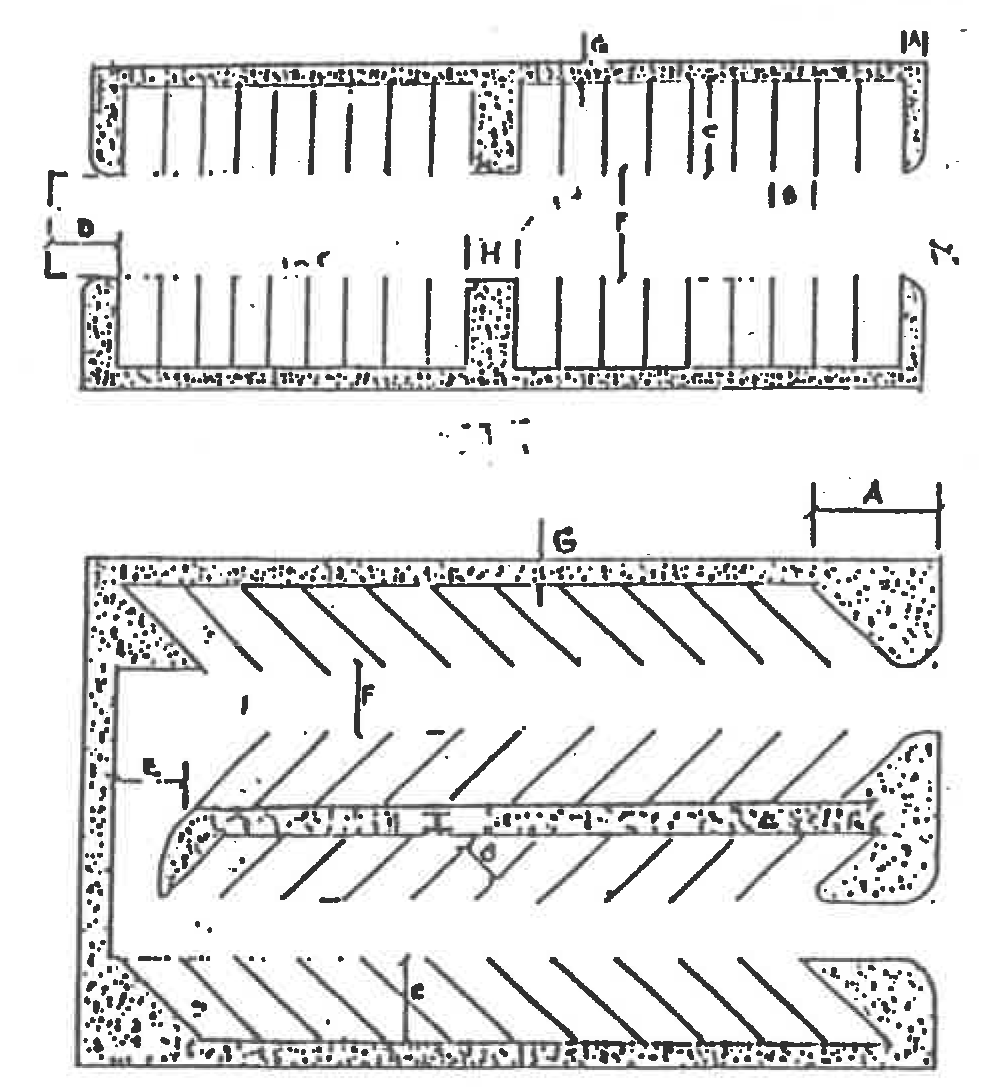
Parking Dimension Table
(Except for Single-Family Residential Uses Only)
Dimensions for parking at any of these angles are:
6.
Vehicular ramps providing ingress and egress to a street system shall have a standard maximum degree of incline of ten (10) percent to the horizontal plane, a blend slope length at the garage floor level of five (5) percent and a vehicle rollback area measured from the property line to the street side of the ramp for a distance of one hundred nine (109) inches at a grade not to exceed five (5) percent.
If a developer or property owner installs a ramp with a slope greater than ten (10) percent but less than or equal to twelve (12) percent, two (2) blend slope lengths shall be required as well as the rollback area. These blend slopes at both the top and bottom of the ramp shall have a degree of incline equal to one-half of the ramp slope and shall have a horizontal component of eight (8) feet.
If a developer or property owner installs a ramp with a slope greater than twelve (12) percent, up to a maximum of eighteen (18) percent, two (2) blend slope lengths shall be required as well as the rollback area. These blend slopes at both the top and bottom of the ramp shall have a degree of incline equal to one-half (½) of the ramp slope and shall have a horizontal component of an additional one-half (½) foot for each additional degree of ramp slope increase.
_____
The following chart displays the requirements:
_____
Ramp slope shall not exceed eighteen (18) percent. All retaining walls, abutments and shrub planters along the full length of the five (5) percent controlled rollback area of the ramp shall not exceed twenty-four (24 inches in height, measured from the highest floor line of the ramp at the property line.
14-48.6. Minimum Required Off-Street Parking Spaces.
The minimum number of required off-street parking spaces shall be determined from the following table. Requirements for any use not specifically mentioned shall be the same as the use most similar to the one sought. When units of measurement determining the required off-street parking spaces result in a fractional space, then such fraction equal to or greater than one-half (½) shall be interpreted as one (1) off-street parking space. In stadiums, houses of worship, sports arenas, or other places of assembly where occupants sit on benches, pews, or other similar seating arrangements, each twenty-four (24) linear inches of such seat shall be counted as one (1) seat. All existing establishments adding an accessory use to a permitted principal use shall demonstrate that the parking demand associated with the accessory use in question meets the current terms of this Code.
1.
Single-Family Dwelling. One (1) parking space per dwelling unit.
2.
Duplex and Multifamily Dwelling. One and one-half (1½) parking spaces on the same lot for each dwelling unit.
3.
Motels or Hotels and Tourist Accommodations. Motels or hotels and tourist accommodations [shall have] one (1) parking space for each rental unit plus one (1) space for a manager. Any hotel, motel or tourist accommodation having a restaurant, lounge or coffee shop shall have one (1) additional parking space for each six (6) persons based on the occupancy load of said restaurant, lounge or coffee shop as determined by the Building Official in accordance with current codes adopted by the city. Tier parking shall be constructed within the confines of the building structure and the view of vehicles shall be screened with a decorative screen material. Open parking shall be allowed within the area comprising the fifty (50) feet deep construction setback area (between the seawall or coastal setback line and the construction building line) only when a minimum of sixty (60) percent up to a maximum of seven thousand five hundred (7,500) square feet of that area is devoted to recreational or tourist oriented amenities.
The area comprising the sixty (60) percent up to a maximum of seven thousand five hundred (7,500) square feet devoted to recreational or tourist oriented amenities shall be one (1) contiguous area, uninterrupted by parking, of which area the smallest dimensions shall be at least fifty (50) feet.
4.
Houses of Worship, Theaters, Auditoriums, Funeral Homes and Other Places of Assembly not listed. One (1) parking space for each four (4) seats in the principal place of assembly.
5.
Child Care Center. Two (2) spaces for each employee plus adequate provisions for loading and unloading children off the street.
6.
Private Clubs or Lodges. One (1) parking space for each three (3) seats or one (1) space for each three hundred (300) square feet of gross floor area, whichever is greater.
7.
Nursing Homes and Rest Homes. One (1) parking space for each four (4) beds.
8.
Golf or Country Club, Swim Club, Tennis or Racquet Club. One (1) parking space for each three (3) seats or one (1) space for each two hundred (200) square feet of gross floor area, whichever is greater plus two (2) spaces per tennis, racquet ball or handball court.
9.
Time Share Unit. For each dwelling unit sold, occupied or held for sale as a "time-share unit," as defined under section 721.05, Florida Statutes, there shall be required a minimum of one and one-half (1½) car spaces on the same lot for each dwelling unit.
10.
Library, Community Center, Recreation Center. One (1) parking space for each two hundred (200) square feet of gross floor area.
11.
Office Buildings, Banks, and Similar Institutions. One (1) parking space for each four hundred (400) square feet of gross floor area.
12.
Medical Offices, Clinics, and Laboratories. Three (3) parking spaces for each dentist plus one (1) parking space for each employee and five (5) parking spaces for each medical doctor, or other practicing professional, plus one (1) parking space for each employee.
13.
Retail Business and Personal Service Establishment. One (1) parking space for each two hundred fifty (250) square feet of gross public floor area.
14.
Service Stations. One (1) parking space for each gas pump plus three (3) parking spaces for each grease rack or other working bay.
15.
Restaurants, Nightclubs or Bars. Restaurants in the general commercial zone: One (1) parking space for each four (4) seats with a minimum of one (1) parking space for every fifteen (15) square feet of seating area and one (1) parking space for every two (2) employees and in any event no more than forty-nine seats for the first approved exit door and further requirements of the NFPA Life Safety Code 101.
16.
Bowling Alleys. Three (3) spaces for each alley plus one (1) parking space for each two (2) employees.
17.
Wholesale, Retail and Commercial Storage. One (1) parking space for each employee plus one (1) space for each one thousand five hundred (1,500) square feet devoted to wholesale, retail and commercial storage.
18.
Interior Storage Facility. One (1) parking space for each six thousand (6,000) square feet of gross floor area.
19.
Internet Cafes and Establishments Offering Devices with Internet Access and/or Services for Purchase or Use on the Premises. One (1) parking space for every two hundred (200) square feet of gross floor area OR one (1) parking space for every two (2) seats, whichever is greater PLUS one (1) parking space for every two (2) employees.
20.
Pain Management Clinic. One (1) parking space per ten (10) gross square feet of customer waiting area including, but not limited to, the lobby and seating area. Each pain management clinic shall provide a minimum of one (1) parking space per two hundred (200) gross square feet of the remainder of the building.
14-48.7. Required Off-Street Loading.
Off-street loading areas are required by this ordinance so that vehicles engaged in unloading or loading will not encroach on or interfere with the public use of streets or by off-street parking spaces by motor vehicles so that adequate space is available for the unloading and loading of goods, materials or things for delivery and shipping.
Off-street loading facilities provided to meet the needs of one (1) use may not be used to meet the needs of another use. Off-street parking facilities may not be used or counted as meeting off-street loading requirements.
Each off-street loading space shall be directly accessible from a street or alley without crossing or entering any other required off-street loading space. Such loading space shall be accessible from the interior of the building it serves and shall be arranged for convenient and safe ingress and egress by motor trucks and/or trailer combinations.
14-48.8. Off-Street Loading Space Dimensional Requirements.
Each required off-street loading space shall have the following minimum dimensions. However, each developer should evaluate his own particular off-street loading needs to determine if they are greater than the minimum specified below. In no case shall a vehicle extend into or onto a public right-of-way while loading or unloading.
For the purpose of this ordinance, an off-street loading space shall have a minimum dimension of twelve (12) feet by forty (40) feet and an overhead clearance of fourteen (14) feet in height above the paving grade.
_____
14-48.9. Minimum Required Off-Street Loading Spaces.
_____
14-48.10 Minimum Required Bicycle Parking Spaces.
A minimum of five (5) bicycle parking spaces shall be provided for all commercial developments.
14-48.11. Specialized Off-Street Parking Requirements.
Off-street parking in the MUPUDE Mixed Use Planned Unit Development East District shall be approved through the MUPUD agreement.
Off-street parking and loading space in the MUPUDW Mixed Use Planned Unit Development West District shall be provided as follows:
One (1) private parking space per multifamily residential, timeshare or hotel/motel unit shall be provided within the boundary of the PUD.
Other uses: One (1) parking space per three hundred (300) net square feet.
Off-street parking in the GC-RD General Commercial-Redevelopment District, shall be governed by the existing rules and regulations for parking in section 14-48 with the exception of the additional guidelines:
14-48.11.1.
Reserved.
14-48.11.2.
Parking as a Principal Use. No lot or part of a lot may be used as parking only, unless said parking is approved by the City Commission pursuant to section 14-58.1.2.A.8. of this Land Development Code.
14-48.11.3.
Parking as an Accessory Use. Notwithstanding section 14-48.11.2, parking shall be permitted only as an accessory use to a principal use.
14-48.11.4.
Parking Garages. A parking garage may be constructed as an accessory use to a permitted principal use; however said garage may not have parking on the ground floor. The ground floor shall be used only as a permitted principal use for the district in which they exist.
14-48.11.5.
Unpaved Parking. Unpaved parking shall only be allowed in the GC-RD District when approved by City of Daytona Beach Shores City Commission, pursuant to section 14-58, for a period not to exceed three hundred sixty-five (365) consecutive days and accompanied by a post-reclamation plan. Unpaved parking in all other redevelopment districts is prohibited.
(Ord. No. 91-11, § 2, 7-10-91; Ord. No. 91-18, § 1, 8-14-91; Ord. No. 2007-23, § 4, 11-28-07; Ord. No. 2008-22, § 2, 12-9-08; Ord. No. 2010-09, § 3, 5-11-10; Ord. No. 2011-08, § 3, 9-27-11; Ord. No. 2011-09, § 1, 9-27-11; Ord. No. 2014-12, § 3, 11-11-14; Ord. No. 2020-16, § 2, 11-10-20; Ord. No. 2022-20, § 1, 12-13-22)
Sec. 14-49. - Open space area allowance.
Except when otherwise prescribed by these zoning regulations when open space areas are specially required by these zoning regulations, the following areas qualify partially or wholly as open space:
Sec. 14-50. - Parking and storage of certain vehicles.
1.
In a residentially zoned district automotive vehicles or trailers of any type without current license plates shall not be parked or stored other than in a completely enclosed building.
2.
Within any residentially zoned district trucks, trailers or wagons in excess of three-quarter (¾) ton capacity shall not be parked for storage purpose or overnight on any public right-of-way or on private property except within a completely enclosed garage.
Sec. 14-51. - Parking, storage or use of major recreational vehicles.
No major recreational vehicle greater than eighteen (18) feet in length shall be parked or stored on any lot in a residential district except in a carport or enclosed building or behind the nearest portion of a building to a street, provided however, that such equipment may be parked anywhere on residential premises for a period not to exceed twenty-four (24) hours for the purpose of maintenance, loading or unloading. No such vehicle shall be used for living, sleeping or housekeeping purposes when parked or stored on a residential lot or in any location not approved for such use.
Sec. 14-52. - Performance standards.
These performance standards shall apply to all zoning districts:
14-52.1. Smoke, Dust and Dirt.
There shall be no emission of visible smoke, dust, dirt, fly ash or any particulate matter from any pipes, vents or other openings, or from any other source, into the air. All fuel shall be used so as to prevent any emission of visible smoke, fly ash or cinders into the air.
14-52.2. Fumes, Vapors, and Gases.
There shall be no emission of any fumes, vapors or gases of a noxious, toxic or corrosive nature which can cause any damage or irritation to health, animals, vegetation or to any form of persons or property.
14-52.3. Sewage.
There shall be no discharge at any point of liquid or solid wastes into any public sewage disposal system which will overload such system or create detrimental effects in the flow and treatment of public sewage. There shall be no discharge of any industrial wastes into any private sewage disposal system or into or on the ground of a kind or nature which would contaminate any water supply or otherwise cause the emission of dangerous or objectionable elements or conditions. There shall be no discharge of any industrial commercial or domestic waste into any stream, waterway, water body or drainage canal. There shall be no accumulation of solid wastes conducive to the breeding of rodents or insects.
14-52.4. Heat, Cold, Dampness or Movement of Air.
Activities which shall produce any adverse effect on the temperature, motion or humidity of the atmosphere beyond the lot line shall not be permitted.
14-52.5. Electromagnetic Interference.
No use, activity or process shall be conducted which produces electromagnetic interference with normal radio or television reception.
14-52.6. Noise.
The permitted level of noise or bound [sound] emission at the property line of the lot on which the principal use is located shall not at any time exceed the average noise level prevailing for the same hour, as generated by street traffic activity. The determination of noise level shall be measured with a sound level meter that conforms to specifications published by the American Standards Association.
14-52.7. Odor.
There shall be no emission of odorous gases or other odorous matter in such quantities as to be offensive, obnoxious or unpleasant beyond the property line of which the principal use is located. Any process, including the preparation of food which may involve the creation and emission of any such odors, shall be provided with both a primary and secondary safeguard system so that odor control may be maintained in the event of a failure in the primary safeguard system.
14-52.8. Glare.
There shall be no direct glare visible from any residential district caused by unshielded floodlights or other sources of high intensity of lighting.
14-52.9. Maintenance of Properties.
A.
Intent. The intent of subsection 9 is to provide regular inspection of all properties within the city; to ensure compliance with city codes, pertaining to those sites; and, specifically, to ensure that improvement required on final site plans or building permits are properly maintained.
B.
Nuisances Defined. It is a public nuisance for any person owning, leasing, occupying or having charge of any premises in this city to maintain or permit to exist, such premises in such a manner that any one (1) or more of the following conditions exist thereon:
1.
Any public nuisance known at common law or in equity jurisprudence, as set forth in F.S. ch. 823, Public Nuisances.
2.
All violations pertaining to premises as defined in the Municipal Code of Ordinances of the City of Daytona Beach Shores, sections 16-12 through 16-14.
3.
Any attractive nuisance which constitutes an imminent threat to the health, safety, and welfare of children, whether in a building, on the premises of a building, or upon an unoccupied lot. This includes, but is not limited to, any abandoned wells, shafts, basements, or excavations, unprotected and/or hazardous pools, ponds, or other bodies of water, abandoned refrigerators and motor vehicles, any structurally unsound fences or structures, or any lumber, trash, fences, debris or vegetation, which may prove a hazard for inquisitive minors.
4.
Insufficient ventilation or illumination, as defined in the Standard Building Code.
5.
Inadequate or unsanitary sewerage or plumbing facilities, as is defined by the Standard Building Code.
6.
Whatever renders air, food, or drink an imminent threat to the health, safety, and welfare of human beings.
7.
Any place or premises which have been determined by the city's Code Enforcement Board, per F.S. § 893.138, to have been used on more than two (2) occasions as the site of the unlawful sale, delivery, possession, or storage of controlled substances.
8.
Land, the topography, geology, or configuration of which, whether in natural state or as a result of grading operations, excavation or fill, causes erosion, subsidence, or surface water drainage problems of such magnitude as to be injurious or potentially injurious to the public health, safety and welfare, or to adjacent properties.
9.
The failure to close, by such means as are acceptable to the Building Official, all doorways, windows and other openings into vacant structures.
10.
Broken windows constituting hazardous conditions and inviting trespassers and malicious mischief.
11.
Vegetation, including dry grass, dead shrubs, dead trees, combustible refuse and waste, or any material growing upon the area between the traveled way and the property line, sidewalks, or upon private property, which by reason of size, manner of growth and location would create any of the following: a condition likely to constitute a fire hazard to any building, improvement, or other property, or when dry, will in reasonable probability constitute a fire hazard; or a condition likely to harbor rats, vermin, or similar creatures constituting a health hazard.
12.
Dead, decayed, diseased or hazardous trees, weeds as prohibited in section 13-5 of this Code, or other vegetation constituting an imminent threat to health, safety, and welfare.
13.
Waste on the premises which, by reason of its location or condition, would materially hamper or interfere with the suppression of fire or the use of rescue or emergency vehicles upon the premises, or adjacent premises.
14.
All yards, swale areas, walkways, driveways, parking areas, vacant lots, landscape areas, and open space areas not properly maintained, consistent with the following standards: they shall be free of refuse and debris; all paved areas shall be maintained reasonably free of holes and cracks; all landscaped material shall be maintained reasonably free of weeds and foreign matter and shall be kept in reasonably healthy condition at all times, and all dead material, including trees, shall be replaced consistent with the requirements of the Land Development Code, section 14-46, Landscaping Standards.
15.
Whatever is dangerous to human life, or is detrimental to health, as determined by the director of community services pursuant to section 13-4 of the Municipal Code of Ordinances of the City of Daytona Beach Shores.
16.
Exterior walls: Every exterior wall shall be free of holes, breaks, loose or rotting boards, or timbers and any other condition which might admit rain or dampness to the interior portions of the walls or to the occupied spaces of the building. All siding material and other exterior surfaces of walls shall be kept in good repair. The term "good repair" shall include the requirement that the surface be kept reasonably clean and free from a substantial amount of mildew or other substances which would alter its intended appearance. All exterior surfaces, except brick, stone, or other materials not requiring application of a weatherproofing coating, shall be kept painted, with a good quality final coat of exterior paint (or equivalent substance) and any primer coating must be overlaid with a final coat of regular paint or equivalent. The final coat of paint or equivalent subject to the elements shall be maintained in such condition that its appearance does not show excessive fading, streaking, peeling, blistering, discoloring, cracking, or similar imperfections.
17.
Care of premises: It shall be unlawful for the owner or occupant of a building, structure or property, to utilize the premises for the open storage of any abandoned motor vehicle, ice box, refrigerator, stove, glass, building materials, building rubbish or similar items, as specified in section 13-6 of the Municipal Code of Ordinances of the City of Daytona Beach Shores, except as allowed by the zoning regulations. It shall be the duty and responsibility of every such owner or occupant to keep the premises of the property clean and to remove from same all such abandoned items as listed above, including, but not limited to, weeds, dead trees, trash, garbage, etc., upon notice from the code enforcement officer. Premises shall be kept free from health hazards, including debris accumulation and breeding conditions for mosquitoes.
18.
Any other public nuisance defined, described or identified anywhere in the Daytona Beach Shores Code of Ordinances.
C.
Unsafe Structures. All buildings, or structures which either have become unsafe, structurally flawed or defective or are unsanitary for human occupancy, or do not have adequate ingress and egress, constituting a fire hazard, or otherwise, are dangerous to human life; or, which in relation to existing use, constitute a hazard to safety or health by reason of inadequate maintenance, dilapidation, obsolescence or abandonment, or which constitute a nuisance, as defined in paragraph B., are considered unsafe structures. All such unsafe structures are hereby declared illegal and shall be abated by repair and rehabilitation or by demolition, as authorized by paragraph E.
D.
Minimum Maintenance Standards.
1.
All buildings shall present a neat and fresh appearance and be free of all peeling paint, rust, graffiti, and deteriorated or mismatched roofing material.
2.
All parts of any building and/or structure shall be structurally sound. Rotten or weakened sections shall be repaired, replaced, or removed.
3.
Nonfunctional elements on any building, structure, or premises, such as unused sign poles, brackets, empty electrical conduit, etc., shall be removed and the remaining surface shall, if damaged, be repaired or rebuilt to match adjacent surfaces and the original condition. All loose wires and/or conduits shall be secured.
4.
Broken or missing windows shall be repaired, replaced, or properly abandoned. All windows must fit tightly and have sashes of proper size and design. Abandonment of window openings shall be accomplished by using the same size material as the adjacent surface.
5.
Awnings that are torn, badly faded, frayed, or structurally compromised shall be repaired, replaced, or removed.
6.
All roofs, gutters, and downspouts shall be maintained to prevent damage to the structure and adjoining properties.
7.
All retaining walls, seawalls, nonstructural walls, and fences shall be structurally sound, in good repair and maintained to present cared-for aesthetic appearance.
8.
Dumpsters must be screened by enclosures which present a painted, rust-free, and neat appearance. Dumpsters may not be exposed to view from the street.
9.
Lighting devices and supports, outdoor service and seating areas, signs, and their supporting elements shall be structurally sound, free of graffiti, overgrowth and debris, and maintained in a painted, rust-free, cared-for appearance.
10.
All parking areas shall be kept free of potholes. Broken pavement, to the point of being a hazard, shall be repaired. All dead tree limbs and dead trees shall be removed from parking areas and trees replaced.
11.
All vacant lots should be kept free of overgrowth, weeds, trash, and debris.
12.
Landscaping shall be kept in a neat and well-maintained condition.
13.
All dead tree limbs and dead trees shall be removed from the site and trees replaced with live trees.
E.
International Property Maintenance Code, 2018 Edition adopted.
1.
With the exceptions referenced below, the City of Daytona Beach Shores hereby adopts the International Property Maintenance Code, 2018 Edition published by the International Code Council, Inc., and incorporates the same by reference as if fully set forth herein. Copies of the International Property Maintenance Code, 2018 Edition, together with this section, are on file in the office of the City Clerk.
2.
The following sections of the International Property Maintenance Code, 2018 Edition are hereby amended as follows:
a.
Section 102.3 entitled "Application of other codes" is hereby amended to read as follows: Repairs, additions, or alterations to a structure, or changes of occupancy, shall be done in accordance with the procedures and provisions of the current edition of the Florida Building Code and adopted volumes thereof. Nothing in this Code shall be construed to cancel, modify, or set aside any provision of the City of Daytona Beach Shores Code of Ordinances or it's Appendixes. All references to the International Model Codes shall be changed to the equivalent currently adopted edition of the Florida Codes, as follows:
i.
International Building Code is the Florida Building Code, Building;
ii.
International Plumbing Code is the Florida Building Code, Plumbing;
iii.
International Mechanical Code is the Florida Building Code, Mechanical;
iv.
International Fuel Gas Code is the Florida Building Code, Fuel Gas;
v.
International Residential Code is the Florida Building Code, Residential;
vi.
International Existing Building Code is the Florida Building Code, Existing Building;
vii.
International Electrical Code is the National Electrical Code NFPA 70;
viii.
International Fire Code is Florida Fire Prevention Code and NFPA;
ix.
International Zoning Code is the City of Daytona Beach Shores Land Development Code;
b.
Section 103.1, entitled "General," shall read as follows: The City Manager or designee is hereby charged with the primary responsibility of enforcing this Code.
c.
Section 103.2, entitled "Appointment," shall read as follows: The Code Official shall be the City Manager or designee.
d.
Section 103.5, entitled "Fees," is hereby deleted in its entirety.
e.
Section 106.2, entitled "Notice of Violation," is hereby deleted in its entirety.
f.
Section 106.3, entitled "Prosecution of Violation," is hereby deleted in its entirety.
g.
Section 107, entitled "Notices and Orders," shall read, in its entirety, as follows: Whenever the code official or an employee charged with enforcement of the International Property Maintenance Code, 2018 Edition determines a violation of such Code exists, all Notices given must follow the procedures outlined in the Florida Statutes, Section 162.12., adopted by the Daytona Beach Shores Code of Ordinances, Chapter 2. Administration, Article III. Code Enforcement Board.
h.
Section 108.3 entitled "Notice," shall read as follows: Condemnation Notices based on conditions identified in the International Property Maintenance Code, 2018 Edition shall comply with the procedures outlined in the Daytona Beach Shores Code of Ordinances, Chapter 19. Public Nuisances., Article II. - DILAPIDATED, UNSANITARY, UNSAFE OR UNINHABITABLE BUILDINGS.
i.
Section 109.4 entitled "Emergency repairs," is hereby deleted in its entirety.
j.
Section 109.5 entitled "Costs of emergency repairs," is hereby deleted in its entirety.
k.
Section 110, entitled "Demolition," is hereby amended to read as follows:
Subsection 110.1 Condition of lot or structure after demolition. A lot from which a manmade dwelling, structure, or manmade body of water is repaired or demolished shall be completely cleaned of all repair or demolition material and shall be properly filled, graded, and seeded with grass or sodded and watered, within ten (10) days of the date of completion of the repairs or demolition.
Subsection 110.2 Cost of repair or demolition; lien on property; collection.
i.
Upon repair or demolition of any building or structure, either with City of Daytona Beach Shores employees or by independent contractor, all costs of demolition and/or repair shall be assessed against and constitute a lien on the property upon which the building or structure is/was situated. Cost shall include, but not be limited to, all administrative costs, attorney's fees, postage, publication fees, and actual costs of physical removal and/or repair.
ii.
The City Clerk may file a lien in the public records of Volusia County Florida, showing the nature of the lien, the amount thereof, a legal description of the property, and the owner thereof.
iii.
The lien may be enforced in the same manner as a court judgment by the State of Florida, including levy against personal property, and may also be foreclosed. All costs and attorney's fees incurred in collection of amounts due under any such lien shall also be secured by the property and included within the total sum due under the lien.
iv.
The city shall not commence any lien foreclosure action against any property for which a lien has been filed until such lien has been filed of record for a period of at least ninety (90) days.
l.
Section 111, entitled "Means of Appeal," is hereby deleted in its entirety.
m.
Section 201.4, entitled "Terms not Defined," is hereby amended to read as follows: Words not defined herein or in the referenced Florida Codes shall have meanings defined in the Florida Statutes, other documents, manuals, or standards adopted elsewhere in this Code of Ordinances. Words not defined in those documents shall have the meaning stated in the latest edition of Merriam-Webster's Collegiate Dictionary.
n.
Section 301.2, entitled "Responsibility," shall read, in its entirety, as follows: The owner of the premises shall maintain the structures and exterior property in compliance with these requirements. A person shall not occupy as owner-occupant or permit another person to occupy premises that are not in a sanitary and safe condition and that do not comply with the property maintenance requirements of the city.
o.
Section 302.4, entitled "Sanitation," shall read, in its entirety, as follows: Exterior property and premises shall be maintained in a clean, safe, and sanitary condition.
p.
Section 302.4, entitled "Weeds," shall read as follows: All premises and exterior property shall be maintained free from weeds or plant growth in excess of twelve (12) inches.
q.
Section 304.14, entitled "Insect Screens," is hereby deleted in its entirety.
r.
Section 309.5, entitled "Occupant," is hereby deleted in its entirety.
s.
Section 404.4.5, entitled "other requirements," is hereby deleted in its entirety.
t.
Section 602.3, entitled "Heat supply," shall read as follows: Each owner and operator of any building who rents, leases, or lets one (1) or more dwelling units or sleeping units on terms, either expressed or implied, to furnish heat to the occupants thereof shall supply heat during the period from November 15 th to March 15 th sufficient to maintain a temperature of not less than sixty-eight (68) degrees Fahrenheit in all habitable rooms, bathrooms, and toilet rooms.
u.
Section 602.4, entitled "Occupiable workspaces," shall read as follows: Indoor occupiable work spaces shall be supplied with heat during the period from November 15 th to March 15 th sufficient to maintain a temperature of not less than sixty-eight (68) degrees Fahrenheit during the period the spaces are occupied.
v.
Section entitled "Appendix A: Boarding Standard" is hereby deleted in its entirety.
w.
Supplemental Code. The provisions of this Code shall be supplemental to other codes and other ordinances of the city.
F.
Relief due to Proven Hardship. If it appears to be physically or economically impractical to bring the property completely up to the code standard for any specific item, a variance for more limited compliance may be sought from the appropriate board or council.
G.
Enforcement. Violations of this section shall be subject to the enforcement by the city in any way authorized by state or federal law and any way authorized by any code or ordinance of the city.
(Ord. No. 98-35, §§ 1, 2, 10-14-98; Ord. No. 99-14, §§ 1, 2, 7-28-99; Ord. No. 2012-07, § 5, 6-26-12; Ord. No. 2014-02, § 3, 5-27-14; Ord. No. 2022-30, § 2, 1-10-23)
Sec. 14-53. - Permits in conflict with these regulations.
Permits for either the construction of buildings or for the use of land or buildings which have been issued prior to the adoption of this zoning ordinance and which are in violation with the regulations of this ordinance shall be declared void unless evidence is shown to establish that substantial expenditures have been made either for the preparation of plans for construction or for preliminary planning. Investment in real property shall not be construed as an expenditure towards construction. Unless actual construction work, including grading and excavation, is underway within six (6) months after the adoption of this zoning ordinance, such permit shall become void.
Sec. 14-54. - Permitted building area.
The principal building on any lot or parcel of land shall be erected within the area bounded by the building lines established by setback or yard requirements. Accessory buildings may be erected within any building area established for the principal building and in required yard areas as may be provided for in section 14-16 [14-34] of this ordinance.
Sec. 14-55. - Service stations.
The following regulations shall apply to the location, size, design, construction, operation and maintenance of service stations:
14-55.1. Location of Structures, Pumps, Etc.
1.
No principal or accessory buildings; no sign of any type; no gasoline pump, tank, vent, pump island or pump island canopy shall be located within twenty-five (25) feet of any residential area or residentially zoned property.
2.
The principal building shall conform to all street frontage setbacks required for the district in which the service station is located.
3.
Gasoline pumps, vents, pump island and pump island canopies shall conform to all side and rear setbacks required for other structures in the zoning district in which the automotive service station is located, provided no such pumps, tanks, vents, pump island or pump island canopies shall be located closer than twenty (20) feet to any side or rear property line.
4.
Gasoline pumps, vents, tanks, pump island and pump island canopies may be located no closer than fifteen (15) feet to the street right-of-way line, provided that if such fifteen-foot requirement is closer than setback requirements for the district in which the automotive service station is located, such service station appurtenances shall be removed before the property is converted to a use other than an automotive service station.
5.
In districts where setbacks greater than fifteen (15) feet are required, no gasoline pumps, vents, tanks, pump islands or pump island canopies shall be located at a fifteen-foot distance from the street right-of-way line until a legal instrument satisfactory to the City Legal Department has been prepared and recorded at the expense of the property owner or lessee, which instrument shall relieve the city of all costs of removal of such appurtenances and from any severance damages should the city acquire such right-of-way.
14-55.2. Curb Breaks.
The number of curb breaks for one (1) automotive service station shall not exceed two (2) for each one hundred fifty (150) feet of street frontage, each break having a width of no more than thirty (30) feet exclusive of transitions and located not closer than fifty (50) feet to the right-of-way lines of any intersection. Curb breaks shall not be closer than fifteen (15) feet to any other property line. There shall be a minimum distance of twenty (20) feet between curb breaks. Clearance for curb breaks shall be obtained from the Florida Department of Transportation for any proposed station to be located on a street under department of transportation jurisdiction before a building permit will be granted.
14-55.3. Buffers.
Where lots to be used for service stations abut on any property which is residentially zoned, a landscape buffer area shall be provided as required in section 14-46.
14-55.4. Permanent Storage of Materials, Merchandise, and Equipment.
All permanent storage of materials, merchandise, and lubrication, repair and servicing equipment other than liquid fuel shall be within the principal building.
14-55.5. Trash Facilities.
Adequate, enclosed trash storage facilities shall be provided on the site. On an interior lot such facilities shall be located at the rear of the service station's main structure; on a corner lot such facilities shall be located where possible on the side of the main structure with street frontage carrying the lesser volume of traffic. No operator should deposit or cause to be deposited debris cleaned from the premises upon the adjacent roadway.
14-55.6. Parking of Wreckers and Service or Customer Vehicles.
Wreckers and service or customer vehicles shall be parked on the premises in a manner that will not create a traffic hazard or interfere with vehicular maneuvering area necessary for gasoline pump areas, service bays or required off-street parking spaces.
14-55.7. Sale or Rental of New or Used Vehicles.
A truck and trailer rental operation established primarily for the transporting of household goods shall be permitted subject to the following:
1.
The required minimum lot area shall be increased by fifteen hundred (1,500) square feet for the parking of each rental truck proposed and give five hundred (500) square feet for each rental trailer proposed. The city occupational license shall specify the total number of each type of vehicle to be authorized for any service station lot.
2.
No such vehicles shall be parked within any front or side yard abutting a street.
3.
No rental vehicles shall be parked in a way to conflict with the on-site traffic circulation generated by the service station function. All vehicles shall be maintained at all times in a neat and presentable manner.
4.
No service station shall be approved for vehicle rental when such service station violates any part of this subsection and all city occupational licenses shall be issued and renewed accordingly.
Sec. 14-56. - Site development plan approval.
14-56.1. Procedure.
Where, by the terms of these zoning regulations, approval by the City Commission of a site development plan is required prior to the issuance of a building permit, such site development plan shall be submitted to the Building Official for comment and criticism and to any city officer or department which may have a responsibility for some aspect of the site development plan. The site development plan shall be reviewed by the Planning and Zoning Board within sixty (60) days after it meets the criteria of the site plan review check list. The City Commission shall review the site plan within thirty (30) days after the Planning and Zoning Board has made its recommendation. Prior to approval of the site plan, the City Community Services Director shall issue written assurances that available capacity exists to support the proposed development at the adopted Level of Service standard for the relevant facility or service to be provided. Nothing in this procedure shall impede the approval of development for the handicapped, affordable housing or elderly facilities. The Planning and Zoning Board and the City Commission shall consider the site plan in hearings and shall require due public notice for the hearings pursuant to section 2.2 [2-2].
14-56.2. Required Exhibits.
The data and exhibits required to be submitted under this section are specified in section 4-3.2, Requirements for Submission of Site Development Plan.
14-56.3. Termination.
From the date a site plan is approved by the City Commission, the applicant shall have twelve (12) months to start construction as defined in section 2-2. If start of construction does not occur within twelve (12) months from the date of the approval by the City Commission, the site plan approval will expire and no construction shall be permitted unless site extension has been granted as provided for in section 4-5.
(Ord. No. 95-01, §§ 1, 2, 2-22-95; Ord. No. 96-19, §§ 3, 4, 11-20-96; Ord. No. 97-31, § 1, 11-12-97; Ord. No. 98-21, § 1, 7-8-98)
Sec. 14-57. - Lot width on cul-de-sac lots or curves.
In all residential zoning districts the lot width as measured at the street right-of-way line on cul-de-sacs or curves shall not be less than thirty-five (35) feet.
Sec. 14-58. - Special exceptions and conditional uses.
14-58.1. Special Exceptions.
14-58.1.1.
A.
In General. A special exception is a use that would not generally be appropriate without restriction, but which, if controlled as to number, area, location or relation to the surrounding area, would promote the public health, safety and general welfare. Such use may be permitted in a zoning district as a special exception only if identified as such in this Code.
B.
Application Procedure. Written application shall be made to the city for a special exception in accordance with this Code with the burden of proof and persuasion being upon the applicant at all times. In addition, the applicant shall provide, at a minimum, the following information:
1.
A conceptual site plan showing buildings, parking and access locations, utility service points, proposed screening or buffering, supplemental details necessary to address the review criteria and satisfy any specific requirements for such use described in this chapter, and any other information pertinent to the specific requested use of the site.
2.
A written statement specifically addressing the general requirements of this section and this Code as well as consistency with the city's Comprehensive Plan.
C.
Notice and Hearing Procedures. The procedures for notice, review and approval of special exception requests shall be as follows:
1.
Notice. Notice shall be pursuant to the due public notice requirements contained in App. G, section 2-2 of this Code.
2.
Hearing.
(a)
Planning and Zoning Board Action. The Planning and Zoning Board shall hold a public hearing to consider and make a recommendation to the City Commission on a special exception application. The recommendation of the Planning and Zoning Board shall be forwarded to the City Commission for consideration.
(b)
City Commission Action. The City Commission shall consider the recommendation of the Planning and Zoning Board and any additional evidence presented before taking final action on a proposed special exception. However, if the Planning and Zoning Board fails to make a recommendation within sixty (60) days of commencing consideration of a special exception, the City Commission may take action on the special exception based upon an assumed recommendation of approval from the Planning and Zoning Board.
D.
Special Requirements and Conditions.
1.
Conditions and Safeguards. In granting any special exception, the Planning and Zoning Board may recommend, and the City Commission may prescribe, appropriate conditions and safeguards to ensure compliance with the requirements of this section and the code in general. Such conditions may include time limits for the initiation of the special exception use, specific minimum or maximum limits to normative Code requirements, or any other conditions reasonably related to the requirements and criteria of this chapter.
2.
Review Criteria. When reviewing an application for a special exception, the Planning and Zoning Board and City Commission shall consider the following requirements and criteria:
(a)
Traffic generation and access for the proposed use shall not adversely impact adjoining properties and the general public safety;
(b)
Off-street parking, loading and service areas for commercial, hotel/motel and multifamily residential development shall be provided and located such that there is no adverse impact on adjoining properties, beyond that which generally experienced in the district with regard to normative development activity;
(c)
Required yards, screening or buffering and landscaping shall be consistent with the district in general and the specific needs of the abutting land uses as determined by the city;
(d)
Architectural and signage treatments shall comply with the general provisions applicable to permitted uses in the district, to the greatest extent practicable, and mitigate impacts to surrounding development; and
(e)
Size, location or number of special exception uses in an area shall be limited so as to maintain the overall character of the district as generally intended by this Code.
3.
Notwithstanding the review criteria established within this section, all special exceptions shall also be reviewed pursuant to the criteria established in section 14-69.1(1) through (4) of this Code.
4.
Transfer or Abandonment of Special Exceptions. Special exceptions shall run with the property and the ownership of a special exception use may be transferred to another party. A special exception use that is not initiated within two (2) years of being granted shall not be established without a new public hearing in accordance with requirements of this section and shall be deemed abandoned. A special exception use that is abandoned, after establishment, for a period of six (6) months or more shall not be reestablished without a new public hearing in accordance with requirements of this section.
5.
Distance Between Special Exception Uses. Unless the method for measurement is specifically described herein, the distance between specific uses shall be measured by a straight line drawn from the nearest point of each lot, parcel or site to each other and such measurement shall be irrespective of jurisdictional boundaries.
6.
Special Locational Criteria. Where the proposed site for a special exception use is required to be located on or front an arterial or major collector roadway, said requirement is intended to ensure that traffic impacts associated with the use are directed toward the major collector or arterial roadway. Accordingly, this frontage requirement may be met by sites without direct frontage on the major collector or arterial, provided that the site location is in close proximity to the designated roadway, and the traffic impacts associated with the proposed use will be directed through areas of higher intensity development to reach the designated roadway.
7.
Violation of Special Exception Terms or Conditions. It is a violation of this Code for any person to violate or to refuse or fail to comply with any term or condition of a special exception. Violations may be prosecuted or enforced in any manner as may be provided by law for prosecution or enforcement of municipal ordinances.
8.
Denial. The Planning and Zoning Board may recommend denial of any application for any special exception, and the City Commission may deny any application for special exception, for any of the following reasons or a combination thereof:
(a)
Inconsistency with the findings and intent of this section.
(b)
Inconsistency with any goal, objective or policy of the Comprehensive Plan.
(c)
Adverse affect upon the public interest.
(d)
Failure to meet the requirements of the applicable special exception regulations.
(e)
Failure to meet all requirements imposed by federal, state, other local government or City Commission, law, rule, regulation, ordinance, or policy.
(f)
Creation of a hazard, a public nuisance or a circumstance dangerous to individuals or the public.
(g)
Incompatibility with the predominant use or character of the surrounding property.
(h)
The use will materially alter, disrupt or decrease the character or value of the area within which the use is proposed or abutting neighborhoods.
(i)
The use will adversely affect the natural environment, natural resources or scenic beauty, or cause excessive pollution.
9.
Expiration or abandonment of special exception purpose. If a special exception does not begin to serve the purpose for which it was granted permission within two (2) years from the date of approval of the special exception it shall expire and be deemed, conclusively, to have been abandoned. The submittal of a site development plan will constitute meeting the requirements of this provision. If after receiving approval the site development plan expires, the special exception will also expire and a new application must be submitted and approved in accordance with this section.
14-58.1.2. Special Exceptions Permitted in All Districts.
A.
The following uses are permitted as special exceptions in all districts unless otherwise noted:
1.
Package sewage treatment plants provided the following requirements are met:
a.
Package treatment plants shall have a minimum design flow capacity of one hundred thousand (100,000) gallons per day.
b.
Package treatment plants, evaporation percolation ponds, subsurface drainfields and/or spray irrigation fields shall have a minimum fifty-foot setback from adjoining properties, water bodies, bulkheads or street rights-of-way.
c.
Subsurface drainfields shall be constructed in accordance with Chapter 17-13 Florida Administrative Code, and subsequent revisions thereto.
d.
Subsurface drainfields or percolation ponds shall not be located within three hundred (300) feet of any water supply well.
e.
Evaporation/percolation ponds shall be constructed in accordance with the following design criteria:
(1)
Evaporation/percolation ponds shall be constructed with dual cells to permit maintenance and cleaning and shall be of such size as to permit a hydraulic loading no greater than three (3) gallons per square foot per day or a maximum organic loading no greater than twelve and five-tenths (12.5) pounds of five-day biochemical oxygen demand per acre, whichever is less.
(2)
The retaining walls, dikes, beams [berms] or other structures shall be compacted and seeded with grass or otherwise constructed to prevent any overflow or leakage.
(3)
The ponds shall be maintained so as to prevent mosquito breeding.
(4)
There shall be no discharge from evaporation/percolation ponds at any time through surface runoff.
(5)
Additional area may be required to be set aside to expand the pond if necessary.
f.
The package plant site shall be landscaped with minimum three-foot high plant materials that enhance the grounds and provide partial visual screening from adjoining properties and traveled rights-of-way.
g.
Each application for the installation of a package sewage treatment plant shall be accompanied by five (5) package treatment plant site development plans in accordance with section 14-56. In addition to the requirements of section 14-56.2, the following information will be required:
(1)
Existing topography at a contour interval of not more than two (2) feet.
(2)
The location of subsurface drainfields and/or spray irrigation fields.
(3)
A completed state department of pollution control "Application to Construct/Operate Pollution Control Sources."
(4)
The results of a recent percolation test performed at the proposed site of effluent disposal by a registered engineer.
(5)
A written statement signed by the applicant attesting to the fact that there are no nearby facilities that have a capacity to serve the proposed project and that any existing nearby sewage systems or package plants cannot be expanded to serve the proposed project.
(6)
A written statement signed by the applicant indicating with reasonable assurances that:
(a)
The package treatment plant will be phased out and waste water transferred to an areawide system when it becomes available to the applicant;
(b)
When the package treatment plant is phased out it will be removed at the owner's expense;
(c)
The package treatment plant will be dedicated to the city if it is in accord with the areawide water and sewer plan.
h.
The above site plan and exhibits shall be reviewed and comments forwarded to the Planning and Zoning Board prior to site plan approval:
(1)
Volusia County Environmental Control Department;
(2)
Building official;
(3)
Volusia County Health Department.
After site plan approval the City Commission may require the owner to post an appropriate bond to guarantee compliance with the operating requirements of the state department of environmental regulation to prevent deterioration of surface or ground water quality when the owner's financial resources are inadequate or the proposed plant operation is proven to be unreliable.
2.
Churches or cemeteries provided:
a.
The principal means of access is from an arterial or collector road.
b.
The lot is at least twenty thousand (20,000) square feet in area.
c.
No structure is located closer than fifty (50) feet from any property line.
d.
Landscape buffers are provided in accordance with requirements of section 14-46.
3.
Golf country clubs, swim clubs and tennis clubs provided:
a.
That principal and accessory buildings shall occupy no more than fifteen (15) percent of the total lot area.
b.
That no dwelling units be provided on the premises except for living quarters of a resident manager, watchman and/or caretaker.
c.
That no principal building, accessory building, swimming pools or tennis courts be located closer than fifty (50) feet from any lot line.
d.
That no outdoor loudspeaker or call systems be employed which would produce objectionable noise at the boundaries of the lot.
e.
That any land area not used for buildings, swimming pools, game courts, drives, parking areas and the like be landscaped and well-maintained in trees, grass, shrubs and pedestrian walks.
4.
Golf courses provided:
a.
The course is not lighted for night play.
b.
Miniature golf course, par-three golf, driving ranges and similar activities operated as a business are not permitted.
c.
Building for golf shop; locker room; snack bar; or living quarters for caretaker, resident manager or night watchman are permitted as an accessory use.
d.
Practice greens and driving ranges may accompany a golf course occupying at least fifty (50) acres.
5.
Public elementary and high schools, parochial schools and private schools having a curriculum similar to a tax-supported elementary or high school provided all buildings are located at least fifty (50) feet from any lot line.
6.
Public utility uses provided all above-ground utility uses, except aerial cables, are completely surrounded by landscape buffers as required by section 14-46.
7.
Child care centers, provided:
a.
Lot area shall not be less than seven thousand five hundred (7,500) square feet;
b.
Fenced play area of not less than three thousand (3,000) square feet shall be provided for first twenty (20) or fewer children, with additional two hundred (200) square feet for each additional child;
c.
Landscaped buffer required on all nonstreet property lines;
d.
All facilities, operations and maintenance shall meet Volusia County and state requirements for operation or child care centers.
8.
Temporary Parking, provided:
a.
Screening and/or landscaping will be required as a buffer on all nonstreet property lines.
b.
The hours of operation and noise caused by the parking shall not be inconsistent with the character of the neighborhood.
c.
The purpose for the parking shall be within a reasonable distance of said parking.
d.
This special exception may be approved for a limited period of time. In this event the city may determine to issue variances relating to certain requirements that would ordinarily be required for a permanent improvement.
e.
Pursuant to the authority of section 14-69.1, 5. of this Code, the Planning and Zoning Board is hereby assigned the duties [as] to the granting of special exemptions under this provision. In addition, any recommendations by the Planning and Zoning Board shall be heard and require final approval by the City Commission after a public hearing.
f.
Pursuant to the authority of Section 2-2 of this Code, due public notice shall be established.
g.
All off-beach parking shall be permitted in the GC-RD, GC-1 and GC-2 commercial zoning districts pursuant to this ordinance.
B.
The following uses are permitted as special exceptions in the T, RMF-1 and RMF-2 districts unless otherwise noted:
1.
Sales offices, conditioned upon the following:
a.
The site shall have a recently approved and active site plan for a multifamily, hotel or PUD; and
b.
A site plan for the sales office or trailer is approved by the city. The site plan shall comply with all parking, landscaping, and stormwater requirements set forth in the Land Development Code; and
c.
Minimum setbacks shall be as follows:
Front: Ten (10) feet;
Sides: Seven (7) feet;
Rear: Fifty (50) feet (RMF-1 and T districts) or twenty (20) feet (RMF-2); and
d.
Sales office or trailer meets wind loads and all associated Florida Building Code regulations; and
e.
Sales offices or trailers shall only sell units associated with the development's approved site plan; and
f.
The special exception may be renewed annually by the City Commission. A request for renewal must be submitted to the City Manager at least sixty (60) days before the date of expiration. If a renewal is not requested the special exception shall be terminated exactly one (1) year after approval; and
g.
Under no conditions shall a special exception be renewed for more than five (5) consecutive years.
2.
Model units, conditioned on the following:
a.
The site shall have a recently approved and active site plan for a multifamily, hotel or PUD development; and
b.
A site plan for the model unit(s) is approved by the city. The site plan shall comply with all parking, landscaping, and stormwater requirements set forth in the Land Development Code; and
c.
Minimum setbacks shall be as follows:
Front: Ten (10) feet;
Sides: Seven (7) feet;
Rear: Fifty (50) feet (RMF-1 and T districts) or twenty (20) feet (RMF-2); and
d.
A model unit may be approved in conjunction with a sales office providing the terms of section 15-58.B.1. are met; and
e.
Model unit(s) shall meet wind loads and all associated Florida Building Code regulations; and
f.
The special exception may be renewed annually by the City Commission. A request for renewal must be submitted to the City Manager at least sixty (60) days before the date of expiration. If a renewal is not requested the special exception shall be terminated exactly one (1) year after approval; and
g.
Under no conditions shall a special exception be renewed for more than five (5) consecutive years.
C.
The following uses are permitted as special exceptions in the GC-1, GC-2 and GC-RD zoning districts as follows:
1.
Internet cafes and similar establishments offering computer(s) and other devices with internet access or services for purchase or use on the premises.
a.
The establishment shall not derive more than forty-nine (49) percent of its gross sales from the use of computers and/or sale of internet services or use, incidental to another bona fide business use. Such establishment shall provide the City Manager, or designee, with an accounting report and documents supporting same, prepared by a Florida licensed certified public accountant providing proof that the establishment derives no more than forty-nine (49) percent of its gross sales from the sale of computer use and/or internet services. Reports shall be provided to the City Manager within ten (10) days of the end of each quarter (each three-month period) of each year.
b.
The proposed site shall front an arterial roadway.
c.
The proposed site shall be at least one thousand (1,000) feet from any other such use. Such use shall not be located within the same plaza or center regardless of separation distances.
d.
The City Commission of Daytona Beach Shores may designate hours of operation by subsequent resolution.
e.
Parking shall be paved and comply with the provision of section 14-46 and section 14-48 of this Code.
f.
The special exception shall be limited to a period of one (1) year.
g.
The special exception may be renewed annually by the City Commission. The applicant shall provide a request for renewal to the City Manager at least sixty (60) days before the date of expiration. If a renewal is not requested pursuant to this subsection then the special exception shall be terminated exactly one (1) year after the date of Commission approval.
h.
Pursuant to the authority of section 2-2 of this Code, due public notice shall be provided by the applicant.
2.
Pain management clinics. In order to provide adequate protection to the community and establish and maintain the bona fide public purpose of each pain management clinic as a legitimate medical facility, pain management clinics as defined in App. G, section 2-2 of this Code, shall be allowed only upon a development order being approved granting a special exception in the GC-1, GC-2 and GC-RD zoning districts subject to the following:
a.
A certificate of use, in accordance with section 14-61.1 of this Code, shall be obtained prior to the establishment of any pain management clinic.
b.
A pain management clinic shall be limited to the hours of operation between 7:00 a.m. and 7:00 p.m., Monday through Saturday.
c.
No pain management clinic shall be permitted to be located within one thousand five hundred (1,500) feet of another pain management clinic, measured from the nearest point of subject property lines in a straight line. Such use shall not be located within the same plaza or center regardless of separation distances. This separation requirement applies regardless of what land use or jurisdiction a pain management clinic is located.
d.
The proposed site shall be at least one thousand five hundred (1,500) feet from the nearest house of worship, school, child care center and public park. The beach area adjacent to the Atlantic Ocean shall not be considered a public park for the purposes of these regulations. This separation requirement applies regardless of what land use or jurisdiction a house of worship, school, child care center or public park is located.
e.
Regardless of any other provision of this Code, it is prohibited and unlawful for a pain management clinic to have any outdoor seating areas, queues, or customer waiting areas. All activities of each pain management clinic including, but not limited to, sales, displays, preparation and storage, shall be conducted entirely within a completely enclosed building.
f.
The proposed site shall front an arterial roadway as designated in the City Comprehensive Plan.
g.
Parking shall be paved and comply with the provisions of section 14-46 and section 14-48 of this Code.
h.
The special exception may be approved for a limited period of time and such condition of use shall be incorporated into the development order relating to the approval.
i.
Pursuant to the authority of App. G, section 2-2 of this Code, due public notice shall be provided by the applicant.
j.
Pursuant to its authority derived from this Code, the Planning and Zoning Board is hereby assigned the duties as to the granting of special exemptions under this section and its recommendations shall be heard and in the course of final action on the application by the City Commission.
D.
The following uses are permitted as special exceptions in the GC-RD zoning districts as follows:
1.
Automotive Service Stations. In order to provide for the sound development of automotive service stations, as defined in App. G, section 2-2 of this Code, such land use may be permitted only upon a development order being approved granting a special exception in the GC-RD zoning district subject to the following development standards:
a.
Location.
(1)
Automotive service stations shall only be permitted on properties with SR A1A frontage.
(2)
New automotive service stations shall not be permitted within one thousand (1,000) feet of an existing or permitted automotive service station site.
b.
Property Dimensions and Size.
(1)
Property shall have a minimum of one hundred twenty-five (125) feet of frontage along SR.A1A.
(2)
Minimum area of property shall be twenty thousand (20,000) square feet.
c.
Orientation.
(1)
Service bays and bullpens (temporary vehicle storage or parking not subject to the city's parking requirements) shall not be oriented towards residential districts. This requirement may be deviated from by the City Commission if a finding of public necessity is made by the City Commission and a finding of fact that the orientation of service bays and bullpen will not jeopardize public health, safety or welfare or adversely affect abutting land uses. The burden of proof shall be on the applicant to meet this requirement.
(2)
Primary building entry shall front SR A1A.
(3)
Primary vehicular entrance shall be from SR AIA.
d.
Aesthetics.
(1)
The principal structure shall be fully treated consistent with a uniformed theme or architectural style approved by the City Commission, based upon sound and generally accepted land use planning practices and principles, when elevation is visible from public right-of-way or residential district. The burden of proof shall be on the applicant to meet this requirement.
(2)
Accessory structures including, but not limited to, fences, walls, detached buildings, dumpster enclosures, bullpen, storage facilities and gas pump canopies shall be consistent with the approved architectural treatment and style of the principal building so as to create a uniform architectural style and appearance as determined by the City Commission, based upon sound and generally accepted land use planning practices and principles, burden of proof shall be on the applicant to meet this requirement.
(3)
Accessory structures noted above and fronting the public right-of-way or a residential district shall be fully treated.
(4)
All buildings and gas pump canopies shall be treated with a barrel tile, metal or other appropriate roof treatment consistent with the prevailing architectural style of the principal building.
e.
Construction Type.
(1)
Prefabricated or metal walls on buildings shall not be used.
f.
Accessory Structures.
(1)
Bullpens (vehicle repair temporary storage) shall not be visible from the public right-of-way.
g.
Outdoor Vehicular Self-Service equipment.
(1)
Outdoor vehicle self-service equipment such as air pumps, vacuums, etc, but excluding gas pump islands, may be located within side yard setbacks that do not abut a residential district.
h.
Signage.
(1)
Signage on or through the windows of the principal building shall be limited to twenty-five (25) percent of the total window area.
(2)
Signage located inside service and storage areas shall not be visible from the right-of-way.
(3)
Signage on gas pumps shall not exceed fifty (50) percent of gas pump area on either side of a gas pump.
(4)
Signage, for the purposes of instructions and cost of operation, on all other outdoor accessory self-service equipment shall be limited to one (1) square foot.
(5)
Banners shall be permitted pursuant to chapter 6 of this Code.
i.
Outdoor Displays.
(1)
Outdoor displays are prohibited. All lube, tires and other retail merchandise shall be stored and sold entirely inside the principal structure.
j.
Permitted Accessory Uses.
(1)
Convenience store.
(2)
Carwash, provided that carwash facilities shall not be located in any rear or side yard abutting a residential district.
(3)
All other uses permitted under the term "automotive service station" contained in app. G, section 2-2 of this Code, providing that all service areas and equipment shall be contained within service bays.
k.
Hours of operation.
(1)
Carwash and other accessory services, including repair, and other facilities shall be limited to the hours of 6:00 a.m. to 9:00 p.m.
l.
Fuel Storage Tanks.
(1)
Fuel storage tanks shall be underground.
m.
Lighting.
(1)
Neon lighting on buildings and structures are prohibited.
(2)
All lighting shall conform to the county sea turtle lighting standards.
(3)
Glare and direct lighting shall not project into the right-of-way or into any residential district.
n.
Service Station Regulations.
(1)
All service stations shall comply with the requirements contained in section 14-55 of this Code.
2.
Interior Storage. In order to provide adequate interior storage facility options to the community while maintaining community values and safety, an interior storage facility as defined in app. G, section 2-2 of this Code, shall be allowed in the GC-RD zoning district only upon a development order being approved granting a special exception subject to the following as well as all other provisions of this Code relating thereto:
a.
Property Dimension and Size:
(1)
The property shall have a minimum of one hundred twenty-five (125) feet of frontage along SR.A1A.
(2)
The minimum area of property shall be twenty thousand (20,000) square feet.
(3)
An interior storage facility shall have a minimum of five thousand (5,000) square feet of gross floor area.
b.
Property Location:
(1)
The proposed site for an interior storage facility shall front an arterial roadway as designated in the City Comprehensive Plan.
(2)
Interior storage facilities shall not be located within two thousand five hundred (2,500) feet of another interior storage facility, measured from the nearest point of subject property
lines in a straight line. This separation requirement applies regardless of what land use or jurisdiction an interior storage facility is located.
c.
Hours of Operation: An interior storage facility shall be limited to the hours of operation between 6:00 a.m. and 9:00 p.m. unless otherwise provided in the development order approving the special exception.
d.
Regardless of any other provision of this Code, it is prohibited and unlawful for an interior storage facility to have any outdoor seating areas and ancillary or accessory structures outside and detached from the principal storage facility building. All permitted interior storage shall be conducted entirely within a completely enclosed area.
e.
It is prohibited and unlawful for an interior storage facility to have any docking, delivery or drop-off facilities visible from any public right-of-way.
f.
Parking and other vehicular use areas shall be paved and comply with all provisions of this Code.
g.
All newly constructed interior storage facilities shall conform to the following:
(1)
Minimum green area shall be ten (10) percent of lot size.
(2)
Landscaping and buffering shall be provided in accordance with the requirements of this Code.
(3)
The principal structure shall be fully treated consistent with a uniform theme or architectural style approved by the City Commission, based upon sound and generally accepted land use planning and land use practices and principles, when elevation is visible from public right-of-way or residential district. The burden of proof shall be on the applicant to meet this requirement.
(4)
Accessory structures including, but not limited to, fences, walls, and dumpster enclosures shall be consistent with the approved architectural treatment and style of the principal building so as to create a uniform architectural style and appearance as determined by the City Commission, based upon sound and generally accepted land use planning practices and principles. The burden of proof shall be on the applicant to meet this requirement.
h.
Lighting:
(1)
Neon lighting on buildings and structures is prohibited and unlawful.
(2)
All lighting shall conform to the county sea turtle lighting standards and it is prohibited and unlawful for failure to meet said standards.
(3)
It is prohibited and unlawful to project glare or direct lighting into the right-of-way or into any residential district.
i.
Construction type:
(1)
Prefabricated or metal walls on buildings shall not be used.
j.
Signage:
(1)
Signage on or through the windows of the principal building shall be limited to twenty-five (25) percent of the total window area.
k.
Operations:
(1)
It is prohibited and unlawful to use storage space within an interior storage facility for commercial business operations including, but not limited to, sales, showrooms and manufacturing.
(2)
It is prohibited and unlawful to use storage space within an interior storage facility for the storage of hazardous materials including, but not limited to, chemicals, flammables, gases.
(3)
It is prohibited and unlawful to use storage space within an interior storage facility to store fueled equipment, including but not limited to motorcycles, mopeds, lawn-care equipment and portable cooking equipment without compliance with applicable fire and building codes.
(4)
It is prohibited and unlawful to use storage space within an interior storage facility for any other use not solely storage in nature including, but not limited to, temporary or permanent living and/or habitation, or, residential use of any kind.
(5)
It is prohibited and unlawful to provide storage space within an interior storage facility equipped with or having access to electrical outlets or plug-in energy sources.
(6)
It is prohibited and unlawful to use the interior or exterior premises of an interior storage facility for any type of trade, construction, work or manufacturing of any kind.
(7)
Both the property owner and the owner of the interior storage facility business shall be responsible to ensure that the facility operates and complies at all times with the terms of this ordinance.
l.
The special exception may be approved for a limited period of time and such condition of use shall be incorporated into the development order relating to the approval.
m.
Pursuant to the authority of app. G, section 2-2 of this Code, due public notice shall be provided by the applicant.
3.
Moving Equipment Rentals. In order to provide adequate moving equipment rental facility options to the community while maintaining community values and safety, a moving equipment rental facility as defined in section 2-2 of this Code, shall be allowed in the GC-RD zoning district only upon a development order being approved granting a special exception subject to the following as well as all other provisions of this Code relating thereto:
a.
Property Dimension and Size.
1.
The property shall have a minimum of one hundred and forty (140) feet of frontage along SR. A1A.
2.
The minimum area of property shall be twenty thousand (20,000) square feet.
b.
Property Location.
1.
The proposed site for a moving equipment rental facility shall front an arterial roadway as designated in the Daytona Beach Shores Comprehensive Plan.
2.
A moving equipment rental facility shall not be located within two thousand five hundred (2,500) feet of another moving equipment rental facility, measured from the nearest point of subject property lines in a straight line. This separation requirement applies regardless of what land use or jurisdiction an interior storage facility is located.
3.
A moving equipment rental facility shall be located in the "GC-RD" General Commercial-Redevelopment District.
c.
Hours of Operation: A moving equipment rental facility shall be limited to the hours of operation between 6:00 a.m. and 9:00 p.m. unless otherwise provided in the development order approving the special exception.
d.
Regardless of any other provision of this Code, it is prohibited and unlawful for a moving equipment rental facility to have any outdoor storage and maintenance of any kind. Notwithstanding the aforementioned, moving equipment rental vehicles and trailers are permitted outside the building as prescribed in this ordinance.
e.
It is prohibited and unlawful for a moving equipment rental facility to have any docking, staging, delivery, pick-p or drop-off facilities visible from any public right-of-way.
f.
It is prohibited and unlawful for a moving equipment rental facility to have on the property any vehicle or trailer not associated with the established onsite moving equipment rental business.
g.
All newly constructed moving equipment rental facilities shall conform to the following:
1.
Minimum green area shall be ten (10) percent of lot size.
2.
Landscaping and buffering shall be provided in accordance with the requirements of this Code.
3.
The principal structure shall be fully treated consistent with a uniformed theme or architectural style approved by the City Commission, based upon sound and generally accepted land use planning and land use practices and principles, when elevation is visible from public right-of-way or residential district. The burden of proof shall be on the applicant to meet this requirement.
4.
Accessory structures including, but not limited to, fences, walls, and dumpster enclosures shall be consistent with the approved architectural treatment and style of the principal building so as to create a uniform architectural style and appearance as determined by the City Commission, based upon sound and generally accepted land use planning practices and principles. The burden of proof shall be on the applicant to meet this requirement.
h.
Lighting.
1.
Neon lighting on buildings and structures is prohibited and unlawful.
2.
All lighting shall conform to the Volusia County Sea Turtle Lighting Standards and it is prohibited and unlawful for failure to meet said Standards.
3.
It is prohibited and unlawful to project glare or direct lighting into the right-of-way or into any residential district.
i.
New Construction Type.
1.
Prefabricated or metal walls on buildings shall not be used.
j.
Signage.
1.
Signage on or through the windows of the principal building shall be limited to twenty-five (25) percent of the total window area.
k.
Accessory Use Areas and Parking.
1.
All vehicle and equipment pick-up and drop-off areas shall be identified in the application and located on the site plan to be approved by the city.
2.
Accessory uses, including vehicle and equipment pick-up and drop-off, shall be conducted entirely indoors or in the rear of the property completely out of public view from adjacent rights-of-way.
3.
All moving rental equipment and vehicles shall be parked in the rear of the property completely out of public view from adjacent rights-of-way.
4.
All moving rental equipment and vehicle pick up, drop off and parking areas shall be screened with an opaque solid fence or hedge that is at least six-feet in height.
5.
If needed to meet the requirements of Subsections k.2, k.3 and k.5 above, the Building Official is hereby authorized to provide an administrative variance to the provisions of section 14-44 of the city's Land Development Code entitled, "Fences, Walls and Hedges."
6.
Off-street parking shall be consistent with section 14-48.
7.
Rental equipment and vehicles shall not be parked, standing or placed in required off-street parking areas.
m.
Operations:
1.
It is prohibited and unlawful to use or store within moving equipment rental facilities any hazardous materials including, but not limited to, chemicals, flammables, gases.
2.
Both the property owner and the owner/tenant of the moving equipment rental facility business shall be responsible to ensure that the facility operates and complies at all times with the terms of this ordinance.
n.
The special exception may be approved for a limited period of time and such condition of use shall be incorporated into the development order relating to the approval.
o.
Pursuant to the authority of section 2-2 of this Code, due public notice shall be provided by the applicant.
4.
Concession Parking Ancillary Facility. To provide for the sound development of concession parking ancillary facilities, as defined in App. G, Section 2-2 of this Code, such land use may be permitted only upon a development order being approved granting a special exception in the GC-RD zoning district subject to the following development standards:
a.
Location.
(1)
Concession parking ancillary facilities shall only be permitted on properties with at least two (2) street frontages and vehicular access points.
(2)
Concession parking ancillary facilities shall not be permitted within five thousand two hundred eighty (5,280) feet of an existing concession parking ancillary facility site.
(3)
Concession parking ancillary facilities shall only be permitted within a shopping plaza.
(4)
Concession parking ancillary facilities shall only be permitted on a site where authorized beach concession parking exists at the time of adoption of this ordinance.
b.
Property Dimensions and Size.
(1)
Property shall have a minimum of three hundred (300) feet of frontage along SR A1A.
(2)
Minimum area of shopping plaza property shall be one hundred thousand (100,000) square feet.
c.
Orientation.
(1)
The principal building, service and maintenance areas shall not be oriented toward residential districts or visible from SR A1A.
(2)
Primary building entry shall not front SR A1A.
(3)
Concession vehicular entrance shall not be from SR AIA.
d.
Permits and Protection Required.
(1)
All appliances, equipment, structures and supporting infrastructure on site, including those in the concession parking area and inside the principal building, shall be permitted and successfully inspected prior to the first quarterly inspection outlined in subsection o. of this section.
(2)
Any new appliance, equipment or structure shall be permitted prior to installation.
(3)
All devices, appurtenances, appliances and apparatus intended to serve some special function, such as sterilization, distillation, processing, cooling, or storage of ice or foods, and that discharge to the drainage system, shall be provided with protection against backflow, flooding, fouling, contamination and stoppage of the drain. Bathroom vanity sinks are exempt for this provision.
e.
Vehicle Concession Parking.
(1)
Concession parking shall be restricted to the existing area permitted prior to the approval of the ancillary facility as depicted in the beach concession parking ancillary facility special exception development order.
(2)
All concession vehicles parked onsite shall maintain current vehicle registration with the Florida Department of Motor Vehicles. Tags shall also be prominently displayed on all vehicles.
(3)
All concession vehicles parked onsite shall maintain a current Mobile Food Dispensing Vehicle License with the Florida Department of Business and Professional Regulation's Division of Hotels and Restaurants.
(4)
The parking, standing and/or storage of any vehicle failing to satisfy subsection (2) or (3) above is prohibited in the beach concession parking area.
f.
Maintenance of Structures.
(1)
The principal structure and accessory structures on the property, including those located in the concession parking area, such as, but not limited to, fences, walls and dumpster enclosures, shall be opaque, structurally sound and well maintained pursuant to Section 14-52.9 of this Code.
(2)
All new accessory structures shall be consistent with the approved architectural treatment and style of the principal building to create a uniform architectural style and appearance as determined by the Building Official, based upon sound and generally accepted land use planning practices and principles. The burden of proof shall be on the property owner to meet this requirement.
g.
Vehicular Maintenance and Repair.
(1)
Vehicular lifts and ramps are prohibited.
(2)
Major equipment and vehicular repair, as determined by the Building Official, including, but not limited to, body work and engine repair, are prohibited.
(3)
Vehicular maintenance shall not be visible from any public right-of-way.
(4)
Maintenance equipment including, but not limited to, air pumps and vacuums, shall be located outside the required yard setbacks.
h.
Signage.
(1)
Signage on or through the windows of the principal building shall be prohibited.
(2)
Banners on the principal building shall be prohibited.
i.
Outdoor Displays, Storage, Equipment and Supplies.
(1)
Outdoor displays and storage are prohibited.
(2)
All portable equipment, merchandise, vehicle maintenance supplies, etc. shall be stored in a safe and orderly manner entirely inside the principal structure.
j.
Fuel Storage and Sale.
(1)
Existing outdoor fuel storage tanks containing fuel used solely for offsite beach concession cooking and which are approved by the State of Florida and city shall be permitted to remain aboveground and maintained according to controlling law.
(2)
New outdoor fuel storage tanks containing fuel used solely for offsite beach concession cooking shall be underground and permitted by the State of Florida and city.
(3)
The distribution of offsite beach concession cooking fuel shall be limited solely to bona fide concession vehicles, which utilize the site year round for overnight parking.
(4)
Outdoor storage and or sale of petrol fuel used for transportation is prohibited.
(5)
Indoor storage of fuel of any kind, including those in portable containers, is prohibited.
k.
Lighting.
(1)
Neon lighting on buildings and structures is prohibited.
(2)
All lighting shall conform to the Volusia County sea turtle lighting standards.
(3)
Glare and direct lighting shall not project into any right-of-way or residential district.
l.
Duration of Special Exception.
(1)
A special exception permitting a concession parking ancillary facility may be approved by the City Commission for a period up to one (1) year. Thereafter, the special exception shall automatically terminate unless the special exception is extended by the City Commission at least sixty (60) days prior to termination of the development order. Extensions may be granted for a maximum of up to one (1) year and must be requested in writing to the City Manager at least ninety (90) days prior to termination of the development order. No more than five (5) total extensions shall be granted.
m.
Hours of Operation.
(1)
Loading and unloading shall be restricted to no more than one (1) hour prior to sunrise and no more than one (1) hour after sunset.
(2)
All other external activities and uses including, but not limited to, repair and maintenance, shall be limited to the construction hours prescribed in Section 16-53 of the Daytona Beach Shores Code of Ordinances.
n.
Current Business Tax Receipt and Certificate of Use.
(1)
All facilities shall maintain an active and current business tax receipt and certificate of use pursuant to the City's Code of Ordinances and Land Development Code.
o.
Quarterly Inspections and Termination of Development Order.
(1)
All facilities shall be inspected quarterly by the Building Official, or his designee, for consistency with this Code and the approved development order. Any violation of this ordinance or the approved development order shall be remedied by the property owner within thirty (30) days of being notified in writing by the Building Official. Failure to remedy violations as prescribed by this Code shall render the development order null and void resulting in immediate termination.
(2)
The Building Official may also conduct random inspections of facilities, provided at least twenty-four (24) hours notice is provided to the property owner or certificate of use holder. This inspection may be performed by the Building Official, or his designee, for consistency with this Code and the approved development order. Any violation of this ordinance or the approved development order shall be remedied by the property owner within thirty (30) days of being notified in writing by the Building Official. Failure to remedy violations as prescribed by this Code shall render the development order null and void resulting in immediate termination.
5.
Parking, Provided:
a.
Screening and/or landscaping will be required as a buffer on all nonstreet property lines.
b.
The hours of operation and noise caused by the parking shall not be inconsistent with the character of the neighborhood.
c.
The purpose for the parking shall be within a reasonable distance of said parking.
d.
This special exception may be approved for a limited period of time. In this event the city may determine to issue variances relating to certain requirements that would ordinarily be required for a permanent improvement.
e.
Pursuant to the authority of section 14-69.1, 5. of this Code, the Planning and Zoning Board is hereby assigned the duties as to the granting of special exemptions under this provision. In addition, any recommendations by the Planning and Zoning Board shall be heard and require final approval by the City Commission after a public hearing.
f.
Pursuant to the authority of section 2-2 of this Code, due public notice shall be established.
g.
Off-beach parking facilities shall be located within five hundred (500) feet of a public pedestrian beach access or vehicular ramp and:
1.
The total off-beach parking, driving and vehicular use areas do not exceed sixty (60) percent of the overall area of the property.
2.
There is a clear demonstration of need for the off-beach parking facility based upon sound and generally accepted scientific and land use planning practices and principles. The burden of proof shall be on the property owner to meet this requirement.
E.
The following uses are permitted as special exceptions in the GC-1, GC-2 and T-zoning districts as follows:
1.
Murals. Murals are artistic representations that could enhance the community's aesthetic value, sense of place and well being. If located strategically, murals can also serve to introduce and welcome visitors to the city while illustrating the city's past, present and vision for the future. Permitting colors not listed on the city's official color palette in commercial and hotel districts by means of special exception would regulate murals so as to enhance aesthetics within the city, limit potential adverse impacts, foster community identity and maintain public safety. Murals qualifying under the terms of this section may only be permitted in the GC-1, GC-2 and T districts subject to the following conditions:
a.
Location: Murals qualifying under the terms of this section may only be placed on commercial and hotel properties located in a commercial or hotel/motel zoning district, respectively.
b.
Size: Murals shall be limited to thirty (30) percent of any single wall surface area of the primary building.
c.
Public Safety: Murals must not impede or have an adverse effect on the safe and efficient movement of vehicular or pedestrian traffic.
d.
Design and Application Standards:
(1)
A mural must exhibit exceptional design, material, and application standards, while incorporating high-quality materials that will enhance the overall development and appearance of the site.
(2)
The materials used in developing a mural may consist of, but are not limited to, paint and other artistic mediums such as tile or mosaic, original digital images and low-relief sculpture. All materials must be appropriate for outdoor location and climate, with special considerations for longevity.
(3)
A mural's color scheme shall be complementary and harmonious with the exterior colors of the building or structure, and consistent with the chosen theme. The design, location and scale of the mural shall be in keeping with and enhance the building as well as the local environment.
(4)
A mural shall not obscure or detract from the significant architectural features of the structure on which it is located or have an adverse effect on adjacent properties or facing properties.
(5)
A mural's overall features shall be designed to enhance the city's gateways and contribute to the unique character and quality of life in the city.
(6)
There shall be no exterior lighting directed upon the mural.
(7)
Murals shall not cover doors or windows or other architectural elements such as cornices and pilasters.
(8)
Murals may only be permitted on flat planes of walls.
(9)
Each mural shall be an original work of art.
(10)
A mural shall be designed, applied and/or constructed under the supervision of a qualified artist/muralist or other qualified professional who has sufficient knowledge and experience in the design and execution of such projects, as well as with the application of the selected medium.
e.
Alterations: A mural shall remain in place without alterations for a minimum period of one (1) year. Any future alteration is subject to approval by the City Commission after receiving a recommendation from the beautification advisory board.
f.
Maintenance Plan Required: Murals may only be approved when submitted for review with an adequate and professionally prepared maintenance plan.
g.
Written consent from the property owner of the property on which a mural is to be developed is required.
h.
The special exception relating to a mural may be approved for a limited period of time and such condition of use shall be incorporated into the development order relating to the approval.
i.
Pursuant to section 2-2 of this Code, due public notice shall be provided by the applicant.
j.
The property owner shall be responsible for compliance with the terms of this section and the special exception development order issued.
F.
The following uses are permitted as special exceptions in the GC-1 and GC-2 zoning districts.
1.
Parking, provided:
a.
Screening and/or landscaping will be required as a buffer on all non-street property lines.
b.
The hours of operation and noise caused by the parking shall not be inconsistent with the character of the neighborhood.
c.
The purpose for the parking shall be within a reasonable distance of said parking.
d.
This special exception may be approved for a limited period of time. In this event the city may determine to issue variances relating to certain requirements that would ordinarily be required for a permanent improvement.
e.
Pursuant to the authority of section 14-69.1, 5. of this Code, the Planning and Zoning Board is hereby assigned the duties as to the granting of special exemptions under this provision. In addition, any recommendations by the Planning and Zoning Board shall be heard and require final approval by the City Commission after a public hearing.
f.
Pursuant to the authority of Section 2-2 of this Code, due public notice shall be established.
g.
Off-beach parking facilities shall be located within five hundred (500) feet of a public pedestrian beach access or vehicular ramp and:
1.
The total off-beach parking, driving and vehicular use areas do not exceed sixty (60) percent of the overall area of the property.
2.
There is a clear demonstration of need for the off-beach parking facility based upon sound and generally accepted scientific and land use planning practices and principles. The burden of proof shall be on the property owner to meet this requirement.
14-58.2. Conditional Uses.
1.
In general. Conditional uses shall be generally limited to those uses or combination of uses which, because of their uniqueness, are not specifically identified as permitted uses, or special exception uses within any zoning district in this Code.
2.
Application procedure and submission requirements. A fee established in the schedule of fees relating to this Code shall be paid and a written application on the prescribed form shall be made to the city in order to perfect an application for a conditional use permit. In addition, the applicant shall provide, at a minimum, the following information:
a.
A conceptual plan depicting buildings, parking, driveway and access locations, utility service points, proposed screening or buffering, outdoor lighting and signage, outdoor furniture and fixture exhibits and any other information pertinent to the specific requested use of the site; and
b.
A written statement specifically addressing the general requirements of the proposed use and stating why the application is asserted to meet the requirements of this Code and consistency with the goals, objectives and policies of the city's Comprehensive Plan.
3.
Review and approval. The City Manager or designee shall review and administratively approve conditional use applications as specifically permitted by this Code. The City Commission shall review and approve all other conditional use applications. Decisions of the City Manager are appealable to the City Commission upon a written appeal being filed with the City Clerk within fifteen (15) days of the date of the City Manager's decision. Appeals to the City Commission shall be de novo. Approvals shall be formalized by issuance of a development order. Denials shall be formalized by issuance of a denial development order in accordance with the provisions of F.S. § 166.033, or its successor provision. The City Manager may delegate authority to issue administratively approved conditional use permits in which case the decision of the delegate is appealable to the City Manager upon a written appeal being filed with the City Clerk within fifteen (15) days of the date of the City Manager's delegatee's decision.
4.
Notice and hearing procedures. The procedure for notice of conditional use requests shall be consistent with the conditional use due public notice requirements set forth in App. G, section 2-2 of this Code.
a.
Planning and zoning board action. The Planning and Zoning Board shall hold a public hearing to consider and make a recommendation to the City Commission on conditional use applications to be heard by the City Commission. The recommendation of the Planning and Zoning Board shall be forwarded to the City Commission for consideration.
b.
City Commission Action. The City Commission shall hold a public hearing to consider the application, recommendation from the Planning and Zoning Board and any additional evidence presented before taking action on a proposed conditional use. However, if the Planning and Zoning Board fails to make a recommendation within a reasonable period of time as determined exclusively in the discretion of the City Commission, the City Commission may take action on the conditional use without recommendation from the Planning and Zoning Board.
5.
General Requirements and Conditions.
a.
Conditions and Safeguards. In granting any conditional use the city may prescribe appropriate conditions and safeguards to ensure compliance with the requirements of this Code and to safeguard public health, safety and welfare as may be consistent with sound and generally accepted land use planning practices and principles. Such conditions may include conditions such as, but not limited to, time limits for the initiation and duration of the conditional use, specific minimum or maximum limits to normative Code requirements, or any other conditions reasonably related to the requirements and criteria of this Code and the safeguarding of the public health, safety and welfare as may be consistent with sound and generally accepted land use planning practices and principles.
b.
Review Criteria. When reviewing an application for a conditional use, the city shall consider the following requirements and criteria:
(1)
Traffic generation and access for the proposed use shall not adversely impact adjoining properties, businesses or general public safety;
(2)
Off-street parking, loading and service areas shall be provided and located such that there is no adverse impact on adjoining properties beyond those generally experienced in the zoning district from permitted uses;
(3)
Required yards, screening or buffering, and landscaping shall be consistent with the zoning district in general and the specific needs of the abutting land uses resulting from the impacts of the proposed development;
(4)
Architectural and signage treatments shall comply with the general provisions applicable to permitted uses in the zoning district and minimize impacts to abutting development; and
(5)
The size, location, or number of conditional uses in an area of the proposal shall be considered in order to limit the proliferation of conditional uses and in order to maintain the overall character of the zoning district as intended by the uses permitted by this Code.
6.
Transfer or Abandonment of a Conditional Use. Approved conditional uses shall be personal to the owner of the property. Therefore, ownership of a conditional use cannot be transferred to another party. The grant of a conditional use permit does not create a vested right in the use conditionally approved.
7.
Violation of Conditional Use Terms or Conditions. Without limiting the generality of the provisions set forth in this ordinance, it is prohibited and unlawful for any person to violate or to refuse or fail to comply with any term or condition of a conditional use.
8.
An approval of a conditional use application which is not implemented within one (1) year of being approved shall lapse and be subject to a new application and approval process.
9.
A conditional use that is abandoned for a period of six (6) months or more shall be conclusively deemed abandoned and shall be subject to a new application and approval process.
10.
Permit Prerequisite: No application for a conditional use permit shall be processed by the city if the property owner owes to the city any outstanding fines, fees, taxes or other charges.
14-58.2.1. Conditional Uses Permitted.
The following uses are permitted as conditional uses subject to the provisions of this Code.
14-58.2.1.A. Outdoor Dining.
1.
Outdoor Dining. Outdoor dining may be allowed as a conditional use in all commercial, planned unit development, and hotel/motel districts consistent with regulations of this section. Outdoor dining not associated with a conventional restaurant shall not serve alcoholic beverages.
2.
Notice, Review and Approval.
a.
Administrative Approval: The City Manager shall have the power and authority to notice, review, and administratively approve the following outdoor dining conditional use applications: (i) applications proposing six (6) tables or fewer, or, applications proposing twenty-five (25) seats or fewer; and (ii) all applications for an area facing the Atlantic Ocean in the hotel/motel zoning district, regardless of the number of tables or seats.
b.
City Commission Approval: All outdoor dining applications not subject to administrative approval as set forth herein shall be noticed, reviewed and be subject to approval by the City Commission pursuant to this Code. Notwithstanding the threshold requirements for administrative approval contained herein, the following shall also be subject to approval by the City Commission: (i) all outdoor dining proposed to be located in the vicinity of the rear yard of a commercial zoning district directly adjacent to and abutting a residential zoning district on the rear yard in question; (ii) all outdoor dining proposed to be located in the vicinity of the side yard of a commercial zoning district directly adjacent to and abutting a residential zoning district on the side yard in question; and (iii) all outdoor dining in commercial zoning districts proposed to be located on or over any building or structure.
c.
Time Limitation and Extensions: Outdoor dining conditional uses may be permitted for a maximum period of one (1) year. Outdoor dining conditional use permits may be renewed annually for a maximum period of one (1) year subject to approval from City Manager.
d.
Hours Permitted: Outdoor dining may only be permitted and conducted between the hours of 7:00 a.m. and 10:00 p.m.
3.
Submission Requirements. In addition to the conditional use application submission requirements, the applicant for an outdoor dining conditional use permit shall submit a floor plan, building elevation, fire hydrants, setbacks, location of refuse containers, layout of all tables, chairs and other furniture, nearby utilities and pedestrian ingress and egress, a dimensioned sketch of the seating area, and photographs, drawings or manufacturers' brochures describing specifications and the appearance of the proposed tables, chairs, umbrellas or other objects related to the outdoor dining.
4.
Review Criteria.
a.
In commercial districts, outdoor dining may only be permitted where a restaurant or retail establishment serving prepared food generates over fifty (50) percent of its gross sales from the sale of food as determined by the City Manager. Establishments may be required by the City Manager to provide quarterly reports to the City Manager certifying the aforementioned. A registered state certified public accountant shall provide the required certification in accordance with sound and generally accepted accounting practices and principles.
b.
All facilities proposing outdoor dining shall have been awarded a current and valid business tax receipt and certificate of use permit.
c.
Permanent improvements associated with outdoor dining may be permitted in required front and side yards (setbacks), providing any permanent improvement, except for ground treatment and safety features, shall be located no less than three (3) feet from the property line. For the purposes of this section, a permanent improvement shall mean any structure, furniture, accessory or ground treatment that is anchored and/or permanently affixed on or to the ground.
d.
Outdoor dining shall not be located in required parking or driveway elements.
e.
Outdoor dining shall not impede or obstruct the flow of pedestrian traffic. In no case shall an unobstructed walkway or sidewalk be less than five (5) feet in width.
f.
Umbrellas shall maintain seven (7) feet of vertical clearance from ground level.
g.
Temporary stanchions with chains or ropes may be approved for the outdoor dining facility, the extent and nature of which shall be set out in the conditional use permit.
h.
No fencing, railings, plantings or other barriers may be installed or erected to delineate the outdoor seating area in the public right-of-way.
i.
Outdoor dining areas shall not occupy an area more than fifty (50) percent of the total area of the primary restaurant or food preparation establishment, unless otherwise approved by the City Commission.
j.
Outdoor dining facilities shall not create a parking deficiency inconsistent with the required off-street parking requirements of this Code. Additional parking demand created by outdoor dining shall be provided consistent with section 14-48.6(15) of this Code, providing that an outdoor dining area which is less than one hundred (100) square feet in any district is exempt from providing additional parking.
k.
With the exception of menu boards that are conditionally approved by the city, no additional signage, including but not limited to umbrellas and furniture with signage, are allowed in the outdoor dining area.
l.
With the exception of outdoor dining in the hotel/motel districts, food preparation and kitchen service equipment shall be located inside.
m.
All outdoor dining elements including, but not limited to, furniture and accessories, elements shall be of quality design, materials and workmanship, as determined by the City Manager, to ensure the safety and convenience of users and to enhance the visual and aesthetic quality of the urban environment. All elements shall be of significant and adequate weight to prevent easy toppling in significant winds as determined by the City Manager. All elements shall be of commercial grade.
n.
All outdoor dining elements including, but not limited to, furniture and accessories, shall be of uniform design and style.
o.
Outdoor dining areas shall not intrude upon designated components of egress such as exit discharge, exit discharge being defined as that portion of a means of egress between the termination of an exit and a public way.
p.
Outdoor dining furniture and accessories shall be located a minimum of five (5) feet from driveways and other vehicular use areas. Use separation devices may be required to ensure a safe outdoor dining experience.
q.
Lighting shall complement the existing building and outdoor dining design and shall not cause a glare to passing pedestrians or vehicles or residential districts. Seasonal lighting and decoration shall be approved by the Building Official. Lighting must be preapproved by the Volusia County sea turtle lighting staff.
r.
All outdoor dining areas shall include adequate and proportional landscaping to enhance the patron experience. Existing landscaping may be used to satisfy this requirement as determined by the City Manager.
5.
Operation of outdoor dining facility.
a.
Notwithstanding the abandonment provisions of this ordinance, an outdoor dining establishment may temporarily terminate the operation of the outdoor dining on a seasonal basis without the outdoor dining conditional use permit being permanently terminated. During such time that the outdoor dining may not be in operation, all tables, chairs and accessories must be removed and stored inside. The city shall be noticed in writing by the property owner of such suspension of use.
b.
The property owner shall be responsible for maintaining the outdoor dining area in a clean and safe condition. All food and drink items, trash and litter shall be removed continuously throughout the establishment's hours of operation and immediately after customer leaves the premises. Public sidewalk trash containers shall not be used as a means of disposing of table waste generated by outdoor dining customers.
c.
The operation of an outdoor dining area shall not be conducted in such a way as to cause a public nuisance and the operation of such business shall not interfere with the circulation of pedestrian or vehicular traffic on the adjoining streets.
d.
Any change in the location of the permitted outdoor dining area shall require a new application and permitting.
e.
An outdoor dining facility shall only be used and operated in conjunction with, and under the same management and exclusive control of, a restaurant or food preparation facility located on the same or contiguous property as may be approved by the city.
f.
The outdoor dining area's hours of operation shall be no greater than operating hours of the principal restaurant or food preparation facility.
g.
Outdoor dining shall comply with all applicable local, state and federal laws including, but not limited to, life safety codes and the Americans with Disabilities Act.
h.
An outdoor dining establishment shall temporarily terminate the operation of the outdoor dining during all severe weather warnings and events. During such time all tables, chairs and accessories not permanently installed must be removed and stored inside.
i.
Outdoor dining music, activities and noise shall conform to the noise regulations contained in chapter 16, article II of this Code.
j.
Feeding of wildlife shall be prohibited and unlawful.
k.
All outdoor dining furniture and accessories shall be maintained in good repair.
14-58.2.1.B. Live/Work Facilities.
Any conditional use permit issued for live/work facilities shall be subject to the following criteria:
1.
Administrative Approval.
a.
The City Manager, or designee, shall have the power and authority to notice, review and administratively approve all live/work conditional use applications.
b.
Approvals shall be implemented by means of a development order.
c.
Denials shall be implemented by a denial development order consistent with the provisions of F.S. § 166.033, and other controlling law.
2.
General Requirements.
a.
Only bona fide owners or daily operators of the business associated with the live/work facility may occupy the living unit portion of the live/work facility.
b.
No portion of a live/work facility may be separately rented or sold as a commercial space for a person or persons not living on the premises, or as a residential space for a person or persons not working on the premises.
c.
All facilities proposing a live/work facility uses must be awarded a business tax receipt and a certificate of use by the city and must maintain such matters in current status. Proof of working status shall be submitted in conjunction with a certificate of use application and provided as requested by the Community Services Director.
d.
Lots or parcels with an approved live/work facility shall not be combined with another lot or parcel containing or proposing an additional live/work facility.
e.
The termination, closing or abandonment of the work or commercial portion of a live/work facility shall cause the immediate revocation of the live/work conditional use permit without any action being taken by the city.
3.
Facility Requirements.
a.
Live/work facilities shall only be located in singular buildings with two (2) floors on an approved lot or parcel of land.
b.
The live/work facility shall comply with the Florida Building Code and National Fire Prevention Act requirements applicable to the co-location of uses at the particular site.
c.
Live/work facilities may not be changed or converted to residential use greater than the approved work or commercial square footage.
d.
Ground floors shall not be used for residential or living purposes.
e.
Residential units shall have a minimum floor area of seven hundred (700) square feet.
f.
Commercial units shall have a minimum floor area of eight hundred (800) square feet.
4.
Location.
a.
Live/work facilities may be located in any commercial zoning district.
5.
Minimum Lot Size:
a.
Lots or parcels containing buildings pre-dating the adoption of this chapter: five thousand (5,000) square feet.
b.
Newly constructed live/work structures shall meet the minimum lot size requirement for the applicable zoning district.
6.
Minimum Lot Width:
a.
Lots or parcels containing buildings pre-dating the adoption of this chapter: fifty (50) feet.
b.
Newly constructed live/work structures shall meet minimum lot width requirement for the applicable zoning district.
7.
Permitted Commercial Uses.
a.
All commercial or work activities shall be limited to the permitted uses of the underlying zoning district in which the site is located.
8.
Permitted Accessory Uses and Structures.
a.
Permitted accessory uses for the work or commercial component of a live/work facility shall be consistent with the underlying zoning district regulations.
b.
Permitted accessory uses for the living or residential component of a live/work facility shall be conducted entirely indoor or in the rear of a property.
c.
The construction or installation of swimming pools, tiki huts, and other permanent residential accessory structures, except those permitted in yards as prescribed by App. G, section 2-2 of this Code, is prohibited and unlawful.
9.
Prohibited Live Work Use Combinations.
a.
Live/work conditional use permits shall not be issued in combination with any entertainment, automotive service station, fuel sale establishment, body art, pain management clinic, internet café, veterinary services, including grooming and boarding, and the breeding or care of animals for hire or for sale, or establishments associated with the sale of packaged beer, liquor or spirits.
b.
Live/work conditional use permits shall not be issued in combination with any special exception.
10.
Parking.
a.
Unless otherwise determined by the city, off-street parking shall not be required for the residential component of live/work facilities.
11.
Signage.
a.
Signage on or through the windows of the principal building shall be limited to twenty-five (25) percent of the total window area and shall only be permitted on the work or commercial floor of the building.
b.
Home based business signs are prohibited and unlawful.
12.
Appearance Standards.
a.
Each application for a live/work conditional use permit in a structure pre-dating the adoption of this ordinance shall be accompanied with a photographic rendering of the proposed appearance of the structure upon being converted to a live/work facility.
b.
Each application for a live/work conditional use permit in a structure pre-dating the adoption of this ordinance shall be accompanied with a proposed landscape plan for the property which plan, upon approval, shall be included as a condition in the development order approving the use.
c.
Each application for a live/work conditional use permit in a new structure subsequent to the adoption of this ordinance shall meet the following standards:
i.
The principal structure shall be fully treated consistent with a uniformed theme or architectural style approved by the city, based upon sound and generally accepted land use planning practices and principles, when elevation is visible from public right-of-way or residential district. The burden of proof shall be on the applicant to meet this requirement.
ii.
Accessory structures including, but not limited to, fences, walls, detached buildings and dumpster enclosures shall be consistent with the approved architectural treatment and style of the principal building so as to create a uniform architectural style and appearance as determined by the city, based upon sound and generally accepted land use planning practices and principles. The burden of proof shall be on the applicant to meet this requirement.
iii.
Accessory structures noted above and fronting the public right-of-way or a residential district shall be fully treated.
13.
Lighting.
a.
Neon lighting on buildings and structures are prohibited and unlawful.
b.
All lighting shall conform to the Volusia County sea turtle lighting standards.
c.
Glare and direct lighting shall not project into the right-of-way or into any residential district.
14.
Outdoor Activities.
a.
Unless otherwise authorized by this code and permitted by the city, all work activities and storage shall take place in fully enclosed areas.
15.
Variances.
a.
Variances from the requirements of this ordinance are prohibited and applications for such approval shall not be accepted by the city.
14-58.2.1.C. Rental and Sales of Light Recreational Vehicles and/or Beach Equipment.
Any conditional use permit issued for rental and sales of light recreational vehicles and/or beach equipment shall be subject to the following criteria:
1.
City Commission Approval.
a.
Subsequent to a recommendation from the Planning and Zoning Board, the City Commission shall review and decide on all conditional use applications concerning the rental and sales of light recreational vehicles and/or beach equipment.
b.
Approvals shall be implemented by means of a development order in a form issued by the city.
c.
Denials shall be implemented by a denial development order consistent with the provisions of F.S. § 166.033, and other controlling law.
2.
General Requirements.
a.
All businesses proposing the rental and sales of light recreational vehicles and/or beach equipment must be awarded a business tax receipt and a certificate of use permit by the city and must maintain such matters in current and good status.
3.
Facility Requirements.
a.
Facilities shall comply with the Florida Building Code and National Fire Prevention Act requirements.
b.
Facilities renting or selling light recreational vehicles shall have a minimum floor area of four thousand (4,000) square feet.
4.
Location.
a.
Facilities shall be located in the "GC-RD" General Commercial-Redevelopment District.
5.
Minimum Lot Size:
a.
Lots or parcels containing buildings pre-dating the adoption of this chapter: five thousand (5,000) square feet.
b.
Newly constructed structures shall meet the minimum lot size requirement of the "GC-RD" General Commercial-Redevelopment District.
6.
Minimum Lot Width:
a.
Lots or parcels containing buildings pre-dating May 14, 2013, which is the adoption date of this chapter: fifty (50) feet.
b.
Newly constructed structures shall meet minimum lot width requirement of the "GC-RD" General Commercial-Redevelopment District.
7.
Permitted Accessory Uses and Service Areas.
a.
Accessory uses, including loading and unloading, equipment and vehicle returns, maintenance and servicing shall be conducted entirely indoor or in the rear of a property completely out of public view from adjacent rights-of-way.
b.
All accessory uses and service areas shall be identified in the application and located on the site plan to be approved by the city.
c.
All service areas shall be screened with an opaque solid fence or hedge that is six (6) feet in height.
8.
Parking.
a.
Off-street parking shall be consistent with section 14-48.
b.
Employee/owner parking shall be in the rear of the property out of public view from adjacent rights-of-way.
c.
Rental equipment and light recreation vehicles for rent or sale shall not be parked, standing or placed in off-street parking areas.
9.
Signage.
a.
Signage on or through the windows of the principal building shall be limited to twenty-five (25) percent of the total window area in an area to be approved by the Building Official.
b.
Notwithstanding the above, the use of the property for the rental or sales of beach equipment and light recreational vehicles shall not entitle the owner or occupant to additional signage.
10.
Appearance Standards.
a.
Each application for a conditional use permit in a structure that lawfully existed prior to the effective date of this ordinance shall be accompanied with a photographic rendering of the proposed appearance of the structure upon being converted.
b.
Each application for a conditional use permit in a structure that lawfully existed prior to the effective date of this ordinance shall be accompanied with a proposed landscape plan for the property which plan, upon approval, shall be included as a condition in the development order approving the use.
c.
Each application for a conditional use permit in a new structure subsequent to the effective date of the ordinance from which this section derived shall meet the following standards:
(1)
The principal structure shall be fully treated consistent with a uniformed theme or architectural style approved by the city, based upon sound and generally accepted land use planning practices and principles, when elevation is visible from public right-of-way or residential district. The burden of proof shall be on the applicant to meet this requirement.
(2)
Accessory structures including, but not limited to, fences, walls, detached buildings and dumpster enclosures shall be consistent with the approved architectural treatment and style of the principal building so as to create a uniform architectural style and appearance as determined by the city, based upon sound and generally accepted land use planning practices and principles. The burden of proof shall be on the applicant to meet this requirement.
(3)
Accessory structures noted above and fronting the public right-of-way or a residential district shall be fully treated.
11.
Lighting.
a.
Neon lighting on buildings and structures are prohibited and unlawful.
b.
All lighting shall conform to the county sea turtle lighting standards.
c.
Glare and direct lighting shall not project into the right-of-way or into any residential district.
12.
Outdoor Activities.
a.
Unless otherwise authorized by this Code and permitted by the city, all work activities and storage shall take place in fully enclosed areas.
13.
Outdoor Displays.
a.
The display of any merchandise, rental equipment, light recreation vehicle or accessory outside the principal building is prohibited and unlawful.
14.
Variances.
a.
Variances from the requirements of this ordinance are prohibited and the city shall not accept applications for such approval.
14-58.2.2 Conditional Uses Permitted in the GC-RD District.
The following uses are permitted as conditional uses in the GC-RD district subject to the provisions of this Code.
14-58.2.2.A. Tour Service.
1.
Tour Service. Tour services may be allowed as a conditional use in the GC-RD zoning district consistent with regulations of this section.
2.
Notice, Review and Approval.
a.
Administrative Approval: The City Manager, or designee, shall have the power and authority to notice, review, and administratively approve tour service conditional use applications provided the regulations of this section are met.
b.
Approvals shall be implemented by means of a development order.
c.
Denials shall be implemented by a denial development order consistent with the provisions of F.S. § 166.033, and other controlling law.
3.
Submission Requirements. In addition to the conditional use application submission requirements of this Code, the applicant for a tour service conditional use permit shall submit a restaurant staging plan depicting restaurant elements, including, but not limited to, the placement of tables, chairs, window treatments, and lighting, a building elevation, parking plan, location of ready-for-use and stored tour vehicles, landscape plan, proposed tour route(s), product description of all tour vehicles to be used in operation, and regular business hours for the tour service and restaurant at the time of issuance of a certificate of use.
4.
Review Criteria.
a.
Proposed development and operations, including parking, shall be consistent with this Code.
b.
Tour service facilities shall provide a minimum twenty (20) percent green area in the front yard.
5.
Location.
a.
Tour service facilities shall be located in the "GC-RD" General Commercial-Redevelopment District.
6.
Minimum Lot Size.
a.
Twenty thousand (20,000) square feet.
7.
Minimum Lot Width.
a.
Seventy-five (75) feet.
8.
Permitted Accessory Uses.
a.
Accessory uses, including storage of tour vehicles and maintenance and servicing of tour vehicles, shall be conducted entirely within a completely enclosed structure completely out of public view from adjacent rights-of-way.
b.
Maintenance and servicing vehicles which are not tour vehicles is prohibited.
9.
Parking.
a.
Off-street parking shall be consistent with section 14-48 of this Code.
b.
Employee/owner parking shall be in the rear of the property out of public view from adjacent rights-of-way.
c.
Tour vehicles shall not be parked, staged, standing or placed in off-street parking areas or driveways/drive aisles.
10.
Signage.
a.
Signage on or through the windows of the principal building shall be limited to twenty-five (25) percent of the total window area.
b.
All other signage shall conform with chapter 6 of this Code.
11.
Operation of Tour Service and Appearance Standards.
a.
All facilities proposing tour services shall obtain a valid certificate of use.
b.
Restaurant staging elements shall be in place prior to the issuance of a certificate of use for a tour service facility.
c.
All tour vehicles shall be stored in a completely enclosed building and at no point shall tour vehicles which are not in use be visible from the public right-of-way.
d.
The operation of a tour service shall not cause a public nuisance and the operation shall not interfere with the circulation of pedestrian or vehicular traffic on adjoining rights-of-way or offsite destinations or drop-off locations.
e.
A tour service facility shall only be used and operated in conjunction with a bona fide restaurant located on the same property pursuant to the terms and conditions below:
(1)
A restaurant shall be established within six (6) months of the issuance of a certificate of use for the tour service establishment.
(2)
A restaurant shall not be abandoned for more than ninety (90) days.
i.
Notwithstanding the definition of abandonment pursuant to section 2-2 of this Code, abandonment of a restaurant use shall also mean the closure of the restaurant during regular business hours for a period of fourteen (14) continuous days or more.
ii.
A restaurant shall not be considered abandoned for closure due to permitted renovations or rehabilitation of the restaurant.
iii.
The property owner shall notify the Community Services Director in writing when a restaurant use has been abandoned.
(3)
In the event a restaurant will remain abandoned for a period longer than ninety (90) days, the property owner may petition the Community Services Director prior to the ninety (90) day deadline, for a time certain extension to establish the restaurant. Grounds for extensions shall include, but are not limited to, impacts of natural and manmade disasters and the tenant eviction process.
f.
All tour vehicles and accessories shall be maintained in good working condition and comply with the requirements of F.S. Chapter 316, 320, and other controlling law.
g.
Tour service facilities shall comply with the Florida Building Code and National Fire Prevention Act requirements.
h.
Each application to conduct a tour service in a structure that lawfully existed prior to the effective date of this ordinance shall be accompanied by a proposed landscape plan for the property. This plan, upon approval, shall be included as a condition in the development order approving the use.
i.
Each application to conduct a tour service conditional use in a structure built subsequent to the effective date of the ordinance from which this section is derived shall meet the following standards:
(1)
The principal structure shall be designed, constructed, and treated with a uniform theme or architectural style approved by the city, based upon sound and generally accepted land use planning practices and principles, when elevation is visible from a public right-of-way or a residential district. The burden of proof shall be on the applicant to meet this requirement.
(2)
Accessory structures, including but not limited to fences, walls, detached buildings and dumpster enclosures, shall be consistent with the approved architectural treatment and style of the principal building so as to create a uniform architectural style and appearance as determined by the city, based upon sound and generally accepted land use planning practices and principles. The burden of proof shall be on the applicant to meet this requirement.
(3)
Accessory structures noted above and fronting a public right-of-way or a residential district shall be fully treated.
12.
Lighting.
a.
Neon lighting on buildings and structures are prohibited and unlawful.
b.
All lighting shall conform to the Volusia County Sea Turtle Lighting Regulations.
c.
Glare and direct lighting shall not project offsite.
13.
Outdoor Activities.
a.
Unless otherwise authorized by this Code and permitted by the city, all work activities and storage shall take place in fully enclosed areas.
14.
Outdoor Displays.
a.
The display of any merchandise, tour vehicle, or accessory outside the principal building is prohibited and unlawful.
b.
Outdoor displays and events in conformance with chapter 16 ¾, section 14-60.2., and section 14-60.3 of this Code are permitted.
(Ord. No. 2007-7, § 1, 5-23-07; Ord. No. 2008-22, § 3, 12-9-08; Ord. No. 2011-08, § 4, 9-27-11; Ord. No. 2011-09, § 1, 9-27-11; Ord. No. 2012-03, § 2, 6-12-12; Ord. No. 2012-04, § 2, 6-12-12; Ord. No. 2012-05, § 1, 6-12-12; Ord. No. 2012-08, § 2, 8-28-12; Ord. No. 2012-09, § 3, 9-10-12; Ord. No. 2013-07, § 2, 5-14-13; Ord. No. 2013-12, § 2, 11-12-13; Ord. No. 2017-01, § 2, 2-14-17; Ord. No. 2017-04, § 2, 8-22-17; Ord. No. 2020-05, § 1, 4-28-20; Ord. No. 2023-03, § 3, 6-13-23)
Sec. 14-59. - Coastal construction setback line.
14-59.1. Established.
In multifamily residential and hotel/motel districts abutting the Atlantic Ocean there is hereby established a coastal construction setback line which extends fifty (50) feet landward from any existing onsite seawall located on a parcel of property. If no onsite seawall exists on a parcel of property, the coastal construction setback line shall extend fifty (50) feet landward from the seawall line formed when forming (by applying appropriate surveying practices) an imaginary line joining the most proximate or abutting northern and southern seawalls to form a reasonably continuous and uniform line across the subject property which is described with precision in accordance with appropriate surveying practices.
In single-family residential districts abutting the Atlantic Ocean, the coastal construction setback line shall be the building line landward from the onsite seawall, seawall line or frontal dunes, as defined in F.S. § 161.053(5)(a), or its successor provision. * The building line shall be that line formed when joining the easternmost walls of the most proximate or abutting northern and southern principal buildings to form a reasonably continuous and uniform line across the subject property that is capable of being surveyed in accordance with generally accepted land surveying practices and principles.
14-59.2. Structures prohibited.
No structure will be permitted to be constructed or placed within this setback line.
14-59.3. Subject to State Regulations.
The setback line shall be subject to any variances, alterations, or amendments by the state department of environmental protection, as established by law.
14-59.4. Existing Structures not in Violation.
All structures currently in place within this setback area, upon the effective date (March 10, 1982) of this section, shall not be deemed to be in violation of this section.
14-59.5. Exceptions.
The prohibition of structures within this setback line shall not include swimming pools, pool equipment, sun decks, portable recreation equipment, open-air recreational structures such as, but not limited to, tiki huts or pavilions, seawalls, dune walkovers and other structures of similar type and impact as determined by the Building Official. Exempt structures constructed within the setback line shall comply with all applicable local, state and federal law, rules, codes, ordinances and regulations.
(Ord. No. 2013-9, § 2, 7-23-13)
* The term is defined to mean "...the first natural or manmade mound or bluff of sand which is located landward of the beach and which has sufficient vegetation, height, continuity, and configuration to offer protective value."
Sec. 14-60. - Satellite dish antennas.
A permit shall be obtained from the building department to erect a satellite dish antenna. Satellite dish antennas shall be permitted as an accessory use in all zoning districts subject to the following restrictions:
1.
When accessory to a single-family or two-family dwelling on a lot not having a waterfront or oceanfront yard, there may be one (1) satellite dish antenna which shall be located in the side or rear yard only, provided the satellite dish antenna is a minimum of five (5) feet from the lot line, except as provided within paragraph number (3) or (7)(a) herein.
2.
When accessory to a single-family or two-family dwelling on a lot having a waterfront or oceanfront yard, there may be one (1) satellite dish antenna which may be located in the side yard, provided it is a minimum of five (5) feet from the property line, or within the waterfront, oceanfront, or front yard building setback line, except as provided within paragraph (7)(a) herein. Where there is no suitable site within the area described above, the antenna may extend eight (8) feet into the front yard setback, provided that it is located in the least visible portion of the front yard as viewed from the street and is set back from the side lot line as specified above.
3.
When accessory to a single-family or two-family dwelling on a corner or double frontage lot, there may be one (1) satellite dish antenna which may be located in any side yard abutting the public right-of-way but no closer than fifteen (15) feet to the public right-of-way, except as provided within paragraph (7)(a) herein.
4.
When accessory to General Commercial, there may be one (1) satellite dish antenna which shall not be located in the required front or rear setback.
5.
a.
Satellite dish antennas mounted on the ground and serving a master antenna television
system shall not exceed twenty (20) feet in height as measured from the base of the
antenna to the highest point of the antenna.
b.
Satellite dish antennas mounted on the ground and serving any use or purpose other than a master antenna television system shall not exceed eight (8) feet in height as measured from the base of the antenna to the highest point of the antenna.
6.
a.
Satellite dish antennas mounted on the ground shall be screened on all sides which
have a view to surrounding property owners, including the view of the street. Fences,
walls, gates, doors, hedges, trees, other plant materials, landscape treatments or
combination of such items shall be used for screening. Screening shall be selected,
located and maintained to provide a visual barrier which is seventy-five (75) percent
or more opaque. If landscaping is utilized to meet this requirement, it shall be installed
upon placement of the satellite dish and designed to be a minimum of six (6) feet
in height within one hundred eighty (180) days of the date of permit, except that
the "signal reception window" may be kept free of screening materials. If fences,
walls, gates or doors are used for screening, they shall not exceed six (6) feet in
height.
b.
Satellite dish antennas mounted on any roof shall be screened on all sides which are visible to the general public (including but not limited to streets, ocean, rivers, lakes) by a structure that is seventy-five (75) percent or more opaque; provided, however, that the screening structures need not intrude into the "signal reception window."
c.
Satellite dish antennas shall not be mounted to any building walls.
7.
No satellite dish antennas shall be mounted on the roof of any attached or detached single-family residence or duplex residence unless the following regulations are fully complied with:
a.
If the Building Official determines, based upon information provided by the person installing said antenna, that there is no location on the ground which will provide the residence with television reception free of tree line interference without removing any specimen tree, he may permit the antenna to be within three (3) feet of any side property line not abutting a public right-of-way, or up to ten (10) feet into a required rear or side yard which abuts a public right-of-way.
b.
If the antenna cannot be located in any lawful location on the ground free of tree line interference, the antenna may be placed on the roof, provided it does not exceed the maximum height of the zoning district in which it is located.
8.
A roof mounted satellite dish antenna on multi-family or nonresidential structures shall not extend more than fifteen (15) feet above the highest point of a nat [flat] roof or the top of deck associated with a mansard facia roof or the average height level between eaves and ridge for gable, hip and gambrel roofs. The highest point of a roof mounted satellite dish antenna shall not exceed the maximum height of the district in which it is located with the exception of zoning district T-RMF-1 in which roof mounted satellite dish antennas may extend an additional fifteen (15) feet above the maximum building height permitted within the district. Roof mounted satellite dish antennas on multifamily or nonresidential structures shall be placed in a location determined by the chief Building Official to be the least visible from the ground, considering all viewing points, and structurally capable of bearing the load imposed by the antenna.
9.
Satellite dish antennas shall be of a color generally available to the public, and compatible with the surrounding environment to the maximum extent possible.
Sec. 14-60.1. - Telecommunication facilities.
14-60.1.1. Telecommunication Facilities Definitions.
All general definitions contained in section 2-2 of the Land Development Code shall apply to the following definitions. Should a conflict exist, the definitions in this section shall prevail.
Administrative official shall mean the community services director, or his designee.
Alternative support structure. A structure, other than a telecommunication tower, which is used to support one (1) or more antennas, including but not limited to buildings, water towers, light poles, power poles and any other similar structures.
Antenna. Any structure or device used to transmit or receive communications which is mounted on or proposed to be mounted on a telecommunication tower or alternative support structure.
Co-location. The placement of two (2) or more antennas by wireless communication providers on an existing or proposed telecommunication tower or alternative support structure.
FAA. The Federal Aviation Administration.
FCC. The Federal Communications Commission.
Height. When referring to a tower or other structure, the distance measured from existing grade to the highest point on the tower or other structure, even if said highest point is an antenna.
Preexisting telecommunication towers and preexisting antennas. Any telecommunication tower or antenna for which a building permit was issued, prior to the effective date of this ordinance.
Telecommunication tower. A freestanding tower designed and constructed for the purpose of supporting one (1) or more antennas. The term shall include those towers used exclusively for receive-only antennas, fixed point microwave dishes, commercial satellites and receiving dishes, two-way dispatch, or amateur radio (as licensed by the FCC), and those towers which are under district height limits. Telecommunication towers shall be classified as follows:
(A)
Camouflaged: A telecommunication tower designed to blend into and conform in appearance with existing, or proposed surroundings.
(B)
Guyed: A telecommunication tower which is anchored with guy wires.
(C)
Lattice: A telecommunication tower which is self-supporting and has three (3) or more sides of open-framed supports.
(D)
Monopole: A single self-supporting telecommunication tower of spin-cast concrete, concrete, steel, or other similar materials containing no guy wires.
Temporary telecommunication tower. A mobile wireless telecommunication unit operating temporarily.
14-60.1.2. Purpose and Intent.
Sections 14-60.1 et seq. are intended to:
(1)
Protect abutting properties and residential areas, through sound planning and engineering practices, from the potential adverse visual impacts associated with telecommunications towers and antennas as permitted herein;
(2)
Minimize the total number of telecommunications towers and their adverse impact by encouraging the co-location of antennas on existing telecommunication towers and encouraging antennas to be mounted on alternative support structures;
(3)
Minimize the adverse visual impacts of telecommunications towers and antennas by encouraging design styles in the construction of communication towers and adopting landscaping, screening, setback and height requirements which are compatible with the towers as well as the abutting and proximate land uses;
(4)
Enhance the ability of the wireless telecommunications industry to provide their services to the community quickly, effectively and efficiently; and
(5)
Avoid potential damage to adjacent properties through tower failure by careful siting of tower structures.
14-60.1.3. Federal Regulations.
All telecommunication towers and antennas shall meet, or exceed, current standards and regulations of the FAA, the FCC, and any other agency of the Federal government with the authority to regulate telecommunication towers and antennas. Further, all facilities shall comply with the radio frequency emissions standards of the FCC.
14-60.1.4. Height Limitations.
The performance standards shall govern the height limitation of telecommunication towers and antennas. The district height limitations applicable to buildings and structures shall not apply to telecommunication towers and antennas. The maximum height of communication towers shall be:
(A)
In all residential districts:
Up to fifty (50) feet in height
(B)
In all other zoning districts:
Up to one hundred fifty (150) feet in height
14-60.1.5. Preexisting Telecommunication Towers and Antennas.
All preexisting telecommunication towers and antennas constructed within the city on the effective date of this ordinance shall be permitted to continue to be used and maintained as they presently exist.
(A)
Routine maintenance shall be permitted for any preexisting telecommunication tower or antenna. However, except as provided in subparagraph (B) of this paragraph, any such telecommunication tower which is undergoing expansion of use, or new construction, shall comply with all requirements of this Code for new telecommunications towers.
(B)
Any preexisting telecommunication tower may be modified to accommodate co-location of additional antennas. In such instance the height limitations established in this ordinance shall apply with respect to the telecommunication tower and all antennas. Any preexisting telecommunication tower may be rebuilt and relocated on the same lot or parcel to accommodate co-location, subject to applicable setback requirements and height limitations. However, if it is impossible for a preexisting telecommunication tower to be rebuilt in compliance with applicable setback requirements, the Planning and Zoning Board shall have authority to consider and recommend approval or denial to the Commission of a request for a variance to allow the tower to be rebuilt in its exact previous location.
14-60.1.6. Principal Use.
Every telecommunications tower shall be deemed to be a principal use of the parcel or lot which constitutes the site on which the telecommunications tower is located. An existing principal use and/or an existing structure on a lot or parcel shall not preclude a specified area within that lot or parcel from being utilized for a telecommunications tower as provided herein. For purposes of determining whether a telecommunications tower site complies with the regulations of the applicable zoning district, including but not limited to setback, lot coverage and other such requirements, the dimensions of the entire lot or parcel shall control, even if the tower is located on a specified area within such lot or parcel.
14-60.1.7. Temporary Telecommunication Towers.
The operation of a temporary telecommunication tower may be approved in conjunction with a city-recognized special event. The City Manager shall have authority to approve or deny the proposed use of a temporary telecommunication tower in conjunction with such a special event after reviewing an application submitted in a format which the city shall provide. Temporary telecommunication towers necessary to aid in post disaster relief efforts are exempt from this paragraph and are hereby approved.
14-60.1.8. Procedural Requirements.
(A)
Any person proposing to construct a telecommunications tower shall be required to follow the city's accepted site plan and building permit approval process as set forth in the Land Development Code.
(B)
No person shall commence construction of a telecommunication tower or antenna prior to obtaining a permit according to the procedures set forth in Chapter 5 of the Land Development Code.
(C)
Any decision to deny a request for a permit to install or construct a telecommunication tower shall be in writing and based on evidence in a written record.
(D)
If the alteration of an alternative support structure, as defined in this section, is required to accommodate the installation of a telecommunication tower and/or antenna, site plan review and approval by the Planning and Zoning Board and the City Commission is required.
14-60.1.9. Wireless Telecommunication by Zoning District.
(A)
The following table lists the zoning districts in which antennas and various types of telecommunication towers shall be permitted as principle or special uses, except as provided for in paragraph (B) below:
(B)
No telecommunication towers, except for antennas on alternate support structures, shall be permitted east of South Atlantic Avenue from the north to south city limits.
14-60.1.10. Performance Standards.
(A)
Setback requirements:
1.
Telecommunication towers and all appurtenances (i.e., guy wires) located on the west side of South Atlantic Avenue, from the north to south city limits shall have a minimum setback of the greater of one hundred (100) feet, or one hundred (100) percent of the height of the tower from the South Atlantic Avenue west right-of-way line.
2.
Telecommunication towers and all appurtenances (i.e., guy wires) located along Dunlawton Avenue and Florida Shores Boulevard from the west to the east city limits shall have a minimum setback of the greater of one hundred fifty (150) feet or the height of the tower, from the edges of the Dunlawton Avenue and Florida Shores Boulevard right-of-way.
3.
All other telecommunication towers and appurtenances (i.e., guy wires) shall comply with the minimum setbacks of the district in which they are located.
(B)
Telecommunication towers shall not be required to comply with district height limitations applicable to buildings and structures.
(C)
Telecommunication tower sites shall not be required to comply with minimum living area, minimum lot area, minimum lot width, maximum building coverage, or minimum open space requirements, when such sites constitute a specified area within a lot or parcel.
(D)
All buildings which are ancillary to telecommunication transmission and reception shall meet minimum setback requirements of the district where located.
(E)
Telecommunication towers (including integrated mounted antenna) shall not exceed one hundred fifty (150) feet in height.
(F)
Antennas installed on alternative support structures shall not extend more than twenty (20) feet above the overall height of such structures or increase the height of the existing building by more than twenty (20) percent, whichever is less.
(G)
All telecommunication towers shall be certified by a licensed structural engineer to be structurally sound and in conformance with the requirements of the standard building code and all other construction standards set forth by this Code, local, federal and state law. The expenses for the certification shall be the responsibility of the telecommunication tower owner. Such certification shall be submitted with the application for certificate of completion. In addition, such certification shall be submitted three (3) years after the initial certification and every two (2) years thereafter. Notwithstanding the foregoing, the city shall have the authority to require the telecommunication tower owner to submit to more frequent certification if the city has reason to believe that the structural and electrical integrity of the telecommunication tower is jeopardized. The city and the city's officers, employees and agents shall have the authority to enter onto the property upon which a tower is located, at such times as the city may deem necessary, for the purpose of inspecting the telecommunication tower to determine whether it complies with the standard building code and all other construction standards provided by this Code, local, federal and state law. The city shall have authority to conduct such inspections at any time, upon reasonable notice to the telecommunication tower owner. All expenses related to inspections by the city shall be paid by the telecommunication tower owner upon billing by the city.
(H)
Telecommunication towers shall meet the following separation distances between telecommunication towers:
(I)
Each service provider located on a tower, or alternative support structure, which also maintains a permanent business location or business office within the city pursuant to F.S. § 205.043, shall obtain an occupational license to operate at that location. If the tower or support structure owner is different than the provider(s) located on the tower or support structure, the owner shall be required to obtain a license as well.
14-60.1.11. Co-location Requirements.
(1)
In applying for a permit to construct a telecommunication tower, the applicant shall:
a.
Submit a comprehensive inventory of those telecommunication towers in its ownership or in operation, which are located within the city and within one-quarter (¼) mile of the city limits.
b.
Submit report from a registered structural or civil engineer which shall indicate the proposed tower's height, design, total anticipated capacity of structure (e.g., potential number/types of antennas which could be accommodated); a wind load calculation; the proposed method of constructing the tower; a list of antennas proposed for installation (including types and owners); and the proposed tower's proximity to the nearest residential uses and districts.
(2)
The administrative official may share information required to be submitted by this subsection with other applicants applying for permits to construct telecommunication towers or to install antennas within the city. However, in providing such information the administrative official shall not be construed, in any way, to represent or warrant that such sites are available or suitable.
(3)
A proposed telecommunication tower shall not be approved unless the applicant demonstrates that there is need for the telecommunication tower which cannot be met by co-locating the subject antenna(s) on existing telecommunication towers or by installing the subject antennas on alternative support structures. The applicant shall submit substantial evidence addressing one (1) or more of the following factors:
(a)
Insufficient structural capacity of existing telecommunication towers and alternative support structures.
(b)
Unavailability of suitable locations to accommodate system design or engineering on existing telecommunication towers or alternative support structures.
(c)
Radio frequency interference or other signal interference problems at existing telecommunication towers or alternative support structures.
(d)
The fees, costs, or contractual provisions required by the owner to share an existing telecommunication tower or alternative support structure, or to adapt an existing telecommunication tower or alternative support structure for use, are unreasonable. Costs exceeding new telecommunication tower construction shall be presumed to be unreasonable.
(e)
Other factors which demonstrate the reasonable need for a new telecommunication tower.
The administrative official shall evaluate the evidence submitted and determine, based on that evaluation, whether the need as described above exists and shall provide a recommendation, with evidence evaluated, to the Planning and Zoning Board and the City Commission.
(4)
All new towers constructed shall be designed to accommodate multiple providers according to the following schedule:>
The number of providers shown above are the minimum number required for accommodation. These numbers may be exceeded so long as the applicable design standards are met.
(5)
Telecommunications antennas may be co-located on existing facilities as follows:
(A)
Existing telecommunication towers. The addition of antennas to an existing nonconforming tower shall not be considered expansion of a nonconforming use.
(B)
Existing high-rise buildings in the RMF-1, RMF-2, RMF-3, and PUD Districts. Any such antenna may not increase the height of the existing building by more than twenty (20) percent or twenty (20) feet, whichever is less.
(C)
Other tall structures provided the antenna and supporting equipment building are fully integrated into the design of the structures. In the case of existing structures, the height of the structure shall not be increased by more than twenty (20) percent or twenty (20) feet, whichever is less.
14-60.1.12. Design Requirements.
(1)
Telecommunication towers shall comply with the standards of the FAA, or other governmental authority having authority over towers, for color and painting design.
(2)
Antennas shall maintain a steel finish that is identical to, or closely compatible with, the color of the supporting structure so as to make the antenna as visually unobtrusive as possible.
(3)
The design of any equipment and/or building(s) ancillary to telecommunication transmission and reception shall use materials, colors, and textures that will blend the equipment and/or building(s) into the surrounding natural setting and built environment.
(4)
Telecommunication towers shall comply with the lighting requirements of the FAA or other governmental entity having authority over such matters. The City Commission shall have the authority to require lighting for towers for reasons specific to that tower's location or design, including but not limited to safety concerns. The Planning and Zoning Board shall make recommendations to the City Commission regarding the lighting of a proposed tower. If lighting is required, the administrative official shall review the lighting alternatives approved by such governmental entity and shall have authority to require as a condition of the development permit that the lighting used be that which would cause the least adverse impact to adjoining properties.
(5)
No commercial signage or advertising shall be permitted on a telecommunication tower unless otherwise required by law or the signage pertains only to the posting of the property relative to trespassing.
(6)
Telecommunication towers shall be enclosed by a block wall of not less than six (6) feet in height and which shall be equipped with an appropriate anti-climbing device. Access to the telecommunication tower through the wall or fence shall be through a locked gate.
14-60.1.13. Landscaping Requirements.
Around the outer perimeter of any wall installed around a tower, a row of trees spaced at ten (10) feet on center shall be planted. In addition, a continuous hedge at least thirty (30) inches high at planting and capable of growing to at least thirty-six (36) inches in height within eighteen (18) months shall be planted in front of the row of shade trees. All trees and hedge plants shall be salt resistant/tolerant varieties as identified on a list provided by the city. Minimum amount of planting required around ancillary buildings shall be the same as required at the outer perimeter of the wall around the tower.
14-60.1.14. Abandonment.
Notwithstanding any other provision of this ordinance, each approval by the City of Daytona Beach Shores of a development order, or permit, as defined in F.S. ch. 163, which would have the effect of allowing, or approving, the location or construction of a communication tower, shall be conditioned upon receipt by the city of the following:
(A)
Either a surety bond, third party controlled escrow account, insurance policy (which may be a blanket policy) or standby letter of credit, in each case reasonably acceptable to the City Manager as to form and financial condition of the issuer, securing the obligations of the applicant to dismantle the communication tower as required of this ordinance. The bond, insurance policy or letter of credit shall be payable to the City of Daytona Beach Shores and shall provide to the city funds equal to the lesser of twenty-five thousand dollars ($25,000.00) or one hundred fifty (150) percent of the estimated cost of dismantling the communication tower (net of salvage value), as evidenced by a certificate of a Florida Licensed Engineer or other evidence reasonably satisfactory to the City Manager. Each such bond, insurance policy or letter of credit shall be maintained in force for a minimum of fifteen (15) years and thereafter for additional periods designated by the City Manager if the communication tower remains in place at the end of the original fifteen (15) year term. Such financial security shall be payable to the city if the applicant is in default of its obligation under this ordinance to dismantle the communication tower and all proceeds shall be used to pay the cost of such dismantling and removal.
(B)
An easement granted by the fee owner of the remaining land underlying the tower, in favor of the City of Daytona Beach Shores, to access the communication tower site for removal of the subject tower not complying with the time period of this ordinance.
(C)
Written permission from all record owners, beneficial owners and leaseholders of the tower in a form acceptable to the city, for city staff, agents or with contractors to enter upon the subject site and to remove the subject communications tower located there if it is found to be in violation of this ordinance.
In the event all telecommunication tower usage has been discontinued for a period of ninety (90) days, the telecommunication tower shall be deemed to be abandoned. The administrative official shall have authority to determine date of abandonment and the power to request documentation and affidavits from the telecommunication tower owner/operator regarding the issue of telecommunication tower usage. The telecommunication tower owner/operator shall provide all requested information within five (5) business days after receiving the administrative official's request. The telecommunication tower owner shall have ninety (90) days from the date of the administrative official's written finding of abandonment within which to: (1) Reactivate the use of the telecommunication tower, or transfer the tower to another owner who must make actual use of the telecommunication tower as previously permitted within ninety (90) days of the transfer; or (2) dismantle and remove the telecommunications tower.
(Ord. No. 98-07, § 1, 4-8-98)
Sec. 14-60.2. - Temporary promotional activity permits, standards in the GC-RD, GC-1 and GC-2 Commercial Districts and T Hotel/Motel District.
1.
General: A temporary promotional activity, also known as a TPA, shall be limited to promotional activities, exhibits, displays and sales directly and customarily associated with the principal and accessory uses of a business within zoning categories GC-RD, GC-1 and GC-2 Commercial Districts and T Hotel/Motel District. TPA permits shall only be issued to one (1) tenant space per primary address. Outdoor promotional activities are permitted between the hours of 7 a.m. and 10 p.m. subject to the city's noise regulations. A TPA permit shall not authorize itinerant vending.
2.
Application:
(i)
An application shall be submitted to the City Manager, or designee, on the approved form provided by the city.
(ii)
Applications shall be submitted at least ten (10) days prior to the start of the requested TPA.
(iii)
Fees established by the City Council shall be paid in full at the time of application submission.
(iv)
Applications shall contain a site sketch exhibit indicating dimensions, tent capacity, egress and location and placement of all TPA components relative to all buildings and structures, parking and property lines.
(v)
TPA permits may only be obtained by the business owner.
(vi)
TPA shall be authorized by the property owner.
3.
Transfers: TPA permits shall not be transferable.
4.
Duration: Temporary promotional activities shall not exceed twenty-one (21) days per calendar year for any business tenant space with a primary address, excepting that the owner of a newly opened business in the city may obtain an additional, one-time TPA permit for up to fourteen (14) consecutive calendar days for the purpose of signage, pursuant to subsection 11 of this section, announcing the opening of such business, if utilized within ninety (90) days of obtaining a Certificate of Use for the new business. The city may reduce or fully rescind said 90-day utilization period if evidence exists of the business operating before a required Certificate of Use was obtained. A TPA permit shall be issued for a minimum of three (3) days.
5.
Hazards and Public Nuisances: Temporary promotional activities shall not create public nuisances or hazards jeopardizing the public health, safety or welfare.
6.
Tents and removal of outdoor components: Temporary promotional activities may occur within temporary outdoor structures such as tents, as approved by the City Manager, or designee, not to exceed five hundred (500) square feet per business. All components associated with the TPA shall be removed immediately after event closing.
7.
Area restrictions: A TPA shall not occupy more than five hundred (500) square feet PLUS an additional square footage two (2) times the lineal footage of the business' frontage. TPA areas shall not exceed twenty-five (25) percent of the business' required off-street parking area. In no case shall the total TPA areas permitted on a multi-business property, lot or parcel exceed twenty-five (25) percent of the property's total required off-street parking area. All merchandise shall be displayed under a temporary outdoor structure, as approved by the Building Official.
8.
Access and setbacks: Temporary promotional activities shall not impede or obstruct pedestrian or vehicular traffic, building egress, occupy or block driveways, drive aisles, fire lanes, sidewalks and sight triangles, as determined by the Building Official. All TPA components shall set back at least five (5) feet from rights-of-way and side lot lines and at least fifty (50) feet from residential properties.
9.
Location: Promotional activities may occur inside or outside. However, outdoor temporary promotional activities shall only be permitted in front of or in an area adjacent to the business subject to the terms and conditions of this section. TPA components and activities shall not occur inside required landscape islands or planter boxes.
10.
Prohibitions:
(i)
Amusements.
(ii)
Outdoor adult entertainment activities, sales and displays.
(iii)
Outdoor body art services.
(iv)
Vehicular washing events.
(v)
Outdoor alcohol sales and consumption, except as approved by an active outdoor dining conditional use permit.
(vi)
Tethered airborne accessories.
(vii)
Trampolines, jump houses and other similar recreation equipment and devices.
11.
Signage and temporary promotional accessories: Each TPA shall be permitted two (2) banner signs, not to exceed thirty-two (32) square feet each and one (1) temporary promotional accessory. All other signage, including, but not limited to, mobile and portable signage on trailers, is prohibited.
12.
Security and Safety: All TPA components shall be safely secured overnight and when not in use against vandalism and theft. TPA components, including, but not limited to, tents and accessories, shall be installed, maintained and removed pursuant to manufacturer's instructions.
13.
Enforcement and Violations: It shall be a violation of the Land Development Code to violate the terms of any temporary promotional activity permit. In addition to other remedies such as Code Enforcement Special Magistrate action, the City Manager is authorized to immediately suspend or revoke a temporary promotional activity permit, without prior warning, if the City Manager determines that the temporary promotional activity is being conducted in a manner that violates any portion of this section 14-60.2, or in a manner that poses an imminent threat to public health, safety or welfare. Upon revocation of a temporary promotional activity permit, the permittee shall immediately cease the temporary promotional activity authorized by the permit. The permittee shall be required to obtain a new permit and pay new permit fees before the permit activity may be resumed. Upon suspension of a temporary promotional activity permit, the temporary promotional activity permittee must close down the temporary promotional activities authorized by the permit until the suspension order is lifted. Suspension or revocation shall be effective immediately upon notice to the permittee. Notice to the permittee shall be deemed to be given when delivered to the permittee or to any person listed in the permit application as managing or supervising the temporary promotional activity or, if no such person appears to be on the site of the temporary promotional activity at the time of the issuance, to any other person who appears to be in control of the temporary promotional activity or who appears to be acting on the temporary promotional activity permittee's behalf.
(Ord. No. 2001-03, § 4, 2-28-01; Ord. No. 2003-06, § 1, 3-12-03; Ord. No. 2020-11, § 4, 10-13-20; Ord. No. 2021-06, § 1, 6-8-21)
Sec. 14-60.3. - Outside activities and uses.
1.
Outside Activities and Uses Prohibited Generally. Except as specifically provided otherwise all activities, storage and displays shall be conducted entirely within an enclosed structure in all districts of the city.
2.
Outside Activities and Uses Specifically Permitted.
(a)
Gift shop shell displays not greater than eighty (80) square feet.
(b)
Retail displays at least one hundred (100) feet from any public right-of-way.
(c)
Temporary promotional activities as provided in section 14-60.2.
(d)
Sidewalk cafes in the TC-MUPUDW District pursuant to an approved development agreement.
(e)
Outdoor dining pursuant to section 14-58.2.1 of this Code.
(f)
Garage sales and other customary accessory uses in the RSF-1 and RSF-2 zoning districts.
(g)
Mobile food vehicles pursuant to section 14-60.3.3 of this Code.
3.
Mobile Food Vehicles
(a)
Location. Mobile food vehicles as defined in section 2-2 of this Code are authorized to operate on (i) any active construction site pursuant to section 5-14 of this Code and (ii) any commercial or hotel property that is subject to an approved development agreement. All mobile food vehicles operating in the city shall adhere to the following requirements provided however, mobile food vehicles operating with a permit for a specific special event sponsored by the city of Daytona Beach Shores are exempt from the provisions of these regulations except for life safety provisions required by controlling law.
(b)
Specific Requirements.
1.
The operator of a mobile food vehicle as defined in section 2-2 of this Code shall have the written consent of the property owner(s) prior to operation of the mobile food vehicle.
2.
Mobile food vehicle operator shall make the mobile food vehicle available for inspection by the Public Safety Department at a location determined by the department prior to operation. The Public Safety Department shall ensure compliance with all applicable federal, state, and local fire safety statutes, regulations, ordinances, and codes. Subsequently, every mobile food vehicle shall undergo bi-annual inspection by the Public Safety Department. Failure to have the mobile food vehicle inspected prior to operation may result in a public safety officer, under the authority of the fire marshal, requiring the mobile food vehicle to shut down until the initial inspection can be conducted.
3.
Mobile food vehicle operators shall display prominently all applicable approvals and licenses from the State of Florida Department of Business and Professional Regulations (DBPR), Florida Department of Health, and Florida Department of Agriculture and Consumer Services.
4.
Prior to performing outdoor cooking operations, workers shall be trained in emergency response procedures.
5.
Initial and refresher training shall be documented and made available to an inspector upon request.
6.
Mobile food vehicles shall comply with all requirements of National Fire Protection Association most current adopted edition by the Florida Administrative Code 69A (NFPA) 1 Chapter 50 Mobile and Temporary Cooking Operations.
(c)
Prohibitions. Mobile food vehicle operations are prohibited from the following:
1.
Selling or distributing alcoholic beverages.
2.
Serving food from a free-standing barbecue grill.
3.
Operating, standing or storage of the vehicle on a public right-of-way, driveway, driveway aisle, loading zone, no parking zone, required parking area or any other required vehicular use element of the site.
4.
Operating in a fire lane or blocking fire hydrants or any other fire protection devices and equipment, or Americans with Disabilities Act (ADA) accessible parking spaces and/or accessible ramps.
5.
Operating in a location that will impede on-site circulation of motor vehicles.
6.
Operating at inactive construction sites and vacant business locations.
7.
Use of sound amplification regardless of intended purpose.
8.
Utilizing balloons, banners, streamers, flashing (including moving or alternating) lights, or other similar devices to attract customers.
9.
Selling or dispensing food to customers in a moving vehicle or otherwise engaging in drive-up sales.
(d)
General Requirements.
1.
Mobile food vehicle operators shall remove all waste and trash prior to vacating their location.
2.
Under no circumstances shall grease or any waste materials be released into the stormwater system, tree pits, landscaped areas, open areas, sidewalks, streets, parking lots, or on any other private or public property. Outdoor food vendors shall be responsible to properly discard any waste material in accordance with controlling law.
3.
There shall be no emission of visible smoke, dust, dirt, fly ash or any particulate matter from any pipes, vents or other openings, or from any other source, into the air. All fuel shall be used so as to prevent any emission of visible smoke, fly ash or cinders into the air.
4.
There shall be no emission of any fumes, vapors or gases of a noxious, toxic or corrosive nature which can cause any damage or irritation to health, animals, vegetation or to any form of persons or property.
5.
No mobile food vehicle equipment or process shall create noise or sounds in excess of 65dBA while operating.
6.
In accordance with the Florida Department of Business and Professional Regulation guidelines, all necessary control measures shall be used to effectively minimize, or eliminate when possible, the presence of rodents, roaches, and other vermin and insects on or within the premises of all outdoor food vending operation, including mobile food trucks. Each outdoor food vendor shall maintain a log containing a written record of the control measures performed by exterminators or other pest control businesses on the mobile food truck. This log shall be open to inspection by the city.
7.
Mobile food vehicle operators shall not engage in food preparation if the vending operation does not provide water and waste systems as required by the Florida Department of Business and Professional regulation or otherwise fails to meet sanitation and safety requirements.
8.
All food service equipment utilized by the mobile food vehicle operator shall be maintained in good repair and a clean condition.
9.
Routine inspections may be conducted by code enforcement inspectors, building code inspectors, or public safety officers at any mobile food vehicle operation at any time and at any frequency deemed appropriate by the city.
(e)
Operating Requirements.
1.
Mobile food vehicles shall not operate on a site for more than twelve (12) consecutive hours.
2.
Mobile food vehicles shall be permitted to operate between the hours of 7:00 a.m. and 10:00 p.m., provided however, mobile food vehicles on construction sites shall be limited to operate between the hours of 7:00 a.m. and 3:30 p.m.
3.
Mobile food vehicles shall be self-contained when operating, except for the required trash and/or recycling receptacles that shall be attached to the vehicle and shall not impede free movement of automobiles or pedestrians.
4.
No more than one (1) mobile food vehicle shall operate on any property at any one (1) time, except as may be authorized by a special event permit or development agreement approved by the City Commission.
5.
Mobile food vehicles may operate in required side and rear yards provided however mobile food trucks shall maintain a distance of at least fifty (50) feet from all residential properties.
6.
When seating is provided in direct connection with an operating mobile food vehicle, American with Disability Act (ADA), restroom and other controlling law requirements shall apply.
7.
Mobile food vehicles and operations shall be operated only by an authorized employee of the mobile food service license holder.
8.
If at any time the Florida Department of Business and Professional Regulation revokes or suspends the mobile food vehicle's license, the city's outdoor food vending permit and/or authorization shall be deemed to have been simultaneously revoked or suspended.
(Ord. No. 2003-05, § 1, 3-12-03; Ord. No. 2010-09, § 3, 5-11-10; Ord. of 2012-03, § 3, 6-12-12; Ord. No. 2021-14, § 2, 11-9-21)
Sec. 14-61. - Trash storage facilities.
Trash storage facilities in all districts shall be screened by the owner so as to completely conceal such facilities from the view of persons in adjacent public rights-of-way normally reserved for vehicular traffic. This screening shall conform generally to the aesthetics and architectural characteristics of the adjoining principal structure or structures, and the use of natural materials and landscaping is encouraged. A dumpster pad detail and location plan shall be submitted to the building department for approval and permitting before any dumpster is located within the city limits. The specifications shall be as follows: A concrete pad shall be required twelve (12) feet wide and sixteen (16) feet long with a six-foot high screened enclosure with a lockable gate. Said gate and screen are to be located outside of and not on the pad. The angle of the pad with driving lane shall allow for a straight line maneuvering distance of fifty-five (55) feet. A final inspection shall be required to assure proper installation of the dumpster.
Sec. 14-61.1. - Zoning confirmation; certificate of use or certificate of compliance-vacant property.
(a)
A zoning confirmation and certificate of use process shall be completed for all commercial properties to include, but not be limited to, all retail, sales, services and other non-residential uses regardless of the zoning district assigned to the property, prior to a certificate of use being issued by the city and a certificate of use is required for all new occupancies or changes in occupancies relative to all commercial uses within the city. It is prohibited and unlawful to place commercial property in use without first obtaining a zoning confirmation and certificate of use from the city.
(b)
An application for a certificate of compliance shall be submitted to the City Building Official for all vacant or abandoned commercial properties to include, but not be limited to, all retail, sales, services and other non-residential uses regardless of the zoning district assigned to the property, upon a building or structure located on such property being vacant for a period exceeding sixty (60) calendar days. It is prohibited and unlawful for the owner of a building or structure located on a commercial property to allow said building or structure to remain vacant for more than sixty (60) calendar days without applying for a certificate of compliance for vacant property from the city's Building Official. The application shall be accompanied with a plan of maintenance while the building or structure is vacant to ensure that the building or structure meets all applicable health, safety and welfare requirements of the City Code. A certificate of compliance shall be applied for every twelve (12) months after the initial certificate of compliance is issued and it is prohibited and unlawful to allow a building or structure to remain vacant without obtaining a timely certificate of compliance and appropriately displaying the certificate of compliance on the vacant building or structure. A certificate of compliance is required for each vacant building or structure located on a parcel of property.
(c)
An application for a zoning confirmation and certificate of use or a certificate of compliance for a building or structure shall be submitted to the city in such form as the City Manager, or designee, shall prescribe. An applicant for a zoning confirmation and certificate of use or certificate of compliance shall pay an application fee as established in the schedule of fees adopted by the City Commission.
(d)
The owner or lessee or agent of either shall make application for zoning confirmation and certificate of use prior to commencing the use of property or for a certificate of compliance for vacant property within five (5) calendar days after a building or structure has been vacant for a period of sixty (60) calendar days.
(e)
Zoning confirmation and certificate of use shall only be issued by the city when the use on the property is found to be in compliance with all applicable land development regulations of the city or the use is a legal non-conforming use.
(f)
Prior to the change in occupancy relative to a parcel of real property, and as part of the zoning confirmation and certificate of use application process, a site plan shall be submitted to the city for review and approval which site plan shall include, but not be limited to, a parking plan depicting the parking lot that will serve the applicant business. Within five (5) days after a building or structure has been vacant for a period of sixty (60) calendar days, the property owner shall file an application with the city's Building Official requesting a certificate of compliance which shall contain a plan of maintenance while the building or structure is vacant.
(g)
Upon acceptance of a completed application, the application shall be forwarded to the city's pertinent staff for approval of proper zoning and compliance with the pertinent land development regulations and building regulations of the city. The Public Safety Department shall evaluate the property and inspect the property, as necessary, to ensure compliance with the fire codes and applicable safety codes.
(h)
The city may engage in inspections by city inspectors as determined to be necessary and desirable with regard to the property under consideration. If it is determined that the applicant's business location does not comply with the requirements of the city's land development regulations, building codes, fire codes, or safety codes, such application shall be denied by the city and the applicant shall not be permitted to engage in the business at such location or, in the case of a vacant building or structure, administratively ordered to remedy all identified issues.
(i)
Upon approval of the zoning confirmation and other matters set forth in this section by the city a certificate of use shall be issued to the applicant and the applicant shall prominently display the certificate of use at the property for which the certificate of use was issued or, in the case of a certificate of compliance for vacant property, upon approval of the vacant building or structure maintenance plan, a certificate of compliance shall be issued.
(j)
The Building Official/Community Services Director may revoke a certificate, permit or approval issued under the provisions of this section in cases where there has been any false statement or misrepresentation as to a material fact in the application or plans on which the permit or approval was based or, in the case of a certificate of compliance, the vacant building or structure maintenance plan has not been adhered to.
(k)
Right of appeal.
(1)
If the designee of the City Manager denies a certificate of use or certificate of compliance, or the Building Official/Community Services Director revokes a certificate of use or certificate of compliance the aggrieved party therefore shall have the right to appeal such action to the City Manager by filing a notice of appeal with the City Manager within ten (10) days after such action. The City Manager, within fifteen (15) days of such appeal, shall hold an informal hearing to determine if the business location complies with the requirements of all applicable ordinances, codes and regulations. Written notice of the hearing shall be provided by the City Manager to the aggrieved party, which notice shall set a date for the hearing giving the applicant an opportunity to be heard on the action. The City Manager, after hearing from all interested parties, shall either sustain or reverse the action. The City Manager shall issue a written decision.
(2)
If the decision of the City Manager is adverse, the aggrieved party shall have the right to bring an appeal to the city's Special Magistrate by filing a notice of appeal with the City Clerk within ten (10) days after receiving notice of the adverse decision. The city's Special Magistrate shall, as soon as practicable, hold a hearing to determine if the business location complies with the requirements of all applicable ordinances, codes and regulations or if the certificate of compliance should have been granted or not revoked. Written notice of the hearing shall be provided by the City Clerk to the aggrieved party, which notice shall set a date for the hearing on the appeal. The city's Special Magistrate, after hearing from all interested parties, shall either sustain or reverse the action of the City Manager and shall issue a written decision which shall be final city action on the matter.
(l)
An aggrieved party shall pay the appeal fee established in the schedule of fees adopted by the City Commission for appeals to be heard by the Special Magistrate at the time of filing an appeal with the City Clerk.
(m)
Pain Management Clinics and Similar Enterprises.
(1)
No certificate of use will be issued to any person engaged or operating a pain management clinic or similar enterprises until such person shall furnish the following information to the city:
a.
The place or places of residence of the applicant for the five (5) years immediately preceding application.
b.
The address and nature of business engaged in for five (5) years immediately preceding the date of application.
c.
The names and present addresses of all persons, whether adults or minors, connected with or associated with the proposed business or occupation.
(2)
The city shall direct an inquiry to the Volusia County Sheriff and the city's Chief of Police in order that they can accomplish such investigation(s) and issue such report(s) as they deem appropriate in order to evaluate the moral and law abiding character of the applicant.
(3)
The applicant for a pain management clinic certificate of use shall provide to the city proof of registration with the Florida Department of Health, pursuant to F.S. § 458.3265 or 459.0137, as amended, prior to the issuance of a certificate of use for the business. If the registration of a pain management clinic is revoked or suspended by the Florida Department of Health, the certificate of use shall be revoked automatically and shall not be appealable.
(4)
The application for a certificate of use for a pain management clinic shall include an affidavit by the owner or the physician of record pursuant to F.S. § 458.3265 or 459.0137, as amended, attesting to the fact that no employee, full-time, part-time, contract, independent or volunteer has been convicted of or has pled guilty or nolo contendere at any time to an offense constituting a felony in this State or in any other state involving the prescribing, dispensing, supplying, selling or possession of any controlled substance within a five-year period prior to the date of employment at the pain management clinic.
(5)
If at any time the city determines that a pain management clinic is operating in any manner that is inconsistent with, or contrary to, the provisions of this section or any other applicable code or law, the city may revoke the certificate of use through the process outlined in this Code.
(6)
The application for a certificate of use for a pain management clinic shall disclose, in detail, the names and addresses of the owners and operators of the pain management clinic and shall be updated by the owner/operator annually at the time of renewal of the business tax receipt for the business, or at any time that there is a change of owner or the physician of record pursuant to F.S. § 458.3265 or 459.0137, as amended.
(7)
A copy of each pain management clinic and similar enterprise's certificate of use shall be posted in a conspicuous location at or near the entrance to the business in order that it may be easily observed and read at any time.
(Ord. No. 2009-10, § 16, 7-28-09; Ord. No. 2011-08, § 5, 9-27-11; Ord. No. 2019-09, § 4, 9-9-19; Ord. No. 2019-14, § 4, 1-14-20; Ord. No. 2020-15, § 1, 11-10-20)
Sec. 14-61.2. - Regulation of publication storage devices.
(a)
The public sidewalks and pedestrian walkways of the City of Daytona Beach Shores are important thoroughfares for all persons enjoying the city, including residents and visitors. The pedestrian uses of the city's sidewalks and walkways are integrally important to the tourism opportunities available within the city. The preservation, protection and enhancement of the visual environment of the city is of paramount concern to all citizens due to the importance of the aesthetically dependent tourist and convention trade to the city's economic vitality. The placement of unsightly, dirty or otherwise inadequately maintained publication storage devices located in the city constitutes a public nuisance that is detrimental to the well being and prosperity of the city and its citizens.
(b)
There is a substantial governmental interest in promoting the public health, safety and general welfare by ensuring that persons may use the public streets and sidewalks without unreasonable interference or distraction. The uncontrolled placement of publication storage devices impairs the vision and distracts the attention of motorists and pedestrians, particularly small children, and may cause injury to the person or property of such persons. The city has determined to ensure that its sidewalks and walkways are available for the movements of tourists from business-to-business and from tourist destination-to-tourist destination. The proliferation of publication storage devices is highly unsightly and interferes with the enhanced level of pedestrian mobility needed within the city. The city's main thoroughfares are constrained and difficult to traverse using motor vehicles and in terms of pedestrian mobility. Publication storage devices unreasonably interfere with pedestrian traffic, particularly as those publication storage devices may conflict with the movement of disabled pedestrians.
(c)
The city has developed and implemented plans with a view toward facilitating ease of pedestrian movement, preventing traffic hazards by eliminating visual obstructions, preserving the ambience and atmosphere of the beach and Oceanside living offered within the city, enhancing the overall aesthetic appeal of the city and preserving the enormous public and private investment which is being made in the city. It is, therefore, important and necessary to regulate the placement of publication storage devices and encroachments in general to preserve free access while allowing the greatest opportunity for dissemination of printed material through these publication storage devices.
(d)
It is intended that the provisions of this ordinance shall be consistent with the requirements of the Americans with Disabilities Act (ADA) and related laws and that the owner of each publication storage device comply with its provisions in order to provide protection to those persons with physical challenges and disabilities. The uncontrolled placement of publication storage devices may inhibit wheelchair access and interfere with the safe use of the public rights-of-way by disabled persons. The uncontrolled placement of publication storage devices in and about the public rights-of-way in the city presents an inconvenience and danger to the safety, health and welfare of persons using such rights-of-way including, but not limited to, pedestrians, persons entering and leaving vehicles and buildings, and persons performing essential utility, traffic control and emergency services.
(e)
The regulation of the sale or free distribution of newspapers and other publications dispensed from publication storage devices as set forth in this ordinance provides the least intrusive and burdensome means for ensuring the purposes stated in this ordinance are carried out while still providing ample opportunities for the distribution of news, opinion and free speech. The city recognizes that the broad dissemination of newspapers and publications is in the public interest and that any governmental action with respect to such dissemination must be consistent with the protection accorded free press by the First Amendment to the Constitution of the United States.
(f)
Given the limited space available and the increasing congestion throughout the city, the city has a substantial interest in devising a balanced approach to publication storage device placement to ensure broad distribution of publications while attaining the goals set forth in this Section.
(Ord. No. 2009-13, § 1, 8-11-09)

