
Delta City Zoning Code
18.64 DEVELOPMENT
STANDARDS
18.64.010 General Development Standards
- Erection Of More Than One Principal Structure On Lot: The following restriction is applicable in these zone districts: C-B, H-C, and I-1:
- Erection Of More Than One Principal Structure On The Lot: More than one structure housing a permitted principal use may be erected on a single lot; provided, that yard setbacks and other requirements of this title shall be met for each structure. (Ord. 18-277, 2-15-2018)
- Erection of more than one principal structure on a lot is prohibited in all other zones.
- Structure To Have Access: All structures shall be on a lot adjacent to a public street and shall be so located on lots as to provide safe and convenient access for fire protection. (Ord. 18-277, 2-15-2018)
- Setbacks:
- Cul-de-sacs, elbows, knuckle streets, or irregular frontage.
- Front Setback Requirements: Where a lot fronts a cul-de-sac or some other irregularly shaped frontage, the front setback may be measured from a straight line drawn joining the front corners of the lot; however, in no case may the living area be any closer than fifteen feet (15') from the back of the property line and the garage may not be any closer than twenty feet (20') from the back of the property line.
- Rear Setback Requirements: On irregularly shaped lots and cul-de-sacs, the rear setbacks for a principle structure may be reduced by five (5') feet; however in no case may the principal structure be any closer than ten (10') feet from the rear property line.
- Cul-de-sacs, elbows, knuckle streets, or irregular frontage.
HISTORY
Amended by Ord. 20-288 on 12/16/2020
Amended by Ord. 21-290 on 7/21/2021
Amended by Ord. 22-292 on 2/16/2022
Amended by Ord. 20-288 on 12/16/2020
Amended by Ord. 21-290 on 7/21/2021
Amended by Ord. 22-292 on 2/16/2022
18.64.020 FARM ANIMALS; LIVESTOCK
- The following restrictions are applicable in these zone districts: A-1 and A-5: Farm animals/livestock. Livestock, fowl and other animals, excluding household pets, that may, where permitted, be kept, bred and maintained with the following restrictions:
- Livestock: One animal for every five thousand (5,000) square feet of property (excluding occupied structures): One horse, cow, pig, llama, goat or five (5) sheep. Unaltered male goats are not allowed other than on a temporary basis for breeding purposes. The offspring of livestock may be kept without consideration of the space limitations until the animal is weaned or not to exceed six (6) months.
- Other Farm Animals: For each five thousand (5,000) square feet of property (excluding occupied structures): Five (5) rabbit or fowl or other similar small animals may be kept. Fifty (50) rabbits or fowl may be kept in an enclosed structure with a roof and walls on all sides. The offspring kept in the enclosed structure shall not exceed one hundred (100) and may be kept for a period of six (6) months. One enclosed structure may be kept for every five thousand (5,000) square feet of property (excluding occupied structures).
- Animals Stabled Or Housed In Enclosed Areas: Any building, structure or corral in which livestock is kept must be at least fifty feet (50') from any street, dwelling or sidewalk. This restriction does not include open pasturing on a temporary or seasonal basis.
- The following restrictions are applicable in these zone districts: R-D and R-R: Farm animals/livestock. Livestock, fowl and other animals, excluding household pets, that may, where permitted, be kept, bred and maintained with the following restrictions:
- Livestock: One animal for every seven thousand five hundred (7,500) square feet of property (excluding occupied structures): One horse, cow, donkey, mule, four (4) goats or sheep, eight (8) feeder lambs or twelve (12) fowl. The offspring of livestock may be kept without consideration of the space limitations until the animal is weaned or not to exceed six (6) months.
- Other Farm Animals: For each five thousand (5,000) square feet of property (excluding occupied structures): Five (5) rabbit or fowl or other similar small animals may be kept. Fifty (50) rabbits or fowl may be kept in an enclosed structure with a roof and walls on all sides. The offspring kept in the enclosed structure shall not exceed one hundred (100) and may be kept for a period of six (6) months. One enclosed structure maybe kept for every five thousand (5,000) square feet of property (excluding occupied structures).
- Animals Stabled Or Housed In Enclosed Areas: Any building, structure or corral in which livestock is kept must be at least fifty feet (50') from any street, dwelling or sidewalk. This restriction does not include open pasturing on a temporary or seasonal basis. (Ord. 18-277, 2-15-2018)
- Restrictions Applicable To Lots Or Parcels Under One Acre: The following restrictions are applicable in these zone districts: R-R parcels or lots that are less than one acre:
- No Farm Animals/Livestock: Livestock, fowl and other animals, other than household pets, may not be kept, bred or maintained on parcels or lots that are less than one acre.
- No Stabled Or Housed Animals: No building, structure or corral in which livestock is kept may be built or maintained on a single parcel or lot that is less than one acre. (Ord. 18-277, 2-15-2018
HISTORY
Amended by Ord. 19-280 on 3/20/2019
Amended by Ord. 20-288 on 12/16/2020
Amended by Ord. 19-280 on 3/20/2019
Amended by Ord. 20-288 on 12/16/2020
18.64.030 PUBLIC STREETS AND RIGHT-OF-WAY
The following restrictions are applicable in this zone district: R-R-2:
- Public streets and right-of-way.
- Size: The dedicated public right-of-way shall be not less than sixty feet (60').
- Design Specifications: Public street shall meet the design specifications set out in appendix A on file in the City. (Ord. 18-277, 2-15-2018)
HISTORY
Amended by Ord. 19-282 on 12/4/2019
Amended by Ord. 19-282 on 12/4/2019
18.64.032 FRONTING NARROW RIGHT-OF-WAY (RESERVED)
HISTORY
Adopted by Ord. 22-292 on 2/16/2022
Amended by Ord. 26-331 on 6/17/2026
Adopted by Ord. 22-292 on 2/16/2022
Amended by Ord. 26-331 on 6/17/2026
18.64.040 DITCHES AND CANALS
As a means of reducing the safety hazards from open irrigation systems:
- All inlets to culverts, pipes, or covered ditches or canals that are within or adjoining a project site must have weed/debris catchers and be cemented to prevent erosion. Specifications for inlet construction and weed/debris catchers shall be approved by the City Engineer and user company or user.
- This section shall be applicable to the following uses: Bed and breakfast, Child care for business center, any dwelling greater than single family, any form of group home, health care center, mental health center, mobile home park, preschool, recreational vehicle park, or school (public or private).
- Open ditches or canals shall not be allowed within or adjoining a project site.
- The owner shall work with irrigation, drainage or ditch company[s] or owner[s] as to:
- Methods of covering, realigning or eliminating ditches or canals within or adjoining the subject site;
- The size of pipe and culverts required;
- The responsibility for the periodic inspection, cleaning and maintenance of such ditches, pipes and culverts.
- The owner shall provide the City with a detailed written proposal of such measures that are satisfactory to water users and/or canal companies. Where canals or ditches cross, within or adjacent to public rights-of-way or a proposed public right-of-way, grades and specifications for pipes or culverts must be approved by the City Engineer and user company or user.
- The owner shall work with irrigation, drainage or ditch company[s] or owner[s] as to:
- Open ditches or canals shall not be allowed within or adjoining a project site.
- For all other uses, Open ditches or canals shall not be allowed except along rear or side lot lines. That notwithstanding, it shall be the preference that ditches and canals be covered or eliminated where possible.
- The owner shall work with irrigation, drainage or ditch company[s] or owner[s] as to:
- Methods of covering, realigning or eliminating ditches or canals within or adjoining the subject site;
- The size of pipe and culverts required;
- The responsibility for the periodic inspection, cleaning and maintenance of such ditches, pipes and culverts.
- In cases where canals or ditches cross public roads or proposed public roads, specifications and grades for pipe or culvert must be approved by the City Engineer and user company or user.
- The owner shall work with irrigation, drainage or ditch company[s] or owner[s] as to:
HISTORY
Amended by Ord. 20-288 on 12/16/2020
Amended by Ord. 21-290 on 7/21/2021
Amended by Ord. 20-288 on 12/16/2020
Amended by Ord. 21-290 on 7/21/2021
18.64.050 Parking Standards
- Purpose: The purpose of this section is to provide uniform regulations and standards for residential and commercial developments in the City. (Ord. 18-277, 2-15-2018)
- Application Of Standards: The minimum standards for off street on site parking requirements shall be mandatory for all new construction and expansions of existing uses, unless a hardship can be clearly demonstrated. In unusual circumstances, where the parking requirements create an extreme hardship, a reasonable reduction may be requested to the Appeal Authority. (Ord. 18-277, 2-15-2018)
- General Provisions: Off street parking shall be provided in accordance with the following requirements:
- Off Street Parking Space Required: The minimum off street parking spaces as outlined in this chapter, along with adequate provisions for ingress and egress by standard sized automobiles and adequate loading facilities shall be provided for any use of land or main building or structure in the City. These facilities shall be provided at the time the use is established or the building erected.
- For all new or expansion of residential construction, all off street parking facilities must be located on the same parcel as the residential use.
- For all new construction, other than residential uses, off-street parking facilities must be located on the same or adjoining parcel as the associated use. The adjoining parcel must be under the same ownership as the associated use, and, as used in this section, “adjoining” shall also include parcels that are directly across a public right-of-way, not including Main street.
- For preexisting buildings or structures that existed prior to November 1, 2022:
- If possible, parking facilities must be located on the same parcel as the proposed use.
- Parking facilities not located on the same parcel as the associated use must provide documentation to the City of a permanent lease, ownership or shared parking agreement that runs with the land and business on the ground where such parking is located so long as the use is maintained, or other parking is made available. Shared parking facilities or agreements must be approved by the Land Use Authority before petitioning business operations commence and must be in accordance with the standards outlined below.
- Parking facilities not located at the same parcel as the associated use shall be located within six hundred and sixty feet (660') of the parcel of land as the use they are intended to serve. Off street parking spaces which are required with a use shall be located within the same or similar zone as the associated use.
- Parking facilities not located on the same parcel as the associated use must comply with the applicable parking standards outlined below.
- Parking spaces may not be double counted for multiple uses or for multiple parcels.
- If possible, parking facilities must be located on the same parcel as the proposed use.
- For all new or expansion of residential construction, all off street parking facilities must be located on the same parcel as the residential use.
- No Parking Reduction: Space for off street parking being used in connection with an existing building shall not be reduced in the number or size of parking spaces, nor shall it be utilized for any other purpose than off street parking, but shall be maintained in perpetuity as long as the requirement for said off street parking is needed.
- Tandem Parking (Parking 2 Vehicles End To End): Tandem parking shall not be considered toward minimum parking requirements. Area between garage and street or public right-of-way shall be considered tandem parking, meaning that minimum parking requirements may be satisfied by parking within the garage, or in front the garage, but not both.
- Enlargements: No building or structure shall be enlarged, altered or converted unless there is provided and thereafter maintained for such building and its use, a minimum number of parking spaces as hereinafter required in each district; provided, however, that if such alteration, enlargement or conversion does not increase the number of required parking spaces by more than fifteen percent (15%), no additional parking spaces need be provided.
- Uses Not Mentioned: In the case of a use not specifically mentioned herein, the requirements for the most nearly similar use, which is so mentioned, shall apply. The decision of the City Council, as recommended by the Planning Commission, as to what is the most nearly similar use shall apply. (Ord. 18-277, 2-15-2018)
- Off Street Parking Space Required: The minimum off street parking spaces as outlined in this chapter, along with adequate provisions for ingress and egress by standard sized automobiles and adequate loading facilities shall be provided for any use of land or main building or structure in the City. These facilities shall be provided at the time the use is established or the building erected.
- Minimum Parking Standards: The following are minimum standards for parking spaces to be maintained in connection with the buildings and uses indicated. In those instances where there are clearly identified multiple uses within a structure, the minimum standards shall apply to each use and the parking requirements for such structure shall be the total of all such minimum requirements:(Ord. 18-277, 2-15-2018)
Bars, nightclubs 1 space per each 2 persons (designed capacity) Boarding houses 1 space per unit and 1 space per owner/manager Bowling alleys 2 spaces per lane Clubs, lodges 1 space per each 3 persons (designed capacity) Daycare and nursery schools 1-1/2 spaces per employee Dormitories, fraternities, sororities 1 space per each 2 beds Elementary and middle schools 2 spaces per each classroom High schools 1 space per each 4 persons (designed capacity) High volume retail sales (consists of supermarkets, clothing and department stores, shopping complexes, hardware, building supplies and similar uses) 1 space per each 200 square feet sales area (includes employee parking) Hospitals 1 space per each 2 beds and 2 spaces per each 3 employees per employee shift Hotels 1 space per unit Industrial, manufacturing Employee parking, plus 10% of total for visitor parking Low volume retail sales (consists of furniture, appliance sales, repair shops, nurseries, greenhouses and similar uses) 1 space per each 250 square feet sales area (includes employee parking) Mortuaries 1 space per each 5 person (designed capacity) Motels 1 space per unit Nursing homes 1 space per each 4 beds, 1 space per each 3 employees per employee shift Offices, banks, medical-dental clinics and government offices 1 space per each 300 square feet of floor area Residential Residential uses: 3 spaces per dwelling unit. Garages will be counted as 1 parking space unless the garage dimension is 24' x 24' or greater with an opening of 20' or greater for a 1 door entrance, or 9' minimum for multi-door entrance for vehicle entrance in which it would count as 2 parking spaces. For
for multi-family dwellings , 3 spaces per dwelling unit plus 1 additional space for every 2 dwelling units. Thus, as example, a three-plex requires 10 spaces.Restaurant 1 per 3 seats (designed seating capacity) Service business (consists of beauty, barber shops, animal hospitals, frozen food lockers, laundries and similar uses) 1 space per each 300 square feet gross floor area (includes employee parking) Theaters 1 space per each 4 seats (designed seat capacity) Vehicle sales (such as automobile dealerships, used car sales, recreational vehicle sales, etc.) An area equal to 10% of the display area Warehousing Employee parking only, plus 10% of total for visitor parking Wholesale business Employee parking, plus 10% of total employee stalls for visitor parking - Minimum Space Dimensions:(Ord. 18-277, 2-15-2018)
Angle Stall Width Stall Depth Aisle Width 0° 9.0' 9.0' 12.0' 9.5' 9.5' 12.0' 10.0' 10.0' 12.0' 30° 9.0' 18.0' 11.0' 9.5' 18.0' 11.0' 10.0' 20.0' 11.0' 45° 8.5' 20.0' 13.0' 9.0' 20.0' 13.0' 9.5' 20.0' 11.0' 60° 8.5' 21.0' 18.0' 9.0' 21.0' 16.0' 9.5' 21.0' 15.0' 75° 8.5' 19.5' 25.0' 9.0' 19.5' 23.0' 9.5' 19.5' 22.0' 90° 8.5' 18.5' 28.0' 9.0' 18.5' 25.0' 9.5' 18.5' 24.0' - Location: The parking area should be provided on the same property as the principal building wherever possible. In business, commercial and industrial districts, the parking may be within seven hundred feet (700') of the property. Such separate parking lots shall be maintained as long as the principal buildings or uses are maintained. Parking spaces in residential districts shall not be in a front yard setback as required by setback regulations. (Ord. 18-277, 2-15-2018)
- Use Of Off Street Parking By Another Building: No part of an off street parking space identified for any building or use shall be included as part of an off street parking area for another building or use, unless it is demonstrated to the Planning Commission that such uses do not conflict with each other. (Ord. 18-277, 2-15-2018)
- Joint Parking Facilities: The off street parking requirements for churches, auditoriums, clubs or lodges may be supplied with other off street facilities, provided operations of other uses such as business offices, retail stores, manufacturing or wholesale buildings, are not normally conducted during the same hours, and provided that:
- Distance: Off street parking designated for joint use shall not be more than seven hundred feet (700') from the property or use it is intended to serve.
- Long Term Lease: A business may purchase a long term lease of off street parking from a parking entity (public or private) to satisfy required parking minimums. Purchased or leased parking will be considered appropriate if it is within seven hundred feet (700') of the property and can be demonstrated to the Planning Commission not to have an adverse affect on the existing parking supply.
- No Conflicts Evident: Sufficient evidence shall be presented to the Planning Commission to demonstrate that there will be no substantial conflict in any joint parking arrangement.
- Written Agreement: Evidence in the form of a written agreement between the owners (or other parties of interest) of the structures or uses for which joint parking arrangements are proposed shall be presented with the application for a building permit and a copy of said agreement shall be maintained in the offices of the City. (Ord. 18-277, 2-15-2018)
- Plan Of Parking Areas: For any parking area, plans should be submitted to the Code Enforcement Officer, for investigation and recommendation to the Planning Commission. (Ord. 18-277, 2-15-2018)
- Landscaping: When an area provides parking spaces for more than fifteen (15) cars, a minimum of five percent (5%) of the total area of the parking lot shall be used for landscaping and/or aesthetic treatment. Approval of the plan is required by the Planning Commission. The Planning Commission can apply a maximum of fifteen percent (15%) of landscaping and/or aesthetic treatment with specific findings for each project. (Ord. 18-277, 2-15-2018)
- Lighting: Site lighting shall be designed and installed for the primary purpose of providing visibility and safety around structures, within parking areas and along vehicular and pedestrian travel areas. Careful consideration should be given to reducing the number of lights and resulting ambient light generated.
- Pole Heights: Luminary mounting heights are to be measured from the parking lot or driveway surface, to the bottom of the luminary device.
- Light poles shall not exceed sixteen feet (16') in height if located within one hundred feet (100') of a residential zone.
- Pole heights may not exceed twenty feet (20'). The location of lights and luminary amounts should give consideration to the following:
- Review of the site and landscape plans;
- Proposed land uses on the site;
- Impacts on the surrounding land uses and properties;
- Parking area size;
- Building mass;
- Location of the site with respect to other lighting sources; and
- Topography of site.
- Special consideration may be given to allowing pole heights of thirty five feet (35') for developments which are required to provide over one hundred fifty (150) parking stalls. The items of consideration in paragraph K,1,b shall also be reviewed for this increased height.
- Gas Station Canopies: All lighting on gas station canopies which serves to illuminate pump islands shall be recessed and designed to minimize glare and impact on motorists within or traveling by the site.
- Pedestrian Paths And Walking Areas: The intent of pathway lights is to provide pools of light to help direct pedestrians along the path, not to fully illuminate the path. Three foot (3') bollards with louvers and ten foot (10') pole mounted, down directed luminaries shall be utilized to maintain a minimum one horizontal foot-candle along the path.
- Photometric Lighting Plan: A photometric lighting plan is required for each new commercial development, in order to ensure adequate and appropriate lighting levels throughout the development. All site lighting should comply with the minimum lighting standards generally applied and recommended by the Illuminating Engineering Society of North America (IES). (Ord. 18-277, 2-15-2018)
- Pole Heights: Luminary mounting heights are to be measured from the parking lot or driveway surface, to the bottom of the luminary device.
- Screening: For each boundary line of a business parking area abutting directly on a residential use, there shall be a wall, screen, fence or screen planting of a year-round nature, of six feet (6') high, except where setback requirements and site distance requirements would limit it. (Ord. 18-277, 2-15-2018)
- Parking At Commercial Establishments: The parking of vehicles on privately owned parking areas serving commercial establishments shall be regulated according to the parking standards previously stated herein. (Ord. 18-277, 2-15-2018)
- Stopping, Standing or Parking on Privately Owned Parking Areas Serving Commercial Establishments: As per DCC 10.08.030, it shall be unlawful for any person, except authorized personnel, to stop, stand or park a vehicle, whether occupied or not, after business hours, on the parking lots of those businesses who have entered into an agreement with the City, or who may hereafter enter into an agreement with the City, for the regulation of such parking on privately owned lots serving commercial establishments.
- Prohibited Parking: It shall be unlawful for any person to stop, stand or park a vehicle any place where official traffic control devices prohibit stopping, standing or parking on public or private property.
- Official Traffic Control Devices: As used in this paragraph N "official traffic control device" shall mean all signs, signals, markings and devices placed or erected by authority of, or at the request of, a public body or official having jurisdiction, for the purpose of regulating, warning or guiding traffic.
- Authorized Personnel: As used in this paragraph N "authorized personnel" shall include, but not be limited to, owners, managers, lessors, lessees, employees and those people lawfully on the premises by invitation or permission of such authorized personnel.
- Agreement To Allow For Enforcement Of Parking Regulations On Private Property: Those businesses who have agreed to allow enforcement of parking regulations on private property have executed an agreement with the City, giving its consent to such enforcement. A copy of each such agreement is an exhibit and incorporated herein by reference.
- Property Owner Responsible To Post Signs: The City may require each property owner, whose business establishment is subject to this paragraph N, to post a sign, approved by the City, prohibiting the stopping, standing or parking of any unauthorized vehicles on business premises, after business hours. (Ord. 18-277, 2-15-2018)
- Americans With Disabilities Act Accessible Parking Requirements: Any parking area to be used by the general public shall provide parking spaces designated and located to adequately accommodate the disabled, and these shall be clearly marked as such. Parking spaces for the disabled shall be located in close proximity to the principal building. The designation of parking spaces for the disabled shall constitute consent by the property owner to the enforcement of the restricted use of such spaces to disabled motorists by the City. Parking spaces for the disabled shall conform to the standards of the Americans with Disabilities Act and as set out by the International Building Code. (Ord. 18-277, 2-15-2018)
- Continuing Obligation: The required off street parking and loading facilities shall be a continuing obligation of the property owner so long as the use requiring vehicle parking or vehicle loading facilities continues. It shall be unlawful for an owner of any building or use to discontinue or dispense with the required vehicle parking or loading area which meets the requirements of this title. (Ord. 18-277, 2-15-2018)
HISTORY
Amended by Ord. 20-288 on 12/16/2020
Amended by Ord. 22-292 on 2/16/2022
Amended by Ord. 2022-299 on 11/16/2022
Amended by Ord. 20-288 on 12/16/2020
Amended by Ord. 22-292 on 2/16/2022
Amended by Ord. 2022-299 on 11/16/2022
18.64.060 Parking Lot Surface, Drainage And Maintenance
- The following restrictions are applicable in Zone Districts: A-1, A-5, C-B, H-C, I-1, P/QP, R-R, R-R-2. Every parcel of land used as a parking or storage area and any area used for ingress and egress from such parking or storage areas shall be paved with asphalt, brick or concrete surfacing, and shall be so arranged and striped as to provide the orderly and safe loading or unloading, parking and storage of vehicles.
- Striping: Parking lot striping shall be maintained on a regular basis so that striping is visible for the safe ingress/egress and parking of vehicles.
- Maintenance: Parking lot shall be kept free of debris, including, but not limited to, trash, blowing debris, sand, dirt, gravel, etc.
- Surfacing: Parking lot surfacing shall be kept true to line and in accordance with City engineering approved finish grading and drainage plans.
- Drainage Plans: Drainage plans must be reviewed by the appropriate City department for compliance with adopted storm drainage standards, any storm drain master plans, and impacts on adjacent properties caused by a proposed development.
- Additional Pavement: To provide for secure traction and to prevent breaking the edge of paved roads, any area of a parcel that abuts a paved or hard surfaced City Street or public right-of-way that will provide for ingress or egress, to the private property shall be paved with asphalt, brick or concrete surfacing at least 20 feet back from the existing road surface that abuts the public right-of-way with ingress and egress being a minimum width of 24 feet.
- Deviations To Surfacing Materials: The Code Enforcement Officer shall review and may approve or deny other types of hard surfacing materials based on site drainage and grading, durability and adequacy of materials, and ability to withstand local climate and geologic conditions. Compacted or treated typical subgrade materials are not an appropriate surface material.
- The following restrictions are applicable in these zone districts: H-C, I-1, and I-D: Those areas of a parcel of land designated and/or used as a parking or storage area to comply with the parking requirements of this title, including, but not limited to, the parking standards set out in DCC 18.64.120, shall be paved with asphalt, brick or concrete surfacing, and shall be arranged and striped as to provide the orderly and safe loading or unloading, parking and storage of vehicles. Any area of a parcel of land that will be used for ingress and egress from area that has been so paved shall also be paved with asphalt, brick or concrete surfacing.
- Striping: Parking lot striping shall be maintained on a regular basis so that striping is visible for the safe ingress/egress and parking of vehicles.
- Maintenance: Parking lot shall be kept free of debris, including, but not limited to, trash, blowing debris, sand, dirt, gravel, etc. Surfacing: Parking lot surfacing shall be kept true to line and in accordance with City engineering approved finish grading and drainage plans.
- Drainage Plans: Drainage plans must be reviewed by the appropriate City department for compliance with adopted storm drainage standards, any storm drain master plans, and impacts on adjacent properties caused by a proposed development.
- Additional Pavement: To provide for secure traction and to prevent breaking the edge of paved roads, any area of a parcel that abuts a paved or hard surfaced City Street or public right-of-way that will provide for ingress or egress, to the private property shall be paved with asphalt, brick or concrete surfacing at least 20 feet back from the existing road surface that abuts the public right-of-way with ingress and egress being a minimum width of 24 feet.
- Deviations To Surfacing Materials: The Code Enforcement Officer shall review and may approve or deny other types of hard surfacing materials based on site drainage and grading, durability and adequacy of materials, and ability to withstand local climate and geologic conditions. Compacted or treated typical subgrade materials are not an appropriate surface material. (Ord. 18-277, 2-15-2018)
HISTORY
Amended by Ord. 20-288 on 12/16/2020
Amended by Ord. 20-288 on 12/16/2020
18.64.070 RIGHT-OF-WAY USE AND ENCROACHMENTS
- Public Right-of-way Use: No structures, fence, sign or other permanent, manmade object may be erected in any public right-of-way without specific approval by the Planning and Zoning Commission. No part of any right-of-way may be used for the storage or display of goods, wares or merchandise offered for sale or for advertising or for any purpose unless so authorized and in compliance with provisions of all applicable City ordinances. (Ord. 18-277, 2-15-2018)
- Permitted Encroachments: The following features, and no others, may extend into required minimum yard areas of all structures in all zones within the City. These restrictions shall apply to buildings, structures or projections located in yards, or portions thereof, that are required by the setback regulations of this title:
- A carport, subject to the following:
- Carport (including the roof, eaves and supporting members) must be set back at least five feet (5') from a side property line.
- Carport (including the roof, eaves and supporting members) must be within street side setbacks, including corner lots.
- No opening on any side shall be lower than seven feet (7') as measured from floor to bottom of carport eave line.
- Perimeter of encroaching carport must remain open on at least three (3) sides. When located in the front yard, perimeter of carport must remain open on at least the three (3) sides that are parallel to the front and side yards. Openings must be unobstructed by walls, screens, lattice work or similar features that would create an enclosed space or obstruct visibility. Supporting vertical members, such as columns, poles and posts must have a cross section no larger than a square that is twelve inches (12") on each side.
- Supporting vertical members, other secondary structural members for lateral bracing, trim, fascia and other vertical elements must not obscure more than fifteen percent (15%) of the vertical plane of any open side.
- Area beneath the roof of the carport must be covered with at least four inches (4") compacted road base, subbase or aggregate, or hard surfaced, such as concrete or asphalt.
- Carport (including the roof, eaves and supporting members) must not overhang or intrude into any type of public utility or drainage easement that is currently being used by or housing a public utility or drainage.
- Carport (including the roof, eaves and supporting members) must not overhang or intrude into any type of public utility or drainage easement without the written approval of the Code Enforcement Officer/Public Works Director.
- There can be no enclosed use above or on top of carport.
- Carport must be used solely for the parking of vehicles and not for any other purpose, including storage of any type.
- All carports shall be kept in an attractive state, in good repair, and in a safe and sanitary condition.
- All Building Codes shall apply.
- Maximum of one encroaching carport per residential lot.
- A porch, subject to the following:
- Only those residential dwellings which received a building permit prior to the adoption of this ordinance on 4 December, 2019 shall be eligible to construct a porch which extends past standard building setback limits.
- Porch must not protrude more than ten feet (10') from the outer wall of the dwelling into any building setback.
- Porch may be covered with a suitable roof, but must not be permanently enclosed; encroaching porch must not be used in such a way as to extend or expand the livable or usable indoor space of the dwelling. (Ord. 18-277, 2-15-2018)
- Cantilevered extensions, subject to the following:
- A residential dwelling that received a building permit prior to November 1, 2020 and that is not encroaching on currently established setbacks, shall be eligible to construction of a cantilevered extension of the building (extensions that are not directly supported by a foundation) which extend or encroach not more than two feet (2') past the standard building setback limits applicable to the building.
- A residential dwelling that received a building permit prior to November 1, 2020 and that is not encroaching on currently established setbacks, shall be eligible to construction of a cantilevered extension of the building (extensions that are not directly supported by a foundation) which extend or encroach not more than two feet (2') past the standard building setback limits applicable to the building.
- A carport, subject to the following:
- Nonconformities Created By Public Action: When area or setbacks of a legally-created lot or parcel are reduced as the result of conveyance to a federal, state or local government for a public purpose and the remaining area or setback is at least seventy-five percent (75%) of the required minimum in the zone where it is located, the lot or parcel shall be deemed to be in compliance with the minimum lot size and setback standards of this title without any need for a variance.
HISTORY
Amended by Ord. 19-282 on 12/4/2019
Amended by Ord. 20-288 on 12/16/2020
Amended by Ord. 19-282 on 12/4/2019
Amended by Ord. 20-288 on 12/16/2020
18.64.080 Public Improvements To Income Producing Properties
- The following restrictions, except in zone R-R-2, are applicable to any new construction of the following:
- Four-Family Dwelling;
- Three-Family Dwelling;
- Two-Family Dwellings;
- Apartment Hotel; and
- Any and all commercial, industrial, or business property construction.
- All lots subject to the new construction shall be subject to the following public improvements:
- Streets Improvements: Surfacing of streets abutting lots subject to the new construction shall be constructed or completed in accordance with specifications adopted by the City.
- Curb, Gutter (including surface water drainage), and Sidewalks: Curbs, gutters (including the connection of gutters to City storm drain), and sidewalks shall be installed on existing streets by the developer in accordance with Specifications adopted by the City.
- Limited to Front Frontage: Public improvements required by this section are only required for front and side frontage. Public improvements along rear frontage is only required if development is such that rear frontage will have primary or regular vehicular access to the lot or parcel.
HISTORY
Adopted by Ord. 20-288 on 12/16/2020
Amended by Ord. 22-292 on 2/16/2022
Adopted by Ord. 20-288 on 12/16/2020
Amended by Ord. 22-292 on 2/16/2022
18.64.090 Antennas And Towers (Including Any Unoccupied Structure Exceeding 35 Feet In Height)
- Wind Energy System, Small:
- Purpose: The purpose of this paragraph A is to establish minimum requirements and regulations for the placement, construction and modification of small wind energy systems, commercial wind energy systems and wind metering towers and equipment, as defined herein, while promoting the safe, effective and efficient use of such systems.
- Definitions: TOTAL HEIGHT: The distance measured from ground level to the blade extended at its highest point (tower and turbine combined). TOWER: The supporting structure on which the turbine and accessory equipment are mounted. TURBINE: That portion of the wind system which includes the blades, generator and tail. WIND ENERGY SYSTEM: A wind energy conversion system consisting of a wind turbine, a tower and associated control or conversion electronics with a rated capacity appropriate to the on site electric usage of the end use and which will be used primarily to reduce on site consumption of utility power (limited to 1 per lot or parcel, or up to 4 on agricultural properties with 20 acres or more; systems with multiple towers may cluster towers/facilities together). A small wind energy system shall not exceed a rated capacity of one hundred kilowatts (100 kW). WIND MONITORING TOWER AND EQUIPMENT (MET TOWER): A temporary housing or supporting wind measuring equipment, such as an anemometer, for the purpose of establishing the viability of wind generated energy by measuring and monitoring wind, velocity, duration, intensity, regularity, etc.
- Requirements:
- Permitted Locations: A small wind energy system is not permitted on any lot in the City unless a private occupied residence exists on the same lot.
- Minimum Lot Size: No wind energy system shall be erected on any lot less than one acre in size.
- Total Height: For property sizes of five (5) acres or less, the total height shall not exceed seventy five feet (75'). For property sizes of greater than five (5) acres but less than twenty (20) acres, the total height shall not exceed one hundred feet (100'). For property sizes of twenty (20) acres or greater, the total height shall not exceed one hundred twenty five feet (125').
- Location: No small wind energy system shall be located in any front or side yard.
- Setbacks: The base of the tower shall be set back from all property lines, public right-of-ways, and public utility lines a distance equal to the total extended height. Turbines shall be allowed closer to a property line than its total extended height if the abutting property owner(s) grants written permission and the installation poses no interference with public utility lines or public road and rail right-of-ways.
- Tower Height: So long as the total extended height meets sound and setback requirements, there shall be no specific height limitation, except as imposed by Federal Aviation Administration regulations as stated in paragraph A,2,j.
- Sound: Sound produced by the turbine under normal operating conditions, as measured at the property line, shall not exceed thirty (30) dB(A). Sound levels, however, may be exceeded during short term events out of anyone's control, such as utility outages and/or severe wind storms.
- Requirements For Engineered Drawings: Building permit application for small wind energy systems shall be accompanied by standard drawings of the wind turbine structure and stamped engineered drawings of the tower, base, footings and/or foundation as provided by the manufacturer. Wet stamps shall not be required on any system larger than twenty kilowatts (20 kW).
- Soil Studies: For standard soil conditions (not including gravel, sand or muck), foundations developed by the wind turbine manufacturer shall be acceptable for turbine installations of twenty kilowatts (20 kW) or less and will not require project specific soils studies or an engineer's wet stamp.
- Compliance With FAA Regulations: No WEC shall be constructed, altered or maintained so as to project above any of the imaginary airspace surfaces described in FAR part 77 of the FAA Guidance on Airspace Protection.
- Compliance With National Electrical Code: Building permit applications for small wind energy systems shall be accompanied by a line drawing of the electrical components, as supplied by the manufacturer, in sufficient detail to allow for a determination that the manner of installation conforms to the National Electrical Code.
- Utility Notifications: No small wind energy system shall be installed until evidence has been given that the utility company has been informed of the customer's intent to install an interconnected customer owned generator. Off grid systems shall be exempt from this requirement.
- Insurance: Additional insurance beyond homeowners' coverage shall not be required.
- Abandonment: If a wind turbine is inoperable for six (6) consecutive months, the owner shall be notified that they must, within six (6) months of receiving the notice, restore their system to operating condition. If the owner(s) fails to restore their system to operating condition within the six (6) month time frame, then the owner shall be required, at his expense, to remove the wind turbine from the tower for safety reasons. The tower then would be subject to the public nuisance provisions of this title.
- Signage: All signs, other than the manufacturer's or installer's identification, appropriate warning signs or owner identification on a wind generator, tower, building or other structure associated with a small wind energy system visible from any public road shall be prohibited.
- Lighting: No illumination of the turbine or tower shall be allowed unless required by the FAA.
- Access: Any climbing footpegs or rungs below twelve feet (12') of a freestanding tower shall be removed to prevent unauthorized climbing. For lattice or guyed towers, sheets of metal may be fastened to the bottom tower section such that it cannot be readily climbed. (Ord. 18-277, 2-15-2018)
- Telecommunication Tower:
- Purpose: The purpose of this paragraph B is to establish minimum requirements and regulations for the placement, construction and modification of commercial telecommunications systems and equipment, as defined herein, while promoting the safe, effective and efficient use of such systems.
- Definitions: EQUIPMENT AND/OR BUILDING: Structure used to house equipment subsidiary to the operation of the facility. TOTAL HEIGHT: The distance measured from ground level to the top, at its highest point. TOWER: The supporting structure on which the antennas and accessory equipment are mounted.
- Requirements:
- Permitted Locations: A telecommunications site or tower is not permitted within three hundred feet (300') of any residential zone. Towers not exceeding two hundred feet (200') are permitted in I-1, H-C, and P/QP zones. Towers not exceeding thirty-five feet (35') are permitted in C-B zone.
- Total Tower Height: Total height of a tower shall not exceed two hundred feet (200').
- Setbacks: The base of the tower shall be set back from all property lines, public right-of-ways and public utility lines a distance equal to the total extended height.
- Requirements For Engineered Drawings: Building permit application for towers shall be accompanied by standard drawings of the structure and stamped engineered drawings of the tower, base, footings and/or foundation as provided by the manufacturer.
- Compliance With FAA Regulations: No tower shall be constructed, altered or maintained so as to project above any of the imaginary airspace surfaces described in FAR part 77 of the FAA Guidance on Airspace Protection.
- Abandonment: If a tower is inoperable for six (6) consecutive months, the owner shall be notified that they must, within six (6) months of receiving said notice, restore their system to operating condition. If the owner(s) fails to restore their system to operating condition within the six (6) month time frame, then the owner shall be required, at his expense, to remove the tower for safety reasons. The tower then would be subject to the public nuisance provisions of this title.
- Signage: All signs, other than the manufacturer's or installer's identification, appropriate warning signs or owner identification on a tower, building or other structure associated with a tower, visible from any public road shall be prohibited.
- Lighting: No illumination of the tower shall be allowed unless required by the FAA.
- Access: Any climbing footpegs or rungs below twelve feet (12') of a freestanding tower shall be removed to prevent unauthorized climbing. For lattice or guyed towers, sheets of metal may be fastened to the bottom tower section such that it cannot be readily climbed.
- Fencing: Fencing shall be provided for security reasons. (Ord. 18-277, 2-15-2018)
HISTORY
Amended by Ord. 19-282 on 12/4/2019
Amended by Ord. 20-288 on 12/16/2020
Amended by Ord. 19-282 on 12/4/2019
Amended by Ord. 20-288 on 12/16/2020
18.64.100 Fences, Walls And Hedges
- Restrictions Applicable in All Zones:
- Fences To Allow for Sidewalk: To leave sufficient room for sidewalks, any and all fences abutting roads, streets, or public rights-of-way shall be placed no less that one foot (1') from a sidewalk constructed per the
applicable construction, regardless of whether a sidewalk is being built in conjunction with the fence, or not. This provision shall apply to new construction as well as any existing fence that is being substantially repaired or replaced. - Visibility At Intersections In Residential Districts:
- Requirements: To ensure visibility at intersections, on a corner lot in any residential district, nothing shall be erected, placed, planted or allowed to grow to a height exceeding three feet (3') above the grade in the triangular area, two (2) sides of which are determined by measuring along the curb line from the projected intersection of both corner curb lines a distance of thirty five feet (35'), with the third side of such triangle being a line connecting the two (2) points so determined.
- Removal, Modification: Any fence or wall found to obstruct the view of vehicular traffic shall be removed or modified to mitigate the obstruction to the satisfaction of the Code Enforcement Officer. (Ord. 18-277, 2-15-2018)
- Fencing requirements as setout in this section may be modified for the following reasons:
- Fences required by state law to surround or enclose public utility installations, hazardous areas, public schools or other public buildings.
- Temporary construction fences that are installed to protect the public from injury during construction or to maintain security for the development which is under construction. Temporary construction fences must be removed as soon as construction is finished. A permit will be required before installation.
- Fences To Allow for Sidewalk: To leave sufficient room for sidewalks, any and all fences abutting roads, streets, or public rights-of-way shall be placed no less that one foot (1') from a sidewalk constructed per the
- Fencing Regulations - Residential:
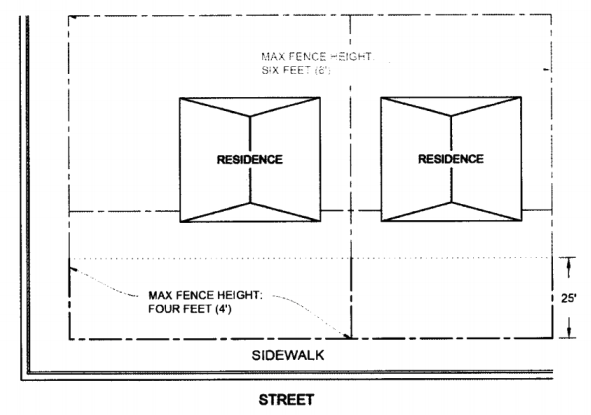
- Fencing within twenty-five feet (25') of the main property frontage, including any fencing along the side(s) of a property, may not exceed four feet (4') in height. Fencing beyond twenty-five feet (25') from the property frontage may not exceed seven feet (7') in height. (Diagram 9-21-1)
Diagram 9-21-1: Fencing setbacks (residential). NOTE: Any conflict between Diagram 9-21-1 and the text of the Delta City Code should be determined by the text of the Code and not the diagram.
- Fences Allowed / Maximum Height:
- Fences, walls and hedges may be allowed in any required yard, or along the edge of any yard in a height not exceeding seven feet (7'); provided, that no fence, wall or hedge along the front, as defined in DCC 18.04.010, edge of any front yard shall be over four feet (4') in height.
- In places where a residential zone abuts a different zone, the fence height allowance may be extended to nine feet (9'), at the point where the zones adjoin, to allow for privacy in the residential yard.
- Construction Material:
- All fences and walls shall be constructed of substantial material and the design and construction shall be consistent with the quality of dwellings and other improvements within the surrounding area. Examples of acceptable fencing construction material include, but are not limited to, vinyl, block, chainlink, concrete and cedar slate. No barbed wire or electrically charged fences shall be allowed except in the industrial, rural residential or agricultural zones, or as required by Federal, State or local statute for protection purposes.
- Fencing within twenty-five feet (25') of the main property frontage, including any fencing along the side(s) of a property, may not exceed four feet (4') in height. Fencing beyond twenty-five feet (25') from the property frontage may not exceed seven feet (7') in height. (Diagram 9-21-1)
Diagram 9-21-1: Fencing setbacks (residential). NOTE: Any conflict between Diagram 9-21-1 and the text of the Delta City Code should be determined by the text of the Code and not the diagram.
- Fencing Regulations - Non-residential:
- The following provisions shall govern the height and location of fences, walls, and hedges or other obstructions to view.
- Subject to intersection visibility setout above in 18.64.100(A)(3), fences, walls and hedges up to seven feet (7') in height may be constructed or maintained in non-residential zones.
- Construction Material: All fences and walls shall be constructed of substantial material and the design and construction shall be consistent with the quality of dwellings and other improvements within the surrounding area. Examples of acceptable fencing construction material include, but are not limited to, vinyl, block, chainlink, concrete and cedar slate. It shall be unlawful for any person to erect or maintain any concertina or razor wire, or electric fence along or adjacent to any public street in the City, unless required by federal, state, or local statute for protection purposes. (Ord. 18-277, 2-15-2018)
- The following provisions shall govern the height and location of fences, walls, and hedges or other obstructions to view.
- Building Permit Required:
- Submittal, Approval Required: In order to ensure correct placement to establish accurate property lines, avoid conflict with public utilities and reduce conflict between adjacent property owners, a fence permit must be obtained prior to the placement or complete replacement of any fence or wall. Before commencing construction, plans for all fences, living fences and walls shall be submitted to and approved by the Code Enforcement Officer.
- Referral To Planning Commission: Where, in the opinion of the City staff, a proposed fence, living fence or wall does not conform to the above criteria, the Code Enforcement Officer shall refer the application to the Planning Commission for action. The Planning Commission shall have the authority to reverse, affirm or modify any decision of the Code Enforcement Officer.
- Fee For Permit: The applicant for a fence permit shall pay a fee set by the fee schedule.
- Before commencing construction of a fence or wall, plans shall be submitted and approved by the Public Works Director. Construction of fences, walls and retaining walls must meet applicable requirements of Delta Building Code. For construction of all fences over seven feet (7') and retaining walls over four feet (4'), including the footings, in height, a building permit must also be secured. (Ord. 18-277, 2-15-2018)
HISTORY
Amended by Ord. 19-282 on 12/4/2019
Amended by Ord. 20-288 on 12/16/2020
Amended by Ord. 2022-299 on 11/16/2022
Amended by Ord. 19-282 on 12/4/2019
Amended by Ord. 20-288 on 12/16/2020
Amended by Ord. 2022-299 on 11/16/2022
18.64.110 Group Homes
- Purpose: The purpose of this section is to allow for the continuation of low density residential neighborhoods and to not encourage an over concentration of congregate living facilities that tends to create an "institutional" rather than a "residential" atmosphere in the applicable neighborhoods.
- Distinguish between facilities providing residential services to the disabled or to the elderly and other congregate living facilities, such as youth homes;
- Avoid the institutionalization of residential neighborhoods and create an environment that will facilitate the "mainstreaming" of persons with disabilities and elderly persons into a "normalized" residential environment;
- Provide an opportunity for congregate living facilities to be located within the City;
- Establish zoning uses, standards and practices which will not have the effect of discriminating against congregate living arrangements of unrelated people with disabilities or the elderly;
- Enact a separation requirement of at least one-fourth (1/4) mile that is necessary to provide the adequate mixture of residential housing types to meet the needs of maintaining a "normalized" residential environment, while still providing adequate alternatives for the establishment of such housing throughout the community. (Ord. 18-277, 2-15-2018)
- Requirements:
- Residential Facility For Disabled: Residential facility for the disabled is defined as a facility that is occupied on a twenty four (24) hour per day basis in a family type arrangement under the supervision of a house family or manager, and that conforms to all applicable standards and requirements of and is licensed by the Utah Department of Human Services - Division of Services for People with Disabilities, and is operated by or under contract with that department. Such facilities are not residential treatment facilities and shall not include facilities for the following: secure treatment, inpatient treatment, residential treatment, adult daycare, day treatment, comprehensive mental health treatment, comprehensive substance abuse treatment or domestic violence treatment, as defined in Utah Code § 62A-2-101.
- A residential facility for persons with a disability requires a conditional use permit and is permitted only in residential and agricultural zones. The application for a conditional use permit shall include sufficiently detailed site plans, building plans or remodeling plans, and all other information necessary to determine compliance with building, safety and health regulations and standards applicable to similar dwellings. Any alterations must be reviewed and recommended by the Planning Commission before a conditional use permit is approved. Additionally, the facility shall conform to all applicable Building, Fire, Health and Safety Codes and requirements for facilities of this type.
- A residential facility for persons with a disability is subject to this title, the standards contained herein, and the exemptions below.
- A residential facility for persons with a disability shall not have any structural or landscaping alterations that would change the structure's residential character.
- A residential facility for persons with a disability shall be limited to five (5) persons unrelated to the owner or provider.
- A residential facility for persons with a disability shall not be located within a radius of one-fourth (1/4) mile of another existing congregate living facility inside or outside of the City limits.
- Residential Facility For Elderly: Residential facility for the elderly is defined as a facility that is occupied on a twenty four (24) hour per day basis in a family type arrangement under the supervision of a house family or manager, and that conforms to all applicable standards and requirements of and is licensed by the appropriate licensing department of the State and is operated by or under contract with that department. A residential facility for the elderly is not a residential treatment facility and shall not include facilities for the following: secure treatment, inpatient treatment, residential treatment, adult daycare, day treatment, comprehensive mental health treatment, comprehensive substance abuse treatment or domestic violence treatment as defined in Utah Code § 62A-2-101.
- A residential facility for the elderly requires a conditional use permit and is permitted only in residential and agricultural zones. The application for a conditional use permit shall include sufficiently detailed site plans, building plans or remodeling plans, and all other information necessary to determine compliance with building, safety and health regulations and standards applicable to similar dwellings. Any alterations must be reviewed and recommended by the Planning Commission before a conditional use permit is approved. Additionally, the facility shall conform to all applicable Building, Fire, Health and Safety Codes and requirements for facilities of this type.
- A residential facility for the elderly is subject to this title, the standards contained herein, and the exemptions below.
- A residential facility for the elderly shall not have any structural or landscaping alterations that would change the structure's residential character.
- A residential facility for the elderly shall be limited to five (5) persons unrelated to the owner or provider.
- A residential facility for the elderly shall not be located within a radius of one-fourth (1/4) mile of another existing congregate living facility inside or outside of City limits.
- Youth Home: Youth home is defined as a twenty four (24) hour group living environment for three (3) or more persons under the age of eighteen (18), unrelated to an owner or provider that offers room, board or specialized services to residents. Youth home may include facilities for the following: resource family home, child placement or residential support as defined in Utah Code 62A.
- A youth home requires a conditional use permit and is permitted only in zones primarily permitting residential or agricultural development, subject to specific requirements of the land use ordinance. The application for a conditional use permit shall include sufficiently detailed site plans, building plans or remodeling plans, and all other information necessary to determine compliance with building, safety and health regulations and standards applicable to similar dwellings. Any alterations must be reviewed and recommended by the Planning Commission before a conditional use permit is approved. Additionally, the facility shall conform to all applicable Building, Fire, Health and Safety Codes and requirements for facilities of this type.
- A youth home is subject to this title, the standards contained herein, and the exemptions below.
- A youth home shall not have any structural or landscaping alterations that would change the structure's residential character.
- Youth homes shall be limited to five (5) persons under the age of eighteen (18) who are unrelated to the owner or provider of the youth home.
- A youth home shall not be located within a radius of one-fourth (1/4) mile of another existing congregate living facility inside or outside of the City limits. (Ord. 18-277, 2-15-2018)
- Residential Facility For Disabled: Residential facility for the disabled is defined as a facility that is occupied on a twenty four (24) hour per day basis in a family type arrangement under the supervision of a house family or manager, and that conforms to all applicable standards and requirements of and is licensed by the Utah Department of Human Services - Division of Services for People with Disabilities, and is operated by or under contract with that department. Such facilities are not residential treatment facilities and shall not include facilities for the following: secure treatment, inpatient treatment, residential treatment, adult daycare, day treatment, comprehensive mental health treatment, comprehensive substance abuse treatment or domestic violence treatment, as defined in Utah Code § 62A-2-101.
- Design:
- Development Standards: Any conversion of buildings or new construction of a congregate living facility shall require that the development standards of this title are met.
- Open Space; Parking: Any conversion of existing buildings or uses to a congregate living facility must provide at least thirty percent (30%) of the area as open green space or playground and at least two (2) parking spaces per residential unit and adequate off street parking spaces for the staff and visitors of the facility as determined by the City Council. The City Council may reduce the parking requirement as part of the conditional use approval upon a finding that less parking will meet the needs of the public and the proposed program.
- Considerations: The Planning Commission and City Council shall consider the general plan, protection of permitted uses in underlying zones, and the aesthetics of any proposed building in making its recommendations and/or approval to any congregate living facility. (Ord. 18-277, 2-15-2018)
- Fees And Financial Capability: The applicant for a permit or license to operate a congregate living facility shall pay the applicable license and permit fees as set by the fee schedule. Applicant shall also provide proof of financial capability to ensure timely restitution to any member of the public suffering damage as a result of intentional or negligent conduct by members of the staff or residents of the facility. Proof of financial capability may take the form of insurance, bonds or financial reserves. Proof of financial capability shall be resubmitted to the City annually or sooner if significantly changed. (Ord. 18-277, 2-15-2018)
- Exemptions: No congregate living facility shall include facilities which house persons being treated for alcoholism or drug abuse, persons who have committed violent crimes, who are not voluntarily residing therein, or who are residing therein as a part of or in lieu of confinement, rehabilitation or treatment in a correctional or other facility. (Ord. 18-277, 2-15-2018)
- Standards And Conditions:
- Conditions: The Planning Commission and/or City Council may set whatever conditions upon a conditional use permit to operate a youth home or a residential facility for persons with a disability or a residential facility for the elderly it deems to be in harmony with the General Plan and in the best interests of the health, safety and welfare of the City, including, but not limited to, the following conditions:
- A community impact study shall be provided by the applicant as part of the application for the conditional use permit. This study shall specifically describe the programs provided and evaluate the impact of the congregate living facility on local schools, the City's economy and economic resources, the tax revenue of the City, the City's infrastructure, including sewer concerns, public safety and law enforcement, traffic, aesthetics, tourism and neighboring properties and businesses, including the impact on property values, if any, and the impact of any other uses within or proposed within the same building to be used as a congregate living facility.
- A minimum of one thousand feet (1,000') must be maintained between congregate living facilities and establishments licensed to sell beer or alcoholic beverages.
- The application for business license shall include the following:
- Proof of cleared background (Bureau of Criminal Identification) checks for all staff that will have direct contact with consumers.
- Written job descriptions, including specific duties and responsibilities and the minimum level of education, training and work experience required.
- Business plan.
- References, including educational background, training and relevant experience of the manager of the facility.
- Educational plan, including a letter from an authorized accreditation organization stating their intent to accredit the facility's educational program.
- The facility shall have twenty four (24) hour per day supervision by trained and qualified personnel, with daytime ratios of at least one to four (1:4) and evening ratios of at least one to eight (1:8).
- Staff shall have access to the following professionals:
- A licensed physician or consulting licensed physician;
- A licensed psychologist or consulting licensed psychologist;
- A licensed mental health therapist;
- A licensed advanced practice registered nurse - psychiatric mental health nurse specialist, or a consulting advanced practice registered nurse - psychiatric mental health nurse specialist; and
- If unlicensed staff are used, they shall be supervised by a licensed clinical professional. (R501-19-5.D)
- The facility's behavior management policy shall be provided to all staff, and staff shall receive training relative to behavior management annually, or more often if needed.
- The facility shall provide twenty four (24) hour supervision of the residents by an adult of the same sex and at least ten (10) years older than the oldest youth resident.
- The facility shall admit only consumers who are agreeable to a waiver of objection to the disclosure through the house family or manager of their current juvenile record for purposes of a confidential report by that family or manager, upon request by the Mayor, as to the identity and background of any troubled youth in the facility from time to time.
- The number of residents in the facility shall not increase above the number allowed in the conditional use permit unless an amendment to the permit is reviewed and approved by the City. Any request for amendment shall be accompanied by the study described in paragraph F,1,a.
- Facility shall report to the City on the first of each month all incidents required to be reported to the Department of Human Services.
- Facility shall report as quickly as possible, but not later than within twenty four (24) hours, any escape, violent incident or crime occurring at the facility. (Ord. 18-277, 2-15-2018)
- Conditions: The Planning Commission and/or City Council may set whatever conditions upon a conditional use permit to operate a youth home or a residential facility for persons with a disability or a residential facility for the elderly it deems to be in harmony with the General Plan and in the best interests of the health, safety and welfare of the City, including, but not limited to, the following conditions:
- Licenses, Permits, Certifications and Compliance:
- Business License Required: To operate a residential facility for persons with disabilities, as licensed by the Department of Human Services, Division of Services for Persons with Disabilities, or to operate a residential facility for the elderly, as licensed by the State Department of Human Services, or to operate a youth home as licensed by the State Department of Human Services, the owner or provider shall be required to maintain a valid business license with the City.
- Residential Facility For Persons With Disability; State Department Of Human Services, Utah Division Of Services For People With Disabilities License Or Certification Required: Applicants must verify, with documentation to the Planning Commission and City Council, compliance with all applicable requirements, regulations and standards of the State Department of Human Services governing the licensing and operation of residential facilities for persons with a disability. At the time of application for a permit and/or business license to establish a residential facility for persons with a disability or within sixty (60) days following approval of a residential facility for persons with a disability by the City Council, the applicant shall provide to the City Recorder evidence that the facility is licensed or certified by the Department of Human Services Division of Services for People with Disabilities or the City shall not issue any business license required to operate a residential facility for persons with a disability, until such evidence is provided. Failure to provide such evidence shall also be grounds for the City to initiate proceedings to revoke any valid City approvals for a residential facility for persons with a disability.
- Residential Facility For Elderly; State Department Of Human Services License Or Certification Required: Applicants must verify, with documentation to the Planning Commission and City Council, compliance with all applicable requirements, regulations and standards of the State Department of Human Services governing the licensing and operation of residential facilities for the elderly. At the time of application for a permit and/or business license to establish a residential facility for persons with a disability or within sixty (60) days following approval of a residential facility for the elderly by the City Council, the applicant shall provide to the Delta City Recorder evidence that the facility is licensed or certified by the Department of Human Services or the City shall not issue any business license, required to operate a residential facility for the elderly, until such evidence is provided. Failure to provide such evidence shall also be grounds for the City to initiate proceedings to revoke any valid City approvals for a residential facility for the elderly.
- Youth Home; State Department Of Human Services License Or Certification Required: Applicants must verify, with documentation to the Planning Commission and City Council, compliance with all applicable requirements, regulations and standards of the State Department of Human Services governing the licensing and operation of youth homes. At the time of application for a permit and/or business license to establish a youth home or within sixty (60) days following approval of a youth home by the City Council, the applicant shall provide to the City Recorder evidence that the facility is licensed or certified by the appropriate department of the State or the City shall not issue any business license required to operate a youth home, until such evidence is provided. Failure to provide such evidence shall also be grounds for the City to initiate proceedings to revoke any valid City approvals for a youth home.
- Continued Licensure Or Certification Requirements Of The State: Operation of a residential facility for persons with a disability requires continued compliance, without interruption, with the Licensure Department of Human Services, Division of Services for People with Disabilities. The responsibility to certify or license programs or owners or providers which operate residential facilities for persons with a disability, as well as require and monitor the provision of adequate services to consumers residing in these facilities shall rest with the Department of Human Services, Division of Services for People with Disabilities. Operation of a residential facility for the elderly requires continued compliance, without interruption, with the State Department of Human Services. The responsibility to license programs or entities which operate residential facilities for the elderly, as well as to monitor the provision of adequate services to persons residing in those facilities, shall rest with the Department of Human Services as provided in Utah Code Annotated. Operation of a residential facility for the elderly requires continued compliance, without interruption, with the State Department of Human Services. The responsibility to license programs or entities which operate youth homes, as well as to monitor the provision of adequate services to persons residing in those facilities, shall rest with the Department of Human Services as provided in Utah Code § 62A-2.
- Special Provisions For Congregate Living Facilities:
- A permit to operate a congregate living facility, as regulated by this section, shall be:
- Subject to a nontransferable business license; and
- Terminated if at any time it is demonstrated to the City Council, that:
- The structure is devoted to a use other than the City approved use; or
- The structure fails to comply with the requirements of this section; or
- The program has failed to operate in accordance with the requirements of this section; or
- The applicant has not obtained and maintained, without interruption, all licenses from the State required to operate and provided the City with proof of such licenses. If the license issued by the State expires, the City business license will automatically become void and the facility must close.
- Application for reinstatement of a City permit or business license must be made to the City Council and will be subject to approval by that body.
- A congregate living facility shall be occupied on a twenty four (24) hour basis by no more than the maximum number allowed per the International Building Code for egress requirements, which will include all supervisors and staff.
- Any conditional use permit for a congregate living facility shall be for a specified number of individuals.
- A permit to operate a congregate living facility, as regulated by this section, shall be:
- License Nontransferable:
- Conditional use permits granted to congregate living facilities shall expire upon the expiration, revocation or surrender of any City business license, State license, or other regulatory license of the facility. A City business license to operate a residential facility for persons with a disability, as authorized by this title, is nontransferable. A business license to operate a residential facility for persons with a disability, as authorized by this title, is nontransferable and shall only be valid to the owner or provider identified on a valid City business license permit authorizing the operation of a residential facility for persons with a disability and identified as the owner or provider as licensed or certified by the Department of Human Services, Division of Services For People with Disabilities.
- A business license to operate a residential facility for the elderly, as authorized by this title, is nontransferable and shall only be valid to the owner or provider identified on a valid City business license permit authorizing the operation of a residential facility for the elderly and identified as the owner or provider as licensed or certified by the appropriate division of the State as required by this paragraph G.
- A business license to operate a youth home, as authorized by this title, is nontransferable and shall only be valid to the owner or provider identified on a valid City business license permit authorizing the operation of a youth home and identified as the owner or provider as licensed or certified by the appropriate division of the State as required by this paragraph G. (Ord. 18-277, 2-15-2018)
- Procedure:
- Checklists: Anyone desiring to procure a City permit and/or license to operate a residential facility for the disabled or the elderly, or a youth home, shall begin the process by completing the Congregate Living Facility Checklist (Appendix A), consulting with the City Recorder or the Code Enforcement Officer, or Planning and Zoning Administrator when necessary. When the checklist has been reviewed and deemed complete by the City Recorder, the applicant may be placed on the agenda of the next regular meeting of the Planning Commission.
- Planning Commission Recommendation: The Planning Commission will hear the applicant's proposal, review the checklist and all required documentation, and determine whether or not it is in harmony with the General Plan and in compliance with this title and State and City standards for granting a conditional use permit. The Planning Commission shall then make findings and recommendations to the City Council, including any specific conditions to be placed on the permit, in writing.
- City Council Approval: Once the Planning Commission has forwarded formal written recommendations to the City Council, the applicant may be placed on the agenda of a regular City Council meeting. The Council may then approve, modify and approve, or deny the conditional use permit.
- Business License: If the City Council approves a conditional use permit for a congregate living facility, the applicant may then supply the necessary documentation and request a business license to operate the facility. (Ord. 18-277, 2-15-2018)
- Appendix A; Congregate Living Facility Checklist: Before an applicant may be placed on the agenda for the Planning Commission, the City Recorder must verify that all of the following documentation has been received by the City:
- Written verification of Department of Criminal Investigations clearance for the facility's operator and any other persons who are to have direct contact with minors or vulnerable adults in a congregate living facility.
- Concept plan for facility.
- Documented proof of ownership of the land, or a valid lease where the facility is to be located. Letter of intent from the State department who will license the facility.
- If the facility provides schooling for minor consumers, written verification of curriculum approval from the State Office of Education. If incorporated, applicant must provide proof of active corporation status, including corporation ownership, from the Utah Department of Commerce.
- Copies from the appropriate licensing department of the State of any written complaints, including employee grievances, against the applicant or facility applying for a business license.
- Where appropriate, supply documents which comply with Human Services Core Standards R501-2-6 and R501-2-7 (what must be available for public inspection).
- Eligibility and/or intake policy outlining the reasons a facility would consider accepting new consumers.
- A written statement from State Board of Education or the National School Accreditation Board verifying accreditation shall be provided.
- Verification of licensure (Utah Department of Professional Licensing number) for medical personnel, therapists and/or social workers, and teachers.
- Organizational chart, including the names of the applying facility's board of directors. (Ord. 18-277, 2-15-2018)
HISTORY
Amended by Ord. 20-288 on 12/16/2020
Amended by Ord. 20-288 on 12/16/2020
18.64.120 Home Occupations
- Conditions And Requirements: Any party engaging in a home occupation (see definition in DCC 18.04.010) must fully comply with the business license provisions of DCC 18.08, as well as with the requirements of this title. When a home occupation is listed as one of the permitted uses within a zone district, such home occupation may be conducted in a dwelling unit within that district; provided, that all of the following conditions are met:
- Within Dwelling: Such use shall be conducted entirely within a dwelling unit and shall be carried on by the inhabitants living there and no others.
- Incidental, Secondary Use: Such use shall be clearly incidental and secondary to the use of the dwelling for dwelling purposes and shall not change the residential character or external appearance thereof in any manner.
- Total Area: The total area used for such purposes shall not exceed one-third (1/3) of the gross floor area of the user's dwelling unit.
- Exterior Storage, Display: There shall be no exterior storage on the premises of material or equipment used as part of the home occupation, nor any outdoor display of merchandise.
- Nuisances: There shall be no offensive noise, vibration, smoke, dust, odors, heat or glare noticeable at or beyond the property line.
- Off Street Parking: A home occupation shall provide additional off street parking of one parking space for each two hundred (200) square feet of gross floor area occupied by the home occupation. The parking plan for such additional parking space or spaces shall be approved by the Code Enforcement Officer prior to issuance of any business license required under DCC 18.08.
- Vehicles, Trucks: Specialized vehicles and trucks such as wreckers, semi-trucks and dump trucks, utilized in a home occupation, shall not be stored on the premises of a residential lot or on a public street or right-of-way.
- Demand For Municipal Services: Shall not cause a demand for Municipal services in excess of that associated with normal residential use.
- Building Code Compliance: Shall be enclosed within a structure in complete conformity with International Building Codes as adopted by the City.
- Prohibited Home Occupations: Is not a mortuary, animal hospital, kennel, clinic, hospital, RV service, junkyard, auto repair service, public stable or adult oriented business. (Ord. 18-277, 2-15-2018)
HISTORY
Amended by Ord. 20-288 on 12/16/2020
Amended by Ord. 20-288 on 12/16/2020
18.64.130 SOLAR ENERGY SYSTEMS
- Solar Energy Systems. Solar Energy Systems are allowed in all zones, subject to the following requirements:
- Setback and Location Requirements.
- Building mounted systems are permitted to face any rear, side or front yard areas.
- Building mounted systems may only be mounted on lawfully permitted principal or accessory structures.
- Limitation on Free Standing Solar Systems.
- The square footage of a free standing solar energy system may not exceed that amount of square footage that would be able to be installed if the solar energy system were installed on the principal or accessory structures on the lot.
- Free standing solar energy systems intended primarily for commercial generation of solar power to be provided to others are not allowed.
- Free standing solar energy systems, if allowed, are subject to accessory use and structure requirements as set out in this Title.
- The highest point of of a free standing solar energy system may not exceed eight (8) feet.
- No part of a free standing system shall extend into required setbacks of a lot.
- Height Restrictions.
- Pitched Roof
- For a building mounted system installed on a pitched roof that faces the front yard of a property, shall have a maximum distance, measured perpendicular to the roof, of twelve (12) inches between the roof and highest edge or surface of the system.
- For a building mounted system installed on a pitched roof, the highest point of the system shall not exceed past the roof ridge or bottom side edges.
- Flat Roof.
- Commercial and Industrial Zones: For a building mounted system installed on a flat roof, the highest point of the roof system shall be permitted to extend up to six (6) feet above the roof to which is it attached at a twenty degree (20°) angle maximum and shall meet all design review, screening and visibility requirements found elsewhere in this Title.
- Residential Zones: For a building mounted system installed on a flat roof, the highest point of the roof system shall be permitted to extend up to three (3) feet above the roof to which is it attached at a twenty (20°) degree angle maximum and shall meet all design review, screening and visibility requirements found elsewhere in this Title.
- Pitched Roof
- Design Standards.
- Solar energy systems shall be designed to blend into the architecture of the building and surrounding neighborhood where feasible, or screened from view from public right-of-ways. The Code Enforcement Officer of Planning and Zoning Commission may consider other architectural methods as proposed by the applicant that will meet the same intent of this section and of similar material quality and craftsmanship, including, but not limited to: parapet wall, setback from roof edge, architectural elements attached to the building.
- For a building mounted system installed on a pitched roof, the system must be installed at the same angles and contour of the roof on which it is installed.
- Building integrated solar systems shall be allowed, provided the building component in which the system is integrated meets all required setback design standards, and other requirements for the zone in which the building is located.
- Solar panels shall be constructed of non-glare glass with an aluminum frame or materials better or equal to such.
- Reasonable efforts, as determined by the Code Enforcement Officer, may be made to minimize visual impacts by preserving natural vegitations, screening adjoining property, or other appropriate measures.
- Building Permits Required.
- It is unlawful for any person, whether acting as owner, occupant or contractor, or otherwise to install, construct, reconstruct, enlarge, locate or alter any solar energy system within the City contrary to any provisions of this chapter or without first obtaining a building permit from the City. No system shall be installed, constructed, reconstructed, located or altered until the plans for such system have been approved and a permit issued by the City.
- Solar energy systems shall comply with all applicable uniform building and electrical codes adopted by the City.
- The Fire Marshall shall approve of all proposed solar energy system plans for emergency access and fire code compliance.
- The Fire Marshall shall approve of all proposed solar energy system plans for emergency access and fire code compliance.
- Setback and Location Requirements.
HISTORY
Adopted by Ord. 20-288 on 12/16/2020
Adopted by Ord. 20-288 on 12/16/2020
18.64.140 ADULT ORIENTED BUSINESSES
- Purpose. The purpose and objective of this section is to establish reasonable and uniform regulations to prevent the concentration of adult-oriented businesses or their location in areas deleterious to the health, safety and welfare of the City, and to prevent inappropriate exposure of such businesses to the community. This criteria regulates the time, place and manner of the operation of sexually-oriented businesses, consistent with the United States and Utah State Constitutions
- Location. No adult-oriented business may be located within one-thousand (1,000) feet of any:
- School, day care facility, cemetery, public park, library or religious institution;
- residential zoning boundary;
- Liquor store; or
- other adult oriented business.
- For the purpose of this section, distance is measured in a straight line, without regard to intervening structures or objects, from the closest exterior wall of the structure in which the adult-oriented business is located and
- The closest exterior wall of another adult-oriented business;
- the closest property line of any school, daycare facility, public park, library, cemetery or religious institutions; and
- the nearest property line of any residential zone.
HISTORY
Adopted by Ord. 20-288 on 12/16/2020
Adopted by Ord. 20-288 on 12/16/2020
18.64.150 Retail Tobacco Specialty Business
- No retail tobacco specialty business shall be located within:
- One thousand feet (1,000'), of the boundary of any residential zone, residential use or a parcel occupied by any of the following:
- A public or private kindergarten, elementary, junior or high school;
- A licensed childcare facility or preschool other than a family daycare facility;
- A playground;
- A youth center;
- A recreational facility;
- An arcade;
- A park; or
- A library.
- One thousand feet (1,000'), of the boundary of any residential zone, residential use or a parcel occupied by any of the following:
- Limited Number: One tobacco/e-cigarette retailer shall be allowed for every ten thousand (10,000) citizens living in the city
- Limited Density of Tobacco/E-Cigarette Retailers: No tobacco/e-cigarette retailer shall be located within five hundred feet (500') of a site occupied by another tobacco/e-cigarette retailer, as measured in a straight line from parcel boundary to parcel boundary.
- Measurement: For the purposes of this subsection, the proximity requirements shall be measured in a straight line from the nearest entrance of the retail specialty business to the nearest property boundary of the community location, residential uses, or other retail tobacco specialty business, without regard to intervening structures or zoning districts.
HISTORY
Adopted by Ord. 20-288 on 12/16/2020
Adopted by Ord. 20-288 on 12/16/2020
18.64.160 CHILDCARE FACILITY/CENTER
- Application, Compliance Requirements: Each application for a child care facility, center or home occupation must include and comply with:
- Proof of application for state child care license;
- Compliance with state, federal and local law;
- A design that does not include a front yard playground;
- A parking and traffic plan that adequately mitigates the adverse impacts of increased traffic in the neighborhood (if a facility or center);
- Childcare providers as a home occupation may not exceed eight (8) children, twelve (12) years of age or younger, including the providers own children at any given time; and
- Childcare providers as a home occupation may not provide services for more than two (2) infants under the age of two (2) at any given time.
HISTORY
Adopted by Ord. 20-288 on 12/16/2020
Adopted by Ord. 20-288 on 12/16/2020
18.64.170 (Reserved)
HISTORY
Adopted by Ord. 20-288 on 12/16/2020
Amended by Ord. 22-292 on 2/16/2022
Adopted by Ord. 20-288 on 12/16/2020
Amended by Ord. 22-292 on 2/16/2022
18.64.180 Multiple-Family Dwellings
This section shall apply to any Two-Family Dwelling, Three-Family Dwelling,, and Four-Family Dwelling.
- Open Space requirement. Five-hundred (500) square foot of open space per dwelling unit.
- Required Amenities
- At a minimum, each dwelling unit must include the following amenities:
- Location and necessary plumbing for clothes washer and dryer;
- Location, plumbing, and appliance of a dishwasher in the kitchen.
- At a minimum, each dwelling unit must include the following amenities:
- Landscaping Requirements.
- At a minimum, landscaping is required in the front of buildings, and in the front setback of any improved property not used for parking, driveways, walkways.
- If ornamental gravel is utilized, it must be contained within durable borders or landscaped edging.
- At a minimum, landscaping is required in the front of buildings, and in the front setback of any improved property not used for parking, driveways, walkways.
HISTORY
Adopted by Ord. 20-288 on 12/16/2020
Amended by Ord. 22-292 on 2/16/2022
Amended by Ord. 2023-302 on 11/15/2023
Adopted by Ord. 20-288 on 12/16/2020
Amended by Ord. 22-292 on 2/16/2022
Amended by Ord. 2023-302 on 11/15/2023
18.64.190 Townhome Building Form And Development
This section shall apply to any Two-Family Dwelling, Three-Family Dwelling, and Four-Family Dwelling that are intended to be subdivided as townhomes.
- General Policy Statement: This Section shall be interpreted such that it is the intent that the subdivision of a townhome within Delta City results in each Townhome being self-servicing, meaning that each townhome will have sufficient, open-space (yard), access to utilities, off-street parking, each townhome having direct access to a public-right-of-way, etc.
- Townhome dwellings are allowed in any zone a Two-Family Dwelling, Three-Family Dwelling, or Four-Family Dwelling would be allowed; meaning that a two-family dwelling townhome is an allowed use in a zone that a Two-family Dwelling is allowed, and same with a three or four-family dwelling.
- Any and all requirements of Title 16 and 18 that would be applicable to any building for multi-family dwellings including, but not limited to the following, shall be applicable to townhome buildings:
- Minimum lot size requirements shall be evaluated based on the total building and the number of residential units within the building.
- Frontage requirements shall be evaluated based on the total width of all parcels, lots, or units located within a townhome building, not a individual residential unit within a townhome building.
- Townhome buildings, and any number of dwelling units, are specially prohibited from fronting narrow right-of-way streets.
- Each dwelling unit of a townhome building shall be considered its own residential unit for the purposes of minimum parking standards pursuant to Delta City Code 18.64.050.
- The minimum off street parking for each individual dwelling unit must be:
- Immediately accessible and front a public-right-of-way.
- Be located on the parcel or lot of the individual dwelling unit the parking is allocated to.
- Shared off-street parking between townhome units is prohibited.
- The minimum off street parking for each individual dwelling unit must be:
- Each structure shall have five-hundred (500) square feet of open space per dwelling unit with such open-space being located on the same parcel as the dwelling unit. The open space for the individual townhomes may be connected, but each town home must satisfy it own open space requirement.
- Metering and Equipment Placement:
- Each townhome shall have individual and separate metering for all utility services.
- Wall-mounted and ground-based meters, HVAC and utility equipment serving any building shall:
- be fully screened from view or located to the sides or rear of the building.
- be placed upon the lot or parcel of residential unityofresidentialunity that it is servicing; and
- shall not be located on any facade on which a Townhome's primary entrance is located.
- Circulation
- Each building in which Townhomes are located shall include concrete sidewalks, at least four (4) feet in width, that connects each Townhome, to the right-of-way primarily used to access the Townhome, commonly owned amenity of the Townhome, and waste container to be utilized by the residents of the Townhome.
- Public Right-of-Way Access:
- The Primary Façade of all Buildings shall front onto a public right-of-way.
- All townhome buildings shall be adjacent to and front publica townstreet,homeandbuilding shallbe located on lots to provide immediate access from public access from a public street and allow forstreetaccess forallow convenienthaveaccessifor fire and emergency access.
- The Primary Façade of all Buildings shall front onto a public right-of-way.
- Conversion: Existing multi-family dwellings may be converted townhomes, provided that the proposed townhomes complies with all standards are requirements of this chapter, title, and applicable international building codes.
- Each townhome shall have an identifiable transition between the individual units.
HISTORY
Adopted by Ord. 2023-302 on 11/15/2023
Adopted by Ord. 2023-302 on 11/15/2023

