
Doral City Zoning Code
ARTICLE II
RESIDENTIAL DISTRICTS
Sec. 68-40. - Intent and purpose.
The intent and purpose of the single-family residential-1 district (SF-1) is to protect and preserve the integrity and value of existing, stable residential neighborhoods of estate density while at the same time allowing a careful and deliberate redevelopment and revitalization of such neighborhoods in need of reinvigoration or neighborhoods with unique amenities which create unique opportunities to increase property values and the overall attractiveness of the city.
(Ord. No. 2007-12, exh. A(ch. V, § 1(a)), 8-22-2007)
Sec. 68-41. - Permitted uses—Generally.
The following uses are permitted in the single-family residential-1 district (SF-1), while all other uses are conditional or prohibited:
(1)
Every use as a one-family residence, including every customary use not inconsistent therewith, including a private garage.
(2)
Municipal recreation buildings, playgrounds, parks or reservations owned and operated by a municipality, county, state or the federal government.
(3)
Public schools.
(Ord. No. 2007-12, exh. A(ch. V, § 1(b)), 8-22-2007; Ord. No. 2016-06, § 2, 6-22-2016)
Sec. 68-42. - Same—With special development requirements.
The following shall be the permitted uses with special development requirements in the single-family residential-1 district (SF-1):
(1)
Private recreation area, private recreation building or playground owned and maintained by a homeowner's or tenant association, provided same is approved in conjunction with approval of the subdivision at the time of site plan approval or plat.
(2)
Family day care and after-school care for children pursuant to section 74-155.
(3)
A group home in a dwelling unit pursuant to section 74-156.
(4)
Houses of worship pursuant to section 74-160.
(5)
Golf courses pursuant to section 74-165.
(6)
Uses that are allowed under power lines such as neighborhood nursery gardens, greenhouses and other similar uses pursuant to chapter 74, article II, division 3.
(7)
Ancillary uses to residential uses pursuant to section 74-146:
a.
Small doctor's office.
b.
Fitness center.
c.
Private education.
d.
Child care.
e.
Dance and karate studios.
f.
Therapy for elderly.
g.
Assembly halls.
h.
Art instruction.
i.
Convenience stores.
j.
Government uses.
(8)
Small-scale public facilities and utilities less than one acre in size.
(9)
All other related and/or similar uses.
(Ord. No. 2007-12, exh. A(ch. V, § 1(c)), 8-22-2007; Ord. No. 2016-06, § 2, 6-22-2016)
Sec. 68-43. - Development standards and additional regulations.
Refer to chapter 53, article II, division 5 for a detailed list of various types of uses and development standards. For additional regulations refer to:
(1)
Chapter 71, landscaping;
(2)
Chapter 74, articles IX—XI, towers, poles and masts;
(3)
Chapter 77, roads and vehicular use areas;
(4)
Chapter 80, sign regulations; and
(5)
Chapter 86, urban design and architectural standards.
(Ord. No. 2007-12, exh. A(ch. V, § 1(d)), 8-22-2007; Ord. No. 2016-06, § 2, 6-22-2016)
Sec. 68-44. - Illustration of district.
The following is a graphic description of the single-family residential-1 district:
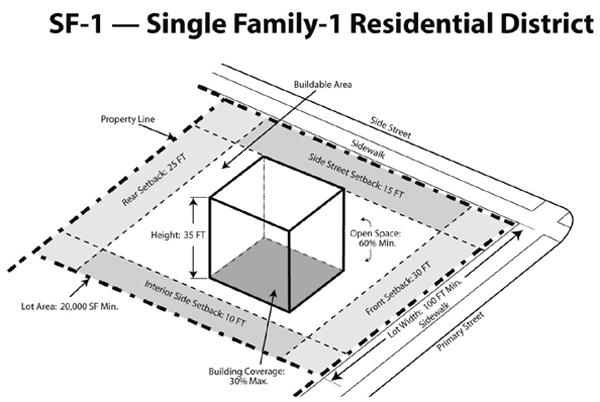
(Ord. No. 2007-12, exh. A(ch. V, § 1(d)), 8-22-2007)
Sec. 68-62. - Intent and purpose.
The intent and purpose of the single-family residential-2 district (SF-2) is to protect and preserve the integrity and value of existing, stable residential neighborhoods of estate density while at the same time allowing a careful and deliberate redevelopment and revitalization of such neighborhoods in need of reinvigoration or neighborhoods with unique amenities which create unique opportunities to increase property values and the overall attractiveness of the city.
(Ord. No. 2007-12, exh. A(ch. V, § 2(a)), 8-22-2007)
Sec. 68-63. - Permitted uses—Generally.
The following uses are permitted in the single-family residential-2 district (SF-2), while all other uses are conditional or prohibited:
(1)
Every use as a one-family residence, including every customary use not inconsistent therewith, including a private garage.
(2)
Municipal recreation buildings, playgrounds, parks or reservations owned and operated by a municipality, county, state or the federal government.
(3)
Public schools.
(Ord. No. 2007-12, exh. A(ch. V, § 2(b)), 8-22-2007; Ord. No. 2016-06, § 2, 6-22-2016)
Sec. 68-64. - Same—With special development requirements.
The following shall be the permitted uses with special development requirements in the single-family residential-2 district (SF-2):
(1)
Private recreation area, private recreation building or playground owned and maintained by a homeowner's or tenant association, provided same is approved in conjunction with approval of the subdivision at the time of site plan approval or plat.
(2)
Family day care and after-school care for children pursuant to section 74-155.
(3)
A group home in a dwelling unit pursuant to section 74-156.
(4)
Houses of worship pursuant to section 74-160.
(5)
Golf courses pursuant to section 74-165.
(6)
Uses that are allowed under power lines such as neighborhood nursery gardens, greenhouses and other similar uses pursuant to chapter 74, article II, division 3.
(7)
Ancillary uses to residential uses pursuant to section 74-146:
a.
Small doctor's office.
b.
Fitness center.
c.
Private education.
d.
Child care
e.
Dance and karate studios.
f.
Therapy for elderly.
g.
Assembly halls.
h.
Art instruction.
i.
Convenience stores.
j.
Government uses.
(8)
Small-scale public facilities and utilities less than one acre in size.
(9)
All other related and/or similar uses.
(Ord. No. 2007-12, exh. A(ch. V, § 2(c)), 8-22-2007; Ord. No. 2016-06, § 2, 6-22-2016)
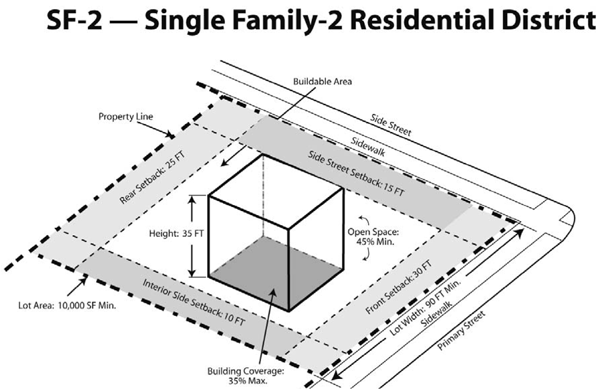
Sec. 68-65. - Development standards and additional regulations.
Refer to chapter 53, article II, division 5 for a detailed list of various types of uses and development standards. For additional regulations refer to:
(1)
Chapter 71, landscaping;
(2)
Chapter 74, articles IX—XI, towers, poles and masts;
(3)
Chapter 77, roads and vehicular use areas;
(4)
Chapter 80, sign regulations; and
(5)
Chapter 86, urban design and architectural standards.
(Ord. No. 2007-12, exh. A(ch. V, § 2(d)), 8-22-2007; Ord. No. 2016-06, § 2, 6-22-2016)
Sec. 68-89. - Intent and purpose.
The intent and purpose of the single-family residential-3 district (SF-3) is to protect and preserve the integrity and value of existing, stable residential neighborhoods of estate density while at the same time, allowing a careful and deliberate redevelopment and revitalization of such neighborhoods in need of reinvigoration or neighborhoods with unique amenities which create unique opportunities to increase property values and the overall attractiveness of the city.
(Ord. No. 2007-12, exh. A(ch. V, § 3(a)), 8-22-2007)
Sec. 68-90. - Permitted uses—Generally.
The following uses are permitted in the single-family residential-3 district (SF-3), while all other uses are conditional or prohibited:
(1)
Every use as a one-family residence, including every customary use not inconsistent therewith, including a private garage.
(2)
Municipal recreation buildings, playgrounds, parks or reservations owned and operated by a municipality, county, state or the federal government.
(3)
Public schools.
(Ord. No. 2007-12, exh. A(ch. V, § 3(b)), 8-22-2007; Ord. No. 2016-06, § 2, 6-22-2016)
Sec. 68-91. - Same—With special development requirements.
The following shall be the permitted uses with special development requirements in the single-family residential-3 district (SF-3):
(1)
Private recreation area, private recreation building or playground owned and maintained by a homeowner's or tenant association, provided same is approved in conjunction with approval of the subdivision at the time of site plan approval or plat.
(2)
Family day care and after-school care for children pursuant to section 74-155.
(3)
A group home in a dwelling unit pursuant to section 74-156.
(4)
Houses of worship pursuant to section 74-160.
(5)
Golf courses pursuant to section 74-165.
(6)
Uses that are allowed under power lines such as neighborhood nursery gardens, greenhouses and other similar uses pursuant to chapter 74, article II, division 3.
(7)
Ancillary uses to residential uses pursuant to section 74-146:
a.
Small doctor's office.
b.
Fitness center.
c.
Private education.
d.
Child care.
e.
Dance and karate studios.
f.
Therapy for elderly.
g.
Assembly halls.
h.
Art instruction.
i.
Convenience stores.
j.
Government uses.
(8)
Small-scale public facilities and utilities less than one acre in size.
(9)
All other related and/or similar uses.
(Ord. No. 2007-12, exh. A(ch. V, § 3(c)), 8-22-2007; Ord. No. 2016-06, § 2, 6-22-2016)
Sec. 68-92. - Development standards and additional regulations.
Refer to chapter 53, article II, division 5 for a detailed list of various types of uses and development standards. For additional regulations refer to:
(1)
Chapter 71, landscaping;
(2)
Chapter 74, articles IX—XI, towers, poles and masts;
(3)
Chapter 77, roads and vehicular use areas;
(4)
Chapter 80, sign regulations; and
(5)
Chapter 86, urban design and architectural standards.
(Ord. No. 2007-12, exh. A(ch. V, § 3(d)), 8-22-2007; Ord. No. 2016-06, § 2, 6-22-2016)
Sec. 68-93. - Illustration of district.
The following is a graphic description of the single-family residential-3 district:
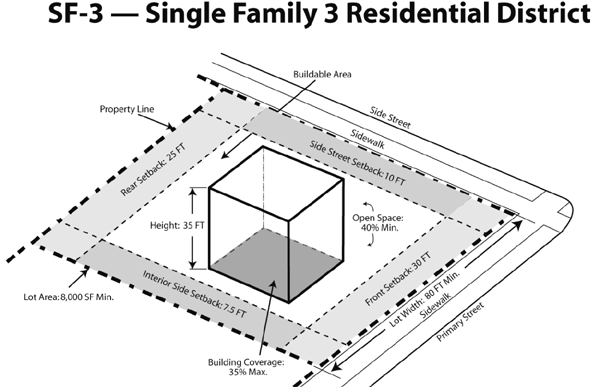
(Ord. No. 2007-12, exh. A(ch. V, § 3), 8-22-2007)
Sec. 68-115. - Intent and purpose.
The intent and purpose of the single-family residential-4 district (SF-4) is to protect and preserve the integrity and value of existing, stable residential neighborhoods of estate density while at the same time allowing a careful and deliberate redevelopment and revitalization of such neighborhoods in need of reinvigoration or neighborhoods with unique amenities which create unique opportunities to increase property values and the overall attractiveness of the city.
(Ord. No. 2007-12, exh. A(ch. V, § 4(a)), 8-22-2007)
Sec. 68-116. - Permitted uses—Generally.
The following uses are permitted in the single-family residential-4 district (SF-4), while all other uses are conditional or prohibited:
(1)
Every use as a one-family residence, including every customary use not inconsistent therewith, including a private garage.
(2)
Municipal recreation buildings, playgrounds, parks or reservations owned and operated by a municipality, county, state or the federal government.
(3)
Public schools.
(Ord. No. 2007-12, exh. A(ch. V, § 4(b)), 8-22-2007; Ord. No. 2016-06, § 2, 6-22-2016)
Sec. 68-117. - Same—With special development requirements.
The following shall be the permitted uses with special development requirements in the single-family residential-4 district (SF-4):
(1)
Private recreation area, private recreation building or playground owned and maintained by a homeowner's or tenant association, provided same is approved in conjunction with approval of the subdivision at the time of site plan approval or plat.
(2)
Family day care and after-school care for children pursuant to section 74-155.
(3)
A group home in a dwelling unit pursuant to section 74-156.
(4)
Houses of worship pursuant to section 74-160.
(5)
Golf courses pursuant to section 74-165.
(6)
Uses that are allowed under power lines such as neighborhood nursery gardens, greenhouses and other similar uses pursuant to chapter 74, article II, division 3.
(7)
The ancillary uses to residential uses pursuant to section 74-146 are as follows:
a.
Small doctor's office.
b.
Fitness center.
c.
Private education.
d.
Child care.
e.
Dance and karate studios.
f.
Therapy for elderly.
g.
Assembly halls.
h.
Art instruction.
i.
Convenience stores.
j.
Government uses.
(8)
Small-scale public facilities and utilities less than one acre in size.
(9)
All other related and/or similar uses.
(Ord. No. 2007-12, exh. A(ch. V, § 4(c)), 8-22-2007; Ord. No. 2016-06, § 2, 6-22-2016)
Sec. 68-118. - Development standards and additional regulations.
Refer to chapter 53, article II, division 5 for a detailed list of various types of uses and development standards. For additional regulations refer to:
(1)
Chapter 71, landscaping;
(2)
Chapter 74, articles IX—XI, towers, poles and masts;
(3)
Chapter 77, roads and vehicular use areas;
(4)
Chapter 80, sign regulations; and
(5)
Chapter 86, urban design and architectural standards.
(Ord. No. 2007-12, exh. A(ch. V, § 4(d)), 8-22-2007; Ord. No. 2016-06, § 2, 6-22-2016)
Sec. 68-119. - Illustration of district.
The following is a graphic description of the single-family residential-4 district:
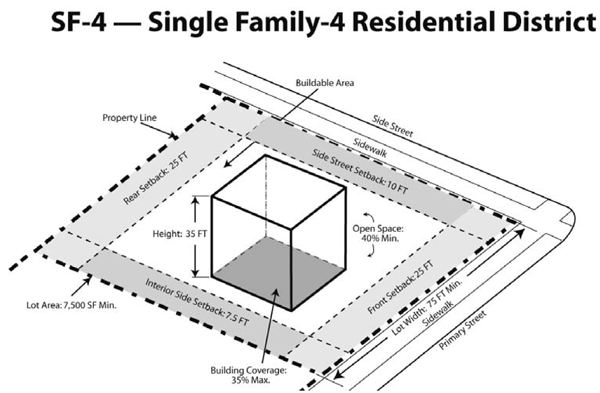
(Ord. No. 2007-12, exh. A(ch. V, § 4), 8-22-2007)
Sec. 68-137. - Intent and purpose.
The intent and purpose of the single-family residential-5 district (SF-5) is to provide urban density single-family housing, and it is intended to serve as a transitional zone between multifamily and single-family residential uses.
(Ord. No. 2007-12, exh. A(ch. V, § 5(a)), 8-22-2007)
Sec. 68-138. - Permitted uses—Generally.
The following uses are permitted in the single-family residential-5 district (SF-5), while all other uses are conditional or prohibited:
(1)
Every use as a one-family residence, including every customary use not inconsistent therewith, including a private garage.
(2)
Municipal recreation buildings, playgrounds, parks or reservations owned and operated by a municipality, county, state or the federal government.
(3)
Public schools.
(Ord. No. 2007-12, exh. A(ch. V, § 5(b)), 8-22-2007; Ord. No. 2016-06, § 2, 6-22-2016)
Sec. 68-139. - Same—With special development requirements.
The following shall be the permitted uses with special development requirements in the single-family residential-5 district (SF-5):
(1)
Private recreation area, private recreation building or playground owned and maintained by a homeowner's or tenant association, provided same is approved in conjunction with approval of the subdivision at the time of site plan approval or plat.
(2)
Family day care and after-school care for children pursuant to section 74-155.
(3)
A group home in a dwelling unit pursuant to section 74-156.
(4)
Houses of worship pursuant to section 74-160.
(5)
Golf courses pursuant to section 74-165.
(6)
Uses that are allowed under power lines such as neighborhood nursery gardens, greenhouses and other similar uses pursuant to chapter 74, article II, division 3.
(7)
Ancillary uses to residential uses pursuant to section 74-146:
a.
Small doctor's office.
b.
Fitness center.
c.
Private education.
d.
Child care.
e.
Dance and karate studios.
f.
Therapy for elderly.
g.
Assembly halls.
h.
Art instruction.
i.
Convenience stores.
j.
Government uses.
(8)
Small-scale public facilities and utilities less than one acre in size.
(9)
All other related and/or similar uses.
(Ord. No. 2007-12, exh. A(ch. V, § 5(c)), 8-22-2007; Ord. No. 2016-06, § 2, 6-22-2016)
Sec. 68-140. - Development standards and additional regulations.
Refer to chapter 53, article II, division 5 for a detailed list of various types of uses and development standards. For additional regulations refer to:
(1)
Chapter 71, landscaping;
(2)
Chapter 74, articles IX—XI, towers, poles and masts;
(3)
Chapter 77, roads and vehicular use areas;
(4)
Chapter 80, sign regulations; and
(5)
Chapter 86, urban design and architectural standards.
(Ord. No. 2007-12, exh. A(ch. V, § 5(d)), 8-22-2007; Ord. No. 2016-06, § 2, 6-22-2016)
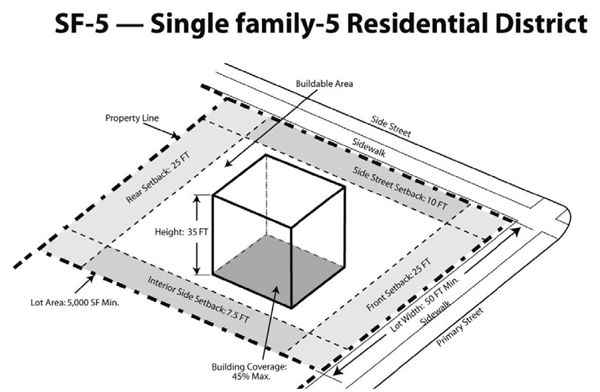
Sec. 68-141. - Illustration of district.
The following is the graphic description of the single-family residential-5 district (SF-5):
(Ord. No. 2007-12, exh. A(ch. V, § 5), 8-22-2007)
Sec. 68-166. - Intent and purpose.
The intent and purpose of the multifamily residential-1 district (MF-1) is to provide a townhouse zoning district in order to permit separate ownership of one-family dwelling units upon compliance with certain rules, regulations and standards, and to authorize the grouping of separately owned one-family dwelling units into a group of townhouses in such a manner as to make efficient, economical and aesthetically pleasing use of land, so restricted that the same will be continually well-maintained in order to preserve the health, welfare, safety, morals and convenience of the neighborhood and surrounding area.
(Ord. No. 2007-12, exh. A(ch. V, § 6(a)), 8-22-2007)
Sec. 68-167. - Permitted uses—Generally.
Public school are a permitted use in the multifamily residential-1 district.
(Ord. No. 2007-12, exh. A(ch. V, § 6(b)), 8-22-2007)
Sec. 68-168. - Same—With special development requirements.
The following uses are permitted with special development requirements in the multifamily residential-1 district:
(1)
Townhouses, subject to the following restrictions:
a.
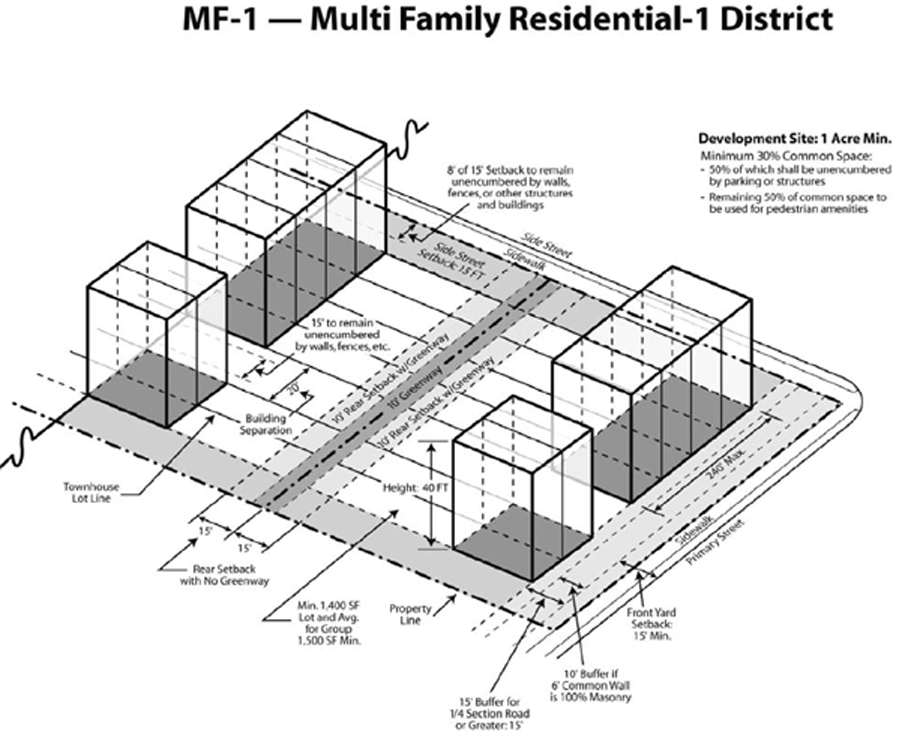
Common open space. A minimum of 30 percent of the site to be developed for townhouses shall be provided as a common open space; 50 percent of said space shall be unencumbered with any structure or off-street parking and shall be landscaped and well-maintained with grass, trees and shrubbery. The remaining 50 percent may be used only as swimming pools, tennis courts, shuffleboards, pedestrian walks, entrance features, recreation buildings, maintenance buildings for the common areas, lakes, canals and lagoons, and other recreational uses.
b.
Grouping length. A grouping of townhouses shall not exceed 240 feet in length.
c.
Unit size. No townhouse shall be smaller than 900 square feet, and the average size of the townhouses in any grouping shall be a minimum of 1,100 square feet.
d.
Size of development site. The minimum size of the site to be developed for townhouses shall be one net acre.
e.
Lot area for each unit. No townhouse site shall contain an area of less than 1,400 square feet and the average size for a group shall not be less than 1,500 square feet, and each unit shall have its foundation on its individual site, except where the units are separated by a common party wall in which event the foundation may be installed equidistant on each side of the lot line for the length of the party wall and its extension along the offset of the townhouses on abutting lots.
f.
Front yard requirements. There shall be a 15-foot minimum distance from the nearest edge of roadway pavement to the front building line. If parking is provided in front of the townhouse unit, then the setback provisions in subsection (1)g of this section shall apply.
g.
Setback. Where parking spaces are provided in front of townhouse buildings, the required front setback of the building shall be 25 feet from the nearest edge of roadway pavement in said parking area unless garages are provided, in which case the garage portion of the structure shall be set back 20 feet from the nearest edge of roadway pavement. Any portion of the townhouse building that is not located directly in front of parking spaces shall be set back 15 feet from the nearest edge of roadway pavement.
h.
Rear yard requirements. The minimum rear building setback shall be ten feet. A minimum greenbelt of ten feet shall be provided between rear lot lines; provided, however, that rear lot lines may abut without a greenbelt if a rear building setback of 15 feet is provided.
i.
Side yard requirements. A minimum side yard of 15 feet shall be provided between the end of a group of townhouses and a public or private street, eight feet of which shall be unencumbered by walls, fences or other structures or buildings. The remaining seven feet may be encumbered by trellises, chimneys or walkways which may be enclosed by privacy fences. Said fences shall not extend in excess of 50 percent of the depth of the building. Said amenities must be attached to the principal structure. A spacing of 20 feet shall be provided between each such group of townhouses, 15 feet of which shall be unencumbered by walls, fences or other structures or buildings. The remaining five feet may be encumbered by trellises, chimneys or walkways which may be enclosed by privacy fences. Said fences shall not extend in excess of 50 percent of the depth of the building. Said amenities must be attached to the principal structure.
j.
Buffer from roadways. Townhouses that face a roadway greater than or equal to a quarter-section road require an additional 15-foot buffer from the above-mentioned yards. A six-foot-high common wall is also required, which may be located anywhere in the buffer. If this wall is constructed with 100 percent masonry then the buffer could be reduced to ten feet.
k.
Street frontage. Each townhouse must have a clear, direct frontage on a public or private street.
l.
Utilities and services. Each townhouse shall be independently served by separate heating, air conditioning, sewer, water, electric power, gas, and other facility and utility services, wherever such utilities and services are provided, and no townhouse shall be in any way dependent upon such services or utility lines located within another unit or on or in another townhouse or townhouse site, except as may be installed in public easements. All townhouses must be connected to water and sewer lines and all electrical and telephone lines in a townhouse development site shall be placed underground. Proper and adequate access for firefighting purposes, and access to service areas to provide garbage and waste collection, and for other necessary services shall be provided.
m.
Street right-of-way width and improvements. The right-of-way width of public streets and private streets serving a group of townhouses and the improvements therein shall conform to all applicable minimum city standards and requirements for such streets.
n.
Walls. All patio and outdoor living areas on each townhouse site shall be enclosed by a wall affording complete screening except in cases where a natural feature of the site such as a lake or golf course would suggest that complete screening would not be required. Such determination shall be made as a result of the site plan review process as provided herein. Such wall shall be of masonry or other material having a life expectancy of not less than ten years and the minimum height of such wall shall be six feet; such walled-in patio may include a screen roof. All rear yard areas used for service, such as drying areas, shall be completely screened from view from the street and from adjoining lots by walls or landscaping.
o.
Patios and service areas. There shall be provided on each townhouse site at least 400 square feet of patio living area exclusive of parking and service areas for each townhouse; such footage may consist of one or more patio areas unless it is a screen enclosure. Open-roof areas and balconies designed and planned for patio purposes may be credited toward patio area. Special setbacks for various accessory uses in chapter 74, article II, division 2, do not apply to these accessory structures and/or uses.
p.
Accessory buildings. No accessory building shall be permitted in unwalled areas on sites containing a townhouse, and where located within an area enclosed with walls, shall not extend above the height of the walls.
q.
Platting requirements. Each townhouse unit shall be located on its own individual platted lot. If areas for common use of occupants of a townhouse development are shown on the plat, such areas shall not be approved until satisfactory arrangements are made for maintenance as provided by this article.
r.
Trees. landscaping and trees shall be provided in accordance with chapter 71, pertaining to landscaping and buffers.
(2)
Private recreation area, private recreation building or playground owned and maintained by a homeowner's or tenant association, provided same is approved in conjunction with approval of the subdivision at the time of site plan approval or plat.
(3)
Family day care and after-school care for children pursuant to section 74-155.
(4)
A group home in a dwelling unit pursuant to section 74-156.
(5)
Houses of worship pursuant to section 74-160.
(6)
Uses that are allowed under power lines such as neighborhood nursery gardens, greenhouses and other similar uses pursuant to chapter 74, article II, division 3.
(7)
Ancillary uses to residential uses pursuant to section 74-146:
a.
Small doctors office.
b.
Fitness center.
c.
Private education.
d.
Child care.
e.
Dance and karate studios.
f.
Therapy for elderly.
g.
Assembly halls.
h.
Art instruction.
i.
Convenience stores.
j.
Government uses.
(8)
Small-scale public facilities and utilities less than one acre in size.
(9)
All other related and/or similar uses.
(Ord. No. 2007-12, exh. A(ch. V, § 6(c)), 8-22-2007)
Sec. 68-169. - Illustration of district.
The following is the graphic description of the multifamily residential-1 district (MF-1):
_____
_____
(Ord. No. 2007-12, exh. A(ch. V, § 6), 8-22-2007)
Sec. 68-192. - Intent and purpose.
The intent and purpose of the multifamily residential-2 district (MF-2) is to provide for residential districts allowing low-rise condominiums/apartments with moderate density.
(Ord. No. 2007-12, exh. A(ch. V, § 7(a)), 8-22-2007)
Sec. 68-193. - Permitted uses—Generally.
The following uses are permitted in the multifamily residential-2 district (MF-2), while all other uses are conditional or prohibited:
(1)
Multiple-family condominium/apartment house use with only one principal building on a lot, parcel or tract, designed for more than four family units.
(2)
Public schools.
(Ord. No. 2007-12, exh. A(ch. V, § 7(b)), 8-22-2007)
Sec. 68-194. - Same—With special development requirements.
The following uses shall be permitted with special development requirements in the multifamily residential-2 district (MF-2):
(1)
Private recreation area, private recreation building or playground owned and maintained by a homeowner's or tenant association, provided same is approved in conjunction with approval of the subdivision at the time of site plan approval or plat.
(2)
Family day care and after-school care for children pursuant to section 74-155.
(3)
A group home in a dwelling unit pursuant to section 74-156.
(4)
Houses of worship pursuant to section 74-160.
(5)
Uses that are allowed under power lines such as neighborhood nursery gardens, greenhouses and other similar uses pursuant to chapter 74, article II, division 3.
(6)
Ancillary uses to residential uses pursuant to section 74-146:
a.
Small doctors office.
b.
Fitness center.
c.
Private education.
d.
Child care.
e.
Dance and karate studios.
f.
Therapy for elderly.
g.
Assembly halls.
h.
Art instruction.
i.
Convenience stores.
j.
Government uses.
(7)
Small-scale public facilities and utilities less than one acre in size.
(8)
All other related and/or similar uses.
(Ord. No. 2007-12, exh. A(ch. V, § 7(c)), 8-22-2007)
Sec. 68-195. - Development standards and additional regulations.
Refer to chapter 53, article II, division 5 for a detailed list of various types of uses and development standards. For additional regulations refer to:
(1)
Chapter 71, landscaping and buffers;
(2)
Chapter 74, articles IX—XI, towers, poles and masts;
(3)
Chapter 77, roads and vehicular use areas;
(4)
Chapter 80, sign regulations; and
(5)
Chapter 86, urban design and architectural standards.
(Ord. No. 2007-12, exh. A(ch. V, § 7(d)), 8-22-2007)
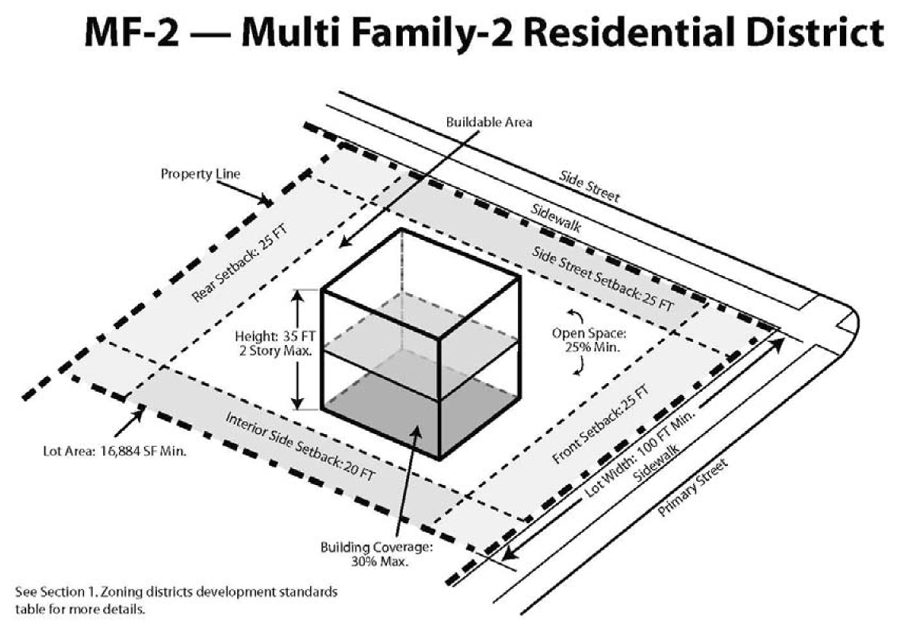
Sec. 68-196. - Illustration of district.
The following is the graphic description of the multifamily residential-2 district (MF-2):
_____
_____
(Ord. No. 2007-12, exh. A(ch. V, § 7), 8-22-2007)
Sec. 68-216. - Intent and purpose.
The intent and purpose of the multifamily residential-3 district (MF-3) is to provide for a residential district allowing low- and mid-rise condominiums/apartments with medium density.
(Ord. No. 2007-12, exh. A(ch. V, § 8(a)), 8-22-2007)
Sec. 68-217. - Permitted uses—Generally.
The following uses are permitted in the multifamily residential-3 district (MF-3), while all other uses are conditional or prohibited:
(1)
Multiple-family condominium/apartment house use with only one principal building on a lot, parcel or tract, designed for more than four family units.
(2)
Public schools.
(Ord. No. 2007-12, exh. A(ch. V, § 8(b)), 8-22-2007)
Sec. 68-218. - Same—With special development requirements.
The following uses shall be permitted with special development requirements in the multifamily residential-3 district (MF-3):
(1)
Private recreation area, private recreation building or playground owned and maintained by a homeowner's or tenant association, provided same is approved in conjunction with approval of the subdivision at the time of site plan approval or plat.
(2)
Family day care and after-school care for children pursuant to section 74-155.
(3)
A group home in a dwelling unit pursuant to section 74-156.
(4)
Houses of worship pursuant to section 74-160.
(5)
Uses that are allowed under power lines, such as neighborhood nursery gardens, greenhouses and other similar uses pursuant to chapter 74, article II, division 3.
(6)
Ancillary uses to residential uses pursuant to section 74-146:
a.
Small doctors office.
b.
Fitness center.
c.
Private education.
d.
Child care.
e.
Dance and karate studios.
f.
Therapy for elderly.
g.
Assembly halls.
h.
Art instruction.
i.
Convenience stores.
j.
Government uses.
(7)
Small-scale public facilities and utilities less than one acre in size.
(8)
All other related and/or similar uses.
(Ord. No. 2007-12, exh. A(ch. V, § 8(c)), 8-22-2007)
Sec. 68-219. - Development standards and additional regulations.
Refer to chapter 53, article II, division 5 for a detailed list of various types of uses and development standards. For additional regulations refer to:
(1)
Chapter 71, landscaping and buffers;
(2)
Chapter 74, articles IX—XI, towers, poles and masts;
(3)
Chapter 77, roads and vehicular use areas;
(4)
Chapter 80, sign regulations; and
(5)
Chapter 86, urban design and architectural standards.
(Ord. No. 2007-12, exh. A(ch. V, § 8(d)), 8-22-2007)
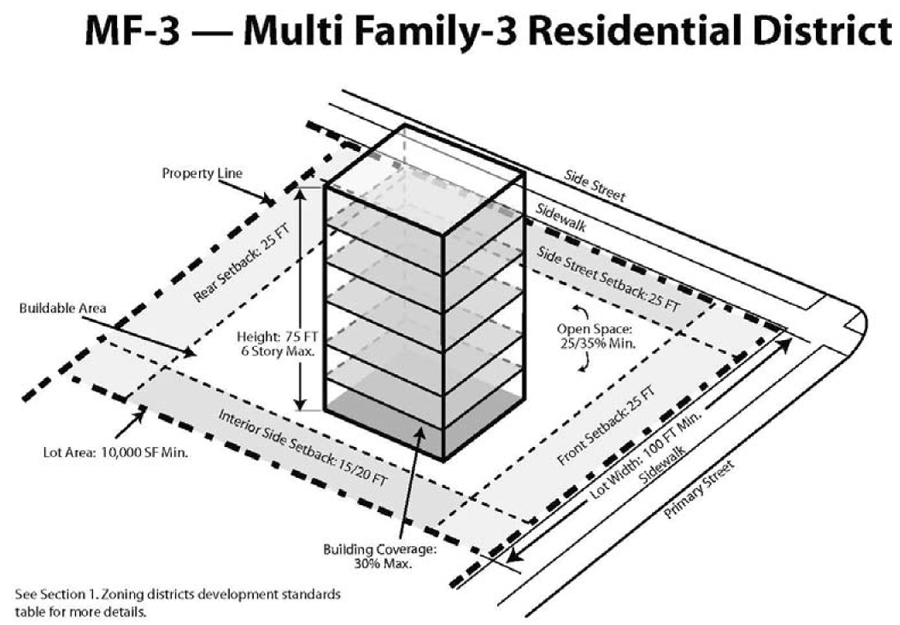
Sec. 68-220. - Illustration of district.
The following is the graphic description of the multifamily residential-3 district (MF-3):
_____
_____
(Ord. No. 2007-12, exh. A(ch. V, § 8), 8-22-2007)
Sec. 68-249. - Intent and purpose.
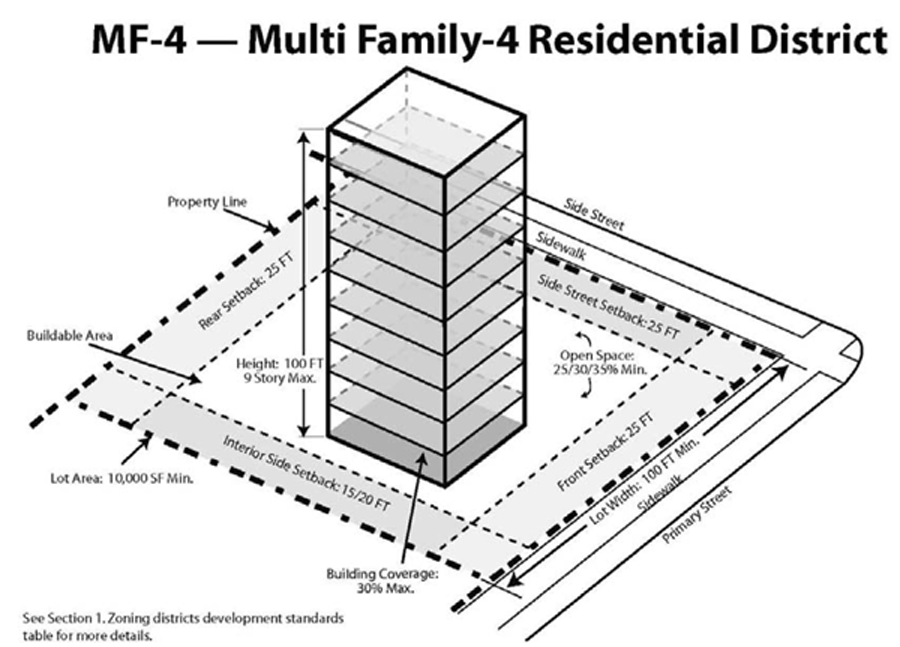
The intent and purpose of the multifamily residential-4 district (MF-4) is to provide for a residential district allowing mid- and high-rise condominiums/apartments with high density.
(Ord. No. 2007-12, exh. A(ch. V, § 9(a)), 8-22-2007)
Sec. 68-250. - Permitted uses—Generally.
The following uses are permitted in the multifamily residential-4 district (MF-4), while all other uses are conditional or prohibited:
(1)
Multiple-family condominium/apartment house use with only one principal building on a lot, parcel or tract, designed for more than four family units.
(2)
Public schools.
(Ord. No. 2007-12, exh. A(ch. V, § 9(b)), 8-22-2007)
Sec. 68-251. - Same—With special development requirements.
The following uses shall be permitted with special development requirements in the multifamily residential-4 district (MF-4):
(1)
Hotels with a maximum of 75 units per acre and a minimum of 11 units per building.
(2)
Private recreation area, private recreation building or playground owned and maintained by a homeowner's or tenant association, provided same is approved in conjunction with approval of the subdivision at the time of site plan approval or plat.
(3)
Family day care and after-school care for children pursuant to section 74-155.
(4)
A group home in a dwelling unit pursuant to section 74-156.
(5)
Houses of worship pursuant to section 74-160.
(6)
Uses that are allowed under power lines such as neighborhood nursery gardens, greenhouses and other similar uses pursuant to chapter 74, article II, division 3.
(7)
Ancillary uses to residential uses pursuant to section 74-146:
a.
Small doctors office.
b.
Fitness center.
c.
Private education.
d.
Child care.
e.
Dance and karate studios.
f.
Therapy for elderly.
g.
Assembly halls.
h.
Art instruction.
i.
Convenience stores.
j.
Government uses.
(8)
Small-scale public facilities and utilities less than one acre in size.
(9)
All other related and/or similar uses.
(Ord. No. 2007-12, exh. A(ch. V, § 9(c)), 8-22-2007)
Sec. 68-252. - Development standards and additional regulations.
Refer to chapter 53, article II, division 5 for a detailed list of various types of uses and development standards. For additional regulations refer to:
(1)
Chapter 71, landscaping and buffers;
(2)
Chapter 74, articles IX—XI, towers, poles and masts;
(3)
Chapter 77, roads and vehicular use areas;
(4)
Chapter 80, sign regulations; and
(5)
Chapter 86, urban design and architectural standards.
(Ord. No. 2007-12, exh. A(ch. V, § 9(d)), 8-22-2007)
Sec. 68-253. - Illustration of district.
The following is the graphic description of the multifamily residential-4 district (MF-4):
_____
_____
(Ord. No. 2007-12, exh. A(ch. V, § 9), 8-22-2007)

