
Doral City Zoning Code
ARTICLE IV
COMMERCIAL DISTRICTS
Sec. 68-349. - Intent and purpose.
The neighborhood commercial district (NC) is established to provide for low- to moderate-intensity business uses in a neighborhood environment.
(Ord. No. 2007-12, exh. A(ch. V, § 11(a)), 8-22-2007)
Sec. 68-350. - Permitted uses—Generally.
The following uses are permitted in the neighborhood commercial (NC) district, while all other uses are conditional or prohibited:
(1)
Retail services. Refer chapter 53, article II, division 5, the use compatibility table, for a detailed list of uses under the categories in the following categories:
a.
Banks.
b.
Tangible sales.
c.
Fitness/sports.
d.
Animal service.
e.
Beauty and personal services.
f.
Other services that are similar to above uses and shall be approved by the director of planning and zoning department.
(2)
Restaurant/cafeteria.
(3)
Professional offices. (Refer to chapter 53 for a detailed list of uses.)
(4)
Low-intensity medical offices and clinics. (Refer to chapter 53, article II, division 5, the use compatibility table, for detailed list of uses.)
(5)
Educational and training institution.
(6)
Public schools.
(7)
Amusements.
(8)
Laundry pickup or dropoff.
(9)
Religious facilities.
(Ord. No. 2007-12, exh. A(ch. V, § 11(b)), 8-22-2007)
Sec. 68-351. - Same—With special development requirements.
The following uses are permitted in the neighborhood commercial (NC) district, under the special development requirements and/or specified herein. Refer to chapter 53, article II, division 5 for a detailed list of various types of uses and development standards. Refer to chapter 74 for special development regulations for the following uses:
(1)
Wine cafes pursuant to chapter 74, article IV.
(2)
Wine cafes with retail sales pursuant to chapter 74, article IV.
(3)
Billiards pursuant to chapter 74, article IV.
(4)
Hotels and motels with retail uses integrated into the project, in an amount no less than ten percent of the total project floor area ratio, as calculated in section 74-157, with a maximum density of 95 units per acre.
(5)
Hotels and motels (stand-alone) with a maximum density of 75 units per acre.
(6)
Brew pubs (restaurant only) pursuant to section 74-166.
(Ord. No. 2007-12, exh. A(ch. V, § 11(c)), 8-22-2007; Ord. No. 2016-19, § 2, 6-8-2016; Ord. No. 2019-13, § 2, 4-24-2019)
Sec. 68-352. - Special exception uses.
Refer to chapter 53, article II, division 5 for a detailed list of various types of uses and development standards. Refer to chapter 74, article IV, for special development regulations forbars and pubs.
(Ord. No. 2007-12, exh. A(ch. V, § 11(d)), 8-22-2007)
Sec. 68-353. - Development standards and additional regulations.
Refer to chapter 53, article II, division 5 for a detailed list of various types of uses and development standards. For additional regulations refer to:
(1)
Chapter 71, landscaping and buffers;
(2)
Chapter 74, articles IX—XI, towers, poles and masts;
(3)
Chapter 77, roads and vehicular use areas;
(4)
Chapter 80, sign regulations; and
(5)
Chapter 86, urban design and architectural standards.
(Ord. No. 2007-12, exh. A(ch. V, § 11(e)), 8-22-2007)
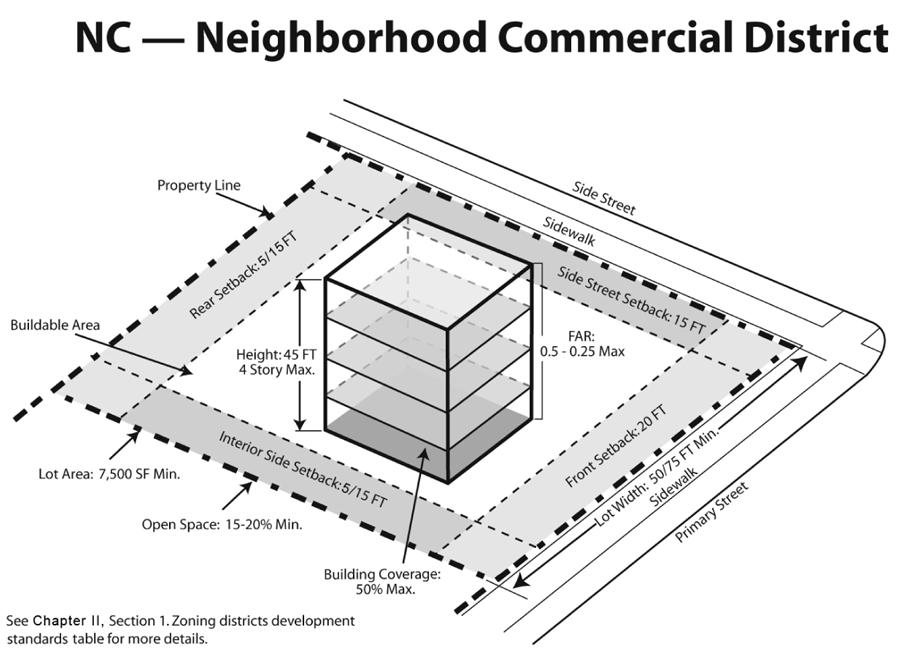
Sec. 68-354. - Illustration of district.
The following is the graphic description of the neighborhood commercial district (NC):
_____
(Ord. No. 2007-12, exh. A(ch. V, § 11), 8-22-2007)
_____
Sec. 68-382. - Intent and purpose.
The corridor commercial district (CC) is established to provide for medium to high-intensity business uses on major corridors and prime commercial areas.
(Ord. No. 2007-12, exh. A(ch. V, § 12(a)), 8-22-2007)
Sec. 68-383. - Permitted uses—Generally.
The following uses are permitted in the corridor commercial (CC) district, while all other uses are conditional or prohibited:
(1)
Retail services. Refer to chapter 53, article II, division 5, the use compatibility table, for a detailed list of uses under these categories in the following categories:
a.
Banks.
b.
Tangible sales.
c.
Fitness/sports.
d.
Animal services:
1.
Pet shops.
2.
Grooming.
3.
Animal training.
4.
Veterinarians.
e.
Firearms.
f.
Beauty and personal services.
g.
Religious facilities.
h.
Other services that are similar to uses in this subsection (1) and shall be approved by the director of planning and zoning department.
(2)
Eating establishments:
a.
Restaurant/cafeteria.
b.
Drive-in restaurants.
c.
Wine cafes.
d.
Wine cafes with retail sales.
e.
Billiards.
f.
Liquor sales with tasting.
g.
Bars and pubs.
(3)
Professional offices. (Refer to chapter 53, article II, division 5 for a detailed list of uses.)
(4)
Medical offices and uses.
(5)
Regional malls.
(6)
Educational and training institutions.
(7)
Public schools.
(8)
Admission facilities like auditoriums, theaters, museums and galleries. (Refer to chapter 53, article II, division 5 for a detailed list of uses.)
(9)
Carwash places.
(10)
Amusements.
(Ord. No. 2007-12, exh. A(ch. V, § 12(b)), 8-22-2007)
Sec. 68-384. - Same—With special development requirements.
The following uses are permitted in the corridor commercial (CC) district, under the special development requirements and/or specified herein. Refer to chapter 53, article II, division 5 for a detailed list of various types of uses and development standards. Refer to chapter 74 for special development regulations for the following uses:
(1)
Nightclubs pursuant to chapter 74, article IV.
(2)
Hotels and motels with retail uses integrated into the project, in an amount no less than ten percent of the total project floor area ratio, as calculated in section 74-157, with a maximum density of 95 units per acre.
(3)
Hotels and motels (stand alone) with a maximum density of 75 units per acre.
(4)
Auto/truck/van sales pursuant to section 74-152.
(5)
Miniwarehouses and self storage facilities pursuant to conditions mentioned in section 52-5.
(6)
Passenger service facilities.
(7)
Brew pubs (restaurant, pub, or bar with a brewery, distillery, or winery as accessory use) pursuant to section 74-167.
(8)
Micro-brewery pursuant to section 74-168.
(Ord. No. 2007-12, exh. A(ch. V, § 12(c)), 8-22-2007; Ord. No. 2016-19, § 2, 6-8-2016; Ord. No. 2019-13, § 2, 4-24-2019)
Sec. 68-385. - Development standards and additional regulations.
Refer to chapter 53, article II, division 5 for a detailed list of various types of uses and development standards. For additional regulations refer to:
(1)
Chapter 71, landscaping and buffers;
(2)
Chapter 74, articles IX—XI, towers, poles and masts;
(3)
Chapter 77, roads and vehicular use areas;
(4)
Chapter 80, sign regulations; and
(5)
Chapter 86, urban design and architectural standards.
(Ord. No. 2007-12, exh. A(ch. V, § 12(d)), 8-22-2007)
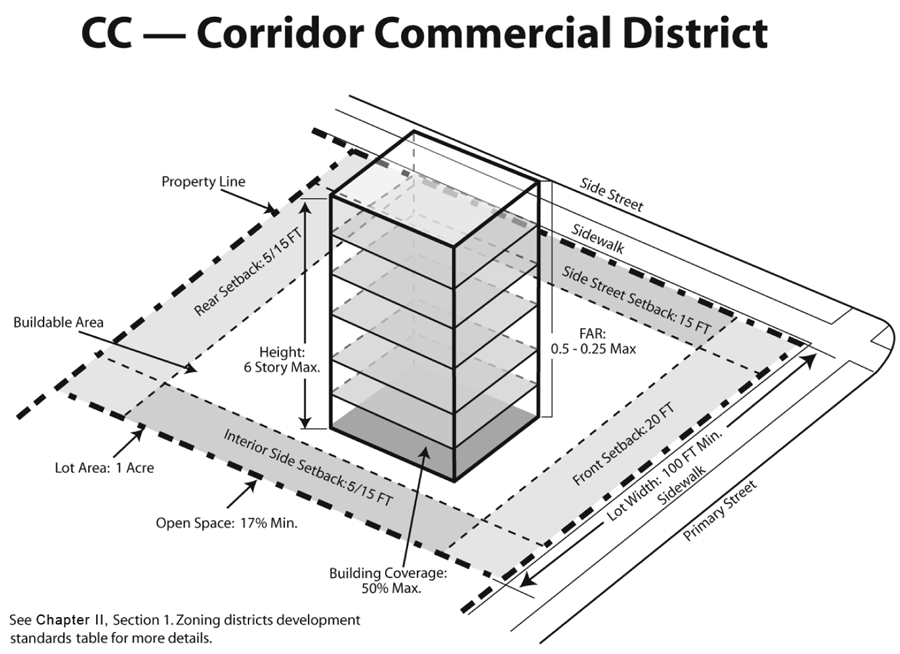
Sec. 68-386. - Illustration of district.
The following is the graphic depiction of the development standards for the corridor commercial district (CC). If the property is located within the Doral Décor Overlay District, then section 68-863(a) shall apply:
_____
 ;hn0; (Ord. No. 2007-12, exh. A(ch. V, § 12), 8-22-2007; Ord. No. 2012-26, § 2, 10-30-2012; Ord. No. 2021-40, § 2, 3-23-2022)
_____
Sec. 68-387. - Tandem parking in mixed use developments.
The city recognizes that public parking demand in the City of Doral is continuing to increase as development and redevelopment occurs.
In order to address the demand of parking needs in mixed use developments that are geographically located on the southern end of N.W. 41 st Street, commonly referred to as Doral Boulevard, west of 97 th Avenue, east of 102 nd Avenue and north of 33 rd Street, and that are no less than 15 acres, the city will permit the use of tandem parking, provided that all other sections of the city code are complied with.
(Ord. No. 2025-20, § 2, 6-4-2025)

