
Dover City Zoning Code
ARTICLE 12
- DEFINITIONS
Unless otherwise expressly stated, the following terms shall, for the purpose of this ordinance, have the following meanings. Words used in the present tense include the future. The singular includes the plural and the plural includes the singular. The word "person" includes a corporation, association or partnership, as well as an individual. The word "lot" includes the word "plot." The term "occupied" or "used," as applied to any building, shall be construed as though followed by the words "or intended, arranged or designed to be occupied or used":
Accessory building: A building or use clearly incidental or subordinate to, and customar[il]y in connection with, the principal building or use on the same lot.
Adult day care facilities: Apply to any program that provides health, social and related support services for four or more functionally impaired adults who require supervision due to cognitive or physical impairment or who cannot independently perform one or more activities of daily living. These services are provided to adults for a period of less than 12 hours during the day and are provided in a setting other than a participant's home or the residence of the facility operator.
(a)
Small adult day care facility: A facility that provides services for four adult participants but less than 16 adult participants.
(b)
Large adult day care facility: A facility that provides services for 16 or more adult participants.
Adult entertainment establishment: Any establishment or portions thereof which offers sexually-oriented material, devices, paraphernalia, services, performances, or any combination thereof, or in any other form, whether printed, filmed, recorded or live. The term "sexually-oriented" shall be interpreted in the context of the following specified sexual activities and anatomical areas:
1.
Genitals in a state of sexual stimulation or arousal;
2.
Acts of human masturbation, sexual intercourse, sodomy, sadism, masochism or bestiality;
3.
Fondling or other erotic touching of the human genitals, pubic region, buttocks, or female breasts;
4.
Less than completely and opaquely covered:
a.
Human genitals, [or] pubic region;
b.
Buttocks; and
c.
Female breasts below a point immediately above the top of the areola;
5.
Human male genitals in a discernibly turgid state, even if completely and opaquely covered.
The term "adult entertainment establishment" shall encompass, but shall not be limited to, what is commonly known as "massage parlors," "adult bookstores" and "adult entertainment centers."
Alluvial solids: Areas subject to periodic flooding as defined by the Natural Resources Conservation Service and mapped in the Kent County soil survey.
Antenna: An apparatus designed for the purpose of emitting radiofrequency (RF) radiation, to be operated or operating from a fixed location pursuant to Federal Communications Commission authorization, for the provision of wireless service and any commingled information services.
Apartment: A dwelling unit, within a building with other uses and/or dwelling units, that is intended for use as a residence by an individual or a single family.
Applicant: A landowner or developer, as hereinafter defined, who has filed application for development, including his heirs, successors and assigns.
Architectural review certificate: A signed and dated document indicating the approval of the City of Dover Planning Commission, or the historic district commission, or city planner upon the authority of the historic district commission, for alteration, construction, relocation, or demolition within the historic district.
Basement: A story in a building having a floor below the finished grade at any point on the periphery of the building and having a structural ceiling level at least four feet above the average finished grade along each side of the building facing a street (see Cellar and Story).
Bed and breakfast inn: A principal residential structure containing eating and sleeping accommodations for the purpose of lodging for overnight guests and which is offered for compensation and which has been approved by the City of Dover Planning Commission in accordance with article 3, section 1.14, item [subsection] (d) of the City of Dover zoning ordinance [this appendix].
Buffer: An open space, landscaped area, or natural woodlands used to separate different uses or to separate cluster or planned residential development, or shopping centers from adjacent properties.
Building: Any combination of materials forming a construction. The term "building" is not intended to include underground construction which permits the use of the ground above as if no construction existed. The term "building" shall include the term "structure," as well as the following:
(a)
Signs;
(b)
Fences;
(c)
Walls, except retaining walls projecting above the ground not more than three feet at the higher ground level and not more than 6½ feet at the lower ground level;
(d)
Radio and television antennae, except for such antennae installed on the roof of a building and extending not more than 15 feet above the highest level of the roof of such building; and
(e)
Porches, carports, bins and other similar structures;
(f)
All areas used for outdoor display and storage of products for sale on the site for more than 14 consecutive days or 21 days in a calendar year. Excluded from this definition are approved motor vehicle, boat and trailer sales establishments; contractors' yards; nurseries and landscaping material sales (where the sale of these materials is the primary use on the lot); wholesale building supply stores and lumber yards; or similar uses.
Cellar: A space in a building with a structural ceiling level less than four feet above the average finished grade along any side of the building facing a street.
Child day care facility: For the purposes of this ordinance, the facilities described furnishing care, supervision and guidance of a child or group of children unaccompanied by a parent or guardian for periods of less than 24 hours per day shall be defined as follows:
(a)
Child day care center:
i.
Any place, other than an occupied residence, which receives children for day care or large family day care home; and
ii.
Any place, including an occupied residence, which receives 13 or more children for day care.
(b)
Family day care home-children: An occupied residence in which a person provides day care for children other than his/her own family and the children of close relatives. Such care in a family day care home is limited to that care given to six or fewer children with a maximum of three children allowed for after school care. Such child care shall be permitted as an accessory use in all residential zones and shall be exempt from obtaining a conditional use permit and site plan approval.
(c)
Large family day care home-children: A facility which provides child care for more than six, but less than 13 children with a maximum of three children allowed for after school care. This care may be offered in a private home or in a property converted to the purpose of providing child day care.
Common open space: A parcel or parcels of land or an area of water, or a combination of land and water within a development site, and designed and available for the use or enjoyment of residents of the development, not including streets, off-street parking areas, and areas set aside for public facilities. "Common open space" shall not include private yards or lots, and shall be permanently protected, by legal means, from development.
Compassion center: An entity registered pursuant to § 4914A of Title 16 of the Delaware State Code that acquires, possesses, sells, supplies, or dispenses marijuana, paraphernalia, or related supplies and educational materials to registered qualifying patients who have designated the dispenser to cultivate marijuana for their medical use and the registered designated caregivers of these patients.
Condominium: A form of property ownership providing for individual ownership of a dwelling unit together with an individual interest in land or parts of a building held in common with other owners. Condominiums follow the provisions of the laws of the state dealing with unit properties and condominiums.
Court, inner: An open space enclosed on all sides by exterior walls of a building.
Court, outer: An open space enclosed on three sides by exterior walls of a building.
Court, outer, depth of: The average dimension from the open side of the court to the opposite wall.
Court, outer, width of: The average dimension between the opposing sides of the court.
Demolition by neglect: Improper maintenance or lack of maintenance of a building, structure or object which results in substantial and widespread deterioration of the building, structure or object which threatens the likelihood of preservation and which presents a threat to the public safety, health and welfare of the immediate community.
Developer: Any landowner, agent or such landowner or tenant with the permission from a landowner, who makes or causes to be made an application for approval of a site development plan.
Development: The improvement of one or more parcels of land for residential, commercial or industrial structures or groups of structures involving the division or allocation of land for the opening, widening or extension of any street or streets, or the division or allocation of land as open spaces for common use by owners, occupants or lease holders, or as easements for the extension and maintenance of public sewer, water supply, storm drainage or other public facilities.
Development coverage: The percent of a site which is covered, or planned to be covered, with impervious surfaces. [The term] "development coverage" shall include off-street parking, driveways and any public streets proposed in a site development plan.
Duplex: A one-family, semi-detached dwelling unit having only one dwelling unit from ground to roof and only one wall in common with another dwelling unit.
Dwelling, attached: A dwelling having one or more walls in common with another dwelling.
Dwelling, detached: A dwelling having no walls in common with other dwellings or with nonresidential uses.
Dwelling, multi-family: (See "dwelling, multiple"—A building, or portion thereof, containing more than two dwelling units).
Dwelling, multiple: A building, or portion thereof, containing more than two dwelling units.
Dwelling, one-family: A permanent dwelling unit placed on a permanent foundation and designed and intended for use by only one family. One-family dwellings shall not include manufactured homes or mobile homes but shall include modular homes constructed to the standards of the Dover Code of Ordinances, Chapter 22—Buildings and Building Regulations.
Dwelling, semi-detached: A dwelling with one wall in common with only one adjacent dwelling.
Dwelling, two-family: A detached building containing two dwelling units only.
Dwelling unit: A building or entirely self-contained portion thereof containing complete housekeeping facilities for only one family, including any domestic servants employed on the premises, and having no enclosed space (other than vestibules, entrance or other hallways or porches) or cooking or sanitary facilities in common with any other dwelling unit. A boarding[house] or roominghouse, convalescent home, dormitory, fraternity or sorority house, hotel, inn, lodging, nursing, or other similar home, travel trailer, recreational vehicle, or other similar structures or vehicles shall not be deemed to constitute a dwelling unit.
Emergency shelter: A facility providing temporary housing to homeless or transient persons in a dormitory style setting; such facility may also provide or facilitate other social services including counseling and vocational training.
Family: One or more persons occupying a dwelling unit as a single housekeeping unit. More than five persons, exclusive of domestic servants, or not more than one boarder or roomer, not related by blood, marriage or adoption, shall not be considered to constitute one family.
Farm: An area of land and its buildings, owned or rented by one management, used for raising crops or livestock, containing at least five acres.
Flood hazard area: Land areas delineated on the Federal Emergency Management Agency's (FEMA's) Community Flood Insurance Rate Map as being within the limits of the 100-year floodplain, and any lands subsequently identified by FEMA as being within the limits of the 100-year floodplain as a result of any revision to the community flood insurance rate map approved by FEMA, or by issuance of a conditional letter of map revision issued by FEMA.
Floor area: The sum of the gross horizontal areas of the several floors of the building or buildings on a lot, measured from the exterior faces of exterior walls, or from the center line of party walls separating two buildings. For purposes of calculating minimum parking and loading space requirements and calculation of floor area ratio, the "floor area" tabulation shall exclude cellar and basement areas used only for storage or for maintenance and operation of the building; shall exclude exterior stair towers; and shall exclude enclosed or partially enclosed garage parking and loading space areas, but shall include all outdoor storage and sales areas in use for more than 21 days in a calendar year.
Floor area, livable: All spaces within the exterior walls of a dwelling unit, exclusive of garages, cellars, heater rooms and basements having a window area of less than 20 percent of the square foot area of the room and of unheated porches and breezeways, but shall include all spaces not otherwise excluded, such as principal rooms, utility rooms, bathrooms, and all closets and hallways opening directly into, and appurtenant to, any rooms within the dwelling unit, and all attic space having a clear height of six feet from [the] finished floor level to [the] pitch of [the] roof rafter and a clear height of seven feet, six inches from [the] finished floor level to [the] ceiling level over 50 percent of the area of such attic space.
Floor area ratio: The floor area in square feet of all buildings on a lot divided by the area of such lot in square feet.
Forest: Areas, groves, or stands of mature or largely mature trees (i.e., greater than six-inch caliper) covering an area greater than one-quarter acre; or groves of mature trees (greater than 12-inch caliper) consisting of more than ten individuals.
Garden apartments: Multiple dwellings designed to provide maximum accessibility of the dwelling units to the private open space. The dwelling units share a common lot area which is the sum of the required lot areas of all dwelling units within the building.
Gross leasable area: The total floor area designed for tenant occupancy and exclusive use, including basements, mezzanines, and upper floors, if any; expressed in square feet and measured from the center line of joint partitions and from outside wall faces.
Gross residential density: The number of dwelling units per acre in a proposed development, computed by dividing the number of dwelling units which the applicant proposes to construct by the total number of acres in the site proposed for development.
Hazard areas: Areas subject to flood hazard, including alluvial soils, as defined and mapped by the Federal Emergency Management Agency. Where mapping from this source is not available, the Kent County soil survey shall be used to determine the extent of flood hazard areas.
Height: The vertical distance measured from the average elevation of the finished grade at the front of the building to the highest point of the roof for flat and mansard roofs and to the mean height between [the] eave and ridge for other types of roofs.
High-rise apartment: Multiple dwellings where individual dwelling units share a common outside access, and elevators serve each floor. The dwelling units share a common lot area, which is the sum of the required lot areas of all dwelling units within the building.
Historic district: The geographic areas of Dover that have been designated by the City of Dover, and graphically illustrated on the official zone map of the City of Dover, as possessing a significant concentration of properties, buildings, structures or objects associated with and representative of the historical development of Dover and which meet at least one of the following criteria:
(a)
Exemplifies or reflects the broad cultural, political, economic, or social history of Dover, Kent County, the State of Delaware, or the United States of America; or
(b)
Is associated with the lives of persons of historic importance or with events of historic significance to Dover, Kent County, the State of Delaware, or the United States of America; or
(c)
Embodies distinguishing architectural characteristics which are invaluable resources for the study, understanding and appreciation of periods, styles, society, methods of construction, craftsmanship and the use of indigenous materials; or
(d)
Represents the notable work of master builders, designers or architects whose designs, construction and craftsmanship have been recognized as distinctive and whose work has influenced the period of time in which they lived.
Historic district design guidelines and standards: The document adopted by the City of Dover Planning Commission as being the source reference document for construction and maintenance of buildings, structures and additions within the Dover Historic District and which is the guiding document for the historic district commission and city planner in their review of applications for architectural review certification.
Hotel or motel: A building having six or more rental rooms, without individual cooking facilities, for transient guests. An office for the renting and management of accommodations and a restaurant designed primarily for the use of overnight guests may be included.
Impervious surfaces: "Impervious surfaces" are those that do not absorb rain. All buildings, parking areas, driveways, roads, sidewalks, and any areas in concrete and asphalt shall be considered "impervious surfaces" within this definition. In addition, other areas determined by the engineer to be impervious within the meaning of this definition will also be classed as "impervious surfaces."
Lakes and ponds: Natural or artificial bodies of water which retain water year-round. Artificial ponds may be created by dams, or may result from excavation. The shoreline of such waterbodies shall be measured from the maximum condition, rather than permanent pool, if there is any difference.
Land lease community: A residential development typified by single ownership of the land within the development, with the landowner retaining the rights of ownership. Home sites or individual lots within the community are leased to individual homeowners, who retain customary leasehold rights.
Landowner: The legal or beneficial owner or owners of land, including the holder of an option or contract to purchase (whether or not such option or contract is subject to any condition), a lessee if he is authorized under the lease to exercise the rights of the landowner, or other person having proprietary interest in the land.
Live-work unit: A first floor business use, such as an office, studio, shop, café, service establishment, personal service establishment, or other permitted use in combination with an office and a dwelling unit located above such place of business. A person or persons other than the proprietor of the first floor business may occupy the dwelling unit portion of a live-work unit.
Logistics: The process of planning, implementing and controlling the procurement, management and inventory control of materials, semi-finished goods, and finished products to meet business requirements.
Lot: Any parcel of land, not necessarily coincident with a lot or lots shown on a map of record, which is occupied or which is to be occupied by a building and its accessory buildings, if any, or by a group of buildings having any land in common and the buildings accessory thereto, if any, together with the required open spaces appurtenant to such building or group of buildings.
Lot corner: A lot at the junction of and abutting on two or more intersecting streets where the interior angle of intersection does not exceed 135 degrees. A lot abutting a curved street shall be deemed a corner lot if the tangents to the curve at the points of intersection of the side lot lines with the street lines intersect on an interior angle of less than 135 degrees.
Lot coverage: The percent of a lot which is covered, or planned to be covered, with impervious surfaces. [The term] "lot coverage" shall include off-street parking areas and driveways, but not public streets.
Lot depth: The minimum distance from the street line of a lot to the rear lot line of each lot.
Lot line: Any boundary of a lot, other than a street line.
Lot line houses: A one-family dwelling on an individual lot, with the building being set on one of the side property lines. An easement for maintenance on the adjoining lot is one of the requirements for this type of construction. Windows and doors on the lot line side of a dwelling are prohibited.
Lot line, rear: The lot line generally opposite to the street line.
Lot width: The distance between the side lot lines of a lot or between the side lot line and the street line most nearly parallel to the side lot line for a corner lot, measured at the street line and setback line. For odd-shaped or triangular-shaped lots or lots fronting on cul-de-sac streets, the lot width measured at the street line may be reduced to not less than one-half of the minimum lot width required for the zoning district. If the street line is a curved line, the lot width measurement shall be measured along the arch of the curved line.
Main floor: The largest area found by the projection of a horizontal plane through the livable floor area which is enclosed by the exterior walls of the building.
Manufactured home means a factory-built, single-family dwelling:
a.
Transportable in one or more sections, which is either eight body feet or more in width and 40 body feet or more in length, or, when erected on site, has more than 400 square feet in living area; and
b.
Designed to be used as a year-round dwelling when connected to the required utilities; and
c.
Manufactured after June 15, 1976, and built in accordance with manufactured home construction requirements promulgated by the federal Department of Housing and Urban Development (The HUD Code).
Manufacturing: Any process whereby the nature, size or shape, or articles or raw materials are changed, or where articles are assembled or packaged, in quantity.
Marijuana cultivation facility or cultivation facility: An entity licensed by the State of Delaware to cultivate, prepare, and package marijuana and sell marijuana to retail marijuana stores, to marijuana product manufacturing facilities, and to other marijuana cultivation facilities, but not to consumers. A marijuana cultivation facility may not produce marijuana concentrates, tinctures, extracts, or other marijuana products.
Marijuana product manufacturing facility: An entity licensed by the State of Delaware to: purchase marijuana; manufacture, prepare, and package marijuana products; and sell marijuana and marijuana products to other marijuana product manufacturing facilities and retail marijuana stores, but not to consumers.
Marijuana testing facility: An entity licensed by the State of Delaware to test marijuana for potency and contaminants.
Mid-rise apartment: Multiple dwellings where individual dwelling units share a common outside access, and elevators serve each floor. The dwelling units share a common lot area, which is the sum of the required lot areas of all dwelling units within the building.
Mobile home means a factory-built, single-family dwelling:
a.
Transportable in one or more sections, which is either eight body feet or more in width and 40 body feet or more in length, or, when erected on site, has more than 400 square feet in living area; and
b.
Designed to be used as a year-round dwelling when connected to the required utilities; and
c.
Manufactured before June 15, 1976, and not built in accordance with manufactured home construction requirements promulgated by the federal Department of Housing and Urban Development (The HUD Code). Prior to the HUD code, mobile homes were not subject to uniform construction or safety standards.
Modular Home: A factory built housing unit constructed to the standards of the Dover Code of Ordinances, Chapter 22—Buildings and Building Regulations.
Motel: See Hotel.
Multiplex: A detached structure containing three to five attached dwelling units, with each unit having independent outside access and at least two exposures.
National Register of Historic Places: A federal list of cultural resources worthy of preservation, authorized under the National Historic Preservation Act of 1966 as part of a national program to coordinate and support public efforts to identify, evaluate, and protect the nation's historic and archaeological resources. The national register program is administered by the state historic preservation office and by the National Park Service under the department of the interior.
Nonconforming building or use: A building or use that does not conform to the regulations prescribed for the district in which it is situated.
Nonresidential zones: C-1, C-1A, C-2, C-2A, C-3, C-4, C-PO, RC, IO, M, IPM, IPM2, IPM3, SC-1, SC-2, or SC-3 zone.
One-family detached dwelling: A one-family dwelling on an individual lot with private yards on all four sides of the house.
Open space: Land which is not covered with impervious surface, other than shuffleboard, tennis and basketball courts, which is devoted to such uses as agriculture, parks, playgrounds, playing fields, courses, and other outdoor recreational uses, as well as all land covered by woods, lakes, ponds, rivers or streams and open lands devoted to public or community uses.
Ordinary maintenance and repair: Work performed to prevent deterioration of a building, structure or object, or any part thereof, by restoring the building, structure or object as nearly as practical to its original condition prior to such deterioration or damage by using replacement materials and applications, wherever possible, of the kind used in original construction.
Parking lot. Parking area provided for ten or more vehicles in the open.
Patio-house: One-family detached or semi-detached dwelling, with one dwelling unit from [the] ground to roof, having individual outside access. The lot shall be fully enclosed by a wall of at least six feet in height. All living space (i.e., living room, den, bedrooms) shall open into a major open area or patio.
Permanent open space: A parcel or parcels of land or an area of water, or a combination of land and water, which is permanently protected, by legal means, from development. "Permanent open space" may be public or common open space, or may be part of a private yard or lot.
Permanently placed manufactured home means a manufactured home that has been placed upon a permanent, unmovable foundation.
Personal service establishment: Establishments primarily engaged in providing individual services generally related to personal needs, such as a hair salon.
Place of public assembly: Establishments where the principal use is for the gathering of persons for activities such as civic, social, or religious functions, including but not limited to night clubs, theaters, civic halls, and places of worship.
Public view: That which can be seen readily from a public street, public building or public property, excluding views from alley rights-of-way.
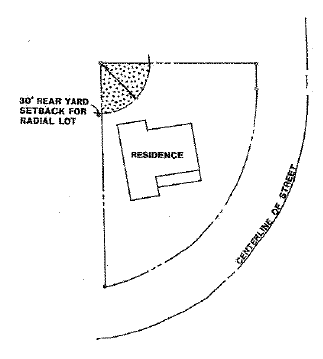
Rear Yard Setback for Radial Lot
Radial lot: A lot which fronts on an interior arch of a curve which results in the lot having only three sides and which does not have a clearly identifiable rear lot line. The minimum rear yard setback area shall be defined by the arch of a circle whose radius is equal to the minimum required rear yard setback and which is measured from the point at which the two side lot lines intersect and which is further illustrated as follows:
Residence zones: R-20, R-15, R-10, R-8, R-7, RM-1, RM-2, RG-1, RG-2, RG-3, RG-4, RG-5, RGO, or MHP zone.
Restaurant: An establishment in which the principal use is preparation and sale of food and beverages.
Retail: The selling of goods, wares, or merchandise directly to the consumer.
Retail marijuana store: An entity licensed by the State of Delaware to purchase marijuana from marijuana cultivation facilities; to purchase marijuana and marijuana products from marijuana product manufacturing facilities; and to sell marijuana and marijuana products to consumers.
Service establishment: Any establishment whose primary activity is the provision of assistance, as opposed to products, to individuals, business, industry, government, and other enterprises.
Setback: The distance between the street line and the setback line.
Setback line: A line extending between the two side lot lines of a lot or a parcel of land, which is parallel to, and a stated distance from, a street line.
Shopping center: A retail commercial complex of three or more establishments, which is designed, developed, operated and controlled by a single ownership, with accessory off-street parking located on the site to serve jointly all establishments in the complex.
Site development master plan: A site development plan which depicts a comprehensive development plan for a property which is intended to be developed in distinct phases of construction over an extended period of time. Individual construction phases may include but are not limited to the construction of new buildings and structures or portions thereof, parking lots, utility construction and stormwater management improvements and related site improvements so as to achieve completion in accordance with the site development master plan. Each construction phase shall be planned and constructed to function as a complete and habitable site development, while being designed and implemented so as to permit the continuation of future phases of construction.
Small wind energy system. A wind energy conversion system consisting of a wind turbine, a tower, and associated control or conversion electronics which is intended to primarily reduce on-site consumption of utility-supplied energy.
Solar energy system. Any solar collector or other solar energy device or any structural design feature mounted on a building or on the ground, and whose primary purpose is to provide for the collection, storage, and distribution of solar energy for space heating or cooling, for water heating, or for electricity.
Story: That part of any building, exclusive of cellars but inclusive of basements, comprised between the level of one finished floor and the level of the next higher finished floor, or if there be no higher finished floor, then that part of the building comprised between the level of the highest finished floor and the top of the roof beams.
Story, half: Any space partially within the roof framing, where the clear height of not more than 50 percent of such space between the top of the floor beams and the structural ceiling level is seven feet, six inches or more.
Street: A street shown on the official map of the City of Dover and improved to the satisfaction of the planning commission.
Street level: The established elevation of the street grade at the point that is opposite the center of the wall nearest to and facing the street line.
Street line: The dividing line between a lot and a street.
Structural alteration: Any change in the supporting members of a building.
Student home: The term "student home" shall mean a building, structure, dwelling or other form of construction that provides [a] domicile and living arrangements for three or more students, unrelated by blood, marriage, or legal adoption, that are matriculated students at a college or university, or that are in the process of attending a college or university, or who are on a semester or summer break from studies at a college or university, or any combination of such persons. The term "student home" shall not be construed to include or be synonymous with the terms "fraternity house, sorority house, dormitory, community residential treatment center, homeless shelter," or "halfway house." A "student home" is subject to the provisions of appendix B, zoning ordinance, article 3, district regulations, section 2, general residence zones (RG-1 and RG-2), subsection 2.4(b).
Townhouse: A one-family, attached dwelling unit, with one dwelling unit from [the] ground to roof, having individual outside access.
Trailer, house: Any vehicle mounted on wheels, movable either by its own power or by being drawn by another vehicle, and equipped to be used for living or sleeping quarters or so as to permit cooking. The term "house trailer" shall include vehicles if mounted on temporary or permanent foundations with the wheels removed.
Transitional housing: A residential facility developed in a one-family dwelling unit that is established to provide transition from homelessness to permanent housing, and generally integrated with other social services and counseling programs to assist in the transition to self-sufficiency through acquisition of stable income and permanent housing.
Usable open space: An unenclosed portion of the ground of a lot which is not devoted to driveways or parking spaces, which is free of structures of any kind, of which not more than 25 percent is roofed for shelter purposes only, the minimum dimension of which is 40 feet, and which is available and accessible to all occupants of the building or buildings on the said lot for purposes of active or passive outdoor recreation. Accessory building roof space may be substituted for ground space, provided such space is available and accessible to all the said occupants by means of access other than stairs.
Use: The specific purpose for which land or a building is designed, arranged, [or] intended, or for which it is or may be occupied or maintained. The term "permitted use" or its equivalent shall not be deemed to include any nonconforming use.
Vegetative ground cover: Grass and a combination of shrubs and/or trees planted or naturally occurring that occupies a portion of a property for the purpose of maintaining or improving water quality or natural conditions of the land.
Vocational education facility: Services or instruction which are geared toward training for a specific occupation or set of skills.
Vocational training: A specialized instructional establishment that provides on-site training of business, commercial, and/or trade skills. Incidental instructional services in conjunction with another primary use shall not be considered vocational training.
Warehouse: A building where goods or wares are held in storage for sale or distribution later.
Warehousing: The act of storing goods and materials that will be sold or distributed later; the keeping of business inventories for future use, but not where sales are made primarily to retail customers. Warehousing excludes places designed and operated where individual units are rented out for the purpose of storing personal belongings, as in self-storage or mini-storage facilities.
Wetlands: Lands that are inundated or saturated by surface or groundwater at a frequency and duration sufficient to support, and that under normal circumstances do support, a prevalence of vegetation typically adapted for life in saturated soils conditions.
Wireless communications facility (WCF). An antenna facility or a wireless support structure that is used for the provision of wireless service, whether such service is provided on a stand-alone basis or commingled with other wireless communications services.
Yard, front: An unoccupied ground area fully open to the sky between the street line and the setback line. The minimum width of the front yard is equal to the setback.
Yard, rear: An unoccupied ground area fully open to the sky between the rear lot line and a line parallel thereto.
Yard, side: An unoccupied ground area fully open to the sky between any property line other than a street or rear lot line, and a line drawn parallel thereto, and between the front and rear yards.
(Ord. of 7-23-1979; Ord. of 3-24-1986; Ord. of 6-12-1989; Ord. of 5-14-1990; Ord. of 12-14-1992(2); Ord. of 7-12-1993, §§ 5, 12—14; Ord. of 7-26-1993; Ord. of 4-25-1994; Ord. of 9-13-1999; Ord. of 5-22-2000; Ord. of 7-10-2000; Ord. of 2-12-2001; Ord. of 1-13-2003; Ord. of 4-23-2007(5); Ord. No. 2010-25, 11-8-2010; Ord. No. 2011-01, 4-11-2011; Ord. No. 2014-08, 7-14-2014; Ord. No. 2015-20, 1-11-2016; Ord. No. 2016-16, 8-8-2016; Ord. No. 2017-13, 12-11-2017; Ord. No. 2018-01, 9-24-2018; Ord. No. 2018-06, 8-27-2018; Ord. No. 2019-15, 9-9-2019; Ord. No. 2020-13, 11-9-2020; Ord. No. 2020-05, 1-11-2021; Ord. No. 2022-21, 1-9-2023; Ord. No. 2024-01, 3-11-2024; Ord. No. 2024-29, 1-2-2025; Ord. No. 2024-30, 1-2-2025)

