
Dover City Zoning Code
ARTICLE 3
- DISTRICT REGULATIONS
Section 1. - One-family residence zones [(R-20, R-15, R-10, R-8 and R-7)].
(R-20, R-15, R-10, R-8, R-7.) (See also article 5, Supplementary Regulations; and article 6, Off-Street Parking, Driveways and Loading Facilities.)
1.1 Uses permitted. In a one-family residence R-20, R-15, R-10, R-8 and R-7 zones, no building or premises shall be used and no building or part of a building shall be erected or altered which is arranged, intended or designed to be used, in whole or in part, for any uses except the following:
1.11 The raising of field and garden crops, vineyards and orchard farming, the maintenance of nurseries, and the seasonal sale of the products thereof, provided no building is erected and signs conform with article 5, section 4.
1.12 One-family detached dwellings, not to exceed one such dwelling per lot.
1.13 Public buildings, structures and uses, including parks and playgrounds, subject to approval of site plans by the planning commission in accordance with article 10, section 2.
1.14 The following uses are permitted, conditional upon the approval of the planning commission in accordance with the procedures and subject to the general conditions set forth in section 10.1 and to any specified requirements set forth below:
(a)
Places of worship, including parish houses; [and] schools, including nursery schools, kindergartens and day care centers in accordance with article 5, Supplementary Regulations, section 14. Child day care facilities; philanthropic and eleemosynary institutions; hospitals and sanitariums for general medical care; and funeral homes subject to the following requirements:
i.
Any school permitted under this paragraph [subsection 1.14(a)] shall be a nonprofit organization within the meaning of the Internal Revenue Act and shall be registered effectively as such thereunder.
ii.
Any school permitted under this paragraph [subsection 1.14(a)], other than a kindergarten, nursery school, or day care center, shall occupy a lot with an area of not less than two acres, plus one acre for each 100 pupils for which the building is designed.
iii.
Any kindergarten or nursery school permitted under this paragraph [subsection 1.14(a)] shall be limited to a maximum of 50 children in zones R-8 thru R-20 and a maximum of 100 children in all other zones. At least 100 square feet of outdoor play space per child shall be provided. Outdoor play space shall be fenced or otherwise enclosed on all sides and shall not include driveways, parking areas, or land unsuited by other usage or natural features for children's active play space. Fencing or other enclosures shall be a minimum height of four feet. The minimum lot area for each ten, or remainder over the multiple of ten, children shall be the same as the minimum lot area requirement for each dwelling unit in the districts in which such uses are to be located.
iv.
No such building or part thereof shall be erected with less than a 50-foot front yard or nearer than 25 feet from any other street or property line.
v.
The sum of all areas covered by all principal and accessory buildings shall not exceed 20 percent of the area of the lot.
vi.
Courts shall conform to the requirements of article 5, section 3 hereof.
(b)
Railroad and public utility rights-of-way and structures necessary to serve areas within the city, subject to such conditions as the planning commission may impose in order to protect and promote the health and safety and general welfare of the community and the character of the neighborhood in which the proposed structure is to be constructed.
(c)
Country clubs or other annual membership clubs, catering exclusively to members and their guests, and accessory private playgrounds, golf courses, swimming pools, tennis courts and recreation buildings not conducted as business enterprises, provided that the following operations shall be prohibited:
i.
Outdoor entertainment, live or mechanical;
ii.
The use of outdoor public address systems for any purpose; and
iii.
Exterior lighting producing glare at the lot line other than that essential for the safety of the users of the premises.
No building erected under the provisions of this paragraph [subsection 1.14(c)] shall be so erected nearer than 50 feet to any street or property line.
(d)
Adult day care facilities in accordance with Article 5—Supplementary Regulations, Section 22—Adult Day Care Facilities.
1.15 Accessory uses, limited to the following:
(a)
Professional office or studio of an artist, dentist, musician, teacher, or physician, but not including veterinarians, provided that:
i.
Such office or studio is incidental to the residential use of the premises and is carried on by a resident thereon with not more than one nonresident assistant; and
ii.
Such office or studio shall occupy not more than 30 percent of the area of one floor of the main building.
iii.
Studios where dancing or music instruction is offered to groups in excess of four pupils at one time or where concerts or recitals are held are prohibited.
iv.
Medical centers, barbershops, beauty parlors, real estate offices, funeral homes or similar uses shall not be considered permitted accessory uses.
(b)
Garden house, tool house, playhouse, greenhouse or pool incidental to the residential use of the premises and not operated for gain.
(c)
Private garage, provided that, in the case of a one-family dwelling, such garage shall have a capacity of not more than three passenger automobiles. One such space may be leased to a person not [a] resident on the premises.
(d)
Keeping domestic animals as pets, provided not more than three (3) dogs over six months old, shall be permitted.
(e)
Keeping of chickens for individual domestic purposes subject to the following restrictions:
i.
Keeping of chickens shall not be permitted on lots smaller than 10,890 square feet in lot area.
ii.
No more than five (5) chickens shall be permitted on a residential lot.
iii.
Chickens shall be registered with the Delaware Department of Agriculture.
iv.
Chickens shall be penned in a coop that shall be at least four (4) square feet per chicken.
v.
All chicken coops shall be located in a rear yard and shall be a minimum of 20 feet from side and rear property lines.
vi.
Any odor associated with the chickens shall not be discernable from property lines.
vii.
Keeping of roosters shall be prohibited.
viii.
Any lot with chickens shall either comply with these requirements by June 1, 2016 or remove the chickens.
(f)
Dormitories accessory to schools, provided that such dormitories conform to the bulk regulations of the RG-1 zone. For purposes of computing bulk requirements, each four rooms shall be considered one dwelling unit. Parking shall be calculated as identified in Article 6—Off-Street Parking, Section 3—Required off-street parking spaces, Paragraph 3.1—Schedule of requirements.
(g)
Customary home occupations, provided that:
i.
No display of products, goods and/or signs shall be visible from the street.
ii.
Such home occupation shall be incidental and secondary to the residential use of the premises and shall be conducted in the principal building by the resident or residents that reside therein.
iii.
Nonresident assistants or co-workers shall be prohibited.
iv.
Such home occupation shall not occupy more than 30 percent of the area of one floor in the principal building.
v.
There shall be no exterior effect such as noise, traffic, odor, dust, smoke, gas, fumes, radiation, or electromagnetic interference.
1.16 [1.2] Site development plan approval. Site development plan approval in accordance with article 10, section 2 hereof shall be required prior to the issuance of building permits for the erection or enlargement of all structures and related accessory structures. Such approval shall also be required prior to the issuance of certificates of occupancy for a change of use.
1.17 [1.3] Performance standards. All uses are subject to performance standards as set forth in article 5, section 8.1.
1.18 [1.4] [Closed zone.] Zone R-7 is a closed zone in accordance with article 10, section 5.19.
1.19 [1.5] [Signs.] Signs shall meet the regulations found in article 5, section 4, supplementary sign regulations.
(Ord. of 1-8-1979; Ord. of 5-14-1990; Ord. of 12-14-1992(2); Ord. of 7-10-2000; Ord. of 2-12-2001; Ord. No. 2009-12, 9-14-2009; Ord. No. 2011-21, 10-10-2011; Ord. No. 2016-01, 4-11-2016; Ord. No. 2017-13, 12-11-2017)
Section 2. - General residence zones (RG-1 and RG-2).
2.1 Uses permitted. In a general residence zone, no building or premises shall be used, and no building or part of a building shall be erected, which is arranged, intended or designed to be used, in whole or in part, for any purpose, except the following:
2.11 Any use permitted in one-family residence zones.
2.12 Garden apartments limited to placement within the RG-2 district only.
2.2 Performance standards. All uses are subject to performance standards as set forth in article 5, section 8.1.
2.3 Site development plan approval. Site development plan approval in accordance with article 10, section 2 hereof shall be required prior to the issuance of building permits for the erection or enlargement of all structures and related accessory structures. Such approval shall also be required prior to the issuance of certificates of occupancy for a change of use.
2.4 Conditional uses. The following uses are permitted, conditional upon the approval of the planning commission in accordance with the procedures and subject to the general conditions set forth in article 10, section 1:
(a)
Townhouses subject to the following restrictions:
i.
No more than one dwelling unit shall be permitted upon a lot.
ii.
No more than four dwelling units shall be permitted in a group of townhouses.
iii.
Each group of townhouses shall be physically separated from another by no less than two dwelling units of a different housing type from other groups of townhouses on the same side of the street.
iv.
Townhouse groups shall be designed to minimize points of access to the public street and to take access from an alley or other shared access where such access is available.
(b)
Duplex dwellings subject to the following restrictions:
i.
No more than one dwelling unit shall be permitted upon a lot
ii.
Duplex dwellings shall be designed to minimize points of access to the public street and to take access from an alley or other shared access where such access is available.
(c)
Bed and breakfast inns in the RG-1 district only, subject to the following:
i.
A bed and breakfast inn may only be established within a primary residential structure or an associated accessory structure.
ii.
The owner of the property shall reside on the premises of the bed and breakfast inn or in an adjacent premises. However, if ownership of the property is in the name of a corporation, partnership, trust, etc., a full-time resident manager/operator/inn-keeper shall reside in the principal structure on the subject property or adjacent property.
iii.
The principal structure shall contain at least one full bathroom for the exclusive use of the owner or resident manager and other members of the immediate household. In addition, one full bathroom shall be provided for each two guestrooms. Each full bathroom shall contain a minimum of one water closet (toilet), one lavatory (sink) and one bathtub or shower stall and shall comply with all applicable building and plumbing codes.
iv.
The number of guestrooms requested shall be set forth in the application for conditional use. The planning commission shall expressly establish the maximum number of guestrooms permitted for any application for which approval is granted. In no case shall a bed and breakfast inn contain more than ten guestrooms.
v.
Off-street parking shall be provided at a minimum of two spaces, plus one space per guestroom. Off-street parking shall be prohibited in the front yard, except that such parking which may be customarily accommodated on a single width driveway may be permitted. Required parking may be provided on the premises or off the premises, provided that such off-premises parking is located within 150 feet walking distance of the bed and breakfast property.
vi.
Lot coverage for a bed and breakfast inn shall not exceed 60 percent of the lot.
vii.
Signage is limited to one sign not to exceed six square feet in area. Signs may be illuminated, provided that internally illuminated signs shall be prohibited.
viii.
Meals may be served to residents and overnight guests only. No cooking appliances or kitchenettes shall be permitted within the guestrooms, except small refrigerators and microwave ovens.
ix.
The stay of overnight guests shall be limited to 30 consecutive days.
x.
The owner/operator of a bed and breakfast inn shall maintain a current City of Dover business license, and the establishment shall be inspected by the City of Dover Fire Marshal and the City of Dover Health Inspector for compliance with all applicable life safety and health and sanitation codes.
(d)
Student homes subject to the following siting and bulk criteria:
i.
No student home shall be located closer than 500 feet from any other student home.
ii.
The maximum allowable occupancy shall be four persons or the occupancy limit as determined by the building and fire codes adopted by the City of Dover, whichever is less.
iii.
Two off-street parking spaces shall be provided per dwelling unit.
iv.
A student home shall not be permitted to be established within any semi-detached dwelling, duplex dwelling, group dwelling, or townhouse dwelling unit.
v.
Buildings or groups of buildings on the same lot with 15 or more units on the lot shall not be subject to the student home regulations.
vi.
Student homes shall be licensed under chapter 10, Housing Code [chapter 22, Buildings and Building Regulations], article V [X], Rental Dwellings, of the Code of Ordinances.
vii.
Student homes shall be subject to the provisions of chapter 10, Housing Code [chapter 22, Buildings and Building Regulations], article III [VIII], Leases, of the Code of Ordinances.
(e)
Multiple dwellings limited to placement in the RG-2 district only.
(f)
Professional offices may be permitted on Governors Avenue between Water Street and Mary Street, and on Route 8, subject to the following restrictions:
i.
The office operations shall be conducted in such a manner as to maintain the residential character of the surrounding neighborhood, and no changes or improvements shall be made to the premises which might preclude utilization of the premises for residential purposes in the future.
ii.
There shall be no other professional office located in the same zoning district within 250 feet of the premises.
iii.
No display of products or goods shall be visible from the street.
iv.
There shall be no exterior effects such as noise, traffic, odor, dust, smoke, gas, fumes, radiation, or electromagnetic interference.
v.
A minimum of two off-street parking spaces shall be required.
vi.
No more than four off-street parking spaces shall be permitted. Furthermore, all off-street spaces shall be visually screened from adjacent residential uses, to the greatest extent possible, by employing a landscape screen no less than six and one-half feet high, which landscape screen shall be properly maintained throughout the duration of the professional office use on the subject premises.
vii.
Signage shall be limited to one sign, not to exceed six square feet in area. No sign may be illuminated.
viii.
The hours of operation shall not commence prior to 6:00 a.m. and shall cease no later than 8:00 p.m., with no more than four employees engaged in the operations upon the premises at any given time.
ix.
The planning commission shall have the authority to impose such additional conditions and restrictions as may be necessary or appropriate to protect the general health, safety, and welfare of the residents of surrounding properties.
(g)
In order to stimulate limited commercial activity in the RG-1 and RG-2 zones within the city's historic district zone and/or where a historic district property or a property listed on the National Register of Historic Places exists, and to make this area of historic Dover more attractive to tourists and residents, antique shops, art galleries, gift and card shops, book stores, specialty hobby stores, and restaurants with no alcoholic beverages may be permitted as accessory uses incidental to the principal residence, subject to the conditional use approval of the planning commission in accordance with Article 10—Planning Commission, Section 1—Approval of conditional uses, and subject to the following:
i.
Total floor area of any nonresidential accessory use shall not exceed 2,000 square feet.
ii.
A minimum of two off-street parking spaces shall be required to serve the residence and the accessory use.
iii.
Signage for the accessory use is limited to one sign not to exceed six square feet in area. Signs may be illuminated, provided that internally illuminated signs shall be prohibited.
(h)
Off-street parking.
2.5 Reserved.
2.6 Administrative waivers:
(a)
The city planner shall have the authority to waive the bulk standards and parking requirements of article 4, section 4.2 for all non-conforming lots that existed in the RG-1 zone prior to January 1, 2007, when deemed necessary for redevelopment. The applicant must request such waivers in writing, stating the reasons that such waivers are necessary for development for redevelopment of the subject parcel.
(b)
The city planner shall have the authority to adjust the lot dimension requirements of article 4, section 4.2 in the approval minor lot line adjustment plans, where no additional lots are created, and to waive the bulk standards of article 4, section 4.2 for the placement of a structure on associated lots when deemed necessary for redevelopment. The applicant must request such waivers in writing, stating the reasons that waivers are necessary for redevelopment of the subject property.
(c)
The city planner shall have the authority to allow alternative parking surface, other than those specified in article 6, section 3.6 provided that such off-street parking areas where alternative surface is used are located within a rear yard. The applicant must request such a waiver in writing, stating the reasons that waivers are necessary.
(Ord. of 7-12-1993, § 14; Ord. of 4-22-1996; Ord. of 2-12-2001 Ord. of 1-13-2003; Ord. of 9-11-2006; Ord. of 5-29-2007; Ord. No. 2011-29, 1-9-2012; Ord. No. 2014-05, 5-27-2014; Ord. No. 2015-13, 10-12-2015)
Section 3. - Group housing zone (RG-3).
3.1 Uses permitted. In a group housing zone, no building or premises shall be used, and no building or part of a building shall be erected, which is arranged, intended, or designed to be used, in whole or in part, for any purpose, except the following:
3.11 Any use permitted in one-family residence zones.
3.12 One-family group dwellings such as townhouses and row houses.
3.2 Performance standards. All uses are subject to performance standards as set forth in article 5, section 8.1.
3.3 Site development plan approval. Site development plan approval in accordance with article 10, section 2 shall be required prior to the issuance of building permits for the erection or enlargement of all structures and related accessory structures. The approval shall be required prior to the issuance of certificates of occupancy for a change of use.
3.4 [Signs.] Signs shall meet the regulations found in article 5, section 4, supplementary sign regulations.
(Ord. of 4-23-1979; Ord. of 2-12-2001)
Section 4. - General residence zone for multistory apartments (RG-4).
4.1 Uses permitted. In a general residence zone for multistory apartments, no building or premises shall be used, and no building or part of a building shall be erected, which is arranged, intended or designed to be used, in whole or in part, for any purpose, except the following:
4.11 Any use permitted in one-family residence zones.
4.12 High-rise apartments as defined in article 12.
4.13 In addition, the following uses may be permitted as conditional uses under article 10, section 1 of this ordinance:
(a)
Sale of the following commodities and services, as accessory uses and appropriate adjuncts to an apartment house, which are designed to serve the tenant's daily needs; food, drugs, sundries and personal services, provided that:
i.
Such uses are limited to the main floor of the building or below; and
ii.
There is no direct entrance thereto from the outside of the building; and
iii.
No part of such accessory use or the entrance thereto is visible from a sidewalk; and
iv.
No sign or display indicating the existence of such accessory use is visible from the outside of the building; and
v.
The accessory uses authorized under this subparagraph [subsection 4.13] are intended to supply tenants of the apartments house with commodities and services supplementary to those established in the commercial districts.
4.2 Site development plan approval. Site development plan approval in accordance with article 10, section 2 hereof shall be required prior to the issuance of building permits for the erection or enlargement of all structures and prior to the issuance of certificates of occupancy for any change in use.
4.3 Performance standards. All uses are subject to performance standards as set forth in article 5, section 8.1.
4.4 [Closed zone.] Multistory apartments (RG-4) is a closed zone in accordance with article 10, section 5.19.
4.5 [Signs.] Signs shall meet the regulations found in article 5, section 4, supplementary sign regulations.
(Ord. of 11-24-1980, § 2; Ord. of 4-22-1996; Ord. of 2-12-2001)
Section 5. - General residence zone for mid-rise apartments (RG-5).
5.1 Uses permitted. In [the] general residence zone for mid-rise apartments, no building or premises shall be used, or no building or part of a building shall be erected, which is arranged, intended or designed to be used, in whole or in part, for any purpose, except the following:
5.11 Any use permitted in one-family residence zones.
5.12 Mid-rise apartments as defined in article 12.
5.13 The sale of the following commodities and services are permitted as accessory uses and appropriate adjuncts to an apartment house, which are designed to serve the tenant's daily needs; food, drugs, sundries and personal services, provided that:
i.
Such uses are limited to the main floor of the building or below; and
ii.
There is no direct entrance thereto from the outside of the building; and
iii.
No part of such accessory use or the entrance thereto is visible from a sidewalk; and
iv.
No sign or display indicating the existence of such accessory use is visible from the outside of the building; and
v.
The accessory uses authorized under this subparagraph [subsection 5.13] are intended to supply tenants of the apartment house with commodities and services supplementary to those established in the commercial districts.
5.2 Site development plan approval. Site development plan approval in accordance with article 10, section 2 hereof shall be required prior to the issuance of building permits for the erection or enlargement of all structures and prior to the issuance of certificates of occupancy for any change in use.
5.3 Performance standards. All uses are subject to performance standards as set forth in article 5, section 8.1.
5.4 [Signs.] Signs shall meet the regulations found in article 5, section 4, supplementary sign regulations.
(Ord. of 4-22-1996; Ord. of 2-12-2001)
Section 6. - Medium density residence zones (RM-1).
6.1 Uses permitted. In an RM-1 zone, no building or premises shall be used, and no building or part of a building shall be erected, which is arranged, intended or designed to be used, in whole or in part, for any purposes, except the following:
(a)
Any use permitted in one-family residence zones;
(b)
One-family lot-line dwellings, not to exceed one such dwelling per lot;
(c)
Duplex dwellings;
(d)
Multiplex dwellings;
(e)
Townhouses;
(f)
Roominghouses accommodating not more than five roomers.
6.2 Performance standards. All uses are subject to performance standards as set forth in article 5, section 8.1.
6.3 Site development plan approval. Site development plan approval in accordance with article 10, section 2 hereof shall be required prior to the issuance of building permits for the erection or enlargement of all structures and related accessory structures. Such approval shall also be required prior to the issuance of certificates of occupancy for a change of use.
6.4 Maximum density. The gross residential density in an RM-1 zone shall not exceed six dwelling units per acre.
6.5 [Signs.] Signs shall meet the regulations found in article 5, section 4, supplementary sign regulations.
(Ord. of 2-12-2001)
Section 7. - [Medium density residence] RM-2 zone.
7.1 Uses permitted. In an RM-2 zone, no building or premises shall be used, and no building or part of a building shall be erected, which is arranged, intended or designed to be used, in whole or in part, for any purposes, except the following:
(a)
Any use permitted in one-family residence zones;
(b)
One-family lot-line dwellings, not to exceed one such dwelling per lot;
(c)
Duplex dwellings;
(d)
Multiplex dwellings;
(e)
Townhouses;
(f)
Roominghouses accommodating not more than five roomers.
(g)
Garden apartments.
7.2 Performance standards. All uses are subject to performance standards as set forth in article 5, section 8.1.
7.3 Site development plan approval. Site development plan approval in accordance with article 10, section 2 hereof shall be required prior to the issuance of building permits for the erection or enlargement of all structures and related accessory structures. The approval shall be required prior to the issuance of certificates of occupancy for a change of use.
7.4 Maximum density. The gross residential density in an RM-2 zone shall not exceed eight dwelling units per acre.
7.5 [Signs.] Signs shall meet the regulations found in article 5, section 4, supplementary sign regulations.
(Ord. of 2-12-2001)
Section 8. - Manufactured housing (MH) zone.[2]
8.1 Uses permitted. In a manufactured housing zone, no building or premises shall be used, and no building shall be erected, which is arranged, intended or designed to be used, in whole or in part, for any uses, except the following:
8.11 Manufactured homes on individual lots, held in any type of ownership.
8.12 Multiple manufactured homes on a lot, provided that:
(a)
The lot is operated as a condominium, including, but not limited to, condominiums formed pursuant to 25 Del. C., Chapter 71; or
(b)
The lot is operated as a land lease community; and
(c)
There are at least 15 manufactured homes on the lot, or else sufficient home sites for rent or sale on the lot to accommodate 15 manufactured homes. Such home sites need not be expressly delineated but must be improved so as to be complete and ready for occupancy by a manufactured home. There shall be no mixing of manufactured homes and permanently placed manufactured homes on one lot.
8.13 Permanently placed manufactured homes on individual lots, provided that the home and the lot are under common ownership.
8.14 Multiple permanently placed manufactured homes on a lot, provided that:
(a)
The lot is operated as a condominium including, but not limited to, condominiums formed pursuant to 25 Del. C., Chapter 71; or
(b)
The lot is operated as a land lease community; and
(c)
There are at least 15 permanently placed manufactured homes on the lot, or else sufficient home sites for rent or sale on the lot to accommodate 15 permanently placed manufactured homes. Such home sites need not be expressly delineated but must be improved so as to be complete and ready for occupancy by a permanently placed manufactured home. There shall be no mixing of manufactured homes and permanently placed manufactured homes on one lot.
8.15 One-family detached homes on individual lots, held in any type of ownership.
8.2 Conditional uses. Conditional uses shall be consistent with those conditionally permitted in the one-family residence zones.
8.3 Accessory uses. Accessory uses shall be consistent with those permitted in the one-family residence zones, with the following additions and exceptions:
8.31 Management facilities. The following shall be permitted accessory to lots providing home sites for multiple manufactured homes:
(a)
Management offices with rooms for the usual office furniture and supplies, limited to one per lot;
(b)
Storage space for utility connection supplies in quantity, manufactured home accessories and maintenance materials and equipment;
(c)
Laundry facilities equipped with washing machines and dryers;
(d)
Community building facilities, including indoor recreation areas;
(e)
Commercial establishments consistent with uses permitted in the C-1 neighborhood commercial zone, limited to one such establishment per lot;
(f)
One-family detached homes intended for the use of a manager or caretaker, limited to one such dwelling per lot.
8.32 Accessory home occupations. Accessory home occupations shall be permitted consistent with the conditions outlined for home occupations in the one-family residence zones, with the exception that no home occupation shall be permitted if not also permitted by the owner of the lot on which the home is sited.
8.4 Uses prohibited. The following uses are specifically prohibited:
8.41 Mobile homes, house trailers, and recreational vehicles as principal uses on a lot. Any such structures or vehicles located within the zone and being used as dwellings shall upon the effective date of this ordinance be deemed non-conforming uses in accordance with article 7.
8.42 Any other kind of factory-built housing that does not meet the Manufactured Home Construction and Safety Standards of the U.S. Department of Housing and Urban Development (HUD) Code as approved June 15, 1976, unless it can be demonstrated that such housing is constructed to the standards of the Dover Code of Ordinances, Chapter 22, Buildings and Building Regulations. Any such housing located within the zone and being used as dwellings shall upon the effective date of this ordinance be deemed non-conforming uses in accordance with article 7.
8.5 Minimum occupation length. No lot or home site within the manufactured housing zone reserved for occupation by a manufactured home shall be leased or occupied for residential use except for periods of 30 consecutive days or more.
8.6 Land lease communities. The following regulations shall apply to land lease communities within the MH zone:
8.61 The entire land area occupied by a land lease community, regardless of the number of home sites or individual lots therein, shall be maintained in single ownership, or if in multiple ownership, under the provisions of the laws of the state dealing with unit properties and condominiums.
8.62 Changes to site plan. After initial site development plan approval of a land lease community, reapproval for the entire community shall not be required prior to the issuance of building permits for alterations to individual manufactured homes, or their accessory buildings such as storage areas and patios, which, in the judgement of the city planner, do not materially alter the site development plan approval by the planning commission and are requested as adjustments to the individual manufactured home sites or lots leased by an individual family and designed for the convenience and comfort of the individual lessee.
8.7 Performance Standards. All uses are subject to performance standards as set forth in article 5, section 8.
8.8 Site development plan approval. Site development plan approval in accordance with article 10, section 2 hereof shall be required prior to the issuance of building permits for the erection or enlargement of all structures and related accessory structures. Such approval shall also be required prior to the issuance of certificates of occupancy for a change of use.
8.81 For purposes of preparing a site development plan for approval by the planning commission, and all subsequent improvements, alterations or additions, the applicant shall conform to current submission requirements and site development standards as set forth by the National Fire Protection Association publication 501A,"Standard for Fire Safety Criteria for Manufactured Home Installations, Sites, and Communities." Where applicable, the approving authority shall be the fire marshal's office.
8.82 No site development plan proposing the siting of a manufactured home outside of a land lease community shall be approved unless the plan shows the manufactured home is to be permanently placed, as defined in the Dover Code of Ordinances, Chapter 66—Manufactured Homes, Mobile Homes, and Land Lease Communities.
8.9 Maximum density. The gross residential density in an MH zone shall not exceed six dwelling units per acre.
8.10 Signs. Signs shall meet the regulations found in Article 5—Supplementary Regulations, Section 4—Supplementary Sign Regulations.
(Ord. No. 2016-16, 8-8-2016; Ord. No. 2018-01, 9-24-2018)
Editor's note— Ord. No. 2016-16, adopted August 8, 2016, in effect, repealed § 8 and enacted a new § 8 as set out herein. Former § 8 pertained to similiar subject matter and derived from Ord. of 10-13-1981; Ord. of 3-20-1983; Ord. of 3-24-1986; Ord. of 7-10-2000; Ord. of 2-12-2001; Ord. of 4-28-2008(2); and Ord. No. 2010-29, adopted January 10, 2011.
Section 9. - General residence and office zone (RG-O).
9.1 Uses permitted. In a general residence and office zone, no building or premises shall be used, and no building or part of a building shall be erected, which is arranged, intended, or designed to be used, in whole or in part, for any purpose, except the following:
9.11 Any use permitted in the general residence zone, except off-street parking accessory to uses in the central commercial zone (C-2).
9.12 Any use permitted in the RM-2 zone.
9.131 Business, professional, or governmental office on suitably landscaped lots.
9.132 In order to stimulate limited commercial activity in this zone where the city's historic district overlay zone exists and to make this portion of the city's historic district a greater attraction to tourists and residents, the following list of preferred uses are permitted:
(a)
Antique shops, art galleries, gift and card shops, and personal service establishments.
9.14 The following uses are permitted, conditional upon the approval of the planning commission in accordance with the procedures and subject to the general conditions set forth in section 10.1 and to any specified requirements set forth below:
(a)
After a building complex in this zone has reached a building space area of 100,000 square feet, then the following uses shall be permitted as conditional uses, subject to the approval of the planning commission: cafeterias, restaurants, barbershops, beauty shops, travel agencies, banks, copy centers, coffee supplies, retail stores, newsstands and associated laboratory facilities.
(b)
In order to stimulate limited commercial activity in this zone where the city's historic district overlay zone exists and to make this portion of the city's historic district a greater attraction to tourists and residents, the following list of preferred uses may be permitted as conditional uses, subject to the approval of the planning commission:
i.
Book stores, specialty hobby stores (i.e., miniatures, models, needlecrafts), bakeries (including baking on premises), and restaurants.
ii.
Limitation of entrances from State Street only.
iii.
Total floor area of any one use is not to exceed 2,000 square feet.
iv.
Such uses will be subject to historic district requirements and will therefore require an architectural review certificate. Architectural review certificates for uses described above shall not be granted unless it has been demonstrated that the proposed use will result in either no material change to the exterior of the structure visible from State Street or will result in a restoration of the structure to an appearance which can be documented to more closely reflect the historical appearance of that structure. Material change would include modifications to doors, windows and masonry, other than routine maintenance.
v.
No parking shall be required for the use.
vi.
If new construction is proposed on State Street between Loockerman and Water Streets, the proposal must not require demolition or extensive modifications of any existing structure which presently contributes to the historic district because of its age or architectural appearance. In addition, the RG-O zone bulk and parking requirements would be waived in certain respects. Lot width and depth will be as appropriate to the site, subject to architectural review and site plan review. Setbacks will be discouraged. Side yards will reflect the needs of adjacent structures by providing adequate light and air to reach existing windows. The height limit of 35 feet or 2½ stories will be retained, as will the 85 percent lot coverage limit. The floor area ratio limitation will be raised to 1.0. The parking requirements will be waived.
(c)
Bed and breakfast inns, subject to the following:
i.
A bed and breakfast inn may only be established within a primary residential structure or in an associated accessory structure.
ii.
The owner of the property shall reside on the premises of the bed and breakfast inn or in an adjacent premises. However, if ownership of the property is in the name of a corporation, partnership, trust, etc., a full-time resident manager/operator/innkeeper shall reside in the principal structure on the subject property or adjacent property.
iii.
The principal structure shall contain at least one full bathroom for the exclusive use of the owner or resident manager and other members of the immediate household. In addition, one full bathroom shall be provided for each two guestrooms. Each full bathroom shall contain a minimum of one water closet (toilet), one lavatory (sink) and one bathtub or shower stall and shall comply with all applicable building and plumbing codes.
iv.
The number of guestrooms requested shall be set forth in the application for conditional use. The planning commission shall expressly establish the maximum number of guestrooms permitted for any application for which approval is granted. In no case shall a bed and breakfast inn contain more than ten guestrooms.
v.
Off-street parking shall be provided at a minimum of two spaces, plus one space per guestroom. Off-street parking shall be prohibited in the front yard, except that such parking which may be customarily accommodated on a single width driveway may be permitted. Required parking may be provided on the premises or off the premises, provided that such off-premises parking is located within 150 feet walking distance of the bed and breakfast property.
vi.
Lot coverage for a bed and breakfast inn shall not exceed 60 percent of the lot.
vii.
Signage is limited to one sign, not to exceed six square feet in area. Signs may be illuminated, provided that internally illuminated signs shall be prohibited.
viii.
Meals may be served to residents and overnight guests only. No cooking appliances or kitchenettes shall be permitted within the guestrooms, except for small refrigerators and microwave ovens.
ix.
The stay of overnight guests shall be limited to 30 consecutive days.
x.
The owner/operator of a bed and breakfast inn shall maintain a current City of Dover business license and the establishment shall be inspected at least semi-annually by the City of Dover Fire Marshal and the City of Dover Health Inspector for compliance with all applicable life safety and health and sanitation codes.
9.15 Signs shall meet the regulations found in article 5, section 4, supplementary sign regulations.
9.2 Performance standards. All uses are subject to performance standards as set forth in article 5, section 8.1.
9.3 Site development plan approval. Site development plan approval in accordance with article 10, section 2 hereof shall be required prior to the issuance of building permits for the erection or enlargement of all structures and related accessory structures. Such approval shall also be required prior to the issuance of certificates of occupancy for a change of use.
9.4 Off-street parking. No parking lot shall be located within the minimum required front yard, nor between the street line and the principal building on the lot. Off-street parking shall be provided in accordance with the provisions of article 4 and article 6 of this ordinance.
(Ord. of 2-14-1983; Ord. of 1-9-1989; Ord. of 6-26-1989; Ord. of 2-10-1992; Ord. of 7-12-1993, § 14; Ord. of 4-25-1994; Ord. of 7-10-2000; Ord. of 2-12-2001; Ord. No. 2012-15, 8-13-2012; Ord. No. 2019-19, 2-10-2020)
Section 10. - Institutional and office zone (IO).
10.1 Uses permitted. In an institutional and office zone (IO), no building or premises shall be used, and no building or part of a building shall be erected, which is arranged, intended, or designed to be used, in whole or in part, for any purpose, except the following:
(a)
Business, professional, or governmental offices.
(b)
Banks.
(c)
Research, design, and development laboratories.
(d)
Public and institutional uses including hospitals, medical clinics, libraries, police stations, courthouses, transit centers, schools, colleges, universities, places of public assembly, philanthropic and charitable institutions, parks, playgrounds, public indoor recreation centers, athletic fields.
(e)
Public utility rights-of-way and structures necessary to serve areas within the city.
(f)
Child day care centers, provided they are established in accordance with all applicable state regulations pertaining to child care and provided that they are established and maintained in accordance with article 5, section 14 of this ordinance.
(g)
Emergency shelters and transitional housing.
(h)
Adult day care facilities provided they are established in accordance with all applicable state regulations pertaining to adult care and provided that they are established and maintained in accordance with article 5, section 22 of this ordinance.
10.2 Conditional uses. The following uses are permitted, conditional upon the approval of the planning commission in accordance with the procedures and subject to the general conditions set forth in article 10, section 1:
(a)
Firearm ranges, prisons, and correctional facilities.
(b)
Public incinerators.
(c)
Hotels and restaurants.
10.3 Accessory uses. The following uses shall be permitted accessory to other permitted uses on a lot.
(a)
Clinics, cafeterias, and recreational facilities.
(b)
Motor vehicle storage and repair facilities accessory to a public or institutional use.
(c)
Restaurants that are on a campus and intended to support users of the campus.
10.4 Uses prohibited. The following uses are prohibited:
(a)
Landfills, dumps.
10.5 Enclosed buildings. All permitted uses and all storage accessory thereto, other than offstreet parking, shall be carried on in buildings fully enclosed on all sides, except for outdoor eating areas associated with restaurants approved by the city planner.
10.6 Performance standards. All uses are subject to performance standards as set forth in article 5, section 8.1.
10.7 Site development plan approval. Site development plan approval in accordance with article 10, section 2 hereof shall be required prior to the issuance of building permits for the erection or enlargement of all structures and prior to the issuance of certificates of occupancy for any change of use.
(Ord. of 10-24-1983; Ord. of 12-14-1992; Ord. of 7-12-1993, § 7; Ord. of 4-25-1994; Ord. of 10-12-1998; Ord. of 7-10-2000; Ord. of 2-12-2001; Ord. of 4-23-2007(1); Ord. of 4-23-2007(2); Ord. No. 2014-08, 7-14-2014; Ord. No. 2017-13, 12-11-2017)
Section 11. - Neighborhood commercial zone (C-1).
11.1 Uses permitted. In a neighborhood commercial zone (C-1), no building or premises shall be used, and no building or part of a building shall be erected, which is arranged, intended, or designed to be used, in whole or in part, for any purpose, except the following:
(a)
Retail stores.
(b)
Personal service establishments.
(c)
Service establishments.
(d)
Restaurants.
(e)
One family residences, including attached and semi-detached dwellings, complying with the bulk standards of the RG-1 (General Residence) zone.
(f)
Apartments and multi-family dwellings.
11.2 Uses prohibited. The following uses are prohibited:
(a)
Fuel pumps; motor vehicle storage, sales, or repairs.
(b)
Drive-throughs.
(c)
Liquor stores.
(d)
Fire arm sales
(e)
Tobacco shops.
11.3 Enclosed buildings. All permitted uses and all storage accessory thereto, other than offstreet parking, shall be carried on in buildings fully enclosed on all sides, except for outdoor eating areas associated with restaurants and outdoor sales areas approved by the city planner.
11.4 Floor area. The total floor area in any one establishment shall not exceed 2,500 square feet.
11.5 Performance standards. All uses are subject to performance standards as set forth in article 5, section 8.1.
11.6 Site development plan approval. Site development plan approval in accordance with article 10, section 2 hereof shall be required prior to the issuance of building permits for the erection or enlargement of all structures and prior to the issuance of certificates of occupancy for any change of use.
(Ord. of 7-10-2000; Ord. of 2-12-2001; Ord. No. 2014-08, 7-14-2014)
Section 12. - Limited commercial zone (C-1A).
12.1 Uses permitted. In a limited commercial zone (C-1A), no building or premises shall be used, and no building or part of a building shall be erected, which is arranged, intended, or designed to be used, in whole or in part, for any purpose, except the following:
(a)
Retail stores.
(b)
Personal service establishments.
(c)
Service establishments.
(d)
Restaurants.
(e)
Business, professional, and governmental offices.
(f)
One family residences, including attached and semi-detached dwellings, complying with the bulk standards of the RG-1 (General Residence) zone.
(g)
Apartments and multi-family dwellings.
12.2 Conditional uses. The following uses are permitted, conditional upon the approval of the planning commission in accordance with the procedures and subject to the general conditions set forth in article 10, section 1:
(a)
Drive-throughs accessory to a permitted use.
12.3 Uses prohibited. The following uses are prohibited:
(a)
Fuel pumps and motor vehicle storage, sales, or repairs.
12.4 Enclosed buildings. All permitted uses and all storage accessory thereto, other than offstreet parking, shall be carried on in buildings fully enclosed on all sides, except for outdoor eating areas associated with restaurants and outdoor sales areas approved by the city planner.
12.5 Performance standards. All uses are subject to performance standards as set forth in article 5, section 8.1.
12.6 Site development plan approval. Site development plan approval in accordance with article 10, section 2 hereof shall be required prior to the issuance of building permits for the erection or enlargement of all structures and prior to the issuance of certificates of occupancy for any change of use.
(Ord. of 6-25-1984; Ord. of 3-24-1986; Ord. of 7-10-2000; Ord. of 2-12-2001; Ord. No. 2014-08, 7-14-2014)
Section 13. - Central commercial zone (C-2).
13.1 Uses permitted. In a central commercial zone (C-2), no building or premises shall be used, and no building or part of a building shall be erected, which is arranged, intended, or designed to be used, in whole or in part, for any purpose, except the following:
(a)
Retail stores.
(b)
Restaurants, cafes, and eating establishments.
(c)
Commercial kitchens.
(d)
Microbrewery, craft distillery, and meadery establishments.
(e)
Hotels, including bed and breakfast inns.
(f)
Art galleries and artisan studios.
(g)
Service establishments.
(h)
Banks and financial institutions.
(i)
Personal service establishments.
(j)
Business, professional, and government offices.
(k)
Apartments and multi-family dwellings, provided that no dwelling units shall be permitted on the first floor on the street frontage of Loockerman Street. Uses accessory to the residential units such as lobby and amenity spaces are permitted on the first floor.
(l)
Live-work units.
(m)
Indoor recreation and amusement establishments.
(n)
Parking lots and parking structures as a principal use.
(o)
Places of public assembly.
(p)
Manufacturing, assembling, converting, altering, finishing, cleaning, cooking, baking, or any other processing of products where goods so produced or processed are to be sold at retail on the premises or online and where the size of the establishment shall not exceed 5,000 square feet in floor area.
(q)
Open space areas.
13.2 Conditional uses. The following uses are permitted, conditional upon the approval of the planning commission in accordance with the procedures and subject to the general conditions set forth in article 10, section 1:
(a)
Manufacturing, assembling, converting, altering, finishing, cleaning, cooking, baking, or any other processing of products where goods so produced or processed are to be sold at retail on the premises or online and where the size of the establishment exceeds 5,000 square feet in floor area.
13.3 Uses prohibited. The following uses are prohibited:
(a)
Fuel pumps and motor vehicle storage, sales, or repairs.
13.4 Enclosed buildings. All permitted uses and all storage accessory thereto, other than offstreet parking, shall be carried on in buildings fully enclosed on all sides, except for outdoor eating areas, outdoor gathering areas, and outdoor sales areas approved by the city planner or approved as part of the site development plan approval required by article 3, section 13.6.
13.5 Design standards. The following standards shall apply to the site and building development in the central commercial zone (C-2):
13.51 Façade articulation. Building facades should incorporate design elements to provide a base, middle, and top of the building to reinforce the pedestrian scale at the street level.
13.52 Height. For buildings greater than four stories in height, then the upper floors above the fourth story shall step back six feet for fifty percent of the width of the primary facade. For buildings greater than six stories, then the upper floors above the sixth floor shall step back an additional six feet on the primary façade. These step back areas may begin at a lower height than these minimums as part of the building design in order to be compatible with the character of the area.
13.53 Step back areas. The step back areas should be open to the sky and can be open air balcony spaces or other design architectural features that are not enclosed spaces.
13.54 Off-street parking. Off-street parking lots shall not be permitted to be situated between the street line and the primary facade of the principal building. Consideration should be given to locating parking to the side or rear of the building.
13.55 Screening. Any off-street parking lots provided shall be screened from the street line by buildings, landscaping, or other means. Off-street parking lots shall be screened from adjacent residential zones and residential uses. This screening provision does not apply to adjacent alleys.
13.6 Performance standards. All uses are subject to performance standards as set forth in article 5, section 8.1.
13.7 Site development plan approval. Site development plan approval in accordance with article 10, section 2 hereof shall be required prior to the issuance of building permits for the erection or enlargement of all structures and prior to the issuance of certificates of occupancy for any change of use.
(Ord. of 1-14-1980; Ord. of 6-24-1985; Ord. of 4-25-1994; Ord. of 12-8-1997; Ord. of 7-10-2000; Ord. of 2-12-2001; Ord. No. 2008-33, 8-25-2008; Ord. No. 2014-08, 7-14-2014; Ord. No. 2023-08, 10-23-2023; Ord. No. 2024-01, 3-11-2024)
Section 14. - Limited central commercial zone (C-2A).
14.1 Uses permitted. In a limited central commercial zone (C-2A), no building or premises shall be used, and no building or part of a building shall be erected, which is arranged, intended, or designed to be used, in whole or in part, for any purpose, except the following:
(a)
Retail stores.
(b)
Business, professional or governmental offices.
(c)
Personal service establishments.
(d)
Restaurants.
(e)
Service establishments.
(f)
Hotels.
(g)
Places of public assembly.
(h)
Drive-throughs.
(i)
One family residences, including attached and semi-detached dwellings, complying with the bulk standards of the RG-1 (General Residence) zone.
(j)
Apartments and multi-family dwellings.
14.2 Conditional uses. The following uses are permitted, conditional upon the approval of the planning commission in accordance with the procedures and subject to the general conditions set forth in article 10, section 1:
(a)
Parking lots and parking structures as a principal use on suitably landscaped lots.
(b)
Fuel pumps accessory to a permitted use.
14.3 Enclosed buildings. All permitted uses and all storage accessory thereto, other than offstreet parking, shall be carried on in buildings fully enclosed on all sides, except for outdoor eating areas associated with restaurants and outdoor sales areas approved by the city planner.
14.4 Performance standards. All uses are subject to performance standards as set forth in article 5, section 8.1.
14.5 Site development plan approval. Site development plan approval in accordance with article 10, section 2 hereof shall be required prior to the issuance of building permits for the erection or enlargement of all structures and prior to the issuance of certificates of occupancy for any change of use.
(Ord. of 7-10-2000; Ord. of 2-12-2001; Ord. No. 2008-33, 8-25-2008; Ord. No. 2010-28, 1-10-2011; Ord. No. 2014-08, 7-14-2014)
Section 15. - Service commercial zone (C-3).
15.1 Uses permitted. In a service commercial zone (C-3), no building or premises shall be used, and no building or part of a building shall be erected, which is arranged, intended, or designed to be used, in whole or in part, for any purpose, except the following:
(a)
Service establishments.
(b)
Personal service establishments.
(c)
Business, professional or governmental offices.
(d)
Retail uses accessory to a permitted use.
(e)
Drive-throughs accessory to a permitted use.
(f)
Wholesale, storage, and warehousing establishments.
(g)
Indoor recreation and amusement establishments.
(h)
Motor vehicle, boat, or farm equipment sales or service, subject to the following regulations:
(1)
The minimum lot size for such establishments shall be 20,000 square feet, and the minimum street frontage shall be 150 feet.
(2)
Entrance and exit driveways shall have an unrestricted width of not less than 16 feet, shall be located not nearer than ten feet from any property line and shall be so laid out as to avoid the necessity of any vehicle leaving the property to back out across any public right-of-way or portion thereof.
(3)
Vehicle lifts or pits, dismantled and disabled automobiles and all parts or supplies shall be located within a building enclosed on all sides.
(4)
All service or repair of motor vehicles, other than such minor servicing as change of tires or sale of gasoline or oil, shall be conducted in a building fully enclosed on all sides. This requirement shall not be construed to mean that the doors to any repair shop must be kept closed at all times.
(5)
The storage of gasoline or flammable oils in bulk shall be located fully underground in accordance with applicable provisions of the National Fire Protection Association Code.
(6)
No fuel pumps shall be located nearer than 15 feet to any street line.
(7)
Fuel pumps shall not be permitted closer than 100 feet from a property line of any school, day care, church, hospital, nursing home, or place of public assembly designed for the simultaneous use and occupancy by more than 100 persons.
(i)
Manufacturing, assembling, converting, altering, finishing, cleaning or any other processing of products for sale on or off the premises, provided that not more than 25 persons shall be engaged in such activity; and provided further, that any such use shall be subject to the performance standards procedure as set forth in article 5, section 8.
(j)
Mini-storage facilities, subject to the following regulations:
(1)
No unit shall be placed within 30 feet of a residential property line.
(2)
No outside storage, except for recreational vehicles, boats, or personal automobiles when parked in specifically approved locations. Parking for these vehicles shall not count toward the required parking set forth in subsection (e) below.
(3)
No individual unit may be used for retail, garage sale or any other commercial activities.
(4)
No storage of flammable, explosive, corrosive or other hazardous products may occur in the individual unit.
(5)
Parking must be provided at a ratio of one space for each 25 rental units, plus a minimum of three spaces for an office outside of the enclosure.
15.2 Conditional uses. The following uses are permitted, conditional upon the approval of the planning commission in accordance with the procedures and subject to the general conditions set forth in article 10, section 1:
(a)
Crematory, subject to the following requirements:
(1)
The building lot line upon which a crematory is to be established shall be located at least 100 feet from any residential zone.
(2)
Where adjacent to residential zones, all landscape buffers shall be required. The buffer shall consist of a landscape screen no less than six and one-half feet high. All landscaping shall be properly maintained throughout the life of the use on lot.
(3)
Loading operations shall be conducted within a completely enclosed building. Location of loading doors shall be at the side or rear of the building.
(4)
The crematory shall comply with the Delaware Incinerator Regulations. A copy of the approved air pollution permit issued by the State of Delaware Department of Natural Resources and Environmental Control shall accompany the application for a certificate of occupancy.
15.3 Enclosed buildings. All permitted uses and all storage accessory thereto, other than offstreet parking, shall be carried on in buildings fully enclosed on all sides, except for outdoor eating areas associated with restaurants and outdoor sales areas approved by the city planner.
15.4 Performance standards. All uses are subject to performance standards as set forth in article 5, section 8.1.
15.5 Site development plan approval. Site development plan approval in accordance with article 10, section 2 hereof shall be required prior to the issuance of building permits for the erection or enlargement of all structures and prior to the issuance of certificates of occupancy for any change of use.
(Ord. of 3-22-1993; Ord. of 5-22-2000; Ord. of 5-22-2000; Ord. of 7-10-2000; Ord. of 2-12-2001; Ord. of 7-23-2001; Ord. No. 2014-08, 7-14-2014)
Section 16. - Highway commercial zone (C-4).
16.1 Uses permitted. In a highway commercial zone (C-4), no building or premises shall be used, and no building or part of a building shall be erected, which is arranged, intended, or designed to be used, in whole or in part, for any purpose, except the following:
(a)
Retail stores.
(b)
Business, professional or governmental offices.
(c)
Restaurants.
(d)
Personal service establishments.
(e)
Service establishments.
(f)
Hotels and motels.
(g)
Places of public assembly.
(h)
Bus terminal.
(i)
Wholesale, storage, warehousing, and distribution establishments.
(j)
Indoor or outdoor recreation and amusement establishments.
(k)
Hospitals and medical centers.
(l)
Drive-throughs.
(m)
Motor vehicle, boat, or farm equipment sales or service:
(1)
The minimum lot size for such establishments shall be 20,000 square feet, and the minimum street frontage shall be 150 feet.
(2)
Entrance and exit driveways shall have an unrestricted width of not less than 16 feet, shall be located not nearer than ten feet from any property line and shall be so laid out as to avoid the necessity of any vehicle leaving the property to back out across any public right-of-way or portion thereof.
(3)
Vehicle lifts or pits, dismantled and disabled automobiles, and all parts or supplies shall be located within a building enclosed on all sides.
(4)
All service or repair of motor vehicles, other than such minor servicing as change of tires or sale of gasoline or oil, shall be conducted in a building fully enclosed on all sides. This requirement shall not be construed to mean that the doors to any repair shop must be kept closed at all times.
(5)
The storage of gasoline or flammable oils in bulk shall be located fully underground in accordance with applicable provisions of the National Fire Protection Association Code.
(6)
No fuel pumps shall be located nearer than 15 feet to any street line.
(7)
Fuel pumps shall not be permitted closer than 100 feet from a property line of any school, day care, church, hospital, nursing home, or place of public assembly designed for the simultaneous use and occupancy by more than 100 persons.
(n)
Manufacturing, assembling, converting, altering, finishing, cleaning, or any other processing of products for sale on or off the premises, provided that not more than 25 persons shall be engaged in such activity; and provided further, that any such use shall be subject to the performance standards procedure as set forth in article 5, section 8.
(o)
Mini-storage facilities, subject to the following regulations:
(1)
No unit shall be placed within 30 feet of a residential property line.
(2)
No outside storage, except for recreational vehicles, boats, or personal automobiles when completely parked in specifically approved locations. Parking for these vehicles shall not count toward the required parking set forth in subsection (e) below.
(3)
No individual unit may be used for retail, garage sale, or any other commercial activities.
(4)
No storage of flammable, explosive, corrosive, or other hazardous products may occur in the individual unit.
(5)
Parking must be provided at a ratio of one space for each 25 rental units, plus a minimum of three spaces for an office.
(p)
Adult entertainment establishments, subject to the provisions stated in article 5, section 13.
(q)
Retail marijuana stores, subject to the requirements outlined in article 5, section 24.
16.2 Conditional uses. The following uses are permitted, conditional upon the approval of the planning commission in accordance with the procedures and subject to the general conditions set forth in article 10, section 1:
(a)
Apartments and multi-family dwellings.
(b)
Crematory, subject to the following requirements:
(1)
The building lot line upon which a crematory is to be established shall be located at least 100 feet from any residential zone.
(2)
Where adjacent to residential zones, all landscape buffers shall be required. The buffer shall consist of a landscape screen no less than six and one-half feet high. All landscaping shall be properly maintained throughout the life of the use on lot.
(3)
Loading operations shall be conducted within a completely enclosed building. Location of loading doors shall be at the side or rear of the building.
(4)
The crematory shall comply with the Delaware Incinerator Regulations. A copy of the approved air pollution permit issued by the State of Delaware Department of Natural Resources and Environmental Control shall accompany the application for a certificate of occupancy.
16.3 Enclosed buildings. All permitted uses and all storage accessory thereto, other than offstreet parking, shall be carried on in buildings fully enclosed on all sides, except for outdoor eating areas associated with restaurants and outdoor sales areas approved by the city planner.
16.4 Performance standards. All uses are subject to performance standards as set forth in article 5, section 8.1.
16.5 Site development plan approval. Site development plan approval in accordance with article 10, section 2 hereof shall be required prior to the issuance of building permits for the erection or enlargement of all structures and prior to the issuance of certificates of occupancy for any change of use.
(Ord. of 7-23-1979; Ord. of 1-14-1980; Ord. of 4-25-1988; Ord. of 2-10-1992; Ord. of 9-13-1999; Ord. of 7-10-2000; Ord. of 2-12-2001; Ord. No. 2014-08, 7-14-2014; Ord. No. 2024-30, 1-2-2025)
Section 17. - Shopping center development [(SC-1, SC-2 and SC-3)].
17.1 General. In order to encourage superior commercial development and, in particular, to encourage grouping of commercial establishments for safer access and greater convenience, shopping centers shall be permitted in shopping center zones SC-1, SC-2 and SC-3.
17.2 Eligibility. No area shall be zoned for shopping center development unless the following conditions are met:
(a)
The development consists of a contiguous area of at least one acre for a neighborhood shopping center (SC-1), 15 acres for a community shopping center (SC-2) and 50 acres for a regional shopping center (SC-3).
(b)
The development will be served by public water supply and public sewerage, which shall be in place at the time construction of the first stage of the shopping center begins.
(c)
The frontage of the development shall be of sufficient width that safe and efficient access to the shopping center can be adequately spaced from accesses to adjacent properties, according to standards set forth by the Delaware Department of Transportation.
17.3 Permitted uses.
17.31 In a neighborhood shopping center (SC-1), [the following are permitted uses]:
1.
All uses permitted in the neighborhood commercial zone C-1, with no limitation on the size of establishments;
2.
Business, professional and governmental offices, public libraries, banks and restaurants.
3.
Retail and service establishments, subject to the following:
(a)
The following uses shall be prohibited:
i.
Wholesaling, warehousing, storage;
ii.
Motor vehicle service, sales, and/or fueling stations.
(b)
Gasoline pumps shall be permitted only as an accessory use and shall be subject to conditional use approval by the planning commission in accordance with Appendix B—Zoning, Article 10—Planning Commission, Section 1—Approval of conditional uses.
17.32 In a community shopping center (SC-2), [the following are permitted uses]:
1.
All uses permitted in the neighborhood shopping center zone SC-1;
2.
Banks, theaters and restaurants;
3.
Outlets and pickup stations for laundries and cleaning establishments. Except in self-service, automatic laundry establishments containing not more than 30 washing machines, washing of wearing apparel on the premises is prohibited. Except for incidental removal of spots with flammable solvent, cleaning of wearing apparel or household effects on the premises is permitted only if nonflammable solvent is used.
4.
Manufacturing, assembling, converting, altering, finishing, cleaning or any other processing of products where goods so produced or processed are to be sold at retail exclusively on the premises, provided that:
(a)
An area fully concealed from any street and equal to not more than 20 percent of the area devoted to retail sales shall be so used;
(b)
Except in connection with clothes pressing, electrical power not exceeding a total of five rated horsepower and steam pressure not in excess of 60 pounds of pressure per square inch shall be used exclusively;
(c)
Not more than four employees are engaged in such production or processing.
5.
Hotels and clubs.
6.
Light motor vehicle service accessory to a permitted use, provided that all work is completed inside a building and that no automobiles are stored outside.
17.33 In a regional shopping center (SC-3), [the following are permitted uses:]
1.
All retail, office, personal service, recreational and institutional facilities, warehousing, transshipment and distribution, and logistics support, which can be shown to be needed, and which will have no adverse effect on adjacent land uses.
17.4 Design standards. The design standards, including dimensional requirements and sign regulations, shall be the same as required for commercial development in the C-4 zone unless specifically excepted in this article or unless waived by the planning commission where the commission finds such a waiver to be necessary, desirable and consistent with the purposes of this article and of the comprehensive plan.
17.5 Parking spaces. All shopping centers shall have no less than one parking space for every 300 square feet of gross leasable area.
17.6 Circulation. Access to state highways shall be controlled by standards set forth by the department of transportation. There shall be no exceptions or waivers to this requirement.
The internal circulation system shall be separated from the external public street system, and pedestrian traffic shall be separated from vehicular traffic by means of appropriate site design and traffic control devices.
17.7 Building setbacks, buffers and landscaping. The following building setbacks shall supersede the front, side and rear yard requirements of article 4, sections 4.14 and 4.15:
There shall be a landscaped buffer area of no less than ten feet along all lot lines. Where adjacent to residential zones, the buffer shall consist of a landscape screen no less than 6½ feet high. All landscaping shall be properly maintained throughout the life of any use on the lot.
No less than ten percent of the site area shall consist of landscaping, pedestrian malls and courtyards. Parking areas shall be landscaped.
17.8 Stormwater drainage. Permanent facilities shall be provided by the developer to handle increased stormwater runoff which will result from increasing the impervious surface area of the site.
Such provision shall include contributions towards the cost of off-site facilities constructed by the city to the extent that the improvements are necessitated by the construction of the shopping center.
17.9 Procedure.
Application of rezoning. The application for rezoning to a shopping center zone shall include, in addition to the usual requirements:
1.
Substantiation of the need for the shopping center based on the developer's market analysis and expression of tenant interest for all SC-2 and SC-3 zoning proposals;
2.
Nature of the applicant's interest in the development;
3.
The approximate use, height and floor area of all buildings and other structures;
4.
Preliminary traffic study and proposed methods for alleviating adverse impact on adjacent roads;
5.
Approximate size and capacity of all proposed parking areas;
6.
Proposed drainage plan;
7.
Plans of existing natural features showing topography, soils, drainage and vegetation.
8.
Site plans showing approximate locations of buildings, malls, roads, parking, landscaping and utility and drainage easements.
17.10 Site development plan approval. Site development plan approval in accordance with article 10, section 2 hereof shall be required prior to the issuance of building permits for the erection or enlargement of all structures and prior to the issuance of certificates of occupancy for any change of use.
17.11 Performance standards. All uses are subject to performance standards as set forth in article 5, section 8.1.
17.12 [Signs.] Signs shall meet the regulations found in article 5, section 4, supplementary sign regulations.
(Ord. of 4-12-1982, § 1; Ord. of 4-25-1994; Ord. of 2-12-2001; Ord. No. 2011-25, 12-12-2011; Ord. No. 2014-06, 5-12-2014; Ord. No. 2021-12, 7-12-2021)
Section 18. - Recreational and commercial zone (RC).
18.1 Uses permitted. No building or premises shall be used and no building shall be erected which is arranged, intended or designed to be used, in whole or in part, for any purpose except the following:
(a)
Public and private parks and playgrounds.
(b)
Athletic fields.
(c)
Sports stadiums and arenas.
(d)
Public and private swimming pools and clubs.
(e)
Miniature golf courses and pitch and putt golf courses.
(f)
Golf or baseball driving ranges.
(g)
Golf courses and country clubs.
(h)
Casinos
(i)
Hotels, motels and restaurants.
(j)
Auto, horse and motorcycle racetracks.
(k)
Indoor and/or outdoor recreation and amusement establishments.
(l)
A temporary outdoor activity, such as a fair, circus, carnival, bazaar, music festival, or other outdoor event, subject to the following requirements:
(1)
Permit required. A temporary outdoor activity permit shall be required. Such permit may be issued for a calendar year, provided that any changes to the permit are reviewed and approved by the department of planning and inspections.
(2)
Plan required. The owner shall submit a plan to the department of planning and inspections showing the layout for the temporary activity a minimum of 30 days prior to the event, including the location of all existing structures and any proposed temporary structures, including but not limited to stages, tents, trailers, and temporary buildings. The permit application must address water supply, wastewater disposal, sanitation, erosion and sediment controls, and maintenance of traffic as it relates to any city streets. The permit shall include any other pertinent information deemed appropriate by the department director for this permit.
(3)
Fees. A fee for the temporary activity permit shall be in accordance with Appendix F—Fees and Fines.
(4)
Parking. The application for the temporary activity permit shall include a plan delineating the proposed parking area(s), number of parking spaces, ingress and egress to the parking area, and any other pertinent information deemed appropriate for the permit.
(5)
Noise. The use of loud speakers and other amplification systems outdoors shall be prohibited between 12:00 a.m. and 7:00 a.m. on Monday through Friday and between 2:00 a.m. and 9:00 a.m. on Saturday and Sunday.
(6)
Documentation of approval. The director of planning and inspections may require documentation of approval for outside agencies having jurisdiction over such activity including but not limited to the Delaware Division of Public Health, Department of Transportation, and the Dover Police Department.
(7)
Discharge of substances. No activity associated with a temporary outdoor activity shall be permitted to discharge any substance, including but not limited to wash water, to any storm drain, storm water management area, drainage ditch, or other water conveyance system.
(m)
Temporary camping areas. Temporary camping areas shall be permitted subject to the following requirements:
(1)
Permit required. Property owners wishing to provide more than five camping sites shall apply for a permit from the planning and inspections department. Such permit shall be valid for the calendar year in which it is issued. Any changes to the permit shall be approved by the department of planning and inspections.
(2)
Fees. Fees for the permit and/or amendments to the permit will be charged in accordance with Appendix F—Fees and Fines.
(3)
Diagram required. Prior to issuance of a permit, the property owner or his/her agent must submit a legible diagram of the camping area to the department of planning and inspections. The diagram shall include:
i.
Identification of camping areas and indicate whether each area will be utilized for tent camping or recreational vehicle camping.
ii.
Emergency access, drive aisles, entrance(s) and exit(s).
iii.
Number of proposed recreational vehicles or tents to be permitted in each camping area.
iv.
Location of power lines.
v.
Location of restroom facilities.
vi.
The period of time for which the permit is requested.
(4)
Distance from power lines. No camping sites shall be permitted within 25 feet of power lines as measured from the center of the utility pole. Vertical extensions from camping sites shall not be closer than 25 feet to power lines as measured from any point on the vertical extension.
(5)
Tent placement in relation to vehicles. Tent camping sites shall be laid out to avoid the location of tail pipes, generators, and other carbon monoxide sources near tent placement. The fire marshal or other city code official shall have the authority to require that vehicles and/or tents be relocated to avoid the danger of carbon monoxide entering tents.
(6)
Restrooms and shower facilities required. Tent camping areas shall be required to include temporary or permanent restrooms and shower facilities.
(7)
Parking recreational vehicles. Recreational vehicles shall not be parked closer than ten feet to other recreational vehicles, buildings, or other structures, as measured from the long side of the vehicle; nor closer than two feet from other recreational vehicles, buildings, or other structures, as measured from the front or rear of the vehicle. The required ten feet shall exclude any bump-outs or other protrusions from the side of the vehicle. Any exceptions to this shall be subject to review by the fire marshal upon the determination that the safety objectives of this subsection are achieved.
(8)
Drive aisles. Camping areas shall have drive aisles constructed of drivable surfaces engineered to hold the weight of recreational vehicles, fire equipment, and other emergency response equipment in all types of weather. Crushed stone or gravel surfaces shall be permitted for such drive aisles.
(9)
Residential buffering. Any camping area abutting a residential use shall be buffered by a landscape buffer of evergreen trees of a minimum height of six feet tall and an opaque fence of six feet tall.
(10)
Change approval. Any changes to the approved layout of temporary camping areas shall be approved by the department of planning and inspections.
(11)
Discharge of substances. No activity associated with any camping area shall be permitted to discharge any substance, including but not limited to wash water, to any storm drain, storm water management area, drainage ditch, or other water conveyance system.
18.2 Conditional uses. The following uses are permitted, conditional upon the approval of the planning commission in accordance with the procedures and subject to the general conditions set forth in article 10, section 1:
(a)
Outdoor and drive-in theaters, provided that adequate screening is installed to shield all adjacent properties and public streets and alleys from the glare of lights from the parking areas.
(b)
Airports and facilities incident to aviation.
(c)
Livery stables and riding academies, provided that the corrals shall be at least 200 feet from any dwelling, school, church, eating place and intermittent or running, natural or artificial watercourses.
18.3 Accessory uses. The following uses shall be permitted accessory to other permitted uses on a lot.
(a)
Accessory uses customarily incident to the principal use and any other necessary to the operation of the principal permitted use located on the same premises therewith shall also be a permitted use.
18.4 Performance standards. All uses are subject to performance standards as set forth in article 5, section 8.1.
18.5 Site development plan approval. Site development plan approval in accordance with article 10, section 2 hereof shall be required prior to the issuance of building permits for the erection or enlargement of all permanent structures and prior to the issuance of certificates of occupancy for any change of use.
(Ord. of 7-10-2000; Ord. of 2-12-2001; Ord. No. 2015-17, 12-14-2015)
Section 19. - Manufacturing zone (M).
19.1 Uses permitted. No building or premises shall be used, and no building or part of a building shall be erected, which is arranged, intended or designed to be used, in whole or in part, for any purpose, except the following, and in accordance with performance standards procedure as set forth in article 5, section 8 and subject to the site development plan approval as set forth in article 10, section 2:
19.11 Manufacturing, assembling, converting, altering, finishing, cleaning, cooking, baking or any other type of manufacturing or industrial processing of any goods, materials, products, instruments, appliances and devices, provided that the fuel used shall be oil, gas or electricity; together with accessory uses incidental to the use.
19.12 Research, design and development laboratories.
19.13 Wholesale storage and warehousing, transshipment and distribution, logistics support.
19.14 Building contractors' yards.
19.15 Public utilities uses.
19.16 Ministorage facilities, subject to the following regulations:
(a)
No unit shall be placed within 30 feet of any other structure on the lot or a residential property line.
(b)
No outside storage, except for recreational vehicles, boats or personal automobiles when completely screened from view and parked in specifically approved locations. Parking for these vehicles shall not count toward the required parking set forth in subsection (e) below.
(c)
No individual unit may be used for retail, garage sale or any other commercial activities.
(d)
No storage of flammable, explosive, corrosive or other hazardous products may occur in the individual unit.
(e)
Parking must be provided at a ratio of one space for each 25 rental units, plus a minimum of three spaces for an office outside of the enclosure. One row of parallel parking is permitted between buildings at a ratio of one space per 25 feet.
(f)
All other bulk requirements of this ordinance are met.
19.17 Railroad yards, sidings, and storage facilities.
19.18 Marijuana cultivation facilities, marijuana manufacturing facilities, and marijuana testing facilities subject to the requirements outlined in article 5, section 24.
19.19 Accessory uses:
(a)
On-site offices, clinics, food service facilities, recreation facilities and child day care services collocated within the permitted use and limited to exclusive use by employees, and such other accessory uses and structures clearly incidental to, and customary to and associated with the permitted use.
(b)
The following uses may be permitted as conditional uses if approved by the planning commission in accordance with the provisions and procedures set forth in article 10, section 1 and any specified requirements set forth below:
(1)
Associated retail uses in conjunction with and accessory to a permitted use, provided that the associated retail uses do not occupy more than 30 percent of the gross floor area of the building or group of buildings on a lot. Parking shall be provided at a rate of one parking space per 300 square feet of retail space for the exclusive use of retail customers in addition to the bulk parking requirements of this zoning district for a particular use.
(2)
Outside storage which is incidental to the primary uses on the lot, within a completely enclosed and secure area appropriately screened from public view and not in any required setback from property lines.
19.2 Uses prohibited. The following uses are specifically prohibited:
19.21 Residences.
19.22 Manufacturing uses involving primary production of the following products from raw materials: asphalt, cement, charcoal, and fuel briquettes; chemicals: aniline dyes, ammonia, carbide, caustic soda, cellulose, chlorine, carbon black and bone black, creosote, hydrogen and oxygen, industrial alcohol, nitrates (manufactured and natural) of an explosive nature, potash, plastic materials and synthetic resins, pyroxylin, rayon yarn, and hydrochloric, nitric, phosphoric, picric, and sulphuric acids; coal, coke and tar products, including gas manufacturing; explosives; fertilizers; gelatin, glue and size (animal); linoleum and oil cloth; matches; paint, varnishes and turpentine; rubber (natural and synthetic); soaps, including fat rendering; [and] starch.
19.23 The following processes: nitrating of cotton or other materials; milling or processing of flour, food, or grain; magnesium foundry; reduction, refining, smelting, and alloying of metal or metal ores; refining secondary aluminum; refining petroleum products, such as gasoline, kerosene, naphtha, [and] lubricating oil; distillation of wood or bones; [and] reduction and processing of wood pulp and fiber, including papermill operations.
19.24 Operations involving stock yards and slaughter houses, grain elevators, and slag piles.
19.25 Storage of explosives and bulk or wholesale storage of gasoline above the ground.
19.26 Dumps, except those owned and operated by the city.
19.27 Quarries, stone crushers, screening plants, and storage of quarry screenings, accessory to such uses.
19.28 Junkyards, automobile dismantling plants or storage of used parts of automobiles or other machines or vehicles or of dismantled or junked automobiles.
19.3 Site development plan approval. Site development plan approval in accordance with article 10, section 2 hereof shall be required prior to the issuance of building permits for the erection or enlargement of all structures and prior to the issuance of certificates of occupancy for any change of use.
19.4 Performance standards. All uses are subject to performance standards as set forth in article 5, section 8.1.
(Ord. of 7-12-1993, § 8; Ord. of 7-10-2000; Ord. of 2-12-2001; Ord. of 7-23-2001; Ord. No. 2021-19, 11-8-2021; Ord. No. 2024-29, 1-2-2025)
Section 20. - Industrial park manufacturing zone (IPM).
20.1 Uses permitted. No building or premises shall be used and no building or part of a building shall be erected, which is arranged, intended or designed to be used, in whole or in part, for any purpose, except the following, and in accordance with performance standards procedure as set forth in article 5, section 8, and subject to site development plan approval as set forth in article 10, section 2:
20.11 Manufacturing, assembling, converting, altering, finishing, cleaning, cooking, baking or any other type of manufacturing or industrial processing of any goods, materials, products, instruments, appliances and devices, provided that the fuel used shall be oil, gas or electricity; together with incidental clinics, cafeterias and recreational facilities for the exclusive use of employees of the concern engaged in such undertaking.
20.12 Research, design, testing and development laboratories.
20.13 Printing, publishing, binding, packaging, storage, warehousing, transshipment and distribution, and trucking terminals.
20.14 Business, professional or administrative offices; banks and financial institutions; hotels, motels and restaurants; public parks, playgrounds, and recreational facilities; and public utility uses, provided that these uses shall only be located upon a thoroughfare, arterial street or access highway with[in] the IPM zone. Retail sales and service establishments within planned industrial parks for local needs and local consumption of the employees and customers of the other permitted uses within the planned industrial park.
20.15 Signs shall meet the regulations found in article 5, section 4, supplementary sign regulations.
20.16 Agricultural or farm uses as defined and permitted in article 3, section 1.11.
20.17 The following uses may be permitted as conditional uses if approved by the planning commission in accordance with the provisions and procedures set forth in article 10, section 1 and any specified requirements set forth below:
(a)
Associated retail uses in conjunction with and accessory to a permitted use, provided that the associated retail use does not occupy more than 30 percent of the gross floor area of the building or group of buildings on a lot. Parking shall be provided at a rate of one parking space per 300 square feet of retail space for the exclusive use of retail customers in addition to the bulk parking requirements of this zoning district for a particular use.
20.18 Mini-storage facilities, subject to the following regulations:
(a)
No unit shall be placed within 30 feet of any other structure on the lot or a residential property line.
(b)
No outside storage [is allowed], except for recreational vehicles, boats or personal automobiles when completely screened from view and parked in specifically approved locations. Parking for these vehicles shall not count toward the required parking set forth in subsection (e) below.
(c)
No individual unit may be used for retail, garage sale or any other commercial activities.
(d)
No storage of flammable, explosive, corrosive or other hazardous products may occur in the individual unit.
(e)
Parking must be provided at a ratio of one space for each 25 rental units, plus a minimum of three spaces for an office outside of the enclosure. One row of parallel parking is permitted between buildings at a ratio of one space per 25 feet.
(f)
All other bulk requirements of this ordinance are met.
20.19 Marijuana cultivation facilities, marijuana manufacturing facilities, and marijuana testing facilities, subject to the requirements outlined in article 5, section 24.
20.2 Uses prohibited. The following uses are specifically prohibited:
20.21 Residences, except those existing at the time of adoption of this amendment.
20.22 Manufacturing uses involving primary production of the following products from raw materials: asphalt, cement, charcoal, and fuel briquettes; chemicals: aniline dyes, ammonia, carbide, caustic soda, cellulose, chlorine, and carbon black and bone black, creosote, hydrogen and oxygen, industrial alcohol, nitrates (manufactured and natural) of an explosive nature, potash, plastic materials, and synthetic resins, pyroxylin, rayon yarn, and hydrochloric, nitric, phosphoric, picric, and sulphuric acids: coal, coke, and tar products, including gas manufacturing; explosives; fertilizers; glue, and size (animal); linoleum and oil cloth; matches; paint, varnishes, and turpentine; rubber (natural or synthetic); [and] soaps, including fat rendering.
20.23 The following processes: nitrating of cotton or other materials; magnesium foundry; reduction, refining, smelting, and alloying of metal or metal ores; refining secondary aluminum; refining petroleum products, such as gasoline, kerosene, naphtha, [and] lubricating oil; distillation of wood or bones; [and] reduction and processing of wood pulp and fiber, including papermill operations.
20.24 Operations involving stockyards, slaughterhouses, and slag piles.
20.25 Storage of explosives, [and] bulk or wholesale storage of gasoline above [the] ground.
20.26 Dumps.
20.27 Quarries, stone crushers, screening plants, and storage of quarry screenings, accessory to such uses.
20.28 Junkyards, automobile dismantling plants or storage of used parts of automobiles or other machines or vehicles or of dismantled or junked automobiles.
20.3 Development options. Land zoned IPM may be developed on a conventional individual lot basis or as a planned industrial park development made up of multiple individual lots and containing an internal road system. Lot area, bulk and parking requirements for conventional development in an IPM zone shall be as set forth in article 4, section 4.16 of this ordinance. Development of land in an IPM zone as a planned industrial park shall be permitted only when certain eligibility requirements, as set forth in article 3, section 20.4 of this ordinance, and when specific design standards, as set forth in article 3, section 20.5 of this ordinance, are met.
20.4 Eligibility for planned industrial park development. No area shall be developed as a planned industrial park unless the following conditions are met:
(a)
The development consists of a continuous area of at least 25 acres in single ownership.
(b)
The development will be served by public water supply and public sewerage, which shall be in place at the time construction of the first stage of the industrial park begins.
(c)
The frontage of the development shall be on an arterial road and be of sufficient width that safe and efficient access to the industrial park can be adequately spaced from accesses to adjacent properties, according to standards set forth by the Delaware Department of Transportation.
20.5 Design standards for planned industrial parks. The design standards, including dimensional requirements and sign regulations, for a planned industrial park shall be the same as required for conventional individual lot development for land in an IPM zone, as set forth in article 4, section 4.16 of this ordinance, unless specifically excepted in this article or unless waived by the planning commission, where the commission finds such a waiver to be necessary, desirable and consistent with the purposes of this article and of the comprehensive plan.
20.51 In a planned industrial park, no structure may be located within 100 feet of the property line of the development.
20.52 There shall be a landscaped buffer area of no less than ten feet along all property lines. Where adjacent to residential zones, the buffer shall consist of a landscape screen no less than 6½ feet high. All landscaping shall be properly maintained throughout the life of any use on the lot.
20.53 The average size of all individual lots in a planned industrial park shall be 2½ acres. The minimum individual lot size shall be 60,000 square feet. The minimum width of a lot shall be 150 feet.
20.54 Structures in a planned industrial park shall be restricted to two stories and 35 feet in height. The maximum floor area ratio shall be 0.5. The maximum area of an individual lot permitted to be covered by an enclosed structure is 35 percent. Not more than 65 percent of the total area of an individual lot may be covered by impervious surfaces.
20.55 Access to state highways and arterial roads shall be controlled by standards set forth by the department of transportation. There shall be no exceptions or waivers to this requirement. The internal circulation system shall be separated from the external public street system, and pedestrian traffic shall be separated from vehicular traffic by means of appropriate site design and traffic control devices.
20.56 No less than 35 percent of the site area shall consist of grass and landscaped areas. Parking areas shall be landscaped.
20.57 Permanent facilities shall be provided by the developer to handle increased stormwater runoff which will result from increasing the impervious surface area of the site in accordance with the State of Delaware soils erosion and sedimentation control act (7 Del. C. § 4001 et seq.) adopted and administered by the City of Dover. Such provision shall include contributions toward the cost of off-site facilities constructed by the city to the extent that the improvements are necessitated by the construction of the planned industrial park.
20.6 Site development plan approval. Site development plan approval, in accordance with article 10, section 2 hereof, shall be required for either conventional individual lot development or planned industrial park development of land zoned IPM prior to the issuance of building permits for the erection or enlargement of all structures and prior to the issuance of certificates of occupancy for any change of use. In the case of planned industrial parks, this requirement will apply to each individual lot within the development, in addition to the requirement to obtain site development plan approval for the development as a whole. The application for site development plan approval for a planned industrial park shall include, in addition to the usual requirements:
(a)
Substantiation of the need for the planned industrial park, based on the developer's market analysis and expression of tenant's or buyer's interest.
(b)
Nature of the applicant's interest in the development.
(c)
The approximate use, height and floor area of all buildings and other structures.
(d)
Preliminary traffic study and proposed methods for alleviating adverse impact on adjacent roads.
(e)
Approximate size and capacity of all proposed parking areas.
(f)
Proposed stormwater management plan.
(g)
Plans of existing natural features showing topography, soils, drainage and vegetation.
(h)
Site plans showing approximate locations of buildings, roads, parking, landscaping and utility and drainage easements.
(i)
An outline or a draft text of any proposed protective covenants governing architectural controls, landscaping, lighting, etc., that the developer intends to impose on tenants or property owners within the planned industrial park.
20.7 Performance standards. All uses are subject to performance standards as set forth in article 5, section 8.1.
(Ord. of 3-24-1986; Ord. of 1-14-1991; Ord. of 6-10-1991; Ord. of 7-12-1993, §§ 2, 9; Ord. of 7-10-2000; Ord. of 2-12-2001; Ord. of 7-23-2001; Ord. No. 2024-29, 1-2-2025)
Section 20A. - Industrial park manufacturing zone—Business and Technology Center (IPM2).
20A.A Purpose and Intent. The industrial park manufacturing zone - Business and Technology Center (IPM2) is established for the following:
(a)
To provide locations for the development of light to moderate industrial manufacturing, warehousing, distribution, logistics, research and technology establishments as well as offices and professional services which could be compatible with residential uses.
(b)
To provide employment opportunities for nonoffensive industries, businesses, and technologies in close proximity to centers of population.
(c)
To include guidelines and performance standards which will control and confine any offensive features such as noise, vibration, heat, smoke, glare, dust, objectionable odors, toxic waste, or unsightly storage.
20A.1 Uses permitted. No building or premises shall be used and no building or part of a building shall be erected, which is arranged, intended or designed to be used, in whole or in part, for any purpose, except the following, and in accordance with performance standards procedure as set forth in article 5, section 8, and subject to site development plan approval as set forth in article 10, section 2:
20A.11 Manufacturing, assembling, converting, altering, finishing, cleaning, cooking, baking or any other type of manufacturing, industrial, or technological processing of any goods, materials, products, instruments, appliances, biotechnology, and devices, provided that the fuel used shall be oil, gas or electricity; together with incidental clinics, cafeterias and recreational facilities for the exclusive use of employees of the concern engaged in such undertaking.
20A.12 Research, design, testing and development laboratories.
20A.13 Offices and corporate support operations for business and professional services, data management, financial services, insurance, and health care industries.
20A.14 Agricultural or farm uses as defined and permitted in article 3, section 1.11.
20A.15 Production of electricity provided that the power source used shall be gas, oil, solar or wind.
20A.16 Warehousing, transshipment and distribution, and logistics support and trucking terminals.
20A.17 Printing, publishing, binding, and packaging.
20A.18 Accessory uses:
a)
On-site offices, clinics, food service facilities, recreation facilities, and child day care services collocated within the permitted use and limited to exclusive use by employees, and such other accessory uses and structures clearly incidental to, and customary to, and associated with the permitted use.
20A.19 Indoor recreation and amusement establishments.
20A.2 Conditional uses: The following uses may be permitted as conditional uses if approved by the planning commission in accordance with the provisions and procedures set forth in article 10, section 1 and any specified requirements set forth below:
20A.21 Building contractor's yard provided that:
(a) Outside storage is within a completely enclosed and secure area and appropriately screened from public view and not in any required setback from property lines.
20A.22 Vocational education facility
20A.23 Associated retail uses in conjunction with and accessory to a permitted use, provided that the associated retail use does not occupy more than 30 percent of the gross floor area of the building or group of buildings on a lot. Parking shall be provided at a rate of one parking space per 300 square feet of retail space for the exclusive use of retail customers in addition to the bulk parking requirements of this zoning district for a particular use.
20A.24 Craft distillery and microbrewery provided that:
(a)
All permits and approvals required by the Delaware Alcoholic Beverage Commission are obtained and remain in full force and effect.
(b)
All aspects of the distilling or brewing process are completely confined within a building, including storage of all materials and finished products.
(c)
Such establishment may offer to the public, various activities ancillary to its distilling and/or brewing process, including by way of example: tours of the premises, educational classes, demonstrations, tasting rooms, and retail sales areas limited to the sale of beer, mead, cider, or spirits brewed or distilled on the premises for consumption off-premises and other retail items.
(d)
On-site consumption or tasting associated with a craft distillery or microbrewery establishment shall be permitted. Any area associated with on-site consumption or tasting shall not operate as a stand-alone bar or tavern, shall be located on the premises of the craft distillery or microbrewery establishment, and shall be ancillary to the primary use. "Ancillary" for purposes of this section means subordinate, auxiliary, smaller and less intensive than the primary use. On-site consumption or tasting of alcohol shall be limited to those products brewed or distilled on the premises, except as otherwise permitted by Delaware Law.
(e)
All food sales shall be limited to prepackaged snack items or those food items prepared by a food establishment licensed by the State of Delaware.
(f)
Outdoor seating and gathering areas shall be permitted subject to the following requirements:
i.
Permanent and temporary outdoor seating and gathering areas shall be subject to building permit application and approval requirements.
ii.
Outdoor seating and gathering areas and ancillary improvements shall include physical barriers from public rights-of-way and physical and visual barriers from adjoining properties. Physical barriers along public rights-of-way shall restrict access from the public rights-of-way to the outdoor seating and gathering areas and shall not exceed four feet in height. Barriers along adjoining property lines shall create a physical and visual barrier consisting of fencing six feet in height or vegetation at least six feet in height.
iii.
Maximum occupancy and points of ingress/egress shall be clearly marked. Occupancy of outdoor seating and gathering areas shall not exceed one person per 15 square feet of the outdoor seating and gathering areas identified in the building plans or any other occupancy limit established by the City of Dover.
iv.
All structures and uses related to outdoor seating and gathering areas and facilities are subject to the Dover Code of Ordinances, Chapter 22 and Chapter 46.
v.
The occupancy of outdoor seating and gathering areas shall be included when calculating the building requirements and minimum parking standards required by the City of Dover and State of Delaware.
vi.
Tables, chairs, umbrellas, equipment, games, and any other items provided in connection with outdoor seating and gathering areas shall be maintained in good repair and shall be secured during non-business hours in a safe and orderly manner.
vii.
Any licensing required by the Delaware Alcoholic Beverage Control Commissioner for outdoor seating and gathering areas shall be obtained.
20A.3 Uses prohibited. The following uses are specifically prohibited:
20A.31 Residences, except those existing at the time of adoption of this amendment.
20A.32 Manufacturing uses involving primary production of the following products from raw materials: Asphalt, cement, charcoal, and fuel briquettes; chemicals: aniline dyes, ammonia, carbide, caustic soda, cellulose, chlorine, and carbon black and bone black, creosote, hydrogen and oxygen, industrial alcohol, nitrates (manufactured and natural) of an explosive nature, potash, and synthetic resins, pyroxylin, rayon yarn, and hydrochloric, nitric, phosphoric, picric, and sulphuric acids; coal, coke, and tar products, including gas manufacturing; explosives, fertilizers, glue, and size (animal); linoleum and oil cloth; matches; paint, varnishes, and turpentine; rubber (natural or synthetic); and soaps, including fat rendering.
20A.33 Storage, except that which is incidental to the primary use on the lot.
20A.34 The following processes: nitrating of cotton or other materials; magnesium foundry; reduction, refining, smelting, and alloying of metal or metal ores; refining secondary aluminum; refining petroleum products, such as gasoline, kerosene, naphtha, and lubricating oil; distillation of wood or bones; and reduction and processing of wood pulp and fiber, including papermill operations.
20A.35 Operations involving stock yards, slaughter houses, and slag piles.
20A.36 Storage of explosives, and bulk or wholesale storage of gasoline above the ground.
20A.37 Dumps.
20A.38 Quarries, stone crushers, screening plants, and storage of quarry screenings, accessory to such uses.
20A.39 Junkyards, automobile dismantling plants or storage of used parts of automobiles or other machines or vehicles or of dismantled or junked automobiles.
20A.4 Site development plan approval. Site development plan approval, in accordance with article 10, section 2 hereof, shall be required for either conventional individual lot development or planned industrial park development of land zoned IPM2 prior to the issuance of building permits for the erection or enlargement of all structures and prior to the issuance of certificates of occupancy for any change of use.
20A.5 Performance standards. All uses are subject to performance standards as set forth in article 5, section 8.
(Ord. of 8-23-1999; Ord. No. 2009-18, 10-12-2009; Ord. No. 2019-15, 9-9-2019; Ord. No. 2022-21, 1-9-2023)
Section 20B. - Industrial park manufacturing zone—Industrial aviation and aeronautics center (IPM3).
20B.1 Uses permitted. In an IPM3 zone, no building or premises shall be used and no building or part of a building shall be erected, which is arranged, intended or designed to be used, in whole or in part, for any purpose, except the following, and in accordance with performance standards review procedure as set forth in article 5 sections 8.2 and 8.6, and subject to site development plan approval as set forth in article 10, section 2:
20B.11 Airports, spaceports, and related facilities, including passenger terminals, cargo facilities, hangars, refueling operations, parking facilities and other uses integral to airport or spaceport operations.
20B.12 Commercial or industrial uses that are related to aviation or aeronautics and/or require direct access to an airport, spaceport, or aviation/aeronautics services, including assembly or sale of aircraft or spacecraft, air frames, aircraft or spacecraft engines, associated parts and components, radios or navigational equipment, and similar products or services.
20B.13 Public and institutional uses that support the aviation or aeronautics industries such as aviation or aeronautics technical schools, security services, and inspection facilities.
20B.14 Bulk storage of fuel, lubricants, fire suppression and other materials integral to design, construction, testing, maintenance, or operation of aircraft or spacecraft.
20B.15 Printing, publishing, binding, packaging, storage, warehousing, and transshipment and distribution.
20B.16 Business, professional, or administrative offices.
20B.2 Conditional uses. The following uses are permitted, conditional upon the approval of the planning commission in accordance with the procedures and subject to the general conditions set forth in article 10, section 1. The application for conditional use shall clearly demonstrate the relationship of the proposed use to an existing or proposed airport or spaceport.
20B.21 Service establishments such as auto rental and travel agencies, commercial parking lots and garages, automobile service stations, car washes, banks, gift shops, newsstands, bookstores, restaurants, bars, medical offices, postal facilities, laundry services, and similar facilities available to airport or spaceport users and employees.
20B.22 Radio or television broadcasting towers, tower based wireless communications facilities, antenna arrays, and receiving satellite dishes that support aviation, aeronautics, or related operations.
20B.3 Uses prohibited. The following uses are specifically prohibited:
20B.31 Residences.
20B.32 Manufacturing uses involving primary production of the following products from raw materials: Asphalt, cement, charcoal, and fuel briquettes; chemicals: aniline dyes, ammonia, carbide, caustic soda, cellulose, chlorine, and carbon black and bone black, creosote, hydrogen and oxygen, industrial alcohol, nitrates (manufactured and natural) of an explosive nature, potash, and synthetic resins, pyroxylin, rayon yarn, and hydrochloric, nitric, phosphoric, picric, and sulphuric acids; coal, coke, and tar products, including gas manufacturing; explosives, fertilizers, glue, and size (animal); linoleum and oil cloth; matches; paint, varnishes, and turpentine; rubber (natural or synthetic); [and] soaps, including fat rendering.
20B.33 The following processes: nitrating of cotton or other materials; magnesium foundry; reduction, refining, smelting, and alloying of metal or metal ores; refining secondary aluminum; refining petroleum products, such as gasoline, kerosene, naphtha, [and] lubricating oil; distillation of wood or bones; [and] reduction and processing of wood pulp and fiber, including papermill operations.
20B.34 Operations involving stock yards, slaughter houses, and slag piles.
20B.35 Storage of explosives.
20B.36 Landfills.
20B.37 Quarries, stone crushers, screening plants, and storage of quarry screenings accessory to such uses, except for temporary construction activities supporting a specific construction project in the IPM3 zone or the adjoining air facility, and lasting only the duration of that construction project.
20B.38 Junkyards, automobile dismantling plants or storage of used parts of automobiles or other machines or vehicles or of dismantled or junked automobiles.
20B.39 Public assembly facilities, including, but not limited to, churches, libraries, sports fields, theaters, and amphitheaters.
20B.4 Tree planting requirements in the IPM3 zone.
20B.41 No new trees shall be planted within 120 feet of any pavement area taxied by operational aircraft or spacecraft. For the purpose of fulfilling the tree density requirements of article 5, section 16, tree planting and preservation, the area of this pavement plus the area of the 120-foot wide buffer around it shall be excluded from the required development area for the property as defined in that section.
20B.42 All new trees shall be of a species that does not typically exceed 50 feet in height at maturity.
20B.5 Site development plan approval. Site development plan approval, in accordance with article 10, section 2 hereof, shall be required prior to the issuance of building permits for the erection or enlargement of all structures and prior to the issuance of certificates of occupancy for any change of use.
20B.6 Performance standards. All uses in the IPM3 zone are subject to performance standards as set forth in article 5, section 8, including any uses not subject to the performance standards review procedure.
20B.7 Exemptions. Uses in the IPM3 zone are exempt from the following provisions of the City of Dover Code of Ordinances:
20B.71 Outdoor storage trailers. Appendix B, article 5, section 7.4, where the use of outdoor trailers for storage or distribution is a primary use of the site.
20B.72 Fences. Appendix B, article 5, section 7.5, where:
a.
Dover Air Force Base requires a more robust fence, in which case the fence shall be constructed per Dover Air Force Base Standards; or
b.
It can be demonstrated to the satisfaction of the planning commission that a more robust fence is required for site safety and security reasons. In approving a waiver for such a fence, the commission shall consider the following factors:
i.
The design of the proposed fence, including material and opacity.
ii.
Whether there are residential land uses adjacent to or across the street from the proposed fence.
iii.
The proposed setback of the fence from the property line.
iv.
Whether a berm or vegetated screen could feasibly be included in the setback to screen the fence from view, without compromising the security function of the fence or introducing vegetation hazardous to aircraft or spacecraft operations.
20B.8 Compliance with AEOZ. Properties in the IPM3 zone shall not be exempt from the requirements of Appendix B, article 3 section 22, airport environs overlay zone (AEOZ). If the proposed use of a property is permitted in the IPM3 zone but prohibited based on the property's location within an accident potential zone (APZ I and II), clear zone (CZ) or noise zone, the use shall be prohibited on that property.
Section 21. - Historic district (H).
21.1 Purpose. The purpose of this historic district regulation is to preserve and enhance that unique character and value of the old portion of Dover as an area of special charm and interest. It is particularly intended that the regulations prevent, in the historic district, any change of conditions that would be deemed to be a disfigurement or degradation of the present unique visual and architectural qualities of the district.
21.2 [Use and bulk requirements.] In the historic district, use[s] and bulk shall be governed by those provisions of this ordinance related to the zone designation of each property, except those aspects of building height, bulk and setback that are subject to architectural review as set forth in article 10, section 3 of this ordinance.
21.3 [Architectural review certificate.] An architectural review certificate shall be required for the demolition, construction, reconstruction, alteration or restoration of any new or existing structure or where general exterior repairs are made within the historic district, as provided in article 10, section 3 of this ordinance.
21.4 [Amendments, supplements and repeals.] The city council shall not take any action to amend, supplement, or repeal the historic district in accordance with article 10, section 5, amendments, without a report by the historic district commission in accordance with article 10, section 3.3, unless the historic district commission fails to render such a report within 75 days after its regularly scheduled meeting following referral by the city council.
21.5 [Signs.] Signs shall meet the regulations found in article 5, section 4, supplementary sign regulations.
(Ord. of 3-24-1986; Ord. of 7-26-1993; Ord. of 2-12-2001)
Section 22. - Airport environs overlay zone (AEOZ).
22.1 Purpose and intent. The airport environs overlay zone (AEOZ) is expressly intended to protect the public health, safety, and welfare by identifying areas impacted by high levels of aircraft noise, and the potential for aircraft accidents associated with airport operations, by regulating land use and the construction of buildings within such areas. The AEOZ is further intended to preserve and promote the integrity of the mission of Dover Air Force Base (DAFB) as a matter of local, regional and national importance, by regulating development and land use within the specific areas surrounding DAFB, and to protect DAFB from encroachment of incompatible land uses. The AEOZ shall serve as an overlay zone that applies additional standards and requirements to properties located therein.
(a)
The AEOZ is based on information provided by the Dover Air Force Base's Air Installation Compatible Use Zone Study Update. The city shall work with the Dover Air Force Base to update the provisions of this section as needed.
(b)
In case of conflicting standards and requirements, the more stringent standards and requirements shall apply. Uses prohibited by the underlying zoning designations of the properties within the AEOZ shall not be permitted by this section.
22.2 Definitions.
(a)
Air installations compatible use zones (AICUZ): is a department of defense program to achieve compatibility between air installations and neighboring communities.
(b)
Airport environs: is the geographic area that is affected by airport air traffic operations and defined on the basis of those areas immediately impacted by aircraft noise of the 65 decibels (dBs) and greater noise exposure areas as delineated by the current and approved DAFB air compatibility use zone study. This area is represented as the airport environs overlay zone (AEOZ).
(c)
Day-night average A-weighted sound level (DNL): is a cumulative aircraft noise index which estimates the exposure to aircraft noise and relates the estimated exposure to an expected community response; a 24-hour energy average sound level expressed in decibels (dBs), with a ten-decibel penalty applied to noise occurring between 10:00 p.m. and 7:00 a.m.
(d)
DNL contour: is an isoline linking together a series of points of equal cumulative noise exposure based on Ldn metric. Such contours are developed based on aircraft flight patterns, number of daily aircraft operations by type of aircraft and time of day, noise characteristics of each aircraft, and typical runway usage patterns.
(e)
Decibel (dB): is a unit of measure of sound pressure or intensity.
(f)
Ldn metric: is the average equivalent A-weighted sound level during a 24-hour day, obtained by adding ten decibels to the hourly noise levels measured during the night (10:00 p.m. to 7:00 a.m.).
(g)
SLUCM: Standard Land Use Coding Manual, U.S. Department of Transportation.
22.3 Accident potential zones and noise zones. The AEOZ is comprised of two basic regulatory components: accident potential zones and noise zones. This section establishes three accident potential zones and four noise zones. The boundaries of each of these zones are delineated on the City of Dover Zoning Map and are further described as follows:
(a)
Accident potential zones:
(1)
Clear zone (CZ) is that area immediately adjoining the end of a runway and which extends outward from the edge of the runway a distance of 3,000 feet and which is 3,000 feet in width (1,500 feet to either side of the centerline of the airport runway);
(2)
Accident potential zone I (APZ I) is that area immediately adjoining the outer edge of the CZ and which extends outward from the boundary of the CZ a distance of 5,000 feet, and which is 3,000 feet in width; and
(3)
Accident potential zone II (APZ II) is that area immediately adjoining the outer edge of the APZ I and which extends outward from the boundary of the APZ I a distance of 7,000 feet, and which is 3,000 feet in width.
(b)
Noise zones:
(1)
Noise zone A (DNL A) is that area within and bounded by DNL contour lines of between 65 decibels and 69 decibels of noise pressure.
(2)
Noise zone B (DNL B) is that area within and bounded by DNL contour lines of between 70 decibels and 74 decibels of noise pressure.
(3)
Noise zone C (DNL C) is that area within and bounded by DNL contour lines of between 75 decibels and 79 decibels of noise pressure.
(4)
Noise zone D (DNL D) is that area within and bounded by DNL contour lines of 80 decibels and subject to noise pressure of 80 decibels and greater.
22.4 Exemptions. The following uses and structures are exempt from compliance with the provisions of this section:
(a)
Additions to existing one-family dwellings. Additions to existing one-family dwellings may be permitted when all other applicable zoning district bulk requirements are met.
(b)
Additions to existing non-residential buildings.
(1)
Additions to existing non-residential buildings designed for human occupation shall be limited to a maximum increase of 50% of the floor area.
(2)
Additions to existing non-residential buildings designed for storage, warehousing and other uses not designed or intended for human occupancy as a primary use are unlimited in floor area.
(c)
Temporary uses. Temporary uses which include but are not limited to public gatherings, celebrations and outdoor entertainment events are permitted, so long as the period of operation does not exceed five days.
(d)
Temporary structures. Temporary buildings and structures such as tents, pavilions, bleachers, etc., that are not used for residential purposes, and which meet said applicable requirements as contained within this zoning ordinance appendix are permitted, so long as such uses and associated structures are constructed incidental to a permitted use.
(e)
Accessory uses and structures. Accessory uses and structures incidental to a permitted principal structure or use.
22.5 Land use and development standards. Any building or portion thereof constructed or placed within the AEOZ shall comply with the following standards:
(a)
Unless specifically exempted under subsection 22.4 above, land uses shall be permitted or prohibited in accordance with subsection 22.6, land use compatibility table.
(b)
Proposed structures situated within noise zones A through D shall be constructed with noise attenuation features to achieve the minimum interior noise level reductions specified by building type in subsection 22.6, land use compatibility table.
(c)
In APZ I and APZ II, no structure may be erected over 60 feet in height, regardless of zoning district bulk regulations of the individual zoning district.
(d)
All building permit applications for construction of new buildings or building additions not exempted under section 22.4, within AEOZ shall be accompanied by a written statement from a licensed architect or engineer, which lists all construction materials to be used and the resultant interior noise level reductions to be achieved. The written analysis provided by the engineer or architect shall demonstrate that the proposed construction will achieve compliance with the minimum required interior noise level reductions specified in subsection 22.6, land use compatibility table.
22.6 Land use compatibility table.
Y (Yes)—Land use and related structures are compatible without restriction.
N (No)—Land use and related structures are not compatible and are prohibited.
Yx (yes with restrictions)—Land use and related structures generally compatible; see Notes 1—12.
NLR (Noise Level Reduction)—NLR (outdoor to indoor) to be achieved through incorporation of noise attenuation measures into the design and construction of the structures.
NOTES:
1 Require NLR of 25dB for DNL A.
2 Require NLR of 30dB for DNL B.
3 Require NLR of 35dB for DNL C.
4 Require NLR of 40dB for DNL D.
5 Require NLR of noise zone and building location and site planning, and design and use of berms and barriers can help mitigate outdoor exposure, particularly from near ground level sources. Measures that reduce outdoor noise should be used whenever practical in preference to measures which only protect interior spaces.
6 Require NLR of noise zone and special sound reinforcement systems are installed.
7 Associated residential uses require NLR of noise zone.
8 Structures are not permitted and personnel should wear hearing protection devices.
9 Facilities shall be low intensity.
10 No passenger terminals and no major aboveground transmission lines in APZ I.
11 Excludes chapels.
12 Maximum density of one dwelling unit per acre.
22.7 Design standards.
(a)
All buildings and structures to be constructed or placed within the AEOZ shall be situated on the portion of the lot that affords the least noise impact to the proposed building or structure, wherever and whenever practicable. Buildings and structures shall be designed and oriented to minimize exposure to the noise source and should take maximum advantage of existing physical features to minimize noise impact. Windows, doors and other building openings shall be located the greatest possible distance away from the noise source.
(b)
Landscape buffer plantings and related screening material shall be used whenever practicable to deflect noise away from areas intended for human habitation.
22.8 Prohibited uses. In addition to uses prohibited by subsection 22.6, land use compatibility table, the following activities are prohibited within the CZ, APZ I and APZ II zones of the AEOZ, including, but not limited to:
(a)
Storage of explosives;
(b)
Hazardous or toxic materials/waste;
(c)
Aboveground transmission lines;
(d)
Uses that release into the air any substance which would impair visibility or otherwise interfere with the operation of aircraft (dust, smoke, etc.);
(e)
Uses that produce light emission, direct or indirect, which would interfere with pilot vision;
(f)
And uses that attract birds or water fowl, such as, but not limited to, landfills, wastewater treatment facilities, and associated settling ponds, artificial marshes, dredge spoil materials, sand and gravel dredging operations and open fish farming.
(Ord. of 2-12-2001; Ord. No. 2013-01, 3-11-2013; Ord. No. 2016-16, 8-8-2016)
Section 23. - Agricultural zone (A).
23.1 Uses permitted. In an agricultural zone (A), no land or building shall be used and no building or part of a building shall be erected or altered which is arranged, intended or designed to be used, in whole or in part, for any uses except the following:
23.11 Agriculture including general farming, pasture, orchard, grazing, outdoor plant nurseries, truck farming, forestry, and wild crop harvesting;
23.12 Kennels and stables as a conditional use under section 10.1 of this ordinance, provided that any building or open pen for keeping of animals shall be located at least 100 feet from any lot lines;
23.13 Non-commercial recreational uses including parks, camps, picnic grounds, hiking and riding trails, fishing areas, game farms, fish hatcheries, wildlife sanctuaries, nature preserves, swimming areas and boat launching sites. No buildings or impervious ground covers shall be permitted in connection with recreation uses, except as a conditional use by permission of the planning commission under article 10, section 1 of this ordinance;
23.14 Public utility rights-of-way and structures, subject to such conditions as the planning commission may impose in order to protect and promote health, safety and general welfare.
23.15 Single-family detached residential dwellings on individual lots in the form of a conventional subdivision, or single-family detached or attached housing in the form of rural residential cluster development. The density and lot size requirements for conventional residential development of agriculturally zoned land are set forth in article 3, section 23.2 of this ordinance. The conditions of eligibility, density limits and design requirements for rural residential cluster development are set forth in article 3, section 23.3 of this ordinance.
23.16 Sales of agricultural supplies and products as an accessory use to the principal agricultural use on a parcel.
23.17 Marijuana cultivation facilities, subject to the requirements outlined in article 5, section 24.
23.2 Conventional residential development requirements in an agricultural zone. For conventional residential development where either public sewerage or public water is not available, the minimum lot area for each single-family detached dwelling shall be 2½ acres. Where both public sewerage and public water are available, the minimum lot area for each single-family detached dwelling shall be one acre.
23.3 Rural residential cluster development requirements.
23.31 No area shall be developed as a rural residential cluster unless the following conditions are met:
(a)
The development consists of a contiguous area of at least 50 acres of land now in productive agricultural use and generally suitable for urban development in single ownership or land that is considered to be environmentally sensitive as defined in article 5, section 11 of this ordinance, except that all wetlands and areas subject to flooding and existing street and utility rights-of-way shall be excluded for purposes of determining the acreage of the rural residential cluster development parcel.
(b)
The development will be served by public or community water supply and public or community sewerage which shall be in place at the time of construction of the first stage of the rural residential cluster development.
23.32 Not more than 20 percent of the total land area of the development parcel may be physically developed as a rural residential cluster. The remaining land area must be placed under a recorded deed restriction limiting the use of the land to open space or agricultural use in perpetuity. Existing farmsteads shall be considered part of the open space or agricultural land for purposes of this requirement.
23.33 The maximum density permitted shall be 0.75 dwelling units per gross acre of land contained in the entire development parcel, including that portion of the land to be deed restricted as permanent open space or agricultural land.
23.34 Development within that portion of the land to be physically developed as a rural residential cluster shall be consistent with the general provisions and design requirements of article 3, section 25 of this ordinance, and with the use and density regulations of article 3, section 25.35, with the exception of the stated minimum size requirement.
23.4 Site development plan approval. Site development plan approval in accordance with article 10, section 2 shall be required prior to the issuance of building permits for the erection or enlargement of all structures and related accessory structures. The approval shall be required prior to the issuance of certificates of occupancy for a change of use.
23.5 Performance standards. All uses are subject to performance standards as set forth in article 5, section 8.1.
23.6 [Signs.] Signs shall meet the regulations found in article 5, section 4, supplementary sign regulations.
(Ord. of 3-24-1986; Ord. of 2-12-2001; Ord. No. 2012-14, 8-13-2012; Ord. No. 2024-29, 1-2-2025)
Section 24. - Planned neighborhood design option (PND).
24.1 Generally.
(a)
Planned neighborhoods. In order to encourage superior residential environments through a unified planning process, the planned neighborhood design option shall be permitted in R-20, R-15, R-1O, R-8, RM-1 and RM-2 zones as a conditional use subject to the provisions of article 10 of this ordinance and after a determination by the planning commission that the proposed planned neighborhood design presents a superior community design than would be possible under the conventional zone and is in accordance with the goals and policies of the comprehensive plan. The minimum size required for a planned residential development shall be 20 acres.
(b)
Senior citizen housing option. In order to encourage the development of high quality housing opportunities designed to accommodate the particular needs of senior citizens, the senior citizen housing option shall be permitted in all zones as a conditional use, except in the M, IPM, IPM2, IPM3 and C-4 zones within which this option shall not be applicable. Preference shall be given to those projects which are within close proximity to public transit services and which are situated within one-quarter mile of a grocery store, pharmacy, restaurant, physician office, senior center or similar convenience service establishment.
24.2 Review process. The planned neighborhood design option shall involve a three-step review and approval process. In the first step, the developer shall meet with the city council and present a general sketch plan and a statement documenting the project's compliance with the goals of the comprehensive plan for review. The general sketch plan shall reflect the general layout of streets, open space, and housing areas and types. Each application for a general sketch plan review shall be accompanied by a fee as provided for in Appendix F—Fees and Fines. The city council shall determine whether the proposed project is of such a design and type that it warrants further review by the planning commission. If the city council determines that further review is warranted, the second step shall be the conditional use review process which involves the submission of a conceptual plan which conforms in content to the design standards and requirements specified in subsections 24.5 and 24.6 of this section, as well as the plan submission requirements of subsection 24.8 of this section and article 10, section 1.6 of the zoning ordinance [this appendix]. Depending upon the type of development proposed, the following additional requirements shall apply:
(a)
Proposals not involving land subdivision. Submission of plans for proposals which do not involve the subdivision of land shall also conform in content to the provisions of article 10, section 2.5 of the zoning ordinance [this appendix] pertaining to site development plans. Depending upon the complexity and physical size of a proposal, either a one- or two-step planning commission review process will be required. Plans for smaller, less complex projects may be processed as a unified conditional use and site development plan application which shall reflect conformity with the provisions of article 10, sections 1.6 and 2.5 of this ordinance. Large scale, more complex proposals may involve an initial conditional use/conceptual plan review by the planning commission in accordance with the provisions of article 10, section 1 of this ordinance, to be followed by a more detailed site development plan submission reflecting conformity with the provisions of article 10, section 2.5 of this ordinance.
(b)
Proposals involving land subdivision. In the case of proposals involving subdivision of land, the conditional use plan shall also conform to the provisions of article V, section A of the land subdivision ordinance.
If the conditional use/conceptual subdivision plan is approved, the plan would proceed to the third step which involves the submission of a site development plan and preliminary subdivision plan for review and approval by the planning commission in accordance with the provisions subsection 24.9 of this section.
24.3 Permitted uses:
(a)
Any use permitted in one-family residence zones;
(b)
Any other residential use, including one-family lot line dwelling units, duplexes, multiplexes, townhouses, patio houses, garden apartments, and mid-rise apartments, but not including high-rise apartments, mobile homes, or manufactured homes;
(c)
Accessory dwelling units may be proposed in conjunction with detached single-family houses if approved by the planning commission as an integral part of planned neighborhood design;
(d)
Commercial uses accessory to the development as a whole in accordance with the standards of the C-1A zone;
(e)
Under the senior citizen housing option, all housing types, and including congregate housing structures and uses, assisted living residences, and nursing homes. All such housing units and/or property shall be deed restricted to require that the head of household for each housing unit be at least 55 years of age or older.
24.4 Maximum density. The maximum density for each zone shall be the same as follows, plus additional bonuses as set forth in section 24.7:
24.41 R-20. The gross residential density in an R-20 planned residential development shall not exceed 1.6 dwelling units per acre.
24.42 R-15. The gross residential density in an R-15 planned residential development shall not exceed two dwelling units per acre.
24.43 R-10. The gross residential density in an R-10 planned residential development shall not exceed three dwelling units per acre.
24.44 R-8. The gross residential density in an R-8 planned residential development shall not exceed 3.8 dwelling units per acre.
24.45 RM-1. The gross residential density in an RM-1 planned residential development shall not exceed six dwelling units per acre.
24.46 RM-2. The gross residential density in an RM-2 planned residential development shall not exceed eight dwelling units per acre.
24.47 Senior housing option. Project density shall be generally compatible with the development pattern and existing or potential zone densities of the surrounding area. The applicant shall demonstrate to the satisfaction of the planning commission that the project density proposed is compatible with the development pattern and density potential of the surrounding area in general, and with that of adjoining properties in particular.
24.5 Design standards. The design standards and dimensional requirements (bulk and parking regulations) shall be in accordance with article 4, sections 4.10 and 4.11, except that the planning commission may relax any of these requirements where the developer can demonstrate that such action is desirable and consistent with the objectives of this ordinance and the comprehensive plan.
24.51 Accessory dwelling units. Accessory dwelling units shall only be permitted if approved by the planning commission as part of the overall planned neighborhood design when it has been demonstrated to the satisfaction of the planning commission that such units would be beneficial to achieving a well balanced residential neighborhood. The following standards shall pertain to accessory dwelling units:
(i)
Only one accessory dwelling unit shall be permitted in conjunction with a detached single-family house.
(ii)
Accessory dwelling units shall only be permitted if dispersed occasionally within the neighborhood. It is not the intention of this [sub]section to permit such units in conjunction with the majority of single-family units proposed, but rather to permit such units on a limited basis in recognition of accessory units as valid contributors to the overall balance of housing options within a healthy and well designed residential neighborhood.
(iii)
An accessory dwelling unit may be within the main dwelling house or within a freestanding structure such as a carriage house.
(iv)
For purposes of calculating density, minimum lot area and a single-family unit with an accessory dwelling unit shall be counted as 1.5 dwelling units. Single-family houses with accessory dwelling units shall be physically separated from each other by at least three dwelling units of a different dwelling type which do not include accessory dwelling units.
24.52 Senior citizen housing option.
[(i)]
For conventional housing types, the design standards and dimensional requirements referenced in [sub]section 24.5 above shall prevail.
(i) [(ii)]
For congregate living facilities, assisted living residences, and nursing homes, the following standards shall apply:
Lot coverage. In R-20, R-15, R-10, R-8, R-7 and RG-1 [zones], no more than 40 percent of the lot shall be covered by buildings and impervious surfaces. In the RG-2, RG-3, RG-4, RG-5, RM-1 and RM-2 [zones], no more than 60 percent of the lot shall be covered by buildings and impervious surfaces. In all other zones, the lot coverage limitations for buildings in those zones shall apply as set forth in article 4 of this ordinance.
Minimum setback areas. In all residential zones, new buildings shall observe a 30-foot minimum front yard, 20-foot minimum side yards, and a 30-foot minimum rear yard. In all other zones, the minimum building setback requirements set forth in article 4 of this ordinance shall apply for the applicable zoning district designation.
Off-street parking. Off-street parking shall be provided for residents, visitors and employees of the facility. The applicant shall demonstrate to the satisfaction of the planning commission that, based on total potential occupancy load (resident, visitor and employee), a sufficient number of off-street parking spaces will be provided.
24.6 Design requirements.
24.61 Common open space. Common open space shall be provided in all planned neighborhood design proposals.
At least one-half of the minimum required open space land must be free of wetland
area, in order to be readily accessible and usable for active and passive recreation.
Significant natural features shall be incorporated into common open space whenever
possible.
The common open space shall be designed as a contiguous area if possible, and shall
be interspersed with residential areas so as to provide pedestrian access and visual
amenity. The common open space shall be designed and maintained as detailed in article 5, section 10. Recreational areas shall be constructed in accordance with article 5, section 10.1, and may be located within the 25 percent open space set aside. Area
requirements are as follows:
(a)
Planned neighborhoods. The area set aside and preserved for open space shall aggregate no less than 25 percent of the total site area.
(b)
Senior citizen housing option. Useable open space shall be provided in accordance with the area requirements set forth in article 5, section 10.16 of this ordinance. The location, dimensions and orientation shall be designed to afford maximum accessibility and convenience for the residents of the development. Open space areas shall include landscaped walkways with park benches, patios, and garden areas, and may include other active recreation amenities suited to the needs, abilities and preferences of the anticipated service population. The open space area requirement may be reduced or waived by the planning commission if it is determined that the property on which a senior citizen housing option is proposed is within one-quarter mile walking distance of a public park which offers pedestrian amenities and appropriate recreation opportunities for senior citizens.
24.62 Disruption of natural environment. The planned neighborhood design development shall be designed and scheduled so as to minimize earthmoving, erosion, tree clearance and other disruption of the natural environment. Existing vegetation shall be preserved wherever possible. Where extensive natural tree cover and vegetation do not exist or cannot be preserved on the site, landscaping shall be undertaken in order to enhance the appearance of the development and screen streets and parking areas, and enhance privacy of private dwelling. Natural drainage systems shall be preserved wherever possible, and, to this end, the planning commission may waive requirements for curbs and gutters if such action is deemed desirable.
24.63 Privacy. Dwelling unit structures shall be located and arranged so as to promote privacy for residents within the development and maintain privacy for residents adjacent to the development. Recreational and nonresidential uses shall be located and designed so as not to interfere with nearby residential areas. All structures and activities located near the periphery of the site shall be designed so as to harmonize with neighboring areas.
24.7 Density bonus. A density bonus of up to 20 percent of the maximum density specified in article 3, section 24.4 may be granted if the developer furnishes improvements that significantly demonstrate to the planning commission that the improvements contribute to superior design and which exceed the standard requirements of the city ordinances in accordance with the following schedule:
24.71 Open space. For each ten percent increase in common open space over the minimum 25 percent requirement, a density bonus of five percent shall be granted.
24.72 Housing types. Neighborhood design which integrates a variety of housing types to provide architectural diversity and which avoids monotony and segregation by dwelling type in order that single housing type does not dominate the planned neighborhood or section thereof shall be awarded a density bonus of ten percent. The term "housing type" refers to each of the following dwelling types: single-family detached houses, semi-detached and duplex houses, multiplexes, townhouses, and garden apartments.
24.73 Public buildings. The construction and leasing of a public building, including a school, a firehouse, or a library, which is necessitated, either wholly or partially, by the development, may increase the permitted density by ten percent, if approved by the city, the planning commission and the agency to whom the building is to be leased.
24.74 School sites. The donation of a school site may increase the permitted density by ten percent, if approved by the city, the planning commission and the local school board.
24.75 Recreation facilities. Where the developer provides recreation facilities in accordance with recommendations from the city, the planning commission, and the parks, recreation, and community enhancement committee of the city council, where the facilities are in excess of those required by city ordinances, a density bonus of five percent shall be given. Such facilities may include, but are not limited to, bike paths, tennis courts, and boating access areas.
24.76 Community gardens. The reservation of additional common land for the establishment of community gardening space for the raising of flowers, fruits and vegetables shall be awarded a five percent density bonus.
24.77 Community day care facilities. The construction of a building to house a day care center for use primarily by residents of the community shall be awarded a ten percent density bonus.
24.78 Community buildings. The construction of a community building to serve as a meeting hall for various community functions, including but not limited to civic meetings, recreational purposes, receptions and special events, shall be awarded a ten percent density bonus.
24.79 Conservation easements. The establishment of a permanent easement for the purpose of conserving and protecting a woodland area, a wetland area, and/or a stream corridor from removal of existing natural vegetation, and/or encroachment by future development shall be awarded a five percent density bonus.
24.8 Conditional use plan approval. In addition to the minimum conditional use plan requirements listed in article 10, section 1 of this ordinance and the minimum conceptual subdivision plan requirements listed in article IV, section A of the land subdivision regulations [appendix A to this Code], the following additional items shall be reflected on or shall accompany the conditional use plan:
(i)
Architectural drawings illustrating exterior elevations of typical dwelling units and nonresidential structures to be constructed.
(ii)
Statements and illustrations of the materials to be used in construction and their compatibility with the city building and other codes relating to construction.
(iii)
Total acreage of development, land uses in each area, total number of dwelling units, average gross residential density, average lot area and lot width by unit type, and gross residential density in each section.
(iv)
Building coverage lines accurately locating all types of dwelling units, and nonresidential structures, giving dimensions of the structures, distances between the structures, distances to street rights-of-way and parking areas, with distances accurate to the nearest hundredth of a foot, [and] total amount and percentage of impervious area.
(v)
Accurate dimensions of common open space areas specifically indicating those areas to be developed for active recreation. Where common space areas are to be developed, the exact location of the structures in common open space will be illustrated.
(vi)
Locations and dimensions of parking areas and pedestrian walkways.
(vii)
For senior citizen housing option proposals, a draft copy of the deed restrictions and covenants document which would set forth the minimum age requirement of 55 years of age for heads of household of each housing unit within the senior housing development.
24.81 Each application for a conditional use plan approval shall be accompanied by a fee as provided for in Appendix F—Fees and Fines.
24.9 Site development preliminary subdivision plan review. Application for site development plan approval shall be made to the planning commission in accordance with article 10, section 2 of the zoning ordinance [this appendix], and article IV, section B of the land subdivision regulations [appendix A to this Code]. Such application may be requested in stages, as set forth in article 5, section 9, with the additional requirement that at least 33 percent of the dwelling units must be rented or sold before any commercial development may be completed. The following additional requirements shall be included for review along with the site development plan submission:
(i)
A development phasing plan if proposed, which clearly defines the boundaries of each phase of the development and indicates the number of dwelling units to be constructed in each phase. Each phase shall be assigned a number which represents that phase's order in the construction sequence of the development.
(ii)
Preliminary drawings for the installation of all improvements. Profiles and cross sections for street, sanitary sewer, water supply, and storm drainage system improvements shall be presented. Each system shall be illustrated on one or more separate sheets.
(iii)
Architectural drawings illustrating exterior and interior designs of typical dwelling units or each type and nonresidential structures to be constructed.
(iv)
Statements and illustrations of the materials to be used in construction and their compatibility with the city building and other codes relating to construction.
(v)
A proposed stormwater drainage system, showing culverts, ditches, and curbs and gutters as required; [and] all inlets, manholes, and pipes for storm drainage shall be shown, [and] this shall be accompanied by computations prepared by a registered professional engineer, to the satisfaction of the city, demonstrating that the stormwater drainage system will be adequate for the planned residential development. Special emphasis will be directed to flood control prevention plans, materials and structures.
(vi)
Detailed plans for a sewerage system, together with provision for placing all utilities underground.
(vii)
A detailed erosion and sediment control plan and program.
(viii)
All covenants running with the land governing the reservation and maintenance of dedicated or undedicated open space land. These shall bear the certificate of approval of the city solicitor as to their legal sufficiency.
(ix)
Restrictions of all types which will run with the land and become covenants in this ordinance or in the land subdivision regulations [appendix A to this Code].
(x)
In the case of a planned neighborhood design which is proposed to be developed over a period of years in specific phases, the site development/preliminary subdivision plan requirements as listed in this section shall apply to the phase or phases for which approval is being sought. The site development plan for each phase must demonstrate compliance with minimum plan requirements and shall provide phase specific information regarding proposed development density and dwelling types, locations of common open space, sanitary sewer and water distribution systems, and street systems consistent with the approved conditional use conceptual plan developed for the entire neighborhood.
24.91 Each application for a preliminary plan approval shall be accompanied by a fee as provided for in Appendix F—Fees and Fines.
24.10 Final subdivision plat approval. Final subdivision plat review and approval for planned neighborhood design projects
involving subdivision of land shall follow the requirements pertaining to the review
and recordation of final subdivision plats as set forth in article IV, section C of
the land subdivision regulations [appendix A to this Code].
In the case of projects [for] which a phasing plan has been approved, the final subdivision
plat for each phase shall demonstrate compliance with minimum plan requirements and
shall provide phase specific information regarding proposed development density and
dwelling types, locations of common open space, sanitary sewer and water distribution
systems, and street systems consistent with the approved conditional use conceptual
plan developed for the entire neighborhood.
24.101 Each application for a final subdivision plat approval shall be accompanied by a fee as provided for in Appendix F—Fees and Fines.
24.11 [Signs.] Signs shall meet the regulations found in article 5, section 4, supplementary sign regulations.
(Ord. of 6-10-1996; Ord. of 7-14-1997; Ord. of 2-12-2001; Ord. of 7-12-2004(2); Ord. No. 2009-09, 6-22-2009; Ord. No. 2014-18, 10-27-2014; Ord. No. 2016-16, 8-8-2016; Ord. No. 2018-06, 8-27-2018)
Editor's note— An ordinance adopted June 10, 1996, repealed § 24 of art. 3, app. B, in its entirety. Formerly, said section pertained to planned residential development and derived unchanged from a zoning ordinance adopted April 21, 1975. Said ordinance adopted June 10, 1996, also provided for the addition of a new § 24 as herein set out.
Section 25. - Reserved.
Editor's note— An ordinance adopted June 10, 1996, repealed § 25 of art. 3, app. B, in its entirety. Formerly, said section pertained to residential cluster development and derived from an ordinance adopted Mar. 24, 1986.
Section 26. - Commercial and professional office zone (C-PO).
26.1 Uses permitted. In a commercial and professional office zone (C-PO), no building or premises shall be used, and no building or part of a building shall be erected, which is arranged, intended, or designed to be used, in whole or in part, for any purpose, except the following:
(a)
Business, professional or governmental offices.
(b)
Banks.
(c)
Medical laboratories.
(d)
Drive-in facilities accessory to any permitted use.
26.2 Conditional uses. The following uses are permitted, conditional upon the approval of the planning commission in accordance with the procedures and subject to the general conditions set forth in article 10, section 1:
(a)
Conditional uses accessory to permitted uses on the same lot:
(1)
Cafeteria.
(2)
Restaurant.
(3)
Barbershop/beauty shop.
(4)
Copy center.
(5)
Office supply.
(6)
Retail store.
(7)
Newsstand.
(8)
Spa and health club.
(9)
Associated laboratories (other than those affiliated with permitted medical uses).
(b)
Residential uses as follows:
(1)
Apartments and multifamily residences, provided at least two off-street parking spaces shall be provided in the area for each unit.
(2)
One family residences subject to the requirements of the RG-1 (General Residence) zone.
26.3 Enclosed buildings. All permitted uses and all storage accessory thereto, other than offstreet parking, shall be carried on in buildings fully enclosed on all sides, except for outdoor eating areas associated with restaurants and outdoor sales areas approved by the city planner.
26.4 Performance standards. All uses are subject to performance standards as set forth in article 5, section 8.1.
26.5 Site development plan approval. Site development plan approval in accordance with article 10, section 2 hereof shall be required prior to the issuance of building permits for the erection or enlargement of all structures and prior to the issuance of certificates of occupancy for any change of use.
(Ord. of 6-12-1989; Ord. of 2-10-1992; Ord. of 2-12-2001; Ord. No. 2014-08, 7-14-2014)
Section 27. - Corridor overlay zone 1 (COZ-1).
27.1 Purpose. The corridor overlay zone (COZ) is established for the following reasons:
(a)
To promote superior urban corridor development and the highest quality built environment;
(b)
To foster coordination and linkage among corridor properties and with adjacent lands;
(c)
To preserve the functionality and efficiency of the roadway for traffic movement; and
(d)
To achieve a visually balanced streetscape environment which is friendly to the pedestrian and motorist alike.
27.2 Superior urban design. For the purposes of this ordinance the term "superior urban design" shall meet the following criteria:
(a)
Superior urban design places a strict and primary importance on the pedestrian. The concept should lend itself to interconnectivity while presenting building structures as aspects of the street, not simply islands existing in the "sea of roads". The design should encourage fewer car-trips, as well as promote automobile trips on an interconnected local street system rather than trips that utilize the arterials. In demonstrating superior urban design, an applicant must show that the plan presented exceeds the requirements of the zoning ordinance in at least two of the following areas:
(i)
Transportation amenities for bicycles, pedestrians and transit that exceed those required by the zoning ordinance;
(ii)
Architectural features including, but not limited to: LEED-certified buildings; unique architecture not replicated in other locations; use of architectural elements such as entry porticos, porte-cocheres, colonnades, cornices, porch columns and balusters, band courses, coins, water tables and other trim that enhances visual quality and function of the structure; and use of the highest-quality construction materials.
(iii)
Landscaping that exceeds the requirements of this section, including robust use of trees, shrubbery, and flowering plants to screen parked cars; water gardens and ponds; arboretums; tree preservation measures;
(iv)
Public spaces and art including, but not limited to, sculpture, memorials, murals, public court yards and pocket parks, and fountains;
(v)
Green technologies for stormwater management, as well as green energy technologies such as geothermal heating and cooling and solar energy supplies.
(b)
The city planner shall develop policy guidance on how the concept of superior urban design will be evaluated.
27.3 Zone boundaries. The COZ encompasses the lands adjacent to the following roadways as outlined on the City of Dover Zoning Map as set forth in article 2, section 2 of this ordinance:
(a)
Delaware Route 8 (Forrest and Division Streets) from the railroad tracks in a westerly direction to the city limit line.
(b)
McKee/Saulsbury Road (County Road 156) from the intersection at Dennys Road (County Road 100) in a southerly direction to the terminal intersection with West North Street (County Road 73).
27.4 Permitted uses. Land use shall be governed by those provisions of this ordinance related to the specific zoning district designations of each property as depicted on the zoning map.
27.5 Site development plan approval. Site development plan approval in accordance with article 10, section 2 shall be required prior to the issuance of building permits for the erection or enlargement of all structures and prior to the issuance of certificates of occupancy for any change in use. When the zoning district regulations specify that a particular use requires conditional use approval in accordance with article 10, section 1, the provisions of that article shall apply. Site development plans and conditional use site plans for properties within the COZ shall reflect compliance with the development guidelines of this article, in addition to all other applicable codes and regulations.
27.6 Development guidelines.
27.61 Setbacks:
a.
Front yards.
* When the applicant can demonstrate to the satisfaction of the planning commission through the site plan review process that the proposal involves a superior urban design, the maximum setback may be increased to no more than 90 feet from the property line on Route 8 from Mifflin Road to Saulsbury Road and on McKee and Saulsbury Roads.
27.62 Building placement. Buildings shall be situated on the property so as to maximize the use of the frontage along the roadway and shall have the longest side of the building arranged parallel and square to the roadway. When the applicant can demonstrate to the satisfaction of the planning commission that, due to specific constraints related to lot configuration, alternative building placements may be permitted.
27.63 Parking.
(a)
Location. Parking shall not be permitted to be situated within the front yard, nor between the right-of-way line and the building, except in the following instances:
(i)
Automobile service stations;
(ii)
Properties in a shopping center (SC) zoning district, in which case, parking may be permitted between the building and the roadway, provided that such parking [shall] be limited to five rows of single parking spaces between the road and the storefront;
(iii)
When the applicant can demonstrate to the satisfaction of the planning commission through the site plan review process that the design presented involves a superior urban design, parking may be permitted between the building and the street, provided that such parking within this area shall be adequately landscaped and screened from the roadway.
(b)
Required number of spaces. See specific district requirements in article 4.
(c)
Layout.
(i)
Parking lots shall be arranged in such a manner so that not more than 20 parking spaces in a row shall be permitted without a landscaped island. No more than six rows of 20 spaces shall be provided without provision for a landscaped median. Parking islands shall be a minimum of ten feet wide and planting medians shall be no less than eight feet wide.
(ii)
There shall be a landscaped buffer area of at least 12 feet in width between the building and parking lot and drive areas. The buffer area shall include provisions for a sidewalk of at least six feet and no greater than eight feet in width. The buffer area and sidewalk shall be grade separated from the parking lot by concrete curbing of at least six inches in height.
(d)
Landscaping. Design shall be simple and easy to maintain and shall consist of a combination of hardy canopy trees, low evergreen shrubs and turf grass, and shall be designed in accordance with landscape guidelines set forth in article 5, section 15 of this ordinance and as follows:
(i)
Interior landscaping. A minimum of five percent of the interior area of a parking lot shall be reserved for landscape purposes. This provision shall include the landscaping of all required parking islands and medians. Shade trees shall be incorporated within the landscaped islands whenever and wherever practicable.
(ii)
Parking lot screening adjacent to public right-of-way. Low profile screening shall be required when parking spaces would result in vehicles facing onto the roadway. Screening may consist of a low wall, evergreen hedge with a minimum height of two feet at the time of planting, planted three feet apart on center, and a maximum height of three feet at maturity, or earth berm. Should a low wall be used, such wall shall be accompanied by evergreen shrub plantings on the roadway side of the wall and spaced ten feet apart on center.
(iii)
Reserved.
27.64 Site access.
(a)
Entrance width and radii. Site entrances shall have a minimum width of 24 feet. Entrances involving a median divider shall be at least 35 feet in width. Entrance radii shall be a minimum of 15 feet and a maximum of 25 feet.
(b)
Number of entrances and curb cut spacing. One curb cut shall be permitted for each street which abuts a site. For sites with street frontage in excess of 300 linear feet, one additional curb cut may be permitted. For sites with street frontage in excess of 600 linear feet, two additional curb cuts may be permitted.
Multiple curb cuts on a property shall have a minimum spacing distance in accordance with the following schedule:
(c)
[Shared access.] Shared access shall be provided, whenever possible, for entrances to adjoining uses, including residential driveways.
(d)
[Cross access.] Cross access shall be provided among abutting uses of similar use categories, whenever possible, to provide linkage between properties as an alternative to re-entering the corridor to access both existing and future neighboring properties.
(e)
Entrance locations for adjoining properties. Commercial site entrances shall be no closer than 25 feet to an adjoining property which is zoned residential and no closer than ten feet to an adjoining property which is in a nonresidential zoning category.
27.65 [Signs.] Signs shall meet the regulations found in article 5, section 4, supplementary sign regulations.
27.66 Building height.
(a)
Buildings shall be limited in overall height to 35 feet and shall not exceed two stories.
27.67 Open space and landscaping.
(a)
Lot coverage. Each lot shall have a minimum of 25 percent of the lot area dedicated to be landscaped open space. A lesser amount of landscaped open space may be permitted when it can be demonstrated to the satisfaction of the planning commission, through the site plan review process, that, due to lot configuration and existing built conditions, the required minimum is impractical.
(b)
Frontage. Each lot shall have a landscaped open space of at least 25 feet in width, measured from the back of curb along the entire frontage of the lot, except at points of site access. Trees shall be provided along the frontage perimeter at a minimum rate of one tree for each 50 linear feet of frontage.
(c)
Side and rear yards. A minimum of 15 feet of landscaped open space shall be provided along all side and rear lot lines when abutting a residential use and a minimum of five feet when abutting a nonresidential use. Tree plantings shall be provided along all nonfrontage perimeters at a minimum rate of one tree for each 75 linear feet.
(d)
Stormwater detention ponds. Detention ponds may be counted toward the minimum 25 percent open space area, provided that such ponds are designed to emulate natural features by incorporating irregular outline, gradual slopes (no greater than 1:4), and appropriate landscape plantings.
(e)
Landscaping. Landscaped open spaces shall be designed in accordance with the provisions of this section, as well as the landscaping guidelines as set forth in article 5, section 9 of this ordinance.
(f)
Screening. The following items shall be located so as to minimize visibility from the roadway, adjacent properties and other public areas, and shall be screened from public view:
(1)
Service bays;
(2)
Loading docks and platforms;
(3)
Rooftop utilities;
(4)
Satellite dishes;
(5)
Dumpsters;
(6)
Storage areas.
(g)
Standard for tree plantings. Trees shall be of a high canopy variety and shall be limbed to a minimum height of 12 feet above grade at maturity.
(h)
Standards for shrubbery. Shrubbery shall be of a low evergreen variety and shall be limited to use as foundation plantings and for screening purposes.
(i)
Standards for ground cover. Ground cover shall be limited to turf and ornamental grasses and ornamental evergreen ground cover plantings within required landscape areas.
27.68 Lot configuration. All lots within the corridor overlay district created after the enactment of this section shall conform to the following:
(a)
Minimum lot area [shall be] 10,000 square feet. Service stations [shall have a minimum lot area of] 20,000 square feet.
(b)
Minimum lot depth shall be 100 feet. In the C-3 (service commercial) district, the minimum lot depth shall be 150 feet.
(c)
Minimum road frontage shall be at least 100 feet. In the C-3 (service commercial) district, the minimum road frontage shall be 150 feet.
27.69 Architectural review. The side of any building which faces the corridor (or corridors) shall be referred to as the "corridor elevation." Buildings in the COZ-1 shall be designed to front on the corridor, and the corridor elevation shall contain architectural elements traditionally associated with the front of a building. Blank walls without functioning windows are prohibited along the corridor. Windows must be incorporated into the overall design concept of the corridor elevation. Providing one or several small windows on a large corridor elevation shall not constitute compliance with this ordinance.
A "functioning window" shall be defined as a window which lets light into the interior of the structure, and is integrated and related to the interior layout of the space. In addition to functioning windows, the corridor elevation shall have the following elements:
(a)
A primary entrance door or doors (except for loading doors).
(b)
A primary entrance feature, such as a porch, portico, awning, entrance walk, or other similar feature.
In addition, the corridor elevation shall have one of the following elements:
(a)
Landscaping integrated into the building design concept.
(b)
Architectural or urban design elements which link adjacent structures together, such as plazas, walkways, colonnades, or similar features.
(c)
Architectural relief, such as vertical and horizontal offsets in exterior wall elevations, band courses, lintels and sill courses, cornices, and the like, to create shadow lines.
The applicant shall submit 12 copies of the corridor elevation at the time of application. The city planner or his/her designee shall determine whether compliance with the provisions of this ordinance has been achieved.
27.7 Properties located on a corner lot with two frontages within the Corridor Overlay Zone. When a property is located on the corner of two corridors within the Corridor Overlay Zone, only one of the two corridors shall be subject to the requirements of Section 27.61 Setbacks and Section 27.63 Parking, Subsection (a) Location. The frontage of the property on which the identifiable front of the building is located shall be the frontage that is subject to the requirements of Section 27.61 And Section 27.63, Subsection (a). In designing the site, in order to qualify for the relief under this subsection, the applicant must demonstrate to the satisfaction of the planning commission that the design incorporates the principles of superior urban design as defined in Section 27.2.
(Ord. of 3-18-1992; Ord. of 9-13-1999; Ord. of 2-12-2001; Ord. of 11-13-2006; Ord. No. 2008-25, 6-9-2008)
Section 28. - Traditional Neighborhood Design Zone (TND).
28.1 Purpose and intent. The intent of the Traditional Neighborhood Design (TND) zone is to create a walkable and pedestrian-friendly, economically viable professional, commercial and mixed use residential neighborhood for people of different ages and incomes that draw from the best architectural and community design features of Delaware and the Delmarva Peninsula from its colonial past to the mid 20th century. Its intent is also to preserve and enhance the natural landscape, celebrate the history of the site, and buffer the development from adverse external influences. The provisions of this section are intended to encourage greater integration of land-uses and diversity of lot sizes than is permitted under other provisions of the Land Subdivision Regulations and Zoning Ordinance of the City of Dover. Lastly, it may provide locations for other uses that will aid in the fulfillment of the City of Dover's Comprehensive Plan and allow people to live near their work.
28.2 Definitions.
a)
Comprehensive development standards manual, master: A document prepared in narrative and graphic form that explains the concepts behind the implementation of the proposed Traditional Neighborhood Development on the parcel and in the community. It should contain a full explanation of the historic precedents and how they influence the proposal (Section 28.84) and identify the concepts and approaches to each of the elements identified in Section 28.8 and for each of the use types of Section 28.5.
b)
Comprehensive development standards manual, implementation: A document prepared in narrative and graphic form that describes all details of the development relative to the elements reflective of the design principles of 28.7 and the specific requirements of Section 28.8. All subsequent plan review and construction activities shall be governed by the Implementation Comprehensive Development Standards Manual.
c)
General overall master plan: A document composed of a set of maps of a subject property and a Master Comprehensive Development Standards Manual that reflects a Traditional Neighborhood Design. The general overall master plan is to be submitted to the Planning Commission and city council as materials to support the rezoning of a land area for development as a TND.
d)
Implementation plan: A document composed of a set of maps and a Comprehensive Development Standards Manual that describes the anticipated physical development of a property. The document should reflect the design principles of Section 28.7 and the Implementation Comprehensive Development Standards Manual described in Section 28.8.
28.3 Eligibility requirements. No land area shall be zoned TND unless the following conditions are met:
a)
The land area shall have access to an existing or planned arterial or collector road;
b)
The land area shall be served by adequate existing or planned infrastructure;
c)
The land area may contain a single or multiple parcels. The rezoning application for the land area shall be filed jointly by all owners of the involved land area;
d)
Finding by the Planning Commission and city council that the proposed TND location is generally consistent with the Comprehensive Plan.
28.4 Procedure. An application for rezoning of a land area to a TND Zone shall be required to obtain approvals as follows:
28.41 Application for rezoning and general overall master plan review. The requirements of Article 10, Section 5 shall be followed except as noted below. The application for rezoning to a TND shall include, in addition to the requirements of Article 10, Section 5.18, the following:
a)
A narrative on the nature of the applicant's interest in the development;
b)
The development team involved in the proposed development;
c)
A general overall master plan which is composed of plans and a narrative Master Comprehensive Development Standards Manual that includes:
(i)
Plans of existing natural features showing topography, soils, drainage vegetation and potential limitations to development;
(ii)
Plans of the proposed building areas, streets, roads, parking, open space and storm water management;
(iii)
Overall program of uses including showing general use location, proposed building height, and total gross square feet by use;
(iv)
Master comprehensive development standards manual, as set forth in subsection 28.8 of this section and as defined in subsection 28.2, for purpose of showing that the proposed development meets the purpose and intent of the TND.
28.411 Each petition for a rezoning amendment shall be accompanied by a minimum fee as provided for in Appendix F—Fees and Fines.
(Ord. No. 2009-09, 6-22-2009)
28.412 Each petition for a rezoning amendment shall be heard by the City of Dover Planning Commission for a recommendation to the city council, which will make the final action on the petition. Public hearings will be required for both bodies.
28.42 Application for implementation plan review: The planning commission shall review the TND implementation plan following rezoning. The implementation plan shall abide by and match the general overall master plan. The submission for the individual use districts (Residential, Commercial or Office) may be submitted separately for planning commission consideration. To request such consideration, the submission of the general overall master plan shall include more detail of the design elements of the project, including, but not limited to, architectural standards, design relationships between uses and different scales of buildings, parking and open spaces, and an explanation of how the segregated implementation plan conforms to the intent of the approved general overall master plan. All elements of any implementation plan shall include the following:
a)
Detailed plans of existing natural features showing topography, soils, drainage and vegetation;
b)
Detailed plans of the proposed building locations, actual street networks, parking areas with counts, recreation and open space with calculations, stormwater management and a phasing plan;
c)
Final program of uses including building footprints for commercial/office uses and buildable envelope for residential portions, building height, and total square feet by use and housing type;
d)
The implementation comprehensive development standards manual, as set forth in subsection 28.8 of this section and as defined in subsection 28.2, for purpose of showing the proposed development pattern, materials, dimensions and architectural styles.
28.421 Each application for implementation plan review shall be heard by the City of Dover planning commission for final action on the application. A public hearing will be required.
28.422 Each application for implementation plan approval must be accompanied by a fee as provided for in Appendix F—Fees and Fines.
(Ord. No. 2009-09, 6-22-2009)
28.423 The planning commission may act to approve the implementation plan once it has determined that the implementation plan meets the purpose and intent of this ordinance, as well as the objectives found in article 10, section 2.2 of the zoning ordinance.
28.424 The approved implementation plan shall remain in effect until amended with approval of the planning commission. After five years of inactivity, the implementation plan may be considered by the Planning Commission for a new implementation plan or rezoning for the undeveloped portions of the original plan only.
28.43 Following implementation plan approval, the city planner shall perform an administrative review of subsequent site development plans or subdivision Plans for compliance with the approved implementation plan in accordance with the following:
28.431 Site development plan: The application for neighborhood commercial districts, professional office districts, condominium complexes, and apartment buildings shall adhere to the site development plan submission materials identified in article 10, section 2 of the zoning ordinance.
28.432 Subdivision plat: The application for subdivision of residential parcels shall adhere to the City of Dover land subdivision regulations submission requirements and the approved implementation plan shall be considered as the approved preliminary plan required in the subdivision regulations.
28.433 Implementation plan amendments: The city planner will entertain only minor, clarifying amendments to the plans or the Comprehensive Development Standards Manual in considering the Site Development Plan or Subdivision Plat for final approval. Minor amendments may include, but are not limited to, the addition of a material for buildings or landscaping, adjustments to the specific street or alley placement of less than 50 feet, or change in location of structures in an active recreation space. Any major amendments, as determined by the city planner, will be required to be approved by the Planning Commission.
28.434 Fee. Each application for site development plan or subdivision plat to be approved under this section shall be accompanied by a fee as provided for in Appendix F—Fees and Fines.
(Ord. No. 2009-09, 6-22-2009)
28.44 The city planner shall determine whether any application submitted under section 28 meets the minimum requirements of the section, including but not limited to the general overall master plan, the implementation plan, site design, subdivision design and the elements of the comprehensive development standards manual, prior to submitting the application to the planning commission for review.
28.5 Uses permitted: In a TND zone, no buildings or premises shall be used and no building or part of a building shall be erected or altered which is arranged, intended or designed to be used, in whole or in part, for any uses except the following:
28.51 Uses allowed in all areas of the TND:
28.511 All residential uses, accessory uses, and conditional uses currently permitted in the residential zones of the city identified in article 3, sections 1, 2, 3, 4, 5, 6, 7 and 9. Proposed conditional uses shall be identified in the application to the planning commission.
28.512 Accessory dwelling units in conjunction with detached single family houses. A maximum of one accessory dwelling unit shall be permitted in conjunction with a detached single-family house.
28.513 Open space.
28.514 Civic uses including, but not necessarily limited to:
a)
Government buildings;
b)
Education buildings;
c)
Libraries;
d)
Meeting halls;
e)
Museums;
f)
Recreational facilities;
g)
Places of Worship;
h)
Other cultural, civic or social use as designated on the approved implementation plan.
28.52 Neighborhood commercial district: Additional uses permitted in this district include the following subject to the requirements set forth in subsection 28.7:
28.521 Convenience retail stores such as, but not limited to, drug stores, grocery stores, restaurants, variety stores, or combinations thereof. Fuel pumps accessory to a convenience retail store may be permitted as a conditional use, upon the approval of the Planning Commission in accordance with the procedures and subject to the general conditions set forth in article 10, section 1. Drive through drug stores shall be allowed if they are of superior design and screening consistent with the intent of the TND zone. There shall be no drive-through restaurants.
28.522 Personal service stores such as, but not limited to, barber shops, beauty parlors, and laundry/dry cleaning establishments.
28.523 Service establishments furnishing services other than of a personal nature, but excluding motor vehicle storage, repair, or service.
28.524 Business, professional, and government offices, banks, philanthropic or not-for-profit offices, and financial institutions. Drive through banks shall be allowed if they are of superior design and screening consistent with the intent of the TND zone.
28.525 Any of these uses mixed with residential uses in the same building.
28.53 Professional office, medical, and financial district: Additional uses permitted in this district include the following, subject to the requirements set forth in subsection 28.7:
28.531 Business, professional, and government offices, banks, philanthropic or not-for-profit offices, and financial institutions. Drive through banks shall be allowed if they are of superior design and screening consistent with the intent of the TND zone.
28.532 Medical and dental offices including clinics, laboratories, and hospital services. Drug stores, eye wear sales, and similar medical related retail uses, along with luncheonettes or delicatessens shall be allowed if designed as an accessory use or tenant space in a medical office building.
28.533 Nursing or extended care facilities offering overnight accommodations.
28.6 Performance standards: All uses are subject to performance standards as set forth in article 5, section 8.1 of the zoning ordinance.
28.7 Design and development principles and standards: The following standards and principles of design and development shall apply to the TND and be reflected in the implementation plan:
28.71 Street, sidewalk, blocks, and lot design standards shall be governed by the approved comprehensive development standards manual and shall supercede standards found in Appendix A, Land Subdivision Regulations, of [to] the Code of Ordinances.
28.72 The bulk standards including setback, lot area, height, impervious surface, floor area ratio (FAR), lot coverage, parking, signs, landscaping shall be governed by the approved comprehensive development standards manual and shall supersede standards found in Appendix B, Zoning ordinance, of [to] the Code of Ordinances of the City of Dover.
28.73 The following sections of the zoning ordinance shall be adhered to in the approved implementation plan at a minimum:
28.731 Article 5, section 10, Open space, recreation, and other public facilities;
28.732 Article 5, section 11, Environmental protection;
28.733 Article 5, section 15, Landscape guidelines;
28.734 Article 5, section 16, Tree planting and preservation
28.735 Article 5, section 17, Emergency access requirements;
28.74 The TND design principles below shall be reflected in the implementation plan, consistent with the purpose and intent section of this ordinance.
28.741 The design for the entire zone shall follow an environmentally sustainable approach to development. To accomplish this, the design shall take advantage of natural drainage patterns on site and minimize earthmoving, erosion, tree clearance and other disruption of the natural environment. Existing vegetation and habitats shall be preserved wherever possible. Where extensive natural tree cover and vegetation do not exist or cannot be preserved on the site, landscaping shall be undertaken in order to enhance the appearance of the development, screen streets and parking areas, and enhance the privacy of private dwellings. Native plant species shall be used whenever possible and practical. Natural drainage systems shall be preserved wherever possible. Where natural drainage systems do not exist, drainage patterns shall be developed similar to the natural pattern to the extent practical.
28.742 Development shall be compatible with existing historic buildings, landscapes and urban design within or adjacent to the zone. Any existing cultural resources shall be analyzed for creative preservation and/or adaptive reuse in the new development.
28.743 Permanent, publicly accessible open space outside of individual lots comprising a minimum of 25 percent of the land area shall be provided in the TND. Land owned by government or non-profit entities that is included in the approved Implementation Plan and is open to the public may count toward this requirement. At least one-half of the minimum required open space land must be free of wetlands or storm water management areas containing permanently standing water, in order to be readily accessible and usable for active and passive recreation. Significant natural features shall be incorporated into permanent public open space whenever possible. A portion of the permanent public open space shall be designed as a contiguous area to provide access throughout the full project site as described in [subsection] 28.746 and a portion shall be interspersed within all areas so as to provide access from the surrounding neighborhood, active recreation space and/or a visual amenity.
28.744 Open space within residential areas shall be oriented to the fronts of the buildings. Isolated open spaces in the rear of properties are discouraged.
28.745 Landscape plantings in parks, greens or significant open spaces shall be of a size larger than required in the landscape guidelines to create an immediate positive visual impact on the community.
28.746 The TND shall have a pedestrian walkway and/or bicycle system through the open spaces that connects to the street system or connects a series of open spaces. Bicycle parking/locking facilities should be provided in public spaces as appropriate.
28.747 The design of streets shall form a connected system with dimensions and speed reasonable to serve the development, but also to create an environment that is friendly to pedestrians and bicycle riders.
28.748 All streets shall have sidewalks on both sides. Sidewalks shall be at minimum, five feet wide. The planning commission may waive the requirement for sidewalks in limited areas for infeasibility or drainage issues only.
28.749 Service alleys shall be used throughout the development whenever practical, particularly in areas with attached and multiple family dwellings. Garbage storage and pick up areas shall be located along alleys. Driveway access may be from the street or an alley, if an alley is provided. All residential uses shall have off street parking.
28.7410 Residential neighborhoods and their individual blocks, to the extent possible, shall contain a mixture of a variety of house and lot types and sizes to strengthen community interactions.
28.7411 Different architectural styles shall be mixed to the extent practical and appropriate within any given block.
28.7412 Porches are encouraged as an architectural feature, and, if provided, shall be sized to be functional social spaces with sufficient room to comfortably accommodate chairs and area for movement.
28.7413 Nonresidential uses in a primarily residential area shall be of a character, size, scale and design to compliment a mixed traditional community.
28.75 Neighborhood commercial district: A neighborhood commercial district is optional in the TND, subject to the additional requirements below. Its purpose is to provide a range of commercial/retail, business/office and other non-residential services supportive of the residential character of the TND. Residential use in the district, including that of upper floors, is encouraged. The following design principles shall be reflected in the implementation comprehensive development standards manual for the neighborhood commercial district.
28.751 The TND may have one or more neighborhood commercial districts, but the total acreage dedicated to neighborhood commercial districts shall not exceed ten percent of the total TND area. If these allowed uses are primarily developed to create residential uses above the first floor, the proportion may increase to 15 percent of the total TND area.
28.752 The footprint of a single building may be no more than 60,000 gross square feet. Any other building may have a footprint of up to 20,000 gross square feet. Building height shall be no greater than three stories or 40 feet. Buildings may be connected but must retain fire separation. Mixed-use buildings are encouraged.
28.753 The neighborhood commercial district shall be designed around and shall have frontage on an internal main street that connects to the street system outside the district. Buildings within the district shall be organized in relation to this internal main street, to create a walkable connection among the different uses and buildings.
28.754 Off-street parking shall be provided in a manner so that it is screened from the right of way by buildings, landscaping or other means. Off-street parking shall be screened from adjacent non-commercial uses and consideration should be given to locating parking to the side or rear of the building. Off-street parking shall be shared by adjacent uses.
28.755 Service drives shall be designed and used for loading and trash collection.
28.756 Public areas for seating, gathering, and public amenities such as fountains, amphitheaters, display areas, public art, kiosks, and recreational activity shall be integrated into the district.
28.76 Professional office, medical, and financial district: A professional office, medical, and financial district is optional in the TND, subject to the additional requirements below. Its purpose is to provide a range of professional, medical, and financial office space with the opportunity to incorporate a variety of residential uses. Residential use of part of such areas is encouraged to make them more active and secure after the workday is over.
28.761 The TND may have one or more professional office, medical, and financial districts, but the total acreage dedicated to the districts shall not exceed 15 percent of the total TND area. If these allowed uses are primarily developed to create residential uses above the first floor, the proportion may increase to 20 percent of the total TND area.
28.762 Building footprint size is limited to 40,000 gross square feet per building. Building height shall be no greater than three stories or 40 feet. Buildings may be connected but must retain fire separation and have a distinct connection. Mixed-use buildings are encouraged.
28.763 The professional office, medical, and financial district shall be designed around a through street or streets which connect to the street system outside the district and also make good connections within the overall plan. Buildings within the district shall be organized in relation to this internal main street, to create a walkable connection among the different uses and buildings.
28.764 Off street parking shall be provided in a manner so that it is screened from the right of way by buildings, landscaping or other means. Off street parking shall be screened from adjacent noncommercial uses and consideration should be given to locating parking to the side or rear of the building. Off street parking shall be shared among the adjacent uses.
28.765 Service drives for loading and trash collection are encouraged.
28.766 Public areas for seating, gathering, and public amenities, such as fountains, amphitheaters, display areas, public art, kiosks, and recreational activity, shall be integrated into the district.
28.8 Comprehensive development standards manual:
28.81 The implementation comprehensive development standards manual, once approved by the planning commission, shall constitute an agreement by the land owner/developer to follow the standards and guidelines contained therein during the design, construction and maintenance of land developed according to the TND District regulations. It is a formal acknowledgement of the land owner/developer's commitment to heed the purpose and intent of the TND regulations. The comprehensive development standards manual also establishes the nature and identity of the community for potential residents prior to its completion. The comprehensive development standards manual addresses a series of items pertaining to the physical character of the TND development.
28.82 The master comprehensive development standards manual shall consist of a brief written and graphic description of the owner/developer's proposed approach to each of the items listed in section 28.84. The architectural, lighting, signage and landscape examples may be vignettes of styles with graphic and narrative descriptions for this submission. The purpose of the master comprehensive development standards manual is to insure that the owner/developer gives adequate thought to the nature of a TND designation and understands the impacts of such a designation on site development; and it provides a way for the City to be involved early in the planning process to confirm that the Purpose and Intent of the ordinance will be addressed.
28.83 The implementation comprehensive development standards manual shall address the items listed in subsection 28.84 through evidence of substantive research and physical guidelines. The extensive use of photographs, drawings and other graphic methods is strongly encouraged. The results of this work may be organized in a manner that best represents the owner/developer's intent as long as all the items are substantively addressed.
28.84 The following items are required to be included in the comprehensive development standards manual:
a)
Historical precedents - a discussion and illustration of local and regional precedents in the design of the City of Dover's traditional neighborhoods, communities, buildings, and landscape and how they will be reflected in the proposed development.
b)
Circulation - classification and illustration of a system of streets, alleys, and pedestrian and bicycle routes that creates an integrated network serving the TND development and links it to adjacent areas. Detailed design standards and illustrations for each component of the system are required. A plan of the circulation systems shall be included.
c)
Building lots - a classification and illustration of the full range of proposed lot types, sizes and setbacks, locations of potential accessory buildings, and access by auto and foot. A plan of their location throughout the development shall be included.
d)
Buildings - a classification of the full range of buildings, residential, commercial, office or mixed, to be constructed including detailed guidelines addressing their architectural character and essential required elements, such as size, composition and massing, windows, doors, porches, roof design, fenestration, and all materials. A plan of their location by use type throughout the development shall be included.
e)
Accessory structures - detailed design guidelines for accessory structures including, but not limited to, fences, sheds, pools, garages, gazebos shall be included and compatible with the TND design principles.
f)
Open spaces - a classification of a system of landscaped open spaces (in addition to private yards) with a plan of the network created by the open spaces and pedestrian and bicycle circulation systems.
g)
Landscape design - a palette of hard (paving) and plant materials along with street furniture, major focal elements and ornamentation shall be provided. These shall be located on a plan of the development. Details of plant species and hard materials shall be included.
h)
Lighting design - placement of public and private lighting throughout the development and design of the lighting fixtures, globes, illumination patterns and intensities.
i)
Signage - provide the design, size, height and placement of all signs for public and private uses in the neighborhood. Include standards for street signs, parking signs, fire lanes, and signs for businesses in residential, office and commercial districts.
j)
Application and administration - a presentation of the manner in which the comprehensive development standards manual requirements and guidelines will be administered and enforced on behalf of the developer. The roles and responsibilities of the developer, builders and homeowners and/or homeowners' association in overall administration of comprehensive development standards manual requirements shall be addressed.
(Ord. of 11-8-2004; Ord. No. 2017-16, 3-12-2018)
Section 29. - Source water protection overlay zone (SWPOZ).
29.1 Purpose. The purpose of this source water protection overlay zone is to provide a safe drinking water supply and to ensure that groundwater is adequately protected and maintained. The overlay zone's purpose is to protect public health and safety by minimizing contamination of the aquifer and to ensure that the aquifer is property maintained and supplied with clean water through the reduction of impervious surfaces.
29.2 Definitions.
Aboveground storage tank (AST). An AST is a single containment vessel greater than 250 gallons as defined in the Delaware Regulations Governing Aboveground Storage Tanks. ASTs with a storage capacity greater than 12,499 gallons containing petroleum or hazardous substances, and ASTs with a storage capacity greater than 39,999 gallons containing diesel, heating fuel or kerosene are subject to the design, construction, operation and maintenance requirements of the Delaware AST regulations.
Hazardous material. A material which is defined in one or more of the following categories:
Ignitable: A gas, liquid or solid which may cause fires through friction, absorption of moisture, or which has low flash points. Examples: white phosphorous and gasoline.
Carcinogenic: A gas, liquid, or solid which is normally considered to be cancer causing or mutagenic. Examples: PCBs in some waste oils.
Explosive: A reactive gas, liquid or solid which will vigorously and energetically react uncontrollably if exposed to heat, shock, pressure or combinations thereof. Examples: dynamite, organic peroxides and ammonium nitrate.
Highly toxic: A gas, liquid, or solid so dangerous to man as to afford an unusual hazard to life. Example: chlorine gas.
Moderately toxic: A gas, liquid or solid which through repeated exposure or in a single large dose can be hazardous to man.
Corrosive: Any material, whether acid or alkaline, which will cause severe damage to human tissue, or in case of leakage might damage or destroy other containers of hazardous materials and cause the release of their contents. Examples: battery acid and phosphoric acid.
Underground storage tank (UST). A UST is one or a combination of tanks including underground pipes, the volume of which is ten percent or more belowground, as defined in the Delaware Regulations Governing Underground Storage Tank Systems. The following USTs are not subject to the design, construction, operation and maintenance requirements of the Delaware UST regulations: Residential heating fuel, agricultural and residential motor fuel USTs less than 1,100 gallons and any UST less than 110 gallons.
29.3 Use and bulk requirements. The uses and bulk standards which govern the underlying zoning designations attached to the properties within the source water protection overlay zone shall apply in all instances except where uses are specifically prohibited by this section and except pertaining to impervious surface, ground cover, and floor area ratio. Where issues of impervious surface, ground cover, and floor area ratio are concerned, the provisions of the source water protection overlay zone are the governing provisions, overriding the existing zoning for the property.
29.4 Zone boundaries. This section of the zoning ordinance encompasses the lands demarcated on the City of Dover Zoning Map as set forth in article 2 section 2 of this Ordinance, as the source water protection overlay zone.
29.5 Uses prohibited. The following uses are specifically prohibited throughout the source water protection overlay zone:
29.51 Uses prohibited:
a)
Automobile body/repair shop, motor vehicle, boat or farm equipment service;
b)
Gas stations and motor vehicle service stations;
c)
Fleet/trucking/bus terminal;
d)
Dry cleaner;
e)
Electrical/electronic manufacturing facility;
f)
Machine shop;
g)
Metal plating/finishing/fabricating facility;
h)
Chemical processing/storage facility;
i)
Wood preserving/treating facility;
j)
Junk yard/scrap yard/salvage yard;
k)
Mines/gravel pit;
l)
Land divisions resulting in high density (> one unit/acre) septic systems;
m)
Equipment maintenance/fueling areas;
n)
Injection wells/dry wells/sumps, except for single-family residences directing gutter downspouts to a drywell;
o)
Underground storage tanks;
p)
All uses not permitted in the underlying zone district.
29.6 Geothermal wells. Geothermal wells are permitted uses within the source water protection overlay zone in accordance with other city and state regulations.
29.7 Tier 3: excellent recharge areas. Lands defined as tier 3 lands are areas which have been identified as 'excellent recharge areas'. Recharge areas are defined as land with high percentages of sand and gravel that have "excellent" potential for recharge as determined through a stack unit mapping analysis performed originally by the Delaware Geological Survey.
29.71 Applicability. The impervious cover restrictions of this section shall apply only to any activity requiring approval of the planning commission.
29.72 Impervious surfaces. Impervious surfaces within tier 3 lands of the source water protection overlay zone are limited to a maximum of 30 percent. Limits upon impervious surface apply to portions of a site which is within tier 3 lands. New development may exceed the 30 percent impervious cover threshold up to 60 percent impervious cover provided the differential volume of stormwater generated from 30 percent to 60 percent impervious cover, based on the two-year storm, is infiltrated within an excellent recharge area. The use of infiltration shall be based upon the technical merits of the application as well as the ability to quantify the volume of recharge. All infiltration facilities shall be designed in accordance with the Delaware Sediment and Stormwater Regulations.
29.73 Redevelopment. Site modification which requires site development plan approval must create a 15-percent reduction in the amount of impervious surface on the site when compared to pre-redevelopment conditions.
(a)
If the 15-percent reduction would require a site to go below the 30-percent maximum impervious surface provision of section 29.72, then the maximum impervious surface cover for the site is 30 percent.
(b)
If stormwater is infiltrated within the excellent recharge area as per section 29.72 then only an amount of reduction in impervious surface which is necessary to meet the 60-percent maximum will be required.
29.74 Storage tanks. Underground storage tanks are prohibited within tier 3 lands. Aboveground storage tanks which use, store, transfer, or dispose of any solid or liquid material or waste having potentially harmful impact on groundwater quality are prohibited within tier 3 lands.
29.75 Site design. All reasonable efforts must be undertaken to position permanent structures on the portions of the property which are not subject to the tier 3: excellent recharge area. The particular desires of personal or corporate entities shall not constitute reasonable efforts.
29.76 Alternative design standards. It is the intent of this ordinance to protect, conserve, and improve the available supply of potable water while still maintaining property rights. As such, where the restrictions of this ordinance prevent development that would otherwise be reasonable and proper according to the base zoning, the applicant may request alternative design standards as part of their application and development plan. The planning commission may modify specific bulk standards when in the opinion of the commission, it has been demonstrated that the use of alternative design standards is desirable and consistent with the protection of water resources. Alternative bulk standards include, but are not limited to changes in building height/stories, floor area ratio, or building setbacks.
29.77 Master plans. Site development which occurs as part of a site development master plan as specified in the zoning ordinance, article 10 section 2.58 may consider the area of the entire tier 3 portion of the master plan area when developing individual phases. This will allow for higher than prescribed amounts of impervious cover on specific portions of the master plan so long as the overall impervious surface for the entire tier 3 lands in the plan remains in compliance with this section. On a site development master plan, when the city engineer certifies that the project utilizes superior infiltration design that maximizes groundwater recharge, impervious cover may be increased to 75 percent.
29.78 Improvements to existing residential lots. Improvements to existing residential lots, including additions to existing one-family dwellings, the placement of sheds, and fences are exempt from section 29.7 and may be permitted when all other applicable zoning district bulk requirements are met.
29.79 Downtown target area. The downtown redevelopment target area as defined in appendix C, article II, section 3 [Target Area] of the City of Dover Code of Ordinances shall be exempt from the requirements and restrictions of the source water protection overlay zone.
29.710 Special environmental considerations. On sites where infiltration would be contrary to a cleanup agreement or other conditions imposed by the department of natural resources and environmental control or the U.S. Environmental Protection Agency, the impervious surface limitations of this section shall not apply to the affected areas. Such sites shall be certified by the City Engineer through the development application process.
29.711 Procedure for Contesting the delineation of the source water protection overlay zone. Data used to define these zones was generated in a report from the Delaware Geological Survey entitled, "Report of Investigations No. 66, Ground-Water Recharge Potential Mapping in Kent and Sussex Counties, Delaware". Any challenges to the delineation of the source water protection overlay zone must follow the methods provided in the above sited report to contest the delineation.
29.8 Tier 2: Primary wellhead protection areas. Lands defined as tier 2 lands are areas which have been identified as primary wellhead protection areas.
29.81 Purpose and intent. The purpose of the primary wellhead protection areas is to safeguard the potable water resources of Dover and Kent County and to safeguard the public health, safety, and resources through regulation of land use and development within zones of protection surrounding potable water supply well fields.
29.82 [Open space requirements.] Areas within 300 feet of the well shall be 100 percent open space.
29.83 [Hazardous materials restrictions.] New development within 500 feet of the well must demonstrate that the new development will not produce, store, transfer or otherwise handle hazardous materials.
29.84 [Wellhead production area reduction.] The primary wellhead protection area around the well may be reduced to a 150-foot radius provided a hydrogeological report, prepared by a Delaware registered geologist and submitted to the satisfaction of the Delaware Geological Survey and the DNREC, is prepared. The report must certify that (1) the minimum 60-day time of travel from a point to the public water supply well is maintained and (2) the well draws from a confined aquifer. Upon completion of such a report, the regulations governing tier 1 lands within the source water protection overlay zone will apply.
29.85 Runoff. The natural runoff flowing into wellhead areas shall be allowed and all new stormwater runoff shall be diverted around the wellhead protection areas wherever practical.
29.86 The stormwater system's discharge to tier 2. Primary wellhead protection areas land shall be by sheet flow through a grassland or discharge from a stormwater management facility having a wetland or aquatic bench. Stormwater runoff from all parking areas shall be directed to a stormwater management facility before it is discharged into a primary wellhead protection area.
29.87 Boundary disputes. For primary wellhead protection area boundary determinations, a site-specific geological and hydrogeological analysis shall be performed by a state-registered professional geologist and shall be based upon thorough site investigation, subsurface testing and other testing as may be determined appropriate by the City of Dover.
29.9 Tier 1: secondary wellhead protection areas. Lands defined as tier 1 lands, are areas which have been identified as secondary wellhead protection areas. Secondary wellhead areas extend a buffer of 150-foot radius from the well point located in an area of the confined aquifer.
29.91 Purpose and intent. The purpose of this secondary wellhead protection areas is to safeguard the potable water resources of Dover and Kent County and to safeguard the public health, safety, and resources through regulation of land use and development within zones of protection surrounding potable water supply well fields.
29.92 Open space. Areas within 50 feet of the well shall be 100 percent open space.
29.93 [Hazardous materials restrictions.] New development within 75 feet of the well must demonstrate that the new development will not produce, store, transfer or otherwise handle hazardous materials.
29.94 [Runoff.] The natural runoff flowing into wellhead areas shall be allowed and all new stormwater runoff shall be diverted around the wellhead protection areas wherever practical.
29.10 Intergovernmental coordination.
29.101 Review. The City of Dover, through the development advisory committee, will coordinate with the Kent Conservation District and DNREC as necessary to ensure compliance with the source water protection overlay zone.
29.102 Memorandum of understanding. A memorandum of understanding must be kept and maintained between the city and any review agencies which evaluate the implementation of the required elements of the source water protection overlay zone through the development advisory committee process.
29.11 Data distribution.
29.111 The digital delineation of this overlay zone will be provided upon written request. Distribution of this information will be governed by the City of Dover's Geographic Data Use and Distribution Policy.
29.12 Existing development. Existing developed land which is located within the source water protection overlay zone will be treated as a nonconforming use, subject to the provisions of article 7.
29.13 Effective date. The requirements of the source water protection overlay zone shall apply to all site plan and subdivision applications filed after adoption of these requirements by city council.
(Ord. of 11-26-2007; Ord. of 3-24-2008)
Section 30. - Recreational and open space zone (ROS).
30.1 Purpose and intent. The purpose of this zoning type is to establish zoning regulations that promote preservation and management of natural and recreational open space and responsible development of active communities that promote healthy and active lifestyles.
30.2 Permitted uses. No building or premises shall be used and no building shall be erected which is arranged, intended or designed to be used, in whole or in part, for any purpose except the following:
30.21 Public and/or private parks and playgrounds.
30.22 Natural areas, woodland areas, public and private open space.
30.23 Athletic fields, game courts, basketball courts, recreation centers, picnic areas, and pavilions/gazebos.
30.24 Public and/or private swimming pools.
30.25 Boat ramps/docks and fishing piers.
30.26 Golf driving ranges and baseball batting cages.
30.27 Golf courses and country clubs.
30.28 Clubhouses and their associated meeting/activity rooms.
30.29 Cemeteries.
30.3 Accessory uses. Accessory uses as follows:
(a)
Accessory uses customarily incidental to the principal permitted use and necessary to the operation of the principal permitted use located on the same premises therewith shall also be a permitted use.
30.4 Conditional uses. The following uses are permitted, conditional upon the approval of the planning commission in accordance with the procedures and subject to the general conditions set forth in article 10 section 1 and to any specified requirements set forth below:
30.41 Residential lifestyle communities inclusive of golf course communities, equestrian communities, and other country club style residential neighborhoods subject to the following:
(a)
Maximum density. The maximum density for a residential lifestyle community shall be no more than one unit per acre of the total site area, with the density to be clustered on the site.
(b)
Open space. A minimum of 75 percent of the total land area must remain open or devoted to natural open space, active recreation, passive recreation, and/or other recreational use.
(c)
[Housing types.] Housing types shall include:
i.
One-family detached dwellings;
ii.
Duplex dwellings;
iii.
Multiplex dwellings;
iv.
Townhouses;
v.
Garden apartments.
(d)
Design standards. The design standards and dimensional requirements (bulk and parking regulations) shall be in accordance with article 4, sections 4.10 and 4.11, except that the planning commission may relax any of these requirements where the developer can demonstrate that such action is desirable and consistent with the objectives of this ordinance and the comprehensive plan.
(e)
Accessory uses. Accessory, noncommercial uses customarily incidental to the principal conditional use and any other use necessary to the operation of the principal conditional use located on the same premises therewith shall also be a permitted use.
(f)
Implementation plan. As part of an application to the planning commission for conditional use review, the applicant must provide a detailed implementation plan for which completion of such a plan becomes a condition of approval. At a minimum, the implementation plan should do the following:
i.
Provided documentation for how the site will provide recreation and open space for its residents. This information will be reviewed by the parks, recreation, and community enhancement committee under the guidelines of article 5, section 10.
ii.
Provide a procedure or documentation for how community resources, inclusive of the recreation elements approved for the residential life-style community will be maintained for its residents in the event that any commercial, recreational, or otherwise associated portion of the community is dissolved or disbanded.
iii.
Provide a report to the planning commission that details how the proposed conditional use is in keeping with the surrounding residential or commercial character. If surrounding land uses are residential in nature, the implementation plan should note the density and bulk standards of surrounding neighborhoods. If surrounding land uses are commercial in nature, the Implementation Plan should consider issues of traffic, noise, and compatibility.
30.42 Livery stables and riding academies, provided that the corrals shall be at least 200 feet from any dwelling, school, church, eating place and intermittent or running, natural or artificial watercourses.
30.43 Museums, nature centers, and cultural facilities.
30.44 Commercial uses customarily incidental to the principal use located on the same premises inclusive of eating and drinking establishments, retail businesses, and service businesses.
(a)
Off-street parking requirements for commercial uses shall refer to article 6, section 3.
(b)
No structure housing a commercial use shall be located within 30 feet of a lot line.
30.5 Setbacks. No structure, equipment or game court surface permitted under this section shall be located nearer than 30 feet to any lot line. In cemeteries, structures associated with interment shall be exempt from this requirement, except where the lot line abuts a residential use or where such structure would obstruct corner visibility, as defined by a triangular area formed by intersecting right-of-way lines. Two sides of the triangular area shall be 30 feet in length and measured from the point of intersection of the right-of-way lines as further illustrated in figure 3-1.
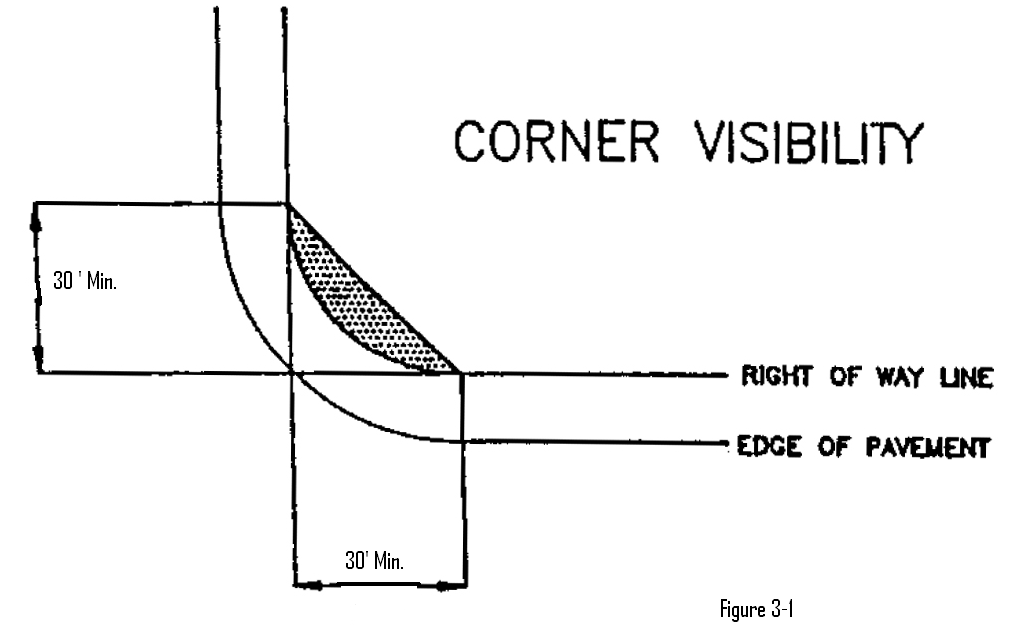
30.6 Building height. No structure permitted under this section shall exceed three stories or 35 feet in height.
30.7 Signs. Signs shall meet the regulations found in article 5, section 4, supplementary sign regulations.
30.8 Parking spaces. Parking for nonresidential uses and structures, excluding gazebos, is required at a rate of one parking space per 300 square feet of floor area or in accordance with article 6, section 3, whichever is greater.
30.81 Planning commission may waive some or all of the required parking if the applicant can demonstrate that development is a fully accessible pedestrian-oriented facility and/or is served by a variety of transportation modes.
30.9 Performance standards. All uses are subject to performance standards as set forth in article 5, section 8.1.
30.10 Site development plan approval. Site development plan approval in accordance with article 10, section 2 hereof shall be required prior to the issuance of building permits for the erection or enlargement of all structures, development of recreation facilities, and prior to the issuance of certificates of occupancy for any change of use.
(Ord. No. 2010-12, 6-4-2010; Ord. No. 2010-28, 1-10-2011)

