
Duarte City Zoning Code
ARTICLE 2
ZONES, ALLOWABLE USES, AND DEVELOPMENT STANDARDS
Chapter 19.10 - RESIDENTIAL ZONES (R-1, R-1A, R-1B, R-1D, R-1E, R-1F, R-2, R-3, R-4, R-MH)
Sections:
Chapter 19.12 - COMMERCIAL ZONES (C-P, C-G, C-F)
Sections:
Chapter 19.14 - HOSPITAL ZONE (H)
Sections:
Chapter 19.16 - INDUSTRIAL ZONE (M)
Sections:
Chapter 19.18 - PUBLIC FACILITIES ZONE (PF)
Sections:
Chapter 19.20 - OPEN SPACE ZONE (O)
Sections:
Chapter 19.22 - SPECIFIC PLAN ZONES (SP)
Sections:
Chapter 19.24 - INSTITUTIONAL ZONE (I)
Sections:
Chapter 19.26 - AFFORDABLE HOUSING OVERLAY ZONE
Sections:
19.10.010 - Purpose of residential zones.
A.
General. The residential zones are established to implement the Very Low Density (0-3.5 du/ac), Low Density (1-6 du/ac), Medium Density (7-21 du/ac), and High Density (21-28 du/ac) residential land use designations of the General Plan. Other permitted uses are restricted to those residential uses specifically required by State law, as well as other uses that may be conditionally permitted, such as the keeping of horses, places of religious assembly, country clubs, golf courses and related activities, educational institutions, publicly owned facilities (including parks), nursing/rest homes, and senior housing, as set forth in this Chapter. The purpose of the residential zones is as set forth in the following Subsections.
B.
R-1 Single-Family Residential Zones (Very Low Density and Low Density). The R-1 zones are established to provide areas for the development and preservation of residential subdivisions consisting of detached residences and accessory uses compatible with the residential use of the zone. There are six single-family (R-1) residential zones that provide a variety of living environments based upon the required minimum net lot size. No more than one dwelling unit is allowed on each lot, except as otherwise provided in Section 19.60.160 (Second Dwelling Units), Section 19.10.035 (Duplex Developments in Single-Family Residential Zones), and/or Chapter 19.88 (Urban Lot Splits). Required minimum lot sizes for each of the six zones are as follows:
1.
R-1: 6,500 square foot minimum lot size.
2.
R-1A: 7,500 square foot minimum lot size.
3.
R-1B: 10,000 square foot minimum lot size.
4.
R-1D: 20,000 square foot minimum lot size (Hillside area).
5.
R-1E: 20,000 square foot minimum lot size (Non-hillside area).
6.
R-1F: 80,000 square foot minimum lot size.
C.
R-2 Two-Family Residential Zone (Medium Density). The R-2 zone is established to provide for the development of medium-density residential homes that may consist of one or two-family detached or attached units, and that comprise a cohesive development that may incorporate common open space and/or private open space areas, at a density range from 7 to 11 dwelling units per net acre.
D.
R-3 Multiple-Family Residential Zone (Medium Density). The R-3 zone is established to accommodate residential development generally characterized by single structures or a collection of cohesive structures that house individual and/or multiple units, with common open space areas and amenities, at a maximum density of 21 dwelling units per net acre.
E.
R-4 Multiple-Family Residential Zone (High Density). The R-4 zone is established to accommodate higher-density, multi-story residential development, with a focus on providing an intensity and function at locations within easy walking distance to transit, recreation and community facilities, and commercial services. The maximum permitted density is 28 dwelling units per net acre.
F.
R-MH Mobile Home Residential Zone (Medium Density). The R-MH zone is established to accommodate mobile home parks. The only permitted uses in the R-MH zone are residential mobile homes within integrated mobile home parks, including any accessory uses in support of mobile home park operations, such as common community facilities and structures accessory to individual mobile homes.
(Ord. No. 907, § 4.A., 3-8-2022)
19.10.020 - Land use and permit requirements.
A.
General. New residential land uses and structures, and alterations to existing land uses and structures, shall be designed, constructed, and/or established in compliance with the requirements in Tables 2-3 and 2-4. Standards for accessory structures are set forth in Chapter 19.34 (Accessory Structures).
B.
Residential structures near freeway and railroad rights-of-way. No habitable residential structure shall be erected within 40 feet of any railroad or freeway right-of-way, as measured from the closest right-of-way line. Multi-family residential projects that are part of a transit-oriented development may be located up to 20 feet of a railroad right-of-way (adjacent or above), provided measures to lessen noise and vibration impacts are addressed through development regulations in a specific plan to that development.
C.
Prohibition of structures in front setback area. No portion of any habitable structure and/or accessory structure shall occupy any portion of a required front setback area (see Figure 2-1), except as provided in 19.32.020 (Permitted Projections into the Required Setback Areas).
D.
Exceptions to maximum lot coverage. Maximum lot coverage for development in the R-1, R-1A and R-1F zone are subject to maximum lot coverage standards that may vary based on the lot size and/or building height (i.e., 1 or 2 stories). In the R-1 and R-1A zones, the base maximum lot coverage for one- or two- story units is 35 percent, except that units limited to one story in height on lots 8,000 square feet or less in size may occupy up to 40 percent of the lot area. When an existing unit on an R-1 or R-1A lot exceeds 35 percent lot coverage, new second story (or expansion of existing second story) construction shall not be permitted, regardless of lot size, unless the overall building footprint is reduced to 35 percent. In the R-1F zone, the base maximum lot coverage for one-story units is 12.5 percent. However, two-story units are limited to a maximum 10 percent lot coverage. When an existing unit on an R-1F lot exceeds 10 percent lot coverage, a new second story (or expansion of an existing second story) shall not be permitted unless the building footprint is reduced to 10 percent.
(Ord. No. 874, § 2(Exh. A), 4-11-2017; Ord. No. 907, § 4.B., 3-8-2022; Ord. No. 916, § 3, 4-25-2023)
19.10.030 - Development standards.
A.
General. New residential land uses and structures, and alterations to existing land uses and structures, shall be designed, constructed, and/or established in compliance with the requirements in Tables 2-3 and 2-4. Standards for accessory structures are set forth in Chapter 19.34 (Accessory Structures).
B.
Residential structures near freeway and railroad rights-of-way. No habitable residential structure shall be erected within 40 feet of any railroad or freeway right-of-way, as measured from the closest right-of-way line. Multi-family residential projects that are a part of a transit-oriented development may be located up to 20 feet of a railroad right-of-way (adjacent or above), provided measures to lessen noise and vibration impacts are addressed through development regulations in a specific plan to that development.
C.
Prohibition on structures in front setback area. No portion of any habitable structure and/or accessory structure shall occupy any portion of a required front setback area (see Figure 2-1), except as provided in 19.32.020 (Permitted Projections into Required Setback Areas).
_____
Figure 2-1. Development Features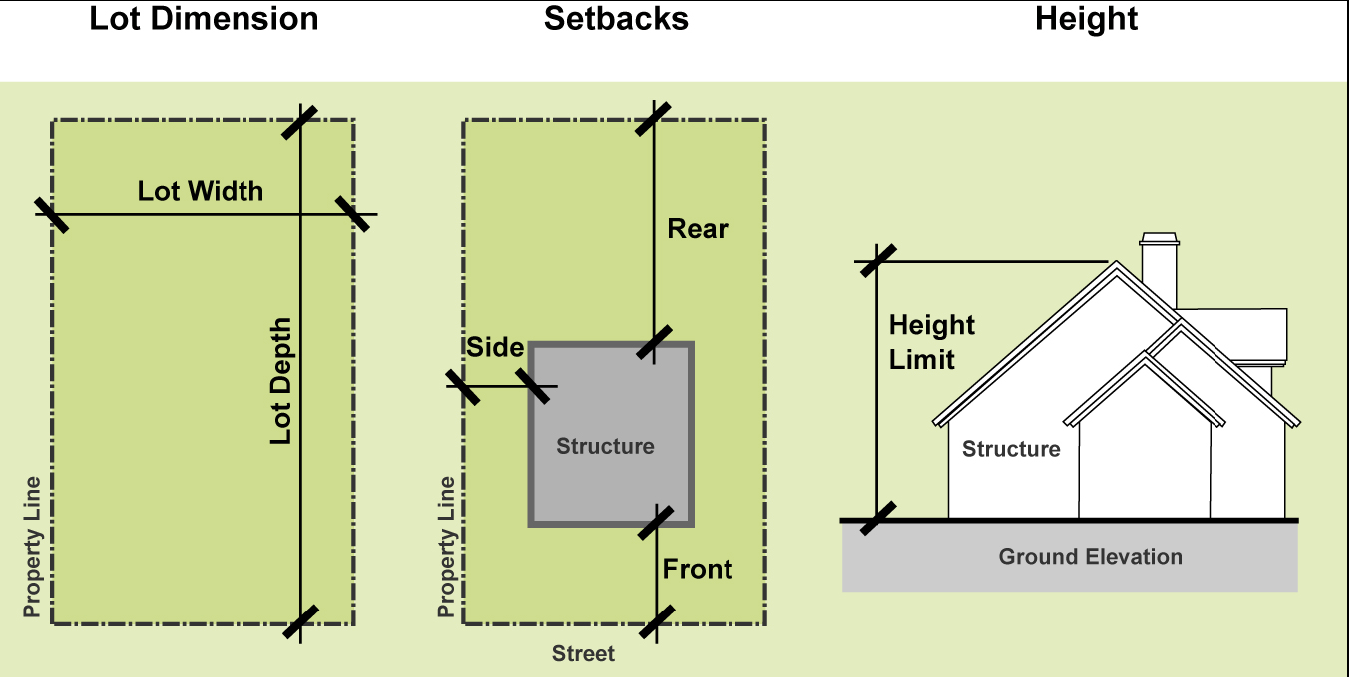
_____
D.
Exceptions to maximum lot coverage. Maximum lot coverage for development in the R-1 zones is as provided in Table 2-3 and includes flexible lot coverage standards as follows. Properties in the R-1, R-1A and R-1F zone are subject to maximum lot coverage standards that may vary based on the lot size and/or building height (i.e., 1 or 2 stories). In the R-1 and R-1A zones, the base maximum lot coverage for one- or two-story units is 35 percent, except that units limited to one story in height on lots 8,000 square feet or less in size may occupy up to 40 percent of the lot area. When an existing unit on an R-1 or R-1A lot exceeds 35 percent lot coverage, new second story (or expansion of existing second story) construction shall not be permitted, regardless of lot size, unless the overall building footprint is reduced to 35 percent. In the R-1F zone, the base maximum lot coverage for one-story units is 12.5 percent. However, two-story units are limited to a maximum 10 percent lot coverage. When an existing unit on an R-1F lot exceeds 10 percent lot coverage, a new second story (or expansion of an existing second story) shall not be permitted unless the building footprint is reduced to 10 percent.
Notes:
1. Properties within the R-1F, R-1D, and R-1B zones shall be subject to additional hillside development standards set forth in Chapter 19.46 (Hillside Development Standards).
2. Properties within the R-1 and R-1A zones located north of Sunnydale Drive and Brookridge Road shall be subject to additional hillside development standards set forth in Chapter 19.46 (Hillside Development Standards).
3. See also Section 19.10.040 (Multi-Story Setback), Section 19.32.020 (Permitted Projections into Required Setback Areas), and Section 19.32.050 (Yards — Measurement and Requirements).
4. See also Section 19.88 (Urban Lot Splits).
5. See also Section 19.10.035 (Duplex Developments in Single-Family Residential Zones).
Notes:
1. Development Standards for Mobile Home Parks shall be determined through the Site Plan and Design Review process in conjunction with the required Conditional Use Permit.
2. Private open space square feet may be transferred to common open space if an open space plan is prepared and reviewed through the Planned Development Permit process (Chapter 19.118).
(Ord. No. 907, § 4.C., 3-8-2022)
_____
19.10.035 - Duplex Developments in single-family residential zones.
A.
Purpose. The purpose of this section is to allow and appropriately regulate duplex (two-family dwelling unit) developments in single-family residential zones in accordance with Government Code Section 65852.21.
B.
Definitions.
Car Share Vehicle is a motor vehicle that is operated as part of a regional fleet by a private or public car sharing company or organization and provides hourly or daily service.
Unit is any dwelling unit, including, but not limited to, a primary dwelling unit, a unit created under this section of this Code, an accessory dwelling unit (ADU), or a junior accessory dwelling unit (JADU).
C.
Application, review process, standard for denial.
1.
An application for a duplex project must be submitted on the city's approved form and include all items required as part of the application submittal package.
2.
A full title report shall be provided as part of the application.
a.
In the event the property has not already been legally subdivided, the applicant must obtain a certificate of compliance with the Subdivision Map Act for the lot and provide the certificate with the application.
3.
The owner shall sign an affidavit, in the form approved by the City Attorney, stating that the duplex would not require demolition or alteration of any of the following types of housing listed in Subsections E.5.a.—E.5.d.
a.
The City may conduct its own inquiries and investigation to ascertain the veracity of the sworn statement, including but not limited to, surveying owners of nearby properties; and the City may require additional evidence of the applicant and owner as necessary to determine compliance with this requirement.
4.
Only a complete application will be considered. The City will inform the applicant within 30 days after submittal whether the application is complete. If the City does not respond within 30 days after submittal, the application is deemed incomplete.
5.
The City may establish a fee to recover its costs for adopting, implementing, and enforcing this section of the code, in accordance with applicable law. The City Council may establish and change the fee by resolution. The fee must be paid with the application. An application submitted without the established fee is deemed incomplete.
6.
An application for a duplex development shall be considered ministerially, without discretionary review or hearing.
7.
An application for a duplex development shall be approved or denied by the Community Development Director through the site plan and design review process, further described in Chapter 19.122.
8.
Notwithstanding Subsection C.6., the City may deny an application for a Duplex development if the building official, or designee, makes a written finding, based upon a preponderance of the evidence, that the proposed duplex development would have a specific, adverse impact, as defined in Government Code Section 65589.5(d)(2), upon public health and safety or the physical environment and for which there is no feasible method to satisfactorily mitigate or avoid the specific, adverse impact.
D.
Accessory dwelling unit ineligibility. Parcels containing both a duplex and subject to an urban lot split as those terms both defined in Article 9 shall be ineligible for an accessory dwelling unit or junior accessory dwelling unit permit under Section 19.60.160 of this Code. Operation of an accessory dwelling unit or junior accessory dwelling unit in violation of this subsection shall be a violation of this section and grounds for enforcement pursuant to Subsection L.
E.
Applicability. Proposed Duplex developments must satisfy each of the following:
1.
Zoning. Located within a single-family zoning district.
2.
Lot location. Located on a parcel that meets all requirements of Government Code Section 65913.4(a)(6)(B) through (A)(6)(K), as may be amended from time to time.
3.
Subdivision Map Act compliance. Located on a lot that has been legally subdivided.
4.
Not historic. The lot must not be a historic property or within a historic district that is included on the State Historic Resources Inventory. Nor may the lot be or be within a site that is designated by ordinance as a City or County landmark or as a historic property or district.
5.
No impact on protected housing. The duplex project must not require or include the demolition or alteration of any of the following types of housing:
a.
Housing that is income-restricted for households of moderate, low, or very low income.
b.
Housing that is subject to any form of rent or price control through a public entity's valid exercise of its police power.
c.
Housing, or a lot that used to have housing, that has been withdrawn from rental or lease under the Ellis Act (Government Code Sections 7060- 7060.7) at any time in the 15 years prior to submission of the urban lot split application.
d.
Housing that has been occupied by a tenant in the last three years. The applicant and the owner of a property for which a duplex project is sought must provide a sworn statement as to this fact with the application for the parcel map. The City may conduct its own inquiries and investigation to ascertain the veracity of the sworn statement, including but not limited to, surveying owners of nearby properties; and the City may require additional evidence of the applicant and owner as necessary to determine compliance with this requirement.
6.
Demolition.
a.
Not more than 25 percent of the existing exterior structure walls of an existing dwelling on the parcel may be demolished unless the site has not been occupied by a tenant in the last three years.
b.
If approved by the Community Development Director, any duplex project that involves an existing dwelling unit proposed for demolition of more than 25 percent of the existing exterior structure walls of an existing dwelling on the parcel must comply with the replacement provisions of Government Code Section 66300(d).
F.
Development standards. A duplex development shall comply with the following development standards. In the cases where the following standards preclude development of an 800 square foot dwelling, the plan check review process will allow deviations sufficient to accommodate such development.
1.
Configuration.
a.
Proposed adjacent or connected units shall be permitted if they meet building code standards, are designed to allow separate conveyance, and comply with the development standards of the underlying zoning district or additional standards prescribed in this section, as applicable.
b.
Required parking for units associated with a duplex project shall be accessed via an alley, if there is an alley.
2.
Quantity.
a.
No more than two units of any kind may be built on a lot that results from an urban lot split, as prescribed under Chapter 19.88.
b.
A lot that is not created by an urban lot split may have a two-unit project under this section, plus any ADU or JADU that must be allowed under state law and the City's ADU ordinance.
3.
Unit size.
a.
The total floor area of each unit built that is developed under this section must be no greater than 800 square feet, exclusive of any enclosed garage space.
b.
Notwithstanding Paragraph F.3.a., if the duplex application proposes to add one new unit to a unit that was legally established prior to submission of the duplex application, the existing, legally established unit may retain its dimensions at the time the duplex application is submitted. A unit that was legally established prior to submission of the duplex application which retains its dimensions pursuant to this paragraph may not be expanded except as provided by Paragraph F.3.c.
c.
A unit that was legally established prior to submission of the duplex application and that is smaller than 800 square feet may be expanded to 800 square feet after or as part of the duplex project.
4.
Lot coverage. The City's existing lot coverage standards for the single-family residential zones shall apply to projects subject to this section.
5.
Setbacks. The city's existing setback standards for its R-1 single-family residential zone shall apply to projects subject to this section.
a.
Side and rear. Duplex developments shall be setback at least four feet from the side and rear property lines.
b.
Existing structures. No setback is required for an existing legally established structure or for a new structure that is constructed in the same location and to the same dimensions as an existing legally established structure.
c.
Building separation. A minimum separation of 10 feet, measured from wall to wall, shall be required between detached dwelling units located on the same site.
d.
Projections into setbacks. See Chapter 19.32.
6.
Height.
a.
Any new units built shall be one-story and no taller than 16 feet to the highest ridgeline, and no taller than 10 feet to the top plate.
b.
Heights above 16 feet are allowed for existing or proposed units with a garage, in which the first-floor garage is maintained as off-street parking for two or more vehicles and the second-floor dwelling unit is equal to or less than the footprint of the first-floor garage itself. The garage must be accessible from a paved driveway that connects to a street or alley.
7.
Foundations. A permanent foundation shall be required for all new units.
8.
Landscaping. The City's existing landscape, irrigation, and hardscape standards for the single-family residential zones shall apply to projects subject to this section as required by Chapters 19.40.
9.
Accessible roof areas. For units subject to this section, accessible decks, patios, balconies, and similar private open spaces above the top plate of any new or remodeled existing dwelling unit are prohibited.
10.
Lighting. Exterior lighting shall be shielded or directed downwards.
11.
Parking.
a.
Existing off-street garage parking and driveway must be maintained as part of a duplex project.
b.
Required parking shall be one off-street parking space within an enclosed garage per each dwelling unit, unless one of the following applies:
i.
The parcel is within one-half mile walking distance of a high-quality transit corridor or a major transit stop, as defined in California Public Resources Code Sections 21155 or 21064.3.
ii.
The parcel is located within one block of a car-share vehicle location, as defined in this section.
c.
Any parking and access, as required or otherwise proposed, for a duplex development lot shall be accessed via an alley, if there is an alley.
12.
Pedestrian access. Access to a public street or alley shall be provided with an exterior pedestrian pathway from the primary entrances of each unit to the adjoining sidewalk, street, or alley.
G.
Other standards. All other applicable standards of this Code shall apply to the extent these standards do not conflict with this section of State law, in addition to the following:
1.
Design standards. Units and any other accessory structures shall comply with applicable objective design standards, as further described in Section 19.44.010.
2.
Utilities. Each dwelling unit on a parcel must have its own direct utility connection to the utility service provider.
3.
Onsite wastewater treatment system. For dwelling units connected to an onsite wastewater treatment system, a percolation test completed within the last five years, or, if the percolation test has been recertified, within the last 10 years, and compliance with Chapter 6.13 of the Duarte Municipal Code, which implements the County of Los Angeles Local Agency Management Program (Ordinance No. 2018-0037).
H.
Standards precluding development. If an applicant submits plans showing that any of the objective standards which otherwise apply to duplex applications would have the effect of physically precluding the construction of up to two units or would physically preclude either of the two units from being at least 800 square feet in floor area, the Community Development Director shall permit the minimum deviation of the objective standards shown to physically preclude the construction of up to two units or physically preclude either of the two units from being at least 800 square feet in floor area necessary to physically permit the duplex project.
I.
Regulation of uses.
1.
Residential Only. No non-residential use is permitted on the lot.
2.
Short-term Rentals. No unit on the lot may be rented for a period of less than 30 days.
J.
Separate Conveyance.
1.
Primary dwelling units on the lot may not be owned or conveyed separately from each other.
2.
Condominium airspace divisions and common interest developments are not permitted within the lot.
3.
All fee interest in the lot and all the dwellings must be held equally and undivided by all individual property owners.
K.
Restrictive Covenant. The applicant shall sign and record a restrictive covenant in the form prescribed by the City Attorney, which shall run with the land and provide for the following:
1.
A prohibition on non-residential uses on the lot.
2.
A prohibition against renting or leasing the units for fewer than 30 consecutive calendar days.
3.
All required parking shall be maintained, and useable for the parking of motor vehicle(s).
4.
Expressly prohibits any separate conveyance of a primary dwelling on the property, any separate fee interest, and any common interest development within the lot.
L.
Remedies. If a duplex project violates any part of this Code or any other legal requirement:
1.
The buyer, grantee, or lessee of any part of the property has an action for damages or to void the deed, sale, or contract.
2.
The City may:
a.
Bring an action to enjoin any attempt to sell, lease, or finance the property.
b.
Bring an action for other legal, equitable, or summary remedy, such as declaratory and injunctive relief.
c.
Pursue criminal prosecution, punishable by imprisonment in county jail or state prison for up to one year, by a fine of up to $10,000.00, or both; or a misdemeanor.
d.
Record a notice of violation.
e.
Withhold any or all future permits and approvals.
f.
Pursue all other administrative, legal, or equitable remedies that are allowed by law or the City's Code.
(Ord. No. 907, § 2, 3-8-2022)
19.10.040 - Multi-story setback.
A.
R-1 and R-2 Zones. In all R-1 and R-2 zones, where the side or rear yard setback for the first story is the minimum required setback for the applicable zone, the second story of any residential structure shall be set back an additional two and one-half feet from the required minimum setback (see Figure 2-2). If the first story is set back 30 inches or more than the minimum required setback, no additional setback of the second story shall be required.
B.
R-3 and R-4 Zones. For structures with more than one story in the R-3 and R-4 zones, the rear setback shall be increased by five feet for each story or fractional story above the first story.
_____
Figure 2-2. Second Story Setback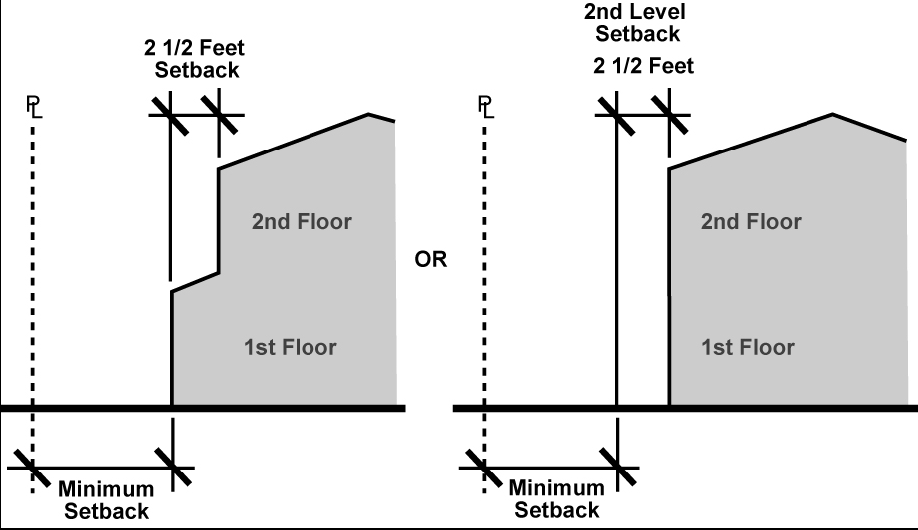
_____
19.10.050 - R-1D zone: additional standards.
A.
Site plan and design review required. Site Plan and Design review, pursuant to Chapter 19.122 (Site Plan and Design Review) of this Code, shall be required for any development in the R-1D zone involving any new single-family unit or an addition of 250 square feet or more that is visible from any public right-of-way.
B.
Driveways. Each driveway shall follow natural terrain contours to the maximum extent feasible to minimize grading, and also shall comply with the following standards. The finished grade of a driveway shall conform to the finished grade of the lot, but in no case shall exceed an average grade of 15 percent, or 20 percent at any point.
C.
Retaining walls to create building pads. The maximum height of retaining walls used to create a building pad shall not exceed 10 feet.
D.
Hillside development standards apply. Properties within the R-1D zone shall be subject to additional hillside development standards set forth in Chapter 19.46 (Hillside Development Standards).
19.10.060 - R-3 and R-4 zones: additional standards.
A.
Open space—Common.
1.
Common open space shall be distributed throughout the development at convenient, safe, and easily accessible locations to all residents of the development.
2.
Any one common open space area shall have minimum dimensions — depth or width — of 15 feet.
3.
Common open space areas may be developed with landscaping, play equipment, swimming pools, walkways and paths, paved terraces, and similar features that benefit all residents of the development.
4.
All common open spaces areas not covered by hard surface improvements as described in subparagraph 3, above, shall be landscaped.
B.
Open space—Private.
1.
Private open space must be contiguous to the unit it serves.
2.
Any single private open space area shall have minimum dimensions — depth or width — of 10 feet.
3.
Private open space square feet minimum requirements may be transferred to common open space if it meets the following standards:
a.
An Open Space Plan is prepared and approved by the Director; or
b.
A Planned Development Permit is approved;
c.
Such open space provides creative communal spaces, including but not limited to gardening areas, sunning areas, outdoor seating, patios, barbeque facilities, and other similar features and spaces that contribute to a functional outdoor space for use by all residents.
d.
See Section 19.52.060 (Urban Water Runoff and Drainage) that encourages vegetable gardens as alternative to landscaping for multi-family residential developments.
C.
Open space plan. In lieu of the open space requirements set forth in Table 2-4 and paragraphs A and B, above, an open space plan may be prepared for review as part of the Site Plan and Development Review process (Chapter 19.122). Such open space plan shall indicate how the proposed open space meets the intent of the public and private open space requirements for the R-3 and R-4 zones and General Plan goals regarding open space and development amenities. Such open space may include indoor or outdoor common areas, or combinations of such areas, that provide amenities such as a pool/spa, a recreation room, fitness facilities, or community gardens.
D.
Balconies.
1.
Balconies, where provided, shall have minimum dimensions of four feet by six feet.
2.
See 19.44.010.E (Residential Architectural and Design Standards) for required design treatment.
E.
Laundry facilities. All units shall be provided with individual washer and dryer hook-ups. In lieu of individual hook-ups, common laundry facilities may be provided at a ratio of one washer and one dryer for every four units. Such common facilities shall be located to be convenient, safe, and easily accessible to all residents of the development.
F.
Storage. All units shall provide for a storage area of not less than 250 cubic feet which must be within an enclosed area. Storage areas must not conflict with required parking area nor affect required open space.
G.
Trash and recycling facilities.
1.
Where common waste and recycling receptacles are provided, waste and recycling receptacles areas shall be designed and constructed in accordance with current standard City plans or policies.
2.
Trash enclosures for individual units and/or common facilities should be sized to accommodate separate bins for recyclable trash and regular trash, as well as green/yard waste (when appropriate).
3.
All waste and recycling receptacles areas shall be screened from view from any public street and all adjacent properties, and screening shall be designed to be architecturally compatible and integral to the overall project design.
4.
All waste and recycling receptacles areas shall be located to be convenient, safe, and easily accessible to all residents of the development.
19.10.070 - Accessory structures.
Accessory structures are permitted subject to the development standards set forth in Chapter 19.34 (Accessory Structures) of this Code.
19.10.080 - Manufactured housing.
A.
Manufactured housing considered a single-family dwelling. A manufactured housing unit shall be considered a single-family dwelling and is subject to the development standards identified in this Chapter 19.10 (Residential Zones).
B.
Foundation required. A manufactured home shall be installed and maintained upon a permanent, continuous, exterior, masonry, or concrete foundation.
C.
Design standards.
1.
All manufactured housing units shall comply with the site design and architectural standards set forth in Section 19.44 (Architectural and Design Standards).
2.
Roofs on manufactured housing shall include a roof overhang with eaves a minimum of 12 inches.
3.
Flat roofs are not permitted. A minimum roof pitch of 4 to 12 is required.
D.
Manufactured housing may be prohibited. The Director, pursuant to Section 65852.3(a) of the California Government Code, shall have the authority to preclude the installation of a manufactured housing unit if the manufactured housing unit was constructed 10 or more years prior to the date of the application for permit issuance to install the manufactured housing unit.
19.10.090 - Other applicable regulations.
In addition to the requirements contained in this Chapter 19.10 (Residential Zones), regulations contained in the following Chapters may apply to development in residential zones.
Chapter 19.32, Site Planning and General
Development Standards.
Chapter 19.34, Accessory Structures.
Chapter 19.36, Fences, Walls, and Hedges.
Chapter 19.38, Off-Street Parking Regulations and Design.
Chapter 19.40, Landscaping.
Chapter 19.42, Signs.
Chapter 19.44, Architectural and Design
Standards.
Chapter 19.48, Property Maintenance.
Chapter 19.50, Performance Standards.
Chapter 19.52, Sustainable Development
Practices.
Article 4, Standards for Specific Land Uses
and Activities.
(Ord. No. 908, § 3.A., 4-12-2022)
19.12.010 - Purposes of commercial zones.
The City has established three commercial zones to implement General Plan policies regarding the accommodation of necessary and desired commercial goods and services in the City, and to achieve the following:
A.
C-P Commercial-Professional zone. The C-P zone provides locations appropriate for administrative and professional offices, with limited accessory retail and service uses.
B.
C-G Commercial-General zone. The C-G zone provides locations for a wide variety of commercial enterprises and intended to serve local and regional needs.
C.
C-F Commercial-Freeway zone. The C-F zone provides locations along Interstate 210 for large, auto-oriented, and regional-serving retail commercial developments that benefit from the increased exposure and regional traffic afforded by a freeway-adjacent location, and where development standards can be tailored to attract and maintain such regionally oriented uses.
19.12.020 - Land uses and permit requirements.
A.
Allowed land uses.
1.
Table 2-5 indicates the uses allowed within each commercial zone and any permits required to establish the use, pursuant to Article 7 (Permit Processing Procedures) and Article 8 (Development Code Administration).
2.
See Article 9 for land use definitions.
3.
Land uses that are not listed in Table 2-5 or are not shown in a particular zone are not allowed (see Uses Not Classified in Section 19.04.040), except as otherwise provided by Section 19.04.020 (Rules of Interpretation).
B.
Applicable regulations. Where the last column in the Table 2-5 includes a Chapter or Section number, the regulations in the referenced Chapter or Section shall apply to the use. Provisions in other Sections of this Development Code may also apply.
(Ord. No. 852, § 2, 8-26-2014; Ord. No. 856, § 1, 3-10-2015)
19.12.030 - Commercial zones general development standards.
New land uses and structures, and alterations to existing land uses and structures, shall be designed, constructed, and/or established in compliance with the requirements in Table 2-6, and the development standards in Article 3 (Regulations Applicable to All Zones). Standards for accessory structures are set forth in Chapter 19.34 (Accessory Structures).
19.12.040 - Limitations on shopping centers.
No more than 40 percent of leasable gross space can be devoted to eating and drinking establishments within a shopping center having more than four tenant spaces.
19.12.042 - Limitations on service-based uses in C-F zoned properties.
A.
No more than 50 percent of the gross floor area of the shopping center, excluding anchor tenant(s), can be devoted to service-based uses, including but not limited to uses consisting of:
1.
Financial institutions and related services.
2.
Offices.
3.
Service uses—General category.
4.
Veterinary services.
5.
Service uses—Restricted category.
6.
Medical-related and social services category.
7.
Health/fitness facilities.
B.
For the purposes of this Section, an anchor tenant is defined as a retail business consisting of 20,000 square feet or more of gross floor area.
(Ord. No. 856, § 2, 3-10-2015)
19.12.050 - Limitations on outdoor use and storage.
A.
Permitted outdoor uses. All permitted uses in the C-P, C-G, and C-F zones shall be conducted wholly within an enclosed structure, except the following:
1.
Parking lots.
2.
Vehicle sales areas.
3.
Any recreation use that requires use of outdoor space.
4.
Service station fuel dispensing activities.
5.
Plant nurseries.
6.
Garden and bulky hardware supplies associated with a home improvement or similar retail business, provided that all such outdoor use shall be fully screened and secured by walls or fencing materials (see Section 19.60.130 [Outdoor Displays, Permanent]).
7.
Outdoor dining areas associated with restaurants (see Section 19.60.120 [Outdoor Dining]).
8.
Temporary outdoor sales or special events with the approval of a Temporary Use Permit pursuant to Chapter 19.124 (Temporary Use Permits).
B.
Outdoor storage prohibited. All types of outdoor storage shall be prohibited.
19.12.060 - Other applicable regulations.
In addition to the requirements contained in this Chapter 19.12 (Commercial Zones), regulations contained in the following Chapters may apply to development in commercial zones.
Chapter 19.32, Site Planning and General
Development Standards.
Chapter 19.34, Accessory Structures.
Chapter 19.36, Fences, Walls, and Hedges.
Chapter 19.38, Off-Street Parking Regulations and Design.
Chapter 19.40, Landscaping.
Chapter 19.42, Signs.
Chapter 19.44, Architectural and Design
Standards.
Chapter 19.48, Property Maintenance.
Chapter 19.50, Performance Standards.
Chapter 19.52, Sustainable Development
Practices.
Article 4, Standards for Specific Land Uses
and Activities.
19.14.010 - Purpose of the Hospital zone.
The purposes of the Hospital zone is to provide for areas appropriate for health care-related uses (and limited accessory retail and service uses) that provide necessary community and regional facilities to support and promote good health and medical care, and that provide jobs for all educational and skill levels. Such uses generally benefit from good regional access.
19.14.020 - Land uses and permit requirements.
A.
Table 2-7 indicates the uses allowed within the Hospital zone and any permits required to establish the use, pursuant to Article 7 (Permit Processing Procedures) and Article 8 (Development Code Administration).
B.
See Article 9 for land use definitions.
C.
Land uses that are not listed in Table 2-7 or are not shown in a particular zone are not allowed (see Section 19.04.040 - Uses Not Classified), except as otherwise provided by Section 19.04.020 (Rules of Interpretation).
D.
Late-night and 24-hour uses, as defined in Article 9 (Definitions) do not require any particular use regulations in the H zone, except as may be imposed through any required discretionary permit.
19.14.030 - Hospital zone general development standards.
A.
General. New land uses and structures, and alterations to existing land uses and structures, shall be designed, constructed, and/or established in compliance with the minimum requirements in Table 2-8, unless a Master Plan or Specific Plan has been approved, and the development standards in Article 3 (Regulations Applicable to All Zones). Standards for accessory structures are set forth in Chapter 19.34 (Accessory Structures).
B.
Hospitals approved under a specific plan or master plan. Hospitals approved via a Specific Plan or Master Plan (via a Conditional Use Permit) can deviate from the development standards in Table 2-8, but at a minimum, development shall comply with the following standards:
1.
Hospital developments cannot exceed the maximum floor-area ratio of 1.50.
2.
Hospital developments adjacent to residential uses must minimize potential noise, vibration, traffic, shade, glare, and other potential impacts.
3.
With regard to building height, consideration shall be given to shade and shadow impacts on surrounding properties.
19.14.040 - Other applicable regulations.
In addition to the requirements contained in this Chapter 19.14 (Hospital Zone), regulations contained in the following Chapters may apply to development in the H zone.
Chapter 19.32, Site Planning and General
Development Standards.
Chapter 19.34, Accessory Structures.
Chapter 19.36, Fences, Walls, and Hedges.
Chapter 19.38, Off-Street Parking Regulations and Design.
Chapter 19.40, Landscaping.
Chapter 19.42, Signs.
Chapter 19.44, Architectural and Design
Standards.
Chapter 19.48, Property Maintenance.
Chapter 19.50, Performance Standards.
Chapter 19.52, Sustainable Development
Practices.
Article 4, Standards for Specific Land Uses
and Activities.
19.16.010 - Purpose of Industrial zone.
A.
General. The City has established a single industrial zone to implement General Plan policies regarding the accommodation of manufacturing, research and development, and similar uses that produce goods for businesses and consumers, and that are involved in medical and similar research activities. Allowed uses in the industrial zones shall consist of those that have minimal impact on surrounding uses.
B.
M Light Industrial Zone District. The M zone provides areas for relatively low-intensity industrial activities that do not involve substantial truck traffic or outdoor fabrication or assembly, do not produce noticeable odors, and do not involve operations normally considered hazardous within an urban environment.
19.16.020 - Industrial zone land uses and permit requirements.
A.
Allowed land uses.
1.
Table 2-9 indicates the uses allowed within the M zone and any permits required to establish the use, pursuant to Article 7 (Permit Processing Procedures) and Article 8 (Development Code Administration).
2.
See Article 9 for land use definitions.
3.
Land uses that are not listed in Table 2-9 or are not shown in a particular zone are not allowed (see Section 19.04.040 Uses Not Classified), except as otherwise provided by Section 19.04.020 (Rules of Interpretation).
B.
Health risk assessment. The City may require a health risk assessment for any use involving hazardous materials.
19.16.030 - Industrial zone general development standards.
A.
General. New land uses and structures, and alterations to existing land uses and structures, shall be designed, constructed, and/or established in compliance with the requirements in Table 2-10, in addition to the development standards in Article 3 (Regulations Applicable to All Zones). Standards for accessory structures are set forth in Chapter 19.34 (Accessory Structures).
19.16.040 - Limitation on ancillary office space.
Office space supporting an approved industrial use shall be limited to 30 percent of the gross leasable floor area of any individual use.
19.16.050 - Limitations on outdoor use and storage.
A.
Permitted outdoor uses. All permitted uses in the M zone shall be conducted wholly within an enclosed structure except for the following:
1.
Building material sales and supply yards.
2.
Equipment and vehicle sales and/or rental yards.
3.
Fueling stations.
4.
Open work areas incidental and in conjunction with a primary permitted use, provided that such areas are not visible from a public street or alley or from an adjacent property. No use of power tools or equipment other than forklifts or similar moving equipment shall be permitted in open work areas.
B.
Limits on outdoor storage. Outdoor storage is permitted in the M zone subject to the following standards:
1.
Outdoor storage shall not be visible from a public street or alley or from adjoining properties.
2.
Outdoor storage shall be screened from view by the positioning of structures around the storage area or by a solid masonry wall. Any materials stored outdoors shall not be stacked above the height of the structure or wall.
3.
Outdoor storage areas may not occupy required parking or driveway areas, required landscape areas, fire lanes, or other emergency access.
19.16.060 - Other applicable regulations.
In addition to the requirements contained in this Chapter 19.16 (Industrial Zone), regulations contained in the following Chapters may apply to development in the M zone.
Chapter 19.32, Site Planning and General
Development Standards.
Chapter 19.34, Accessory Structures.
Chapter 19.36, Fences, Walls, and Hedges.
Chapter 19.38, Off-Street Parking Regulations and Design.
Chapter 19.40, Landscaping.
Chapter 19.42, Signs.
Chapter 19.44, Architectural and Design
Standards.
Chapter 19.48, Property Maintenance.
Chapter 19.50, Performance Standards.
Chapter 19.52, Sustainable Development
Practices.
Article 4, Standards for Specific Land Uses
and Activities.
19.18.010 - Purposes of Public Facilities zone.
The Public Facilities zone is established to provide for areas at suitable locations for facilities intended to provide supportive government functions to the population, including community centers, cultural institutions, government facilities, libraries, public utilities, and public schools.
19.18.020 - Land uses and permit requirements.
A.
Allowed land uses.
1.
Table 2-11 indicates the uses allowed within the Public Facilities zone and any permits required to establish the use, pursuant to Article 7 (Permit Processing Procedures) and Article 8 (Development Code Administration). Any public use associated with the City of Duarte is permitted by right.
2.
See Article 9 for land use definitions.
3.
Land uses that are not listed in Table 2-11 or are not shown in a particular zone are not allowed (see Uses Not Classified in Section 19.04.040), except as otherwise provided by Section 19.04.020 (Rules of Interpretation).
19.18.030 - Development standards.
A.
General. Table 2-12 identifies the minimum development standards applicable to all development in the PF zone. Standards for accessory structures are set forth in Chapter 19.34 (Accessory Structures).
19.18.040 - Other applicable standards.
In addition to the requirements contained in this Chapter 19.18 (Public Facilities Districts Zone), regulations contained in the following Chapters may apply to development in residential zones.
Chapter 19.32, Site Planning and General
Development Standards.
Chapter 19.34, Accessory Structures.
Chapter 19.36, Fences, Walls, and Hedges.
Chapter 19.38, Off-Street Parking Regulations and Design.
Chapter 19.40, Landscaping.
Chapter 19.42, Signs.
Chapter 19.44, Architectural and Design
Standards.
Chapter 19.48, Property Maintenance.
Chapter 19.50, Performance Standards.
Chapter 19.52, Sustainable Development
Practices.
Article 4, Standards for Specific Land Uses and Activities.
19.20.010 - Purposes of Open Space zone.
The Open Space zone is established to set aside areas necessary to maintain and protect open spaces for the purposes of recreation, natural resource protection and enhancement, hazards management, utility corridors, and the protection of prehistoric places, features, and objects.
19.20.020 - Open Space zone land uses and permit requirements.
A.
Allowed land uses.
1.
Table 2-13 indicates the uses allowed within the Open Space zone and any permits required to establish the use, pursuant to Article 7 (Permit Processing Procedures) and Article 8 (Development Code Administration).
2.
See Article 9 for land use definitions.
3.
Land uses that are not listed in Table 2-13 or are not shown in a particular zone are not allowed (see Uses Not Classified in Section 19.04.040), except as otherwise provided by Section 19.04.020 (Rules of Interpretation).
19.20.030 - Development standards.
Generally, development is not permitted in the Open Space zone. Allowed structures are limited to those necessary to support the primary open space function of the use, such as parking lots, restroom facilities, small accessory structures, and access ways. Where structures are permitted through a Conditional Use Permit or Minor Use Permit, the permit conditions shall specify the development standards for any structures. Table 2-14 identifies the minimum development standards applicable to all allowed development in the Open Space zone. Standards for accessory structures are set forth in Chapter 19.34 (Accessory Structures).
19.20.040 - Other applicable regulations.
In addition to the requirements contained in this Chapter 19.15 (Open Space Zone), regulations contained in the following Chapters may apply to development in the O zone.
Chapter 19.32, Site Planning and General
Development Standards.
Chapter 19.34, Accessory Structures.
Chapter 19.36, Fences, Walls, and Hedges.
Chapter 19.38, Off-Street Parking Regulations and Design.
Chapter 19.40, Landscaping.
Chapter 19.42, Signs.
Chapter 19.44, Architectural and Design
Standards.
Chapter 19.48, Property Maintenance.
Chapter 19.50, Performance Standards.
Chapter 19.52, Sustainable Development
Practices.
Article 4, Standards for Specific Land Uses
and Activities.
19.22.010 - Purpose.
The Specific Plan (SP) zone is established to implement Sections 65450 through 65457 of the State Government Code. As provided for in the Government Code, a specific plan is designed to provide for flexibility, innovative use of land resources and development, a variety of housing and other development types, and an effective and safe method of pedestrian and vehicular circulation. A specific plan may be adopted for any property or group of properties meeting the criteria set forth in this Chapter and Chapter 19.150 (Specific Plans). The Specific Plan zone shall apply to all properties lying within the bounds of a specific plan that has been adopted by resolution or ordinance of the Council.
19.22.020 - Effect of Specific Plan zone.
Once adopted, a specific plan shall govern all use and development of properties within the bounds of that specific plan. Where a specific plan is silent with regard to particular development standards, the provisions of this Code shall govern. The Director shall have the authority to determine which provisions of this Code apply where a specific plan is silent.
19.22.030 - Required contents of a specific plan.
The required contents of a specific plan shall be as set forth in Government Code Section 65450 et seq. Further, the General Plan sets forth guidelines for the planned Gold Line and City Center Specific Plan areas. Those guidelines shall be incorporated into those unique planning areas.
19.22.040 - Land use and development standards.
Each adopted specific plan establishes the land use regulations and development standards applicable to the properties within the specific plan.
19.22.050 - Adopted specific plans.
Table 2-15 identifies the adopted specific plans in Duarte. These specific plans define the development standards and guidelines for each corresponding Specific Plan zone.
Note:
1. Citrus Collection at Duarte II was not formally adopted; however draft Ordinance
98-0-7 provides preliminary standards.
(Ord. No. 893, § 4, 11-26-2019)
_____
19.22.060 - Site design and architectural standards; sustainable practices requirements.
A.
Each adopted specific plan establishes comprehensive site design and architectural standards applicable to the properties in the corresponding specific plan area. Standards for parking and signage may also be set forth in the corresponding specific plans.
B.
All new specific plans shall incorporate sustainable design approaches as set forth in Chapter 19.52 (Sustainable Development Practices) and as may otherwise be required through the specific plan approval process.
19.24.010 - Purpose of Institutional zone.
The purpose of the Institutional (I) zone is to provide for private institutional uses including but not limited to private schools and colleges and associated uses and facilities; community care facilities; residential care facilities for children and the elderly and associated buildings and uses; private hospitals; cemeteries; and places of religious assembly and associated purposes. Except as specifically provided elsewhere in this Title, any and every building and premises or land in an I zone shall be used for or occupied and every building moved into or within the I zones exclusively in accordance with a master plan for the ultimate development of the area and only in accordance with Chapter 19.02 of this Code, the Duarte general plan, and with the regulations set forth in this Chapter.
(Ord. No. 924, § 4 (Exh. A), 10-8-2024)
19.24.020 - Land uses and permit requirements.
A.
Allowed land uses.
1.
Table 2-16 indicates the uses allowed within the Institutional zone and any permits required to establish the use, pursuant to Article 7 (Permit Processing Procedures) and Article 8 (Development Code Administration).
2.
See Article 9 for land use definitions.
3.
Institutional uses represent the primary allowed use, and only those additional uses that are complementary to, and can exist in harmony with, the institutional character of this zone may be allowed as accessory, conditionally permitted, and/or temporary uses. Accessory uses deemed appropriate may only be permitted when provided as a secondary use on property for which a legally permitted/allowed institutional structure exists or is proposed in conjunction with establishment of the accessory use, except as may be otherwise allowed in Article 6 (Nonconformities).
4.
Land uses that are not listed in Table 2-16 or are not shown in a particular zone are not allowed (see Uses Not Classified in Section 19.04.040), except as otherwise provided by Section 19.04.020 (Rules of Interpretation).
5.
Late-night and 24-hour uses, as defined in Article 9 (Definitions) do not require any particular use regulations in the I zone, except as may be imposed through any required discretionary permit.
B.
Master plan in lieu of a conditional use permit. The Community Development Director may allow a master plan in lieu of a conditional use permit on development pieces where a master plan provides improved site development. This may be to allow a better approach to: phased buildout, a mix of uses and similar factors. A master plan in the Institutional zone shall be processed in the same manner as a conditional use permit.
(Ord. No. 924, § 4 (Exh. A), 10-8-2024)
19.24.030 - Development standards.
New land uses and structures, and alterations to existing land uses and structures, shall be designed, constructed, and/or established in compliance with the minimum requirements in Table 2-17, unless a master plan or specific plan has been approved, and the development standards in Article 3 (Regulations Applicable to All Zones). Standards for accessory structures are set forth in Chapter 19.34 (Accessory Structures).
(Ord. No. 924, § 4 (Exh. A), 10-8-2024)
19.24.040 - Accessory structures.
Accessory structures are permitted subject to the development standards set forth in Chapter 19.34 (Accessory Structures) of this Code.
(Ord. No. 924, § 4 (Exh. A), 10-8-2024)
19.24.050 - Fence and walls.
A.
Maximum height. The maximum allowed wall/fence height in the Institutional zone shall be eight feet.
B.
Buffer wall required. Where a lot line of an Institutional zone abuts a property zoned for residential use, a minimum six-foot-high wall shall be required, except for any portion in a required yard abutting a street. Architectural and other treatment of the wall is required pursuant to Chapter 19.44 (Architectural and Design Standards).
C.
Fence/wall plan approval required. Any proposal for fences or walls must be approved by the Community Development Director or designee.
D.
Compliance with Chapter 19.36. Unless in conflict with this subchapter, all other portions of Chapter 19.36 (Fences, Walls, and Hedges) apply.
(Ord. No. 924, § 4 (Exh. A), 10-8-2024)
19.24.060 - Signage.
Signage development standards for the Institutional zone shall reference subchapter 19.42.150. All other applicable sections of Chapter 19.42 (Signs) shall also apply.
(Ord. No. 924, § 4 (Exh. A), 10-8-2024)
19.24.070 - Additions to existing facilities.
Minor additions to existing permitted buildings shall not be subject to a conditional use permit of master plan process, as listed in Section 19.24.020, unless specifically required in the approval of the building or development. For the purposes of this Section, minor additions are defined as tenant improvements, changes of use, new buildings of 1,000 square feet or less, or additions of up to 1,000 square feet or five percent of the existing building area on the property, whichever is greater.
(Ord. No. 924, § 4 (Exh. A), 10-8-2024)
19.24.080 - Other applicable regulations.
In addition to the requirements contained in this Chapter 19.24 (Institutional Zone), regulations contained in the following Chapters may apply to development in the I zone.
Chapter 19.32, Site Planning and General Development Standards.
Chapter 19.34, Accessory Structures.
Chapter 19.36, Fences, Walls, and Hedges.
Chapter 19.38, Off-Street Parking Regulations and Design.
Chapter 19.40, Landscaping.
Chapter 19.42, Signs.
Chapter 19.44, Architectural and Design Standards.
Chapter 19.48, Property Maintenance.
Chapter 19.50, Performance Standards.
Chapter 19.52, Sustainable Development Practices.
Chapter 19.60, Standards for Specific Uses (Accessory Uses, Home Occupations, Horse Keeping, Large and Small Family Day Care Facilities, Places of Religious Assembly, Accessory Dwelling Units, Wireless Communication Facilities, and Low-Barrier Navigation Centers)
Article 4, Standards for Specific Land Uses and Activities.
(Ord. No. 924, § 4 (Exh. A), 10-8-2024)
19.26.010 - Purpose.
The Affordable Housing Overlay (AHO) zone is established to implement the housing goals set forth in the Housing Element of the General Plan. As a part of the strategy to encourage and promote affordable housing, specific locations in the City have been designated with the AHO, offering increased densities and other incentives to developers that provide affordable housing as a part of development projects. To qualify, projects must restrict housing units to certain income levels as further described in the Chapter. The AHO may be applied by itself or in combination with a State Density Bonus to provide density bonuses beyond those allowable under State Density Bonus Law. Sites developed under the AHO will be higher density, will be well integrated into the existing neighborhood, will be designed with similar development standards to ensure compatibility and a consistent quality of life, and will incorporate creative techniques to ensure a positive sense of place.
This Chapter is applicable to mixed income and affordable housing developed in the AHO. All other development shall be subject to the underlying zoning designation.
(Ord. No. 927, § 4 (Exh. A), 11-12-2024)
19.26.020 - Definitions.
A.
Affordable housing cost means the total housing costs paid by a qualifying household, which shall not exceed the specified fraction of their gross income as specified in California Health and Safety Code Section 50053 and 50052.5.1.
B.
Affordable housing unit means a dwelling unit within a residential development which will be reserved for sale or rent to, and is made available at an affordable rent or affordable ownership cost to, very low, low, or moderate-income households.
C.
Household income levels: very low, low and moderate means households whose gross incomes do not exceed the qualifying very low, low and moderate income limits established in Section 6932 of the California Code of Regulations, and amended periodically based on the U.S. Department of Housing and Urban Development (HUD) estimate of median income in the County of Los Angeles Primary Metropolitan Statistical Area, and as adjusted by the State Department of Housing and Community Development (HCD). Pursuant to Code Sections 6926, 6928 and 6930, these income limits are approximately as follows, subject to variations for household size and other factors:
1.
Very low income household: 0-50 percent of area median income, adjusted for household size appropriate for the unit and other factors determined by HUD
2.
Low income household: 50-80 percent of area median income, adjusted for household size appropriate for the unit and other factors determined by HUD
3.
Moderate income household: 80-120 percent of area median income, adjusted for household size appropriate for the unit and other factors determined by HUD
D.
Ministerial processing or ministerial approval means a process for development approval involving little or no discretion or personal judgment by the public official as to the wisdom or manner of carrying out the project, whereby the public official merely ensures that the development project meets all the standards set forth in this part.
E.
State Density Bonus means an increased residential density of between 20 to 80 percent over the maximum general plan density which is granted to an owner/developer of a housing project agreeing to construct a prescribed percentage of very low, low and/or moderate income dwelling units, as defined by California Government Code Section 65915 through 65918 (refer to Chapter 19.64 of the Duarte Development Code).
(Ord. No. 927, § 4 (Exh. A), 11-12-2024)
19.26.030 - Applicability.
The 2021-2029 Housing Element of the City of Duarte General Plan identifies the following opportunity sites for designation with the Affordable Housing Overlay (AHO), as depicted in Figure 1 of the Housing Element:
1.
1214 Elmhurst Avenue & 2150-2200 Huntington Drive (Opportunity Site 7). This site on the southeast corner of Elmhurst Avenue and Huntington Drive includes five underutilized properties, which if assembled would provide a one point eight-acre development site. A part or all of these properties may be developed under the AHO, with greater incentives for assembly of a minimum 40,000 square foot parcel, as specified under Section 19.26.060.
2.
2400-2422 Huntington Drive (Opportunity Site 8). This site includes two vacant Housing Authority owned properties (2400-2402 Huntington Drive) envisioned to be assembled with the four underutilized properties to the east to create a larger, one point four-acre parcel. A part or all of these properties may be developed under the AHO, with greater incentives for assembly of a minimum 40,000 square foot parcel, as specified under Section 19.26.060.
3.
1806-1812 Mountain Avenue (Opportunity Site 9); and 1803, 1809, and 1815 Citrusview Avenue. This site is comprised of two adjacent City-owned vacant parcels with a total area of 15,300 square feet. This City property could be developed by itself under the AHO, but assembly with the three adjacent single-family properties to the east would greatly increase the development yield. For this site, this Chapter is being expanded to include the three easterly adjacent parcels described above, which include 1803, 1809, and 1815 Citrusview Avenue.
4.
1900 Buena Vista Street (Opportunity Site 10). This 4.3-acre site is developed with the Duarte Park Apartments that includes 100 units deed restricted as affordable to very low income seniors. The site has a lot coverage of just 35 percent, providing significant additional infill opportunity on the site's open space and parking areas. Designation of this site with the AHO will allow it to develop at the base overlay density of 30 units/acre, plus an automatic 80 percent density bonus to 54 units/acre under State Density Bonus Law. Alternatively, the addition of affordable senior housing would make the site eligible for Duarte's senior housing density bonus, allowing the City Council discretion to double the R-4 base density of 28 units/acre to 56 units/acre.
5.
Properties within the AHO may, but are not required to, utilize the rules and regulations of this Chapter.
(Ord. No. 927, § 4 (Exh. A), 11-12-2024)
19.26.040 - Affordable housing requirement.
To qualify for the increased density and other incentives under the AHO, a development project must include the following deed restricted affordable housing units:
1.
Opportunity Site 7 (1214 Elmhurst Ave and 2150-2200 Huntington Drive). At least 50 percent of housing units shall be developed, offered to, and rented or sold to very low, low or moderate-income households at an affordable housing cost as defined in Section 19.26.020. The percentage of affordable units shall be calculated as a percentage of the total number of units in a project, exclusive of any units granted under State Density Bonus Law.
2.
Opportunity Site 8 (2400-2422 Huntington Drive), Opportunity Site 9 (1806-1812 Mountain Avenue and 1803, 1809, and 1815 Citrus View Avenue), and Opportunity Site 10 (1900 Buena Vista Street). 100 percent of housing units (with the exception of a manager's unit), shall be developed, offered to, and rented or sold to very low or low-income households at an affordable housing cost as defined in Section 19.26.020.
3.
Prior to issuance of any building permit, the applicant shall execute an agreement with the City in a form acceptable to the City Attorney ensuring the continued affordability of the affordable units for a period of not less than 55 years.
(Ord. No. 927, § 4 (Exh. A), 11-12-2024)
19.26.050 - Development standards.
The development standards that apply to a project seeking approval under the AHO are as follows:
1.
Density. A project seeking approval under the AHO shall be allowed a density of up to 30 units per acre, with a minimum required density of 20 units per acre. Property owners providing 100 percent lower income affordable units under the AHO are automatically eligible for an 80 percent density increase under State Density Bonus Law, or up to 54 units per acre.
2.
Building height. The maximum building height for any building or structure included in a project seeking approval under the AHO shall be no taller than 50 feet, or four stories. Buildings taller than three stories fronting on public streets shall include building height modulation to reduce building scale at the street edge. Any and all stories above the third story shall maintain an average setback of at least 12 feet from the front property line.
3.
Building setbacks.
a.
Front setback — 10 feet minimum
b.
Side setback — five feet minimum
c.
Rear setback — 10 feet minimum
4.
Open space. The required minimum amount of open space shall be 125 square feet per residential unit. The minimum open space may be met through a combination of common, private, and/or quasi-public open space provided on site. All required open space shall be usable.
5.
Off-street parking. Unless modified herein, the parking requirements in the underlying zoning designation of the property shall apply. All fractional units shall be rounded up to the nearest whole number. The parking requirements for each affordable unit provided shall be as follows:
a.
Studio and one-bedroom units — one parking space
b.
Two and three-bedroom units — one and one-half parking spaces
c.
Four-bedroom units — two and one-half parking spaces
d.
A senior citizen housing project as defined in Sections 51.3 and 51.12 of the Civil Code shall be required to provide no more than one-half parking space per dwelling unit.
6.
Conflict between AHO and City of Duarte Development Code. The AHO development standards specified in 19.26.050 are in addition to the objective development standards, pursuant to Section 19.122.040.D for the applicable zoning district in which a proposed project is located. Where a conflict between the AHO standards and other provisions of the City of Duarte Development Code exists, the provisions of this Section shall govern.
(Ord. No. 927, § 4 (Exh. A), 11-12-2024)
19.26.060 - Lot consolidation incentives.
The following AHO sites are comprised of multiple, privately-owned parcels:
•
1214 Elmhurst Avenue and 2150-2200 Huntington Drive (Opportunity Site 7)
•
2400-2422 Huntington Drive (Opportunity Site 8)
For these two opportunity sites, projects which assemble a minimum 40,000 square foot parcel will be provided increased densities of up to 40 units per acre.
(Ord. No. 927, § 4 (Exh. A), 11-12-2024)
19.26.070 - Process.
Housing developments meeting the affordable housing requirements specified in 19.26.040 are a permitted use in the Affordable Housing Overlay zone and are processed ministerially subject to the development standards specified in 19.26.050 and general development standards provided in Chapter 19.32. Development in the Affordable Housing Overlay zone may also utilize the planned development permit process in Chapter 19.118, but is not subject to the minimum site area specified in Section 19.118.020.B.
(Ord. No. 927, § 4 (Exh. A), 11-12-2024)

