
Duarte City Zoning Code
ARTICLE 4
STANDARDS FOR SPECIFIC LAND USES AND ACTIVITIES
Chapters:
Chapter 19.60 - STANDARDS FOR SPECIFIC LAND USES AND ACTIVITIES
Sections:
Chapter 19.62 - ADULT BUSINESS USES
Sections:
Chapter 19.64 - DENSITY BONUS FOR AFFORDABLE HOUSING[1]
Sections:
Editor's note—Ord. No. 916, § 6, adopted April 25, 2023, amended Ch. 19.64 in its entirety to read as herein set out. Former Ch. 19.64, §§ 19.64.010—19.64.040, pertained to similar subject matter.
19.60.010 - Purpose and applicability.
A.
Purpose. This Chapter provides locational, site planning, developmental, and/or operational standards for certain land uses that are allowed by Article 2 (Zones, Allowable Uses, and Development Standards) within individual or multiple zones, and for activities that require special standards to mitigate their potential adverse impacts.
B.
Applicable standards. The land uses and activities covered by this Chapter shall comply with the provisions of each Section applicable to the specific use, in addition to all other applicable provisions of this Development Code.
1.
Planning permit requirements. When allowed, each use shall be located only where allowed by Article 2 (Zones, Allowable Uses, and Development Standards) and authorized by the planning permit/ authorization specified by Article 2.
2.
Development standards. The standards for specific uses in this Chapter supplement and are required in addition to all other applicable provisions of this Development Code (e.g., Articles 2 and 3, etc.).
a.
The land use tables in Article 2 (Zones, Allowable Uses, and Development Standards) and the specific characteristics of the use, as defined in Article 9 (Definitions), determine when the standards of this Chapter apply to a specific land use.
b.
In the event of any conflict between the requirements of this Chapter and those of Article 2 (Zones, Allowable Uses, and Development Standards) or Article 3 (Regulations Applicable to All Zones), the requirements of this Chapter shall control or the matter may be determined by the Director in compliance with the interpretation process specified in Chapter 19.04 (Interpretation of the Development Code).
19.60.020 - Accessory uses.
A.
Purpose. This Section provides locational, developmental, and/or operational standards for accessory uses, as defined in Article 9 (Definitions).
B.
Applicability. Unless more specific standards are presented elsewhere within this Article for unique accessory uses the provisions in this Section shall apply to accessory uses as defined in Article 9 and where allowed in compliance with Article 2 (Zones, Allowable Uses, and Development Standards).
C.
Accessory use standards in nonresidential zones. This Subsection provides standards for accessory uses (e.g., retail sales and service uses, office uses, etc.) that are accessory to a primary commercial, industrial, or institutional use, where allowed by Article 2 (Zones, Allowable Uses, and Development Standards).
1.
General standard. There shall be limited external evidence of any accessory uses (e.g., for industrial zones, no windows with merchandise visible from adjoining streets, etc.), and limited access to any space used for the accessory office, retail, or service use other than from within the primary structure.
2.
Review and approval requirements. Accessory uses may require a Conditional Use Permit, Minor Use Permit, or Zoning Clearance in compliance with Article 2 (Zones, Allowable Uses, and Development Standards) and Chapters 19.114 (Conditional Use Permits and Minor Use Permits) and 19.128 (Zoning Clearances), this Article, or as established in any specific plan.
19.60.030 - Alcoholic beverage sales businesses.
A.
Purpose. This Section provides locational guidelines and operational standards for the sale of alcoholic beverages (e.g., subject to a State-issued Alcoholic Beverage Control, or ABC, license), either on-sale or off-sale.
B.
Applicability. The provisions in this Section shall apply to the sale of alcoholic beverages where allowed in compliance with Article 2 (Zones, Allowable Uses, and Development Standards) and the following standards.
C.
Nonconforming ABC licenses. All premises where an ABC license for the sale of alcoholic beverages exists which does not comply with the provisions of this Section, but which is legally in existence on the effective date of the adoption of this Section, shall, upon the effective date of this Section, acquire the status of a legally nonconforming license and shall be allowed to remain in existence subject to the provisions of this Section, but shall not thereafter be structurally modified or expanded, in compliance with Article 6 (Nonconformities). Any legally nonconforming ABC license in violation of its Conditional Use Permit shall be subject to revocation procedures of Chapter 19.152 (Permit Modifications and Revocations).
D.
Operational standards and guidelines for distancing. This Section establishes operational standards for defined establishments involved in the sale of alcoholic beverages. A Conditional Use Permit for an ABC license generally may be granted for these establishments; provided, that the requisite findings specified in Chapter 19.114 can be made.
1.
Sit-down restaurants.
a.
Sit-down restaurants, defined as an indoor area which is regularly, and in a bona fide manner, used and kept open for the serving of at least lunch or dinner guests for compensation, and which has suitable kitchen facilities connected to the restaurant containing conveniences for cooking an assortment of foods which may be required for the meals.
b.
The lounge area(s) for the exclusive serving of alcoholic beverages shall not constitute more than 20 percent of the total aggregate area of the sit-down restaurant.
2.
Supermarkets, drug stores, and other similar establishments.
a.
Supermarkets, drug stores, and other similar food-related uses over 2,500 square feet in size and which do not devote more than 10 percent of their floor area to the display, sale, and storage of alcoholic beverages.
b.
These establishments shall not sell alcoholic beverages at drive-up window(s).
3.
Convenience stores and retail stores engaged in the sale of vehicle fuels.
a.
Convenience stores and retail stores engaged in the sale of vehicle fuels which contain over 750 square feet in gross indoor/enclosed retail floor area may offer beer and wine, and not distilled spirits, for sale for off-site consumption.
b.
These stores shall not devote more than 10 percent of their floor area to the display, sale, and storage of alcoholic beverages.
4.
Places of assembly. Places of assembly, where admittance is limited to members and guests invited by members, and where the sale of alcoholic beverages is clearly incidental to other activities conducted on the premises.
5.
Theaters and concert halls which satisfy the following requirements.
a.
The establishment has permanently affixed seats which are arranged to provide all spectators with a direct and unobstructed view of the stage upon which live theatrical or musical performances are given.
b.
The sale of alcoholic beverages is clearly incidental to the performances.
6.
Florist shops and similar gift establishments. Florist shops and similar establishments selling floral or edible gifts may offer the sale of up to three bottles of alcoholic beverage together with a floral arrangement or edible gift.
7.
Wholesale off-sale licenses. Wholesale off-sale ABC licenses.
8.
Mixed use projects. Mixed use projects, as that term is defined in Article 9 (Definitions), containing any combination of residential, office/commercial, recreational/commercial, retail/commercial, or research and development/industrial types of land uses, integrally mixed either horizontally in one development project, or vertically in one structure(s).
9.
Other businesses or establishments. Except for the above types of establishments in compliance with the required operational standards, other types of commercial establishments could generally be granted a Conditional Use Permit for an ABC license, if they first meet the specified findings as well as the following distance separation guidelines.
It is recommended that no ABC licensed activity should be located within 1,000 feet of any other alcoholic beverage on-sale or off-sale establishment or located within 200 feet of any property zoned exclusively for residential purposes. The distance between any structure subject to an ABC license and another structure with an ABC license or any property zoned exclusively for residential purposes shall be measured in a straight line, without regard to intervening structures, from the closest property line of the structure subject to the ABC license to the closest property line of another structure with an ABC license or the property line of the property zoned exclusively for residential purposes.
The inability of the review authority to find that the establishment meets the distancing guidelines may be grounds for denial of a Conditional Use Permit for an ABC license.
19.60.040 - Donation boxes—Outdoor.
A.
Purpose. This Section provides locational, developmental, and operational standards for outdoor charitable donation boxes.
B.
Applicability. The provisions in this Section shall apply to outdoor charitable donation boxes as defined in Article 9 and where allowed in compliance with Article 2 (Zones, Allowable Uses, and Development Standards) and the following standards.
C.
City standards. Outdoor charitable donation boxes shall comply with all of the following locational, developmental, and operational standards:
1.
No more than one donation box shall be allowed on a single site or shopping center;
2.
The donation box shall be secured against theft or unauthorized removal;
3.
The party responsible for the donation box shall ensure that the box and surrounding site are properly maintained and that donated materials do not fall, spill, or accumulate outside of the box. If the party responsible for the donation box fails to provide the required maintenance, the property owner shall be responsible for all of the maintenance specified in this Subparagraph; and
4.
The party responsible for the donation box shall ensure that the box is removed and the site is cleared of any evidence of its previous setup when the box is no longer needed or has been inactive for 60 days. If the party responsible for the donation box fails to provide the required removal and clean-up, the property owner shall be responsible for the removal and clean-up specified in this Subparagraph.
19.60.050 - Drive-through and drive-up facilities.
A.
Purpose. This Section provides locational and operational guidelines for retail trade or service uses providing drive-through and drive-up facilities to ensure that the facilities are designed and operated to effectively mitigate problems of congestion, excessive pavement, litter, noise, pedestrian safety, traffic, and unsightliness.
B.
Applicability. The provisions in this Section shall apply to drive-through and drive-up facilities as defined in Article 9 and where allowed in compliance with Article 2 (Zones, Allowable Uses, and Development Standards) and the following City guidelines.
C.
Inwardly focused. Drive-through aisles should be inwardly focused within the site and located away from adjoining streets and adjoining properties, wherever feasible.
D.
Pedestrian walkways. Pedestrian walkways (including ADA access areas) should not intersect the drive-through access aisles, but where they do they shall have clear visibility and be emphasized by enhanced paving or markings.
E.
No reduction in off-street parking. The provision of drive-through and drive-up service facilities shall not justify a reduction in the number of required off-street parking spaces.
F.
Accommodation of waiting vehicles.
1.
Drive-through access aisles should provide sufficient space before the menu board to accommodate at least five waiting vehicles and at least five waiting vehicles between the menu board and the drive-up service window.
2.
Drive-through lanes shall be designed separately from drive-through access aisles and shall avoid the blocking of parking stalls or pedestrian access.
_____
Figure 4-1. Accommodation of Drive-through Vehicles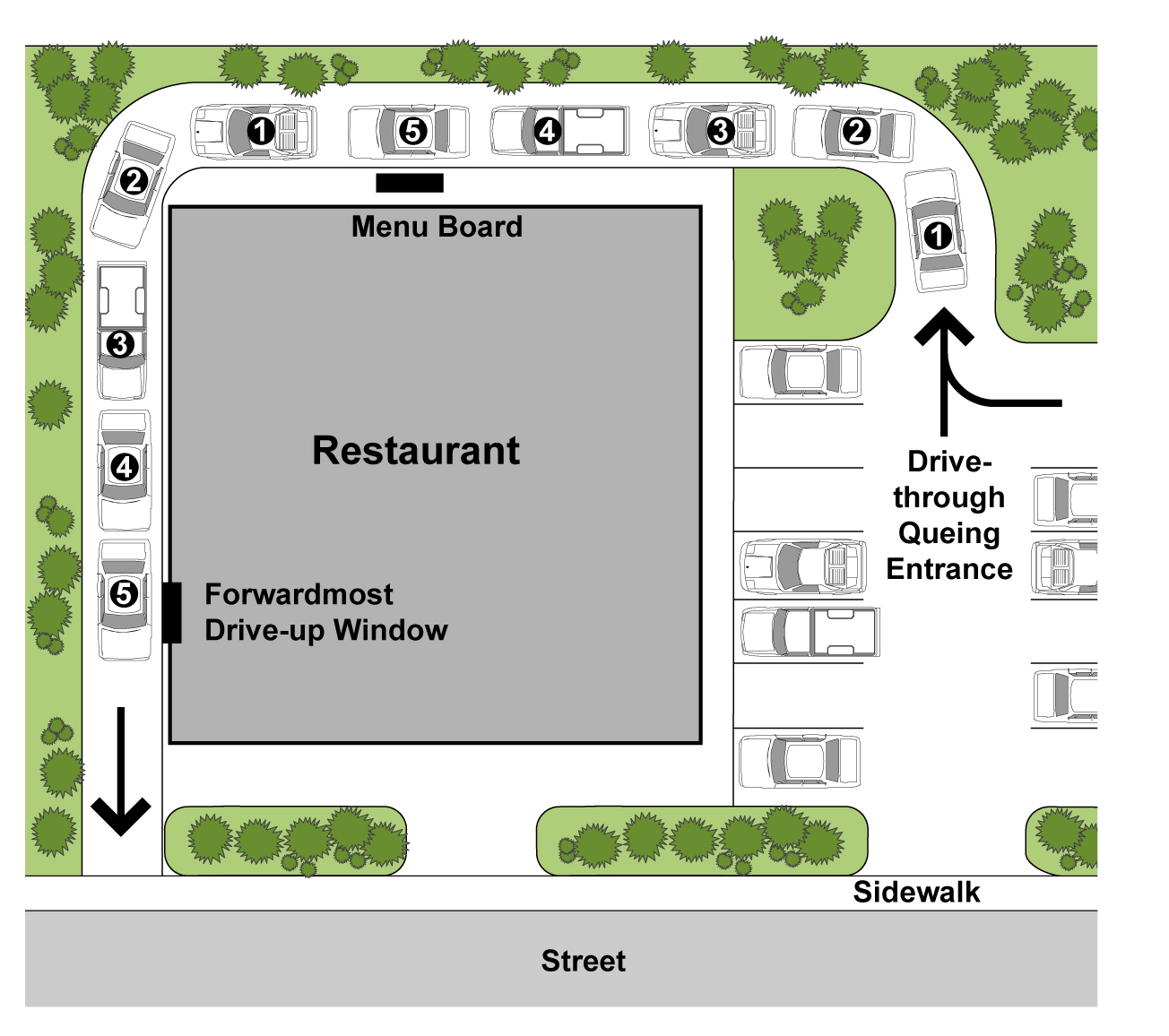
_____
G.
Menu and preview boards. Menu and preview boards may only be installed in compliance with all of the following requirements.
1.
Approval of a menu and preview board shall be subject to the approval of a Sign Plan or Comprehensive Sign Program in compliance with Chapter 19.42 before installation of any signs on the subject site.
2.
As practical, visibility of outdoor menu and preview boards should be minimized from any adjoining street(s). Additional landscape areas or shrub plantings may be required to provide proper screening.
3.
Any proposed carhop and/or walk-up menu boards shall not exceed four square feet in area and shall be located in areas generally defined through the required Conditional Use Permit process in compliance with Chapter 19.114.
H.
Noise. Amplification equipment (e.g., speakers at menu boards, piped music, etc.) shall be located so as not to adversely impact adjoining uses and shall be operated in compliance with Section 19.50.080 (Noise and Vibration).
I.
Prevention of headlight glare. Each drive-through aisle should be appropriately screened with a combination of landscaping, low walls, and/or berms maintained at a minimum height of three feet to prevent headlight glare from impacting adjacent streets, adjoining properties, and parking lots.
J.
Wall required when adjoining residential uses. A minimum six-foot-high solid decorative masonry wall shall be constructed on each property line that adjoins a parcel zoned for and/or developed with a residential use. The design of the wall and the proposed construction materials shall be subject to review and approval through the Site Plan and Design Review process. A minimum five-foot-deep landscaping strip shall be provided between the wall and any driveway.
19.60.060 - Fueling stations.
A.
Purpose. This Section provides locational, developmental, and operational standards for fueling service stations.
B.
Applicability. The provisions in this Section shall apply to fueling service stations as defined in Article 9 and where allowed in compliance with Article 2 (Zones, Allowable Uses, and Development Standards) and the following standards.
C.
City standards. Fueling service stations shall comply with all of the following locational, developmental, and operational standards:
1.
The minimum structure setback from street property lines shall be 40 feet, unless otherwise approved by the Commission for a reverse designed fueling service station (where rear of structure is placed adjacent to the street property line(s)).
2.
The minimum structure setback from other property lines shall be 10 feet.
3.
The maximum standard width of driveways at the sidewalk shall be 30 feet.
4.
The centerline of driveways shall be perpendicular to the curbline.
5.
The minimum distance from any driveway to any interior property line shall be five feet, and the minimum return shall be 20 feet from full height curb.
6.
The minimum distance between curbcuts shall be 30 feet.
7.
Parking shall comply with the design, parking ratio, and size requirements specified in Chapter 19.38 (Off-Street Parking Regulations and Design), but accessory uses associated with the fueling service station shall be parked as follows:
a.
Accessory uses (e.g., car-wash and/or mini-market) may be allowed subject to meeting off-street parking standards for each accessory use.
b.
Notwithstanding subparagraph a., above, a mini-market with no greater than 750 square feet of net retail floor area shall be considered a part of the fueling service station, and not require any additional off-street parking.
c.
The total number of off-street parking spaces shall be the sum total required for the various uses computed separately.
8.
All pump or fuel dispensing islands shall be set back a minimum of 15 feet from the closest property line.
9.
The maximum number of pumps or individual fuel dispensing appliances shall be as follows:
a.
Site size of 12,000 square feet or less shall be limited to eight pumps or individual fuel dispensing appliances.
b.
Two pumps or individual fuel dispensing appliances may be added for each additional 2,000 square feet of site area.
10.
A solid decorative masonry wall of minimum six feet high, and five-foot wide landscape buffer, should be erected along all property lines separating the site from any parcel zoned for residential purposes, and along all alley property lines if the property opposite is zoned for residential purposes. The design of the wall and the proposed construction materials shall be subject to review and approval through the Site Plan and Design Review process.
11.
No parking on the premises other than for those persons attending to business on the site and the vehicles of employees.
19.60.070 - Home occupations.
A.
Purpose. This Section provides locational, developmental, and operational standards for the conduct of home occupations.
B.
Applicability. The provisions in this Section shall apply to home occupations as defined in Article 9 and where allowed in compliance with Article 2 (Zones, Allowable Uses, and Development Standards) and the following standards. A home occupation shall only be allowed as an accessory use on a parcel with a legal residential dwelling unit.
C.
Business license required. The operator of the home occupation shall procure a City Business License issued in compliance with Municipal Code Section 5.04.020 (License Required).
D.
Compliance required. All home occupations shall comply with the applicable locational, developmental, and operational standards identified in this Section.
E.
City standards. Each home occupation shall comply with all of the following standards.
1.
Only the permanent resident(s) of the subject dwelling shall be employed on the premises in the conduct of a home occupation.
2.
There shall be no exterior use or storage of material or mechanical equipment, as determined by the Director, to be for the home occupation use as well as not for normal household or hobby use.
3.
The home occupation shall not involve the use of structures other than those allowed in the subject residential zone.
4.
There shall be no signs on the residential site associated with the home occupation.
5.
Not more than one room or the equivalent of 20 percent of the floor area of the entire dwelling unit, whichever is greater, shall be employed for the home occupation, except for residential day care uses as that term is defined in Article 9 and allowed in compliance with Section 19.16.100. Use of the garage is allowed only when all required vehicle storage and garage parking is maintained in compliance with this Development Code, and the garage doors shall remain closed at all times, except when the vehicle is entering or exiting the garage.
6.
The appearance of the dwelling or any accessory structure shall not be altered so that the dwelling may be reasonably recognized as serving a nonresidential use (either by color, construction, dust, lighting, materials, noise, odors, sounds, vibrations, etc. or that disturbs the peace). The existence of a home occupation shall not be apparent beyond the boundaries of the subject site.
7.
There shall be no use of utilities or community facilities beyond that normal to the reasonable use of the property for residential purposes as defined in the zone.
8.
Visitor limit.
a.
A home occupation may not generate the number of visitors (e.g., pedestrian and/or vehicular traffic) beyond that considered normal within the surrounding residential neighborhood. A home occupation shall not involve the use of commercial vehicles for delivery of materials to or from the premises in a manner different from normal residential usage, except for FedEx, UPS, or USPS-type home deliveries/pick-ups.
b.
This provision shall not be construed to limit the business transacted by the operator of the home occupation solely by means of the Internet, mail, or telephone, or similar means of communications, or while away from the site of the home occupation.
9.
Visitation and deliveries incidental to the home occupation shall be limited to the hours of 7:00 a.m. to 7:00 p.m., Monday through Friday and 8:00 a.m. to 6:00 p.m., on Saturdays and Sundays.
10.
Only one vehicle, owned or leased by the operator of the home occupation, not to exceed one-ton rated carrying capacity (manufacturer's specifications) may be used by the occupant(s) directly or indirectly in connection with a home occupation and parked at the residence.
11.
For rental property, the property owner or property management's written authorization for the proposed use shall be obtained and submitted with the application for a Business License.
12.
All pre-existing home occupations shall conform to all applicable Development Code requirements upon renewal of the annual Business License.
19.60.080 - Horse keeping.
A.
Purpose. This Section provides locational and operational standards for the keeping of horses owned by the occupants of the residential property.
B.
Applicability. The provisions in this Section shall apply to the keeping of horses as defined in Article 9 and where allowed in compliance with Article 2 (Zones, Allowable Uses, and Development Standards).
C.
City standards.
1.
A minimum parcel size of 20,000 square feet is required for the keeping of any horses.
2.
The maximum number of horses allowed shall be in compliance with the following square footage requirements specified in Table 4-1.
Note:
(1) For the purpose of meeting the square footage requirements, the square footage
of contiguous parcels may not be combined.
3.
A corral shall be provided which shall have a minimum dimension of not less than 12 feet and shall contain not less than 240 square feet of area for each horse.
4.
A box stall shall be provided for each horse and shall have minimum dimensions of 12 feet by 12 feet.
5.
The following fencing requirements shall be met:
a.
Materials and construction.
(1)
Fencing may be constructed of chain link, masonry, metal, or wood, equivalent in structural strength to the use and employment of two-inch by six-inch wood railings installed horizontally and spaced vertically, 18 inches on center. When chain link fencing is used, it should be obscured from view at the public right-of-way by landscaping or compatible means.
(2)
For use in conjunction with stud stalls, the railings, which are to be installed horizontally, shall be spaced vertically, 12 inches on center.
b.
Fence posts.
(1)
Fence posts may be constructed of concrete, metal, or wood, equivalent in structural strength to four-inch by six-inch wood posts installed vertically and spaced horizontally, six feet on center.
(2)
For use in conjunction with stud stalls, the posts, which are to be installed vertically, shall be spaced horizontally, four feet on center.
c.
Fence height.
(1)
Fences provided for enclosures shall be maintained not less than five feet in height.
(2)
For use in conjunction with stud stalls, the fence shall be maintained not less than six feet in height.
6.
In conjunction with corrals, a roofed area shall be provided having minimum dimensions of not less than eight feet in width and 12 feet in length.
7.
Running, potable water facilities shall be provided to each corral and/or stall, and the facilities shall be maintained accessible to the horses to be served at all times.
8.
The following maintenance requirements shall be met.
a.
All corrals and stalls shall be continuously maintained in order to prevent physical deterioration.
b.
No person shall keep or allow any manure to remain within 50 feet of any door or window of any inhabited structure or within 100 feet of any structure or place on another parcel where food products are kept, manufactured, stored, or served to the public.
c.
Every person owning or occupying premises where horse manure accumulates shall provide for the removal of the manure daily, and all storage of manure pending its removal shall be in tightly closed containers.
d.
Any person keeping horses shall fully comply with all applicable ordinances and regulations of the Los Angeles County Health Department.
9.
Substantial and acceptable locking and/or latching devices shall be provided and installed on all doors and gates to horse areas in order to be inaccessible to the horses or small children, so as to prevent horse escape and unauthorized entry.
10.
Feeding facilities and/or boxes shall be provided in each corral and/or the box stall be located in a manner so as to be maintained above ground, and the facilities shall be maintained accessible to the horses to be served.
11.
Storage of hay and grain.
a.
The storage of hay shall take place on a Portland cement concrete slab floor or stored not less than 18 inches above ground.
b.
The storage of hay shall not exceed a height above ground level greater than 12 feet and shall be located at least five feet from any property line.
c.
The storage of grain shall be confined to wildlife-proof (i.e., bears, rodents, etc.) containers only.
d.
All structures utilized for the storage of hay shall be subject to the approval of the Director as to safety and architectural aesthetic design.
12.
All areas located adjacent to any barn, coop, corral, grazing, pen, stable, stall, or training or workout areas, or other structures and areas where horses are kept and maintained, shall be graded to drain away from the facilities to prevent ponding and insect harborage on the subject property and on adjoining properties.
13.
All areas used as arenas for exercising or training of horses shall be continuously maintained in a dust-free manner at all times by dampening with an approved sprinkler system or other acceptable means for the prevention of detrimental and nuisance effects of dust emission to surrounding properties.
14.
No barn, corral, pen, or stable shall be maintained within 50 feet of any dwelling or other structure used for human habitation, or within 35 feet of any property line, or within the front setback area of a single-family dwelling.
15.
Horses may only be kept on a parcel containing the approved square footage on which there exists an inhabited single-family dwelling, and/or on a vacant parcel; provided, the person keeping the horse(s) lives contiguous to the vacant parcel and complies with all applicable standards.
19.60.090 - Internet cafés and game arcades.
A.
Purpose. This Section provides locational, developmental, and operational standards for internet and cyber cafés and game arcades.
B.
Applicability. The provisions in this Section shall apply to internet and cyber cafés and game arcades as defined in Article 9 and where allowed in compliance with Article 2 (Zones, Allowable Uses, and Development Standards) and the following standards.
C.
City locational, developmental, and operational standards. The following standards shall apply to internet and cyber cafés and game arcades.
1.
No internet or cyber cafés or game arcade use shall be established or maintained within a 500-foot radius, as measured from the property line, of any park, school, other internet café/arcade, or a public playground.
2.
Adult-oriented business activities and/or uses are prohibited, unless specifically approved in compliance with the requirements of Chapter 19.62 (Adult Business Uses).
3.
Internet site blocking, for the purposes of restricting adult sites, shall be required.
4.
Internet and cyber cafés and game arcades shall provide full-time adult attendants or supervisors, 21 years of age or older, at a ratio of at least one attendant/supervisor for each 10 machines, plus one security guard for each 20 machines or fraction thereof or as otherwise directed by the Director.
5.
Hours of operation shall be limited to 8:00 a.m. to 10:00 p.m., Sunday through Thursday, and 8:00 a.m. to 12:00 a.m. midnight, Friday and Saturday, unless alternative hours are specifically approved through the Conditional Use Permit process. These hours of operation shall be posted in a conspicuous place to the satisfaction of the Director.
6.
A person shall not enter, be, or remain in any part of an internet and cyber café or game arcade while in the possession of, consuming, using, or under the influence of any alcoholic beverage or drug.
a.
No licensee or manager shall permit any person in possession of, consuming, using, or under the influence of any alcoholic beverage or drug to enter or remain on the premises.
b.
Signs shall be posted stating this condition to the satisfaction of the Director.
7.
Minors shall be accompanied by a parent or legal guardian after 10:00 p.m. and may not enter the facility during those times that the Duarte Unified School District is conducting its regular education program. Patrons who appear under the age of 25 shall present proper identification to verify their age before using the facility. Notice of these prohibitions shall be posted at the entrance to the satisfaction of the Director.
8.
Adequate lighting shall be maintained inside the business and parking areas. An interior and exterior lighting plan shall be reviewed and approved by the Director before occupancy.
9.
No window(s) shall be obstructed, tinted, or otherwise covered during business hours.
10.
Establishments with internet access consisting of 25 percent or more of the gross floor area shall provide a waiting area with seating equal to one seat for every four computer stations.
a.
No waiting list may be maintained beyond the seating capacity of the waiting area.
b.
No outside waiting (loitering) or seating area shall be allowed and signs shall be posted stating this prohibition to the satisfaction of the Director.
11.
The applicant shall submit and receive an approved plan from the Los Angeles County Fire Department.
a.
The plan shall address all exiting requirements of the Uniform Building and Fire Codes.
b.
This includes, but is not limited to, aisle locations and dimensions, equipment location, exiting, and panic hardware.
12.
A security plan shall be subject to the review and approval of the Director of Public Safety.
13.
Security measures may include, but are not limited to additional security guards, background investigations of the business applicants, and surveillance video equipment.
14.
To minimize noise issues, all computers shall utilize headphones with no external speakers allowed.
19.60.100 - Large and small family child day care facilities.
A.
Purpose. This Section provides standards for the location, development, and operation of large and small family child day care homes in compliance with State law.
B.
Child day care—Large family.
1.
Purpose. This Subsection provides standards for the location, development, and operation of large family child day care homes for nine to 14 children in compliance with State law.
2.
Applicability. The provisions in this Subsection shall apply to large family child day care homes, as defined by current State law, which shall be allowed in all residential zones in compliance with Article 2 (Zones, Allowable Uses, and Development Standards) and the following standards.
3.
State and other regulatory requirements. These standards shall apply in addition to requirements imposed by the California Department of Social Services and other regulatory agencies (e.g., Fire Department).
4.
City standards. All large family child day care homes shall comply with all of the following City standards:
a.
Licensing. The operator of a large family child day care home shall obtain and maintain a valid license from the California Department of Social Services in compliance with California Code of Regulations, Title 22, Division 12 (Child Care Facility Licensing Requirements).
b.
Large family child day care home permit required.
(1)
Review of permit—Director. A Large Family Child Day Care Home Permit shall be reviewed and either approved or denied by the Director in compliance with the provisions of Health and Safety Code Section 1597.46(a)(3) and this Section.
(2)
Approval of permit. The permit may be approved only if the large family child day care home complies with Health and Safety Code Section 1597.46(d), this Section, all applicable City ordinances, and any regulations adopted by the State Fire Marshall.
c.
Care provider's residence. The large family child day care home shall be the primary residence of the care provider, and the use shall be clearly residential in character and shall be incidental and accessory to the use of the property as a residence.
d.
Fences or walls required.
(1)
A six-foot-high solid decorative fence or masonry wall shall be constructed and properly maintained along all property lines or around the area where outdoor care is provided (as deemed appropriate by the Director), except in the front setback area or within a corner cutoff intersection area, in compliance with the requirements of Chapter 19.36 (Fences, Walls, and Hedges).
(2)
Fences or walls shall provide for safety with controlled points of entry.
e.
Play area and equipment. Outdoor play area(s), including all stationary play equipment, shall be located in the rear area of the parcel.
f.
Separation.
(1)
A large family child day care home proposed within a residential zone shall not be located within a 300-foot radius of another large family child day care home, other day care facility, or group home facility, disregarding the corporate boundary of the City.
(2)
The Director may allow more than one large family child day care home within 300 feet of any another like facility specified in Subparagraph (1), above, if the applicant first demonstrates one of the following to the satisfaction of the Director:
(a)
Any existing large family child day care home located within 300 feet is at capacity; or
(b)
The need exists for a particular or unique service not provided by an existing like facility specified in Subparagraph (1), above, located within 300 feet of a proposed large family child day care home.
g.
Drop-off/pick-up areas, and use of garages.
(1)
A minimum of two off-street parking spaces shall be provided as a drop-off and pick-up area. The spaces shall be in addition to those required for the dwelling unit in compliance with Chapter 19.38 (Off-Street Parking Regulations and Design). A driveway may be used to provide the spaces; provided, the City Traffic Engineer approves the arrangement based on traffic and pedestrian safety considerations.
(2)
A passenger loading plan shall be required to minimize noise and parking issues to the maximum extent possible.
(3)
Additional off-street parking may be required by the Director to minimize impacts on adjacent parcels.
(4)
A facility located on a through street classified as a collector or arterial street shall provide a drop-off and pick-up area that does not require backing into the street.
(5)
Garages shall not be used as a family child day care play area unless alternative on-site covered parking is available to meet minimum residential parking requirements and further, the garage is improved to meet Building and Fire Code regulations as a habitable space.
h.
Noise. In order to protect adjacent residential dwellings from noise impacts, a large family child day care home located within a residential zone may only operate a maximum of 17 hours each day between the hours of 6:00 a.m. and 11:00 p.m. and may only conduct outdoor activities between the hours of 7:00 a.m. and 9:00 p.m.
i.
No exterior evidence. There shall be no exterior evidence and/or signage identifying the large family child day care home.
j.
Inspection required.
(1)
Before commencing operation of a large family child day care home, the City Building Inspector shall conduct an inspection of the premise on which the large family child day care home is to be operated to ensure that there is no unpermitted building, electrical, and/or mechanical improvements to the property.
(2)
The property owner shall obtain and final all required Building Permits for all unpermitted construction on the premises before commencing the on-site operation of a large family day care home.
k.
Issuance of large family day care home permit. The Director shall issue the Large Family Day Care Home Permit before the operation of the large family child day care home begins, once the operator has demonstrated compliance with Health and Safety Code Section 1597.46(d), this Section, all applicable City ordinances, and any regulations adopted by the State Fire Marshall.
C.
Child day care—Small family.
1.
Purpose. This Subsection provides provisions for the location and operation of small family child day care homes for eight or fewer children in compliance with State law.
2.
Applicability. The provisions in this Subsection shall apply to small family child day care homes, as defined by current State law, where allowed in compliance with Article 2 (Zones, Allowable Uses, and Development Standards) and the following standards.
3.
State requirements.
a.
These provisions shall apply in addition to requirements imposed by the California Department of Social Services.
b.
The operator of a small family child day care home shall obtain and maintain a valid license from the California Department of Social Services in compliance with California Code of Regulations, Title 22, Division 12 (Child Care Facility Licensing Requirements).
4.
Permitted by right. As required by State law (Health and Safety Code Section 1597.30 et seq. [Family Day Care Homes]), small family child day care homes (eight or fewer children) shall be considered a residential use of property and shall be an allowed use, permitted by right, within a residence located in a residential zone with no City land use permits required.
19.60.110 - Late night and/or twenty-four hour uses.
A.
Intent and purpose. The City recognizes the need for certain businesses to operate under extended hours, but seeks to balance concern for such activity when located proximate to other uses sensitive to noise, lighting, glare or similar activities during late night hours. Therefore, the following regulations have been determined to be necessary in order to protect the public health, safety, welfare, and quality of life in the City;
B.
Applicability.
1.
Late night hours shall be defined as any nonresidential activity that occurs between the hours of 12:00 a.m. (midnight) and 6:00 a.m.
2.
The provisions in this Section shall apply when any commercial or industrial use regularly maintains business hours open to the public and/or vendors during late night hours, or when any nonresidential use routinely has shifts of ten or more employees on-site during late night hours.
C.
Late night use standards.
1.
Any commercial use open to the public during late night hours, as defined in Subsection B above, for which the property is located within 300 feet of a legal residential use or zone shall require a Conditional Use Permit, unless a determination by the Director is made that the nature of said use does not warrant a CUP.
2.
Any industrial use open to the public or vendors or operating employee shifts where 10 or more employees are present on-site during late night hours, as defined in Subsection B above, for which the property is located within 300 feet of a legal residential use or zone shall require a Conditional Use Permit.
19.60.112 - Massage establishments.
A.
Purpose. This Section provides locational and developmental standards for massage establishments.
B.
Applicability. The provisions in this Section shall apply to massage establishments, including accessory massage uses, as defined in Article 9 and where allowed in compliance with Article 2 (Zones, Allowable Uses, and Development Standards), Chapter 5.56 of the Duarte Municipal Code.
C.
City standards. Massage establishments shall comply with all of the following locational and developmental standards:
1.
Any massage establishment shall contain a minimum of 1,200 square feet of gross owned or leased floor area;
2.
There shall be a reception and front desk waiting area within the massage establishment, which shall be accessed directly through the front door of the premises and shall be used as a reception and waiting area for customers who are awaiting massage services.
a.
The reception/front desk area shall be no less than 200 square feet of the massage establishment floor area.
b.
The reception/front desk area shall be located at the front/side (corner) portions of the building and must be comprised of no less than 75 percent windows, as measured in area as a percentage of the total width and height of the front/side (corner) storefront elevations and as subject to the City's site plan and design review process.
c.
The reception/front desk area shall be unobscured from view through the front and/or side (corner) windows through the use of curtains, drapes, louvers, shading devices, window tinting, furniture, displays or other methods that reduce visibility to where a reasonable person may not see into the establishment from the exterior of the premises.
3.
Lighting at all massage establishments must be designed to illuminate both all off-street parking areas and all entries and exits serving any massage business and/or establishment, subject to Planning Division approval of a lighting and illumination plan and subject to such additional requirements as may be imposed under Chapter 19.50.070 of the Duarte Municipal Code.
(Ord. No. 857, § 1, 4-28-2015)
19.60.120 - Outdoor dining.
A.
Purpose. This Section provides locational, developmental, and operational standards for outdoor dining area(s) located on private property as an accessory use to a legally established restaurant. Any request for deviation from these standards shall require the approval of a Conditional Use Permit in compliance with Chapter 19.114.
B.
Applicability. The provisions in this Section shall apply to outdoor dining where allowed in compliance with Article 2 (Zones, Allowable Uses, and Development Standards) and the following standards.
C.
City locational, developmental, and operational standards. The following standards shall apply to outdoor dining.
1.
Location requirements. Patron tables and other outdoor dining area components shall be located on the same site as the other facilities of the restaurant.
2.
Sizes of outdoor dining areas and related permit requirements. Outdoor dining area(s) shall comply with the following size and related permit requirements:
a.
Outdoor dining areas—Limited. Containing up to 800 square feet of gross floor area: Site Plan and Design Review by the Director shall be required in compliance with Chapter 19.122.
b.
Outdoor dining areas—General. Containing over 800 square feet of gross floor area: Conditional Use Permit and Site Plan and Design Review by the Director shall be required in compliance with Chapters 19.114 and 19.122.
3.
Alcoholic beverage sales. A restaurant that proposes to serve alcoholic beverages within an outdoor dining area shall comply with the standards established by the State Department of Alcoholic Beverage Control (ABC). The dining area shall be:
a.
Accessible from inside the restaurant only, unless the Director waives or modifies this requirement in circumstances where this is not feasible or practical;
b.
Physically defined and clearly a part of the restaurant it serves; and
c.
Supervised by a restaurant employee(s) to ensure compliance with laws regarding the on-site consumption of alcoholic beverages.
4.
Awnings. All awnings installed within an outdoor dining area(s) shall comply with the roof covering standards of the City's Building Code. In addition to an awning, outdoor dining area(s) on private property may use flexible, transparent plastic to enclose the sides and front of the outdoor dining area during the official Los Angeles County rainy season from October 15 through April 15. These plastic enclosures should be removed on days without rainfall and at a minimum shall be removed from April 16 through October 14.
5.
Landscaping. All outdoor dining areas shall include appropriate landscaping. A landscape plan for the outdoor dining area(s) may include the use of planter boxes and permanent vegetation and shall comply with Chapter 19.40 (Landscaping).
6.
Operating requirements.
a.
Barriers. Appropriate barriers shall be placed between outdoor dining areas and parking, pedestrian and vehicular circulation areas. The design, construction, and placement of the barriers shall be subject to the prior approval of the Director. Barriers shall serve only to define the areas and shall not constitute a permanent all-weather enclosure.
b.
Clean-up facilities and maintenance. Outdoor dining areas shall:
(1)
Be continually cleaned by the removal of litter and food items which constitute a nuisance to public health, safety, and welfare; and
(2)
Contain waste receptacles for use by the public and restaurant employees.
c.
Outdoor cooking. Cooking within an outdoor dining area is prohibited, unless authorized by a Conditional Use Permit approved in compliance with Chapter 19.114.
d.
Parking. When the outdoor seating area exceeds 50 percent of the gross interior floor area, 1 parking space for each 200 square feet of floor area exceeding the 50 percent interior floor area shall be provided. Otherwise, no additional parking shall be required for outdoor dining area(s). Additionally, parking shall be calculated, designed, installed, and maintained in compliance with Chapter 19.38 (Off-Street Parking Regulations and Design).
e.
Placement of tables. Tables shall be placed only in the locations shown on the approved site plan.
7.
Design compatibility. The following standards are intended to ensure compatibility with surrounding uses and a high standard of design quality.
a.
Outdoor dining areas and associated physical elements, awnings, barriers, covers, furniture, umbrellas, or other physical elements that are visible from the public rights-of-way shall be compatible with one another and with the overall character and design of the primary structure(s).
b.
The use of awnings, plants, umbrellas, and other human-scale elements is encouraged to enhance the pedestrian experience.
c.
Consideration shall be given in the design of outdoor dining areas to ensure that the potential for conflict or resulting nuisances are minimized for residential uses located within 200 feet.
d.
Consideration shall be given to the relationship of proposed outdoor dining areas to hospitals, places of religious assembly, and public schools. Proper design and construction measures should be applied to eliminate potential impacts related to glare, light, loitering, noise, odor, and smoke.
e.
Pedestrian and vehicular traffic flow shall not be obstructed, nor shall existing pedestrian or vehicular movement areas be removed.
f.
A minimum setback of five feet from adjoining property lines or parking lots shall be provided.
19.60.130 - Outdoor displays—Permanent.
A.
Purpose. This Section provides locational, developmental, and operational guidelines for permanent areas for outdoor display/sale of merchandise.
B.
Applicability. The provisions in this Section shall apply to permanent areas for outdoor display/sale of merchandise as defined in Article 9 and where allowed in compliance with Article 2 (Zones, Allowable Uses, and Development Standards) and the following guidelines.
C.
City locational, developmental, and operational guidelines.
1.
Height of displayed materials. The outdoor display/sale of merchandise should not exceed a height deemed to be acceptable and aesthetically pleasing by the Director.
2.
Location of displays. Outdoor display/sale area(s) should be located entirely on private property. They should not encroach into required setbacks. In zones where no setback is required, the outdoor area(s) should be set back a minimum of 10 feet from adjoining property line(s), unless otherwise allowed through the approval of a Conditional Use Permit, in compliance with Chapter 19.114.
3.
Location of merchandise. Displayed merchandise should occupy a fixed, specifically approved, and defined location that does not disrupt the normal function of the site or its circulation, and does not encroach upon driveways, landscaped areas, parking spaces, area(s) required for ingress and egress to the parking area(s), or ADA and pedestrian walkways. Displays should not obstruct traffic safety sight areas or otherwise create hazards for pedestrian or vehicle traffic.
4.
Operating hours. The outdoor display/sale of merchandise should only be allowed during regular hours of operation.
5.
Signs. Signs associated with permanent outdoor displays should be limited to pricing or description tags with no additional advertising allowed. Further, the overall size for pricing/description tags shall not exceed one square foot for each tag, and only one tag allowed for each type of item.
19.60.140 - Places of religious assembly.
A.
Purpose. This Section provides locational, developmental, and operational standards for places of religious assembly.
B.
Applicability. The provisions in this Section shall apply to places of religious assembly as defined in Article 9 and where allowed in compliance with Article 2 (Zones, Allowable Uses, and Development Standards) and the following standards.
C.
City locational, developmental, and operational standards. Except as specified in this Section, the premises on which a place of religious assembly use is located shall comply with the regulations and restrictions applicable to the zone in which it is located.
1.
Parcel size and location.
a.
The minimum parcel size for a place of religious assembly shall be 40,000 square feet.
b.
A place of religious assembly use shall have frontage on a site with a minimum of two separate access points to secondary or larger roadways, as designated in the General Plan.
c.
Properties on which an existing place of religious assembly has continuously operated, and was legally established prior to 2010 that does not meet the property size standard in Subsection a. above shall be exempt from the requirements in Subsection a. and Subsection b. above.
2.
Overconcentration. A place of religious assembly use shall not be located within a 300-foot radius of another existing place of religious assembly use, disregarding the corporate boundary of the City, unless the applicable review authority grants an exception. The review authority, in granting an exception, shall first find that the proposed concentration will not be detrimental to the health, safety, peace, morals, comfort, or general welfare of persons residing or working in the neighborhood of the proposed place of religious assembly use.
(Ord. No. 881, § 4, 6-26-2018)
19.60.150 - Recycling facilities.
A.
Purpose. This Section provides locational, developmental, and operational standards for various types of recycling facilities (e.g., reverse vending machine(s) and small collection facilities).
B.
Applicability. The provisions in this Section shall apply to recycling facilities as defined in Article 9 and where allowed in compliance with Article 2 (Zones, Allowable Uses, and Development Standards) and the following standards.
C.
City locational, developmental, and operational standards.
1.
Reverse vending machine(s). Reverse vending machine(s) intended solely for recycling purposes shall be allowed in compliance with all of the following standards. Vending machines for merchandise and other self-services are addressed in Section 19.60.180 (Vending Machines - Outdoor).
a.
The machines shall be installed as an accessory use in compliance with the applicable provisions of this Development Code and shall not require additional parking.
b.
If located inside the primary structure, the machines shall be within 30 feet of the entrance and shall not obstruct pedestrian circulation.
c.
If located outside the primary structure, the number of machines shall be limited to a maximum of two, shall not occupy required parking spaces, shall be constructed of durable waterproof and rustproof material(s), and shall be placed in a manner that is properly designed and constructed in terms of architectural treatment and security from vandalism, subject to the approval of the Director.
d.
The machines shall not exceed a floor or ground area of 50 square feet for each installation, including any protective enclosure, nor eight feet in height.
e.
The machines shall have a maximum sign area of four square feet for each machine, exclusive of operating instructions.
f.
The machines shall have operating hours which are consistent with the operating hours of the primary use.
g.
The area in front of the machines shall be illuminated to ensure comfortable and safe operation, if operating hours are between dusk and dawn.
2.
Small collection facilities. Small collection facilities shall be allowed in compliance with all of the following standards.
a.
The facility shall not exceed a floor or ground area of 350 square feet nor three parking spaces, not including space that would be periodically needed for the removal of materials or exchange of containers.
b.
The facility shall not use power-driven processing equipment, except for reverse vending machines. The Director may allow an exception to this processing equipment limitation through the Minor Use Permit process in compliance with Chapter 19.114.
c.
The facility shall not be located within 100 feet of any parcel zoned or occupied for residential use. The Director may modify this location limitation through the Minor Use Permit process in compliance with Chapter 19.114.
d.
The facility shall be set back at least 10 feet from any public right-of-way, and not obstruct vehicular or pedestrian circulation.
e.
The facility shall accept only glass, metal, or plastic containers, which have a CRV value, and other household beverage containers (i.e., plastic milk containers, wine bottles, etc.).
f.
All recycled items shall be stored within a fully enclosed structure which is designed and constructed to ensure against unauthorized removal of the items. The structure and containers within the structure shall be of a capacity sufficient to accommodate the items collected and the collection schedule. Outdoor storage of recycled items shall be prohibited.
g.
The fully enclosed structure, the collection containers, and site fencing shall be of a color and design that would be compatible and harmonious with the character of their location, subject to the review and approval of the Director. Landscaping and other appropriate screening may be required on a case-by-case basis as a condition to the required Minor Use Permit approval.
h.
Signs may only be provided as follows:
(1)
Recycling facilities may have identification signs with a maximum area of 15 percent for each side of the structure or 12 square feet, whichever is greater.
(2)
Signs shall be both compatible and harmonious with the character of their location and in compliance with Chapter 19.42 (Signs).
(3)
Directional signs without advertising messages may be installed with the approval of the Director.
i.
Additional parking spaces shall not be required for customers of a small collection facility located in the established parking lot of the primary use.
j.
Mobile recycling units shall have an area clearly marked to prohibit other vehicular parking during hours when the mobile unit is scheduled to be present. The mobile recycling units shall only be parked within the marked area.
k.
Use of parking spaces by the patrons and the attendant shall not reduce available parking spaces below the minimum number required for the primary use.
19.60.160 - Accessory dwelling units.
A.
Purpose. The purpose of this section is to comply with Government Code Sections 65852.2 and 65852.22 and recent amendments thereto, which allow the City to enact certain standards for the development of accessory dwelling units and junior accessory dwelling units in residential zones within the City. It is also the purpose of this section to ensure the availability of affordable housing for family members, students, and the elderly, among others, in the City while mitigating impacts to traffic, utilities, public health and safety and preserving the character of residential neighborhoods.
B.
Applicability. The provisions in this section shall apply as defined below and where allowed in compliance with Article 2 (Zones, Allowable Uses, and Development Standards) and as permitted within this section.
Accessory Dwelling Unit. Accessory dwelling unit (also "ADU," "second unit," or "granny unit") shall mean an attached or detached residential dwelling unit which provides complete independent living facilities for one or more persons. It shall include a kitchen, a ¾ or full bath, and permanent provisions for living, sleeping, eating, cooking, sanitation, and storage on the same parcel where the primary single-family or multi-family residence is situated. An accessory dwelling unit also includes an "efficiency unit" as defined in Health and Safety Code Section 17958.1 and a "manufactured home" as defined in Health and Safety Code Section 18007.
Attached ADU shall mean a new ADU is constructed as a physical expansion (i.e., addition) to the primary dwelling and is attached to the single-family dwelling or multifamily dwelling unit by one or more common walls.
Converted ADU shall mean an ADU created within the interior of an Existing Structure that occupies part or all of the floor area of the existing structure. A converted ADU does not include an ADU that would: (a) increase the height of an existing structure; (b) require removal of more than 50 cubic yards as part of the excavation of an existing structure; or (c) increase the total floor area of the existing structure by more than 150 square feet beyond its existing physical dimensions for the purpose of accommodating ingress and egress.
Detached ADU shall mean a new ADU that is located on the property such that the unit does not share any walls with the single-family dwelling or multi-family dwelling unit, and the distance between the nearest point of any portion of the ADU and the single-family dwelling or multifamily dwelling unit is a minimum of six feet.
Junior Accessory Dwelling Unit (also known as "junior ADU" or "JADU") shall mean a unit that is between 150 and 500 square feet in size and contained entirely within a single-family residence. A junior accessory dwelling unit may include separate sanitation facilities or may share sanitation facilities with the existing structure.
ADU Kitchen shall mean a sanitary' cooking, food preparation, and storage area of the ADU that includes the following:
1.
A cooking facility with permanent utility connections to electrical and/or gas-powered appliances;
2.
A food preparation area that includes a sink, garbage disposal, and countertop;
3.
A cabinet storage area that is of a reasonable size in relation to the size of the ADU.
Accessory Dwelling Unit (ADU) Agreement means a legally binding agreement between a property owner and the City which sets forth those provisions necessary to ensure fulfillment of the requirements of this Division.
C.
Location and zoning requirements. An accessory dwelling unit may be located only on residentially zoned lots.
1.
One detached, attached, or converted ADU may be constructed on a single-family residential lot.
2.
One JADU may be constructed on a single-family residential lot zoned to allow residential use.
3.
One JADU and one detached or converted ADU may be constructed on a single-family residential lot where the JADU and ADU meet the requirements in Government Code Section 65852.2(e).
4.
Up to two detached ADUs may be constructed on a multi-family lot where the detached ADUs meet the requirements in Government Code Section 65852.2(e)
5.
Converted ADUs may be built in multi-family residential dwellings, but the number of converted ADUs is limited to up to 25 percent of the total number of multi-family residential units where the converted ADUs meet the requirements in Government Code Section 65852.2(e); however a minimum of one ADU shall be permitted. Converted ADUs in multifamily zoned lots shall be limited to the portions of the dwellings that are non-living space.
6.
Any ADU/JADU legally created shall be governed by the zoning regulations in effect at the time of approval.
D.
ADUs/JADU restrictions. All ADU/JADUs shall be subject to the following restrictions:
1.
The development and use of the ADU/JADUs shall only be valid and permitted based on the terms established in this Section.
2.
A deed restriction shall be required for all ADUs/JADUs. Prior to obtaining a building permit for an ADU/JADU, a deed restriction shall be approved by the Community Development Director or his/her designee and the City Attorney, which shall include the restrictions and limitations identified in this Paragraph, along with specific information about the subject property and the project. Prior to the issuance of the certificate of occupancy or granting final inspection for the construction of the project, the applicant shall record the deed restriction with the County Recorder's Office and provide a copy of the final recorded deed restriction with the Community Development Department, stating that, among others:
a.
An ADU/JADU deed restriction shall run with the land and shall be binding upon any successor in ownership of the property.
b.
The ADU/JADU shall not be sold separately from the primary residence, except as permitted by Government Code 65852.26, or as the section may be amended from time to time.
c.
If the ADU/JADU is rented, it shall not be rented for a period of less than 30 consecutive days.
d.
Owner-occupancy is required for parcels with a JADU, consistent with Paragraph G of this Section.
e.
Owner-occupancy for all ADU/JADUs shall be required after January 1, 2025.
f.
The ADU/JADU shall be restricted to the total floor area approved at the time of building permit issuance. Any owner wishing to incorporate the total floor area of the ADU/JADU back into the primary Dwelling Unit must request termination of the ADU/JADU use under this Section, satisfying all zoning and development standards such as setbacks, floor area, lot coverage, and parking.
g.
A second unit may not have utility services separate from those of the main residential structure on the same property.
h.
The Owner and all successors in interest in the subject property shall maintain the ADU/JADU in accordance with all applicable regulations established in this Section and any approval granted by the City. Violations and lack of compliance with any provisions of this Section, may result in legal action against the property owner, including revocation of any right to maintain an ADU/JADU on the property.
E.
Review process for ADUs and JADUs.
1.
Permit review and timelines. The Community Development Department Director or his/her designee shall ministerially review and approve an ADU/JADU permit application and shall not require a public hearing, provided that the submitted application is complete and demonstrates that the ADU/JADU complies with the requirements contained in this section. Where an ADU/JADU permit application is submitted with an application for a single-family dwelling that is subject to design review under Chapter 19.122 of the Duarte Development Code, the ADU/JADU permit application will be considered separately without discretionary review or a public hearing.
a.
ADU/JADU permit applications subject to ministerial approval shall be processed within the timelines established by California Government Code Section 65852.2.
b.
In addition to obtaining an ADU/JADU permit, the applicant shall be required to obtain a building permit, tree removal permit, if applicable, and other applicable construction permit requirements prior to the construction of the ADU/JADU.
F.
ADU development standards. ADUs shall comply with the following development standards:
1.
Studio and one bedroom ADUs shall not exceed 850 square feet of total floor area. ADUs with more than one bedroom shall not exceed 1,000 square feet of total floor area. In no case shall the ADU be less than 150 square feet.
2.
An attached ADU shall not exceed 50 percent of the total floor area of the existing primary dwelling on the subject lot, however this requirement shall not reduce the maximum allowable size to less than 800 square feet of total floor area.
3.
An attached ADU shall not exceed the height and/or number of stories of the existing primary dwelling unit, except for an attached single-story ADU which can be built to a height of 25 feet.
4.
A detached ADU shall be limited to a maximum height of 18 feet and one story in height. Two story detached ADUs that include heights above 18 feet are allowed for existing or proposed detached garages where the first floor garage is maintained as off-street parking for two or more vehicles, and the second floor ADU is equal to or less than the footprint of the first floor garage itself.
5.
The maximum lot coverage for the underlying zone may be exceeded to accommodate the construction of ADUs equal to or less than 800 square feet in total floor area. For ADUs greater than 800 square feet in total floor area, the Duarte Development Code requirements related to lot coverage, minimum landscape area, maximum hardscape area, and all other local development standards apply.
6.
An ADU shall be in similar in the building materials, color, style, massing, and form of the primary residence. Architectural details including, but limited to, wall modulation, windows, roof pitch and lines, eaves, fascia boards, and trim shall match the primary residence on the property, provided that no ADU shall include any second story balcony or similar open space on the second story.
7.
Exterior lighting shall be shielded or directed so that it does not glare off-site or illuminate the primary residence or any adjacent property, where feasible.
8.
An ADU shall have a separate exterior access. The exterior access shall be a standard exterior door and shall be located in a manner that will preserve, to the greatest extent feasible, the privacy of the primary residence and any adjoining residences and, to the greatest extent feasible, shall not be visible from the street. Access from the exterior access point of the ADU to the street are encouraged to be provided on a decorative paved pathway.
9.
Any common wall separating an attached ADU from the primary dwelling unit and/or main building shall be soundproofed. Details of the proposed means of soundproofing shall be submitted with plans for construction.
10.
When an ADU is attached to or converted within a primary dwelling that is required to have fire sprinklers, then the ADU shall also install fire sprinklers.
11.
New detached ADUs shall install rooftop solar panels as required by the Building Code.
12.
In addition to the off-street parking space(s) required for the primary residence, one off-street parking space shall be provided for each ADU, except when:
a.
The ADU is located within one-half mile walking distance of Public Transit. For purposes of this Chapter, "public transit" has the same meaning as in Government Code section 65852.2(j)(10).
b.
The ADU is entirely or partially within a proposed or existing primary dwelling or other existing structure.
c.
The ADU is located within a historic district.
d.
On-street parking permits are required but not offered to the occupant of the ADU.
e.
There is a City-approved and dedicated parking space for a car share vehicle located within one block of the ADU.
13.
When the ADU is created by converting or demolishing a garage, carport or covered parking structure, replacement of covered parking space(s) eliminated by the construction of the ADU shall not be required as long as the ADU remains in use as a legal ADU. If the ADU is removed from use, the single-family or multifamily dwelling unit shall be required to comply with parking standards established in Chapter 19.38 of the Duarte Development Code as well as all other development standards applicable to the zoning district.
14.
Required parking space(s) shall be a minimum of 20 feet in length. The required parking spaces for the ADU may be uncovered. For single-family residential properties, the only allowable driveways leading to required parking spaces shall be paved in Portland cement concrete.
G.
JADU development standards. Junior accessory dwelling units shall comply with the following:
1.
The owner of a parcel proposed for a JADU shall occupy as a principal residence either the single-family dwelling unit or the JADU. The JADU shall be considered to be in compliance with this Code only so long as the owner occupies either the single-family dwelling unit or the JADU.
2.
Owner-occupancy shall not be required if the owner is another governmental agency, land trust, or housing organization.
3.
The JADU shall be a minimum of 150 square feet and a maximum of 500 square feet of total floor area. The floor area of a shared sanitation facility shall not be included in the total floor area of the JADU.
4.
One JADU may be constructed on a lot zoned for single-family residential use, where there is a single-family dwelling unit existing or proposed to be built on the lot. The JADU must be contained entirely within the walls of the existing or proposed single-family dwelling unit.
5.
The JADU shall include an efficiency kitchen meeting the requirements of Government Code Section 65852.22.
6.
Any common wall separating the JADU from the primary dwelling unit and/or main building shall be soundproofed. Details of the proposed means of soundproofing shall be submitted with plans for construction.
7.
A separate exterior entry from the main entrance to the single-family dwelling shall be provided to serve a JADU.
8.
A JADU may include separate sanitation facilities or may share sanitation facilities with the existing structure.
9.
A JADU may not be connected to a detached ADU.
10.
Any exterior improvements associated with the development of a JADU shall conform to zoning regulations and any existing land use entitlements on the property.
11.
No additional parking is required for a JADU, unless the JADU is created from the conversion of existing, attached garage space. In this case, replacement off-street garage parking is required.
H.
Termination of permit and use for ADUs and.JADUs.
1.
In his or her sole discretion, the Community Development Director may grant an owner's request to terminate an ADU/JADU permit and deed restriction. The Community Development Director shall consider the length of time such permit has been in force, the conditions of approval, the exceptions granted for the permit.
2.
As a condition of termination, the Community Development Director shall require the owner to make modifications to the property to comply with: (1) current building code requirements; and (2) current development standards in effect at the time the request is made to terminate the use of the ADU or JADU, including but not limited to, setbacks, heights, and parking. The owner shall apply for a building permit to make such modifications as required by the City's building and fire codes.
3.
In no case shall the ADU or JADU permit be terminated, if the proposed termination would require a variance to exceed the allowable lot coverage of the single-family dwelling unit.
4.
Where a request is to terminate an ADU that was created from the conversion or demolition of a garage, carport, or covered parking structure, the garage, carport, or covered parking structure must be converted back to off-street parking.
I.
Violations and enforcement.
1.
Violations and enforcement for units described in the subsection shall be in compliance with Chapter 19.154 of the Duarte Development Code.
(Ord. No. 874, § 2(Exh. A), 4-11-2017; Ord. No. 904, § 1(Exh. A), 7-27-2021; Ord. No. 916, § 5, 4-25-2023)
19.60.165 - Tobacco shops.
A.
Purpose. This Section provides concentration, separation, spacing and distance, and operational standards for tobacco shops in the City of Duarte in order to maintain the City's character, the diversity and vitality of the community's commercial areas, and the quality of life of Duarte residents.
B.
Applicability. The provisions in this Section shall apply to tobacco shops where allowed in compliance with Article 2 (Zones, Allowable Uses, and Development Standards) and the standards set forth in this Section.
C.
Nonconforming Tobacco Shops. Tobacco shops that do not comply with the concentration, separation, spacing and distance requirements set forth in Section 19.60.165.E.1—4, but which were legally in existence on the date this Section was adopted, shall, upon the effective date of this Section, acquire the status of a legally nonconforming use and shall be allowed to remain in existence subject to the provisions of this Section and Article 6 (Nonconformities) of this Code. The Director of Community Development shall create and maintain a list of the tobacco shops that were legally in existence on the date this Section was adopted. Notwithstanding the foregoing, nonconforming use status does not authorize noncompliance with the operational requirements set forth in Section 19.60.165.E.5—8, the Business License requirements set forth in Chapters 5.04 and 5.08 of the Duarte Municipal Code, and the Tobacco Retailer License requirements set forth in Chapter 5.09 of the Duarte Municipal Code.
D.
[Minor Use Permit Required.] No person shall cause or permit the creation, operation, or intensification of any of any tobacco shop use without first obtaining and maintaining a minor use permit pursuant to Chapter 19.114 (Conditional Use Permits and Minor Use Permits).
E.
City Standards. Each tobacco shop shall comply with the all of the following standards:
1.
A tobacco shop shall not be located within 600 feet of any parcel of land that contains any one or more of the following land uses:
a.
Another tobacco shop;
b.
A private or public preschool, kindergarten, elementary, middle, or high school;
c.
A library open to the public;
d.
A youth center; and
e.
A public playground/plaza/park/recreation area.
2.
The maximum number of tobacco shops within the City of Duarte shall not exceed one tobacco shop for every 3,500 inhabitants of the City.
3.
For the purposes of this subsection, the total number of inhabitants of the City shall be determined by the most current published data available from the U.S. Census Bureau or the California State Department of Finance, whichever has been more recently updated, as of the date the application is filed.
4.
The distance between any structure subject to a tobacco shop use and any other structure with a tobacco shop use or sensitive use set forth in Section 19.60.165.E.1.a—e shall be measured in a straight line, without regard to intervening structures, from the closest property line of the structure subject to the tobacco shop use to the closest property line of the other structure with a tobacco shop or sensitive use.
5.
A tobacco shop located in a building sharing one or more common walls or sharing common attic space with another retail or commercial establishment shall not allow tobacco product use on the premises in a manner that interferes with any other establishment's use or enjoyment of the premises.
6.
Tobacco products and tobacco paraphernalia shall be kept and displayed in a secure and locked enclosure, which can only be accessed with the assistance of a clerk. Self-service displays of tobacco products and tobacco paraphernalia are prohibited.
7.
Tobacco products, tobacco paraphernalia, electronic cigarettes and vaping devices, and electronic cigarette and vaping accessories shall not be visible through storefront windows.
8.
The area dedicated for the sale of tobacco paraphernalia shall not exceed five percent of gross floor area.
F.
Sale of Drug Paraphernalia. Tobacco retailers should be aware that the sale of "drug paraphernalia" (as that term is defined in Health and Safety Code Section 11364.5(d)) is regulated by the California Uniform Controlled Substances Act (specifically, Health and Safety Code Sections 11364 to 11376.5), as amended from time to time.
G.
Revocation of a Business and/or Tobacco Retailer License. In addition to any other penalty authorized by law or the Duarte Municipal Code, the business license and/or tobacco retailer license of any business that violates any provision of this Section, the California Uniform Controlled Substances Act (including without limitation Health and Safety Code Sections 11364 to 11376.5), as amended from time to time, or any other local, State or Federal law or regulation may be revoked pursuant to the procedure set forth in Sections 5.04.250 and 5.09.120 of the Duarte Municipal Code.
(Ord. No. 852, § 3, 8-26-2014)
19.60.167 - Accessory retail sales of tobacco products, electronic cigarette and vaping devices, electronic cigarette and vaping accessories, and tobacco paraphernalia.
A.
Purpose. This Section provides operational standards for land uses associated with the accessory retail sale of tobacco products, electronic cigarette and vaping devices, electronic cigarette and vaping accessories, and tobacco paraphernalia in the City of Duarte in order to maintain the City's character, the diversity and vitality of the community's commercial areas, and the quality of life of Duarte residents.
B.
Applicability. The provisions in this Section shall apply to the accessory retails sale of tobacco products, electronic cigarette and vaping devices, electronic cigarette and vaping accessories, and tobacco paraphernalia where allowed in compliance with Article 2 (Zones, Allowable Uses, and Development Standards) and the standards set forth in this Section.
C.
City Standards. Accessory retail sales of tobacco products, electronic cigarette and vaping devices, electronic cigarette and vaping accessories, and tobacco paraphernalia (collectively, "accessory products") shall comply with all of the following standards:
1.
The sale of accessory products shall be an accessory use (i.e., not the primary use) of the establishment.
2.
The primary use must be permitted or conditionally permitted in the zone in which the establishment is located.
3.
Accessory products shall be located within an enclosed business establishment.
4.
Accessory products shall be kept and displayed in a secure and locked enclosure, which can only be accessed with the assistance of a clerk. Self-service displays of accessory products are prohibited.
5.
Accessory products shall not be visible from the public right-of-way and internal sidewalks or areas accessible to the public.
6.
The area dedicated for accessory products shall not exceed five percent of the gross floor area.
7.
Any permitted sign, including but not limited to wall sign(s), monument identification signs, and other signage authorized pursuant to Chapter 19.42 of this Code, shall identify the business using the name associated with its primary use.
D.
Sale of Drug Paraphernalia. Tobacco retailers should be aware that the sale of "drug paraphernalia" (as that term is defined in Health and Safety Code Section 11364.5(d)) is regulated by the California Uniform Controlled Substances Act (specifically Health and Safety Code Sections 11364 to 11376.5), as amended from time to time.
E.
Revocation of a Business and/or Tobacco Retailer License. In addition to any other penalty authorized by law or the Duarte Municipal Code, the business license and/or tobacco retailer license of any business that violates any provision of this Section, the California Uniform Controlled Substances Act (including without limitation Health and Safety Code Sections 11364 to 11376.5), as amended from time to time, or any other local, State or Federal law or regulation may be revoked pursuant to the procedure set forth in Sections 5.04.250 and 5.09.120 of the Duarte Municipal Code.
(Ord. No. 852, § 4, 8-26-2014)
19.60.170 - Vehicle repair facilities—General and limited.
A.
Purpose. This Section provides locational, developmental, and operational standards for vehicle repair facilities, both general and limited.
B.
Applicability. The provisions in this Section shall apply to vehicle repair facilities, both general and limited, as defined in Article 9 and where allowed in compliance with Article 2 (Zones, Allowable Uses, and Development Standards).
C.
City locational, developmental, and operational standards. The following standards shall apply to vehicle repair facilities, both general and limited, and may be modified through a discretionary review process.
1.
Enclosure required. All operations shall be conducted within an enclosed structure. Service bay doors may be left in an open position during normal working hours, except as restricted in Subparagraph C.2. (Noise Control), below.
2.
Noise control.
a.
All structures shall be located and/or soundproofed to prevent annoyance or detriment to surrounding properties.
b.
All body repair or similar noise-generating activities shall be conducted within an enclosed masonry or similar structure with sound-attenuating construction to absorb noise.
c.
All structures shall be sealed with doors and windows closed while any body repair or similar noise-generating activities are conducted.
d.
Air compressors and similar noise-generating equipment shall be located inside a structure.
e.
Noise levels on adjacent residential properties shall not exceed 50 decibels for a cumulative period of more than 30 minutes within a 24-hour period.
3.
Short-term storage.
a.
Vehicles awaiting repair by the establishment may be stored in on-site spaces that are not designated for required customer or employee parking.
b.
Long-term storage of vehicles (or partial vehicles) exceeding one week is not allowed.
c.
No permanently disabled, junked, or wrecked vehicles, or used or discarded vehicle parts or equipment may be stored outside a structure.
4.
Vehicle dismantling prohibited. Dismantling of vehicles for purposes other than on-site repair is prohibited.
19.60.180 - Vending machines—Outdoor.
A.
Purpose. This Section provides locational, developmental, and operational standards for outdoor vending machines and similar self-service walk-up facilities, exclusive of reverse vending machines used solely for recycling purposes (see Section 19.60.150, Recycling Facilities).
B.
Applicability. The provisions in this Section shall apply to outdoor vending machines as defined in Article 9 and where allowed in compliance with Article 2 (Zones, Allowable Uses, and Development Standards) and the following standards.
C.
City locational, developmental, and operational standards. The following standards shall apply to vending machines and similar self-serve walk-up facilities (as applicable) and only as an accessory use and when located outdoors.
1.
Permit requirements. A Minor Use Permit, approved in compliance with Chapter 19.114, shall be required before installing and maintaining outdoor vending equipment.
2.
Hours of operation. Hours of operation for vending equipment shall be as determined by the Minor Use Permit.
3.
Equipment placement. Vending equipment shall not be allowed to operate:
a.
At a location where space for pedestrian pathways will be reduced to less than five feet. All pathways shall have a vertical clearance of not less than eight feet above the surface of the path;
b.
At a location which obstructs access to any entrance to any structure or facility used by the public, including but not limited to doors and emergency exits;
c.
Within 10 feet of any handicap access ramp, pedestrian crosswalk, or fire hydrant;
d.
In any parking lot, drive aisle, or marked parking space;
e.
Within any landscaped area;
f.
At any publicly owned property including streets or sidewalks and the adjacent public right(s)-of-way;
g.
Within 100 feet of a business selling food and/or beverages for on-site consumption, in the case of a vending equipment selling food and/or beverages; or within 100 feet of a business selling a similar commodity in the case of a vending equipment selling commodities other than food and/or beverages, unless approved through the Minor Use Permit process;
h.
Within a public park or recreation area, except when licensed by the City as a concessionaire or when authorized by the City to vend at special events; or
i.
Within 200 feet of another approved vending equipment location, unless approved through the Minor Use Permit process.
4.
Development and operational standards.
a.
Vending equipment shall occupy no more than 50 square feet of space and shall not exceed eight feet in height.
b.
Vending equipment shall be maintained in a clean and hazard free condition; failure to so maintain and failure to clean the vending location of all waste shall be cause for revocation of the Minor Use Permit.
c.
Customer trash receptacles shall be provided for in compliance with the Minor Use Permit. The receptacles shall be a decorative design to complement or enhance the intended use and shall be located immediately adjacent to the vending location for use by customers.
d.
Vending equipment design shall be of a quality and appearance that is compatible with the surrounding area and streetscape. Vending equipment design approval shall be subject to submittal and review of detailed vending equipment design plan/specifications and/or photos.
e.
Vending equipment shall be easily moved and self supporting; at no time shall vending equipment be attached, tied, or locked to trees, hydrants, or other permanent vertical structures or benches.
f.
No vending equipment shall use, play, or employ any amplifier, loudspeaker, radio, sound, or any other instrument or device for the production of sound in connection with the promotion of a vending operation.
g.
No vending equipment shall offer to sell alcoholic beverages.
h.
Vending equipment which cooks or warms food shall maintain a fire extinguisher at the vending location at all times.
i.
A valid Business License shall be obtained following approval of the Minor Use Permit.
j.
No cardboard or other types of similar storage boxes shall be visible to the public.
19.60.190 - Wireless communications facilities.
A.
Intent and purpose.
1.
The City recognizes the need to provide opportunities to establish wireless communication facilities for the convenience of the public, to provide reliable emergency wireless communication transmission, and to address concerns over aesthetic issues related to potential visual impacts of these facilities.
2.
Therefore, the following regulations have been determined to be necessary in order:
a.
To protect the public health, safety, welfare, and quality of life in the City;
b.
To provide for the personal communications needs of the City's residents, businesses, and visitors;
c.
To provide for reliable emergency wireless communications transmissions; and
d.
To ensure wireless telecommunications facilities of visually unobtrusive appearance.
B.
Applicability.
1.
The location, requirements, and other provisions of this Section shall apply to all wireless communication facilities as defined in Article 9, referred to in this Chapter as WCFs, within the City.
2.
A WCF shall not be allowed within the City, unless the location is within a zone(s) that allows a WCF by right, subject to Site Plan and Design Review in compliance with Chapter 19.122 or with the approval of a Conditional Use Permit, in compliance with Chapter 19.114.
3.
The Site Plan and Design Review Committee and, for WCFs that require a Conditional Use Permit, the Commission shall evaluate the effectiveness of the visual mitigation techniques including the effectiveness of stealth designs being proposed.
4.
This Section describes the procedures and techniques that shall be used to design, locate, install, place, and remove WCFs, with the intent of achieving the least possible visual impact.
5.
Failure to comply with the design, location, installation, placement, removal, and other requirements and provisions of this Section shall be and is declared to be a public nuisance in compliance with Municipal Code Section 9.32.010(g).
C.
Commission review and determination required. The Site Plan and Design Review Committee's decision for any new WCFs that are proposed to be located in zones that require a Conditional Use Permit for the use of a WCF shall not be final, but shall be referred by the Site Plan and Design Review Committee to the Commission for review and final decision.
D.
General standards for all WCFs. To minimize WCF proliferation and visual impacts throughout the City, all of the following standards shall apply.
1.
Location preference. Based on potential aesthetic impact, the preferred methods for locating a new WCF are, in order of preference, as follows:
a.
Co-location on an existing antenna support; provided, the co-location does not create a visual anomaly or significantly impact stealthing requirements;
b.
Mounted on an existing structure's rooftop;
c.
Mounted with non-communications facilities (e.g., flagpole, light standard); and
d.
Mounted on a new stealth antenna structure that is either structure or ground mounted.
2.
Cell site requirements. WCFs shall be located within a defined lease area on the proposed cell site that does not conflict with the use of existing structures on the property, does not reduce required parking, and does not conflict with or reduce landscaping, setbacks, or development standards.
3.
Permission.
a.
The applicant shall provide evidence to the City that a lease agreement, license for use, or similar document has been negotiated with the property owner(s) of the cell site that authorizes the use of the applicant's WCF on the cell site, and that requires the applicant to remove, at the applicant's sole cost and expense, the applicant's WCF upon termination for any reason, or default by the applicant, of the lease agreement, license for use, or similar document.
b.
The applicant shall not have the obligation to execute the lease agreement, license for use, or similar document until the applicant has obtained from the City the permit required for the applicable zone, and the applicant shall not have a right to use a WCF until the applicant has obtained from the City the permit required for the applicable zone.
c.
No later than 30 days following obtaining the permit required for the applicable zone, the applicant shall deliver to the Director (if not previously delivered) an executed copy of the lease agreement, license for use, or similar document, in a form that is the same as or substantially similar to that which was provided to City as evidence, in compliance with this Subparagraph, of the applicant's ability to use the cell site for applicant's WCF.
d.
In the event that the applicant does not deliver an executed copy of the lease agreement, license for use, or similar document within 30 days following obtaining the permit required, the Director shall deliver a notice to the applicant that the City has not received a copy of the executed lease agreement, license for use, or similar document, and the applicant shall have an additional 30 days following delivery of the notice to deliver to the Director the executed document.
e.
The applicant may redact, before delivery to the Director of the executed lease agreement, license for use, or similar documents, any proprietary or other information in the document except for the following:
(1)
The parties to the lease, license, or similar document;
(2)
The term of the lease, license, or other right to use (and any options or extensions thereto); and
(3)
The provisions regarding the obligation of the applicant to remove, at the applicant's sole cost and expense, the applicant's WCF upon termination for any reason, or default by the applicant, of the lease, license, or similar document.
f.
The redaction of any information in the lease agreement, license for use, or similar document after the document is in the custody and control of the City shall be in compliance with applicable law.
4.
Review authority.
a.
All WCF applications shall be subject to Site Plan and Design Review in compliance with Chapter 19.122.
b.
When the applicable zone for the proposed WCF requires a Conditional Use Permit, the decision of the Site Plan and Design Review Committee shall not be final, but shall be referred to the Commission for review and final decision in compliance with Chapter 19.114 (Conditional Use Permits and Minor Use Permits).
5.
Numerical limits. The City shall have and shall retain the authority to limit the number of WCFs to be located at any one site or adjacent sites in order to prevent the negative visual impact associated with multiple WCFs.
6.
Required permits. The applicant shall obtain all permits before the installation of any WCF, in compliance with the requirements of the Municipal Code, this Chapter, and all applicable laws, regulations, and Building Codes of other governmental agencies having jurisdiction over the cell site or WCF, or both.
7.
Colors and materials. All antennas, equipment, poles, and towers, including associated equipment enclosures, for any WCF shall have a non-reflective finish and shall be designed, painted, or otherwise treated to match or blend with the primary background of and minimize visual impacts to the cell site (e.g., simulated tree bark).
8.
WCF support facilities.
a.
WCF support facilities other than antennas and antenna structures shall be located either underground, within a completely enclosed structure in a rear yard not visible from the public right-of-way, or on a screened rooftop area.
b.
WCF support facilities shall be located and constructed so that they will not interfere with existing land uses at the site, and shall be compatible in design with adjacent structures.
c.
Ground-mounted WCF support facilities that are located within a required front or side setback, and that are visible from the public right-of-way, shall be underground vaulted so that the facility will have a minimal visual impact to the cell site and will not detrimentally impact the aesthetic appearance of the City, unless an alternative to underground vaulting is authorized by the appropriate City review authority.
9.
Fencing materials.
a.
When fencing is proposed to surround the WCF, the use of block, wrought iron, or similar material is required to enclose a ground-mounted WCF.
b.
Alternative fencing materials may be considered and approved by the Site Plan and Design Review Committee or, for WCFs that require a Conditional Use Permit, the Commission, if the alternative fencing materials are similar to fencing used in the surrounding area.
c.
The use of chain-link fencing or razor wire for fencing around WCF is prohibited.
10.
Hardscape. All hardscape around a WCF shall consist of either pervious or impervious paving methods, unless otherwise approved by the Site Plan and Design Review Committee or, for WCFs that require a Conditional Use Permit, the Commission.
11.
Illumination. Ground and structure mounted antennas and WCF support facilities may not be illuminated, unless specifically required by the Federal Aviation Administration or other governmental agencies having jurisdiction over the cell site or WCF, or both.
12.
Landscaping required.
a.
WCFs shall be installed to maintain and enhance existing landscaping on the site, including foliage, shrubs, and trees, whether or not the landscaping is used for screening of a WCF.
b.
Additional landscaping and irrigation shall be planted and installed where vegetation is deemed necessary by the Site Plan and Design Review Committee or, for WCFs that require a Conditional Use Permit, the Commission, to provide screening or to block the line of sight between a WCF and adjacent residential uses and properties zoned for residential use.
c.
Landscaping and irrigation maintenance shall be the responsibility of the applicant, at the applicant's sole cost and expense.
13.
Pre-existing character.
a.
Site location and development of WCFs shall preserve the pre-existing character of the site to the greatest extent possible.
b.
Existing vegetation shall be preserved or improved, and disturbance of the existing topography of the site shall be minimized, unless the disturbance would result in less visual impact of the WCF on the surrounding area.
14.
Signs.
a.
The display of any advertising sign or any other graphics on the antenna structure or WCF support facilities is prohibited, except for required public safety warnings, maintenance contact information, or by any governmental agencies having jurisdiction over the cell site or WCF, or both.
b.
Maintenance contact information shall be provided to the City for each WCF, and updated information concerning maintenance contact information shall be provided to the City.
c.
Unless required to be placed higher by an applicable Federal or State law or regulation, required signs shall be placed no higher than eight feet above the base of the antenna structure or WCF support facilities.
d.
All signs to be installed and placed on a WCF shall be reviewed and approved by the Department before installation in compliance with Chapter 19.44 (Signs).
15.
Site maintenance.
a.
The site of a WCF shall be constantly maintained to be free of debris, refuse, and trash.
b.
All graffiti on a WCF shall be removed within 72 hours of discovery or notification from the City to the applicant.
16.
Stealth design.
a.
All WCFs shall be stealth designed to the greatest extent feasible, considering technological requirements, by means of architectural compatibility, camouflage, color choice, placement, screening, and other site characteristics.
b.
The applicant shall use the smallest and least visible antennas possible to accomplish the carrier's, owner's, or operator's coverage objectives.
17.
Amateur radio antennas.
a.
In compliance with Government Code Section 65850.3, the City shall allow for and accommodate amateur radio antennas.
b.
An applicant for a WCF that will be used for amateur radio service communications shall design and choose the location of the WCF so that the standards specified in this Section and the intent and purpose in Subsection A. (Intent and purpose), above, shall be implemented and complied with to the greatest extent possible.
c.
The City has determined that the provisions of this Section constitute the minimum practicable regulations necessary to accomplish the City's legitimate intent and purpose specified in Subsection A. (Intent and purpose), above.
E.
Co-location WCF standards. In addition to all other applicable development standards required by the Municipal Code and applicable laws and regulations of governmental agencies with jurisdiction over a cell site or WCF, or both, all co-located WCFs shall be in compliance with all of the following:
1.
No preclusion to co-location. All mounts shall be designed so as not to preclude a possible future co-location by other carriers, owners, or operators of a WCF.
2.
Good-faith effort. All applicants for a WCF shall demonstrate a good-faith effort to co-locate with other carriers, owners, or operators of an existing WCF. The City may deny a WCF application to an applicant who has not demonstrated a good faith effort to co-locate on an existing WCF. Good-faith effort includes demonstration by the applicant of all of the following:
a.
Contact with all other licensed carriers, owners, or operators that have a WCF in the area of coverage;
b.
Sharing non-proprietary technical information necessary to determine if co-location is feasible under the design configuration most accommodating to co-location. Good-faith effort does not require the disclosure of proprietary information by an applicant;
c.
In the event that co-location is found to be infeasible, the applicant shall demonstrate that a proposed WCF cannot be placed on an existing structure or ground mounted facility. The Site Plan and Design Review Committee may require an independent, third-party review, at the applicant's sole cost and expense, in order to identify alternatives for a new WCF; and
d.
In the case of co-locations, architectural and other camouflaging treatments shall be coordinated between all users on the cell site.
3.
Stealth design. New antenna structures and WCF support facilities shall be scaled and designed to integrate or complement the existing site design and should always consider the existing bulk, scale, and symmetry of the cell site. Design techniques shall include one or more of the following:
a.
New antennas shall be disguised by replicating the dominant visual feature of the existing facility or add features that complement the site (e.g., placement of additional faux palm fronds or pine branches);
b.
WCF support facilities shall be located in an underground vault, adjacent to existing mechanical equipment, or in a separate enclosure inside a structure; and
c.
Techniques that the Director, the Site Plan and Design Review Committee, or, for WCFs that require a Conditional Use Permit, the Commission, may require, including additional landscaping and/or screening, undergrounding, an alternative color scheme, or relocation of the proposed WCF to a less obtrusive area of the site where it would have a less prominent visual presence due to size, slope, topography, or relationship to the public right-of-way.
F.
Ground-mounted WCF standards. In addition to all other applicable development standards required by the Municipal Code and applicable laws and regulations of governmental agencies with jurisdiction over a cell site or WCF, or both, all ground-mounted WCFs shall be in compliance with all of the following:
1.
New ground-mounted WCF. An applicant shall demonstrate that a proposed WCF cannot be placed on an existing structure or co-located on an existing ground-mounted structure. The Site Plan and Design Review Committee may require an independent, third-party review, at the applicant's sole cost and expense, to indentify alternatives for a newly proposed ground-mounted WCF.
2.
Stealth design. Antennas and WCF support facilities shall be designed and scaled to integrate with the structure design and should always consider the existing bulk, scale, symmetry, and design of the structure. Design techniques shall include one or more of the following:
a.
The WCF shall be sited to be screened by existing development, topography, or vegetation, or integrated into structure architecture or a structure other than a single antenna structure, or designed to appear as a different object (e.g., a tree);
b.
The WCF shall be disguised within its environmental backdrop by replicating the dominant visual feature of that backdrop (e.g., monopoles designed to look like palm or pine trees [monopalm, monopine]); and
c.
Techniques that the Director, the Site Plan and Design Review Committee, or, for WCFs that require a Conditional Use Permit, the Commission, may require, including additional landscaping and /or screening, undergrounding, an alternative color scheme, or relocation of the proposed WCF to a less obtrusive area of the site where it would have a less prominent visual presence due to size, slope, topography, or relationship to the public right-of-way.
3.
Maximum antenna height. The height of an antenna shall complement prevailing heights found in the surrounding neighborhood.
4.
Structural support. The antenna structure shall be designed to be freestanding. The use of guywires or support structures shall not be allowed.
G.
Structure-mounted WCF standards. In addition to all other applicable development standards required by the Municipal Code and applicable laws and regulations of governmental agencies with jurisdiction over a cell site or WCF, or both, all structure-mounted WCFs shall be in compliance with all of the following antenna location requirements:
1.
Roof-mounted. The roof-mounted antenna shall be located at or near the center of the structure, unless otherwise approved by the Site Plan and Design Review Committee or, for WCFs that require a Conditional Use Permit, the Commission.
2.
Façade-mounted. Panel antennas mounted on the sides of structures shall be subject to the review and approval of the Site Plan and Design Review Committee or, for WCFs that require a Conditional Use Permit, the Commission.
3.
Minimum structure height. For an antenna to be placed on a structure, the structure shall have an existing overall height of 35 feet or higher.
4.
Maximum antenna height. A roof-mounted antenna and WCF support facilities may not extend more than 15 feet above the roofline.
5.
Stealth design. Antennas and WCF support facilities shall be designed and scaled to integrate with the structure design by considering the existing bulk, scale, symmetry, and design of the structure. Design techniques shall include one or more of the following:
a.
The use of existing structure elements by proposing antennas and/or WCF support facilities behind existing structure features (e.g., a parapet, penthouse, tower, or other architectural elements); or
b.
The addition of new architectural features to the structure that allow for the placement and concealment of antennas and WCF support facilities behind or within existing roof-top structures.
6.
Support facility enclosures. Based on potential aesthetic impact, the preferred placement of WCF support facilities are, in order of preference, as follows:
a.
Placed within an existing roof top structure (e.g., parapet, penthouse, tower);
b.
Placed within the actual structure;
c.
Placed in a new, completely concealed roof mounted structure located at or near the center of the structure, unless otherwise approved by the Site Plan and Design Review Committee or, for WCFs that require a Conditional Use Permit, the Commission; or
d.
Placed in a new, completely concealed, vaulted, or ground mounted structure in compliance with this Section.
H.
Required findings for WCF approval. No WCF shall be approved or approved with conditions, unless the Site Plan and Design Review Committee or, for WCFs that require a Conditional Use Permit, the Commission, first makes all of the following findings in addition to those findings specified in Chapter 19.114 (Conditional Use Permits and Minor Use Permits):
1.
Co-location or alternative. The applicant has located the antenna on an approved co-location facility, or has demonstrated to the City, in compliance with this Section, a good-faith effort to locate the antenna on an approved co-location facility, but has demonstrated that co-location is not technically feasible due to coverage needs, potential interference, or other technical reasons supported by substantial evidence;
2.
No conflict with existing use. There is adequate space on the property for the WCF so that it does not conflict with the use of existing structures on the property, does not reduce required parking, and does not conflict with or reduce landscaping setbacks or development standards;
3.
No conflict with surrounding environment. The design and placement of the WCF does not adversely impact the use of the property, other structures located on the property, or the surrounding area or neighborhood;
4.
Compliance with section. The proposed WCF is consistent with the intent and purpose specified in Subsection A. (Intent and purpose), above, and complies with the design standards in this Section; and
5.
Least possible visual impact. The applicant has demonstrated that the WCF will have the least possible visual impact on the environment taking into account economic, engineering, technical, and other relevant factors to be considered in compliance with this Section.
19.62.010 - Purpose.
This Chapter provides locational and operational standards for adult business uses.
19.62.020 - Applicability.
The provisions in this Chapter shall apply to adult business uses where allowed in compliance with Article 2 (Zones, Allowable Uses, and Development Standards) and the provisions and standards specified in this Chapter.
19.62.030 - Council findings.
A.
To regulate the location and operation of adult businesses. The Council finds that it is necessary and appropriate to amend the Municipal Code to add a Chapter, entitled "Adult Business Uses" to regulate the location and operation of adult businesses as that term is defined in this Development Code in order to protect the public health, safety, and welfare of the City of Duarte and its residents by:
1.
Mitigating and reducing the judicially recognized potential adverse secondary effects of adult businesses, including but not limited to crime, the prevention of blight in neighborhoods, and the increased threat of the spread of sexually transmitted diseases;
2.
Protecting the quality of life and neighborhoods in the City, the City's retail and commercial trade, and local property values, and minimizing the potential for nuisances related to the operation of adult businesses; and
3.
Protecting the peace, welfare, and privacy of persons who own, operate, and/or patronize adult businesses.
B.
Studies concerning the adverse secondary effects of adult businesses in other cities.
1.
The Council, in adopting this Chapter, takes legislative notice of the existence and content of the following studies concerning the adverse secondary effects of adult businesses in other cities: Adams County, Colorado (1990); Amarillo, Texas, Planning Department (1977); Austin, Texas, Office of Land Development Services (1986); Beaumont, Texas (1982); Cleveland, Ohio (1977); Dallas, Texas (1997) and El Paso, Texas (1986); Garden Grove, California (1991); Houston, Texas, Council Report (1983 and 1997); Indianapolis, Indiana, Department of Metropolitan Development (1984); Los Angeles, California, Department of City Planning (1977); Minnesota Crime Prevention Center, Inc., Minneapolis (1980); New York, New York (1994); Newport News, Virginia (1996); Phoenix, Arizona (1979); Oklahoma City, Oklahoma (1986); Seattle, Washington, Department of Construction and Land Use (1989); Times Square, New York City (1994); Tucson, Arizona (1990); and Whittier, California (1978).
2.
The studies and their summaries are available for public review in the City Clerk's office.
3.
The Council finds that these studies are relevant to the problems addressed by the City in enacting this Chapter to regulate the adverse secondary effects of adult businesses and more specifically finds that these studies provide convincing evidence that:
a.
There is substantial evidence that an increase in crime tends to accompany, concentrate around, and be aggravated by adult businesses, including but not limited to an increase in the crimes of narcotics distribution and use, prostitution, pandering, and violence against persons and property. The studies from other cities establish by convincing evidence that adult businesses that are not regulated as to location and operating standards often have a deleterious effect on nearby businesses and residential areas, causing, among other adverse secondary effects, an increase in crime and a decrease in property values.
b.
Regulations for adult businesses should be developed to prevent deterioration and/or degradation of the vitality of the community before the problem exists, rather than waiting for problems to be created.
C.
Council does not intend to suppress or infringe upon any expressive activities protected by the First Amendment.
1.
In developing this Chapter, the Council is mindful of legal principles relating to regulation of adult businesses, and the Council does not intend to suppress or infringe upon any expressive activities protected by the First Amendment of the United States and California Constitutions but instead desires to enact reasonable time, place, and manner regulations that address the adverse secondary effects of adult businesses.
2.
The Council has considered decisions of the United States Supreme Court regarding local regulation of adult businesses, including but not limited to: City of Los Angeles v. Alameda Books, 122 S.Ct. 1728 (2002); City of Erie v. Pap's A.M. ("Kandyland"), 529 U.S. 277, 120 S.Ct. 1382, 146 L.Ed.2d 265 (2000); Barnes v. Glen Theatre, Inc., 501 U.S. 560, 111 S.Ct. 2456, 115 L.Ed.2d 504 (1991); FW/PBS, Inc. v. City of Dallas, 493 U.S. 215, 110 S.Ct. 596, 107 L.Ed.2d 603 (1990); City of Renton v. Playtime Theatres, Inc., 475 U.S. 41, 106 S.Ct. 925, 89 L.Ed.2d 29 (1986); and Young v. American Mini Theaters, Inc., 427 U.S. 50, 96 S.Ct. 2440, 49 L.Ed.2d 310 (1976); decisions of the United Stated Court of Appeals for the Ninth Circuit, including but not limited to: Gammoh v. City of La Habra (9th Cir. 2005) 395 F.3d 1114; World Wide Video of Washington, Inc. v. City of Spokane, 2004 WL 1171686 (9th Cir.(May 2004)); Diamond v. City of Taft, 215 F.3d 1052 (9th Cir. 2000), cert. denied 531 U.S. 1072 (2001); Isbell v. City of San Diego, 258 F.3d 1108 (9th Cir. 2001); Young v. City of Simi Valley, 216 F.3d 807 (9th Cir. 2000), cert. denied 531 U.S. 1104 (2001); Lim v. City of Long Beach, 217 F.3d 1050 (9th Cir. 2000), cert. denied 121 S.Ct. 1189 (2001); Alameda Books v. City of Los Angeles, 222 F.3d 719 (9th Cir. 2000), cert. granted 121 S.Ct. 1223 (2001); Baby Tam & Co., Inc. v. City of Las Vegas ("Baby Tam I"), 154 F.3d 1097 (9th Cir. 1998); Baby Tam & Co., Inc. v. City of Las Vegas ("Baby Tam II"), 199 F.3d 1111 (9th Cir. 2000); Baby Tam & Co., Inc. v. City of Las Vegas ("Baby Tam III"), 247 F.3d 1003 (9th Cir. 2001); 4805 Convoy, Inc. v. City of San Diego, 183 F.3d 1108 (9th Cir. 1999); Topanga Press, Inc. v. City of Los Angeles, 989 F.2d 1524 (9th Cir. 1993), cert. denied 511 U.S. 1030 (1994); Kev, Inc. v. Kitsap County, 793 F.2d 1053 (9th Cir. 1986); Colacurcio v. City of Kent, 163 F.3d 545 (9th Cir. 1998), cert. denied 529 U.S. 1053 (2000); several California cases, including but not limited to: Tily B., Inc. v. City of Newport Beach, 69 Cal.App.4th 1 (1998); City of National City v. Wiener, 3 Cal.4th 832 (1993), cert. denied 510 U.S. 824; People v. Superior Court (Lucero) 49 Cal.3d 14 (1989); Department of Alcoholic Beverage Control v. Alcoholic Beverage Appeals Bd. of California ("Vicary") 99 Cal.App.4th 880 (2002); and City of Vallejo v. Adult Books, 167 Cal.App.3d 1169 (1985), cert. denied 475 U.S. 1064 (1986); and other federal cases, including but not limited to: Hang On, Inc. v. City of Arlington, 65 F.3d 1248 (5th Cir. 1995); Mitchell v. Commission on Adult Entertainment, 10 F.3d 123 (3rd Cir. 1993); Lakeland Lounge v. City of Jacksonville, 973 F.2d 1255 (5th Cir. 1992), cert. denied 507 U.S. 1030 (1993); International Eateries v. Broward County, 941 F.2d 1157 (11th Cir. 1991), cert. denied 503 U.S. 920 (1992); and Star Satellite, Inc. v. City of Biloxi, 779 F.2d 1074 (5th Cir. 1986).
3.
Copies of the decisions are available for public review in the City Clerk's office.
D.
Experiences of other cities. The Council further finds the following, based in part upon its understanding of the documents, including but not limited to the experiences of other cities including the City of Arcadia, (as a result of its experience with including the undercover reports from the police officers at the Golden Eyes and Taboo adult businesses), the City of Newport Beach, the declarations of police officers in other jurisdictions specifying their experiences, and judicial decisions in the public record:
1.
Evidence indicates that some dancers, entertainers, models, performers, and other persons who publicly perform specified sexual activities or publicly display specified anatomical areas in adult businesses (collectively referred to as "performers") have been found to engage in sexual activities with patrons of adult businesses on the site of the adult business.
2.
Evidence has demonstrated that performers employed by adult businesses have been found to offer and provide private shows to patrons who, for a price, are permitted to observe and participate with the performers in live sex shows.
3.
Evidence indicates that performers at adult businesses have been found to engage in acts of prostitution with patrons of the establishment.
4.
Evidence indicates that fully enclosed booths, individual viewing areas, and other small rooms whose interiors cannot be seen from public areas of the establishment regularly have been found to be used as locations for engaging in unlawful sexual activity.
5.
As a result of the above, and the increase in incidences of HIV, AIDS, hepatitis B, and hepatitis C which are sexually transmitted or blood borne diseases, the City has a substantial interest in adopting regulations that will reduce the possibility for the occurrence of prostitution and unlawful sex acts at adult businesses in order to protect the health, safety, and well-being of its citizens. The City finds this is relevant to the need to regulate the secondary effects of adult businesses within the community.
6.
The public health, safety, welfare, and morals of all persons in the City shall be protected by the establishment of standards to diminish the possibility of infection of contagious diseases.
E.
Danger from the sexually transmitted disease AIDS.
1.
The Council is cognizant of the specific danger from the sexually transmitted disease AIDS, which is currently irreversible and fatal.
2.
The Council takes legislative notice that according to statistics provided by the Los Angeles County Health Department, in 1998 1,624 cases of AIDS were diagnosed in Los Angeles County and 184 AIDS-related deaths were reported.
3.
According to the most recent statistics available for 1999, 464 cases of AIDS were diagnosed in Los Angeles County between January 1, 1999 and June 30, 1999, and 42 AIDS-related deaths were reported for that same period. Further, the Council takes legislative notice of the County of Orange Communicable Disease Summary 1998, County of Orange Health Care Agency, issued January 2000 ("Communicable Disease Summary").
4.
The Communicable Disease Summary states that 5,149 cases of AIDS were reported in Orange County between 1982 and 1998. In 1998, 305 cases of AIDS were reported in Orange County, an 8% increase over the 283 reported cases in 1997.
5.
As of December 1998, an estimated 2,345 residents of Orange County were living with AIDS, over double the number six years prior.
6.
As of December 2000, an estimated 5,700 Orange County residents were living with HIV or AIDS.
7.
The City also takes legislative notice of the AIDS Surveillance Report dated July 31, 2001 by the County of San Diego Health and Human Services Agency, Division of AIDS and Community Epidemiology ("AIDS Surveillance Report") and the report entitled San Diego County HIV/AIDS Status dated June 2000, also by the County of San Diego Health and Human Services Agency ("AIDS Status Report").
8.
According to the AIDS Surveillance Report, 10,876 AIDS cases were reported throughout the County since 1981 through July 2001, 150 of which were reported in 2001 and 420 of which were reported in 2000.
F.
Preventing the spread of other sexually transmitted diseases.
1.
The City is also concerned with preventing the spread of other sexually transmitted diseases (e.g., chlamydia, gonorrhea, hepatitis B, hepatitis C, and syphilis).
2.
The Communicable Disease Summary further indicates that between 1994 and 1998, 17,349 cases of chlamydia were reported, 3,094 cases of gonorrhea were reported, and 211 cases of syphilis were reported, in the County.
3.
The City also takes legislative notice of the STD Fact Sheet of 2000 by the County of San Diego Health and Human Services Agency ("STD Fact Sheet") and the Sexually Transmitted Diseases Annual Summary, San Diego County, 1993 -1994, by the Sexually Transmitted Disease Control Program, dated December 1995 ("STD Annual Summary").
4.
According to the STD Fact Sheet and STD Annual Summary, 1109 cases of syphilis were reported throughout the County between 1990 and 2000, 27 of which were reported in 2000.
5.
With respect to gonorrhea, 27,890 cases of gonorrhea were reported between 1990 and 2000, 1797 of which were reported in 2000.
6.
The number of cases of chlamydia reported within the County dramatically exceeds the number of reported cases of syphilis and gonorrhea: 74,079 cases were reported between 1990 and 2000, 8637 of which were reported in 2000.
7.
It should also be noted that according to the AIDS Status Report, numerous studies have shown that sexually transmitted diseases (e.g., chlamydia, gonorrhea, and syphilis) facilitate the transmission of HIV.
8.
The Council has a reasonable basis to believe that the experiences of Los Angeles County, Orange County, and San Diego County as to these sexually transmitted or blood borne diseases are relevant to the experiences of Duarte.
G.
Deleterious secondary effects of live entertainment facilities.
1.
The Council has also determined that live entertainment facilities with or without the service of alcohol brings deleterious secondary effects into the community and it is necessary to protect the health, safety, and general welfare of the citizens of the City.
2.
In addition to the findings in studies conducted in other cities regarding increases in crime rates and blighting of areas in which these businesses are located, the Council also takes legislative notice of the facts recited in the case of Kev, Inc., v. Kitsap County, 793 F.2d 1053 (9th Cir. 1986); Colacurcio v. City of Kent, 163 F.3d 545 (9th Cir. 1998); and Tily B. v. City of Newport Beach (1999) 69 Cal.App.4th 1, regarding how live adult entertainment facilities result in secondary effects (e.g., drug dealing, prostitution, and other law enforcement problems).
3.
The City has a reasonable basis to conclude that these secondary effects are in play for live entertainment facilities which do not serve alcohol which are many times referred to as "nude juice bars" but in most cases provide totally nude dancers on a raised center stage and offer some type of off stage activity.
4.
It is important to note that the same dancers that perform on stage totally nude then add a minimal amount of clothing and move immediately off stage in most cases offering some type of off stage fare typically referred to as lap dances.
5.
The City has relied on information from police officers from its jurisdiction as well as information as to the experiences of sister communities to support its finding that live entertainment facilities have increased crime, including drug related activities, all of which place an added burden on the resources of the City's Police Department.
H.
Distance limitations between performers and patrons.
1.
The City also takes legislative note of the number of courts that have upheld distance limitations between performers and patrons, prohibitions against physical contact between performers and patrons, and precluded direct exchange of monies between performers and patrons at adult businesses that provide live entertainment, including, based on the presence of secondary effects including, but not limited to: Gammoh v. City of La Habra (9th Cir. 2005) 395 F.3d 1114; Tily B. v. City of Newport Beach (1999) 69 Cal.App.4th 1; Colacurcio v. City of Kent, 163 F.3d 545 (9th Cir. 1998); BSA, Inc. v. King County, 804 F.2d 1104, 1110-11 (9th Cir. 1986); Kev, Inc. v. Kitsap County, 793 F.2d 1053 (9th Cir. 1986); DLS, Inc. v. City of Chattanooga, 894 F. Supp. 1140 (E.D. Tenn. 1995); Parker v. Whitfield County, 463 S.E.2d 116 (Ga. 1995); and Hang On, Inc. v. City of Arlington, 65 F.3d 1248 (5th Cir. 1995).
2.
The Council finds that a six-foot separation is appropriate for reasons which include, but are not limited to: the fact that six feet is approximately the distance of two outstretched arms; and it also assists in enforcing the prohibitions against physical contact and prevents the transmission of illegal drugs.
3.
The Council further finds that although off-stage performances have always been permitted within the City so long as the off-stage performances are performed no closer than within six feet of a patron.
I.
Children and minors exposed to the effects of adult businesses.
1.
The Council recognizes the possible harmful effects on children and minors exposed to the effects of adult businesses and recognizes the need to enact regulations which will minimize and/or eliminate this exposure.
2.
The Council takes legislative notice of the Penal Code provisions authorizing local governments to regulate matter that is harmful to minors (i.e., Penal Code Section 313 et seq.).
3.
The Council further takes legislative notice of the cases that recognize that protection of minors from sexually explicit materials is a compelling government interest, including Crawford v. Lungren, 96 F.3d 380 (9th Cir. 1996), cert. denied 520 U.S. 1117 (1997) and Berry v. City of Santa Barbara, 40 Cal.App.4th 1075 (1995).
J.
Diminishes undesirable adverse secondary effects associated with the operation of adult businesses. While the Council desires to protect the rights conferred by the United States Constitution to adult businesses, it does so in a manner that ensures the continued and orderly use and development of property within the City and diminishes, to the greatest extent feasible, those undesirable adverse secondary effects which the above mentioned studies have shown to be associated with the operation of adult businesses.
K.
Locational limits for adult businesses.
1.
Locational limits on adult facilities are a legitimate and reasonable means of reducing adult businesses' secondary effects and helping to ensure that these businesses comply with reasonable regulations to minimize and control problems associated with these businesses and thereby protect the health, safety, and welfare of the City's residents, protect citizens from increased crime, preserve the quality of life, preserve property values and the character of surrounding neighborhoods and businesses, and deter the spread of urban blight.
2.
No adult business use shall be established or located:
a.
Within 1,000 feet of an existing residential zone or use; or
b.
Within 1,000 feet of the nearest property line of a day care facility or center, park, place of religious assembly, playground, or school that is attended by minors.
3.
The distance shall be measured in a straight line, without regard to intervening structures, from the nearest exterior wall of the facility housing the adult business use or proposed adult business use to the property line included within a residential zone or property in current residential use or the nearest property line where the day care facility or center, park, place of religious assembly, playground, or school is located.
4.
The requirements contained in this Chapter do not unreasonably restrict the establishment or operation of constitutionally protected adult businesses in the City.
L.
Operational standards for adult businesses.
1.
The Council, in adopting operational standards, recognizes that these standards do not preclude reasonable alternative avenues of communication.
2.
For example, the closing hours requirement means that adult businesses are free to operate seven days a week for 16 hours each day.
3.
The Council takes note of the proliferation of adult material on the Internet, satellite television, direct television, CDs, DVDs, and that these various media provide alternative avenues of communication.
4.
The Council also considers and relies on published decisions examining the proliferation of communications on the Internet. (Reno v. American Civil Liberties Union, 521 U.S. 844, 117 S.Ct. 2329, 138 L.Ed.2d 874 (1997) [the principle channel through which many Americans now transmit and receive sexually explicit communication is the Internet]; Anheuser-Busch v. Schmoke, 101 F.3d 325, 329 (4th Cir. 1996), cert. denied 520 U.S. 1204 (1997) [the Fourth Circuit rejected a First Amendment challenge to a Baltimore ordinance restricting alcohol advertisements on billboards acknowledging that the Internet is one available channel of communication]; U.S. v. Hockings, 129 F.3d 1069 (9th Cir. 1997); see also U.S. v. Thomas, 74 F.3d 701 (6th Cir. 1996), cert. denied 519 U.S. 820 [recognizing the Internet as a medium for transmission of sexually explicit material in the context of obscenity prosecutions].)
5.
The emergence of the Internet brings with it a virtually unlimited additional source of adult oriented sexual materials available to interested persons in every community with a mere keystroke.
6.
An adult business no longer has to be physically located in a City to be available in the community.
M.
Ensuring that adult businesses are located in places and conducted so as to minimize adverse secondary effects. Zoning, licensing, or regulatory permits, along with operating standards are a legitimate and reasonable means of ensuring that adult businesses are located in places and conducted in a manner so as to minimize their adverse secondary effects and to help ensure that these businesses, licensees, operators, and permittees comply with reasonable regulations related to requirements designed to minimize and control problems associated with these businesses and thereby protect the health, safety, and welfare of the City's residents, protect citizens from increased crime, preserve the quality of life, preserve property values and the character of surrounding neighborhoods and businesses, and deter the spread of urban blight.
N.
Provisions do not unreasonably restrict the establishment or operation of constitutionally protected adult businesses.
1.
The requirements contained in this Chapter concerning distance between adult businesses and other provisions do not unreasonably restrict the establishment or operation of constitutionally protected adult businesses in the City, and a sufficient and reasonable number of alternative locations for adult businesses are provided by the City. The Council takes legislative notice of the United States Supreme Court decision in Renton that requires the City provide adult businesses a reasonable opportunity to open and operate.
2.
The Council also takes legislative notice of the Ninth Circuit's decision in Topanga Press, Lim v. City of Long Beach; Isbell v. City of San Diego; and World Wide Video v. City of Spokane with respect to availability of sites for adult businesses and finds that there are sufficient sites available for adult businesses within the City.
O.
Not intent of the council to condone or legitimize the distribution of obscene material. It is not the intent of the Council in enacting this Chapter, or any provision of this Chapter, to condone or legitimize the distribution of obscene material, and the City and its Council recognize that State law prohibits the distribution of obscene materials and expect and encourage law enforcement officials to enforce State obscenity statutes against these illegal activities in the City.
P.
Council does not intend to regulate in any area preempted by state law. The Council does not intend to regulate in any area preempted by State law, including but not limited to, regulation of obscene speech, nor is it the intent of the Council to preempt regulations of the State Department of Alcoholic Beverage Control ("ABC").
Q.
Chapter does not intend to authorize, legalize, or permit violations of city or state laws. Nothing in this Chapter is intended to authorize, legalize, or permit the establishment, operation, or maintenance of any business, structure, or use which violates any City ordinance or any statute of the State regarding public nuisances, unlawful or indecent exposure, sexual conduct, lewdness, obscene or harmful matter, or the exhibition or public display thereof.
19.62.040 - Adult oriented businesses.
A.
Purpose.
1.
The intent of this Chapter is to regulate uses which, because of their very nature, are believed to have any of the recognized significant secondary effects on the community which include, but are not limited to: depreciated property values and increased vacancies in residential and commercial areas in the vicinity of adult oriented businesses, interference with residential, commercial, and industrial property owners' enjoyment of their property when the property is located in the vicinity of adult oriented businesses due to increased crime, debris, noise, and vandalism; higher crime rates in the vicinity of adult oriented businesses; and blighting conditions (e.g., low-level maintenance of commercial premises and parking lots) which have a deleterious effect upon adjacent areas.
2.
Special regulation of these uses is necessary to ensure that these adverse effects will not contribute to the blighting or downgrading of the neighborhoods in the vicinity of the adult oriented businesses.
3.
In approving the regulations contained in this Chapter, the Council has reviewed detailed letters, reports, and studies prepared by other jurisdictions and its own staff with respect to the detrimental social, health, and economic effects on persons and properties surrounding adult oriented businesses.
4.
These studies include Upland, California (1992); Garden Grove, California (1991); Tucson, Arizona (1990); Seattle, Washington (1989); Austin, Texas (1986); Oklahoma City, Oklahoma (1986); Indianapolis, Indiana (1 984); Houston, Texas (I 983); Beaumont, Texas (1982); Minneapolis, Minnesota (1980); Phoenix, Arizona (1979); Whittier, California (1978); Amarillo, Texas (1977); Cleveland, Ohio (1977); Los Angeles, California (1977); State of Minnesota, Attorney General Report (1989); Newport news, Virginia (1996); St. Paul, Minnesota (1987); Corpus Christi, Texas (1995); National Law Center (1995); and Azusa (2003) (and are collectively referred to as "studies").
5.
The studies substantiate the adverse, secondary effects of adult businesses.
6.
It is neither the intent nor effect of this Chapter to impose limitations or restrictions on the content of any communicative material.
7.
It is neither the intent nor effect of this Chapter to restrict or deny access by adults to sexually oriented materials protected by the First Amendment, or to deny access by the distributors or exhibitors of sexually oriented materials to their intended market.
8.
Nothing in this Chapter is intended to authorize, legalize, or permit the establishment, operation or maintenance of any business, structure, or use which violates any City ordinance or any statute of the State regarding public nuisances, unlawful exposure, sexual conduct, lewdness or obscene or harmful matter, or the exhibition or public display thereof.
B.
Definitions. In addition to any other definitions contained in the Municipal Code, the following words and phrases shall, for the purpose of this Chapter and Article VI, Chapter 7, be defined as follows, unless it is clearly apparent from the context that another meaning is intended. Should any of the definitions be in conflict with any current provisions of the Municipal Code, these definitions shall prevail.
1.
Adult Arcade. A business establishment to which the public is permitted or invited and where as a regular and substantial course of conduct coin, card, or slug operated or electronically, electrically or mechanically controlled devices, still or motion picture machines, projectors, videos, DVDs, MPEG AVI or other computer video media, holograms, virtual reality devices, or other image-producing devices are maintained to show images on a regular or substantial basis, where the images so displayed are distinguished or characterized by an emphasis on matter depicting or describing "Specified Sexual Activities" or "Specified Anatomical Areas." These devices shall be referred to as "Adult Arcade Devices."
2.
Adult Booth/Individual Viewing Area. A partitioned or partially enclosed area or portion in an adult business used for any of the following purposes:
a.
Where a live or taped performance is presented or viewed, where the performances and/or images displayed or presented are distinguished or characterized by their emphasis on matter depicting, describing, or relating to Specified Sexual Activities or Specified Anatomical Areas including, but not limited to booths or seating areas where lap dances or other Adult Live Entertainment is provided for the benefit of a single patron; or
b.
Where Adult Arcade Devices are located.
3.
Adult Business. An adult business shall mean:
a.
A business establishment or concern that as a regular and substantial course of conduct operates as an Adult Arcade, Adult Cabaret, Adult Modeling Studio, Adult Motion Picture Theater, and/or Adult Retail Store, (as these phrases are defined in this Section); or
b.
A business establishment or concern which as a regular and substantial course of conduct distributes, offers, or sells Adult Oriented Material or Sexually Oriented Merchandise, or which offers to its patrons materials, merchandise, products, services, or entertainment, including Adult Live Entertainment characterized by an emphasis on matters depicting, describing, or relating to Specified Sexual Activities or Specified Anatomical Areas but not including those uses or activities which are preempted by State law.
4.
Adult Cabaret. A business establishment (whether or not serving alcoholic beverages) that features Adult Live Entertainment as a regular and substantial course of conduct.
5.
Adult Live Entertainment. Any physical human body activity, whether performed or engaged in, alone or with other persons, including but not limited to acting, dancing, pantomiming, posing, simulating, singing, speaking, walking, or wrestling, in which (1) the performer (including but not limited to a topless and/or bottomless dancers, exotic dancers, go-go dancers, strippers, or similar performers) exposes to public view, without opaque covering, Specified Anatomical Areas; and/or (2) the performance or physical human body activity depicts, describes, or relates to Specified Sexual Activities whether or not the Specified Anatomical Areas are covered.
6.
Adult Modeling Studio. A business establishment which as a regular and substantial course of conduct provides for any form of consideration, the services of a live human model, who, for the purposes of sexual stimulation of patrons, displays Specified Anatomical Areas to be filmed, observed, painted, photographed, sculpted, sketched, or otherwise depicted by persons paying for the consideration. "Adult Modeling Studio" does not include schools maintained in compliance with standards set by the State Board of Education.
7.
Adult Motion Picture Theater. A business establishment, with or without a stage or proscenium, which as a regular and substantial course of conduct provides, for any form of consideration, material that is presented through digital video disks, films, holograms, laser disks, motion pictures, slides, video cassettes, virtual reality devices, or similar electronically-generated reproductions that is characterized by the depiction or description of Specified Sexual Activities or Specified Anatomical Areas.
8.
Adult Oriented Material. Accessories, books, compact discs, drawings, digital video disks, holograms, laser disks, magazines, motion pictures, paintings, pamphlets, paraphernalia, photographs, prints, slides, tapes, videos, or electronically generated images or devices including computer software, or any combination thereof that is distinguished or characterized by its emphasis on matter depicting, describing, or relating to Specified Sexual Activities or Specified Anatomical Areas. Adult Oriented Material shall include Sexually Oriented Merchandise.
9.
Adult Retail Store. A business establishment, which as a regular and substantial course of conduct displays, provides, sells, stocks, or otherwise conveys Adult Oriented Material and/or Sexually Oriented Merchandise.
10.
City Manager. The Duarte City Manager or the City Manager's designee.
11.
Day Care Facility or Day Care Center. Any child day care facility as defined in Health and Safety Code Section 1596.750 and Article 9 (Definitions), other than family day care homes.
12.
Establishment of an Adult Business. Establishment of an adult business shall include any of the following:
a.
The opening or commencement of any adult business as a new business;
b.
The conversion of an existing business, whether or not an adult business, to any adult business or to another form of an adult business;
c.
The addition of any adult business to any other existing adult business;
d.
The relocation of any adult business; or
e.
Physical changes that expand the square footage of an existing adult business by more than 10 percent.
13.
Owner/Permit Holder. An owner or permit holder shall include any of the following:
a.
The sole proprietor of an adult business;
b.
Any general partner of a partnership that owns and operates an adult business;
c.
A corporation;
d.
The owner of a controlling interest in a corporation or limited liability company that owns and operates an adult business; or
e.
The person designated by the officers of a corporation or the members of a limited liability company to be the permit holder for an adult business owned and operated by the corporation.
14.
Park. Any athletic field, golf course, park, playground, or swimming pool within the City which is under the City's control, operation and management or under the control of the County or a park district.
15.
Performer. Any person who is an employee or independent contractor of an adult business, and who, with or without any compensation or other form of consideration, performs Adult Live Entertainment for patrons of an adult business. Performer does not include a patron.
16.
Regular and Substantial Course of Conduct. When 25 percent of a business's stock in trade, and/or 25 percent of a business's total gross annual revenue, and/or 25 percent of a business's advertising, or interior net public area (not including non-public areas [e.g., dressing rooms, non-public storage space, office space, and public and non-public bathrooms]) is derived from or devoted to a particular thing.
17.
Religious Institution (also known as Place of Religious Assembly). Structure or facility that is used primarily for religious assembly and related religious activities (e.g., church, synagogue, or temple).
18.
Residential Zone. Any property within the City which carries a zoning designation of R-1, R-1A, R-1B, R-1D, R-1E, R-1F, R-2, R-3, R-4, or RMH, any mixed-use with residential uses, or a specific plan that permits residential uses.
19.
School.
a.
Any institution of learning for minors, whether public or private, offering instruction in those courses of study required by the California Education Code and/or is maintained in compliance with standards set by the State Board of Education and has an approved use permit, if required under the applicable jurisdiction.
b.
This definition includes an elementary school, kindergarten, middle or junior high school, nursery school, senior high school, or any special institution of education under the jurisdiction of the State Department of Education, but it does not include a vocational or professional institution of higher education, including a community or junior college, college, or university.
c.
This definition does not include private instructional and/or tutoring facilities.
20.
Sexually Oriented Merchandise. Sexually oriented implements, paraphernalia, or novelty items, such as, but not limited to: anatomical balloons with orifices, auto sucks, benwa balls, dildos, inflatable orifices, sexually oriented vibrators, simulated and battery operated vaginas, and similar sexually oriented devices which are designed or marketed primarily for the stimulation of human genital organs or sado-masochistic activity, sexually marketed lubricants, or merchandize distinguished or characterized by their emphasis on matter depicting, describing, or relating to Specified Sexual Activities or Specified Anatomical Areas.
21.
Specified Anatomical Areas. Specified anatomical areas shall mean and include any of the following:
a.
Less than completely and opaquely covered, and/or simulated to be reasonably anatomically correct, even if completely and opaquely covered human:
(1)
Anus and/or buttocks;
(2)
Female breasts below a point immediately above the top of the areola;
(3)
Genitals, and/or pubic region; or
b.
Human male genitals in a discernibly turgid state, even if completely or opaquely covered.
22.
Specified Sexual Activities. Specified sexual activities shall mean and include any of the following, irrespective of whether performed directly or indirectly through clothing or other covering:
a.
Human genitals in a state of sexual stimulation or arousal;
b.
Acts of human arousal, masturbation, or sexual stimulation;
c.
Simulated sexual intercourse;
d.
Use of human or animal coitus, ejaculation, masturbation, oral copulation, or sodomy;
e.
Masochism, erotic or sexually oriented torture, beating, or the infliction of pain, or bondage and/or restraints;
f.
Human excretion, menstruation, urination, vaginal or anal irrigation; and/or
g.
Fondling or other erotic touching of human buttock, genitals, pubic region, or female breast.
C.
Permit required. Notwithstanding any other provision of the Municipal Code, no adult business shall be permitted to operate, engage in, conduct, or carry on business within the City unless the owner of the business first obtains both an Adult Business Regulatory Permit and a Business License from the City.
D.
Permit requirements.
1.
It shall be unlawful for any person to carry on, conduct, engage in, establish, or operate any adult business within the City unless the person first obtains, and continues to maintain in full force and effect, an Adult Business Regulatory Permit as required by this Section.
a.
Any occurrence of the "Establishment of an Adult Business" as defined in Subsection B. (Definitions), above, shall require a new application for an Adult Business Regulatory Permit.
b.
The Adult Business Regulatory Permit shall be subject to the development and operational standards contained in Subsection F. (Development and Operating Standards), below.
2.
Permit applicants shall file a written, signed, and verified application on a form provided by the Director.
a.
Any changes in information on an application shall be submitted on a supplemental application within 10 working days of each change.
b.
The application shall contain the following information and shall also include the applicant's acknowledgment that the applicant has read, understands, and will comply with all of the requirements specified in Subsection F. (Development and Operating Standards), below:
(1)
If the permit applicant is an individual, the individual shall state his or her legal name, including any aliases, telephone number, home address (including previous addresses), tax identification number, social security number, information regarding past adult business ownership, and shall submit satisfactory written proof that he or she is at least 18 years of age.
(2)
If the permit applicant is a partnership, the partners shall state the partnership's complete name, address, and telephone number, and the names (including aliases), telephone number, home address (including previous addresses), tax identification number, social security number, and information on past adult business ownership of all partners. The applicant and all the partners shall also submit satisfactory written proof that he or she is at least 18 years of age and whether the partnership is general or limited; and shall attach a copy of the partnership agreement, if any.
(3)
If the permit applicant is a corporation, the corporation shall provide its complete name, the date of its incorporation, evidence that the corporation is in good standing under the laws of the State of California, the names and capacities of all officers and directors, the name of the registered corporate agent, and the address of the registered office for service of process.
(4)
If the permit applicant is an individual, he or she shall sign the application. If the permit applicant is other than an individual, each individual or entity with a 10 percent or greater interest in the business entity shall sign the application. Any individual who signs the application shall also provide his or her name, including any aliases, home address (including previous addresses), telephone number, date of birth, social security number, information regarding past adult business ownership, and shall submit satisfactory written proof that he or she is at least 18 years of age.
(5)
If the permit applicant intends to operate the adult business under a name other than that of the permit applicant, the permit applicant shall file the fictitious name of the adult business and show proof of registration of the fictitious name.
(6)
A description of the type of adult business for which the permit is requested and the proposed address where the adult business will operate, plus the names and addresses of the owners and lessors of the adult business site. If the premises are leased, a complete copy of the current lease shall be attached. The property owner shall sign the application.
(7)
The address to which notice of action on the application is to be mailed.
(8)
The full names, aliases, if any, addresses, telephone numbers and date of birth of all employees, independent contractors, and other persons who will perform Adult Live Entertainment at the adult business, who are required by Section 19.62.050 (Adult Live Entertainment Performers), below, to obtain an Ault Business Performer License.
(a)
This information shall be updated by the permit holder of the Adult Business Regulatory Permit within five days of retention of any new or additional employees, independent contractors, and other persons who will perform Adult Live Entertainment at the adult business, who are required by Section 19.62.050 (Adult Live Entertainment Performers), below, to obtain an Adult Business Performer License.
(b)
All persons who have been issued an Adult Business Regulatory Permit shall promptly supplement the information provided as part of the application for the permit with the names of all employees, independent contractors, or other persons, who are required to obtain an Adult Business Performer License, within 10 working days of any change in the information originally submitted.
(c)
The information obtained by the City in compliance with this Subparagraph shall be kept confidential.
(9)
Permit applications shall include a signed and verified statement that:
(a)
The permit applicant, if an individual, or each director, officer, partner, and shareholder, or other party possessing a 10 percent or greater interest, if a partnership or corporation, has not pled guilty or nolo contendere or been convicted of an offense classified by this or any other state as a sex or sex-related offense; or
(b)
If there has been a conviction or a plea, then:
(i)
More than two years have elapsed between the date of conviction or plea, or the date of release from confinement for a conviction or plea, whichever is the later date, and the date of application if the conviction or plea is a misdemeanor;
(ii)
More than five years have elapsed between the date of conviction or plea, or the date of release from confinement for a conviction or plea, whichever is the later date, and the date of application if the conviction or plea is a felony; or
(iii)
More than five years have elapsed between the date of the last conviction or plea, or the date of release from confinement for the last conviction or plea, whichever is the later date, and the date of application if the convictions or pleas are two or more misdemeanors or a combination of misdemeanor offenses occurring within any 24-month period.
3.
The completed application shall be accompanied by a non-refundable application fee specified by Council resolution.
4.
The fact that a permit applicant possesses other types of State or City permits or licenses does not exempt the permit applicant from the requirement of obtaining an Adult Business Regulatory Permit.
E.
Investigation and action on application for adult business regulatory permit.
1.
The completeness of an application for an Adult Business Regulatory Permit shall be determined by the Director within five working days of its submittal.
a.
If the Director determines that the permit application is incomplete, the Director shall immediately notify in writing the permit applicant of the fact and the reasons therefore, including any additional information necessary to render the application complete.
b.
The writing shall be deposited in the U.S. mail, postage prepaid, immediately upon determination that the application is incomplete.
c.
Within five working days following the receipt of an amended application or supplemental information, the Director shall again determine whether the application is complete in compliance with the provisions specified above.
d.
Evaluation and notification shall occur as provided in this Subsection until the application is found to be complete.
2.
Upon receipt of a completed application and payment of the application and permit fees, the Director shall immediately write or stamp the application "received" and, in conjunction with City staff and the Chief of Police, shall promptly investigate the information contained in the application to determine whether an Adult Business Regulatory Permit shall be granted.
3.
Within 10 working days of receipt of the completed application, the Director shall issue or deny the license, unless extended for five additional working days upon a showing of good cause. Only one extension shall be permitted unless requested by the applicant.
4.
In reaching a decision, the Director shall not be bound by the formal rules of evidence in the California Evidence Code.
5.
The failure of the Director to render any decision within the time frames established in any part of this Subsection shall be deemed to constitute an approval of the Adult Business Regulatory Permit. The Director's decision shall be hand delivered or mailed to the applicant at the address provided in the application, and shall be provided in compliance with the requirements of this Section.
6.
Notwithstanding any provisions in this Section regarding the occurrence of any action within a specified period of time, the applicant may request additional time beyond that provided for in this Section or may request a continuance regarding any decision or consideration by the City of the pending application. Extensions of time sought by applicants shall not be considered delay on the part of the City or constitute failure by the City to provide for prompt decisions on applications.
7.
The Director shall grant or deny the application in compliance with the provisions of this Section, and so notify the applicant in the following manner:
a.
The Director shall write or stamp "Granted (vs. Approved)" or "Denied" on the application and date and sign the notation.
b.
If the application is granted, the Director shall stamp "Approved" on the application.
c.
If the application is denied, the Director shall attach to the application a statement of the reasons for the denial.
8.
The Director shall grant the application and issue the Adult Business Regulatory Permit unless the application is denied based upon one or more of the criteria specified in Subparagraph 10 below.
9.
If the Director grants the application, the applicant may begin operating the adult business for which the permit was sought, subject to strict compliance with the development and operational standards and requirements specified in Subsection F. (Development and Operating Standards), below. The permit holder shall post the permit conspicuously in the premises of the adult business.
10.
The Director shall deny the application for any of the following reasons:
a.
The adult business does not comply with the zoning and location standards specified in Section 19.62.020 (Applicability), above.
b.
The adult business does not comply with the development, operational, or performance standards specified in Subsection F. (Development and Operating Standards), below.
c.
The permit applicant, his or her agent, director, employee, manager, officer, partner, or shareholder with a 10 percent or greater interest has made any false, misleading, or fraudulent statement of material fact in the application for an Adult Business Regulatory Permit or in any document, record, or report required to be filed with the application, the Public Safety Department, Sheriff, other law enforcement agency, or other City department.
d.
The permit applicant is under 18 years of age.
e.
The required application fees have not been paid.
f.
The permit applicant, if an individual, or any director, officer, partner, shareholder, or other party possessing a 10 percent or greater interest, if a partnership or corporation, has:
(1)
Pled guilty or nolo contendere or been convicted of an offense classified by this or any other state as a sex or sex-related offense; and
(2)
Been subject to conviction or plea in one of the following:
(a)
Less than two years have elapsed between the date of conviction or plea, or the date of release from confinement for a conviction or plea, whichever is the later date, and the date of application if the conviction or plea is a misdemeanor;
(b)
Less than five years have elapsed between the date of conviction or plea, or the date of release from confinement for a conviction or plea, whichever is the later date, and the date of application if the conviction or plea is a felony; or
(c)
Less than five years have elapsed between the date of the last conviction or plea, or the date of release from confinement for the last conviction or plea, whichever is the later date, and the date of application if the convictions or pleas are two or more misdemeanors or a combination of misdemeanor offenses occurring within any 24-month period.
g.
Within the past 18 months the applicant, including, but not limited to, an owner, partner, or shareholder with a 10 percent or greater financial interest has been found to have violated any provision of this Chapter, has had an Adult Business Permit or similar entitlement permitting the establishment of an adult business revoked, regardless of whether the revocation occurred within the City or in some other jurisdiction.
11.
An applicant cannot re-apply for an Adult Business Regulatory Permit for a location for which the applicant previously submitted an application within 12 months following the date of prior denial, if the denial is based on Subparagraphs 10.c. or 10.f. Denial for any other reason shall be without prejudice to permit re-application at any time.
12.
Any affected person may appeal the decision of the Director to the City Manager in writing in compliance with the provisions of Subsection H. (Denial, Revocation, or Suspension of Adult Business Regulatory Permits/Appeal Procedure), below.
F.
Development and operating standards.
1.
Hours of operation. It shall be unlawful for any employee, manager, operator, owner, or permittee of an adult business to allow the adult business to remain open for business, or to permit any employee or performer to engage in a performance, solicit a performance, make a sale, solicit a sale, provide a service, or solicit a service, between the hours of 2:00 a.m. and 10:00 a.m. of any day.
2.
Exterior lighting requirements. All exterior areas, including parking lots, of the adult business shall be illuminated at a minimum of 1.50 foot-candle, maintained and evenly distributed at ground level with appropriate devices to deflect, diffuse, or screen the lighting in a manner so as to prevent glare or reflected light from creating adverse impacts on adjoining and nearby public and private properties. Inoperable and/or broken lights shall be replaced within 24 hours.
3.
Interior lighting requirements. All interior areas of the adult business shall be illuminated at a minimum of 1.00 foot-candle, maintained and evenly distributed at floor level. Inoperable and/or broken lights shall be replaced within 24 hours.
4.
Minors' access.
a.
To the extent that it is in compliance with the Penal Code, compact disks (CDs), digital video disks (DVDs), laser disks, movies, and videotapes rated "X" or "NC-17" by the Motion Picture Association of America ("MPAA") or which have not been submitted to the MPAA for a rating and which are distinguished or characterized by an emphasis on depicting or describing Specified Sexual Activities or Specified Anatomical Areas shall be restricted to persons at least 18 years of age.
b.
If an establishment that is not otherwise prohibited from providing access to persons under 18 years of age displays, rents, or sells DVDs, laser disks, movies, or videos that have been rated "X" or rated "NC-17" by the MPAA, or which have not been submitted to the MPAA for a rating, and which consist of images which are distinguished or characterized by an emphasis on depicting or describing Specified Sexual Activities or Specified Anatomical Areas, the CDs, DVDs, laser disks, movies, and videos shall be located in a specific section of the establishment where persons under the age of 18 shall be prohibited.
c.
It shall be unlawful for any employee, manager, operator, owner, permittee, or responsible managing employee of an adult business to allow any person under the age of 18 years upon the premises or within the confines of any adult business, either as a patron or employee, if no liquor is served, or under the age of 21 if liquor is served.
5.
Adult booth/individual viewing areas.
a.
No adult booth/individual viewing areas shall be occupied by more than one patron at a time.
b.
Each adult booth/individual viewing area within the adult business shall be simultaneously visible from a location in a continuous and accessible main aisle in a public portion of the establishment (the "Managers Station"), and shall not be obscured by any curtain, door, wall, two-way mirror, or other device which would prohibit a person from seeing the entire interior of the adult booth/individual viewing area from the main aisle.
(1)
A manager shall be stationed in the Manager's Station at all times.
(2)
No one shall maintain any adult booth/individual viewing area in any configuration unless the entire interior of each adult booth/individual viewing area is visible from the Manager's Station.
(3)
The entire body of any patron in any adult booth/individual viewing area shall be visible from the Manager's Station without the assistance of mirrors or other device.
c.
No doors are permitted on an adult booth/individual viewing area. No partially or fully enclosed adult booth/individual viewing areas or partially or fully concealed adult booth/individual viewing areas shall be permitted.
d.
No holes or other openings (commonly known as "glory holes") shall be permitted between adult booth/individual viewing areas. Any hole or opening shall be repaired within 24 hours using "pop" rivets to secure metal plates over the hole or opening to prevent patrons from removing the metal plates.
e.
No beds shall be permitted in an adult booth/individual viewing area.
6.
Interior of premises. No exterior door or window on the premises of an adult business shall be propped or kept open at anytime while the business is open and any exterior windows shall be covered with opaque coverings at all times.
7.
On-site manager and security measures required.
a.
All adult businesses shall have a responsible person who shall be at least 21 years of age and shall be on the premises to act as manager at all times during which the business is open.
b.
The individual designated as the on-site manager shall be registered with the Director to receive all complaints and be given by the owner and/or permittee the responsibility and duty to address and immediately resolve all violations taking place on the premises.
c.
All adult businesses shall provide a security system that visually records and monitors all parking lot areas during all business hours.
d.
At least one security guard shall be on duty outside the premises, patrolling the grounds and parking lot at all times.
e.
The security guard shall be charged with preventing violations of law and enforcing the provisions of this Chapter.
f.
All security guards shall be uniformed so as to be readily identifiable as a security guard by the public.
g.
No person acting as a security guard shall act as a door person, seller, or ticket taker, or any similar function, while acting as a security guard.
h.
For all adult businesses providing Adult Live Entertainment, an additional security guard shall be provided with each increase in maximum occupancy of 200 persons.
i.
Security guards shall be licensed under the California Private Security Services Act, Business & Professions Code Section 7580 et seq.
8.
Sign requirements. All adult businesses shall comply with the following sign requirements, in addition to those otherwise specified in the Municipal Code (Chapter 19.42 [Signs]). Should a conflict exist between the other requirements of the Municipal Code and this Subparagraph, the more restrictive shall prevail.
a.
If an adult business does not serve alcohol, it shall post a notice inside the establishment, within 10 feet of every entrance used by customers for access to the establishment, stating that persons below the age of 18 years of age are prohibited from entering onto the premises or within the confines of the adult business.
(1)
This notice shall be posted on a wall in a place of prominence.
(2)
The dimensions of the notice shall be no less than six inches by six inches, with a minimum typeface of 25 points on contrasting background.
b.
If the adult business serves alcohol, it shall comply with all notice and posting requirements of the Alcoholic Beverage Control Department.
c.
No material relative to adult businesses on the premises shall be displayed in window areas or any area where they can be viewed from the sidewalk in front of the structure.
9.
Adult live entertainment—Additional operating requirements.
a.
The following additional requirements shall pertain to adult businesses providing Adult Live Entertainment.
b.
No association, corporation, partnership, or person shall engage in, conduct, or carry on, or permit the operation of an adult business to engage in, conduct or carry on Adult Live Entertainment unless all of the following requirements are met:
(1)
No employee, manager, operator, owner, permittee, or responsible managing employee of the use shall allow any person below the age of 18 years upon the premises or within the confines of the adult business if no liquor is served, or under the age of 21 if liquor is served.
(2)
On-stage performances.
(a)
Except as provided below, no performer whose performance includes Adult Live Entertainment shall perform a performance at an adult business except upon a permanently fixed stage at least 18 inches above the level of the floor surrounded by a railing at least 30 inches high which railing is set back from the outside edges of the stage by six feet.
(b)
At all times during the performance all portions of the performer's body shall remain within the above referenced railing.
(3)
Off-stage performances.
(a)
A performer shall only be permitted to perform off-stage Adult Live Entertainment when the performer is at least six feet from a patron while the performer is engaged in a performance which includes Adult Live Entertainment.
(b)
This provision shall not apply to an Individual viewing area where the performer is completely separated from the patron by a floor to ceiling permanent solid barrier enclosed on all sides so that access by the patron is not possible.
(4)
No performer engaged in a performance which includes Adult Live Entertainment shall have physical contact with any patron, and no patron shall have physical contact with any performer, while the performer is performing on the premises.
(a)
In addition, while on the premises, no performer shall have physical contact with a patron and no patron shall have physical contact with a performer, which physical contact involves the touching of the clothed or unclothed genitals, pubic area, buttocks, cleft or the buttocks, perineum, anal region, or female breast with any part or area of the other person's body either before, during, or after any Adult Live Entertainment by the performer.
(b)
This prohibition does not extend to incidental touching.
(c)
Patrons shall be advised of the separation and no touching requirements by signs conspicuously placed on the railing separating and performers referenced in Subparagraph F.9.(3), above and in each Individual viewing area.
(d)
If necessary, patrons shall also be advised of the separation and no touching requirements by employees or independent contractors of the adult business.
(5)
No performer, when performing Adult Live Entertainment, shall accept directly from a patron, and no patron shall directly hand to a performer any tip or gratuity, or place tips in the performers' costumes.
(a)
Patrons shall be advised of these tipping and gratuity requirements by signs conspicuously placed on the premises.
(b)
If necessary, patrons shall also be advised of the tipping and gratuity requirements by employees or independent contractors of the adult business.
(6)
The adult business shall provide dressing rooms for performers that are separated by gender and exclusively dedicated to the performers' use, and which the performers shall use.
(a)
Same gender performers may share a dressing room.
(b)
Patrons shall not be permitted in dressing rooms.
(7)
The adult business shall provide an entrance/exit for performers which is separate from the entrance/exit used by patrons, which the performers shall be required to use when entering and exiting the business.
(8)
The adult business shall provide access for performers between the stage and the dressing rooms which is completely separated from the patrons.
(a)
If separate access is not physically feasible, the adult business shall provide a minimum three-foot wide walk aisle for performers between the dressing room area and the stage, with a fence, railing, or other barrier separating the patrons and the performers capable of (and which actually results in) preventing any physical contact between patrons and performers.
(b)
Nothing in this Subparagraph is intended to exempt the adult business from compliance with the provisions of California Code of Regulations Title 24 pertaining to handicapped accessibility.
10.
Adult motion picture theater. As referenced in Subparagraph F.9.b., above, all adult businesses shall observe the following special requirements. If the adult motion picture theater contains a hall or auditorium area, that area shall comply with each of the following provisions:
a.
Have individual, separate seats, not benches, couches, or the like, to accommodate the maximum number of persons who may occupy the area.
b.
Have a continuous main aisle alongside the seating areas in order that each person seated in the areas shall be visible from the aisle at all times.
c.
Have a sign posted in a conspicuous place at or near each entrance to the hail or auditorium area which lists the maximum number of persons who may occupy the hall or auditorium area, which number shall not exceed the number of seats within the hall or auditorium area.
d.
If an adult motion picture theater is designed to permit outdoor viewing by persons seated in automobiles, it shall have the motion picture screen so situated, or the perimeter of the establishment so fenced, that the material to be seen by those persons may not be seen from any day care facility, park, public right-of-way, religious institution, or school as those terms are defined in this Section.
11.
Regulation of public restroom facilities.
a.
If the adult business is required to provide restrooms for patron use, it shall provide separate restroom facilities for female and male patrons.
b.
The restrooms shall be free from adult oriented material.
c.
Only one person shall be allowed in each restroom at any time, unless otherwise required by law, in which case the adult business shall employ a restroom attendant of the same sex as the restroom users who shall be present in the public portion of the restroom during operating hours.
d.
The attendant shall ensure that no person of the opposite sex is permitted into the restroom, and that not more than one person is permitted to enter a restroom stall, unless otherwise required by law, and that the restroom facilities are used only for their intended sanitary purposes.
e.
Access to restrooms for patron use shall not require passage through an area used as a dressing area by the performers.
12.
Trash. All interior trash cans shall be emptied into a single locked trash bin lined with a plastic bag at least once each day.
G.
Transfer of adult businesses or adult business regulatory permits.
1.
A permit holder shall not operate an adult business under the authority of an Adult Business Regulatory Permit at any place other than the address of the adult business stated in the application for the permit.
2.
Adult Business Permits are non-transferable.
a.
No adult business or Adult Business Regulatory Permit shall be assigned, sold, or transferred by the permittee, or by operation of law, to any other person(s); any assignment, sale, or transfer, or attempted assignment, sale, or transfer, shall be deemed to constitute a voluntary surrender of the permit and the permit shall thereafter be deemed terminated and void; provided, and excepting, however, that if the permittee is a partnership and one or more of the partners should die, one or more of the surviving partners may acquire, by purchase or otherwise, the interest of the deceased partner(s) without affecting a surrender or termination of the permit and in each case the permittee shall thereafter be deemed to be the surviving partner(s).
b.
If the permit is issued to a corporation, stock may be assigned, issued, sold, or transferred to stockholders who have been named on the application.
c.
If any stock is assigned, issued, sold, or transferred to a person not listed on the application as a stockholder, the permit shall be deemed terminated and void.
H.
Denial, revocation, or suspension of adult business regulatory permits/appeal procedure.
1.
Written notice of the proposed denial, revocation, or suspension.
a.
On determining that the grounds for Adult Business Regulatory Permit denial, revocation, or suspension exist, the Director shall furnish written notice of the proposed denial, revocation, or suspension to the permit applicant or permit holder.
b.
The notice shall specify the time and place of a hearing before the City Manager and the ground(s) upon which the hearing is based, the pertinent Municipal Code Section(s), and a brief statement of the factual matters in support thereof.
c.
The notice shall be mailed, postage prepaid, addressed to the address of the permit applicant or permit holder provided to the City, or shall be delivered to the permit applicant or permit holder personally or at the business, at least 10 working days before the hearing date.
d.
The hearing shall be consistent with the following requirements:
(1)
All parties involved shall have the right to offer documentary, tangible, and testimonial evidence bearing upon the issues and may be represented by counsel.
(2)
The City Manager shall not be bound by the formal rules of evidence.
(3)
Any hearing under this Subsection may be continued for a reasonable time for the convenience of a party or witness at the request of the permit applicant or permit holder. Extensions of time or continuances sought by a permit applicant or permit holder shall not be considered delay on the part of the City or constitute failure by the City to provide for prompt decisions on permit denials, revocations, or suspensions.
(4)
The City Manager may conduct the hearing itself or may delegate the hearing to a retired judge (the "Designated Hearing Officer") who shall hear the case including all factual and legal challenges, and make a proposed decision to the City Manager within five working days of the conclusion of the hearing.
(a)
Upon receipt of the Designated Hearing Officer's proposed decision, the City Manager shall render its decision within seven days.
(b)
If the City Manager finds and determines that there are grounds for denial, revocation, or suspension, the City manager shall impose one of the following:
(i)
Denial of the permit or conditional granting of the permit;
(ii)
Revocation of the permit; or
(iii)
Suspension of the permit for a specified period not to exceed 180 days.
(5)
The City Manager shall render a written decision that shall be hand delivered or overnight mailed to the permit holder within five working days.
2.
Grounds for revocation. An Adult Business Regulatory Permit may be revoked or suspended based on the following causes arising from the acts or omissions of the permit holder, or an agent, director, employee, manager, partner, or stockholder with a 10 percent or greater interest of the permittee (unless a performer is an employee, any performer shall be deemed to be an agent of the permittee for purposes of this Section):
a.
The use or equipment, location, or structure used by the adult business fails to comply with applicable building, fire, electrical, plumbing, health, and those zoning requirements of the Municipal Code or this Chapter relating to adult businesses, including the adult business development and operating standards specified in Subsection F. (Development and Operating Standards), above.
b.
The permit holder has failed to obtain or maintain all required City, County, and State licenses and permits.
c.
The permit holder has made any false, fraudulent, or misleading statement of material fact in the application for an Adult Business Regulatory Permit.
d.
The permit is being used to conduct an activity different from that for which it was issued.
e.
The permit holder has failed to submit and/or update the information pertaining to performers in compliance with Subparagraph D. 2. (8), above.
f.
An adult business has been operated without a person on the premises who is over 18 and is the person duly designated as a manager by the permittee at all times during which the business is open or operating.
g.
A permittee, including, but not limited to, an employee, owner, partner, or shareholder with a 10 percent or greater financial interest of an adult business, has pled guilty or nolo contendere or been convicted of an offense classified by this or any other state as a sex-related offense and:
(1)
Less than two years have elapsed since the date of conviction or the date of release from confinement of conviction to the date of application, whichever is the later date, if the conviction is a misdemeanor;
(2)
Less than five years have elapsed since the date of conviction or the date of release from confinement of conviction to the date of application, whichever is the later date, if the conviction is a felony; or
(3)
Less than five years have elapsed since the date of the last conviction or the date of release from confinement for the conviction to the date of application, whichever is the later date, if the convictions are two or more misdemeanors or combination of misdemeanor offenses occurring within any 24-month period.
h.
An independent contractor working in the adult business or individual employed by the adult business has been convicted of two or more sex-related offenses that occurred in or on the licensed premises within a 12-month period and was an employee or independent contractor of the adult business at the time the offenses were committed.
i.
The use for which the Adult Business Regulatory Permit was granted has ceased to exist or has been suspended for more than 180 days.
j.
The permit holder, agent, director, employee, manager, partner, or stockholder with at least a 10 percent interest in the business has knowingly allowed or permitted, and has failed to make a reasonable effort to prevent the occurrence of any of the following on the premises of the adult business; or a permittee has been convicted of violating any of the following State laws on the premises of the adult business:
(1)
Any act of unlawful sexual intercourse, sodomy, oral copulation, or masturbation.
(2)
Use of the establishment as a place where unlawful solicitations for sexual intercourse, sodomy, oral copulation, or masturbation openly occur.
(3)
The occurrence of acts of assignation, lewdness, or prostitution, including any conduct constituting violations of California Penal Code Sections 315, 316, or 318.
(4)
Any act constituting a felony involving the sale, use, possession, or possession for sale of any controlled substance specified in California Health and Safety Code Sections 11054, 11055, 11056, 11057, or 11058.
(5)
Any conduct constituting a criminal offense which requires registration under California Penal Code Section 290.
(6)
An act or omission in violation of any of the requirements of this Chapter if the act or omission is with the approval, authorization, or knowledge of the permittee or is as a result of the permittee's negligent supervision of the employees of the adult business. This includes the allowance of activities that are or become a public nuisance, which includes the disruptive conduct of business patrons whether on or immediately off the premises where the patrons disturb the peace, obstruct traffic, damage property, engage in criminal conduct, violate the law and otherwise impair the free enjoyment of life and property.
3.
No new permit within 18 months. In the event a permit is revoked (or suspended) in compliance with this Section, another Adult Business Regulatory Permit to operate an adult business shall not be granted to the permittee, or any other board member, director, manager, owner, or immediate family member of any of the above within 18 months following the date of the revocation (or if suspended, during the period of suspension).
4.
Decision of city manger final. Notwithstanding any other provision of this Section, the decision of the City Manager on any revocation or suspension shall be deemed final.
I.
Judicial review.
1.
The time for a court challenge to a decision of the Board (vs. City Manager) rendered under Subsection H. (Denial, Revocation, or Suspension of Adult Business Regulatory Permits/Appeal), above, is governed by California Code of Civil Procedure Section 1094.8.
2.
Notice of the Board's (vs. City Manager's) decision and its findings under Section 6807 shall include citation to California Code of Civil Procedure Section 1094.8.
3.
Any permit applicant or permit holder whose permit has been denied, revoked, or suspended in compliance with Sections 6804 and/or 6807 shall be afforded prompt judicial review of that decision as provided by California Code of Civil Procedure Section 1094.8.
4.
A revocation or suspension of an Ault Business License shall be effective upon the latter to occur of the following:
a.
The expiration of the time period within which the permittee can commence judicial review of the revocation in compliance with Code of Civil Procedure Section 1094.8, if no action for review is filed; or
b.
If judicial review is commenced, upon issuance of judgment in the trial court.
J.
Display of adult business regulatory permit. Every adult business shall display, at all times during business hours, the Adult Business Regulatory Permit issued in compliance with the provisions of this Section for the adult business in a conspicuous place so that the same may be readily seen by all persons entering the adult business.
K.
Employment of and services rendered to persons under the age of 18 years prohibited, 21 if alcoholic beverages are served.
1.
Employees.
a.
Employees of an adult business shall be at least 18 years of age.
b.
It shall be unlawful for any director, employee, manager, officer, operator, owner, partner, or other person in charge of any adult business to employ, contract with, or otherwise retain any services in connection with the adult business with or from any person who is not at least 18 years of age.
c.
If alcoholic beverages are served at the adult business, all employees of the adult business shall be at least 21 years of age.
d.
If alcoholic beverages are served at the adult business, it shall be unlawful for any director, employee, manager, officer, operator, owner, partner, or other person in charge of any adult business to employ, contract with, or otherwise retain any services in connection with the adult business with or from any person who is not 21 years of age; and the persons shall exercise reasonable care in ascertaining the true age of persons seeking to contract with, be employed by, or otherwise service the adult business.
e.
The provisions of this Subsection do not apply to service employees (e.g., janitors, repair and maintenance workers, or similar service workers) whose work is not conducted during the hours of operation for the adult business as specified in Subsection F. (Development and Operating Standards), above.
2.
Patrons.
a.
Patrons of an adult business shall be at least 18 years of age.
b.
It shall be unlawful for any director, employee, manager, officer, operator, owner, partner, permittee, or other person in charge of any adult business to permit to enter or remain within the adult business any person who is not at least 18 years of age.
c.
If alcoholic beverages are served at the adult business, patrons shall be at least 21 years of age.
d.
If alcoholic beverages are served at the adult business, it shall be unlawful for any director, employee, manager, officer, operator, owner, partner, permittee, or other person in charge of any adult business to permit to enter or remain within the adult business any person who is not at least 21 years of age; and the persons shall exercise reasonable care in ascertaining the true age of persons entering the adult business.
3.
X-rated movies.
a.
The displaying, renting, and/or selling of compact disks (CDs), digital video disks (DVDs), laser disks, movies, and videotapes rated "X" or "NC-17" by the Motion Picture Association of America ("MPAA") shall be restricted to persons at least 18 years of age or older.
b.
If an establishment that is not otherwise prohibited from providing access to persons under 18 years of age displays, rents, or sells CDs, DVDs, laser disks, movies, or videos that have been rated "X" or rated "NC-17" by the MPAA, or which have not been submitted to the MPAA for a rating, and which consist of images that are distinguished or characterized by an emphasis on depicting or describing Specified Sexual Activities or Specified Anatomical Areas, the CDs, DVDs, laser disks, movies, or videos shall be located in a specific section of the establishment from which persons under the age of 18 shall be prohibited.
L.
Inspections.
1.
Each permit agent, applicant, director, employee, manager, officer, operator, owner, partner, permittee, shareholder with a 10 percent or greater interest, or other person in charge of an adult business shall permit representatives of the Development Services Department, Fire Department, Health Department, Public Safety Department, other City departments, to inspect the adult business for the purpose of ensuring compliance with this Chapter, other applicable law(s), and the development and operating standards specified in Subsection F. (Development and Operating Standards), above. applicable to adult businesses at any time it is occupied or opened for business.
2.
The inspections shall be conducted in a reasonable manner.
M.
Employment of performers without valid license unlawful. It shall be unlawful for any agent, director, employee, manager, officer, operator, owner, partner, permittee, shareholder with a 10 percent or greater interest, or other person in charge of an adult business which provides Adult Live Entertainment to allow any person to perform entertainment who is not in possession of a valid, un-revoked, un-suspended Adult Business Performer License.
N.
Regulations non-exclusive.
1.
The provisions of this Chapter regulating adult businesses are not intended to be exclusive, and compliance with these provisions shall not excuse noncompliance with any other regulations pertaining to the operation of businesses as adopted by the Council.
2.
In the event of direct conflict, the provision of this Chapter shall control.
O.
Violations.
1.
Any agent, director, employee, manager, operator, owner, partner, permittee, or independent contractor of an adult business violating or assisting, counseling, or permitting the violation of any of these provisions regulating adult businesses shall be subject to any and all civil remedies, including without limitation permit revocation.
a.
All remedies shall be cumulative and not exclusive.
b.
Any violation of these provisions shall constitute a separate violation for each and every day during which the violation is committed or continued.
2.
The restrictions imposed in compliance with this Chapter are part of a regulatory licensing process, and do not constitute a criminal offense.
3.
Notwithstanding any other provision of the Municipal Code, the City does not impose a criminal penalty for violations of the provisions of this Chapter related to sexual conduct or activities.
P.
Public nuisance. In addition to the penalties specified in Subsection O. (Violations), above, any adult business which is operating in violation of these provisions regulating adult businesses is declared to constitute a public nuisance and, may be abated or enjoined from further operation.
19.62.050 - Adult live entertainment performers.
A.
Purpose and intent.
1.
It is the purpose and intent of this Section to provide for the licensing of Adult Live Entertainment Performers in order to promote the health, safety, and general welfare of the citizens of the City.
2.
The goals of these performer licensing provisions are:
a.
To protect minors by requiring that all performers be over the age of 18;
b.
To ensure the correct identification of persons performing in adult businesses;
c.
To enable the City to deploy law enforcement resources effectively; and
d.
To detect and discourage the involvement of crime in adult businesses by precluding the licensing of performers with certain sex-related convictions in a set time period.
3.
It is neither the intent nor the effect of these regulations to invade the privacy of performers or to impose limitations or restrictions on the content of any communicative material.
4.
It is neither the intent nor the effect of these regulations to restrict or deny access by adults to communicative materials or to deny access by the distributors or exhibitors of adult businesses to their intended lawful market.
5.
Nothing in these regulations is intended to authorize, legalize, or permit the establishment, operation, or maintenance of any business, structure, or use which violates any City ordinance or any statute of the State of California regarding public nuisances, unlawful or indecent exposure, sexual conduct, lewdness, obscene or harmful matter, or the exhibition or public display thereof.
6.
The definitions contained in the Municipal Code, specifically those found in Section 19.62.040 (Adult Oriented Businesses), above, shall govern for purposes of these regulations.
B.
Adult business performer license.
1.
No performer shall be contracted, employed, hired for, or permitted to perform any Adult Live Entertainment in an adult business without first having a valid Adult Business Performer License issued by the City.
2.
Consistent with the purposes of enforcing this Section of the Municipal Code (Adult Live Entertainment Performers) the Director shall mean the Community Development Director of the City or his or her designee and the License Officer shall mean the Finance Director of the City or his or her designee.
3.
License applicants shall file a written, signed, and verified application or renewal application on a form provided by the License Officer. The application shall contain the following information, necessary for the City to determine an applicant's ability to function responsibly in an adult business setting, and be accompanied by the following documents:
a.
The license applicant's legal name and any other names (including stage names and aliases) used by the applicant.
b.
Age, date, and place of birth.
c.
Height, weight, hair and eye color, and tattoo descriptions and locations.
d.
Each present and/or, as the case may be, proposed business address(es) and telephone number(s) of the establishments at which the applicant intends to work.
e.
Driver's license or identification number and state of issuance.
f.
Social Security number.
g.
Satisfactory written proof of verifiable identification establishing that the permit applicant is at least 18 years of age or 21 years of age if the performance is to occur in a Department of Alcoholic Beverage Control (ABC) regulated establishment.
h.
The license applicant's fingerprints on a form provided by the License Officer and a color two by two inch photograph clearly showing the applicant's face.
(1)
Any fees for the photographs and fingerprints shall be paid by the applicant.
(2)
Fingerprints and photograph shall be taken within 180 days of the date of application.
i.
Whether the license applicant has pled guilty or nolo contendere or been convicted of an offense classified by this or any other state as a sex-related offense and (a) less than two years have elapsed since the date of conviction or the date of release from confinement of conviction to the date of application, whichever is the later date, if the conviction is a misdemeanor; or (b) less than five years have elapsed since the date of conviction or the date of release from confinement of conviction to the date of conviction, whichever is the later date, if the conviction is a felony; or (c) less than five years have elapsed since the date of the last conviction or the date of release from confinement for the conviction to the date of application, whichever is the later date, if the convictions are two or more misdemeanors or combination of misdemeanor offenses occurring within any 24-month period. This Section shall be applied consistent with California Penal Code Section 11105 and any amendments thereto.
j.
If the application is made for the purpose of renewing a license, the license applicant shall attach a copy of the license to be renewed.
k.
Address of primary place of residence.
4.
The completed application shall be accompanied by a non-refundable application fee and an annual license fee as set by Council resolution.
5.
The completeness of an application shall be immediately determined by the License Officer upon its submittal.
a.
The License Officer will accept applications during normal City Hall working hours.
b.
If the License Officer determines that the application is incomplete, the License Officer shall immediately inform the applicant of the fact and the reasons therefore, including any additional information necessary to render the application complete.
c.
Upon receipt of a completed Adult Business Performer application and payment of the license fee specified in Subparagraph B. 4., above, the License Officer shall immediately issue a temporary license which shall expire of its own accord 10 business days following the date of issuance and shall only be extended as provided in Subparagraph C. 3., below.
d.
This temporary Adult Business Performer license shall authorize a performer to commence performance at an adult business that possesses a valid Adult Business Regulatory Permit which authorizes it to provide Adult Live Entertainment.
6.
The fact that a license applicant possesses other types of State or City permits or licenses, including Adult Business Performer Licenses or permits from other cities, does not exempt the license applicant from the requirement of obtaining an Adult Business Performer License from the City.
7.
The information provided above in Subparagraphs 3. a., e., f., and k. shall be redacted from any public disclosure under the California Public Records Act to protect the physical security of the performers.
C.
Investigation and action on application for adult business performer licenses.
1.
Upon submission of a completed application, payment of license fees, and issuance of a temporary Adult Business Performer License in compliance with Subsection B. (Adult Business Performer License), above, the License Officer shall immediately stamp the application "Received" and shall investigate the application to determine whether the license applicant should be issued an Adult Business Performer License.
2.
Investigation shall not be grounds for the City to unilaterally delay in reviewing a completed application. The License Officer's decision to grant or deny the Adult Business Performer License shall be made within 10 working days following the date the temporary license was issued and in no case shall the decision to grant or deny the license application be made after the expiration of the temporary license.
3.
The License Officer shall render a written decision to grant or deny the license within the foregoing 10-day period.
a.
The decision shall be mailed first class postage prepaid or hand delivered to the applicant, within the foregoing 10-day period, at the address provided by the applicant in the application.
b.
For good cause as specified in writing, the 10-day period shall be extended up to an additional 10 days.
c.
This extension shall automatically extend the temporary license.
d.
Failure of the License Officer to render a decision on the Adult Business Performer License within the time frames established by this Section shall be deemed to constitute an approval.
4.
The License Officer shall notify the applicant in the following manner:
a.
The License Officer shall write or stamp "Approved" or "Denied" on the application and date and sign the notation.
b.
If the application is approved, the License Officer shall attach to the application an Adult Business Performer License.
c.
If the application is denied, the License Officer shall attach to the application a statement of the reasons for denial. The notice shall also provide that the permit applicant may appeal the denial to the City Manager in compliance with Subsection D. (Denial, Revocation, or Suspension of Adult Business Performer License/Appeal Hearing), below.
d.
The application, as acted upon, and the license, if any, shall be placed in the United States mail, first class postage prepaid, or hand delivered, addressed to the license applicant at the residence address stated in the application in compliance with the time frames established in this Section.
5.
The License Officer shall approve the application and issue the license unless the application is denied based on one of the grounds specified in Subparagraph D.3., below.
6.
On determining that the grounds for license denial exist in compliance with Subparagraph D. 3., below, the License Officer shall furnish written notice of the denial to the applicant. The notice shall provide, in addition to the grounds for denial, that the license applicant may appeal the denial to the City Manager in compliance with Subsection D. (Denial, Revocation, or Suspension of Adult Business Performer License/Appeal Hearing), below, and that the temporary license shall be extended through the time the appeal is concluded.
7.
Each Adult Business Performer License, other than the temporary license described in Subsection B. (Adult Business Performer License), above, shall expire in 12 months following the date of issuance and may be renewed only by filing with the License Officer a written request for renewal, accompanied by the annual license fee and a copy of the license to be renewed.
a.
The request for renewal shall be made at least 30 days before the expiration date of the license.
b.
If the application conforms to the previously approved application and there has been no change with respect to the license holder being convicted of any crime classified by this or any other state as a sex-related offense, the License Officer shall renew the license for 12 months.
c.
Any plea to or conviction of a sex-related offense requires the renewal application to be set for hearing before the Board (vs. City Manager) in compliance with the provisions of this Section.
d.
The denial of a renewal application is appealable in compliance with the provisions of Subsection D. (Denial, Revocation, or Suspension of Adult Business Performer License/Appeal Hearing), below.
e.
Applications for renewal shall be acted upon as provided in this Section for action upon applications for a new license.
D.
Denial, revocation, or suspension of adult business performer license/appeal hearing.
1.
On determining that grounds for license denial, revocation, or suspension (also referred to collectively as License Action) exist, the License Officer shall furnish written notice of the License Action to the license holder or applicant (referred to in this Section as "License Holder" or "Licensee" and shall also mean "License Applicant" or "Applicant").
a.
The notice shall specify the time and place of a hearing and the ground(s) upon which the hearing is based, the pertinent Municipal Code Sections, and a brief statement of the factual matters in support thereof.
b.
The notice shall be mailed, postage prepaid, addressed to the last known address of the License Holder, or shall be delivered to the License Holder personally, at least 10 working days prior to the hearing date before the City Manager.
2.
The Applicant or License Holder shall have the right to offer documentary, tangible, and testimonial evidence bearing upon the issues and may be represented by counsel.
a.
The City Manager shall not be bound by the formal rules of evidence.
b.
Any hearing under this Section may be continued for a reasonable time for the convenience of a party or a witness at the request of the Licensee.
c.
Extensions of time or continuances sought by a Licensee shall not be considered delay on the part of the City or constitute failure by the City to provide for prompt decisions on License Actions.
3.
An Adult Business Performer License may be denied, revoked, or suspended, based on any of the following causes arising from the acts or omissions of the License Holder:
a.
The Applicant or Licensee has made any false, fraudulent, or misleading statement of material fact in the application for an Adult Performer License.
b.
The Applicant or Licensee is under 18 years of age.
c.
The Applicant or Licensee has pled guilty, nolo contendere, or been convicted of an offense classified by this or any other state as a sex-related offense and (a) less than two years have elapsed since the date of conviction or the date of release from confinement for the conviction to the date of application, whichever is the later date, if the conviction is a misdemeanor, or (b) less than five years have elapsed since the date of conviction or the date of release from confinement of conviction to the date of application, whichever is the later date, if the conviction is a felony; or (c) less than five years have elapsed since the date of the last conviction or the date of release from confinement for the conviction to the date of application, whichever is the later date, if the convictions are two or more misdemeanors or combination of misdemeanor offenses occurring within any 24-month period.
d.
The Applicant or Licensee has committed acts in violation of the requirements and standards of the Adult Business Ordinance (Section 19.62.040 [Adult Oriented Businesses), above]).
4.
After holding the hearing in compliance with the provisions of this Section, if the City Manager finds and determines that there are grounds for denial, revocation, or suspension, the City Manager shall impose one of the following:
a.
Denial and/or revocation of the license;
b.
Suspension of the license for a specified period, not to exceed 180 days; or
c.
Conditional granting of the license.
5.
The City Manager shall render a written decision that shall be hand delivered or overnight mailed to the License Holder within two working days of the hearing.
6.
The City Manager's failure to render a decision within the time frames established by this Section shall constitute an approval or reinstatement of the license.
7.
In the event an Adult Business Performer License is revoked in compliance with this Section, another Adult Business Performer License shall not be granted to the Licensee within 12 months following the date of the revocation.
E.
Judicial review.
1.
The time for a court challenge to a decision of the City Manager rendered in compliance with this Section is governed by California Code of Civil Procedure Section 1094.8.
2.
Notice of the City Manager's decision and findings rendered in compliance with this Section shall include citation to California Code of Civil Procedure Section 1094.8.
3.
Any Applicant or License Holder whose license has been denied, revoked, or suspended in compliance with this Section shall be afforded prompt judicial review of that decision as provided by California Code of Civil Procedure Section 1094.8.
F.
Display of license identification cards.
1.
The License Officer shall provide each Adult Business Performer required to have a license in compliance with this Section with an identification card containing the name, address, photograph, and permit number of the performer.
2.
Every performer shall have this identification card available for inspection at all times during which he or she is on the premises of the adult business at which he or she performs or entertains.
G.
Adult business performer license non-transferable.
1.
No Adult Business Performer License may be assigned, sold, or transferred by any Licensee or by operation of law, to any other corporation, group, partnership, person, or any other entity.
2.
Any assignment, sale, or transfer, or attempted assignment, sale, or transfer shall be deemed to constitute a voluntary surrender of the Adult Business Performer License, and the license thereafter shall be null and void.
H.
Time limit for filing application for permit.
1.
All persons required by this Section to obtain an Adult Business Performer License who are performing in the City prior to the effective day of this Section shall apply for and obtain an Adult Business Performer License within 60 days of the effective date of this Section.
2.
Failure to do so and continued performance of any Live Adult Entertainment after this 60-day period of time without a permit or license shall constitute a violation of the Municipal Code.
I.
Violations.
1.
Any person violating or causing the violation of any of these provisions regulating Adult Business Performer Licenses shall be subject to license revocation in compliance with Subsection D. (Denial, Revocation, or Suspension of Adult Business Performer License/Appeal Hearing), above, and any and all other civil remedies.
a.
It shall be a violation of this Section and Section 19.62.040 (Adult Oriented Businesses), above, for any principal, including but not limited to any Adult Business Permittee, to assist, counsel, permit, or procure any agent of that permittee, including but not limited to an employee or independent contractor, to violate any provision of this Section.
b.
All remedies provided in this Section shall be cumulative and not exclusive.
c.
Any violation of these provisions shall constitute a separate violation for each and every day during which a violation(s) is committed or continued.
2.
The operating standards for performers of Adult Live Entertainment are part of a regulatory licensing process, and the City does not impose a criminal penalty for violations of the provisions of this Section relating to sexual conduct or activities.
3.
In addition to the remedies specified in Subparagraph 1., above, any violation of any of these provisions regulating Adult Business Performer Licenses is hereby declared to constitute a public nuisance and may be abated or enjoined.
J.
Regulations nonexclusive. The provisions of this Section regulating Adult Business Performer Licenses are not intended to be exclusive, and compliance with these provisions shall not excuse noncompliance with any other regulations pertaining to the licensing provisions as adopted by the Council.
19.64.010 - Purpose.
The purpose of this Chapter is to provide standard and processes that incentivize the use the creation of affordable housing and assisted housing as mandated by the State of California.
(Ord. No. 916, § 6, 4-25-2023)
19.64.020 - Density bonus for affordable housing.
A.
Purpose. The purpose of this Chapter is to provide a means for granting density bonuses and incentives in compliance with Government Code Sections 65915 through 65918. This Chapter provides density bonuses and incentives for the development of housing that is affordable to lower-, low-, and moderate-income households and senior citizens. Where regulations are not specifically addressed in this Chapter or where there are conflicts between these provisions and the provisions of Government Code Sections 65915 through 65918, the provisions of the Government Code, as they may be amended over time, shall apply.
B.
Eligibility for density bonus and incentives.
1.
In order to be eligible for a density bonus and other incentives as provided by this Chapter, a proposed housing development shall comply with the eligibility requirements specified in Government Code Sections 65915 through 65918.
2.
For housing projects that are restricted specifically to senior citizens, and where all units provided are for low and very low-income households, the City Council may grant an additional discretionary density bonus beyond the density bonus provided for in Government Code Sections 65915 through 65918. This additional bonus may be up to two times the density provided for in the General Plan (e.g. Where 40 units are allowed based on general plan density, and additional 40 may be permitted with this provision) the final amount subject to the approval of the City Council based on a case-by-case analysis of the proposed housing development by considering the following factors: the square footage of the individual units (typically, senior units are smaller than comparable unrestricted units), the allowable density for adjacent and neighboring parcels, the compatibility of the additional discretionary density bonus with existing and potential uses of adjacent and neighboring parcels, the necessity of the additional discretionary density bonus to make the proposed housing development economically feasible, the quality and design of the proposed housing development, and the fulfillment of the City's housing needs as established in the Housing Element of the General Plan.
C.
Design and distribution of affordable units. Affordable units shall be designed and distributed within the residential development as follows:
1.
Number of bedrooms. Affordable units shall reflect the range of numbers of bedrooms provided in the residential development project as a whole.
2.
Comparable quality and facilities. Affordable units shall be comparable in the facilities provided (e.g., laundry, recreation) and in the quality of construction and exterior design to the market-rate units.
3.
Size. Affordable units may be smaller and have different interior finishes and features than the market-rate units.
4.
Location. Affordable units shall be dispersed throughout the residential development.
D.
Density bonus application and agreement. Affordable units shall be designed and distributed within the residential development as follows.
1.
Housing developments that seek to include a density bonus and/or incentives or concessions under the provisions of this Chapter shall submit a density bonus application along with Site Plan and Design Review, in addition to any other applications for permits or approvals that may be required, pursuant to the Development Code. The density bonus application shall include at a minimum the following: the total number of dwelling units for the proposed housing development, the number of base units and number of density bonus units proposed, requested incentives or concessions (if any), the proposed length of the affordability restrictions for any low-, moderate-, and very low-income units, and requested financial assistance (if any) to be provided from the City or any of its agencies or commissions. Nothing in this Chapter shall be deemed to require the City or any of its agencies or commissions to provide, as an incentive or concession or otherwise, any financial assistance.
2.
A density bonus housing agreement (and any necessary implementing documents, such as an equity sharing agreement, for the approved housing development) shall be signed by the owner of the property seeking the density bonus pursuant to this Chapter. Such agreement shall be approved by the Director and City Attorney, shall be recorded with the Los Angeles County Recorder, and shall continue to be valid upon change of ownership.
3.
Affordable units may be smaller and have different interior finishes and features than the market-rate units. No demolition, grading, building, or other ministerial permit shall be issued for all or any portion of a housing development subject to this Chapter unless the Director has approved the density bonus application and density bonus agreement.
4.
Affordable units shall be dispersed throughout the residential development. No certificate of occupancy shall be issued for all or any portion of a housing development subject to this Chapter unless the approved density bonus application and approved density bonus agreement has been fully implemented.
(Ord. No. 916, § 6, 4-25-2023)
19.64.030 - Retention of existing affordable housing.
A.
Purpose. The purpose of this Section is to ensure that new residential development does not result in the loss of existing affordable residential units in accordance with Government Code 65583.2(g)(3).
B.
Applicability. All existing, affordable or potentially affordable units, proposed for demolition, must be replaced with units affordable to the same or lower income level as a condition of development on a nonvacant site consistent with those requirements set forth in Density Bonus Law. Replacement requirements shall be required for sites that currently have residential uses, or within the last five years have had residential uses that have been vacated or demolished, and were either rent or price restricted, or were occupied by low or very low income residents.
(Ord. No. 916, § 6, 4-25-2023)
19.64.040 - Supportive and small employee housing.
A.
Purpose. The purpose of this Section is to acknowledge the State mandated regulations meant to protect disadvantaged groups that seek to reside in group housing from housing discrimination and recognize the regulations of the State on these matters. This section also pertains to employer-owned group homes intended for employees.
B.
Definition.
1.
"Small employee housing" means housing owned by the employer for use by six or fewer employees.
2.
"Low barrier to navigation center" shall be as defined as a low barrier, temporary, service-enriched shelter that helps homeless individuals and families to quickly obtain permanent housing and more specifically described by State law at Government Code 65660.
C.
Applicability.
1.
Residential care facilities (small) and Small employee housing shall be permitted by right in all residential zones.
2.
Residential care facilities (large) shall be permitted in all residential zones with approval of a Conditional Use Permit.
3.
Low barrier to navigation centers shall be permitted as mandated by the State at Government Code 65660 - 65666.
(Ord. No. 916, § 6, 4-25-2023)
19.64.050 - Parking exemption for supportive housing.
A.
Purpose. The purpose of this Section is to acknowledge the State mandated regulation prohibiting local jurisdictions from establishing minimum parking regulations for supportive housing that meets certain criteria.
B.
Applicability.
1.
Residential care facilities of any size shall not have parking requirements if they are located within one-half mile of a transit stop.
(Ord. No. 916, § 6, 4-25-2023)

