
Duarte City Zoning Code
ARTICLE 5
SUBDIVISIONS
Chapter 19.70 - GENERAL PROVISIONS
Sections:
Chapter 19.72 - TENTATIVE MAP FILING AND PROCESSING
Sections:
Chapter 19.74 - FINAL TRACT AND PARCEL MAPS
Sections:
Chapter 19.76 - ADDITIONAL SUBDIVISION PROCEDURES
Sections:
Chapter 19.78 - SUBDIVISION DESIGN AND IMPROVEMENT REQUIREMENTS
Sections:
Chapter 19.80 - DEDICATIONS, RESERVATIONS, AND EXACTIONS
Sections:
Chapter 19.82 - DEDICATION OF LAND FOR PARK AND RECREATIONAL PURPOSES
Sections:
Chapter 19.83 - NONRESIDENTIAL CONDOMINIUMS
Sections:
Chapter 19.84 - RESIDENTIAL CONDOMINIUMS
Sections:
Chapter 19.85 - NONRESIDENTIAL CONDOMINIUM CONVERSIONS
Sections:
Chapter 19.86 - RESIDENTIAL CONDOMINIUM CONVERSIONS
Sections:
Chapter 19.88 - URBAN LOT SPLITS
A.
Purpose. The purpose of this section is to allow and appropriately regulate urban lot splits in single-family residential zones in accordance with Government Code Section 66411.7.
B.
Definitions.
Acting in Concert means a person that has common ownership or control of the subject parcel with the owner of the adjacent parcel, a person acting on behalf of, acting for the predominant benefit of, acting on the instructions of, or actively cooperating with, the owner of the parcel being subdivided.
Adjacent parcel means any parcel of land that is (1) touching the parcel at any point; (2) separated from the parcel at any point only by a public right-of-way, private street, or way, or public or private utility, service, or access easement; or (3) separated from another parcel only by other real property which is in common ownership or control of the applicant.
Car share vehicle means a motor vehicle that is operated as part of a regional fleet by a private or public car sharing company or organization and provides hourly or daily service.
Common ownership or control means property owned or controlled by the same person, persons, or entity, or by separate entities in which any shareholder, partner, member, or family member of an investor of the entity owns ten percent or more of the interest in the property.
Unit means any dwelling unit, including, but not limited to, a primary dwelling unit, a unit created under this section of this Code, an accessory dwelling unit (ADU), or a junior accessory dwelling unit (JADU).
C.
Application, review process, standard for denial.
1.
An application for an urban lot split must be submitted on the City's approved form and include all items required as part of the application submittal package.
2.
The owner shall sign an affidavit, in the form approved by the City Attorney, stating that the proposed urban lot split would not require demolition or alteration of any of the following types of housing listed in Subsections E.6.a—E.6.d.
a.
The City may conduct its own inquiries and investigation to ascertain the veracity of the sworn statement, including but not limited to, surveying owners of nearby properties; and the City may require additional evidence of the applicant and owner as necessary to determine compliance with this requirement.
3.
The owner and applicant shall sign an affidavit, in the form approved by the City Attorney, stating that neither the owner nor applicant, nor any person acting in concert with the owner or applicant, has previously subdivided an adjacent parcel using an urban lot split.
4.
Only a complete application will be considered. The City will inform the applicant within 30 days after submittal whether the application is complete. If the City does not respond within 30 days after submittal, the application is deemed incomplete.
5.
The City may establish a fee to recover its costs for adopting, implementing, and enforcing this section of the code, in accordance with applicable law. The City Council may establish and change the fee by resolution. The fee must be paid with the application. An application submitted without the established fee is deemed incomplete.
6.
An application for an urban lot split shall be considered ministerially, without discretionary review or hearing, pursuant to Table 5-1 (Subdivision Review Authorities) listed in Chapter 19.70.
7.
Ministerial approval of both a tentative and final parcel map are required for an urban lot split. Ministerial approval of a final parcel map means that all required documents have been recorded and proof of recordation is provided to the City.
8.
Notwithstanding Subsection C.7., the City may deny an application for an urban lot split if the building official, or designee, makes a written finding, based upon a preponderance of the evidence, that the proposed urban lot split would have a specific, adverse impact, as defined in of Government Code Section 65411.7(d), upon public health and safety or the physical environment and for which there is no feasible method to satisfactorily mitigate or avoid the specific, adverse impact.
D.
Accessory dwelling unit ineligibility. Parcels containing both a duplex development and subject to an urban lot split as those terms both defined in Article 9 shall not contain an accessory dwelling unit or junior accessory dwelling unit under Section 19.60.160 of this Code. Operation of an accessory dwelling unit or junior accessory dwelling unit in violation of this subsection shall be a violation of this Section and grounds for enforcement pursuant to Subsection L.
E.
Applicability. A proposed urban lot split must satisfy each of the following:
1.
Zoning. Located within a single-family zoning district.
2.
Lot location. Located on a parcel that meets all requirements of subsections(a)(6)(B) through (A)(6)(K), inclusive, of Government Code Section 65913.4, as may be amended from time to time.
3.
No prior urban lot split.
a.
The lot to be split was not established through a prior urban lot split.
b.
The lot to be split is not adjacent to any lot that was established through a prior urban lot split by the owner of the lot to be split or by any person acting in concert with the owner.
4.
Subdivision Map Act compliance.
a.
The urban lot split must conform to all applicable objective requirements of the Subdivision Map Act (Government Code Section 66410 et seq., "SMA") and applicable sections of Article 5 (Subdivisions) of this Code, except as otherwise expressly provided in this section.
b.
Notwithstanding section 66411.1 of the SMA, no dedication of rights-of-way or construction of offsite improvements is required for an urban lot split.
5.
Not historic. The lot must not be a historic property or within a historic district that is included on the State Historic Resources Inventory. Nor may the lot be or be within a site that is designated by ordinance as a City or County landmark or as a historic property or district.
6.
No impact on protected housing. The urban lot split must not require or include the demolition or alteration of any of the following types of housing:
a.
Housing that is income-restricted for households of moderate, low, or very low income.
b.
Housing that is subject to any form of rent or price control through a public entity's valid exercise of its police power.
c.
Housing, or a lot that used to have housing, that has been withdrawn from rental or lease under the Ellis Act (Government Code Sections 7060- 7060.7) at any time in the 15 years prior to submission of the urban lot split application.
d.
Housing that has been occupied by a tenant in the last three years.
7.
Demolition.
a.
Not more than 25 percent of the existing exterior structure walls of an existing dwelling on the parcel may be demolished unless the site has not been occupied by a tenant in the last three years.
b.
If approved by the Community Development Director, any duplex project that involves an existing dwelling unit proposed for demolition of more than 25 percent of the existing exterior structure walls of an existing dwelling on the parcel must comply with the replacement provisions of Government Code Section 66300(d).
F.
Development standards.
1.
Lot size. An urban lot split shall subdivide an existing parcel to create no more than two new parcels of approximately equal lot area, provided that:
a.
Parcels resulting from the urban lot split must be no less than 40 percent the size of the original parcel;
b.
Neither resulting parcel shall be smaller than 1,200 square feet; and
c.
No flag lots shall be created as a result of the lot split if the existing parcel is adjacent to an alley, is a corner lot or through lot.
2.
General development standards.
a.
Front lot lines shall conform to the minimum public street frontage requirements of this Development Code.
b.
Each parcel shall have approximately equal lot width and lot depth, consistent with the minimum parcel sizes described in Subsection E.1. Lot depth shall be measured at the midpoint of the front lot line. Lot width shall be measured by a line connecting two points on opposite interior lot lines that will result in a line parallel to the front lot line.
c.
New lot lines must be straight lines, unless there is a conflict with existing improvements or the natural environment in which case the line may be not straight but shall follow the appropriate course.
d.
Lot lines facing a street shall generally be parallel to the street.
e.
Interior lot lines not facing the street shall be at right angles perpendicular to the street on straight streets, or radial to the street on curved streets.
f.
Lot lines shall be contiguous with existing zoning boundaries.
g.
The placement of lot lines shall not result in an accessory building or accessory use on a lot without a main building or primary use on the same lot, as defined in this Development Code.
h.
Lot lines shall not render an existing structure as nonconforming in any respect (e.g., setbacks, open yard, floor area ratio, parking), nor increase the nonconformity of an existing nonconforming structure.
3.
Flag lot development standards. The following regulations apply only to an urban lot split, as defined by this chapter, when up to one flag lot is to be developed with a duplex development.
a.
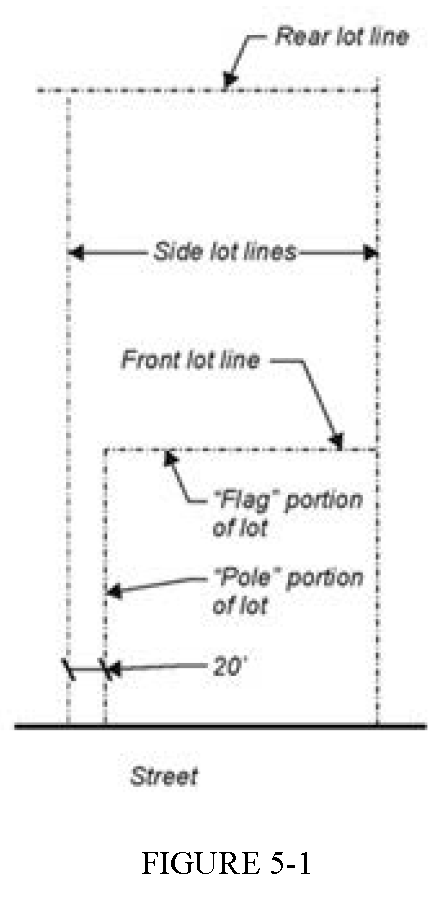
Each flag lot shall be designed to provide a "pole" that functions primarily as an accessway from the street to the main body ("flag" portion) of the lot. The pole portion shall be deemed to end, and the flag portion of the lot shall be deemed to commence, at the extension of the newly created front property line of the urban lot split. See Figure 5-1.
b.
Any parking and access, as required or otherwise proposed, for an urban lot split lot shall be accessed via an alley, if there is an alley.
c.
Twenty feet of street frontage (pole width) shall be maintained throughout the length of the pole.
d.
Driveways.
i.
Only one driveway accessing a street shall be allowed per parcel.
ii.
Driveways shall be no narrower than 10 feet and no wider than 14 feet.
iii.
The remaining pole width which is not used for a driveway shall be landscaped and irrigated with planting material and/or hardscape, and permanently maintained, in compliance with Chapter 19.40 of the City's Development Code.
iv.
All driveways shall be clear and unobstructed for a height of 12 feet above ground.
v.
All driveways for private automobile storage spaces and the actual spaces shall be paved with Portland cement concrete or approved equivalent at least three inches thick.
e.
Walls. The use of decorative block walls are required, as permitted by Chapter 19.36 of the City's Development Code.
f.
All flag lots proposed in this chapter shall comply with all requirements of the Fire Department, the Public Works Division, and the Building Division.
4.
Easements. The owner shall dedicate all easements over the resulting parcels required for the provision of utilities, and public services and facilities, as determined by the City Engineer.
5.
Configuration.
a.
Proposed adjacent or connected units shall be permitted if they meet building code standards, are designed to allow separate conveyance, and comply with the development standards of the underlying zoning district or additional standards prescribed in this section, as applicable.
b.
Required parking for an urban lot split lot shall be accessed via an alley, if there is an alley.
6.
Quantity.
a.
Notwithstanding any provision of Government Code Sections 65852.2, 65852.21, 65852.22, 65915, or 66411.7, no more than two units can occupy a parcel created through an urban lot split. In addition, parcels containing both a duplex as that term is defined in Section 19.010.035 and subject to or created by an urban lot split as that term is defined in this Section shall be ineligible for an accessory dwelling unit or junior accessory dwelling unit permit under Section 19.60.160.
7.
Unit size.
a.
The total floor area of each unit built that is developed under this section must be no greater than 800 square feet, exclusive of any enclosed garage space.
b.
A unit that was legally established on the lot prior to the urban lot split and that is larger than 800 square feet is limited to the lawful floor area at the time the application for the urban lot split is submitted, provided that the unit may not thereafter be expanded.
c.
A unit that was legally established prior to the submission of the urban lot split application and that is smaller than 800 square feet may be expanded to 800 square feet after the urban lot split occurs.
8.
Lot coverage. The City's existing lot coverage standards for the single-family residential zones shall apply to projects subject to this Chapter.
9.
Setbacks. The City's existing setback standards for its r-1 single-family residential zone shall apply to projects subject to this chapter.
a.
Side and rear. Units on urban lot split parcels shall be setback at least four feet from the side and rear property lines.
b.
Existing structures. No setback is required for an existing legally established structure or for a new structure that is constructed in the same location and to the same dimensions as an existing legally established structure.
c.
Building separation. A minimum separation of 10 feet, measured from wall to wall, shall be required between detached units located on the same site.
d.
Projections into setbacks. See Chapter 19.32.
10.
Height.
a.
Any new units built shall be one-story and no taller than 16 feet to the highest ridgeline, and no taller than ten feet to the top plate.
b.
Heights above 16 feet are allowed for existing or proposed dwelling units with a garage, in which the first-floor garage is maintained as off-street parking for two or more vehicles and the second-floor dwelling unit is equal to or less than the footprint of the first-floor garage itself. The garage must be accessible from a paved driveway that connects to a street or alley.
11.
Foundations. A permanent foundation shall be required for all new units.
12.
Landscaping. The City's existing landscape, irrigation, and hardscape standards for the single-family residential zones shall apply to projects subject to this chapter as required by Chapters 19.40.
13.
Accessible roof areas. For all units subject to the section: Accessible decks, patios, balconies, and similar private open spaces above the top plate of any dwelling unit are prohibited.
14.
Lighting. Exterior lighting shall be shielded or directed downwards.
15.
Parking.
a.
Existing off-street garage parking and driveway must be maintained as part of an urban lot split project.
b.
Required parking shall be one off-street parking space within an enclosed garage per each dwelling unit, unless one of the following applies:
i.
The parcel is within one-half mile walking distance of a high-quality transit corridor or a major transit stop, as defined in California Public Resources Code Sections 21155 or 21064.3..
ii.
The parcel is located within one block of a car-share vehicle location, as defined in this section.
c.
Any parking and access, as required or otherwise proposed, for units on an urban lot split parcel shall be accessed via an alley, if there is an alley.
16.
Pedestrian access. Access to a public street or alley shall be provided with an exterior pedestrian pathway from the primary entrances of each dwelling unit to the adjoining sidewalk, street, or alley.
G.
Other standards. All other applicable standards of this Code shall apply to the extent these standards do not conflict with this section of State law, in addition to the following:
1.
Design standards. Units and any other accessory structures shall comply with applicable objective design standards, as further described in Section 19.44.010.
2.
Utilities. Each unit on an urban lot split parcel must have its own direct utility connection to the utility service provider.
3.
Onsite wastewater treatment system. For units connected to an onsite wastewater treatment system, a percolation test completed within the last five years, or, if the percolation test has been recertified, within the last 10 years, and compliance with Chapter 6.13 of the Duarte Municipal Code, which implements the County of Los Angeles Local Agency Management Program (Ordinance No. 2018-0037).
H.
Standards precluding development. If an applicant submits plans showing that any of the objective standards which otherwise apply to urban lot split applications would have the effect of physically precluding the construction of up to two units or would physically preclude either of the two units from being at least 800 square feet in floor area, the Community Development Director shall permit the minimum deviation of the objective standards shown to physically preclude the construction of up to two units or physically preclude either of the two units from being at least 800 square feet in floor area necessary to physically permit the urban lot split project.
I.
Regulation of uses.
1.
Residential only. No non-residential use is permitted on the lot.
2.
Short-term rentals. No unit on the lot may be rented for a period of less than 30 days.
J.
Separate conveyance.
1.
Within a resulting lot.
a.
Primary dwelling units on a lot that is created by an urban lot split may not be owned or conveyed separately from each other.
b.
Condominium airspace divisions and common interest developments are not permitted on a lot that is created by an urban lot split.
c.
All fee interest in a lot and all dwellings on the lot must be held equally and undivided by all individual property owners.
2.
Between resulting lots. Separate conveyance of the resulting lots is permitted. If dwellings or other structures (such as garages) on different lots are adjacent or attached to each other, the urban lot split boundary may separate them for conveyance purposes if the structures meet building code safety standards and are sufficient to allow separate conveyance. If any attached structures span or will span the new lot line, the owner must record appropriate covenants, conditions, and restrictions ("CC&Rs"), easements, or other documentation that is necessary to allocate rights and responsibility between the owners of the two lots.
K.
Restrictive covenant. Prior to the approval and recordation of the parcel map, the applicant shall sign and record a restrictive covenant in the form prescribed by the City Attorney, which shall run with the land and provide for the following:
1.
A prohibition against further subdivision of the parcel using the urban lot split procedures as provided for in this section.
2.
A prohibition on non-residential uses of any units developed or constructed on either resulting parcel.
3.
A prohibition against renting or leasing the units for fewer than 30 consecutive calendar days.
4.
All required parking shall be maintained, and useable for the parking of motor vehicle(s).
5.
A statement that the applicant intends to occupy one of the housing units on the newly created lots as its principal residence for a minimum of three years from the date of the approval of the urban lot split. This paragraph shall not apply to an applicant that is a "community land trust," as defined in clause (ii) of subparagraph (C) of paragraph (11) of subdivision (a) of Section 402.1 of the Revenue and Taxation Code or is a "qualified nonprofit corporation" as described in Section 214.15 of the Revenue and Taxation Code.
L.
Remedies. If an urban lot split violates any part of this Code or any other legal requirement:
1.
The buyer, grantee, or lessee of any part of the property has an action for damages or to void the deed, sale, or contract.
2.
The City may:
a.
Bring an action to enjoin any attempt to sell, lease, or finance the property.
b.
Bring an action for other legal, equitable, or summary remedy, such as declaratory and injunctive relief.
c.
Pursue criminal prosecution, punishable by imprisonment in county jail or state prison for up to one year, by a fine of up to $10,000.00, or both; or a misdemeanor.
d.
Record a notice of violation.
e.
Withhold any or all future permits and approvals.
f.
Pursue all other administrative, legal, or equitable remedies that are allowed by law or the City's Code.
(Ord. No. 907, § 3, 3-8-2022)
19.70.010 - Purpose of article.
A.
Supplement and implement the Act. The provisions of this Article are intended to supplement, implement, and work with the State Subdivision Map Act, referred to in this Article as the Act, as specified in Government Code Sections 66410 et seq., for the purpose of regulating the design and improvement of divisions of land within the City, as those sections may be replaced or amended from time to time.
B.
Used in conjunction with the Act. This Article is not intended to replace the Act, but is expected to be used in conjunction with the Act in the preparation of subdivision applications, and the review, approval, and improvement of proposed subdivisions.
C.
References to other laws. Whenever reference is made to an ordinance of this City or to a statute of the State, the reference applies to the requirements of the ordinance or statute applicable on the date of final action on a tentative map and to the provisions of variances and permits granted in compliance with the ordinances or statutes.
19.70.020 - Title.
This Article shall be referred to as "the City's subdivision ordinance."
19.70.030 - Definitions.
For the purpose of this Article, the following definitions shall apply unless the context clearly indicates or requires a different meaning.
Act. California Government Code Sections 66410 et seq., also known as the Subdivision Map Act.
Advisory Agency. The City staff member or City policy-making or review authority responsible for acting on an application, as specified in Section 19.70.050 (Advisory Agency).
Certificate of Compliance; Conditional Certificate of Compliance. A document issued by the City and recorded by the County Recorder certifying that a specified real property complies with the provisions of the Subdivision Map Act (Government Code Sections 66410 et seq.) and this Article. A Conditional Certificate of Compliance includes any conditions that the City may impose upon the granting of the certificate requiring that specified terms be complied with before the subsequent issuance of a permit or other grant of approval for development of the property.
Development Code. The Development Code of the City specified in Municipal Code Title 19.
Environmental Analysis. An analysis conducted in compliance with the provisions of the California Environmental Quality Act (CEQA), California Public Resources Code Section 21000 et seq.
Final Map. A map showing a subdivision of parcels prepared in compliance with the provisions of this Article and the Subdivision Map Act (Government Code Sections 66410 et seq.) and in a manner to be filed in the office of the County Recorder. The map may be either a final map or a final parcel map.
Lot Line Adjustment. The adjustment or relocation of any property line between two contiguous, legally created parcels. No lot line adjustment shall be allowed where the effect is to create additional parcels or delete a parcel.
Parcel Map. A map prepared for the purpose of dividing a legal parcel into four or fewer parcels and prepared in compliance with the provisions of this Article and the Subdivision Map Act (Government Code Sections 66410 et seq.) and in a manner to be recorded in the office of the County Recorder.
Parkway. That portion of a public right-of-way located between the outermost curb-lane driving lane and the farthest edge of the right-of-way.
Streets. The streets and roadways in the City are categorized into five functional classifications: Principal Arterial Interstate, Other Principal Arterial, Minor Arterial, Collector, and Local. These streets and roadways are classified by the Highway Performance Monitoring System (HPMS) and are described below.
•
Principal Arterial Interstate. A Principal Arterial Interstate (functional classification code 11 from the HPMS) is a freeway that is included as part of the interstate highway system. It is a controlled access, divided highway that is intended to accommodate high-speed regional travel. Freeways have grade-separated interchanges that provide access from freeway to freeway or between freeways and the arterial street system.
•
Other Principal Arterial. The Other Principal Arterial category (functional classification code 14 from the HPMS) is comparable to a major arterial roadway. It accommodates regional, subregional, and intercity travel and generally has four to six through travel lanes with a raised median and/or a center left-turn lane. While Other Principal Arterials accommodate through traffic, they also provide direct access to adjacent properties and intersecting streets. The right-of-way widths for Other Principal Arterial roadways in the City range from 80 to 108 feet, while the pavement widths range from 60 to 80 feet.
•
Minor Arterial. A Minor Arterial (functional classification code 16 from the HPMS) is an arterial roadway that has less of a regional significance than Other Principal Arterial roadways. It accommodates subregional and intercity travel and generally has four to six through travel lanes with a raised median and/or a center left-turn lane. Minor Arterials accommodate through traffic while also providing direct access to adjacent properties and intersecting streets. The right-of-way widths for Minor Arterial roadways in the City range from 80 to 100 feet, while the pavement widths range from 60 to 80 feet.
•
Collector. A Collector (functional classification code 17 from the HPMS) is a street that is intended to serve as an intermediate route to accommodate travel between local streets and arterial roadways and to provide access to the abutting properties. Collector streets generally have two travel lanes, although four lanes may be provided at certain locations. The right-of-way width for collector streets in the City is typically 60 feet, while the pavement widths range from 35 to 52 feet.
•
Local. A Local (functional classification code 19 from the HPMS) is a low speed street that is primarily intended to provide direct access to the abutting properties. Local streets generally have two travel lanes with parking along both sides of the street. The right-of-way widths for local streets in the City range from 50 to 60 feet, while the pavement widths range from 32 to 40 feet.
Subdivide. The act of dividing land in compliance with Government Code Section 66410 et seq. and shall also mean the act of constructing multi-unit residential developments within the City.
Subdivider. An association, corporation, firm, partnership, or person that proposes to divide, divides, or causes to be divided real property into a subdivision for that person/entity or others, except that employees and consultants of the person/entity, acting in the capacity, are not subdividers.
Subdivision. The parcel map so filed for approval or the proposed multi-unit residential development.
Subdivision Map Act (the Act). Government Code Sections 66410 et seq., as it may be replaced or amended from time to time, and referred to in this Article as the Act.
Tentative Map. A map showing the design and improvement of a proposed division of land and the existing conditions in and around it.
Vesting Tentative Map. A tentative map for any subdivision, which shall have printed conspicuously on its face the words "Vesting Tentative Map" at the time it is filed and which meets all of the requirements for a vesting tentative map as specified in the Act and this Article.
19.70.040 - Authority.
This Article is adopted in compliance with the Act as a "local ordinance," as the term is used in the Act. All provisions of the Act and future amendments to the Act not incorporated into this Article shall, nevertheless, apply to all subdivision maps and proceedings under this Article.
19.70.050 - Applicability.
A.
Applicability of article.
1.
No person shall divide any real property for the purpose of sale, lease, or financing except in compliance with the provisions of this Article and/or the Act, Government Code Sections 66410 et seq.
2.
This Article shall apply to all divisions of land, except those exempted by Government Code Sections 66412, 66412.1, 66412.2, and 66412.5.
3.
In the event of divisions of land which are not subject to this Article and/or the Act, a certificate of compliance shall be issued on a form prescribed by the Director.
B.
Subdivision approval required. Each division of land within the City shall be authorized through the approval of a map or other entitlement in compliance with this Article.
C.
Conflicts with the Act. In the event of any conflicts between the provisions of this Article and the Act, the Act shall control.
D.
Compliance with other regulations required. The approval or conditional approval of a subdivision map shall not authorize an exception or deviation from any zoning regulation in this Development Code, or as an approval to proceed with any development in violation of other applicable provisions of the Municipal Code or other applicable ordinances or regulations of the City.
19.70.060 - Advisory agency.
A.
Advisory agency.
1.
The designated advisory agencies specified in this Section shall have the duty of making investigations and reports on the design and improvement of proposed applications for the division of real property and imposing requirements and conditions on these applications, and shall have the authority to act upon the applications as specified below.
2.
Any advisory agency shall have the authority to refer an application to the Commission or Council for action, as indicated in Table 5-1 (Subdivision Review Authorities), below.
3.
Notwithstanding the provisions of this Section, any application filed in compliance with this Article that has an associated permit application made in compliance with the provisions of this Development Code, and is subject to action by the Commission or Council, the application shall be subject to those same review and hearing requirements required for the associated permit application, in compliance with Table 7-1 (Review Authority), located within Article 7 (Permit Processing Procedures).
Notes:
1.
"Decision" means that the review authority makes the final decision on the matter; "Appeal" means that the review authority may consider and decide upon appeals to the decision of an earlier decision-making body, in compliance with Chapter 19.144 (Appeals); "Recommend" means that the review authority makes a recommendation to a higher decision-making review authority.
2.
Decisions of the Council may not be appealed.
_____
B.
Appeal boards.
1.
The Commission shall be the review authority for any appeal of a decision of the City Engineer or Director, except when dealing with any maps containing dedications.
2.
The Council shall be the review authority for any appeal of a decision of the Commission.
C.
City engineer. The City Engineer shall be responsible for all of the following.
1.
Establishing subdivision and public improvement design and construction details, standards, and specifications.
2.
Determining whether proposed subdivision improvements comply with the provisions of this Article and the Act.
3.
Inspecting and approving subdivision improvements.
4.
Review authority on amendments to recorded maps, extensions of time on tentative maps, final parcel maps without dedications, parcel mergers, subdivision improvement plans, and waiver of parcel maps.
5.
Providing assistance to the Director on the review of amendments to approved tentative maps, certificates of compliance, lot line adjustments, parcel mergers, and tentative parcel maps without dedications.
D.
Director. The Director shall be responsible for all of the following.
1.
Accepting certificate of compliance, lot line adjustment, parcel map, reversion to acreage, tentative map, vesting tentative map, and similar applications for processing; and distributing the application materials to appropriate agencies and City departments for review.
2.
Investigating tentative map applications for conformity to the General Plan, applicable specific plans, and this Development Code, and in consultation with other City departments, recommending action to the Commission.
3.
Conducting environmental analyses related to proposed applications in compliance with the California Environmental Quality Act (CEQA) specified in Public Resources Code Section 21000 et seq.
4.
Certifying amended maps, final maps, and reversion to acreage maps for substantial compliance with approved tentative maps.
5.
Review authority on amendments to approved tentative maps, certificates of compliance, lot line adjustments, parcel mergers, and tentative parcel maps without dedications.
E.
Commission. The Commission shall be responsible for all of the following.
1.
Taking action to recommend approval, conditionally approval, or denial of condominiums/ conversions, tentative tract map applications, and reversions to acreage maps to the Council.
2.
Hearing appeals of decisions of the City Engineer and Director.
3.
Reviewing and taking action to approve, conditionally approve, or deny commercial condominium and residential condominium conversion applications.
F.
Council. The Council shall be responsible for all of the following.
1.
Accepting offers of dedication and improvements for divisions of land resulting in five or more parcels.
2.
Review authority on amendments to recorded maps, condominiums/conversions, tentative and final parcel maps with dedications, tentative and final tract maps, and reversions to acreage maps.
3.
Taking action to approve, conditionally approve, or deny any application referred by another review authority or by appeal, or any land division application with an associated permit application filed in compliance with the requirements of this Development Code.
19.70.070 - Type of subdivision approval required.
Any subdivision of an existing parcel into two or more parcels shall require approval by the City in compliance with this Article and the Act. In general, the procedure for subdivision first requires the approval of a tentative map, and then the approval of a final parcel map (for a subdivision that results in four or fewer parcels) or a final map (for a subdivision that results in five or more parcels) to complete the subdivision process. The City's review of a tentative map evaluates the compliance of the proposed subdivision with applicable City standards, and the appropriateness of the proposed subdivision design. Parcel and final maps are precise surveying documents that detail the location and dimensions of all parcel boundaries in an approved subdivision and, after approval, are recorded in the office of the County Recorder.
A.
Tentative map requirements. The filing and approval of a tentative map is required for:
1.
A subdivision or resubdivision of four or fewer parcels, as authorized by Government Code Section 66428; and
2.
A subdivision or resubdivision or of five or more parcels, and all other types of subdivisions required to have tentative map approval by Government Code Section 66426.
B.
Final map/final parcel map requirements. A final map/final parcel map (Chapter 19.74 ) shall be required as follows.
1.
Final map. The filing and approval of a final map (Chapter 19.74 ) shall be required for a subdivision of five or more parcels, except a subdivision that is otherwise required to have a final parcel map by Government Code Section 66426.
2.
Final parcel map. The filing and approval of a final parcel map (Chapter 19.74 ) shall be required for a subdivision creating four or fewer parcels, with or without a designated remainder in compliance with Government Code Article 2, Chapter 1, except for the following subdivisions:
a.
Public agency or utility conveyances. Any conveyance of land, including a fee interest, an easement, or a license, to a governmental agency, public entity, public utility or a subsidiary of a public utility for rights-of-way, unless the Director determines, based on substantial evidence, that public policy necessitates a parcel map, in an individual case, in compliance with Government Code Section 66428;
b.
Cemeteries. Land dedicated for cemetery purposes in compliance with the Health and Safety Code; and
c.
Waived parcel map. A subdivision that has been granted a waiver of parcel map requirements in compliance with Section 19.74.020 (Waiver of Parcel Map).
C.
Exemptions from subdivision approval requirements. The types of subdivisions specified by Government Code Sections 66411, 66412, 66412.1, 66412.2, and 66426.5, or other applicable Act provision as not being subject to the requirements of the Act, and/or not being considered to be divisions of land for the purposes of the Act, shall be exempt from the subdivision approval requirements of this Article.
D.
Exceptions from map preparation requirements. The types of subdivisions specified by Government Code Section 66426, or other applicable Act provisions as not requiring the preparation of a tentative map, parcel map, and/or a final map shall comply with Government Code Section 66426.
19.70.080 - Enforcement of subdivision regulations.
A.
Enforcement of these Subdivision Regulations shall be as set forth in the Act.
B.
Any person, firm, or corporation violating any of the provisions of this Article or the Act shall be deemed guilty of a misdemeanor, and upon conviction thereof shall be punishable as provided in Municipal Code Section 1.04.100.
C.
Each person, firm, or corporation shall be deemed guilty of a separate offense for every day during any portion of which any violation of any provision of this Article is permitted, continued, or committed by the person, firm, or corporation and shall be punishable as provided in Municipal Code Section 1.04.100, and any alley, parcel, street, or other feature made the subject of this Article maintained contrary to the provisions of this Article shall constitute a public nuisance.
D.
Remedies and procedures for violations shall be as set forth in the Act.
19.70.090 - Applications deemed approved.
A.
Subdivisions deemed approved by law. A subdivision application deemed approved in compliance with Government Code Sections 65956 or 66452.1, 66452.2 or 66542.4, shall be subject to all applicable provisions of this Development Code, and any conditions imposed by the review authority, which shall be satisfied by the subdivider before a Building Permit is issued.
B.
Subject to mandatory requirements. Final maps filed for recordation after their tentative parcel or tract maps are deemed approved shall remain subject to all of the mandatory requirements of this Article and the Act, including Government Code Sections 66473, 66473.5, and 66474.
19.70.100 - Processing fees.
A.
Council shall set fees. The Council, by resolution, shall set reasonable fees in connection with this Article, including but not limited to fees and deposits for processing tentative tract and parcel maps and final and final parcel maps; fees for giving notice of public hearings; fees for copying and distributing written reports on tentative maps; fees for processing lot line adjustments, mergers, and reversions to acreage; and fees and deposits related to the other procedures and requirements specified in this Article.
B.
Planning fee schedule. This schedule of fees shall be referred to in this Development Code as the Planning Fee Schedule.
C.
Payable to the city. All required fees and deposits shall be payable to the City in compliance with the Planning Fee Schedule established by resolution of the Council, as it may be revised from time to time.
19.70.110 - Exceptions to subdivision standards.
A.
Exceptions to standards. An exception to a provision of Chapter 19.78 (Subdivision Design and Improvement Requirements) may be requested by a subdivider in compliance with Chapter 19.128 (Variances and Administrative Variances).
B.
Not used to waive Act. An exception shall not be used to waive or modify a provision of the Act, or a provision of this Article that is duplicated or paraphrased from the Act.
19.72.010 - Purpose.
This Chapter establishes requirements for the preparation, filing, approval or denial of tentative maps, consistent with the requirements of the Act.
19.72.020 - Tentative map preparation, application contents.
A.
When required.
1.
A tentative map shall be submitted for a subdivision for which a tentative parcel or tract map is required by Government Code Sections 66410 et seq.
2.
The requirements specified in this Chapter shall apply to all applications for tentative parcel and tract maps.
B.
Application and filing fees required.
1.
An application shall be filed on forms provided by the Department.
2.
The application shall be accepted for filing only upon payment by the applicant of a filing and processing fee in compliance with the Planning Fee Schedule.
3.
An applicant may, in writing, withdraw the application at any time during the processing of the application.
4.
In compliance with adopted City policy, any refund of any of the filing and processing fees paid in connection with the application may only occur on a pro-rated basis in compliance with Section 19.112.050 (Application and Other Related Fees).
5.
Within 30 days of receiving an application and the application filing fee, the Director shall inform the applicant in writing whether the application is deemed complete for the purpose of complying with Government Code Chapter 4.5 and Section 19.112.070 (Initial Review of Application).
19.72.030 - Tentative map filing, initial processing.
A.
Submission of tentative maps.
1.
The subdivider is strongly encouraged to confer with the Director before preparing and submitting the tentative map.
2.
Submission of a tentative map shall not constitute filing with the City until all attachments and required statements, instructions, environmental forms and clearances, and a completed application form with appropriate fees are deposited with the Department and a written receipt is provided to the applicant. Included with the application shall be a signed statement indicating whether the project site is located on a site included on any of the local lists prepared by the California Integrated Waste Management Board in compliance with Government Code Sections 65962.5(d) and (f).
3.
The subdivider shall file with the Department the number of tentative maps the Director shall deem necessary, together with evidence as to the ownership of the land proposed to be divided.
4.
Failure to submit all materials and statements required by this Section shall constitute grounds for rejection of the application.
B.
Prepared by civil engineer or surveyor. Tentative maps shall be prepared by or under the direction of a registered civil engineer or a licensed surveyor.
C.
Maps to be clearly drawn. tentative maps shall be clearly and legibly drawn on one sheet.
1.
Whenever practicable, map sheets should be no less than 18 inches by 26 inches. The review authority may approve a modification in map sheet size when necessary to adequately show the subdivision. A one-inch margin shall be left between the trim line and the borderline.
2.
The maps shall be prepared at a readable scale, but in general in no case shall the scale be less than one inch equals 100 feet or a scale as request by the City.
3.
All lettering shall be one-eighth-inch minimum.
4.
Tentative maps shall contain, at a minimum, all of the following information, as well as any additional information that may be specified in the application form:
a.
A title, which shall contain the subdivision number, subdivision name, and type of subdivision.
b.
Name and address of the legal owner, the subdivider, and person preparing the map, including registration or license number.
c.
A sufficient legal description to define the boundary of the proposed subdivision.
d.
Date, north arrow, scale, contour interval, and source and date of existing contours.
e.
Existing and proposed land use(s).
f.
A vicinity map showing data sufficient to locate the proposed subdivision and show its relation to the community.
g.
Existing topography of the proposed site and at least 100 feet beyond its boundaries or covering the entire drainage area, whichever is greater, including but not limited to all of the following:
(1)
Existing contours at one-foot intervals, or as required by the City Engineer.
(2)
The approximate location of all trees standing within the boundaries of the division of land and a clear indication as to which trees are to be removed. The location of all trees with a diameter greater than six inches, measured three feet above grade, shall be clearly indicated, and a statement on the existing ground cover shall also be submitted.
(3)
The approximate location and outline of existing structures identified by type. Structures to be removed shall be so marked.
(4)
The approximate location of all areas subject to inundation or storm water overflow and the direction, location, and width of flow of each water course.
(5)
The grade, location, pavement and right-of-way width, and name of existing streets or highways.
(6)
The identity, location, and widths of all existing easements.
(7)
The location and size of existing sanitary sewers, storm drains, and water mains and the approximate slope of existing sewers and storm drains shall be clearly indicated. The location of existing overhead and underground utility lines on peripheral streets shall be clearly indicated.
5.
The tentative map also shall show, or be accompanied by the required number of copies of reports and written statements from the subdivider giving essential information regarding all of the following matters:
a.
Source of water supply.
b.
Type of street improvements and utilities which the subdivider proposes to install.
c.
Proposed method of sewage disposal.
d.
Proposed stormwater sewer or other means of drainage (grade and size).
e.
Protective covenants to be recorded.
f.
Proposed tree planting.
g.
A geological and/or soils report, if required by the City Engineer, prepared by a licensed geologist and/or registered civil engineer, stating the effect of geological or soil conditions on the proposed development.
h.
An Environmental Initial Study and/or input for a Draft Environmental Impact Report, as determined by the Director.
i.
For all condominiums, stock cooperatives, and planned unit developments, a site plan shall be submitted with the tentative map. The site plan shall contain all of the information required for a Site Plan and Design Review in compliance with Chapter 19.122 (Site Plan and Design Reviews).
D.
Proposed improvements. Proposed improvements required to be shown shall include, but not be limited to, all of the following:
1.
The grade, location, centerline and curb return radii and arc length of curves, pavement, right-of-way width, and names of all proposed adjacent streets
2.
Typical sections of all existing and proposed streets
3.
The location, nature, and width of all easements
4.
The approximate parcel layout and the approximate dimensions of each parcel and of each building site. Engineering data shall show the approximate finished grade of each parcel
5.
Location and nature of all proposed recreation facilities
6.
Location and nature of all proposed common areas and areas to be dedicated for public open space or reserved for common private open space
7.
The elevation, location, and size of proposed sanitary sewers, storm drains, and water mains
8.
Location and nature of all proposed slopes
9.
Dimensions of setbacks for proposed structures
10.
Phasing lines for proposed developments
E.
Name(s) of any geologist or soils engineer. The name(s) of any geologist or soils engineer whose services were utilized in the preparation of the design of the tentative map.
F.
Additional data and reports required. Tentative maps shall be accompanied, at a minimum, by the following data or reports, as well as any additional data and reports that may be required by the Director to facilitate review of the tentative map:
1.
Title report. A preliminary title report dated no older than within 90 days of the filing date of the tentative map.
2.
Owner's affidavit. Written verification that the fee owner(s) of the real property have consented to the filing of the tentative map.
G.
Referral to affected agencies.
1.
Required referrals. The Director shall refer a tentative map application for review and comment to agencies that will be expected to provide service to the proposed subdivision, including, as appropriate, City agencies and departments, local agencies, public utilities, special districts, and State agencies.
2.
Anticipated type of response. The agencies that receive a tentative map application are expected to respond to the Department with an evaluation of the proposal, a list of items (e.g., hydrology study, title report, traffic study, etc.) that may need to be filed and considered during the evaluation phase, and a list of proposed conditions of tentative map approval.
3.
Time limits for referral and response.
a.
As required by Government Code Sections 66453 through 66455.7, referral shall occur within five days of the tentative map application being determined to be complete in compliance with Section 19.112.070 (Initial Review of Application).
b.
An agency wishing to respond to a referral shall provide the Department with its recommendations within 15 days after receiving the tentative map application.
H.
Environmental review.
1.
The Director, upon receipt of a tentative map application, shall conduct an environmental analysis.
2.
If a draft Environmental Impact Report is required, the application for tentative map approval shall not be considered completed until an Environmental Impact Report is ready for presentation to the Commission.
19.72.040 - Staff report and recommendation.
A.
Preparation of an evaluation.
1.
Director shall prepare evaluation. The Director shall prepare an evaluation in compliance with Government Code Section 66452.3 describing the conclusions of the tentative map application review.
2.
Mailing of copies of evaluation. Copies of the evaluation shall be mailed to the subdivider (and each tenant of the subject property, in the case of a residential condominium conversion [Chapter 19.84]) at least three days before any hearing or action on the tentative map by the review authority in compliance with Chapter 19.146 (Public Notices and Hearings).
a.
City department evaluations and recommendations. Wherever possible, the evaluations and recommendations of the City departments shall be presented to the Director.
b.
Required action in the case of waste discharge violations. The City Engineer shall advise the Director as to whether the discharge of waste from the proposed subdivision into an existing community sewer system will result in the violation of existing requirements prescribed by the California Regional Water Quality Control Board in compliance with Water Code Section 13000 et seq.
19.72.050 - Tentative map public hearing and action.
A.
Applicable review authority. The applicable review authority is set forth in Table 5-1.
B.
Scheduling of review authority's action. The review authority shall approve, conditionally approve, or deny a tentative parcel or tract map application within 60 days from the date of adoption by the lead agency of a Negative Declaration, Mitigated Negative Declaration, or determination that the project is exempt from CEQA, or if an Environmental Impact Report is required, within 180 days after certification of the Final Environmental Impact Report.
C.
Notice and public hearing required.
1.
The review authority shall hold a noticed public hearing on a tentative parcel or tract map.
2.
Notice of the public hearing shall be given and the hearing shall be conducted in compliance with Government Code Sections 66410 et seq. and Chapter 19.146 (Public Notices and Hearings).
3.
Posting of the site shall also be required.
a.
The City shall post the property being subdivided not less than 10 days before consideration of the proposed subdivision.
b.
The notice shall consist of the words, "notice of proposed subdivision of property," printed in plain type with letters of not less than one inch in height and a statement specifying a description of the property under consideration, the nature of the proposed subdivision, and the time and place at which the matter will be considered.
c.
If more than one parcel of property is involved, then notice shall be posted not more than 100 feet apart on each side of the street upon which the property fronts for a distance of not less than 300 feet in each direction from the subject property.
D.
Review authority's action is conclusive. In the absence of a timely filed written appeal in compliance with Chapter 19.144 (Appeals), the decision of the review authority shall be final and conclusive.
19.72.060 - Tentative map approval or denial.
In order to approve or recommend the approval of a tentative parcel or tract map and conditions of approval, or to deny a tentative parcel or tract map, the review authority, as designated in Table 5-1, (Designated Review Authorities), shall first make the findings required by this Section. In determining whether to approve a tentative parcel or tract map, the City shall apply only the ordinances, policies, and standards in effect on the date the Department determined that the application was complete in compliance with Section 19.72.030 (Tentative Map Filing, Initial Processing), except where the City has initiated General Plan, specific plan, or Development Code changes, and provided public notice as required by Government Code Section 66474.2.
A.
Required findings for approval.
1.
Mandatory findings. The review authority shall approve a tentative parcel or tract map only after first making all of the following findings, as required by Government Code Sections 66474 and 66474.6. The findings shall apply to each proposed parcel as well as the entire subdivision, including any parcel specified as a designated remainder in compliance with Government Code Section 66424.6.
2.
Additional specific findings. Additional specific findings shall be made by the review authority before approval or conditional approval of a tentative parcel or tract map, as applicable to the application, such as if the proposed subdivision is a conversion of residential real property into a condominium, a community apartment project, or a stock cooperative, the review authority shall first make the additional finding that the proposed subdivision complies with the requirements of Government Code Sections 66427.1(a) and 66452 before approving the proposed subdivision.
3.
Findings under an EIR. Notwithstanding the finding required by subparagraph A.1.c., above, the review authority may approve a tentative map, or a parcel map for which a tentative map was not required, if an Environmental Impact Report (EIR) was prepared for the project and a finding is made in compliance with Public Resources Code Section 21081 Subdivision (a) Paragraph (3), that specific economic, social, or other considerations make the mitigation measures or project alternatives specified in the EIR infeasible.
B.
Supplemental findings. In addition to the findings specified in subsection A., above, the review authority shall not approve a tentative parcel or tract map unless it can also make the following findings, when they are applicable to the specific subdivision proposal.
1.
Construction of improvements. In the case of a tentative map for a subdivision that will require a subsequent parcel map, the construction of improvements for the subdivision within a specified time after the recordation of the parcel map is in the interest of the public health and safety, and it is necessary as a prerequisite to the orderly development of the surrounding area.
2.
Waiver of parcel map. The findings required by Section 19.74.020 (Waiver of Parcel Map), if waiver of a parcel map has been requested with the tentative map application.
C.
Time limits. The time limits for acting and reporting on tentative parcel or tract maps and appeals, as specified in this Article and by the Act, may be extended by mutual consent of the subdivider and the review authority.
D.
Appeals. The subdivider or any interested person adversely affected by a decision of the review authority with respect to a tentative parcel or tract map may appeal, in compliance with the applicable appeals procedures specified in Government Code Section 66452.5, Chapter 19.144 (Appeals), and as follows:
1.
If the Commission is the review authority, then the appeal shall be to the Council which is established as the appeals board;
2.
If the review authority is not the Commission, then the first appeal shall be to the Commission. The Commission's decision may be appealed to the Council.
19.72.070 - Conditions of approval.
Along with the approval of a tentative parcel or tract map, the review authority may adopt any conditions of approval deemed reasonable and necessary to carry out the purposes of this Development Code, including conditions regarding the matters described in Subsection A., below; provided, that all conditions shall be consistent with the requirements of the Act.
A.
Dedications and improvements.
1.
As a condition of approval of a map of five or more parcels, the City may require dedications and improvements as necessary to ensure that the parcels to be created:
a.
Are provided with adequate public services and utilities, including any appropriate cable television services, to meet the needs of future residents or users;
b.
Are of adequate design in all respects in compliance with this Development Code;
c.
Act to mitigate any potential environmental impacts specified in the Environmental Impact Report (EIR) or by other means; and
d.
Provide for proper grading and erosion control, including the prevention of sedimentation or damage to off-site property.
2.
All improvements shall comply with adopted City standards.
B.
Access.
1.
Except as provided below, parcels created by a subdivision of land shall abut upon a recorded dedicated public right-of-way of a width as established by the City's Major Facilities Street Ordinance, or shall be ensured of access to the City road system by an approved access which connects a parcel(s) to a maintained public street or State highway.
2.
Private road easements may be approved for access to each parcel if it is determined that public street access cannot be provided due to certain title limitations or topographical conditions.
3.
Road easements of record established before the effective date of this Article shall be recognized as legal access to each parcel of the proposed subdivision.
4.
Existing traveled roads for which a court has determined that a prescriptive right by users exists for public use shall be recognized as legal access to each parcel of the proposed subdivision.
C.
Conditions modifying subdivision design—Time for compliance. When modifications in design require a change in the conditions of approval of a parcel map or tentative tract map, the subdivider shall, at least 30 days before the submission of a final map, submit the appropriate number of copies of the tentative map as modified to the Department for review for confirmation by the City Engineer.
19.72.080 - Effective date of tentative map approval.
The approval of a tentative map shall become effective for the purposes of filing a final tract or parcel map, including compliance with the conditions of approval, 10 days following the date of decision by the applicable review authority in compliance with Government Code Section 66452.5, if no appeal is filed in compliance with Chapter 19.144 (Appeals).
19.72.090 - Completion of subdivision process.
A.
Effect of approval on prior approvals. The approval or conditional approval by the review authority of any revised or new parcel map or tentative map shall annul all previous subdivision designs and approvals for the same site.
B.
Compliance with conditions, improvement plans. After approval of a parcel map or tentative tract map in compliance with this Article, the subdivider shall proceed to fulfill the conditions of approval within any time limits specified by the conditions and the expiration of the map and, where applicable, shall prepare, file, and receive approval of improvement plans in compliance with Chapter 19.78 (Subdivision Design and Improvement Requirements), before constructing any required improvements.
C.
Parcel or final map preparation, filing, and recordation.
1.
A parcel map for a subdivision of four or fewer parcels shall be prepared, filed, processed, and recorded in compliance with Chapter 19.74 (Parcel Maps and Final Maps), to complete the subdivision, unless a parcel map has been waived in compliance with Section 19.74.020 (Waiver of Parcel Map).
2.
A final map for a subdivision of five or more parcels shall be prepared, filed, processed, and recorded in compliance with Chapter 19.74 (Parcel Maps and Final Maps), to complete the subdivision.
3.
Project phasing and the filing of multiple parcel or final maps shall be in compliance with this Chapter.
19.72.100 - Vesting on approval of vesting tentative map.
A.
Purpose. The purpose of this Section is to establish procedures necessary for the implementation of the provisions of Government Code Section 66452 relating to vesting tentative maps.
B.
Application filing.
1.
Whenever a provision of the Act or this Chapter requires the filing of a tentative parcel or tract map, a vesting tentative map may instead be filed.
2.
A vesting tentative map shall be filed in the same form and have the same contents, accompanying data and reports and shall be processed in the same manner as is required of tentative maps in compliance with this Chapter, except as otherwise provided in this Section.
3.
At the time a vesting tentative map is filed it shall have printed conspicuously on its face the words "Vesting Tentative Map."
4.
At the time a vesting tentative map is filed a subdivider shall also supply all of the following information.
a.
The height, location, and size of all existing and proposed structures.
b.
Detailed information on the use(s) of the existing and proposed structures.
c.
Architectural plans for tract development or design guidelines for custom subdivisions.
d.
Detailed circulation information (existing and proposed). This information may include area wide traffic data sufficient for the City to determine future circulation needs.
e.
Detailed grading plans.
f.
Flood control information.
g.
Hazardous materials - Level 1 Study.
h.
Road, sewer, storm water, and water details.
i.
Soils report.
j.
Any other studies the Director and/or City Engineer may require to thoroughly evaluate the project.
k.
The Director may require the filing and concurrent review of other related development applications where it is necessary for the review and implementation of the vesting tentative map.
C.
Expiration. The approval or conditional approval of a vesting tentative map shall expire at the end of the same time period, and shall be subject to the same extensions, established by the Act and/or this Chapter for the expiration of approved or conditionally approved tentative maps.
D.
Vesting on approval of vesting tentative map.
1.
The approval or conditional approval of a vesting tentative map shall confer a vested right to proceed with development in compliance with Government Code Section 66474.2.
2.
However, if Government Code Section 66474.2 is repealed, the approval or conditional approval of a vesting tentative map shall be deemed to have conferred a vested right to proceed with development in substantial compliance with the ordinances, policies, and standards in effect at the time the vesting tentative map was approved or conditionally approved.
3.
Notwithstanding Subparagraph 1., above, the review authority may condition or deny a permit, approval, extension, entitlement, or require an amendment to the map if it first determines any of the following:
a.
A failure to do so would place the residents of the subdivision or the immediate community, or both, in a condition dangerous to their health or safety, or both; or
b.
The condition or denial is required in order to comply with State or Federal law.
4.
The review authority may alter any condition(s) of a vesting tentative map through an amendment in compliance with Section 19.74.070 (Correction and Amendment of Maps) or Section 19.72.120 (Amendments to Approved Tentative Maps) in order to protect against conditions dangerous to public health and safety or to comply with State or Federal law.
E.
Expiration of vested rights.
1.
The vested rights referred to in this Section shall expire if a final map is not approved before the expiration of the vesting tentative map, as provided in the Act.
2.
If the final map is approved, the vested rights shall last for the following periods of time:
a.
An initial time period of 12 months.
b.
A subdivider may apply for a 12-month extension 30 days before expiration in compliance with Subsection C. (Expiration), above.
c.
If the extension is denied, the subdivider may appeal that denial within 15 days after the denial, in compliance with Chapter 19.144 (Appeals).
19.72.110 - Tentative map expiration and extensions.
A.
Valid timeframe. An approved tentative parcel or tract map is valid for 24 months after its effective date, except as otherwise provided by Government Code Section 66452.6, which, under specified circumstances, allows for a tentative map to be deemed valid for 36 months unless otherwise extended in accordance with the provisions of this Article and the Act.
B.
Expiration of an approved map.
1.
Expiration of an approved tentative parcel or tract map or vesting tentative map shall terminate all proceedings.
2.
The application shall not be reactivated unless a new tentative parcel or tract map application is filed in compliance with this Article.
C.
Filing of extension request.
1.
The time limits for acting on maps and associated appeals, as specified in this Article and Government Code Sections 66410 et seq., may be extended by mutual consent of the subdivider and the applicable review authority.
2.
An extension request shall be in writing and shall be filed with the Director not less than 30 days before the date of expiration of the approval or previous extension, together with the required filing fee in compliance with the Planning Fee Schedule.
D.
Approval of first extension—City engineer. The City Engineer may grant one 12-month extension to the initial time limit, only after first finding all of the following:
1.
There have been no changes to the provisions of the General Plan, any applicable specific plan, or this Development Code applicable to the project since the approval of the tentative parcel or tract map;
2.
There have been no changes in the character of the site or its surroundings that affect how the policies of the General Plan, any applicable specific plan, or other standards of this Development Code apply to the project; and
3.
There have been no changes to the capacities of community resources, including but not limited to roads, sewage treatment or disposal facilities, schools, or water supply so that there is no longer sufficient remaining capacity to serve the project.
E.
Additional extensions—Commission.
1.
The Commission may grant additional extensions to the initial time limit, only after first making all of the findings specified in Subsection D., above.
2.
The aggregate period of time for all extensions shall not exceed the maximum limits specified in Government Code Section 66452.6.
F.
Appeal of decision. If the tentative map extension request is denied, the subdivider may appeal the denial within 10 days after the effective date of the denial of the extension in compliance with Chapter 19.144 (Appeals).
G.
Filing of a lawsuit.
1.
If a lawsuit has been filed and is pending in a court of competent jurisdiction affecting the validity of the approval or conditional approval of a tentative parcel or tract map, the subdivider may apply to the City within 10 days of the service of the initial petition or complaint upon the City for a stay of the time in which a tentative parcel or tract map will expire.
2.
Within 40 days after receiving the request, the Director shall stay the map's expiration date until final conclusion of the action, if the Director determines that the action affects the validity of the tentative parcel or tract map approval.
19.72.120 - Amendments to approved tentative maps and conditions.
A.
Minor changes to approved tentative maps—Director. A subdivider may request minor changes or amendments to an approved tentative parcel or tract map or its conditions of approval before recordation of a final map in compliance with this Section. Changes to a parcel or final map after recordation are subject to Section 19.74.070 (Correction and Amendment of Maps).
B.
Minor changes defined. Minor changes or amendments to a tentative parcel or tract map that may be requested by a subdivider in compliance with this Section include minor adjustments to the location of proposed parcel lines and improvements, and reductions in the number of approved parcels (but no increase in the number of approved parcels), and any changes to the conditions of approval, consistent with the findings required by Subsection F. (Required Findings for Approval), below.
C.
Changes other than minor changes. All proposed changes or amendments not covered by this Section shall require the filing and processing of a new tentative parcel or tract map in compliance with this Chapter.
D.
Application for changes. The subdivider shall file an application and filing fee, in compliance with the Planning Fee Schedule, with the Department, using the forms furnished by the Department, together with the following additional information:
1.
A statement identifying the tentative parcel or tract map number, the features of the map or particular conditions to be changed and the changes requested, the reasons why the changes are requested, and any facts that justify the changes; and
2.
Any additional information deemed appropriate by the Director.
E.
Processing of application. Proposed changes to a tentative parcel or tract map or conditions of approval shall be processed using the same procedures as the original tentative parcel or tract map, except as otherwise provided by this Section.
F.
Review authority. The Director shall be the review authority for reviewing and either approving or denying minor changes to approved tentative maps.
G.
Required findings for approval. The Director may approve changes or amendments to an approved tentative parcel or tract map or its conditions of approval if the Director first finds all of the following findings to be true, and that all of the applicable findings for approval required by Subsections 19.72.060 A. and B., above, can still be made:
1.
No parcels are added, deleted, or substantially altered;
2.
No proposed structure locations are substantially altered;
3.
The changes are consistent with the intent and spirit of the original tentative parcel or tract map approval; and
4.
There are no resulting violations of this Article, the Act, or other applicable laws.
H.
Effect of changes on time limits. Approved changes to a tentative parcel or tract map or conditions of approval shall not be considered as approval of a new tentative map, and shall not extend the time limits provided by Section 19.72.110 (Tentative Map Expiration and Extensions), above, nor extend any right(s) in compliance with a vesting tentative map.
I.
Recording of amendments. Minor changes or amendments shall be indicated on the approved map and certified by the Director.
19.72.130 - Post-decision procedures.
The procedures and requirements related to appeals and public hearings in Article 8 (Development Code Administration) shall apply following the decision on a tentative map application.
19.74.010 - Purpose.
This Chapter establishes requirements for the preparation, filing, processing, approval, conditional approval, or denial, and recordation of final tract and parcel maps, consistent with the requirements of the Act.
19.74.020 - Waiver of parcel map.
Not withstanding the provisions of this Chapter, the City Engineer may elect to waive the requirement for a parcel map subject to the preparation of written findings and as provided for in the Act.
19.74.030 - Final tract and parcel map form and content.
A.
Form and content. The form and content of final tract and parcel maps shall be as required by the Act and this Chapter. The map shall be considered submitted when it is complete and complies with all applicable provisions of the Act, this Chapter, and this Code.
B.
Authorized preparers.
1.
The final tract or parcel map shall be prepared by, or under the direction of, a registered civil engineer or licensed land surveyor.
2.
A final tract or parcel map shall be based upon a field survey made in compliance with the Professional Land Surveyors Act and as required by this Chapter.
C.
Certificates and acknowledgments.
1.
Before filing, the certificates and acknowledgements required by the Act and this Chapter shall appear on the map and may be combined where appropriate.
2.
The certificates and acknowledgments shall appear on the face of the map unless the City Engineer advises the subdivider that the certificates and acknowledgments are to be made by separate instrument.
3.
If a certificate or acknowledgment is made by separate instrument, there shall appear on the map a reference to the separately recorded documents.
D.
Monuments. The location, number, and type of monuments shall be as specified in the Act and this Chapter and shall be in compliance with the standards prescribed in the California Business & Professions Code Section 8771.
E.
Documentation required for city review and approval.
1.
The subdivider shall submit prints of the map to the City Engineer for checking, who will distribute the map to other City departments and agencies for review.
2.
The preliminary prints shall be accompanied by documents, plans, and reports in a form approved by the City Engineer, including but not limited to all of the following.
a.
Improvement plans. Improvement construction plans as required by the City Engineer.
b.
Soils report.
(1)
A preliminary soils report, based upon test borings and prepared in compliance with the requirements of the Building Code, as it may be amended and as referenced in Municipal Code Title 16 (Buildings and Construction), shall be required for all tract maps and for those parcel maps which involve commercial or industrial development.
(a)
The soils report shall be prepared by a State-registered civil or soils engineer.
(b)
The requirement of a preliminary soils report may be waived or reduced in scope by the City Engineer if, in the City Engineer's opinion, the soil characteristics in the vicinity of the proposed subdivision have been established by previous analyses.
(2)
Parcel maps which propose the construction of single-family dwellings shall require the preparation of a report which includes the subsurface soil classification, as well as the results of an expansive index test.
c.
Title report. A title report prepared by a title insurer, with the title report required to be dated no older than within 90 days of the filing of the final map.
d.
Improvement cost estimate. An improvement cost estimate, which shall include all improvements located within public or private rights-of-way, common areas, or easements, on-site and off-site drainage improvements, and utility trench backfill as provided by the subdivider, except for those utility facilities to be installed by a utility company under the jurisdiction of the Public Utilities Commission.
e.
Deeds for easements and rights-of-way.
(1)
Deeds for easements or rights-of-way required which are not proposed to be dedicated on the final map.
(2)
The subdivider shall provide written evidence acceptable to the City in the form of rights of entry or permanent easements across private property outside of the subdivision granting access to perform necessary construction work and allowing the maintenance of facilities, if required.
f.
Traverse closure calculations. Traverse closure calculations for the boundary blocks, easements, monument lines, parcels, and street centerlines.
g.
Hydrology and hydraulic calculations. Complete hydrology and hydraulic calculations.
h.
Organization documents.
(1)
Any proposed declaration of covenants, conditions, and restrictions and all other organization documents for the subdivision in a form prescribed by the Civil Code Section 1355.
(2)
All documents shall be subject to review and approval by the Director and the City Attorney.
i.
Letter of certification from water agencies. The subdivider shall submit written certification from the affected water provider that adequate domestic water facilities are or will be available to serve the proposed project and that all necessary financial arrangements have been made to ensure construction of the facilities.
j.
Other reports. Any additional calculations, data, reports, or information required by the City Engineer.
19.74.040 - Filing and processing of final tract and parcel maps.
A.
Official and timely filing of map.
1.
The subdivider shall cause the map to be officially filed with the City Engineer at least 20 days before the expiration of the approved or conditionally approved tentative map or any approved extension of time granted in compliance with Section 19.72.110 (Tentative Map Expiration and Extensions).
2.
The map shall not be considered officially filed until the engineer or surveyor has received notification from the City Engineer that all provisions of the tentative map approval, the Act, the Municipal Code, this Development Code, and applicable City standards have been complied with.
3.
The filing of the official copy of the map with the City Engineer shall constitute the timely filing of the map.
B.
Review of map.
1.
After the issuance of a receipt for the map, the City Engineer shall examine it as to sufficiency of affidavits and acknowledgements, correctness of surveying data, mathematical data and computations, and other matters which may require checking to ensure compliance with the provisions of the Act, this Chapter, and applicable City standards.
2.
If the map is found to be in substantial compliance with the tentative map and is in correct form, the matters shown on the map are sufficient, and the City Engineer is satisfied that all of the conditions of approval have been met, the City Engineer shall endorse approval of the map.
3.
The City Engineer shall combine with the map the agreements, easements, and securities as required by this Chapter.
4.
The material shall be transmitted to the Council for its consideration of the map.
C.
Time limit for filing map. If the subdivider fails to file the map with the City Engineer and the required accompanying data with the appropriate City departments within 24 months, or other period of time specified in Government Code Section 66452.6 and Section 19.72.110 (Tentative Map Expiration and Extensions), following the effective date of tentative map approval by the review authority, or within any authorized extension of time, the tentative map approval or conditional approval shall become void. In this case, a new filing fee shall be paid, in compliance with the Planning Fee Schedule, and an application for a new tentative map shall be filed.
1.
If 120 days before the submittal of a map, the subdivider has failed to comply with the tentative map conditions which require the subdivider to construct or install off-site improvements on land in which neither the subdivider nor the City has sufficient title or interest, including an easement or license, then at the time the map is filed with the local agency, to allow the improvements to be made, the subdivider shall enter into an agreement with the City through the City Engineer to pay all costs of the City in acquiring the property.
2.
The City shall have 120 days from the filing of the map, in compliance with Government Code Section 66457, to obtain interest in the land to allow the improvement(s) to be made by negotiation or proceedings in compliance with Code of Civil Procedure Title 7 (commencing with Section 1230.010) of Part 3, including proceedings for immediate possession of the property under Code of Civil Procedure Title 7 Article 3 (commencing with Section 1255.410).
3.
In the event the City fails to meet the 120-day time limitation, the condition for construction of off-site improvements shall be conclusively deemed to be waived.
4.
Before approval of the map, the City may require the subdivider to enter into an agreement to complete the improvements, in compliance with Subsection 19.74.050 D. (Map with Incomplete Improvements), below, at the time the City acquires an interest in the land which will allow the improvements to be made.
5.
"Off-site improvements," as used in this subsection, do not include improvements which are necessary to ensure replacement or construction of housing for persons and families of low or moderate income, as defined in Health and Safety Code Section 50093.
19.74.050 - Final tract or parcel map approval and recordation.
After determining that the map is in compliance with Section 19.74.030 (Final Map and Parcel Map Form and Content), above, and is technically correct, the City Engineer shall execute the City Engineer's certificate on the map in compliance with Government Code Section 66442, and forward the map to the City Clerk for Council action in the following manner.
A.
Applicable review authority. The applicable review authority is set forth in Table 5-1.
B.
Review and approval by the review authority.
1.
Timing of review authority's review. The Review Authority shall approve or deny the map after it receives the map from the City Engineer or, in the case of the Council, at its regular meeting after the meeting at which it receives the map, unless that time limit is extended with the mutual consent of the Director and the subdivider.
2.
Criteria for approval.
a.
The Review Authority shall approve the map if it conforms to all of the requirements of the Act, all provisions of this Development Code that were applicable at the time that the tentative map was approved, and is in substantial compliance with the approved tentative map.
b.
If the map does not conform, the Review Authority shall not approve the map.
c.
Where a map does not include any offers for dedication or improvement, the Director shall review the map(s) and shall approve each map if the map conforms to the applicable requirements of the Act and this Chapter. If the map(s) does not conform, it shall not be approved.
3.
Applicable ordinances, policies, and standards. In determining whether to approve or deny a map, the Review Authority shall apply only those ordinances, policies, and standards in effect on the date the proposal for the subdivision was accepted as complete, in compliance with Government Code Section 66474.2.
4.
Action not to approve a final tract or parcel map.
a.
If a map is not approved due to its failure to meet any of the requirements imposed by the Act or this Chapter, the denial shall be accompanied by findings identifying the requirements which have not been met or performed.
b.
Approval of a map shall not be withheld when the failure of the map to comply is the result of a technical and inadvertent error which, in the determination of the Council or, in the case of a map not involving any offers of dedication or improvement, the Director, does not materially affect the validity of the map.
C.
Map with dedications.
1.
If a dedication or offer of dedication is required on the map, the Council shall accept, accept subject to improvement, or reject, on behalf of the public, of any real property offered for dedication to the public in compliance with the terms of the offer of dedication, at the same time as it takes action to approve the map.
2.
If the Council rejects the offer of dedication, the offer shall remain open and may be accepted by the Council at a later date in compliance with Government Code Section 66477.2.
3.
Any termination of an offer of dedication shall be processed in compliance with Government Code Section 66477.2 using the same procedures as specified by Streets and Highway Code Part 3 of Division 9.
D.
Map with incomplete improvements. If improvements required by this Development Code, conditions of approval, or other applicable laws have not been completed at the time of approval of the map, the review authority shall require the subdivider to enter into an agreement with the City as specified in Government Code Section 66462, and Section 19.78.050 (Improvement Agreements), as a condition precedent to the approval of the map.
E.
Recording of final tract and parcel maps.
1.
After action by the Review Authority, as applicable, to approve the map, and after the required signatures and seals have been affixed, the City Clerk shall transmit the map back to the City Engineer.
2.
The City Engineer shall establish an appointment with the County Recorder for filing.
3.
The County Recorder shall oversee the recording of the map.
19.74.060 - Supplemental information sheets.
In addition to the information required by this Chapter to be included in all final tract and parcel maps, additional information may be required to be submitted and recorded simultaneously with a final or parcel map as required by this Section.
A.
Preparation and form.
1.
The additional information required by this Section shall be presented in the form of an additional map sheet(s), unless the Director determines that the type of information required would be more clearly and understandably presented in the form of a report or other document(s).
2.
The additional map sheet(s) shall be prepared in the same manner and in substantially the same form as required for final tract and parcel maps by Section 19.74.020 (Final Tract and Parcel Map Form and Content).
B.
Content of information sheets. Supplemental information sheets shall contain the following statements and information:
1.
Title. A title, including the number assigned to the accompanying final or parcel map by the Director, the words "Supplemental Information Sheet;"
2.
Explanatory statement. A statement following the title that the supplemental information sheet is recorded along with the subject final or parcel map, and that the additional information being recorded with the final or parcel map is for informational purposes, describing conditions as of the date of filing, and is not intended to affect record title interest;
3.
Location map. A location map, at a scale not to exceed one inch equals 1,200 feet. The map shall indicate the location of the subdivision within the City;
4.
Areas subject to flooding. Identification of all lands within the subdivision subject to periodic inundation by water;
5.
Soils or geologic hazards reports. When a soils report or geological hazard report has been prepared, the existence of the report shall be noted on the information sheet, together with the date of the report and the name of the engineer making the report; and
6.
Information required by conditions of approval. Any information required by the review authority (e.g., areas subject to earthquakes and other similar environmental constraints) to be included on the supplemental information sheet(s) because of its importance to potential successor(s)-in-interest to the property, including any other easements or dedications.
19.74.070 - Correction and amendment of recorded maps.
A recorded final tract or parcel map (referred to as a map) may be amended by the City Engineer to correct errors in the recorded map or to change characteristics of the approved subdivision in compliance with Government Code Chapter 3, Article 7.
A.
Type of corrections allowed in compliance with Government Code Section 66469.
1.
Filing of a certificate of correction or an amending map. In the event that errors in a map are discovered after recordation, or that other corrections are necessary, the corrections may be accomplished by either the filing of a certificate of correction or an amending map, in compliance with Government Code Chapter 3, Article 7.
2.
Error defined. For the purposes of this Section, "errors" include errors in course or distance (but not changes in courses or distances from which an error is not ascertainable from the map), omission of any course or distance, errors in legal descriptions, or any other map error or omission as approved by the City Engineer that does not affect any property right, including but not limited to acreage, parcel numbers, street names, and identification of adjacent record maps.
3.
Other corrections. Other corrections may include indicating monuments set by engineers or surveyors other than the one that was responsible for setting monuments, or showing the proper character or location of any monument that was incorrectly shown, or that has been changed.
4.
Review authority. The City Engineer shall be the review authority for reviewing and either approving or denying corrections to and amendments of recorded maps in compliance with Government Code Section 66469.
5.
Application and city engineer's review process.
a.
An application to amend a recorded map in compliance with Government Code Section 66469 shall be filed with the City Engineer.
b.
The City Engineer shall determine if the changes requested may be approved with a certificate of correction or an amending map.
c.
The City Engineer may request additional information based upon that determination and shall approve the certificate of correction or the amending map if all of the required findings specified in Subparagraph 5. (Required Findings), below can be made.
6.
Required findings. A map may be amended only if the City Engineer first finds all of the following to be true:
a.
The change(s) requested only involves a minor map annotation correction(s);
b.
The amendment(s) does not impose any additional burden on the fee owner(s) of the real property;
c.
The amendment(s) does not alter any interest, right, or title in the real property reflected on the map; and
d.
The map, as amended, is still in compliance with Government Code Section 66474.
B.
Type of corrections allowed in compliance with Government Code Section 66472.1. In the event that there are changes in circumstances which make any or all of the conditions of a recorded map no longer appropriate or necessary, the following procedures shall be followed to amend the map:
1.
Application and city's review process.
a.
An application to amend a recorded map in compliance with Government Code Section 66472.1 shall be filed with the City Engineer.
b.
Once approved by the City Engineer, the application shall be sent to the Council for approval of either a certificate of correction or an amending map.
c.
The Council shall approve the application if all of the required findings specified in Subparagraph 3. (Required Findings), below can be made.
2.
Review authority. The Council shall be the review authority for reviewing and either approving or denying corrections to and amendments of recorded maps in compliance with Government Code Section 66472.1.
3.
Required findings. A map may be amended only if the Council first finds all of the following to be true:
a.
There is a change(s) in circumstances that make any or all of the conditions of the map no longer appropriate or necessary;
b.
The amendment(s) does not impose any additional burden on the fee owner(s) of the real property;
c.
The amendment(s) does not alter any interest, right, or title in the real property reflected on the map; and
d.
The map, as amended, is still in compliance with Government Code Section 66474.
C.
Recordation. After approval, the certificate of correction or amending map shall be submitted to the County Recorder for recordation.
D.
Amendment of an approved subdivision. In the event that a subdivider wishes to amend (e.g., change or modify) the characteristics of an approved subdivision (e.g., a recorded final tract or parcel map), including but not limited to the number or configuration of parcels, location of streets or easements, or the nature of required improvements, the construction of which has been deferred through the approval of an agreement in compliance with Section 19.78.070 (Improvement Agreements), the subdivider shall file a new tentative, final, or parcel map in compliance with this Article or comply with the requirements of Government Code Section 66499.20½.
19.74.080 - Post-decision procedures.
The procedures and requirements related to appeals and public hearings in Article 8 (Development Code Administration) shall apply following the decision on a final tract or parcel map application.
19.76.010 - Purpose.
This Chapter establishes requirements consistent with the Act for certificates of compliance, lot line adjustments, parcel mergers, and reversions to acreage.
19.76.020 - Certificates of compliance.
A.
General provisions.
1.
The City shall process and approve or deny applications for certificates of compliance in compliance with Government Code Sections 66499.34 and 66499.35, and this Section.
2.
Filing criteria and applicability—When required.
a.
A recorded certificate of compliance may be requested by any person owning real property to have the Director determine whether the property complies with the provisions of this Development Code.
b.
A certificate of compliance may be required by the Department with the recordation of a Notice of Merger.
c.
A recorded certificate of compliance shall be required for all lot line adjustments.
d.
When contiguous deeds or surveys have ambiguities in which the property boundary can not be ascertained as determined by the Director and an agreement is reached to establish the line by all parties, a boundary line agreement and a certificate of compliance shall be recorded.
e.
When determined by the Director, a certificate of compliance may be required for the remainder parcel(s) on final or parcel maps.
B.
Application. An application for the approval of a certificate of compliance or conditional certificate of compliance shall be filed with the Director and include the information required by the Director, together with the processing fee specified by the planning fee schedule.
C.
Review authority. The Director shall be the review authority for reviewing and either approving or denying Certificates of Compliance.
D.
Review and action.
1.
The Director shall review the completed application in light of public records and applicable law.
2.
If the Director is able to determine from this review that the parcel is clearly in compliance with the provisions of this Article and the Act, a certificate of compliance shall be issued by the Director and delivered to the County Recorder for recordation.
3.
If the Director is unable to determine from this review that the parcel is in compliance with the provisions of this Article and the Act, but can do so with appropriate conditions, a conditional certificate of compliance shall be issued by the Director and delivered to the County Recorder for recordation.
4.
If the Director is unable to determine from this review that the parcel is clearly in compliance, the procedures specified in Government Code Section 66499.35 shall apply.
19.76.030 - Lot line adjustments.
A.
Conditions for allowing lot line adjustments.
1.
Compliance with Government Code Section 66412(d). Lot line adjustments shall be allowed in compliance with Government Code Section 66412(d); provided, all of the following provisions are complied with.
2.
Four or fewer parcels. A lot line adjustment is between four or fewer existing adjoining parcels, where the land taken from one parcel is added to an adjoining parcel, and where a greater or lesser number of parcels than originally existed are not created.
3.
Who shall prepare application. An application for a lot line adjustment shall be prepared by a licensed land surveyor or civil engineer authorized to practice land surveying by the State.
4.
Application requirements.
a.
An application for a lot line adjustment shall be filed and processed in compliance with Chapter 19.112 (Application Processing Procedures).
b.
The application shall include the information and materials specified in the Department handout for lot line adjustment applications, together with the required fee in compliance with the Planning Fee Schedule.
c.
It is the responsibility of the applicant to provide evidence in support of the findings required by Subsection B. (Processing of Lot Line Adjustment Application - Findings Required for Approval), below.
5.
Survey may be required. The Director may, at the Director's sole discretion, require a survey of the properties involved, if the Director finds the survey necessary in order to provide an adequate description of the subject properties.
B.
Review authority. The Director shall be the review authority for reviewing and either approving or denying lot line adjustments.
C.
Processing of lot line adjustment application—Findings required for approval.
1.
The Director may approve a lot line adjustment only after first making all of the following findings:
a.
No street or alley dedication or improvements are necessary to properly service the properties involved in the proposed lot line adjustment;
b.
The parcels, as proposed by the lot line adjustment, will conform, in all respects, to the provisions of this Article and those of this Development Code;
c.
A greater or lesser number of parcels than originally existed are not created;
d.
The new lot line(s) is located in a manner so as not to substantially alter the size and shape of the existing parcels, with "substantially alter" defined to be not reducing the parcel size by more than 10 percent;
e.
All lien holders, record owners, and trust deed holders consent in writing to the lot line adjustment; and
f.
A title report prepared by a title insurer, with the title report required to be dated no older than within 90 days of the filing date of the lot line adjustment application, is submitted.
2.
Where the Director finds all of the above facts to be present, the Director shall approve the lot line adjustment; and thereafter, the owner(s) of the parcels involved shall cause a map, in a form approved by the Director, to be recorded.
3.
If the Director finds any of the foregoing facts specified in Subparagraph 1., above, not present, the lot line adjustment shall be denied.
a.
The applicant shall be advised of the Director's action.
b.
In case of denial, the applicant shall have the option of:
(1)
Appealing the decision to the Commission in compliance with Chapter 19.144 (Appeals); or
(2)
Filing a parcel or tract map in compliance with this Article.
19.76.040 - Parcel mergers.
A.
Purpose.
1.
This Section is provided in compliance with Government Code Division 2, Chapter 3, Article 1.5 (Merger of Parcels) for the purpose of establishing the authority of the City to merge two or more parcels or units of land held by the same owner.
2.
Parcel mergers may be voluntary mergers initiated by the property owner(s) or mandatory mergers initiated by the City.
3.
Parcels may also be merged in compliance with Government Code Sections 66499.20½, or 66499.20¾ pertaining to the reversion to acreage.
B.
Voluntary merger of contiguous parcels.
1.
Description and purpose. It is the purpose of this Subsection to allow property owners to request a voluntary merger of contiguous parcels that are under the same ownership.
2.
Review authority. The Director shall be the review authority for reviewing and either approving or denying parcel mergers.
3.
Process.
a.
The property owner shall file an application for a parcel merger.
b.
The merger of the subject parcels become effective when the Director causes a notice of merger specifying the names of the record owners and a description of the real property to be filed for record with the County Recorder.
4.
Requirements. A parcel may be voluntarily merged with one or more contiguous parcels held by the same owner: if any one of the contiguous parcels held by the same owner does not conform to standards for minimum parcel size or dimension specified by the applicable zone; if the property owner wishes to construct a structure across the property line(s) of two or more contiguous parcels; or, if at least one of the parcels meet one or more of the requirements specified in the Government Code Section 66451.11(b).
C.
Where these provision do not apply.
1.
This Subsection shall not apply to the sale, lease, or financing of one or more contiguous parcels or units of land which have been created under the provisions of City ordinances regulating the division of real property and Government Code Sections 66410 et seq., applicable at the time of their creation, or to parcels or units which were not subject to the provisions at the time of their creation, even though the contiguous parcels or units are held by the same owner.
2.
However, if any one of the contiguous parcels or units held by the same owner does not conform to standards for minimum parcel size to allow use or development in compliance with this Development Code and the standards established by Subsection D. (Unmerged Parcels Prior to January 1, 1984), below, then those parcels or units shall be merged.
D.
Unmerged parcels prior to January 1, 1984. Any parcels or units which were deemed unmerged, before January 1, 1984, under the Act and which have not been merged subsequently shall be considered separate parcels or units for purposes of this Subsection.
E.
Mandatory merger of nonconforming contiguous parcels under single ownership. Contiguous parcels or units of land held by the same owner on the date that notice of intention to determine status is filed shall be involuntarily merged if one of the parcels or units does not conform to the minimum parcel size to allow use or development in compliance with this Development Code, and if all of the following requirements are satisfied in compliance with Government Code Section 66451.11(b):
1.
At least one of the affected parcels is not developed with any structure for which a Building Permit was issued or for which a Building Permit was not required at the time of construction, or is developed only with an accessory structure(s), or is developed with a single structure, other than an accessory structure, that is also partially sited on a contiguous parcel or unit.
2.
With respect to any affected parcel, one or more of the following conditions exists:
a.
Comprises less than 5,000 square feet in area at the time of the determination of merger.
b.
Was not created in compliance with applicable laws and ordinances in effect at the time of its creation.
c.
Does not meet current standards for sewage disposal and domestic water supply.
d.
Does not meet slope stability standards.
e.
Has no legal access which is adequate for vehicular and safety equipment access and maneuverability.
f.
Its development would create health or safety hazards.
g.
Is not consistent with the applicable General Plan and any applicable specific plan, other than minimum parcel size or density standards.
3.
Subparagraph E. 2., above, shall not apply if any of the conditions specified in Government Code Sections 66451.11(A), (B), (C), (D) or (E) exist.
F.
Proceedings for notice of intention to determine status.
1.
Whenever the Director has knowledge that real property has merged in compliance with this Section, the Director shall mail, by certified mail, to the current record owner(s) of the property a notice of intention to determine status.
a.
The notice of intention shall state that the affected parcels may be merged in compliance with this Subsection; that the owner may request, within 30 days from the date the notice of intention was recorded, a hearing before the Commission to present evidence that the property does not meet the standards for merger; and that the notice of intention was recorded with the County Recorder on the date the notice of intention was mailed to the property owner(s).
b.
Upon receipt of a request for a hearing, the Director shall set the hearing for a date not less than 30 days but not more than 60 days from the date of receipt of the request.
c.
The property owner shall be notified of the hearing by certified mail.
d.
After the hearing, the Commission shall determine whether the affected property has merged in compliance with this Section.
e.
A determination of non-merger may be made whether or not the affected property meets the standards for merger specified in Subsection E., above.
f.
The determination shall be made and notification of the determination shall be mailed to the property owner(s) within five working days following the date of the hearing.
2.
If the parcels have merged, the Director shall file a notice of merger with the County Recorder within 30 days following the date of the hearing, unless the determination has been appealed in compliance with Subparagraph 3., below, and Chapter 19.144 (Appeals).
a.
The notice of merger shall specify the name(s) of the record owner(s) and shall particularly describe the real property.
b.
If the parcels have not merged, the Director shall record a release of the notice of intention within 30 days following the date of the determination, and shall mail a copy of the release to the owner(s).
c.
If no hearing is requested, the determination shall be made not later than 90 days after the mailing of the notice of the opportunity for a hearing.
3.
If the owner(s) requested a hearing, the determination of the Commission may be appealed to the Council within 10 days following the date of mailing the notice of determination by filing a written appeal with the City Clerk, in compliance with Chapter 19.144 (Appeals).
a.
A fee in compliance with the Planning Fee Schedule shall be paid at the time of filing the appeal.
b.
Upon receipt of an appeal and payment of the fee, the City Clerk shall place the matter on the Council agenda not less than 30, but not more than 60, days following the date the appeal was filed.
c.
If, after a hearing, the Council grants the appeal, the City Clerk shall, within 30 days, record a release of the notice of intention with the County Recorder.
d.
If the appeal is denied, the City Clerk shall, within 30 days, record a notice of merger with the County Recorder.
e.
A copy of either the release or the notice of merger shall be sent to the property owner(s).
G.
Unmerger.
1.
Deemed unmerged. Any parcel or unit of land which merged in compliance with the provisions of any law before January 1, 1984, but for which a notice of merger was not recorded on or before that date are deemed unmerged, if on January 1, 1984, all of the criteria established by Government Code Section 66451.30(a) are met, and if none of the conditions specified in Government Code Section 66451.30(b) exist.
2.
Filing of a certificate of compliance. Upon request of an owner, the Director shall file a certificate of compliance whenever the Director determines that a parcel is unmerged in compliance with this Subsection.
H.
Request for determination of merger.
1.
Director's determination of merged or unmerged.
a.
A property owner may request that the Director determine whether property has merged in compliance with Subsection E. (Mandatory Merger of Nonconforming Contiguous Parcels under Single Ownership), above, or is deemed unmerged in compliance with Subsection G. (Unmerger), above.
b.
A request for determination shall be made in writing and shall be accompanied by a fee in compliance with the Planning Fee Schedule.
2.
Determination of merged. Upon determination that property has merged, the Director shall issue to the owner(s) and record with the County Recorder a notice of merger.
3.
Determination of unmerged. Upon determination that property is deemed unmerged, the Director shall issue to the owner(s) and record with the County Recorder a certificate of compliance showing each parcel as a separate parcel.
19.76.050 - Reversions to acreage.
A.
Filing provisions.
1.
A reversion to acreage shall be initiated, processed, reviewed, and approved or denied in compliance with Government Code Chapter 6, Article 1.
2.
An application for reversion submitted by a property owner(s) shall include all information required by the Director, and shall include the fee required by the Planning Fee Schedule.
3.
A parcel map may be filed to revert to acreage land previously subdivided that consists of four or less contiguous parcels, in compliance with Government Code Section 66499.20¼.
B.
Review authority. The Council shall be the review authority for reviewing and either approving or denying reversions to acreage.
C.
Procedures.
1.
Public hearing required.
a.
The Commission shall hold a public hearing on all petitions for, and Council initiations of, reversions to acreage.
b.
The notice of the hearing shall be provided and the hearing shall be conducted in compliance with Chapter 19.146 (Public Notices and Hearings).
c.
The Commission shall render its decision in the form of a written recommendation to the Council.
d.
The recommendation shall include the reasons for the recommendation and shall be transmitted to the Council.
e.
Upon receipt of the recommendation of the Commission, the Council shall hold a public hearing.
f.
The notice of the hearing shall be provided and the hearing shall be conducted in compliance with Chapter 19.146 (Public Notices and Hearings).
g.
The Council may approve a reversion to acreage only if it first makes all of the findings required by Subsection C. (Required Findings), below.
D.
Required findings. The review authority shall approve a reversion to acreage only after first making all of the following findings, as required by Government Code Sections 66499.16:
1.
Dedications or offers of dedication to be abandoned or vacated by the reversion to acreage are unnecessary for present or prospective public purposes; and
2.
Either:
a.
All owners of an interest in the real property within the subdivision have consented to the reversion;
b.
None of the improvements required to be made have been made within two years from the date the final or parcel map was filed for record, or within the time allowed by agreement for completion of the improvements, whichever is the later; or
c.
No parcels shown on the final or parcel map have been sold within five years from the date the map was filed for record.
E.
Recordation procedures.
1.
After the hearing before the Commission and the Council and approval of the reversion to acreage, the final or parcel map, as applicable, shall be delivered to the City Engineer.
2.
The reversion to acreage shall be effective upon the final or parcel map being filed for recordation by the County Recorder.
3.
Upon filing, all dedications and offers of dedication not shown on the final or parcel map for reversion shall be of no further force or effect.
F.
Effect of reversion. The filing of a final or parcel map, as applicable, to complete a reversion to acreage shall also constitute the merger of the separate parcels into one parcel, in compliance with Government Code Section 66499.20½.
19.76.060 - Post-decision procedures.
The procedures and requirements related to appeals and public hearings in Article 8 (Development Code Administration) shall apply following the decision on any application filed in compliance with this Chapter.
19.78.010 - Purpose.
A.
Requirements for the design and layout. This Chapter establishes standards for the design and layout of subdivisions, and the design, construction, and installation of public improvements within subdivisions. Additional standards for hillside properties, as defined in Section 19.46.020, may apply and are provided in Chapter 19.46 (Hillside Development Standards). Also, other design and layout standards that support sustainability and conservation are provided in Chapter 19.52 (Sustainable Development Standards) and should be incorporated to the extent feasible.
B.
Creation of new usable parcels. The purpose of these standards is to ensure, through careful site evaluation and design, the creation of new usable parcels that are consistent with the General Plan and any applicable specific plan.
19.78.020 - Applicability of design and improvement standards.
The requirements of this Chapter apply as follows:
A.
Extent of required improvements. Each subdivision of four or fewer parcels, and each subdivision of five or more parcels, shall provide the improvements required by this Chapter, and any additional improvements required by conditions of approval.
B.
Applicable design standards, timing of installation.
1.
The subdivider shall construct all on- and off-site improvements according to standards approved by the City Engineer.
2.
No parcel or final map shall be presented to the Council for approval and no parcel map shall be presented to the City Engineer for approval until the subdivider either completes the required improvements, or enters into a subdivision improvement agreement with the City for the work in compliance with Section 19.78.040 (Subdivision Improvement Requirements), below.
C.
Subdivision improvement standards—Conditions of approval.
1.
The applicable subdivision improvement and dedication requirements of this Chapter and any other improvements and dedications required by the review authority shall be described in conditions of approval adopted for each approved tentative map in compliance with Section 19.72.070 (Conditions of Approval).
2.
The design, construction, or installation of all subdivision improvements shall comply with the requirements of the City Engineer.
D.
Oversizing of improvements.
1.
At the discretion of the review authority, improvements required to be installed by the subdivider for the benefit of the subdivision may also be required to provide supplemental size, capacity, number, or length for the benefit of property not within the subdivision, and may be required to be dedicated to the City, in compliance with Government Code Chapter 4, Article 6.
2.
In the event that oversizing is required, the City shall comply with all applicable provisions of Government Code Sections 66485 et seq., including the reimbursement provisions of Government Code Section 66486.
3.
If a parcel proposed for subdivision is subject to an existing reimbursement agreement, the subdivider shall pay the required reimbursement before the recordation of the parcel or final map, or the issuance of a Building Permit for construction on the parcel, whichever occurs first.
E.
Exceptions. Exceptions to the requirements of this Chapter may be requested and considered in compliance with Section 19.70.110 (Exceptions to Subdivision Standards).
19.78.030 - Subdivision design standards.
A.
Purpose. This Section establishes standards for the design and layout of subdivisions.
B.
Applicability. Each subdivision shall be designed in compliance with the standards of this Section, except where an exception is granted in compliance with Section 19.70.110 (Exceptions to Subdivision Standards).
C.
Roads and streets. The layout, design, and construction of proposed roads and streets shall comply with the General Plan, and adopted City street standards.
1.
Street alignment plan.
a.
If the General Plan (or any applicable specific plan) designates a general location of a proposed street and any portion of the street may be wholly or partially located within a proposed subdivision or may be affected by a proposed subdivision before the approval of the subdivision, a specific alignment plan shall be prepared and adopted.
b.
Each street shall conform in width and alignment with that shown or indicated on the General Plan or any standards adopted in compliance with the General Plan.
c.
As a condition of approval of the subdivision, the subdivider shall be required to make dedications and construct reasonable improvements as required by the specific alignment plan.
d.
These requirements may be waived by the Director upon recommendation of the City Engineer, if the proposed street is located upon a section line or its precise alignment can be otherwise determined.
2.
Circulation standards.
a.
Streets and street layout. The layout, design, and construction of proposed streets shall comply with the General Plan, this Development Code, and/or other requirements that may be deemed appropriate by the City Engineer and/or Director.
b.
Subdivision access.
(1)
Depending on the size of the subdivision and the length of the streets, the subdivision and each of its phases shall have a minimum of two points of vehicular ingress and egress from existing and surrounding streets.
(2)
Where providing this access is physically impossible or a cul-de-sac is proposed, this requirement may be waived or modified by the City Engineer, after receiving a recommendation from the County Fire Department.
D.
Additional standards.
1.
Applicable standards. The following additional standards shall apply:
a.
Freeways, limited access, and unlimited access State highways shall conform to the standards of the California Department of Transportation and where the same are involved in any subdivision, they shall receive special attention. The standards of the California Department of Transportation shall be deemed to be the minimum standards acceptable.
b.
Minor street intersections located within subdivisions, as defined in Subparagraph 2. (Street and Highway Standards), above, shall generally be designed as "T" intersections.
c.
Special local streets where freeways, grade separations, parkways, railroads, or other dominant factors are involved shall receive special consideration.
d.
Suitable tangents, when possible, shall be used between all curves.
e.
In areas where no official plans exist, the layout of all improvements, including curbs, gutters, parkways, planting strips, sewer lines, sidewalks, streets, street lights, trees, and private water mains located within the public rights-of-way, shall be in compliance with adopted City standards, and where no standards have been adopted, the arrangements shall be subject to review and approval by the City Engineer.
2.
Interconnected streets. Streets proposed within a new subdivision shall be interconnected and shall connect with adjacent streets external to the subdivision, to provide multiple routes for pedestrian and vehicle trips from, to, and within the subdivision, as determined by the review authority to be appropriate.
3.
Street extensions and stub streets.
a.
Street extensions. Where the subdivision adjoins unsubdivided land, streets in the subdivision shall be extended to the adjacent unsubdivided land, as prescribed by the review authority, to provide access to the unsubdivided land in the event of its future subdivision.
b.
Stub street improvements.
(1)
In the case of stub end streets extending to the boundary of the property, a barricade, the design to be approved by the City Engineer, shall be constructed at the end of the stub end street, pending the extension of the street into adjacent property.
(2)
Where required by the review authority, a temporary connection to another street, or a temporary turnaround, shall be provided by the subdivider.
4.
Intersection design. All streets shall normally intersect as nearly as possible at right angles, except when it can be shown that any other street pattern will improve the design of the subdivision without hindering traffic safety.
5.
Pedestrian walkways away from street frontages.
a.
As part of subdivision approval, the City may require dedicated and improved pedestrian walkways in locations away from street frontages where necessary to provide safe and convenient pedestrian access to a public facility or to otherwise provide convenient connections between existing pedestrian routes.
b.
Where walkways are required, the City Engineer shall specify the standards for their design and construction.
6.
Street dedications.
a.
A street that is not constructed to City standards will not be accepted by the City for dedication as a public street.
b.
Even a street that complies with all applicable City standards may not be accepted for dedication.
c.
Acceptance of street dedication is at the discretion of the City Engineer.
E.
Block lengths. Blocks less than 330 feet in length, or more than 990 feet in length, may be cause for denial.
F.
Parcel design. The arrangement, shape, and size of proposed parcels shall comply with this Section, and with any General Plan policy, specific plan requirement, or other Municipal Code provisions that apply to proposed subdivisions.
1.
General parcel design standards.
a.
Each proposed parcel shall be determined by the review authority to be "buildable" because it contains at least one building site that can accommodate a structure in compliance with all applicable provisions of this Development Code.
b.
No parcel shall be created that divides a City, County, school district, or other taxing district boundary line.
c.
No subdivision shall be approved which leaves unsubdivided islands, strips or parcels, or property unsuitable for subdividing, which is not either accepted by the City or other appropriate entity for public use, or maintained as common area, within the development.
2.
Parcel area.
a.
Compliance with Article 2. The minimum area for new parcels shall be as required by Article 2 (Zones, Allowable Uses, and Development Standards) for the applicable zone, except as otherwise provided by this Section.
b.
Minimum parcel area requirements for common interest projects. The minimum parcel area requirements of Article 2 (Zones, Allowable Uses, and Development Standards) shall not apply to condominiums, condominium conversions, and townhouses, but shall apply to the creation of the original parcel(s) that are the location of the condominium or townhouse.
3.
Dimensions. The dimensions of new parcels shall comply with the applicable provisions of Article 2 (Zones, Allowable Uses, and Development Standards), or as otherwise required by the review authority.
4.
Lot Line orientation. Side lot lines shall be at right angles to the street on straight streets and shall be approximately radial on curved streets.
5.
Parcel configuration. The layout of proposed parcels and streets shall be designed to use land efficiently and minimize site disturbance in terms of cuts and fills and the removal of vegetation. See also the parcel design provisions regarding energy conservation in Subsection H. (Energy Conservation), below.
a.
Street frontage required. Each proposed parcel shall have frontage on a public street. The frontage width shall be at least the minimum parcel width required by the applicable zone, except where a flag lot is approved in compliance with Subparagraph F. 5. c. (Flag lots), below.
b.
Double-frontage parcels prohibited.
(1)
Parcels with streets along both the front and rear parcel lines shall be discouraged. (An alley is not considered a street for the purposes of this Subparagraph.)
(2)
For through parcels as described in Subparagraph (1), above, the Director shall determine which frontage(s) shall be considered as the "parcel front" or "parcel frontages" for the purposes of compliance with the minimum setback requirements specified in Article 2 (Zones, Allowable Uses, and Development Standards).
c.
Flag lots.
(1)
Flag lots may be approved only where the review authority first determines that unusual depth or other characteristic of a parcel to be subdivided prevents one or more proposed parcels from having a frontage width equal to the minimum parcel width required by the applicable zone.
(2)
Where allowed, the "flag pole" portion of a flag lot shall have a minimum width of 20 feet; provided, the review authority may require additional width depending upon the length of the flag pole and traffic safety sight distance considerations.
G.
Energy conservation. Each proposed subdivision shall be designed to provide maximum opportunities for energy conservation, including opportunities for passive or natural heating or cooling opportunities, in compliance with Government Code Section 66473.1 and Chapter 19.52 (Sustainability Development Practices) and as follows.
1.
Street layout. The streets proposed in a subdivision shall be planned in a primarily east-west orientation where feasible.
2.
Parcel and building site design. Proposed parcels shall be designed, where feasible, to provide building sites that allow the orientation of structures in an east-west alignment for southern exposure, and to take advantage of existing shade or prevailing breezes.
H.
Environmental health. Lands to be subdivided for residential, park, playground, or land recreation purposes may be subject to environmental quality standards as established by ordinances and regulations of the different departments and agencies within the City.
I.
Fire protection.
1.
Subdivision design shall provide for safe and ready access for fire and other emergency equipment and for routes of escape to safely handle evacuations.
2.
The subdivision shall be served by water supplies for community fire protection in compliance with the standards established by the County Fire Department.
3.
In hazardous fire areas, all flammable or combustible vegetation shall be removed from around all structures, in compliance with County Fire Department requirements. Where erosion is probable, the slopes shall be planted with fire resistive ground cover.
J.
Exceptions.
1.
Conditional exceptions to the regulations specified in this Section may be authorized by the review authority if exceptional or special circumstances apply to the subject property.
2.
The special circumstances may include extreme topography, limited size, dominating drainage problems, unusual shape, or the impracticability of employing a comprehensive plan or layout by reason of prior existing recorded subdivision of contiguous properties.
19.78.040 - Subdivision improvement requirements.
A.
General improvement installation. All culverts, curbs, drainage structures, fire hydrants, gutters, pavements, sanitary sewer lines, sidewalks, street lights, street name signs, and water mains shall be installed by and at the cost of the subdivider when not prohibited by the Act, and shall conform to grades and specifications established and approved by the City.
B.
Bicycle/walking paths and hiking/equestrian trails. The subdivider shall construct bicycle paths, multiple use trails, and/or access to multiple use trails within an approved subdivision in compliance with the Circulation, and open Space, and Conservation Elements of the General Plan and any applicable specific plan.
C.
Bridges and major thoroughfares. The City may assess and collect fees as a condition of issuing a Building Permit for the purpose of defraying the actual or estimated costs of constructing bridges or major thoroughfares in compliance with Government Code Section 66484, after the City has established a master plan for bridge crossings and major thoroughfares.
D.
Fire hydrants. The subdivider shall install fire hydrants, with their associated underground water pipes, of sizes and locations as required and approved by the County Fire Department.
E.
Monuments. The subdivider shall install monuments in compliance with the requirements of the City Engineer, Government Code Chapter 4, Article 9, and Section 19.78.100 (Monuments), below.
F.
Private facilities—Maintenance. A subdivision with common area or private streets shall have conditions, covenants, and restrictions (CC&Rs) approved by the City to provide for the proper maintenance of the common areas and/or private streets, and establish standards for maintenance.
G.
Public utilities. Each approved parcel shall be provided connections to public utilities, including electricity, gas, sewer, telecommunications, and water services, which shall be installed as part of the subdivision improvements as provided by this Section.
1.
Underground utilities required.
a.
Utility lines, including communications, electric, telephone, and street lighting, located within or directly serving each subdivision, shall be placed underground.
b.
The subdivider is responsible for complying with the requirements of this Subsection without expense to the City, and shall make necessary arrangements with the appropriate utility company for the installation of the facilities. Appurtenances and associated equipment (e.g., boxes and meter cabinets) and concealed ducts in an underground system may be placed above ground.
c.
This Subsection shall also apply to existing utility or common carrier routes in use at the time the subdivision is completed which do not provide service to the area being subdivided, except for high voltage transmission lines or other utilities with good cause as excepted on a case-by-case basis by the City Engineer.
2.
Cable television systems. If a local cable television system (or comparable technology system provider) is available to serve the project, any subdivision for which a tentative map is required, or a parcel map for which a tentative map was not required, shall be designed to provide the appropriate cable television system an opportunity to construct, install, and maintain on land reserved for cable television service or by separate instrument, any equipment necessary to extend cable television services to each residential parcel in the subdivision.
a.
"Appropriate cable television system," as used in this Subparagraph, means those franchised or licensed to serve the geographical area in which the subdivision is located.
b.
This Subparagraph shall not apply to the conversion of existing dwelling units to condominiums, community apartments, or stock cooperatives.
3.
Reimbursement for relocation or replacement.
a.
Whenever the City imposes as a condition of its approval of a tentative parcel or tract map a requirement that necessitates replacing, undergrounding, or permanently or temporarily relocating existing facilities of a telephone corporation or cable television system, common carrier, or other public utility, the developer or subdivider shall reimburse the appropriate facility provider for all costs for the replacement, undergrounding, or relocation.
b.
All costs shall be paid as required by the responsible cable television system, common carrier, or other public utility.
c.
Under no circumstances shall the telephone corporation or cable television system be reimbursed for costs incurred in excess of the cost to replace the facilities with substantially similar facilities.
H.
Sewage disposal.
1.
Each parcel within an approved subdivision shall be provided a connection to the City's (and/or Sanitation District's sewage collection, treatment, and disposal system, in compliance with the City's adopted improvement standards and specifications.
2.
The subdivider shall also pay the City's and/or Sanitation District's required connection fee.
3.
When sanitary sewer mains are existing the subdivider shall pay for these improvements in cash, in compliance with the provisions of Municipal Code for the developed parcels.
4.
All sanitary sewer mains, appurtenances, and service connections shall be constructed or laid to the line and grade established by the City Engineer and shall be of a design and size as designated.
5.
Sewers shall not be installed in utility easements, except in special cases and circumstances, subject to the approval of the City Engineer.
I.
Street lighting.
1.
All proposed subdivisions shall provide street lighting facilities designed and constructed in compliance with the City's adopted improvement standards and specifications.
2.
The subdivider shall pay the energy fee for lighting of public streets.
3.
The subdivider shall pay for street light maintenance on decorative fixture lighting as required by the City.
J.
Street signs and street names.
1.
Street names.
a.
All public and private streets located within a proposed subdivision shall have names in compliance with the procedures established by the City Engineer.
b.
The duplication of an existing street name within the same area shall not be allowed in a new subdivision unless the street is an obvious extension of and contiguous to an existing street.
2.
Street name signs.
a.
The subdivider shall be responsible for the cost of materials, manufacturing, and installation of street name signs.
b.
One set of signs shall be installed at each intersecting street identifying each street name at a location(s) determined by the City Engineer.
c.
All street name signs shall be designed, ordered, and installed by the City Engineering Department.
K.
Storm drainage. Storm water runoff from the subdivision shall be collected and conveyed by an approved storm drain system.
1.
A subdivision that lies in the path of existing watercourses or overflows from existing watercourses, or natural drainage from upstream properties, shall not be approved unless adequate dedicated right(s)-of-way and improvements are provided as deemed satisfactory by the City Engineer.
2.
When the City Engineer determines that a subdivision may cause an unnatural increase or concentration of surface waters onto downstream property, the subdivision shall not be approved unless drainage outlets are provided that will be adequate to render the City and/or Los Angeles County Flood Control District harmless from any damages caused by the increase or concentration of water.
3.
The location, size, and type of watercourses or drainage works, and all drainage of streets and other drainage works between streets, shall comply with City standards or as required by the City Engineer.
4.
When the City Engineer determines that drainage right(s)-of-way are necessary, the subdivider shall offer to dedicate upon the tentative, parcel, or final map of the subdivision the necessary right(s)-of-way for the drainage facilities.
5.
Where dedication is offered or granted for Los Angeles County Flood Control District right(s)-of-way, the right(s)-of-way shall be shown as parcels lettered alphabetically on the tentative, parcel, or final map. The offer of dedication or grant shall be made by an appropriate statement on the title sheet of the final map.
L.
Water supply. Water shall be provided from a common source(s), and water mains shall be constructed to serve each parcel within the subdivided area and shall be of a size and design as designated by the City Engineer or current water provider.
M.
Special facilities. Special facilities as required by the General Plan, any applicable specific plan, or as a special condition of the subject zone shall be provided.
19.78.050 - Site preparation and grading for subdivision construction.
A.
Grading. Before the issuance of a Building Permit, a grading plan prepared and signed by a registered civil engineer shall be submitted to and approved by the City Engineer. Grading plans shall show the elevations of the natural ground at all parcel corners, the finished grade at corners, the finished pad elevation, finished floor elevations, rates and directions of all drainage swales, elevation height of all retaining or perimeter walls and finished sidewalk elevations at all front lot lines, and existing topographic elevations and drainage direction a minimum of 100 feet outside the boundary of proposed project area and/or map or as required by the City Engineer.
1.
Hillside development standards. Specific standards regulating hillside development are located in Chapter 19.46 (Hillside Development Standards).
2.
Minimum slopes. The minimum grade of all drainage swales on parcels shall be one-half of one percent unless approved differently by the City Engineer.
3.
Pad elevation. All building pad elevations shall be established in compliance with Municipal Code Title 16 (Buildings and Construction).
4.
Drainage plan.
a.
No inter-parcel or "cross drainage" shall be allowed.
b.
Each parcel shall drain its own water to a public street, approved public or private drainage facility, or natural drainage course without passing through or across an adjacent parcel, except where a legal right exists (e.g., a drainage easement), and is authorized by the City Engineer.
c.
No parcel shall drain water over the bank of a flood control channel.
5.
Grading practices.
a.
All grading within the City shall employ the best available management practices, as determined by the City Engineer, to minimize airborne dust, erosion, sedimentation, and unnecessary grading.
b.
Each building site on sloping parcels shall be individually prepared.
6.
Grading exceptions. Specific exceptions to the above grading requirements may be authorized at the discretion of the City Engineer.
7.
Bonding.
a.
The City may require, as a condition of approval, that a bond be secured before any grading.
b.
This bond would be used to install landscaping and appropriate erosion control measures as needed if the subdivider abandons the project after grading occurs.
c.
All bonding shall be in compliance with Sections 19.78.070 (Improvement Agreement Required) and 19.78.080 (Improvement Security).
8.
As-built grading plan. Upon completion of grading operations the subdivider or individual parcel owner shall furnish to the City Engineer two prints of an as-built grading plan prepared by the subdivider's or owner's engineer.
9.
Compliance with Uniform Building Code required. Every map approved in compliance with the provisions of this Article shall be conditioned on compliance with the requirements for grading and erosion control, including the prevention of sedimentation or damages to off-site property, in compliance with Uniform Building Code Appendix Chapter 70, as adopted and amended from time to time by the City.
10.
Retaining walls.
a.
Retaining walls shall be required at grade differences of twenty-four inches or more, unless a recorded slope easement is obtained.
b.
Retaining walls shall be constructed in compliance with Chapter 19.36 (Fences, Walls, and Hedges) and any other adopted City standards.
c.
Retaining walls three feet or more in height shall be constructed of masonry or concrete, and shall be engineered to City standards.
B.
Erosion and sediment control. A proposed subdivision shall be designed so that all grading incorporates appropriate erosion and sediment control measures.
19.78.060 - Improvement plans.
After the approval of a tentative map and before the construction of any improvements or recording of the final map, the subdivider shall submit plans to the City in the following manner.
A.
Preparation and content. Improvement plans shall be prepared by a California registered professional engineer and shall include all of the following information:
1.
All calculations, design reports, drawings, specifications, and other information required by the City Engineer;
2.
Grading, drainage, erosion and sediment control, and a storm water pollution prevention plan (SWPPP) for the entire subdivision; and
3.
The improvement plan/specification checking and construction inspection fees required by the Planning Fee Schedule.
B.
Submittal of plans. Improvement plans shall be submitted to the City Engineer and other appropriate reviewing agencies for review and approval. Upon the approval of improvement plans in compliance with Subsection C. (Review and Approval), below, the subdivider shall also submit to the City Engineer a detailed cost estimate of all improvements, based on guidelines provided by the City.
1.
Street and drainage plans and profiles. Plans, profiles, and specifications of proposed street and drainage improvements shall be submitted to the City Engineer, checked and approved before presentation of the final map to the Council for acceptance. These plans and profiles shall show full details of the proposed improvements in compliance with City standards.
2.
Water systems plans. Plans, specifications, and all necessary details of the proposed water system shall be submitted to the City Engineer for review; provided, the water purveyor has certified that it has reviewed and approved all of the plans, specifications, and all necessary details of the proposed water system and is willing and able to supply water upon request.
a.
Connections. The subdivider shall install an approved water connection to the property line of each parcel within the subdivided area and pay the applicable water connection fees as established by City resolution or ordinance.
b.
Mains. Water mains and house services shall be constructed to serve each parcel within the subdivided area and shall be of a size and design as designated by the City Engineer or the private water company.
3.
Sanitary sewer plans. Plans, profiles, specifications, and all necessary details of the sanitary sewers to be installed shall be submitted to the City Engineer for review; provided, that before submitting the plans, they shall have been approved by the entity that will serve the subdivision, or if a private sewage disposal company is to provide service, the plans shall have been approved by the City Engineer.
C.
Review and approval. Improvement plans shall be reviewed and approved by the applicable agency within the time limits specified by Government Code Section 66456.2.
D.
Effect of approval.
1.
The final approval of improvement plans shall be required before approval of a parcel or final map.
2.
The approval of improvement plans shall not bind the City to accept the improvements nor waive any defects in the improvements as installed.
19.78.070 - Improvement agreement required.
If all required improvements, engineering, and inspections are not satisfactorily completed before a parcel or final map is approved, the subdivider shall, before the approval of the parcel or final map, enter into an improvement agreement with the City whereby in consideration of the acceptance by the Council of the streets, easements, and any other land offered for dedication, the subdivider and the subdivider's contractor agrees to furnish the equipment, labor, and material necessary to complete the work within the time specified in the agreement in compliance with Government Code Section 66499.3.
19.78.080 - Improvement security.
A.
Security required. To ensure that the work covered by the improvement agreement specified in Section 19.78.070 (Improvement Agreement Required), above, will be completed, improvement security shall be furnished, in an amount, form and manner consistent with the Act and/or as approved by the Council based on a recommendation(s) of the City Engineer, to guarantee the performance of any act or agreement.
B.
Forfeiture on failure to complete. Upon the failure of a subdivider to complete any improvements and work within two years from the date the agreement is executed, the Council may, upon notice in writing served by registered mail addressed to the last known address of the person, firm, or corporation signing the contract, determine that the improvement work or any part of the work is uncompleted and may cause to be forfeited to the City, the sum of money or bond(s) given for the faithful performance of the work as may be necessary to complete the work.
C.
Exoneration of improvement security.
1.
With the exception of flood control or drainage works inspected by the Los Angeles County Department of Public Works or water facilities under the control of entities other than the City, it shall be the duty of the City Engineer to inspect or receive certificates of completion of all improvements installed as to their compliance with this Chapter and City standards.
2.
The security furnished by the subdivider may be released in the following manner.
a.
Security given for faithful performance of any act or agreement shall be released upon the performance of the act subject to a 10 percent withholding until final completion and acceptance of the required work.
b.
Security guaranteeing the payment to the contractor, subcontractors, and to persons furnishing labor, materials, or equipment shall, after passage of the time within which claims of lien are required to be recorded in compliance with Civil Code Article 3 (commencing with Section 3114) of Chapter 2 of Title 15 of Part 4 of Division 3 and other acceptance of the work, be reduced to an amount equal to the total claimed by all claimants for whom claims of lien have been recorded and notice of the claims given in writing to the Council, and if no claims have been recorded, the security shall be released in full.
c.
The release shall not apply to any required guarantee and warranty period, nor to the amount of the security deemed necessary by the City for the guarantee and warranty period, nor to cost and reasonable expenses and fees, including reasonable attorney's fees.
d.
Maintenance security necessary for guarantee and warranty of the work for a period of 12 months following completion and acceptance of the work against any defective work or labor completed, or defective materials furnished, as specified in Subparagraph A.4., above, shall be released if no claims of defective work have been filed with the Council.
e.
In the event of defective work, the security shall be held until all work is considered satisfactory and acceptable by the City.
19.78.090 - Installation of improvements.
Subdivision improvements required as conditions of approval of a tentative map approved in compliance with this Article (see Chapter 19.72) shall be installed as specified in this Section.
A.
Timing of improvements. Required improvements shall be constructed or otherwise installed only after the approval of improvement plans in compliance with Section 19.78.040, above, and before the approval of a parcel or final map in compliance with Chapter 19.74, except where:
1.
Improvements are deferred in compliance with Section 19.78.070 (Improvement Agreement Required); or
2.
To avoid breaking up street paving, underground utility or service lines required to be installed as part of a subdivision and which are planned to run across or underneath a street or alley right-of-way shall be installed before the preparation of subgrade and before the surfacing of any streets or alleys.
3.
In the event that the development of the subdivision requires the utility company to perform utility construction work, the subdivider shall pay a deposit satisfactory to the utility company within sufficient time to allow construction work to be performed before subgrade preparation.
4.
In no event shall subgrade preparation commence before installation of all necessary utilities and laterals.
B.
Inspection of improvements. The inspection of the construction and installation of required subdivision improvements shall occur in the following manner.
1.
Supervision.
a.
Before starting any work, the contractor engaged by the subdivider shall designate in writing an authorized representative who shall have the authority to represent and act for the contractor in contacts with the City.
b.
The designated representative shall be present at the work site at all times while work is in progress.
c.
At times when work is suspended, arrangements acceptable to the City Engineer shall be made for any emergency work that may be required.
2.
Inspection procedures.
a.
Inspections required.
(1)
The agency that has required a specific action shall make any inspections as it deems necessary to ensure that all construction complies with the approved improvement plans.
(2)
Where required by the agency, the subdivider shall enter into an agreement with the City to pay the full cost of any contract inspection services determined to be necessary by that agency.
b.
Access to site and materials. The agency that has required a specific action shall have access to the work site at all times during construction, and shall be furnished with every reasonable facility for verifying that the materials and workmanship are in compliance with the approved improvement plans.
c.
Authority for approval.
(1)
The work done and all materials furnished shall be subject to the inspection and approval of the agency that has required a specific action.
(2)
The inspection of the work or materials shall not relieve the contractor of any obligations to fulfill the work as prescribed.
d.
Improper work or materials.
(1)
Work or materials not meeting the requirements of the approved plans and specifications may be rejected, regardless of whether the work or materials were previously inspected by the agency that has required a specific action.
(2)
In the event that the agency determines that subdivision improvements are not being constructed as required by the approved plans and specifications, it shall order the work stopped and shall inform the contractor of the reasons for stopping work and the corrective measures necessary to resume the work.
(3)
Any work done after issuance of a stop work order shall be a violation of this Chapter.
3.
Notification.
a.
The subdivider shall notify the City Engineer as part of condition compliance upon the completion of each stage of construction before recordation as specified in this Chapter.
b.
Further construction may only be completed if all required actions included in the conditions of approval have been accomplished and signed off by the agency that has required the action(s).
19.78.100 - Monuments.
The location, number, and type of monuments shall be as specified in the Government Code Chapter 4, Article 9 in compliance with the standards prescribed in the California Business & Professions Code Section 8771.
19.78.110 - Soils reports.
A.
Purpose. This Section provides standards for the preparation and review of soils reports, in compliance with Government Code Chapter 4, Article 7.
B.
Preliminary soils report. A preliminary soils report based upon adequate test borings and prepared by a registered civil engineer shall be required for every subdivision for which a final map is required or when required as a condition of development when soils conditions warrant the investigation and report. The preliminary soils report shall be submitted with the tentative map application.
1.
Form of preliminary soils report. A preliminary soils report may be divided into two parts (i.e., soils reconnaissance and soils investigation and report) in the following manner:
a.
Soils reconnaissance.
(1)
The soil reconnaissance shall include a complete description of the site based on a field investigation of soils matters.
(2)
The soils matters reviewed shall include erosion, settlement, stability, feasibility of construction of the proposed improvements, description of soils related hazards and problems, and proposed methods of eliminating or reducing these hazards and problems.
b.
Soils investigation and report. This investigation and report shall include field investigation and laboratory tests with detailed information and recommendations relative to all aspects of grading, filling, and other earthwork, foundation design, pavement design, and subsurface drainage.
(1)
The report shall also recommend any required corrective action for the purpose of preventing structural damage to subdivision improvements and the structures to be constructed on the parcels.
(2)
The report shall also recommend any special precautions required for erosion control, and the prevention of sedimentation or damage to off-site property.
(3)
If the preliminary soils report indicates the presence of critically expansive soils or other soils problems which, if not corrected, would lead to structural defects or environmental impacts, a subsequent soils investigation of each parcel in the subdivision may be required and shall be submitted to and approved by the Building Inspection Department and the City Engineer before approval of a parcel or final map.
2.
Preliminary soils report waiver. The preliminary soils report may be waived if the City Engineer determines that existing available information on the qualities of the soils of the subdivision makes no preliminary analysis necessary.
C.
Final soils report. A final soils report prepared by a registered civil engineer shall be required where a preliminary soils report was required, unless the final report is waived by the City Engineer.
1.
Filing of report. The final soils investigation and report shall be filed with the improvement plans.
2.
Content of report.
a.
The report shall contain sufficient information to ensure compliance with all recommendations of the preliminary soils report and the specifications for the project.
b.
The report shall also contain information relative to soils conditions encountered which differed from that described in the preliminary soils reports, along with any corrections, additions, or modifications not shown on the approved plans.
D.
Geologic investigation and report. If the City Engineer determines that conditions warrant, a geologic investigation and report may also be required.
19.80.010 - Purpose.
This Chapter establishes requirements for the for subdivider dedications of land or payment of fees, in conjunction with subdivision approval.
19.80.020 - Dedications.
A.
Dedications required. Required dedications shall include all of the following.
1.
Reversion to acreage. The review authority may require dedications as a condition precedent to filing a map for the purpose of reverting to acreage land previously subdivided.
2.
Restricted use areas. The right to restrict the erection of structures within those portions of parcels which are shown as being subject to flood hazard, inundation, or geological hazard on a tentative parcel or tract map shall be dedicated.
3.
Sewers and drains. If sewers or drains or both are required for the general use of parcel owners in a division of land and the sewers or drains are not to be installed within public highways, streets, or alleys, the necessary easements shall be granted.
4.
Natural watercourses. In the event that a division of land is traversed by a major watercourse, channel, creek, stream, or swale, the review authority may require that an adequate right-of-way be dedicated for storm drainage purposes.
B.
Dedications and improvements.
1.
Offer for dedication. All streets, highways, and parcels of land shown on the final tract or parcel map and intended for any public use shall be offered for dedication for public use by certificate on the final map.
2.
Future dedication. Streets or portions of streets may be offered for future dedication where the immediate widening and improvement is not required but where it is necessary to ensure that the City can later accept dedication when the streets are needed for the further development of the area or adjacent areas. The offers shall be made by certificate on the final map.
3.
Improvement condition. The subdivider shall improve, or agree to improve, all land dedicated for streets, highways, public ways, and easements as a condition precedent to acceptance and approval of the final map when the areas of abutting parcels are an acre or less, and the improvements may be required if the areas of abutting parcels exceed one acre each. The improvements shall include bridges, culverts, curbs, grading, gutters, sanitary sewers, sidewalks, storm drains, street lights, surfacing, and other structures or improvements as may be required by ordinance or deemed by the review authority to be necessary for the general use of the parcel owners in the subdivision and local neighborhood traffic and drainage needs.
4.
Grades. All improvements shall be installed to grades approved by the City Engineer.
5.
Plans, profiles, and specifications. Plans, profiles, and specifications of proposed improvements shall be furnished to the City Engineer at the time of submitting the final map, and be approved by the City Engineer before the final map is filed with the review authority. The plans and profiles shall show full details of the proposed improvements which shall be in compliance with all applicable City standards.
C.
General work and improvements required.
1.
The minimum work and improvements which the subdivider shall be required to make, or enter into an agreement to make, in the subdivision before the acceptance and approval of the final tract map by the Council, or approval of the final parcel map by the review authority both as provided in Section 19.78.040 (Subdivision Improvement Requirements), shall include all of the following:
a.
Adequate distribution lines for domestic water supply to each parcel;
b.
Sewage collection system, unless the City determines that main lines of an adequate disposal system are not reasonably available;
c.
Adequate drainage of the subdivision streets, highways, ways, and alleys;
d.
Adequate grading and surfacing of streets, highways, ways, and alleys;
e.
Curbs and gutters, crossgutters, and sidewalks; provided,, the sidewalks may be omitted in whole or part in the event that the City determines that the omission of sidewalks is desirable or justified by reason of particular circumstances, which shall be specified in writing in the determination;
f.
Monuments;
g.
Fire hydrants at locations designated by the Fire Department;
h.
Street name signs, two to each intersection;
i.
Necessary barricades and safety devices;
j.
Street trees, in compliance with the requirements of the Department of Public Works;
k.
An underground ornamental street lighting system shall be required.
(1)
The underground ornamental system is to be installed by the subdivider; the subdivider shall be liable for and pay all costs incurred in installing the entire system and appurtenances thereto.
(2)
Installation of street lighting shall be in compliance with the plans and specifications of, or approved by, the City Engineer.
(3)
The system shall be installed subject to the inspection of the City Engineer and electrical provider;
l.
All new and preexisting lighting, power, and telephone lines shall be undergrounded within all street rights-of-way adjacent to and within the subdivision boundaries and all utility lines leading from the poles to the new parcels shall also be undergrounded, all by and at the expense of the subdivider.
(1)
If it is determined by the City Engineer that it is impractical for the subdivider to complete all undergrounding required by this Subparagraph, then a cash fee equal to the estimated cost thereof may be deposited in the City's Underground Utility Fund in lieu of installation.
(2)
The estimate of cost shall be prepared by a licensed civil engineer at the expense of the subdivider and reviewed and recommended for approval by the City Engineer before it is accepted by the City.
(3)
Subject to review and approval by the City Engineer, high voltage transmission lines may be exempted.
2.
All improvements shall conform to the standards and specifications established by the Council.
D.
Acceptance of dedications.
1.
Certification of council action.
a.
At the time the Council approves a final map, it shall also accept, subject to improvement, or reject any offer of dedication.
b.
The City Clerk shall certify on the map the action of the Council.
2.
Deferred acceptance.
a.
If at the time the final map is approved, any streets, alleys, paths, public utility easements, rights-of-way for local transit facilities including benches, bus turnouts, landing pads, shelters, and similar items that directly benefit the residents of a subdivision, or storm drainage easements are rejected subject to Code of Civil Procedure Section 771.010, the offer of dedication shall remain open and the Council may by resolution at any later date, and without further action by the subdivider, rescind its action and accept and open the streets, alleys, paths, rights-of-way for local transit facilities including benches, bus turnouts, landing pads, shelters, and similar items that directly benefit the residents of a subdivision, or storm drainage easements for public use, in compliance with Subparagraph B. 2. (Future Dedication), above.
b.
The acceptance shall be recorded in the office of the County Recorder.
19.80.030 - Reservations.
The subdivider, as a condition of approval of a tentative map, may be required to reserve areas of real property for fire stations, libraries, parks, or other public uses, in compliance with the requirements of Government Code Sections 66479 and 66480.
19.82.010 - Purpose and recitals.
A.
Purpose. This Chapter establishes requirements for the dedication of land for parks and related recreational purposes to serve the residents of newly created subdivisions.
B.
Council recitals. The Council finds, determines, and declares as follows:
1.
In 1975, the State Legislature amended the Subdivision Map Act (Government Code Sections 66410 et seq.) to enable the City to require the dedication of land, the payment of fees, or a combination of both, for park or recreational purposes as a condition of approval of a subdivision;
2.
Before the City may avail itself of Government Code Sections 66410 et seq., it shall have a Open Space and Conservation Element to the General Plan with definite principles and standards for the park and recreational facilities to serve the residents of the City; and
3.
The Council has adopted an Open Space and Conservation Element to the General Plan.
19.82.020 - Applicability.
A.
Subdividers shall provide park and recreational facilities. Every subdivider who subdivides land shall dedicate a portion of the land, pay a fee, or do both, as specified in this Chapter for the purpose of providing park and recreational facilities to serve future residents of the subdivision.
B.
Application—Exceptions. The provisions of this Chapter shall apply to all subdivisions, as that phrase is defined in Government Code Sections 66410 et seq., except for the following:
1.
Condominium projects which consist of the subdivision of air space in an existing apartment structure which is more than five years old when no new dwelling units are added;
2.
Industrial subdivisions;
3.
Parcel maps containing fewer than five parcels; and
4.
For a shopping center containing more than 300,000 square feet of gross leasable area with no residential development or uses.
C.
Applicability to parcel maps and multi-dwelling unit developments.
1.
The requirements of this Chapter shall also apply to persons filing parcel maps for approval by the City and to persons constructing new multi-unit residential developments within the City, except as provided in this Section.
2.
Notwithstanding the provisions of this Chapter, persons subject to the provisions of this Section shall pay the required fee(s) and shall not have the alternative of dedicating land.
19.82.030 - Relationship of land required to population density.
A.
Relation of land required to population density. The Council has found and determined that the public convenience, health, interest, safety, and welfare require that two and one-half acres of property, for each 1,000 persons residing within this City, shall be devoted to park and recreational purposes.
B.
Population density.
1.
Population density, for the purpose of this Chapter shall be determined in compliance with the most recent decennial U.S. Census or State of California Department of Finance population estimates):
a.
Single-family dwelling units and duplexes are equal to three and one-tenth persons per dwelling unit; and
b.
Multi-family dwelling units are equal to two and one-tenth persons per dwelling unit.
2.
The basis for determining the total number of dwelling units shall be the number of units allowed by the City on the property included in the subdivision at the time the final map is filed with the Council and/or review authority for approval.
_____
19.82.040 - Land dedication formula.
The amount of land required to be dedicated by a subdivider in compliance with this Chapter shall be based on the gross area included within the subdivision in compliance with Table 5-2 (Density Calculations), below.
19.82.050 - Amount of fee in lieu of land dedication.
A.
Amount of fee required.
1.
Where a fee is required to be paid in lieu of land dedication, the amount of the fee shall be based upon the fair market value of the amount of land which would otherwise be required to be dedicated in compliance with Section 19.82.040 (Land Dedication Formula), above.
2.
The amount of the fee shall be a sum equal to the fair market value of the amount of land required in compliance with Table 5-3 (Fee Calculations), below.
B.
Fair market value. The fair market value shall be determined as of the time of filing of the final map in compliance with the following:
1.
The subdivider may, at the subdivider's own expense, obtain an appraisal of the property by a qualified real estate appraiser approved by the City, which appraisal may be accepted by the Council if found reasonable; or
2.
The City and subdivider may agree to the fair market value.
C.
Credit for private open space. Where private open space for park and recreational purposes is provided in a proposed subdivision and the space is to be privately owned and maintained by the future residents of the subdivision, the areas shall be credited against the requirement of dedication for park and recreation purposes, as specified in Section 19.82.040 (Land Dedication Formula), above, or the payment of fees in lieu thereof, as specified in this Section (Amount of Fee in Lieu of Land Dedication); provided, the Council finds it is in the public interest to do so, and that all of the following standards are met:
1.
The court areas, setbacks, yards, and other open areas required to be maintained by this Development Code or applicable building regulations shall not be included in the computation of the private open space;
2.
The private ownership and maintenance of the open space is adequately provided for by written agreement;
3.
The use of the private open space is restricted for park and recreational purposes by recorded covenants which run with the land in favor of the future owners of the property within the subdivision and which cannot be defeated or eliminated without the consent of the Council;
4.
The proposed private open space is reasonably adaptable for use for park and recreational purposes, taking into consideration factors as access, geology, shape, size, topography, and location of the private open space land(s); and
5.
The facilities proposed for the open space are in substantial compliance with the provisions of the Open Space and Conservation Element of the General Plan, and are approved by the Council.
D.
Time of commencement shall be designated. The approved tentative map shall be conditioned to designate the time when development of the park and recreational facilities shall be commenced.
19.82.060 - Determination of dedication of land or payment of fee.
A.
Procedure. The procedure for determining whether the subdivider is to dedicate land, pay a fee, or both, shall be as follows:
1.
Subdivider.
a.
At the time of filing a tentative map for approval, the owner of the property shall, as a part of the filing, indicate whether the owner desires to dedicate property for park and recreational purposes or desires to pay a fee in lieu of dedication.
b.
If the owner desires to dedicate land for this purpose, the owner shall designate the area on the tentative map as submitted.
2.
Action of city. At the time of the tentative map approval, the Council shall determine as a part of the approval, whether to require a dedication of land within the subdivision, payment of a fee in lieu of dedication, or a combination of both.
3.
Prerequisites for approval of final map.
a.
Where dedication is required, it shall be accomplished in compliance with Government Code Sections 66410 et seq.
b.
Where fees are required, the same shall be deposited with the City before the approval of the final map.
c.
Open space covenants for private park or recreational facilities shall be submitted to the City before approval of the final map and shall be recorded contemporaneously with the final map.
B.
Determination.
1.
Whether the Council accepts land dedication or elects to require payment of a fee in lieu of dedication, or a combination of both, shall be determined by consideration of all of the following:
a.
The Open Space and Conservation Element of the General Plan;
b.
The access, geology, location, and topography of the land in the subdivision available for dedication; and
c.
The shape and size of the subdivision and the land available for dedication.
2.
The determination of the Council as to whether land shall be dedicated or whether a fee shall be charged, or a combination thereof, shall be final and conclusive.
3.
On subdivisions involving 50 parcels or fewer, only the payment of fees shall be required in compliance with Government Code Section 66477 (a)(7); however, land may be accepted upon agreement of the subdivider and the Council.
19.82.070 - Limitations on the use of land and fees.
The land and fees received in compliance with this Chapter shall be used only for the purpose of providing park and recreational facilities to serve the subdivision for which received, and the location of the land and amount of fees shall bear a reasonable relationship to the use of the park and recreational facilities by the future inhabitants of the subdivision.
19.83.010 - Purpose.
A.
Commercial and industrial condominium projects differ from other commercial and industrial subdivisions in numerous respects, particularly as to development standards and ownership of individual units and jointly held common areas.
B.
The purpose of this Chapter is to address the special attributes of condominium subdivisions and to adopt development standards which will protect both the community and the purchasers of condominium units.
C.
This Chapter applies to commercial and industrial condominiums in compliance with Government Code Section 66427.
D.
If a commercial or industrial condominium is proposed in combination with a residential condominium, the requirements of this Chapter and Chapter 19.84 (Residential Condominiums) shall be read together, with the relevant requirements applying to the applicable portions of the project.
19.83.020 - Definitions.
For the purpose of this Chapter, the following definitions shall apply unless the context clearly indicates or requires a different meaning:
Association. A nonprofit corporation or unincorporated association created for the purpose of managing a condominium or other common interest development in compliance with Civil Code Section 1351.
Condominium. An estate in real property consisting of an undivided interest in common in a portion of a parcel of real property, together with a separate interest in space in a commercial, industrial, or residential structure located on the same real property (e.g., apartment, office, or store). A condominium may include, in addition, a separate interest in other portions of the real property in compliance with Civil Code Section 783.
Declaration. The document (covenants, conditions, and restrictions (CC&Rs), or however titled) which contains the restrictive covenants of the development, consistent with Civil Code Section 1353.
19.83.030 - Submittal requirements.
In addition to standards applicable to regular subdivisions, no new condominium project or portion of a project shall be approved unless all of the following items have been submitted with the tentative map and approved by the City.
A.
Subdivision procedures. Under Government Code Section 66426, a condominium is treated as a subdivision subject to the provisions of the Act and this Article.
B.
Application, fees, and deposits required. An application for a nonresidential condominium shall be filed and processed in compliance with Chapter 19.112 (Application Processing Procedures) and this Article. The application shall include the information and materials specified in the Department handout for nonresidential condominium applications, together with the required fee in compliance with the Planning Fee Schedule.
C.
Development plan. A development plan of the project including location and sizes of structures, parking layout, access areas, and exterior elevations.
D.
Preliminary landscaping plan. A preliminary landscaping plan of the project indicating types and sizes of landscaping materials and permanent irrigation facilities, prepared by a person licensed to prepare plans by the State, in compliance with Chapter 19.40 (Landscaping).
E.
Preliminary lighting plan. A preliminary lighting plan of the project indicating location and nature of lighting and lighting fixtures in common areas.
F.
Proposed condominium documents. The proposed condominium documents, including those portions of the covenants, conditions, and restrictions that apply to the conveyance of units, the assignment of parking and proposed mechanism for resolving parking issues, and the management and maintenance of common areas and improvements.
G.
Other information. Other information which the Director determines is necessary to evaluate the proposed project to ensure consistency with the General Plan, any applicable specific plan, this Development Code, and any other applicable City regulations.
19.83.040 - Site requirements.
A condominium tentative map may be approved, conditionally approved, or denied, based upon an evaluation of the proposed condominium plan in relation to all of the following criteria:
A.
Architectural and site design. Architectural evaluation shall include, but not be limited to, all of the following, in compliance with Chapter 19.122 (Site Plan and Design Review):
1.
The general appearance of the proposed development shall contribute to the orderly and harmonious development of the community as a whole;
2.
The design of all exterior surfaces of the structures shall create an aesthetically pleasing project; and
3.
General architectural and site considerations, including site layout and topography, the location of structures, access, building materials, circulation, colors, lighting, open space, screening, signing, and similar elements have been designed to provide a desirable environment. The design should minimize visibility of all service areas (e.g., delivery, outdoor storage, and solid waste), backflow prevention devices, and other utilities from public areas.
B.
Environmental preservation.
1.
The design, location, and orientation of all structures shall be arranged to preserve natural features by minimizing the disturbance to the physical environment.
2.
Natural features (e.g., historic landmarks, slopes, and/or trees) shall be delineated in the development plan and considered when planning the location and orientation of structures, parking areas, paved areas, play areas, open spaces, underground services, walks, and finished grade elevations.
C.
Landscaping.
1.
All setback areas fronting on or visible from an adjacent public street, and all open space areas shall be landscaped in an attractive manner and provided with a method for the maintenance of the areas in compliance with Chapter 19.40 (Landscaping).
2.
Decorative design elements (e.g., benches, exterior recreational facilities, fountains, planters, pools, sculptures, and similar elements) may be allowed; provided, the elements are incorporated as a part of the landscaping plans, except where otherwise prohibited.
3.
Permanent and automatic irrigation facilities shall be provided in all planted landscaped areas.
4.
The landscaping shall be consistent with the zone district in which the condominium project is proposed.
D.
Lighting.
1.
The subdivider shall install an on-site lighting system on all vehicular access ways and along major walkways.
2.
The lighting shall be directed onto the driveways and walkways within the development and shielded to eliminate off-site glare away from adjacent properties.
3.
Appropriate lighting shall also be installed within all covered and/or enclosed parking areas.
E.
Open space—Common. Common open space areas shall be designed and located within the project to afford use by all owners of the project.
F.
Parcel coverage. Parcel coverage shall conform to the Development Code requirements for the zone district in which the condominium project is proposed.
G.
Parking. Off-street parking shall be provided in compliance with Development Code requirements for commercial and industrial projects, as specified in Chapter 19.38 (Off-Street Parking and Design). Parking assignments shall be designated in the recorded declaration.
H.
Solid waste and recycling collection areas. Solid waste and recycling collection areas shall be in compliance with Section 19.34.050 (Solid Waste and Recyclable Materials Storage Areas).
I.
Width of the public rights-of-way and roadways. The width of the public rights-of-way and roadways of the street(s) abutting the subject property shall conform to the minimum standards of the Circulation Element of the General Plan.
J.
Proposed declaration. The proposed declaration shall include a clear designation of parking and sign rights, and a method for resolving differences. The declaration shall include a provision substantially as follows:
"The City of Duarte Development Code regulates (1) the uses of property and required parking and (2) allowable signs. The City will not issue a Building Permit or a Sign Permit unless it is first authorized in writing by the association. This authorization shall be submitted with an application to the City. For parking, the authorization shall include a comprehensive parking layout and calculation to show there is sufficient parking for the proposed modification and all existing development. For signs, the authorization shall indicate the total signs allocated to the property and to each unit. This provision may not be modified without the written consent of the City."
19.83.050 - Structural and electrical requirements.
A.
Structural requirements. A condominium project is to be subject to the structural requirements specified in Municipal Code Title 16 (Buildings and Construction).
B.
Circuit breakers panels.
1.
Each unit shall have its own circuit breaker panel for all electrical circuits and outlets which serve the unit.
2.
The breaker panels shall be accessible without leaving the unit.
19.83.060 - Inspection and fees.
A.
Compliance with Title 16 required. Building inspection and associated fees shall be in compliance with Municipal Code Title 16 (Buildings and Construction).
B.
Compliance with Municipal Code required. Inspection and associated fees for required public and private street and utility improvements shall be in compliance with other applicable Sections of the Municipal Code.
19.83.070 - Post-decision procedures.
The procedures and requirements related to appeals and public hearings in Article 8 (Development Code Administration) shall apply following the decision on a nonresidential condominium application.
19.84.010 - Purpose.
A.
Residential condominium projects differ from other residential subdivisions in numerous respects, particularly as to development standards and ownership of individual dwelling units and jointly held common areas.
B.
The purpose of this Chapter is to address the special attributes of condominium subdivisions and to adopt development standards which will protect both the community and the purchasers of condominium dwelling units.
C.
If a commercial or industrial condominium is proposed in combination with a residential condominium, the requirements of this Chapter and Chapter 19.83 (Nonresidential Condominiums) shall be read together, with the relevant requirements applying to the applicable portions of the project.
19.84.020 - Condominium defined.
A.
Condominium. An estate in real property consisting of an undivided interest in common in a portion of a parcel of real property, together with a separate interest in space in a commercial, industrial, or residential structure located on the real property (e.g., apartment, office, or store) in compliance with Civil Code Section 783.
B.
May also include. A condominium may include, in addition, a separate interest in other portions of the real property.
19.84.030 - Submittal requirements.
In addition to standards applicable to regular subdivisions, no new condominium project or portion of a project shall be approved unless all of the following items have been submitted with the tentative map and approved by the City:
A.
Subdivision procedures. Under Government Code Section 66426, a condominium is treated as a subdivision subject to the provisions of the Act and this Article.
B.
Application, fees, and deposits required. An application for a residential condominium shall be filed and processed in compliance with Chapter 19.112 (Application Processing Procedures) and this Article. The application shall include the information and materials specified in the Department handout for residential condominium applications, together with the required fee in compliance with the Planning Fee Schedule.
C.
Development plan. A development plan of the project including location and sizes of structures, parking layout, access areas, and exterior elevations;
D.
Preliminary landscaping plan. A preliminary landscaping plan of the project indicating types and sizes of landscaping materials and permanent irrigation facilities, prepared by a person licensed to prepare plans by the State in compliance with Chapter 19.40 (Landscaping);
E.
Preliminary lighting plan. A preliminary lighting plan of the project indicating location and nature of lighting and lighting fixtures in common areas;
F.
Proposed condominium documents. The proposed condominium documents, including those portions of the covenants, conditions, and restrictions that apply to the conveyance of units, the assignment of parking, and the management and maintenance of common areas and improvements;
G.
Delineation of shared common spaces. All shared common spaces (including shared access areas, utility corridors, etc.) shall be clearly delineated with bearings and distances; and
H.
Other information. Other information which the Director determines is necessary to evaluate the proposed project to ensure consistency with the General Plan, any applicable specific plan, this Development Code, and any other applicable City regulations.
19.84.040 - Site requirements.
A condominium tentative map may be approved, conditionally approved, or denied, based upon an evaluation of the proposed condominium plan in relation to all of the following criteria.
A.
Architectural and site design. Architectural evaluation shall include, but not be limited to, all of the following, in compliance with Chapter 19.122 (Site Plan and Design Review):
1.
The general appearance of the proposed development shall contribute to the orderly and harmonious development of the community as a whole;
2.
The design of all exterior surfaces of the structures shall create an aesthetically pleasing project;
3.
Consideration shall be given to the appearance of garages when viewed from outside the subdivision; and
4.
General architectural and site considerations, including site layout and topography, the location of structures, access, building materials, circulation, colors, lighting, open space, screening, signing, and similar elements have been designed to provide a desirable environment.
B.
Environmental preservation.
1.
The design, location, and orientation of all structures shall be arranged to preserve natural features by minimizing the disturbance to the physical environment.
2.
Natural features (e.g., historic landmarks, slopes, and/or trees) shall be delineated in the development plan and considered when planning the location and orientation of structures, parking areas, paved areas, play areas, open spaces, underground services, walks, and finished grade elevations.
C.
Landscaping.
1.
All setback areas fronting on or visible from an adjacent public street, and all leisure, open space, and recreation areas shall be landscaped in an attractive manner and provided with a method for the maintenance of the areas in compliance with Chapter 19.40 (Landscaping).
2.
Decorative design elements (e.g., benches, exterior recreational facilities, fountains, planters, pools, sculptures, and similar elements) may be allowed; provided, the elements are incorporated as a part of the landscaping plans, except where otherwise prohibited.
3.
Permanent and automatic irrigation facilities shall be provided in all planted landscaped areas.
4.
The landscaping shall be consistent with the zone district in which the condominium project is proposed.
D.
Lighting.
1.
The subdivider shall install an on-site lighting system on all vehicular access ways and along major walkways.
2.
The lighting shall be directed onto the driveways and walkways within the development and away from the adjacent properties.
3.
Appropriate lighting shall also be installed within all covered and/or enclosed parking areas.
E.
Parcel coverage. Parcel coverage shall conform to the Development Code requirements for the zone district in which the condominium project is proposed.
F.
Open space—Common.
1.
Common open space areas shall be designed and located within the project to afford use by all residents of the condominium project, in compliance with Section 19.10.060 (R-3 and R-4 Zones: Additional Standards). These common areas may include, but are not limited to, game courts or rooms, garden roofs, play lots, putting greens, sauna baths, and/or swimming pools.
2.
Active recreation and leisure areas, except those located completely within a structure, used to meet the open space requirement shall not be located within 15 feet of any door or window of a dwelling unit.
G.
Parking. Off-street parking shall be provided in compliance with Development Code requirements for condominium and townhouse projects, as specified in Chapter 19.38 (Off-Street Parking and Design).
H.
Solid waste and recycling collection areas. Solid waste and recycling collection areas shall be in compliance with Section 19.34.050 (Solid Waste and Recycling Materials Storage Areas).
I.
Width of the public rights-of-way and roadways. The width of the public rights-of-way and roadways of the street(s) abutting the subject property shall conform to the minimum standards of the Circulation Element of the General Plan.
19.84.050 - Structural requirements.
A condominium project shall be subject to the structural requirements specified in Municipal Code Title 16 (Buildings and Construction).
19.84.060 - Other requirements.
A.
Storage space—Private.
1.
Where the proposed dwelling units are to be constructed with other than an attached garage, a minimum of 200 cubic feet of storage space shall be provided outside of the dwelling unit for each condominium unit.
2.
The storage space shall have a minimum horizontal surface area of 24 square feet of enclosed, lockable storage space.
B.
Circuit breakers panels.
1.
Each dwelling unit shall have its own circuit breaker panel for all electrical circuits and outlets which serve the unit.
2.
The breaker panels shall be accessible without leaving the unit, except for townhouse units.
19.84.070 - Inspection and fees.
A.
Compliance with Title 16 required. Building inspection and associated fees shall be in compliance with Municipal Code Title 16 (Buildings and Construction).
B.
Compliance with Municipal Code required. Inspection and associated fees for required public and private street and utility improvements shall be in compliance with other applicable Sections of the Municipal Code.
19.84.080 - Post-decision procedures.
The procedures and requirements related to appeals and public hearings in Article 8 (Development Code Administration) shall apply following the decision on a residential condominium application.
19.85.010 - Purpose.
A.
Commercial and industrial condominium conversion projects differ from other commercial and industrial subdivisions in numerous respects, particularly as to development standards and ownership of individual units and jointly held common areas.
B.
The purpose of this Chapter is to address the special attributes of condominium conversions and to adopt development standards which will protect both the community and the purchasers of condominium units.
C.
This Chapter applies to commercial, industrial, and mixed-use condominium conversions. in compliance with Government Code Section 66427.
19.85.020 - Definitions.
For the purpose of this Chapter, the following definitions shall apply unless the context clearly indicates or requires a different meaning:
Association. A nonprofit corporation or unincorporated association created for the purpose of managing a condominium or other common interest development in compliance with Civil Code Section 1351.
Condominium. An estate in real property consisting of an undivided interest in common in a portion of a parcel of real property, together with a separate interest in space in a commercial, industrial, or residential structure located on the real property (e.g., apartment, office, or store). A condominium may include, in addition, a separate interest in other portions of the real property in compliance with Civil Code Section 783.
Condominium Conversion. The conversion of an existing structure into separately owned commercial, industrial, or mixed-use units.
Declaration. The document (covenants, conditions, and restrictions (CC&Rs), or however titled) which contains the restrictive covenants of the development, consistent with Civil Code Section 1353.
19.85.030 - Tenant notification.
The applicant shall submit evidence to the Department that a certified letter of notification was sent to each tenant at least 30 days before the filing of an application for a subdivision in compliance with this Chapter, with a statement that all tenants have been notified of the following information:
A.
The name, address, and telephone number of the current owner and/or applicant and of any person designated by the applicant as the person to be contacted for future information;
B.
The approximate date on which the application for a subdivision is proposed to be filed;
C.
The approximate date on which the unit is to be vacated by non-purchasing tenant(s);
D.
The anticipated price range and terms of sale for each type of unit;
E.
The proposed property owners' association fees;
F.
A copy of the applicable condominium conversion regulations;
G.
The address and telephone number of the City of Duarte Community Development Department; and
H.
Notification to tenants that, upon filing an application, the structure(s) subject to subdivision and selected units may be inspected by City representatives.
19.85.040 - Submittal requirements.
In addition to the other subdivision requirements and procedures, a commercial, industrial, or mixed-use conversion is subject to the requirements specified in this Chapter. An application for approval of a tentative map for the condominium subdivision shall be accompanied by all of the following items.
A.
Application, fees, and deposits required. An application for a nonresidential condominium conversion shall be filed and processed in compliance with Chapter 19.112 (Application Processing Procedures) and this Article. The application shall include the information and materials specified in the Department handout for nonresidential condominium conversion applications, together with the required fee in compliance with the Planning Fee Schedule.
B.
Development plan. A development plan of the proposed project including location and sizes of existing and proposed structures, parking layout, access areas, sewer, storm drains, water, and any other information required by the Director.
C.
Proposed declaration. A proposed declaration, as required by Civil Code Section 1353. The declaration shall include an agreement for common area maintenance, a clear designation of parking and sign rights, and a method for resolving differences. The declaration shall include a provision substantially as follows:
"The City of Duarte Development Code regulates (1) the uses of property and required parking and (2) allowable signs. The City will not issue a Building Permit or a Sign Permit unless it is first authorized in writing by the association. This authorization shall be submitted with an application to the City, and for parking shall include a comprehensive parking layout and calculation to show there is sufficient parking for the proposed modification and all existing development. For signs, the authorization shall indicate the total signs allocated to the property and to each unit. This provision may not be modified without the written consent of the City."
D.
Allocation of parking and signs. Each proposal shall include all of the following:
1.
Square footage of each unit, and the type of business for each existing tenant;
2.
An allocation of parking based on the parking requirements for commercial and industrial projects as specified in Chapter 19.38 (Off-Street Parking and Design); and
3.
An allocation of signs based on the sign requirements for commercial and industrial projects as specified in Chapter 19.42 (Signs) and any existing master sign program.
19.85.050 - Procedures.
A.
Subdivision procedures. Under Government Code Section 66426, a condominium conversion is treated as a subdivision subject to the provisions of the Act and this Article.
B.
Acceptance of reports—Copy to buyers.
1.
The final form of all of the information required by Section 19.85.030 (Submittal Requirements), above, shall be as approved by the City.
2.
The information in its final, accepted form shall remain on file with the Director for review by the public.
3.
The subdivider shall provide each purchaser with a copy of the information (in its final, accepted form).
C.
Inspections and associated fees.
1.
Before submitting the final map, the subdivider shall request that an inspection of the premises be made by the Director for compliance with Section 19.85.070 (Inspection and Fees), below.
2.
A project inspection(s) shall be made by the Building Official, the City Engineer, and the Director.
3.
The inspection shall include common areas, public improvements, site improvements, structures, and other related facilities.
4.
A deficiency list shall be compiled during the inspection of all corrections required to comply with the requirements of this Section, Section 19.85.070 (Inspection and Fees), below, and other applicable Development Code requirements.
5.
When the final inspection is complete, a copy of the deficiency list shall be transmitted to the subdivider.
6.
All deficiencies shall be corrected to the satisfaction of the City before filing of the final map.
7.
When plans for corrective work are required, they shall be as approved by the appropriate City official specified in Subparagraph 2., above, before filing of the final map.
8.
The City shall charge the usual fees, if applicable, or an hourly fee (estimated actual hourly cost to the City) for the inspection and processing.
9.
The subdivider shall post a cash deposit in an amount equal to the estimated cost of inspection(s).
10.
The deposit shall be applied towards the inspection fee with any refund or balance due to be resolved before the approval of the final map by the applicable review authority.
11.
Any balance due to the City shall be paid before recordation of the final map.
19.85.060 - Review standards.
In reviewing requests for conversion of existing commercial, industrial, and/or mixed-use space to condominiums, the review authority as set forth in Table 5-1, shall consider all of the following:
A.
Whether or not the amount and impact of the displacement of tenants if the conversion is approved would be detrimental to the health, safety, or general welfare of the community;
B.
The need and demand for lower cost commercial, industrial, and/or mixed-use ownership opportunities which are increased by the conversion of commercial, industrial, and/or mixed-use space to condominiums; and
C.
If the review authority determines that vacancies in the project have been increased for the purpose of preparing the project for conversion, the tentative map may be denied.
19.85.070 - Standards for condominium conversions.
The following standards apply to a condominium conversion. These standards shall be satisfied, or security provided in a form approved by the City Attorney, before the final map is approved.
A.
Building regulations. The project shall comply with the applicable standards of the City adopted Building Code in effect at the time the last Building Permit was issued.
B.
Fire prevention.
1.
Fire warning systems. Each unit shall be provided with a fire warning system complying with the Building and Fire Code standards adopted by the City in type and locations.
2.
Maintenance of fire protection systems. All fire alarm systems, fire hydrants, portable fire extinguishers, and other fire protective appliances shall be retained in an operable condition at all times.
C.
Landscape maintenance.
1.
All landscaping shall be restored or new landscaping shall be installed to achieve a high degree of appearance and quality as specified in Chapter 19.40 (Landscaping).
2.
Provisions shall be made for continuing maintenance of all landscaped areas.
3.
All existing and new landscaping is subject to review and approval by the Director.
D.
Parking. Off-street parking shall be provided in compliance with this Development Code for commercial and industrial projects as specified in Chapter 19.38 (Off-Street Parking and Design).
E.
Refurbishing and restoration.
1.
Each accessory structure, driveway, fence, landscaped area, main structure, sidewalk, utility, and any additional element required by the Director shall be refurbished and restored as necessary to achieve a high degree of appearance, quality, and safety.
2.
The refurbishing and restoration is subject to review and approval by the Director.
F.
Sewer.
1.
The sewer system shall be inspected and brought up to current standards, subject to the approval of the City Engineer.
2.
If the structure proposed for condominium conversion has not been levied a sanitary sewer line charge or other charges or fees required for ownership units, the owner or subdivider shall pay any charges required by the responsible sewering authority, and shall provide to the City proof of the payment.
G.
Sound transmission.
1.
Vibration transmission. All permanent mechanical equipment (e.g., compactors, compressors, motors, and pumps) which is determined by the Building Official to be a source of structural vibration or structural-borne noise shall be vibration isolated with inertia blocks or bases or vibration isolator springs in a manner approved by the Building Official.
2.
Noise standards.
a.
The structures shall comply with all interior and exterior sound transmission standards of the State Administrative Code, Title 24, and the Building Code.
b.
Where present noise standards cannot reasonably be met the Director may require the applicant to notify potential buyers of the noise deficiency currently within the unit(s).
H.
Utility metering. Each unit shall be separately metered for electricity, gas, and water, unless the declaration provides for the association to take responsibility for these utilities.
I.
Windows and doors.
1.
All windows and doors shall be inspected and brought up to current energy efficiency standards, subject to the approval of the Building Official.
2.
All windows and doors shall meet applicable window and door emergency escape/rescue requirements.
19.85.080 - Findings.
The review authority may approve or conditionally approve a commercial or industrial condominium conversion application only after first making all of the following findings:
A.
All provisions of this Chapter and all applicable provisions of this Development Code are met;
B.
The proposed conversion is consistent with the General Plan and any applicable specific plan;
C.
The proposed conversion will conform to all Municipal Code provisions in effect at the time of tentative map approval, except as otherwise provided in this Chapter; and
D.
The overall design and physical condition of the condominium conversion achieve a high degree of appearance, quality, and safety.
19.85.090 - Inspection and fees.
A.
Compliance with Title 16 required. Building inspection and associated fees shall be in compliance with Municipal Code Title 16 (Buildings and Construction).
B.
Compliance with Municipal Code required. Inspection and associated fees for required public and private street and utility improvements shall be in compliance with other applicable Sections of the Municipal Code.
19.85.100 - Post-decision procedures.
The procedures and requirements related to appeals and public hearings in Article 8 (Development Code Administration) shall apply following the decision on a nonresidential condominium conversion application.
19.86.010 - Purpose.
A.
This Chapter establishes regulations for the conversion of residential apartments into condominiums.
B.
These regulations work to provide for the housing needs for all economic segments of the community while also protecting the rights of the tenant; protecting the health, safety, and welfare of the public and potential purchasers; promoting home ownership; and increasing owner-occupied units that are affordable to all economic segments of the community.
19.86.020 - Procedures and application required.
A.
Subdivision procedures. Under Government Code Section 66426, a condominium conversion is treated as a subdivision subject to the provisions of the Act and this Article.
B.
Application. An application for a residential condominium conversion shall be filed and processed in compliance with Chapter 19.112 (Application Processing Procedures) and this Article. The application shall include the information and materials specified in the Department handout for residential condominium conversion applications, together with the required fee in compliance with the Planning Fee Schedule.
19.86.030 - Building conditions/inspections.
A.
As part of the application review process, the premises shall be inspected by the Building Official to evaluate the condition of the structure(s). All inspection costs shall be incurred by the owner or subdivider.
B.
The Building Official shall inspect all structures and premises for needed repairs and upgrades to bring the project into compliance with the adopted Building Code requirements, Housing Code requirements, and State requirements for residential condominiums applicable at the time of Building Permit and/or other permit issuance.
C.
The County Fire Department shall inspect all structures and premises to determine the sufficiency of fire protection systems serving the structures and premises, report on any deficiencies, and indicate which deficiencies are required to be corrected by law.
D.
The Director shall inspect all structures, improvements, and premises for compliance with Development Code requirements applicable to the project.
19.86.040 - Noticing and tenants rights.
Noticing shall be required as provided in the Act and shall include, but is not limited to, all of the following:
A.
At least 60 days before submittal of the tentative tract map and application to the City for processing, the owner or subdivider shall send a notice to each and every tenant in the structure(s) to be converted. The notice shall contain information as specified by the City and shall be delivered in a manner that provides for proof of delivery.
B.
A least 60 days before submittal of the tentative tract map, the owner or subdivider shall give written notice of the intent to convert to each person applying for rental of a unit in the subject property immediately before acceptance of any rent or deposit from the prospective tenant.
C.
The City shall provide each tenant with written notification of planned public hearings for the application for conversion.
D.
Within 10 days of submittal of an application for a subdivision public report to the State Department of Real Estate, the owner or subdivider shall give written notice of application for the public report to each tenant, and each tenant shall be advised that upon issuance of the public report, it will be made available to any tenant upon request, free of charge.
E.
At least 180 days before termination of tenancy due to the conversion or proposed conversion, the owner or subdivider shall provide each tenant with 180 days written notice of the intention to convert.
F.
Each tenant shall be given an exclusive right to contract for the purchase of their respective unit upon the same terms and conditions that the unit will be initially offered to the general public or on terms more favorable to the tenant, and the exclusive right shall run for a period of not less than 90 days from the date of issuance of the subdivision public report by the State Department of Real Estate.
G.
No units may be sold in the structure proposed for conversion unless the conversion is approved by the City and until after the final tract map is recorded and a subdivision public report has been issued by the State Department of Real Estate.
H.
Unless tenants of the structure proposed to be converted were given written notice of the intention to convert by the owner or subdivider, or by their respective agent(s), at the time the tenants signed rental or lease agreements, the owner or subdivider shall compensate the tenants for their reasonable relocation expenses.
19.86.050 - Development regulations and required upgrades.
A.
Building inspection deficiencies. Deficiencies found during the building inspection shall be corrected at the owner's or subdivider's expense to the satisfaction of the Building Official.
B.
Fire protection system inspection deficiencies. Deficiencies found during the fire protection system inspection shall be corrected as required.
C.
Zoning compliance inspection deficiencies. Deficiencies found during the zoning compliance inspection shall be corrected as required.
D.
Upgrades required. The owner or subdivider shall be required to upgrade all of the following:
1.
Building components and systems. Components and systems with a remaining life of five years or less shall be replaced
2.
Electrical. Electrical system and equipment shall be in compliance with the adopted Electrical Code.
3.
Fire detection systems. Early-warning smoke detection systems in the living quarters and fire protection appurtenances, as required by current State and local law, shall be required for all residential condominium conversions.
4.
Fire protection systems. Fire protections systems for individual units and for the project as a whole shall be provided as required by the County Fire Department and applicable City codes.
5.
Landscaping and irrigation systems. Street trees, all yard landscaping, and all irrigation systems required by Chapter 19.40 (Landscaping) shall be provided.
E.
Laundry facilities.
1.
A laundry area shall be provided in each unit; or if common laundry areas are provided, the facilities shall consist of not less than two automatic washers and dryers for each five units or fractions thereof.
2.
In cases determined by the Director where the developer can demonstrate that this standard cannot or should not reasonably be met, this standard may be modified by the Director.
F.
Parking. All parking shall be provided in compliance with Chapter 19.38 (Off-Street Parking and Design), including any requirement for covered and guest parking.
G.
Pest control. The owner or subdivider shall repair or replace any damaged or infested areas in need of repair or replacement, as shown in the structural pest control report, which shall be prepared by a State licensed structural pest control operator and shall be dated and filed at least 30 days before the submittal of the final map.
H.
Private storage space.
1.
Each unit shall have at least 200 cubic feet of enclosed weather-proofed and lockable private storage space in addition to guest, linen, pantry, and clothes closets customarily provided.
2.
The space shall be for the sole use of the unit owner.
3.
The space may be provided in any location approved by the Director, but shall not be divided into two or more locations.
4.
In cases determined by the Director where the developer can demonstrate that this standard cannot or should not reasonably be met, this standard may be modified by the Director.
I.
Sewer.
1.
The sewer system shall be inspected and brought up to current standards, subject to the approval of the City Engineer.
2.
If the apartment proposed for condominium conversion has not been levied a sanitary sewer line charge or other charges or fees required for ownership units, the owner or subdivider shall pay any charges required by the responsible sewering authority, and shall provide to the City proof of the payment.
J.
Sound attenuation.
1.
All floor-to-ceiling assemblies between separate units shall meet the standards for the sound transmission class specified in applicable building and/or health and safety codes for residential condominium units.
2.
The compliance shall be certified in the inspection report.
3.
Occupancy Permits shall not be issued without first meeting sound-proofing compliance requirements.
K.
Street improvements.
1.
The owner or subdivider shall improve or post security with the City guaranteeing the installation of required public right-of-way improvements to City standards in compliance with Section 19.130.050 (Performance Guarantees).
2.
These improvements may include, but shall not be limited to, curbs, gutters, sidewalks, ramps, driveways, drainage devices, trees and tree wells, and streetlights.
L.
Windows and doors.
1.
All windows and doors shall be inspected and brought up to current energy efficiency standards, subject to the approval of the Building Official.
2.
All windows and doors shall meet applicable window and door emergency escape/rescue requirements.
19.86.060 - Review standards.
In reviewing requests for conversion of existing apartments to condominiums, the review authority, as set forth in Table 5-1, shall consider all of the following:
A.
Whether or not the amount and impact of the displacement of tenants if the conversion is approved would be detrimental to the health, safety, or general welfare of the community;
B.
The need and demand for lower cost home ownership opportunities which are increased by the conversion of apartments to condominiums; and
C.
If the review authority determines that vacancies in the project have been increased for the purpose of preparing the project for conversion, the tentative map may be denied.
19.86.070 - Findings.
The review authority may approve or conditionally approve a residential condominium conversion application only after first making all of the following findings:
A.
All provisions of this Chapter and all applicable provisions of this Development Code are met;
B.
The proposed conversion is consistent with the General Plan and any applicable specific plan;
C.
The proposed conversion will conform to all Municipal Code provisions in effect at the time of tentative map approval, except as otherwise provided in this Chapter; and
D.
The overall design and physical condition of the condominium conversion achieve a high degree of appearance, quality, and safety.
19.86.080 - Inspection and fees.
A.
Compliance with Title 16 required. Building inspection and associated fees shall be in compliance with Municipal Code Title 16 (Buildings and Construction).
B.
Compliance with Municipal Code required. Inspection and associated fees for required public and private street and utility improvements shall be in compliance with other applicable Sections of the Municipal Code.
19.86.090 - Post-decision procedures.
The procedures and requirements related to appeals and public hearings in Article 8 (Development Code Administration) shall apply following the decision on a residential condominium conversion application.

