
Dunwoody City Zoning Code
ARTICLE III
USES AND USE-SPECIFIC REGULATIONS
Sec. 27-111. - General.
This division contains a description of the use classification system used to classify principal uses in this zoning ordinance.
(1)
Use categories. This zoning ordinance classifies principal land uses into five major groupings, which are referred to as use categories:
a.
Residential;
b.
Quasi-Public and Institutional;
c.
Commercial;
d.
Industrial;
e.
Agricultural.
(2)
Use subcategories. Each use category is further divided into more specific "subcategories." Use subcategories classify principal land uses and activities based on common functional, product, or physical characteristics, such as the type and amount of activity, the type of customers or residents, how goods or services are sold or delivered and site conditions.
(3)
Specific uses. Some use subcategories are further broken down to identify specific use, business or activity types that are regulated differently than the parent subcategory as a whole.
(4)
Use tables. The use tables in sections 27-57 and 27-72 identify uses allowed in residential districts and in nonresidential and mixed-use districts, respectively.
a.
Use categories, use subcategories and specific use types. The use categories and subcategories described in this division are identified in the first column of the use tables. In some cases, specific use types are listed in addition to the use categories and subcategories.
b.
Permitted uses. Uses identified with a "P" in the use tables are permitted as of right in the subject zoning district, subject to compliance with all other applicable regulations of this zoning ordinance.
c.
Special uses.
1.
Uses identified with an "S" in the use tables may be allowed if reviewed and approved in accordance with the special land use permit procedures of article V, division 3. Special land uses are subject to compliance with any supplemental use regulations identified in the final column of the tables and with all other applicable regulations of this zoning ordinance.
2.
Uses identified with an "E" in the use tables may be allowed if reviewed and approved in accordance with the special exception procedures of article V, division 6. Special exception uses are subject to compliance with any supplemental use regulations identified in the final column of the tables and with all other applicable regulations of this zoning ordinance.
3.
Uses identified with an "A" in the use tables may be allowed if reviewed and approved in accordance with the administrative permit procedures of article V, division 7. Administrative permit uses are subject to compliance with any supplemental use regulations identified in the final column of the tables and with all other applicable regulations of this zoning ordinance.
d.
Prohibited uses. Uses identified with an "-" are expressly prohibited. Uses that are not listed in the use table and that cannot reasonably be interpreted to fall within the use categories described in this article III, division 1 are also prohibited.
e.
Supplemental use regulations. The final column of use table identifies supplemental regulations that apply to some uses. Unless otherwise expressly stated, compliance with such regulations is required regardless of whether the use is permitted as of right or requires any form of special use approval.
(5)
Determination of use categories and subcategories.
a.
The community development director is authorized to classify uses on the basis of the use category and subcategory descriptions of this section.
b.
When a use cannot be readily classified into a use category/subcategory or appears to fit into multiple categories/subcategories, the community development director is authorized to determine the most similar, and thus most appropriate, use category/subcategory based on the actual or projected characteristics of the principal use or activity in relationship to the use category and subcategory descriptions provided in this section. In making such determinations, the community development director is authorized to consider all of the following:
1.
The types of activities that will occur in conjunction with the use;
2.
The types of equipment and processes to be used;
3.
The existence, number and frequency of residents, customers or employees;
4.
Parking demands associated with the use; and
5.
Other factors deemed relevant to a use determination.
c.
If a use can reasonably be classified in multiple categories, subcategories or specific use types, the community development director must categorize the use in the category, subcategory or specific use type that provides the most exact, narrowest and appropriate match.
d.
If the community development director is unable to determine the appropriate use category for a proposed use, the community development director is authorized to deny the permit request.
(Ord. No. 2013-10-15, § 1(Exh. A § 27-8.10), 10-14-2013; Ord. No. 2015-01-05, § 1, 1-26-2015; Ord. No. 2021-09-14, § IV, 9-27-2021)
Sec. 27-112. - Residential use category.
The residential use category includes uses that provide living accommodations to one or more persons.
(1)
Household living category. Residential occupancy of a dwelling unit by a household. When dwelling units are rented, tenancy is arranged on a month-to-month or longer basis. Dwelling units rented whole or in part for periods of less than one calendar month are not included in the household living category. They are considered a form of lodging (subsection 27-114(10).
a.
Detached house. A principal residential building containing one dwelling unit located on a single lot with private yards on all sides.
b.
Attached house. A residential building containing two or more dwelling units, each located on its own lot with a common or abutting wall along shared lot lines. Each dwelling unit has its own external entrance.
c.
Multi-unit building. A residential building, other than an attached house building, containing two or more dwelling units that share common walls and/or common floors/ceilings.
d.
Mixed-use building, vertical. A building in which commercial uses occupy the ground floor and dwelling units occupy one or more upper floors.
(2)
Group living. Residential occupancy of a dwelling by other than a "household," typically providing communal kitchen/dining facilities. Examples of group living uses include but are not limited to fraternities, sororities, convents, monasteries, nursing homes and the following specific use types:
a.
Nursing home. An establishment providing inpatient, skilled nursing and rehabilitative services to patients who require health care but not hospital services. Care is ordered by and under the direction of a physician.
b.
Shelter, homeless. The provision of overnight housing and sleeping accommodations for one or more persons who have no permanent residence and are in need of temporary, short-term housing assistance, and in which may also be provided meals and social services including counseling services.
c.
Transitional housing facility. The provision of long-term but not permanent living accommodations for more than six persons who have no permanent residence and are in need of long-term housing assistance.
d.
Child-caring institution. Any institution, society, agency, or facility, whether incorporated or not, which either primarily or incidentally provides full-time care (room, board, and watchful oversight) for children through 18 years of age outside of their own homes, and that is licensed by the state department of human resources as a child caring institution.
e.
Community residence. A community residence is a residential living arrangement for five or fewer (although more may be allowed if a special land use permit is granted) unrelated individuals with disabilities, or individuals who need assistance with one or more activities of daily living or administration of medication, living as a single functional family in a single dwelling unit, or in multiple dwelling units within the same structure, who are in need of the mutual support furnished by other residents of the community residence as well as the support services, if any, provided by any staff of the community residence. Residents may be self-governing or supervised by a sponsoring entity or its staff, which provides habilitative or rehabilitative services related to the residents' disabilities. A community residence seeks to provide the characteristics of a residential household by, amongst other things, providing a common housekeeping management plan and intentionally structured relationships to foster stability for its residents and integrate them into the surrounding community. Its primary purpose is to provide shelter in a family-like environment. Medical treatment is incidental as in any home. Supportive inter-relationships between residents are an essential component. Except as required by state law, a special land use permit must be granted to house more than five unrelated people in a community residence. Community residence includes facilities defined by state law as a personal care home, assisted living community, or intermediate care home.
f.
Recovery community. Multiple dwelling units located on a single parcel, or a series of adjacent lots under unified ownership, providing a drug-free and alcohol-free living arrangement for people in recovery from substance use disorders or acute mental health disorders, (i) that are not held out to the general public for rent or occupancy and, (ii) which taken together, do not emulate a single family and are under the auspices of a single entity or group of related entities. Medical treatment shall not comprise treatment beyond that which would be provided in the confines of a residential setting.
(3)
Party house. A single unit detached, single unit attached, or multi-unit dwelling, including all accessory structures and the dwelling unit's curtilage, which is used for the purpose of hosting a commercial event. See subsection 27-143.2 for additional definitions.
(Ord. No. 2013-10-15, § 1(Exh. A § 27-8.20), 10-14-2013; Ord. No. 2015-01-05, § 1, 1-26-2015; Ord. No. 2022-01-02, § V, 1-10-2022; Ord. No. 2024-07-05, § V, 7-22-2024; Ord. No. 2025-08-03, § I, 8-25-2025)
Sec. 27-113. - Quasi-public and institutional category.
The quasi-public and institutional use category includes educational, medical and religious institutions and other quasi-public uses. The quasi-public and institutional use category includes the following use subcategories:
(1)
Ambulance service. Privately operated ambulance or emergency medical services.
(2)
Club or lodge, private. The use of a building or lot by a membership-based organization that restricts access to its facility to bona fide, dues-paying members and their occasional guests. Private clubs and lodges are characterized by definite membership qualifications, payment of fees and dues, regular meetings and a constitution and bylaws. Examples include country clubs and fraternal organizations. This subcategory does not include adult entertainment establishments or adult service facilities.
(3)
Cultural exhibit. Museum-like preservation and exhibition of objects in one or more of the arts and sciences, museum exhibition of works of art.
(4)
Day care. Uses providing care, protection and supervision for children or adults on a regular basis away from their primary residence for fewer than 24 hours per day.
a.
Adult day care center. A day care establishment operated by any person with or without compensation for providing for the care, supervision and oversight only during day-time hours of seven or more adults who are elderly, physically ill or infirm, physically handicapped or mentally handicapped.
b.
Adult day care facility. A day care establishment operated by any person with or without compensation for providing for the care, supervision and oversight only during day-time hours of six or fewer adults who are elderly, physically ill or infirm, physically handicapped or mentally handicapped.
c.
Child day care center. A day care establishment operated by any person with or without compensation providing for the care, supervision and protection of seven or more children who are under 18 years of age, without transfer of legal custody. Children who are related by blood, marriage, adoption or guardianship to the operators of the day care center must be included when computing the number of children within a child day care center. See also "kindergarten," which is included in the educational services use classification.
d.
Child day care facility. A day care establishment operated by any person with or without compensation providing for the care, supervision and protection of six or fewer children who are under 18 years of age, without transfer of legal custody. Children who are related by blood, marriage, adoption or guardianship to the operators of the day care facility must be included when computing the number of children within a child day care facility.
(5)
Educational services. The provision of tuition-based learning opportunities for academic or career advancement purposes.
a.
College or university. Colleges and other institutions of higher learning that offer courses of general or specialized study leading to a degree. They are certified by the state or by a recognized accrediting agency. Colleges tend to be in campus-like settings or on multiple blocks. Examples include universities, liberal arts colleges, community colleges, nursing schools, conservatories and seminaries.
b.
Kindergarten. An establishment operated for compensation providing for the care, supervision, instruction and protection of seven or more children who are under seven years of age, without transfer of legal custody.
c.
Elementary, middle or senior high schools. Private schools at the primary, elementary, middle school (ju-nior high) or senior high school level that provide state-mandated basic education.
(6)
Hospital. Uses providing medical or surgical care to patients and offering inpatient (overnight) care.
(7)
Place of worship. A place of public assembly for religious worship that is maintained and controlled by a religious body organized to sustain public worship. Typical uses include synagogues, temples, mosques and churches. Typical accessory uses include schools, religious education, social gathering rooms, food service facilities, indoor and outdoor recreation facilities, day care centers, kindergartens and similar uses.
(8)
Utility facility, essential. Structures and facilities necessary for the distribution of electricity, gas, water, stormwater, wastewater, communication, transportation or other similar service, excluding telecommunications towers, telecommunications antennas and public utility facilities.
(9)
Neighborhood recreation club. A non-profit organization which provides recreational facilities and programs for neighborhood or other association of persons, and characterized by certain membership qualifications, payment of fees and dues, and a charter and bylaws. Neighborhood recreation club shall also mean, where the context requires, the premises and structures owned, used or occupied by the members of the association in which the activities of the neighborhood recreation club are conducted.
(Ord. No. 2013-10-15, § 1(Exh. A § 27-8.30), 10-14-2013; Ord. No. 2015-01-05, § 1, 1-26-2015)
Sec. 27-114. - Commercial use category.
The commercial use category includes uses that provide a business service or involve the selling, leasing or renting of merchandise to the general public. The commercial use category includes the following use subcategories.
(1)
Adult use.
a.
Body art service. Provision of any of the following procedures: body piercing, tattooing, cosmetic tattooing, branding or scarification. This definition does not include practices that are considered medical procedures by the Georgia Composite Medical Board, which may not be performed in a body art services establishment.
b.
Sexually oriented business. An adult bookstore or adult video store, an adult cabaret, an adult motion picture theatre, a semi-nude model studio or a sexual device shop. See subsection 27-149(c) for additional definitions.
(2)
Animal services. The following are animal services use subcategories:
a.
Animal care/boarding. The keeping of and care for any number of companion animals for remuneration or profit. Typical uses include boarding kennels, pet resorts/hotels, doggy or pet day care facilities, foster care homes, dog training centers and animal rescue shelters.
b.
Animal grooming. Grooming of companion animals. Typical uses include dog bathing and clipping salons and pet grooming shops.
c.
Animal hospital/veterinary clinic. Typical uses include pet and veterinary clinics, dog and cat hospitals and animal hospitals.
(3)
Communication services. Broadcasting and other information relay services accomplished through use of electronic and telephonic mechanisms. Typical uses include recording studios, television and radio studios and telecommunication towers and antennas.
a.
Telecommunication facility.
1.
Telecommunications antenna. Any exterior apparatus designed for telephonic, radio, or television communications through the sending and/or receiving of electromagnetic waves.
2.
Telecommunications tower. Any structure that is designed or constructed primarily for the purpose of supporting one or more antennas, including self-supporting lattice towers, guy towers, or monopole towers. The term "telecommunications tower" includes radio and television transmission towers, microwave towers, common-carrier towers, cellular telephone towers and alternative tower structures.
3.
Alternative tower structure. A telecommunications tower, the visual presence of which is camouflaged or concealed in the form of a clock tower, campanile, light pole, artificial tree or similarly camouflaged telecommunications antenna-mounting structure.
(4)
Construction and building sales and services. Establishments that provide services, supplies or equipment to construct, develop, repair maintain, or visually enhance a structure or premises. Typical uses include lumber yards, hardware stores, home improvement centers, equipment rental or sales, building contracting/construction businesses and janitorial services, pest control services, landscape maintenance contractors and window cleaning services. Hardware stores, paint stores and similar retail sales businesses that do not include any visible outdoor storage or display are classified under the "retail" use subcategory. Uses that involve only office or administrative functions with no on-site equipment or service vehicle storage are classified under the "office or consumer service" subcategory.
(5)
Eating and drinking establishments. Provision of prepared food and/or beverages for on- or off-premises consumption. Typical uses include ice cream shops, bakeries, coffee shops, cafes, restaurants and bars.
a.
Food truck. A licensed motor vehicle or other mobile food dispensation unit that is temporarily parked outside of the right-of-way and in which food items are sold to the general public.
(6)
Entertainment and spectator sports. Provision of cultural, entertainment, athletic and other events to spectators, such as typically occurs in theaters, cinemas, auditoriums, special events facilities, stadiums and arenas.
a.
Special events facility. A meeting or gathering place for personal social engagements or activities, where people assemble for parties, weddings, wedding receptions, reunions, birthday celebrations, business conferences or similar activities, in which food and beverages may be served to guests.
(7)
Financial services. Financial or securities brokerage services. Typical uses include federally chartered banks, credit unions, savings and loan associations, consumer investment advisory businesses, pawn shops and check cashing establishments.
a.
Convenient cash business. A check cashing establishment, precious metal broker other substantially similar business.
1.
Check cashing establishment. Check cashing establishment means any establishment licensed by the State of Georgia pursuant to O.C.G.A. § 7-1-700 et seq.
2.
Precious metal broker. An establishment engaged in whole or in part in the business of buying gold, precious metals or jewelry.
b.
Pawn shop. An entity engaged in whole or in part in the business of lending money on the security of pledged goods (as that term is defined in O.C.G.A. § 44-12-130(5)), or in the business of purchasing tangible personal property on a condition that it may be redeemed or repurchased by the seller for a fixed price within a fixed period of time, or in the business of purchasing tangible personal property from persons or sources other than manufacturers or licensed dealers as part of or in conjunction with the business activities described in this definition.
(8)
Food and beverage retail sales. Retail sale of food and beverages for off-premises consumption. Typical uses include groceries, liquor stores and wine stores.
(9)
Funeral and interment services. Provision of services involving the care, preparation or disposition of human dead. The following are funeral and interment services use subcategories:
a.
Cemetery/columbarium/mausoleum. Land or other facilities used for burial or interment of the dead, including pet cemeteries.
b.
Cremating. Crematory services involving the purification and reduction of the human body by fire. Typical uses include crematories and crematoriums. (Note: cremating is also considered an accessory use to a cemetery, columbarium or mausoleum)
c.
Undertaking. Undertaking services such as preparing the dead for burial and arranging and managing funerals. Typical uses include funeral homes and mortuaries.
(10)
Lodging. Provision of lodging on a temporary basis, which may include incidental food, drink and other sales and services intended for the convenience of overnight guests. Lodging is most typically offered for transient occupancy for periods of less than one month duration. The following are lodging uses:
a.
Bed and breakfast. A detached house in which the owner offers overnight accommodations and meal service to guests for compensation.
b.
Hotel/motel. An establishment, other than a bed and breakfast, in which short-term lodging is offered for compensation and that may or may not include the service of one or more meals to guests. Typical uses include hotels and motels.
(11)
Medical service. Personal health services including prevention, diagnosis and treatment services provided by physicians, dentists, nurses and other health personnel and medical testing and analysis services. Typical uses include medical and dental offices, including chiropractic offices, physical therapy offices, psychologist and psychiatrist offices, health maintenance organizations, blood banks and health centers.
(12)
Office or consumer service. Professional, governmental, executive, management or administrative offices. Typical uses include administrative offices, law offices, architectural and engineering firms, insurance companies, travel agencies, photography studios, tax preparation services and similar offices and consumer service businesses. Medical offices are included under the "medical services" use subcategory.
(13)
Parking, non-accessory. Parking that is not provided to comply with minimum off-street parking requirements and that is not provided exclusively to serve occupants of or visitors to a particular use, but rather is available to the public at-large. A facility that provides both accessory parking and non-accessory parking is classified as non-accessory parking.
(14)
Personal improvement service. Informational, instructional, personal improvement and similar services of a nonprofessional nature. Typical uses include hair salons, barber shops, beauty shops, nail salons, massage and/or spa establishments, esthetician services, yoga or dance studios, personal fitness training studios, driving schools and martial arts schools. Health clubs are classified under the "participant sports and recreation" use subcategory.
a.
For additional license and operational regulations applicable to massage and spa establishments see chapter 10, article IX of this Code, massage establishments and spas.
(15)
Repair or laundry service, consumer. Provision of repair, dry cleaning or laundry services to individuals or households, but not to firms. Excludes vehicle and equipment repair. Typical uses include laundry/dry cleaning drop-off stations (with no on-premises dry cleaning), hand laundries, appliance repair shops, locksmiths, shoe and apparel repair and musical instrument repair.
(16)
Research service. An establishment that conducts educational, scientific, high-technology or medical research not involving the mass production, distribution or sale of products. Research services do not produce odors, dust, noise, vibration or other external impacts that are detectable beyond the property lines of the subject property. Research-related establishments that do produce such external impacts are classified as "manufacturing and production, light."
(17)
Retail sales. Businesses involved in the sale, lease or rent of new or used products or merchandise to consumers. Typical uses include drug stores, department stores, florists, quick-service copy shops, TV and electronics stores, jewelry stores, camera shops, bike shops, sporting goods stores, office supply stores, furniture stores and apparel stores.
a.
Medical cannabis dispensary: A facility that is granted a license for the sale and distribution of medical cannabis products, as defined in O.C.G.A § 16-12-190 and elsewhere regulated by the State of Georgia.
(18)
Sports and recreation, participant. Provision of sports or recreation primarily by and for participants. (Spectators are incidental and nonrecurring). Examples include bowling alleys, health clubs, skating rinks, billiard parlors, driving ranges and miniature golf courses and batting cages.
(19)
Vehicle and equipment sales and service. Sales or rental of motor vehicles and repair and maintenance services for motor vehicles. The following are vehicle sales and service use subcategories:
a.
Car wash. A building or site containing facilities for washing automobiles. It may use automatic production line methods—a conveyor, blower, steam cleaning device, or other mechanical device—or provide space, water and equipment for hand washing, cleaning or detailing, whether by the customer or the operator.
b.
Gasoline sales. Uses engaged in retail sales of personal automobile and vehicle fuels including electric vehicle charging stations. Note: Level 1 (slow-charging) and level 2 (medium) battery charging stations are considered accessory uses and are not regulated as auto fueling stations. Gasoline sales uses may include retail sales activities, such as convenience stores.
c.
Vehicle sales and rentals. Sales of autos, trucks, motorcycles, trailers, recreational vehicles and boats, together with incidental maintenance activities. Typical uses include automobile and boat dealers, car rental agencies and recreational vehicle sales and rental agencies.
d.
Vehicle repair, minor. A vehicle repair establishment that provides lubrication and/or checking, changing, or additions of those fluids and filters necessary to the maintenance of a vehicle. Customers generally wait in the car or at the establishment while the service is performed. Examples include quick lube services. Also includes vehicle repair establishments that provide replacement of passenger vehicle parts or repairs that do not involve body work or painting or require removal of the engine head or pan, engine transmission or differential. Examples include tire, muffler and transmission shops.
e.
Vehicle repair, major. Any vehicle repair activity other than "minor vehicle repair." Examples include repair or servicing of commercial vehicles or heavy equipment or body work, painting, or major repairs to motor vehicles.
f.
Vehicle storage and towing. Storage of operating motor vehicles or vehicle towing services. Typical uses include towing services, private parking tow-aways (tow lots), impound yards and fleet storage yards.
(Ord. No. 2013-10-15, § 1(Exh. A § 27-8.40), 10-14-2013; Ord. No. 2015-06-13, § 2, 6-22-2015; Ord. No. 2023-08-09, § IV, 8-14-2023)
Sec. 27-115. - Industrial use category.
The industrial use category includes uses that produce goods and that store or distribute materials or goods in large quantities. The industrial use category includes the following use subcategories:
(1)
Manufacturing and production, light. Manufacturing or refurbishing of finished parts or products, primarily from previously prepared materials. Typical uses include: catering establishments, printing and related support activities; machinery manufacturing; food processing and manufacturing; computer and electronic product manufacturing/assembly; electrical equipment, appliance, component manufacturing/assembly; furniture and related product manufacturing/assembly; and other manufacturing and production establishments that typically have few, if any, negative external impacts on surrounding properties.
(2)
Recycling facilities. An establishment that collects, stores, or processes recyclable material for the purpose of marketing or reusing the material in the manufacturing of new, reused or reconstituted products.
a.
Recyclable material drop-off facilities. An establishment that accepts consumer recyclable commodities directly from the consuming party and accumulates or stores them for not more than 30 days. Establishments that process recyclable material are classified as "recyclable material processing facilities." (Note: Small consumer-oriented donation and (recycling) collection drop boxes for items such as clothes, books, newspapers, cans and glass items may be considered an accessory use, subject to the regulations of article III, division 3.)
b.
Recyclable material processing facilities. Establishments that receive and process consumer recyclable commodities for subsequent use in the secondary market.
(3)
Warehousing, wholesaling and freight movement. Temporary storage, wholesale sales or distribution of materials and equipment. Typical uses include storage warehouses, self-storage warehouses, moving and storage firms, trucking or cartage operations, truck staging or storage areas, wholesale sales of materials and equipment to entities other than the general public.
(Ord. No. 2013-10-15, § 1(Exh. A § 27-8.50), 10-14-2013)
Sec. 27-116. - Agriculture and transportation use category.
The agricultural use category includes the following subcategories:
(1)
Agriculture. The use of land for agricultural purposes, including the growing of farm crops and raising or livestock and farm animals.
a.
Community Garden. An area of land managed and maintained by an individual or group to grow and harvest food crops and/or non-food, ornamental crops, such as flowers, for personal or group use, consumption, sales or donation.
(2)
Transportation. Land and facilities used for or in support of the transport of people.
(Ord. No. 2013-10-15, § 1(Exh. A § 27-8.60), 10-14-2013)
Sec. 27-117. - Other use category.
Drive-through facility. A facility at which a customer queues in a stacking lane and is served while sitting in a vehicle, typically associated with but not limited to, drive-thru restaurants, banks, pharmacies, and dry cleaners. Customers served while sitting in a vehicle when parked in a parking space are exempt from this definition.
(Ord. No. 2023-10-14, § IV, 10-16-2023)
Sec. 27-131. - Animal services.
(a)
Animal hospitals and veterinary clinics.
(1)
All buildings and outdoor activity areas must be set back at least 100 feet from any property zoned or used for residential purposes.
(2)
No boarding or outdoor animal runs or kennels are allowed unless required in connection with medical treatment or when located in a zoning district that allows animal boarding.
(3)
When located in a multi-tenant center, the use must be adequately soundproofed and odor-proofed, and pet food must be secured to avoid rodents.
(b)
Animal care/boarding and animal grooming.
(1)
All buildings and outdoor activity areas associated with animal care/boarding and animal grooming uses must be set back at least 100 feet from any property zoned or used for residential purposes.
(2)
When located in a multi-tenant center, the use must be adequately soundproofed and odor-proofed, and pet food must be secured to avoid rodents.
(Ord. No. 2013-10-15, § 1(Exh. A § 27-9.10), 10-14-2013)
Sec. 27-132. - Attached houses.
The following building separation requirements apply to all attached house buildings on sites containing two or more attached house buildings. For the purpose of these provisions, the front and rear faces are those exterior building walls generally perpendicular to the party (or abutting) walls between dwelling units and the side face is the exterior building wall that is generally perpendicular to the building's front and rear faces.
(1)
Building setbacks must be provided as required by the applicable zoning district requirements.
(2)
Buildings that are front face to front face, rear face to rear face, or front face to rear face must be separated by a distance of at least 60 feet.
(3)
Buildings that are side face to front face or rear face must be separated by a distance of at least 40 feet.
(4)
Buildings that are side face to side face must be separated by a distance of at least 20 feet.
(5)
Buildings may not exceed 250 feet in length along any elevation.
(Ord. No. 2013-10-15, § 1(Exh. A § 27-9.20), 10-14-2013)
Sec. 27-133. - Bed and breakfast.
Bed and breakfast are subject to all of the following regulations:
(1)
A bed and breakfast must be occupied by the owner or renter-occupant of the dwelling.
(2)
The minimum lot area requirement for a bed and breakfast is 20,000 square feet.
(3)
A dwelling must have a minimum floor area of at least 2,500 square feet in order to be used for a bed and breakfast.
(4)
No separate kitchen facilities are allowed for the bed and breakfast.
(5)
The exterior residential appearance of the dwelling must be maintained, and no signs other than those otherwise permitted within the subject zoning district are allowed.
(6)
Meals may be served only to members of the resident household and to registered overnight guests of the bed and breakfast.
(7)
Business and accounting records for the bed and breakfast use must be made available to the city upon request to verify compliance with regulations.
(8)
Guests may not stay longer than seven nights and may not re-register for a period of 30 days.
(Ord. No. 2013-10-15, § 1(Exh. A § 27-9.30), 10-14-2013)
Sec. 27-133.1. - Medical cannabis dispensary.
Medical cannabis dispensaries are subject to the following distance requirements:
(1)
1,000-foot distance from places of worship, public or private schools, daycare facilities, and daycare centers, measured in a straight line from property line to property line.
(2)
Two miles distance from other medical cannabis dispensaries, measured in a straight line from property line to property line.
(3)
Medical cannabis sales accessory to general full-range pharmacies, as regulated by the state board of pharmacy, shall be permitted regardless of these distance requirements.
(4)
No consumption of cannabis products shall be allowed on the property of a medical cannabis dispensary.
(Ord. No. 2023-08-09, § V, 8-14-2023)
Sec. 27-134. - Car washes.
Wastewater from car washes must drain directly into the public sanitary sewer unless otherwise approved by the city. Car washes are subject to the drive-through requirements of section 27-211.
(Ord. No. 2013-10-15, § 1(Exh. A § 27-9.40), 10-14-2013)
Sec. 27-135. - Community gardens.
Community gardens are subject to the following regulations.
(1)
A community garden area may be divided into separate garden plots for cultivation by one or more individuals or may be farmed collectively by members of the group.
(2)
Community garden group members may or may not reside on the subject property.
(3)
Any structure used in conjunction with a community garden must comply with the following requirements:
a.
Be located at least ten feet from any property line.
b.
If the total area of structures used in conjunction with a community garden does not exceed 64 square feet, the structures are not considered accessory buildings. Otherwise, all structures used for community gardens are accessory buildings and must comply with all applicable accessory use and structure regulations.
c.
The following are not considered structures for the purposes of this section: benches, bike racks, cold-frames, hoop houses, raised/accessible planting beds, compost or waste bins, picnic tables, garden art, rain barrel systems and children's play areas.
(4)
The site must be designed and maintained so that water will not drain onto adjacent property.
(5)
Sales activities may occur only in locations where retail sales are an allowed use, provided that on-site sales of crops grown on a community garden site may be authorized as a temporary use in accordance with subsection 27-188(c).
(Ord. No. 2013-10-15, § 1(Exh. A § 27-9.50), 10-14-2013)
Sec. 27-135.1. - Community residences.
(a)
Community residences are subject to the following regulations:
(1)
A community residence shall be located at least 2,640 linear feet from the closest existing community residence or recovery community. Distance is measured from the nearest lot line of the entire parcel of the proposed community residence to the nearest lot line of the entire parcel of the closest existing community residence or recovery community. A community residence located less than 2,640 linear feet from the nearest existing community residence or recovery community shall first obtain a special land use permit.
(2)
A community residence shall be located at least 1,000 linear feet from the closest existing public or private elementary or secondary school. The term public or private elementary or secondary school shall include any facility that offers education in one or more of the grade levels from kindergarten through 12th grade. Distance is measured from the nearest lot line of the entire parcel of the proposed community residence to the nearest lot line of the entire parcel of the closest existing public or private elementary or secondary school. A community residence located less than 1,000 linear feet from the nearest existing public or private elementary or secondary school shall first obtain a special land use permit.
(3)
A community residence shall be limited to five or fewer residents plus applicable staff providing support services. A community residence exceeding five residents shall first obtain a special land use permit.
(4)
The operator of a community residence shall submit an operations plan that includes (but is not limited to):
a.
Any state licenses the community residence intends to obtain,
b.
Any applicable charters, accreditations, or memberships such as an Oxford House Charter or Georgia Association of Recovery Residences membership,
c.
A description of staff training and licensing requirements,
d.
A description of how the community residence will resemble or simulate a household or households and be operated to achieve stability, a structured environment, and community integration,
e.
Rules and practices governing how the community residence is operated and that will protect residents from abuse, exploitation, fraud, theft, insufficient support, use of illegal drugs or alcohol, and misuse of prescription medications, and
f.
A description how transition planning for departing residents will be administered and which factors and resources will be considered.
(5)
Residents shall not be registered as a sex offender and residents shall not be actively on parole or probation and be ordered to reside at a specific address.
(b)
Review criteria for community residences that require a special land use permit:
(1)
When a proposed community residence is required to obtain a special land use permit because it would be located within 2,640 linear feet of an existing community residence or recovery community, the city council may approve a special land use permit for a community residence if it finds that the applicant has demonstrated that:
a.
The proposed community residence will not interfere with the stability, structured environment, and community integration of the residents of any existing community residence or recovery community and that the presence of other community residences or recovery communities will not interfere with the stability, structured environment, and community integration of the residents of the proposed community residence, and
b.
The proposed community residence in combination with any existing community residences or recovery communities will not alter the residential character of the surrounding neighborhood by creating or intensifying an institutional atmosphere or a de facto quasi-public and institutional district by concentrating or clustering community residences or recovery communities in a neighborhood.
(2)
When a proposed community residence is required to obtain a special land use permit because it would be located within 1,000 linear feet of an existing public or private elementary or secondary school, the city council may approve a special land use permit for a community residence if it finds that the applicant has demonstrated that:
a.
The proposed community residence will not present safety or security concerns for students at the school, and
b.
The proposed community residence will not create a substantial burden to public services, including, but not limited to, streets, water, sewer, storm water, and public safety, and
c.
If within 1,000 linear feet of an existing public or private elementary or secondary school, the proposed community residence will not present any distractions from or disruption of the educational mission of the particular school. The applicant will provide proof that the administration of the school has been informed of the application at least 15 days prior to the public hearing on the application.
(3)
In districts where a community residence is allowed only as a special use, the city council may approve a special land use permit for a community residence if it finds that the applicant has demonstrated that:
a.
The proposed community residence will not interfere with the stability, structured environment, and community integration of the residents of any existing community residence or recovery community and that the presence of other community residences or recovery communities will not interfere with the stability, structured environment, and community integration of the residents of the proposed community residence;
b.
The proposed community residence in combination with any existing community residences or recovery communities will not alter the character of the surrounding neighborhood by creating or intensifying an institutional atmosphere or a de facto quasi-public and institutional district by concentrating or clustering community residences or recovery communities in a neighborhood;
c.
The proposed community residence will be compatible with residential uses allowed as of right in the zoning district;
d.
If the proposed community residence would be located in a zoning district where it is allowed only as a special use, the proposed community residence, alone or in combination with any existing community residences or recovery communities, will not alter the residential stability of the zoning district.
(4)
If an applicant seeks to house more than five unrelated individuals in a community residence, the city council shall not approve a special land use permit for a community residence unless and until it finds that the applicant has:
a.
Specified by how many individuals it wishes to exceed the as of right maximum of five residents and demonstrate the financial and therapeutic need to house the proposed number of residents greater than five;
b.
Demonstrated that the primary function of the proposed community residence is residential where any medical treatment is merely incidental to the residential use of the property;
c.
Demonstrated that the proposed community residence will emulate a residential household and operate as a functional family rather than as a boarding or rooming house, nursing home, short term rental, continuing care facility, motel, hotel, treatment center, rehabilitation center, institutional use, assisted living facility that does not comport with the definition of "community residence," or other nonresidential use; and
d.
Demonstrated that the requested number of residents in the proposed community residence will not interfere with the stability, structured environment, and community integration of the occupants of any existing community residence or recovery community.
(Ord. No. 2024-07-05, § VI, 7-22-2024; Ord. No. 2025-08-03, § II, 8-25-2025)
Sec. 27-136. - Convenient cash businesses.
(a)
Convenient cash businesses are allowed only on lots with frontage on a major arterial.
(b)
Convenient cash businesses may not be located within 1,000 feet of an existing convenient cash business, pawn shop or liquor store. This separation distance must be measured as a straight-line distance between the main customer entrance doors of the existing and proposed uses or between the main customer entrance door of the proposed use and the lot line of the property occupied by the existing use, whichever method results in the greater separation distance.
(Ord. No. 2013-10-15, § 1(Exh. A § 27-9.60), 10-14-2013)
Sec. 27-137. - Day cares.
(a)
Adult day care center. All outdoor recreation areas associated with adult day care centers must be enclosed by a fence or wall at least four feet in height.
(b)
Adult day care facility. Adult day care facilities are subject to all of the following requirements:
(1)
All outdoor recreation areas must be enclosed by a fence or wall at least four feet in height.
(2)
Persons seeking to operate an adult day care facility must file a permit application with the community development department. Each application must be accompanied by the applicant's affidavit certifying the maximum number of adults that will be served simultaneously and that the proposed adult day facility will meet and be operated in accordance with all applicable state laws and regulations and with all ordinances and regulations of the city. The community development department may require that the applicant provide additional information deemed necessary to determine whether the proposed facility will meet applicable laws, ordinances and regulations. If a proposed adult day care facility is required to obtain a certificate of registration from the state department of human resources, a permit for the operation of the facility may not be issued until proof has been submitted by the applicant that the certificate of registration has been obtained.
(c)
Child day care center. All outdoor play areas associated with child day care centers must be enclosed by a fence or wall at least four feet in height.
(d)
Child day care facility. Child day care facilities are subject to all of the following requirements:
(1)
At least 30 square feet of indoor play area must be provided for each child, based on maximum allowed enrollment.
(2)
At least 100 square feet of outdoor play area must be provided for each child, based on maximum allowed enrollment. All outdoor play areas must be enclosed by a fence or wall at least four feet in height.
(3)
Not more than 50 percent of the floor area of a residence may be used for a child day care facility.
(4)
The exterior residential appearance of the dwelling must be maintained, and no signs other than those otherwise permitted within the subject zoning district are allowed. No cut-outs, animal characters, or other graphics may be affixed to the exterior of the building or displayed on the premises.
(5)
Persons seeking to operate a child day care facility must file a permit application with the community development department. Each application must be accompanied by the applicant's affidavit certifying the maximum number of children that will be served simultaneously and that the proposed child day care facility will meet and be operated in accordance with all applicable state laws and regulations and with all ordinances and regulations of the city. The community development department may require that the applicant provide additional information deemed necessary to determine whether the proposed facility will meet applicable laws, ordinances and regulations. If a proposed child day care facility is required to obtain a certificate of registration from the state department of human resources, a permit for the operation of the facility may not be issued until proof has been submitted by the applicant that the certificate of registration has been obtained.
(6)
In reviewing and acting on special land use permit applications for child day care facilities, authorized review and decision-making bodies must consider the following factors in addition to the generally applicable special land use permit approval criteria of section 27-359:
a.
Whether there is adequate off-street parking for all staff members and for visitors to the child day care facility;
b.
Whether the proposed off-street parking areas and the proposed outdoor play areas can be adequately screened from adjacent properties so as not to adversely impact any adjoining land use;
c.
Whether there is an adequate and safe location for the dropping off and picking up of children at the child day care facility; and
d.
Whether the character of the exterior of the proposed structure will be compatible with the residential character of any surrounding residential buildings.
(Ord. No. 2013-10-15, § 1(Exh. A § 27-9.70), 10-14-2013)
Sec. 27-138. - Food trucks.
Food trucks are subject to all of the following regulations:
(1)
Food trucks may only be located on a lot containing a principal building or use.
(2)
The number of food trucks allowed per site is limited as follows:
a.
A maximum of one food truck is allowed on sites with less than 20,000 square feet of land area.
b.
On sites with land area of 20,000 square feet or more, one food truck is allowed per 20,000 square feet of land area or fraction thereof.
c.
For purposes of this provision, a site may consist of one lot or a combination of contiguous lots.
d.
The number of food trucks allowed may be increased above the limits established in this section if approved in accordance with the special land use permit procedures of article V, division 3.
(3)
Food trucks must be located at least 100 feet from the main entrance of any eating or drinking establishment and at least 100 feet from any outdoor dining area serving a non-food truck eating or drinking establishment, unless written permission is provided, signed and notarized, by the owner/operator of the eating or drinking establishment. This permission must be provided to the community development director prior to the issuance of a business license.
(4)
Food trucks may not obstruct pedestrian, bicycle or vehicle circulation routes, and must be set back at least five feet from the edge of any driveway or public sidewalk and at least 15 feet from fire hydrants.
(5)
Food trucks and any associated seating areas may not occupy parking spaces provided to meet the minimum parking requirements of the principal use, unless the principal use's hours of operation do not coincide with those of the food truck business. Food trucks may not occupy any parking spaces reserved for persons with disabilities.
(6)
No freestanding signs or audio amplification are allowed as part of the food truck's operation.
(7)
Hours of operation of food trucks are limited to the hours between 6:00 a.m. and 11:00 p.m.
(8)
Food trucks and associated outdoor seating must be removed from all permitted locations when not in operation, unless food trucks and associated outdoor seating are not visible from the street and are located in a zoning district where eating and drinking establishments are allowed.
(9)
Operators are responsible for ensuring that all waste is disposed of in accordance with city regulations and for maintaining all areas used for food vending and customer activity in a safe and clean condition.
(Ord. No. 2013-10-15, § 1(Exh. A § 27-9.80), 10-14-2013; Ord. No. 2022-01-01, § I, 1-10-2022)
Sec. 27-139. - Gasoline sales.
(a)
Gasoline pumps, electric vehicle charging equipment and other vehicle service areas must be set back at least 30 feet from all rights-of-way, provided that canopies over gas pump areas are subject to a minimum 15-foot setback.
(b)
Major vehicle repair activities may be conducted in association with the gasoline sales uses only in those zoning districts that allow major vehicle repair uses.
(c)
Rental of vehicles or trailers is allowed as an accessory use to a gasoline sales use if the subject lot is at least one acre in area. Parking or storage areas for vehicles or trailers available for lease or rental may be located only in side or rear yard areas.
(Ord. No. 2013-10-15, § 1(Exh. A § 27-9.90), 10-14-2013)
Sec. 27-140. - Homeless shelters and transitional housing facilities.
The maximum allowed capacity of any homeless shelter or transitional housing facility in the RM-150 district is six persons. In all other districts in which homeless shelters or transitional housing facilities are allowed, they may not exceed a maximum capacity of 20 persons.
(Ord. No. 2013-10-15, § 1(Exh. A § 27-9.100), 10-14-2013)
Sec. 27-141. - Kindergartens.
All outdoor recreation areas for a kindergarten must be enclosed by a fence or wall at least four feet in height.
(Ord. No. 2013-10-15, § 1(Exh. A § 27-9.110), 10-14-2013)
Sec. 27-142. - Multi-unit residential buildings.
The following building separation requirements apply to all multi-unit buildings on sites containing two or more multi-unit buildings. For the purpose of these provisions, the front and rear faces are those exterior building walls generally perpendicular to the party walls between dwelling units and the side face is the exterior building wall that is generally perpendicular to the building's front and rear faces.
(1)
Building setbacks must be provided as required by the applicable zoning district requirements.
(2)
Buildings that are front face to front face, rear face to rear face, or front face to rear face must be separated by a distance of at least 60 feet.
(3)
Buildings that are side face to front face or rear face must be separated by a distance of at least 40 feet.
(4)
Buildings that are side face to side face must be separated by a distance of at least 20 feet.
(5)
Buildings may not exceed 250 feet in length along any elevation.
(Ord. No. 2013-10-15, § 1(Exh. A § 27-9.120), 10-14-2013)
Sec. 27-143. - Reserved.
Editor's note— Ord. No. 2022-01-02, § VI, adopted Jan. 10, 2022, renumbered § 27-143 as § 27-143.1.
Sec. 27-143.1. - Parking, non-accessory.
Non-accessory parking garages may include gasoline pumps if the pumps are located entirely within the parking garage structure.
(Ord. No. 2013-10-15, § 1(Exh. A § 27-9.130), 10-14-2013; Ord. No. 2022-01-02, § VI, 1-10-2022)
Editor's note— Ord. No. 2022-01-02, § VI, adopted Jan. 10, 2022,, renumbered § 27-143 as § 27-143.1, as set out therein.
Sec. 27-143.2. - Party house.
(a)
Defined. A single unit detached, single unit attached, or multi-unit dwelling, including all accessory structures and the dwelling unit's curtilage, which is used for the purpose of hosting a commercial event. For this definition, commercial event includes parties, ceremonies, receptions or similar large-scale gatherings where a fee is charged for the use of the dwelling unit, whether or not the attendees are charged entry to the event; or parties, ceremonies, receptions or similar large-scale gatherings where attendees are charged entry. Where a special administrative permit is required for a party house, the criteria for approval are outlined in section 27-441.
(b)
A party house is subject to all of the following regulations:
(1)
It is unlawful for a party house event to occur in the city without having first obtained a permit for such event.
(2)
Persons seeking to operate a party house event must file a special administrative permit application with the community development department. The community development director shall determine compliance with the city's zoning requirements.
(3)
All permits are temporary and shall not vest in the holder any permanent property rights in a permit.
(4)
Unless specifically provided otherwise, a party house event is subject to and must comply with any and all other applicable ordinances of the city.
(5)
The location of a party house must comply with all existing zoning requirements of the city.
(6)
Party house use shall be prohibited within 150 feet of a property zoned R-150, R-100, R-85, R-75, R-60, R-50, RA-5, RA-8, RM-150, RM-100, RM-85, RM-75, RM-HD, DV-3, PC-4, or a property used for a residential purpose measured from property line to property line.
(Ord. No. 2022-01-02, § VI, 1-10-2022)
Sec. 27-144. - Pawn shops.
The following provisions apply to all pawn shop uses:
(1)
Pawn shops are allowed only on lots with frontage on a major arterial.
(2)
Pawn shops may not be located within 1,000 feet of an existing pawn shop or convenient cash business. This separation distance must be measured as a straight-line distance between the main customer entrance doors of the existing and proposed uses or between the main customer entrance door of the proposed use and the lot line of the property occupied by the existing use, whichever method results in the greater separation distance.
(Ord. No. 2013-10-15, § 1(Exh. A § 27-9.140), 10-14-2013)
Sec. 27-145. - Personal care homes.
Congregate personal care homes may be approved in R districts only when located on a campus with a land area of at least 25 acres.
(Ord. No. 2013-10-15, § 1(Exh. A § 27-9.150), 10-14-2013)
Sec. 27-146. - Places of worship, convents and monasteries.
The following regulations apply to places of worship, convents, monasteries and their accessory uses:
(1)
In residential zoning districts, places of worship, convents and monasteries require a minimum lot area of three acres, with a minimum public street frontage of 100 feet. These minimum lot area and frontage regulations apply only to places of worship, convents and monasteries developed or established after July 29, 1970.
(2)
Places of worship, convents and monasteries in residential districts are allowed only on lots with frontage on a major or minor arterial. These minimum lot area and frontage regulations apply only to places of worship, convents and monasteries developed or established after July 29, 1970. Any place of worship, convent or monastery with frontage on a street other than a major or minor arterial is considered a nonconforming use if constructed pursuant to a development permit issued between July 30, 1970 and April 13, 1999.
(3)
Uses, buildings or structures operated by a place of worship that are not specifically included within the "place of wor-ship" use subcategory (see subsection 27-113(7)) are allowed only in districts where those uses are allowed.
(Ord. No. 2013-10-15, § 1(Exh. A § 27-9.160), 10-14-2013)
Sec. 27-146.1. - Recovery communities.
(a)
Recovery communities are subject to the following regulations:
(1)
A recovery community shall be located at least 5,280 linear feet from the closest existing community residence or recovery community. Distance is measured from the nearest lot line of the entire parcel of the proposed recovery community to the nearest lot line of the entire parcel of the closest existing community residence or recovery community. A recovery community located less than 5,280 linear feet from the nearest community residence or recovery community shall first obtain a special land use permit.
(2)
A recovery community shall be located at least 2,000 linear feet from the closest existing public or private elementary or secondary school. The term public or private elementary or secondary school shall include any facility that offers education in one or more of the grade levels from kindergarten through 12th grade. Distance is measured from the nearest lot line of the entire parcel of the proposed recovery community to the nearest lot line of the entire parcel of the closest existing public or private elementary or secondary school. A recovery community located less than 2,000 linear feet from the nearest existing public or private elementary or secondary school shall first obtain a special land use permit.
(3)
The operator of a recovery community shall submit an operations plan that includes (but is not limited to):
a.
Any state licenses the recovery community intends to obtain such as a State of Georgia residential Drug Abuse Treatment and Educational Program license,
b.
Any applicable charters, accreditations, or memberships such as an Oxford House Charter or Georgia Association of Recovery Residences membership,
c.
A description of staff training and licensing requirements,
d.
A description of how the recovery community will be operated to achieve stability, structured environment, and community integration,
e.
Rules and practices governing how the recovery community is operated and that will protect residents from abuse, exploitation, fraud, theft, insufficient support, use of illegal drugs or alcohol, and misuse of prescription medications, and
f.
A description how transition planning for departing residents will be administered and which factors and resources will be considered.
(4)
Residents shall not be registered as a sex offender and residents shall not be actively on parole or probation and be ordered to reside at a specific address.
(5)
A recovery community shall be located on a parcel that is exclusively for said purpose. Co-location in a multi-family residential community with units for sale or lease for general dwelling purposes shall not be permissible. It shall be a separate violation of this provision for each resident and for each 24-hour day or part thereof that such resident is present.
(b)
Review criteria for recovery communities that require a special land use permit:
(1)
When a proposed recovery community is required to obtain a special land use permit because it would be located within 5,280 linear feet of an existing community residence or recovery community, the city council may approve a special land use permit for a recovery community if it finds that the applicant has demonstrated that:
a.
The proposed recovery community will not interfere with the stability, structured environment, and community integration of the residents of any existing community residence or recovery community and that the presence of other community residences or recovery communities will not interfere with the stability, structured environment, and community integration of the residents of the proposed recovery community; and
b.
The proposed recovery community in combination with any existing community residences or recovery communities will not alter the residential character of the surrounding neighborhood by creating or intensifying an institutional atmosphere or a de facto quasi-public and institutional district by concentrating or clustering community residences or recovery communities in a neighborhood.
(2)
When a proposed recovery community is required to obtain a special land use permit because it would be located within 2,000 linear feet of a public or private elementary or secondary school, the city council may approve a special land use permit for a recovery community if it finds that the applicant has demonstrated that:
a.
The proposed recovery community will not present safety or security concerns for students at the school; and
b.
The proposed recovery community will not create a substantial burden to public services, including, but not limited to, streets, water, sewer, storm water, and public safety; and
c.
If within 2,000 linear feet of an existing public or private elementary or secondary school, the proposed recovery community will not present any distractions from or disruption of the educational mission of the particular school. The applicant will provide proof that the administration of the school has been informed of the application at least 15 days prior to the public hearing on the application.
(3)
In districts where a recovery community is allowed only as a special use, the city council may approve a special land use permit for a recovery community if it finds that the applicant has demonstrated that:
a.
The proposed recovery community will not interfere with the stability, structured environment, and community integration of the residents of any existing community residence or recovery community and that the presence of other community residences or recovery communities will not interfere with the stability, structured environment, and community integration of the residents of the proposed recovery community;
b.
The proposed recovery community in combination with any existing community residences or recovery communities will not alter the character of the surrounding neighborhood by creating an institutional atmosphere or a de facto quasi-public and institutional district by concentrating or clustering community residences or recovery communities in a neighborhood;
c.
The proposed recovery community will be compatible with any residential uses allowed as of right in the zoning district;
d.
If the proposed recovery community would be located in a zoning district where it is allowed only as a special use, the proposed recovery community, alone or in combination with any existing community residences or recovery communities, will not alter the residential stability of the zoning district.
(Ord. No. 2024-07-05, § VII, 7-22-2024; Ord. No. 2025-08-03, § III, 8-25-2025)
Sec. 27-147. - Residential infill.
Applicability: The residential infill regulations of this subsection apply to the construction and reconstruction of detached houses and the subdivision of land zoned single family:
(1)
Front door threshold elevation.
a.
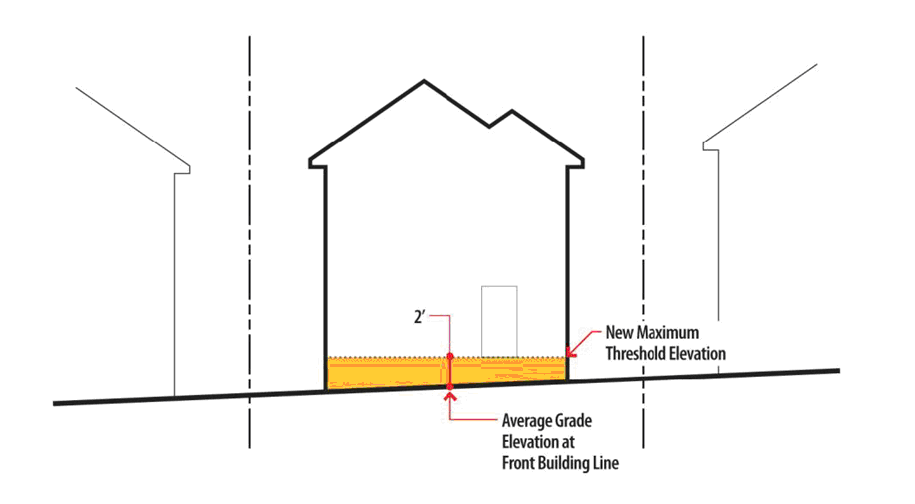
Replacement of a detached house. The proposed front door threshold elevation for any new detached house may not be more than two feet higher than the front door threshold elevation of the residential structure that existed on the lot prior to demolition (see Figure 9-1). If there was no previous residential structure on the subject lot, or if the lot has been part of an approved subdivision that resulted in the creation of any new lots, then the proposed front door threshold elevation for a new detached house on the lot may not be more than two feet higher than the average elevation of the existing natural grade at the front building line (see Figure 9-2). If the proposed construction would require alteration or eradication of the original threshold, then the original elevation must be measured and certified by a licensed surveyor or engineer.
Figure 9-1: Residential Infill, Maximum Threshold Elevation Based on Previously Existing
Threshold
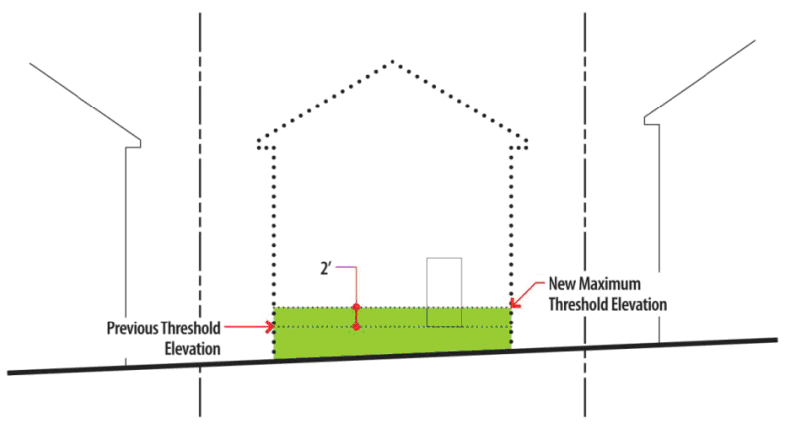
Figure 9-2: Residential Infill, Maximum Threshold Elevation Based on Average Grade
Elevation at Front Building Line
b.
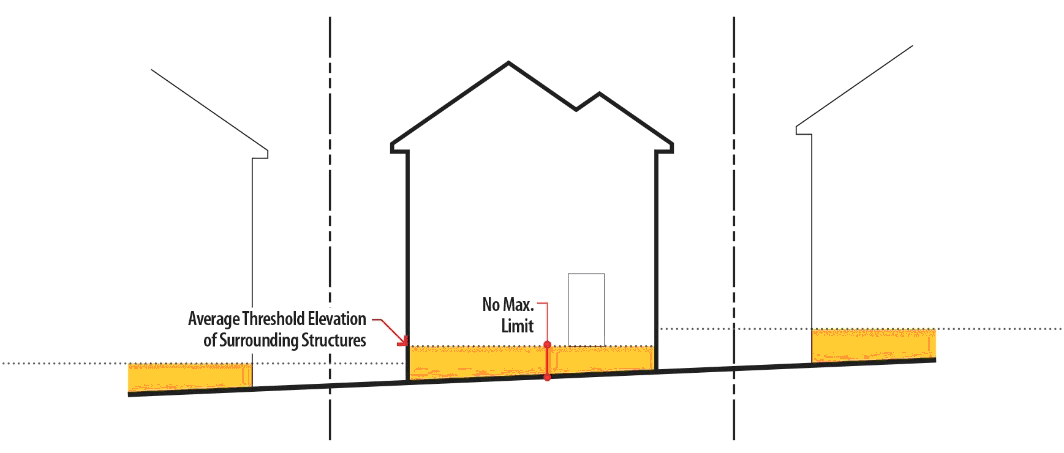
Threshold averaging. The community development director is authorized to approve a proposed front door threshold elevation for new detached houses that exceed the threshold elevation allowed by subsection (1)a. if the applicant for a building permit establishes that the elevation of the front door threshold of the proposed residential structure does not exceed the average elevation of the front door thresholds of the residential structures on both lots immediately abutting the subject lot (see Figure 9-3). If any adjacent lot is vacant, the front door threshold shall be calculated using the formula in [subsection] (1)a. above (for lots with no previous residential structure, Figure 9-2). The applicant must provide the community development director with the threshold elevations, as certified by a licensed surveyor or engineer.
Figure 9-3: Residential Infill, Maximum Threshold Elevation Based on Threshold Averaging
c.
Sewer elevation. If an existing dwelling or lot is not connected to county sewer and if the community development director determines that the proposed residence is unable to be connected to county sewer by gravity flow within the allowable front door threshold height provided for in [subsection] (1)a or (1)b above, then the community development director is authorized to approve a maximum three-foot increase in the front door threshold height over and above the threshold elevation allowed by subsection (1)a or (1)b to provide for gravity flow into the existing sewer tap. The community development director's determination must be based on sewer line elevation data and other evidence provided by the applicant and any other pertinent information available to the director.
d.
Topographical conditions. If exceptional topographical restrictions exist on the subject lot that were not created by the owner or applicant, the community development director is authorized to approve a maximum three-foot increase in the front door threshold height over and above the threshold elevation allowed by either subsection (1)a, (1)b, or (1)c above. The applicant must provide a site plan, including topography, certified by an engineer or landscape architect.
(2)
Contextual street setbacks. Detached houses constructed on block faces that are occupied by two or more existing detached houses must comply with the contextual street setback regulations of this subsection.
a.
The street facing façade of a detached house subject to these contextual street setback regulations must be located within the range of street setbacks observed by detached houses that exist on the nearest two lots on both sides of the subject lot.
b.
If one or more of the nearest two lots on both sides of the subject lot is vacant, the vacant lot will be deemed to have a street setback depth equal to the minimum street setback requirement of the subject zoning district.
Figure 9-3[4]: Residential Infill, Contextual Setbacks (1)
![Figure 9-3[4]: Residential Infill, Contextual Setbacks (1)](https://mcclibrary.blob.core.usgovcloudapi.net/codecontent/14784/488943/27-147-c.png)
c.
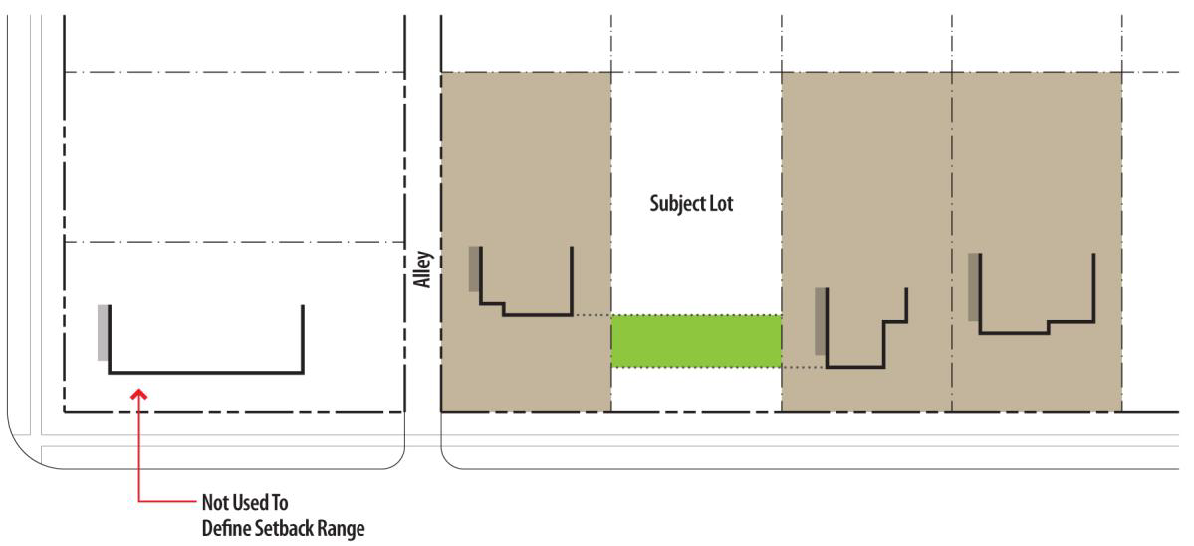
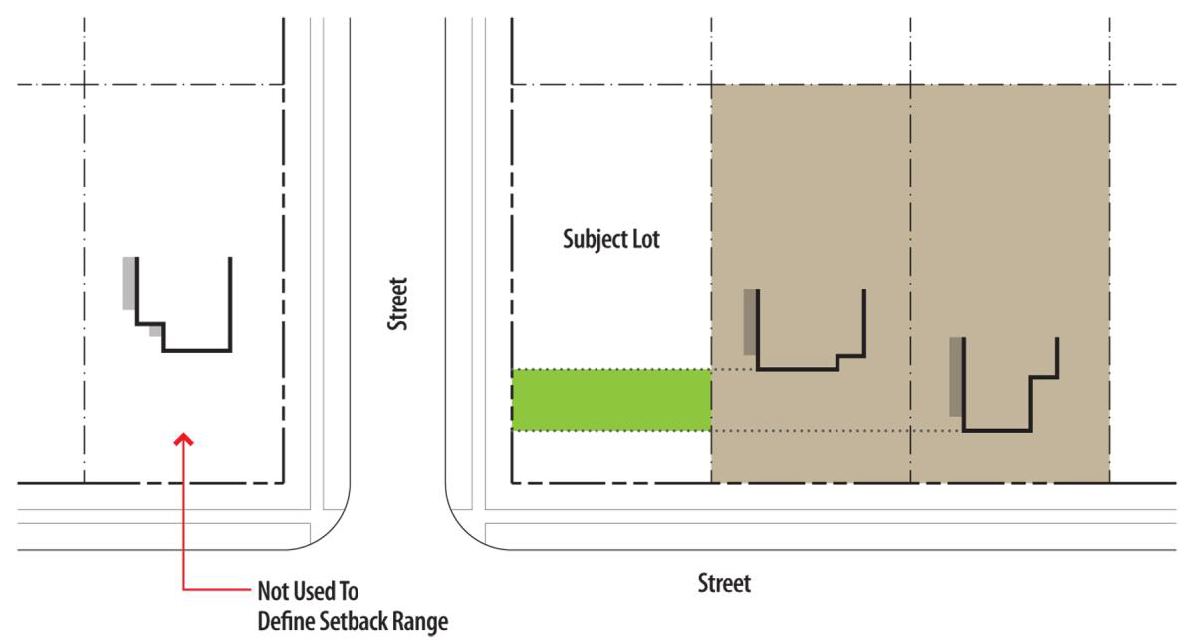
Lots with frontage on a different street than the subject lot or that are separated from the subject lot by a street or alley may not be used in determining the street setback range (see Figure 9-4).
Figure 9-4: Residential Infill, Contextual Setbacks (2)
d.
If the subject lot is a corner lot, the street setback range must be determined on the basis of the nearest two lots with frontage on the same street as the subject lot.
e.
If the subject lot abuts a corner lot with frontage on the same street, the street setback range must be determined on the basis of the abutting corner lot and the nearest two lots with frontage on the same street as the subject lot.
f.
These contextual street setback regulations may not be used to reduce the setback of a street-facing garage door to less than 20 feet.
(3)
Contextual lot characteristics. Proposed subdivisions that are adjacent to block faces that are occupied by two or more existing detached houses must comply with the contextual lot characteristic regulations of this subsection in addition to those requirements in chapters 16 and 27.
a.
Minimum lot area shall be determined by calculating the average area of lots that exist on the nearest four lots on both sides of the subject lot.
b.
Minimum lot frontage shall be determined by calculating the average frontage of lots that exist on the nearest four lots on both sides of the subject lot.
c.
Minimum lot width shall be determined by calculating the average width of lots that exist on the nearest four lots on both sides of the subject lot, measured along the building setback line.
d.
Corner lots or lots with multiple street frontages
1.
Area. Minimum lot area shall be determined by calculating the average area of lots that exist on the nearest four lots on both sides of the subject lot for all street frontages.
2.
Frontage. Minimum lot frontage shall be determined by calculating the average frontage of the nearest four lots on the side(s) with frontage on the same street as the subject frontage. An additional 15 feet shall be provided on all frontages above the minimum distance obtained by the average calculation for minimum lot frontage.
3.
Width. Minimum lot width shall be determined by calculating the average width of the nearest four lots on the side(s) with frontage on the same street as the subject width.
e.
Lots with frontage on a different street than the subject lot or that are separated from the subject lot by a street or alley may not be used in determining contextual lot characteristics, except as required for corner lots.
f.
In no circumstance shall the provisions of this subsection reduce any provision required by the base zoning district.
(4)
If existing land is proposed to be subdivided, the reference parcels for the purposes of determining contextual requirements shall be those immediately adjacent to and outside the parcel or group of parcels comprising the subject subdivision. Additionally, upon a determination of the community development director, parcels with the following characteristics shall not be used in calculating contextual street setbacks or lot characteristics. Where practical—the next immediate adjacent parcel meeting the requirements for use as a reference parcel, if any, shall be used for subject calculations:
a.
Unbuildable lots;
b.
Substandard or nonconforming lots;
c.
Unsubdivided property, or meets and bounds lots, which are uncharacteristic of the area and/or significantly exceed one or more of the minimum lot regulations for the zoning district, and/or are large raw undeveloped property which are expected to be the subject of a future subdivision request.
(5)
Building plans. Building plans for a detached house must be submitted for review and approval prior to issuance of a building permit. Plans must contain all information necessary to determine compliance with the building code and this zoning ordinance.
(6)
Exceptions. Exceptions to the requirements of this section 27-147, residential infill, may be requested through the special exception process as outlined in section 27-416. In addition to the review criteria of section 27-421(b), the zoning board of appeals shall also determine that the proposed exception will not be detrimental to or adversely impact adjacent property.
(7)
Determination. The community development director is authorized to determine whether the provisions of the contextual regulations for lot size, width, frontage and setbacks apply to the subdivision of land and/or construction of a single-family home on a lot. Findings used in this determination shall include, but not be limited to, the following:
Whether the lot(s):
1.
Is significantly different in character and/or contrary to the prevailing orientation of lots outside of the subdivision, (within the immediate surrounding or adjacent area); or
2.
Creates multiple new lots or lot/block configurations which create a different context; or
3.
Creates new streets and alignments of lots; or
4.
Alters other characteristics of the property such that the lot(s) represent a different context, are altered visually or physically from the characteristics of the adjacent/previous neighborhood and such conditions render the application of the contextual regulations for lot size, width, frontage, and setback impractical, unreasonable, or unwarranted.
The owners of property adjacent to the subject lot(s) will be notified of and may appeal the decision of the community development director per article V of this chapter.
(Ord. No. 2013-10-15, § 1(Exh. A § 27-9.170), 10-14-2013; Ord. No. 2015-01-05, § 1, 1-26-2015; Ord. No. 2017-04-07, § 2, 4-11-2017; Ord. No. 2021-09-14, § V, 9-27-2021)
Sec. 27-148. - Schools, (private) elementary, middle or senior high.
The following minimum lot area requirements apply to private elementary, private middle schools and private senior high schools that require special land use approval:
(1)
Elementary school: five acres plus one additional acre for each 100 students, based on the design capacity of the school.
(2)
Middle school: 12 acres plus one additional acre for each 100 students, based on the design capacity of the school.
(3)
High school: 20 acres plus one additional acre for each 100 students, based on the design capacity of the school.
(Ord. No. 2013-10-15, § 1(Exh. A § 27-9.180), 10-14-2013)
Sec. 27-149. - Sexually oriented businesses.
(a)
Purpose. It is the purpose of the city zoning ordinance to regulate land use by sexually oriented businesses in order to promote the health, safety, moral and general welfare of the citizens of the city, and to establish reasonable and uniform regulations to prevent the deleterious secondary effects of sexually oriented businesses within the city. The provisions of this division have neither the purpose nor effect of imposing a limitation or restriction on the content or reasonable access to any communicative materials, including sexually oriented materials. Similarly, it is neither the intent nor effect of this division to restrict or deny access by the distributors and exhibitors of sexually oriented entertainment to their intended market. Neither is it the intent nor effect of this division to condone or legitimize the distribution of obscene material.
(b)
Findings and rationale.
(1)
Based on evidence of the adverse secondary effects of adult uses presented in hearings and in reports made available to the mayor and city council, and on findings, interpretations, and narrowing constructions incorporated in the cases of City of Littleton v. Z.J. Gifts D-4, L.L.C., 541 U.S. 774 (2004); City of Los Angeles v. Alameda Books, Inc., 535 U.S. 425 (2002); City of Erie v. Pap's A.M., 529 U.S. 277 (2000); City of Renton v. Playtime Theatres, Inc., 475 U.S. 41 (1986); Young v. American Mini Theatres, 427 U.S. 50 (1976); Barnes v. Glen Theatre, Inc., 501 U.S. 560 (1991); California v. LaRue, 409 U.S. 109 (1972); N.Y. State Liquor Authority v. Bellanca, 452 U.S. 714 (1981); and Daytona Grand, Inc. v. City of Daytona Beach, 490 F.3d 860 (11th Cir. 2007); Artistic Entertainment, Inc. v. City of Warner Robins, 331 F.3d 1196 (11th Cir. 2003); Artistic Enter-tainment, Inc. v. City of Warner Robins, 223 F.3d 1306 (11th Cir. 2000); Williams v. Pryor, 240 F.3d 944 (11th Cir. 2001); Williams v. A.G. of Alabama, 378 F.3d 1232 (11th Cir. 2004); Williams v. Morgan, 478 F.3d 1316 (11th Cir. 2007); Gary v. City of Warner Robins, 311 F.3d 1334 (11th Cir. 2002); Ward v. County of Orange, 217 F.3d 1350 (11th Cir. 2002); Boss Capital, Inc. v. City of Casselberry, 187 F3d 1251 (11th Cir. 1999); David Vincent, Inc. v. Broward County, 2000 F.3d 1325 (11th Cir. 200); Sammy's of Mobile, Ltd. v. City of Mobile, 140 F.3d 993 (11th Cir. 1998); Lady J. Lingerie, Inc. v. City of Jacksonville, 176 F.3d 1358 (11th Cir. 1999); This That And The Other Gift and Tobacco, Inc. v. Cobb County, 285 F.3d 1319 (11th Cir. 2002); DLS, Inc. v. City of Chattanooga, 107 F.3d 403 (6th Cir. 1997); Grand Faloon Tavern, Inc. v. Wicker, 670 F.2d 943 (11th Cir. 1982); International Food and Beverage Systems v. Ft. Lauderdale, 794 F.2d 1520 (11th Cir. 1986); 5634 E. Hillsborough Ave., Inc. v. Hillsborough County, 2007 WL 2936211 (M.D. Fla. Oct. 4, 2007), aff'd, 2008 WL 4276370 (11th Cir. Sept. 18, 2008) (per curiam); Sensations, Inc. v. City of Grand Rapids, 526 F.3d 291 (6th Cir. 2008); World Wide Video of Washington, Inc. v. City of Spokane, 368 F.3d 1186 (9th Cir. 2004); Ben's Bar, Inc. v. Village of Somerset, 316 F.3d 702 (7th Cir. 2003); H&A Land Corp. v. City of Kennedale, 480 F.3d 336 (5th Cir. 2007); Illinois One News, Inc. v. City of Marshall, 477 F.3d 461 (7th Cir. 2007); G.M. Enterprises, Inc. v. Town of St. Joseph, 350 F.3d 631 (7th Cir. 2003); Richland Bookmart, Inc. v. Nichols, 137 F.3d 435 (6th Cir. 1998); Spokane Arcade, Inc. v. City of Spokane, 75 F.3d 663 (9th Cir. 1996); Gammon v. City of La Habra, 395 F.3d 1114 (9th Cir. 2005); High Five Investments, LLC v. Floyd County, No. 4:06-CV-190, R. 128 (N.D. Ga. Mar. 14, 2008); People ex rel. Deters v. The Lion's Den, Inc., Case No. 04-CH-26, Modified Permanent Injunction Order (Ill. Fourth Judicial Circuit, Effingham County, July 13, 2005); Reliable Consultants, Inc. v. City of Kennedale, No. 4:05-CV-166-A, Findings of Fact and Conclusions of Law (N.D. Tex. May 26, 2005); and Fairfax MK, Inc. v. City of Clarkston, 274 Ga. 520 (2001); Morrison v. State, 272 Ga. 129 (2000); Sewell v. Georgia, 233 S.E.2d 187 (Ga. 1977), dismissed for want of a substantial federal question, 435 U.S. 982 (1978) (sexual devices); Flippen Alliance for Community Empowerment, Inc. v. Brannan, 601 S.E.2d 106 (Ga. Ct. App. 2004); Oasis Goodtime Emporium I, Inc. v. DeKalb County, 272 Ga. 887 (2000); Chamblee Visuals, LLC v. City of Chamblee, 270 Ga. 33 (1998); World Famous Dudley's Food and Spirits, Inc. v. City of College Park, 265 Ga. 618 (1995); Airport Bookstore, Inc. v. Jackson, 214 (1978); and
(2)
Based upon reports concerning secondary effects occurring in and around sexually oriented businesses, including, but not limited to, Austin, Texas - 1986; Indianapolis, Indiana - 1984; Garden Grove, California - 1991; Houston, Texas - 1983, 1997; Phoenix, Arizona - 1979, 1995-98; Chattanooga, Tennessee - 1999-2003; Los Angeles, California - 1977; Whittier, California - 1978; Spokane, Washington - 2001; St. Cloud, Minnesota - 1994; Littleton, Colorado - 2004; Oklahoma City, Oklahoma - 1986; Dallas, Texas - 1997; Ft. Worth, Texas - 2004; Kennedale, Texas - 2005; Greensboro, North Carolina - 2003; Amarillo, Texas - 1977; Jackson County, Missouri - 2008; New York, New York Times Square - 1994; and the Report of the Attorney General's Working Group On The Regulation Of Sexually Oriented Businesses, (June 6, 1989, State of Minnesota);
(3)
The mayor and city council finds:
a.
Sexually oriented businesses, as a category of commercial uses, are associated with a wide variety of adverse secondary effects including, but not limited to, personal and property crimes, prostitution, potential spread of disease, lewdness, public indecency, obscenity, illicit drug use and drug trafficking, negative impacts on surrounding properties, urban blight, litter and sexual assault and exploitation.
b.
Sexually oriented businesses should be separated from sensitive land uses to minimize the impact of their secondary effects upon such uses, and should be separated from other sexually oriented businesses, to minimize the secondary effects associated with such uses and to prevent an unnecessary concentration of sexually oriented businesses in one area.
c.
Each of the foregoing negative secondary effects constitutes a harm which the city has a substantial government interest in preventing and/or abating. This substantial government interest in preventing secondary effects, which is the city's rationale for this division, exists independent of any comparative analysis between sexually oriented and non-sexually oriented businesses. Additionally, the city's interest in regulating sexually oriented businesses extends to preventing future secondary effects of either current or future sexually oriented businesses that may locate in the city. The city finds that the cases and documentation relied on in this division are reasonably believed to be relevant to said secondary effects.
(4)
The city hereby adopts and incorporates herein its stated findings and legislative record related to the adverse secondary effects of sexually oriented businesses, including the judicial opinions and reports related to such secondary effects.
(c)
Definitions. The following words, terms and phrases, when used in this section, have the meanings ascribed to them in this subsection, except where the context clearly indicates a different meaning:
(1)
Adult bookstore or adult video store means a commercial establishment which, as one of its substantial business activities, offers for sale or rental for any form of consideration any one or more of the following items: books, magazines, periodicals or other printed matter, or photographs, films, motion pictures, videocassettes, compact discs, digital video discs, slides, or other visual representations which are characterized by their emphasis upon the display of specified sexual activities or specified anatomical areas. A substantial business activity exists where the commercial establishment meets any one or more of the following criteria:
a.
At least 25 percent of the establishment's displayed merchandise consists of the foregoing items;
b.
At least 25 percent of the wholesale value of the establishment's displayed merchandise consists of the foregoing items;
c.
At least 25 percent of the retail value (defined as the price charged to customers) of the establishment's displayed merchandise consists of the foregoing items;
d.
At least 25 percent of the establishment's revenues derive from the sale or rental, for any form of consideration, of the foregoing items;
e.
The establishment maintains at least 25 percent of its interior business space for the display, sale and/or rental of the foregoing items (aisles and walkways used to access those items are included in interior business space maintained for the display, sale, or rental of said items);
f.
The establishment maintains at least 500 square feet of its interior business space for the display, sale and/or rental of the foregoing items (aisles and walkways used to access those items are included in interior business space maintained for the display, sale, or rental of said items) and limits access to the premises to adults only;
g.
The establishment offers for sale or rental at least 1,000 of the foregoing items and limits access to the premises or to the portion of the premises occupied by said items to adults only;
h.
The establishment regularly advertises itself or holds itself out, using "adult," "XXX," "sex," "erotic," or substantially similar language, as an establishment that caters to adult sexual interests; or
i.
The establishment maintains an adult arcade, which means any place to which the public is permitted or invited wherein coin-operated or slug-operated or electronically, electrically, or mechanically controlled still or motion picture machines, projectors, or other image-producing devices are regularly maintained to show images to five or fewer persons per machine at any one time and where the images so displayed are characterized by their emphasis upon matter exhibiting specified sexual activities or specified anatomical areas.
(2)
Adult cabaret means a nightclub, bar, juice bar, restaurant, bottle club, or similar commercial establishment, regardless of whether alcoholic beverages are served, which regularly feature persons who appear semi-nude.
(3)
Adult motion picture theater means a commercial establishment where films, motion pictures, videocassettes, slides, or similar photographic reproductions which are characterized by their emphasis upon the display of specified sexual activities or specified anatomical areas are regularly shown to more than five persons for any form of consideration.
(4)
Characterized by means describing the essential character or quality of an item. As applied in this division, no business shall be classified as a sexually oriented business by virtue of showing, selling, or renting materials rated NC-17 or R by the Motion Picture Association of America.
(5)
Interior business space means the floor area inside a sexually oriented business that is visible or accessible to patrons for any reason, excluding restrooms.
(6)
Nudity or state of nudity means the showing of the human male or female genitals, pubic area, vulva, anus, anal cleft, or cleavage with less than a fully opaque covering, or the showing of the female breast with less than a fully opaque covering of any part of the nipple and areola.
(7)
Operate or cause to operate means to cause to function or to put or keep in a state of doing business. The term "operator" means any person on the premises of a sexually oriented business who causes the business to function or who puts or keeps in operation the business or who is authorized to manage the business or exercise overall operational control of the business premises. A person may be found to be operating or causing to be operated a sexually oriented business whether or not that person is an owner, part owner, or licensee of the business.
(8)
Premises means the real property upon which the sexually oriented business is located and all appurtenances thereto and buildings thereon, including, but not limited to, the sexually oriented business, the grounds, private walkways and parking lots and/or parking garages adjacent thereto, under the ownership, control, or supervision of the licensee, as described in the application for a sexually oriented business license.
(9)
Regularly means the consistent and repeated doing of an act on an ongoing basis.
(10)
Semi-nude or state of semi-nudity means the showing of the female breast below a horizontal line across the top of the areola and extending across the width of the breast at that point, or the showing of the male or female buttocks. This definition includes the lower portion of the human female breast, but does not include any portion of the cleavage of the human female breast exhibited by a bikini, dress, blouse, shirts, leotard, or similar wearing apparel provided the areola is not exposed in whole or in part.
(11)
Semi-nude model studio means a place where persons regularly appear in a state of semi-nudity for money or any form of consideration in order to be observed, sketched, drawn, painted, sculptured, photographed, or similarly depicted by other persons. This definition does not apply to any place where persons appearing in a state of semi-nudity did so in a modeling class operated:
a.
By a college, junior college, or university supported entirely or partly by taxation;
b.
By a private college or university which maintains and operates educational programs in which credits are transferable to a college, junior college, or university supported entirely or partly by taxation; or
c.
In a structure:
1.
Which has no sign visible from the exterior of the structure and no other advertising that indicates a semi-nude person is available for viewing; and
2.
Where, in order to participate in a class, a student must enroll at least three days in advance of the class.
(12)
Sexual device means any three-dimensional object designed and marketed for stimulation of the male or female human genitals, anus, female breast, or for sadomasochistic use or abuse of oneself or others and includes devices such as dildos, vibrators, penis pumps, cock rings, anal beads, butt plugs, nipple clamps and physical representations of the human genital organs. Nothing in this definition shall be construed to include devices primarily intended for protection against sexually transmitted diseases or for preventing pregnancy.
(13)
Sexual device shop means a commercial establishment that regularly features sexual devices. This definition shall not be construed to include any pharmacy, drug store, medical clinic, any establishment primarily dedicated to providing medical or healthcare products or services, or any establishment that does not restrict access to its premises or a portion of its premises to adults only.
(14)
Sexually oriented business means an adult bookstore or adult video store, an adult cabaret, an adult motion picture theatre, a semi-nude model studio, or a sexual device shop.
(15)
Specified anatomical areas mean and include:
a.
Less than completely and opaquely covered: human genitals, pubic region, buttock and female breast below a point immediately above the top of the areola; and
b.
Human male genitals in a discernibly turgid state, even if completely and opaquely covered.
(16)
Specified sexual activity means any of the following:
a.
Intercourse, oral copulation, masturbation or sodomy; or
b.
Excretory functions as a part of or in connection with any of the activities described in subsection (1) of this definition.
(d)
Standards.
(1)
Sexually oriented businesses are subject to the following standards:
a.
It is unlawful to establish, operate, or cause to be operated a sexually oriented business in the city, unless said sexually oriented business is at least:
1.
Five hundred feet from any parcel in the city zoned R-150, R-100, R-85, R-75, R-60, RA-5, R-50, RA-8, RM-150, RM-100, RM-85, RM-75 or RM-HD;
2.
Six hundred feet from any business in the city licensed by the state to sell alcohol on the premises; and
3.
One thousand feet from any place of worship or a public or private elementary or secondary school in the city.
b.
For the purpose of this subsection, measurements must be made in a straight line in all directions without regard to intervening structures or objects, from the closest point on a boundary line of the sexually oriented business parcel to the closest point on a boundary line of any parcel in the city zoned R-150, R-100, R-85, R-75, R-60, RA-5, R-50, RA-8, RM-150, RM-100, RM-85, RM-75 or RM-HD. Measurements must be made in a straight line in all directions without regard to intervening structures or objects, from the closest part of the structure containing the sexually oriented business to the closest part of any structure in the city occupied by a house of worship, public or private elementary or secondary school, or a business licensed by the state to sell alcohol on the premises.
(2)
All sexually oriented businesses must submit with the application for a building or occupancy permit, a certified boundary survey by a licensed surveyor of the site and the property lines of surrounding properties identifying the use of properties at or within 1,000 feet of the boundary lines of the subject property.
(3)
Each sexually oriented business must provide off-street parking spaces as required by article IV, division 1.
(Ord. No. 2013-10-15, § 1(Exh. A § 27-9.190), 10-14-2013)
Sec. 27-150. - Telecommunication facilities and structures in general.
The regulations of this section apply to all telecommunications facilities and structures.
(1)
Definitions.
a.
(Accessory) equipment means any equipment serving or being used in conjunction with small cell technology or small cell technology wireless support structures and includes, but is not limited to, utility or transmission equipment, power supplies, generators, batteries, cables, equipment buildings, cabinets and storage sheds, shelters or similar structures.
b.
Alternative telecommunication support structure shall mean clock telecommunication support structures, bell telecommunication support structures, church steeples, light/power poles, electric transmission telecommunication support structures, man-made trees and similar natural or man-made alternative-design mounting structures that camouflage or conceal the presence of antennas or telecommunication support structures. An alternative telecommunication support structure may include a pre-existing building.
c.
Antenna shall mean any equipment designed for wireless telecommunication, radio, or television communications through the sending and/or receiving of electromagnetic waves or beams of visible or invisible light and radio signals used in the provision of all types of telecommunication services, including standalone equipment and equipment affixed to or proposed to be affixed to existing telecommunication support structures and/or authorized alternative telecommunication support structures.
d.
Applicant shall mean a person or entity with an application for the permit for the erection of, modification of, or co-location of telecommunication facilities in the city, whether located on private lands or in a public right-of-way. For purposes of this section, this term shall include any co-applicant or party with an ownership interest in a proposed or affected existing telecommunication facility, including, but not limited to, property owners, telecommunication support structure owners, and any proposed tenants for the facility.
e.
Application shall mean a formal request submitted to the city to construct a tower, small cell technology wireless support structure or collocated antenna. An application shall be deemed complete when all documents, information, and fees specifically enumerated in the city's regulations, ordinances and forms pertaining to the location, construction or operation of wireless facilities are submitted by the applicant to the city.
f.
Collocation shall mean the placement or installation of a new antenna, including new small cell wireless technology on the property of a legally existing tower or, if on a right-of-way, that of a utility or other franchisee legally existing in the public right-of-way. Such term includes the placement of accessory equipment within an existing equipment compound.
g.
Decorative pole shall mean a pole owned by the City of Dunwoody that is specially designed and placed for aesthetic purposes.
h.
Equipment compound shall mean an area surrounding or adjacent to the base of a wireless support structure within which accessory equipment is located.
i.
FAA shall mean the Federal Aviation Administration.
j.
FCC shall mean the Federal Communication council.
k.
Governing authority shall mean the governing authority of the city.
l.
Geographic search area shall mean the geographic area within which the placement of accessory equipment is necessary to meet the engineering requirements of an applicant's cellular network or other broadcasting need.
m.
Height shall mean, when referring to a telecommunication support structure or other structure, the distance measured from ground level to the highest point on the telecommunication support structure or alternative telecommunication support structure, even if said highest point is an antenna or lightning rod.
n.
Micro wireless facility shall mean a small wireless technology not larger in dimension than 24 inches in length, 15 inches in width, and 12 inches in height that has an exterior antenna, if any, no longer than 11 inches.
o.
Modification or modify shall mean the change, or proposed change, of any portion of an existing telecommunication facility from its description as previously approved by the city, including improvements, upgrades, expansions, or the replacement of any existing telecommunication equipment, conduit, or infrastructure apparatus, provided such improvement, upgrade, expansion, or replacement does not increase the height of the telecommunication support structure.
p.
Pole shall mean a vertical pole, such as a utility, lighting, traffic, or similar pole made of wood, concrete, metal or other material that is lawfully located or to be located within a right-of-way, including without limitation a replacement pole and an authority pole. Such term shall not include any other telecommunication support structure or alternative telecommunication support structure, as otherwise defined herein, decorative pole, or electric transmission structure.
q.
Provider shall mean any legal entity authorized and/or engaged in the provision of telecommunication services.
r.
Small cell technology shall mean an antenna facility that meets the following conditions:
1.
Mounted on structures 50 feet or less in height, including their antennas; or
2.
Mounted on structures no more than ten percent taller than other adjacent structures; or
3.
Do not extend existing structures on which they are located to a height of more than 50 feet or by more than ten percent, whichever is greater; and
4.
Each antenna, excluding associated equipment, is no more than three cubic feet in volume; and
5.
All wireless equipment associated with the structure, including any pre-existing associated equipment on the structure, is no more than 28 cubic feet in volume.
s.
Small cell wireless support structure shall mean a free-standing wireless support structure, designed to support or capable of supporting small cell technology wireless facilities.
t.
Stealth technology shall mean a method of concealing or reducing the visual impact of wireless support structures, including small cell wireless support structures, antennas and small cell technology, by use of incorporating features or design elements of the installation which either totally or partially conceals the structure; achieves the result of having the structure blend into the surrounding environment; or otherwise minimizes the visual impact of the structure.
u.
Telecommunication facility or facilities shall mean any physical component utilized in the provision of all types of telecommunications services, including all telecommunication support structures, alternative telecommunication support structures, antennas, equipment, infrastructure apparatus, base support mechanism, accessory equipment, towers, monopoles, small cell installations, and physical attachments necessary for the provision of such telecommunications services.
v.
Telecommunication facility owner shall mean any person or entity that directly or indirectly owns, controls, operates, or manages telecommunications facilities, including any related equipment or property within the city, used or to be used for the purpose of offering or transmitting signals used in the provision of any telecommunication services.
w.
Telecommunications service(s) shall mean the transmittal of voice, data, image, graphic, and video programming between or among points by wire, cable, fiber optics, laser, microwave, radio, satellite, or other facilities. This term shall include commercial mobile radio services, unlicensed wireless services, and common carrier wireless exchange services as identified in the Telecommunications Act of 1996.
x.
Telecommunication (wireless) support structure shall mean any freestanding structure that is designed to support or capable of supporting and constructed primarily for the purpose of supporting telecommunication equipment; this term shall include self-supporting, guyed, and monopole support structures. The term includes, and is not limited to, radio and television transmission telecommunication support structures, microwave telecommunication support structures, common-carrier telecommunication support structures, cellular telecommunication support structures, man-made trees, alternative telecommunication support structures, and other similar structures. In the public rights-of-way, only telecommunication support structures erected for the installation of small cells shall be permitted.
(2)
Co-located antennas on private property.
a.
Antennas that are attached or affixed to existing telecommunications support structures or alternative telecommunication support structures are permitted as of right in all zoning districts, provided that the antenna does not substantially change the physical dimensions of such structure.
b.
Co-location antennas that substantially change the physical dimensions of such structure require administrative permit approval in accordance with section 27-150.1. For the purpose of this section, "substantial change" shall mean:
1.
Increases height by more than ten percent or 20 feet, whichever is greater, as measured from facility as it existed as of October 1, 2012.
2.
Appurtenance added protrudes from body of structure more than 20 feet in width.
3.
If it involves installing more than the standard number of cabinets for the technology involved, not to exceed four cabinets (private property); or if it involves installation of any cabinets if there are no pre-existing cabinets, or involves installation of ground cabinets that are more than ten percent larger in height or overall volume than any other associated ground cabinets.
4.
Involves excavation or deployment outside the current "site." "Site" shall be defined as the current boundaries of the leased or owned property surrounding the tower and any access or utility easements.
5.
For concealed or stealth-designed facilities, if a modification would defeat the concealment elements of the wireless tower or base station.
6.
The modification would not comply with other conditions imposed on the applicable wireless support structure or base station, unless the non-compliance is due to an increase in height, increase in width, addition of cabinets, or new excavation that does not exceed the above thresholds.
Alternative telecommunication support structure-mounted antennas in residential zoning districts must be visually screened from view of all abutting lots. Alternative telecommunication support structure-mounted antennas in other zoning districts must be screened or designed and installed so as to make the antenna and related equipment as visually unobtrusive as possible.
(3)
Applicable law. The regulations of this section and sections 27-150.1 and 27-150.2 must be applied within the constraints of the Telecommunications Act of 1996 and Section 6409 of the Middle Class Tax Relief and Job Creation Action of 2012, as well as all applicable rulings of the FCC and the Streamlining Wireless Facilities and Antennas Act of 2019, as codified in title 36, chapters 66B and 66C.
(4)
General regulations.
a.
Telecommunication facilities that require administrative permit approval are subject to the following setbacks:
1.
If located on a lot abutting a residential zoning district or a lot occupied by a residential use, the facility must be set back from the zoning district or lot boundary by a minimum distance of one-half the overall height of the tower or 200 feet, whichever is greater; or
2.
If located on a lot abutting a nonresidential or mixed-use district that is not occupied by a residential dwelling, the facility must be set back from the abutting lot by a minimum distance of 33 percent of the overall height of the tower or 200 feet, whichever is greater.
b.
Telecommunications facilities that require special land use permit approval must be set back at least 200 feet from any property line, unless a greater setback is expressly required as part of the special land use permit approval.
c.
Telecommunications facilities must either maintain a galvanized steel finish or, subject to any applicable standards of the Federal Aviation Administration or Federal Communications Commission, be painted a neutral color, so as to reduce visual obtrusiveness. These color and design requirements do not apply to alternative telecommunication support structures.
d.
At a facility site, the design of the buildings and related structures must, to the maximum extent possible, use materials, colors, textures, screening and landscaping that will blend the facilities to the natural setting and built environment.
e.
Telecommunication support structures or alternative telecommunication support structures may not be artificially lighted, unless required by the Federal Aviation Administration, Federal Communications Commission or other applicable authority. If lighting is required, it must be done in a way that minimizes the disturbance to surrounding views.
f.
Telecommunication support structures must be entirely enclosed by a security fence of at least six feet in height. Towers must be equipped with an anti-climbing device. This requirement does not apply to alternative telecommunication structures, or telecommunication facilities on the right-of-way, provided equivalent alternative security measures are installed.
g.
In addition to any other landscaping or buffer requirements that may apply, telecommunication facilities must be landscaped with plant material that effectively screens the facility site from adjacent uses. Existing tree growth and natural land forms on-site must be preserved to the maximum extent possible. At a minimum, a landscaped strip ten feet in width must be provided around the perimeter of the facility site.
h.
Telecommunications support structures must be constructed to the minimum height necessary to accomplish their required telecommunications purpose.
i.
The environmental effects of radio frequency emissions may not serve as a basis to approve, deny or otherwise regulate a telecommunication facility to the extent that emissions comply with Federal Communications Commission regulations.
j.
All decisions denying a request to place, construct or modify a telecommunications facility must be in writing and be supported by a written record documenting the reasons for the denial and the evidence in support of the decision. Decisions must be made within the time specified herein.
k.
Each applicant requesting approval of a telecommunications facility must provide to the community development director as a part of the application an inventory of its existing facilities that are either within the city or within one-quarter mile of the city boundaries, including information regarding the location, height and design of each facility. The community development director may share this information with other applicants or with other organizations seeking to locate a telecommunication facility within the city. In sharing this information, the community development director is not in any way representing or warranting that the sites are available or suitable.
l.
No new telecommunication support structure may be permitted unless the applicant demonstrates that no existing facility or structure can accommodate the applicant's proposed antenna. Evidence must be submitted at the time of application demonstrating that no existing facility or structure can accommodate the applicant's proposed antenna and may consist of one or more of the following:
1.
No existing facilities or structures are located within the geographic area required to meet applicant's engineering requirements;
2.
Existing facilities or structures are not of sufficient height to meet applicant's engineering requirements;
3.
Existing facilities or structures do not have sufficient structural strength to support applicant's proposed antenna and related equipment;
4.
The applicant's proposed antenna would cause electromagnetic interference with the antenna on the existing facilities or structures, or the antenna on the existing facilities or structures would cause interference with the applicant's proposed antenna;
5.
The fees, costs, or contractual provisions required by the owner in order to share an existing or structure or to adapt an existing facility or structure for sharing are unreasonable; or
6.
There are other limiting factors that render existing facilities and structures unsuitable.
m.
The placement of additional buildings or other supporting equipment necessarily required in connection with an otherwise authorized telecommunication support structure or antenna is specifically authorized.
n.
Any telecommunications antenna or support structure that is not operated for a continuous period of six months, or in the case of a facility or structure on the right-of-way, 12 months, will be considered abandoned, and the owner of such antenna or structure must remove the antenna or structure within 90 days of receipt of notice from the city. If such abandoned antenna or structure is not removed within said 90 days, the city may enforce this subsection by all available legal means as authorized by the City Code, and not prohibited by state or federal law, including removal of the structure at the owner's expense with an additional assessed fine of $500.00. Until the owner pays said expense and penalty, the owner shall not be entitled to apply for, or receive, any future permits under this section. If there are two or more users of a single structure, then this provision shall not become effective until all users cease using the structure.
(Ord. No. 2019-12-20, § 1, 12-9-2019)
Editor's note— Ord. No. 2019-12-20, § 1, adopted Dec. 9, 2019, repealed § 27-150, and enacted a new § 27-150 as set out herein. The former 27-150 pertained to telecommunications towers and antennas and derived from Ord. No. 2013-10-15, § 1(Exh. A § 27-9.200), adopted Oct. 14, 2013; and Ord. No. 2015-09-18, § 1, adopted Sept. 28, 2015.
Sec. 27-150.1. - Telecommunication facilities and structures on private property.
(a)
Application submittals. Applications for administrative permit or special use permit in accordance with this section shall include the following:
(1)
Name, address, and telephone number of a principal officer and local agent of the applicant;
(2)
Physical address of the parcel upon which the proposed antenna, telecommunication support structure or alternative telecommunication support structure is to be erected;
(3)
Name of the person, firm, corporation, or association erecting the antenna, telecommunication support structure or alternative telecommunication support structure, including all parties with a prospective ownership interest in the proposed antenna, telecommunication support structure or alternative telecommunication support structure;
(4)
Written consent of all parties with an existing ownership interest, including all underlying land owners and owners or licensees of any affected, existing telecommunication support structures or alternative telecommunication support structures, allowing the application;
(5)
A site plan showing existing vegetation to be removed from the site and vegetation to be replanted to replace the vegetation that will be removed;
(6)
A certified statement prepared by an engineer licensed in Georgia or other qualified industry professional indicating that the erection and operation of the proposed antenna, telecommunication support structure or alternative telecommunication support structure, including reception and transmission functions, will not interfere with public safety communications or the usual and customary transmission or reception of radio, television, or other telecommunication service enjoyed by adjacent properties;
(7)
Proof of and/or certified copies of any required approval, registration, and/or licensure from the commission for any provider of telecommunications services to provide such services in the State of Georgia, where applicable, and any other required FAA, FCC, or otherwise state and federal approval, registration, and/or licensure required to erect the proposed antenna, new telecommunication support structure or alternative telecommunication support structure;
(8)
Written certification that all emissions from any antenna on the telecommunication support structure will comply with FCC frequency emissions standards;
(9)
For new telecommunication support structure applications, the applicant shall provide photo-simulated, post-construction renderings of the completed proposed telecommunication support structure equipment compound and/or equipment cabinets, ancillary structures, and landscaping, if any. The views shall incorporate before and after scenarios, a scaled, color image of the proposed type of facility, an aerial map with the location of the selected views, and a description of the technical approach used to create the photo simulations. The simulations shall include a minimum of four vantage points (generally north, south, east, and west). Based on the information provided the applicant may be required to provide other pictorial representations from other viewpoints including, but not limited to, state highways and other major roads; state and local parks; other public lands; historic districts; preserves and historic sites normally open to the public; and from any other location where the site is visible to a large number of visitors, travelers or residents;
(10)
The community development director may, at his sole discretion, require a balloon test to be conducted at any time during which an application is pending before the city;
(11)
Six sets of accurate scale drawings including a scaled site plan and a scaled elevation view and other supporting drawings, calculations, and other documentation including, but not limited to, the method of construction and attachment to the ground for the telecommunication support structure. The plans for the telecommunication support structure construction shall be certified by a registered structural engineer licensed in the State of Georgia as meeting all current safety and design standards of all applicable federal, state, and city codes, and shall show the location and dimensions of all improvements, including information concerning topography, radio frequency coverage, telecommunication support structure height requirements, setbacks, drives, parking, fencing, landscaping, adjacent uses, and other information deemed by the community development director to be necessary to assess compliance with this article. In addition, the report from the structural engineer must contain:
a.
Telecommunication support structure height and design, including technical, engineering, economic, and other pertinent factors governing selection of the proposed design. A cross-section of the telecommunication support structure shall be included;
b.
Total anticipated capacity of the structure, including number and types of antenna(s) which can be accommodated;
c.
Evidence of structural integrity of the proposed telecommunication support structure; and
d.
Failure characteristics of the telecommunication support structure and demonstration that site and setbacks are of adequate size to contain debris.
(b)
Approval criteria. In reviewing and acting on administrative and special land use permit applications, authorized review and decision-making bodies must consider the following factors in addition to the generally applicable approval criteria of section 27-359 and 27-441, as applicable:
(1)
Height of the proposed facility;
(2)
Proximity of the facility to residential structures;
(3)
Nature of uses on adjacent and nearby properties;
(4)
Surrounding topography;
(5)
Surrounding tree cover and foliage;
(6)
Design of the facility, with particular reference to design characteristics that have the effect of reducing or eliminating visual obtrusiveness; and
(7)
Compliance with of this section and section 27-150.
(c)
Review process.
(1)
All co-location antennas and any new small cell installation support structures require a special administrative permit from the community development director. Any new non-small cell telecommunication support structure requires a special use permit from the mayor and city council. Fees for administrative permits for small cell installations may not exceed $500.00 for the first five locations, and $100.00 for each additional location, requested simultaneously.
(2)
For non-small cell technology installations, the community development director shall have 30 days in which to review the application for completeness in accordance with the requirements of this section, the Federal Telecommunications Act and any applicable state law. If the application is found to be incomplete, the community development director shall state so in writing to the applicant, detailing the specific Code section, statute or provision of federal law under which that determination was made. Upon the issuance of the written notice, the required federal and/or state decision clock shall be tolled until such time as an updated application is filed. If the application remains incomplete after the resubmission, said incompleteness may serve as valid reason for denial of the application by either the community development director or city council, as applicable.
(3)
For small cell technology installations the community development director shall notify an applicant submitting an application of any identified deficiencies therein within ten calendar days of receipt of such an application. If the community development director determines an application is not complete, he shall notify the applicant in writing of said deficiencies. Upon resubmission of the application, the initial 10-day period shall not be counted towards the review period defined herein. The community development director shall have an additional ten calendar days to notify applicant of any other deficiencies in the re-submitted application. To the extent additional information is required after resubmission, the time required for an applicant to provide such information shall not be counted toward the review period set forth herein. If the application remains incomplete after the second resubmission, said incompleteness may serve as valid reason for denial of the application.
(4)
The community development director must grant or deny an administrative permit within 60 days of the filing of a completed application for any small cell co-location and any co-location that does not substantially increase the size of the facility as defined in section 27-150, and within 90 days of the filing of a completed application for a new small cell facility structure and antenna. If a denial is issued, said denial must be in writing and include specific reason(s) for same as found in this section and based on substantial evidence in the record.
(5)
For applications requiring a special use permit, the procedure of article V, division III of the zoning ordinance must be utilized with the exception that the decision by the mayor and city council must be made within 150 days of the filing of a completed application and shall be in writing and based on substantial evidence in the record.
(6)
Decisions of the community development director denying an administrative permit may be appealed in accordance with the procedures and conditions in chapter 27, article V, division 8.
(Ord. No. 2019-12-20, § 1, 12-9-2019; Ord. No. 2021-09-14, § X, 9-27-2021)
Sec. 27-150.2. - Telecommunication structures and antennas in the right-of-way.
(a)
Access to the right-of-way. The city shall not require any telecommunications facility owner to sign an agreement of any kind as pre-condition for access to the city's right-of-way. The provisions of this section and the ACT shall serve as the only pre-conditions for location of telecommunication facilities in the rights-of-way. Any telecommunications facility owner may, voluntarily, enter into any such right of way access agreement with terms that deviate from the provisions of the ACT or this section, so long as said agreements are available for public inspection and are non-discriminatory as to terms and conditions with different telecommunication facility owners.
(b)
Fees.
(1)
Application fee for co-location of a small cell installation on an existing pole: $100.00 for each facility.
(2)
Application fee for each replacement pole with an associated small cell installation: $250.00.
(3)
Application fee for each new pole with an associated small cell installation: $1,000.00 per pole.
(4)
Right of way occupancy rate:
a.
Co-located small cell installation on existing or replacement pole: $100.00 per year.
b.
New pole with associated small cell installation: $200.00 per year.
(5)
Annual attachment rate for poles owned by the city: $40.00 per year per small cell installation.
(6)
On January 1, 2021, each of the fees delineated above shall increase 2.5 percent annually.
(c)
Contents of application.
(1)
The application pursuant to this section shall be submitted to the community development director and contain the following:
a.
The applicant's name, address, telephone number, and email address, including emergency contact information;
b.
The names, addresses, telephone numbers, and email addresses of all consultants, if any, acting on behalf of the applicant with respect to the filing of the application.
c.
A general description of the proposed work and the purposes and intent of the proposed facility. The scope and detail of such description shall be appropriate to the nature and character of the physical work to be performed, with special emphasis on those matters likely to be affected or impacted by the physical work proposed.
d.
Detailed construction drawings regarding the proposed use of the public right-of-way.
e.
To the extent the proposed installation involves co-location on a pole, decorative pole, or support structure, a structural report performed by a duly licensed engineer evidencing that the pole, decorative pole, or support structure will structurally support the co-location, or that the pole, decorative pole, or support structure may and will be modified to meet structural requirements, in accordance with applicable codes.
f.
Visual depictions or representations if such are not included in the construction drawings.
g.
Information indicating the horizontal and approximate vertical location, relative to the boundaries of the right-of-way, of the small cell installation for which the application is being submitted.
h.
If the application is for the installation of a new pole or decorative pole, a certification that the applicant has determined, after diligent investigation, that it cannot meet the service objectives of the permit by co-locating on an existing pole or support structure on which:
1.
The applicant has the right to co-locate subject to reasonable terms and conditions; and
2.
Such co-location would not impose technical limitations or significant additional costs.
The applicant shall certify that it has made such a determination in good faith, based on the assessment of a licensed engineer, and shall provide a written summary of the basis for such determination.
i.
A certification that the applicant has permission from the owner to co-locate on the structure or pole.
j.
If the applicant is not provider of wireless services, a certification that a wireless service provider has requested in writing that the applicant co-locate the small cell installation or install, modify, or replace the pole or decorative pole at the requested location.
(2)
Any material change to information contained in an application shall be submitted in writing to the community development director within 30 days after the events necessitating the change. Failure to do so shall be a violation of this section.
(d)
Exemption from permit.
(1)
An application shall not be required for the following activities, provided that applicable electrical or encroachment permits may still be required pursuant to the provisions of the City Code:
a.
With respect to a pole or decorative pole on which the small cell installation is co-located, inspections, testing, repairs and modifications that maintain functional capacity and aesthetic and structural integrity, provided that modifications are limited by the structural load analysis supplied by the applicant in its prior application for installation of the facility; and
b.
Inspections, testing, or repairs that maintain functional capacity or the replacement or upgrade of antennas or other components of the small wireless installation such as a swap out or addition of antennas and radio equipment as required by the applicant, with antennas and other components that are substantially similar in color, aggregate size, and other aesthetics to that previously permitted by the city and consistent with the height and volume limits for wireless installations under this section, so long as the pole, decorative pole, or support structure will structurally support, or prior installation will be modified to support, the structural load in accordance with the structural load analysis supplied by the applicant in its prior application for the installation.
(2)
A permit shall not be required for the installation, placement, maintenance, operation or replacement of micro wireless facilities that are suspended on cables that are strung between poles or support structures in the right-of-way in compliance with applicable codes, subject to the requirement that other applicable permits, such as electrical, excavation, street closure, or as otherwise required by this Code, be obtained.
(e)
Procedure after submission of application.
(1)
Within 20 days of receipt of a written application pursuant to this section, the community development director shall:
a.
Notify the applicant in writing of the commencement and completion dates of any widening, repair, reconstruction, or relocation of the applicable right-of-way that is scheduled to commence, or is anticipated in good faith to commence, within 24 months after the application is filed;
b.
Notify the applicant of any aspect of the application that appears to be grounds for the denial of the application pursuant to this section; and
c.
Determine whether the application is complete and inform the applicant of his determination in writing.
(2)
If the application is deemed incomplete, the community development director shall specifically identify in writing all missing information within such 20-day period.
(3)
If notified of incompleteness, the applicant may submit such missing information within 20 days of the receipt of the notification from the community development director, and, upon resubmission, any subsequent review for completeness shall be limited to the previously missing information. If the application remains incomplete or is materially changed other than to address the missing information, the community development director shall notify the applicant of such within ten days of the resubmission and such notice shall constitute an official denial of the application.
(f)
Time for review.
(1)
Within 30 days of the city's written determination that the application is complete, or upon it becoming complete by operation of law 20 days after submission, for a co-location, and within 70 days for installation, modification or replacement of a pole or decorative pole, the community development director shall make the determination whether to approve or deny the application.
(2)
A decision to deny the application shall be in writing, shall identify all reasons for denial, and shall identify the provision(s) of this section on which the denial was based.
(3)
If the community development director fails to act on an application within the review period provided in this section, the applicant may provide the city written notice that the time period for acting has lapsed, and the community development director shall then have 20 days after receipt of said notice to render a written decision. If the community development director does not act within that additional 20 days, the application shall be deemed to be approved by operation of law.
(g)
Standards of review. The community development director shall approve the application unless the co-location of a small cell installation or requested installation, modification, or replacement of a pole or decorative pole:
(1)
Interferes with the operation of traffic control equipment;
(2)
Interferes with the sight lines or clear zones for transportation or pedestrians;
(3)
Fails to comply with the Americans with Disabilities Act, 42 U.S.C. section 12101, et. seq., or similar laws of general applicability regarding pedestrian access or movement;
(4)
Requests that ground-mounted equipment be located more than 7.5 feet in radial circumference from the base of the pole, decorative pole, or support structure to which the antenna would be attached, provided that this shall not serve as reason for denial if the applicant can show that the greater distance is necessary to avoid interfering with sight lines or clear zones for transportation or pedestrians or to otherwise protect public safety;
(5)
Fails to comply with applicable codes;
(6)
Fails to comply with the maximum limitations of what is defined as a small cell installation under this article or otherwise refuses to locate the facilities underground in those areas where the city requires same of all utilities in the right-of-way;
(7)
With respect to an application to install a pole or decorative pole, interferes with the widening, repair, reconstruction, or relocation of a public road or highway by the city or GDOT that has been advertised for bid and scheduled for completion within six months after the application is filed;
(8)
With respect to an application to install a pole or decorative pole, interferes with a public works construction project governed by O.C.G.A. § 36-91 and scheduled for completion within six months after the application is filed;
(9)
Fails to comply with aesthetic requirements or alternate location requirements of this section;
(10)
Fails to comply with laws of general applicability that address pedestrian and vehicular traffic and safety requirements; or
(11)
Fails to comply with laws of general applicability that address the occupancy or management of the right-of-way and that are not otherwise inconsistent with this article or the ACT.
(h)
Expiration of permit. The co-location, installation, modification or replacement for which a permit is issued under this section shall be completed within six months after issuance, provided that the city shall grant an extension for up to an additional six months upon written request made before the expiration of the initial 6-month period if a delay results from circumstances beyond the reasonable control of the applicant.
(i)
Relocation, recondition and replacement.
(1)
If the city requires any widening, repair, reconstruction, or relocation of a public road or highway, or relocation of poles, support structures, or small cell installations as a result of a public project, the telecommunication facility owner shall relocate poles and support structures that have been installed in the right-of-way at no cost to the city in case said poles and support structures are found to unreasonably interfere with the widening, repair, reconstruction or relocation project or the public project. The telecommunication facility owner shall relocate the poles or support structures:
a.
By the date designated in a written notice by the city that contains a good faith estimate of the date by which the city intends to commence work so long as the time frames are applied to all utilities in the right-of-way, provided, however, that the date designated for relocation shall be at least 45 days after the city provides written notice of same; or
b.
Within the time frame that the telecommunication facility owner estimates in good faith is reasonably needed to complete the relocation, so long as such good faith estimate is provided to the city in writing within 30 days following receipt of the city's written notice and explains in detail why such relocation cannot be reasonably completed by the date designated by the city.
(2)
The telecommunication facilities owner shall reasonably cooperate with the city to carry out reconditioning work activities for any poles or decorative poles owned by the city in a manner that minimizes interference with the approved use of the facility. The city shall use reasonable effort to provide the telecommunication facility owner with written notice of reconditioning work at least 120 days before such work begins. Upon receiving such notice, it shall be the telecommunication facility owner's sole responsibility to provide adequate measures to cover, remove, or otherwise protect the facility from the consequences of the reconditioning work, including but not limited to paint and debris fallout. The city reserves the right to require removal of all facilities from the city's pole and surrounding premises during reconditioning work, provided that the requirement to remove such is contained in the written notice required herein. All costs associated with the protection measures shall be the sole responsibility of the telecommunication facility owner.
(3)
In the case of the city needing to replace its poles or decorative poles, the city shall provide the telecommunication facility owner with at least 120 days written notice of same before the city may remove the facility. The city shall promptly notify the telecommunication facility owner when the poles have been replaced and the equipment can be reinstalled. During the replacement work, the telecommunication facility owner may maintain a temporary communications facility on the property, or, after approval by the city, on any land owned or controlled by the city in the vicinity of the property.
(4)
If the telecommunication facility owner fails to relocate a support structure as required in this section, or fails to provide a good faith estimate of the time needed to relocate, the city shall have the right, ten days after written notice of same, to cut power or move any support structure or pole located in the right-of-way as the city may determine to be necessary, appropriate, or useful in order to commence work on the public project.
(j)
Public safety.
(1)
An applicant in the public right-of-way shall employ due care during the installation and maintenance process and shall comply with all safety and public right-of-way protection requirements in the city codes and regulations and State Law.
(2)
An applicant or permittee pursuant to this section shall not place any small cell installations, support structures, poles or decorative poles where they will interfere with any existing infrastructure or equipment and shall locate its lines and equipment in such a manner as not to interfere unnecessarily with the usual vehicular or pedestrian traffic patterns or with the rights or reasonable convenience of owners of property that abuts any public right-of-way.
(3)
If the city determines that a telecommunication facility owner's activity in the public right-of-way pursuant to this section creates an imminent risk to public safety, the city shall provide written notice to the facility owner requiring the facility owner to address said risk. If the facility owner fails to address the issue within 24 hours of the written notice, the city shall be authorized to address said issue at the facility owner's expense.
(4)
Any damage to the public right-of-way caused by the activities of the telecommunication facility owner while occupying, installing, repairing or maintaining small cell installations, poles, or support structures shall be repaired promptly by the facility owner. If the facility owner fails to conduct such repairs within 90 days of receipt of a written notice from the city notifying the facility owner of the damage to the right-of-way, the city shall be authorized to correct and repair the damage at the facility owner's expense, plus a $500.00 penalty. Failure of the facility owner to pay the city's expenses under those circumstances, as well as the penalty, shall result in the facility owner being prohibited from applying for, or receiving, any further permits under this section until the full amount is paid to the city.
(k)
Alternate locations. For application for new poles in the public right-of-way in areas zoned for residential use, the city may propose an alternate location in the public right-of-way within 100 feet of the location set forth in the application, and the applicant shall use the city's proposed alternate location unless the location imposes technical limits or significant additional costs, a fact the applicant must certify to have determined in good faith, based on the assessment of a licensed engineer, and shall provide a written summary of the basis for such determination.
(l)
First come, first served requests. If multiple applications are received by the city to install two or more poles or decorative poles at the same location or to co-locate two or more small cell installations on the same pole, decorative pole or support structure, the applications shall be considered in the order they were received once deemed complete and, if a permit is granted for the first completed application, the subsequent completed applications for the same location shall be deemed to be automatically denied.
(Ord. No. 2019-12-20, § 1, 12-9-2019)
Sec. 27-151. - Utility facilities, essential.
Essential utility facility structures are subject to the lot and building regulations of the subject zoning district.
(Ord. No. 2013-10-15, § 1(Exh. A § 27-9.210), 10-14-2013)
Sec. 27-152. - Vehicle repair, major.
(a)
Major vehicle repair uses may not be located within 300 feet of school, park, playground or hospital, as measured between lot lines.
(b)
Major vehicle repair uses may not be located on a lot that is adjacent to or directly across the street from any R or RM district.
(c)
All service and repair activities must be conducted entirely within an enclosed building.
(Ord. No. 2013-10-15, § 1(Exh. A § 27-9.220), 10-14-2013)
Sec. 27-153. - Vehicle repair, minor.
All minor vehicle repair establishments must be conducted entirely within an enclosed building.
(Ord. No. 2013-10-15, § 1(Exh. A § 27-9.230), 10-14-2013)
Sec. 27-154. - Vehicle sales and rental.
(a)
Vehicle sales and rental uses require a minimum lot area of one acre.
(b)
All vehicles and trailers must be set back at least 30 feet from all rights-of-way.
(Ord. No. 2013-10-15, § 1(Exh. A § 27-9.240), 10-14-2013)
Sec. 27-155. - Vehicle storage and towing.
(a)
Vehicle storage and towing uses may not be located within 1,000 feet of any residential district or lot containing a residential use, as measured between lot lines.
(b)
Vehicle storage and towing uses must be enclosed by a wall that is at least eight feet in height and that provides complete visual screening of stored vehicles.
(c)
No dismantling, repair or other activity may be conducted on the premises.
(d)
Vehicles at impound or towing establishments may not be held longer than provided by state law.
(Ord. No. 2013-10-15, § 1(Exh. A § 27-9.250), 10-14-2013)
Sec. 27-156. - Distillery.
Where allowed, the individual establishment shall not exceed a building footprint of 15,000 square feet.
(Ord. No. 2020-03-04, § III, 3-9-2020)
Sec. 27-157. - Microbreweries.
Where allowed, the individual establishment shall not exceed a building footprint of 15,000 square feet.
(Ord. No. 2020-03-04, § IV, 3-9-2020)
Sec. 27-158. - Wine specialty shop.
(a)
It shall be unlawful for a wine specialty shop to sell or have on premises spirituous liquors.
(b)
A wine specialty shop shall be allowed to sell growlers containing draft beer, as long as they follow provisions set forth in article II of this chapter.
(c)
Shall be allowed to serve draft beers by the glass for consumption on the premises only during the same hours as are permitted in article V under this chapter for the sale of "malt beverages and wine packaged sales." Malt beverages fees shall apply for consumption on the premises of draft beer.
(d)
Only the licensee or an employee shall dispense beers from a tap. Free samples of wine or beer shall not exceed two ounces.
(e)
Sampling or tasting of wine and beer is only permitted within the designated portion of the premises.
(f)
Shall not exceed 50,000 square feet in floor area.
(Ord. No. 2020-03-04, § V, 3-9-2020)
Sec. 27-166. - Generally applicable regulations.
(a)
Accessory uses allowed. Accessory uses and structures are permitted in connection with lawfully established principal uses.
(b)
Accessory use determinations. The community development director is authorized to determine when a use, building or structure meets the criteria of an accessory use or accessory structure. In order to classify a use or structure as "accessory" the community development director must determine that the use or structure:
(1)
Is customarily found in conjunction with the subject principal use or principal structure;
(2)
Is subordinate and clearly incidental to the principal use; and
(3)
Provides a necessary function for or contributes to the comfort, safety or convenience of occupants of the principal use.
(c)
Time of construction and establishment.
(1)
Accessory uses may be established only after the principal use of the property is in place.
(2)
Accessory buildings may be established in conjunction with or after the principal building. They may not be established before the principal building is in place.
(d)
Location. Accessory uses and structures must be located on the same lot as the principal use to which they are accessory, unless otherwise expressly stated. Accessory buildings are expressly prohibited in front street yards.
(e)
Accessory buildings and structures.
(1)
Applicable regulations and standards. Accessory buildings and structures are subject to the same regulations and standards as applicable to principal uses and structures on the subject lot, unless otherwise expressly stated. Accessory buildings attached to the principal building by a breezeway, passageway or similar means are considered part of the primary structure and are subject to the lot and building regulations that apply to the principal building. Accessory buildings attached by structures less than 30 inches in height or less (e.g.: patios, walks, decks without railing) are not considered part of the primary structure and must comply with accessory building and structure regulations.
(2)
Building separation. Accessory buildings must be separated by a minimum distance of ten feet from the principal building on the lot, unless the accessory building is located entirely within the principal building setbacks, in which case no separation is required. Structures less than 30 inches in height do not require a building separation.
(3)
Maximum accessory building floor area. Accessory buildings in all residential zoning districts are subject to the following maximum floor area limits:
(Ord. No. 2013-10-15, § 1(Exh. A § 27-10.10), 10-14-2013; Ord. No. 2015-01-05, § 1, 1-26-2015; Ord. No. 2017-04-07, § 2, 4-11-2017)
Sec. 27-167. - Amateur radio service antenna structures.
Amateur radio service antenna structures over 70 feet in overall height require review and approval in accordance with the special land use permit procedures of article V, division 3. All amateur radio service antenna structures must be set back from all property lines a distance equal to at least one-half the height of the structure's overall height.
(Ord. No. 2013-10-15, § 1(Exh. A § 27-10.20), 10-14-2013)
Sec. 27-168. - Home occupations.
(a)
Purpose. The home occupation regulations of this section are intended to allow Dunwoody residents to engage in customary home-based work activities, while also helping to ensure that neighboring residents are not subjected to adverse operational and land use impacts (e.g., excessive noise or traffic or public safety hazards) that are not typical of residential neighborhoods.
(b)
Type A and type B home occupations. Two types of home occupations are defined and regulated under this section: type A and type B.
(1)
Type A home occupations. Type A home occupations are those in which household residents use their home as a place of work, with no employees, customers or clients coming to the site. Typical examples include telecommuting office workers, writers, consultants, artists and crafts people.
(2)
Type B home occupations. Type B home occupation are those in which household residents use their home as a place of work and either one non-resident employee or customers come to the site. Typical examples include tutors, teachers, photographers and licensed therapists or counselors.
(c)
Exemptions.
(1)
Personal care homes. Personal care homes are not regulated as home occupations and are exempt from the home occupation regulations of this section. Personal care homes are allowed as indicated in the use tables of sections 27-57 and 27-72. Supplemental regulations applicable to some personal care homes can be found in section 27-145.
(2)
Day care. Day care uses are not regulated as home occupations and are exempt from the home occupation regulations of this section. Day care uses are allowed as indicated in the use tables of sections 27-57 and 27-72. Supplemental regulations applicable to some day care uses can be found in section 27-137.
(3)
Bed and breakfast. Bed and breakfasts are not regulated as home occupations and are exempt from the home occupation regulations of this section. Bed and breakfasts are allowed as indicated in the use tables of sections 27-57 and 27-72. Supplemental regulations applicable to bed and breakfasts can be found in section 27-133.
(d)
Prohibited home occupations. The following uses are expressly prohibited as home occupations:
(1)
Any type of assembly, cleaning, maintenance or repair of vehicles or equipment with internal combustion engines or of large appliances (such as washing machines, clothes dryers or refrigerators).
(2)
Dispatch centers or other businesses where employees come to the site and are dispatched to other locations.
(3)
Equipment or supply rental businesses.
(4)
Taxi, limo, van, or bus services.
(5)
Tow truck services.
(6)
Taxidermists.
(7)
Restaurants.
(8)
Funeral or interment services.
(9)
Animal care, grooming or boarding businesses; and
(10)
Any use involving the use or storage of vehicles, products, parts, machinery or similar materials or equipment outside of a completely enclosed building.
(e)
Where allowed.
(1)
Type A home occupations. Type A home occupations are permitted as of right as an accessory use to a principal use in the household living use category. Type A home occupations are subject to the general regulations of subsection (f) and all other applicable regulations of this section. More than one type A home occupation is allowed as an accessory use, but the general regulations of subsection (f) apply to the combined home occupation uses.
(2)
Type B Home occupations. Type B home occupations may be approved as an accessory use to a principal use in the household living use category only as expressly stated in subsection (g). Type B home occupations are subject to the general regulations of subsection (f), the supplemental regulations of subsection (g) and all other applicable regulations of this section. Multiple type B home occupations are prohibited as an accessory use to a household living use, and a type A home occupation may not be conducted with a type B home occupation.
(f)
General regulations. All type A and type B home occupations are subject to the following general regulations.
(1)
Home occupations must be accessory and secondary to the use of a dwelling unit for residential purposes. They may not change the character of the residential building they occupy or adversely affect the character of the surrounding neighborhood. Home occupations may not, for example, produce light, noise, vibration, odor, parking demand, or traffic impacts to that are not typical of a residential neighborhood in Dunwoody. Home occupations must be operated so as not to create or cause a nuisance.
(2)
Any tools or equipment used as part of a home occupation must be operated in a manner or sound-proofed so as not to be audible beyond the lot lines of the subject property.
(3)
External structural alterations or site improvements that change the residential character of the lot upon which a home occupation is located are prohibited. Examples of such prohibited alterations include construction of parking lots, the addition of commercial-like exterior lighting or the addition of a separate building entrance that is visible from abutting streets.
(4)
Signs that directly or indirectly, name, advertise, or call attention to a business, product, service, or other commercial activity occurring on the subject property are prohibited.
(5)
Home occupations and all related activities, including storage (other than the lawful parking or storage of vehicles), must be conducted entirely within the dwelling unit.
(6)
The area devoted to the conduct of all home occupations present on the property is limited to 25 percent of the dwelling unit's floor area or 500 square feet, whichever is less.
(7)
No window display or other public display of any material or merchandise is allowed.
(8)
The use or storage of hazardous substances is prohibited, except at the "consumer commodity" level, as that term is defined in 49 C.F.R. section 171.8.
(9)
Any commercial motor vehicles (as defined in O.C.G.A § 40-1-1) parked outside of a completely enclosed parking spot are expressly prohibited. For all other vehicles, only one vehicle used in the conduct of a home occupation may be parked outside of a completely enclosed parking spot.
(10)
Vehicles parked on-site in association with a home occupation may only be driven by an occupant of the dwelling.
(11)
The provisions of subsection (9) (above) are not intended to prohibit deliveries and pickups by common carrier delivery vehicles (e.g., postal service, united parcel service, Fed Ex, et al.) of the type typically used in residential neighborhoods.
(g)
Use permits and supplemental regulations for type B home occupations.
(1)
Special land use permit approval required. Type B home occupations are allowed only if reviewed and approved in accordance with the special land use permit procedures of article V, division 3, provided that teaching-related home occupations conducted entirely within the principal dwelling are not subject to the special land use permit procedures, but instead require review and approval in accordance with the administrative permit procedures of article V, division 7.
(2)
Supplemental regulations. All type B home occupations are, at a minimum, subject to the following regulations in addition to the general regulations of subsection (f).
a.
Customers or clients may visit the site only from 9:00 a.m. to 7:00 p.m. Monday through Saturday. No more than two clients or customers may be present at any one time, except that up to three students may be present at one time in a teaching-related home occupation (e.g., tutor or music/dance instructor).
b.
Resident and customer parking shall be provided within a garage and/or driveway on-site. While conducting the home occupation no resident or customer vehicles shall be parked on the street.
c.
The home occupation shall not create any noise, noxious smell or odor, vibration or other adverse impact upon adjacent property.
d.
One nonresident employee is allowed with a type B home occupation if no customers come to the site at any time. Home occupations that have clients, customers or students coming to the site at any time may not have nonresident employees. For the purpose of this provision, the term "nonresident employee" includes an employee, business partner, co-owner or any other person affiliated with the home occupation, who does not live at the site, but who visits the site as part of the home occupation.
e.
No stock in trade may be displayed or kept for sale on the premises and no on-premises sales may be conducted.
(Ord. No. 2013-10-15, § 1(Exh. A § 27-10.30), 10-14-2013; Ord. No. 2017-04-07, § 2, 4-11-2017; Ord. No. 2023-06-05, 6-12-2023)
Sec. 27-169. - Electric vehicle charging stations.
(a)
General.
(1)
Private (restricted-access) electric-vehicle (EV) charging stations are permitted as accessory uses in all zoning districts.
(2)
Public EV charging stations are permitted as accessory uses to allowed nonresidential uses in all zoning districts.
(b)
Parking.
(1)
Electric vehicle charging stations may be counted toward satisfying minimum off-street parking space requirements.
(2)
Public electric vehicle charging stations must be reserved for parking and charging electric vehicles. Electric vehicles may be parked in any space designated for public parking, subject to the restrictions that apply to any other vehicle.
(c)
Equipment. Vehicle charging equipment must be designed and located so as to not impede pedestrian, bicycle or wheelchair movement or create safety hazards on sidewalks.
(d)
Signage.
(1)
Information must be posted identifying voltage and amperage levels and any type of use, fees, or safety information related to the electric vehicle charging station.
(2)
Public electric vehicle charging stations must be posted with signage indicating that the space is reserved for electric vehicle charging purposes only. For purposes of this provision, "charging" means that an electric vehicle is parked at an electric vehicle charging station and is connected to the battery charging station equipment.
(e)
Maintenance. Electric vehicle charging stations must be maintained in all respects, including the functioning of the equipment. A phone number or other contact information must be provided on the equipment for reporting when it is not functioning or other problems are encountered.
(Ord. No. 2013-10-15, § 1(Exh. A § 27-10.40), 10-14-2013)
Sec. 27-170. - Geothermal energy systems.
(a)
General. Geothermal energy systems are permitted as an accessory use in all zoning districts.
(b)
Location.
(1)
Geothermal energy systems must be located entirely within the lot lines of the subject property or within appropriate easements.
(2)
No portion of a geothermal energy system may be located within a stream or stream buffer.
(Ord. No. 2013-10-15, § 1(Exh. A § 27-10.50), 10-14-2013)
Sec. 27-171. - Residential composting.
(a)
The composting of landscape waste (including grass clippings, leaves, and chipped brush) and food waste (including discarded fruits, vegetables, and grains) is an allowed accessory use in residential zoning districts, subject to the regulations of this section.
(b)
Only landscape waste generated from plants grown and maintained on the subject lot may be composted. This provision is not intended to prohibit property owners from adding "outside" materials or ingredients to speed or enhance decomposition.
(c)
Only food waste resulting from food preparation or consumption by residents of the subject lot and their visitors may be composted. This provision is not intended to prohibit property owners from adding "outside" materials or ingredients to speed or enhance decomposition. Meat products are prohibited in residential compost bins.
(d)
All food waste must be placed within rodent-resistant compost bins, which must be set back at least ten feet from all lot lines.
(e)
Landscape waste compost piles may not exceed 125 cubic feet in volume, and may not exceed five feet in height.
(f)
Landscape waste compost piles must be set back at least ten feet from all lot lines. Landscape waste compost piles that are not contained within a rodent-resistant compost bin must be set back at least 30 feet from all dwelling units on abutting lots.
(g)
Only animal waste from herbivores is allowed within compost piles or bins.
(h)
Burning of compost piles is not allowed.
(Ord. No. 2013-10-15, § 1(Exh. A § 27-10.60), 10-14-2013)
Sec. 27-172. - Satellite dish antennas.
(a)
Where allowed.
(1)
Satellite dish antennas up to 40 inches in diameter are permitted as of right in all zoning districts. They are subject to all applicable accessory structure setback regulations.
(2)
Satellite dish antennas over 40 inches in diameter, up to 120 inches in diameter, are permitted as of right in nonresidential and mixed-use zoning districts. They are subject to all applicable accessory structure setback regulations.
(b)
Location.
(1)
In multi-unit residential (RM), nonresidential and mixed-use districts, satellite antennas may be located anywhere in the buildable area of the lot (outside of required setbacks) or on an allowed principal or accessory building on the lot.
(2)
In detached house and attached house (R and RA) districts satellite antennas may be located only to the rear of any principal structure. If usable communication signals cannot be obtained from a rear location, the satellite antenna may be located in the side yard. Both locations are subject to applicable zoning district setbacks.
(3)
If usable satellite communication signals cannot be received by locating the antenna in the rear or to the side of the principal structure, the antenna may be placed in the front yard or on the roof in a location that is visible from the street, provided that the diameter does not exceed 18 inches and that approval of the community development director is obtained prior to installation. The community development director is authorized to issue a permit for a front location only upon a showing by the applicant that usable communication signals are not receivable from any location on the property other than the location selected by the applicant.
(c)
Height and screening.
(1)
Ground-mounted satellite dish antennae must be screened to reduce visual impact from surrounding properties at street level and from public streets.
(2)
All satellite television antennae must meet all manufacturers' specifications, be located on noncombustible and corrosion-resistant material and be erected in a secure manner.
(3)
All satellite television antennae must be adequately grounded for protection against a direct strike of lightning pursuant to the requirements of the electrical code.
(Ord. No. 2013-10-15, § 1(Exh. A § 27-10.70), 10-14-2013)
Sec. 27-173. - Solar energy systems.
(a)
General.
(1)
Accessory solar energy systems must comply with all applicable building ordinance and electrical code requirements.
(2)
Owners of accessory solar energy systems are solely responsible for negotiating with other property owners for any desired solar easements to protect access to sunlight. Any such easements must be recorded with the county recorder of deeds.
(b)
Building-mounted solar energy systems.
(1)
Building-mounted solar energy systems may be mounted on principal and accessory structures.
(2)
All applicable setback regulations apply to building-mounted solar energy systems. Systems mounted on principal structures may encroach into interior side and rear setbacks in accordance with subsection 27-576(d).
(3)
Only building-integrated and/or flush-mounted solar energy system may be installed on street-facing building elevations.
(4)
Solar energy systems may not extend more than three feet above the applicable maximum building height limit for the subject building type or more than five feet above the highest point of the roof line, whichever is less.
(c)
Ground-mounted solar energy systems.
(1)
In residential zoning districts, ground-mounted solar energy systems may not be located in a required street setback or street yard area.
(2)
Ground-mounted solar energy systems may be located within required interior side and rear setbacks.
(3)
Ground-mounted solar energy systems are subject to applicable accessory structure height and lot coverage regulations.
(Ord. No. 2013-10-15, § 1(Exh. A § 27-10.80), 10-14-2013)
Sec. 27-174. - Relatives' residences.
A second kitchen facility may be constructed and used within a detached house for the exclusive use of relatives of the real property owner, subject to all of the following regulations:
(1)
The real property owner must live in the detached house.
(2)
Relatives must be related by blood, marriage or law.
(3)
The area of the second kitchen facility may not exceed the area of the main kitchen facility.
(4)
Access to the relatives' living area must come from the interior of the residence, although secondary access to the exterior of the dwelling is not prohibited.
(5)
Permits for the second kitchen facility may not be issued until the property owner has applied to and received from the community development director an administrative permit for a relatives' residence. The relatives' residence permit must be in recordable form and, upon execution, must be recorded in the office of the clerk of the superior court. The community development director must provide a copy of the permit to the board of tax assessors.
(Ord. No. 2013-10-15, § 1(Exh. A § 27-10.90), 10-14-2013; Ord. No. 2021-09-14, § VI, 9-27-2021)
Sec. 27-175. - Retail sales kiosks, vending machines and donation drop boxes.
Retail sales kiosks, vending machines and donation drop boxes are allowed only if located entirely within an enclosed building or within the exterior perimeter footprint of an allowed building.
(Ord. No. 2013-10-15, § 1(Exh. A § 27-10.100), 10-14-2013)
Sec. 27-176. - Chickens in single-family residence districts
(a)
Purpose and intent. The purpose and intent of the city council in enacting the following regulations is to allow Dunwoody citizens the right to keep and raise backyard chickens in all single-family residential zoning districts in the City of Dunwoody. Further, the city council finds it appropriate to regulate backyard chicken raising in the manner presented in this section, so as to be permissive enough to easily allow citizens to keep chickens on their property, but restrictive enough to protect the interests of neighboring residents from unnecessary noise, odor, and the invitation of rodents, wild birds and predatory animals to the property. Additionally, these regulations are intended to ensure the humane treatment of animals.
(b)
Prior authorization.
(1)
The community development director or their designee shall develop an application form and determine the submittal requirements for the review of these requests. A person seeking to keep and raise chickens on a single-family property shall first submit a complete application to the community development department.
(2)
In order to obtain zoning approval, persons keeping chickens must show that they can meet the requirements of this section by providing a conceptual site plan showing the property with dimensions and the location of existing and required structures. The city may conduct site inspections of the subject property to make compliance determinations under this section prior to and after zoning approval. The community development director is authorized to approve or disapprove an application if he/she determines that the application fails to meet the requirements of this section.
(3)
Prior to obtaining zoning approval, the city may inspect the applicant's lot for compliance with city codes and zoning approval shall grant the right to a city code enforcement officer to enter onto applicant's lot at any time to investigate any chicken-related complaints or concerns.
(4)
This section does not authorize persons to violate applicable restrictive covenants and/or homeowners' association rules and regulations. Persons applying for and receiving zoning approval under this section are solely responsible for compliance with all applicable restrictive covenants and homeowners' association rules and regulations.
(5)
Zoning approval for the keeping and raising of chickens shall be granted to the applicant only and shall not transfer to any future occupant or property owner.
(c)
General regulations.
(1)
For the purposes of this section:
a.
The term "coop" means an enclosure, cage or pen, usually with bars or wires, in which chickens are traditionally confined; and
b.
The term "chicken" refers to female chickens only (i.e., hens). The keeping and raising roosters, crowing hens, ducks, geese, turkeys and other poultry or fowl are prohibited in the City of Dunwoody.
(2)
Feed and any other food source provided to the chickens shall be stored in predator-proof containers. Every person who owns, controls, keeps, maintains or harbors chickens must keep them confined on the premises at all times within a chicken coop or chicken run.
(3)
Chickens shall be kept for personal use only. Selling chickens, eggs, or chicken manure, or the breeding of chickens for commercial purposes is prohibited.
(4)
Chickens shall not be slaughtered on premises.
(5)
The construction of chicken coops and runs shall comply with all applicable building codes.
(6)
Maximum number of chickens allowed per residential lot:
a.
No more than six chickens shall be kept on any lot in the City of Dunwoody.
b.
No chickens may be kept on lots under 10,000 square feet.
(d)
Requirements for chicken coops and enclosures/runs.
(1)
Chickens shall be securely housed in coops and provided with runs.
(2)
Coops shall not exceed six feet in height above grade and must allow for a footprint of at least two square feet per chicken housed in the coop. The maximum single coop footprint size is 40 square feet. The minimum ground space required per chicken in a run is five square feet. Runs must be located under coops or otherwise covered at all times.
(3)
Coops and runs must be kept clean, sanitary and free from standing water at all times. Coops and runs shall be constructed, designed and maintained in such a way as to be impermeable to and free of rodents, vermin, wild birds, and predators, including, but not limited to, cats, coyotes, dogs, raccoons and skunks.
(4)
Coops and runs must be located in the rear yard of the lot.
(5)
Coops and runs must be setback no less than 35 feet from the rear property line and no less than 15 feet from side property lines. Coops and runs must be a minimum of 20 feet from corner side lot lines.
(6)
The maximum size of the total coop and run area shall be 100 square feet. Mobile coops shall be prohibited unless properly anchored to the satisfaction of the building official or his/her designee.
(7)
Nothing in this section shall prevent construction of a coop or pen that abuts the applicant's house.
(8)
Runs must be situated on a well-drained area that allows the chickens to have access to dry ground at all times. Feces shall be removed and disposed of, composted or land applied in a manner to avoid odor.
(9)
As provided for herein, the keeping of chickens is not considered an 'agricultural' activity.
(e)
Health, sanitation and nuisance as applied to the keeping of chickens.
(1)
Chickens shall be kept within a coop and run. No person shall release or set any chicken free from such coop or enclosure except as set forth in subsection (c)(3), above. Chickens shall not be permitted to trespass on neighboring properties.
(2)
Chicken coops and runs shall be maintained in a clean and sanitary condition at all times. Chickens shall not be permitted to create a nuisance consisting of odor, noise or pests, or contribute to any other nuisance condition on-site or on adjacent property.
(f)
Violations.
(1)
Failure of the applicant to abide by all the applicable regulations of this section, the City of Dunwoody Code of Ordinances, or any state or federal law regarding chicken-raising and/or coops, shall be a violation of the City of Dunwoody Code of Ordinances.
(2)
The applicant and/or property owner shall be jointly responsible for compliance with all provisions of this section.
(3)
No person convicted as a repeat violator of subsections (a)—(e) of this section will be permitted to, or continue to, keep chickens on their premises.
(4)
If the provisions of this section conflict with any other provisions of the City of Dunwoody Code of Ordinances, the provisions contained in this section shall control.
(Ord. No. 2017-05-13, § 1, 5-22-2017)
Sec. 27-186. - Description and purpose.
(a)
A temporary use is the use of property conducted from an area or structure (e.g., parking lots, lawns, trucks, tents, or other temporary structures) that does not require a building permit and that may or may not comply with the use or lot and building standards of the zoning district in which the temporary use is located.
(b)
The temporary use regulations of this section are intended to permit such occasional, temporary uses and activities when consistent with the overall purposes of this zoning ordinance and when the operation of the temporary use will not be detrimental to the public health, safety or general welfare.
(Ord. No. 2013-10-15, § 1(Exh. A § 27-11.10), 10-14-2013)
Sec. 27-187. - Authority to approve.
(a)
Except as otherwise expressly stated, temporary uses are subject to all city permit procedures and municipal code requirements.
(b)
The community development director is authorized to approve temporary uses that comply with the provisions of this division and to impose conditions on the operation of temporary uses that will help to ensure that they do not create significant adverse impacts on surrounding uses and that they operate safely, consistent with the general purposes of this zoning ordinance.
(c)
Temporary uses and special events on city streets or city-owned land are subject to the special event provisions of chapter 26 of the Municipal Code.
(d)
The community development director is also authorized to require that temporary uses that are deemed likely to generate significant impacts on the surrounding area be processed as special land use permits in accordance with article V, division 3.
(Ord. No. 2013-10-15, § 1(Exh. A § 27-11.20), 10-14-2013)
Sec. 27-188. - Authorized temporary uses.
(a)
Garage sales.
(1)
Up to two garage sales per calendar year are permitted as temporary uses without a permit. Any additional garage sales require community development approval.
(2)
Garage sales in residential zoning districts are permitted only on lots occupied by a residential dwelling unit.
(b)
Temporary buildings.
(1)
The community development director is authorized to approve temporary buildings to be used in conjunction with construction work or pending completion of a permanent building. The temporary building shall not be approved until a permit for the land development or building construction has been issued.
(2)
Temporary buildings shall be removed prior to the expiration or finaling of a building or land development permit on the subject site. Temporary buildings must be removed when construction has been completed and prior to issuance of a final certificate of occupancy.
(c)
Temporary outdoor seasonal sales. The regulations of this subsection apply to temporary outdoor sales of plants, flowers, produce, seasonal greenery and similar items customarily displayed and sold outdoors on a seasonal basis. The community development director is authorized to approve temporary outdoor seasonal sales in NS, C-1, C-2, and M zoning districts and on the site of a place of worship, subject to the following requirements:
(1)
Any application for a temporary use permit for outdoor seasonal sales must be accompanied by written authorization of the subject property owner to use the property for temporary outdoor seasonal sales.
(2)
No permit for temporary outdoor seasonal sales may be approved for the same lot or any portion of the same lot for a cumulative total of more than 60 days in any calendar year.
(3)
Temporary outdoor seasonal sales uses are permitted only on lots that have adjacent hard-surface parking with a curb cut.
(4)
No operator, employee or representative may solicit directly to motorists.
(d)
Temporary outdoor sales. The regulations of this subsection apply to temporary outdoor sales activities (other than temporary seasonal sales) where the point of sales occurs outside of a building (e.g., parking lot tent sale). The community development director is authorized to approve temporary outdoor sales of merchandise in NS, C-1, C-2 and M zoning districts, subject to the following requirements:
(1)
Any application for a temporary use permit for outdoor sales of merchandise must be accompanied by written authorization of the subject property owner to use the property for temporary outdoor sales of merchandise.
(2)
No temporary outdoor sales of merchandise may be conducted within 50 feet of the public right-of-way.
(3)
Applicants for temporary outdoor sales permits must obtain a business license.
(4)
No temporary outdoor sales of merchandise may be approved for a time period exceeding three consecutive days.
(5)
No permit for temporary outdoor sales of merchandise may be approved for the same lot or any portion of the same lot for a total of more than six days in any calendar year.
(6)
Except as authorized by the permit for temporary outdoor sales of merchandise, all other sales of merchandise must be conducted within a permanent building that has a floor area of at least 300 square feet and that complies with the requirements of this zoning ordinance and all other applicable parts of the municipal code.
(7)
Temporary outdoor sales activities are prohibited on vacant lots.
(8)
No temporary buildings are permitted in connection with a temporary outdoor sales use.
(9)
All activities associated with temporary outdoor sales are limited to daylight hours and all displays and equipment must be removed nightly.
(10)
No operator, employee or representative may solicit directly to motorists.
(e)
Temporary portable storage containers. The community development director is authorized to approve the use of portable storage containers as a temporary use in any zoning district. The following regulations apply in residential districts.
(1)
Temporary portable storage containers are permitted for a period not to exceed a total of 60 days within any calendar year unless a valid building or construction permit is in place for the subject property, in which case the portable storage container may remain in place for a maximum of 120 days or until the permit expires, whichever occurs first. If a dwelling has been damaged by natural disaster or casualty, the community development director is authorized to grant extensions of otherwise applicable portable storage container time limits.
(2)
Temporary portable storage containers may not exceed 8.5 feet in height or more than 260 square feet in area.
(3)
Temporary portable storage containers may not be located in the public right-of-way or obstruct intersection visibility.
(4)
Temporary portable storage containers may not be located in side setbacks or side yards. Temporary portable storage containers may not be located in a street yard unless located on a driveway or other paved surface.
(5)
Rail cars, semi-trailers or similar equipment may not be used for temporary (or permanent) storage.
(6)
Signs on temporary portable storage containers must comply with all applicable city sign regulations.
(7)
Certificates or occupancy or completion may not be issued until all portable storage containers are removed from the subject property.
(f)
Temporary telecommunications service. The community development director is authorized to approve a Communication Transmission Van (CTV) often referred to as "Cellular on Wheels" subject to the following criteria.
(1)
Vehicles and all related equipment shall only be permitted on commercially zoned property within the PCID and may not be closer than 200 feet from any residential zoning district, or less than 50 feet to any property line or right-of-way.
(2)
No part of the vehicle, structure or apparatus, including antenna, may be higher than 35 feet or the allowable building height in the zoning district, whichever is less.
(3)
Noise caused by a generator or other equipment shall not exceed 75 decibels as measured at 30 feet from the source.
(4)
Where deemed necessary by the director, appropriate screening or camouflage for the site and/or structures shall be incorporated.
(5)
Such provision shall require the applicant, to at all times indemnify, protect, save, hold harmless, and exempt the city, and its officers, employees, committee members, attorneys, agents, and consultants from any and all penalties, damages, costs, or charges arising out of any and all claims, suits, demands, causes of action, or award of damages, whether compensatory or punitive, or expenses arising therefrom, either at law or in equity, which might arise out of, or are caused by, the placement, construction, erection, modification, location, products performance, use, operation, maintenance, repair, installation, replacement, removal, or restoration of said CTV's.
(6)
All applicable rules, regulations, standards, and provisions of any state or federal agency, including but not limited to, the FAA and the FCC shall be complied with. Conformance with all applicable city codes and permits is required.
(7)
Written approval from the property owner shall be provided.
(8)
The facility shall be secured through the use of acceptable fencing and screening and the use shall not obstruct fire or emergency access, or site visibility.
(9)
Such provisions shall be for temporary deficiencies in coverage and shall be limited to a maximum of 60 days per calendar year per site.
(10)
Any other conditions of approval determined to comply with the provisions of [section] 27-189.
(Ord. No. 2013-10-15, § 1(Exh. A § 27-11.30), 10-14-2013; Ord. No. 2015-01-05, § 1, 1-26-2015)
Sec. 27-189. - Conditions of approval.
In approving any temporary use, the community development director is authorized to impose conditions that will help to ensure that the use and its associated activities do not create significant adverse impacts on surrounding uses and that they operate safely, consistent with the general purposes of this zoning ordinance. Such conditions may include the following:
(1)
Requirements for vehicle access and parking;
(2)
Restrictions on hours of operation;
(3)
Limitations on signs and outdoor lighting;
(4)
Requirements for financial guarantees covering the costs of cleanup and/or removal of structures or equipment; and
(5)
Other conditions necessary to carry out the general purposes of this zoning ordinance.
(Ord. No. 2013-10-15, § 1(Exh. A § 27-11.40), 10-14-2013)

