
Dunwoody City Zoning Code
ARTICLE IV
GENERALLY APPLICABLE REGULATIONS
Sec. 27-201. - General.
(a)
Purpose.
(1)
The regulations of this division are intended to help ensure provision of off-street motor vehicle parking facilities, bicycle parking areas and other motorized and non-motorized transportation circulation facilities in rough proportion to the generalized demands of different land uses. By requiring such facilities, it is the intent of this division to help avoid the negative impacts associated with spillover parking into adjacent areas, while at the same time avoiding the negative environmental and visual impacts that can result from very large parking lots and other vehicular use areas.
(2)
The provisions of this division are also intended to help protect the public health, safety and general welfare by:
a.
Promoting multi-modal transportation options and enhanced pedestrian and cyclist safety; and
b.
Providing flexible methods of responding to the transportation and access demands of various land uses in different areas of the city.
(b)
Applicability.
(1)
General. Unless otherwise expressly stated, the regulations of this division apply to all districts and uses.
(2)
New uses and development. Unless otherwise expressly stated, the parking regulations of this division apply to all new buildings constructed and all new uses established in all zoning districts.
(3)
Change of use. When an existing or previously existing use fails to provide the number of off-street parking spaces required under this zoning ordinance and a new use is proposed the existing parking (deficit) may be continued. When the number of parking spaces required for the new use exceeds the number of spaces required for the use that most recently occupied the property, additional spaces are required only to make up the difference between the number of spaces required for the previous use and the number of spaces required for the new use, based on the regulations of this zoning ordinance.
(4)
Enlargements and expansions.
a.
Unless otherwise expressly stated, the parking regulations of this division apply whenever an existing building or use is enlarged or expanded to include additional dwelling units, floor area, seating capacity, employees or other units of measurement used for establishing off-street parking requirements.
b.
In the case of enlargements or expansions that trigger requirements for additional parking, additional spaces are required only to serve the enlarged or expanded area, not the entire building or use. In other words, there is no requirement to address lawfully existing parking space deficits.
(Ord. No. 2013-10-15, § 1(Exh. A § 27-12.10), 10-14-2013)
Sec. 27-202. - Maximum motor vehicle minimum bicycle parking ratios.
Except as otherwise expressly stated, off-street motor vehicle and bicycle parking spaces must be provided in accordance with the following table, provided that:
(1)
No use is required to provide more than eight bicycle parking spaces; and
(2)
The community development director is authorized to reduce minimum bicycle parking ratios for multi-tenant centers and other sites occupied by multiple uses when the director determines that common bike rack locations and overall bike parking availability will be adequate to meet bicycle parking demands on the subject lot.
(3)
Maximum parking ratios may be exceeded with construction of a multi-level parking deck, provided the footprint does not exceed the area of the maximum allowable surface level parking lot.
[1] Parking requirements for shopping centers are calculated based on the area of the entire shopping center, rather than the individual uses within the center. This parking calculation provision applies only to shopping centers in which restaurants make up less than 50 percent of the center's gross floor area. Parking requirements for any drive-through uses within a shopping center are always calculated separately.
(Ord. No. 2013-10-15, § 1(Exh. A § 27-12.20), 10-14-2013; Ord. No. 2015-01-05, § 1, 1-26-2015; Ord. No. 2017-04-07, § 4, 4-11-2017; Ord. No. 2019-07-14, § 1, 7-22-2019)
Editor's note— Ord. No. 2019-07-14, § 1, adopted July 22, 2019, changed the title of § 27-202 from "Minimum motor vehicle and bicycle parking ratios" to read as herein set out.
Sec. 27-203. - Calculation of maximum parking.
The following rules apply when calculating the maximum number of off-street parking spaces:
(1)
Multiple uses. Unless otherwise expressly stated, lots containing more than one use may not exceed parking in an amount equal to the total of the requirements for all uses on the lot.
(2)
Fractions. When measurements of the number of required spaces result in a fractional number, any fraction of less than one-half is rounded down to the next lower whole number, and any fraction of one-half or more is rounded up to the next higher whole number.
(3)
Area measurements. Unless otherwise expressly stated, all area-based (square footage) parking standards must be computed on the basis of gross floor area.
(4)
Occupancy- or capacity-based standards. For the purpose of computing parking requirements based on employees, students, members, residents or occupants, calculations must be based on the largest number of persons working on any single shift, the maximum enrollment or membership or the maximum fire-rated capacity, whichever is applicable and whichever results in the greater number of spaces.
(5)
Unlisted uses. Upon receiving a development application for a use not specifically listed in an off-street parking schedule, the community development director is authorized to apply the off-street parking ratio specified for the listed use that is deemed most similar to the proposed use or establish a maximum off-street parking requirement for the proposed use in accordance with subsection (6).
(6)
Establishment of other parking ratios. The community development director is authorized to establish maximum off-street parking ratios for unlisted uses and in those instances where authority to establish a requirement is expressly granted. Such ratios may be established on the basis of a similar use/parking determination (as described in subsection (5)), on parking data provided by the applicant or information otherwise available to the community development director. Parking data and studies must include estimates of parking demand based on reliable data collected from comparable uses or on external data from credible research organizations (e.g., Institute of Transportation Engineers (ITE) or American Planning Association [APA]). Comparability will be determined by density, scale, bulk, area, type of activity and location. Parking studies must document the source of all data used to develop recommended requirements.
(7)
On-street parking. Nonresidential uses shall count on-street parking spaces on public street rights-of-way abutting the subject property towards the off-street motor vehicle parking maximums for nonresidential uses. One on-street parking space credit shall be taken for each 20 linear feet of abutting right-of-way where parallel on-street parking is allowed. Credit for angled parking, where allowed, will be determined by the community development director. Only space on the same side of the street as the subject use shall be counted, except that the community development director is authorized to allow spaces on the opposite side of the street to be counted if the property on that side of the street does not have the potential for future development. In calculating credit for on-street parking, all fractional spaces are rounded down.
(8)
Outdoor dining areas.
a.
Except as otherwise expressly stated in this ordinance, maximum off-street parking requirements for eating and drinking establishments must be based on the amount of indoor and outdoor floor area.
b.
Outdoor dining areas containing up to 24 seats or no more than ten percent of the indoor public floor area devoted to customer seating (whichever amount is less) are not counted in determining maximum off-street parking requirements. All portions of outdoor seating areas that exceed ten percent the indoor public floor area devoted to customer seating and all portions of outdoor dining areas with a capacity of more than 24 seats must be counted in determining maximum off-street parking requirements.
(9)
Alternative compliance. The motor vehicle parking ratios of this division are not intended to prevent development and redevelopment or to make development and redevelopment economically impractical. In order to allow for flexibility in addressing the actual expected parking demand of specific uses, alternative compliance parking ratios may be approved through the special exception process (see article V, division 6) or the special administrative permit process (see article V, division 7) only if it is determined that the maximum motor vehicle parking ratios do not accurately reflect the actual parking demand that can reasonably be anticipated for the proposed use and the applicant provides a parking study or survey or a parking demand management plan in accordance with the following:
a.
The applicant submits a parking study or survey, prepared and sealed by a registered professional engineer in the State of Georgia with expertise in parking and transportation demonstrating that the motor vehicle parking ratios of section 27-202 do not accurately reflect the actual parking demand that can reasonably be anticipated for the proposed use.
(10)
Shared parking. Shared parking among different users is authorized provided that:
a.
The community development director is authorized to specify the shared parking methodology to be used or to require that the analysis be prepared by registered engineer in the State of Georgia with expertise in parking and transportation. The shared parking analysis must demonstrate that the peak parking demands of the subject uses occur at different times and that the parking area will be large enough for the anticipated demands of all uses.
b.
Required residential parking and accessible parking spaces (for persons with disabilities) may not be shared and must be located on site.
(Ord. No. 2013-10-15, § 1(Exh. A § 27-12.30), 10-14-2013; Ord. No. 2019-07-14, § 1, 7-22-2019)
Editor's note— Ord. No. 2019-07-14, § 1, adopted July 22, 2019, changed the title of § 27-203 from "Calculation of required parking" to read as herein set out.
Sec. 27-204. - Reserved.
Editor's note— Ord. No. 2019-07-14, § 1, adopted July 22, 2019, repealed § 27-204, which pertained to motor vehicle parking reductions and derived from Ord. No. 2013-10-15, § 1(Exh. A § 27-12.40), adopted Oct. 14, 2013; and Ord. No. 2017-04-07, § 4, adopte April 11, 2017.
Sec. 27-205. - Bicycle parking.
(a)
General. This section allows reduction of motor vehicle parking requirements in exchange for providing bicycle parking facilities in excess of minimum bicycle parking requirements. It also establishes location and design requirements for required and non-required bicycle parking facilities.
(b)
Replacement of motor vehicle parking spaces with additional bicycle parking spaces. Any nonresidential use may convert or substitute up to ten percent of required motor vehicle parking spaces in exchange for providing additional bicycle parking spaces at the following ratios, provided that the total motor vehicle parking reduction does not exceed 25 spaces:
(1)
A reduction of one motor vehicle parking space is permitted for each six short-term bicycle parking spaces provided. Bicycle parking spaces required under section 27-202 may not be counted in determining allowed vehicle parking reductions.
(2)
A reduction of one motor vehicle parking space is permitted for each two long-term bicycle parking spaces provided. Bicycle parking spaces required under section 27-202 may not be counted in determining allowed vehicle parking reductions.
(c)
Location and design.
(1)
Short-term bicycle parking spaces.
a.
Location. Off-street bicycle parking spaces required by section 27-202 and short-term bicycle parking spaces provided to receive parking credit in accordance with subsection (b) of this section must be located in highly visible, illuminated areas that do not interfere with pedestrian movements. Such bicycle parking spaces must be located within 100 feet of a customer entrance.
b.
Design. Off-street bicycle parking spaces required by section 27-202 and short-term bicycle parking spaces provided to receive parking credit in accordance with subsection (b) of this section must:
1.
Consist of bike racks or lockers that are anchored so that they cannot be easily removed;
2.
Be of solid construction, resistant to rust, corrosion, hammers, and saws;
3.
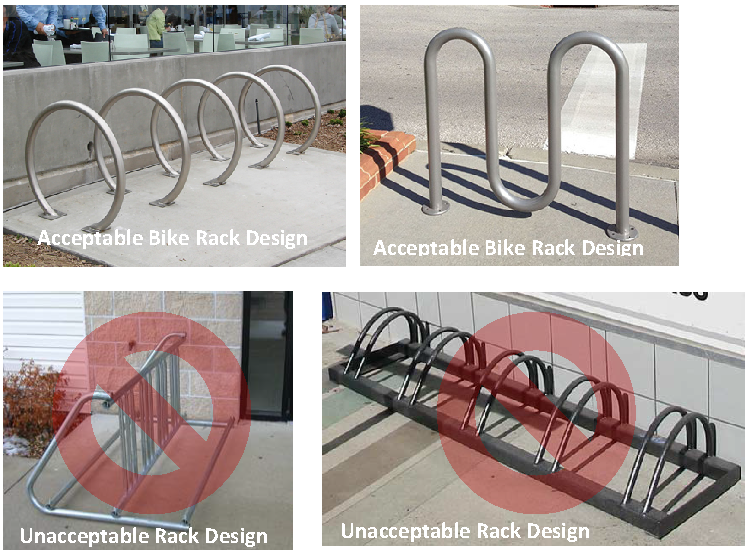
Allow both the bicycle frame and the wheels to be locked with the bicycle in an upright position using a standard U-lock (See figure 12-1A and PCID public space standards for examples of acceptable and preferred designs);
Figure 12-1A: Acceptable Bike Rack Designs
4.
Be designed so as not to cause damage to the bicycle;
5.
Facilitate easy locking without interference from or to adjacent bicycles; and
6.
Have minimum dimensions of two feet in width by six feet in length, with a minimum overhead vertical clearance of seven feet.
(2)
Long-term bicycle parking and storage spaces.
a.
Location. Long-term bicycle parking spaces provided to receive parking credit in accordance with subsection (b) of this section must be provided in at least one of the following locations:
1.
In weather-protected stationary racks or lockers that comply with the short-term bicycle parking location requirements of subsection (c)(1)a.
2.
In a locked room;
3.
In a weather-protected locked area that is enclosed by a fence or wall with a minimum height of seven feet;
4.
In a private garage or private storage space serving an individual dwelling unit within a multi-dwelling (residential) building;
5.
In a weather-protected area within clear view of an attendant or security personnel;
6.
In a weather-protected area continuously monitored by security cameras; or
7.
In a weather-protected area that is visible from employee work areas.
b.
Design. Long-term bicycle parking spaces provided to receive parking credit in accordance with subsection (b) of this section must:
1.
Be covered to provide protection from weather and secured to prevent access by unauthorized persons;
2.
Consist of bike racks or lockers anchored so that they cannot be easily removed;
3.
Be of solid construction, resistant to rust, corrosion, hammers, and saws;
4.
Allow both the bicycle frame and the wheels to be locked with the bicycle in an upright position using a standard U-lock;
5.
Be designed so as not to cause damage to the bicycle;
6.
Facilitate easy locking without interference from or to adjacent bicycles; and
7.
Have minimum dimensions of two feet in width by six feet in length, with a minimum overhead vertical clearance of seven feet. Bicycle lockers are exempt from overhead clearance requirements.
(Ord. No. 2013-10-15, § 1(Exh. A § 27-12.50), 10-14-2013; Ord. No. 2017-04-07, § 4, 4-11-2017)
Sec. 27-206. - Location of off-street parking.
(a)
General. Except as otherwise expressly stated, required off-street parking spaces must be located on the same lot as the building or use they are required to serve.
(b)
Residential districts. The following standards apply in residential districts:
(1)
Parking required in driveway. In R districts, parking is prohibited in street yards except on approved driveways.
(2)
Driveway materials. In R and RA districts, all driveways and parking areas on residential properties must be surfaced and maintained with dust-free, all-weather materials (e.g. concrete, asphalt, or pavers). Porous pavement material may be substituted for standard dust-free pavements subject to approval by the community development director. Eligible porous pavement materials include, but are not limited to, grasscrete, ribbon driveways, and pervious paver systems. Gravel may be substituted for standard driveway materials subject to the standards in section 27-206(b)(3).
(3)
Gravel as driveway material. If gravel is used as a material for driveways and parking areas, the following standards shall be met:
a.
Gravel driveways and parking areas shall be constructed of ¼-inch (minimum diameter) gravel at least four inches in depth. Compaction criteria for both the gravel and subbase shall be per the supplier's recommendations.
b.
Gravel areas shall have a durable border constructed of wood, concrete, brick, or stone, extending a minimum of one inch below the depth of the gravel.
c.
Gravel driveways and parking areas shall be maintained so that no gravel fragment leaves the driveway and parking area.
d.
Driveway aprons shall comply with the city standard details.
(3)
Circular driveways. Circular driveways are allowed only on lots with adequate width to comply with the Institute of Traffic Engineers' geometric design standards. They are subject to any applicable lot coverage regulations.
(4)
RM district parking. In RM districts, parking is prohibited in required street setbacks.
(5)
Commercial vehicles prohibited. Only licensed, operable motorcycles and passenger vehicles not operated as a common or contract carrier for hire may be parked outside of an enclosed building in residential zoning districts. This provision is intended to expressly prohibit the parking of commercial motor vehicles (as defined in O.C.G.A § 40-1-1) outside of an enclosed building, except for the immediate loading or unloading of goods or people. It also expressly prohibits the outdoor parking and outdoor storage of construction equipment such as tractors, skid steers, backhoes, forklifts, cement mixers and similar equipment. This prohibition does not apply to construction staging areas.
(6)
Location of parking for recreational vehicles, trailers, etc. The parking and outdoor storage of trailers, recreational vehicles, travel trailers, campers, pickup coaches, motorized homes, boat trailers, boats and similar vehicles and equipment is prohibited in street yards and within 20 feet of any lot line
(c)
Off-site parking.
(1)
General. Up to 25 percent of the number of off-street parking spaces required for nonresidential uses may be provided off-site, in accordance with the provisions of this section. Off-site parking areas must comply with all applicable parking area design and accessibility standards. Required accessible parking spaces and parking required for residential uses may not be located off site.
(2)
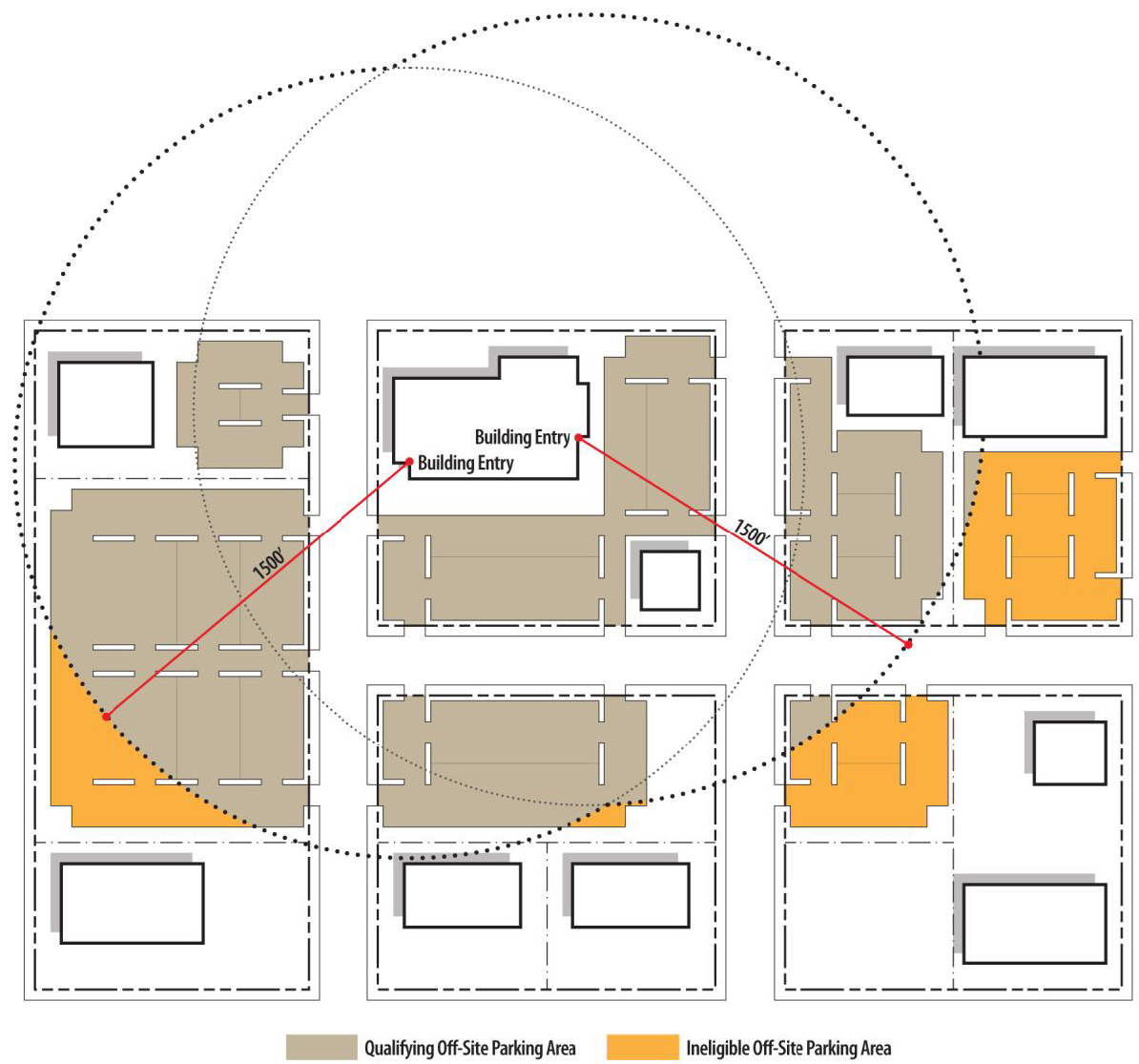
Location. Off-site parking areas must be located within a 1,500-foot radius of the use served by such parking, measured between the entrance of the use to be served and the outer perimeter of the furthest parking space within the off-site parking lot. Off-site parking lots are allowed as of right only in zoning districts that permit either the principal use to be served by the off-site parking spaces or non-accessory parking uses. Off-site parking in other zoning districts requires review and approval of a special use special land use permit in accordance with the procedures of article V, division 3.
Figure 12-1: Off-site Parking, Maximum Distance Measurement
(3)
Control of off-site parking area. The property to be occupied by the off-site parking facilities must be under the same ownership as the lot containing the use to be served by the parking. The off-site parking area may be under separate ownership only if an agreement is provided guaranteeing the long-term availability of the parking, commensurate with the use served by the parking. Off-site parking privileges will continue in effect only as long as the agreement, binding on all parties, remains in force. If an off-site parking agreement lapses or is no longer valid, then parking must be provided as otherwise required by this division.
(Ord. No. 2013-10-15, § 1(Exh. A § 27-12.60), 10-14-2013; Ord. No. 2015-01-05, § 1, 1-26-2015; Ord. No. 2022-08-13, § I, 8-22-2022)
Sec. 27-207. - Use of off-street parking areas.
(a)
Required off-street parking areas may be used solely for the temporary parking of licensed motor vehicles in operating condition.
(b)
Required off-street parking spaces may not be used for the display of goods for sale or lease or for storage of building materials.
(c)
Required off-street parking spaces are intended to serve residents, tenants, patrons, employees, or guests of the principal use. Off-street parking spaces that are required by this zoning ordinance must be maintained for the life of the principal use.
(d)
No motor vehicle repair work of any kind is permitted in a required parking space except within a zoning district that otherwise permits motor vehicle repair.
(Ord. No. 2013-10-15, § 1(Exh. A § 27-12.70), 10-14-2013)
Sec. 27-208. - Parking area design.
(a)
Tandem and valet parking arrangements. Parking areas must be designed and constructed to allow unobstructed movement into and out of required parking spaces without interfering with fixed objects or vehicles except in the case of allowed tandem and valet parking, as follows.
(1)
Tandem parking. Tandem parking spaces may be used to satisfy residential parking requirements if the tandem spaces are assigned to the same dwelling unit.
(2)
Valet parking. Valet parking may be used to satisfy minimum off-street parking requirements for nonresidential uses if an attendant is present during all hours of operation. Valet parking arrangements may involve the stacked parking of vehicles (i.e., requiring one or more vehicles to be moved to obtain access to other parked vehicles). Valet parking is not subject to the maximum 1,500-foot off-site parking limit of subsection 27-206(c)(2).
(b)
Stall sizes and parking lot geometrics.
(1)
Stall size.
a.
Standard spaces. Required parking spaces must have minimum dimensions of 8.5 feet (width) by 18 feet (depth) except as allowed by subsection (b)(1)b. (compact spaces).
b.
Driveway depth. In no case shall any parking space be less than 20 feet in depth as measured from a garage door or wall, to any "public" or shared sidewalk, drive aisle, or street right-of-way.
c.
Compact spaces. In parking lots containing 20 or more required parking spaces, up to 40 percent of the required spaces may be compact car spaces. Compact spaces must have minimum dimensions of eight feet (width) by 15 feet (depth).
(c)
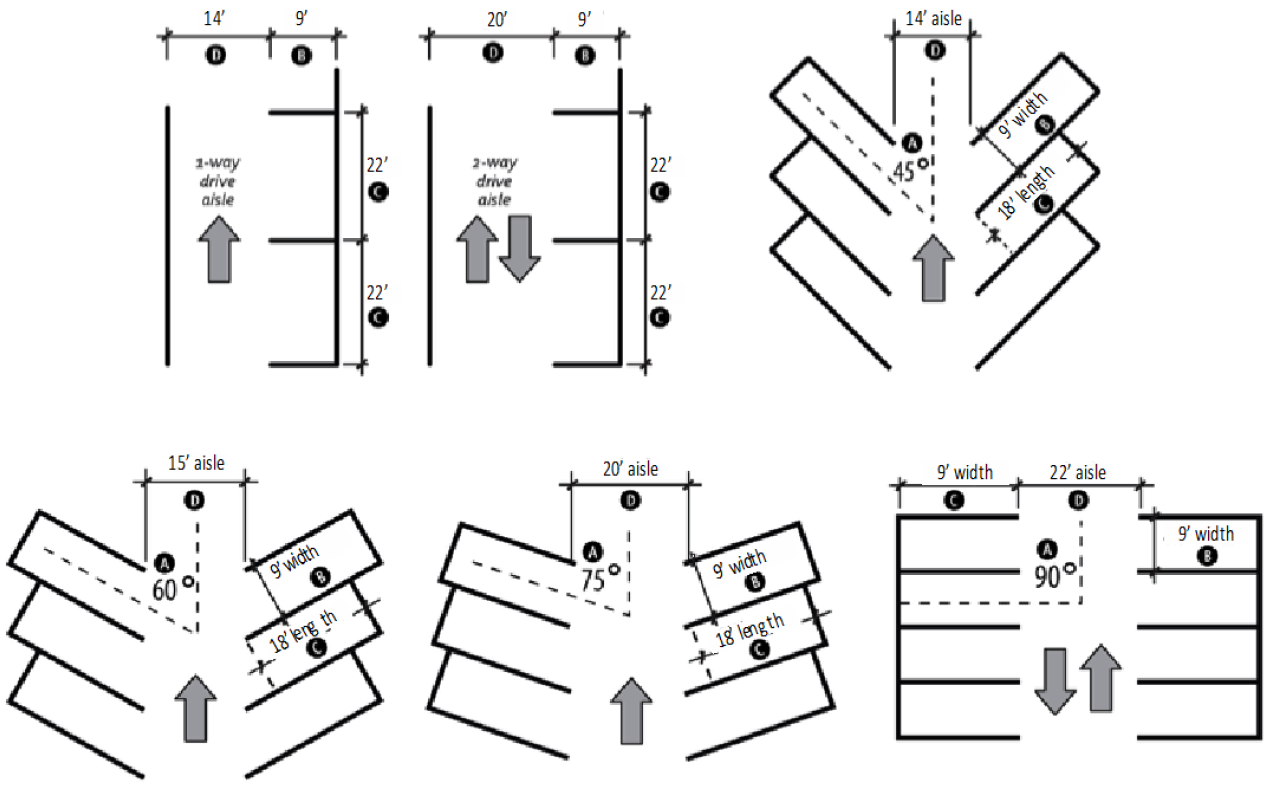
Geometric design. Parking lots must be designed in accordance with the dimensional standards in the following table, which shows minimum dimensions for various parking layouts (angles). Requirements for layouts or angles not shown here may be interpolated from the layouts shown, as approved by the community development director.
A = Stall Angle, B = Stall Width, C = Stall Length, D = Aisle Width (1-way/2-way)
Figure 12-1B: Parking Area Geometrics
(d)
Landscaping. See the parking lot landscaping regulations of sections 27-228 and 27-229.
(Ord. No. 2013-10-15, § 1(Exh. A § 27-12.80), 10-14-2013; Ord. No. 2015-01-05, § 1, 1-26-2015; Ord. No. 2017-04-07, § 4, 4-11-2017)
Sec. 27-209. - Pedestrian circulation.
An on-site circulation system for pedestrian and non-motorized travel must be provided in accordance with the following requirements:
(1)
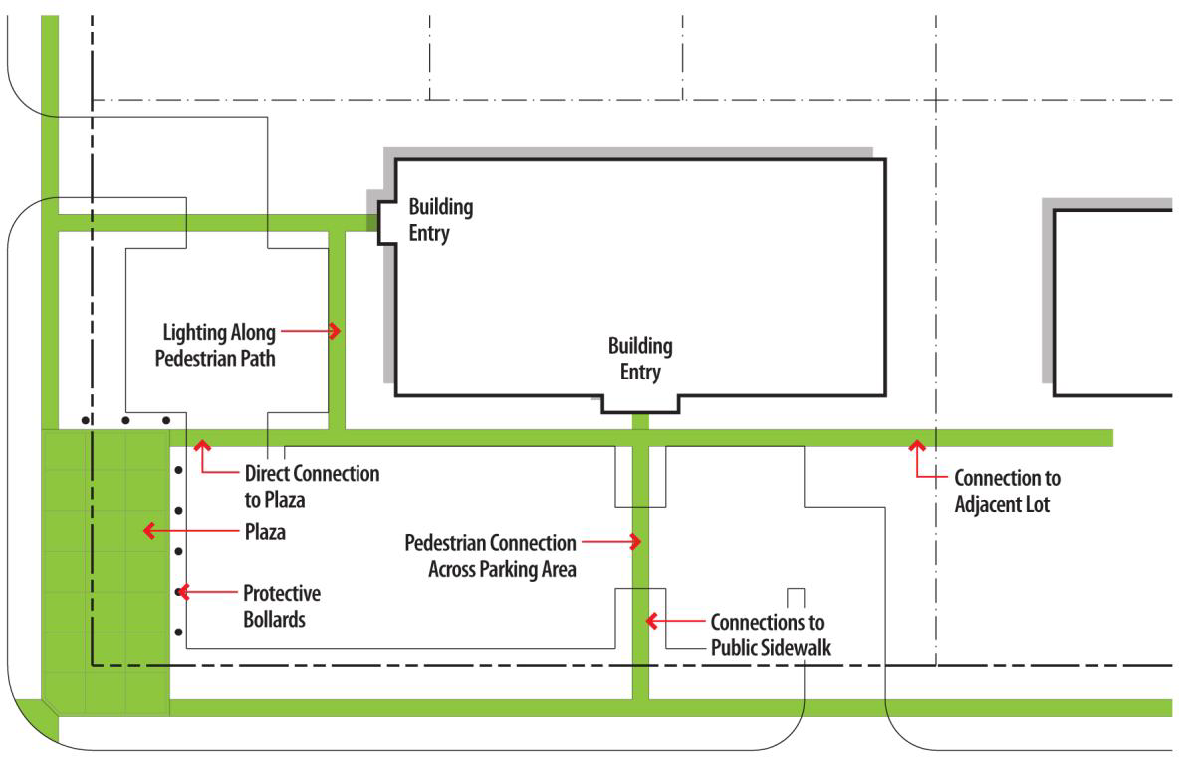
Connection to the street. The on-site pedestrian circulation system must connect all adjacent public rights-of-way to the main building entrance. The connection must follow a direct route and not involve significant out-of-direction travel for system users.
(2)
Connection to abutting properties. The on-site pedestrian circulation system must provide at least one connection to existing paths and sidewalks on abutting properties or to the likely location of future paths or sidewalks on those properties. When the community development director determines that no paths or sidewalks exist on a neighboring property or it is not possible to determine the likely location of future path or sidewalk connections or extending a connection would create a safety hazard on either property, no such connection is required.
(3)
Internal connections. The on-site pedestrian circulation system must connect all buildings on the site and provide connections to other areas of the site likely to be used by pedestrians and non-motorized travel, such as parking areas, bicycle parking, recreational areas, common outdoor areas, plazas and similar amenity features.
Figure 12-2: Pedestrian Connections
(4)
Design. Required on-site pedestrian circulation facilities must be designed and constructed in accordance with the following requirements:
a.
The on-site pedestrian circulation system must be paved and be at least five feet in width.
b.
When the on-site pedestrian circulation system crosses driveways, parking areas or loading areas, it must be clearly differentiated through the use of elevation changes, a different paving material or other equally effective methods. Striping does not meet this requirement.
c.
When the on-site pedestrian circulation system is parallel and adjacent to a motor vehicle travel lane, it must be a raised path at least six inches above the vehicle travel lane surface or be separated from the vehicle travel lane by a raised curb, bollards, landscaping or another physical barrier. If a raised path is used, the ends of the raised portions must be equipped with accessible curb ramps.
d.
The on-site pedestrian circulation system must be illuminated to ensure that it can be used safely at night by employees, residents, and customers. Lighting must be at height appropriate to a pedestrian pathway system.
(Ord. No. 2013-10-15, § 1(Exh. A § 27-12.90), 10-14-2013)
Sec. 27-210. - Accessible parking for people with disabilities.
Accessible parking facilities must be provided in accordance with Georgia law.
(Ord. No. 2013-10-15, § 1(Exh. A § 27-12.100), 10-14-2013)
Sec. 27-211. - Drive-through facilities.
(a)
Purpose. These regulations of this section are intended to help ensure that:
(1)
There is adequate on-site maneuvering and circulation area for vehicles and pedestrians;
(2)
Waiting vehicles do not impede traffic on abutting streets; and
(3)
Impacts on surrounding uses are minimized.
(b)
Applicability.
(1)
The regulations of this section apply to all uses that include all drive-through facilities and to all portions of a development that comprise the drive-through facility. They do not apply to accessory facilities where vehicles do not routinely queue up while waiting for service.
(2)
The regulations apply to new developments, the addition of drive-through facilities to existing developments and the relocation of existing drive-through facilities.
(c)
Stacking spaces required. Stacking lanes must be provided in accordance with the following minimum requirements:
(d)
Stacking lane dimensions, design and layout.
(1)
Stacking lanes must be designed so that they do not interfere with parking movements or safe pedestrian circulation. Stacking spaces must be nine feet wide by 20 feet long.
(2)
All stacking lanes must be clearly identified, through such means as striping, landscaping, pavement design, curbing and/or signs.
(e)
Setbacks. Stacking lanes must be set back at least 50 feet from any abutting residential zoning districts and at least 25 feet from all other lot lines.
(f)
Noise—Drive-through facilities. Speakers associated with drive-through facilities may not be audible from abutting R-zoned lots or abutting lots occupied by residential uses. Sound attenuation walls, landscaping or other mitigation measures may be required to ensure that the facility will not have adverse noise-related impacts on nearby residential uses.
(g)
Site plans. Site plans must show the location of drive-through windows and associated facilities (for example: communications systems and access aisles), as well as adjacent residential uses.
(Ord. No. 2013-10-15, § 1(Exh. A § 27-12.110), 10-14-2013)
Sec. 27-212. - Off-street loading.
(a)
Minimum ratios. Off-street loading spaces must be provided in accordance with the following schedule:
(b)
Design and location.
(1)
Off-street loading spaces must be at least 12 feet in width and 35 feet in length unless off-street loading will involve the use of semi-tractor trailer combinations or other vehicles in excess of 35 feet in length, in which case the minimum size of a loading space is 12 feet by 55 feet. All loading spaces must have a minimum vertical clearance of 14 feet.
(2)
Each loading space must have sufficient maneuvering space on site so as to prevent interference with pedestrian or vehicular circulation on the subject site and on public streets and sidewalks.
(3)
Plans for location, design and layout of all loading spaces must be indicated on required site plans.
(4)
All off-street loading areas must be paved.
(Ord. No. 2013-10-15, § 1(Exh. A § 27-12.120), 10-14-2013)
Sec. 27-226. - General.
(a)
Purpose. The landscaping and screening regulations of this division establish minimum requirements for landscaping and screening. The regulations are intended to advance the general purposes of this ordinance and specifically to:
(1)
Enhance quality of life for residents and visitors;
(2)
Protect property values;
(3)
Enhance the quality and appearance new development and redevelopment projects;
(4)
Mitigate possible adverse impacts of higher intensity land uses abutting lower intensity land uses;
(5)
Promote the preservation, expansion, protection and proper maintenance of existing trees and landscaping;
(6)
Help ensure wise use of water resources;
(7)
Improve air quality;
(8)
Protect water quality and reduce the negative impacts of stormwater runoff by reducing impervious surface area and providing vegetated areas that filter and retain greater amounts of stormwater on site;
(9)
Moderate heat by providing shade;
(10)
Reduce the impacts of noise and glare; and
(11)
Promote sustainable landscape practices including the use of non-invasive native and regionally adaptable plants.
(b)
Applicability. The landscaping and screening regulations of this division apply as set forth in the individual sections of these regulations.
(c)
General exemption. Unless otherwise expressly stated, the landscaping and screening regulations of this division do not apply to the construction or expansion of individual detached houses.
(Ord. No. 2013-10-15, § 1(Exh. A § 27-13.10), 10-14-2013)
Sec. 27-227. - General landscaping of yards and open areas.
On all lots, required setback areas and areas that are not allowed to be covered (in accordance with lot coverage requirements) must be landscaped.
(Ord. No. 2013-10-15, § 1(Exh. A § 27-13.20), 10-14-2013)
Sec. 27-228. - Parking lot interior landscaping.
(a)
Applicability. The parking lot interior landscaping regulations of this section apply to all of the following:
(1)
The construction or installation of any new surface parking lot containing eight or more parking spaces; and
(2)
The expansion of any existing surface parking lot if the expansion would result in eight or more new parking spaces, in which case the requirements of this section apply only to the expanded area.
(b)
Exemptions. Installation of parking lot interior landscaping is not required beneath canopies or other structures that block sunlight or rainfall.
(c)
Options. Landscaping must be provided in the interior of parking lots in the form of landscape islands or a combination of landscape islands and landscape medians, at the option of the property owner. The two options for satisfying parking lot interior landscaping requirements are as follows:
(1)
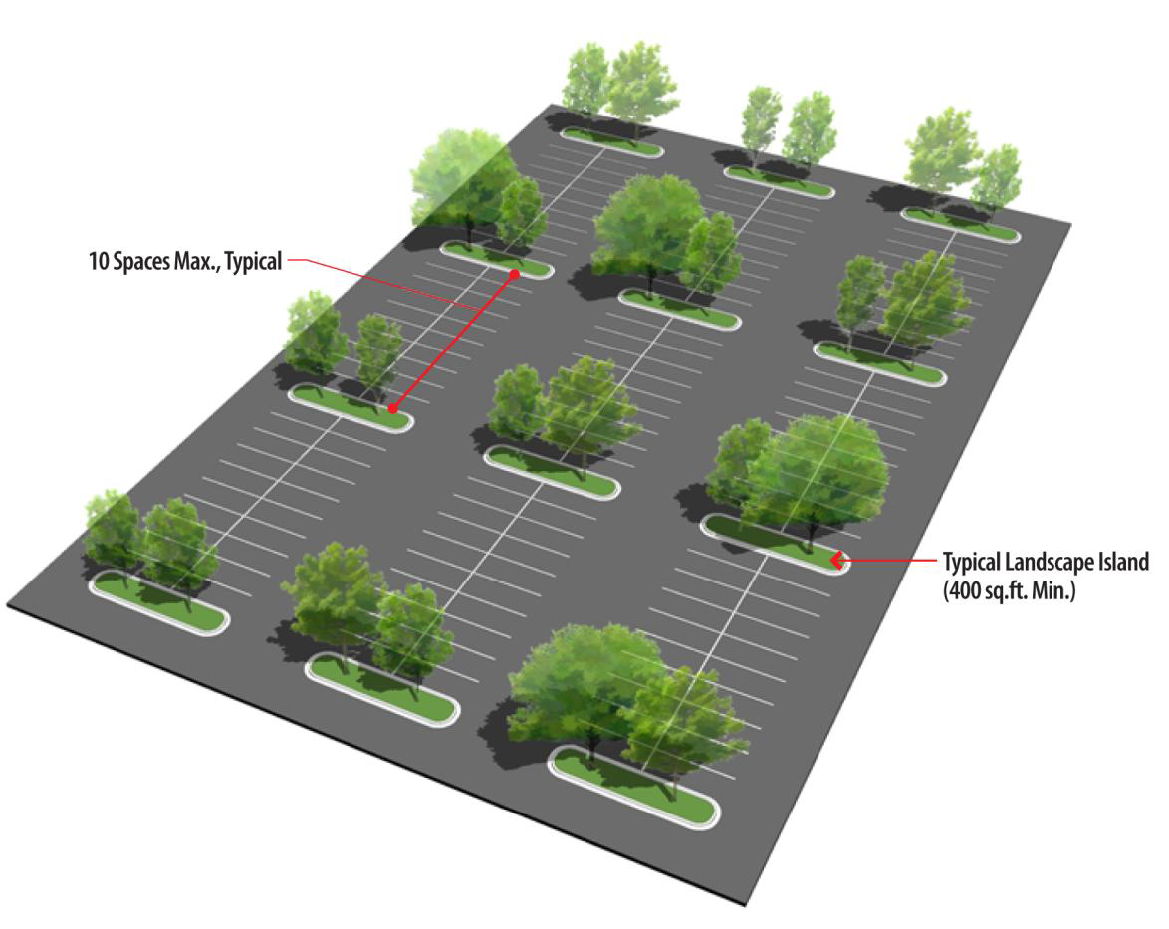
Landscape islands (option 1). Under option 1, landscape terminal islands (end caps) must be provided at the end of each row of parking spaces and interior landscape islands must be provided within each row of parking spaces so that the distance between islands is no greater than ten parking spaces. Under option 1, all landscape islands must have a minimum pervious area of 400 square feet, except when only a single row of parking spaces is provided, the minimum pervious area requirement is 200 square feet.
Figure 13-1: Landscape Islands (Option 1)
(2)
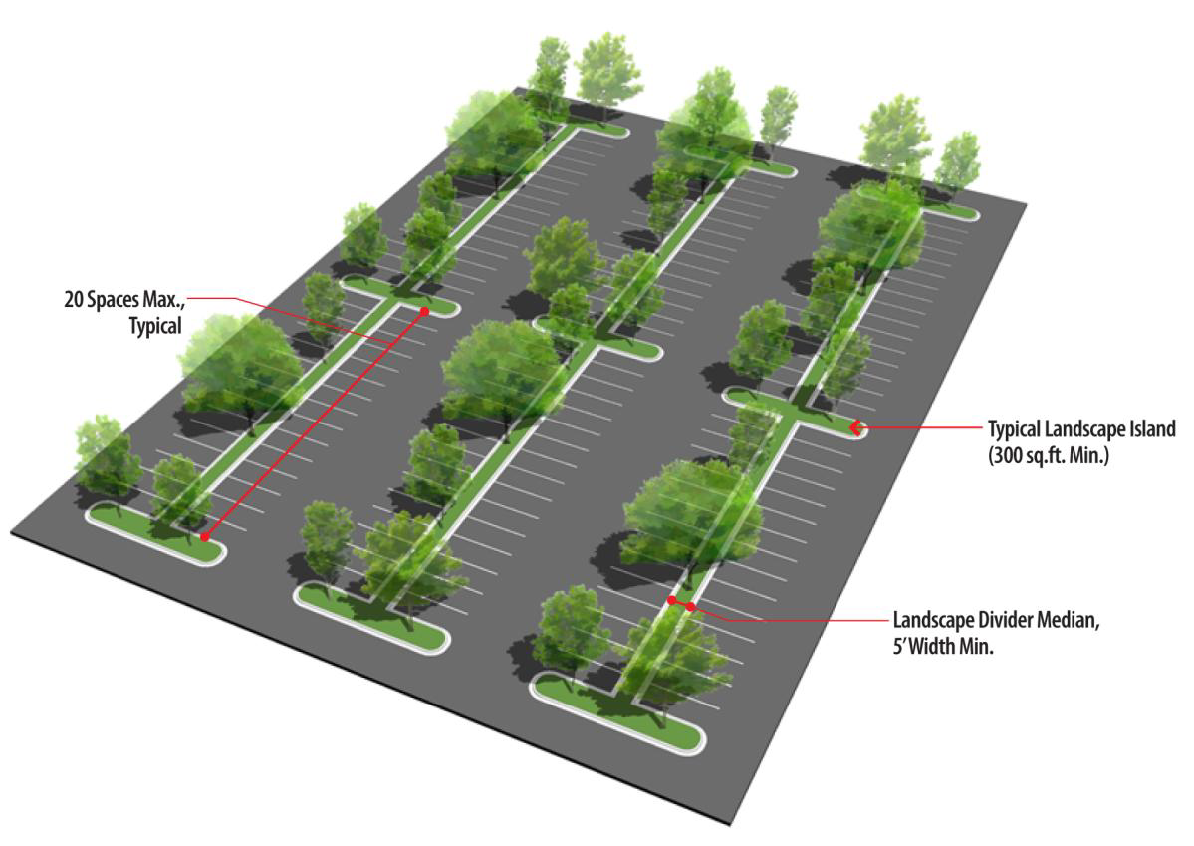
Landscape islands and medians (option 2). Under option 2, landscape terminal islands (end caps) must be provided at the end of each row of parking spaces and interior landscape islands must be provided within each row of parking spaces so that the distance between islands is no greater than 20 parking spaces. A landscape divider median with a minimum width of five feet must run continuously between landscape islands and include at least one canopy tree per 30 linear feet of median length. Under option 2, all landscape islands must have a minimum pervious area of 300 square feet except when only a single row of parking spaces is provided, the minimum pervious area requirement is 150 square feet.
Figure 13-2: Landscape Islands (Option 2)
(d)
Plant material.
(1)
Landscape islands abutting a single row of parking spaces must include at least one canopy tree.
(2)
Landscape islands abutting a double row of parking spaces must include at least two canopy trees.
(3)
Shrubs must be provided in landscape islands and divider medians at a rate of four shrubs per required canopy tree.
(4)
Ground cover must be used in areas not covered by trees and shrubs. Turf grass may not be used in landscape islands or divider medians.
(5)
Landscaping within parking lots may not exceed three feet in height, with the exception of trees.
(e)
Landscape materials and design. Parking lot interior landscaping is subject to the regulations of section 27-233.
(Ord. No. 2013-10-15, § 1(Exh. A § 27-13.30), 10-14-2013)
Sec. 27-229. - Parking lot perimeter landscaping.
(a)
Applicability. The parking lot perimeter landscaping regulations of this section apply to all of the following:
(1)
The construction or installation of any new surface parking lot or vehicular use area that is adjacent to street right-of-way; and
(2)
The expansion of any existing surface parking lot or vehicular use area that is adjacent to street right-of-way, in which case the requirements of this section apply only to the expanded area.
(b)
Exemptions. Installation of parking lot perimeter landscaping is not required when the parking lot or vehicular use area is not visible from adjacent street right-of-way, as determined by the city arborist.
(c)
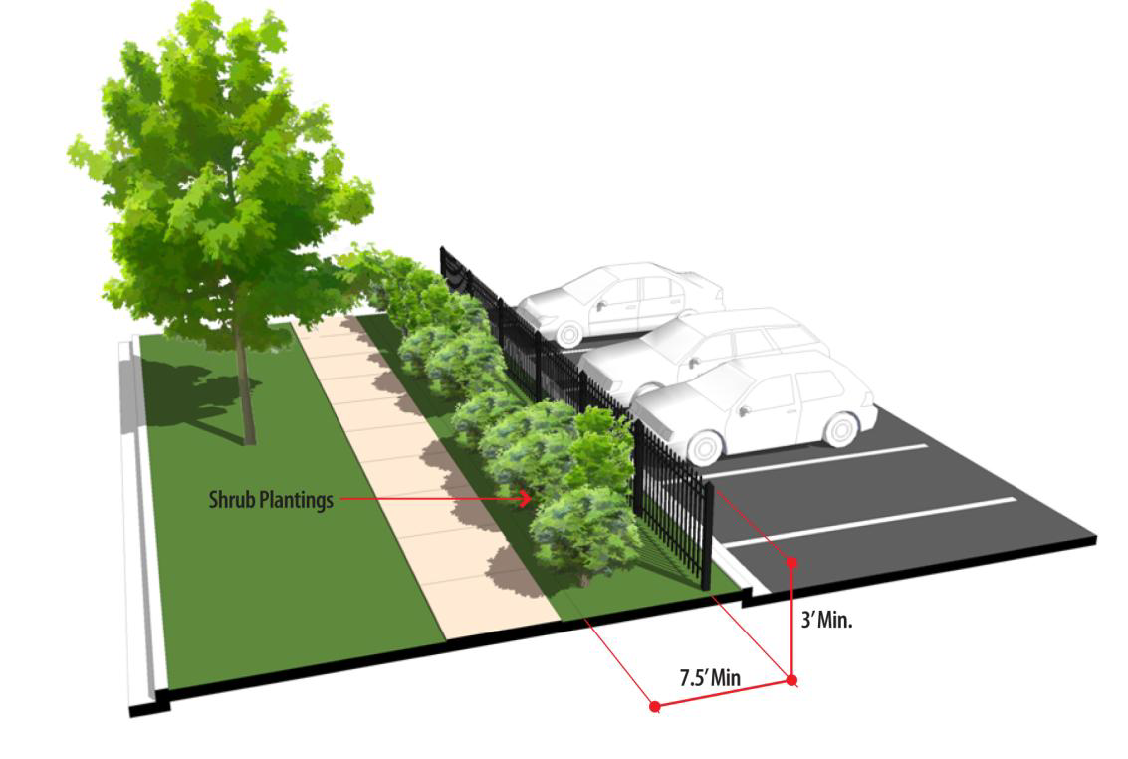
Requirements. Parking lot perimeter landscaping must be provided in the form of a landscape strip with a minimum depth of 7.5 feet that includes a hedge, dense shrub planting, masonry wall or combination of such features that results in a continuous visual screen to a height of at least three feet above the grade of the parking lot (or vehicular use area) along the length its frontage.
Figure 13-3: Parking Lot Perimeter Landscaping
(d)
Plant material. Shrubs used to satisfy parking lot perimeter landscaping requirements must be provided at a rate of 30 shrubs per 100 feet of parking lot (or vehicular use area) frontage.
(e)
Landscape materials and design. Parking lot perimeter landscaping is subject to the regulations of section 27-233.
(Ord. No. 2013-10-15, § 1(Exh. A § 27-13.40), 10-14-2013)
Sec. 27-230. - Transition yards.
(a)
Applicability. The transition yard landscaping regulations of this section apply along interior property lines in those instances expressly identified in this zoning ordinance and only to the following activities:
(1)
The construction or installation of any new principal building or principal use; and
(2)
The expansion of any existing principal building or principal use that increases gross floor area or impervious surface area by more than 25 percent or 1,000 square feet, whichever is greater. In the case of expansions triggering transition yard requirements, the transition yard must be placed to provide reasonable screening and buffering of areas visually impacted by the proposed expansion, as determined by the community development director.
(b)
Transition yard types.
(1)
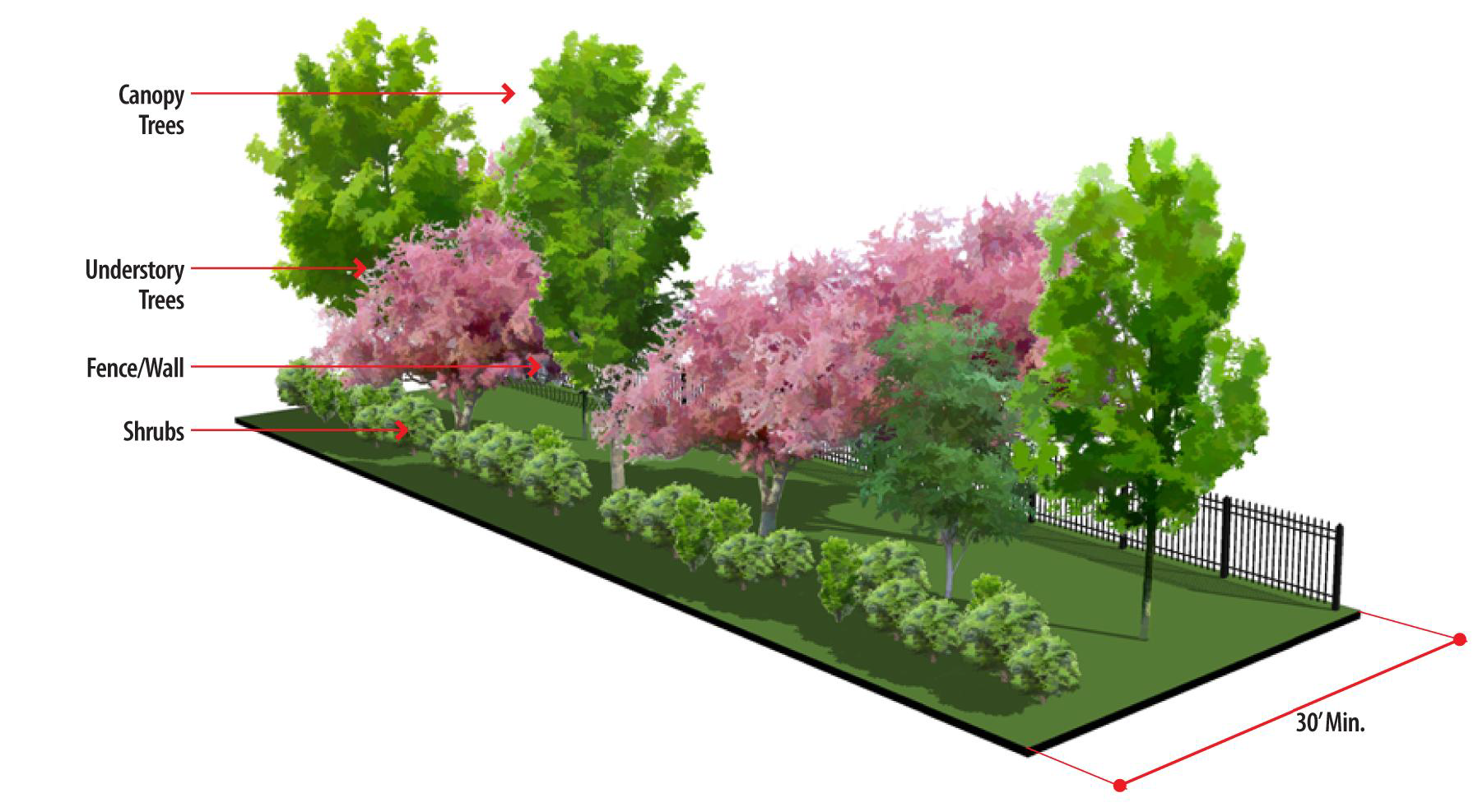
Four transition yard types are established in recognition of the different contexts that may exist. They are as follows:
[1] Yard widths calculated on the basis of average per 100 feet, provided that the yard width at any point may not be less than 50 percent of the minimums stated in the table. Required zoning district setbacks may be counted toward satisfying transition yard widths.
[2] TY2 transition yard must include either (a) a fence/wall or (b) shrubs meeting the minimum requirements of this table.
Figure 13-4: Transition Yard 1 (TY1)
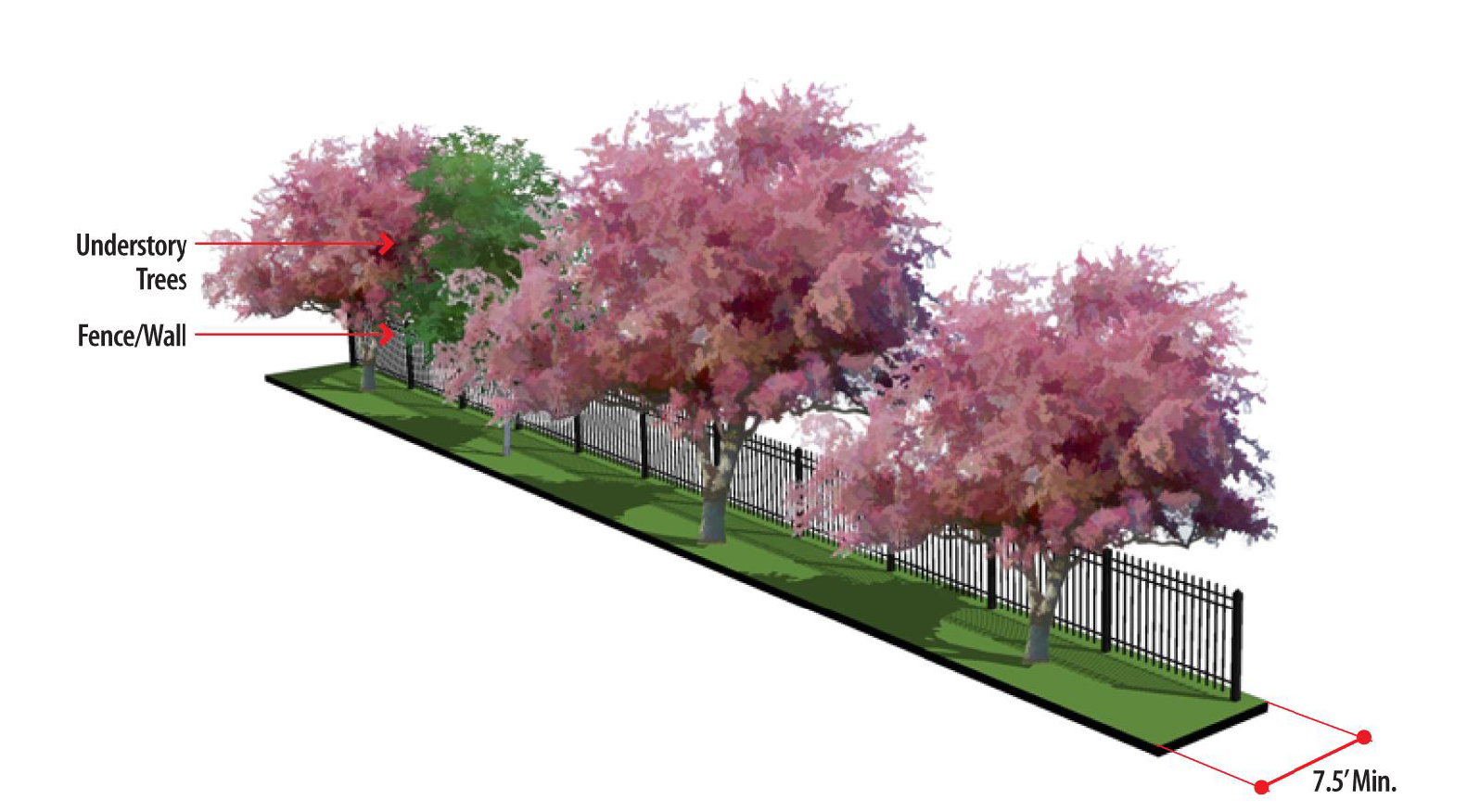
Figure 13-5: Transition Yard 2 (TY2)
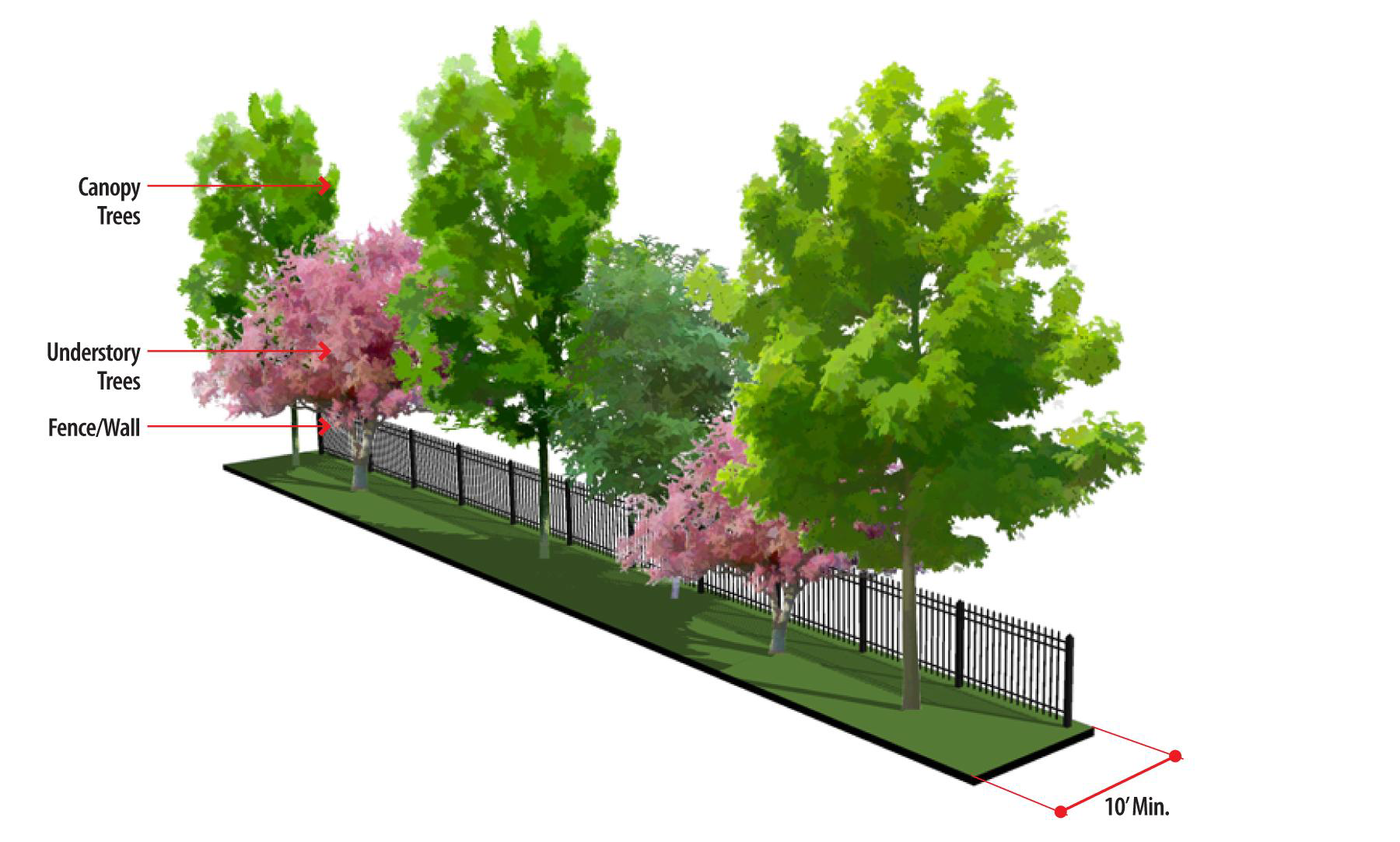
Figure 13-6: Transition Yard 3 (TY3)
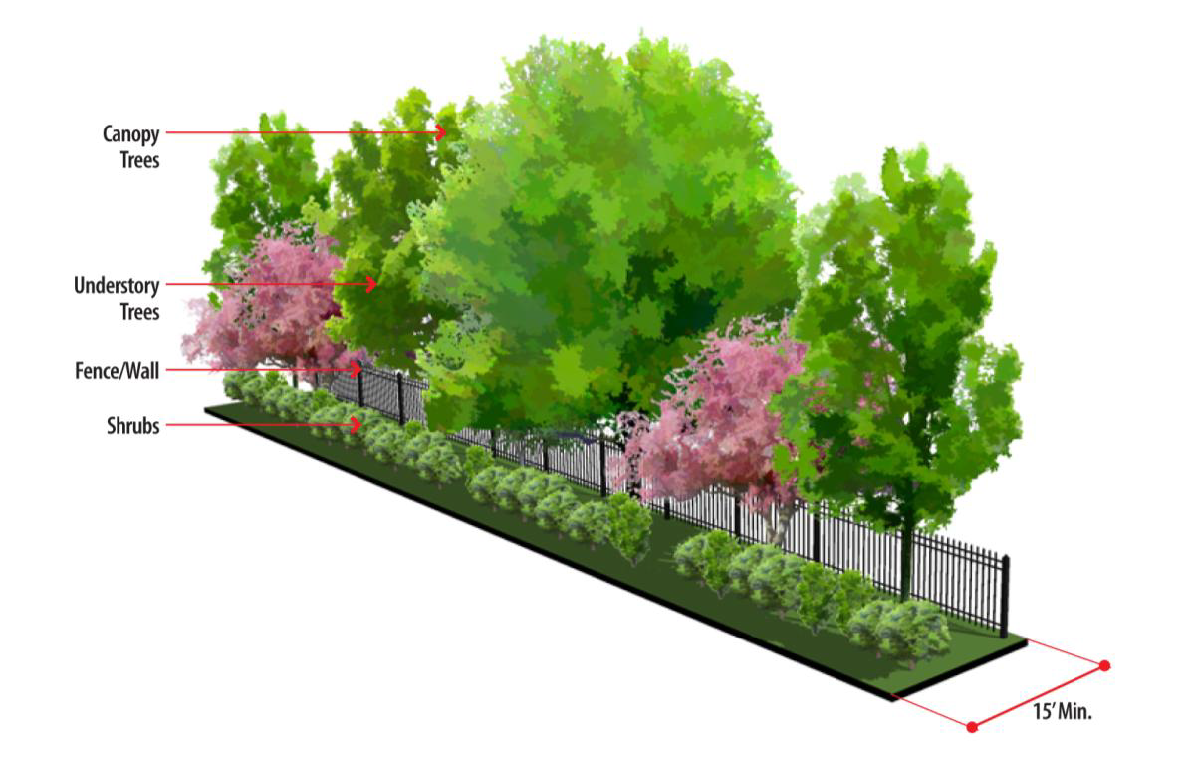
Figure 13-7: Transition Yard 4 (TY4)
(2)
Transition yard requirements are minimum regulations. Property owners who are subject to transition yard requirements may elect to provide a higher level transition yard.
(3)
The city arborist is authorized to count existing vegetation and structural elements as satisfying all or part of transition yard requirements upon determining that such existing vegetation and structural elements meet the overall intent of these landscaping and screening regulations.
(4)
No buildings or parking areas may be located in required transition yards. Breaks for motorized and non-motorized transportation access are allowed.
(c)
Zoning district transition yards. Transition yards are required between zoning districts in accordance with the following minimum requirements.
(d)
Landscape materials and design. Trees species must be selected from the city's approved street tree list, which is available in the community development department; alternative cultivars may be approved on a case-by-case basis with the approval of the city arborist. Transition yard landscaping is subject to the regulations of section 27-233.
(Ord. No. 2013-10-15, § 1(Exh. A § 27-13.50), 10-14-2013; Ord. No. 2017-04-07, § 4, 4-11-2017; Ord. No. 2020-11-23, Exh. B, 11-30-2020)
Sec. 27-231. - Screening.
(a)
Features to be screened. The following features must be screened from view of public rights-of-way, public open spaces and from lots used or zoned for residential purposes, as specified in this section.
(1)
Ground-mounted mechanical equipment.
(2)
Roof-mounted mechanical equipment.
(3)
Refuse/recycling containers.
(4)
Outdoor storage of materials, supplies and equipment.
(b)
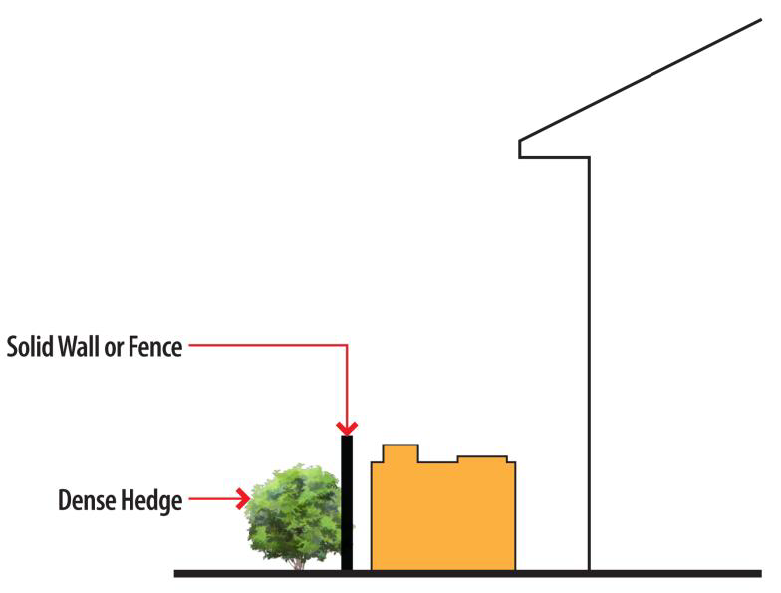
Ground-mounted mechanical equipment. Ground-mounted mechanical equipment over 30 inches in height may not be placed within a required street yard setback and must be screened from view by a solid fence, solid wall, dense hedge, or combination of such features. The hedge, fence or wall must be tall enough to screen the equipment ([see] Figure 13-8).
Figure 13-8: Screening of Ground-mounted Mechanical Equipment
(c)
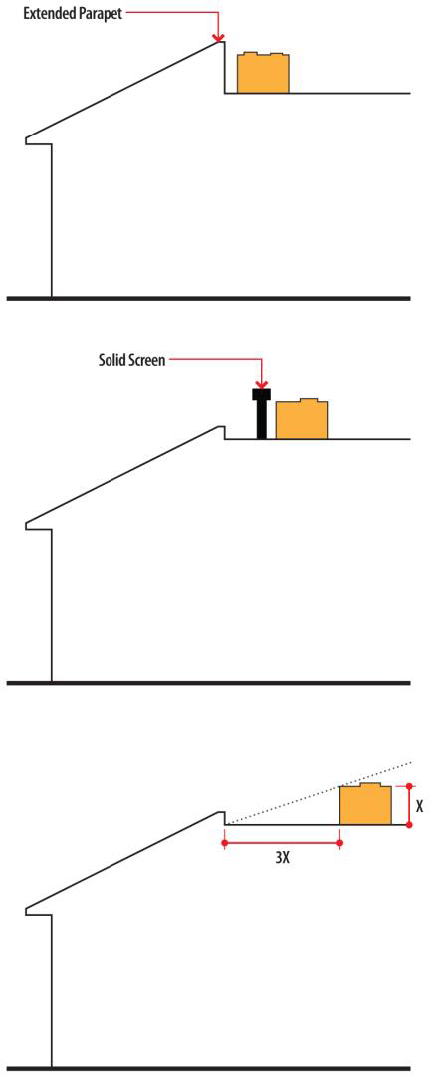
Roof-mounted mechanical equipment. Roof-mounted mechanical equipment (e.g., air conditioning, heating, cooling, ventilation, exhaust and similar equipment, but not solar panels, wind energy or similar renewable energy devices) shall be screened in all directions by walls or parapets equal in height, or taller than, the mechanical equipment (see Figure 13-9).
Figure 13-9: Screening of Roof-mounted Mechanical Equipment
(d)
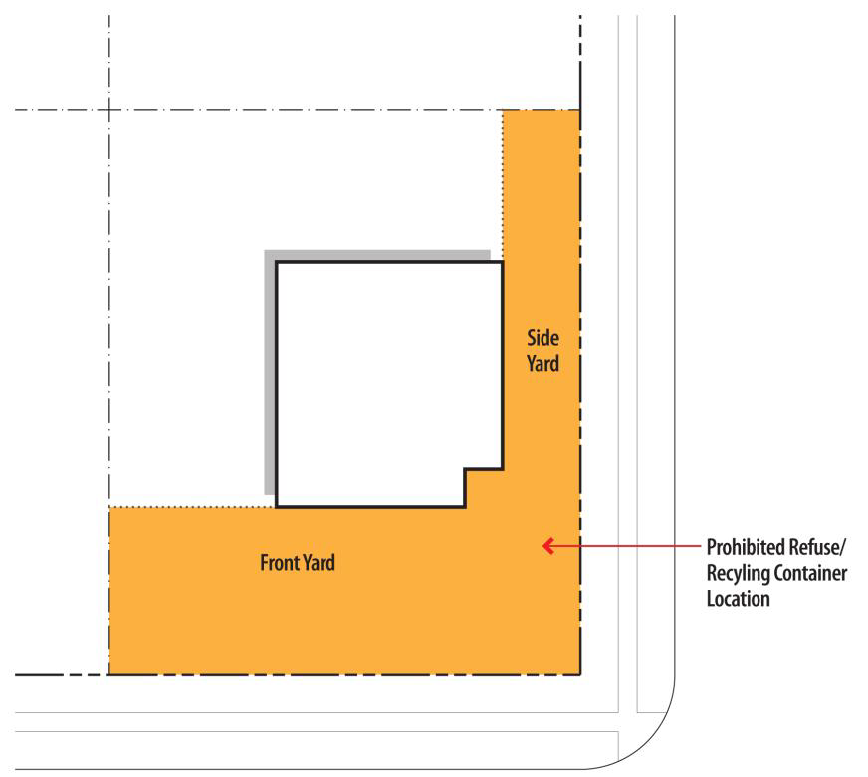
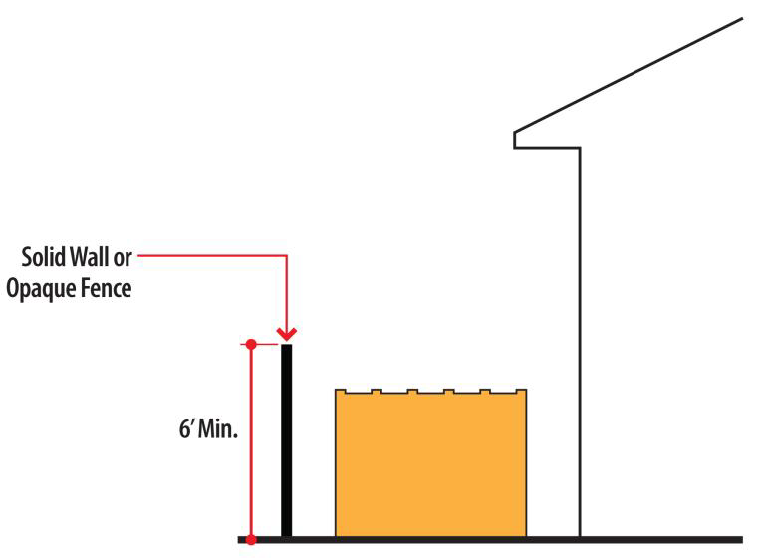
Refuse/recycling containers. Refuse/recycling containers must be screened from view of streets and all abutting lots with a solid wall or opaque fence at least six feet in height. Refuse/recycling containers may not be located in front or street side setbacks.
Figure 13-10: Location and Screening of Refuse/Recycling Containers
(e)
Outdoor storage of materials, supplies and equipment. All stored materials, supplies, merchandise, vehicles, equipment, or other similar materials not on display for direct sale, rental or lease to the ultimate consumer or user must be screened by a fence, wall, dense hedge, or combination of such features with a minimum height of six feet at the time of installation.
(f)
Landscape materials and design. Landscape material used to satisfying the screening requirements of this section are subject to the regulations of section 27-233.
(g)
A request to waive or modify the screening requirements for roof-mounted mechanical equipment may be submitted as a design review application to the design review advisory committee according to article V, division 4, design review. The design review advisory committee shall make a recommendation to the community development director who is then authorized to approve, approve with conditions, or deny the application for alternative screening.
(Ord. No. 2013-10-15, § 1(Exh. A § 27-13.60), 10-14-2013; Ord. No. 2015-01-05, § 1, 1-26-2015)
Sec. 27-232. - Landscape plans.
All applications for development permit activities that are subject to the landscape and screening regulations of this division must be accompanied by a separate landscape plan that has been prepared and sealed by a Georgia-registered landscape architect, certified arborist or registered forester. No certificate of occupancy or similar authorization may be issued unless city arborist determines that the landscaping regulations of this division have been met.
(Ord. No. 2013-10-15, § 1(Exh. A § 27-13.70), 10-14-2013)
Sec. 27-233. - Landscape material and design.
(a)
Landscaping with required landscape areas. Required landscaped areas must be covered with biodegradable mulch and ground cover plants.
(b)
Existing trees and vegetation. Existing non-invasive trees and shrubs count toward satisfying the landscaping and screening regulations of this division if they are located within the subject area and they comply with the plant height and size requirements of this section.
(c)
Plant selection.
(1)
Trees and plants selected for required landscape areas must be well-suited to the microclimate and on-site soil conditions.
(2)
Trees and plant material must comply with the specifications found in American Standards for Nursery Stock (ANSI).
(3)
Invasive species may not be used to meet landscape requirements.
(4)
If more than 30 trees will be used, a mixture of three or more tree species must be used. If more than 50 shrubs will be used, a mixture of three or more shrub species must be used.
(5)
All plant materials are subject to the approval of the city arborist.
(d)
Trees.
(1)
Deciduous. Deciduous trees used to satisfy the requirements of this division must be drought-tolerant, have a minimum caliper size of three inches (measured six inches above the root ball) and a minimum height of ten feet.
(2)
Evergreen. Evergreen trees used to satisfy the requirements of this division must be drought-tolerant and have a minimum height of six feet at time of planting.
(e)
Shrubs and ornamental grasses. Shrubs and ornamental grasses used to satisfy the requirements of this division must [be] a minimum one-gallon size.
(f)
Groundcover plants. Groundcover plants are deciduous or evergreen plants that grow low and spread horizontally, not including turf. Groundcover plants used to satisfy the requirements of this division must be at least one-gallon size.
(g)
Mulch. All required trees and shrubs must be located within a (biodegradable) mulched area.
(h)
Curbs and vehicle barriers. Landscaped areas in or abutting parking lots must be protected by concrete curbing, anchored wheel stops, or other durable barriers approved by the city arborist. Alternative barrier designs that provide improved infiltration or storage of stormwater are encouraged. Curbs protecting landscape areas may be perforated, have gaps or otherwise be designed to allow stormwater runoff to pass through them.
(i)
Installation.
(1)
All landscaping must be installed in a sound workmanlike manner and in accordance with accepted good landscape planting procedures.
(2)
Newly planted trees may not be staked or guyed unless they are unable to stand upright without support. Any staking and guying materials must be removed within one year of installation.
(3)
If the landscape design incorporates plants that require seasonal watering, an automatic irrigation system must be provided to maintain the landscaping in healthy, attractive condition.
a.
Preserved trees, shrubs, and native plant communities are not required to be irrigated, unless directed by the city arborist.
b.
Drip irrigation systems must be installed in areas planted with trees, shrubs, perennials and groundcovers. The city arborist may approve an alternate comparable system if it provides irrigation at the ground level rather than an upright spray.
c.
Turf grass areas must be irrigated on a different zone than trees, shrubs, perennials and groundcovers.
d.
Moisture sensor and/or rain gauge equipment is required on automatic irrigation systems to avoid irrigation during periods of sufficient rainfall.
e.
No significant irrigation overthrow is permitted onto impervious surfaces.
f.
A watering schedule shall be submitted as part of the landscape plan. The schedule shall indicate the different irrigation zones and the frequency and amount of irrigation. Landscape plans must identify methods that will be employed to promote resource-efficient landscaping for the conservation of water and other natural resources, such as:
1.
Practical turf areas;
2.
Use of water-conserving plant material;
3.
Grouping of plants with similar water requirements;
4.
Installation of pervious paving to encourage groundwater recharge and re-use and to discourage run-off;
5.
Rainwater harvesting techniques;
6.
Use of mulches;
7.
Use of soil amendments based on soil analysis;
8.
Use of reclaimed water, and
9.
Other practices and techniques.
(j)
Maintenance. The property owner, occupant, tenant and respective agent of each, if any, are jointly and severally responsible for the maintenance and protection of all required landscaping in perpetuity, in accordance with the following regulations:
(1)
Landscaping must be kept reasonably free of visible signs of insects and disease and appropriately irrigated to enable landscaping to exist in a healthy growing condition;
(2)
Landscaping must be mowed or trimmed in a manner and at a frequency appropriate to the use made of the material and species on the site so as not to detract from the appearance of the general area. Growth of plant material at maturity must be considered where future conflicts such as view, signage, street lighting, utilities and circulation might arise;
(3)
All landscaping must be maintained to minimize property damage and public safety hazards, including removal of dead or decaying plant material, and removal of low-hanging branches next to sidewalks and walkways obstructing street lighting; and
(4)
All pruning must be done in accordance with ANSI A300 (part 1) "Standards for Tree Care Operations-Pruning." Tree topping is prohibited. Crown reduction pruning may be used instead to reduce the height of a tree when necessary. Topped trees may not be counted toward tree planting requirements.
(5)
The property owner must post a maintenance bond or cash escrow prior to issuance of a certificate of occupancy guaranteeing all landscape materials and work for a period of two years. The bond or escrow must be for at least 115 percent of the estimated cost of replacing all required landscaping. An itemized estimate must be provided by the owner and based on the opinion of a landscape contractor and found to be reasonable by the city arborist. The city arborist must make an inspection and notify the owner of any corrections to be made within the two-year guarantee period.
(Ord. No. 2013-10-15, § 1(Exh. A § 27-13.80), 10-14-2013)
Sec. 27-234. - Alternative compliance.
In order to encourage creativity in landscape and screening design and to allow for flexibility in addressing atypical, site-specific development/redevelopment challenges, the city arborist is authorized to approve alternative compliance landscape plans when the city arborist determines that one or more of the following conditions are present:
(1)
The site has space limitations or an unusual shape that makes strict compliance impossible or impractical;
(2)
Conditions on or adjacent to the site such as topography, soils, vegetation or existing structures or utilities are such that strict compliance is impossible, impractical or of no value in terms of advancing the general purposes of this division;
(3)
Safety considerations such as intersection visibility, utility locations, etc., make alternative compliance necessary; or
(4)
Creative, alternative landscape plans will provide an equal or better means of meeting the intent of the landscaping and screening regulations of this division.
(Ord. No. 2013-10-15, § 1(Exh. A § 27-13.90), 10-14-2013)
Sec. 27-246. - Purpose.
The regulations of this division are intended to:
(1)
Permit reasonable uses of outdoor lighting for nighttime safety, utility, security, productivity, enjoyment and commerce;
(2)
Curtail and reverse the degradation of the nighttime visual environment and the night sky;
(3)
Preserve the dark night sky for astronomy;
(4)
Minimize glare, obtrusive light and artificial sky glow by limiting outdoor lighting that is misdirected, excessive or unnecessary;
(5)
Conserve energy and resources to the greatest extent possible; and
(6)
Help protect the natural environment from the damaging effects of night lighting from human-made sources.
(Ord. No. 2013-10-15, § 1(Exh. A § 27-14.10), 10-14-2013)
Sec. 27-247. - Conformance with applicable regulations.
All outdoor lighting devices must comply with the provisions of this division, the building code and the electrical code, required permits and inspections, as applicable.
(Ord. No. 2013-10-15, § 1(Exh. A § 27-14.20), 10-14-2013)
Sec. 27-248. - Prohibited lighting.
The following are expressly prohibited:
(1)
Aerial lasers;
(2)
Searchlight style lights;
(3)
Light sources that exceed 200,000 lumens or intensity in any direction of 2,000,000 candelas or more;
(4)
Mercury vapor lamps;
(5)
Low-sodium vapor lamps; and
(6)
Exposed neon lighting.
(Ord. No. 2013-10-15, § 1(Exh. A § 27-14.30), 10-14-2013)
Sec. 27-249. - Exempt lighting.
The following luminaries and lighting systems are expressly exempt from the regulations of this division:
(1)
Underwater lighting used for the illumination of swimming pools and fountains;
(2)
Temporary holiday lighting;
(3)
Lighting required and regulated by the Federal Aviation Administration, or other authorized federal, state or local government agency;
(4)
Emergency lighting used by police, fire, or medical personnel, or at their direction;
(5)
All outdoor light fixtures producing light directly from the combustion of fossil fuels, such as kerosene and gasoline;
(6)
Security lighting controlled and activated by a motion sensor device for a duration of ten minutes or less.
(Ord. No. 2013-10-15, § 1(Exh. A § 27-14.40), 10-14-2013)
Sec. 27-250. - Regulations.
(a)
Applicability.
(1)
The regulations of this section apply:
a.
To all new land uses, new developments and new buildings that require a permit;
b.
Whenever existing land uses, developments or buildings are expanded by 25 percent or more in terms of additional dwelling units, parking spaces or gross floor area, in which case the entire property must be brought into conformance with these regulations; and
c.
whenever existing outdoor lighting constituting 60 percent or more of the permitted lumens for the parcel is modified or replaced, no matter the actual amount of lighting already on the site.
(2)
When existing developments or buildings are expanded by less than 25 percent in terms of additional dwelling units, parking spaces or gross floor area and the expansion requires a permit, the applicant must submit a complete inventory and site plan detailing all existing and any proposed new outdoor lighting. Any new lighting on the site must comply with the shielding and lamp type regulations of this division.
(b)
General regulations.
(1)
Outdoor lighting fixtures must be full cutoff and placed so as to allow no light above the horizontal as measured at the luminaire, except as herein noted in this section (as in the case of period fixtures, cutoff fixtures may be used) and except as allowed in chapter 20 of the Municipal Code (signs).
(2)
Outdoor lighting fixtures must be located, aimed or shielded to minimize glare and stray light trespassing across lot lines and into the public right-of-way.
(3)
Flood or spot lamps must be positioned no higher than 45 degrees above straight down (half-way between the vertical and the horizontal) when the source is visible from any off-site residential property or public roadway.
(4)
All light fixtures that are required to be shielded shall be installed and maintained in such a manner that the shielding is effective as described herein for fully shielded fixtures.
(5)
Lighting on sites consisting of multiple uses must conform to the standards of the respective uses.
(6)
Illumination levels are measured from any height and orientation of the measuring device at any location along the property line except the lighting of parking lots must be measured at grade with the meter sensor held horizontally at the surface.
(7)
Color temperature of outdoor lighting fixtures must not exceed 3,000K at the light source except at outdoor sports, recreation fields and performance areas.
(c)
Specific uses and activities. This subsection establishes supplemental lighting regulations for specific types of uses and activities. All lighting not directly associated with the special use areas designated below must comply with all other applicable regulations of this division.
(1)
Outdoor sports, recreation fields and performance areas. Lighting of outdoor recreational facilities (public or private), such as, but not limited to, outdoor athletic fields, courts, tracks, special event or show areas must comply with the following regulations:
a.
Facilities designed for municipal leagues, elementary to high school levels of play and training fields for recreational or social levels of play, college play, semi-professional, professional or national levels of play must utilize luminaries with minimal uplight consistent with the illumination constraints of the design. Where fully shielded fixtures are not utilized, acceptable luminaries include only those that:
1.
Are provided with internal and/or external glare control louvers or lenses, and are installed so as to minimize uplight and offsite light trespass and glare, and
2.
All lighting installations must be designed to achieve the illuminance levels for the activity as recommended by the Illuminating Engineering Society of North America (IESNA RP-6).
E1 = Areas with intrinsically dark landscapes, such as national parks, areas of outstanding natural beauty, etc.
E2 = Areas of low ambient brightness, including sensitive residential areas.
E3 = Areas of medium ambient brightness, generally being urban residential areas.
E4 = Areas of high ambient brightness, which would include dense urban areas with mixed residential and commercial use with high levels of nighttime activity.
b.
All events must be scheduled so as to complete all activity no later than 10:30 p.m. Illumination of the playing field, court or track is permitted after the curfew only to conclude a scheduled event that was unable to conclude before the curfew due to unusual circumstances. Field lighting for these facilities must be turned off within 30 minutes of completion of the last event of the night.
c.
All light poles must be set back a minimum 60 feet from any residential property line or right-of-way.
(2)
Service station canopies and parking garages.
a.
All luminaries mounted on or recessed into the lower surface or service station canopies and parking structures must be fully shielded and utilize flat lenses.
b.
The total light output of luminaries mounted on the lower surface, or recessed into the lower surface of the canopy, and any lighting within signage or illuminated panels over the pumps, may not exceed 50 footcandles. The total light output of other illuminated areas of a service station may not exceed 15 footcandles.
c.
Illuminance levels for the interior of parking structures, where interior lighting is visible from outside the structure, must conform to IESNA recommendation RP-20.
d.
Lights may not be mounted on the top or sides of a canopy, and the sides of the canopy may not be illuminated.
(3)
Security lighting.
a.
Security lighting must be directed towards the targeted area.
b.
Sensor activated lighting must be located in such a manner as to prevent direct glare and lighting into properties of others or into a public right-of-way, and the system must be designed and maintained so that lights are not activated by activity off of the subject property.
(4)
Pedestrian path lighting. Lighting posts for pedestrian path lighting may not exceed 16 feet in height from finished grade.
(5)
Architectural accent lighting.
a.
Fixtures used to accent architectural features, materials, colors, style of buildings, landscaping, or art must be located, aimed and shielded so that light is directed only on those features. Such fixtures must be aimed or shielded to minimize light spill into the dark night sky in conformance with the luminaire standards.
b.
Lighting fixtures may not generate glare, or direct light beyond the façade onto a neighboring property, streets or into the night sky.
(6)
Temporary lighting permits. Permits for temporary lighting may be granted by the community development department if the total output from the luminaries does not exceed 50 footcandles, subject to the following regulations:
a.
The lighting may not remain for more than 30 days, except that permits for a major construction project may extend to completion.
b.
The lighting must be designed in such a manner as to minimize light trespass and glare.
c.
Temporary recreational lighting allowed by permit must be extinguished by 10:30 p.m.
(7)
Parking areas.
a.
All lighting fixtures servicing parking lots must be directed downward and not towards buildings or other areas.
b.
Parking lots must be illuminated to a minimum illumination level of 0.4 footcandles at grade level, and the ratio of the average illumination to the minimum illumination may not exceed 4:1.
c.
Light poles used in parking lots with 100 parking spaces or less may not exceed 20 feet in height. Light poles used in parking lots with more than 100 parking spaces may not exceed 35 feet in height.
(8)
Street lights. Unless street light fixtures are of a period or architecture style as approved by the public works department, all new, repaired or replaced fixtures must be full cutoff fixtures.
(Ord. No. 2013-10-15, § 1(Exh. A § 27-14.50), 10-14-2013; Ord. No. 2015-01-05, § 1, 1-26-2015; Ord. No. 2022-06-10, § I, 6-13-2022)
Sec. 27-251. - Variances.
Applications for variances from the outdoor lighting regulations of this division must include the recommended practices of the Illuminating Engineering Society of North America, a professional engineer or other commonly recognized authority on outdoor lighting. Applications must also include information concerning the proposed design and appearance of the luminaire and how light trespass and glare will be limited.
(Ord. No. 2013-10-15, § 1(Exh. A § 27-14.60), 10-14-2013)
Sec. 27-252. - Plans.
(a)
Applicants for any permit for any residential use required by any provision of the ordinances of the city involving outdoor lighting fixtures must submit evidence that the proposed work will comply with the outdoor lighting regulations of this division.
(1)
The submission must include the following information with the application for the required permit:
a.
Description of all proposed outdoor illuminating devices, fixtures, lamps, supports, reflectors. The description may include, but is not limited to catalog cuts and illustrations by manufacturers.
(b)
Applicants for any permit for any commercial use required by any provision of the ordinances of the city involving outdoor lighting fixtures must submit evidence that the proposed work will comply with the outdoor lighting regulations of this division.
(1)
The submission must include the following information with the application for the required permit:
a.
Plans indicating the location on the premises of each outdoor illuminating device, both proposed and any already existing on the site.
b.
Description of all proposed illuminating devices, fixtures, lamps, supports, reflectors. The description may include, but is not limited to catalog cuts and illustrations by manufacturers.
c.
Photometric data, such as that furnished by manufacturers or similar, showing the angle of cut-off of light emissions and the color temperature of all proposed illuminating devices, fixtures, lamps, supports, and reflectors.
d.
Photometric plans must include the maximum and average light layout.
(2)
The above required plans, descriptions, and data must be complete and accurate so that the community development department is able to readily determine whether the proposal will comply with the requirements of this division.
(Ord. No. 2013-10-15, § 1(Exh. A § 27-14.70), 10-14-2013; Ord. No. 2015-01-05, § 1, 1-26-2015; Ord. No. 2022-06-10, § I, 6-13-2022)
Sec. 27-253. - Certification.
For all projects, certification that the lighting as installed, conforms to the approved plans must be provided by a licensed professional before the certificate of occupancy is issued. Until this certification is submitted, approval for use by the issuance of the certificate of occupancy may not be issued.
(Ord. No. 2013-10-15, § 1(Exh. A § 27-14.80), 10-14-2013)
Sec. 27-266. - Applicability.
The fence and wall regulations of this division govern the design and location of all fences and walls, including retaining walls and wing walls.
(1)
Building permit required. Walls, fences, and retaining walls constructed in a front yard or a side yard fronting a street must be permitted by the community development department prior to installation. To receive a permit, the applicant must submit a completed application to the community development department. For walls and fences, upon receipt of a completed, compliant application, the community development department shall issue the applicant a permit within one business day of receipt of the completed application at no cost to the property owner. For retaining walls, the applicable fee shall be that which is listed in the community development department fee schedule as adopted by the city council. Permits shall only be issued for walls, fences, and retaining walls that conform to the provisions of this section.
(Ord. No. 2013-10-15, § 1(Exh. A § 27-15.10), 10-14-2013; Ord. No. 2015-01-05, § 1, 1-26-2015; Ord. No. 2018-03-05, § I, 3-26-2018)
Sec. 27-267. - Maximum height.
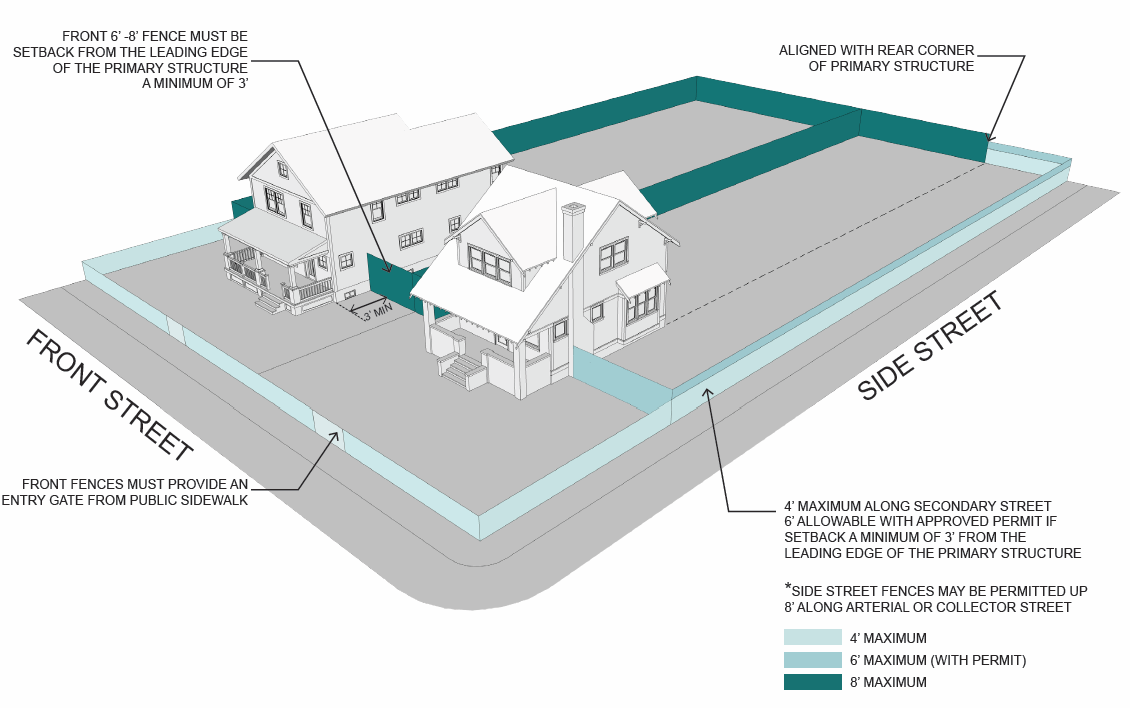
In residential zoning districts fences and walls located in street yards may not exceed four feet in height. Fences on residential lots adjacent to a collector or arterial street may not exceed eight feet in height within said street yard. Fences on residential lots fronting on a collector or arterial street may not exceed four feet within the front yard. The community development director is authorized to approve an administrative permit (in accordance with article V, division 7) allowing fences in the side yard fronting a street on residential corner lots at a height of up to six feet. Fences shall not obstruct visibility as prescribed in section 27-289 of this article. All other fences and walls are limited to a maximum height of eight feet unless otherwise expressly stated in this zoning ordinance ([see] Figure 15-1). The height of fences shall be measured from the natural adjacent grade on the lowest side of the fence to the top of the fence.
Figure 15-1: Maximum Fence and Wall Heights
(Ord. No. 2013-10-15, § 1(Exh. A § 27-15.20), 10-14-2013; Ord. No. 2015-01-05, § 1, 1-26-2015; Ord. No. 2018-03-05, § I, 3-26-2018)
Sec. 27-268. - Required fences and walls.
When fences or walls are required to be installed, the wall or fence must be in place before issuance of a certificate of occupancy for the principal use or structure.
(Ord. No. 2013-10-15, § 1(Exh. A § 27-15.30), 10-14-2013)
Sec. 27-269. - Retaining walls in single-dwelling residential districts.
The regulations of this section apply to retaining walls in single-dwelling residential zoning districts.
(1)
Newly constructed retaining walls are subject to the following maximum height limits:
(2)
Existing retaining walls may be repaired and replaced if the repair or replacement does not result in an increase in the height of the wall.
(3)
On lots occupied by a detached house, retaining walls must be set back from all property lines a distance equal to the required building setback. The community development director is authorized to approve an administrative permit (in accordance with article V, division 7) allowing a retaining wall to encroach the setback.
(4)
A decision to allow an authorized administrative permit or special exception must be based on a determination that exceptional topographical restrictions exist on the lot in context with the adjoining property that were not created by the applicant or owner, and a determination that no practical alternative retaining wall design is feasible. The applicant must submit a site plan or a topographical map certified by an engineer or landscape architect with any exception application for retaining walls.
(5)
Retaining walls may not exceed 12 inches above grade at the higher side elevation.
(Ord. No. 2013-10-15, § 1(Exh. A § 27-15.40), 10-14-2013; Ord. No. 2018-03-05, § I, 3-26-2018)
Sec. 27-270. - Wing walls in single-dwelling residential districts.
The regulations of this section apply to wing walls in single-dwelling residential zoning districts.
(1)
Newly constructed wing walls that are part of the foundation of the principal structure are permitted when exceptional topographical restrictions exist on the subject lot in context with the adjoining properties that were not created by the owner or applicant.
(2)
Wing walls may not exceed ten feet in height, or the height of the foundation wall to which it is attached, whichever results in a lower wing wall height. Wing walls may not be used to allow a house to exceed the detached house infill regulations of section 27-147.
(3)
When affixed to a detached house, a wing wall may project into a street setback or rear setback for a distance not to exceed ten feet. The community development director is authorized to approve an administrative permit (in accordance with article V, division 7) allowing a wing wall to project a side setback to a point not closer than five feet from the side lot line.
(4)
Guardrails must be installed atop all wing walls exceeding 30 inches in height above grade. Guardrails may not be opaque and must be a minimum of 36 inches and a maximum of 48 inches in height.
(5)
Wing walls may not exceed 12 inches above grade at the higher side elevation.
(Ord. No. 2013-10-15, § 1(Exh. A § 27-15.50), 10-14-2013; Ord. No. 2018-03-05, § I, 3-26-2018)
Sec. 27-271. - Measurement of wing wall and retaining wall height.
(a)
The height of wing walls is measured from the bottom of the footing or foundation at the base of the wall to the topmost point on the wall.
(b)
For zoning purposes the height of retaining walls is measured from the natural adjacent grade on the lowest side of the wall to the top of the wall.
(Ord. No. 2013-10-15, § 1(Exh. A § 27-15.60), 10-14-2013; Ord. No. 2017-04-07, § 4, 4-11-2017)
Sec. 27-272. - Fence and wall materials.
The following standards shall apply to fences and walls.
(1)
Adjoining right-of-way. In all single-family detached dwelling developments, wire fencing materials, including chain-link fencing with plastic, vinyl, or wooden inserts shall not be used adjoining a street right-of-way. The architectural treatment of poured concrete, common aggregate block or concrete block walls requires review and approval by the community development director. This provision shall not preclude the use of chain link fencing as a security fence around stormwater facilities ([see] Figure 15-2).
Figure 15-2: Examples of Permissible Fence Types
(2)
Fences along all property lines. Walls and fences constructed along all property lines shall be constructed with a finished side toward the neighboring property.
a.
Wall and fences shall be constructed of wood, brick, block, vinyl, PVC, stone, metal, stucco, split rail, or wrought iron.
b.
Prohibited materials:
1.
Barbed wire, razor wire, or electrically charged fencing shall not be approved for any single-family dwelling lots. Barbed wire may be used for security strands in all but single-family dwelling districts at a height of at least six feet above grade.
2.
The use of plywood/sheet goods, canvas, cloth, vinyl sheeting, EFIS, or other nondurable materials is prohibited.
3.
Chainlink fencing with plastic, vinyl, wooden, or other inserts is prohibited.
4.
No wall or fence shall be constructed of exposed concrete block, tires, junk, or other discarded materials.
(c)
Materials not permitted in subsection (a) nor explicitly prohibited in subsection (b) may be utilized upon review and approval by the community development director.
(d)
Chainlink fencing, where permitted, shall be vinyl coated, black or green.
(e)
Painted or stained wood shall be maintained.
(f)
Metal fencing shall be painted or vinyl coated.
(g)
Fence supports shall face inwards.
(h)
Posts shall be anchored in concrete.
(i)
Fences may step down a slope, however supports shall be vertical and plumb.
(Ord. No. 2018-03-05, § I, 3-26-2018)
Sec. 27-273. - Setback.
(a)
Fences and walls shall be set back a minimum of three feet from a public right-of-way unless otherwise approved by the community development director.
(b)
Fences in front yards exceeding four feet in height must be setback from the leading edge of the primary structure by a minimum of three feet.
(Ord. No. 2018-03-05, § I, 3-26-2018)
Sec. 27-286. - Outdoor storage.
(a)
Where allowed.
(1)
Outdoor storage is prohibited in all zoning districts except the C-2 and M districts.
(2)
Temporary storage of construction equipment, construction materials, or construction vehicles is permitted on lots that are the subject of a valid development or building permit as long as construction work is actively being undertaken on the lot.
(b)
Required setbacks and screening. Outdoor storage areas in C-2 and M districts must be set back at least 50 feet from street rights-of-way and screened from view.
(Ord. No. 2013-10-15, § 1(Exh. A § 27-16.10), 10-14-2013)
Sec. 27-287. - Street frontage required.
All buildings must be located on a lot or parcel that abuts a public street or private street.
(Ord. No. 2013-10-15, § 1(Exh. A § 27-16.20), 10-14-2013)
Sec. 27-288. - State routes.
Any applicant for any development or building permit for any lot or parcel of land fronting on any roadway that is classified as a state route by the state department of transportation must obtain the preliminary approval of both the city public works department and the state department of transportation before beginning any construction of any type.
(Ord. No. 2013-10-15, § 1(Exh. A § 27-16.30), 10-14-2013)
Sec. 27-289. - Intersection visibility.
No fence, wall, building, structure, sign, plant material, or other obstruction of any kind may be maintained within 15 feet of the intersection of the rights-of-way lines of any two streets extended, or of a street intersection with a railroad right-of-way line.
(Ord. No. 2013-10-15, § 1(Exh. A § 27-16.40), 10-14-2013)
Sec. 27-290. - Right-of-way structures and improvements.
In no case shall any fence, wall, or other private improvement, encroach into any public right-of-way without the written approval of the appropriate public entity.
(Ord. No. 2015-01-05, § 1, 1-26-2015)

