
Dunwoody City Zoning Code
ARTICLE VII
MEASUREMENTS, LANGUAGE AND DEFINITIONS
Sec. 27-571. - Lot area.
Lot area is a measure of the total ground-level surface area contained within the property lines of a lot.
(Ord. No. 2013-10-15, § 1(Exh. A § 27-30.10), 10-14-2013)
Sec. 27-572. - Lot frontage.
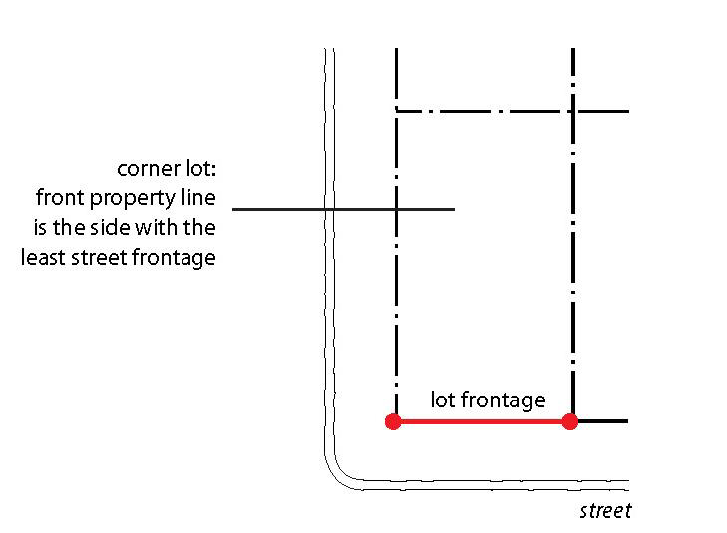
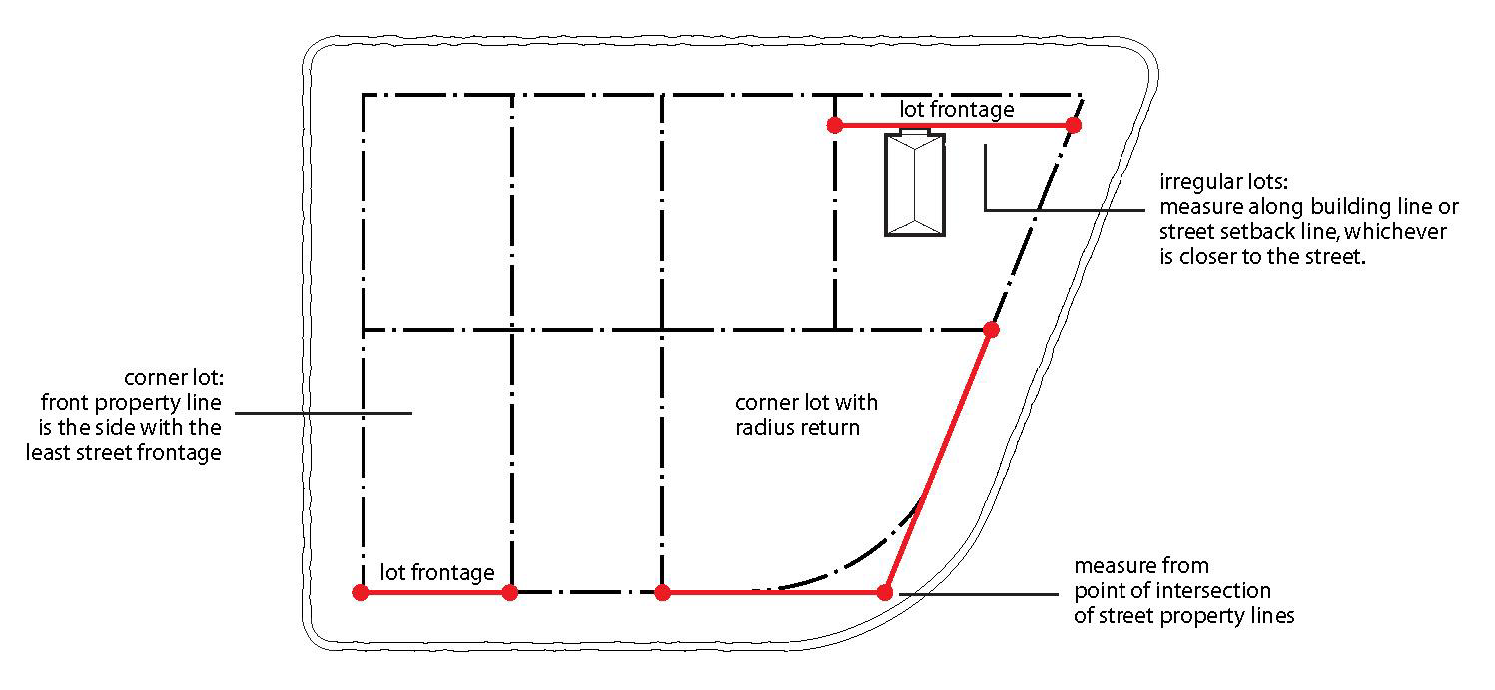
Lot frontage is measured along the front property line adjacent to the street. On a corner lot the side of the lot having the least amount of street frontage is the front property line. For purposes of measuring lot frontage on corner lots with a radius return, the measurement must be taken from the point of intersection of an imaginary extension of the street property lines. For lots with other irregular geometric shapes, lot frontage is measured along an imaginary line located at the building line or the required street setback line, whichever is closer to the street.
Figure 30-1: Measurement of Lot Frontage
(Ord. No. 2013-10-15, § 1(Exh. A § 27-30.20), 10-14-2013)
Sec. 27-573. - Density.
Density is a measure of the number of dwelling units per acre (43,560 sq. ft.) of land area.
(Ord. No. 2013-10-15, § 1(Exh. A § 27-30.30), 10-14-2013)
Sec. 27-574. - Floor area and gross floor area.
Except as otherwise expressly stated, a building's "floor area" is calculated on the basis of "gross floor area," and is measured as follows:
(1)
For purposes of calculating the floor area ratio of buildings in the PC-1 district, gross floor area is measured as the sum of all the space within all floors of a building located above ground level, as measured from the exterior faces of exterior walls. Calculations shall include all space regardless of whether it is intended for human occupancy or whether it is heated or un-heated, including garages, stairwells, hallways, storage areas, elevator shafts, mechanical rooms, all above-ground floors of parking decks and other enclosed spaces.
(2)
The gross floor area of an accessory building is measured as the sum of all the space within all floors in the building, measured from the exterior faces of the exterior walls.
(3)
For all purposes other than calculating FAR in the PC-1 district or measuring the floor area of an accessory building, gross floor area is measured as the sum of all heated space within all floors of a building located above ground level, as measured from the exterior faces of exterior walls.
(Ord. No. 2013-10-15, § 1(Exh. A § 27-30.40), 10-14-2013; Ord. No. 2017-04-07, § 5, 4-11-2017)
Editor's note— Ord. No. 2017-04-07, § 5, adopted April 11, 2017, changed the title of § 27-574 from "Floor area" to read as herein set out.
Sec. 27-574.5. - Reserved.
Editor's note— Ord. No. 2021-09-14, § VIII, adopted Sep. 27, 2021, repealed § 27-574.5, which pertained to floor area ratio (FAR) and derived from Ord. No. 2017-04-07, § 5, adopted April 11, 2017.
Sec. 27-575. - Lot coverage.
Lot coverage is measured as the area or percentage of a lot that is covered by buildings, structures, swimming pools, streets, sidewalks, patios, driveways, parking areas and other impervious surfaces, often expressed as impervious surface ratio (ISR). Permeable decks shall not be included in the lot coverage calculation. However, impermeable surfaces under a deck shall be included. Gravel surfaces shall be included in the lot coverage calculation. Trail improvements that are part of a city council-approved plan are not counted as part of a site's impervious surface area for purposes of site development-related calculations and regulations.
(Ord. No. 2013-10-15, § 1(Exh. A § 27-30.50), 10-14-2013; Ord. No. 2015-01-05, § 1, 1-26-2015; Ord. No. 2022-08-13, § I, 8-22-2022)
Sec. 27-576. - Setbacks.
(a)
Measurement.
(1)
Setbacks are measured from the referenced lot line to the closest point of the building or structure.
(2)
Street setbacks are measured from the property line that abuts a street.
(3)
Side (interior) setbacks are measured from a side lot line that does not abut a street.
(4)
Rear setbacks are measured from the rear lot line. On double-frontage lots, street setbacks apply from both opposing property lines that abut the street, rear setback standards do not apply.
(b)
Permitted obstructions. Setbacks must be unobstructed and unoccupied from the ground to the sky except as expressly allowed in subsection (d).
(c)
Setback averaging.
(1)
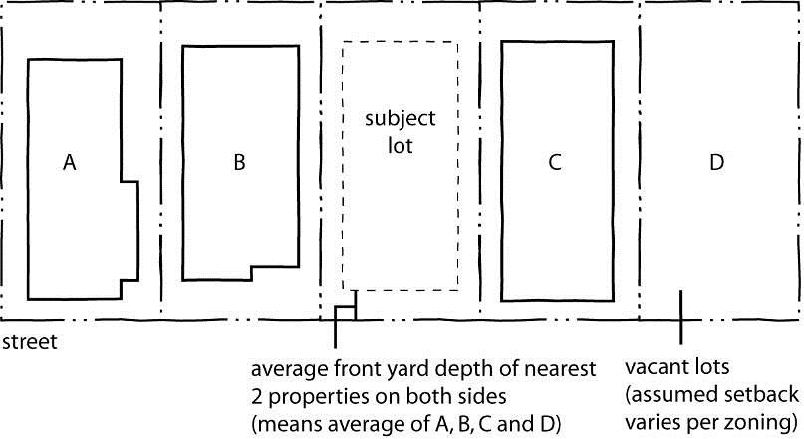
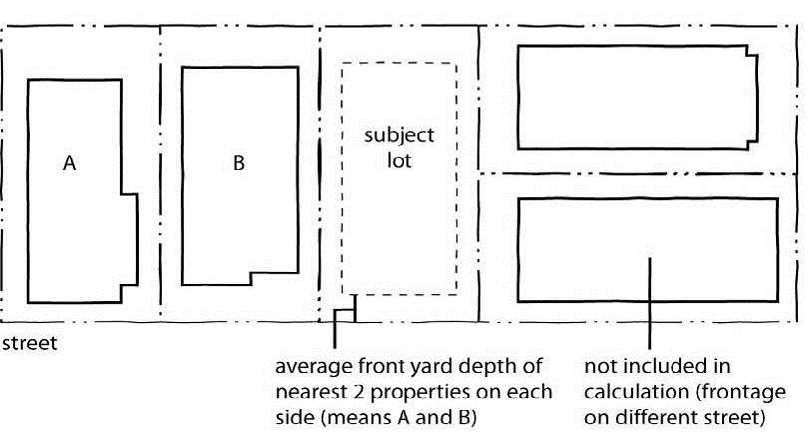
Applicability. When existing buildings on one or more abutting lots are closer to the street (front or street side) property line than the otherwise required setback, additions to existing buildings or construction of new buildings on the subject lot may comply with the average street yard depth that exists on the nearest two lots on either side of the subject lot instead of complying with the zoning district's minimum street setback requirement. Detached houses constructed on infill lots are subject to the contextual street setback regulations of subsection 27-147(2), which will govern in the case of conflict with the setback averaging provisions of this section.
(2)
Calculation of "average setback."
a.
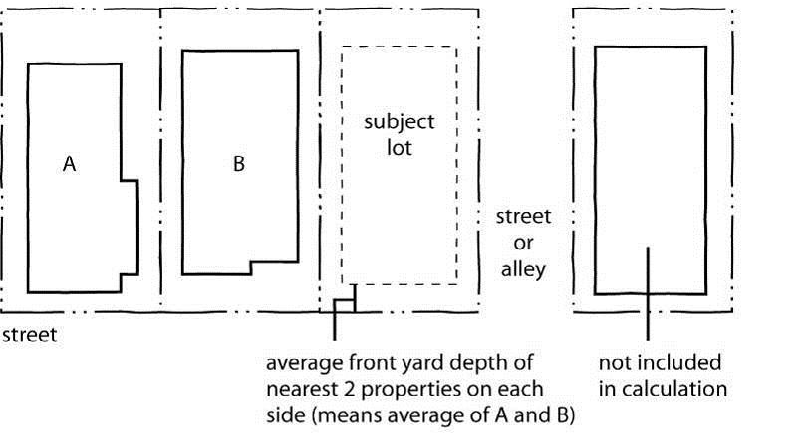
The average setback is based on the average (arithmetic mean) street yard depth that exists on the nearest two lots on either side of the subject lot.
b.
If one or more of the lots that are required to be included in the averaging calculation is vacant, that vacant lot will be deemed to have a street yard depth equal to the minimum street setback requirement of the subject zoning district.
c.
Lots with frontage on a different street than the subject lot or that are separated from the subject lot by a street or alley may not be used in computing the average.
d.
When the subject lot is a corner lot, the average street yard depth will be computed on the basis of the nearest two lots with frontage on the same street as the subject lot.
e.
When the subject lot abuts a corner lot with frontage on the same street, the average front yard depth will be computed on the basis of the abutting corner lot and the nearest two lots with frontage on the same street as the subject lot.
f.
These setback averaging provisions may not be used to reduce the setback of a street-facing garage door to less than 20 feet.
(d)
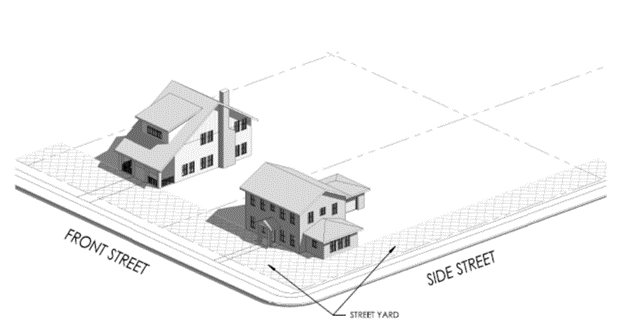
Street yard setbacks. Street yard shall be defined as the yard area of a building site adjacent or parallel to a street that extends from the property line that abuts the street to the edge of the principle structure. See the "Obstruction/Projection into Required Setback" chart, section e, for details on encroachment into the street yard.
(e)
Features allowed to encroach in required setbacks. Building and site features are allowed to obstruct or encroach into required setbacks to the extent indicated in the following table:
(Ord. No. 2013-10-15, § 1(Exh. A § 27-30.60), 10-14-2013; Ord. No. 2020-08-16, 8-24-2020)
Sec. 27-577. - Building height.
(a)
Measurement.
(1)
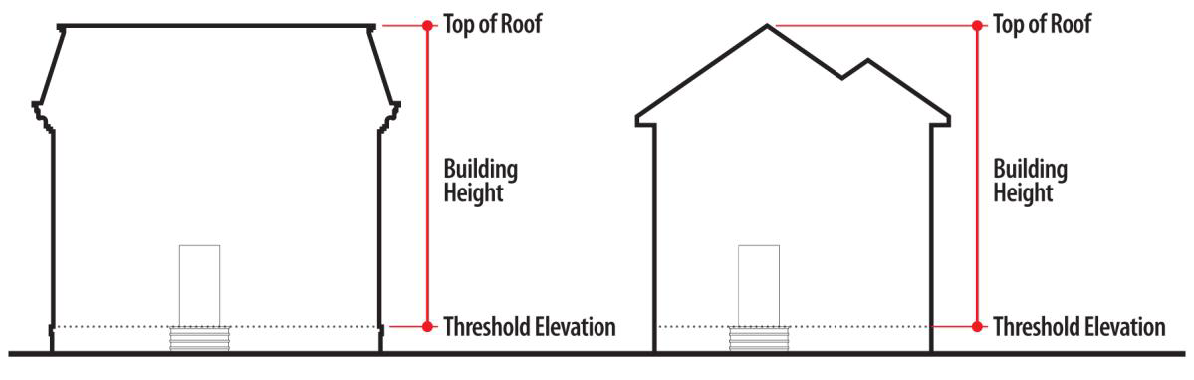
Detached houses. The building height of a detached house is measured as the vertical distance from the front door threshold elevation to the highest point of the roof ([see] Figure 30-2).
Figure 30-2: Building Height Measurement, Detached Houses
(2)
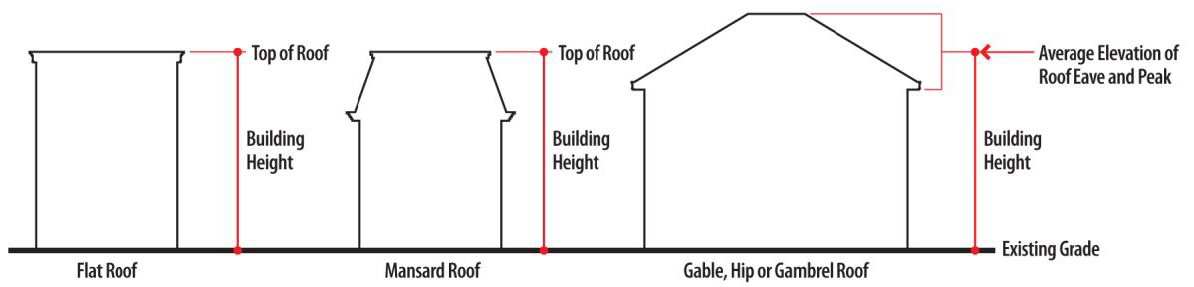
Other buildings. For all buildings except detached houses, building height is measured as the vertical distance from finished grade along the exterior building wall to the top of the highest roof beams or top of parapet (whichever is greater) on a flat or shed roof, the deck level on a mansard roof, and the average distance between the eaves and the ridge level for gable, hip, and gambrel roofs ([see] Figure 30-3).
Figure 30-3: Building Height Measurement, Other Buildings
(b)
Exceptions.
(1)
Farm buildings and farm-related structures are not subject to building height limits when located on bona fide farms.
(2)
Belfries, clock towers, cupolas, domes, flag poles and spires may exceed maximum building limits, provided they are not intended for human occupancy.
(3)
Bulkheads, elevator and equipment penthouses, chimneys, water tanks and similar structures may exceed maximum height limits, provided they do not cover more than 25 percent of the total roof area of the building on which they are located.
(4)
Telecommunications towers and antennas are subject to their own special height limits (see section 27-150).
(5)
Building-mounted solar energy systems may extend up to three feet above the applicable maximum zoning district height limit, provided they do not extend more than five feet above the roof line (see also subsection 27-173(b)).
(Ord. No. 2013-10-15, § 1(Exh. A § 27-30.70), 10-14-2013; Ord. No. 2015-01-05, § 1, 1-26-2015)
Sec. 27-578. - Lot width.
Lot width is measured as the distance between the side lot lines, measured along a line drawn parallel to the front lot line at a distance from the front lot line equal to the minimum street yard setback. For lots with curvilinear frontage and setback lines (e.g.: cul-de-sac lots), the width shall be measured as a straight line through the points that intersect the side lot lines at a distance from the front lot line equal to the minimum street yard setback.
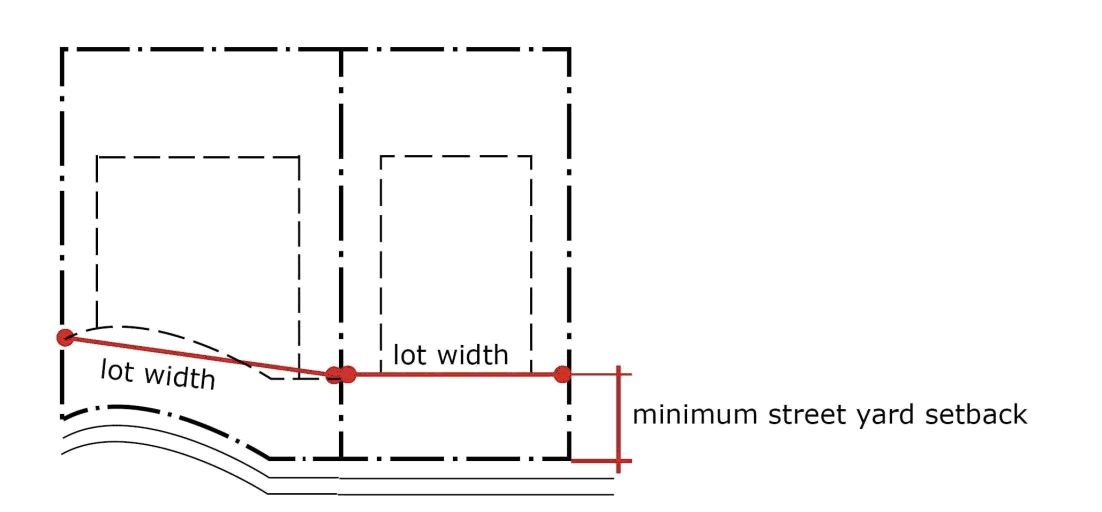
(Ord. No. 2015-01-05, § 1, 1-26-2015)
Sec. 27-591. - Meanings and intent.
The language of the zoning ordinance must be read literally. Regulations are no more or less strict than stated. Words and terms expressly defined in this zoning ordinance (see, for example, article VII, division 3) have the specific meanings assigned, unless the context clearly indicates another meaning. Words that are not expressly defined in this zoning ordinance have the meaning given in the latest edition of Merriam-Webster's Unabridged Dictionary.
(Ord. No. 2013-10-15, § 1(Exh. A § 27-31.10), 10-14-2013)
Sec. 27-592. - Tenses and usage.
(a)
Words used in the singular include the plural. The reverse is also true.
(b)
Words used in the present tense include the future tense. The reverse is also true.
(c)
The words "must," "will," "shall" and "may not" are mandatory.
(d)
The word "may" is permissive, and "should" is advisory, not mandatory or required.
(e)
When used with numbers, "up to x," "not more than x" and "a maximum of x" all include "x."
(f)
The word "lot" includes the word "plot."
(g)
The word "used" is deemed to also include "designed, intended, or arranged to be used."
(h)
The word "erected" is deemed to also include "constructed," "reconstructed," "altered," "placed," "relocated" or "removed."
(i)
The terms "land use" and "use of land" are deemed to also include "building use" and "use of building."
(Ord. No. 2013-10-15, § 1(Exh. A § 27-31.20), 10-14-2013)
Sec. 27-593. - Conjunctions.
Unless the context otherwise clearly indicates, conjunctions have the following meanings:
(1)
"And" indicates that all connected items or provisions apply; and
(2)
"Or" indicates that the connected items or provisions may apply singularly or in combination.
(Ord. No. 2013-10-15, § 1(Exh. A § 27-31.30), 10-14-2013)
Sec. 27-594. - Computation of time.
(a)
References to "days" are to calendar days unless otherwise expressly stated. References to "business days" are references to regular city government working days, excluding Saturdays, Sundays and holidays observed by the city.
(b)
The time in which an act is to be completed is computed by excluding the first day and including the last day. If the last day is a Saturday, Sunday, or holiday observed by the city, that day is excluded.
(c)
A day concludes at the close of business of city hall, and any materials received after that time will be considered to have been received the following day.
(Ord. No. 2013-10-15, § 1(Exh. A § 27-31.40), 10-14-2013)
Sec. 27-595. - Headings and illustrations.
Headings and illustrations are provided for convenience and reference only and do not define or limit the scope of any provision of this zoning ordinance. In case of any difference of meaning or implication between the text of this zoning ordinance and any heading, drawing, table, figure, or illustration, the text governs.
(Ord. No. 2013-10-15, § 1(Exh. A § 27-31.50), 10-14-2013)
Sec. 27-596. - References to other regulations.
All references in this zoning ordinance to other city, state or federal regulations are for informational purposes only, and do not constitute a complete list of such regulations. These references do not imply any responsibility by the city for enforcement of state or federal regulations.
(Ord. No. 2013-10-15, § 1(Exh. A § 27-31.60), 10-14-2013)
Sec. 27-597. - Current versions and citations.
All references to other city, state or federal regulations in this zoning ordinance refer to the most current version and citation for those regulations, unless otherwise expressly indicated.
(Ord. No. 2013-10-15, § 1(Exh. A § 27-31.70), 10-14-2013)
Sec. 27-598. - Lists and examples.
Lists of items or examples that use "including," "such as" or similar terms are intended to provide examples only. They are not to be construed as exhaustive lists of all possibilities.
(Ord. No. 2013-10-15, § 1(Exh. A § 27-31.80), 10-14-2013)
Sec. 27-599. - Delegation of authority.
Whenever a provision appears requiring the head of a department or another officer or employee of the city to perform an act or duty, that department head, officer or employee is authorized to delegate the assigned responsibility to other individuals over whom they have authority.
(Ord. No. 2013-10-15, § 1(Exh. A § 27-31.90), 10-14-2013)
Sec. 27-600. - Public officials and agencies.
All employees, public officials, bodies and agencies to which references are made are those of the City of Dunwoody unless otherwise expressly stated.
(Ord. No. 2013-10-15, § 1(Exh. A § 27-31.100), 10-14-2013)
Sec. 27-621. - Terms defined.
The words and terms expressly defined in this division have the specific meanings assigned, unless the context clearly indicates another meaning. Words that are not expressly defined have the meaning given in the latest edition of Merriam-Webster's Unabridged Dictionary.
(a)
Terms beginning with "A."
Accessory building means a building detached from the principal building located on the same lot and customarily incidental and subordinate in area, extent, and purpose to the principal building or use. See also the accessory use regulations of article III, division 3.
Accessory structure means a structure detached from the principal building located on the same lot and customarily incidental and subordinate in area, extent, and purpose to the principal building or use. See also the accessory use regulations of article III, division 3.
Accessory use means a use of land or building or structure or portion thereof customarily incidental and subordinate to the principal use of the land or building and located on the same lot with the principal use. See also the accessory use regulations of article III, division 3.
Agent means a person duly authorized to act on behalf of the subject property owner.
Amateur radio service antenna structure means a tower and antenna for radio transmission and reception that is maintained by a licensed amateur radio operator as an accessory structure.
American Main Street Commercial style means buildings designed in the one-part commercial block and two-part commercial block styles.
Amplified sound reproduction device means any device capable of producing, reproducing or emitting sounds by means of any loudspeaker or amplifier.
Animal, companion means animals that are commonly kept by persons as a pet or for companionship. Companion animals have the following characteristics: have a special and close relationship with humans; are partially or totally dependent on people; commonly live inside a residence in close proximity with humans; form bonds with people; and interact with their human companions. Dogs and cats are common companion animals.
ANSI means the American National Standards Institute.
Antenna means telecommunications antenna.
Archaeological resource means any material remains of past human culture or activities that are of archaeological interest, including, but not limited to the following: basketry, bottles, carvings, graves, human skeletal materials, pit houses, pottery, rock intaglios, rock paintings, soapstone quarries, structures or portions of structures, tools, weapons, weapon projectiles, or any portion or piece of any of the foregoing items. Nonfossilized and fossilized paleontological specimens, or any portion or piece thereof, are not considered archaeological resources under the regulations of this zoning ordinance, unless found in archaeological context. No item may be deemed to be an archaeological resource under regulations of to this zoning ordinance unless the item is at least 200 years of age.
Authorized use means any use allowed by right in a zoning district and subject to the restrictions applicable to that zoning district.
Automobile means a self-propelled, free-moving vehicle, with not more than six wheels, typically used to transport no more than eight passengers and licensed by the appropriate state agency as a passenger vehicle.
(b)
Terms beginning with "B."
Base (zoning) district means any zoning district that is not an overlay district.
Basement means a space having one-half or more of its floor-to-ceiling height below the average level of the adjoining ground and with a floor-to-ceiling height of no less than 6.5 feet.
Battery charging station means an electrical component assembly or cluster of component assemblies designed specifically to charge batteries within electric vehicles.
Battery exchange station means a facility designed to enable an electric vehicle with a swappable battery to enter a drive land and exchange the depleted battery for a more fully charged battery through an automated process.
Bedroom means a private room planned and intended for sleeping, separated from other rooms by a door, and accessible to a bathroom without crossing another bedroom.
Bicycle parking, long-term means bicycle parking spaces provided to meet the needs of residents, employees or occupants of a site who leave bicycles unattended overnight, during the workday or other long periods of time.
Bicycle parking, short-term, means bicycle parking spaces provided to meet the needs of customers and other short-term visitors to a site.
Biomass energy means energy produced from the biological breakdown of organic matter.
Block face means all parcels abutting one side of a street between the two nearest intersecting streets.
Buildable area means the area of a lot remaining after the minimum setbacks and open space requirements of this zoning ordinance have been met.
Building means any structure having a roof supported by columns or walls and intended for the shelter, housing, or enclosure of any individual, animal, process, equipment, goods, or materials of any kind.
Building line means an imaginary line representing the vertical projection (or plumb line) of an exterior building wall that encloses interior floor space.
Building, accessory. See "Accessory building."
Building footprint means the outline of the total area covered by a building's perimeter at the ground level.
Building mass means the overall visual impact of a structure's volume; a combination of height and width, and the relationship of the heights and widths of the building's components.
Building, principal. See "Principal building."
Building scale means the relationships of the size of the parts of a structure to one another and to humans.
Building type, civic has the meaning ascribed in [section] 27-105(b)(2)e.
Building type, detached house has the meaning ascribed in section 27-105(b)(2)d.
Building type, general has the meaning ascribed in [section] 27-105(b)(2)b.
Building type, shopfront has the meaning ascribed in [section] 27-105(b)(2)a.
Building type, townhouse has the meaning ascribed in [section] 27-105(b)(2)c.
(c)
Terms beginning with "C."
Car-share program means a system in which a fleet of cars (or other motor vehicles) is made available for use by members of the car-share program and that exhibit all of the following characteristics:
(1)
Members are permitted to use vehicles from the car-share program fleet on an hourly basis;
(2)
Car-share vehicles are generally available 24 hours a day and seven days a week to members in parking spaces at dispersed locations or facilities; and
(3)
No separate written agreement is required each time a member reserves and uses a car-share vehicle.
Car-share vehicle means a motor vehicle from a car-share program fleet.
City manager means the person hired and designated as such by the mayor and city council.
City solid waste means any solid waste derived from households, including garbage, trash, and sanitary waste in septic tanks and means solid waste from household living uses, hotel and motels, picnic grounds and day use recreation areas. The term includes yard trimmings and commercial solid waste but does not include solid waste from mining, agricultural, or silvicultural operations or industrial processes or operations.
Collector street means a street or road designated as a collector street in the transportation plan.
Commercial solid waste means all types of solid waste generated by stores, offices, restaurants, warehouses, and other non-manufacturing activities, excluding residential and industrial wastes.
Common open space means that open space that is owned in common by all property owners within the development.
Compatible means land development that is consistent with existing, identified physical elements in proximity to that land development, such as architectural style, building mass, building scale, land uses, and landscape architecture.
Composting means the controlled biological decomposition of organic matter into a stable, odor-free humus.
Comprehensive plan means the comprehensive plan adopted by the mayor and city council, as it may be amended from time to time, that divides areas of the city into land use categories and that constitutes the official policy of the city regarding long-term planning and use of land.
Conditional approval or conditions means the imposition of special requirements, whether expressed in written form or as a site plan or other graphic representation, made a requirement of development permission associated with a particular parcel or parcels of land and imposed in accordance with the terms of this zoning ordinance.
Condominium means a building, or group of buildings, in which dwelling units, offices, or floor area are owned individually, and the structure, common areas, and facilities are owned by all the owners on a proportional, undivided basis in compliance with Georgia Law.
Conservation easement means a restriction or limitation on the use of real property that is expressly recited in any deed or other instrument of grant or conveyance executed by or on behalf of the owner of the land described therein and whose purpose is to preserve land or water areas predominantly in their natural scenic landscape or open condition or in an agricultural farming, forest or open space use.
Construction means any site preparation, assembly, erection, repair, alteration or similar action, including demolition of buildings or structures.
Construction staging area means temporary storage of construction equipment and building materials on sites (1) for which a valid land-disturbance permit or valid building permit exists and (2) on which development or construction is being diligently pursued.
Courtyard means an outdoor area enclosed by a building façade on at least three sides and open to the sky.
Cutoff fixture means a luminaire light distribution where the candela per 1,000 lamp lumens does not numerically exceed 25 (2.5 percent) at or above a vertical angle of 90 degrees above nadir, and 100 (ten percent) at or above a vertical angle of 80 degrees above nadir. This applies to all lateral angles around the luminaire.
(d)
Terms beginning with "D."
Demolition means any dismantling, destruction or removal of buildings, structures, or roadways whether manmade or natural occurring both above and below ground.
Demolition of an infill building means the destruction and removal of an existing building or structure in whole or in part whether such destruction and removal involves removal of all or part of the prior foundation.
Density. See section 27-573.
Development permit means any permit that authorizes land-disturbance for the use, construction thereon or alteration of any real property within the city.
Diameter-at-breast height (DBH) means tree trunk diameter measured at a height of 4.5 feet above grade level at the base of a tree.
Dripline means a vertical line extending from the outermost edge of the tree canopy or shrub branch to the ground.
Dwelling unit means one or more rooms designed, occupied, or intended for occupancy as a separate living quarters, with cooking, sleeping, and bathroom facilities provided within the dwelling unit for the exclusive use of a single household.
Dwelling unit, efficiency, or studio means a self-contained residential unit consisting of not more than one room together with a private bath and kitchen facilities.
(e)
Terms beginning with "E."
Easement means authorization by a property owner for use of all or a designated portion of the subject property by another property owner or entity.
Electric vehicle means any vehicle that is licensed and registered for operation on public and private highways, roads, and streets; either partially or exclusively, on electrical energy from the grid or an off-board source, that is stored on-board via a battery. "Electric vehicle" includes: (1) battery electric vehicles; and (2) plug-in hybrid electric vehicles.
Electric vehicle (EV) charging station means a public or private parking space that is served by battery charging station equipment.
Electric vehicle charging station, private (restricted-access) means an EV charging station that is not available for use by the general public. Examples include electric vehicle charging stations that serve residential homeowners or renters, executive parking areas, designated employee parking areas and fleet parking areas.
Electric vehicle charging station, public means an EV charging station that is accessible to and available for use by the general public.
Electric vehicle parking space means any parking space that is clearly identified to be used exclusively for the parking of an electric vehicle.
Emergency work means any work or action necessary to deliver essential services including, but not limited to, repairing water, gas, electricity, telephone, sewer facilities, or public transportation facilities, removing fallen trees on public rights-of-way, dredging navigational waterways, or abating life-threatening conditions.
Expression line means an architectural feature consisting of a decorative, three-dimensional, linear element, horizontal or vertical, protruding or indented at least 1.25 inches from the exterior façade of a building. It is typically utilized to delineate the top or bottom of floors or stories of a building.
(f)
Terms beginning with "F."
Façade means all the wall planes of a building seen from one side or view.
Fence means a structure designed to provide separation and security, constructed of materials including chain link, wire, metal, artistic wrought iron, vinyl, plastic and other such materials as may be approved by the community development director.
Fenestration means the arrangement, proportioning, and design of windows and doors in a building. For purposes of administering and interpreting the Perimeter Center districts and overlay only, said term means a measurement of the percentage of a façade that has highly transparent, low-reflectance windows, not including mirrored glass.
Flood hazard district. See chapter 16 of the Municipal Code (land development).
Flood lamp means a form of lighting designed to direct its output in a specific direction with a reflector formed from the glass envelope of the lamp itself. Such lamps are so designated by the manufacturers and are typically used in residential outdoor area lighting.
Flood light means a form of lighting designed to direct its output in a diffuse, more or less specific direction, with reflecting or refracting elements located external to the lamp.
Floodplain means 100-year floodplain.
Floodplain, 100-year, means land within the 100-year flood elevation as is defined in the city's land development code (chapter 16).
Floodway. See chapter 16 of the Municipal Code (land development).
Floor area ratio. See section 27-574.5.
Floor area ratio means the gross floor area of all heated floor space in all buildings or structures on a lot divided by the total lot area.
Footcandle means a unit of measure for illuminance on a surface that is everywhere one foot from a point source of light of one candle, and equal to one lumen per square foot of area.
Freeway means a multiple-lane roadway carrying local, regional, and interstate traffic of relatively high volumes that permits access only at designated interchanges and is so designated in the comprehensive plan.
Front door means the door located closest to the front of the dwelling that provides the most direct access to that level of the dwelling that contains the main kitchen of the dwelling.
Frontage. See section 27-572. Frontage also means, for purposes of administering and interpreting the Perimeter Center districts and overlay only, required pedestrian and bicyclist accommodations within the space between the building and the existing curb for all street types within the Perimeter Center Overlay. Street types are identified in figure 27-98-2.
Full cutoff means a luminaire light distribution where zero candela intensity occurs at or above an angle of 90 degrees above nadir. Additionally, the candela per 1,000 lamp lumens does not numerically exceed 100 (ten percent) at or above a vertical angle of 80 degrees above nadir. This applies to all lateral angles around the luminaire.
Full cutoff fixture means an outdoor light fixture shielded or constructed in such a manner that it emits no light above the horizontal plane of the fixture.
(g)
Terms beginning with "G."
Geothermal heat exchange system means equipment that exchanges thermal energy between the ground (or a water source) and a building. This includes vertical closed loop, horizontal closed loop, water body closed loop system and open loop systems. Also known as ground source heat pumps and geothermal heat pumps.
Glare means the sensation produced within the visual field by luminance that is sufficiently greater than the luminance to which the eyes are adapted, causing annoyance, discomfort, or loss in visual performance and visibility.
Grade, average, means the mean elevation of the ground along a line determined by dividing the sum of the elevation of the highest point on the line and the elevation of the lowest point on the line by two.
Grade, existing, means the elevation of the ground surface before development.
Grade, finished, means the final grade of the ground surface after development.
Greenhouse means a temporary or permanent structure that is primarily used for the cultivation of plants.
Greenspace means undeveloped land that has been designated, dedicated, reserved, or restricted in perpetuity from further development and that is not a part of an individual residential lot.
(h)
Terms beginning with "H."
Home occupation [means] an accessory use of a dwelling unit for limited commercial purposes. Home occupations are subject to the regulations of section 27-168.
Hoop house means a temporary or permanent structure typically made of flexible pipe or other material covered with translucent plastic, constructed in a "half-round" or "hoop" shape, for the purposes of protecting and cultivating plants. A hoop house is considered more temporary than a greenhouse.
Household means a group of individuals related by blood, marriage, adoption, guardianship or other custodial relationship, or not more than four persons not so related, living together in a dwelling unit as a single housekeeping unit under a common housekeeping management plan based on an intentionally structured relationship providing organization and stability. This definition specifically includes four or fewer persons with mental, developmental, or other disabilities as defined in the Fair Housing Act, 42 USC 3601 et seq., living as a housekeeping unit and otherwise meeting this definition of "household."
(i)
Terms beginning with "I."
IESNA means the Illuminating Engineering Society of North America, a non-profit professional organization of lighting specialists that has established recommended design standards for various lighting applications.
Illuminance means the quantity of light arriving at a surface divided by the areas of the illuminated surface measured in footcandles. Horizontal illuminance applies to a horizontal surface; vertical illuminance applies to a vertical surface. Average illuminance is the level of illuminance over an entire illuminated target area. Maximum illuminance is the highest level of illuminance on any point within the entire area; minimum illuminance is the lowest level of illuminance on any point within the entire area.
Illuminance levels and footcandles noted in this zoning ordinance mean the maintained illuminance levels, the illuminance levels occurring just prior to lamp replacement and luminaire cleaning. The average illuminance level applies to an entire illuminated target area. Minimum and maximum illuminance levels apply to small areas within the entire illuminated target area. Unless otherwise noted, illuminance levels refer to horizontal illuminance levels.
Industrial solid waste means solid waste generated by manufacturing or industrial processes or operations that is not a hazardous waste as defined herein. Such wastes include, but are not limited to, waste resulting from the following manufacturing processes: electric power generation; fertilizer and agricultural chemicals; food and related products and by-products; inorganic chemicals; iron and steel products; leather and leather products; nonferrous metal and foundry products; organic chemicals; plastics and resins; pulp and paper; rubber and miscellaneous plastic products; stone, glass, clay and concrete products; textiles; transportation equipment; and water treatment. This term does not include mining waste or oil and gas waste.
Industrialized building means any structure or component of a building that is wholly or in substantial part made, fabricated, formed, or assembled in manufacturing facilities for installation or assembly and installation on a building site and has been manufactured in such a manner that all parts or processes cannot be inspected at the installation-site without disassembly, damage to, or destruction thereof.
Infill building means any building built or proposed to be built on an infill lot.
Infill lot means: (1) a conforming lot or a nonconforming lot of record created by the demolition of an existing residential structure for the replacement of that structure with new construction; (2) any lot intended for use as a site for a detached house that is created by act of subdivision; or (3) any lot that has no principal building and that is subsequently proposed as a site for a detached house.
Interim development control means an ordinance that temporarily imposes developmental regulations when existing regulations do not adequately protect the public's health, safety and welfare in accordance with the standards specified in this zoning ordinance.
Interior lot façade means any façade that does not face a street, faces the interior of the lot, or is located such that a parking lot is between the building and the street.
Invasive (plant) species: means any plant species, including its seeds, spores or other biological material capable of propagating that species, that is not native to that ecosystem; and whose introduction does or is likely to cause environmental harm.
(j)
Terms beginning with "J."
Junk vehicle means any vehicle that is inoperable or any vehicle that does not bear a current, valid license plate.
(k)
Terms beginning with "K."
Kiosk means a freestanding structure upon which temporary information and/or posters, notices, and announcements are posted.
Kitchen facilities means a room used to prepare food containing, at a minimum, a sink and a stove or oven.
(l)
Terms beginning with "L."
Landscape/landscaping means the act of enhancing the appearance of the land by altering its contours and planting trees, shrubs, vines, flowers, turf, groundcover and other plant materials for aesthetic effect.
Land use means a description of how land is occupied or utilized.
Leachate collection system means a system at a landfill for collection of the leachate that may percolate through the waste and into the soils surrounding the landfill.
Lot means a designated parcel, tract, or area of land legally established by plat, subdivision, or as otherwise permitted by law, to be separately owned, used, developed, or built upon.
Lot area. See section 27-571.
Lot, buildable area of, means the portion of a lot remaining after required yards have been provided.
Lot, corner, means a lot abutting upon two or more streets at their intersection or upon two parts of the same street forming an interior angle of less than 135 degrees.
Lot coverage. See section 27-575.
Lot, double-frontage, means a lot that abuts two parallel streets or that abuts two streets that do not intersect at the boundaries of the lot. Double-frontage lots are sometimes referred to as "through lots."
Lot, interior, means a lot, other than a corner lot, abutting only one street.
Lot, nonconforming. See [subsection] 27-552(a).
Luminaire means a complete lighting unit consisting of a lamp or lamps and the parts designed to distribute the light, to position and protect the lamp, and to connect the lamp to the power supply. These parts include the lamp, reflector, ballast, socket, wiring, diffuser and housing.
(m)
Terms beginning with "M."
Main parking lot means a parking lot that contains more than 50 percent of the parking designated for a particular building.
Mixed-use development means a development that includes primary residential uses and primary nonresidential uses that are part of the same integrated development, whether within the same building or on the same walkable, interconnected site.
Multiuse property means any distinct parcel of land that is being used for more than one land use purpose.
(n)
Terms beginning with "N."
New construction on an infill lot means the replacement of an existing residential building or structure with a new building, structure or an addition that increases the usable square footage in the building, structure or addition.
Node means a concentration of population, retail, and employment within a well-defined area that has a diverse mix of land uses and a pedestrian and transit orientation.
Nonconforming use. See subsection 27-554(a).
Nonresidential development means any development that does not include residential uses.
(o)
Terms beginning with "O."
Occupied space means interior building space regularly occupied by the building users. It does not include storage areas, utility space, or parking, but includes hallways, stairwells, and elevators.
One-part commercial block style means a single-story building that has a flat roof, a façade that is rectangular in shape, and in which the fenestration in the façade is equal to 75 percent of the width of the front façade of the building.
Open-air uses means storage yards, construction debris sites, used vehicle sales lots, vehicle impound yards, auto wrecking, junkyards, and similar open-air uses when the only buildings on the parcel are incidental and accessory to the open-air use of the lot.
Open water means a pond, lake, reservoir, or other water feature holding water at all times with the water surface fully exposed.
Outdoor lighting fixture means outdoor artificial illuminating device, lamp, and other similar device used for flood lighting, security, and/or general illumination. Such devices include: outdoor lighting of buildings and structures, including building overhands and canopies; outdoor lighting of recreational areas or parking lots; security lighting; street lighting; landscape lighting; building-mounted area lighting; product display area lighting; and building façade lighting.
Outdoor storage means the keeping, in an unenclosed area, of any goods, material, merchandise, or vehicles in the same place for more than 24 hours.
(p)
Terms beginning with "P."
Parking garage means a covered or sheltered structure designed, constructed and used for the parking of motor vehicles.
Parking lot means any area designed for temporary storage of motor vehicles of the motoring public in normal operating condition, whether for a fee or as a service.
Paved means an improved area, covered by asphalt, concrete, or other hard surface material, that may or may not be impervious. "Paved" specifically excludes dry gravel and similar materials as a finished product.
Pedestrianway means a pathway designed for use by pedestrians; it can be located mid-block allowing pedestrian movement from one street to another without traveling along the block's perimeter.
Pervious paving or pavement means a ground covering of hard-surfaced material that is designed and installed to allow percolation or infiltration of stormwater into the soil below. Pervious paving or pavement systems include but are not limited to porous concrete and modular porous paver systems that are designed to allow infiltration of stormwater. Pervious paving or pavement areas are not considered "impervious surface areas" for the purposes of calculating impervious surface coverage.
Photovoltaic cell means a semiconductor device that converts solar energy into electricity. Pitch of roof lines means the ratio of the rise to the run in the slope of a roof.
Principal building means the building occupied by the principal use of the subject lot.
Principal use means the primary or predominant use of the subject lot.
Private restrictive covenants means private restrictions on the use of land or structures imposed by private contract, such as subdivision covenants.
Private right-of-way means any street, avenue, boulevard, road, highway, sidewalk, alley or easement that is not owned, leased, or controlled by a governmental entity.
Public right-of-way means any street, avenue, boulevard, road, highway, sidewalk, alley or easement that is owned, leased, or controlled by a governmental entity.
Public uses means land or structures owned by a federal, state or local government, including a board of education, and used by the respective unit of government for a necessary governmental function.
(q)
Terms beginning with "Q."
RESERVED
(r)
Terms beginning with "R."
Real property line means (1) the imaginary line, including vertical extension, that separates one parcel of real property from another; (2) the vertical and horizontal boundaries of a dwelling unit that is part of a multi-unit residential building; or (3) on a multiuse property, the dividing lines that separate various portions of the property used for different purposes.
Real property owners within a proposed or enacted residential infill overlay district means the homeowners or other real property owners of land within the residential infill overlay district as indicated in the tax records maintained by the county board of tax assessors.
Recovered materials means those materials that have known use, reuse, or recycling potential; can be feasibly used, reused, or recycled; and have been diverted or removed from the solid waste stream for sale, use, reuse, or recycling, whether or not requiring subsequent separation and processing.
Recreational vehicle means a vehicle that is: built on a single chassis; 400 square feet or less when measured at the largest horizontal projection; designed to be self-propelled or permanently towable by a light duty vehicle; and designed primarily not for use as a permanent dwelling but as temporary living quarters for recreational, camping, travel or seasonal use.
Renewable energy means energy from resources that are quickly replenished, such as sunlight, wind, water, biomass, geothermal resources.
Residential district. See article II, division 1.
Residential use means the occupation of a building and land for human habitation.
Retaining wall means a structure constructed and erected between lands of different elevations to protect structures and/or to prevent erosion. A retaining wall is not a wing wall or an areaway. See also article IV, division 4.
(s)
Terms beginning with "S."
Satellite television antenna means an apparatus capable of receiving but not transmitting television, radio, or cable communications from a central device transmitting said communications.
Semi-nude means the exposure of one or more, but not all, of the following: human genitals or pubic region, buttocks, or female breasts below a point immediately above the top of the areola.
Semi-pervious surface means, for purposes of administering and interpreting the Perimeter Center districts and overlay only, either a material covering a surface that allows for at least 40 percent absorption of water into the ground or plant material, such as pervious pavers, permeable asphalt and concrete, or gravel, or a vegetated roof.
Setback. See section 27-576.
Sexually oriented business. See subsection 27-114(1)a.
Shopping center means a group of retail and other commercial establishments that is planned, developed, owned and/or managed as a single property, typically with collective parking, shared driveways, common signage and other shared features.
Site plan means that plan required to acquire a development, construction or building permit that shows the means by which the developer will conform with applicable provisions of this zoning ordinance and other applicable ordinances.
Solar energy system means a system intended to convert solar energy into thermal, mechanical or electrical energy,
Solar energy system, building-integrated means a solar energy system that is an integral part of a principal or accessory building, rather than a separate mechanical device, replacing or substituting for an architectural or structural part of the building. Building-integrated systems include, but are not limited to, photovoltaic or hot water systems that are contained within roofing materials, windows, skylights, shading devices and similar architectural components.
Solar energy system, structure-mounted means a solar energy system that is mounted on the façade or roof of either a principal or accessory structure.
Solar energy system, flush-mounted means a solar energy system that is mounted flush with a finished building surface, at no more than six inches in height above that surface.
Solar energy system, ground-mounted means a solar energy system mounted on the ground and not attached to any other structure other than structural supports.
Solar panel means a group of photovoltaic cells assembled on a panel. Panels are assembled onsite into solar arrays.
Solid waste means any garbage or refuse; sludge from a wastewater treatment plant, water supply treatment plant, or air pollution control facility; and other discarded material including solid, semisolid, or contained gaseous material resulting from industrial, commercial, mining, and agricultural operations and community activities, but does not include recovered materials; solid or dissolved materials in domestic sewage; solid or dissolved materials in irrigation return flows or industrial discharges that are point sources subject to permit under 33 USC 1342; or source, special nuclear, or byproduct material as defined by the Federal Atomic Energy Act of 1954, as amended (68 Stat. 923).
Solid waste handling means the storage, collection, transportation, treatment, utilization, processing, or disposal of solid waste or any combination of such activities.
Specified anatomical areas means any of the following:
(1)
Less than completely and opaquely covered human genitals or pubic region, buttocks, or female breasts below a point immediately above the top of the areola; or
(2)
Human male genitalia in a discernibly turgid state, even if completely or opaquely covered.
Specified sexual activities means any of the following:
(1)
Actual or simulated intercourse, oral copulation, anal intercourse, oral anal copulation, bestiality, direct physical stimulation of unclothed genitals, flagellation or torture in the context of a sexual relationship, or the use of excretory functions in the context of a sexual relationship, and any of the following sexually-oriented acts or conduct: analingus, buggery, coprophagy, coprophilia, cunnilingus, fellatio, necrophilia, pederasty, pedophilia, sapphism;
(2)
Clearly depicted human genitals in a state of sexual stimulation, arousal or tumescence;
(3)
Use of human or animal ejaculation, sodomy, oral copulation, coitus, or masturbation;
(4)
Fondling or touching of nude human genitals, pubic regions, buttocks or female breasts;
(5)
Masochism, erotic or sexually oriented torture, beating or the infliction of pain;
(6)
Erotic or lewd touching, fondling or other sexually-oriented contact with an animal by a human being; or
(7)
Human excretion, urination, menstruation, vaginal or anal irrigation.
Spill light means the light that illuminates surfaces beyond the intended area of illumination caused by the uncontrolled direct light component from the luminaires.
Stoop means a platform entranceway at the door to a building, providing a transition between the interior of the building and the sidewalk outside the building. The stoop may be elevated or at grade, and may be covered by a canopy or awning.
Stormwater management facility means those structures and facilities that are designed for the collection, conveyance, storage, treatment and disposal of storm water runoff into and through the drainage system.
Story means that portion of a building, other than a basement, included between the surface of any floor and the surface of the floor next above or, if there is no floor above, the space between the floor and the ceiling next above. Each floor or level in a multistory building used for parking, excluding a basement, is classified as a story.
Story, ground (or ground floor) means the first floor of a building on any street façade that is level to or elevated above the finished grade on any street façade.
Story, half means a story either in the basement of the building, partially below grade and partially above grade, or a story fully within the roof structure with windows facing the street.
Story, upper (or upper floor) means all floors located above the ground story of a building. Upper stories may be half stories.
Street façade means the façade of a building that faces a street right-of-way.
Street, private, means any street that provides vehicular or pedestrian access within a development that is not dedicated or intended to be dedicated to the city, and that is not maintained by the city.
Street, public, means any right-of-way set aside for public travel deeded to the city and any right-of-way that has been accepted for maintenance as a street by the city.
Street right-of-way line means the dividing line between a lot, tract or parcel of land and a street right-of-way.
Structure means anything constructed or erected with a fixed location on the ground, or attached to something having a fixed location on or in the ground. This does not include telephone poles and utility boxes.
Structure, accessory. See "Accessory structure."
Subdivision means as set forth in the city development code (chapter 16). ;l0; (t)\Terms beginning with "T."
Telecommunications tower or antenna height means the vertical distance from grade to the highest point of the telecommunications tower, grade being the average level of the pre-existing or finished surface of the ground adjacent to the exterior of the tower, whichever is lower. When referring to a telecommunications antenna alone, it means the vertical distance from the base of the antenna to its highest point. Where telecommunications towers and antennae are used in combination, height means the vertical distance from grade to the highest point of either the tower or antenna, whichever is highest.
Threshold means the top of the subfloor in the opening that is designated as the front door of a dwelling.
Tree means any self-supporting woody plant that usually provides one main trunk and produces a more or less distinct and elevated head with branches.
Tree canopy means the area directly beneath the crown and within the outermost edges of the branches and leaves of a tree.
Trespass light means the offsite spill light that illuminates beyond the property boundaries in which the light fixture is installed, where it is neither wanted nor needed.
Truck means every motor vehicle designed, used, or maintained primarily for the transportation of property.
Two-part commercial block style means a building of two stories or greater in height that has a flat roof and is characterized by a horizontal division of the building façade into two distinct zones. These zones may be similar in design but must be clearly separated from one another. The ground floor level of the building must contain fenestration equal to 75 percent of the width of the front façade of the building.
(u)
Terms beginning with "U."
Usable satellite signals means satellite signals from all major communications satellites that, when viewed on a conventional television set, are at least equal in picture quality to those received from local commercial television stations by way of cable television.
Use means the purpose or activity for which land or buildings are designed, arranged, or intended or for which land or buildings are occupied or maintained.
Utility-scale energy production means an energy production facility that produces electric energy for widespread distribution through the electric power grid.
(v)
Terms beginning with "V."
Vacant and undeveloped means the comprehensive plan land use category that includes forested areas, undeveloped land and land not used for any other identified purpose.
Van service means a commercial or not-for-profit service in which the provider offers transportation service to clients from their home to another destination, such as a medical service facility or other destination, and in which service is usually provided in a closed vehicle with a capacity of eight to 12 passengers.
Vegetated roof means that portion of a building roof covered with vegetation and a growing medium, planted over a waterproofing membrane. It may also include additional layers such as a root barrier and drainage and irrigation systems.
Vehicular use area means any area on a parcel that is not located within any enclosed or partially enclosed building and that is devoted to a use by or for motor vehicles including parking; storage of automobiles, trucks or other vehicles; gas stations; car washes; vehicle repair establishments; loading areas; drive-through service areas; and access drives and driveways.
Viewshed means the total visible area from an identified observation position or positions.
Visible basement means a half story or basement partially below grade and exposed above grade a minimum of one-half the minimum floor-to-floor height.
(w)
Terms beginning with "W."
Wall means a solid retaining or security barrier constructed of materials including brick, stone, concrete, concrete block, ceramic tile or other aggregate materials and other such materials as may be approved by the community development director. See also article IV, division 4.
Water collection cistern means a barrel or similar container that collects and stores rainwater or other water that would otherwise be lost as runoff or diverted into a storm drain.
Weekday means the time period of the week that begins at 7:00 a.m. on each Monday and ends at 6:00 p.m. on each Friday.
Weekends means the time period of each week that begins at 6:00 p.m. on each Friday and ends at 7:00 a.m. on each Monday.
Wetlands means an area of land meeting the definition of "wetlands" set forth in 33 CFR 328.3(b), as amended, and that is subject to federal, state or local regulations governing land meeting that definition.
Wing wall means a wall that is constructed and poured at the same time as the building foundation, and is structurally a part of the building foundation. A wing wall is not a retaining wall or an areaway. See also article IV, division 4.
(x)
Terms beginning with "X."
RESERVED
(y)
Terms beginning with "Y."
Yard means the actual area of a lot between the principal building and adjoining lot lines. Note: "setback" refers to the minimum distance that buildings are required to be set back from property lines.
Yard, street means the actual area of the lot between the principal building and the adjoining lot line fronting a street.
(z)
Terms beginning with "Z."
Zoning decision means final legislative action by a local government that results in: (1) the adoption of a zoning ordinance; (2) the adoption of an amendment to a zoning ordinance that changes the text of the zoning ordinance; (3) the adoption of any amendment to a zoning ordinance that rezones the property from one zoning classification to another; (4) the grant of a permit relating to a special use of property, as defined in O.C.G.A. § 36-66-3, and as may hereafter be amended by state law.
(Ord. No. 2013-10-15, § 1(Exh. A § 27-32.10), 10-14-2013; Ord. No. 2015-01-05, § 1, 1-26-2015; Ord. No. 2017-04-07, § 5, 4-11-2017; Ord. No. 2019-07-14, § 1, 7-22-2019)

