
East Bethel City Zoning Code
SECTION 01
GENERAL PROVISIONS OF ADMINISTRATION
1.- Title.
This chapter may be known, cited, and referred to as the "East Bethel Zoning Ordinance" except as referred to herein where it may be known as "this chapter."
2. - Authority.
This chapter is enacted pursuant to the authority granted by the Municipal Planning Act, §§ 462.351 to 462.364 [Minn. Stats. §§ 462.351—462.364], and may be amended.
3. - Intent.
This chapter is enacted to promote the public health, safety, and general welfare of the City of East Bethel and its people through establishment of minimum regulations governing the development and use of property within the city. Such regulations are established for the following reasons:
A.
Implement the comprehensive plan.
B.
Encourage the planned and orderly development of property to allow for residential, commercial, and rural land uses in a manner that maintains community identity and that complies with the City of East Bethel Comprehensive Plan.
C.
Provide housing opportunities for all age and income groups.
D.
Limit congestion in the public rights-of-way.
E.
Develop and maintain cohesively zoned neighborhoods.
F.
Facilitate business opportunities commensurate with the planned level of services within the community.
G.
Provide for the compatible integration of different land uses, and protect from incompatible land uses.
H.
Maintain and encourage opportunities for continued agricultural services.
I.
Protect adequate light, air, and convenient access to property.
J.
Maintain, to a reasonable extent, the property values and tax base of the city.
K.
Manage growth in a manner that preserves natural features, resources, and environmental systems within the city, including, but not limited to, wetlands, floodplain, and shoreland areas.
4. - Relationship to the comprehensive plan.
The administration, enforcement, and amendment of this ordinance shall be consistent with the policies contained in the city's adopted comprehensive plan. In accordance with Minnesota Statutes, the city council will not approve any rezoning or other changes in this ordinance that are inconsistent with the city's comprehensive plan.
5. - Scope.
The use of all land and all structures erected, converted, altered, enlarged or relocated, and every use accessory thereto, shall be in conformance with the provisions of this ordinance from and after its effective date. Any existing use, structure, lot, or development that was legally established prior to the effective date and is not in conformance with the provisions of this ordinance shall be regarded as nonconforming and may continue in existence only for such period of time and under such conditions as is provided in Section 05. Nonconformities of this ordinance.
6. - Interpretation and application.
A.
The provisions of this ordinance shall be minimum requirements. Where conditions imposed by any provision of this ordinance are the subject of any other law, ordinance, statute, resolution, or regulation of any kind, the regulation which is more restrictive, or which imposes higher standards or requirements, shall prevail.
B.
Except as otherwise provided in this chapter, the following shall apply to a use not provided for within a zoning district:
1)
If a use is not specifically permitted in a zoning district, the use shall be considered prohibited in the zoning district.
2)
The city council may direct city staff to conduct a study to determine if a particular use complies with the comprehensive plan, in which zoning district, if any, the use is most appropriate, and which zoning provisions may apply to the use.
3)
The city or an applicant may initiate an amendment to this chapter to permit the particular use under consideration.
C.
The language set forth in the text of this chapter shall be interpreted in accordance with the following rules of construction:
1)
The singular number includes the plural and the plural includes the singular.
2)
The present tense includes the past and future tenses, and the future the present.
3)
The word "shall" is mandatory, and the word "may" is permissive.
4)
The masculine gender includes the feminine and neuter genders.
5)
Words or terms defined in this chapter shall have the meanings assigned to them unless such meaning is clearly contrary to the intent of this chapter.
7. - Official zoning map.
A.
The location and boundaries of the zoning districts established by this chapter shall be known and may be referred to as the "Official Zoning Map of the City of East Bethel." The map and any amendments to the map are hereby incorporated into and adopted by reference into this chapter; they will be as much a part of this ordinance as if fully described herein and will be on permanent file and available for public inspection at the East Bethel City Hall.
B.
It shall be the responsibility of city staff to maintain the official zoning map and to make changes on the map promptly whenever appropriate.
C.
The following rules shall apply where uncertainty exists concerning the boundaries of any zoning district shown on the official zoning map:
1)
Zoning district boundary lines shown on the official zoning map are intended to follow lot lines, the center lines of streets or highways, street lines, street or highway right-of-way lines, or railroad right-of-way lines except in the shorelands and floodplain districts.
2)
The zoning district boundary lines of the shoreland district shall be determined as specified in Section 57. Shoreland Overlay District.
3)
The boundary lines of the floodplain management district shall be determined as specified in Section 58. Floodplain Management Overlay District.
8. - Severability.
Every section or subdivision of this ordinance is declared separable from every other section or subdivision. If any section or subdivision is held to be invalid by competent authority, no other section or subdivision of this ordinance shall be invalidated by such action or decision.
9. - Definitions.
The following words and terms used in this ordinance shall be defined as follows. Words found in this ordinance not defined in this section shall have the meanings customarily assigned to them by any standard dictionary, except where such a meaning is clearly contrary to the intent of this ordinance.
Accessory apartment: An apartment located within a single-family home and is incidental to the principal use to which it is related.
Accessory storage container: A container placed outdoors and used for the storage of goods, materials, or merchandise that is used in connection with a lawful principal or accessory use of the lot. The term "accessory storage container" includes, but is not limited to, containers such as boxcars, semi-trailers, roll-off containers, slide-off containers, railroad cars, piggyback containers, and portable moving and storage containers. The term "accessory storage containers" does not include a garage, barn, or storage shed accessory to a dwelling provided such structure is not of a type designed, equipped, or customarily used for over-the-road transport of goods, materials, or merchandise.
Accessory structure:Any building or improvement clearly subordinate to a principal use such as garages, sheds, or storage buildings located on the same parcel as the principal structure, including detached and attached buildings.
Accessory use: A use which is clearly incidental to, customarily found in connection with, and (except in the case of accessory off-street parking spaces or loading) located on the same parcel as the principal use to which it is related. An accessory use includes, but is not limited to, the following:
A.
Residential accommodations for servants or caretakers.
B.
Swimming pools and private recreational facilities for the use of the occupants of a residence or their guests.
C.
Residential- or agriculture-related storage in a barn, shed, tool room, or similar accessory building.
D.
Interior storage of merchandise normally carried in-stock in connection with a business or industrial use unless such storage is excluded in the applicable district's regulations.
E.
Accessory off-street parking spaces, open or enclosed.
F.
Uses clearly incidental to a main use such as, but not limited to, offices of an industrial or commercial complex located on the site of the commercial or industrial complex.
Addition: A physical enlargement of an existing structure, excepting that said physical enlargement shall not be larger than the existing structure.
Adult uses: Adult uses include adult bookstores, adult motion picture theaters, adult motion picture rental, adult mini-motion picture theaters, adult companionship establishments, adult conversation/rap parlors, adult health/sport clubs, adult cabarets, adult novelty businesses, adult motion picture arcades, adult modeling studios, adult hotels or motels, adult body painting studios, and other premises, enterprises, establishments, businesses, or places open to some or all members of the public at or in which there is an emphasis on the presentation, display, depiction, or description of "specified sexual activities" or "specified anatomical areas" which are capable of being seen by members of the public.
Agricultural building: A structure on agricultural land designed, constructed, and used to house farm implements, livestock, or agricultural produce or products used by the owner, lessee, or sub-lessee of the building and members of their immediate families, their employees, and persons engaged in the pickup or delivery of agricultural produce or products.
Agricultural business, seasonal: A seasonal business not exceeding six months in any calendar year operated on a rural farm offering for sale to the general public produce or any derivative thereof grown or raised on the property.
Agricultural composting: The direct incorporation by disking or plowing of yard waste into the soil surface of agricultural production lands.
Agricultural use: The production for sale of livestock, dairy animals or dairy products, poultry or poultry products, fur-bearing animals, horticultural or nursery stock, fruit, vegetables, forage, grains, or bees and apiary products.
All-terrain vehicle: "All-terrain vehicle" or "vehicle" means a motorized flotation-tired vehicle of not less than three low pressure tires, but not more than six tires, that is limited in engine displacement of less than 800 cubic inches and total dry weight less than 900 pounds.
Alteration: Any change, addition, or modification in construction or type of occupancy, or in the structural members of a building such as foundations, walls, or partitions, columns, beams, or girders, or any enlargement of a building or structure whether horizontal or vertical.
Amortization: The establishment of a time schedule over which the cost of an investment is depreciated.
Antenna, amateur radio: Any equipment or device used to transmit, receive, or transmit and receive electromagnetic signals for "amateur radio service" communications.
Antenna, building-mounted: Any antenna, other than an antenna with its supports resting on the ground, directly attached or affixed to a building, tank, tower, building-mounted mast less than ten feet tall and six inches in diameter, or a structure other than a telecommunications tower.
Antenna, minor: A ground- or building-mounted receive-only radio or recreational vehicle antenna whose total height including any mast to which it is attached is less than 20 feet.
Antenna support structure: Any building, pole, telescoping mast, tower, tripod, or any other structure which supports an antenna.
Apartment: A suite of rooms or a room in a multiple-family dwelling arranged and intended as a place of residence.
Applicant: The owners, their agent, or representative having interest in land where an application for city review of any permit, use, or development is required by this chapter.
Auto reduction yard: A lot or yard where one or more unlicensed motor vehicle(s) or the remains thereof, are kept for the purpose of dismantling, wrecking, crushing, repairing, rebuilding, sale of parts, sales of scrap, storage, or abandonment.
Barndominium: A single-family detached principal residential structure with attached shops or storage areas and usually built using a post frame method of construction.
Base flood: See Regional flood.
Basement: That portion of a building which is partly or wholly below grade but so located that the vertical distance from the average grade to the floor is greater than the vertical distance from the average grade to the ceiling.
Bed and breakfast: An owner-occupied private home where accommodations are offered for one or more nights to transients.
Block: The property abutting one side of a road or street and lying between the two intersecting or intercepting roads or streets and subdivided acreage.
Bluff: A topographic feature such as a hill, cliff, or embankment having the following characteristics:
A.
Part or all of the feature is located in a shoreland area;
B.
The slope rises at least 25 feet above the ordinary high water level of the water body;
C.
The grade of the slope from the toe of the bluff to a point 25 feet or more above the ordinary high water level averages 30 percent or greater; and
D.
The slope must drain toward the water body. An area with an average slope of less than 18 percent over a distance for 50 feet or more shall not be considered part of the bluff.
Bluff impact zone: A bluff and land located within 20 feet from the top of a bluff.
Boathouse: An uninhabited structure designed and used solely for the storage of boats or boating equipment.
Boundary fence: A boundary fence is any fence within five feet of the property line, running parallel to the property line.
Brew pub: A brewer who also holds one or more retail on-sale licenses and who manufactures fewer than 3,500 barrels of malt liquor in a year, at any one licensed premises, the entire production of which is solely for consumption on tap on any licensed premises owned by the brewer, or for off-sale from those licensed premises as permitted in Minnesota State Statute, § 340A.24, subdivision 2.
Buffer: A strip of land intended to create physical separation between potentially incompatible uses of land or environmentally sensitive areas.
Buildable lot area, net: The space remaining on a lot after the setback requirements, area with a slope of 33 percent or more, 100-year floodplain, and drainage easements or wetland have been subtracted.
Building: Any structure having a roof supported by columns or walls for the shelter or enclosure of persons, animals, or property.
Building code: The Minnesota State Building Code.
Building height: The vertical distance measured from the highest adjoining ground level to the highest point of the roof surface for flat roofs, to the deck line of mansard roofs, and to the average height of eaves for gable, hip, and gambrel roofs. Where a building is located on sloping terrain, the height may be measured from the average ground level of the grade at the building wall.
Building line: A line parallel to a lot line or the ordinary high water level at the required setback beyond which a structure may not extend.
Building official: Appointed by the city council to support the city administrator in the enforcement of the state building code.
Building permit: A permit required from the responsible governmental agency before any site work, construction, or alteration to structures can be started.
Bus: A vehicle designed for carrying passengers and having a seating capacity of at least 12 persons.
Cannabis business: A business licensed by the Office of Cannabis Management (OCM) as Minn. Stats. § 342.01 subd. 14.
Cannabis cultivator: A cannabis business that grows cannabis plants from seed or immature plant to mature plant, harvests the cannabis flower from a mature plant, and packages and labels immature cannabis plants and seedlings and cannabis flower for sale pursuant to Minn. Stats. § 342.30.
Cannabis event: A temporary cannabis event lasting no more than four days operating pursuant to Minn. Stats. § 342.39.
Cannabis manufacturer: A cannabis business that makes cannabis and/or hemp concentrate, manufactures artificially derived cannabinoids, adult-use cannabis products, lower-potency hemp edibles, and/or hemp-derived consumer products, and sells cannabis concentrate, hemp concentrate, artificially derived cannabinoids, cannabis products, lower-potency hemp edibles, hemp-derived consumer products to other cannabis businesses pursuant to Minn. Stats. § 342.31.
Cannabis mezzobusiness: A cannabis business that grows cannabis plants from seed or immature plant to mature plant, harvests the cannabis flower from a mature plant, makes cannabis and/or hemp concentrate, manufactures artificially derived cannabinoids, adult-use cannabis products, lower-potency hemp edibles, and/or hemp-derived consumer products, and sells immature cannabis plants and seedlings, adult-use cannabis flower, adult-use cannabis products, lower-potency hemp edibles, hemp-derived consumer products, and other products authorized by law to other cannabis businesses and to consumers pursuant to Minn. Stats. § 342.29.
Cannabis microbusiness: A cannabis business that grows cannabis plants from seed or immature plant to mature plant, harvests the cannabis flower from a mature plant, makes cannabis and/or hemp concentrate, manufactures artificially derived cannabinoids, adult-use cannabis products, lower-potency hemp edibles, and/or hemp-derived consumer products, and sells immature cannabis plants and seedlings, adult-use cannabis flower, adult-use cannabis products, lower-potency hemp edibles, hemp-derived consumer products, and other products authorized by law to other cannabis businesses and to consumers, including on-site consumption, pursuant to Minn. Stats. § 342.28.
Cannabis retailer: A cannabis business that sells immature cannabis plants and seedlings, adult-use cannabis flower, adult-use cannabis products, lower-potency hemp edibles, hemp-derived consumer products, and other products authorized by law to customers pursuant to Minn. Stats. ch. 342 and Minnesota Rule 9810.0200.
Cannabis testing facility: A cannabis business that obtains and tests immature cannabis plants and seedlings, cannabis flower, cannabis products, hemp plant parts, hemp concentrate, artificially derived cannabinoids, lower-potency hemp edibles, and hemp-derived consumer products from cannabis microbusinesses, cannabis mezzobusinesses, cannabis cultivators, cannabis manufacturers, cannabis wholesalers, lower-potency hemp edible manufacturers, and industrial hemp growers pursuant to Minn. Stats. § 342.37.
Cannabis wholesaler: A cannabis business that sells immature cannabis plants and seedlings, cannabis flower, cannabis products, lower-potency hemp edibles, and hemp-derived consumer products to cannabis microbusinesses, cannabis mezzobusinesses, cannabis manufacturers, and cannabis retailers pursuant to Minn. Stats. § 342.33.
Certificate of occupancy: A certificate issued by the building official authorizing the use or occupancy of a building or structure.
Certificate of survey: A legal document depicting property information that is signed by a registered land surveyor under Minnesota State Law.
City: The City of East Bethel, Minnesota.
City council: The governing body of the City of East Bethel, Minnesota.
City-supported senior housing: Residential housing developed in conjunction with block grants or other governmental financial aid intended for the development of senior housing (residential housing restricted to persons age 55 and older) as mandated by the granting authority. City-supported senior housing will consist of multi-unit housing intended to serve senior citizens (persons age 55 and older). It may consist of cooperative housing or rental units managed by the residents thereof or a qualified independent management entity.
Commercial use: The principal use of land or buildings for the sale, lease, rental, or trade of products, goods, and services.
Common open space: Land held in common ownership used for natural habitat, pedestrian corridors, and/or recreational purposes that is protected from future development.
Composting:
Agricultural: The direct incorporation by disking or plowing of yard waste into the soil surface of agricultural production lands.
Residential: A mixture of decaying organic matter used to improve soil structure and provide nutrients being incorporated into the soil surface.
Comprehensive plan: The document entitled "The City of East Bethel Comprehensive Plan," adopted October 13, 2000, as amended, or as hereafter revised or superseded by new comprehensive plans.
Conditional use. See Use, conditional.
Condominium: An estate in real property consisting of an undivided interest in common with other purchasers in a portion of [a] parcel or real property, together with a separate interest in space in a building.
Conservation easement: An interest in real property created in a manner that imposes limitations or affirmative obligations in regard to the use of property including the retention, protection, and maintenance of natural resources, open space, and agriculture.
Construction debris: Concrete, blacktop, bricks, stone facing, concrete block, stucco, glass, structural metal, and wood from demolished structures. It shall also include waste building materials, packaging and rubble resulting from construction, remodeling, repair and demolition of buildings and roads, and any material as defined by the Minnesota Pollution Control Agency (MPCA) or permitted for deposit in construction debris disposal facilities by said agency or by Anoka County such as, but not limited to, foundry sand, waste shingles, tree waste, water treatment plant lime sludge, and street sweepings.
Contiguous: Parcels of land that share a common lot line or boundary.
Craft brewery: A brewer that holds a taproom license and is limited to brew no more than 250,000 barrels annually as permitted in Minnesota State Statute, § 340A.
Craft center: A place designated to serve individuals and groups by offering indoor crafts such as knitting, quilting, scrapbooking, and other similar uses.
Crematorium or crematory: A place where bodies are consumed by incineration and the ashes of the deceased are collected for permanent burial or storage in urns.
Deck: A horizontal, unenclosed platform with or without attached railings, seats, trellises, or other features, attached or functionally related to a principal use or site and at any point extending more than 30 inches above ground.
Density: The number of dwelling units permitted per acre of new developable acres of land as regulated by the applicable zoning district.
Density units: The number of individual dwelling units that can be located on a parcel of land as established through the use of [a] yield plan. For the purpose of this chapter, a multifamily residential dwelling is considered as having, as many density units as there are individual dwelling units regardless of whether those units are attached or detached.
Drive-through: Any use where products and/or services are provided to the customer under conditions where the customer does not have to leave the car or where service to the automobile occupants is offered regardless of whether service is also provided within a building.
Driveway access permit: A permit required from the responsible governmental agency that allows access onto a public road. Such permit must be acquired prior to construction and the issuance of a building permit.
Disposal facility: A waste facility that is designed or operated for the purpose of disposing of waste on or in the land, together with any appurtenant facilities needed to process waste for disposal.
Dwelling: A building of one or more portions thereof occupied exclusively for human habitation, but not including rooms in hotels, motels, or bed and breakfasts (also see Dwelling unit).
Dwelling, attached, single-family: A dwelling that is joined to another dwelling by a common wall.
Dwelling, detached, single-family: A dwelling that is entirely surrounded by open space on the same lot.
Dwelling, townhouse: A single structure consisting of two or more dwelling units having the first floor at or near the ground level with no other dwelling units or portions thereof above or below, with each dwelling unit connected to each other unit by a single party wall with no openings.
Dwelling, two-family: A building designed and used exclusively for occupancy by two families living independently of each other within a dwelling unit.
Dwelling unit: Any structure, portion of a structure, or other shelter designed as living quarters for one or more persons and having cooking facilities. Short-term rental or timeshare accommodations such as motel, hotel and resort room and cabins are not considered dwelling units.
Easement: Property which is acquired by the city by purchase, gift, device, condemnation, lease, or otherwise that is used for the expressed purpose of providing access for: public utility installation and maintenance, stormwater drainage, right-of-way, and otherwise. An easement does not provide or allow any other public access or use unless specifically recorded in the legal description.
Equal degree of encroachment: A method of establishing the location of floodway boundaries so that floodplain lands on both sides of a stream are capable of conveying a proportionate share of flood flows.
Erected: Built, constructed, altered, reconstructed, moved upon, or any physical operations on the premises which are required for the building or structure. Excavation, fill, drainage, and the like shall be considered a part of erection.
Essential services: The utilization, construction, alteration, or maintenance by public utilities or municipal departments of underground, surface, or overhead gas, electricity, steam, fuel, water supply or distribution system(s); sanitary sewage disposal system; including accessory facilities necessary for the furnishing of adequate service by such utilities or municipal departments for the general health, safety, or welfare.
Essential services—governmental uses, buildings and storage: An area of land or structures used for public purposes, storage, or maintenance, and which is owned or leased by a governmental unit.
Essential services—utility substation: A utility use whose function is to reduce the strength, amount, volume, or configuration of utility flow from a bulk wholesale quantity in large-size long-distance transmission lines to small retail qualities in a neighborhood distribution system. These uses include electric substations and telephone switching and relay facilities. Business offices associated with these uses are not included as part of this definition.
Excavation: Any breaking of ground, except common household gardening and ground care.
Exterior storage: The storage of goods, materials, equipment, manufactured products, and similar items not fully enclosed by a building.
Extractive use: The use of land for surface or subsurface removal of sand, gravel, rock, industrial minerals, other nonmetallic minerals, and peat not regulated under Minn. Stats. §§ 93.44—93.51.
Farm: A tract of land used for any agricultural activity or the raising of livestock or small animals as a source of income.
Feedlot: A lot or building or combination of lots and buildings intended for the confined feeding, breeding, raising, or holding of animals and specifically designed as a confinement area in which manure may accumulate, or where the concentration of animals is such that a vegetative cover cannot be maintained within the enclosure. Open lots used for the feeding and rearing of poultry (poultry ranges or operations) shall be considered animal feedlots, but an unrestricted pasture or range shall not be considered animal feedlots.
FEMA: Federal Emergency Management Agency.
Fill: Any act by which soil, earth, sand, gravel, rock, or any similar material is deposited, placed, pushed, or transported, and shall include the conditions resulting thereupon.
Final plat: A drawing or map of an approved subdivision that meets all requirements of the Subdivision Regulations.
Fish house: A structure set on the ice of state waters to provide shelter while taking fish by angling.
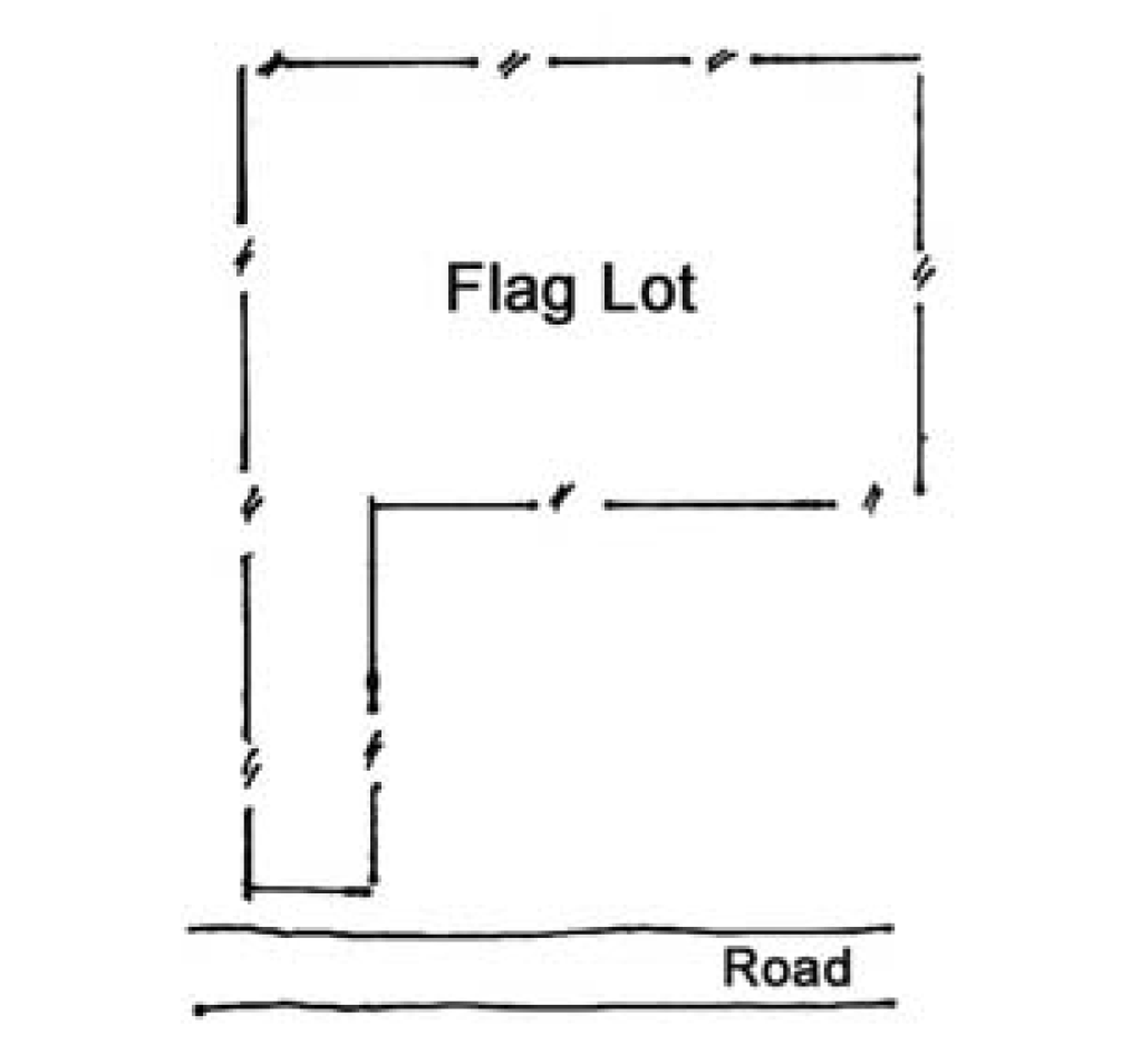
Flag lot: A lot with access provided to the bulk of the lot by means of a narrow corridor.
Flood: A temporary increase in the flow or stage of a stream or in the stage of a wetland or lake that results in the inundation of normally dry areas.
Flood frequency: The frequency for which it is expected that a specific flood stage or discharge may be equaled or exceeded.
Flood fringe: The portion of the floodplain outside of the floodway. Flood fringe is synonymous with the term "floodway fringe" used in the flood insurance study for Anoka County.
Floodplain: The beds proper and the areas adjoining a wetland, lake, or watercourse which have been or hereafter may be covered by the regional flood.
Flood-proofing: A combination of structural provisions, changes, or adjustments to properties and structures subject to flooding, primarily for the reduction or elimination of flood damages.
Floodway: The bed of a wetland or lake and the channel of a watercourse and those portions of the adjoining floodplain which are reasonably required to carry or store the regional flood discharge.
Floor area: The sum of the horizontal areas of each floor of a building, measured from the exterior faces of the exterior walls or from the centerline of walls separating two attached buildings. The floor area measurement is exclusive of areas of basements, unfinished attics, attached garages, or space used for off-street parking or loading, breezeways, and enclosed and unenclosed porches, elevators, or stair bulkheads and accessory structures.
Florist, commercial: A building or premises used primarily for the retail sale of flowers and small plants which may not have been grown or raised on the property and does not include greenhouse.
Food truck: A mobile food unit (MFU) is a food and beverage service establishment that is a vehicle mounted unit, either motorized or trailered, and readily movable, without disassembling, for transport to another location. The unit can operate no more than 21 days annually at any one place unless it is operated at the site of and in conjunction with a permanent business licensed under Minnesota Statutes, chapter 157 or chapter 28A. All MFU must operate in compliance with the Minnesota food code.
Footprint: The area of the land covered by a building's foundation.
Forest land conversion: The clear cutting of forested lands to prepare for a new land use other than reestablishment of a subsequent forest stand.
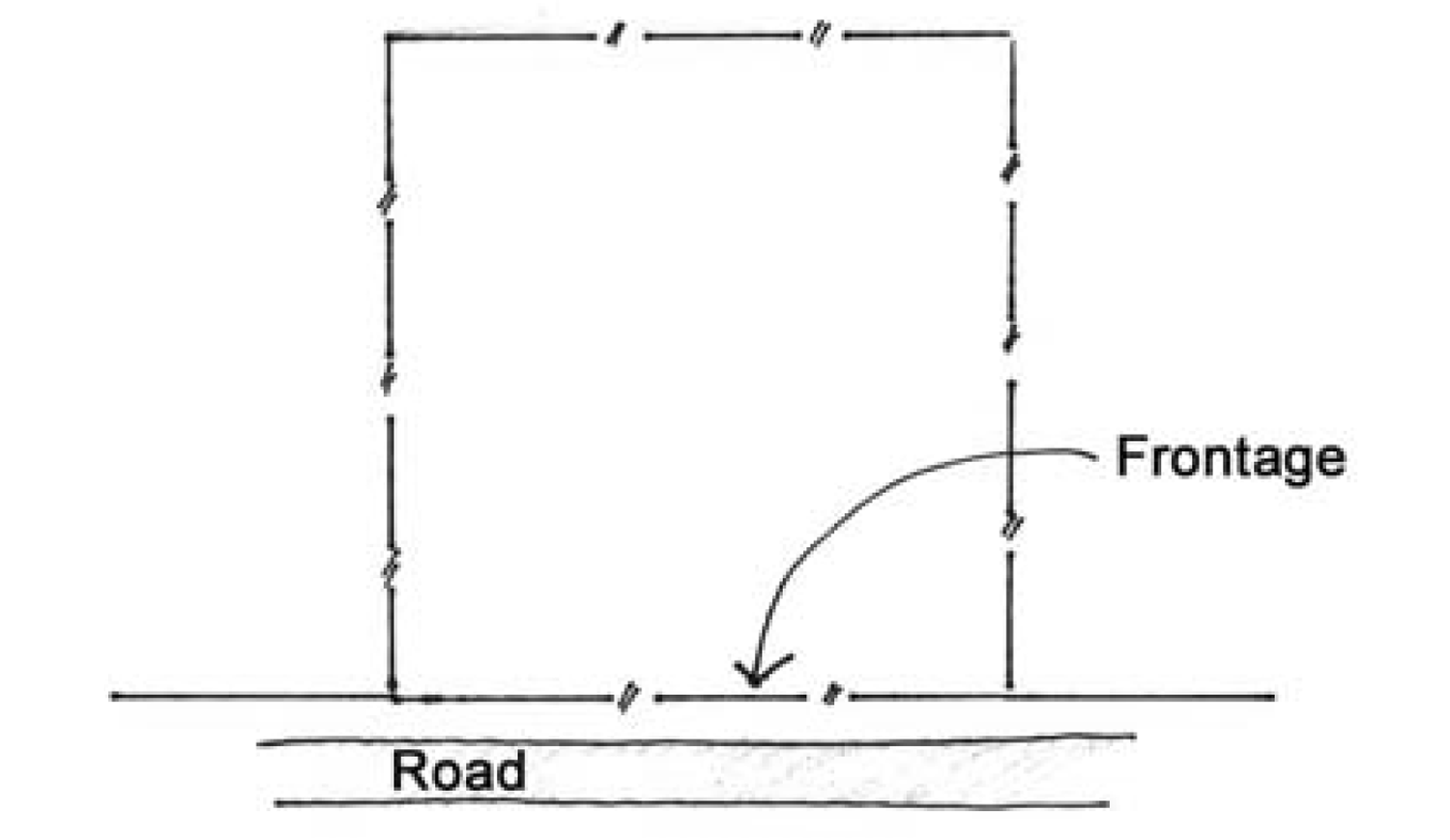
Frontage: That boundary of a lot that abuts a public street or private road.
Funeral home: A building or part thereof used for funeral services. Such buildings may contain space and facilities for:
A.
Embalming and the performance of other services used in preparation of the dead for burial;
B.
The storage of caskets, urns, and other related funeral supplies; and
C.
The storage of funeral vehicles.
Where a funeral home is permitted, a funeral chapel shall also be permitted. This definition shall not include facilities for cremation.
Garage: A detached or attached accessory building designed or used for the parking and storage of vehicles owned and operated by residents of the principal structure on the same lot.
Garden supply store and nursery yard: A building or premises used primarily for the wholesale and retail sale of trees, shrubs, flowers, other plants, and accessory products. Accessory products are those products that are used in the culture, display and decoration of lawns, gardens, and indoor plants.
Golf course: An area of land laid out for golf with a minimum series of nine holes each including a tee, fairway, and putting green, and often one or more natural or artificial hazards.
Governing body: The city council.
Habitable space: A space in a building for living, sleeping, eating, or cooking. Bathrooms, toilet rooms, closets, halls, storage or utility spaces and similar areas are not considered habitable spaces.
Hardship: A property cannot be put to reasonable use if: the conditions of the zoning ordinances are followed; the landowner's particular circumstances are unique and not self-created; and, granting a variance will not alter the essential character of the locality.
Hazardous waste: Any refuse, sludge, or other waste material or combination of refuse, sludge, or other waste materials in solid, semisolid, liquid, or contained gaseous form which because of its quantity, concentration, or chemical, physical, or infectious characteristics may cause or significantly contribute to an increase in mortality or serious, irreversible, or incapacitating reversible illness, or which poses a substantial present or potential hazard to human health or the environment when improperly treated, stored, transported, disposed of, or otherwise managed. Categories of hazardous waste materials include, but are not limited to, explosives, flammables, oxidizers, poisons, irritants, and corrosives. Hazardous waste does not include source, special nuclear, or by-product material as defined by the Atomic Energy Act of 1954, as amended.
Health/recreation facility: An indoor facility that includes uses such as game courts, exercise equipment, locker rooms, Jacuzzi and/or sauna, and pro shop.
Hemp business: A business licensed by the Office of Cannabis Management (OCM) as defined by Minn. Stats. § 342.01 subd. 34.
Home occupation: An occupation carried on in a dwelling unit or detached accessory building by the resident, which is clearly secondary to the principal use.
Homeowners association: A formally constituted nonprofit association or corporation made up of the property owners and/or residents of the development for the purpose of owning, operating, and maintaining the common open space and facilities.
Hotel: A building having provision for ten or more guests in which lodging is provided with or without meals, for compensation, and which is open to transient or permanent guests or both, and which ingress and egress to and from all rooms is made through an inside lobby or office supervised by a person in charge.
Impound lots: A lot or yard where wrecked or towed vehicles are brought for temporary storage.
Industrial use: The use of land or buildings for the production, manufacture, warehousing, storage, or transfer of goods, products, commodities, or other wholesale items.
Industrial waste: Solid waste resulting from an industrial, manufacturing, service, or commercial activity that is managed as a separate waste stream.
Infectious waste: Laboratory waste, blood, regulated body fluids, sharps, and research animal wastes that have not been decontaminated.
Inoperative vehicle: A vehicle incapable of movement under its own power.
Intensive vegetation clearing: The complete removal of trees or shrubs in a contiguous patch, strip, row, or block.
Interim use: Uses that are permitted for a limited amount of time (contain a sunset provision), after approval of the city, if conditions listed in the ordinance are met. Junk yard: An establishment, place of business, or place of storage or deposit, which is maintained, operated, or used for storing, keeping, buying, or selling junk, or for the maintenance or operation of an automobile graveyard, and shall include garbage dumps and sanitary fills not regulated by the MPCA, any of which are wholly or partly within one-half mile of any rights-of-way, whether maintained in connection with another business or not, where waste, or discarded material stored is equal in bulk to five or more motor vehicles and which is to be resold for used parts or old iron, metal, glass, or other discarded material.
Kennel, commercial: Any place where a person accepts dogs from the general public and which are kept for the purpose of boarding.
Kennel, private: Any place where more than two dogs, over four months of age are kept or harbored, provided such animals are owned by the owner or lessee of the premises on which they are kept or harbored.
Land clearing: The removal of contiguous groups of trees and other woody plants in an area of 20,000 square feet or more within any 12-month period.
Licensed daycare facility: Any public or private facility required to be licensed by a governmental agency that provides one or more persons with care, training, supervision, habilitation, rehabilitation, or developmental guidance on a regular basis, for periods of less than 24 hours per day, in a place other than the person's own home. Licensed daycare facilities include, but are not limited to: family daycare homes, group family daycare homes, daycare centers, day nurseries, nursery schools, developmental achievement centers, day treatment programs, adult daycare centers, and day services.
Licensed residential care facility: Any public or private facility required to be licensed by a governmental agency, that provides one or more persons with 24-hour-per-day care, food, lodging, training, education, supervision, habilitation, rehabilitation, and treatment they need, but which for any reason cannot be furnished in the person's own home. Residential facilities include, but are not limited to, state institutions under the care of the commissioner of human services, foster homes, residential treatment centers, group homes, residential programs, supportive living residences for functionally impaired adults, or schools for handicapped persons. A facility whose primary purpose is to treat juveniles or adults who have violated criminal statutes relating to sex offenses or have been adjudicated adults or delinquents on the basis of conduct in violation of criminal statutes pertaining to sex offenses shall not be considered a licensed residential care facility.
Lighting:
A.
Fixture, outdoor: Outdoor electrically powered illuminating devices, outdoor lighting or reflective surfaces, lamps and similar devices, permanently installed or portable, used for illumination or advertisement. The fixture includes the hardware that houses the illumination source and to which the illumination source is attached including, but not limited to, the hardware casing. Such devices shall include, but are not limited to, search, spot, and flood lights for:
1.
Buildings and structures;
2.
Recreational areas;
3.
Parking lot lighting;
4.
Landscape lighting;
5.
Billboards and other signs;
6.
Street lighting;
7.
Product display area lighting; and
8.
Building overhangs and open canopies.
B.
Footcandle: A unit of illumination produced on a surface, all points of which is one foot from a uniform point source of one candle.
C.
Shielding: A technique or method of construction permanently covering the top and sides of a light source by a material which restricts the light emitted to be projected below an imaginary horizontal plane passing the light fixture.
D.
Source: A single artificial point source of luminescence that emits measurable radiant energy in or near the visible spectrum.
E.
Outdoor: Any light source or collection of light sources located outside of a building including, but not limited to, light sources attached to any part of a structure, located on the surface of the ground, or located on free standing poles.
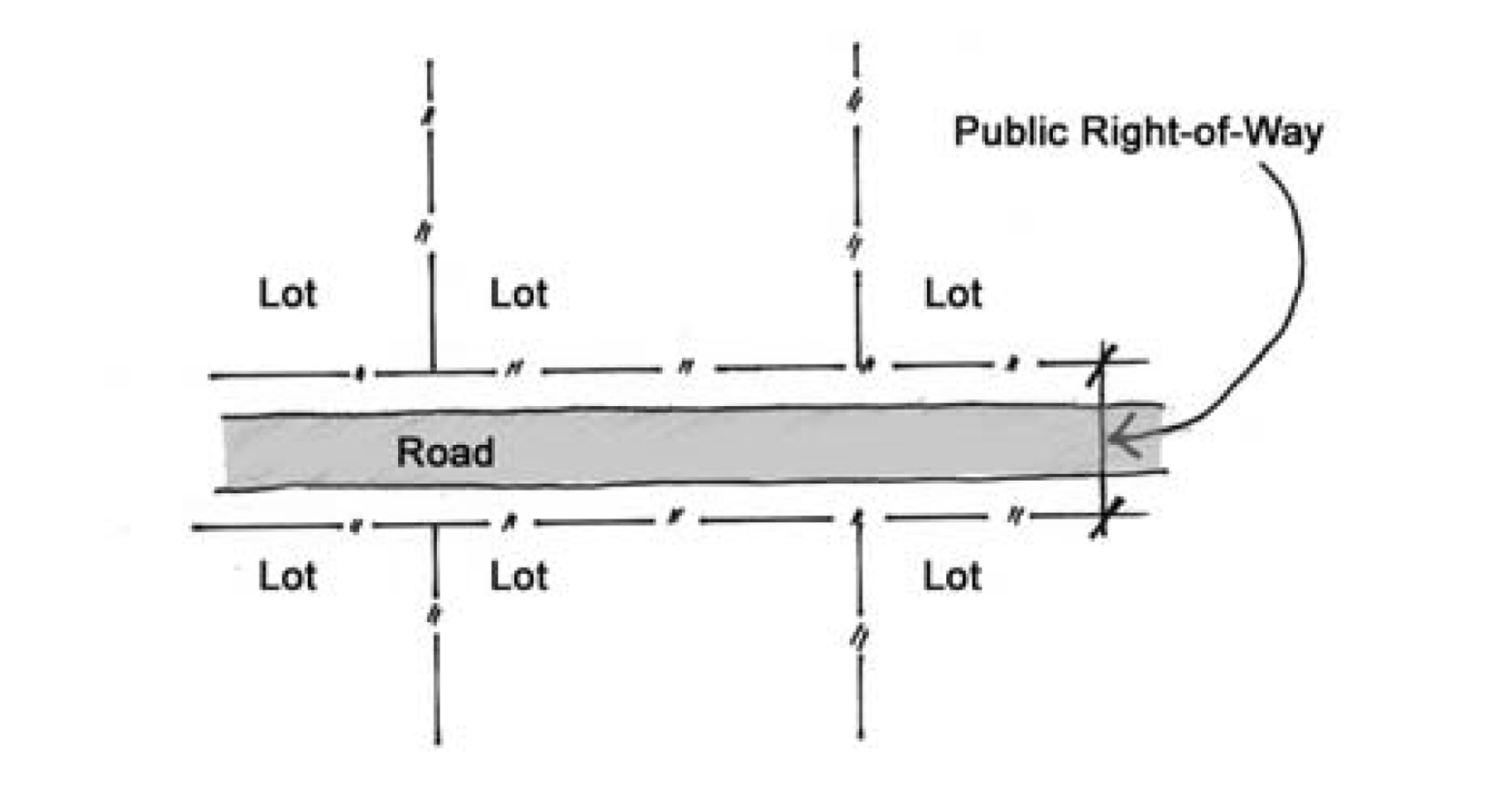
Lot: A parcel of land designated by plat, metes and bounds, registered land survey, auditors plat, or other legal means and separate and apart from any other parcel or portion of land, and from right-of-way, public or private.
Lot area: Total horizontal area within the lot lines of the lot.
Lot, corner: A lot situated at the junction of and abutting two or more intersecting streets or public right-of-ways; or a lot at the point of a deflection in alignment of a single street, the interior angle of which does not exceed 135 degrees.
Lot coverage: The part or percent of the lot occupied by buildings, including accessory buildings, and other impervious surface. This definition includes, but is not limited to, driveways, patios, and structures.
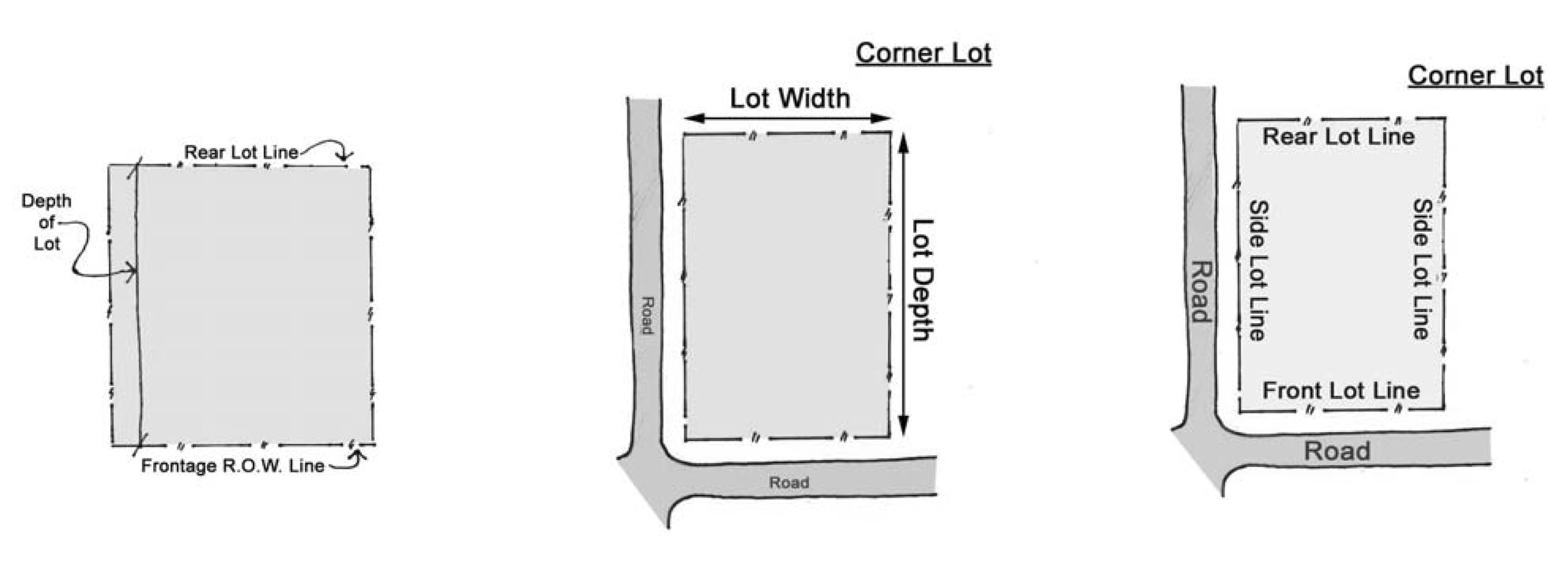
Lot depth: The average horizontal distance between the front and rear lot lines.
Lot lines: The lines bounding a lot are defined below:
A.
Front lot line: For an interior lot, the line separating the lot from the street. For a corner lot, the lines separating the lot from either street. For a through lot, the lines separating the lot from both streets. On lakeshore lots, the street shall be considered the front lot line.
B.
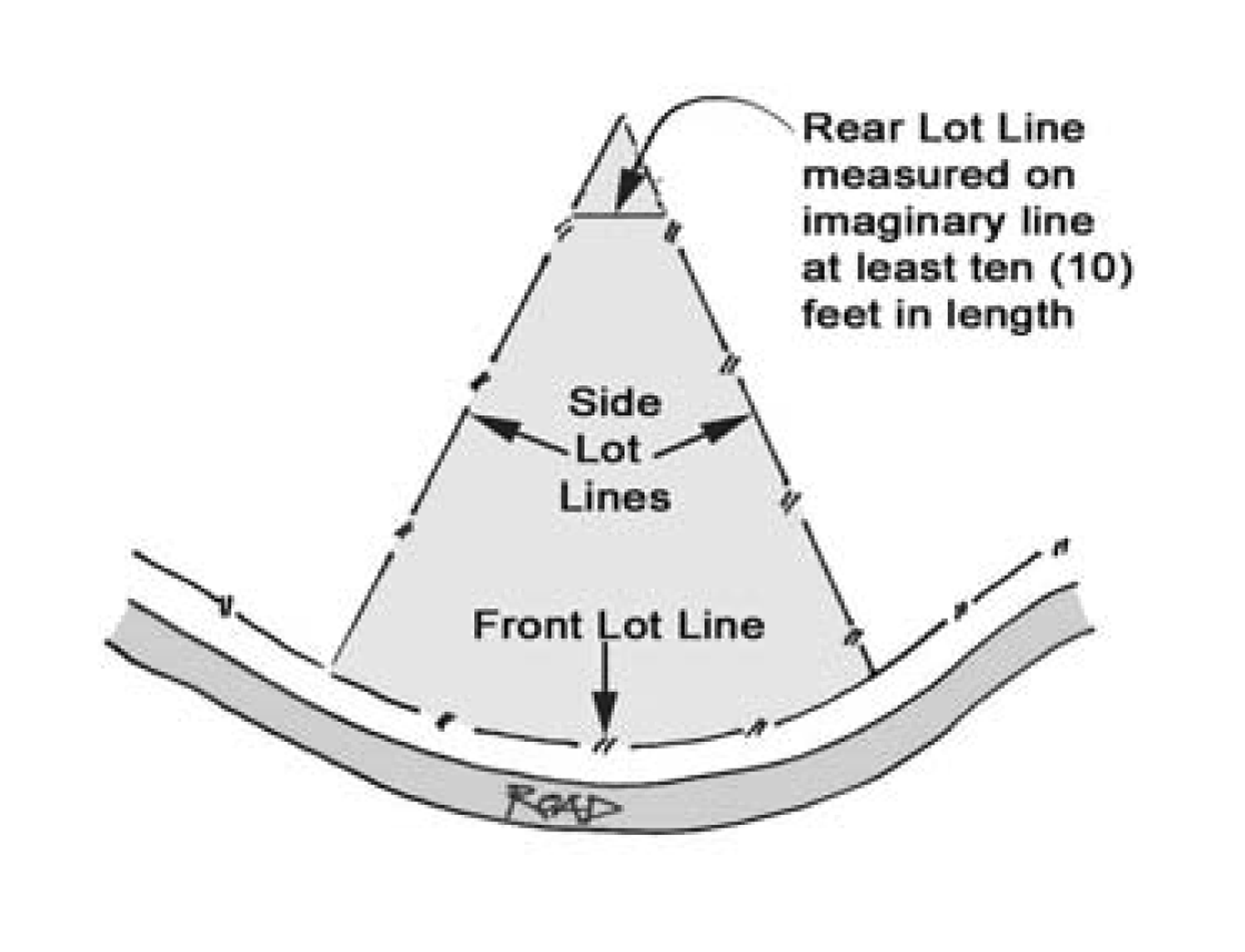
Rear lot line: The lot line opposite the front lot line. In the case of a lot pointed at the rear, the rear lot line shall be an imaginary line parallel to the front lot line, not less than ten feet long lying farthest from the front lot line and wholly within the lot.
C.
Side lot line: Any lot line other than the front lot line or rear lot line; the average horizontal distance between the front and rear lot lines.
D.
Zero lot line: A lot line dividing two or more dwelling units sharing a common wall.
Lot of record, buildable: Any lot which is individually owned and has been recorded in the Office of the Anoka County Recorder as having the minimum area and minimum road frontage required by this ordinance for a building site in the district in which such lot is located.
Lot, through: Any lot other than a corner lot that abuts more than one street or street right-of-way. On a through lot, all property lines abutting the street right-of-way shall be considered the front lines.
Lot width: The shortest distance between lot lines measured at the midpoint of the building line.
Lower-potency hemp edible manufacturer: A hemp business that makes hemp concentrate, manufactures artificially derived cannabinoids lower-potency hemp edibles, and/or hemp-derived consumer products, and sells hemp concentrate, artificially derived cannabinoids, lower-potency hemp edibles, hemp-derived consumer products to other cannabis businesses and hemp businesses pursuant to Minn. Stats. § 342.45.
Lower-potency hemp edible retailer: A hemp business that sells lower-potency hemp edibles to customers, including on-site consumption, pursuant to Minn. Stats. § 342.46.
Manufactured home: A structure, transportable in one or more sections, which is built on a permanent chassis and designed to be used as a dwelling, with or without a permanent foundation when connected to the required utilities, and includes the plumbing, heating, air conditioning, and electrical systems contained therein; the term includes any structure which meets all the requirements and with respect to which the manufacturer voluntarily files a certification required by the Secretary of the United States Department of Housing and Urban Development and complies with the standards established under Minn. Stats. ch. 327.
Manufactured home park: Any site, lot, field, or tract of land upon which two or more occupied manufactured homes are located, either free of charge or for revenue purposes, and shall include any building, structure, tent, vehicle, or enclosure used or intended for use as part of the equipment of the manufactured home park.
Manufacturing, light: Establishments involved in the manufacture, processing, fabrication, packaging, assembly or compounding of products where the process involved is usually completely enclosed and without adverse environmental effects.
Master development plan: A concept plan of an area adopted by the city council which includes single and/or multiple ownerships of parcel(s) that relate through common objectives and design elements.
Materials recovery: The collection, storage, sorting, separation, processing, sale, use, or reuse of discarded materials, substances, or products contained within or derived from waste.
Medical uses: Those uses concerned with the diagnosis, treatment, and care of human beings.
Micro distillery: A micro distillery may provide on its premises samples of distilled spirits manufactured on its premises, in an amount not to exceed 15 milliliters per variety per person. No more than 45 milliliters may be sampled under this paragraph by any person on any day. May be issued a cocktail room license as permitted in Minnesota State Statute, § 340A.
Mining: The excavation, removal, storage, or processing of sand, gravel, rock, soil, clay, or other deposits in excess of one acre.
Mixed municipal solid waste: Garbage, refuse, and other solid waste from residential, commercial, industrial, and community activities that the generator of the waste aggregates creates for collection. Auto hulks, street sweepings, ash, construction debris, industrial wastes, mining waste, sludges, tree and agricultural wastes, tires, lead acid batteries, used oil, and other materials collected, processed, and disposed of as separate waste streams are not included.
Mn/DOT: Minnesota Department of Transportation.
Motel: An establishment containing rooming units designed primarily to provide sleeping accommodations for transient lodgers, with rooms having a separate entrance providing direct access to the outside, and providing automobile parking located adjacent to or near sleeping rooms.
Motor truck: A single or multiple axle straight frame truck with a maximum gross vehicle weight rating (GVWR) 20,000 pounds or greater.
Motor vehicle: The meaning given to it in Minn. Stats. § 168.011, subd. 4, and also includes a park trailer as defined in Minn. Stats. § 168.011, subd. 8, and a horse trailer as defined in Minn. Stats. § 168.27, subd. 1.
Motor vehicle and/or motorcycle internet distribution sales (only): A business predicated on sales through internet communication elements of which consist of the following: at least 95 percent of all sales are initiated and secured through internet communication between buyer and seller; the business has no pre-sale acquired inventory; all sales are substantially completed before the product is delivered to the business site for delivery to the customer; there is minimal need for automotive storage on site with the exception of automobiles awaiting customer pickup; there is limited need for exterior storage, and no automotive repair or maintenance is conducted outdoors.
Motor vehicle dealer: Any person, firm, or corporation, including licensed used motor vehicle dealers, wholesalers, auctioneers, and lessors of new or used motor vehicles, regularly engaged in the business of selling, purchasing, and generally dealing in new and used motor vehicles, and new and used motor vehicle bodies, chassis-mounted or not, having an established place of business for the sale, trade, and display of new and used motor vehicles, and new and used motor vehicle bodies, and which has new and used motor vehicles and new and used motor vehicle bodies for the purposes of sale or trade.
Motor vehicle parts: Retail and wholesale of new auto parts, equipment, and supplies to the general public and the automotive industry.
Motor vehicle repair, major: General repair, rebuilding, or reconditioning of engines, motor vehicles, or trailers; collision service including body, frame, or fender straightening or repair, overall painting and upholstering; and/or vehicle steam, cleaning. This definition does not include towing businesses.
Motor vehicle repair, minor: Repairs, incidental body and fender work, replacement of parts and motor services to passenger automobiles and trucks not exceeding 12,000 pounds gross weight, but not to include any operation specified under Motor vehicle repair, major.
Motor vehicle sales: The sale, offering for sale, display for sale, or facilitating the sale of motor vehicles, new or used.
Motor vehicle sales lot: Any lot, site, premises, or establishment where motor vehicles, new or used, are sold, offered for sale, or displayed for sale, or where the sale of motor vehicles is facilitated.
Motor vehicle service station: A place for the dispensing, sale, or offering for sale of motor fuel directly to users of motor vehicles, together with the sale of minor accessories and the servicing of and minor repair of motor vehicles.
Motor vehicle wash: Premises having a structure for washing and drying vehicles and adequate outdoor space for staging vehicles into and out of the wash.
Motorcycle: Every motor vehicle having a seat or saddle for the use of the rider and designed to travel on not more than three wheels in contact with the ground, including motor scooters and bicycles with motor attached, excluding tractors as defined by Minn. Stats. § 169.011, subd. 44.
MPCA: Minnesota Pollution Control Agency.
Municipal facilities: Buildings and storage areas for municipal services such as city halls, fire stations, public works, and public safety.
NIER: Non-ionizing electromagnetic radiation, electromagnetic radiation primarily in the visible, infrared, and radio frequency portions of the electromagnetic spectrum.
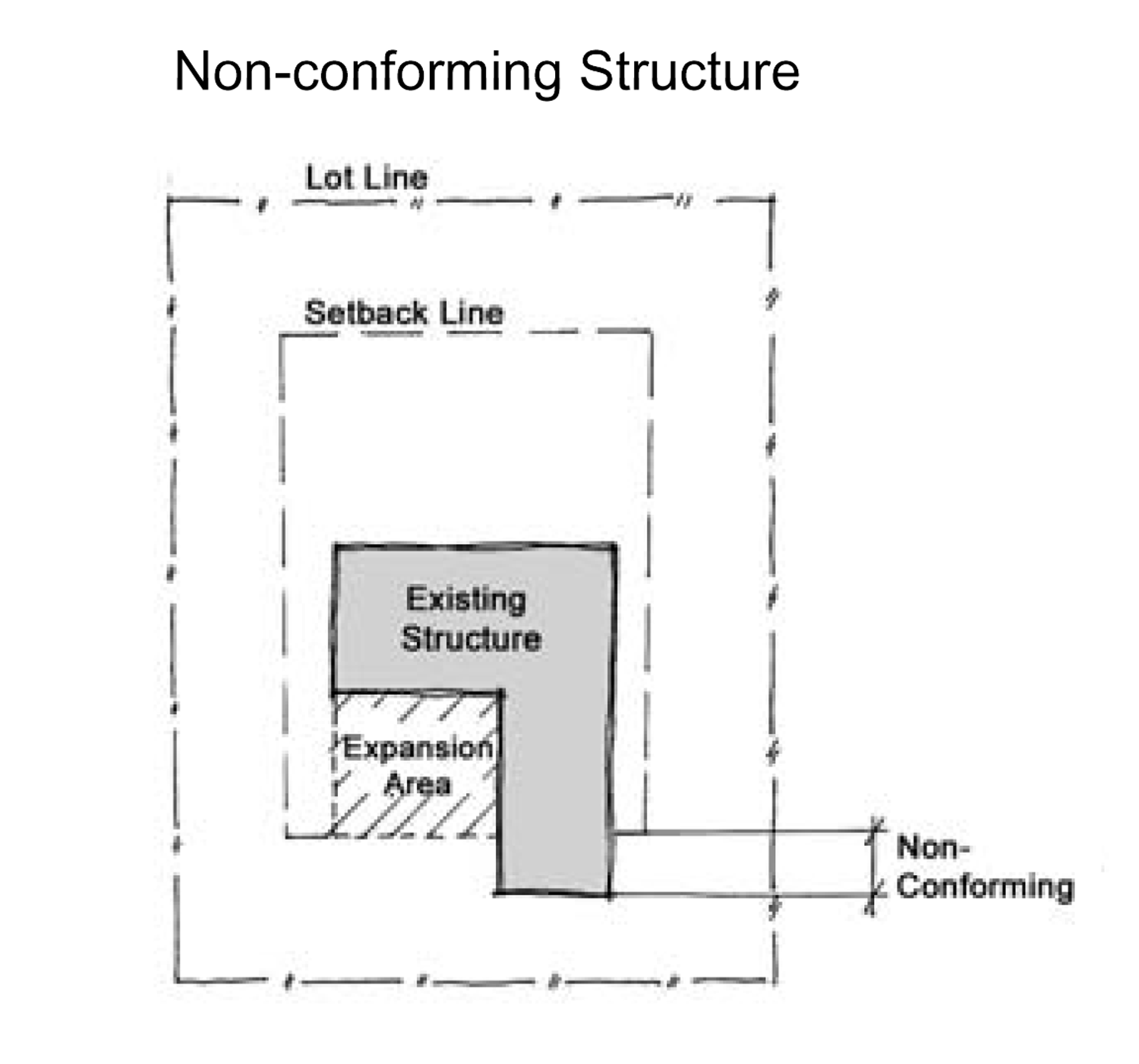
Nonconforming lot: A separate parcel or lot of record on the effective date of this chapter, or any amendment thereto, which lot or parcel does not conform to the regulations, including area or dimensional standards, contained in this chapter or amendments thereto.
Nonconforming structure: Any structure legally existing on the effective date of this chapter, or any amendment thereto, which does not conform to the regulations including the dimensional standards, for the district in which it is located after the effective date of this chapter or amendments thereto.
Nonconforming use: A use which lawfully occupies a building or land after the effective date of this ordinance, or amendments thereto, and that does not conform to the use regulations of the district in which it is located.
Nonconformity: Any legal use, structure, or parcel of land already in existence, recorded, or authorized before the adoption of official controls or amendments thereto that would not have been permitted to become established under the terms of the official controls as now written, if the official controls had been in effect prior to the date it was established, recorded, or authorized.
Non-residential uses in residential districts: All conditional or interim uses as permitted by city council in a residential zoning district. This includes, but is not limited to, places of worship, schools, bed and breakfast inns, utility substations, and other similar uses as determined by city council.
Noxious matter or material: Material which is capable of causing injury or is in anyway harmful to living organisms, or is capable of causing detrimental effect upon the physical, economic, or mental health of human beings.
Nursing home: A building with facilities for the health evaluation and treatment of patients and residents who are not in need of an acute care facility but who require nursing supervision on an inpatient basis. A nursing home does not include a facility or that part of a facility that is a hospital.
Obstruction: Any dam, wall, wharf, embankment, levee, dike, pile, abutment, projection, excavation, channel modification, culvert, building, wire fence, stockpile, refuse, fill, structure, or matter in, along, across, or projecting into any channel, watercourse, or regulatory floodplain which may impede, retard, or change the direction of the flow of water, either in itself or by catching or collecting debris carried by such water.
Office: A room, suite of rooms, or a building containing rooms or suites of rooms in which commercial activities, professional services, or occupations are conducted that do not require that goods are stored, produced or sold at retail, or repaired including, but not limited to, financial institutions, professional office, governmental offices, insurance offices, real estate offices, utility offices, radio broadcasting, and similar uses.
Office of Cannabis Management (OCM): The state agency with the powers and duties of making rules, establishing policy, and exercising its regulatory authority over the cannabis industry and hemp consumer industry.
Official control: Legislatively defined and enacted policies, standards, precise detailed maps, and other criteria all of which control the physical development of the City of East Bethel or any part thereof or any detail thereof, and the means of translating into ordinances all or part of the general objectives of the comprehensive plan. Such official controls may include, but are not limited to, ordinances establishing zoning, subdivision controls, site plan regulations, sanitary codes, building codes, housing codes, and official maps that have been adopted by the City of East Bethel as the East Bethel Zoning Ordinance.
Official map: A map adopted in accordance with the provisions of Minnesota State Statutes.
Off-street parking lot: A facility providing vehicular parking spaces, along with adequate drives and aisles for maneuvering, to provide access for entrance and exit for the parking of more than three vehicles.
Open sales lot: Lands devoted to the display of goods for sale, rent, lease, or trade where such goods are not enclosed within a building.
Open space: Land used for agriculture, natural habitat, pedestrian corridors, and/or recreational purposes that is undivided and permanently protected from future development.
Ordinary high water level: The boundary of public waters and wetlands delineating the highest water level which has been maintained for a sufficient period of time to leave evidence upon the landscape, commonly that point where the natural vegetation changes from predominantly aquatic to predominantly terrestrial. For watercourses, the ordinary high water level is the elevation of the top of the bank of the channel. For reservoirs and flowages, the ordinary high water level is the operating elevation of the normal summer pool.
Outdoor sidewalk cafe: A seasonal expansion of a permitted restaurant, delicatessen, or lunch shop outside on an attached or unattached patio structure, or a freestanding public or private outdoor cafe in conjunction with a promotional event.
Overlay district: A zoning district shown as an overlay on the zoning map. Development within an overlay district is subject to the regulations of both the underlying zoning district and the overlay district.
Owner: Any individual, firm, association, syndicate, partnership, corporation, trust or any other legal entity having proprietary interest in the land.
Parking space: An area of definite length and width designed for parking of motor vehicles, exclusive of drives, aisles, or entrances to the spaces and shall be fully accessible for the storage or parking of permitted vehicles.
Permitted use: A use which may be lawfully established in a particular district or districts provided it conforms with all requirements, regulations, and performance standards (if any) of such district.
Place of worship: A building, together with its accessory buildings and uses, where persons regularly assemble for religious worship and which is maintained and controlled by a religious body organized to sustain public worship.
Planning commission: The planning commission of the City of East Bethel, Minnesota.
Plant nursery, commercial: A building or premises used primarily for the retail sale of trees, shrubs, flowers, or other plants, which may not have been grown or raised on the property.
Plant nursery, wholesale: A building or premises used primarily for the growing and wholesale sale of trees, shrubs, flowers, and other plants.
Platted area: A parcel of land described by block and lot.
Principal building or use: The main use of buildings or land in which the principal use of the property is conducted.
Pole building: A building with no foundation and with sides consisting of corrugated steel or aluminum panels supported by poles set in the ground typically at eight-foot intervals.
Private sewage treatment system: Septic tank and soil absorption system or other individual or cluster-type sewage treatment system as described and regulated in Ordinance 61—Sewage Treatment Ordinance.
Project development package: An application containing information needed to initiate the review process of specific site(s) with the master development plan area.
Public utility: A corporation, municipal department, board, or commission duly authorized under federal, state, or municipal regulations to furnish the public with gas, steam, electricity, sewage disposal, communication, telegraph, transportation, or water.
Public waters: All lakes, ponds, swamps, streams, drainage ways, floodplains, floodways, natural water courses, underground water resources, and similar features involving directly or indirectly, the use of water within the community, as defined by the department of natural resources.
Reach: A hydraulic engineering term describing a longitudinal segment of a stream or river influenced by a natural or man-made obstruction. In an urban area, the segment of a stream or river between two consecutive bridge crossings would most typically constitute a reach.
Recreation, commercial: Land intended to accommodate uses that provide active and passive recreational opportunities on a use and/or membership fee basis. Land designated for commercial recreation use differs from land designated for park and recreation use in that it is privately owned land rather than being publicly owned.
Recreation, public: Land intended to accommodate uses that provide active and passive recreational opportunities whether or not on a use and/or membership fee basis. Land designated for public recreation use differs from land designated for commercial recreation use in that it is publicly owned land rather than being privately owned. Typical uses include tot lots, neighborhood parks, community parks, ball fields, public golf courses, public gardens, green ways and trail corridors, beaches, and community centers.
Recreational equipment: Play apparatus such as swing sets and slides, sandboxes, poles for nets, picnic tables, lawn chairs, barbecue stands, and similar equipment or structures, but not including tree houses, swimming pools, play houses exceeding 25 square feet in floor area, or sheds utilized for storage of equipment.
Recreational facility: An indoor facility in which physical recreation activities are conducted, such as ice hockey, tennis, racquet/hand ball, swimming, ice and roller skating, or bowling.
Recreational vehicle: Any device having wheels and capable of supporting overnight sleeping accommodations and designed for uses in addition to normal travel.
Recyclable material: Materials that can be readily separated from mixed municipal solid waste for the purpose of recycling including, but not limited to, paper, glass, plastics, metals, automobile oil, and batteries.
Recycling drop-off facility: A publicly owned, operated, or sponsored site used to collect recyclable materials which have been source separated from other materials and stored for shipment to processing, reuse, or manufacturing facilities.
Regional flood: A flood which is representative of large floods known to have occurred generally in Minnesota, and reasonably characteristic of what can be expected to occur on an average frequency of once each 100 years. Regional flood is synonymous with the term "base flood" used in the Flood Insurance Study.
Registered engineer: An engineer registered in accordance with the laws of the State of Minnesota.
Regulatory flood protection elevation (RFPE): An elevation no lower than one foot above the elevation of the regional flood plus any increases in flood elevation caused by encroachments on the floodplain that results from designation of a floodway.
Research: Medical, chemical, electrical, metallurgical, or other scientific research and quality control conducted in accordance with the provisions of this chapter.
Restaurant, fast food: Any restaurant that meets some or all of the following requirements:
A.
Customarily provides quick service to its customers.
B.
Offers its customers a limited, standardized choice of inexpensive food and/or beverages.
C.
Serves its customers from a counter and customarily does not serve its customers at tables.
D.
Packages and serves its food and beverages in disposable wrappers, containers, cartons, boxes and/or bags.
E.
Expects customers to dispose of their used food serving and packaging containers in trash, litter, or garbage cans.
F.
Prepares a considerable amount of its food in volume in advance of customer orders.
G.
Offers food to customers by way of signs, placards, posters, valences, or boards rather than on menus given to customers.
Restaurant, full service: A business establishment whose principal business is the preparing, selling, and serving of unpackaged ready-to-consume food to customers seated at counters or tables.
Retail/office/multitenant structure: Any grouping of two or more principal retail uses whether on a single lot or on abutting lots under multiple or single ownership.
Retail sales and services: Stores and shops selling goods over-the-counter for use away from the point of purchase, or offering services on the premises. Large items such as motor vehicle or open sale lots are not included in this category of uses.
RFPE: Regulatory flood protection elevation.
Right-of-way (ROW), public: An area for public use owned and maintained by a government jurisdiction.
Satellite dish: Any device incorporating a reflective surface that is solid, open mesh, or bar configured that is shallow, dish, cone, horn, or cornucopia shaped and is used to transmit and/or receive electromagnetic signals. This definition is meant to include, but is not limited to, what are commonly referred to as satellite earth stations, TVROs, and satellite microwave antennae.
School: A facility that provides a curriculum of preschool, elementary, secondary, post-secondary, or other instruction including, but not limited to, licensed daycare facilities, kindergartens, elementary, junior high, high schools, and technical or college instruction.
School, home: A school within a residential dwelling educating children residing in the residential dwelling.
School, specialty: A facility that provides specialized instruction for dance, music, art, karate, or similar educational activities.
Screening: Screening includes earth mounds, berms, or ground forms, fences and walls, or landscaping (plant materials) or landscaped fixtures (such as timbers), used in combination or singularly so as to block direct visual access to an object throughout the year.
Self-service storage: A structure or structures containing separate storage spaces of varying sizes that is leased or rented individually.
Semi-public use: The use of land by a private, nonprofit organization to provide a public service that is ordinarily open to some persons outside the regular constituency of the organization.
Semi-tractor: A vehicle that is designed to pull a trailer attached to a fifth wheel and has a gross vehicle weight rating (GVWR) 20,000 pounds or greater, as defined in MN Statutes 169.01.
Semi-trailer: A vehicle of the trailer type so designed and used in conjunction with a tractor-trailer that a considerable part of its own weight or that of its load rests upon and is carried by the truck-tractor and includes a trailer drawn by a truck-tractor semi-trailer combination, as defined in MN Statutes 169.01.
Sensitive resource management: The preservation and management of areas unsuitable for development in their natural state due to constraints such as shallow soils over groundwater or bedrock, highly erosive or expansive soils, steep slopes, susceptibility to flooding, or occurrence of flora or fauna in need of special protection.
Setback: The minimum horizontal distance from any lot line, road easement, ordinary high water level, or other referenced feature that a structure or improvement may be placed, as measured from the lot line or feature to the closest point of the structure or improvement.
Sewer system: Pumping stations, force main, pipelines, or conduits, and all other construction, devices, appliances, or appurtenances used for conducting sewage, industrial waste, or other wastes to a point of ultimate disposal.
Sidewall height: The height of a wall as measured from the interior floor surface to the underside of the truss.
Shore impact zone: Land located between the ordinary high water level of a public water and a line parallel to it at a setback of 50 percent of the structure setback.
Shoreland: Land located within the following distances from public waters: 1,000 feet from the ordinary high water level of a lake, pond, or flowage; and 300 feet from a river or stream, or the landward extent of a floodplain designated by ordinance on a river or stream, whichever is greater. The limits of shorelands may be reduced whenever the waters involved are bounded by topographic divides which extend landward from the waters for lesser distances and when approved by the commissioner of the department of natural resources.
Sidewall height: The height of a wall as measured from the interior floor surface to the underside of the truss.
Significant historic site: Any archaeological site, standing structure, or other property that has been listed on, or meets the criteria for eligibility to be listed on, the National Register of Historic Places, the state register of historic sites, or any regional, county, municipal or local historic registers, or that is determined to be an unplatted cemetery that falls under the provisions of Minn. Stats. § 307.08. A historic site meets these criteria if it is presently listed on any of the aforementioned registers, or if it is determined to meet the qualifications for listing after review by the Minnesota State Archaeologist, the director of the Minnesota Historical Society, or a qualified representative of the regional, county, municipal, or local registers. All unplatted cemeteries are automatically considered to be significant historic sites.
Slaughterhouses: A building where animals are killed and prepared for mass food production.
Small brewery. Is a brewer that holds a taproom license and is limited to production of less than 20,000 barrels/year as permitted in Minnesota State Statute, § 340A.
Snowmobile: "Snowmobile" means a self-propelled vehicle designed for travel over snow or ice on skis or runners.
Solid waste: garbage: Refuse or sludge from a water supply treatment plant or air contaminant treatment facility, and other discarded waste materials and sludges, in solid, semisolid, liquid, or contained gaseous form, resulting from industrial, commercial, mining, and agricultural operations, and from community activities, but does not include hazardous waste, animal waste used as fertilizer, earthen fill, boulders, rock, sewage sludge, solid or dissolved material in domestic sewage or other common pollutants in water resources such as silt, dissolved or suspended solids in industrial wastewater effluents or discharges which are point sources subject to permits under section 402 of the Federal Water Pollution Control Act, as amended, dissolved materials in irrigation return flows, or source, special nuclear, or by-product material as defined by the Atomic Energy Act of 1954, as amended.
Steep slope: Land where agricultural activity or development is either not recommended or described as poorly suited due to slope steepness and the site's soil characteristics as mapped and described in available county soil surveys or other technical reports unless appropriate design and construction techniques and farming practices are used in accordance with the provisions of this ordinance. Where specific information is not available, steep slopes are lands having average slopes over 12 percent, as measured over horizontal distances of 50 feet or more, that are not bluffs.
Street: A public vehicular right-of-way which affords a primary means of access to abutting property, except in the case of streets with a high volume of vehicular traffic where access may be restricted and an alternative access may be required.
A.
Approved private street: A private street that has been approved by resolution of the City of East Bethel. Such resolution must specify the street, indicate that the street must support emergency vehicles, and specify that provisions must exist for the ongoing maintenance of the street.
B.
Collector street: A street that serves or is designed to serve as a traffic way for a neighborhood or as a feeder to a major road and designated as a collector street on the city comprehensive plan.
C.
Arterial street: A street, as designated in the comprehensive plan, which serves or is designed to serve heavy flows of traffic, and which is used primarily as a route for traffic between communities and/or other heavy traffic generating areas.
D.
Local street: A street intended to serve primarily as an access to abutting properties.
E.
Street pavement: The wearing or exposed surface of the roadway used by vehicular traffic.
F.
Street, public: A street owned and maintained by a government jurisdiction.
G.
Width of street: The width of the right-of-way measured at right angles to the centerline of the street.
Story: Vertical distance from top to top of two successive tiers of beams or finished floor surfaces; and for the topmost story, from the top of the finished floor surface to the top of the ceiling joists or, where there is not a ceiling, to the top of the roof rafters of a building or structure.
Story, half: That part of a building under the gable, hip, or gambrel roof; the wall plates of which are not more than four feet above the floor.
Structural alteration: Any change in the supporting members of a building such as bearing walls, columns, beams, or girders.
Structure: Anything constructed or erected, the use of which requires location on the ground or attachment to something having location on the ground.
Structure, public: An edifice or building of any kind, or any piece of work artificially built-up or comprised of parts joined together in some definite manner which is owned or rented and operated by a federal, state, or local government agency.
Structure, recreational: Structures of a recreational nature such as swing sets, jungle gyms, tree houses and other similar facilities.
Structure, temporary: Structures that are of a mobile nature and located on a property for no more than six months in a 12-month period, such as ice fishing shanties, camping, tents, enclosed trailers, and other similar facilities.
Subdivision: Land that is divided for the purpose of sale, rent, or lease.
Surface water-oriented commercial use: The use of land for commercial purposes where access to and use of a surface water feature is an integral part of the normal conducting of business. Marinas, resorts, and restaurants with transient docking facilities are examples of such use.
Swimming pool: Any structure intended for swimming or recreational bathing that contains water over 24 inches deep and 5,000 gallons in capacity. This includes in-ground, above-ground, and on-ground swimming pools.
Tavern or bar: A building with facilities for the serving of 3.2 percent malt beverages, liquor, wine, set-ups, and short order foods.
Telecommunications facility: A facility that transmits and/or receives electromagnetic signals. It includes antennae, microwave dishes, horns, and other types of equipment for the transmission or receipt of such signals, telecommunications towers or similar structures supporting said equipment, equipment buildings, parking areas, and other accessory development. It does not include facilities staffed with other than occasional maintenance and installation personnel, vehicle or other outdoor storage yards, offices, or broadcast studios other than those designated for emergency use. All communication towers are subject to the provisions established for such use in Section 17 [16]. Telecommunication[s] Facilities.
Telecommunications tower: A mast, pole, monopole, guyed tower, lattice tower, freestanding tower, or other structure designed and primarily used to support antennae. A ground- or building-mounted mast less than ten feet tall and six inches in diameter supporting a single antenna shall not be considered a telecommunications tower.
Temporary/seasonal sales: A facility or area for temporary or seasonal sales of goods, wares, or merchandise.
Toe of the bluff: The base of a bluff.
Top of the bluff: The top portion of a bluff.
Townhouse: A single-family dwelling unit, with private front and rear entrances which is part of a multiple-family building whose dwelling units are attached horizontally in a linear arrangement. Each dwelling unit must be separated from other dwelling units by a firewall or walls extending from the foundation through the roof with no openings. Each dwelling unit shall have a totally exposed front and rear wall to be used for entry, light, and ventilation.
Transportation/motor freight terminal: A building or area in which freight brought by truck is assembled and/or stored for routing or shipment, or in which semi-trailers, including tractor or trailer units and other trucks, are parked or stored.
Transportation terminal: Taxi, bus, train, and mass transit terminal and related ticketing, passenger waiting, parking, and storage areas.
Truck farming: An agricultural operation in which garden vegetables, fruits, and other such produce is transported from the subject property to an off-site location for sale.
Truck stop: A motor fuel station devoted principally to the needs of tractor-trailer units and trucks, and which may include eating and/or sleeping facilities
Undisturbed soil contour: The identified area within the buildable area of each lot which has never been excavated, cut, or filled. On-site septic areas (sewers) sufficient for two systems shall be identified on each lot and marked off to keep construction traffic off during plat development. Areas for sewers which cannot be located in the undisturbed soil contour area will require a design by a certified designer to ensure the lot will be capable of sustaining an on-site sewer at the time of plat review. Certification of "buildable area" and "undisturbed soil contour" shall be submitted in the form of an exhibit prepared by the developer's engineer or surveyor.
Unplatted area: A parcel of land described by metes and bounds, without reference to block and lot.
Use: The purpose for which land or premises or a building thereon is designed, arranged or intended, or for which it is or may be occupied or maintained.
A.
Accessory use: A use subordinate to and serving the principal use or structure on the same lot and incidental to such principal use.
B.
Conditional use: Either a public or private use as listed which because of its unique characteristics cannot be properly classified as a permitted use in a particular district. After consideration in each case of the impact of such use upon neighboring land and of the public need for the particular use at the particular location, such "conditional use" may or may not be granted by the council.
C.
Interim use: Uses that are permitted for a limited amount of time (contain a sunset provision), after approval of the city, if conditions listed in the ordinance are met.
D.
Open space use: The use of land without a structure or including a structure incidental to the open space use with a ground floor equal to five percent or less of the area of the lot.
E.
Permitted use: A use that is or may be lawfully established in a particular district or district provided it conforms to all requirements, regulations, and performance standards of such district.
F.
Principle use: The main use of land or buildings as distinguished from subordinate or accessory uses. A "principal use" may be permitted or conditional.
Used motor vehicle: A motor vehicle for which title has been transferred from the person who first acquired it from the manufacturer, distributor, or dealer. A new motor vehicle will not be considered a used motor vehicle until it has been placed in actual operation and not held for resale by an owner who has been granted a certificate of title on the motor vehicle and has registered the motor vehicle in accordance with Minn. Stats. ch. 168 and Minn. Stats. chs. 168A and 297B, or the laws of the residence of the owner.
Variance: A modification or variation of the provisions of this chapter as applied to a specific lot or property.
Veterinary: Those uses concerned with the diagnosis, treatment, and medical care of animals, including animal or pet hospitals.
Warehousing: The storage, packaging, and crating of materials or equipment within an enclosed building or structure.
Warehousing and distribution: A use engaged in storage, wholesale, and distribution of manufactured products, supplies, and equipment.
Waste: Infectious waste, nuclear waste, pathological waste, sewage sludge, solid waste and hazardous waste.
Waste facility: Property used for the accumulation, storage, processing, or disposal of waste.
Waste management: Activities which are intended to affect or control the generation of waste and activities which provide for or control the collection, processing, and disposal of waste.
Water-oriented accessory structure or facility: A small, above-ground building or other improvement, except stairways, fences, docks, and retaining walls.
Wetland: Lands transitional between terrestrial and aquatic systems where the water table is usually at or near the surface or the land is covered by shallow water. For purposes of this chapter, wetlands must:
a)
Have a predominance of hydric soils;
b)
Be inundated or saturated by surface water or groundwater at a frequency and duration sufficient to support a prevalence of hydrophytic vegetation typically adapted for life in saturated soil conditions; and
c)
Under normal circumstances, supports a prevalence of hydrophytic vegetation.
Wetlands generally include swamps, marshes, bogs, and similar areas.
Wholesaling: The selling of goods, equipment, and materials by bulk to another person who in turn sells the same to customers.
Yard waste: Garden wastes, leaves, lawn clippings, weeds and pruning generated at residential or commercial properties.
Yards: The open spaces on the same lot as a main building, unoccupied and unobstructed from the ground upward except as otherwise provided in this ordinance, and as defined below:
A.
Front yard: An open space extending the full width of the front lot line, the depth of which is the minimum horizontal distance between the front lot line and the nearest point of the main building. For a corner lot which is not a reversed frontage corner lot, the front yard shall adjoin a front yard in an adjoining lot.
B.
Rear yard: An open space extending the full width of the lot the depth of which is the minimum horizontal distance between the rear lot line and the nearest point of the main building. In the case of a corner lot, the rear yard may be opposite either street frontage.
C.
Side yard: An open space between a main building and the side lot line, extending from the front yard to the rear yard, the width of which is the horizontal distance from the nearest point of the side lot line to the nearest point of the main building.
Zoning district: An area or areas within the limits of the city in which the regulations and requirements of this chapter are applied uniformly.
(Ord. No. 19, Second Series, 5-5-2010; Ord. No. 28, Second Series, 12-1-2010; Ord. No. 36, Second Series, 4-4-2012; Ord. No. 48, Second Series, 2-5-2014; Ord. No. 48, Third Series, 6-4-2014; Ord. No. 28, Third Series, 6-17-2015; Ord. No. 48, Fourth Series, 9-21-2016; Ord. No. 48, Fifth Series, 6-6-2018; Ord. No. 2020-03, 3-9-2020; Ord. No. 2021-05, § 2, 9-13-2021; Ord. No. 2021-06, 10-11-2021; Ord. No. 2024-05, § 2, 12-3-24; Ord. No. 2025-03, § 1, 7-14-25)

