
East Bethel City Zoning Code
SECTION 22
- OFF-STREET PARKING AND LOADING REQUIREMENTS
1.- Purpose.
This section establishes off-street parking standards to allow for the orderly and adequate parking of vehicles on property, to alleviate and prevent congestion on public right-of-way, and to control the appearance and maintenance of parking areas and surfaces.
2. - Scope of regulations.
The regulations and requirements set forth in this chapter shall apply to all off-street parking facilities in all of the zoning districts.
3. - General provisions.
A.
Change of use or occupancy of land. No change of use or occupancy of land already dedicated to a parking area, parking spaces, or loading spaces shall be made, nor shall any sale of land or division or subdivision of land be made which reduces area necessary for parking, parking stalls, or parking requirements below the minimum prescribed by this chapter. Any change of use or occupancy of any building (including additions thereto) requiring more parking area, shall not be permitted until additional parking spaces as required by this chapter are furnished.
B.
Prohibited uses in required parking areas. Required off-street parking areas in the B-1, B-2, B-3, I, and MXU districts, shall not be used for open storage of goods, recreational vehicles and equipment, commercial vehicles and equipment, unlicensed/inoperable vehicles, or vehicles displayed for sale.
C.
Prohibited parking.
1)
Single-family residential (R-1), single-family and townhome (R-2) zoning, and Coon Lake residential (CL) districts:
a)
Parking of buses, motor trucks, semi-tractors and/or semi-trailers on city streets and on individual lots is prohibited.
b)
Parking of vehicles on lots created after the adoption of [this] Ordinance [No.] 203 is prohibited in any portion of the front, side, or rear yard except on bituminous or concrete driveways or on one open, bituminous, or concrete space located on the side of the driveway.
c)
Parking of vehicles on existing R-1, R-2, and CL parcels is prohibited in any portion of the front, side, or rear yard except on a designated driveway or on one open space located on the side of the driveway.
2)
Rural residential (RR) zoning district:
a)
Parking of buses, motor trucks, semi-tractors and/or semi-trailers on individual properties longer than 24 hours continuously is prohibited. Parking on city streets is prohibited.
b)
Parking of vehicles is prohibited in any front, side, or rear yards except on designated driveways.
3)
Business and light industrial districts. Parking of truck-tractors, semi-trailers, and/or equipment incidental to the principal use is prohibited on city streets.
D.
Re-establishment of nonconforming structures. Should a nonconforming structure or use be damaged or destroyed by fire, it may be re-established in compliance with Section 05. Nonconformities; except in doing so, any off-street parking or loading area which existed shall be retained.
E.
Accessible parking. All parking shall comply with the Building Code Accessibility Requirements or Americans with Disabilities Act (ADA), as deemed necessary.
(Ord. No. 2020-03, 3-9-2020; Ord. No. 2021-06, 10-11-2021)
4. - Design, construction, and maintenance.
A.
Approval of parking plans. Except for single-family dwellings, before any construction occurs on any new, enlarged, reduced, reconfigured or altered parking lot, plans for such parking lots shall require review and approval by the city. When the parking lot is in conjunction with an application for a new structure, expansion of an existing structure, or expansion of a use of land, parking plans shall be part of the site plan review process. All parking lot plans shall be shown on a site plan drawn to scale and shall include: a layout of spaces, accessible spaces, drive aisles, and access drives with dimensions, construction materials, grading and drainage plans, screening, landscaping, signage, lighting, and a tabulation of the number of spaces required relative to square footages of specific uses on site and the number of spaces to be provided. All parking facilities and streets are subject to the City of East Bethel engineering standards.
B.
Location of parking spaces. All required off-street spaces in all districts shall be on the same lot as the principal building.
C.
Circulation design. Parking areas shall be so designed that circulation between parking bays or aisles occurs within the designated parking lot. Parking areas that require backing into the public street are prohibited.
D.
Fire access lanes. Fire access lanes shall be provided as required by building and fire code regulations.
E.
Curbing. Except for single-family dwellings, all driveways, loading areas, and parking areas shall be bounded by curb and gutter.
A. [1)]
The city may exempt curbing where the city has approved future expansion of a parking lot.
B. [2)]
Traffic safety islands shall be installed at the ends of each parking tier. Additional traffic safety islands may be required to maintain a safe and orderly flow of traffic within the parking lot.
C. [3)]
All required curbing and safety islands shall be poured-in-place concrete.
[F.
Reserved.]
G.
Signs. No signs shall be located in a parking area except as necessary for the orderly operation of traffic movement. No sign shall be located so as to restrict the sight lines and orderly operation and traffic movement within the parking lot.
H.
Lighting. Any lighting used to illuminate an off-street parking area shall meet the requirements of Section 26. Lighting Regulations.
I.
Landscaping. Landscaping and maintenance shall meet the requirements of Section 27. Landscaping Regulations.
J.
Marking of spaces. Parking stalls shall be marked with painted lines four inches wide in accordance with the approved site plan.
K.
[Size.] Each parking space shall be a minimum of nine feet wide by 20 feet long.
L.
Maintenance of off-street parking spaces. It shall be the responsibility of the operator and owner of the principal use, uses, and/or building to maintain, in a neat and adequate manner, parking spaces, drive aisles, landscaping, screening, and fencing.
M.
[Pedestrian walkways.] Pedestrian walkways are required in lots with a minimum of 100 spaces.
5. - Calculation of parking requirements.
A.
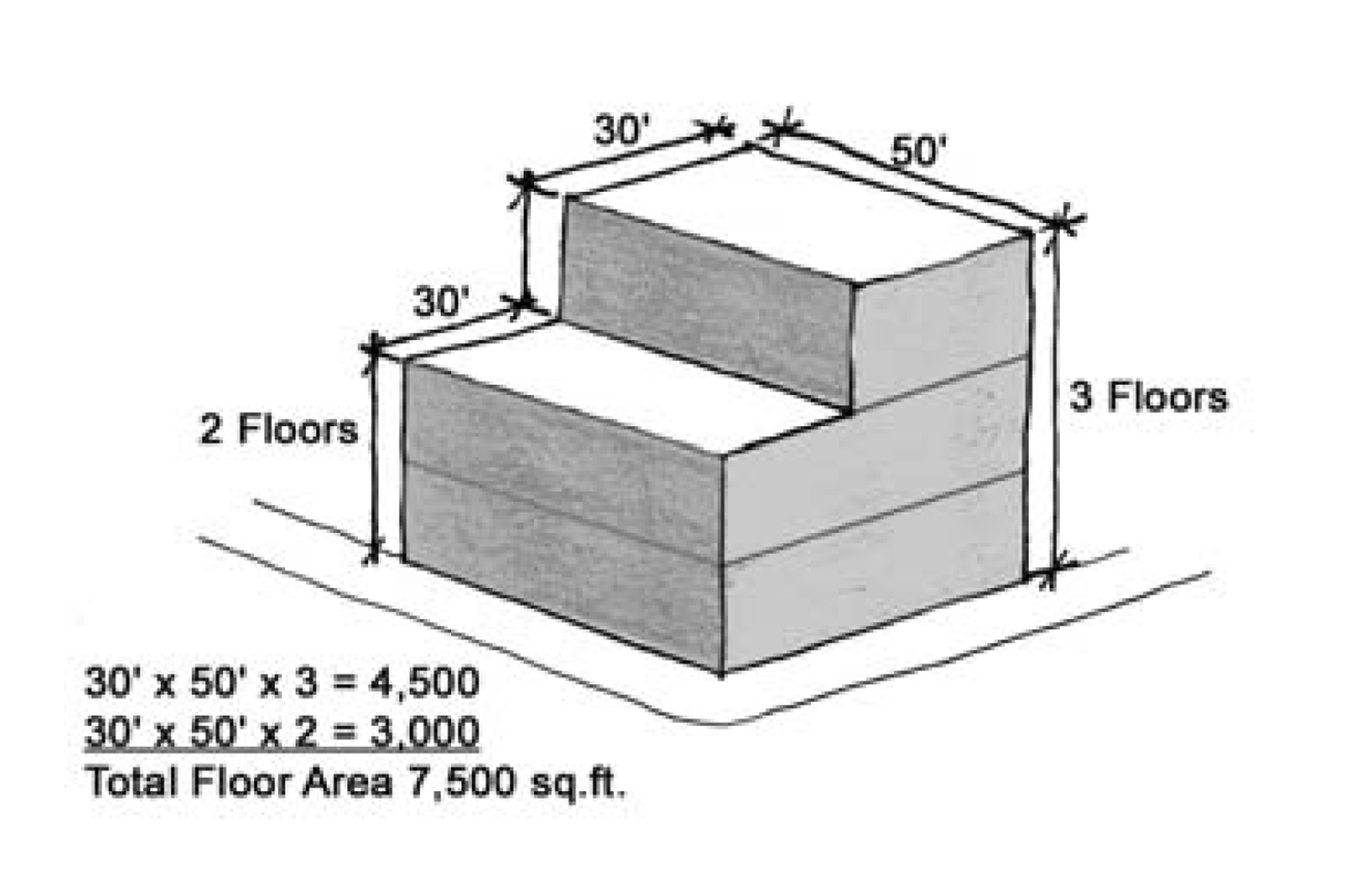
Floor area. For the purpose of determining off-street parking requirements, the term "floor area" shall mean the sum of the gross horizontal areas of the several floors of a building including interior balconies, mezzanines, basements, and attached accessory buildings, but exempting that area primarily devoted to window display, storage, fitting rooms, stairs, escalators, unenclosed porches, detached accessory buildings utilized for dead storage, heating and utility rooms, inside off-street parking, or loading space. Measurements shall be made from the inside of exterior walls.
B.
Multiple types of use in a single building, or in a complex of several buildings on a single site. In instances where more than one type of use occupies the same building or parcel, the total number of required spaces shall be based upon the parking requirements for each use. Parking needs will be based on existing and potential uses of the building. In cases where potential future uses will generate additional parking demand, the city may require a proof of parking plan for the difference between the immediate and potential parking needs.
C.
Bench seating. In stadiums, sports arenas, churches, and other places of assembly in which patrons or spectators occupy benches, pews, or other similar seating facilities, each 18 inches of such seating facilities shall constitute one seat for the purpose of calculating required parking.
D.
Reduced parking requirement. Parking space for uses outlined in this chapter may be reduced if a detailed parking analysis is provided by the applicant and approved as a conditional use permit (CUP).
6. - Joint parking facilities.
A.
The city council may, after receiving a report and recommendation from the planning commission, approve a CUP for one or more businesses to provide the required off-street parking facilities by joint use of one or more sites where the total number of spaces provided is less than the sum of the total required for each business should they provide them separately. When considering a request for such a permit, the planning commission shall not recommend that such permit be granted nor shall the city council approve such a permit except when the following conditions are found to exist:
1)
Up to 50 percent of the parking facilities required for a theater, bowling alley, dance hall, bar, or restaurant may be supplied by the off-street parking facilities provided by types of uses specified as primarily daytime uses in subsection (4) of this section.
2)
Up to 50 percent of the off-street parking facilities required under subsection (4) of this section as primarily daytime uses may be supplied by the parking facilities provided by the following nighttime or Sunday uses: auditoriums incidental to a public or parochial school, places of worship, bowling alleys, dance halls, theaters, bars, apartments, or restaurants.
3)
Up to 80 percent of the parking facilities required by this article for a place of worship or for an auditorium incidental to a public or parochial school may be supplied by the off-street parking facilities provided by uses specified under subsection (4) of this section as primarily daytime uses.
4)
For the purpose of this section, the following uses are considered as primarily daytime uses: banks, business offices, retail stores, personal service shops, household equipment or furniture shops, clothing or shoe repair or service shops, manufacturing, wholesale uses, and similar uses.
B.
Conditions required for joint use are as follows:
1)
The building or use for which application is being made to utilize the off-street parking facilities provided by another building or use shall be located within 300 feet of such parking facilities.
2)
The applicant shall show that there is no substantial conflict in the principal operating hours of the two buildings or uses for which joint use of off-street parking facilities is proposed.
3)
A properly drawn legal instrument, executed by the parties concerned for joint use of off-street parking facilities, duly approved as to form and manner of execution by the city attorney, shall be filed with the city clerk-treasurer and recorded with the county recorder within 60 days after the approval of the joint parking use by the city.
7. - Required off-street parking spaces and garages.
A.
The number of required parking spaces has been established for specific uses in the city. The zoning administrator shall determine the required number of parking spaces for uses not specifically listed in this section based upon the characteristics of the use.
B.
Garage size. The minimum garage size for single and townhome dwellings, attached or detached, shall be, at a minimum, 24 feet by 24 feet for each dwelling unit.
C.
The minimum number of parking spaces for uses shall be as follows:
8. - Reduced parking facilities.
When demonstrated to the satisfaction of the city council that up to ten percent of the number of parking spaces required by this section would not be needed for the particular use in question, a reduced number of parking spaces may be approved subject to the following:
A.
The application for reduction shall be accompanied by supporting data specifically applying to the particular use in question or showing a lesser national standard.
B.
The applicant must also provide each of the following:
1)
A detailed parking plan demonstrating that the parking otherwise required by this section can be provided on the site within ordinance design standards; and
2)
A covenant in recordable form, approved as to form and content by the city attorney, executed by the property owner, which covenant provides that the owner, on behalf of him/herself and his/her heirs, successors and assigns, will not use the area identified for expansion parking for any use except landscaping or to cause compliance with the off-street parking requirements of this Code.
C.
The city may order installation of previously excepted parking spaces at any time when, in the city's judgment, conditions indicate the need for such parking, and the property owner shall comply with such order.
9. - [Parking stall and aisle dimensions].
Parking stall and aisle dimensions for parking lots shall be constructed as follows:
*One-way aisles only.
**Aisles that serve one row of parking stalls may be 22 feet wide.
10. - Loading facilities.
The regulation of loading spaces is designed to alleviate or prevent congestion of public rights-of-way and so to promote the safety and general welfare of the public by establishing minimum requirements for off-street loading and unloading from motor vehicles in accordance with the utilization of various parcels of land or structures.
A.
Location.
1)
All loading berths shall be off-street and located on the same lot as the building or use to be served.
2)
All loading berth curb cuts shall be located a minimum of 50 feet from the intersection of two or more street rights-of-way. This distance shall be measured from the property line.
3)
Except for loading berths for condominiums, no loading berth shall be located closer than 50 feet to a residential district unless within a structure.
4)
Loading berths shall not be located within the front yard.
5)
Loading berths located at the side of buildings on a corner lot shall:
a)
Not conflict with pedestrian movement.
b)
Not obstruct the view of public rights-of-way from off-street parking access.
c)
Comply will all other requirements of this section.
6)
Each loading berth shall be located with appropriate means of vehicular access to a street or public alley in a manner which will cause the least interference with traffic.
B.
Surfacing. All loading berths and access ways shall be constructed with bituminous or concrete surface and curbed.
C.
Use of loading berths and access drives. Any space allocated as a required loading berth or access drive shall not be used for the storage of goods, inoperable vehicles, or snow, and shall not be included as part of the space required for off-street parking.
D.
Screening. Except in the case of multiple dwellings, all loading areas shall be screened and landscaped from abutting and surrounding residential uses in compliance with this ordinance.
E.
Size of loading berths. Unless otherwise specified in this chapter, the first loading berth shall be not less than 70 feet in length, and additional berths required shall be not less than 30 feet in length, and all loading berths shall be not less than ten feet in width and 14 feet in height, exclusive of aisle and maneuvering space.
11. - Parking provisions in residential districts.
A.
Location of parking spaces.
1)
Side and rear yard: Off-street parking areas shall not be located within five feet of the side or rear lot lines.
2)
Front yard: Off-street parking areas shall not be located within ten feet of the front lot line.
B.
Screening.
1)
Parking areas for residential dwellings other than detached single-family shall be screened from adjacent properties in accordance to [with] Section 23. Screening Regulations.
2)
Parking areas for non-residential uses in residential districts shall be screened from adjacent properties.
12. - Parking provisions in business districts.
A.
Location of parking spaces.
1)
Front yard: Ten feet from the right-of-way.
2)
Side yard: Five feet from the right-of-way.
3)
Rear yard: Five feet from the right-of-way.
B.
Screening. Parking areas shall be landscaped in accordance to [with] Section 27. Landscape [Landscaping] Regulations.
1)
Parking areas abutting a residential district shall be screened from adjacent properties. Types of screening materials shall consist of berms, fences, walls, or landscaping. Plans for screening shall be submitted and approved in the site plan review process.
2)
Screening shall be a minimum of six feet in height.
13. - Parking provisions in the light industrial district.
A.
Location of parking spaces.
1)
Front yard: Ten feet from the right-of-way.
2)
Side yard: Five feet from the right-of-way.
3)
Rear yard: Five feet from the right-of-way.
B.
Screening.
1)
Parking areas shall be screened in accordance to [with] Section 23. Screening Regulations.
2)
Parking areas abutting a residential district shall be screened from adjacent properties. Types of screening materials shall consist of berms, fences, walls, or landscaping. Plans for screening shall be submitted and approved in the site plan review process.
(Ord. No. 19, Second Series, 5-5-2010)

