
East Peoria City Zoning Code
CHAPTER 15
- CONSTRUCTION ON AND MAINTENANCE OF STEEP SLOPE ZONES
Sec. 5-15-1. - Definitions.
The following words, terms and phrases, when used in this chapter, shall have the meanings ascribed to them in this section, except where the context clearly indicates a different meaning:
Aggregate diameter means the combined diameter of a multiple trunk tree measured at diameter breast height.
Bottom, or toe, of slope means the line formed by the base of a steep slope.
Construction activities means any activity that involves the construction or demolition of any structure of any nature whatsoever or the disturbance, excavation or placement of soil in sufficient quantities to change soil contour at any location by a depth of more than six inches, or removal of any protected tree.
Desirable species means any species of tree belonging to any of the following genera:
Diameter breast height (DBH) means the diameter of a tree measured at 4½ feet above the highest point of the existing grade at the base of the tree.
Director means the director of planning and zoning of the city.
Drainage line means a pipe, tile, ditch or other similar manmade means of accomplishing the removal of surface and/or subsurface water.
Erosion means the process whereby soils are transferred from place to place by the movement of wind or water.
Protected tree means any living tree of a desirable species having a diameter of eight inches DBH or larger or having an aggregate diameter of 15 inches DBH or larger.
Ravine means a gully or gorge worn by the flow of water in a regularly or intermittently flowing waterway.
Remove or removal means the actual physical removal of a tree, or the effective removal through intentional damaging, poisoning, or other direct or indirect intentional action resulting in, or likely to result in, the death of a tree.
Restoration means the re-establishment of the grade, slope, stability, vegetation, or drainage systems of disturbed property in a steep slope zone by bringing the property back to substantially the same condition as existed prior to disturbance.
Steep slope means land with a slope which equals or exceeds a vertical rise of one foot for a horizontal run of three feet for a vertical height of 35 feet or more.
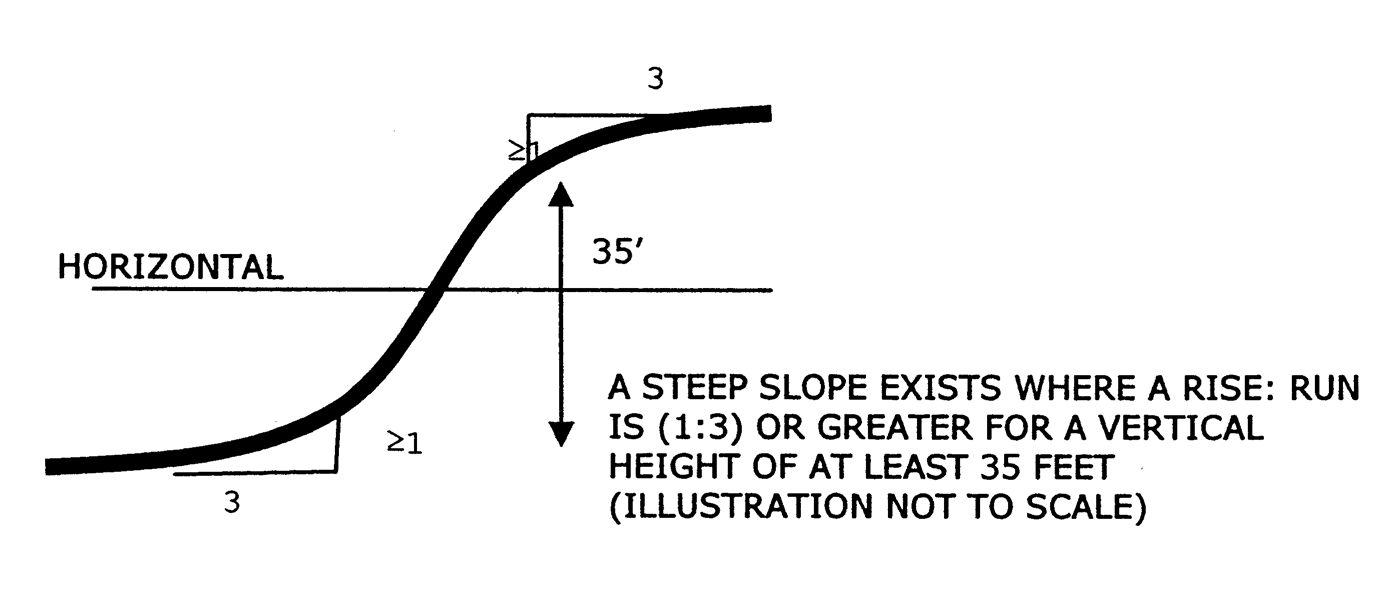
Steep Slope
Steep slope zone means all land which lies between the bottom of a steep slope and a line 20 feet beyond the top of a steep slope into the adjoining tableland.
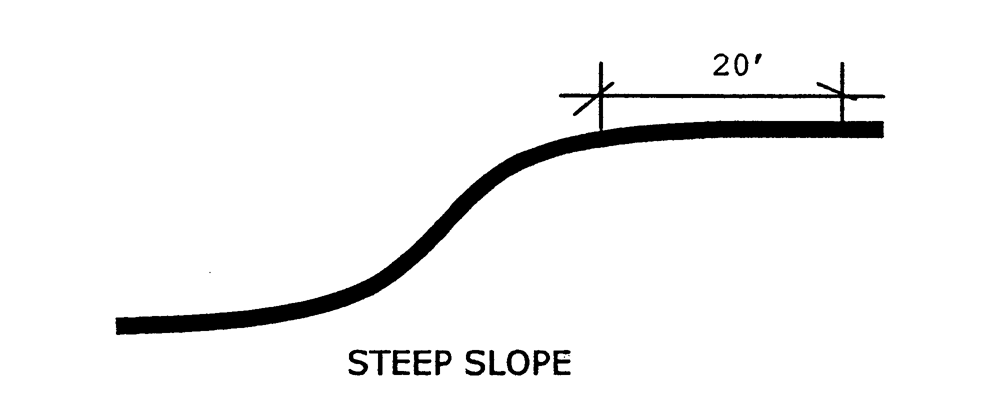
Steep Slope Zone
Tableland means an elevated region with a low relief surface and with at least one border defined by more or more steep slopes.
Top of steep slope means the line formed by the top of a steep slope.
Tree means a self-supporting, woody plant, together with its root system, having a well-defined stem or trunk or a multi-stemmed trunk system, a more or less well-defined crown, and a mature height of at least 15 feet. The term "tree" shall not include trees in containers or nursery stock trees maintained for resale.
Undesirable species means are those species of tree considered by arborists to be invasive, nonnative, and/or shallow-rooted, including, but not limited to, buckthorn, Norway maple, mulberry, box elder, black locust, Chinese elm, Siberian elm, tree of heaven and willow.
(Code 1994, § 5-15-1; Ord. No. 3682, § 7, 4-4-2006)
Sec. 5-15-2. - Limitation on construction in and development of steep slope zones.
Except as authorized in this chapter, no construction activities may be undertaken or continue in a steep slope zone. Steep slope zones shall remain vegetated in the natural state. Any steep slope zone disturbed for any reason including the commencement of any authorized or unauthorized construction activities shall be restored by planting appropriate native vegetation. When construction activities occur upon property abutting a steep slope zone, erosion control measures prescribed by this chapter and by title 4, chapter 14 shall be placed along the top of the steep slope and maintained during any construction activities.
(Code 1994, § 5-15-2; Ord. No. 3682, § 7, 4-4-2006)
Sec. 5-15-3. - Maintenance of property in a steep slope zone.
Owners of real estate within or adjacent to a steep slope zone shall install and properly maintain drainage lines that convey stormwater generated by manmade structures on such property either to a public storm sewer or to the base of the steep slope. Private drainage lines shall not leak water onto the surface of a steep slope zone. Lawn waste or other debris shall not be placed in a steep slope zone and if placed shall be removed.
(Code 1994, § 5-15-3; Ord. No. 3682, § 7, 4-4-2006)
Sec. 5-15-4. - Subdivision of property which includes steep slopes.
In connection with the approval and recordation of a plat of subdivision, the city may require covenants to be placed on record as may be necessary to ensure the long-term maintenance of drainage lines and other measures designed to reduce erosion. All subdivision plats approved after the ordinance from which this chapter is derived shall show the boundaries of any steep slope zone located within the subdivision. Within subdivisions that contain steep slope zones, the city council may in its sole discretion approve requests by the subdivider to reduce front yard setbacks on lots containing steep slope zones, but only if the city council finds that such reductions meet the standards for an exception as prescribed by section 6-3-13 of city subdivision regulations.
(Code 1994, § 5-15-4)
Sec. 5-15-5. - Structures and activities authorized within a steep slope zone.
The following construction activities are permitted within a steep slope zone subject to prior issuance of a building permit and subject to conformance with the standards established in this chapter and elsewhere in this Code:
(1)
Legal nonconforming structures may be maintained or rebuilt subject to the provisions of chapter 5 of this title pertaining to nonconforming buildings and uses.
(2)
Mechanical or electrical lifts, bridges, walkways, steps, landings, and/or fences which do not obstruct the flow of light or water, and utility service lines. Stairs constructed in the steep slope zone shall be no greater than five feet in width. Landings constructed in the steep slope zone shall be no larger than five feet by ten feet.
(3)
Emergency action to remediate an unstable or insecure slope which poses an imminent threat to the health, safety, or welfare of the public; provided, further, that the remedial action involves the least possible disruption of the natural features of the site and conforms as nearly as possible with the standards and policies of this chapter.
(4)
Normal landscape maintenance or routine arboreal activities, including small scale planting of ornamental flowers or shrubs, and/or the removal of diseased, dead or damaged trees of any species, and/or the removal of undesirable trees, provided such activities include revegetation in conformance with the standards contained in this chapter.
(5)
Extensions of structures such as balconies or decks, provided that such extension is not supported by any structure or foundation located within the steep slope zone. However, no part of any such structure may extend more than one foot into the steep slope zone for each three feet of height.
(6)
Public improvements and infrastructure constructed by the city or other units of federal, state or local government.
(7)
Other accessory structures having a total ground cover area not exceeding 150 square feet.
(8)
Small scale erosion control structures such as check dams not exceeding a height of three feet and rip-rap.
(9)
Construction activities within a steep slope zone other than those specifically authorized by subsections (1) through (8) of this section shall require a special use authorized by the city council in accordance with the procedures established by section 5-12-10. Every application for a special use to undertake construction activities within a steep slope zone shall include the submission of a report prepared by a licensed professional civil/structural engineer trained and experienced in the practice of geotechnical engineering. The report shall cover affected portions of the steep slope zone where construction is proposed together with all adjoining areas in the tableland located beyond the top of the steep slope zone but within 30 feet thereof. The report shall include the following:
a.
Soil types and subsurface materials investigation. This investigation shall at a minimum consist of:
1.
A thorough subsurface investigation using techniques such as borings, test pits, in situ tests, laboratory tests or other procedures performed to a depth sufficient to determine foundation conditions for the proposed construction; and
2.
A description of the soil and subsurface materials found on the subject site to a depth extending below any proposed excavation as well as the engineering properties of the subsurface soil materials.
b.
Means and methods. A written description of the proposed means and methods of accomplishing such work, which means and methods shall be carefully selected to minimize slope damage. In the case of any proposed structure, the means and methods shall include plans and specifications for construction, including, without limitation, a foundation plan which takes into account the conditions identified through the soil types and subsurface materials investigation. Upon approval of a building permit for the structure by the director, such written description shall be the enforceable means and method of construction.
c.
Geotechnical characteristics. A discussion of geotechnical characteristics which shall, at a minimum, include the following:
1.
Consideration in the design of all proposed structures shall be given to the effect of undercutting at the base of steep slopes or bluffs caused by wave action, stormwater flow, and erosion and/or channel changes.
2.
A description of the stability of surface patterns of water flow as well as indication of the presence or absence of permeable zones in underlying soils and susceptibility of slope instability due to changes in the water table.
3.
An opinion that the soil types, soil stability, subsurface hydrology, and external influences affecting the site will not cause any significant hazards for the proposed use; or if they may cause such hazards, an opinion that such hazards can be overcome, together with a reasonably detailed description of how it is proposed to overcome them.
d.
Earth moving plan. An earth moving plan which complies with the provisions of section 5-15-6(3) which plan shall, at a minimum, include the following:
1.
A topographic survey, showing property contours at one-foot intervals for tableland and five-foot intervals for steep slopes, including special notes and details of the existing terrain;
2.
Proposed earth moving details, including the dimensions, elevations, and contours of any proposed earth moving and the placement of excavated materials;
3.
A description of the methods to be employed in disposing of soil and other material removed, including the location of the disposal site;
4.
A time-table for commencement and completion of each stage of the project; and
5.
A provision requiring where appropriate the placement of a temporary construction perimeter fence on the tableland at the top edge of steep slope zone until construction is completed.
e.
Hydrological control plan. A plan for intercepting and containing drainage at the site and from any structure which plan complies with section 5-15-6(1).
f.
Vegetation plan. A vegetation plan which complies with the provisions of section 5-15-6(2) prepared or approved in writing by a landscape professional trained and experienced in both the characteristics of plant material and proper procedures for installation, which plan shall at a minimum include the following:
1.
An inventory describing the existing floral and tree cover of the site, including identification of undesirable species and protected trees showing those areas where the vegetation will be removed as part of the proposed development;
2.
A description of proposed revegetation of disturbed areas, specifying the materials to be used;
3.
A written description detailing methods of slope stabilization and revegetation, together with the rationale for selecting the plant materials and planting techniques proposed to be used; and
4.
A maintenance guideline, instructing owners of the site of necessary actions to be taken following construction and/or earth moving in order to maintain plantings in good and serviceable health.
(Code 1994, § 5-15-5; Ord. No. 3682, § 7, 4-4-2006)
Sec. 5-15-6. - Development standards.
Construction and/or earth moving within a steep slope zone and within 100 feet of a steep slope zone shall occur in accordance with the following standards:
(1)
Hydrological controls.
a.
Natural channels. Natural drainage ways shall be preserved to the maximum extent possible.
b.
Controlled runoff. Concentrated runoff from impervious surfaces shall be conveyed away from a steep slope to a municipal storm sewer system if available, or through grassed swales, infiltration trenches or other sound professional engineering practices designed to infiltrate stormwater runoff and minimize erosion. If infiltration is not deemed appropriate, concentrated runoff from impervious surfaces shall be collected and transported in drainage lines. Stormwater pipes conveying concentrated runoff to the bottom of a steep slope shall generally be located above ground but may be located below ground with the approval of the director. Sump pump drain lines shall be connected to a municipal storm sewer system if located within 350 feet thereof.
c.
Interceptor ditches. When sound professional engineering practice dictates or when required by the director, interceptor ditches shall be established outside of steep slope zones in order that soil shall not become saturated and the intercepted water shall be conveyed in a pipe or other approved manner to a municipal storm sewer system, if available, or to the bottom of a slope in a manner designed to minimize erosion.
d.
Discharge point stabilization in steep slopes. Natural drainage ways shall be stabilized by landscape integration, rip-rap, rolled erosion control products or other means consistent with sound professional engineering practice, to a distance below drainage and culvert discharge points sufficient to convey the discharge while minimizing channel erosion and in such a manner as to dissipate the energy of the discharge.
e.
Early completion. The overall drainage system shall be completed and made operational at the earliest possible time during construction.
f.
Impact on adjacent property. The natural or usual flow of surface or subsurface water shall not be altered or obstructed by grade changes in any way that may adversely affect the property of another by either contributing to pooling or collection of waters or to the concentration or intensification of surface water discharge. However, construction which might otherwise be prohibited hereinabove may be allowed if such waters are properly drained by a pipe or other approved manner to a municipal storm sewer system, if available, or to the bottom of the steep slope.
(2)
Vegetation and revegetation.
a.
Natural vegetation. Every effort shall be made to maintain natural vegetation in a steep slope zone.
b.
Smallest area. When construction activities are authorized in a steep slope zone, the smallest practical area of raw soil shall be exposed for as short a duration of time as practical. When sound professional engineering practice dictates or when required by the director, temporary vegetation, or other acceptable cover shall be used to protect areas of raw soil exposed during construction.
c.
Revegetation. A mixed planting of perennial and woody species (preferably native species with adequate deep root systems) shall be used to landscape disturbed areas in a steep slope zone.
d.
Tree removal. It is unlawful to remove any protected tree from a steep slope zone without the approval of the director.
e.
Long term management. The director shall encourage the owners of property containing steep slope zones, including, in particular, those who apply for permits to undertake construction activities as authorized under the provisions of this chapter, to learn and implement the most current techniques for the management of the forested areas of the steep slope zones in accordance with the best available scientific information.
(3)
Earth moving.
a.
Minimum alterations. Earth moving shall be limited to the minimum required for building foundations, driveways, drainage control structures, and immediate yard areas.
b.
Erosion control. All earth moving shall be accomplished in a manner which will create the lowest possible potential for erosion.
c.
Soil fill on steep sloped land. All fill in a steep slope zone is prohibited, other than backfill which is determined by the director to be necessary for slope stabilization.
d.
Prompt completion. All earth moving shall be accomplished in the shortest practical period of time. All excess excavated material shall be removed from the steep slope zone and no temporary or permanent storage of material shall be permitted within the steep slope zone. No existing natural vegetation shall be destroyed, removed or disturbed prior to the initiation of earth moving activities.
(Code 1994, § 5-15-6; Ord. No. 3682, § 7, 4-4-2006)
Sec. 5-15-7. - Permits.
A permit for any construction activity which, under the provisions of section 5-15-5(7), requires a special use may be issued only after approval of the special use by the city council. Each application for a permit to undertake any construction activities within a steep slope zone which does not require a special use shall be made in compliance with this title and title 3. The seal of a state licensed professional civil or structural engineer shall appear on all plans and specifications pursuant to which any permit is issued for any construction activities within a steep slope zone which does not require a special use. No building permit shall be issued for any construction activity within a steep slope zone which does not require a special use until the applicant has submitted and the director has approved a written plan consisting of at least the following:
(1)
A description of soil and subsoil conditions in the area where the construction activity will occur.
(2)
An earth moving plan which details dimensions, elevations and contours of any proposed earth moving activities, describes the placement of excavated materials, describes the methods to be employed in disposing of excess excavated material including the location of the disposal site, a timetable for completion of the project and a description of temporary and permanent erosion control measures, including provisions for the interception and containment of surface and subsurface water in the vicinity of construction.
(3)
A vegetation plan which describes vegetation to be removed or affected during construction, including, in particular any protected trees to be removed and a plan for revegetation of the disturbed area, including a description of the plant materials which will be utilized in connection with the restoration.
(Code 1994, § 5-15-7; Ord. No. 3682, § 7, 4-4-2006)
Sec. 5-15-8. - Reimbursement of engineering fees.
Should any representative of the city deem it necessary to obtain the services of a professional engineer to review or verify the calculations or conclusions submitted to the city in connection with any application for a permit to undertake construction activities within a steep slope zone, to conduct inspections while an applicant engages in construction activities after issuance of a permit, or to undertake any other reasonably necessary investigations or activities, the applicant for such permit shall reimburse the city for the reasonable cost of such services. By submitting an application to undertake construction activities within a steep slope zone, the applicant shall be taken to have agreed to pay any such fees. The director shall refuse to issue a permit for any construction activities within a steep slope zone until all actual or estimated engineering fees due under the provisions of this section have been paid in full. The director shall refuse to issue a certificate of occupancy for any improvements until all engineering fees due under the provisions of this section have been paid in full. The director may as a condition to commencing the process of considering an application for a special use under the provisions of section 5-15-5(9) require advance payment of the estimated cost of such engineering fees.
(Code 1994, § 5-15-8; Ord. No. 3682, § 7, 4-4-2006)
Sec. 5-15-9. - Security for completion of improvements.
In order to secure compliance with this chapter, including the completion of construction activities within a steep slope zone in accordance with the provisions of any report submitted in support of an application to undertake such activities and/or to secure compliance with the terms of any permit or special use authorized under the provisions of this chapter, either the city council or the director may require the applicant to post security in the form of either a performance bond or a letter of credit. Any such performance bond or letter of credit shall make funds available to the city in an amount which reasonably approximates the cost of completing any construction activities commenced under the terms of any permit or special use and/or the cost of completing the restoration of the affected property in the event that construction activities are commenced but not completed. In the event that construction activities are commenced but not completed in accordance with any applicable permit or special use, the city may, at its option, either complete any authorized construction activities or undertake restoration of the affected property. Should it complete the authorized construction activities or undertake restoration of the affected property, the city may pay any costs that it incurs by drawing on the performance bond or letter of credit posted with respect to the affected property. A performance bond or letter of credit required under this section shall contain such terms and conditions as the city council or the director deem reasonably necessary to ensure the availability of funds in the amount of the security instrument for the purpose of completing any construction activities or completing any restoration.
(Code 1994, § 5-15-9; Ord. No. 3682, § 7, 4-4-2006)
Sec. 5-15-10. - Penalties and enforcement.
The general penalty provisions of this Code shall apply to violations of this chapter. Failure to comply with the terms and conditions of any special use authorized under the provisions of this chapter shall constitute a violation of this chapter. Failure to comply with or implement the provisions of any engineering report or other plan submitted in support of any application for a permit or special use under this chapter shall constitute a violation of this chapter. Each day that a violation continues shall constitute a separate offense. In addition, the city may, in its discretion, apply to a court of competent jurisdiction for injunctive relief for the purpose of enforcing the provisions of this chapter.
(Code 1994, § 5-15-10; Ord. No. 3682, § 7, 4-4-2006)
Sec. 5-15-11. - Conflict with other regulations.
Where the provisions of this chapter conflict with other laws, regulations and policies, the more restrictive of this chapter and such other laws, regulations or policies shall apply.
(Code 1994, § 5-15-11; Ord. No. 3682, § 7, 4-4-2006)

