
Effingham County Unincorporated
City Zoning Code
City Zoning Code
ARTICLE III
GENERAL PROVISIONS
3.1 - Abandoned real property.
3.1.1 For any public street or alley which is hereafter officially vacated or abandoned, the regulations applicable to each parcel of abutting property shall apply to the centerline of the property which is abandoned. In the event abandoned property is not divided at the centerline for abutting properties, the zoning districts applicable shall apply to such ownership line as determined by virtue of such abandonment.
3.1.2 For any public property other than streets or alleys, the regulations applicable to the zoning classification which abuts the abandoned property for the greatest number of linear feet shall apply to the entire property.
3.2 - Abandoned vehicles.
Within all zoning districts, except where specifically authorized, all vehicles which are inoperative and/or unlicensed shall not be abandoned in the public right-of-way or on private property in excess of 30 days during any consecutive 120-day period, except within a completely enclosed garage or other structure. For purposes of this section, the term "vehicle" includes farm and commercial vehicles, machinery, and equipment.
(Ord. of 12-15-92)
3.3 - Accessory structures in residential districts.
3.3.1 Accessory structures in the AR-1, AR-2, AR-3, R and PD-R residential districts may be erected within a side or rear yard, provided they conform to the following:
(a)
Maximum height. 25-foot maximum height to the ridgeline of the roof in the R and PD-R districts; 35 feet in AR-1, AR-2, and AR-3 districts. Accessory structures used for agricultural purposes are exempt from the height restrictions in AR-1.
(b)
An accessory structure shall not be less than five feet from the rear property line and not less than five feet from interior side setback lines.
(c)
An accessory structure shall not be less than ten feet from a principal structure.
(d)
Not more than two accessory structures, including a detached garage, shall be located in any R or PD-R district, on one lot.
3.3.2 Accessory structures in the agricultural residential districts may be placed in the front yard where the property is at least five acres and not in a platted subdivision. All structures on the property must comply with the front setback requirements for a principal structure.
(a)
Accessory structures shall not be erected on a lot prior to construction of a principal structure, except for agricultural purpose storage buildings in the AR-1 zoning district, where the property is at least five acres, and not in a platted subdivision.
(b)
Accessory structures in the R, PD-R, and AR zoning districts may not be used for any type of commercial operation, except as provided for in section 3.15A and 3.15B.
(c)
An accessory structure shall not be used as a dwelling unit.
3.3.3. A shipping container may be utilized as an accessory building in an AR-1, AR-2, and AR-3 zoning districts, provided it shall conform to the following:
(a)
Containers shall be painted in solid neutral colors. No writing or advertising of any kind shall be permitted.
(b)
Containers shall meet the required side and rear yard setback requirements for an accessory structure, and shall be placed no nearer than ten feet from a primary structure.
(c)
Containers shall not be placed in the front yard.
(d)
Containers shall not be stacked above the height of a single container.
(e)
Containers shall be subject to lot coverage requirements.
(f)
Containers shall only be placed on AR-1, AR-2, and AR-3 lots that meet the minimum lot size for the district.
(g)
The number of shipping containers on AR-1, AR-2, and AR-3 lots shall be limited to one container per acre of land, to a maximum of five containers on a parcel.
(h)
No electricity or plumbing shall be connected to a shipping container.
(i)
Ventilation is not required.
(j)
No hazardous materials may be stored in a shipping container.
(k)
Shipping containers shall be secured from entry by children and the general public when not attended.
(l)
Shipping containers used for storage of equipment and supplies, and associated with an approved building construction project, shall be permitted to remain on site until the approval of the project's final building inspection, or expiration of the building permit, whichever is less.
(Ord. of 2-19-91; Ord. of 1-19-21; Ord. of 9-15-20; Ord. of 1-3-23(2); Ord. No. 2025-206, 5-6-25; Ord. No. 2025-516, 11-18-25)
3.4 - Buffers.
Purpose and function: To provide minimum separation and screening of different land uses. To minimize the adverse effects of commercial and industrial land uses on surrounding property and public throughfares; to act as a filtration zone for storm water; to make the environment more visually attractive; and to preserve the tree canopy in the county.
It is the intent of this ordinance that buffers be maintained and controlled so that the effects of the screening are not diminished.
3.4.1 Buffer design standards:
A.
Plant material: Existing plant materials including understory vegetation in buffers shall be maintained whenever possible. AH trees over six inches diameter at breast height (dbh) shall be retained. Additional planting may be required when existing plant material is inappropriate for screening. Additional landscaping may be added at the property owner's discretion.
B.
Encroachment: Buffer areas should remain natural. The following are the only permitted encroachments:
1.
Drainage ditches, utility, and service lines provided that they are approximately perpendicular to the property line.
2.
Sidewalks and pathways that connect multiple parcels.
3.
Lighting fixtures.
4.
Signs.
5.
Flagpoles.
6.
Structural elements: Privacy fences or walls located in a buffer shall provide a minimum of two feet from the element to the exterior property line to allow for plant material.
7.
Landscaping retaining wall if integrated into the buffer and subject to approval by the zoning administrator.
8.
Berms, subject to the following standards if encroaching within a buffer:
a.
Minimum slope of 4:1 (see figure below).
b.
Maximum height of the berm shall be based on the width as provided below and shall be reduced by six feet for every one foot of berm height:
i.
For a 25 feet high berm, the buffer requirement is reduced from a 300 feet buffer to a 150 feet buffer. The 150 feet wide buffer includes 35 feet of natural and undisturbed buffer and remaining buffer is the berm. If the berm base is beyond 115 feet, the berm extends into the property and not the 35-foot undisturbed area.
ii.
For a 16 feet high berm, the buffer requirement is reduced from a 300 feet buffer to a 200 feet buffer. The 200 feet wide buffer includes 35 feet of natural and undisturbed buffer and remaining buffer is the berm. If the berm base is beyond 165 feet, the berm extends into the property and not the 35-foot undisturbed area.
iii.
For a 10 feet high berm, the buffer requirement is reduced from a 300 feet buffer to a 240 feet buffer. The 240 feet wide buffer includes 35 feet of natural and undisturbed buffer and remaining buffer is the berm. If the berm base is beyond 180 feet, the berm extends into the property and not the 35-foot undisturbed area.
iv.
The height of the berm is measured perpendicular off the nearest adjacent property line using the natural grade, height cannot be determined by infill grade.
v.
Major subdivisions with rear or side facing homes will install a six (6) foot tall berm with approved landscaping material at the apex of the berm. Minimum width of the berm is fifteen (15) feet at the base.
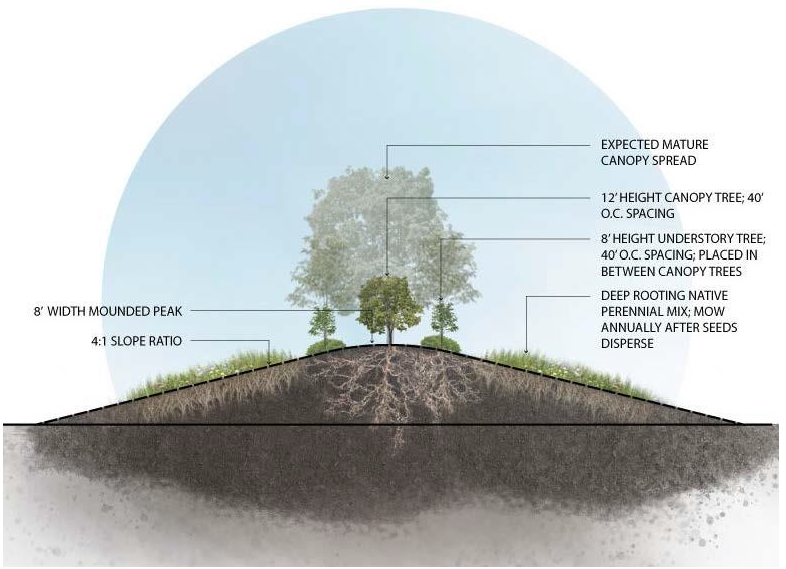
C.
Required setbacks shall be inclusive of buffers areas.
If a privacy fence is used, the material needs approval by Development Services, the fence maximum height is seven (7) feet in height, then the adjacent buffer may be reduced by ten (10) feet-30 feet to 20 feet for residential required buffers only.
* Subdivisions of less than five lots are exempt from buffer requirements when neighboring property is under the same ownership.
D.
The constructed berm shall have vegetative cover applied immediately post construction to assist in stabilization of the berm.
Before final plat approval of a subdivision or sketch plan approval of a commercial, industrial or PD development, a bond shall be submitted to development services in the amount of ten (10) percent of the construction cost of the berm as determined by EOM.
** Adjacent commercial, institutional, and industrial developments which are designed as a single development or share parking may reduce the buffer width by up to 50 percent between these parcels. If commercial property is developed with zero lot lines, then the buffer between parcels shall be eliminated. At no time may buffers be reduced between commercial, institutional, or industrial and residential uses.
*** The required plant material portion of a buffer may be reduced by 50% when adjacent to agricultural or conservation areas if replaced by additional storm water management areas.
**** Industrial surface mines will follow the buffer requirements in section 3.17.4.
3.4.2 Adjacent public street buffers: All development excluding industrial development shall maintain a ten-foot wide landscaped buffer between any parking or loading area and an adjacent accessed public right-of-way (ROW). In single family subdivisions a ten-foot landscaped buffer must be maintained between any lot or internal street and any public collector or arterial ROW accessed from the subdivision.
A.
In cases where the adjacent public street is also the exterior boundary of the site, the buffer required in table 3.4.1 shall be inclusive of this ten-foot-wide landscaped buffer.
B.
Where parcels abut a street without access to that street the buffer on that side of the parcel shall equal the required buffer for the use on the other side of the street in the above chart.
C.
Street buffers for industrial property shall equal the required buffer for the use on the other side of the street in the above chart.
D.
Residential subdivisions shall have visual buffers consisting of either vegetative cover or fencing and shall have a minimum 50 percent opacity. If vegetation is used, it shall be projected to reach the required opacity within one year of installation and shall maintain the minimum required opacity during all seasons of the year. A visual buffer may be no higher than six feet in height, except on main or collector streets where the buffer is a maximum height of twenty (20) feet.
E.
PDs may have different buffer requirements; however, buffers are still required in all approved PDs. Please refer to PD ordinance in Article X.
F.
Where property lines run adjacent to federally designated interstate highways, regardless of zoning or proposed use, that section of the property is exempt from all buffer requirements along the property line with frontage on the interstate highway.
3.4.5 Required plant material:
A.
Where trees do not already exist they must be planted at a rate of one tree, at least two inches dbh, every 15 linear feet of buffer. The following list specifies recommended trees for this area. For buffers greater than 30 feet in depth required tree planting must come from the large tree list.
B.
Buffers in industrial zones must include understory plantings at a rate of on three (3) gallon plant every five linear feet if sufficient understory foliage does not exist.
Medium Canopy Trees: (Count for 550 square feet of area for planting—minimum two inches caliber)
(Amend. of 12-12-06; Ord. of 11-4-08; Ord. of 12-8-09, § 1; Ord. of 8-2-16, § 1(a) ; Ord. of 11-07-2023(1))
3.5 - Buildings on through lots.
Where a lot extends through from one street to another, the setback requirement for each such street shall be complied with and any building shall have dual facing. No accessory building or other structure shall be placed on through lots if said structures would conflict with other building values or uses on the same street. On lots having frontage on more than two streets, the minimum front yard shall be provided in accordance with the provisions of this ordinance on at least two of the street frontages.
3.6 - Family cemeteries.
(A)
Purpose and intent. The purpose of this section is to permit the establishment of limited, noncommercial family cemeteries on private property in a manner that is compatible with agricultural and residential land uses, protects adjoining properties, and ensures compliance with applicable provisions of state law.
(B)
Applicability.
1.
A family cemetery may be established only on a conforming parcel zoned AR-1 agricultural-residential that contains a minimum of five acres, and only upon approval of a conditional use permit in accordance with this appendix.
2.
Approval of a family cemetery shall be determined by the board of commissioners, following county review and recommendation, in accordance with the county's conditional use procedures.
3.
A family cemetery shall be noncommercial in nature and shall comply with all requirements of this section as conditions of approval.
4.
The parcel on which a family cemetery is approved shall remain a conforming AR-1 parcel containing a minimum of five acres for so long as the family cemetery exists. No subdivision, boundary line adjustment, or other action shall be permitted that would reduce the parcel below the minimum acreage required by this section or otherwise render the parcel nonconforming.
(C)
Definitions. For purposes of this section, the following definitions shall apply:
Family cemetery - A burial ground located on private property that is established and maintained solely for the interment of members of a single family or related families by blood, marriage, or adoption; that is noncommercial in nature; that is not open to the general public for burial purposes; and that is permitted only in accordance with the standards of this appendix.
Delineated cemetery boundary survey - A land survey prepared and certified by a Georgia-licensed professional land surveyor that identifies and depicts the location and boundaries of a family cemetery on a parcel of land for purposes of compliance with this appendix, recordation, and enforcement.
(D)
Development and recordation standards. A family cemetery shall comply with the following minimum development and recordation standards:
1.
Delineated cemetery boundary survey. Prior to any interment, the property owner shall cause a delineated cemetery boundary survey to be prepared and certified by a Georgia-licensed land surveyor. The survey shall, at a minimum:
•
Delineate the boundaries of the family cemetery by metes and bounds and clearly show the cemetery area as a distinct, labeled tract;
•
Depict and label the applicable setback lines and/or distances necessary to demonstrate compliance with subsection (D)(3), including distances to property lines, existing dwellings or structures located on the subject parcel (if present), and wells, streams, ponds, or other water bodies (if present);
•
Identify the location and type of the required buffer and/or four foot fence or wall;
•
Show the location of all existing and proposed utilities and utility features serving or affecting the cemetery area, including septic systems and known underground utilities;
•
Depict the required minimum 60-foot wide access and drainage easement; and
•
Be sufficient to demonstrate compliance with the applicable standards of this subsection.
2.
Maximum number of burial plots. A family cemetery shall contain no more than eight burial plots, unless otherwise approved by the board of commissioners as part of the conditional use permit. The board of commissioners may approve a lesser or greater number of burial plots based upon site conditions, compatibility with surrounding uses, and compliance with the intent of this section.
3.
Setbacks. Burial plots shall be located a minimum of 150 feet from:
a)
Any property line;
b)
Any existing dwelling or structure located on the subject parcel; and
c)
Any well, stream, pond, or other water body.
4.
Buffers and fencing. The cemetery area shall be screened from adjoining properties by existing vegetation, supplemental landscaping, or a four-foot fence or wall, sufficient to minimize visual impacts.
5.
Access and easement. The cemetery shall have safe and legal access from a public or private road and shall provide a minimum 60-foot wide access and drainage easement to the cemetery area.
6.
Recordation, deed notice, and continued conformance.
a)
The delineated cemetery boundary survey shall be recorded with the Effingham County Clerk of Superior Court prior to any burial activity.
b)
The recorded survey shall include a statement that:
1.
The area shown is designated as a family cemetery;
2.
The cemetery is noncommercial in nature;
3.
The designation shall run with the land and shall not be extinguished by sale, transfer, or conveyance of the property; and
4.
The parcel shall remain a conforming AR-1 parcel containing a minimum of five acres for so long as the family cemetery exists.
c)
Following recordation of the delineated cemetery boundary survey, the property owner shall cause the deed to the property to be updated, revised, or re-recorded, as applicable, so as to reference and incorporate the recorded cemetery survey and its description. The deed shall reflect the existence and location of the family cemetery and shall reference the recorded plat or survey by book and page.
d)
No subdivision, boundary line adjustment, or other action shall be permitted that would reduce the parcel below the minimum acreage required by this section or otherwise eliminate or impair the recorded family cemetery designation.
7.
Burial depth and interment standards.
a)
Minimum burial depth. Each burial shall be placed at a depth of not less than four feet, measured from the natural ground surface to the top of the burial container. A burial depth of six feet is preferred, where site conditions reasonably allow. This requirement is adopted pursuant to the county's zoning and land-use authority and is not intended to regulate the handling, preparation, or disposition of human remains, which shall remain subject to applicable provisions of Georgia law.
b)
Casket requirement. At a minimum, all human remains shall be interred within a casket or coffin.
c)
Vaults and ground liners. Burial vaults and ground liners are not required by Georgia law for family cemeteries. Such vaults and liners are commonly utilized in registered cemeteries to protect burial sites from heavy equipment used in cemetery operations and to reduce the likelihood of ground subsidence or collapse of the casket due to deterioration; however, their use shall be optional for family cemeteries permitted under this section.
(E)
Prohibited activities.
1.
No family cemetery shall be used for commercial purposes, including but not limited to the sale of burial plots or burial services.
2.
No mausoleums, crematories, or columbaria shall be permitted within a family cemetery.
(F)
Compliance with State law. All family cemeteries shall comply with all applicable provisions of Georgia law relating to burial sites, cemetery protection, and the disturbance of human remains.
(G)
Enforcement. Failure to comply with the provisions of this section shall constitute a violation of this appendix and shall be subject to enforcement and penalties as provided herein.
(Amend. of 7-3-01(1); Ord. No. 2026-045, 3-3-26)
Editor's note— Ord. No. 2026-045, adopted March 3, 2026, amended the title of § 3.6 to read as herein set out. The former § 3.6 title pertained to cemeteries, mausoleums, and crematories.
3.7 - Churches and schools.
Public schools shall be subject to the regulations set forth in section 5.3 of this appendix.
3.7.1 Schools, churches, and religious institutions shall be permitted in agricultural, single-family residential districts, agricultural residential districts, multifamily residential districts, general commercial districts, and neighborhood commercial districts provided that the following requirements are complied with:
3.7.1.1 Off-street parking shall be provided as set forth in section 3.30 of this appendix.
3.7.1.2 The principal building and accessory buildings shall comply with the yard and setback requirements of the district in which they are located.
3.7.2 Schools, churches, and religious institutions may be permitted in other districts only after recommendations of the planning board and approval by the county commissioners, which shall hold a public hearing on such request.
3.7A - Conditional zoning.
3.7A.1. In deciding any application for an amendment to the zoning classification of a parcel of property or to the zoning map, the board of commissioners may, on their own motion or upon the recommendation of the planning board or the zoning administrator, grant the application subject to certain conditions deemed necessary by the board to promote and protect the health, safety, morality, and welfare of the county and to further the purposes of this ordinance. Such provisions shall be imposed for the benefit of the community to prevent or lessen any negative impact expected to result from the zoning reclassification or zoning map amendment.
3.7A.2. Conditions that may be adopted include, but are not limited to, conditions as to buffers, preservation of existing vegetation and tree cover, maximum density and/or number of lots, minimum lot size, setback restrictions, and property use restrictions. Such restrictions shall be binding upon the applicant and any successor in title.
3.7A.3. If the conditions under consideration by the board are unacceptable to the applicant, the applicant may withdraw its application without prejudice to the filing of a new application requesting a different zoning classification.
3.7A.4. Map amendments and zoning classification amendments approved conditionally shall be reflected on the zoning map by a notation indicating that the property has been conditionally zoned.
(Ord. of 12-14-99(1))
3.8 - Conversion of dwellings.
The conversion of any building into a dwelling, or the conversion of any dwelling so as to accommodate an increased number of dwelling units or families, shall be permitted only within a district in which a new building for similar occupancy would be permitted under this ordinance, and only when the resulting occupancy will comply with the requirements governing new construction in such district with respect to minimum lot size, lot area per dwelling unit, percentage of lot coverage, dimensions of yards and other open spaces, and off-street parking. Each conversion shall be subject also to such further requirements as may be specified hereinafter within the article applying to such district.
3.8A - Construction sites (portable toilets).
Portable toilet facilities, as approved by the building inspector, shall be furnished at all construction sites for which a building permit has been issued prior to the commencement of work. The building inspector is authorized to waive this requirement upon a showing that alternate sanitary facilities are available to workers at the site.
3.8B - Construction sites (waste material).
All landowners, construction and demolition contractors, and other responsible persons for construction or demolition sites shall provide on-site refuse receptacles, bulk containers or detachable containers for loose debris, paper, building material wastes, scrap building materials, and other trash produced by those working on the site. All of the above-mentioned materials shall be containerized by the end of each day, and the site shall be kept in a reasonably clean and litter free condition. Dirt, mud, construction materials, or other debris deposited upon any public or private property as a result of construction or demolition shall be immediately removed by the landowners, construction and demolition contractors, and other responsible persons. Construction or demolition sites shall be kept clean and orderly at all times.
(Ord. of 10-1-19)
3.9 - Deed restrictions.
These regulations shall not lessen any previous deed restrictions or restrictive covenants recorded with any deed, plat, or other legal document relating to the use of lot and building requirements. The person or agency in the capacity of administering and enforcing these regulations shall abide by any deed restrictions or restrictive covenants provided the restrictions are known.
3.10 - Excavation of sand, gravel, or other material (for industrial or commercial use).
Excavation shall be considered a temporary use, and shall be permitted only in industrial and agricultural districts. Excavations shall not be nearer than 100 feet to any school, church, dwelling, or highway right-of-way.
3.11 - Existing uses.
Nothing contained in this ordinance shall be deemed or construed to prohibit a continuation of any particular lawful use or uses of any land, building, structure, improvement, or premises legally existing in any of the respective districts at the time this ordinance becomes effective; provided, however, that if any such existing lawful use changes to a different use after the date of the adoption of this ordinance, such different use shall conform to the provisions of this ordinance regulating the particular district in which said premises is situated. If any legally existing use or occupancy of a building or premises conflicts with any requirement of this ordinance or any of its amendments, such building shall not be moved, structurally altered, or added to except with the approval of the county commissioners.
All future building structures, repairs, alterations, or other improvements shall comply with all district requirements contained herein, and such structural provisions of the building code and other regulations as have been incorporated herein and made a part hereof, including any building on which construction has been suspended at the time this ordinance was adopted and any building for which foundations were not completed at said time.
No nonconforming building or structure shall be extended or enlarged except when authorized by the board of commissioners, which may permit one enlargement or extension up to 25 percent of the floor area of the structure as it existed at the time of passage of this ordinance.
3.12 - Fences.
Except in planned manufactured home communities, industrial districts, and general and neighborhood commercial districts, no fence, wall, or screened structure, excluding plants and shrubbery, over ten feet in height shall be built within any yard.
3.13 - Garbage disposal.
Garbage or other refuse shall be deposited only in approved garbage cans or in approved garbage disposal areas.
3.14 - Government uses.
The board of county commissioners of Effingham County are not legally exempt from the provisions of this ordinance.
3.15 - Home occupations.
(a)
Definitions.
Bona fide residence: The primary, legal residence where the practitioner resides full time.
Business vehicle: A vehicle used in conjunction with a home occupation, excluding heavy equipment or commercial trucks exceeding one ton capacity.
Hazardous materials: Substances regulated by applicable fire code (NFPA/IFC) that pose a risk to health, safety, or the environment. Storage and use shall comply with local fire code and all applicable Environmental Protection Division (EPD) regulations; Class I flammable liquids are limited to household exemption amounts unless otherwise approved by the fire marshal; any hazardous material storage requires disclosure with the application.
Home occupation: An occupation or profession that is conducted entirely within a dwelling or accessory structure, which is clearly incidental and subordinate to the primary residential use of the property. The occupation shall be conducted exclusively by family members residing on the premises, shall not involve customers or clients visiting the property, and shall not alter the residential character of the structure or surrounding neighborhood.
Principal dwelling: The primary residential structure on the property that is lawfully occupied as the full-time residence of the property owner.
Property tax compliance: The condition in which all ad valorem property taxes assessed by Effingham County on a parcel are paid in full and current, with no outstanding delinquencies, liens, or unpaid balances.
Utility trailer: A non-commercial trailer not exceeding 22 feet in overall length, used for home occupation activities. A utility trailer shall not display any commercial markings, logos, advertising, or equipment and shall not be equipped with racks or lifts.
3.15.2 Development Standards. Home occupations shall be permitted in all districts provided the following criteria are met:
(a)
No home occupation may commence operations without prior written approval from the zoning administrator or their designee.
(b)
Property tax compliance. No home occupation, residential business or rural and agritourism business shall be approved, renewed, or continue operation if any county ad valorem property taxes assessed against the parcel are delinquent or otherwise not in compliance. Proof of tax compliance shall be verified by the tax commissioner prior to issuance or renewal of any approval under this section.
(c)
A home occupation shall be permitted only if it is conducted entirely within the principal dwelling or an accessory structure located on the same residential parcel. The principal dwelling must serve as the bona fide residence of the principal practitioner.
(d)
No more than two approved home-based commercial ventures, including any combination of home occupation and/or residential business, shall be permitted per residential parcel at any given time.
(e)
Home occupations must be incidental to the use of the premises as a residence, compatible with surrounding residential uses, limited in extent, and not detracting from the residential character of the neighborhood.
(f)
The total area utilized for the home occupation shall not exceed 500 square feet or 25 percent of the total heated floor area of the dwelling or accessory structure, whichever is less. This area must be declared at the time of application.
(g)
The total area proposed for the home occupation shall be declared in the application submitted to the zoning administrator or their designee.
(h)
All activities related to the home occupation shall occur entirely within the principal dwelling or accessory structure located on the same residential parcel.
(i)
Any structural modifications to the principal dwelling or accessory structure for purposes of conducting a home occupation shall be architecturally compatible with surrounding development and comply with all applicable building and zoning codes.
(j)
No customers or clients shall be permitted on the premises in connection with the home occupation.
(k)
Home occupation operations shall not produce noise that constitutes a nuisance. Operations shall not produce odors, vibrations, fumes, glare, electrical interference, or any other disturbances that are disruptive to the surrounding residential environment. All such activities shall remain entirely contained within the dwelling or accessory structure in which the occupation is conducted and shall not result in impacts that are perceptible beyond the property boundaries.
(l)
Hours of operation: Home occupation activities are limited to 8:00 a.m. thru 7:00 p.m. Monday thru Friday and 9:00 a.m. thru 5:00 p.m. Saturday; none on Sundays or county holidays unless otherwise approved by the zoning administrator or their designee.
(m)
Waste disposal for home occupation shall not produce hazardous materials, excessive waste or pollutants beyond what is normally associated with a residential use.
1)
No on-site burning, burying, or stockpiling of waste materials is permitted.
2)
Waste or by-products shall not be stored outdoors unless enclosed and screened from public view.
3)
The property shall not be used for the storage or disposal of toxic, flammable, or hazardous substances beyond household quantities. All uses must comply with all applicable Environmental Protection Division (EPD) regulations. Substances that pose a risk include any chemical, biological, or radiological material that, in excessive amount could endanger human health, safety, or the natural environment.
4)
Noise/odor impact: Waste shall not result in odor, vermin, or unsanitary conditions detectable beyond the property line.
(n)
Only one business vehicle and utility trailer used exclusively by the resident is permitted.
1)
The motor vehicle shall be no larger than a pickup truck, panel truck, or van and limited to a one-ton carrying capacity. Such vehicle shall have no visible business equipment or modifications that alter its residential appearance and shall not include box trucks, step vans, flatbeds, buses, semi-tractors, or other heavy equipment. Trailers are prohibited except as allowed under 'Utility Trailer'.
2)
Utility trailer. Utility trailer shall comply with the following standards:
a)
The trailer shall be a non-commercial trailer not exceeding 22 feet in length and used in connection with residential business activities.
b)
A maximum of one utility trailer shall be permitted.
c)
The utility trailer shall be stored entirely within an enclosed garage or located behind opaque screening in the rear yard
d)
On-street storage of a utility trailer is prohibited.
e)
Loading and unloading of a utility trailer shall occur only during permitted business hours.
(o)
All home occupation approvals shall be subject to periodic review and shall coincide with the annual renewal of the home occupation license, as provided in section 3.15.4, renewal of home occupation approvals.
Approvals may be granted for the initial term of one year and renewed annually thereafter, subject to continued compliance with all applicable standards.
At the time of renewal, the county reserves the right to:
1)
Reevaluate the operation for compliance with this ordinance.
2)
Modify conditions of approval to address new or ongoing impacts.
3)
Require updated documentation or inspection as part of renewal.
4)
Revoke or deny renewal if violations are found and not corrected within a reasonable timeframe.
Failure to renew in accordance with section 3.15.4 shall result in automatic expiration of the approval.
3.15.3 Non-Transferability. Approval of any home occupation shall be issued specifically to the principal practitioner and shall not be transferable upon sale, lease, or change of occupancy of the property. Any subsequent owner or occupant seeking to continue such activity shall be required to submit a new application in accordance with the procedures established in this section.
3.15.4 Application Submittal Requirements. Each application for home occupation approval shall include the following documentation, as determined necessary by the zoning administrator or their designee:
1.
Concept Plan - A scaled plan showing parcel boundaries, the principal dwelling, accessory structures, total floor area to be used for the occupation, designated parking areas, access points, and any equipment.
2.
Business Plan - A written statement describing the nature of the business, hours of operation, staffing, floor area allocation, materials and equipment used, and methods of mitigating any potential impacts on adjacent residential properties.
3.
Photographs - Current color photographs showing the principal dwelling, driveways, parking areas, and any accessory structures proposed for use, dated within 14 days of application submission.
4.
Additional Documentation - The zoning administrator may require additional information necessary to verify compliance with the provisions of this ordinance and to ensure compatibility with the surrounding residential character.
3.15.5 Compliance with Permit Conditions. All home occupations shall remain in compliance with the approved plans, conditions, and operational standards established under this section. Failure to maintain compliance, including exceeding the maximum permitted area or engaging in unapproved activities, shall constitute a zoning violation and shall be subject to enforcement under section "enforcement and violations" of this ordinance.
3.15.6 Renewal of Home Occupation Approvals.
(a)
Purpose. To ensure continued compliance with all applicable requirements through an annual administrative review process.
(b)
Renewal frequency. Each approved home occupation shall be renewed annually in conjunction with the county's business license renewal cycle. Failure to renew within the prescribed period shall render the approval void.
(c)
Renewal application requirements. Renewal applications shall include, at a minimum:
1)
A renewal form signed by the principal practitioner and property owner (if applicable);
2)
An updated business summary describing any operational changes;
3)
Verification of floor area used for the occupation;
4)
An updated concept plan, if any structural or operational modifications have occurred;
5)
A compliance affidavit affirming continued adherence to all applicable standards;
6)
Current photographs showing the dwelling, parking, and accessory structures used for the occupation; and
7)
Inspection authorization permitting county inspection if deemed necessary.
(d)
Administrative review. The zoning administrator shall review all renewal applications. Approvals demonstrating continued compliance shall be renewed administratively. Where noncompliance is identified, the administrator may deny renewal pending correction or refer the matter for enforcement.
(e)
Lapse of approval. Failure to submit a complete renewal application within the required period shall result in automatic expiration of approval. Any continued operation thereafter shall require a new application pursuant to this section.
3.15.7 Prohibited Activities.
(a)
Repair or mechanical maintenance of motor vehicles, boats, recreational vehicles, or equipment, or any use which creates noise, noxious odors, or hazards that may endanger the health, safety, or welfare of the neighborhood.
(b)
Any use that causes electrical interference detectable beyond the dwelling or accessory structure in which it operates is expressly prohibited.
(c)
Any other use determined by the zoning administrator or their designee to be incompatible with the residential nature of the neighborhood.
(d)
There shall be no exterior visibility of a business being conducted on the premises.
(e)
No signage related to the home occupation is permitted on the premises to maintain the residential character of the property.
3.15.8 Enforcement and Violations.
(a)
The code enforcement or their designee may inspect home occupations to ensure compliance.
(b)
The county reserves the right to inspect home occupations for compliance with waste disposal requirements.
(c)
Any person operating a home occupation in violations of the provisions of this ordinance shall be subject to enforcement actions, which may include written warnings, fines, revocation of approval, stop-work orders, and legal proceedings as provided by County Code. Each day a violation continues shall constitute a separate offense, with a maximum fine of $1,000.00 per day as stated in County Ordinance, Part II - Official Code, chapter 1, section 1-19, general penalty, continuing violations; authority granted to court.
(d)
Failure to comply with the terms and conditions of approval may result in revocation and prohibition from reapplication for a period of 12 to 24 months.
(e)
Continued noncompliance may result in legal action, including injunctive relief.
3.15.9 Appeals.
(a)
Any applicant whose home occupation request has been denied by the zoning administrator or their designee shall have the right to appeal the decision.
(b)
A written notice of appeal must be submitted to the county planning Department within 30 calendar days of the date of denial. The notice shall state the grounds for appeal and include any supporting documentation the applicant wishes to provide.
(c)
Upon receipt of a timely and complete appeal, the matter shall be scheduled for a public hearing before the board of commissioners.
(d)
The board of commissioners shall consider the appeal at its next regularly scheduled meeting, provided proper public notice requirements are met. The board may affirm, modify, or overturn the decision of the zoning administrator based on the evidence presented. The final decision shall be documented in writing and provided to the applicant.
(e)
The decision of the board of commissioners shall be final, subject to any further legal remedies available under state law.
(Ord. of 12-14-99(2), § 1; Amend. of 12-14-04(1); Ord. No. 2025-404, 9-2-25; Ord. No. 2025-544, 12-2-25; Ord. No. 2026-083, 3-17-26)
3.15A - Residential businesses.
(a)
Purpose and intent. This section establishes regulations for residential businesses to ensure that such uses remain clearly secondary to the principal residential use of the property, preserve neighborhood character, and protect the health, safety, and welfare of the community.
(b)
Definitions. For purposes of this section, the following terms shall have the meanings indicated:
Clients: Includes anyone receiving goods or services, whether formal or informal. Repeated visits (more than twice in 30 days) will be considered business-related regardless of the stated relationship to the principal practitioner.
Commercial vehicle: A motor vehicle used for business purposes, limited to a passenger car, van, or light truck with a manufacturer's rated carrying capacity of no more than one ton. Such vehicle shall have no visible business equipment or modifications that alter its residential appearance and shall not include box trucks, step vans, flatbeds, buses, semi-tractors, or other heavy equipment.
Customer: Any person visiting the premises to receive goods or services.
Dwelling: A structure or portion thereof designed or used exclusively for residential occupancy.
Group activity: Any occurrence in which two or more unrelated persons are simultaneously present for business purposes, except for licensed childcare/daycare duly authorized by applicable regulations.
Hazardous materials: Substances regulated by applicable fire code (NFPA/IFC) that pose a risk to health, safety, or the environment. Storage and use shall comply with local fire code and all applicable Environmental Protection Division (EPD) regulations; Class I flammable liquids are limited to household exemption amounts unless otherwise approved by the fire marshal; any hazardous material storage requires disclosure with the application.
Incidental: A use or activity that is clearly secondary and subordinate to the principal residential use of the property, both in scale and in effect, and which does not alter the residential character of the dwelling, accessory structures, or surrounding neighborhood.
Nonconforming property: A parcel, structure, or use of land that was lawfully established prior to the adoption or amendment of this Development Code, but which does not conform to one or more of the current zoning, dimensional, or development standards applicable to the district in which it is located.
Non-resident employee: Any individual not residing on the property who provides labor or services for the residential business, regardless of classification (employee, contractor, sub-contractor, agent, vendor, volunteer, intern, trainee, or gig worker). Any such individual physically entering the parcel for business purposes counts toward the concurrent on-site headcount and trip thresholds.
On-site: Any area within property lines, including structures, attached or detached garages, outbuildings, and yards.
Participant: Each person other than the principal practitioner physically present for business purposes, except for licensed childcare/daycare duly authorized by applicable regulations.
Primary residence: The dwelling for which the practitioner qualifies for homestead exemption or, if ineligible, provides two forms of proof of primary occupancy.
Principal practitioner: The person primarily responsible for the operation of the residential business whose primary residence is the dwelling, evidenced by a homestead exemption or, if ineligible, two forms of proof of primary occupancy (e.g., driver's license and recent utility bill).
Property tax compliance: The condition in which all ad valorem property taxes assessed by Effingham County on a parcel are paid in full and current, with no outstanding delinquencies, liens, or unpaid balances.
Public road frontage: Property that directly abuts and has legal access to a public roadway.
Rear yard: The portion of the lot between the rear lot line and the rear line of the principal structure, excluding side yards.
Residential business: An occupation or profession that is conducted primarily within a dwelling or accessory structure, with no outdoor business activity permitted except as expressly authorized under section d.5 through conditional approval by the board of commissioners (BOC). Any approved outdoor use shall be limited to the designated rear yard area, subject to conditions on size, setbacks, screening, noise, hours, equipment, and attendance, as set forth in section d.5. The business must be operated solely by residents of the home and no more than one non-resident person performing work on-site at any time, and shall remain clearly incidental and secondary to the primary residential use of the property.
Trip: Each vehicle arrival to or departure from the parcel for business purposes, counted individually.
Utility trailer: A non-commercial trailer not exceeding 22 feet in overall length, used for residential business activities. A utility trailer shall not display any commercial markings, logos, advertising, or equipment and shall not be equipped with racks or lifts.
(c)
Applicability. Residential businesses are permitted within the AR-1, AR-2, AR-3, and R-1 zoning districts, provided the following criteria are met:
(d)
Approval and renewal.
(1)
A conditional use permit to operate all residential businesses must receive approval from the board of commissioners prior to commencement of operations.
(2)
The board may impose reasonable conditions to ensure compatibility with surrounding properties and maintain neighborhood character.
(3)
A public hearing shall be held in accordance with article IX of this ordinance.
(4)
Tax compliance. No home occupation, residential business or rural and agritourism business shall be approved, renewed, or continue operation if any county ad valorem property taxes assessed against the parcel are delinquent or otherwise not in compliance. Proof of tax compliance shall be verified by the tax commissioner prior to issuance or renewal of any approval under this section.
(5)
Nonconforming property compliance. Any parcel determined to be a legal non-conforming use, structure, or lot under this Development Code shall be required to come into full compliance with all applicable zoning, development and property maintenance standards prior to consideration of a conditional use permit or business approval by the board of commissioners. The zoning administrator shall verify compliance status before the application is scheduled for hearing.
(6)
Renewal must be applied for annually and is subject to review by the zoning administrator or their designee. All applications and renewal documents are subject to applicable public disclosure laws to promote transparency with adjacent property owners. Renewal requirements and procedures shall be governed by section d.11 (renewal of residential and home-base business approvals).
(7)
The county or its authorized agents may conduct random, unannounced site inspections to ensure ongoing compliance with all requirements and business representation as stated in application materials.
(8)
Failure to renew prior to expiration shall render the permit void. Continued operation without renewal shall be a violation of this ordinance and will require an appeal to the board of commissioners for reinstatement.
(9)
An occupational tax certificate is mandatory and must be maintained as a condition of operation.
(10)
Annual compliance statement: The applicant shall annually attest to compliance with all applicable federal, state, and local laws, including accessibility requirements when the business serves the public on premises. County staff shall not determine ADA applicability; the applicant bears responsibility for compliance.
(d.1)
Residence requirements.
(1)
No more than two approved home-based commercial ventures, including any combination of home occupation and/or residential business, shall be permitted per residential parcel at any given time.
(2)
The dwelling must be the bona fide residence of the principal practitioner at the time of application.
(3)
Approval is valid only as long as the original practitioner resides in the home, actively operates the business, and maintains a valid business license.
(d.2)
Incidental use and operational standards.
(1)
Floor area limitation. The business floor area shall not exceed the lesser of 35 percent or 700 square feet of the dwellings conditioned floor area or within a fully enclosed, code-compliant accessory structure.
•
Election of option: The principal practitioner shall elect one of the options in section d.2., Subsection (a) at the time of application or permit approval. Once elected, the option shall remain in effect unless a modification is approved by the county.
•
Prohibition on dual application: Under no circumstances shall both the percentage-based limit and the square-footage limit be applied simultaneously to increase the allowable business area.
•
Code compliance: All accessory structures used for business purposes must meet current building, fire, and zoning code requirements.
(2)
Hours of operation. Businesses requiring on-site customers presence, deliveries, or outdoor business activity are limited to 8:00 a.m. thru 7:00 p.m. Monday thru Friday and 9:00 a.m. thru 5:00 p.m. Saturday; none on Sundays or county holidays unless otherwise approved by BOC.
(3)
Trip caps. The total number of trips associated with any home-based commercial venture, including, without limitation, trips by customers, employees, contractors, service providers, and commercial or passenger deliveries, shall not exceed eight per day and 40 per week, unless otherwise authorized by the board of commissioners. Where more than one home-based commercial venture operates on the same Parcel, trips shall be aggregated and calculated in accordance with section d.10(d) (cumulative traffic thresholds), and compliance shall be enforced on an aggregate basis across all such ventures.
(4)
Noise shall not exceed 55 dBA at any property line during permitted hours and 50 dBA at other times; no amplified outdoor sound.
(5)
Employee/on-site personnel. No more than one non-resident person performing work on-site at any time, inclusive of employees, contractors, sub-contractors, vendors, volunteers, interns, trainees, or gig workers.
(6)
All business-related parking must be on-site; on-street parking by business vehicles or customers is prohibited.
(7)
Enforcement. The county reserves the right to review and determine whether a residential business meets the definition and criteria for "incidental." Failure to comply shall constitute a zoning violation subject to fines, abatement orders, and potential revocation of residential business permit approval.
(d.3)
Site and access requirements.
(1)
The property must have frontage on a public road.
(2)
Clients or customers may only visit the site if adequate off-street parking is provided. Adequate off-street parking shall mean:
a.
A designated parking area located entirely on the subject property, specifically within the existing driveway or approved parking pad.
b.
No use of the public right-of-way, street shoulder, or sidewalk areas for customer parking is permitted.
c.
The parking area must accommodate all expected vehicles associated with the business, including those of clients, customers, and non-resident employees.
d.
Parking areas must be surfaced with gravel, concrete, asphalt, or another stable, erosion-resistant material.
e.
The layout must not obstruct access to neighboring properties, pedestrian walkways, or emergency vehicle routes.
(3)
All parking areas for residential business use must be clearly demarcated and approved by the zoning administrator or their designee. Approvals shall consider the number of visitors served, traffic patterns, proximity to adjacent properties, and visual impact from the street. Parking configurations must also comply with ADA standards where applicable, including accessible parking and clear entry access.
(4)
All residential businesses that allow customer access must ensure that their premises and operations are compliant with applicable provisions of the Americans with Disabilities Act (ADA), including but not limited to accessible parking, entryways, and restrooms where applicable. Inspections related to ADA compliance must be approved by the building official or their designee.
(5)
Parking location restrictions. Any vehicle, regardless of duration, beyond approved parking locations is prohibited for business activity. Use of side streets, neighbors' property, easements, or street parking for client or business vehicles, even temporarily, is a violation. All business-related vehicles shall park on-site on paved or stabilized surfaces. On-street parking by customers or business vehicles is prohibited. Driveways and sidewalks shall not be blocked.
(d.4)
Delivery and transportation restrictions.
(1)
No truck-based deliveries or pickups are permitted in connection with a residential business, except those conducted by U.S. mail or commercial parcel service (e.g., USPS, UPS, FedEx).
(2)
Deliveries must be made using standard passenger vehicles, including non-commercial vans or light trucks with no more than two axles.
(3)
Business-related deliveries or pickups shall not exceed two per day and must occur only between the hours of 8:00 a.m. thru 7:00 p.m. Monday thru Friday and 9:00 a.m. thru 5:00 p.m. Saturday; none on Sundays or County holidays unless otherwise approved by BOC.
(4)
Delivery activity shall be conducted in a manner that does not create excessive traffic, on-street parking, or other adverse impacts inconsistent with residential character of the surrounding area.
(d.5)
Interior use, accessory structures and outdoor activity.
(1)
All business operations shall be conducted entirely within a fully enclosed residential dwelling or an approved accessory structure located on the same premises. No portion of the business shall be conducted in any outdoor area, including but not limited to any yard, driveway, patio, porch, or other exterior portion of the property, unless express conditional approval is granted by the board of commissioners as part of the initial application and review process.
Any proposal involving outdoor activity, including the use of any exterior area of the lot, shall be explicitly identified in the application and subject to public hearing and discretionary review. The board may, in its sole discretion, grant approval for such activities if it determines that they are compatible with the surrounding residential character will not create adverse impacts on neighboring properties, and comply with all applicable provisions of this ordinance. Approval may be subject to conditions, limitations, or performance standards as deemed necessary by the board to mitigate potential impacts and ensure ongoing compliance.
(2)
Where outdoor activity is conditionally approved by the board of commissioners pursuant to subsection (a), such activity shall be subject to the following limitations and performance standards:
a.
Outdoor business operations shall be limited to a total area not exceeding 200 square feet.
b.
All outdoor activity areas shall maintain a minimum setback of 20 feet from all property lines.
c.
The designated outdoor area located in the rear yard shall be fully screened from view of adjacent properties and public rights-of-way by a six-foot tall opaque fence, supplemented with landscaping to minimize visual and noise impacts.
d.
The use of power equipment in outdoor areas shall be prohibited except during hours expressly permitted by this ordinance or as established by the board of commissioners through the conditional approval process.
e.
No outdoor storage of materials, tools, equipment, or vehicles related to the business shall be permitted, unless specifically authorized under conditions of approval.
f.
Hours of operation for any outdoor activity shall be subject to limitations established by the board of commissioners and specified in the conditional approval.
(3)
Visibility of the business from adjacent properties and public rights-of-way shall be minimized to the greatest extent practicable and shall be designed and maintained in a manner consistent with the existing residential character of the surrounding neighborhood and shall not detract from the visual quality or appearance of the property or area.
(d.6)
Signage.
(1)
One non-illuminated sign up to one square foot may be permitted, or signage may be prohibited entirely, as determined by BOC. In no case shall signs be illuminated or inconsistent with residential character, it must be flush-mounted on the primary structure's facade, no higher than five feet from ground level.
(2)
All signs, including temporary banners, flags, or window notices visible from any public way, are prohibited.
(3)
Off-site signage is prohibited and constitutes a violation of the county's sign ordinance. Such violations shall be subject to enforcement actions as provided by the County Code.
(d.7)
Storage and display.
(1)
No outdoor storage or display of business materials is allowed.
(2)
Window and door restrictions. All windows and exterior doors in the business area must remain uncovered except for standard residential drapes or blinds visible from residential street view. Mirror tints, painted glass, or permanent coverings are prohibited.
(d.8)
Commercial vehicles and utility trailers.
(1)
The principal practitioner may park one commercial vehicle on-site, limited to a pickup truck, panel truck, or van with a maximum carrying capacity of one ton. The vehicle shall not have visible business equipment from surrounding properties. Box trucks are prohibited; trailers are prohibited except as allowed under 'Utility Trailer'.
(2)
Utility trailer. Utility trailer shall comply with the following standards:
a.
The trailer shall be a non-commercial trailer not exceeding 22 feet in length and used in connection with residential business activities.
b.
A maximum of one utility trailer shall be permitted.
c.
The utility trailer shall be stored entirely within an enclosed garage or located behind opaque screening in the rear yard
d.
On-street storage of a utility trailer is prohibited.
e.
Loading and unloading of a utility trailer shall occur only during permitted business hours.
(d.9)
Waste disposal and environmental impact. Residential businesses shall not produce hazardous materials, excessive waste, or pollutants beyond what is normally associated with a residential use.
(1)
No on-site burning, burying, or stockpiling of waste materials is permitted.
(2)
Waste or by-products shall not be stored outdoors unless enclosed and screened from public view.
(3)
The property shall not be used for storage or disposal of toxic, flammable, or hazardous substances beyond household quantities. All uses must comply with all applicable Environmental Protection Division (EPD) regulations. Substances that pose a risk include any chemical, biological, or radiological material that, in excessive amounts, could endanger human health, safety, or the natural environment.
(4)
Waste shall not result in odor, vermin, or unsanitary conditions detectable beyond the property line.
(5)
Definition of "Normal Household Quantities": Defined as the greater of one U.S. gallon of any single liquid hazardous material or ten pounds of any solid hazardous material, per residence.
(6)
Zero-tolerance penalty: Any violation of this threshold, intentional or unintentional, results in mandatory revocation and a 12- to 24-month ban on reapplication.
(d.10)
Combined standards for home occupations and residential businesses.
(1)
Intent and purposes. This subsection establishes cumulative limitations for home-based commercial ventures operating on a single residential parcel to ensure such activities remain clearly subordinate to the principal residential use, preserve neighborhood and agricultural character, and prevent over-intensification of commercial activity within residential areas.
(2)
Number of permitted ventures. As provided in subsection D.1, no more than two approved home-based commercial ventures - including any combination of home occupation and/or residential business, shall be permitted per residential parcel at any given time.
(3)
District-specific standards and cumulative area limitations. The combined area for all home-based ventures on a parcel shall not exceed the following, whichever is less per line item:
a.
AR-1, AR-2, AR-3 and R-I Districts: 700 square feet or 35 percent of the heated floor area of the principal dwelling;
b.
Districts where only home occupations are permitted: 500 square feet or 25 percent of the heated floor area of the principal dwelling.
This total includes all interior work areas, accessory structures, and storage areas associated with the approved ventures.
(4)
Cumulative traffic thresholds.
a.
Purpose. To ensure that the intensity of activity from multiple home-based commercial ventures remains compatible with residential areas and does not create cumulative traffic or parking impacts inconsistent with neighborhood character.
b.
Daily and weekly limits. The combined total for all approved ventures on a single parcel shall not exceed eight business-related trips per day or 40 trips per calendar week, unless specifically modified by the board of commissioners under conditional approval.
c.
Shared operations. Where more than one venture operates on a parcel, all trips shall be tallied cumulatively across ventures. Applicants must demonstrate - via concept plan and business plan, that combined activity will remain within the trip caps.
d.
Exceedance review and mitigation. Exceeding trip caps constitutes a zoning violation subject to enforcement under section (h). Applicants may request a conditional modification from the board of commissioners demonstrating that additional trips will not adversely affect adjacent properties. Mitigation measures may include restricted delivery windows, staggered scheduling, or enhanced on-site parking management.
e.
Monitoring and verification. The zoning administrator may require submission of periodic trip-log affidavits or evidence (e.g., appointment schedules, delivery records) to verify compliance.
(5)
Non-Transferability. Approval shall be issued to the principal practitioner and shall not transfer upon sale, lease, or change of occupancy.
(6)
Application submittal requirements. Each application shall include the following:
a.
Concept plan. A concept plan shall be required verifying the total heated floor area used for business purposes. If a business is currently being operated on the residential parcel, it shall be identified on the concept plan along with the proposed new business being applied for. The concept plan shall depict, at a minimum: parcel boundaries; principal dwelling and accessory structures; floor-area calculations for all business spaces; parking/driveway layout; loading/delivery areas (if any); customer entrance (if any); and the location of any proposed signage, outdoor storage, or equipment.
b.
Business plan. A business plan shall be required at the time of application and shall include, at a minimum: business description; principal practitioner information; operations summary; staffing; floor-area allocation table; parking/access plan; equipment and vehicles; materials, storage, and waste; neighborhood impacts and mitigation; signage; licenses and approvals; and a compliance affidavit.
c.
Administrative review. The zoning administrator shall review the concept plan and business plan for completeness and compliance. Additional documentation may be requested as necessary to verify compliance with this ordinance.
d.
Photographs. The applicant shall provide current color photographs sufficient to document compliance, including at a minimum: (a) front and side elevations of the principal dwelling; (b) driveways, parking areas, and points of access; (c) any accessory structures or detached work areas proposed for business use; (d) any existing or proposed signage; and (e) any outdoor storage or equipment associated with the business. Photographs shall be dated within 14 days of the application and become part of the permanent record of approval.
(7)
Enforcement. Exceeding the maximum permitted area, number of ventures, or violating any condition of approval constitutes a zoning violation subject to enforcement as provided in subsection (h) of this ordinance (enforcement).
(d.10A)
Agricultural-related residential businesses (AR-1 zoning district only).
(1)
Purpose. The purpose of this subsection is to allow limited business activity on residential property in the AR-1 zoning district where such activity is directly related to agricultural operations, provided that it remains clearly subordinate to the residential use of the property and consistent with the rural character of the area.
(2)
Eligibility. This subsection shall apply only to properties zoned AR-1 (agricultural residential) that meet all of the following criteria:
a.
The property consists of a single parcel containing not less than five acres;
b.
The parcel is not located within a platted subdivision; and
c.
The proposed business use is agricultural-related, as defined herein.
For the purposes of this subsection, "agricultural-related business" shall mean a business whose primary function supports or is derived from agricultural production, including but not limited to the processing, storage, or direct marketing of agricultural products, or the repair of agricultural equipment, provided that:
1.
No more than two pieces of agricultural equipment may be worked on or stored on the property for repair, service, or maintenance at any given time; and
2.
All repair or maintenance activity shall occur within a fully enclosed building or within a designated work area screened from view of adjoining properties and public rights-of-way.
(3)
Conditional expansion of allowable area.
a.
In lieu of the standard limitation of 700 square feet or 35 percent of the principal dwelling's floor area permitted for a residential business, an applicant meeting the eligibility requirements above may request approval to:
1.
Utilize up to 1,000 square feet of enclosed floor area; and
2.
Occupy up to 45 percent of the principal dwelling's heated floor area, whichever is less.
This total includes all interior work areas, accessory structures, and storage areas associated with the approved ventures.
b.
Such request shall be subject to review and final determination by the Effingham County Board of Commissioners in accordance with the procedures established for residential business approvals.
(4)
Additional standards and stipulations.
a.
All other applicable standards of section 3.15A shall apply unless specifically modified herein.
b.
The board of commissioners may impose additional stipulations as reasonably necessary to protect the public health, safety, and welfare, including but not limited to:
1.
Limitations on hours of operation;
2.
Screening or buffering of outdoor storage, parking, or repair areas;
3.
Limitations on the number of employees or customer visits; and
4.
Access or roadway improvements as necessary to ensure safe ingress and egress.
(5)
Road access conditions.
a.
Where the subject property has access from a county-maintained public road, the board of commissioners may require driveway, apron, or frontage improvements to ensure compatibility with anticipated business activity.
b.
Where access is via a private road or easement, the applicant shall demonstrate that such access is adequate for the proposed level of activity and that business use of the road does not violate existing covenants, easements, or private agreements.
c.
The board of commissioners may limit or deny approval if it determines that use of a private road for business purposes would create a safety hazard or impose undue maintenance or access burdens on other property owners.
(6)
Findings. Before granting approval under this subsection, the board of commissioners shall find that:
a.
The use is clearly incidental and subordinate to the agricultural and residential use of the property;
b.
The proposed business will not create excessive traffic, noise, or other impacts inconsistent with the character of the area;
c.
Adequate access, buffering, and operational controls are provided; and
d.
The business activity will not adversely affect adjoining properties or the rural residential environment.
(7)
State law compliance; agricultural practice protection.
a.
The use permitted under this subsection shall be conducted in accordance with all applicable state and federal laws, regulations, and permits (including environmental, health, fire, building and septic-system requirements).
b.
The business activity shall be operated so as not to interfere with the lawful agricultural operations, as defined under O.C.G.A § 41-1-7 ("Treatment of agricultural facilities and operations as nuisances"), on adjoining or nearby agricultural parcels.
c.
The applicant shall certify that the business activity will be subordinate to the residential and agricultural uses, and will not supersede or convert the parcel to a primarily non-agricultural commercial operation.
(9)
Review of changes in intensity. Any change in the nature or intensity of the business approved under this subsection (including but not limited to increased equipment, new structures, expanded hours, increased number of employees or customer visits, or increased floor-area use beyond what was approved) shall require a new application or amendment to the existing approval and may be subject to additional stipulations by the board.
(8)
Monitoring and revocation.
a.
The board of commissioners shall require an annual review to confirm compliance with all conditions of approval. Such review shall occur in conjunction with the county's business license renewal cycle and may include inspection by the zoning administrator or their designee to verify ongoing compliance.
b.
Failure to comply with any condition imposed hereunder may result in revocation or suspension of the business authorization granted under this subsection.
(10)
Renewal submittals.
a.
At each annual renewal pursuant to section (d.11), the applicant shall submit an updated concept plan and an updated business plan reflecting any changes in operations, staffing, floor-area allocation, equipment/vehicles, parking and access, deliveries, outdoor areas, signage, materials and waste handling, and mitigation measures.
b.
The applicant shall also submit current color photographs sufficient to document compliance, including, at a minimum, the principal dwelling (front and side elevations), driveways/access and on-site parking, any accessory structures or detached work areas, any existing or proposed signage, and any outdoor storage or equipment.
c.
Renewal submittals shall meet or exceed the minimum contents specified in section (d.11) (renewal application requirements) and the photograph standards set forth in this section, and failure to provide complete renewal submittals shall be grounds for denial or non-renewal.
(d.11)
Renewal of residential and home-based business approvals.
(1)
Purpose. To ensure continued compliance of approved ventures through an annual administrative review process.
(2)
Renewal frequency. Each approved home occupation or residential business, shall be renewed annually in conjunction with the county's business license renewal cycle. Failure to submit a renewal application within the prescribed period shall render the prior approval void.
(3)
Renewal application requirements. A renewal packet shall include, at a minimum:
a.
Renewal form signed by the principal practitioner and property owner (if applicable).
b.
Updated business plan summary detailing any changes in operations, staffing, traffic, or equipment.
c.
Floor-area verification demonstrating continued compliance with applicable district limitations.
d.
Concept plan update, if applicable.
e.
Compliance affidavit affirming ongoing conformance with this ordinance.
f.
Photographs showing the principal dwelling, driveways/access, on-site parking, accessory structures, outdoor storage, and signage.
g.
Inspection authorization granting code enforcement or their designee access for site inspection if necessary.
(4)
Administrative review. Renewal applications shall be reviewed administratively by the zoning administrator. The administrator shall approve renewals that demonstrate continued compliance. If noncompliance is found, the administrator may deny renewal pending compliance or refer the matter for enforcement under section (h) of this ordinance (enforcement).
(5)
Lapse of approval. Failure to submit a complete renewal application and associated documentation by the renewal deadline shall result in automatic expiration of the approval. Any subsequent operation shall require a new application pursuant to subsection (d.10).
(6)
Transfer and ownership changes. Approvals are specific to the principal practitioner and shall not transfer upon sale, lease, or change of occupancy. A new practitioner must apply as a new business under this ordinance.
(e)
Prohibited residential business types. The following business types are strictly prohibited within residential dwellings under this ordinance, regardless of scale, frequency, or proposed mitigation measures:
•
Vehicle or equipment repair: Automotive, boat, motorcycle, equipment, and small engine repair, and vehicle detailing are prohibited uses unless expressly authorized by BOC under conditional approval with specific standards.
•
Appliance repair: Including repair of major household appliances such as refrigerators, ovens, washers/dryers, etc.
•
Retail sales: Sale of goods not produced or fabricated on-site, including online resale operations, pawn shops, or storefront activity.
•
Food or beverage service: Including any restaurant, commercial kitchen, tavern, catering facility, or food sales operation.
•
Group activities or assembly-based uses: Group instruction, meetings, counseling, classes, or assembly uses involving more than one participant (excluding the principal practitioner) present at the same time are prohibited, except licensed childcare/daycare duly authorized by applicable regulations. 'Participant' means each person other than the principal practitioner physically present for business purposes, except for licensed childcare/daycare duly authorized by applicable regulations. Serial appointments shall be managed to comply with trip caps, parking, and hours.
•
Hazardous or industrial operations: Including use or storage of chemicals beyond household quantities; manufacturing, welding, or woodworking with industrial equipment; and any operation producing fumes, noise, or pollutants beyond the dwelling.
•
Dispatch or commercial vehicle storage: Including on-site parking or dispatch of tow trucks, delivery fleets, heavy equipment, or landscaping crews.
These uses are inconsistent with the intent of this section, which is to preserve the residential character of neighborhoods and protect the health, safety, and welfare of surrounding property owners.
(f)
Prohibited activities.
(1)
Repair or mechanical maintenance of motor vehicles, boats, recreational vehicles, or equipment is prohibited, as is any business activity that: creates noise, odors, vibration, fumes, glare, electrical interference, or other nuisances that are perceptible beyond the structure of the dwelling; causes electrical interference detectable beyond the dwelling; or endangers the health, safety, or welfare of the neighborhood.
(2)
Misrepresentation ban. Any pattern of unreported or misrepresented employment is grounds for immediate revocation and a 12- to 24-month reapplication ban.
(3)
E-commerce and retail ban. No on-site retail or wholesale sales to customers are permitted without BOC approval. Storage of inventory produced off-site is prohibited. Storage of finished goods produced on-site is limited to 50 square feet and 100 cubic feet unless otherwise approved by BOC. Customer pickup of goods on-site is prohibited absent BOC approval, regardless of where payment occurs. 'Retail activity' includes order pickups, curbside exchanges, and any transfer of possession to customers at the premises.
(g)
Architectural consistency.
(1)
Any modifications or additions to the residence for business purposes must match the architectural character of the surrounding residential or agricultural area.
(2)
Defined business area. Before approval, floor areas to be used for business shall be permanently marked and documented on the dwelling's layout. Unauthorized expansion is a violation.
(3)
Renovation disclosure. Any proposed renovations that would expand usable space must be disclosed and separately approved before any work or business activity begins.
(h)
Enforcement.
(1)
The code enforcement or their designee shall be responsible for the enforcement of this ordinance.
(2)
Any person operating a residential business in violation of the provisions of this ordinance shall be subject to enforcement actions, which may include written warnings, fines, revocation of the conditional use permit, stop-work orders, and legal proceedings as provided by County Code. Each day a violation continues shall constitute a separate offense, with a maximum fine of $1,000.00 per day as stated in County Ordinance, Part II - Official Code, chapter 1, section 1-19, general penalty, continuing violations; authority granted to court.
(3)
The county reserves the right to inspect residential businesses for compliance with waste disposal requirements.
(4)
Failure to comply with the terms and conditions of approval may result in revocation of the permit and prohibition from reapplication for a period of 12 to 24 months.
(5)
Complaints must be submitted in writing and will be investigated by the code enforcement or their designee.
(6)
The board of commissioners reserves the right to revoke approval for cause, following a public hearing.
(7)
Immediate review trigger. Any violation found during unannounced inspections or substantiated complaints triggers immediate review and possible summary suspension of business activity by county code enforcement.
(8)
Repeat violation ban. Any business found in non-compliance more than once within a two-year period is permanently disqualified from residential business operation at that address.
(9)
Surveillance requirement. Businesses are subject to video monitoring or time-stamped photo records of parking area use upon county inspection demand.
(10)
Employee limits. Business records, including all compensation forms (W-2, 1099-MISC, cash logs) for every individual providing services for the business, must be available for inspection upon request.
(11)
Annual zoning compliance renewal is required. The county may inspect upon credible complaint or with reasonable notice. Violations are subject to a tiered enforcement path: warning, fine, suspension, and revocation. Repeated or material violations constitute grounds for revocation.
(i)
Consistency clause. In the event of a conflict between this section and other provisions of the zoning code, the more restrictive provision shall control. All activities remain subject to general nuisance, noise, and property maintenance regulations.
(Ord. of 12-14-99(2), § 2; Amend. of 12-14-04(1); Ord. No. 2025-404a, 9-2-25; Ord. No. 2025-545, 12-2-25)
3.15B - Rural businesses.
"Rural business" means an occupation or profession which is conducted either entirely or partially within a dwelling, which is carried on by a principal practitioner who at all times maintains said dwelling as his or her permanent residence, and which employs no more than one employee who does not reside therein.
Rural businesses are permitted as a conditional use only in Agricultural Residential (AR-1 and AR-2) districts, and a rural business may be permitted in said district only if it meets the following criteria:
(a)
Intent. A rural business shall be a small office or small-scale retail sales or service-type business which shall be secondary or incidental to the primary use of property for agricultural or residential purposes. Such business shall be primarily directed toward providing local or neighborhood service to the rural-residential area in which it is located. Rural businesses are intended to be of a smaller size, intensity, and scale than commercial uses which would be more commonly found in commercial or business zoning districts. Rural business activities may occur in an accessory structure detached from the principal residence or in a screened area outside of the dwelling. In addition, an applicant for a rural business must have established residency and be living in a residence upon the subject property prior to any application being filed for consideration by the zoning administrator. There are no restrictions on customers coming to the premises.
(b)
Each rural business must be reviewed by the planning board and approved by the board of commissioners before any activities in connection with the occupation begin. The planning board may recommend to the board of commissioners that conditions be imposed to insure the orderly operation of the proposed business and its compatibility with the surrounding properties. The board of commissioners may place reasonable conditions on the proposed use as deemed necessary to insure the orderly operation of the proposed business and its compatibility with the surrounding properties. The planning board and board of commissioners shall hold public hearings as provided in article IX of this ordinance.
(c)
Rural businesses shall be limited to no more than 1,000 square feet if in a structure, and 1,000 square feet of land if outside a structure. Should the use require both inside and outside area, the total area used may not exceed 1,000 square feet. If the rural business is to be conducted in the residence, no more than 45 percent of the heated floor space or 1,000 square feet, whichever is less, may be used for the business. The proposed size of the business shall be specified at the time that the application is submitted to the zoning administrator.
(d)
Any additions or alterations to the residence which will be used for the rural business must be of an architectural style in keeping with the surrounding residential and agricultural development. Any structure built to house the business must be located to the side or rear of the residence, unless it is at least 100 feet from the front property line and meets all applicable side and rear setbacks. The structure must be readily and easily usable for customary agricultural and residential uses.
(e)
Any outside area in which the business is conducted, other than parking area, shall be completely enclosed in a manner that the business is not visible from surrounding property.
(f)
Only one nonilluminated sign not to exceed 16 square feet is permitted, location to be approved by the zoning administrator. Said location must be at least 15 feet from all property lines.
(g)
No more than two commercial ventures (home occupations, residential businesses, and/or rural businesses) shall be allowed in any residence at one time.
(h)
Property on which the rural business is proposed must have frontage on a public road.
(i)
Parking for customers/clients must be provided on-site, and the location of the parking approved by the zoning administrator.
(j)
Days and hours of operation requiring access by the public, customers and/or clients shall be Monday through Saturday, daylight hours only.
(k)
Rural business shall be located on property containing at least three acres of land.
(l)
Uses permitted (as rural businesses):
1.
Offices;
2.
Beauty shops, barber shops;
3.
Retail sales or services of a specialty nature, such as antique shops, specialty food shops, custom furniture stores, custom-made sporting goods shops, and meat cutting as a retail service to the public provided, however, that no slaughtering or wholesale meat cutting or processing is permitted;
4.
Small repair shops for appliances, machinery, farm equipment, or automobiles with the following limitations:
a.
Repair shops shall not create noise, noxious odors, or any hazard which would adversely affect the health, safety, or welfare of the adjoining property owners or the neighborhood in general;
b.
Repair shops shall operate during daylight hours only;
c.
No more than two vehicles shall actually be serviced, actively worked on, or repaired at any one time. Any pieces of machinery equipment or vehicles stored for service or awaiting pick-up after servicing shall be parked within an area reserved for that purpose (maximum 1,000 square feet) and designated at the time of approval by the board of commissioners. The storage area must be located to the side or rear of the shop building unless normal operation would generate large amounts of vehicular traffic.
(m)
Uses not permitted as rural businesses:
1.
Any use which clearly is out of scale or character with an agricultural or residential area.
(Ord. of 12-14-99(2), § 3; Amend. of 12-14-04(1))
3.16 - Junk yards.
3.16.1 All junk yards shall be completely screened from roads or developed areas with a solid fence or wall a minimum of seven feet, maintained in good condition as determined by the governing authority, and painted except for masonry construction, or with suitable evergreen plantings. Refer to section 3.4 for additional requirements.
3.16.2 No operations shall be conducted which shall cause a general nuisance or endanger the public health.
3.16.3 All existing junk yards shall comply with these requirements within one year of the date of this ordinance, or shall then terminate their operation.
3.16.4 Wrecked automobiles shall be stored in an orderly manner with an adequate area for maneuvering provided within the property boundaries. All loading and unloading shall occur within the property boundaries and no trucks delivering or picking up the wrecked automobiles shall park in the public road or public road rights-of-way. Under no circumstances may wrecked automobiles be stacked and at no time may any storage yard contain more than 50 wrecked automobiles. Further, all wrecked automobiles shall be free of all motor fuels and fluids including, but not limited to, gasoline, diesel fuel, oil, brake fluid, engine coolant and transmission fluids.
(Ord. of 11-5-19
3.16A - Shipping container facility.
3.16A.1 Buffers. A shipping container facility shall be subject to the buffer requirements for heavy industrial uses pursuant to section 3.4, buffers. A variance to the buffer requirements may be requested, according to the following:
(a)
The width of the vegetative buffer required in HI-Heavy industrial may be reduced six feet for every one feet of berm height.
3.16A.2 Facility operation limitations. All repairs, with the exception of general maintenance and minor repairs, shall only occur within an enclosed building.
3.16A.3 Signs. All signage shall meet the requirements for signs in industrial districts per part II, chapter 62-signs, article III, section 3.38, signs.
3.16A.4 Parking and access. Parking and access for customers and employees must be provided on-site, pursuant to section 3.30, off-street access control and parking.
3.16A.5 Hours of operation. Days and hours of operation requiring access by customers and/or clients shall be Monday through Saturday, daylight hours only, except in cases of emergencies, natural disasters, or required maintenance.
3.16A.6 Uses permitted. Shipping container storage, including offices related to the business operations.
3.16A.7 Uses not permitted: Any use which is ineligible for state or local permits, or a county occupational tax license.
3.16A.8 Performance standards. Shipping container storage facilities are subject to section 5.12.4, performance standards.
3.16A.9 Approval. A shipping container facility conditional use application shall be submitted for review by the planning board and approval by the board of commissioners.
3.16A.10 Transportation network and road impacts.
(a)
A traffic impact study shall be required, pursuant to the county traffic impact study requirements.
(b)
All vehicles entering and exiting the site are subject to section 74-8, designated truck routes.
(c)
The property on which the shipping container facility is proposed must have frontage on a paved roads built to county or GDOT standards.
(d)
No shipping container facility operators or transportation partners, customers, etc., shall damage any portion of a county road or right-of-way or cause a road to become impassable or unsafe to normal passenger traffic.
3.16A.11 Minimum requirements for operating a shipping container facility using a county road access:
(a)
Entrance drive/road into shipping container facility property is to be paved from edge of existing road to county right-of-way or to radius point. Pavement is to be at minimum eight inches thick graded aggregate base course with three inches thick asphalt surface course.
(b)
Pavement section is to be 24-foot minimum width at county right-of-way, with a 30-foot radius on each side.
(c)
Figure 1 of this section illustrates the shipping container facility entrance road requirements.
(d)
A driveway culvert is to be installed if the right-of-way contains a roadside ditch or drainage swale, to allow for the continuation of drainage control along the right-of-way.
(e)
The shipping container facility operator must install a sign facing the county road. The sign shall include the following information:
1.
Operator/company name, and
2.
Operator/company phone number.
(f)
"Trucks Entering Road" signs are also to be installed at locations to be determined by the county engineer. A "Stop" sign is to be placed in the right-of-way to control trucks entering a county road from the shipping container facility.
Figure 1 Shipping Container Facility Entrance Road Requirements
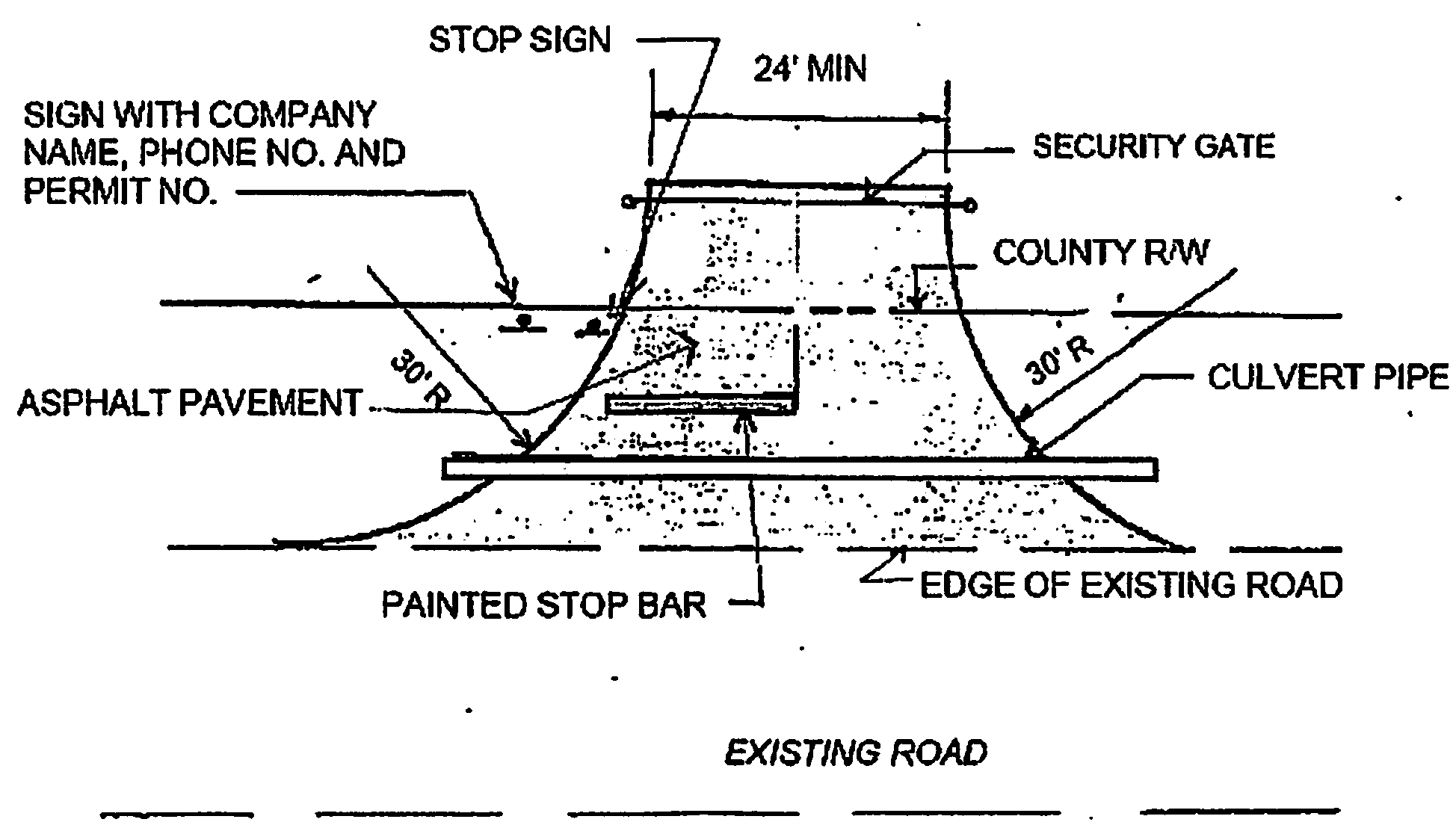
(Ord. of 1-3-23(2))
3.17 - Excavation, mining, ponds, and fills of land and/or state/federal jurisdictional waters or wetlands.
3.17.1 The following activities shall be subject to review by the county planning board:
1.
Excavation of land, or removal of earth that exceeds one acres of disturbed area.
2.
Removal of earth or like material from the subject site to another parcel.
3.
Filling of land and/or state/federal jurisdictional waters or wetlands.
If two out of the three items above meets the project criteria, review by the planning board and approval by the board of commissioners is mandatory. If one of the three items above meets the project criteria, review by the county engineer or their designee is mandatory.
3.17.2 Excavation, mining, and fills of land and/or state/federal jurisdictional waters or wetlands. Excavation, mining, and fills of land and/or state/federal jurisdictional waters or wetlands that are associated with a specific project that has been approved by the board of commissioners that comply with all other regulations set forth in this ordinance are exempt from section 3.17.
3.17.3 Requirements for submittal for planning board and/or staff review.
1.
Application and checklist.
a.
Applications and a checklist may be obtained from the development services office.
b.
Application and checklist must be complete and submitted with all required information.
c.
Fees in accordance with the county schedule of fees must be paid at the time of application submittal.
2.
Excavation activities that have greater than one acre of disturbed area must obtain a state mining permit. A copy of the approved state mining permit must be submitted to the development services office prior to work commencing.
3.
Any excavation activity between one acre and ten acres that requires a state mining permit or is a GDOT-approved borrow-source or pit for a GDOT-approved project, may be permitted as a conditional use in the AR-1 and AR-2 zoning districts, upon approval of the board of commissioners, and after review by the planning board.
4.
Any excavation activity greater than one acre of disturbed area may be permitted in the PD-MR zoning district. Excavation activities that have greater than ten acres must be permitted in PD-MR.
3.17.3A Requirements for approval and final inspection.
1.
Pond of less than one acre of disturbed area. Construction of the pond shall cease within six months of the approval date. The pond may be subject to a final inspection.
2.
For any excavation activity between one acre and ten acres that is approved as a conditional use in AR-1 or AR-2, and requires a state mining permit, or is a GDOT-approved borrow-source or pit for a GDOT-approved project, the bond shall be submitted to DNR, if required. Excavation activities shall cease within three years of DNR or GDOT approval date. Extension of excavation activities beyond three years will require approval by the board of commissioners, after review by the planning board. Business operator shall maintain an annual occupation tax certificate, pursuant to article II, business and occupation tax, for a license to operate a surface mine. Applicant shall submit a survey of the completed excavation site to development services. A final inspection is required. All DNR reclamation requirements shall be met.
3.
For any excavation activity greater than one acre that requires a state mining permit and is permitted in PD-MR, or is a GDOT-approved borrow-source or pit for a GDOT-approved project, the bond shall be submitted to DNR, if required. Excavation activities shall cease within five years of DNR or GDOT-approval date. Extension of excavation activities beyond five years shall require approval by the board of commissioners, after review by the planning board. Business operator shall maintain an annual occupation tax certificate, pursuant to article II, business and occupation tax, for a license to operate a surface mine. Applicant shall submit a survey of the completed excavation site to development services. A final inspection is required. All DNR reclamation requirements shall be met.
3.17.4 Construction requirements.
1.
All projects must comply with best management practices as outlined in the "Manual for Soil and Sediment Control in Georgia" as specified in O.C.G.A. § 12-7-6.
2.
Side slopes of any excavated area must be constructed at a maximum of 3:1 slope (one foot in elevation change per three feet of horizontal distance) from the top of the excavation to the bottom at all times during construction and at completion of the excavation. All wet ponds must have a minimum five feet depth and a minimum ten feet width from bottom of the bank, excluding stormwater ponds.
3.
All digging and hauling operations must be completed within six months. All disturbed areas will have a permanent stand of grass established at completion.
4.
No digging and hauling activities shall take place except between the hours of 8:00 a.m. and 5:00 p.m., Monday through Friday for a pond less than one acre and in an R Zoning District. A project of regional significance may be permitted alternative hours of operation, upon review and approval by the county manager or his designee.
5.
Unless a pond/excavation is to be shared by two or more parcels it shall be located at least 50 feet from the nearest property line. Proposed excavations shall not be nearer than 100 feet to any existing school, church, dwelling, or highway right-of-way. The location of the existing Pond may not be within 50 feet from any proposed school, church, dwelling or highway right-of-way. No pond shall be located less than ten feet from the nearest access or utility easements. Refer to the Buffer Ordinance (Section 3.4) for Buffer requirements for surface mining operations.
6.
All wetland impacts must be approved by the USACE.
7.
The construction entrance and roadway shall be designed and built pursuant to GSWCC Construction Exit Guidance (2016 Edition). The roadway shall extend a minimum of 50 feet into the mine site from the paved entrance.
(Ord. of 7-5-05; Ord. of 8-2-16, § 1; Ord. of 9-15-20; Ord. of 1-3-23(1); Ord. No. 2024-348, 8-20-24)
3.17A - Reserved.
Editor's note— Ord. No. 2024-348, adopted Aug. 20, 2024, repealed § 3.17A, which pertained to ponds—construction and derived from Ord. of Sep. 4, 2007, § 1(b).
3.18 - Land subject to flooding.
No building or mobile home shall be moved into or constructed in a floodprone area unless the first floor elevation, including all mechanical and electrical equipment, ductwork, and any basement, is one foot above the highest elevation at that location expected to be flooded in a 100-year flood. These requirements shall be enforced in accordance with the county floodplain management ordinance.
3.19 - Living units in zones other than residential.
Dwellings shall not be permitted in any industrial district as a principal use. However, living untis may be established conditionally within an industrial district, provided that succh living untis are accessory to the industrial use and have direct access to an abutting street.
(Ord. of 12-8-09, § 1)
3.20 - Minimum living area.
No single or multiple-family living unit shall be constructed with a total living area of less than 525 square feet; provided, however, that a special exception to the minimum living area requirements shall be granted for the construction of efficiency type apartments having no separate bedroom if it is established that the granting of such exception will not adversely affect the interest of the general public or the character of the surrounding neighborhood. Application for any such special exception shall be made to the planning board, which shall forward its recommendations to the county commissioners for their action. The planning board may require the submission of plans in connection with such applications and may impose such additional requirements as a condition of the granting of the request as it deems reasonable and appropriate. (This section shall not apply to mobile homes meeting all other requirements of this ordinance.)
3.21 - Mobile homes, trailers, mobile home parks, and trailer parks.
No trailer, manufactured home, industrialized home, or mobile home shall be parked outside of a campsite/RV park or planned manufactured home community unless specifically permitted in a particular zoning district to provide living quarters or space for the conduct of a business. A trailer, manufactured home, industrialized building, or mobile home may be used temporarily for office purposes during the construction of a principal building or road upon the issuance of a temporary permit by the zoning officer. Notwithstanding the foregoing, any owner of camping and recreational equipment, including but not limited to travel trailers, pick-up coaches, motorized homes, and boat trailers, may park or store such equipment on private residential property subject to the following conditions:
3.21.1 Such parked or stored camping and recreational equipment shall never be occupied or used for living, sleeping, or housekeeping purposes.
3.21.2 If the camping or recreational equipment is parked or stored outside of a building, it shall be parked or stored, if possible, to the rear of the front building line of the lot.
3.21.3 Notwithstanding the provisions of subsection 3.21.2 above, camping and recreation equipment may be parked anywhere on the premises while actually being loaded or unloaded.
3.21A. - Mobile and manufactured homes septic tank installation.
Any certificate of occupancy and any building permit issued for a mobile home or manufactured home may be revoked by the zoning administrator 30 days or more after issuance of such certificate or permit upon a determination that the mobile home or manufactured home has not been connected to a properly functioning septic tank or sewage system, duly approved by the county health department.
3.23 - Moving of buildings.
Whenever a building is moved from any location to a site within Effingham County, the building shall immediately be made to conform to all provisions of the building, plumbing, and electrical codes, if any, and this ordinance. The person causing the building to be moved shall secure a building permit from the zoning office.
3.24 - Nonconforming buildings or structures.
3.24.1 Any lawful use of any dwelling, building, or structure existing as of the effective date of this ordinance may be continued, even though such use does not conform to the provisions hereof. Routine maintenance and repair that does not increase the degree of nonconformity shall be permitted. If no structural alterations are made, a nonconforming use may be changed to another nonconforming use of a more restricted classification. Whenever a nonconforming use has been changed to a more restricted use or to a conforming use, such use shall not thereafter be changed to a less restricted use. No nonconforming building or structure shall be extended or enlarged except when authorized by the board of commissioners, who may permit a cumulative enlargement or extension up to 50 percent of the gross floor area of the structure as it existed on the effective date of this ordinance.
Any such enlargement or extension shall not increase the degree of nonconformity and shall be evaluated for consistency with the future land use map and comprehensive plan.
Any enlargement, extension, or expansion of a nonconforming structure or use shall comply with all applicable current zoning standards to the maximum extent practicable, including but not limited to setbacks, buffers, and screening requirements. In addition, all enlargements, extensions, or expansions shall comply with applicable current building and fire code standards.
3.24.2 Whenever the use of a building shall become nonconforming through a change in the zoning ordinance including zoning map amendments or text amendments, or the district boundaries, such use may be continued, and if no structural alterations are made, may be changed to another nonconforming use of the same or a more restricted classification.
Discontinuance of such use shall be governed by section 3.24.3.
3.24.3 A nonconforming use of a building or portion thereof that is discontinued for a continuous period of 12 months shall not be reestablished except in conformity with the regulations of the district in which such building is located.
Discontinuance shall create a rebuttable presumption of abandonment, and the burden shall be on the property owner to demonstrate otherwise.
Seasonal, agricultural, or temporary uses shall not be considered discontinued solely due to periods of inactivity, provided evidence of ongoing or intended use is demonstrated.
3.24.4 A nonconforming building, other than a single-family dwelling, which has been damaged by fire, explosion, act of God, or act of war to the extent of more than 75 percent of its fair market value at the time of damage shall not be restored except in conformity with the regulations of the district in which it is located. When damage is less than 75 percent of its fair market value a nonconforming building may be repaired or reconstructed and used as before the time of damage, provided such repairs or reconstruction are completed within two years of the date of such damage. Such reconstruction shall not increase the degree of nonconformity and shall comply with applicable floodplain management regulations where applicable.
Where the extent of damage is disputed, the county may require an independent appraisal by a licensed Georgia real estate appraiser at the property owner's expense. The board of commissioners shall make the final determination of fair market value for purposes of this section.
3.24.5 Subject to the limitation set forth in section 2.55.2 of this ordinance, a nonconforming single-family dwelling which has been damaged or destroyed by fire, explosion, act of God, or act of war may be repaired, reconstructed, or replaced with a nonconforming structure of the same dimensions and used as before the time of damage, provided such repair, reconstruction, or replacement is completed within two years of the date of such damage and provided that the structure meets all applicable county building and permitting requirements. The replacement structure shall not exceed the original footprint, height, or gross floor area. The board of commissioners may grant a one-time extension of up to one additional year for good cause.
3.24.6 A nonconforming structure located on a lot in any district, when once removed, shall not be relocated on such lot and shall not be replaced with another nonconforming structure except as otherwise permitted by this ordinance. This provision shall apply only to voluntary removal and shall not prohibit reconstruction permitted under sections 3.24.4 and 3.24.5 or relocation required by condemnation or governmental action.
(Ord. No. 2026-189, 5-19-26)
3.25 - Nonconforming lots.
3.25.1 Remedies. Where two or more nonconforming lots with continuous frontage are under the same ownership or where a nonconforming lot has a continuous frontage with a larger tract under the same ownership, such lot or lots shall be combined to form one or more building sites meeting the lot requirements of the district in which they are located.
3.25.2 Dwellings on nonconforming lots. A building permit may be issued for at least one single-family dwelling on a legally existing nonconforming lot, provided that the remedies set forth in this section cannot be complied with and that all other applicable regulations of the zoning district are met.
Legally existing lots that do not meet the minimum dimensional requirements of the zoning district shall be considered nonconforming lots and shall not be required to rezone solely due to such dimensional nonconformity.
Nothing in this section shall be interpreted to limit or prohibit the number of dwelling units otherwise permitted by the underlying zoning district, including, but not limited to, districts that allow two or more primary dwelling units per lot.
Where a zoning district permits more than one dwelling unit per lot, such units may be permitted on a nonconforming lot only where all applicable zoning, health, and development standards can be met.
Where a proposed development cannot meet applicable zoning requirements, the property owner may seek relief through a variance, rezoning, or other applicable approval process in accordance with this Ordinance.
3.25.3 Nonconforming uses of land. The nonconforming use of land not involving any principal building or structure existing on the effective date of this ordinance may be continued for a period of not more than five years; provided, however, that no such nonconforming use of the land shall in any way be expanded or extended either on the same or adjoining property. If such nonconforming use of land or any portion thereof is discontinued or changed, any future use of such land shall be in conformity with the provisions of this ordinance. Active agricultural and forestry uses consistent with the comprehensive plan shall be exempt from this limitation, provided they do not create adverse impacts on surrounding properties.
3.25.4 Dwellings on nonconforming lots. The board of commissioners may authorize the issuance of a building permit for a single-family dwelling on a legally existing nonconforming lot only where it is demonstrated that compliance with the requirements of this section cannot be achieved. The board of commissioners may also grant variances to lot and building requirements in cases of hardship, provided that such relief does not create conditions detrimental to the public health, safety, and welfare.
(Ord. No. 2026-189, 5-19-26)
3.26 - Nonconforming use of buildings and structures.
Use of any building or structure not in conformance with these regulations pertaining to uses permitted on the effective date of this ordinance may not be:
3.26.1 Changed to another nonconforming use except where it is determined by the county commissioners that the design, construction, and character of the building is suitable for uses permitted in the district in which such nonconforming use is situated.
3.26.2 Reestablished after discontinuance for 12 months except where it is determined by the board of commissioners that the design, construction, and character of the building is unsuitable for conforming uses.
3.26.3 Extended, enlarged, or expanded except when authorized by the board of commissioners who may permit a cumulative enlargement or extension up to 50 percent of the gross floor area of the structure as it existed on the effective date of this ordinance. Such expansion shall not increase the degree of nonconformity and shall be evaluated for consistency with the future land use map and comprehensive plan.
(Ord. No. 2026-189, 5-19-26)
3.27 - Nursing homes.
Nursing homes shall include convalescent homes, homes for the aged, and such other activities designed to take care of the aged or persons unable to care for themselves without supervision or assistance. Nursing homes shall be permitted as a conditional use in any multifamily residential district. Such uses shall comply with all regulations applicable to the district. Such uses shall comply with the off-street parking requirements set forth in this article. In addition, such uses shall meet the minimum requirements as set forth by state or federal agencies regulating such activities and shall, upon application for either building permit or occupancy certificate, provide certificates indicating approval by such state and federal agencies.
3.28 - Obstruction to vision at road intersections and driveways.
3.28.1 The minimum development standards set forth in this section shall apply to land abutting streets, street intersections, and driveways delineated as follows:
(a)
The triangle bounded on two sides by the intersecting right-of-way lines, measured 40 feet in each direction from the point of intersection, and on the third side by the diagonal line connecting the ends of the 40-foot sides, as illustrated in Figure 1.
(b)
The triangles bounded on two sides by the intersection of a private driveway, measured 40 feet along the road right-of-way and 12.5 feet along the private driveway. This shall apply to each side of the private driveway.
(c)
Additional sight distance requirements may be imposed on streets and roads maintained by Effingham County or the State of Georgia based on design speed and Institute of Transportation Engineers and American Association of State Highway Transportation Officials standards.
3.28.2 Within the triangles identified in subsection 3.28.1 above, and except as provided in subsection 3.28.2 below, no structure, sign, plant, shrub, tree, berm, fence, wall, or other object of any kind shall be installed, constructed, set out or maintained so as to obstruct cross-visibility at a level between 30 and 120 inches above the level of the center of the street intersection or driveway.
3.28.3 The restrictions of this section shall not apply to:
(a)
Existing natural grades which, by reason of natural topography, rise 30 or more inches above the level of the center of the adjacent intersection;
(b)
Trees having limbs or foliage trimmed in such a manner that no limbs or foliage extend into the area between 30 and 120 inches above the level of the center of the abutting intersection; or
(c)
Fire hydrants, public utility poles, mailboxes, street markers, governmental signs, and traffic control devices.
(1)
All items listed in (c) above, shall be installed and maintained in accordance with approved standards.
3.28.4 In other than 90 degree intersections or where grades mandate, the Effingham County Building and Zoning Department in coordination with the public works department may impose additional sight triangles under standards adopted by the American Association of State Highway Transportation Officials.
3.28.5 The director of building and zoning shall investigate violations, issue notices and orders, and perform other duties required for enforcement under this section.
3.28.6 The director of building and zoning, with the concurrence of the public works director, may, based on design speed and Institute of Transportation Engineers and American Association of State Highway Transportation Officials standards, reduce or waive all or part of these requirements of this section where a waiver could not constitute a traffic hazard or a condition dangerous to public safety. A decision by the director of building and zoning may be appealed to the board of commissioners.
3.29 - Offensive color, designs, smoke, noise, etc.
Nothing shall be allowed on the premises in any district which would in any way be offensive or obnoxious by reason of the emission of odors, liquids, gas, dust, smoke, vibration, or noise; nor shall anything be placed, constructed, or maintained that will in any way constitute an eye-sore or nuisance to adjacent property owners, residents, or to the community. All uses must satisfactorily comply with the requirements of the state department of natural resources as required by the United States Environmental Protection Agency.
3.30 - Off-street access control parking and loading.
In all districts off-street parking facilities shall be provided and properly maintained, as set forth in this section for any building which is hereafter erected, enlarged, or increased in capacity. Such facilities shall be made available for public use.
3.30.1 [Generally.] In order to promote the safety of motorists and pedestrians and to minimize traffic congestion and conflict by reducing the magnitude of and the number of points of contact, the following regulations shall apply:
3.30.1.1 A point of access, that is, a driveway or other opening for vehicles onto a public street, shall be a minimum of 12 feet in width and not exceed 25 feet in width, except as otherwise provided in this section.
3.30.1.2 The maximum number of points of access permitted onto any one street shall be as follows:
3.30.1.3 In lieu of any two openings permitted on any one street, there may be permitted a single point of access up to 35 feet in width. However, service stations shall be permitted two openings, not to exceed 35 feet each in width along any abutting public street, provided that such property abuts such street for a distance of not less than 120 feet.
3.30.1.4 There shall be a minimum distance of 12 feet between any two openings onto the same street.
3.30.1.5 No point of access shall be allowed within 20 feet of the intersection of the right-of-way lines of any two local streets, nor within 30 feet at an intersection of a state or federal highway.
3.30.1.6 No curbs shall be cut or altered and no point of access or opening for vehicles onto a public street shall be established without a permit issued by the commissioners under the supervision of the county road superintendent.
3.30.2 Size and access. Each off-street parking space shall have an area of not less than 180 square feet exclusive of access drives or aisles and be in usable shape and condition, except in the case of dwellings, and shall have no parking area containing less than three spaces. There shall be adequate ingress and egress to all parking spaces. Where a lot does not abut on a public or private alley or easement or access, there shall be provided an access drive leading to the parking or storage areas or loading spaces. Such access drive shall be not less than 12 feet in width in the case of a dwelling, and not less than 20 feet in width in all other cases.
Access to off-street parking areas shall be limited to several well-defined locations, and in no case shall there be unrestricted access along the length of a street or alley.
3.30.3 Number of parking spaces required. The number of off-street parking spaces required are set forth in the following table. Where the use of the premises is not specifically mentioned, requirements for similar uses shall apply.
3.30.4 Location of off-street parking spaces.
3.30.4.1 Such parking spaces as required in this section shall in no part exist upon and no portion of any vehicle shall overhang the right-of-way of any public road, street, alley, or walkway. There shall be no off-street parking in the front yards of residential districts except as normally exists in driveways.
3.30.4.2 The parking spaces for all dwellings shall be located on the same plot as the main building.
3.30.4.3 Parking spaces for all other uses shall be provided on the same plot with the main building or not more than 300 feet in distance, as measured along the nearest pedestrian walkway, provided that such area is under the same ownership as the principal use. The applicant for a building permit which proposes to use an area for off-street parking in order to meet the requirements of this ordinance and in accordance with the provisions of this subsection shall submit evidence of a restrictive covenant running with the land to be used for off-street parking purposes stating that such land shall not be encroached upon, used, sold, leased, or conveyed for any other purpose until such time as the principal building ceases to be required to provide such off-street parking facilities.
3.30.4.4 Parking requirements for two or more uses of the same or of different types may be provided by the establishment of the required number of spaces for each use in a common parking area when under the same ownership. Accessory uses shall not be required to have additional parking spaces other than those required by the principal use.
3.30.4.5 Off-street parking areas may be situated in any residential district abutting any commercial district or industrial district to a depth not exceeding 120 feet, provided that all off-street parking lot improvements as provided in section 3.30.5 of this article are complied with.
3.30.5 Parking lot improvement requirements. Any off-street parking lot of five or more parking spaces serving any use other than dwellings of four units per building or less shall meet the following off-street parking lot improvement requirements. Certain types of developments can obtain an exemption from the parking lot tree requirements listed in this section. These include, but are not limited to: warehouse loading and unloading areas, tractor-trailer parking, container storage yards, car dealerships, etc. Any exemption to the parking lot requirements must be approved by the zoning administrator prior to issuance of a LDA permit.
3.30.5.1 Screening and landscaping. Off-street parking areas for more than five vehicles and off-street loading areas shall be effectively screened on each side which joins or faces residential or industrial premises situated in any residential district.
1.
In addition to required buffer planting trees from the large tree list (see buffer ordinance) which are at least two-inch dbh shall be provided and maintained at a ratio of one tree for every 12 spaces.
2.
All landscape islands shall be at least as large as the adjoining parking spaces.
3.
There shall be a minimum of curb radii of three feet required on the corners of all landscape islands and medians to allow for free movement of motor vehicles around planting materials. Although innovative storm water management techniques are strongly encouraged, all islands and medians shall have raised curbs unless other storm water management techniques are approved by the zoning administrator.
4.
At the end of all rows of parking a terminal landscape island or area shall be provided to protect parked vehicles, confine moving traffic to aisles and driveways, and provide space for landscaping. A terminal island for a single row of parking spaces shall be planted with at least one tree. A terminal island for a double row of parking spaces shall contain two large trees.
3.30.5.2 Surfacing for all retail sales and services, business services, and professional services. Off-street parking areas for all retail sales and services, business services, and professional services serving the general public and having access to and abutting a paved street shall be provided with a hard surface, all-weather pavement of asphalt or cement and shall be so graded and drained to provide for the adequate runoff and disposal of surface water.
3.30.5.3 Lighting. Where lighting facilities are provided for the parking area, they shall be designed and installed so as to reflect the light away from any contiguous residentially zoned property.
3.30.6 Off-street loading requirements.
3.30.6.1 Every hospital, institution, commercial, or industrial building, or similar use having a floor area of 20,000 square feet or more and requiring receipt or distribution by vehicle of materials or merchandise shall have at least one permanent off-street loading space for each 20,000 square feet of gross floor area or fraction thereof immediately adjacent to the principal building.
3.30.6.2 Every building which requires the receipt or distribution of material and/or merchandise by motorized vehicles shall provide off-street loading berths in accordance with the following table:
Off-Street Loading Space Requirements
3.30.6.3 Every off-street loading and unloading space shall have direct access to the public street or alley and shall have the following minimum dimensions: length, 30 feet; width, 12 feet; height, 14 feet.
(Ord. of 12-8-09, § 1)
3.31 - Overhanging or extruding projections.
In single-family residential districts, multifamily residential districts, and planned manufactured home community districts, every part of a required yard or court shall be open from its lowest point to the sky, unobstructed except for the customary ornamental features and eaves; provided, however, that none of the above projections shall extend into a required yard more than four feet. Open or enclosed fire escapes, outside stairways, balconies, chimneys, flues, or other projections shall not extend into any required yard except that uncovered steps may project not more than four feet into the required yard.
(Amend. of 4-4-00(23); Ord. of 12-8-09)
3.32 - On street parking.
3.32.1 Within any R district no trucks or trailers in excess of one ton capacity shall be parked for storage purposes, including overnight, on any public right-of-way.
3.32.2 Dumpsters and temporary storage units may not be placed on any roadway open to the public.
3.32.3 Parking is allowed on local streets only. If they have a pavement width of at least 28 feet then parking is allowed on one side of the road. If they have a pavement width of at least 36 feet then parking may be allowed on both sides of the road.
(Ord. of 1-19-16, § 1)
3.33 - Performance standards.
These performance standards shall apply to all nonresidential uses.
3.33.1 Smoke, dust, and dirt. All emissions of visible smoke, dust, dirt, fly-ash, or any particulate matter from any pipes, vents, or other openings from any other source shall conform to state and federal standards.
3.33.2 Fumes, vapors, and gases. All emissions of any fumes, vapors, or gases of a noxious, toxic, or corrosive nature which can cause any damage or irritation to health, animals, vegetation, or to any form of property shall conform to state and federal regulations.
3.33.3 Sewerage. There shall be no discharge at any point of liquid or solid waste into any public sewage disposal system which will overload such system or create detrimental effects in the flow and treatment of public sewage.
There shall be no treatment of public sewage. There shall be no discharge of any industrial wastes into any private sewage disposal system, stream, or into the ground of any kind or nature which would contaminate any water supply or otherwise cause emission of dangerous or objectionable elements or conditions. There shall be no accumulation of solid waste conducive to the breeding of rodents or insects.
3.33.4 Odors. There shall be no emission of odorous gases or other odorous matter in such quantities as to be offensive, obnoxious, or unpleasant beyond the property line on which the principal use is located. Any process including the preparation of food which may involve the creation and emission of any such odor shall be provided with a primary and secondary safeguard system so that odor control may be maintained in the event of failure of the primary safeguard system. Any odorous matter shall be kept a minimum of 1,500 feet from any residence, school, hospital, or church, and any commercial district.
3.33.5 Noise. The permitted level of noise or sound emission at the property line of the lot on which the principal use is located shall not at any time exceed the average noise level prevailing for the same hour as generated by streets and traffic activity. The determination of noise level shall be measured with a sound level meter that conforms to specifications published by the American Standards Association.
3.33.6 Glare. There shall be no direct glare visible from any residential district caused by unshielded floodlights or other sources of high intensity lighting.
3.34 - Permitted building area.
The principal building on any lot or parcel of land shall be erected within the area bound by the building lines established by setback of yard requirements. Accessory buildings may be erected within any building line established for the principal building and in required rear yards as may be otherwise provided in these regulations.
3.35 - Principal building on a lot.
Except in planned manufactured home communities and in the AR-1 district as provided in these regulations, only one principal building and its customary accessory buildings may be erected on any lot of record. Any dwelling shall be deemed to be the principal building on the lot on which the same is located. An addition to any building shall not be construed as a principal building.
3.36 - Retaining walls.
Nothing in these regulations shall be construed to prohibit or to prevent the erection of a retaining wall on any property, provided that such retaining wall does not adversely affect the natural flow of surface water or create any other adverse effect upon adjacent or adjoining properties. However, any application for a retaining wall shall be subject to approval of the zoning administrator before the issuance of a permit.
3.37 - Shopping centers.
Shopping centers are hereby defined as a group of retail stores or shops under single ownership or management with an area of five acres or more and with a minimum depth of 300 feet established as a shopping entity with common parking facilities, ingress, and egress, and loading and unloading facilities. Shopping centers shall be permitted in any general or neighborhood commercial district and may be developed in accordance with approval of a plat of a subdivision or development as approved by the board of commissioners. The shopping center shall not be divided into separate lots for each store or use. No permit shall be issued for the construction of a shopping center until the plans and specifications, including the design of ingress and egress roads, parking facilities, and other such items as may be found of importance have been approved by the board of commissioners. No buildings shall be erected closer than 50 feet to any road right-of-way line. There shall be provided a minimum of one parking space for each 200 square feet of floor area designed to be used for business or shopping purposes. Such parking area, including maneuvering areas, ingress and egress roads, and driving lands, shall be paved and kept in good repair at all times with a hard, all-weather surface. All points of access shall be to the public road; however, there shall be no public roads or alleys within the shopping center property. All loading and unloading shall be done entirely within the shopping center property. Except as otherwise provided in this section all uses within the shopping center shall conform with other regulations as set forth in this ordinance.
3.38 - Signs.
The purpose of this section is to:
A.
Promote the safety of persons and property by providing that signs do not create traffic hazards or hazards due to collapse, fire, collision, decay or abandonment.
B.
To protect the public welfare and county property values by preserving the aesthetic quality of the natural environment.
C.
Promote efficient commercial and non-commercial identification or information by improving the legibility and effectiveness of signs through the control of their number, location, size, appearance, illumination, and animation.
D.
Preserve the right of free speech and expression.
3.38.1 Sign permits. All signs on commercial or industrial property must have a sign permit issued by the Effingham County Zoning Department. Multiple similar signs such as real estate or political signs shall only be required to have a single sign permit. All signs other than temporary event signs shall be required to get a building permit and meet all required wind load and building regulations.
3.38.2 Legal signs.
A.
Any permitted sign which complies with the provisions of this article, and any subsequent amendments hereto, is hereby deemed to be a legal sign. Any proposed alteration to or relocation of such sign shall require a new permit pursuant to this section.
B.
Any legal sign which does not comply with the provisions of this article solely due to the enactment of an amendment shall, upon the effective date of such amendment, become a nonconforming sign and shall be considered a legal sign unless it is relocated or altered.
3.38.3 Illegal signs. Any existing sign that does not have a permit issued by Effingham County pursuant to this section is hereby deemed to be an illegal sign and such sign and the person or persons responsible for such sign shall be subject to the enforcement and penalty provisions in this title.
3.38.4 Signs exempt from regulation.
A.
Governmental agency signs
B.
Property addresses up to 12 inches in height
C.
Incidental signs one square foot or less
3.38.5 Prohibited signs.
A.
Any sign, except those erected by a governmental agency, in a public street or highway right-of-way.
B.
Inflatable signs.
C.
Signs mounted on a roof or extending above the roofline.
D.
Ribbons, and pennants.
E.
Any sign resembling the shape, size, or color of a governmental traffic sign.
F.
Any sign with lights that resemble the lights used by police, fire, and emergency vehicles.
G.
Any light source on a sign that is directly visible from a vehicle or residence.
H.
Any flashing or intermittent light.
I.
Any sign attached to a natural feature such as a tree or rock.
J.
Any sign attached to a telephone pole or utility pole.
K.
Any unpermitted sign attached to a permitted sign.
L.
No sign shall be placed in or obstruct the view of an area of designated historic interest.
3.38.6 Billboards.
A.
Uniform size. The outside measurements of all billboards shall be 12 feet in height and 25 feet in length.
B.
Location. The billboard must be on commercial or industrial land. It must be located on a parcel with at least 200 feet of state or federal highway frontage.
C.
Illumination. All illuminated billboards shall use base-mounted lights. The light source must not be visible from a vehicle or a residence. No additional lighting shall be allowed.
D.
Height. All billboards shall be a minimum of ten feet above grade and a maximum of 30 feet above grade.
E.
Extrusions prohibited. Extrusions beyond the face of the billboard, excluding aprons, are prohibited.
F.
Number of signs per location. Only one billboard shall be allowed to face the same direction per location. This allows back to back or V formation billboards but prohibits two billboards facing the same direction.
G.
Spacing. Billboard location shall be no less than 500 feet from the nearest billboard measuring from the nearest point. No more than three billboards shall be permitted per mile when such billboards are located on the same side of the road.
H.
Distance from property line. Billboard structures shall be no less than ten feet from any property line.
I.
State law. All billboards must also comply with all aspects of the Georgia Outdoor Advertising Code.
J.
Changeable copy signs.
1.
General Rule — Animated or changeable copy signs shall be erected, posted, displayed or modified only in accordance with the criteria hereunder as well as all other generally applicable standards of this ordinance related to the location, height, size, and other characteristics. Billboards that move, flash or simulate movement are prohibited.
2.
Each message displayed on any changing billboard display shall remain static for at least ten seconds following the completion of its transition from the previous message. As used in this subsection "static" shall mean a display that is fixed in one position with no portion of the display being in motion or changing in color or light intensity.
3.
Changing of image shall be substantially instantaneous, two seconds or less, as seen by the human eye and shall not use fading, rolling, window shading, dissolving or similar effect as part of the change.
4.
No display or other effect from any electronically changed billboard shall cause a glare or other condition that impairs the vision of the driver of any motor vehicle or which otherwise interferes with the safe operation of a motor vehicle.
5.
Video technology in billboards shall use automatic level controls to reduce light levels at night and under cloudy or other darkened conditions, in accordance with the following standards. All electronic or digital display unit message boards shall have installed ambient light monitors, and such monitors shall at all times automatically adjust the brightness level of the electronic billboard based on ambient light conditions. Maximum brightness levels for electronic or digital display boards shall not exceed ambient light levels by more than 0.3 foot candles.
6.
Any billboard using video technology which malfunctions, fails, or ceases to operate in its usual or normal manner causing therein motion, movement, flashing or any other similar effects shall be repaired or disconnected within 48 hours by the owner or operator of such billboard, and shall be equipped so that it may be turned off by the county in the event of such malfunction or failure.
7.
The county shall be permitted to post emergency notices on electronically changeable billboards on 24 hours' notice.
8.
Conversion of an existing billboard to an automatic changeable copy video billboard or to add an automatic changeable copy video element to it is allowed only if the billboard as modified will conform with all standards in this section and with all other applicable standards related to the height, size, location and other characteristics of the billboard.
3.38.7 Signs in commercial zones.
A.
Each parcel in a commercial zone is entitled to one freestanding sign for up to 200 feet of street frontage.
B.
Each parcel in a commercial zone may have an additional freestanding sign for each additional 200 feet of street frontage and must be separated by at least 200 feet from any other sign on the property.
C.
A multi-unit building on a single commercial parcel may have multiple tenant panels on a single sign.
D.
No sign shall encroach into the street right-of-way or be within 25 feet of an established street intersection and no sign or support thereof shall obstruct driver visibility.
3.38.8 Number of signs. In addition to any potential free standing sign, each business in a commercial or industrial zone shall be limited to one facade sign, one projecting sign attached to the building and one wall sign for each exposed side of the building other than the front.
3.38.9 Freestanding sign size. The maximum size of the signable area of a freestanding sign is as follows:
A.
In the B-2, B-3, and I-1 districts: 64 square feet for a single tenant parcel or 100 square feet for a multiple tenant parcel.
B.
In the B-1 zoning district: 32 square feet.
C.
In the R-3 and R-4 zoning districts: 50 square feet.
D.
In the R-1, R-1A, and R-2 zoning districts: Six square feet excluding signs at the entrance to neighborhoods which may be up to 24 square feet.
E.
In the CP zoning district: 16 square feet.
F.
In the PD zoning district: Sign regulations not less stringent than the regulations herein must be included in the written development text required by section 5.15.3.3 of the Effingham County Zoning Ordinance.
3.38.10 Height.
A.
Maximum height. In all commercial and industrial districts no freestanding sign shall exceed 30 feet from grade.
B.
Clearance. No hanging, suspended, or projecting sign shall have a vertical clearance of less than 14 feet over any vehicular public way, nor less than nine feet over any pedestrian public way. Public ways include privately owned sidewalks and drives customarily used by the public.
3.38.11 Institutional uses. Institutional uses are allowed one sign per 200 feet of street frontage with a maximum signable area of 64 square feet regardless of which zoning district they are located in.
3.38.12 Projections. No sign shall project more than six feet from the wall of a building.
3.38.13 Event signs.
A.
In the B-1, B-2, B-3, I-1, R-3, or R-4 zoning districts one temporary event sign not to exceed 24 square feet in size and not to be displayed for more than 30 days may be located on each parcel. Temporary event signs in these districts must be secured to a building.
B.
In all zoning districts each parcel is entitled to one temporary event sign not to exceed six square feet in size. Such signs may be displayed for the length of the event. Each parcel may have no more than three such events per calendar year.
C.
When there is the threat of a serious wind event the county reserves the right to remove any temporary event sign that it deems to be a hazard to public safety. It will be the responsibility of the sign owner to retrieve any impounded sign from the county zoning office.
D.
Signs not removed within ten days following the occurrence of an event or expiration of the permitted period may be removed by the county zoning office and impounded. The costs of removal shall be charged to the person owning or using the sign or the owner of the building or premises.
E.
Impounded signs will be held for ten days, after which they will be destroyed.
3.38.14 Flags. In the B1, B-2, B-3, and I-1 zoning districts no more than three flags are allowed per parcel. The combined square footage of all flags displayed on a parcel in these districts shall be no more than 64 square feet.
3.38.15 Sign conditions.
A.
Unsafe signs. Whenever a sign becomes structurally unsafe or otherwise endangers the safety of the building or the public, the zoning administrator shall order that such sign be made safe or removed. The person owning or using the sign or the owner of the building or premises on which such unsafe sign is affixed or erected shall comply with such order within ten days of receipt thereof.
B.
Unmaintained signs. Whenever a sign is physically damaged or is not maintained and is determined by the zoning administrator to negatively impact the visual character of the surrounding area or pose an unsafe condition, the zoning administrator shall order that such sign be properly maintained or removed. The person owning or using the sign or the owner of the building or premises on which such unsafe sign is affixed or erected shall comply with such order within 60 days of receipt thereof.
3.38.16 Nonconforming signs. No nonconforming sign may be relocated or altered other than for routine maintenance without bringing the sign into conformance with the current sign ordinance. A temporary sign may not be considered a nonconforming sign for purposes of grandfathering.
3.38.17 Sign definitions.
Awning: A cloth, plastic, or other nonstructural covering that either is permanently attached to a building or can be raised or retracted to a position against the building when not in use. A sign on an awning is considered a projecting sign.
Banner: A sign on a lightweight material that is secured or mounted to a building.
Billboard: A large sign erected along a state or interstate highway and intended to be viewed from travelers on said highway.
Changeable copy: Copy, including text and/or graphics that changes at intervals.
External illumination: Illumination of a sign that is affected by an artificial source of light not contained with the sign itself.
Facade: The side of a building below the eaves.
Flag: Lightweight material, usually with a political symbol, that is attached on one side to a pole.
Flashing illumination: Illumination in which the artificial source of light is not maintained stationary or constant in intensity and color at all times when a street graphic is illuminated, including illuminated lighting.
Free standing sign: A sign that is not attached to a building or other structure.
Graphic: Written or pictorial representation.
Historic or scenic area: An area that contains unique historic or scenic characteristics that require special regulations to ensure that street graphics displayed within the area are compatible with its visual character.
Incidental sign: A sign of one square foot or less.
Indirect Illumination: A source or external illumination located away from the sign.
Institutional uses: Schools, hospitals, churches, and government facilities.
Internal illumination: A light source that is concealed or contained within a sign.
Monument sign: A sign that is permanently affixed to the ground at its base, supported entirely by the base structure, and not mounted on a pole.
Multi-use building: A building consisting of more than one commercial use.
Neon sign: A sign that is created by bending a neon filled glass tube to form text or graphics.
Nonconforming sign: A sign that was lawfully constructed or installed prior to the adoption or amendment of this ordinance and was in compliance with all ordinances at the time of installation, but which does not presently comply with these regulations.
Pole sign: A freestanding sign other than a billboard that is permanently supported in a fixed location by a pole(s), uprights, or braces from the ground and not supported by a building or a base structure.
Portable sign: A sign not permanently attached to the ground or a building or designed to be permanently attached to the ground.
Projecting sign: A sign attached to and projecting from a wall and not in the same plane as the wall.
Roof sign: A sign that is displayed above the peak or parapet of the building.
Shopping center: A commercial development under unified control consisting of four or more separate commercial establishments sharing a common building, or are in separate buildings that share a common parking area or entryway.
Sign: Any structure, display, or device that is used to advertise, identify, direct, or attract attention to a business, institution, organization, person, idea, product, service, event, or location by any means, including words, letters, figures, design characteristics, symbols, logos, fixtures, colors, movement, or illumination.
Signable area: An area within a single continuous perimeter composed of a single rectangle, circle, or triangle enclosing the extreme limits of characters, lettering, illustrations, ornamentations, or other figures.
(Ord. of 2-4-97; Amend. of 11-7-06; Ord. of 4-7-09)
3.40 - Traffic visibility across corner lots.
On any corner lot in any district, no fence, structure, or planting more than 30 inches high measured from the center of the road shall be erected or maintained within 20 feet of the corner so as not to interfere with traffic visibility across the corner.
3.41 - Swimming pools, private community, or club.
3.41.1 Swimming pools. A swimming pool, whether in the ground, is hereby defined as any pool, lake, or open tank, other than a farm pond, which is not located within a completely enclosed building and which contains, or is capable of containing, water at a depth at any point greater than 1½ feet. No such private swimming pool shall be permitted by Development Services in the B-1, AR, PUD districts, or in any R district, except as an accessory use, and unless it complies with the following conditions and requirements:
3.41.2 Use. The pool is intended and is to be used solely for the enjoyment of the occupants of the principal use of the property on which it is located and their guests, and no fee shall be charged.
3.41.3 Location. It may not be located, including closer than ten feet from water's edge to any property line of the property on which it is located, and ten feet from any dwelling. Swimming pools are prohibited in the front yard of any agricultural and/or residential zoning district.
3.41.4 Fence. The swimming pool should be fenced at a minimum of four foot with a self-latching gate with a lockable device that opens away from the pool to prevent uncontrolled access by children.
3.41.5 Community or club swimming pools. A community or club swimming pool shall be any pool constructed by an association of property owners, or by a private club solely for use and enjoyment by members of the association or club and their families and guests of members. Community and club swimming pools shall comply with the following conditions and requirements:
3.41.5.1 The pool and accessory structures thereto, including the areas used by the bathers, shall meet the front setback for the district in which it lies. Side and rear setbacks shall be ten feet.
3.41.5.2 The swimming pool and all of the area used by the bathers shall be so walled or fenced as to prevent uncontrolled access by children from the street or adjacent properties. The said fence or wall shall not be less than four feet in height and maintained in good condition and grounded for electricity. The area surrounding the enclosure, except of the parking spaces, shall be suitably landscaped with grass, hardy shrubs, and trees and shall be maintained in good condition.
3.41.6 Private swimming pools used for swimming lessons. A private pool hosting swimming lessons must adhere to the same standards as a community or club swimming pool in section 3.41.5, as well as obtain a home occupation tax certificate.
(Ord. of 6-23-15; Ord. No. 2024-349, 8-20-24)
3.42 - Time limitation.
No building permit for construction, erection, or alteration of any building or structure or part thereof, or for signs or outdoor advertisements, or part thereof, shall be valid for more than six months unless work at the site has commenced within such period.
3.43 - Notice of starting work.
The building and zoning inspector shall be given at least 24 hours' notice by the owner or applicant prior to commencement of work at the site under building permits.
3.44 - Temporary dwelling allowance.
In the case of a single-family residence being destroyed by natural disaster or accidental fire it shall be allowed in all agricultural and single-family residential districts for a recreational vehicle or trailer to be moved onto the property for use as a temporary dwelling during the replacement of the primary residence. This special exemption shall be permitted for a period of no longer than one year. Placement of the vehicle must meet all setback requirements and be approved by the Effingham County Building Department. Sanitation must be approved by the Effingham County Health Department.
(Ord. of 5-4-10, § 1)
3.45 - County surveyor.
The county manager or designee shall appoint a professionally licensed land surveyor. The county surveyor will be responsible for preforming land surveying and related services for the county. The county surveyor is empowered to appoint one or more assistants or deputies, for whose conduct he/she is responsible.
(Ord. of 08-01-2023(1))
Editor's note— Ord. of 08-01-2023(1), set out provisions intended for use as § 3.1. Inasmuch as there were already provisions so designated, said section has been codified herein as § 3.45 at the discretion of the editor.
3.46 - Accessory dwelling units.
3.46.1 Purpose. The purpose of this section is to establish uniform standards for accessory dwelling units as an accessory residential use, ensuring consistency with established development patterns, compatibility with surrounding properties, and clear, objective administration of this ordinance.
3.46.2 General Provisions. Definitions:
A.
Accessory dwelling unit (ADU). An accessory dwelling unit (ADU) is a subordinate, self-contained dwelling unit located on the same lot as a principal dwelling and providing permanent provisions for living, sleeping, eating, cooking, and sanitation.
B.
Dwelling unit requirements. A structure or portion thereof shall be considered a dwelling unit for the purposes of this section only if all of the following conditions are met:
1.
The accessory dwelling unit shall contain no more than two bedrooms.
2.
The unit contains permanent kitchen facilities, including a fixed sink, counter surface, and appliance connections.
3.
The unit contains permanent sanitary facilities, including a toilet, bathing/shower fixture, and sink.
4.
All habitable rooms meet the minimum standards for livable space defined by the International Residential Code (IRC) or the building code adopted by the county.
5.
The unit is constructed as a permanent structure and not a temporary, mobile, or portable structure.
C.
Subordination.
1.
The accessory dwelling units (ADUs) shall remain subordinate to the principal dwelling in size, scale, and function.
2.
The livable floor area of an accessory dwelling unit (ADU) shall not exceed 75 percent of the livable floor area of the principal dwelling.
3.
Accessory dwelling units (ADUs) livable floor area shall be measured only by space that meets building-code requirements for habitable space. Garages, unfinished attics, unfinished basements, storage areas, mechanical rooms, and similar non-habitable areas shall not be included.
D.
Quantity. No more than one accessory dwelling unit (ADU) is permitted per lot of record.
E.
Ownership. The accessory dwelling unit (ADU) shall remain in common ownership with the principal dwelling and shall not be subdivided, platted separately, or conveyed as an independent parcel.
F.
Types of accessory dwelling units (ADUs).
1.
Detached accessory dwelling unit (ADU): A stand-alone permanent structure.
2.
Attached accessory dwelling unit (ADU): A structure sharing at least one common wall with the principal dwelling.
3.
Interior accessory dwelling unit (ADU): A dwelling unit located entirely within the principal dwelling.
3.46.3 Districts Where Permitted.
A.
Accessory dwelling units (ADUs) are permitted in all residential (R) districts and all agricultural-residential (AR) districts in which detached single-family dwellings are permitted.
B.
An accessory dwelling unit (ADU) is considered an accessory residential use and shall not increase the allowable density of the zoning district.
3.46.4 Standards for accessory dwelling units (ADUs) in AR Districts.
A.
Maximum livable floor area. The accessory dwelling units (ADUs) shall not exceed 75 percent of the livable floor area of the principal dwelling or 1,200 square feet, whichever is less.
B.
Height. The maximum height of a detached accessory dwelling unit (ADU) in AR districts shall be 35 feet.
C.
Setbacks. Detached accessory dwelling units (ADUs) shall comply with all required setbacks for accessory structures in the applicable AR district. Where greater setbacks apply due to buffers, easements, conservation requirements, or overlays, the greater requirement shall control. Attached accessory dwelling units (ADUs) shall comply with all setback requirements applicable to the principal structure.
D.
Minimum lot size. The lot shall meet the minimum lot area requirement of the underlying AR zoning district.
3.46.5 Standards for accessory dwelling units (ADUs) in R Districts.
A.
Maximum livable floor area. The accessory dwelling unit (ADU) shall not exceed 75 percent of the livable floor area of the principal dwelling or 1,000 square feet, whichever is less.
B.
Height. The maximum height of a detached accessory dwelling unit (ADU) in R districts shall be 25 feet.
C.
Setbacks. Detached accessory dwelling units (ADUs) shall comply with all required setbacks for accessory structures in the applicable R district. Where greater setbacks apply due to buffers, easements, conservation requirements, or overlays, the greater requirement shall control. Attached accessory dwelling units (ADUs) shall comply with all setback requirements applicable to the principal structure.
D.
Minimum lot size. The lot shall meet the minimum lot area requirement of the underlying R zoning district.
3.46.6 Infrastructure Requirements.
A.
Water and sewer.
1.
Accessory dwelling units (ADUs) may share utility connections with the principal dwelling or establish separate connections if permitted by the utility provider.
2.
Where a septic system is used, the Effingham County Health Department must certify that the system is adequate for the combined load of both units.
3.
Accessory dwelling units (ADUs) shall maintain a minimum setback of five feet from the drain field and ten feet from the septic tank, unless greater distances are required by the Effingham County Health Department or state regulations.
B.
Driveway access. No additional driveway curb cuts are permitted. Access to the accessory dwelling unit (ADU) shall be provided through the existing driveway serving the principal dwelling.
C.
Addressing and emergency access. Accessory dwelling units (ADUs) shall comply with county addressing requirements and maintain clear, unobstructed emergency access.
3.46.7 Parking Requirements.
A.
No additional off-street parking space shall be provided for the accessory dwelling unit (ADU), in addition to required parking for the principal dwelling. Parking must be on the same lot as the principal dwelling.
B.
Stabilized or gravel parking is permitted in AR districts.
3.46.8 Design and Compatibility.
A.
Exterior materials, roof pitch, and general architectural character of a detached accessory dwelling unit (ADU) shall be compatible with the principal dwelling or with customary rural building types in the county.
B.
An accessory dwelling unit (ADU) shall maintain a residential appearance. Recreational vehicles, campers, trailers, shipping containers, or temporary structures shall not be used as ADUs unless fully converted to meet building code standards for habitable dwellings.
C.
Detached accessory dwelling units (ADUs) shall maintain a minimum separation of ten feet from all other structures, or greater where required by the building or fire code.
3.46.9 Environmental and Siting Requirements.
A.
Accessory dwelling units (ADUs) shall not be located within required stream buffers, wetlands, flood hazard areas, drainage easements, utility easements, or protected tree zones.
B.
All land-disturbing activity associated with accessory dwelling unit (ADU) construction shall comply with county erosion and sedimentation control regulations.
3.46.10 Conversion of Existing Structures.
A.
Existing accessory structures may be converted to accessory dwelling units (ADUs) if:
1.
The structure is brought into full compliance with current building code requirements for habitable space;
2.
The accessory dwelling unit (ADU) meets the size and livable space standards established in this section;
3.
The conversion does not increase any nonconformity;
4.
Adequate water, sewer, or septic capacity is verified.
3.46.11 Occupancy and Use.
A.
Accessory dwelling units (ADUs) may be used for long-term residential occupancy.
B.
Short-term rental of an accessory dwelling unit (ADU) shall comply with all applicable county regulations.
C.
Accessory dwelling units (ADUs) shall not be used as independent commercial operations unless expressly permitted elsewhere in this ordinance.
3.46.12 Permitting.
A.
Establishment of an accessory dwelling unit (ADU) requires issuance of an administrative zoning permit and all applicable building permits.
B.
A complete application shall include:
1.
A site plan demonstrating compliance with setbacks, access, utilities, and environmental requirements;
2.
Floor plans identifying livable areas;
3.
Building elevations;
4.
Documentation of wastewater or septic capacity;
5.
Any additional information required by the zoning administrator.
C.
An accessory dwelling unit (ADU) shall be approved upon demonstration that all standards of this section are met.
3.46.13 Enforcement.
A.
Violations of this section shall be subject to the enforcement procedures of this ordinance.
B.
The county may revoke permits for noncompliance with the standards of this section.
(Ord. No. 2025-291, 6-17-25; Ord. No. 2025-515, 11-18-25; Ord. No. 2026-137, 5-5-26)

