
Effingham County Unincorporated
City Zoning Code
City Zoning Code
ARTICLE V
- USES PERMITTED IN DISTRICTS
5.1 - AR-1 Agricultural residential districts.
5.1.1 Intent. Agricultural Residential 1 (AR-1) is designed to preserve the county's rural character while protecting natural resources and supporting both active and passive recreational uses. This district emphasizes land conservation and resource protection, minimal pedestrian activity, ample open space, and a high degree of separation between structures.
Refer to Article V, Table of Permitted Uses (TPU)
Any use that is not explicitly addressed in the TPU is prohibited; however, the applicant may request a text amendment and follow the process for getting approval of the use.
Two principle dwellings are allowed in AR-1 zoning. Land established and used as a mobile rental home site prior to September 23, 1980, will be allowed to continue this practice.
(Ord. of 12-14-99(2), §§ 4, 5; Amend. of 4-4-00(21); Amend. of 10-21-04, §§ 2, 3; Ord. of 5-6-08; Ord. of 4-7-09; Ord. of 6-1-10, § 1; Ord. of 7-17-12, § 1; Ord. of 8-20-13; Ord. of 6-6-17(2); Ord. of 11-3-20; Ord. of 1-3-23(1); Ord. of 11-07-2023(2); Ord. No. 2025-271a, 8-5-25)
5.2 - AR-2 Agricultural residential districts.
5.2.1 Intent. Agricultural Residential 2 (AR-2) is established to foster rural residential living while integrating open space and natural resource conservation. This district supports moderately sized lots (minimum 1 acre), encouraging low-density development that blends residential uses with the rural landscape. AR-2 provides a transitional zone between more intense development and larger-lot rural areas, maintaining moderate spacing between homes and limited pedestrian activity to preserve the rural atmosphere. This district is exclusively designated for family or estate subdivisions, ensuring that development remains consistent with the rural character.
Refer to Article V, Table of Permitted Uses (TPU)
Any use that is not explicitly addressed in the TPU is prohibited; however, the applicant may request a text amendment and follow the process for getting approval of the use.
5.2.2 Non-Conforming Uses. The AR-2 district may serve as a zoning designation for legally established nonconforming uses compatible with its character but not permitted in other districts. This provides a pathway to bring such properties into compliance when rezoning is required due to changes in ownership, development activity, or enforcement actions.
(Ord. of 12-14-99(2), § 6; Amend. of 4-4-00(21); Amend. of 4-4-00(24); Amend. of 4-4-00(25); Amend. of 10-21-04, § 3; Ord. of 7-17-12, § 1; Ord. of 11-3-20; Ord. of 1-3-23(1); Ord. No. 2025-271d, 8-5-25)
5.3 - AR-3 Agricultural residential districts.
5.3.1 Intent. Agricultural Residential 3 (AR-3) is designed to preserve the rural fabric of the county by allowing widely spaced residential development on large lots, with a minimum of 2.5 acres. This district prioritizes agricultural viability, low-impact development, and the conservation of open space and natural features. AR-3 discourages intensive land uses and supports a landscape-driven design approach to uphold the county's rural identity.
Refer to Article V, Table of Permitted Uses (TPU)
Any use that is not explicitly addressed in the TPU is prohibited; however, the applicant may request a text amendment and follow the process for getting approval of the use.
5.3.2 Non-Conforming uses. The AR-3 district may serve as a zoning designation for legally established nonconforming uses compatible with its character but not permitted in other districts. This provides a pathway to bring such properties into compliance when rezoning is required due to changes in ownership, development activity, or enforcement actions.
(Ord. of 12-14-99(2), § 7; Amend. of 4-4-00(21); Amend. of 4-4-00(26); Amend. of 10-21-04, § 3; Ord. No. 2025-271b, 8-5-25)
Editor's note— Ord. No. 2025-271b, adopted Aug. 5, 2025, renumbered the former §§ 5.3—5.17 as §§ 5.4—5.18 and enacted a new § 5.3 as set out herein. The historical notation has been retained with the amended provisions for reference purposes.
5.4 - R-1 Single-family residential districts.
5.4.1 Intent. The intent of the R-1 Single-Family Residential District is to preserve and protect the character of established low-density residential neighborhoods and to provide opportunities for the development of new single-family housing in a stable and attractive setting. This district is intended to accommodate detached single-family dwellings on individual lots, supporting a traditional neighborhood form. Development within the R-1 district is guided by regulations that promote orderly growth, ensure compatibility with surrounding uses, and maintain the scale and character of single-family communities. The district serves as the foundation for residential areas throughout the county, offering a predictable and consistent development pattern that supports long-term investment and community cohesion.
Refer to article IV, section 4.1A, Table of Permitted Uses (TPU)
Any use that is not explicitly addressed in the TPU is prohibited; however, the applicant may request a text amendment and follow the process for getting approval of the use.
5.4.2 Required utilities. The minimum lot area is only permitted for property served by a public or community water system and a public or community sanitary sewer system. If no public or community sanitary sewer service is available, an applicant for a building permit must have a minimum of 21,780 square feet. If neither public or community sanitary sewer nor public or community water service is available at the time of building, the applicant must have a minimum of 43,560 square feet. The building permit will be issued with the condition that, upon the extension of either service to the property, connection to the system will be required within 90 days. Health department approval must be obtained prior to the issuance of a building permit.
5.4.3 Development standards. The following design elements shall be included:
(a)
Sidewalk requirement. To support walkability and infrastructure investment, sidewalks are required when a property is served by a public or community water system and a public or community sanitary sewer system.
(b)
Entrance features. Designed entrance features shall be permitted where they contribute to the overall aesthetic and identity of the development. Such features must be thoughtfully integrated into the site and complement the surrounding area's character and the proposed development. Minimal clearing within required buffers shall be allowed only to the extent necessary to accommodate the entrance feature, and this disturbance shall be limited to the smallest area practicable. At the discretion of staff, additional landscaping or buffering may be required to ensure visual cohesion and to mitigate potential impacts on adjacent properties or public rights-of-way.
(c)
Exterior finished material shall be constructed with a combination of clay masonry brick, natural stone including granite, marble, sandstone, field stone, or other similar natural stone; manufactured stone including imitation field stone, marble terrazzo, and other similar manufactured finish stone; wood, cement plank, fiber plank, traditional three coat stucco, or other materials of like appearance. The use of vinyl is approved if it is a minimum of 0.04 in thickness, incorporates two patterns, and is used in combination with at least one of the natural elements mentioned above.
(d)
All garage doors shall include decorative hardware features, such as handles and hinges, to enhance the overall architectural character of the structure.
(e)
At least 20 percent of the wall space of the front façade shall be windows and doors. Windows shall be provided with trim.
(f)
The minimum roof overhang shall be 12 inches, exclusive of porches and patios.
(g)
In the event that a proposed design standard deviates from the provisions of this ordinance, the applicant may petition the Board of Commissioners for consideration and approval of such design.
5.4.4 Open space requirements. Refer to appendix C, article III, section 3.47, residential subdivision openspace and greenspace for specific requirements. All developments in the R-1 zoning district that are half acre or more shall provide five percent of the net usable area as common outdoor open space. All developments in the R-1 district that are 12,000 square feet shall provide ten percent of the net usable area as common outdoor open space.
Maintenance plan: For communities without an HOA to maintain open space, a maintenance plan shall be established and recorded in the covenants and restrictions. Defining an open space maintenance plan for a residential community involved outlining standards, responsibilities, procedures, and schedule for maintaining the various open space areas to ensure they remain functional, safe, and visually appealing. The plan should also support long-term sustainability and comply with local regulations.
5.4.5 Accessory dwelling unit. Refer to appendix C, article III, section 3.46, accessory dwelling units for specific requirements.
(Ord. of 12-14-99(2), § 7; Amend. of 4-4-00(21); Amend. of 4-4-00(26); Amend. of 10-21-04, § 3; Ord. No. 2025-363a, 10-21-25; Ord. No. 2025-363(3), 10-21-25)
Editor's note— See editor's note at § 5.3.
5.5 - R-1-A Single-family residential district (alternative).
5.5.1 Permitted uses.
5.5.1.1 All permitted uses in R-l single-family residential district.
5.5.1.2 Single-family manufactured homes meeting the following minimum standards:
1.
Foundation:
a.
The structure shall be attached to a foundation to be installed according to the manufacturer's or architect's specifications and soil conditions. Land shall be crowned beneath the structure.
b.
Poured runners of concrete with fiber mesh or one-half inch reinforcing rods shall be installed perpendicular to the length of the structure spaced no more than six feet apart on center. Each runner shall be a minimum of 20 inches in width and six inches thick.
c.
The area beneath the ground floor of the structure shall be enclosed around the exterior of the structure with a curtain wall constructed of masonry at least three inches thick. The masonry wall shall be constructed on a permanent foundation that is at least six inches deep and 12 inches wide.
2.
Exterior siding. Exterior siding materials shall consist of any combination of wood, brick, stone, stucco, or similar materials, or lap siding of hardboard, vinyl, and vinyl covered or painted metal, or similar materials.
3.
Roofs.
a.
All roof surfaces shall have a minimum pitch of 3:12 (three feet of rise for every 12 feet of run);
b.
All roof surfaces exposed to view shall be covered with asphalt or fiberglass shingles, wood shakes or shingles, standing seam (noncorrugated) tin, clay tiles, slate, or similar materials.
4.
Minimum width. The minimum width of the structure shall be 24 feet.
5.
Minimum dimension for landing. Each structure must have a landing with a minimum dimension of 48 inches by 48 inches, steps, and handrails.
6.
Driveways. All homes must have a concrete, pavement, brick, paving stone, or gravel driveway.
5.5.1.3 Customary accessory buildings incidental to the above permitted uses.
5.5.2 Conditional uses.
5.5.2.1 The following uses may be permitted in accordance with the provisions of section 7.1.6 in the single-family residential district (alternative) (R-l-A) on a conditional basis upon approval by the county commission after review by the planning board.
5.5.2.2 All conditional uses of the R-l single-family district.
5.5.2.3 Customary accessory buildings incidental to the above permitted uses.
5.5.3 Lot and building requirements. Principal buildings:
Required utilities. The minimum lot area is only permitted for property served by a central water system and a central sanitary sewer service system. If no central sanitary sewer service is available, an applicant for a building permit must have a minimum of 21,780 square feet. If neither central sanitary sewer nor central water system is available in the area at the time of building, the applicant must have a minimum of 43,560 square feet; and the permit will be issued with the requirement that, upon such time that either service is extended to the property, hook-up will be required within 90 days. Health department approval must be obtained prior to the issuance of a building permit.
(Amend. of 4-16-02; Ord. of 12-8-09; Ord. of 1-3-11, § 1; Ord. No. 2025-363a, 10-21-25; Ord. No. 2025-363(3), 10-21-25)
Editor's note— See editor's note at § 5.3.
5.6 - R-2 Residential multifamily—Low districts.
5.6.1 Intent. The intent of the Two-Family Residential District is to provide for the development and preservation of residential neighborhoods characterized by a mix of two-family (duplex) dwellings, and townhomes (attached and detached). This district supports moderate-density housing options that promote affordability, efficient land use, and diverse household needs, while maintaining the residential character of the area. The R-2 district is intended to serve as a transition between lower-density single-family neighborhoods and higher-intensity residential or mixed-use areas, encouraging a variety of housing choices in walkable, livable communities.
Refer to article IV, section 4.1A, Table of Permitted Uses (TPU)
Any use that is not explicitly addressed in the TPU is prohibited; however, the applicant may request a text amendment and follow the process for getting approval of the use.
Duplexes
Townhomes - Attached
Narrow-lot Homes
5.6.2 Concept plan review requirements. At the time of a preliminary plat request to the board of commissioners, a concept plan is recommended to be submitted for review by planning staff. The concept plan should illustrate the proposed layout, land uses, access points, open space, and general site design intent. While not binding, the concept plan can serve as a framework to evaluate the appropriateness of the preliminary plat request in the context of the surrounding area, infrastructure capacity, and consistency with the comprehensive plan.
5.6.3. Required utilities. A central water system and a central sanitary sewer service system shall serve all lots. Connection to both systems shall be required prior to the issuance of a building permit, and all structures must remain connected thereafter. Reuse is required only in common areas; individual lots are excluded from this requirement.
5.6.4 Design standards. The following design standards apply to all new R-2 developments.
(a)
A homeowners' association shall be established, or management company identified. Said association or company shall operate pursuant to subdivision covenants, which are submitted to county with the final plat. It is the intent that said association or company will provide oversight of the development standards and maintenance of common areas and amenities.
(b)
Entrance features. Designed entrance features shall be permitted where they contribute to the overall aesthetic and identity of the development. Such features must be thoughtfully integrated into the site and complement the surrounding area's character and the proposed development. Minimal clearing within required buffers shall be allowed only to the extent necessary to accommodate the entrance feature, and this disturbance shall be limited to the smallest area practicable. At the discretion of staff, additional landscaping or buffering may be required to ensure visual cohesion and to mitigate potential impacts on adjacent properties or public rights-of-way.
(c)
Individual dwelling units shall incorporate a covered front door. This may be accomplished with recessed entry, a portico, a door canopy or a covered porch.
(d)
All residential dwellings shall provide a minimum of three and one-half-inch wide trim on all components of any street-facing façade.
(e)
All garage doors shall include decorative hardware features, such as handles and hinges, to enhance the overall architectural character of the structure.
(f)
The following amenity requirements shall apply:
1.
The mail kiosk and/or bus stop shall be covered.
2.
All amenities in the current phase must be completed before building permits for subsequent phases will be approved.
(g)
R-2 developments shall have rolled curbing and gutter throughout.
(h)
In the event that a proposed design standard deviates from the provisions of this ordinance, the applicant may petition the Board of Commissioners for consideration and approval of such design.
5.6.4.1 Design standards. The following design standards are specific to townhomes only.
(a)
All standards in section 5.6.4 shall apply.
(b)
In order to give the appearance of separate buildings, attached townhomes shall utilize offset such as full height projections or recesses at a minimum of every two units, in addition to variations in finish colors, architectural features, and building materials.
(c)
To avoid repetition and to promote aesthetic variation, the same front elevation of townhome building shall not be duplicated on more than one-third of the buildings throughout a townhome development located on more than two acres.
(d)
Townhomes shall have rear-loading garages.
(e)
Variation in color or texture shall be used to highlight openings such as windows and doors, as well as to add visual interest to the building façade.
5.6.5 Roads and right-of-way. Refer to appendix B, article VII, section 7.1, streets and roads. (link to be added)
5.6.6 Street trees and landscaping requirements.
(a)
The minimum landscaping shall be as follows:
1.
One small shrub per six linear feet.
2.
One large shrub per ten linear feet.
(b)
Planting standards: On average, one large canopy street tree shall be planted on both sides of the street for every 50 feet of street frontage, or as otherwise determined by the county's planning department. The intent of this average is not to require strict on-center spacing, but rather to establish the number of trees required. Grouping and natural plantings shall be allowed. For circumstances where a large tree cannot be planted, medium trees may be planted on average every 40 feet and small trees on average every 30 feet. Small trees will only be allowed as street trees in situations where the tree lawn/verge is limited due to adjacent parallel parking.
1.
The minimum tree lawn/verge width shall be:
•
Eight feet for large trees
•
Six feet for medium trees
•
Four feet for small trees
2.
Width of 24 inches deep root barrier required if tree lawn/verge is less than the minimum:
•
16 feet for large trees
•
12 feet for medium trees
•
Eight feet for small trees
(c)
Species selection: Trees selected must be either from the county's tree list in section 3.4 of the zoning code or a similar species/variety that is suitable for the local climate and conditions. All trees shall be native or regionally adapted. No trees listed as an invasive species by the University of Georgia Extension Service shall be allowed.
(d)
Maintenance: Adjacent property owners or a property owners association will be responsible for the ongoing maintenance and care of the street trees, including watering, feeding, and pruning (limb and root) as needed to ensure tree health and prevent root damage to adjacent paving and utilities.
5.6.6.1 Enforcement and penalties. Non-compliance with this ordinance may result in a notice of violation and a requirement to plant or replace trees as needed. Repeated violations may result in fines as established by the county code.
(Ord. of 12-14-99(2), § 8; Amend. of 4-4-00(21); Amend. of 4-4-00(27); Amend. of 7-3-01; Amend. of 4-16-02; Ord. No. 2025-363b, 10-21-25; Ord. No. 2025-363(5), 10-21-25)
Editor's note— See editor's note at § 5.3.
5.7 - R-3 Multifamily residential districts.
5.7.1 Intent. The intent of the R-3 multifamily residential - high district is to provide for a variety of higher-density residential housing types, including townhomes and apartments in a manner that supports both fee simple and in-common ownership development formats. This district is designed to accommodate compact and efficient land use patterns that contribute to housing diversity, affordability, and accessibility. R-3 developments may include stacked or attached housing configurations and shall be in areas with access to infrastructure. The district promotes high-quality, livable communities that offer a range of housing choices while integrating harmoniously with surrounding uses.
Refer to article IV, section 4.1A, Table of Permitted Uses (TPU)
Any use that is not explicitly addressed in the TPU is prohibited; however, the applicant may request a text amendment and follow the process for getting approval of the use.
5.7.2 Concept plan review requirements. At the time of a rezoning request to this district, a concept plan shall be submitted for review by planning staff. The concept plan must illustrate the proposed layout, land uses, access points, open space, and general site design intent. While not binding, the concept plan will serve as a framework to evaluate the appropriateness of the rezoning request in the context of the surrounding area, infrastructure capacity, and consistency with the comprehensive plan.
5.7.3 Design standards.
a)
All duplexes, townhomes, and narrow-lot home developments in the R-3 district shall adhere to the R-2 design standards.
b)
All apartment design standards shall be subject to review and approval by the board of commissioners prior to the issuance of any development approvals or building permits.
c)
All apartment developments shall require approval by the board of commissioners of a preliminary plat, a development plan, and a final plat prior to the issuance of any building permits.
5.7.4 Required utilities. A central water system and a central sanitary sewer service system shall serve all lots. Connection to both systems shall be required prior to the issuance of a building permit, and all structures must remain connected thereafter. Reuse is required only in common areas; individual lots are excluded from this requirement.
5.7.5 Open Space requirements. Refer to appendix C, article III, section 3.47, residential subdivision openspace and greenspace for specific requirements. All developments in the R-3 zoning district shall provide 25 percent of the net usable area as common outdoor open space.
5.7.6 A maintenance association, homeowners association, condominium association or some other entity acceptable to the county administration must be created to maintain all amenities and common areas in good condition.
(Amend. of 4-4-00(21); Amend. of 4-16-02; Amend. of 10-21-04, § 4; Ord. of 03-01-22(1); Ord. of 11-15-22(1); Ord. No. 2025-363c, 10-21-25; Ord. No. 2025-363(4), 10-21-25)
Editor's note— See editor's note at § 5.3.
5.8 - R-4 Planned manufactured home community districts.
5.8.1 Intent. The intent of the R-4 zoning district is to establish designated areas specifically for mobile home development. These areas are separated from other residential districts due to the distinct construction standards of mobile homes compared to conventional dwelling units. Designating separate districts for mobile homes also allows for residential development at a higher density than typically permitted in other residential zones, thereby supporting a wider range of housing needs. Recreational vehicle (RV) parks are permitted as conditional uses but are not intended to be mixed with mobile home parks or mobile home subdivisions.
The development regulations established for the mobile home district are designed to promote a safe, attractive, and well-organized residential environment, offering a reasonable level of amenity and livability for residents.
Refer to article IV, section 4.1A, Table of Permitted Uses (TPU)
Any use that is not explicitly addressed in the TPU is prohibited; however, the applicant may request a text amendment and follow the process for getting approval of the use.
5.8.2 Development regulations applicable to mobile home parks, mobile home subdivisions and recreational vehicle parks.
5.8.2.1 Perimeter setback requirements. Mobile home sites, mobile home lots and recreational vehicle sites shall be set back from the perimeter of mobile home parks, mobile home subdivisions and recreational vehicle parks as follows:
Minimum perimeter setback: 20 feet
5.8.2.2 Perimeter landscaped buffer. A natural or landscaped buffer not less than 15 feet in depth shall be provided around the entire perimeter of each mobile home park, mobile home subdivision and recreational vehicle park. The landscaped buffer shall be interrupted only where necessary to provide for vehicular and pedestrian access. It shall contain a visual screen consisting vegetation which have a minimum opacity of 75 percent to a height of not less than six feet. It shall be landscaped as set forth. Masonry or wooden fences meeting the requirements may be substituted along common property lines other than street right-of-way lines.
5.8.3 Recreation space requirements.
1.
Minimum percent of total mobile home park, mobile home subdivision or recreational vehicle park devoted to recreation space = seven percent.
2.
Maximum percent of total recreation space devoted to recreationally used water bodies = 30 percent.
3.
Minimum size of any single recreation area = 5,000 square feet.
4.
Minimum dimension of any single recreation area on one side = 60 feet.
5.
Minimum separation of active recreation area from any mobile home site = 30 feet.
6.
Developers of new mobile home parks, mobile home subdivisions or recreational vehicle parks shall provide an onsite structure(s) to shelter the development's projected hurricane season population. Such shelters may include, but not be limited to, clubhouses and recreation centers.
5.8.4 Underground placement of utilities required. All utilities distribution and collection systems, including water supply, sewage disposal, electricity, gas, telephone and television cable, shall be placed underground.
5.8.5 Water and sewer facilities. Community wells or public water required. No individual wells allowed. Mobile homes may not share a septic system. If public sewer is not available then lots must meet health department size regulations to accommodate individual septic systems.
5.8.6 Development regulations specific to mobile home parks and mobile home subdivisions.
1.
Minimum development area = 15 acres
2.
Minimum number of access points = two
5.8.7 Internal street construction requirements. Internal streets which are dedicated to public use shall be constructed according to Effingham County Regulations.
5.8.8 Internal street width requirements. Right-of-way and pavement widths for internal streets which are dedicated to public use shall be determined according to the standards contained in the county's subdivision regulations. Right-of-way and pavement widths for internal streets which are reserved for private use shall be determined according to function, anticipated traffic volume and subject to site plan approval, provided that no right-of-way or pavement shall be less than as follows:
1.
Minimum right-of-way width for private interior streets = 30 feet.
2.
Minimum pavement width of private access drives, excluding curbs = 20 feet.
3.
Minimum pavement width of private collector streets, excluding curbs = 24 feet.
4.
Minimum pavement width of one-way lanes divided by landscaped median, excluding curbs = 12 feet.
5.8.9 Common area maintenance provisions for mobile home subdivisions. The zoning administrator shall approve a final plat for a mobile home subdivision only after making a determination that there is a feasible program for the full maintenance and operation of common areas, common improvements and common facilities included in the plat consistent with the common area maintenance provisions.
Mobile home requirements:
5.8.12 Mobile home unit parking requirements. Minimum number of hard surface on-site parking spaces per mobile home site = two spaces.
5.8.13 Site plan review. Applications for a permit to construct a mobile home park shall be processed in a manner similar to the procedures of the Effingham County Subdivision Ordinance. A site plan and construction plans shall be submitted. A final plat of record is required. Applications for a permit to construct a mobile home subdivision shall be processed in accordance with the platting procedures of the Effingham County Subdivision Ordinance.
5.8.14 Development regulations specific to legal nonconforming mobile home parks and mobile home subdivisions.
1.
Placement and replacement of units permitted. Units may be placed or replaced within legally non-conforming mobile home park developments which were previously approved, provided the resulting density does not exceed that originally approved.
2.
Alterations to meet site improvement requirements permitted. Alterations or development site area expansions which increase conformance with site improvement requirements are permitted. All regulations pertaining to use non-conformities as set forth shall apply to non-conformities within MH districts.
3.
Separation and setback requirements for new or replaced units.
(a)
Minimum separation between side of one mobile home and side or end of another mobile home measured perpendicular to each side or side and end = ten feet.
(b)
Minimum end-to-end and corner-to-corner separation between mobile homes = ten feet.
(c)
Minimum separation between noncombustible appurtenances (such as screen rooms, awnings, carports and accessory storage buildings) measured perpendicularly to sides and ends = six feet.
(d)
Minimum setback of permanent buildings and mobile home units from perimeter boundaries = five feet.*
* An existing mobile home located closer than five feet to a perimeter boundary may be replaced with another unit at the same location.
5.8.15 Mobile home district development regulations specific to recreational vehicle parks.
Recreational vehicle park requirements:
5.8.15.1 Central refuse collection requirements. All refuse shall be stored in water- and pest-proof containers located within a convenient distance from all vehicle sites and shall be collected and placed in one or central containers daily. Collection from central containers shall be in accordance with the collection schedule [of] Effingham County.
5.8.15.2 Individual or central sewage disposal system requirements. Facilities for disposal of liquid wastes vehicle holding tanks may be provided at each vehicle site or at central sanitary stations. Central sanitary stations, if used, shall be provided at a ratio of at least one for every 75 vehicle sites or fractional part thereof. Such sanitary stations shall be separated from any vehicle site by a minimum distance of 50 feet and shall be suitably screened from other activities by visual barriers such fences, walls or natural barriers.
5.8.15.3 Site plan review. A site plan shall be submitted with applications for a permit to construct a recreational vehicle park. The site plan shall include complete engineering plans and specifications in sufficient detail to demonstrate full compliance with all applicable provisions of this land development code and other applicable municipal ordinances.
5.8.16 Mobile home district development regulations specific to tiny home subdivisions. Tiny homes shall be placed on permanent foundations and comply with all residential building codes.
Tiny home requirements:
(Amend. of 4-4-00(21); Amend. of 4-16-02; Amend. of 10-21-04, § 5; Ord. of 9-7-10, § 1; Ord. No. 2025-363d, 10-21-25; Ord. No. 2025-363(2), 10-21-25)
Editor's note— See editor's note at § 5.3.
5.9 - R-5 Single-family traditional neighborhood design residential district.
5.9.1 Intent. The R-5 district represents a balanced trade-off—allowing for increased residential density in exchange for thoughtfully designed and accessible open space, ensuring that growth is compact yet livable, and community-oriented.
The intent of the R-5 single-family traditional neighborhood design residential district is to promote compact, higher-density residential development that reflects the principles of traditional neighborhood design. This district encourages walkable, interconnected communities, smaller lot sizes, and pedestrian-oriented streetscapes. The R-5 district is designed to accommodate single-family detached dwellings in a pattern that fosters a strong sense of community and efficient land use. Key features may include reduced setbacks, alley access, front porches, and integrated open spaces contributing to neighborhood character and livability. This district supports long-term planning goals related to housing diversity, affordability, and sustainable growth by offering an alternative to conventional suburban development patterns, while still preserving the identity of single-family neighborhoods in a higher-density format.
Refer to article IV, section 4.1A, Table of Permitted Uses (TPU)
Any use that is not explicitly addressed in the TPU is prohibited; however, the applicant may request a text amendment and follow the process for getting approval of the use.
**All building setbacks shall be shown on final subdivision plat**
5.9.2 Concept Plan Review Requirements. At the time of a preliminary plat request to the board of commissioners, a concept plan is recommended to be submitted for review by planning staff. The concept plan should illustrate the proposed layout, land uses, access points, open space, and general site design intent. While not binding, the concept plan can serve as a framework to evaluate the appropriateness of the preliminary plat request in the context of the surrounding area, infrastructure capacity, and consistency with the comprehensive plan.
5.9.3 Required Utilities. This zoning district will only be allowed if municipal or county water and sewer service is adjacent to the parcel and capacity is available or a state permitted, privately owned community water and sewer system is constructed or available and can provide assurance of capacity.
5.9.4 Planned single-family home communities with the following requirements:
(a)
A homeowners' association shall be established, or management company identified. Said association or company shall operate pursuant to subdivision covenants, which are submitted to county with the final plat. It is the intent that said association or company will provide oversight of the development standards and maintenance of common areas and amenities.
1.
Covenants shall include a provision that no more than 20 percent of homes in the community may be rented until at least 12 months has elapsed since issuance of the certificate of occupancy.
(b)
Walls in excess of 20 feet in length facing a street shall be broken up with entry elements, windows or wall offsets at least two feet deep.
(c)
A minimum of two decorative elements shall be added to the front façade including but not limited to decorative shutters, decorative lighting, trellises, cornices, or similar architectural elements.
(d)
Up to 25 percent of the total number of dwelling units within a development in the R-5 zoning district may be constructed as duplexes, townhomes, or narrow-lot homes, following the R-2 design standards. The percentage of duplexes, townhomes, or narrow-lot homes shall be calculated based on the total number of residential units proposed within the development and must be clearly identified on the preliminary plat and all subsequent development plans.
5.9.5 Open space requirements. Refer to Appendix C, article III, section 3.47, residential subdivision openspace and greenspace for specific requirements. All developments in the R-5 zoning district shall provide 25 percent net usable area as common outdoor open space. (link to be added)
5.9.6 Roads and Rights-of-way. Refer to appendix B, article VII, section 7.1, streets and roads. (link to be added)
5.9.7 Development standards. The following design elements shall be included:
(a)
Exterior finished material shall be constructed with a combination of clay masonry brick, natural stone including granite, marble, sandstone, field stone or other similar natural stone; manufactured stone including imitation field stone, marble terrazzo, and other similar manufactured finish stone; and wood, cement plank, fiber plank, traditional three coat stucco, or other materials of like appearance.
(b)
The use of vinyl is approved if it is a minimum of .04 in thickness, incorporates two patterns, and is used in combination with at least one of the natural elements mentioned above.
(c)
Buildings shall utilize design features from the following list, totaling at least four points, to provide visual relief along the front of the dwelling unit. Unless otherwise specified, features are worth one point:
1.
Dormers (functional or false);
2.
Gables;
3.
Recessed entries;
4.
Covered front porches, at least six feet in depth (two points);
5.
Pillars or posts;
6.
Two or more brick masonry pattern bond treatments;
7.
Bay windows (minimum 24-inch projection);
(d)
Individual dwelling units shall incorporate a covered front door. This may be accomplished with a recessed entry, a portico, a door canopy, or a covered front porch.
(e)
Variation in color or texture shall be used to highlight openings such as windows and doors, as well as to add visual interest to the building's facade.
(f)
All residential dwellings shall provide a minimum of three and one-half inch wide trim on all components of any street-facing façade.
(g)
Trim shall be constructed of durable, weather-resistant materials and shall be consistent in style, dimension, and finish with the architectural design of the dwelling.
(h)
If a garage occupies more than 40 percent of the total front façade of the principal building, an architectural garage door and an eyebrow roof or architectural overhang shall be required to enhance visual interest and reduce the prominence of the garage on the streetscape.
(i)
All garage doors shall include decorative hardware features, such as handles and hinges, to enhance the overall architectural character of the structure.
(j)
R-5 developments must have rolled curbing and gutter throughout.
(k)
At least 20 percent of the wall space of the front façade shall be windows and doors. Windows shall be provided with trim.
(l)
The minimum roof overhang shall be 12 inches, exclusive of porches and patios.
(m)
The following amenity requirements shall apply:
1.
The mail kiosk and/or bus stop shall be covered.
2.
All amenities in the current phase must be completed before building permits for subsequent phases will be approved.
(n)
Entrance features. Designed entrance features shall be permitted where they contribute to the overall aesthetic and identity of the development. Such features must be thoughtfully integrated into the site and complement the surrounding area's character and the proposed development. Minimal clearing within required buffers shall be allowed only to the extent necessary to accommodate the entrance feature, and this disturbance shall be limited to the smallest area practicable. At the discretion of staff, additional landscaping or buffering may be required to ensure visual cohesion and to mitigate potential impacts on adjacent properties or public rights-of-way.
(o)
In the event that a proposed design standard deviates from the provisions of this ordinance, the applicant may petition the board of commissioners for consideration and approval of such design.
5.9.8 Street Trees and Landscaping requirements.
(a)
The minimum landscaping for street facing facade shall be as follows:
1.
One small shrub per six linear feet.
2.
One large shrub per ten linear feet.
(b)
Planting standards: On average, one large canopy street tree shall be planted on both sides of the street for every 50 feet of street frontage, or as otherwise determined by the county's planning department. The intent of this average is not to require strict on-center spacing, but rather to establish the number of trees required. Grouping and natural plantings shall be allowed. For circumstances where a large tree cannot be planted, medium trees may be planted on average every 40 feet and small trees on average every 30 feet. Small trees will only be allowed as street trees in situations where the tree lawn/verge is limited due to adjacent parallel parking.
1.
The minimum tree lawn/verge width shall be:
•
Eight feet for large trees
•
Six feet for medium trees
•
Four feet for small trees
2.
Width of 24 inches deep root barrier required if tree lawn/verge is less than the minimum:
•
16 feet for large trees
•
12 feet for medium trees
•
Eight feet for small trees
(c)
Species selection: Trees selected must be either from the county's tree list in section 3.4 of the zoning code or a similar species/variety that is suitable for the local climate and conditions. All trees shall be native or regionally adapted. No trees listed as an invasive species by the University of Georgia Extension Service shall be allowed.
(d)
Maintenance: Adjacent property owners or a property owners association will be responsible for the ongoing maintenance and care of the street trees, including watering, feeding, and pruning (limb and root) as needed to ensure tree health and prevent root damage to adjacent paving and utilities.
5.9.8.1 Enforcement and Penalties. Non-compliance with this ordinance may result in a notice of violation and a requirement to plant or replace trees as needed. Repeated violations may result in fines as established by the county code.
(Ord. No. 2025-363(6), 10-21-25)
Editor's note— Ord. No. 2025-363(6), adopted Oct. 21, 2025, renumbered the former § 5.9 as § 5.9A and enacted a new § 5.9 as set out herein. The historical notation has been retained with the amended provisions for reference purposes.
5.9A - R-6 Single-family residential district (four and one-half dwellings per acre).
5.9A.1 Where applicable. This zoning district will only be allowed if municipal or county water and sewer service is adjacent to the parcel and capacity is available or a state permitted, privately owned community water and sewer system is constructed or available.
5.9A.2 Required utilities. All properties in the R-6 zoning district shall be connected to water and sewer systems. No individual septic systems shall be permitted.
5.9A.3 Maximum density. Four and one-half dwelling units per acre.
5.9A.4 Permitted uses. Site-built and class A single-family detached dwellings.
Unlighted regulation size, or par three golf courses, consisting of nine holes or more, including normal clubhouses and pro shop activities, and other business activity associated with country clubs.
Home occupations and residential business, as provided in article III, sections 3.15 and 3.15A.
Government owned utilities, except publicly owned treatment plants permitted by the state and water storage facilities in excess of 1,000,000 gallon capacity, provided that wells, pump stations, meter stations, and water storage facilities must be enclosed by a painted or chain link fence or wall at least six feet in height above the finished grade and provided there is neither office nor commercial operation nor storage of vehicles or equipment on the premises.
Parks, recreational areas, playgrounds, public or private swimming pools.
Libraries or museums.
5.9A.5 Conditional uses. The following uses may be permitted in accordance with the provisions of section 7.1.6 in the single-family residential (R-6) district on a conditional basis upon approval by the county commission after review by the planning board.
Churches, synagogues, mosques, temples, or other places of worship provided that:
Such use is housed in a permanent structure;
No structure on the lot is closer than 25 feet to any abutting residential property line.
Public and private school engaged in teaching general curriculum for educational advancement, provided the structure are placed not less than 50 feet from any residential property line. Such schools shall be day schools only and have no rooms regularly used for housing or sleeping purposes.
Public utilities substation or subinstallation including water towers provided that:
1.
Such use is enclosed by a painted or chain link fence or wall at least six feet in height above finished grade;
2.
There is neither office nor commercial operation nor storage of vehicles or equipment on the premises;
3.
A landscaped strip not less than five feet in width is planted and suitably maintained around the facility.
Day care facilities.
Nursing homes.
5.9.6 Lot and building requirements.
5.9A.7 Open space requirements. All developments in the R-6 zoning district must provide 15 percent of net usable area as common outdoor open space. Open space calculations must be on the subdivision plat. Common outdoor open space shall mean areas accessible to all residents of the development. Common outdoor open space can include passive or active recreation areas, pathways, swimming pools, and open areas for congregating, per article II definition. Ten percent of common open space shall be greenspace. The implementation of a conservation easement is strongly encouraged.
A homeowners association or some other entity acceptable to the administrator must be created to maintain the amenities and open space in good condition.
5.9A.8 Sidewalk requirement. Streets in the R-6 zoning district shall have sidewalks on any side of any street that contains houses. A tree no less than two inches DBH must be planted at a rate of one for every two houses between the sidewalk and the street.
5.9A.9 Parking requirements. Two off street parking spaces shall be provided for each single-family dwelling. These spaces can be in a garage, carport, or driveway accessed from the front or rear of the parcel.
(Ord. of 8-16-16, § 1(b); Ord. of 3-1-22(1); Ord. of 11-15-22(1); Ord. No. 2024-494, 10-15-24; Ord. No. 2025-363(1), 10-21-25)
Editor's note— See editor's note at § 5.9.
5.10 - B-1 Neighborhood commercial districts.
5.10.1 Intent. The Neighborhood-Business District (B-1) is intended to accommodate small-scale commercial uses that primarily serve the daily needs of nearby residential areas. These businesses provide convenient shopping, dining, and personal services that enhance the livability of surrounding neighborhoods without generating excessive traffic, noise, or other disruptions. Due to their close proximity to residences, businesses within this district are expected to operate at a low-intensity level, maintaining a scale and character that harmonizes with adjacent residential development. Design and site standards emphasize compatibility with the neighborhood, encouraging pedestrian-friendly environments, attractive landscaping, and architectural styles that blend with residential surroundings. Public service demands, including infrastructure, utilities, and transportation impacts, remain minimal, ensuring that the district supports economic activity without overburdening community resources.
Refer to Article V, Table of Permitted Uses (TPU)
Any use that is not explicitly addressed in the TPU is prohibited; however, the applicant may request a text amendment and follow the process for getting approval of the use.
Refer to Article III, 3.4 for the required buffers for the B-1 zoning district.
5.10.2 Greenspace requirement. At least 20% of the total lot area must be designed as greenspace. This includes landscaped areas, required buffers, tree plantings, bioswales, and pedestrian-friendly areas. At least 50% of the street frontage shall be landscaped to enhance highway aesthetics and contribute to the overall visual quality of the corridor.
5.10.3 Sidewalk requirement. Sidewalks shall be required along all public street frontages within commercial districts. If no existing sidewalk or pedestrian network is located within 500 feet of the subject property, the developer may provide a payment in lieu of construction. The payment shall be equal to the estimated cost of sidewalk installation and shall be used by the County for future pedestrian infrastructure improvements in the area.
(Amend. of 4-4-00(21); Amend. of 4-4-00(28); Amend. of 4-16-02; Amend. of 10-21-04, § 6; Ord. of 12-8-09, § 1; Ord. of 7-17-12, § 1; Ord. of 8-16-16, § 1(b); Ord. of 12-15-20; Ord. of 3-1-22(1); Ord. No. 2025-271e, 8-5-25)
Editor's note— See editor's note at § 5.3.
5.11 - B-2 General commercial districts.
5.11.1 Intent. The General Business District (B-2) is intended to accommodate a broad range of commercial activities that provide both durable and convenience goods to the community. This district serves as a commercial hub, offering essential goods, professional services, and shopping opportunities that support residents, businesses, and visitors alike. Strategically located along major and minor thoroughfares, ensuring high visibility and accessibility for consumers across the entire community. Their placement along well-traveled corridors allows for efficient traffic flow and convenient access while minimizing unnecessary congestion within residential neighborhoods. Due to the larger scale and increased activity levels associated with general business uses, site design standards emphasize buffering, landscaping, and architectural compatibility to mitigate potential impacts on adjacent businesses and residential areas. Properly designed setbacks, screening, and traffic management measures help reduce noise, light intrusion, and operational disruptions, ensuring a harmonious relationship between commercial and non-commercial land uses. Fostering economic growth while maintaining a well-planned, community-oriented commercial environment.
Refer to Article V, Table of Permitted Uses (TPU)
Any use that is not explicitly addressed in the TPU is prohibited; however, the applicant may request a text amendment and follow the process for getting approval of the use.
Refer to Article III, 3.4 for the required buffers for the B-2 zoning district.
5.11.2 Greenspace requirement. At least 15% of the total lot area must be designed as greenspace. This includes landscaped areas, required buffers, tree plantings, bioswales, and pedestrian-friendly areas. At least 50% of the street frontage shall be landscaped to enhance highway aesthetics and contribute to the overall visual quality of the corridor.
5.11.3 Sidewalk requirement. Sidewalks shall be required along all public street frontages within commercial districts. If no existing sidewalk or pedestrian network is located within 500 feet of the subject property, the developer may provide a payment in lieu of construction. The payment shall be equal to the estimated cost of sidewalk installation and shall be used by the County for future pedestrian infrastructure improvements in the area.
(Amend. of 4-4-00(21); Amend. of 10-3-00; Amend. of 7-3-01(2); Amend. of 4-16-02; Ord. of 12-8-09, § 1; Ord. of 7-17-12, § 1; Ord. of 8-16-16, § 1(b); Ord. of 6-6-17(1); Ord. of 12-15-20; Ord. of 3-1-22(1); Ord. No. 2025-271f, 8-5-25)
Editor's note— See editor's note at § 5.3.
5.12 - B-3 Highway commercial districts.
5.12.1 Intent. The Major Commercial District (B-3) is intended to accommodate a diverse mix of commercial activities that provide both durable and convenience goods to the broader community. This district supports businesses that benefit from high visibility, easy access, and steady vehicular traffic, making it ideal for commercial uses that cater to both local residents and travelers. Strategically located along major and minor thoroughfares, ensuring direct access to well-traveled roadways and key transportation corridors. Their placement allows for the efficient movement of goods and services while minimizing disruptions to local streets and residential areas. Given the potential for increased traffic volumes and commercial activity, site design standards prioritize buffering, landscaping, and access management to mitigate impacts on adjacent properties. Proper setbacks, screening, and traffic control measures help reduce noise, glare, and congestion, ensuring a smooth transition between commercial corridors and nearby residential or lower intensity uses. Playing a vital role in supporting regional commerce, economic growth, and job creation while maintaining a balance between accessibility, functionality, and community character.
Refer to Article V, Table of Permitted Uses (TPU)
Any use that is not explicitly addressed in the TPU is prohibited; however, the applicant may request a text amendment and follow the process for getting approval of the use.
Refer to Article III, 3.4 for the required buffers for the B-3 zoning district.
5.12.2 Greenspace requirement. At least 15% of the total lot area must be designed as greenspace. This includes landscaped areas, required buffers, tree plantings, bioswales, and pedestrian-friendly areas. At least 50% of the street frontage shall be landscaped to enhance highway aesthetics and contribute to the overall visual quality of the corridor.
5.12.3 Sidewalk requirement. Sidewalks shall be required along all public street frontages within commercial districts. If no existing sidewalk or pedestrian network is located within 500 feet of the subject property, the developer may provide a payment in lieu of construction. The payment shall be equal to the estimated cost of sidewalk installation and shall be used by the County for future pedestrian infrastructure improvements in the area.
(Amend. of 4-4-00(21); Amend. of 4-16-02; Ord. of 12-8-09, § 1; Ord. of 7-17-12, § 1; Ord. of 8-16-16, § 1(b); Ord. of 6-6-17(3); Ord. of 11-5-19; Ord. of 3-1-22(1); Ord. No. 2024-359, 8-20-24; Ord. No. 2025-271c, 8-5-25; Ord. No. 2025-271g, 8-5-25)
Editor's note— See editor's note at § 5.3.
5.13 - I-1 Industrial districts.
All properties currently zoned I-1 shall adhere to the buffer requirements designated for I-1 uses as shown on the buffer chart in article III, section 3.4. However, applicants may request to apply the Light Industrial (L-I) buffer standards in lieu of the I-1 buffer standards, subject to approval by the board of commissioners.
5.13.1 I-1 permitted uses. Refer to Article IV, Section 4.1A Table of Permitted Uses (TPU). Any use that is not explicitly addressed in the TPU is prohibited; however, the applicant may request a text amendment and follow the process for getting approval of the use.
For projects that meet two out of the three non-metropolitan thresholds for DRI review the required buffer screening may be lessened to allow for architectural views upon approval of the zoning official.
Please see buffer ordinance for required plantings.
5.13.1A I-1 l conditional uses. The following uses may be permitted on a conditional basis upon approval of the board of commissioners.
1.
Junk yards, as provided in article III, section 3.16.
2.
Shipping container facility, as provided in article III, section 3.16A.
The board of commissioners in reviewing the conditional use application, may consider the following factors:
a.
The effect the proposed activity will have on traffic flow along adjoining streets;
b.
Ingress and egress to the property;
c.
The number, size and types of signs proposed for the site;
d.
The amount and location of open space;
e.
Protective screening, either natural vegetation and/or berms, and fencing, to screen the use from public view;
f.
Hours and manner of operation;
g.
Outdoor lighting;
h.
Compatibility with surrounding land use; and,
i.
The effect of noise, dust, debris or other external impacts of the use on the surrounding uses.
5.13.2 All proposed uses not listed within article IV, section 4.1A Table of Permitted Uses (TPU) are subject to review by the board of commissioners in accordance with the following procedures:
5.13.2.1 Submission of plans. The owner of a tract of land zoned or permitted by conditional use for I-1 industrial use shall submit to the board of commissioners for its review a site plan for the use and development of such tract of land. It shall then be the duty of the board of commissioners to investigate and ascertain whether the proposed activity complies with all the provisions of this chapter which pertain to article III, section 3.16, article III, section 3.16A, or I-1 (industrial) districts. The board of commissioners may determine that a proposed activity is similar to those uses listed within article IV, section 4.1A Table of Permitted Uses (TPU) or that the use is not similar. If the proposed activity is considered to be a similar use, said activity may be permitted by right. If the proposed activity is not similar to those uses listed within article IV, section 4.1A Table of Permitted Uses (TPU), the use shall be subject to the approval of the board of commissioners,, subject to such conditions deemed necessary and appropriate by the board of commissioners to protect the public health, safety, and welfare of the citizens of the county and to promote the purposes of this chapter. The board of commissioners may employ experts in specific fields as needed, and as funds are available, to determine whether a proposed use meets the required performance standards.
5.13.2.2 Submission requirements. Design and operation site plans shall be submitted to the zoning official and consist of at least the following:
1.
Name, address, and telephone number of petitioner, architect, surveyor, engineer of designer.
2.
Names and addresses of all property owners of the site.
3.
Zoning district classification of adjoining land.
4.
Site plan to include the following:
a.
Location and dimensions of existing and/or proposed structures with the type of usage designated.
b.
Proposed and existing access and egress.
c.
Proposed and existing rights-of-way.
d.
Proposed and existing easements.
e.
Proposed and existing water, sewer, and storm-water facilities.
f.
Proposed and existing buffers.
g.
Setbacks.
h.
Streams, lakes, and jurisdictional wetland areas.
i.
Proposed waste treatment/handling facilities.
j.
Proposed parking.
k.
Proposed outdoor lighting and signage.
l.
Proposed hours of operation.
m.
Traffic study.
n.
Where the noise generated by the proposed development is expected to exceed 55 dB(A) at any point along the property line, the developer shall provide a detailed proposal for noise-reduction measures and shall depict said improvements on all site plans.
o.
A dust and debris mitigation plan to keep the roads clean.
5.
Written report outlining the industrial operation, schedule of development, and listing the toxic and/or hazardous materials regulated by local, state, or federal regulations, including disposal/handling plans of said materials.
5.13.3 Authorization. If the board of commissioners find that the proposed use is consistent with the purpose of the zoning ordinance to promote the public health, safety, and general welfare, it may approve the rezoning.
5.13.4 Performance standards. All permitted and conditional uses must conform to the following performance standards:
5.2.4.1 Smoke. The emission from any air contaminant source the opacity of which is equal to or greater than 40 percent shall not be permitted. Furthermore, from fuel-burning equipment, visible emissions the opacity of which is equal to or greater than 20 percent, except for one six-minute period per hour of not more than 27 percent opacity, shall not be permitted. Any operation, process, handling, transportation, or storage facility which may result in fugitive dust shall take all reasonable precautions to prevent such dust from becoming airborne. The percent opacity from any fugitive dust source shall not equal or exceed 20 percent. "Opacity" means the degree to which emissions reduce the transmission of light and obscure the view of an object in the background, and is expressed in terms of percent opacity. The measurement of percent opacity does not include the measurement of the obscuration of view due to uncombined water droplets. Any determination of the percent opacity shall be made by the arithmetic average of six minutes of data.
Any visual observation or determination of opacity taken for the purpose of determining compliance with any requirement of this standard shall be made by personnel certified according to procedures established for such certification by the Georgia EPD or by US EPA to make such observation or determination.
5.13.4.2 Odor. Any process which may involve the creation or emission of any odors shall be provided with a secondary safeguard system, so that control will be maintained if the primary safeguard system should fail. There is hereby established as a guide in determining such quantities of offensive odors table 3 (Odor Thresholds) in chapter 5, Air Pollution Abatement Manual, copyright 1951, by Manufacturing Chemists Association, Inc., Washington, D.C. Where said publication gives range of figures a simple average of these shall be used.
5.13.4.3 Toxic gases. The emission of gases or fumes injurious to persons or property beyond the lot lines occupied by the use is prohibited.
5.14.4.4 Glare and heat. Glare and heat from arc welding, acetylene torch cutting, or similar processes shall be performed so as not to produce glare which is visible, or objectionable heat beyond the property line of the lot on which the operation is located. Direct glare from incandescent exposed lights shall not be visible from adjoining streets or properties. All lighting shall be downward facing and shielded.
5.13.4.5 Wastewater. No discharge is permitted at any point in any private sewage disposal system or stream or into the ground of any materials in such a way or of such nature or temperature as could contaminate any water supply, or otherwise cause the emission of dangerous objectionable elements, except in accordance with the standards as approved by water pollution control boards of appropriate agencies of the state department of natural resources.
Furthermore, no accumulation of solid wastes conducive to the breeding of rodents or insects shall be permitted.
5.13.4.6 Storage of toxic or hazardous wastes, chemicals, and materials. Any applicant who intends to store, handle, or transport toxic or hazardous waste, chemicals, or materials shall submit to the county fire chief a listing of all compounds and contents to be contained on the proposed site. Disposal of toxic or hazardous wastes, chemicals, and materials is prohibited.
5.13.4.7 Vibration. Any use creating intense earthshaking vibration shall be set back as far as possible from the lot lines on all sides, and in no case shall any such vibration be perceptible along any lot line.
5.13.4.8 Buffer/screening. Please refer to article III, section 3.4, buffers.
5.13.5 Uses prohibited.
1.
Residential subdivisions.
2.
Single-family residences.
3.
Churches.
4.
Single-family dwellings.
5.
Multifamily dwellings.
6.
Childcare centers (a childcare center may be allowed as a conditional use to make childcare available to the employees of an industrial site).
5.13.6 Reserved.
(Amend. of 4-4-00(21); Amend. of 4-16-02; Amend. of 1-4-05, §§ 1—5; Ord. of 11-4-08; Ord. of 8-16-16, § 1(b); Ord. of 11-5-19; Ord. of 1-3-23(2); Ord. No. 2025-271h, 8-5-25; Ord. No. 2026-082, 3-17-26)
Editor's note— See editor's note at § 5.3.
5.14 - Light industrial districts.
5.14.1 Intent. The Light Industrial district (L-I) is established to promote and sustain economic growth and employment opportunities by providing dedicated areas for a broad range of industrial, manufacturing, processing, and distribution activities. This district is designed to accommodate industries that operate in a clean, efficient, and non-intrusive manner, ensuring compatibility with adjacent commercial and residential areas while supporting the needs of industrial businesses. Serving as a hub for businesses that require flexible operational space but do not generate excessive noise, pollution, vibration, or other nuisances that could negatively impact surrounding properties.
Refer to article IV, section 4.1A, Table of Permitted Uses (TPU)
Any use that is not explicitly addressed in the TPU is prohibited; however, the applicant may request a text amendment and follow the process for getting approval of the use.
Refer to article III, section 3.4, buffers for the required buffers for the L-I zoning district.
5.14.2 Storage of toxic or hazardous waste, chemicals, and materials. Any applicant who intends to store, handle, or transport toxic or hazardous waste, chemicals, or materials shall submit to the county fire chief or designee a listing of all compounds and contents to be contained on the proposed site. Disposal of toxic or hazardous wastes, chemicals, and materials is prohibited. No accumulation of solid waste conducive to the breeding of rodents or insects shall be permitted.
5.14.3 Vibration. Any use creating intense earthshaking vibration shall be set back as far as possible from the lot lines on all sides, and in no case shall any such vibration be perceptible along any lot line.
5.14.4 Greenspace requirement. At least 15 percent of the total lot area shall be designated as greenspace. Greenspace may include landscaped areas, required buffers, tree plantings, bioswales, and pedestrian-friendly spaces such as plazas or seating areas.
(Amend. of 4-16-02; Amend. of 10-21-04, § 7; Ord. of 8-16-16, § 1(b); Ord. No. 2025-271h, 8-5-25; Ord. No. 2026-082, 3-17-26)
Editor's note— See editor's note at § 5.3.
Editor's note— Ord. No. 2025-271h, adopted Aug. 5, 2025, amended the title of § 5.13 to read as herein set out. The former § 5.13 title pertained to FH Flood hazard districts.
5.15 - Heavy Industrial districts.
5.15.1 Intent. The Heavy Industrial designation is intended to support and enhance employment opportunities by establishing areas specifically designated for a diverse range of industrial activities. These areas accommodate businesses that require extensive infrastructure, large-scale facilities, and access to key transportation networks, ensuring efficient operations and logistical support. The designation encourages the retention and expansion of existing industries while also attracting new businesses that contribute to economic growth. Additionally, it allows for complementary uses—such as logistics hubs, research and development facilities, and limited commercial services—that support industrial functions and workforce needs, fostering a dynamic and sustainable industrial environment.
Refer to article IV, section 4.1A, Table of Permitted Uses (TPU)
Any use that is not explicitly addressed in the TPU is prohibited; however, the applicant may request a text amendment and follow the process for getting approval of the use.
Refer to article III, section 3.4, buffers for the required buffers for the H-I zoning district.
5.15.2 Greenspace requirement. At least 15 percent of the total lot area shall be designated as greenspace. Greenspace may include landscaped areas, required buffers, tree plantings, bioswales, and pedestrian-friendly spaces such as plazas or seating areas.
(Amend. of 4-4-00(21); Amend. of 4-16-02; Amend. of 10-21-04, § 7; Ord. of 8-16-16, § 1(b); Ord. No. 2025-271h, 8-5-25; Ord. No. 2026-082, 3-17-26)
Editor's note— See editor's note at § 5.3.
Editor's note— Ord. No. 2025-271h, adopted Aug. 5, 2025, amended the title of § 5.14 to read as herein set out. The former § 5.14 title pertained to CP conservation preservation districts.
5.16 - PD Planned development district.
It is the intent of this section that the PD zoning district be reserved for the establishment and continuance of shopping centers, residential developments, recreational developments, industrial parks, medical centers and similar types of large-scale, compatible use developments. The regulations which apply within this district are designed to encourage the formation of such planned developments when appropriate and to permit the greatest latitude possible with respect to:
(1)
Internal site planning considerations; and
(2)
The location of these developments within the unincorporated portions of the county in the best interest of comprehensive development plans of the county.
;hg0>5.16.1 Eligibility requirements.5.16.1.1 The site utilized for planned development must contain an area of not less than the following:
Any proposed planned development with a combination of any of the above will be subject to the most restrictive land area requirement of the above listed single uses.
5.16.1.2 The site must have a minimum width, between any two opposite boundary lines of 300 linear feet and must adjoin or have direct, adequate access (as defined by the Highway Capacity Manual, most current edition), to at least one improved public road as shown on the county road classification map.
5.16.1.3 There is hereby established the requirement that development projects as determined by the planning board staff, will submit a developments of regional impact report for review by staff. All projects that are subject to the regional impact review, will follow the procedures outlined by the Georgia Department of Community Affairs, Chapter 110-12-3, developments of regional impact (DRI), which must be completed and submitted to the zoning office for review, before local government action related to the project occurs. This will include but not be limited to the completion of Form 1: Initial DRI information, and if required Form 2: DRI review initiation request for those projects meeting the minimum threshold requirements. Based upon review of the information provided and comments received from state and/or local agencies, planning board staff may request that the applicant provide additional information to complete their review before the eligibility requirements are met and the rezoning request is brought before the planning board.
5.16.1.4 The area proposed shall be in one ownership, or if in several ownerships, the application for amendment to the zoning ordinance shall be filed jointly by all of the owners of the properties included in the plan.
5.16.1.5 The requirements of the PD zoning district will hereafter apply to planned unit development rezoning request currently under the review of the county.
5.16.2 Procedure for creating and maintaining a PD district.
5.16.2.1 Any request pertaining to the establishment of a PD district shall be considered a proposal for amendment to the zoning ordinance and shall be processed in accordance with the regulations set forth in article IX of appendix C of the county code (hereafter appendix C), with regards to application requirements, county planning board review (hereafter planning board), and public hearings. All data set forth in appendix C, shall be submitted to the planning board, and subsequently forwarded to county board of commissioners (hereafter board of commissioners) with the recommendations of the planning board. If approved by the board of commissioners, the master plan shall be officially delineated on the zoning districts map and such plan and all information submitted in conjunction with the proposal, as amended, shall be adopted as planned development district. All further development shall conform to the standards adopted for the district, regardless of any changes in ownership. The violation of any provision of the master plan, as submitted and approved, shall constitute a violation of this ordinance. In any event, where it is determined by the board of commissioners that development of the PD district is not in accordance with the standards adopted for that district, the board of commissioners shall be empowered to amend the ordinance to place parts or all of the property in its prior zoning classification.
5.16.2.2 Any substantial changes in the development of the district shall be treated as proposed amendments to the zoning ordinance and must be considered in accordance with the procedures set forth in article IX. For purposes of this subsection, substantial change shall be defined as an overall change in land use, change in acreage, a change in project intent, or a change in buffers along the project's external boundary. Minor changes will not be treated as a proposed amendment to the zoning ordinance and may be approved with authorization of the county manager and/or development services official. Minor changes for the purpose of this subsection shall be defined as changes in street access or alignment, changes in public or common areas, changes in building setbacks, or changes to buffers between internal components of the project. The development services official shall be responsible for determining whether a proposed change is substantial or minor. Substantial changes must be approved by planning board and county commission. Appeals based on hardship or an alleged misinterpretation of the ordinance by the development services official shall be processed in accordance with the procedures set forth in article IX of this ordinance.
5.16.2.3 Only after the PD zoning has been approved by the board of commissioners, may the applicant submit a site plan for development, however, no building permit shall be issued for a PD district until a site plan conforming to the requirements set forth in appendix B, entitled subdivision regulations, found within the Effingham County Code, has been submitted to and approved by the board of commissioners.
5.16.2.4 No site plan approved by the board of commissioners shall be valid for a period longer than 12 months, unless within such period a preliminary plat is submitted pursuant to Appendix B of the Effingham County Code. The planning board may recommend to the board of commissioners to grant extensions not exceeding 12 months each upon written request of the original applicant if the application submitted is substantially the same as the initial application. However, the planning board, with approval of the board of commissioners, has the power in such cases to attach new conditions to its reapproval or disapproval of the reapplication. Where the application for reapproval contains changes which the zoning administrator concludes materially alter the initial application, he shall initiate a new site plan review procedure as stated herein.
5.16.3 Formal application for a PD district. A planned development district may be created only by the application procedures set forth herein. Said application shall be submitted by the owners of the property for review by the planning board and approval by the board of commissioners.
5.16.3.1 Prior to filing for a planned development, a draft planned development text and a conceptual plan shall be submitted to the development services official for review and comment. The development services official may include input from the county engineer, building official, fire chief, and other county departments, as appropriate. The application shall contain the following elements, where applicable:
A digital conceptual plan drawn at an accurate legible scale by a registered surveyor, architect, landscape architect, or engineer, showing the following information:
(a)
Name of the development and the owner, north arrow, and a dated field survey depicting boundaries of the property with dimensions and bearings referenced to a permanent monument;
(b)
Reserved.
(c)
Proposed parking for amenities;
(d)
Proposed land uses for each site;
(e)
Proposed water supply and means of sewage disposal;
(f)
Proposed major internal collector streets and points of access to public rights-of-way;
(g)
Proposed areas which are to be dedicated or reserved for public or common use;
(h)
Major waterbodies, wetlands and drainage ways;
(i)
Proposed perimeter building setbacks and buffers;
(j)
The location, name and right-of-way width of any existing streets within or adjacent to the proposed development, and;
(k)
Proposed impact to the county school system by estimating the number of children living in said development.
5.16.3.2 The application for master plan approval shall be filed with the development services official, and shall contain the following elements, where applicable:
A digital master plan drawn at an accurate legible scale, and one copy on 11- by 17-inch sheet, by a registered surveyor, architect, landscape architect, or engineer, showing the all items required within section 5.16.3.1 above as well as the following information:
(a)
Existing contours at two-foot intervals;
(b)
Location of proposed development areas and their size;
(c)
Tract boundary lines, dimensions, bearings and angles;
(d)
Reference points to at least two permanent monuments;
(e)
The type and net density of dwelling units proposed for each residential site;
(f)
Internal collector streets and points of access to public rights-of-way;
(g)
Areas which are to be dedicated or reserved for public or common use;
(h)
Major waterbodies, wetlands and drainage ways;
(i)
Proposed perimeter building setbacks and buffers;
(j)
Means of ingress and egress;
(k)
Access and circulation arrangements;
(l)
Types and use of proposed for buildings and structures;
(m)
Means of protecting or screening abutting properties, including proposed landscaping; and
(n)
Location of proposed reservations, easements, or dedications.
5.16.3.3 A final version of the written planned development text shall also be submitted for review and approval with the master plan submittal and shall include:
(a)
A general description of the proposal;
(b)
A statement of the present ownership and a legal description of the property;
(c)
Proposed land uses and development standards, density and height limitations, yard requirements, setback requirements, lot size requirements, and restrictive covenants;
(d)
Exceptions or variations from the requirements of the zoning ordinance, if any are being requested;
(e)
Tables showing the total number of acres in the proposed development and the percentage designated for each proposed type of land use, including public facilities;
(f)
Tabulations showing the maximum number, type and net density of dwelling units proposed for each building site;
(g)
Proposed dedication or reservation of land for public use, including streets, easements, parks and school sites;
(h)
Plans for open space, courts, walks and common areas;
(i)
Plans for the provision of utilities, including water, sewer and drainage facilities;
(j)
Plans for parking, loading, access ways, signs, buffers and means of protecting adjacent areas from lighting and other potential adverse effects;
(k)
A development schedule indicating the approximate date when construction of each site or phase of development can be expected to begin and be completed; and
(l)
A statement defining the manner in which the county commission is to be assured that all improvements are to be installed and maintained.
5.16.4 Permitted uses. Any use proposed by the developer in the formal application for PD zoning that is considered by the planning board and the board of commissioners as being compatible with other nearby uses within and without the district and in keeping with the intent of the county comprehensive plan may be permitted in such district upon approval by the planning board and the board of county commissioners. A listing of permitted uses for each separate tract within a particular PD district shall be adopted as part of the regulations applying to that district. Thereafter, the uses permitted in the district shall be restricted to those listed, approved and adopted according to procedures set forth herein.
5.16.5 Preliminary plan approval.
5.16.5.1 In all PD zoned districts, a building permit shall not be issued by the building official until the preliminary plan (as defined within appendix B of the Effingham County Code) has been approved by the development services department in accordance with chapter 30, article III (soil erosion and sedimentation control), chapter 34 (flood damage prevention), chapter 58, article I (roads), and appendix B (subdivision regulations) of the Effingham County Code. The preliminary plan approval procedure is intended to ensure substantial conformity to the approved master plan.
5.16.5.2 No application for preliminary plan approval shall be required for a change in a permitted use not involving a new building, an external expansion of an existing building, or an accessory use not associated with a retail, office or commercial recreation facility.
5.16.5.3 An application for preliminary plan approval may be filed by any person having a financial, contractual or proprietary interest in the property. Said application shall be filed with the development services official, and shall include a digital version of the site plan prepared by a registered surveyor, architect, landscape architect, or engineer at a scale of not less than one inch = 400 feet, as well as one copy on 11- by 17-inch sheet. The sketch plan shall conform to the requirements set forth in Appendix B.
5.16.5.4 Once planned development rezoning is approved, an application for sketch plan approval may be submitted according to the application deadline and meeting schedule. The planning board, after giving public notice, shall hold a hearing to act on the application. The planning board, at said hearing, shall pass their order of approval or approval with conditions.
The planning board, before acting upon the sketch plan, shall ensure that it complies with the provisions of this ordinance, the design criteria and development standards set forth in appendix B, and any applicable special requirements set forth within the Effingham County Code.
5.16.5.5 Conditions and restrictions.
(a)
In approving a sketch plan application, the planning board may recommend and the board of commissioners may impose conditions and restrictions and may vary the standards set forth in this ordinance so long as the general intent of this ordinance is carried out and the zoning district regulations established herein are not varied as to make them less restrictive. If the planning board and board of commissioners so acts, it shall specifically state those requirements which must be met before an applicant may be granted sketch plan approval, preliminary plan approval and a building permit. Subsequent to approval or conditional approval by the board of commissioners, the development services official shall issue a notice to proceed to the applicant. The notice to proceed shall include, as appropriate, recommended changes in the sketch plan to be incorporated into the preliminary plan to assist the applicant in obtaining preliminary plan approval, in accordance with appendix B (subdivision regulations) of the Effingham County Code.
(b)
In the event that the development services department requires any correction or revision of the preliminary plan, the applicant shall submit a preliminary plan corrected or revised in accordance with the recommendation of the development services official before preliminary plan approval and a building permit may be granted.
(c)
The planning board may recommend and the board of commissioners may delegate to the development services official the power to grant the final approval of the preliminary plan application upon the official's determination that the specifically prescribed conditions and/or corrections have been met by the applicant.
5.16.5.6 Following preliminary plan approval, the use of land and the construction or alteration of any buildings and structure shall be governed by the approved master plan and approved preliminary plan, except that, minor changes in the location or character of buildings and structures may be authorized by the development services official. No change so authorized may increase the size of any building or structure by more than ten percent, nor change the location of any building or structure by more than ten feet in any direction; provided however, the development services official may not permit changes beyond conditions of approval or requirements set forth in this ordinance.
5.16.5.7 If the proposed master plan includes the subdivision of land for any purpose or the installation of new streets, the information required above any additional information required for the submittal of preliminary plan and subdivision plats under appendix B of the county shall be processed in accordance with appendix B.
5.16.6 Design criteria and development standards.
5.16.6.1 In all PD districts, the general provisions set forth in appendix B shall govern unless relief is granted by the planning board and the board of commissioners.
5.16.6.2 The planning board and the board of commissioners, before approving a PD district master plan, and preliminary plan, shall ensure that the respective plans comply with the following applicable design criteria and development standards:
(a)
Overall site design should be harmonious in terms of landscaping, enclosure of principal and accessory uses, parcel sizes, street patterns, and land use relationships. Variety in building types, heights, facades, setbacks, and size of open spaces shall be encouraged. Common open space shall be at least 20 percent of the overall site. In a PD-R, or residential portion of a PD-MU, no more than 50 percent of required common open space shall be unbuildable land.
(b)
Unless otherwise specified in the approved development text, densities per acre for residential dwelling units shall not exceed those set forth for residential districts.
(c)
Yard and other dimensional requirements for each PD district may be set by the board of commissioners, upon recommendation of the planning board. Residential district standards shall serve as minimum requirements for residential units proposed for location in a PD district. The most restrictive standards specified elsewhere in this ordinance as they apply to commercial, industrial, and institutional uses shall serve as minimum requirements for such uses located in PD districts.
(d)
Parking, loading and other requirements for each PD district may be set by the board of commissioners, upon recommendation of the planning board. The standards of appendix B shall serve as a general guide to such requirements, except that, the number of off-street parking spaces may be modified in consideration of the following factors: Probable number of cars owned by dwelling unit occupants; and varying time periods of use, when use of common parking areas is proposed.
(e)
Where development abuts a separate single-family residential district, buildings, parking lots and other structures other than single-family dwellings and two-family dwellings, must be set back from the separating property line or district boundary line, not less than 30 feet for multi-family residential, public or institutional uses or 50 feet for commercial or industrial uses, to ensure the absence of any objectionable effects on or from abutting districts.
Property lines abutting single-family residential districts must be screened by a permanent, attractive planted buffer, wall or fence not less than six feet in height and sufficient to screen out excessive sound and view from the residential areas, except in the following instances:
Where one and two-family dwellings within the PD district are on property immediately adjoining a residential district, then the planning board may recommend and the board of commissioners may waive the buffer requirement.
Where multi-family dwellings and townhouses within the PD district are on property immediately adjoining multi-family dwellings or townhouses in a residential district, then the planning board may recommend and the board of commissioners may waive the buffer requirement.
However, all parking lots, storage yards, and outdoor recreation areas must be enclosed with a planting screen, wall or fence to a height of at least six feet excluding gates or exit points.
(f)
Within a PD district, the design should include buffers suitable for screening residential areas from institutional, commercial and industrial uses when a danger of incompatibility appears to exist.
(g)
Lighting facilities shall be arranged in a manner which will protect the highway and neighboring properties from direct glare or hazardous interference of any kind.
(h)
Sign requirements may be set by the board of commissioners, following recommendation by the planning board.
(i)
In PD districts, areas used for parking and loading or for traffic ways shall be physically separated from public streets by suitable barriers against unchanneled motor vehicles ingress or egress. Access ways shall generally conform to standards set forth in appendix B, with the following conditions:
Shopping centers, other individual commercial, industrial, institutional and multi-family uses shall have not more than two access points to any one public street, unless unusual circumstances demonstrate the need for additional access points.
Where possible, all access points to a public street from shopping centers or other individual commercial, industrial, institutional and multi-family uses shall be located at least 100 feet from the intersection of any street right-of-way and shall be designed in a manner conducive to safe ingress and egress.
5.16.7 Permitted PD districts. The following uses shall be classified as planned developments subject to the provisions of this section governing such projects, and to the special provisions as indicated:
5.16.7.1 Cultural or civic center (PD-C).
Characteristics and intent: It is the intent of the PD-C district to permit in the form of a large scale development the location and proper arrangement of major public and/or private cultural and civic facilities as well as any necessary supporting activities.
5.16.7.2 Mixed use (PD-MU).
Characteristics and intent: It is the intent of the PD-MU district to encourage the large scale planned development of mixed uses or groups of uses not otherwise provided for in this section but considered by the planning board and the board of commissioners to be compatible and worthy for inclusion in a PD district, and further, to encourage the development of such uses or groups of uses according to the requirements and standards of this section.
5.16.7.3 Industrial (PD-I).
Characteristics and intent: It is the intent of the PD-I to be developed and reserved primarily for industrial purposes in a planned, organized and controlled development. The regulations which apply within this district are designed to encourage the formation and continuance of compatible industrial uses which involve manufacturing, assembling and processing operations or the sale and distribution of goods or products at wholesale and to discourage any encroachment by residential, commercial or other uses, except those which augment the principal purpose of the district.
Special requirements: In addition to the information required in appendix B, site plans for PD-I districts shall show the following items, if applicable:
(a)
Loading zones.
(b)
Rail facilities.
(c)
Fire-fighting facilities.
(d)
Electric, oil, gas or any other power systems.
(e)
Plans for control of air and water pollution.
(f)
Plans for control of mining nuisances.
5.16.7.4 Medical center (PD-M).
Characteristics and intent: In view of the unique methods of hospitals, their land needs, and their effect on surrounding properties, it is intended that this planned development be set aside as a specialized area for hospitals and allied services; that this area be protected against encroachment from non-related and incompatible uses, that provisions be made for the expansion of hospitals and allied services, and that, to the greatest possible extent, surrounding land uses and properties be stabilized against any possible detrimental effects that might be created by the proximity of the hospital and allied services.
5.16.7.5 Residential (PD-R).
Characteristics and intent: It is the intent of this ordinance that the PD-R district may be applied to any residential area where the developer wishes to apply use regulations or controls more restrictive than those required by other residential districts in this ordinance.
Special requirements: In addition to other information required elsewhere in this section for submission of a PD district, applications for PD-R districts shall be accompanied by any additional restrictions, limitations, conditions, plans, easements, rights, or privileges beyond those normally required in a residential district in this ordinance, which the developer proposes for application to this proposed PD district.
Such information shall be submitted in written form or, where applicable, on maps. The information shall be reviewed in the normal course of processing the PD proposal. If the over-all PD district proposal is adopted as a part of the ordinance, those restrictions or other conditions approved by the planning board and the board of commissioners shall also be adopted as part of the requirements applying to that particular PD district and shall also become part of the ordinance.
5.16.7.6 Shopping center (PD-S).
Characteristics and intent: The purpose of the PD-S district shall be to encourage the logical and timely development of land for commercial purposes and the expansion of shopping and/or commercial centers, in accordance with the objectives, policies and standards of the comprehensive plan; and to discourage any use which would interfere with the use of the district as a shopping, commercial and service center for surrounding residential neighborhoods.
In addition to information required elsewhere in this section, applicants for PD-S districts may be required to submit a market analysis showing the economic need for a shopping center of the size being proposed, and the inadequacy of existing commercial districts and vacant, commercially zoned land to meet this need. For these purposes, the market analysis shall contain the following:
(a)
Determination of the population of the trade area of the proposed shopping center;
(b)
Determination of average family incomes by logical sub-areas, and the effective buying power, both at present and ten years in the future;
(c)
Estimates of the square footage and gross sales of competitive retail stores; and
(d)
Determination of net potential customer buying power for stores in the proposed shopping center.
5.16.7.7 Recreation (PD-REC).
Characteristics and intent: It is the intent of the PD-REC district to provide a sound and healthy recreational environment unique to this development style. Minimum lot and site requirements shall meet or exceed those detailed in appendix C. Design criteria and development standards in the PD district regulations shall also apply. Section 5.16, rules and regulations for development of mobile home parks, shall be presented to applicants as a reference for developing their planned development zoning text.
5.16.7.8 Commercial (PD-CM).
Characteristics and intent: It is the intent of the PD-CM district to encourage development of commercial developments for uses or groups of uses not otherwise provided for in this section but considered by the planning board and the board of commissioners to be compatible and worthy for inclusion in a PD district and, further, to encourage the development of such uses or groups of uses according to the requirements and standards of this section.
5.16.7.9 Mining and reclamation (PD-MR).
Characteristics and intent: It is the intent of the PD-MR district to accommodate development of commercial surface mining operations that meet the requirements of GA Rule 391-3-3, surface mining. The surface mine operations shall not adversely affect the ecology of the area; the use and enjoyment of surrounding properties; or the condition or safety of county roads used in connection with surface mine operations. Upon a timely conclusion of surface mine operations, the site shall be permanently reclaimed pursuant to the approved mining land use plan (MLUP), and established as a lake.
Surface mining operations shall comply with all relevant guidance from the department of natural resources (DNR), including submission of the surety bond, annual status reports, and amendments, as necessary, to the approved permit or MLUP. Maintenance of both active and inactive surface mining sites is required. Copies of all submittals shall be submitted to development services at the same they are submitted to DNR.
In advance of an application for a permit from DNR, the applicant shall meet with development services and develop a PD-MR document. The completed PD-MR document shall be submitted to development services, along with an application for rezoning. The application must also include a draft mining permit application and MLUP; a site plan detailing proposed buffers and berms, as needed; hours of operation; a statement granting an authorized representative of the county the right of entry and travel upon affected lands; and such other information as is requested by development services. Following rezoning approval, the approved mining permit shall be submitted to development services before mining operations commence. The annual status report shall be submitted each year to development services at the same time that it is submitted to DNR. Any approvals for permit or MLUP amendments, or changes in active status, shall be submitted to development services before amended mining operations proceed.
Requirements: Commercial surface mine operations are subject to section 5.12.4, performance standards; section 3.17.5, surface mine operations—road maintenance requirements; and section 74-8, designated truck routes. A traffic impact assessment may be required by the county engineer. Business operator shall maintain an annual occupation tax certificate, pursuant to article II, business and occupation tax, for a license to operate a surface mine. The property on which the surface mine is proposed shall have frontage on a paved road built to county or GDOT standards/designated truck route. No surface mine operators, transportation partners, customers, etc., shall damage any portion of a county road or right-of-way or cause a road to become impassable or unsafe to normal passenger traffic.
5.16.8 Maintaining common facilities/areas. If other satisfactory arrangements have not been met prior to approval, i.e., public dedication or private owner management, a homeowners or property owners' association shall be created for operating, maintaining, and improving common facilities such as streets, driveways, parking areas, drainage ways, landscaping and recreation areas.
(Amend. of 4-4-00(21); Amend. of 3-5-02; Amend. of 4-16-02; Ord. of 4-1-03; Ord. of 10-21-03; Ord. of 2-5-04; Ord. of 8-5-08; Ord. of 8-16-16, § 1(b); Ord. of 1-4-22; Ord. of 1-4-22(1); Ord. of 1-3-23(1))
Editor's note— See editor's note at § 5.3.
5.17 - Historic village overlay district.
5.17.1 Applicability and purpose. The purpose of the historic village overlay district is to protect the residential character of the historic community while offering relief from the burden of nonconforming lot sizes. All new development and changes to existing development would be subject to the overlay district regulations. Existing nonconforming structures may be expanded as long as the expansion does not create further nonconformity.
5.17.2 Delineation of the district. The historic village overlay district includes all parcels designated in the shaded area as indicated in the illustration below.
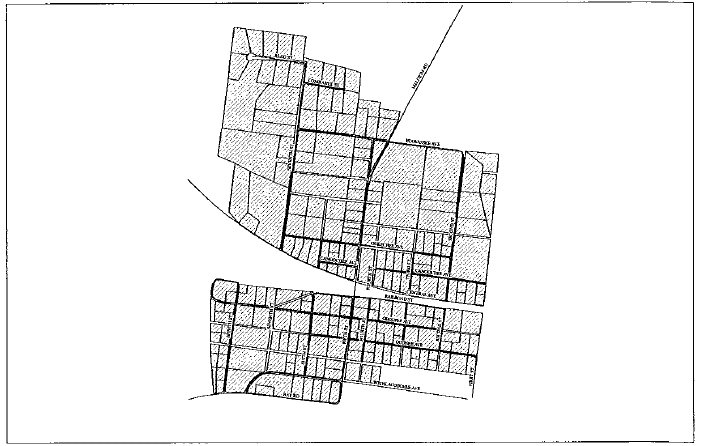
5.17.3 District regulations.
A.
Setbacks from property line for principle building.
a.
Front yard setbacks shall be a minimum of 20 feet.
b.
Rear yard setbacks shall be a minimum of 15 feet.
c.
Interior side yard setbacks shall be a minimum of ten feet or at least 20 feet from the nearest principle building whichever is greater.
d.
Street side yard setbacks shall be a minimum of 15 feet.
B.
All other district regulations shall be the same as section 5.1, AR-1 Agricultural residential district.
(Ord. of 2-3-11; Ord. of 8-16-16, § 1(b))
Editor's note— See editor's note at § 5.3.
5.18 - R-5 Single-family traditional neighborhood design residential district.
5.18.1 Intent. The R-5 District represents a balanced trade-off—allowing for increased residential density in exchange for thoughtfully designed and accessible open space, ensuring that growth is compact yet livable, and community-oriented.
The intent of the R-5 Single-Family Traditional Neighborhood Design Residential District is to promote compact, higher-density residential development that reflects the principles of traditional neighborhood design. This district encourages walkable, interconnected communities, smaller lot sizes, and pedestrian-oriented streetscapes. The R-5 District is designed to accommodate single-family detached dwellings in a pattern that fosters a strong sense of community and efficient land use. Key features may include reduced setbacks, alley access, front porches, and integrated open spaces contributing to neighborhood character and livability. This district supports long-term planning goals related to housing diversity, affordability, and sustainable growth by offering an alternative to conventional suburban development patterns, while still preserving the identity of single-family neighborhoods in a higher-density format.
Refer to article V, Table of Permitted Uses (TPU)
Any use that is not explicitly addressed in the TPU is prohibited; however, the applicant may request a text amendment and follow the process for getting approval of the use.
**All building setbacks shall be shown on final subdivision plat**
5.18.2 Concept plan review requirements. At the time of a preliminary plat request to the board of commissioners, a concept plan is recommended to be submitted for review by planning staff. The concept plan should illustrate the proposed layout, land uses, access points, open space, and general site design intent. While not binding, the concept plan can serve as a framework to evaluate the appropriateness of the preliminary plat request in the context of the surrounding area, infrastructure capacity, and consistency with the comprehensive plan.
5.18.3 Required utilities. This zoning district will only be allowed if municipal or county water and sewer service is adjacent to the parcel and capacity is available or a state permitted, privately owned community water and sewer system is constructed or available and can provide assurance of capacity.
5.18.4 Planned single-family home communities with the following requirements:
(a)
A homeowners' association shall be established, or management company identified. Said association or company shall operate pursuant to subdivision covenants, which are submitted to county with the final plat. It is the intent that said association or company will provide oversight of the development standards and maintenance of common areas and amenities.
1.
Covenants shall include a provision that no more than 20 percent of homes in the community may be rented until at least 12 months has elapsed since issuance of the certificate of occupancy.
(b)
Walls in excess of 20 feet in length facing a street shall be broken up with entry elements, windows or wall offsets at least two feet deep.
(c)
A minimum of two decorative elements shall be added to the front façade including but not limited to decorative shutters, decorative lighting, trellises, cornices, or similar architectural elements.
(d)
Up to 25 percent of the total number of dwelling units within a development in the R-5 zoning district may be constructed as duplexes or townhomes. The percentage of duplexes or townhomes shall be calculated based on the total number of residential units proposed within the development and must be clearly identified on the preliminary plat and all subsequent development plans.
5.18.5 Open space requirements. Refer to Appendix C - Zoning Ordinance, article III - General Provisions for Open Space requirements. All developments in the R-5 zoning district shall provide 25 percent net usable area as common outdoor open space. (link to be added)
5.18.6 Roads and Rights-of-way. Refer to Appendix B - Subdivision Regulations, article VII - Design Standards, section 7.1 - Streets and roads. (link to be added)
5.18.7 Development standards. The following design elements shall be included:
(a)
Exterior finished material shall be constructed with a combination of clay masonry brick, natural stone including granite, marble, sandstone, field stone or other similar natural stone; manufactured stone including imitation field stone, marble terrazzo, and other similar manufactured finish stone; and wood, cement plank, fiber plank, traditional three coat stucco, or other materials of like appearance.
(b)
The use of vinyl is approved if it is a minimum of .04 in thickness, incorporates two patterns, and is used in combination with at least one of the natural elements mentioned above.
(c)
Buildings shall utilize design features from the following list, totaling at least four points, to provide visual relief along the front of the dwelling unit. Unless otherwise specified, features are worth one point:
1.
Dormers (functional or false);
2.
Gables;
3.
Recessed entries;
4.
Covered front porches, at least six feet in depth (two points);
5.
Pillars or posts;
6.
Two or more brick masonry pattern bond treatments;
7.
Bay windows (minimum 24-inch projection);
(d)
Individual dwelling units shall incorporate a covered front door. This may be accomplished with a recessed entry, a portico, a door canopy, or a covered front porch.
(e)
Variation in color or texture shall be used to highlight openings such as windows and doors, as well as to add visual interest to the building's facade.
(f)
All residential dwellings shall provide a minimum of three and one-half inch wide trim on all components of any street-facing façade.
(g)
Trim shall be constructed of durable, weather-resistant materials and shall be consistent in style, dimension, and finish with the architectural design of the dwelling.
(h)
If a garage occupies more than 40 percent of the total front façade of the principal building, an architectural garage door and an eyebrow roof or architectural overhang shall be required to enhance visual interest and reduce the prominence of the garage on the streetscape.
(i)
All garage doors shall include decorative hardware features, such as handles and hinges, to enhance the overall architectural character of the structure.
(j)
R-5 developments must have rolled curbing and gutter throughout.
(k)
At least 20 percent of the wall space of the front façade shall be windows and doors. Windows shall be provided with trim.
(l)
The minimum roof overhang shall be 12 inches, exclusive of porches and patios.
(m)
The following amenity requirements shall apply:
1.
The mail kiosk and/or bus stop shall be covered.
2.
All amenities in the current phase must be completed before building permits for subsequent phases will be approved.
(n)
Entrance features. Designed entrance features shall be permitted where they contribute to the overall aesthetic and identity of the development. Such features must be thoughtfully integrated into the site and complement the surrounding area's character and the proposed development. Minimal clearing within required buffers shall be allowed only to the extent necessary to accommodate the entrance feature, and this disturbance shall be limited to the smallest area practicable. At the discretion of staff, additional landscaping or buffering may be required to ensure visual cohesion and to mitigate potential impacts on adjacent properties or public rights-of-way.
(o)
In the event that a proposed design standard deviates from the provisions of this ordinance, the applicant may petition the board of commissioners for consideration and approval of such design.
5.18.8 Street trees and landscaping requirements.
(a)
The minimum landscaping for street facing facade shall be as follows:
1.
One small shrub per six linear feet.
2.
One large shrub per ten linear feet.
(b)
Planting standards: On average, one large canopy street tree shall be planted on both sides of the street for every 50 feet of street frontage, or as otherwise determined by the county's planning department. The intent of this average is not to require strict on-center spacing, but rather to establish the number of trees required. Grouping and natural plantings shall be allowed. For circumstances where a large tree cannot be planted, medium trees may be planted on average every 40 feet and small trees on average every 30 feet. Small trees will only be allowed as street trees in situations where the tree lawn/verge is limited due to adjacent parallel parking.
1.
The minimum tree lawn/verge width shall be:
•
8 feet for large trees
•
6 feet for medium trees
•
4 feet for small trees
2.
Width of 24 inches deep root barrier required if tree lawn/verge is less than the minimum:
•
16 feet for large trees
•
12 feet for medium trees
•
8 feet for small trees
(c)
Species selection: Trees selected must be either from the county's tree list in section 3.4 of the zoning code or a similar species/variety that is suitable for the local climate and conditions. All trees shall be native or regionally adapted. No trees listed as an invasive species by the University of Georgia Extension Service shall be allowed.
(d)
Maintenance: Adjacent property owners or a property owners association will be responsible for the ongoing maintenance and care of the street trees, including watering, feeding, and pruning (limb and root) as needed to ensure tree health and prevent root damage to adjacent paving and utilities.
5.18.8.1 Enforcement and penalties. Non-compliance with this ordinance may result in a notice of violation and a requirement to plant or replace trees as needed. Repeated violations may result in fines as established by the county code.
(Ord. of 11-15-22(1); Ord. No. 2025-363e, 10-21-25)
Editor's note— See editor's note at § 5.3.

