
El Centro City Zoning Code
ARTICLE III
PROPERTY DEVELOPMENT STANDARDS
Sec. 29-100. - Lot size averaging.
Where land is subdivided into five (5) or more lots with a tentative map, such tentative map approval may authorize a reduction in the required minimum net lot area of the zone in which it is located by not more than ten (10) percent for not more than ten (10) percent of the total lots of the tentative map, provided the average of all lot sizes of the tentative map is not less than the minimum net lot size of the zone and that the subdivision does not exceed the maximum density allowed by the underlying zone.
(Ord. No. 24-03, § 2, 9-17-24)
Sec. 29-101. - Reduced lot size for public and utility buildings.
Where a lot or building site is devoted exclusively to public buildings and uses owned by the city, county, or other political subdivision or to public utility buildings and uses, and no living quarters are located on such lot or parcel, a reduction in the minimum required lot size may be authorized by conditional use permit.
(Ord. No. 24-03, § 2, 9-17-24)
Sec. 29-102. - Lot size in planned developments and manufactured home parks.
Where land is to be developed pursuant to a conditional use permit for a planned unit development or manufactured home park, the conditional use permit may specify lesser minimum lot sizes than otherwise required by the zone in which the land is located, provided the overall density of the project conforms to the provisions of division 2 of this article, entitled density regulations, and does not exceed the maximum density of the underlying zone.
(Ord. No. 24-03, § 2, 9-17-24)
Sec. 29-103. - Lot size for specific plans.
For single-family detached residential development under a specific plan, the minimum lot size shall be three thousand six hundred (3,600) square feet and the minimum average single-family detached residential lot size shall be five thousand four hundred (5,400) square feet. The density of residential development under a specific plan shall be consistent with the maximum density required by the general plan.
(Ord. No. 24-03, § 2, 9-17-24)
Sec. 29-107. - Computing permitted number of dwelling units.
The maximum number of dwelling units permitted within the exterior lot lines of any lot or building site shall be equal to the product of the total of the net lot area of such lot or building site expressed in acres multiplied by the maximum density designated by the applicable zone.
For example, the maximum permitted number of dwelling units for a building site with five (5) net acres in the R1 zone would be computed as follows:
Five (5) net acres of building site multiplied by the maximum density of seven (7) dwelling units per net acre for the R1 zone equals a maximum of thirty-five (35) permitted dwelling units on a five (5) net acre site.
A product with a fraction shall be rounded off to the nearest whole number of dwelling units. A product with a fraction of one-half (½) or less of a dwelling unit shall be rounded down to the nearest whole number of dwelling units and a product with a fraction of more than one-half (½) of a dwelling unit shall be rounded up to the nearest whole number of dwelling units provided that the product does not result in a density in excess of the maximum density allowed by the underlying zone. If rounding up to the nearest whole number would exceed the allowable maximum density of the underlying zone, then the product shall be rounded down to the nearest whole number.
(Ord. No. 24-03, § 2, 9-17-24)
Sec. 29-108. - Exceptions to density regulations.
Exceptions to this chapter's density regulations may be granted for specific housing projects as regulated by article IV, division 4 of this chapter, entitled density bonus program.
(Ord. No. 24-03, § 2, 9-17-24)
Sec. 29-113. - Yards, general conditions.
(a)
Yards shall be measured perpendicular to the property line or from a future street or highway line as shown in the general plan.
(b)
Yards shall apply to both main and accessory structures.
(c)
No required yard or other open space around an existing building or any building hereafter erected shall be considered as providing a yard or other open space for any other building on an adjoining lot or building site.
(d)
Garage doors shall not, when open or being opened, project beyond any lot line.
(Ord. No. 24-03, § 2, 9-17-24)
Sec. 29-114. - Exceptions to setback regulations.
(a)
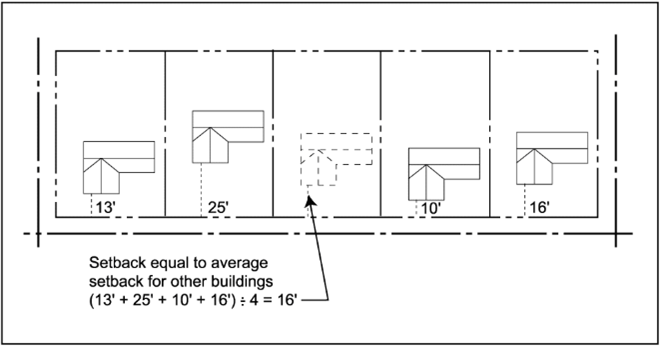
Partially built-up blocks. Where lots comprising fifty-one (51) percent or more of the block frontage are developed with a front yard less than that prescribed herein, the average of such existing front yards shall establish the front yard for the remaining lots in the block frontage provided that a front yard determined in this manner shall be not less than fifteen (15) feet on local streets and twenty (20) feet on major highways and select city streets. Existing front yards greater than twenty-five (25) feet shall be considered as twenty-five (25) feet when computing said average.
(b)
Neighborhood unit plans. Where the entire block frontage is designed and developed as a unit, the front yard requirements may be varied by not more than five (5) feet in either direction provided that the average front yard for the entire block frontage is not less than that required in the zone.
(c)
Sidewalk arcades. In view of the climatic conditions, the community development director will require the construction of an arcade over all or part of the sidewalks on Main Street, State Street and Broadway Avenue between 8th Street and 4th Street in connection with any new building or major alteration of an existing building. The community development director may specify the general character and architectural appearance of such arcades as recommended in the Urban Design Study: Downtown El Centro (1978).
(d)
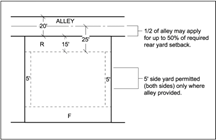
Where alleys are provided—residential or mixed-use zones. The following applies where a dedicated public alley granting access to the rear yard in a residential or mixed-use zone is provided:
(1)
The side yard setback shall be five (5) feet on both sides except where a side yard setback is adjacent to a public street or where a greater setback is required by a conditional use permit or site plan;
(2)
One-half (½) the width of said alley may be considered as applying to not more than one-half (½) of the required rear yard setback of twenty-five (25) feet for a two (2) story building.
(e)
Existing lots abutting a freeway. Any lot in an R1 (single-family residential) zone that contains an existing single-family residence on the effective date of this chapter shall have a rear yard requirement of twenty-five (25) feet when abutting a freeway.
(f)
Exception by variance or conditional use permit. When a conditional use permit or variance for a use or structure is otherwise required by this chapter, the permit may authorize an exception to the setback regulations of the zone and establish greater or lesser setback and spacing requirements subject to the permit.
(g)
Street facades in mixed-use zones. Certain frontage design elements specified in section 29-91(d)(1) may encroach no more than ten (10) feet into the required front setback for a maximum of fifty (50) percent of the building front facade length.
(Ord. No. 24-03, § 2, 9-17-24)
Sec. 29-115. - Additional setback required.
(a)
Future street line. Where the public works director has determined a future right-of-way line for an arterial or collector street designated in the general plan circulation element, or for the necessary widening of a local street, the required yard setback for lots abutting such streets shall be measured from the future right-of way line.
(b)
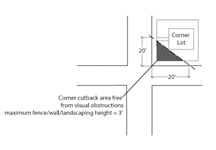
Vision clearance of corner lots. All corner lots shall maintain, for safety vision purposes, a triangular area, one (1) angle and two (2) sides of which shall be formed by the intersection of the front and side lot lines, excepting corner lots located within the CD zone. The third side of said triangle shall be a straight line connecting two (2) points on the property lines which are distant twenty (20) feet from the intersection of the front and side lot lines. Within the area comprising said triangle, no portion of the building or any sign, tree, fence, shrub, or other feature higher than three (3) feet above the estimated curb grade, which obstructs vision, shall be permitted (see illustration in section 29-143(11)a.)
(c)
Through lots to have two (2) front yards. A through lot shall maintain a front yard adjacent to each street upon which it fronts and to which it has access rights.
(d)
Setback line on recorded map. Where a recorded map has a specific building setback line delineated which is greater than the requirements set forth in the zone, the delineated setback line shall apply.
(e)
Required distance between detached accessory buildings and main buildings. Except as otherwise permitted in section 29-168, no detached accessory building wall shall be closer than six (6) feet to any main building wall or other accessory building wall on the same lot or building site. No detached accessory building eaves shall be closer than five (5) feet to any main building eaves or other accessory building eaves on the same lot or building site. Swimming pools which do not extend more than three (3) feet above the level of the ground adjacent thereto are exempt from this provision.
(f)
4th Street South of Orange Avenue. A setback of twenty-five (25) feet is required on both sides of the segment of 4th Street south of Orange Avenue for all nonresidential development.
(Ord. No. 24-03, § 2, 9-17-24)
Sec. 29-116. - Exceptions to the required openness of required yards.
Every part of each required yard shall be open and unobstructed from finished grade to the sky except for buildings, structures, and projections allowed in said yard by the following table. Any building, structure or projection not specifically allowed in a required yard by table 29-116.1 is prohibited.
Table 29-116.1 Permitted Buildings, Structures, and Projections in Required Yards
(Ord. No. 24-03, § 2, 9-17-24)
Sec. 29-121. - Maximum height specified.
The maximum height permitted shall be established in the property development standards of each zone. Height shall be measured in accordance with the definition of "building height" provided in article I, division 2 of this chapter.
(Ord. No. 24-03, § 2, 9-17-24)
Sec. 29-122. - Permitted exceptions to height limits.
(a)
The following structures shall be exempt from the maximum height provisions of the applicable zone:
(1)
Radio and television receiving antennae no more than one hundred (100) feet in height of the type customarily used for home radio and television receivers.
(2)
Transmitting antennae no more than one hundred (100) feet in height used by licensed amateur (ham) or citizens' band radio operators.
(3)
Flagpoles no more than sixty-five (65) feet in height provided, however, that such flagpoles used as signs or attention-attracting devices shall be subject to the off-premises sign regulations of chapter 22.1 of the City Code.
(4)
Chimneys extending no more than three (3) feet above the highest point of the roof of the building.
(5)
Solar collector systems, stepped parapets walls, and cornices extending not more than five (5) feet above the highest point of the roof.
(6)
Within commercial, mixed-use, and manufacturing zones, roof structures for the housing of elevators, stairways, tanks, ventilating fans or similar equipment necessary to operate and maintain the building provided that such structures do not extend more than twelve (12) feet above the height of the building and do not provide additional floor space.
(b)
A conditional use permit may be granted to authorize additional exceptions to height limits in any zone.
(Ord. No. 24-03, § 2, 9-17-24)
Sec. 29-127. - General provisions.
(a)
The requirements of this division shall be met for any new building constructed, any new use established, any addition or enlargement of an existing building or use, and any change in the occupancy of an existing building.
(b)
For additions or enlargements of any existing building or use, or any change of occupancy or manner of operation that would increase the number of parking spaces required, the additional parking spaces shall be required only for such addition, enlargement, or change and not for the entire building or use, unless required as a condition of approval of a conditional use permit. No existing parking may be counted as meeting this requirement unless it exceeds the requirements for the original building, and then only that excess portion may be counted.
(c)
Off-street automobile parking space being maintained in connection with any existing main building or use shall be maintained so long as said main building or use remains, unless an equivalent substitute number of such spaces is provided and thereafter maintained conforming to the requirements of this section. However, this regulation shall not require the maintenance of more automobile parking space than is required herein for a new building or use, or the maintenance of such space for any type of building or use other than those specified herein.
(d)
All licensed vehicles incapable of movement under their own power shall be stored in an entirely enclosed space, except in cases of emergency.
(e)
Except as hereinafter provided, required parking facilities needed for any development shall be located within three hundred (300) feet of the building or use they are required to serve and on the same site; and be on the same site as said building or use unless an irrevocable access and/or parking easement is obtained, in which case the parking may be on an adjacent site. Property within the ultimate right-of-way of a street or highway shall not be used to provide required parking or loading spaces.
(f)
In the case of mixed-use developments, the total number of required off-street parking spaces shall be the sum of the requirements for the each of the uses computed separately. Off-street parking facilities required for one (1) use shall not be considered as providing the required parking facilities for any other use.
(g)
Where the parking requirements for a use are not specifically defined herein, the parking requirements for such use shall be determined by the community development director in the manner set forth in section 29-3. Such determination shall be based upon the requirements for the most comparable use specified herein.
(Ord. No. 24-03, § 2, 9-17-24)
Sec. 29-128. - Required parking spaces.
Parking spaces shall be provided and thereafter maintained for all buildings and uses established within the city as specified in table 29-128.1, unless otherwise specified in state law. After computing the required number of parking spaces, any fraction of one-half (½) of a space or less shall be rounded down to the preceding whole number; fractions greater than one-half (½) shall be rounded up to the next whole number.
Table-29-128.1 Required Parking Spaces
(Ord. No. 24-03, § 2, 9-17-24)
Sec. 29-129. - Accessible parking spaces required.
Public accommodations or facilities, including commercial, office, manufacturing, civic, limited use, and multi-family dwellings of five (5) or more units, shall provide parking spaces for the physically handicapped in compliance with the Americans with Disabilities Act (ADA) Accessibility Guidelines outlined in the following provisions:
(1)
Size of space. The minimum length of each parking space shall be eighteen (18) feet with a minimum width of nine (9) feet.
(2)
Van accessible space. One (1) accessible van parking space, and not less than one (1), shall be provided for every eight (8) regular accessible spaces. Such van spaces shall be nine (9) feet in width.
(3)
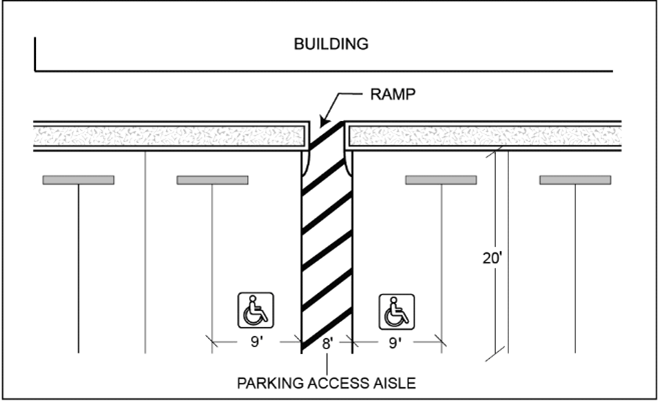
Access aisles. Parking access aisles (five (5) feet wide for standard cars and eight (8) feet wide for vans) shall be part of an accessible route to the building or facility entrance. Two (2) accessible parking spaces may share a common access aisle.
(4)
Number of required spaces. The required number of accessible parking spaces per total number of spaces is provided in table 29-129.1.
Table 29-129.1 Accessible Parking Space Requirements
a.
If only one (1) space is provided, it shall be seventeen (17) feet wide and marked to provide a nine (9) foot parking area and an eight (8) foot loading and unloading area.
b.
When more than one (1) space is provided, in lieu of providing a 17-foot-wide space for each parking space, two (2) spaces may be provided within a twenty-six (26) foot-wide area marked to provide a nine (9) foot parking area on each side of an eight (8) foot loading/unloading area in the center (see figure 29-129.1).
Figure 29-129.1 Accessible Parking Space Configuration
(5)
Location. Spaces shall be located as follows:
a.
Parking spaces for the physically handicapped shall be located as near as practical to a primary entrance.
b.
Slope of parking space. Surface slopes of parking spaces for the physically handicapped shall be the minimum possible, and shall not exceed two (2) percent in any direction.
c.
Arrangement of parking area. In each parking area, a bumper or curb shall be provided and located to prevent encroachment of cars over the required width of walkways. Also, the space shall be so located that a handicapped person is not compelled to wheel or walk behind parked cars other than his/her own. Pedestrian ways which are accessible to the physically handicapped shall be provided from each such parking space to related facilities, including curb cuts or ramps as needed. Ramps shall not encroach into any parking space except where such encroachment into the length of any handicap space does not limit the handicapped person's capability to leave or enter the vehicle.
(6)
Signing.
a.
Identification. Each parking space reserved for the handicapped shall be identified by a permanently affixed reflectorized sign constructed of porcelain on steel, beaded text, or equal, displaying the international symbol of accessibility. The sign shall not be smaller than seventy (70) square inches in area and shall be centered at the interior end of the parking space at a minimum height of eighty (80) inches from the bottom of the sign to the parking space finished grade, or centered on the wall at the interior end of the parking space at a minimum height of thirty-six (36) inches from the parking space finished grade, ground or sidewalk.
b.
Pursuant to California Vehicle Code section 22511.8(d), a sign shall also be posted, in a conspicuous place, at each entrance to the off-street parking facility, not less than seventeen (17) inches by twenty-two (22) inches in size, with lettering not less than one (1) inch in height, which clearly and conspicuously states the following:
"Unauthorized vehicles not displaying the distinguishing placards or license plates issued for physically handicapped persons may be towed away at the owner's expense. Towed vehicles may be reclaimed at or by telephoning."
The sign shall also reference California Vehicle Code 22511.8(d).
c.
The surface of each parking place shall have a surface identification duplicating the symbol of accessibility in blue paint, at least three (3) square feet in area.
(7)
Vertical clearance. Entrances to and vertical clearances within parking structures shall have a minimum vertical clearance of eight (8) feet two (2) inches where required for accessibility to handicap parking spaces.
(8)
Additional requirements. For additional accessible site development requirements, including curbs, ramps and landing requirements refer to the California Code of Regulations, Title 24 for the accommodation of the disabled.
(Ord. No. 24-03, § 2, 9-17-24)
Sec. 29-130. - Area exempt from required parking.
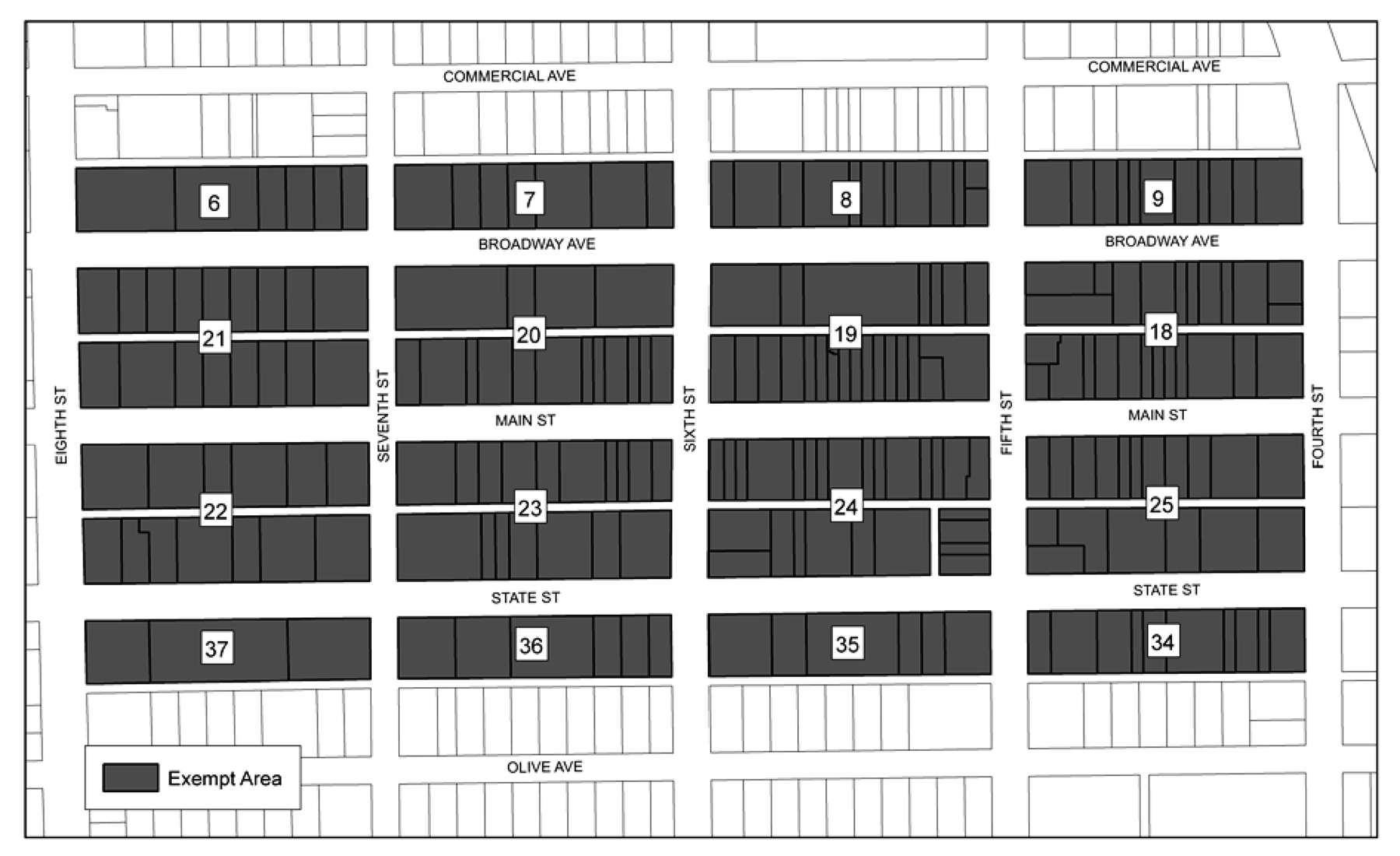
All sites located on blocks 18, 19, 20, 21, 22, 23, 24, and 25, and the south half of blocks 6, 7, 8 and 9, and the north half blocks of 34, 35, 36, and 37 are exempt from the off-street parking requirements otherwise required by this division as shown on figure 29-130.1. Residential uses proposed within the downtown commercial zone shall not be exempt from the standard off-street parking requirement.
All off-street parking provided in said areas shall meet the design and access requirements of this division.
Figure 29-130.1. Area Exempt from Required Parking
(Ord. No. 24-03, § 2, 9-17-24)
Sec. 29-131. - Reductions in requirements for parking.
(a)
Whenever the city or any special parking district owns, or commences condemnation proceedings on land to be used for public off-street parking purposes, the planning commission may, on its own motion or pursuant to application by the owner of any land abutting the area used or to be used for public parking, recommend the reduction, in part or entirely, of the off-street parking requirements imposed by this chapter on the lands abutting said area, provided that:
(1)
The planning commission, before recommending a reduction in off-street parking requirements, shall make a finding that the stated conditions exist in reference to subject property; and that
(2)
The city council, in granting a reduction, may impose reasonable conditions to assure the intent and purpose of this chapter are met.
(3)
The city council, in the formation of any parking district, may impose reasonable conditions to assure the intent and purpose of this chapter are met.
(b)
Pursuant to section 29-298, the administrative committee may grant an administrative variance reducing certain parking requirements.
(Ord. No. 24-03, § 2, 9-17-24)
Sec. 29-132. - In lieu payments for noncompliance.
As an alternative to compliance with the provisions of this division, an owner of property may pay the city's adopted in-lieu parking fee for noncompliance for each of the parking spaces by which the proposed project is deficient according to the parking requirements of this division. This section shall only apply to property located on a block in a commercial zone with fifty (50) percent or more of the frontage of such block occupied by commercial buildings at the time of the adoption of this chapter.
The city shall establish the amount of the in-lieu parking fee for noncompliance in a resolution adopted separate from this chapter. All in-lieu fee payments for noncompliance shall be held for three (3) years in the city's parking lot acquisition fund for the purpose of paying any parking district assessments which may become legally payable on behalf of the owners of said property. After three (3) years, said deposits may only be used by the city for such purpose, or for purchase or improvement of parking lot property within five hundred (500) feet of the said property. Upon payment of parking district assessments from any in-lieu fee payment, and the subsequent removal of parking requirements from said property by ordinance, any remaining money from the in-lieu fee payment shall be repaid to the then record owner of said property.
This section does not apply to residential units provided in the downtown commercial zone. All residential development must provide off-street parking in compliance with the requirement of table 29-128.1 and the other applicable provisions of this chapter.
(Ord. No. 24-03, § 2, 9-17-24)
Sec. 29-133. - Location of parking on building site.
Covered or enclosed parking may be located anywhere a structure may be located or as permitted by section 29-116. Open parking may be located as follows:
(1)
Single-family and two-family residential zones. Anywhere except within ten (10) feet from the front lot line. If within an interior side yard, a six (6) foot high solid fence or wall is required. If within an exterior side yard, a three (3) foot property line setback and corner cutback must be maintained.
(2)
Multi-family residential zones. If within a required front yard, parking areas shall be set back at least ten (10) feet from the front property line. If within an interior side yard, a six (6) foot high solid fence or wall is required. If within an exterior side yard, a three (3) foot property line setback and corner cutback must be maintained.
(3)
Within commercial, manufacturing, or other zones. Anywhere except within a required landscape strip.
(4)
Conditional uses. As prescribed in the approved conditional use permit. If not prescribed, the requirements of this division shall apply.
(5)
Within MU1, MU2 overlay and MO overlay zones. To encourage an active, pedestrian environment, vehicle parking shall be placed to the side or rear of buildings and may not be placed within a required front yard or a required landscape strip. Below grade and structured parking are encouraged for larger developments.
(6)
Vehicle parking for live/work and artisan loft units is prohibited between the structure's street front facade and the street.
(Ord. No. 24-03, § 2, 9-17-24)
Sec. 29-134. - Design and improvement of parking areas.
(a)
Parking space dimension. The minimum size of required parking spaces shall be a width of nine (9) feet and a length of eighteen (18) feet, except that not more than twenty (20) percent of required parking spaces for any land use for which five (5) or more spaces are required, may be compact spaces and shall be a width of eight and one-half (8½) feet and a length of sixteen (16) feet.
(b)
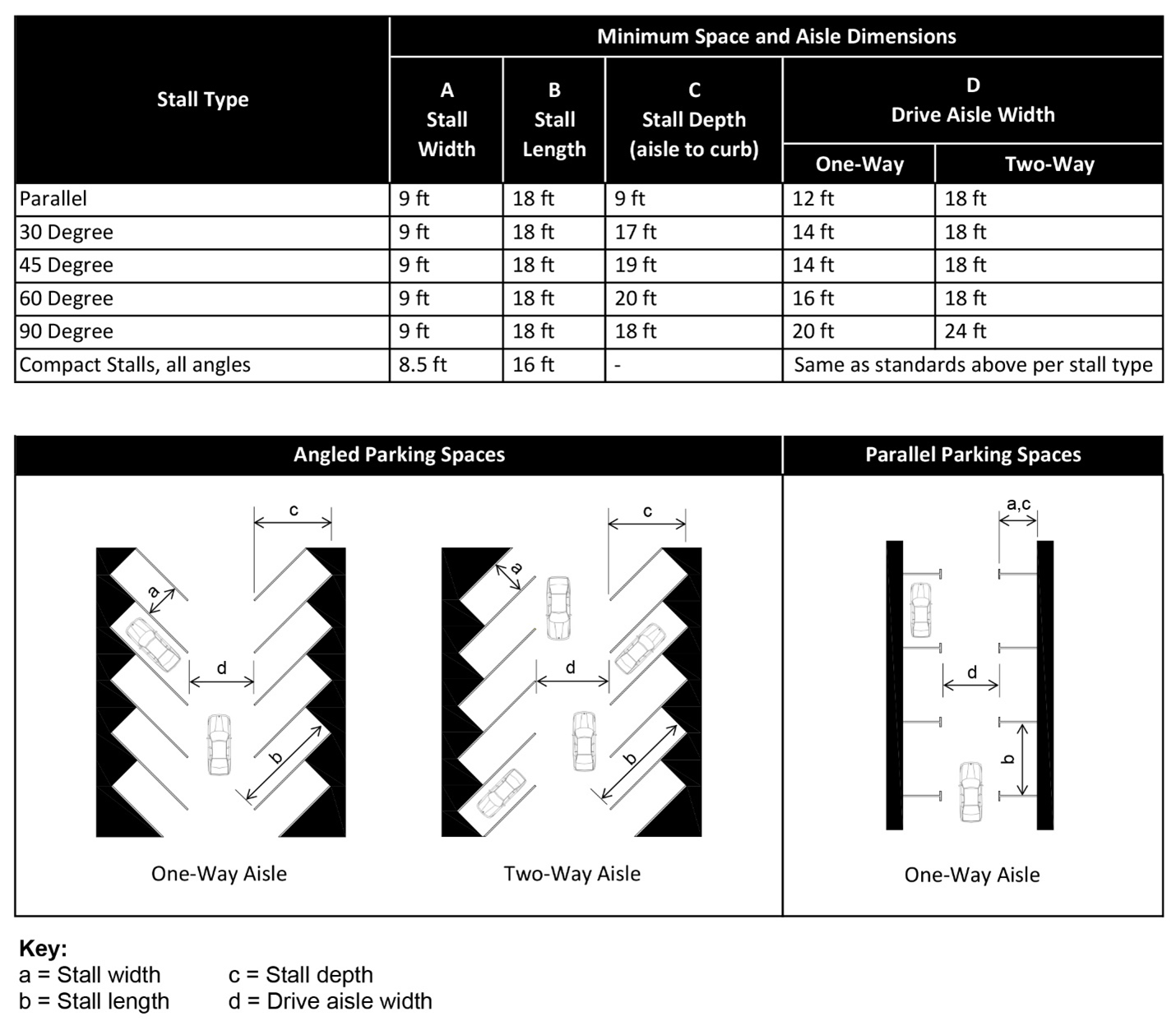
Parking layout. The design standards identified in table 29-134 shall apply to all off-street parking areas, except when the parking lot is served by an attendant:
Table 29-134
(c)
Improvement standards for parking areas.
(1)
General standards. All parking areas shall be improved and maintained to the standards of the public works department with regard to:
a.
Ease of access.
b.
Grading and drainage.
c.
Surfacing with cement or asphaltic concrete.
d.
Parking stall layout and markings.
e.
Curbs, barriers and wheel stops.
f.
Directional signs.
(2)
Structural standards. The public works department may require additional depth of base material and thickness of surfacing in portions of parking areas or driveways intended for use by heavy vehicles, such as by trash trucks or large delivery trucks.
(3)
Lighting. All outdoor lights within parking areas shall be hooded and arranged to reflect light away from adjacent property and streets.
(4)
Adjacent to residential zone. Where a parking area of five (5) or more spaces is established within or adjacent to a residential zone, a six (6) foot high solid fence or wall shall be constructed and maintained between said parking area and the rear and/or interior side property line which abuts the residentially zoned property. Said fence or wall is to be reduced to three (3) feet in height within any corner cutback area and within the front yard area of the adjacent residential zones.
(5)
Maintenance. All parking spaces shall be maintained free of debris and in good operating condition for the duration of the use requiring such parking, and shall be used exclusively for the parking of vehicles. Parking facilities shall not be used for the storage of merchandise, or for the storage or repair of vehicles or equipment.
(6)
Landscaping. All parking areas of five (5) to twenty (20) spaces shall contain a minimum interior landscaped area of five (5) percent of the total parking area, exclusive of landscaping within a front or side yard setback. All parking areas of more than twenty (20) spaces shall contain a minimum interior landscaped area of ten (10) percent the total parking area, exclusive of landscaping within a front or side yard setback. Landscaping installed within a parking area shall count toward meeting the requirement of section 29-142 for required landscaping. Such landscaped area shall be designed and maintained in accordance with section 29-142(2) of this chapter.
(Ord. No. 24-03, § 2, 9-17-24)
Sec. 29-135. - Parking of commercial and recreational vehicles in residential zones prohibited.
The parking of commercially licensed vehicles and recreational vehicles in excess of one (1) ton capacity on private property in any residential zone is prohibited, except as follows:
(1)
When loading or unloading property; or
(2)
When such vehicle is parked in connection with, and in aid of, the performance of a service to or on property in the block in which such vehicle is parked.
(3)
Notwithstanding the above provisions, no commercially licensed or recreational vehicle shall remain parked in excess of twenty-four (24) hours and no more than fourteen (14) days in a year.
(Ord. No. 24-03, § 2, 9-17-24)
Sec. 29-136. - Off-street loading spaces.
(a)
General provisions. Every hospital, institution, hotel, commercial, public assembly or industrial building hereafter erected or established shall have and maintain loading spaces as provided in this section.
(1)
Loading spaces shall be not less than twelve (12) feet in width, forty (40) feet in length, and shall have fourteen (14) feet of vertical clearance.
(2)
When the lot upon which the loading spaces are located abuts upon an alley, such loading spaces shall have access to said alley. The length of the loading space may be measured perpendicular to or parallel with the alley. Where such loading area is parallel with the alley and said lot is fifty (50) feet or less in width, the loading area shall extend across the full width of the lot.
(3)
Loading spaces shall be so located and designed that trucks need not back into a street or alley.
(4)
No part of an alley or street shall constitute part of a loading area required by this section.
(5)
Loading spaces being maintained in connection with any main building existing on the effective date of this chapter shall thereafter be maintained so long as said building remains, unless an equivalent number of such spaces are provided on a contiguous lot in conformity with the requirements of this section. However, this regulation shall not require the maintenance of more loading space than is hereby required for a new building, nor the maintenance of such space for any type of main building other than those specified above.
(6)
No loading space that is provided for the purpose of complying with the provisions of this chapter shall hereafter be eliminated, reduced, or converted in any manner below the requirements established in this chapter, unless equivalent facilities are provided elsewhere in conformance with this chapter.
(b)
Loading spaces required. The following off-street loading spaces shall be provided for all hospitals, institutions, places of public assembly, hotels, commercial and industrial uses:
(1)
Commercial and industrial uses:
(2)
Hospitals, institutions, and hotels:
(3)
Hotels, places of public assembly, and restaurants:
(4)
Exceptions. In any office commercial zone and downtown commercial zone, permitted uses therein as set forth in section 29-61 shall not be subject to the loading space requirements provided in this section. Notwithstanding the foregoing, office commercial uses shall comply with the requirements of this section. In addition, any block in a commercial zone where more than fifty (50) percent of the block frontage is occupied by commercial buildings at the time of the adoption of this chapter shall be subject to the following loading space requirements:
(c)
Mixed occupancies. In the case of mixed-uses, the total number of required loading spaces shall equal the sum of the requirements for the various uses computed separately. Loading space facilities for one (1) use shall not be considered as providing required loading space facilities for any other use. However, off-street loading spaces may be used between buildings and multiple occupants within the mixed-use zones.
(Ord. No. 24-03, § 2, 9-17-24)
Sec. 29-137. - Vehicular access.
(a)
Access required. Each building, structure or use shall have permanent vehicular access to the approved public or private street or right-of-way on which the lot or building site has frontage, unless a secondary means of permanent all weather vehicular access such as an alley, private drive or service road has been approved by the administrative committee under the provisions of section 29-298.
(b)
Vehicular access to local and collector street frontage. In order to encourage sound development of street frontage, the following provisions shall apply to all uses fronting on any local or collector street.
(1)
All vehicular access ways shall be located not less than twenty-two (22) feet from the ultimate curb line of intersecting streets.
(2)
Vehicular access ways on the same lot, building site or project shall be not less than sixty (60) feet apart as measured along the street frontage.
(3)
In mixed-use, mixed-use overlay, and medical office overlay zones, vehicular access and parking shall be taken from the alley or side street when available, and curb cuts shall be limited in accordance with city standards to minimize traffic stacking.
(c)
Vehicular access to arterial frontage. In order to encourage sound development of arterial frontage, any access to arterial streets from property fronting on them shall be so arranged that vehicles entering the street need not back out. This provision shall apply to all industrial, commercial, mixed-use, office, public and institutional uses, as well as residential uses requiring four (4) or more parking spaces.
(1)
In mixed-use, mixed-use overlay, and medical office overlay zones, vehicular access and parking shall be taken from the alley or side street when available, and curb cuts shall be limited in accordance with city standards to minimize traffic stacking.
(Ord. No. 24-03, § 2, 9-17-24)
Sec. 29-138. - Shared parking facilities.
A site plan may be approved for shared parking facilities in the following zones serving more than one (1) use on a site or serving more than one (1) property: commercial, mixed-use, and medical office. Site plan approval for shared off-street parking may allow a reduction of the total number of spaces required by this section if the following findings are made:
(1)
The spaces to be provided will be available as long as the uses requiring the spaces are in operation;
(2)
The peak hours of parking demand from all uses do not coincide so that peak demand is greater than the parking provided;
(3)
The adequacy of the quantity and efficiency of parking provided will equal or exceed the level that can be expected if collective parking is not provided; and
(4)
A reciprocal parking and access agreement exists between the landowner(s) and the city, in a form satisfactory to the city attorney, which includes:
a.
A guarantee that there will be no substantial alteration in the uses that will create a greater demand for parking;
b.
A guarantee among the landowner(s) for access to and use of the shared parking facilities;
c.
A provision that the city may require parking facilities in addition to those originally approved upon a finding by the community development director that adequate parking to serve the use(s) has not been provided;
d.
A provision stating that the city may for due cause and upon notice, unilaterally modify, amend, or terminate the agreement at any time; and
e.
A provision that the agreement will be recorded in the county recorder's office within ninety (90) days from the date of site plan approval.
The maximum allowable reduction in the number of spaces to be provided shall not exceed twenty (20) percent of the sum of the number required for each use served, and shall not reduce the total number of spaces to less than one (1) space for every four hundred (400) square feet of gross floor area.
An applicant for site plan review for shared parking may be required to submit survey data substantiating a request for reduced parking requirements. Site plan approval for shared parking shall describe the limits of any area subject to reduced parking requirements and the reduction applicable to each use.
(Ord. No. 24-03, § 2, 9-17-24)
Sec. 29-142. - Required landscaping.
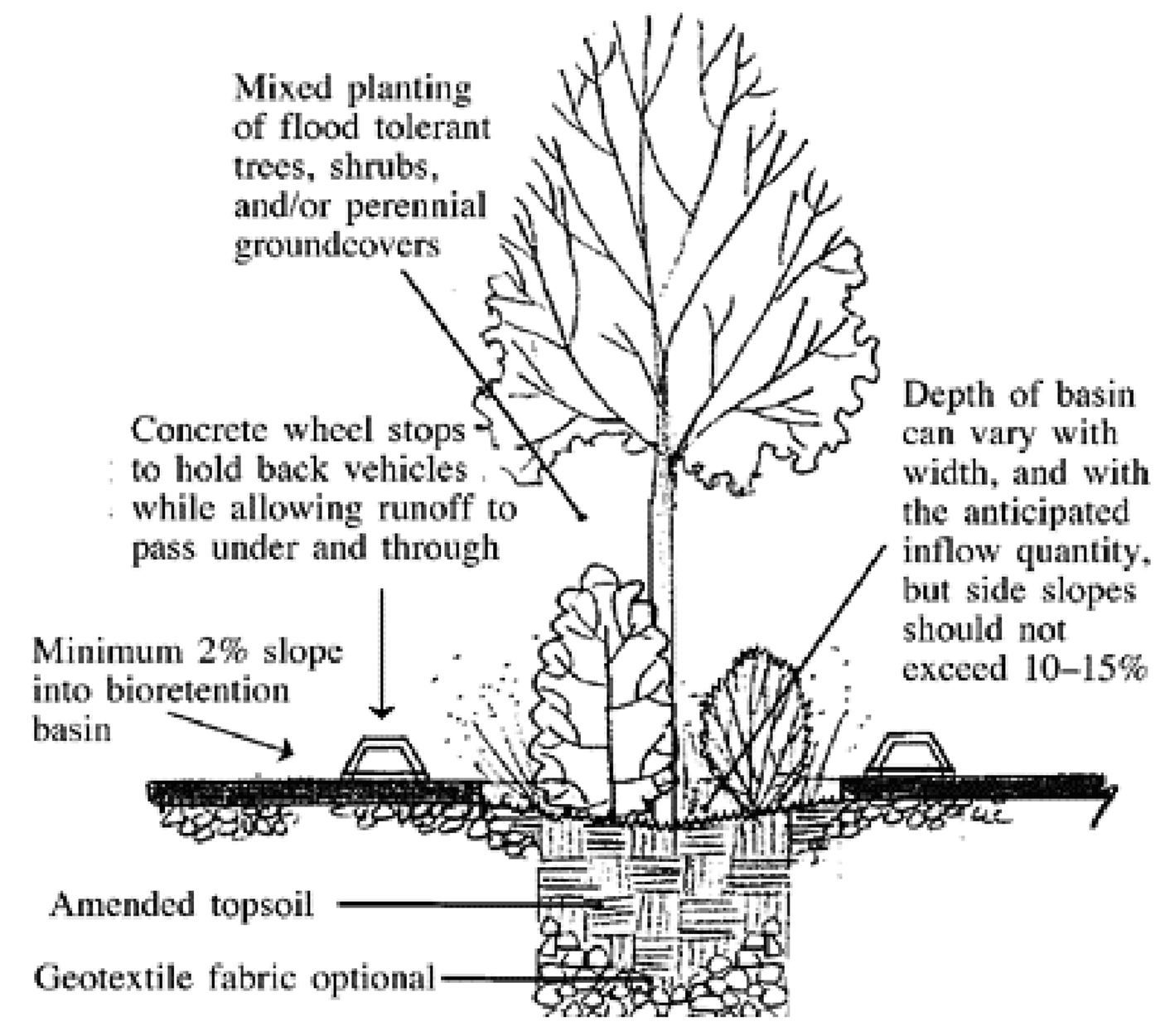
Landscaping shall be provided and maintained in all zones in accordance with the following standards and with the city retention basin standards, where applicable:
(a)
All front and exterior side yard areas in all zones, excluding permitted parking spaces, walkways, and driveways, shall be landscaped with a mixture of compatible species.
(b)
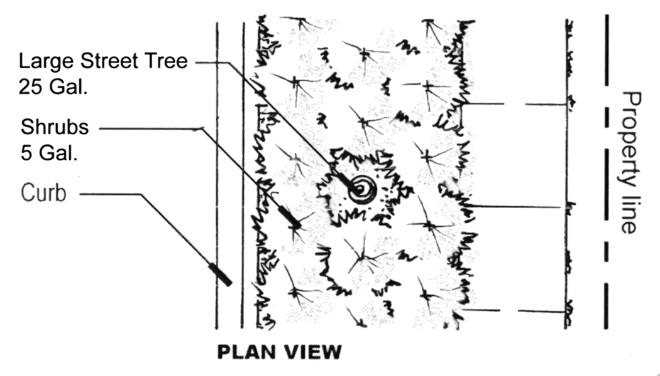
All off-street parking areas of five (5) or more spaces shall be landscaped. All parking areas of five (5) to twenty (20) spaces shall contain a minimum interior landscaped area of five (5) percent of the total parking area, exclusive of landscaping within a front or side yard setback. All parking areas of more than twenty (20) spaces shall contain a minimum interior landscaped area of ten (10) percent of the total parking area, exclusive of landscaping within a front or side yard setback.
(c)
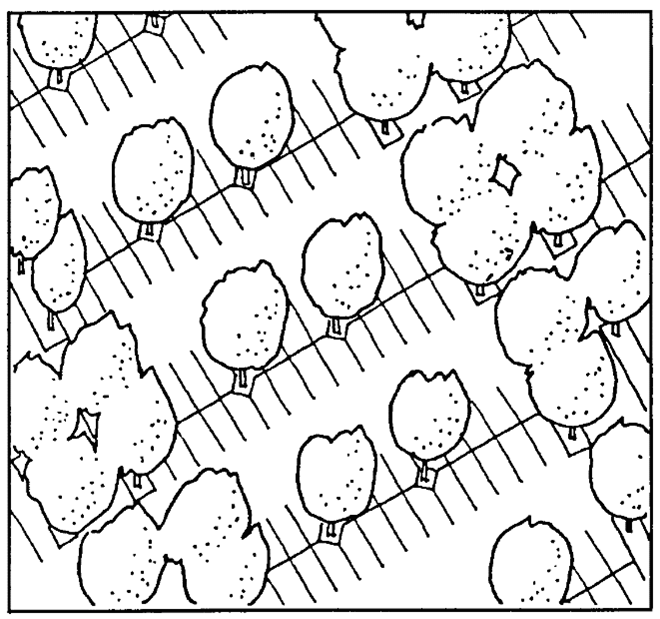
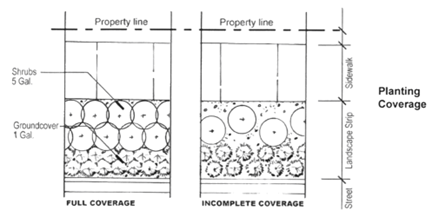
Required landscaping shall be evenly distributed throughout the parking area and planted sufficiently to achieve complete coverage within one (1) year of the initial planting (see illustration below). The parking lot landscaping shall also include an appropriate number of trees to achieve forty (40) percent shading within fifteen (15) years. Islands at the ends of parking lanes shall be provided to help achieve "orchard" parking lot landscaping. Parking lot islands shall be a minimum five (5) feet in width with curbs and irrigated understory.
(d)
If an established use in a commercial, mixed-use, manufacturing, or civic center zone abuts property in a residential zone or a school, then a ten (10) foot landscape strip shall be provided along the property line which is adjacent to the residential zone or use. The community development director may permit required landscaping to be located adjacent to a building rather than on the property line. Such landscaping shall include trees of a size and type in compliance with the other provisions of this section and planted twenty (20) feet on center or equivalent approved spacing.
(e)
If a use is established in the commercial, mixed-use, or civic center zones or within any zone in a visual enhancement area, an area or areas equivalent to at least fifteen (15) percent of the net lot or building site area shall be landscaped. Uses established within the downtown commercial zone are exempt from the landscaping requirements. Uses established within a manufacturing zone shall provide a minimum of ten (10) percent of the building site with landscaping. In all non-residential zones a minimum of eighty (80) percent of the required landscaping shall be provided within the frontage area or areas visible from a public street.
(f)
Reserved.
(g)
All required landscaping shall include the planting of trees at a minimum ratio of one (1) tree per two hundred (200) square feet of landscaping or one (1) tree per every five (5) parking spaces, whichever is more. The required trees shall be a minimum of twenty-four(24)-inch box in size when planted. Trees shall be of appropriate size and trunk diameter for the specified container and tree type. No more than twenty (25) percent of the required number of trees shall be palm trees. The planning commission may approve trees, shrubs, and ground cover not recommended by this section upon submission of evidence that such landscaping is well suited for the city.
(h)
New residential subdivisions and single-family dwellings shall provide a minimum of two (2) trees per lot from the recommended city tree list. Such trees shall be planted within the parkway strip if one (1) is provided or within the required front yard setback. The use of street tree themes is encouraged. Not all trees within a development may be of the same variety.
(i)
All landscaped areas shall be maintained in a clean, neat, and healthy condition, whether the building is occupied or vacant. Maintenance shall include proper watering, fertilizing, weeding, removing of litter, and replacement of plants when necessary.
(j)
Where a site plan is required by this chapter, said site plan shall indicate the type, size, and location of all landscaping materials.
(k)
Landscaping located in commercial, mixed-use, industrial, and multifamily residential developments shall include a water efficient irrigation system in accordance with specifications provided by the department of public works. All irrigation systems shall contain an adequate backflow prevention device.
(l)
Landscaping shall include a balanced mixture of trees, shrubs, and ground cover. Trees, shrubs, and ground cover material shall be selected from the recommended city tree, shrub and ground cover lists contained under subsections (t), (u), and (v) respectively, of this section.
(m)
All planting areas shall be covered with a minimum three (3) inch deep layer of mulch. Mulch may consist of rock mulch, shredded wood or bark. Decomposed granite shall not be used as a mulch for planting areas. All mulch shall be free of trash, waste and construction debris. Mulch shall be tapered to reduce the depth to two (2) inches for all areas within three (3) feet of flatwork, headers, curb, and mow edges. Keep mulch two (2) feet away from tree trunks and four (4) to six (6) feet away from shrub/groundcover stems to avoid retention of moisture at the trunks and stems which can lead to rot.
(n)
Rootbarrier shall be provided for all trees located within five (5) feet of any paved hardscape areas (sidewalks, driveways, etc). Rootbarrier shall be placed adjacent to the paving and run for a length of twenty (20) feet (ten (10) feet in each direction centered on the tree trunk). Rootbarrier shall be a minimum depth of twenty-four (24) inches.
(o)
In single-family residential developments, a minimum of fifty (50) percent of the required landscaping shall be provided from the approved city lists. Shrubs shall be a minimum of five (5) gallons in size when planted. Ground cover shall be evenly split between fifty (50) percent vegetative and fifty (50) percent non-vegetative. Not more than fifty (50) percent of the vegetative ground cover may be turf. Non-vegetative ground cover may include rocks, wood chips, and artificial covering.
(p)
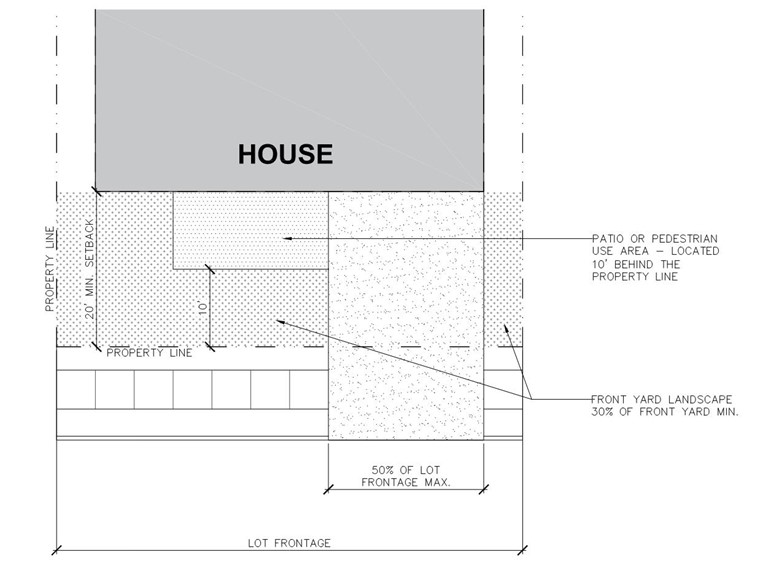
In single-family residential developments, front yard setbacks shall provide a minimum of thirty (30) percent vegetative areas. Additional hardscape spaces such as patios or other usable pedestrian areas shall be permitted in the front yard setback only where they occur a minimum of ten (10) feet behind the property line. A minimum of fifty (50) percent of the required landscaping shall be provided from the approved city lists. Shrubs shall be a minimum of five (5) gallons in size when planted.
(q)
Artwork, benches, and other structural features may be included in residential and mixed-use developments if approved as part of the site plan. Decorative water features shall use recirculating water. The use of drought resistant plant materials is strongly encouraged.
(r)
Except for landscaping within a single-family residence, all landscaping and irrigation systems shall be installed prior to the issuance of a certificate of occupancy. The city may accept the posting of a bond for the estimated cost of completion of the landscaping to guarantee the installation of the landscaping within six (6) months of occupancy with complete coverage at one (1) year from occupancy.
(s)
Landscape planters shall be designed to retain water on site within the planter areas.
(t)
The city officer or body having jurisdiction over a site plan, variance, conditional use permit, or other plan may permit or require alternative methods or standards for landscaping as a condition of project approval.
(u)
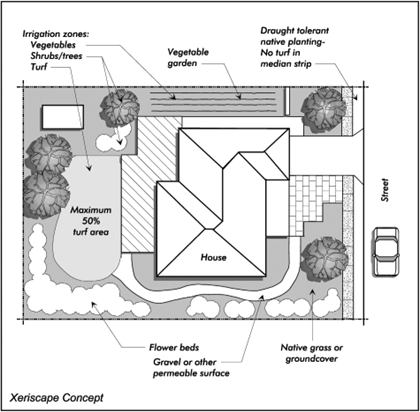
All landscaping, except as provided for under section 29-142(s) below shall, be subject to water efficiency conservation efforts as incorporated herein. A Xeriscape(tm) concept is provided on the following page.
(1)
Model water efficient landscape requirements.
a.
Property owners or their building or landscape designers, including anyone requiring a building or planning permit, plan check, or landscape design review from the city, who are constructing a new project with a landscape area greater than five hundred (500) square feet, or rehabilitating an existing landscape with a total landscape area greater than two thousand five hundred (2,500) square feet, shall comply with sections 492.6(a)(3)(B) (C), (D), and (G) of the Model Water Efficient Landscape Ordinance (MWELO), including sections related to use of compost and mulch as delineated in this section 29-142(r)(1).
b.
The following compost and mulch use requirements that are part of the MWELO are now also included as requirements of this ordinance. Other requirements of the MWELO are in effect and can be found in 23 CCR, division 2, chapter 2.7.
c.
Property owners or their building or landscape designers that meet the threshold for MWELO compliance outlined in section 29-142(r)(1)a. above shall:
1.
Comply with sections 492.6 (a)(3)(B)(C),(D) and (G) of the MWELO, which requires the submittal of a landscape design plan with a soil preparation, mulch, and amendments section to include the following:
i.
For landscape installations, compost at a rate of a minimum of four (4) cubic yards per one thousand (1,000) square feet of permeable area shall be incorporated to a depth of six (6) inches into the soil. Soils with greater than six (6) percent organic matter in the top six (6) inches of soil are exempt from adding compost and tilling.
ii.
For landscape installations, a minimum three (3) inch layer of mulch shall be applied on all exposed soil surfaces of planting areas except in turf areas, creeping or rooting groundcovers, or direct seeding applications where mulch is contraindicated. To provide habitat for beneficial insects and other wildlife up to five (5) percent of the landscape area may be left without mulch. Designated insect habitat must be included in the landscape design plan as such.
iii.
Organic mulch materials made from recycled or post-consumer materials shall take precedence over inorganic materials or virgin forest products unless the recycled post-consumer organic products are not locally available. Organic mulches are not required where prohibited by local fuel modification plan guidelines or other applicable local ordinances.
2.
The MWELO compliance items listed in this section are not an inclusive list of MWELO requirements; therefore, property owners or their building or landscape designers that meet the threshold for MWELO compliance outlined in section 14(a) shall consult the full MWELO for all requirements.
d.
If, after the adoption of this ordinance, the California Department of Water Resources, or its successor agency, amends 23 CCR, division 2, chapter 2.7, sections 492.6(a)(3)(B) (C), (D), and (G) of the MWELO September 15, 2015 requirements in a manner that requires cities to incorporate the requirements of an updated MWELO in a local ordinance, and the amended requirements include provisions more stringent than those required in this section, the revised requirements of 23 CCR, division 2, chapter 2.7 shall be enforced.
(v)
The following projects are not subject to water conservation requirements:
(1)
Property owner-provided landscaping for single-family residential projects;
(2)
New and rehabilitated cemeteries in compliance with sections 492.4, 492.11, and 492.12; and existing cemeteries are limited to sections 493, 493.1 and 4932.2 of the MWELO;
(3)
Ecological restoration projects that do not require a permanent irrigation system;
(4)
Mined-land reclamation projects that do not require a permanent irrigation system; or
(5)
Any project with a rehabilitated landscaped area less than two thousand five hundred (2,500) square feet.
(6)
Any project with a new landscaped area less than five hundred (500) square feet.
(w)
Prior to the issuance of any building permit, a landscape documentation package shall be submitted to the city for review and approval. The landscape documentation package shall include the following elements:
(1)
Water conservation concept statement.
(2)
Calculation of the maximum applied water allowance.
(3)
Calculation of the estimated applied water use.
(4)
Calculation of the estimated total water use.
(5)
Landscape design plan.
(6)
Irrigation design plan.
(7)
Irrigation schedules.
(8)
Maintenance schedule.
(9)
Landscape irrigation audit schedule.
(10)
Grading design plan.
(11)
Soil analysis.
(12)
Certificate of substantial completion (to be submitted after installation of the project.).
(x)
Recommended tree list for the city. The city's recommended tree list is provided in table 29-142.1.
Table 29-142.1 Recommended Tree List for the City of El Centro
Notes:
*Preferred twenty-four (24)-inch box minimum size for all recommended trees.
(v)
Recommended Ground Cover List for the City of El Centro. Table 29-142.2 provides the city's recommend ground cover list.
Table 29-142.2 Recommended Ground Cover List for the City of El Centro
Notes:
One (1) gallon minimum size for all recommended ground cover.
(w)
Recommended shrub list for the city. Table 29-142.3 provides the city's recommended shrub list.
Table 29-142.3 Recommended Shrub List for the City of El Centro
Notes:
Five (5) gallon minimum size for all recommended shrubs.
(Ord. No. 24-03, § 2, 9-17-24)
Sec. 29-143. - Required screening and fencing.
Except as otherwise provided in this chapter, the following screening, fences and/or walls are required:
(1)
Commercial, mixed-use, manufacturing, limited use or civic center zones. When a use is established in any commercial, mixed-use, manufacturing, limited use or civic center zone, a six (6) foot high solid masonry wall with a painted, stucco, or natural decorative masonry or adobe surface shall be constructed and maintained where a rear or interior side property line abuts a residential zone.
(2)
Multi-family residential zone.
a.
All uses established in a multi-family residential zone shall require the construction and maintenance of a six (6) foot high solid wood fence or masonry wall with a painted, stucco, or natural decorative masonry or adobe surface where a rear or interior side property line abuts a single-family residential zone.
b.
Parking areas located in front of multi-family residential buildings shall be screened by a three (3) foot high solid wood fence or masonry wall with a painted, stucco, or natural decorative masonry or adobe surface, a three (3) foot height high landscaped berm, a combination of wall and berm totaling three (3) feet in height, or landscaping with a mature height of two (2) to three (3) feet.
c.
For safety and security purposes, a multi-family residential development with more than one hundred (100) units may control vehicular and pedestrian access at the front property line with six (6) foot high fences and gates with a maximum of fifty (50) percent opacity (such as wrought iron or tubular steel frames), but only in instances where the fence and gate design promotes visibility and reinforces and enhances the architectural form and style of the development. Chain-link and any type of barbed-wire or electrified fencing is prohibited in any residential zone or zone abutting a residential zone. See also chapter 18, section 18-4.
(3)
Parking areas. All uses established in a commercial, mixed-use, industrial, limited use, or civic center zone, shall require the construction and maintenance of a six (6) foot high solid masonry wall with a painted, stucco, or natural decorative masonry or adobe surface where any parking area of five (5) or more spaces and a rear or interior side property line abut a residential zone.
(4)
Adjacent to street. The above-required solid walls or fences shall be reduced to three (3) feet high within the required front yard when adjacent to a street.
(5)
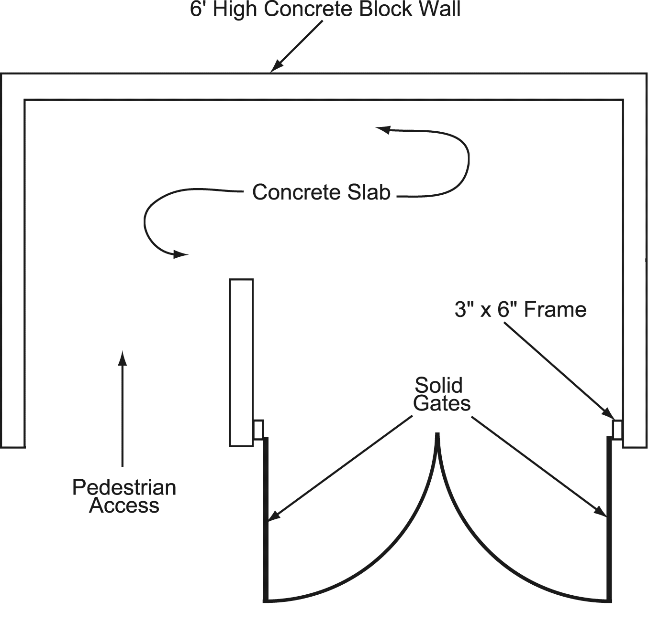
Trash enclosures. All areas set aside for trash storage, pickup, and trash compactors and items used for recycling, reconditioning, or trash compacting shall be screened from view with a solid six (6) foot wall, fence, or other method deemed acceptable by the community development director when abutting:
a.
Streets or public places;
b.
Any property within a residential zone; and
c.
Areas abutting alleys serving only commercial, mixed-use, or industrial zones are exempt from this requirement. Trash enclosures and the other above-mentioned areas shall be maintained below the surrounding wall or fence.
(6)
Storage areas. All permitted outdoor storage areas in commercial, civic center, or industrial zones shall be screened or otherwise located so that such items are not visible from any public street, highway or residential zone. Screening shall consist of a six (6) foot high solid or view-obscuring fence or wall or a chain-link fence with wood or metal slats. Outdoor storage areas featuring for-sale or rental automobiles or nursery stock shall be exempt from this requirement.
(7)
Pool fencing. All swimming pools, whirlpools, and spas shall be enclosed by a minimum five (5) foot high fence with a self-closing gate, except where rear and side yard fences or walls are provided.
(8)
Hazardous areas and railroads.
a.
A solid six (6) foot high masonry wall shall be required along the perimeter of any lot or project abutting an irrigation canal.
b.
A fence or wall not less than six (6) feet in height may be required by the administrative committee due to certain property conditions or physical hazards, such as frequent inundation, erosion, excavation, or grade differential.
c.
An eight (8) foot high solid masonry wall shall be installed at the time of new residential construction along any side or rear property line(s) adjacent to operational railroad right-of-way.
(9)
Security fencing. Security fencing as required by any governmental agency or jurisdiction shall be permitted in accordance with California Civil Code section 835, notwithstanding the other provisions of this chapter.
(10)
Exceptions to screening and fencing requirements.
a.
Required walls and fences between zone boundaries and for purposes of screening parking areas need not be provided if a wall or fence, meeting required specifications, exists immediately abutting and on the opposite side of the property line.
b.
In lieu of a required wall, a thirty-six (36) inch high landscaped berm, or combination of wall and berm totaling thirty-six (36) inches in height, may be provided between any parking area and a street.
c.
Where the requirements of this chapter for screening would prove to be ineffective, the community development director may approve alternatives that meet the intent of this chapter.
d.
The city officer or body having jurisdiction over a site plan, variance, conditional use permit, or other plan may permit or require alternative methods or standards for screening as a condition of project approval.
(11)
Required intersection visibility in all zones.
a.
Corner lots. There shall be no visual obstructions as herein described within the corner cutback area of all corner lots, except corner lots located within the CD zone. The corner cutback area shall be defined by a line on a horizontal plane connecting two (2) points along the front and street-side property lines and forming a triangle. These points shall be measured twenty (20) feet back from the intersection of the front and street-side property lines. In the corner cutback area of corner lots, the height of mature shrubs, without pruning, and walls, fences and other features that obstruct vision may not exceed three (3) feet above curb grade.
b.
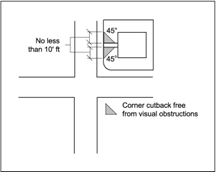
Driveways. There shall be a corner cutback area on each side of any private driveway at its intersection with a street. The cutback lines shall be in a horizontal plane, making an angle of forty-five (45) degrees with the side, front or rear property lines, as the case may be. They shall pass through a point not less than ten (10) feet from the edges of the driveway where it intersects the street right-of-way.
c.
Exceptions. The foregoing provisions regarding intersection visibility shall not apply to the following: permanent buildings in existence on the effective date of this chapter; utility poles; trees trimmed at the trunk line at least eight (8) feet above the level of the intersection; supporting members or appurtenances to permanent buildings in existence on the effective date of this chapter; and official warning signs or signals.
(12)
Architectural compatibility. Notwithstanding the other provisions of this section, all required screening, fences, and/or walls shall be designed in a manner that is architecturally compatible with the structures and/or uses of the lot on which they are located; structures and/or uses adjacent to the lot on which they are located; and the character of the surrounding area.
(13)
Screening of properties along Interstate 8. New properties along I-8 shall provide a solid six (6) to eight(8)feet tall wall to provide a visual and sound buffer from the interstate. Walls shall conform with section 29-144. The wall shall be constructed entirely within private property. Screening with landscape may also be provided on private property in combination with the wall as desired. Plant material shall be a minimum of five (5) foot tall at maturity but shall not exceed twenty (20)feet in height in order to avoid conflicts with the existing power lines. Note that any landscape overgrowth may be pruned by the utility or Caltrans as required for maintenance of the interstate or utility rights- of-way. Screening plant material shall be evergreen and consistent with the city's recommended plant list. No invasive plant species shall be utilized for screening purposes.
(Ord. No. 24-03, § 2, 9-17-24)
Sec. 29-144. - Permitted fences, walls, and hedges.
Except where a greater or lesser height is required by the landscaping and screening regulations, or other provisions of the zone, fences or walls are permitted in any zone in accordance with the following standards:
(1)
A thirty-six (36) inch high solid fence or wall may be located anywhere on a lot.
(2)
A forty-eight (48) inch high open fence may be located anywhere on a lot.
(3)
Except where driveway, street or alley visibility requires a cutback area, a six (6) foot high fence or wall may be located anywhere on a lot behind the required front yard.
(4)
Within the main building area, a fence or wall may be no higher than twelve (12) feet.
(5)
Within visual enhancement areas, a six (6) foot high solid masonry wall shall be permitted.
(6)
Under no circumstances shall any fence or wall, regardless of its location, block pedestrian or vehicular visibility for safe and easy circulation.
Hedges - except where a greater or lesser height is required by the landscaping and screening regulations, or other provisions of the zone, hedges are permitted in any zone in accordance with the following standards: A thirty-six (36) inch hedge may be located anywhere on a lot.
(7)
Except where driveway, street or alley visibility requires a cutback area, a hedge no higher than eight (8) feet may be located anywhere on a lot outside of the cutback area.
(8)
Under no circumstances shall any hedge, regardless of its location, block pedestrian or vehicular visibility for safe and easy circulation.
(Ord. No. 24-03, § 2, 9-17-24)
Sec. 29-149. - Lighting standards.
Outdoor lighting shall be permitted so as to provide safe pedestrian and vehicular access and to provide security lighting in compliance with the following standards:
(1)
Lights shall be used for the purpose of illumination only, and not designed for or used as an advertising display.
(2)
Light fixtures shall be so designed and adjusted as to reflect light away from the following: any road or street; adjoining premises on which a dwelling is located; or land zoned for other than business or industrial uses.
(3)
Light fixtures for any light source shall be shielded from above in such a manner that the edge of the shield is level with or below the bottom of the light source in order to minimize the direct emission of light above the horizontal. For the purposes of this section, the term light source shall include light-directing refractors and exclude incandescent lamps of two hundred (200) watts or less and light produced directly by the combustion of natural gas or other fuels.
(4)
No light or glare shall be transmitted or reflected in such concentrated quantities or intensities as to be detrimental or harmful to, or to interfere with, the use of surrounding properties or streets.
(5)
The height of light poles shall not exceed a maximum height of forty-five (45) feet; however, light fixtures between twenty-five (25) feet and thirty-five (35) feet are preferred.
(Ord. No. 24-03, § 2, 9-17-24)
Sec. 29-154. - Compliance required.
All uses established or placed into operation after the effective date of this chapter shall comply at all times hereafter with the following performance standards. All commercial and industrial uses actually established and in operation on the effective date of this chapter shall be made to comply with the following performance standards on or before the effective date of this chapter and shall comply at all times thereafter.
(Ord. No. 24-03, § 2, 9-17-24)
Sec. 29-155. - Residential noise insulation standards.
All new residential construction shall comply with the noise insulation standards of title 24, part 2 of the California Code of Regulations.
(Ord. No. 24-03, § 2, 9-17-24)
Sec. 29-156. - Commercial, mixed-use, and industrial standards.
(a)
Fire and explosion hazards. The city fire prevention code shall apply to all developments and uses in the city.
(b)
Electrical disturbance. Except where rules of the Federal Communications Commission take precedence, devices that radiate radio-frequency energy shall be so operated as not to cause interference with any activity carried on beyond the boundary line of the property upon which the device is located. Radio-frequency energy is defined as electromagnetic energy at any frequency in the radio spectrum between ten (10) kilocycles and three million (3,000,000) megacycles.
(c)
Noise. The maximum one (1) hour average sound level radiated by any use or facility when measured at any point at least four (4) feet above ground level, on or beyond the boundary line of the property on which sound is generated, shall not exceed the following:
*Zone which exists on the abutting or nearby property at whose boundary the measurement is taken.
(d)
Vibration. Every use shall be so operated that the ground vibration inherently and recurrently generated does not cause a displacement of the earth greater than three thousandths (0.003) of one (1) inch as measured at any point along the property line of the use.
(e)
Smoke. No emission of visible grey smoke shall be permitted at any point, from any chimney or otherwise, when of a shade equal to or darker than:
(1)
Units No. 1 and No. 2 on the Power's Micro-Ringlemann chart. Emissions of such smoke are permitted for a maximum of four (4) minutes in any thirty (30) minute period. These provisions are also applicable to visible smoke of a different color but with an apparently equivalent opacity.
(f)
Emission of dust, heat and glare. Every use shall be so operated that it does not emit dust, heat or glare in such a quantity or degree as to be readily detectable on any boundary line of the lot on which the use is located. The following requirements also apply:
(1)
Dust, dirt and fly ash shall not exceed three tenths (0.3) grains per cubic feet of flue gas at stack temperature of five hundred (500) degrees Fahrenheit, nor fifty (50) percent excess air. In addition, such emissions shall in no manner be unclean, destructive, unhealthful, hazardous, nor shall visibility be impaired by emission of a haze in which vision is unduly impeded with an apparent opaqueness equivalent to Unit No. 1 of the Power's Micro-Ringlemann chart.
(2)
Glare from arc welding, acetylene torch cutting or similar processes shall be performed so as not to be seen from any point outside of the property.
(g)
Emission of odors. No emission of odorous gases or other odorous matter in quantities which exceed the proportions shown in the Imperial County Air District's Rules and Regulations manual as periodically updated.
(1)
Odor. The emission of obnoxious odors of any kind shall not be permitted.
(2)
Gas. No gas which is deleterious to the public health, safety or general welfare shall be emitted.
(Ord. No. 24-03, § 2, 9-17-24)
Sec. 29-161. - Accessory uses subordinate to principal use.
In addition to the permitted principal uses, each zone established by this chapter shall be deemed to include specifically identified accessory uses and other accessory uses that are necessarily and customarily associated with, and are appropriate, incidental, subordinate to, and create no greater impact to surrounding property than such principal uses. It shall be the responsibility of the community development director to determine if a proposed accessory use is necessarily and customarily associated with, and is appropriate, incidental, and subordinate to the principal use. Such a determination shall be based on his or her evaluation of two (2) issues:
(1)
The resemblance of the proposed accessory use to those uses specifically identified as accessory to the principal uses; and
(2)
The relationship between the proposed accessory use and the principal use.
Such determinations may be appealed to the administrative committee pursuant to section 29-353.
(Ord. No. 24-03, § 2, 9-17-24)
Sec. 29-162. - Residential and mixed-use zones.
For accessory uses in residential and mixed-use zones, the following regulations shall apply:
(1)
Accessory dwelling units (ADUs) and junior accessory dwelling units (JADUs). See section 29-168.
(2)
Home occupations.
a.
Purpose and intent. This section provides standards for the conduct of home occupations, as defined in section 29-23. The home occupation provisions are intended to ensure compatibility with other permitted uses and with the residential character of the neighborhood.
b.
Permissible home occupations. The following uses or similar uses shall be considered as home occupations provided that such uses comply with the criteria established by this section:
1.
Consultative professional occupations that function to provide a service not involving the exchange of goods or products. May include but is not limited to accountant, architect, attorney, author, bookkeeper, consultant, drafting and design, engineer, editor, insurance agent, or similar use as determined by the community development director.
2.
In-home educational activity, including, but not limited to, personal trainer, music lessons, academic tutoring, swimming lessons, or religious instruction.
3.
A home office when all sales are conducted off-premises or by correspondence. May include but is not limited to artist, real estate agent, broker, e-commerce, photographer, sales representative (such as jewelry, cosmetics, clothing, household items), seamstress/tailoring, or similar use as determined by the community development director.
4.
Contractors' offices, when the home occupation is limited to record keeping, communications, scheduling, ordering, or billing and all physical activities and gathering of employees or subcontractors is off-premises. May include but is not limited to general contractors, gardening and landscaping services, janitorial, pet grooming, mobile vehicle services, or similar use as determined by the community development director.
5.
One (1) station beauty salon, barber shop, or aesthetician.
6.
One (1) station massage therapist licensed and certified pursuant to chapter 16, article VI, divisions 1 and 2.
c.
Operating standards. The following regulations shall apply in the operation of any home occupation:
1.
There shall be no employment of help other than a resident of the home.
2.
The home occupation shall be conducted wholly within the structures on the premises and shall not exceed twenty-five (25) percent of the total floor area of all legal structures.
3.
Customers, clients, or prospective customers or clients shall not be invited to the residence except by appointment only, for the purpose of obtaining service, tutoring, or training. The home occupation shall not involve the onsite presence of more than two (2) customers or clients at a time. Customers or clients shall not be permitted on the premises between the hours of 8:00 p.m. and 8:00 a.m.
4.
There shall be no display or showroom of products and merchandise on the premises.
5.
There shall be no use of materials or mechanical or electrical apparatus, equipment, or tools not recognized as being part of normal household or hobby uses. Activities conducted and equipment or material used shall not change the fire safety or occupancy classifications of the premises. Utility consumption shall not exceed normal residential usage.
6.
Required off-street parking for the residence shall be maintained.
7.
Vehicles owned by the residents may be used with the home occupation and shall be limited to one (1) passenger vehicle (car, pickup, truck, van), and one (1) trailer that may be towed by a truck or van. The vehicle will be deemed in use for the home occupation if it contains advertising and/or any materials including stock, wares, goods, samples, or equipment carried in or on the vehicle. A truck, van, or trailer must be parked/stored on the premises.
8.
Pedestrian or vehicular traffic, noise, odor, dust, vibration, smell, smoke, glare, electrical interference, fire hazard, or any other activity that constitutes a hazard, nuisance, or disturbance of the peace of any person shall not be produced or made at the residence in connection with the home occupation.
9.
Deliveries or pick-ups by normal delivery services (such as USPS, FedEx, UPS, and Amazon) shall occur between 8:00 a.m. and 8:00 p.m.
10.
There shall be no unsightly storage of materials or supplies in connection with the home occupation nor shall merchandise be visible from outside the home.
11.
There shall be no signs or structures other than those permitted in the zone.
12.
There shall be complete conformity with fire, building, plumbing, electrical and health codes and to all state and city laws and ordinances.
d.
Renting or use of residential properties as a commercial venue for weddings, celebrations, or similar events, is prohibited.
e.
Notwithstanding the above home occupation provisions, a cottage food operation may be allowed for the production and sale of cottage food products, pursuant to state and county health regulations and as amended. A cottage food operator must obtain and comply with all required permits and standards from the County Department of Environmental Health in order to operate a cottage food home occupation business.
f.
Notwithstanding the above home occupation provisions, microenterprise home kitchen operation (MEHKO) may be allowed for an individual to operate a restaurant in their private residence, pursuant to state and county health regulations and as amended. The MEHKO operator must obtain and comply with all required permits and standards from the county department of environmental health in order to operate a MEHKO home occupation business.
(3)
Repair of vehicles and equipment. Repair, fabrication, or other work on automobiles, other vehicles or equipment on residential premises shall be subject to the following conditions and restrictions:
a.
Such work shall be done only upon vehicles or equipment owned by a resident of the premises.
b.
Such work shall be limited to vehicles or equipment that may be stored within a private garage upon residential premises.
c.
Such work shall be done only between the hours of 8:00 a.m. and 10:00 p.m.
d.
Such work shall not be done in a public right-of-way.
e.
Storage of parts for such vehicles or equipment on the premises shall be limited to those parts reasonably necessary for repair of the occupant's vehicle or equipment. Parts which cannot be conveniently located within an enclosed structure shall be screened so as not to be visible from the public right-of-way and adjacent property.
f.
Notwithstanding anything to the contrary herein, no such work that creates a nuisance or otherwise tends to deteriorate the environment, peace, tranquility, and enjoyment of residents in the surrounding neighborhood shall be permitted.
g.
Flammable liquids shall not be used in any building or residential premises in connection with such work, and no welding or torch cutting may be done anywhere on such premises except when a permit is obtained from the city fire code official. All such work shall be conducted in conformance with the applicable provisions of the city fire prevention code.
(4)
Large family day care homes. Large family day care homes shall be permitted in all residential zones when appurtenant to a single-family residential dwelling in conformance with the California Health and Safety Code and shall conform to all development standards specified for the zone in which such home is located. In addition, large family day care homes shall be permitted on all lots zoned for two-family residential dwelling units.
(5)
Large residential care facilities. The following standards and conditions apply to large residential care facilities:
a.
Notice to operate a large residential care facility. Notice of application to operate a large residential care facility shall be mailed to all property owners within a one hundred (100) foot radius of the exterior boundaries of the proposed site not less than ten (10) days prior to the date on which the decision will be made on the application.
b.
Administrative hearing required. The applicant or any affected person(s) may request an administrative hearing before the administrative committee for consideration of the application. Any request for an administrative hearing, shall be made in writing to the city, not more than fifteen (15) days from receipt of the notice to operate.
c.
No hearing required. If an administrative hearing is not requested by the applicant or affected person(s), the application shall be reviewed by the planning director as a nondiscretionary permit under the site plan review procedure and shall be in accordance with the standards listed under subparagraphs d. through k. of this subsection (5).
d.
Spacing/concentration. A large residential care facility shall not be located within three hundred (300) feet of another such facility on the same street as measured from the exterior property lines. An exemption to the spacing requirement may be approved by the city if the existing facility is at capacity or the applicant demonstrates that a need exists for a unique or particular service not currently provided by the existing large residential care facility.
e.
Parking. A minimum of two (2) off-street parking spaces shall be provided for the project. Off-street parking related to the large residential care facility operation may only be provided on a driveway within the twenty (20) foot front yard setback. Residences located on arterial streets (as designated in the circulation element of the general plan) shall provide a drop-off/pick up area designed to prevent vehicles from backing onto the street.
f.
Noise. Outdoor common areas shall be designed and located to reduce impacts of noise on surrounding properties. Noise levels shall be in compliance with the city's residential noise level standards provided in chapter 17.1 of the City Code pertaining to noise abatement and control. The city may impose reasonable requirements to alleviate noise, including but not limited to the installation of a six (6) foot high block wall around the perimeter of the rear yard.
g.
State license. Prior to the approval of the site plan review application, the applicant shall provide proof that he or she is licensed by the California Department of Social Services, if applicable, and operating said facility in accordance with all applicable state requirements.
h.
Operation. Large residential care facilities shall be operated in a manner that will not adversely affect adjoining residences or be detrimental to the character of the residential neighborhood.
i.
Exempt from CEQA. Pursuant to CEQA Guidelines section 15274, applications to operate residential care facilities are exempted from formal environmental review.
j.
Signs. No on-site signs advertising the large residential care facility shall be permitted.
k.
Health and safety requirements. The operator shall comply with all applicable California Health and Safety Code regulations or other requirements of the city building and safety department and fire department regarding health and safety requirements and all other applicable codes and regulations.
(6)
Supportive and transitional housing. Supportive and transitional housing that is provided in single-family, duplex, manufactured housing, multi-family, mixed-use units, or group dwellings shall be permitted, conditionally permitted or prohibited in the same manner as the other single-family, duplex, manufactured housing, multi-family, mixed-use units, or group dwellings under this chapter.
(Ord. No. 24-03, § 2, 9-17-24)
Sec. 29-163. - Commercial, manufacturing and civic center zones.
(a)
Accessory structures and uses shall, for the purposes of this section, be defined as those necessarily and customarily associated with, and appropriate, incidental, and subordinate to the principal commercial, industrial or other uses which are permitted in each zone.
(b)
A caretaker residence shall be subject to site plan review and approval by the community development director, and shall comply with the following:
(1)
In any commercial or manufacturing zone, a caretaker residence may be established when it is located within and occupies not more than twenty (20) percent of the floor area of a commercial or industrial building, and is occupied exclusively by the owner, caretaker, superintendent, or security personnel and his/her family.
(2)
Within the ML (light manufacturing) or MG (general manufacturing) zones only, a detached caretaker residence shall be permitted, provided that such dwelling occupies not more than twenty (20) percent of the floor area occupied by the principal manufacturing use and is screened from view from any public street in a manner satisfactory to the city. Pursuant to article V, division 4 of this chapter, a site plan shall be submitted to the city for review and approval prior to the issuance of any building permits. The appropriate school districts shall be notified through the site plan review procedure in order to assess any appropriate school impact mitigation.
(c)
Accessory residential in the CG (general commercial) zone. A conditional use permit for a mixed commercial/residential development in general compliance with the standards and procedures for a planned unit development may be granted by the city council following review and recommendation by the planning commission. In approving said conditional use permit, the planning commission and city council shall find that the proposed development would better achieve the goals of the general plan than would strict compliance with the permitted uses of the CG (general commercial) zone.
(d)
Supportive and transitional housing. Supportive and transitional housing that is provided in single-family, duplex, manufactured housing, multi-family, mixed-use units, or group dwellings shall be permitted, conditionally permitted or prohibited in the same manner as the other single-family, duplex, manufactured housing, multi-family, mixed-use units, or group dwellings under this chapter.
(e)
Outdoor dining and seating in the CG (general commercial) zone, ML (light manufacturing) zone and civic center zone. The purpose of this section is to permit outdoor dining and seating that enhance the pedestrian ambience of the city and ensure that they do not adversely impact adjacent properties and surrounding neighborhoods consistent with the goals, objectives, and policies of the general plan. Outdoor dining and seating are permitted as accessory uses to otherwise permitted and legally established cafes, restaurants, coffee shops, delicatessens, and other commercial uses that are located on the same parcel, a contiguous adjacent parcel, within courtyards, or on public right-of-way immediately adjacent to the tenant space, subject to the following standards:
(1)
The total area dedicated to outdoor dining and seating shall not exceed the area dedicated to indoor dining and seating.
(2)
The hours of operation of the outdoor dining and seating shall be limited to the hours of operation of the associated restaurant or other commercial use.
(3)
The outdoor dining and seating area shall not be located in the public right-of-way, unless approved in a form required by the city. Assumption of liability and indemnity must be executed by the applicant and property owner, which shall hold harmless and indemnify the city against any and all claims brought on as a result of the outdoor dining and seating in the public right-of-way.
(4)
All outdoor dining and seating uses shall maintain ingress/egress and pedestrian circulation subject to building and fire safety code requirements including Americans with Disabilities Act (ADA) requirements.
(5)
When adjacent to a public street, outdoor dining and seating areas shall provide a minimum of five (5) feet of unobstructed pedestrian circulation and shall be placed at least twenty (20) feet away from an intersection.
(6)
The location and use of the outdoor dining and seating area shall not obstruct the movement of pedestrians, goods, or vehicles; required parking spaces; driveways or parking aisles; entrances; legal signs; utilities or other improvements. When located adjacent to parking spaces, driveways or parking lot aisles, a physical barrier such as curb or railing shall be provided.
(7)
If located in the public right-of-way, furnishings shall be strictly limited to chairs, benches and tables, and single pole table umbrellas designed for outdoor use. Such furnishings shall be maintained free of appendages or conditions that pose a hazard to pedestrians and vehicles.
(8)
No additional parking is required for the outdoor dining and seating area as long as the area dedicated to outdoor dining and seating is less than the area dedicated to indoor dining and seating.
(9)
Outdoor dining and seating areas shall remain clear of litter at all times and shall not reduce, be located within, or damage any required landscaped area.
(10)
Noise levels, including music and outdoor speakers, shall be in compliance with the city's performance standards in section 29-156(c) and noise level standards provided in chapter 17.1 of the City Code pertaining to noise abatement and control.
(11)
A fixed barrier (per State Alcohol Beverage Control (ABC) approval/requirements) is required for outdoor dining uses that want to serve alcohol in the public right-of-way (a dining use on its own would not require a barrier).
(Ord. No. 24-03, § 2, 9-17-24)
Sec. 29-168. - Accessory dwelling unit regulations.
(a)
Purpose. The purpose of this chapter is to establish standards for the development of accessory dwelling units and junior accessory dwelling units consistent with Government Code section 66310 et. seq. (Accessory Dwelling Units), as amended. Accessory dwelling units and junior accessory dwelling units are allowed in conjunction with single-family and multi-family dwellings in order to provide flexible and affordable housing options within the city.
(b)
Number permitted. Notwithstanding sections (1) through (3) below, the number of dwelling units permitted on a lot shall not exceed the number allowed by California Government Code sections 66323 and 66333.
(1)
The following shall be permitted as accessory uses on lots with one (1) existing or proposed single-family dwelling:
a.
One (1) accessory dwelling unit; and
b.
One (1) junior accessory dwelling unit.
(2)
The following shall be permitted as an accessory use on lots with more than one (1) existing or proposed single-family dwelling:
a.
One (1) internal or detached accessory dwelling unit per lot.
(3)
The following shall be permitted as accessory uses to existing or proposed multi-family dwellings:
a.
Up to two (2) detached accessory dwelling units; and
b.
The conversion of portions of existing multi-family dwellings that are not used as living space to create at least one (1) internal accessory dwelling unit, or up to twenty-five (25) percent of the number of existing dwelling units as internal accessory dwelling units.
(c)
Occupancy. When a junior accessory dwelling unit is located on a residential property, either the junior accessory dwelling unit or the primary dwelling shall be occupied by the owner of the primary dwelling. Prior to the issuance of a building permit, a deed restriction shall be recorded against the title of the property that stipulates this owner occupancy requirement and that the junior accessory dwelling unit cannot be sold separately from the primary dwelling.
(d)
Rental. An accessory dwelling unit or junior accessory dwelling unit shall not be rented for less than thirty (30) days.
(e)
Minimum allowance. Development standards included in this chapter or elsewhere in chapter 29 shall not prohibit an accessory dwelling unit with a floor area up to eight hundred (800) square feet and four (4) foot side and rear yards.
(f)
Development standards. The following development standards shall apply to accessory dwelling units and junior accessory dwelling units. Where development standards are not specified in this chapter, accessory dwelling units and junior accessory dwelling units shall meet all development standards for the zone within which they are located, provided the development standards do not prohibit the minimum allowance as described in subsection (d) above.
(1)
Density. Accessory dwelling units and junior accessory dwelling units shall not be counted for the purpose of determining residential density as defined in this title.
(2)
Lot size. There is no minimum lot size required for accessory dwelling units or junior accessory dwelling units.
(3)
Existing structures.
a.
When an existing accessory building is converted to an accessory dwelling unit, the existing square footage may be expanded by up to one hundred fifty (150) square feet to allow for ingress and egress.
b.
Junior accessory dwelling units shall not include expansions of existing structures.
(4)
Junior accessory dwelling unit size.
a.
The minimum floor area of a junior accessory dwelling unit shall be one hundred fifty (150) square feet.
b.
The maximum floor area of a junior accessory dwelling unit shall be five hundred (500) square feet.
(5)
Accessory dwelling unit size.
a.
The minimum floor area of an accessory dwelling unit shall be one hundred fifty (150) square feet.
b.
The maximum floor area of an accessory dwelling unit shall be fifty (50) percent of the size of the primary dwelling (not to exceed one thousand two hundred (1,200) square feet), or at least eight hundred fifty (850) square feet for units with one (1) or fewer bedrooms and one thousand (1,000) square feet for units with two (2) or more bedrooms.
c.
The conversion of an existing accessory building to an accessory dwelling unit is not subject to a maximum size limit, provided there is no expansion of the existing structure beyond one hundred fifty (150) square feet for ingress and egress.
(6)
Height.
a.
The maximum height for detached or attached accessory dwelling units shall be twenty-five (25) feet.
b.
The maximum height for internal accessory dwelling units and junior accessory dwelling units shall be the same as the primary dwelling in the underlying zone.
c.
The conversion of an existing accessory building to an accessory dwelling unit is not subject to this height limit, provided there is no expansion of the existing structure beyond one hundred fifty (150) square feet.
(7)
Setbacks for attached or detached accessory dwelling units. Setbacks for attached or detached accessory dwelling units shall be as follows:
a.
Front setback. The front setback shall be consistent with the requirements of the underlying zone.
b.
Rear setback. Rear setbacks shall be four (4) feet or consistent with the requirements of the underlying zone, whichever is less.
c.
Rear setback abutting a freeway. Rear setbacks abutting a freeway shall be fifty (50) feet.
d.
Interior side setback. Interior side setbacks shall be four (4) feet or consistent with the requirements of the underlying zone, whichever is less.
(8)
Setbacks for internal and junior accessory dwelling units. Setbacks for internal accessory dwelling units and junior accessory dwelling units shall be consistent with the requirements for the primary dwelling in the underlying zone.
(9)
Setbacks for conversions. The conversion of an existing accessory building to an accessory dwelling unit is not subject to setback requirements, provided there is no expansion of the existing structure beyond one hundred fifty (150) square feet.
(10)
Access for junior accessory dwelling units. If a permitted junior accessory dwelling unit does not include a separate bathroom, the permitted junior accessory dwelling unit shall include a separate entrance from the main entrance to the structure, with an interior entry to the main living area.
(g)
Parking for junior accessory dwelling units. No additional off-street parking spaces shall be required for junior accessory dwelling units, except that existing off-street parking within an attached garage that is removed as part of a conversion to a junior accessory dwelling unit shall be replaced elsewhere on the property. Required off-street parking spaces may be provided as tandem spaces or within setback areas, provided the spaces do not create a health or safety hazard.
(h)
Parking for accessory dwelling units. Off-street parking shall be provided for accessory dwelling units as follows:
(1)
One (1) off-street parking space shall be required per accessory dwelling unit, except:
a.
No off-street parking spaces are required for accessory dwelling units located within one-half (½) mile walking distance of public transit, defined for the purposes of this section as a location including, but not limited to, a bus stop or train station where the public may access buses, trains, and other forms of transportation that charge set fares, run on fixed routes, and are available to the public.
b.
No off-street parking spaces are required for accessory dwelling units located within an architecturally and historically significant historic district.
c.
No off-street parking spaces are required for accessory dwelling units that are part of the proposed or existing primary dwelling or an accessory structure.
d.
No off-street parking spaces are required for accessory dwelling units when on-street parking permits are required, but not offered to the occupant of the accessory dwelling unit.
e.
No off-street parking spaces are required for accessory dwelling units when there is a car share vehicle located within one (1) block of the accessory dwelling unit.
f.
Existing off-street parking within a garage, carport, or covered parking structure that is removed or converted as part of construction of an accessory dwelling unit is not required to be replaced.
(2)
Required off-street parking spaces may be provided as tandem spaces or within setback areas, provided the spaces do not create a health or safety hazard.
(i)
Fire sprinklers. Fire sprinklers shall not be required for accessory dwelling units or junior accessory dwelling units unless they are required for the primary dwelling. The construction of an accessory dwelling unit shall not trigger a requirement for fire sprinklers to be installed in the existing primary dwelling.
(j)
Design. A junior or accessory dwelling unit, whether attached or detached, shall be architecturally compatible with the primary dwelling through the use of consistent architectural style, exterior building and roofing colors and materials, and landscaping.
(Ord. No. 24-03, § 2, 9-17-24)
Sec. 29-169. - Application of animal keeping regulations.
The following regulations shall apply to the keeping of animals on any residential property and shall specifically be inapplicable to the following:
(1)
Dogs and cats not constituting a kennel.
(2)
Animals kept for sale in zones where retail sale is permitted, provided such animals are kept within an enclosed building without outside runs or cages.
(3)
Animals kept incidental to the operation of a veterinary hospital.
(Ord. No. 24-03, § 2, 9-17-24)
Sec. 29-170. - Animal keeping by conditional use permit.
Where accessory to a single-family or two-family dwelling, the following animal keeping is permitted subject to the following standards, including a conditional use permit where specified. All other animal keeping is prohibited within the city.
(1)
Birds. Where more than ten (10) birds are kept on any premises, whether for pleasure of profit, a conditional use permit shall be required.
(2)
Poultry, rabbits, chinchillas, furbearing animals, amphibians, and other small animals. Where more than two (2) such animals are kept on any premises, whether for pleasure or profit, a conditional use permit shall be required. In no case shall such conditional use permit allow more than twenty-five (25) such animals.
(3)
Wild, exotic or undomesticated animals. Not permitted.
(4)
Horses, bovine animals, sheep, goats, swine, mules, and roosters. Permitted within the rural residential zone and not otherwise permitted except as an animal raising project as specified in sections 5-1 and 29-171.
(Ord. No. 24-03, § 2, 9-17-24)
Sec. 29-171. - Temporary permits for animal raising regulations.
Animal raising projects shall be subject to the following regulations:
(1)
Youth organization. Such project is limited to the keeping, raising and breeding of domesticated animals under the auspices of 4-H, FFA or other similar youth organizations.
(2)
Minimum lot size. No such animal raising project shall be permitted on a lot less than six thousand (6,000) square feet in net area.
(3)
Temporary use permit. A temporary use permit shall be required for such animal raising project for a period not to exceed six (6) months. The fee for a temporary use permit shall be waived for all animal raising projects contemplated by subsection (1).
(4)
Other conditions. A temporary use permit for an animal raising project may impose other conditions pertaining to the type, number, and location of animals as are reasonable and necessary for the protection of the public health and welfare and for the protection of the health and welfare of the animals.
(Ord. No. 24-03, § 2, 9-17-24)

