
El Centro City Zoning Code
ARTICLE II
ZONES
Sec. 29-42. - Establishment of zones.
In order to classify, regulate, restrict and separate the use of land, buildings and structures and to regulate and to limit the type, height and bulk of buildings and structures in the various zones and to regulate the areas of yards and other open areas abutting and between buildings and structures and to regulate the density of population, the city is hereby divided into the following zones:
Residential
RAP residential airport zone
RR rural residential zone
R1 single-family residential zone
R2 variable residential zone
R3 multiple family residential zone
Commercial
CT tourist commercial zone
CO office commercial zone
CN neighborhood commercial zone
CD downtown commercial zone
CG general commercial zone
CH heavy commercial zone
Manufacturing
ML light manufacturing zone
MG general manufacturing zone
Mixed-use
MU1 mixed-use zone
Special/Other
CC civic center zone
LU limited use zone
Overlays
MO medical office overlay zone
MU2 mixed-use overlay zone
SF single-family neighborhood overlay zone
(Ord. No. 24-03, § 2, 9-17-24)
Sec. 29-43. - Uses permitted.
(a)
Buildings, structures and land shall be used, designed, erected, structurally altered or enlarged only for the purposes permitted in the zone in which such building or land is located, and then only after applying for and securing all permits and licenses required by law and ordinance.
(b)
Uses not specifically listed as permitted or prohibited shall be deemed to be prohibited unless determined to be a use similar in development characteristics and land use impact to a permitted use as determined by the community development director.
(Ord. No. 24-03, § 2, 9-17-24)
Sec. 29-44. - Official zoning map.
The original of the official zoning map shall be kept on file with the city clerk and shall constitute the original record. A copy of said map shall also be filed with the public works department. All amendments and changes shall be published by the city clerk within fifteen (15) days after passage of such amendments. This data shall at that time be filed with the public works director. A new amended official zoning map shall be prepared as directed by the city council, upon which is shown all changes and amendments enacted during the previous period of time.
(Ord. No. 24-03, § 2, 9-17-24)
Sec. 29-45. - Uncertainty of boundaries.
Where uncertainty exists as to the boundaries of any zone, the following rules of construction shall apply:
(1)
Along line. Where such boundaries are indicated as approximately following street and alley lines or lot lines, such lines shall be construed to be such boundaries.
(2)
Unsubdivided property. Where a zone boundary divides a lot, or parcel, the location of such boundaries, unless the same is indicated by dimension, shall be determined by the use of the scale appearing on said zoning map.
(3)
Vacated or abandoned street or alley. Where a public street or alley is officially vacated or abandoned, the area comprising such vacated street or alley shall acquire the classification of the property to which it reverts.
(4)
Realigned rights-of-way in certain subdivisions. Where a proposed public street or alley shown on a tentative map forms a zone boundary, and such street or alley is realigned on the final map for the subdivision, the zone boundary shall be deemed to be the centerline of the street or alley as shown on the approved final map.
(5)
Interpretation by commission. If after application of the above rules, uncertainty exists as to any zone boundary, the commission shall, upon letter of request submitted by the property owner/agent, interpret the map and determine said boundary, and said determination shall be final and made a permanent public record.
(Ord. No. 24-03, § 2, 9-17-24)
Sec. 29-46. - Lots subdivided without required approval.
Where a lot is divided by sale or contract without first having been approved by the planning commission and city council in conformity with city subdivision regulations, said property shall continue to be considered as one (1) lot or parcel for purposes of applying the provisions of the zone in which said lot is located.
(Ord. No. 24-03, § 2, 9-17-24)
Sec. 29-47. - Annexed territory.
Territory hereafter annexed to the city shall, upon the date that said annexation becomes effective, be classified in the R1, single-family residential zone; except where the planning commission has recommended, and the city council has adopted, zoning other than R-1 that is consistent with the general plan for the annexed territory.
(Ord. No. 24-03, § 2, 9-17-24)
Sec. 29-52. - Purpose and intent.
Residential zones providing for a range of dwelling unit densities and a variety of housing types are hereby established to achieve the following purposes:
RAP residential airport zone. This zone is intended to provide consistency with the airport comprehensive land use plan by allowing for the development of residential uses within areas designated as "extended approach/departure zone" under the Imperial County Airport Land Use Compatibility Plan where risk factors have been identified resulting in the need for restricting density. This zone allows development of a single-family home (or manufactured home on a permanent foundation) at a maximum density of one (1) dwelling unit per acre. Subject to article V, division 6, conditional use permit, densities allowed under the R1 zone shall be allowed so long as development is clustered in a manner that the average density within those portions of the site designated "extended approach/departure zone" does not exceed one (1) dwelling unit per acre subject to the provisions of article V, division 6, conditional use permit.
RR rural residential zone. This zone is intended to provide for large lot rural residential uses. Single-family dwellings at a density of two (2) dwelling units per acre are allowed in this zone. The RR zone is intended to implement the rural residential general plan land use designation.
R1 single-family residential zone. This zone is intended to provide for the development of a single-family home (or manufactured home on a permanent foundation) on lots not less than six thousand (6,000) square feet in area, and the protection of these dwellings from incompatible uses. The R1 zone is intended to implement the low density residential general plan land use designation.
R2 variable residential zone. This zone is intended to permit the development of medium density, single-family, duplex, or multi-family dwellings such as apartments, garden-style units, townhouses, and condominiums, with a maximum density of twelve (12) dwelling units per net acre. For attached dwellings, lots shall not be less than seven thousand two hundred (7,200) square feet in net area. For single-family detached dwellings, lots shall not be less than three thousand six hundred (3,600) square feet in net area. The R2 zone is intended to implement the medium density residential general plan land use designation.
R3 multi-family residential zone. This zone is intended to permit the development of medium high-density multi-family dwellings such as apartments, garden-style units, townhouses, and condominiums, with a maximum density of twenty-five (25) dwelling units per net acre, on lots not less than seven thousand two hundred (7,200) square feet in net area. The R3 zone is intended to implement the high medium density residential general plan land use designation.
(Ord. No. 24-03, § 2, 9-17-24)
Sec. 29-53. - Residential zones use regulations.
The uses identified in table 29-53.1 shall be permitted uses where the symbol "P" appears. Where the symbol "C" appears, the use requires a conditional use permit pursuant to article V, division 6 of this chapter. The symbol "X" indicates that the use is prohibited.
Table 29-53.1 Residential Zones Use Regulations
(Ord. No. 24-03, § 2, 9-17-24; Ord. No. 26-02, § 4, 5-19-26)
Sec. 29-54. - Residential zones property development standards.
The following minimum property development standards identified in table 29-54.1 shall apply to all land and buildings in the residential zones, except that any lot shown on an official subdivision map duly approved and recorded, or any lot for which a bona fide deed had been duly recorded prior to the effective date of this chapter may be used as a building site. See also article III of this chapter for exceptions to, or clarification of, these regulations.
(1)
Special requirements for two (2) or more dwelling units per lot:
a.
Site plan review. Before any building or structure which increases the number of dwelling units to two (2) or more is erected on any lot in a residential zone, a site plan shall have been submitted to and approved by the community development director, pursuant to the provisions of article V, division 4 of this chapter.
Table 29-54.1 Residential Zones Property Development Standards
Notes:
(1)
Legal lots may exist that do not meet this development standard. However, any subdivision of land occurring after the adoption of this zoning ordinance must meet the minimum net lot area required by table 29-54.1 standard, with the following exception for existing infill lots at the time of the adoption of this chapter. For the purposes of this section, an infill lot is any legal lot surrounded on at least two (2) sides by developed lots.
•
The subdivision of an existing infill lot is permitted if the net lot area of the subdivided lot(s) is equal to or greater than ninety (90) percent of minimum net lot area required by table 29-54.1.
(2)
Density is one (1) du/acre per the general plan. However, densities consistent with the R1 development standards may be allowed as a cluster development, subject to approval of a CUP and so long as average densities within designated "extended approach/departure" areas do not exceed one (1) du/acre.
____________
b.
Open space. Development of two (2) or more units on a single lot shall have efficient access to common and private open space for passive or active recreation and for social activities. Common open space includes amenities open to all residents and their visitors, such as game courts, swimming pools, gardens, fitness areas, play equipment, picnic areas, barbeque areas, community gardens, or landscape gardens. No portion of off-street parking spaces, driveways, covered pedestrian access ways or utility areas such as laundries, clothes drying yards or trash areas shall constitute common open space. Private open space includes areas connected or adjoining a dwelling unit for the exclusive use of the occupants and their visitors, such as balconies, porches, or patios. All common open space shall conform to the following standards:
1.
Amount required.
i.
For two (2) to four (4) dwelling units (attached or detached) on a single lot, a minimum of three hundred (300) square feet of open space with a minimum dimension width and depth of twenty (20) feet shall be provided for each dwelling unit.
ii.
For more than five (5) or more on a single lot or building site, a minimum of one hundred fifty (150) square feet per dwelling unit of common open space shall be provided, not less than fifty (50) percent of which shall be located in a single common area with a minimum dimension width and depth of twenty (20) feet.
iii.
In addition to the above, in the R3 zone private open space shall be provided as follows:
(A)
For dwelling units with one (1) or more bedrooms a minimum of fifty (50) square feet of private open space shall be provided contiguous to each dwelling unit. A minimum of fifty (50) square feet of private open space shall be provided contiguous to each dwelling unit.
(B)
For studio or efficiency units a minimum of fifty (50) square feet of private open space shall be provided contiguous to each dwelling unit, except that the amount of required private open space may be reduced when additional common open space is provided. For every additional square foot of common open space provided, private open space may be reduced by one (1) square foot.
(C)
Private open space shall have a minimum width and depth of five (5) feet, and be screened from ground level exterior visibility by a wood or masonry fence not more than fifty (50) percent open and not less that fifty-four (54) inches high, or, if on a deck or balcony, not less than forty-two (42) inches high.
iv.
When a private open space area greater than ninety-six (96) square feet with a minimum width of eight (8) feet is provided for each dwelling unit, the total common open space requirements may be reduced by twenty-five (25) percent.
v.
Rooftop amenities may also be included in the required open space if they are accessible to all residents.
vi.
Planting areas may be reduced to fifteen (15) percent if active recreation areas such as playgrounds, sport courts, pools or fitness areas are provided for common open space.
vii.
Any accessory building or unit designed and intended to be used for recreational purposes shall be counted as common open space but may not exceed fifty (50) percent of the required open space.
2.
Location.
i.
Required common open spaces shall be conveniently and centrally located to the majority of units in the development to promote a sense of community. Common open space areas located within center courtyards are preferred to provide resident privacy and security.
ii.
Common open spaces and children's play areas shall be visible from individual units and be connected to the internal pedestrian system in the development.
iii.
Private open spaces shall be contiguous to and have direct pedestrian access from the units they serve.
3.
Design.
i.
The design and orientation of all open spaces shall take advantage of available sunlight and be sheltered from the wind, noise and traffic on adjacent streets, and incompatible uses.
ii.
A surface shall be provided which allows convenient use for outdoor activities. Such surface shall be any practicable combination of lawn, garden, flagstone, wood planking, concrete, asphalt, or other serviceable, dust free surfacing. Slope shall not exceed five (5) percent.
iii.
Pools with incidental cabanas and restrooms, and paved recreation areas may be developed in the required common open space.
iv.
Not less than twenty-five (25) percent, but no more than fifty (50) percent, of this common space shall be permanently landscaped.
v.
All common open spaces shall be ADA accessible and feature ADA accessible features.
vi.
Single projects that occur on multiple lots, as a part of a single phase of development, may cluster open space into a single location on a single lot rather than providing open space on each individual lot.
c.
Trash enclosure. All areas set aside for storage and pickup of trash and garbage shall be completely enclosed on four (4) sides by a solid six-foot wall or fence or completely screened by any other methods acceptable to the director. Said areas shall be convenient to residents which they are intended to serve. Solid access doors shall be provided at the same height as the wall or fence.
d.
Laundry room. For developments of ten (10) or more dwelling units, a minimum of one (1) clothes washer and one (1) clothes dryer per each full ten (10) dwelling units shall be provided and maintained within an enclosed structure. The provision of one (1) clothes washer and one (1) clothes dryer hookup in each dwelling unit shall meet this requirement.
(Ord. No. 24-03, § 2, 9-17-24; Ord. No. 25-12, § 3, 12-16-25)
Sec. 29-55. - Single-family and two-family residential design standards.
(a)
Purpose and applicability. These design standards are intended to assist the project applicant in understanding the city's requirements for high quality residential development. These mandatory standards complement the development regulations contained in this division by providing good examples of potential design solutions and by providing design interpretations of the various mandatory regulations. These standards ensure the highest level of design quality while at the same time providing the flexibility necessary to encourage creativity on the part of project designers. These standards apply to all single-family residential development and duplexes.
(b)
Site layout.
(1)
Consistency. New development shall continue the functional, on-site relationships of the surrounding neighborhood, including architectural features visible from the public right-of-way, building design elements, landscaping, and parking location.
(2)
Natural surveillance. The design and placement of residential dwellings, common areas, and other features shall maximize visibility and encourage natural surveillance. The placement and orientation of buildings, windows, doors, balconies, site entrances, landscaping, walls, fences, and other physical obstructions shall be consistent with crime prevention through environmental design (CPTED) principles. Building doors, windows, and entrances shall be oriented to relate directly to public and private streets, drives, paseos, greenways, and common open space.
(3)
Visual interest. New development shall encourage visual interest along the street using one (1) or more of the following techniques:
i.
Variation in building placement and orientation;
ii.
Variation in lot width to provide different amounts of open areas between structures;
iii.
Variation in distances between adjoining homes, or between homes and fences, to provide different types of yards and private patio areas;
iv.
Variation in landscape treatment.
(c)
Building features and design.
(1)
Privacy. To the extent residential windows face the windows of an adjacent unit, the windows shall be offset to maximize privacy. Windows, balconies or similar openings shall be oriented to minimize direct line-of-sight into adjacent units within the development. To provide privacy for adjacent residential units, windows on the second and higher floors of buildings which directly face or abut the windows of other residential units shall be designed either as translucent or louvered, or another solution shall be utilized to achieve privacy for the adjacent residential units.
(2)
Porches. When provided, porches shall extend along the front or corner side facade of the structure and shall be compatible with and complementary to the architectural style of the dwelling.
(3)
Rooflines. Rooflines shall be compatible with the design and scale of surrounding dwellings. Variation in the roof lines of new development shall be provided through breaks in parapets, varied parapet heights, pitched roofs, gabled roofs, and/or mansard roofs. Variable or stepped building heights shall be provided, both to add visual interest and give the appearance of a collection of smaller structures.
(4)
Window and front entry doors. Window and front entry door design shall be compatible and complementary to the building design. Windows and front entry doors visible from the public right-of-way shall include enhanced design elements such as shutters, window boxes, decorative corbels, panels, awnings, or trim.
(5)
Solar panels. Solar panels, when provided, shall be integrated into the roof design, flush with the roof slope. Frames shall be colored to match roof colors. Natural aluminum finish is not permitted. Solar panels shall be located only on roofs. Any mechanical equipment shall be screened from view.
(d)
Architectural style.
(1)
Consistency. New development in existing neighborhoods shall incorporate distinctive architectural characteristics of surrounding development, including one (1) or more of the following: window and door detailing, colors, materials, roof style and pitch, finished-floor height, porches and bay windows, and landscaping.
(2)
Architectural details. The architectural details exterior colors, and materials visible from the public right-of-way on new development shall be consistent with the architectural form and style of the structure. Exterior columns or supports for site elements, such as trellises and porches, shall utilize materials and colors that complement the materials and colors of other elements in the development.
(3)
New accessory structures. The design of new accessory structures, including garages and carports, shall be architecturally compatible with the principal residential structure through the use of consistent architectural style, exterior building and roofing colors and materials, and landscaping.
(4)
Facades. Add to the visual richness of facades by incorporating any two (2) or more of the following decorative details in new development:
i.
Tile base or trim at wall base, around windows, doors, and openings;
ii.
Clay tile vents;
iii.
Wood brackets/knee braces;
iv.
Recessed niches;
v.
Window grilles;
vi.
Pot shelfs;
vii.
Wrought iron railing;
viii.
Sconce lighting;
ix.
Corbels;
x.
Stone or stucco window trim;
xi.
Shutters.
(5)
Roof materials.
(i)
Roofs of accessory structures visible from the public right-of-way shall be constructed of permanent, durable materials.
(ii)
The following roof materials shall not be used:
i.
Corrugated metal (standing rib metal roofs are permitted);
ii.
Tarps or sails;
iii.
Highly reflective surfaces (copper roofs may be considered);
iv.
Illuminated roofing.
(e)
Colors.
(1)
For new development, intense primary or secondary colors shall not be the dominant overall color for a structure. The use of earth tones and soft muted colors is encouraged.
(2)
Residential subdivisions shall include at least two varieties of roof and building materials.
(3)
The color of new accessory structures (including roof colors) shall complement the color of the primary building(s) or buildings in the surrounding neighborhood.
(f)
Screening.
(1)
Fences and walls.
i.
Portions of all perimeter walls or fences completed as part of new residential development that are visible from the public right-of-way shall be designed in a style, material and color to complement neighborhood architecture.
ii.
Visually penetrable materials, such as wrought iron or tubular steel, shall be used for front yard fences and gates to encourage self-policing and discourage crime. Chain-link fencing with or without slats is prohibited in the front and corner side yards of lots with residential dwellings.
iii.
When required, sound walls shall be provided to a minimum height and bulk to meet the maximum one (1) hour sound levels identified in division 8 of article III. Sound walls shall be of masonry, concrete, smooth stucco finish, or other approved masonry material. Landscaping and/or decorative elements such as wrought iron, tile insets or grillwork shall also be incorporated into sound walls to improve their appearance. Sound walls shall be designed in a style, material and color to complement neighborhood architecture.
(2)
Screening roof top equipment.
i.
All roof top equipment, including roof-mounted air-conditioning units, shall be screened from public view by either screening the equipment with materials of the same nature as the roof or positioning the equipment to minimize visibility from the public right-of-way. Mechanical equipment shall be located below the highest vertical element of the building.
(g)
Parking and access.
(1)
Circulation components shall be pedestrian-friendly and configured in such a manner as to facilitate physical and visual connections with adjacent uses.
(2)
All alleys shall be paved for vehicular traffic if utilized for vehicular access. Green alleys are encouraged with pervious paving with a high albedo, such as permeable pavers, porous asphalt, reinforced grass pavement (turf-crete), stone pavers and other permeable materials.
(3)
Garages.
i.
Garage doors shall be adequately setback to keep the sidewalk clear of vehicles at all times.
ii.
Garages shall not occupy more than fifty (50) percent of any street facade of the principal residential structure.
iii.
A variety of compatible garage door designs shall be used throughout a project. The design of the garage door shall be compatible with the architectural style of the primary residence.
(4)
Carports.
i.
Carports are permitted within a required front, side, or rear yard in accordance with section 29-116.
ii.
Carports shall comply with the following requirements:
(A)
Required parking shall be provided in full compliance with the provisions of chapter 29, article III, division 5, parking and loading regulations.
(B)
A minimum front yard of ten (10) feet and a minimum side yard of three (3) feet shall be maintained.
(C)
Temporary or portable carports shall not be permitted.
(D)
Materials.
a.
Carport posts shall not be constructed of PVC pipe.
b.
Carport posts shall be at least four (4) inches wide by four (4) inches long.
c.
Roofing materials shall comply with subsection (d) of this section.
(h)
Lighting.
(1)
The design of light fixtures and their structural support shall be architecturally compatible with the main structures on-site. Illuminators shall be integrated within the architectural design of the structures.
(2)
All lighting fixtures shall be shielded to confine light spread within the site boundaries.
(Ord. No. 24-03, § 2, 9-17-24)
Sec. 29-56. - Multi-family residential design standards.
(a)
Purpose and applicability. These design standards are intended to assist the project applicant in understanding the city's requirements for high quality residential development. These mandatory standards complement the development regulations contained in this division by providing good examples of potential design solutions and by providing design interpretations of the various mandatory regulations. These standards ensure the highest level of design quality while at the same time providing the flexibility necessary to encourage creativity on the part of project designers.
(b)
Site layout.
(1)
At least one (1) of the following design techniques shall be implemented:
i.
Varying front setbacks within the same structure;
ii.
Staggered and jogged unit planes;
iii.
Use of reverse building plans to add variety;
iv.
Maximum of two (2) adjacent units with identical wall and rooflines;
v.
Varying orientations to avoid the monotony of garage door corridors.
(2)
Natural surveillance. The design and placement of residential dwellings, common areas, and other features shall maximize visibility and encourage natural surveillance. The placement and orientation of buildings, windows, doors, balconies, site entrances, landscaping, walls, fences, and other physical obstructions shall be consistent with crime prevention through environmental design (CPTED) principles. Building doors, windows, and entrances shall be oriented to relate directly to public and private streets, drives, paseos, greenways, and common open space amenities.
(c)
Building features and design.
(1)
Visual bulk. Reduce the visual bulk of new multi-family development by incorporating any three (3) of the following design features:
i.
Accentuated building corners (this may be achieved with architectural treatments, such as a change in material, greater building height at the corner, rounded or chamfered building facades, pronounced building forms, enhanced window treatments or projections - such as awnings, trellises, parapets, roof overhangs, etc.);
ii.
Fenestration elements, such as recessed windows, decorative panels and trim, color accents, offsets and framed openings;
iii.
Patterned garage doors with painted trim or varied garage door colors;
iv.
A change in materials and finishes, providing at least three (3) materials and finishes across the building facade;
v.
A horizontal offset in the building plane consisting of a minimum two-foot offset in the building facade for every thirty (30) feet of building frontage;
vi.
A ten (10) foot stepback for habitable space of the third floor.
(2)
Privacy. To the extent residential windows face the windows of an adjacent unit, the windows shall be offset to maximize privacy. Windows, balconies or similar openings shall be oriented to minimize direct line-of-sight into adjacent units within the development. To provide privacy for adjacent residential units, windows on the second and higher floors of buildings which directly face or abut other residential units shall be designed either as translucent or louvered, or another solution shall be utilized to achieve privacy for the adjacent residential units.
(3)
Porches. When provided, porches shall extend along the front or corner side facade of the structure and shall be compatible with and complementary to the architectural style of the dwelling.
(4)
Rooflines. Rooflines shall be compatible with the design and scale of surrounding dwellings.
i.
Rooflines shall not run in a continuous plane for more than fifty (50) feet without offsetting or jogging the roof plane, or providing variation in the roof lines through breaks in parapets, varied parapet heights, varied roof heights, pitched roofs, gabled roofs, and/or mansard roofs.
ii.
Variable or stepped building heights shall be provided both to add visual interest and give the appearance of a collection of smaller structures.
(5)
Window and front entry doors. Window and front entry door design shall be compatible and complementary to the building design. Windows and front entry doors visible from the public right-of-way shall include at least two (2) enhanced design elements such as shutters, window boxes, decorative corbels, panels, awnings, or trim.
(6)
Solar panels. Solar panels, when provided, shall be integrated into the roof design, flush with the roof slope. Frames shall be colored to match roof colors. Natural aluminum finish is not permitted. Solar panels shall be located only on roofs. Any mechanical equipment shall be screened from view.
(7)
Multi-family exterior stairs. When provided, simple, clean, bold projections of stairways are required to complement the architectural massing and form of the structure. Stairways shall be of smooth stucco, plaster, or wood, with accent trim of complementary colors and railings appropriate to the architectural style of the structure. Thin-looking, open metal, prefabricated stairs are not allowed.
(8)
Shade. All developments shall provide shade for at least fifty (50) percent of the required common open space areas, as measured at 2:00 p.m. on June 21. Shade may be provided through the following design elements: arcades, colonnades, pergolas, verandas, covered porches, fixed canopies, awnings, trellises, or other shade structures, or shade trees.
(9)
Permanent shade structures. Permanent shade structures such as canopies and arcades shall maintain a vertical clearance of at least ten (10) feet above finished grade.
(d)
Architectural style.
(1)
Consistency. New development in existing neighborhoods shall incorporate distinctive architectural characteristics of surrounding development, including one (1) or more of the following: window and door detailing, colors, materials, roof style and pitch, finished-floor height, porches and bay windows, and landscaping.
(2)
Materials, colors and details. Architectural details, exterior colors, and materials visible from the public right-of-way shall be consistent with the architectural form and style of the structure. Exterior columns or supports for site elements, such as trellises and porches, shall utilize materials and colors that match the materials and colors of other elements in the development.
i.
Exterior building and roof colors visible from the public right-of-way shall be appropriate to and enhance the architectural style and materials of the structure. The dominant overall color of the exterior building and roof shall be earth tones or soft muted colors. Intense primary and secondary colors shall be avoided as the dominant overall color for a structure.
ii.
Brick, stone, terra cotta, tiles, and copper shall be left in their natural colors. Veneer shall turn corners and avoid exposed edges.
iii.
The color of accessory structures (including roof colors) shall complement the color of the primary building(s).
(3)
Compatibility. The design of accessory structures shall be architecturally compatible with the principal residential structure through the use of consistent architectural style, exterior building and roofing colors and materials, and landscaping.
(4)
Facades. Add to the visual richness of facades by incorporating any two (2) or more of the following decorative details in new development:
i.
Tile base or trim at wall base, around windows, doors, and openings;
ii.
Clay tile vents;
iii.
Wood brackets/knee braces;
iv.
Recessed niches;
v.
Window grilles;
vi.
Pot shelfs;
vii.
Wrought iron railing;
viii.
Sconce lighting;
ix.
Corbels;
x.
Stone or stucco window trim;
xi.
Shutters.
(e)
Roof materials.
(1)
Roofs of accessory structures visible from the public right-of-way shall be constructed of permanent, durable materials.
(2)
The following roof materials shall not be used:
i.
Corrugated metal (standing rib metal roofs are permitted);
ii.
Highly reflective surfaces (copper roofs may be considered); and
iii.
Illuminated roofing.
(f)
Screening and landscaping.
(1)
Fences and walls.
i.
Portions of all perimeter walls or fences visible from the public right-of-way shall be designed in a style, material and color to complement neighborhood architecture.
ii.
Use visually penetrable materials, such as wrought iron or tubular steel, for front yard fences and gates to encourage self-policing and discourage crime. Chain-link fencing with or without slats is prohibited in the front and corner side yards of lots with residential dwellings.
iii.
When required, sound walls shall be provided to a minimum height and bulk of sound walls to meet the maximum one (1) hour sound levels identified in division 8 of article III. Sound walls shall be of masonry, concrete, smooth stucco finish, or other approved masonry material. Landscaping and/or decorative elements such as wrought iron, tile insets or grillwork shall also be incorporated into sound walls to improve their appearance. Sound walls shall be designed in a style, material and color to complement neighborhood architecture.
(2)
Screening equipment.
i.
All roof top equipment, including roof ladders, shall be screened from public view by screening materials of the same nature as the structure's basic materials. Mechanical equipment shall be located below the highest vertical element of the building.
ii.
Whether on a roof, side of a structure or on the ground, screen all equipment, utilities, trash enclosures, service/maintenance areas and parking zones of buildings and developments and provide buffers to mitigate nuisances and reduce their visual dominance. The method of screening shall be architecturally integrated with the adjacent structure in terms of materials, color, shape, size, and surrounding landscape. Where individual equipment is provided, a continuous screen is required.
(3)
Outdoor storage. Screening for outdoor storage shall be determined by the height of the material or equipment being screened. Chain-link fencing is prohibited. When allowed, exterior storage shall be confined to portions of the site least visible to public view. Where screening is required, a combination of elements shall be used including solid masonry walls, berms, and landscaping.
(4)
Landscaping.
i.
All areas not covered by structures, drives, parking or hardscape shall be landscaped and maintained. Landscaping shall incorporate trees and/or tall shrubs in addition to grass, small shrubs, and groundcover to frame, soften and embellish the quality of the environment, to buffer units from undesirable views, to break up large expanses of parking, and to provide shading and climatic cooling of nearby units and moderate prevailing winds.
ii.
Provide landscape buffers and/or low patio walls to reduce noise impacts and protect the privacy of residential units along high-traffic streets and intense uses.
iii.
All buildings shall provide a landscape buffer area within the rear and side yard setback area. The landscape area may consist of existing and established native and naturalized vegetation and new container plant material comprised of twenty-four (24)-inch box trees at a minimum of twenty-five (25) feet on center and understory planting with minimum one (1) and five (5) gallon shrubs and groundcover. New planting should consist of a combination of small, medium, and large-scale trees, shrubs, and groundcover. (See table 29-142.2 and table 29-142.3 for groundcover and shrub lists.)
(5)
Recycling and solid waste disposal. Recycling and solid waste disposal areas must be fully enclosed by masonry walls and solid gates, and such facilities shall meet the service needs of the city's solid waste operator. These enclosures shall be softened with landscaping on their most visible sides when practical. Recommended locations include inside parking courts or at the end of parking bays. Locations shall be conveniently accessible for trash collection, maintenance and pedestrians (a separate walk-in access shall be provided), shall minimize solid waste vehicle driveway length into the property, and shall not block access drives during loading operations.
(g)
Circulation and access.
(1)
Safe and direct pedestrian access shall be provided from ground level residential units to streets and communal areas.
(2)
When fences or walls are in place around the perimeter of a development, at least one (1) a gate or other dedicated pedestrian access point shall be provided every six hundred (600) feet to allow access to each street along the development's frontage.
(3)
All alleys shall be paved for vehicular traffic if utilized for vehicular access. Where green alleys are provided, pervious paving with a high albedo, such as permeable pavers, porous asphalt, reinforced grass pavement (turf-crete), stone pavers and other permeable materials are encouraged, but not required.
(4)
Street trees and streetscape improvements.
i.
Street trees shall be placed in tree cutouts or a continuous parkway. Provide a fifty (50) square foot minimum area for all trees to allow for adequate root zone that is clear of anything with a footing that could cause potential damage to trees or roots. Landscaping and irrigation, decorative boulders, and small signage may be allowed in this area.
ii.
Ground plane treatment at the tree cutouts or parkway shall include a combination of understory planting, rock mulch and boulders. (See table 29-142.2 and table 29-142.3 for groundcover and shrub lists.)
iii.
For all new development, street tree species for Adams Avenue shall be Quercus virginiana (Southern Live Oak) and for S. Imperial Avenue shall be Ulmus parvifolia (Chinese Evergreen Elm).
iv.
Streetlights shall comply with the city's adopted standards.
(5)
Project entries.
i.
Entries shall be easily identified by architectural accents or massing. Landscaping and site design shall be used to frame and distinguish the main entry.
ii.
When the main entry into a multi-family residential development includes vehicular access, colored and textured paving treatment shall be provided to a minimum depth of ten (10) feet located immediately behind the street property line.
iii.
Each dwelling unit's entry shall be emphasized and differentiated through architectural elements such as porches, stoops, or roof canopies, and detailing such as paint color, trim, materials, or awnings.
(h)
Vehicle parking.
(1)
Garages.
i.
When garages are provided for individual residential units, they shall be enclosed behind garage doors.
ii.
Garages with parking aprons less than twenty-three (23) feet in length shall have automatic garage door openers and sectional roll-up doors.
iii.
Garages in multi-family developments shall be accessible only from the interior of a development and shall not face public streets.
(2)
Parking areas and carports.
i.
Parking spaces shall be located within three hundred (300) feet of the units that use them.
ii.
To reduce their visual impact on the streetscape, parking areas with more than ten (10) vehicle parking spaces shall be located to the rear or side of residential structures, or within the interior of the development.
iii.
Drive aisles that provide access to parking areas with more than ten (10) vehicle parking spaces shall not be located along the frontage of a site.
iv.
Parking areas shall include a maximum of two (2) double-loaded parking aisles (bays) adjacent to each other.
v.
No more than fifteen (15) adjacent parking spaces shall be permitted per aisle in parking areas or carports.
vi.
No more than an average of ten (10) adjacent covered parking spaces shall be permitted within carports.
vii.
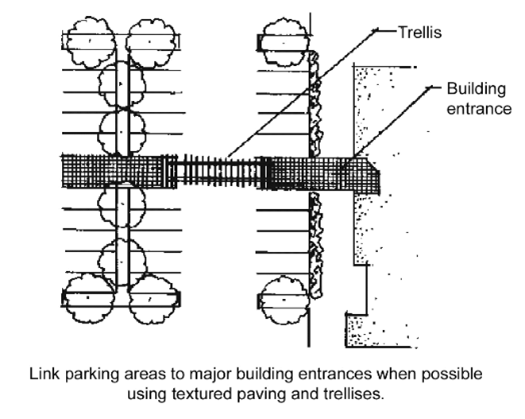
A continuous, clearly marked walkway shall be provided from parking areas and carports to main entrances of buildings in order to minimize cross-circulation between vehicles and pedestrians.
(3)
Landscaping.
i.
Landscaping shall be provided for parking areas and carports in accordance with sections 29-142 and 29-143.
ii.
Vines, shrubs, and trees shall be used around garages, tuck-under parking spaces, and underground parking entrances to reduce their visual dominance.
iii.
The ends of each cluster of carports shall be landscaped if visible from the public right of way or adjacent properties.
vi.
Parking areas shall be separated from each other by dwelling units or by a landscaped buffer not less than thirty (30) feet wide.
vii.
Landscape bulbs shall align with major building entrances to provide pedestrian access to the building entrance from a parking area or driveway. Bulbs that align with entrances shall include a pathway as well as a vertical landscape or architectural element such as a trellis or a tree.
(i)
Lighting.
(1)
Lighting shall be used to provide illumination for the security and safety of on-site areas such as parking, loading, shipping and receiving, walkways and working areas.
(2)
The design of light fixtures and their structural support shall be architecturally compatible with the main structures on-site. Illuminators shall be integrated within the architectural design of the structures.
(3)
All lighting fixtures shall be shielded to confine light spread within the site boundaries.
(Ord. No. 24-03, § 2, 9-17-24)
Sec. 29-60. - Purpose and intent.
Commercial zones providing appropriate located areas and development standards for necessary office uses, retail stores, service establishments and tourism facilities are hereby established to achieve the following purposes:
CT tourist commercial zone. This zone is intended to provide for the development of motels, resort hotels, related tourist commercial uses, limited retail and freeway-oriented businesses. Multi-family residential may also be permitted by conditional use permit, where appropriate. The CT zone is intended to implement the tourist commercial general plan land use designation.
CO office commercial zone. This zone is intended for establishment of professional and administrative offices, medical care centers and ancillary services with appropriate landscaping and development standards which provide relative compatibility for such uses near residential areas. The CO zone is intended to implement the office commercial general plan land use designation.
CN neighborhood commercial zone. This zone is intended for retail uses serving principally the convenience shopping needs of the neighborhood in which it is located. The CN zone is intended to implement the neighborhood commercial general plan land use designation.
CD downtown commercial zone. This zone is intended for retail, office, entertainment, restaurant, artisan/cultural production, social, cultural, and service-oriented uses that will help draw visitors and energize and revitalize the downtown area. Developments in this zone are encouraged to be pedestrian oriented and tied together through common architecture and the use of arcades. The CD zone is intended to implement the downtown commercial general plan land use designation. Residential uses are not allowed in the CD downtown commercial zone.
CG general commercial zone. This zone is intended for general business, light service and retail uses, as well as large-scale planned shopping districts and, where appropriate, hotel and public assembly uses. The CG zone is intended to implement the general commercial general plan land use designation.
CH heavy commercial zone. This zone is intended for general commercial uses, business and consumer services, and light manufacturing. The CH zone is intended to implement the heavy commercial general plan land use designation.
(Ord. No. 24-03, § 2, 9-17-24)
Sec. 29-61. - Commercial zones use regulations.
The uses identified in table 29-61.1 shall be permitted uses where the symbol "P" appears. Where the symbol "C" appears, the use requires a conditional use permit pursuant to article V, division 6 of this chapter. The symbol "X" indicates that the use is prohibited.
Table 29-61.1 Commercial Zones Use Regulations
1
Meeting the requirements of California Government Code 65662.
2
Meeting the requirements of California Government Code 65651.
(Ord. No. 24-03, § 2, 9-17-24; Ord. No. 24-06, 3, 12- 3-24)
Sec. 29-62. - Commercial zones development standards.
The following minimum property development standards identified in table 29-62.1 shall apply to all land and buildings in the commercial zones, except that any lot shown on an official subdivision map duly approved and recorded, or any lot for which a bona fide deed had been duly recorded prior to the effective date of this chapter may be used as a building site. See also article III of this chapter for exceptions to, or clarification of, these regulations.
Additionally, before any building, structure, or use of land outside of a building or structure, is established in a commercial zone, a site plan shall be submitted to and approved by the community development director, pursuant to article V, division 3 of this chapter. If specified by this chapter, such site plan review shall be conducted by the planning commission and/or city council.
Table 29-62.1 Commercial Zones Development Standards
(Ord. No. 24-03, § 2, 9-17-24)
Sec. 29-63. - Commercial zones design standards.
(a)
Purpose. These design standards are intended to assist the project applicant in understanding the city's requirements for high quality commercial development. These mandatory standards complement the development regulations contained in this division by providing good examples of potential design solutions and by providing design interpretations of the various mandatory regulations. These standards ensure the highest level of design quality while at the same time providing the flexibility necessary to encourage creativity on the part of project designers.
(b)
Site planning.
(1)
Placement of structures shall consider the existing built context of the commercial area, the location of incompatible land uses, the location of major traffic generators as well as an analysis of a site's characteristics and particular influences.
(2)
Locate and orient structures in a manner that will complement adjacent structures.
(3)
Plan and develop the whole project site in a coordinated manner to provide order, compatibility and diversity.
(4)
Structures and other improvements shall be sited in a manner that maximizes visibility of public areas (e.g., parking lots, plazas), and streets and alleys to create opportunities for people engaged in their normal behavior to observe the space around them.
(5)
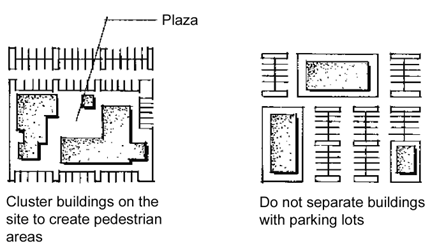
When appropriate, new structures shall be clustered. This creates plazas or pedestrian malls and prevents long "barracks-like" rows of structures. When clustering is impractical, a visual link between separate structures shall be established. This link can be accomplished through the use of an arcade system, trellis or other open structure. This linkage is required in the CD zone.
(6)
Locate structures and on-site circulation systems to minimize pedestrian/vehicle conflicts where possible. Link structures to the public sidewalk where possible with ADA/title 24 of the California Code of Regulations compliant textured paving, landscaping and trellises.
(7)
Recognize the importance of spaces between structures as outdoor rooms on the site. Outdoor spaces shall have clear, recognizable shapes that reflect careful planning and are not simply left over areas between structures. Such spaces shall provide pedestrian amenities such as shade, benches, fountains, etc.
(8)
Loading facilities shall not be located at the front of structures where it is difficult to adequately screen them from view. Such facilities are more appropriate at the rear of the site. Such facilities shall be screened.
(9)
Where feasible, open space areas shall be clustered into larger, landscaped areas rather than equally distributing them into areas of low impact such as at building peripheries, behind a structure or in other areas of little impact to the public view.
(c)
Natural surveillance. Whenever possible, design and placement of buildings and other physical features shall maximize visibility and encourage natural surveillance. This includes building orientation, placement of windows, doors and balconies, building and site entrances and exit locations, placement of parking, lighting and refuse containers, placement and type of landscape materials, plazas and other open space areas, location of walkways, types of walls and fences (including the use of picket and wrought-iron and similar materials to promote visibility) and other physical obstructions in a manner that discourages the potential for criminal activity.
(d)
Architecture. A diversity of architectural styles shall be used except in large-scale developments where a harmonious or unified architectural style is generally desirable.
(e)
Facade articulation. To ensure large buildings are not monotonous boxlike structures, the developer shall:
(1)
Vary the planes of the exterior walls in depth and/or direction. Wall planes shall not run in a continuous direction for more than fifty (50) feet without an offset proportional to the building size or an architectural feature such as a column to provide visual interest.
(2)
Vary the height of the buildings so that it appears to be divided into distinct massing elements.
(3)
Articulate the different parts of a building's facade by use of color, arrangement of facade elements or a change in materials.
(4)
Use landscaping and architectural detailing at the ground floor level to lessen the impact of an otherwise bulky building.
(5)
Avoid blank walls at the ground floor levels. Utilize windows, trellises, wall articulation, arcades, change in materials or other features.
(6)
Set back buildings from property lines to avoid the use of parapet walls unless abutting existing buildings. Parapet walls can abruptly change the continuity of a building's architecture by creating a cut-off effect and result in large blank walls.
(7)
Architecturally treat all building facades visible from public streets and public areas (such as parking areas).
(f)
Mass and scale. Developers shall use the following techniques to reduce the appearance of large scale and bulky structures:
(1)
Reduce building scale through the proper use of window patterns, structural bays, roof overhangs, siding, awnings, moldings, fixtures and other details that promote a "human" scale.
(2)
The scale of buildings shall be related to adjacent pedestrian areas (e.g. courtyards) and other such structures, where provided.
(3)
Large dominating structures shall be broken up by:
a.
Creating horizontal emphasis through the use of trim;
b.
Adding three (3) dimensional architectural elements;
c.
Use of combinations of complementary colors; and
d.
Landscape materials.
(g)
Colors.
(1)
Exterior building and roofing colors shall be appropriate to and enhance the architectural style and materials of the structure. Intense primary colors shall generally be avoided as the dominant overall color for a structure. The use of earth tones and soft muted colors is encouraged.
(2)
The color palette chosen for new structures shall generally be compatible with the colors of adjacent structures. An exception is where the colors of adjacent structures strongly diverge from these design standards.
(3)
Generally, primary or bold colors shall only be used to accent elements, such as door and window frames and architectural details.
(4)
Roof flashing, rain gutters, and downspouts, vents and other roof protrusions shall be finished to complement the adjacent materials and/or colors.
(h)
Wall treatments.
(1)
Base and top treatments. All building facades shall have a recognizable base, middle, and top. The base shall include elements such as richly textured materials, darker color materials, mullions, and/or panels and similar features or enhanced landscaping of mature and specimen shrubs and trees with a minimum planter depth of five (5) feet exclusive of curbs. A top shall include elements such as cornice treatments, roof overhangs, stepped parapets, and richly textured materials such as tile or masonry treatments or similar features.
(2)
Materials. Materials shall be consistently applied on all facades and be chosen to work harmoniously with adjacent materials. Piecemeal embellishment and frequent changes in materials shall generally be avoided. Materials tend to appear substantial and integral when material changes occur at changes in plane. Material or color changes at the outside corners of structures give an impression of thinness and artificiality, which shall be avoided. Material changes shall not occur at external corners, but may occur at reverse or interior corners or if located at least four (4) feet from the edge of external corners. Material changes not accompanied by changes in plane give materials an insubstantial or applied quality.
(3)
Awnings and canopies. Awnings and canopies shall be subject to the following:
a.
Awnings/canopies shall not be located so as to obscure transom windows, piers, pilasters and other architectural building features and shall generally be designed to project over individual doors and window openings where feasible. Awnings/canopies that are a continuous feature extending over several windows, doors and over architectural features are generally discouraged.
b.
The size of the awning/canopy shall be proportional in scale with the building to which it is attached.
c.
No portion of an awning/canopy shall be less than eight (8) feet above the surface above which it projects (fourteen (14) feet above a roadway surface) or shall project more than five (5) feet into a public right-of-way. An encroachment permit is required for any awning/canopy located within the public right-of-way.
d.
The style of the awning/canopy shall complement the architectural style of the building to which it is attached. Awnings should generally have a simple horizontal valance if located over rectangular or square window/door openings. Domed or barrel-shaped awnings are appropriate for buildings with arched window/door openings.
e.
The color of the awning/canopy shall be compatible with and complement the exterior color(s) of the building. Awning/canopy colors that call more attention to the awning/canopy than the building are inappropriate. Awnings/canopies with highly contrasting corporate/franchise identity colors are not allowed. An awning/canopy with a single, solid color is preferred.
f.
Awnings/canopies shall be regularly cleaned and kept free of visible defects and wear.
g.
Awnings/canopies with signs shall require the issuance of a sign permit in accordance with chapter 22.1 of the City Code.
(i)
Roof treatments.
(1)
The roofline at the top of the structure shall not run in a continuous plane for more than fifty (50) feet without offsetting or jogging the roof plane.
(2)
All roof top equipment shall be screened from public view by screening materials of the same nature as the structure's basic materials. Mechanical equipment shall be located below the highest vertical element of the building. Plain equipment boxes are not acceptable.
(3)
The following roof materials shall not be used:
a.
Corrugated metal (standing rib metal roofs are permitted);
b.
Highly reflective surfaces (copper roofs may be considered); and
c.
Illuminated roofing.
(j)
Parking and circulation. Parking lot design can be a critical factor in the success or failure of a commercial use. In considering the possibilities for developing a new parking area, the developer shall analyze the following factors: ingress and egress with consideration to possible conflicts with street traffic; pedestrian and vehicular conflicts; on-site circulation and service vehicle zones; and the overall configuration and appearance of the parking area.
(1)
Separate vehicular and pedestrian circulation systems shall be provided to the extent feasible. Pedestrian linkages between uses in commercial developments shall be emphasized, including distinct pedestrian access from parking areas in large commercial developments, such as shopping centers. Arcades to connect areas are recommended in all commercial zones, and are required in the CD zone.
(2)
Common driveways that provide vehicular access to more than one (1) development are encouraged.
(3)
Parking areas shall be landscaped, receiving interior as well as perimeter treatment.
(4)
Parking areas shall be separated from structures by either a raised concrete walkway or landscaped strip, preferably both. Situations where parking spaces directly abut structures shall be avoided whenever possible.
(5)
Enhanced paving (colored, textured paving) shall be provided at a minimum depth of ten (10) feet at all primary vehicular driveway entrances (immediately behind the street right-of-way line) to the development.
(6)
Where parking areas are connected, interior circulation shall allow for a similar direction of travel and parking bays in all areas to reduce conflict at points of connection.
(7)
Whenever possible, locate site entries on side streets in order to minimize pedestrian/vehicular conflicts. When this is not possible, design the front site entry with appropriately patterned concrete or pavers to differentiate it from the sidewalks.
(8)
Parking access points shall be located as far as possible from street intersections so that adequate stacking room is provided. The number of access points shall be limited to the minimum amount necessary to provide adequate circulation. The first parking stall which is perpendicular to a driveway or first aisle juncture, shall be set back a sufficient distance from the curb to avoid traffic obstruction based on the number of parking spaces and traffic conditions at the driveway intersection. With larger centers, significantly more setback to the first parking stall will likely be required to ensure adequate stacking room.
(9)
Design parking areas so that pedestrians walk parallel to moving cars. Minimize the need for the pedestrian to cross parking aisles and landscape areas to access structures. When such design is not feasible, pedestrian walkways shall be provided which connect the parking areas and the structures. Such walkways shall be clearly demarked from the parking areas and drive aisles through the use of colored, textured paving, landscaping, shade structures, or similar treatment.
(10)
Parking areas that accommodate a significant number of vehicles shall be divided into a series of connected smaller lots divided by landscaping and/or buildings.
(11)
For climatic reasons, the use of shade structures or other mechanisms within commercial parking areas to shade parked vehicles from the sun is strongly encouraged.
(k)
Landscaping.
(1)
Landscaping for commercial uses shall be used to define specific areas by helping to focus on entrances to buildings and parking lots, define the edges of various land uses, provide transition between neighboring properties (buffering), and provide screening for loading and equipment areas.
(2)
Landscaping shall be in scale with adjacent structures and be of appropriate size at maturity to provide substantial shading.
(3)
Landscaping around the entire base of structures is recommended to soften the edge between the parking lot and the structure. This shall be accented at entrances to provide focus.
(4)
Trees shall be located throughout the parking lot and not simply at the ends of parking aisles. In order to be considered within the parking lot, trees shall be located in curbed and irrigated planters.
(5)
Landscaping shall be protected from vehicular and pedestrian encroachment by raised planting surfaces, depressed walks or the use of concrete curbs.
(6)
Vines and climbing plants integrated upon buildings, trellises and walls shall be used when complementary to the project design.
(7)
When provided, potted plants shall be in clay or decorative concrete containers, especially for enhancement of sidewalk shops, plazas and courtyards and to soften the hardscape.
(l)
Fences and walls.
(1)
If not required for a specific screening or security purpose, walls shall generally not be used within commercial areas. When used, the walls shall be as low as possible while performing their screening and security functions.
(2)
Where walls are used along property frontages, or screen walls are used to conceal storage and equipment areas, they shall be designed to blend with the site's architecture. Both sides of all perimeter walls or fences should be architecturally treated when visible from public or private streets and public areas such as parking lots and plazas. Landscaping shall be used in combination with such walls whenever possible.
(3)
Long expanses of fence or wall surfaces shall be offset or architecturally designed to prevent monotony. Landscape pockets or vines shall be provided whenever possible.
(4)
When security fencing is used, a combination of solid walls with pillars and decorative view ports, or short solid wall segments and wrought iron grill work shall be used, except as provided in (5) below.
(5)
Barbed or razor wire and similar fencing, or electric security fencing: See chapter 18, section 18-4.
(m)
Screening.
(1)
Any outdoor equipment, whether on a roof, side of a structure or on the ground, shall be appropriately screened from view. The method of screening shall be architecturally integrated with the adjacent structure in terms of materials, color, shape and size. Where individual equipment is provided, a continuous screen is desirable.
(2)
Screening for outdoor storage (including cart storage) shall be determined by the height of the material or equipment being screened. When allowed, exterior storage shall be confined to portions of the site least visible to public view. Where screening is required, a combination of elements shall be used including solid masonry walls, berms and landscaping. Chain-link fencing with wood or metal slatting is only permitted when not visible from a public or private street or public areas such as parking lots and plazas.
(3)
Roll-up doors, vehicle bays, drive-through aisles, car wash entrances/exits, wash stalls and similar features shall be screened from view of adjacent streets by building orientation and/or the provision of landscaping, trellises, berms, or low walls that are consistent with the architecture and exterior materials of the building.
(n)
Lighting.
(1)
Lighting shall be used to provide illumination for the security and safety of on-site areas such as parking, loading, shipping and receiving, walkways and working areas.
(2)
The design of light fixtures and their structural support shall be architecturally compatible with the main structures on-site. Illuminators shall be integrated within the architectural design of the structures.
(3)
As a security device, lighting shall be adequate but not overly bright. All building entrances shall be appropriately lighted.
(4)
All lighting fixtures shall be shielded to confine light spread within the site boundaries.
(o)
Kiosks. Where kiosks are allowed, kiosk design and exterior color(s) shall be compatible with the architectural style and exterior color(s) of surrounding buildings.
(p)
Drive-through business standards. The minimum lot size of any drive-through business shall be ten thousand (10,000) square feet. All drive-through restaurants shall provide a drive-through lane with a minimum length of one hundred twenty (120) feet and a minimum width of ten (10) feet. All other drive-through businesses shall include a drive-through lane with minimum dimensions of thirty-six (36) feet in length and ten (10) feet in width.
(q)
Downtown design standards. To assure an attractive, pedestrian-friendly environment, all development occurring within the CD, downtown commercial zone upon the effective date of this section, unless otherwise exempted by this chapter, shall comply with the Project SHAPE Downtown El Centro Design Standards which are adopted by reference herein and which shall be available upon request from the community development department. If said design standards appear to conflict with another provision of this chapter, the design standards shall prevail. All other commercial zone design standards shall apply.
(r)
Water dispensing facility standards.
(1)
All water dispensing machines shall be visible in well-lit areas from access drives or public streets and be maintained in a clean, attractive, and litter-free condition. Any graffiti on an outdoor machine shall be removed within twenty-four (24) hours. If the water dispensing machine is removed, the area shall be cleaned and restored to its previous condition, including the removal of any abandoned pipes, conduits, or other connecting hardware.
(2)
Vending of water must comply with state law, including operators obtaining proper licenses from the food and drug branch of the California Department of Public Health.
(3)
Water dispensing machines shall not obstruct pedestrian pathways, driving aisles, parking spaces, alleys, any areas necessary for proper vehicular circulation or loading activities, nor be located within the public right-of-way. A clear path of travel at least four (4) feet wide must be provided around water dispensing facilities.
(4)
The water dispensing machine shall not be within ten (10) feet of an entranceway to any business open to the public nor block any store window.
(5)
Sign copy on water dispensing facility shall be limited to that which fits on the exterior panels of the machine and shall only advertise the actual product or service provided by the water dispensing machine.
(6)
Business owner or operator shall not utilize or permit the utilization of any device which produces loud noise, or use and operate any loudspeaker, public address system, radio, sound amplifier, or similar noise creating device to attract the attention of the public, subject to the noise regulations of the commercial zone.
(Ord. No. 24-03, § 2, 9-17-24)
Sec. 29-68. - Purpose and intent.
Manufacturing zones providing employment opportunities in manufacturing, service, research and development, engineering, and wholesale trade are hereby established to achieve the following purposes:
ML light manufacturing zone. This zone is intended to provide for the development of industrial uses that include fabrication, manufacturing, assembly or processing of materials that are in refined form and that do not in their transformation create smoke, gas, odor, dust, noise, vibration of earth, soot or lighting to a degree that is offensive when measured at the property line of subject property. Most operations within this zone are to be conducted within enclosed buildings. The ML zone is intended to implement the light manufacturing-general industrial general plan land use designation.
MG general manufacturing zone. This zone is intended to provide for the development of manufacturing, processing, fabrication, and assembly of goods and materials, which do not in their operation or maintenance create offensive, obnoxious, or dangerous conditions that are detectable beyond the boundary of the zone. Certain outdoor operations are permitted in this zone. The MG zone is intended to implement the general manufacturing - general industrial general plan land use designation.
(Ord. No. 24-03, § 2, 9-17-24)
Sec. 29-69. - Manufacturing zones use regulations.
The uses identified in table 29-69.1 shall be permitted uses where the symbol "P" appears. Where the symbol "C" appears, the use requires a conditional use permit pursuant to article V, division 6 of this chapter. The symbol "X" indicates that the use is prohibited.
Table 29-69.1
Manufacturing Zones Use Regulations
(Ord. No. 24-03, § 2, 9-17-24)
Sec. 29-70. - Manufacturing zones development standards.
The following minimum property development standards identified in table 29-70.1 shall apply to all land and buildings in the manufacturing zones. See also article III of this chapter for exceptions to, or clarification of, these regulations.
Before any building, structure, or use of land outside of a building or structure, is established in the manufacturing zones, a site plan shall have been submitted to and approved by the community development director pursuant to the provisions of article V, division 4 of this chapter. Where specified by this chapter, such site plan review shall be conducted by the planning commission and/or city council.
Table 29-70.1 Manufacturing Zones Development Standards
(Ord. No. 24-03, § 2, 9-17-24)
Sec. 29-71. - Manufacturing zones design standards.
(a)
Purpose. These design standards are intended to assist the project applicant in understanding the city's requirements for high quality manufacturing development. These mandatory standards complement the development regulations contained in this division by providing good examples of potential design solutions and by providing design interpretations of the various mandatory regulations. These standards ensure the highest level of design quality while at the same time providing the flexibility necessary to encourage creativity on the part of project designers.
(b)
Site planning.
(1)
The main elements of sound manufacturing site design include the following:
a.
Controlled site access;
b.
Site planning, lighting, and architectural design that encourages natural surveillance;
c.
Service areas located at the sides and rear of buildings;
d.
Convenient access, visitor parking and on-site circulation;
e.
Screening of outdoor storage, work areas and equipment; and
f.
Landscaped open space.
(2)
A variety of building and parking setbacks shall be provided in order to avoid long monotonous building facades and to create diversity.
(3)
Structures shall be located on landscape islands, where the office portion of the building does not directly abut paved parking areas. A minimum four-foot landscape strip should be provided between parking areas and the office portion of a structure.
(4)
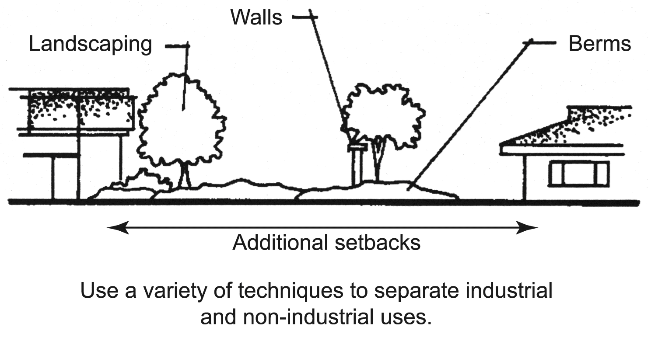
Where manufacturing uses are adjacent to non-manufacturing uses, appropriate buffering techniques such as setbacks proportional to building size, screening and landscaping shall be provided to mitigate any negative effects of manufacturing operations.
(c)
Natural surveillance. Whenever possible, design and placement of buildings and other physical features shall maximize visibility and encourage natural surveillance. This includes building orientation, placement of windows, doors and balconies, building and site entrances and exit locations, placement of parking, lighting and refuse containers, placement and type of landscape materials, location of walkways, types of walls and fences (including the use of picket and wrought-iron and similar materials to promote visibility) and other physical obstructions in a manner which discourages the potential for criminal activity.
(d)
Architecture.
(1)
Employ variety in structure forms, to create visual character and interest.
(2)
Avoid long, unarticulated facades. Wall planes shall not run in a continuous direction for more than fifty (50) feet without an offset.
(3)
Avoid blank front and corner side wall elevations on street frontages.
(4)
Sensitive alteration of colors and materials shall be used to produce diversity and enhance architectural forms.
(5)
Design elements that are undesirable and shall be avoided include:
a.
Highly reflective surfaces at the ground story;
b.
Large blank, unarticulated wall surfaces;
c.
Exposed, untreated precision block walls;
d.
Chain-link, electric, barbed-wire or razor wire fencing visible from public rights-of-way;
e.
False fronts;
f.
"Stuck on" mansard roofs on small portions of the roofline;
g.
Unarticulated building facades; and
h.
Materials with high maintenance such as stained wood, shingles or metal siding.
(6)
Wall materials that will withstand abuse by vandals or accidental damage from machinery and vehicles shall be chosen, whenever feasible.
(7)
All metal buildings shall have architectural enhancements on facades visible from public rights-of-way.
(8)
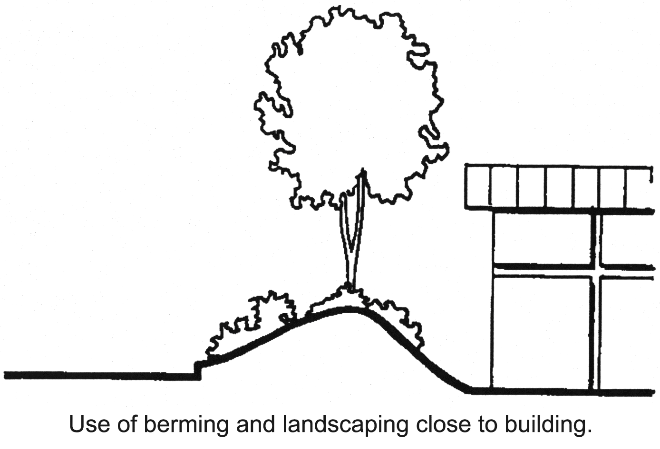
Berming in conjunction with landscaping can be used at the building edge to reduce structure mass and height along facades.
(9)
Rolling shutter doors located on the inside of the building is the preferred method for providing large loading doors while keeping a clean, uncluttered appearance from the exterior.
(10)
All gutters, downspouts, vents, louvers, exposed flashing and overhead doors, shall be painted to blend with or compliment the surface to which attached.
(e)
Roof treatments.
(1)
The roofline at the top of the structure shall not run in a continuous plane for more than fifty (50) feet without offsetting or jogging the roof plane.
(2)
Nearly vertical roofs (A-frames) and piecemeal mansard roofs (used on a portion of the building perimeter only) shall not be used. Mansard roofs, when used, shall wrap around the entire perimeter of the structure.
(3)
All roof top equipment must be screened from public view by screening materials of the same nature as the building's basic materials. Mechanical equipment generally shall be located below the highest vertical element of the building.
(4)
The following roof materials shall not be used:
a.
Corrugated metal (standing rib metal roofs are permitted);
b.
Highly reflective surfaces; and
c.
Illuminated roofing.
(5)
The roof design should be considered as a component of the overall architectural design theme.
(f)
Parking and circulation.
(1)
Large expansive paved areas located between the street and the building are to be avoided in favor of smaller multiple lots separated by landscaping and buildings. Angled parking shall be used for larger parking lots that can accommodate one-way aisles.
(2)
The circulation system shall be designed to reduce conflicts between vehicular and pedestrian traffic, combine circulation and access areas where possible, provide adequate maneuvering and stacking areas and consideration for emergency vehicle access.
(3)
Entrances and exits to and from parking and loading facilities shall be clearly marked with appropriate directional signage where multiple access points are provided. The use of sidewalks, pavement, gates, lighting and landscaping to and from entrances and exits shall also be used to clearly guide the public.
(4)
Vehicles shall not be required to enter the street in order to move from one (1) area to another on the same site.
(5)
Parking lots adjacent to and visible from public streets shall be adequately screened from view through the use of rolling earth berms, low screen walls, changes in elevation, landscaping or combinations thereof whenever possible.
(6)
The manufacturing site shall be a self-contained development capable of accommodating its own parking needs. The use of the public street for parking and staging of trucks is not allowed.
(7)
Uses that rely on larger trucks for pickup and deliveries shall include separated truck parking facilities on-site to support the use.
(g)
Loading facilities.
(1)
To alleviate the unsightly appearance of loading facilities for manufacturing uses, these areas shall generally not be located at the front of buildings where it is difficult to adequately screen them from view. Such facilities are more appropriate at the rear of the site where special screening may not be required.
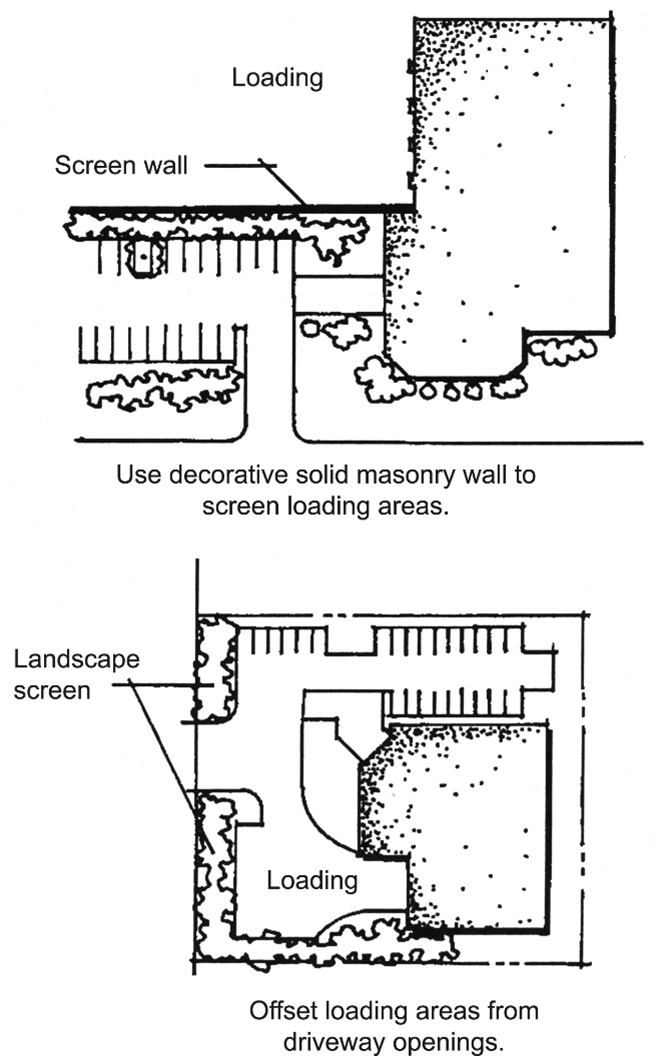
(2)
When it is not possible to locate loading facilities at the rear of the building, loading docks and doors shall not dominate the frontage and must be screened from view of the street through the use of landscaped berms or a combination of landscaping and architecturally enhanced walls. Chain-link with slats is not acceptable for screening along public or private streets.
(3)
Backing from the public street onto the site for loading into front end docks causes unsafe truck maneuvering and shall not be permitted.
(h)
Landscaping.
(1)
Landscaping shall be used to define areas by helping to focus on entrances to buildings, parking lots, loading areas, defining the edges of various land use, providing transition between neighboring properties (buffering) and providing screening for outdoor storage, loading and equipment areas.
(2)
All primary entrances to manufacturing parks shall receive special landscape treatment. Plans for entrances shall be submitted to the community development director concurrently with the site plan for review and approval.
(3)
Landscaping shall be in scale with adjacent buildings and be of appropriate size at maturity to accomplish its intended goals.
(4)
Use of vines on walls is appropriate in manufacturing areas because such walls often tend to be large and blank.
(5)
Landscaping around the entire base of buildings, especially where offices and similar customer-oriented areas are located, is encouraged to soften the edge between the parking lot and the structure.
(6)
Trees should be located throughout the parking lot and not simply at the ends of parking aisles. In order to be considered within the parking lots, trees should be located in planters that are bounded on at least three (3) sides by parking area paving or related site hardscape. Trees shall also be provided between the public sidewalk and parking areas.
(7)
Landscaping shall be protected from vehicular and pedestrian encroachment by raised planting surfaces, depressed walks or the use of concrete curbs.
(8)
As the ground cover, shrubs and trees mature, landscaping shall be maintained to minimize the conflicts between natural surveillance and the landscaping.
(9)
Landscaping plant materials and features for individual lots shall be made an integral part of the overall landscaping park theme. The use of earth mounds is recommended, both to screen and to add to the natural theme of landscaping semipublic to private space. Walls should also be used to screen automobiles, loading and storage areas and utility structures and provide barriers to conflicting uses. Walls should be as low as possible while still performing their screening and security functions.
(i)
Reserved.
(j)
Walls and fences.
(1)
Where walls are used at property frontages, or screen walls are used to conceal storage and equipment areas, they shall be designed to blend with the site's architecture. Both sides of all perimeter walls shall be architecturally treated. Plant materials shall be used in combination with such walls.
(2)
When security fencing is required, it shall be a combination of solid pillars or short solid wall segments and wrought iron grill work. Barbed wire or electric fencing shall be permitted in accordance with chapter 18, section 18-4.
(3)
Long expanses of fence or wall surfaces shall be offset and architecturally designed to prevent monotony.
(k)
Screening.
(1)
Screening for outdoor storage shall be determined by the height of the material being screened.
(2)
Where screening is required, a combination of elements shall be used including solid masonry walls, berms and landscaping.
(3)
Black powder or vinyl-coated chain-link fencing with black slatting is an acceptable screening material only for areas of a lot not visible from Interstate 8 or SR-111.
(4)
Any equipment, whether on the roof, side of building or ground, shall be screened from view of public and private streets. The method of screening shall be architecturally integrated in terms of materials, color, shape and size. The screening design shall blend with the building design. Where individual equipment is provided, a continuous screen is desirable.
(5)
All roof-mounted mechanical equipment and/or duct work, which projects vertically more than one and one-half (1½) feet above the roof or roof parapet and is visible from an adjoining street is to be screened by an enclosure which is detailed consistent with the building.
(6)
Roof-mounted mechanical equipment and/or duct work which projects one and one-half (1½) feet or more above the roof or roof parapet is to be painted in its entirety consistent with the color scheme of the building.
(7)
No mechanical equipment except for emergency equipment and air conditioning equipment is to be exposed on the wall surface of a building. Such mechanical equipment shall be screened by an enclosure which is detailed consistent with the building.
(8)
Plans for cyclone blowers, bag houses, tanks, etc., shall be reviewed at the time of preliminary plan check to determine design integration with buildings and adjacent areas. Further, they shall be painted to blend with or complement the surface to which attached, if visible.
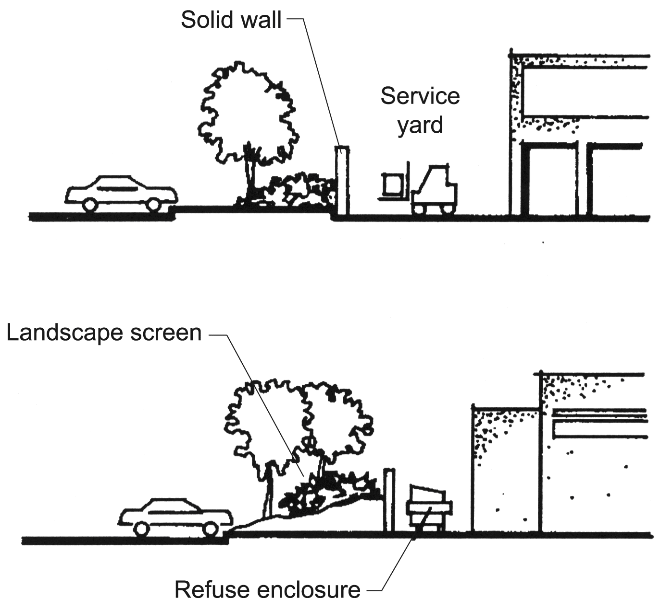
(9)
All exterior storage areas and service yards, loading docks and ramps, electrical cage enclosures and storage tanks are to be screened from view from access or adjacent streets, by an eight (8) foot high fence, wall, or mature landscape materials.
(10)
No outdoor storage of materials or equipment shall be permitted in the following areas: required setbacks, off-street parking and loading, required access drives, maneuvering areas or public streets.
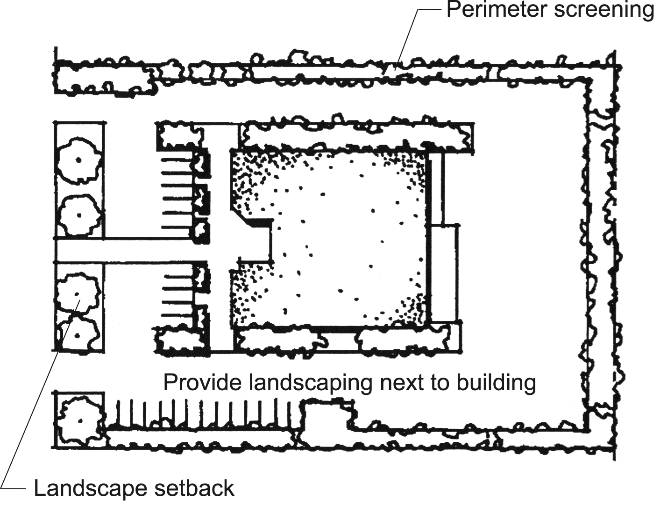
(11)
Within all designated storage areas, except for trucks or other vehicles necessary for the operation of the business, no materials or equipment shall be stored to a height greater than eight (8) feet.
(12)
Except for properly screened outdoor storage of materials and finished products, all processes and activities related to a permitted or conditional use shall be conducted within a completely enclosed structure.
(13)
All outside refuse collection areas shall be screened by a six (6) foot high decorative block concrete, or stucco wall with concrete floor and apron and a chain-link gate with wood slats. The location, size and number of trash bins and enclosures shall be subject to review and approval by the community development director.
(l)
Lighting.
(1)
Lighting shall be used to provide illumination for the security and safety of on-site areas such as parking lots, walkways, entrances, exits and related areas.
(2)
The design of light fixtures and their structural support shall be architecturally compatible with main buildings on-site. Illuminators shall be integrated within the architectural design for the buildings.
(3)
As a security device, lighting shall be adequate but not overly bright. All accesses to buildings shall be well lighted.
(4)
All exterior fixtures shall be illuminated from dusk until dawn, unless otherwise approved for the site.
(5)
When feasible, any exterior lighting device designed for security lighting shall be protected by weather and vandal-resistant covering.
(6)
All lighting shall be shielded to confine light spread within the site boundaries and "sky-glow" impacts.
(7)
Lighting shall be maintained at all times to the standards approved for the site.
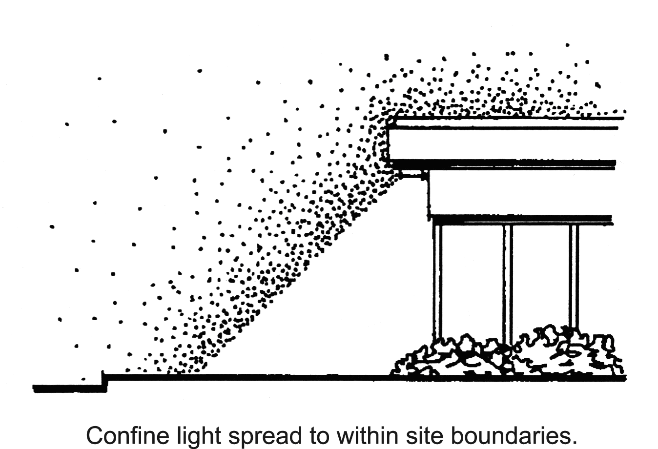
(m)
Development adjacent to I-8 and SR-111. For development that is adjacent to Interstate 8 and the SR-111, the following regulations shall also apply:
(1)
Open storage of materials and equipment shall not face I-8 or SR-111.
(2)
Overhead doors, garages, or loading zones shall be placed facing away from view of the I-8 and SR-111.
(3)
Not less than twenty (20) feet of landscaping measured from the freeway/highway right-of-way line, shall be provided and permanently maintained.
(Ord. No. 24-03, § 2, 9-17-24)
Sec. 29-74. - Purpose and intent.
CC civic center zone. This zone is intended to encourage an orderly and harmonious development of public and private facilities in the area surrounding the civic center of the city and to permit certain private office and commercial uses compatible with and appropriately designed to complement governmental administrative uses in the civic center area. The CC zone is intended to implement the civic general plan land use designation.
(Ord. No. 24-03, § 2, 9-17-24)
Sec. 29-75. - Civic center zone use regulations.
The uses identified in table 29-77.1 shall be permitted uses where the symbol "P" appears. Where the symbol "C" appears, the use requires a conditional use permit approved by the city council pursuant to article V, division 6 of this chapter. The symbol "X" indicates prohibition.
Table 29-77.1 Civic Center Zone Use Regulations
(Ord. No. 24-03, § 2, 9-17-24)
Sec. 29-76. - Civic center zone development standards.
(a)
The property development standards of the CG general commercial zone shall apply within the civic center zone, except that the required site plan approval may be conditioned on compliance with greater yard, parking or other standards than required therein.
(b)
Site plan review required. A site plan review shall be required pursuant to article V, division 4 of this chapter, as follows:
(1)
Applicability. The site plan review process shall apply within the CC zone to all construction of new buildings, or any addition to an existing use, when the addition has a floor area of one thousand (1,000) square feet or more. For new construction and additions less than three thousand (3,000) square feet, the community development director shall have final authority. For new construction and additions of three thousand (3,000) square feet or more, review and action by the planning commission shall be required.
(2)
Content of site plan. In addition to the information specified in section 29-306 of this chapter, a site plan submitted within the CC zone shall include the exterior elevation plans of all sides of the proposed building indicating materials and colors to be used on all exterior surfaces; and such other drawings or data as requested by the community development director to assist the commission in its review of the site plan.
(3)
Alteration of existing uses. Notwithstanding the provisions of article IV, division 6 of this chapter regarding nonconforming uses, any use of property in the civic center zone which existed on the effective date of the ordinance from which this chapter is derived, may be altered; enlarged, or expanded subject to a site plan review by the planning commission pursuant to article V, division 4 of this chapter. The planning commission may apply conditions of approval to any existing building, structure, or use on the same property, as well as to the proposed alteration, expansion, or enlargement.
(c)
Additional zoning provisions. The following zoning provisions shall also apply:
(1)
Parking and loading regulations. See article III, division 5 of this chapter.
(2)
Vehicular access. See section 29-137.
(3)
Required landscaping, screening, fencing and outdoor storage. See article III, division 6 of this chapter.
(4)
Accessory structures and uses. See article III, division 9 of this chapter.
(5)
Temporary uses. See article IV, division 5 of this chapter.
(6)
Nonconforming uses and lots. See article IV, division 6.
(7)
Signs. See chapter 22.1 of the City Code.
(Ord. No. 24-03, § 2, 9-17-24)
Sec. 29-77. - Civic center zone design standards.
Development located in the civic center zone shall be subject to the design standards for commercial development contained in section 29-63.
(Ord. No. 24-03, § 2, 9-17-24)
Sec. 29-80. - Purpose and intent.
LU limited use zone. This zone is applied where concerns of public health and safety necessitate that use of property be limited, where public or semi-public ownership of land limits the use of the property, or where the property is used or planned for a transportation or utility corridor. Typical application of this zone would include flood control or irrigation channels; schools, parks or other public facilities, existing or future highways, railways or other modes of transportation, or facilities for the production and transmission of electrical, gas, geothermal or other forms of energy. The LU zone is intended to implement the public general plan land use designation.
(Ord. No. 24-03, § 2, 9-17-24)
Sec. 29-81. - Permitted uses.
(a)
Publicly owned lands. Buildings, structures and land uses established in the LU limited use zone, on land which is owned in fee by a public agency of the city, county, state or federal government, public district or other political subdivision, including a public school district, shall be in accordance with a development plan approved by the governing body of such agency, or by the administrative entity of such agency empowered to approve such development plans. Any lease, license or permit grand for a use of such publicly owned land by a person other than a public agency, except in the provision of a service incidental to the principal public use of the land, shall be subject to issuance of a conditional use permit pursuant to the provisions of section 29-320.
(b)
Privately owned land. Buildings, structures and land uses established in the LU limited use zone by any person, including a public utility, except those agencies referenced in subsection (a) above, shall be subject to issuance of a conditional use permit pursuant to the provisions of section 29-320. The provision of this section shall not apply to activities of a public utility where the authority of the city to review a proposed use is limited by state or federal law.
(Ord. No. 24-03, § 2, 9-17-24)
Sec. 29-82. - Limited use zone development standards.
For uses established in the LU limited use zone, the property development standards, including lot area, setback, height, design, landscaping, screening, parking, lighting and other requirements for the proposed use, shall be those of the CG zone as identified in section 29-62.
(Ord. No. 24-03, § 2, 9-17-24)
Sec. 29-83. - Limited use zone design standards.
Development located in the limited use zone shall be subject to the design standards identified in the development plan approved by the appropriate governing body or by the conditional use permit approved for the project, as applicable.
(Ord. No. 24-03, § 2, 9-17-24)
Sec. 29-84. - Purpose and intent.
SF single-family neighborhood overlay zone. This zone is applied on parcels within the existing single-family neighborhoods shown on figure 29-84.1. These older residential neighborhoods were developed in the early part of the 1920s and represent a historic character that the city wishes to preserve. The intent of the overlay zone is to protect these existing neighborhoods from development that is out of character, scale, and architectural style with the existing development. The single-family neighborhood overlay zone is intended to implement the single-family neighborhood overlay general plan land use designation.
Figure 29-84.1. Single-Family Overlay Zone
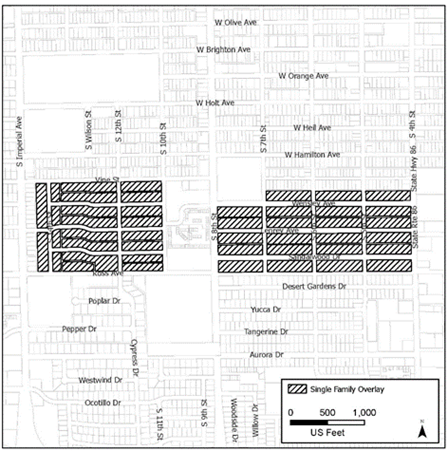
(Ord. No. 24-03, § 2, 9-17-24)
Sec. 29-85. - Single-family neighborhood overlay zone use regulations.
Development and redevelopment in the single-family neighborhood overlay zone shall be pursuant to the R1 single-family residential zone use regulations identified in section 29-53.
(Ord. No. 24-03, § 2, 9-17-24)
Sec. 29-86. - Single-family neighborhood overlay zone development standards.
Development and redevelopment in the single-family neighborhood overlay zone shall be pursuant to the R1 single-family residential zone development standards identified in section 29-54, except the setback regulations in section 29-87(b)(1) and (2) below shall also apply.
(Ord. No. 24-03, § 2, 9-17-24)
Sec. 29-87. - Single-family neighborhood overlay zone design standards.
(a)
Purpose. In addition to the general design standards identified in section 29-55, new development and redevelopment activities in the single-family neighborhood overlay zone, must also be consistent with the design standards of this section. These standards are intended to preserve single-family neighborhoods and avoid new development or redevelopment that would conflict with the nature of existing development in the single-family neighborhood overlay zone.
(b)
Site planning and building orientation.
(1)
For vacant sites, new development shall maintain the average existing setbacks (front, side, and rear) on the block as determined by the community development director.
(2)
For redevelopment of parcels developed as of the effective date of this zoning ordinance, the setbacks (front, side, and rear) of the existing primary residence and any accessory structures shall be maintained.
(3)
To the extent residential windows face the windows of an adjacent unit, the windows shall be offset to maximize privacy. Windows, balconies or similar openings shall be oriented to minimize direct line-of-sight into adjacent units within the development. To provide privacy for adjacent residential units, windows on the second and higher floors of buildings, which directly face or abut residential zones, may be designed either as translucent, louvered, be offset from existing residential windows, or utilize another solution to achieve privacy for the adjacent residential units.
(c)
Mass and scale.
(1)
Building facades and garages that face existing residential units shall be designed to be compatible with the setbacks and scale of the existing development.
(2)
The mass and scale of a new development shall be compatible with neighboring development and not overwhelm them with disproportionate size or a design that is out of character.
(3)
Building scale shall be reduced through the proper use of window patterns, structural bays, roof overhangs, awnings, moldings, fixtures and other details that promote a "human" scale.
(d)
Architecture. New development and redevelopment shall be constructed in a style (1920s bungalows) similar and complementary to existing development on-site and/or within the same block, as appropriate.
(e)
Landscaping. Landscaping shall be in scale with the proposed development and of similar size at maturity as surrounding landscaped developments.
(Ord. No. 24-03, § 2, 9-17-24)
Sec. 29-88. - Purpose and intent.
Mixed-use zones providing a range of medium to high residential dwelling unit densities, a variety of housing types, and a mix of pedestrian-oriented commercial uses are hereby established to achieve the following purposes.
MU1 mixed-use 1 zone. This zone is intended to provide for a mix of multi-family residential, live/work and smaller scale, pedestrian-oriented commercial uses (including retail, artisan manufacturing, grocery stores, pharmacies, financial institutions, cafes and restaurants, offices, personal services, dry cleaners/laundromats) and similar uses deemed by the director as compatible with residential neighborhoods. This zone includes the development of medium high density apartment, condominium, townhouse, duplex, and triplex dwellings with a minimum density of twelve (12) dwelling units per net acre and a maximum density of twenty-five (25) dwelling units per net acre, on lots not less than seven thousand two hundred (7,200) square feet in net area. A maximum density of thirty-two (32) dwelling units per net acre may be approved for senior-only projects or a senior portion of a project in compliance with article IV, division 4, density bonus. Because mixed-use development includes both residential and nonresidential uses, the zone includes both density and intensity standards.
Overall, the MU1 zone intends to:
(1)
Implement the mixed-use goals and policies of the general plan, by creating or reactivating vital areas for living, working, shopping, and recreating.
(2)
Ensure that mixed-use development is of high quality and contains a functionally integrated development plan.
(3)
Provide a variety of housing types and densities to support the diverse population and local workforce.
(4)
Create a more vibrant, comfortable, and welcoming environment that fosters a mix of businesses and entrepreneurs to serve residents and visitors.
(5)
Enrich opportunities for amenity spaces and artwork.
(6)
Promote walkability within an individual project and throughout the mixed-use corridor area and support increased bicycling and transit use.
(7)
Increase awareness of design considerations among the citizens of El Centro.
(8)
Upgrade the visual appearance of El Centro's primary vehicular corridors.
(9)
Enhance community identity and property values within El Centro.
(Ord. No. 24-03, § 2, 9-17-24)
Sec. 29-89. - Mixed-use zones use regulations.
The uses identified in table 29-89.1 shall be permitted uses where the symbol "P" appears. Where the symbol "C" appears, the use requires a conditional use permit pursuant to article V, division 6 of this chapter. The symbol "X" indicates that the use is prohibited.
Mixed-use developments, artisan lofts, live/work, and stand-alone residential developments shall be permitted uses, only if the project fully complies with all development and design standards of this division.
Within the MU1 zone, only the following occupations are intended for the commercial/office component of the live/work use: accountants; architects; artists and artisans; attorneys; computer software and multimedia related professionals; consultants; engineers; fashion, graphic, interior and other designers; insurance; medical offices; real estate and travel agents; photographers, and other occupations deemed by the director to be similar and compatible with residential neighborhoods.
Table 29-89.1 Mixed-use Zones Use Regulations
1 Meeting the requirements of California Government Code 65662.
2 Meeting the requirements of California Government Code 65651.
(Ord. No. 24-03, § 2, 9-17-24)
Sec. 29-90. - Mixed-use zones property development standards.
The following minimum property development standards identified in table 29-90.1 shall apply to all land and buildings in the mixed-use zones, except that any lot shown on an official subdivision map duly approved and recorded, or any lot for which a bona fide deed had been duly recorded prior to the effective date of this chapter may be used as a building site. See also article III of this chapter for exceptions to, or clarification of, these regulations.
Additionally, before any building, structure, or use of land outside of a building or structure, is established in a mixed-use zone, a site plan shall be submitted to and approved by the community development director, pursuant to article V, division 4 of this chapter. If specified by this chapter, such site plan review shall be conducted by the planning commission and/or city council.
Table 29-90.1 Mixed-use Zones Development Standards
(Ord. No. 24-03, § 2, 9-17-24)
Sec. 29-91. - Mixed-use zones design standards.
(a)
Purpose. These design standards are intended to assist the project applicant in understanding the city's requirements for high quality development. These mandatory standards complement the development regulations contained in this division by providing good examples of potential design solutions and by providing design interpretations of the various mandatory regulations. These standards ensure the highest level of design quality while at the same time providing the flexibility necessary to encourage creativity on the part of project designers.
(b)
Building siting, access, orientation, and shade.
(1)
The whole project site shall contain a functionally integrated development plan to provide order, compatibility, and an appropriate mix of uses.
(2)
Consistent with crime prevention through environmental design (CPTED) principles, orient building doors, windows, and entrances to relate directly to public and private streets, drives, paseos, greenways, and common open space amenities.
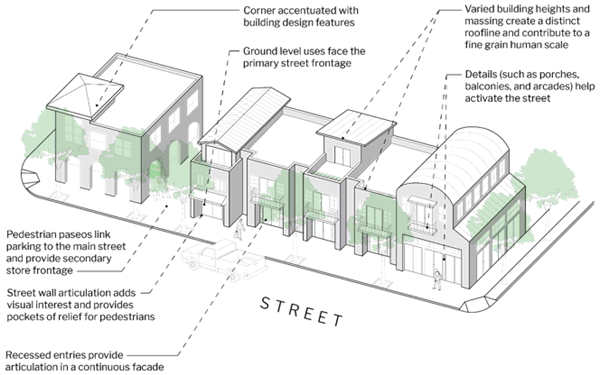
(3)
Provide safe and direct pedestrian access from ground level residential units to streets and communal areas. Provide alley access for residential use as available.
(4)
Provide safe and direct pedestrian access from ground level commercial to the primary street frontage.
(5)
For sites greater than one (1) acre in area, incorporate informal outdoor areas and pedestrian nodes that can function as gathering spaces into the overall site design. These areas shall adjoin the development's common facilities, such as the play areas, courtyards, barbecue area, and community buildings.
(6)
Circulation components shall provide physical and visual connections with adjacent uses.
(7)
All alleys shall be paved for vehicular traffic if utilized for vehicular access. Green alleys are encouraged with pervious paving with a high albedo, such as permeable pavers, porous asphalt, reinforced grass pavement (turf-crete), stone pavers and other permeable materials.
(8)
The workspace of a live/work or artisan loft dwelling unit shall be accessible from the street and open to the street.
(9)
When adjacent to a public street, outdoor dining areas shall provide a minimum of five (5) feet of unobstructed pedestrian circulation and shall be placed at least twenty (20) feet away from an intersection.
(10)
All developments shall provide shade for at least fifty (50) percent of the required common open space areas, as measured at 2:00 p.m. on June 21. Shade shall be provided through the following design elements: arcades, colonnades, pergolas, verandas, covered porches, fixed canopies, awnings, trellises, or other shade structures, or shade trees.
(11)
Permanent shade structures such as canopies and arcades shall maintain a vertical clearance of at least ten (10) feet above finished grade.
(12)
For non-residential uses, a minimum of sixty (60) percent of the street wall area on the ground floor shall be transparent. For residential uses, a minimum of forty (40) percent of the street wall area on the ground floor shall be transparent.
(13)
Ground floor spaces shall provide a clear floor to ceiling height of thirteen (13) feet minimum.
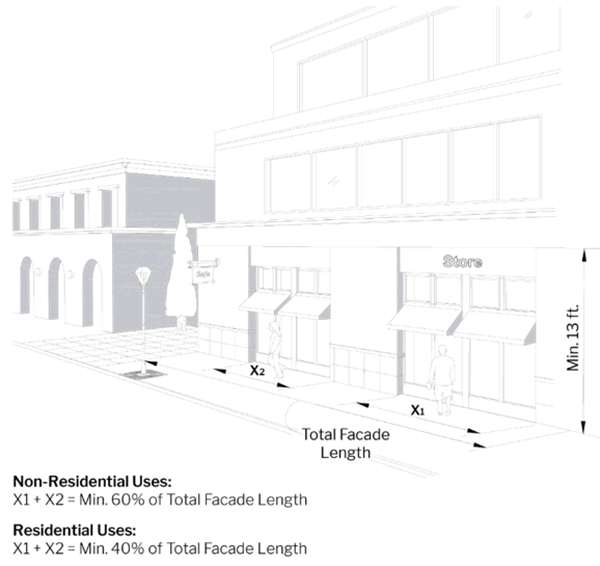
(c)
Sidewalk zone.
(1)
All sidewalk zones shall be a minimum of fifteen (15) feet from the face of the existing curb to allow for a wider pedestrian zone and encourage cafe seating and activation of the sidewalk. See also section 29-91(k), street trees and streetscape improvements. The sidewalk zone shall consist of the following three (3) areas:
a.
Furnishing area: Five (5) feet wide and adjacent to the curb. Area includes street trees, understory planting, light poles, bike racks and/or trash and recycle receptacles. This width shall remain consistent throughout the mixed-use zone.
b.
Throughway area: Minimum five (5) feet wide of unobstructed walking surface, consisting of ADA compliant paving. Note this area may be increased to allow for a wider sidewalk area.
c.
Frontage area: Minimum five (5) feet wide closest to building. This area may be widened to allow for additional cafe seating, benches or other amenity areas adjacent to the building.
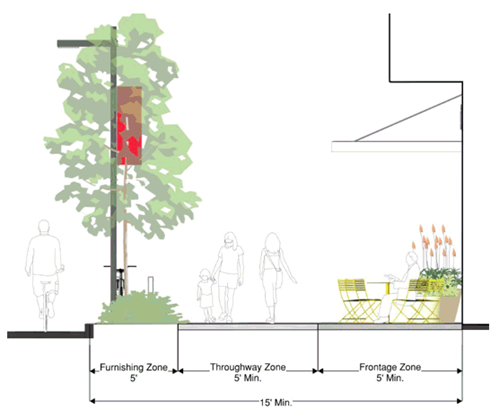
(d)
Building frontage design.
(1)
Activate the street facades of buildings by providing a minimum of two (2) frontage elements listed below. A minimum of two (2) elements must be provided for every thirty (30) feet of the building street facade length (frontage elements selected may repeat and may encroach into the required front setback per section 29-114(h).):
| a. Covered porch | 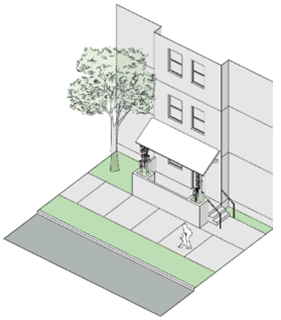 |
| b. Gated stoop | 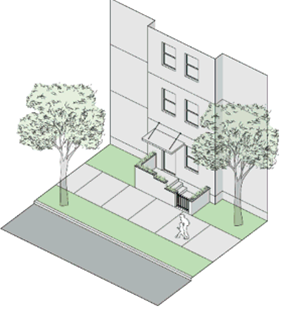 |
| c. Recessed entrance | 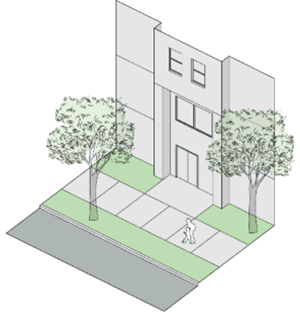 |
| d. Arcade or colonnade | 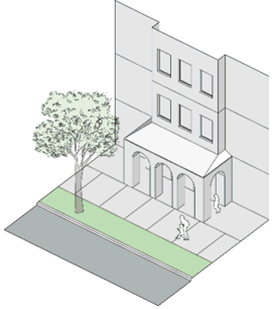 |
| e. Bay windows | 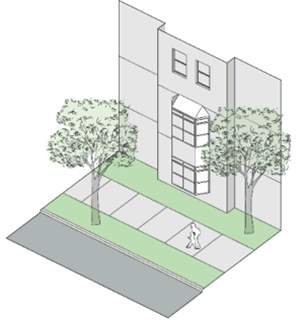 |
| f. Awnings, overhangs, or trellises projecting a minimum of two (2) feet | 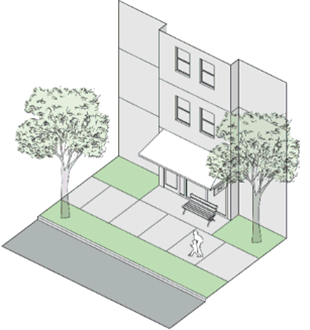 |
| g. Yard, Forecourt, planter | 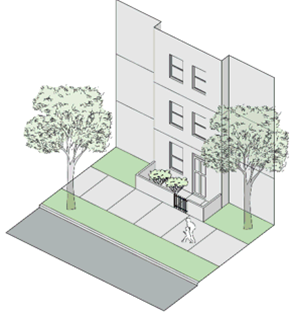 |
| h. Storefront with a minimum 60 percent transparent on the ground floor. | 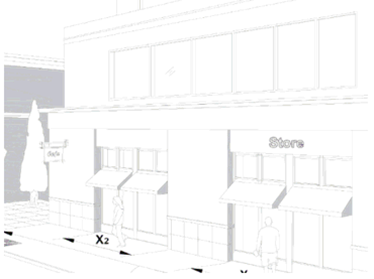 |
(e)
Building scale, massing, and articulation.
(1)
Entries shall be easily identified by architectural accents or massing. Emphasize each business or dwelling unit's entry and differentiate it through architectural elements such as porches, stoops, or roof canopies, and detailing such as paint color, trim, materials, or awnings.
(2)
Reduce the visual bulk of new mixed-use development by incorporating any three (3) of the following design features:
a.
Accentuated building corners (this shall be achieved with architectural treatments, such as a change in material, greater building height at the corner, rounded or chamfered building facades, pronounced building forms, enhanced window treatments or projections - such as awnings, trellises, parapets, roof overhangs, etc.).
b.
Fenestration elements, such as recessed windows, decorative panels and trim, color accents, offsets and framed openings.
c.
Patterned garage doors with painted trim or varied garage door colors.
d.
A change in materials and finishes, providing at least three (3) materials and finishes across the building facade.
e.
A horizontal offset in the building plane consisting of a minimum two (2) foot offset in the building facade for every thirty (30) feet of building frontage.
f.
A ten (10) foot stepback for habitable space of the third floor.
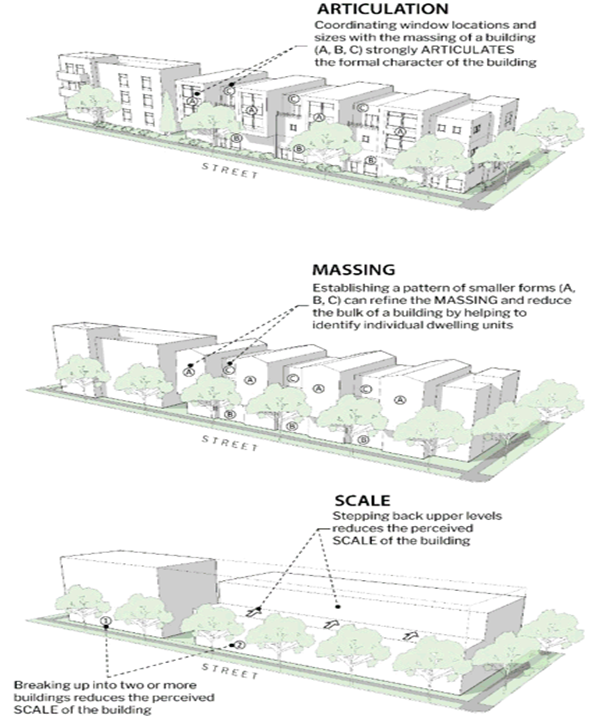
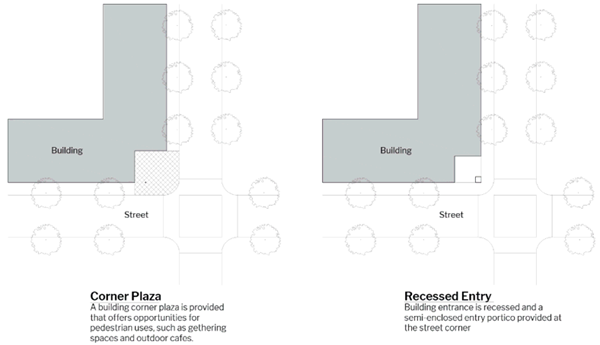
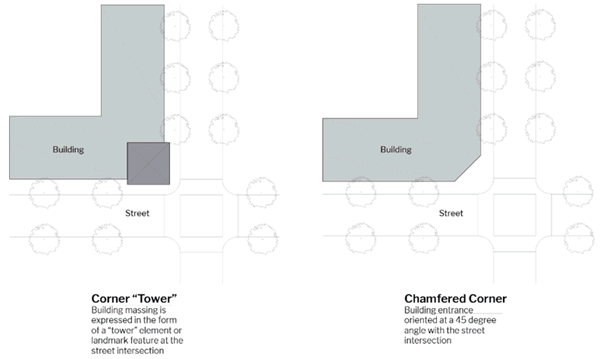
(f)
Circulation and parking. The following standards shall apply to all parking areas with ten (10) or more vehicle parking spaces:
(1)
Minimize cross circulation between vehicles and pedestrians by providing a continuous, clearly marked walkway from parking areas to main entrances of buildings.
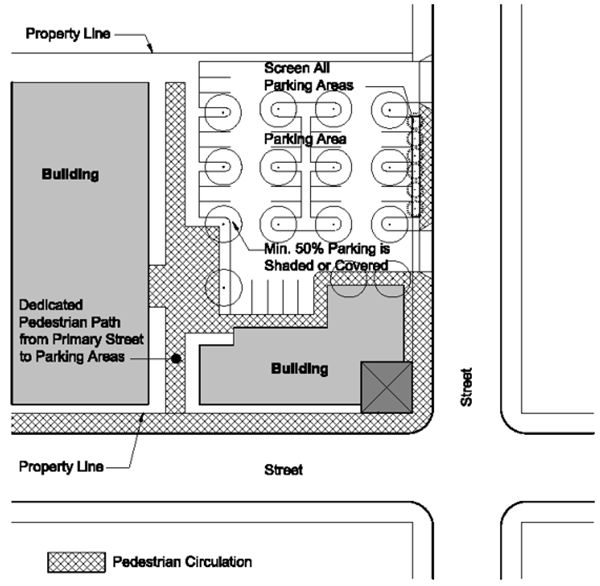
(2)
Parking shall be located to the rear or side of the building. Secondary entries from the parking lots shall be provided for all buildings.
(3)
Vehicle access and curb cuts shall be on secondary streets or alleys, when available. Vehicle access and curb cuts shall comply with section 29-137 and city roadway standards.
(4)
Surface parking lots shall be separated from buildings by a minimum of ten (10) feet along the entire building frontage facing the parking area (including a minimum four (4) foot-wide walkway and six (6) foot-wide landscaped area with breaks as needed for access).
(5)
Shared parking is highly encouraged. Parking lot access may require a shared access easement with adjacent property owners. See section 29-138, shared parking facilities.
(6)
Provide enhanced paving, textured paving, colored paving, and/or marked striping at all pedestrian and bicycle crossings in parking areas (such as concrete surface treatment, brick, terra-cotta or stone pavers).
(7)
Provide walkways and/or corridors between residences, parking areas, and all site facilities for safe access. Provide pedestrian walkways and paths that are clearly identified and made safe and accessible through the use of hardscape design, landscaping and lighting.
(8)
Pedestrian connections shall be provided from the street to the parking lot. These connections shall be located in the side setbacks and may be widened to provide additional public realm spaces.
(9)
For sites with alley frontage, primary vehicle access shall be taken from the alley.
(10)
For sites greater than one (1) acre in area, provide multiple pedestrian access points.
(11)
Incorporate any two (2) or more of the following design features in surface parking areas of the development:
a.
Carports/shade structures providing a minimum of fifty (50) percent shade covering for parking area.
b.
A minimum ten (10) foot-wide landscape area (trees, shrubs, groundcover) at the exterior perimeter of all parking lots. The ten (10) foot landscape area shall consist of existing and established native and naturalized vegetation and new container plant material comprised of minimum of twenty-four (24)-inch box trees and one (1) and five (5) gallon shrubs and groundcover. New planting shall consist of a combination of small, medium, and large-scale trees, shrubs, and groundcover. (See table 29-142.2 and table 29-142.3 for groundcover and shrub lists.)
c.
One (1) tree per two hundred (200) square feet of landscaping or one (1) tree per every five (5) parking spaces, whichever is more. The required trees shall be a minimum of twenty-four (24)-inch box in size when planted. Trees shall be of appropriate size and trunk diameter for the specified container and tree type. Tree spacing may be varied to accommodate site conditions or design considerations; however, the total number of trees calculated for all parking areas shall be maintained.
d.
Increased pervious paving with a high albedo, such as permeable pavers, porous asphalt, reinforced grass pavement (turf-crete), stone pavers and other permeable materials.
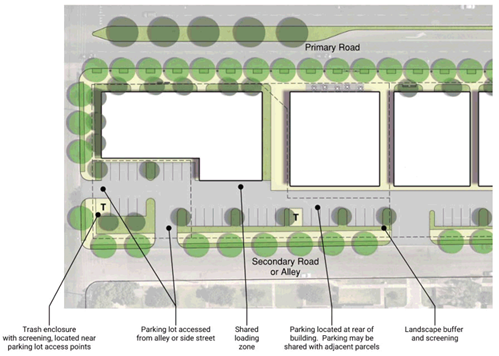
(g)
Open spaces and public access.
(1)
New structures shall be clustered to create plazas, courtyard or pedestrian paseos within the development and prevent long rows of structures.
(2)
Open space areas shall be clustered into larger, landscaped areas rather than equally distributing them into areas of low impact such as at building peripheries, behind a structure or in other areas of little impact to the public view.
(3)
Development within the mixed-use zone is encouraged to provided open spaces with public access. The spaces may include paseos, pocket parks or plazas and may include a variety of uses from seating, playground equipment, fitness equipment, outdoor cafes, splash pads, public art or other uses.
(4)
When public access to open spaces is limited, it shall be controlled with six (6) foot high fences and gates with a minimum of fifty (50) percent opacity for safety and security purposes.
(5)
Open space. Residential development shall have efficient access to common and private open space, whether public or private, for passive or active recreation and for social activities. Common open space includes amenities open to all residents and their visitors, such as game courts, swimming pools, gardens, fitness areas, play equipment, picnic areas, barbeque areas, community gardens, or landscape gardens. No portion of off-street parking spaces, driveways, covered pedestrian access ways or utility areas such as laundries, clothes drying yards or trash areas shall constitute common open space. Private open space includes areas connected or adjoining a dwelling unit for the exclusive use of the occupants and their visitors, such as balconies, porches, or patios. All open space shall conform to the following standards:
a.
For two (2) to four (4) dwelling units (attached) on a single lot, a minimum of three hundred (300) square feet of open space with a minimum width and depth of twenty (20) feet shall be provided for each dwelling unit.
b.
For five (5) or more dwelling units on a single lot or building site, a minimum of one hundred fifty (150) square feet per dwelling unit of common open space shall be provided, not less than fifty (50) percent of which shall be located in a single common area with a minimum width and depth of twenty (20) feet.
c.
Private open space shall be provided as follows:
i.
For dwelling units with one (1) or more bedrooms a minimum of fifty (50) square feet of private open space shall be provided contiguous to each dwelling unit.
ii.
For studio or efficiency units a minimum of fifty (50) square feet of private open space shall be provided contiguous to each dwelling unit, except that the amount of required private open space may be reduced when additional common open space is provided. For every additional square foot of common open space provided, private open space may be reduced by one (1) square foot.
iii.
Private open space shall have a minimum width and depth of five (5) feet; and be screened from ground level exterior visibility by a wood or masonry fence not more than fifty (50) percent open and not less that fifty-four (54) inches high, or, if on a deck or balcony, not less than forty-two (42) inches high.
d.
A surface shall be provided which allows convenient use for outdoor activities. Such surface shall be any practicable combination of lawn, garden, flagstone, wood planking, concrete, asphalt, or other serviceable, dust free surfacing. Slope shall not exceed five (5) percent. No portion of off-street parking space, driveways, covered pedestrian access ways or utility areas such as laundries or trash areas shall constitute open space.
e.
Pools with incidental cabanas and restrooms, and paved recreation areas may be developed in the required common space.
f.
Rooftop amenities may also be included in the required common open space if they are accessible to all residents.
g.
Not less than twenty-five (25) percent, but no more than fifty (50) percent, of common open space shall be permanently landscaped.
h.
When a private open space area greater than ninety-six (96) square feet with a minimum width of eight (8) feet is provided for each dwelling unit, the total common open space requirements may be reduced by twenty-five (25) percent.
i.
Required common open spaces shall be centrally located to the majority of residential units in the development to promote a sense of community. The design and orientation of open spaces shall take advantage of available sunlight and be sheltered from the wind, noise and traffic on adjacent streets, and incompatible uses. Open space areas located within courtyards are preferred to provide resident privacy and security.
j.
Common open spaces and children's play areas shall be visible from individual residential units and be connected to the internal pedestrian system in the development.
k.
Private open spaces shall be contiguous to and have direct pedestrian access from the residential units they serve.
l.
All common open space areas shall be ADA accessible and feature ADA accessible features.
m.
Single projects that occur on multiple lots, as a part of a single phase of development, may cluster open space into a single location on a single lot rather than providing open space on each individual lot.
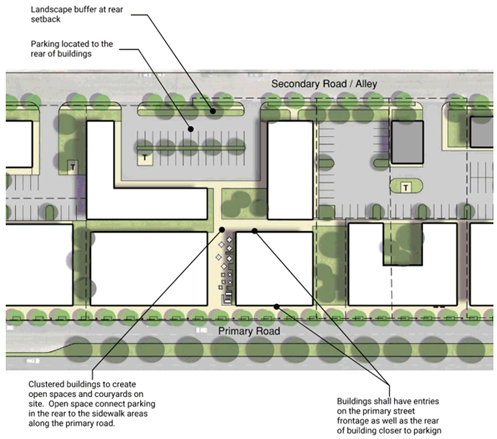
(h)
Buffers and screening.
(1)
Clearly differentiate public and private areas, and residential and non-residential uses, with separate building entrances, building and landscape design features, building separations, access control or a change in levels and materials.
(2)
Provide landscape buffers and/or low patio walls to reduce noise impacts and protect the privacy of residential units along high-traffic streets and intense uses.
(3)
All buildings shall provide a landscape buffer area within the rear and side yard setback area (See table 29.90.1, Mixed-use Zone Development Standards). The landscape area shall consist of existing and established native and naturalized vegetation and new container plant material comprised of twenty-four (24)-inch box trees at a minimum of twenty-five (25) feet on center and understory planting with minimum one (1) and five (5) gallon shrubs and groundcover. New planting shall consist of a combination of small, medium, and large-scale trees, shrubs, and groundcover. (See table 29-142.2 and table 29-142.3 for groundcover and shrub lists.)
(4)
Whether on a roof, side of a structure or on the ground, screen all mechanical equipment, utilities, trash enclosures, service/maintenance areas and parking zones of buildings and developments and provide buffers to mitigate nuisances and reduce their visual dominance. The method of screening shall be architecturally integrated with the adjacent structure in terms of materials, color, shape, size, and surrounding landscape. Individual mechanical equipment shall be continuously screened.
(5)
Vines, shrubs, and trees shall be used around garages, tuck-under parking spaces, and underground parking entrances to reduce their visual dominance.
(6)
Screen surface parking lots with landscape plantings, berms, and fencing, in accordance with sections 29-142 and 29-143.
(7)
Use open spaces, such as pedestrian plazas, paseos, greenways and courtyards, to serve dual functions as valuable community space and buffers between different uses.
(8)
A six (6) foot high solid masonry wall with a painted, stucco, or natural decorative masonry or adobe surface shall be constructed and maintained where a rear or interior side property line abuts a residential use or zone, in accordance with section 29-143.
(9)
Screening for outdoor storage (including cart storage) shall be determined by the height of the material or equipment being screened. Chain-link fencing is prohibited. When allowed, exterior storage shall be confined to portions of the site least visible to public view. Where screening is required, a combination of elements shall be used including solid masonry walls, berms, and landscaping.
(10)
Roll-up doors, drive-through aisles, and similar features shall be screened from view of adjacent streets by building orientation and/or the provision of landscaping, trellises, berms, or low walls that are consistent with the architecture and exterior materials of the building.
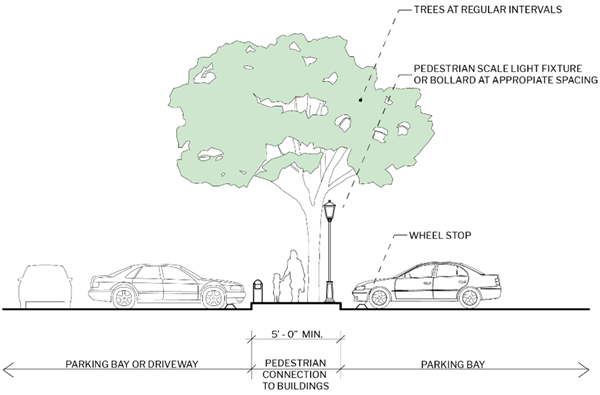
(i)
Roof treatments.
(1)
Provide variation in the roof lines of new development through breaks in parapets, varied parapet heights, pitched roofs, gabled roofs, and/or mansard roofs.
(2)
Provide variable or stepped building heights, both to provide visual interest and give the appearance of a collection of smaller structures.
(3)
All roof top equipment, including roof ladders, shall be screened from public view by screening materials of the same nature as the structure's basic materials. Mechanical equipment shall be located below the highest vertical element of the building.
(4)
The following roof materials shall not be used:
a.
Corrugated metal (standing rib metal roofs are permitted);
b.
Highly reflective surfaces (copper roofs may be considered); and
c.
Illuminated roofing.
(j)
Building materials, finishes, and colors.
(1)
The development's dwelling units, community facilities, and other structures shall provide a unified appearance through a consistent use of building materials, textures, and colors.
(2)
Exterior columns or supports for site elements, such as trellises and porches, shall utilize materials and colors that complement the materials and colors of other elements in the development.
(3)
Brick, stone, terra cotta, tiles, and copper shall be left in their natural colors. Veneer shall turn corners and avoid exposed edges.
(4)
Storefronts shall be of a non-reflective glazing. Mirrored glazing is prohibited for all storefronts facing an arterial street.
(5)
Use visually penetrable materials, such as wrought iron or tubular steel, for front yard fences and gates to encourage self-policing and discourage crime. Chain-link fencing is prohibited.
(6)
Add to the visual richness of facades by incorporating any two (2) or more of the following decorative details in new development:
a.
Tile base or trim at wall base, around windows, doors, and openings.
b.
Clay tile vents.
c.
Wood brackets/knee braces.
d.
Recessed niches.
e.
Window grilles.
f.
Pot shelfs.
g.
Wrought iron railing.
h.
Sconce lighting.
i.
Corbels.
j.
Stone or stucco window trim.
k.
Shutters.
(7)
Exterior building and roofing colors shall be appropriate to and enhance the architectural style and materials of the structure. Intense primary and secondary colors shall be avoided as the dominant overall color for a structure. The use of earth tones and soft muted colors is encouraged.
(8)
Exterior stairs (residential). When provided, simple, clean, bold projections of stairways are required to complement form of the structure. Stairways shall be of smooth stucco, plaster, or wood, with accent trim of complementary colors and railings appropriate to the architectural style of the structure. Thin-looking, open metal, prefabricated stairs are not allowed.
(k)
Street trees and streetscape improvements.
(1)
Street trees shall be placed in tree cutouts or a continuous parkway. Provide a fifty (50) square foot minimum area for all trees to allow for adequate root zone that is clear of anything with a footing that could cause potential damage to trees or roots. Landscaping and irrigation, decorative boulders, and small signage may be allowed in this area.
(2)
Ground plane treatment at the tree cutouts or parkway shall include a combination of understory planting, rock mulch and boulders. (See table 29-142.2 and table 29-142.3 for groundcover and shrub lists.)
(3)
For all new development, street tree species for Adams Avenue shall be Quercus virginiana (Southern Live Oak) and for S. Imperial Avenue shall be Ulmus parvifolia (Chinese Evergreen Elm).
(4)
For all mixed-use zones, streetlights shall match the city's adopted standard. These lights consist of a tall fixture to illuminate the street, low fixture to illuminate the sidewalk and decorative banner arms. Decorative banner arms shall face the street and the light post shall be set back thirty (30) inches from the back of the curb so that banners do not stick into travel lanes. Lights shall be placed at a maximum spacing of seventy-five (75) feet on center but may be spaced closer if needed to provide higher footcandles for adequate illumination of the sidewalk to meet code requirements.
(5)
All developments shall include one of the following furnishings for every fifty (50) linear feet of frontage street, located within the public right-of-way or front yard setback. Furnishings shall be coordinated with adjacent development to ensure a variety of furnishings are placed within the streetscape and that amenities are not duplicated with adjacent developments. Furnishings shall be a consistent design along the entirety of the street frontage. All furnishings shall comply with city requirements and regulations.
a.
Trash and recycle receptacles. Minimum thirty-five (35) gallon made of powder coated steel and covered with a lid to reduce water intrusion and to discourage inappropriate refuse use. Provide one (1) recycle and one (1) trash receptacle. Receptacles shall be surface mounted to the sidewalk.
b.
Benches: Provide a six (6) foot long bench with backs, arms and a center arm as a sleep deterrent. Benches shall consist of powder coated steel and/or aluminum slats and be permanently anchored to the sidewalk.
c.
Bike parking: Provide bike parking for a minimum of four (4) bikes with surface mounted bike racks. Bike racks shall consist of powder coated steel or stainless steel.
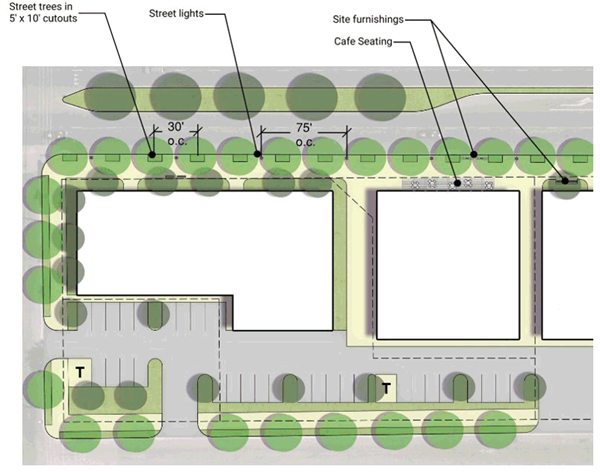
(l)
Refuse and recycling.
(1)
Refuse and recycling bins shall be located in a separate room, enclosed niche/recess area, or walled enclosure and must be well-screened with landscaping to protect adjacent uses from noise and odors.
(2)
All refuse and recycling storage in exterior areas shall be covered with a trellis or similar shade canopy structure.
(3)
All exterior areas set aside for storage and pickup of refuse and recycling bins shall be screened from view from any street or public place (excepting an alley serving a mixed-use zone), or from any property in a residential zone, by a six (6) foot high solid masonry wall with a painted, stucco, or natural decorative masonry or adobe surface on at least three (3) sides. All refuse and recycling storage shall be maintained below said wall or fence. Chain-link fencing is prohibited.
(4)
For mixed-use development, residential and non-residential waste streams shall be collected separately.
(5)
Refuse and recycling storage areas shall be located away from public streets at the rear or side of buildings and shall not be located within any required setback areas or impede parking lot access.
(6)
Refuse and recycling storage areas shall be conveniently accessible to the employees/residents of the units/buildings they are designed to serve. A clear and lighted pedestrian route shall be established to each trash area.
(7)
Refuse and recycling storage areas shall be located in a manner that is easily accessible for refuse pickup companies. Trash enclosures may be shared with adjacent development when adequately sized.
(8)
Each refuse and recycling storage area shall be provided with decorative solid heavy gauge metal gates designed with cane bolts to secure the gates when in the open and closed positions. Gates shall be designed not to swing into any drive aisle, parking space, walkway, and shall not otherwise interfere with onsite and offsite circulation. Gates shall be kept closed to provide screening, except during disposal or collection activity.
(m)
Drive-through business.
(1)
The minimum lot size of any drive-through business shall be ten thousand (10,000) square feet.
(2)
All drive-through fast food restaurants shall provide a drive-through lane with a minimum length of one hundred twenty (120) feet and a minimum width of ten (10) feet. All other drive-through businesses shall include a drive-through lane with minimum dimensions of thirty-six (36) feet in length and ten (10) feet in width.
(3)
Any drive-through lane shall have a shade canopy provided over the drive-through at the service or pick-up window.
(4)
All drive-through or drive-in fast food restaurants must have a minimum separation of five hundred (500) feet from any other business that operates a drive-through business.
(n)
Lighting.
(1)
Lighting shall be used to provide illumination for the security and safety of on-site areas such as building entrances, parking, loading, shipping and receiving, walkways and working areas.
(2)
The design of light fixtures and their structural support shall be architecturally compatible with the main structures on-site. Illuminators shall be integrated within the architectural design of the structures.
(3)
All lighting fixtures shall be shielded to confine light spread within the site boundaries.
(Ord. No. 24-03, § 2, 9-17-24)
Sec. 29-92. - Purpose and intent.
MO medical office overlay zone. This overlay zone is applied on parcels along S. Imperial Avenue shown on figure 29-92.1, in close proximity to the existing regional medical facilities and uses and provides options for residential property on lots not less than six thousand (6,000) square feet in area to transition to medical/professional office, remain single-family residential, or allow a combination of both uses in a live/work project. The underlying R1 single-family residential zoning remains in place to provide legal conforming land use status. Because potential development includes both residential and medical/professional office uses, the overlay zone includes both density and intensity standards.
Overall, the MO overlay zone intends to:
(1)
Implement the goals and policies of the general plan, by supporting the integration of living and working uses.
(2)
Provide new opportunities for employment uses at appropriate intensities and locations.
(3)
Identify a specific area in close proximity to the El Centro Regional Medical Center appropriate for the transition to medical and other small professional offices.
(4)
Encourage the transition from the current pattern of driveways serving each residence taking direct access from Imperial Avenue to alley-oriented access to improve safety and traffic flow along Imperial Avenue.
(5)
Support redevelopment of properties to medical/professional office and live/work (medical/professional office use).
(6)
Provide right-of-way that allows for a continuous bike lane along Imperial Avenue to implement the general plan circulation element.
Figure 29-91.1 Medical Office Overlay Zone
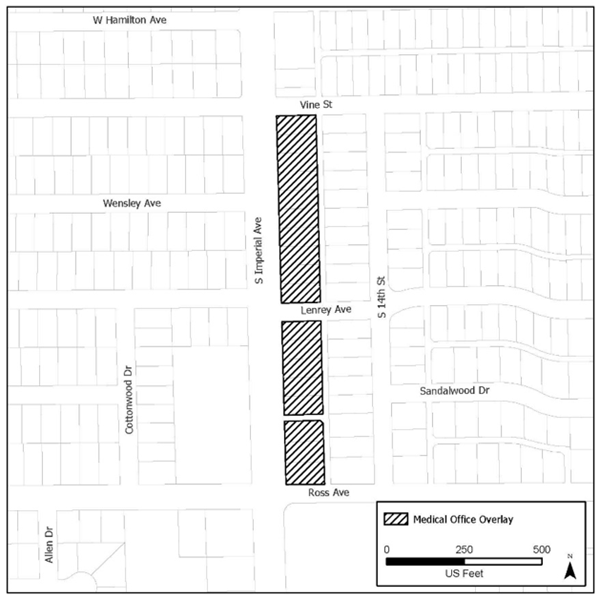
(Ord. No. 24-03, § 2, 9-17-24)
Sec. 29-93. - Medical office overlay zone use regulations.
Development and redevelopment in the medical office overlay zone shall be pursuant to the R1 single-family residential zone use regulations identified in section 29-53.
Additionally, medical office uses (including chiropractic, dentistry and veterinary), professional offices uses noted below, and live/work shall be subject to site plan review and shall be permitted uses, only if the project fully complies with all development and design standards of this division.
Within the MO overlay zone, only the following occupations are intended for the professional office component of the live/work use: medical offices; accountants; architects; attorneys; computer software and multimedia related professionals; consultants; engineers; photographers, and other occupations deemed by the director to be similar and compatible with residential neighborhoods.
(Ord. No. 24-03, § 2, 9-17-24)
Sec. 29-94. - Medical office overlay zone development standards.
The following minimum property development standards identified in table 29-94.1 shall apply to all land and buildings in the medical office overlay zone, except that any lot shown on an official subdivision map duly approved and recorded, or any lot for which a bona fide deed had been duly recorded prior to the effective date of this chapter may be used as a building site. See also article III of this chapter for exceptions to, or clarification of, these regulations.
Additionally, before any structures and outdoor uses for medical/professional office uses and live/work (medical/professional office use) are established in a medical office overlay zone, a site plan shall be submitted to and approved by the community development director, pursuant to article V, division 3 of this chapter.
Table 29-94.1 Medical Office Overlay Zone Property Development Standards
(Ord. No. 24-03, § 2, 9-17-24)
Sec. 29-95. - Medical office overlay zone design standards.
(a)
Purpose. New development and redevelopment activities in the medical office overlay zone must be consistent with the design standards of this section. These standards are intended to transition homes to medical/professional offices and avoid new development or redevelopment that would conflict with the nature of existing residential development in the medical office overlay zone. These standards ensure the highest level of design quality while at the same time providing the flexibility necessary to encourage creativity on the part of project designers.
(b)
Parking and access.
(1)
Off-street parking for business patients and patrons shall be accessed from a rear alley and located at the rear of the lot. Use of the front yard and existing driveway(s) of existing homes for patient and patron parking is prohibited. Existing driveways shall be used for delivery vehicles and residents only.
(2)
Parking areas shall be bordered on all sides that face abutting properties by perimeter walls/fencing with a minimum height of six (6) feet and screening that provides a minimum opacity of fifty (50) percent.
(3)
Redevelopment and new development of medical/professional offices or live/work shall not take access from Imperial Ave. All existing curb cuts along Imperial Ave shall be removed as part of any project. Parking access shall be taken from the alley to improve traffic flow and safety.
(4)
Alleys shall be paved as a part of any proposed project and shall utilize green alley principles, which must include some pervious paving areas to account for stormwater treatment. Types of pervious paving may include but are not limited to porous concrete, porous asphalt, permeable pavers, turf block, gravel pave, grass pave or grasscrete. A twelve (12) foot-wide paved area for regular vehicular traffic shall be provided for all alleys within the MO overlay zone.
(5)
Shared parking is highly encouraged. Parking lot access may require a shared access easement with adjacent property owners. See section 29-138, shared parking facilities.
(6)
Incorporate any two (2) or more of the following design features in surface parking areas of the development:
a.
Carports/shade structures providing a minimum of fifty (50) percent shade covering for parking area.
b.
A minimum ten (10) foot-wide landscape area (trees, shrubs, groundcover) at the exterior perimeter of all parking lots. The ten (10) foot landscape area may consist of existing and established native and naturalized vegetation and new container plant material comprised of minimum of twenty-four (24)-inch box trees and one (1) and five (5) gallon shrubs and groundcover. New planting should consist of a combination of small, medium, and large-scale trees, shrubs, and groundcover. (See table 29-142.2 and table 29-142.3 for groundcover and shrub lists.).
c.
One (1) tree per two hundred (200) square feet of landscaping or one (1) tree per every five (5) parking spaces, whichever is more. The required trees shall be a minimum of twenty-four (24)-inch box in size when planted. Trees shall be of appropriate size and trunk diameter for the specified container and tree type. Tree spacing may be varied to accommodate site conditions or design considerations; however, the total number of trees calculated for all parking areas shall be maintained.
d.
Increased pervious paving with a high albedo, such as permeable pavers, porous asphalt, reinforced grass pavement (turf-crete), stone pavers and other permeable materials.
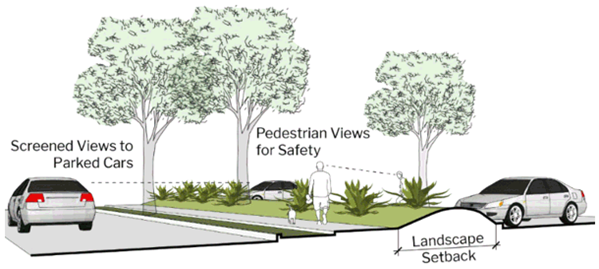
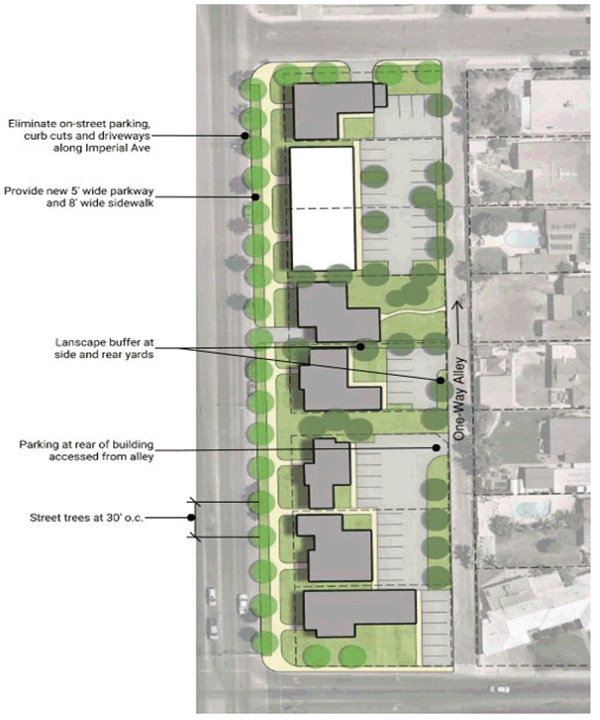
(c)
Street trees and streetscape.
(1)
A five (5) foot-wide continuous parkway shall be added along Imperial Avenue and shall be planted with street trees with a spacing of thirty (30) feet on center. The parkway ground plane treatment shall include a combination of understory planting, rock mulch and boulders. (See table 29-142.2 and table 29-142.3 for groundcover and shrub lists.).
(2)
Street tree species shall be Ulmus parvifolia (Chinese Evergreen Elm) and shall be consistent for entire length of street.
(3)
Furnishings shall be a consistent, cohesive design along the entirety of the street frontage. All furnishings shall be approved by the city and in compliance with city requirements and regulations.
(4)
An eight (8) foot-wide concrete sidewalk consisting of ADA compliant paving shall be provided adjacent to the parkway. ADA compliant walks shall connect the public sidewalk to any building.
(5)
All on-street parking shall be eliminated from Imperial Avenue within the MO overlay zone to allow for dedicated bike lanes.
(d)
Front door.
(1)
The front door to the business shall be visible from the street, easily accessible by foot, and connected by a continuous pedestrian path that leads to the street. The pathway connecting the front door of the business to the street must be independent from the driveway of an existing/previously existing house.
(2)
If a gate is provided between the front door and the street, the gate shall be clearly marked as the main entrance to the business and include a doorbell, directory, call box, or other means of communication for patients and patrons to be allowed access to the business.
(3)
Exterior waiting areas are prohibited. All waiting and reception areas of the business shall be interior to the building.
(e)
Compatibility.
(1)
New medical/professional office buildings that replace existing single-family residential shall be limited to two (2) stories.
(2)
Where a proposed medical/professional office building abuts existing residential uses on adjacent lots, an additional five (5)-foot side yard setback shall be provided, except that where the proposed development provides clearstory windows with a sill height of a minimum of five (5) feet or zero windows facing the side yard, the minimum side yard setback may remain in place according to table 29-94.1.
(3)
Where a proposed medical/professional office building abuts existing residential uses on adjacent lots, an offset of a minimum two (2) feet in the building plane (either horizontally or vertically) shall be required for every one hundred (100) square feet of building facade.
(4)
Reflective or mirrored glass facing interior property lines is prohibited.
(f)
Buffers and screening.
(1)
All buildings shall provide a landscape buffer area within the rear and side yard setback area (See table 29.94.1, medical office overlay zone development standards). The landscape area shall consist of existing and established native and naturalized vegetation and new container plant material comprised of twenty-four (24)-inch box trees at a minimum of twenty-five (25) feet on center and understory planting with minimum one (1) and five (5) gallon shrubs and groundcover. New planting shall consist of a combination of small, medium, and large-scale trees, shrubs, and groundcover. (See table 29-142.2 and table 29-142.3 for groundcover and shrub lists.)
(2)
A six (6) foot high solid masonry wall with a painted, stucco, or natural decorative masonry or adobe surface shall be constructed and maintained where a rear or interior side property line abuts a residential use or zone.
(g)
Lighting.
(1)
All lighting on the property shall be designed to be directed inward into the property to minimize glare and spillover into neighboring properties.
(2)
Lighting shall be used to provide illumination for the security and safety of on-site areas such as parking and walkways. Lights shall not be designed for or used as an advertising display.
(h)
Signage.
(1)
Provide clear and visible signage on both the street and rear side of the site indicating the location of patient and patron parking entrance(s).
(2)
Provide a clear and visible professional sign indicating the name and service of the business. The sign shall conform to the following design standards:
a.
Size. The maximum size shall be ten (10) square feet.
b.
Illumination. All signs shall be externally illuminated. Internally illuminated signs are prohibited.
c.
Location. Except as provided below, all signs shall be affixed to the building facade above the primary public entrance to the business. A sign placed over the building facade shall not cover a window, door, or architectural detail of the building. A sign may project out from the building facade up to one (1) foot if parallel to the facade and four (4) feet if perpendicular to the facade (a "projecting sign").
d.
Monument and directory signs. Business name and directory signage may be mounted to a monument, post, or garden wall/fence located in the front yard of the property and shall be limited in size to ten (10) square feet and eight (8) feet in height.
e.
Material. Sign materials shall include wood, faux wood, metal, or plastic with a minimum thickness of one-half (½) inch. Vinyl is prohibited.
f.
Advertising. All advertising shall be provided in separate and removable freestanding signs and shall not be affixed to the building.
(Ord. No. 24-03, § 2, 9-17-24)
Sec. 29-96. - Purpose and intent.
MU2 mixed-use 2 overlay zone. This overlay zone is applied on parcels within the more intensive general commercial and tourist commercial zones, as depicted on the adopted zoning map. The intent of the overlay zone is to provide for a mix of missing middle housing, multi-family residential, and non-commercial uses to support an active, community- or regional-serving serving corridor, area, or activity center. This overlay zone includes the development of high-medium to higher density apartment, condominium, townhouse, duplex and triplex dwellings with a minimum density of twenty-one (21) dwelling units per acre and a maximum density of thirty (30) dwelling units per net acre, on lots not less than seven thousand two hundred (7,200) square feet in net area. A maximum density of thirty-eight (38) dwelling units per net acre may be approved for senior-only projects or a senior portion of a project in compliance with article IV, division 4, density bonus. Because mixed-use development includes both residential and nonresidential uses, the overlay zone includes both density and intensity standards.
Overall, the MU2 overlay zone intends to:
(1)
Implement the mixed-use goals and policies of the general plan, by creating or reactivating vital areas for living, working, shopping, and recreating.
(2)
Ensure that mixed-use development is of high quality and contains a unified development plan with thoughtful integration of complementary residential uses.
(3)
Provide a variety of housing types and densities to support the diverse population and local workforce.
(4)
Create a lively setting for more intense commercial activities that promotes a mix of local and regional serving businesses.
(5)
Enrich opportunities for amenity spaces, artwork and community involvement.
(6)
Support walkability within an individual project and throughout the mixed-use area, with an emphasis on facilitating pedestrian, bicycling, and transit connections.
(7)
Enhance economic development, community identity and property values within El Centro.
(8)
Provide opportunity to further activate and support the El Centro mall area by enabling the development of housing in close proximity to an established retail area.
(Ord. No. 24-03, § 2, 9-17-24)
Sec. 29-97. - Mixed-use 2 overlay zone use regulations.
Development and redevelopment in the mixed-use 2 overlay zone shall be pursuant to the underlying (CG general commercial or CT tourist commercial) zone use regulations identified in section 29-61.
Mixed-use developments and stand-alone residential developments shall be permitted uses, only if the project fully complies with all development and design standards of this division.
(Ord. No. 24-03, § 2, 9-17-24)
Sec. 29-98. - Mixed-use 2 overlay zone development standards.
The following minimum property development standards identified in table 29-98.1 shall apply to all land and buildings in the mixed-use overlay zones, except that any lot shown on an official subdivision map duly approved and recorded, or any lot for which a bona fide deed had been duly recorded prior to the effective date of this chapter may be used as a building site. See also article III of this chapter for exceptions to, or clarification of, these regulations.
Additionally, before any building, structure, or use of land outside of a building or structure, is established in a mixed-use 2 overlay zone, a site plan shall be submitted to and approved by the community development director, pursuant to article V, division 3 of this chapter. If specified by this chapter, such site plan review shall be conducted by the planning commission and/or city council.
Table 29-98.1 Mixed-use Overlay Zones Development Standards
(Ord. No. 24-03, § 2, 9-17-24)
Sec. 29-99. - Mixed-use 2 overlay zone design standards.
(a)
Purpose. These design standards are intended to assist the project applicant in understanding the city's requirements for high quality development. These mandatory standards complement the development regulations contained in this division by providing good examples of potential design solutions and by providing design interpretations of the various mandatory regulations. These standards ensure the highest level of design quality while at the same time providing the flexibility necessary to encourage creativity on the part of project designers.
(b)
Primary community amenity spaces in residential buildings.
(1)
The primary community amenity spaces of a residential building or complex (such as lobbies, gyms, leasing offices, shared work spaces, clubhouses, community rooms, recreation rooms, and lounges) shall be located directly adjacent or within one hundred (100) feet distance of a public way, private drive, primary building entrance, and/or primary pedestrian path.
(c)
Block connectivity.
(1)
Orient development in ways that create compact blocks and lots. A 'block' is defined as an area of development that is delineated on all sides by any of the following elements: public streets, paseos, trails, parks, community facilities, and/or private internal streets. Except where site-specific circumstances preclude it, blocks within the MU-2 overlay zone shall have a maximum of perimeter of two thousand (2,000) feet.
(2)
A minimum of one (1) paseo and one (1) bicycle access way into the development shall be provided for approximately every five (5) acres of developable area.
(3)
Private drives shall connect public rights-of-way to multiple locations within a development. Where private drives are provided, they shall comply with the following:
a.
Private drives shall be designed to reduce conflicts between vehicles and pedestrian and bicycle circulation.
b.
Sidewalks shall be provided along both sides of private drives.
c.
The alignment of private drives shall be coordinated and connected to the public right-of-way, emphasizing interconnected streets and the ability to reach local destinations through multiple routes.
d.
The number of trees required for each private drive frontage shall be calculated at the average rate of one (1) twenty-four (24)-inch box canopy tree for every forty (40) feet of private drive frontage. Tree spacing may be varied to accommodate site conditions or design considerations.
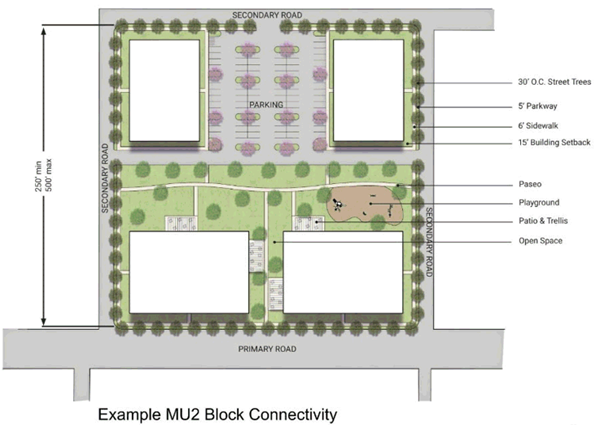
(4)
New streets or private roads shall be provided throughout the development area in order to create an orderly network of streets, connections and developable parcels. New streets shall be provided so that minimum block sizes are two hundred fifty (250) feet, but no block length shall exceed five hundred (500) feet in length.
(5)
The pedestrian circulation of MU-2 developments shall include three (3) or more of the following features:
a.
Artwork.
b.
Open air cafe; with food service.
c.
Covered arcade, colonnade, or veranda.
d.
Recessed building entrance with a minimum recess of ten (10) feet.
e.
Widened sidewalk with a minimum width of fifteen (15) feet.
f.
Pedestrian through block connection (paseo) with a minimum width of ten (10) feet.
g.
Plaza with a minimum width of forty (40) feet and a minimum depth of twenty (20) feet.
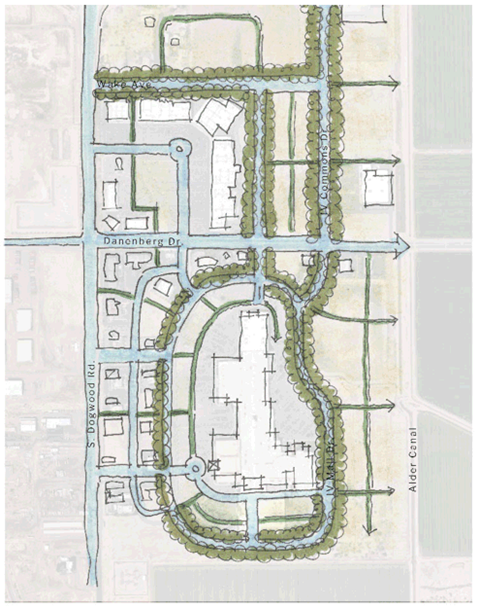
(d)
Building siting, access, orientation, and shade.
(1)
Developments shall comply with design standards under section 29-91(b).
(e)
Building frontage design.
(1)
Developments shall comply with design standards under section 29-91(d).
(f)
Building scale, massing, and articulation.
(1)
Developments shall comply with design standards under section 29-91(e).
(g)
Circulation and parking.
(1)
Developments shall comply with design standards under section 29-91(f).
(h)
Open spaces and public access.
(1)
Developments shall comply with design standards under section 29-91(g).
(i)
Buffers and screening.
(1)
Developments shall comply with design standards under section 29-91(h).
(j)
Buffers and screening from existing commercial service areas.
(1)
New residential buildings abutting or facing the rear and service side of commercial shopping centers and other "big box" stores shall be set back from the right-of-way with a twenty (20) foot-wide buffer zone.
(2)
The twenty (20) foot-wide buffer zone shall include open space and landscaped areas and slopes, including the following: trellises, garden walls and fences not exceeding six (6) feet in height, retaining walls, lighting, signage, and pedestrian circulation elements.
(3)
The minimum fifteen (15) foot-wide landscaped area (trees, shrubs and groundcover) shall be provided in the twenty (20) foot-wide buffer.
(4)
New residential buildings shall be oriented with the long dimension of the building perpendicular to existing commercial centers.
(k)
Roof treatments.
(1)
Developments shall comply with design standards under section 29-91(i).
(l)
Building materials, finishes, and colors.
(1)
Developments shall comply with design standards under section 29-91(j).
(m)
Street trees and streetscape improvements.
(1)
Street trees shall be placed in a continuous parkway. Provide a forty (40)square foot minimum area for all trees to allow for adequate root zone that is clear of anything with a footing that could cause potential damage to trees or roots. Landscaping and irrigation, decorative boulders, and small signage may be allowed in this area.
(2)
Street tree species to be consistent the entire stretch of each street segment.
(3)
Ground plane treatment at the tree cutouts or parkway shall include a combination of understory planting, rock mulch and boulders. Turf shall not be placed within parkway areas. (See table 29-142.2 and table 29-142.3 for groundcover and shrub lists.)
(4)
All developments are encouraged to use medians and parkways for stormwater collection and treatment in order to make a landscape feature out of the stormwater system. Concrete lined channels shall not be used for stormwater treatment areas.
(5)
Developments shall comply with design standards under section 29-91(k)(4)and(5).
(n)
Refuse and recycling.
(1)
Developments shall comply with design standards under section 29-91(l).
(o)
Drive-through business.
(1)
Developments shall comply with design standards under section 29-91(m).
(p)
Lighting.
(1)
Developments shall comply with design standards under section 29-91(n).
(Ord. No. 24-03, § 2, 9-17-24)

