
El Cerrito City Zoning Code
PART IV
- Regulations Applying In Some or All Districts
Chapter 19.20 - STANDARDS FOR SPECIFIC USES
Sections:
Chapter 19.21 - GENERAL SITE STANDARDS
Sections:
Chapter 19.22 - AFFORDABLE HOUSING BONUS
Sections:
Chapter 19.23 - INCENTIVES PROGRAM
Sections:
Chapter 19.24 - OFF-STREET PARKING AND LOADING
Sections:
Chapter 19.25 - LANDSCAPING AND BUFFER YARDS
Sections:
Chapter 19.26 - SIGN REGULATIONS
Sections:
Chapter 19.27 - NONCONFORMING USES, STRUCTURES, AND LOTS
Sections:
Chapter 19.28 - WIRELESS TELECOMMUNICATIONS FACILITIES
Sections:
Chapter 19.30 - INCLUSIONARY ZONING
Sections:
19.20.010 - Purpose and other applicable standards.
This Chapter establishes standards applicable to specific uses listed in Part II. Base Districts, that are in addition to standards listed in this Zoning Ordinance including, but not limited to, development standards in the base zoning districts, Chapter 19.24, Off-Street Parking and Loading, Chapter 19.25, Landscaping and Buffer Yards, and Chapter 19.26, Sign Regulations. Where a standard of this Chapter conflicts with another provision of this Zoning Ordinance, the stricter standard shall apply.
(Ord. 2008-2 Div. II (part), 2008.)
19.20.020 - Adult businesses.
The following findings, definitions and standards shall apply to adult businesses within the City of El Cerrito.
(Ord. 2008-2 Div. II (part), 2008.)
19.20.021 - Findings and intent.
A.
The City Council takes legislative notice of the existence, content and findings of the following studies concerning the adverse secondary effects of adult entertainment businesses: New York, New York (1994); Garden Grove, California (1991); Seattle, Washington (1989); Austin, Texas (1986); Houston, Texas (1986); Indianapolis, Indiana (1984); Phoenix, Arizona (1979); Whittier, California (1978); Amarillo, Texas (1977); Los Angeles, California (1977). Copies of these studies are hereby made a part of the record of the consideration of this code and are available for inspection in the office of the Director of Community Development.
B.
The City Council also takes legislative notice of the facts set forth in numerous reported court opinions regarding the adverse secondary effects of adult entertainment businesses. See, e.g., California v. La Rue, 409 U.S. 109 (1972) (describing on-premises sexual contacts between adult entertainment business customers and entertainers, as well as the on-premises occurrence of prostitution).
C.
The City Council finds that these studies and court opinions are, in whole or in part, relevant to the problems addressed by the City of El Cerrito in enacting this code. The City Council further finds that these studies and court opinions provide convincing evidence that adult entertainment businesses generate adverse secondary effects. These adverse secondary effects include, but are not limited to: depreciation of property values; increased vacancy rates in residential and commercial areas; increased criminal activity; increased litter, noise, and vandalism; and interference with the enjoyment of residential property in the vicinity of such businesses.
D.
In accordance with City of Renton v. Playtime Theatres, Inc., 475 U.S. 41 (1986), the City Council has relied on these studies and court opinions, in whole or in part, in enacting this code. The purpose of this code is to regulate adult entertainment businesses in a manner that eliminates or mitigates the adverse secondary effects noted in Paragraph "C" above.
E.
The City Council recognizes that sexually explicit, non-obscene entertainment is constitutionally protected. In enacting this code, the City Council does not intend to restrict or deny access by adults to such entertainment nor to deny the distributors and exhibitors of such entertainment access to their targeted market.
F.
This code does not condone or legitimize any unlawful sexual activities or the distribution of obscene matter. The City Council recognizes that state law prohibits certain sexual activities and the distribution of obscene matter.
G.
The City Council finds that the regulations imposed by this code provide a reasonable opportunity for adult entertainment businesses to operate within the City of El Cerrito. In the establishment of these regulations, the City Council considered their effects on the number and suitability of locations for adult entertainment businesses.
(Ord. 2008-2 Div. II (part), 2008.)
19.20.022 - Purpose.
The purpose of this section is to prevent community-wide adverse secondary effects that can be generated by the unregulated operation of adult entertainment businesses. These adverse secondary effects include, but are not limited to: depreciation of property values; increased vacancy rates in residential and commercial areas; increased criminal activity; increased litter, noise, and vandalism; and interference with the enjoyment of residential property in the vicinity of such businesses.
(Ord. 2008-2 Div. II (part), 2008.)
19.20.023 - Definitions.
For the purpose of this section, unless it is plainly evident from the context that a different meaning is intended, the following definitions shall apply:
A.
"Adult entertainment business" shall mean any of the following:
1.
Adult arcade. An "adult arcade" is an establishment where, for any form of consideration, as a regular and substantial course of conduct one (1) or more still or motion picture projectors, or similar machines, for viewing by five (5) or fewer persons each, are used to show films, computer generated images, motion pictures, video cassettes, slides or other photographic reproductions that are characterized by an emphasis upon specified sexual activities or the exposure of specified anatomical areas.
2.
Adult cabaret. An "adult cabaret" is an establishment that, for any form of consideration, as a regular and substantial course of conduct presents live performances that are characterized by an emphasis upon specified sexual activities or feature any semi-nude person.
3.
Adult motion picture theater. An "adult motion picture theater" is an establishment that, for any form of consideration, as a regular and substantial course of conduct offers to show films, computer-generated images, motion pictures, video cassettes, slides, or other photographic reproductions that are characterized by an emphasis upon specified sexual activities or the exposure of specified anatomical areas.
4.
Adult retail store. An "adult retail store" is an establishment that, for any form of consideration, as a regular and substantial course of conduct offers for sale, rent, or viewing either adult entertainment material, adult entertainment merchandise or both.
5.
Any business that, for any form of consideration, as a regular and substantial portion of conduct offers to its patrons products, merchandise, services or entertainment characterized by an emphasis upon specified sexual activities or the exposure of specified anatomical areas.
B.
"Adult entertainment material" shall mean any audio tape, book, periodical, magazine, photograph, drawing, sculpture, motion-picture film, videotape recording, digital video disk, computer program, or other visual representation, characterized by an emphasis upon specified sexual activities or the exposure of specified anatomical areas.
C.
"Adult entertainment merchandise" shall mean adult entertainment implements or paraphernalia, such as, but not limited to: dildos; auto sucks; vibrators; edible underwear; benwa balls; inflatable orifices; anatomical balloons with orifices; simulated vaginas and similar adult entertainment devices that are designed or marketed primarily for the stimulation of human genital organs or sadomasochistic activity.
D.
"Characterized by an emphasis upon" shall mean the dominant or essential theme of the object described by such phrase.
E.
"Educational Institution" shall mean any institution of learning for minors, whether public or private, offering instruction in the courses of study required by the California Education Code and maintained pursuant to standards set by the State Board of Education. This definition includes a nursery school, kindergarten, elementary school, middle or junior high school, senior high school, or any special institution of education, but it does not include a vocational or professional institution of higher education, including a community or junior college, college or university.
F.
"Owner" shall mean the following: (i) the sole proprietor of an adult entertainment business; (ii) any general partner of a partnership that owns and operates an adult entertainment business; (iii) the owner of a controlling interest in a corporation that owns and operates an adult entertainment business; or (iv) the person designated by the officers of a corporation to be the zoning clearance holder for an adult entertainment business owned and operated by the corporation.
G.
"Park" shall mean a park, playground, swimming pool, recreational facility or athletic field within the City that is under the control, operation or management of the City or any other public entity.
H.
"Regular and substantial course of conduct" shall mean that any of the following conditions exist:
1.
At least thirty percent (30%) of the stock-in-trade is devoted to adult entertainment material, adult entertainment merchandise, or both; provided, however, that this criteria shall not apply to mail order businesses or wholesale businesses with no patrons on the premises;
2.
At least thirty percent (30%) of the total display area is devoted to adult entertainment material, adult entertainment merchandise, or both; provided, however, that this criteria shall not apply to mail order businesses or wholesale businesses with no patrons on the premises;
3.
The business presents any type of entertainment, live or otherwise, characterized by an emphasis upon specified sexual activities or featuring any nude or semi-nude person on any four (4) or more separate days within any thirty (30) day period; or
4.
At least thirty percent (30%) of the gross receipts of the business are derived from the sale, trade, rental, display or presentation of services, products, materials or entertainment that is characterized by an emphasis upon specified sexual activities or the exposure of specified anatomical areas.
I.
"Religious Institution" shall mean property that is used primarily for religious worship and related religious activities.
J.
"Semi-nude" shall mean a state of dress in which clothing covers no more than the genitals, pubic region, buttocks, areola and nipple of the female breast, as well as portions of the body covered by supporting straps or devices.
K.
"Specified anatomical areas" shall mean the following:
1.
Less than completely and opaquely covered human:
a.
genitals or pubic region;
b.
buttocks; and
c.
female breast below a point immediately above the top of the areola;
2.
Human male genitals in a discernibly turgid state even if completely and opaquely covered;
3.
Any device, costume or covering that simulates any of the body parts included in paragraph 1 or 2 above.
L.
"Specified sexual activities" shall mean any of the following, whether performed directly or indirectly through clothing or other covering:
1.
The fondling or other erotic touching of human genitals, pubic region, buttocks, anus, or female breast;
2.
Sex acts, actual or simulated, including intercourse, oral copulation, or sodomy;
3.
Masturbation, actual or simulated; or
4.
Excretory functions as part of, or in connection with, any of the other activities described in subparagraphs 1 through 3 of this paragraph.
M.
"Zoning Administrator" shall mean the Zoning Administrator as designated by the Director of Community Development.
(Ord. 2008-2 Div. II (part), 2008.)
19.20.024 - Zoning clearance application.
It is unlawful for any person to operate, engage in, conduct or carry on any adult entertainment business unless the owner of such business first obtains from the Zoning Administrator a zoning clearance for such business.
A.
Applications for a zoning clearance shall be submitted on a form provided by the Zoning Administrator and shall be accompanied by a nonrefundable application fee in an amount established by Resolution of the City Council.
B.
If the Administrator determines that the applicant has completed the application improperly, the Administrator shall promptly notify the applicant of such fact and shall return the application unprocessed. On request of the applicant, the Administrator shall grant the applicant an extension of time of ten (10) days to complete the application properly. The time period for granting or denying the requested zoning clearance shall be stayed during the period in which the applicant is granted an extension of time.
(Ord. 2008-2 Div. II (part), 2008.)
19.20.025 - Approval or denial of zoning clearance.
The Administrator shall, within thirty (30) city business days of the filing of a complete application, approve and issue a zoning clearance if the provisions of Section 19.20.026 (Location criteria) have been satisfied; otherwise the zoning clearance shall be denied. Notice of the approval or denial of the zoning clearance shall be given to the applicant in writing by first class mail, postage prepaid, deposited in the course of transmission with the United States Postal Service on the date of such decision. If the application is denied, the Administrator shall attach to the notice a statement of the reasons for the denial. The time period set forth in this paragraph shall not be extended except upon the written consent of the applicant.
(Ord. 2008-2 Div. II (part), 2008.)
19.20.026 - Location criteria.
A.
Separation Requirements. An adult entertainment business may be located in the districts specified in this code, provided that the business satisfies all of the following requirements:
1.
The adult entertainment business is not within one thousand two hundred (1,200) feet of any other adult entertainment business located within or outside the City.
2.
The adult entertainment business is not within three hundred fifty (350) feet of any residential (RS, RM or RD) district boundary.
3.
The adult entertainment business is not within one thousand (1,000) feet of any educational or religious institution.
4.
The adult entertainment business is not within three hundred (300) feet of any public park.
B.
The distances set forth in subsection A above shall be measured as a straight line, without regard to intervening structures or objects, from the property line of the property containing the adult entertainment business to the property line of the property so used at the time of submission of the permit application; provided, however that the distances between adult entertainment businesses as set forth in paragraph (1) of subsection A above shall be measured from the outside wall of the tenant space of each adult entertainment business.
C.
No adult entertainment business may be located within the City except as provided in this section.
D.
Nontransferable. No person shall operate an adult entertainment business under the authority of a zoning clearance at any place other than the address of the adult entertainment business stated in the application for the zoning clearance.
E.
Number of Businesses. No building, structure or other facility shall contain more than one (1) type of adult entertainment business, as such types of adult entertainment businesses are defined in this code.
F.
Regulations Nonexclusive. The provisions of this code regulating adult entertainment businesses are not intended to be exclusive and compliance therewith shall not excuse noncompliance with any other applicable provisions of this code or any other applicable law.
(Ord. 2008-2 Div. II (part), 2008.)
19.20.027 - Appeals.
Any decision of the Zoning Administrator may be appealed in accordance with Chapter 19.39 of this Zoning Ordinance.
(Ord. 2008-2 Div. II (part), 2008.)
19.20.030 - Automated teller machines (ATMs).
ATMs located within a building are permitted; ATMs located exterior to a building or on the exterior wall fronting a public sidewalk require administrative design review per the provisions of Chapter 19.38, Design Review and must also be approved by the Public Works Director and the Chief of Police to ensure safety and adequate circulation area.
(Ord. 2008-2 Div. II (part), 2008.)
19.20.040 - Automobile/vehicle sales and services.
Automobile/Vehicle Sales and Services shall be located, developed and operated in compliance with the following standards:
A.
Minimum Lot Size. Automobile/Vehicle Sales and Services may not be located on any lot smaller than 10,000 square feet in area.
B.
Landscaping and Buffer Yards. In addition to the requirements of Chapter 19.25, Landscaping and Buffer Yards, which apply to any commercial use adjacent to a residential use, the following buffer and landscaping requirements apply to any Automobile/Vehicle Service and Repair use:
1.
For parking and other unenclosed areas along street-facing yards, a decorative masonry wall, or wrought iron fence two and one half to three and one half feet in height shall be provided, located between six and 10 feet from the back of the sidewalk. Landscaping between the sidewalk and wall or fence is required. Landscaped areas shall be enclosed by either a six inch concrete curb or masonry wall to prevent damage from automobiles. Chain-link fencing is prohibited.
2.
Notwithstanding any provision in Chapter 19.25, Landscaping and Buffer Yards to the contrary, landscaping shall comprise a minimum of 10 percent of the site area, exclusive of required setbacks. All landscaped areas shall be permanently maintained in compliance with Chapter 19.25, Landscaping and Buffer Yards. Additional landscaping may be required where necessary to prevent visual impacts to adjacent properties.
C.
Buildings. All sales buildings shall be built abutting the sidewalk and must have views into the building or window displays at least three feet deep.
D.
Lighting. In addition to the lighting standards required in Section 19.21.050(A), all exterior light sources, including canopy, perimeter, and floodlights, shall be energy-efficient, stationary, and shielded or recessed within the roof canopy to ensure that all light and glare is directed away from adjacent properties and public rights-of-way. Lighting shall not be of an intensity that causes a traffic hazard, be used as an advertising element, or adversely affect adjacent properties.
E.
Noise. All body and fender work, or similar noise-generating activity, shall be enclosed in a masonry or similar building with sound buffers to absorb noise. Automobile/Vehicle Sales and Services shall comply with the noise requirements in Section 19.21.050(B).
F.
Intercom Speaker. Noise levels measured at the property line of a drive-in or drive-through service facility shall not increase the existing ambient noise levels in the surrounding area. Noise shall comply with the standards in Section 19.21.050(B). All outdoor speakers shall be directed away from any residential district.
G.
Work Areas for Automobile/Vehicle Service and Repair Uses. All automobile/vehicle service and repair activities, including disassembly and assembly activities, shall be performed within an enclosed building. Vehicle bays shall not directly face public streets and shall be screened from view from public rights-of-way.
H.
Litter. The premises shall be kept in a clean and orderly condition at all times. No used or discarded automotive parts or equipment or permanently disabled, junked, or wrecked vehicles may be stored within public view.
I.
Hazardous Materials. All necessary permits for the storage and use of hazardous materials shall be obtained. All automotive fluids shall be recycled or removed according to applicable state and federal standards.
J.
Vehicle Display. All vehicles displayed shall be in clean, attractive, operating condition and shall not be stored in the public right-of-way.
K.
Temporary Signs. The use of signs and advertising displays may be permitted for occasional special events or temporary sales, subject to the requirements of Chapter 19.26, Sign Regulations, regarding approval of temporary signs.
L.
Exceptions. Exceptions to the standards in subsections (A) — (J) of this Section may be allowed with the approval of a Conditional Use Permit subject to the findings required for use permits in Section 19.34.040 and finding that:
1.
There will be no adverse impacts on nearby residential uses.
2.
The use will result in positive enhancement to the financial success and attractiveness of the commercial district.
M.
Design Review. Design review shall be required for the establishment of all Automobile/Vehicle Sales and Service uses, and all site and building improvements for new or existing Auto/Vehicle Sales and Service Uses.
(Ord. 2008-2 Div. II (part), 2008.)
19.20.050 - Bed and breakfasts.
Bed and Breakfast establishments shall be located, developed, and operated in compliance with the following standards:
A.
Type of Residence. A Bed and Breakfast must be located, developed and operated in a single-family dwelling in which the owners of the business reside.
B.
Number of Rooms. No more than two rooms for rent may be allowed without a Conditional Use Permit.
C.
Appearance. In all residential districts, the exterior appearance of a structure housing a bed and breakfast establishment shall not be altered from its original single-family character.
D.
Business License Required. A current business license shall be obtained and posted in compliance with Title 6 of the El Cerrito Municipal Code.
E.
Limitation on Services Provided. Meals and rental of bedrooms shall be limited to registered guests. Separate or additional kitchens for guests are prohibited.
F.
Parking. One off-street parking space for every two guest rooms is required, in addition to the requirements for the dwelling itself, as prescribed in Chapter 19.24, Off-Street Parking and Loading.
(Ord. 2008-2 Div. II (part), 2008.)
19.20.060 - Day care centers.
Day care centers shall be located, developed and operated in compliance with the following standards:
A.
Landscaping and Buffer Yards. Landscaping and buffer yards adjacent to residential districts shall be provided for day care centers, pursuant to the standards prescribed by Chapter 19.25, Landscaping and Buffer Yards. In addition to the requirements of Chapter 19.25, a periphery wall, constructed of wood or masonry, shall be provided for purposes of securing outdoor play areas and screening the site and shall achieve 75 percent opacity. Chain metal fencing or barbed wire is prohibited.
B.
Hours of Operation. 7:00 a.m. to 7:00 p.m., Monday through Friday.
C.
Noise. Outdoor play shall not occur before 8:00 a.m. when the site is located within or adjacent to a residential district. Day care centers shall comply with the requirements of the City's noise ordinance limits.
D.
Passenger Loading and Drop-off. One curbside passenger loading zone designated by the City shall be located near the entrance of the day care center or in an off-street location acceptable to staff.
E.
Exceptions. Exceptions to these standards shall be granted by Conditional Use Permit.
(Ord. 2008-2 Div. II (part), 2008.)
19.20.070 - Drive-in and drive-through facilities.
Any eating and drinking establishment, retail use, bank or financial institution, or other use providing drive-in or drive-through facilities shall be located, developed and operated in compliance with the following standards:
A.
Drive-In and Drive-Through Aisles. Such facilities shall be designed to allow safe, unimpeded movement of vehicles at street access points and within the travel aisles and parking space areas. A minimum 15-foot interior radius at curves and a minimum 12-foot, one-way drive aisle width shall be required. Each drive-in and drive-through entrance and exit shall be set back at least 100 feet from an intersection of public rights-of-way, measured at the closest intersecting curbs; exceptions may be allowed with approval by the City Engineer, so long as exceptions will not increase the risk of pedestrian or automobile accidents. Each entrance to an aisle and the direction of flow shall be clearly designated and maintained by signs and/or pavement markings or raised curbs outside of the public right-of-way.
B.
Drive-In and Drive-Through Queue Area. Each drive-through aisle shall provide a sufficient queue area based on an interior traffic study prepared by the applicant and reviewed and approved by City staff or a third party hired by the City and funded by the applicant. The queue area shall not interfere in any manner with public rights-of-way or streets, or on-site and off-site circulation and parking.
C.
Landscaping. Landscaping shall be provided pursuant to Chapter 19.25, Landscaping and Buffer Yards. Each drive-through aisle shall be appropriately screened with a combination of decorative walls and landscaping to prevent headlight glare and direct visibility of vehicles from adjacent streets, parking lots, and adjacent properties.
D.
Menu Board Signs. Menu board signs shall not exceed 20 square feet in area, with a maximum height of six feet, and shall face away from public rights-of-way unless located at least 35 feet from the street and adequately screened from view.
E.
Intercom Speaker. Noise levels measured at the property line of a drive-in or drive-through service facility shall not increase the existing ambient noise levels in the surrounding area. Noise shall comply with the standards in Section 19.21.050(B). All outdoor speakers shall be directed away from any residential district.
F.
Pedestrian Walkways. Pedestrian walkways shall not intersect drive-in or drive-through aisles, unless no alternative exists. In such cases, pedestrian walkways shall have clear visibility, emphasized by enhanced paving or markings.
(Ord. 2008-2 Div. II (part), 2008.)
19.20.080 - Gas stations and convenience markets.
Convenience Markets operated in conjunction with gas stations and/or other Minor Automobile/Vehicle Service and Repair uses shall be located, developed, and operated in compliance with the following standards:
A.
Minimum Lot Size: 10,000 square feet.
B.
Minimum Frontage: 100 feet on each street fronting the site.
C.
Pump Islands. Pump islands shall be located a minimum of 15 feet from any property line to the nearest edge of the pump island. A canopy or roof structure over a pump island may encroach up to 10 feet within this distance. Pump islands shall be covered by a canopy.
D.
Landscaping. Landscaping shall comprise a minimum of 10 percent of the site area, exclusive of required setbacks. All landscaped areas shall be permanently maintained in compliance with Chapter 19.25, Landscaping and Buffer Yards. A minimum six-foot wide inside dimension and six-inch high curbed landscaped planter area shall be provided along the front and street-side property lines, except for openings required for vehicular circulation. An on-site planter area of not less than 200 square feet shall be provided at the corner of two intersecting streets. Additional landscaping and screening may be required where necessary to prevent visual impacts to adjacent properties, such as required for parking lots in Section 19.25.060.
E.
Lighting. In addition to the lighting standards required in Section 19.21.050(A), all exterior light sources, including canopy, perimeter, and floodlights, shall be energy-efficient, stationary, and shielded or recessed within the roof canopy to ensure that all light and glare is directed away from adjacent properties and public rights-of-way. Lighting shall not be of an intensity that causes a traffic hazard, be used as an advertising element, or adversely affect adjacent properties.
F.
Drive Aisles. Drive aisles and driveways shall be kept to the minimum size necessary for safe onsite circulation as determined by the Public Works Director. Whenever possible, curbcuts and driveways shall be limited to one per street frontage. Additional curbcuts may be approved by the Public Works Director.
(Ord. 2008-2 Div. II (part), 2008.)
19.20.090 - Hazardous waste facilities.
The following standards apply to hazardous waste facility projects:
A.
Definitions. The following definitions apply to the provisions of this Section:
1.
"Hazardous waste facility" means all contiguous land and structures, other appurtenances, and improvements on the land used for the treatment, transfer, storage, resource recovery, disposal, or recycling of hazardous waste. A hazardous waste facility may consist of one or more treatment, transfer, storage, resource recovery, disposal, or recycling hazardous waste recycling management units, or combinations of these units.
2.
"Hazardous waste facility project" means a project undertaken for the purpose of siting and constructing a new hazardous waste facility that will require a hazardous waste facilities permit issued pursuant to Health and Safety Code Section 25200 or any successor statute, or for the purpose of significantly expanding or modifying an existing hazardous waste facility that is being used or operated under a permit issued pursuant to Health and Safety Code Section 25200 or any successor statute, or a grant of interim status pursuant to Section 25200.5. Unless expressly provided otherwise, "hazardous waste facility project" includes a specified hazardous waste facility project.
3.
"Specified hazardous waste facility" means an offsite facility that serves more than one producer of hazardous waste.
B.
Conditional Use Permit Required. All hazardous waste facility projects require a Use Permit pursuant to Chapter 19.34, Use Permits. All applications for hazardous waste facility projects in the Contra Costa County Hazardous Waste Management Plan shall comply with the procedures set forth in Public Resources Code Sections 21000 through 21177 and Government Code Section 65920 et seq. or any successor statutes. The local permitting process is intended to ensure adequate protection of public health and the environment without imposing undue restrictions on projects.
C.
Application Contents. Every application for a hazardous waste facility project shall be made in writing to the Zoning Administrator on the forms provided by the Planning Department, accompanied by a filing fee pursuant to Chapter 19.32, Common Procedures and shall include all information contained in the submittal requirements list published by the Zoning Administrator.
D.
Specified Hazardous Waste Facilities. All applications for specified hazardous waste facility projects must follow the procedures set forth in Chapter 19.34, Use Permits, Health and Safety Code Sections 25199 et seq. or any successor statute, Public Resources Code Sections 21000 through 21177, and Government Code Section 65920 et seq. or any successor statutes, and the following standards:
1.
The person or entity preparing the documents required by the California Environmental Quality Act shall not be the same person, or entity, which acts as a consultant to the local assessment committee.
2.
All applications for a specific hazardous waste facility project shall contain a proposed public education/participation program to be employed during the local land use decision-making process. Such plan shall be mutually agreeable to the project proponent and the Zoning Administrator.
E.
Standards and Locational Criteria. All specified hazardous waste facility projects in the City shall comply with the siting criteria set forth in the Contra Costa County Hazardous Waste Management Plan, as adopted in June 1990, and the following criteria:
1.
Proximity to Populations. Residuals repositories shall be a minimum distance of two thousand feet (2,000) from the active portion of the facility to any residence.
2.
Capability of Emergency Services. All facilities shall be located in areas where fire departments are able to respond immediately to hazardous material accidents, where mutual aid and immediate aid agreements are well established and where demonstrated emergency response times are the same or better than those recommended by the National Fire Prevention Association. In addition, hazardous materials accident response services at the facility may be required based on the type of wastes handled or the location of the facility.
3.
Flood Hazard Areas. Residuals repositories are prohibited in areas subject to inundation by floods with a one hundred year return frequency, and shall not be located in areas subject to flash floods and debris flows. All other facilities shall not locate in floodplains or areas subject to flash floods and debris flows unless they are designed, constructed, operated, and maintained to prevent migration of hazardous wastes in the event of inundation.
4.
Proximity to Active or Potentially Active Faults. All facilities are required to have a minimum 200-foot setback from a known active earthquake fault.
5.
Slope Stability. Residuals repositories are prohibited in areas of potential rapid geologic change. All other facilities shall not locate in areas of potential rapid geologic change unless containment structures are designed, constructed, and maintained to preclude failure as result of such changes.
6.
Subsidence/Liquefaction. Residuals repositories are prohibited from locating in areas of potential rapid geologic change. All other facilities shall avoid locating in areas of potential rapid geologic change unless containment structures are designed, constructed, and maintained to preclude failure as a result of such changes.
7.
Discharge of Treated Effluent. Facilities generating wastewater shall be located in areas with adequate sewer capacity to accommodate the expected wastewater discharge. If sewers are not available, the site should be evaluated for ease of connecting to a sewer or for the feasibility of discharge directly into a stream or the ocean. All facilities should comply with all NPDES permitting requirements.
8.
Proximity to Supply Wells and Well Fields. Residuals repositories shall be located away from the cone of depression created by pumping a well or well field for ninety days. Location is preferred where the saturated zone predominantly discharges to nonpotable water without any intermediate withdrawals for public water supply. All other hazardous waste facilities shall be located outside the cone of depression created by pumping a well field for ninety days, unless an effective hydrogeologic barrier to vertical flow exists.
9.
Depth to Groundwater. Residuals repositories and facilities with subsurface storage and/or treatment are prohibited in areas where the highest anticipated elevation of underlying groundwater is five feet or less from the lowest subsurface point of the facility. At all facilities, the foundation of all containment structures at the facility must be capable of withstanding hydraulic pressure gradients to prevent failure due to settlement, compression, or uplift as certified by a California registered civil engineering geologist.
10.
Groundwater Monitoring. Residuals repositories and facilities with subsurface storage and/or treatment must develop a program that successfully satisfies the Regional Water Quality Control Board permit requirements for groundwater monitoring. Facilities that handle liquids should be located where groundwater flow is in one direction with no vertical interformational transfer of water.
11.
Major Aquifer Recharge Area. Residuals repositories are prohibited within any area known to be, or suspected of, supplying principal recharge to a regional aquifer. Facilities with subsurface storage or treatment must be located at least one-half mile away from potential drinking water sources. All other facilities located in areas known to be, or suspected of providing recharge to an existing water supply well, shall provide for increased spill containment and inspection measures.
12.
Soil Permeability. Soil permeability requirements for disposal and subsurface treatment and storage facilities shall conform to those required by the State Water Resources Control Board. All other above-ground facilities shall have engineered structural design features common to other types of industrial facilities. These features shall include spill containment and monitoring devices. All other facilities may be located in areas where surficial materials are principally highly permeable if adequate spill containment and inspection measures are employed.
13.
Existing Groundwater Quality. Residuals repositories are allowed only where the uppermost water-bearing zone or aquifer is presently mineralized (by natural or human induced conditions) to the extent that it could not reasonably be considered for beneficial use. All other facilities located in areas where existing groundwater quality is Class 1 or Class 2 shall provide increased spill containment and inspection measures.
14.
Nonattainment Areas. All facilities with air emissions locating in nonattainment areas and emitting air containments in excess of established limits will require preconstruction review under new source review requirements.A permit to construct and a permit to operate from the Bay Area Air Quality Management District (BAAQMD) will also be required.
15.
Prevention of Significant Deterioration (PS) Area. All facilities with air emissions locating in the regions which are classified as major stationary sources as defined by BAAQMD will be required to submit to preconstruction review and apply best available control technology.
16.
Recreation, Cultural or Aesthetic Areas. All facilities shall be prohibited in areas of recreation, cultural, or aesthetic value as determined by the decision making authority.
17.
Proximity to Areas of Waste Generation. Subject to other standards and criteria described herein, all facilities shall be located in areas best suited for providing services to any hazardous waste generators in the City of El Cerrito. Facilities which will primarily serve generators from outside the City must demonstrate why the facility cannot be located closer to the points of hazardous waste generation to be serviced.
18.
Distance from Major Transportation Routes. Distance traveled on minor roads shall be kept to a minimum. Facility proponents shall be required to pay user fees to ensure proper road construction and maintenance necessary to accommodate the anticipated increase in traffic due to the facility.
19.
Structure Fronting Minor Routes. Facilities shall be located such that any local, collector or arterial roads between highways and the facility are used primarily by trucks. The number of nonindustrial structures (homes, hospitals, schools, etc.) along such routes shall be minimized. The facility proponent shall evaluate the "population-at-risk" based on the Federal Highway Administration's guidelines for applying criteria to designate routes for transporting hazardous materials. The population-at-risk factor should not exceed that for existing facilities, and sites with lower factors are preferred.
20.
Capacity vs. Average Daily Traffic of Access Roads. The changes in the volume to capacity ratio shall be negligible after calculating the number of trucks on the roadways expected to service the facility.
21.
Consistency with the General Plan. The proposed facility shall be consistent with all general plan requirements, Zoning Ordinances, and other regulations.
F.
Conditions. The following conditions shall apply to all proposed facilities:
1.
Safety and Security. The operator shall provide a 24-hour surveillance system which continuously monitors and controls entry onto the facility. Perimeter fencing shall be constructed and security measures taken to prevent climbing and scaling of fences. Masonry walls shall be used when the facility is adjacent to non-industrial uses. The Zoning Administrator shall determine compliance with this standard.
2.
Monitoring.
a.
Upon reasonable notice, and for the purpose of ensuring compliance with all standards, conditions, and other requirements which the City of El Cerrito is authorized to enforce under its police power, city officials or designated representatives may enter the premises on which a hazardous waste facility permit has been granted.
b.
The owner or operator of a facility shall report quarterly to the Community Development Department the amount, type and disposition of all wastes processed by the facility. The report shall include copies of all manifests showing the delivery and types of hazardous wastes, a map showing the exact location (coordinates and elevation), and the quantities and types of materials placed in repositories, stored or disposed of onsite.
c.
The owner or operator of a hazardous waste facility shall immediately send copies of all complaints regarding facility operations and copies of all inspection reports made by other local, state or federal agencies to the Zoning Administrator.
d.
The emergency response plan shall be updated annually, signed by all management personnel at the facility and distributed to all local emergency response agencies and the Zoning Administrator.
G.
General Conditions.
1.
The City may impose conditions and standards other than those presented in subsection (F) of this section in order to achieve the purposes of this Zoning Ordinance and to protect the health, safety or welfare of the community.
2.
No hazardous waste facility shall be sited if it will manage a volume or type of hazardous waste in excess of that generated, and not currently managed by a facility in El Cerrito.
3.
Any modifications of the types and quantities of hazardous waste to be managed that were not included in the approved application for land use are subject to approval of an amended application by the City.
4.
Every hazardous waste facility project must have a contingency operation plan approved by the State Department of Health Services. A copy of the contingency plan shall be maintained at the facility and sent to the local police department, fire department, hospitals, and the Contra Costa Department of Environmental Health.
5.
The owner or operator of a hazardous waste facility project shall, prior to the local land use decision, submit to the Zoning Administrator a written closure plan approved by the State Department of Health Services. All revisions to such closure plans shall also be submitted to the Zoning Administrator.
6.
Prior to issuance of an "occupancy permit" to begin the use identified in the land use decision, the applicant shall submit evidence satisfactory to the Zoning Administrator demonstrating that it has met all of the financial responsibility requirements imposed by the California Department of Health Services and any other federal or state agency with jurisdiction of the facility.
7.
The applicant shall indemnify, defend, and hold harmless the City of El Cerrito and its City Council, and all officers, employees and agents of the City against and from all claims, actions, or liabilities relating to the land use decision or arising out of its implementation at the site. The applicant shall enter into an Indemnity Agreement with the city in a form approved by the City Attorney.
8.
No hazardous waste facility project will be approved if it significantly undercuts incentives for waste minimization by hazardous waste generators.
9.
Owners/operators of all hazardous waste facilities shall prepare and submit an annual emergency response preparedness report to the Zoning Administrator. Such report shall be initialed by each person at the facility who has emergency response responsibilities.
10.
Owners/operators of all facilities shall submit an annual air, soil and groundwater monitoring report to the Zoning Administrator.
11.
The facility owner/operator shall be responsible for all costs of responding to a release of hazardous wastes.
12.
Any storage, treatment, disposal or transportation of "extremely hazardous waste," as defined in Section 25115 of the California Health and Safety Code or any successor statute, by the facility owner/operator shall be reported to the Fire Chief at least 48 hours prior to such storage, treatment, disposal or transportation.
13.
All costs of compliance with this Zoning Ordinance shall be borne by the facility owner/operator.
14.
The City of El Cerrito may employ any and all methods permitted by law to enforce this Zoning Ordinance.
H.
Findings. The following findings shall be made in writing prior to making a land use decision that will allow the siting of a hazardous waste facility project:
1.
The project will be consistent with the General Plan.
2.
The project will not be detrimental to the health, safety, or general welfare of the community.
3.
The project site is served by roads not traversing residential areas and other public or private service facilities.
4.
The project has met or exceeded each requirement of this Zoning Ordinance and all other applicable regulations, policies and goals.
5.
The environmental impacts identified in the environmental impact report or proposed negative declaration have been adequately mitigated.
I.
Duration of Land Use Decision. The life of the land use approval shall be determined at the time of approval and shall not exceed 10 years. The project proponent shall commence substantial construction of the facility within two years of the land use approval and such construction must be pursued diligently to completion.
(Ord. 2008-2 Div. II (part), 2008.)
19.20.100 - Home occupations.
Home occupations shall be located, developed, and operated in compliance with the following standards:
A.
Terms of Use. A home occupation shall be considered an accessory use of a nonresidential nature that is conducted within a residential unit by a resident of the unit.
B.
Location. A home occupation shall be conducted, either within the residential unit, within a structure attached to the unit, or within a structure detached from the unit. When conducted within any garage, the doors to the garage shall remain closed.
C.
Maximum Size. A home occupation shall not exceed 300 square feet or 40 percent of the residential unit floor area, whichever is less.
D.
Nuisances. A home occupation shall be conducted such that no offensive or objectionable noise, vibration, smoke, odors, humidity, heat, cold, glare, dust, dirt, electrical or other disturbance is perceptible at or beyond any lot line of the unit or structure within which the home occupation is conducted.
E.
Traffic. The home occupation shall not create greater pedestrian or vehicular traffic or greater need for parking beyond that which is normal in a residential district. Up to five roundtrips per day by employees, deliveries, or visitors to the home occupation are permitted. Deliveries shall be by standard mail or package carriers.
F.
Employees. One non-resident full-time employee is permitted if an additional off-street parking space is provided on the subject site beyond the number of spaces required for the residential use, except that if the home occupation is conducted in a unit that is within ¼ mile of a BART station, no parking is required for the employee.
G.
Exclusions. The following uses are not permitted as a home occupation: adult businesses as defined in Section 19.20.023, personal instruction services for more than two students at one time, accommodation of paying guests except as otherwise permitted by Section 19.20.050, beauty parlors with more than one hair stylist, and the boarding and treatment of animals.
H.
Appearance. The residential appearance of the unit within which the home occupation is conducted shall be maintained and no exterior indication of a home occupation shall be permitted.
I.
Exceptions. Exceptions to this section shall require an administrative use permit.
(Ord. 2008-2 Div. II (part), 2008.)
19.20.110 - Large family day care.
Large Family Day Care homes shall be located, developed, and operated in compliance with the following standards:
A.
Location. Large Family Day Care homes must be located at least 300 linear feet apart along the fronting street from any other Large Family Day care home. In no case shall any residential property have more than one Large Family Day Care home adjacent to its property line.
B.
Licensing. Large Family Day Care homes shall be licensed or certified by the State of California and shall be operated according to all applicable state and local regulations.
C.
Outdoor Play Area. A six-foot high, solid fence shall be required to separate the outdoor play area of a large family day care home from adjacent residential properties. Fence shall be provided pursuant to Chapter 19.25, Landscaping and Buffer Yards.
D.
Noise. Noise from the operation of any Large Family Day Care may not exceed noise standards set forth in Section 19.21.050.B, while the periodic sounds of small groups of children at play shall be considered customary in residential neighborhoods during the daytime hours. Satisfaction of the noise standard herein is subject to the complaint procedure set forth in subsection L of this section.
E.
Hours of Operation. Large Family Day Care homes shall operate only between the hours of 4:00 a.m. and 7:00 p.m. No outdoor play is allowed before 9:00 a.m. or after 5:30 p.m.
F.
Parking and Traffic. An operator of a Large Family Day Care home shall satisfy the following traffic control conditions:
1.
At least one on-street parking space located abutting the Large Family Day Care home property is required for drop-off and pick-up of children.
2.
The operator of a Large Family Day Care home shall provide at least three off-street parking spaces, which may include spaces already provided to satisfy existing residential parking requirements. One of these spaces may be uncovered and may be in tandem with required parking for the principal dwelling unit.
3.
Large Family Day Care homes located on arterial streets, as designated by the General Plan Circulation Element, shall provide drop-off and pick-up areas located in areas that prevent vehicles from backing onto the arterial roadway.
4.
No Large Family Day Care homes shall be located upon a lot having less than 22 feet of linear street frontage available for legally permitted on-street parking.
5.
Increased traffic due to the operation of any Large Family Day Care home shall not cause traffic levels to exceed those levels customary in residential neighborhoods. However, somewhat higher traffic levels during the morning and evening commute time shall be considered customary in residential neighborhoods. Satisfaction of the traffic control standard is subject to the complaint procedure set forth in subsection L of this section.
6.
Vehicles dropping off and picking up children shall not:
a.
Double-park at anytime;
b.
Block the driveways of neighboring houses; or
c.
Use driveways of neighboring houses to turn around.
7.
To eliminate further potential hazards, no Large Family Day Care home may be located:
a.
Upon a lot fronting a street with a curb-to-curb width of less than thirty feet; or
b.
Fronting on a dead-end street or cul-de-sac with a bulb diameter of less than 40 feet.
G.
Residency. The operator of a Large Family Day Care home shall be a full-time resident of the dwelling unit in which the use is located.
H.
Contact Person(s). The current name(s) and telephone number(s) of the operator(s) shall be on file with the Planning Department at all times.
I.
Expiration of Permit. If a Large Family Day Care home that is subject to a use permit ceases to operate for a period of greater than 180 consecutive days, its permit shall be considered to be null and void. This time period shall commence automatically when six or fewer children receive care, protection and supervision at the facility.
J.
Notification of Operating Standards. The operator of the Large Family Day Care shall notify the Zoning Administrator in writing of any modifications to operating standards, including hours of operation and drop off and pick up locations.
K.
Review. The operation of all Large Family Day Care homes is subject to the following review procedures:
1.
The Zoning Administrator shall review any application for a Large Family Day Care home for compliance with these requirements and may require the permit to be reviewed by the Planning Commission at a public hearing, where there is dispute as to whether the project complies with all standards.
2.
A noticed public hearing to review compliance with standards is mandatory when the City receives six substantiated complaints as provided in subsection K of this section.
L.
Complaints. Upon receiving any combination of six substantiated complaints from six different residences within 300 feet of the large family day care home within one calendar year concerning noise, hours of operation, or traffic control as specified in subsections D, E and F of this section, the Planning Commission shall review the Large Family Day Care operation at a noticed public hearing conducted in accordance with the procedures outlined in Chapter 19.32, Common Procedures of this Zoning Ordinance.
1.
Complaint Procedures. Before submitting a complaint to the City pursuant to this subsection, a complainant shall first submit to the operator of the Large Family Day Care home a written complaint, signed by the complainant and setting forth the complainant's address and telephone number. If after 14 calendar days from the submittal of a complaint to the operator, the complainant remains dissatisfied with the performance of the Large Family Day Care home, the complaint may then be submitted to the Planning Department, including the original complaint letter, and documentation of any and all contact with the operator to resolve the issues identified in the original complaint. The Planning Department shall investigate complaints within 14 calendar days of receipt of the complaint to determine their validity.
2.
Substantiated Complaint. A complaint shall be considered substantiated if the Zoning Administrator determines that the operator has failed to respond appropriately to a complaint concerning hours, traffic control or noise. Complaints shall be limited to alleged violations of the standards for hours, noise and traffic control, and may originate only from residences within 300 feet of the applicable large family day care home.
M.
Exceptions. An exception for the hours of operation and number of off-street parking spaces may be granted via a conditional use permit.
(Ord. 2008-2 Div. II (part), 2008.)
(Ord. No. 2009-03, §§ X, XI, 4-20-2009)
19.20.120 - Liquor stores.
Liquor stores shall be located, developed and operated in compliance with the following standards. These standards apply only to alcohol sales for off-site consumption and do not apply to full-service eating and drinking establishments:
A.
Location.
1.
Minimum distance from a residential district boundary: 500 feet.
2.
Minimum distance from other liquor stores: 1,000 feet.
3.
Minimum distance from educational, religious, or cultural institutions and public parks: 500 feet.
B.
Minimum Size. 1,000 square feet. Additional floor area may be allowed with approval of a Conditional Use Permit.
C.
Hours of Operation. 8:00 a.m. to 8:00 p.m., seven days a week. Additional hours may be allowed with approval of a Conditional Use Permit.
D.
Litter. One permanent, non-flammable trash receptacle shall be installed in the parking area adjacent to the entrance/exit of the store.
E.
State License. Liquor stores shall comply with all provisions of any license required for such stores by the State of California Department of Alcoholic Beverage Control.
F.
Exceptions. Exceptions to this Section shall require a Conditional Use Permit.
(Ord. 2008-2 Div. II (part), 2008.)
19.20.130 - Live/work units.
Joint living and working quarters (Live/Work Units) shall be located, developed, and operated in compliance with the following standards:
A.
Establishment. Live/Work Units may be established through the conversion of existing commercial and industrial buildings or by new construction, permitted or conditionally permitted as specified in Part II. Base District Regulations.
B.
Use Regulations. Work activities in Live/Work Units shall be those uses permitted outright, permitted subject to zoning clearance, or permitted subject to use permit in the district in which the units are located.
C.
Business License. All work activity shall be subject to a business license to be maintained by at least one occupant of each unit.
D.
Non-Resident Employees. Persons who do not reside in the Live/Work Unit may be employed in a Live/Work Unit if a Conditional Use Permit is obtained and the parking required in the district is provided.
E.
Client and Customer Visits. Client and customer visits to Live/Work Units are permitted in all commercial and transit-oriented mixed-use districts.
F.
Sale or Rental of Portions of Unit. No portion of a Live/Work Unit may be separately rented or sold as a commercial space for a person or persons not living on the premises, or as a residential space for a person or persons not working on the premises.
(Ord. 2008-2 Div. II (part), 2008.)
19.20.140 - Manufactured housing.
A.
Required Certification. A manufactured home shall constitute a permitted use in all residential districts, provided that any such manufactured home is certified under the standards set forth in the National Manufactured Housing Construction and Safety Standards Act of 1976 (42 USC 5401 et seq.), as amended at the time of any application for placement of such manufactured home.
B.
General Requirements. A manufactured home in a residential district shall be subject to the following requirements:
1.
Permanent Foundation. The manufactured home shall be placed on a permanent foundation in accordance with the standards set forth in the California Building Standards Code.
2.
Age of Home. No more than 10 years may elapse between the date of the manufacture of the manufactured home and the date of the application for issuance of a building permit to install a home on a lot in the City.
3.
Exterior Materials. Manufactured homes are to be covered with an exterior material harmonious and compatible with the exterior materials of residential structures in the surrounding area, and shiny or metallic finishes are prohibited except for window and door frames. The exterior covering material must extend to finished grade. If a solid concrete or masonry perimeter foundation is used, the exterior covering material need not extend more than three inches below the top of the foundation. Alternative skirting materials, customarily used in conventional residential structures, are permitted.
4.
Roofing. All roofs on manufactured homes shall be comprised of asphalt, shingles, tile or other decorative materials and shall comply with the most recent edition of the California Building Standards Code for fire rating for residential structures. Eave overhangs shall be at least 12 inches but not more than 16 inches.
5.
Utilities. Each manufactured home shall be provided permanent hookups for electricity, gas, water, and sewer connections in the same manner applicable to permanent residences. Gas shutoff valves, meters, and regulators shall not be located beneath the manufactured home, in compliance with the requirements of the California Building Standards Code for comparable residential structures.
(Ord. 2008-2 Div. II (part), 2008.)
19.20.150 - Outdoor dining and retail sales.
Outdoor Dining Uses and Outdoor Retail Sales shall be located, developed, and operated in compliance with the following standards:
A.
Applicability. No person may establish an Outdoor Dining or Outdoor Retail Use on private property or in the public right-of-way without obtaining an Outdoor Dining and Retail Permit from the City in accordance with the requirements of this section. Outdoor Dining and retail uses shall be consistent with the standards in subsections (C) and (D) below, and the measures set forth in the Outdoor Dining and Retail Program Guidelines most recently in effect as may be amended. As used in this section, the term "applicant" shall include property owners, business owners, individuals or entities that submit an application to the City, and/or any other project sponsors applying to the City for an Outdoor Dining and Retail Permit and establishing or operating an Outdoor Dining or Outdoor Retail Use thereunder.
B.
All Outdoor Dining and Outdoor Retail Uses. All Outdoor Dining or Outdoor Retail Use shall obtain an Outdoor Dining and Retail Permit issued by the City. Issuance of an Outdoor Dining and Retail Permit shall be subject to compliance with the following requirements:
1.
Location.
a.
Outdoor Dining and Outdoor Retail uses permitted pursuant to this chapter shall be located on properties containing an existing business, excluding Home Occupations, and adjacent pedestrian areas of public right-of-way. Outdoor Dining and Outdoor Retail uses must be operated in conjunction with an existing business. Outdoor Dining and Outdoor Retail uses must be located within the frontage of the existing business. The definition of "frontage" shall be as defined in the San Pablo Avenue Specific Plan ("SPASP"). Exceptions to the foregoing requirements shall be allowed with approval of an Administrative Use Permit.
b.
Notwithstanding any provisions of the Zoning Ordinance and the SPASP, the use of outdoor private sidewalks, other private pedestrian areas, and private parking areas for outdoor dining and outdoor retail uses shall be permitted consistent with this chapter. The applicant must provide evidence to the City demonstrating valid authorization from the property owner for such use, including the size and location of the use, at the time of filing an application.
2.
Compliance with the Outdoor Dining and Retail Program Guidelines. The establishment, operation, and maintenance of an Outdoor Dining or Outdoor Retail use shall comply with all requirements and regulations contained in the Outdoor Dining and Retail Program Guidelines most recently in effect.
3.
Temporary Signs. In addition to any signage permitted for the associated business by the Zoning Ordinance and the SPASP, and notwithstanding any provisions of the Zoning Ordinance and SPASP to the contrary, a maximum of one free-standing menu or merchandizing board may be displayed, as set forth in the Outdoor Dining and Retail Program Guidelines. Free-standing signs must not encroach on the pedestrian right-of-way or the accessible path as required in subsection (B)(1) above.
4.
Compliance with Applicable Laws. Outdoor Dining or Outdoor Retail uses shall comply with all applicable federal, state, and local laws at all times, including but not limited to all applicable Fire and Building Standards Code provisions.
5.
County and State Requirements. Prior to establishing an Outdoor Dining or Retail Use, the applicant shall secure all applicable approvals and permits from the Contra Costa County Department of Environmental Health and/or the California Department of Alcohol Beverage Control (ABC) or other applicable approvals.
6.
Requirements for Use in the Public Right-of-Way. Outdoor Dining or Retail Use occupying any portion of the Public Right-of-Way, including but not limited to public sidewalks, shall comply with the following requirements:
a.
Hold Harmless Waiver. The applicant shall execute and provide to the City a written agreement, in a form approved by the City Attorney, that the applicant will indemnify, defend and hold harmless the City and designated City Indemnitees for any and all liabilities, claims, damages and expenses for any injuries or property damages in the Right-of-Way arising from the presence of such Outdoor Dining or Retail area in the Right-of-Way.
b.
Certificates of Insurance. The applicant shall provide General Liability insurance, as approved by the City Attorney and the City's Risk Manager, in an amount not less than one million dollars naming the City and City Indemnitees as additional insureds; such policy shall remain in force at all times that the permit is in effect and the applicant shall provide verification of this policy to the City annually.
C.
Permit Application Review and Approval.
1.
Application. An application for Outdoor Dining or Retail Uses shall be filed with the City and shall be accompanied by copies, in a quantity as required on the City's published application checklist, of site plans, ownership information, activity descriptions, photographs, or other presentation material as may be necessary for complete review and consideration of the proposed outdoor dining activities. The applicant shall pay all applicable fees or deposits as set forth in the City's Master Fee Schedule most recently adopted by the City Council.
2.
Review and Approval. Except as provided for in subsection (D) below, the City shall administratively process and review an application for Outdoor Dining or Retail Uses. The application will be reviewed against this section and the Outdoor Dining and Retail Program Guidelines most currently in effect. The application may be approved and an Outdoor Dining and Retail Permit may be issued if the City determines that the proposed Outdoor Dining and/or Outdoor Retail activities and design are consistent with all applicable requirements. Upon approval, the applicant shall execute all required agreements, pay all applicable outstanding fees or deposits as reflected herein and in the City's Master Fee Schedule, and obtain any required insurance, pursuant to the requirements herein.
D.
Non-Removable Outdoor Dining. In addition to the requirements of subsection (B) above, an applicant seeking to install Non-Removable Outdoor Dining furnishing structures that are not readily removable shall be subject to the following additional requirements.
1.
Design Review. Notwithstanding subsection (B)(7) above, the installation of furnishings and structures shall be subject to Tier I Design Review within the SPASP area or Administrative Design Review in all other areas.
2.
Public Right-of-Way. For any use of the Public Right-of-Way such as public sidewalks, the following additional requirement shall apply:
a.
Encroachment Permit. Applicants for an Outdoor Dining use in the public right-of-way with non-removable features shall obtain an Encroachment Permit from the City.
b.
Removal of Fixtures Upon Termination. The applicant is required to remove all Outdoor Dining and Retail installations within ninety days upon termination of the Permit pursuant to subsection (E) below, or if the use has ceased for a duration of more than one hundred eighty days.
E.
Termination of Outdoor Dining and Retail Permit.
1.
Revocation Based on Complaints Received.
a.
Any interested party observing a violation of this section or the Outdoor Dining and Retail Program Guidelines may submit a complaint to the City in accordance with the procedures set forth in the Guidelines.
b.
The City will review all complaints received and determine if a complaint has been validly filed and can be substantiated. If the City determines that there is sufficient evidence to substantiate a validly filed complaint, the City will first provide a notice of violation to the party committing the violation in accordance with the procedures set forth in the Outdoor Dining and Retail Program Guidelines.
c.
If the violation is not corrected as provided for in the Guidelines, the Zoning Administrator may take the following actions or refer the matter to Planning Commission to take the following action:
(1)
Review an Outdoor Dining or Outdoor Retail Permit at a noticed public hearing and impose Conditions on said Outdoor Dining or Retail use under the permit; or
(2)
May initiate revocation of the applicable permit for the Outdoor Dining or Outdoor Retail use in accordance with the procedures outlined in Chapter 19.32, Common Procedures of this Zoning Ordinance.
2.
Cessation of Use. The applicant is required to remove the installation if not in use for a duration of more than one hundred eighty days.
F.
Appeals. Decisions on Outdoor Dining and Retail Use application submissions and permit decisions may be appealed by the applicant to the City Manager or their designee within ten days of an action on the application. Design Review actions for non-removable Outdoor Dining may be appealed pursuant to Chapter 19.39: Appeals.
G.
Violation—Penalty. Any person who violates, or causes or permits another person or entity to violate, any provision of this chapter shall be subject to administrative citations and fines as set forth under Chapter 1.14: Administrative Penalties.
(Ord. 2008-2 Div. II (part), 2008; Ord. No. 2026-01, § 3, 4-7-2026)
19.20.160 - Reserved.
Editor's note— Ord. No. 2026-01, § 4, adopted April 7, 2026, repealed § 19.20.160, which pertained to outdoor retail sales and derived from Ord. 2008-2, Div. II (part), adopted in 2008.
19.20.170 - Recycling facilities.
Recycling Facilities shall be subject to the following standards:
A.
Reverse Vending Machines. Reverse Vending Machines are permitted or conditionally permitted as specified in Part II. Base District Regulations, and in addition, are subject to the following criteria:
1.
Machines shall be located adjacent to the entrance of the commercial host use and shall not obstruct pedestrian or vehicular circulation.
2.
Machines shall be clearly marked to identify the type of material to be deposited, operating instructions, and the identity and phone number of the operator or responsible person to call if the machine is inoperative.
3.
Machines shall have a maximum sign area of four square feet exclusive of operating instructions.
4.
Machines shall be illuminated to ensure comfortable and safe operation between dusk and dawn.
5.
Machines shall provide and monitor in a clean and orderly condition, a 40-gallon garbage can for nonrecyclable materials located adjacent to the reverse vending machine.
B.
Recycling Collection Point. Recycling Collection Points are permitted or conditionally permitted as specified in Part II. Base District Regulations, and in addition are subject to the following criteria:
1.
Facilities shall be set back at least 10 feet from any street line and not obstruct pedestrian or vehicular circulation.
2.
Facilities shall accept recyclable material as defined by the State Department of Conservation.
3.
Containers shall be clearly marked to identify the type of accepted material, the name and telephone number of the facility operator and the hours of operation.
4.
Signs shall be a maximum of 20 percent per side of facility or container or 16 square feet, whichever is larger. In the case of a wheeled facility, the side is measured from the pavement to the top of the container.
5.
Facilities shall provide and monitor in a clean and orderly condition, a 40-gallon garbage can for nonrecyclable materials adjacent to any receptacle where recyclable materials are deposited.
6.
Visual screening is required around the recycling collection point, the exact type, location, and amount to be determined by the Zoning Administrator.
C.
Recycling Processing Facility. Recycling Processing Facilities are permitted or conditionally permitted as specified in Part II. Base District Regulations, and in addition are subject to the following criteria:
1.
Facilities shall not abut a property zoned for residential use unless specifically exempted by findings and conditions of the use permit.
2.
Facilities shall be screened from the public right-of-way by operating within a fully enclosed building or within an area enclosed by a solid fence at least six feet in height with landscaping.
3.
Setbacks and landscape requirements shall be those provided for in the base zone.
4.
No storage, excluding truck trailers and overseas containers, shall be visible above the height of the fencing. Trucks, trailers and overseas containers may not be stacked on top of each other.
5.
Facilities shall be clearly marked with the name and phone number of the facility operator and hours of operation. Signage shall conform to the provisions of Chapter 19.26, Sign Regulations.
6.
Facilities shall provide and monitor in a clean and orderly condition, a 40-gallon garbage can for nonrecyclable materials on the property.
(Ord. 2008-2 Div. II (part), 2008.)
19.20.180 - Residential care facilities.
Residential Care Facilities shall meet the following standards:
A.
Location. If located in a residential district, minimum distance from other Residential Care Facilities: 300 feet.
B.
Landscaping and Walls. A minimum six-foot high perimeter wall, constructed of wood or masonry, is required to secure outdoor recreation areas and screen the site. Walls must be at least 75 percent opaque. Chain link fencing or barbed wire is prohibited.
C.
Passenger Loading. One passenger loading space is required, either curbside or on-site.
D.
Deliveries. If located in a residential district, delivery of goods shall occur between the hours of 8:00 a.m. and 8:00 p.m., seven days a week. Additional hours may be allowed with approval of a Conditional Use Permit.
E.
Exceptions. Facilities that fall under the "Residential Care Facilities — Limited" classification, as defined in Section 19.46.040 (N)(2), are exempt from these standards.
(Ord. 2008-2 Div. II (part), 2008.)
19.20.190 - Accessory dwelling units.
A.
Purpose. The following regulations are intended to comply with Government Code Sections 65852.150 and 65852.2 (or as otherwise amended), and implement the General Plan by allowing Accessory Dwelling Units subject to the standards and requirements herein.
B.
Applicability. An Accessory Dwelling Unit Permit shall be required for all Accessory Dwelling Units, subject to the following exceptions:
1.
ADUs on Single-Family Dwelling Lots. The following Accessory Dwelling Units shall be allowed on a parcel with a proposed or existing single family dwelling, consistent with state law:
a.
One Interior ADU or Junior ADU subject to the following standards:
i.
The Interior ADU or JADU shall have exterior access.
ii.
The Interior ADU or JADU shall have side and rear setbacks sufficient for fire safety as determined by the Fire Marshal.
iii.
A Junior ADU shall be consistent with Section 19.20.195.
iv.
The Interior ADU or JADU shall not be rented for a term less than thirty days.
b.
One Detached ADU subject to the following standards:
i.
The Detached ADU shall not exceed eight hundred square feet in size.
ii.
The side and rear setbacks of the Detached ADU shall be a minimum of four feet.
iii.
The height of the Detached ADU shall not exceed sixteen feet.
iv.
The Detached ADU shall not be rented for a term less than thirty days.
2.
ADUs on Multifamily Dwelling and Duplex Lots. The following Accessory Dwelling Units shall be allowed on a parcel with an existing multifamily dwelling or a duplex, consistent with state law.
a.
At least one ADU within the portion of an existing multifamily dwelling structure or a duplex not used as livable space subject to the following standards:
i.
The number of ADUs allowed per structure shall not exceed twenty-five percent of the existing multifamily dwellings within a structure.
ii.
The space includes, but is not limited to, storage rooms, boiler rooms, passageways, attics, basements, or garages, if each unit complies with state building standards for dwellings.
iii.
The ADU shall not be rented for a term less than thirty days.
b.
Two Detached ADUs subject to the following standards:
i.
The height of the Detached ADU shall not exceed sixteen feet.
ii.
The side and rear setbacks of the Detached ADU shall be a minimum of four feet.
iii.
The Detached ADU(s) shall not be rented for a term less than thirty days.
C.
Where Allowed.
1.
Accessory Dwelling Units may be established on any lots zoned to allow single family or multifamily residential uses.
D.
General Requirements. Accessory Dwelling Units shall conform to the following:
1.
Architectural Compatibility. The architectural design, exterior materials and colors, roof pitch and style, type of windows, and trim details of an Accessory Dwelling Unit shall be substantially the same as, and visually harmonious and or compatible with the primary dwelling, as determined by the Zoning Administrator.
2.
Windows. All Accessory Dwelling Unit windows facing a side yard or rear yard of an adjacent property and located less than five feet from the shared property line shall be clerestory (minimum of six and one-half feet above the finished floor height).
3.
Parking. No parking spaces shall be required. When a garage, carport, or covered parking structure is demolished in conjunction with the construction of an Accessory Dwelling Unit or converted to an Accessory Dwelling Unit, replacement off-street parking spaces shall not be required.
4.
Building Code Compliance. Notwithstanding any other provision of this section, Accessory Dwelling Units shall be developed in compliance with Title 16, Buildings and Construction, of the El Cerrito Municipal Code.
5.
Owner Occupancy. A legal owner of the property shall occupy either the primary dwelling or the Accessory Dwelling Unit, as the owner's primary residence, except that owner occupancy shall not be required for any Accessory Dwelling Unit permitted between January 1, 2020 and December 31, 2024, in accordance with Government Code section 65852.2(a)(6) or as otherwise amended. After December 31, 2024, a deed restriction shall be required as following:
a.
Deed Restriction. Before obtaining a building permit for an Accessory Dwelling Unit, the owner of the lot or parcel shall file with the County Recorder a declaration or agreement of restrictions that has been approved by the City Attorney as to its form and content, containing a reference to the deed under which the property was acquired by the owner and stating that:
i.
The Accessory Dwelling Unit shall not be sold separately.
ii.
Accessory Dwelling Unit shall be considered legal only as long as either the Primary Dwelling or the Accessory Dwelling Unit is occupied by an owner of record of the property.
A.
This section shall only be required in accordance with Government Code section 65852.2(a)(6).
iii.
An Accessory Dwelling Unit shall be maintained as a separate living unit and shall not be converted as an addition to a primary dwelling unit.
iv.
The restrictions shall be binding upon any successor in ownership of the property and lack of compliance may result in legal action against the property owner.
6.
Sale Prohibited. An Accessory Dwelling Unit may be rented, but shall not be sold or otherwise conveyed separately from the primary dwelling.
E.
Development Standards.
1.
Setbacks.
a.
Detached ADUs and Attached ADUs. Side and rear setbacks shall be no less than four feet. Detached and Attached ADUs shall comply with the front setback requirements applicable to the primary dwelling unit(s) in the zoning district where the respective ADU is proposed, and with the Lot Location requirements below.
b.
Interior ADUs. No setback shall be required for an existing living area or accessory structure or a structure constructed in the same location and to the same dimensions as an existing structure that is converted or partially converted to an Accessory Dwelling Unit.
2.
Floor Area.
a.
Accessory Dwelling Units shall be subject to the following maximum floor area:
b.
An Accessory Dwelling Unit must have a floor area of at least one hundred fifty square feet and shall not preclude an Efficiency Unit.
c.
Attached ADU. The total floor area of an Attached ADU shall not exceed fifty percent of the existing primary dwelling unit(s) or eight hundred square feet, whichever is more. In the event of a conflict between this subsection and the maximum floor areas in subsection a, the Attached ADU shall be subject to the lower square footage requirement.
3.
Height.
a.
The maximum height of a Detached ADU shall be sixteen feet.
b.
The maximum height of an Attached ADU shall comply with daylight plane, building height, and any other provisions relevant to building height applicable to the primary dwelling unit in the zoning district where the Accessory Dwelling Unit is proposed.
4.
Entries/Access. An Accessory Dwelling Unit shall have exterior access that is independent from that of the primary dwelling unit. No specific path or passageway shall be required in conjunction with the construction of an ADU, but the unit must meet the requirements of Title 16, Buildings and Construction, of the El Cerrito Municipal Code.
a.
Attached ADUs. The exterior access to an Attached ADU shall be located at least ten feet behind the exterior access to the primary unit, or shall be located on the side or rear of the dwelling.
5.
Lot Location.
a.
Detached ADUs—Interior Lots. A Detached ADU shall be located behind the primary dwelling(s) in relation to the front lot line. For the purpose of this regulation, "behind" shall mean that at least one of the following criteria is met:
i.
All portions of the ADU are located behind all portions of the primary unit(s).
ii.
The ADU is located partially behind the primary dwelling unit(s), and the front façade of the ADU is at least twenty feet farther from the front lot line than is the front facade of the primary unit(s).
iii.
The ADU is located entirely in the rear half of the lot.
b.
Attached Units. If an Attached ADU is created through an addition to an existing single-family dwelling at the second or higher story of the dwelling, such ADU shall be located in the rear half of the structure.
6.
Exceptions. Exceptions to the above standards shall require an Administrative Use Permit, according to the procedures of Chapter 19.34, Use Permits. In addition to the findings for approval of Section 19.34.040, the decision-making authority shall only grant approval if it finds the Accessory Dwelling Unit is compatible with, and preserves, the applicable residential character of the primary dwelling and the surrounding neighborhood. Additionally:
a.
The hearing shall be publicly noticed not less than twenty-one days in the local newspaper and to all property owners located within a three hundred-foot radius.
b.
Any decision of the Zoning Administrator may be appealed directly to the Planning Commission.
7.
Limitations. Notwithstanding any local development standards, including, but not limited to, unit size, lot size, lot coverage, floor area ratio, and/or open space; an Accessory Dwelling Unit that is no more than eight hundred square feet with minimum four-foot side and rear yard setbacks, and a maximum height of sixteen feet, shall be allowed provided the unit will be constructed in compliance with all other local development standards.
(Ord. 2008-2 Div. II (part), 2008; Ord. No. 2009-03, § XII, 4-20-2009; Ord. No. 2017-04, § 2, 6-6-2017; Ord. No. 2021-03, § 4, 11-16-2021)
19.20.195 - Junior accessory dwelling units.
A.
Applicability. This section applies to Junior Accessory Dwelling Units. Junior Accessory Dwelling Units in compliance with this section shall be allowed pursuant to Section 19.20.190.B.1.a.
B.
Where Allowed. Junior Accessory Dwelling Units may be established on any lot in a RS zoning district, as identified in Chapter 19.06, with a proposed or existing primary single-family dwelling. Only one Junior Accessory Dwelling Unit is permitted per lot.
C.
General Requirements. Junior Accessory Dwelling Units shall conform to the following:
1.
Parking. No parking spaces shall be required. When a garage, carport, or covered parking structure is demolished in conjunction with the construction of a Junior Accessory Dwelling Unit or converted to a Junior Accessory Dwelling Unit, replacement off-street parking spaces shall not be required.
2.
Short-term Rentals. Junior Accessory Dwelling Units may not be rented for less than thirty days.
3.
Building Code Compliance. Notwithstanding any other provision of this section, Junior Accessory Dwelling Units shall be developed in compliance with Title 16, Buildings and Construction, of the El Cerrito Municipal Code.
4.
Owner Occupancy. A legal owner of the property shall occupy either the primary dwelling or the Junior Accessory Dwelling Unit, as the owner's primary residence. Prior to the issuance of a building permit for a Junior Accessory Dwelling Unit, the applicant shall record notice of this requirement as a deed restriction.
a.
Exception. This section shall not apply if the owner is a governmental agency, land trust, or housing organization.
5.
Sale Prohibited. A Junior Accessory Dwelling Unit shall not be sold, transferred, or assigned separately from the primary dwelling.
6.
Deed Restriction. Before obtaining a building permit for a Junior Accessory Dwelling Unit, the owner of the lot or parcel shall file with the County Recorder a declaration or agreement of restrictions that has been approved by the City Attorney as to its form and content, containing a reference to the deed under which the property was acquired by the owner and stating that:
a.
The Junior Accessory Dwelling Unit shall not be sold separately; and
b.
The Junior Accessory Dwelling Unit shall be considered legal only as long as either the Primary Dwelling or the Accessory Dwelling Unit is occupied by an owner of record of the property; and
c.
The restrictions shall be binding upon any successor in ownership of the property and lack of compliance may result in legal action against any property owner; and
d.
The Junior Accessory Dwelling Unit shall be restricted to the size and attributes in accordance with this section.
D.
Development Standards.
1.
Location. A Junior Accessory Dwelling Unit shall be constructed entirely within the walls of the proposed or existing single-family residence.
2.
Entries/Access. A Junior Accessory Dwelling Unit shall have exterior access that is independent from that of the primary dwelling unit. No specific path or passageway is required in conjunction with the construction of a JADU, but the unit must meet the requirements of Title 16, Buildings and Construction, of the El Cerrito Municipal Code.
3.
Efficiency Kitchen. A Junior Accessory Dwelling Unit shall include an efficiency kitchen, which shall include all of the following:
a.
A cooking facility with appliances; and
b.
A food preparation counter and storage cabinets that are of reasonable size in relation to the size of the Junior Accessory Dwelling Unit.
(Ord. No. 2021-03, § 5, 11-16-2021)
19.20.200 - Tattoo establishments.
Tattoo establishments shall be located, developed, and operated in compliance with the following standards:
A.
Tattoo establishments shall be located a minimum distance of 1,000 feet from other tattoo parlors.
B.
Tattoo establishments shall have all licenses required by the State or County.
(Ord. 2008-2 Div. II (part), 2008.)
19.20.210 - Reserved.
Editor's note— Ord. No. 2015-08, § 2.A., adopted Oct. 6, 2015, repealed § 19.20.210, which pertained to tobacco sales and derived from Ord. 2008-2, Div. II(part), adopted in 2008.
19.21.010 - Purpose.
The purpose of this Chapter is to establish specific site standards that apply to several or all districts.
(Ord. 2008-2 Div. II (part), 2008.)
19.21.030 - Development on lots divided by district boundaries.
A.
Generally. The regulations applicable to each district shall be applied to the area within that district and no use shall be located in a district in which it is not a permitted or conditionally permitted use, except in situations listed in Subsection (B) below. When deemed appropriate, the applicant or City shall initiate a zone change to make the zoning district lines consistent with parcel lines.
B.
Exception. If more than 60 percent of the lot is in one zoning district; the Zoning Administrator may grant exceptions to Subsection A, above, based on consideration of the proposed use of the parcel, and the existing uses on surrounding parcels. Such an exception shall be considered through the Administrative Use Permit process, following the provisions of Chapter 19.34, Use Permits.
(Ord. 2008-2 Div. II (part), 2008.)
19.21.040 - Mechanical equipment screening.
All mechanical and electrical equipment and antennas shall be screened or incorporated into the building design so as not to be visible from a public street, freeway, BART tracks, or adjacent private property in residential districts. These include, but are not limited to, all roof-mounted equipment, utility meters, cable equipment, telephone entry boxes, backflow preventers, irrigation control valves, electrical transformers and pull boxes. Screening materials shall be consistent with the materials of the building and blend into the architectural character of the building.
(Ord. 2008-2 Div. II (part), 2008.)
19.21.050 - Performance standards.
The following performance standards shall apply to development within the city:
A.
Lighting. Lighting shall be provided subject to the following requirements:
1.
All Exterior Lights. All exterior lights shall be designed, located, installed, directed and shielded in such a manner as to prevent glare across property lines. Exterior lighting shall be directed downward and away from adjacent properties and the public right-of-way. Shielded shall mean that the light rays are directed onto the project site, and any objectionable glare is not visible from an adjacent property or rights-of-way.
2.
Protection and Shielding. All exterior bulbs shall be protected by weather- and-vandal- resistant covers.
3.
Residential Buildings. Aisles, passageways and recesses related to and within a building complex shall be illuminated with an intensity of at least 0.25 foot-candles at the ground level during the hours of darkness.
4.
Nonresidential Buildings. All exterior doors, during the hours of darkness, shall be illuminated with a minimum of one foot-candle of light. Lighting devices shall be protected by weather- and vandal- resistance covers.
B.
Noise. The following noise standards are guidelines and performance-based standards only as shown in the Noise section of the Resources and Hazards element of the General Plan. If an area currently is below the desired maximum noise levels, an increase in noise up to the maximum should not necessarily be allowed. The impact of a proposed project on an existing land use should be evaluated in terms of the increase in existing noise levels and potential for adverse community impact.
1.
Definitions. The following definitions apply to the provisions of this Section only.
a.
"Normally acceptable" noise exposure means that the specified land use is satisfactory, based upon the assumption that any buildings involved are of normal conventional construction, without any special noise insulation requirements.
b.
"Conditionally acceptable" noise exposure means that the specified land use may be permitted with the preparation of a noise study and only after detailed analysis of the noise reduction requirements and needed noise insulation features are included in the design.
c.
"Unacceptable" noise exposure means that new construction or development should generally not be undertaken because mitigation is usually not feasible to comply with Noise Element policies.
2.
Outdoor Noise Levels. All new development shall comply with the outdoor noise standards established in Table 19.21-A below.
TABLE 19.21-A
OUTDOOR NOISE LEVELS
a.
Outdoor Noise Levels for Residential Areas. The goal for maximum outdoor noise levels in residential areas is an Ldn of 60 dB. This level is a requirement to guide the design and location of future development and is a goal for the reduction of noise in existing development. This goal will be applied where outdoor use is a major consideration (e.g., backyards in single-family housing developments and open space areas in multi-family housing projects). The outdoor standard will not normally be applied to the small decks associated with apartments and condominiums but these will be evaluated on a case-by-case basis. Where the Zoning Administrator determines that providing an Ldn of 60 dB or lower outdoors is not feasible, the outdoor goal may be increased to an Ldn of 65 dB at the discretion of the Planning Commission.
b.
Impacts of BART Noise on Residential Uses. If the noise source is BART, then the outdoor noise exposure criterion should be 70 Ldn for future development, recognizing that BART noise is characterized by intermittent loud events.
c.
Other Non-Transportation Noise Sources. For other non-transportation related noise sources, noise levels outdoors should not exceed the limits in Table 19.21-A, Outdoor Noise Levels, above.
3.
Indoor Noise Levels. All new development shall comply with the indoor noise standards established in Table 19.21-B below.
TABLE 19.21-B
INDOOR NOISE LEVELS
1 As required by the State of California Noise Insulation Standards
a.
Indoor Instantaneous Noise Levels. Interior noise levels in new residential units exposed to an Ldn of 60 dB or greater should be limited to a maximum instantaneous noise level of 50 dBA in the bedrooms. Maximum instantaneous noise levels in other rooms should not exceed 55 dBA. The typical repetitive maximum instantaneous noise level at each site would be determined by a noise meter. Examples would include trucks passing by on busy streets, BART trains passing by, and train warning whistles.
4.
Evaluation of Noise Impacts in Existing Residential Areas. The noise environment in existing residential areas shall be protected. The City shall require the evaluation of mitigation measures for projects under the following circumstances:
a.
The project would cause the Ldn to increase three dBA or more.
b.
Any increase would result in an Ldn greater than 60 dBA.
c.
The Ldn already exceeds 60 dBA.
d.
The project has the potential to generate significant adverse community response.
5.
Noise Study Required. The Zoning Administrator may require a noise study to be prepared for all new uses with outdoor noise levels within the conditionally acceptable range in Table 19.21-A above, or uses that, in the Zoning Administrator's opinion, may not meet the standards of the Noise Section of the Resources and Hazards General Plan Element. The noise study shall, at a minimum, conform to the following standards:
a.
The analysis shall be prepared by a qualified person experienced in the fields of environmental noise assessment and architectural acoustics.
b.
Noise levels shall be documented with sufficient sampling periods and locations to adequately describe local noise conditions and noise sources.
c.
Existing and projected noise levels shall be estimated in terms of Leq and Ldn or CNEL. Levels shall be compared to the existing ambient noise levels.
d.
Mitigation shall be recommended, giving preference to site planning and design rather than noise barriers, where feasible.
e.
Noise exposure after the prescribed mitigation measures have been implemented shall be estimated.
6.
Noise Mitigation Measures. The approval body may require a project to incorporate any noise mitigation measures deemed necessary to ensure that noise standards are not exceeded.
C.
Fire and Explosion Hazards. All activities involving the use of, or storage of, flammable and explosive materials shall be operated with adequate safety devices against the hazard of fire and explosion, and adequate fire fighting and fire-suppression equipment and devices, as approved by the fire department. All incineration is prohibited.
D.
Radioactivity or Electrical Disturbance. No use, activity or process, other than wireless communications which are regulated specifically in Chapter 19.28, Telecommunications, or other activities regulated by Federal agencies, shall cause electromagnetic interference with normal radio or television reception in residential districts, or with the function of other electronic equipment beyond the property line of the site on which they are situated.
E.
Vibration. No use, activity or process shall produce vibrations that are perceptible without instruments by a reasonable person at or beyond the property line of the site on which they are situated.
F.
Smoke, Particulate Matter, Odor and Other Air Contaminants. All uses, activities or processes, except those properties with single-family homes, shall be conducted to prevent the emission of particulate matter or air contaminants that are readily detectable without instruments by a reasonable person beyond the property line of the site on which they are situated. All required permits from the Bay Area Air Quality Management District shall be obtained.
G.
Humidity, Heat and Cold. All uses shall be operated so as not to produce humidity, heat or cold which is perceptible without instruments by a reasonable person at or beyond the property line of the site on which such uses are situated.
H.
Liquid or Solid Wastes. The following standards apply:
1.
Discharges to Water or Sewers. Discharges into any groundwater or waterways (whether direct or indirect), public or private sewer or sewage disposal system, or into the ground, shall conform with the requirements of the Regional Water Quality Control Board, the California Department of Fish and Game, the California Department of Public Health, or such other relevant governmental agency.
2.
Solid Wastes. Solid wastes shall be handled and stored so as to prevent nuisances, health, safety and fire hazards, and to facilitate recycling. Suitable containers shall be provided to prevent scattering of trash by animals or wind. Suitable space and containers shall be provided to encourage on-site sorting and collection of recyclables.
(Ord. 2008-2 Div. II (part), 2008.)
19.21.060 - Recycling and solid waste facilities in new development.
A.
Purpose. The City of El Cerrito must divert 50 percent of its solid waste through source reduction, recycling, composting activities and other mechanisms. The lack of adequate designated areas in commercial, residential and industrial projects proposed in the city for the collecting, storing and loading of recyclable materials is a significant impediment to the City's ability to meet this requirement. The purpose of this section is to provide that projects designate areas for the collecting, storing and loading of recyclable materials, subject to the conditions specified herein.
B.
Definitions. The following definitions apply to the provisions of this Section only.
1.
"New development project" means any newly constructed commercial, industrial, or institutional building or cluster of buildings, for which an application for a building permit or other discretionary approval is submitted on or after February 1, 1994.
2.
"New project" means any new development project, new residential project, and new public facility, as those terms are defined by this Section.
3.
"New residential project" means a newly constructed residential project for which an application for a building permit or other discretionary approval is submitted on or after February 1, 1994, and which consists of either of the following:
a.
A single building having three or more dwelling units; or
b.
A residential project consisting of more than one dwelling unit where solid waste is not collected and loaded from each individual unit's curbside but is instead collected and loaded in locations intended to serve more than one dwelling unit.
4.
"Existing development project" means any commercial, industrial, or institutional building, or cluster of buildings, constructed prior to February 1, 1994.
5.
"Existing project" means any existing development project and existing residential project, as those terms are defined by this Section.
6.
"Existing residential project" means a residential project which was constructed before February 1, 1994 and which consists of either of the following:
a.
A single building having five or more dwelling units; or
b.
A residential project consisting of five or more dwelling units where solid waste is not collected and loaded from each individual unit's curbside, but is instead collected and loaded in locations intended to serve more than five dwelling units.
7.
"New public facility" means any new public facility where solid waste is collected and loaded, and any improvements for areas of a public facility used for collecting and loading solid waste which is constructed on or after February 1, 1994.
8.
"Recycling area (areas for recycling)" means the interior or exterior space allocated for collecting, storing and loading recyclable material.
C.
New Projects. Any new development project, new residential project, or new public facility for which a building permit is required shall include adequate, accessible and convenient areas for collecting, storing and loading recyclable materials, subject to the following requirements:
1.
No building permit shall be issued for any new project until the recycling area is approved for design review by the Zoning Administrator or the Design Review Board, pursuant to Chapter 19.38, Design Review, based on the recommendations from the Integrated Waste Services Manager.
2.
In reviewing the recycling area, the Design Review Board, the Zoning Administrator and the Integrated Waste Services Manager shall consider the standards listed in subsection (E) below.
3.
As a condition of approval for any new project by the City, the applicant must first obtain approvals from the Integrated Waste Management department.
D.
Existing Projects. By June 30, 1995, the owners or operators of each existing development project and each existing residential project which has not by that date constructed a City-approved recycling area, shall submit a plan to the Integrated Waste Services Manager providing for the location and construction of an adequate, accessible and convenient area for collecting, storing and loading recyclable materials. Such plan must first be approved by the Integrated Waste Management department prior to further City review. The recycling area and plan are subject to the following requirements:
1.
In the case of an existing development project, the recycling plan may include the designation of a recycling area to be shared by two or more of the owners or operators of the development project, or of two or more contiguous projects, so long as adequate space for all expected recyclable materials are provided.
2.
In the case of an existing development project where solid waste is collected and stored in a location which serves multiple tenants of the development project, the proposed recycling area shall be designed in such a manner as to be adequate, accessible and convenient to the needs of these multiple tenants and the recycling collector(s).
3.
The Integrated Waste Services Manager shall review the plan for the recycling area based on the standards of subsection (E) below. Once the plan is approved by the Zoning Administrator, the owner or operator of the project shall have 60 days to implement the plan and provide the approved recycling area. A decision of the Zoning Administrator regarding the recycling area may be appealed to the Planning Commission in accordance with the time limits and procedures specified in Chapter 19.39, Appeals of this Zoning Ordinance.
4.
If, prior to June 30, 1995, the owner or operator of an existing development project or an existing residential project seeks either: (1) a building permit for project renovations in an amount equal to or exceeding twenty thousand dollars ($20,000) in any consecutive 12-month period; or (2) a discretionary permit from the El Cerrito Zoning Administrator, Planning Commission or Design Review Board, the owner or operator of the project shall submit a plan providing for the location and construction of an adequate, accessible and convenient area for collecting, storing and loading recyclable materials.
5.
For those projects requiring a discretionary permit described in subsection (D)(4) above, conditions regarding the recycling area may be attached to any permit issued by the Planning Commission or the Design Review Board for permits and renovations subject to review by those bodies. For renovations not subject to review by the Planning Commission or the Design Review Board, the Zoning Administrator, based on a recommendation from the Integrated Waste Services Manager, must approve the recycling area before a building permit may be issued. A decision of the Zoning Administrator regarding the recycling area may be appealed to the Design Review Board in accordance with the time limits and procedures specified in Chapter 19.39, Appeals, of this Zoning Ordinance.
6.
In reviewing the plans for a recycling area, the Zoning Administrator, Planning Commission or Design Review Board shall rely on the standards contained in subsection (E) below.
E.
Recycling Area Standards. The following criteria shall apply to the review of the plans for a recycling area:
1.
The recycling area shall be designed to be architecturally compatible with nearby structures and with the existing topography and vegetation.
2.
The design, construction and location of the recycling area shall not be in conflict with any applicable federal, state or local laws relating to fire, building, access, transportation circulation or safety.
3.
Driveways and travel aisles should provide unobstructed access for the collection, storage and loading of recyclable materials.
4.
Developments and transportation corridors adjacent to the recycling area shall be adequately protected from any adverse impacts such as noise, odor, vectors or glare through the incorporation of conditions including, but not limited to, adequate separation, fencing and landscaping.
5.
Areas for recycling shall be adequate in capacity, number and distribution to serve the project, and shall be placed in a location and manner which best serves the convenience of the intended users of the recycling area. Recycling areas shall be accessible by recycling collector(s), their equipment and trucks, and must be easily accessed from the street or alleyway.
6.
Recycling area dimensions shall be adequate to accommodate the needs of the project.
7.
An adequate number of bins or containers to allow for the collection, storage and loading of recyclable materials shall be located within the recycling area.
8.
Recycling areas will be located in or adjacent to refuse collection areas in order to provide clear recycling and garbage disposal options for users of the building(s). Exceptions may be made in unity at the discretion of the Zoning Administrator, upon consultation with the Integrated Waste Services Manager.
F.
Change in Recycling Area Location. An owner or operator may not modify the design, location or configuration of a recycling area approved by the Zoning Administrator, Planning Commission or Design Review Board, without first consulting the Zoning Administrator to determine if any other City approvals are required.
G.
Solid Waste and Recycling Enclosures.
1.
Purpose. The purposes of this Section are to:
a.
Establish design and locational criteria for the construction of solid waste and recycling-container enclosures.
b.
To ensure that enclosures are functional, serviceable, durable, unobtrusive, and architecturally compatible with adjacent buildings.
c.
To ensure adequate areas for the storage of recyclable materials as required by the California Solid Waste Reuse and Recycling Access Act of 1991.
2.
General Requirements and Alternatives.
a.
Generally. Solid waste and recycling-container enclosures are required for four or more new dwelling units and for commercial or industrial buildings that exceed 10,000 square feet.
b.
Alternatives. Projects with 10 or fewer residential units may have individual trash containers for each unit, provided that there is a designated screened storage location for each individual trash container adjacent to the dwelling unit, that each unit brings solid waste and recycling containers to the curbside for regular weekly or bi-weekly collection, and that all containers are removed from the curbside and put in their storage location within 24 hours of collection.
3.
Location and Orientation. All enclosures shall comply with the California Fire Code and shall meet the following requirements unless it is demonstrated that they are infeasible. A building permit shall not be issued for a project until documentation of approval of the location is provided by the Zoning Administrator.
a.
No enclosures shall be located within any required front yard or street side yard setback areas unless it is satisfactorily demonstrated to the Zoning Administrator that due to originality of design, architectural treatments, and lack of visibility of loading areas, the location meets the intent of this Section.
b.
Solid waste and recycling enclosures shall be located so that the then current equipment used by the City of El Cerrito's franchised solid waste collector and El Cerrito's municipal recycling collection trucks have sufficient maneuvering areas and, if feasible, so that the collection equipment can avoid backing. The enclosure pad shall have an apron with a minimum width of 10 feet and length of 30 feet. Projects and applicants are responsible for procuring current equipment size and turning radius from the City of El Cerrito's franchised solid waste collector and El Cerrito's municipal recycling collection division.
c.
All enclosure types shall be consolidated to minimize the number of collection sites and located so as to reasonably equalize the distance from the building spaces they serve. For multi-family residential projects, there should be a minimum of one trash enclosure per fifty units and the enclosure should be located within 100 feet of the residential units. Exceptions may be approved by the Zoning Administrator to take into account specifics of the site plan and unit location.
d.
The area in front of and surrounding all enclosure types shall be kept clear of obstructions, shall not be utilized for parking, and shall be painted, striped, and marked "No Parking."
4.
Materials, Construction, and Design. The materials, construction and design of solid waste and recycling enclosures for single-family projects shall be subject to design review pursuant to Chapter 19.38, Design Review, in special situations where design review of structures is required. For commercial and multi-family projects, the various components of solid waste and recycling-container enclosures shall be constructed and thereafter maintained as follows:
a.
Enclosure Material. Enclosure wall material shall be a minimum of six foot high solid masonry or concrete tilt-up with a decorative exterior-surface finish compatible to the main structure(s).
b.
Gate Material. Gate material shall be decorative, solid, heavy-gauge metal or a heavy-gauge metal frame with a covering of a view-obscuring material. If not visible from a public street, public parking area, or residential area, the enclosure gates may be constructed of chain link with wood or plastic slats.
c.
Enclosure Pad. Four-inch-thick-minimum concrete pad.
d.
Bumpers. Six inches by six inches thick and made of concrete, steel, or other suitable material and shall be anchored to the concrete pad.
e.
Protection for Enclosures. Concrete curbs or equivalent shall protect enclosures from adjacent vehicle parking and travel ways.
f.
Travelways and Area in Front of Enclosure. An adequate base to support a truck weight of 62,000 pounds.
g.
Maintenance. Enclosures shall contain a functioning hose bib, and shall be maintained in a clean and orderly fashion.
h.
Visibility. Enclosures shall not be situated so as to obstruct vehicular or pedestrian visibility in an unsafe manner.
(Ord. 2008-2 Div. II (part), 2008.)
19.21.070 - Artificial bodies of water—Swimming pools, hot tubs, and ponds.
The following standards apply to artificial bodies of water, including but not limited to, swimming pools, hot tubs and ponds in all districts:
A.
Lot Coverage.
1.
Residential Districts. The maximum area for an artificial body of water, measured at the high-water line, shall be no more than 15 percent of the lot area.
2.
All Other Districts. The artificial body of water area shall be as approved by the decision-making body for any discretionary project, or by the Zoning Administrator if no discretionary approval is required.
3.
Rear Yard. No artificial body of water shall occupy over 60 percent of the required rear yard. Coverage by an artificial body of water shall not be considered in measuring maximum lot coverage by structures unless it is enclosed in a roofed structure.
B.
Location. The minimum distance from a lot line to the nearest point of artificial body of water and associated equipment shall be as follows:
C.
Enclosures for Swimming Pools and Hot Tubs.
1.
Swimming Pools. All swimming pools shall be completely enclosed by a protective fence at least four and one-half feet in height, with no outside stringers. All entrances to the pool shall be protected by a self-closing and self-latching gate with latches installed at least four feet from the ground level. Any building may serve as a portion of the required enclosure so long as all doors leading from such buildings to the pool have self-closing and self-latching gates. Doors of occupied dwellings opening into pool area need not meet latch requirements.
2.
Hot Tubs. Hot tubs shall be either enclosed or screened to prevent noise and other disturbance to adjacent properties. When a hot tub is located in a required rear or side yard in a residential district, evergreen landscaping between six and eight feet in height shall be provided between the hot tub and fence separating adjacent properties to provide a privacy buffer. This requirement may be waived by the Zoning Administrator if there is a large setback from the property line, fencing taller than six feet, a structure enclosing the hot tub, or other feature that acts as a privacy buffer.
D.
Filter and Heating Systems. All pools and hot tubs located within 40 feet of a lot line shall provide adequate enclosure of all filter and heating systems to prevent noise and other disturbance to adjacent properties. Enclosures may consist of a double-walled structure, concrete block or concrete structure or pit, or insulation.
E.
Public Pool and Semipublic Pool. A Conditional Use Permit shall be obtained from the Planning Commission before the construction of any public pool. All public and semipublic pools shall meet all of the requirements of the state and local health departments, building codes, and the provisions of this Zoning Ordinance.
F.
Permanent Wading Pools. Permanent wading pools are not permitted in any required setback area and shall not be located or maintained in a manner contrary to the public health and safety of the people residing in the area.
G.
Engineer's Statement. A written statement from a civil engineer registered in the State of California that certifies that construction of the pool will not have a detrimental effect on any neighboring structures, may be required by the Building Official prior to the issuance of a building permit.
H.
Elevated Swimming Pools. All elevated swimming pools, constructed on the ground, may not be higher than four feet.
(Ord. 2008-2 Div. II (part), 2008.)
19.21.080 - Underground utilities.
All electrical, telephone, cable television, and similar distribution lines providing direct service to a development site shall comply with all undergrounding requirements specified in Title 16, Buildings and Construction and Title 18, Subdivisions, of El Cerrito's Municipal Code.
(Ord. 2008-2 Div. II (part), 2008.)
19.22.010 - Purpose.
The purposes of this Chapter are to:
A.
Implement the policies of the General Plan Housing Element for encouraging and expanding housing opportunities for households with very-low and lower incomes, seniors, disabled, and other persons with special housing needs.
B.
Allow for density bonuses and additional incentives, consistent with Government Code Section 65915 and the General Plan Housing Element, for affordable housing, housing developed for seniors and disabled persons, and development that includes a childcare facility.
C.
Provide additional incentives for affordable housing containing three or more bedrooms to meet the needs of large families.
D.
Require resale and rental controls on affordable housing and ensure that lower income rental units remain affordable for at least 30 years or such other term approved by the City, consistent with State law.
(Ord. 2008-2 Div. II (part), 2008.)
19.22.020 - General affordable housing provisions.
A.
State Law Governs. The provisions of this chapter shall be governed by the requirements of Government Code Section 65915, as that statute is amended from time-to-time. Where conflict occurs between the provisions of this chapter and State law, the State law provisions shall govern, unless otherwise specified.
B.
Compatibility. All affordable housing units shall be dispersed within market-rate projects whenever feasible. Affordable housing units within market-rate projects shall be comparable with the exterior design and use of market-rate units in appearance, use of materials, and finished quality. The exterior design and appearance of the affordable housing units shall be compatible with the design of the total housing project and consistent with the surrounding neighborhood. Forms, materials and proportions that are compatible with the character of the surroundings shall be used.
C.
Availability. All affordable housing units shall be constructed concurrently with, and made available for qualified occupants at the same time as, the market-rate housing units within the same project unless both the City and the developer agree in the Affordable Housing Agreement to an alternative schedule for development.
D.
Affordable Housing Agreement. An Affordable Housing Agreement shall be made a condition of the discretionary planning permits for all projects granted a density bonus, pursuant to this Chapter. The Agreement shall be recorded as a restriction on the parcel or parcels on which the affordable housing units will be constructed. The Agreement shall be consistent with Section 19.22.060.D of this Chapter.
E.
Median Income Levels. For the purpose of determining the income levels for Households under this Chapter, the City shall use the Contra Costa County income limits found in Title 25, Section 6932 of the California Code of Regulations, and regularly updated and published by the State Department of Housing and Community Development, or other income limits adopted by the City Council if the State Department of Housing and Community Development fails to provide regular updates.
F.
Effect of Granting Density Bonus. The granting of a density bonus shall not, in and of itself, be interpreted to require a general plan amendment, zoning change, or other discretionary approval.
(Ord. 2008-2 Div. II (part), 2008.)
19.22.030 - State affordable housing density bonus.
A.
Density Bonus. Pursuant to Government Code Section 65915, the City shall grant a density bonus in the following amounts over the otherwise allowable maximum residential density permitted by this Title and the General Plan, and one or more of the Affordable Housing Incentives set forth in Section 19.22.050 below, if the applicant agrees or proposes to construct any one of the following:
1.
Lower Income Units. A density bonus of twenty percent if ten percent of the total units of a housing development are target units affordable to lower income households, as defined in Section 50079.5 of the Health and Safety Code.
2.
Very Low Income Units. A density bonus of twenty percent, if five percent of the total units of a housing development are target units affordable to very low income households, as defined in Section 50105 of the Health and Safety Code.
3.
Senior Citizen Housing Development. A density bonus of twenty percent, if a housing development qualifies as a Senior Citizen Housing Development, as defined in Section 51.3 of the Civil Code.
4.
Moderate Income Units in Condominium and Planned Unit Developments. A density bonus of five percent if ten percent of the total dwelling units in a condominium project, as defined in subdivision (f) of, or in a Planned Development, as defined in subdivision (k) of Section 1351 of the Civil Code, as Target Units affordable to persons and families of moderate income, as defined in Section 50093 of the Health and Safety Code.
5.
Housing Accompanied by Land Donation. A density bonus of fifteen percent, if a housing developer agrees to donate land to the City, subject to the requirements of Section 19.22.070.
B.
Applicability. The provisions of subsection (A) shall be applicable to residential projects of five or more units, and senior citizen housing developments of at least 35 units.
C.
Calculation of Density Bonuses.
1.
Density Bonus Units. When calculating the number of permitted density bonus units, all fractional units shall be rounded to the next whole number. The density bonus shall not be included when determining the number of target affordable or senior housing units to be provided in a development project.
2.
Sliding Scale for Greater Density Bonus. The number of units to which the applicant is entitled may exceed the percentage specified in subsection A if the percentage of affordable housing exceeds the percentages specified in subsection A, subject to the following provisions:
a.
Lower Income Dwellings. For each additional one percent increase above 10 percent in the proportion of units affordable to lower income households, the density bonus shall be increased by 1.5 percent up to a maximum of 35 percent of the maximum allowable residential density for the site.
b.
Very Low Income Dwellings. For each additional one percent increase above five percent in the proportion of units affordable to very low income households, the density bonus shall be increased by 2.5 percent up to a maximum of 35 percent of the maximum allowable residential density for the site.
c.
Condominium and Planned Unit Developments. For each additional one percent increase above 10 percent in the proportion of units affordable to moderate income households in condominium and planned unit developments, the density bonus shall be increased by one percent up to a maximum of 35 percent of the maximum allowable residential density for the site.
d.
Housing Accompanied by Land Donation. For each additional one percent increase above the minimum 10 percent land donation described in Section 19.22.070, the density bonus shall be increased by one percent, up to a maximum of 35 percent of the maximum allowable residential density for the site.
D.
Applicant May Request Smaller Density Bonus. Notwithstanding the foregoing, the City may award a smaller density bonus than specified in this section if the Applicant so requests in writing.
(Ord. 2008-2 Div. II (part), 2008.)
19.22.040 - State childcare facility density bonus.
A.
Density Bonus. When an applicant proposes to construct a housing development that conforms to the requirements of Section 19.22.030(A), Density Bonus, and includes a childcare facility other than a family day care home that will be located on the premises of, as part of, or adjacent to the project, the City shall grant either of the following:
1.
Additional Density Bonus. A density bonus of additional residential units equal in square footage to the amount of square feet of the childcare facility, or.
2.
Additional Concession or Incentive. An additional concession or incentive that contributes significantly to the economic feasibility of the construction of the childcare facility.
B.
Conditions of Approval. The City shall require, as a condition of approving the housing development, that the following occur:
1.
Length of Operation. The childcare facility remains in operation for a period of time that is as long as, or longer than the length of time during which Section 19.22.060.B requires that the affordable housing units remain affordable.
2.
Attending Children. The percentage of children of very low, low or moderate income households who attend the childcare facility shall be the same or greater than the percentage of dwelling units in the project that are required for households at each income level, pursuant to Section 19.22.030(A).
C.
Exceptions. The City shall not be required to provide a density bonus or concession for a childcare facility if it finds that, based upon substantial evidence, the community has adequate childcare facilities.
(Ord. 2008-2 Div. II (part), 2008.)
19.22.050 - Affordable housing concessions and incentives.
A.
Number of Incentives or Concessions. An applicant is entitled to receive incentives or concessions in addition to the density bonus as follows:
1.
One incentive or concession for projects that include at least ten percent of the total units for lower income households, at least five percent for very low income households, or at least ten percent for persons and families of moderate income in a condominium or planned development, or
2.
One incentive or concession for senior citizen housing developments, or
3.
Two incentives or concessions for projects that include at least 20 percent of the total units for lower income households, at least ten percent for very low income households, or at least 20 percent for persons and families of moderate income in a condominium or planned development, or
4.
Three incentives or concessions for projects that include at least 30 percent of the total units for lower income households, at least 15 percent for very low income households, or at least 30 percent for persons and families of moderate income in a condominium or planned development.
B.
Proposal of Incentives and Findings. An applicant may propose specific incentives or concessions that would contribute significantly to the economic feasibility of providing affordable units pursuant to this chapter and State law. In addition to any increase in density to which an applicant is entitled, the City shall grant one or more incentives or concessions that an applicant requests, up to the maximum number of incentives and concessions required pursuant to subsection A, unless the City makes a written finding that either:
1.
The concession or incentive is not necessary in order to provide the proposed targeted units, or
2.
The concession or incentive would have a specific adverse impact that can not be feasibly mitigated on public health and safety or the physical environment or any property that is listed in the California Register of Historical Resources.
C.
Types of Affordable Housing Incentives. Affordable housing incentives may consist of any combination of the items listed below. In addition to the incentives listed, the City may allow for fast track and priority processing for project with affordable housing.
1.
Modification of Development Standards. Up to 20 percent in modification of site development standards or Zoning Ordinance requirements that exceed minimum building code standards and fire code standards, including, but not limited to:
a.
Reduced minimum lot sizes and/or dimensions.
b.
Reduced minimum building setbacks and building separation requirements.
c.
Reduced minimum outdoor and/or private outdoor living area requirements.
d.
Increased maximum lot coverage.
e.
Increased maximum building height.
2.
Reduced Parking.
a.
Upon the applicant's request, the City shall allow a reduction in required parking, excluding handicapped parking. Notwithstanding the foregoing, the parking must satisfy at least the following minimum ratios:
i.
One on-site space for zero to one bedroom units;
ii.
Two on-site spaces for two or more bedrooms.
b.
If the total number of parking spaces required for a development is other than a whole number, the number shall be rounded up to the next whole number.
c.
At the applicant's request, tandem parking may be counted toward meeting these parking requirements.
3.
Mixed Use Zoning. Approval of mixed use zoning in conjunction with the housing project if commercial, office, industrial or other land uses will reduce the cost of the housing development and such uses are compatible with the housing project and the surrounding area.
4.
Other Incentives. Other regulatory incentives or concessions may be considered for approval by the City that result in identifiable cost reductions or avoidance.
D.
Additional Affordable Housing Incentives. The City may allow for additional affordable housing incentives to be granted on a case-by-case basis, when requested by an applicant when more than 50 percent of the affordable housing units provided contain three or more bedrooms to meet the needs of large families.
(Ord. 2008-2 Div. II (part), 2008.)
19.22.060 - Administration of affordable housing.
A.
Application and Review Process. A preliminary review of development projects imposed pursuant to this Chapter is encouraged pursuant to Chapter 19.32, Common Procedures, to discuss and identify potential application issues, including proposed modifications to development standards. The applicant shall request in the application the incentives the applicant wishes to obtain. The application shall include financial data showing how the incentives are necessary to make the affordable units feasible. Applications shall be reviewed and processed according to the provisions of Chapter 19.32, Common Procedures.
B.
Duration of Affordability for Rental Units. All lower income and very low income housing units shall be kept affordable for a minimum period of 30 years or a longer period of time if required by the construction or mortgage financing assistance program, mortgage insurance program, or rental subsidy program, consistent with State law.
C.
Definition of Affordability. Those units targeted for lower income households as defined in Section 19.22.030 shall be affordable at a rent that does not exceed 30 percent of 60 percent of the area median income. Units targeted for very low income households shall be affordable at a rent that does not exceed 30 percent of 50 percent of area median income. Units targeted for moderate income households shall be affordable at a rent that does not exceed 35 percent of 110 percent of area median income. Median income levels shall be the income limits for Contra Costa County households as provided for in Section 19.22.020.E.
D.
Affordable Housing Agreement Required. All affordable housing projects shall be subject to the approval of an affordable housing agreement conforming to the provisions of Title 7, Division 1, Chapter 4, Article 2.5 of the Government Code, which shall be recorded as a covenant on the title to the Property. The terms of the Agreement shall be reviewed and revised as appropriate by the Zoning Administrator and City Attorney, who shall formulate a recommendation to the Planning Commission for final approval. This Agreement shall include, but is not limited to, the following:
1.
Number of Units. The total number of units approved for the projects, including the number of affordable housing units.
2.
Target Units. The location, unit sizes (in square feet) and number of bedrooms of the affordable housing units.
3.
Household Income Group. A description of the household income groups to be accommodated by the project and a calculation of the Affordable Rent or Sales Price.
4.
Certification Procedures. The party responsible for certifying rents or sales prices of units, and the process that will be used to certify renters or purchasers of such units.
5.
Schedule. A schedule for the completion and occupancy of the affordable housing units.
6.
Remedies for Breach. A description of the remedies for breach of the Agreement by either party.
7.
Required Term of Affordability. For lower income and very low income units, duration of affordability of the housing units, pursuant to Section 19.22.060(B) above. Provisions should also cover resale control and deed restrictions on targeted housing units that are binding on property upon sale or transfer.
8.
Expiration of Agreement. Provisions covering the expiration of the agreement, including notice prior to conversion to market rate units and right of first refusal option for the City and/or the distribution of accrued equity for for-sale units.
9.
Other Provisions. Other provisions to ensure implementation and compliance with this Chapter.
10.
Condominium and Planned Unit Developments. In the case of condominium and planned unit developments, the Affordable Housing Agreement shall provide for the following conditions governing the initial sale and initial resale and use of affordable housing units:
a.
Target Units shall, upon initial sale, be sold to eligible Very Low, Lower, or Moderate Income Households at an Affordable Sales Price and Housing Cost, or to Qualified Residents as defined by this Chapter.
b.
Target Units shall be initially owner-occupied by eligible Very Low, Lower, or Moderate Income Households.
c.
Upon resale, the seller of a Target Unit shall retain the value of any improvements, the downpayment, and the seller's proportionate share of appreciation. The City shall recapture its proportionate share of appreciation, which shall be used to promote home ownership opportunities as provided for in Health and Safety Code Section 33334.2. The City's proportionate share shall be equal to the percentage by which the initial sale price to the targeted household was less than the fair market value of the dwelling unit at the time of initial sale.
11.
Rental Housing Developments. In the case of rental housing developments, the Affordable Housing Agreement shall provide for the following conditions governing the use of Target Units during the use restriction period:
a.
The rules and procedures for qualifying tenants, establishing affordable rent rates, filling vacancies, and maintaining Target Units for qualified tenants.
b.
Provisions requiring owners to verify tenant incomes and maintain books and records to demonstrate compliance with this Chapter.
c.
Provisions requiring owners to submit an annual report to the City, which includes the name, address, and income of each person occupying Target Units, and which identifies the bedroom size and monthly rent or cost of each Target Unit.
E.
Notice of Conversions. Notice of conversions of affordable units to market-rate units shall be provided pursuant to the following requirements:
1.
General. At least one year notice shall be required prior to the conversion of any rental units for affordable households to market-rate.
2.
Required Notice. Notice shall be given to the following:
a.
The City.
b.
The State Housing and Community Development Department (HCD).
c.
The Contra Costa Housing Authority.
d.
The residents of the affordable housing units proposed to be converted.
e.
Any other person deemed appropriate by the City.
F.
Conversion of Affordable Rental Units. If an owner of a housing development issues a notice-of-intent to convert affordable housing rental units to market-rate housing, the City shall consider taking one or more of the following actions:
1.
Meet with the owner to determine the owner's financial objectives.
2.
Determine whether financial assistance to the current owner will maintain the affordability of the rental housing development or whether acquisition by another owner dedicated to maintaining the affordability of the development would be feasible.
3.
If necessary to maintain the affordability of the housing unit or facilitate sale of the rental development, consider the use of redevelopment housing set-aside funds or assistance in accessing state or federal funding.
(Ord. 2008-2 Div. II (part), 2008.)
19.22.070 - Density bonuses for housing developments accompanied by land donation.
The City shall grant a density bonus pursuant to Section 19.22.030 to a housing development if the applicant agrees to donate land to the City and the applicant satisfies all of the following requirements:
A.
The applicant donates and transfers the land no later than the date of approval of the final subdivision map, parcel map, or residential development application;
B.
The developable acreage and zoning classification of the land being transferred are sufficient to permit construction of units affordable to very low income households in an amount not less than 10 percent of the number of residential units of the proposed development;
C.
The transferred land is at least one acre in size or of sufficient size to permit development of at least 40 units, has the appropriate general plan designation, is appropriately zoned for development as affordable housing, and is or will be served by adequate public facilities and infrastructure, as determined by the Director of Development Services;
D.
The transferred land has appropriate zoning and development standards to make the development of the affordable units feasible, as determined by the Director of Development Services;
E.
Prior to the date of approval of the final subdivision map, parcel map, or of the residential development, the transferred land has all of the permits and approvals, other than building permits, necessary for the development of the very low income housing units on the transferred land, except that the City may subject the proposed development to subsequent design review if the design is not reviewed by the City prior to the time of transfer;
F.
The transferred land and the affordable units shall be subject to a deed restriction ensuring continued affordability of the units meeting the requirements of an affordable housing agreement as set forth in Section 19.22.060.D;
G.
The land is transferred to the City or to a housing developer approved by the City. The City may require the applicant to identify and transfer the land to the developer; and
H.
The transferred land is within the boundary of the proposed development or, if the City agrees, within one-quarter mile of the boundary of the proposed development.
(Ord. 2008-2 Div. II (part), 2008.)
19.23.010 - Purpose.
It is recognized that desirable characteristics incorporated into a development project may require modifications to the limitations, requirements and development standards established by this Zoning Ordinance, when such modifications result in an exceptional project, and/or closer adherence to the goals of the City's General and/or Specific Plans, policies and other applicable requirements and regulations, than could be achieved through strict adherence to the zoning standards otherwise applicable.
Therefore, the purposes of this Chapter and the Incentives Program are to:
A.
Encourage and make practical, developments, and structures which enhance the quality of life in the City through excellent design and optimum use of land.
B.
Provide flexibility in the application of zoning requirements in cases where development standards for the RM, CC or TOM districts create an impediment to achieving permitted densities under the Zoning Ordinance.
C.
Balance the impacts of a project through desirable features of development, and/or community amenities that will benefit the City and the public.
D.
Authorize the Planning Commission to modify the limitations, requirements and development standards of this Zoning Ordinance for development projects which incorporate certain desirable features and/or community amenities such as, but not limited to those outlined in this Chapter.
E.
Implement the goals and objectives in the General Plan and in Council-adopted plans and policies.
(Ord. 2008-2 Div. II (part), 2008.)
19.23.020 - Evaluation criteria.
In determining whether to authorize incentives provided in Section 19.23.030 below, the decision-making authority shall evaluate each Incentives application against the following Incentives Evaluation Criteria, and rate each on a point basis, in order to determine whether to approve an Incentives proposal. A project does not need to include all of the desirable criteria listed below; however the application must achieve a score of at least 50 points, out of the 174 total points available to be eligible for consideration for an Incentives approval. Each feature shall have a maximum number of points that can be awarded by the decision-making authority. The decision-making authority may approve an Incentives use permit subject to the findings required by Section 19.23.040(B). The evaluation criteria for which a use permit for Incentives may be awarded are:
A.
Projects that include high quality, innovative design and product type, maximum provisions for pedestrian and bicycle use, and reflect progressive planning principles such as Smart Growth, Transit Oriented Development, Neotraditional design, and/or the Ahwanee Principles. (Up to 15 points possible)
B.
Projects that provide creative design solutions for improvements to unusual or irregular sites that are difficult to develop for optimum use. (Up to 7 points possible)
C.
Substantial rehabilitation and/or reuse of blighted or under-utilized on site and/or off site structures or properties. (Up to 10 points possible)
D.
Usable open space or landscaped areas that are at least 25 percent greater than the minimum requirements stated in this Zoning Ordinance and which offer specific visual, community amenity, or functional benefits. (Up to 7 points possible)
E.
Creative solutions or design of off-street parking which minimizes the land devoted to, or visual impact of parking through car sharing, transit use incentives, undergrounding structures, landscaping, design, or sharing of facilities by more than a single use. (Up to 15 points possible)
F.
Provision of affordable housing or other specialized facilities. (Up to 20 points possible)
1.
Provision of affordable housing that is over and above what is required by State law, Redevelopment law, and/or this Zoning Ordinance, for a range of incomes and lifestyles, or individuals or groups with special needs including affordable housing for very low, low, and/or moderate income: large families; the disabled; seniors; credentialed school teachers; City of El Cerrito Police or Firefighters; and/or City of El Cerrito public employees. Under the Incentives Program, project density of up to 70 du/acre may be allowed provided the project includes housing for elderly and/or disabled persons, where there is a commitment to provide services such as congregate care, on-site counseling, rehabilitation or medical services for residents.
2.
Provision of market rate housing for the exclusive use of the elderly or the disabled.
G.
Provision of on-site and/or off-site community services, amenities and/or infrastructure (other than standard requirements and improvements) such as funding for public safety facilities and/or services, facilities for the arts, libraries, senior centers, community meeting rooms, child care or recreation, new or enhanced public spaces such as the Ohlone Greenway, sidewalks, streets, parking areas, pathways or parks; in addition to required facilities. (Up to 20 points possible)
H.
Provision of green building and/or energy efficient design, layout, landscaping, construction and materials of an active or passive nature, which exceed those otherwise required by Title 24 but do not achieve LEED certification. (Up to 9 points possible)
I.
Compliance with LEED certified development standards. (Up to 20 points possible)
J.
Provision of environmental benefits such as preservation or restoration of such features as creeks, historical structures, or off-site remediation of sites affected by hazardous materials. (Up to 10 points possible)
K.
Development of job generating land uses, or facilities to assist economic development, in conjunction with the development of dwelling units. (Up to 20 points possible)
L.
Significant improvements to public school property or facilities, exceeding minimum school mitigation fee or development requirements. (Up to 10 points possible)
M.
Provision of significant measures for the use of clean air and/or alternative fuel vehicles, and/or public transit. (Up to 20 points possible)
(Ord. 2008-2 Div. II (part), 2008.)
19.23.030 - Incentives.
If the decision-making authority grants at least 50 points for the evaluation criteria specified in Section 19.23.020, the decision-making authority may grant an Incentives approval to modify the zoning requirements, limitations and development standards otherwise applicable to a development project, including modifications to:
A.
Site requirements for area, height, setback, dimensions and coverage.
B.
The allowable capacity, density or intensity of residential and nonresidential uses. An increase in density granted through this program shall not be combined with increased density granted through a separate section of this code.
C.
Off-street parking requirements.
D.
Landscaping and screening requirements.
E.
Usable open space requirements.
F.
Requirements for public improvements.
G.
Land use limitations.
(Ord. 2008-2 Div. II (part), 2008.)
19.23.040 - Procedures.
A.
Application Requirement. Any person proposing development within the City shall have the option to apply for development under the Incentives Program of this Chapter by filing an application for a Conditional Use Permit as provided in Section 19.32, Common Procedures. In addition to information required therein and in Chapter 19.34, Use Permits, the applicant shall submit all of the following:
1.
A statement of objectives for the development and how these objectives relate to the City's goals, objectives and policies;
2.
A list of the evaluation criteria which are proposed to be to incorporated into the development and how those features satisfy each of the proposed criteria;
3.
A list of the incentives which the applicant believes are necessary to accomplish the objectives for the development;
4.
A statement of how the proposal meets the Required Findings in Section 19.23.040.B below;
5.
If an Incentives project applicant proposes a Development Agreement (DA), the DA must accompany the Conditional Use Permit application materials filed for such Incentives proposal. If the proposed DA is not ultimately approved by the City Council and executed by the City and the applicant, the Conditional Use Permit Incentives application shall be deemed denied; and
6.
Such other information as may be required by the Zoning Administrator.
B.
Required Findings. A decision to approve a use permit under the Incentives Program shall be based on written findings that the approved incentives are in the public interest and are desirable to the public convenience and welfare and will substantially promote the purposes of the Incentives Program as described in Section 19.23.010. In making this determination, the following factors shall be considered:
1.
What features of the proposed development are desirable and warrant the incentives authorized;
2.
How such features will enhance the quality of life in the City;
3.
How such features substantially exceed the minimum requirements of the Zoning Ordinance, General Plan, and/or other relevant State and local codes, requirements or policies;
4.
How approval of the incentives will aid the optimum use of land as defined by the General and/or Specific Plans;
5.
How approval of the incentives will help implement the goals and objectives specified in the General Plan, Specific Plans and/or other Council adopted goals, plans and policies.
(Ord. 2008-2 Div. II (part), 2008.)
19.24.010 - Purpose.
This Chapter provides off-street auto parking, loading, and bicycle parking standards to:
A.
Ensure that sufficient off-street parking and loading facilities are provided to meet the needs created by new land uses and by major alterations and enlargements of existing uses.
B.
Provide safe and orderly circulation, loading, unloading, parking, and vehicle storage within parking areas, and minimize conflicts between pedestrian and vehicular circulation.
C.
Encourage the development of common parking areas and common access for adjoining lots.
D.
Contribute to a balanced transportation system with choice of transit, bicycle, pedestrian, and private automobile modes.
E.
Ensure that business areas have adequate pedestrian and bicycle facilities.
F.
Reflect the parking needs of diverse housing types desired in the General Plan.
G.
Minimize non-residential parking intrusion into residential neighborhoods.
(Ord. 2008-2 Div. II (part), 2008.)
19.24.020 - Applicability.
The regulations of this Chapter apply to:
A.
New development, and
B.
Any alterations or additions to an existing building or change in use that increases the number of parking spaces required by this Chapter by more than 10 percent of the total number of required spaces before the alteration or enlargement.
(Ord. 2008-2 Div. II (part), 2008.)
19.24.030 - Review procedure.
The design, location, and surfacing of required parking shall be subject to design review for all projects except for single-family dwellings, which shall be reviewed by staff.
(Ord. 2008-2 Div. II (part), 2008.)
19.24.040 - Required off-street parking spaces.
Off-street motor vehicle parking shall be provided in all residential, commercial and other districts in accordance with the following provisions:
A.
Number of Spaces Required. Each land use shall be provided at least the minimum number of off-street parking spaces stated in Table 19.24-A, except where a parking reduction has been granted in compliance with Section 19.24.050.
B.
When Constructed. Off-street parking facilities and off-street loading facilities required by this Chapter shall be provided prior to the issuance of a Certificate of Occupancy for the use they serve.
C.
Calculation of Required Spaces.
1.
Fractions. If a calculation of the number of required off-street parking spaces results in a fraction that is 0.50 or higher, the fraction shall be rounded up to the next whole number. If such calculation results in a fraction that is less than 0.50, the fraction shall be rounded down to the preceding whole number. For example, if computed requirements equal 9.5 spaces, 10 spaces will be required. If computed requirements equal 9.4 spaces, 9.0 spaces will be required.
2.
Floor Area. Where an off-street parking or loading requirement is stated in Table 19.24-A as a ratio of parking spaces to floor area, floor area is assumed to be gross floor area, unless otherwise stated.
3.
Employees. Where an off-street parking or loading requirement is stated as a ratio of parking spaces to employees, the number of employees shall be based on the largest shift that occurs in a typical week.
D.
Small Commercial Uses Exempt. Notwithstanding any other provision of this Section, the following commercial uses are not required to provide off-street parking when they contain less than 1,500 square feet of floor area: Retail Sales, Personal Services, Eating and Drinking Establishments, Offices - Medical and Dental, Offices — Business and Professional — Walk-in Clientele, and Banks and Financial Institutions. However, when more than four such establishments are located on a single lot, their floor areas shall be aggregated with all other establishments located on the lot in order to determine required parking.
E.
Reduced Parking for Uses Located Near Major Transit Stations. For any land use except Single-Family Dwelling, Second Unit, and Two Family Dwelling, if any portion of a lot is located within one-quarter (¼) mile of a Bay Area Rapid Transit (BART) station, the number of normally required parking spaces stated in Table 19.24-A is reduced by 25 percent. Additional reductions of required spaces may be approved with a Use Permit pursuant to Section 19.24.050.
F.
Parking Requirement for Uses Located on the Theater Block Fronting San Pablo Avenue. The Theater Block shall be defined as the block bounded by San Pablo Avenue to the west, Fairmount Avenue to the south, Central Avenue to the north and Kearney Street to the east. The provisions of required parking spaces, as stated in Table 19.24-A, are eliminated for any commercial land uses, within existing building footprints, including new development renovations, or change of occupancy of buildings on the Theater Block that front on San Pablo Avenue.
G.
Multiple Land Uses. When two or more primary uses are located on the same lot or within the same building, the number of off-street parking spaces required shall be the sum total of the requirements of the various individual uses, except where a use permit for shared parking is approved.
H.
Uses Not Specified. In the case of a land use for which off-street parking requirements are not specified in this Section, the Zoning Administrator shall establish a requirement considering the parking requirements for the most nearly similar use for which off-street parking requirements are specified, and any other relevant studies and data regarding parking demand.
I.
Substitution of Compact for Standard Parking Stalls. 15 percent of required spaces may be compact spaces. However, only 5% of required spaces serving the following uses may be compact size: Building Materials and Services, and Home Improvement Sales and Service. Required dimensions for standard-size and compact spaces are stated in Tables 19.24-B and 19.24-C. Compact spaces shall be evenly distributed throughout the parking areas they are within.
TABLE 19.24-A
REQUIRED PARKING
(Ord. 2008-2 Div. II (part), 2008; Ord. No. 2010-05, § 1, 4-19-2010; Ord. No. 2017-04, § 3, 6-6-2017; Ord. No. 2021-03, § 6, 11-16-2021)
19.24.050 - Parking reductions.
The required number of parking spaces may be reduced in accordance with the following provisions.
A.
Shared Parking.
1.
Use Permit for Shared Parking. A use permit may be approved for shared parking facilities serving more than one use on a site or serving more than one property. The use permit may allow for a reduction of the total number of spaces required by this Chapter if the following findings are made:
a.
The peak hours of parking demand from all uses do not coincide so that peak demand will be greater than the parking provided;
b.
The efficiency of parking provided will equal or exceed the level that can be expected if parking for each use were provided separately.
2.
Shared Parking Agreement. A written agreement between the landowner(s) and the City that runs with the land shall be filed, in a form satisfactory to the City Attorney, and including:
a.
A guarantee that there will be no substantial alteration in the uses that will create a greater demand for parking without application for approval of an amended use permit;
b.
A guarantee among the business operators and the landowner(s) for access to and use of the shared parking facilities;
c.
Evidence that the agreement has been recorded in the County Recorder's office.
B.
Other Parking Reductions. Required parking for any use except a Single Family Dwelling, Second Unit, or Two Family Dwelling may be reduced through approval of a use permit by the Planning Commission.
1.
Criteria for Approval. The Planning Commission will only grant a Conditional Use Permit for reduced parking if it finds that the project meets all of the Conditional Use Permit criteria in Chapter 19.34, Use Permits and that three or more of the following are true:
a.
The use will be adequately served by the proposed parking due to the nature of the proposed operation; proximity to frequent transit service; transportation characteristics of persons residing, working or visiting the site; or because the applicant has undertaken a transportation demand management program that will reduce parking demand at the site.
b.
Parking demand generated by the project will not exceed the capacity of or have a detrimental impact on the supply of on-street parking in the surrounding area.
c.
The project furthers the implementation of land use or redevelopment goals of the El Cerrito General Plan more effectively than the project would if it met the parking standards of this Chapter.
d.
The site plan is consistent with the objectives of the zoning district, and incorporates features such as unobtrusive off-street parking placed below the ground level of the project with commercial uses above, or enclosed parking on the ground floor.
e.
The applicant has provided onsite parking for car share vehicles via recorded written agreement between the landowner and the City that runs with the land. Agreement shall provide for proof of a perpetual agreement with a car share agency to provide at least one car share vehicle onsite.
2.
Application Submittal Requirements. In order to evaluate a proposed project's compliance with the above criteria, the Zoning Administrator may require submittal of a Parking Demand Study that substantiates the basis for granting a reduced number of spaces and includes the following information:
a.
Total square footage of all uses within existing and proposed development and the square footage devoted to each type of use;
b.
Existing parking surveys of the surrounding area;
c.
Trip generation rates expected for existing and proposed development;
d.
A description of any Transportation Demand Management Program that would result in reduced parking demand through measures such as preferential carpool spaces, telecommuting or staggered works shifts, provision of transit passes or other transit incentives for residents or employees, incorporation of spaces for car share vehicles, significant measures for the use of clean air or alternative full vehicles, bicycle trip-end facilities, provision of shuttles to transit stations, or other measures; and
e.
The lot or business owner's plan to reasonably provide alternative solutions to off-street parking on the lot.
(Ord. 2008-2 Div. II (part), 2008.)
19.24.060 - General parking design standards.
A.
Applicability. The standards of this section shall apply to all required parking spaces as well as spaces provided in excess of the minimum requirements.
B.
Property on Which Parking and Loading Must Be Provided. Required off-street parking spaces and loading berths must be located on the same lot as the use they serve, except:
1.
When shared parking consistent with Section 19.24.050(A) has been approved; or
2.
Upon the granting of a use permit by the Planning Commission, parking may be located within 300 feet of the use served. The Planning Commission shall only approve a use permit for parking located on a different lot than the use served if it finds that the parking will be convenient and accessible to residents, employees, or patrons of the use. The owners of both lots shall prepare and execute to the satisfaction of the City Attorney, and file with the Contra Costa County Recorder, an agreement guaranteeing that parking facilities will be maintained and reserved for the use served, for the duration of such use.
C.
Minimum Parking Space Dimensions - Standard. Off-street parking spaces shall have the minimum dimensions stated in Table 19.24-B, according to the angle of spaces in relation to adjacent aisles. The minimum basic dimension of a standard-size parking stall shall be nine feet by 18 feet. In addition, any parking space located adjacent and parallel to a wall or other solid barrier shall be at least 11 feet wide. See Figure 19.24-A.
TABLE 19.24-B
PARKING AREA SPACE DIMENSIONS FOR AUTOMOBILES — STANDARD SPACES
* Most frequently used angles.
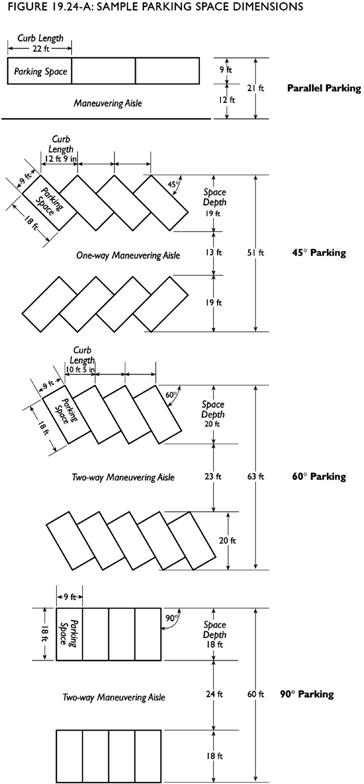
D.
Minimum Parking Space Dimensions — Compact. Compact parking spaces, where permitted by this Zoning Ordinance, shall have the minimum dimensions stated in Table 19.24-C, according to the angle of spaces in relation to adjacent aisles. The minimum basic dimension of a compact-size parking stall shall be eight feet by 16 feet. In addition, any compact parking space located adjacent and parallel to a wall or other solid barrier shall be at least 10 feet wide. The maneuvering aisle width listed in the table applies only where compact spaces are designated on both sides of a one-way aisle. All other aisle widths must meet corresponding standard aisle width requirements. Each compact space shall be clearly and distinctively marked as a compact space.
TABLE 19.24-C
PARKING AREA SPACE DIMENSIONS FOR AUTOMOBILES — COMPACT SPACES
* Most frequently used angles.
1 Aisle width applies only to where compact spaces are double-loaded on both sides of a one-way aisle. All other aisle widths must meet corresponding standard aisle width requirements.
2 Parking area width where all spaces are both sides of the aisle are compact spaces.
E.
Standards for Handicapped Parking Spaces. Parking spaces designated for persons with disabilities shall comply with Chapter 11B of the California Building Code or any successor regulations.
F.
Access to Spaces. Except where otherwise specified by this Zoning Ordinance, each parking space shall have unobstructed access from a street or from an aisle or drive connecting with a street without requiring moving another vehicle. However, required parking spaces for any dwelling unit may be arranged in tandem, so long as parking required for any dwelling unit is arranged independently from parking serving any other dwelling unit, with unobstructed access from a street for at least one of the spaces required for each dwelling unit. Notwithstanding the requirements above, parking spaces for accessory dwelling units may be tandem, per the requirements of Section 19.20.190. Tandem parking for commercial uses is prohibited, unless it is for valet parking.
G.
Vertical Clearance. A minimum height of 14 feet shall be maintained clear of obstructions from the parking surface to any structure or landscape feature above that may interfere with the safe passage of vehicles, except within garages, carports, or parking structures, where the minimum clearance shall be eight feet six inches.
H.
Direction of Vehicle Ingress/Egress. Off-street parking areas shall allow vehicles to enter and exit from or onto a public street by a forward motion only. Off-street parking areas for Single Family Dwellings, Accessory Dwelling Units, and Two Family Dwellings are exempted.
I.
Pedestrian Walkways.
1.
Materials. Where a pedestrian walkway crosses parking areas, it must be clearly identifiable through the use of elevation changes, calming measures such as speed bumps, a different paving material, or other similar method. Striping does not meet this requirement. Elevation changes and speed bumps designed to meet this requirement must be at least four inches high.
2.
Separation. Where a required walkway is parallel and adjacent to an auto travel lane, it must be raised or separated from the auto travel lane by a raised curb, bollards, landscaping or other physical barrier. If a raised path is used, it must be at least six inches high and the ends of the raised portions must be equipped with curb ramps. Bollard spacing must be no further apart than five feet on center.
J.
Surfacing. All parking areas shall be improved with surfacing such as asphalt, concrete, or a comparable permanent nonabsorbent surface. Other surfacing may be permitted subject to approval by the Public Works Department and the Design Review Board.
1.
Landscaping In-lieu of Paving. A maximum of two feet of the parking stall depth may be landscaped with low-growth, hardy materials in-lieu of paving, allowing a bumper overhang while maintaining the required parking dimensions. However, the overhang area shall not be counted as part of the minimum required perimeter or interior landscaping. See Figure 19.24-B.
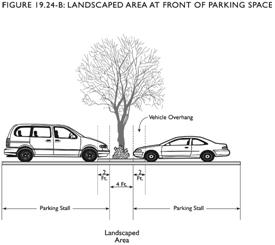
K.
Drainage. Parking and loading areas shall be designed and constructed:
1.
So that surface water will not drain over sidewalks or adjacent parcels; and
2.
In compliance with the storm water quality and quantity standards of the City's best management practices.
L.
Landscaping. All parking areas shall be landscaped according to the provisions of Section 19.25.060.
M.
Screening. Where a parking lot is adjacent to a public right-of-way, it shall be screened according to the standards in Section 19.25.060(E).
N.
Lighting. Adequate lighting shall be provided for the illumination and protection of the premises. Lighting shall be directed away from adjacent streets and properties. All light standards and luminaries shall be clearly identified on all site plans. Lights shall not blink, flash, change intensity, or cause glare. String lights are prohibited. The type of lighting (e.g., mercury vapor, sodium vapor, fluorescent, etc.) shall be approved by the Design Review Board.
O.
Wheel Stops and Curbing. Concrete curbing at least six inches high and six inches wide, with breaks to allow on-site drainage, shall be provided for parking spaces located adjacent to fences, walls, property lines, landscaped areas, and structures. Individual wheel stops may be provided in-lieu of continuous curbing when the parking is adjacent to a landscaped area and the drainage is directed to the landscaped area. Alternative barriers designed to protect landscaped areas from vehicle damage may be approved by the Zoning Administrator and Public Works Department. Wheel stops shall be placed to allow for two feet of vehicle overhang area within the dimension of the parking space.
P.
Markings. Each parking space and parking facility shall be identified by surface markings and shall be maintained in a manner so as to be readily visible and accessible at all times. Such markings shall be arranged to provide for orderly and safe loading, unloading, parking, and storage of vehicles. Marking required to be maintained in a highly visible condition includes striping, directional arrows, lettering and field color on signs in handicapped-designated areas.
Q.
Utilization of Required Parking Spaces. Storage of merchandise, cartons, trash, equipment or other materials shall not be permitted in required parking areas, driveways, or landscaped areas.
R.
Internal Circulation. The design of the parking facility shall provide an internal circulation pattern that is safe and efficient for motorists and pedestrians as determined by the City Engineer.
(Ord. 2008-2 Div. II (part), 2008.)
(Ord. No. 2009-03, § XIII, 4-20-2009; Ord. No. 2017-04, § 3, 6-6-2017)
19.24.070 - Driveways.
A.
Driveway Width. Minimum and maximum driveway widths are prescribed in the base zoning district regulations.
B.
Driveway Separation. Driveways serving the same parking facility shall be located at least 35 feet apart.
C.
Driveway Visibility. Visibility of a driveway crossing a street property line shall not be blocked at or above a height of 3.5 feet for a depth of ten feet from the street property line as viewed from the edge of the right-of-way on either side of the driveway at a distance of ten feet or at the nearest property line intersecting the street property line, whichever is less. See Figure 19.24-C.
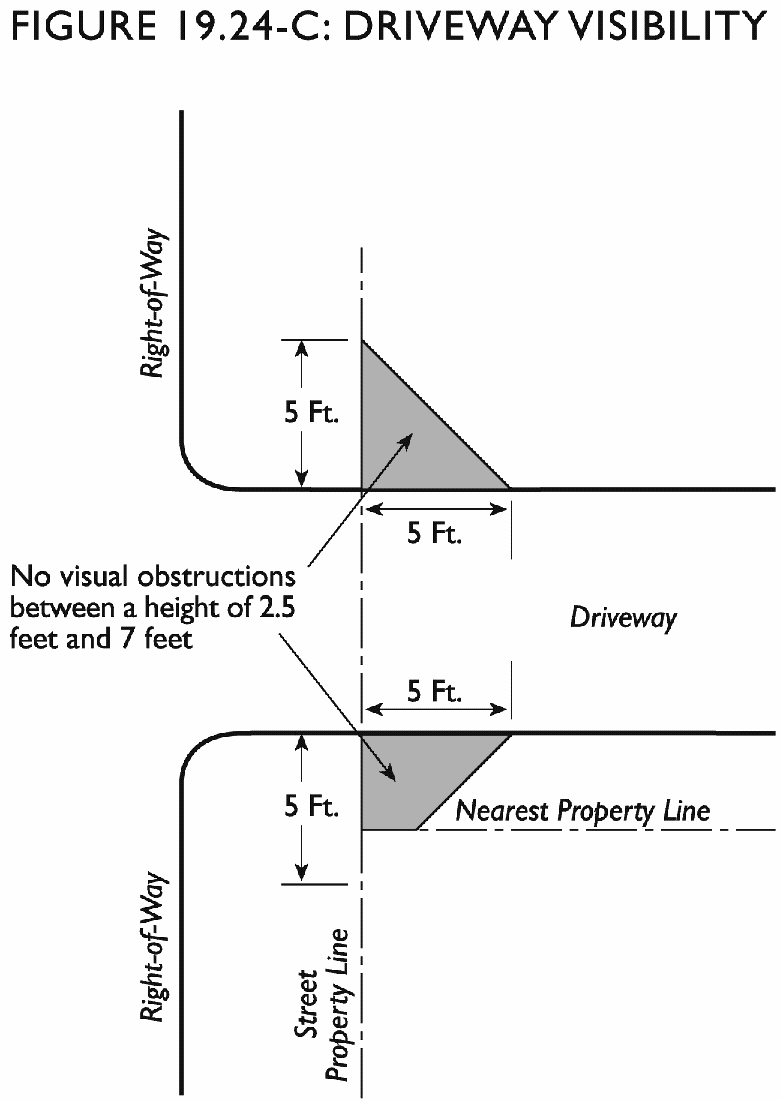
(Ord. 2008-2 Div. II (part), 2008.)
19.24.080 - Required off-street loading.
A.
Required Loading Spaces for Delivery and Distribution. A building, or part thereof, having a floor area of 10,000 square feet or more that is to be occupied by any use requiring the receipt or distribution by vehicles or trucks of material or merchandise must provide at least one off-street loading space, plus one additional such loading space for each additional 40,000 square feet of floor area. The off-street loading space(s) must be maintained during the existence of the building or use it is required to serve. Truck-maneuvering areas must not encroach into required parking areas, travelways, or street rights-of-way.
B.
Required Loading Spaces for Customers. Customer loading spaces allow bulky merchandise to be loaded into customers' vehicles. Each Home Improvement Sales and Service use shall provide at least two customer loading spaces per business establishment or one customer loading space per 40,000 square feet of floor area, whichever is greater. Customer loading spaces shall be located adjacent to the building or to an outdoor sales area where bulky merchandise is stored and shall be clearly visible from the main building entry or through directional signage visible from the main entry. Customer loading spaces shall be not be located in such a way that they impede on-site or off-site traffic circulation, as determined by the Director of Public Works.
C.
Standards for Off-street Loading Spaces.
1.
Minimum Size. Each off-street loading space required by this Section must be not less than 12 feet wide, 30 feet long, and 15 feet high, exclusive of driveways for ingress and egress and maneuvering areas. Loading spaces for customers may be 12 feet wide, 26 feet long, and 12 feet high.
2.
Driveways for Ingress and Egress and Maneuvering Areas. Each off-street loading space required by this Section must be provided with driveways for ingress and egress and maneuvering space adequate for trucks, per City standards.
3.
Location of Loading Areas. An off-street loading space (excluding loading spaces for customers) required by this Section must not be located closer than 30 feet to any lot or parcel of land in a residential district, unless such off-street loading space is wholly enclosed within a building or on all sides by a wall not less than eight feet in height. Except in industrial districts, a loading door or loading dock that is visible from a public street must be screened with an 8-foot-high, solid masonry or other sound-absorbing wall, with landscaping planted between the wall and the right-of-way.
4.
Idling. Idling of vehicles loading or unloading shall be limited to a maximum of five minutes.
(Ord. 2008-2 Div. II (part), 2008.)
19.24.090 - Required bicycle parking.
A.
Applicability. Bicycle parking shall be provided for all new construction, additions of 10 percent or more floor area to existing buildings, and changes in land use classification. Single family homes, duplexes and multi-family dwellings of less than four units are exempt.
B.
Definitions.
1.
Long-Term Bicycle Parking. Long-term bicycle parking serves employees, students, residents, commuters, and others who generally stay at a site for four hours or longer.
2.
Short-Term Bicycle Parking. Short-term bicycle parking serves shoppers, customers, messengers, and other visitors to a site who generally stay for a short time.
C.
Number of Required Bicycle Parking Spaces. The required minimum number of bicycle parking spaces for each use category is shown on Table 19.24-D. Uses that are not listed in the table are not required to provide short-term bicycle parking. Uses that are not listed in the table or for which no long-term spaces are prescribed are not required to provide long-term bicycle parking unless there are 50 or more employees, in which case, one long-term space shall be provided for each 25 employees.
TABLE 19.24-D
REQUIRED BICYCLE PARKING
(Ord. 2008-2 Div. II (part), 2008.)
19.24.100 - Bicycle parking standards.
A.
Standards for Short-term Bicycle Parking. Required short-term bicycle parking must meet the standards of subsection (C) below as well as the following standards:
1.
Location. Short-term bicycle parking must be located:
a.
Outside a building, in a designated interior location near the principal entrance of a building, or in a parking structure that serves the subject use; and
b.
Within 50 feet of an entrance to the building it serves. However, in the case of a multi-tenant shopping center, bike parking for the center must be located within 50 feet of an entrance to each anchor store.
2.
Size. Each required short-term bicycle parking space must be at least two feet by six feet.
B.
Standards for Long-term Bicycle Parking. Required long-term bicycle parking must meet the standards of subsection (C) below as well as the following standards:
1.
Location. Long-term bicycle parking must be located on the site of the use it serves.
2.
Covered Spaces. At least 50 percent of required long-term bicycle parking must be covered. Covered parking can be provided inside buildings, under roof overhangs or awnings, in bicycle lockers, or within or under other structures.
3.
Security. To provide security, long-term bicycle parking must be in at least one of the following locations:
a.
In a locked room;
b.
In an area that is enclosed by a fence with a locked gate. The fence must be either eight feet high, or be floor-to-ceiling;
c.
Within view of an attendant or security guard;
d.
Within 100 feet of an attendant or security guard;
e.
In an area that is monitored by a security camera;
f.
In an area that is visible from employee work areas; or
g.
Within a dwelling unit, dormitory or other group housing unit, live/work unit, or artists' studio. If long-term bicycle parking is provided within a unit, neither long-term racks nor lockers are required.
C.
Standards for All Bicycle Parking.
1.
Bicycle Lockers. Where required bicycle parking is provided in lockers, the lockers must be securely anchored.
2.
Bicycle Racks. Required bicycle parking may be provided in floor, wall, or ceiling racks. Where required bicycle parking is provided in racks, the racks must meet the following standards:
a.
The bicycle frame and one wheel can be locked to the rack with a high-security U-shaped shackle lock if both wheels are left on the bicycle;
b.
A bicycle six feet long can be securely held with its frame supported so that the bicycle cannot be pushed or fall in a manner that will damage the wheels or components; and
c.
The rack must be securely anchored.
3.
Parking and Maneuvering Areas.
a.
Each required bicycle parking space must be accessible without moving another bicycle;
b.
There must be an aisle at least five feet wide adjacent to all required bicycle parking to allow room for bicycle maneuvering. Where the bicycle parking is adjacent to a sidewalk, the maneuvering area may extend into the right-of-way; and
c.
The area devoted to bicycle parking must be hard surfaced.
4.
Visibility. If required bicycle parking is not visible from the street or main building entrance, a sign must be posted at the main building entrance indicating the location of the parking.
5.
Security Lighting. Bicycle parking areas shall be lit in accordance with the lighting performance standards in Section 19.21.050. All exterior bulbs shall be protected by weather- and-vandal resistant covers.
(Ord. 2008-2 Div. II (part), 2008.)
19.25.010 - Purpose.
The purposes of the landscaping regulations are to:
A.
Improve the appearance of the community by requiring aesthetically designed landscaping on public and private sites;
B.
Preserve existing significant trees and tree groupings where possible;
C.
Improve the appearance of streetscapes and roadways through the planting of street trees;
D.
Soften the appearance of parking lots through landscaping;
E.
Encourage indigenous and drought-tolerant species that reduce water usage and are compatible with El Cerrito's climate;
F.
Require ongoing maintenance of landscaping.
(Ord. 2008-2 Div. II (part), 2008.)
19.25.020 - Applicability.
The standards of this Chapter apply to all areas that are required to be landscaped. The landscaping standards must be met for all new development, and for additions that expand existing floor area by 15 percent or more, except for new construction of or additions to Single Family Dwellings, Second Units, or Two Family Dwellings. Reduced requirements for landscaping for an addition of 15 percent or more to an existing use or structure may be permitted upon the granting of a Conditional Use Permit.
(Ord. 2008-2 Div. II (part), 2008.)
19.25.030 - Landscape and irrigation plans.
A.
Information Required. For all projects for which landscaping is required, a landscape and irrigation plan shall be submitted as part of the permit application. A landscape plan shall be drawn to scale and shall at a minimum indicate: proposed plant locations, species, and sizes; any additional landscape features; proposed irrigation systems; and any measures to facilitate plant growth or control erosion.
B.
Alternative Landscape and Irrigation Plan. An applicant who can demonstrate that the intent of Section 19.25.010 can be exceeded, in whole or in part, through a modification of the standards of this Chapter, may submit an Alternative Landscape and Irrigation Plan (ALP) prepared in accordance with the following principles and design criteria. The ALP shall include a narrative that clearly details the modifications being requested and explains how they are superior to standard requirements and how they meet the landscape design principles listed below.
1.
Design Principles. To qualify for consideration, an Alternative Landscape and Irrigation Plan shall demonstrate the following principles:
a.
Innovative use of plant materials and design techniques in response to unique characteristics of the site or the proposed use achieving a better overall design solution then would be created under the landscaping standards of this chapter.
b.
Preservation or incorporation of existing native vegetation.
c.
Incorporation of naturalistic design principles, such as variations in topography, meandering or curvilinear plantings, and grouping of dominant plant materials (trees, large shrubs) in a manner consistent with existing native vegetation.
d.
Integration of landscaping and pedestrian facilities in a manner that improves access or incorporates pedestrian-friendly design, this may include reduced ground-level planting along the front setback if canopy shade trees along sidewalks are provided.
e.
Use of additional shade trees to create a greater canopy effect.
f.
A greater degree of compatibility with surrounding uses than a standard landscape and irrigation plan would offer.
(Ord. 2008-2 Div. II (part), 2008.)
19.25.040 - Areas to be landscaped.
The following areas shall be landscaped, and may count toward the total area of site landscaping required by the zoning district regulations:
A.
Required Setbacks. All required front and street-facing side setbacks, except for areas used for exit and entry, shall be landscaped. This requirement does not apply to the TOM.
B.
Parking Lots. Parking lots must be landscaped as provided in Section 19.25.060.
C.
Buffer Yards. Required buffer yards must be landscaped as provided in Section 19.25.090.
D.
Unused Areas. All areas of a project site not intended for a specific use, including areas planned for future phases of a phased development, shall be landscaped.
(Ord. 2008-2 Div. II (part), 2008.)
19.25.050 - General landscaping standards.
A.
Materials.
1.
General. Landscaping may consist of a combination of groundcovers, shrubs, vines, and trees. Landscaping may also include incidental features such as stepping stones, benches, fountains, sculptures, decorative stones, or other ornamental features, placed within a landscaped setting.
2.
Ground Cover Materials. Ground cover shall be of live plant material. Groundcover may include grasses. Non-plant materials such as gravel, colored rock, cinder, bark, and similar materials may not be used to meet the minimum planting area requirements required by this article, except with approval of an Alternative Landscape Plan. Mulch must be confined to areas underneath shrubs and trees and is not a substitute for ground cover plants.
3.
Turf Allowance/Drought-Tolerant Materials. The maximum amount of lawn in required landscape areas shall be 30 percent for non-residential uses and 50 percent for residential uses except for turf areas that comprise an essential component of a project (e.g., golf courses or playing fields), which are exempt from this limit. The use of drought-tolerant plant materials is strongly encouraged. Plant materials shall be grouped by common irrigation needs.
4.
Size and Spacing. Plants shall be of the following size and spacing at the time of installation:
a.
Ground Covers. Ground cover plants other than grasses must be at least four-inch pot size or flats. Areas planted in ground cover plants other than grass seed or sod must be planted at a rate of one per 12 inches on center. Flats shall be planted on 6 inch centers or as designated by planting recommendation for subject species.
b.
Shrubs. Shrubs shall be a minimum size of one gallon. When planted to serve as a hedge or screen, shrubs shall be planted with two to four feet of spacing, depending on the plant species.
c.
Trees. Trees shall be a minimum of 15 gallons in size with a one-inch trunk diameter at breast height (dbh) or as otherwise conditioned by the Design Review Board.
B.
Dimension of Landscaped Areas. No landscaped area smaller than three feet in any horizontal dimension shall count toward required landscaping.
C.
Existing Trees. Existing healthy trees shall be maintained whenever possible. Existing trees meeting size requirements and consistent with any applicable limitations on tree species within the Municipal Code may be counted toward required landscaping. Existing trees that are to remain shall be protected from root damage during construction.
D.
Drivers' Visibility. Trees and shrubs shall be planted and maintained so that at maturity they do not interfere with traffic safety sight areas, or public safety. See Section 19.24.070(C).
E.
Irrigation. An irrigation system shall be installed that consists of underground piped water lines with low water flow sprinklers and/or drip or trickle irrigation systems. The irrigation system shall be designed and installed to provide adequate coverage to all plant material by a license landscape architect or contractor.
(Ord. 2008-2 Div. II (part), 2008.)
19.25.060 - Parking lot landscaping standards.
Parking lot landscaping shall conform to all of the general standards of Section (19.25.050) above, as well as the following: (See Figure 19.25-A).
A.
Landscape Area Required. A minimum of 15 percent of the parking lot area shall be landscaped. For the purpose of calculating required parking lot landscaping, parking lot area shall include parking and loading spaces and adjacent paved areas, aisles, and auto entry and exit areas. Internal pedestrian access ways may be excluded from the parking lot area used to calculate required landscaping. On-site landscaped setbacks or buffer areas located between a parking lot and adjacent public right-of-way, public sidewalk, or interior lot line, as required by Subsections (E) and (F) below may be counted toward the required parking lot landscaping. Planting strips located within the right-of-way may not be counted toward required parking lot landscaping. All parking lot landscape area dimensions are exclusive of curbs.
B.
Required Trees. A minimum of one 15-gallon tree shall be provided within the parking lot area for every four parking spaces. Trees required as part of a buffer yard per Section 19.25.090(D)(2) shall not count toward fulfilling this requirement.
C.
Layout. Landscaped areas shall be distributed throughout the parking lot area. Parking lot landscaping may be provided in any combination of landscaped strips at least five feet wide between rows of parking stalls, landscaped strips between parking areas and adjacent buildings or internal pedestrian walkways, landscaped islands located between parking stalls or at the ends of rows of parking stalls, and on-site landscaping at the parking lot perimeter, as long as the following minimum requirements are met:
1.
Landscaped Islands. A landscaped island at least six feet wide and 18 feet deep or equivalent area shall be provided at each end of each interior row of parking stalls and between every six consecutive parking stalls in any residential development or any mixed-use development in which residential units overlook on-site parking areas, and between every 10 stalls in any non-residential development. One tree of at least 15-gallon size shall be located in each landscaped island.
2.
Landscaped Separation between Parking Areas and Buildings. No parking space shall directly abut an exterior building wall. A landscaped area at least five feet wide shall be provided between any parking stall and adjacent building or walkway.
D.
Size of Tree Planting Spaces. Anywhere that an individual tree is planted in a space surrounded by pavement, the planting area must have a minimum interior dimension of five square feet.
E.
Landscaped Buffer for Open Parking Abutting Public Right-of-Way. A landscaped area at least 10 feet wide shall be provided between any surface parking lot and any adjacent public sidewalk or street. Alternatively, a landscaped area at least five feet wide may be provided in conjunction with a solid screening wall at least two and one half to three and one half feet tall. Such screening wall shall be composed of brick, stone, stucco, or other quality durable material approved by the Zoning Administrator, and shall include a decorative cap or top finish as well as edge detail at all wall ends. Smooth concrete blocks are not allowed as a screening wall material unless capped and finished with stucco or other material approved by the Zoning Administrator.
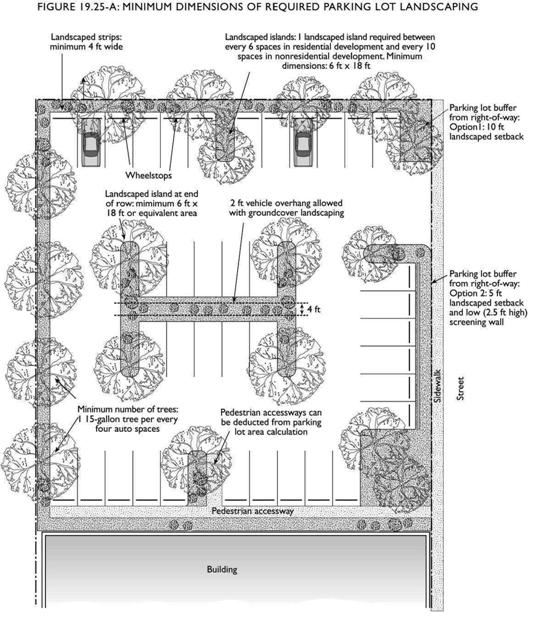
F.
Landscaped Buffer for Open Parking Abutting Interior Lot Line. A landscaped area at least five feet wide shall be provided between any surface parking area and any adjacent lot or lots for the length of the parking area. Such landscaped area may overlap or be continuous with any buffer yard required by Section 19.25.090.
G.
Protection of Vegetation.
1.
Design. All required parking lot landscaped areas shall be designed so that plant materials, at maturity, are protected from vehicle damage by providing a minimum two-foot clearance of low growing plants where a vehicle overhang is permitted, or by wheel stops set a minimum of two feet from the back of the curb.
2.
Planters. All required parking lot landscaping shall be within planters bounded by a concrete curb at least six inches wide and six inches high. No planter, except building perimeter planters, shall be smaller than 25 square feet in area, or five feet in any horizontal dimension, excluding curbing.
3.
Clearance. Landscaping in planters at the end of parking aisles shall not obstruct drivers' vision of vehicular and pedestrian cross traffic. Mature trees shall have a foliage clearance of eight feet from the grade of the parking area, with other plant materials not to exceed 26 inches in height.
4.
Walkways. Clear access paths through planters from parking areas shall be provided via stepping stones, tiles, bricks or other materials to protect plantings from pedestrian traffic.
(Ord. 2008-2 Div. II (part), 2008.)
19.25.070 - Required street trees.
Street trees shall be provided at a ratio of at least one tree for each 30 feet of public street frontage or as determined by the Public Works Department, unless a greater number of trees is specified in the zoning district regulations. Street tree locations shall be subject to approval by the Public Works Director. Street trees shall comply with Sections 13.28.010 through 13.28.090 of the El Cerrito Municipal Code.
(Ord. 2008-2 Div. II (part), 2008.)
19.25.080 - Landscape installation and maintenance.
A.
Consistency with Approved Plans. All landscaping shall be installed and maintained consistent with approved plans and specifications.
B.
Timing of Installation. Required landscaping shall be installed prior to the issuance of a certificate of occupancy for a project. Alternatively, required landscaping may be installed within 120 days of the issuance of a certificate of occupancy if a surety in the amount equal to 150 percent of the estimated cost of landscaping, including materials and labor, as well as an agreement that the required landscaping will be installed within 120 days, is filed with the City to assure completion of landscaping installation within such time. The surety may take the form of cash deposit, irrevocable letter of credit or bond; and together with the agreement, shall provide for payment to the City of any costs incurred in contracting for completion of the required landscaping. All required fences and walls shall be permanently maintained in good condition and repaired or replaced when necessary to ensure continued compliance with the requirements of this Section.
C.
Maintenance. All planting and irrigation systems shall be maintained in good condition. Maintenance shall include, where appropriate, pruning, mowing, weeding, cleaning, fertilizing, and regular watering. Wherever necessary, plantings shall be replaced with other plant materials to insure continued compliance with approved landscape plans and applicable landscaping requirements. Trees shall be maintained by property owners to be free from physical damage or injury arising from lack of water, chemical damage, accidents, vandalism, insects and disease. Any tree showing significant damage, as determined by the Zoning Administrator shall be replaced with another tree of comparable size (diameter at breast height) or value. Landscape maintenance agreements shall be required for all commercial, mixed use and multi-family residential projects.
(Ord. 2008-2 Div. II (part), 2008.)
19.25.090 - Buffer yards.
A.
Purpose. These provisions are intended to minimize or eliminate conflicts between potentially incompatible but otherwise permitted land uses on adjoining lots through a combination of setbacks and visual screening.
B.
Applicability. The buffer yard standards of this Section shall apply to:
1.
All new development on vacant land.
2.
Redevelopment or expansion of existing development by 15 percent or more of existing floor area, except for new construction of single family units, accessory dwelling units, or two family dwellings.
3.
Any change from a residential use to a commercial or industrial use, a commercial use to an industrial use; or any other change from one land use classification to another non-residential land use classification that increases development intensity and results in increased traffic, processes, noise, or pollution, as determined by the Zoning Administrator.
C.
Exceptions.
1.
Where a proposed use is separated from an existing use by a public right-of-way, drainage channel, or stream corridor, no buffer yard is required provided such right-of-way, stream corridor, or major body of water or waterway is at least equal in width to the required buffer yard.
2.
Where a development lot is 25 feet or less in width, a six-foot high solid masonry wall may be provided in lieu of any required buffer yard.
3.
Compliance with the buffer yard standards shall not necessitate the demolition or relocation of any portion of any existing building.
4.
Other exceptions to the standards of this section may be granted with a Conditional Use Permit.
D.
Required Buffer Yards — Minimum Dimensions and Standards. Required buffer yards are indicated in Table 19.25-A. A buffer yard shall be provided on any lot containing a use listed in the first column of Table 19.25-A when it abuts a lot containing a use listed in the second column of the same row. Buffer yards shall consist of both a landscaped area and a solid wall in the dimensions prescribed in the table and shall comply with all applicable standards of this subsection. See Figure 19.25-B.
TABLE 19.25-A
REQUIRED BUFFER YARDS
1.
Location. Required buffer yards shall be developed along the perimeter of the lot and extend inward from the property line of the project site as illustrated in Figure 19.25-B.
2.
Landscaping of Required Buffer Yards. Buffer yards shall be planted with a mix of trees, a minimum of 15 gallons in size, and shrubs. At least one tree shall be planted per 20 lineal feet or as appropriate to provide a tree canopy over the buffer yard. In addition, three shrubs shall be planted per 20 lineal feet.
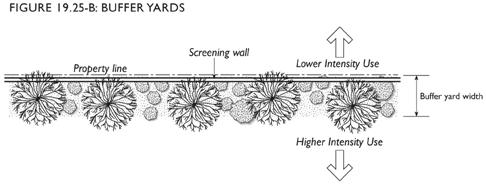
3.
Walls. Industrial uses must provide a solid screening wall of sound absorbing stucco, decorative block, or concrete panel. Screening walls for other uses may be constructed of stucco, decorative block, concrete panel or a dense hedge of at least 95 percent opacity that provides a year-round evergreen barrier, or other substantially equivalent material.
4.
Uses of Buffer Yards. Buffer yards may be used as yards, open space, or natural areas, or for any use that does not interfere with its effectiveness as a buffer between potentially incompatible uses. Buffer yards shall not be used for parking, driveways, trash enclosures, mechanical equipment, or as a building area.
5.
Buffer Yard Plan. A buffer yard plan shall be submitted in conjunction with other application materials for a permit. A buffer yard plan shall show the location of all buffer yards on the project site, proposed plant locations, a plant list and key, and existing and proposed structures on the site. Where a landscaping plan is also required, the buffer yard plan may be incorporated into the landscaping plan.
6.
Maintenance. All required planting shall be permanently maintained in good growing condition and replaced with new plant materials when necessary to ensure compliance with applicable standards. All required walls and irrigation systems shall be permanently maintained in good condition and repaired or replaced when necessary to ensure continued compliance with the requirements of this Section.
(Ord. 2008-2 Div. II (part), 2008; Ord. No. 2017-04, § 3, 6-6-2017)
19.26.010 - Purpose.
The specific purposes of the sign regulations are to:
A.
Promote and aid in the identification, location, and advertisement of goods and services.
B.
Enhance the City's ability to attract sources of economic development and growth by providing a system of sign regulation.
C.
Promote an attractive, positive image of the City.
D.
Preserve the residential character of residential neighborhoods and prevent the confused and disorderly appearance of commercial areas.
E.
Ensure that building signs are compatible with the scale and character of buildings.
F.
Minimize the possible adverse effect of signs on nearby public and private property.
G.
Improve pedestrian and traffic safety by reducing the distractions, hazards, and obstructions that result from improperly designed or located signs.
(Ord. 2008-2 Div. II (part), 2008.)
19.26.020 - Applicability.
The provisions set forth in this Chapter shall apply in all zoning districts of the City, except where expressly stated otherwise. No sign shall be erected or maintained anywhere in the City except in conformity with this Chapter.
(Ord. 2008-2 Div. II (part), 2008.)
19.26.030 - Exempt signs.
The design review requirements of Section 19.26.090 shall not apply to the following signs, nor shall the area of such signs be included in the maximum area of signs permitted for any site or use:
A.
Address Signs. Required address identification signs that are in conformance with the Building Code.
B.
Change of Business Signs. A temporary attachment or covering of wood, plastic, or canvas over a permanent sign indicating a change of ownership or activity may be displayed for no longer than 30 days following the change of ownership or activity for which the sign is intended. The sign shall be no larger than the previously permitted permanent sign.
C.
Construction Signs. A temporary construction sign may be erected on a construction site for the duration of construction activities provided that it is immediately removed after issuance of a Certificate of Occupancy or Certificate of Completion for the project, or abandonment of work. A temporary construction sign may not exceed 32 square feet in area and eight feet in height within commercial, mixed-use, or other non-residential zones or eight square feet in area and five feet in height within residential zones.
D.
Interior Signs. Signs that are located in interior areas of a building or site and are not visible from public streets or adjacent properties. For the purpose of this regulation, "visible" means legible to a person of ordinary eyesight (with vision adequate to pass a state driver's license exam) standing at ground level at a location on the public right-of-way or other private property.
E.
Official Government Signs. Official notices issued by a court, public body or office; official notices posted by a utility or other quasi-public agency; signs erected by a governmental body to direct or regulate pedestrian or vehicular traffic; public hearing or meeting notices; seismic warning signs, or other signs required or authorized by law.
F.
Commemorative Signs. Commemorative plaques, memorial signs or tablets, or signs indicating names of buildings and dates of building erection, either attached to or cut into the surfaces of buildings, provided that no such sign exceeds three square feet in area.
G.
Parking and Directional Signs. On-site parking and directional signs not exceeding three square feet in area and limited to directional messages such as entrance/exit locations or instructions to direct on-site traffic circulation.
H.
Informational Signs. Noncommercial informational signs located wholly on private property not exceeding one square foot in area erected for the immediate convenience of the public, such as signs identifying rest rooms, public telephones, walkways, and similar features or facilities.
I.
Time and Temperature Devices. Time and temperature devices, not higher than permitted signs, located wholly on private property and bearing no commercial message.
J.
On-Site Real Estate Signs. On-premises signs conveying information about the sale, rental, or lease of the appurtenant lot, premises, dwelling, or structure, provided that they comply with the following standards:
1.
No more than one real estate sign per public street frontage per lot is displayed at any one time;
2.
The sign or signs do not exceed an aggregate area of 32 square feet within commercial, mixed-use, or other non-residential zones or six square feet in area within residential zones;
3.
The sign or signs are not illuminated; and
4.
The sign or signs are removed within seven days after the sale, lease, or rental of the property has been completed.
5.
Real estate signs are not permitted in the public right-of-way.
K.
Vehicle Signs. Signs painted, stenciled or similarly affixed to the surface of vehicles.
L.
Window Signs. Window Signs, subject to the following provisions:
1.
In residential zones and on residential properties, window signs not exceeding 20 percent of the area of window and transparent door frontage on any building facade, and subject to the requirements of Residential Signs.
2.
In commercial and mixed-use zones, window signs not exceeding 20 percent of the area of window and transparent door frontage on any building facade. Any sign either hung within two feet of a window or attached to a display located within two feet of a window is considered a window sign.
M.
Barber Poles. Barber poles not exceeding six feet in height, located wholly on commercial private property and bearing no lettering.
N.
Newspaper Stands. Signs that are part of newspaper stands, provided the sign area does not exceed six square feet.
O.
Decorative Holiday Displays. Noncommercial decorative holiday displays, provided that such displays are removed within 45 days of their installation.
P.
Bus Shelter and Bus Bench Signs. Signs on a public bus bench, public bus shelter, or any waste bin attached to a public bus bench or public bus shelter, which convey a commercial message as their primary purpose and that are authorized by a contract or franchise agreement with the applicable transit agency.
(Ord. 2008-2 Div. II (part), 2008.)
19.26.040 - Prohibited signs.
The following types of signs, materials, designs, messages, and locations are prohibited:
A.
Banners, Streamers, Pennants or Inflatable Signs. Banners, streamers, pennants, and other signs made of lightweight fabric or similar material, designed to rotate or move with the wind, except where expressly provided for in this Chapter. Signage or displays that are also inflatable are also prohibited. Notwithstanding any provision of this Chapter to the contrary, banners may be posted or otherwise affixed upon fences located at public schools. A permit shall not be required for such banners. No such banner shall exceed the dimensions of four feet by two and one half feet (4′ x 2½′). A maximum of five (5) banners shall be permitted upon any individual school property.
B.
Emissions. Signs that produce noise or sounds that can be heard at the property line, excluding voice units at menu boards, and signs that emit visible smoke, vapor, particles, or odor.
C.
Animated and Moving Signs. Animated, flashing, blinking, reflecting, revolving, or other similar signs or signs with visibly moving or rotating parts or visible mechanical movement of any kind, either adjacent to or as an integral part of the display, unless expressly allowed by this Chapter.
D.
Signs Creating Traffic Hazards.
1.
Signs located in such a manner as to constitute a traffic hazard or obstruct the view of traffic, any authorized traffic sign or signal device, or signs that may be confused with any authorized traffic sign, signal, or device; or which makes use of the words "stop," "look," "danger," or any other word, phrase, symbol, or character that interferes with, misleads, or confuses vehicular drivers in their use of roads.
2.
Signs within five feet of a fire hydrant, street sign, or traffic signal if such placement could create a safety hazard.
3.
Signs placed or fixed so as to create obstruction, interference, or injury to passersby, residents, or occupants.
E.
Off-Premises Signs. Off premises signs, as defined in Chapter 19.47, except signs on a public bus bench, public bus shelter, or any waste bin attached to a public bus bench or public bus shelter which convey a commercial message as their primary purpose and are authorized by a contract or franchise agreement with the applicable transit agency.
F.
Roof Signs.
1.
Attached signs that extend above the roof line or parapet (whichever is higher) of a building with a flat roof.
2.
Attached signs that extend above the eave line of a building with a sloped, gambrel, gable or hip roof.
3.
Attached signs that extend above the deck line of a mansard roof, whether real or simulated.
4.
Signs on rooftop structures, such as penthouse walls or mechanical enclosures.
5.
However, signs that do not extend above the eave line of a sloped, gambrel, gable, or hip roof, that do not extend above the deck line of a mansard roof, that do not extend above the parapet (or the roofline if no parapet is present) of a flat roof are permitted subject to the standards of Section 19.26.050. See Figure 19.26-A.
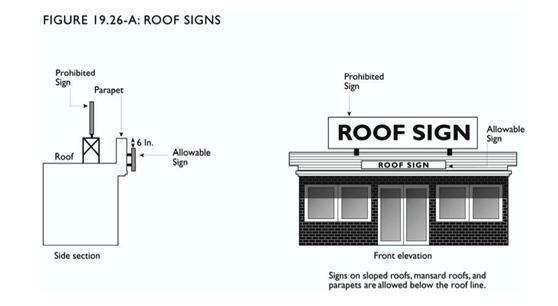
G.
Signs in Right-of-Way. No sign, or supporting sign structure, may be erected in the public right-of-way, with the exception of: legal notices which are required by law to be placed upon public property to provide notice to the public; signs erected by a governmental body to promote public safety or direct or regulate pedestrian or vehicular traffic; public holiday lights and displays erected by a governmental body; district identification banners; signs or banners erected by a governmental body above streets or attached to lamp posts or utility poles, to promote or City sponsored activities or promotions; commercial signs on public bus benches and public bus shelters, which convey a commercial message as their primary purpose, as specifically authorized by a contract or franchise agreement with the applicable transit agency; portable A-frame signs subject to the standards of Section 19.26.050(C)(5); noncommercial bus stop signs erected by a public transit agency; and projecting signs that are attached to a building and project over the public sidewalk but provide at least eight feet of clearance above the sidewalk. Any sign located in a public right-of-way or projecting over a public sidewalk shall be placed only in a manner consistent with standards promulgated by the Public Works Department.
(Ord. 2008-2 Div. II (part), 2008.)
19.26.050 - Signs—Commercial, mixed-use, and other non-residential zones.
The regulations of this section apply to signs located in commercial, mixed-use, public/semi-public, open space, and any other non-residential zones.
A.
Maximum Aggregate Sign Area Per Site. The aggregate area of all signs on a single lot, excluding exempt signs for which no design review is required pursuant to Section 19.26.090(C), shall not exceed one square foot of sign area per lineal foot of public street frontage. However, in the special situations listed below, sign area is calculated as follows:
1.
Sites with Multiple Frontages. On sites with more than one frontage on a public street, maximum permitted sign area shall be calculated as follows:
a.
Where an interior lot fronts on two streets (a corner or "through lot"), either both the front and side, or front and rear lot lines as related to the applicable frontages may be used for calculating the allowable sign area.
b.
Where a lot has three or more frontages on a public street, the length of only two contiguous sides, one of which shall be the principal street frontage, shall be added together to determine allowable sign area.
2.
Multiple-Occupancy Commercial Sites with Limited Frontage. Where a commercial site for which a master sign program is required pursuant to Section 19.26.090(E) has a land area in excess of two acres, and public street frontage equal to 20 percent or less of the perimeter measurement of the site, the maximum allowable sign area for the site is as follows: One square foot of sign area per one lineal foot of public street frontage, plus one lineal foot of exterior building walls fronting on driveways and parking lots that are generally used for public access and are located on the same site. Pedestrian-only passageways that are lined on both sides by building walls shall be considered interior spaces, and although signs may be placed on such walls, the area of such walls shall not be included in the calculation of the maximum allowable sign area for the site.
B.
Permitted Sign Types. Permitted sign types are listed in Table 19.26-A and defined in Chapter 19.47, Definitions, under "Sign Types." The signs erected on a site may be any combination of permitted sign types, subject to the limitations for individual sign types listed in this Section and any other provisions of this Chapter.
C.
Standards for Specific Sign Types. Signs shall conform to the standards listed in Table 19.26-A, as well as any additional standards.
TABLE 19.26-A
STANDARDS FOR SIGNS IN COMMERCIAL, MIXED-USE, AND OTHER NON-RESIDENTIAL ZONES
1.
Projecting Signs.
a.
Minimum Clearance. Projecting signs shall be located a minimum of eight feet above grade.
2.
Freestanding Signs.
a.
Minimum Setback from Property Line. Freestanding signs must be set back a minimum of five feet from any property line.
b.
Limitations in Driveway Median. Freestanding signs erected in a median within a driveway shall be set back a minimum of five feet from the face of the curb surrounding the median, or from the edge of adjacent pavement where no curb exists, and shall not interfere with driver visibility.
3.
Awning or Canopy Signs.
a.
Location. Awning and canopy signs are permitted only on the first and second floor of buildings. Awnings and canopies shall not cover transom windows or historic building elements. Awnings and canopies shall be aligned with windows and entries.
b.
Minimum Clearance. Awnings and canopies shall be located a minimum of eight feet above grade, measured from the lowest structural element of the awning or canopy.
c.
Non-Functional Awnings or Canopies. Awnings and canopies that project less than two feet from the building facade to which they are attached, or do not overhang a sidewalk or pedestrian walkway, are considered non-functional awnings or canopies. When signage is attached to or incorporated into non-functional awnings or canopies, the entire surface area of the face of the awning fronting a street or pedestrian walkway shall be considered the sign area.
4.
Marquee Signs.
a.
Uses Allowed On. Marquee signs are allowed for theaters, cinemas, stadiums, auditoriums, or other public assembly facilities.
b.
Height. Subject to review and approval of the Planning Commission, a vertically-oriented marquee sign may project up to six feet above the roof line. The Planning Commission shall only approve a marquee sign extending above the roofline if it finds that the marquee sign is architecturally integrated with the building.
c.
Lighting. Notwithstanding any other provision of this Chapter, a marquee sign may include animated lights, subject to review and approval by the Design Review Board.
5.
Portable A-Frame Signs.
a.
A Portable A-Frame Sign is only permitted where building frontage is located within 10 feet of a public sidewalk.
b.
A Portable A-Frame Sign shall be located only in the space directly between the storefront and the curb so as to allow at least six feet clear for pedestrian passage along a public sidewalk or pedestrian walkway. The Public Works Department will determine whether or not the planned location for a portable A-Frame sign will require an Encroachment Permit and associated liability insurance.
6.
City Banners.
a.
City-issued banners that identify the city or specific commercial districts or signs or banners erected by a governmental body to promote public safety or City sponsored activities or promotions, may be posted by the City above streets or attached to lamp posts or utility poles.
b.
Banners located in the right-of-way shall be placed only in a manner consistent with standards promulgated by the Public Works Department.
7.
Signs — Minor Automobile/Vehicle Service and Repair Stations.
a.
Notwithstanding any other provision of this Chapter, the total sign area for all signs for any service station (Minor Automobile/Vehicle Service and Repair) use shall not exceed 100 square feet. No individual sign face shall have a surface area exceeding 50 square feet. No portion of any sign attached to or placed upon the wall or canopy of a service station structure shall exceed an elevation of 20 feet above finished grade at the base of the sign, and no portion of any freestanding sign or sign structure shall exceed an elevation of 20 feet above the finished grade of the lot at the base of the service station building.
b.
Accessory signs not more than 20 square feet in area or over five feet in height shall be permitted for fuel prices at Minor Automobile/Vehicle Service and Repair Stations, and these fuel price signs shall not count toward total allowable sign area nor shall the area of fuel price signs if they are part of a monument sign. Fuel price signs shall comply with the requirements of the State Business and Professions Code.
c.
In addition to any other applicable design criteria, signs for service stations shall only be approved if the review authority finds that the proposed signs are in architectural harmony with the total service station design theme.
8.
Flags.
a.
Each use may display a total of one flag per lot frontage. City and other government uses are exempt from this requirement.
b.
No flag displayed pursuant to this subsection shall exceed 12 square feet in area unless reviewed by the Design Review Board.
c.
Flags shall be suspended from flagpoles at a height of not less than 12 feet nor more than 40 feet.
d.
Flags poles and related structures designed to display a flag require a building permit, and must comply with other regulations of the applicable zoning districts.
D.
Substitution of Sign Message. Any of the Permitted Sign Types authorized by this Section, with the exception of signs placed at public bus benches and bus shelters and City banners, may contain non-commercial copy in lieu of any other copy.
(Ord. 2008-2 Div. II (part), 2008.)
19.26.060 - Signs—Residential zones.
The regulations of this Section shall apply to all residential zones, as well as Residential Uses located in non-residential zones.
A.
Permitted Signs. In addition to the exempt signs listed in Section 19.26.030, the following signs are permitted in residential zones:
1.
Commercial Signs.
a.
One sign per site not exceeding six square feet indicating the presence on the property of:
i.
A permitted accessory use that is allowed signage, such as a Small Family Day Care,
ii.
An existing legal non-conforming non-residential use.
b.
One sign indicating the presence on the property of an approved, conditionally permitted use. Such signs shall not exceed 8 square feet in area, unless a greater area is specifically approved by the decision-making authority as part of administrative use permit approval.
2.
Subdivision Signs. A subdivision in a residential district shall be permitted to display a subdivision sign or signs not exceeding eight square feet in aggregate area. Such sign(s) must be attached to a wall, fence, or gateway structure, and integrated with the design of the structure.
3.
Flags. Each site may display a total of two (2) flags per frontage. No flag shall exceed 12 square feet in area nor contain commercial copy.
4.
Non-Commercial Signs.
a.
Residential Uses. Up to four noncommercial signs, with an aggregate area of no more than eight square feet, are allowed for each dwelling unit on a property. Notwithstanding the foregoing, no more than four noncommercial signs are permitted in the front yard or street-facing side yard of any residential property, whether single-family, two family, or multi-family.
b.
Existing Public, Semi-Public and Services Uses. One sign, not exceeding 8 square feet in area, unless a greater area is specifically approved by the decision-making authority as part of administrative use permit approval.
B.
Illumination. No sign governed by this Section shall be internally illuminated.
(Ord. 2008-2 Div. II (part), 2008.)
(Ord. No. 2009-03, § XIV, 4-20-2009)
19.26.070 - Temporary signs.
A.
Temporary Noncommercial Signs — Residential Zones and Uses. Up to four temporary noncommercial signs, each no larger than six (6) square feet in area, are permitted per dwelling unit. Notwithstanding the foregoing, no more than four such signs are permitted to be located in the front yard or street-facing side yard of any residential property, whether single-family, two-family, or multi-family. Temporary Non-Commercial Signs may be attached to freestanding sign structures no more than five feet in height, building walls, or fences. Temporary noncommercial signs must be removed or replaced within 60 days of placement.
B.
Temporary Noncommercial Signs — Non-Residential Zones and Uses. Temporary Noncommercial Signs meeting the requirements of this Chapter are permitted in commercial, mixed-use, and other non-residential zones. Temporary Noncommercial Signs must be removed or replaced within 60 days of placement, and each sign shall not exceed 32 square feet in sign area. For properties not subject to a Master Sign Program, the maximum number of Temporary Noncommercial Signs per property at one time shall be four.
C.
Large Distributions. Any person wishing to distribute more than ten (10) Temporary Noncommercial Signs to property owners in the city must first apply for and receive a permit from the Zoning Administrator. The permit application shall contain an actual-sized prototype of the sign and the name, address, and telephone number where the applicant may be reached by the Zoning Administrator or Police Chief or the respective deputies responsible for the enforcement of these provisions. The permit application shall be approved unless the sign does not meet the requirements set forth in this Chapter. The decision to grant or deny a permit shall be made within one business day after submission of the application. One permit shall govern all signs of each type distributed to property owners in the City.
D.
Temporary Commercial Signs: Permit Required. Temporary Commercial Signs meeting the requirements of this Chapter may be displayed with a permit from the Zoning Administrator, on non-residential properties in Commercial and Industrial zones. Commercial Temporary Signs shall be displayed for a period of time not to exceed thirty days, or a shorter period determined by the Zoning Administrator based on the length of time of the use or activity, or as specified by this section. The provisions contained in Section 19.26.090, Procedures for Sign Approval, shall apply to Temporary Commercial Signs. No more than one Commercial Temporary Sign shall be permitted and no such sign shall be more than 32 square feet in sign area. Such signs may be permitted on any site up to three times per year.
E.
Owner/Occupant Consent Required. No Temporary Sign shall be placed, erected or maintained without the authorization of the property owner or occupant.
F.
Off-Premises Signs Prohibited. Directional signage for the purposes of advertising an open house is exempted from this provision provided the signs are removed within 48 hours of posting and are placed so as to not cause a hazard for pedestrians or vehicles.
G.
Conformity with Council Guidelines. Where the Council has established policy guidelines for the installation of temporary signs in commercial areas, such signs may be approved by the Zoning Administrator only upon finding that the subject sign is in compliance with those policy guidelines.
(Ord. 2008-2 Div. II (part), 2008.)
19.26.080 - General provisions for all sign types.
A.
Calculation of Sign Area. The area of an individual sign shall be calculated as follows.
1.
Single-faced Signs. Sign area shall include the entire area within a single continuous perimeter composed of squares or rectangles that enclose the extreme limits of all sign elements, including, but not limited to, sign structures or borders, written copy, logos, symbols, illustrations, and color. Supporting structures such as sign bases and columns are not included in sign area provided that they contain no lettering or graphics except for addresses or required tags. The calculation of sign area for various types of single-faced signs is illustrated in Figure 19.26-B.
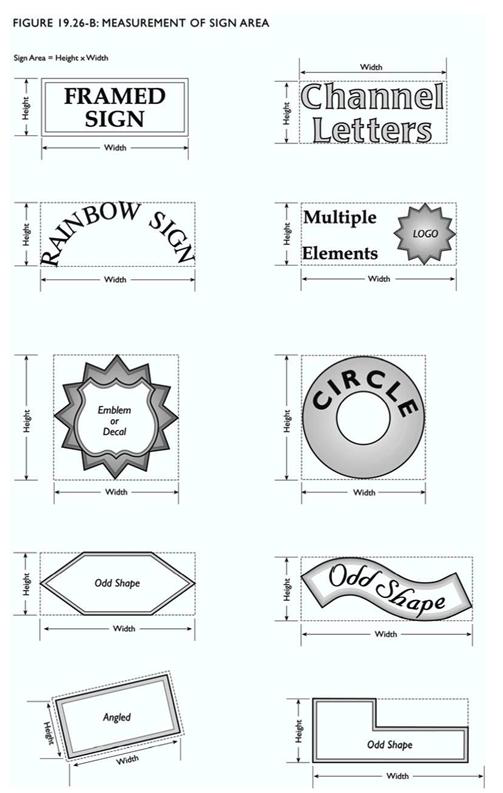
2.
Double-faced Signs. Where two faces of a double-faced sign are located two feet or less from one another at all points, or located at an interior angle of 45 degrees or less from one another, the sign area shall be computed as the area of one face. Where the two faces are not equal in size, the larger sign face shall be used. Where two faces of a double-faced sign are located more than two feet or 45 degrees from one another, both sign faces shall be counted toward sign area. See Figure 19.26-C.
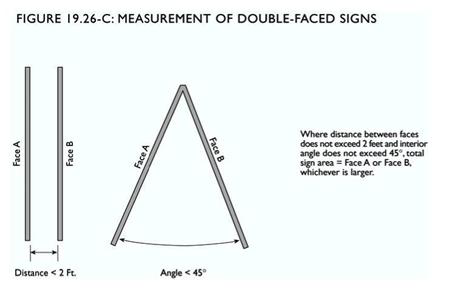
3.
Multi-faced Signs. On a three-faced sign, where at least one interior angle is 45 degrees or less, the area of two faces (the largest and smallest face) shall be summed to determine sign area. In all other situations involving a sign with three or more sides, sign area shall be calculated as the sum of all faces.
4.
Three-Dimensional Signs. Signs that consist of, or have attached to them, one or more three-dimensional objects (i.e., balls, cubes, clusters of objects, sculpture, or statue-like trademarks), shall have a sign area of the sum of all areas using the four vertical sides of the smallest cube that will encompass the sign. See Figure 19.26-D on the following page.
B.
Materials. Paper, cardboard, or other material subject to rapid deterioration shall be limited to signs displayed for no more than 60 days. Fabric signs shall be restricted to City Banners, Awning Signs, and Temporary Signs permitted pursuant to Section 19.26.070.
C.
Illumination. The illumination of signs, from either an internal or external source, shall be designed to avoid negative impacts on surrounding rights-of-way and properties. The following standards shall apply to all illuminated signs:
1.
External light sources shall be directed and shielded to limit direct illumination of any object other than the sign;
2.
Sign lighting shall not be of an intensity, brightness or generate glare that will create a nuisance for residential properties in a direct line of sight to the sign.
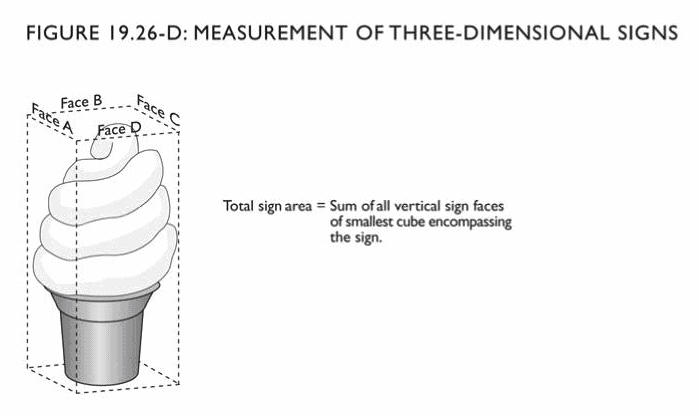
D.
Changeable Copy Other Than Permitted Marquee Signs. Changeable copy shall cover no more than 20 percent of the total sign area, except for the following uses which are allowed up to 75 percent of sign area to be changeable copy: all public and civic uses, indoor theaters, other public assembly uses, and fuel price signs.
E.
Code Compliance. Signs erected, installed, located or maintained in the city must comply with all applicable structural provisions of the most recently adopted versions of the Uniform Sign Code, California Building Code, and California Electrical Code adopted by the City.
(Ord. 2008-2 Div. II (part), 2008.)
19.26.090 - Procedures for sign approval.
A.
Design Review Required. The erection, installation, alteration, enlargement, or relocation of all signs, except those exempt from review per Section 19.26.030, is subject to design review pursuant to Chapter 19.38, Design Review. Signs shall be reviewed and approved by the Zoning Administrator through the Administrative Design Review process unless otherwise stated in this Chapter. Master Sign Programs shall be reviewed by the Design Review Board in accordance with Section 19.26.100. In addition, per Chapter 19.38, the Zoning Administrator may refer any application to the Design Review Board for review and decision. Freestanding signs exceeding 10 feet in height, monument signs exceeding five feet in height, or other exceptions to standards, shall be reviewed by the Planning Commission in addition to the Design Review Board.
B.
Minor Alterations Excepted. The changing of changeable copy, or the replacement of sign copy or sign face where the materials, copy and copy size are in substantial conformance with the existing sign they replace, is not deemed an alteration and is not subject to design review.
C.
Findings. The approval authority will not approve an application for a sign unless it finds that the proposed sign or signs conform to the design review criteria in Section 19.38.050, and are aesthetically harmonious and compatible with the surrounding area, considering such factors as the proposed size, location and design of the sign(s), the type of business to which the sign(s) pertain, the architectural character of the building(s) on site, the architectural character of surrounding buildings, and the type of other permitted signage in the vicinity of the proposed sign.
D.
Application — Individual Signs on Sites with Less than Four Non-Residential Tenant Spaces. A design review application for a sign shall be submitted on a form provided by the City and shall include detailed drawings to show the locations, dimensions, structure, colors, materials, fonts, and symbols of all proposed signs. The application shall indicate the area of each individual sign and the aggregate area of all existing and proposed signs on the lot, and demonstrate through drawings and/or calculations that all standards are met. The application shall be accompanied by a fee in the amount specified in the City's master fee schedule.
E.
Conditional Use Permit for Exceptions to Standards. An exception to any standard of this Chapter regarding the size, dimensions, or height of individual signs, or the number of signs of a particular type, may be reviewed and approved through the use permit process of Chapter 19.34, Use Permits. No conditional use permit for an exception to a standard shall be granted unless the Planning Commission finds that in addition to conformity with the required use permit findings in Chapter 19.34, the proposal meets the following:
1.
The project is consistent with the purpose and intent of the sign regulations (Section 19.26.010);
2.
The proposed signage is not excessive in relation to the size of the site or the size of signs in the surrounding area; and
3.
The proposed departure from a standard is necessary in order to adequately identify businesses, or will result in a superior design solution given the characteristics of the site or buildings.
(Ord. 2008-2 Div. II (part), 2008.)
(Ord. No. 2009-03, § XV, 4-20-2009)
19.26.100 - Master sign programs.
A.
Applicability.
1.
Master Sign Program Required. All commercial projects with four or more tenant spaces, all separately identifiable commercial building groups, and all construction and renovation projects involving more than 40,000 square feet of land area must obtain approval for a Master Sign Program prior to the installation of any signs.
2.
Optional Sign Program Application permitted. Application under the provision of a planned sign program shall be at the option of the applicant whenever such application is not mandatory under this section and the site meets any of the following conditions:
a.
The site to be considered shall consist of five or more separate business activities.
b.
The area to be included for consideration shall consist of a lot, parcel or a series of lots or parcels combined, to total a minimum of two acres.
c.
The site to be considered shall consist of a lot, parcel or a series of lots or parcels combined which front on two or more publicly dedicated street rights-of-way.
B.
Required Submittals. Applications for a Master Sign Program shall include the following plans and text: a computation of allowable area for all signs, plans drawn to scale showing the total number of proposed signs, the area of each individual sign as well as aggregate area of all signs on the site, the proposed height and dimensions of all signs, the location of each sign indicated on both a site plan and on typical building elevations, and drawings of generic sign types, including general information on materials and color schemes. An application shall also include a written program of standards for all sign types to be distributed to future tenants, including color, size, illumination, construction details, and placement of signs.
C.
Findings. The Design Review Board will only approve a Master Sign Program if the following findings are made:
1.
That the proposed signs are in harmony and visually related to:
a.
Other signs included in the planned sign program. This shall be accomplished by incorporating several common design elements such as materials, letter style, colors, illumination, sign type or sign shape.
b.
The buildings they identify. This may be accomplished by utilizing materials, colors or design motifs included in the building being identified.
c.
The surrounding development. Approval of a planned sign program shall not adversely affect surrounding land uses or obscure adjacent conforming signs.
2.
That the proposed signs will comply with all the provision of this section, except with regard to:
a.
Allocated sign area authorized.
b.
Number of signs allowed.
c.
Location and height of signs.
D.
Addition, replacement or modification of signs within a previously approved planned sign program. Application for the addition, modification, or replacement of signs requiring permits, within the boundaries of an area having a previously approved planned sign program, shall be made in the following manner:
1.
Whenever the total number of signs to be added, modified or replaced total less than twenty-five percent of the number of permitted signs presently on the site, application shall be made under the provisions of the standard sign application.
2.
When the total number of signs to be added, modified or replaced total twenty-five percent or more of the number of permitted signs presently on the site, application shall be made under the provisions of a standard sign program application.
(Ord. 2008-2 Div. II (part), 2008.)
19.26.110 - Maintenance, abandonment and removal.
A.
Maintenance. Each sign shall be: (1) maintained in a secure and safe condition; (2) maintained in good repair; and (3) cleaned, painted and replaced as necessary to present a neat appearance. If the City determines that a sign is not secure, safe, or in a good state of repair, it shall give written notice of this fact to the property owner. If the defect is not corrected within reasonable time as determined by the City, the City may revoke the sign permit to maintain the sign and may remove the sign pursuant to the public nuisance abatement provisions of Chapter 19.43, Enforcement of the Zoning Ordinance.
B.
Abandoned or Obsolete Sign. An on-premises sign advertising an activity, business, service or product shall be removed within 90 days following the actual discontinuance of the activity, business, service or product. If the sign is not so removed, the code enforcement officer may have the sign removed in accordance with the public nuisance abatement provisions Zoning Ordinance.
C.
Illegal Signs. Any sign, banner, or sign structure not erected, constructed or located in conformance with this Chapter is an illegal sign and is subject to abatement in accordance with the public nuisance abatement procedures set forth in this Zoning Ordinance.
(Ord. 2008-2 Div. II (part), 2008.)
19.27.010 - Purpose.
This Chapter is intended to permit continuation of uses and continued occupancy and maintenance of structures that were legally established but do not comply with all of the standards and requirements of this Zoning Ordinance in a manner that does not impair public health, safety, and welfare. The provisions of this Chapter apply to structures, land and uses that have become nonconforming by operation of this Zoning Ordinance and that remain in a nonconforming status by application of this Zoning Ordinance, as well as structures, land and uses that hereafter become nonconforming due to annexation to the City, zoning map changes, or text amendments.
(Ord. 2008-2 Div. II (part), 2008.)
19.27.020 - General rules.
A.
Valuation of Improvements. The determination of the appraised value of improvements shall be made by the Building Official. The valuation to be used shall be the total of all construction work for which a permit is required and includes: finish work, painting, roofing, electrical, plumbing heating, air conditioning, and any permanent work or permanent equipment.
(Ord. 2008-2 Div. II (part), 2008.)
19.27.030 - Change from nonconforming to conforming building, use or structure.
Any building, use or structure that is nonconforming solely by reason of the absence of a use permit may be changed to a conforming building, use or structure when a use permit is obtained in accordance with Chapter 19.34, Use Permits.
(Ord. 2008-2 Div. II (part), 2008.)
19.27.040 - Continuation and maintenance of nonconforming buildings and structures.
A.
Continuation of Nonconforming Buildings and Structures. Legal nonconforming buildings and structures may be continued and maintained in compliance with the requirements of this Zoning Ordinance in their current size and configuration, unless deemed to be a public nuisance because of health or safety conditions.
B.
Nonstructural Repairs. Maintenance, non-structural repairs and non-structural interior alterations to a nonconforming structure or to a structure occupied by a nonconforming use are permitted, so long as the changes and improvements do not enlarge or extend the structure.
C.
Structural Repairs. Structural repairs that do not enlarge or extend the structure, including modification or repair of bearing walls, columns, beams or girders, may be undertaken in the following instances:
1.
Less Than 40% of Valuation. Permitted as-of-right for all structure types when the cost of such work does not, within a twelve-month period, exceed 40 percent of the appraised value of all improvements exclusive of the land.
2.
All Other Structural Repairs. All other structural repairs shall require a use permit pursuant to the provisions of Chapter 19.34, Use Permits.
3.
Single-Family Residential Structures. Permitted as-of-right for single-family residential structures, regardless of valuation, if the structural change meets the following criteria:
a.
The dwelling is located in the appropriate zoning district;
b.
The dwelling has an existing garage that meets minimum dimensional requirements under this Title; and
c.
The improvement will not add new habitable space to the dwellings.
(Ord. 2008-2 Div. II (part), 2008.)
19.27.050 - Additions and structural alterations to nonconforming structures occupied by conforming uses.
A use permit shall be required, pursuant to the provisions of Chapter 19.34, Use Permits, for all additions and structural alterations that enlarge and extend a nonconforming structure, except in the following instances:
A.
Non-Residential and Multi-family Structures. Non-conforming, non-residential and multi-family structures may be enlarged, extended, or structurally altered or repaired so long as:
1.
Such enlargement, extension, alteration or repair complies with all applicable requirements and does not, within any twelve-month period exceed 40 percent of the appraised value of all improvements exclusive of the land;
2.
The use of the property is conforming;
3.
The structure is conforming as to parking; and
4.
Modifications are made to bring the property and/or existing structure closer into compliance with development standards of the zoning district, as determined by the Zoning Administrator or other designated decision-making body, pursuant to Part V. Administration.
B.
Single-family Structures. Non-conforming, single-family structures may be enlarged, extended, or structurally altered or repaired so long as:
1.
Such enlargement, extension, alteration or repair complies with all applicable requirements;
2.
The dwelling is located in the appropriate zoning district; and
3.
The dwelling has an existing garage that meets minimum dimensional requirements under this Title and the structure is conforming as to parking.
C.
Nonconforming Setbacks and Parking.
1.
Nonconforming Setbacks. Additions or enlargements that extend along an existing non-conforming building setback line and which do not come closer to the property line than the existing non-conformity may be permitted, subject to the provisions of Chapter 19.37, Waivers and Exceptions.
2.
Nonconforming Parking.
a.
Single-family Structure.
1.
If a single-family residential property is legally nonconforming because it contained one covered parking space prior to two covered parking spaces being required, the residence on the property may be altered or expanded without increasing the number of covered parking spaces, subject to all of the following limitations:
A.
After alteration or expansion, the residence may not contain more than three bedrooms or more than 2,000 square feet of habitable floor area.
B.
The alteration or expansion must comply with all other applicable requirements of this Code.
2.
This section does not apply to any of the following:
A.
A single-family residential property with no parking spaces (covered or uncovered).
B.
A single-family residential property that contained two covered parking spaces but the number of covered parking spaces has been reduced to one.
C.
Any other circumstance in which a single-family residential property is nonconforming as to parking.
b.
Multi-family Structure. A multi-family residential structure that is legally nonconforming due to parking may be altered or expanded up to 10 percent of the habitable floor area with the approval of an administrative use permit provided that no additional units are added. No more than one such permit may be granted within a five-year period.
D.
Nonconforming Lot Coverage, Floor Area Ratio (FAR), and Residential Density. A structure that is legally nonconforming because it exceeds the maximum allowable lot coverage, may be expanded only if the expansion does not involve any further lot coverage. The expansion of a structure that is legally nonconforming because it exceeds the FAR or residential density permitted by this Zoning Ordinance shall be permitted only if the Planning Commission approves a variance in accordance with Chapter 19.36, Variances to allow such addition or enlargement.
(Ord. 2008-2 Div. II (part), 2008.)
(Ord. No. 2009-03, § XVI, 4-20-2009)
19.27.060 - Changes, substitutions or expansions of nonconforming uses.
A.
Replacement with a More Conforming Use. A legal nonconforming use may be replaced with another nonconforming use only if the Planning Commission finds that the new use is more conforming to the underlying zone than the previous use, and subject to Planning Commission approval of a Use Permit in accordance with Chapter 19.34, Use Permits.
B.
Expansion within a Structure that Conforms to this Title. A legal nonconforming use occupying a portion of a structure that conforms to this Title and to the requirements of the California Building Code may expand the portion that it occupies subject to Planning Commission approval of a Use Permit in accordance with Chapter 19.34, Use Permits.
C.
Expansion within a Structure that Does Not Conform to this Title. A legal nonconforming use in a structure that does not conform to the requirements of this Title but does conform to the requirements of the California Building Code may expand its occupancy and building floor area subject to Planning Commission approval of a Use Permit in accordance with Chapter 19.34, Use Permits, provided, however, that any structural expansion meets the requirements this Zoning Ordinance.
D.
Expansion within a Structure That Does Not Conform to the Building Code. Any legal nonconforming use in a structure that does not conform to the California Building Code (CBC) may not expand the area it occupies until and unless the structure is brought into conformance with all applicable UBC requirements, and subject to the above requirements of this Section.
(Ord. 2008-2 Div. II (part), 2008.)
19.27.070 - Reestablishment of abandoned nonconforming uses.
Except as otherwise provided in this Section, no legal nonconforming use may be resumed, reestablished, reopened or replaced by any other nonconforming use after it has been abandoned or vacated for a period of six months except as provided in this Section. Notwithstanding the foregoing, the nonconforming use of a legally established structure may be reestablished after six months of being abandoned if the Planning Commission, in addition to making any other findings required pursuant to this Code, approves a use permit after making all the following findings. As a condition of approving the resumption of such nonconforming use, the Commission may impose a time limit on its duration if necessary in order to make all of the required findings:
Required Findings:
A.
At least one of the following is true:
1.
The use has been abandoned or vacant between six months and one year, and the applicant has made demonstrable, constant, diligent efforts to replace the abandoned nonconforming use with a conforming use or a more conforming use; or
2.
The legally nonconforming structure cannot be used for any conforming use because of its original design or because of lawful structural changes made for a previous nonconforming use; or
3.
The legally nonconforming structure is harmonious and compatible with well designed structures in the surrounding area, and can be reasonably expected to remain in active use for a period of 20 years without requiring repairs or maintenance in excess of 50 percent of the assessed value of the structure, as defined in this article, within any five-year period.
B.
And, the continuation of the use or structure will not be detrimental to surrounding conforming uses.
C.
And, the structure is significantly modified to come closer into compliance with current development standards.
(Ord. 2008-2 Div. II (part), 2008.)
19.27.080 - Restoration of damaged nonconforming uses and structures.
A.
Restoration. If any legal nonconforming use or structure is destroyed by fire, explosion, earthquake, flood, other casualty, act of God, or through a deliberate act, to an extent of 50 percent or greater of the assessed value, as defined in this Title, then said use or structure may be restored and used only in compliance with the regulations existing in the district where it is located, except as provided below. Subject to obtaining a Conditional Use Permit in accordance with the provisions of Chapter 19.34, such building may be restored provided the previous total floor area is not exceeded.
B.
Exceptions. Legal nonconforming residential structures of three units or less may be replaced if destroyed by fire, explosion, earthquake, flood, other casualty, or act of God, provided however that the floor area or lot coverage of the use is not increased and the new structures conform to all current California Building Code requirements.
(Ord. 2008-2 Div. II (part), 2008.)
19.27.090 - Nonconforming lots.
Any legally created lot that fails to meet the current standards for area or dimensions of the district in which it is located may be developed, subject to the following.
A.
Lots Less Than 5,000 Square Feet in RS Residential Districts. Only a single-family dwelling may be constructed on a lot in a residential district that is less than 5,000 square feet in area.
B.
RD and RM Districts. Up to two units may be constructed on any building site in the RD and RM districts containing less than 5,000 square feet of area, or less than 45 feet average width, with the approval of a Conditional Use Permit.
C.
Parcel Mergers. These provisions notwithstanding, the City may exercise procedures for merging substandard lots as provided for in Title 18, Divisions of Land and pursuant to the Subdivision Map Act.
(Ord. 2008-2 Div. II (part), 2008.)
(Ord. No. 2009-03, § XVII, 4-20-2009)
19.28.010 - Purpose.
This Chapter provides a uniform and comprehensive set of standards and procedures to regulate the development, placement, installation, and operation of wireless telecommunications antennas and related facilities ("wireless telecommunications facilities") consistent with the goals, objectives, and policies of the General Plan and the applicable requirements of federal law. The regulations are intended to provide for the appropriate development of wireless telecommunications facilities within the City to meet the needs of residents, business-owners, and visitors while protecting public health and safety and preventing visual blight and degradation of the community's aesthetic character and scenic vistas.
It is the City's intent to apply these regulations to accomplish the following:
A.
Provide incentives for well-designed and appropriately located antennas and wireless communications facilities.
B.
Encourage the leasing of publicly owned properties where feasible or desirable.
C.
Encourage the use of existing facilities by collocating multiple service providers.
D.
Encourage the placement of antennas on existing structures.
E.
Provide a competitive and broad range of telecommunications services and high quality telecommunications infrastructure to meet the community's needs and serve as an important and effective part of El Cerrito's emergency response network.
(Ord. 2008-2 Div. II (part), 2008.)
19.28.020 - Applicability.
The requirements of this Chapter shall apply to all telecommunications facilities that transmit and/or receive electromagnetic signals including, but not limited to personal communications services (cellular and paging) and radio and television broadcast facilities. The following facilities are exempt from these requirements provided that the primary use of the property is not a telecommunications facility and that the antenna use is accessory to the primary use of the property:
A.
Collocated Facilities. A wireless telecommunications facility shall be exempt from the requirements of this Chapter provided it satisfies the following requirements:
1.
The proposed facility is located on an existing wireless telecommunications facility that received Planning Commission and Design Review approval.
2.
The proposed facility does not exceed the height of the existing wireless facility.
3.
The proposed facility does not expand the overall massing of the existing wireless facility so as to exceed the locational and siting requirements in Section 19.28.040;
B.
Licensed Amateur (Ham) Radio. Licensed amateur (ham) radio and citizen band operations that:
1.
Comply with the applicable height limits of the zoning district; and
2.
Are not located within any yard abutting a public right-of-way or any required setback;
C.
Hand-held, mobile, marine, and portable radio transmitters and/or receivers;
D.
Emergency services radio;
E.
Radio and television mobile broadcast facilities;
F.
Antennas and equipment cabinets or rooms completely located inside of permitted structures; and
G.
Minor modifications to existing wireless facilities, including replacement in-kind or with smaller or less visible equipment that meets the standards set forth in this Chapter and that will have little or no change in the visual appearance of the facility following written notification to the Zoning Administrator.
H.
Radio or Television Antenna. Ground or building-mounted receive-only radio or television antennas not exceeding the maximum height permitted by this Zoning Ordinance, including any mast, or receive-only radio or television satellite dish antennas subject to the following restrictions:
1.
Residential Districts.
a.
Satellite dishes that do not exceed one meter in diameter and are for the sole use of a resident occupying the same residential parcel so long as it does not exceed the height of the ridgeline or parapet of the primary structure on the same parcel. Such antennas shall not be located in any area between a building and the adjacent public right-of-way.
b.
Antennas may be installed on, or attached to, any existing building or other structure that does not exceed 30 feet in height so long as the height of the antenna measured from existing grade does not exceed the permitted height for antennas in the district. The antennas must be for the sole use of residents occupying the same residential parcel on which the antennas are located and shall not be located in any required parking or loading area.
c.
No more than the number of antennas necessary to receive the programming available for reception in the viewer's local viewing area or listener's local receiving area shall be installed.
2.
Commercial, Public, and Semi-Public Districts.
a.
A satellite dish that does not exceed two meters in diameter is permitted anywhere on a parcel in a commercial, public, or semi-public district provided the location does not reduce required parking or loading, diminish pedestrian or vehicular access, or require removal of landscaping maintained as a condition of project approval. Such antennas shall not be located within a required front yard or side yard abutting a street unless screened from view from any public right-of-way or adjoining property.
b.
An antenna that is mounted on any existing building or other structure such that it is not visible from any vantage point exterior to the building or structure, for example an antenna on a roof behind a parapet wall. All wires and/or cables necessary for operation of the antenna shall be placed underground or attached flush with the surface of the building or the structure of the antenna, and be painted to match the color of the building surface.
c.
Antennas mounted on the roof of an existing building and which meet all requirements for allowed projections as described in Section 19.07.030(U).
I.
Any antenna or wireless communications facility that is exempt from local regulation pursuant to the rules and regulations of the Federal Communications Commission (FCC) or permit issued by the California Public Utilities Commission (CPUC). The owner or operator of such facility shall provide the Zoning Administrator with a copy of a current CPUC or FCC permit or a copy of applicable FCC regulations prior to its installation.
J.
All antennas and related wireless communications facilities existing on the date of adoption of this Chapter and installed in accordance with applicable federal regulations shall be considered nonconforming legal uses that shall be allowed to continue as they presently exist. Routine maintenance and repairs shall be permitted on existing antennas and facilities but the replacement or upgrade of existing facilities and all new antennas, structures, and other facilities shall comply with the requirements of this Chapter.
(Ord. 2008-2 Div. II (part), 2008.)
19.28.030 - Submittal requirements.
An Applicant shall file a written application for an Administrative Use Permit or Conditional Use Permit in accord with the application procedures under Chapter 19.32, Common Procedures. In addition to any other requirements, applications shall, at a minimum, include the following information:
A.
Inventory. An inventory list and map of existing wireless communication facilities operated by the applicant within two miles of the proposed site ("Service Area"). The inventory list must include specific information as to location, height, size, and design of each facility. The City may share such information with other applicants seeking to locate wireless communication facilities within the Service Area, in order to encourage co-location.
B.
Report on Alternatives. A report explaining why the wireless communication facility is needed at the requested location. If applicant is seeking to construct a new monopole, applicant shall explain why co-location or location on another kind of support structure is not feasible, including efforts made to develop such an alternative. If the City has requested that the applicant co-locate its wireless communication facility on a site, applicant shall explain why co-location is not feasible, including efforts made to develop such an alternative.
C.
Wireless Communication Facility Plans. Plans shall include a fully dimensioned diagram of the proposed facility and antennas, including height, shape, size and nature of construction. The plans for a monopole must provide sufficient detail to demonstrate that the structure will be able to accommodate at least one other similar telecommunications provider in addition to the applicant. The plans should include a diagram showing the separation between the proposed wireless communication facility and any existing facility or facilities on the same support structure or site, if co-location is planned.
D.
Site Plans. A fully-dimensioned site/landscaping plan that includes, at a minimum, the following information: specific placement of the proposed tower dimensioned to the nearest property line, equipment shelters, and any other wireless communication facility on the site; setbacks from adjacent property lines; the location, use and height of existing structures, trees, and other significant features onsite and abutting sites and identifying those features proposed to be removed; the type and locations of plant materials proposed to screen wireless communication facility components; and the proposed materials and color(s) for the wireless communication facility.
E.
Visual Analysis. Photo-simulations showing views of the proposed facility from surrounding properties and public rights-of-way at varying distances with a map indicating the locations used for the analysis and their distances from the site.
F.
Documentation of Compliance. Copies of all applicable licenses or approvals required by the Federal Communications Commission and any other agency of the government with authority to regulate wireless communication facilities, including documentation of compliance with all conditions imposed in conjunction with such licenses or approvals. In addition, the application shall include any environmental documentation required to obtain such license or approval together with such engineering calculations demonstrating that the proposed wireless communication facility will comply with all applicable FCC requirements and standards.
G.
Fees. In addition to any other fees required by this Zoning Ordinance, Applicants shall pay a permit fee as established by the Master Fee Schedule, pursuant to Title 4, Chapter 4.01 of the El Cerrito Municipal Code, to cover the reasonable actual cost and a reasonable administrative fee for consulting services required by the City to evaluate any technical aspect of the wireless communication facility application with the exception of health studies.
(Ord. 2008-2 Div. II (part), 2008.)
19.28.040 - Additional standards.
To ensure compatibility with this Ordinance and surrounding land uses, protect public safety and natural, cultural, and scenic resources, preserve and enhance the character of neighborhoods, all wireless telecommunications facilities subject to this Chapter shall be located, developed, and operated in compliance with the following standards unless the Zoning Administrator or the Planning Commission approves a use permit subject to the findings in Section 19.28.060. All new telecommunications facilities shall meet the following requirements and standards:
A.
Location and Siting. All facilities shall be designed and sited to minimize their visibility, prevent visual clutter, and reduce conflicts with surrounding land uses. As used in this Chapter, "readily visible" means that a person with normal vision can see the facility and distinguish it as an antenna or other component of a wireless telecommunications facility.
1.
Notwithstanding Items 2-9 of this subsection (A), new antennas and other similar facilities may be located on the existing utility towers that exist in the linear utility easement in the hillside area of El Cerrito, provided that they do not project more than two feet beyond the exterior of the tower structure.
2.
No facility shall be sited within 100 vertical feet of a ridge top unless (a) it has been designed to blend with the surrounding natural or existing built environment so that it is effectively unnoticeable, or (b) due to the specific location, existing development or existing vegetation, the facility will be screened from public view.
3.
No facility shall be sited where it will be silhouetted against the sky as viewed from a public park or other public recreation area or intrude into a significant or sensitive view corridor.
4.
No facility shall be sited where it will be readily visible from a public right-of-way, public park or cultural facility.
5.
No facility shall be located in a residential zoning district where it is readily visible from the habitable area of a dwelling unit within 300 feet of the facility.
6.
No telecommunications antenna or ancillary facility shall be established as the primary use on any site unless the site has already been developed with a legally established wireless facility.
7.
Antennas, support structures, and equipment shelters may be installed on the roof or directly attached to any existing building or structure if they:
a.
Are not visible from the public right-of-way or from the habitable portion of any dwelling unit within 300 feet or;
b.
Are architecturally integrated into the design of the building or structure so long as such facilities do not protrude more than two feet horizontally from the building or structure, and comply with the height requirements of this Chapter.
8.
No wireless facility that is readily visible from an off-site location shall be installed closer than one mile from another wireless telecommunications facility that is readily visible or un-camouflaged, unless it is a collocated facility on a multiple-user site, and has been designed or camouflaged so that it blends into the surrounding natural or existing built environment.
9.
Sites that require construction or grading on slopes of 30% or more shall be avoided unless no other site with a lesser slope is feasible, and environmental review shows that all drainage and erosion impacts can be mitigated to less than significant levels.
B.
Support Structures. Support structures for wireless telecommunications facilities shall be any of the following:
1.
A single pole (monopole) sunk into the ground and/or attached to a foundation. Any new monopole must be constructed to allow for co-location of at least one other similar wireless communications provider.
2.
A monopole mounted on a trailer or a portable foundation if the use is for a temporary wireless communications facility.
3.
An existing non-residential building.
4.
An existing structure other than a building including but not limited to, light poles, electric utility poles, water towers, steeples, smokestacks, billboards, lattice towers, and flag poles. This term includes an electric utility or light pole erected to replace an existing pole, if the replacement pole will serve both electric or lighting and wireless communications functions, and if the replacement pole is substantially equivalent to the predecessor pole in placement, height, diameter and profile.
5.
A new alternative tower structure such as a clock tower, steeple, functioning light pole, or any similar alternative-design support structure that is designed to conceal or camouflage the facility. The term "functioning" as used here means the light pole serves a useful and appropriate lighting function as well as a wireless communications function.
C.
Height. The height of a telecommunication tower shall be measured from the natural undisturbed ground surface below the center of the base of the tower to the top of the tower itself or, if higher, to the tip of the highest antenna or piece of equipment attached to it. In the case of building-mounted towers the height of the tower includes the height of the portion of the building on which it is mounted. In the case of "crank-up" or other similar towers whose height can be adjusted, the height of the tower shall be the maximum height to which it is capable of being raised.
1.
A freestanding antenna or monopole shall not exceed the height limit of the district in which the antenna is located.
2.
Building-mounted wireless telecommunications facilities shall not exceed the height allowed for projections above the height limit as specified in Sections 19.06.030 and 19.07.030.
3.
A functioning light pole shall have a height consistent with existing poles in the surrounding area or height usually allowed for such light poles, except wireless telecommunications facility antennas may extend up to 15 feet above the lighting array of a ball field light pole.
4.
Wireless telecommunications facilities mounted on an existing tower or monopole may exceed the height of the existing structure by five feet, up to the maximum height allowed by this Chapter, if camouflaged as part of the structure design.
5.
Satellite dish and parabolic antennas shall be situated as close to the ground as possible to reduce visual impact without compromising their function.
D.
Setback. When determining whether a wireless telecommunications facility complies with the following requirements, the setback shall be measured from the closest point on the base of the tower, antenna or other structure to the applicable property line or structure.
1.
Except as otherwise provided in this Chapter, all wireless facilities that are not building mounted or mounted on an existing structure shall meet the following setback standards:
a.
Set back a minimum distance of 100 feet from any property lines that contains residentially zoned property, dwelling unit, school or daycare facility, public park, or outdoor recreation area, unless the wireless facility is designed as a flagpole, tree, or other stealth structure approved by the Zoning Administrator;
b.
Set back from any adjacent property line a minimum distance that is equal to 110 percent of the height of the facility (including attached antennae), or a minimum distance equal to the building setback for the district in which it is located, whichever is greater.
c.
Guy wire anchors shall be set back at least 20 feet from any property line.
2.
Any equipment cabinet or building shall comply with the required setbacks for accessory structures of the zoning district in which it is located.
3.
A satellite dish that is greater than one meter in diameter shall not be located within a required front, side or rear setback and shall not be located in any area between a building and the adjacent public right-of-way.
4.
A satellite dish that is greater than two meters in diameter shall not be located within a required front yard or side yard abutting a street in any non-residential district.
E.
Design and Screening. Wireless facility structures and equipment shall be located, designed and screened to blend with the existing natural or built surroundings, as well as any existing supporting structures, so as to reduce visual impacts to the extent feasible.
1.
Based on their potential aesthetic impact, the order of preference for facility type is: flush-mounted, facade-mounted, roof-mounted, ground-mounted, and free-standing tower or monopole. A proposal for a new ground-mounted or free-standing tower shall include factual information to explain why other facility types are not feasible.
2.
All free-standing antennas, monopoles, and lattice towers shall be designed to be the minimum functional height and width required to support the proposed antenna installation unless it can be demonstrated that a higher antenna, monopole, or tower will facilitate co-location or other objectives of this Chapter.
3.
Telecommunications facilities that are mounted on buildings or structures shall be designed to match existing architectural features, be incorporated in building design elements, camouflaged, or otherwise screened to minimize their appearance in a manner that is compatible with the architectural design of the building or structure.
4.
To the extent feasible, wireless telecommunications facilities, including all components thereof, shall be painted or textured to camouflage the installation, achieve architectural compatibility, or otherwise minimize the facility's visibility. Paint colors, which must be non-reflective, are subject to approval.
5.
All telecommunications facilities subject to the requirements of this Chapter shall be installed in such a manner so as to maintain and enhance existing native vegetation and minimize disturbance of existing topography unless the decision-making authority determines that such changes will minimize the visual impact of the facility. Site plans shall include suitable mature landscaping to screen the facility, where necessary. For purposes of this section, "mature landscaping" shall mean trees, shrubs or other vegetation of a size that will provide the appropriate level of visual screening immediately upon installation.
6.
No actions shall be taken subsequent to project completion with respect to the vegetation present that would increase the visibility of the facility itself or the access road and power/telecommunication lines serving it. The owner(s)/operator(s) of the facility shall be responsible for maintenance and replacement of all required landscaping.
7.
Wireless telecommunication facilities shall be not be lighted except when authorized personnel are present on-site at night or unless required by the Federal Aviation Administration. A motion-sensor light may be used for security purposes, if the beam is directed downwards, shielded from adjacent properties and kept off when personnel are not present at night.
8.
No advertising shall be placed on wireless telecommunications facilities, equipment cabinets, or associated structures.
9.
In residential districts ground-mounted satellite dishes with a diameter greater than one meter shall be screened from view from any public right-of-way and adjoining property.
10.
At the time of modification or upgrading of facilities, providers shall, to the extent feasible, replace existing equipment with equipment of equal or greater technical capacity, and reduced size to reduce visual impacts.
F.
Equipment Cabinets and Buildings.
1.
Equipment cabinets shall be located within the building upon which antennas are placed, if technically feasible. Otherwise, equipment cabinets and buildings, and associated equipment such as air conditioning units and emergency generators, shall be screened from view by a wall or landscaping, as approved by the City. Any wall shall be architecturally compatible with the building or immediate surrounding area.
2.
An equipment cabinet shall not exceed eight (8) feet in height and a building shall not exceed one story. An equipment cabinet or building may contain an area of up to 300 square feet for a single provider or 600 square feet for multiple wireless providers. Notwithstanding the foregoing, an equipment cabinet or building for servicing a public safety communications tower may exceed the size limitations set forth herein.
G.
Security Features. All facilities shall be designed to minimize opportunities for unauthorized access, climbing, vandalism, graffiti, and other conditions that would result in hazardous conditions, visual blight, or attractive nuisances.
1.
Security fencing, if any, shall not exceed six (6) feet to 10 feet in height, consistent with fencing in the area. Fencing shall be no less than the above grade height of any equipment cabinet. Fencing shall be effectively screened from view through the use of landscaping. No chain link fences shall be visible from public view.
2.
Anti-climbing features shall be incorporated into wireless telecommunications facilities, as needed, to reduce potential for trespass and injury.
3.
The permittee shall be responsible for maintaining the site and facilities free from trash, debris and graffiti.
H.
Radio Frequency Standards—Noise.
1.
Wireless telecommunications facilities shall comply with federal standards for radio frequency (RF) emissions and interference. No wireless telecommunications facility or combination of facilities shall at any time produce power densities that exceed the FCC's limits for electric and magnetic field strength and power density for transmitters, or operate in a manner that will degrade or interfere with existing communications systems as stipulated by federal law. Failure to meet federal standards may result in revocation or modification of the permit.
2.
Wireless facilities and any related equipment, including backup generators and air conditioning units, shall not generate continuous noise in excess of 40 decibels (dBa) measured at the property line of any adjacent residential property, and shall not generate continuous noise in excess of 50 dBa during the hours of 7:00 a.m. to 10:00 p.m. and 40 dBa during the hours of 10:00 p.m. to 7:00 a.m. measured at the property line of any non-residential adjacent property. Backup generators shall only be operated during power outages and for testing and maintenance purposes. Testing and maintenance shall only take place on weekdays between the hours of 8:30 a.m. and 4:30 p.m.
I.
Co-Location. The applicant and owner of any site on which a wireless facility is located shall cooperate and exercise good faith in co-locating wireless facilities on the same support structures or site. Good faith shall include sharing technical information to evaluate the feasibility of co-location, and may include negotiations for erection of a replacement support structure to accommodate co-location. A competitive conflict to co-location or financial burden caused by sharing information normally will not be considered as an excuse to the duty of good faith.
1.
All facilities shall make available unused space for co-location of other telecommunication facilities, including space for these entities providing similar, competing services. Co-location is not required if the host facility can demonstrate that the addition of the new service or facilities would impair existing service or cause the host to go offline for a significant period of time. In the event a dispute arises as to whether a permittee has exercised good faith in accommodating other users, the City may require the applicant to obtain a third party technical study at applicant's expense. The City may review any information submitted by the applicant and permittee(s) in determining whether good faith has been exercised.
2.
All co-located and multiple-user telecommunication facilities shall be designed to promote facility and site sharing. Telecommunication towers and necessary appurtenances, including but not limited to parking areas, access roads, utilities and equipment buildings, shall be shared by site users whenever possible.
3.
No co-location may be required where it can be shown that the shared use would or does result in significant interference in the broadcast or reception capabilities of the existing telecommunications facilities or failure of the existing facilities to meet federal standards for emissions.
4.
When antennas are co-located, the city may limit the number of antennas with related equipment to be located at any one site by any provider to prevent negative visual impacts.
5.
Failure to comply with co-location requirements when feasible or cooperate in good faith as provided for in this Chapter is grounds for denial of a permit request or revocation of an existing permit.
J.
Fire Prevention. All telecommunication facilities shall be designed and operated in a manner that will minimize the risk of igniting a fire or intensifying one that otherwise occurs. At a minimum, such facilities shall comply with the following requirements:
1.
At least one-hour fire resistant interior surfaces shall be used in the construction of all buildings.
2.
The exterior walls and roof covering of all above-ground equipment shelters and cabinets shall be constructed of materials rated as non-flammable in the California Building Standards Code.
3.
Monitored automatic fire extinguishing systems approved by the Fire Chief shall be installed in all equipment buildings and enclosures.
4.
Openings in all above-ground equipment shelters and cabinets shall be protected against penetration by fire and wind-blown embers to the extent feasible.
(Ord. 2008-2 Div. II (part), 2008.)
19.28.050 - Procedures.
A wireless telecommunications facility subject to the requirements of this Chapter shall not be established, expanded, or otherwise modified except in conformance with the following requirements:
A.
Design Review Required. All wireless telecommunications that are not specifically exempt from the requirements of this Chapter shall require design review in accordance with the requirements of Chapter 19.38, Design Review. Wireless telecommunications facilities meeting subsections (B) and (C) below shall require administrative design review. Facilities meeting subsection (D) below shall require Design Review Board approval.
B.
Permitted With Administrative Design Review. The following wireless telecommunications facilities shall be permitted in any Commercial, Semi-Public, or Public district subject to the Zoning Administrator's determination of compliance with this Chapter:
1.
A facility affixed to an existing building or structure.
2.
A facility co-located on an existing legally established monopole, utility or light tower, or support structure in any zoning district.
3.
Public safety communications towers sixty-five (65) feet in height or less.
4.
Temporary wireless telecommunications facilities.
C.
Administrative Use Permit. The Zoning Administrator may issue an Administrative Use Permit to establish any of the following facilities subject to the requirements of this Chapter, other than facilities listed in subsection (B) and based on the applicable findings in Section 19.28.060.
1.
A facility on City-owned public safety and maintenance facility properties, including but not limited to City Hall, Police Station, Fire Station, and Corporation Yard, provided that the operation of said facilities will not disrupt normal City communications or operations.
D.
Planning Conditional Use Permit. All other wireless telecommunications facilities, specifically including but not limited to any new ground-mounted tower or monopole, shall require Design Review Board approval and use permit approval by the Planning Commission.
E.
Minor Modifications. The Zoning Administrator may approve minor modifications to any legally established wireless telecommunications facility, including replacement in-kind with smaller or less visible equipment and aesthetic upgrades, without notice or hearing. Such modifications shall be subject to compliance with the standards set forth in this Chapter and all existing conditions of approval.
(Ord. 2008-2 Div. II (part), 2008.)
19.28.060 - Required findings.
A.
General Findings. The decision making authority may approve or approve with conditions any Use Permit required under this Chapter, after making the following findings in addition to any other findings required by this Ordinance:
1.
The proposed use conforms with the specific purposes of this Chapter and any special standards applicable to the proposed facility.
2.
The applicant has made good faith and reasonable efforts to locate the proposed wireless facility on a support structure other than a new ground-mounted antenna, monopole, or lattice tower, or to accomplish co-location.
3.
The proposed site results in fewer or less severe environmental impacts than any feasible alternative site.
4.
The proposed facility will not be readily visible, or it is not feasible to incorporate additional measures that would make the facility not readily visible as defined in Section 19.28.040.
B.
Additional Findings for Facilities Not Co-Located. To approve a wireless facility that is not co-located with other existing or proposed facilities, or a new ground-mounted antenna, monopole, or lattice tower the decision maker shall find that co-location or siting on an existing structure is not feasible because of technical, aesthetic, or legal considerations including that such siting:
1.
Would have more significant adverse effects on views or other environmental considerations than a non co-located facility;
2.
Is not permitted by the property-owner;
3.
Would impair the quality of service to the existing facility; or
4.
Would require existing facilities at the same location to go off-line for a significant period of time.
C.
Additional Findings for Facilities in a Residential Zone. To locate a facility in a residential zoning district where it is readily visible from the habitable area of a dwelling unit within 300 feet, or at any location where it is readily visible from a public right-of-way, public park, or other public recreation or cultural facility, the decision maker shall find that:
1.
It is not feasible to provide the service at another location; or to incorporate additional measures such as a decrease in height, increase in setback, change in design, relocation relative to other structures or natural features, that would further reduce its visibility; and
2.
The proposed facility provides an important link in the applicant's service area build-out and is necessary to provide personal wireless services to city residents.
D.
Additional Findings for Setback Reductions. To approve a reduction in setback, the decision maker shall make one or more of the following findings:
1.
The facility will be co-located onto or clustered with an existing, legally established telecommunication facility.
2.
The reduced setback enables further mitigation of adverse visual and other environmental impacts than would otherwise be possible.
E.
Additional Findings for Any Other Exception to Standards. The Planning Commission may waive or modify requirements of this Chapter upon finding that strict compliance would result in noncompliance with applicable federal or state law.
(Ord. 2008-2 Div. II (part), 2008.)
19.28.070 - Exercise of permits—Cessation.
A.
Cessation of Operations. If use of the facility is discontinued for more than 6 months, the permit shall expire and permittee must remove the facility or the City may cause the facility to be removed at the expense of the permittee/owner of the facility. Within 30 days of cessation of operations of any wireless telecommunications facility approved pursuant to this Chapter, the operator shall notify the Zoning Administrator in writing.
1.
After a permit has expired under the preceding subsection, the operator shall remove all wireless telecommunication facilities from the site. If the operator fails to do, the property owner shall be responsible for removal, and may use any bond or other assurances provided by the operator. If such facilities are not removed, the site shall be deemed to be a nuisance pursuant to Chapter 19.43, Enforcement, and the City may call the bond to pay for removal.
2.
Failure to inform the Zoning Administrator of cessation of operations of any existing facility shall constitute a violation of the Zoning Ordinance and be grounds for:
a.
Prosecution;
b.
Revocation or modification of the permit;
c.
Calling of any bond or other assurance secured by the operator pursuant to the requirements of Chapter 19.43; and/or
d.
Removal of the facilities.
B.
Exercise of Permits. Any Administrative Use Permit or Conditional Use Permit issued pursuant to this Article shall expire automatically if the use is not commenced pursuant to the requirements of Chapter 19.32, Common Procedures.
C.
Transfer of Permit. Any FCC-licensed telecommunications carrier that is buying, leasing, or considering a transfer of ownership of an already approved facility, shall provide written notification to the Zoning Administrator. The Zoning Administrator may require submission of any supporting materials or documentation necessary to determine that the proposed use is in compliance with the existing use permit and all of its conditions including, but not limited to, statements, photographs, plans, drawings, models, and analysis by a State-licensed radio frequency engineer demonstrating compliance with all applicable regulations and standards of the FCC and the California Public Utilities Commission. If the Zoning Administrator determines that the proposed operation is not consistent with the existing use permit, he/she shall notify the applicant who may revise the application or apply for amendment of the Use Permit pursuant to the requirements of Chapter 19.32, Common Procedures.
(Ord. 2008-2 Div. II (part), 2008.)
19.30.010.- Findings and Purpose.
A.
Findings. The city council finds and declares as follows:
1.
Housing affordability continues to be a regional issue, especially for the residents of El Cerrito.
2.
According to the El Cerrito Affordable Housing Strategy, one-third of El Cerrito's households are cost-burdened or spend more than thirty percent of their household income for housing.
3.
The 2015-2023 Housing Element identifies the need to study an inclusionary zoning ordinance to address a portion of the city's affordable housing needs.
4.
According to the 2015-2022 Regional Housing Needs Allocation (RHNA), determined by the Association of Bay Area Governments (ABAG), the City of El Cerrito has a total housing need of three hundred ninety-eight units through the year 2022, out of which nearly sixty percent is for lower- and moderate-income households (two hundred thirty two units). Of the affordable units: fifty units (thirteen percent) are for extremely low-income households; fifty units (thirteen percent) for very low-income households; sixty three units (sixteen percent) for lower income households; and sixty nine units (seventeen percent) for moderate income households.
5.
The inclusionary ordinance codified in this chapter will substantially advance the city's legitimate interest in providing additional housing affordable to all income levels and dispersed throughout the city because inclusionary units required by the ordinance codified in this chapter, including both rental and for-sale units, must be affordable to lower, and moderate-income households.
6.
The ordinance codified in this chapter is being adopted pursuant to the city's police power authority to protect the public health, safety, and welfare. Requiring inclusionary units within each residential development is consistent with the community's housing element goals of protecting the public welfare by fostering an adequate supply of housing for persons at all economic levels and maintaining both economic diversity and geographically dispersed affordable housing. Requiring builders of new market rate housing to provide some housing affordable to lower and moderate-income households is also reasonably related to the impacts of their projects.
B.
Purpose. The purposes of this chapter are to:
1.
Implement the housing goals set forth in the 2015-2023 Housing Element of the El Cerrito General Plan and the Affordable Housing Strategy of the City of El Cerrito.
2.
Ensure that private market-rate development is making a reasonable and feasible contribution towards addressing the need for additional affordable housing.
3.
Increase the production of affordable housing units for very low, low and moderate-income households.
4.
Create a balanced community with a wide variety of housing available to households of all income levels.
5.
Support the housing objectives contained in state law.
6.
Establish policies and alternative methods of compliance for meeting the city's affordable housing needs.
(Ord. No. 2018-02, § 2, 5-15-2018)
19.30.020 - Definitions.
The definitions set forth in this part shall govern the application and interpretation of this chapter. Words and phrases not defined in this chapter shall be interpreted to give this chapter its most reasonable application.
"Affordable housing cost" means the housing cost for dwelling units as defined by California Health and Safety Code Section 50052.5 for owner-occupied housing and the affordable rent for rental units as defined by California Health and Safety Code Section 50053, as applicable.
"Affordable housing strategy" means the city's affordable housing workplan that identities a range of goals and implementation tools to preserve and expand housing opportunities for households with very low to moderate incomes and for persons with special housing needs
"Affordable sales price" means the maximum allowable sales price for an inclusionary unit in effect at the time of initial (first) sale to an eligible household. The affordable sales price is a price that includes a reasonable down payment and results in projected average monthly housing payments during the first calendar year of a household's occupancy, including interest, principal, mortgage insurance, property taxes, homeowners' insurance, homeowners' association dues, if any, not exceeding costs equal to thirty five percent of one hundred ten percent of area median income for moderate income units. The city manager may adjust the percentage of area median income to between eighty percent and one hundred ten percent to address major shifts in the housing market or other related economic conditions affecting the demand for inclusionary units, as needed.
"The affordable sales price" shall be determined for a household size based on the number of bedrooms in the dwelling unit plus one. The city manager shall determine the sales price for inclusionary units by any reasonable method, so long as average monthly housing payments do not exceed those permitted by this chapter. Affordable sales prices may be adjusted annually by the city manager and will be provided to the developer annually upon such adjustment.
"Affordable rent" means the total monthly payments by the tenant of an inclusionary unit for all of the following: (1) use and occupancy of the inclusionary unit, land and storage lockers, and use of all common areas; (2) any separately charged fees or service charges assessed by the developer that are required of all tenants of units in the project, except security deposits; (3) an allowance for utilities paid by the tenant as established by the Contra Costa Housing Authority, including garbage collections, sewer, water, electricity, gas and other heating, cooking and refrigeration fuel, but not telephone service or cable TV; and (4) any other interest, taxes, fees or charges for use of the land or associated facilities that are assessed by a public or private entity other than the developer and paid by the tenant.
The affordable rent shall be determined for a household size based on the number of bedrooms in the dwelling unit plus one. The city manager shall determine the rent for inclusionary units by any reasonable method, so long as average monthly housing payments do not exceed those permitted by this chapter. Affordable rent may be adjusted annually by the city manager and shall be provided to the developer annually upon such adjustment. For purposes of this chapter, Affordable Rent, shall not exceed costs equal to thirty percent of seventy percent of area median income for lower income units or thirty percent of one hundred ten percent of area median income for moderate income units.
"Affordable housing trust fund" means a fund or account designated by the city to maintain and account for all monies received pursuant to this chapter.
"Affordable housing plan" means a plan on a form provided by the city that shall be submitted by the applicant or developer, containing all of the information specified in and in conformance with Section 19.30.040 of this chapter specifying the manner in which inclusionary units will be provided in conformance with this chapter and any regulations adopted to implement this chapter, and consistent with the El Cerrito General Plan.
"Applicant" or "developer" means a person, persons, or entity that applies for a residential development and includes the owner or owners of the property if the applicant does not own the property on which development is proposed.
"Area median income" or "AMI" means the annual median income for Contra Costa County as published annually by the State of California Department of Housing and Community Development, adjusted for household size, as published periodically in the California Code of Regulations, Title 25, Section 6932, or its successor provision, or as established by the City of El Cerrito in the event that such median income figures are no longer published periodically in the California Code of Regulations.
"Building permit" includes full structural building permits as well as partial permits such as foundation-only permits.
"City" means the City of El Cerrito.
"City manager" means the city manager of the City of El Cerrito or his or her designee.
"Certificate of occupancy" is the permit issued by the El Cerrito building division authorizing the initial occupancy of a dwelling unit, including a temporary certificate of occupancy.
"Common ownership" or "control" refers to property owned or controlled by the same person, persons, or entity, or by separate entities in which any shareholder, partner, member, or family member of an investor of the entity owns ten percent or more of the interest in the property.
"Community development director" means the director of the community development department or his or her designee.
"Construction phase" means:
A.
The area included within one city approved tentative subdivision map for residential development where a single final map implements the entire approved tentative map;
B.
The area included within each separate final map for residential development where multiple final maps implement the entire approved tentative map; or
C.
An area designated as a construction phase in an approved affordable housing plan. For residential development that does not require a subdivision map, the affordable housing plan shall identify construction phases.
"Contiguous property" means any parcel of land that is:
A.
Touching another parcel at any point;
B.
Separated from another parcel at any point only by a public right of way, private street or way, or public or private utility, service, or access easement; or
C.
Separated from another parcel only by other real property of the applicant which is not subject to the requirements of this chapter at the time of the planning permit application by the applicant.
"Determined to be complete" is a term that applies to an application for a specific land planning permits that is requested by the applicant and in accordance with Title 19 (Zoning) herein, and means that such application:
A.
Accurately includes all data required on the appropriate planning permit checklist that is utilized upon the date of receipt of the application;
B.
Is duly executed by the applicant or the applicant's authorized representative;
C.
Includes the full payment of all required fees;
D.
Includes an accurate and complete application for environmental clearance; and
E.
Includes the affordable housing plan required by Section 19.30.040.
"Density bonus units" means dwelling units approved in a residential development pursuant to California Government Code Section 65915 et seq. that are in excess of the maximum residential density otherwise permitted by the El Cerrito General Plan, San Pablo Avenue Specific Plan or zoning ordinance.
"Dwelling unit" shall have the definition given for dwellings in Title 19 (Zoning) of the El Cerrito Municipal Code.
"Effective date" shall have the definition given in Section 19.30.030.
"Eligible household" means a household which has been determined to be eligible to rent or purchase an inclusionary unit.
"First approval" means the first of the following approvals to occur with respect to a residential development: development agreement, general plan amendment, specific or area plan adoption or amendment, zoning, rezoning, pre-zoning, annexation, planned development permit, tentative map, parcel map, conditional use permit, special use permit, or building permit.
"For-sale" means and refers to any dwelling unit, including a condominium, stock cooperative, community apartment, or attached or detached single family home, for which a parcel or tentative and final map is required for the lawful subdivision of the parcel upon which the dwelling unit is located or for the creation of the unit in accordance with the Subdivision Map Act (California Government Code Section 66410 et seq.), or any residential development including such for-sale dwelling units.
"Inclusionary housing agreement" means an agreement in conformance with Section 19.30.040 of this chapter between the city and an applicant, governing how the applicant shall comply with this chapter.
"Inclusionary unit" means a dwelling unit imposed on new residential development as required by this chapter to be affordable to lower or moderate-income households.
"Livable square feet" means the total square footage of the interior of all dwelling units within a residential development.
"Lower income household" means a household with incomes that do not exceed eighty percent of area median income as set forth in California Health and Safety Code Section 50079.5.
"Market rate unit" means a new dwelling unit in a residential development that is not an inclusionary unit as defined by section.
"Moderate income household" means a household with income ranging above eighty percent to one hundred twenty percent of area median income as set forth in California Health and Safety Code Section 50093(b).
"Planning permit" means a tentative map, parcel map, conditional use permit, site development permit, planned development permit, design review, development agreement, or special use permit, or any discretionary permit excluding general plan amendments, zoning and rezoning, annexation, specific plans, and area development policies.
"Rental" means and refers to a dwelling unit that is not a for-sale dwelling unit, and does not include any dwelling unit, whether offered for rental or sale, that may be sold as a result of the lawful subdivision of the parcel upon which the dwelling unit is located or creation of the unit in accordance with the Subdivision Map Act (California Government Code Section 66410 et seq.), or any residential development including such rental dwelling units.
"Residential development" means any project requiring a planning permit for which an application has been submitted to the city, and that either:
A.
Would create ten or more new rental dwelling units or nine or more new for-sale dwelling units by:
1.
The construction or alteration of structures, or
2.
The conversion of a use to residential from any other use.
B.
Is contiguous to property under common ownership or control and the cumulative residential capacity of all of the applicant's property pursuant to the general plan designation or zoning at the time of the planning permit application for the residential development is either:
1.
Ten or more rental or nine or more for-sale dwelling units; or
2.
Any combination of nine or more for-sale and rental dwelling units, in which case the inclusionary housing requirement shall be determined as though the project were a for-sale residential development.
"Tenant" is a household occupying an inclusionary unit pursuant to a valid lease with the developer.
"Unit type" means any form of dwelling or dwelling unit described in Title 19 (Zoning) of the El Cerrito Municipal Code.
"Utilities" means garbage collection, sewer, water, electricity, gas and other heating, cooling, cooking and refrigeration fuels.
(Ord. No. 2018-02, § 2, 5-15-2018)
19.30.030. - Effective Date and Applicability.
A.
Effective Date. This chapter shall be effective thirty days from and after the date of its adoption.
B.
Applicability. The provisions of this chapter shall apply city-wide to:
1.
All for-sale residential development that consist of nine or more units;
2.
All rental residential development that consist of ten or more units; and
3.
All residential development and contiguous property that is under common ownership or control.
C.
Exemptions. This chapter shall not apply to any of the following:
1.
Accessory Dwelling Unit(s).
2.
Rental residential developments with a total of less than ten dwelling units.
3.
For-sale residential developments with a total of less than nine dwelling units.
4.
A residential development project the application for which has been determined to be complete prior to the effective date, and for which a building permit application is submitted by June 30, 2021 and a building permit is issued within six months of submittal.
5.
A residential development project that has received all required approvals prior to the effective date, and for which a building permit application is submitted by June 30, 2021 and a building permit is issued within six months of submittal.
6.
Residential Developments exempted by California Government Code Section 66474.2 or 66498.1, provided that such residential developments shall comply with any predecessor ordinance, resolution, or policy in effect on the date the application for the development was determined to be complete.
D.
Special Circumstances Related to Exemptions.
1.
Planning approval expiration, extension, or amendment.
a.
Residential development projects that are exempt under subsections (C)(4) and (C)(5) of this section shall remain exempt for the period stipulated in subsections (C)(4) and (C)(5) if their planning permits are amended or extended.
b.
Residential development projects that are exempt under subsections (C)(4) and (C)(5) of this section shall be subject to the requirements of this chapter if a planning permit for the residential development is amended or extended after the period stipulated in subsections (C)(4) and (C)(5), unless the requirements are waived pursuant to Section 19.30.070(C).
c.
In the event that a planning permit expires for a residential development project that is exempt under paragraphs (C)(4) and (C)(5) of this section during the period stipulated in subsections (C)(4) and (C)(5), this chapter shall apply to any subsequent residential development of the same property, unless the requirements are waived pursuant to Section 19.30.070(C).
d.
Any residential development project that requests an extension or amendment of any approved planning permit shall be subject to the requirements of this chapter, unless the residential development project is exempt pursuant to Section 19.30.030(C) or the requirements are waived pursuant to Section 19.30.070(C).
2.
Limited extension of exemption due to delay. The city manager, may grant a request for an extension of the timelines in this section exempting residential development from this chapter where a change in federal, state or local law would cause the need for a material redesign of the approved residential development that would render any of the approved planning permits, if implemented as approved, in violation of federal, state, or local law and would require amendment or revision of the planning permit.
3.
Limited extension of exemption due to COVID-19 delay. In recognition of delays to residential development projects resulting from the economic dislocations of the COVID-19 pandemic, Residential Development projects that are exempt under subsections (C)(4) and (C)(5) of this section may apply for a limited extension of their exemption, as provided for in this subsection.
a.
An application for a limited extension under this subsection shall be filed by June 30, 2021, and include all of the following:
i.
An application on a form prepared by the city or a letter of request.
ii.
A narrative description on the economic impacts of the COVID-19 pandemic on the Residential Development project.
iii.
A project schedule for the Residential Development project showing that the applicant will be able to file a substantially complete application for building permits by January 1, 2021, and to begin construction of the Residential Development project by July 1, 2022.
iv.
An Application Fee to be established by the City Council.
b.
The City Manager may grant a limited extension of a Residential Development project's exemption from this Chapter under subsections (C)(4) and (C)(5) of this Section, based upon a determination, in light of the information provided in the application and any other information regarding the economic impact of the COVID-19 pandemic on the project or information regarding the project schedule and delays in the project and delays in the project that the City Manager considers relevant, that the Applicant will be able to comply with the requirements of the extension listed below. Any extension granted shall be subject to the following conditions and any others that the City Manager determines are necessary or appropriate for the Residential Development project:
i.
The Applicant shall submit a building permit application by January 1, 2022; and
ii.
The Applicant shall start construction by July 1, 2022.
c.
No extension of exemption may be approved for a Residential Development project if noticed violations of the Municipal Code, California Building Codes, or other state or federal laws related to conditions on the Residential Development project property have not been corrected prior to the filing of an extension application.
d.
In the event that an extension is approved by the City Manager and the Residential Development has not submitted a building permit application by January 1, 2022, or construction of the Residential Development project has not commenced by July 1, 2022, the provisions of this Chapter shall apply, unless the requirements are waived pursuant to Section 19.30.070(C).
(Ord. No. 2018-02, § 2, 5-15-2018; Ord. No. 2020-04, § 2, 6-16-2020; Ord. No. 2021-02, § 2, 5-18-2021)
19.30.040. - Inclusionary Housing Requirements.
A.
Inclusionary Housing Requirement.
1.
All new residential developments and contiguous property under common ownership and control shall include inclusionary units. Calculations of the number of inclusionary units required by this section shall be based on the number of dwelling units in the residential development, including any density bonus units as defined in this chapter.
2.
On-site inclusionary requirement. Unless otherwise exempted or excepted from this chapter, residential developments shall include inclusionary units upon the same site as the residential development as follows:
a.
For-sale residential development: For for-sale residential development projects with nine or more dwelling units, twelve percent of the total dwelling units in the residential development shall be built on-site and made available for purchase at an affordable housing cost to moderate income households.
b.
Rental residential development: For rental residential development projects with ten or more dwelling units that elect to provide units, five of the total dwelling units in the residential development shall be made available for rent at an affordable housing cost to moderate income households, and five percent of the total dwelling units in the residential development shall be made available for rent at an affordable housing cost to lower income households.
3.
If a project amendment results in a change in the total number of dwelling units, the number of inclusionary units will be recalculated to coincide with the final approved residential development.
B.
Calculation of Inclusionary Units.
1.
To calculate the number of inclusionary units required:
a.
For for-sale residential development projects, multiply twelve percent by the total number of for-sale dwelling units in the project.
b.
For rental residential development projects with ten or more dwelling Units, multiply five percent by the total number of rental dwelling units in the project to determine the number of dwelling units that must be made available for rent at an affordable housing cost to moderate income households, and five percent by the total dwelling units in the project to determine the number of dwelling units that shall be made available for rent at an affordable housing cost to lower income households.
2.
For rental residential development projects, when five percent is multiplied by the total number of dwelling units to determine the number for each respective income category and the result is less than one unit for each income category, the number of inclusionary units required shall be calculated by multiplying ten percent by the total number of dwelling units, and the required inclusionary units shall be affordable to moderate-income households.
C.
Fractional Units.
1.
When the calculation of inclusionary units according to this section results in a number that includes a fractional unit, the fraction shall be rounded to the next whole number if the fraction is equal to one-half or more. In that event an additional inclusionary unit shall be provided, or for rental residential development projects either an additional inclusionary unit affordable to moderate-income households shall be provided or a fee may be paid in lieu of the additional inclusionary unit.
2.
If the result of the calculation of inclusionary units includes a fraction less than one-half, the applicant shall have the option of either rounding up to next whole number and providing an additional inclusionary unit affordable to moderate-income households or paying an in-lieu fee as provided in Chapter 19.30.50 for the fractional unit.
D.
State Density Program. Any inclusionary units provided on site in compliance with this chapter may be used to qualify for a density bonus under California Government Code Section 65915 or any ordinance implementing Government Code Section 65915. An applicant seeking a density bonus under state law shall provide reasonable documentation to establish eligibility for a requested density bonus, incentive or concession, and waiver or reduction of development standards, as provided for under state law and as consistent with the process and procedures detailed in a locally adopted ordinance implementing the state law. The number of inclusionary units shall be based upon the total number of dwelling units in a residential development, including any market rate units allowed as a result of density bonus. The inclusionary unit requirement for a residential development shall be recalculated after a density bonus is provided to determine the total dwelling units in the project. Regardless of state density bonus utilization, the applicant is required to meet the inclusionary housing requirements defined in this chapter.
E.
Contiguous Property under Common Ownership and Control. An applicant for a planning permit shall not avoid the requirements of this chapter by submitting piecemeal planning permit applications. At the time of the application for first approval for the residential development, the applicant shall identify all contiguous property under common ownership and control. The applicant shall not be required to construct dwelling units upon the contiguous property at the time of the application for first approval; however, the applicant shall be required to include the contiguous property under common ownership or control in its affordable housing plan. The inclusionary housing agreement shall be recorded against the residential development and all contiguous property under common ownership or control and shall require compliance with this chapter upon development of each contiguous property at such time as there are planning permit applications that would authorize a total of ten or more rental or nine or more for-sale dwelling units for the residential development and the contiguous property under common ownership or control.
F.
Residential Development with Overlapping Inclusionary Requirements. When overlapping inclusionary housing requirements could be applied to a residential development pursuant to this chapter because the residential development is located upon a parcel or parcels subject to more than one of the requirements in this section, the entire residential development shall be subject to the requirement that results in the production of the greatest amount and greatest depth of affordability of inclusionary dwelling units.
G.
Residential Development with Both For-Sale and Rental Units. When a residential development includes both for-sale and rental dwelling units, the provisions of this chapter that apply to for-sale residential development shall apply to that portion of the development that consists of for-sale dwelling units, while the provisions of this chapter that apply to rental residential development shall apply to that portion of the development that consists of rental dwelling units.
H.
Timing of Construction of Inclusionary Units. All inclusionary units shall be constructed, completed, ready for occupancy, and marketed concurrently with or prior to the market rate units, unless the city finds that extenuating circumstances exist. In phased developments, inclusionary units may be constructed and occupied in proportion to the number of units in each phase.
I.
Standards for Inclusionary Units.
1.
Single-family detached inclusionary units shall be dispersed throughout the residential development. Townhouse, row-house, and multifamily inclusionary units shall be located so as not to create a geographic concentration of inclusionary units within the residential development.
2.
The quality of exterior design and overall quality of construction of the inclusionary units shall be consistent with the exterior design of all market rate units in the residential development and meet all site, design, and construction standards included in Title 16 (Buildings and Construction), Title 18 (Subdivisions), and Title 19 (Zoning) of this code, including but not limited to compliance with all design guidelines included in applicable specific plans or otherwise adopted by the city council, and any regulations adopted to implement this chapter shall have functionally equivalent parking when parking is provided to the market rate units.
3.
Inclusionary units shall have the same interior finishes and features as the market rate units that are durable and of good quality and comply with any regulations adopted to implement this chapter.
4.
The inclusionary units shall have the same amenities as the market rate units, including the same access to and enjoyment of common open space and facilities in the residential development.
5.
The inclusionary units shall have the same proportion of unit types as the market rate units in the residential development except:
a.
Single-family detached residential projects may include single family attached inclusionary units;
b.
Single-family detached inclusionary units may have smaller lots than single-family detached market rate units in a manner consistent Title 19 (Zoning); and
6.
The inclusionary units shall have a comparable square footage and the same bedroom count and bedroom count ratio as the market rate units.
J.
Minimum Requirements. The requirements of this chapter are minimum requirements and shall not preclude a residential development from providing additional inclusionary units or inclusionary units with lower affordable rents or affordable sales prices than required by this chapter.
K.
Affordable Housing Plan and Inclusionary Housing Agreement.
1.
An affordable housing plan shall be submitted as part of the application for first approval of any residential development whether paying the in-lieu fee or providing inclusionary units on-site. No application for a first approval for a residential development may be determined to be complete unless an affordable housing plan is submitted and approved by the city in conformance with the provisions of this chapter.
2.
For each construction phase, the affordable housing plan shall specify, at the same level of detail as the application for the residential development, all of the following applicable information including, but not limited to:
a.
Developer's compliance option as specified in Section 19.30.050;
b.
The calculations used to determine the number of inclusionary units;
c.
A floor plan or site plan depicting the location of the inclusionary units;
d.
The tenure and affordability level for each inclusionary unit;
e.
The term of affordability;
f.
Other affordability requirements;
g.
A phasing plan for phased developments;
h.
A description and details of any requested incentives, waivers or exemptions;
i.
The process by which eligibility of qualified households will be reviewed and selected to purchase or rent inclusionary units;
j.
Rental/ownership regulatory provisions;
k.
An annual reporting schedule and requirements;
l.
A statement signed by the applicant and property owner, if different, that the affordable housing agreement required by this chapter shall include a provision that authorizes the city to recover reasonable attorneys' fees, investigation and litigation expenses, and related staff costs associated with enforcing the inclusionary housing agreement; and
m.
Any other information that is reasonably necessary to evaluate the compliance of the affordable housing plan with the requirements of this chapter and any regulations adopted to implement this chapter.
3.
Upon submittal, the community development director shall determine if the affordable housing plan is complete and conforms to the provisions of this chapter and any regulations adopted to implement this chapter. The decision of the community development director may be appealed to the city council.
4.
The decision of the community development director may be appealed to the city council by filing a written appeal with the city clerk. The appeal shall identify the decision being appealed and shall clearly and concisely state the reasons for the appeal. The appeal shall be accompanied by the fee specified in the city's master fee schedule.
5.
The city clerk shall schedule the appeal for consideration by the city council within thirty days of the date the appeal was filed. The community development director shall prepare a staff report that responds to the issues raised by the appeal and may include a recommendation for action.
6.
The affordable housing plan shall be reviewed as part of the first approval of any residential development. The affordable housing plan shall be approved if it conforms to the provisions of this chapter and any regulations adopted to implement this chapter. A condition shall be attached to the first approval of any residential development to require recordation of the inclusionary housing agreement described in this section prior to the approval of any final or parcel map or building permit for the residential development.
7.
A request for a minor modification of an approved affordable housing plan may be granted by the community development director if the modification is substantially in compliance with the original affordable housing plan and conditions of approval. Other modifications to the affordable housing plan shall be processed in the same manner as the original plan.
8.
Following the first approval of a residential development, the city shall prepare an inclusionary housing agreement providing for implementation of the affordable housing plan and consistent with any regulations adopted to implement this chapter. Prior to the approval of any final or parcel map or issuance of any building permit for a residential development subject to this chapter, the inclusionary housing agreement shall be executed by the city and the applicant and recorded against the entire residential development property and any other property used for the purposes of providing inclusionary housing pursuant to this chapter to ensure that the affordable housing agreement will be enforceable upon any successor in interest. The inclusionary housing agreement shall not be amended without the prior written consent of the city and shall also not be amended prior to any necessary amendments to applicable planning permits.
9.
The city council, by resolution, may establish fees for the ongoing administration and monitoring of the inclusionary units, which fees may be updated periodically, as required.
L.
Lottery. At the initial offering of inclusionary units in a residential project and any inclusionary unit becomes available for sale or for rent in any residential project, the city requires the use of a lottery approved by the city to select purchasers or renters.
(Ord. No. 2018-02, § 2, 5-15-2018; Ord. No. 2021-02, § 2, 5-18-2021)
19.30.050. - Developer's Compliance Options.
A.
On-site Provision of Inclusionary Rental Units Instead for Inclusionary For-Sale Units. When on-site inclusionary for-sale units are required by this chapter, a developer may instead construct on-site inclusionary rental. If a developer chooses to construct on-site inclusionary rental units in lieu of on-site inclusionary for-sale units, the requirements for such on-site rental inclusionary units shall be the same as if the residential development were a rental residential development project.
B.
In Lieu Fee.
1.
The inclusionary housing requirement in Section 19.30.040 for for-sale residential development must be satisfied by the provision of the required inclusionary units, except when the number of required inclusionary units includes a fraction less than one-half. In that case, an in-lieu fee may be paid for the fractional unit. The inclusionary housing requirement in Section 19.30.040 for rental residential development may be satisfied by the payment of a fee to the city in lieu of constructing the inclusionary units within the residential development, including fractional units. In either case, any fee that the developer chooses to pay must be received by the city upon issuance of a building permit for the residential development.
2.
In lieu fees shall be as follows:
a.
For-sale residential development: An in-lieu fee may be paid only for fractional units when the number of required inclusionary units includes a fraction less than one-half. In that case, the in-lieu fee for each for-sale inclusionary unit shall be twenty dollars per square foot multiplied by the livable square footage of the entire project and divided by the number of required for-sale inclusionary units, including fractional units. The in-lieu fee for each fractional for-sale inclusionary unit shall be the per-unit in-lieu fee calculated using the preceding formula multiplied by the applicable fraction.
b.
Rental residential development: An in-lieu fee may be paid for all or any portion of inclusionary units required in a rental residential development, including fractional units. As noted in Section 19.30.040(C), however, if the number of required rental inclusionary units is one-half or greater, the fraction shall be rounded to the next whole number, and the developer may either provide the rental inclusionary unit or pay a fee in lieu of the rental inclusionary unit. In the event that the developer chooses to pay a fee in lieu of providing rental inclusionary units, the in-lieu fee for each rental inclusionary unit shall be seventeen dollars per square foot multiplied by the livable square footage of the entire project and divided by the number of required rental inclusionary units, including fractional units. The in-lieu fee for each fractional rental inclusionary unit shall be the per-unit in-lieu fee calculated using the preceding formula multiplied by the applicable fraction.
3.
The amount of in lieu fees established in this section shall be included in the city's master fee schedule and may be adjusted annually for inflation each July 1 using an appropriate index, as determined by the city council.
4.
If a project amendment results in a change in the total number of dwelling units, the in-lieu fee will be recalculated to coincide with the final approved residential development.
5.
No building permit shall be issued by the city for any market rate dwelling unit in the residential development prior to the payment in full of all in-lieu fees to the city. The developer shall provide both notice by recorded document against the residential development and, additionally, for each for-sale dwelling unit therein, the developer shall provide specific written notice to any purchaser of any dwelling unit prior to the acceptance of any offer to purchase, and shall obtain executed acknowledgment of the receipt of such notice, that purchaser shall not have any right to occupy the dwelling unit until such time as all in lieu fees owing for the residential development are paid to the city.
6.
All in lieu fees collected under this section shall be deposited in the City of El Cerrito Affordable Housing Trust Fund and utilized for the development of new affordable housing units.
(Ord. No. 2018-02, § 2, 5-15-2018)
19.30.060. - Continuing Affordability and Occupancy.
A.
The duration of affordability and occupancy for units created through the inclusionary zoning provisions are this chapter shall be as follows:
1.
The affordable sales price for inclusionary units shall be restricted for a period of forty five years pursuant to an affordable housing agreement recorded against the property and resets upon resale of the unit(s).
2.
The monthly affordable rent for inclusionary units shall be restricted for a period of fifty five years pursuant to an affordable housing agreement recorded against the property.
3.
A longer term of affordability may be required if the residential development receives a subsidy of any type, including but not limited to loan, grant, mortgage financing, mortgage insurance, or rental subsidy, and the subsidy program requires a longer term of affordability.
B.
The developer shall be required to execute standard documents, in a form approved by the city attorney, to ensure the continued affordability of the inclusionary units approved for each residential development. The documents may include, but are not limited to, inclusionary housing agreements, regulatory agreements, promissory notes, deeds of trust, resale restrictions, rights of first refusal, options to purchase, and/or other documents. The affordability documents shall be recorded against the residential development, all inclusionary units, and any site subject to the provisions of this chapter. Affordability documents for for-sale owner-occupied inclusionary units shall also include subordinate shared appreciation documents permitting the city to capture at resale the difference between the market rate value of the inclusionary unit and the affordable housing cost, plus a share of appreciation realized from an unrestricted sale in such amounts as deemed necessary by the city to replace the inclusionary unit.
C.
Unless otherwise required by law, all promissory note repayments, shared appreciation payments, or other payments collected under this section shall be deposited in the City of El Cerrito Affordable Housing Trust Fund established pursuant to Section 19.30.070.
D.
Any household that occupies an inclusionary unit must occupy that unit as its principal residence at all times, unless the community development director approves rental to a third party for a limited period of time due to household hardship.
E.
No household may begin occupancy of an inclusionary unit until the household has been determined to be an eligible household to occupy that unit. Rental inclusionary units shall continue to be rented to income eligible households at an affordable rent for the entire term of the inclusionary housing restriction. The community development director shall establish standards for determining household income, maximum occupancy, affordable housing cost, provisions for continued monitoring of tenant eligibility, and other eligibility criteria.
F.
Officials, employees, or consultants of the city, and members of boards and commissions thereof, shall comply with all applicable laws, regulations, and policies relating to conflicts of interest as to their eligibility to develop, construct, sell, rent, lease, occupy, or purchase an inclusionary unit. City council may adopt additional conflict of interest provisions relating to the administration of this paragraph and the eligibility of persons to occupy inclusionary units pursuant to this chapter.
(Ord. No. 2018-02, § 2, 5-15-2018)
19.30.070. - Implementation, Waivers, Enforcement.
A.
Affordable Housing Trust Fund.
1.
Unless otherwise required by law, all in lieu fees, fees, promissory note repayments, shared appreciation payments, or other funds collected under this chapter shall be deposited into a separate account to be designated as the City of El Cerrito Affordable Housing Trust Fund.
2.
The moneys in the affordable housing trust fund and all earnings from investment of the moneys in the affordable housing trust fund shall be expended exclusively to provide housing affordable to extremely low income, very low income, lower income, and moderate-income households in the City of El Cerrito and administration and compliance monitoring of the inclusionary housing program.
B.
Monitoring of Compliance. Each inclusionary housing agreement shall include provisions for the monitoring by the city of each residential development and each inclusionary unit for compliance with the terms of this chapter, the applicable inclusionary housing agreement, and as required by law. Such provisions shall require annual compliance reports to be submitted to the city by the owner and the city shall conduct periodic on-site audits to insure compliance with all applicable laws, policies, and agreements. The city council may adopt fees for the costs of monitoring and compliance by the city, which shall be deposited into the affordable housing trust fund for that purpose.
C.
Waiver.
1.
Notwithstanding any other provision of this chapter, the requirements of this chapter may be waived, adjusted, or reduced if an applicant shows, based on substantial evidence, applying the requirements of this chapter would take property in violation of the United States or California Constitutions.
2.
Any request for a waiver, adjustment, or reduction under this section shall be submitted to the city concurrently with the affordable housing plan required by Section 19.30.040 of this chapter. The request for a waiver, adjustment, or reduction shall set forth in detail the factual and legal basis for the claim.
3.
The request for a waiver, adjustment, or reduction shall be reviewed and considered in the same manner and at the same time as the affordable housing plan and is subject to the appeal process for affordable housing plans in Section 19.30.040.
4.
In making a determination on an application for waiver, adjustment, or reduction, the applicant shall bear the burden of presenting substantial evidence to support the claim. The city may assume each of the following when applicable:
a.
That the applicant will provide the most economical inclusionary units feasible, meeting the requirements of this chapter and any regulations adopted to implement this chapter.
b.
That the applicant is likely to obtain housing subsidies when such funds are reasonably available.
5.
The waiver, adjustment or reduction may be approved only to the extent necessary to avoid an unconstitutional result, after adoption of written findings, based on substantial evidence, supporting the determinations required by this section.
D.
Implementation and Enforcement.
1.
The community development director may issue regulations or interpretations to assist in the implementation and administration of all aspects of this chapter.
2.
The city shall evaluate the effectiveness of the ordinance codified in this chapter, for review by the city council, three years or sooner after the effective date of this chapter.
3.
The city attorney shall be authorized to enforce the provisions of this chapter and all inclusionary housing agreements, regulatory agreements, covenants, resale restrictions, promissory notes, deed of trust, and other requirements placed on inclusionary units by civil action and any other proceeding or method permitted by law. The city may, at its discretion, take such enforcement action as is authorized under this code and/or any other action authorized by law or by any regulatory document, restriction, or agreement executed under this chapter.
4.
Failure of any official or agency to fulfill the requirements of this chapter shall not excuse any applicant or owner from the requirements of this chapter. No permit, license, map, or other approval or planning permit for a residential development shall be issued, including without limitation a final inspection or certificate of occupancy, until all applicable requirements of this chapter have been satisfied.
5.
The remedies provided for herein shall be cumulative and not exclusive and shall not preclude the city from any other remedy or relief to which it otherwise would be entitled under law or equity.
(Ord. No. 2018-02, § 2, 5-15-2018)

