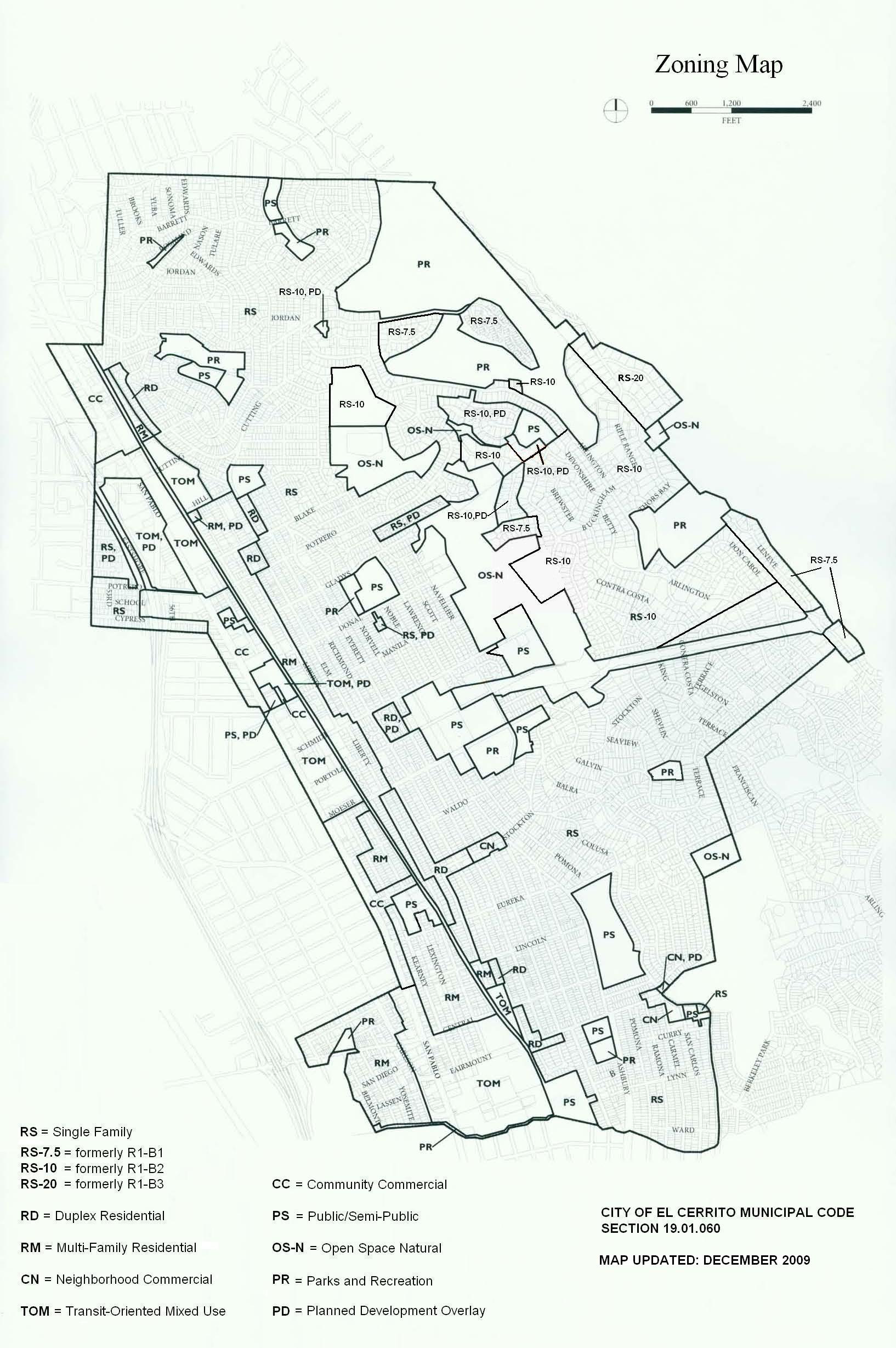
El Cerrito City Zoning Code
PART VI
General Terms
Chapter 19.46 - USE CLASSIFICATIONS
Sections:
Chapter 19.47 - TERMS AND DEFINITIONS
Sections:
19.46.010 - Purpose.
Use classifications describe one or more uses of land having similar characteristics, but do not list every use or activity that may appropriately be within the classification. Part II. Base District Regulations and Part III. Overlay District Regulations rely on these defined use classifications and specify in separate schedules the land uses permitted, subject to specific limitations, and those requiring approval of an Administrative or Conditional Use Permit. These use classifications are also referred to in Chapter 19.24, Off-Street Parking and Loading.
(Ord. 2008-2 Div. II (part), 2008.)
19.46.020 - Classification of uses.
A.
Uncertainty of Uses. When there is uncertainty, the Zoning Administrator shall determine whether a specific use should be considered within one or more use classifications or not within any classification in this Chapter, pursuant to Section 19.33.040. The Zoning Administrator may determine that a specific use is not within a classification if its characteristics are substantially incompatible with those typical of uses named within the classification. Decisions by the Zoning Administrator may be appealed to the Planning Commission.
B.
Accessory or Primary Use. The Zoning Administrator shall determine whether a use or activity is a primary or accessory use of a building or space. Decisions by the Zoning Administrator may be appealed to the Planning Commission. The Zoning Administrator shall use the following criteria in making his/her determination:
1.
The description of the activity or activities in relationship to the characteristics of each use category.
2.
The relative amount of site or floor space and equipment devoted to the activity.
3.
The relative amounts of sales from each activity.
4.
The relative number of employees in each activity.
5.
Building and site arrangement.
6.
How the use advertises itself.
7.
Whether the activity would be likely found independent of the other activities on the site.
8.
Whether the use would be harmonious and compatible with surrounding land uses.
C.
Separate Classification of Each Establishment. Where a single lot contains activities which resemble two or more different activity types, each of the principal activities conducted on a single lot by each individual establishment, management, or institution shall be classified separately.
(Ord. 2008-2 Div. II (part), 2008.)
19.46.030 - Residential use classifications.
A.
Residential Housing Types.
1.
Single Family Dwelling. One dwelling unit, attached or detached, located on a single lot. This use includes manufactured housing but not mobile homes.
2.
Accessory Dwelling Unit. An Attached, Detached, or Interior residential dwelling unit that provides complete independent living facilities for one or more persons and is located on a lot with a proposed or existing primary dwelling, and/or as otherwise defined in California Government Code Section 65852.2, as amended from time to time.
a.
Attached Accessory Dwelling Unit or Attached ADU. An Accessory Dwelling Unit that is constructed as a physical expansion (i.e. addition) of a proposed or existing primary dwelling and shares a common wall with the primary dwelling.
b.
Detached Accessory Dwelling Unit or Detached ADU. An Accessory Dwelling Unit that is constructed as a separate structure and fully detached from a proposed or existing primary dwelling.
c.
Interior Accessory Dwelling Unit or Interior ADU. An Accessory Dwelling Unit located within an existing structure. An existing structure means an existing permitted or otherwise legal dwelling unit, including all fully enclosed areas such as a partial basement, an attached garage, or an accessory structure that can be made safety habitable under building codes.
3.
Junior Accessory Dwelling Unit or JADU. A unit that is no more than five hundred square feet in size and contained entirely within a single family residence, and may include separate sanitation facilities or share sanitation facilities with the existing structure, or as otherwise defined in California Government Code Section 65852.22, as amended from time to time.
4.
Duplex Two-Family Dwelling. A single building that contains two primary dwelling units, or a single lot with two freestanding buildings, each of which is designed for occupancy by one household.
5.
Multiple-Family Residential. Three or more dwelling units on a single lot. Types of multiple-family dwellings include: townhouses, garden apartments, and other apartment buildings.
B.
Family Day Care Homes. A day-care facility licensed by the State of California that is located in a single-family residence or other dwelling unit where an occupant of the residence provides care and supervision for children.
1.
Small Family. A facility which provides care for eight or fewer children.
2.
Large Family. A facility which provides care for nine to 14 children.
C.
Group Housing. Shared living quarters without separate kitchen or bathroom facilities for each room or unit. This classification includes rooming and boardinghouses, dormitories, and private residential clubs, offering shared living quarters, but excludes hotels, residential care facilities and transitional housing facilities.
D.
Senior Citizen Housing. Housing that is available only to households occupied by senior citizens, qualifying residents, and permitted health care residents, subject to the limitations of Civil Code Section 51.3 or any successor statute. Notwithstanding the foregoing, residents of Senior Citizen Housing may host guests that are not senior citizens, qualifying residents, or permitted health care residents, for up to 60 days per year.
(Ord. 2008-2 Div. II (part), 2008; Ord. No. 2015-01, § 2, 1-6-2015; Ord. No. 2017-04, § 3, 6-6-2017; Ord. No. 2021-03, § 2, 11-16-2021)
19.46.040 - Public, semipublic, and service use classifications.
A.
Cemetery. Establishments primarily engaged in operating sites or structures reserved for the internment of human or animal remains and/or cremating the dead. This classification includes mausoleums, burial places, and memorial gardens.
B.
Clubs and Lodges. Meeting, recreational, or social facilities of a private or nonprofit organization primarily for use by members or guests, including residential accommodations that are available to members or guests on a temporary basis for periods of less than 30 consecutive days, but excluding residential hotels. This classification includes union halls and social clubs.
C.
Community Center. Any noncommercial facility established primarily for the benefit and service of the population of the community in which it is located. Examples include youth centers and senior centers. This classification excludes community facilities operated in conjunction with an approved residential or commercial use that are not generally available to the public.
D.
Community Social Service Facilities. Any noncommercial facility, such as homeless shelters, emergency shelters and facilities providing social services such as job referral, housing placement and which may also provide meals, showers, and/or laundry facilities, typically for less than 30 days. Specialized programs and services related to the needs of the residents may also be provided. This classification excludes transitional housing facilities that provide living accommodations for a longer term.
E.
Cultural Institutions. Public or non-profit institutions engaged primarily in the display or preservation of objects of interest in the arts or sciences that are open to the public on a regular basis. This classification includes performing arts centers for theater, dance, and events; libraries; museums; historical sites; aquariums; art galleries; and zoos and botanical gardens.
F.
Day Care Center. Establishments providing non-medical care for one or more persons on a less than 24-hour basis. This classification includes nursery schools, preschools, and day-care centers for children or adults and any other day-care facility licensed or certified by the State of California, excluding small or large family day-care.
G.
Government Offices. Administrative, clerical, or other public offices of a government agency, including postal facilities, together with incidental storage and maintenance of vehicles. This classification excludes corporation yards, equipment service centers, and similar facilities that primarily provide maintenance and repair services and storage facilities for vehicles and equipment.
H.
Hospitals and Clinics. Facilities licensed by the California State Department of Health Services providing medical, surgical, psychiatric, or emergency medical services to sick or injured persons. This classification includes facilities for in-patient and outpatient treatment including drug and alcohol abuse programs as well as training, research, and administrative services for patients and employees.
1.
Hospitals. Institutions providing medical and surgical care to the sick or injured including operating facilities and beds for patients to stay overnight. These establishments may include nursing facilities, extended care facilities, physical therapy, gift shops, retail pharmacies, employee housing, temporary housing for patient families, cafeterias or restaurants, and related uses operated primarily for the benefit of patients, staff, and visitors.
2.
Clinics. Noncommercial, public, community-based facilities, other than hospitals, where patients are admitted for examinations and treatment by one or more physicians, usually on a "walk-in" basis. Patients are treated on an outpatient basis and are not admitted for overnight treatment or observation. This classification includes licensed facilities offering substance abuse treatment, blood banks and plasma centers, and emergency medical services offered exclusively on an out-patient basis. These facilities are distinguished from private medical and dental offices which are generally smaller-scale in nature.
I.
Park and Recreation Facilities. Public parks, playgrounds, trails, wildlife preserves, and open spaces. This classification also includes public and non-commercial playing fields, courts, gymnasiums, swimming pools, picnic facilities, tennis courts, and golf courses, as well as related food concessions or community centers within the facilities.
J.
Parking Facilities, Public. The exclusive or primary use of a parcel for parking in either an open paved area or structure used for parking motor vehicles, owned by a public agency or under contract to a public agency.
K.
Public Maintenance and Service Facilities. Facilities providing maintenance and repair services for vehicles and equipment and material storage areas. This classification includes corporation yards, equipment service centers, and similar public facilities.
L.
Public Safety Facilities. Facilities for public safety and emergency services, including a facility that provides police and fire protection and other emergency medical services.
M.
Religious Facilities. A facility used primarily for religious services, including churches, temples, and similar religious facilities. This classification excludes private schools (as defined in this section), other educational facilities, administrative facilities and offices, community centers, and other uses when not incidental to a facility used primarily for religious services.
N.
Residential Care Facilities. Facilities that are licensed by the State of California to provide permanent living accommodations and 24-hour primarily non-medical care and supervision for persons in need of personal services, supervision, protection, or assistance for sustaining the activities of daily living. Living accommodations are shared living quarters with or without separate kitchen or bathroom facilities for each room or unit. This classification includes facilities that are operated for profit as well as those operated by public or not-for-profit institutions, including hospices, nursing homes, convalescent facilities, and group homes for minors, persons with disabilities, and people in recovery from alcohol or drug additions. This category excludes transitional housing and community social service facilities.
1.
Residential Care, General. A residential care facility providing 24-hour nonmedical care for more than 6 persons in a single unit in need of personal services, supervision, protection, or assistance essential for sustaining the activities of daily living. This classification includes only those facilities licensed for residential care by the State of California.
2.
Residential Care, Limited. A residential care facility providing 24-hour non-medical care for 6 or fewer persons in a single unit, in need of personal services, supervision, protection, or assistance essential for sustaining the activities of daily living. This classification includes only those facilities licensed for residential care by the State of California. 1 This classification includes residential care facilities restricted to persons 60 years of age or older if there are 6 or fewer residents. Six or fewer persons does not include the licensee or members of the licensee's family or persons employed as facility staff.
_______
1 A residential care facility with six or fewer persons and not licensed by the State of California is considered a residential use.
_______
3.
Residential Care, Senior. A housing arrangement chosen voluntarily by the resident, the resident's guardian, conservator or other responsible person; where residents are 60 years of age or older and where varying levels of care and supervision are provided as agreed to at time of admission or as determined necessary at subsequent times of reappraisal. Any younger residents must have needs compatible with other residents, as provided in Health & Safety Code Section 1569.316 or a successor statute. This classification includes continuing care retirement communities and lifecare communities licensed for residential care by the State of California.
O.
Schools, Public or Private. Facilities for primary or secondary education, including public schools, charter schools, and private institutions having curricula comparable to that required in the public schools of the State of California.
(Ord. 2008-2 Div. II (part), 2008.)
19.46.050 - Commercial use classifications.
A.
Animal Sales and Services. Retail sales and services of animals, including grooming, and/or veterinary care for animals on a commercial basis. This classification allows 24-hour accommodation of animals receiving medical or grooming services but does not include kennels. This classification also excludes dog walking and similar pet care services not carried out at a fixed location, and retail stores selling pet supplies only.
B.
Kennel. Facilities for keeping, boarding, training, breeding or maintaining for commercial purposes, four or more dogs, cats, or other household pets not owned by the kennel owner or operator. This classification excludes pet shops and animal hospitals that provide 24-hour accommodation of animals receiving medical or grooming services.
C.
Artists' Studios. Work space for artists and artisans, including individuals practicing one of the fine arts or performing arts, or skilled in an applied art or craft. Incidental retail sales of items produced on the premises is required.
D.
Automobile/Vehicle Sales and Services.
1.
Automobile Rentals. Rental of automobiles, including storage and incidental maintenance.
2.
Automobile/Vehicle Sales and Leasing. Sales or leasing of automobiles, motorcycles, trucks, and/or lawn and garden-type tractors, including storage and incidental maintenance.
3.
Automobile/Vehicle Service and Repair, Major. Repair of automobiles, trucks, and motorcycles, including the sale, installation, and servicing of related equipment and parts. This classification includes auto repair, body and fender, transmission, tire, muffler, and wheel and brake shops, as well as auto glass services, but excludes vehicle dismantling or salvaging and tire re-treading or recapping.
4.
Automobile/Vehicle Service and Repair, Minor. Establishments engaged in the retail sale of gas or diesel fuel, lubricants, parts, and accessories, including gasoline service stations; gas convenience marts; quick-service oil, tune-up; and tire sales and installation, where repairs are made or service provided in enclosed bays and vehicles are not typically stored overnight. This classification excludes establishments providing engine repair, body and fender work, vehicle painting, towing, or repair of heavy trucks or construction vehicles.
5.
Automobile Washing. Washing, waxing, or cleaning of automobiles or similar light vehicles.
6.
Large Vehicle Sales, Service, and Rental. Sales, servicing, and rental of trucks, motor homes, recreational trailers and equipment, boats, and other similar vehicles.
E.
Banks and Other Financial Institutions. Financial institutions providing retail banking services. This classification includes only those institutions engaged in the on-site circulation of money, including credit unions, and businesses offering check-cashing facilities.
1.
With Drive-Through Facilities. Financial institutions providing retail banking services to patrons remaining in automobiles.
2.
Automated Teller Machines (ATMs). Automated devices that perform banking or financial functions operated by the consumer.
F.
Bed and Breakfasts. Owner occupied establishments providing guest rooms for lodging on a less-than-weekly basis, within a single-family dwelling, with incidental eating and drinking service provided from a single kitchen for lodgers and residents only.
G.
Building Materials and Services. Retailing, wholesaling, or rental of building supplies or equipment. This classification includes lumber yards, tool and equipment sales or rental establishments and includes establishments devoted principally to taxable retail sales to individuals for their own use. This definition does not include building contractors' yards, large-scale "warehouse" stores (see Home Improvement Sales and Services), hardware stores with less than 10,000 square feet in floor area or plant nurseries.
H.
Business Services. Establishments that primarily provide goods and services to other businesses on a fee or contract basis, including printing and copying, blueprint services, advertising and mailing, equipment rental and leasing, office security, custodial services, photo finishing, and model building.
I.
Commercial Recreation. Provision of participant or spectator recreation to the general public, excluding public park and recreation facilities.
1.
Large-scale. This classification includes large indoor or outdoor facilities including: sports stadiums and arenas; amusement and theme parks; bowling centers; racetracks; amphitheatres; driving ranges not in conjunction with a golf course; large fitness centers, gymnasiums, handball, racquetball, or tennis club facilities greater than 20,000 square feet; ice or roller skating rinks; swimming or wave pools; miniature golf courses; archery or indoor shooting ranges; riding stables; campgrounds; stables, etc. This classification may include restaurants, snack bars, and other incidental food and beverage services to patrons.
2.
Small-scale. This classification includes small, generally indoor facilities, although some facilities may be outdoor, including: billiard parlors, dance halls, gymnasiums, handball, racquetball, or tennis club facilities less than 20,000 square feet, poolrooms, and amusement arcades. This classification may include restaurants, snack bars, and other incidental food and beverage services to patrons.
J.
Eating and Drinking Establishments. Businesses primarily engaged in serving prepared food and/or beverages for consumption on or off the premises.
1.
Bars/Night Clubs/Lounges. Businesses serving beverages for consumption on the premises as a primary use and including on-sale service of alcohol including beer, wine, and mixed drinks.
2.
Restaurants, Fast Food. Establishments where ready-to-eat prepared foods and beverages are: (1) sold for immediate consumption on- or off-premises; (2) are available upon a short waiting time; and (3) are packaged and served in or on disposable wrappers, containers, or plates. Fast-Food Restaurants may also exhibit other design and operating characteristics, including: a limited menu, food is paid for prior to consumption, the facility in which the activity/use is occurring provides a take-out counter space and substantial delineated area for customer queuing, employees generally wear a standard uniform, and the facility has late or long hours of operation.
3.
Restaurants, Full Service. Restaurants providing food and beverage services to patrons who order and are served while seated and pay after eating. Takeout service may be provided.
4.
Restaurants, Limited Service. Establishments where food and beverages are prepared and may be consumed on the premises, taken out, or delivered, but where no table service is provided and patrons pay before eating. This classification includes cafeterias, delis, coffee shops, and snack bars but excludes fast-food restaurants and take-out only establishments.
5.
Restaurants, Take-Out Only. Establishments where food and beverages are prepared and may be taken out or delivered, but may not be consumed on the premises. No seating is provided on the premises.
6.
With Drive-Through Facilities. Establishments providing food and beverage services to patrons remaining in automobiles. Includes drive-up service.
7.
With Outdoor Eating Areas. Provision of outdoor dining facilities on the same property or in the adjacent public right-of-way.
K.
Food and Beverage Sales. Retail sales of food and beverages for off-site preparation and consumption. Typical uses include markets, groceries, liquor stores, and retail bakeries.
1.
Catering Services. Preparation and delivery of food and beverages for off-site consumption without provision for on-site pickup or consumption.
2.
Convenience Market. Retail establishments that sell a limited line of groceries, prepackaged food items, tobacco, magazines, and other household goods, primarily for off-premises consumption and typically found in establishments with long or late hours of operation and a relatively small building. This classification includes small retail stores located on the same parcel as or operated in conjunction with a service station but does not include delicatessens or specialty food shops. It excludes establishments which have a sizeable assortment of fresh fruits and vegetables or fresh cut meat.
3.
General Market. Retail markets of food and grocery items for primarily offsite consumption. Typical uses include supermarkets, and specialty food stores such as bakeries, candy, nuts and confectionary stores, meat or produce markets, vitamin and health food stores, cheese stores and delicatessens.
4.
Liquor Stores. Establishments with over fifty percent of floor area primarily engaged in selling packaged alcoholic beverages such as ale, beer, wine and liquor.
L.
Funeral Parlors and Mortuaries. An establishment primarily engaged in the provision of services involving the care, preparation, or disposition of the human dead. Typical uses include a crematory, columbarium, mausoleum, or mortuary.
M.
Handicraft Shop. An establishment producing artisan goods by hand manufacturing involving the use of hand tools and small-scale equipment, including ceramic studios, candle makers, and custom jewelry manufacturing. Includes the retail sale of those products produced on-site.
N.
Home Improvement Sales and Services. Retail sales, rental, and related services of hardware, plumbing, electrical, heating, air conditioning, building supplies, lumber, tools and equipment, plants and garden products, rocks and soils, patio furniture, swimming pools, spas and hot tubs, lighting fixtures, kitchen and bathroom fixtures and cabinets, paint, carpeting, floor coverings, or wallpaper. This use classification does not include hardware stores with less than 10,000 square feet of area, or plant nurseries.
O.
Hotels and Motels. Establishments offering lodging to transient patrons. These establishments may provide additional services, such as conference and meeting rooms, restaurants, bars, or recreation facilities available to guests or to the general public. This classification includes motor lodges, motels, hostels, extended-stay hotels, and tourist courts, but does not include rooming hotels, boarding houses, or residential hotels designed or intended to be used for sleeping for a period of 30 consecutive days or longer. This classification also excludes bed and breakfast facilities and similar accommodations that an occupant of single-family housing provides on the same premises incidental to the primary residential use of the property.
P.
Laboratories. Establishments providing medical or dental laboratory services or establishments providing photographic, analytical, research and development or testing services.
Q.
Live/Work Unit. An artist, commercial or industrial unit with incidental residential accommodations that includes adequate working space reserved for artist, commercial or industrial use and regularly used for such purpose by one or more persons residing in the unit and a cooking space and sanitary facilities in conformance with applicable building standards. Up to 50 percent of the gross floor area may be reserved for and primarily used as living space.
R.
Maintenance and Repair Services. Establishments providing appliance repair, office machine repair, janitorial services, or building maintenance services. This classification excludes maintenance and repair of vehicles or boats and pest control services.
S.
Offices, Business and Professional. Offices of firms or organizations providing professional, executive, management, or administrative services, such as accounting, advertising, architectural, computer software design, engineering, graphic design, insurance, interior design, investment, and legal offices. This classification excludes hospitals, banks, and savings and loan associations.
1.
Walk-in Clientele. Offices of firms or organizations providing services to the public that rely on heavy pedestrian activity and constant visits by clients, including real estate offices, landlord-tenant services, credit counseling, and financial tax services.
T.
Offices, Medical and Dental. Offices of firms or organizations providing medical or dental services, such as physicians, dentists, chiropractors, optometrists, and similar medical professionals. This classification includes medical/dental laboratories within medical office buildings but excludes clinics or independent research laboratory facilities.
U.
Parking Facilities, Commercial. Surface lots and structures offering parking to the public for a fee when such use is not incidental to another activity.
V.
Personal Improvement Services. Provision of instructional services or related facilities, including photography; fine arts; crafts; dance or music studios; driving schools; business and trade schools; diet centers, reducing salons, spas, and single-purpose fitness studios such as yoga studios or aerobics studios. This classification is intended for more small-scale storefront locations and is distinguishable from small-scale commercial recreation uses that tend to occupy larger sites and generate more noise.
W.
Personal Services. Provision of recurrently needed services of a personal nature. This classification includes barber and beauty shops, seamstresses, tailors, dry cleaning agents (excluding large-scale bulk cleaning plants), shoe repair shops, self-service laundries, and travel agencies.
X.
Retail Sales. The retail sale and rental of merchandise not specifically listed under another use classification. This classification includes drug stores, pharmacies, department stores, clothing stores, furniture stores, pawn shops, pet supply shops, hardware stores, video rental stores, and businesses retailing goods including: toys, hobby materials, handcrafted items, jewelry, cameras, photographic supplies and services (including portraiture and retail photo processing), medical supplies and equipment, electronic equipment, records, sporting goods, kitchen utensils, hardware (under 10,000 square feet of sales area), appliances, antiques, art supplies and services, paint and wallpaper, carpeting and floor covering, office supplies, bicycles, and new automotive parts and accessories (excluding vehicle service and installation). Retail sales may be combined with other services such as office machine, computer, electronics, and similar small-item repairs.
1.
Large Format. Retail establishments (over 80,000 square feet of sales area) that sell merchandise and bulk goods for individual consumption, including membership warehouse clubs and superstores.
2.
Tobacco Retailer. "Tobacco retailer" means any person that sells tobacco, tobacco products, electronic smoking devices, smoking paraphernalia, or any combination thereof, including retail or wholesale sales. "Tobacco retailing" shall mean the doing of any of these things. This definition is without regard to the quantity of tobacco, tobacco products or smoking paraphernalia sold, offers for sale, exchanged, or offered for exchange.
Y.
Tattoo Establishments. Facilities that apply tattoos to the human body.
Z.
Theaters. Live and motion picture theaters.
(Ord. 2008-2 Div. II (part), 2008.)
(Ord. No. 2015-08, § 2.D., 10-6-2015)
19.46.060 - Industrial use classifications.
A.
Contractors' Yards. On- or off-site storage of contractors' materials or equipment.
B.
Handicraft/Custom Manufacturing. Manufacture by machine or equipment of crafts, art, sculpture, stained glass, and similar items. Incidental sales of products produced by an artist on-site may also be conducted within this space.
C.
Industry, Light. Establishments engaged in any of the following types of activities taking place within enclosed buildings: manufacturing finished parts or products primarily from previously prepared materials; food and beverage manufacturing/distribution; providing industrial services; or conducting industrial or scientific research, including product testing. This classification excludes basic industrial processing and recycling of cans, bottles, cardboard and similar consumer materials.
D.
Industry, Medium. Manufacturing or assembly of products from extracted, raw or finished materials or recycled or secondary materials, or bulk storage and handling of such products and materials. This classification includes: textile mills, textile product mills, apparel manufacturing, leather and allied product manufacturing, wood product manufacturing, paper manufacturing, chemical manufacturing, plastics and rubber products manufacturing, nonmetallic mineral product manufacturing, primary metal manufacturing, and fabricated metal product manufacturing.
E.
Warehousing and Storage. Storage and distribution facilities without onsite sales to the public on-site or direct public access.
1.
Indoor Commercial Storage. Storage within an enclosed building of commercial goods prior to their distribution to wholesale and retail outlets.
2.
Outdoor Storage. Storage of vehicles or commercial goods in open lots.
3.
Personal Storage. Facilities offering storage for individual use, including mini-warehouses.
(Ord. 2008-2 Div. II (part), 2008.)
(Ord. No. 2015-08, § 2.B., 10-6-2015)
19.46.070 - Transportation, communication, and utilities use classifications.
A.
Communication Facilities.
1.
Antennae and Transmission Towers. Broadcasting, recording, and other communication services accomplished through electronic or telephonic mechanisms, as well as structures designed to support one or more reception/transmission systems. Examples of transmission towers include, but shall not be limited to, radio towers, television towers, telephone exchange/microwave relay towers, and cellular telephone transmission/personal communications systems towers.
2.
Facilities Within Buildings. Includes radio, television, or recording studios and telephone switching centers; excludes antennae and transmission towers.
B.
Recycling Facilities. Facilities for receiving, temporarily storing, and transferring materials for recycling, reuse, or final disposal.
1.
Reverse Vending Machine. An automated mechanical device that accepts, sorts and processes recyclable materials and issues a cash refund or a redeemable credit slip.
2.
Recycling Collection Point. An incidental use that serves as a neighborhood drop off point for the temporary storage of recyclable materials but where the processing and sorting of such items is not conducted on-site.
3.
Recycling Processing Facility. Facilities that receive, sort, store and/or process recyclable materials.
C.
Utilities, Major. Generating plants, electric substations, solid waste collection, including transfer stations and materials recovery (recycling processing) facilities, solid waste treatment and disposal, water or wastewater treatment plants, and similar facilities of public agencies or public utilities.
D.
Utilities, Minor. Facilities necessary to support established uses involving only minor structures, such as electrical distribution or transmission lines, and underground water and sewer lines.
E.
Hazardous Waste Facility. All contiguous land and structures, other appurtenances, and improvements on the land used for the treatment, transfer, storage, resource recovery, disposal or recycling of hazardous waste management units, or combinations of these units.
(Ord. 2008-2 Div. II (part), 2008.)
19.46.080 - Agriculture use classifications.
A.
Nurseries. Establishments primarily engaged in retailing nursery and garden products — such as trees, shrubs, plants, seeds, bulbs, and sod - that are predominantly grown elsewhere but which may sell a limited amount of product they grow themselves. All merchandise is kept within an enclosed building or a screened enclosure and fertilizer of any type is stored and sold in package form only. This classification includes wholesale and retail nurseries.
(Ord. 2008-2 Div. II (part), 2008.)
19.47.010 - List of terms.
Abutting or Adjoining.
Access.
Accessory Dwelling Units.
Accessory Structure (or Building).
Accessory Use.
Acre, Gross.
Active Fault.
Adjacent.
Adult Businesses.
Affordable Housing.
Affordable Housing Incentives.
Affordable Housing Terms.
Agent.
Aggrieved Party (or Person).(See Area Median Income Levels)
Alcoholic Beverage Sales.
Alley.
Alteration.(See also Structural Alteration)
Amateur Radio Antenna.
Animated or Moving Sign.(See Sign Types)
Antenna.
Applicant.
Arborist.
Arbors.(See Overhead Landscape Features)
Area Median Income Levels.(See Affordable Housing Terms)
Architectural Feature.
Assessed Value.
Automated Teller Machine (ATM).
Average Grade.(See Grade-Related Terms)
Awning.
Awning or Canopy Sign.(See Sign Types, See also Awning and Canopy)
Balcony.
Banner Sign.(See Sign Types)
Base Density.
Bedroom.
Best Management Practices.
Blockface.
Board.
Brush Layering.
Brush Matting.
Building.
Building Envelope.
Building Height.
Building Inspector.
Building, Main.
Building-Mounted Telecommunications Facility.
Building Site.
Bulk.
California Environmental Quality Act (CEQA).
Canopy.(See also Awning or Canopy Sign)
Carport.
CEQA.
Change of Use.
Changeable Sign Copy.(See Sign Copy)
Childcare Facility.
City.
City Council.(See Council)
City Limits.
Co-location.
Commercial Signs.(See Sign Types)
Commission.
Common Open Space.(See Open Space Types)
Construction Cost.
Construction Sign (Development Sign).(See Sign Types)
Corner Lot.(See Lot Types)
Council.
Court.
Covenant.
Coverage, Lot.(See Lot Coverage)
Creek.
Creekbank.
Cribwalls.
Culvert.
Daylight Plane.
Daylighting (Creek).
Deck.
Deck Line.
Density Bonus.
Design Review.
Development.
Diameter of a Tree.
Directional Sign.(See Sign Types)
Director.
Disabled.
Discretionary Permit.(See Permit)
District.
Domestic Animals.
Dripline.
Driveway.
Dwelling.
Dwelling Unit.
Earthen Berm.
Easement.
Eave Line.
Efficiency Unit.
EIR.
Emergency.
Environment.
Environmental Documents.
Environmental Impact Report.(See EIR)
Environmentally Sensitive Habitat.
Existing Grade.(See Grade-Related Terms)
Exterior or Street Side Yard.(See Yard Types).
Family.
Fascines (sometimes "Wattles").
Fault Trace.
Feasible.
Fee Parking.
Fence.
Fill Slope.
Finished Grade.(See Grade-Related Terms)
Flag Lot.(See Lot Types)
Flag.(See Sign Types)
Floor.
Floor Area.
Floor Area Ratio.
Footprint, Building.
Freestanding Sign.(See Sign Types)
Front Lot Line.(See Lot Line Types)
Front Yard.(Yard Types)
Frontage, Street or Frontage, Building.
Gabions.
Gable Roof.(See Roof Types)
Gambrel Roof.(See Roof Types)
Garage.
General Plan.
Grade-Related Terms.
Grading.(See Grade-Related Terms)
Grand Opening Sign.(See Sign Types)
Greenhouse.
Gross Floor Area.(See Floor Area)
Ground-Slope.
Guesthouse.
Hazardous Waste.
Hazardous Waste Facility.
Height.
Hip Roof.(See Roof Types)
Home Occupation.
Household.
Illegal Use.
Impervious Surface.
In-lieu Fees.
Intensity of Use.
Intensification of Use.
Interior Lot.(See Lot Types)
Interior Lot Line.(See Lot Line Types)
Interior Side Yard.(Yard Types)
Irregular Lot.(See Lot Types)
Joint Watershed Goals Statement.
Key Lot.(See Lot Types)
Kitchen.
Landscaping.
Living Area.
Living Room.
Loading Space.(See Off-street Loading)
Lot.
Lot Area.
Lot Coverage.
Lot Depth.
Lot Frontage.
Lot Line.
Lot Line Types.
Lot of Record.
Lot Types.
Lot Width.
Lower Income Households.(See Affordable Housing Terms)
Maintenance and Non-Structural Repair.
Mansard Roof.(See Roof Types)
Manufactured Housing.
Marquee Sign.(See Sign Types)
Master Fee Schedule.
Ministerial Permit.(See Permit)
Mixed Use.
Moderate Income Households.(See Affordable Housing Terms)
Monitoring.
Monopole.
Monument Sign.(See Sign Types)
National Pollutant Discharge Elimination System (NPDES) Storm Water Discharge Permits.
Natural Grade.(See Grade-Related Terms)
Negative Declaration.
Noncommercial Sign.(See Sign Types)
Nonconforming Building or Structure.
Nonconforming Parcel.
Nonconforming Use.
Occupancy, Change In.
Off-Street Loading.
On-Premises Sign.(See Sign Types)
Off-Premises Sign.(See Sign Types)
Open Space.
Open Space Types.
Outdoor Dining.
Outdoor Retail.
Outdoor Storage.
Overhead Landscape Features.
Parapet Wall.
Parking Lot.(See also Public Garage)
Parking Space.
Parking Structure.(See also Parking Lot and Public Garage)
Passageway.
Pergolas.(See Overhead Landscape Features)
Permit.
Permitted Health Care Resident.
Person.
Physically Handicapped.
Plan Line.
Planning Commission.
Plant Cuttings.
Plant Nursery.
Pole Sign.(See Sign Types)
Pollute.
Porch.
Portable A-Frame Sign.(See Sign Types)
Pre-existing.
Premises.
Primary Structure.
Primary Use.
Private Open Space.(See Open Space Types)
Project.
Projecting Sign.(See Sign Types)
Public Garage or Storage Garage.
Public Right-of-Way (ROW).
Qualifying Residents.
Readily Removable.
Real Estate Sign.(See Sign Types)
Rear Lot Line.(See Lot Line Types)
Rear Yard.(See Yard Types)
Recreational Vehicle.
Recyclable Material.
Recycling Facility.
Regular Lot.(See Lot Types)
Reporting.
Retaining Wall.
Reversed Corner Lot.(See Lot Types)
Riparian Habitat.
Riprap.
Riprapping.
Roof Line.
Roof Sign.(See Sign Types)
Roof Types.
Satellite Antenna.
Screening.
Senior Citizen.
Setback line.
Side Lot Line.(See Lot Line Types)
Side Yard.(Yard Types)
Sign.
Sign Area.
Sign Copy.
Sign Face.
Sign Height.
Sign Types.
Site.
Solar Energy.
Storm Water Runoff.
Story.
Stream.
Streambed.
Street.
Street Grade.(See Grade-Related Terms)
Street Line.(See Lot Line Types)
Structural Alteration.
Structural Repairs.
Structure.
Studio Dwelling Unit.
Substandard Lot.(See Lot Types)
Swimming Pools.
Telecommunications Facility.
Telecommunications Facility, Co-Located.
Temporary Sign.(See Sign Types)
Tenant.
Through Lot.(See Lot Types)
Top of Creek Bank.
Trellises.(See Overhead Landscape Features)
Use.
Very Low Income Households.(See Affordable Housing Terms)
Visible.
Wading Pool.
Walkway.
Wall Sign.(See Sign Types)
Watercourse.
Wetlands.
Window Sign.(See Sign Types)
Yard.
Yard Types.
Zoning Administrator.
(Ord. 2008-2 Div. II (part), 2008; Ord. No. 2009-03, § XVIII, 4-20-2009; Ord. No. 2017-04, § 3, 6-16-2017; Ord. No. 2021-03, § 3, 11-16-2021; Ord. No. 2026-01, § 2, 4-7-2026)
19.47.020 - Definitions.
Abutting or Adjoining. To physically touch or border upon, or sharing a common property line.
Access. The place, or way through which pedestrians and/or vehicles shall have a safe, adequate and usable ingress or egress to a property or use as required by this Zoning Ordinance.
Accessory Dwelling Units.See "Residential Housing Types, Accessory Dwelling Units" in Chapter 19.46, Use Classifications.
Accessory Structure (or Building). A building, part of a building, or structure that is detached from the principal structure or building on a site, and with a use that is incidental to the principal building. Examples include, but are not limited to, detached garages, detached decks, storage buildings, woodsheds, workshops and gazebos. This definition does not include overhead landscape features.
Accessory Use. A use that is customarily associated with, and is incidental and subordinate to, the principal use and located on the same lot as the principal use. See Chapter 19.46, Use Classifications for additional regulations.
Acre, Gross. A measure of total land area of any lot including future streets, parks and other land dedications.
Active Fault. A fault that has had surface displacement within the Holocene epoch (approximately the last 11,000 years) that constitutes a potential hazard to structures located across it.
Adjacent. Near or close to; sometimes contiguous; neighboring.
Adult Businesses.See Section 19.20.020.
Affordable Housing. Housing units which are affordable to families with very low, low or moderate incomes.
Affordable Housing Incentives. Regulatory concessions as specified in California Code Sections 65915(l) or any successor statute, to include, but not be limited to, the reduction of site development standards or Zoning Ordinance requirements, approval of mixed-use zoning in conjunction with the housing project, or any other regulatory incentive which would result in identifiable cost reductions that are offered in addition to a density bonus. See Chapter 19.22, Affordable Housing Bonus.
Affordable Housing Terms.See also Chapter 19.22, Affordable Housing Bonus.
Area Median Income Levels. Income levels regularly updated and published by the State Department of Housing and Community Development, and found in Title 25, Section 6932 of the California Code of Regulations. Area Median Income Levels are also available at www.hcd.ca.gov.
Lower Income Households. Households with incomes that do not exceed 80 percent of Area Median Income (AMI), adjusted for family size and revised annually by the State Department of Housing and Community Development, and as defined in Section 50079.5 of the Health and Safety Code or any successor statute. This includes "very low income households" and "extremely low income households," as defined in Sections 50105 and 50106, respectively of the Health and Safety Code or any successor statutes.
Moderate Income Households. Households with incomes ranging from 80 percent to 120 percent of Area Median Income (AMI), adjusted for family size and revised annually by the State Department of Housing and Community Development, and as defined in Section 50093 of the Health and Safety Code or any successor statute.
Very Low Income Households. Households with incomes that do not exceed 50 percent of Area Median Income (AMI), adjusted for family size and revised annually by the State Department of Housing and Community Development, and as defined in Section 50105 of the Health and Safety Code or any successor statute.
Agent. A person authorized in writing by the property owner to represent and act for a property owner in contacts with City employees, committees, Commissions and the Council, regarding matters regulated by this Zoning Ordinance.
Aggrieved Party (or Person). Any person who alleges that their property will be injured by a decision of the Zoning Administrator, Planning Commission, or other decision-making body involved in the enforcement of this Zoning Ordinance.
Alcoholic Beverage Sales. The retail sale of beer, wine, and/or distilled spirits for on-premise or off-premise consumption.
Alley. A secondary vehicular accessway through the middle of a block that provides access to the rear of building sites or buildings.
Alteration. Any change, addition or modification that changes the exterior architectural appearance or materials of a structure or object. Alteration includes changes in exterior surfaces, changes in materials, additions, remodels, demolitions, and relocation of buildings or structures, but excludes ordinary maintenance and repairs. See also "Structural Alteration."
Antenna. Any system of wires, poles, rods, reflecting discs or similar devices used for the transmission or reception, or both, of electromagnetic radiation waves.
Amateur Radio Antenna. Any antenna used to receive or transmit radio signals on the amateur radio bandwidth, as designated by Federal regulation.
Satellite Antenna. Any antenna used to receive or transmit radio or television signals from orbiting communication satellites.
Applicant. Any person who is filing an application requesting an action who is:
1.
The owner or lessee of the property;
2.
A party who has contracted to purchase, rent, or lease property contingent upon that party's ability to acquire the necessary approvals required for that action in compliance with this Zoning Ordinance, and who presents written authorization from the property owner to file an application with the City; or
3.
The agent of either of the above who presents written authorization from the property owner to file an application with the City.
Arborist. A person currently certified by the Western Chapter of the International Society of Arboriculture as an expert on the care of trees; or, a consulting arborist who satisfies the requirements of the American Society of Consulting Arborists; or other qualified professional who the Zoning Ordinance determines has gained through experience the qualifications to identify, remove or replace trees.
Arbors.See Overhead Landscape Features.
Architectural Features. An exterior building feature including roof, windows, doors, porches, etc.
Assessed Value. The value of a structure as shown in the records of the County Assessor.
Automated Teller Machine (ATM).See "Banks and Other Financial Institutions" in Chapter 19.46, Use Classifications.
Awning. An architectural projection that provides weather protection, identity or decoration and is wholly supported by the building to which it is attached. An awning is typically constructed of fabric, metal or other comparable materials on a supporting framework which projects from and is supported by the exterior wall of a building.
Awning or Canopy Sign.See "Sign Types," "Awning," and "Canopy."
Balcony. A platform that projects from and is supported by the wall of a building rather than columns or other supports below the platform, and is enclosed by a parapet or railing.
Base Density. The number of dwelling units permitted on a particular parcel of land, in conformance with the General Plan and this Zoning Ordinance.
Bedroom. Any room located within a dwelling unit that is used primarily for sleeping purposes by its residents and that contains at least 70 square feet of floor area. Rooms designated as a "den," "library," "study," "loft" or other extra room that satisfies this definition and is not a kitchen, living room, or bath will be considered a bedroom.
Best Management Practices. Best Management Practices means activities, practices, and procedures to prevent or reduce the discharge of pollutants directly or indirectly to the municipal storm drain system and waters of the United States. Best Management Practices include: treatment facilities to remove pollutants from storm water; operating and maintenance procedures; facility management practices to control runoff, spillage or leaks of non-storm water, waste disposal, and drainage from materials storage; erosion and sediment control practices; the prohibition of specific activities, practices, and procedures; and such other provisions as the City determines appropriate for the control of pollutants.
Blockface. All property between two intersections that fronts upon a street or abuts a public right-of-way.
Board. The Design Review Board of the City of El Cerrito, California. Also referred to as the "Design Review Board."
Brush Layering. The use of live branches or cuttings which are inserted into the creekbanks perpendicular to the slope so that the rooting occurs back into the slope.
Brush Matting. The use of dead or live cuttings from riparian vegetation stacked and secured against creekbanks to check erosion and revegetate banks.
Building. Any structure having a roof supported by columns or by walls, designed for the shelter or housing of any person, animal or property.
Building Envelope. The volume of space within which a building or structure is permitted to be built on a lot, defined by minimum setbacks, maximum height limits, and required daylight planes.
Building Height. The distance from any point of a structure as measured vertically to the elevation of the natural or finished grade, whichever is lower. The ground elevation shall be calculated at a point three feet outside the exterior perimeter of the foundation of the structure. See also Chapter 19.03, Rules of Measurement.
Building Inspector. The building inspector or other officer or person charged with the administration and enforcement of City regulations pertaining to buildings and structures, or a duly authorized representative.
Building, Main. A building in which the principal use of the lot and/or building site is conducted.
Building-Mounted Telecommunications Facility. A facility constructed in two general forms, roof mounted, in which an antenna is placed on or above the roof, and facade-mounted, in which an antenna is mounted on the side of a building. Building-mounted facilities can be located on or inside various structures such as building roof or eave trim, church steeples, or other innovative locations.
Building Site. A parcel of land occupied or to be occupied by a main building and accessory buildings, or by a dwelling group and its accessory building, together with such open spaces as are required by the terms of this Zoning Ordinance and having its principal frontage on a street, road or highway.
Bulk. A term used to designate the overall size and mutual relationship of buildings and other structures, as to size, height, coverage, shape, location of exterior walls in relation to lot lines, to the center of streets, to other walls of the same building, and to other buildings or structures; and to all open spaces relating to the building or structure.
California Environmental Quality Act (CEQA). State law, pursuant to California Public Resources Code Section 21000 et seq. or any successor statute, which requires public agencies to document and consider the environmental effects of a proposed action before a decision.
Canopy. A roofed shelter projecting over a sidewalk, driveway, entry, window, or similar area that may be wholly supported by a building or may be wholly or partially supported by columns, poles, or braces extending from the ground. See also "Awning or Canopy Sign."
Carport. An accessory building with a minimum dimension of 9 x 20 feet, permanently open on at least two sides and maintained for the storage of automobiles or other motor vehicles.
CEQA.See "California Environmental Quality Act (CEQA)."
Change of Use. The replacement of an existing use on a lot or parcel, or any portion thereof, by a new use, or a change in the nature of an existing use; but does not include a change of ownership, tenancy, or management associated with a use for which the previous nature of the use will remain substantially unchanged.
Childcare Facility. A facility installed, operated, and maintained for the non-residential care of children as defined under applicable state licensing requirements for the facility.
City. The City of El Cerrito, California.
City Limits. The legal boundaries of the City of El Cerrito, California.
Co-location. The placement of two or more wireless communication facilities on a single support structure or otherwise sharing a common location. Co-location shall also include the placement of wireless communication facilities on buildings, water tanks, light poles, electricity towers, or other existing facilities and/or structures.
Commission. The City Planning Commission of the City of El Cerrito, California. Also referred to as the "Planning Commission."
Construction Cost. The total cost required to construct, rebuild, repair, remodel or make an addition to an existing building, including all permanent work and permanent equipment, excluding landscaping.
Council. The City Council of the City of El Cerrito, California. Also referred to as the "City Council."
Court. An open space wholly or partially enclosed by a building or group of buildings.
Covenant. A formal binding agreement for the performance of some action.
Coverage, Lot.See "Lot Coverage."
Creek. A watercourse which carries water, whether identified or unidentified, from either a permanent or natural source, either intermittently or continuously; and which runs in a defined channel or continuous swale or depression, which later merges with a larger watercourse. This definition includes a channel, swale, depression, or watercourse, whether or not culverted, but excludes any part of an engineered system which was developed by a public agency for collection of storm or flood waters, provided however that such part does not follow the original course of the creek. The word "creek" shall be synonymous with "natural watercourse" as used in this Title.
Creekbank. The uppermost limit of the active creek channel, usually marked by a break in slope.
Cribwalls. A rectangular framework of logs which is filled with soil and/or rocks and planted with cuttings.
Culvert. The placement or construction of a pipe or box shaped conduit in a creek bed for the purpose of collecting water.
Daylight Plane. An inclined plane, beginning at a stated height above grade at a setback line and extending into the site at a stated upward angle to the horizontal, and which limits the height or horizontal extent of structures.
Daylighting (Creek). The unearthing of a culverted creek, stream or natural watercourse and the design of a new channel to re-create the original creek, stream channel and environment.
Deck. An open, unroofed porch or platform, either freestanding or attached to a building that is supported above grade.
Deck Line. The line of intersection on a Mansard Roof of the two slopes of a side.
Density Bonus. A density increase over the base density, permitted if certain requirements are met.
Design Review. The process of examination of a proposed project to assure compliance with provisions of this title and conditions of approval related to building design and site planning. See Chapter 19.38, Site Plan and Design Review.
Development. Any manmade change to improved or unimproved real estate, including but not limited to, the construction or relocation of buildings or other structures on a lot, mining, dredging, filling, grading, landscaping, paving, excavation, parking, fences, pools, signs or temporary uses.
Diameter of a Tree. Trunk diameter measure at 4.5 feet above the ground (also known as "Diameter at Breast Height" or "DBH").
Director. The Director of the Community Development Department of the City of El Cerrito, California or his/her designee.
Disabled. Persons affected by a long-duration physical impairment such that their mobility has been reduced for an indeterminate length of time and whose ability to live independently could be improved by suitable housing conditions.
District. A portion of the city within which certain uniform regulations and requirements, or various combinations thereof apply under the provisions of this title.
Dripline. A line that may be drawn on the ground around a tree directly under its outermost branch tips and which identifies that location where rainwater tends to drip from the trees. When depicted on a map, the drip line will appear as an irregular shaped circle that follows the contour of the tree's branches as seen from overhead.
Driveway. A paved or unpaved accessway used by vehicles and pedestrians for common access to a parking space, garage, dwelling, or other structure.
Dwelling. A building or portion thereof designed and used exclusively for residential occupancy, including one-family, two-family and multiple-family dwellings, but not including hotels, motels or boarding houses.
Dwelling Unit. One room or a cluster of rooms designed for use by one family for living and sleeping purposes and having only one kitchen or kitchenette.
Earthen Berm. A mount or embankment of earth, together with necessary retaining structures.
Easement. A legal interest in land owned by another that entitles its holder to a specific right or privilege to use or enjoy the land (examples: a right to pass over a piece of property; a utility easement for power lines and water pipes; an easement for an unobstructed view; or a right to use property as a recreation area).
Eave Line. The lower border of a roof that overhands the wall. For a non-flat roof that does not overhang the wall, the eave line shall be the highest point of the walls.
Efficiency Unit. Shall have the same meaning as defined in Section 17958.1 of the Health and Safety Code, as amended from time to time.
EIR.An Environmental Impact Report as required under the California Environmental Quality Act, Public Resources Code Section 21000 et seq. or any successor statute.
Emergency. A sudden unexpected occurrence demanding immediate action to prevent or mitigate loss or damage to life, health, property or essential public services.
Environment. The physical conditions which exist within the area which will be affected by a proposed project including land, air, water, minerals, flora, fauna, ambient noise, and objects of historical or aesthetic significance. The area involved shall be the area in which significant effects would occur either directly or indirectly as a result of the project. The "environment" includes both natural and man-made conditions. (California Environmental Quality Act (CEQA)).
Environmental Documents. Initial studies, negative declarations, draft and final EIRs, documents prepared as substitutes for EIRs and negative declarations under the California Environmental Quality Act, Public Resources Code Section 21000 et seq. or any successor statute.
Environmental Impact Report.See "EIR."
Environmentally Sensitive Habitat. A type of sensitive resource area where plant or animal life or their habitats are either rare or especially valuable because of their special nature or role in an ecosystem and which could be easily disturbed or degraded by human activities and development. This term includes, but is not limited to, wetlands, riparian vegetation, and terrestrial habitats, as mapped in the General Plan.
Existing Grade.See "Grade-Related Terms" and Chapter 19.03, Rules of Measurement.
Family. One or more persons living together as a single nonprofit housekeeping unit and sharing common living, sleeping, cooking and eating facilities. Members of a "family" need not be related by blood but are distinguished from a group occupying a hotel, club, fraternity or sorority house.
Fascines (sometimes "Wattles"). Bundles of cuttings from riparian plants used to revegetate banks.
Fault Trace. The line formed by the intersection of a fault and the earth's surface, that is the representation of a fault as depicted on a map, including maps of earthquake fault zones.
Feasible. Capable of being accomplished in a successful manner within a reasonable period of time, taking into account economic, environmental, social and technological factors.
Fee Parking. The parking and storage of vehicles on a fee basis, but does not include off-street parking provided gratis to customers, such as is required elsewhere in this title.
Fence. Any structural device forming a physical barrier or boundary by means of hedge, wood, mesh, metal, chain, brick, stake, plastic or other similar materials.
Fill Slope. The depositing of earth or any other substance or material by artificial means, including new pilings (except for replacement pilings) placed for the purposes of erecting structures thereon placed in a submerged area, any action by which earth, sand, gravel, rock or any other material is placed, pushed, pumped, pulled, transported, or moved to a new location above the natural surface of the ground or on top of the stripped surface and shall include the conditions resulting therefrom.
Flag.See "Sign Types."
Floor. A surface that is horizontal or nearly so, located within the interior of a structure which is suitable for walking or standing upon.
Floor Area. The horizontal area of all floors included within the surrounding exterior walls of a building or buildings. See Chapter 19.03, Rules of Measurement.
Floor Area Ratio. The ratio of the floor area of all buildings on a lot to the lot area. See Chapter 19.03, Rules of Measurement.
Footprint, Building. Floor area of a structure at the ground level, including areas under higher levels, but excluding decks, open stair landings, balconies and other unroofed structures less than six feet tall.
Freestanding Sign.See "Sign Types."
Frontage, Street or Frontage, Building. The side of a lot or building site facing a street.
Gabions. Wire baskets filled with rocks.
Gable Roof.See "Roof Types."
Gambrel Roof.See "Roof Types."
Garage. Accessible and usable covered space entirely enclosed for the storage of automobiles.
General Plan. The General Plan of the City of El Cerrito, California, as adopted by the City Council on August 30, 1999, and as amended from time to time.
Grade-Related Terms.See also Chapter 19.03, Rules of Measurement.
Average Grade. A horizontal line approximating the ground elevation through each building on a site used for calculating the exterior volume of buildings. Average grade is calculated separately for each building.
Natural Grade. The grade of a building site prior to grading, filling, or other site alterations for a project. Natural grade may also be referred to as existing grade.
Finished Grade. The final grade of a building site as shown on the survey at the time of issuance of a building permit or in the case of a subdivision, the approved grade shown on the as-built grading plan of the subdivision.
Grading. Excavating, filling, leveling or smoothing or combination thereof, but not including temporary stock piles of a duration of 30 days or less.
Street Grade. The top of the curb or the top of the edge of the pavement or traveled way where no curb exists.
Greenhouse. A transparent or translucent glazed structure devoted to the protection and growth of plants.
Gross Floor Area.See "Floor Area."
Ground-Slope. A calculation of deviation from the horizontal, considering the ground area within the setback lines prescribed for the main building on a site. See Chapter 19.03, Rules of Measurement.
Guesthouse.See "Residential Housing Types, Second Units" in Chapter 19.46, Use Classifications.
Hazardous Waste. Any material, including any substance, waste, or combination thereof, which because of its quantity, concentration, or physical, chemical, or infectious characteristics may cause, or significantly contribute to, a substantial present or potential hazard to human health, safety, property, or the environment when improperly treated, stored, transported, disposed of, or otherwise managed. (California Health and Safety Code Section 25117).
Hazardous Waste Facility.See Chapter 19.46, Use Classifications.
Height.See "Building Height."
Hip Roof.See "Roof Types."
Home Occupation. Any occupation conducted by a resident, entirely within a dwelling, where the use is accessory to the residential use of the structure, and does not change the residential character of the neighborhood. See Chapter 19.20, Standards for Specific Uses.
Household. One or more persons, whether or not related by blood, marriage or adoption, sharing a dwelling unit in a living arrangement usually characterized by sharing living expenses, such as rent or mortgage payments, food costs and utilities, as well as maintaining a single lease or rental agreement for all members of the Household and other similar characteristics indicative of a single Household.
Illegal Use. Any use of land or building that does not have the currently required permits and was originally constructed and/or established without permits required for the use at the time it was brought into existence.
Impervious Surface. Any paved, hardened or structural surface which does not allow for complete on-site infiltration of precipitation. Such surfaces include, but are not limited to, buildings, concrete or asphalt driveways, streets, concrete or asphalt parking lots, swimming pools, and tennis courts.
In-lieu Fees. A cash payment required as a substitute for a dedication and/or improvement of land by an owner or developer of property.
Intensity of Use. The impacts a particular use or the use in combination with other uses has on its surroundings or on its demand for services and natural resources. Measures of intensity include but are not limited to requirements for water, gas, electricity, or public services; number of automobile trips generated by a use; parking demand; number of employees on a site; hours of operation; the amount of noise, light or glare generated; the number of persons attracted to the site, or, in eating establishments, the number of seats.
Intensification of Use. A change in the use of a structure or site that generates more traffic or other level of activity on the site, for example: where the new use is required by this Zoning Ordinance to have more off-street parking spaces than the former use; or change in the operating characteristics of a use (for example, hours of operation).
Joint Watershed Goals Statement. Statement of goals established by the coordination between the cities of El Cerrito, Albany, Berkeley, and Richmond, the East Bay Regional Park District and the University of California at Berkeley to restore the watershed of the joint jurisdictions to a healthy condition.
Kitchen. Any space used, intended or designed to be used for cooking and preparing food.
Landscaping. The planting, configuration and maintenance of trees, ground cover, shrubbery and other plant material, decorative natural and structural features (walls, fences and hedges), earth patterning and bedding materials, and other like site improvements, for an aesthetic or functional purpose.
Living Area. Shall have the same meaning as defined in California Government Code Section 65852.2, as amended from time to time.
Living Room. The principal room in a dwelling unit designed for general living purposes rather than for sleeping.
Loading Space.See "Off-street Loading."
Lot. A legally subdivided plot of land shown on a map of record.
Lot Area. The net area of a lot expressed in terms of acres or square feet, exclusive of any public or private street easements.
Lot Coverage. The ratio of the footprint of all principal and accessory structures on a lot to the lot area. See Chapter 19.03, Rules of Measurement.
Lot Depth. The horizontal distance from the midpoint of the front lot line to the midpoint of the rear lot line or to the most distant point on any other lot line where there is no rear lot line. See Chapter 19.03, Rules of Measurement.
Lot Frontage. The portion of a lot that fronts on or adjoins a street.
Lot Line. A line separating the frontage from a street; the side from a street or adjoining property; the rear from an alley or street or adjoining property.
Lot Line Types.
Front Lot Line. The side of a lot that abuts a public street. For corner lots, the shortest side fronting upon a street is considered the front of the lot regardless of which street is used for vehicle, pedestrian access or addressing.
Interior Lot Line. A lot line not adjacent to a street.
Rear Lot Line. The lot line that is opposite and most distant from the front lot line. Where no lot line is within 45 degrees of being parallel to the front lot line, a line 10 feet in length within the lot, parallel to and at the maximum possible distance from the front lot line, will be deemed the rear lot line for the purpose of establishing setbacks and measuring rear yard depth.
Side Lot Line. Any lot line not a front lot line or a rear lot line.
Street Line. A lot line dividing a lot from an abutting street right-of-way.
In case of unusual circumstances, the zoning administrator may use their discretion to reassign front, side and rear lot line types in a way that best serves the spirit and intent of zoning ordinance.
Lot of Record. A lot that is designated upon a map showing the lot, block and tract as indicated on a final map, as such map is filed in the county recorder's office, or as a lot shown on a recorded record of survey map.
Lot Types.
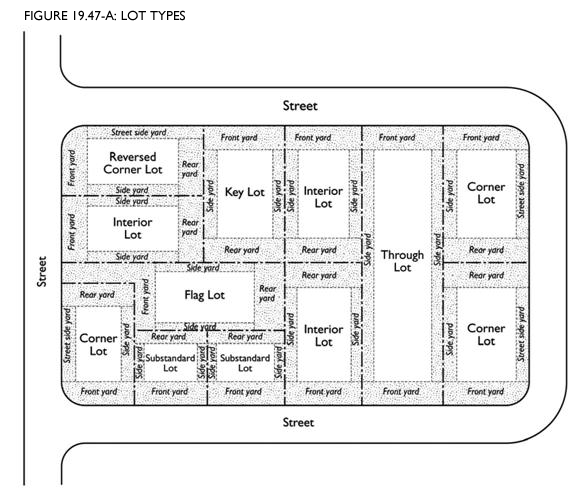
Corner Lot. A lot with two or more adjacent sides that face a street or public right-of-way.
Flag Lot. A lot with a portion that does not meet minimum lot width requirements, where access to the public roadway is provided via that narrow portion.
Interior Lot. A lot with only one front lot line, not located on a street corner and lacking a side lot line adjacent to a street.
Irregular Lot. A nonrectangular parcel or one with its lot width less than one-fourth its depth.
Key Lot. The first lot to the rear of a reversed corner lot and not separated therefrom by an alley.
Regular Lot. A rectangular or nearly rectangular shaped parcel with lot width not less than one-fourth its depth.
Reversed Corner Lot. A corner lot where the rear yard abuts the side yard of a key lot.
Substandard Lot. A lot which does not meet the minimum requirements for lot size, lot width, and/or lot depth.
Through Lot. A lot which has two or more lot frontages which do not intersect to form a corner lot. See Figure 19.47-A.
Lot Width. The average horizontal distance of a lot measured at right angles to its depth. See Chapter 19.03, Rules of Measurement.
Maintenance and Non-Structural Repair. The repair or replacement of nonbearing walls, fixtures, wiring, roof or plumbing that restores the character, scope, size or design of a structure to its previously existing, authorized and undamaged condition, and does not enlarge or extend the structure.
Mansard Roof.See "Roof Types."
Manufactured Housing. A home built in a factory in one or more sections to the specifications of the National Manufactured Housing Construction and Safety Standards Act of 1974, or any state or national minimum standards adopted subsequent to 1974. See also Chapter 19.20, Standards for Specific Uses.
Master Fee Schedule. The schedule of all general and special fees and charges, established by resolution of the City Council pursuant to Title 4, Chapter 4.01 of the El Cerrito Municipal Code.
Mixed Use. A combination of uses on the same site or within the same district.
Monitoring. Monitoring refers to inspection activities conducted by the city or private consultant, to ascertain whether mitigation measures identified in the environmental document for the project have been implemented or complied with by the applicant in development of the project.
Monopole. A facility that consists of a single pole structure erected on the ground to support wireless communication antennas and connecting appurtenances.
Monument Sign.See "Sign Types."
National Pollutant Discharge Elimination System (NPDES) Storm Water Discharge Permits. General, group, and individual storm water discharge permits that regulate facilities defined in Federal NPDES regulations in compliance with the Clean Water Act. These permits include General Construction Activity permits, General Industrial Activity permits, and similar permits adopted by the Central Coast Region of the California Regional Water Quality Control Board, and the State Water Resources Control Board.
Negative Declaration. A Negative Declaration as defined by the California Environmental Quality Act (CEQA).
Nonconforming Building or Structure (Legal). An existing building or structure that was designed, erected, or structurally altered pursuant to law under a previously applicable version of this Zoning Ordinance or prior to the adoption of this Zoning Ordinance but that does not conform with the currently applicable zoning requirements prescribed for the district in which it is located.
Nonconforming Parcel. A parcel that was created pursuant to law under a previously applicable version of this Zoning Ordinance or prior to the adoption of this Zoning Ordinance, but that does not comply with the current area, width, depth or other applicable requirements of this Zoning Ordinance.
Nonconforming Use (Legal). A use of a structure or land that was established and maintained pursuant to law under a previously applicable version of this Zoning Ordinance or prior to the adoption of this Zoning Ordinance, but which does not conform with the current use regulations for new uses within the district in which it is located.
Occupancy, Change In. A discontinuance of an existing use and the substitution therefore of a use of a different kind or class.
Off-Street Loading. A site or portion of a site, including loading berths, aisles, access drives, and landscaped areas, devoted to the loading or unloading of people or materials from motor vehicles, trucks or trailers.
Open Space. Any outdoor area not located within a required front setback which is to be used exclusively for leisure and recreational purposes, and which meets the requirements of the zoning district to qualify as open space. Open space may not be occupied by structures other than uncovered accessory structures such as swimming pools.
Open Space Types.
Common Open Space. Land not individually owned or dedicated for public use which is designed and intended for the common use.
Private Open Space. An open area outside a building adjoining and directly accessible to a dwelling unit, reserved for the exclusive use of residents of the dwelling unit and their guests.
Outdoor Dining. The use of an outside area for eating, drinking, and food preparation activities, including those in conjunction with an existing business with a storefront. This definition does not include Outdoor Retail, or a sidewalk vendor as defined in Government Code Section 51036.
Outdoor Retail. The use of an outside area in which goods are placed for display or sale purposes in conjunction with an existing business with a storefront.
Outdoor Storage. Storage of materials, including items for sale, lease, processing, and repair, in an area outside an enclosed building.
Overhead Landscape Features. Arbors, pergolas, trellises and the like which are detached from a main or accessory building, but may be attached to a fence or wall. An overhead landscape feature is substantially open to the passage of light and air on all sides and has a roof of typical lattice or a roof that is not less than sixty (60) percent open to the sky at any point across the entire structure. It may serve as an ornamental entry way or a support for screen planting. Overhead landscape features are not accessory structures.
Parapet Wall. That part of a wall that extends above the roof line.
Parking Lot. An off-street, surfaced, open area for the temporary storage of motor vehicles. See also "Public Garage."
Parking Space. A permanently surfaced clear area for the parking of a vehicle excluding driveways or access drives. See Chapter 19.24, Off-Street Parking and Loading.
Parking Structure. A structure or a portion thereof composed of one or more levels or floors used exclusively for the parking or storage of motor vehicles. See also "Parking Lot" and "Public Garage."
Passageway. Shall have the same meaning as defined in California Government Code Section 65852.2, as amended from time to time.
Pergolas.See Overhead Landscape Features.
Permit. Any Administrative Use Permit, Conditional Use Permit, Temporary Use Permit, Variance, Building Permit, license, certificate, approval, or other entitlement for development and/or use of property as required by any public agency.
Ministerial Permit. A permit granted ministerially by the Zoning Administrator or City staff, involving only the use of fixed standards or objective measures and requiring no discretion or public hearing.
Discretionary Permit. A permit granted following an exercise of discretion by the Zoning Administrator, Planning Commission, City Council, or other hearing body.
Permitted Health Care Resident. A person hired to provide live-in, long-term, or terminal health care to a senior citizen, a qualifying resident, or a family member of a qualifying resident providing such care. For the purposes of this definition, the care provided by a permitted health care resident must be substantial in nature and must provide either assistance with necessary daily activities or medical treatment, or both.
Person. An individual, group of individuals, city, county, association, firm, partnership, corporation, cooperative, trust or other entity, public or private, including the State of California and the Federal government.
Physically Handicapped.See Disabled.
Plan Line. An official line determined by the city delineating the limits of a public right-of-way for a street. Such line is adopted by ordinance and shown on the zoning map.
Planning Commission. The City Planning Commission of the City of El Cerrito, California. Also referred to as the "Commission."
Plant Cuttings. Sticks cut from riparian shrub and tree branches in their dormant state such as willows and alder, which are buried about halfway in the ground and take root.
Plant Nursery. The production or cultivation for sale of horticultural specialties intended for ornamental or landscaping purposes, such as flowers, plants, shrubs and trees.
Pole Sign.See "Sign Types."
Pollute. Anything that causes or contributes to pollution, which may include paints, varnishes, and solvents; oil and other automotive fluids; non-hazardous liquid and solid wastes and yard wastes; refuse, rubbish, garbage, litter, or other discarded or abandoned objects, articles, and accumulations that may cause or contribute to pollution; floatables; pesticides, herbicides, and fertilizers; hazardous substances and wastes; sewage, fecal coliform and pathogens; dissolved and particulate metals; animal wastes; wastes and residues that result from constructing a building or structure (including but not limited to sediments, slurries, and concrete fines); and noxious or offensive matter of any kind.
Pond. A small body of water for housing pets or created for landscaping purposes. Does not including detention or retention ponds for wastewater or stormwater.
Porch. A covered but otherwise open platform that provides a transition between the interior of a building and a public space of the street.
Pre-existing. In existence prior to the effective date of this Zoning Ordinance.
Premises. A lot or parcel of real property or any portion thereof which is used separately from other portions thereof, or any building located thereon, or any portion of such building which has a separate street address. "Premises" also includes business complexes.
Primary Structure. A structure that accommodates the primary use of the site.
Primary Use. The main purpose for which a site is developed and occupied.
Project. Any proposal for a new or changed use or for new construction, alteration, or enlargement of any structure, that is subject to the provisions of this Title. This term also refers to any action that qualifies as a "project" as defined by the California Environmental Quality Act.
Property Line.See "Lot Line."
Public Garage or Storage Garage. Any building or portion of a building used primarily or in part for the storage, servicing or repair of two or more vehicles not used by tenants of the building or buildings on the premises.
Public Right-of-Way (ROW). Public streets and utility easements owned by the City or other public entity, but only to the extent of the City or public entity's right, title, interest or authority to grant a license to occupy and use such streets and easements for wireless communication facilities.
Qualifying Residents. Persons 62 years of age or older, or 55 years of age or older in a residential development developed, substantially rehabilitated, or substantially renovated for, senior citizens that has at least 35 dwelling units, and persons meeting the definition of "qualifying resident" or "qualified permanent resident" as defined in Section 51.3 of the Civil Code or any successor statute. See Chapter 19.22, Affordable Housing Bonus.
Readily Removable. Fixtures which are not leaded, cemented, nailed, bolted, power riveted, screwed in or affixed to a location on the ground by weight or in any other manner, and that can be relocated and stored without the use of heavy equipment when not in use.
Recreational Vehicle. A vehicle which is designed or used for human habitation for recreational purposes and which may be moved upon a public highway without a special permit or chauffeurs license or both, without violating any provision of the Vehicle Code. Also referred to as "Motor Home" or "Travel Trailer."
Recyclable Material. Reusable material intended for reuse, remanufacture or reconstruction for the purpose of using the altered form. Does not include refuse or hazardous materials. Recyclable materials shall consist of those acknowledged by the state of California's Department of Conservation.
Recycling Facility.See Chapter 19.46, Use Classifications.
Reporting. Reporting refers to the submitting of reports to the city by the applicant or private consultant demonstrating implementation of compliance with mitigation measures identified in the environmental document or conditions of approval.
Retaining Wall. A wall or similar structural device used at a grade change to hold the soil on the up-hillside from slumping, sliding, or falling.
Riparian Habitat. An area of vegetation that is an association of plant species that grow adjacent to freshwater watercourses, including perennial and intermittent streams, lakes, and other bodies of fresh water.
Riprap. Cobbles, rock, concrete pieces or other non-vegetative debris used to protect creekbanks against erosion.
Riprapping. The placement of riprap on creekbanks.
Roof Line. The highest point of a building with a flat roof.
Roof Types.
Gable Roof. A pitched roof having a gable at each end.
Gambrel Roof. A roof with two different pitches on each of two sides.
Hip Roof. A roof with four sloping sides.
Mansard Roof. A flat roof with a decorative slope on at least one side.
Screening. Wall, fences or dense hedges for the purpose of concealing from view the area behind such structures or hedges or protecting against noise, traffic, heat, glare and dust.
Senior Citizen. A person fifty-five years of age or older.
Setback line. A line parallel to a corresponding lot line or building site boundary. The intervening space between a setback line and the corresponding lot line or building site boundary defines a required setback yard area where limits on site improvements may be established based on specific zone standards.
Sign. Any letters, figure, symbol, emblem, logo, object, or display, or any combination thereof, designed or used to identify, attract attention to, advertise, or communicate information. See Chapter 19.26, Sign Regulations.
Sign Area. The entire area of a sign calculated for maximum sign area purposes. See Chapter 19.26, Sign Regulations.
Sign Copy. Any words, letters, numbers, figures, designs or other symbolic representations incorporated into a sign.
Changeable Sign Copy. Sign copy that can be changed manually, such as on a menu board or theater marquee.
Sign Face. The surface or surfaces used for the display of a sign message as seen from any one direction.
Sign Height. The height of a sign. See Chapter 19.26, Sign Regulations.
Sign Types.See Chapter 19.26, Sign Regulations.
Animated or Moving Sign. Any sign that, through the use of moving structural elements, flashing or sequential lights, lighting elements, or other automated method, results in movement, the appearance of movement, or change of sign image or message.
Awning or Canopy Sign. A sign that is applied directly to, or integrated into the face of an awning or canopy. See also "Awning," and "Canopy."
Banner Sign. A temporary sign composed of fabric or similar non-rigid material that is supported or anchored on two or more edges or on fewer edges or corners but with weights installed that reduce the reaction of the sign to wind.
Commercial Sign. Any sign that directly or indirectly names, advertises, identifies, or directs attention to a business, product, good, service, or activity offered by a Commercial Use.
Construction Sign (Development Sign). A temporary on-site sign which identifies a residential or commercial project while it is under construction and includes information such as the project name, architect, landscape architect, engineer, planner, contractor, or other person or firm participating in the development, construction or financing of the project site on which the sign is located.
Directional Sign. A sign limited to directional messages such as entrance/exit or instructions to direct on-site traffic circulation.
Flag. A sign made of fabric or similar non-rigid material supported or anchored (typically to a pole, cable, or rope), along only one edge or supported or anchored at only two corners. If any dimension of a flag is more than three times as long as any other dimension, it is classified as a banner regardless of how it is anchored or supported.
Freestanding Sign. Any sign that is permanently erected or standing on the ground and supported from the ground by one or more poles, columns, uprights, braces, or anchors. This includes "pole signs" and "monument signs."
Grand Opening Sign. A temporary sign for the introduction, promotion, or announcement of a new business, store, shopping center or office, or for the re-opening of a business that has been closed to the public.
Marquee Sign. A sign incorporated into or attached to a marquee or permanent canopy and traditionally associated with theaters.
Monument Sign. A freestanding sign erected to rest on the ground or to rest on a monument base designed as an architectural unit. The width of the top of a monument sign is no more than 125 percent of the width of the base.
Noncommercial Sign. A sign that does not, either directly or indirectly, name, advertise, or direct attention to a business, product, good, service, or activity offered by a Commercial Use.
On-Premises Sign. Any sign that identifies or directs attention to an occupancy, business, product, service, or activity conducted, sold, produced, or offered upon the premises where the sign is located.
Off-Premises Sign. Any sign that identifies, advertises, or contains a message related to an occupancy, business, service, or product that is conducted, sold, produced, or offered on a premises other than where the sign is located; or which identifies by brand name a service or product which, although sold on the premises, does not constitute the principal item for sale on the premises.
Pole Sign. A sign mounted on a free-standing pole(s), columns, or other supports. See "Free-Standing Sign."
Portable A-Frame Sign. A sign with two slanted faces that form a shape similar to the letter "A" when unfolded, will stand up without help when placed on the ground, but is typically collapsible and can be readily moved.
Projecting Sign. A sign affixed to the face of a building and projecting more than 12 inches either perpendicularly or at an angle from the surface and usually has two message surfaces.
Real Estate Sign. A sign that serves to advertise the sale, rent or lease of the premises where the sign is located.
Roof Sign. Any sign erected, constructed or maintained upon or over the roof of a building.
Temporary Sign. A sign that is not designed, constructed, rate, or intended for permanent display on the property.
Wall Sign. Any sign attached to or painted on the wall of a building or structure in a plane parallel or approximately parallel to the plane of the wall and projecting less than 12 inches from the wall.
Window Sign. Any sign either hung within two feet of a window or attached to a display within two feet of a window.
Site. A lot, parcel, leasehold, or other physical location that is in a single ownership or under unified control. See also "Building Site."
Solar Energy. Energy for heating and lighting of structures produced by the sun.
Storm Water Runoff. Any surface flow, runoff, and drainage consisting entirely of water from rainstorms.
Story. A space in a building between the upper surface of any floor and either the upper surface of the next floor above, or in the case of the topmost floor, the ceiling or roof above. Those portions of a subgrade or partially subgrade living space, space used for parking, underfloor space or crawl space are counted as a story where the finished floor above such space is 5 feet or more above the final grade adjacent to any exterior wall around the perimeter of the building.
Story Poles. Story poles are temporary frame structures used to define the outlines of a proposed permanent structure in order to show the proposed height and mass of the construction. Story poles are intended to help decision makers, staff, neighbors and other interested parties visualize the location, mass and/or height of a proposed building(s), as part of the review of the project's relationship to its surroundings. Story poles are clearly visible and stable structures that distinctly show the corners and roof lines of the proposed construction.
Stream. A natural water course as designated by a solid line or dash and three dots symbol as shown on the most recently published United States Geological Survey map, or any well-defined channel with distinguishable bed and bank that shows evidence of having contained flowing water as indicated by scour or deposit of rock, sand, gravel, soil or debris.
Streambed. Waterways of the State, including intermittent streams, rivers, or lakes, under the jurisdiction of the Department of Fish and Game.
Street. A public or private thoroughfare which affords principal means of access to adjoining property, including avenue, place, way, drive, lane, boulevard, highway, road and any other thoroughfare, except an alley as defined in this Section.
Structure. Anything constructed or erected, the use of which requires location on the ground or attachment to something having location on the ground.
Structural Alteration. Any change in the supporting members of a building or structure, such as bearing walls, columns, beams or girders, that enlarges or extends a structure.
Structural Repairs. Any repairs to a building that do not enlarge or extend the structure, including modification or repair of bearing walls, columns, beams or girders.
Studio Dwelling Unit. A dwelling unit in which one room serves as both a living room and a bedroom.
Supportive Housing. Housing with no limit on length of stay, that is occupied by the target population, and that is linked to an onsite or offsite service that assists the supportive housing resident in retaining the housing, improving his or her health status, and maximizing his or her ability to live and, where possible, work in the community.
Swimming Pools. Any body of water more than twenty-four inches deep and/or over two hundred fifty square feet in area either confined naturally or artificially.
Telecommunications Facility. A facility that transmits or receives electromagnetic signals, including antennas for cellular, enhanced specialized mobile radio (ESMR), personal communications services (PCS), microwave dishes, earth stations for satellite-based communications, and similar facilities.
Telecommunications Facility, Co-Located. A facility comprised of a single telecommunications tower or building supporting one or more antennas, dishes, or similar devices owned or used by more than one public or private entity.
Temporary Use. A land use that is designed, operated and occupies a site for a limited time, typically less than 30 days.
Tenant. A person who rents, leases, or subleases real property from another through a written or oral agreement.
Top of Creek Bank. The uppermost ground elevation paralleling a creek or watercourse where the gradient changes from a more defined vertical component to more horizontal.
Transitional Housing. Buildings configured as rental housing developments, but operated under program requirements that require the termination of assistance and recirculating of the assisted unit to another eligible program recipient at a predetermined future point in time that shall be no less than six months from the beginning of assistance.
Trellises.See Overhead Landscape Features.
Use. The purpose for which land or premises of structure thereon is designed, arranged or intended, or for which it is or may be occupied or maintained.
Visible. Capable of being seen (whether or not legible) by a person.
Wading Pool. Any body of water either natural or artificially confined less than twenty-four inches deep and two hundred fifty square feet in area, which is located permanently on the building site.
Walkway. Pedestrian access from the public right-of-way to a structure or use.
Watercourse. A creek, stream or other waterway.
Wetlands. Lands which may be covered periodically or permanently with shallow water, including saltwater marshes, freshwater marshes, open or closed brackish water marshes, swamps, mudflats, and fens.
Yard. Any open space on the same lot with a structure, which open space is unoccupied and unobstructed from the ground upward, except as otherwise permitted by this Zoning Ordinance.
Yard Types.See Figure 19.47-A: Lot Types.
Exterior or Street Side Yard. A side yard adjacent to a street on a corner lot.
Front Yard. A yard extending across the front of the lot between the side lot lines and measured from the front line of the lot to the required minimum front setback, as required by this Zoning Ordinance.
Interior Side Yard. A side yard adjacent to another lot.
Rear Yard. A yard extending across the full width of the lot and measured between the rear line of the lot and required minimum rear setback, as required by this Zoning Ordinance.
Side Yard. A yard extending along each side lot lines of the lot and measured between the side line of the lot and the minimum side setback, as required by this Zoning Ordinance, bounded by the required front and rear yards.
Zoning Administrator. A city staff member appointed by the Community Development Director to administer the provisions of this Zoning Ordinance. The Zoning Administrator may appoint a designee as a temporary acting Zoning Administrator. See Chapter 19.31, Planning Agency.
(Ord. 2008-2 Div. II (part), 2008.)
(Ord. No. 2009-03, § XIX, 4-20-2009; Ord. No. 2015-01, § 2, 1-6-2015; Ord. No. 2017-04, § 3, 6-6-17; Ord. No. 2021-03, § 3, 11-16-2021; Ord. No. 2026-01, § 2, 4-7-2026)