
Elkhorn City Zoning Code
ARTICLE 17
2. - Definitions
17.2-1 - Definitions.
For the purpose of this chapter, the following definitions shall be used. Words used in the present tense include the future; the singular number includes the plural number; and vice versa.
Active outdoor recreation and open space. Recreation and open space uses located on public or private property which involve the participation of patrons in some outdoor physical activity. Examples may include: country clubs, playcourts (tennis, basketball, etc.), tot lots, outdoor swimming pools, swimming beaches, fitness courses, golf courses, driving ranges, hiking/biking/cross country ski trails, horse trails, and similar land uses.
Adult daycare center. A place or facility in which are received 3 or more adults for part of the day.
Adult family home. A place where 3 or 4 adults who are not related to the operator reside and receive care, treatment or services that are above the level of room and board and that may include up to 7 hours per week of nursing care per resident; and may be a private residence (as defined by Section 50.01(1), Wis. Stats.
Adult use. Any establishment, including, but not limited to, arcades, bookstores, cabaret, hotel/motel, motion picture theatre, massage parlor, modeling studio, sexual encounter establishment, or store, charging any form of consideration, or a point of transmission or broadcast of video, internet content or other electronic media, at which a substantial portion of the stock-in-trade or business activities are characterized by an emphasis upon the conduct, depiction or description of specified sexual activities or specified anatomical areas as defined below.
1.
Adult use, specified anatomical areas. As used herein, includes any of the following:
a.
Less than completely and opaquely covered human genitals, pubic region, buttocks, anus, or female breasts below a point immediately above the top of the areolae; or
b.
Human male genitals in a discernibly turgid state, even if completely and opaquely covered.
2.
Adult use, specified sexual activities. As used herein, includes any of the following:
a.
The fondling or other erotic touching of human genitals, pubic region, buttocks, anus, or female breasts;
b.
Sex acts, normal or perverted, actual or simulated, including intercourse, oral copulation, or sodomy;
c.
Masturbation, actual or simulated; or
d.
Excretory functions as part of or in connection with any of the activities a. through c.
Agriculture. The use of a tract of land for growing crops, dairying, pasturage, horticulture, floriculture, viticulture, and nurseries, the feeding, grazing in open pasture, or sheltering in penned enclosures of animals and necessary accessory uses and other similar activities; such agricultural use shall not include wholesale or retail sales. Agriculture-related businesses and confined animal feed-lots are specifically excluded from this definition of agriculture.
Agriculture-related business. Business which provide equipment, goods, or services used in the production, transport or storage of agricultural commodities, including, but not limited to: feed mills, dairy supplies, creameries, auction yards, and other businesses supporting local agriculture.
Airport. An area of land or water which is used, or intended for the use, for the landing and taking-off of aircraft and any appurtenant areas which are used or intended for use for airport buildings or other airport facilities or rights-of-ways, including all necessary taxiways, aircraft storage and tie down areas, hangars and other necessary buildings and open spaces.
Alley, public. A special public right-of-way affording only secondary access to abutting properties.
Arterial street (see "street, arterial").
Attic. The space under the roof and above the ceiling of the topmost part of a dwelling.
Automobile repair shop. The use of a site for the repair of automobiles, noncommercial trucks, motorcycles, recreational vehicles or boats, including the sale, installation, and servicing of parts. This use includes muffler shops, auto repair garages, tire sales and installation, wheel and brake shops, body and fender shops, upholstery repair shops, painting, oil change and lubrication, installation of stereo, security or communications equipment, and similar repair and service activities, but excludes dismantling or salvage.
Bar or tavern. Any establishment in which the primary activity is the sale or service of alcoholic beverages to customers for consumption on the premises and the service of food is absent or incidental to the service of liquor. A restaurant as defined herein is not considered a bar or tavern.
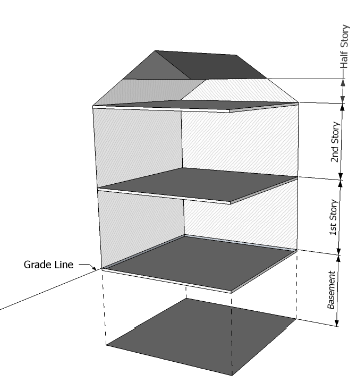
Basement. The part of a building below the first floor or ground floor with its entire floor below grade.
Bed and breakfast establishment. Any place of lodging that provides 8 or fewer rooms for rent to no more than a total of 20 tourists or transients; provides no meals to guests other than breakfast and provides the breakfast only to guests staying in said place; is the owner's personal residence; is occupied by the owner at the time of rental; and was originally built and occupied as a single-family residence, or, prior to use as a place of lodging, was converted to use and occupied as a single-family residence. A place of lodging which exceeds or does not meet these criteria shall be considered a hotel or motel.
Breezeway. A structure for the principal purpose of connecting the main building or buildings on a property with other main or accessory buildings.
Buildable lot area. The portion of a lot remaining after required yards have been provided.
Building. Any structure having a minimum of 100 square feet, a roof supported by columns or walls used or intended to be used for the shelter or enclosure of persons, animals, equipment, machinery or materials.
Building (structure) area. The total area bounded by the exterior walls of a building at the floor levels, but not including unfinished attics.
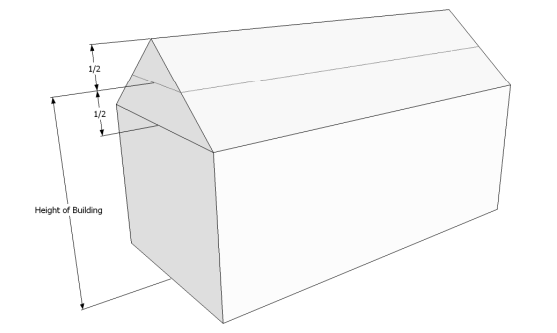
Building height. The vertical distance from grade plane to the average height of the highest roof surface (see graphic).
Building, principal. A building in which the principal use of the lot on which it is located is conducted.
Business. Any lawful commercial endeavor to engage in the manufacturing, purchase, sale, lease, or exchange of goods and/or the provision of services.
Car wash. Any facility used for the washing of vehicles requiring the installation of special equipment, or machinery and plumbing affixed to or affixed separate of a structure.
Certificate of occupancy (see Section 17.14-4).
Charging levels. The standardized indicators of electrical force, or voltage, at which an electric vehicle's battery is recharged. The terms 1, 2, and 3 are the most common charging levels, and include the following specifications:
1.
Level-1 is considered slow charging. Voltage including the range from 0 through 120.
2.
Level-2 is considered medium charging. Voltage is greater than 120 and includes 240.
3.
Level-3 is considered fast or rapid charging. Voltage is greater than 240.
Collector, street (see "street, collector").
Common wall or party wall. A wall containing no opening which extends from the elevation of building footings to the elevation of the outer surface of the roof or above, and which separates contiguous buildings but is in joint use for each building.
Community living arrangement. The following facilities licensed or operated, or permitted under the authority of Wisconsin State Statutes: Child welfare agencies under Section 48.60, group foster homes for children under Section 48.02(6), and community-based residential facilities under Section 50.01; but does not include adult family homes as defined under Section 50.01, daycare centers, nursing homes, general hospitals, special hospitals, prisons, and jails. The establishment of a community living arrangement shall be in conformance with Sections 46.03(22), 62.23(7)(i), and 62.23(7a), 60.63, and all other relevant sections of the Wisconsin State Statutes and amendments thereto.
Composting facility. A facility or business where organic matter that is derived primarily from off-site is to be processed by composting and/or is processed for commercial purposes. Activities of a composting site may include management, collection, transportation, staging, composting, curing, storage, marketing, or use of compost.
Conditional use. A use or occupancy of a structure, or a use of land, which, because of special requirements or characteristics, is permitted only upon issuance of a conditional use permit (according to the procedures and standards outlined in Section 17.14-5), which imposes such conditions as are necessary to make the use compatible with other uses permitted in the same zone of vicinity.
Conservation standards. Guidelines and specifications for soil and water conservation practices and management enumerated in the Technical Guide prepared by the USDA Soil Conservation Service for Walworth County, adopted by the County Soil and Water Conservation District Supervisors, and containing suitable alternatives for the use and treatment of land based upon its capabilities from which the landowner selects that alternative which best meets his needs in developing his soil and water conservation plan.
Construction services. Facilities used by businesses commonly referred to as construction which shall include, without limitation, plumbing, electrical, heating, roofing, interior remodeling, excavating, etc.
Convenience store. A one-story, retail store containing less than 3,000 square feet of gross floor area that is designed and stocked to sell a limited line of food, beverages (including packaged liquor, subject to applicable licenses), and other household supplies. It is designed to attract and depends upon a large volume of stop-and-go traffic and may also be associated with a gas station.
Crematory service. A facility containing properly installed, certified apparatus intended for use in the act of cremation.
Daycare center. A place or facility other than a "dwelling" or "family daycare home" in which children receive care and supervision for part of the day. The term "daycare center" includes, but is not limited to, the following: infant care center, childcare center, nursery school, and day nursery. It does not included bona fide schools, kindergartens or nurseries operated by public or private elementary or secondary schools.
Deck. An unenclosed exterior structure, attached or adjacent to the exterior wall of the building, which has a floor but no roof (see also patio and porch).
District, basic. A part or parts of the City for which the uniform regulations of this chapter govern the use and location of land and buildings.
District, overlay. A superimposing of certain additional requirements upon a basic zoning district without disturbing the requirements of the basic district. In the instance of conflicting requirements, the more strict of the conflicting requirement shall apply.
Drive-in and drive-thru establishment or facility. Any commercial retail, personal service, or service establishment or facility designed or intended to enable a customer in a motor vehicle parked on or moving through the premises to transact business with a person located within the principal structure, including an establishment or facility that by design of physical facilities or by service or packaging procedures encourages or permits customers to receive a service or obtain a product while staying within a motor vehicle. Such establishments include, but are not limited to, financial institutions, restaurants, drug stores, and dry cleaning stores.
Driveway. A private access way that provides direct access from a street to not more than 2 lots, principal buildings or uses.
Dwelling, attached. A residential building which is joined to another dwelling at one or more sides by a party wall or walls.
Dwelling, detached. A residential building which is entirely surrounded by open space on the same lot.
Dwelling, efficiency. A dwelling unit consisting of one principal room with no separate sleeping rooms.
Dwelling, single-family. A building designed for or occupied exclusively by one family.
Dwelling, two-family. A building containing 2 separate dwelling units, designed for occupancy by not more than 2 families (one per dwelling unit). A duplex is a type of two-family dwelling.
Dwelling, multiple-family. A residential building designed for or occupied by 3 or more families, with the number of families in residence not to exceed the number of dwelling units provided.
Dwelling unit. A group of rooms, constituting all or part of a dwelling, which are arranged, designed, used or intended for use exclusively as living quarters for one family.
Electric vehicle. Any vehicle that uses electricity for propulsion, in whole or in part. "Electric vehicle" includes, but is not limited to, a battery electric vehicle and a plug-in hybrid electric vehicle.
Electric vehicle charging station. A public or private parking area that is served by electric vehicle supply equipment that has as its primary purpose the transfer of electric energy (by conductive or inductive) to a battery or other energy storage device in an electric vehicle.
Electric vehicle charging space. Any marked parking space that identifies the use to be exclusively for the charging of a parked electric vehicle.
Electric vehicle supply equipment. The conductors, including the ungrounded, grounded and equipment grounding conductors, and the electric vehicle connector, attachment plugs, and all other fittings, devices, power outlets, or apparatuses installed specifically for the purpose of transferring energy between the premises wiring and the electric vehicle.
Emergency residential shelter. A facility, other than a community living arrangement, that provides short-term housing and a protective sanctuary for victims of fire, natural disaster, economic hardship, crime, abuse, domestic abuse as defined by § 813.12(1)(am), Wis. Stats., or neglect, including emergency housing during crisis intervention for victims of rape, domestic abuse, child abuse or physical beatings, and which contains individual or group sleeping rooms and may or may not have food preparation facilities and private shower or bath facilities.
Emergency services. Rescue and paramedic type services which respond to serious situations or occurrences that happen unexpectedly and demand immediate attention.
Essential services. Services provided by public and private utilities, necessary for the exercise of the principal use or service of the principal structure. These services include underground, surface, or overhead electrical, gas, steam, water, sanitary sewerage, stormwater drainage, and communication systems and accessories thereto such as poles, towers, wires, mains, drains, vaults, culverts, laterals, sewers, pipes, catch basins, water storage tanks, conduits, cables, fire alarm boxes, police call boxes, traffic signals, pumps, lift stations and hydrants, but not including buildings.
Extraction industry. The extraction of minerals, including solids, such as coal and ores; liquids, such as crude petroleum; and gases, such as natural gases. The term also includes quarrying; well operation; milling, such as crushing, screening, washing and flotation; and other preparation customarily done at the extraction site or as part of the extractive activity.
Fairgrounds. An area wherein buildings, structures, and land are used for the exhibition of livestock, farm products, etc., and/or for carnival-like entertainment, including such areas owned by Walworth County Agricultural Society and/or a nonprofit operating agency.
Family. Any number of persons related by blood, adoption, or marriage, or not to exceed 4 persons not so related, living together in one dwelling unit.
Family daycare home. A dwelling in which are received from 3 to 8 children, not of common parentage, for care and supervision for a part of the day.
Farm dwelling. A single-family dwelling that is located on and used in connection with a farm.
Farm employee housing. Dwellings or lodging units located on land owned by the laborer's employer, inhabited solely by persons and their families while employed in full-time or seasonal agricultural activities on land owned by the laborer's employer.
Farm stand. A temporary structure such as a table, vehicle or tent located on private property as an accessory use at which agricultural products such as raw vegetables, fruits, herbs, flowers, plants, nuts, honey or eggs are sold. Agricultural products including, but not limited to, jams, jellies, oils, vinegars, and cheese, may be sold at farm stands. Products sold at farm stands are intended to have been primarily grown, raised, or produced at farms in Wisconsin.
Fence. An artificially constructed enclosure or barrier used as a boundary, means of protection, privacy screening or confinement.
Fence, solid. A fence, including gates, designed and constructed with greater than 50% of its area as solid material of uniform distribution, when viewed from a right angle. Common solid fences include a privacy fence, picket fence or shadow box fence.
Fence, open. A fence, including gates, designed and constructed with no more than 50% of its surface area as solid material of uniform distribution, when viewed from a right angle. Common open fences include a split rail fence, open design picket fence, wrought iron style fence, or chain link fence.
Floor area.
1.
For parking and off-street loading requirements in business and manufacturing buildings (excluding the B-1 central business district). The sum of the gross floor areas of several floors of the building, or portion thereof, devoted to a use requiring off-street parking or loading. This shall include accessory storage areas located within selling or working space, such as counters, racks, or closets and any basement floor area devoted to retailing activities, to the production or processing of goods, or to business or professional offices.
2.
Gross floor area (excluding the B-1 central business district). The sum of the gross floor areas of all floors measured in square feet, measured from the exterior faces of the exterior walls or from the centerline of walls separating 2 buildings. The floor area of a building includes elevator shafts and stairwells at each floor, floor space used for mechanical equipment (except equipment, open or closed, located on a roof or in a basement), penthouses, interior balconies and mezzanines, and floor area devoted to accessory uses. Uninhabitable attics, and decks are not included in gross floor area.
Foster family home. The primary domicile of a foster family which includes 4 or fewer foster children and which is licensed under Section 48.62, Wis. Stats. and amendments thereto.
Garage, private. An accessory building for the private use of the owner or occupant of a principal building, situated on the same lot of the principal building for the storage of motor vehicles, with no facilities for mechanical service or repair of a commercial or public nature.
Garage, public. Any building or portion thereof, not accessory to a residential building or structure, used for, public parking of motor vehicles, or other recreational vehicles.
Gas station. Any lot or parcel or portion thereof used partly or entirely for storing or dispensing flammable liquids, combustible liquids, liquefied flammable gas, or flammable gas into the fuel tanks of motor vehicles.
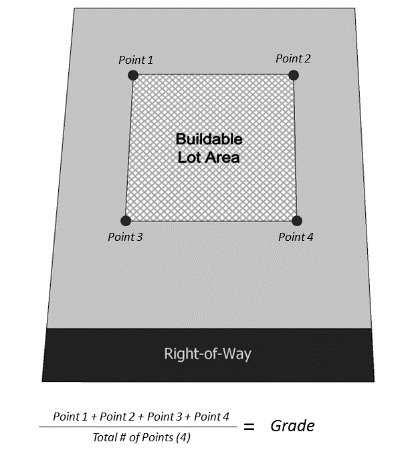
Grade. The average elevation at the corners of the smallest polygon formed by the intersecting lines of: The minimum required street yard, rear yard, and side yard lines on a lot. Grade shall be established prior to any development, demolition, or issuance of a drainage and grading permit or tree removal permit.
Grade, Abutting. The natural elevation of the ground, prior to construction, directly below or directly adjacent to a structure.
Grocery/food sales. Uses which primarily sell grocery, food, and beverage items, and such sales occur entirely within an enclosed building. Examples may include: convenience grocery stores (without gas pumps), grocery stores (which may include secondary sales of nonfood items), supermarkets, fruit and vegetable stores, delicatessens, health food stores, meat markets/butcher shops, fish and poultry stores, bakeries, nut and confectionery shops, dairy products stores, and similar land uses. Liquor stores and liquor sales are specifically excluded from this definition.
Gross acre. An area of land measuring 43,560 square feet in area exclusive of any existing or planned public street rights-of-way (see also "net acreage").
Group foster home. A type of community living arrangement operated by a person required to be licensed by the State of Wisconsin under Section 48.62, Wis. Stats. for the care and maintenance of 5 to 8 foster children.
Habitable area. Rooms used for sleeping, living or dining purposes, excluding such enclosed places as kitchens, closets, pantries, bath or toilet rooms, hallways, laundries, storage spaces, and similar spaces.
Health clinic medical office. An establishment, other than a hospital as defined herein, where human patients who are not lodged overnight are admitted for examination and treatment by one or more physicians, dentists, therapists, other health care professionals, or similar professions.
Home occupations. Any occupation for gain or support conducted entirely within buildings by resident occupants which does not disrupt the integrity of the neighborhood and the zoning district in which the home occupation is located (see Section 17.5-2(9)).
Hotel. A building in which lodging is provided to the public for compensation, which is offered to transient guests rather than permanent boarders, and in which access to individual rooms is provided via interior lobbies and hallways.
Indoor business sales and service. Uses which display or conduct, entirely within an enclosed building, the sale or rental of business-oriented products, equipment, merchandise, or services that are nonpersonal and nonprofessional in nature. Examples may include: Duplicating or photocopying sales and service; addressing, or mailing sales and services; locksmith shops; computer sales and service; employment agencies; and similar land uses.
Indoor civic, cultural or institutional uses. Civic cultural, institutional uses which occur within an enclosed building (other than community living arrangements as defined herein). Examples may include: Government offices, libraries, museums, community centers, post offices, fire/police/rescue stations, centers, convention centers, religious organization, educational institution, place of worship, and similar land uses.
Indoor recreation or entertainment. Uses which provide recreation or entertainment services entirely within an enclosed building. Adult uses are specifically not included in this category. Examples may include: Indoor movie or live theater, billiard/pool hall, roller/ice rink, arcade, bowling alley, dance hall/club, dance/music school or studio, gymnastic facility, martial arts facility, sports training facility, health/fitness club, country club indoor facilities, and similar land uses.
Indoor retail sales of goods (other than groceries or food). The indoor retail sales of goods use classification, excluding grocery and food sales, applies to retail uses which display or conduct the sale or rental of merchandise entirely within an enclosed building. Examples may include: Antique shops, furniture stores, hardware stores, department stores, clothing/wearing apparel stores, book stores, sporting goods stores, drug stores, pharmacies, florist shops, and similar land uses. Liquor stores and liquor sales are specifically excluded from this definition.
Impervious lot coverage. A ratio determined by dividing that area of a lot which is occupied or covered by all impervious surfaces, by the gross area of that lot.
Impervious surface. A surface which does not naturally permit the downward transmission of water into the ground. Impervious surfaces consist of all buildings, parking areas, driveways, roads, sidewalks, and any areas of concrete or asphalt (including a ground-level deck or patio). Hard surfaces that may have permeable characteristics when first installed (such as permeable pavers, permeable asphalt, or grasscrete) shall be counted as impervious surface. For lumberyards or similar uses, areas of stored lumber constitute impervious surfaces.
Kennel. A facility for the keeping, boarding or maintaining of 4 or more dogs, cats, or other household pets over 3 months of age and not owned by the kennel owner, for commercial purposes. A kennel does not include pet shops, or veterinary offices with overnight stays by sick animals.
Landmark. Any structure or part of a parcel of land which has a special character or special historic interest or value as part of the development, heritage or cultural characteristics of the City, state or nation and which has been designated as a landmark pursuant to the provisions of the City of Elkhorn Municipal Code.
Landmark site. Any parcel of land of historic significance due to substantial value in tracing the history of aboriginal man, or upon which a historic event has occurred, and which has been designated as a landmark site under the provisions of the City of Elkhorn Municipal Code, or a parcel of land, or part thereof, on which is situated a landmark and any abutting parcel, or part thereof, used as and constituting part of the premises on which the landmark is situated.
Line of sight triangle. The triangle area formed by a diagonal line connection 2 points located on intersecting rights-of-way lines (or right-of-way and the curb of a driveway), each point being 10 feet from the intersection of the 2 right-of-way lines (or right-of-way and the curb of a driveway).
Liquor sales. Sales of beer, wine, and other alcohol for consumption off the premises, as an accessory use in a retail or grocery/food store.
Liquor store. A retail store in which sales of beer, wine, and other alcohol for consumption off the premises are the primary activity.
Loading area/dock. A completely off-street space or berth on the same lot for the loading or unloading of freight carriers, having adequate ingress and egress to a public street or alley.
Local street (see "street, minor").
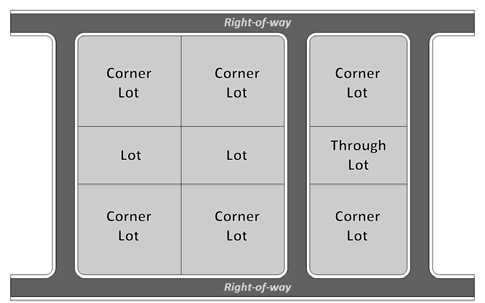
Lot. A parcel of land having frontage on a public street, occupied or intended to be occupied by a principal structure or use and sufficient in size to meet the lot width, lot frontage, lot area, and other open space provisions of this chapter.
Lot area. The horizontal area within the exterior lines of the lot, exclusive of any area in a public or private right-of-way open to public uses.
Lot, corner. A lot abutting 2 or more road rights-of-way at their intersection (see graphic).
Lot, substandard. A parcel of land having frontage on a public street, occupied or intended to be occupied by a principal building or structure together with accessory buildings and uses, having insufficient size to meet the lot width, lot area, yard, setback, offset, off-street parking areas, or other open space provisions of this chapter.
Lot, through. A lot having frontage on 2 streets other than at the street intersection, the streets typically being along the front and rear lot lines. For purposes of yard space, both shall be treated as street yards (see graphic).
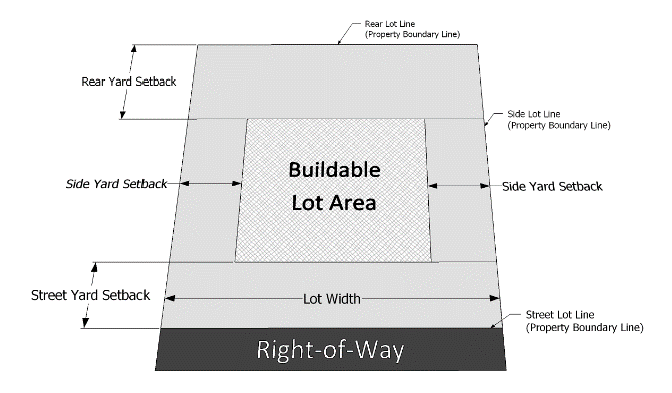
Lot line, rear. That boundary line that is opposite and most distant from the street lot line. The rear lot line of a triangular or irregular lot shall, for the purposes of this code, be the line at least 10 feet long and most parallel and most distant from the front lot line.
Lot line, side. Any boundary line of a lot that is not a street lot line nor a rear lot line.
Lot line, street. In the case of an interior lot, a property boundary line separating the lot from a street.
Lot width. The horizontal distance between side lot lines (including corner lot lines) measured at the minimum street setback line.
Machine shops. Shops where lathes, presses, grinders, shapers, and other wood and metal working machines are used, such as welding, and sheet metal shops; plumbing, heating and electrical repair and overhaul shops.
Manufactured home. A manufactured home is a structure which can be transportable, being 8 feet or more in width (not including the overhang of the roof) or 32 feet or more in length (not including the overhang of the roof), built on a chassis and designed to be used as a dwelling with or without a permanent foundation when connected to the required utilities. Manufactured homes are often referred to locally as "mobile homes," "trailers," "double-wides," or "sectionals."
Manufactured home park. Any plot or plots of ground upon which 3 or more manufactured homes that are occupied for dwelling or sleeping purposes are located. Manufactured home park does not include a farm where the occupants of the manufactured homes are the father, mother, son, daughter, brother or sister of the farm owner or operator or where the occupants of the manufactured homes work on the farm.
Manufacturing, heavy. The manufacture or compounding process of raw materials. These activities or processes may necessitate the storage of highly flammable, toxic, radioactive or explosive materials needed for the manufacturing process. Activities which involve outdoor manufacture or compounding as part of their manufacturing process are considered heavy manufacturing.
Manufacturing, light. The manufacture, predominantly from previously prepared materials, of finished products or parts, including processing, fabrication, assembly, treatment and packaging of such products, and incidental storage, sales, and distribution of such products, but excluding basic industrial processing. Production and processing are customarily conducted entirely within an enclosed building.
Manufacturing, medium. The processing and manufacturing of materials or products predominately from extracted or raw materials. These activities do not necessitate the storage of highly flammable, toxic, radioactive or explosive materials needed for the manufacturing process, and do not involve outdoor manufacture or compounding as part of their manufacturing process.
Mini warehouse. A building or group of buildings consisting of individual, self-contained units leased to individuals, organizations, or businesses for self-service storage of personal property.
Minor street (see "street, minor").
Minor structures. Any small, movable accessory construction or erection, such as birdhouses, tool houses, pethouses, play equipment, arbors, and walls and fences under 4 feet in height.
Mobile home (see "manufactured home").
Mobile home park (see "manufactured home park").
Modular home. A dwelling unit assembled on-site in accordance with the Elkhorn Building Code and composed of components substantially prepared in a manufacturing plant and transported to the building site for final assembly on a permanent foundation. Modular homes do not include manufactured homes as defined herein. For purposes of this zoning ordinance, modular homes shall be treated the same as any site-built structure. Modular homes are often referred to locally as "pre-fabricated" or "factory-built" homes.
Motel. A building containing lodging rooms provided to the public for compensation where each lodging has a doorway opening directly to the outdoors, and more than 50% of the lodging rooms are for rent to transient tourists for a continuous period of less than 30 days.
Net acreage. The gross acres of a site, minus the acreage devoted to bodies of water, public parks, school sites, municipal sites, wetlands, floodplains, and areas with slopes greater than 20% (see also "gross acres").
Nonconforming uses/structures (see "use, nonconforming;" and "structure, nonconforming").
Office and professional service. The office of an engineer, doctor, dentist, attorney, real estate broker, insurance broker, architect or other similar professional person, and any office used primarily for accounting, correspondence, research, editing or administration.
Outdoor entertainment. Uses which provide entertainment services partially or wholly outside of a completely enclosed building. Such uses typically, although not always, attract an audience where patrons are not engaged in a physical recreational activity. Examples may include: Amusement parks, drive-in theaters, outdoor live theatres, vehicular and animal racetracks, zoos, and similar land uses. Fairgrounds are specifically excluded from this category.
Outdoor sales. The permanent or temporary display of items for sale outside of an enclosed building, including sales lots (such as pumpkins and Christmas trees) and accessory sales (such as goods displayed outside a grocery store, gas station, etc.).
Outdoor storage. The keeping, in an unenclosed structure or enclosed trailer, of any goods, junk, material, merchandise or vehicles in the same place for more than 24 hours.
Parking lot. A structure or premises containing 5 or more parking spaces.
Parking space. A graded and surfaced area for the parking of a motor vehicle, having adequate ingress and egress to a public street or alley and provided in accordance with the regulations of Article 17.6.
Parties in interest. Any persons with incidence of ownership and including all abutting property owners, all property owners within 100', and all property owners of opposite frontages.
Passive outdoor recreation and open space. Recreation and open space uses located on public or private property which allow users to enjoy passive recreational pursuits, such as interpretative programs and trail systems that take advantage of geological, biological, or scenic resources located within the park. These uses are typically not operated for commercial profit. Examples may include: Cemeteries, arboretums, natural areas, open grasslands, picnic areas, picnic shelters, gardens, fishing areas, and similar land uses. Facilities which accommodate organized sporting events are specifically excluded.
Patio. A level surfaced area, without a roof or solid walls at grade level and not attached to or adjacent to the exterior wall of a building. A patio may be constructed of any material (see also "deck").
Personal services. Personal service uses are exclusively indoor land uses in which personal services are provided to individuals on a walk-in or on an appointment basis. Examples may include: Barber shops, beauty shops, shoe repair/shoe shine shops, tailor/garment repair shops, small household appliance repair shops, dry cleaning shops (without plant facilities), coin-operated laundromat, travel office, and similar land uses.
Porch. A roofed structure not more than 75% enclosed by solid walls or permanent glass windows, and attached to the main building for the purpose of sheltering from the weather. Shelter for vehicles does not constitute a porch. Where more than 75% of the structure is enclosed by solid walls or permanent glass windows, the area shall be considered part of the floor area of the primary building and not a porch.
Research and development. Research, development, and testing laboratories that do not involve the mass manufacture, fabrication, processing, or sale of products.
Restaurant. Uses which sell food and beverage items intended to be consumed immediately, either on the premises or prepared on-site for consumption off-site. Examples may include: Sit down restaurants, fast food restaurants (but not including drive through facilities), carry out restaurants, ice cream shops and similar land uses. A restaurant may include the sale of alcoholic beverages for consumption on the premises, as an accessory function secondary to the principal function of food service, subject to applicable licensing requirements.
Seat. Furniture upon which to sit having a linear measurement not less than 24" across the surface used for sitting; intended for use in determining off-street parking requirements.
Senior housing. Multiple family housing designed for the living and care needs of senior citizens; includes housing regulated by the State of Wisconsin as Community Based Residential Facility (CBRF), Residential Care Apartment Complexes (RCAC), and nursing home.
Setback. The minimum horizontal distance between any structure and the property boundary line. Where the lot line is an arc, the corresponding setback shall be measured from the arc.
Signs. Any medium, including its structure, words, letters, figures, numerals, phrases, sentences, emblems, devices, designs, trade names, or trademarks by which anything is made known and which are used to advertise or promote an individual, firm, association, corporation, profession, business, commodity, or product and which is visible from any public street or highway.
Storage condominium. A facility developed by a declarant in accordance with Chapter 703 of the Wisconsin Statutes for the sole purpose of selling condominium storage units.
Story. That portion of a principal building included between the surface of any floor and the surface of the next floor above, or if there is no floor above, the space between the floor and the finished ceiling next above. A basement shall not be counted as a story, and an uninhabitable attic shall also not be counted as a story.
Story, half. A habitable story which is situated under a sloping roof, the floor area of which does not exceed ⅔ of the floor area of the story immediately below it, and which does not contain an independent dwelling unit. If the habitable area contains more than ⅔ of the floor area of the story immediately below it, or if it does contain an independent dwelling unit, it shall be considered a story.
Street. A public right-of-way providing primary access to abutting properties.
Street, arterial. A public street or highway used or intended to be used primarily for fast or heavy through traffic. Arterial streets shall include highways, freeways, and expressways, as well as major streets and parkways.
Street, collector. A street used, or intended to be used, to carry traffic from minor streets to the major system of arterial streets including the principal entrance streets to residential developments.
Street, minor. A street used, or intended to be used, primarily for access to abutting properties.
Structural alterations. Any change in the structure including supporting members of a structure such as foundations, bearing walls, columns, beams or grinders.
Structure. Any erection or construction, such as buildings, towers, masts, poles, booms, signs, decorations, carports, stationary machinery, appurtenances and equipment.
Structure, accessory. A detached structure subordinate to the principal structure and located on the same lot or parcel, serving a purpose customarily incidental to the principal structure.
Structure, nonconforming. A building or structure lawfully existing at the time of enactment of the ordinance codified in this chapter or amendments thereto that does not comply with all of the applicable area, height, and placement regulations of this chapter. Any such structure conforming in respect to use but not in respect to frontage, width, height, area, yard, parking, loading or distance requirements shall be considered a nonconforming structure.
Transportation facilities. Facilities used primarily to move and sort freight, including rail and truck yards and intermodal yards.
Use. The purpose or activity for which the land or building thereon is designated, arranged, or intended, or for which it is occupied or maintained lawfully established by the adopted City of Elkhorn Zoning Map.
Use, accessory. A use that is subordinate in area, extent, and purpose to, is incidental and customary to, and is located on the same lot as the principal use.
Use, nonconforming. Any use of a building or premises which on the effective date of the ordinance codified in this chapter does not, even though lawfully established, comply with all if the applicable use regulations of the zoning district in which such building or premises is located.
Use, principal. The main use of land or building as distinguished from a subordinate or accessory use.
Utilities. Public and private facilities, such as water wells, water and sewage pumping stations, water storage tanks, water purification facilities, power and communication transmission lines, electrical power stations and substations, static transformer stations, telephone and telegraph exchanges, microwave radio relays, and gas regulation stations, but not including sewage disposal plants, municipal incinerators, warehouses, shops and storage yards.
Veterinary clinic. An establishment for the care, observation, or treatment of domestic animals.
Warehouse, distribution, and wholesale. The display, storage, and sale of goods to other firms for resale, as well as activities involving significant movement and storage of products or equipment, including truck terminal or bus servicing facilities, motor freight transportation, moving and storage facilities, warehousing and storage facilities.
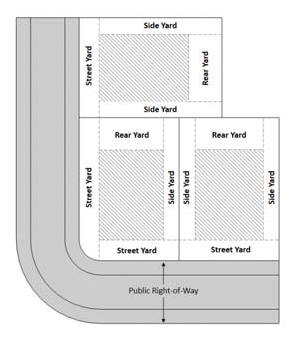
Yard (also see "yard, corner side"; "yard, street"; "yard, rear"; "yard, side"; and "yard, street"). An open space on the same lot with a structure, unoccupied and unobstructed from the ground upward except the vegetation. A yard extends between a lot line to the depth specified in the yard regulations for the designated zoning district.
Yard, corner side. On a corner lot, the yard adjacent to a street (see "yard, street").
Yard, rear. A yard extending across the full width of a lot, the depth of which is the shortest horizontal distance between the rear lot line and the nearest line of the building or any enclosed portion thereof.
Yard, side. A yard extending between the street and rear yards, the depth of which is the horizontal distance between the side lot line and the nearest line of the building or any enclosed portion thereof. On a corner lot, the side yard adjacent to the street is a street yard.
Yard, street. Any yard extending across the full length of a property that is adjacent to a street, the depth of which is the horizontal distance between the street lot line and the nearest line of the building or any enclosed portion thereof. A corner lot will have two street yards.
Zoning permit (see Section 17.14-3). (Ord. No. 23-06, 6-5-2023; Ord. No. 22-07, 7-18-2022; Ord. No. 21-10, 7-19-2021; Ord. No. 17-14, § 3, 11-6-2017; Ord. No. 15-12, § 1, 2015; Ord. No. 14-05, §§ 1, 2, 2014.)

