
Elkhorn City Zoning Code
ARTICLE 17
7. - Modifications
17.7-1 - Height.
The district height limitations stipulated elsewhere in this chapter may be exceeded, but such modification shall be in accord with the following:
(1)
Architectural projections, such as spires, steeples, belfries, parapet walls, cupolas, domes, flues and chimneys are exempt from the height limitations of this chapter.
(2)
Special structures, such as elevator penthouses, gas tanks, grain elevators, observation towers, and scenery lofts, manufacturing equipment and necessary mechanical appurtenances, cooling towers, fire towers, substations and smoke stacks, are exempt from the height limitations of this chapter.
(3)
Essential services, utilities, water towers, electric power and communication transmission lines are exempt from the height limitations of this chapter. Energy generating windmills shall not exceed in height twice their distance from the nearest lot line.
(4)
Communication structures, such as radio and television transmission and relay towers, aerials, radio and television receiving and transmitting antennas shall not exceed in height 3 times their distance from the nearest lot line.
(5)
Agricultural structures, such as barns, silos and windmills, shall not exceed in height twice their distance from the nearest lot line.
(6)
Public or semipublic facilities, such as schools, churches, hospitals, monuments, sanatoriums, libraries, governmental offices and stations, may be erected to a height of 60', provided all required yards are increased not less than one foot for each foot the structure exceeds the district's maximum height requirement.
17.7-2 - Yards.
The yard requirements stipulated elsewhere in this chapter may be modified as follows:
(1)
Uncovered stairs, landings, decks and fire escapes may project into any required yard but not to exceed 6 feet and not closer than 3 feet to any lot line. However, this modification does not modify any requirements of the state or local building codes relating to uncovered stairs, landings, decks and fire escapes.
(2)
Architectural projections, such as chimneys, flues, sills, eaves, belt courses and ornaments, may project into any required yard; but such projection shall not exceed 3 feet.
(3)
(a)
General Fence Standards for all Districts.
1.
Construction. All fences must be erected or installed so that the finished side faces outward (i.e., construction supports facing in).
2.
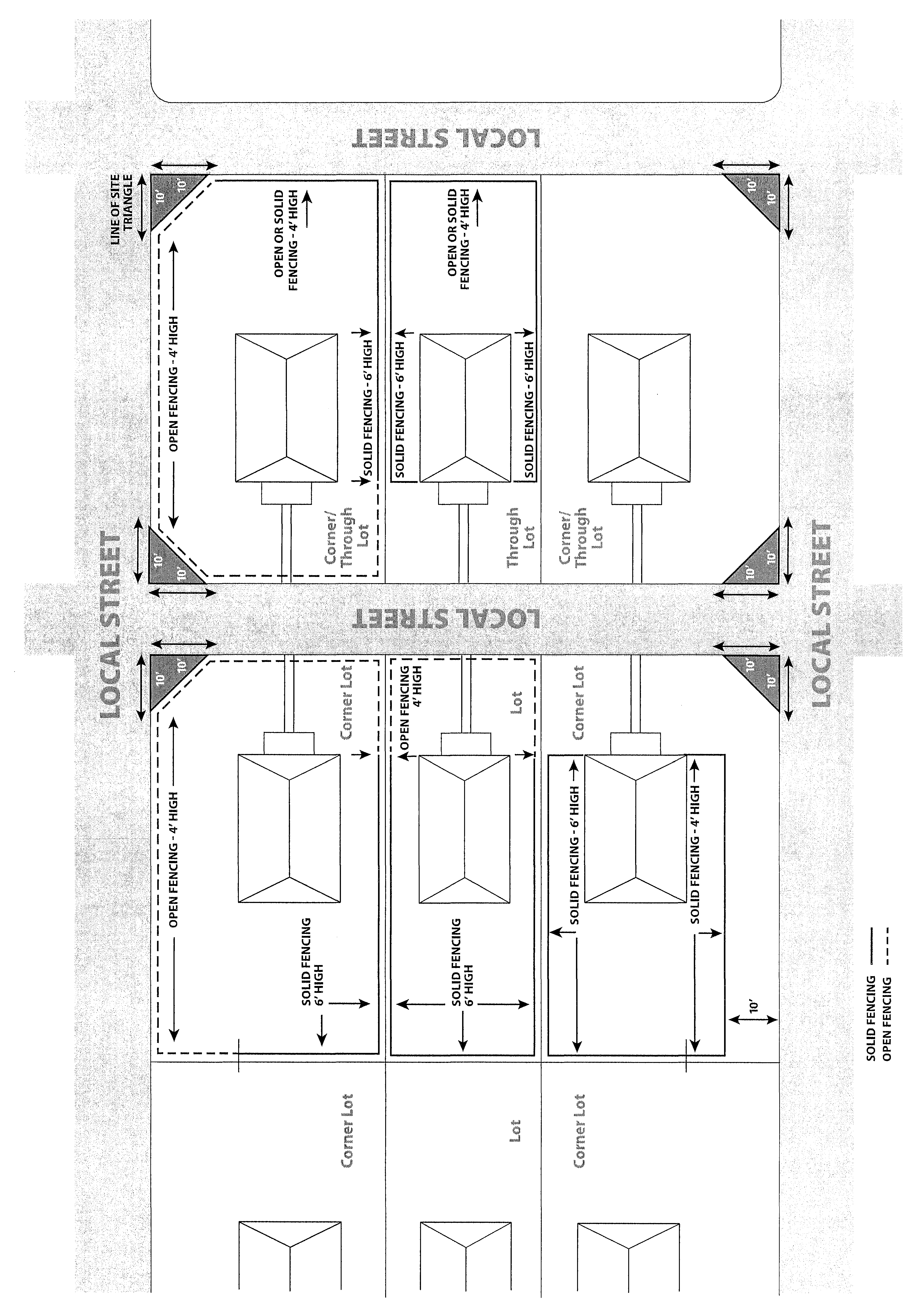
Visibility. In no instance shall a fence obscure the visibility of motorists or be located within the line-of-sight triangle as defined in Section 17.2-1 Definitions.
3.
Locations near rights-of-way and utility easements. Private fences or walls shall be allowed or constructed a minimum of one foot back from the rights-of-way of public streets, highways, or alleys. Fences or walls may, by permit, be placed on public utility easements, so long as the structures do not interfere in any way with existing underground, ground, or over ground utilities. Furthermore, the City or any utility company having authority to use such easements shall not be liable for repair or replacement of such fences or walls, in the event they are moved, damaged or destroyed by virtue of the lawful use of the easement.
4.
Good repair. All fences shall be maintained in good repair and in clean, presentable and attractive condition.
5.
Drainage. Fences shall not block or hinder natural drainage or water flow.
(b)
Fences in Residential Districts (RS-1, RS-2, RD-1, RM-1, RM-2, RM-3, R-4, and T-1).
1.
Fences are permitted in the required street yard, side street yard and rear yard of double frontage lots if such fence meets the following standards:
a.
Fences are limited to a maximum height of 4 feet, as measured from abutting grade.
b.
Fences must be a minimum of 50% open.
c.
Finials on support posts are limited to 4 inches above the finished top of the fence.
2.
Solid fences are permitted in interior side yards and rear yards and are limited to 6 feet in height. Solid fences are permitted in street side yards located a minimum of 10 feet back from the street right-of-way and are limited to 4 feet in height.
3.
Solid fences are permitted in a street rear yard of through lot properties directly abutting the road right-of-way and are limited to 6 feet in height.
4.
Open fence material shall be picket, chain link, wood, vinyl, wire mesh, wrought iron, aluminum, metal, and/or lattice. Other types of fencing may be approved if the proposed fence receives specific approval by the Zoning Administrator or the Plan Commission and the requested fence is consistent with the requirements of this chapter, of good quality materials not specifically identified above. It is the specific goal of this section to not require a zoning code amendment every time a new or different material, style or design is proposed. Any new materials, styles, or designs approved in such a manner shall be listed in the Zoning Administration Office and available to the public. (See 17.5-1 entitled "Interpretation of Use")
5.
Solid fence material shall be wood, metal, or vinyl. Other types of fencing may be approved if the proposed fence receives specific approval by the Zoning Administrator or the Plan Commission and the requested fence is consistent with the requirements of this chapter, of good quality materials not specifically identified above. It is the specific goal of this section to not require a zoning code amendment every time a new or different material, style or design is proposed. Any new materials, styles, or designs approved in such a manner shall be listed in the Zoning Administration Office and available to the public. (See 17.5-1 entitled "Interpretation of Use")
6.
No barbed wire, chicken wire (except for gardening purposes limited to 4 feet in height and at least 2 feet off the property line). Razor wire or electrically charged fences, or other dangerously constructed fences shall not be allowed in residential zoning districts under any circumstances.
(4)
Security fences are permitted on the property lines in all districts except residential districts but shall not exceed 10 feet in height and shall be of an open type with woven or welded wire, chain link, aluminum, steel, or wrought iron fencing. Other types of fencing may be approved if the proposed fence receives specific approval by the Zoning Administrator or the Plan Commission and the requested fence is consistent with the requirements of this chapter, of good quality materials not specifically identified above. It is the specific goal of this section to not require a zoning code amendment every time a new or different material, style or design is proposed. Any new materials, styles, or designs approved in such a manner she be listed in the Zoning Administration Office and available to the public. (See 17.5-1 entitled "Interpretation of Use".)
(5)
Accessory uses and detached accessory structures are permitted in the rear yard only. In no case shall they:
(a)
Be closer than 5' to the principal structure (except as required by local building and fire codes);
(b)
Exceed 15' in height;
(c)
Be closer than 3' to any lot line nor 5' to any alley line;
(d)
Occupy more than 20% of the rear yard area in all districts (except the business districts where such uses and structures shall not occupy more than 75 percent of the rear yard area);
(e)
Be closer than 5' to any lot line in a Business District.
(6)
Off-street parking is permitted in all yards of all districts except required street yards and shall not be closer than 4' to a side lot line except in the RS-1, RD-2, and B-1 districts.
(7)
Essential services, utilities, electric power and communication transmission lines are exempt from the yard and distance requirements of this chapter.
(8)
Landscaping and vegetation are exempt from the yard requirements of this chapter. Landscape plantings such as shrubs shall not be permitted in the right-of-way unless approved by the City Plan Commission. (Ord. No. 24-01, 1-15-2024; Ord. No. 17-14, §§ 1, 2, 11-6-2017; Ord. No. 14-05, §§ 1, 2, 2014.)
17.7-3 - Additions.
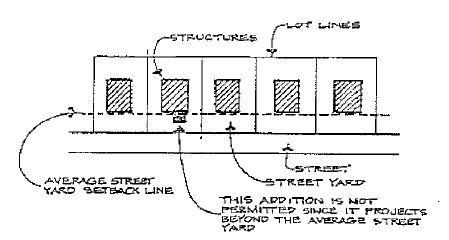
Additions in the street yard of existing structures shall not project beyond the average of the existing street yards on the abutting lots or parcels (see Figure 3.) (Ord. No. 14-05, §§ 1, 2, 2014.)
17.7-4 - Average street yards.
The required street yards may be decreased in any residential, business, manufacturing or institutional district to the average of the existing street yards of the abutting structures on each side but in no case to less than 15' in any residential district and to less than 5' in the B-2 Community Business District and B-3 Neighborhood Business District. (Ord. No. 14-05, §§ 1, 2, 2014.)
17.7-5 - Corner lots.
Structures shall provide a street yard as required by this chapter on the street right-of-way that the structure faces. A second street yard shall be provided on the side of the structure abutting a second public or private street right-of-way. (Ord. No. 14-05, §§ 1, 2, 2014.)
17.7-6 - Existing substandard lots.
(1)
A lot located in a residential district which does not contain sufficient area to conform to the dimensional requirements of this chapter, but which is at least 50' wide and 6,000 square feet in area, may be used as a single building site provided that the use is permitted in the zoning district and the lot is a lot of record in the County Register of Deeds Office prior to the effective date of the ordinance codified in this chapter.
(2)
A lot located in the business, manufacturing, or institutional districts which does not contain sufficient area to conform to the dimensional requirements of this chapter may be used as a building site provided that the lot is a lot of record in the County Register of Deeds Office prior to the effective date of the ordinance codified in this chapter.
Figure 3:
EXAMPLE OF ADDITIONS IN THE STREET YARD OF EXISTING STRUCTURES
(3)
Substandard lots granted permits under this section shall be required to meet the setback and other yard requirements of this chapter. A building permit for the improvement of a lot with lesser dimensions and requisites than those stated above shall be issued only after a variance by the Board of Appeals.
(Ord. No. 14-05, §§ 1, 2, 2014.)
17.7-7 - Noise.
Sirens, whistles and bells which are maintained and utilized solely to serve a public purpose are exempt from the sound level standards of this chapter.
(Ord. No. 14-05, §§ 1, 2, 2014.)
17.7-8 - Modifications to be considered by Plan Commission.
(1)
The Plan Commission shall have the right to grant a modification, as listed herein, for those developments/structures that are required to be reviewed by the Plan Commission as part of the site plan review process as outlined in Section 17.5-4.
(a)
Number and location of required parking spaces as required in Section 17.6-6.
(b)
Number of required loading spaces as required in Section 17.6-6.
(c)
Landscape location, quantity, and material selection.
(d)
Area and height of signage within a business or manufacturing district as outlined in Section 17.8-3.
(2)
Process:
(a)
Applicant must file a modification request with the Zoning Administrator.
(b)
The Plan Commission shall consider such request as part of the required site plan review as outlined in Section 17.5-4.
(c)
Approval of modification shall require the aforementioned note and 5 Plan Commission members.
(3)
Basis for Review:
(a)
As a basis for recommending approving, conditionally approving, or rejecting a modification, the Plan Commission shall state, for the record whether or not the modification:
1.
Is compatible with good design or planning practices;
2.
Create a substantial detriment to adjacent property and materially impair or be contrary to the purpose and spirit of this chapter or the public interest;
3.
Is consistent with the goals, objectives, and policies of the Comprehensive Plan, or any applicable specific plan; and
4.
Will compromise the intent or purpose of any City regulation.
(b)
In reaching such conclusion, the Plan Commission may utilize the written request prepared by the applicant and other applicable information.
(4)
Such modification provisions shall not preclude the Common Council or Board of Appeals from granting allowable relief as authorized in other sections of this chapter, including those as outlined in the Planned Unit Development Overlay District as outlined in Section 17.4-24.
(Ord. No. 14-05, §§ 1, 2, 2014.)

