
Elkhorn City Zoning Code
ARTICLE 17
8. - Signs2
Editor's note— Ord. No. 17-04, adopted Apr. 17, 2017, deleted and recreated Art. 17.8, Signs, in its entirety to read as herein set out. Former Art. 17.8 pertained to the same subject matter and derived from Ord. No. 14-05, 2014.
17.8-1 - Purpose and intent.
The purpose of this chapter [article] is to protect pedestrian and traffic safety, promote economic vitality, enhance the community's appearance, and encourage the effective use of signs in the community by maintaining minimum standards that manage the number, size, design and illumination of signs. Establishing sign regulations allows the City to protect pedestrian and traffic safety by minimizing confusing and distracting signs as well as keeping a community aesthetic consistent throughout the City. The City has a compelling interest in protecting the safety of its residents and visitors as well as maintaining an attractive, consistent appearance.
(Ord. No. 17-04, §§ 1, 2, 4-17-2017.)
17.8-2 - Sign permit required.
No sign shall hereafter be located, erected, moved, reconstructed, extended, enlarged, converted or structurally altered without a sign permit, except those signs excepted in Article [Section] 17.8-3 and without being in conformity with the provisions of this chapter.
(Ord. No. 17-04, §§ 1, 2, 4-17-2017.)
17.8-3 - Signs permitted in all districts without a permit.
The following signs are permitted in all zoning districts without a permit, subject to the following regulations:
1.
Temporary signs notifying the public that a residential property or premises is for sale or rent that do not exceed 8 square feet in area. There shall be no more than one such sign on such properties or premises per road frontage abutting such property or premises. A second sign of equal or smaller size shall be permitted on such property for the day(s) of an "open house" event only. The duration of an "open house" event shall not exceed one weekday or one weekend from Friday to Sunday.
2.
A single on-site information sign notifying of a state or federal historic designation. No such sign shall exceed 2 square feet in area.
3.
A single sign notifying patrons of the existence of a home-based business which shall not exceed 2 square feet in area.
4.
Any sign placed by the City or state or federal authorities whether temporary or permanent.
5.
Temporary signs erected during an election campaign period, provided that permission has been obtained from the property owner, renter or lessee. All such signs shall be removed within 2 weeks after the election period is completed.
(a)
Definitions:
1.
"Election Campaign Period" - The period beginning on the first day for circulation of nomination papers by candidates, or the first day on which candidates could circulate nomination papers if papers were to be required, and ending on the day of the election. (Section 12.04a, Wis. Stats.)
2.
"Referendum" - The period beginning on the day on which the question to be voted upon is submitted to the electorate and ending on the day on which the referendum election is completed. (Section 12.04a, Wis. Stats.)
(b)
Signs during election campaign period or referendum shall not exceed 20 square feet in area on any sides.
(c)
Signs during election campaign period or referendum shall not contain flashing lights or moving parts.
(d)
No such sign shall be erected in a location where it constitutes a traffic hazard.
6.
Signs permitted in all districts without a permit. No more than one temporary sign per parcel, provided, that permission has been obtained from the property owner, renter, or lessee. Such temporary sign shall not exceed 8 square feet in area and shall not contain flashing lights or moving parts.
(Ord. No. 17-04, §§ 1, 2, 4-17-2017.)
17.8-4 - Signs permitted in manufacturing and business districts (other than B-1) without a permit.
1.
Temporary Signs. Temporary signs notifying that a premises is for sale or rent with a maximum area of 32 square feet.
(a)
Defined. For purposes of this section the term "temporary sign" is defined as a sign constructed of cloth, canvas, fabric, paper, plywood, or other light material and intended to be displayed for a short period of time the premises are for sale or rent.
(b)
Location. Such temporary signs may be placed in any spot that does not violate any other section of this Code and specifically does not impair the sightline of passing vehicles.
(c)
Number. A maximum of one temporary sign is permitted per property except that a second sign of equal or smaller size is permitted on such property for the day(s) of an "open house" event only. An "open house" event shall not exceed one weekday or one weekend from Friday to Sunday.
2.
Multiple Frontage lots. A single temporary sign is allowed on each road frontage abutting such property or premises.
3.
Signs allowed as set forth in a development agreement negotiated with the City.
(Ord. No. 17-04, §§ 1, 2, 4-17-2017.)
17.8-5 - Signs requiring a permit.
(1)
B-1 district temporary signs on properties for sale or rent larger than 16 square feet.
(2)
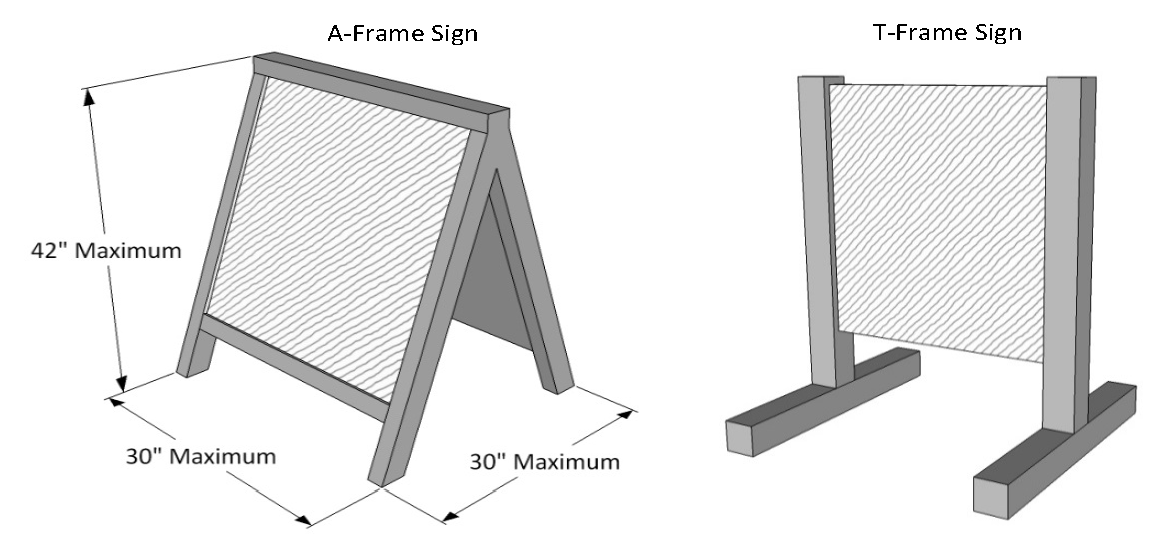
A and T Frame Signs.
(a)
Definition: A sign made of a lightweight and rigid material having the capability to stand on its own support, is primarily used in front of businesses, and is portable.
(b)
Districts Where Allowed: B-1 Central Business District, B-2 Community Business District, B-3 Neighborhood Business District, T-l Downtown Transition District.
(c)
Measurements:
1.
Height: Once erected, the maximum height of an A or T Frame Sign shall be 42 inches from the ground on which it stands.
2.
Width: Once erected, the maximum width of the sign on any side shall not exceed 30 inches.
3.
Location and Setback: An A or T Frame Sign may be placed on private property or on a sidewalk in the public right-of-way. An A or T Frame Sign on a sidewalk shall be at least one foot from the curb line and be located directly in front of the business the sign is promoting.
(d)
Additional Requirements:
1.
A or T Frame Signs shall not block or interfere with use of the public right-of-way.
2.
A or T Frame Signs may only be displayed during the hours of operation of the business the sign is promoting.
3.
A or T Frame Signs shall maintain adequate pedestrian passage as determined by the Zoning Administrator.
4.
A or T Frame Signs may be located within the doorway of a building so long as it does not interfere with any building or other life safety codes.
5.
A or T Frame Signs in B-2 and B-3 Districts shall be limited to one per business and located no further than 20' from the front door of the business being advertised.
6.
Only one A or T Frame Signs may be located per lot in the B-1 and T-1 Districts.
(3)
Awning Signs.
(a)
Definition: A temporary hood or cover projecting from the wall of the building. An awning may be retracted, folded or collapsed against the face of a supporting structure.
(b)
Districts Where Allowed: B-1 Central Business District, T-1 Downtown Transition District, (B-2 Community Business District, if approved as part of a site plan).
(c)
Measurements:
1.
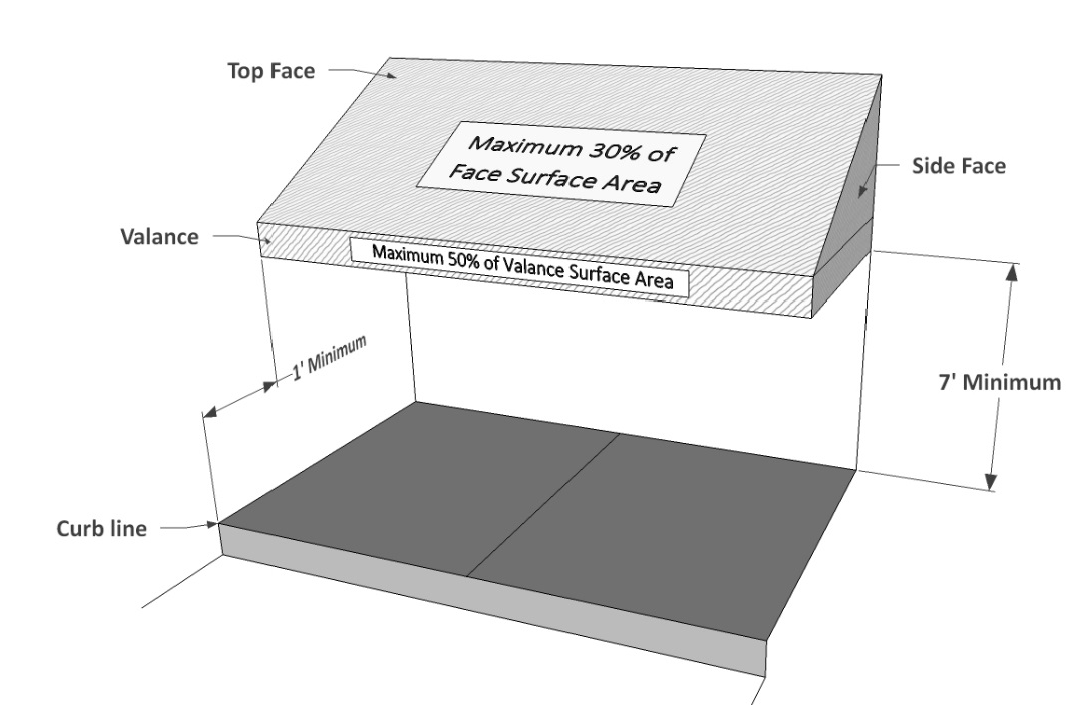
Height: All awnings shall be constructed and erected so that the lowest portion thereof shall be not less than 7' above the level of the public sidewalk.
2.
Setback: No awning shall extend beyond a structure to less than one foot from the curb line.
3.
Top Face: Any sign located on an awning face may take up a maximum of 30% of the total face surface area.
4.
Side Face: Any sign located on an awning side face may take up a maximum of 50% of the total side face surface area.
5.
Valance: Any sign or words on the valance of an awning may take up a maximum of 50% of the total valance surface area.
(d)
Additional Requirements:
1.
Awnings shall be securely attached to and supported by the building and shall be without posts or columns.
(4)
Canopy Signs.
(a)
Definition: A sign located on a canopy, which is a shelter, attached to or connected with a building and extending into a setback or over the public sidewalk.
(b)
Districts Where Allowed: B-1 Central Business District, T-1 Downtown Transition District.
(c)
Measurements:
1.
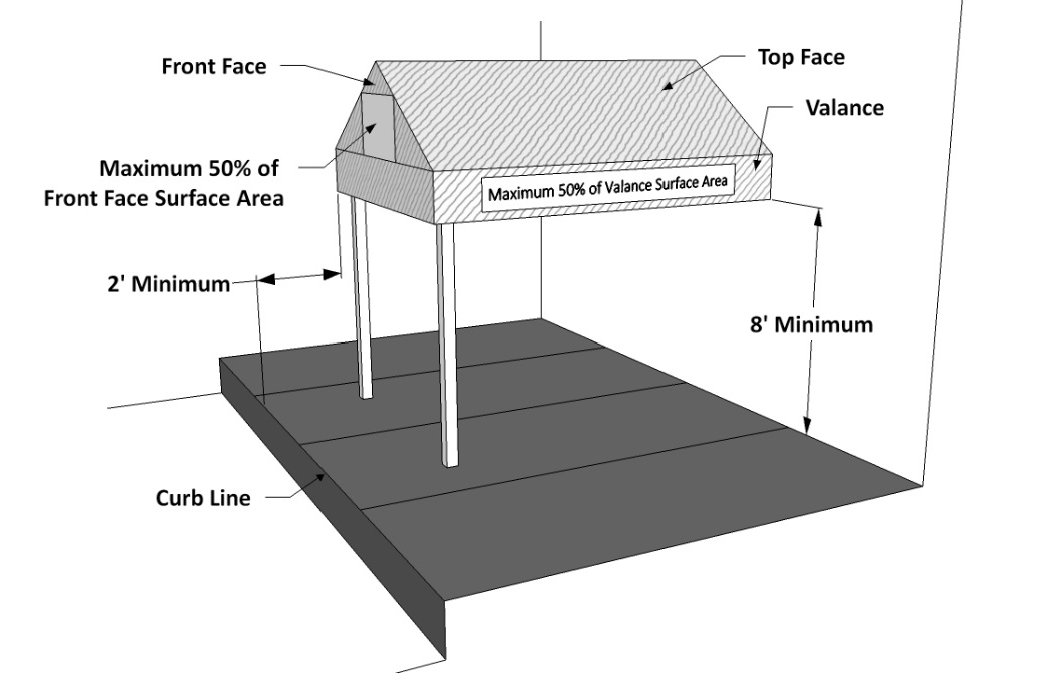
Height: All canopies shall be constructed and erected so that the lowest portion thereof shall be not less than 8' above the level of the public sidewalk.
2.
Setback: No canopy shall extend beyond a structure to less than 2' from the curb line.
3.
Front Face: Any sign located on the front face of a canopy may take up a maximum of 50% of the total front face surface area.
4.
Top Face: No signs are allowed on the top face of any canopy.
5.
Valance: Any sign or words on the valance of a canopy may take up a maximum of 50% of the total valance surface area.
(d)
Additional Requirements:
1.
The structural support of all canopies shall be approved so as to be in compliance with the building code of the City and shall meet State building codes. All frames and supports shall be of metal and designed to withstand a wind pressure as provided in subsection 17.8-6(1) of this Code. All canopies shall be attached to a building, and no support shall exist on the street side of the setback line between the canopy and the sidewalk or ground below.
(5)
Changeable Copy Sign.
(a)
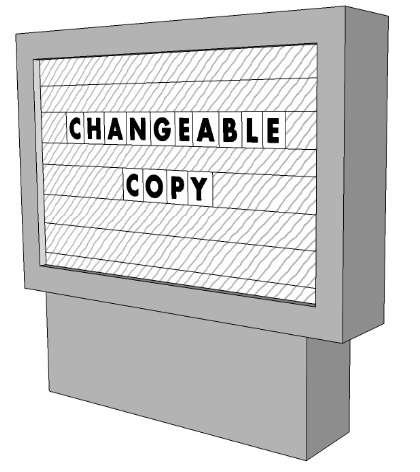
Definition: A sign with characters, letters, or illustrations that can be changed or rearranged manually or electronically without altering the face or surface of the sign.
(b)
Districts Where Allowed: B-1 Central Business District, B-2 Community Business District, B-3 Neighborhood Business District, B-4 Office District, B-5 Highway Business District, B-6 Commercial Business District, M-l Light Manufacturing District, M-2 General Manufacturing District, T-1 Downtown Transition District, 1-1 Institutional District, E-1 Employment District.
(c)
Measurements: The measurements of a changeable copy sign must adhere to the requirements of the relevant sign.
(d)
Additional Requirements:
1.
The following types of permanent signs may be or have a portion of their sign feature a changeable copy sign:
a.
Monument sign.
b.
Pole sign.
c.
Wall sign.
d.
A & T frame signs (may not be electronic signs).
(6)
Window Sign.
(a)
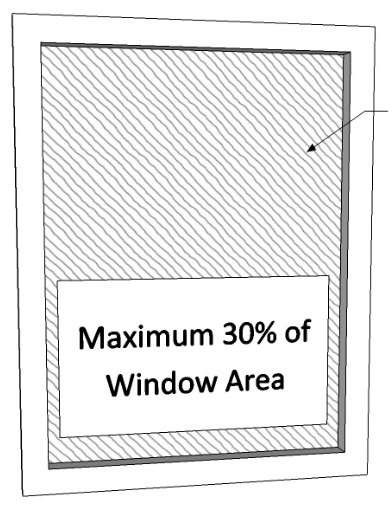
Definition: Any sign which is located on or within 4' of a window and is clearly visible from and intended to be seen from the exterior of a building.
(b)
Districts Where Allowed: B-1 Central Business District, B-2 Community Business District, B-3 Neighborhood Business District, B-4 Office District, B-5 Highway Business District, B-6 Commercial Business District, M-l Light Manufacturing District, M-2 General Manufacturing District, T-1 Downtown Transition District, E-1 Employment District.
(c)
Measurements: Window signs shall not exceed 30% of the window area in which the sign is displayed. The maximum area for any one sign shall be 25 square feet.
(d)
Neon signs shall be permitted as a window sign; except in the T-1 District where neon signs shall be prohibited.
(7)
Monument Signs.
(a)
Definition: A freestanding sign that is detached from a building and has a support structure that is a solid appearing base constructed of a permanent material.
(b)
Districts Where Allowed: B-1 Central Business District, B-2 Community Business District, B-3 Neighborhood Business District, B-4 Office District, B-5 Highway Business District, B-6 Commercial Business District, M-l Light Manufacturing District, M-2 General Manufacturing District, T-1 Downtown Transition District, 1-1 Institutional District, E-1 Employment District.
(c)
Measurements:
1.
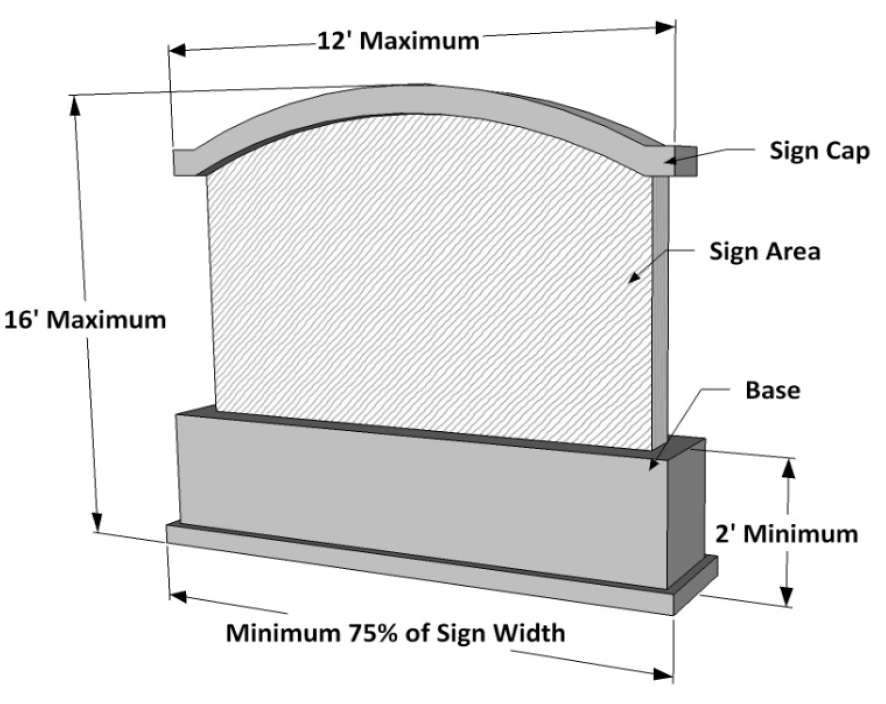
Total Height: The maximum height for any monument sign shall be 16' from the ground. This includes all parts of the sign such as the base, the sign, a sign cap, or any other object attached to the monument sign.
2.
Base Height: The height of any base structure for a monument sign shall be at least 2' from the ground.
3.
Sign Width: The maximum width for any monument sign shall be 12'.
4.
Base Width: The base structure of any monument sign shall be at least 75% of the sign width.
5.
Sign Cap: A sign cap may be placed on top of the monument sign but shall not exceed the width of the base.
(d)
Additional Requirements:
1.
Monument signs shall be located within a landscaped planter. The minimum area of this planter must be equal to the total area of the sign located within the planter. A landscape plan shall be approved by the Zoning Administrator.
2.
Construction materials of a monument signs shall match that of the principal structure.
3.
The monument sign base shall be constructed of a solid material such as brick, metal or other material approved by the Zoning Administrator.
(e)
Low Profile Monument Sign:
1.
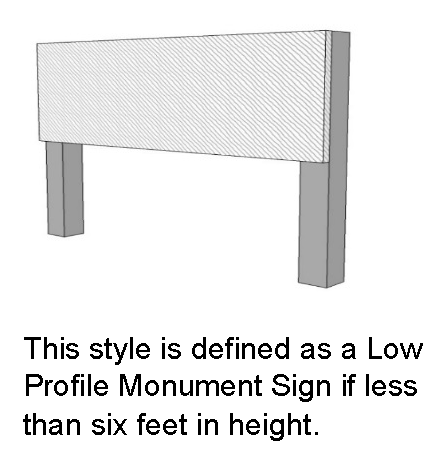
Definition: A form of monument sign that also is a freestanding sign detached from a building. This sign has a 2-pylon support structure and the area under the sign face is above the ground.
2.
The maximum height of a low profile monument sign shall be 6' from the ground. This includes all parts of the sign.
3.
The maximum width of a low profile monument sign shall not exceed 10'.
4.
Low profile monument signs shall be located within a landscaped area, the landscaped area must be equal to the total area of the sign located within the planter. A landscape plan shall be approved by the Zoning Administrator.
5.
Construction materials of a low profile monument signs need not match that of the principal structure, but shall be of a solid material and durable nature.
(8)
Pole Sign.
(a)
Definition: A freestanding sign that is mounted on a pole or beam that is placed on and anchored in the ground or on a base and that is independent from any building or other structure.
(b)
Districts Where Allowed: B-5 Highway Business District, M-l Light Manufacturing District, M-2 General Manufacturing District.
(c)
Measurements:
1.
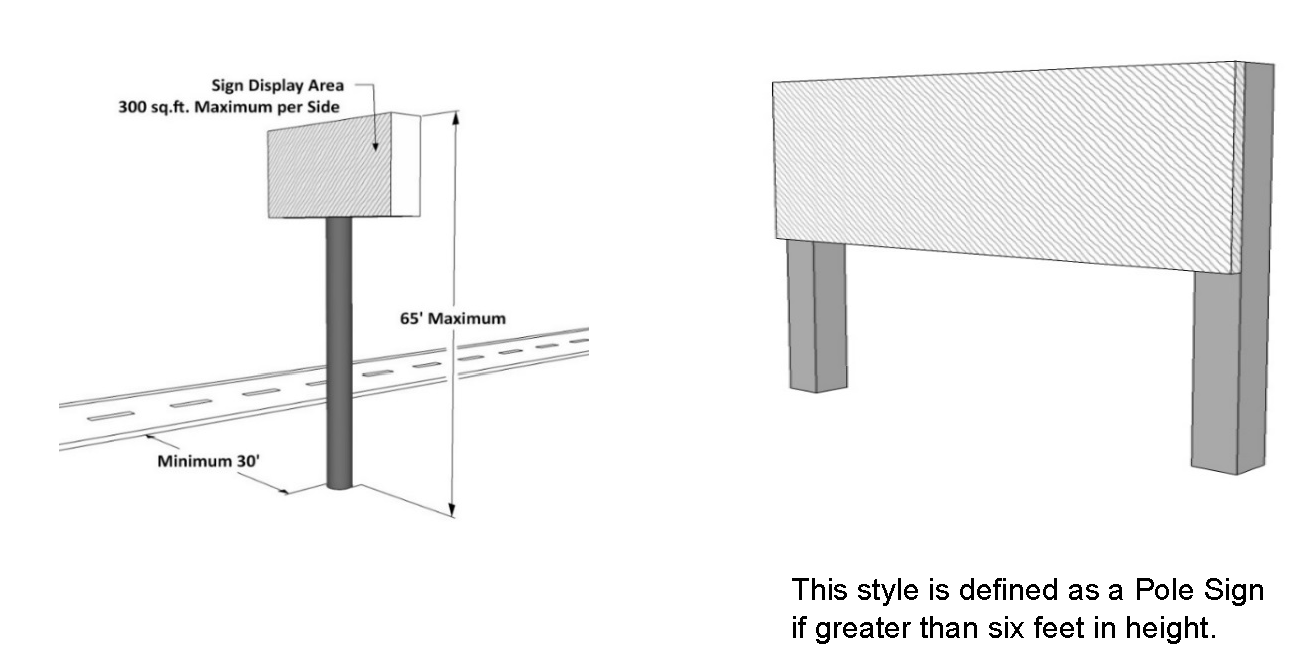
Height: Signs shall not exceed 65' in height.
2.
Setbacks: Pole signs shall be at least 30' from the street lot line. No pole-mounted sign shall be located closer than 300' to a ground sign, projecting sign, or wall sign. No pole-mounted sign shall be located closer than 1,000' to another pole sign.
3.
Area: Signs shall not exceed 300 square feet in display area on any one side nor 600 square feet in display area in all sides for any one premises.
(d)
Additional Requirements:
1.
An on-premises pole sign may be located in the B-2 Community Business District if it is within the first 100' adjacent to Interstate Highway 43 or U.S. Highway 12 or frontage roads.
2.
Signs located adjacent to a limited access highway shall conform to applicable regulations of the State of Wisconsin.
(9)
Projecting Sign.
(a)
Definition: An on-premises attached sign end-mounted or otherwise attached to an exterior wall of a building which projects from the wall to which it is attached.
(b)
Districts Where Allowed: B-1 Central Business District, (B-2 Community Business District, if approved as part of a site plan).
(c)
Measurements:
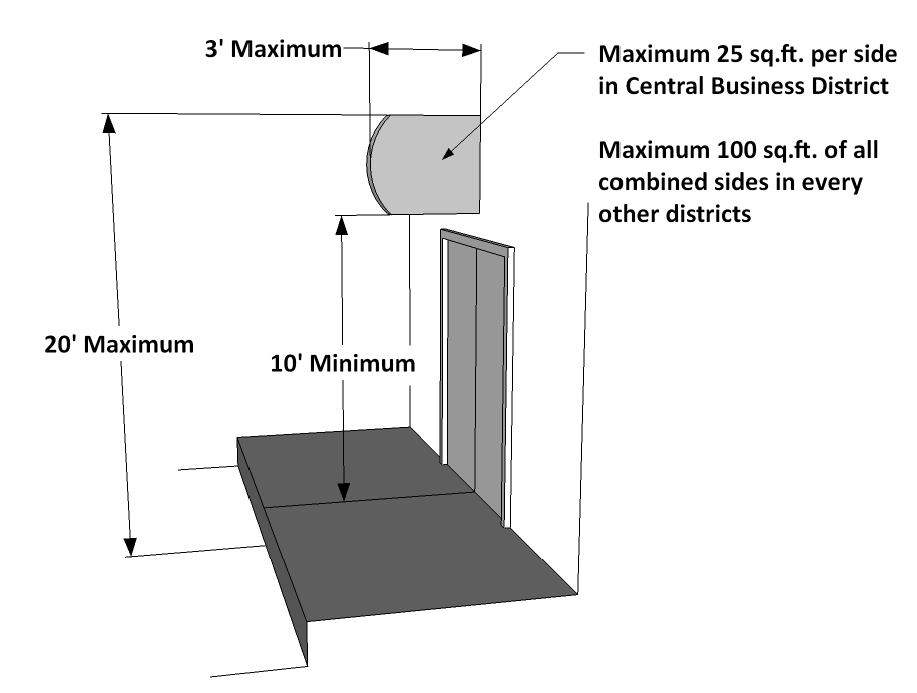
1.
Height: Any projecting sign shall not exceed a height of 20' above the centerline street grade; and shall be a minimum of 10' in height above any sidewalk.
2.
Projection: Any projecting sign shall not extend into any public right-of-way more than 3'.
3.
Area: A projecting sign in the B-1 Central Business District zone shall not exceed 25 square feet in area on each side of a two-sided sign or 50 square feet for all sides. A projecting sign in any other allowed district shall not exceed 100 square feet in area for any one premises.
(10)
Wall Sign.
(a)
Definition: A sign affixed to or painted on the exterior wall of any building.
(b)
Districts Where Allowed: B-1 Central Business District, B-2 Community Business District, B-3 Neighborhood Business District, B-4 Office District, B-5 Highway Business District, B-6 Commercial Business District, M-1 Light Manufacturing District, M-2 General Manufacturing District, T-1 Downtown Transition District, Institutional District, E-1 Employment District.
(c)
Measurements:
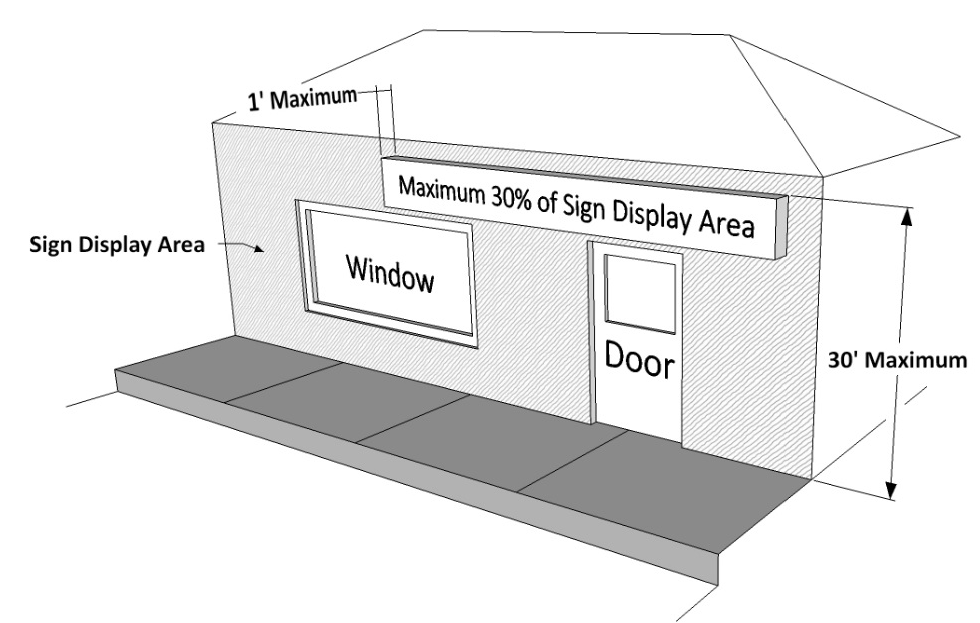
1.
Height: The top of the sign shall not be higher than the bottom of the second story window or the top of the wall of a one-story building.
2.
Projection: A wall sign shall not extend more than 12" from the building's wall surface.
3.
Area: Each wall sign shall be located within a selected sign display area. The sign display area is considered all the surface area on the face of a wall except the area used for windows and doors. The total area of all wall signs per wall shall not exceed 30% of the sign display area.
Area of all wall sign(s) shall not exceed 3 square feet per lineal foot of the respective lot frontage toward which the sign(s) is displayed.
(11)
Temporary Signs Notifying of Special Events.
(a)
Any sign constructed of cloth, canvas, fabric, paper, plywood, or other light material and intended to be displayed for a short period of time for the following purposes:
1.
Promotional banners displayed over a public street, alley or highway when approved by the Zoning Administrator for a period not to exceed 2 weeks prior to the promoted event. The sponsoring person, firm, organization or corporation shall provide a certificate of liability insurance in the amount of not less than $100,000.00 each person and $300,000.00 each occurrence, bodily injury liability; and $100,000.00 each occurrence, property damage liability. Banners approved and authorized in accordance with this subparagraph shall be promptly removed following the final day of the event being promoted. The City shall approve the manner and materials used to hang and support any such sign.
2.
A temporary sign in a residential district for a purpose approved by the City in advance.
3.
A temporary search light for advertising purposes in any district provided that the search light will not be located in any public right-of-way, will not be located closer than 10' to an adjacent property, will not cause a hazard to traffic or prevent the quiet enjoyment of any adjoining property. Any approved light will comply with the provisions of Section 17.10-5. Search light permits shall not be granted for a period of more than 5 days in any 6-month period. (Ord. No. 17-04, §§ 1, 2, 4-17-2017.)
17.8-6 - Prohibited signs.
The following signs are prohibited in all zoning districts:
(1)
Any sign not otherwise permitted in this chapter is prohibited.
(2)
Off-premises signs (including billboards).
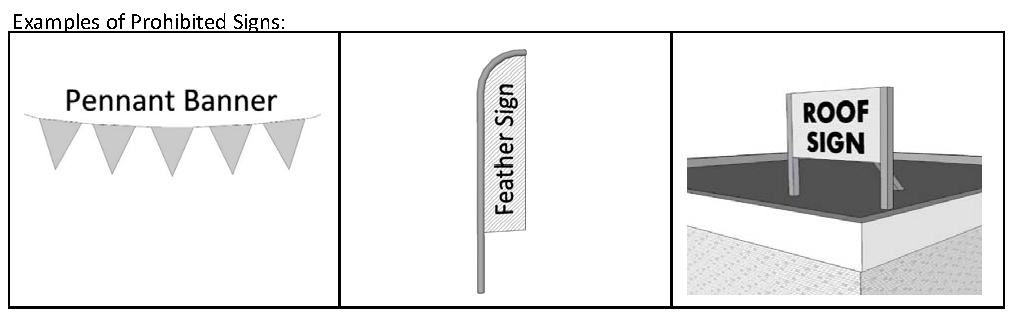
(3)
Pennant banner flags.
(4)
Feather signs.
(5)
Roof signs.
(6)
Any sign in the public right-of-way except for a government purpose including, but not limited to, traffic control, parking and directional signs and as otherwise specified in this chapter.
(a)
Signs on Marquees, Canopies, or Awnings. Restrictions imposed on the projection of signs across property lines into the public way shall not apply to signs located on marquees, canopies or awnings provided that no such sign shall extend vertically or horizontally beyond the limits of said marquees, canopy or awning.
(7)
Any sign that resembles, imitates, or is approximately the shape, size, form or color of railroad or traffic signs, signals or devices.
(8)
Any sign which obstructs or interferes with the effectiveness of railroad or traffic signs, signals, or devices.
(9)
Signs and appurtenances which prevent free ingress to or egress from any door, window or fire escape; and any sign attached to a standpipe or fire escape.
(10)
Signs that obstruct or interfere with traffic visibility or are lighted in such a way as to cause glare or impair driver visibility upon public ways.
(11)
Flashing signs.
(12)
Any sign that contains any matter, in writing or in a depiction, which predominantly appeals to prurient interests.
(Ord. No. 17-04, §§ 1, 2, 4-17-2017.)
17.8-7 - Construction and maintenance standards.
(1)
Wind Pressure and Dead Load Requirements: All signs and other advertising structures shall be designed and constructed to withstand wind pressure of not less than 40 pounds per square foot of area; and shall be constructed to receive dead loads as required in the City Building Code or other ordinance.
(2)
Protection of the Public: The temporary occupancy of a sidewalk or street or other public property during construction, removal, repair, alteration or maintenance of a sign is permitted provided the space occupied is provided with barricades and appropriate notifications and warnings.
(3)
Maintenance: The owner of any sign shall keep it in good maintenance and repair which includes restoring, repainting or replacement of a worn or damaged legally conforming, existing sign to its original condition. Sign supports and brackets shall be routinely inspected and repaired by the owner so as to maintain the integrity and safety of the support system. A sign which is not repaired, painted or maintained pursuant to written notification and order by the Zoning Administrator shall be subject to removal, and an owner who fails to comply with this section shall be subject to penalty.
(4)
Awning or Canopy Maintenance: The owner of any awning or canopy shall keep it in good maintenance and repair which includes restoring, repainting or replacement of a worn or damaged legally conforming, existing awning or canopy to its original condition. Supports and brackets shall be routinely inspected and repaired by the owner so as to maintain the integrity and safety of the support system. An awning or canopy which is not repaired, painted or maintained pursuant to written notification and order by the Zoning Administrator or designee shall be subject to removal, and an owner who fails to comply with this subsection shall be subject to penalty.
(5)
Construction of Signs and Supporting Members or Braces: The method of construction and materials used shall be subject to the approval of the Zoning Administrator.
(6)
Abandoned Signs: All signs or sign messages shall be removed by the owner or lessee of the premises upon which a sign is located when the business it advertises is no longer conducted, or the product or service advertised is no longer available. If the owner or lessee fails to remove the sign within 30 days of the business closing the City may remove or cause the sign to be removed and the cost associated with said removal is to be assessed as a special assessment against the property on which the said sign is located, or cause an action to be taken pursuant to the penalties specified in Article 17.14.
(Ord. No. 17-04, §§ 1, 2, 4-17-2017.)
17.8-8 - Nonconforming existing signs, canopies and awning.
(1)
A legally nonconforming sign, canopy or awning shall be kept in good repair. A sign, canopy or awning which is not repaired, painted or maintained within 90 days of written notification by the Zoning Administrator shall be removed and the owner shall be subject to penalty.
(2)
A legally nonconforming sign, canopy or awning, although it shall be maintained, may not be replaced except by a conforming sign, canopy or awning; except that the face of the nonconforming sign may be changed or modified provided that the new sign face is of the same dimensions of the existing sign and may be incorporated into the existing frame and supporting structure.
(3)
A legally nonconforming sign may not be enlarged or modified to increase the nonconformity.
(4)
If there is a change in ownership of the business or institution which the sign is representing, the face of the nonconforming sign may be changed or modified provided that the new sign face is of the same dimensions as the existing sign and may be incorporated into the existing frame and supporting structure.
(5)
A legally nonconforming sign, canopy or awning shall be discontinued and removed when the business identified on the sign, or in conjunction with which the canopy or awning exists, has closed or moved or the use of the building upon which the sign, canopy or awning is displayed or attached, is changed. A legally nonconforming sign, canopy or awning shall be deemed abandoned and shall be discontinued and removed if the property upon which such sign, canopy or awning is located remains vacant for a period of 90 days.
(6)
The Zoning Administrator, upon determining that a nonconforming sign, canopy or awning exists on any property, shall notify the owner, agent or person having beneficial use of the property of the existence of such nonconforming sign, canopy or awning and shall provide a copy of this Article with such notice.
(Ord. No. 17-04, §§ 1, 2, 4-17-2017.)
17.8-9 - General provisions.
The following general provisions apply to all signs in all zones and land uses unless otherwise stated:
(1)
Sign Area Measurement: The area of a sign face or lettering not enclosed in a frame, is determined by calculating the smallest square, circle, rectangle, triangle, or combination that will encompass the extreme limits of the sign, together with any material or color forming an integral part of the background of the display or used to differentiate the sign from the backdrop or structure against which it is placed. This area calculation does not include any supporting framework, bracing, or decorative fence or wall when such fence or wall otherwise meets zoning ordinance regulations and is clearly incidental to the display itself.
(2)
Total sign area of combinations of any sign types shall not exceed all requirements for an individual sign.
(3)
The following signs are permitted in the I-1 Institutional and P-1 Park Districts and are subject to the following regulations:
(a)
Monument signs indicating Institutional, park name and municipal signs when approved by the City Plan Commission shall not exceed 200 square feet in area.
(4)
Electronic Message Signs: An electronic message sign is considered a sign that uses changing lights to form a message or messages wherein the sequence of messages and the rate of change are electronically programmed and may be modified by electronic processes. All electronic message signs shall have a permit.
(a)
Types of Signs: The following signs are allowed to be or have a portion of their sign area be an electronic message sign:
1.
Monument signs.
2.
Pole signs.
(b)
Rate of Change: The frequency of the message change shall not exceed once every 10 seconds. The message shall not flash or move, but may scroll into place within 3 seconds from the start of the transition.
(c)
Brightness:
1.
Brightness levels shall conform to the standards set in Illumination Section of this Article [subsection] 17.8-9(5)(b).
2.
Electronic message sign shall have the capability to lower the intensity of the light being emitted after it is erected.
3.
Prior to the issuance of a sign permit, the applicant shall provide a written certification from the sign manufacturer that the light intensity has been factory pre-set not to exceed the maximum brightness level.
(5)
Illumination.
(a)
Hours of Operation: All illuminated signs within 150' of any residential zoning district shall be turned off between the hours of 8:00 p.m. and 7:00 a.m. unless the establishment is engaged in the operation of business during such period, in which case the sign may be lit during the hours of operation only. Illuminated signs located in the T-1 Downtown Transition District shall be turned off by 10:00 p.m.
(b)
Brightness: Signs may not have a luminance level of more than 0.3 of a foot-candle above the average ambient light level measured 150' from the face of the sign or have a luminance level of more than 0 foot-candles at the lot line.
(c)
Internal Illumination: If the sign is internally illuminated the light source shall be visible only through a translucent surface or recessed into the sign. The following types of signs may be internally illuminated:
1.
Monument signs.
2.
Wall signs.
3.
Pole signs.
4.
Projecting signs.
(d)
External Illumination: If the sign is externally illuminated the light sources not be visible from the right-of-way. The following types of signs may be externally illuminated:
1.
Awning signs.
2.
Monument signs.
3.
Pole signs.
4.
Wall signs.
(e)
Direction: The illumination of signs shall be diffused or indirect and shall be arranged so no direct rays shall reflect into a public way or any lot on the perimeter of the premises on which the signs are located.
(f)
Prohibited:
1.
Exposed light bulbs, flashing, blinking or traveling and similar illumination are prohibited.
2.
No temporary sign shall be illuminated.
(Ord. No. 17-04, §§ 1, 2, 4-17-2017; Ord. No. 2025-09, 3-17-2025.)
17.8-10 - Sign, awning or canopy permit.
(1)
Application. Application for a sign, awning or canopy permit shall be made on forms provided by the Zoning Administrator, designee or City Clerk and shall contain or have attached thereto the following information:
(a)
Name, address and telephone number of the applicant. Location of building, structure or lot to which or upon which the sign, awning or canopy is to be attached or erected;
(b)
Name of person, firm, corporation or association erecting the sign, awning or canopy;
(c)
Written consent of the owner or lessee of the building, structure or land to which or upon which the sign, awning or canopy is to be affixed;
(d)
A scale drawing of such sign, awning or canopy indicating the dimensions, materials to be used, type of illumination, if any, and the method of construction and attachment;
(e)
A plat of survey prepared by a land surveyor registered in Wisconsin or other map drawn to scale and approved by the Zoning Administrator or designee showing the location of such sign, awning or canopy in relation to property lines, buildings and structures;
(f)
Copies of any other permit required and issued for the sign, awning or canopy, including the written approval of the City so as to be in keeping with the Building Code. In the case of illuminated signs, awnings or canopies, all plans specifications, wiring and connections shall comply with the City Electrical Code;
(g)
Additional information as may be required by the City, its Zoning Administrator or its Plan Commission.
(2)
Permit. Sign, awning or canopy permit applications shall be filed with the Zoning Administrator, who shall review the application for its completeness and accuracy.
(a)
Said Zoning Administrator shall have discretion to approve or deny the application. If not satisfied with the decision of the Zoning Administrator, applicant shall have the right to submit an appeal to the Plan Commission.
(b)
A sign, awning or canopy permit shall become null and void if work authorized under the permit has not been completed within 6 months of the date of issuance.
(3)
Standards. No permit shall be granted for a sign, canopy or awning unless the following standards are met:
(a)
The character of the sign, canopy or awning should be consistent with the design of the building;
(b)
Materials and colors shall compliment the building and be compatible with other buildings in the area;
(c)
The sign, canopy or awning shall not detract from the historical character of the building located in the B-1 Central Business District.
(Ord. No. 17-04, §§ 1, 2, 4-17-2017.)
17.8-11 - Exceptions and appeals.
(1)
Exceptions. Exceptions to the regulations in this chapter may be allowed only by the Plan Commission of a public hearing called for that purpose, and only if the Plan Commission determines by clear and convincing evidence that the criteria set forth below are met:
(a)
The height and area of a sign shall not be increased by more than 25% of the initial standard.
(b)
The visibility of the sign is impaired by the surrounding environment and that an alternative sign location is not feasible.
(2)
Appeals. Appeals to a denial of a sign permit application by the Zoning Administrator shall be heard by the Plan Commission. The Plan Commission shall consider if the permit application is in keeping with the intent and requirements of this Code and that the applicant has shown by clear and convincing evidence that the standards of this Code have been met or an exception is warranted by the standards set forth herein.
(Ord. No. 17-04, §§ 1, 2, 4-17-2017.)

