
Elkhorn City Zoning Code
ARTICLE 17
6. - Parking and Loading
17.6-1 - Purpose.
The purpose of this article is to promote the safety and welfare of the public by establishing minimum requirements for off-street parking, loading, and unloading of motor vehicles.
(Ord. No. 14-05, §§ 1, 2, 2014.)
17.6-2 - General provisions for parking and loading facilities.
(1)
Scope of Regulations. The off-street parking and loading provisions of this article shall apply as follows:
(a)
For all buildings and structures erected and all uses of land established after January 1, 2014, accessory parking and loading facilities shall be provided as required by the regulations of this article. However, where a building permit has been issued prior to the effective date of the ordinance, and provided that construction is begun within one year of such effective date, and diligently carried out to completion, only the less restrictive parking and loading standards as required prior to the effective date shall be provided.
(b)
When the gross floor area, occupant capacity and/or number of dwelling units of any building, structure or premises shall be increased, parking and loading facilities as required herein shall be provided for such increase. This requirement shall apply to all zoning districts.
(c)
Whenever the existing use of a building or structure is changed to a new use, parking or loading facilities shall be provided as required for such new use. In the B-1 Central Business District, CPO Central Place Overlay, and T-1 Transitional District, the standards of subsection 17.6-2(3) shall apply.
(2)
Existing Parking and Loading Facilities. Accessory off-street parking or loading facilities which are located on the same lot as the building or use served, and which were in existence on January 1, 2007, or were provided voluntarily after such effective date, shall not hereafter be reduced below, or if already less than, shall not further be reduced below the requirements of this article for a similar new building or use. This section does not apply to an existing business adding outdoor seating.
(3)
Central Business District Parking Requirements. For the purpose of allowing the existing mix and density of uses within the B-1 Central Business District and the T-1 Transitional District, additional off-street parking is not required for sites where limited parking or no parking is currently provided. New uses permitted in the B-1 and T-1 Districts respectively shall not be required to provide additional parking. However, where new construction and/or expansion of existing uses occurs, parking per the standard parking requirements detailed in this section shall be required. This section does not apply to an existing business adding outdoor seating.
(4)
Permissive Parking and Loading Facilities. Nothing in this article shall be deemed to prevent the voluntary establishment of off-street parking or loading facilities to serve any existing use of land or buildings provided that all regulations herein governing the location, design, improvement and operation of such facilities are adhered to.
(5)
Submission of Plot Plan. Any application for a building permit, or for a certificate of occupancy where no building permit is required, shall include therewith a site plan, drawn to scale and fully dimensioned, showing any parking or loading facilities to be provided in compliance with this section.
(6)
Landscape Requirements. All public and private off-street parking areas which serve 5 vehicles or more and are created or redesigned and rebuilt subsequent to the adoption of the ordinance codified in this chapter shall be provided with accessory landscape areas not less than 5% of the surfaced area. Every 10 parking stalls shall be broken up by a landscape island. The minimum size of each landscape area shall be at least 100 square feet. Location of landscape areas and plant materials including curbing and provision for maintenance shall be subject to approval by the Zoning Administrator. All plans for such proposed parking areas shall include a topographic survey or grading plan which shows existing trees, shrubs, and other natural vegetation in the parking area may be included in the calculation of the required minimum landscape area. Those parking areas for 5 or more vehicles, if adjoining a residential use shall be screened from such use by a vegetative barrier built and maintained at minimum height of 6'.
(7)
Curbs and Barriers. Curbs and barriers shall be installed a minimum of 4' from the property line so as to prevent the parked vehicles from extending over any lot lines.
(Ord. No. 21-09, 7-6-2021; Ord. No. 21-08, 7-6-2021; Ord. No. 14-05, §§ 1, 2, 2014.)
17.6-3 - Parking regulations.
(1)
Use of Parking Facilities. Off-street parking facilities accessory to residential uses located in any residential district shall be used solely for the parking of passenger automobiles owned by occupants of the dwelling structures to which such parking facilities are accessory or by guests of said occupants. Under no circumstances shall require parking facilities accessory to residential structures be used for the parking of automobiles belonging to the owners, tenants, visitors or customers of business or manufacturing establishments. Vehicles showing company insignia may be parked if driven to work by the occupant of the structure. No semi-trailers are allowed to be parked in residential zoning district homes sites. Semi-trailers may only be parked on sites where the principal business operates.
(2)
Joint Parking Facilities. Notwithstanding any other parking requirements set forth in this article, a joint parking facility may be applied where mixed uses are proposed and the mix of uses creates staggered peak periods of parking demand. A joint parking facility allows the property developer to use parking spaces more efficiently by allowing the same spaces to be "shared" by various land uses, thus reducing the total amount of required parking. A shared parking program may include parking located on different sites. All sites incorporated into a joint parking facility shall be subject to the provisions herein. In no case shall a shared parking program include the parking spaces required for residential uses.
(a)
The City Engineer may approve a joint parking facility upon the developer providing clear and specific evidence that:
1.
Pedestrian access is provided to and from the parking area and the building; and
2.
All other requirements set forth herein are met. If denied, the request may be appealed to the Plan Commission. In the case of such appeal, the burden shall be on the appellant to show that the requirements of this code or standards for relief are met. The Plan Commission shall be under no obligation to grant an appeal unless provided such evidence.
(b)
Those wishing to apply for a joint parking facility must demonstrate to the City Engineer the feasibility of shared parking pursuant to the same criteria as noted in subparagraph (e) below. The maximum reduction in the number of parking spaces required for all uses sharing the parking area shall be 20%.
(c)
Shared parking spaces may be located on a different lot than the use which it serves only where the following conditions are met:
1.
The parking is located no more than 300' from the use that it serves. The distance between the use and the parking lot shall be measured following a reasonable and safe walking route from the main entrance of the use to the nearest parking lot;
2.
The applicant(s) for a building permit or certificate of occupancy for the use which is to be served by a joint parking facility shall submit a copy of a written agreement pursuant to subparagraph (f) below along with his or her application for such permit or certificate.
3.
Operating and peak use hours of businesses served by the parking support the shared parking program. Possible change of business uses shall be considered and provisions made to address changes to conditions that warranted approval of the shared parking.
4.
Sufficient parking is provided per the requirements of this code for all uses served.
(d)
Off-street parking facilities for properties with separate buildings or uses, or for buildings with mixed uses, may be provided collectively on the zoning lot, provided that the total number of spaces so located together shall not be less than the sum of the separate requirements for each use. Cumulative parking requirements for mixed-use occupancies may be reduced where it can be determined that the peak requirement of the several occupancies occurs at different times (either daily or seasonally). Shared parking reports published by groups such as the Urban Land Institute or Institute of Transportation Engineers may be used as a guideline in the estimation of parking demand for mixed-use buildings and sites. Requests for reduced parking shall be submitted to the City Engineer for approval. Possible change of business uses shall be considered and provisions made to address changes to conditions that warranted approval of the shared parking. If denied, the request may be appealed to the Plan Commission. In the case of such appeal, the burden shall be on the appellant to show that the requirements of this Code or standards for relief are met. The Plan Commission shall be under no obligation to grant an appeal unless provided such evidence.
(e)
Agreement. Whenever a joint parking facility is used to provide parking required per this code, the parties concerned shall execute written covenants and easements assuring their access, retention, maintenance, and use for such purposes. Such covenants and easements shall be reviewed and approved by the City Attorney.
(3)
Parking spaces that are reserved for a specific business purpose (e.g. reserved for doctors only) or designated and marked for use by persons with disabilities shall not be counted toward meeting the shared parking requirements.
(4)
Computation. When determination of the number of off-street parking spaces required by this section results in a requirement of a fractional space, any fraction of ½ or less may be disregarded while a fraction in excess of ½ shall be counted as one parking space.
(5)
Size. A required off-street parking space shall be at least 9' in width and at least 18.5' in length, exclusive of access drives or aisles, ramps, columns, or office or work areas. Each required off-street parking space shall have a vertical clearance of at least 7'.
(6)
Access.
(a)
Each required off-street parking space shall open directly upon an aisle or driveway of at least the width below, based upon the angle of the parking stalls provided and whether the aisle serves one or 2 rows of parking spaces:
FIGURE 1
PARKING ANGLE AND AISLE WIDTH
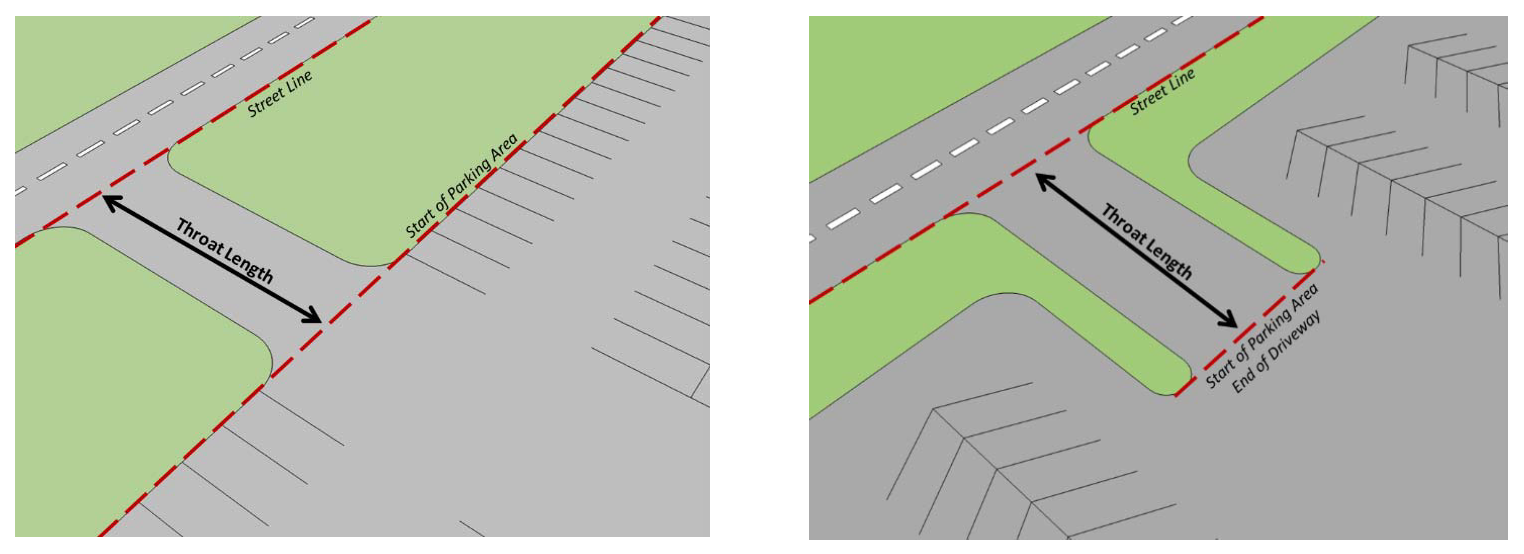
FIGURE 2
MINIMUM PERMITTED THROAT LENGTH
(See graphics)
(b)
All off-street parking facilities shall be designed with appropriate means of vehicular access to a street or alley in a manner which will least interfere with traffic movements. No driveway across public property nor curb cut shall exceed a width of 35'. Except that for properties in the M and I Districts the Public Works Department may approve relief from this requirement, based on the standards in Chapter 8 of the City Code. Driveways shall be located at least one foot from the property line.
(7)
In Yards. Required off-street parking spaces may be located in any yard except required street yards, but shall not be closer than 4' to the lot line.
(8)
Design and Maintenance.
(a)
Open and Enclosed Parking Spaces. Accessory parking spaces located on the same lot as occupied by the use served may be open surface or enclosed in a building.
(b)
Surfacing. All newly constructed or expanded outdoor off-street parking areas and driveways shall be constructed with hot mix asphalt, concrete, or other materials that may be approved by the Public Works Department. Where an existing parking lot constructed of an unapproved material is expanded, the existing portion of the lot must be brought into compliance with this standard. Construction of such surfacing shall require issuance of a building permit and shall be completed within one year of the issuance of that permit.
(c)
Lighting. Any lighting used to illuminate off-street parking areas shall be directed away from residential use or zone properties in such a way as not to create a nuisance. (See Lighting, Section 17.10-9.)
(d)
Signs. Incidental signs are permitted in parking areas in accordance with the provisions established in Signs, Article 17.8.
(e)
Repair and Service. No motor vehicle repair work of any kind shall be permitted in conjunction with outdoor accessory off-street parking facilities in a residential district, except for minor repairs of the occupant's personal vehicle, provided that the vehicle is not rendered immobile for more than 7 days.
(f)
The sale of gasoline and motor oil in conjunction with accessory off-street parking facilities is not permitted.
(9)
Land Bank for Parking. When a reduction in the amount of required parking is requested the City may, but shall not be obligated to, permit that up to 25% of the required parking be reserved in a land bank in keeping with the follow[ing]:
(a)
Satisfactory information must be provided to the Plan Commission that the use of property for which the accessory parking is required will function in a safe manner and in keeping with the requirements of this subsection with the proposed land banked parking. The burden shall be on the applicant to show that this requirement is met. The Plan Commission shall be under no obligation to allow the land banking unless provided such evidence.
(b)
The proposed area for parking land bank must be appropriate for future parking; as evidenced by a site plan showing how the area would be designed and incorporated into existing parking areas.
(c)
The proposed area for parking land bank shall be maintained with a minimum landscape condition of live groundcover. The Plan Commission may require screening or additional landscaping as deemed necessary.
(d)
Approved requests for parking land bank will be accompanied by a covenant running with the land assuring use of the property for future parking and specifying the City's authority to require the parking to be installed when deemed necessary. The form of the covenant shall be reviewed and approved by the City Attorney.
(e)
The City shall determine that some or all of the parking land bank area be constructed for parking upon a finding by the Zoning Administrator that safe and effective use of the property and/or impacts on nearby streets or properties requires parking beyond that constructed on the subject site.
(10)
Handicapped Parking Requirements.
(a)
Number of Spaces. The owner or lessee of any public building or place of employment required to provide more than 25 spaces shall reserve parking spaces for use by motor vehicles used by physically disabled persons as follows:
1.
At least one space for a facility offering 26 to 49 spaces.
2.
At least 2% of all spaces for a facility offering 50 to 1,000 spaces.
3.
At least an additional one percent of each 1,000 spaces over the first 1,000.
4.
A minimum of one handicapped parking space must be van accessible, and one van accessible spaces shall be required for every 8 total handicapped stalls.
(b)
Stall Size and Location.
1.
Handicapped spaces shall be at least 12' wide and located as close as possible to an entrance which allows a physically disabled person to enter and leave the principal building or use area.
2.
A handicapped access aisle of 5' shall be located adjacent to each handicapped space
3.
Two handicapped parking spaces may share an accessible aisle.
4.
Access aisles adjacent to van accessible spaces shall be 8' wide.
(c)
Handicapped Parking Signs.
1.
All required handicapped parking spaces shall be posted with signs indicating the international symbol of accessibility.
2.
Van accessible handicapped parking spaces shall be designated with a handicapped parking sign indicating "Van Accessible".
(Ord. No. 14-05, §§ 1, 2, 2014.)
17.6-4 - Location of accessory off-street parking facilities.
When required parking facilities are provided on land other than the zoning lot on which the building or use served by such facilities is located, the following requirements shall be met; in addition to all other applicable standards.
(1)
The location of off-street parking facilities shall be measured from the main entrance of the use served to the nearest edge all parking spaces in the off-street parking facility. The distance shall be measured along a logical and safe walking path. Distances shall be as follows:
(a)
For Uses in a Residential or Agricultural District. Parking spaces accessory to dwellings shall be located on the same zoning lot as the principal use. Spaces accessory to uses other than dwellings may be located on a lot adjacent to, or directly across a street or alley from the lot occupied by the principal use, but in no case at a distance in excess of 300' from the parking space to the main entrance.
(b)
For Uses in Business, Institutional, Office, or Manufacturing Districts. All required parking spaces shall be within 1,000' of the main entrance. However, no parking spaces accessory to a use in a business or manufacturing district shall be located in a residential district, except that municipal parking lots may be allowed within 300' of and adjacent to any business or industrial district.
(2)
Control of Off-Site Parking Facilities. When required parking facilities are provided on a lot other than the lot on which the building or use served by such facilities is located, both lots shall be and remain in the same ownership.
No off-site parking facilities shall be authorized and no occupancy permit shall be issued where the plans call for parking facilities to be located on a lot other than on the same zoning lot as the principal use until and unless the Plan Commission has reviewed the plans, heard the applicant and made findings that the zoning lot and the remote site are in common ownership and that the off-site parking facilities will be maintained at all times during the life of the proposed use or building.
(Ord. No. 14-05, §§ 1, 2, 2014.)
17.6-5 - Off-street loading.
(1)
No Use of Public Right-of-Way. At no time shall goods be loaded or unloaded from the right-of-way of a collector or arterial street. This requirement does not apply to businesses located in the B-1 Downtown Business District, Postal Trucks and Package Service Trucks.
(2)
Space Size. Off-street loading spaces, excluding maneuvering areas, shall be at least 10' wide by 50' long.
(3)
Location.
(a)
Location of off-street loading facilities. All off-street loading facilities shall be located on the same lot as the building or land use served.
(b)
Central loading facilities. Central loading facilities may be substituted for off-street loading facilities on individual lots, provided that:
1.
Access. Each lot served shall have direct access to the central loading area without crossing a street or alley. Additionally, no lot served shall be more than 500' from the central loading facility.
2.
Required berths. The total number of off-street loading berths required shall be the sum total or berths required for all of the properties served by the central loading facility.
3.
Agreement. Whenever the required off-street loading facilities are collectively provided and used in a central loading facility, the parties concerned shall execute written covenants and easements assuring their access, retention, maintenance, and use for such purposes. Such covenants and easements shall be reviewed and approved by the City Attorney.
(4)
Yard Requirements for Off-Street Loading Facilities. Off-street loading facilities located within the buildings they serve shall comply with the yard and setback requirements of the zoning district in which located. For unenclosed off-street loading facilities, the following provisions apply:
(a)
The loading facilities shall not be located in any street yard; and
(b)
Loading facilities shall not be located within 5' of any property line.
(Ord. No. 14-05, §§ 1, 2, 2014.)
17.6-6 - Schedule of parking and loading requirements.
(1)
Applicability. Accessory off-street parking spaces and loading requirements shall be provided for the following uses as required hereinafter. For uses not listed herein, the parking requirements shall be determined by the Zoning Administrator.
(2)
The off-street parking requirements established herein may be reduced up to 25% through an exception granted by the Plan Commission, provided that it can be shown why the established requirement is not applicable or appropriate. Reductions that exceed 25% shall be heard by the Board of Appeals.
(a)
The City may, but is under no obligation to, grant an exception to parking requirements. Evidence to support such a reduction shall be provided by the applicant and may include, but not be limited to, direct experience of the applicant with similar facilities, observed experience of other comparable facilities, and/[or] broadly accepted industry parking standards showing successful parking usage at a lower rate than required.
(b)
In the case of such parking reduction, the burden shall be on the appellant to show that the requirements of this code or standards for relief are met. The City shall be under no obligation to grant a reduction unless provided such evidence.
(3)
Parking spaces required on an employee basis shall be based on the maximum number of employees on duty or residing, or both, on the premises at any one time. Off-street loading berths shall be provided on the basis of gross floor area of buildings or portions thereof devoted to such uses in the amounts shown below:
SCHEDULE OF OFF-STREET LOADING REQUIREMENTS
Off-Street loading berths shall be provided on the basis of gross floor area in accordance with the following:
(Ord. No. 14-05, §§ 1, 2, 2014.)

