
Ellijay City Zoning Code
ARTICLE 3
- DEFINITIONS
Sec. 3.1.- Rules.
For the purpose of this ordinance, certain terms and words are hereby defined. Words used in the present tense shall include the future; the singular number shall include the plural and the plural the singular; the word "structure" shall include the word "building"; the word "shall" is mandatory and not discretionary.
Sec. 3.2. - Use of definitions.
Any word not herein defined shall be as defined elsewhere in the zoning ordinance or, if not defined elsewhere in the zoning ordinance, as defined in Webster's New World Dictionary of the American Language - Second College Edition, the said definition to be read in context with the purposes and provision of the part of the ordinance it is being used to define.
Sec. 3.3. - Definitions.
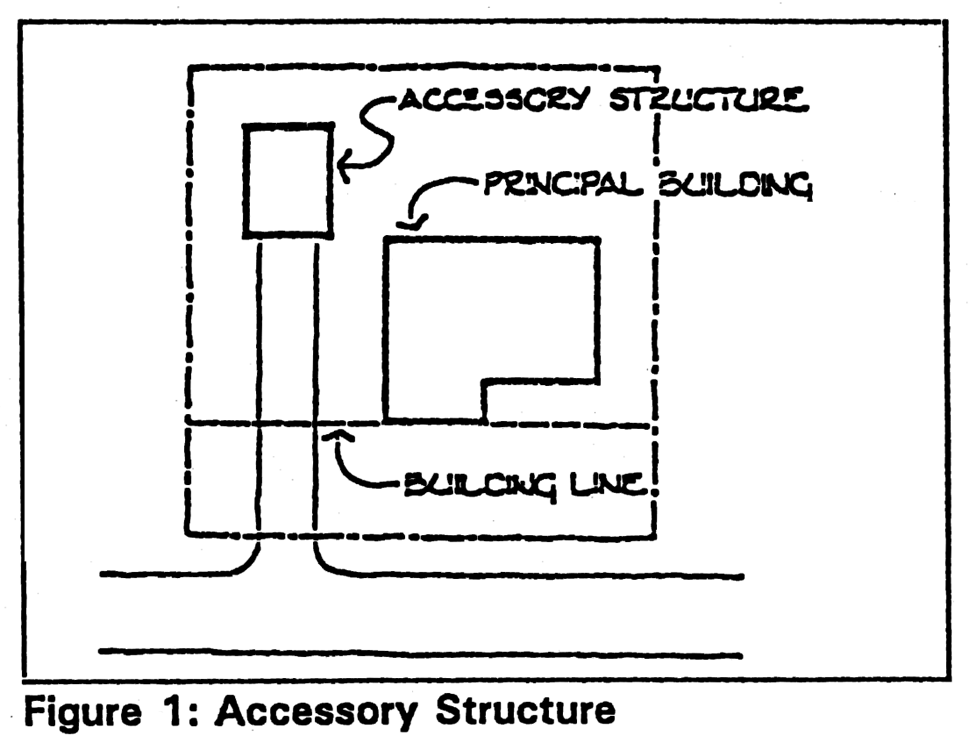
Accessory structure. A structure detached from a principal building on the same lot and customarily incidental and subordinate to the principal building. See figure 1: Accessory Structure.
Addition (to an existing building). Any walled and roofed expansion to the perimeter of a building in which the addition is connected by a common loan [load]-bearing wall other than a fire wall. Any walled and roofed addition which is connected by a fire wall or is separated by independent perimeter load-bearing walls is new construction.
Agricultural. The commercial cultivation or growth from or on the land of horticultural, floricultural, forestry, dairy, livestock, poultry, or apiarian products. Included within the definition of "agriculture" shall be the importation, storage, or distribution in bulk, unpackaged form of raw materials directly to persons engaged in agriculture. "Raw materials" for purposes of this definition shall include organic materials such as straw, hay, animal feeds, sawdust, mulches, and like items. "Raw materials" shall also include inorganic dolomitic lime. "Raw materials" shall not include farm equipment, building materials, chemicals, fertilizer, manure not produced on the premises, packaged materials not produced on the premises, materials distributed for resale not produced on the premises, or materials not expended in the production of the above-listed products.
Alley. A public thoroughfare which affords only a secondary means of access to abutting property.
Alteration. Any change in the supporting members of a building or structure such as bearing walls, columns, and girders, except such emergency change as may be required for safety purposes; any addition to a building; any change in use from that of one district classification to another; or, any movement of a building from one location to another.
Animal husbandry. The production of animals (livestock) and/or the byproduct thereof.
Animal quarters. Any structure which surrounds or is used to shelter, care for, house, feed, exercise, train, exhibit, display or show any animals, other than fenced pasture land for grazing.
Antenna. Any exterior apparatus designed for telephonic, radio, or television communications through the sending and/or receiving of electronic waves.
Apartment. See "Dwelling, multifamily."
Aquifer. Any stratum or zone of rock beneath the surface of the earth capable of containing or producing water from a well.
Area of special concern. An area of the city so designated by the city council, involving one or more properties or parcels, where structural and/or cosmetic deterioration has advanced to the point where local authorities judge the situation to warrant special concern over diminishing property values, environmental degradation, loss of traditional character, or general detriment to public health, welfare, and safety, according to standards established in the International Property Maintenance Code.
Bed and breakfast home. Provided that rooms for rent are within a single-family dwelling occupied by the owner as his/her principle [principal] residence; the same rental occupants shall not reside at the bed and breakfast for more [than] seven consecutive days; breakfast is the only meal served and only to registered overnight guests; no person not a resident on the premises is employed; the exterior appearance of the dwelling is not altered from its residential character except for safety purposes; and, the identification sign shall be no larger than two square feet and not internally lighted.
Bed and breakfast inn. A building, not necessarily owner-occupied, that offers transient lodging accommodations and breakfast for four or more guest rooms for compensation provided that:
a)
Compliance with the same licensing, inspection and taxation requirements as hotels, motels, and restaurants.
b)
If within a residential district, the building shall be residential in character.
c)
Breakfast is the only meal served and only to overnight guests.
d)
The owners may have employees.
e)
The owner shall provide one off-street parking space for each rental room and one space for each employee.
f)
In a residential district, signage shall be limited to one sign and maximum size of two square feet.
Billboard. Any sign used as an outdoor display for the purpose of making anything known, the matter advertised or displayed being remote from its origin or point of sale.
Boardinghouse. A dwelling, permanently occupied by the owner or operator, where sleeping accommodation and meals, served upon the table family style with no provision for cooking in any of the occupied rooms, are provided for five or more persons not of the same family by prearrangement for definite periods and for compensation.
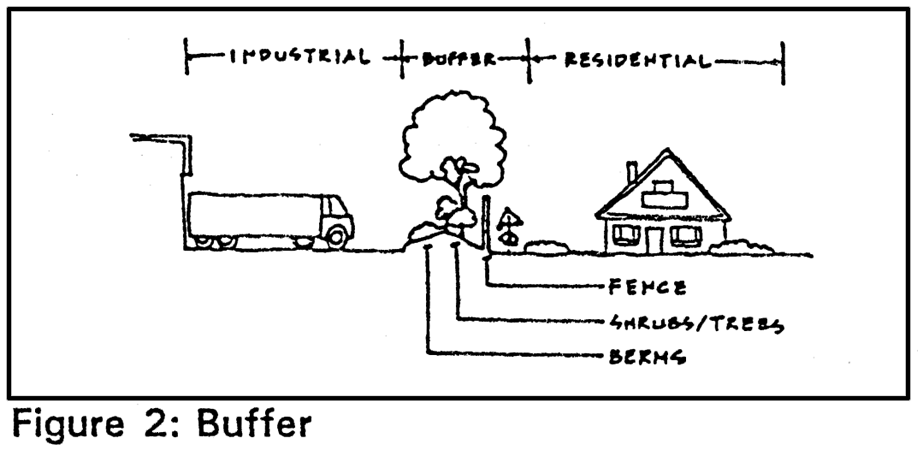
Buffer. A buffer is a portion of lot set aside for open space and/or screening purpose, to shield or block noise, light, glare, or visual or other nuisances; to block physical passage to dangerous areas; or to reduce air pollution, dust, dirt, and litter. A buffer may contain a barrier, such as a berm, wall or fence, where such additional screening is necessary to achieve the desired level of buffering between various activities. See figure 2: Buffer.
Building. Any structure having a roof supported by columns or walls designed or built for the support, enclosure, shelter, or protection of persons, animals, chattels, or property of any kind.
Building height. The vertical distance measured from the highest grade adjacent to the highest point of roof surface of a flat roof, to the deck line of a mansard roof, or to the average height between eaves and ridges of a gable, hip, or gambrel roof.
Building line. A line parallel to the street right-of-way line at a distance therefrom equal to the depth of the required front yard for the zoning district in which the lot is located (see "Setback Line").
Caliper. Diameter measurement of the trunk taken six inches above ground level for trees up to and including four inch caliper size.
Cattery. Any place that regularly breeds, boards, trains, buys, sells or trades any cat.
Cemetery, private. Any plot of ground, building, mausoleum, other enclosure used for the burial of deceased persons of one collateral line of descent.
Cemetery, public. A plot of ground, building, mausoleum, or other enclosure not located on property owned by or adjacent to a religious institution and but used for the burial of deceased persons.
Cemetery, religious institution. A plot of ground, building, mausoleum, or other enclosure owned by or adjacent to a religious institution and used for the burial of deceased persons who are generally members of that religious institution.
Child care center, group. A building or portion of a building wherein is provided care and supervision of persons away from their place of residence for less than 24 hours a day on a regular basis for compensation; serves seven to 18 persons and is licensed by the State of Georgia.
Child care facility. A building or portion of a building wherein is provided care and supervision of persons away from their place of residence for less than 24 hours per day on a regular basis for compensation; serves 19 or more persons and is licensed by the State of Georgia; for children, the outdoor play area shall be enclosed by a fence of not less than four feet in height in the rear yard only. For the purposes of this ordinance, the term "Child Care" shall include but not be limited to the terms "Day Care," "Nursery School," "Early Learning Center," "Prekindergarten," "Private Kindergarten," "Play School" and "Preschool."
Child care home, family. A customary home occupation which provides, for six or less persons who are not residents of the premises; care and supervision by a State of Georgia registered resident adult for less than 24 hours per day on a regular basis for compensation.
Church. A religious institution that has been granted 501(c) tax-exempt status by the Internal Revenue Service and whose property is deemed tax exempt by the Gilmer County Tax Assessor.
Clinic. A building or a portion of a building where patients are not lodged overnight, but are admitted for examination and treatment by one or more physicians or dentists practicing together.
Club, private. A building or portion thereof or premises owned or operated by a corporation, association, person or persons for a social, educational or recreational purpose but not primarily for profit or to render a service which is customarily carried on as a business.
Commission. The Ellijay City Planning Commission.
Comprehensive plan. The Joint Gilmer County-Ellijay-East Ellijay Comprehensive Plan, also known as Gilmer 2015: A Shared Vision, as adopted and as may be subsequently amended by Gilmer County and the cities of Ellijay and East Ellijay.
Conditional uses. A use not ordinarily permitted but which may be permitted upon the imposition of conditions related to the promotion of the public health, safety, morals, or general welfare and designed to minimize the negative impact on surrounding lands. Such conditions may include, but are not limited to, restriction on land use; height, setback and other non-use requirements; physical improvements to the property and infrastructure serving the property. A conditional use must be approved as specified in article 15 of this ordinance.
Condominium. A building or group of buildings, in which units are owned individually, and the structure, common areas and facilities are owned by all the owners on a proportional, undivided basis.
Council. The Ellijay City Council.
DBH (diameter breast height). The diameter of a tree 4½ feet above average ground level.
Development. Subdividing a tract of land into two or more lots whether for sale or rental; construction, erection, or expansion of a structure; filling, grading, excavation or land disturbing activities affect more than one acre; recordation of a plat in the office of the clerk of superior court (unless such recordation is to illustrate a deed line such as with a land boundary line agreement); or the location of a facility.
District. A delineated section or sections of the City of Ellijay for which the zoning regulations governing the use of buildings and premises, the height of buildings, the size of yards, and the intensity of use are uniform.
Drive-in. Any use providing the opportunity of selling, serving, or offering goods or services directly to customers waiting in vehicles or customers who return to their vehicles to consume or use the goods or services while on the premises of the principal use.
Dwelling. A building which is designed or used exclusively for residential purposes, including single-family and multifamily residential buildings, rooming and boarding houses, fraternities, sororities, dormitories, manufactured homes, and industrialized homes but not including hotels and motels.
Dwelling, apartment. See "Dwelling, multifamily."
Dwelling, loft. A dwelling unit, occupied by no more than four persons, and located only on the floor above a ground level commercial business.
Dwelling, single-family attached. A building containing two or more dwelling units, each of which is deeded with separate ownership and has primary ground floor access to the outside and which are attached to each other by party walls without openings. The term can include fee simple townhouses and condominiums.
Dwelling, single-family detached. A residential building containing not more than one dwelling unit entirely surrounded by open space. A single-family detached dwelling includes site-built houses, manufactured homes and industrialized homes. (A mobile home is not a single-family detached dwelling.) All single-family detached dwellings shall meet the appearance standards as provided in section 6.2.
Dwelling, multifamily. A building designed as two or more separate units for or occupied exclusively by two or more families.
Dwelling unit. One or more rooms located within a building and forming a single habitable unit with individual permanent sanitary and kitchen facilities and is used or intended to be used for living, sleeping, cooking, and eating purposes. Units in motels, or other structures designed for transient residence are not included.
Dwelling, zero-lot-line. A development of single-family detached residences in which one interior side yard may be lawfully reduced to zero on any lot for the purpose of creating larger, more usable, and more easily maintained yard spaces, particularly on smaller lots.
Easement. The right of a person, government agency, or public utility company to use public or private land owned by another for a specific purpose.
Existing construction. Any structure for which the start of construction commenced before the effective date of this ordinance [June 16, 1997].
Family. Two or more persons occupying a single dwelling unit where all members are related by blood, genetics, marriage or adoption up to the second degree of consanguinity, or by foster care. For the purposes of this definition, "consanguinity" means only the following persons are related within the second degree of consanguinity: Husbands and wives, parents and children, grandparents and grandchildren, brothers and sisters, aunts and uncles, nephews and nieces, and first cousins. The term "family" does not include any organization or institutional group.
Farming. The business of cultivating land, or employing it for the purposes of husbandry; the cultivation and fertilization of the soil as well as caring and harvesting the crops.
Flea market. A building or open area in which stalls or sales areas are set aside, and rented or otherwise provided, and which are intended for use by various unrelated individuals to sell articles that are either homemade, homegrown, handcrafted, old, obsolete, or antique and may include the selling of goods at retail by businesses or individuals who are generally engaged in retail trade.
Flood. A rise in stream flow or stage that results in temporary inundation of the areas adjacent to the channel.
Floor area, gross. The gross heated areas of all floors, measured from the exterior faces of the exterior walls of the building.
Frontage, street. The distance of a lot abuts on a street; the front lot line (See figure 3: Lot).
Fur farm. Any place that regularly breeds and raises rabbits, mink, foxes or other fur or hide-bearing animals for the harvesting of their skins.
Garage, private. An accessory building designed or used for the storage of motor-driven vehicles owned and used by the occupants of the buildings to which it is accessory.
Garage, general service. A building or portion thereof, other than a private, storage, or parking garage, designed or used for equipping, servicing, repairing, hiring, selling, or incidental short-term storing of motor-driven vehicles, but not including the storage of wrecked or junked vehicles, to which repairs are not intended to be made.
Grade. The average level of the finished ground surface adjacent to the exterior walls of the building.
Group home. A residence composed of nonrelated individuals with one or more surrogate parents that function as a singular housekeeping unit. All group homes shall be approved and licensed by the State of Georgia Department of Human Resources.
Hardship. An unusual situation on the part of an individual property owner which will not permit him/her to enjoy the full utilization of his/her property which is given to others within the county. A hardship exists only when it is not self-created, or when it is not economic in nature.
Hazardous waste. Any solid waste which has been defined as a hazardous waste in regulations, promulgated by the administrator of the United States Environmental Protection Agency (U.S. EPA) pursuant to the federal act, which are in force and effect on February 1, 1988, codified as 40 CFR 261.3.
Health department. The Gilmer County Health Department and/or the Georgia Department of Human Resources.
Health officer. The legally designated health authority of Gilmer County, or the State of Georgia, or an authorized agent.
Home occupation. An occupation customarily carried on by an occupant of a dwelling unit as a secondary use which is clearly incidental to the use of the dwelling unit for residential purposes and operated in accordance with the provisions of these regulations.
Impervious surface. A manmade structure or surface which prevents the infiltration of stormwater into the ground below the structure or surface. Examples are buildings, roads, driveways, parking lots, decks, swimming pools, or patios.
Industrialized home. Any structure or component thereof which is wholly or in substantial part made, fabricated, formed, or assembled in manufacturing facilities for installation on a building site and has been manufactured in such a manner that all parts or processes cannot be inspected at the installation site without disassembly, damage to, or destruction thereof. Industrialized homes are constructed and regulated in accordance with article 2 of chapter 2 of title 8 of the Official Code of Georgia. An industrialized home is a single-family detached dwelling and its placement in a residential district must meet or exceed the appearance standards as provided in section 6.2.
Institution. A public or semipublic building occupied by a governmental entity, nonprofit corporation or nonprofit establishment for public use.
Junk. Wrecked or inoperative (whether repairable or not) motor vehicle(s), scrap copper, scrap brass, scrap rope, scrap glass, scrap rags, scrap metal, scrap paper, scrap batteries, scrap appliance, scrap beds and bedding, scrap rubber, scrap tires, scrap motor vehicle parts, scrap furniture, scrap wood, scrap building materials, scrap tools or other used materials that have been abandoned from their original use but may or may not be used again in their present form or in a new form.
Junkyard. Any such use involving the storage of disassembly of wrecked automobiles, trucks, or their [other] vehicles; storage, baling or otherwise dealing in bones, animal hides, scrap metal, commercial/residential appliances, used paper, used cloth, used plumbing fixtures and used brick, wood or other building materials. Such uses shall be considered junkyards whether or not all or part of such operations are conducted inside a building or in conjunction with, addition to, or accessory to other uses of the premises. A junkyard shall be presumed to exist if two or more inoperative motor vehicles are maintained for more than 45 days, except vehicles being held pursuant to a law enforcement agency impoundment; however, this presumption may be rebutted if no part of the motor vehicle is outside of a completely enclosed building and no part of the motor vehicle can be viewed from any portion of any adjoining property, road, or street.
Kennel. Any location where breeding, raising, boarding, caring for, and the keeping of more than three dogs or cats or other small animals or combination thereof (except litters or animals not more than six months of age) is carried on for commercial purposes.
Kindergarten. Any premises or portion thereof used for educational work or parental care of children of less than the age required for enrollment in the public or private school system.
Land disturbing activity. Any grading, scraping, excavating, or filling of land, clearing of vegetation; and any construction, rebuilding, or alteration of a structure. Land disturbing activity shall not include activities such as ordinary maintenance and landscaping operations, individual home gardens, yard and grounds upkeep, repairs, additions or minor modifications to a single-family dwelling, and the cutting of firewood for personal use.
Livestock. The [word] "livestock" as used herein shall mean and include cattle, horses, goats, sheep, swine, poultry, ducks, geese and other fowl; and rabbits, minks, foxes, and other fur or hide bearing animals customarily bred or raised in captivity for the harvesting of their skins; whether owned or kept for pleasure, utility or sale.
Loading space. A space having a minimum dimension of 13.5 by 60 feet and a vertical clearance of at least 14.5 feet within the main building or on the same lot, providing for the standing, loading, or unloading of trucks.
Lot. A portion or parcel of land separated from other portions or parcels by description (such as on a subdivision plat of record or as a survey map or plat) or described by metes and bounds, and intended for use, transfer of ownership, or for building development. The word "lot" shall not include any portion of a dedicated right-of-way. Lot size square footage calculations shall also exclude any areas reserved for easements or rights-of-way upon which, by the nature thereof, construction is prohibited (i.e., easements for ingress and egress to other lots or properties, major power line transmission easements, etc.). Lot size calculations shall not include strips of property with widths less than the minimum building line dimension of the particular use district intended to provide access to a given lot or parcel; provided, however, land less than the minimum building width requirements may be considered as part of the square footage lot size calculation in those instances where lot lines are radial to a curved street or cul-de-sac on a subdivision plat approved by the city council.
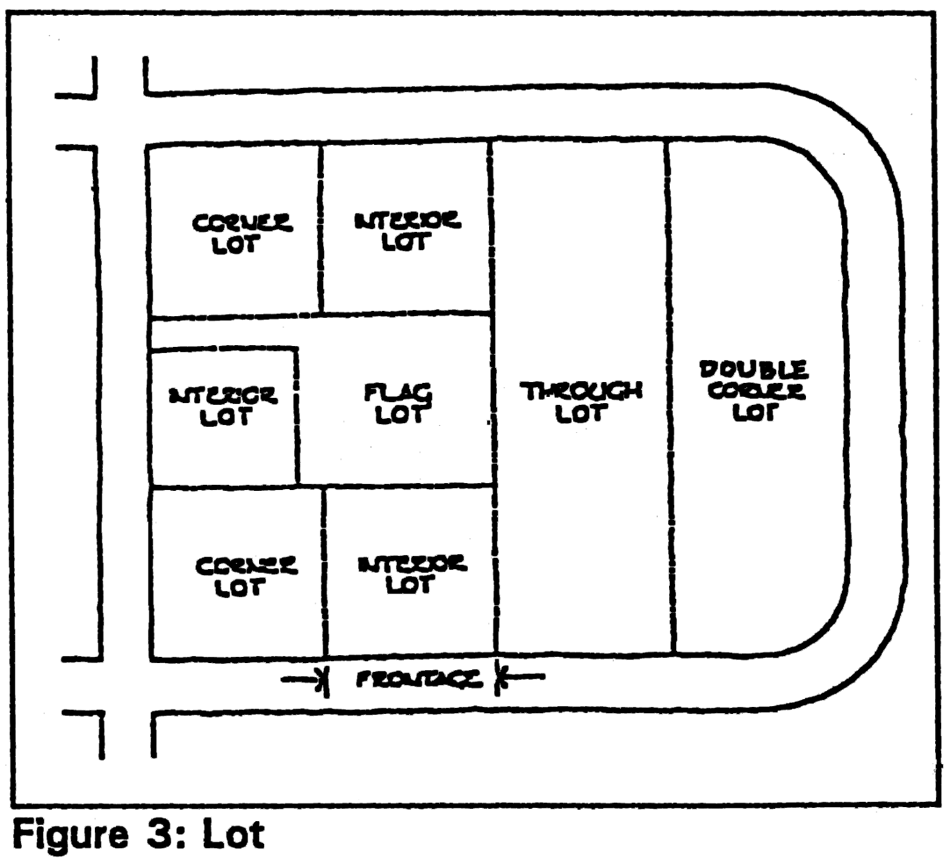
Lot, corner. A lot abutting upon two or more streets at their intersection.
Lot of record. A lot which exists prior to the adoption or subsequent amendment of this ordinance, as shown or described on a plat or deed in the records of the local registry of deeds.
Lot, through. A lot other than a corner lot abutting two streets.
Lot width. The width of the lot at the front building setback line.
Manufactured home. A structure defined by and constructed in accordance with the National Manufactured Housing Construction and Safety Standards Act of 1974, as amended, 42 USC 5401 et seq. The definition at the date of adoption of this part is as follows:
Manufactured home means a structure, transportable in one or more sections, which, in the traveling mode, is eight body feet or more in width or 40 body feet or more in length, or, when erected on site, is 320 or more square feet, and which is built on a permanent chassis and designed to be used as a dwelling with or without a permanent foundation when connected to the required utilities, and includes the plumbing, heating, air conditioning, and electrical system contained therein; except that such term shall include any structure which meets all the requirements and the manufacturer voluntarily files a certification required by the secretary of housing and urban development complying with the standards established under this title.
A manufactured home is a single-family detached dwelling and its placement in a residential district must meet or exceed the appearance standards as provided in section 6.2.
Manufactured home/mobile home park. Premises where three or more mobile home/manufactured home dwelling units are parked for living or sleeping purposes, regardless of whether or not a charge is made for such accommodation, or where spaces or lots are set aside and offered for rent for use by mobile homes/manufactured homes for living or sleeping purposes, including any land, building, structure or facility used by occupants of mobile homes/manufactured homes on such premises. This definition shall not include mobile homes/manufactured homes sales lots.
Mobile home. A structure, transportable in one or more sections, which, in the traveling mode, is eight body feet or more in width or 40 body feet or more in length or, when erected on site, is 320 or more square feet and which is built on a permanent chassis and designed to be used as a dwelling with or without a permanent foundation when connected to the required utilities and includes the plumbing, heating, air conditioning, and electrical systems contained therein and manufactured prior to June 15, 1976.
Mobile office. A factory-fabricated structure designed to be transported on its own wheels, detachable wheels, flatbed or trailer and used or intended to be used or occupied for the transportation [transaction] of business or the rendering of a professional service.
Modular home. See "Industrialized home."
Motel. A permanent building or group of permanent buildings in which overnight sleeping accommodations are provided for travelers and having a parking space near or adjacent to the entrance of the room. Such use has 80 percent of the rooms occupied by a different registered guest every five days, provides patrons with daily maid service, 24-hour desk/counter clerk service, and a telephone switchboard service to receive incoming/outgoing messages, and shall comply with the applicable requirements of the county health department and O.C.G.A. § 31-28-1 et seq., and may provide additional services such as restaurants, retail gift shops, meeting rooms, swimming pools, and exercise facilities.
Multifamily dwelling. See "Dwelling, multifamily."
Neighborhood center. A building or facility used to provide recreational, social, educational and cultural activities for an area of [or] community, which is owned and operated by the management agency of that community, or the homeowner's association of that community. A community can be an incorporated area, a developed subdivision, or a planned development.
New construction. Any structure for which the start of construction commenced on or after the effective date of this ordinance [June 16, 1997].
Nonconforming use. The use of any building or land which was lawful at the time of passage of this ordinance, or amendment thereto, but which use does not conform, after the passage of this ordinance or amendment thereto, with the regulations of the district in which it is situated.
Nursery school. See "Kindergarten."
Nursing home. An extended or intermediate care facility licensed or approved to provide full-time convalescent or chronic care to individuals who, by reason of advanced age, chronic illness or infirmity, are unable to care for themselves.
Occupy. To use land or buildings for any length of time for a purpose for which the land or building or part thereof is used or is intended to be used. Any variation of the term "occupy" shall be encompassed by this definition.
On-site sewerage management system. See "Sewerage management system, on-site."
Parking area. An open, unoccupied space used or required for temporary parking of vehicles exclusively and in which no gasoline or vehicular accessories are sold or no other business is conducted.
Parking lot. An open area used exclusively for the temporary storage of motor vehicles and within which motor fuels and oils may be sold and fees charged, but no vehicles are to be equipped, repaired or sold.
Parking space. A space, enclosed or unenclosed, having an area of not less than 180 square feet (nine feet by 20 feet) exclusive of access, permanently reserved for the temporary storage of one vehicle and having access to a street or alley.
Permit. Any written authorization for building, construction, alteration, development, occupancy, or other matter required by this ordinance to be approved [by] a designated commission, board, official or employee. The person to whom such permit is issued shall be known as the "permittee."
Personal care home or home. A building or group of buildings, a facility or place in which is provided two or more beds and other facilities and services, including room, meals and personal care, for nonfamily ambulatory adults. For the purpose of these rules, personal care homes shall be classified as: family care personal care home, group personal care home, or congregate personal care home. This term does not include buildings which are devoted to independent living units which include kitchen facilities in which residents have the option of preparing and serving some or all of their own meals or boarding facilities which do not provide personal care.
1.
Family personal care home means a home for adults in a family-type residence, noninstitutional in character, which offers care to two through six persons.
2.
Group personal care home means a home for adult persons in a residence or other type building(s), noninstitutional in character, which offers care to seven through 15 persons.
3.
Congregate personal care home means a home for adults which offers care to 16 or more persons.
Planned center, shopping, office of [or] industrial. Any planned concentration of at least three business establishments which also provides planned and shared parking, access, and service.
Planning commission. The Ellijay City Planning Commission.
Plat. A map, plan or layout of a county, city, town, lot, section, subdivision, or development indicating the location and boundaries of properties.
Premises. A lot, together with all buildings and structures existing thereon.
Principal building. A building in which is conducted the main or principal use of the lot in which said building is situated.
Principal use. The primary purpose for which land or a building is used.
Private land. All lands and buildings not owned by governments.
Putrescible wastes. Wastes that are capable of being quickly decomposed by microorganisms. Examples of putrescible wastes include but are not necessarily limited to kitchen wastes, animal manure, offal, hatchery and poultry processing plant wastes, and garbage.
Recorded plat. A plat recorded in the office of the clerk of superior court of Gilmer County.
Right-of-way. An area or strip of land, either public or private, on which a right of use has been recorded. A right-of-way, as distinguished from an easement, is owned in fee-simple title by the City of Ellijay or other government, a duly organized homeowners' or property owners' association, or any other person.
Right-of-way line. The dividing line between a lot, tract, or parcel of land and a contiguous right-of-way.
Roominghouse. A dwelling, permanently occupied by the owner or operator, where only sleeping accommodation is provided for five or more permanent occupants not of the same family by prearrangement for definite periods and for compensation and which makes no provision for cooking in any of the occupied rooms.
Service station. Any building, structure, or land use primarily for the dispensing, sale, or offering for sale at retail any automobile fuels, oils, or accessories, but not including major repair work such as motor overhaul, body and fender repair or spray painting.
Setback. The mean horizontal distance between the front street right-of-way line and the front line of the building or the allowable building lines as defined by the front yard regulations of this ordinance.
Sewerage management system, on-site. A sewerage management system other than a public or community sewerage system, serving single or multiple buildings, manufactured or mobile homes, residences or other facilities designed for human occupancy or congregation, as approved by the county board of health.
Sewerage treatment system, public or community. Any sewerage treatment system, including pipe lines or conduits, pumping station, force mains and all other constructions, devices, and appliances appurtenant thereto, designed for treating or conducting sewerage for treatment and disposal into lakes, streams or other bodies of surface water.
Shopping center. A group of two or more commercial establishments planned, constructed and managed as a total entity with customer and employee parking provided on-site, provision for goods delivery separated from customer access, aesthetic considerations and protection from the elements.
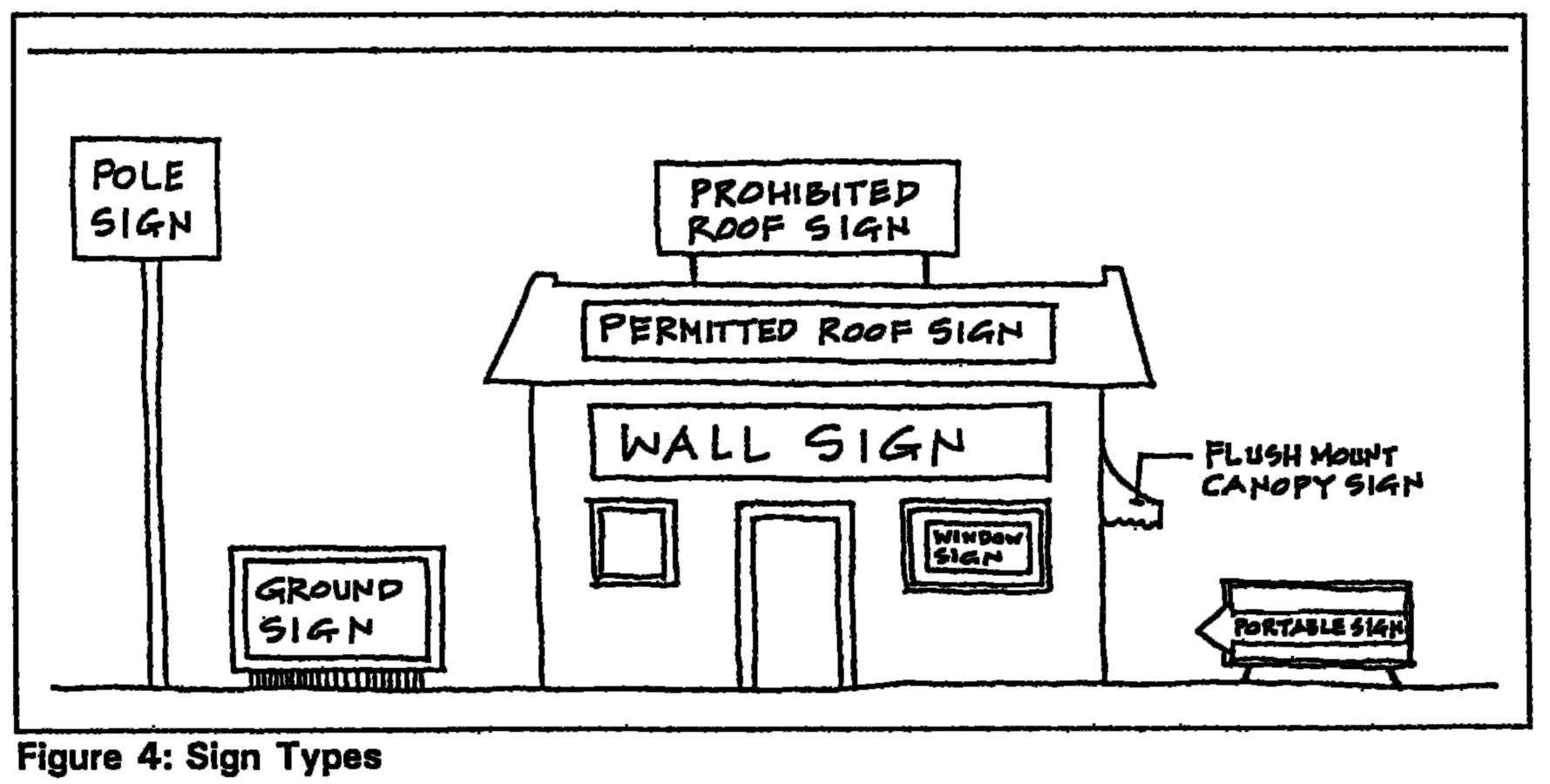
Sign. A name, identification, description, display or illustration which is affixed to, painted or represented, directly or indirectly, upon a building, structure, parcel or lot and which directs attention to an object, product, place, activity, person, institution, organization, or business located on the premises. The term sign shall not be deemed to include official court, governmental notices, traffic warning or control devices or street signs, flag, emblem or insignia of a nation, political unit, school or religion.
Sign, bulletin board. A sign used to announce activities to be held at any noncommercial place of public assembly.
Sign, canopy, including marquee. A sign affixed to, superimposed upon or painted on any roof like structure either permanently or temporarily extended over a sidewalk or walkway.
a.
Flush - mounted in such a manner that a continuous plane with the canopy is formed.
b.
Hanging - suspended from beneath the canopy.
Sign display surface. The area made available by the sign structure for the purpose of displaying a message.
Sign, free-standing. A permanently affixed sign which is wholly independent of any building for support.
Sign, illuminated signs. A sign designed to emit light.
Sign, outdoor advertising. Any sign used for the purpose of displaying advertising by means of posters, or pictorial or reading matter which directs attention to a business, commodity, service, or entertainment conducted, sold or offered elsewhere than on the premises where such sign is displayed or as a minor and incidental activity upon the premises where such sign is displayed.
Sign, portable. A sign that can be moved from place to place that is not permanently affixed to a building, structure or the ground, including but not limited to:
Signs with wheels removed;
Signs with chassis or support constructed without wheels;
Signs designed to be transported by trailer or wheels;
A- or T-frame signs;
Menu, sandwich or sidewalk type signs;
Searchlight stands; and
Signs painted or attached on air-inflated hot-air, or gas-filled [balloons].
Sign, roof. Any sign erected, constructed or maintained upon a roof of a building.
Sign, wall. Any sign attached to or erected against a wall which is an integral part of the building and which shall project not more than 24 inches from the wall of the building.
Sign, window.
Permanent. A sign that is applied or attached permanently to the exterior or interior of a window or located in such manner within a building that it can be seen from the exterior of the structure through a window.
Temporary. A sign that is applied or attached temporarily to the exterior or interior of a window used to announce a special event or products for sale which refer to particular periods of time such as meetings, sales exhibitions, political campaigns and vacancy announcements.
Stockyard. A place where transient cattle, sheep, swine, or horses are kept.
Story. That portion of a building between the surface of a floor and the surface of the floor next above it, or, if there is no floor above it, then the space between the floor and the ceiling.
Story, half. A space under a sloping roof which has the line of intersection of roof decking and wall face not more than three feet above the top floor level, and in which space not more than two-thirds of the floor areas is finished off for use. A half-story containing independent apartment or living quarters shall be counted as a full story.
Street. A public or private thoroughfare which meets locally established design standards and which affords the principal means of access to abutting property however designated as a street, highway, thoroughfare, parkway, road, avenue, boulevard, or place.
a.
Minor or local street. Street used primarily for access to the abutting properties and serving travel demands in the immediate area.
b.
Collector. Those streets so designated on the county functional classification system map, and those streets which otherwise function to serve local traffic movements by collecting or distributing traffic from or to local, other collector, and/or arterial streets. Such a street includes the principal entrance and circulation streets of a subdivision and may also function to provide access to abutting properties in the same manner as a local street.
c.
Major thoroughfare or arterial. Those streets so designated on the county functional classification system map and those streets which otherwise function to move high volumes of traffic between principal traffic generators (such as residential, commercial, and industrial sectors) at moderate speeds and with minimum conflict to movements.
Structure. Anything constructed or erected, the use of which requires a location on the ground, or attached to something having a location on the ground, including but not limited to buildings, signs, billboards, back stops for tennis courts, fences, radio and water towers, grain and feed elevators.
Subdivision. For the purpose of this ordinance, a subdivision is the division, redivision, or separation of one parcel of land into two or more parcels, lots, building sites, or other divisions of land whether for the purpose of sale, legacy, or building development.
Tower. A structure, such as a self-supporting lattice tower, guy tower, or monopole tower, constructed as a free-standing structure or in association with a building, other permanent structure or equipment, on which is located one or more antennas intended for transmitting or receiving television, AM/FM radio, digital, microwave, cellular, telephone, or similar forms of electronic communication. The term includes radio and television transmission towers, microwave towers, common carrier towers, and cellular telephone towers. The term excludes any tower and antenna under 70 feet in total height and owned and operated by an amateur radio operator licensed by the Federal Communications Commission, and satellite earth station antenna one meter in diameter or less, any receive-only home television antenna, and any satellite earth station antenna two meters or less in diameter which is located in a commercial or industrialized zoning district.
Townhouse. A single-family attached dwelling unit that is erected in a row as part of a single building, on adjoining lots, each separated from the adjoining unit or units by approved fire resistant party wall or walls extending from the basement or cellar floor to the roof along the dividing lot line. Each unit shall have its own front door which opens to the outdoors but no access between adjoining units.
Tree. A woody perennial plant having a single (usually elongate) main stem including but not limited to a shrub or vine of arborescent form.
Water system, public. A system, owned and operated by a city, county, or a legislatively created authority, for the provision to the public of piped water for human consumption, if such system has at least 15 service connections, or regularly serves an average of at least 25 individuals daily, at least 60 days out of the year in accordance with the rules of Georgia Department of Natural Resources, Environmental Protection Division, chapter 391-3-5, "Rules for Safe Drinking Water."
Wild animal. Any living member of the animal kingdom, including those born or raised in captivity; but excluding human beings, livestock, dogs and cats, rodents, hybrid animals that are part wild, captive-bred species of common cage birds and aquarium-kept fish, amphibians and reptiles.
Yard. An open space on a lot situated between the principal building or use on the lot and a lot line and unoccupied by any structure except as otherwise provided herein. See figure 10[5]: Yard.
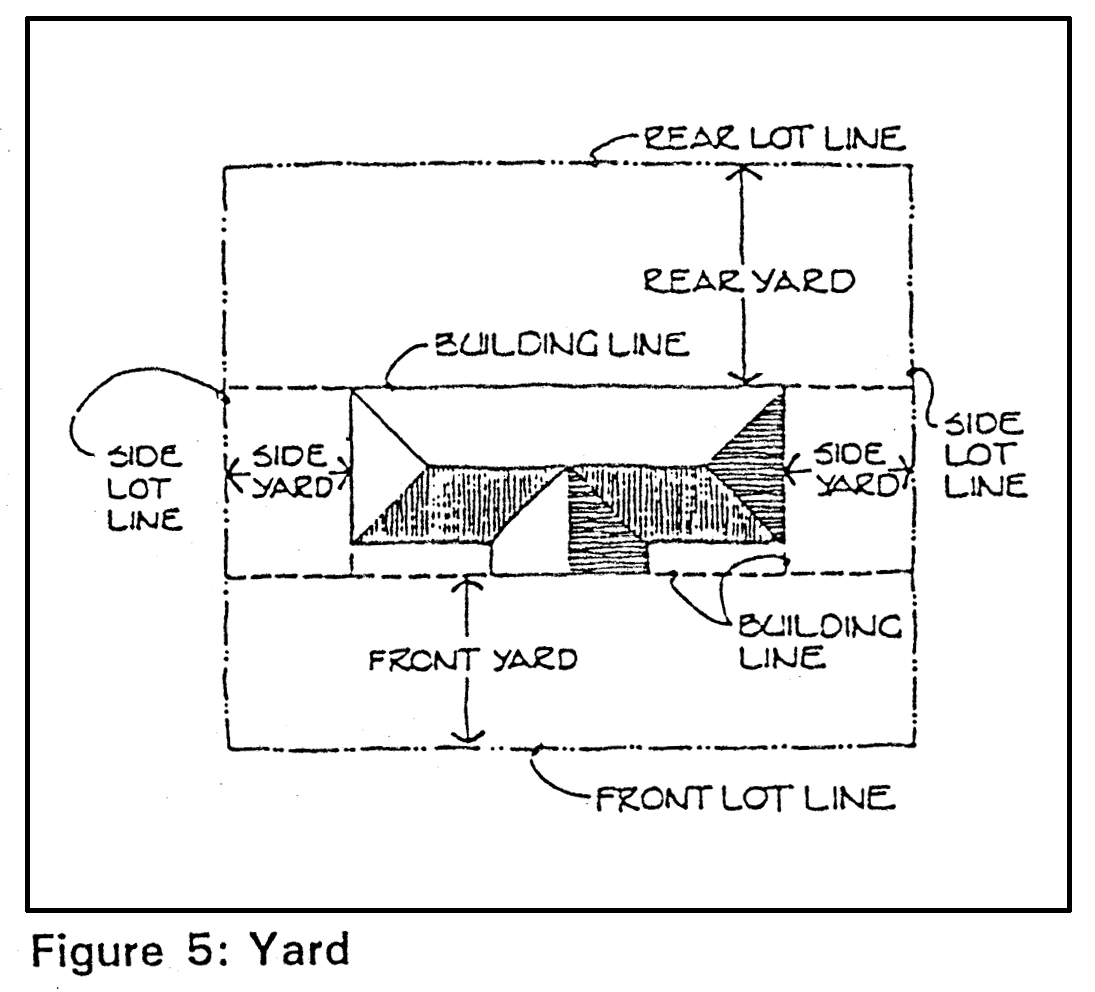
Yard, front. An open, unoccupied space on the same lot with a principal building or use, extending the full width of the lot and located between the right-of-way line and the front line of the building projected to the side lines of the lot.
Yard, rear. An open space on the same lot with a principal building or use, unoccupied except by an accessory building or use, extending the full width of the lot and located between the rear line of the lot and the rear line of the building or use projected to the side lines of the lot.
Yard, side. An open, unoccupied space on the same lot with a principal building or use, located between the building or use and the side line of the lot and extending from the rear line of the front yard to the front line of the rear yard. See figure 10[5]: Yard.
Zone, overlay. A district which applies supplementary regulations to land which is classified into a specific zoning district.
Zoning. The power of the City of Ellijay to provide within its territorial boundaries for the zoning of property for various uses and the prohibition of other or different uses within such zones or districts and for the regulation of development and the improvement of real estate within such zones or districts in accordance with the uses of property for which said zones or districts were established.
(Ord. No. 062104, § 3, 6-21-2004; Ord. No. 071805A, §§ 1, 3, 7-18-2005)

