
Emporia City Zoning Code
ARTICLE X
- SUBDIVISION
Sec. 90-581. - Title.
This article is a portion of the city zoning and subdivision ordinance. It shall be permitted, for convenience, to be referred to as the "Subdivision Ordinance of the City of Emporia, Virginia" or "this ordinance."
Sec. 90-582. - Recording.
In accord with Code of Virginia, § 15.2-2252, as amended, a certified copy of the adopted city subdivision ordinance and any and all amendments thereto shall be filed in the office of the subdivision agent (agent) and in the clerk's office of the county circuit court.
Sec. 90-583. - Amendments.
(a)
Per Code of Virginia, §§ 15.2-2251 and 15.2-2253, as amended, this article may be amended in whole or in part by the city council; provided, that any such amendment shall either originate with or be submitted to the planning commission for recommendation; further provided, that no such amendment shall be adopted without a public hearing having been held by the city council in accordance with Code of Virginia, § 15.2-2204, as amended.
(b)
In no instance shall an amendment be adopted by the city council without first seeking the recommendation of the planning commission. If no recommendation is made by the planning commission, the city council may take action 60 days from their inquiry.
Sec. 90-584. - Repeal.
Upon the adoption of this ordinance, all subdivision ordinances heretofore adopted by the city council are hereby repealed.
Sec. 90-585. - Applicability.
(a)
This article shall apply to the subdivision of all lots, tracts, or parcels of land within the city, unless specifically exempt, as provided in section 90-587 below.
(b)
No person shall subdivide any tract of land, or complete a boundary line adjustment, consolidation or easement, that is located within the city except in conformity with the provisions of this article, the zoning and subdivision ordinance, and the provisions of state law relating to land subdivision and development.
(c)
Plats of boundary line adjustments, consolidations, or easements shall follow the final plat requirements of division 8 of this article and may be administratively approved.
(d)
This article bears no relation to any private easement, covenant, agreement, or restriction, nor is the responsibility of enforcing a private easement, covenant, agreement, or restriction implied herein to the city.
Sec. 90-586. - Circumvention.
(a)
Development of multiple adjoining minor or single lot subdivisions, over any amount of time, for the purpose of circumventing subdivision requirements, shall not be permitted.
(b)
Development of multiple adjoining major subdivisions for the purpose of circumventing preliminary plat requirements, shall not be permitted.
(c)
Creative lot layout, for the purpose of circumventing design requirements, shall not be permitted.
Sec. 90-587. - Exemptions.
The following are exempt from this article, but this does not mean the parcels are exempt from the other articles of the zoning and subdivision ordinance:
(1)
Existing parcels. The sale or exchange of existing parcels of land between owners and the creation of boundary surveys which do not change or alter any boundary lines of a parcel.
(2)
Utility rights-of-way; public, private rights-of-way. A bona fide division of a tract of land in order that one or more of the resulting parcels may be used as part of a public or private right-of-way. If a parcel resulting from such division is ever to be used as a building site for other than a hereinabove described right-of-way, then before a building permit may be issued for such other use, the minimum requirements of this article shall be met.
(3)
Wills, court action. The partition of lands by will, by partition deed of intestate land, by the descendants of the deceased former owner or through action of a court of competent jurisdiction.
Sec. 90-588. - Appeals and variances.
(a)
Appeals to any decisions made by the agent, regarding the requirements of this article, shall be taken to the planning commission for recommendation and final decision by the city council in accordance with article III, permits and applications, division 11, public hearings and notifications, of this ordinance.
(b)
Variances to any provision of this article shall be taken to the board of zoning appeals in accordance with article III, permits and applications, division 5, variances, of this ordinance.
Sec. 90-591. - Major subdivisions.
Major subdivisions are subdivisions of more than ten lots or other divisions of land or division of property that involves the creation of new street(s) or the extension of street(s), and therefore will have greater impact on the environment, highways, and surrounding communities than will minor subdivisions. Due to the potential impacts, these subdivisions are required to submit a preliminary plat, when they include more than 50 lots, and are reviewed by planning commission and approved or denied by city council.
Sec. 90-592. - Minor subdivisions.
Minor subdivisions are subdivisions of ten lots or less, do not include the creation or extension of street(s) and have reduced impact on the environment, highways, and surrounding communities than major subdivisions. These subdivisions may submit a preliminary plat. The subdivider shall, however, submit an application and fulfill all requirements to obtain approval of the final plat. Minor subdivisions are administratively reviewed and approved.
Sec. 90-601. - Conformity to plans and regulations.
(a)
Comprehensive plan. Proposed subdivision plats shall conform to the officially adopted city comprehensive plan. Whenever a tract to be subdivided embraces a part of any major highway system on the comprehensive plan, such part of any highway or street shall be platted by the subdivider in the location and of the width indicated on the plan.
(b)
Zoning. Proposed subdivision plats shall conform to the officially adopted city zoning ordinance.
Sec. 90-602. - Suitability of land.
(a)
If the agent finds that land proposed to be subdivided is unsuitable for subdivision development due to flooding, bad drainage, topography, inadequate utilities, soil, light, air, and other such conditions which may endanger health, life or property; and, if from investigations conducted by the public agencies concerned, it is determined that in the best interest of the public, the land should not be developed for the purpose proposed, the agent shall not approve the land for subdivision unless adequate methods are advanced by the subdivider for solving the problems that will be created by the development of the land.
(1)
Such land within the subdivision shall be set aside on the plat for such uses as shall not be endangered by periodic or occasional inundation or shall not produce conditions contrary to public welfare.
(2)
The arrangement, character, extent, width, grade, construction and location of all building sites, lots, streets, drainage, sewer, water lines, and other facilities, public or private, shall conform to any floodplain regulations, laws, or ordinances established by local, state, or federal authorities and their subsequent amendments.
(b)
In investigating the suitability of land for subdivision, the agent may require the subdivider to furnish topographic maps, soil reports, established 100-year flood plain studies, wetlands delineation, and other information relevant to such determination.
Sec. 90-603. - Land for public purposes.
(a)
The agent shall require, by dedication or reservation, subdividers of residential developments to set aside land or its monetary equivalent for parks, playgrounds, open spaces, libraries, municipal facilities or other public use installations and for the protection of access to such facilities or land, subject to the dedication and reservation requirements of article VIII, community design standards, division 7, open space, of this ordinance.
(b)
In addition to article VIII, community design standards, division 7, open space, the following regulations apply:
(1)
Dedication. When in the opinion of the agent there is not a good or workable site within the subdivision for dedication, the subdividers shall be required to post an amount of money equal to the minimum open space required of the developed sale price of the entire subdivision for the purchase by the city of a park, playground, or open space for the use of the residents of the area in which the subdivision is located.
(2)
Reservation. Where a school or other public use facility is shown on an officially adopted element of the city comprehensive plan to be located in whole or in part in a proposed subdivision, reservation of the area shown, shall be required by the agent. The subdivider shall not be required to hold the land longer than 24 months following the recording of the plat for such purchase. If the land is not purchased within the 24 months, it may be sold as lots for the same purpose for which the subdivision was platted. To facilitate such possible eventual sale of reserved land as separate lots, the subdivider shall show on his final plat, by dotted lines and dotted numbers, the sizes and dimensions of lots to be created within the boundaries of any such reserved land, and may sell such lots, after the expiration date of the reservation, by lot number, without filing an amended plat.
Sec. 90-604. - Lots.
(a)
Lot size.
(1)
Lot area and width shall be in accordance with article IV, primary zoning districts, of this ordinance.
(2)
Greater lot areas may be required by the state department of health, if needed to adequately accommodate septic tanks, drain fields, and water systems.
(b)
Lot shape.
(1)
The lot arrangement, design, and shape shall be such that lots will provide satisfactory and desirable sites for buildings, be properly related to topography, and conform to requirements of this ordinance.
(2)
Lots shall not contain peculiarly shaped elongations which would be substantially unusable for normal purposes solely to satisfy necessary square footage or frontage requirements; to provide for drainage fields or septic areas; or to provide access to any lot that would otherwise not have road frontage.
Sec. 90-605. - Remnants.
All remnants of lots below minimum size, left over after subdividing a tract, must be added to adjacent lots rather than allowed to remain unusable parcels.
Sec. 90-606. - Frontage.
(a)
Unless otherwise stated, all lots or parcels of land shall front on an existing or proposed street or right-of-way in accordance with the provisions of this ordinance.
(b)
Double frontage and reversed frontage residential lots shall in general be avoided except where essential to provide residential separation from arterial streets or to overcome other disadvantages of orientation or topography.
Sec. 90-607. - Access.
The following shall apply to all subdivisions:
(1)
The design of a subdivision shall be made to interconnect streets within the subdivision to promote grid pattern development, avoid dead end streets unless provided in accordance with section 90-609, streets, of this ordinance, and to arrange streets to provide access to adjoining parcels to promote orderly development of the city.
(2)
Adequate easements shall be provided for the development of future streets and such easements shall include restrictions that assure the adequacy of the easement, including building setback lines, to ensure the future viability of the easement.
(3)
Streets between adjoining properties shall be required to interconnect where the ability to interconnect streets has been created through right-of-way construction and dedication.
(4)
If there are corner lots created in the subdivision of property that meet the road frontage requirements on existing public roads, then such lots are required to access the interior subdivision road and they shall not access the existing public road.
Sec. 90-608. - Blocks.
(a)
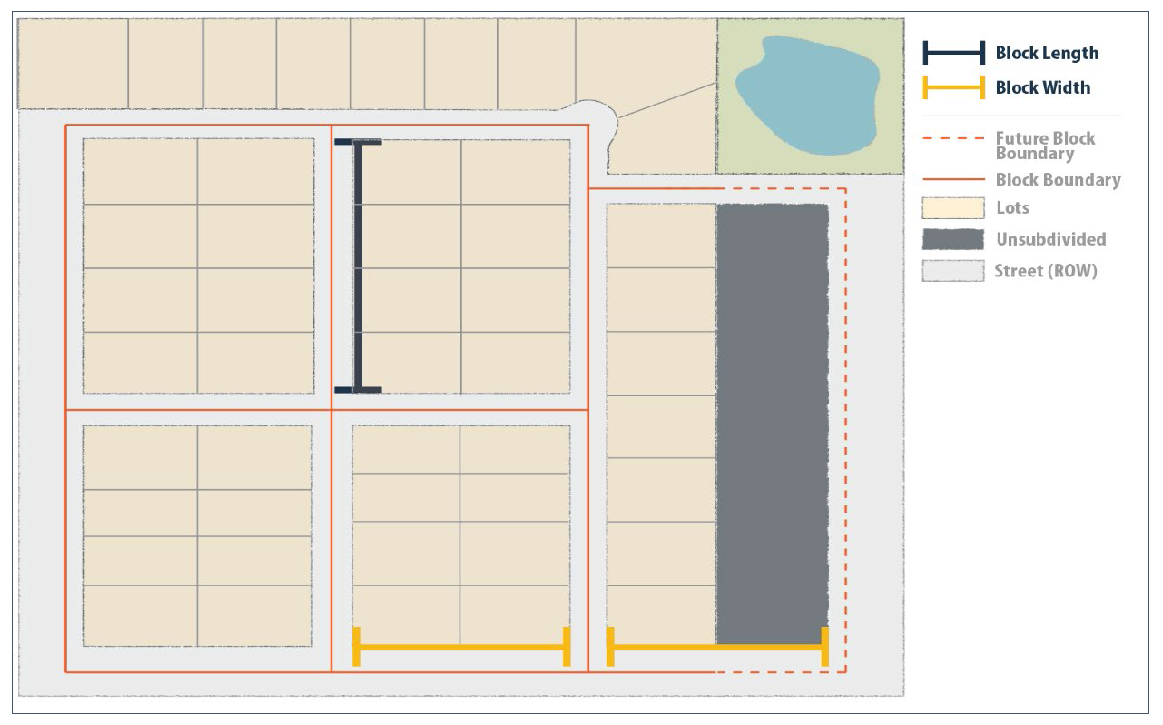
Length. No block in a subdivision shall exceed 1,000 feet in length except where permitted by the agent and all other provisions of this section have been met.
(b)
Width. Blocks shall be wide enough to allow two tiers of lots of minimum depth, except where prevented by topographical conditions or size of the property, in which case the agent may approve a single tier of lots of minimum depth. See figure 10.1.
(c)
Intersections. To ensure intersections of streets and to achieve a grid pattern, all blocks shall be separated by an intersection.
Figure 10.1 Block Length and Width
Sec. 90-609. - Streets.
(a)
Street names and signs. The following standards shall apply to all new streets, whether public or private:
(1)
Names.
a.
Street names shall comply with the recommendations of the agent.
b.
A proposed street which is aligned with an existing street shall bear the same name as the existing street and names of existing streets shall not be changed.
c.
In no case shall the name of proposed streets duplicate existing street names, regardless of the use of the suffix (e.g. Avenue, Boulevard, Drive, Way, Place, Lane, or Court).
d.
Street names shall be subject to approval by the agent and conform with the city's specifications on signs. No name shall be used which duplicates or is likely to be confused with the name of an existing street.
(2)
Signs. Street name signs and other safety regulations shall be erected and located in accordance with the specifications of the agent.
(b)
Public streets. For purposes of this ordinance, public streets are those that are dedicated to and accepted by the city.
(1)
When required. All streets in any subdivision created after the effective date of this ordinance shall front on or construct public streets.
(2)
Existing public streets. In cases where subdivision lots are created on an existing public street having a total width of less than 50 feet, a dedication of additional right-of-way to the city shall be provided.
(3)
New public streets. All new public streets shall be constructed with a compacted six inches stone base and in accordance with alignment, approach angle, access, width, grading, paving, and other specifications established by the city in effect at the time the subdivision is approved.
a.
When the city does not define specifications the state department of transportation specifications shall rule.
(c)
Grade.
(1)
Major streets shall conform to the contours to avoid grades in excess of three percent, unless because of special conditions, the agent permits otherwise.
(2)
Other streets and alleys shall avoid grades in excess of ten percent.
(3)
No street shall have a minimum grade of less than 0.5 percent.
(d)
Width.
(1)
Collector, commercial, and industrial street width shall meet the collector street requirements of the state department of transportation.
(2)
Local streets shall meet the secondary street requirements of the state department of transportation.
(e)
Intersections. The following standards shall apply to all new streets:
(1)
All streets shall intersect as near to a 90-degree angle as is practical. If a street intersects at less than 90 degrees, the angle shall be rounded by a curve of sufficient radius to permit easy turning movements of vehicles and as acceptable by the state department of transportation.
(2)
Curb radius at street intersections shall be constructed as required by the state department of transportation. Concentric curves on the property line may be required by the agent.
(3)
Driveways from parking areas shall be the minimum distance from intersections of arterial or collector streets as required by the state department of transportation and located to cause the least interference with traffic movement.
(f)
Culs-de-sac. Any street which terminates at a point not intersecting another street shall be considered a cul-de-sac. The following standards shall apply to culs-de-sac on any new streets:
(1)
Cul-de-sac streets are strongly discouraged but warranted when they protect natural features or match the surrounding area and provide inclusivity.
(2)
Cul-de-sac streets shall be:
a.
Four hundred feet or less in length.
b.
Fifty feet or more in width.
c.
Terminated in a circular right-of-way with a minimum right-of-way radius of 50 feet.
(3)
On streets intended for future extension, temporary turnarounds shall be provided by means of easements over private land adjoining the street. Such easements shall revert to the landowners at such time as the street road is extended.
(g)
Curbs, gutter, and sidewalks. The following standards apply to all new streets.
(1)
Pursuant to Code of Virginia, § 15.2-2241, curbs, gutters, and sidewalks shall be required on:
a.
All streets in all zoning districts.
1.
The agent may approve sidewalks to be constructed on only one side of subdivisions when adjacent parcels contain sidewalks on only one side and such construction is in keeping with the comprehensive plan.
2.
The agent may approve dedication of right-of-way for curb, gutter, and sidewalks without construction when adjacent properties do not contain curb, gutter, and sidewalks and when such development is in keeping with the comprehensive plan.
(h)
Alleys.
(1)
Alleys shall be required in commercial and industrial districts where needed for rear entry garages, service vehicles, deliveries, access to loading areas, and similar purposes and shall be 24 feet in width.
(2)
When provided in the rear of residential lots, alleys shall be a minimum of 20 feet wide and may be required by the agent when the lot is less than 75 feet wide.
(i)
Alignment and layout. The following standards shall apply to all new streets:
(1)
As required by Code of Virginia, § 15.2-2241, as amended, the arrangement of streets in new subdivisions shall make provisions for the continuation and coordination of streets within and contiguous to the subdivision with other existing or planned streets within the general area.
a.
Where appropriate, streets shall be extended to the subdivision boundary so that future extensions can be made into adjoining properties, which may be subdivided.
b.
Dedication of half-streets, those streets with a portion of the required right-of-way in the proposed subdivision and with the required minimum balance anticipated to be provided by the adjoining owner, shall not be permitted.
c.
Overall street layout shall provide for safe movement of vehicular traffic while discouraging through traffic on residential streets.
1.
Streets for industrial subdivisions shall connect with collector or arterial streets so that no industrial traffic will be directed into any local street.
(2)
The street arrangement shall be such as to cause no unnecessary hardship to owners of adjoining property when they plat their own land and seek to provide for convenient access to it.
Sec. 90-610. - Easements.
(a)
In accordance with Code of Virginia, § 15.2-2241(2), as amended, the city or its agent shall require that easements for drainage through adjoining property be provided by the subdivider when needed to adequately provide for drainage or flood control.
(b)
In accordance with Code of Virginia, § 15.2-2241(6), as amended, once a developer conveys an easement that will permit electric, cable or telephone service to be furnished to a subdivision and a request is made to use the easement for said purpose, the developer shall grant the easement within 30 days or mutually agree on an alternate location for an easement.
(c)
Where alleys are not provided in the plat, public utility easements of not less than ten feet in width, five feet on each side of the rear or side lot lines, shall be granted to the city by the owner for utilities and drainage. Easements of greater width may be required along lot lines or across lots when necessary for the extensions of main sewers or other utilities.
(d)
No buildings or structures shall be permitted on easements.
Sec. 90-611. - Utilities and other improvements.
(a)
Water. Every subdivision shall be connected to the public water supply system.
(1)
The subdivision water distribution system shall be adequate for the type of development proposed and for existing or potential surrounding development to form a logical part of a coordinated system, minimizing potential water supply problems for the general area.
a.
All provided water systems shall be planned and constructed to meet the specifications of the city, including connections for each lot and appropriately spaced fire hydrants.
b.
All new or replacement water supply systems, together with attendant facilities proposed to be located in the floodplain as defined and designated in this ordinance shall be designed and constructed so as to minimize or eliminate flood damage, infiltration or inflow of floodwater into the system, and discharges or overflows from the systems into floodwaters.
c.
Before construction commences, plans and specifications shall be reviewed and approved by the agent.
(2)
Where public water supply is not available, the subdivider shall supply acceptable private water systems which shall be constructed to facilitate later connection with the public system. Privately provided general and individual water supply systems shall be permitted only when approved by the state health department and the agent.
(b)
Sewer. Every subdivision shall be connected to the public sanitary sewer system.
(1)
The subdivision sanitary sewage collection system shall be adequate for the type of development proposed and for existing or potential surrounding development to form a logical part of a coordinated system, minimizing potential sanitary sewerage problems for the general area.
a.
All sewer systems, other than individual, shall be planned and constructed to meet the specifications of the city including adequately serving all lots, including lateral connections to the public system.
b.
All new or replacement sanitary sewage systems, together with attendant facilities proposed to be located in the floodplain as defined and designated in this ordinance shall be designed and constructed so as to minimize or eliminate flood damage, infiltration or inflow of floodwater into the system, and discharges or overflows from the systems into floodwaters.
c.
Before construction commences, plans and specifications shall be reviewed and approved by the agent.
(2)
Where a public sanitary sewer system is not reasonably accessible, the subdivider shall provide a central treatment plant for a group or an individual disposal system for each lot within the subdivision. Privately provided general and individual sewage systems shall be permitted only when approved by the state health department and the agent and shall be constructed to facilitate later connection with the public system.
a.
The state health department may prohibit certain types of systems in areas to which they are not adapted, may require the use of other systems, may specify increases in lot sizes above those generally required if necessary to make such systems effective, and may specify the way such systems are to be located or designed to meet the needs of particular sites or areas.
(3)
Combinations of sanitary sewers and storm sewers shall be prohibited.
(c)
Utilities. Except as provided in this section, transmissions, distribution, and customer service utility facilities carrying or used in connection with electric power, streetlights, telephone, telegraph, cable television, or petroleum, shall be placed below the surface of the ground.
(1)
Except:
a.
Equipment such as electric distribution transformers, switchgear, meter pedestals, telephone pedestals, meters, service connections and the like normally installed above the ground in accordance with accepted utility practices for underground distribution.
b.
Temporary overhead facilities required for construction purposes.
c.
High tension transmission lines of 50,000 volts or more.
(2)
All installations shall be in accordance with applicable codes and the specifications of the office of public works, and shall be in accordance with charges as approved by the state corporation commission.
(3)
All new or replacement gas or electrical distribution systems, together with attendant facilities of the floodplain as defined and designated in this ordinance shall be designed, located, and constructed so as to minimize or eliminate flood damages.
(d)
Drainage. A drainage system shall be provided for by means of culverts under roadways, side, lead and outlet ditches and other structures that are necessary to provide adequate drainage of both natural water and stormwater for all streets within the subdivision and adjoining properties.
(1)
The agent shall have the authority to determine what shall be adequate with respect to storm sewer facilities within a subdivision.
(2)
All storm drainage shall be designed and installed in accordance with the city's specifications.
(3)
Before construction commences, plans and specifications shall be reviewed and approved by the agent.
(e)
Streetlights. Streetlights shall be provided on all collector, arterial, and local streets within or contiguous to a subdivision, and in such other locations found by the agent to require such lighting in the interest of safety and security to persons, property, and traffic.
(1)
The streetlight layout shall be in accordance with the VDOT Subdivision Street Guide (24VAC-30-91-160).
(2)
Each streetlight shall conform to the requirements of article VIII, community design standards, division 1, lighting, of this ordinance and:
a.
Be installed with associated wiring underground.
b.
Consist of a uniform style within the subdivision and to adjacent streetlights.
c.
Be full cutoff luminaires and aimed and controlled such that light is directed and confined to the object intended to be illuminated.
(3)
Before construction commences, plans and specifications shall be reviewed and approved by the agent.
(f)
Landscaping. Trees shall be provided by the subdivider in all subdivisions where curbs, gutters, and sidewalks are required in accordance with standards and specifications of article VIII, community design standards, division 2, landscaping and screening, of this ordinance.
(1)
Before construction commences, plans and specifications shall be reviewed and approved by the agent.
Sec. 90-612. - Monuments.
In accordance with the Code of Virginia, § 15.2-2241, as amended, permanent reference monuments shall be provided at all street corners, points where street lines intersect exterior boundaries, and at angle points and points of curvature and tangency in each street.
(1)
Monuments shall be:
a.
Made of a permanent material, such as stone or concrete;
b.
Twenty-four inches in length and six inches square with a brass bolt or plate at the top; and
c.
Set not less than three nor more than nine inches below the finished grade and anchored or embedded to prevent movement.
(2)
The replacement of any monuments removed or destroyed during the development of the subdivision shall be the responsibility of the developer.
(3)
Upon completion of subdivision street, sewer, and other improvements, the developer shall make certain that all monuments required by this ordinance are clearly visible for inspection and use. Such monuments shall be inspected and approved by the agent before any improvements are accepted by the city council.
(4)
Any person, developer, builder, firm, or corporation shall take the necessary precautions to protect all monuments and metal markers during construction.
Sec. 90-621. - Improvement plan.
(a)
The plans and specifications for all the required physical improvements to be installed in a subdivision shall be prepared by a surveyor or engineer duly authorized by the commonwealth to prepare such plans and specifications.
(1)
Improvements to be shown on the plan include all required improvements and any water, sewer, electric light or power works, pipes, wires, fixtures or systems, or any telephone or community antenna television systems or the like, in, on or under any streets, alleys or easements within the subdivision, and all other general improvements to be provided by the subdivider or his agent, including preparation of land by grading, clearing, filling, or drainage.
(2)
To the extent that specifications have been established by the city or other public agency having jurisdiction concerning a particular type of improvement, they may be included by reference and need not be restated in relation to a particular plan.
(b)
Three copies of such plans and specifications shall be submitted to the agent for local review, approval, inspection and recording, plus one copy for return to the subdivider or his agent, bearing certification of approval by the appropriate officials, if approved, or if disapproved, indicating the reasons for such disapproval.
Sec. 90-622. - Obligations of improvements.
(a)
All improvements and facilities required by this article shall be installed by the developer at their cost and is not the responsibility of the locality, as outlined in Code of Virginia, § 15.2-2268, as amended, unless the city agrees to cost-sharing or other means of participation, and this agreement is formally entered into before final plat approval.
(b)
As allowed by the Code of Virginia, § 15.2-2243, as amended, the city may require a subdivider or developer of land to pay the pro rata share of the cost of providing reasonable and necessary road improvements, sewerage, water, and drainage facilities, located outside the property limits of the land owned or controlled by them but necessitated or required, at least in part, by the construction or improvement of the subdivision or development as per city water and sewer regulations and comprehensive plan.
(c)
Any improvements, which are installed and constructed as part of a subdivision or development, which are not required but will come under control of the city, shall be installed and constructed in accordance with good engineering practices and approved by the agent.
(d)
Inspection during and after installation of improvements will be made by representatives of the city and approving agencies to ensure conformity with approved plans and specifications.
(1)
The subdivider shall notify the city in writing at least three days before commencing construction or installation on any item of improvement and of each phase of street construction.
(2)
The subdivider shall also notify the city upon completion of each improvement item or phase of street construction.
(3)
The subdivider shall provide adequate competent supervision on the project site during construction of the required improvements.
(4)
The subdivider shall keep one set of approved plans, profiles, and specifications on the project site at all times when work is being performed.
Sec. 90-623. - Environmental obligations.
The subdivider must disclose all information related to contamination and other adverse environmental conditions, pursuant to Code of Virginia, § 15.2-2242.
Sec. 90-624. - Procedure for plan approval and revisions.
The approval and revision process for plans shall follow those outlined in article III, permits and applications, division 6, site plans, of this ordinance.
Sec. 90-631. - Types of guarantees.
The developer shall provide a guarantee to the city for acceptance by the agent or city attorney, such guarantee may be a:
(1)
Performance bond. A performance bond shall be executed by a surety company licensed to do business in the state.
(2)
Letter of credit. A letter of credit shall be executed by a bank licensed to do business in the state.
(3)
Cash escrow. The applicant shall provide to the city a cash or cashier's check.
Sec. 90-632. - Required to be guaranteed.
(a)
Pursuant to Code of Virginia, § 15.2-2245, and as provided in this ordinance, prior to approval of the final plat, all improvements required in this article shall be constructed prior to the granting of the final plat approval by the agent; or the subdivider shall furnish the agent with a surety or certified check for the amount of the estimated construction cost for the ultimate installation and initial maintenance of the improvements.
(1)
The bond shall be payable to, and held by, the city council.
(2)
In accordance with Code of Virginia, § 15.2-2241(B), as amended, any certified check, cash escrow, bond, letter of credit or other performance guarantee furnished pursuant to this article shall only apply to, or include the cost of, any facility or improvement shown or described on the approved final plat or plan of the project for which such guarantee is being furnished. The guarantee shall remain in full force and effect until released, in accordance with the provisions of this ordinance.
(b)
Guarantees for dedicated public uses. In accordance with Code of Virginia, § 15.2-2241.1, as amended, provided the developer and the city council have agreed on the delineation of sections within a proposed development, the developer shall be required to furnish a bond for construction of public facilities only when construction plans are submitted for the section in which such facilities are to be located.
(c)
Guarantees for other improvements. Other improvements requiring a guarantee include, but are not limited to:
(1)
Structures necessary to ensure stability of critical slopes, and for stormwater management facilities;
(2)
Erosion and sediment control measures required as a condition to grading, building, or other permits;
(3)
Any privately-owned site-related improvements, including but not limited to fencing, landscaping, buffering, internal sidewalks, lighting, paving, and private recreational facilities required by this ordinance but not completed prior to issuance of a certificate of occupancy.
Sec. 90-633. - Amount.
The guarantee shall be provided in the following amount:
(1)
Total estimated cost of construction based on unit prices, approved by the agent;
(2)
Plus, an additional ten percent of the total estimated cost of construction to cover administrative costs, inflation, and potential damage to existing roads or facilities, as permitted by Code of Virginia, § 15.2-2241, as amended.
Sec. 90-634. - Release.
(a)
As outlined in Code of Virginia, § 15.2-2245, as amended, the subdivider may apply for the periodic partial and final, complete release of any bond required under this article.
(b)
Periodic partial release. Upon the completion of at least 30 percent of the improvements covered by a performance guarantee, the applicant may file a written request with the agent for a partial release of such guarantee.
(1)
The agent may inspect the facilities for conformance with the terms and conditions of the approved plan and specifications for the facilities for which the guarantee is applicable.
(2)
The agent shall not refuse to make a periodic partial or final release of guarantee for any reason not directly related to the specified defects or deficiencies in construction of the facilities covered by such bond, escrow, letter of credit or other guarantee.
(3)
The agent shall act upon the written request for a partial release within 30 days of receipt.
(4)
If no action is taken by the agent within the 30-day time period, the request for partial release shall be approved, and a partial release shall be granted to the developer.
(5)
Up to 90 percent of the original amount of the performance guarantee may be released through periodic partial releases, based upon the percentage of public facilities completed and approved by the city or other agency having jurisdiction.
(c)
Final release. Upon final completion of the facilities, the developer may file a written request for final release of the guarantee.
(1)
The agent may inspect the facilities for conformance with the terms and conditions of the approved plan and specifications for the facilities for which the guarantee is applicable.
(2)
The agent shall either accept the facilities, request and receive the defect bond, and release the remaining guarantee or notify the applicant that the facilities are not accepted and that there are specific defects or deficiencies in construction.
(3)
If the agent fails to act within the 30-day time period, then the applicant may make an additional request in writing for final release, sent by certified mail to the city manager.
a.
The city manager shall act within ten working days of the request.
b.
If no action is taken, the request shall be deemed approved and final release granted to the applicant.
(d)
For the purposes of this section and as defined in Code of Virginia, § 15.2-2245, as amended, the term "acceptance" means: when the public facility is accepted by and taken over for operation and maintenance by the state agency, local government department or agency, or other public authority which is responsible for maintaining and operating such public facility upon acceptance.
(e)
As-built plans. These plans shall be required prior to the release of any guarantee and the developer shall certify that all agreed upon standards have been met.
(1)
If a periodic release is requested, the as-builts plans and certification for that phase of the development shall be provided prior to release of that portion of the guarantee.
(f)
Defect bonds. A defect bond or other surety shall be provided at the time any improvement is proposed to be accepted for dedication, maintenance, or operation by the city.
(1)
The amount of the bond shall be five percent of the total construction cost of the improvement or a bond with surety satisfactory to the city attorney in an amount sufficient for coverage costs of remedy of defects appearing in such improvements within two years.
(2)
The defect bond shall be released at the end of two years from the date of city acceptance of responsibility.
a.
Such release shall be in full if no defects have been found to exist, or if defects found to exist have been corrected by the owner or developer.
b.
If defects found to exist have been corrected by action of the city, the costs of such action shall be deducted from the defect bond.
c.
If defects found to exist within the two-year period have not been corrected after proper notice by the end of such period, the agent shall make an estimate of cost of correction and such cost shall be deducted from the defect bond, and any balance remaining as a result of lesser actual than estimated cost shall be paid to the owner or developer.
Sec. 90-635. - Extensions for completion.
(a)
The maximum period for the developer to complete guaranteed improvements shall be 24 months, unless extended in accordance with subsection (b) below.
(b)
If guaranteed improvements are not completed in a timely manner acceptable to the city, the agent may proceed via the provisions for default or allow an extension of time for the completion of facilities, not to exceed one year, provided that:
(1)
All surety consents have been acquired and approved by the city;
(2)
The owner has submitted an acceptable revised schedule for completion; and
(3)
Inspection of existing physical improvements is found to be satisfactory.
Sec. 90-636. - Default.
In the event of default in the construction of guaranteed facilities, the agent is authorized to take such action as may be required to protect the city including, but not limited to:
(1)
Draw or make demand on the owner or developer's security;
(2)
Contract for the completion of the work, following the rules for public procurement; and
(3)
Bring an action at law against the owner, developer, financial institution, or surety.
Sec. 90-641. - Preapplication meeting.
(a)
Before filing an application for approval of a subdivision plat, the subdivider shall confer with the agent and agencies of the city as he deems advisable concerning the general proposal. Such action shall not require formal application, fees, or filing of a plat, and is not to be construed as application for approval of a plat in computing time limitations of approval.
(b)
The purpose of this meeting is to discuss early and informally the purpose and effect of this ordinance and the criteria and standards contained therein; and to familiarize the developer with the standards set forth in the city's erosion and sediment control ordinance, the comprehensive plan, the parks and open space requirements, and the flood control, drainage, sewer, and water systems for the city. The subdivider shall, at the preapplication meeting, submit a sketch plan, legibly drawn at a suitable scale, containing the following information in accordance with the Code of Virginia:
(1)
The proposed subdivision in relation to existing community facilities, thoroughfares, and other transportation modes, shopping centers, manufacturing establishments, residential developments and easements, and existing natural and manmade features, such as soil types, vegetation, contours, and utilities in the neighboring area.
(2)
The layout and acreage of streets, lots, and any nonresidential sites such as commercial, manufacturing, school or recreational uses within the proposed subdivision.
(3)
The location of utilities in the proposed subdivision, if available, or the locations of the nearest sources for water and public facilities for the disposal of sewage and stormwater.
(4)
The scale and title of the subdivision, a north arrow, and the date.
(5)
The 100-year flood elevation data.
(6)
Name, address, and phone number of the owners and the developer.
(c)
The agent, at the preapplication meeting, may:
(1)
Determine the proposed subdivision plat to be a minor subdivision. Such a determination shall exempt the subdivider from the requirements of filing a preliminary plat or the preliminary supplementary information as provided in division 7 of this article;
(2)
Determine the proposed subdivision plat to be a major subdivision. Such a determination shall require a preliminary plat for those that are more than 50 lots and all major subdivisions require review and approval by the planning commission and city council;
(3)
Advise the developer of existing city plans which might affect the proposed subdivision;
(4)
Check the existing zoning of the tract and make recommendations if a zoning change is necessary or desirable; and
(5)
Inspect the site or otherwise determine its relationship to existing and proposed streets, utility systems and adjacent land uses and determine any known problems.
Sec. 90-642. - Approval before sale.
(a)
No person shall sell, convey, or record a deed to land subdividing off a parcel without making and recording a final plat of such subdivision and without fully complying with the provisions of this article.
(b)
No final plat shall be approved unless all lots shown thereon comply with all applicable requirements of this ordinance.
Sec. 90-643. - Subdivision name.
If applicable as determined by the agent, every subdivision shall be given a name which shall not duplicate or closely approximate that of any other subdivision existing or planned.
Sec. 90-644. - Separate ownership.
Where the land covered by a subdivision includes two or more parcels in separate ownership, and lot arrangement is such that a property ownership line divides one or more lots, the land in each lot so divided shall be transferred by deed to single ownership, simultaneous with the recording of the plat. Said deed is to be deposited with the agent and held with the plat until the subdivider is ready to record same, and they both shall then be recorded together.
Sec. 90-645. - Changes to plats.
No change, erasure or revision shall be made on any preliminary or final plat, nor on accompanying data sheets, after approval has been endorsed, in writing, on the plat or sheets, unless authorization for such change has been granted in writing by the agent.
Sec. 90-651. - Applicability.
(a)
In accordance with Code of Virginia, § 15.2-2260, all proposed subdivisions involving more than 50 lots must submit a preliminary plat for approval.
(b)
Preliminary plats are not required for:
(1)
Major subdivisions which are less than 51 lots but include new street(s) or extension of street(s);
(2)
Minor subdivisions; or
(3)
Boundary line adjustments.
(c)
For any of those instances in subsection (b) above, the developer may have a preliminary conference and voluntarily provide a plat, as outlined in section 90-641, prior to submission of a final plat.
Sec. 90-652. - Application for approval.
(a)
The subdivider, after the preapplication stage, shall submit to the agent an application in writing for approval of the preliminary plat and three copies of the preliminary plat, together with all required supplementary information specified in this article.
(b)
The preliminary plat, accompanied by the proper filing fee, as provided by the city fee schedule, shall be considered officially filed on the day it is received in the office of the agent and shall be so dated.
Sec. 90-653. - Preliminary plat form and content.
(a)
The preliminary plat shall be drawn to a scale of not less than 100 feet to the inch and shall be one or more sheets not exceeding 24 by 36 inches in size. The plat and the supplementary information shall be prepared by an engineer or surveyor duly authorized by the commonwealth to prepare such plan and shall contain the following information:
(1)
A title block denoting the type of application, tax map number(s), the total number of sheets, and a signature line for the approving authority.
(2)
Proposed name of the subdivision.
(3)
Names, addresses, and phone numbers of the owner, subdivider, and registered engineer and surveyor who prepared the plat, and appropriate registration numbers and seals.
(4)
Date of survey.
(5)
Scale of the plat and north point.
(6)
Vicinity map.
(7)
Boundaries of the subdivision and its acreage.
(8)
Names of adjacent subdivisions, owners of adjoining parcels of unsubdivided land, and the location of their boundary lines.
(9)
Locations, widths, and names of all existing platted or proposed streets, railroad rights-of-way, easements, parks, permanent buildings, and corporation lines; location of wooded areas and other significant topographic and natural features within and adjacent to the plat for a minimum distance of 200 feet.
(10)
Location, names, and widths of proposed streets and easements.
(11)
Layout, numbers, and approximate dimensions of each lot.
(12)
Building setback lines with dimensions.
(13)
Zoning classification of the tract and adjoining properties and a description of proposed zoning changes, if any.
(14)
Existing sewers, water lines, culverts, and other underground structures, and power transmission poles and lines, within and adjacent to the tract.
(15)
Proposed method of water supply and sewage disposal, location and dimensions of all proposed utility and sewer lines, showing their connections with the existing system.
(16)
All parcels of land to be dedicated for public use, pursuant to Code of Virginia, § 15.2-2260.
(17)
The 100-year flood elevation data.
(18)
Drainage districts and burial sites, pursuant to Code of Virginia, § 15.2-2258.
(19)
The location of all monuments and their type of materials.
(b)
The following information shall be supplied unless waived by the agent as insignificant to the application:
(1)
Statement of proposed use of lots, giving type and number of dwelling units and type of business or industry.
(2)
Topographic map at a suitable scale and properly correlated to the United States Geological Survey datum. The map shall indicate existing contours at an interval of not greater than two feet if the slope of the ground is 15 percent or less; and not greater than five feet where the slope is more than 15 percent.
(3)
Profile of each street with tentative grades.
(4)
Provision for collecting and discharging surface drainage and preliminary designs for any bridges or culverts.
(5)
Location and approximate dimension of all existing buildings.
(6)
Proposed methods to be utilized in minimizing potential erosion and sediment, both during construction and upon completion of the subdivision. Such plan and control methodology shall be developed in accordance with this chapter 34, article IV, of this Code. Where duplication of required information exists between this section and others of this ordinance, such information need only be supplied once.
(7)
For commercial and industrial development, the location, dimensions, and approximate grade of proposed parking and loading areas, alleys, pedestrian walks, streets, and the points of vehicular ingress and egress to the development.
(8)
Description of proposed covenants and restrictions.
Sec. 90-654. - Review of preliminary plats.
(a)
In addition to the items below, the agent, planning commission, and city council will act accordingly with regard to timeframes of resubmittals and other agency reviews, as outlined in Code of Virginia, § 15.2-2259, as amended.
(1)
The agent shall record the date of submission and shall, only after determining that all preliminary plat requirements and fees have been met, schedule the plat for review by the planning commission at a meeting to be held within 60 days of submission.
(2)
Upon receipt of a complete submission, the agent shall forward copies of the preliminary subdivision plat and related data to such officials and agencies as may be necessary for the purpose of study and recommendation. Recommendations from officials and agencies shall be submitted to the agent not later than 15 days before the planning commission meeting at which the preliminary plat will be reviewed.
(3)
After receipt of reports from such officials and agencies, the agent shall incorporate all comments together with the results of the staff review and forward the same with the preliminary plat to the planning commission for consideration.
(b)
Review by planning commission and city council.
(1)
The planning commission shall transmit its recommendation to the city council. If recommended for disapproval, the planning commission or agent shall set forth in writing the reasons for denial, with reference to the specific section(s) of the zoning and subdivision ordinance with which it does not comply and shall state what corrections or modifications will be required for approval.
(2)
The city council shall approve or disapprove all plats referred to it by the planning commission. If disapproved, the council or agent shall set forth in writing the reasons for denial, with reference to the specific section(s) of the zoning and subdivision ordinance with which it does not comply and shall state what corrections or modifications will be required for approval.
(c)
Effect and validity.
(1)
Approval of a preliminary plat shall not constitute approval of the final plat. It shall be deemed as an expression of approval of the layout submitted on the preliminary plat as a guide to the preparation of the final plat.
(2)
As dictated by Code of Virginia, § 15.2-2260, as amended, an approved preliminary plat shall be valid for a period of five years, provided the developer:
a.
Submits a final plat for all or a portion of the property within one year of such approval; and
b.
Thereafter diligently pursues approval of the final plat. "Diligent pursuit of approval" means that the developer has incurred extensive obligations or substantial expenses relating to the submitted final plat or modifications thereto.
c.
If, as determined by the agent, approval of the final plat is not diligently pursued after a period of three years, the agent shall provide the subdivider with 90 days written notice by certified mail that because approval has not been diligently pursued, the approval of the preliminary plat has been revoked.
(3)
Once an approved final plat for all or a portion of the property is recorded, the underlying preliminary plat shall remain valid for a period of five years from the date of the latest recorded final plat of subdivision for the property.
Sec. 90-655. - Changes to preliminary plats.
(a)
Technical changes.
(1)
If it becomes necessary for an approved preliminary plat, or accompanying data sheets, to be changed, the agent may, at the applicant's request, administratively approve technical changes to such plat. The nature of technical changes are those that:
a.
Do not alter the basic design or layout of the subdivision;
b.
Do not alter the functional interrelationship of the individual features of the subdivision to each other and surrounding properties; and
c.
Comply with the provisions of this article or other applicable articles of this ordinance, in effect at the time of preliminary plat approval:
(2)
Technical changes include:
a.
Changes to correct demonstrated errors;
b.
Changes to name of the subdivision or the name of a street;
c.
Adjustment of the location of lot lines;
d.
Relocation or addition of utility easements;
e.
Changes in response to amendments to city ordinances; or
f.
Other changes which are clearly of a similar technical nature.
(3)
A request for approval of a technical change shall be made in writing to the agent on an application provided by the agent. The request shall fully describe the change and provide reasonable justification for the granting of the change.
(4)
The agent shall either approve or disapprove the change within ten days of the request.
(b)
Major changes. Any change to an approved preliminary plat or accompanying data sheets, beyond those technical changes provided in subsection (a) above, shall require review of the plat under the procedures of this ordinance for original review and approval.
Sec. 90-661. - Applicability.
(a)
Final plats are required for all subdivisions.
(b)
If a subdivision requires a preliminary plat, as provided in section 90-651 of this article, final plat submission shall be after the preliminary plat is approved.
Sec. 90-662. - Form and content.
(a)
Plat details shall meet the standard for plats as adopted under the Virginia Public Records Act, Code of Virginia, § 42.1-76 et seq.
(b)
The final plat shall be legibly drawn in waterproof black ink on tracing cloth or other material of equal permanence. It shall be drawn at a scale not less than 100 feet to the inch, and shall be one or more sheets 24 by 36 inches in size. If more than one sheet is needed, each sheet shall be numbered and the relation of one sheet to another clearly shown.
(c)
The final plat and the supplementary information shall be prepared by an engineer or surveyor duly authorized by the commonwealth to prepare such plan, and in addition to the preliminary plat requirements specified in section 90-653 of this article, the final plat shall contain the following:
(1)
A vicinity map at a scale of not less than 2,000 feet to the inch shall be shown on, or accompany, the final plat. This map shall show all existing subdivisions, roads, and tract lines and the nearest existing thoroughfare.
(2)
Sufficient data to readily determine the location, bearing and length of every street line, lot line, block line and boundary line and to reproduce the same on the ground from permanent monuments. Linear dimensions shall be in feet and decimals to the closest 1.01 of a foot; angular measurements shall be expressed by bearings or angles. All dimensions, both linear and angular, shall be determined by an accurate control survey which must close and balance within a limit of one foot in 5,000 feet.
(3)
The radii, central angles, tangent distances, tangent bearings, and arc lengths of all curves. The curve data shall be expressed by a curve table lettered on the face of the plat, each curve being tabulated and numbered to correspond with the respective numbered curves shown throughout the plat.
(4)
Lots numbered in numerical order. In tracts containing more than one block, the blocks shall be lettered in alphabetical order. In case there is a resubdivision of lots in any block, such resubdivision shall be numbered numerically beginning with the number following the highest lot number in the block.
(5)
The location and description of permanent reference monuments.
(6)
All bearings, referred to the true meridian where geodetic control has been completed. Where the magnetic meridian is used, the declination shall be stated.
(7)
All parcels of land to be dedicated for public use, pursuant to the Code of Virginia, § 15.2-2260.
(8)
The names of all streets and the name of the subdivision, location by section, range, and jurisdiction.
(9)
In accordance with the Code of Virginia, § 15.2-2258, as amended, the location of any drainage district, grave, object or structure marking a place of burial shall be identified.
(10)
The final subdivision plat shall also contain a statement to the effect that the subdivision (insert a correct description of the land subdivider) as appears on the plat is with the free consent and in accordance with the desire of the owners or proprietors of the land subdivided and the trustees in any deed of trust, mortgage or other instrumentality imposing a lien upon such land, if any, which shall be signed by such owners, proprietors and trustees, and shall be duly acknowledged before some officer authorized to take acknowledgement of deeds.
(11)
If a zoning change is involved, certification from the agent shall be required indicating that the change has been approved and is in effect.
(12)
Certification shall be required showing that all required improvements have been either installed or approved by the proper officials or agencies, and that a bond or other surety has been furnished assuring installation and initial maintenance of the required improvements.
Sec. 90-663. - Review.
(a)
The agent will act accordingly with regards to timeframes of resubmittals and other agency reviews, as outlined in the Code of Virginia, § 15.2-2259, as amended.
(1)
Upon receipt of all necessary data, recommendations, and applications, a final plat shall be reviewed by the agent to determine its conformity to this ordinance, the comprehensive plan, and all other ordinances and regulations in force which affect subdivisions. In addition, based on the type of plat the following apply:
a.
Major subdivisions of more than 50 lots.
1.
The agent shall also review based on the city council preliminary plat approval.
2.
A final plat may constitute only a portion of the area contained in the approved preliminary plat provided that the public improvements constructed in the area covered by the plat are sufficient by and of themselves to accomplish a proper development and to provide adequately for the health, safety, and convenience of the proposed residents therein and for adequate access to contiguous areas.
b.
Major subdivisions of less than 51 lots.
1.
The agent shall provide the plat for recommendation to the planning commission and approval by the city council.
c.
Minor subdivisions and all other plats, as provided in section 90-585, applicability, do not have to be reviewed by planning commission and town council unless the agent deems it of such complex nature to require such review.
(2)
The developer shall transmit copies of the final plat, or appropriate portions thereof, to the city manager, utility department heads, appropriate utility companies, soil conservation agent, and other pertinent city and state officials and agencies as deemed necessary by the agent for recommendations.
(3)
These recommendations shall be submitted to the agent within ten days.
(4)
The agent shall confirm that provisions for required guarantees, as provided in division 4, improvement plans, obligations, and procedure and division 5, guarantees, of this article, are met.
(5)
The agent shall within 60 days of its submission, unless the time is extended by the agent in agreement with the developer, either approve or disapprove the final plat.
(6)
After the agent reviews the final plat, such review and the date thereof shall be noted on the plat.
(7)
If the plat is disapproved, the agent shall set forth in writing the reasons for denial, with reference to the specific section(s) of the zoning and subdivision ordinance and/or the city council approved preliminary plat with which it does not comply and shall state what corrections or modifications will be required for approval. The agent shall maintain a copy of such record and shall forward a copy to the subdivider.
(8)
The agent shall act on any proposed plat that it has previously disapproved of within 45 days after the plat has been modified, corrected and resubmitted for approval.
(9)
If the agent does not act in accordance with the time constraints or disapproves a plat and the subdivider contends that the disapproval was not properly based, then the subdivider may seek approval as provided in Code of Virginia, § 15.2-2259, as amended.
(b)
The signature of the agent approving the plat shall constitute final approval of the platting of the area shown on the final plat, but the owner shall cause such plat to be recorded in the office of the clerk of the county circuit court.
(c)
Approval of the final plat shall not be deemed the acceptance by the city of any street, alley or other public space shown on the plat for maintenance, repair or operation thereof.
Sec. 90-664. - Recording.
(a)
As required by Code of Virginia, § 15.2-2254, as amended, any owner or developer of any tract of land situated within the city who subdivides the same shall cause a plat of subdivision to be made and recorded in the office of the clerk of the county circuit court.
(1)
However, no such plat of subdivision shall be recorded unless and until it shall have been submitted, approved, and certified by the agent in accordance with the regulations set forth in this article.
(b)
As directed by Code of Virginia, § 15.2-2241(8), as amended, after the agent has approved the final plat, the subdivider shall file such plat for recordation in the clerk's office of the circuit court within six months after approval thereof; otherwise, such approval shall become null and void.
(1)
However, in any case where construction of facilities to be dedicated for public use has commenced pursuant to an approved plan or permit with surety approved by the city council or agent, or where the developer has furnished a guarantee to the city council or agent by certified check, cash escrow, bond, or letter of credit in the amount of the estimated cost of construction of such facilities, the time for plat recordation shall be extended to one year after final approval or to the time limit specified in the approved guarantee agreement, whichever is greater.
(c)
To entitle a final plat to be entered in the proper books in the office of the clerk of the county circuit court, the certificate of consent as outlined in Code of Virginia, § 15.2-2264, as amended, together with the certificates of approval of the agent, shall accompany it.
(1)
These certificates shall be lettered or printed legibly on the face of the final plat. After the final plat shall have been approved by the agent, the clerk of circuit court shall sign the plat and cause a certified copy of the resolution approving such plat to be attached to the plat and returned to the subdivider.
(d)
A recorded plat or final site plan shall be valid for a period of not less than five years from the date of approval of said plat or plan, as required by Code of Virginia, § 15.2-2261, as amended. If a recorded subdivision plat dedicates real property to the city, then the approved final subdivision plats shall remain valid indefinitely.
(e)
Recordation of plats shall act as transfer of streets, termination of easements and rights-of-way to the city as outlined in Code of Virginia, § 15.2-2265, as amended. However, nothing shall obligate the city to install or maintain such facilities unless otherwise agreed to by the city.
(f)
If the provisions of a recorded plat or final site plan, which was specifically determined by the city council and not its agent, to be in accordance with the zoning conditions previously approved pursuant to Code of Virginia, §§ 15.2-2296—15.2-2303, as amended, conflict with any underlying zoning conditions of such previous rezoning approval, the provisions of the recorded plat or final site plan shall control, and the zoning amendment notice requirements of Code of Virginia, § 15.2-2204, as amended, shall be deemed to have been satisfied.
Sec. 90-671. - Vacation of plats.
(a)
Vacation. Pursuant to Code of Virginia, § 15.2-2278, as amended, any recorded plat of subdivision may be vacated as outlined in the items below, taken from Code of Virginia, § 15.2-2270 et seq., as amended. The effects of such vacations are outlined in the Code of Virginia, § 15.2-2274, as amended.
(b)
Boundary lines. As allowed by Code of Virginia, § 15.2-2275, as amended, the agent may approve the boundary lines of any lot or parcel of land to be vacated, relocated, or altered as part of an otherwise valid and properly recorded plat of subdivision or re-subdivision:
(1)
Approved as provided in this article; or
(2)
Properly recorded prior to the applicability of this article and executed by the owner or owners of the land.
(3)
The action shall not involve the relocation or alteration of streets, alleys, easements for public passage, or other public areas. No easements or utility rights-of-way shall be relocated or altered without the express consent of all persons holding any interest therein.
(c)
Interest to the city. Any interest in streets, alleys, easements for public rights of passage, easements for drainage, and easements for a public utility granted to the city as a condition of the approval of a site plan may be vacated by the city council according to the two methods listed in Code of Virginia, § 15.2-2270, as amended.
(d)
Before sale of lot. An approved and recorded plat of subdivision, or part thereof, may be vacated prior to the sale of any lot therein by the city council utilizing the procedures set forth in Code of Virginia, § 15.2-2271, as amended.
(e)
After sale of lot. An approved and recorded plat of subdivision, or part thereof, may be vacated after the sale of any lot by the city council utilizing one of the two methods specified in Code of Virginia, § 15.2-2272, as amended.
(f)
Duties of the clerk. According to Code of Virginia, § 15.2-2276, as amended, the clerk in whose office any plat so vacated has been recorded shall write in plain legible letters across such plat, or the part thereof so vacated, the word "vacated," and also make a reference on the plat to the volume and page in which the instrument of vacation is recorded.
Sec. 90-681. - Enforcement.
As provided in Code of Virginia, § 15.2-2254, as amended, the following applies:
(1)
No person shall subdivide land without making and recording a final plat of the subdivision and without fully complying with the provisions of the Code of Virginia and this ordinance.
(2)
No final plat of any subdivision shall be recorded unless and until it has been submitted to and approved by the agent or city council in accordance with the provisions of this article.
(3)
No person shall sell or transfer any land of a subdivision, before a final plat has been duly approved and recorded as provided by this article, unless the subdivision was lawfully created prior to the adoption of a subdivision ordinance. However, nothing contained in this ordinance shall be construed as preventing the recordation of the instrument by which such land is transferred or the passage of title as between the parties to the instrument.
(4)
As of the effective date of this ordinance, the clerk of the circuit court shall not file or record a final plat of a subdivision until such plat has been approved as required by this article. Penalties provided by Code of Virginia, § 17.1-223, as amended, shall apply to any failure to comply with the provisions of this section.
(5)
On lands where a final plat is required to be approved and recorded as provided in this article, until compliance with this article and other applicable provisions of this ordinance are met:
a.
No building permit shall be issued, nor shall construction be authorized by the city; and
b.
No certificate of occupancy shall be issued regarding the use of any structure or land.
Sec. 90-682. - Violation and penalty.
(a)
Violations of this article shall be in accordance with article II, administration, of this ordinance.
(b)
The description of such lot or parcel by metes and bounds in the instrument of transfer or other document used in the process of selling or transferring shall not exempt the transaction from such penalties or from the remedies herein provided.
Sec. 90-683. - Fees.
(a)
Pursuant to Code of Virginia, § 15.2-2273, there shall be a charge to compensate the city for the costs incurred during the examination and approval or disapproval of every subdivision plat or lot required to be reviewed by the agent or city council. The applicant should refer to the city schedule of fees to determine the charge.
(b)
The city retains authority to charge a fee for the plat vacation process, pursuant to Code of Virginia, § 15.2-2273.
(c)
All fees shall be payable to the city treasurer in such amount as set by city council.

