
Emporia City Zoning Code
ARTICLE VIII
COMMUNITY DESIGN STANDARDS
Sec. 90-451. - Purpose and intent.
The purpose of this division is to:
(1)
Permit the use of exterior lighting at the minimum level necessary for nighttime safety, utility, security, productivity, enjoyment, and commerce;
(2)
Ensure exterior lighting does not adversely impact land uses on adjacent land by minimizing light trespass, obtrusive light, and glare;
(3)
Curtail light pollution, reduce sky glow, and preserve the nighttime environment for astronomy, wildlife, and enjoyment of residents and visitors; and
(4)
Ensure security for persons and property.
Sec. 90-452. - Applicability.
(a)
General. Unless exempted by subsection (b) below, the standards of this division shall apply to:
(1)
The provisions of this division shall apply to all new development in the city unless exempted in accordance with subsection (b) below.
(2)
To the maximum extent practicable, redevelopment of an existing structure, building, parking lot, or use when it is expanded, enlarged, or otherwise increased in intensity equivalent to or beyond 50 percent of its existing state.
(b)
Exemptions. The following are exempted from the exterior lighting standards of this article:
(1)
Lighting within a public right-of-way or easement that is used principally for illuminating a roadway;
(2)
Lighting for single- and two-family residential development.
(3)
Lighting exempt under state or federal law;
(4)
Lighting for public monuments and statuary;
(5)
Lighting that is required under the Uniform Statewide Building Code;
(6)
Construction lighting, provided the lighting is temporary and discontinued upon completion of the construction activity each day;
(7)
Emergency, or holiday decorative or festive lighting, provided such lighting does not create unsafe glare on street rights-of-way;
(8)
Temporary lighting for circuses, fairs, carnivals, theatrical, and other performance areas, provided such lighting is turned off not more than one hour after the last performance/event of the day and discontinued upon completion of the final performance/event;
(9)
Security lighting, provided it is directed downward, does not glare onto adjacent property, and is controlled and activated by motion sensor devices for a duration of 15 minutes or less, unless it can be demonstrated otherwise that there is a need for constant security lighting;
(10)
Lighting for flags of the United States of America or the Commonwealth of Virginia, or any department, division, agency or instrumentality thereof, and other noncommercial flags expressing constitutionally protected speech;
(11)
Architectural lighting of 40 watts incandescent or less;
(12)
Field lighting for an outdoor athletic facility, provided such lighting is directed and falls within the primary playing area and is turned off at the end of the sports event;
(13)
FAA-mandated lighting associated with a utility tower or airport; and,
(14)
The replacement of a failed or damaged luminaire that is one of a matching group serving a common purpose installed prior to the adoption of this division.
(c)
Conformance with all applicable codes. All outdoor lighting shall be installed in accordance with the provisions of this ordinance, applicable electrical and energy codes, and applicable sections of the building code.
(d)
Time of review. Review for compliance with the standards of this division shall occur as part of the review of an application for a site plan, planned development, zoning permit, conditional use permit, or variance.
(e)
Signs. Lighting for signage shall be governed by the standards set forth in division 6, signs, of this article.
Sec. 90-453. - Standards.
(a)
Hours of illumination. Public/civic/recreational uses, commercial uses, and industrial uses (as identified in article VI, use matrix) that are adjacent to existing residential development or residential zoning districts shall extinguish all exterior lighting, except lighting necessary for security or emergency purposes, within one hour after closing and shall not turn on such lights until within one hour of opening.
(1)
For the purposes of this subsection, lighting necessary for security or emergency purposes shall be construed to mean the minimum amount of exterior lighting necessary to illuminate possible points of entry or exit into a structure, to illuminate exterior walkways and parking areas, or to illuminate outdoor storage areas. Lighting activated by motion sensor devices is encouraged for these purposes.
(b)
Uniformity. Outdoor luminaires shall be of uniform style for each project site and conform to the design of the project.
(c)
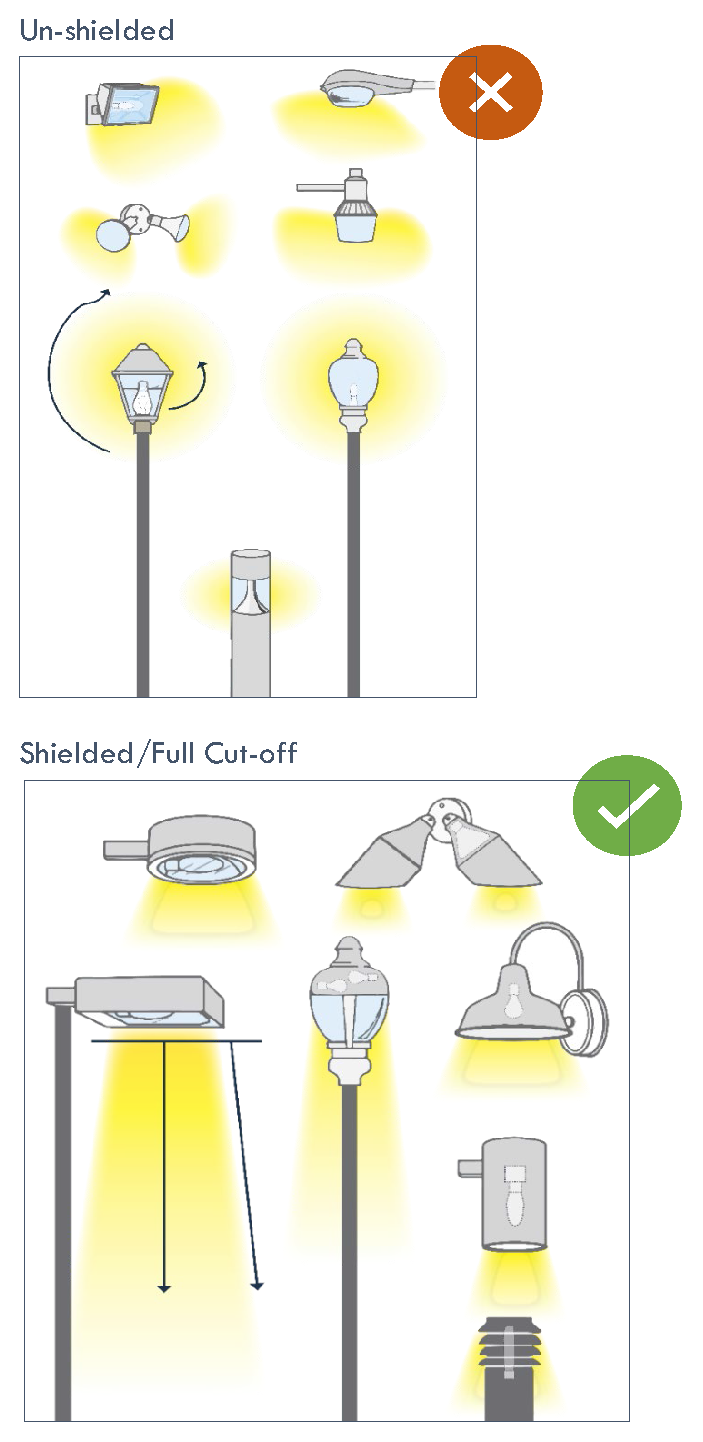
Shielding. Each outdoor luminaire subject to these outdoor lighting requirements shall be dark sky compliant with a full cutoff luminaire and aimed and controlled such that directed light is directed inward to the property and confined to the object intended to be illuminated. Directional control shields shall be used when necessary to limit stray light and prevent glare to adjacent properties and vehicular public rights-of-way. See figure 8.1.
Figure 8.1 Examples of Lighting
(d)
Color temperature. All exterior lights shall be 3,000 Kelvin light color temperature or less.
(e)
Type. Low-pressure sodium vapor (LPS), high-pressure sodium vapor (HPS), or light emitting diode (LED) lights shall be the preferred type of exterior site lighting.
(f)
Maximum illumination levels.
(1)
The maximum permitted average maintained illumination measured vertically and horizontally shall not exceed:
a.
2.0 footcandles in residential and R-PRD districts; and
b.
5.0 footcandles in commercial and industrial districts.
(2)
All lighting visible from outside, except for street lighting and pedestrian area lighting, must be designed and located so that the maximum illumination at any lot line abutting a residential district, dwelling, or any public right-of-way, does not exceed 0.5 footcandles.
(g)
Canopy lighting. Light fixtures under any gasoline canopy or other structural canopy shall be recessed into the canopy ceiling with a flat lens to prevent glare.
(h)
Height. Any pole-mounted exterior lighting shall not exceed a height of 30 feet in industrial districts and 20 feet in all other districts.
Sec. 90-461. - Purpose and intent.
The purpose of this division is to establish standards for landscape architecture, site design, site buffering, and landscape screening. With the intent of preserving and promoting the health, safety, and general welfare of the city, this division is intended to:
(1)
Preserve and enhance the aesthetic character and visual harmony of the city;
(2)
Protect the quality of the city's natural rivers, streams, and wetlands;
(3)
Enhance erosion control;
(4)
Improve the relationship between adjacent properties through screening, buffering, and proper placement and design of landscaping and screening;
(5)
Promote economic development in the city's commercial districts and main thoroughfares, and;
(6)
Ensure the safety, security, and privacy of properties.
Sec. 90-462. - Applicability.
(a)
General. The requirements of this division shall apply to new construction, developments, or redevelopments in all zoning districts requiring an approved site plan, conditional use permit, or zoning permit specified by the ordinance.
(b)
Exemptions. The following are exempted from the landscaping and screening standards of this article:
(1)
Single- and two-family development on individual lots (not part of a major subdivision or planned development)
(c)
Timing of review. Review for compliance with the standards of this division shall occur as part of the review of an application for a site plan, planned development, zoning permit, conditional use permit, or variance.
Sec. 90-463. - Landscape plan requirements.
(a)
Landscape plan required. A landscaping plan shall be required for all new construction, developments, or redevelopments in all zoning districts requiring an approved site plan, conditional use permit, or zoning permit specified by the ordinance. The landscaping plan shall:
(1)
Be prepared and/or certified by a certified professional or firm qualified to create such a plan.
(2)
Cover the entire project area included in the overall site plan or development plan for which approval is sought.
(b)
Landscape plan contents. The landscape plan shall include:
(1)
Location, species, size, height, and number of proposed plantings;
(2)
Planting specifications or installation details with consideration of the appropriateness of plants and locations for the specific characteristics of the site and the purpose for installation;
(3)
Information about the general location, composition, and extent of existing vegetation (plants, trees, shrubs, etc.) to be retained during construction, as well as protection measures to be implemented during construction;
a.
The information shall include the successional stage of the vegetation, a list of the primary tree species, a list of the prominent non-native invasive species, and a statement regarding the general age, health, and condition of the vegetation.
(4)
Location, size, and other related design details for all hardscape improvements, ground-mounted signage, recreational improvements, and open space areas, fences, walls, barriers, and other related elements;
(5)
Designation of required setbacks, yards, and screening areas;
(6)
Location of other man-made site features, parking lots, overhead structures, and underground utilities to ensure that landscape materials will not be in conflict with the placement and operation of these improvements; and
(7)
A preference to design and plant materials which are native and with reduced water needs.
(c)
Landscape plan bond. After a landscape plan has been approved, and before any planting or disturbance can occur, the developer shall furnish to the city an irrevocable letter of credit, cash escrow, or bonds (collectively referred to as "performance bond") from a certified state lending institution by corporate surety in a form and amount sufficient to guarantee the completion of all required improvements.
(1)
The cost of required landscaping shall be determined by a bona fide estimate of cost prepared by a duly licensed landscape architect, engineer, or other licensed professional, and such estimate shall be provided at the expense of the developer.
Sec. 90-464. - General standards.
(a)
Tree and plant standards.
(1)
Existing trees and vegetation shall be preserved to the greatest extent possible.
a.
Existing, healthy trees and shrubs shall be credited toward any minimum landscaping required by this division, provided they meet minimum size standards of subsection (b) below, and are protected before and during construction and maintained thereafter in a healthy growing condition.
b.
Where existing vegetation is not adequate to achieve the required landscaping or screening, additional plants shall be installed as necessary to meet the objective, and in accordance with the standards of this division.
(2)
Any required landscaping shall be installed prior to the issuance of a certificate of occupancy.
a.
When the planting of required landscaping conflicts with the planting season, a certificate of occupancy may be issued subject to approval by the administrator that a sufficient surety is in place.
b.
The owner or developer shall provide a development agreement which sets a deadline by which the plantings will be installed to be approved by the administrator.
(3)
The owner of the property upon which the required landscaping or buffering is installed shall be responsible for maintenance and replacement.
(4)
All plantings shall be maintained in perpetuity in such a way to ensure that the requirements of this ordinance continue to be met.
a.
Any dead or dying plants shall be removed within 30 days of notification by the administrator. If notified during winter, such plants may be replaced by the property owner during the next viable planting season.
(5)
Landscaping materials should generally be sustainable and biologically diverse with emphasis on trees and plants native to Virginia and the region.
(6)
Plants shall be nursery grown and materials shall conform to the requirements described in the latest edition of American Standard for Nursery Stock, as published by the American Association of Nurserymen, as amended.
(7)
Landscaping shall not obstruct the view of motorists using any street, driveway, parking isles, or the approach to any street intersection so as to constitute a traffic hazard or a condition dangerous to the public safety.
(8)
Plant materials shall be installed via dig, ball, burlap, and transplant. Bare-root planting is not permitted for any tree.
(b)
Tree measurement standards.
(1)
Caliper measurements shall be taken six inches above grade for trees under four inches in diameter. Caliper measurements shall be taken 12 inches above grade for trees four inches in diameter and larger.
(2)
All required landscaping materials shall conform to the following minimum size or height standards provided in table 8.1, minimum plant measurements.
Table 8.1 Minimum Plant Measurements
(c)
Tree protection standards.
(1)
Trees which are to be preserved on site shall be protected before, during, and after the development process utilizing accepted practices. At a minimum, the tree protection practices set out in the Virginia Erosion and Sediment Control Handbook, as amended, shall be utilized.
(2)
Trees selected for preservation in order to obtain landscaping credits shall be shown on the landscape plan and clearly marked. In wooded areas, groups of trees shall be selected for preservation rather than single trees wherever possible.
(3)
Trees and groups of trees which are to be preserved shall be enclosed by a temporary fence or barrier to be located and maintained five feet outside of their dripline during construction.
a.
Such a fence or barrier shall be installed prior to clearing or construction, shall be sufficient to prevent intrusion into the fenced area during construction, and in no case shall materials, vehicles, or equipment be stored or stockpiled within the enclosure.
b.
Within the fenced area, the topsoil layer shall not be disturbed except in accordance with accepted tree protection practices.
(4)
No healthy deciduous tree(s) shall be removed from the site unless such trees are replaced.
a.
Such trees shall be shown on the landscaping plan.
b.
These replacement trees shall be in addition to landscaping required by this division.
c.
No replacement tree shall have a caliper of less than three inches, measured six inches from the ground, at the time of planting.
(5)
The developer shall be responsible for notifying all construction personnel of the presence and purpose of clearing limits and protective fences or barriers and for ensuring that they are observed.
(6)
Where grade changes in excess of six inches from the existing natural grade level are necessary, permanent protective structures such as tree wells or walls shall be installed as recommended by the tree preservation and protection standards outlined in the Virginia Erosion and Sediment Control Handbook, as amended.
(7)
In determining which trees shall be preserved, consideration shall be given to preserving trees which:
a.
Are trees of 15-inch caliper or larger;
b.
Are ornamental trees of any size;
c.
Are trees within required setbacks or along boundaries unless necessary to remove for access, grading, circulation, utilities or drainage.
d.
Are heritage, memorial, significant, and specimen trees;
e.
Complement the project design including the enhancement of the architecture and streetscape appearance;
f.
Can tolerate environmental changes to be caused by development (i.e. increased sunlight, heat, wind, and alteration of water regime);
g.
Have strong branching and rooting patterns;
h.
Are disease and insect resistant;
i.
Complement or do not conflict with stormwater management and best management practice designs;
j.
Are located in required buffer areas;
k.
Exist in natural groupings, including islands of trees;
l.
Do not conflict with necessary utility; and
m.
Have been recommended by the commonwealth department of forestry, the county cooperative extension service, or a certified arborist or urban forester for preservation.
Sec. 90-465. - Transitional buffers.
(a)
Applicability. The standards of this section apply to:
(1)
All new development, except as provided in subsection (B) below;
(2)
Major subdivisions; and
(3)
A change of use of an existing structure is proposed that requires a zoning map amendment (rezoning).
(b)
Exceptions. A transitional buffer is not required:
(1)
For any single- or two-family dwelling not part of a larger development;
(2)
Between uses, buildings, or lots developed under a common plan or operated under common management; or
(3)
As exempt in table 8.2, transitional buffer type required.
(c)
Screening alternative. The applicant may propose, and the administrator may approve, a screening alternative where a building or screening has been specifically designed to minimize adverse effects through a combination of architectural and landscaping techniques, and the administrator determines the building or screening is consistent with the purposes of this section. See table 8.4, alternative transitional buffer.
(d)
Transitional buffer types required. Table 8.2, transitional buffer type required, identifies the type of transitional buffer, if any, required between a proposed use and adjacent property/development. Table 8.3, minimum plantings, provide the minimum width and planting standards for each transitional buffer type.
(1)
"Adjacent" includes land closer to the proposed use than the required buffer width, even if they are separated by a narrow strip of land with different zoning districts.
(2)
Transitional buffers for planned developments will be determined as part of the rezoning process.
(e)
Location and design.
(1)
Transitional buffers must be located along the boundaries of the adjacent district, as provided below, except where driveways or other openings are permitted.
a.
This includes any lot lines abutting the adjacent districts, including those separated by any public road.
(2)
Transitional buffers may be located within the required minimum front, side, or rear setbacks.
(3)
Type A and B buffers may be dispersed along the setback instead of planted in straight rows, to create a natural setting. However, the purpose and intent of this division shall be met.
(4)
Development within a transitional buffer is limited to the following:
a.
Fences and walls, including retaining walls, in accordance with division 3 of this article;
b.
Sidewalks, trails, and other pedestrian/bicycle paths that intersect the transitional buffer yard at or near a 90-degree angle; and
c.
Areas of ingress and egress, fire hydrants, utilities, and other public infrastructure; and
d.
Flag poles and permitted signs.
e.
Development within a transitional buffer must not reduce required parking lot landscaping.
Table 8.2 Transitional Buffer Type Required
Table 8.3 Minimum Plantings
Table 8.4 Alternative Transitional Buffer
Sec. 90-466. - Screening and enclosures.
(a)
Except on lots where the principal use is a single- or two-family dwelling or manufactured home, the following objects and areas shall be located to the side or rear of the principal structure, and shall be screened from public view at ground level, both on and off the premises, in accordance with this section:
(1)
Large waste receptacles (dumpsters) and refuse and recycling collection points (including containers);
(2)
Loading and service areas;
(3)
Outdoor storage areas;
(4)
Utility and mechanical equipment, such as, generators, HVAC units, utility meters, junction and accessory boxes, and transformers; and
(5)
Stormwater management facilities;
(6)
All other uses or elements where screening is required as identified in article VII, use standards, of this ordinance.
(b)
Screening/enclosures shall be comprised singularly, or of a combination of:
(1)
A solid masonry wall or opaque fence, in accordance with division 3.
(2)
A double, unbroken row of evergreens that, at maturity, blocks visibility of the object being screened.
(3)
A planted berm.
(c)
Access to all grease containers, recycling and trash containers, and other outside storage shall be through gates capable of closure when not in use. All gates shall be closed and secured when not in use.
Sec. 90-467. - Parking lot landscaping.
(a)
General.
(1)
To provide shade, screen views, and mitigate stormwater runoff, all vehicle parking areas shall include landscaping as required in this section.
(2)
Parking lot landscaping for all developed, vacant, and abandoned commercial, industrial, or planned development shall be installed and continuously maintained by the owner according to the requirements contained in this article.
a.
Grass and groundcover (not including shrubs, bushes, etc.) shall be maintained to grass height of no more than six inches from grade.
b.
Grass areas shall be maintained in good condition with uniform grass coverage and free from rill or gully erosion.
c.
Any dead or dying plants shall be removed within 30 days of notification by the administrator. If notified during winter, such plants may be replaced by the property owner during the next viable planting season.
(b)
Exemptions.
(1)
The landscape provisions of this division shall not apply to off-street parking for individual single- or two-family residential dwellings or for parking garages or similar multi-level parking structures.
(2)
In the case of redevelopment proposals, parking lot landscape requirements do not apply to those proposals that are not required to add parking spaces over those that are currently provided.
(c)
Parking lot landscape buffers.
(1)
Where a parking lot (or a private driveway providing access to a parking lot or building entry) abuts a residential district or a public right-of-way, a landscaping strip of at least ten feet in width shall be located between the parking lot and the abutting property line.
a.
A minimum of one deciduous shade tree for each 50 feet of contiguous property line shall be planted in the landscape strip.
b.
A minimum of five shrubs for each 50 feet of contiguous property line shall be planted in the landscape strip.
c.
The landscape strip may include a sidewalk or trail. The remainder of the landscape strip must contain groundcover, turf, trees, or shrubs, or be mulched.
d.
The landscape strip shall maintain a visibility clearance of at least three feet at all ingresses and egresses for vehicular traffic.
(d)
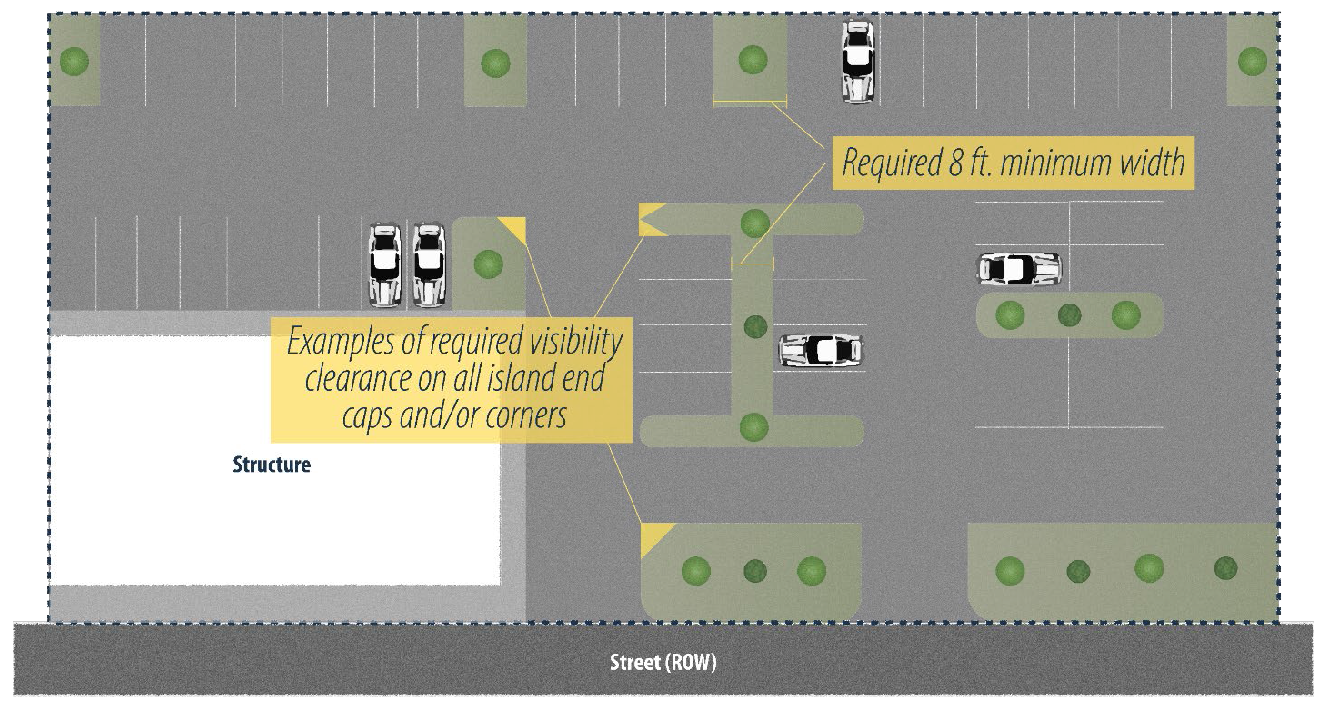
Parking lot landscape islands. See figure 8.2.
(1)
Landscaped planting islands shall be provided in the interior of the following types of parking lots, unless the Administrator deems the requirements would pose unreasonable hardship on the applicant:
a.
The total size of the parking lot exceeds 30 total parking spaces; or
b.
Parking lot layout incorporates three or more double-loaded or single-loaded parking bays which are contiguous and parallel to each other.
(2)
Landscaped planting islands minimum standards:
a.
Landscape planting islands shall be at least ten percent of the parking area.
b.
A minimum of one tree shall be provided for each five spaces of required parking. The remaining area of the island(s) shall be landscaped with shrubs, ground cover, lawn, or additional trees.
c.
Planting islands shall have a minimum width of eight feet to allow for bumper overhang and shall otherwise provide adequate width for the growth and maintenance of the intended landscape materials to be planted therein.
d.
Planting islands shall maintain a visibility clearance of at least three feet at both ends of the island to ensure vehicular traffic and pedestrian safety.
e.
The landscaped planting islands shall be dispersed throughout the parking lot, with interior dimensions of any planting area (i.e. interior parking median or island) sufficient to protect and maintain all landscaping materials planted therein.
Figure 8.2 Landscaped Planting Islands Standards
Sec. 90-468. - Modifications.
Modifications to the layout and design standards contained herein may be approved through a waiver by the administrator upon a determination that the following conditions exist:
(1)
The proposed layout and design provide landscaping which will have the same or increased screening impact, intensity, or variation throughout the year when viewed from adjacent properties or rights-of-way as that which would be required by strict interpretation of the standards contained in this division.
(2)
The proposed layout and design fully integrate and complement the existing trees to be preserved on the site.
(3)
Any trees or shrubs installed or preserved on the site which exceed the minimum numerical requirements of this division shall not be subject to the species mixture, locational, maintenance, or replacement requirements contained herein.
Sec. 90-471. - Purpose and intent.
The purpose of this division is to provide standards to ensure that walls and/or fences used to provide buffering, privacy, separation, security, or for aesthetic reasons, will not create an unsightly or unsafe condition on or off the public or private property on which the fence or wall is proposed.
Sec. 90-472. - Applicability.
The provisions of this division shall apply to all construction, reconstruction, or replacement of walls and/or fences except:
(1)
Walls and/or fences required for the physical support of a principal or accessory structure;
(2)
Walls and/or fences erected temporarily for construction sites or a similar purpose, provided that they comply with all relevant requirements of the Uniform Statewide Building Code and do not block sight distance;
(3)
Landscaping berms without fences;
(4)
Walls and/or fences necessary for soil erosion control;
(5)
Walls and/or fences at government facilities;
(6)
Customary fencing provided as part of a permitted tennis court, athletic field, and similar recreational facility will be exempt from the height standards; and
(7)
Fences for tree protection (temporary and permanent).
Sec. 90-473. - Location.
(a)
Walls and/or fences shall not:
(1)
Be located within the public right-of-way;
(2)
Be installed in a manner, or in a location, so as to block or divert a natural drainage flow on to or off of any other land, unless the fence or wall has specifically been approved as part of an approved stormwater management plan;
(3)
Be constructed in a manner or in a location that impairs safety or sight lines for pedestrians and vehicles traveling on public rights-of-way; or
(4)
Prevent immediate view of, or access to, fire hydrants or other fire-fighting water supply devices.
(b)
Walls and/or fences may be located within any required setback or yard.
(c)
Walls and/or fences located within an easement shall receive written authorization from the easement holder or the city (as appropriate).
(1)
The city shall not be responsible for damage to, or the repair or replacement of, fences that must be removed to access such easements or facilities.
(d)
Walls and/or fences within required transitional buffers shall be installed so as not to disturb or damage existing vegetation or installed plant material.
Sec. 90-474. - Height.
(a)
Maximum height. Walls and/or fences shall be permitted in accordance with the following standards:
(1)
No wall and/or fence between a street and a front building line shall be more than four feet in height. In the case of fences within a front yard on a corner lot, the fence shall not be any closer to the street than the front building line.
(2)
And not forgoing subsection (1) above:
a.
Walls and/or fences in any residential or planned development district shall not exceed six feet in height above the existing grade without approval of a conditional use permit;
b.
Walls and/or fences in any commercial zoning district shall not exceed six feet in height above the existing grade without approval of a conditional use permit; and
c.
Walls and/or fences in any industrial zoning district shall not exceed eight feet in height above the existing grade without approval of a conditional use permit.
(b)
Measuring height. Wall and/or fence height will be measured parallel along the side of the fence from the highest point above grade to where the grade is lowest but excluding the height of any retaining wall directly beneath the fence or wall.
Sec. 90-475. - Materials.
(a)
Permitted materials.
(1)
Walls and/or fences shall be constructed of any combination of:
a.
Treated or rot-resistant wood or similar composite wood material;
b.
Wrought iron;
c.
Vinyl (PVC);
d.
Decorative metal materials; or
e.
Brick, stone, masonry materials, or products designed to resemble these materials.
f.
Where wood, masonry, or other opaque materials are specified for particular types of screening or buffering fences or walls, all other fence materials are prohibited.
(2)
All wall and/or fence segments located along a single lot side shall be composed of a uniform style, material, and color compatible with other parts of the wall and/or fence.
(b)
Prohibited materials. Walls and/or fences made of debris, junk, rolled plastic, sheet metal, plywood, barbed wire, or waste materials are prohibited in all zoning districts unless such materials have been recycled and reprocessed into new building materials that resemble the customary materials listed in subsection (a) above.
(c)
Chain link fencing. Chain link fencing shall be allowed, subject to the following requirements:
(1)
Permitted in commercial and industrial districts, and long the side and rear yards of residential districts.
(2)
Coated or opaque fencing is required when a commercial or industrial zoned property or use is adjacent to a residential zoned property or use. The chain link fencing may include black or dark green opaque slats.
(d)
Finished side to outside. Wherever walls and/or fences are installed, if one side of the wall and/or fence appears more "finished" than the other (e.g. one side has visible support framing and the other does not), then the more "finished" side of the fence shall face the perimeter of the lot, rather than the interior of the lot.
Sec. 90-476. - Maintenance.
(a)
All walls and/or fences shall be maintained in good repair and in a safe and attractive condition.
(b)
The owner of the property on which wall and/or fences are located shall be responsible for maintenance, including but not limited to, the replacement of missing, decayed, or broken structural and decorative elements.
Sec. 90-481. - General.
(a)
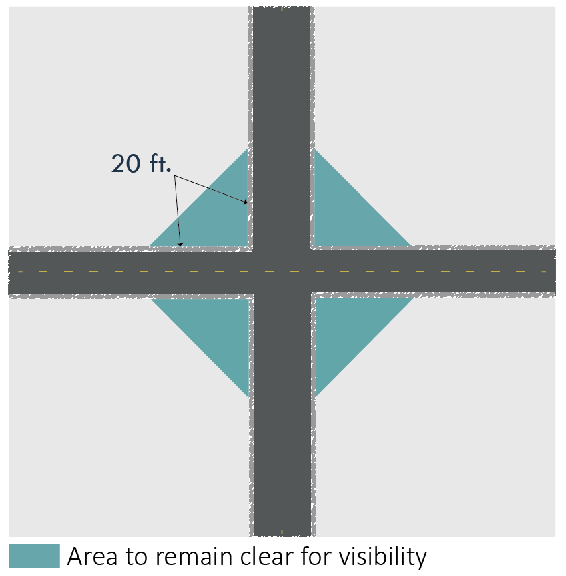
For protection against traffic hazards, no planting, sign, structure, fence, or other obstruction to visibility greater than three feet in height shall be erected, placed, allowed to grow, or maintained within a visibility triangle on any corner lot.
(b)
The apex of the triangle shall be at the intersection of the department of transportation, city or other designated right-of-way lines (extended in the case of rounded corners), the sides being 20 feet in length along the right-of-way lines, and the base of the triangle running through the lot. See figure 8.3.
Figure 8.3 Visibility Clearance
Sec. 90-491. - Purpose and intent.
The purpose of this division is to ensure efficient traffic flow and to reduce hazards to public safety by establishing standards for off-street parking and off-street loading areas. This division is intended to:
(1)
Ensure adequate parking is designed and constructed during the erection of all new structures and the modifications to existing structures;
(2)
Provide safe and convenient traffic flow and add to the beautification of the city;
(3)
Provide for adequate but not excessive off-street parking and loading while accommodating alternative parking solutions for permanent, temporary, and seasonal demands;
(4)
Minimize the environmental impact of vehicular parking by avoiding excessive paved surface areas, applying appropriate minimum parking requirements, and encouraging the use of permeable parking surfacing; and
(5)
Support walking and bicycling in appropriate locations through the provision of bicycle parking.
Sec. 90-492. - General.
(a)
Off-street parking and loading shall be provided in accordance with the requirements of this division.
(1)
Off-street parking shall not be required for non-residential uses in the DT district, with the exception of hotels, motels, tourist homes, and bed and breakfast establishments.
(2)
Any residential use in the DT district may be exempted or granted reduced parking requirements by the administrator in conjunction with site plan approval. The applicant shall demonstrate sufficient public parking availability during peak hours of operation.
a.
The total number of required off-street parking spaces as set forth in the schedule of parking requirements in section 90-498 may be reduced by one space for every 20 feet of lot frontage on a street to the extent that on-street parking is permitted along the same frontage. The administrator shall determine if on-street parking is permitted along the said frontage used for this reduction.
(b)
For purposes of this division, off-street parking shall mean an improved surface not in a street or alley.
(c)
Parking and loading spaces shall be provided at the time of the erection of any building or structure, not less than the amount of parking and/or loading space(s) given in sections 90-498 and 90-502.
(d)
Parking space(s) shall be maintained and shall not be encroached upon unless in conformance with sections 90-494 and 90-495 below.
(e)
Loading space(s), as required in sections 90-501 and 90-502 below, shall not be construed as supplying off-street parking.
Sec. 90-493. - Obligations of owner.
(a)
The requirements for off-street parking space(s) and off-street loading space(s) shall be a continuing obligation of the owner of the real estate on which any structure or use is located as long as such structure or use is in existence, and the use requiring off-street parking or loading facilities continues.
(b)
It shall be unlawful for the owner of any structure or use affected by this division to discontinue, change, dispense with, or cause the discontinuance or change of the required off-street parking or loading space, apart from the alternate off-street parking or loading space which meets with the requirements of, and complies with, this division.
(c)
It shall be unlawful for any firm or corporation to use such structure without acquiring such land or other suitable land for off-street parking or loading space(s) which meets the requirements of, and complies with, this division.
Sec. 90-494. - Location to use.
All parking spaces required herein shall be located on the same lot with the building or principal use served; except that:
(1)
A remote parking lot may be approved by a conditional use permit and shall:
a.
Be located and maintained not to exceed 600 feet from the principal building or use it serves; and
b.
Be established by a recorded covenant or agreement as parking space(s) to be used in conjunction with the principal building or use and shall be reserved as such through an encumbrance on the title of the property.
c.
Have an existing sidewalk or improved pathway and permanent access easement.
1.
If none exists, the developer shall establish a sidewalk or improved pathway and permanent access easement that connects the parking to the use.
Sec. 90-495. - Joint/shared parking.
(a)
Required parking spaces can be used jointly by two or more buildings, uses, or establishments, as provided below:
(1)
The shared parking space(s) may be used to meet no more than 75 percent of the required off-street parking requirement.
(2)
The shared parking space(s) must be for those uses that the normal periods of peak use are different from the shared use.
(3)
The use(s) for which parking is being shared shall be within 600 feet, as measured along lines of public access.
(b)
In the case of mixed or joint uses of a building or premises having different peak parking demands, the parking spaces required may be reduced up to 50 percent if approved by the administrator, in conjunction with site plan approval.
(1)
In such instances, the applicants shall demonstrate that the periods of peak use are separated sufficiently, and shared parking spaces are available to all uses sharing them, to not cause a parking demand problem.
(c)
In the case of joint use of a building or premises by more than one use having the same peak parking demand, the parking spaces required shall equal the sum of the requirements of the various uses computed separately.
Sec. 90-496. - Reduction in parking.
(a)
Reduction in required spaces. Off-street parking space(s) required under this division may be reduced at a time when the capacity or use of a building is changed in such a manner that the new use or capacity would require less space than before the change.
(b)
Increase in required parking. Whenever a building or use is changed or enlarged in floor area, number of employees, number of dwelling units, seating capacity or otherwise, to create a need under the requirements of this division for an increase in parking spaces of ten percent or more, such additional spaces shall be provided on a basis of the change or enlargement.
(1)
Parking increases shall not be circumvented by a series of changes that together would meet, or exceed, the ten percent requirement.
Sec. 90-497. - Parking design standards.
(a)
Surfacing.
(1)
All driveways, aisles, and parking areas, including residential uses, shall have an improved surface to prevent soil erosion, abate dust, and provide an adequate driving surface.
a.
Improved surface shall mean concrete, asphalt, bituminous pavement, brick or stone pavers, or other hard, all-weather, dustless, permeable pavement system.
(b)
Pervious and semi-pervious materials.
(1)
The use of pervious or semi-pervious parking lot surfacing materials—including, but not limited to pervious asphalt and concrete, open joint pavers, and reinforced grass grids—may be approved for off-street parking and loading areas except on industrial and other sites where there is reasonable expectation that petroleum and other chemical products will be spilled, and provided such surfacing is subject to an on-going maintenance program (e.g. sweeping, annual vacuuming).
(2)
Any pervious or semi-pervious surfacing used for aisles within or driveways to parking and loading areas shall be certified by a design professional as capable of accommodating anticipated traffic loading stresses and maintenance impacts or as approved by the director of public services.
(3)
Reinforced grass grid parking permitted under certain circumstances:
a.
Reinforced grass grid parking areas are permitted for the following:
1.
Uses that require ten or fewer parking spaces.
b.
All reinforced grass grid parking areas shall:
1.
Grass shall be maintained to height of no more than six inches from grade.
2.
Grass shall be maintained in good condition with uniform grass coverage and free from rill or gully erosion.
3.
Travelways shall be appropriately marked to maintain egress.
c.
All reinforced grass grid parking areas:
1.
Cannot be permitted for any parking area that includes drive-through windows.
2.
Cannot be located in any existing or proposed landscaped area, stormwater management area, easement, or required yard.
(4)
Gravel parking is permitted for parking lots of three or fewer parking spaces.
(c)
Marking. For all paved parking areas, each parking space shall be striped and maintained. Parking spaces shall be marked by painted lines or curbs or other means to indicate individual spaces. Signs or markers shall be used to ensure efficient traffic operation on the lot.
(1)
For reinforced grass grid, and gravel parking, spaces shall be marked by signage and wheel stops. Signage and wheel stops must be maintained.
(d)
Location. Off-street parking areas shall be located in such a way to reduce visual impact from the street or pedestrian view. The preferred location for off-street parking areas is to the rear of the structure it is associated with, or the side of the structure as an alternative; if it can be demonstrated that the lot could not accommodate parking area(s) to the side or rear of the lot, the Administrator may waive this provision.
(1)
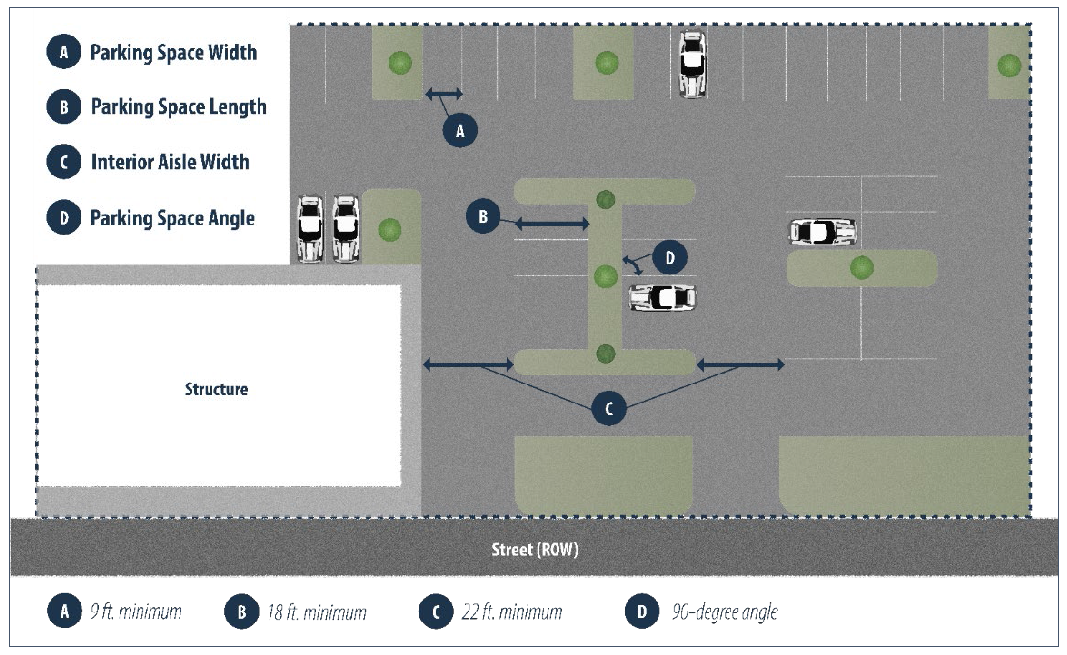
Parking space dimensions. See figure 8.4. Off-street parking spaces, including residential uses, shall be a minimum width of nine feet and a minimum length of 18 feet; or in the case of parking spaces for trucks, buses, or special equipment, parking spaces of a minimum size to be determined by the administrator based on the nature of the parked vehicles.
a.
Where more than ten spaces are required by this ordinance, a maximum of 20 percent of the required spaces may be reduced to a minimum width of eight feet and a minimum length of 16 feet, provided that such spaces are designated by appropriate signs as reserved for compact cars only.
(e)
Arrangement of interior aisles. See figure 8.4. All aisles within parking areas shall have the minimum widths:
(1)
Parking spaces at a 90-degree angle: 22 ft.
(2)
Parking spaces at a 60-degree angle: 18 ft.
(3)
Parallel parking spaces: 15 ft.
Figure 8.4 Parking Area Dimensions
(f)
Handicap accessible parking. Every land use shall include the number of handicap accessible off-street parking spaces in accordance with the requirements of the Virginia Uniform Statewide Building Code. These parking spaces shall be included within the required amount of parking spaces, as provided in table 8.5.
(g)
Entrances and exits. The location and design of entrances and exits shall meet the VDOT traffic safety and design standards. In general, there shall not be more than one entrance and one exit or one combined entrance and exit along any one street.
(h)
Separation from walkways and streets.
(1)
Off-street parking spaces shall be separated from walkways, sidewalks, streets, or alleys by the required landscape buffer, a wall or fence, or curbing.
(i)
Drainage and maintenance. Off-street parking areas shall be drained to eliminate standing water and prevent damage to abutting property and/or public streets and alleys. Off-street parking areas shall be maintained in a clean, orderly, and dust-free condition at the expense of the owner or lessee.
(j)
Lighting. Adequate lighting shall be provided in accordance with division 1 of this article.
(k)
Landscaping. Whenever a parking area for a commercial or industrial use is located in or adjacent to a residential district, it shall be effectively landscaped in accordance with division 2 of this article. However, areas requiring natural air circulation, unobstructed view, or other technical considerations necessary for proper operation, may submit an alternative screening plan to be approved by the administrator.
(l)
Fleet vehicles. Whenever daily or overnight storage of fleet vehicles is proposed, these vehicles shall be screened or parked to block visibility from streets or adjacent properties; screening shall be in accordance with the requirements of division 2 of this article. These off-street parking spaces shall be identified on any approved site plan.
(m)
Boats and recreational vehicles. All boats and recreational vehicles must be parked and stored on an improved surface as described in surfacing and pervious and semi-pervious above.
Sec. 90-498. - Schedule of required parking spaces.
(a)
Except as otherwise provided in this ordinance, when any building or structure is hereafter erected or structurally altered, or any building or structure hereafter erected is converted, off-street parking space(s) shall be provided according to the requirements for individual uses in the following table.
(b)
Where fractional spaces result, the parking spaces required shall be increased to be the next highest whole number.
(c)
Exemptions to off-street parking requirements are contained in sections 90-495 and 90-496 above.
(d)
The parking requirements in this division are in addition to any other parking requirements contained in the district or use standards of this ordinance.
(e)
The parking requirements in this division do not limit additional requirements that may be imposed for approval of a conditional use permit.
(f)
For residential uses, the total number of off-street parking spaces provided inside a private garage shall be calculated based on the intended design of the garage.
(g)
Except as otherwise provided, the number of employees shall be compiled based on the maximum number of persons employed on the premises at one time, on an average day or average night, whichever is greater. Seasonal variations in employment may be recognized in determining an average day.
(h)
The parking space requirements for a use not specifically listed in the chart shall be the same as for a listed use of similar characteristics of parking demand generation, as determined by the administrator.
(i)
In order to minimize the adverse impacts caused by improving large areas with impervious surfaces, including increased storm water run-off, urban heat island effects, and nonpoint source pollution, the total number of parking spaces serving a use may not exceed the minimum parking standards in table 8.5 by more than 20 percent, unless one of the following apply:
(1)
Any spaces in excess of 20 percent of the minimum number required are located in a structured parking facility; or
(2)
A landscape plan that provides additional pervious landscape surfaces and increases stormwater filtration has been reviewed and approved by the administrator; or
(3)
The applicant for the project shall apply and receive approval through a conditional use permit.
Table 8.5 Minimum Off-Street Parking Requirements
Sec. 90-499. - Bicycle parking.
(a)
When required. Bicycle parking shall be required for the following:
(1)
All commercial developments in the DT, C1, and C2 districts requiring 25 or more parking spaces; and
(2)
All multi-family developments.
(b)
Required spaces.
(1)
Four bicycle parking spaces for the first 25 required off-street parking spaces, as shown in table 8.5 above. Each additional 50 parking spaces shall require one additional bicycle space.
(2)
The minimum number of bicycle parking spaces provided at each site shall be 4 and the maximum shall be 20.
(c)
Standards.
(1)
A bicycle rack, bicycle loops, or other device as approved by the Administrator shall be installed to secure bicycles within the bicycle parking area.
(2)
Each rack must:
a.
Allow for the securing of the frame and at least one wheel of a bicycle in a bicycle parking space to the rack with an industry-standard U-shaped bike lock;
b.
Provide each bicycle parking space with support for a bicycle in a stable position with direct support to the bicycle frame;
c.
Be securely anchored to the ground or to a structural element of a building or structure; and
d.
Be constructed of materials designed to withstand cutting, severe weather, and permanent exposure to the elements, such as powder-coated steel or stainless steel.
(3)
Bicycle parking must be visible from the main entrance of the building it serves, unless the administrator determines that another location provides better security for users.
(4)
The location of the bicycle parking area, when fully occupied, shall not obstruct any pedestrian way and a five-foot wide pedestrian path shall be maintained at all times.
(5)
A bicycle parking area may not be located in any minimum front, side, or rear setbacks, or required landscaping or transitional buffer.
Sec. 90-500. - Joint/shared off-street loading.
Where a building is used for more than one use, and where the floor area used for each use for which loading space is required is below the minimum for required loading spaces, but the aggregate floor area used is greater than such minimum, then off-street loading space shall be provided as if the entire building were used for the use in the building for which the most spaces are required. In such cases, the administrator may make reasonable requirements for the location of required loading.
Sec. 90-501. - Off-street loading design standards.
(a)
Minimum size. For the purpose of the regulations of this division, a loading space is a space within the main building or on the same lot providing for the standing, loading, or unloading of trucks, and having a minimum width of ten feet, a minimum length of 25 feet, and a vertical clearance of at least 15 feet.
(b)
Location. All required off-street loading areas shall be located on the same lot as the use served and shall not obstruct required off-street parking spaces, any public street, or any fire lane or emergency access route during the loading or unloading of vehicles. All loading spaces shall be located only within side or rear yards, or shall be screened from view of the public right of way.
(c)
Surfacing. All loading areas shall have an improved surface to prevent soil erosion, abate dust, and provide an adequate driving surface.
(d)
Screening. Whenever an off-street loading area is located in or adjacent to a residential district, it shall be effectively screened in accordance with division 2 of this article. However, areas requiring natural air circulation, unobstructed view, or other technical considerations necessary for proper operation, may submit a screening plan to be approved by the administrator.
(e)
Entrances and exits. Location and design of entrances and exits shall be in accordance with VDOT traffic safety and design standards.
(1)
Where the entrance or exit of a building is designed for truck loading and unloading, such entrance or exit shall be designed to provide a least one off-street loading space.
(2)
Where an off-street loading space is to be approached directly from a major thoroughfare, necessary maneuvering space shall be provided on the lot without impeding the public-right-of-way or any parking space or parking lot aisle.
Sec. 90-502. - Schedule of required off-street loading spaces.
(a)
Except as otherwise provided in this ordinance, when any building or structure is hereafter erected, enlarged, or increased in capacity to the extent of increasing the floor area by 50 percent or more, or any building is hereafter converted, for the uses and floor areas listed below, accessory off-street loading spaces shall be provided as required in table 8.6 below.
(b)
Space allocated to any off-street loading use shall not be used to satisfy the space requirements for any off-street parking area or portion thereof.
(c)
The loading space requirements in this division do not limit other loading requirements contained in the district or use standards of this ordinance.
(d)
The loading space requirements in this division do not limit additional requirements that may be imposed in connection with uses permitted by approval of a conditional use permit.
Table 8.6 Minimum Off-Street Loading Requirements
Sec. 90-511. - Purpose and intent.
The purpose of these sign regulations is to define, permit, and control the size, material, location, and condition of signs in a manner that, as its first priority, protects those who travel in and through the city; and to regulate the markets through a comprehensive system of reasonable, effective, consistent, content-neutral, and nondiscriminatory sign standards and design requirements. The city council finds that the regulations in this division advance the significant government interests identified herein and are the minimum amount of regulation necessary to achieve those interests. These sign regulations are intended to achieve the following community goals and objectives:
(1)
Protect the health, safety, and welfare of the public;
(2)
Promote the use of signs which are aesthetically pleasing, of appropriate scale, and integrated with the surrounding buildings and landscape;
(3)
Balance public and private objectives by allowing adequate signage for business identification.
(4)
Prevent property damage and personal injury from signs which are improperly constructed or poorly maintained;
(5)
Safeguard the public use and nature of the streets and sidewalks;
(6)
Protect and enhance the visual environment of the city;
(7)
Discourage the diminishing of property values in the city;
(8)
Minimize visual distractions to motorists using the public streets;
(9)
Promote the economic growth of the city by creating a community image that is conducive to attracting new business and industrial development;
(10)
Permit reasonable effectiveness of signs and to prevent their over-concentration, improper placement and excessive height, bulk, density, and area;
(11)
Promote the safety of persons and property by requiring that signs not create a hazard due to collapse, fire, decay, or abandonment;
(12)
Ensure that signs do not obstruct fire-fighting efforts or create traffic hazards by confusing or distracting motorists or by impairing drivers' ability to see pedestrians, obstacles, other vehicles, or traffic signs; and
(13)
Promote commerce and trade, with recognition of the effects of signage on the character of the community.
Sec. 90-512. - Administration.
(a)
Interpretation.
(1)
The regulations of this division shall apply to all new signs, replacement signs, and their modification(s) established after the effective date of this ordinance.
(2)
Signs not expressly permitted are prohibited.
(3)
Signs containing noncommercial speech are permitted anywhere that advertising or commercial signs are permitted, subject to the same regulations of such signs.
(4)
This division shall be interpreted in a manner consistent with the First Amendment guarantee of free speech.
(b)
Application and permit.
(1)
Sign permit required.
a.
No sign shall be erected, installed, altered, modified, refaced, re-hung, or replaced, without obtaining a permit pursuant to this division, except as otherwise provided in this division.
b.
No permit shall be issued by the administrator except upon a determination that a proposed sign is in conformity with the requirements of this division and, where applicable, in conformity with the requirements of an approved site plan for the property upon which the sign is to be placed.
c.
More than one sign on one building or group of buildings located on the same parcel of land may be included on one application provided that all such signs are applied for at one time.
d.
After the issuance of an approved sign permit, the applicant may install and display the approved sign(s). Once installed, the administrator may inspect the sign(s) for conformance with the approved sign permit and this ordinance.
(2)
Application. An application for a sign permit shall:
a.
Include the name, address, and contact information of the applicant, and property owner (if different);
b.
Include the name of person, firm, or business erecting the sign and/or any related electric work;
c.
Specify the type of sign to be constructed and the zoning district in which this sign is to be located;
d.
Be accompanied with plans including a survey of the property, including measurements of the lot frontage;
e.
Indicate the square footage and location of all existing signs on the property;
f.
The area, size, structure, design, location, lighting, and materials for the sign; and
g.
Contain written consent of the owner or lessee of the land or building upon which the sign is to be erected, if not owned by the applicant.
(3)
Duration and revocation of permit.
a.
Any sign permit shall be null and void if any sign for which the permit was issued is not installed in accordance with the permit within six months of the date of approval.
b.
A sign permit shall become null and void if the use to which it pertains is not commenced within six months after the date the sign permit is issued.
1.
Upon written request and for good cause shown, the administrator may grant one six-month extension.
c.
Whenever the use of a building or land is discontinued by the specific business, the sign permit shall expire and all signs pertaining to that business shall be removed by the property owner within 30 calendar days of the discontinuance.
d.
The administrator shall revoke a sign permit if the sign does not comply with applicable regulations of this division, building code, or other applicable law, regulation, or ordinance.
Sec. 90-513. - Prohibited.
The following types of signs are prohibited in all zoning districts, unless otherwise specifically permitted in this ordinance:
(1)
Any sign affixed to, hung, placed, or painted on any cliff, rock, tree, or other natural feature; public utility pole or structure supporting wire, cable, or pipe; or radio, television, or similar tower;
a.
This prohibition shall not affect official traffic, parking, or informational signs placed on utility poles by the city.
(2)
Any sign or banner within or across a public right-of-way, unless specifically approved by the Virginia Department of Transportation (VDOT) and the city council;
(3)
Any sign that, due to its size, illumination, location, or height, obstructs the vision of motorists or pedestrians at any intersection, or similarly obstructs the vision of motorists entering a public right-of-way from private property;
(4)
Signs simulating, or which are likely to be confused with, a traffic control sign or any other sign displayed by a public authority. Any such sign is subject to immediate removal and disposal by an authorized city official as a nuisance;
(5)
Signs which obstruct any window or door opening used as a means of egress, prevents free passage from one part of a roof to any other part thereof, or interferes with an opening required for ventilation;
(6)
Signs attached, painted, or mounted to unlicensed, inoperative, or generally stationary vehicles and/or trailers. Vehicles and/or trailers shall not be used primarily as static displays, advertising a business, product, or service, nor utilized as storage, shelter, or distribution points for commercial products or services for the general public;
(7)
Signs extending above the roofline of a structure, building, or parapet wall;
(8)
Any flashing sign or signs with intermittent lights or lights of changing degrees of intensity or color, or with non-shielded illumination within 200 feet of a residential district, except those officially erected for safety purposes;
a.
This prohibition shall not apply to electronic or digital displays that display messages in intervals of at least ten seconds.
(9)
Any strings of lights, either outlining any part of a building or affixed to any ornamental feature thereof, except for seasonal holiday displays which are limited to 45 days.
(10)
Signs that emit sound, smoke, flame, scent, mist, aerosol, liquid, or gas;
(11)
Any sign representing or depicting illegal activity, or specified sexual activities and/or specified anatomical areas or sexually oriented goods;
(12)
Any sign containing information which states or implies that a property may be used for any purpose not permitted under the provisions of this ordinance.
(13)
Off-site signs, unless specifically permitted by this division; and
(14)
Any signs greater in size, quantity, or window coverage other than as provided for in the sections below.
Sec. 90-514. - Exemptions.
The following signs are exempt from the provisions of this division and may be erected or constructed without a permit but shall be in accordance with all other provisions of this ordinance and the structural and safety requirements of the city building code.
(1)
Governmental body or required by law. Signs erected by a governmental body or required by law, including official traffic signs or sign structures and provisional warning signs or sign structures, and temporary signs indicating danger.
(2)
Changeable message content. The changing of message content, including message content on a changeable message sign if permitted in the district.
(3)
Small signs.
a.
Portable signs. One portable sign per street frontage/business, each portable sign not to exceed 12 square feet in area.
1.
Portable signs shall in no way obstruct vehicular travel, public parking, and/or pedestrian movement along sidewalks and are removed when the establishment is closed for business.
b.
Minor signs. Two minor signs per street frontage, each minor sign not to exceed three square feet in area.
1.
A minor sign is any wall or freestanding sign not exceeding three square feet in area, not exceeding four feet in height, and not illuminated. Examples include no trespassing signs, displays of building address, security warning signs, parking signs, entrance/exit signs, and on-site directional signs.
c.
Temporary signs.
1.
Temporary signs for events/non-recurring activities, not exceeding 40 square feet in area and erected for not more than 30 consecutive days.
2.
On a property under construction or renovation, for sale, or for rent, temporary signs not exceeding 16 square feet for single- and two-family residential properties or 40 square feet for all other residential, nonresidential, or mixed-use properties.
d.
Memorial plaques and building cornerstones. Memorial plaques and building cornerstones not exceeding six square feet in area and cut or carved into a masonry surface or other noncombustible material and made an integral part of the building or structure.
(4)
Flag signs. Flag signs, subject to the following:
a.
Residential, planned development, and DT districts: limit of two per parcel at a maximum of 60 square feet in size, and a maximum of 30 feet in height.
b.
C-1, C-2, and industrial districts: limit of three per parcel at a maximum of 96 square ft in size, and a maximum of 45 feet in height.
c.
The minimum setback for a flagpole is the longest dimension of the pole, in order to prevent the flag or pole falling into the property of another or into a public street, trail, or sidewalk.
d.
Flag signs shall not be located within any right-of-way.
(5)
Window signs. Windows in the DT district are permitted on the first floor of a building and shall not exceed a total area of two square feet for each foot of frontage of the business.
(6)
Recreation/sports facility fence signs. Signs affixed to the interior of a permanent fence of a recreational or sports facility.
(7)
Murals and decorations. Art, murals, and holiday or seasonal decorations which are not commercial in nature.
Sec. 90-515. - Measurement and general sign standards.
(a)
Sign area calculation—One sided.
(1)
The sign area permitted under this division is determined by measuring the entire face of the sign, including any background incidental to its decoration, but excluding support elements for the sole purpose of supporting the sign.
(2)
The sign area shall be calculated using the smallest rectangle, circle, or triangle that can enclose the sign face.
a.
Rectangle formula: sign area = length (L) x width (W).
b.
Circle formula: sign area = πr 2 .
c.
Triangle formula: sign area = ½ x base (B) x height (H).
(3)
The surface area of any sign made up only of individual letters or figures shall include the space between such letters or figures.
(b)
Sign area calculation—Multi-sided.
(1)
Whenever one sign contains information on both sides (back-to-back and not more than 42 inches apart), sign area shall be calculated based on the largest sign face. Faces are not totaled.
(2)
Whenever one sign is multi-faceted (3-D objects, greater than 42 inches apart, etc.), sign area shall be calculated by adding together the area of all sign faces visible from any one point.
(c)
Sign height.
(1)
The maximum height for signs shall be as provided in table 8.7. table 8.8, and table 8.9, provided in section 90-517 below.
(2)
The height of a sign shall be computed as the distance from the base of the sign at average grade to the top of the highest attached component of the sign.
(d)
Sign setbacks. The minimum setback from any right-of-way, unless otherwise specified, is one-half the height of the sign.
(e)
Illumination.
(1)
All permitted signs may be internally or externally lit.
(2)
No sign shall be illuminated in such a way that light may shine into on-coming traffic, affect highway safety, or shine directly into a residential dwelling.
(3)
Any electrical sign shall display the required UL, ETL, CSA, or ULC label.
(4)
Illumination shall be no greater than 1,000 nits from sunrise to sunset, or 500 nits from sunset to sunrise and be equipped with automatic brightness control which can dim the display brightness when ambient conditions exist.
(5)
Electronic service lines shall be underground.
Sec. 90-516. - Special sign standards.
(a)
Changeable signs. Within any commercial or industrial district, one changeable sign per lot shall be permitted, subject to the following requirements:
(1)
The changeable sign may be an existing or proposed freestanding, wall, or projected sign.
(2)
The message shall not be changed more than once every ten seconds, move, flash, or display animation, as prohibited in this article.
(3)
Any changeable message sign that malfunctions, fails, or ceases to operate in its usual or normal programmed manner, thereby causing motion, movement, flashing or any other similar effects, shall be repaired, covered, or disconnected by the owner or operator of such sign within 24 hours of notice of violation.
(b)
Projecting signs.
(1)
Signs projecting over public walkways, including doors and entryways, shall be a minimum height of eight feet from average grade to the bottom of the sign.
(2)
Projecting signs shall not extend more than four feet beyond the face of the building or greater than two feet from the curb line towards the building the sign is attached to.
(3)
Signs, architectural projections, or sign structures projecting over vehicular access areas shall have a minimum vertical clearance of 14 feet.
(c)
Temporary signs.
(1)
Each temporary sign shall be maintained in good, safe condition, securely affixed to a building or the ground.
(2)
Any temporary sign pertaining to an event must be removed within ten days after the event.
(3)
No temporary sign shall be illuminated.
Sec. 90-517. - Permitted signs by district.
(a)
The following standards, shown in table 8.7, maximum sign dimensions—residential districts, table 8.8 maximum sign dimensions—C-1 and DT districts, and table 8.9, maximum sign dimensions—C-2 and industrial districts show the maximum sign dimensions, per type of sign, permitted in each district for all by-right and conditional uses, subject to all other requirements of this ordinance.
(1)
Signs requiring a sign permit within planned developments will be determined as part of the rezoning process.
(b)
Sign area square footage limits are provided per sign, unless specified as a total.
(1)
Total area is calculated as an aggregate of all signs of that type.
(c)
See section 90-2, definitions, of this ordinance, for the definitions of the sign types provided in the tables of this division.
(d)
For the purposes of table 8.7, the residential uses shall be those under the residential category in table 6.1, use matrix, and non-residential uses shall be those under the public/civic/recreation, commercial, industrial, and miscellaneous category of table 6.1, use matrix.
Table 8.7 Maximum Sign Dimensions—Residential Districts
Table 8.8 Maximum Sign Dimensions—C-1 and DT Districts
Table 8.9 Maximum Sign Dimensions—C-2 and Industrial Districts
Sec. 90-518. - Nonconforming signs.
(a)
Any sign legally existing at the time of the effective date of this ordinance that does not conform in use, location, height, or size with the regulations of the district in which such sign is located, shall be considered legally nonconforming and shall be permitted to continue in such status until such time as it is either abandoned or removed by its owner, subject to the following limitations:
(1)
A nonconforming sign shall not be enlarged, nor shall any feature of a nonconforming sign such as, illumination, be increased.
(2)
A nonconforming sign shall not be moved for any distance on the same lot or to any other lot unless:
a.
Such change in location will make the sign meet all current requirements of this division; or
b.
Such change in location is to conform to required setbacks of this ordinance.
(3)
A nonconforming sign that is destroyed or damaged by any casualty to an extent not exceeding 50 percent of its sign area, may be restored within two years after such destruction or damage but shall not be enlarged in any manner.
(b)
If such a sign is destroyed or damaged to an extent exceeding 50 percent, it shall not be reconstructed but may be replaced with a sign that meets all current requirements of this division.
(c)
Notwithstanding any contrary provision in this ordinance, no nonconforming sign is required to be removed solely by the passage of time.
Sec. 90-519. - Maintenance and enforcement.
(a)
Every sign permitted by this division shall be kept in good condition and repair. All signs shall be maintained, including the replacement of defective parts, painting, repainting, cleaning, and other acts required for the maintenance of such signs.
(b)
If a sign is in violation of the provisions of this ordinance, the owner shall correct such violations and make the sign conform with the provisions of this division, within ten days of a notice of violation from the administrator. Signs in violation may include:
(1)
Any that becomes insecure, in danger of falling, or is otherwise deemed unsafe by the administrator; or
(2)
Any sign that is unlawfully installed, erected, or maintained in violation of any of the provisions of this ordinance.
(c)
If within ten days the notice of violation is not complied with, the administrator shall be permitted to remove or cause such sign to be removed at the expense of the owner of the sign.
(d)
If a sign presents an imminent and immediate threat to life or property, then the administrator may abate, raze, or remove it, and may bring an action against the responsible party to recover the necessary costs incurred for abating, razing, or removing the sign.
Sec. 90-520. - Removal of abandoned signs.
(a)
Except as otherwise provided in this division, any sign that is located on a property which becomes vacant and is unoccupied for a period of three months or more, or any sign which pertains to a time, event, or purpose which no longer applies, shall be deemed to have been abandoned.
(1)
Business signs applicable to a business temporarily suspended because of a change of ownership or management shall not be deemed abandoned unless the property remains vacant for a period of 12 months or more.
(b)
If the owner or lessee fails to remove such sign, the administrator shall give the owner 30 days' written notice to remove it.
(c)
Upon failure to comply with this notice, the administrator may remove the sign at cost to the property owner.
Sec. 90-531. - Purpose and intent.
The standards in this division are intended to ensure that a minimum amount of required open space is provided in new development for the use and enjoyment of the development's residents, employees, and users in a manner that:
(1)
Preserves the city's natural resources;
(2)
Provides open areas for use as active and passive recreation;
(3)
Reduces the heat island effect of developed areas;
(4)
Provides civic and meeting spaces for use by the public;
(5)
Preserves trees and strands of older growth;
(6)
Enhances stormwater management; and
(7)
Provides other public health benefits.
Sec. 90-532. - Applicability.
(a)
General. Unless exempted in accordance with subsection (b) below, all new development within residential and planned development districts in the city must comply with the standards in this division.
(b)
Exemptions. The following development is exempted from the standards in this division:
(1)
Single- and two-family development on individual lots (not part of a major subdivision or planned development);
(2)
Minor subdivisions;
(3)
Utility uses; and
(4)
Development within the DT district.
(c)
Timing of review. Review for compliance with the standards of this division will occur during review of an application for a planned development, zoning permit, conditional use, building permit, certificate of occupancy, site plan, or subdivision plat, as appropriate.
(d)
Open space plan required. All development applications subject to review for compliance with the standards of this division must include an open space plan, which shall designate all open space areas, including the amount of each type of open space provided, and the relation of each open space area to the constructed areas of the site, including all buildings and circulation systems.
Sec. 90-533. - Amount of open space required.
Development subject to these standards must provide required open space in an amount that meets or exceeds the minimum provided in table 8.10, minimum open space required, based on the district where the development is proposed.
Table 8.10 Minimum Open Space Required
Sec. 90-534. - Areas counted as open space.
The features and areas identified below shall count toward required open space as required by this division.
(1)
Natural features.
a.
Description. Native mixed forests, existing and healthy wooded areas, and natural vegetation.
b.
Limitation.
1.
A maximum of 50 percent of the required open space shall be comprised of natural features.
2.
These areas shall not include streams, rivers, ponds, lakes, wetlands, steep slopes, drainageways, or flood hazard areas.
(2)
Passive recreation areas.
a.
Description. Planned and regularly maintained open areas that provide passive recreation opportunities, including arranged plantings, gardens, community gardens, picnic shelters, gazebos, and similar structures.
b.
Design requirements. Passive recreation areas must have at least one direct access to a building or to a street or walkway accessible to the development's residents and users.
(3)
Active recreation areas.
a.
Description. Land occupied by areas and facilities used for active recreational purposes, such as ballfields, playgrounds, tennis courts, pools, jogging trails, and community buildings and clubhouses.
b.
Design requirements. Land must be compact and contiguous unless used to link or continue an existing or planned open space resource. Areas must have at least one direct access to a building or to a street or walkway accessible to the public or the development's residents and users.
(4)
Required landscaping and buffers.
a.
Description. All areas occupied by required landscape areas and transitional buffers, except for parking lot landscaping.
b.
Design requirements. As provided in division 2 of this article.
(5)
Stormwater management areas/facilities treated as site amenities.
a.
Description. Stormwater management features that are incorporated into a site amenity (e.g. with low fencing, vegetative landscaping, gentle slopes, fountain or other visible water circulation device, and pedestrian access or seating).
b.
Limitation. A maximum of 75 percent of the land area occupied by stormwater management facilities (including retention and detention ponds and other bioretention devices) may be included as open space.
c.
Design requirements. To qualify, stormwater management facilities must support passive recreation uses by providing access, pedestrian elements such as paths and benches, gentle slopes, and vegetative landscaping.
(6)
Public access easements.
a.
Description. Public access easements that include paths or trails that are available for activities such as walking, hiking, running, and/or biking.
b.
Design requirements. Such access easements must include at least one improved access from a public street, sidewalk, or trail that includes signage designating the access point.
(7)
Squares and plazas.
a.
Description. Flat, open areas immediately in front of a building/group of buildings or framed by buildings or streets that provide gathering places, opportunities for outdoor dining, and other similar activities.
b.
Design requirements. A square or plaza must be at least 200 square feet, but no more than one acre, in area. It must have at least one direct access to a principal building, or to a street or walkway accessible to the public or the development's residents and users. Surrounding principal buildings must be oriented toward the square or plaza where possible.
Sec. 90-535. - Areas not counted as open space.
The following features and areas will not be counted as required open space for purposes of this division:
(1)
More than 50 percent of open space comprised of natural features, as provided in subsection 90-534(1) above.
(2)
Yards on lots containing a single- or two-family dwelling, or manufactured homes;
(3)
Street rights-of-way, private access easements, or utility easements, including sidewalks located within those rights-of-way or easements;
(4)
Parking areas and driveways, including parking lot landscaping and walkways;
(5)
Land covered by structures, unless designed for active or passive recreational uses;
(6)
Designated outdoor storage areas and mechanical yards; and
(7)
Stormwater management facilities not located and designed as a site amenity, as described in subsection 90-534(5) above.
Sec. 90-536. - Design and development standards.
(a)
Location.
(1)
Required open space must be readily accessible by residents and users of the development to the maximum extent practicable.
(2)
To the extent practicable, a portion of the open space should provide focal points for the development through prominent placement or direct visibility from streets.
(b)
Configuration.
(1)
Required open space must be compact with a minimum of 40 percent of the required open space contiguous unless:
a.
A linear configuration is needed to continue an existing trail or accommodate preservation of natural features; or
b.
It can be demonstrated that a different configuration provides better access to usable open space for intended users of the open space.
(2)
If the development site is adjacent to existing or planned public trails, parks, or other public open space area, the required open space must, to the maximum extent practicable, be located to adjoin, extend, and enlarge the trail, park, or other public open space area.
(3)
Pedestrian access to required open space must be provided from sidewalks or other pedestrian ways within or adjacent to the development.
(c)
Limitations.
(1)
Development within required open space shall be appropriate to the purposes of the type of required open space.
(2)
All structures within required open space shall comply with setback and other dimensional requirements of the district for which the development is located.
Sec. 90-537. - Ownership and maintenance.
(a)
All required open space must include deed restrictions, covenants, or other legal instruments that ensure continued use of the land for its intended open space purposes and provide for the continued and effective management, operation, and maintenance of the land and facilities.
(1)
Stormwater management facilities treated as site amenities must be maintained to provide for the effective management of stormwater and as a passive recreation.
(2)
Adequate liability insurance shall be secured for the intended purposes of the land.
(b)
Required open space must be maintained by the developer or owner of the project or by a property owners' association comprising owners of the property in the project.
(1)
If property is conveyed to the property owners' association:
a.
Deed restrictions and covenants, in a form satisfactory to the city attorney, must provide that any assessments, charges, or costs of maintenance of required open space constitute a pro rata lien upon the individual properties inferior in lien and dignity only to taxes and bona fide duly recorded first deeds of trust on each property or lot.
b.
The association must be organized prior to the sale of any lots.
c.
Membership in the organization shall be mandatory for all property owners, present or future, and such organization shall not discriminate in its members or shareholders.
(c)
Required open space may be dedicated to the city for public use only in a manner and form approved by the city.
(d)
Maintenance of natural features is limited to the minimum removal and avoidance of hazards, nuisances, and unhealthy conditions, and the clearing of debris from trails.

