
Enterprise City Zoning Code
ARTICLE 3
- GENERAL REGULATIONS
Sec. 3.01.- Uses.
3.01.01 Uses specified as "permitted by right" are permitted on application to the Zoning Official. Special Exception uses require approval of the Board in accordance with Section 12.06.
3.01.02 Accessory uses that are reasonable and customary to the district and the permitted use may also be permitted by the Zoning Official.
3.01.03 If a use is not specifically referred to in this Ordinance, its status may be determined by the Zoning Official by reference to the most clearly analogous use in the applicable Table of Permitted Uses. If the Zoning Official determines that a proposed use is not clearly analogous to a use in the Table of Permitted Uses, the Zoning Official refers the matter to the Board of Adjustments. If the Board determines that the use is compatible with the purpose of the district and with its permitted uses, it may consider the use as a Special Exception in accordance with Section 12.06. Once the status of an unlisted use has been determined, that determination applies subsequently to all uses of the same type.
Sec. 3.02. - Lots, Yards and Open Spaces.
3.02.01 Each structure, hereafter erected or altered, must conform to the minimum lot area, width and yard setbacks of the applicable district.
3.02.02 No yard, open space or lot required for a building or structure shall, during its life be occupied by or counted as open space for another building or structure. No lot shall be reduced in area so that yards and other open spaces total less than the minimum area required under this Ordinance.
3.02.03 On any lot which, at the time of adoption or subsequent amendment of this Ordinance, would be reduced in area by widening a public street as indicated on the duly adopted major thoroughfare plan or other applicable plan, the minimum required yards, lot area, lot width and maximum building area are measured by considering the future street line as the lot line of such lot.
3.02.04 The minimum front yard setback applies to both frontages of double-frontage lots.
3.02.05 Projections into Required Yards. The following projections into required yards may be allowed. Driveways and sidewalks are not limited by the provisions of this Section:
A.
Architectural features such as, but not limited to, chimneys, roof overhangs, or eaves may project up to 2.5 feet but not closer than three feet to any property line.
B.
Terraces, steps, uncovered porches and similar features that extend no more than three feet above the ground may project into a required yard but no closer than five feet to any property line.
C.
Within residential districts, satellite dish antennas may be located only within a rear yard and may not closer than ten feet to any property line, measured from the closest edge of the structure.
D.
Such projections may not be included in the calculation of required setbacks.
3.02.06 Exceptions to lots and yard requirements.
A.
The minimum front yard setback may be reduced where existing buildings on the same block frontage and in the same district are set back less than the front yard setback of the applicable district, as follows:
(1)
On blocks up to 500 ft in length, the setback requirement is reduced to the average setback of all buildings along the frontage or the average setback of buildings within 100 ft on each side of the subject lot, whichever is less.
(2)
On blocks longer than 500 ft, the setback requirement is reduced to the average setback of buildings within 200 ft on each side of the subject lot.
(3)
For corner lots, the setback requirement is reduced to the average setback of all existing buildings along the same block frontage.
B.
The Zoning Official may allow the reduction of a side or rear yard setback when that yard adjoins an open space prohibited from development of any kind by means of deed restrictions or similar legal method.
C.
Common open spaces that are contained within their own lot are not subject to the district lot and yard requirements.
Sec. 3.03. - Structures.
3.03.01 Only buildings conforming to the Building Code and manufactured homes conforming to Section 3.03.07, Manufactured Homes, may be used for permanent residential occupancy. Recreational vehicles, tiny homes on wheels and similar portable structures may be permitted for temporary residential occupancy in recreational vehicle parks in accordance with Section 7.14 Recreational Vehicle Parks and Campgrounds.
3.03.02 Access.
A.
Every building erected or relocated must be located on a lot adjoining a public street or having access to a public street by way of an approved access easement or private street.
B.
All buildings must be sited and arranged so that they have safe and convenient access for servicing, fire protection, and required off-street parking.
3.03.03 Height.
A.
Each structure, hereafter erected or altered, may not exceed the maximum building height of the applicable district. However, maximum height regulations do not apply to barns, silos and other farm structures; steeples, spires, domes, chimneys, flagpoles, public utility poles, radio and television towers and aerials, silos, cooling towers, water tanks, and industrial structures required for a permitted manufacturing process and other such structures not designed for human occupancy may exceed this height, provided they comply with all other applicable codes and ordinances, and are located no closer to the nearest property line than the distance equal to their height plus ten feet.
B.
The height of all structures must be in accordance with the limits imposed by the Federal Aviation Administration or any other federal, state or municipal authority, where applicable.
3.03.04 No private permanent building, fence, wall or other structure may be placed or constructed within a public right-of-way or easement without prior approval by the City Council.
3.03.05 It is the intent of this Ordinance that there be but one main building on any lot used for single-family residential purposes plus any permitted accessory structures.
3.03.06 Accessory Structures.
A.
It is the intent of this Ordinance that accessory structures be permitted for uses that are reasonable and customary to the district and permitted use. Except as permitted for Accessory Dwellings, accessory structures may not be used for residential occupancy.
B.
No accessory structure other than a permitted sign may be erected in any required front yard.
C.
Accessory structures may not exceed 25 ft in height except as provided in Section 3.03.03 and may not cover more than 30% of any required rear yard. Accessory structures must be set back at least five feet from the rear and side lot lines and ten feet from any other structure on the same lot. If taller than 15 ft, they must be set back an additional foot from side and rear lot lines for each two feet in height above 15 ft.
D.
Accessory structures may not have windows on a second level or above 12 ft, as applicable, facing the rear or side lot line so that a window would overlook an adjoining property. This does not apply if the window is more than 15 ft horizontally from the lot line toward which it faces.
E.
On any corner lot which adjoins another residential lot at the rear, no part of any structure within 25 ft of the common lot line shall be nearer the side street lot line than the least depth of any front yard required for a dwelling on such adjoining lot along the side yard.
F.
Emergency shelters are permitted in any district, subject to the yard and lot coverage regulations of the district. Such structures may contain or be added to other structures or may be constructed separately. In addition to their use as temporary shelters, they may be used for any principal or accessory use permitted in the district but may not be used for any use not permitted in the district.
3.03.07 Manufactured Homes.
A.
All manufactured homes, excluding those in permitted manufactured home sales or repair establishments, must be located in approved manufactured home parks regardless of whether or not such manufactured homes are occupied. No other manufactured homes may be kept in the corporate limits of the city unless approved by the Board of Adjustment in accordance with Section 12.06 Special Exceptions.
B.
Permit must be obtained from the City prior to the placement or replacement of any manufactured home. Application must include the following information:
(1)
Year of manufacture;
(2)
Model and serial number;
(3)
Exterior dimensions of the home;
(4)
Affidavit that no structural alterations have been made to the home.
C.
Each manufactured home must bear a valid set-up inspection sticker from the Alabama Manufactured Housing Commission and have all applicable electrical, gas, water, sewer and HVAC permits.
D.
Manufactured homes installed after the effective date of this Ordinance, including those used to replace an existing home, must comply with the applicable regulations of the US Department of Housing and Urban Development as of 1994 and must be inspected and approved before issuance of a Certificate of Occupancy. The Building Official will inspect each proposed home for evidence of the following or similar conditions or defects. If present, the Official may not issue a Certificate of Occupancy until the conditions have been remedied to the satisfaction of the Building Official:
(1)
Exterior water leaks, presence of mold, softness present in interior walls, inadequate vapor retarders, inadequately sealed ducts;
(2)
Missing shingles, uneven roof, holes in roof;
(3)
Broken windows;
(4)
Holes in floor, buckled or uneven floor, deteriorated subfloor;
(5)
Lack of GFCI protection, exposed wiring, inadequate electrical grounding, improper repair of wiring;
(6)
No smoke detectors;
(7)
No heating and cooling installed;
(8)
Damaged sheathing.
3.03.08 Portable Buildings.
A.
A portable building may be temporarily used as a bona fide construction office and the quarters of a lone night watchman at a construction site in accordance with Section 7.16 Temporary Uses.
B.
Special exceptions may be granted by the Board of Adjustment for business use of portable buildings in a commercial district upon showing catastrophic circumstances created by acts of God or casualty damages in accordance with Section 12.06 Special Exceptions.
Sec. 3.04. - Swimming and Wading Pools.
Swimming and wading pools with a depth of one foot or more in any portion of the pool must be set back at least five feet from any property line and must be secured as required by the Building Code.
Sec. 3.05. - Parking, Loading and Driveways.
3.05.01 Off-street parking and loading requirements must be provided in accordance with Article 8 Parking and Loading.
3.05.02 Driveway spacing standards. The number and location of driveways accessing public streets are subject to the standards in Table 3-1. The Zoning Official may reduce spacing requirements when the following conditions exist, based on commonly accepted and applied traffic engineering principles: shared access is not possible; exceptional topographic or site conditions exist at the driveway location (such as in-place utility or drainage features) which would make strict application of the standard exceptionally and/or practically difficult or unduly harsh; application of the standards would conflict with other provisions of these Regulations; and where the reduction would not compromise the safe, efficient flow of traffic.
Table 3-1 Driveway Spacing Standards
3.05.03 Driveways providing access to public streets must be surfaced with concrete, asphalt or as otherwise approved by the Zoning Official for a distance of at least 25 ft.
Sec. 3.06. - Signs.
All permanent and temporary exterior signage must comply with Article 9 Signs.
Sec. 3.07. - Landscaping, screening and buffers.
Landscaping of parking areas, screening and buffers must be provided as required by and in accordance with Article 10 Landscaping.
Sec. 3.08. - Sight distance, clearance for pedestrian movement.
3.08.01 Sight Distance. Other than traffic control signs, no fence, wall, landscaping, sign or other visual obstruction greater than 18 inches in width is permitted between the heights of 2.5 feet and eight feet above street level, that will obstruct a motorist's line of sight at intersections of streets, driveways or alleys, as determined by the City Engineer in accordance with the following or AASHTO Geometric Design of Highways and Streets, latest addition. Requirements are determined as follows:
A.
At the intersection of two streets: 30 ft from the intersection measured along each curb line/edge of pavement.
B.
At the intersection of a street and a driveway or alley: 20 ft from the intersection measured along the curb line/edge-of-pavement and 20 ft along the driveway or alley pavement.
C.
At the intersection of a street, alley or driveway with a major street or railroad: 20 ft from the intersection measured along the curb line/edge-of-pavement of the street, alley or driveway and 70 ft along the curb line/edge-of-pavement of the major street or the railroad right-of-way.
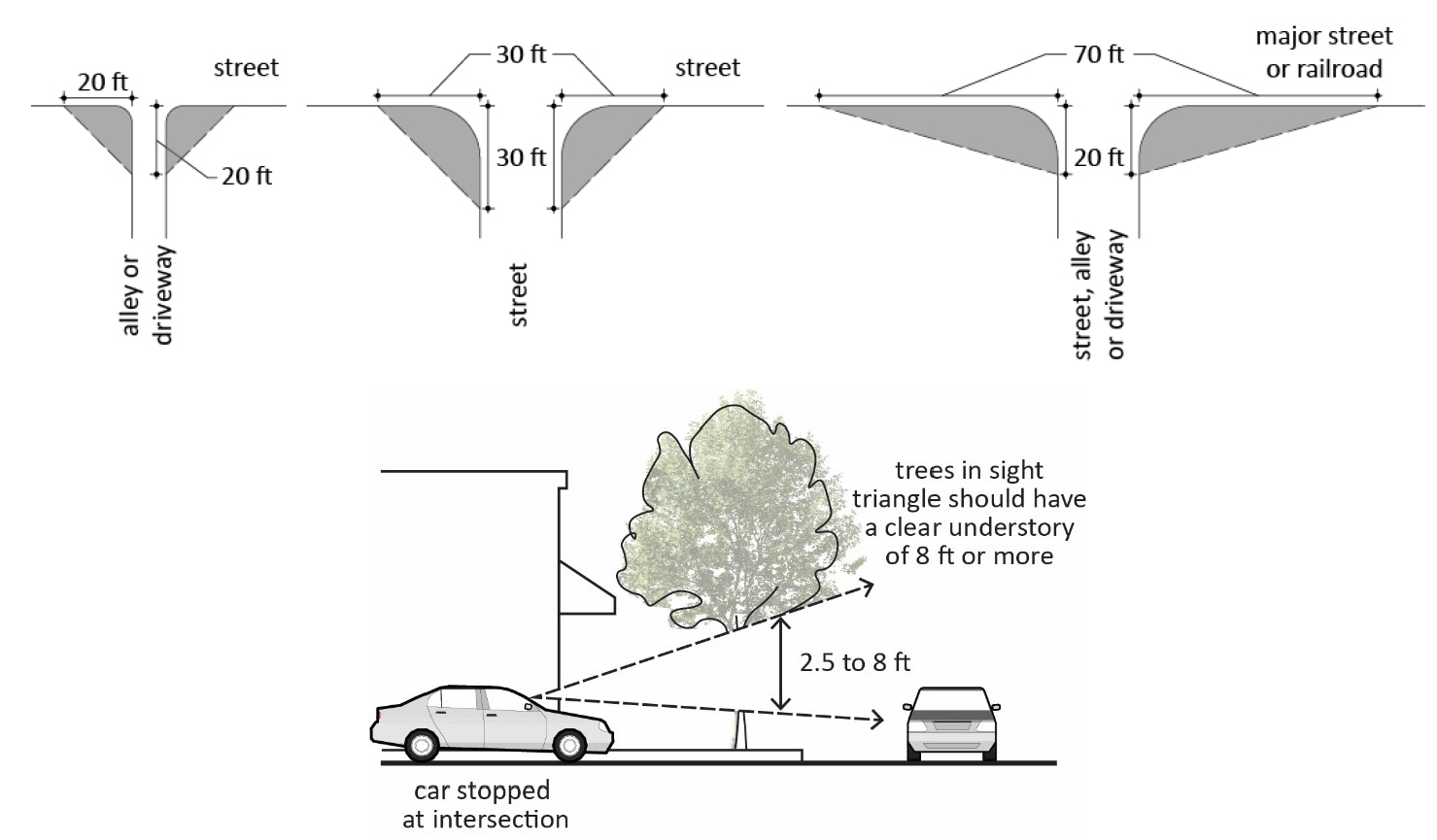
Sight Distance
3.08.02 Clearance for Vehicular and Pedestrian Movement. A clear height of at least eight feet above the walking surface must be maintained over any area intended for pedestrian use. However, the Zoning Official may permit vertical clearance no less than seven feet where an existing structure is of a design that makes compliance with this requirement impracticable. A clear width of at least five feet must be maintained at all points along a public sidewalk.
Sec. 3.09. - Fences, Walls, and Hedges.
3.09.01 The maximum height of fences, walls and hedges located in a front yard setback is four feet. Outside of the front yard setback, the maximum height of fences, walls, and hedges is eight feet, except as necessary for screening required by this Ordinance.
3.09.02 All fences and walls require a building permit; except that no permit is required for a fence on land used for farming or forestry in the AG District.
3.09.03 Fences and walls may not project into a right-of-way or impede intersection sight distance. See Section 3.05 Sight Distance, Clearance for Vehicular and Pedestrian Movement.
3.09.04 Fences and walls may not be built on or over any easement without approval of the entity having authority over the easement.
3.09.05 Fences and walls must not adversely affect draining or create debris build-up, nor impede access to metering devices or public utilities, including fire hydrants.
Sec. 3.10. - Common Open Spaces and Facilities.
For all proposals involving the creation of common open spaces or facilities, which may include subdivision entrances and signage, that are to be owned and maintained by the developer or a property owner association, the following apply:
3.10.01 If not owned and maintained by the developer, an association representing the owners must own the common open space or facility in perpetuity. Membership in the association is mandatory and automatic for all owners of the subdivision or condominium and their successors. The association must have lien authority to ensure the collection of dues from all members. The responsibility for maintaining the common open space and facilities is borne by the developer, association or property owners of the development.
3.10.02 Management Plan. The applicant must submit a plan for management of open space and/or common facilities that:
A.
Allocates responsibility and guidelines for the maintenance and operation of the common open space/facilities including ongoing maintenance and long-term capital improvements;
B.
Estimates the costs and staffing requirements needed for maintenance and operation of, and insurance for, the common open space/facilities and outlines the means by which funding will be secured;
C.
Provides that any changes to the plan must be approved by the Commission; and
D.
Provides for enforcement of the plan.
3.10.03 In the event the party responsible for the common open space or facilities fails to maintain all or any portion in reasonable order and condition, the City may assume responsibility for its maintenance and may enter the premises and take corrective action, including extended maintenance. The costs of such maintenance may be charged to the association or to the individual owners that make up the association and may include administrative costs and penalties. Costs may become a lien on all involved properties.
Sec. 3.11. - Parking and Storage of Certain Vehicles.
3.11.01 Automotive vehicles or trailers of any kind without current license plates, or which are inoperable or disabled for a period of five consecutive days, may not be stored or parked on any residentially-zoned property, whether occupied as a residence or not, or on property used for residential purposes in a nonresidential district except in an enclosed building or within the rear yard if fully screened from off-premise. For the purposes of this section, a vehicle is deemed inoperable or disabled if it is unable to operate on the streets and roadways of the State of Alabama in full compliance with the various provisions of the Code of Alabama, 1975.
3.11.02 Recreational vehicles may be stored in any district but only if parked in the side or rear yard, or in an accessory structure conforming to the requirements of this Ordinance. The Zoning Official may permit keeping of recreational vehicles in the front yard of a residential corner lot provided the sight distance and other public safety standards are otherwise met. No such equipment may be used for living, sleeping, or housekeeping purposes when parked or stored on a residential lot or in any location not approved for such use.
Sec. 3.12. - Tree Protection.
Every attempt should be made to protect and save existing trees on a development site, except for those trees removed to allow for the erection of the building and other improvements. Whenever possible, a tree or group of trees to preserved must have a barrier constructed to the drip line of the tree, or group of trees, as approved by the Zoning Official.
Sec. 3.13. - Farm Animals.
Except as provided for keeping of chickens on the premises of detached single-family dwellings in accordance with Section 7.10 Keeping of Chickens, horses, cattle, sheep, pigs, fowl and other farm animals are allowed only in the AG District.
Sec. 3.14. - Donation Bins.
3.14.01 Donation Bins are allowed as an accessory use on nonresidential premises only and may only be placed with permission of the property owner and only upon approval of an applicable permit by the Zoning Official.
3.14.02 Location of donation bins must be approved by the Zoning Official before being placed on premises.
3.14.03 Donations Bins may not encroach on any required parking, loading or landscaping and may not interfere with vehicular circulation on or off the premises.
3.14.04 Donated goods must be collected regularly so as not to allow accumulation of goods outside of containers. Receptacles must display the name of the owner or sponsor, their address, telephone number, and contact person responsible for collection. All donated goods accumulating outside of containers must be collected within 48 hours of notice by the City.

