Enterprise City Zoning Code
ARTICLE 6
- SPECIAL DISTRICTS
Sec. 6.01.- AG Agricultural District.
This District is intended to provide space within the city to continue agricultural and forestry operations and to preserve land for future urban use when the demand for land for development and availability of services warrant such development and property may be rezoned for a more intensive use.
6.01.01 Uses. Refer to Table 6-1.
A.
Refer to Section 7.16 for temporary uses.
B.
All uses not classified as permitted or Special Exception uses are prohibited.
6.01.02 All uses must comply with the area and dimensional requirements in Table 6-2.
A.
Whenever there is more than one dwelling allowed on a lot, there must be at least 15,000 sf of lot area provided for each dwelling.
Table 6-1 Permitted Uses, AG District
Table 6-2 Area and Dimensional Requirements, AG District
Sec. 6.02. - HC Highway Corridor Overlay District.
6.02.01 Purpose. Recognizing the special nature of certain thoroughfares and the direct and indirect impacts of the appearance of these roadways and their importance to the local economy, the Highway Corridor Overlay District is intended to ensure that development in these areas is visually pleasing and economically viable. Whenever there is a conflict between the regulations of the overlay district and underlying zoning, the more restrictive applies.
6.02.02 These regulations apply to new development and redevelopment in all lots, parcels and tracts that are zoned B-1 and B-3 that border Highways 27, 84, 134, 167, 192 and 248, excluding any M-1, M-2, B-2 zoned property and any property within the Downtown Overlay.
6.02.03 Definitions. As used in this Section, certain terms are defined as follows:
A.
Cladding: The exterior surface material of a building
B.
Exterior insulation and finish system (EIFS): An exterior wall cladding using rigid insulation boards on the exterior of the wall sheathing with a plaster appearance.
C.
Front Façade: That building elevation facing the street. Buildings on corner lots are considered to have two front façades. In the case of multi-building developments, building elevation facing the primary internal circulation area are also considered front facades.
D.
Masonry: Brick, stone, precast concrete, poured concrete and architectural-grade concrete block (split-face, textured and colored-aggregate)
6.02.04 Building Materials.
A.
Exterior cladding materials for front facades are limited to: approved masonry; glass; wood; hard-coat stucco; EIFS; cement fiber board; corrugated, standing seam and flat panel metal siding.
B.
Approved masonry must be used as at least 50% of the cladding on front facades and 30% of the cladding on all other facades. Window (including glass curtain walls) and door openings are excluded from this calculation.
C.
Vinyl siding may not be used as cladding. Vinyl may only be used for soffits and other trim material.
D.
Rib or R-panel metal siding may not be used on front facades and may not comprise more than 50% of other facades.
E.
Non-architectural quality concrete block may only be used along the building foundation and may not extend above finished floor elevation of the first floor.
6.02.05 Landscaping. Vehicular area landscaping, screening and buffers must be provided as required in Article 10 except as follows:
A.
Frontage Landscaping. A landscaped yard of at least 15 ft in depth must be provided and maintained along all front property lines and planted in accordance with the requirements in Section 10.04.03, Frontage Landscaping.
B.
When a fence or wall meeting the standards in Section 10.05 is provided as part of frontage landscaping, the landscaped yard may be reduced to no less than eight feet in depth.
6.02.06 Other Site Standards.
A.
All structures must be set back at least 20 ft from the front property line.
B.
All garages, car washes and other service bays must be set back at least 40 ft from the front property line.
6.02.07 Signs. Signs are subject to Article 9 and the following:
A.
The design and materials of all signs must be consistent with that of the structures on the site.
B.
All metallic poles and structural elements must be covered entirely in masonry, stone, wood, decorative metal or similar non-structural cladding material. The painting of metal surfaces alone is not sufficient to meet this requirement.
C.
Freestanding signs may be mounted on a base not exceeding four feet in height. If such base contains any lettering, symbols or other graphics legible from the street right-of-way, its area is counted as part of the allowable sign area.
6.02.08 Lighting. Light or glare from any operation and all lighting for parking areas or for the external illumination of buildings or grounds shall be directed or located in such a manner such that direct or indirect illumination from the source of light shall not exceed one foot candle when measured from any property line adjoining a residential district. Outside lights for nonresidential properties/uses must be made up of a light source and reflector so that, acting together, the resulting light is controlled and not directed across an adjacent property.
(Ord. No. 07-16-24, § 1, 8-20-24)
Sec. 6.03. - Planned Residential District.
6.03.01 General Provisions.
A.
Purpose. The Planned Residential District is intended to provide optional methods of residential development and compatible uses developed at a relatively large scale and to allow flexibility in overall design and types and density of dwelling units.
B.
Community objectives. Planned developments are afforded more flexibility than provided through conventional zoning regulations to:
(1)
Enable choice in housing type, lot size and neighborhood design;
(2)
Preserve trees, slopes, wetlands, flood prone areas and natural drainage patterns and limit disruption of natural features; and
(3)
Promote efficient development patterns that result in economically designed infrastructure.
C.
Applicability.
(1)
No amendment of this Ordinance affects a PRD approved prior to such amendment. The approved PRD Development Plan may continue in accordance with the Zoning Ordinance in effect at the time of such prior approval. Should the PRD Development Plan approval expire or be voided, any newly submitted PRD Development Plan must conform to the regulations in effect at the time of the new submittal.
(2)
All provisions of the Zoning Ordinance and Subdivision Regulations apply except where specifically addressed in this Section and within the approved PRD Development Plan.
6.03.02 General Requirements.
A.
Minimum area. Each PRD must contain at least ten acres of contiguous land. A smaller land area may be considered provided evidence of one or more of the following conditions:
(1)
The project is consistent with the developmental goals of the Comprehensive Plan for the particular location;
(2)
The minimum acreage requirement is impractical due to ownership, existing development patterns and similar constraints;
(3)
The design concept integrates the development into and minimizes any potential adverse impacts on the surrounding neighborhood or business area;
(4)
The arrangement of uses, buildings, streets, parking, open spaces and amenities could not be reproduced on the site under conventional zoning regulations.
B.
Community benefits. The applicant must demonstrate that, in exchange for the flexibility conferred by PRD designation, the development will feature one or more of the following benefits:
(1)
All buildings will feature quality, durable materials.
(2)
Driveways, garages and parking areas will not dominate public views along streets.
(3)
Residential developments will feature a range of housing types and sizes appropriate to different stages in life.
(4)
Usable open spaces will be provided in accessible locations throughout the development. A greater amount of common open space will be provided in more intensively developed portions of the development.
(5)
Paths will be provided to enable the safe movement of residents, on foot or bike, throughout the development and to adjoining neighborhoods and community destinations.
C.
Proposed common areas are subject to Section 3.10 Common Open Spaces and Facilities.
6.03.03 Development Standards.
A.
Each PRD must include a residential subdistrict and may also include a mixed-use subdistrict. Mixed-use subdistricts may not exceed 30% of the total tract area of any PRD planned development.
B.
Uses. Refer to Table 6-3 and the following.
(1)
Uses indicated with "P" are permitted by right in that subdistrict whether or not they are specifically identified in the approved PRD Development Plan.
(2)
Uses indicated with "SE" are permitted by right in those locations specified for such uses in the approved PRD Development Plan. If no location is identified for such use in the approved PRD Development Plan, Special Exception approval from the Board of Adjustment (see Section 12.06) must be obtained before a building permit may be issued for such use.
(3)
Uses not indicated with "P" or "SE" and those that are not specified in Table 6-3 are prohibited unless expressly approved by the Council as part of the final approval of the PRD Development Plan and rezoning. If approved, the use is subject to any conditions the Council deems necessary for approval and may only be developed in the location specified with such approval. Any prohibited use not expressly included in the approved PRD Development Plan requires amendment of the PRD Development Plan by the Council before a building permit may be issued for such use.
(4)
All uses are subject to the applicable requirements in Article 7 Use-specific Regulations unless otherwise provided for in the approved PRD Development Plan.
C.
Density and setbacks must conform to the standards in Table 6-4. Requirements greater than or in addition to those in Table 6-4 must be specified in the PRD Development Plan.
D.
Open Space Standards. Common open space must be provided as shown in Table 6-4. No designated common open space may be subdivided, reduced in area or used for any other purpose unless approved through an amendment to the PRD Development Plan. The following are not counted toward meeting open space requirements:
(1)
Open spaces that are only accessible from the lots that abut them;
(2)
Parking areas;
(3)
Remnant strips of land less than 40 ft wide at their narrowest.
6.03.04 Procedure.
A.
Application. Application for PRD zoning must be accompanied by a Preliminary PRD Development Plan. Refer to the appendix for submittal requirements for Preliminary PRD Development Plan.
B.
Commission, Council Action.
(1)
Within 30 days after holding a public hearing on a PRD rezoning request and approval of the Preliminary PRD Development Plan, the Commission will make a recommendation for approval, approval with changes, or denial to the Council; or, with consent of the applicant, table its recommendation to allow time for further review or for the applicant to make requested changes.
(2)
Upon receipt of the Commission's recommendation, the Council will conduct a public hearing on the rezoning request. Rezoning approval by the Council establishes the maximum density, maximum number of dwelling units and land use composition in each subdistrict of the proposed PRD.
(3)
After PRD zoning has been established, no building permit may be issued, and no grading, clearing, excavation or filling may take place, until the Commission has approved the PRD Development Plan. The applicant has 180 days from rezoning approval to submit the PRD Development Plan to the Commission. Upon the applicant's request, the Zoning Official may extend this time period by 60 days. If not submitted within this period, the Council may take action to revert the zoning to its previous classification.
(4)
The proposed PRD Development Plan must conform to the density and uses approved with the PRD rezoning and should incorporate any modifications recommended or required as conditions by the Council. How conditions specified by the Council are addressed should be clearly indicated by the applicant in the proposed PRD Development Plan.
(5)
For PRD developments requiring subdivision approval, the Preliminary Plat of all or a portion of the development may be considered at the same Commission meeting as that of the PRD Development Plan.
(6)
Within 30 days after holding a public hearing on the PRD Development Plan, the Commission will approve, approve with changes, or disapprove the PRD Development Plan; or, with consent of the applicant, table its recommendation to allow time for further review or for the applicant to make requested changes. If disapproved by the Commission, the applicant may appeal the decision to the Council.
C.
Effect of PRD Development Plan Approval.
(1)
All properties in an approved PRD are bound by the standards in its PRD Development Plan, even if subsequently sold, unless and until the PRD Development Plan is voided by the City. In the case of multiple ownership, the approved PRD Development Plan is binding on all owners.
(2)
No use of the property, nor construction or alteration of any use or structure is permitted in conflict with the approved PRD Development Plan.
(3)
Upon approval of the PRD Development Plan, subdivision approvals, building and other required permits are issued in the same manner as applies generally.
(4)
The Board of Adjustment may not grant variances that would have the effect of amending an approved PRD Development Plan.
D.
Amendments. The Zoning Official may approve changes that are incidental or minor in scope. The following changes must be referred to the Commission and may be considered without additional public hearings. Any change that would increase the permitted density or number of dwelling units or reduce the amount of open space must be approved as an amendment after a public hearing by the Council:
(1)
A change in land use boundaries, provided there is no increase in overall density or total number of dwelling units in each subdistrict and no reduction in the amount of open space;
(2)
Rearrangement of streets and any reduction in pedestrian and bicycle facilities;
(3)
Reductions in setbacks, lot area or lot width greater than five percent;
(4)
Increases in building height greater than five percent;
(5)
A reduction of off-street parking or loading space greater than five percent;
(6)
Changes to the Development Schedule.
Any deviation from the PRD Development Plan in conflict with the above limits constitutes a violation of this Ordinance.
E.
Failure to Begin Construction. Construction of the approved development must begin within one year of PRD Development Plan approval. If the development is to be constructed in phases, the construction of each phase must begin within one year of the construction start times for that phase as provided for in the approved development schedule. Failure to comply with this provision constitutes a violation of this Ordinance.
Table 6-3 Permitted Uses, Planned Residential District
Table 6-4 Area and Dimensional Requirements, Planned Residential District
1. Where specified in the approved PRD Development Plan, buildings may be constructed with a zero setback provided the buildings on the adjoining lot are set back the same or are required by the PRD Development Plan to be set back at least ten feet from the shared lot line.
2. Does not apply to townhouses.
(Ord. No. 01-07-25-B, § 3, 2-4-25)
Sec. 6.04. - PBD Planned Business District.
6.04.01 Purpose. The Planned Business District is intended to accommodate development of uses, which due to their inherent nature and proposed location, may require special conditions to protect adjoining properties from adverse impacts.
6.04.02 General Provisions.
A.
Developments within a Planned Business District must be laid out, developed and used according to a Development Plan prepared in accordance with this Article.
B.
The uses permitted are those prescribed in Table 6-5. The use of each building or premises must be in accordance with the Development Plan approved as part of the rezoning.
C.
Setbacks, lot size and building height are subject to Table 6-5. Requirements greater than or in addition to those in Table 6-5 may be required as conditions on the Development Plan.
Table 6-5 Planned Business District
6.04.03 Procedure. The procedure for PBD rezoning is as described in Section 13.05 Amendments except as follows:
A.
The rezoning application must be accompanied by a preliminary Development Plan as prescribed in Section 13.03 for the review and recommendation of the Commission.
B.
The following criteria are used in the review of the rezoning request and preliminary Development Plan:
(1)
That the value and character of property adjacent to the tract under consideration will not be adversely affected;
(2)
That the proposed development is consistent with the intent of the Comprehensive Plan and of this Ordinance to promote the public health, safety and general welfare;
(3)
That the preliminary Development Plan meets the requirements of all other regulating bodies; and
(4)
That an approved method of sewage disposal is available to the tract under consideration.
C.
If, within 365 days from the effective date of the rezoning, a complete building permit application has not been submitted, the Council may take action to revert the property to its previous or another zoning classification.
D.
Applications for plat approval or for building permits must be accompanied by a site plan delineating the location of proposed buildings, parking and loading areas, streets, egress, and pedestrian facilities; the locations, size, character and number of signs; the location and character of exterior lighting; and the character and extent of landscaping.
E.
The Zoning Official may not issue a building permit unless the site plan conforms to the applicable requirements of this Ordinance and the approved Development Plan.
Sec. 6.05. - Downtown Overlay District.
6.05.01 Purpose. This District is intended to guide future development and redevelopment toward creating an attractive and vibrant urban pattern that balances the pedestrian and traffic needs of residents, while it protects and enhances the original pattern of development. The design and land development standards are intended to be flexible and encourage design diversity and variation. Development criteria will ensure that the architectural integrity and details of existing significant structures are maintained and will affirm the appropriateness of new development.
6.05.02 Mixed-Use Buildings.
A.
Vertical, mixed-use construction is encouraged in the Downtown Overlay District to the extent permitted by the underlying zoning.
B.
Except for live-work units, neither the basement nor first floor of buildings may be used for residential purposes.
C.
The dwelling portion of a live-work unit may be accessible from the nonresidential portion of the building. Otherwise, exterior access to upper-story dwellings must be separate from that of the businesses and, to the degree practicable, should not be located on the front façade. If the access is located on the front façade, it must be consistent with the style and materials used along the storefront but clearly signed to distinguish dwelling access from business access.
D.
For new construction, at least one private parking space must be provided and reserved for each upper-story dwelling unit.
6.05.03 Balconies.
A.
The City Council must approve any encroachment into a public right-of-way by any balcony structure. Insurance must be maintained by the property owner. No building permit may be issued without Council approval of the encroachment. Any change in design after the Council approves the encroachment must be re-submitted to the Council before a building permit may be issued.
B.
No portion of a balcony may obstruct required pedestrian clearance. See Section 3.08.02.
C.
Balconies may not project closer than 2.5 ft to the curb line extended vertically.
D.
Balconies must meet all applicable requirements of the Building Code, must be waterproofed and horizontal surfaces sloped to drain water away from the structure.
E.
Those portions of a balcony within the right-of-way may have a roof or similar cover but may not be enclosed. Railings and posts must be of durable wood, metal or similar material specifically approved by the Building Official.
6.05.04 Exterior Building Materials. The following design standards shall apply to new construction, additions, and alterations to commercial and mixed-use buildings and structures unless otherwise specified.
A.
Approved Materials. Exterior walls must be finished in brick, wood, concrete formed or assembled as stone, precast concrete panels with a finish to simulate stucco texture, polished stone, or glazed brick or tile.
B.
Prohibited Material. Vinyl siding, aluminum siding, rolled asphalt, precast concrete panels with smooth finish, fiber cement wood simulated horizontal lap siding, fiber cement panels, Exterior Insulation Finishing Systems (EIFS), T-111 plywood siding, ceramic-based coatings and sealers on the siding.
C.
Exceptions. The Board of Adjustment may allow the use of a prohibited material through approval of a Special Exception. Such requests will be heard only upon receipt of a recommendation from the Main Street Design Committee.
6.05.05 Signs.
A.
Freestanding signs may not be taller than four feet, may not be larger than 40 sf in area and must be made of approved materials.
B.
Wall signs may not be larger than 80 sf or 2.25 sf per linear foot of façade per tenant, whichever is less. No more than one wall sign is permitted per tenant per street-facing façade.
C.
Nonfunctioning electronic signs and signs deteriorated to the extent that their message is no longer legible must be removed or repaired within 30 days of notice by the Zoning Official.
D.
The Zoning Official may require that wall, window and freestanding signs installed by a tenant who has not occupied a building for a period of six months or longer be removed or covered.
6.05.06 Building Maintenance. Buildings must be maintained free of degraded exterior conditions, such as but not limited to; rot, peeling or faded paint, rust, and dirt buildup. Such conditions must be corrected upon notice by and with the timeframe specified by the Zoning Official.
6.05.07 Alleyways. Garbage may be placed in alleyways for collection only in an approved City garbage receptacle. Otherwise, alleyways must be kept clear of any storage or other accumulation of materials, equipment or waste from the tenants in adjoining buildings.
6.05.08 Prohibited Uses.
A.
Storage of materials or equipment of any kind not accessory to the use of the premises is prohibited. Materials, goods and equipment of any kind in violation of this must be removed within two years of the effective date of this ordinance. This does not apply to currently operating mini-warehouses.
B.
Outdoor storage is prohibited.
6.05.09 Vacant Buildings. Vacant buildings, which were originally built for commercial or business activities, must be registered with the City, and their owners must maintain a valid Vacant Building Permit for each such vacant building. A registration fee of $500 must be paid at the time of application or renewal. No permit may be issued or renewed prior to fee payment. Each permit is valid for up to three months.
A.
Waivers may be granted upon a showing that the building or structure is being actively marketed for sale or lease and maintained pursuant to the requirements of this Section 6.05 and its vacant building permit or renewal thereof. Waivers may be issued for no more than 4 permit periods, not including any interim permit period that occurs within a permit period. Vacant building permit fees, once a building is sold to a new owner, are waived for the remainder of the permit period and the permit period immediately following.
B.
Waivers may be granted when a building is being rehabilitated pursuant to applicable building and fire permits and the owner has spent at least 5% of the assessed valuation of the building or structure on rehabilitation, not including the cost of permits, in the prior 3-month period.
C.
Waivers may be granted when an owner secures all required permits to demolish the building or structure. The owner must demolish the building or structure within 3 months of securing said permits; this waiver shall be void and the vacant building permit fee shall be owed if the owner fails to demolish within this time. The time to demolish may be extended upon a showing of good cause.
D.
When a waiver is requested, the full fee must nonetheless be paid with the waiver request. The fee will be refunded by the City if the waiver is granted.
Sec. 6.06. - A-Z Airport Zoning Districts.
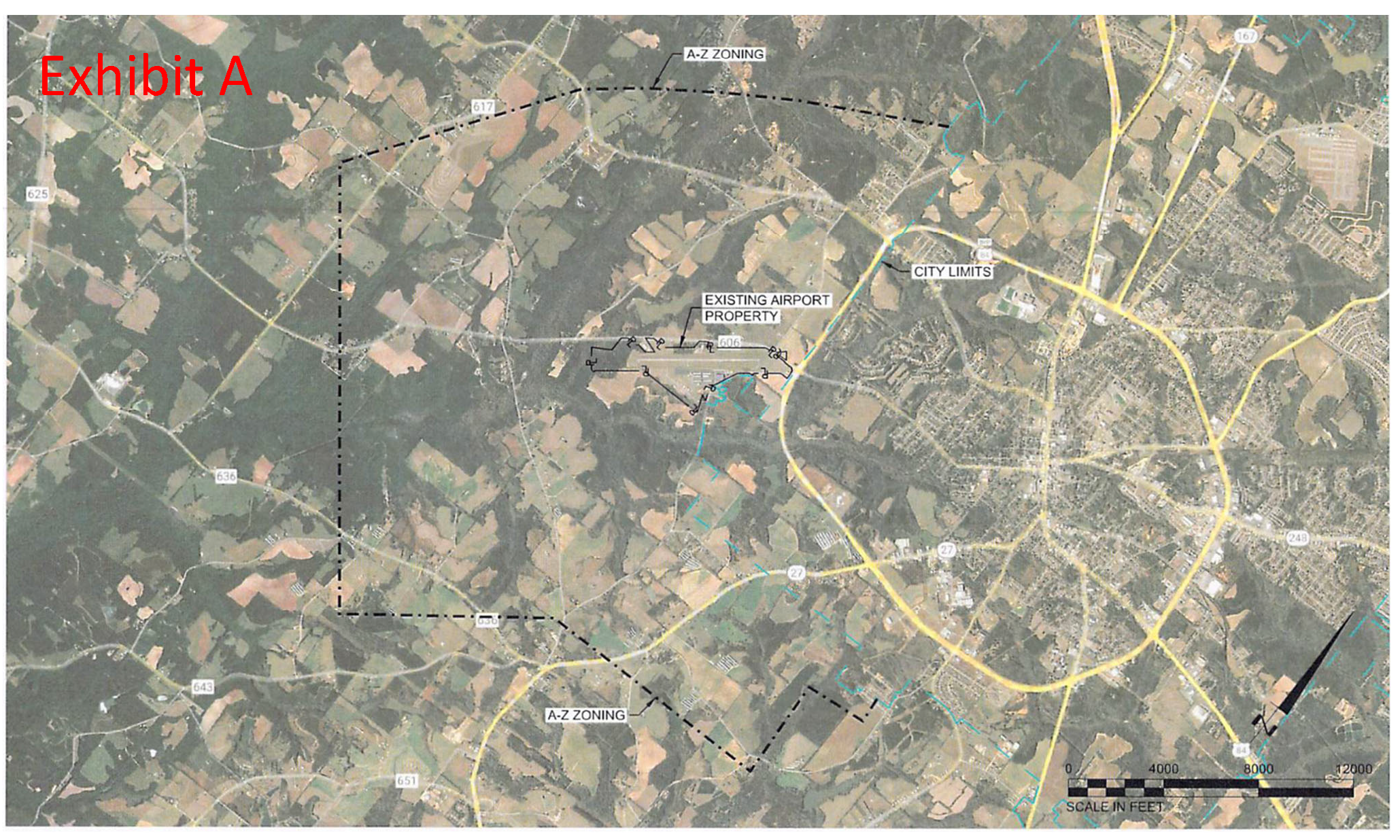
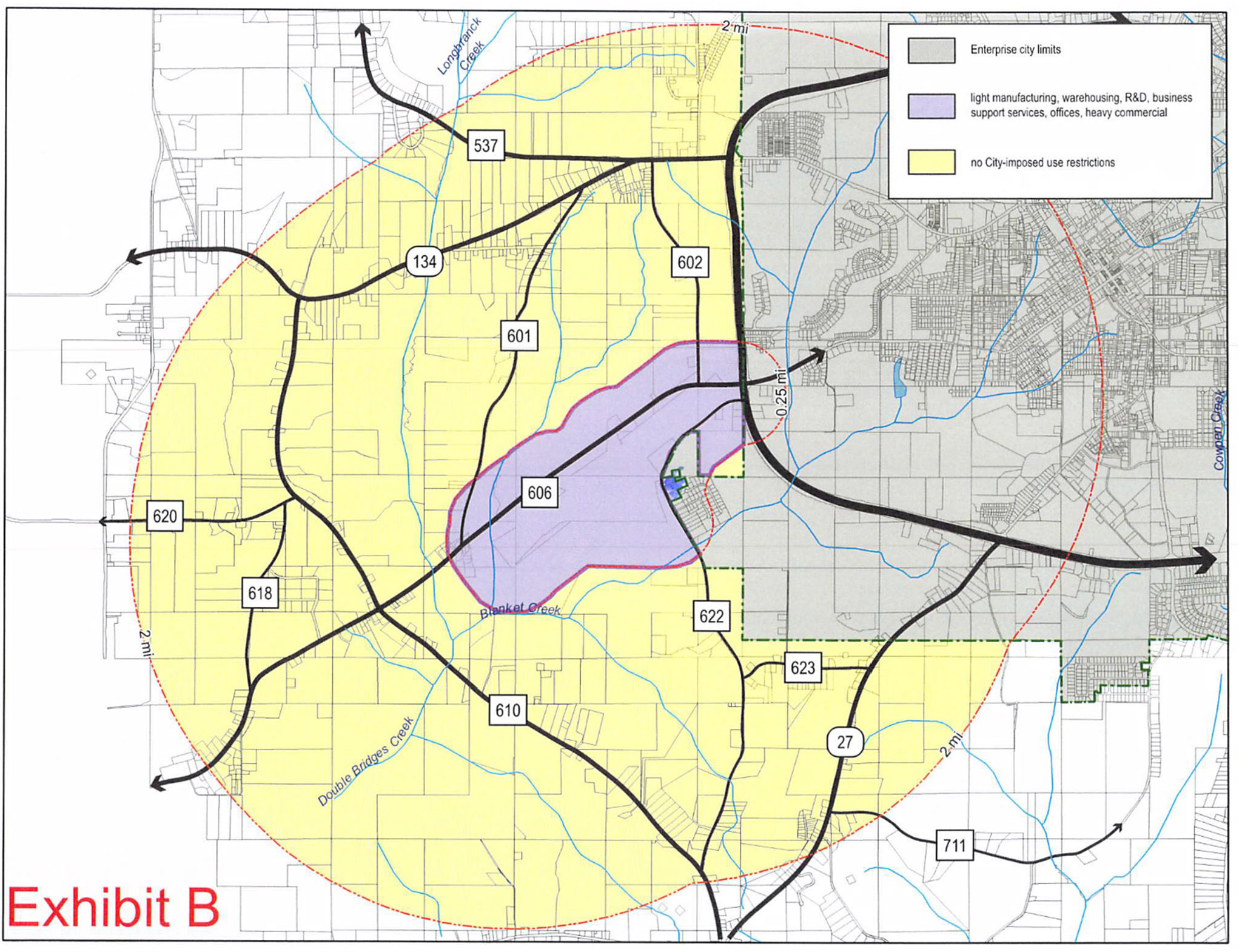
6.06.01 Designation of Airport Zoning Districts (AZ). All the real property, not heretofore zoned, within two miles of the boundaries of the Enterprise Municipal Airport (said boundaries as set out in the attached map, see Exhibit A attached hereto and incorporated by reference herein) shall bear the designation "AZ Airport Zoning District". All said real property shall comply with the rules and regulations of this Ordinance, except as otherwise expressly provided. The Council, after recommendation of the Planning Commission shall be empowered to enact, although not obligated to do so, further zoning in AZ districts in accordance with existing or future ordinances related to zoning real property and district uses set out therein, all in accordance with the Act and said ordinances. Therefore, there shall be a new zoning district established at this time known as AZ District which shall apply as shown on Exhibit B attached hereto and incorporated herein by reference. Said Exhibit B shows the planned/future use restrictions of the real property in AZ Districts, and includes areas where no city-imposed use restrictions exist, except as expressly provided by this Ordinance, and except as may from time to time be provided for by Coffee County or as otherwise may be provided by future action of the City in accordance with this or any other applicable ordinance of the City. In AZ Districts with specific use restrictions, if a rule or regulation of Coffee County conflicts with the provisions of the ordinance from which this section derives, it is intended that the terms of this ordinance shall govern.
6.06.02 Variances. Any person desiring to erect any structure, or increase the height of any structure, or otherwise use his property in violation of airport zoning regulations adopted under this section, may apply to the Zoning Board of Adjustment for a variance from the zoning regulations in question. Such variances shall be allowed where a literal application or enforcement of the regulations would result in practical difficulty or unnecessary hardship and the relief granted would not be contrary to the public interest but do substantial justice and be in accordance with the spirit of the regulations; provided, that any variance may be allowed subject to any reasonable conditions that the Board may deem necessary to effectuate the purposes of this section.
6.06.03 Permits and nonconforming uses.
A.
Before any new structure or use may be constructed or established and before any existing use or structure may be substantially changed or substantially altered, a permit must be obtained from the Building Official. A permit fee of $25.00 per permit shall be owed, subject, however, to the provision that no permit shall be required as to uses and structures on any real property which carries the designation of "No Use Restriction imposed by City" as set out on Exhibit B, unless a structure is over 25 ft in height.
B.
Nothing in this section or any airport zoning regulations adopted under/pursuant to this section shall require the removal, lowering or other change or alteration of any structure not conforming to the regulations when adopted or amended or otherwise interfere with the continuance of any nonconforming use, except as provided in this section. Nonconforming uses shall be discontinued and removed in case of being abandoned, destroyed, deteriorated or decayed. However, before any nonconforming structure or tree may be replaced, substantially altered, rebuilt, allowed to grow higher or replanted, a permit must be secured from the Building Official of the city, authorizing such replacement or change; but no such permit shall be required to make maintenance repairs to or to replace parts of existing structures which do not enlarge or increase the height of an existing structure. No permit shall be granted that would allow the establishment or creation of an airport hazard or permit a nonconforming structure or tree or nonconforming use to be made or become higher or become a greater hazard to air navigation than it was when the applicable regulation was adopted or than it is when the application for a permit is made.
C.
In granting any permit or variance under this section, the Building Official, may, if they respectively deem such action advisable to effectuate the purposes of this section and reasonable in the circumstances, so condition such permit or variance as the case may be so as to require the owner of the structure or tree in question to permit the city, at its own expense, to install, operate and maintain thereon such markers and lights as may be necessary to indicate to flyers the presence of an airport hazard, upon payment to the owner for all damage resulting to his/her its property by such maintenance. Such shall be the right but not the obligation of the City.
D.
Any denial of such permit as set above may be appealed to the Board within 15 days of written denial by the Building Official, by delivering a notice of appeal to the Engineering Department or otherwise, the decision of the Building Official shall be final.
6.06.04 Enforcement of rules and regulations of this section/powers. The Building Official, Planning Commission or the Board of Adjustment, all as the case may be, shall have and exercise the following powers as designated:
A.
To carry out those acts as designated by this section.
B.
To review site plans in areas zoned A-Z which designate permitted uses (Planning Commission).
C.
To hear and decide any special exceptions to the terms of the airport zoning regulations upon which such agency may be required to pass under such regulations (Board).
D.
To authorize in specific cases such variance from the terms of the this section as will not be contrary to the public interest, where, owing to special conditions, a literal enforcement of the provisions of this section will result in unnecessary hardship, and so that the spirit of this section shall be observed and substantial justice done. (Board)
E.
The applicable agency or person designated above shall not be required to return the original papers acted upon by it, but it shall be sufficient to return certified or sworn copies thereof or of such portions thereof as may be called on by such writ. The return shall concisely set forth such other facts as may be pertinent and material to show the grounds of the decision appealed from and shall be verified.
F.
The Board and Planning Commission as the case may be, shall adopt rules in accordance with the provisions of this section or resolution by which it was created. Meetings of said agencies shall be held at the call of the chairman and at such other times as the agency may determine. The chairman, or in his absence the acting chairman, may administer oaths and compel the attendance of witnesses. All hearings of the agency shall be public. The agency shall keep minutes of its proceedings, showing the vote of each member upon each question, or, if absent or failing to vote, indicating such fact, and shall keep records of its examinations and other official actions, all of which shall immediately be filed in the office of the agency and shall be a public record.
6.06.05 Appeals.
A.
Any person aggrieved by any decision of the Planning Commission or Board or any governing body of the City, as the case may be, which is of the opinion that a decision of such an administrative agency is an improper application of airport zoning regulations of concern to such governing body or board or commission may appeal to the circuit court of the county where such airport is located.
B.
All appeals taken under this section must be taken within 10 days by filing with the agency from which the appeal is taken a notice of appeal specifying the grounds thereof. The agency from which the appeal is taken shall forthwith transmit to the court all the papers constituting the record upon which the action appealed from was taken.
C.
An appeal shall stay all proceedings in furtherance of the action appealed from, unless the agency from which the appeal is taken certifies to the court, after the notice of appeal has been filed with it, that by reason of the facts stated in the certificate a stay would, in its opinion, cause imminent peril to life or property and file bond to indemnify the owner for damages as may be fixed by the court. In such cases proceedings may be stayed upon the filing by the appellant of a supersedeas bond in an amount to be set by the circuit court of the county in which the subject matter of such decision lies on application by the appellant or the agency from which the appeal is taken.
D.
The court may, in conformity with the provisions of this section, reverse, affirm wholly or partly, or modify the order, requirement, decision or determination appealed from and may make such order, requirement, decision or determination as ought to be made and to that end shall have all the powers of the administrative agency from which the appeal is taken.
6.06.06 Remedies. In case any building or structure is erected, constructed, reconstructed, altered, repaired, converted or maintained, or any structure or land is used in violation of this section or other regulation made under authority conferred by the Act, city officials of the city, in addition to other remedies as set out by this Zoning Ordinances, as amended, may institute any appropriate action or proceedings to prevent such unlawful erection, construction, reconstruction, alteration, repair, conversion, maintenance or use, to restrain, correct or abate such violation, to prevent the occupancy of such structure or land or to prevent any illegal act, conduct, business or use in or about such premises.
6.06.07 This section cumulative unless conflict. This section is cumulative of the existing zoning ordinance, as amended, and is only intended to amend those portions of the ordinance which are amended as set out above. Otherwise, the zoning ordinance, as amended, remains in full force and effect and unchanged.
6.06.08 Severability. If any section, sentence, clause, phrase, or part of this ordinance is for any reason declared to be invalid by the valid judgment or decree of a court of competent jurisdiction, such decision shall not affect any remaining sections, sentences, clauses, phrases, or parts of this section.