
Enterprise City Zoning Code
ARTICLE 7
- USE-SPECIFIC REGULATIONS
Sec. 7.01.- Accessory Dwellings.
Accessory Dwellings may only be permitted as an accessory use to a permitted single-family detached dwelling in accordance with the following:
7.01.01 Permit Required. An Accessory Dwelling Permit is required for all accessory dwellings. Accessory dwellings may be maintained in perpetuity but only in compliance with these regulations. Any accessory dwelling permit will automatically expire whenever:
A.
Required off-street parking is no longer provided on the premises
B.
In the R-1 and R-2 Districts, the permittee ceases to own or reside on the premises
7.01.02 Because the R-1 and R-2 Districts are intended for single-family detached dwellings, an accessory dwelling may only be permitted when the owner of the principal dwelling resides on the premises. This ensures that the accessory dwelling remains subordinate to the principal dwelling.
7.01.03 Area and Dimensional Requirements. Accessory dwellings are permitted only on lots of at least 14,000 sf. If the principal dwelling is not connected to sanitary sewer service, minimum lot requirements of the health department or similar authority apply to each of the dwellings.
A.
Accessory dwellings must be set back from lot lines as required for the principal dwelling.
B.
The habitable floor area of an accessory dwelling must be at least 200 sf but not more than 50% of the gross floor area of the principal dwelling or 1,000 sf, whichever is more restrictive. Detached accessory dwellings are subject to the cumulative area permitted for accessory structures.
7.01.04 Additional Requirements
A.
Separate utility meters are not permitted for accessory dwellings.
B.
No more than one accessory dwelling is permitted on the lot of a single-family detached dwelling.
C.
Accessory dwellings may not be used for short-term rental purposes.
D.
One parking space, in addition to that required for the principal dwelling, must be provided.
E.
Accessory dwellings must comply with the Building Code and be installed on a permanent foundation.
F.
Accessory dwellings may not have separate vehicular access along the same street frontage as the principal dwelling.
G.
An accessory dwelling may not be sold separately from the principal dwelling unless there is sufficient lot area to subdivide the property into lots meeting the area and dimensional requirements of the district.
H.
If an existing residential garage is converted to an accessory dwelling, off-street parking requirements for the principal dwelling and accessory dwelling must be met concurrently with the conversion.
Sec. 7.02. - Alternative Financial Services.
Alternative Financial Services, including but not limited to collateral loan/exchange, payday loan, title loan businesses and check cashing establishments, are recognized, particularly when several are concentrated in a given area, to have deleterious effects upon adjacent areas, detract from property values and can have adverse effects on the general welfare. Therefore, not more than two such uses are hereafter permitted within 1,000 ft of each other, as measured between the nearest property lines.
Sec. 7.03. - Bed and Breakfast.
The following standards apply to Bed and Breakfast establishments in residential districts only:
7.03.01 Bed and Breakfasts are permitted only in detached, single-family dwellings and must be operated by the owner and resident of the dwelling.
7.03.02 One parking space must be provided for each guest room, in addition to the spaces required for the dwelling. Such additional required parking spaces must be screened from adjacent properties and arranged so that each space has direct access to a driveway. Recreational vehicle parking is prohibited except on lots one acre or larger in size. If permitted, recreational vehicle parking is subject to Section 3.11 Parking and Storage of Certain Vehicles.
7.03.03 Food service is limited to overnight guests of the Bed and Breakfast. No dining facilities may be open to the general public. Guest rooms may not contain cooking equipment.
Sec. 7.04. - Cemeteries.
7.04.01 All cemeteries must have direct access to a public street with ingress and egress designed to minimize traffic congestion.
7.04.02 The minimum site area for a new cemetery is ten acres.
7.04.03 Structures, materials and internments must be set back at least 35 ft from any adjoining lot line, except where adjoining another cemetery.
7.04.04 Internments must be set back at least 150 ft from any well used for drinking water purposes.
Sec. 7.05. - Conservation Subdivision.
7.05.01 Intent.
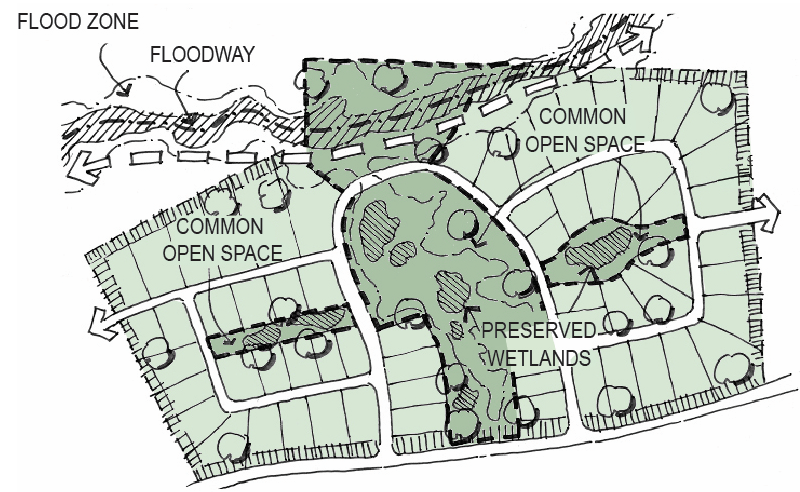
A.
To provide flexibility to accommodate development on lands constrained by natural hazards that may limit the amount or type of development;
B.
To promote the creation of accessible green space;
C.
To protect sensitive, environmental land features to promote the public health and safety;
D.
To reduce erosion, sedimentation, land disturbance, and removal of vegetation; and
E.
To promote development of walking and bicycling facilities and greenways within new developments.
7.05.02 Applicability. The Conservation Subdivision option is available for single-family detached residential development of sites containing at least ten acres. If held in multiple ownership, the site must be developed according to a single plan with common authority and maintenance responsibility. The development must adhere to all other requirements of this Ordinance and the Subdivision Regulations.
7.05.03 Density Determination.
A.
The maximum number of lots is determined by dividing the total area of the proposed subdivision by the minimum lot size of the applicable district or, if septic tanks are to be used, by the minimum lot size required by the County Health Department. In making this calculation, the following may not be included in the total area of the tract:
(1)
Designated floodway;
(2)
Bodies of open water over 5,000 sf of contiguous area.
B.
The minimum total area for front, rear and side yards is 2.5 times the ground floor area of the dwelling unit. Separation between dwellings must be at least 14 ft.
7.05.04 Application Requirements.
A.
Site Analysis Map. The applicant must prepare and submit a site analysis map concurrently with the Development Plan or preliminary plat, as applicable. The purpose of the site analysis map is to ensure that important site features have been identified prior to the creation of the site design.
B.
Conservation Subdivision Plan. As part of the Development Plan or preliminary plat, the applicant must prepare a Conservation Subdivision Plan yielding no more lots than identified under Section 7.05.03 Density Determination. The Conservation Subdivision Plan must identify open spaces to be protected and include an open space management plan, all of which must be submitted and approved prior to the issuance of a grading permit.
C.
Instrument of Permanent Protection. An instrument of permanent protection, as described in Section 7.05.06, must be placed on the open space at the time of issuance of a grading permit.
7.05.05 Open Space Management Plan. For the purposes of this Section, "open space" is defined as the portion of a Conservation Subdivision that has been set aside for permanent protection. Activities within the open space must be restricted in perpetuity by a legal instrument approved by the City Attorney.
A.
Standards.
(1)
At least 20% of the total area of the tract must be maintained as open space.
(2)
The following are considered priority conservation areas and must be included within the open space, unless the applicant demonstrates that this would constitute an unusual hardship and be counter to the purposes of the Conservation Subdivision:
(i)
The 100-year floodplain;
(ii)
Riparian zones of at least 75 ft width along all perennial streams;
(iii)
Slopes above 25% of at least 10,000 sf contiguous area;
(iv)
Delineated wetlands
(v)
Archaeological sites, cemeteries and burial grounds
(3)
The following are considered secondary conservation areas and should be included within the open space to the extent practicable:
(i)
Historic sites;
(ii)
Existing trails that connect the site to neighboring areas;
(iii)
Existing healthy, native forests of at least one-acre contiguous area;
(iv)
Other significant natural features and scenic viewsheds, particularly those that can be seen from public roads.
(4)
Utility rights-of-way and small areas of impervious surface may be included within the protected open space but cannot be counted towards the 20% minimum area requirement (exception: historic structures and existing trails may be counted). Large areas of impervious surface, such as portions of streets, parking and loading areas, are not counted toward the open space requirements.
(5)
At least 25% of the open space must be suitable for passive recreational use.
(6)
At least 50% of the open space must be in a contiguous tract, which may be divided by a local street. The layout of open space should allow connection to neighboring open spaces.
(7)
To the extent practicable, the open space should be accessible to the largest number of lots and/or buildings within the site. Non-adjoining lots must be provided with access to the open space through sidewalks or off-street walkways.
B.
Permitted Uses of Open Space.
(1)
Conservation of natural, archeological and historical resources
(2)
Meadows, woodlands, wetlands, wildlife corridors, game preserves, and similar conservation-oriented areas
(3)
Agricultural and forestry activities, only if conducted according to best management practices
(4)
Passive recreation areas, walking, bicycle and similar trails
(5)
Active recreation areas, if they are limited to no more than 20% of the total open space and are not located within primary conservation areas. Active recreation areas may include playing courts and similar impervious surfaces necessary to the recreational activity.
(6)
Landscaped stormwater management facilities, community and individual wastewater disposal systems. Such facilities must be located outside of primary conservation areas.
(7)
Easements for drainage, access, and underground utility lines
(8)
Other conservation-oriented uses compatible with the purposes of this Section.
C.
Prohibited Uses of Open Space.
(1)
Golf courses.
(2)
Streets, parking and loading areas and similar impervious surfaces, except as specifically authorized in the preceding subsections.
(3)
Other activities established by the applicant and recorded on the legal instrument for permanent protection.
7.05.06 Ownership, Management and Protection of Open Space.
A.
Responsibility for management of open spaces must be established in accordance with Section 3.10 Common Open Spaces and Facilities.
B.
The open space must be protected in perpetuity by one of the following binding legal instruments, which must be recorded with the deed and include clear restrictions on use of the open space in accordance with this Section:
C.
A permanent conservation easement in favor of either:
(1)
a land trust or similar conservation-oriented nonprofit organization with legal authority to accept such easements. The organization must be bona fide and in perpetual existence and the conveyance instruments must contain an appropriate provision for retransfer in the event the organization becomes unable to carry out its functions; or
(2)
a governmental entity with an interest in pursuing goals compatible with the purposes of this Subsection, and if the entity accepting the easement is not the City, then a third right of enforcement favoring the City must be included in the easement.
D.
A permanent restrictive covenant for conservation purposes in favor of a governmental entity.
E.
An equivalent legal tool that provides permanent protection, as approved by the City Attorney.
Sec. 7.06. - Cottage Development.
7.06.01 General Standards.
A.
Cottage Developments are permitted only on sites served by public water and sewer services.
B.
Cottage Developments may be subdivisions, in condominium form or a combination.
C.
Cottage Developments must include at least four dwellings but not more than ten dwelling lots that do not have street frontage, subject to the following:
(1)
Each lot must front on and have a main entry facing the Common Open Space, except those lots, nearest the fronting street, may front on the street or Common Open Space.
(2)
The rear of dwellings may not face toward a street, except in the case of a double-frontage tract, the rear of cottage lots may be oriented toward the street of higher classification.
(3)
Lots must be readily accessible for fire suppression purposes as determined by the Fire Chief during subdivision plat review.
7.06.02 Area and Dimensional Requirements.
A.
Minimum Lot Width, Setbacks.
(1)
The lot width and side yard setback prescribed for detached single-family dwellings in the applicable district do not apply. Spacing between cottage dwellings must be at least five feet, which may include zero-lot line arrangements.
(2)
Dwellings must be set back at least 20 ft from all exterior lot lines and must observe the front yard setback for the district along all street frontages.
(3)
No setback is required between a dwelling and the common open space; however, no portion of a building may encroach into or over the common open space.
B.
Minimum Common Open Space: 250 sf per unit and not less than 40 ft in width at any point.
C.
Permitted Total Floor Area per Dwelling:
(1)
One-Story units: no more than 1,200 sf.
(2)
1-1/2 and Two-story units: no more than 1,600 sf.
D.
Maximum Height: two stories.
7.06.03 Ownership and Management of Open Space. See Section 3.10 Common Open Spaces and Facilities.
7.06.04 Parking must be provided as required for detached single-family dwellings and may be clustered together or provided individually at the rear of each home. Clustered parking areas must be screened from the common open space and from streets and adjacent residential uses.
Sec. 7.07. - Emergency and Transitional Care Homes.
No emergency care home or transitional care home may be located within 1,000 ft of an existing emergency care home or transitional care home.
Sec. 7.08. - Home Occupations.
7.08.01 Permitted home occupations include but are not limited to: internet-based businesses, artistic and design services, telephone sales, catering, tax preparation, off-site instruction, child day care homes, child day care group homes, on-site music, dance and art instruction, on-site sales and personal services subject to the limits herein, and other activities which the Zoning Official determines to be substantially similar in nature, intensity, or impact to these.
7.08.02 All home occupations must meet the following standards:
A.
No more than one person other than persons residing on the premises may be employed by the home occupation.
B.
The home occupation must clearly be secondary and incidental to the use of the dwelling unit as a residence.
C.
The appearance of the dwelling unit may not be altered, nor may the home occupation be conducted in any way that would cause the premises to differ from its residential character and that of the immediate neighborhood.
D.
Home occupations must be conducted entirely within the principal building and/or accessory structure. There may be no outside display or storage of materials, goods, supplies, or equipment used in the home occupation.
E.
Home occupations are limited to two students, customers, clients or other visitors at any one time.
F.
No traffic may be generated by the home occupation in greater volumes than would normally be expected in a residential area. Any need for parking generated by the home occupation must be provided off the street and other than in the required front yard.
G.
The operation of a home occupation may not create any nuisance such as excessive traffic, noise, vibration, glare, odor, fumes, dust, heat, fire hazards, electrical interference or fluctuation in line voltage, or be present or noticeable beyond the property boundaries of the home occupation premises. Any occupations involving fabrication, cooking or other processes that present a greater risk of fire hazard are subject to any conditions for approval required by the Fire Marshal.
7.08.03 Procedure.
A.
Any person desiring to operate a home occupation must submit an application to the Zoning Official. The applicant must present evidence of ownership of the property in question, or a signed and notarized letter from the owner authorizing the application. The Zoning Official has ten calendar days in which to act on an application.
B.
Action taken pursuant to this ordinance does not mean that other regulations, rules, covenants, deed restrictions or other matter would prohibit such action.
C.
Final approval of a home occupation is contingent upon the applicant obtaining a valid business license from the City.
Sec. 7.09. - Junkyards.
7.09.01 No junkyard may be established closer than 300 ft to an established residential district.
7.09.02 All outdoor storage of salvage and wrecking operations must be completely screened in accordance with Section 10.02 Screening.
7.09.03 The storage of wrecked automobile, junk, or salvaged materials may not exceed six feet in height.
Sec. 7.10. - Keeping of Chickens.
The following standards apply to the keeping of chickens in any residential district.
7.10.01 Chickens may be kept only on the premises of an occupied detached single-family dwelling with a lot size of at least 14,000 sf subject to the following maximum allowances:
A.
Lots of 14,000-19,999 sf: one hen.
B.
Lots of 20,000 sf to 29,999 sf: two hens.
C.
Lots of 30,000-39,999 sf: three hens.
D.
Lots of 40,000 sf and larger: one hen per 10,000 sf of lot area.
7.10.02 Roosters are prohibited.
7.10.03 Chickens, coops and runs may be kept only in the established rear yard. Except when under the personal control of the resident, chickens must be confined within a coop or run at all times.
7.10.04 Coops and runs are subject to accessory structure setback requirements. No structure for the keeping of chickens may be located within 50 ft of the nearest dwelling other than that of the owner.
7.10.05 The activity and associated structures must be maintained in a condition such that no odors or noises are produced that create a nuisance for adjoining properties. Coops, runs and yard areas must be cleaned regularly to prevent accumulation of waste that will produce nuisance odor.
7.10.06 In the event of an odor, noise or other nuisance complaint, the Code Compliance or Animal Control Officer will inspect the premises and issue a violation accordingly. Violations are subject to penalties as provided in Section 13.07 Penalties and Remedies.
Sec. 7.11. - Keeping of Honeybees.
7.11.01 Approval Requirements.
A.
The keeping of honeybees may only be conducted by the person or entity owning or leasing the subject property.
B.
Keeping of honeybees may only be permitted on lots of at least 14,000 sf in area and requires approval from the Board of Adjustment in accordance with Section 12.06 Special Exceptions. All apiaries and colony numbers must be approved by the Board before any colonies are maintained, kept or harbored.
C.
The requirements of this Ordinance must be observed regardless of whether there is an existing or subsequent use, from which apiaries must be separated, adjoining the subject property. For example, if a dwelling is later established on adjoining property, which causes the apiary to be closer to the new dwelling than permitted, the apiary must be removed or relocated as necessary to comply with this Section.
D.
Apiaries must comply with all applicable state and federal regulations and laws.
E.
Nothing in this Section is intended to override or otherwise allow the keeping of honeybees on any real property where deeds, covenants or other private restrictions prohibit the keeping of honeybees.
7.11.02 Genetic Stock.
A.
Only strains of known European origins to comprise colonies of honeybees may be used. No other types of honeybees may be kept.
B.
Once Africanized honeybees have been confirmed by a recognized authority as inhabiting any area of Alabama, beekeepers must re-queen their colonies annually with queens of known European origin. Queen stock must be obtained from a reputable queen breeder who produces queens from European stock and is not under federal quarantine. Honeybees may not be obtained from areas where Africanized honeybees are found or exist.
C.
Receipts of purchases of honeybees, including, but not limited to, queens must be kept and produced upon request by the enforcement authority. At all times said records and the real property must remain open for inspection by the Code Enforcement Department, which has the right, but not the obligation, to make such inspections.
7.11.03 Additional Requirements.
A.
The keeping of honeybees must be separated by at least 100 ft from any dwelling, other than that of the beekeeper, and at least 300 ft from any school, place of worship, hospital, public building, park, playground or swimming pool.
B.
Colony density. The number of bee colonies that may be kept on real property may not exceed the following, as approved by the Board of Adjustment, which may adjust the number of colonies based on the circumstances of the request:
(1)
Lots of 14,000 sf up to one acre: four colonies..
(2)
Residentially-zoned lots greater than one acre: six colonies.
(3)
Agriculturally-zoned lots greater than one acre but less than two acres: six colonies.
(4)
Agriculturally-zoned lots of two acres or more: eight colonies.
C.
Colonies must be set back at least 25 ft from the nearest lot lines.
D.
Colonies must be placed behind a solid fence or flyway, meaning a permanent vertical, solid structure made of common building materials that augments a honeybee's flight path at least six feet in height that is parallel to the property line and extends at least six feet beyond the colonies in each direction. All flyways must be forced over a minimum of six feet levels.
E.
A convenient source of water must be provided and available at all times, especially when colonies are actively rearing brood, and in times of extreme heat.
F.
Should honeybees swarm onto any property within 1000 ft of the subject property, the beekeeper must retrieve said swarm, provided permission is obtained from the property owner where the swarm is located.
G.
Honey may not be sold or offered for sale in any residential zone without approval as a home occupation.
H.
Signage must be maintained on their property clearly visible from the public right of way fronting the subject property stating "Honey Bees Kept Outdoors Here."
I.
In the event of any change in use or subdivision of a property on which honeybees are kept, either the new use or lot must meet the requirements herein or the colonies removed or relocation as necessary to comply with Section.
7.11.04 Nuisance. The keeping or harboring of colonies of bees in a manner that would render the enjoyment of life or property uncomfortable to others, or interfere with the public health, safety and general welfare is deemed a nuisance and a violation of this Ordinance subject to Section 13.07 Penalties and Remedies.
7.11.05 Penalties.
A.
Any person violating any provision of this Section is guilty of a misdemeanor and will, upon conviction thereof, be punished pursuant to section 11 of the Code of Ordinances for the City, and will be adjudicated by the municipal court or other court of competent jurisdiction.
B.
In addition to and cumulative of all other penalties, the City has the right to seek injunctive relief for any or all violations of this Section.
Sec. 7.12. - Mini-warehouses.
7.12.01 The use of storage compartments is limited to the storage of personal property. However, this does not preclude periodic auctions held on the premises to dispose of abandoned items.
7.12.02 No storage of volatile, toxic or explosive materials is permitted inside a storage structure or on the premises.
7.12.03 Alleys between storage buildings must be wide enough to allow two cars to pass each other.
7.12.04 Any outdoor storage must be screened from public view and from adjoining properties as required in Section 10.02 Screening.
Sec. 7.13. - Multifamily development.
7.13.01 Multifamily developments with buildings containing five or more dwelling units are subject to the following standards. Any multifamily development involving subdivision or resubdivision requires Development Plan approval (see Section 13.03) by the Commission to assure that the layout of buildings, open spaces, circulation, drainage and infrastructure is in harmony with the equivalent standards of the City Subdivision Regulations.
7.13.02 Site Development Standards.
A.
The arrangement of buildings, open spaces, parking areas and drives must be suitable to existing topography to avoid extensive grading.
B.
Buildings must be spaced no less than the sum of their lengths divided by three ((A+B)/3), or 90 ft whichever is less (see Figure 7-1). In no case may buildings be placed closer together than 20 ft. Building spacing is measured perpendicularly from the longer of the two building walls at the closest point between them.
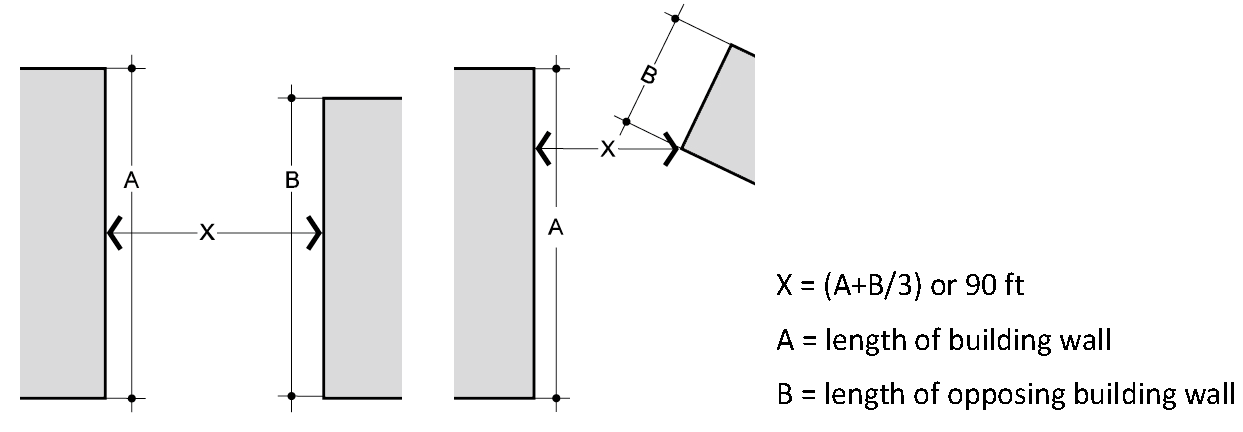
Figure 7-1: Minimum Building Spacing
C.
Multifamily buildings may not be surrounded on all sides by parking and driveways. On at least one side of each multifamily building, there must be an open space of at least 40 ft in depth, another building or the property boundary.
D.
Parking and Driveways.
(1)
Common and individual garages, if provided, must be oriented so that the garage doors do not face public street views.
(2)
Boats and recreational vehicles may not encroach into required parking and may not be kept forward of the front building line.
(3)
The number and location of access points to a public street must be as required by the City Building and Fire Codes.
E.
Open Space. For the purposes of this section, "improved open space" means open space created or modified for resident use, including but not limited to parks, playgrounds, swimming pools, ball fields, plazas, landscaped common areas.
(1)
At least 20% of the site must be permanently reserved as open space. All common open spaces and recreational areas must be well maintained in a safe and orderly condition.
(2)
At least 50% of the required open space must be improved and maintained as open space for the use of residents and guests. Improved open spaces should be consolidated into one or a few central locations to assure accessibility and usability and must be oriented to receive adequate sunlight.
(3)
Required setback and buffer areas do not count toward open space requirements. Spaces must be large enough to support leisure and recreational activity; no dimension may be less than 15 ft. Gazebos, pavilions and similar open structures for the use of residents are permitted in improved open spaces.
(4)
Improved open space must be graded and sodded, at a minimum, to accommodate use by residents, and must be adequately drained to prevent ponding.
F.
Stormwater Management. Stormwater retention or detention facilities should be integrated into the design of parking areas and open spaces as landscape amenities. Stormwater facilities located within an open space may be counted as improved open space if designed so that it need not be fenced and is appropriately landscaped as an amenity.
G.
Service, Loading and Waste Collection. Each development must be provided with service areas for waste collection. Each such area must be located away from public views but accessible to residents and to vehicles for collection purposes and paved with concrete.
H.
Fire Protection.
(1)
No portion of any building may be located farther from a fire hydrant than may be reached with 500 ft of hose.
(2)
Every multifamily building must be accessible to fire trucks and equipment as approved by the Fire Department.
I.
Pedestrian Access Standards.
(1)
Walkways must connect the pedestrian circulation system to adjacent public streets.
(2)
If not already provided, a publicly accessible sidewalk at least three feet wide must be provided along all public street frontages.
(3)
Walkways must connect the main entrances of all buildings. For buildings fronting on a public street, a public sidewalk may be counted toward this standard. Walkways must be provided that connect building entrances to parking areas and common areas and facilities.
J.
Traffic Impact Study and Plan. A traffic impact study and plan, prepared by a Traffic Engineer, may be required as part of Development Plan review. In such cases the study must be prepared in accordance with generally accepted standards for traffic studies and must show the effect that traffic generated will have on the area adjacent to and near the site. The study must make recommendations with respect to what additional traffic controls will be needed adjacent to or near the site. The developer must pay the cost of any such signals and/or devices if required.
K.
Multifamily developments may not be later subdivided unless the resulting properties each meet all requirements of this Section, Section 3.10 Common Open Spaces and Facilities and all other applicable requirements of this Ordinance and the City Subdivision Regulations.
7.13.03 Applicability to Existing Development. If an existing multifamily building, which does not conform to the standards in this Section 7.13, is damaged or destroyed, the Zoning Official may permit the building to be rebuilt without requiring it or its site to be made to conform to such standards, provided, however, that the building conforms to the Building Code in effect at the time of its reconstruction. The building may be rebuilt provided all other existing buildings in the development conform with the existing property maintenance code and no public nuisances exist at the time of construction.
Sec. 7.14. - Recreational vehicle parks and campgrounds.
7.14.01 Park and Campground Standards.
A.
Minimum tract size: five acres.
B.
Minimum street frontage: 100 ft.
C.
All structures, camp sites and RV spaces must be set back at least 35 ft from all property lines.
D.
No recreational vehicle may be occupied by a person or family for more than 31 consecutive days. However, the Zoning Official may authorize longer occupancies for seasonal workers and military personnel upon receipt of sufficient evidence of seasonal employment or military status, as applicable.
E.
Perimeter landscaping must be provided on all sides of a recreational vehicle park as required for freestanding parking lot (see Section 10.04 Vehicular Area Landscaping).
F.
At least 5,000 sf for the first 20 RV spaces plus 150 sf for each additional RV space must be provided for recreational use of park occupants.
7.14.02 Standards for RV Spaces.
A.
Each RV space must be at least 500 sf in area. Spaces for non-motorized recreational vehicles must be large enough for the RV and the passenger vehicle pulling it unless parking is provided for the passenger vehicle elsewhere on site.
B.
Only one recreational vehicle may be located in each RV space.
C.
Spaces must be designed to provide at least 20 ft separation between RVs in adjoining spaces.
7.14.03 Parking and Access.
A.
At least one parking space must be provided for each camp site plus one parking space per employee. Parking spaces are not required to be paved but must be graded and surfaced as approved by the Building Official.
B.
All RV spaces and all parking, sanitary, recreation and other common facilities must be accessed from an internal vehicular drive designed to accommodate recreational vehicles.
C.
Vehicular drives must be maintained by the park owner or operator and open for access at all times to emergency vehicles.
D.
Vehicular drives must be surfaced with asphalt, crushed rock or other suitable, dustless material approved by the Zoning Official. Vehicular drives must be at least 12 ft wide for one-way traffic and 22 ft wide for two-way traffic.
7.14.04 Lighting. All vehicular drives and walkways providing access to restrooms and campground office must be adequately lighted for safety.
7.14.05 Sanitation.
A.
The following facilities must be provided, at a minimum, for the use of park occupants: two toilets and lavatories for each 15 camp sites and RV spaces or fraction thereof not provided with a water connection, two shower facilities and a washer and dryer.
B.
For any RV spaces not provided with drain inlets for discharge of toilets, dump stations designed to receive discharge of sewage holding tanks must be provided. Such stations must be set back at least 100 ft from all camp sites and RV spaces.
C.
Two-cubic yard or larger waste containers must be located within 300 ft of every RV space. Alternatively, the Zoning Official may approve the use of individual waste containers for each RV space provided the park operator provides for regular waste pickup from RV spaces.
D.
Dump stations and two-cubic yard and larger waste containers may not be closer than 30 ft to any property line and must be screened in accordance with Section 10.02 Screening.
7.14.06 Storm Shelter.
A.
Every Recreational Vehicle Park of ten or more RV spaces must be provided with storm shelter, which must have a minimum floor area of seven square feet for each RV space. However, the Zoning Official may waive storm shelter requirements if the RV park is within one-half mile of a public storm shelter. In such case, signage must be posted and maintained in one or more conspicuous locations providing directions to the public shelter.
B.
Storm shelters must be designed and constructed to meet all applicable City codes, ADA standards, and Federal Emergency Management Agency (FEMA) requirements and guidelines if the shelter is in a flood plain.
C.
The park owner or their designated agent is responsible for making the storm shelter accessible and usable in times of need. Required storm shelters may not be used for storage if such use reduces the floor area available for shelter below these requirements.
D.
For any addition of ten or more RV spaces to any existing park, a storm shelter that complies with the requirements of this section must be provided to serve such additional spaces. For any addition of fewer than ten RV spaces to an existing park there is no requirement that shelter be provided to serve such additional spaces. However, when two or more such additions result in a cumulative addition of ten or more RV spaces, a storm shelter which complies with these requirements must be provided.
E.
Any park of ten or more RV spaces which has an existing storm shelter, as of the effective date of the ordinance, which does not conform to the requirements of this section is considered nonconforming and may continue to exist as long as said existing shelter remains in place and usable; provided, however, any RV spaces added to such community after such effective date require storm shelters as provided herein.
Sec. 7.15. - Telecommunication Towers.
7.15.01 Definitions. As used in this Section, the following words and terms have the meanings as defined herein:
A.
Antenna. An electromagnetic device which conducts radio, cellular or other communication signals to or from a transmitter or receiver. Antenna includes devices commonly referred to as "whips", "panels" and "parabolic dishes" but does not include antennae for receiving only of radio or television signals.
B.
Co-Location Site. Land on which the antennae and related equipment of more than one party are located.
C.
Communication Facilities. Towers, antennae and equipment, collectively.
D.
Equipment. All equipment and facilities used in conjunction with one or more towers and/or antennae, including, but not limited to, electronic systems, generators, fuel tanks and fuel.
E.
Monopole. Any self-supporting pole designed to support an antenna; provided, that the word "monopole" does not include a latticed steel or metal tower, a tower which requires guy wires for support or a tower which has more than one source of support, such as a tower with more than one leg.
F.
Residential Property. Any land located in a Residential District and any property used exclusively for residential purposes in a Planned Residential District.
G.
Tower. Any telecommunication monopole including those used for microwave, cellular or personal communication service systems and any other telecommunication systems now or hereafter in use. "Tower" includes any telecommunication tower installed or constructed within the City prior to the effective date of this Ordinance, regardless of whether such tower is a monopole or another type of tower.
H.
Tower Compound. A parcel of land or a building on which Communication Facilities are located.
7.15.02 Required Approvals. No party may construct a tower or tower compound until after Special Exception approval, if required, and a Building Permit has been granted. The installation of an antenna on an existing tower is subject only to approval of the Zoning Official unless the tower compound is to be enlarged or there is a change in the size or location of the existing tower.
7.15.03 Applicability. All towers, antennae and equipment constructed or installed after the effective date of this Ordinance and any changes or additions to any tower or antenna in existence before the effective date of this Ordinance are subject to this Section. A tower proposed to be built on a co-location site is subject to the same requirements and conditions as all other towers. Routine maintenance of, and repairs to, the communication facilities, may be performed without City approval, though a permit may be required if applicable to the nature of the maintenance or repair activity.
7.15.04 Public hearing. Where Special Exception approval is required, the Board of Adjustments will hold a public hearing on each application for the construction of a tower.
7.15.05 Co-location. A new tower may not be constructed if space is available, on an economically reasonable basis, on an existing tower which is able to support the proposed antenna. An affidavit that reasonable effort has been made by the applicant to locate the proposed antenna on an existing tower must be submitted with the application for the construction of a new tower. Each tower must be designed to accommodate additional antennae to the fullest extent practicable.
7.15.06 Review Criteria. In considering whether to permit communication facilities, the approving authority will consider the following public health, safety, and general welfare criteria:
A.
Towers must comply with wind-load and other structural standards of applicable building and technical codes, and the electronic industries associations code.
B.
To the extent practicable, towers and tower compounds must be designed, through the use of building materials, colors, textures, screening and landscaping, so that their appearance is compatible with their surroundings.
C.
All communication facilities must comply with all applicable rules, regulations and requirements of the governmental agencies having jurisdiction over them. The approving authority may require the applicant provide evidence of such compliance.
7.15.07 Development Criteria. The approving authority may waive any one or more of the following requirements if the circumstances in the particular case justify such waiver.
A.
All towers must receive FAA approval and comply with height restrictions when in flight path of aircraft associated with the municipal airport or any Fort Novosel flight operation.
B.
All towers must be monopoles.
C.
Each tower compound must be large enough to provide room for a structure to contain the equipment for at least one additional antenna.
D.
No tower may be closer than 200 ft to the boundary line of any residential property. If the land on which a tower compound is located, and all land which abuts the tower compound, is in a nonresidential zoning district, the tower may not be closer than 50 ft to the nearest property line. These setbacks may be reduced in exceptional cases where, due to unusual topographic conditions, the enforcement of the setback requirements would result in unnecessary hardship; provided that the setback may not be reduced to less than the minimum setback required in the applicable district and that the reduction of the setback requirements may not be contrary to the health, safety and general welfare of the public.
E.
Material finishes and colors should be used that reduce the visibility of the tower.
F.
No signs may be attached to or depicted on a tower at a height more than 20 ft above grade level.
G.
Towers may not be illuminated except for warning beacons and as provided herein. Lights for security and maintenance purposes may be installed on structures which contain equipment. Such light must be pointed downward from a height of not more than 10 ft and may not exceed a maximum of 150 watts.
H.
Each tower compound must be secured by a dark colored, vinyl-coated or galvanized steel chain link security fence or masonry wall or combination thereof, at least eight feet in height.
I.
All tower compounds must be surrounded by landscaping to screen the view of the tower compound from adjacent public ways and residential property, which must consist of a landscaped strip, at least four feet in depth, located outside of the security fence and planted with a combination of trees, shrubs, vines, and/or ground covers. All fences, walls and landscaping must be kept in good condition. In isolated, nonresidential areas, alternative landscaping methods may be permitted on the condition that if the areas surrounding such tower compound become developed, the City may require the owner of the tower compound to comply with the requirements herein.
J.
Existing mature tree growth and natural landforms must be preserved to the maximum extent practicable. In some cases, such as tower compounds located on large, wooded lots, preservation of natural growth around the tower compound may be considered by the approving authority in determining buffer requirements.
K.
A parking area and driveway of asphalt, concrete or other all-weather surface approved by the Zoning Official must be provided for each tower compound for service access and for access by emergency services.
7.15.08 Removal of Unused Towers. Any tower which is no longer in use for its permitted purpose must be removed at the owner's expense. Within ten working days of sending notice to the FCC of the intent of the owner to cease use of the tower, the owner must provide the Zoning Official with such notice. The owner must remove the tower and all communication facilities used in connection with it within 180 calendar days from the day the tower ceases to be used or as required by the FCC. If the owner does not remove the tower from the tower compound within the required time period, the property owner, if different from the tower owner, must remove it within 180 calendar days of receiving written notice from the City. If the tower is not removed within the time prescribed, the City may remove the tower and may recover the cost of doing so from the tower owner and/or the property owner.
A shared tower may continue provided it is in use by at least one party. Any party who ceases to use a shared tower must remove its antenna from the tower and its equipment from the tower compound within 90 calendar days after it ceases to use the tower, or as prescribed by the FCC, so that the tower and compound will be available for use by another party.
7.15.09 Application. Applications to construct a new tower or to install an antenna or additional equipment on an existing tower compound, must include the following:
A.
Name and address of the party responsible for maintenance and repair of the communication facilities. If a different person becomes responsible for maintenance and repair, the owner of the tower must give the City written notice of the person's name and address.
B.
Names and addresses of all owners of property adjoining the subject property
C.
A written statement concerning the steps the applicant has taken to comply with all applicable rules, regulations, and requirements concerning health and safety matters related to the proposed communication facilities.
D.
A site plan scaled to not less than one-inch equals 50 ft, showing the location and dimensions of the subject property, setback lines, driveways, parking areas, fencing, landscaping, and generators and the location, size and type of any fuel tanks. The site plan must also show:
(1)
All parcels located within 500 ft of the tower compound.
(2)
Zoning classification of the property and of all parcels adjoining the subject property, including any in an adjoining municipality.
(3)
The latitude, longitude, section, township, range, tax parcel identification number, street address and the site identification number of the proposed tower compound.
(4)
Such other information as may be required by the approving authority to determine compliance with this Section.
E.
Elevation views: a silhouette and elevation view of the proposed or existing tower, as applicable, all other communication facilities, and the tower compound, describing colors and materials to be used for the communication facilities and any fencing or walls. The configuration of proposed antenna arrays must be shown on the silhouette. The proposed location of future, additional antenna arrays must be shown on the silhouette by dashed lines.
F.
Frequency band and wattage: The frequency band and maximum wattage of proposed communication facilities.
G.
The estimated life of the tower, the antenna and the equipment.
H.
Affidavit: An affidavit of the applicant stating that: 1) there is no existing tower from which the area to be served from the proposed new tower can be served; or 2) the applicant has made good faith efforts to have its antenna installed on an existing or proposed tower (from which the area proposed to be served by the new tower could be served) and has been unable to do so and giving a written narrative of the efforts made to use such existing or proposed tower.
I.
Certification of Shared Use Design. If the tower to be used is one on which there is already one or more antennae, the application must be accompanied by a certification by an engineer that the tower is able to accommodate the proposed antenna in a safe and functional manner.
7.15.10 Foundation Survey, As-Built Certification. After the foundation for a tower is poured, a foundation survey, prepared by a surveyor, showing the location of the foundation, must be furnished to the Zoning Officer, and no further work may be done with respect to the construction of the tower until the Zoning Officer has approved the foundation. Upon completion of work, the tower and antenna or the antenna, as the case may be, may not be put into operation until a qualified engineer furnishes the City written certification that such construction or installation was completed in accordance with the plans approved by the city.
Sec. 7.16. - Temporary Uses.
7.16.01 Authorization, Exemptions. Temporary uses are permitted only as expressly provided for in this Section. The following are exempt from the provisions of this Section:
A.
Merchandise for sale occupying a permanent, outdoor display area used in conjunction with a permanent business
B.
Merchandise located in a temporary display area which does not occupy required parking spaces, driveway aisles or required landscaping areas, and for which customers must enter a permanent business on the same lot to make a purchase.
7.16.02 Permit required. All temporary uses require a temporary use permit unless specifically exempted herein.
A.
Applications for a permit are made on forms provided by the Zoning Official. If deemed necessary by the Zoning Official due to the size, potential impact and duration of the temporary use, applications must include a site plan as specified in the Appendix.
B.
If not the property owner, the applicant must present a notarized letter from the owner granting permission for use of the property.
C.
A fee covering the cost of reviewing the application, issuing the permit and inspecting the site must be submitted with the application. Permit fees are in addition to any required bonds. Fees are waived for fundraising events held by nonprofit organizations.
7.16.03 General provisions.
A.
Temporary commercial uses are permitted only in nonresidential and agricultural zoning districts, unless otherwise specified in this Section.
B.
Sanitary facilities must be provided if permanent facilities are not available on premises.
C.
The applicant must provide parking for the patrons of the temporary use. It is the responsibility of the applicant to guide patrons to approved parking and to prevent unlawful parking.
D.
Any traffic control specifically required by the Police Department is the responsibility of the applicant.
E.
The site must be cleared of all debris by the expiration of the permit. Any temporary structures must be removed within seven days of the expiration of the permit, however, an exception may be granted by the Zoning Official for produce sales structures. The City may require a cash bond in an amount adequate to ensure that the site is cleared of all debris after the close of the temporary use. Instead of a bond, the applicant may present a signed contract with a waste disposal company, which must be included with the permit application.
F.
Serving of alcoholic beverages is not allowed except by permit from the City Council.
7.16.04 Permitted temporary uses. The following are permitted subject to the criteria provided. The Fire Marshal and Zoning Official must inspect all uses before occupancy.
A.
Carnival or circus.
(1)
Permitted in INST, B-1, B-2 and B-3 Districts only.
(2)
Maximum length of permit is 30 days.
(3)
Signs are permitted as follows:
(i)
Total area of all signage directed toward public streets may not exceed 100 sf.
(ii)
Signs must be set back at least 20 ft from all lot lines.
(iii)
No more than one freestanding sign is permitted.
(4)
Hours of operation are limited to between 10:00 a.m. and 11:00 p.m.
B.
Christmas Tree Sales.
(1)
Permitted in nonresidential and agricultural districts.
(2)
Maximum length of permit is 45 days.
(3)
Signs are permitted as follows:
(i)
Total area of all signage directed toward public streets may not exceed 100 sf.
(ii)
Signs must be set back at least 20 ft from all lot lines.
(iii)
No more than one freestanding sign is permitted.
(4)
Hours of operation are limited to between 10:00 a.m. and 10:00 p.m.
C.
Contractor's office and construction equipment sheds.
(1)
Permitted in any district where use is incidental to construction project on the same property.
(2)
Maximum length of permit is one year.
(3)
Must be removed no more than five days after issuance of the Certificate of Occupancy.
(4)
Signs are permitted in conjunction with construction project as specified in Article 9.
D.
Events of Public Interest.
(1)
Permitted events: outdoor concerts, auctions, athletic events, street fairs and associated concessions, and other similar events.
(2)
Permitted in all business and institutional districts and property owned by the City, County Commission or any public or private school or place of worship.
(3)
Signs are permitted, in addition to any existing permanent signage, as follows:
(i)
Total area of all signs posted at the entrance may not exceed 200 sf, with no one sign greater than 100 sf.
(ii)
No more than one freestanding sign is permitted.
E.
Public fundraising events by nonprofit organizations.
(1)
Permitted only in nonresidential districts, unless conducted in conjunction with an approved nonresidential use in a residential district.
(2)
Permitted events: car washes, bake sales, fruit sales, and similar activities conducted by nonprofit organizations to raise tax exempt funds.
(3)
No activities or signs may be located in the public right-of-way.
F.
Real estate sales office.
(1)
Permitted in any district when used in conjunction with an approved subdivision, whether residential or nonresidential. The office may not contain any sleeping or cooking accommodations. A model home may serve as a temporary office but may not be occupied as a dwelling while being used as an office.
(2)
Maximum length of permit is one year or until all lots in the subdivision are developed; whichever expires first.
(3)
Only signs permitted in Article 9 may be displayed in conjunction with the office.
G.
Tent Assembly.
(1)
Permitted in nonresidential and agricultural districts. Permitted in residential districts as a Special Exception (see Section 12.06).
(2)
Maximum length of permit is 15 days.
(3)
Signs are permitted as follows:
(i)
Total area of all signage directed toward public streets may not exceed 100 sf.
(ii)
Signs must be set back at least 20 ft from all lot lines.
(iii)
No more than one freestanding sign is permitted.
H.
Seasonal sale of farm produce.
(1)
Permitted in business, industrial and agricultural
(2)
One six-month permit may be issued during each twelve-month period.
(3)
Sales areas, including produce stands, vehicles used as stands, and sheds, may encompass no more than 200 sf. Sales areas must be set back at least 20 ft from all lot lines. Entrances and exits must be at least 50 ft from the nearest intersection, measured from the intersection of rights of way. This does not apply to previously approved driveways.
(4)
Signs are permitted as follows:
(i)
Total area of all signage directed toward public streets may not exceed 50 sf.
(ii)
No more than one freestanding sign is permitted.
I.
Temporary storage containers.
(1)
Permitted in all districts.
(2)
No permit is required.
(3)
Containers must be kept within the property and may not be placed in any way that obstructs on-site parking or circulation.
(4)
Containers may only be kept on premises for 30 consecutive days; however, the Zoning Official may authorize an extension of up to 30 days upon request.
Sec. 7.17. - Townhouses.
7.17.01 The following general requirements will apply to all townhouse dwellings:
A.
Any townhouse development involving subdivision or resubdivision requires Development Plan approval (see Section 13.03) by the Commission to assure that the layout of buildings, open spaces, circulation, drainage and infrastructure is in harmony with the equivalent standards of the City Subdivision Regulations.
B.
No more than ten townhouses may be attached to one another.
C.
A side yard setback of at least ten feet is required on the lots at both ends of a group of attached townhouses.
D.
Each townhouse must have its own yard containing at least 400 sf, exclusive of paved parking space, reasonably secluded from view from streets and from neighboring property.
E.
No off-street parking space may be more than 100 ft by the most direct pedestrian route from a door of the dwelling unit it is intended to serve.
F.
Attached townhouses must be separated from each other by a fire and noise reduction partition wall which complies with the City Building and Fire Codes.
G.
Common open spaces and facilities, when provided, must comply with Section 3.10 Common Open Spaces and Facilities.
H.
Waste collection and resident access to any common waste collection facilities must be properly integrated into the development plan. Common waste collection areas may not be located forward of the front building line.
I.
Maintenance easements must be provided along shared lot lines of attached townhouses. Other access easements may also be required based on the site arrangement.
7.17.02 The following specific requirements apply to detached townhouses only.
A.
Each detached townhouse must have one side yard of at least ten feet, the other side yard may be as little as zero feet, with each lot containing at least 2,400 sf and a minimum lot width of 24 ft. Each lot must have one yard containing at least 600 sf, exclusive of paved parking space, reasonably secluded from view from streets and from neighboring property.
B.
When a detached townhouse with a zero lot line is included in a townhouse complex, the lot adjacent to the zero setback side must be under the same ownership at the time of initial construction so that there will be no infringement on the property rights of owners of adjoining property. A five-foot easement for water drainage and wall maintenance must be established on the yard adjacent to the zero setback, which must be shown on the plat and included in the restrictions and covenants for the development. Fences and walls may be located on or along this easement provided gates and other openings are provided so as not to block local lot drainage or wall access.
C.
Each detached townhouse constructed on a zero lot line may not:
(1)
Project over the zero lot line, except that roof overhang may penetrate the drainage and maintenance easement on the adjacent property a maximum of 30 inches, provided the roof shall be so designed so that water runoff shall be restricted to the drainage easement area.
(2)
Have windows, doors or other openings on the zero side.

