
Enterprise City Zoning Code
ARTICLE 9
- SIGNS
Sec. 9.01.- Purpose, Applicability.
9.01.01 The purpose of these provisions is to regulate signs and outdoor advertising displays, to promote the use of signs to assist the public in its orientation within the City, to express the history and character of the City, to prevent the degradation of the aesthetic qualities of the City, and to promote the public safety by limiting visual clutter and distraction of motorists.
9.01.02 These regulations govern all signs, both existing and hereafter erected or displayed.
Sec. 9.02. - Definitions.
9.02.01 Abandoned Sign.
A.
A permanent sign containing a commercial message and which is located on a premises that has been vacant for a continuous period of one year or longer.
B.
A permanent sign with no message or a message that has been covered for a continuous period of one year.
9.02.02 Attached Sign. Any sign, other than a Freestanding Sign, that is permanently installed upon and supported by a building or stationary structure, including wall signs, projecting signs, and canopy and awning signs.
9.02.03 Canopy Sign or Awning Sign. A sign installed on a building canopy or awning.
9.02.04 Changeable Copy Sign. A sign in which the message may be manually or electronically changed without altering the sign.
9.02.05 Direct Lighting. Light emitted from a source within or affixed to the sign face and beaming outward from it.
9.02.06 Double-Faced Sign. A sign designed to display its message on the outer surfaces of two opposing planes. When only one face is legible from any vantage point along the street, the area of one side (the larger, if applicable) is counted toward allowable sign area. If both faces may be viewed from the same vantage point, the area of both sides is counted.
9.02.07 Electronic Message Center. A sign or portion thereof designed so that characters, letters or illustrations can be changed or rearranged electronically.
9.02.08 Freestanding Sign. A sign permanently installed on its own self-supporting structure or base detached from any supporting elements of a building, wall or fence.
9.02.09 Indirect Lighting. Light aimed toward a sign from a separate outside source, including back-lit signs.
9.02.10 Install. To place, construct, erect, mount, paint, affix or attach a sign to a structure or to the ground.
9.02.11 Intermittent Lighting. Any flashing light, including those that spell messages, simulate motion or form various symbols or images.
9.02.12 Legible. Able to be read by a person of ordinary eyesight standing at grade level at a location on the public right-of-way or, if applicable, on another private property.
9.02.13 Noncommercial Message. Any message other than a commercial message and any messages or types of messages considered noncommercial speech by a court of law.
9.02.14 Off-premise Sign or Message. A sign that advertises or directs attention to a use, product, service, or activity occurring on property other than where the sign is located. Signs bearing noncommercial messages are not considered Off-Premise Signs.
9.02.15 On-premise Sign or Message. A sign that advertises, directs attention to or provides information on a use, product, service, or activity occurring on the property where the sign is located. For the purposes of these regulations, signs bearing noncommercial messages are considered On-Premise Signs.
9.02.16 Portable Sign. Any freestanding sign greater than six square feet in area that is readily movable and that is not permanently affixed to the ground, including signs mounted on weighted bases or wheeled chassis.
9.02.17 Premises. One or more adjoining lots developed in a unified manner and design with shared parking and driveway facilities or an undeveloped property.
9.02.18 Projecting Sign. A sign attached to a building wall and extending more than 12 inches from the face of such wall.
9.02.19 Seasonal Decorations. Decorations and lighting displayed during religious, national or state holidays not installed in a permanent manner and that contain no commercial message. This does not include temporary signs that are greater than four square feet in sign area, that are directed at and legible from the public right-of-way.
9.02.20 Sign. Any device, fixture, placard or structure, including its component parts, which is legible from a street or adjoining parcel and that directs attention to an object, product, place, activity, service, person, institution, organization, or business or which promotes the interests of any person. The term does not include the following objects though they may be legible from a public area: cemetery markers, vending machines, express mail drop-off boxes, decorations, a building's architectural features, or a manufacturer's or seller's markings on machinery or equipment.
9.02.21 Sign Face. The surface area of a sign devoted to a message or advertising display.
9.02.22 Temporary Sign. A sign, other than a portable sign, that is not permanently attached to the ground or a structure, that is not intended for permanent display and that is designed and fabricated with materials of a temporary nature, including but not limited to paper, fabric, corrugated plastic, cardboard and vinyl.
9.02.23 Wall Sign. A sign painted upon or installed on the wall of a building, but not extending more than 12 inches from the face of the building wall or above the top of the building wall.
9.02.24 Window Sign. A sign applied to, attached to or displayed within a first-floor window to attract attention of persons outside the building. Merchandise in a window display is not considered a window sign.
Sec. 9.03. - Permitting.
9.03.01 Permit Required.
A.
No sign may be installed, replaced, or changed in location or size without a valid Sign Permit issued by the City, unless exempted by Section 9.03.02 or Section 9.03.03. Sign permit applications must show the proposed location of the sign, and any pavement, curb, public right-of-way or easement within 25 feet of the sign, sign type, size, height, type of foundation, electrical scheme, illumination scheme, and any other information required by the City. The Zoning Official issues permits only upon determination that signage plans conform to these regulations.
B.
All necessary application and permitting fees must be paid prior to the issuance of any sign permit.
9.03.02 Excluded Signs. The following are exempt from regulation under this Article and do not require a Sign Permit, though they may require other types of permits, whenever applicable:
A.
Signs that are not legible from any public right-of-way, public space or another property.
B.
Any permanent sign with a sign area of one square foot or less.
C.
Signs of a governmental body, public authority or public utility including, but not limited to, traffic and similar regulatory devices, legal devices, warnings at railroad crossings, governmental survey or boundary markers, signs indicating bus stops, taxi stands, and similar transportation facilities and notices of water lines or buried cables.
D.
Publicly owned memorial tablets and signs.
E.
Signs required by law or governmental order, rule, or regulation.
F.
Signs inside a building other than Window Signs.
G.
Seasonal decorations containing no commercial message.
H.
Signs on an operable vehicle used in the normal course of business; except signs on vehicles that are kept, on a recurring basis, on the premises so that the signs is legible from the street.
9.03.03 Permit Exemptions. The following signs and actions related to signs do not require a Sign Permit, unless the sign or action is of a nature that requires a building, electrical or other permit. However, they must nonetheless conform in all other respects to the requirements of this article, may not be illuminated and may not have a total sign area greater than six square feet:
A.
Temporary signs.
B.
Window signs.
C.
Changing of copy on Changeable Copy Signs provided there is no structural change or change in the primary lighting source.
D.
Routine sign maintenance, including painting, repainting, cleaning and repair not involving structural changes or changes to the sign area or height.
E.
Signs and notices issued by any court, officer or other person in performance of a governmental duty.
9.03.04 Permit Expiration. A Sign Permit expires if work has not begun within 180 days from the date it is issued. Applicants are allowed one 90-day extension of each Sign Permit, provided the extension is applied for prior to the original permit's expiration.
9.03.05 Indemnification of City. Every Sign Permit application must include an agreement of indemnification and hold the City harmless for any damages or expenses that may be incurred because of the sign or its structure.
Sec. 9.04. - General Regulations Applying to All Signs.
9.04.01 Viewpoint and Content Neutrality, Substitution
A.
It is the policy of the City to regulate signs in a manner that does not favor commercial speech over noncommercial speech and does not regulate speech by message content. No sign will be subject to any limitation based on the viewpoint of the sign message.
B.
Signs authorized by this Article may carry noncommercial messages in lieu of any other commercial or noncommercial messages. Substitution of messages may be made without additional approval or permitting process, except where the change of message increases the sign area or requires changes to the sign that would otherwise require a Sign Permit. This provision prevails over any more specific provision to the contrary within this Article. The purpose of this provision is to prevent an inadvertent favoring of commercial messages over noncommercial messages or favoring of any particular noncommercial message over another. This provision does not create a right to increase the total amount of signage on a lot, nor does it affect the requirement that a sign structure or mounting device be properly permitted.
9.04.02 Prohibited Signs. In the interest of public safety and aesthetics, the following are prohibited in all districts:
A.
Signs with moving, strobing or flashing lights or any design that may be confused with the lights of a police, fire or emergency response vehicle;
B.
Off-premise signs (except as provided in Section 9.10 Off-premise Signs)
C.
Signs which imitate, resemble, obscure or otherwise physically interfere or may be confused with any official traffic sign, signal or device and signs which obstruct, mislead, confuse or otherwise physically disrupt pedestrian or vehicular traffic;
D.
Signs that move, rotate, whirl, spin or otherwise make use of motion to attract attention (this does not include changing copy on Changeable Copy Signs), including but not limited to streamers, pennants, string lights and other attention-getting devices that may be moved by the wind; this does not include flags installed on flagpoles or stanchions in accordance with Section 9.06. Inflatable signs are permitted only on a temporary basis in accordance with Section 9.08 Nonresidential Districts;
E.
Signs that emit any detectable noise, smoke, vapor, odor, particles or that include any lighting or control mechanism that interfere with radio, television or electronic means of communication;
F.
Signs or attention attracting devices that contain a beacon of any type and/or contain a spotlight providing illumination to the public; and
G.
Signs constructed of mirrors or other surfaces that reflect light.
9.04.03 Signs may not be erected or maintained which are deemed by the Zoning Official to be structurally unsafe or in substantial disrepair.
9.04.04 Signs may not be established on vehicles or trailers in circumvention of this Article.
9.04.05 All illuminated or highly reflective signs must be effectively shielded to prevent beams or rays of light from being directed at any portion of a street or roadway, or from shining on or into any dwelling, or otherwise adversely affecting surrounding or facing properties.
9.04.06 When a premises becomes vacant for a continuous period of 180 days or more, the Zoning Official may require the sign face or message on any permanent or portable sign be covered or removed as long as the premises remains vacant. This does not apply to noncommercial messages.
9.04.07 Placement.
A.
Signs may not be located in, encroach upon; or be located, installed, or lighted in such manner as to constitute a hazard to the health or safety of persons on any public right-of-way. Refer also to Section 3.08 Sight Distance for placement of signs adjacent to street and driveway intersections.
B.
No portion of a permanent or temporary sign may be located on or project over any public property or right-of-way.
C.
Permanent and temporary signs must be set back at least ten feet from the nearest edge of pavement or back of curb and at least 25 ft from the centerline of an undedicated public road.
D.
Signs may not be attached to utility poles, meter posts or street lights and may not be painted or drawn upon rocks, trees or other natural features.
E.
Except as required by law, no sign may be displayed on a property without the consent of the legal owner.
F.
Signs may not be installed on the roof of any building or extend more than twelve inches above the parapet or eave against which it is installed.
G.
On any premises where the principal structure is set back less than the required setback for freestanding signs, the Zoning Official, may authorize a lesser setback provided a public hazard will not be created and all other requirements are met.
H.
Signs and sign structures may not obstruct openings required for ventilation or means of egress, including any fire escape, window, door, stairway, exit, walkway, utility access or Fire Department connection.
9.04.08 Determining Sign Height and Area.
A.
Supporting framework, bracing, or decorative fences or walls are not included in calculating sign area.
B.
For sign messages installed on a background panel, cabinet, or surface distinctively designed to serve as the background for the sign message, sign area is calculated as the smallest rectangle that encompasses the extreme limits of the background panel, cabinet or surface. See Figures 9-1 and 9-2.
C.
For sign messages where individual letters or elements are installed on a building façade and where there is no background panel, cabinet or surface distinctively designed to serve as the background for the sign message, sign area is calculated as the smallest rectangle that encloses all the letters or elements associated with the sign. When there are multiple sign elements on the same surface, the Zoning Officer determines the outermost boundaries of individual sign elements. See Figure 9-3.
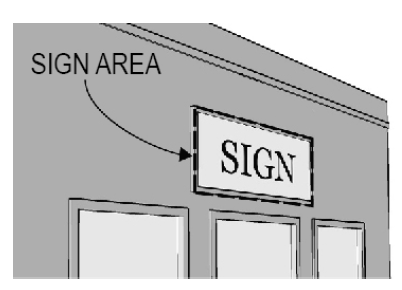
Figure 9-1 Wall Sign with panel
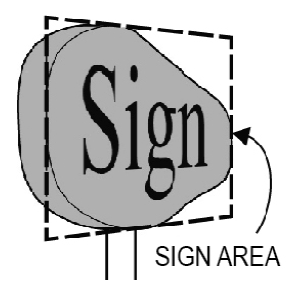
Figure 9-2 Freestanding Sign
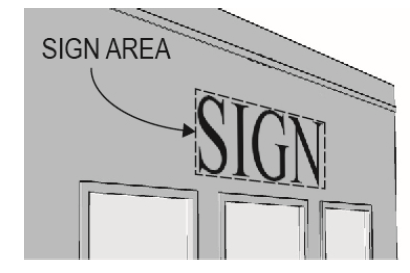
Figure 9-3 Wall Sign without panel
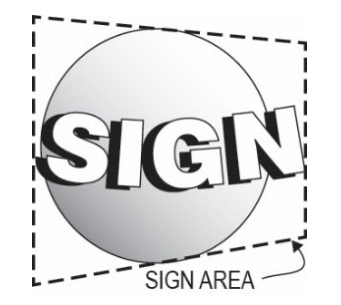
Figure 9-4 Nonplanar Sign
D.
For sign messages that are nonplanar, the sign area is calculated as the smallest rectangle that encompasses the profile of the sign message and any background object, panel, cabinet or surface distinctively designed to serve as the background for the sign message. The profile used is the largest area of the sign message and background visible from any one point. See Figure 9-4.
E.
Sign heights. For freestanding signs, including temporary and portable signs, sign height is measured from the grade level of the adjoining roadway at its centerline directly in front of the freestanding sign.
Sec. 9.05. - Standards by Sign Type.
9.05.01 Projecting signs may not project more than 30 inches from the wall plane. The top edge of the sign may not extend more than twelve inches higher than the top of the structure to which it is attached.
9.05.02 Illuminated Signs.
A.
Illuminated signs must conform in all respects to the City Electrical and Fire Codes.
B.
Any light mounted on, within or directed toward any sign must be shielded so that no direct illumination is cast upon any surrounding property or on or toward any public right-of-way.
9.05.03 Electronic Message Center ("EMC") Signs.
A.
EMC signs, regardless of the method of illumination, may not be brighter than 4,690 nits throughout the daytime until at least one-half hour before sunset and 1,675 throughout at the nighttime until sunrise.
B.
EMC signs must be equipped with a dimmer control and photocell and must automatically adjust the display intensity as required herein.
C.
EMC signs must have a default mechanism that will freeze the display in a static message, turn off the display or revert to a black screen if a malfunction occurs.
D.
EMC signs may not display light of such intensity or brilliance to cause glare, impair the vision of an ordinary driver or constitute a nuisance to traffic and pedestrian safety.
E.
Message displays must be static, employing no motion, animation or changes in color or brightness, and may not change more frequently than eight seconds. Transitions between message displays must be instantaneous and may not simulate movement, such as flashing, racing, strobing, twinkling, or animation.
F.
Exposed neon or fiber-optic tubing on EMC signs is prohibited.
G.
Electronic Message Centers must be set back at least 50 ft from any residential district boundary. If permitted by special exception within a residential district, the sign must be set back at least 50 ft from the lot lines of the nearest dwelling, or otherwise as far as practicable as determined by the Zoning Official.
9.05.04 Portable Signs.
A.
Portable signs are permitted only in the B-1, B-3, AG and industrial zones.
B.
Portable signs may not be located closer than 30 feet to any freestanding sign and must be secured, as approved by the Zoning Official, to prevent unintended movement due to wind or other causes.
C.
Portable signs must comply with the setback and sight distance requirements applicable to freestanding signs.
D.
Portable signs may not contain off-premises messages.
E.
Portable signs are limited to one per business.
Sec. 9.06. - Signs Permitted in All Districts.
The following signs are permitted in all zoning districts subject to applicable regulations herein.
9.06.01 Temporary Signs, in accordance with Section 9.07 Residential Districts, Section 9.08 Nonresidential Districts and Section 9.09 AG District. Temporary signs may be used for commercial or noncommercial speech.
9.06.02 Flagpoles and Stanchions.
A.
Unless otherwise required by law, for each developed residential premises, one flagpole is permitted. There is no limit to the number of flags that may be displayed per flagpole.
B.
For each nonresidential premises up to one-half acre in size, up to two flagpoles are permitted. For each nonresidential premises over one-half acre in size, up to three flagpoles are permitted. For each additional acre, one additional flagpole is permitted. Up to two flags may be displayed per flagpole.
C.
Flagpoles may not exceed 1.5 times the allowed building height for the district, but in no event may a flagpole be taller than 50 ft.
D.
For each principal structure, up to two flag brackets or stanchions may be attached or placed for the display of flags.
Sec. 9.07. - Residential Districts.
9.07.01 General Standards.
A.
Only those signs expressly permitted in Section 9.06 and this Section are permitted.
B.
Electronic Message Centers may be permitted only by special exception (see Section 12.06) and only on nonresidential premises.
C.
The following types of signs are prohibited:
(1)
Projecting Signs;
(2)
Off-premises Signs.
9.07.02 Attached Signs.
A.
Each multifamily building is permitted one wall sign, which may not exceed 12 sf in area.
B.
Each principal nonresidential building is permitted one wall sign, which may not be larger than 24 sf in sign area. One additional wall sign is permitted for a secondary façade along an adjoining public street, which may not exceed 18 sf in sign area.
9.07.03 Freestanding Signs.
A.
Subdivisions. Each subdivision is permitted one sign at each street entrance, which may not be taller than six feet nor larger than 24 sf in sign area. An acceptable legal entity other than the City must provide perpetual maintenance for the sign.
B.
Multifamily Developments, Manufactured Home Parks and Nonresidential Premises. Each housing development and nonresidential premises is permitted one indirectly-lighted, freestanding sign, which may not be taller than six feet nor more than 18 sf in sign area.
9.07.04 Temporary Signs.
A.
During construction of a residential or nonresidential development, only the following temporary signs are permitted:
(1)
Subdivisions, Multifamily and Nonresidential Developments, Manufactured Home Parks. Up to two temporary signs are permitted at the primary entrance to the development. Each sign may be up to 18 sf in area and may not be taller than six feet above grade level. These signs must be removed within 30 days following the completion of the development. For residential subdivisions, "completion" refers to issuance of Certificates of Occupancy for 75% of the dwellings in the subdivision or phase thereof, as applicable. In all other cases "completion" refers to issuance of a Certificate of Occupancy for the development.
B.
After initial construction, each residential and nonresidential premises is permitted the following temporary signs:
(1)
At any time, three temporary signs with a combined area of 20 sf, with no sign larger than nine square feet in sign area nor taller than four feet.
(2)
For nonresidential uses, one additional temporary sign may be posted for up to 30 days from the time of its initial opening and up to 30 days prior to its final closing. The sign may not be larger than 20 sf in sign area. If freestanding, it may not be taller than six feet.
Sec. 9.08. - Nonresidential Districts.
9.08.01 General Standards. In all Business, Manufacturing, and Institutional Districts, only those signs expressly permitted in Section 9.06 and this Section are permitted.
9.08.02 Attached Signs.
A.
Residential premises are permitted attached signs in accordance with Section 9.07 Residential Districts.
B.
For nonresidential and mixed-use premises, each ground floor tenant is permitted one wall sign subject to the following:
(1)
Wall signs may not be larger than two square feet of sign area per linear foot of wall on which the tenant has a main entrance or 200 sf, whichever is more restrictive. An additional wall sign is permitted for tenant spaces with a secondary façade along an adjoining public street. The additional attached sign is limited to 32 sf.
(2)
In addition to a primary attached sign, each premises or each tenant on a premises with multiple tenants is allowed up to two canopy or awning signs. The area of such signs is counted toward the total allowed sign area for wall signs.
(3)
The aggregate area of permanent and temporary window signs may not exceed 50% of the total glass area of all ground floor windows on that building wall.
9.08.03 Freestanding Signs.
A.
Residential premises are permitted freestanding signs in accordance with Section 9.07 Residential Districts. Portable signs are not permitted.
B.
Nonresidential and mixed-use premises are permitted freestanding signs provided in Table 9-1 and as follows:
(1)
Where used, portable signs are counted toward the allowable number of freestanding signs on each premises.
(2)
Freestanding signs must be set back at least ten feet from the public right-of-way line.
Table 9-1 Freestanding Sign Standards
9.08.04 Temporary Signs.
A.
Residential premises are permitted temporary signs in accordance with Section 9.07 Residential Districts.
B.
Nonresidential and mixed-use premises are permitted temporary signs as follows:
(1)
During construction, up to two temporary signs are permitted at the primary entrance to the development. Each sign may be up to 32 sf in area and may not be taller than six feet above grade level. These signs must be removed within 30 days after the Certificate of Occupancy has been issued.
(2)
After initial construction, each premises is permitted the following temporary signs:
(i)
At any time, each premises is permitted two temporary signs with each sign no larger than 16 sf in sign area nor taller than six feet.
(ii)
Inflatable signs may be used for up to seven days each quarter. Each inflatable sign is counted toward the number of temporary signs otherwise permitted in this subsection. Inflatable signs may not exceed 20 ft in height and must be securely anchored to the ground.
(iii)
One additional temporary sign may be posted for up to 30 days from the time of its original opening and for up to 30 days prior to its final closing. Such signs may not be larger than 32 sf in sign area. If freestanding, the sign may not be taller than six feet.
(iv)
During repair, renovation or addition to an existing building, one additional temporary sign per premises may be posted for up to 60 days. The sign may not be larger than 12 sf in sign area nor taller than six feet above grade. These signs must be removed within seven days of completion of the repair, renovation or addition.
Sec. 9.09. - AG District.
9.09.01 General Standards.
A.
Only those signs expressly permitted in Section 9.06 and this Section are permitted.
B.
Electronic message centers may only be permitted as a special exception (see Section 12.06) and only on the premises of permitted nonresidential uses.
C.
Projecting signs are prohibited.
9.09.02 Attached Signs. Agricultural and any nonresidential premises are permitted attached signs as follows:
A.
Wall signs may not be larger than one square foot of sign area per linear foot of wall on which the tenant has a main entrance or 100 sf, whichever is more restrictive.
B.
In addition to a primary wall sign, each premises is allowed up to two canopy or awning signs, the area of which is counted toward the total allowed wall sign area.
C.
Window signs may not exceed 20% of the total glass area of the window.
9.09.03 Freestanding Signs.
A.
Residential premises are permitted permanent freestanding signs as provided for Residential Districts in Section 9.07.03.
B.
All other premises developed with a principal use or structure are allowed one freestanding sign regardless of the number of street frontages. Freestanding signs may not be larger than 32 sf in sign area.
9.09.04 Temporary Signs.
A.
Residential premises are permitted temporary signs as provided for Residential Districts in Section 9.07.04.
B.
All other premises are permitted temporary signs as follows:
(1)
During construction, up to two temporary signs are permitted at the primary entrance to the development. Each sign may be up to 32 sf in area and may not be taller than six feet above grade. These signs must be removed within 30 days following the completion of the development.
(2)
After initial construction, each premises is permitted the following temporary signs:
(i)
At any time, each premises is permitted three temporary signs with each sign no larger than nine square feet in sign area nor taller than six feet.
(ii)
One additional temporary sign may be posted for up to 30 days from the time of its original opening and for up to 30 days prior to its final closing. Such signs may not be larger than 32 sf in sign area. If freestanding, the sign may not be taller than six feet.
Sec. 9.10. - Off-Premises Signs.
9.10.01 For purposes of this Section, a "conforming" Off-premises Sign means an existing Off-premises Sign that meets all requirements of this Ordinance in place at the time the sign was erected.
9.10.02 No new Off-premises Signs are permitted.
9.10.03 All existing Off-premises Signs must be maintained with no "open faces" meaning that said signs must have panels installed and attached with smooth surfaces and no torn or tattered edges hanging loosely. No structural members other than the pole may be exposed unless approved in advance and in writing by the Zoning Official.
9.10.04 Conforming Off-premises Signs within 500 ft of intersecting state highways may be converted to accommodate electronic message centers, provided that any such conversion must be approved in advance, in writing, by the Zoning Official and provided the requirements and regulations of the Zoning Ordinance referenced in paragraph (a) above are met, as such other requirements and regulations shall remain in full force and effect. Off-premises Signs with electronic message centers, whether single face or back-to-back, may not be closer than 1,000 ft to any other such sign. However, conforming Off-premises Signs on Highway 248 (Rucker Boulevard/Glover Avenue) may not incorporate electronic message centers.
9.10.05 Off-premises Signs located on Highway 84 Bypass may not be larger than 450 sf per face, excluding structural elements and skirts. Off-premises Signs located on Rucker Boulevard/Glover Avenue (Highway 248) may not be larger than 300 sf per face excluding structural elements and skirts.
9.10.06 Only single face and back-to-back Off-premises Signs are permitted. Side-by-side and stacked units are prohibited.
9.10.07 The lowest point of any Off-premises Sign must be at least 15 feet above grade level. Off-premises Signs may not exceed a total height of 50 ft.
9.10.08 Off-premises Signs must be of all metal, single-pole construction, with the exception of faces and skirts; subject, however, to the following: If any all embellishments or pole coverings are requested, the applicant must obtain prior approval, in writing, by the Zoning Official.
9.10.09 In the event any Off-premises Sign, conforming or otherwise, is destroyed by natural disaster or other casualty, or must be removed for any reason, the remnants must be removed within 30 days.
A.
The Off-premises Sign may be rebuilt at the same location or another location as long as it then meets all of the provisions of this Ordinance, other City Ordinances as referenced above or as may apply, and any rule, regulation of law of any other governmental entity having jurisdiction over such; provided, however, the rebuild/relocate permit may only be issued to the same permit holder or its assignee.
B.
Should the permit holder relocate the Off-premises Sign for any reason set forth in this Section 9.10.09, another Off-premises Sign permit holder may apply for a permit to install a newly located Off-premises Sign on real property leased from the landowner, provided said newly located Off-premises Sign:
(1)
takes the place of a previously existing Off-premises Sign in existence on March 1, 2018 or erected thereafter;
(2)
is installed on the same landowner's property and within a 30 ft radius of the previously existing Off-premises Sign;
(3)
conforms to the additional requirements of the City's ordinances and other applicable law and regulations; and,
(4)
is to be installed within 30 days of the date the permit is granted. This is known as a Landowner Replacement Credit and the City will not issue more than one permit for a Landowner Replacement Credit (city-wide) in any one calendar year.
9.10.10 Off-premises Signs that are visible from public streets, roads and highways, may not contain any speech that is considered obscene and therefor not protected by the First Amendment.
9.10.11 Off-premises signs, which did not conform to Zoning Ordinance in effect at the time they were erected, will not be required to be removed on the basis of size or height. However, all such nonconforming signs must be maintained as provided in this Section 9.10 and must comply with the codes of the City except as noted as to location, height and square footage. This includes, but is not limited to, the obligation that the owners of said signs may not keep open faces on said signs and must keep such Off-premises Signs properly secured, painted where applicable and in good structural and aesthetic appearance.
9.10.12 Violations of this section may result in the following: suspension or revocation of sign permit by City Council which will result in the sign owner or lessee removing the same; actions at law or equity to prevent or remedy said violation; and/or offender being prosecuted in the Enterprise municipal court for a misdemeanor offense subject to up to a $500.00 fine and up to six months in jail.
Sec. 9.11. - Nonconforming Signs.
9.11.01 All lawfully nonconforming signs in existence or under construction with a valid permit upon the effective date of this article may continue subject to the following:
A.
The sign does not become damaged or deteriorated so as to become a public hazard. The Zoning Official may order the removal of any nonconforming sign which becomes a public hazard. Such sign must be removed within 30 days of the date of the order;
B.
Any single repair does not exceed 60% of the sign's value immediately prior to the repair;
C.
The sign is not extended or maintained in such a way as to extend its nonconformity; and
D.
The sign is not expanded and, if a permanent sign, relocated or removed for any length of time.
9.11.02 Any nonconforming sign that becomes abandoned must be removed, covered or otherwise brought into conformity at the owner's expense.
Sec. 9.12. - Penalties.
Both the owners or other persons in charge or control of signs and the owners or other persons in charge or control of property on which signs are located are responsible for assuring compliance with this Article. Any failure or refusal to comply with the provisions of this Article is a violation and subject to penalties as provided in Section 13.07 Penalties and Remedies.

