
Estes Park City Zoning Code
CHAPTER 3
- REVIEW PROCEDURES AND STANDARDS
§ 3.1 - General Provisions
The following general provisions shall apply to all applications under this Code:
A.
Authority to File Applications. An application for development review or approval under this Code shall be filed by the record owner(s). The Boards or the EVPC may initiate Code amendment action under this Code with or without an application from property owner(s) who may be affected.
B.
Applications. Applications required under this Chapter shall be submitted on forms provided by the Staff in such numbers as required by the Staff. Applications shall be accompanied by a nonrefundable fee established by the Boards to defray the costs of processing applications and by any required escrow funds.
C.
Incomplete Applications or Insufficient Fees. Applications shall be reviewed for completeness within eight (8) working days of filing. If the Staff determines that the application is complete, the application shall then be processed. If the Staff determines that it is incomplete, they shall return the application to the Applicant as incomplete and specify the specific ways in which the application is deficient. No further processing of the incomplete application shall occur until the deficiencies are corrected. Any application that is not accompanied by the required fee shall be found incomplete. Fees shall not be required with applications initiated by the Staff, Planning Commission or Boards.
(Ord. 8-05 #1)
D.
Required Times for Action and Inaction.
1.
General Rule—Deemed Denial. Except as set forth in subsections D.2 and D.4 below, whenever the provisions of this Chapter require that reviewers or the Decision-Making Body take action on an application within a specified period of time and such action is not taken within that time limit or within a permitted extension of such time limit, such inaction shall be deemed a denial of the application unless the Applicant agrees to an extension of the time period.
2.
Exceptions—Subdivisions and Planned Unit Developments—Deemed Approval. Failure of the reviewers or Decision-Making Body to take action on a subdivision or PUD application within any time frame required by this Chapter, or other time frame agreed to by the Applicant at the time of the application filing or during the application's review, shall be deemed an approval of the application unless the Applicant agrees to an extension of the time period in writing.
3.
Extensions of Time Periods for Review. Except as set forth in subsection D.4 below, reviewers or the Decision-Making Body shall have the discretion to extend the time periods set forth in this Chapter up to a maximum of sixty (60) days without consent of the Applicant, for review and final decision on a development application. Such extension shall be allowed when the projected size, complexity, anticipated impacts or other factors associated with the proposed development clearly justify such extension of time.
4.
Extensions of Time Periods for Review—Subdivisions and Planned Unit Developments. Time frames for action on a subdivision or PUD application may be extended by the reviewers or Decision-Making Body when necessary to receive recommendations or reports from a reviewing agency, but no such extension shall exceed thirty (30) days unless the reviewing agency notifies the reviewer or Decision-Making Body that it needs more time to complete its recommendation. All other extensions of the time periods set forth in this Chapter for review and action on subdivision or PUD applications may be extended by the reviewers or Decision-Making Body only if the Applicant agrees in writing to an extension of time.
5.
Suspension of Time Periods for Review in Emergencies. Whenever the provisions of this Section or this code require that reviewers or the Decision-Making Body take action on an application within a specified period of time, any declaration of emergency or disaster under §2.28.030 of the Estes Park Municipal Code shall have the effect of nullifying and suspending any and all effects of the specified time periods or deadlines for pending applications until the declaration has terminated. Such time periods shall restart upon the termination of the declaration. Without limitation, this paragraph specifically applies to the thirty-day deadline in §3.2(F)(1). The Town may schedule a public hearing to occur virtually during an emergency.
(Ord. 06-20 §2; Ord. 16-22, §3)
E.
Concurrent Submittal and Timing of Reviews. At the election of the Applicant and with the approval of the Staff, applications for different types of development approvals may be processed concurrently to expedite total review and processing time for a project.
(Ord. 08-14 §1; Ord. 21-16 §1)
F.
Application Processing Schedule. The Staff may promulgate a processing schedule for each application.
G.
Permitted Scope of Action by Decision-Makers. The Decision-Making Body holding the public meeting or hearing may approve the application, approve the application with conditions or deny the application.
H.
Continuation of Hearings. A public hearing may be continued to a later date without again complying with the notice requirements of this Chapter, provided that the continued hearing is set for a specific date and time. No public hearing on a subdivision or planned unit development application shall be continued for more than forty (40) days without the written consent of the Applicant.
I.
Submittal Requirements.
1.
General. Submittal requirements for each type of development application are set forth in Appendix B to this Code.
2.
Waivers Pursuant to Pre-Application Meetings. At or following a pre-application conference, Staff may waive certain submittal requirements set forth in Appendix B to this Code in order to reduce the burden on the Applicant and to tailor the requirements to the information necessary to review a particular application. Staff may waive such requirements where it finds that the projected size, complexity, anticipated impacts or other factors associated with the proposed development or subdivision clearly justify such waiver. This discretion may only be exercised if a pre-application conference is held.
J.
Modifications and Amendments.
1.
Minor Modifications to Approved Plans/Plats. Minor modifications of approved development plans and subdivision plats may be authorized by Staff pursuant to §3.7, "Minor Modifications," below.
2.
Amendments to Approved Plans/Plats. Any change or modification to an approved development plan or subdivision plat that does not qualify as a minor modification pursuant to this Chapter shall be submitted as a new application for approval of a plan/plat and shall follow the applicable procedures as set forth in this Chapter.
(Ord. 8-05 §1, 6/14/05; Ord. 08-14 §1, 3/25/14; Ord. 21-16 §1(Exh. A), 8/23/16; Ord. 06-20 §2, 3/24/20; Ord. 16-22, §3, 9-27-22)
§ 3.2 - Standard Development Review Procedure
All development applications are subject to the following [six]-step "standard" review procedure, unless variations or exceptions to the standard procedure are expressly provided for in the particular development application requirements set forth in this Chapter.
(Ord. 15-18 §1(Exh. A))
A.
Step 1: Pre-Application Conference.
1.
Purpose. The purposes of the pre-application conference are to provide an opportunity for the Applicant and the Staff to discuss the review process schedule and submittal requirements, the scope of the project and compliance with this Code.
2.
Applicability. A pre-application conference is mandatory for the following applications:
a.
Special review uses;
b.
Development plans;
c.
Rezoning applications;
d.
Preliminary subdivision plat;
e.
Preliminary PUD plans;
f.
Variances;
g.
Minor subdivisions; and
h.
Annexations.
Staff may waive the pre-application conference on the ground that the proposed development is not complex and will not have any significant impacts on services, roads, natural resources or adjacent property.
(Ord. 18-02 #2)
3.
Scheduling. The pre-application conference shall be scheduled by the Applicant with Staff at least fourteen (14) days prior to the date of submission of any related application.
4.
Submittal Requirements. All Applicants shall submit a sketch plan to the Staff for review no later than five (5) days prior to the scheduled pre-application conference. See Appendix B to this Code for sketch plan submittal requirements.
B.
Step 2: Neighborhood and Community Meeting.
1.
Purpose. The purpose of the neighborhood and community meeting is to educate occupants and owners of nearby lands about the proposed development and application, receive comments, address concerns about the development proposal, and resolve conflicts and outstanding issues, where possible.
a.
Favored Practice. Neighborhood and community meetings are encouraged as opportunities for informal communication between owners and occupants of nearby lands, applicants and other residents who may be affected by development proposals.
b.
Applicability. Except as provided otherwise in §3.2.G (Summary Table-Standard Development Review Process by Application Type), neighborhood and community meetings shall be mandatory for zoning and planning projects that require a public hearing as specified in this Code. Except as provide otherwise in §3.2.G (Summary Table-Standard Development Review Process by Application Type), neighborhood and community meetings shall be voluntary for zoning and planning projects that do not require a public hearing as specified in this Code.
c.
Procedure. If a neighborhood and community meeting is held by the applicant, it shall generally comply with the following procedures:
(1)
Time and Place. The neighborhood and community meeting shall be held at a place that is generally accessible to neighbors that own and/or reside in the notification area to the land subject to the application. It shall be scheduled after 5:00 p.m. on a weekday or at any time on a weekend day.
(2)
Written Notification. The applicant shall provide notification of the neighborhood and community meeting a minimum of fifteen (15) days in advance of the meeting by placing notice in a newspaper or display advertising of general circulation in the Estes Valley and by mailing notice to all owners and occupants within the notification boundary of the land subject to the application. The list of owners within the notification area of the affected property shall be obtained by the applicant from the most recent version of the property owners of record provided by the Town of Estes Park. The notification shall state the time and place of the meeting. (Ord. 16-24, §1(Exh. A))
(3)
Posted Notices of Neighborhood and Community Meeting. Required posted notice requirements shall be on a standard sign with format and material as determined by the Planning Department. The following additional requirements shall apply to posted notices pursuant to this Section:
a)
Any posted notice shall be legible from a public street or public right-of-way in clear weather conditions. "Legible" is defined as meeting the legibility requirements in the Estes Park Municipal Code Chapter 17.66 (Signs).
b)
Projects abutting more than one public street or public right-of-way shall be required to post one (1) additional sign for each abutting public street or public right-of-way.
c)
Posting of all notice(s) required by this Section shall take place no later than fifteen (15) days prior to any given neighborhood and community meeting for which the posting is required, and the posted signage shall remain until the close of any such neighborhood and community meeting, including the closing dates of any neighborhood and community meeting that may be continued or postponed. (Ord. 16-24, §1(Exh. A))
d)
Proof that the required signage was posted in accord with this Section shall be provided to the Planning Department prior to the opening of any neighborhood and community meeting. A date-stamped photograph of the posted notice in context shall be deemed adequate proof for purposes of this Section.
e)
Removal, obstruction, damage or destruction of a properly posted notice by weather or other natural occurrence shall not be construed as failure to comply with the public notice provisions of this Code. (Ord. 16-24, §1(Exh. A))
(4)
Conduct of Meetings. At the neighborhood and community meeting, the applicant shall explain the development proposal and application, inform attendees of the character and nature of the process for review, and respond to comments and questions neighbors may have about the application and propose ways to resolve conflicts.
(5)
Staff Attendance. Town staff may attend the neighborhood and community meeting for the purpose of advising the attendees regarding applicable provisions of the Development Code, but shall not serve as facilitators or become involved in negotiations at the neighborhood meeting.
(6)
Written Summary of Neighborhood and Community Record of Meeting. The applicant shall provide the Planning Department a written summary of the neighborhood and community meeting. The written summary shall include a list of those in attendance, a summary of the issues related to the development proposal discussed, comments by those in attendance about the development proposal, and any other information the applicant deems appropriate. The written summary of the neighborhood and community meeting shall be included with the application materials, and be made available to the public for inspection.
(7)
Response to Summary. Any party in attendance at the neighborhood and community meeting may submit an additional written summary indicating their understanding of the issues related to the development proposal discussed, comments by those in attendance about the development proposal, and any other information they deem appropriate. This written summary may include a response to the applicant's written summary of the neighborhood meeting.
Neighborhood and community meetings are optional for any other applications not requiring a public hearing.
(Ord. 15-18 §1(Exh. A); Ord. 11-19 §1(Exh. A); Ord. 16-24, §1(Exh. A))
C.
Step 3: Application Timing and Certification of Completeness.
1.
Except for variances, all development applications shall be submitted to Staff a minimum of fifty-five (55) days prior to the next regularly scheduled EVPC meeting at which the application will be reviewed. See §3.6 regarding variances. Staff shall have the discretion to shorten submittal time frames.
(Ord. 8-05 #1)
2.
Within eight (8) working days of submittal, the Staff shall either certify the application as complete and in compliance with all submittal requirements or reject it as incomplete and notify the Applicant of any deficiencies. See §3.1.C above.
(Ord. 8-05 #1; Ord. 15-18 §1(Exh. A))
D.
Step 4: Staff Review and Report. No later than fourteen (14) days prior to EVPC meeting, Staff shall refer the development application to the appropriate review agencies, review the development application and prepare a staff report. No changes to the development application or any accompanying plans or information shall be permitted after submittal, except for any changes or additional information requested by the Staff during their review.
(Ord. 8-05 #1; Ord. 15-18 §1(Exh. A))
E.
Step 5: Estes Valley Planning Commission Action or Recommendation.
1.
Public Hearings or Meetings Required.
a.
General Rule. Except as provided in subsection 1.b below, within forty-five (45) days from the date that a submitted application is certified as complete, the EVPC shall review the application at a public meeting or hearing as required by this Code or applicable law.
b.
Authority to Hold Application for Later EVPC Review. Notwithstanding the time for action requirements set forth in subsection 1.a above, whenever an extraordinary number of applications are submitted, such that the Staff is unable to complete their review adequately prior to the next regularly scheduled EVPC meeting, the Staff shall be authorized to hold an application until the next subsequent processing period for EVPC review. Once the application is placed on the official agenda for a public meeting or hearing before the EVPC, all other time requirements for review pursuant to this Section and Chapter shall apply.
2.
Compliance with EVPC's Conditional Approvals.
a.
EVPC Final Actions. When the EVPC is the Decision-Making Body, approval of an application shall not become final and appealable until all conditions of approval have been complied with. (See Chapter 2 above.) Acceptance of all conditions of approval and compliance, where feasible (e.g., required revisions to plans and drawings), shall be completed by the Applicant within thirty (30) days of the EVPC's action.
b.
EVPC Recommended Actions. When the EVPC is a reviewing body only, conditions of EVPC-recommended approval that require revisions to the submitted application, plans or drawings shall be completed by the Applicant within thirty (30) days of the EVPC's action. (See Chapter 2 above.) A revised application shall be a condition precedent to placing the application on the Board's agenda. (See Step 5 below.)
(Ord. 15-18 §1(Exh. A))
F.
Step 6: Board Review and Action.
1.
Board Action Required. Within thirty (30) days from the date that the Board receives the application, including any revisions, the Board shall hold a public hearing and consider the development application, the staff report, the Planning Commission's recommendation and the evidence from any public meeting. The Board shall take final action by either approving, approving with conditions or denying the development or land use applications based on its compliance with the appropriate review standards.
2.
Compliance with Board's Conditions. Board approval of an application shall not become final and appealable until the Applicant complies with or accepts all conditions of approval. Compliance with conditions of approval (e.g., required revisions to plans and drawings), shall be completed by the Applicant and submitted to the Staff within thirty (30) days of the Board's action, unless a longer time is requested by the Applicant and agreed to by Staff.
(Ord. 15-18 §1(Exh. A))
G.
Summary Table—Standard Development Review Process by Application Type.
(Ord. 17-17 §1; Ord. 15-18 §1(Exh. A); Ord. 11-19 §1(Exh. A); Ord. 01-21, §1(Exh. A); Ord. 15-21, §1(Exh. A); Ord. 16-24, §1(Exh. A))
H.
Flow Chart of Standard Development Approval Procedure.
STANDARD DEVELOPMENT AND REVIEW PROCEDURE
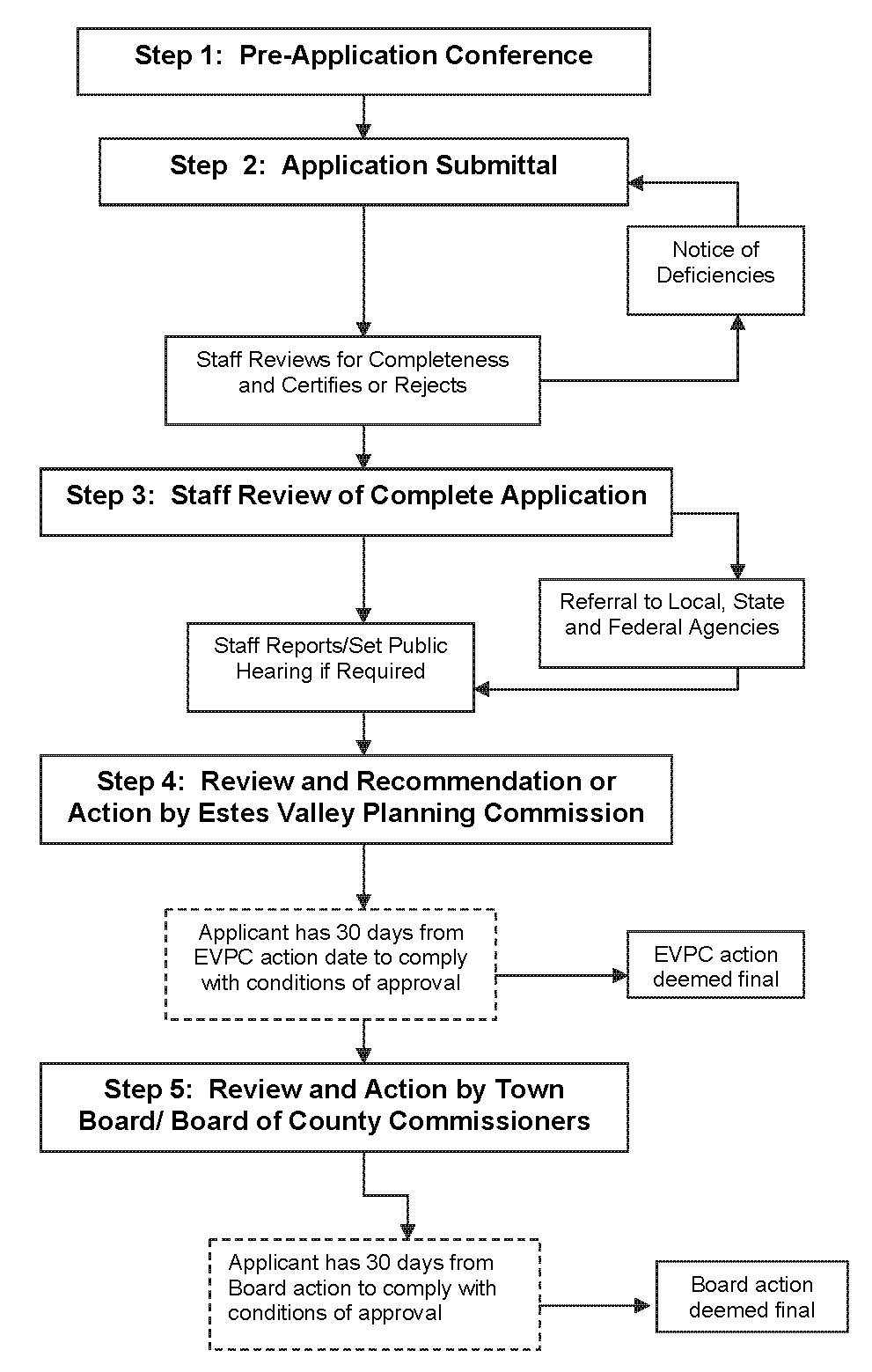
(Ord. 18-01 #5, 10/23/01; Ord. 18-02 #2, 12/10/02; Ord. 8-05 #1, 6/14/05; Ord. 21-10 §1, 9/28/10; Ord. 17-17 §1(Exh. D), 6/13/17; Ord. 15-18 §1(Exh. A), 10/9/18; Ord. 11-19 §1(Exh. A), 5/14/19; Ord. 01-21, §1(Exh. A), 1/12/21; Ord. 15-21, §1(Exh. A), 11/9/21; Ord. 16-24, §1(Exh. A), 10/22/24)
§ 3.3 - Code Amendments
A.
Initiation. Applications for text or Official Zoning Map amendments may be initiated by the following:
1.
By motion of the Estes Valley Planning Commission;
2.
By request of either Board; or
3.
By application for a rezoning by the owner(s) of the property for which the amendment is requested.
B.
Private-Party-Initiated Applications for Code Amendments (Rezonings). All applications for text or Official Zoning Map amendments initiated pursuant to §3.3.A.3 above shall comply with the following requirements:
1.
Development Plan Required. All applications seeking to amend this Code to allow a change from one (1) zone district to a different zone district or seeking to amend this Code by changing the permitted uses in any zone district shall be accompanied by a development plan. This requirement may be waived by Staff if it finds that the projected size, complexity, anticipated impacts or other factors associated with the proposed development or subdivision clearly justify such waiver.
2.
Contents of Development Plan. See Appendix B to this Code for submittal requirements.
3.
Within one (1) year from the effective date of this Code, any property owner may apply for rezoning on the basis that an error in the original zoning was made. Staff may waive the development plan requirements based upon the nature of the proposed request. Applicant must submit a statement of request setting forth information, data and reasons why the error exists.
C.
Procedures for Approval. All applications for text or Official Zoning Map amendments shall follow the standard development approval process set forth in §3.2 of this Chapter.
D.
Standards for Review. All applications for text or Official Zoning Map amendments shall be reviewed by the EVPC and Board(s) for compliance with the relevant standards and criteria set forth below and with other applicable provisions of this Code.
1.
The amendment is necessary to address changes in conditions in the areas affected;
2.
The development plan, which the proposed amendment to this Code would allow, is compatible and consistent with the policies and intent of the Comprehensive Plan and with existing growth and development patterns in the Estes Valley; and
3.
The Town, County or other relevant service providers shall have the ability to provide adequate services and facilities that might be required if the application were approved.
E.
Effect of Approvals and Lapse. When a development plan is required by this Section, if an Applicant fails to either apply for a building permit or commence operation with regard to the rezoning approval consistent with such development plan within three (3) years from the effective date of the amendment, such development plan shall automatically lapse and become null and void. In the event a development plan has lapsed, the Board, at its discretion, may institute rezoning proceedings pursuant to the procedures and standards set forth in this Section to rezone the affected land areas.
(Ord. 07-14 §1)
F.
Applications for Building Permits During Consideration of Application for Amendment to this Code.
1.
Whenever an ordinance or resolution has been introduced before the Boards that involves a change in zoning from a less restricted district to a more restricted district, or to set forth prohibited uses in any existing zone district, no building permit shall be issued for a period not to exceed one hundred twenty (120) days from the date of the introduction of such zoning amendment when such building permit would authorize the construction of a building or the establishment of a use that would become nonconforming under the contemplated zoning amendment.
2.
If such ordinance or resolution is not adopted within one hundred twenty (120) days, the appropriate public entity is authorized to accept applications and issue building permits regardless of the pendency of such amendment.
(Ord. 07-14 §1, 2/25/14)
§ 3.4 - Planned Unit Developments
A.
Applicability. Planned Unit Developments may be approved in any zoning district in which this Code expressly permits such projects (See Chapter 9), subject to the standards set forth in this Code and the approval procedures set forth in this Section.
B.
Consolidation with Subdivision Approval. Where applicable, the Applicant may consolidate an application for Preliminary PUD Plan approval with an application for preliminary subdivision plan approval, and may consolidate an application for Final PUD Plan approval with an application for final subdivision plat approval. Such consolidated application shall be submitted in a form that satisfies both the planned unit development requirements of this Code and the provisions, including submittal requirements, governing subdivisions. (Ord. 17-24, §1(Exh. A))
C.
Procedures for Approval of a PUD Plan. (Ord. 17-24, §1(Exh. A))
1.
General. The PUD is first approved in preliminary form and then approved in final form, except for eligible applications as described below which may be approved in a combined preliminary/final form.
2.
Procedure for Approval of Preliminary PUD Plan. Applications for preliminary PUD plan shall follow the standard development approval process set forth in §3.2.
3.
Procedure for Approval of Final PUD Plans. Applications for final PUD plan approval shall follow the standard development approval process set forth in §3.2, except that Step 4 (EPPC Review and Action) shall not apply.
4.
Procedure for Approval of Combined Preliminary/Final PUD Plans. Applications for projects smaller than five (5) acres in size or which contain ten (10) or fewer dwelling units are eligible for a combined preliminary/final PUD plan. Applications for a combined preliminary/final PUD plan approval shall be considered a Final PUD Plan and shall follow the standard development approval process set forth in §3.2, including Step 4.
D.
Standards for Review. All applications for Planned Unit Developments shall demonstrate compliance with the requirements and review standards set forth below and in Chapter 9, "Planned Unit Developments," and with all other applicable provisions of this Code. An application for approval of a PUD Plan, together with submitted plans and reports, shall be reviewed for conformance with the following standards:
1.
The PUD shall be consistent with and implement the planning goals, policies and objectives as contained in this Code and in the Comprehensive Plan;
2.
Adverse impacts on adjacent properties, including but not limited to traffic, noise and visual impacts, shall be mitigated to the maximum extent feasible;
3.
The PUD shall be integrated with adjacent development through street connections, sidewalks, trails and similar features;
4.
Except as provided in Chapter 9 below, all district, development and subdivision standards set forth in Chapters 4 (Zoning Districts), 7 (General Development Standards) and 10 (Subdivision Standards) shall be met; and
5.
As allowed in Chapter 9 below, certain standards may be modified or varied upon a finding that the proposed PUD incorporates creative site design such that it represents an improvement in quality over what could have been accomplished through strict application of the otherwise applicable district or development standards, including but not limited to improvements in open space provision and access; environmental protection; tree/vegetation preservation; efficient provision of streets, roads and other utilities and services; or choice of living and housing environments.
6.
The PUD shall provide public benefits that are advantageous to the surrounding neighborhood or the public in general to a greater extent than could have been accomplished through strict application of the otherwise applicable district or development standards. Public benefits of the proposed PUD may include:
a.
Mixed-use development that implements elements of the Comprehensive Plan not otherwise possible under this Development Code;
b.
Significant preservation of existing environmental features through site design techniques such as cluster development;
c.
Innovative approaches to mitigate the risks of natural hazards such as wildfire and floods;
d.
Protection of natural ecosystems, conservation of natural resources and wildlife habitat, and mitigation and adaptation to a changing climate;
e.
Historic preservation of private or public structures, places, or landscapes;
f.
Adaptive reuse, renovation, or redevelopment of existing buildings;
g.
Enhanced building design above that required by the Code and/or the use of green building and sustainable development techniques, including Leadership in Energy and Environmental Design (LEED) or LEED-equivalent certification of structures.
h.
Provision of Attainable, Workforce, or Employee Housing or other housing solutions that support the Housing element of the Comprehensive Plan;
i.
Multimodal transportation improvements that create a safer, more comfortable environment for users of all ages and abilities; or
j.
Other public benefits which the Town Board finds substantially advance the goals and other policies and objectives of the Comprehensive Plan.
(Ord. 17-24, §1(Exh. A))
E.
Effect of Approvals.
1.
Effect of Approval of a Preliminary PUD Plan.
a.
Within twelve (12) months from the date of the final approval of a preliminary PUD plan, the developer shall submit an application for final PUD plan. If the final PUD plan is not submitted within this twelve-month time period, the approval shall automatically lapse and be null and void.
b.
During the period in which an approved preliminary PUD plan is effective, no subsequent change or amendment to this Code or any other governing ordinance or plan shall be applied to affect adversely the right of the Applicant to proceed with any aspect of the approved development in accordance with the terms of such preliminary PUD plan approval.
2.
Effect of Approval of a Final PUD Plan and Combined Preliminary/Final PUD
Plan. Within one hundred eighty (180) days from the date of the Board's action on
the final PUD plan or combined preliminary/final PUD plan, the Applicant shall make
all required revisions, if any (see §3.2.E above), and shall submit the PUD plan to
the Town for recording. If the PUD plan is not submitted for recording within this
one-hundred-eighty-day time period, the approval shall automatically lapse and be
null and void. (Ord. 17-24, §1(Exh. A))
(Ord. 17-24, §1(Exh. A), 11/26/24)
§ 3.5 - Special Review Uses
A.
Procedures for Approval of Special Review Uses. Applications for approval of a special review use shall follow the standard development approval process set forth in §3.2 of this Chapter. Uses that require a Special Review and are subject to the regulations of this section are stated in the use tables Table 4-1: Permitted Uses: Residential Zoning Districts and Table 4-4: Permitted Uses: Nonresidential Zoning Districts.
Special Review Uses shall be reviewed through an S1 or S2 procedure. Those uses that have a wider public interest or impact shall be reviewed through the S2 procedure. Both review procedures provide an opportunity to allow the use when there are minimal impacts, to allow the use but impose mitigation measure to address identified concerns, or to deny the use if findings establish that concerns cannot be resolved.
Approval of a Special Review Use shall not constitute a change in the base zoning district and shall be granted only for the specific use approved at the specific site. Approval is subject to such modifications, conditions, and restrictions as may be deemed appropriate by the Decision Making Body.
B.
Standards for Review. All applications for a special review use shall demonstrate compliance with all applicable criteria and standards set forth in Chapter 5, "Use Regulations," of this Code.
Applications for S1 or S2 Special Review shall provide a narrative that describes how the proposed use fulfills the applicable requirements and standards for the use. In order to minimize adverse impacts of the proposed use, an approval of Special Review Use may be conditioned based upon information provided in the narrative and staff findings.
For purposes of the Special Review, the narrative shall describe the following, as applicable:
1.
The proposed use and its operations;
2.
Traffic generation including a traffic impact study if determined necessary by the Decision-Making Body;
3.
Existing zoning compatibility;
4.
Location of parking and loading, including size, location, screening, drainage, landscaping, and surfacing;
5.
Effect on off-site parking;
6.
Street access points, including size, number, location and/or design;
7.
Hours of operation, including when certain activities are proposed to occur;
8.
Exterior lighting;
9.
Effects on air and water quality;
10.
Environmental effects which may disturb neighboring property owners such as;
a.
Glare. This may be described in terms of location, design, intensity and shielding;
b.
Noise; and
c.
Dust;
11.
Height, size, setback, and location of buildings and activities;
12.
Any diking, berms, screening or landscaping, and standards for their installation and maintenance; and
13.
Other resources. This description shall include information on protection and preservation of existing trees, vegetation, water resources, habitat areas, drainage areas, historic resources, cultural resources, or other significant natural resources.
(Ord. 05-18 §1(Exh. A))
C.
Lapse.
1.
Failure of an Applicant to apply for a building permit or commence operation with regard to the special review use approval within three (3) years of the approval of special review shall automatically render the decision null and void unless a longer period is approved by the decision-making body as a condition of approval.
2.
If a legally established special review use is abandoned or discontinued for a period of three (3) consecutive years or more, then the decision originally approving such special review use shall automatically lapse and be null and void, unless a longer period is approved by the decision-making body as a condition of approval.
3.
Prior to the end of the lapse period set forth in Paragraphs 1 and 2 above, the owner of the property receiving special review use approval may seek an extension of the lapse period for an additional two (2) years by petitioning either the Board of Trustees or the Board of County Commissioners for an extension of two (2) years. Said petition shall be filed prior to the expiration of the lapse period and shall set forth reasons why the project will be commenced within the requested two-year period. The decision on any extension shall be at the sole discretion of the Board of Trustees or the Board of County Commissioners. No additional extension of the additional two-year lapse period shall be granted, except in connection with a new Special Review application and review.
(Ord. 07-14 §2; Ord. 17-17 §1)
(Ord. 07-14 §2, 2/25/14; Ord. 17-17 §1(Exh. D), 6/13/17; Ord. 05-18 §1(Exh. A), 4/10/18)
§ 3.6 - Variances
A.
Applicability. The BOA shall hear requests for variances where it is alleged that the provisions of this Code inflict unnecessary hardship and practical difficulties upon the Applicant.
B.
Procedure for Approval of Variances. Applications for approval of variances shall follow the standard development approval process set forth in §3.2 of this Chapter, except for the following modifications:
1.
Step 2: Application Timing. Applications for variances shall be submitted to Staff a minimum of forty-two (42) days prior to a regularly scheduled meeting of the BOA. Staff shall have the discretion to shorten submittal timeframes.
(Ord. 8-05 §1)
2.
Step 4: Review and Action by the BOA. The staff report on an application for a variance shall be forwarded to the BOA. The BOA shall review the application, staff report and public meeting testimony and take final action by either approving, approving with conditions or denying such application. The BOA's decision on the application shall be final.
C.
Standards for Review. All applications for variances shall demonstrate compliance with the standards and criteria set forth below:
1.
Special circumstances or conditions exist (e.g., exceptional topographic conditions, narrowness, shallowness or the shape of the property) that are not common to other areas or buildings similarly situated and practical difficulty may result from strict compliance with this Code's standards, provided that the requested variance will not have the effect of nullifying or impairing the intent and purposes of either the specific standards, this Code or the Comprehensive Plan.
2.
In determining "practical difficulty," the BOA shall consider the following factors:
a.
Whether there can be any beneficial use of the property without the variance;
b.
Whether the variance is substantial;
c.
Whether the essential character of the neighborhood would be substantially altered or whether adjoining properties would suffer a substantial detriment as a result of the variance;
d.
Whether the variance would adversely affect the delivery of public services such as water and sewer;
e.
Whether the Applicant purchased the property with knowledge of the requirement; and
f.
Whether the Applicant's predicament can be mitigated through some method other than a variance.
3.
No variance shall be granted if the submitted conditions or circumstances affecting the Applicant's property are of so general or recurrent a nature as to make reasonably practicable the formulation of a general regulation for such conditions or situations.
4.
No variance shall be granted reducing the size of lots contained in an existing or proposed subdivision if it will result in an increase in the number of lots beyond the number otherwise permitted for the total subdivision, pursuant to the applicable zone district regulations.
5.
No variance shall be granted increasing the number of accommodation units beyond the number otherwise permitted. (Ord. 17-24, §1(Exh. A))
6.
If authorized, a variance shall represent the least deviation from the regulations that will afford relief.
7.
Under no circumstances shall the BOA grant a variance to allow a use not permitted, or a use expressly or by implication prohibited under the terms of this Code for the zone district containing the property for which the variance is sought.
8.
In granting such variances, the BOA may require such conditions as will, in its independent judgment, secure substantially the objectives of the standard so varied or modified.
D.
Lapse. Failure of an Applicant to apply for a building permit and commence construction or action with regard to the variance approval within one (1) year of receiving approval of the variance shall automatically render the decision of the BOA null and void. However, variances associated with an approved development plan or special review application shall become null and void upon the lapse or expiration of the approval of the development plan or special review.
(Ord. 07-14 §3)
(Ord. 18-02 #4, 12/10/02; Ord. 8-05 #1, 6/14/05; Ord. 07-14 §3, 2/25/14; Ord. 17-24, §1(Exh. A), 11/26/24)
§ 3.7 - Minor Modifications
A.
Applicability.
1.
Staff Minor Modifications to Approved Final Plans. Staff may grant minor modifications to approved development plans (including approved development plans for rezonings), final PUD plans and final subdivision plats, provided that the Staff finds that such modification advances the goals and purposes of this Code and results in more effective environmental or open space preservation or relieves practical difficulties in developing a site.
In no circumstance, however, shall the Staff approve a modification that results in:
a.
An increase in overall project density;
b.
A decrease in lot size;
c.
A change in permitted uses or mix of uses;
d.
An increase in building height; or
e.
An expansion of established limits of disturbance greater than ten percent (10%).
(Ord. 27-17 §1(Exh.))
2.
Minor Modifications from General Development and Zone District Standards.
a.
Staff Authority to Grant Minor Modifications. Staff may grant minor modifications up to a maximum of ten percent (10%) from the following general development and zone district standards, provided that the Staff finds that such modification advances the goals and purposes of this Code and either results in less visual impact or more effective environmental or open space preservation, or relieves practical difficulties in developing a site:
(1)
Minimum lot area and dimensional requirements; (Ord. 8-05 §1)
(2)
Yard and building setback requirements;
(3)
General development standards set forth in Chapter 7; or
(4)
Subdivision design standards set forth in Chapter 10.
b.
EVPC Authority to Grant Minor Modifications. The EVPC may grant minor modifications up to a maximum of twenty-five percent (25%) from the following general development and zone district standards, provided that the EVPC finds that such modification advances the goals and purposes of this Code and either results in less visual impact or more effective environmental or open space preservation, or relieves practical difficulties in developing a site:
(1)
Minimum lot area and dimensional requirements; (Ord. 8-05 §1)
(2)
Yard and building setback requirements;
(3)
General development standards set forth in Chapter 7; or
(4)
Subdivision design standards set forth in Chapter 10.
c.
Exceptions to Authority to Grant Minor Modifications. In no circumstance shall the Staff or EVPC approve a modification of a general development or zone district standard that results in:
(1)
An increase in overall project density;
(2)
A change in permitted uses or mix of uses; or
(3)
An increase in building height.
(Ord. 27-17 §1(Exh.))
3.
In determining "practical difficulties," Staff and the EVPC shall consider and apply the factors set forth in §3.6.C of this Code.
4.
In granting such minor modifications, the Staff or the EVPC may require conditions that will secure substantially the objectives of the standard so varied or modified and that will substantially mitigate any potential adverse impact on the environment or on adjacent properties, including but not limited to additional landscaping or buffering.
B.
Procedure for Approval of Minor Modifications.
1.
Minor Modifications from General Development or Zone District Standards.
a.
Staff-Approved Minor Modifications. At any time prior to submittal of the staff report to the EVPC (Step 3 of the standard development review procedure), the Staff may initiate or approve a minor modification from the general development or zone district standards of this Code.
b.
EVPC-Approved Minor Modifications. At any time before it takes action on a development application (whether as a review body or Decision-Making Body), the EVPC may initiate or approve a minor modification from the general development or zone district standards of this Code.
c.
Noted on Pending Application. Staff shall specify any approved minor modifications from development or zone district standards and the justifications for such modification on the pending development application for which the modifications were sought.
2.
Minor Modifications to Approved Plans/Plats. Minor modifications to an approved development plan, final PUD plan or final subdivision plat shall be noted on a revised plan/plat, which shall be plainly marked as "Amended" and submitted to the Staff. The Staff shall note the terms of the approved modification or amendment directly on the amended plan and affix his signature and the date of approval.
(Ord. 8-05 #1, 6/14/05; Ord. 27-17 §1(Exh.), 10/24/17)
§ 3.8 - Development Plan Review
A.
Purpose. The purpose of the development plan review process is to ensure compliance with the zoning standards and provisions of this Code, while encouraging quality development in the Estes Valley reflective of the goals, policies and objectives found in the Comprehensive Plan.
B.
Applicability. All development set forth in Table 3-3 below shall be required to submit a development plan for review pursuant to the procedures and standards set forth in this Section. See also §7.1.B, which requires development plans for all new development on land with slopes steeper than thirty percent (30%) or on land containing ridgeline protection areas. No development, excavation, site preparation or construction activity, including tree/vegetation removal or grading, shall occur on property subject to this Section until a development plan has been approved.
Table 3-3
Development Plan Review Requirements
(Ord. 18-01 #6, 7; Ord. 8-05 #1; Ord. 17-17 §1; Ord. 10-19 §1(Exh. A))
C.
Development Plan Approval Procedures. Applications for development plan and Special Review development plan approval shall follow the standard development approval process set forth in §3.2 of this Chapter, except for the following modifications:
1.
Step 3: Staff Review and Report. All development plans subject to Staff review shall be reviewed by Staff, who shall take final action by either approving, approving with conditions or denying the application. Staff action on a development plan shall not be final and appealable until the Applicant complies with or accepts all conditions of approval.
2.
Step 4: EVPC Review and Action. All development plans subject to EVPC review, as shown in Table 3-3 above, shall be reviewed by the EVPC, who shall take final action by either approving, approving with conditions or denying the application.
(Ord. 17-17 §1)
D.
Standards for Review. The recommending and decision-making entities shall review development plan applications and all submitted plans and reports, and evaluate them according to the following standards:
1.
The development plan complies with all applicable standards set forth in this Code; and
2.
The development plan is consistent with the policies, goals and objectives of the Comprehensive Plan and any other relevant land use, parks and trails, capital improvement and other similar plans.
(Ord. 17-17 §1)
E.
Effect of Approval and Lapse. (Ord. 17-10 §1)
1.
If an Applicant fails to apply for a building permit and commence construction or operation with regard to a development plan approval within three (3) years from the date of such approval, unless a development plan has been approved with a vested rights period greater than three (3) years, the development plan shall automatically lapse and become null and void at the end of the applicable vesting period.
2.
An approved building permit and commencement of construction or operation for any development plan shall extend the approval of the development plan for a period of eighteen (18) months from the date of the issuance of a building permit.
3.
Prior to expiration of a development plan, the property owner may file for a one-year extension. Such extension may be granted by the Community Development Director upon determination that there have been no changes to the Estes Valley Development Code that would affect the approved development or conditions of approval.
4.
These provisions shall apply to all development plans approved subsequent to effective date of this Code.
(Ord. 18-01 #6, 7, 10/23/01; Ord. 8-05 #1, 6/14/05; Ord. 17-10 §1, 7/27/10; Ord. 17-17 §1(Exh. D), 6/13/17; Ord. 10-19 §1(Exh. A), 5/14/19)
§ 3.9 - Subdivisions
A.
Purposes. The purpose of the subdivision review process is to ensure compliance with the subdivision standards and provisions of this Code, while encouraging quality development in the Estes Valley reflective of the goals, policies and objectives found in the Comprehensive Plan.
B.
Applicability. All subdivisions shall be subject to the approval procedures set forth in this Section.
C.
Procedure for Approval of Subdivisions (Except Minor Subdivisions and Minor Adjustments). (Ord. 01-21, §1(Exh. A))
1.
General. Subdivisions are approved in two (2) stages: first, a preliminary subdivision plan is approved, and second, a final subdivision plat is approved and recorded. The Board of Trustees or the Board of County Commissioners is the entity with final approval authority for both preliminary and final subdivision plats, depending on the location of the property.
2.
Procedure for Approval of Preliminary Subdivision Plats. Applications for preliminary subdivision plat approval shall follow the standard development approval process set forth in §3.2 of this Chapter.
3.
Procedure for Approval of Final Subdivision Plats. Applications for final subdivision plat approval shall follow the standard development approval process set forth in §3.2 of this Chapter, except that Step 4 (EVPC Review and Action) shall not apply.
D.
Minor Subdivisions and Minor Adjustments. (Ord. 01-21, §1(Exh. A))
1.
Minor Subdivisions and Minor Adjustments are categorized as follows:
a.
Minor Subdivision. Division of one (1) or more lots, tracts or parcels of land into a total of not more than four (4) lots shall also be a minor subdivision, provided that each resulting lot fronts onto an existing street, and that the subdivision entails no extension of public facilities. No more than a total of four (4) lots shall be created out of a lot, tract or parcel or set of contiguous parcels in the same ownership using the minor subdivision procedure. Frontage Lot subdivisions shall be titled as a "Subdivision."
(Ord. 18-01 #8; Ord. 8-05 #1; Ord. 01-21, §1(Exh. A))
b.
Minor Adjustments. Minor Adjustments are Amended Plats, Boundary Line Adjustments, or Land Consolidation Plats:
(1)
Amended Plat. An Amended Plat is an instrument to amend a recorded subdivision plat. An Amended Plat is a revision to a recorded subdivision plat, or a portion of a recorded subdivision plat. An Amended Plat may reconfigure lots, vacate interior lot lines, change or eliminate a platted building envelope, or correct drafting or technical errors. To qualify as an Amended Plat, no additional lots or building sites may be created, nor any lots that do not comply with zoning standards or other requirements of this code. An Amended Plat must not include easement or right-of-way vacation or dedication, involve more than five (5) lots, or necessitate new or modified public improvements; such plats shall be considered final subdivision plats under subsection 3.9.C, above, and shall require a public hearing before the Town Board of Trustees.
(2)
Boundary Adjustment shall mean the division of one (1) or more lots, tracts or parcels of land for the sole purpose of adjusting boundary lines between such lots, tracts or parcels of land and adjacent lots, tracts or parcels of land, which adjustments do not create additional lots or building sites for any purposes.
(3)
Land Consolidation Plat. Unplatted contiguous lots approved for single-family residential development may be combined with a Land Consolidation Plat, provided that the new lot conforms to all requirements of this code. Land Consolidation Plats shall be titled as "Land Consolidation Plat." The final plat shall clearly indicate the original boundaries of each lot and shall contain the following statement:
"Boundary lines indicated on this map are adjustments of former boundary lines of the property depicted hereon. Such adjustments do not create additional lots or building sites for any purposes."
(Ord. 01-21, §1(Exh. A))
2.
Hazard Areas. Areas with geologic hazards as defined by §7.7 of this Code shall not be eligible for the minor subdivision process.
(Ord. 18-01 #9; Ord. 8-05 #1; Ord. 01-21, §1(Exh. A))
3.
Procedure for Approval of Minor Subdivisions and Minor Adjustments. Applications for minor subdivision or minor adjustment approval shall follow the standard development approval process set forth in §3.2 of this Chapter.
(Ord. 18-01 #10; Ord. 8-05 #1; Ord. 01-21, §1(Exh. A))
4.
Submittal Requirements. A Minor Adjustment shall follow the applicable subdivision submittal requirements within the EPDC Appendix B. II., as determined by the Community Development Director or designee.
(Ord. 01-21, §1(Exh. A))
5.
Modifications and Waivers. The Community Development Director, or designee, shall have authority to grant modifications and/or waive standards set forth in Chapter 10 in conjunction with an Amended Plat, Boundary Adjustment or Land Consolidation Plat.
(Ord. 01-21, §1(Exh. A))
a.
Advances the goals and purposes of this Code; (Ord. 8-05 #1)
b.
Either results in less visual impact, more effective environmental or open space preservation, relieves practical difficulties in developing a site or results in the use of superior engineering standards than those required by this Code; (Ord. 8-05 #1)
c.
There will be no increase in the intensity of use; and (Ord. 8-05 #1)
d.
There will be no increase in development and/or demand for services that necessitates compliance with EVDC standards.
(Ord. 8-05 #1)
E.
Standards for Review. All subdivision applications shall demonstrate compliance with the standards and criteria set forth in Chapter 10, "Subdivision Standards," and all other applicable provisions of this Code. For minor subdivisions, the EVPC shall also find that approval will not be materially detrimental to the public welfare, injurious to other property in the neighborhood, or in conflict with the purposes and objectives of this Code.
F.
Effects of Approval.
1.
Effect of Approval of a Minor Subdivision or Minor Adjustment. Within one hundred eighty (180) days of approval of the minor subdivision or minor adjustment, the developer shall submit the minor subdivision or minor adjustment final plat for recording. If the minor subdivision or minor adjustment plat is not submitted for recording within this one hundred eighty-day time period, the approval shall automatically lapse and be null and void.
(Ord. 8-05 #1; Ord. 01-21, §1(Exh. A))
2.
Effect of Approval of a Preliminary Subdivision Plan.
a.
Within twelve (12) months from the date of the final approval of a preliminary subdivision plat, the developer shall submit an application for final subdivision plat for either all or at least one (1) phase of the proposed subdivision.
b.
An approved final subdivision plat for any phase of the preliminary subdivision plan shall extend the life of the preliminary subdivision plan for an additional twelve-month period from the date the final subdivision plat is approved. If the original twelve-month period or any successive twelve-month period expires before a final subdivision plat is approved, then the preliminary plan approval automatically lapses and becomes null and void.
c.
During the period in which an approved preliminary subdivision plan is effective, no subsequent change or amendment to this Code or any other governing ordinance or plan shall be applied to affect adversely the right of the Applicant to proceed with any aspect of the approved development in accordance with the terms of such preliminary subdivision plat approval. However, the Applicant shall comply with those local laws and regulations adopted subsequent to the approval of such preliminary subdivision if the Estes Valley Planning Commission determines, on the basis of written findings, that compliance is reasonably necessary to protect the public health, safety or welfare.
3.
Effect of Approval of a Final Subdivision Plat. Within one hundred eighty (180) days from the date of the Board's action on the final subdivision plat, the Applicant shall make all required revisions, if any (see §3.2.E above), and shall submit the final subdivision plat to the Town for recording. If the final plat is not submitted for recording within this one hundred eighty-day time period, the approval shall automatically lapse and be null and void.
(Ord. 8-05 #1; Ord. 01-21, §1(Exh. A))
(Ord. 18-01 #8—11, 10/23/01; Ord. 8-05 #1, 6/14/05; Ord. 01-21, §1(Exh. A), 1/12/21)
§ 3.10 - Vested Rights
A.
Purpose. This Section is intended to implement the provisions of Article 68 of Title 24, C.R.S., as amended, establishing a vested property right to undertake and complete development and use of real property under the terms and conditions of an approved site specific development plan.
B.
Site Specific Development Plan Approval.
1.
Site Specific Development Plan Defined. Final approval of a final subdivision plat (including a minor subdivision plat), final PUD plan, development plan and special review shall be considered approval or conditional approval of a "site specific development plan," as defined in §24-68-101 et seq., C.R.S., and shall result in a vested right for a period of three (3) years as provided in §24-68-101 et seq., C.R.S.
2.
Hearing Required. No site specific development plan shall be approved until after a public hearing, preceded by written notice of such hearing. Such notice shall be published at the time and in the manner required by §3.15 below, and may be combined with any other required notice.
3.
Notice of Approval.
a.
Each map, plat or special review constituting a site specific development plan shall contain the following language: "Approval of this plan creates a vested property right pursuant to Article 68 of Title 24, C.R.S., as amended."
b.
In addition, notice describing generally the type and intensity of the use approved, the specific parcel or parcels of property affected, and a statement that a vested property right has been created shall be published once, not more than fourteen (14) days after final approval of the site specific development plan, in a newspaper of general circulation within the Estes Valley.
4.
Amendments to Site Specific Development Plans. In the event amendments to a site specific development plan are approved pursuant to this Chapter, the effective date of such amendments, for purposes of the duration of a vested property right, shall be the date of the approval of the original site specific development plan, unless the Decision-Making Body specifically finds otherwise and incorporates such finding in its approval of the amendment.
C.
Other Provisions Unaffected. Approval of a site specific development plan shall not constitute an exemption from or waiver of any other provisions of this Code pertaining to the development and/or use of the property.
D.
Limitations. Nothing in this Chapter is intended to create any vested property right, but only to implement the provisions of Article 68 of Title 24, C.R.S., as amended. In the event of the repeal of such article or a judicial determination that such article is invalid or unconstitutional, this Chapter shall be deemed to be repealed and the provisions hereof no longer effective.
(Ord. 2-11 §1, 1/25/11)
§ 3.11 - Temporary Uses and Structures
A.
Applicability. All temporary uses and structures shall obtain a Temporary Use Permit pursuant to the procedures set forth in this Section.
B.
Procedures for Approval of Temporary Uses and Structures. The procedure for an application for a temporary use or structure shall be as follows:
1.
Step 1: Pre-Application Conference. A pre-application conference is voluntary for temporary use/structure applications.
2.
Step 2: Staff Review and Action. Within thirty (30) days from the date a complete application is submitted, the Staff shall review the application according to the standards set forth in this Section, and make a final decision to approve, approve with conditions or deny the application.
C.
Standards for Review. The Staff shall review an application for a temporary use or structure and evaluate it for compliance with the general standards and specific use standards (as applicable) set forth in §5.3, "Temporary Uses and Structures," and in addition all of the following standards:
1.
The proposed site for the temporary use or structure is adequate in size and shape to accommodate the temporary use;
2.
The proposed site is adequately served by streets or highways having sufficient width and improvements to accommodate the kind and quantity of traffic that such temporary use will or could reasonably generate;
3.
Adequate parking to accommodate vehicular traffic to be generated by such use will be available either on-site or at alternate locations; and
4.
The operation of the requested use at the location proposed and within the time period specified will not jeopardize, endanger or otherwise constitute a menace to the public health, safety or general welfare.
D.
Conditions of Approval. In approving a Temporary Use Permit, the Staff may impose conditions, including but not limited to control of nuisance factors (e.g., glare, noise, smoke, dust), provision of security and safety measures, and limitations on hours of operation, storage and parking, provided that such conditions are necessary to:
1.
Achieve the general purposes of this Section and the specific purposes of the zoning district in which the temporary use will be located, or to be consistent with the Comprehensive Plan;
2.
Protect the public health, safety and general welfare; or
3.
Ensure operation and maintenance of the temporary use in a manner compatible with existing uses on adjoining properties and in the surrounding area.
E.
Time Limits on Permits. Temporary Use Permits shall be valid for a specified period of time, not to exceed thirty (30) days, unless otherwise expressly provided for in §5.3 of this Code.
§ 3.12 - Use Classification Requests
A.
Purpose and Applicability.
1.
The use classifications set forth in Chapter 4, "Zoning Districts," and defined in Chapter 13, "Definitions," describe one (1) or more uses having similar characteristics, but do not list every use or activity that may appropriately fall within the classification. This Section shall apply to determine all questions or disputes whether a specific use is deemed to be within a use classification permitted in a zoning district.
2.
The provisions of this Section shall not apply to permit any specific use that is expressly prohibited in a zoning district.
3.
If, pursuant to this Section, a specific use cannot be clearly determined to be in a use classification permitted in the applicable zoning district, such use may be incorporated into the zoning regulations by a Code Amendment, as provided in §3.3 above.
B.
Procedures for Use Classification Request. The procedure for an application to determine a use classification shall be as follows:
1.
Step 1: Pre-Application Conference. A pre-application conference is voluntary for use classification requests.
2.
Step 2: Staff Review and Action. Within thirty (30) days from the date a complete application is submitted, the Staff shall: (a) review the application according to the standards set forth in this Section; (b) consult with the Town or County Attorneys and other staff, as necessary; and (c) make a final determination as to whether the subject use shall be deemed to be within a use classification set forth in this Code and whether such use should be allowed in the applicable zoning district.
3.
Appeals. Appeals from the Staff's determination on a use classification request shall be made to the respective Boards.
4.
Form of Determination. All final determinations by Staff or the Boards shall be provided to the Applicant in writing and shall be filed in the official record of use classification determinations.
C.
Standards for Review. The following considerations shall be used to determine what classification a use is in and whether it is appropriate to allow such use as a principal use in the applicable zoning district:
1.
The actual or projected characteristics of the subject use compared to the stated characteristics of each use classification allowed in the zoning district (see §13.2, "Use Classifications/Specific Use Definitions and Examples");
2.
The relative amount of site area or floor space and equipment devoted to the use;
3.
Relative amounts of sales from the subject use compared to other permitted uses;
4.
The relative number of employees in each use;
5.
Hours of operation;
6.
Building and site arrangement;
7.
Vehicles used with the use;
8.
The relative number of vehicle trips generated by the use;
9.
Signs expected in conjunction with the use;
10.
How the use advertises itself;
11.
Whether the use is likely to be found independent of other uses on the site;
12.
Any other potential impacts of the subject use relative to other specific uses included in the classification and permitted in the applicable zoning district; and
13.
Whether the subject use is consistent with the stated intent and purposes of this Code and the zoning district in which it is to be located.
D.
Official Record of Use Classification Determinations. An official record of use classification determinations shall be kept on file in the office of the Town of Estes Park Community Development Director. The record shall be available for public inspection in the Estes Park Community Development Department during normal business hours.
§ 3.13 - Public Facility/Use Location and Extent Review
A.
Purpose. This Section implements §30-28-110(1), C.R.S., and is intended to provide an opportunity for review of the location and extent of specified public facilities and uses sought to be constructed or authorized within the Estes Valley, especially as to whether such public use is consistent with the Estes Valley Comprehensive Plan and this Code.
B.
Applicability.
1.
Applicable to Specified Public Uses.
a.
Location and extent review shall apply to the construction or authorization of all public schools, public safety facilities, trail heads, major utilities (whether publicly or privately owned) and all other public uses not specifically exempt from this Section. These public uses are listed in Chapter 4, "Zoning Districts," (Tables 4-1 and 4-4) with the notation under the "additional regulations" column that Public Facility/Use Location and Extent review may be applicable.
b.
Location and extent review shall also apply to the acceptance, widening, removal, extension, relocation, narrowing, vacation, abandonment, change of use, or sale, lease or acquisition of any land for any public use subject to this Section.
2.
Exemption for Town Public Uses Located Within Town Limits. Location and extent review shall not apply to any public road, park, trail, public street, way, ground, space or utility, or any other public facility or use other than a public building or structure, that is to be constructed, financed or owned by the Town of Estes Park on property located within the jurisdictional limits of the Town.
C.
Procedure for Location and Extent Review.
1.
Public Uses.
a.
A proposed development plan shall be submitted to the EVPC for approval, pursuant to the development plan approval process set forth in §3.8 of this Chapter, prior to the construction or authorization of any public use that is subject to location and extent review.
b.
Failure of the EVPC to act within thirty (30) days after the date of official submission of the development plan shall be deemed an approval, unless a longer period is granted by the submitting board, body or official.
c.
If the EVPC disapproves the development plan, it shall communicate its reasons to the Board of County Commissioners or Board of Trustees, depending on the location of the proposed project. The respective Board is authorized to overrule such disapproval by a majority vote of its entire membership. Upon overruling, the Board may proceed with construction or authorization of the project, as applicable.
d.
If the project is not required to be authorized or financed by the Board of County Commissioners or Board of Trustees, or other County or Town official or board, the EVPC's disapproval may be overruled by the body or official having jurisdiction over the authorization and financing of the project. A vote to overrule by such body shall be by a majority vote of its entire membership. In the case of a utility owned by an entity other than a political subdivision, the EVPC's disapproval may be overruled by the Public Utilities Commission by not less than a majority of its entire membership.
(Ord. 05-18 §1(Exh. A))
D.
Standards for Review. The EVPC and Boards shall review the extent and location of the proposed public use for its consistency with the goals, policies and objectives stated in the Comprehensive Plan and for its compliance with this Code.
(Ord. 05-18 §1(Exh. A), 4/10/18)
§ 3.14 - Separate Lot Determinations
A.
Purpose and Applicability.
1.
This Section shall be used to review all questions or disputes regarding separate lot determinations based on the definition set forth in §13.3.135.b. In determining whether or not the individual parcel was intended at the time of its creation to be separately owned, developed and otherwise used as a separate developable unit, the standards for review set forth in §3.14.C shall be considered, in addition to other relevant factors.
B.
Procedures for Separate Lot Determinations. The procedure for an application for a separate lot determination shall be as follows:
1.
Step 1: Pre-application Conference. A pre-application conference is voluntary for separate lot determinations.
2.
Step 2: Staff Review and Action. Within thirty (30) days from the date a complete application is submitted, the Staff shall: (a) review the application according to the standards set forth in this Section; (b) consult with the Town or County Attorneys and other staff, as necessary; and (c) make a final determination as to whether the individual parcel in question is a lot.
3.
Appeals. Appeals from the Staff's separate lot determination shall be made to the respective Boards.
4.
Form of Determination. All final determinations by Staff or the Boards shall be provided to the Applicant in writing and shall be filed in the official record of separate lot determinations.
C.
Standards for Review. In determining whether or not the individual parcel was intended at the time of its creation to be separately owned, developed and otherwise used as a separate developable unit, the following factors shall, where relevant, be considered, in addition to other relevant factors:
1.
Shape, size and physical character of the parcel. For example, if the parcel in question will comply with the adequate public facilities requirements set forth in §7.12 of this Code and a principal structure can be built meeting all applicable setbacks, the individual parcel may have been intended to be separately owned, developed and otherwise used as a separate developable unit. Also, for example, if the shape, size or physical character of the parcel in question is not similar to lots in the same neighborhood, the individual parcel may not have been intended to be separately owned, developed and otherwise used as a separate developable unit. Also for example, if the shape of the parcel indicates that it was intended to be used for physical access or for the provision of utilities, the individual parcel may not have been intended to be separately owned, developed and otherwise used as a separate developable unit;
2.
Historic use of the parcel in question. For example, if a principal structure was built over the boundary line in question, the individual parcel may not have been intended to be separately owned, developed and otherwise used as a separate developable unit;
3.
Historic property ownership patterns. For example, if no portion of the parcel in question has been individually deeded into separate ownership from the remaining portion of the parcel at any time prior to May 5, 1972, the individual parcel may not have been intended to be separately owned, developed and otherwise used as a separate developable unit;
4.
Private restrictions in effect at the time the parcel was created. For example, if private covenants in effect at the time of conveyance prohibited the creation of more than one (1) lot, the individual parcel may not have been intended to be separately owned, developed and otherwise used as a separate developable unit;
5.
If no portion of the parcel in question was ever taxed separately by the Larimer County Tax Assessor, the individual parcel may not have been intended to be separately owned, developed and otherwise used as a separate developable unit;
6.
If the parcel in question is divided by a municipal or county boundary line, the individual parcel may have been intended to be separately owned, developed and otherwise used as a separate developable unit; and
7.
If the parcel in question was delineated on an unrecorded subdivision plat and created conformance with the applicable subdivision and zoning regulations, if any, in effect at the time of creation, the individual parcel may have been intended to be separately owned, developed and otherwise used as a separate developable unit.
D.
Official Record of Separate Lot Determinations. An official record of separate lot determinations shall be kept on file in the office of the Town of Estes Park Community Development Director during normal business hours. The record shall be available for public inspection in the Estes Park Community Development Department during normal business hours.
(Ord. 18-02 #1)
(Ord. 18-02 #1, 12/10/02)
§ 3.15 - General Notice Provisions
A.
Newspaper Notice of Public Hearings. At least fifteen (15) days' notice of scheduled public hearings before a reviewing agency or body shall be published in one (1) or more newspapers of general circulation in the Estes Valley. The notice shall specify the time and place of the meeting/hearing, and the specific nature of the matter to be heard.
B.
Written Notice of Public Hearings.
1.
Whenever a public hearing is required by this Code for any specific property(s), the department shall be responsible for mailing written notice at least fifteen (15) days before the scheduled meeting to all landowners within a specified boundary perimeter as required in this Section.
2.
Failure to send or receive this written notice shall not affect the review and decision concerning the development application.
3.
Written notice shall be sent by regular USPS mail in a standard business envelope, and shall include the type of review (such as rezoning, Special Review, etc.), the location of the property(s) proposed for review, identification of the body conducting the public hearing, the date, time and location of the public hearing, a notice that written comment may also be submitted for the hearing record at any time prior to the hearing's close, staff contact information, and a procedure for obtaining additional information if desired.
4.
The boundary perimeter within which written notice is to be mailed shall be determined to include all properties in whole or in part less than or equal to five hundred (500) linear feet from the outermost boundaries of the subject property(s). (Ord. 16-24, §1(Exh. A))
C.
Posted Notice of Public Hearings. Required posted notice requirements shall be on a standard sign with format and material as determined by the department. The following additional requirements shall apply to posted notices pursuant to this Section:
1.
Any posted notice shall be legible from a public street or public right-of-way in clear weather conditions. "Legible" is defined as meeting the legibility requirements in Estes Park Municipal Code Chapter 17.66 (Signs).
2.
Projects abutting more than one public street or public right-of-way shall be required to post one (1) additional notice for each additional abutting public street or public right-of-way.
3.
Posting of all notice(s) required by this Section shall take place no later than fifteen (15) days prior to any given Public Hearing for which the posting is required, and the posted signage shall remain until the close of any such public hearing, including the closing dates of any public heating that may be continued or postponed.
4.
A project with multiple required public hearing dates (for example, a project with a Planning Commission Public Hearing followed by a Town Board Public Hearing) may retain the same posted notice(s) throughout the cycle of public hearings, provided the posted notice(s) remain in reasonable repair and continue to be legible per the requirements of Section C.1.
5.
Proof that the property was posted in accord with this Section shall be provided to the department prior to the opening of any public hearing. A date-stamped photograph of the posted notice in context, showing a date in compliance, shall be deemed adequate proof for purposes of this Section.
6.
Removal, obstruction, damage or destruction of a properly posted notice by weather or other natural occurrence shall not be construed as failure to comply with the public-notice provisions of this Code. (Ord. 16-24, §1(Exh. A))
(Ord. 08-18 §1(Exh. A), 5/8/18; Ord. 16-24, §1(Exh. A), 10/22/24)
§ 3.16 - Conditional Use Permit
A.
Procedures for Approval on Conditional Use Permit. Applications for approval of a conditional use permit shall follow the standard development approval process set forth in §3.2 of this Chapter, except for the following modifications.
B.
Standards for Review. All applications for a conditional use permit shall demonstrate compliance with all applicable criteria and standards set forth in Chapter 5, "Use Regulations," or Chapter 14, "Wireless Communication Facilities (WCFs)" of this Code, as applicable, and the following requirement:
The application for the proposed conditional use permits mitigates, to the maximum extent feasible, potential adverse impacts on nearby land uses, public facilities and services and the environment.
C.
Lapse.
1.
Failure of an Applicant to apply for a building permit and commence construction or operation with regard to the conditional use permit approval within one (1) year of receiving approval of the conditional use permit, or as otherwise explicitly set forth in the original approval, shall automatically terminate the conditional use permit.
2.
If a legally established conditional use permit is abandoned or discontinued for a period of one (1) consecutive year or more, then the decision originally approving such conditional use permit shall automatically terminate.
3.
Prior to expiration of a conditional use permit, the property owner may file for a one-year extension. Such extension may be granted by the Community Development Director upon determination that there have been no changes to the Estes Park Development Code that would affect the approved conditional use permit or conditions of approval.
(Ord. 21-10 §1, 9/28/10; Ord. 15-21, §1(Exh. A), 11/9/21)

