
Fargo City Zoning Code
ARTICLE 20
07 - GENERAL DEVELOPMENT STANDARDS
§20-0701 - Parking and Loading
A.
General
1.
Applicability
a.
New Development
The off-street parking and loading standards of this section apply to any new building
constructed and to any new use established.
b.
Expansions and Alterations
The off-street parking and loading standards of this section apply when an existing
structure or use is expanded or enlarged. Additional off-street parking and loading
spaces will be required only to serve the enlarged or expanded area, not the entire
building or use, provided that in all cases the number of off-street parking and loading
spaces provided for the entire use (preexisting + expansion) must equal at least 75
percent of minimum ratio established in Off-Street Parking Schedule "A" of this section.
c.
Change of Use
Off-street parking and loading must be provided for any change of use or manner of
operation that would, based on the Off-Street Parking Schedule "A" or the Off-street
Loading Schedule of this section, result in a requirement for more parking or loading
spaces than the existing use. Additional parking or loading spaces will be required
only in proportion to the extent of the change, not for the entire building or use.
2.
DMU Exemption
All residential and nonresidential development in the DMU district shall be exempt
from the off-street parking and loading standards of this section.
3.
No Reduction Below Minimums
Existing parking and loading spaces may not be reduced below the minimum requirements
established in this section. Any change in use that increases applicable off-street
parking or loading requirements will be deemed a violation of the Land Development
Code unless parking and loading spaces are provided in accordance with the provisions
of this section.
4.
UMU Exemption for Nonresidential and UMU Reduction for Residential
While no regulatory intent is implied herein, the responsibility clearly falls upon
the applicant to review and understand, using professional consultation as appropriate,
the parking needs of the development and to provide for the availability of sufficient
parking, either onsite or offsite, which meets the minimum demands of the intended
use. However, the minimum parking standards for properties in a UMU zoning district
are indicated below.
a.
All nonresidential uses in a UMU zoning district shall be exempt from the off-street parking and loading standards of this section.
b.
All residential development within a UMU zoning district, shall be required 1.25 parking stalls per dwelling unit. One stall per dwelling unit shall be reserved full time.
Source: 4695 (2009).
B.
Off-Street Parkin g Schedules
1.
Off-Street Parking Schedule "A"
Off-Street Parking Schedule "A" lists the minimum off-street parking requirement for
each use category defined in this Land Development Code. These requirements apply
unless an Alternative Access Plan is reviewed and approved in accordance with the
procedures of this section. For some uses, the schedule of requirements contains a
reference to off-street parking schedules "B" or "C." Those schedules can be found
following Schedule "A."
Off-Street Parking Schedule "A"
Source: 2985 (1999), 4167 (2001).
2.
Off-Street Parking Schedule "B"Off-street parking spaces for Schedule "B" uses must be provided for all components of the use, as follows:
3.
Off-Street Parking Schedule "C"
Schedule "C" uses have widely varying parking demand characteristics, making it impossible
to specify a single off-street parking standard.
a.
Parking Study
A developer proposing to develop or expand a Schedule "C" use must submit a parking
study that provides justification for the number of off-street parking spaces proposed.
A parking study must include estimates of parking demand based on recommendations
of the Institute of Traffic Engineers (ITE), or other acceptable estimates as approved
by the City Engineer and should include other reliable data collected from uses or
combinations of uses that are the same as or comparable with the proposed use. Comparability
will be determined by density, scale, bulk, area, type of activity, and location.
The study must document the source of data used to develop the recommendations.
b.
Review by City Engineer
The City Engineer shall review the parking study and any other traffic engineering
and planning data relevant to the establishment of an appropriate off-street parking
standard for the proposed use. After reviewing the parking study, the City Engineer
shall establish a minimum off-street parking standard for the proposed use.
c.
Appeals
Appeals of the City Engineer's decision may be taken to the Board of Adjustment in
accordance with the procedures of Sec. 20-0916.
C.
Rules for Computing Requirements
The following rules apply when computing off-street parking and loading requirements.
1.
Multiple Uses
Lots containing more than one use must provide parking and loading in an amount equal
to the total of the requirements for all uses.
2.
Fractions
When measurements of the number of required spaces result in a fractional number,
any fraction of ( or less will be rounded down to the next lower whole number and
any fraction of more than ( will be rounded up to the next higher whole number.
3.
Area Measurements
Unless otherwise expressly stated, all square-footage-based parking and loading standards
must be computed on the basis of gross floor area.
4.
Occupancy-Based Standards
For the purpose of computing parking requirements based on employees, students, residents
or occupants, calculations shall be based on the largest number of persons working
on any single shift, the maximum enrollment or the maximum fire-rated capacity, whichever
is applicable and whichever results in the greater number of spaces.
5.
Unlisted Uses
Upon receiving a development application for a use not specifically listed in an off-street
parking schedule, the Zoning Administrator shall apply the off-street parking standard
specified for the listed use that is deemed most similar to the proposed use or require
a parking study in accordance with Off-Street Parking Schedule "C."
D.
Location of Required Parking
1.
General
Except as expressly stated in this section, all required off-street parking spaces
must be located on the same lot as the principal use.
2.
Single-Family Districts
a.
Within single-family (SR) zoning districts, a maximum of one off-street parking space shall be permitted on a front yard residential driveway. Within single-family (SR) zoning districts, front yard residential driveways shall not exceed 24 feet in width or the width of the driveway approach, whichever is greater, provided that in no event shall any such driveway allow less than 8 feet of non-paved surface to exist alongside one or both sides of such driveway [1] . [3] All other off-street parking spaces must be located in a covered garage or in side or rear yards.
b.
All off-street parking spaces in front or side yard areas shall have an all-weather surface. Rear yard parking spaces may be surfaced with gravel.
E.
Alternative Access Plans
An Alternative Access Plan represents a proposal to meet vehicle parking and transportation
access needs by means other than providing parking spaces on-site in accordance with
the Off-Street Parking Schedule of Sec. 20-0701-B. Applicants who wish to provide
fewer off-street parking spaces than required pursuant to Sec. 20-0701-B must secure
approval of an Alternative Access Plan, in accordance with the standards and procedures
of this section.
1.
Procedures
a.
Plan Contents
Alternative Access Plans must be submitted in a form established by the Zoning Administrator
and made available to the public. At a minimum, such plans must detail the type of
alternative proposed and the rationale for such a proposal.
b.
Review and Approval Authority
(1)
Small Facilities
The Zoning Administrator is authorized to review and act on Alternative Access Plans
if the plan proposes a reduction of no more than 25 percent or 25 parking spaces.
The Zoning Administrator shall mail written notice of the request to all property
owners within 150 feet of the subject property at least 10 days before the Zoning
Administrator takes action on the plan.
(2)
Large Facilities
Alternative Access Plans that propose a reduction of more than 25 percent or more
than 25 off-street parking spaces require review and action by the Planning Commission,
in accordance with the Conditional Use Permit Review procedures of Sec. 20-0909.
c.
Recordation of Approved Plans
An attested copy of an approved Alternative Access Plan must be recorded with the
County Register of Deeds on forms made available in the Planning Department. An Alternative
Access Plan may be amended by following the same procedure required for the original
approval.
d.
Violations
Violations of an approved Alternative Access Plan constitute a violation of the Land
Development Code and will be subject to the enforcement and penalty provisions of
Article 20-011.
2.
Eligible Alternatives
A number of specific access alternatives are described in this subsection. Decision-makers
are, however, authorized to consider and approve any alternative to providing off-street parking spaces on the site of the subject development
if the applicant demonstrates to the satisfaction of the decision-making body that
the proposed plan will do at least as good of a job protecting surrounding neighborhoods,
maintaining traffic circulation patterns and promoting quality urban design than would
strict compliance with otherwise applicable off-street parking standards.
a.
Bicycle Parking
Decision-makers may authorize a reduction in the number of required off-street parking
spaces for developments or uses that provide bicycle parking or that make special
provisions to accommodate bicyclists. Examples of accommodations include bicycle lockers,
employee shower facilities and dressing areas for employees.
b.
Valet Parking
Decision-makers may authorize valet parking as a means of satisfying otherwise applicable
off-street parking standards, provided that the following conditions are met:
(1)
An automobile shall be retrievable from its parking space with the movement of a maximum of two additional vehicles; and
(2)
The decision-maker determines that the valet parking will not cause interference with the public use of streets or ways or imperil the public safety.
3.
Transportation Demand Management
Decision-makers may authorize a reduction in the number of required off-street parking
spaces for developments or uses that institute and commit to maintain a transportation
management program, in accordance with the standards of this section.
a.
Required Study
The applicant must submit a study that clearly indicates the types of transportation
management activities and measures proposed.
b.
Transportation Management Activities
The following measures serve as a guide to eligible transportation management activities.
There is, however, no limitation on the types of transportation management activities
for which reductions may be granted from otherwise required off-street parking ratios.
(1)
Posting and Distribution of Information
The distribution and posting of information from transit agencies and other sources
of alternative transportation may be cause for a reduction in otherwise applicable
off-street parking requirements.
(2)
Transportation Coordinator
The appointment of a Transportation Coordinator with responsibility for disseminating
information on ride-sharing and other transportation options may be cause for a reduction
in otherwise applicable off-street parking requirements. In addition to acting as
liaisons, Transportation Coordinators shall be available to attend meetings and training
sessions with the City or transit providers.
(3)
Off-Peak Work Hours
Employers that institute off-peak work schedules, allowing employees to arrive at
times other than the peak morning commute period, may be eligible for a reduction
in otherwise applicable off-street parking requirements. The peak morning commute
period is defined as 7:30-9:00 a.m.
(4)
Preferential Parking
The provision of specially marked spaces for each registered car pool and van pool
may be cause for a reduction in otherwise applicable off-street parking requirements.
(5)
Financial Incentives
The provision of cash or in-kind financial incentives for employees commuting by car
pool, van pool and transit may be cause for a reduction in otherwise applicable parking
requirements.
4.
Off-Site Parking
Off-street parking spaces may be located on a separate lot from the lot on which the
principal use is located if approved as part of an Alternative Access Plan and if
the off-site parking complies with the all of following standards.
a.
Ineligible Activities
Off-site parking may not be used to satisfy the off-street parking standards for residential
uses (except for guest parking), restaurants, convenience stores or other convenience-oriented
uses. Required parking spaces reserved for persons with disabilities may not be located
off-site.
b.
Location
No off-site parking space may be located more than 600 feet from the primary entrance
of the use served unless shuttle bus service is provided to the remote parking area.
Off-site parking spaces may not be separated from the use served by a street right-of-way
with a width of more than 80 feet, unless a grade-separated pedestrian walkway is
provided, or other traffic control or shuttle bus service is provided to the remote
parking area.
c.
Zoning Classification
Off-site parking areas serving uses located in nonresidential zoning districts must
be located in nonresidential zoning districts. Off-site parking areas serving uses
located in residential zoning districts may be located in residential or nonresidential
zoning districts.
d.
Agreement for Off-Site Parking
In the event that an off-site parking area is not under the same ownership as the
principal use served, a written agreement will be required. An attested copy of the
agreement between the owners of record must be submitted to the Zoning Administrator
for recordation on forms made available in the Planning Department. Recordation of
the agreement with the Register of Deeds must take place before issuance of a building
permit for any use to be served by the off-site parking area. An off-site parking
agreement may be revoked only if all required off-street parking spaces will be provided,
in accordance with Sec. 20-0701-B.
5.
Shared Parking
Developments or uses with different operating hours or peak business periods may share
off-street parking spaces if approved as part of an Alternative Access and Parking
Plan and if the shared parking complies with the all of following standards.
a.
Location
Shared parking spaces must be located within 600 feet of the primary entrance of all
uses served, unless remote parking shuttle bus service is provided.
b.
Zoning Classification
Shared parking areas serving uses located in nonresidential zoning districts must
be located in nonresidential zoning districts. Shared parking areas serving uses located
in residential zoning districts may be located in residential or nonresidential zoning
districts.
c.
Shared Parking Study
Those wishing to use shared parking as a means of satisfying off-street parking requirements
must submit a shared parking analysis to the Zoning Administrator that clearly demonstrates
the feasibility of shared parking. The study must be provided in a form established
by the Zoning Administrator and made available to the public. It must address, at
a minimum, the size and type of the proposed development, the composition of tenants,
the anticipated rate of parking turnover and the anticipated peak parking and traffic
loads for all uses that will be sharing off-street parking spaces.
d.
Agreement for Shared Parking
A shared parking plan will be enforced through written agreement among all owners
of record. An attested copy of the agreement between the owners of record must be
submitted to the Zoning Administrator for recordation on forms made available in the
Planning Department. Recordation of the agreement with the Register of Deeds must
take place before issuance of a building permit for any use to be served by the off-site
parking area. A shared parking agreement may be revoked only if all required off-street
parking spaces will be provided, in accordance with Sec. 20-0701-B.
F.
Parking for Persons with Disabilities
Off-street parking for persons with disabilities must be provided in accordance with
the International Building Code.
G.
Parking and Loading Area Design
Off-street parking and loading areas must be designed and constructed to accepted
construction standards in the industry. Unless otherwise expressly stated in this
Land Development Code, including paragraph D.2. of this section pertaining to gravel
surfaces in rear yards within single-family (SR) zoning districts, or approved by
the City, all off-street parking spaces shall have an all-weather surface. In LI or
GI zoning districts only, rear yard vehicular circulation area, not including parking
spaces, may be crushed concrete or similar material as approved by the Zoning Administrator.
H.
Use of Required Parking Spaces
Required off-street parking areas are to be used solely for the parking of licensed,
motor vehicles in operating condition. Required spaces may not be used for the display
of goods for sale or lease or for long-term storage of vehicles, boats, motor homes,
campers, mobile homes, or building materials.
I.
Vehicle Stacking Areas
1.
Minimum Number of Spaces
Off-street stacking spaces shall be provided as follows:
2.
Design and Layout
Required stacking spaces are subject to the following design and layout standards.
a.
Size
Stacking spaces must be a minimum of 8 feet by 20 feet in size.
b.
Location
Stacking spaces may not impede on- or off-site traffic movements or movements into
or out of required off-street parking spaces.
c.
Design
Stacking spaces must be separated from other internal driveways by raised medians
if deemed necessary by the City Engineer for traffic movement and safety.
J.
Off-Street Loading Schedule
Off-street loading spaces for trucks and delivery vehicles shall be provided as follows:
K.
Off-Street Loading Space Dimensions
Off-street loading spaces shall be at least 10 feet wide and 25 feet long unless the
Zoning Administrator determines that off-street loading will involve the use of semi-tractor
trailer combinations or other vehicles in excess of 25 feet in length, in which case
the minimum size of a space shall be 12 feet by 65 feet. All circulation areas leading
to and from such spaces shall be provided on site. Under no circumstance shall vehicles
be permitted to utilize public streets and rights-of-way as their circulation or parking
area, unless otherwise allowed by the City Engineer.
L.
Traffic Impact Studies
1.
A traffic impact study is required under any one of the following circumstances:
a.
The proposed use consists of one of the following land uses:
(1)
Truck stop,
(2)
Hospital,
(3)
High schools,
(4)
Elementary or middle schools of over 600 students,
(5)
Major recreation and entertainment facilities, indoor or outdoor,
(6)
Medical office building of 100,000 square feet or greater at build-out of all phases
(7)
General or corporate office building of 100,000 square feet or greater at build-out of all phases, and
(8)
Retail building or shopping center of 100,000 square feet or greater at build-out of all phases.
b)
At the discretion of the City Engineer, based on one or more of the following considerations:
(1)
Proposed land use is more intense than that shown on the Growth Plan,
(2)
The proposed development (proposed plus future phases) is determined to generate peak hour peak directional trips that are equal to or greater than 250,
(3)
Sensitivity of adjacent neighborhoods or other areas that may be perceived as impacted, such as the potential for cut-through traffic,
(4)
Anticipated need for additional capacity in an area where widening may be infeasible or undesirable, and
(5)
Other conditions as identified by the City Engineer.
2.
The City Engineer shall also have the authority to waive the requirement for a traffic impact study even if one of the above criteria is met.
3.
The stage at which a traffic impact study may be required shall be one of the following:
a.
Category 1
(1)
Application for change to land use plan
(2)
Application for rezoning
(3)
Application for subdivision
(4)
Planned Unit Development
The review of a Category 1 traffic impact study and the associated recommendations as a result of that study shall follow the same review and approval process as required in Sections 20-0905, 20-0906, 20-0907, and 20-0908. The assignment of financial responsibility for required improvements shall be reviewed and approved by the Board of City Commissioners.
b.
Category 2
(1)
Application for building permit
The review of a Category 2 traffic impact study and the associated recommendations as a result of that study shall follow the same review and approval process as required in Sec. 20-0913 and as carried out during established site plan review practices. The assignment of financial responsibility for required improvements shall be reviewed and approved by the Board of City Commissioners.
4.
The following shall be the process for conducting a traffic impact study when required:
a.
The cost of the traffic impact study shall be the responsibility of the applicant unless conditions exist whereby a form of cost sharing is appropriate, as determined by the City Engineer.
b.
The City shall be the contracting agent (client) with the consultant(s) from whom cost estimates are received, and with the consultant hired to carry out the study unless otherwise approved by the City Engineer.
c.
Appeals regarding the determination that a traffic impact study is needed shall be made to the Planning Commission.
Source: 2985 (1999), 3062 (1999), 4039 (2000), 4167 (2001), 4177 (2001), 5179 (2018).
[1] Driveway approach width is governed by 18-0216 of the Fargo Municipal Code.
§20-0702 - Roadway Access and Driveways
A.
Access to Streets
Access to streets shall be allowed as follows, unless otherwise restricted by negative
access easements or other limitations as indicated on the plat.
[1] Access allowed provided that at corner lots in SR zoning districts access is at least 15 feet from block corner and at corner lots in UMU, MR and nonresidential zoning districts access is at least 75 feet from block corner. Driveway spacing in NO-GI districts shall be a minimum of 50 feet.
[2] Access allowed provided that at corner lots in SR zoning districts access is at least 40 feet from block corner and in MR and nonresidential zoning districts access is at least 75 feet from block corner. Driveway spacing in UMU, MR and NO-GI districts shall be a minimum of 50 feet.
[3] Guideline = Minimum spacing of 150 feet between driveways.
[4] Minimum spacing of 300 feet between driveways and intersections.
[5] Shared driveways required wherever possible.
[6] Minimum spacing of 600 feet between driveways and intersections.
[7] Existing lot sizes and access locations do not always allow for the practical enforcement of footnotes [3], [4], [5], and [6]. In these areas, the City Engineer shall have the authority to review driveway and intersection spacing on a case-by-case basis, taking into consideration the necessity of the access, the relative location of other access points along the same and opposite sides of the street, opportunities for shared access, and opportunities for on-site modifications that will optimize the location of the driveway or intersection. Using these considerations, the City Engineer shall have the authority to approve driveway and intersection spacing that does not meet footnotes [3], [4], [5], and [6]. This footnote shall not apply to corridors where subdivision accounted for access control or where access control has been applied through a street reconstruction project.
B.
Backing onto Arterial Streets
Driveways must be designed and arranged so as to avoid requiring vehicles to back
on to arterial streets.
Source: 4039 (2000), 4167 (2001), 4697 (2009).
§20-0703 - Number of Principal Buildings and Uses Per Lot
A single lot may be occupied by more than one principal nonresidential use and more than one principal nonresidential structure. A single lot may also be occupied by more than one multi-dwelling residential structure. In all cases, principal structures must be separated by a minimum distance of 10 feet and development on the lot must comply with all applicable standards of this Land Development Code.
Source: 4695 (2009).
§20-0704 - Residential Protection Standards
A.
General
1.
Purpose
The Residential Protection Standards of this section are intended to protect residential
properties and neighborhoods from the adverse impacts sometimes associated with adjacent
multi-dwelling development and nonresidential development, whether public or private.
2.
Applicability
[1]
[4]
The standards of this section apply to:
a.
All multi-dwelling development when such development occurs on a site located within 150 feet of any SR or MHP zoning districts; and
b.
All nonresidential development when such development occurs on a site located within 150 feet of any SR, MR or MHP zoning districts.
3.
Exemptions
Notwithstanding the applicability provisions of this section, the following are specifically
exempt from compliance with Residential Protection Standards to the extent indicated.
a.
Structural alteration of an existing building when such alteration does not increase the building's square footage by more than 1,000 square feet;
b.
Structural alteration of an existing building when such alteration does not increase the building's height by more than 10 percent; or
c.
A change in use that does not increase the number of required off-street parking spaces.
B.
Setback
1.
From Abutting Side and Rear Lot Lines
Development on lots adjacent to the side or rear lot lines of lots in any SR or MR
zoning district must observe the following minimum setbacks.
Note: "Protected Lot" is one located in any SR or MR zoning district.
2.
Front Setbacks
When new multi-family or nonresidential development occurs on lots adjacent to the
side lot line of a lot in any SR or MHP zoning district, the new development shall
observe the same minimum front setback that applies to the SR-zoned lot for a distance
of 50 feet from the SR-zoned lot. When new nonresidential development occurs on lots
adjacent to the side lot line of a lot in MR zoning district, the new development
shall observe the same minimum front setback that applies to the MR-zoned lot for
a distance of 50 feet from the MR-zoned lot. In all such cases, no buildings, parking
spaces, loading spaces or dumpsters may be located within the required setback.
C.
Visual Screening of Dumpsters and Outdoor Storage Areas
Dumpsters and outdoor storage areas located on property subject to the residential
protection standards of this section must be completely screened from view of property
in any SR, MR or MHP zoning district by buildings, fences, walls, berms or landscape
buffers that are at least as tall as the dumpster. This provision shall apply to all
dumpsters and outdoor storage areas, including public or private facilities used for
collection and storage of recyclable materials.
D.
Building Height
1.
75 Feet from Residential
Structures or portions of structures may not exceed 35 feet in height within 75 feet
of any SR or MHP zoning district. Structures or portions of structures may not exceed
the maximum height allowed in any MR zoning district located within 150 feet of said
structure.
2.
76 to 100 Feet from Residential
Structures or portions of structures may not exceed 45 feet in height when located
76 to 100 feet from any SR or MHP zoning district. Structures or portions of structures
may not exceed the maximum height allowed in any MR zoning district located within
150 feet of said structure.
3.
101 to 150 Feet from Residential
Structures or portions of structures may not exceed 55 feet in height when located
101 to 150 feet from any SR or MHP zoning district. Structures or portions of structures
may not exceed the maximum height allowed in any MR zoning district located within
150 feet of said structure.
E.
Residential Protection Buffers
1.
Where Required
[1]
[5]
Residential Protection Landscape Buffers must be installed or preserved along lot
lines adjacent to any SR-, MR-, or MHP-zoned property. Plantings in Residential Protection
Landscape Buffers are not counted toward the plant unit requirements of the Open Space
Landscaping Requirements of Section 20-0705C.
2.
Types of Buffers Required
Any of the following types of landscape buffers may be used to satisfy the Residential
Protection Buffer standards of this section.
a.
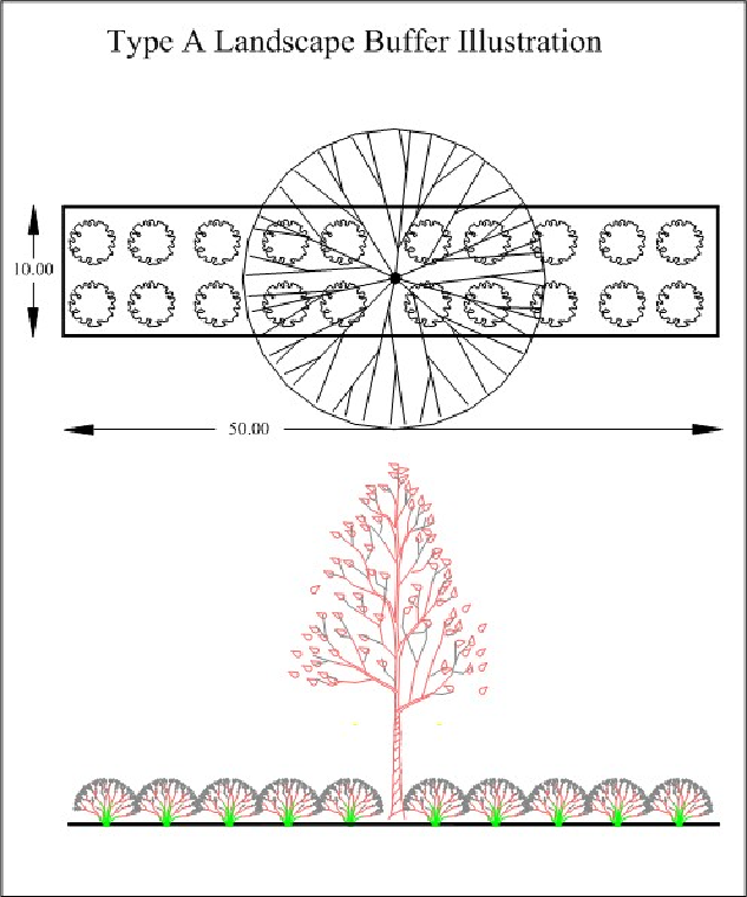
Type A
A "Type A" landscape buffer has a minimum width of 10 feet, with a minimum of 1 tree
and 20 shrubs per 50 linear feet of buffer.
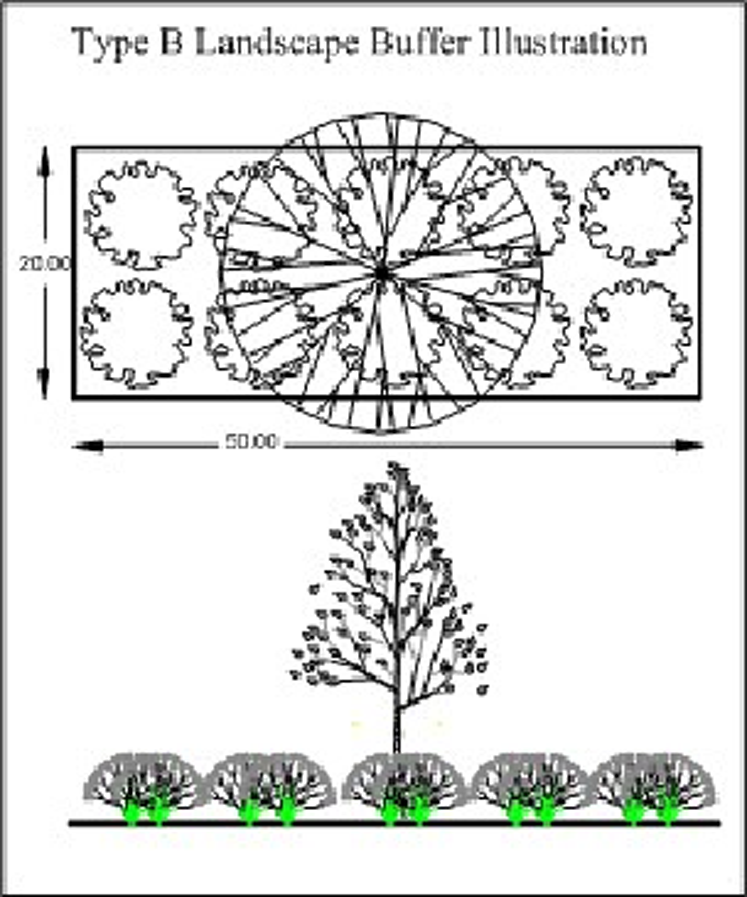
b.
Type B
A "Type B" landscape buffer has a minimum width of 20 feet. It requires a minimum
of 1 tree and 10 shrubs per 50 linear feet of buffer.
3.
Use of Landscape Buffers
Required landscape buffers may be used solely for open space and landscaping. No proposed
building addition, parking area or any other type of physical land improvement, (other
than walls, walkways or other landscape features) may be located in a required landscape
buffers.
4.
Waiver for Small Sites
The area of required Residential Protection Buffers shall not be required to exceed
10 percent of the site area or 10 percent of the width of the site.
5.
Trees and Shrubs
Deciduous trees planted to satisfy the standards of this section must have a minimum
size of 2-inch caliper. Evergreen trees must have a minimum height of 5 feet. Shrubs
must be at least 1 gallon size.
F.
Operating Hours
The following operating hour restrictions apply to all development that is subject
to Residential Protection Standards.
1.
Collection of Garbage and Recyclables
No use subject to Residential Protection Standards may be served by garbage or recycling
collection services between the hours of 10:00 p.m. and 6:00 a.m.
2.
Loading Operations
No use subject to Residential Protection Standards may conduct loading or unloading
operations between the hours of 10:00 p.m. and 6:00 a.m.
G.
Lighting
[1]
[6]
All lights used by development that is subject to Residential Protection Standards
must be arranged and controlled so as to deflect light away from any SR-, MR-, or
MHP-zoned property. Any light or combination of lights that cast light on any SR-,
MR-, or MHP-zoned lot may not exceed 0.4 foot-candles (meter reading), as measured
one foot inside the lot line of an SR-, MR-, or MHP-zoned lot.
H.
Odor
[1]
[7]
No use that is subject to Residential Protection Standards may be operated in a manner
that causes odors that are detectable after the air has been diluted with 4 or more
volumes of odor-free air, as measured within the lot lines of an SR-, MR-, or MHP-zoned
lot. No violation of this odor standard will be deemed to have occurred if the person
or business causing the emission of odorous air contaminants is employing the best
available treatment, maintenance, and odor emission control techniques currently available.
I.
Waivers
The City Planner may reduce or waive one or more of the Residential Protection Standards
imposed by this section if they the City Planner finds find that reduction or waiver
is appropriate and will not harm the surrounding area. An application for a reduction
or waiver of one or more of the Residential Protection Standards shall be submitted
in writing in a form established by the City Planner. Prior to issuing a decision
by the City Planner to approve a reduction or waiver of the Residential Protection
Standards, the City Planner shall provide written notice of the City Planner's decision
by first class mail to all owners of the subject property, all property owners within
300 feet of the subject property and all members of the Planning Commission. The notice
of decision shall describe the requested reduction or waiver, the intended decision
of the City Planner and shall inform the recipient that an appeal of the City Planner's
decision may be appealed within 10 days of the date of the City Planner's notice of
decision by filing an appeal with the City Planner.
1.
Appeal of City Planner's Decision
a.
Appeals to Planning Commission; Timing
Appeals from the action of the City Planner on an application for waiver of the residential
protection standards required by Sec. 20-0704 may be taken to the Planning Commission by filing an appeal with the City Planner.
b.
Appeals to Board of City Commissioners; Timing
Appeals from the action of the Planning Commission on an application for waiver of
the residential protection standards required by Sec. 20-0704 may be taken to the City Commission by filing an appeal with the City Planner.
c.
Right to Appeal
The following persons and entities shall have standing to appeal the action of the
City Planner or Planning Commission on an application for waiver of the residential
protection required by Sec. 20-0704:
(1)
The applicant;
(2)
The Planning Commission or any member of the Planning Commission;
(3)
The Board of City Commissioners or any member of the Board of City Commissioners;
(4)
Any person that the Planning Commission or Board of City Commissioners determine to be actually or potentially aggrieved by the appealed action; and
(5)
Any person given the right of appeal by law.
d.
Action on Appeal
The Planning Commission or Board of City Commissioners shall consider the appealed
decision on the request for waiver of residential protection standards required by
Sec. 20-0704 as a new matter. After considering the matter, the Planning Commission or Board of
City Commissioners shall act to approve or deny the original application.
J.
Installation Maintenance and Replacement
All trees and landscaping must be installed according to sound nursery practices in
a manner designed to encourage vigorous growth. All landscaping and buffers required
by this Land Development Code must be healthy and in-place within one (1) year of
the date that the building permit was approved. The Zoning Administrator shall be
authorized to extend this deadline.
1.
Maintenance and Replacement
Trees, shrubs, fences, walls, and other landscape features depicted on plans approved
by the City will be considered as elements of the project in the same manner as parking,
building materials, and other details are elements of the plan. The land owner, or
successors in interest, or agent, if any, will be jointly and severally responsible
for the following:
a.
Regular maintenance of all landscaping in good condition and in a way that presents a healthy, neat, and orderly appearance. All landscaping must be maintained free from disease, pests, weeds, and litter. This maintenance must include weeding, watering, fertilizing, pruning, mowing, edging, mulching or other maintenance, as needed and in accordance with acceptable horticultural practices;
b.
The repair or replacement of required landscape structures (e.g. walls, fences) to a structurally sound condition;
c.
The regular maintenance, repair, or replacement, where necessary, or any landscaping required by this section; and
d.
Continuous maintenance of the site as a whole.
e.
Survival rate levels of less than 90 percent of the original landscaping requirements after expiration of four years from issuance of the building permit shall be corrected upon notification submitted to the owner of the property by the Zoning Administrator. Any person, firm or company, having received such notification from the Zoning Administrator, shall be required to correct survival rate levels of less than 90 percent of the original landscaping requirements by replacing trees, shrubs or other landscaping elements within one year of such notification or in such other manner as approved by the Zoning Administrator.
2.
Notification of Noncompliance
If the Zoning Administrator determined that required landscaping has not been installed
or maintained in compliance with this section, the Zoning Administrator shall notify
the applicant immediately (by mail or personal service to the same person and to the
same address as is designated to receive the real estate tax notice for the property).
The notice shall state:
a.
The work that must be done or the improvement that must be made to comply with the requirements of this Land Development Code;
b.
The amount of time the owner has to commence and complete the required landscape work or improvements; and
c.
That, if the work or improvements are not commenced and completed within the time specified, the work will be performed by the City and the cost thereof will be assessed against the real property described in the notice.
Source: 2985 (1999), 4039 (2000), 4167 (2001), 4386 (2004), 5179 (2018).
[1] For purposes of the residential protection buffers, property zoned AG-Agricultural that is identified as being future residentially-zoned property on any growth plan approved under §20-0905 shall be deemed to be SR-, MR-, or MHP-zoned property.
--- (5) ---
[1] For purposes of the residential protection buffers, property zoned AG-Agricultural that is identified as being future residentially-zoned property on any growth plan approved under §20-0905 shall be deemed to be SR-, MR-, or MHP-zoned property.
--- (6) ---
[1] For purposes of the residential protection buffers, property zoned AG-Agricultural that is identified as being future residentially-zoned property on any growth plan approved under §20-0905 shall be deemed to be SR-, MR-, or MHP-zoned property.
--- (7) ---
[1] For purposes of the residential protection buffers, property zoned AG-Agricultural that is identified as being future residentially-zoned property on any growth plan approved under §20-0905 shall be deemed to be SR-, MR-, or MHP-zoned property.
§20-0705 - Trees and Landscaping
A.
Exemptions
The following are exempt from all of the standards of this section.
1.
Agriculture in the AG district;
2.
Construction, repair or remodeling of single-family or duplex dwelling units; provided, however, that street tree requirements shall be required in SR zoning districts within the City limits;
3.
Development in the DMU district; and
4.
Improvements or repairs to existing development that do not increase the existing floor area by more than 1,000 square feet or 10 percent, whichever is greater, and changes in use that do not require more parking spaces or a more intensive zoning than the previous use.
B.
Street Trees and Ground Cover of Boulevard
The Street Tree and Ground Cover Planting standards of this subsection apply to all
nonexempt development. Review for compliance with these standards shall occur as part
of the Subdivision process, Conditional Use Permit, Site Plan Review or Building Permit
process, whichever occurs first.
1.
Number
a.
Local Streets
At least one (1) street tree is required for every 35 linear feet of local street
frontage unless the City Forester determines that additional space between trees is
necessary to address specific siting or other conditions. All areas of right-of-way
for streets and utilities not covered by concrete, asphalt or such other material
for vehicular, bicycle or pedestrian travel shall be covered by grass, unless otherwise
approved by the Zoning Administrator.
b.
Collector and Arterial Streets
At least one (1) street tree is required for every 50 linear feet of collector and
arterial street frontage unless the City Forester determines that additional space
between trees is necessary to address specific siting or other conditions. All areas
of right-of-way for streets and utilities not covered by concrete, asphalt or such
other material for vehicular, bicycle or pedestrian travel shall be covered by grass,
unless otherwise approved by the Zoning Administrator.
2.
Location
Required street trees shall be installed within the street right-of-way or within
10 feet of the street right-of-way. If street trees are to be located outside of the
right-of-way, the City shall be authorized to require the establishment of a 15-foot
landscape easement. The proposed location of street trees must be shown on the Amenities
Plan that accompanies the subdivision plat.
3.
Spacing
Street trees need not be placed exactly at 35- or 50-foot intervals, but they must
be placed fairly evenly along the street frontage. The City Forester shall have the
authority to determine the final location of street trees, based on site factors such
as the location of utilities and driveways, intersection visibility requirements and
other factors.
4.
Size
Street trees must comply with the following minimum size standards (all sizes to be
measured in accordance with American Standards for Nursery Stock published by the American Association of Nurserymen).
a.
Local Streets
Street trees planted adjacent to local streets must be a minimum size of 1 ½-inch
caliper.
b.
Collector Streets
Street trees planted adjacent to collector streets must be a minimum size of 2-inch
caliper.
c.
Arterial Streets
Street trees planted adjacent to arterial streets must be a minimum size of 3-inch
caliper.
5.
Planting Requirement
Organic mulch (woodchips) shall be installed to a minimum coverage thickness of 2
inches around street tree plantings within a radius of 3 feet of the trunk base.
C.
Open Space Landscaping
1.
Applicability
The Open Space Landscaping standards of this subsection shall apply to any development
that contains three or more attached dwelling units in SR-3, SR-4, or SR-5 zoning
districts and to any development in MR-1 or more intensive zoning districts.
2.
Relationship to Other Landscaping Standards
Landscaping provided to meet the Street Tree or Parking Lot Perimeter Landscaping
standards of this section may not be counted towards meeting a project's Open Space
Landscaping requirements. Open Space Landscaping may be placed within the interior
of off-street parking areas, in which case the landscaping shall be counted toward
meeting the project's Open Space Landscaping requirements.
3.
Plant Units Required
a.
Residential Districts and UMU zoning district
Within residential and institutional zoning districts and a UMU zoning district, at
least three (3) plant units shall be provided for each 1,000 square feet of lot area
or fraction thereof, and eight (8) square feet per plant unit shall be provided.
b.
Commercial and P/I Districts
Within commercial and public/institutional zoning districts (NO, NC, GO, LC, GC, P/I),
at least three (3) plant units shall be provided for each one thousand (1,000) square
feet of lot area or fraction thereof, and eight (8) square feet per plant unit shall
be provided.
c.
Industrial Districts
Within industrial zoning districts (LI and GI), at least one (1) plant unit shall
be provided for each one thousand (1,000) square feet of lot area or fraction thereof,
and eight (8) square feet per plant unit shall be provided.
The following table provides a breakdown of plant unit equivalencies.
Sizes to be measured in accordance with American Standards for Nursery Stock published by the American Association of Nurserymen.
[1] Smaller caliper trees for certain species may be acceptable upon approval of the
Zoning Administrator.
[2] Type 3 cone types ANSI standard including spruce and pine varieties.
[3] Type 6 columnar evergreens including upright junipers and pyramidal arborvitae.
[4] Perennial plant materials shall not exceed twenty percent (20%) of the open space requirement
4.
Location of Plant Units
A minimum of seventy percent (70%) of the plant units required pursuant to this subsection
shall be installed in required front or street side setback areas. In a UMU zoning
district, said seventy percent (70%) requirement shall not apply.
5.
P/I Zoning District Calculation
The City Planner shall have authority to exclude playing fields or ball fields from
the square footage value used to calculate required plant units in P/I zoning districts.
D.
Parking Lot Perimeter Landscaping
1.
Applicability
All off-street parking areas shall be subject to the Parking Lot Perimeter Landscaping
standards of this subsection. The standards do not apply to areas used for storing
vehicles or equipment in conjunction with a vehicle sales or rental establishment.
2.
Relationship to Other Landscaping Standards
Landscaping provided to meet Street Tree or Open Space Landscaping standards shall
not be counted towards meeting the Parking Lot Perimeter Landscaping requirements.
3.
Buffer Standards
Parking lot perimeter buffers shall be located between adjacent street rights-of-way
and off-street parking areas and all vehicular circulation
[3]
areas within the front or street side setback in accordance with the following table:
Notes:
1.
Buffer Width measured from property line
2.
Planting requirements and minimum sizes at installation:
Perennial grass (greater than 2.5 ft tall at maturity), 1 gallon container
Shrub (greater than 2.5 ft tall at maturity), 1 gallon container
Small deciduous tree (less than 30 ft tall at maturity), 1.5-inch caliper
Small evergreen tree (less than 30 ft tall at maturity), 3-4 foot height
Large deciduous tree (greater than 30 ft tall at maturity), 1.5-inch caliper
Large evergreen tree (greater than 30 ft tall at maturity), 5-6 foot height
3.
Vehicular circulation refers to any surfaces intended for motor vehicle use.
4.
Continuous plantings must be spaced so that at maturity, plantings create a continuous row with no spaces or gaps. The plantings shall be spaced between 2 and 4 feet.
4.
Paving setbacks.
For the purpose of providing space for pedestrian and bicycle circulation, and creating
opportunities for planting buffers, parking lots and vehicular circulation areas shall
provide a paving setback in accordance with the following table:
E.
Landscape Quality
Plants installed to satisfy the requirements of this must meet or exceed the plant
quality standards of the most recent edition of American Standard for Nursery Stock, published by the American Association of Nurserymen. Plants must be nursery-grown
and adapted to the local area.
F.
Use of Existing Plant Material
Vegetation and plant material that exists on a site prior to its development may be
used to satisfy the landscaping standards of this section provided that it meets all
size, variety and locational requirements of this section.
G.
Installation Maintenance and Replacement
All trees and landscaping must be installed according to sound nursery practices in
a manner designed to encourage vigorous growth.
1.
Installation of Street Trees
The Forester shall determine the time for installation of Street Trees by a written
order. Required Street Trees within subdivisions must be healthy and in-place within
six (6) months of the order of the Forester. In no event, however, shall Street Trees
required by this section be installed, healthy and in-place later than five (5) years
after approval of the plat.
2.
Installation of other Required Landscaping
All other landscaping and buffers (other than street trees) required by this Land
Development Code must be healthy and in-place within one year of the date that the
building permit was approved.
3.
Maintenance and Replacement
Trees, shrubs, fences, walls and other landscape features depicted on plans approved
by the City will be considered as elements of the project in the same manner as parking,
building materials and other details are elements of the plan. The land owner, or
successors in interest, or agent, if any, will be jointly and severally responsible
for the following:
a.
Regular maintenance of all landscaping in good condition and in a way that presents a healthy, neat, and orderly appearance. All landscaping must be maintained free from disease, pests, weeds and litter. This maintenance must include weeding, watering, fertilizing, pruning, mowing, edging, mulching or other maintenance, as needed and in accordance with acceptable horticultural practices;
b.
The repair or replacement of required landscape structures (e.g. walls, fences) to a structurally sound condition;
c.
The regular maintenance, repair, or replacement, where necessary, of any landscaping required by this section; and
d.
Continuous maintenance of the site as a whole.
e.
Survival rate levels of less than ninety percent (90%) of the original landscaping requirements after expiration of four years from issuance of the building permit shall be corrected upon notification submitted to the owner of the property by the Zoning Administrator. Any person, firm, or company, having received such notification from the Zoning Administrator, shall be required to correct survival rate levels of less than ninety percent (90%) of the original landscaping requirements by replacing trees, shrubs or other landscaping elements within one year of such notification or in such other manner as approved by the Zoning Administrator.
4.
Notification of Noncompliance
If the Zoning Administrator determines that required landscaping has not been installed
or maintained in compliance with this section, the Zoning Administrator shall notify
the applicant immediately (by mail or personal service to the same person and to the
same address as is designated to receive the real estate tax notice for the property).
The notice shall state:
a.
The work that must be done or the improvement that must be made to comply with the requirements of this Land Development Code;
b.
The amount of time the owner has to commence and complete the required landscape work or improvements; and
c.
That, if the work or improvements are not commenced and completed within the time specified, the work will be performed by the City and the cost thereof will be assessed against the real property described in the notice.
Source: 2985 (1999), 4039 (2000), 4167 (2001), 4227 (2002), 4695 (2009), 5016 (2016), 5179 (2018).
§20-0706. - Corner Visibility
Notwithstanding any other provision of this Land Development Code, neither buildings, permanent or portable signs, parking spaces, fences, landscaping nor any other object may be erected, placed, planted, or allowed to grow in such a manner as to impede vision between a height of two (2) feet and eight (8) feet above curb grade within the required corner visibility area of a street intersection or driveway intersection with a street.
At intersections of two streets, the corner visibility triangle for the street with the higher speed limit applies. The size of the triangle may be increased by the Zoning Administrator when deemed necessary for traffic safety alignment or other factors that require increased corner visibility. This Corner Visibility Standard shall not apply within the portion of the DMU district where development follows the zero lot line dimensional standard. A "portable sign", as defined in the Fargo Sign Code, that is located within a parking space on an all-weather-surface parking lot that is striped for parking shall be permitted even though such sign may be within said corner visibility area. For purposes of this section, that "distance measured from curb" at an intersection of two streets or roads shall be determined from a point where the extension of the curb from the two streets or roads meet and, at an intersection of a street or road and a driveway, the distance shall be measured from the point of the curb cut for the driveway.
Source: 4167 (2001), 4439 (2004), 4697 (2009).

